WO2006077688A1 - インクジェット用白インク組成物、画像形成方法及びインクジェット記録装置 - Google Patents
インクジェット用白インク組成物、画像形成方法及びインクジェット記録装置 Download PDFInfo
- Publication number
- WO2006077688A1 WO2006077688A1 PCT/JP2005/021407 JP2005021407W WO2006077688A1 WO 2006077688 A1 WO2006077688 A1 WO 2006077688A1 JP 2005021407 W JP2005021407 W JP 2005021407W WO 2006077688 A1 WO2006077688 A1 WO 2006077688A1
- Authority
- WO
- WIPO (PCT)
- Prior art keywords
- ink composition
- group
- white ink
- compound
- ink
- Prior art date
- Legal status (The legal status is an assumption and is not a legal conclusion. Google has not performed a legal analysis and makes no representation as to the accuracy of the status listed.)
- Ceased
Links
Classifications
-
- C—CHEMISTRY; METALLURGY
- C09—DYES; PAINTS; POLISHES; NATURAL RESINS; ADHESIVES; COMPOSITIONS NOT OTHERWISE PROVIDED FOR; APPLICATIONS OF MATERIALS NOT OTHERWISE PROVIDED FOR
- C09D—COATING COMPOSITIONS, e.g. PAINTS, VARNISHES OR LACQUERS; FILLING PASTES; CHEMICAL PAINT OR INK REMOVERS; INKS; CORRECTING FLUIDS; WOODSTAINS; PASTES OR SOLIDS FOR COLOURING OR PRINTING; USE OF MATERIALS THEREFOR
- C09D11/00—Inks
- C09D11/02—Printing inks
- C09D11/10—Printing inks based on artificial resins
- C09D11/101—Inks specially adapted for printing processes involving curing by wave energy or particle radiation, e.g. with UV-curing following the printing
Definitions
- the present invention relates to a white ink composition for ink jet (hereinafter also referred to as an ink composition for ink jet and an ink composition), an image forming method using the same, and an ink jet recording apparatus. It has excellent visibility for non-transparent recording media, recording media with low brightness, and metal surfaces, and has excellent ink storage stability and emission stability, as well as high image quality, drying properties, substrate adhesion,
- the present invention relates to a white ink composition for inkjet that exhibits durability and the like, and is particularly excellent in curability, low shrinkage, and safety, and an image forming method and an inkjet recording apparatus using the same.
- Inkjet recording methods are attracting attention as a technology capable of producing images easily and inexpensively, and with high image quality in recent years, enabling high-quality recording that can be sufficiently applied in various printing fields.
- ink-jet ink compositions are generally used for printing systems.
- Low-viscosity ink compositions based on aqueous and non-aqueous solvents are common, and the recording media are ink-absorbing or higher.
- Dedicated paper is required to obtain image quality.
- an ink composition that has no ink absorbability and can be fixed and printed on a recording medium such as a film or metal an ink composition containing a component that is polymerized by ultraviolet irradiation (for example, a patent) And a UV curable ink composition (see, for example, Patent Documents 2 and 3) containing a colorant, a UV curing agent, a photopolymerization initiator, and the like.
- a UV curable ink composition see, for example, Patent Documents 2 and 3 containing a colorant, a UV curing agent, a photopolymerization initiator, and the like.
- the talate system used in conventional UV-curable inks is susceptible to curing inhibition by oxygen during curing, has high skin irritation and sensitization (rash), and has few safe compounds.
- problems such as difficulty in handling such as shrinkage.
- white ink compositions for inkjet include inorganic white pigments, organic solvents, and binding resin.
- White ink composition with a viscosity of 1111? & '3-15111? & ' 3, and titanium oxide, polymerizable compounds, photopolymerization A photocurable ink composition for ink jet recording comprising an agent and aqueous solvent power (for example, see Patent Document 5) has been proposed.
- the photocurable ink composition for inkjet recording described above has a large problem in printability because it uses a polyfunctional acrylate.
- titanium oxide with strong hiding power is used as a white ink pigment for normal printing inks
- titanium oxide has a higher specific gravity than organic pigments, so that it can remain static for a long time. If the ink is placed, the pigment will settle out, and compared to the paint with a high viscosity, the ink jet ink with a low viscosity will cause a settling problem.
- the inkjet recording method requires higher definition recording and the nozzle diameter is also narrower. Therefore, when the dispersed particle diameter is large or the dispersion is unstable, the nozzle tip There are problems such as clogging at the edges and deterioration of the emission characteristics, and improvements are required.
- Patent Document 1 Japanese Patent Laid-Open No. 3-216379
- Patent Document 2 U.S. Pat.No. 5,623,001
- Patent Document 3 Japanese Patent Laid-Open No. 8-143806
- Patent Document 4 Japanese Patent Publication No. 2-45663
- Patent Document 5 JP 2000-336295 A
- Patent Document 6 JP 2003-55563 A
- An object of the present invention is to have a good visibility with respect to a transparent recording medium without ink absorbability, a recording medium with low brightness, or a metal surface, and high image quality, drying property, and substrate adhesion.
- a cationic white ink composition for ink jet excellent in dispersion stability, ink storage stability and emission stability, curability, low shrinkage, and safety, image forming method and ink jet recording Is to provide a device.
- An ink jet white ink composition comprising a titanium oxide, an activator, a cationic polymerizable compound and a photopolymerization initiator, wherein the activator is a high molecular weight polyester acid amine salt. Ink composition.
- the acid titanium is anatase acid titanium and rutile acid titanium 2.
- the white ink yarn composition for inkjet according to 1 above, which is at least one selected compound and the active agent is a high molecular weight polyester acid amine amine salt.
- the particle size of the titanium oxide is 50 ⁇ ! 3.
- At least one of the cationically polymerizable compounds is an alicyclic epoxy compound represented by the following general formula (A): White ink thread and composition for inkjet.
- R represents a substituent
- mO represents 0 to 2.
- rO represents 1 to 3.
- L represents an acid in the main chain.
- 100 0 represents an rO + monovalent linking group or single bond having 1 to 15 carbon atoms, which may contain an elemental atom or sulfur atom.
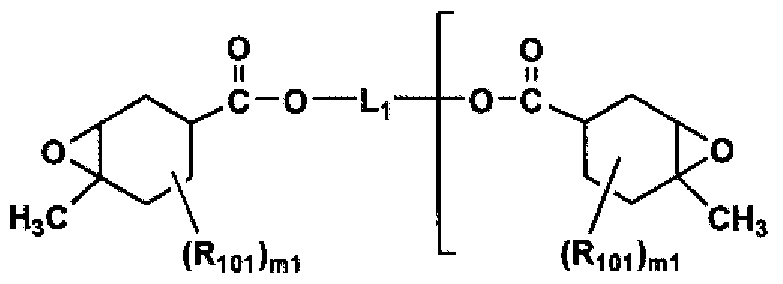
- the alicyclic epoxy compound represented by the general formula (A) is an at least one compound selected from the alicyclic epoxy compounds represented by the following general formulas (I) and (II): 5.
- R represents a substituent
- ml represents 0 to 2.
- rl represents 1 to 3.
- L represents an acid in the main chain.
- 101 1 represents an rl + 1 monovalent linking group or single bond having 1 to 15 carbon atoms, which may contain an elemental atom or sulfur atom.
- R represents a substituent
- m2 represents 0 to 2.
- r2 represents 1 to 3.
- L represents an acid in the main chain.
- An image forming method comprising irradiating actinic rays for 0.001 seconds to 1.0 seconds after the white ink composition is landed.
- An image forming method in which printing is performed on a recording material by ejecting the inkjet white ink composition according to any one of 1 to 9 above onto the recording material from an inkjet recording head comprising: a line head
- An image forming method comprising forming an image by ejecting from a recording head of a type.
- a transparent recording medium without ink absorbability, low brightness, good visibility to the recording medium and the metal surface, and high image quality, drying properties, substrate adhesion, resistance to damage.
- a white ink composition for inkjet that exhibits long-lasting properties, in particular, good dispersion stability, ink storage stability and ejection stability, and excellent curability, low shrinkage, and safety, and uses the ink composition
- An image forming method and an ink jet recording apparatus could be provided together.
- FIG. 1 is a front view showing an example of a configuration of a main part of an ink jet recording apparatus of the present invention.
- FIG. 2 is a top view showing another example of the configuration of the main part of the ink jet recording apparatus of the present invention.
- anatase type There are three crystal forms of acid-titanium, anatase type, rutile type, and brookite type, and general-purpose ones can be broadly classified into anatase type and rutile type.
- the anatase type has a small specific gravity and a small particle size, while the rutile type has a high refractive index and high concealment.
- any of them may be used, but it is preferable to make a selection according to the application by taking advantage of each feature.
- the specific gravity is small and the particle size can be easily reduced.
- anatase type the dispersion stability, ink storage stability, and emission properties are improved.
- the combined use of anatase type, which can be used in two or more different crystal forms, and rutile type, which has high tinting strength, can reduce the amount of titanium oxide added, and can improve the storability and ejection properties of the ink. Will be better.
- a surface treatment method of titanium oxide an aqueous treatment, a gas phase treatment, or the like is performed.
- a surface treatment agent alumina or silica treatment is generally used.
- Lumina 'silica-treated one The average particle diameter of titanium oxide is 50 ⁇ from the viewpoint of providing sufficient concealment and improving ink storage stability and light emission. It is preferably ⁇ 500 nm, more preferably 100 nm to 300 nm.
- the dispersibility of titanium oxide in the ink composition is improved, so that mixing at the time of ink preparation and storage stability of the ink after preparation are performed.
- the use of a high molecular weight copolymer or a high molecular weight polyester acid amide amine salt improves the dispersion stability, ink storage stability, and emission properties.
- a commercial item can be used for high molecular weight polyester acid amide amine salt.
- the addition amount of the activator is 1 to 30% by mass, more preferably 5 to 20% by mass with respect to titanium oxide.
- the photopolymerizable compound contains an alicyclic epoxy compound represented by the general formula (A).
- R represents a substituent
- mO represents 0-2.
- rO 1-3 To express. L may contain an oxygen atom or a sulfur atom in the main chain rO + 1 with 1 to 15 carbon atoms
- the alicyclic epoxy compound represented by the general formula (A) is the general formula (I) or
- the alicyclic epoxy compound represented by (II) is preferred.
- R represents a substituent
- ml represents 0-2.
- rl represents 1-3
- the L may contain an oxygen atom or a sulfur atom in the main chain.
- R 1 represents a substituent
- m 2 represents 0-2.
- r2 represents 1-3
- the L is an r2 + l valence having 1 to 15 carbon atoms which may contain oxygen or sulfur atoms in the main chain
- R 1, R 2 and R 3 represent a substituent.
- Examples include halogen atoms (eg, chlorine atoms, bromine atoms, fluorine atoms, iodine atoms, etc.), alkyl groups having 1 to 6 carbon atoms (eg, methyl group, ethyl group, propyl group, isopropyl group, butyl group).
- halogen atoms eg, chlorine atoms, bromine atoms, fluorine atoms, iodine atoms, etc.
- alkyl groups having 1 to 6 carbon atoms eg, methyl group, ethyl group, propyl group, isopropyl group, butyl group.
- Pentyl group, hexyl group, etc. alkoxy group having 1 to 6 carbon atoms (for example, methoxy group, ethoxy group, n-propoxy group, isopropoxy group, n-butoxy group, tert-butoxy group, etc.), An acyl group (for example, acetyl group, propiool group, trifluoroacetyl group, etc.), an acyloxy group (for example, acetoxy group, propio-loxy group, trifluoroacetoxy group, etc.), an alkoxycarbo group group (for example, methoxy group) Carbonyl group
- Ethoxycarbonyl group tert-butoxycarbonyl group, etc.
- Preferable substituents are an alkyl group, an alkoxy group, and an alkoxycarbo group.
- m0, ml, m2 represents 0 to 2, and 0 or 1 is preferable.
- L is an rO + monovalent carbon atom having 1 to 15 carbon atoms which may contain an oxygen atom or a sulfur atom in the main chain.
- L is a carbon which may contain an oxygen atom or a sulfur atom in the main chain
- Prime number 1-15 rl + monovalent linking group or single bond, L is oxygen atom or sulfur in the main chain
- Examples of the divalent linking group having 1 to 15 carbon atoms that may contain an oxygen atom or a sulfur atom in the main chain include the following groups and these groups and the O group, S group, CO group, and CS group: The group which can be combined together can be mentioned.
- 1,2-ethylene group one CH CH one,
- 1,2-propylene group 1 CH (CH 2) 2 CH—,
- 1,3-propanedinole group one CH CH CH—.
- Oxydiethylene group one CH CH OCH CH one,
- Thiojetylene group One CH CH SCH CH One
- 3-Oxothiojetylene group One CH CH SOCH CH One,
- 3,3-Dioxothiojetylene group One CH CH SO CH CH —,
- 1,3-cyclopentadyl group -1,3-CH
- 1,2-cyclohexanediyl group — 1, 2 -CH-
- 1,3-cyclohexanediyl group — 1, 3 -CH-
- 1,4-cyclohexanediyl group — 1, 4 -CH-
- 2,5-tetrahydrofuranyl group 2, 5- -C H 0- p phenylene group: p- CH-,
- Phenylene group m—CH—
- Furan 2,5 diyl bismethylene group 2,5-CH 2 -CH 2 O-CH-,
- the trivalent or higher linking group includes a group formed by removing as many hydrogen atoms as desired from the divalent linking group listed above as necessary, and a plurality of these groups together with an O group, an S group, a CO group, and a CS group.
- the group which can be combined can be mentioned.
- L, L, and L may have a substituent.
- substituents include halogen atoms (for example,
- a chlorine atom, a bromine atom, a fluorine atom, an iodine atom, etc. an alkyl group having 1 to 6 carbon atoms (for example, a methyl group, an ethyl group, a propyl group, an isopropyl group, a butyl group, a pentyl group, a hexyl group, etc.
- An alkoxy group having 1 to 6 carbon atoms for example, methoxy group, ethoxy group, n-propoxy group, isopropoxy group, n-butoxy group, tert butoxy group, etc.
- acyl group for example, acetyl group, propionyl group, trifluoroacetyl group, etc.
- acyloxy group for example, acetoxy group, propionyloxy group, trifluoroacetoxy group, etc.
- alkoxy carbonyl group for example, methoxycarbol group
- Preferred as a substituent are an alkyl group, an alkoxy group, and an alkoxy carbo group.
- L, L and L have 1 to 8 carbon atoms which may contain an oxygen atom or a sulfur atom in the main chain.
- a divalent linking group having 1 to 5 carbon atoms in which the main chain preferred by the divalent linking group is only carbon is more preferred.
- the molecular weight of the alicyclic epoxy compound used in the present invention is preferably in the range of 170 to 2000 from the viewpoint of easily adjusting the viscosity during ink preparation.
- the addition amount of the alicyclic epoxy compound according to the present invention is such that the curability is stable even when the curing environment (temperature, humidity) varies, and the film physical properties after curing are good. From the viewpoint of, for example, it is preferable to contain 10% by mass to 80% by mass with respect to the total mass of the ink-jet white ink composition (also simply referred to as ink) of the present invention.
- one type of alicyclic epoxy compound may be used alone, or two or more types may be used in appropriate combination.
- the alicyclic epoxy compound according to the present invention may be produced by any method! /, For example, Maruzen KK Publishing, 4th edition Experimental Chemistry Course 20 Organic Synthesis II, 213-, Heisei 4 years, Ed. By Alfr ea Hasfner, The chemistry oi Heterocyclic compounds—small Ring Heterocycles part 3 Oxiranes, John & Wiley and Sons, An Inter science Publication, New York, 1985, Yoshimura, Adhesion, 29 ⁇ 12, 32, 198 5, Yoshimura, Adhesion, 30-5, 42, 1986, Yoshimura, Adhesion, 30-7, 42, 1986, JP-A-11-100378, Patent 2906275, Patent 2926262, etc. Can be synthesized with reference to.
- the white ink composition for inkjet according to the present invention can be combined with the novel alicyclic epoxy compound represented by the general formula (A) described above and other oxysilane group-containing compounds. You may use together.
- the oxysilane group-containing compound used in the present invention is usually an epoxy resin. Any of the monomers, oligomers or polymers used can be used. Specifically, aromatic epoxides, alicyclic epoxides and aliphatic epoxides known in the art (including commercially available products, compounds described in literatures, etc.) can be mentioned. Hereinafter, epoxide means a monomer or an oligomer thereof. These compounds may be used alone or in combination of two or more as required.
- a preferable aromatic epoxide is a di- or polyglycidyl produced by reacting a polyhydric phenol having at least one aromatic nucleus or an alkylene oxide adduct thereof with epichlorohydrin.
- Ethers such as di- or polyglycidyl ethers of bisphenol A or its alkylene oxide adducts, di- or polyglycidyl ethers of hydrogenated bisphenol A or its alkylene oxide adducts, and novolak type Examples include epoxy resin.
- examples of the alkylene oxide include ethylene oxide and propylene oxide.
- a compound having at least one cycloalkane ring such as cyclohexene or cyclopentene ring can be obtained by epoxy polymerization with an appropriate oxidizing agent such as hydrogen peroxide or peracid.
- an appropriate oxidizing agent such as hydrogen peroxide or peracid.
- preferred compounds containing cyclohexene oxide or cyclopentene oxide include, for example, Daicel Chemical Industries, Celoxide 2021, Celoxide 2021A, Celoxide 2021P, Celoxide 2080, Sepoxide, 2000, Evry GT301, Evry GT302, Epochi GT401, Jeho. Lead GT403, EHPE-3150, EHPEL3150CE, manufactured by Union Carbide, UVR-6105, UVR-6110, UVR-6128, UVR-6100, UVR-6216, UVR-6000, and the like.
- Preferable aliphatic epoxides include aliphatic polyhydric alcohols or di- or polyglycidyl ethers of their alkylene oxide adducts, and typical examples thereof include diglycidyl ethers of ethylene glycol.
- Polyglycerides such as diglycidyl ethers of propylene glycol or diglycidyl ethers of alkylene glycols such as diglycidyl ether of 1,6-hexanediol, di- or triglycidyl ethers of diglycidyl ether of glycerin or its alkylene oxide
- diglycidyl in glycidyl ether polyethylene glycol or its alkylene oxide case
- Examples thereof include diglycidyl ethers of polyalkylene glycols such as ethers, polypropylene glycols, or diglycidyl ethers of alkylene oxide-attached bodies.
- examples of the alkylene oxide include ethylene oxide and propylene oxide.
- monoglycidyl ethers of higher aliphatic alcohols and phenols can also be used.
- aromatic epoxides and alicyclic epoxides are preferred in view of fast curing, and alicyclic epoxides are particularly preferred.
- the epoxy compound having an oxysilane group is particularly preferably at least one of epoxy fatty acid ester and epoxy fatty acid dalyceride.
- Epoxy fatty acid ester and the epoxy fatty acid glyceride are not particularly limited as long as an epoxy group is introduced into a fatty acid ester or a fatty acid dalyceride.
- Epoxy ⁇ fatty acid ester is produced by epoxidizing oleate, and methyl epoxy stearate, epoxy stearate, octyl epoxy stearate, etc. are used.
- Epoxidized fatty acid dalyceride is also produced by epoxidizing soybean oil, flaxseed oil, castor oil, etc., and epoxidized soybean oil, epoxidized flaxseed oil, epoxidized castor oil, etc. Used.
- the photopolymerizable compound in addition to the epoxy compound, a known photopolymerizable compound can be used in combination. .
- Oxetane compound also referred to as a compound having an oxetane ring
- a compound having at least one oxetane ring may be used in combination as a photopolymerizable compound.
- the compound having an oxetane ring used in the present invention is preferably a compound having 1 to 4 oxetane rings. Moreover, a commercial item can be used for the oxetane compound according to the present invention.
- the compound having an oxetane ring is contained in an amount of 30% to 95% by mass, preferably 50% to 80% by mass, based on the total composition. .
- the white ink composition for inkjet of the present invention does not exclude the combined use of a known photopolymerizable compound together with the photopolymerizable compound according to the present invention.
- Styrene derivatives, (2) vinyl naphthalene derivatives, (3) vinyl ethers, (4) N vinyl compounds, and the like can also be used.
- styrene ⁇ -methylol styrene, ⁇ -methoxy styrene, 13-methylol styrene, p-methylolene ⁇ -methyl styrene, ⁇ -methylol styrene, ⁇ -methoxy 13-methyl styrene, etc.
- 1-Burnaphthalene ⁇ -Methyl 1-Burnaphthalene, ⁇ -Methyl-1-vinylnaphthalene, 4-Methyl-1-vinylnaphthalene, 4-Methoxy-1-vinylnaphthalene, etc.
- Bull ethers such as ethylene glycol Butyl ether, polyethylene glycol divininole ether, triethylene glycol divininole ether, propylene glycol divininole ether, dipropylene glycol divininole ether, butane diol divinyl ether, hexanediol divinyl ether, cyclohexane dimethanol divinyl ether, tri di- or Application Benefits Bulle ether compounds such as trimethylolpropane trivinyl ether, Echirubi - ether, eta - Buchirubi - ether, iso Buchirubi - ether, Okutadeshirubi - Rue Ter, cyclohexyl vinyl etherate, hydroxybutinorevininore etherenole, 2-ethenorehexino levinenoateol, cyclohexanedimethanol monovinyl ether, ⁇ -propyl vinyl ether, is
- vinyl ether compounds di- or tribyl ether compounds are preferred in view of curability, adhesion, and surface hardness, and in particular dibule ether compounds are preferred! .
- one of the above vinyl ether compounds may be used alone, but two or more may be used in appropriate combination.
- N bull carbazole N bull pyrrolidone, N bull indole, N bull pyrrole, N binino levenothiazine, N- bulacetolide, N vinino lethylacetamide, N bursuccinimide, N bull phthalimide, N bi -Luka Prolatatum, N-Bulimidazole, etc.
- an onium salt also referred to as a photoacid generator
- a photoacid generator that does not generate benzene after irradiation with actinic rays.
- the phrase "does not generate benzene after irradiation with actinic rays" according to the present invention means that benzene is not substantially generated. Specifically, an ohmic salt ( thickness 15 m with the ink a photoacid generator) containing 5 wt%, and printing an image of about 100 m 2, sufficient decomposed amount photoacid generator while maintaining the ink film surface 30 ° C This means that the amount of benzene generated when irradiated with the actinic ray of 5 is less than 5 g or very little.
- onium salt those having a substituent on the benzene ring bonded to S + or 1+ preferred by triarylsulfodium salt or diarylhodonium salt may be used. Meet the condition. From the viewpoint of ejection stability, triarylsulfo salt is more preferred.
- Examples of compounds include the following.
- X— represents PF—.
- gialoleodonium salt examples include Chigoku 'Irgacure 250' manufactured by Specialty Chemicals and CI5102 manufactured by Nippon Soda Co., Ltd.
- a basic compound in combination for further improving the ejection stability. This is particularly effective when an odonium salt (photoacid generator) is used.
- any known compound can be used.
- Representative examples include basic alkali metal compounds, basic alkaline earth metal compounds, basic organic compounds such as amines, and the like. Is mentioned.
- Examples of the basic alkali metal compounds include alkali metal hydroxides (lithium hydroxide, sodium hydroxide, potassium hydroxide, etc.), alkali metal carbonates (lithium carbonate, sodium carbonate, carbonate carbonate). Potassium), alkali metal alcoholates (sodium methoxide, sodium ethoxide, potassium methoxide, potassium ethoxide, etc.).
- Examples of the basic alkaline earth metal compound include alkaline earth metal hydroxides (eg, magnesium hydroxide, calcium hydroxide) and alkali metal carbonates (magnesium carbonate, carbonate carbonate). Calcium), alkali metal alcoholates (magnesium methoxide, etc.) and the like.
- alkaline earth metal hydroxides eg, magnesium hydroxide, calcium hydroxide
- alkali metal carbonates magnesium carbonate, carbonate carbonate.
- Calcium alkali metal alcoholates (magnesium methoxide, etc.) and the like.
- the concentration of the basic compound in the presence of the basic compound is preferably 10 mass ppm to: LOOO mass ppm with respect to the total amount of the photopolymerizable compound, in particular, 20 mass ppm to 500 mass ppm. .
- the basic compounds may be used alone or in combination.
- Various additives other than those described above can be used in the white ink composition for inkjet of the present invention.
- deodorants and fragrances can be added to eliminate the odor peculiar to the material.
- the viscosity at 25 ° C. is 7 mPa ′ S to 50 mPa ′ S because ejection is stable regardless of the curing environment (temperature′humidity). U, preferred for obtaining curability.
- the recording head and ink are heated to 35 ° C to 100 ° C and ejected.
- the ink composition has a large range of viscosity fluctuations due to temperature fluctuations. Viscosity fluctuations directly affect the droplet size and droplet ejection speed, causing image quality degradation. Therefore, it is possible to keep the temperature constant while raising the ink temperature. is necessary .
- the control range of the ink temperature is the set temperature ⁇ 5 ° C, preferably the set temperature ⁇ 2 ° C, more preferably the set temperature 1 ° C.
- the actinic ray is irradiated for 0.001 to 2.0 seconds after the ink landing as the actinic ray irradiation condition, more preferably 0.001 second. ⁇ 1.0 seconds.
- the irradiation timing is as early as possible.
- a basic method of actinic ray irradiation is disclosed in JP-A-60-132767. According to this, a light source is provided on both sides of the head unit, and the head and light source are scanned by the shuttle method. Irradiation is performed after a certain period of time after ink landing. Further, the curing is completed by another light source that is not driven.
- US Pat. No. 6,145,979 as an irradiation method, there is a method in which a collimated light source is applied to a mirror surface provided on the side of the head unit and a recording unit is irradiated with UV light. It is disclosed. Any of these irradiation methods can be used in the image forming method of the present invention.
- irradiation with actinic rays is divided into two stages.
- actinic rays are irradiated by the method described above between 0.001 seconds and 2.0 seconds after ink landing, and after all printing is completed, further actinic rays are emitted.
- the method of irradiating is also a preferred embodiment.
- the actinic rays used in the image forming method of the present invention are various such as an electron beam, an alpha ray, an ultraviolet ray and a visible ray, and in the present invention, an ultraviolet ray is most preferable. Specifically, the actinic ray is used for crosslinking and curing the ink-jet white ink composition of the present invention.
- a high-definition image can be formed even when a light source with an hourly power consumption of 1 kW or less is used, and the shrinkage of the recording material can be kept within a practically acceptable level.
- light sources that consume less than 1 kW per hour include, but are not limited to, fluorescent tubes, cold cathode tubes, and LEDs.
- FIG. 1 is a front view showing a configuration of a main part of the ink jet recording apparatus of the present invention.
- the recording apparatus 1 includes a head carriage 2, a recording head 3, an irradiation unit 4, a platen unit 5, and the like.
- a platen unit 5 is installed under the recording material P.
- the platen section 5 has a function of absorbing ultraviolet rays and absorbs excess ultraviolet rays that have passed through the recording material P. As a result, a high-definition image can be reproduced very stably.
- the recording material P is guided by the guide member 6 and moves from the front side to the back side in FIG. 1 by the operation of the conveying means (not shown).
- Head scanning means (not shown) scans the recording head 3 held by the head carriage 2 by reciprocating the head carriage 2 in the Y direction in FIG. [0089]
- the head carriage 2 is installed on the upper side of the recording material P, and a plurality of recording heads 3 to be described later are arranged in accordance with the number of colors used for image printing on the recording material P, and the discharge ports are arranged on the lower side.
- the head carriage 2 is installed on the main body of the recording apparatus 1 in such a manner that it can reciprocate in the Y direction in FIG. 1, and reciprocates in the Y direction in FIG. 1 by driving the head scanning means.
- the recording head 3 includes a discharge means (not shown) provided with a plurality of actinic ray curable inks (for example, UV curable ink) supplied by an ink supply means (not shown). By operation, the discharge roller is also discharged toward the recording material P.
- the UV ink ejected from the recording head 3 is composed of a coloring material, a polymerizable monomer, an initiator, etc., and the monomer crosslinks when the initiator acts as a catalyst when irradiated with ultraviolet rays. It has the property of being cured by a polymerization reaction.
- the recording head 3 moves from one end of the recording material P to the other end of the recording material P in the Y direction in FIG. UV ink is ejected as ink droplets onto the possible area), and ink droplets are landed on the landable area.
- the irradiation means 4 includes an ultraviolet lamp that emits ultraviolet light in a specific wavelength region with stable exposure energy and a filter that transmits ultraviolet light of a specific wavelength.
- ultraviolet lamps such as strip metal halide lamps, cold cathodes. Tube, mercury lamp or black lamp Is preferred.
- a low-pressure mercury lamp, a cold cathode tube, a hot cathode tube, and a germicidal lamp that emit ultraviolet light having a wavelength of 254 nm are preferable because they can prevent bleeding and efficiently control the dot diameter.
- a black light as the radiation source of the irradiation means 4 for curing the UV ink can be produced at a low cost.
- the irradiating means 4 is the largest one that can be set by the recording apparatus (UV inkjet printer) 1 among the landable areas in which the recording head 3 ejects UV ink by one scan by driving the head scanning means.
- the shape is almost the same or larger than the landable area.
- the irradiation means 4 is installed on both sides of the head carriage 2 so as to be fixed substantially parallel to the recording material P.
- the recording head is determined by the distance hi between the irradiation means 4 and the recording material P. It is effective to increase the distance h2 between the ink ejection part 31 and the recording material P in Fig. 3 (hl ⁇ h2), or to increase the distance d between the recording head 3 and the irradiation means 4 (d is increased). is there. Further, it is more preferable that the space between the recording head 3 and the irradiation means 4 is a bellows structure 7.
- the wavelength of the ultraviolet rays irradiated by the irradiation means 4 can be appropriately changed by replacing the ultraviolet lamp or filter provided in the irradiation means 4.
- the white ink composition for inkjet according to the present invention has very excellent ejection stability and is particularly effective when an image is formed using a line head type recording apparatus.
- FIG. 2 is a top view showing another example of the configuration of the main part of the ink jet recording apparatus.
- the ink jet recording apparatus shown in FIG. 2 is called a line head system, and a plurality of ink jet recording heads 3 are fixedly arranged on the head carriage 2 so as to cover the entire width of the recording material P. ing.
- the entire width of the recording material P is also covered so that 210 ⁇ ! Light emitting diode power with maximum illuminance at ⁇ 280nm Irradiation light source 8, for example, 4 in the scanning direction and 10 in the sub-scanning direction as shown in Fig. 2 are arranged to cover the entire ink printing surface
- the irradiation means 4 is provided.
- Dispersion compositions shown below were blended by pressurization and then kneaded with a roll mill, and acid titanium dispersions 1 to 4 were obtained.
- Anatase-type titanium oxide (average particle size 0.1 m, refractive index 2.52) 50.0 mass%
- Anatase type titanium oxide (average particle size 0.15 ⁇ m, refractive index 2.52) 50.0 mass% Fatty acid-based activator: Disparon 2150 (manufactured by Enomoto Kasei) 4.0 mass% Oxetane compound (Aronoxetane OXT— 221: Toagosei Chemical Co., Ltd.)
- Anatase type titanium oxide (average particle size 0.15 ⁇ m, refractive index 2.52) 50.0 mass%
- High molecular weight polyester amide amine salt: DA-7300 (manufactured by Enomoto Kasei) 4.0 mass%
- Oxetane compound Alonoxetane OXT—221: Toagosei Co., Ltd.
- Rutile titanium oxide (average particle size 0. 15 m, refractive index 2.71) 50.0 mass 0/0 fatty acid-based active agent: Disparlon 2150 (Kusumoto Chemicals, Ltd.) 4.0 wt% Okisetani ⁇ product (Aronokisetan OXT — 221: Toagosei Chemical Co., Ltd.)
- Rutile titanium oxide (average particle size 0. 15 m, refractive index 2.71) 50.0 mass 0/0 Polyester-based activator: KS873N (manufactured by Enomoto Isei) 4.0 quality]
- Oxetane compound (Aronoxetane OXT-221: manufactured by Toagosei Co., Ltd.)
- Titanium oxide dispersion 1 30.0 mass% Alicyclic epoxy compound (EP— 1) 17.8 mass c Oxetane compound (Alonoxetane OXT— 221: manufactured by Toagosei Co., Ltd.)
- Oxetane compound (Aronoxetane OXT-101: Toagosei Co., Ltd.)
- Titanium oxide dispersion 2 30.0 mass% Alicyclic epoxy compound (EP 17.8 mass 0 / Oxetane compound (Alonoxetane OXT—221: Toagosei Co., Ltd.) 34. 2% by mass Oxetane compound (Alonoxetane OXT-212: manufactured by Toagosei Co., Ltd.)
- Oxetane compound (Alonoxetane OXT-101: Toagosei Co., Ltd.)
- Oxetane compound (Alonoxetane OXT-101: Toagosei Co., Ltd.)
- Titanium oxide dispersion 4 20 0% by mass Alicyclic epoxy compound (EP—1) 17.8 mass 0 / Oxetane compound (Alonoxetane OXT—221: manufactured by Toagosei Co., Ltd.) Oxetane compound (Aronoxetane OXT— 212: Toagosei Chemical Co., Ltd.) 9. 0% by mass Oxetane compound (Aronoxetane OXT-101: Toagosei Co., Ltd.)
- Titanium oxide dispersion 2 20 20.
- Titanium oxide dispersion 4 5.
- Alicyclic epoxy compound (EP—1) 17.8% by weight 0 / oxetane compound (Alonoxetane OXT—221: Toagosei Co., Ltd. Made)
- Oxetane compound (Alonoxetane OXT-101: Toagosei Co., Ltd.)
- Oxetane compound (Alonoxetane OXT-212: Toagosei Co., Ltd.)
- Oxetane compound (Aronoxetane OXT-101: Toagosei Co., Ltd.)
- TAS-A Photopolymerization initiator 5.0% by weight Basic compound (triisopropanolamine) 0.1% by weight Surfactant (KF351: manufactured by Shin-Etsu Silicone) 0.8% by weight Fragrance ( (Rinaruru: manufactured by Takasago Inc.) 0.1 mass%
- TAS-A Photopolymerization initiator 5.0% by weight Basic compound (triisopropanolamine) 0.1% by weight Surfactant (KF351: manufactured by Shin-Etsu Silicone) 0.8% by weight Fragrance ( (Rinaruru: manufactured by Takasago Inc.) 0.1 mass%
- the ink composition was allowed to stand at 25 ° C. for 7 days, and then the sedimentation state was evaluated.
- the average particle size of dispersed particles in the ink composition was measured by a dynamic scattering method using a Zetasizer nano from Malvern.
- the above ink composition is loaded into an ink jet recording apparatus having a piezo-type ink jet nozzle and having the constitutional power shown in FIG. 1, and image recording is continuously performed on a long polyethylene terephthalate recording material having a length of 600 mm and a length of 500 m.
- the following clogging and discharge stability were evaluated.
- the ink supply system was an ink tank, supply pipe, front chamber ink tank just before the head, piping with a filter, and piezo head force. Heating was performed from the front chamber tank to the head part at 50 ° C.
- the piezo head was driven to discharge 2 to 20pl multi-size dots at a resolution of 7 20 X 720dpi (dpi is the number of dots per 2.54cm) and continuously discharged.
- the dpi referred to in the present invention represents 2.5 dots per 54 cm.
- Inkjet images were formed in an environment of 25 degrees and 30% RH according to the above method.
- Bidirectional printing was performed at a carriage speed of 400 mmZs using the inkjet recording apparatus. Continuous discharge was performed from the right end of the recording material to 500 mm (100 mm from the left end). After feeding the recording material head width, when the carriage returned again, continuous discharge was performed from 100 mm from the left end of the recording material. The carriage was turned over after passing 500 mm from the right end of the recording material, and the time required to pass 100 mm from the left end of the recording material was set to 4 seconds. The overlap between the print end of the carriage and the beginning of the return print was visually observed, the variation in speed during intermittent ejection was evaluated, and the ejection stability was evaluated according to the following criteria.
- Table 1 shows the evaluation results obtained as described above.
Landscapes
- Chemical & Material Sciences (AREA)
- Life Sciences & Earth Sciences (AREA)
- Engineering & Computer Science (AREA)
- Materials Engineering (AREA)
- Wood Science & Technology (AREA)
- Organic Chemistry (AREA)
- Inks, Pencil-Leads, Or Crayons (AREA)
- Ink Jet Recording Methods And Recording Media Thereof (AREA)
Abstract
本発明は、インク吸収性のない透明な記録媒体や明度が低い記録媒体や金属表面に対して良好な視認性を有し、かつ高い画像品質や乾燥性、基材接着性、耐久性等を示し、特に分散安定性、インク保存性および出射安定性が良好で硬化性および低収縮性、安全性に優れたカチオン系のインクジェット用白インク組成物、画像形成方法およびインクジェット記録装置を提供する。
Description
明 細 書
インクジェット用白インク組成物、画像形成方法及びインクジェット記録装 置
技術分野
[0001] 本発明はインクジェット用白インク組成物(以下、インクジェット用インク組成物、イン ク組成物ともいう)、それを用いた画像形成方法およびインクジェット記録装置に関し 、より詳しくは、インク吸収性のない透明な記録媒体や明度が低い記録媒体や金属 表面に対して良好な視認性を有し、かつインク保存性、出射安定性に優れ、また高 い画像品質や乾燥性、基材接着性、耐久性等を示し、特に硬化性および低収縮性 、安全性に優れたインクジェット用白インク組成物と、それを用いた画像形成方法お よびインクジェット記録装置に関する。
背景技術
[0002] インクジェット記録方式は簡便、安価に画像を作成でき、また近年の画質の向上に 伴 、、各種印刷分野でも充分に対応できる高画質記録が可能な技術として注目を浴 びている。し力し通常のインクジェット用インク組成物は印字方式力 水系溶媒や非 水系溶媒を主成分とした低粘度のインク組成物が一般的で、記録媒体としてはインク 吸収性のあるものや、さらに高画質を得るためには専用紙が必要となる。
[0003] これに対しインク吸収性のな!、フィルムや金属などの記録媒体に固着し印字できる インク組成物としては、紫外線照射により高分子化する成分を含んでなるインク組成 物 (例えば、特許文献 1参照。)や、色剤、紫外線硬化剤、光重合開始剤等を含んで なる紫外線硬化型インク組成物 (例えば、特許文献 2及び 3参照。)が提案されている 。しかし、従来紫外線硬化型インクに用いられているアタリレート系は、硬化時に酸素 による硬化阻害をうけやすい、皮膚刺激性や感作性 (かぶれ)が高く安全な化合物が 少ない、硬化時の収縮率が高ぐ特に軟包装で使われる薄膜基材や、粘着ラベルな どに用いた場合、収縮が起こりやすい、など取り扱いが難しい等の問題点があった。
[0004] また、通常のインクジェット用のインクはほとんどが白色系の記録媒体への印字を対 象とした透明性の高いインクで、透明な基材ゃ明度の低い基材に印字した場合、コ
ントラストが得られず、鮮明なカラー発色性が得られなかったり、視認性のある表示が 難しくなる。視認性が悪い場合、隠蔽性の高い白インクを用いて視認性を得る手法が 知られており、インクジェット用の白色インク組成物としては、無機白色顔料、有機溶 剤、結着用榭脂などカもなり5で〜40でにぉける粘度が1111?& ' 3〜15111?& ' 3の白 色インク組成物(例えば、特許文献 4参照。)や、酸化チタン、重合性化合物、光重合 開始剤と水性溶媒力 なる光硬化型インクジェット記録用インク組成物(例えば、特 許文献 5参照。)等が提案されている。
[0005] しかし、これらのインク組成物は溶媒を含むため、常温では低粘度で、その結果ィ ンク吸収性のない記録媒体では着弾時にドットが広がったり、溶媒残留分を除くため に加熱乾燥が必要となり、熱収縮性のある基材などへの印字には適さない。
[0006] 特に、上記の光硬化型インクジェット記録用インク組成物では、多官能アタリレート 系を用いているため、印字適性に大きな問題があった。
[0007] また、通常印刷インクの白インクの顔料として、隠蔽力の強い酸ィ匕チタンが用いられ ることは公知であるが、酸化チタンは有機顔料に比べ、比重が重いため、長期間静 置されると顔料が沈降しやすぐ高粘度の塗料に比較して、低粘度のインクジェットィ ンクでは特に沈降しやすぐ大きな問題となってしまう。
[0008] カチオン系の硬化型組成物の界面活性剤として、高分子量ポリエステル酸アマイド アミン塩を用いている(例えば、特許文献 6参照。)例があるが、着色剤としては比重 の低い有機顔料を用いたものであって、酸化チタン等、比重の重い無機顔料につい ては記載がない。
[0009] また、近年はインクジェット記録方式にぉ 、て、より高精細な記録が求められノズル 径も細くなつているため、分散粒径が大き力つたり、分散が不安定な場合、ノズル先 端における目詰まりが発生したり出射性が劣化してしまう等の問題点があり、改善が 求められている。
特許文献 1:特開平 3— 216379号公報
特許文献 2 :米国特許第 5, 623, 001号明細書
特許文献 3:特開平 8— 143806号公報
特許文献 4:特公平 2— 45663号公報
特許文献 5:特開 2000— 336295号公報
特許文献 6:特開 2003 - 55563号公報
発明の開示
発明が解決しょうとする課題
[0010] 本発明の目的は、インク吸収性のない透明な記録媒体や明度が低い記録媒体や 金属表面に対して良好な視認性を有し、かつ高い画像品質や乾燥性、基材接着性 、耐久性等を示し、特に分散安定性、インク保存性および出射安定性が良好で硬化 性および低収縮性、安全性に優れたカチオン系のインクジェット用白インク組成物、 画像形成方法およびインクジェット記録装置を提供することである。
課題を解決するための手段
[0011] 本発明の上記目的は、下記構成により達成された。
1.酸化チタン、活性剤、カチオン重合性化合物及び光重合開始剤を含有するインク ジェット用白インク組成物において、該活性剤が高分子量ポリエステル酸アマイドアミ ン塩であることを特徴とするインクジェット用白インク組成物。
2.酸化チタン、活性剤、カチオン重合性化合物及び光重合開始剤を含有するインク ジェット用白インク組成物において、該酸ィ匕チタンがアナターゼ型酸ィ匕チタン及びル チル型酸ィ匕チタン力 選ばれる少なくとも 1種以上の化合物であり、該活性剤が高分 子量ポリエステル酸ァマイドアミン塩であることを特徴とする前記 1に記載のインクジェ ット用白インク糸且成物。
3.前記酸ィ匕チタンの粒径が 50ηπ!〜 500nmであることを特徴とする前記 1又は 2に 記載のインクジェット用白インク組成物。
4.前記カチオン重合性ィ匕合物の少なくとも一種が下記一般式 (A)で表される脂環 式エポキシィ匕合物であることを特徴とする前記 1〜3の何れか 1項に記載のインクジェ ット用白インク糸且成物。
[0012] [化 1]
—般式 (A)

[0013] (式中、 R は置換基を表し、 mOは 0〜2を表す。 rOは 1〜3を表す。 Lは主鎖に酸
100 0 素原子または硫黄原子を含んでも良い炭素数 1〜15の rO+ 1価の連結基または単 結合を表す。 )
5.前記一般式 (A)で表される脂環式エポキシィ匕合物が、下記一般式 (I)及び (II)で 表される脂環式エポキシィ匕合物力 選ばれる少なくとも 1種の化合物であることを特 徴とする前記 1〜4の何れか 1項に記載のインクジェット用白インク組成物。
[0014] [化 2] 一般式 W

[0015] (式中、 R は置換基を表し、 mlは 0〜2を表す。 rlは 1〜3を表す。 Lは主鎖に酸
101 1 素原子または硫黄原子を含んでも良い炭素数 1〜15の rl + 1価の連結基または単 結合を表す。 )
[0016] [化 3] 一般式 (I)

[0017] (式中、 R は置換基を表し、 m2は 0〜2を表す。 r2は 1〜3を表す。 Lは主鎖に酸
102 2 素原子または硫黄原子を含んでも良い炭素数 1〜15の r2+ l価の連結基または単
結合を表す。 )
6.ォキセタンィ匕合物を含有することを特徴とする前記 1〜5の何れ力 1項に記載のィ ンクジェット用白インク糸且成物。
7.光重合開始剤が、活性光線照射後にベンゼンを発生しないォ-ゥム塩であること を特徴とする前記 1〜6の何れか 1項に記載のインクジェット用白インク組成物。
8.塩基性化合物を含有することを特徴とする前記 1〜7の何れか 1項に記載のインク ジェット用白インク糸且成物。
9. 25°Cにおける粘度が 7mPa' s〜50mPa' sであることを特徴とする前記 1〜8の何 れカ 1項に記載のインクジェット用白インク組成物。
10.インクジェット記録ヘッドより、前記 1〜9の何れ力 1項に記載のインクジェット用白 インク組成物を記録材料上に噴射し、該記録材料上に印刷を行う画像形成方法であ つて、該インクジェット用白インク組成物が着弾した後、 0. 001秒〜 1. 0秒の間に活 性光線を照射することを特徴とする画像形成方法。
11.インクジェット記録ヘッドより、前記 1〜9の何れ力 1項に記載のインクジェット用白 インク組成物を記録材料上に噴射して該記録材料上に印刷を行う画像形成方法で あって、ラインヘッド方式の記録ヘッドより噴射して画像を形成することを特徴とする 画像形成方法。
12.前記 10又は 11に記載の画像形成方法に用いられるインクジヱット記録装置であ つて、前記 1〜9の何れ力 1項に記載のインクジェット用白インク組成物を 35°C〜100 °Cに加熱した後、吐出することを特徴とするインクジェット記録装置。
発明の効果
本発明により、インク吸収性のな 、透明な記録媒体や明度が低 、記録媒体や金属 表面に対して良好な視認性を有し、且つ、高い画像品質や乾燥性、基材接着性、耐 久性等を示し、特に分散安定性、インク保存性および出射安定性が良好で硬化性 および低収縮性、安全性に優れる、インクジェット用白インク組成物を提供し、該イン ク組成物を用いる画像形成方法およびインクジェット記録装置を併せて提供すること が出来た。
図面の簡単な説明
[0019] [図 1]本発明のインクジェット記録装置の要部の構成の一例を示す正面図である。
[図 2]本発明のインクジェット記録装置の要部の構成の他の一例を示す上面図である 符号の説明
[0020] 1 インクジェット記録装置
2 ヘッドキャリッジ
3 インクジェット記録ヘッド
31 インク吐出口
4 照射手段
5 プラテン部
6 ガイド部材
7 蛇腹構造
8 照射光源
P 記録材料
発明を実施するための最良の形態
[0021] 本発明を更に詳しく説明する。
[0022] 《酸化チタン》
先ず、本発明に係る酸ィ匕チタンについて説明する。
[0023] 酸ィ匕チタンには、アナターゼ型、ルチル型およびブルーカイト型の 3つの結晶形態 があるが、汎用なものとしてはアナターゼ型とルチル型に大別できる。アナターゼ型 は比重が小さく小粒径ィ匕しやすぐ一方、ルチル型は屈折率が大きく隠蔽性が高い。
[0024] 本発明においては、いずれを用いても良いが、それぞれの特徴を生かし、用途に 応じて選択することが好ま U、。比重が小さく小粒径化しやす 、アナターゼ型を用い ることで、より分散安定性やインク保存性、出射性が良好になる。また、異なる結晶形 態を 2種以上用いても良ぐアナターゼ型と着色力の高いルチル型を併用することで 、酸ィ匕チタンの添加量を減らすことができ、インクの保存性や出射性が良好になる。
[0025] 酸化チタンの表面処理方法としては、水系処理、気相処理等が行われる力 表面 処理剤としては一般的にアルミナ 'シリカ処理が使用され、未処理、アルミナ処理、ァ
ルミナ 'シリカ処理のものがある。酸ィ匕チタンの平均粒径は、十分な隠蔽性を持たせ、 且つ、インクの保存性や出射性向上の観点から、 50ηπ!〜 500nmであることが好ま しく、より好ましくは 100nm〜300nmである。
[0026] 《活性剤》
本発明に係る酸ィ匕チタンを分散させるための活性剤としては、インク組成物中の酸 化チタンの分散性を良くする事により、インク調製時の混鍊、および調製後のインクの 保存性や出射性を改良するものであり、例えば、ポリエチレングリコールエステルイ匕 合物、ポリエチレングリコールエーテル化合物、ポリオキシエチレンソルビタンエステ ル化合物、ソルビタンアルキルエステルイ匕合物、脂肪族多価カルボン酸化合物、燐 酸エステル化合物、ポリエステル酸のアマイドアミン塩、酸化ポリエチレン系化合物、 脂肪酸アマイドワックス、ポリエーテルエステル酸のアミン塩、高分子量ポリエステル 酸のアマイドアミン塩、高分子共重合物、高分子量ブロック共重合物、不飽和ポリアミ ノアマイドと低分子量酸ポリマーとの塩、分散体に親和性のある基を持った水酸基含 有力ルボン酸ィ匕合物、低分子量不飽和酸性ポリカルボン酸ポリマーとポリシロキサン 共重合体ィ匕合物、低分子量不飽和酸性ポリカルボン酸ポリエステルとポリシロキサン 共重合体化合物、低分子量不飽和ポリカルボン酸ポリマーの部分アミドおよびアル キルアンモ-ゥム塩とポリシ口キ酸共重合体化合物、ポリカルボン酸アルキルアンモ 二ゥム塩化合物、ポリアミノアミドのポリカルボン酸塩ィ匕合物、低分子量不飽和酸性ポ リカルボン酸ポリエステルィ匕合物などが挙げられる。
[0027] これら活性剤のうち、本発明において、特に高分子量共重合体または高分子量ポリ エステル酸アマイドアミン塩を用いることで、分散安定性、インク保存性、出射性がよ り良好になる。尚、高分子量ポリエステル酸アマイドアミン塩は市販品を使用出来る。
[0028] 活性剤の添加量は、酸ィ匕チタンに対して 1質量%〜30質量%、より好ましくは 5質 量%〜20質量%の範囲で用いる。
[0029] 以下、本発明を更に詳細に説明する。
[0030] 本発明のインクジェット用白インク組成物においては、光重合性ィ匕合物として、前記 一般式 (A)で表される脂環式エポキシ化合物を含有することを 1つの特徴とする。
[0031] 前記一般式 (A)にお!/、て、 R は置換基を表し、 mOは 0〜2を表す。 rOは 1〜3を
表す。 Lは主鎖に酸素原子または硫黄原子を含んでも良い炭素数 1〜15の rO+ 1
0
価の連結基または単結合を表す。
[0032] 更に、前記一般式 (A)で表される脂環式エポキシィ匕合物が、前記一般式 (I)または
(II)で表される脂環式エポキシ化合物であることが好ま 、。
[0033] 前記一般式 (I)において、 R は置換基を表し、 mlは 0〜2を表す。 rlは 1〜3を表
101
す。 Lは主鎖に酸素原子または硫黄原子を含んでも良い炭素数 1〜15の rl + 1価
1
の連結基または単結合を表す。
[0034] 前記一般式 (II)において、 R は置換基を表し、 m2は 0〜2を表す。 r2は 1〜3を表
102
す。 Lは主鎖に酸素原子または硫黄原子を含んでも良い炭素数 1〜15の r2+ l価
2
の連結基または単結合を表す。
[0035] 一般式 (A)、 (I)または (II)にお 、て、 R 、 R 、 R 、は置換基を表す、置換基の
100 101 102
例としては、ハロゲン原子 (例えば、塩素原子、臭素原子、フッ素原子、ヨウ素原子等 )、炭素数 1〜6個のアルキル基(例えば、メチル基、ェチル基、プロピル基、イソプロ ピル基、ブチル基、ペンチル基、へキシル基等)、炭素数 1〜6個のアルコキシ基 (例 えば、メトキシ基、エトキシ基、 n—プロポキシ基、 iso プロポキシ基、 n—ブトキシ基 、 tert—ブトキシ基等)、ァシル基 (例えば、ァセチル基、プロピオ-ル基、トリフルォ ロアセチル基等)、ァシルォキシ基 (例えば、ァセトキシ基、プロピオ-ルォキシ基、ト リフルォロアセトキシ基等)、アルコキシカルボ-ル基 (例えば、メトキシカルボニル基
、エトキシカルボニル基、 tert ブトキシカルボニル基等)、等が挙げられる。置換基 として好ましいのは、アルキル基、アルコキシ基、アルコキシカルボ-ル基である。
[0036] m0、 ml、 m2、は 0〜2を表し、 0または 1が好ましい。
[0037] Lは、主鎖に酸素原子または硫黄原子を含んでも良い炭素数 1〜15の rO+ 1価の
0
連結基あるいは単結合を、 Lは、主鎖に酸素原子または硫黄原子を含んでも良い炭
1
素数 1〜15の rl + 1価の連結基あるいは単結合を、 Lは主鎖に酸素原子または硫
2
黄原子を含んでも良い炭素数 1〜15の r2+ l価の連結基あるいは単結合を表す。
[0038] 主鎖に酸素原子または硫黄原子を含んでも良い炭素数 1〜15の 2価の連結基の 例としては以下の基およびこれらの基と O 基、 S 基、 CO 基、 CS 基 を複数組み合わせてできる基を挙げることができる。
メチレン基:一 CH—
2
ェチリデン基: >CHCH 、
3
イソプロピリデン基:〉C (CH )
1, 2-エチレン基:一 CH CH 一、
2 2
1, 2-プロピレン基: 一 CH (CH ) CH―、
3 2
1, 3-プロパンジィノレ基:一 CH CH CH—. 、
2 2 2
2, 2- -ジメチル— 1, 3—プロパンジィル基: - -CH C (CH ) CH 一、
2 3 2 2
2, 2- -ジメトキシ— 1, 3—プロパンジィル基: -CH C (OCH ) CH —、
2 3 2 2
2, 2- -ジメトキシメチルー 1, 3—プロパンジィ 'ル基:— CH C (CH OCH ) CH
1ーメチルー 1, 3—プロパンジィル基:— CH (CH ) CH CH―、
3 2 2
1. 4—ブタンジィル基:— CH CH CH CH —、
2 2 2 2
1. 5—ペンタンジィル基: 一 CH CH CH CH CH —、
2 2 2 2 2
ォキシジエチレン基:一CH CH OCH CH 一、
2 2 2 2
チオジェチレン基:一 CH CH SCH CH 一、
2 2 2 2
3—ォキソチオジェチレン基:一 CH CH SOCH CH 一、
2 2 2 2
3, 3—ジォキソチオジェチレン基:一CH CH SO CH CH —、
2 2 2 2 2
1. 4—ジメチル— 3—ォキサ—1, 5—ペンタンジィル基:— CH (CH ) CH O— C
3 2
H (CH ) CH 一、
3 2
3—ォキソペンタンジィル基:一 CH CH COCH CH 一、
2 2 2 2
1. 5—ジォキソ一 3—ォキサペンタンジィル基:一 COCH OCH CO—、
2 2
4—ォキサ― 1, 7—ヘプタンジィル基:― CH CH CH OCH CH CH —、
2 2 2 2 2 2
3, 6—ジォキサ一 1, 8—オクタンジィル基: 一 CH CH OCH CH OCH CH 一、
2 2 2 2 2 2
1, 4, 7—トリメチルー 3, 6—ジォキサ一 1, 8—オクタンジィル基: 一 CH (CH ) CH
3
0-CH (CH ) CH OCH (CH ) CH 一、
2 3 2 3 2
5, 5—ジメチルー 3, 7—ジォキサ— 1, 9—ノナンジィル基:— CH CH OCH C (C
2 2 2
H ) CH OCH CH 一、
3 2 2 2 2
5, 5—ジメトキシ一 3, 7—ジォキサ一 1, 9—ノナンジィル基: 一 CH CH OCH C (
OCH ) CH OCH CH一、
3 2 2 2 2
5, 5 ジメトキシメチル一 3, 7 ジォキサ一 1, 9 ノナンジィル基: 一 CH CH OC
2 2
H C(CH OCH ) CH OCH CH一、
2 2 3 2 2 2 2
4, 7 ジォキソ— 3, 8 ジォキサ— 1, 10 デカンジィル基:— CH CH O— CO
2 2
CH CH CO -OCH CH一、
2 2 2 2
3, 8 ジォキソ— 4, 7 ジォキサ— 1, 10 デカンジィル基:— CH CH CO— O
2 2
CH CH O-COCH CH一、
1, 3-シクロペンタンジィル基:ー1, 3- -CH一、
5 8
1, 2-シクロへキサンジィル基:— 1, 2 -CH -
6 10
1, 3-シクロへキサンジィル基:— 1, 3 -CH -
6 10
1, 4-シクロへキサンジィル基:— 1, 4 -CH -
6 10
2, 5-テトラヒドロフランジィル基: 2, 5- - C H 0- p フエ二レン基: p— CH—、
6 4
m フエ二レン基: m— CH—、
6 4
α, α —ο キシリレン基: 一o— CH—CH—CH—、
2 6 4 2
α, α m キシリレン基: m— CH—CH—CH—、
2 6 4 2
α, α ρ キシリレン基: p— CH—CH—CH—、
2 6 4 2
フラン一 2, 5 ジィル一ビスメチレン基: 2, 5-CH -CH O-CH―、
2 4 2 2
チォフェン一 2, 5 ジィル一ビスメチレン基: 2, 5-CH -CH S-CH一、
2 4 2 2 イソプロピリデンビス一 p フエ二レン基: 一 p— CH— C(CH) —p— CH—、
6 4 3 2 6 4
3価以上の連結基としては、上記に挙げた 2価の連結基から任意の部位の水素原 子を必要なだけ除いてできる基およびそれらと O 基、 S 基、 CO 基、 CS 基を複数組み合わせてできる基を挙げることができる。
L、 L、 Lは置換基を有して 、ても良!、。置換基の例としては、ハロゲン原子 (例え
0 1 2
ば、塩素原子、臭素原子、フッ素原子、ヨウ素原子等)、炭素数 1〜6個のアルキル基 (例えば、メチル基、ェチル基、プロピル基、イソプロピル基、ブチル基、ペンチル基、 へキシル基等)、炭素数 1〜6個のアルコキシ基 (例えば、メトキシ基、エトキシ基、 n— プロポキシ基、 iso プロポキシ基、 n—ブトキシ基、 tert ブトキシ基等)、ァシル基(
例えば、ァセチル基、プロピオニル基、トリフルォロアセチル基等)、ァシルォキシ基( 例えば、ァセトキシ基、プロピオニルォキシ基、トリフルォロアセトキシ基等)、アルコキ シカルボ-ル基(例えば、メトキシカルボ-ル基、エトキシカルボ-ル基、 tert—ブトキ シカルボニル基等)等が挙げられる。置換基として好ましいのは、アルキル基、アルコ キシ基、アルコキシカルボ-ル基である。
[0041] L、 L、 Lとしては主鎖に酸素原子または硫黄原子を含んでも良い炭素数 1〜8の
0 1 2
2価の連結基が好ましぐ主鎖が炭素のみ力 なる炭素数 1〜5の 2価の連結基がより 好ましい。
[0042] また、本発明に用いられる脂環式エポキシィ匕合物の分子量としては、インク調製時 の粘度調整を簡便に行う観点から、 170〜2000の範囲が好ましい。
[0043] 以下、好ま 、一般式 (A)、 (I)または (II)で表される脂環式エポキシィ匕合物の具 体例を示すが、本発明はこれらに限定されない。
[0044] [化 4]

[0045] [化 5]

[0046] 本発明に係る脂環式エポキシィ匕合物の添加量としては、硬化環境 (温度、湿度)が 変動しても硬化性が安定していること、且つ、硬化後の膜物性が良好である等の観 点から、本発明のインクジェット用白インク組成物(単に、インクともいう)の全質量に 対し 10質量%〜80質量%含有することが好ましい。
[0047] 本発明では脂環式エポキシィ匕合物の 1種を単独で使用してもよいが、 2種以上を適 宜組み合わせて使用してもょ 、。
[0048] また、本発明に係る脂環式エポキシィ匕合物は、その製法は問わな!/、が、例えば、丸 善 KK出版、第四版実験化学講座 20有機合成 II、 213〜、平成 4年、 Ed. by Alfr ea Hasfner, The chemistry oi Heterocyclic compounds— small Ring Heterocycles part 3 Oxiranes, John & Wiley and Sons, An Inter science Publication, New York, 1985、吉村、接着、 29卷 12号、 32、 198 5、吉村、接着、 30卷 5号、 42, 1986,吉村、接着、 30卷 7号、 42, 1986,特開平 1 1— 100378号、特許第 2906275号、特許第 2926262号公報等の文献を参考にし て合成できる。
[0049] 本発明のインクジェット用白インク組成物にぉ 、ては、上記説明した前記一般式 (A )で表される新規な脂環式エポキシィ匕合物と共に、その他のォキシラン基含有ィ匕合 物と併用してもよい。
[0050] 本発明に用いられるォキシラン基含有ィ匕合物としては、通常、エポキシ榭脂として
用いられているモノマー、オリゴマーまたはポリマーのいずれも使用可能である。具 体的には、従来公知(市販品、文献記載の化合物等を含む)の芳香族エポキシド、 脂環族エポキシド及び脂肪族エポキシドが挙げられる。なお、以下、エポキシドとは、 モノマーまたはそのオリゴマーを意味する。これら化合物は一種または必要に応じて 二種以上用いてもよい。
[0051] 芳香族エポキシドとして好ましいものは、少なくとも 1個の芳香族核を有する多価フ ェノールあるいはそのアルキレンオキサイド付加体とェピクロルヒドリンとの反応によつ て製造されるジまたはポリグリシジルエーテルであり、例えば、ビスフエノール Aあるい はそのアルキレンオキサイド付加体のジまたはポリグリシジルエーテル、水素添加ビ スフェノール Aあるいはそのアルキレンオキサイド付カ卩体のジまたはポリグリシジルェ 一テル、並びにノボラック型エポキシ榭脂等が挙げられる。ここで、アルキレンォキサ イドとしては、エチレンオキサイド及びプロピレンオキサイド等が挙げられる。
[0052] 脂環式エポキシドとしては、少なくとも 1個のシクロへキセンまたはシクロペンテン環 等のシクロアルカン環を有する化合物を、過酸化水素、過酸等の適当な酸化剤でェ ポキシィ匕することによって得られる、シクロへキセンオキサイドまたはシクロペンテンォ キサイド含有ィ匕合物が好ましぐ具体例としては、例えば、ダイセル化学工業 (株)製 、セロキサイド 2021、セロキサイド 2021A、セロキサイド 2021P、セロキサイド 2080、 セ pキサイド、 2000、エボリ一 GT301、エボリ一 GT302、ェポジ一 GT401、エホ。 リード GT403、 EHPE— 3150、 EHPEL3150CE、ユニオンカーバイド社製、 UVR — 6105、 UVR— 6110、 UVR— 6128、 UVR— 6100、 UVR— 6216、 UVR-60 00等を挙げることができる。
[0053] 脂肪族エポキシドの好ま 、ものとしては、脂肪族多価アルコールあるいはそのァ ルキレンオキサイド付加体のジまたはポリグリシジルエーテル等があり、その代表例と しては、エチレングリコールのジグリシジルエーテル、プロピレングリコールのジグリシ ジルエーテルまたは 1 , 6—へキサンジオールのジグリシジルエーテル等のアルキレ ングリコールのジグリシジルエーテル、グリセリンあるいはそのアルキレンオキサイド付 加体のジまたはトリグリシジルエーテル等の多価アルコールのポリグリシジルエーテ ル、ポリエチレングリコールあるいはそのアルキレンオキサイド付カ卩体のジグリシジル
エーテル、ポリプロピレングリコールあるいはそのアルキレンオキサイド付カ卩体のジグ リシジルエーテル等のポリアルキレングリコールのジグリシジルエーテル等が挙げら れる。ここでアルキレンオキサイドとしては、エチレンオキサイド及びプロピレンォキサ イド等が挙げられる。
[0054] 更に、これらの化合物の他に、脂肪族高級アルコールのモノグリシジルエーテル及 びフエノール、タレゾールのモノグリシジルエーテル等も用いることができる。これらの エポキシドのうち、速硬化性を考慮すると、芳香族エポキシド及び脂環式エポキシド が好ましぐ特に脂環式エポキシドが好ましい。また、本発明においては AMES及び 感作性などの安全性の観点から、ォキシラン基を有するエポキシィ匕合物としては、ェ ポキシィ匕脂肪酸エステル、エポキシィ匕脂肪酸ダリセライドの少なくとも一方であること が特に好ましい。エポキシィ匕脂肪酸エステル、エポキシィ匕脂肪酸グリセライドは、脂 肪酸エステル、脂肪酸ダリセライドにエポキシ基を導入したものであれば、特に制限 はなく用いられる。エポキシィ匕脂肪酸エステルとしては、ォレイン酸エステルをェポキ シ化して製造されたもので、エポキシステアリン酸メチル、エポキシステアリン酸プチ ル、エポキシステアリン酸オタチル等が用いられる。また、エポキシ化脂肪酸ダリセラ イドは、同様に大豆油、アマ-油、ヒマシ油等をエポキシィ匕して製造されたもので、ェ ポキシ化大豆油、エポキシ化アマ-油、エポキシ化ヒマシ油等が用いられる。
[0055] 本発明のインクジェット用白インク組成物においては、光重合性ィ匕合物として、ェポ キシィ匕合物の他に、公知の光重合性ィ匕合物を併せて用いることもできる。
[0056] 《ォキセタンィ匕合物 (ォキセタン環を有する化合物とも 、う)》
本発明のインクジェット用白インク組成物においては、光重合性ィ匕合物として少なく とも 1種のォキセタン環を有する化合物を併用してもょ 、。
[0057] また、ォキセタン環を 1個含有する単官能ォキセタンィ匕合物とォキセタン環を 2個以 上含有する多官能ォキセタンィ匕合物とを併用することが、硬化後の膜強度と記録材 料への密着性を向上させる上で好ましい。ただし、ォキセタン環を 5個以上有する化 合物を使用すると、インク組成物の粘度が高くなるため、取扱いが困難になったり、ま たインク組成物のガラス転移温度が高くなるため、得られる硬化物の粘着性が十分で なくなってしまう。
[0058] 本発明で使用するォキセタン環を有する化合物は、ォキセタン環を 1〜4個有する 化合物が好ましい。また、本発明に係るォキセタンィ匕合物は、市販品を用いることが 出来る。
[0059] 本発明のインクジェット用白インク組成物において、ォキセタン環を有する化合物と しては、全組成物中の 30質量%〜95質量%、好ましくは 50質量%〜80質量%含 有される。
[0060] 本発明のインクジェット用白インク組成物にぉ ヽては、本発明に係る光重合性ィ匕合 物と共に、公知の光重合性下化合物の併用を排除するものではなぐ例えば、(1)ス チレン誘導体、(2)ビニルナフタレン誘導体、(3)ビニルエーテル類、(4) N ビニル 化合物等を用いることもできる。
[0061] (1)スチレン誘導体
例えば、スチレン、 ρ—メチノレスチレン、 ρ—メトキシスチレン、 13—メチノレスチレン、 p ーメチノレー βーメチルスチレン、 α—メチノレスチレン、 ρ—メトキシー 13ーメチルスチ レン等
(2)ビニルナフタレン誘導体
例えば、 1—ビュルナフタレン、 α メチル 1—ビュルナフタレン、 β—メチルー 1 —ビニルナフタレン、 4—メチル 1—ビニルナフタレン、 4—メトキシ一 1—ビニルナ フタレン等(3)ビュルエーテル類例えば、エチレングリコールジビュルエーテル、ジェ チレングリコールジビニノレエーテル、トリエチレングリコールジビニノレエーテル、プロピ レングリコールジビニノレエーテル、ジプロピレングリコールジビニノレエーテル、ブタン ジオールジビニルエーテル、へキサンジオールジビニルエーテル、シクロへキサンジ メタノールジビニルエーテル、トリメチロールプロパントリビニルエーテル等のジ又はト リビュルエーテル化合物、ェチルビ-ルエーテル、 η—ブチルビ-ルエーテル、イソ ブチルビ-ルエーテル、ォクタデシルビ-ルエーテル、シクロへキシルビニルエーテ ノレ、ヒドロキシブチノレビニノレエーテノレ、 2—ェチノレへキシノレビニノレエーテノレ、シクロへ キサンジメタノールモノビニルエーテル、 η—プロピルビニルエーテル、イソプロピルビ -ルエーテル、イソプロぺ-ルエーテル ο プロピレンカーボネート、ドデシルビ- ルエーテル、ジエチレングリコールモノビュルエーテル、ォクタデシルビ-ルエーテ
ル等のモノビュルエーテル化合物等が挙げられる。
[0062] これらのビニルエーテルィ匕合物のうち、硬化性、密着性、表面硬度を考慮するとジ 又はトリビュルエーテルィ匕合物が好ましぐ特にジビュルエーテルィ匕合物が好まし!/ヽ 。本発明では、上記ビニルエーテルィ匕合物の 1種を単独で使用してもよいが、 2種以 上を適宜組み合わせて使用してもょ ヽ
(4) N—ビニルイ匕合物類
例えば、 N ビュルカルバゾール、 N ビュルピロリドン、 N ビュルインドール、 N ビュルピロール、 N ビニノレフエノチアジン、 N—ビュルァセトァ-リド、 N ビニノレ ェチルァセトアミド、 N ビュルスクシンイミド、 N ビュルフタルイミド、 N ビ-ルカ プロラタタム、 N ビュルイミダゾール等
《活性光線照射後にベンゼンを発生しな 、ォ -ゥム塩》:光酸発生剤
次に、活性光線照射後にベンゼンを発生しな 、(生成しな 、とも 、う)ォ-ゥム塩( 光酸発生剤ともいう)について説明する。
[0063] 本発明に係る「活性光線照射後にベンゼンを発生しない」とは、実質的にベンゼン を発生しないことを指し、具体的には、インクジェット用白インク組成物中にォ-ゥム 塩 (光酸発生剤)を 5質量%含有したインクを用いて厚さ 15 m、約 100m2の画像を 印字し、インク膜面を 30°Cに保った状態で光酸発生剤が十分分解する量の活性光 線を照射した際に発生するベンゼンの量力 5 g以下の極微量あるいは皆無である ことを指す。
該ォ -ゥム塩としては、トリアリールスルホ-ゥム塩あるいはジァリールョードニゥム塩 が好ましぐ S+あるいは 1+と結合するベンゼン環に置換基をもつものであれば、上記 条件を満たす。吐出安定性の観点からはトリアリールスルホ -ゥム塩がより好ま 、。
[0064] 例示化合物としては下記の物が挙げられる。 X—は PF—を表す。
6
[0065] [化 6]


[0066] ジァリールョードニゥム塩の具体例としては、チノく'スペシャルティケミカルズ社製 Ir gacure250や日本曹達社製 CI5102などが挙げられる。
[0067] 上記化合物は THE CHEMICAL SOCIETY OF JAPAN Vol. 71 No. 1 1, 1998年、有機エレクトロニクス材料研究会編、「イメージング用有機材料」、ぶんし ん出版(1993年)に記載の光酸発生剤と同様、公知の方法にて容易に合成すること
ができる。
[0068] 本発明においては、吐出安定性の更なる向上のため、塩基性化合物を併用するこ とが好ましい。特に前記ォ-ゥム塩 (光酸発生剤)としてョードニゥム塩を用いる場合 には有効である。
[0069] 《塩基性化合物》
本発明に係る塩基性化合物につ!ヽて説明する。
[0070] 塩基性ィ匕合物としては、公知のあらゆるものを用いることができる力 代表的なもの として塩基性アルカリ金属化合物、塩基性アルカリ土類金属化合物、ァミンなどの塩 基性有機化合物などが挙げられる。
[0071] 前記の塩基性アルカリ金属化合物としては、アルカリ金属の水酸化物(水酸化リチ ゥム、水酸化ナトリウム、水酸化カリウム等)、アルカリ金属の炭酸塩 (炭酸リチウム、炭 酸ナトリウム、炭酸カリウム等)、アルカリ金属のアルコラート(ナトリウムメトキシド、ナト リウムェトキシド、カリウムメトキシド、カリウムエトキシド等)等が挙げられる。
[0072] 前記の塩基性アルカリ土類金属化合物としては、同様に、アルカリ土類金属の水酸 化物(水酸ィ匕マグネシウム、水酸化カルシウム等)、アルカリ金属の炭酸塩 (炭酸マグ ネシゥム、炭酸カルシウム等)、アルカリ金属のアルコラート(マグネシウムメトキシド等 )等が挙げられる。
[0073] 塩基性化合物を存在させる際のその濃度は、光重合性化合物の総量に対して 10 質量 ppm〜: LOOO質量 ppm、特に、 20質量 ppm〜500質量 ppmの範囲であること力 ^ 好ましい。なお、塩基性ィ匕合物は単独で使用しても複数を併用して使用してもよい。
[0074] 《添加剤》
本発明に用いられる添加剤について説明する。
[0075] 本発明のインクジェット用白インク組成物には、上記説明した以外に様々な添加剤 を用いることができる。例えば、界面活性剤、レべリング添加剤、マット剤、膜物性を 調整するためのポリエステル系榭脂、ポリウレタン系榭脂、ビニル系榭脂、アクリル系 榭脂、ゴム系榭脂、ワックス類、また素材特有の臭気を消すための消臭剤や香料など を添加することができる。また、ラジカル重合性モノマーと開始剤を組み合わせ、ラジ カル ·カチオンのハイブリッド型硬ィ匕インクとすることも可能である。
[0076] 本発明のインクジェット用白インク組成物においては、 25°Cにおける粘度が 7mPa' S〜50mPa'Sであることが、硬化環境 (温度'湿度)に関係なく吐出が安定し、良好な 硬化性を得るために好ま U、。
[0077] 《画像形成方法》
本発明の画像形成方法について説明する。
[0078] (インクの吐出条件)
インクの吐出条件としては、記録ヘッド及びインクを 35°C〜100°Cに加熱し、吐出 することが吐出安定性の点で好ま 、。インク組成物は温度変動による粘度変動幅 が大きぐ粘度変動はそのまま液滴サイズ、液滴射出速度に大きく影響を与え、画質 劣化を起こすため、インク温度を上げながらその温度を一定に保つことが必要である 。インク温度の制御幅としては、設定温度 ±5°C、好ましくは設定温度 ±2°C、更に好 ましくは設定温度士 1°Cである。
[0079] (インク着弾後の光照射条件)
本発明の画像形成方法においては、活性光線の照射条件として、インク着弾後 0. 001秒〜 2. 0秒の間に活性光線が照射されることが好ましぐより好ましくは、 0. 001 秒〜 1. 0秒である。高精細な画像を形成するためには、照射タイミングが出来るだけ 早いことが特に重要となる。
[0080] 活性光線の照射方法として、その基本的な方法が特開昭 60— 132767号公報に 開示されている。これ〖こよると、ヘッドユニットの両側に光源を設け、シャトル方式でへ ッドと光源を走査する。照射はインク着弾後、一定時間を置いて行われることになる。 更に、駆動を伴わない別光源によって硬化を完了させる。米国特許第 6, 145, 979 号明細書では、照射方法として、光ファイバ一を用いた方法ゃコリメートされた光源を ヘッドユニット側面に設けた鏡面に当て、記録部へ UV光を照射する方法が開示され ている。本発明の画像形成方法においては、これらの何れの照射方法も用いること ができる。
[0081] また、活性光線を照射を 2段階に分け、まずインク着弾後 0. 001秒〜 2. 0秒の間 に前述の方法で活性光線を照射し、且つ全印字終了後、更に活性光線を照射する 方法も好ましい態様の 1つである。活性光線の照射を 2段階に分けることで、よりイン
ク硬化の際に起こる記録材料の収縮を抑えることが可能となる。
[0082] 《活性光線》
本発明に係る活性光線について説明する。
[0083] 本発明の画像形成方法に用いられる活性光線としては電子線、アルファ線、紫外 線また可視光等種々あるが、本発明においては紫外線が最も好ましい。具体的には 、前記活性光線は本発明のインクジェット用白インク組成物の架橋 '硬化を行わさせ る為に用いられる。
[0084] 従来、 UVインクジェット方式では、インク着弾後のドット広がり、滲みを抑制のため に、光源の総消費電力が lkW'hrを超える高照度の光源が用いられるのが通常であ つた。し力しながら、これらの光源を用いると、特に、シュリンクラベルなどへの印字で は、記録材料の収縮があまりにも大きぐ実質上使用できないのが現状であった。
[0085] 本発明では、 1時間あたりの消費電力が lkW以下の光源を用いても、高精細な画 像を形成でき、且つ記録材料の収縮も実用上許容レベル内に収められる。 1時間あ たりの消費電力が lkW未満の光源の例としては、蛍光管、冷陰極管、 LEDなどがあ る力 これらに限定されない。
[0086] 《インクジェット記録装置》
以下、本発明のインクジェット記録装置について、図面を適宜参照しながら説明す る。尚、図面の記録装置はあくまでも本発明のインクジェット記録装置の一態様であり 、本発明のインクジェット記録装置はこの図面に限定されない。
[0087] 図 1は本発明のインクジェット記録装置の要部の構成を示す正面図である。記録装 置 1は、ヘッドキャリッジ 2、記録ヘッド 3、照射手段 4、プラテン部 5等を備えて構成さ れる。この記録装置 1は、記録材料 Pの下にプラテン部 5が設置されている。プラテン 部 5は、紫外線を吸収する機能を有しており、記録材料 Pを通過してきた余分な紫外 線を吸収する。その結果、高精細な画像を非常に安定に再現できる。
[0088] 記録材料 Pは、ガイド部材 6に案内され、搬送手段(図示せず)の作動により、図 1に おける手前から奥の方向に移動する。ヘッド走査手段(図示せず)は、ヘッドキヤリツ ジ 2を図 1における Y方向に往復移動させることにより、ヘッドキャリッジ 2に保持され た記録ヘッド 3の走査を行なう。
[0089] ヘッドキャリッジ 2は記録材料 Pの上側に設置され、記録材料 P上の画像印刷に用 いる色の数に応じて後述する記録ヘッド 3を複数個、吐出口を下側に配置して収納 する。ヘッドキャリッジ 2は、図 1における Y方向に往復自在な形態で記録装置 1本体 に対して設置されており、ヘッド走査手段の駆動により、図 1における Y方向に往復 移動する。
[0090] 記録ヘッド 3は、インク供給手段(図示せず)により供給された活性光線硬化型イン ク(例えば、 UV硬化インク)を、内部に複数個備えられた吐出手段(図示せず)の作 動により、吐出ロカも記録材料 Pに向けて吐出する。記録ヘッド 3により吐出される U Vインクは色材、重合性モノマー、開始剤等を含んで組成されており、紫外線の照射 を受けることで開始剤が触媒として作用することに伴なうモノマーの架橋、重合反応 によって硬化する性質を有する。
[0091] 記録ヘッド 3は記録材料 Pの一端からヘッド走査手段の駆動により、図 1における Y 方向に記録材料 Pの他端まで移動するという走査の間に、記録材料 Pにおける一定 の領域 (着弾可能領域)に対して UVインクをインク滴として吐出し、該着弾可能領域 にインク滴を着弾させる。
[0092] 上記走査を適宜回数行ない、 1領域の着弾可能領域に向けて UVインクの吐出を 行なった後、搬送手段で記録材料 Pを図 1における手前力 奥方向に適宜移動させ 、再びヘッド走査手段による走査を行ないながら、記録ヘッド 3により上記着弾可能 領域に対し、図 1における奥方向に隣接した次の着弾可能領域に対して UVインクの 吐出を行なう。
[0093] 上述の操作を繰り返し、ヘッド走査手段及び搬送手段と連動して記録ヘッド 3から UVインクを吐出することにより、記録材料 P上に UVインク滴の集合体力 なる画像 が形成される。
[0094] 照射手段 4は、特定の波長領域の紫外線を安定した露光エネルギーで発光する紫 外線ランプ及び特定の波長の紫外線を透過するフィルターを備えて構成される。ここ で、紫外線ランプとしては、水銀ランプ、メタルノヽライドランプ、エキシマーレーザー、 紫外線レーザー、冷陰極管、ブラックライト、 LED (light emitting diode)等が適 用可能であり、帯状のメタルハライドランプ、冷陰極管、水銀ランプもしくはブラックラ
イトが好ましい。特に波長 254nmの紫外線を発光する低圧水銀ランプ、冷陰極管、 熱陰極管及び殺菌灯が滲み防止、ドット径制御を効率よく行なえ、好ましい。ブラック ライトを照射手段 4の放射線源に用いることで、 UVインクを硬化するための照射手段 4を安価に作製することができる。
[0095] 照射手段 4は、記録ヘッド 3がヘッド走査手段の駆動による 1回の走査によって UV インクを吐出する着弾可能領域のうち、記録装置 (UVインクジェットプリンタ) 1で設 定できる最大のものとほぼ同じ形状か、着弾可能領域よりも大きな形状を有する。
[0096] 照射手段 4は、ヘッドキャリッジ 2の両脇に、記録材料 Pに対してほぼ平行に固定し て設置される。
[0097] 前述したようにインク吐出部の照度を調整する手段としては、記録ヘッド 3全体を遮 光することはもちろんであるが、加えて照射手段 4と記録材料 Pの距離 hiより、記録 ヘッド 3のインク吐出部 31と記録材料 Pとの距離 h2を大きくしたり(hl <h2)、記録へ ッド 3と照射手段 4との距離 dを離したり(dを大きく)することが有効である。又、記録へ ッド 3と照射手段 4の間を蛇腹構造 7にすると更に好ましい。
[0098] ここで、照射手段 4で照射される紫外線の波長は、照射手段 4に備えられた紫外線 ランプ又はフィルターを交換することで適宜変更することができる。
[0099] 本発明のインクジェット用白インク組成物は非常に吐出安定性が優れており、ライン ヘッドタイプの記録装置を用いて画像形成する場合に、特に有効である。
[0100] 図 2は、インクジェット記録装置の要部の構成の他の一例を示す上面図である。
[0101] 図 2で示したインクジェット記録装置は、ラインヘッド方式と呼ばれており、ヘッドキヤ リッジ 2に、インクジェット記録ヘッド 3を記録材料 Pの全幅をカバーするようにして複 数個、固定配置されている。
[0102] 一方、ヘッドキャリッジ 2の下流側には、同じく記録材料 Pの全幅をカバーするように して、本発明に係る 210ηπ!〜 280nmに最高照度を有する発光ダイオード力もなる 照射光源 8、例えば、図 2に示すように走査方向に 4個、副走査方向に 10個配列して 、インク印字面全域をカバーするように配置されて 、る照射手段 4が設けられて 、る。
[0103] このラインヘッド方式では、ヘッドキャリッジ 2及び照射手段 4は固定され、記録材料 Pのみが搬送されて、インク出射及び硬化を行って画像形成を行う。
実施例
[0104] 以下に、本発明の実施例を挙げて具体的に説明するが、本発明の実施態様はこ れらに限定されない。
[0105] 《酸ィ匕チタン分散物 1〜4の調製》
以下に示す分散物組成を加圧-一ダ一により配合し、次いでロールミルによって練 肉'分散を行い、酸ィ匕チタン分散物 1〜4を得た。
[0106] (酸化チタン分散物 1)
アナターゼ型酸化チタン(平均粒径 0. 1 m、屈折率 2. 52) 50. 0質量% ポリエステル系活性剤: KS873N (楠本ィ匕成製) 4. 0質量% ォキセタンィ匕合物(ァロンォキセタン OXT— 221:東亞合成化学社製)
46. 0質量0 /0
(酸化チタン分散物 2)
アナターゼ型酸化チタン(平均粒径 0. 15 ^ m,屈折率 2. 52) 50. 0質量% 脂肪酸系活性剤:ディスパロン 2150 (楠本化成製) 4. 0質量% ォキセタンィ匕合物(ァロンォキセタン OXT— 221:東亞合成化学社製)
46. 0質量0 /0
(酸化チタン分散物 3)
アナターゼ型酸化チタン(平均粒径 0. 15 ^ m,屈折率 2. 52) 50. 0質量% 高分子量ポリエステルアマイドアミン塩: DA- 7300 (楠本化成製) 4. 0質量% ォキセタンィ匕合物(ァロンォキセタン OXT— 221:東亞合成化学社製)
46. 0質量0 /0
(酸化チタン分散物 4)
ルチル型酸化チタン(平均粒径 0. 15 m、屈折率 2. 71) 50. 0質量0 /0 脂肪酸系活性剤:ディスパロン 2150 (楠本化成製) 4. 0質量% ォキセタンィ匕合物(ァロンォキセタン OXT— 221:東亞合成化学社製)
46. 0質量0 /0
(酸化チタン分散物 5)
ルチル型酸化チタン(平均粒径 0. 15 m、屈折率 2. 71) 50. 0質量0 /0
ポリエステル系活性剤: KS873N (楠本ィ匕成製) 4. 0質』 ォキセタンィ匕合物(ァロンォキセタン OXT— 221:東亞合成化学社製)
46. 0質量0 /0
《インクジェット用白インク組成物の調製》
下記処方にしたカ^、、白インク組成物 No. 1〜5を調製した。
[0107] (白インク組成物 1)
酸化チタン分散物 1 30. 0質量% 脂環式エポキシィ匕合物 (EP— 1) 17. 8質量 c ォキセタンィ匕合物(ァロンォキセタン OXT— 221:東亞合成化学社製)
34. 2質量% ォキセタンィ匕合物(ァロンォキセタン OXT— 212:東亞合成化学社製)
9. 0質量% ォキセタンィ匕合物(ァロンォキセタン OXT— 101:東亞合成化学社製)
3. 0質量% 光重合開始剤 (TAS-A) 5. 0質量% 塩基性ィ匕合物(トリイソプロパノールァミン) 0. 1質 ί 界面活性剤 (KF351:信越シリコーン社製) 0. 8質量 芳香剤 (リナルール:高砂香料社製) 0. 1質 J
[0108] [化 7]

(白インク組成物 2)
酸化チタン分散物 2 30. 0質量% 脂環式エポキシィヒ合物 (EP 17. 8質量0/ ォキセタンィ匕合物(ァロンォキセタン OXT— 221:東亞合成化学社製)
34. 2質量% ォキセタン化合物(ァロンォキセタン OXT— 212:東亞合成化学社製)
9. 0質量% ォキセタン化合物(ァロンォキセタン OXT— 101:東亞合成化学社製)
3. 0質量% 光重合開始剤 (SP- 152 :旭電化工業) 5. 0質量 塩基性化合物(トリイソプロパノールァミン) 0. 1質量 界面活性剤 (KF351:信越シリコーン社製) 0. 8質量 芳香剤 (リナルール:高砂香料社製) 0. 1質 J
(白インク組成物 3)
酸化チタン分散物 3 30. 0質量% 脂環式エポキシィ匕合物 (EP— 1) 17. 8質量0/ ォキセタン化合物(ァロンォキセタン OXT— 221:東亞合成化学社製)
34. 2質量% ォキセタン化合物(ァロンォキセタン OXT— 212:東亞合成化学社製)
9. 0質量% ォキセタン化合物(ァロンォキセタン OXT— 101:東亞合成化学社製)
3. 0質量% 光重合開始剤 (TAS— A) 5. 0質量% 塩基性化合物(トリイソプロパノールァミン) 0. 1質量 界面活性剤 (KF351:信越シリコーン社製) 0. 8質量 芳香剤 (リナルール:高砂香料社製) 0. 1質 J
(白インク組成物 4)
酸化チタン分散物 4 20. 0質量% 脂環式エポキシィ匕合物 (EP— 1) 17. 8質量0/ ォキセタン化合物(ァロンォキセタン OXT— 221:東亞合成化学社製) ォキセタンィ匕合物(ァロンォキセタン OXT— 212:東亞合成化学社製)
9. 0質量% ォキセタンィ匕合物(ァロンォキセタン OXT— 101:東亞合成化学社製)
3. 0質量% 光重合開始剤 (TAS— A) 5. 0質量% 塩基性化合物(トリイソプロパノールァミン) 0. 1質量 界面活性剤 (KF351:信越シリコーン社製) 0. 8質量 芳香剤 (リナルール:高砂香料社製) 0.應
(白インク組成物 5)
酸化チタン分散物 2 20. 0質量% 酸化チタン分散物 4 5. 0質量% 脂環式エポキシィ匕合物 (EP— 1) 17. 8質量0/ ォキセタン化合物(ァロンォキセタン OXT— 221:東亞合成化学社製)
39. 2質量% ォキセタン化合物(ァロンォキセタン OXT— 212:東亞合成化学社製)
9. 0質量% ォキセタン化合物(ァロンォキセタン OXT— 101:東亞合成化学社製)
3. 0質量% 光重合開始剤 (TAS— A) 5. 0質量% 塩基性化合物(トリイソプロパノールァミン) 0. 1質量 界面活性剤 (KF351:信越シリコーン社製) 0. 8質量 芳香剤 (リナルール:高砂香料社製) 0.應
(白インク組成物 6 :比較)
酸化チタン分散物 5 20. 0質量% 脂環式エポキシィ匕合物 (EP— 1) 17. 8質量0/ ォキセタン化合物(ァロンォキセタン OXT— 221:東亞合成化学社製)
44. 2質量% ォキセタンィ匕合物(ァロンォキセタン OXT— 212:東亞合成化学社製)
9. 0質量%
ォキセタンィ匕合物(ァロンォキセタン OXT— 101:東亞合成化学社製)
3. 0質量%
光重合開始剤 (TAS-A) 5. 0質量% 塩基性ィ匕合物(トリイソプロパノールァミン) 0. 1質量% 界面活性剤 (KF351:信越シリコーン社製) 0. 8質量% 芳香剤 (リナルール:高砂香料社製) 0. 1質量% 各白インク組成物 NO. 1から 5について以下のような評価を行った。
[0110] 《分散安定性》
上記インク組成物を 25°Cで 7日間放置した後、沈降状態を評価した。
[0111] 〇:変化なし
X:上澄み、沈殿物あり
《粒径》
マルバーン社製のゼータサイザ一ナノを用いて、動的散乱法によりインク組成物中 の分散粒子の平均粒径を測定した。
[0112] ◎: 100nm〜 200nm
〇:200nm〜300nm
△ : 300nm〜500nm
X: 500nm以上
《出射性》
ピエゾ型インクジェットノズルを備えた図 1に記載の構成力もなるインクジェット記録 装置に、上記インク組成物を装填し、 600mm,長さ 500mの長尺のポリエチレン テレフタレート記録材料へ、画像記録を連続して行い、下記の目詰まり及び吐出安 定性の評価を行った。インク供給系は、インクタンク、供給パイプ、ヘッド直前の前室 インクタンク、フィルター付き配管、ピエゾヘッド力 なり、前室タンクからヘッド部分ま で断熱して 50°Cの加熱を行った。ピエゾヘッドは、 2〜20plのマルチサイズドットを 7 20 X 720dpi (dpiとは 2. 54cmあたりのドットの数をいう)の解像度で吐出できるよう 駆動して、連続吐出した。着弾後、キャリッジ両脇のランプユニットにより瞬時 (着弾後 0. 5秒未満)に硬化される。本発明でいう dpiとは、 2. 54cmあたりのドット数を表す。
なお、インクジェット画像の形成は、上記方法に従って、 25度、 30%RHの環境下で それぞれ行った。
[0113] 《目詰まり》
巾 600mm、長さ 500mの画像記録を行った後、目視で下記基準で目詰まりを評価 した。
[0114] 〇:目詰まりがほとんどない
約 1割目詰まりがある
X:大部分が目詰まりを起こしている
《吐出安定性》
上記インクジェット記録装置にぉ 、て、キャリッジ速度 400mmZsで双方向印字を 行った。記録材料右端より 500mm (左端からは 100mm)のところまで連続吐出を行 い、記録材料をヘッド幅送った後、キャリッジが再び戻る際に記録材料左端より 100 mmのところより連続吐出を行った。記録材料右端より 500mmを通過してカゝらキヤリ ッジが折り返して、記録材料左端より 100mmを通過する時間は 4秒となるよう設定し た。キャリッジの行きの印字端、帰りの印字始めの重なりを目視観察し、間欠出射時 の速度のばらつきを評価し、下記の基準に従い吐出安定性を評価した。
[0115] 〇:行きと帰りで着弾位置にズレは見られない
△:行きと帰りとで着弾位置のズレが見られ、帰りがやや遅れている
X:行きと帰りとで明瞭な着弾位置のズレが見られる
くインク保存性 >
上記インク組成物を 70°C7日間で保存した後、分散安定性 (沈降性)、粒径および 出射性を評価した。
[0116] 以上により得られた各評価結果を表 1に示す。
[0117] [表 1]
白インク 保存前 保存後
組成物 分散 吐出 分散 吐出
No. 粒径 目詰まり 粒径 目詰まり
安定性 安定性 安定性 安定性
1 o ◎ o 0 o ◎ O O 本発明
2 o ◎ o 0 o ◎ 〇 o 本発明
3 o ◎ 〇 〇 〇 〇 〇 o 本発明
4 o o o 〇 〇 〇 〇 o 本 3¾
5 o 〇 o o o 〇 〇 〇 本発明
6 X 厶 X X X X X X 比較例 表 1より本発明のインク組成物は比較のインク組成物に比べ分散安定性、インク保 存性、出射性に優れていることが分かる。また、硬化した膜の膜強度および基材との 密着性を、爪で擦り評価したが、いずれも画像が剥がれることなく良好な擦過性を示 した。
Claims
請求の範囲
[1] 酸化チタン、活性剤、カチオン重合性化合物及び光重合開始剤を含有するインクジ エツト用白インク組成物において、該活性剤が高分子量ポリエステル酸ァマイドアミン 塩であることを特徴とするインクジェット用白インク組成物。
[2] 前記酸化チタンがアナターゼ型酸化チタン及びルチル型酸化チタンから選ばれる少 なくとも 1種の化合物であることを特徴とする請求の範囲第 1項に記載のインクジェット 用白インク糸且成物。
[3] 前記酸ィ匕チタンの粒径が 50ηπ!〜 500nmであることを特徴とする請求の範囲第 1項 又は第 2項に記載のインクジェット用白インク組成物。
[4] 前記カチオン重合性化合物の少なくとも一種が下記一般式 (A)で表される脂環式ェ ポキシィ匕合物であることを特徴とする請求の範囲第 1項〜第 3項の何れ力 1項に記載 のインクジェット用白インク糸且成物。
[化 1] 一般式 (A)

(式中、 R は置換基を表し、 mOは 0〜2を表す。 rOは 1〜3を表す。 Lは主鎖に酸
100 0
素原子または硫黄原子を含んでも良い炭素数 1〜15の rO+ 1価の連結基または単 結合を表す。 )
前記一般式 (A)で表される脂環式エポキシィ匕合物が、下記一般式 (I)及び (II)で表 される脂環式エポキシィ匕合物力 選ばれる少なくとも 1種の化合物であることを特徴と する請求の範囲第 1項〜第 4項の何れか 1項に記載のインクジェット用白インク組成 物。
[化 2]
-般式 (I>
(式中、 R は置換基を表し、 mlは 0〜2を表す。 rlは 1〜3を表す。 Lは主鎖に酸
101 1
素原子または硫黄原子を含んでも良い炭素数 1〜15の rl + 1価の連結基または単 結合を表す。 )
[化 3]

(式中、 R は置換基を表し、 m2は 0〜2を表す。 r2は 1〜3を表す。 Lは主鎖に酸
102 2
素原子または硫黄原子を含んでも良い炭素数 1〜15の r2+ l価の連結基または単 結合を表す。 )
[6] ォキセタン化合物を含有することを特徴とする請求の範囲第 1項〜第 5項の何れか 1 項に記載のインクジェット用白インク組成物。
[7] 光重合開始剤が、活性光線照射後にベンゼンを発生しないォ-ゥム塩であることを 特徴とする請求の範囲第 1項〜第 6項の何れか 1項に記載のインクジェット用白インク 組成物。
[8] 塩基性化合物を含有することを特徴とする請求の範囲第 1項〜第 7項の何れか 1項 に記載のインクジェット用白インク組成物。
[9] 25°Cにおける粘度が 7mPa' s〜50mPa' sであることを特徴とする請求の範囲第 1項 〜第 8項の何れか 1項に記載のインクジェット用白インク組成物。
[10] インクジェット記録ヘッドより、請求の範囲第 1項〜第 9項の何れか 1項に記載のインク ジェット用白インク組成物を記録材料上に噴射し、該記録材料上に印刷を行う画像
形成方法であって、該インクジェット用白インク組成物が着弾した後、 0. 001秒〜 1.
0秒の間に活性光線を照射することを特徴とする画像形成方法。
[11] インクジェット記録ヘッドより、請求の範囲第 1項〜第 9項の何れか 1項に記載のインク ジェット用白インク組成物を記録材料上に噴射して該記録材料上に印刷を行う画像 形成方法であって、ラインヘッド方式の記録ヘッドより噴射して画像を形成することを 特徴とする画像形成方法。
[12] 請求の範囲第 10項又は第 11項に記載の画像形成方法に用いられるインクジェット 記録装置であって、請求の範囲第 1項〜第 9項の何れか 1項に記載のインクジェット 用白インク組成物を 35°C〜100°Cに加熱した後、吐出することを特徴とするインクジ ット記録装置。
Applications Claiming Priority (2)
| Application Number | Priority Date | Filing Date | Title |
|---|---|---|---|
| JP2005-012628 | 2005-01-20 | ||
| JP2005012628 | 2005-01-20 |
Publications (1)
| Publication Number | Publication Date |
|---|---|
| WO2006077688A1 true WO2006077688A1 (ja) | 2006-07-27 |
Family
ID=36692082
Family Applications (1)
| Application Number | Title | Priority Date | Filing Date |
|---|---|---|---|
| PCT/JP2005/021407 Ceased WO2006077688A1 (ja) | 2005-01-20 | 2005-11-22 | インクジェット用白インク組成物、画像形成方法及びインクジェット記録装置 |
Country Status (1)
| Country | Link |
|---|---|
| WO (1) | WO2006077688A1 (ja) |
Cited By (1)
| Publication number | Priority date | Publication date | Assignee | Title |
|---|---|---|---|---|
| JP2006206623A (ja) * | 2005-01-25 | 2006-08-10 | Konica Minolta Medical & Graphic Inc | インクジェット用白インク組成物、それを用いた画像形成方法及びインクジェット記録装置 |
Citations (3)
| Publication number | Priority date | Publication date | Assignee | Title |
|---|---|---|---|---|
| JP2004182930A (ja) * | 2002-12-05 | 2004-07-02 | Riso Kagaku Corp | 光重合インクジェットインク |
| JP2004315565A (ja) * | 2003-04-11 | 2004-11-11 | Konica Minolta Medical & Graphic Inc | 活性光線硬化型インクジェットインク組成物、それを用いた画像形成方法及びインクジェット記録装置 |
| JP2005002166A (ja) * | 2003-06-10 | 2005-01-06 | Konica Minolta Medical & Graphic Inc | オキセタン化合物、それを用いた活性エネルギー線硬化組成物、インクジェット用インク組成物及び画像形成方法 |
-
2005
- 2005-11-22 WO PCT/JP2005/021407 patent/WO2006077688A1/ja not_active Ceased
Patent Citations (3)
| Publication number | Priority date | Publication date | Assignee | Title |
|---|---|---|---|---|
| JP2004182930A (ja) * | 2002-12-05 | 2004-07-02 | Riso Kagaku Corp | 光重合インクジェットインク |
| JP2004315565A (ja) * | 2003-04-11 | 2004-11-11 | Konica Minolta Medical & Graphic Inc | 活性光線硬化型インクジェットインク組成物、それを用いた画像形成方法及びインクジェット記録装置 |
| JP2005002166A (ja) * | 2003-06-10 | 2005-01-06 | Konica Minolta Medical & Graphic Inc | オキセタン化合物、それを用いた活性エネルギー線硬化組成物、インクジェット用インク組成物及び画像形成方法 |
Non-Patent Citations (1)
| Title |
|---|
| "Disparon DA-7300, Technical Data Sheet", KUSUMOTO KASEI KABUSHIKI KAISHA, 31 March 2003 (2003-03-31), XP003000718, Retrieved from the Internet <URL:http://www.kusumoto.co.jp/pdf-additives/j-tds/da-7300.pdf>> * |
Cited By (1)
| Publication number | Priority date | Publication date | Assignee | Title |
|---|---|---|---|---|
| JP2006206623A (ja) * | 2005-01-25 | 2006-08-10 | Konica Minolta Medical & Graphic Inc | インクジェット用白インク組成物、それを用いた画像形成方法及びインクジェット記録装置 |
Similar Documents
| Publication | Publication Date | Title |
|---|---|---|
| JP4289099B2 (ja) | 画像形成方法 | |
| US7604343B2 (en) | Actinic ray curable composition, actinic ray curable ink, image formation method employing it, and ink-jet recording apparatus | |
| WO2006061981A1 (ja) | 光硬化性インクを用いた画像形成方法及びインクジェット記録装置、また、光硬化性インクを用いたインクセット、インクジェット記録方法及びインクジェット記録装置 | |
| JP2004091698A (ja) | 活性光線硬化型組成物、活性光線硬化型インクとそれを用いた画像形成方法及びインクジェット記録装置 | |
| JP2004131589A (ja) | 紫外線硬化型インクジェット組成物、その製造方法及び画像形成方法 | |
| JP2006152064A (ja) | 活性光線硬化型組成物、活性光線硬化型インクジェットインク、その画像形成方法及びインクジェット記録装置 | |
| WO2007088769A1 (ja) | 活性光線硬化型インクジェットインク組成物、画像形成方法及びインクジェット記録装置 | |
| JP4366947B2 (ja) | 活性光線硬化型インク組成物、及びそれを用いた画像形成方法 | |
| JPWO2006049012A1 (ja) | 活性光線硬化型インクジェットインクとそれを用いた画像形成方法及びインクジェット記録装置 | |
| JP4710330B2 (ja) | インクジェット用白インク組成物、それを用いた画像形成方法及びインクジェット記録装置 | |
| JP5453808B2 (ja) | 活性光線硬化型組成物、活性光線硬化型インクジェットインク、該活性光線硬化型インクジェットインクを用いた画像形成方法及びインクジェット記録装置 | |
| JPWO2005116151A1 (ja) | 活性光線硬化型インクジェットインク、活性光線硬化型インクジェットインクの保存方法及び画像形成方法、インクジェット記録装置 | |
| JP2004323610A (ja) | 活性光線硬化型インクジェットインク組成物、それを用いた画像形成方法及びインクジェット記録装置 | |
| JP2004315565A (ja) | 活性光線硬化型インクジェットインク組成物、それを用いた画像形成方法及びインクジェット記録装置 | |
| JP2005105225A (ja) | 活性光線硬化型インクジェットインク組成物 | |
| JP2008036930A (ja) | インクジェット記録方法 | |
| WO2006077688A1 (ja) | インクジェット用白インク組成物、画像形成方法及びインクジェット記録装置 | |
| JP2004315685A (ja) | 活性光線硬化型インクジェットインク組成物、それを用いた画像形成方法及びインクジェット記録装置 | |
| JP2009197156A (ja) | カチオン重合型インクジェットインク及びインクジェット記録方法 | |
| JP2004323578A (ja) | 活性光線硬化型インク組成物、それを用いた画像形成方法及びインクジェット記録装置 | |
| WO2008001616A1 (en) | Ink-jet ink composition curable with actinic ray, method of forming image, and ink-jet recording apparatus | |
| JP2004307613A (ja) | 活性光線硬化型インク組成物、それを用いた画像形成方法及びインクジェット記録装置 | |
| JP2005041893A (ja) | 活性光線硬化型組成物、それを用いた画像形成方法及びインクジェット記録装置 | |
| JP2005054127A (ja) | 活性光線硬化型組成物、活性光線硬化型インク、それを用いた画像形成方法及びインクジェット記録装置 | |
| WO2006046411A1 (ja) | 活性光線硬化型組成物、活性光線硬化型インクジェットインク、該活性光線硬化型インクジェットインクを用いた画像形成方法及びインクジェット記録装置 |
Legal Events
| Date | Code | Title | Description |
|---|---|---|---|
| 121 | Ep: the epo has been informed by wipo that ep was designated in this application | ||
| NENP | Non-entry into the national phase |
Ref country code: DE |
|
| NENP | Non-entry into the national phase |
Ref country code: JP |
|
| WWW | Wipo information: withdrawn in national office |
Country of ref document: JP |
|
| 122 | Ep: pct application non-entry in european phase |
Ref document number: 05809672 Country of ref document: EP Kind code of ref document: A1 |
|
| WWW | Wipo information: withdrawn in national office |
Ref document number: 5809672 Country of ref document: EP |