WO2005123795A1 - 高分子化合物、ポジ型レジスト組成物及びレジストパターン形成方法 - Google Patents
高分子化合物、ポジ型レジスト組成物及びレジストパターン形成方法 Download PDFInfo
- Publication number
- WO2005123795A1 WO2005123795A1 PCT/JP2005/010697 JP2005010697W WO2005123795A1 WO 2005123795 A1 WO2005123795 A1 WO 2005123795A1 JP 2005010697 W JP2005010697 W JP 2005010697W WO 2005123795 A1 WO2005123795 A1 WO 2005123795A1
- Authority
- WO
- WIPO (PCT)
- Prior art keywords
- group
- structural unit
- formula
- lower alkyl
- polymer compound
- Prior art date
- Legal status (The legal status is an assumption and is not a legal conclusion. Google has not performed a legal analysis and makes no representation as to the accuracy of the status listed.)
- Ceased
Links
Classifications
-
- C—CHEMISTRY; METALLURGY
- C08—ORGANIC MACROMOLECULAR COMPOUNDS; THEIR PREPARATION OR CHEMICAL WORKING-UP; COMPOSITIONS BASED THEREON
- C08F—MACROMOLECULAR COMPOUNDS OBTAINED BY REACTIONS ONLY INVOLVING CARBON-TO-CARBON UNSATURATED BONDS
- C08F220/00—Copolymers of compounds having one or more unsaturated aliphatic radicals, each having only one carbon-to-carbon double bond, and only one being terminated by only one carboxyl radical or a salt, anhydride ester, amide, imide or nitrile thereof
- C08F220/02—Monocarboxylic acids having less than ten carbon atoms; Derivatives thereof
- C08F220/10—Esters
- C08F220/26—Esters containing oxygen in addition to the carboxy oxygen
-
- C—CHEMISTRY; METALLURGY
- C08—ORGANIC MACROMOLECULAR COMPOUNDS; THEIR PREPARATION OR CHEMICAL WORKING-UP; COMPOSITIONS BASED THEREON
- C08F—MACROMOLECULAR COMPOUNDS OBTAINED BY REACTIONS ONLY INVOLVING CARBON-TO-CARBON UNSATURATED BONDS
- C08F220/00—Copolymers of compounds having one or more unsaturated aliphatic radicals, each having only one carbon-to-carbon double bond, and only one being terminated by only one carboxyl radical or a salt, anhydride ester, amide, imide or nitrile thereof
- C08F220/02—Monocarboxylic acids having less than ten carbon atoms; Derivatives thereof
- C08F220/10—Esters
- C08F220/26—Esters containing oxygen in addition to the carboxy oxygen
- C08F220/28—Esters containing oxygen in addition to the carboxy oxygen containing no aromatic rings in the alcohol moiety
- C08F220/282—Esters containing oxygen in addition to the carboxy oxygen containing no aromatic rings in the alcohol moiety and containing two or more oxygen atoms
-
- G—PHYSICS
- G03—PHOTOGRAPHY; CINEMATOGRAPHY; ANALOGOUS TECHNIQUES USING WAVES OTHER THAN OPTICAL WAVES; ELECTROGRAPHY; HOLOGRAPHY
- G03F—PHOTOMECHANICAL PRODUCTION OF TEXTURED OR PATTERNED SURFACES, e.g. FOR PRINTING, FOR PROCESSING OF SEMICONDUCTOR DEVICES; MATERIALS THEREFOR; ORIGINALS THEREFOR; APPARATUS SPECIALLY ADAPTED THEREFOR
- G03F7/00—Photomechanical, e.g. photolithographic, production of textured or patterned surfaces, e.g. printing surfaces; Materials therefor, e.g. comprising photoresists; Apparatus specially adapted therefor
- G03F7/004—Photosensitive materials
- G03F7/039—Macromolecular compounds which are photodegradable, e.g. positive electron resists
- G03F7/0392—Macromolecular compounds which are photodegradable, e.g. positive electron resists the macromolecular compound being present in a chemically amplified positive photoresist composition
- G03F7/0397—Macromolecular compounds which are photodegradable, e.g. positive electron resists the macromolecular compound being present in a chemically amplified positive photoresist composition the macromolecular compound having an alicyclic moiety in a side chain
-
- C—CHEMISTRY; METALLURGY
- C08—ORGANIC MACROMOLECULAR COMPOUNDS; THEIR PREPARATION OR CHEMICAL WORKING-UP; COMPOSITIONS BASED THEREON
- C08F—MACROMOLECULAR COMPOUNDS OBTAINED BY REACTIONS ONLY INVOLVING CARBON-TO-CARBON UNSATURATED BONDS
- C08F220/00—Copolymers of compounds having one or more unsaturated aliphatic radicals, each having only one carbon-to-carbon double bond, and only one being terminated by only one carboxyl radical or a salt, anhydride ester, amide, imide or nitrile thereof
- C08F220/02—Monocarboxylic acids having less than ten carbon atoms; Derivatives thereof
- C08F220/10—Esters
- C08F220/26—Esters containing oxygen in addition to the carboxy oxygen
- C08F220/28—Esters containing oxygen in addition to the carboxy oxygen containing no aromatic rings in the alcohol moiety
- C08F220/281—Esters containing oxygen in addition to the carboxy oxygen containing no aromatic rings in the alcohol moiety and containing only one oxygen, e.g. furfuryl (meth)acrylate or 2-methoxyethyl (meth)acrylate
-
- C—CHEMISTRY; METALLURGY
- C08—ORGANIC MACROMOLECULAR COMPOUNDS; THEIR PREPARATION OR CHEMICAL WORKING-UP; COMPOSITIONS BASED THEREON
- C08F—MACROMOLECULAR COMPOUNDS OBTAINED BY REACTIONS ONLY INVOLVING CARBON-TO-CARBON UNSATURATED BONDS
- C08F220/00—Copolymers of compounds having one or more unsaturated aliphatic radicals, each having only one carbon-to-carbon double bond, and only one being terminated by only one carboxyl radical or a salt, anhydride ester, amide, imide or nitrile thereof
- C08F220/02—Monocarboxylic acids having less than ten carbon atoms; Derivatives thereof
- C08F220/10—Esters
- C08F220/26—Esters containing oxygen in addition to the carboxy oxygen
- C08F220/28—Esters containing oxygen in addition to the carboxy oxygen containing no aromatic rings in the alcohol moiety
- C08F220/283—Esters containing oxygen in addition to the carboxy oxygen containing no aromatic rings in the alcohol moiety and containing one or more carboxylic moiety in the chain, e.g. acetoacetoxyethyl(meth)acrylate
-
- Y—GENERAL TAGGING OF NEW TECHNOLOGICAL DEVELOPMENTS; GENERAL TAGGING OF CROSS-SECTIONAL TECHNOLOGIES SPANNING OVER SEVERAL SECTIONS OF THE IPC; TECHNICAL SUBJECTS COVERED BY FORMER USPC CROSS-REFERENCE ART COLLECTIONS [XRACs] AND DIGESTS
- Y10—TECHNICAL SUBJECTS COVERED BY FORMER USPC
- Y10S—TECHNICAL SUBJECTS COVERED BY FORMER USPC CROSS-REFERENCE ART COLLECTIONS [XRACs] AND DIGESTS
- Y10S430/00—Radiation imagery chemistry: process, composition, or product thereof
- Y10S430/1053—Imaging affecting physical property or radiation sensitive material, or producing nonplanar or printing surface - process, composition, or product: radiation sensitive composition or product or process of making binder containing
- Y10S430/1055—Radiation sensitive composition or product or process of making
- Y10S430/106—Binder containing
- Y10S430/111—Polymer of unsaturated acid or ester
-
- Y—GENERAL TAGGING OF NEW TECHNOLOGICAL DEVELOPMENTS; GENERAL TAGGING OF CROSS-SECTIONAL TECHNOLOGIES SPANNING OVER SEVERAL SECTIONS OF THE IPC; TECHNICAL SUBJECTS COVERED BY FORMER USPC CROSS-REFERENCE ART COLLECTIONS [XRACs] AND DIGESTS
- Y10—TECHNICAL SUBJECTS COVERED BY FORMER USPC
- Y10S—TECHNICAL SUBJECTS COVERED BY FORMER USPC CROSS-REFERENCE ART COLLECTIONS [XRACs] AND DIGESTS
- Y10S430/00—Radiation imagery chemistry: process, composition, or product thereof
- Y10S430/1053—Imaging affecting physical property or radiation sensitive material, or producing nonplanar or printing surface - process, composition, or product: radiation sensitive composition or product or process of making binder containing
- Y10S430/1055—Radiation sensitive composition or product or process of making
- Y10S430/114—Initiator containing
- Y10S430/115—Cationic or anionic
Definitions
- the present invention relates to a polymer compound, a positive resist composition, and a method for forming a resist pattern.
- UV rays represented by g-line and i-line have been used in the past, but now KrF excimer laser (248 nm) is the center of mass production, and ArF excimer laser (193 nm) is also mass-produced. It is beginning to be introduced. Also, F excimer laser
- a resist for such a short-wavelength light source is required to have a high resolution capable of reproducing a pattern with a fine dimension and a high sensitivity to such a short-wavelength light source.
- a chemically amplified resist containing a base resin and an acid generator (hereinafter, referred to as PAG) which generates an acid upon exposure is known.
- PAG an acid generator
- PHS polyhydroxystyrene
- Resins PHS-based resins
- PHS resins have an aromatic ring such as a benzene ring
- their transparency to light having a wavelength shorter than 248 nm, for example, 193 nm is not sufficient. Therefore, chemicals that use PHS resin as the base resin component Amplified resists have drawbacks such as low resolution in processes using 193 nm light, for example.
- a structural unit derived from (meth) acrylate ester polymer is used as the main chain.
- (Acrylic resin) is mainly used.
- tertiary esterification of (meth) acrylic acid is used as an acid dissociable, dissolution inhibiting group.
- a structural unit from which a substance such as a 2-alkyl-2-adamantyl (meth) acrylate is derived is generally used. This structural unit is known to have a high elimination energy of an acid dissociable, dissolution inhibiting group.
- Patent Document 1 Japanese Patent No. 2881969
- the present invention has been made in view of the above circumstances, and has a high resolution, a high sensitivity, and a polymer compound capable of forming a resist pattern in which pattern collapse is suppressed, and the polymer compound
- An object of the present invention is to provide a positive resist composition and a method for forming a resist pattern containing the same.
- the first embodiment of the present invention provides the following general formula (1) or general formula (1) ′
- R represents a hydrogen atom, a fluorine atom, a lower alkyl group having 20 or less carbon atoms, or a fluorinated lower alkyl group having 20 or less carbon atoms.
- R 1 has a substituent and may be a cyclic group having 20 or less rings, and n represents 0 or an integer of 1 to 5.
- R represents a hydrogen atom, a fluorine atom, a lower alkyl group having 20 or less carbon atoms, or a fluorinated lower alkyl group having 20 or less carbon atoms.
- R 1 has a substituent and may be a cyclic group having 20 or less rings, n represents 0 or an integer of 1 to 5, and m represents 0 or 1.
- a structural unit (a2) derived from an ( ⁇ -lower alkyl) acrylate containing a rataton-containing monocyclic or polycyclic group;
- a second aspect of the present invention comprises, as a base resin component (A), the polymer compound of the first aspect and an acid generator (B) that generates an acid upon irradiation with radiation. It is a positive resist composition.
- a step of forming a resist film on a substrate using the positive resist composition of the second aspect a step of exposing the resist film, and a step of developing the resist film
- the "structural unit” means a monomer unit constituting a polymer.
- ( ⁇ -lower alkyl) acrylic acid means one or both of a lower alkylacrylic acid such as methacrylic acid and acrylic acid.
- a lower alkylacrylic acid means one in which a hydrogen atom bonded to the ⁇ -carbon atom of acrylic acid is substituted with a lower alkyl group. The same applies to “( ⁇ -lower alkyl) acrylate”.
- (a-lower alkyl) acrylate ester derived structural unit means a structural unit formed by cleaving the ethylenic double bond of (alower alkyl) acrylate ester.
- Exposure is a concept including general irradiation of radiation.
- alkyl group may be linear or branched unless otherwise specified.
- a polymer compound, a positive resist composition, and a method for forming a resist pattern which are capable of forming a resist pattern excellent in resolution and sensitivity and capable of suppressing pattern collapse.
- polymer compound comprises one or more structural units (al) selected from the group consisting of: a structural unit represented by the general formula (1) or (1) ′;
- a structural unit (a2) derived from an ( ⁇ -lower alkyl) acrylate containing a rataton-containing monocyclic or polycyclic group;
- R is a hydrogen atom, a fluorine atom or a lower alkyl group having 1 to 20 (preferably 1 to 10) carbon atoms or a 1 to 20 (preferably Represents a fluorinated lower alkyl group of 1 to 10).
- the fluorinated lower alkyl group is one in which part or all of the hydrogen atoms of the alkyl group have been replaced with fluorine atoms, and may be shifted.
- R is more preferably a linear or branched alkyl group having 1 to 5 carbon atoms, methyl, ethyl, propyl, isopropyl, n-butyl, isobutyl, tert-butyl, pentyl, Examples include an isopentyl group and a neopentyl group. Industrially, a methyl group is preferred.
- n is 0 or an integer of 1 to 5, preferably 0 or an integer of 1 to 2, and more preferably 0 or 1.
- R 1 is a monocyclic or polycyclic cyclic group having a ring of 20 members or less (excluding the substituent, the number of atoms constituting the basic ring is 20 or less), and the lower limit is not particularly limited. It is more than a member ring.
- a substituent may be bonded to the basic ring.
- polar groups such as a hydroxyl group, a carboxy group and a cyano group are preferred. Among them, a hydroxyl group and a carboxy group are preferred, and a hydroxyl group is particularly preferred.
- the basic ring may be a heterocyclic group containing a hetero atom such as oxygen or nitrogen, or may be an alicyclic group.
- a heterocyclic group containing oxygen and Z or nitrogen, or an alicyclic group Preferable is a heterocyclic group containing oxygen and Z or nitrogen, or an alicyclic group, and particularly preferable is an alicyclic group.
- examples of the basic ring for example, conventionally as ArF positive resist materials
- Known monocyclic or polycyclic aliphatic cyclic groups can be used.
- the term “aliphatic” means having no aromaticity.
- Suitable monocyclic aliphatic cyclic groups include, for example, groups obtained by removing one or two hydrogen atoms from monocycloalkanes such as cyclohexane and cyclopentane.
- Examples of the polycyclic aliphatic cyclic group include groups in which one or two hydrogen atoms have been removed from a polycycloalkane such as bicycloalkane, tricycloalkane, or tetracycloalkane. Examples thereof include groups obtained by removing one or two hydrogen atoms from polycycloalkanes such as adamantane, norbornane, isobornane, tricyclodecane, and tetracyclododecane.
- the structural unit (al) is a structural unit represented by the above general formula (1), and more preferably, the following general formula (2)
- X is a polar group.
- 1 is a structural unit represented by o] representing 0 or an integer of 1 to 3.
- the structural units represented by the general formula (2) most preferably, the following general formulas (3) to (4) and structural units represented by the general formula (3) ′, Among them, the structural units represented by the general formulas (3) and (3) ′ are preferable in that the resolution and the resist pattern shape are improved. Further, it is preferable because the exposure area dependency is improved. It is also preferable on an inorganic substrate such as a SiON substrate because it has good resolution and a resist pattern shape.
- the exposure area margin is the degree to which the resist shape and dimensions do not change due to differences in the mask coverage and the coordinates within the cell (either at the peripheral part or the central part within the cell in the apparatus).
- the acetal-type protecting group of the present invention has a low exposure area because the deprotection reaction proceeds only with the exposure energy having a very low deprotection energy, and is not easily affected by acid diffusion or deactivation. It is thought that degree improves.
- the structural unit (al) has a lower deprotecting energy than a protecting group of a tertiary ester, for example, a 2-alkyl-2-adamantyl group, it is possible to resolve a fine pattern even with a weak acid strength. If so! /
- the deprotection energy is low, the strength of the acid serving as a catalyst can be weakened, so that there is an advantage that the applicable range of the acid generator can be expanded.
- dissociation can be performed with a diazomethane-based acid generator or an acid generator having a camphorsulfonic acid ion in an ion part.
- one type may be used alone, or two or more types may be used in combination.
- the ratio of the structural unit (al) is preferably 10 to 80 mol%, more preferably 20 to 60 mol%, based on the total of all the structural units of the polymer compound of the present invention. , 25 to 50 mol% is most preferred.
- the content is not less than the lower limit, a fine pattern can be obtained when the resist composition is formed, and when the content is not more than the upper limit, a balance with other structural units can be obtained.
- the polymer compound of the present invention has, in addition to the structural unit (al), a structural unit (a2) derived from an ( ⁇ lower alkyl) acrylate ester containing a rataton-containing monocyclic or polycyclic group. .
- the adhesion between the resist film and the substrate is enhanced, and even in a fine resist pattern, pattern collapse, film peeling, etc. occur.
- the hydrophilicity of the polymer compound is increased, the affinity with the developing solution is increased, and the alkali solubility in the exposed portion is improved, which contributes to the improvement in resolution.
- R ′ When the structural unit (a2) is oc lower alkyl acrylate, a lower alkyl group bonded to a carbon atom, for example, R ′ described below may be a linear or branched alkyl group having 1 to 5 carbon atoms Are preferred, for example, methyl, ethyl, propyl, isopropyl, n-butyl, isobutyl, pentyl, isopentyl, neopentyl, etc. And a methyl group is preferable.
- a monocyclic group having a rataton ring force or a polycyclic ring having a rataton ring and an alicyclic group bonded thereto in the ester side chain of the (a-lower alkyl) acrylate Structural units to which a formula group is bonded are exemplified.
- the rataton ring indicates one ring including the o c (o) structure, which is counted as the first ring. Therefore, here, when only a rataton ring is used, it is called a monocyclic group, and when it has another ring structure, it is called a polycyclic group regardless of its structure.
- Examples of the rataton-containing monocyclic or polycyclic group include, for example, a monocyclic group excluding one ⁇ -petit mouth rataton force, a hydrogen atom, a ratatone ring-containing bicycloalkane, and a ratatone ring-containing tricyclo group.
- Examples include alkanes and polycyclic groups excluding one rataton ring-containing tetracycloalkane hydrogen atom.
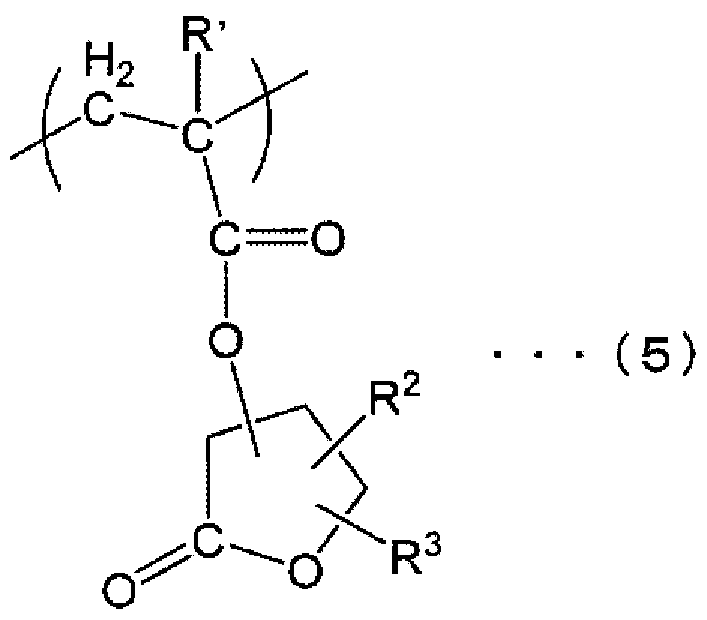
- a (a lower alkyl) acrylate ester having a monocyclic group consisting of a monocyclic ratatone ring such as a structural unit represented by the following general formula (5).
- Structural units derived from (a lower alkyl) acrylate ester having a polycyclic group having a rataton ring such as structural units represented by formulas (6) to (9), and the like. It is possible.
- R ′ is a lower alkyl group or a hydrogen atom.
- R 2 and IT are each independently a hydrogen atom or a lower alkyl group.
- R ′ is the same as described above, and o is 0 or 1.
- R is the same as the lower alkyl group described for the ⁇ lower alkyl acrylate.
- R 2 and R 3 are each independently a hydrogen atom or a lower alkyl group, and a hydrogen atom is preferable in view of industrial availability.
- an alkyl group having 1 to 5 carbon atoms which may be linear or branched, is preferred.
- the structural unit represented by the general formula (5) is used.
- Preferred is a lower alkyl) ⁇ -butyrolataton ester of acrylic acid, ie, a structural unit from which the ( ⁇ -lower alkyl)) acrylate power of ⁇ -butyrolataton is also derived.
- the structural unit derived from the ( ⁇ -lower alkyl)) acrylic acid norbornane ratatone ester represented by the general formulas (7) and (8), that is, the (meth) acrylic acid ester caprate of norbornane ratatone is obtained. This is preferable because the shape of the resulting resist pattern, for example, rectangularity, is even better.
- the structural unit represented by the general formula (5) is most preferred from the viewpoint of the effect of the present invention, and R 2 and R 3 are the same.
- ⁇ -butyrolataton ester of ( ⁇ -lower alkyl) acrylic acid which is a hydrogen atom and has an ester bond at the ⁇ -carbon on the rataton skeleton, ie, a structural unit from which the ((X-lower alkyl) acrylate force of ⁇ -butyrolataton is also derived U, which is most preferred.
- one type may be used alone, or two or more types may be used in combination. May be.
- the proportion of the structural unit (a2), the total of all the structural units of the polymer compound, 10 to 80 Monore 0/0 force S Preferably, 20 to 60 Monore 0/0 power S More preferably, 25 to 50 mol% is most preferable.
- the effect of the present invention is excellent when the content is not less than the lower limit, and the balance with other constituent units can be achieved when the content is not more than the upper limit.
- the structural unit (a3) is a structural unit other than the structural unit (al) and the structural unit (a2), and includes an aliphatic cyclic group-containing non-acid dissociable, dissolution inhibiting group and does not include a polar group.
- the (a-lower alkyl) acrylate is a structural unit from which the acrylate power is also derived.
- the a-lower alkyl group and R 'described below are the same as those described for the structural unit (a2).
- ( ⁇ -Lower alkyl) acrylic acid ester containing a non-acid dissociable, dissolution inhibiting group containing an aliphatic cyclic group The structural unit to be used is a structural unit having a function of increasing the hydrophobicity of the entire component ( ⁇ ) before and after exposure to suppress alkali solubility.
- An aliphatic cyclic group-containing non-acid dissociable, dissolution inhibiting group is a group that does not have aromaticity and has a cyclic group. There is no group.
- Examples of the structural unit (a3) include a unit in which the aliphatic cyclic group-containing non-acid dissociable, dissolution inhibiting group is bonded to the ester portion of ( ⁇ -lower alkyl) acrylate. That is, the structural unit (a3) reduces the alkali solubility of the entire component (A) before exposure, and the structural unit (al) is not dissociated by the action of an acid generated from the component (B) after exposure.
- it is a unit that can improve the contact angle (improve the hydrophobicity) with respect to pure water rinse after PEB (post-exposure bake).
- the structural unit (a3) needs to contain no polar group.
- the polar group is a hydroxyl group, a carboxy group, a cyano group, or the like.
- the structural unit (a3) preferably does not contain an acid dissociable, dissolution inhibiting group.
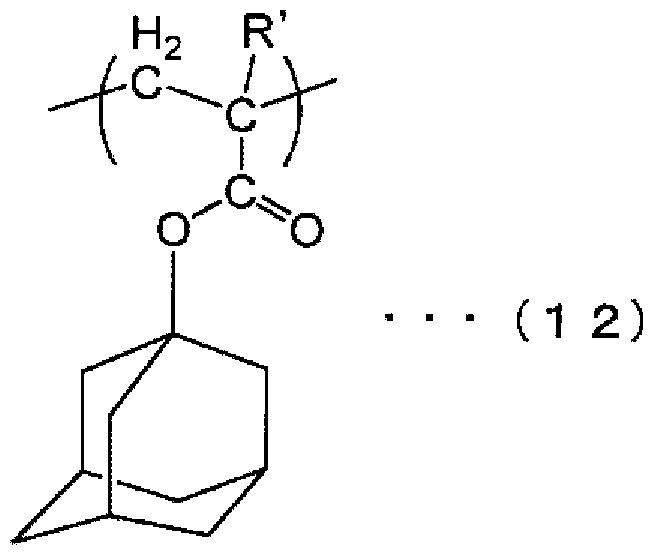
- the structural unit (a3) is represented by the following general formula (10)
- R ′ is the same as described above.
- Y represents an aliphatic cyclic group having 4 to 15 carbon atoms in the basic ring, which may have 1 to 3 alkyl groups having 1 to 10 carbon atoms. ] It is a structural unit shown by.
- Y is an aliphatic cyclic group having 4 to 15 carbon atoms (which may be monocyclic or polycyclic) in the basic ring (ring structure excluding a substituent), and the aliphatic cyclic group May have 1 to 3 alkyl groups having 1 to 10 carbon atoms.
- “aliphatic” means having no aromatic attribute.
- the aliphatic cyclic group is preferably an alicyclic group.
- the alkyl group which Y may have is an alkyl group having 1 to 10 carbon atoms, preferably a straight-chain or branched alkyl group having 1 to 5 carbon atoms, such as a methyl group or an ethyl group.
- the number of the alkyl group is preferably 0 or 1, and more preferably 0.
- the structural unit (a3) does not overlap with the structural unit (al) and the structural unit (a2). That is, the specific acid dissociable, dissolution inhibiting group in the structural unit (al), and the lactone group and the !!
- examples of the cyclic group constituting the basic skeleton of the aliphatic cyclic group include a monocyclic or polycyclic aliphatic cyclic group which is conventionally known as an ArF positive resist material. Can be used.
- examples of the monocyclic aliphatic cyclic group include groups in which one or more hydrogen atoms have been removed from a monocycloalkane such as cyclohexane and cyclopentane.
- polycyclic aliphatic cyclic group examples include bicycloalkane, tricycloalkane, and tetracycloalkane.
- examples thereof include groups in which one or more hydrogen atoms have been removed from polycycloalkanes such as chloroalkanes, and more specifically, groups derived from polycycloalkanes such as adamantane, norbornane, isobornane, tricyclodecane, and tetracyclododecane. Excluding one or more hydrogen atoms;
- a cyclohexyl group, a cyclopentyl group, an adamantyl group, a norvol group, and a tetracyclododecanyl group are industrially easily available, and they also have good point power.
- Force Structural units derived from at least one selected from the group are preferred from the viewpoint of industrial availability.
- the structural unit represented by the general formula (11) is preferable because the shape of the obtained resist pattern, for example, rectangularity is particularly good. In addition, the point of suppressing pattern collapse is preferable.
- one type may be used alone, or two or more types may be used in combination.
- the proportion of the structural unit (a3), the total of all the structural units of the polymer compound, 3-50 Monore 0/0 force S Preferably, 5 to 35 Monore 0/0 power S More preferably, 15 to 30 mol% is most preferable.
- the content is not less than the lower limit, the effect of the present invention is excellent, and when the content is not more than the upper limit, a balance with other structural units can be achieved.
- the polymer compound of the present invention is a polymer compound containing at least one of a structural unit represented by the following general formula (14) and a structural unit represented by the general formula (14) ′, This is preferable because the effects of the present invention are excellent. Further, it is preferable because the exposure area dependency is improved. Further, it is preferable because it has good resolution and a resist pattern even on an inorganic substrate such as a SiON substrate.
- a conventional chemically amplified photoresist other than the structural units (al) to (a3) may be used as long as the effects of the present invention are not impaired.
- acrylic acid derivatives methacrylic acid derivatives, carboxylic acids having an ethylenic double bond for alkali solubility such as acrylic acid, methacrylic acid, maleic acid, and fumaric acid, and acrylic resins known as di-type resists
- acrylic resins known as di-type resists The known monomers and the like may be appropriately combined as needed and copolymerized for use.
- the polymer compound of the present invention may be obtained, for example, by adding a monomer for each structural unit to, for example, azobis It can be obtained by performing polymerization by known radical polymerization using a radical polymerization initiator such as isobutyro-tolyl (AIBN).
- a radical polymerization initiator such as isobutyro-tolyl (AIBN).
- the mass average molecular weight (Mw; mass average molecular weight in terms of polystyrene by gel permeation chromatography (GPC) of the polymer compound of the present invention) is preferably 30,000 or less, more preferably 15,000 or less. .
- Mw mass average molecular weight in terms of polystyrene by gel permeation chromatography
- the lower limit is not particularly limited, but in consideration of resolution, solubility in an organic solvent, and the like, 3000 or more is preferable, and 5000 or more is more preferable.
- the dispersity is 3.0 or less, preferably in the range of 1.0 to 2.5, because resolution and heat resistance are improved.
- the polymer compound of the present invention can also constitute one or more polymer forces.
- the positive resist composition of the present invention comprises a polymer compound of the present invention (hereinafter referred to as “component (A)”) as a base resin component, and an acid generator (hereinafter referred to as “acid generator”) which generates an acid upon irradiation (exposure) with radiation.
- component (A) a polymer compound of the present invention
- acid generator an acid generator which generates an acid upon irradiation (exposure) with radiation.
- component (B) characterized by containing the component (B) and ⁇ ⁇ ).
- the component (A) has a structural unit (al) which is a structural unit having a V-type acid dissociable, dissolution inhibiting group, and thus is insoluble in alkali before exposure, and the component (B) is generated by exposure.
- the acid-dissociable, dissolution-inhibiting group is dissociated, whereby the alkali solubility of the component (A) as a whole is increased. Therefore, in the formation of a resist pattern, if the resist is subjected to selective exposure, or if post-exposure baking (PEB) is performed in addition to the exposure, the exposed part turns alkali-soluble, while the unexposed part Since is not changed while remaining insoluble in alkali, a positive resist pattern can be formed by alkali development.
- PEB post-exposure baking
- the component (B) is a so-called acid generator.
- the component (B) can be used without any particular limitation on the known acid generator power used in a conventional chemically amplified resist composition.
- acid generators include, for example, rhodium salt-based acid generators such as odonium salts and sulfo-dum salts, oxime sulfonate-based acid generators, bisalkyl or bisarylsulfol-diazomethanes, Various types are known, such as diazomethane-based acid generators such as poly (bissulfol) diazomethanes, diazomethane-trobenzylsulfonates, iminosulfonate-based acid generators, and disulfone-based acid generators.
- acid salt-based acid generator examples include trifluoromethanesulfonate or nonafluorobutanesulfonate of diphenyl-donium, trifluoromethanesulfonate or nonafluoromethanesulfonate of bis (4-tert-butylphenol) odonium.
- an oxalate having weak acid strength and having camphorsulfonate ion in an ion portion can also be used.
- Specific examples include compounds represented by the following chemical formulas.
- oxime sulfonate-based acid generator examples include a- (P-toluenesulfo-roxiximino) -benzyl cyanide, ⁇ - ( ⁇ -chlorobenzenebenzenesulfo-roximinino) -benzylic acid, ⁇ - ( 4-Nitrobenzenesulfo-roxyimino) -benzylcyanide, ⁇ - (4-nitro-2-trifluoromethylbenzenesulfo-roxyimino) -benzylcyanide, a- (benzenesulfo-roxyimino) -4-cyclomouth Benzyl cyanide, a-(benzenesulfo-loxyimino)-2,4-dichlorobenzylazide, ⁇ -(benzenesulfo-loxyimino)-2, 6-dichlorobenzylazide, ⁇ -(benzenesulfo- Roxy
- bisalkyl or bisarylsulfol-l-diazomethanes include bis (isopropylsulfol) diazomethane, bis ( ⁇ toluenesulfol) diazomethane, and bis (1,1-) Dimethylethylsulfol) diazomethane, bis (cyclohexylsulfol) diazomethane, bis (2,4 dimethylphenylsulfol) diazomethane and the like.
- Poly (bissulfonyl) diazomethanes include, for example, 1,3 bis (phenylsulfoldiazomethylsulfol) propane having the following structure (distilled product: 135 ° C) ), 1,4-bis (phenylsulfol-diazomethylsulfol) butane (compound B, decomposition point 147 ° C), 1,6-bis (phenylsulfol-diazomethylsulfol) hexane (Compound C, melting point 132 ° C, decomposition point 145 ° C), 1,10 bis (phenylsulfol-diazomethylsulfol) decane (disulfide compound D, decomposition point 147 ° C), 1,2 bis (Cyclohexylsulfol-diazomethylsulfol-l) ethane (distilled compound E, decomposition point 149 ° C), 1,3 bis (Si Chlohe
- an aluminum salt having a fluorinated alkylsulfonate ion as an ion.
- an acid generator having a weak acid strength for example, a diazomethane-based acid generator or an acid generator having a strong sulfonate ion in the ion-on portion is preferably used because the acid dissociable, dissolution inhibiting group can be dissociated. be able to.
- one type of acid generator may be used alone, or two or more types may be used in combination.
- the content of the component (B) is 0.5 to 30 parts by mass, preferably 1 to 10 parts by mass, per 100 parts by mass of the component (A). If the amount is less than the above range, pattern formation may not be sufficiently performed. If the amount exceeds the above range, a uniform solution may not be obtained and storage stability may be deteriorated.
- the positive resist composition of the present invention has a resist pattern shape, stability over time (post exposure stability of the latent image formed oy the pattern-wise exposure of t he resist layer (PED)) and the like.
- a nitrogen-containing organic compound (D) (hereinafter, referred to as “component (D)”) can be further added as an optional component.
- component (D) a wide variety of components have already been proposed. Thus, any known one may be used, but an amine, particularly a secondary lower aliphatic amine ⁇ a tertiary lower aliphatic amine, is preferred.
- the lower aliphatic amine refers to an alkyl or alkyl alcohol amine having 5 or less carbon atoms.
- the secondary and tertiary amines include trimethylamine, getylamine, triethylamine, and di- n. -Propylamine, tri-n-propylamine, tripentylamine, diethanolamine, triethanolamine, triisopropanolamine, etc.
- Component (D) is usually used in the range of 0.01 to 5.0 parts by mass with respect to 100 parts by mass of component (A). You can.
- an organic carboxylic acid or an oxo acid of phosphorus or a derivative thereof (E) may be further included as an optional component.
- the component (D) and the component (E) can be used in combination, or one of them can be used.
- organic carboxylic acid for example, malonic acid, citric acid, malic acid, succinic acid, benzoic acid, salicylic acid and the like are suitable.
- Phosphorus oxoacids or derivatives thereof include phosphoric acid such as phosphoric acid, di-n-butyl phosphate, diphenyl phosphate, and derivatives such as esters thereof, phosphonic acid, dimethyl phosphonate, and phosphonic acid.
- Phosphonic acids such as acid-di-n-butyl ester, phenolphosphonic acid, phosphonic acid diphenyl ester, phosphonic acid dibenzyl ester and derivatives thereof such as esters, phosphinic acid, polyphosphinic acid, etc. Derivatives such as phosphinic acid and their esters are mentioned, of which phosphonic acid is particularly preferred.
- the component (E) is used in an amount of 0.01 to 5.0 parts by mass per 100 parts by mass of the component (A).
- the positive resist composition of the present invention may further contain, if desired, a miscible additive, for example, an additional resin for improving the performance of the resist film, a surfactant for improving coatability, and a dissolving agent.
- a miscible additive for example, an additional resin for improving the performance of the resist film, a surfactant for improving coatability, and a dissolving agent.
- Inhibitors, plasticizers, stabilizers, coloring agents, antihalation agents, dyes and the like can be appropriately added and contained.
- the positive resist composition of the present invention can be produced by dissolving the materials in an organic solvent.
- any one can be used as long as it can dissolve each component to be used and can form a uniform solution.
- One or more kinds can be appropriately selected and used.
- ketones such as ⁇ -butyrolataton, acetone, methyl ethyl ketone, cyclohexanone, methyl isoamyl ketone, and 2-heptanone; ethylene glycol, ethylene glycolone monoacetate, diethylene glycol, diethylene glycolone monoacetate, and propylene Polyhydric alcohols such as glycol, propylene glycol monoacetate, dipropylene glycol or dipropylene glycol monoacetate, such as monomethyl ether, monoethyl ether, monopropyl ether, monobutyl ether or monophenyl ether, and derivatives thereof, and dioxane.
- ketones such as ⁇ -butyrolataton, acetone, methyl ethyl ketone, cyclohexanone, methyl isoamyl ketone, and 2-heptanone
- organic solvents may be used alone or as a mixed solvent of two or more.
- a mixed solvent obtained by mixing propylene glycol monomethyl ether acetate (PGMEA) and a polar solvent is preferable, but the mixing ratio (mass ratio) may be appropriately determined in consideration of the compatibility between PGMEA and the polar solvent.
- the ratio is preferably in the range of 1: 9 to 9: 1, more preferably 2: 8 to 8: 2! / ,.
- the mass ratio of PGMEA: EL is preferably 2: 8 to 8: 2, more preferably 3: 7 to 7: 3! / ,.
- a mixed solvent of at least one selected from PGMEA and EL and ⁇ -petit mouth rataton is also preferable.
- the mixing ratio of the former and the latter is preferably 70: 30-95: 5.
- the amount of the organic solvent used is not particularly limited, it is a concentration that can be applied to a support such as a substrate, and is appropriately set according to the thickness of the applied film. It is used in an amount of 2 to 20% by mass, preferably 5 to 15% by mass.
- the method for forming a resist pattern using the positive resist composition of the present invention can be performed, for example, as follows.
- the positive resist composition is coated on a support such as silicon wafer. It is applied with a spinner or the like, and is applied with a pre-beta for 40 to 120 seconds, preferably 60 to 90 seconds under a temperature condition of 80 to 150 ° C. Then, for example, an ArF excimer laser is irradiated with a desired mask using an ArF exposure device or the like. After selectively exposing (irradiating radiation) through the pattern, PEB (post-exposure bake) is applied for 40 to 120 seconds, preferably 60 to 90 seconds, at a temperature of 80 to 150 ° C. Next, this is developed using an alkali developing solution, for example, an aqueous solution of 0.1 to 10% by mass of tetramethylammonium hydroxide. Thus, a resist pattern faithful to the mask pattern can be obtained.
- PEB post-exposure bake
- an organic or inorganic antireflection film can be provided between the support (substrate) and the coating layer of the resist composition.
- the support is not particularly limited, and a conventionally known support can be used. Examples thereof include a substrate for an electronic component and a support on which a predetermined wiring pattern is formed. It comes out.
- the substrate examples include a substrate made of metal such as silicon-ano, copper, chromium, iron, and aluminum, and a glass substrate.
- the wiring pattern for example, copper, solder, chromium, aluminum, nickel, gold, and the like can be used.
- the wavelength used for exposure is not particularly limited, and an ArF excimer laser, a KrF excimer laser, an F excimer laser, EUV (extreme ultraviolet), VUV (vacuum ultraviolet)
- the resist composition according to the present invention is particularly effective for an ArF excimer laser.
- the positive resist composition containing the polymer compound of the present invention As described above, by using the positive resist composition containing the polymer compound of the present invention, a resist pattern having high resolution, high sensitivity, and suppressed pattern collapse can be formed.
- the advantageous effects of high resolution, high sensitivity, and reduction of line edge roughness (LER) can be obtained at the same time, as well as suppression of pattern collapse.
- the LER refers to uneven unevenness on the side wall of the line.
- the monomer components used in the synthesis example according to the first comparative example are shown below.
- the abbreviations for the monomer component are those listed below the chemical formula of the monomer component.
- resin 1 The precipitated resin was separated by filtration and dried under reduced pressure to obtain a white powder resin. This resin is referred to as resin 1.
- This resin 1 is composed of structural units represented by the following chemical formula.
- This resin 2 also has a structural unit force represented by the following chemical formula.
- a positive resist composition having the composition shown in Table 1 below was prepared.
- TPS-PFBS Triphenylsulfonium nonafluorotansulfonate
- ARC-29A trade name, manufactured by Prue Science Co., Ltd.
- the positive resist composition obtained above is applied on an antireflection film using a spinner, pre-beta (PAB) at 95 ° C. for 90 seconds on a hot plate, and dried to obtain a film thickness.
- a 225 nm resist film was formed.
- a PEB treatment was conducted under conditions of 105 ° C, 90 seconds, further 23 ° C at 2.38 mass 0/0 tetra Mechiruanmo - Umuhidorokishido (TMAH) puddle developed for 60 seconds with an aqueous solution, washed with water dried then 20 seconds did.
- TMAH Mechiruanmo - Umuhidorokishido
- the exposure time at which a 140 nm line and space was formed in 1: 1 was measured in mj / cm 2 (energy amount) as sensitivity (EOP).
- the contact angle was measured using a FACE contact angle meter CA-X150 (product name, manufactured by Kyowa Interface Science Co., Ltd.).
- the measurement method was as follows: propylene glycol monomethyl ether acetate and ethyl lactate were placed on an 8-inch silicon wafer using the polymer compounds (resin 1 and resin 2) used in each Example or Comparative Example, respectively.
- Prepare a solution prepared by dissolving resin in 750 parts by mass of a mixed solvent with a mass ratio of 6: 4 apply it using a spinner, and then heat it at 95 ° C for 90 seconds to form a 225 nm thick resist film. did.
- the polymer membrane was brought into contact with the syringe provided in the apparatus (when the syringe and the polymer membrane came into contact, 2 L of pure water was dropped), and the contact angle at that time was measured. .
- Table 2 shows the evaluation results.
- a positive resist composition was prepared in the same manner as in Example 1 except that resin 1 was changed to resin 3 in Example 1, and then a resist pattern was formed in the same manner and evaluated.
- the sensitivity at that time is 20 mjZcm 2
- the limit resolution is lOnm
- the pattern collapse is 47 nm.
- the line widths of the resist patterns formed in Examples 1 and 2 and Comparative Example 1 were measured at five positions in the longitudinal direction of the lines by using the SEM (trade name: S-9220, manufactured by Hitachi, Ltd.). The force was also measured, and the force was calculated as three times the standard deviation ( ⁇ ) (3 ⁇ ) as a measure of LER. The smaller the value of 3 ⁇ , the smaller the line width roughness (variation, unevenness), which means that a more uniform resist pattern was obtained.
- the resist patterns obtained using the positive resist compositions of Example 1 and Example 2 have excellent resolution and sensitivity, and also suppress pattern collapse and LER. Had been.
- Example 1 structural units corresponding to the structural unit (al), structural unit (a2), and structural unit (a3) were used.
- Comparative Example 1 the polymer compound used in Example 1 was used.
- Resin 1 using Resin 2 in which the structural unit (a3) was changed to a structural unit having a polar group, the contact angle between the two was changed to that of Resin 1 used in Example 1. It was confirmed that it was higher.
- the present invention can be applied to a polymer compound capable of forming a resist pattern, a positive resist composition containing the polymer compound, and a method of forming a resist pattern.
Landscapes
- Chemical & Material Sciences (AREA)
- Physics & Mathematics (AREA)
- Spectroscopy & Molecular Physics (AREA)
- Health & Medical Sciences (AREA)
- Chemical Kinetics & Catalysis (AREA)
- Medicinal Chemistry (AREA)
- Polymers & Plastics (AREA)
- Organic Chemistry (AREA)
- General Physics & Mathematics (AREA)
- Materials For Photolithography (AREA)
- Addition Polymer Or Copolymer, Post-Treatments, Or Chemical Modifications (AREA)
- Exposure And Positioning Against Photoresist Photosensitive Materials (AREA)
Description






Claims


Priority Applications (1)
| Application Number | Priority Date | Filing Date | Title |
|---|---|---|---|
| US11/570,761 US7608381B2 (en) | 2004-06-18 | 2005-06-10 | Polymer compound, positive resist composition and process for forming resist pattern |
Applications Claiming Priority (4)
| Application Number | Priority Date | Filing Date | Title |
|---|---|---|---|
| JP2004181070 | 2004-06-18 | ||
| JP2004-181070 | 2004-06-18 | ||
| JP2004-316959 | 2004-10-29 | ||
| JP2004316959A JP4942925B2 (ja) | 2004-06-18 | 2004-10-29 | 高分子化合物、ポジ型レジスト組成物及びレジストパターン形成方法 |
Publications (1)
| Publication Number | Publication Date |
|---|---|
| WO2005123795A1 true WO2005123795A1 (ja) | 2005-12-29 |
Family
ID=35509625
Family Applications (1)
| Application Number | Title | Priority Date | Filing Date |
|---|---|---|---|
| PCT/JP2005/010697 Ceased WO2005123795A1 (ja) | 2004-06-18 | 2005-06-10 | 高分子化合物、ポジ型レジスト組成物及びレジストパターン形成方法 |
Country Status (4)
| Country | Link |
|---|---|
| US (1) | US7608381B2 (ja) |
| JP (1) | JP4942925B2 (ja) |
| TW (1) | TWI294430B (ja) |
| WO (1) | WO2005123795A1 (ja) |
Cited By (7)
| Publication number | Priority date | Publication date | Assignee | Title |
|---|---|---|---|---|
| WO2006077705A1 (ja) * | 2005-01-18 | 2006-07-27 | Tokyo Ohka Kogyo Co., Ltd. | ポジ型レジスト組成物およびレジストパターン形成方法 |
| WO2006087865A1 (ja) * | 2005-02-16 | 2006-08-24 | Tokyo Ohka Kogyo Co., Ltd. | ポジ型レジスト組成物およびレジストパターン形成方法 |
| WO2006126329A1 (ja) * | 2005-05-24 | 2006-11-30 | Tokyo Ohka Kogyo Co., Ltd. | ポジ型ホトレジスト組成物、厚膜ホトレジスト積層体、厚膜レジストパターンの製造方法および接続端子の製造方法 |
| WO2007083458A1 (ja) * | 2006-01-17 | 2007-07-26 | Tokyo Ohka Kogyo Co., Ltd. | 液浸露光用ポジ型レジスト組成物およびレジストパターン形成方法 |
| US7687222B2 (en) * | 2006-07-06 | 2010-03-30 | Shin-Etsu Chemical Co., Ltd. | Polymerizable ester compounds, polymers, resist compositions and patterning process |
| US7858286B2 (en) | 2005-05-19 | 2010-12-28 | Tokyo Ohka Kogyo Co., Ltd. | Positive resist composition and method for forming resist pattern |
| US8252503B2 (en) | 2007-08-24 | 2012-08-28 | Az Electronic Materials Usa Corp. | Photoresist compositions |
Families Citing this family (7)
| Publication number | Priority date | Publication date | Assignee | Title |
|---|---|---|---|---|
| JP4717640B2 (ja) | 2005-12-12 | 2011-07-06 | 東京応化工業株式会社 | 液浸露光用レジスト組成物およびレジストパターン形成方法 |
| JP2008009269A (ja) * | 2006-06-30 | 2008-01-17 | Tokyo Ohka Kogyo Co Ltd | ポジ型レジスト組成物およびレジストパターン形成方法 |
| JP4757766B2 (ja) * | 2006-10-13 | 2011-08-24 | 東京応化工業株式会社 | 液浸露光用ポジ型レジスト組成物およびレジストパターン形成方法 |
| US7604920B2 (en) | 2007-08-07 | 2009-10-20 | Tokyo Ohka Kogyo Co., Ltd. | Positive resist composition, method of forming resist pattern, polymeric compound, and compound |
| JP5308678B2 (ja) | 2007-08-07 | 2013-10-09 | 東京応化工業株式会社 | 化合物の製造方法、化合物 |
| KR101432503B1 (ko) * | 2008-02-26 | 2014-08-22 | 삼성디스플레이 주식회사 | 포토레지스트 조성물 및 이를 이용한 어레이 기판의 제조방법 |
| TWI520839B (zh) | 2010-07-20 | 2016-02-11 | 國立成功大學 | 可撓性光學板的製造方法、其方法製成的可撓性光學板,及背光模組 |
Citations (5)
| Publication number | Priority date | Publication date | Assignee | Title |
|---|---|---|---|---|
| JPH1130864A (ja) * | 1997-07-10 | 1999-02-02 | Fuji Photo Film Co Ltd | 遠紫外線露光用ポジ型フォトレジスト組成物 |
| JP2003147023A (ja) * | 2001-08-31 | 2003-05-21 | Shin Etsu Chem Co Ltd | 高分子化合物、レジスト材料、及びパターン形成方法 |
| JP2004151364A (ja) * | 2002-10-30 | 2004-05-27 | Fuji Photo Film Co Ltd | ポジ型レジスト組成物 |
| JP2004256562A (ja) * | 2003-02-24 | 2004-09-16 | Central Glass Co Ltd | 含フッ素化合物、含フッ素重合性単量体、含フッ素高分子化合物、それらを用いたレジスト材料とパターン形成方法、及び含フッ素化合物の製造方法 |
| JP2005146252A (ja) * | 2003-10-23 | 2005-06-09 | Shin Etsu Chem Co Ltd | 高分子化合物、レジスト材料及びパターン形成方法 |
Family Cites Families (15)
| Publication number | Priority date | Publication date | Assignee | Title |
|---|---|---|---|---|
| JPH01130864A (ja) | 1987-11-13 | 1989-05-23 | Mitsubishi Motors Corp | 耐熱ピストン |
| JP2881969B2 (ja) | 1990-06-05 | 1999-04-12 | 富士通株式会社 | 放射線感光レジストとパターン形成方法 |
| TW285793B (en) | 1996-01-15 | 1996-09-11 | Ind Tech Res Inst | Variable length code decoder and method |
| JPH11109630A (ja) * | 1997-10-03 | 1999-04-23 | Fuji Photo Film Co Ltd | 遠紫外線露光用ポジ型フォトレジスト組成物 |
| KR100252062B1 (ko) | 1998-04-20 | 2000-06-01 | 윤종용 | 포토레지스트용 중합체 혼합물, 이를 포함하는포토레지스트 조성물 및 이의 제조방법 |
| KR100574257B1 (ko) * | 1998-07-27 | 2006-04-27 | 후지 샤신 필름 가부시기가이샤 | 포지티브 감광성 조성물 |
| TWI263866B (en) | 1999-01-18 | 2006-10-11 | Sumitomo Chemical Co | Chemical amplification type positive resist composition |
| JP3945741B2 (ja) | 2000-12-04 | 2007-07-18 | 東京応化工業株式会社 | ポジ型レジスト組成物 |
| KR20020090489A (ko) * | 2001-05-28 | 2002-12-05 | 금호석유화학 주식회사 | 화학증폭형 레지스트용 중합체 및 이를 함유한 화학증폭형레지스트 조성물 |
| US6844133B2 (en) * | 2001-08-31 | 2005-01-18 | Shin-Etsu Chemical Co., Ltd. | Polymer, resist composition and patterning process |
| TWI286555B (en) | 2003-10-23 | 2007-09-11 | Shinetsu Chemical Co | Polymers, resist compositions and patterning process |
| JP4539847B2 (ja) * | 2004-04-09 | 2010-09-08 | 信越化学工業株式会社 | ポジ型レジスト材料並びにこれを用いたパターン形成方法 |
| KR100942627B1 (ko) * | 2004-04-09 | 2010-02-17 | 신에쓰 가가꾸 고교 가부시끼가이샤 | 포지티브형 레지스트 재료 및 이를 이용한 패턴 형성 방법 |
| JP4722417B2 (ja) * | 2004-06-18 | 2011-07-13 | 東京応化工業株式会社 | 化合物、高分子化合物、ポジ型レジスト組成物およびレジストパターン形成方法 |
| WO2005111097A1 (ja) * | 2004-05-18 | 2005-11-24 | Idemitsu Kosan Co., Ltd. | アダマンタン誘導体、その製造方法及びフォトレジスト用感光材料 |
-
2004
- 2004-10-29 JP JP2004316959A patent/JP4942925B2/ja not_active Expired - Lifetime
-
2005
- 2005-06-10 WO PCT/JP2005/010697 patent/WO2005123795A1/ja not_active Ceased
- 2005-06-10 US US11/570,761 patent/US7608381B2/en not_active Expired - Lifetime
- 2005-06-15 TW TW094119865A patent/TWI294430B/zh not_active IP Right Cessation
Patent Citations (5)
| Publication number | Priority date | Publication date | Assignee | Title |
|---|---|---|---|---|
| JPH1130864A (ja) * | 1997-07-10 | 1999-02-02 | Fuji Photo Film Co Ltd | 遠紫外線露光用ポジ型フォトレジスト組成物 |
| JP2003147023A (ja) * | 2001-08-31 | 2003-05-21 | Shin Etsu Chem Co Ltd | 高分子化合物、レジスト材料、及びパターン形成方法 |
| JP2004151364A (ja) * | 2002-10-30 | 2004-05-27 | Fuji Photo Film Co Ltd | ポジ型レジスト組成物 |
| JP2004256562A (ja) * | 2003-02-24 | 2004-09-16 | Central Glass Co Ltd | 含フッ素化合物、含フッ素重合性単量体、含フッ素高分子化合物、それらを用いたレジスト材料とパターン形成方法、及び含フッ素化合物の製造方法 |
| JP2005146252A (ja) * | 2003-10-23 | 2005-06-09 | Shin Etsu Chem Co Ltd | 高分子化合物、レジスト材料及びパターン形成方法 |
Cited By (10)
| Publication number | Priority date | Publication date | Assignee | Title |
|---|---|---|---|---|
| WO2006077705A1 (ja) * | 2005-01-18 | 2006-07-27 | Tokyo Ohka Kogyo Co., Ltd. | ポジ型レジスト組成物およびレジストパターン形成方法 |
| WO2006087865A1 (ja) * | 2005-02-16 | 2006-08-24 | Tokyo Ohka Kogyo Co., Ltd. | ポジ型レジスト組成物およびレジストパターン形成方法 |
| US7803512B2 (en) | 2005-02-16 | 2010-09-28 | Tokyo Ohka Kogyo Co., Ltd. | Positive resist composition and method of forming resist pattern |
| US7858286B2 (en) | 2005-05-19 | 2010-12-28 | Tokyo Ohka Kogyo Co., Ltd. | Positive resist composition and method for forming resist pattern |
| WO2006126329A1 (ja) * | 2005-05-24 | 2006-11-30 | Tokyo Ohka Kogyo Co., Ltd. | ポジ型ホトレジスト組成物、厚膜ホトレジスト積層体、厚膜レジストパターンの製造方法および接続端子の製造方法 |
| WO2007083458A1 (ja) * | 2006-01-17 | 2007-07-26 | Tokyo Ohka Kogyo Co., Ltd. | 液浸露光用ポジ型レジスト組成物およびレジストパターン形成方法 |
| JP2007192876A (ja) * | 2006-01-17 | 2007-08-02 | Tokyo Ohka Kogyo Co Ltd | 液浸露光用ポジ型レジスト組成物およびレジストパターン形成方法 |
| US7968269B2 (en) | 2006-01-17 | 2011-06-28 | Tokyo Ohka Kogyo Co., Ltd. | Positive resist composition for immersion exposure and method of forming resist pattern |
| US7687222B2 (en) * | 2006-07-06 | 2010-03-30 | Shin-Etsu Chemical Co., Ltd. | Polymerizable ester compounds, polymers, resist compositions and patterning process |
| US8252503B2 (en) | 2007-08-24 | 2012-08-28 | Az Electronic Materials Usa Corp. | Photoresist compositions |
Also Published As
| Publication number | Publication date |
|---|---|
| JP4942925B2 (ja) | 2012-05-30 |
| TW200611916A (en) | 2006-04-16 |
| US7608381B2 (en) | 2009-10-27 |
| TWI294430B (en) | 2008-03-11 |
| US20080096126A1 (en) | 2008-04-24 |
| JP2006028472A (ja) | 2006-02-02 |
Similar Documents
| Publication | Publication Date | Title |
|---|---|---|
| CN100572422C (zh) | 高分子化合物、含有该高分子化合物的光致抗蚀剂组合物以及抗蚀图案形成方法 | |
| JP4942925B2 (ja) | 高分子化合物、ポジ型レジスト組成物及びレジストパターン形成方法 | |
| JP5470328B2 (ja) | ポジ型レジスト組成物及びレジストパターン形成方法 | |
| JP4754265B2 (ja) | ポジ型レジスト組成物およびレジストパターン形成方法 | |
| JP2006349800A (ja) | ポジ型レジスト組成物およびレジストパターン形成方法 | |
| JP4409366B2 (ja) | ポジ型レジスト組成物およびレジストパターン形成方法 | |
| JP2006003846A (ja) | 化学増幅型フォトレジスト用重合体 | |
| TWI305201B (en) | Compound, polymer compound, positive resist composition, and method for forming resist pattern | |
| JP4184352B2 (ja) | ポジ型レジスト組成物及びレジストパターン形成方法 | |
| JP4493938B2 (ja) | ポジ型レジスト組成物及びレジストパターン形成方法 | |
| JP4191150B2 (ja) | ポジ型レジスト組成物およびレジストパターン形成方法 | |
| JP4889950B2 (ja) | 電子線またはeuv用ポジ型レジスト組成物およびレジストパターン形成方法 | |
| WO2005121193A1 (ja) | 重合体、ポジ型レジスト組成物およびレジストパターン形成方法 | |
| US8097396B2 (en) | Positive resist composition and method for forming resist pattern | |
| JP4633655B2 (ja) | ポジ型レジスト組成物およびレジストパターン形成方法 | |
| JP4536622B2 (ja) | ポジ型レジスト組成物およびレジストパターン形成方法 | |
| JP2006003844A (ja) | ポジ型レジスト組成物およびレジストパターン形成方法 | |
| JP4570910B2 (ja) | 重合体およびポジ型レジスト組成物 | |
| JP2007133208A (ja) | ポジ型レジスト組成物およびレジストパターン形成方法 | |
| WO2007102425A1 (ja) | ポジ型レジスト組成物およびレジストパターン形成方法 | |
| JP2007155991A (ja) | ポジ型レジスト組成物およびレジストパターン形成方法 | |
| JP4437065B2 (ja) | ポジ型レジスト組成物およびレジストパターン形成方法 | |
| JP4663459B2 (ja) | ポジ型レジスト組成物およびレジストパターン形成方法 | |
| JP4472586B2 (ja) | ポジ型レジスト組成物およびレジストパターン形成方法 | |
| JP2006104353A (ja) | 高分子化合物、ポジ型レジスト組成物、およびレジストパターン形成方法 |
Legal Events
| Date | Code | Title | Description |
|---|---|---|---|
| AK | Designated states |
Kind code of ref document: A1 Designated state(s): AE AG AL AM AT AU AZ BA BB BG BR BW BY BZ CA CH CN CO CR CU CZ DE DK DM DZ EC EE EG ES FI GB GD GE GH GM HR HU ID IL IN IS KE KG KM KP KR KZ LC LK LR LS LT LU LV MA MD MG MK MN MW MX MZ NA NG NI NO NZ OM PG PH PL PT RO RU SC SD SE SG SK SL SM SY TJ TM TN TR TT TZ UA UG US UZ VC VN YU ZA ZM ZW |
|
| AL | Designated countries for regional patents |
Kind code of ref document: A1 Designated state(s): BW GH GM KE LS MW MZ NA SD SL SZ TZ UG ZM ZW AM AZ BY KG KZ MD RU TJ TM AT BE BG CH CY CZ DE DK EE ES FI FR GB GR HU IE IS IT LT LU MC NL PL PT RO SE SI SK TR BF BJ CF CG CI CM GA GN GQ GW ML MR NE SN TD TG |
|
| 121 | Ep: the epo has been informed by wipo that ep was designated in this application | ||
| WWE | Wipo information: entry into national phase |
Ref document number: 11570761 Country of ref document: US |
|
| NENP | Non-entry into the national phase |
Ref country code: DE |
|
| WWW | Wipo information: withdrawn in national office |
Country of ref document: DE |
|
| 122 | Ep: pct application non-entry in european phase | ||
| WWP | Wipo information: published in national office |
Ref document number: 11570761 Country of ref document: US |