WO2004072082A1 - Superphthalocyanine compounds containing six isoindole subunits ini the porphyrazine cycle, the preparation processes and uses of them - Google Patents
Superphthalocyanine compounds containing six isoindole subunits ini the porphyrazine cycle, the preparation processes and uses of them Download PDFInfo
- Publication number
- WO2004072082A1 WO2004072082A1 PCT/CN2004/000109 CN2004000109W WO2004072082A1 WO 2004072082 A1 WO2004072082 A1 WO 2004072082A1 CN 2004000109 W CN2004000109 W CN 2004000109W WO 2004072082 A1 WO2004072082 A1 WO 2004072082A1
- Authority
- WO
- WIPO (PCT)
- Prior art keywords
- compound
- group
- formula
- atom
- sulfonic acid
- Prior art date
- Legal status (The legal status is an assumption and is not a legal conclusion. Google has not performed a legal analysis and makes no representation as to the accuracy of the status listed.)
- Ceased
Links
Classifications
-
- G—PHYSICS
- G03—PHOTOGRAPHY; CINEMATOGRAPHY; ANALOGOUS TECHNIQUES USING WAVES OTHER THAN OPTICAL WAVES; ELECTROGRAPHY; HOLOGRAPHY
- G03G—ELECTROGRAPHY; ELECTROPHOTOGRAPHY; MAGNETOGRAPHY
- G03G5/00—Recording-members for original recording by exposure, e.g. to light, to heat or to electrons; Manufacture thereof; Selection of materials therefor
- G03G5/02—Charge-receiving layers
- G03G5/04—Photoconductive layers; Charge-generation layers or charge-transporting layers; Additives therefor; Binders therefor
- G03G5/06—Photoconductive layers; Charge-generation layers or charge-transporting layers; Additives therefor; Binders therefor characterised by the photoconductive material being organic
- G03G5/0622—Heterocyclic compounds
- G03G5/0624—Heterocyclic compounds containing one hetero ring
- G03G5/0627—Heterocyclic compounds containing one hetero ring being five-membered
- G03G5/0629—Heterocyclic compounds containing one hetero ring being five-membered containing one hetero atom
-
- C—CHEMISTRY; METALLURGY
- C07—ORGANIC CHEMISTRY
- C07D—HETEROCYCLIC COMPOUNDS
- C07D487/00—Heterocyclic compounds containing nitrogen atoms as the only ring hetero atoms in the condensed system, not provided for by groups C07D451/00 - C07D477/00
- C07D487/22—Heterocyclic compounds containing nitrogen atoms as the only ring hetero atoms in the condensed system, not provided for by groups C07D451/00 - C07D477/00 in which the condensed system contains four or more hetero rings
-
- C—CHEMISTRY; METALLURGY
- C09—DYES; PAINTS; POLISHES; NATURAL RESINS; ADHESIVES; COMPOSITIONS NOT OTHERWISE PROVIDED FOR; APPLICATIONS OF MATERIALS NOT OTHERWISE PROVIDED FOR
- C09K—MATERIALS FOR MISCELLANEOUS APPLICATIONS, NOT PROVIDED FOR ELSEWHERE
- C09K11/00—Luminescent materials, e.g. electroluminescent or chemiluminescent
- C09K11/06—Luminescent materials, e.g. electroluminescent or chemiluminescent containing organic luminescent materials
-
- G—PHYSICS
- G03—PHOTOGRAPHY; CINEMATOGRAPHY; ANALOGOUS TECHNIQUES USING WAVES OTHER THAN OPTICAL WAVES; ELECTROGRAPHY; HOLOGRAPHY
- G03G—ELECTROGRAPHY; ELECTROPHOTOGRAPHY; MAGNETOGRAPHY
- G03G5/00—Recording-members for original recording by exposure, e.g. to light, to heat or to electrons; Manufacture thereof; Selection of materials therefor
- G03G5/02—Charge-receiving layers
- G03G5/04—Photoconductive layers; Charge-generation layers or charge-transporting layers; Additives therefor; Binders therefor
- G03G5/06—Photoconductive layers; Charge-generation layers or charge-transporting layers; Additives therefor; Binders therefor characterised by the photoconductive material being organic
- G03G5/0622—Heterocyclic compounds
- G03G5/0644—Heterocyclic compounds containing two or more hetero rings
- G03G5/0646—Heterocyclic compounds containing two or more hetero rings in the same ring system
-
- G—PHYSICS
- G03—PHOTOGRAPHY; CINEMATOGRAPHY; ANALOGOUS TECHNIQUES USING WAVES OTHER THAN OPTICAL WAVES; ELECTROGRAPHY; HOLOGRAPHY
- G03G—ELECTROGRAPHY; ELECTROPHOTOGRAPHY; MAGNETOGRAPHY
- G03G5/00—Recording-members for original recording by exposure, e.g. to light, to heat or to electrons; Manufacture thereof; Selection of materials therefor
- G03G5/02—Charge-receiving layers
- G03G5/04—Photoconductive layers; Charge-generation layers or charge-transporting layers; Additives therefor; Binders therefor
- G03G5/06—Photoconductive layers; Charge-generation layers or charge-transporting layers; Additives therefor; Binders therefor characterised by the photoconductive material being organic
- G03G5/0622—Heterocyclic compounds
- G03G5/0644—Heterocyclic compounds containing two or more hetero rings
- G03G5/0646—Heterocyclic compounds containing two or more hetero rings in the same ring system
- G03G5/0648—Heterocyclic compounds containing two or more hetero rings in the same ring system containing two relevant rings
-
- G—PHYSICS
- G03—PHOTOGRAPHY; CINEMATOGRAPHY; ANALOGOUS TECHNIQUES USING WAVES OTHER THAN OPTICAL WAVES; ELECTROGRAPHY; HOLOGRAPHY
- G03G—ELECTROGRAPHY; ELECTROPHOTOGRAPHY; MAGNETOGRAPHY
- G03G5/00—Recording-members for original recording by exposure, e.g. to light, to heat or to electrons; Manufacture thereof; Selection of materials therefor
- G03G5/02—Charge-receiving layers
- G03G5/04—Photoconductive layers; Charge-generation layers or charge-transporting layers; Additives therefor; Binders therefor
- G03G5/06—Photoconductive layers; Charge-generation layers or charge-transporting layers; Additives therefor; Binders therefor characterised by the photoconductive material being organic
- G03G5/0622—Heterocyclic compounds
- G03G5/0644—Heterocyclic compounds containing two or more hetero rings
- G03G5/0646—Heterocyclic compounds containing two or more hetero rings in the same ring system
- G03G5/0651—Heterocyclic compounds containing two or more hetero rings in the same ring system containing four relevant rings
-
- G—PHYSICS
- G03—PHOTOGRAPHY; CINEMATOGRAPHY; ANALOGOUS TECHNIQUES USING WAVES OTHER THAN OPTICAL WAVES; ELECTROGRAPHY; HOLOGRAPHY
- G03G—ELECTROGRAPHY; ELECTROPHOTOGRAPHY; MAGNETOGRAPHY
- G03G5/00—Recording-members for original recording by exposure, e.g. to light, to heat or to electrons; Manufacture thereof; Selection of materials therefor
- G03G5/02—Charge-receiving layers
- G03G5/04—Photoconductive layers; Charge-generation layers or charge-transporting layers; Additives therefor; Binders therefor
- G03G5/06—Photoconductive layers; Charge-generation layers or charge-transporting layers; Additives therefor; Binders therefor characterised by the photoconductive material being organic
- G03G5/0622—Heterocyclic compounds
- G03G5/0644—Heterocyclic compounds containing two or more hetero rings
- G03G5/0646—Heterocyclic compounds containing two or more hetero rings in the same ring system
- G03G5/0655—Heterocyclic compounds containing two or more hetero rings in the same ring system containing six relevant rings
-
- G—PHYSICS
- G03—PHOTOGRAPHY; CINEMATOGRAPHY; ANALOGOUS TECHNIQUES USING WAVES OTHER THAN OPTICAL WAVES; ELECTROGRAPHY; HOLOGRAPHY
- G03G—ELECTROGRAPHY; ELECTROPHOTOGRAPHY; MAGNETOGRAPHY
- G03G5/00—Recording-members for original recording by exposure, e.g. to light, to heat or to electrons; Manufacture thereof; Selection of materials therefor
- G03G5/02—Charge-receiving layers
- G03G5/04—Photoconductive layers; Charge-generation layers or charge-transporting layers; Additives therefor; Binders therefor
- G03G5/06—Photoconductive layers; Charge-generation layers or charge-transporting layers; Additives therefor; Binders therefor characterised by the photoconductive material being organic
- G03G5/0664—Dyes
- G03G5/0696—Phthalocyanines
-
- C—CHEMISTRY; METALLURGY
- C09—DYES; PAINTS; POLISHES; NATURAL RESINS; ADHESIVES; COMPOSITIONS NOT OTHERWISE PROVIDED FOR; APPLICATIONS OF MATERIALS NOT OTHERWISE PROVIDED FOR
- C09K—MATERIALS FOR MISCELLANEOUS APPLICATIONS, NOT PROVIDED FOR ELSEWHERE
- C09K2211/00—Chemical nature of organic luminescent or tenebrescent compounds
- C09K2211/10—Non-macromolecular compounds
- C09K2211/1018—Heterocyclic compounds
- C09K2211/1025—Heterocyclic compounds characterised by ligands
- C09K2211/1074—Heterocyclic compounds characterised by ligands containing more than three nitrogen atoms as heteroatoms
-
- C—CHEMISTRY; METALLURGY
- C09—DYES; PAINTS; POLISHES; NATURAL RESINS; ADHESIVES; COMPOSITIONS NOT OTHERWISE PROVIDED FOR; APPLICATIONS OF MATERIALS NOT OTHERWISE PROVIDED FOR
- C09K—MATERIALS FOR MISCELLANEOUS APPLICATIONS, NOT PROVIDED FOR ELSEWHERE
- C09K2211/00—Chemical nature of organic luminescent or tenebrescent compounds
- C09K2211/18—Metal complexes
- C09K2211/187—Metal complexes of the iron group metals, i.e. Fe, Co or Ni
Definitions
- the present invention relates to a superphthalocyanine compound having six isoindole subunits in a class of laver ring, a synthesis method and use thereof, and belongs to the technical field of synthesis of phthalocyanine compounds and preparation of related materials.
- Phthalocyanine compounds are a class of widely used, very important functional molecules. At present, the application fields of phthalocyanine compounds have been involved in chemical sensor devices, electrophotographic materials, semiconductor devices, organic conductive materials, photodynamic therapy for cancer, solar cell materials, liquid crystal display materials, nonlinear optical materials, laser dyes, fuels. Battery, optical information storage and other fields. Since the first synthesis of Bumi and others in 1907, turnip has formed a family with a large number of derivatives.
- the phthalocyanine group having four isoindole units, the superphthalocyanine group having five isoindole units, and the number of isoindole units contained in the porphyrin ring in the phthalocyanine molecule are classified.
- a phthalocyanine family having three isoindole units except for the superphthalocyanine compound having five isoindole units, a phthalocyanine group having four isoindole units and a subphthalocyanine having three isoindole units due to poor stability and a small number of compounds The family has a large number of derivatives.
- Superphthalocyanine compounds having six isoindole subunits in the pyromazine ring have not been reported.
- the invention provides a super phthalocyanine compound having six isoindole subunits in a pyroxazine ring, a synthesis method and a use thereof, adding a new family to the phthalocyanine compound family and providing new materials for many fields. .
- M includes an atom of the elements listed in the following table:
- a 2 , A 3 , and A 4 are elements C and N atoms; R 2 and R 3 are hydrogen and various halogen atoms such as fluorine, chlorine, bromine, and iodine; or nitro, sulfonic acid groups, and aliphatic hydrocarbon groups are substituted.
- a sulfonic acid group a substituted sulfonic acid group having a fluoro group substituted with fluorine, chlorine, bromine, iodine, a nitro group, a sulfonic acid group, an amino group, a hydroxyl group, a carbonyl group, and various alkoxy groups;
- a carbonyl group, an alkoxycarbonyl group and an aryloxy group are aryloxy groups of a substituted phenyl group having a fluorine, chlorine, bromine, iodine, a nitro group, a sulfonic acid group, an amino group, a hydroxyl group, a carbonyl group, and various alkoxy groups bonded to a benzene ring.
- a carbonyl group a hydroxy group and an alkoxy group
- an aryloxy group is a substituted phenyl group having a fluorine, a chlorine, a bromine, an iodine, a nitro group, a sulfonic acid group, an amino group, a hydroxyl group, a carbonyl group, and various methoxy groups attached to the benzene ring.
- An oxy group an amino group, an aliphatic group substituted with an aliphatic hydrocarbon group, a benzene ring substituted with an aryl group, a fluorine, a chlorine, a bromine, an iodine, a nitro group, a sulfonic acid group, an amino group, a hydroxyl group, a carbonyl group, and various alkoxy groups.
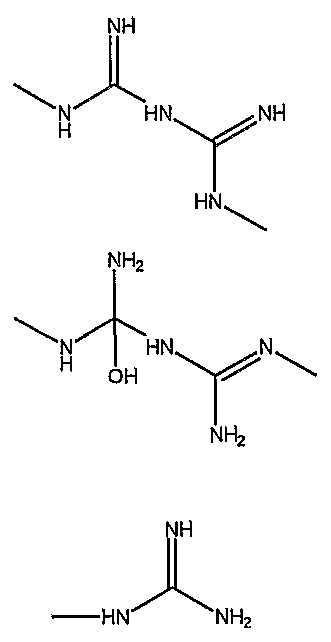
- a substituted amine group; R 5 a group having the following structure:
- the I, II, III moiety in the formula (1) may be the same structure or a different structure.
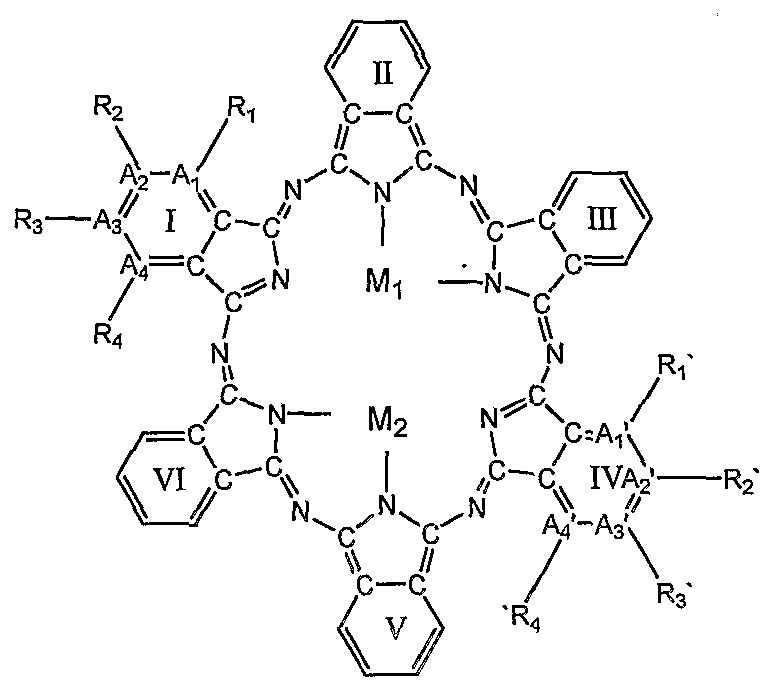
- the compound of the following formula (2) has the following structure:
- an atom of Mj, M 2 and an element represented by the formula (1) M The range is the same, IV ⁇ and can be atoms of the same element, or atoms of different elements; in the formula (2), ⁇ 2 , ⁇ 3 , ⁇ 4, ⁇ , ⁇ 2 ⁇ ⁇ 3 ⁇ ⁇ 4 ⁇
- R 2 , R 3 , , R 2 , R 3 , , , and the range of the elemental atom represented by the formula (AA 2 , A 3 , and A 4 , and the range of the elemental atom and the group represented by R 2 , R 3 , and R 4 are the same;
- the parts I, II, III, IV, V, VI in the formula (2) may be the same structure or different structures.
- the compound of the formula (1) can be synthesized from the compound of the formula (3), the atom of the group A 2 , A 3 , A4 , the substituent of R 2 , R 3 , R 4 and the formula ( 1)
- the range of element atoms represented by Aj, A 2 , A 3 , and A 4 in the compound is the same as the range of atoms and groups represented by R 2 , R 3 , and R4;
- R represents a carboxyl group, a cyano group;
- R represents a carboxylic anhydride group, a carboxylic acid imido group, a 1,3-isodecyl group;
- the synthesis consists of the following steps:
- the solvent used in the reaction includes quinoline, nitrobenzene, trichlorobenzene, 1-chloronaphthalene, isoamyl alcohol, and urea;
- the elemental substance and compound include a halogenated salt (CuCl), a sulfate (NiS0 4 ), an acetate (HfAc 2 ), a nitrate (AgN0 3 );
- the catalyst includes ammonium molybdate and sodium alkoxide.
- the preparation method of the compound of the formula (2) comprises the following steps:
- the compound of the formula (2) can be prepared by using the compound of the formula (1), and the compound of the formula (1) is charged into a thermal reaction apparatus with a vacuum and an addition, at 10 - 4 to 10 - 1 () Pa, 400 ⁇ The reaction is carried out at 600 ° C for 8 to 48 hours, and a bimolecular condensation occurs to obtain a compound of the formula (2).
- the compound of the formula (1) is used as an intermediate compound of a synthetic phthalocyanine compound, and is mixed with a raw material compound of another synthetic phthalocyanine in a certain ratio, and under certain conditions, three or four of the laver ring can be synthesized.
- the compound of the formula (2) provided by the present invention has a novel structure of a novel phthalocyanine compound and exhibits a new property which is not possessed by a series of existing phthalocyanine compounds.
- These properties are: UY-VIS-MR absorption spectrum has three strong absorption peaks, the most characteristic of which is near-infrared absorption near 1428nm; surface photovoltaic characteristics; photoluminescence characteristics; electroluminescence characteristics; Thermal stability; good electrical conductivity, etc.
- this class of molecules makes this class of compounds potentially useful in a number of important areas.
- the compound can be used as a near-infrared optoelectronic material for the preparation of near-infrared optoelectronic devices, etc.; the ordered an ultrathin film exhibits good electrical anisotropy and can be used to prepare molecular device circuits.
- Molecular wires; such compounds exhibit photoluminescence and electroluminescence properties and can be used in the preparation of organic display devices and the like.
- the compound of formula (2) can possess a large population of derivatives.
- the laverazine ring with four isoindole subunits can bind to more than seventy elements. If two different elements are taken out from more than seventy elements and combined to carry out the synthesis of the compound of the formula (2), only two hundred and five hundred kinds of derivatives of the compound of the formula (2) will be obtained only due to the change of the central ion. By introducing a substituent on the peripheral aromatic ring which is conjugated to the laverazine ring, the number of derivatives will be greatly increased. Such a compound of the formula (2) having a large number of derivatives will constitute an important family of phthalocyanine compounds. The invention has important significance for promoting the development of fields such as chemistry, materials science and information science.
- Figure 7 A simulated image of compound i ai .
- Figure 8. Molecular structure diagram of Compound 2.
- Figure 9. Spectrum of Compound 2 1 .
- Figure 22 is a structural diagram of the compound 2a 2 .
- Figure 23 is a structural diagram of the compound la 3 .
- Figure 24 is a structural diagram of the compound 2a 3 .
- ⁇ ⁇ 4 in the general formula (1) represents a nitrogen atom
- 2 and 3 represent a carbon atom
- R4 does not represent any group and atom
- ⁇ represents a hydrogen atom
- R 5 ⁇ R6 representative NH
- urea a compound of the formula (3) such as: Pyrazine-2,3-dicarboxylic acid 4.0008 g (0.0238 mol), CuCl 2 '2H 2 0 1.3683 g (0.0080 mol) ), (NH 4 ) 2 MoH N0 4 0.800 lg finely mixed and hooked into a steel bomb with a Teflon-lined seal, and the steel bomb was placed in an oven and heated to 240 ° C for 8 hours; The bomb was cooled to room temperature to open the lid, and the black solid was taken out; the black solid was placed in a vacuum purification apparatus, and purified at 10 to 4 Pa at 300 ° C for 24 hours.
- a compound of the formula (3) such as: Pyrazine-2,3-dicarboxylic acid 4.0008 g (0.0238 mol), CuCl 2 '2H 2 0 1.3683 g (0.0080 mol) ), (NH 4 ) 2 MoH N0 4 0.800 lg finely mixed and hooked
- ⁇ ⁇ 4 in the general formula (1) represents a nitrogen atom
- ⁇ 2 and ⁇ 3 represent a carbon atom
- R4 does not represent any group and atom
- ⁇ represents a hydrogen atom
- ⁇ represents a Cu(II) ion
- I, II, III, IV, V, VI have the same structure and constitute compound 2 of formula (2).
- the structural formula is Figure 8.
- the obtained compound 1 of the general formula (1) is placed in a vacuum apparatus and reacted at 10 to 4 Pa at 500 ° C for 24 hours to produce a bimolecular condensation reaction of the compound 1 of the general formula (1), thereby obtaining a general formula.
- (2) Compound 2 ai Compound 2 ai .
- the molecular ion peak of the compound 2 ai of the general formula (2) was measured by a mass spectrometer ( FIG. 9 ) M+Na + : 931.9193 amu, which is close to the calculated value of 930.7240. Compliant with the calculated value of 93.31919 for M+H+Na+. This is due to hydrogen in the mass spectrometer the general formula (2) reacting compound 21 in the plasma environment.
- Formula ⁇ spectrum (FIG.
- UV-VIS-NIR absorption spectrum of compound 2 ai of formula (2) UV UV-VIS-NIR absorption spectrum of compound 2a x formic acid solution of formula (2) was investigated by UV-VIS-NIR spectrometer (Fig. 16) The results show that, in addition to the absorption peaks in the ultraviolet region and the visible region, which are common to phthalocyanines, there is an absorption in the near red region (1.428 U rn), and the absorption coefficient is large.
- the UV-VIS-MR absorption spectrum of the compound 2 ai of the formula (2) observed by us is quite different from that of the general phthalocyanine.
- a photovoltaic device particularly a near-infrared photovoltaic device, can be prepared using the compound of the formula (2).
- Formula (2) photoactive compound 231 near-infrared region to the infrared photodynamic treatment of cancer by near infrared transmission properties of penetrating the human body, can be accomplished in vitro irradiation of light.
- This property can also be used in the preparation of gas sensor materials for the determination of harmful substances in the environmental protection field.
- Example 4 Photoluminescence spectrum of compound 2 (fluorescence spectrum) Using a fluorescence spectrometer at a temperature of 10 K The fluorescence spectrum of Compound 2 ai was measured by exciting the compound 2 ai with excitation light at 1200 nm and 350 nm (Figs. 17, 18). The results show that the compound is in the near infrared region of 1530 nm and the visible region of 450 nm. Fluorescence is emitted. Using this property, a compound 2 can be used to prepare a light-emitting device, particularly a near-infrared light-emitting device.
- Photovoltaic properties of compound 2 ai of Example 5 (: surface photovoltage spectrum SPS)
- the photovoltaic characteristic curve of the compound 2 1 was measured by a surface photovoltage spectrometer, that is, the surface photovoltage spectrum (Fig. 19). The results show that the photovoltaic properties of the compound 2 1 are very obvious, and the photovoltaic characteristics also appear in the near-infrared region at about llOOiim. Using this property, a device based on the photoelectric conversion principle can be prepared using Compound 2.
- Compound 2 at 10- 4 ⁇ 10_ 1 ( ⁇ , 900 ⁇ vacuum deposition conditions, film material produced by mass spectrometry, NMR and XPS results revealed that the compound 2a x remains, which indicates that the compound having a heat ultrahigh Stability. Applying this property, compound 2 can be used to prepare photovoltaic devices that operate in high temperature environments for aerospace and other fields.
- Example 6 Under the conditions of Example 6, the compound 2 ai was evaporated onto an ITO glass to obtain a ruthenium film having a thickness of about 100 nm (Fig. 20). Determination of the conductivity of the ruthenium film is 4 X 10 5 ⁇
- compound 2 can be used to prepare conductive materials in molecular devices for use in the field of information engineering.
- ⁇ ⁇ 4 in the general formula (1) represents a nitrogen atom
- ⁇ 2 and ⁇ 3 represent a carbon atom
- R4 does not represent any group and atom
- ⁇ represents a hydrogen atom
- ⁇ represents a Co(II) ion
- urea a compound of the formula (1) such as: Pyrazine-2,3-dicarboxylic Acid 4.0008 g (0.0238 mol), CoCl 2 6H 2 0 1.8876 g (0.0080 mol) , (NH4) 2 MoO 4 0.8001g was finely mixed and filled into a steel bomb with a Teflon-lined seal.
- the steel bomb was placed in an oven and heated to 240 ° C for 8 hours. After the steel bomb was cooled to room temperature, the lid was removed and the black solid was taken out. The black solid was placed in a vacuum purification apparatus and purified at 1 (T 4 Pa, 300 ° C for 24 hours. After the above operation, the molecular ion peak M+: 533.3452 amu was obtained by the compound la 1 ⁇ 5 mass spectrometer, and The calculated value of 533.3344 is consistent.
- a 2 , A 3 and A 4 represent a carbon atom, and R 3 represents a hydrogen atom, which represents a nitro group, and M represents a Ni(II) ion, and ⁇ represents
- A4 represents a nitrogen atom
- a 2 and A 3 represent a carbon atom, and do not represent any group and atom
- R 3 represents a hydrogen atom
- Mi represents a Cu(II) ion
- AA, 2 , A, 3 and A, 4 represent a carbon atom
- R and R, 4 represents a hydrogen atom
- R 2 represents a nitro group
- M 2 represents a ruthenium (iridium) ion
- the obtained compound 1 3 ⁇ 41 and the compound 1 were mixed at a molar ratio of 1/1, and placed in a vacuum apparatus, and reacted at 1 (T 4 Pa, 500 ° C for 8 hours to produce a double of the compound 1 and the compound la 3 After the molecular cross condensation reaction, the compound 2 was obtained.
- the molecular ion peak M+Na+ 1054.9367 amu of the compound 2a 3 was measured by a mass spectrometer, which was in agreement with the calculated value of 1054.9356.
Landscapes
- Physics & Mathematics (AREA)
- General Physics & Mathematics (AREA)
- Chemical & Material Sciences (AREA)
- Organic Chemistry (AREA)
- Engineering & Computer Science (AREA)
- Materials Engineering (AREA)
- Hybrid Cells (AREA)
- Nitrogen Condensed Heterocyclic Rings (AREA)
Description




Claims




Applications Claiming Priority (2)
| Application Number | Priority Date | Filing Date | Title |
|---|---|---|---|
| CN03110994.2 | 2003-02-11 | ||
| CNB031109942A CN100415715C (zh) | 2003-02-11 | 2003-02-11 | 紫菜嗪环中具有六个异吲哚结构亚单元的超酞菁类化合物、合成方法及用途 |
Publications (1)
| Publication Number | Publication Date |
|---|---|
| WO2004072082A1 true WO2004072082A1 (en) | 2004-08-26 |
Family
ID=32855447
Family Applications (1)
| Application Number | Title | Priority Date | Filing Date |
|---|---|---|---|
| PCT/CN2004/000109 Ceased WO2004072082A1 (en) | 2003-02-11 | 2004-02-09 | Superphthalocyanine compounds containing six isoindole subunits ini the porphyrazine cycle, the preparation processes and uses of them |
Country Status (2)
| Country | Link |
|---|---|
| CN (1) | CN100415715C (zh) |
| WO (1) | WO2004072082A1 (zh) |
Families Citing this family (2)
| Publication number | Priority date | Publication date | Assignee | Title |
|---|---|---|---|---|
| CN102533247B (zh) * | 2010-12-12 | 2015-09-30 | 陈文通 | 一种含镝荧光晶体及其制备方法 |
| JP6181053B2 (ja) * | 2012-06-18 | 2017-08-16 | 日本化薬株式会社 | ポルフィラジン色素及びその用途 |
Citations (5)
| Publication number | Priority date | Publication date | Assignee | Title |
|---|---|---|---|---|
| US4839112A (en) * | 1982-12-20 | 1989-06-13 | Northwestern University | Methods for fabricating a low dimensionally electroconductive article |
| JPH02187468A (ja) * | 1989-01-17 | 1990-07-23 | Japan Carlit Co Ltd:The | フタロシアニン化合物 |
| JPH05163440A (ja) * | 1991-12-16 | 1993-06-29 | Japan Carlit Co Ltd:The | フタロシアニン化合物 |
| JPH10182995A (ja) * | 1996-12-26 | 1998-07-07 | Nippon Shokubai Co Ltd | 新規フタロシアニン化合物、その製造方法および近赤外吸収材料 |
| WO1999003868A1 (en) * | 1997-07-16 | 1999-01-28 | Johnson Matthey Public Limited Company | Photosensitizers |
Family Cites Families (4)
| Publication number | Priority date | Publication date | Assignee | Title |
|---|---|---|---|---|
| TW472072B (en) * | 1995-05-12 | 2002-01-11 | Ciba Sc Holding Ag | Process for colouration of high molecular weight organic materials in the mass with soluble phthalocyanine precursors |
| CA2394891A1 (en) * | 1999-12-08 | 2001-06-14 | Michael John Cook | Substituted phthalocyanines and their precursors |
| CN1344718A (zh) * | 2001-07-30 | 2002-04-17 | 宾月景 | 新型酞菁衍生物及其应用 |
| CN1181071C (zh) * | 2001-09-05 | 2004-12-22 | 东北师范大学 | 四-(1,4,8,9-四氮杂)苯并菲类金属酞菁化合物及合成方法 |
-
2003
- 2003-02-11 CN CNB031109942A patent/CN100415715C/zh not_active Expired - Fee Related
-
2004
- 2004-02-09 WO PCT/CN2004/000109 patent/WO2004072082A1/zh not_active Ceased
Patent Citations (5)
| Publication number | Priority date | Publication date | Assignee | Title |
|---|---|---|---|---|
| US4839112A (en) * | 1982-12-20 | 1989-06-13 | Northwestern University | Methods for fabricating a low dimensionally electroconductive article |
| JPH02187468A (ja) * | 1989-01-17 | 1990-07-23 | Japan Carlit Co Ltd:The | フタロシアニン化合物 |
| JPH05163440A (ja) * | 1991-12-16 | 1993-06-29 | Japan Carlit Co Ltd:The | フタロシアニン化合物 |
| JPH10182995A (ja) * | 1996-12-26 | 1998-07-07 | Nippon Shokubai Co Ltd | 新規フタロシアニン化合物、その製造方法および近赤外吸収材料 |
| WO1999003868A1 (en) * | 1997-07-16 | 1999-01-28 | Johnson Matthey Public Limited Company | Photosensitizers |
Also Published As
| Publication number | Publication date |
|---|---|
| CN100415715C (zh) | 2008-09-03 |
| CN1548422A (zh) | 2004-11-24 |
Similar Documents
| Publication | Publication Date | Title |
|---|---|---|
| Wang et al. | Synthesis, structure, and single-molecule magnetic properties of rare-earth sandwich complexes with mixed phthalocyanine and Schiff base ligands. | |
| Yuan et al. | Hydrogen isotope effect endows a breakthrough in photoluminescent covalent organic frameworks | |
| CN105541660B (zh) | 一种芳基水杨醛‑二苯基‑吖嗪联肼类化合物及制备与应用 | |
| Stymne et al. | A spectroscopic study of the complexation of phthalocyanines with water, ethanol and phenol | |
| CN103193733B (zh) | 2,7-二-(n-吩噻嗪基)芴酮及其制备方法 | |
| Ulrich et al. | Carbonyl derivatives of boradiazaindacene via catalytic CO insertion | |
| Akçay et al. | Synthesis, characterization and spectroscopic studies of novel peripherally tetra-imidazole substituted phthalocyanine and its metal complexes, the computational and experimental studies of the novel phthalonitrile derivative | |
| CN107011367A (zh) | 一种具有选择性探测重铬酸根离子的发光晶体材料的制备 | |
| Parvarinezhad et al. | The structural study, Hirshfeld surface analysis, and DFT calculations of ferrocenyl-hydrazine Schiff base: a novel precursor for the selective preparation of Fe2O3 nanoparticles | |
| Wu et al. | Highly Selective Protic-Solvent-Mediated Organic–Inorganic Hybrid Cuprous Bromides Achieving Structural Transformation | |
| Guo et al. | Temperature sensitive properties and preparation of europium complexes with double ligands | |
| Brisson et al. | Boron subphthalocyanine dyes: 3-Pentadecylphenol as a solubilizing molecular fragment | |
| WO2004072082A1 (en) | Superphthalocyanine compounds containing six isoindole subunits ini the porphyrazine cycle, the preparation processes and uses of them | |
| Salan et al. | Synthesis and characterization of a new trans-2, 2′-azoquinoxaline bridged bisphthalocyanine | |
| Bilgin et al. | Novel network polymeric phthalocyanines: synthesis and characterization | |
| WO2014172020A2 (en) | Cross-linked polymer networks and methods of making and using same | |
| CN105622643B (zh) | 检测水中铅离子的化合物及其制备方法和应用 | |
| CN116102494B (zh) | 一种三苯胺衍生物及其制备方法、光致变色薄膜材料及其制备方法和应用 | |
| Wang et al. | A Universal Approach for Potassium‐Passivated 2D Perovskites | |
| Kantekin et al. | Synthesis and characterization of new metal-free and phthalocyanine nickel (II) complex containing macrocyclic moieties | |
| JPH0689001B2 (ja) | ビス(オクタアルキルフタロシアニナート)ランタノイド化合物 | |
| CN105601888B (zh) | 一种五蝶烯共轭聚合物及其制备方法与其在快速检测硝基芳烃类爆炸物中的应用 | |
| CN105646589B (zh) | 检测铅离子的含锰化合物及其制备方法和应用 | |
| CN107686453A (zh) | 邻羧基苯甲醛缩乙二胺席夫碱铜配合物的制备方法 | |
| WO2004106436A1 (en) | Phthalocyanine compounds |
Legal Events
| Date | Code | Title | Description |
|---|---|---|---|
| AK | Designated states |
Kind code of ref document: A1 Designated state(s): AE AG AL AM AT AU AZ BA BB BG BR BW BY BZ CA CH CN CO CR CU CZ DE DK DM DZ EC EE EG ES FI GB GD GE GH GM HR HU ID IL IN IS JP KE KG KP KR KZ LC LK LR LS LT LU LV MA MD MG MK MN MW MX MZ NA NI NO NZ OM PG PH PL PT RO RU SC SD SE SG SK SL SY TJ TM TN TR TT TZ UA UG US UZ VC VN YU ZA ZM ZW |
|
| AL | Designated countries for regional patents |
Kind code of ref document: A1 Designated state(s): BW GH GM KE LS MW MZ SD SL SZ TZ UG ZM ZW AM AZ BY KG KZ MD RU TJ TM AT BE BG CH CY CZ DE DK EE ES FI FR GB GR HU IE IT LU MC NL PT RO SE SI SK TR BF BJ CF CG CI CM GA GN GQ GW ML MR NE SN TD TG |
|
| 121 | Ep: the epo has been informed by wipo that ep was designated in this application | ||
| 32PN | Ep: public notification in the ep bulletin as address of the adressee cannot be established |
Free format text: NOTIFICATION OF LOSS OF RIGHTS PURSUANT TO RULE 69(1) EPC (EPO FORM 1205A SENT 17.11.05) |
|
| 122 | Ep: pct application non-entry in european phase |