USPP17774P3 - Kiwi plant named ‘Hort51-1785’ - Google Patents
Kiwi plant named ‘Hort51-1785’ Download PDFInfo
- Publication number
- USPP17774P3 USPP17774P3 US11/122,613 US12261305V USPP17774P3 US PP17774 P3 USPP17774 P3 US PP17774P3 US 12261305 V US12261305 V US 12261305V US PP17774 P3 USPP17774 P3 US PP17774P3
- Authority
- US
- United States
- Prior art keywords
- fruit
- hort51
- color
- flower
- mean
- Prior art date
- Legal status (The legal status is an assumption and is not a legal conclusion. Google has not performed a legal analysis and makes no representation as to the accuracy of the status listed.)
- Expired - Lifetime, expires
Links
Images




Classifications
-
- A—HUMAN NECESSITIES
- A01—AGRICULTURE; FORESTRY; ANIMAL HUSBANDRY; HUNTING; TRAPPING; FISHING
- A01H—NEW PLANTS OR NON-TRANSGENIC PROCESSES FOR OBTAINING THEM; PLANT REPRODUCTION BY TISSUE CULTURE TECHNIQUES
- A01H5/00—Angiosperms, i.e. flowering plants, characterised by their plant parts; Angiosperms characterised otherwise than by their botanic taxonomy
- A01H5/08—Fruits
-
- A—HUMAN NECESSITIES
- A01—AGRICULTURE; FORESTRY; ANIMAL HUSBANDRY; HUNTING; TRAPPING; FISHING
- A01H—NEW PLANTS OR NON-TRANSGENIC PROCESSES FOR OBTAINING THEM; PLANT REPRODUCTION BY TISSUE CULTURE TECHNIQUES
- A01H6/00—Angiosperms, i.e. flowering plants, characterised by their botanic taxonomy
Definitions
- Genus and species of plant claimed Actinidia chinensis.
- Kiwi plants in cultivation are mainly varieties of A. deliciosa, particularly ‘Hayward’ although some A. chinensis and A. arguta varieties are grown.
- A. deliciosa and A. chinensis are closely related and varieties of both types have large fruit ( ⁇ 100 g) with hair on the skin.
- the main varieties in New Zealand are ‘Hayward’ ( A. deliciosa ) and ‘Hort16A’ ( A. chinensis ). Fruit are usually cut and eaten with a spoon.
- A. chinensis vines are deciduous and tend to grow vigorously in spring and summer when rapidly-growing shoots can intertwine and tangle if not managed. Vines do best in a mild warm-temperate climate without late spring or early autumn frosts. They produce consistently heavy crops when grown in well-drained fertile soils and given regular irrigation in dry spells.
- Harvest of A. chinensis fruit may occur between April and late- May in New Zealand depending on the selection and location of plantings.
- the present invention is a new and distinctive kiwifruit variety having a generally globose shaped fruit with short, soft, silky hair and a golden yellow flesh when ripe.
- This new variety is designated ‘Hort51-1785’ and is derived from a controlled pollination using a female tetraploid A.
- chinensis selection ‘Jing Feng’ also known as 79-3, and by the accession code CK34 — 01) of unknown parentage, and a male tetraploid A.
- chinensis selection CK40 — 02 of unknown parentage.
- the female parent was introduced to New Zealand as vegetative plant material from Jiangxi, China.
- the male parent was selected in New Zealand from seedling plants raised from an introduction of seed from China in 1989. Both parents are unpatented.
- the new variety can be asexually reproduced as cuttings or by grafting or budding on to seedling or cutting-grown rootstocks of A. deliciosa or A. chinensis.
- Trial plantings of grafted plants established at the Te Puke, Nelson and Kerikeri Research Centres in 1998 have shown that the unique combination of characters come true to form and are established and transmitted through succeeding asexual propagations.
- Hort51-1785 flowers at least two weeks later than Hort16A and requires specific tetraploid males to ensure adequate pollination.
- FIG. 1 shows typical fruit of ‘Hort51-1785’ on the vine.
- FIG. 2 shows typical fruit of ‘Hort51-1785’ in side profile.
- FIG. 3 shows a stem end view of fruit of ‘Hort51-1785’.
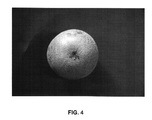
- FIG. 4 shows a stylar end view of fruit of ‘Hort51-1785’.
- FIG. 5 shows fruit of ‘Hort51-1785’ in cross section.
- FIG. 6 shows flowers of ‘Hort51-1785’.
- FIG. 7 shows the leaf of ‘Hort51-1785’.
- Photographs of fruit were taken at the normal harvest date. Fruit skin color may vary depending upon extent of exposure to direct sunlight.
- the new tetraploid kiwifruit variety ‘Hort51-1785’ is pistillate (female), and produces imperfect flowers, i.e. the flowers produce only sterile pollen and require a pollinizer to set fruit.
- Fruit core color at harvest 150C to 150D
- Fruit seed color (in flesh) 200A
- Fruit seed colour (dry seed) 200C
- Fruit skin color at maturity 199B
- Leaf color of upper side (in mature leaf after petal fall) 147A
- Leaf color of lower side (in mature leaf after petal fall)
- Plant stem color on exposed side 177A to 199A
- Fruit of ‘Hort51-1785’ is globose in shape with a rounded stylar end compared with the ovoid shape and protruding stylar beak of ‘Hort16A’.
- the flesh of ‘Hort51-1785’ is golden yellow when ripe compared to the lighter yellow flesh of ‘Hort16A’ and the yellow-green flesh of ‘KI 89’.
- the skin of ‘Hort51-1785’ is a pale mid-brown color, whereas the skin of ‘Hort16A’ is yellow-brown and that of ‘KI 89’ is reddish-brown.
- the fruit of ‘Hort51-1785’ has conspicuous, raised lenticels on the skin, ‘Hort16A’ and ‘KI 89’ do not have raised lenticels.
- the fruit of ‘Hort51-1785’ is generally larger sized, has lower brix, lower dry matter content, and higher flesh firmness at harvest than ‘Hort16A’.
- the fruit of ‘Hort51-1785’ is generally shorter but of greater diameter than fruit of either ‘Hort16A’ or ‘KI 89’.
- ‘Hort51-1785’ has globose-shaped fruit with a ratio of maximum width/fruit length of 0.92 whereas ‘Jing Feng’ fruit is ellipsoidal in shape with a ratio of maximum width/fruit length of 0.78. ‘Hort51-1785’ fruit have a small internal cavity, average length 10.2 mm, at the stylar end, whereas ‘Jing Feng’ fruit has no cavity.
Landscapes
- Life Sciences & Earth Sciences (AREA)
- Health & Medical Sciences (AREA)
- Physiology (AREA)
- Botany (AREA)
- Developmental Biology & Embryology (AREA)
- Environmental Sciences (AREA)
- Breeding Of Plants And Reproduction By Means Of Culturing (AREA)
Abstract
A new and distinct kiwi plant of the species Actinidia chinensis Planch. is described. The variety results from a controlled pollination using a female A. chinensis selection ‘Jing Feng’ (also known as 79-3, and by the accession code CK34_01) of unknown parentage, and a male A. chinensis selection CK40_02 of unknown parentage. Both parents (‘Jing Feng’ and CK40_02) are unpatented. The new variety is distinguished by its large globose-shaped fruit with a flat stylar end, golden coloured flesh and tangy sweet taste.
Description
Genus and species of plant claimed: Actinidia chinensis.
Variety denomination: Hort51-1785.
Kiwi plants in cultivation are mainly varieties of A. deliciosa, particularly ‘Hayward’ although some A. chinensis and A. arguta varieties are grown. A. deliciosa and A. chinensis are closely related and varieties of both types have large fruit (˜100 g) with hair on the skin. The main varieties in New Zealand are ‘Hayward’ (A. deliciosa) and ‘Hort16A’ (A. chinensis). Fruit are usually cut and eaten with a spoon.
All Actinidia species are dioecious, so female varieties have to be interplanted with male pollinizers to ensure fruit production.
A. chinensis vines are deciduous and tend to grow vigorously in spring and summer when rapidly-growing shoots can intertwine and tangle if not managed. Vines do best in a mild warm-temperate climate without late spring or early autumn frosts. They produce consistently heavy crops when grown in well-drained fertile soils and given regular irrigation in dry spells.
A. chinensis flowers in spring (mid October-early December) in New Zealand. Harvest of A. chinensis fruit may occur between April and late-May in New Zealand depending on the selection and location of plantings.
The present invention is a new and distinctive kiwifruit variety having a generally globose shaped fruit with short, soft, silky hair and a golden yellow flesh when ripe. This new variety is designated ‘Hort51-1785’ and is derived from a controlled pollination using a female tetraploid A. chinensis selection ‘Jing Feng’ (also known as 79-3, and by the accession code CK34—01) of unknown parentage, and a male tetraploid A. chinensis selection CK40—02 of unknown parentage.
The female parent was introduced to New Zealand as vegetative plant material from Jiangxi, China. The male parent was selected in New Zealand from seedling plants raised from an introduction of seed from China in 1989. Both parents are unpatented.
This new variety was created during the course of a planned plant-breeding program, which was initiated during 1987 in Auckland, New Zealand. The cross was made on Nov. 24, 1994 in Te Puke, New Zealand. Seeds were sown in the winter of 1995 and 64 seedlings from this cross were planted out in the field at Te Puke in August 1996. The selection ‘Hort51-1785’ first flowered in November 1997 and fruit was first assessed in May 1998. Selection ‘Hort51-1785’ was grafted in 1998 onto four existing kiwifruit rootstocks in a clonal selection trial plot using graftwood from the original seedling plant.
The new variety can be asexually reproduced as cuttings or by grafting or budding on to seedling or cutting-grown rootstocks of A. deliciosa or A. chinensis. Trial plantings of grafted plants established at the Te Puke, Nelson and Kerikeri Research Centres in 1998 have shown that the unique combination of characters come true to form and are established and transmitted through succeeding asexual propagations.
‘Hort51-1785’ flowers at least two weeks later than Hort16A and requires specific tetraploid males to ensure adequate pollination.
Photographs of fruit were taken at the normal harvest date. Fruit skin color may vary depending upon extent of exposure to direct sunlight.
The new tetraploid kiwifruit variety ‘Hort51-1785’ is pistillate (female), and produces imperfect flowers, i.e. the flowers produce only sterile pollen and require a pollinizer to set fruit.
Horticultural terminology is used in accordance with revised UPOV guidelines for kiwi. All dimensions are in millimeters, weights in grams (unless otherwise stated). Color references are in accord with the R.H.S. Colour Chart, the Royal Horticultural Society, London, 1966.
| ‘Hort51-1785’ | ||
| PLANT | |
| (Measurements from samples of | |
| 10, unless stated) | |
| Plant: sex expression | female (flowers imperfect) |
| Plant: ploidy | tetraploid (2n = 2x = 116) |
| Plant: vigour | medium |
| Young shoot: hairs | present |
| Young shoot: density of hairs | medium |
| Young shoot: type of hairs | tomentose |
| Young shoot: anthocyanin color- | absent or very weak |
| ation of growing tip | |
| Young shoot: anthocyanin color- | absent or very weak |
| ation of leaf axil | |
| STEM | |
| Stem: coloration of leaf axil | absent or very weak |
| Stem: diameter | medium (mean 9.5 mm, range |
| 7.6-10.5 mm at mid point1) | |
| Stem: length | 1.2-1.8 m |
| Stem: dormant bud diameter | large (mean 6.3 mm, range 5.00- |
| 7.16 mm) | |
| Stem: color on upper side of shoot | greyish-brown (near 177A to |
| 199A) | |
| Stem: character of bark | smooth |
| Stem: hairs | absent |
| Stem: conspicuousness of lenticels | conspicuous |
| Stem: number of lenticels/cm2 | mean 3.32/cm2 (range |
| bark area | 1.8-5.02/cm2) |
| Stem: color of lenticels | brown, near 166C |
| Stem: size of lenticels - length | mean 3.27 mm, range 1.54-4.53 |
| mm | |
| Stem: size of lenticels - maximum | mean 1.34 mm, range 0.82-2.03 |
| width | mm |
| Stem: size of bud support | medium |
| Stem: visibility of bud (dormant | visible |
| canes) | |
| Stem: number of hairs visible on | many |
| bud (dormant canes) | |
| LEAF (Mature) | |
| Leaf: general shape of blade | very broadly ovate |
| Leaf: length | 124 mm |
| Leaf: width | 151 mm |
| Leaf: petiole length | 103 mm |
| Leaf: shape of tip of blade | acute |
| Leaf: shape of base of blade | cordate |
| Leaf: arrangement of leaf bases | overlapping |
| Leaf: puckering/blistering on upper | medium |
| side of blade | |
| Leaf: margin | ciliate |
| Leaf: green color of upper side of | medium green, near 147A |
| blade | |
| Leaf: glossiness of upper surface of | medium |
| blade | |
| Leaf: color of lower side of blade | light green, near 148B |
| Leaf: glaucosity (lower side of | absent |
| blade) | |
| Leaf: hairs on petiole | present |
| Leaf: density of hairs on petiole | medium |
| Leaf: anthocyanin coloration on | medium |
| upper side of petiole | |
| FLOWER | |
| Inflorescence: predominant number | three |
| of flowers | |
| Flower: pedicel hairs: | present |
| Flower: pedicel length of hairs | very short |
| Flower: pedicel length | mean 27.09 mm |
| Flower: number of sepals | six or seven |
| Flower: color of sepals | green, near 148D |
| Flower: length of sepals | mean 11.45 mm, range 8.86- |
| 12.37 mm | |
| Flower: diameter of sepals | mean 9.09 mm, range 8.32-9.67 |
| Flower: diameter (terminal or king | 51 mm (mean of 7 flowers) |
| flower when fully open) | |
| Flower: mean number of petals per | 6 |
| flower | |
| Flower: length of petals | mean 28.77 mm, range 27.0-31.6 |
| mm | |
| Flower: width of petals | mean 23.89 mm, range 22.4-26.0 |
| Flower: ratio petal length/width | 1.21 |
| Flower: arrangement of petals | overlapping |
| Flower: petal shoulder | present |
| Flower: primary color of petals | white, near 155B |
| (when fully open) | |
| Flower: type of coloration of petals | bi-coloured, green at base |
| Flower: secondary color of base | green, near 144D |
| of petals | |
| Flower: filament color | white, near 157A |
| Flower: anther color | yellow, near 16C |
| Flower: attitude of styles | semi-erect |
| Flower: curvature of styles | absent |
| Flower: color of styles | white, near 155D |
| Flower: amount of hair on ovary | dense |
| Flower: colour of ovary | white near 157B |
| FRUIT | |
| Fruit: weight | mean 99 g |
| Fruit: length | 66 mm |
| Fruit: width (max) | 61 mm |
| Fruit: width (min) | 58 mm |
| Fruit: core diameter (max) | 12.4 mm |
| Fruit: core diameter (min) | 7.8 mm |
| Fruit: locule number | 30 |
| Fruit: peduncle length | 35 mm |
| Fruit: peduncle width | 3.9 mm |
| Fruit: general shape | globose |
| Fruit: cross section at median | circular |
| Fruit: general shape of stylar end | flat |
| Fruit: shape of shoulder on stalk | squared |
| end | |
| Fruit: presence of calyx ring | present |
| Fruit: expression of calyx ring | strongly expressed |
| Fruit: skin color at harvest (fruit | medium brown, near 199B |
| still hard) | |
| Fruit: skin colour change during | absent |
| ripening | |
| Fruit: skin color at maturity for | medium brown, near 199B |
| consumption | |
| Fruit: lenticel color at maturity | near 164C |
| Fruit: hairs | present |
| Fruit: density of hairs | sparse |
| Fruit: type of hairs | pubescent |
| Fruit: hair length | short |
| Fruit: concentration of hairs | uniform |
| Fruit: adherence of hairs to skin | weak |
| (when rubbed) | |
| Fruit: core diameter (at largest dia- | small (approximately 12.4 mm) |
| meter) | |
| Fruit: core shape (in cross section) | transverse elliptic |
| Fruit: core woody spike | weak |
| Fruit: prominence of core woody | small |
| spike | |
| Fruit: outer pericarp color at | yellow, near 162D |
| maturity for consumption | |
| Fruit: inner pericarp col. (locules) | yellow, near 162B |
| at mat. for consumption | |
| Fruit: core color at maturity | pale yellow, near 14D |
| Fruit: sweetness (Brix level) at | 13.8% (range 11.4-16.2%) |
| maturity for consumption | |
| Fruit: vitamin C content (45 fruit | 133 mg/100 g fresh weight |
| sample) | (range 123-140 mg/100 g fresh |
| weight) mean of 5 plants, 3 | |
| values, per plant. | |
| Fruit: seed colour at maturity (in | blackish-brown, near 200A |
| flesh) | |
| Fruit: seed colour when dry | dark brown, near 200C |
| Fruit: average seed number per | mean 514, range 465-596 |
| fruit | |
| Fruit: seed length | mean 2.45 mm |
| Fruit: seed maximum diameter | mean 1.71 mm |
| EVENTS | |
| Time of vegetative budbreak | medium (mid September) |
| Time of beginning of flowering | 8 Nov. (2004) |
| Time of maturity for harvest (at | last week of May (Brix 10%) under |
| nominated Brix level) | New Zealand growing conditions |
| 1Measured in the middle of the cane i.e. halfway down the full length and midway between two buds. | |
Observations were made on plants growing at Te Puke, New Zealand. These plants had been grafted on to seedling kiwifruit rootstocks.
- Rootstocks: ‘Hort51-1785’ vines can be grown on the same rootstocks as ‘Hort16A’. Rootstocks currently being used in New Zealand include A. deliciosa and A. chinensis seedlings, ‘Hayward’ (not patented) and ‘Kaimai’ (not patented) rooted cuttings.
- Cropping: Young vines of ‘Hort51-1785’ crop heavily when young, and must be thinned directly after fruit set to reduce crop loads and to ensure fruit size is not compromised by over cropping. Vines of ‘Hort51-1785’ begin to bear fruit in their second year from graft and can be expected to reach full capacity at about 5 years.
- Storage life: The storage life of ‘Hort51-1785’ fruit is 20 weeks at 0° C., if stored in unventilated containers.
- Pest and disease resistance/susceptibility: Unsprayed fruit of ‘Hort51-1785’ is slightly more susceptible to Greedy Scale infestation, but less damaged by Leaf Roller caterpillar compared to ‘Hayward’. Flowers of ‘Hort51-1785’ are more susceptible to fungal Sclerotinia infection during wet weather, possibly due to the higher flower density (three flowers per inflorescence) compared to ‘Hayward’ (single flowers).
- Fruit size: Date gathered from harvesting all fruit, from 6 vines, in May 2004.
| Mean fruit | 99.2 | g | maximum: | 138 | g | minimum: | 73 | g |
| weight: | ||||||||
| Mean fruit | 332 | maximum: | 1084 | minimum: | 102 | |||
| number: | ||||||||
| Mean yield: | 38.8 | kg | maximum: | 14.1 | kg | minimum: | 81.4 | kg |
Color chart: R.H.S. Colour Chart, The Royal Horticultural Society, London, 1966.
| Fruit: core color at harvest | 150C to 150D |
| Fruit: seed color (in flesh) | 200A |
| Fruit: seed colour (dry seed) | 200C |
| Fruit: skin color at maturity | 199B |
| Leaf: color of upper side (in mature leaf after petal fall) | 147A |
| Leaf: color of lower side (in mature leaf after petal fall) | 148B |
| Plant stem: color on exposed side | 177A to 199A |
The distinctive characteristics of this new kiwifruit variety, described in detail below, were observed in 2005 at Te Puke, New Zealand. The age of the plants was 6 years from grafting onto seedling rootstocks.
Comparison with similar varieties ‘Hort16A’ (U.S. Plant Pat. No. 11,066) and ‘KI 89’ (U.S. Plant Pat. No. 8,497) shows that ‘Hort51-1785’ may be distinguished as follows in Table 1.
| TABLE 1 |
| Comparison with similar varieties |
| Color references are in accord with the RHS Colour Chart, the Royal Hort- |
| icultural Society, London, 1966. Observations made under New Zealand |
| growing conditions. |
| Character- | |||
| istic | ‘Hort51-1785’ | ‘Hort16A’ | ‘KI 89’ |
| Time of full | late November | mid October | early November |
| bloom | |||
| Fruit: Color | mid-brown, near | yellow-brown, | reddish-brown, near |
| of skin | 199B | near | 164B/164C |
| 199A/161A | |||
| Fruit: mean | 99 g | 91 g | 103.4 |
| weight | |||
| Fruit: Core | very small | small | medium |
| diameter | (approximately 12.4 | (approximately | (approximately 15.3 |
| (maximum) | mm) | 13.08 mm) | mm) |
| Fruit: | globose | ovoid | cylindrical |
| General | |||
| shape | |||
| Fruit: shape | rounded | protruding | slightly depressed |
| at stylar end | |||
| Fruit: pres- | present | not present | not present |
| ence of | |||
| internal | |||
| stylar | |||
| cavity | |||
| Fruit: Flesh | golden yellow, near | yellow, near | yellow-green, near |
| color (ripe) | 162D | 12C/12B | 145C/154D |
| Fruit: Pres- | present | not present | not present |
| ence of | |||
| lenticels on | |||
| skin | |||
| Fruit: Visi- | conspicuous | not obvious | not obvious |
| bility of | |||
| lenticels on | |||
| skin | |||
| Fruit: Mean | 12.5-14% | 14-19% | 10.8-12.4% |
| soluble sol- | |||
| ids content | |||
| when ripe | |||
| Mean dry | 17.8% | 18.3% | 15.5-17.2% |
| matter at | |||
| harvest | |||
| Mean flesh | 6.8 Kgf | 4.6 Kgf | 3.7 Kgf |
| firmness at | |||
| harvest | |||
Fruit of ‘Hort51-1785’ is globose in shape with a rounded stylar end compared with the ovoid shape and protruding stylar beak of ‘Hort16A’. The flesh of ‘Hort51-1785’ is golden yellow when ripe compared to the lighter yellow flesh of ‘Hort16A’ and the yellow-green flesh of ‘KI 89’. The skin of ‘Hort51-1785’ is a pale mid-brown color, whereas the skin of ‘Hort16A’ is yellow-brown and that of ‘KI 89’ is reddish-brown. The fruit of ‘Hort51-1785’ has conspicuous, raised lenticels on the skin, ‘Hort16A’ and ‘KI 89’ do not have raised lenticels.
The fruit of ‘Hort51-1785’ is generally larger sized, has lower brix, lower dry matter content, and higher flesh firmness at harvest than ‘Hort16A’. The fruit of ‘Hort51-1785’ is generally shorter but of greater diameter than fruit of either ‘Hort16A’ or ‘KI 89’.
| TABLE 2 |
| Comparison with female parent, ‘Jing Feng’ |
| Colour references are in accord with the RHS Colour Chart, the Royal |
| Horticultural Society, London, 1966. Observations made under New |
| Zealand growing conditions. |
| Characteristic | ‘Hort51-1785’ | ‘Jing Feng’ |
| Time of full bloom | late November | late November |
| Fruit: color of skin | mid-brown, near 199B | light brown, near |
| 165B | ||
| Fruit: core diameter | 12.4 mm | 14.1 mm |
| Fruit: general shape | globose | ellipsoidal |
| Fruit: ratio of fruit | 0.92 | 0.78 |
| maximum width/fruit | ||
| length | ||
| Fruit: mean weight | 99 g | 103 g |
| Fruit: shape at stylar | rounded | flat |
| end | ||
| Fruit: presence of | present | not present |
| stylar cavity | ||
| Fruit: flesh color | golden yellow near 162D | golden yellow, near |
| 163D | ||
| Fruit: locule color | near 162B | near 164B |
| Presence of lenticels | present | not present |
| on fruit skin | ||
| Visibility of lenticels on | conspicuous | not obvious |
| fruit skin | ||
| Mean soluble solids | 12.5-14% | 11.6-14.6% |
| content of ripe fruit | ||
| Mean dry matter at | 17.8% | 16.6% |
| harvest | ||
| Mean firmness at | 6.8 Kgf | 5.5 Kgf |
| harvest | ||
The most striking difference between ‘Hort51-1785’ and the female parent ‘Jing Feng’ is that of fruit shape. ‘Hort51-1785’ has globose-shaped fruit with a ratio of maximum width/fruit length of 0.92 whereas ‘Jing Feng’ fruit is ellipsoidal in shape with a ratio of maximum width/fruit length of 0.78. ‘Hort51-1785’ fruit have a small internal cavity, average length 10.2 mm, at the stylar end, whereas ‘Jing Feng’ fruit has no cavity.
Claims (1)
1. A new and distinct kiwi plant of the species A. chinensis substantially as herein illustrated and described.
Priority Applications (1)
| Application Number | Priority Date | Filing Date | Title |
|---|---|---|---|
| US11/122,613 USPP17774P3 (en) | 2005-05-05 | 2005-05-05 | Kiwi plant named ‘Hort51-1785’ |
Applications Claiming Priority (1)
| Application Number | Priority Date | Filing Date | Title |
|---|---|---|---|
| US11/122,613 USPP17774P3 (en) | 2005-05-05 | 2005-05-05 | Kiwi plant named ‘Hort51-1785’ |
Publications (2)
| Publication Number | Publication Date |
|---|---|
| US20060253946P1 US20060253946P1 (en) | 2006-11-09 |
| USPP17774P3 true USPP17774P3 (en) | 2007-05-29 |
Family
ID=37395476
Family Applications (1)
| Application Number | Title | Priority Date | Filing Date |
|---|---|---|---|
| US11/122,613 Expired - Lifetime USPP17774P3 (en) | 2005-05-05 | 2005-05-05 | Kiwi plant named ‘Hort51-1785’ |
Country Status (1)
| Country | Link |
|---|---|
| US (1) | USPP17774P3 (en) |
Families Citing this family (1)
| Publication number | Priority date | Publication date | Assignee | Title |
|---|---|---|---|---|
| CN114451292A (en) * | 2022-02-17 | 2022-05-10 | 浙江省农业科学院 | Pollen preparation technology for seed softening and reduction of tetraploid Chinese gooseberry |
-
2005
- 2005-05-05 US US11/122,613 patent/USPP17774P3/en not_active Expired - Lifetime
Also Published As
| Publication number | Publication date |
|---|---|
| US20060253946P1 (en) | 2006-11-09 |
Similar Documents
| Publication | Publication Date | Title |
|---|---|---|
| US20090288233P1 (en) | Blackberry plant named 'Natchez' | |
| USPP34867P2 (en) | Blackberry plant named ‘APF-268’ | |
| USPP13309P2 (en) | Grapevine plant named ‘Jupiter’ | |
| USPP11066P (en) | Kiwi plant named `Hort16A` | |
| USPP35368P2 (en) | Blackberry plant named ‘APF-404T’ | |
| USPP22159P3 (en) | Kiwi plant named ‘AU Golden Sunshine’ | |
| USPP28753P2 (en) | Kiwi plant named ‘HFR18’ | |
| US20060253946P1 (en) | Kiwi plant named '51-1785' | |
| USPP36264P3 (en) | Grapevine plant named ‘Gensel 4’ | |
| USPP34612P2 (en) | Strawberry plant named ‘QBC-1’ | |
| USPP22276P3 (en) | Kiwifruit plant named ‘ZESH004’ | |
| USPP35444P2 (en) | Avocado tree named ‘BL516’ | |
| US20250204293P1 (en) | Rubus plant named 'BT RASseven' | |
| USPP22355P3 (en) | Kiwifruit plant named ‘ZESY002’ | |
| USPP20893P3 (en) | Kiwi plant named ‘Hort22D’ | |
| USPP14212P3 (en) | Kiwi plant named ‘Hortgem Toru’ | |
| USPP8212P (en) | "Chislett Summer Navel" orange tree | |
| USPP16229P2 (en) | Grapevine denominated ‘Scarlet Royal’ | |
| USPP32076P2 (en) | Kiwifruit plant named ‘ZES008’ | |
| USPP20028P3 (en) | Apple tree named ‘RS103-130’ | |
| USPP17182P3 (en) | Peach tree plant named ‘Plawhite 5’ | |
| USPP32112P3 (en) | Strawberry plant named ‘A13-72’ | |
| USPP14035P3 (en) | Raspberry variety named ‘Motueka’ | |
| USPP32137P3 (en) | Strawberry plant named ‘A13-26’ | |
| USPP30549P3 (en) | Kiwi plant named ‘HFY01’ |
Legal Events
| Date | Code | Title | Description |
|---|---|---|---|
| AS | Assignment |
Owner name: THE HORTICULTURE AND FOOD RESEARCH INSTITUTE OF NE Free format text: ASSIGNMENT OF ASSIGNORS INTEREST;ASSIGNOR:LOWE, RUSSELL GEORGE;REEL/FRAME:016029/0527 Effective date: 20050429 |
|
| AS | Assignment |
Owner name: THE NEW ZEALAND INSTITUTE FOR PLANT AND FOOD RESEA Free format text: MERGER AND NAME CHANGE;ASSIGNORS:THE HORTICULTURE AND FOOD RESEARCH INSTITUTE OF NEW ZEALAND LIMITED;NEW ZEALAND INSTITUTE FOR CROP AND FOOD RESEARCH LIMITED;REEL/FRAME:023282/0511 Effective date: 20081201 |