USPP14414P3 - Chrysanthemum plant named ‘Gedi Two Ylnov’ - Google Patents
Chrysanthemum plant named ‘Gedi Two Ylnov’ Download PDFInfo
- Publication number
- USPP14414P3 USPP14414P3 US10/137,792 US13779202V USPP14414P3 US PP14414 P3 USPP14414 P3 US PP14414P3 US 13779202 V US13779202 V US 13779202V US PP14414 P3 USPP14414 P3 US PP14414P3
- Authority
- US
- United States
- Prior art keywords
- approximately
- ylnov
- gedi
- cultivar
- color
- Prior art date
- Legal status (The legal status is an assumption and is not a legal conclusion. Google has not performed a legal analysis and makes no representation as to the accuracy of the status listed.)
- Expired - Lifetime
Links
Images
Classifications
-
- A—HUMAN NECESSITIES
- A01—AGRICULTURE; FORESTRY; ANIMAL HUSBANDRY; HUNTING; TRAPPING; FISHING
- A01H—NEW PLANTS OR NON-TRANSGENIC PROCESSES FOR OBTAINING THEM; PLANT REPRODUCTION BY TISSUE CULTURE TECHNIQUES
- A01H6/00—Angiosperms, i.e. flowering plants, characterised by their botanic taxonomy
- A01H6/14—Asteraceae or Compositae, e.g. safflower, sunflower, artichoke or lettuce
- A01H6/1424—Chrysanthemum
-
- A—HUMAN NECESSITIES
- A01—AGRICULTURE; FORESTRY; ANIMAL HUSBANDRY; HUNTING; TRAPPING; FISHING
- A01H—NEW PLANTS OR NON-TRANSGENIC PROCESSES FOR OBTAINING THEM; PLANT REPRODUCTION BY TISSUE CULTURE TECHNIQUES
- A01H5/00—Angiosperms, i.e. flowering plants, characterised by their plant parts; Angiosperms characterised otherwise than by their botanic taxonomy
- A01H5/02—Flowers
Definitions
- the present invention relates to a new and distinct cultivar of Chrysanthemum plant, botanically known as Chrysanthemum morifolium.
- the new and distinct Chrysanthemum plant is hereinafter referred to by the cultivar name ‘Gedi Two Ylnov.’
- the new cultivar is a natural mutation that occurred on a single branch of a plant of the Chrysanthemum cultivar ‘Novare Orange’ (undistributed in the United States). The new cultivar was discovered and asexually propagated by the inventor in October 1996.
- the cultivar ‘Gedi Two Ylnov’ has not been observed under all possible environmental conditions.
- the phenotype may vary somewhat with variations in environment such as temperature, daylength, and light intensity, without, however, any variance in genotype.
- Plants of the new cultivar are similar to plants of the parent cultivar, ‘Novare Orange’ in most horticultural characteristics, however plants of the new cultivar differed from plants of the cultivar ‘Novare Orange’ primarily in ray floret color.
- the inflorescences of the new cultivar also have a smaller diameter than those of the parent variety.
- ‘Gedi Two Ylnov’ has a more round plant shape and greater branching, more blooms per flowering branch, and a flatter inflorescence.
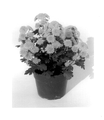
- the photograph shows a plant of ‘Gedi Two Ylnov’ in a six-inch container. One cutting was used in the pot.
- Botanical classification Chrysanthemum morifolium cultivar ‘Gedi Two Ylnov’.
- Time to rooting 7 to 14 days at approximately 21° C.
- Branching characteristics Free Branching.
- Length of lateral branches Approximately 22.5 cm.
- Young foliage upper side Near 135A.
- Young foliage under side Near 137B.
- Mature foliage upper side Near 139A.
- Mature foliage under side Near 137C.
- Flowering habit. Induced by darkness period greater than 13.5 hours, approximately 49 days of appropriate day length required to induce and develop blooms.
- Inflorescence diameter Approximately 3.5 cm.
- Inflorescence depth Approximately 1.2 cm.
- Average length Approximately 0.5 cm.
- Average width Approximately 0.1 cm.
- Width Approximately 0.3 cm.
- Style length Approximately 0.4 cm.
- Style length Approximately 0.3 cm.
- Style color Near 154D.
- Anther color Near 13A.
- Seed production Commercially, this plant is not used or observed in a stage wherein seeds would be produced. Therefore, seed production has not been observed.
- Heat and cold resistance Plants with flowers are hardy to low temperatures about ⁇ 2° C. Non flowering plants are hardy in the approximate range of 3° C. to ⁇ 6° C., depending upon duration of cold and amount of moisture in the soil. With adequate water plants are hardy to a high temperature of 49° C.
Landscapes
- Life Sciences & Earth Sciences (AREA)
- Health & Medical Sciences (AREA)
- Physiology (AREA)
- Botany (AREA)
- Developmental Biology & Embryology (AREA)
- Environmental Sciences (AREA)
- Natural Medicines & Medicinal Plants (AREA)
- Breeding Of Plants And Reproduction By Means Of Culturing (AREA)
Abstract
A new and distinct Chrysanthemum plant cultivar is disclosed, characterized by a decorative-type inflorescence, consistent flowering response to short days, blooming consistently after 49 days of short day length, free branching habit, yellow ray florets, a very uniform round growth habit, and a large quantity of blooms per flowering branch.
Description
Latin name of the genus and species: The present invention relates to a new and distinct cultivar of Chrysanthemum plant, botanically known as Chrysanthemum morifolium.
Variety denomination: The new and distinct Chrysanthemum plant is hereinafter referred to by the cultivar name ‘Gedi Two Ylnov.’
The new cultivar is a natural mutation that occurred on a single branch of a plant of the Chrysanthemum cultivar ‘Novare Orange’ (undistributed in the United States). The new cultivar was discovered and asexually propagated by the inventor in October 1996.
Asexual reproduction of the new cultivar by apical tip cutting and meristem tissue culture was performed in Oxnard, Calif. and has shown that the unique features of this cultivar are stable and reproduced true to type on successive generations.
The cultivar ‘Gedi Two Ylnov’ has not been observed under all possible environmental conditions. The phenotype may vary somewhat with variations in environment such as temperature, daylength, and light intensity, without, however, any variance in genotype.
The following traits have been repeatedly observed and are determined to be the unique characteristics of ‘Gedi Two Ylnov.’ These characteristics in combination distinguish ‘Gedi Two Ylnov’ as a new and distinct Chrysanthemum cultivar:
1. Decorative-type inflorescence,
2. Consistent flowering response to short days, blooming consistently after 49 days of short day length,
3. Free branching habit,
4. Yellow ray florets,
5. Very uniform round growth habit, and
6. Large quantity of blooms per flowering branch.
Plants of the new cultivar are similar to plants of the parent cultivar, ‘Novare Orange’ in most horticultural characteristics, however plants of the new cultivar differed from plants of the cultivar ‘Novare Orange’ primarily in ray floret color. The inflorescences of the new cultivar also have a smaller diameter than those of the parent variety.
In comparison to the commercially available variety ‘Cleagar GF 1’ (U.S. Plant Pat. No. 10,463), ‘Gedi Two Ylnov’ has a more round plant shape and greater branching, more blooms per flowering branch, and a flatter inflorescence.
The photograph shows a plant of ‘Gedi Two Ylnov’ in a six-inch container. One cutting was used in the pot.
In the following description, color references are made to The Royal Horticultural Society Colour Chart except where general terms of ordinary dictionary significance are used. The following observations and measurements describe plants grown in Oxnard, Calif. during the month of December and January. The age of the observed plants is 92 days from a rooted cutting. The growing temperature ranged from 55° to 68° F. at night to 60° to 75° F. during the day. Measurements and numerical values represent averages of typical flowering types.
Botanical classification: Chrysanthemum morifolium cultivar ‘Gedi Two Ylnov’.
Commercial classification: Garden-type Chrysanthemum.
Parentage: Natural mutation of the Chrysanthemum cultivar ‘Novare Orange’ (Undistributed in the United States).
Time to rooting: 7 to 14 days at approximately 21° C.
Root description: Fine, fibrous.
Growth habit: Mounding herbaceous perennial.
Height: Approximately 23 cm.
Spread: Approximately 24 cm.
Growth rate: Moderate.
Branching characteristics: Free Branching.
Length of lateral branches: Approximately 22.5 cm.
Number of leaves per lateral branch: Approximately 15.
Leaf:
Arrangement.—Alternate.
Average length.—Approximately 5.0 cm.
Average width.—Approximately 3.4 cm.
Shape of blade.— Ovate.
Apex.—
Cuspidate.
Base.—Attenuate.
Attachment.—Stalked.
Margin.—Palmately lobed.
Texture of top surface.—Lightly pubescent.
Texture of bottom surface.—Lightly pubescent.
Color.—Young foliage upper side: Near 135A. Young foliage under side: Near 137B. Mature foliage upper side: Near 139A. Mature foliage under side: Near 137C. Venation upper side: Near 138B. Venation under side: Near 138B.
Venation type.—Palmately net.
Petiole:
Average length.—Approximately 2.2 cm.
Color.—Near 139A.
Diameter.—Approximately 0.2 cm.
Inflorescence:
Flowering habit.—Induced by darkness period greater than 13.5 hours, approximately 49 days of appropriate day length required to induce and develop blooms.
Inflorescence form.—Decorative.
Natural flowering season.—Approximately the middle two weeks of September.
Number of inflorescences per lateral branch.—Approximately 20.
Inflorescence diameter.—Approximately 3.5 cm.
Inflorescence depth.—Approximately 1.2 cm.
Inflorescence longevity on plant.—Approximately 16 days.
Persistence.—Persistent.
Ray florets:
Appearance.—Matte.
Texture.—Smooth.
Average number per flower.—159.
Shape.—Oblanceolate.
Aspect.—Approximately 30% of ray florets are cylindric in the bottom one-third of the floret and the upper two-thirds of the floret is cymbiform; approximately 65% of ray florets are completely cymbiform and deeply lobed; approximately 5% of the florets are cylindric.
Margin.—Approximately 35% of the ray florets are entire; approximately 65% are deeply lobed.
Apex.—Retuse.
Length.—Approximately 1.4 cm.
Width.—Approximately 0.4 cm.
Color.—Upper surface at first opening: Near 9A. Upper surface at maturity: Near 7A. Upper surface at fading: Near 7B. Under surface at first opening: Near 6A. Under surface at maturity: Near 6B. Under surface at fading: Near 12A.
Disc florets:
Appearance.—Shiny.
Texture.—Smooth.
Average number per flower.—Approximately 10.
Shape.—Cylindric.
Apex.—Obtuse.
Average length.—Approximately 0.5 cm.
Average width.—Approximately 0.1 cm.
Color.—At first opening: Near 7C. At maturity: Near 16A. At fading: Near 16B.
Peduncle:
Length.—At terminal end (shortest): Approximately 3.0 cm. At lateral end (longest): Approximately 6.8 cm.
Angle to stem.—Acute.
Strength.—Moderate.
Color.—Near 138B.
Habit.—Upright.
Diameter.—Approximately 0.2 cm.
Surface texture.—Lightly pubescent.
Inflorescence bud:
Length.—Approximately 0.5 cm.
Diameter.—Approximately 1 cm.
Form.—Globular.
Color.—Near 2B.
Involucral bracts (phyllaries):
Appearance.—Matte.
Texture.—Lightly pubescent.
Number.—29.
Shape.—Oblanceolate.
Margin.—Entire.
Apex.—Acute.
Length.—Approximately 0.6 cm.
Width.—Approximately 0.3 cm.
Color.—Upper side: Near 143A. Under side: Near 143A.
Ray florets:
Number of pistils per flower.—1.
Stigma shape.—2 branched.
Stigma color.—Near 2B.
Style color.—Near 1C.
Style length.—Approximately 0.4 cm.
Stamens.—Absent.
Disc florets:
Number of pistils per flower.—1.
Stigma shape.—Two-branched.
Stigma color.—Near 12B.
Style length.—Approximately 0.3 cm.
Style color.—Near 154D.
Number of stamens per flower.—4.
Anther shape.—Tubular.
Anther color.—Near 13A.
Pollen color.—Pollen is not present.
Seed production: Commercially, this plant is not used or observed in a stage wherein seeds would be produced. Therefore, seed production has not been observed.
Disease resistance: Neither resistance nor susceptibility to diseases and pests has been observed in this cultivar.
Heat and cold resistance: Plants with flowers are hardy to low temperatures about −2° C. Non flowering plants are hardy in the approximate range of 3° C. to −6° C., depending upon duration of cold and amount of moisture in the soil. With adequate water plants are hardy to a high temperature of 49° C.
Claims (1)
1. A new and distinct cultivar of Chrysanthemum plant named ‘Gedi Two Ylnov’ as herein illustrated and described.
Priority Applications (1)
| Application Number | Priority Date | Filing Date | Title |
|---|---|---|---|
| US10/137,792 USPP14414P3 (en) | 2002-05-01 | 2002-05-01 | Chrysanthemum plant named ‘Gedi Two Ylnov’ |
Applications Claiming Priority (1)
| Application Number | Priority Date | Filing Date | Title |
|---|---|---|---|
| US10/137,792 USPP14414P3 (en) | 2002-05-01 | 2002-05-01 | Chrysanthemum plant named ‘Gedi Two Ylnov’ |
Publications (2)
| Publication Number | Publication Date |
|---|---|
| US20030208812P1 US20030208812P1 (en) | 2003-11-06 |
| USPP14414P3 true USPP14414P3 (en) | 2003-12-23 |
Family
ID=29269160
Family Applications (1)
| Application Number | Title | Priority Date | Filing Date |
|---|---|---|---|
| US10/137,792 Expired - Lifetime USPP14414P3 (en) | 2002-05-01 | 2002-05-01 | Chrysanthemum plant named ‘Gedi Two Ylnov’ |
Country Status (1)
| Country | Link |
|---|---|
| US (1) | USPP14414P3 (en) |
Cited By (1)
| Publication number | Priority date | Publication date | Assignee | Title |
|---|---|---|---|---|
| USPP22553P2 (en) * | 2011-04-14 | 2012-03-06 | Pieters Joseph & Luc B.V.B.A | Chrysanthemum plant named ‘Yellow Greenrunner’ |
Citations (1)
| Publication number | Priority date | Publication date | Assignee | Title |
|---|---|---|---|---|
| USPP10463P (en) | 1996-11-18 | 1998-06-23 | Cleangro Limited | Chrysanthemum plant named `Cleagar gf1` |
-
2002
- 2002-05-01 US US10/137,792 patent/USPP14414P3/en not_active Expired - Lifetime
Patent Citations (1)
| Publication number | Priority date | Publication date | Assignee | Title |
|---|---|---|---|---|
| USPP10463P (en) | 1996-11-18 | 1998-06-23 | Cleangro Limited | Chrysanthemum plant named `Cleagar gf1` |
Non-Patent Citations (1)
| Title |
|---|
| Brummitt, Horticultural Science Chrysanthemum once again, The Garden, 1997, pp. 662-663. * |
Cited By (1)
| Publication number | Priority date | Publication date | Assignee | Title |
|---|---|---|---|---|
| USPP22553P2 (en) * | 2011-04-14 | 2012-03-06 | Pieters Joseph & Luc B.V.B.A | Chrysanthemum plant named ‘Yellow Greenrunner’ |
Also Published As
| Publication number | Publication date |
|---|---|
| US20030208812P1 (en) | 2003-11-06 |
Similar Documents
| Publication | Publication Date | Title |
|---|---|---|
| USPP14501P3 (en) | Chrysanthemum plant named ‘Gedi Two Pad’ | |
| USPP13796P3 (en) | Chrysanthemum plant named ‘Gedi One Nov’ | |
| USPP14482P3 (en) | Chrysanthemum plant named ‘Gedi Two Ylatl’ | |
| USPP14403P3 (en) | Chrysanthemum plant named ‘Gedi Two Fig’ | |
| USPP14414P3 (en) | Chrysanthemum plant named ‘Gedi Two Ylnov’ | |
| USPP14473P3 (en) | Chrysanthemum plant named ‘Gedi Two Are’ | |
| USPP14382P3 (en) | Chrysanthemum plant named ‘Gedi Two Omol’ | |
| USPP14472P3 (en) | Chrysanthemum plant named ‘Gedi Two Cam’ | |
| USPP13689P3 (en) | Chrysanthemum plant named ‘GEDI ONE TAR’ | |
| USPP14404P3 (en) | Chrysanthemum plant named ‘Gedi Two Cop’ | |
| USPP14469P3 (en) | Chrysanthemum plant named ‘Gedi Two Ylpap’ | |
| USPP14407P3 (en) | Chrysanthemum plant named ‘Gedi Two Ran’ | |
| USPP14399P3 (en) | Chrysanthemum plant named ‘Gedi Two Fio’ | |
| USPP14474P3 (en) | Chrysanthemum plant named ‘Gedi Two Can’ | |
| USPP18106P2 (en) | Chrysanthemum plant named ‘PPP MIL YL05’ | |
| USPP14428P3 (en) | Chrysanthemum plant named ‘Gedi Two Cas’ | |
| USPP14429P3 (en) | Chrysanthemum plant named ‘Gedi Two Luc’ | |
| USPP13794P3 (en) | Chrysanthemum plant named ‘Gedi One Car’ | |
| USPP14471P3 (en) | Chrysanthemum plant named ‘Gedi Two Cor’ | |
| USPP14430P3 (en) | Chrysanthemum plant named ‘Gedi Two Pin’ | |
| USPP14633P3 (en) | Chrysanthemum plant named ‘Moza Ves 02’ | |
| USPP16960P2 (en) | Chrysanthemum plant named ‘PPP PAD L05’ | |
| USPP16959P2 (en) | Chrysanthemum plant named ‘PPP TER Y05’ | |
| USPP17745P3 (en) | Chrysanthemum plant named ‘PPP PAD WH05’ | |
| USPP13903P3 (en) | Chrysanthemum plant named ‘Gedi One Ylcel’ |
Legal Events
| Date | Code | Title | Description |
|---|---|---|---|
| AS | Assignment |
Owner name: PIETERS PLANT PRODUCTION, BVBA, BELGIUM Free format text: ASSIGNMENT OF ASSIGNORS INTEREST;ASSIGNOR:PIETERS, DIRK;REEL/FRAME:012869/0275 Effective date: 20020501 |