US9835560B2 - Method and device for the raman spectroscopic, in ovo sex determination of fertilised and incubated birds' eggs - Google Patents
Method and device for the raman spectroscopic, in ovo sex determination of fertilised and incubated birds' eggs Download PDFInfo
- Publication number
- US9835560B2 US9835560B2 US15/317,802 US201515317802A US9835560B2 US 9835560 B2 US9835560 B2 US 9835560B2 US 201515317802 A US201515317802 A US 201515317802A US 9835560 B2 US9835560 B2 US 9835560B2
- Authority
- US
- United States
- Prior art keywords
- raman
- egg
- blood vessel
- laser
- scattered radiation
- Prior art date
- Legal status (The legal status is an assumption and is not a legal conclusion. Google has not performed a legal analysis and makes no representation as to the accuracy of the status listed.)
- Active
Links
Images



Classifications
-
- G—PHYSICS
- G01—MEASURING; TESTING
- G01N—INVESTIGATING OR ANALYSING MATERIALS BY DETERMINING THEIR CHEMICAL OR PHYSICAL PROPERTIES
- G01N21/00—Investigating or analysing materials by the use of optical means, i.e. using sub-millimetre waves, infrared, visible or ultraviolet light
- G01N21/62—Systems in which the material investigated is excited whereby it emits light or causes a change in wavelength of the incident light
- G01N21/63—Systems in which the material investigated is excited whereby it emits light or causes a change in wavelength of the incident light optically excited
- G01N21/65—Raman scattering
-
- A—HUMAN NECESSITIES
- A01—AGRICULTURE; FORESTRY; ANIMAL HUSBANDRY; HUNTING; TRAPPING; FISHING
- A01K—ANIMAL HUSBANDRY; AVICULTURE; APICULTURE; PISCICULTURE; FISHING; REARING OR BREEDING ANIMALS, NOT OTHERWISE PROVIDED FOR; NEW BREEDS OF ANIMALS
- A01K45/00—Other aviculture appliances, e.g. devices for determining whether a bird is about to lay
- A01K45/007—Injecting or otherwise treating hatching eggs
-
- G—PHYSICS
- G01—MEASURING; TESTING
- G01N—INVESTIGATING OR ANALYSING MATERIALS BY DETERMINING THEIR CHEMICAL OR PHYSICAL PROPERTIES
- G01N33/00—Investigating or analysing materials by specific methods not covered by groups G01N1/00 - G01N31/00
- G01N33/02—Food
- G01N33/08—Eggs, e.g. by candling
-
- G—PHYSICS
- G01—MEASURING; TESTING
- G01N—INVESTIGATING OR ANALYSING MATERIALS BY DETERMINING THEIR CHEMICAL OR PHYSICAL PROPERTIES
- G01N33/00—Investigating or analysing materials by specific methods not covered by groups G01N1/00 - G01N31/00
- G01N33/48—Biological material, e.g. blood, urine; Haemocytometers
- G01N33/483—Physical analysis of biological material
- G01N33/4833—Physical analysis of biological material of solid biological material, e.g. tissue samples, cell cultures
-
- G—PHYSICS
- G01—MEASURING; TESTING
- G01N—INVESTIGATING OR ANALYSING MATERIALS BY DETERMINING THEIR CHEMICAL OR PHYSICAL PROPERTIES
- G01N21/00—Investigating or analysing materials by the use of optical means, i.e. using sub-millimetre waves, infrared, visible or ultraviolet light
- G01N21/62—Systems in which the material investigated is excited whereby it emits light or causes a change in wavelength of the incident light
- G01N21/63—Systems in which the material investigated is excited whereby it emits light or causes a change in wavelength of the incident light optically excited
- G01N21/65—Raman scattering
- G01N2021/653—Coherent methods [CARS]
-
- G—PHYSICS
- G01—MEASURING; TESTING
- G01N—INVESTIGATING OR ANALYSING MATERIALS BY DETERMINING THEIR CHEMICAL OR PHYSICAL PROPERTIES
- G01N2201/00—Features of devices classified in G01N21/00
- G01N2201/06—Illumination; Optics
- G01N2201/061—Sources
- G01N2201/06113—Coherent sources; lasers
Definitions
- the invention relates to a method and a device for the Raman spectroscopic in ovo sex determination of fertilized and incubated birds' eggs.
- an egg comprises at least a solid shell, an egg yolk surrounded by the shell and other egg integuments, and a germinal disc associated with the egg yolk, wherein a probe for measuring a spectrum is guided through a hole in the shell in the direction of the germinal disc having germinal disc cells, wherein the method comprises the following steps:
- the germinal disc cells are identified using absorption bands of the nucleic acids (DNA and RNA) and other biochemical compounds such that the sex of the examined egg is determined and displayed.
- the measurement can be conducted using conventional infrared spectroscopy.
- the related device described in the document DE 10 2010 006 161 B3 comprises
- a DNA-relevant cell material is analyzed using vibrational spectroscopy in order to determine the sex of birds' eggs based on DNA differences: either in the egg opened using a probe, or after extraction of the material from the egg and deposition on a substrate.
- the UV resonance Raman spectroscopy is specified for wavelengths of 244 nm or 254 nm.
- a spectral classification is thereby carried out using all existing supervised and unsupervised methods:
- DNA-relevant cell material of the bird for which the sex is to be determined is thus examined using light and the molecular vibrations are measured, wherein the spectrum of the molecular vibrations produced by the light is detected and compared with predefined reference spectra as well as reference spectra representing sex-specific DNA structures of the bird species being examined, and wherein from said spectral comparison a sex is assigned to the bird based on the DNA content of the cell material.
- the molecular vibrations are thereby measured using Raman spectroscopy or IR spectroscopy, wherein for example the DNA-relevant cell material can be extracted from the shaft of a young feather.
- the cell material is prepared on a slide and scanned using light.
- the light for measuring the molecular vibrations of the DNA-relevant cell material of unhatched birds is focused on the embryo or the germinal disc through the egg shell, wherein the spectrum of the radiation in the egg produced by the molecular vibrations is measured using a probe guided through the shell of said egg.
- At least one microscopically small hole is drilled through the egg shell to measure the spectrum.
- the light is focused through the small access point through the egg shell directly onto the germinal disc serving as cell material.
- the probe is inserted through the same access point or a different access point having a small opening size, by means of which probe the reflected spectrum of the aforementioned molecular motion in the interior of the egg, which spectrum is recorded by the probe, is measured.
- the spectral information obtained is, in a second step, compared with sex-specific reference data and supplied to a classification algorithm.
- Said data preferably represent statistically acquired data about the bird species being analyzed. From this comparison, a sex is assigned to the DNA material being analyzed.
- a major disadvantage of the method is that at least one sample is taken from the egg.
- the fractal dimension is calculated and the value of the fractal dimension DF is compared with a species- and sex-specific limit value; wherein the respective egg is classified as female if the limit value is exceeded and male if the value is lower than the limit value.
- the external light source can thereby be either an incandescent lamp, fluorescent lamp, an LED, or a (pulsed or CW) monochromatic or dichromatic laser light source.
- the first part of the method results from the fact that, following exposure using the light source, the fertile birds' eggs emit a higher intensity of the photons than that emitted by the unfertilized birds' eggs.
- the second part of the method results from the fact that, following exposure using the indicated light sources, birds' eggs of the female sex emit a different spectrum of photons than birds' eggs of the male sex.
- the method comprises the steps of introducing a marked antibody into the egg, which antibody binds to a sex-specific antigen of the embryo, and the detection of the marked bound antibody using a detection device outside the egg.
- PCA principal component analysis
- NMR nuclear magnetic resonance
- One disadvantage is that the formation of the sex organs only takes place in a developed embryo after several essential days, wherein at least the implementation requires a high financial cost.
- the presence or absence of an elevated sex-specific hormone level is determined in an extra-embryonic fluid, preferably the allantoic fluid, for the purpose of in ovo sex determination.
- the method is preferably applied to chicken eggs and can be carried out before or during the transfer from the incubator to the hatcher.
- test object is positioned below an array of pulse transmitters and receivers that are arranged on a plane and connected to a computer system such that data and information are transmitted,
- electromagnetic pulses in the spectral range of 0.01 to 1 THz are emitted onto the positioned test object by the pulse transmitters
- the radiation emitted from the test object is recorded by the receivers and supplied to the computer via the data- and information-transmitting connections for an imaging process.
- Electromagnetic energy with a wavelength between approximately 380 nm and 740 nm is thereby used for the non-invasive sex determination of bird embryos, wherein a bird egg is exposed to the electromagnetic energy and the amount of absorption, diffusion, refraction, reflection, or any desired combination thereof of the electromagnetic energy is determined through the bird egg.
- the sex of the bird embryo is at least partially determined.
- the spectrophotometric analysis of the feather color of chicken eggs can only be used on brown breeds or on breeds with a color difference between female chicks and male chicks.
- CARS coherent anti-Stokes Raman scattering spectroscopy
- CARS spectroscopy a multi-photon process is used to excite the molecular vibrations, and a coherent signal is generated.
- CARS a signal is obtained which is several orders of magnitude stronger than that of the spontaneous Raman emission in linear Raman spectroscopy (factor of 10 5 ), which leads to a shorter measurement time.
- the CARS signal is blue-shifted and is therefore free of fluorescence.
- the excitation occurs by means of ultrafast NIR lasers, as a result of which the penetration depth is comparable to the penetration depth in NIR Raman spectroscopy and light damage is therefore minimized.
- the sensitivity is not limited by the detection of the CARS photons, but rather by the differentiation between resonant and non-resonant portions of the CARS signal.
- the Raman spectrum can be obtained from the CARS spectrum by means of a modified Kramers-Kronig transformation or using special calculation methods, based on the assumption of maximum entropy.
- the cited Raman spectroscopic method can also be demonstrated in real-time measurements using CARS spectra of blood.
- the CARS vibration spectra of red blood cells can be recorded in a few picoliters and milliseconds, as is described in the following documents:
- the object of the invention is to specify a method and a device for the Raman spectroscopic in ovo sex determination of fertilized and incubated birds' eggs, which method and device are embodied such that the sex can already be determined in the eggs in a rapid and reliably unequivocal manner, wherein the female embryo continues to develop normally and the female chick can be hatched.
- the creation of a hole in the shell by means of a hole-creating unit in the form of a laser or by means of mechanical perforation can be carried out at the upwards-oriented pointed end of the egg with diameters of up to 18 mm, preferably between 8 mm and 15 mm.
- the light in the visible wavelength range can be white light, but the contrast is improved if blue and/or green light from a light source is used.
- a movement of the blood vessel out of the focus can take place by a tracking of the blood vessels or the associated objective lens, activated by the monitoring vision system.
- a second method is used for the Raman spectroscopic in ovo sex determination of fertilized and incubated birds' eggs, wherein the extra-embryonic structures can no longer move freely, and instead an attachment of the chorioallantoic membrane (CAM) to the shell begins, wherein according to the characterizing part of patent claim 5 the following steps are carried out:
- the light in the visible wavelength range can be white or blue or green or blue and green contrast-generating light from a light source.
- holes with diameters of up to 5 mm, preferably between 0.1 mm and 3 mm, can be formed.
- a classification takes place in the evaluation unit to detect the sex of each measured incubated bird egg before the sex is displayed.
- the Raman scattered radiation from blood of extra-embryonic blood vessels and/or from blood of embryonic blood vessels can thus be used for the non-invasive, in ovo sex determination in the incubated bird egg.
- the blood vessels used and the chorioallantoic membrane (CAM) developed it can be specified in each measuring procedure that the blood vessels develop starting from the second incubation day and the embryonic blood circulates in the bloodstream by the third incubation day. This means that an immediate sex determination is expedient at a very early stage starting from the third incubation day.
- CAM chorioallantoic membrane
- continuously back-guided Raman spectra can be recorded and supplied to an evaluation, wherein an automatic classification of the Raman scattered radiation takes place based on the spectral fingerprint of the blood.
- the egg is preferably positioned on end, and a hole can be created in the region of the upwards-oriented pointed end with a hole size of 10 mm and at three incubation days. Starting from approximately the fifth day, the chorioallantoic membrane begins to adhere to the outer membrane, and a smaller hole can be created in the shell at incubation days greater than five days, wherein the hole can also be horizontal.
- the hole in the shell of the egg ensures optical access to the detected blood vessel through which blood is flowing.
- the laser beam is focused onto the selected blood vessel and, if necessary, the tracking is carried out automatically using an objective lens.
- the output introduced from the laser source must not result in a local or global heating of the egg above 40° Celsius.
- the Raman scattered radiation can preferably be recorded by an objective lens having a large numerical aperture (NA>0.3).
- the Raman scattered radiation can be detected by means of a Raman fiber probe.
- the detected Raman scattered radiation can be supplied to the spectrometer via fiber lines.
- the range from 500 cm ⁇ 1 to 4000 cm ⁇ 1 (Raman shift) is preferably used.
- the sex-specific features are contained in the Raman bands of the nucleic acids, carbohydrates, lipids and proteins, wherein the Raman bands are supplied to a mathematical analysis.
- the detected Raman scattered radiation can be corrected such that background signals due to fluorescence or other scattering processes are eliminated and the spectra are normalized in a predetermined form.
- chorioallantoic membrane (CAM) permeated with capillary vessels can also be used for the sex determination.
- the sex determination can be carried out at any day between the start of incubation and the hatching, preferably in relation to the development of the blood vessels at approximately the third incubation day to the fifth incubation day.
- non-linear Raman spectroscopy can be used in the form of coherent anti-Stokes Raman scattering spectroscopy (CARS), wherein the CARS spectrum from the blood of the blood vessel can be recorded using the same recording configuration as for spontaneous Raman spectroscopy, with or without fiber optics.
- CARS coherent anti-Stokes Raman scattering spectroscopy
- the CARS signal can also be generated by a wide-band femtosecond laser that serves as a pump laser and as a Stokes laser.
- the CARS signal can be generated by means of two laser sources, in particular by means of a wide-band laser and a narrow-band laser for the use and evaluation of multiplex CARS spectroscopy.
- the CARS spectra can be used for the classification.
- the resonant portion of the CARS spectrum [Im(Chi (3) )] can be separated from the non-resonant portion [Re(Chi (3) )], and only the resonant portion only can be used for the classification.
- the device for determining the for the Raman spectroscopic in ovo sex determination of fertilized and incubated birds' eggs uses the aforementioned methods and comprises,
- the device according to the invention can comprise as a vision system a device for identifying the position of blood vessels inside the egg.
- the device for identifying the position of a blood vessel is connected to the control unit via at least one supply and signaling line.
- the device for identifying the position of a blood vessel can be connected to a height-adjustment device and the egg-mounting unit.
- the device for identifying the position of a blood vessel, the height-adjustment device and the egg-mounting unit can be connected to the blood vessel-positioning evaluation device using programming means for performing a coordination of the position of the blood vessel.
- the optical device can be a flexible optical fiber.
- the radiation device can preferably emit green light for detecting at least one blood vessel.
- the evaluation unit can comprise programming means for the sex-determination evaluation of the detected Raman scattered radiation and the detected CARS scattered radiation.
- a hole is created in the shell by means of a hole-creating unit.
- a laser is focused onto the exposed blood vessel and, from the same location, the Raman scattered radiation is collected through the hole and fed back to a spectrometer. All of this occurs under the observation, monitoring and control of the egg illuminated using visible/green light.
- a time-dependent formation of at least one blood vessel and also the subsequent formation of the chorioallantoic membrane (CAM) can be monitored, so that the start of the measuring procedure for the use of the method according to the invention can be coordinated with the chronological development of the blood vessel and subsequently also of the chorioallantoic membrane (CAM).
- the detection of the blood vessels in particular in the case of white eggs, can be carried out with the use of white or green light:
- the Raman scattered radiation is spectrally decomposed and recorded, then processed using predetermined mathematical methods and classified according to the sex.
- the position of blood vessels is determined by means of green or white or blue light, and at a predetermined site a hole is created in the shell, in which hole the Raman scattered radiation of the blood or tissue is excited behind the shell by means of laser radiation in the red or near-infrared spectral range, and the Raman scattered radiation/Raman scattered light is recorded and supplied to a spectral and statistical evaluation, and the sex is determined based on characterizing marker bands.
- near-infrared light with a wavelength of 785 nm (or 1064 nm) is used for the excitation of the Raman scattering.
- Supervised classification methods are used in order to classify the entire spectrum or one or more spectral ranges as male or female, based on a training set that can be obtained in advance from known spectra or spectral ranges.
- the respective optical element for the beam guidance or for the feedback beam guidance can be a flexible optical fiber.
- FIG. 1 An illustration of the difference between the determination levels (compound, compound classes) from the prior art and the invention level (molecular bonds including functional groups);
- FIG. 2 A schematic illustration of the device according to the invention for determining the sex of fertilized and incubated birds' eggs
- FIG. 3 A schematic illustration of a part of the device for introducing laser light into the hole of the shell, wherein
- FIG. 3 a shows the final part, facing the egg, for the irradiation of at least one identified blood vessel and for the detection of the Raman scattered radiation from the irradiated blood vessel, and
- FIG. 3 b shows an enlarged section with a view into the hole of the shell and with the possible measurement points on at least one blood vessel of the movable embryo;
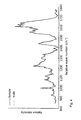
- FIG. 4 A spectroscopic illustration of the evaluated Raman scattered radiation intensities in a predefined wavelength range for identifying the difference between female birds' eggs and male birds' eggs, wherein the continuous line shows the mean spectrum for the female condition and the dotted line shows the mean spectrum for the male condition; and
- FIG. 5 A block diagram explaining the functional principle for classifying the back-guided and detected Raman spectra, and thus for the sex determination of the bird egg embryo.
- FIG. 2 a device 20 for the Raman spectroscopic in ovo sex determination of a fertilized and incubated bird egg 1 is shown in a schematic illustration
- the device 20 comprises at least
- the device 20 comprises a device 34 for identifying the position of the blood vessels 21 inside the egg 1 —a vision system—in connection with the radiation device 19 .
- the device 34 includes a detector 13 in the form of a camera.
- the device 34 for identifying the position of a blood vessel 21 is connected via at least one supply and signaling line 17 to the control unit 18 in the form of a coordinative positioning unit.
- the device 34 for identifying the position of a blood vessel 21 is connected to a height-adjustment device (not drawn) and the egg-mounting unit 16 .
- the device 34 for identifying the position of the blood vessel 21 , the height-adjustment device, for example inside the coordinative positioning unit 18 , and the egg-mounting unit 16 can be connected in the blood vessel-positioning evaluation device 14 by programming means for a coordination and identification of the position of the blood vessel 21 .
- the radiation device 19 for monitoring the development of blood vessels 21 , 27 can comprise the light source 10 , a filter 11 and a lens 12 and can be directed at the top part of the egg 1 .
- the optical device 5 can be a flexible optical fiber.
- FIG. 3 schematic illustrations of a part of the device 5 for introducing laser light 3 a into the hole 2 in the shell 28 are shown, wherein in FIG. 3 a the final part, which faces the egg, for the irradiation of the at least one identified blood vessel 21 and for the detection of the Raman scattered radiation 7 originating from the irradiated blood vessel 21 is shown, and in FIG. 3 b an enlarged section with a view into the hole 2 in the shell 28 and the possible measurement points on the at least one blood vessel 21 of the movable embryo 23 are shown.
- FIG. 3 a a laser light 3 a focused on the blood vessel 21 is directed by the device 5 .
- the blood vessel 21 is located outside the embryo 23 .
- the Raman scattered radiation 7 produced is detected by the device 5 via the objective lens 6 and is transmitted.
- the embryo 23 also has blood vessels 27 , which in FIG. 3 b can likewise be the point of origin for measuring a Raman scattered radiation 7 .
- FIG. 3 b an enlarged section 22 of the hole 2 created in the egg 1 from FIG. 3 a is shown.
- the embryo 23 (gray area in the hole 2 ), along with the embryonic blood vessels 27 thereof (shown in black), is located beneath the hole 2 in the shell 28 of the egg 1 , as are multiple extra-embryonic blood vessels 21 .
- Both blood vessels 21 and 27 can be points for the measurements and detection of the Raman scattered radiation 7 , wherein the possible measurement points 24 , 25 , 26 can be detected depending on a chronological development of the blood vessels 21 and/or 27 and can be defined in the control and/or evaluation units 14 , 9 by the programming means at least for comparison with stored Raman spectra.
- FIG. 4 a spectroscopic illustration of the evaluated Raman scattered radiation intensities in a predetermined wave number range of 800 cm ⁇ 1 to 1800 cm ⁇ 1 for detecting the difference between female birds' eggs and male birds' eggs is shown, wherein the continuous line shows the mean spectrum for the female condition and the dotted line shows the mean spectrum for the male condition. Between the sex curves, there are clear differences or distances in terms of the respective wave number regions between the two intensity wave number curves.
- FIG. 4 show that, for example, three to four spectral ranges may be sufficient for the sex determination, for instance, a comparison of the intensities using the absolute values can be carried out for a sex determination: for the female sex (continuous line), the intensity curve between the predetermined wave numbers is greater or less than the intensity curve for the male sex (dotted line) between the same wave numbers, as a result of which at least one intensity comparison can take place in one of the wave number ranges.
- An embodiment of the light source with optical filters for the corresponding wave numbers can also be provided.
- at least one or more laser diode(s) or light source(s) with a wave number-related filter, in particular an interference filter related to the predefined wave numbers can be used, wherein the wave number ⁇ is the result of multiplying the inverse of the wavelength ⁇ (in micrometers) by 10000.
- the blood from the blood vessel 21 is identified in the spectrometer 8 such that the sex of the examined bird egg 1 can be determined and displayed.
- the spectroscopic evaluation takes place in the evaluation unit 9 involving mathematic classification algorithms.
- FIG. 5 the functional principle is shown including the classification of the measured Raman spectra as part of the evaluation.
- the method according to the invention, and the related device use the Raman spectra preferably of blood from extra-embryonic blood vessels for the non-invasive, in ovo sex determination in the incubated bird egg 1 .
- CAM chorioallantoic membrane
- the blood vessels 21 form starting at the second incubation day. At roughly the third incubation day, the embryonic blood circulates in the blood stream. Within this time span, the measurement for the sex determination is conducted.
- the embryo and the extra-embryonic structures can move in the egg 1 , that is, they are not attached to the shell 28 .
- the measurement procedure is carried out as follows:
- a measurement occurs at the third incubation day.
- non-linear CARS spectroscopy can be used for the sex determination according to the invention.
- CARS Coherent anti-Stokes Raman scattering
- CARS spectroscopy the same molecular vibrations are analyzed, though the difference from (linear) Raman spectroscopy is in the specific manner of excitation.
- CARS spectroscopy a multi-photon process is used to excite the molecular vibrations, and a coherent signal is generated.
- a signal is obtained which is several orders of magnitude stronger than that of spontaneous Raman emission (factor of 10 5 ), which leads to a shorter measurement time.
- the CARS signal is blue-shifted compared to the excitation wavelength and is therefore free of fluorescence.
- the excitation occurs by means of ultrafast NIR lasers, as a result of which the penetration depth is comparable to the penetration depth in NIR Raman spectroscopy and light damage is minimized.
- the sensitivity is not limited by the detection of the CARS photons, but rather by the differentiation between resonant and non-resonant portions of the CARS signal.
- the Raman spectrum can be obtained from the CARS spectrum by means of a modified Kramers-Kronig transformation or with special calculation methods, based on the assumption of maximum entropy.
Landscapes
- Health & Medical Sciences (AREA)
- Life Sciences & Earth Sciences (AREA)
- Engineering & Computer Science (AREA)
- Chemical & Material Sciences (AREA)
- Physics & Mathematics (AREA)
- Biochemistry (AREA)
- Immunology (AREA)
- General Physics & Mathematics (AREA)
- General Health & Medical Sciences (AREA)
- Analytical Chemistry (AREA)
- Pathology (AREA)
- Food Science & Technology (AREA)
- Biomedical Technology (AREA)
- Medicinal Chemistry (AREA)
- Nuclear Medicine, Radiotherapy & Molecular Imaging (AREA)
- Environmental Sciences (AREA)
- Urology & Nephrology (AREA)
- Molecular Biology (AREA)
- Hematology (AREA)
- Biophysics (AREA)
- Optics & Photonics (AREA)
- Birds (AREA)
- Animal Husbandry (AREA)
- Biodiversity & Conservation Biology (AREA)
- Investigating, Analyzing Materials By Fluorescence Or Luminescence (AREA)
Applications Claiming Priority (4)
| Application Number | Priority Date | Filing Date | Title |
|---|---|---|---|
| DE102014010150.9A DE102014010150A1 (de) | 2014-07-04 | 2014-07-04 | Verfahren und Vorrichtung zur Raman-spektroskopischen in-ovo Geschlechtsbestimmung von befruchteten und bebrüteten Vogeleiern |
| DE102014010150.9 | 2014-07-04 | ||
| DE102014010150 | 2014-07-04 | ||
| PCT/DE2015/000342 WO2016000678A1 (de) | 2014-07-04 | 2015-07-03 | Verfahren und vorrichtung zur ramanspektroskopischen in-ovo geschlechtsbestimmung von befruchteten und bebrüteten vogeleiern |
Publications (2)
| Publication Number | Publication Date |
|---|---|
| US20170205353A1 US20170205353A1 (en) | 2017-07-20 |
| US9835560B2 true US9835560B2 (en) | 2017-12-05 |
Family
ID=54062582
Family Applications (1)
| Application Number | Title | Priority Date | Filing Date |
|---|---|---|---|
| US15/317,802 Active US9835560B2 (en) | 2014-07-04 | 2015-07-03 | Method and device for the raman spectroscopic, in ovo sex determination of fertilised and incubated birds' eggs |
Country Status (6)
| Country | Link |
|---|---|
| US (1) | US9835560B2 (de) |
| EP (1) | EP3164696B1 (de) |
| AU (1) | AU2015283366B2 (de) |
| CA (1) | CA2953813A1 (de) |
| DE (1) | DE102014010150A1 (de) |
| WO (1) | WO2016000678A1 (de) |
Cited By (5)
| Publication number | Priority date | Publication date | Assignee | Title |
|---|---|---|---|---|
| US20160239953A1 (en) * | 2015-02-17 | 2016-08-18 | MatrixSpec Solutions Inc. | Systems, devices, and methods for detecting fertility and gender of unhatched eggs |
| US20170160202A1 (en) * | 2014-07-11 | 2017-06-08 | Tronico | Non-invasive device for determining the fertility and/or the sex of an egg, and corresponding method |
| US11116184B2 (en) | 2017-11-13 | 2021-09-14 | Technische Universität München | Automated noninvasive determining the fertility of a bird's egg |
| US11378565B2 (en) * | 2018-03-09 | 2022-07-05 | Technische Universität Dresden | Method for in-ovo fertilisation determination and gender determination on a closed egg |
| US11536704B2 (en) | 2016-10-26 | 2022-12-27 | Technische Universität Dresden | Producing a hole in a bird egg for determining the sex of the bird egg |
Families Citing this family (22)
| Publication number | Priority date | Publication date | Assignee | Title |
|---|---|---|---|---|
| AU2013297168B2 (en) | 2012-07-30 | 2019-05-30 | In Ovo Holding B.V. | Gender, viability and/or developmental stage determination of avian embryos in ovo |
| DE102016004051B3 (de) | 2016-04-04 | 2017-07-27 | Technische Universität Dresden | Verfahren und Vorrichtung zur optischen in-ovo Geschlechtsbestimmung von befruchteten und bebrüteten Vogeleiern |
| DE102016005974B4 (de) | 2016-05-13 | 2018-06-14 | Hochschule für Technik und Wirtschaft Dresden | Verfahren und Vorrichtung zur Einstellung des Laserfokus eines Anregungslasers in Blut durchflossenen Gefäßen für optische Messungen zur Bestimmung des Geschlechtes von Vogeleiern |
| HUE055153T2 (hu) | 2016-05-24 | 2021-11-29 | In Ovo B V | Módszer és rendszer a roncsolásmentes in ovo meghatározásához a szárnyas nemnek |
| JP6723597B2 (ja) * | 2016-06-20 | 2020-07-15 | 株式会社ナベル | 種卵の非破壊検査装置及びそれに用いる種卵検査プログラム |
| CN106225926B (zh) * | 2016-07-15 | 2017-09-29 | 中国科学院重庆绿色智能技术研究院 | 一种小型化激光拉曼光谱仪 |
| DE102016114085B4 (de) | 2016-07-29 | 2023-09-07 | Systamatec GmbH | Vorrichtung zur automatisierten Toxizitätsprüfung von Substanzen an einer Gesamtheit von befruchteten Geflügeleiern und Verfahren |
| DE102016011348A1 (de) | 2016-09-16 | 2018-03-22 | Technische Universität Dresden | Verfahren zur Klassifizierung von Spektren von Objekten mit komplexem Informationsgehalt |
| WO2018115280A1 (de) * | 2016-12-23 | 2018-06-28 | Agri Advanced Technologies Gmbh | Verfahren und system zur in-ovo geschlechtsbestimmung oder geschlechtsbestimmung an lebenden vögeln |
| CN108391602B (zh) * | 2018-04-25 | 2023-06-06 | 中国农业科学院农业信息研究所 | 一种雏鸡性别识别系统及其识别方法 |
| NL2021022B1 (en) * | 2018-05-30 | 2019-12-10 | Seleggt Gmbh | Method for determining the gender of a chicken embryo |
| CN109431484B (zh) * | 2018-12-10 | 2023-11-28 | 佛山科学技术学院 | 一种基于心率测量的鸡蛋胚胎性别鉴定的装置及方法 |
| CN111037102B (zh) * | 2019-12-29 | 2021-10-29 | 上海赛摩电气有限公司 | 自动化鸡蛋去壳方法及装置 |
| DE102020000214A1 (de) * | 2020-01-15 | 2021-07-15 | Technische Hochschule Ostwestfalen-Lippe | Vorrichtung und Verfahren zur in-ovo Geschlechtsbestimmung bei einem befruchteten Vogelei |
| DE102021127696B3 (de) | 2021-10-25 | 2023-03-09 | Technische Universität Dresden, Körperschaft des öffentlichen Rechts | Verfahren und Anordnung zur in-ovo Geschlechtsbestimmung von Vogeleiern |
| DE102022107397B4 (de) * | 2022-03-29 | 2025-10-16 | Technische Hochschule Ostwestfalen-Lippe, Körperschaft des öffentlichen Rechts | Vorrichtung und Verfahren zur Geschlechtsbestimmung bei einem befruchteten Vogelei |
| KR102632163B1 (ko) * | 2022-04-13 | 2024-02-01 | 오보젠 주식회사 | 가금류 알(卵)의 암수 검사 및 선별장치 그리고 이를 이용한 선별방법 |
| CN115187514A (zh) * | 2022-06-14 | 2022-10-14 | 华中农业大学 | 一种基于rf-ds图谱信息融合的孵化早期鸡胚蛋性别无损检测方法 |
| DE102023135725B4 (de) | 2023-12-19 | 2025-07-17 | Technische Universität Dresden, Körperschaft des öffentlichen Rechts | Verfahren zum Öffnen von Eiern für die spektroskopische in-ovo Geschlechtsbestimmung |
| KR102851195B1 (ko) * | 2024-01-19 | 2025-08-28 | 전북대학교산학협력단 | 비파괴 비침습 방식의 달걀 성별 감지 장치 및 방법 |
| CN117882658A (zh) * | 2024-01-30 | 2024-04-16 | 威奥福生物科技(宁波)有限公司 | 一种种蛋开窗封窗方法 |
| CN121438354B (zh) * | 2025-12-05 | 2026-04-10 | 石家庄学院 | 可见光图像与高光谱数据融合实现鸡种蛋性别鉴定的方法 |
Citations (14)
| Publication number | Priority date | Publication date | Assignee | Title |
|---|---|---|---|---|
| US6029080A (en) | 1997-07-09 | 2000-02-22 | Reynnells; Richard D. | Method and apparatus for avian pre-hatch sex determination |
| US6365339B1 (en) | 1998-09-04 | 2002-04-02 | Bechtel Bwxt Idaho, Llc | Gender determination of avian embryo |
| US6506570B1 (en) | 1996-10-04 | 2003-01-14 | Embrex, Inc. | Method of sorting birds in ovo |
| US20060095980A1 (en) * | 2003-01-16 | 2006-05-04 | Petitte James N | Depletion of endogenous primordial germ cells in avian species |
| US7041439B2 (en) | 2001-04-17 | 2006-05-09 | Embrex, Inc. | Methods and apparatus for selectively processing eggs having identified characteristics |
| DE102007013107A1 (de) | 2007-03-15 | 2008-09-18 | Friedrich-Schiller-Universität Jena | Verfahren zur Bestimmung des Gschlechts von Vögeln |
| WO2010103111A1 (en) | 2009-03-13 | 2010-09-16 | Van De Ven Beheer B.V. | Method for avian sex determination |
| WO2010150265A2 (en) | 2009-06-25 | 2010-12-29 | Yissum Research Development Company Of The Hebrew University Of Jerusalem Ltd. | Hyperspectral identification of egg fertility and gender |
| DE102010006161B3 (de) | 2010-01-21 | 2011-01-13 | Technische Universität Dresden | Verfahren und Vorrichtung zur Bestimmung des Geschlechtes von befruchteten und nicht bebrüteten Vogeleiern |
| US7950349B1 (en) | 2008-01-18 | 2011-05-31 | Jack Dean Rollins | Avian egg fertility and gender detection |
| EP2336751A1 (de) | 2009-12-16 | 2011-06-22 | Fraunhofer-Gesellschaft zur Förderung der angewandten Forschung e.V. | Verfahren zur Bestimmung des Geschlechts an Vogeleiern |
| WO2014021715A2 (en) | 2012-07-30 | 2014-02-06 | Bruins Wouter Sebastiaan | Gender, viability and/or developmental stage determination of avian embryos in ovo |
| DE202013011765U1 (de) | 2012-08-31 | 2014-05-26 | Mat-Malta Advanced Technologies Limited | Spektrophotometrische Analyse der Federfarbe von Hühnerembryos |
| DE102012023947A1 (de) | 2012-12-03 | 2014-06-05 | Institut für Photonische Technologien e.V. (IPHT) | Verfahren und Anordnung zur nichtinvasiven, zerstörungsfreien Identifikation molekülspezifischer und/oder biologischer Eigenschaften einer inneren Struktur eines biologischen Untersuchungsobjektes durch eine optisch undurchlässige Barriere hindurch |
-
2014
- 2014-07-04 DE DE102014010150.9A patent/DE102014010150A1/de not_active Withdrawn
-
2015
- 2015-07-03 US US15/317,802 patent/US9835560B2/en active Active
- 2015-07-03 EP EP15759358.3A patent/EP3164696B1/de active Active
- 2015-07-03 CA CA2953813A patent/CA2953813A1/en not_active Abandoned
- 2015-07-03 AU AU2015283366A patent/AU2015283366B2/en not_active Ceased
- 2015-07-03 WO PCT/DE2015/000342 patent/WO2016000678A1/de not_active Ceased
Patent Citations (18)
| Publication number | Priority date | Publication date | Assignee | Title |
|---|---|---|---|---|
| US6506570B1 (en) | 1996-10-04 | 2003-01-14 | Embrex, Inc. | Method of sorting birds in ovo |
| US6029080A (en) | 1997-07-09 | 2000-02-22 | Reynnells; Richard D. | Method and apparatus for avian pre-hatch sex determination |
| US6365339B1 (en) | 1998-09-04 | 2002-04-02 | Bechtel Bwxt Idaho, Llc | Gender determination of avian embryo |
| US7041439B2 (en) | 2001-04-17 | 2006-05-09 | Embrex, Inc. | Methods and apparatus for selectively processing eggs having identified characteristics |
| US20060095980A1 (en) * | 2003-01-16 | 2006-05-04 | Petitte James N | Depletion of endogenous primordial germ cells in avian species |
| DE102007013107A1 (de) | 2007-03-15 | 2008-09-18 | Friedrich-Schiller-Universität Jena | Verfahren zur Bestimmung des Gschlechts von Vögeln |
| US7950349B1 (en) | 2008-01-18 | 2011-05-31 | Jack Dean Rollins | Avian egg fertility and gender detection |
| US20120058052A1 (en) | 2009-03-13 | 2012-03-08 | Prinzen B.V. | Method for avian sex determination |
| WO2010103111A1 (en) | 2009-03-13 | 2010-09-16 | Van De Ven Beheer B.V. | Method for avian sex determination |
| WO2010150265A2 (en) | 2009-06-25 | 2010-12-29 | Yissum Research Development Company Of The Hebrew University Of Jerusalem Ltd. | Hyperspectral identification of egg fertility and gender |
| US20130044210A1 (en) | 2009-06-25 | 2013-02-21 | Israel Rozenboim | Hyperspectral identification of egg fertility and gender |
| US8364247B2 (en) | 2009-12-16 | 2013-01-29 | Fraunhofer-Gesellschaft Zur Foerderung Der Angwandten Forschung E.V. | Methods for determining the sex of birds' eggs |
| EP2336751A1 (de) | 2009-12-16 | 2011-06-22 | Fraunhofer-Gesellschaft zur Förderung der angewandten Forschung e.V. | Verfahren zur Bestimmung des Geschlechts an Vogeleiern |
| DE102010006161B3 (de) | 2010-01-21 | 2011-01-13 | Technische Universität Dresden | Verfahren und Vorrichtung zur Bestimmung des Geschlechtes von befruchteten und nicht bebrüteten Vogeleiern |
| WO2014021715A2 (en) | 2012-07-30 | 2014-02-06 | Bruins Wouter Sebastiaan | Gender, viability and/or developmental stage determination of avian embryos in ovo |
| US20150260704A1 (en) | 2012-07-30 | 2015-09-17 | In Ovo B.V. | Gender, viability and/or developmental stage determination of avian embryos in ovo |
| DE202013011765U1 (de) | 2012-08-31 | 2014-05-26 | Mat-Malta Advanced Technologies Limited | Spektrophotometrische Analyse der Federfarbe von Hühnerembryos |
| DE102012023947A1 (de) | 2012-12-03 | 2014-06-05 | Institut für Photonische Technologien e.V. (IPHT) | Verfahren und Anordnung zur nichtinvasiven, zerstörungsfreien Identifikation molekülspezifischer und/oder biologischer Eigenschaften einer inneren Struktur eines biologischen Untersuchungsobjektes durch eine optisch undurchlässige Barriere hindurch |
Non-Patent Citations (10)
Cited By (12)
| Publication number | Priority date | Publication date | Assignee | Title |
|---|---|---|---|---|
| US20170160202A1 (en) * | 2014-07-11 | 2017-06-08 | Tronico | Non-invasive device for determining the fertility and/or the sex of an egg, and corresponding method |
| US10060854B2 (en) * | 2014-07-11 | 2018-08-28 | Tronico | Non-invasive device for determining the fertility and/or the sex of an egg, and corresponding method |
| US20160239953A1 (en) * | 2015-02-17 | 2016-08-18 | MatrixSpec Solutions Inc. | Systems, devices, and methods for detecting fertility and gender of unhatched eggs |
| US20180033139A1 (en) * | 2015-02-17 | 2018-02-01 | MatrixSpec Solutions Inc. | Systems, devices, and methods for detecting fertility and gender of unhatched eggs |
| US10607338B2 (en) * | 2015-02-17 | 2020-03-31 | MatrixSpec Solutions Inc. | Systems, devices, and methods for detecting fertility and gender of unhatched non-incubated eggs |
| US10713782B2 (en) * | 2015-02-17 | 2020-07-14 | MatrixSpec Solutions Inc. | Systems, devices, and methods for detecting fertility and gender of unhatched eggs |
| US11302000B2 (en) | 2015-02-17 | 2022-04-12 | MatrixSpec Solutions Inc. | Systems, devices, and methods for detecting fertility and gender of unhatched eggs |
| US11688064B2 (en) | 2015-02-17 | 2023-06-27 | MatrixSpec Solutions Inc. | Systems, devices, and methods for detecting fertility and gender of unhatched eggs |
| US11536704B2 (en) | 2016-10-26 | 2022-12-27 | Technische Universität Dresden | Producing a hole in a bird egg for determining the sex of the bird egg |
| US11116184B2 (en) | 2017-11-13 | 2021-09-14 | Technische Universität München | Automated noninvasive determining the fertility of a bird's egg |
| US11122778B2 (en) * | 2017-11-13 | 2021-09-21 | Technische Universität München | Automated noninvasive determining the sex of an embryo and the fertility of a bird's egg |
| US11378565B2 (en) * | 2018-03-09 | 2022-07-05 | Technische Universität Dresden | Method for in-ovo fertilisation determination and gender determination on a closed egg |
Also Published As
| Publication number | Publication date |
|---|---|
| AU2015283366B2 (en) | 2020-05-21 |
| DE102014010150A1 (de) | 2016-01-07 |
| EP3164696B1 (de) | 2018-04-18 |
| WO2016000678A8 (de) | 2016-04-21 |
| WO2016000678A1 (de) | 2016-01-07 |
| CA2953813A1 (en) | 2016-01-07 |
| US20170205353A1 (en) | 2017-07-20 |
| EP3164696A1 (de) | 2017-05-10 |
| AU2015283366A1 (en) | 2017-02-23 |
Similar Documents
| Publication | Publication Date | Title |
|---|---|---|
| US9835560B2 (en) | Method and device for the raman spectroscopic, in ovo sex determination of fertilised and incubated birds' eggs | |
| US10852284B2 (en) | Method and device for optical in ovo sex determination of fertilized and incubated birds' eggs | |
| US11378565B2 (en) | Method for in-ovo fertilisation determination and gender determination on a closed egg | |
| EP3642616B1 (de) | Verfahren und system zur spektralen bestimmung von eigeschlecht und fertilität | |
| JP6665265B2 (ja) | 透過分光法を使用して卵の生存を判定するための非接触型卵識別システム、及び関連する方法 | |
| US8624190B2 (en) | Method and device for determining the sex of fertilized, non-incubated bird eggs | |
| US8364247B2 (en) | Methods for determining the sex of birds' eggs | |
| ES2681628T3 (es) | Dispositivo no invasivo de determinación de la fertilidad y/o del sexo de un huevo, y procedimiento correspondiente | |
| CA2804903A1 (en) | Hyperspectral identification of egg fertility and gender | |
| EP3004847B1 (de) | Fluoreszenzabbildungssystem zur gewebeerkennung | |
| US20200158641A1 (en) | Laser emission based microscope | |
| JP7591275B2 (ja) | 近赤外光を用いる孵化前における鶏卵の雌雄判定方法及び雌雄判定装置 | |
| US20240407341A1 (en) | Method and assembly for in-ovo sexing of bird eggs | |
| NL2021022B1 (en) | Method for determining the gender of a chicken embryo | |
| JP2024056270A (ja) | 雌雄判定装置及び雌雄判定方法 | |
| Wassenaar | inventeers | |
| Faraj et al. | Raman‐based label‐free microscopic analysis of the pancreas in living zebrafish larvae | |
| De Luca et al. | Label-free biochemical characterization of bovine sperm cells using Raman microscopy |
Legal Events
| Date | Code | Title | Description |
|---|---|---|---|
| AS | Assignment |
Owner name: UNIVERSITAET LEIPZIG, GERMANY Free format text: ASSIGNMENT OF ASSIGNORS INTEREST;ASSIGNORS:GALLI, ROBERTA;PREUSSE, GRIT;KOCH, EDMUND;AND OTHERS;SIGNING DATES FROM 20170125 TO 20170302;REEL/FRAME:041751/0693 Owner name: TECHNISCHE UNIVERSITAET DRESDEN, GERMANY Free format text: ASSIGNMENT OF ASSIGNORS INTEREST;ASSIGNORS:GALLI, ROBERTA;PREUSSE, GRIT;KOCH, EDMUND;AND OTHERS;SIGNING DATES FROM 20170125 TO 20170302;REEL/FRAME:041751/0693 |
|
| STCF | Information on status: patent grant |
Free format text: PATENTED CASE |
|
| MAFP | Maintenance fee payment |
Free format text: PAYMENT OF MAINTENANCE FEE, 4TH YEAR, LARGE ENTITY (ORIGINAL EVENT CODE: M1551); ENTITY STATUS OF PATENT OWNER: LARGE ENTITY Year of fee payment: 4 |
|
| MAFP | Maintenance fee payment |
Free format text: PAYMENT OF MAINTENANCE FEE, 8TH YEAR, LARGE ENTITY (ORIGINAL EVENT CODE: M1552); ENTITY STATUS OF PATENT OWNER: LARGE ENTITY Year of fee payment: 8 |