US9605780B2 - Coupling, in particular for connecting anchor rods - Google Patents

Coupling, in particular for connecting anchor rods Download PDF

Info

Publication number
US9605780B2
US9605780B2 US13/908,639 US201313908639A US9605780B2 US 9605780 B2 US9605780 B2 US 9605780B2 US 201313908639 A US201313908639 A US 201313908639A US 9605780 B2 US9605780 B2 US 9605780B2
Authority
US
United States
Prior art keywords
coupling
sealing rings
clamping ring
radially
face
Prior art date
Legal status (The legal status is an assumption and is not a legal conclusion. Google has not performed a legal analysis and makes no representation as to the accuracy of the status listed.)
Active, expires
Application number
US13/908,639
Other versions
US20130264819A1 (en
Inventor
Ernst Friedrich Ischebeck
Ferdinand Coerschulte
Current Assignee (The listed assignees may be inaccurate. Google has not performed a legal analysis and makes no representation or warranty as to the accuracy of the list.)
Friedr Ishebeck GmbH
Friedr Ischebeck GmbH
Original Assignee
Friedr Ishebeck GmbH
Priority date (The priority date is an assumption and is not a legal conclusion. Google has not performed a legal analysis and makes no representation as to the accuracy of the date listed.)
Filing date
Publication date
Application filed by Friedr Ishebeck GmbH filed Critical Friedr Ishebeck GmbH
Assigned to FRIEDR. ISCHEBECK GMBH reassignment FRIEDR. ISCHEBECK GMBH ASSIGNMENT OF ASSIGNORS INTEREST (SEE DOCUMENT FOR DETAILS). Assignors: ISCHEBECK, ERNST FRIEDRICH, COERSCHULTE, FERDINAND
Publication of US20130264819A1 publication Critical patent/US20130264819A1/en
Application granted granted Critical
Publication of US9605780B2 publication Critical patent/US9605780B2/en
Active legal-status Critical Current
Adjusted expiration legal-status Critical

Links

Images

Classifications

    • FMECHANICAL ENGINEERING; LIGHTING; HEATING; WEAPONS; BLASTING
    • F16ENGINEERING ELEMENTS AND UNITS; GENERAL MEASURES FOR PRODUCING AND MAINTAINING EFFECTIVE FUNCTIONING OF MACHINES OR INSTALLATIONS; THERMAL INSULATION IN GENERAL
    • F16LPIPES; JOINTS OR FITTINGS FOR PIPES; SUPPORTS FOR PIPES, CABLES OR PROTECTIVE TUBING; MEANS FOR THERMAL INSULATION IN GENERAL
    • F16L15/00Screw-threaded joints; Forms of screw-threads for such joints
    • F16L15/001Screw-threaded joints; Forms of screw-threads for such joints with conical threads
    • F16L15/003Screw-threaded joints; Forms of screw-threads for such joints with conical threads with sealing rings
    • EFIXED CONSTRUCTIONS
    • E02HYDRAULIC ENGINEERING; FOUNDATIONS; SOIL SHIFTING
    • E02DFOUNDATIONS; EXCAVATIONS; EMBANKMENTS; UNDERGROUND OR UNDERWATER STRUCTURES
    • E02D5/00Bulkheads, piles, or other structural elements specially adapted to foundation engineering
    • E02D5/74Means for anchoring structural elements or bulkheads
    • E02D5/80Ground anchors
    • E02D5/808Ground anchors anchored by using exclusively a bonding material
    • EFIXED CONSTRUCTIONS
    • E21EARTH OR ROCK DRILLING; MINING
    • E21BEARTH OR ROCK DRILLING; OBTAINING OIL, GAS, WATER, SOLUBLE OR MELTABLE MATERIALS OR A SLURRY OF MINERALS FROM WELLS
    • E21B17/00Drilling rods or pipes; Flexible drill strings; Kellies; Drill collars; Sucker rods; Cables; Casings; Tubings
    • E21B17/02Couplings; joints
    • E21B17/04Couplings; joints between rod or the like and bit or between rod and rod or the like
    • E21B17/042Threaded
    • E21B17/0426Threaded with a threaded cylindrical portion, e.g. for percussion rods

Definitions

  • the present invention relates to a coupling for connecting support members provided with external threads, preferably for connecting anchor rods of injection drilling anchors for rotary-percussive drilling, the coupling comprising a sleeve-like coupling sleeve having two screw-in openings that extend from two opposite ends and are each provided with an internal thread for screwing in support members, a radially inwardly facing mounting protrusion that preferably extends annularly along the entire periphery being formed between the two internal threads of the screw-in openings on the inner side of the coupling sleeve, a radial recess that is rotationally symmetrical with regard to the geometrical longitudinal center axis of the coupling sleeve being formed in each case between the mounting protrusion and the internal threads, said recess adjoining a preferably conical run-out of the adjacent internal thread or intersecting the internal thread, an elastically deformable sealing ring preferably made of plastics being inserted or insertable in each case into the
  • injection drilling anchors are known from DE 34 00 182 C that can comprise a plurality of anchor rods connected by means of coupling nuts for achieving greater anchor lengths.
  • injection drilling anchors reference is also made to DE 38 28 335 C1.
  • injection drilling anchors injection piles, micro piles, soil nails or rock anchors.
  • different coupling sleeves or coupling nuts provided with a matching internal thread are known in the prior art.
  • a central threadless portion is provided in the coupling sleeve, which prevents the anchor rods from being screwed through the coupling sleeve.
  • a drive acts on the longitudinal end opposite to the drill bit, and the drive, in addition to a torque, also exerts percussive blows which act in a pulsating manner in the longitudinal and/or axial direction so as to facilitate penetrating through solid layers, for example in the bedrock.
  • percussive blows which act in a pulsating manner in the longitudinal and/or axial direction so as to facilitate penetrating through solid layers, for example in the bedrock.
  • the coupling sleeve has in its interior two thread ends that are offset with respect to one another by half a turn whereby, however, screwing-through of anchor rods can be prevented only up to a limited screw-in torque, and wherein here as well, the compression and impact transmission in the coupling sleeve via only the thread is perceived as being disadvantageous.
  • attempts have already been made to weld an inner stop for the anchor rods into the coupling sleeves or, for example, to insert for this purpose a spring pin into the thread.
  • a limited compression transmission and an undesirable notch effect are again perceived as a disadvantage.
  • a coupling sleeve provided with an internal thread for anchor rods of self-drilling injection anchors is also known from EP 0 391 119 B1.
  • the cylindrical base area of the internal thread is followed by a conically extending base area on which the internal thread continues.
  • the improvement according to the invention should permit, in addition to a good sealing effect, a transmission of axial impact energy with as few losses as possible, and should consist of components that can be produced and assembled in a manner as simple as possible and that are as inexpensive as possible.
  • the coupling has a clamping ring that is preferably made of metal and that has an outside diameter that is smaller than or equal to the inside diameter of the mounting protrusion, and that each of the sealing rings has a rotationally symmetrical abutment surface that, for abutment against one of the two lateral surfaces of the clamping ring, extends in a radius interval that partially geometrically overlaps a radius interval of the lateral surfaces of the clamping ring when the sealing rings are concentrically aligned with the clamping ring.
  • the clamping ring is advantageously made from a material that is comparatively (e.g., in comparison with plastics) difficult to deform, preferably from metal and more preferably from steel.
  • the coupling according to the invention also offers advantages regarding the sealing effect as well as simple manufacturability and mountability, the sealing rings being able to fulfill a double function.
  • the sealing rings consist of an elastic material, preferably a plastics such as, e.g., polyamide, that is easier to deform compared to the clamping ring, and since in the course of the screwing-in of the anchor rods, the sealing rings are pressed at the sealing zones against surfaces of the coupling sleeve and the clamping ring, as a consequence of a gapless coming together along the periphery, the result is a reliable sealing function.
  • the sealing rings have the function of facilitating assembly.
  • the outside diameter thereof is larger than the inside diameter of the mounting protrusion and larger than the core diameter of the internal thread.
  • the two sealing rings are advantageously elastic enough that they can be pressed with the fingers into an oval shape and can be inserted in this manner into the coupling sleeve, where they can be pivoted into the run-out of the thread and clipped into the respective recess.
  • each sealing ring is positively held on both sides in the longitudinal or axial direction between the mounting protrusion and the adjacent internal thread.
  • preassembling i.e., for preparing the coupling for screwing into the anchor rods
  • the outside diameter of the clamping ring is slightly smaller than the inside diameter of the mounting protrusion, i.e., if the clamping ring can be fitted with lateral clearance for movement in or through the mounting protrusion, then, due to the interaction between the two sealing rings, the clamping ring is already held captive axially in the preassembled state of the coupling, so that the coupling can be easily and reliably assembled on the construction site.
  • a certain axial movability of the sealing rings and the clamping ring relative to the coupling sleeve can advantageously remain prior to screwing in the support members.
  • the clamping ring in the coupling sleeve.
  • the hold can even be configured such that under certain circumstances, the clamping ring can be removed again from the coupling sleeve only by means of a special tool. If during preassembly a limited axial clearance for movement remains, i.e., if in the preassembled state an axial end stop fixed in a particular position is still absent, the clamping sleeve and/or the axial end stop adjusts as needed to the adjoining anchor rods only during screwing in of the anchor rods and, as explained later, possibly even when introducing the injection drilling anchor into the bedrock; however, the desired axial impact stiffness is maintained at all times.
  • the coupling according to the invention and/or the coupling arrangement formed with the anchor rods thus maintains high impact stiffness.
  • a limited flexibility of the coupling connection can be avoided by implementing the inner surface of the mounting protrusion and the outer surface of the clamping ring cylindrically and with equal diameters.
  • the depth and the outside diameter of the recesses correspond approximately to the depth of the thread and the outside diameter of the internal thread, respectively.
  • the width of the clamping ring is advantageously selected such that the clamping ring extends in the direction of the geometrical longitudinal center axis up to an axial overlap with the two internal threads, or at least with their run-outs.
  • the clamping ring is made as a separate component from the coupling sleeve. As described, the clamping ring can then be inserted loosely into the hollow cross-section of the mounting protrusion and captively held by means of the sealing rings. Alternatively, it is conceivable that the clamping ring is secured at the mounting protrusion, for example, pressed in or welded therein. In this respect it is even conceivable to alternatively fabricate the clamping ring integrally with the coupling sleeve.
  • said recesses directly adjoin the mounting protrusion.
  • the sealing rings inserted in each case in one recess are positively held along their entire periphery or at least in certain peripheral regions in the recess without, or with only little, clearance for movement in a direction parallel to the geometrical longitudinal center axis.
  • Such an axial clearance for movement can be, for example, in the range of only a few fractions of a millimeter, for example in the range of several tenths or only hundredths of a millimeter.
  • the sealing rings each have a radially inner ring portion that is bordered on one of its sides by the abutment surface for the clamping ring. It is regarded as suitable that at least in the radial overlapping interval, the abutment surface of the sealing ring and the lateral surface of the clamping ring have shapes that are matched to one another for achieving a face-to-face surface support and that are in particular conical and/or rounded in profile cross-section, at least in certain regions. In addition to a self-centering effect during the assembly, a conical and/or rounded shape can facilitate the already described possible pivotability of the clamping ring relative to a reference plane spanned by the mounting protrusion.
  • the sealing rings each have a radially outer ring portion that is connected to the inner ring portion and that is bordered by a cylindrical or substantially cylindrical inner surface that transitions into the abutment surface in an inclined or rounded manner.
  • Said inner surface can adjoin an end lateral surface of the outer ring portion for support on an end lateral surface of the mounting protrusion, the lateral surfaces of the outer ring portion and of the mounting protrusion having shapes that are matched to one another for achieving a planar surface support and preferably extend in the radial direction transversely or perpendicularly with respect to the geometrical longitudinal center axis.
  • the end lateral surface transitions, in particular in a rounded manner, into an outer surface, the outer surface of the outer ring portion, and preferably the curvature which adjoins the outer surface, as well as the circumferential surface of the recess, which surface adjoins the lateral surface of the mounting protrusion, having shapes that are matched to one another for achieving a continuous face-to-face surface support.
  • the outer surface on the outer ring portion can transition into a back surface inclined thereto, wherein in a cross-section oriented transversely with respect to the circumferential direction, the back surface can be inclined more sharply relative to the geometrical longitudinal center line of the coupling than the conical run-out of the internal thread.
  • a configuration can be selected according to which in a preassembled state of the coupling in which the two sealing rings are inserted into the recesses and the clamping ring is situated between the two sealing rings, the sealing rings are substantially flush with the lateral surfaces of the clamping ring in the direction of the geometrical longitudinal center axis, or protrude outwardly beyond the lateral surfaces of the clamping ring.
  • a clamping ring in which the opposing end lateral surfaces extend conically and/or with a convex curvature in a radially outer ring surface region, and in a ring surface region radially inward thereof, extend perpendicularly with respect to the geometrical longitudinal center axis and plane-parallel to one another, and in which the radially outer ring surface region transitions in a rounded manner into the radially inner ring surface region.
  • the inside diameter of the mounting protrusion can be slightly smaller than or equal to the core diameter of the internal thread.
  • the outside diameter of the preferably cylindrical outer surface of the clamping ring is slightly smaller than the diameter of the inner surface of the inner ring portion of the sealing ring, which facilitates a possible inclination of the sealing ring.
  • the outer ring surface region of the lateral surface of the clamping ring extends radially inwardly beyond the abutment surface of the inner ring portion of the sealing ring.
  • the invention further comprises a coupling arrangement which includes at least one coupling that exhibits one or more of the above-described features. It is provided here that in each case one anchor rod for injection drilling anchors which has a continuous center channel and is preferably provided with a continuous external thread in the longitudinal direction, is screwed into the coupling sleeve from both ends until the end face of the anchor rod is supported on and preferably braced against the respective opposing lateral surface of the clamping ring.
  • the end face of the anchor rod has a radially inner, planar end face region, and radially outward thereof, an end face region that, in the longitudinal direction of the anchor rod, protrudes beyond the inner planar end face region to an increasing extent in the radially outward direction, and that the radially outer end face region of the anchor rod and the radially outer ring surface region of the clamping ring have shapes that are conical and/or curved in profile cross-section and are matched to one another for achieving, at least in a limited radius interval, a face-to-face surface support.
  • each sealing ring forms two sealing zones.
  • One sealing zone is located between the sealing ring and the clamping ring, and the other sealing zone is located between the sealing ring and the front end of the anchor rod at the radially outer end face region thereof.
  • the outside diameter of the plane-parallel ring surface regions of the clamping ring corresponds at least approximately to the outside diameter of the planar, radially inner end face regions of the anchor rods, and/or that the inside diameter of the plane-parallel inner ring surface regions of the clamping ring is at least approximately equal to or smaller than the inside diameter of the radially inner end face regions of the anchor rods. This enables large contact surfaces for good transmission of impact energy during rotary-percussive drilling.
  • the outside diameter of the radially outer end face region of the anchor rods lies within the radius interval in which the abutment surface of the sealing rings extends in the undeformed state.
  • screwing in the anchor rods inevitably also results in radial expansion of the sealing rings, so that the sealing rings are sealingly pressed into the recesses of the coupling sleeve.
  • the invention also comprises an injection drilling anchor, preferably for rotary-percussive drilling, having at least one drill bit screwed onto an anchor rod, the injection drilling anchor comprising one or a plurality of coupling arrangements in which in each case one or more of the above-described features are implemented.
  • the invention also comprises a method for connecting two support members, preferably two anchor rods of an injection drilling anchor for rotary-percussive drilling, comprising the method steps: providing a coupling, said coupling comprising a sleeve-like coupling sleeve having screw-in openings that extend from two opposite ends and are each provided with an internal thread for screwing in support members, a radially inwardly facing mounting protrusion that preferably extends annularly along the entire periphery being formed between the two internal threads of the screw-in openings on the inner side of the coupling sleeve, a radial recess that is rotationally symmetrical with regard to the geometrical longitudinal center axis of the coupling sleeve being formed in each case between the mounting protrusion and the internal threads, said recess adjoining a preferably conical run-out of the adjacent internal thread or intersecting the internal thread, an elastically deformable sealing ring preferably made of plastics being insertable in each case into the
  • the object is achieved according to the invention first and foremost with the following further method steps: providing a clamping ring preferably made from metal, the outside diameter of which is smaller than or equal to the inside diameter of the mounting protrusion, using or selecting sealing rings, each of which has a rotationally symmetrical abutment surface which, for abutment against one of the two lateral surfaces of the clamping ring, extends in a radius interval that geometrically overlaps a radius interval of the lateral surfaces of the clamping ring when the sealing rings are concentrically aligned with the clamping ring, inserting a first sealing ring into a first recess so that the abutment surface of said first sealing ring faces toward the hollow cross-section enclosed by the mounting protrusion, inserting the clamping ring into the hollow cross-section enclosed by the mounting protrusion, and inserting the second sealing ring into the second recess so that the abutment surface of said second sealing ring faces toward the hollow cross-section or clamping ring enclosed by the mounting protrusion.
  • the sealing rings prior to inserting into the recess, are ovally deformed and are inserted in this shape into the coupling sleeve, where they are pivoted into the run-out of the thread and clipped into the recess.
  • FIG. 1A shows a coupling according to the invention according to a preferred exemplary embodiment in an arrangement with two anchor rods screwed into said coupling, with one side as a longitudinal section and the other side as a longitudinal view,
  • FIG. 1B shows an enlargement of detail la of FIG. 1A .
  • FIG. 2 shows the coupling sleeve shown in FIG. 1A , with one side as a longitudinal section and the other side as a longitudinal view, with occluded edges shown in dashed lines,
  • FIG. 3 shows in comparison to FIG. 1A the clamping ring shown therein in an enlarged view, and the two sealing rings shown therein, in each case in a sectional view and moved apart from one another,
  • FIG. 4A shows the coupling according to the invention according to FIG. 1A , but without the anchor rod screwed in, with one side as a longitudinal section and the other side as a longitudinal view,
  • FIG. 4B shows an enlargement of detail IVa according to FIG. 4A .
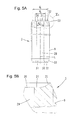
  • FIG. 5A shows an anchor rod of an injection drilling anchor suitable for using the coupling according to the invention, according to a preferred embodiment, illustrated in shortened form and partially cut open,
  • FIG. 5B shows an enlargement of detail Va according to FIG. 5A .
  • FIG. 6A shows the coupling shown in FIG. 4A with only one anchor rod screwed in
  • FIG. 6B shows an enlargement of detail Via of FIG. 6A .
  • FIGS. 1A to 6B there is presented a preferred exemplary embodiment of a coupling 1 according to the invention as well as an exemplary use preferred within the scope of the invention for producing a coupling arrangement 2 which comprises such a coupling 1 and two anchor rods 3 , for example of an injection drilling anchor, screwed therein for connection.
  • FIGS. 4A, 4B show the coupling 1 in a preassembled state
  • FIGS. 2 and 3 show the components of the coupling 1 prior to preassembly.
  • the coupling 1 comprises a sleeve-like coupling sleeve 4 having two screw-in openings 6 that extend from two opposite ends and are each provided with an internal thread 5 for screwing in support members, for example in each case one of the anchor rods 3 shown in FIGS. 5, 5 a .
  • a radially inwardly facing mounting protrusion 7 is formed and extends annularly along the entire periphery.
  • the coupling 1 further comprises a clamping ring 11 and two identical sealing rings 12 . Since the clamping ring 11 and the sealing rings 12 are rotationally symmetrical, the sectional view through the center selected in FIG. 3 is in each case sufficient for the illustration thereof.
  • the illustration of the preassembled state of the coupling 1 according to FIGS. 4, 4 a shows that the width B of the clamping ring 11 in the example is approximately three times the width b of the mounting protrusion 7 .
  • the clamping ring 11 In its middle portion with reference to the longitudinal center axis L, the clamping ring 11 has a cylindrical outer surface 13 , the outside diameter d of which in the example is selected to be slightly smaller than the inside diameter D of the mounting protrusion 7 .
  • the outside diameter D 1 of the two sealing rings 12 in the undeformed state shown in FIG. 3 is larger than the inside diameter d of the mounting protrusion 7 and, in the example, is larger than the core diameter D 2 of the internal thread 5 .
  • one of the two sealing rings 1 made from elastically deformable plastics has been deformed, starting from its unloaded circular form, between two fingers into an oval form by means of compressive force, and led through one of the two screw-in openings 6 of the coupling sleeve 4 into the hollow interior thereof, has been tilted there into a cross-section perpendicular to the longitudinal center axis L, and in the course of the elastic recovery has been clipped into the recess 8 located there.
  • the clamping ring 11 has been inserted through the oppositely situated screw-in opening 6 and into the coupling sleeve 4 approximately up to the position shown in FIG. 4A , in which the hollow cross-section or ring cross-section spanned by the clamping ring 11 lies perpendicularly with respect to the longitudinal center axis L, and in which the clamping ring 11 is positioned in the direction of the longitudinal center axis L, approximately midway, symmetrically with respect to the mounting protrusion 7 and, starting from a geometrical middle line M, extends on both sides into the region of the run-outs 10 of the internal threads 5 .
  • the remaining sealing ring 12 has been inserted in a corresponding manner through said oppositely situated screw-in opening 6 and into the coupling sleeve 4 , and clipped therein into the recess 8 remaining for said sealing ring.
  • the two sealing rings 12 are accommodated on both sides in the direction of the longitudinal center axis L in an axially captive manner by the formed positive-locking fit.
  • the two sealing rings 12 each have a rotationally symmetrical abutment surface 14 (cf. FIG.
  • the largest diameter D 3 of the recess 8 corresponds substantially to the outside diameter D 1 of the sealing rings 12 , so that they are substantially held in the coupling sleeve 4 without radial clearance for movement.
  • the two sealing rings 12 in conjunction with the axial extent of the recess 8 and the run-outs 10 of the internal threads 5 , lead to the fact that in the preassembled state, the two sealing rings 12 still have a limited clearance for movement in the direction of the longitudinal center axis L, i.e. in the axial direction, whereby in particular clipping in is made easier.
  • the sealing rings 12 According to the profile cross-section of the sealing rings 12 shown in FIG. 3 (and, e.g., in FIG. 4B ), the sealing rings each have a radially inner ring portion 18 which, on its side facing toward the mounting protrusion and/or the clamping ring 11 , is bordered by said abutment surface 14 .
  • the abutment surface 14 of the sealing rings 12 and the lateral surfaces 16 of the clamping ring 11 are each implemented conically with inclinations or slopes that correlate in terms of magnitude so that these corresponding shapes result in a face-to-face surface support.
  • the two sealing rings 12 each have a radially outer ring portion 20 that is connected to the inner ring portion 18 and is bordered by a cylindrical inner surface 21 that transitions with a bend into the abutment surface 14 .
  • the inner surface 21 adjoins an end lateral surface 22 for support on an end lateral surface 23 of the mounting protrusion 7 , the lateral surfaces 22 , 23 of the outer ring portion 20 and the mounting protrusion 7 in the profile cross-sections shown in the FIGS. 2, 3 each extending perpendicularly with respect to the geometrical longitudinal center axis L so that a face-to-face surface support is possible.
  • the end lateral surface 22 transitions with a curve 24 into a short cylindrical outer surface 25 , the outer surface 25 and the curve 24 , on the one hand, and also that surface of the recess 8 that adjoins the lateral surface 23 of the mounting protrusion 7 , likewise having corresponding cross-sectional profiles for achieving a continuous face-to-face surface support.
  • the outer surface 25 transitions in its further course into a back surface 26 that is inclined with respect to said outer surface and extends conically with regard to the geometrical longitudinal center axis L.
  • the back surface 26 is inclined more sharply toward the geometrical longitudinal center axis L than the conical run-out 10 of the internal threads 5 , resulting in back clearance that increases toward the sides.
  • FIG. 3 additionally shows that the oppositely situated end lateral surfaces 16 of the clamping ring 11 extend conically in a respective radially outer ring surface region 27 and transition in a rounded manner into a radially inner ring surface region 28 that extends straight and perpendicular to the geometrical longitudinal center axis L. It is also provided that the outer ring surface region 27 extends radially inwardly beyond the radius interval 15 of the abutment surface 14 of the sealing ring 12 .
  • the coupling 1 according to the invention can be used for connecting two support members, for example two of the anchor rods 3 shown in FIGS. 5A, 5B .
  • Such anchor rods 3 which are known per se, have a center channel 29 that passes through along the geometrical longitudinal center axis L of the anchor rods and extends between the two ends.
  • the outer circumferential surface carries an external thread 9 , which can be, for example, a coarse thread that is rolled on.
  • the internal thread 5 of the coupling sleeve 4 is matched to the external thread 9 for establishing a screw connection.
  • 5A, 5B show that the end faces 30 of the anchor rods 3 each have a radially inner, planar end face region 31 that is perpendicular to the geometrical longitudinal center axis L, and radially outward thereof, an end face region 32 that, in the direction of the longitudinal center axis L of the anchor rod 3 , protrudes beyond the inner planar end face region 31 to an increasing extent in the radially outward direction.
  • FIG. 1A, 1B and 6A, 6B shows that the radially outer end face region 32 of the anchor rod 3 and the radially outer ring surface portion 27 of the clamping ring 11 in the profile cross-section extend in each case with the same inclination with regard to the geometrical longitudinal axis L of the coupling 1 . Therefore, their shape is matched to one another in such a manner that screwing in the anchor rods 3 into the coupling 1 results in a face-to-face surface support of the radially outer end face regions 32 on the radially outer ring surface region 27 of the clamping ring 11 .
  • the outside diameter d 1 of the plane-parallel inner ring surface regions 28 of the clamping ring 11 corresponds to the outside diameter d 2 of the planar, radial inner end face regions 31 of the anchor rods 3
  • the inside diameter d 3 of the plane-parallel inner ring surface regions 28 of the clamping ring 22 is equal to the inside diameter d 4 of the radially inner end face regions 31 of the anchor rods 3
  • the outside diameter d 5 of the axially projecting outer end face region 32 of the anchor rods 3 at which the axial projection is at a maximum, lies within the radius interval 15 in which the abutment surface 14 of the sealing rings 12 extends in the undeformed state of said sealing rings.
  • FIGS. 6A, 6B show an intermediate step which in further course leads to the production and/or assembly of the coupling arrangement 2 shown in FIGS. 1A, 1B .
  • an anchor rod 3 has been screwed into the preassembled coupling 1 initially only in one screw-in opening 6 thereof until the end face 30 of the anchor rod rests against the lateral surface 16 of the clamping ring 11 .
  • the end face 30 rests face-to-face with its inner end face region 31 and also with its axially projecting end face region 32 located radially outward thereof against the correspondingly formed ring surface regions 28 and 27 of the lateral surface 16 of the clamping ring 11 .
  • the anchor rod 3 has a chamfer 33 .
  • the first anchor rod 3 is preferably initially screwed into the coupling sleeve 4 until the sealing ring 12 supported on the mounting protrusion 7 permits no further deformation at the selected screw-in force. This corresponds to the intermediate step shown in FIGS. 6A, 6B .
  • a further, preferably a corresponding, anchor rod 3 is screwed into the remaining screw-in opening 6 , thereby also deforming the sealing ring 12 situated therein.
  • the figures show that the two anchor rods 3 now support one another by means of the clamping ring 11 likewise made of steel, and can be braced against one another with any desired strength or force by means of the two internal threads 5 .
  • the sealing rings 12 lie outside of the axial flow of forces which, for example when applying an axial impact force designated by reference character A in FIG. 1A , passes from an anchor rod 3 directly through the clamping ring 11 to the adjacent anchor rod 3 .
  • the coupling arrangement shown in FIG. 1A, 1B can be supplemented by additional anchor rods 3 and couplings 1 .
  • such an arrangement of couplings 1 and anchor rods 3 can be completed to form an injection drilling anchor by screwing a drill bit known per se (not illustrated in the figures) provided, e.g., with a matching internal thread, onto a free longitudinal end of the most forward anchor rod 3 .
  • a drill drive likewise provided with a matching internal thread can be connected, and, by means of the drill drive, a torque, and, if necessary, additional pulsating axial force or impact energy can be transmitted to the injection drilling anchor in order to introduce the latter into the bedrock.

Landscapes

  • Engineering & Computer Science (AREA)
  • Structural Engineering (AREA)
  • Life Sciences & Earth Sciences (AREA)
  • Mining & Mineral Resources (AREA)
  • General Engineering & Computer Science (AREA)
  • General Life Sciences & Earth Sciences (AREA)
  • Geology (AREA)
  • Mechanical Engineering (AREA)
  • Environmental & Geological Engineering (AREA)
  • Physics & Mathematics (AREA)
  • Civil Engineering (AREA)
  • Fluid Mechanics (AREA)
  • Paleontology (AREA)
  • Geochemistry & Mineralogy (AREA)
  • Dowels (AREA)
  • Clamps And Clips (AREA)
  • Mechanical Operated Clutches (AREA)
  • Earth Drilling (AREA)
  • Gasket Seals (AREA)
  • Piles And Underground Anchors (AREA)

Abstract

A coupling for support members includes a sleeve-like coupling sleeve having screw-in openings that proceed from two opposite sides and are each provided with an internal thread. A radially inwardly directed mounting protrusion is formed between the two internal threads in the screw-in openings on the inner side of the coupling sleeve. A radial recess is formed in each case between the mounting protrusion and the internal threads, the recess adjoining a runout of the adjacent internal thread. An elastically deformable sealing ring is inserted in each case into the two recesses. In the unloaded state of the sealing rings, the outside diameter thereof is greater than the inside diameter of the mounting protrusion and/or greater than the core diameter of the internal thread. The coupling has a clamping ring, the outside diameter of which is smaller than or the same as the inside diameter of the mounting protrusion.

Description

FIELD OF THE INVENTION
The present invention relates to a coupling for connecting support members provided with external threads, preferably for connecting anchor rods of injection drilling anchors for rotary-percussive drilling, the coupling comprising a sleeve-like coupling sleeve having two screw-in openings that extend from two opposite ends and are each provided with an internal thread for screwing in support members, a radially inwardly facing mounting protrusion that preferably extends annularly along the entire periphery being formed between the two internal threads of the screw-in openings on the inner side of the coupling sleeve, a radial recess that is rotationally symmetrical with regard to the geometrical longitudinal center axis of the coupling sleeve being formed in each case between the mounting protrusion and the internal threads, said recess adjoining a preferably conical run-out of the adjacent internal thread or intersecting the internal thread, an elastically deformable sealing ring preferably made of plastics being inserted or insertable in each case into the two recesses, and in an unloaded and/or undeformed state of the sealing ring, the outside diameter thereof being larger than the inside diameter of the mounting protrusion and/or larger than or equal to the core diameter of the internal thread.
BACKGROUND OF THE INVENTION
In the prior art, injection drilling anchors are known from DE 34 00 182 C that can comprise a plurality of anchor rods connected by means of coupling nuts for achieving greater anchor lengths. With regard to known injection drilling anchors, reference is also made to DE 38 28 335 C1. Depending on the desired use, one speaks of injection drilling anchors, injection piles, micro piles, soil nails or rock anchors. For connecting individual anchor rods provided with an external thread (in many cases a continuous thread), different coupling sleeves or coupling nuts provided with a matching internal thread are known in the prior art. In the case of a simple construction, a central threadless portion is provided in the coupling sleeve, which prevents the anchor rods from being screwed through the coupling sleeve. The disadvantage of this is that the end of the thread at the center stop can be produced only with a conical run-out or with an undercut. In either case this has disadvantages for the rotary-percussive drilling of the injection drilling anchor that is desired in many applications, and also for a desired later backlash-free load transmission of alternating compressive and tensile forces. In the case of the rotary-percussive drilling of injection drilling anchors, in first instance, a drill bit is secured on a longitudinal end of an anchor rod (e.g., screwed on), it being optionally possible that for extension purposes, one or a plurality of anchor rods is/are already connected to the opposite longitudinal end by means of coupling nuts. A drive acts on the longitudinal end opposite to the drill bit, and the drive, in addition to a torque, also exerts percussive blows which act in a pulsating manner in the longitudinal and/or axial direction so as to facilitate penetrating through solid layers, for example in the bedrock. Depending on the number of anchor rods and the embodiment of the couplings, there is a risk that a portion of the impact energy gets lost between the drive and the drill bit. In a further known embodiment, the coupling sleeve has in its interior two thread ends that are offset with respect to one another by half a turn whereby, however, screwing-through of anchor rods can be prevented only up to a limited screw-in torque, and wherein here as well, the compression and impact transmission in the coupling sleeve via only the thread is perceived as being disadvantageous. Also, attempts have already been made to weld an inner stop for the anchor rods into the coupling sleeves or, for example, to insert for this purpose a spring pin into the thread. However, a limited compression transmission and an undesirable notch effect are again perceived as a disadvantage. A coupling sleeve provided with an internal thread for anchor rods of self-drilling injection anchors is also known from EP 0 391 119 B1. For cost-effective manufacturability it is provided that the cylindrical base area of the internal thread is followed by a conically extending base area on which the internal thread continues. Finally, from DE 42 20 636 B4, a coupling sleeve of the aforementioned kind is known, wherein for achieving a reliable tightness, it is proposed that an axial end stop for an end face of a screwed-in injection anchor rod is formed in the coupling sleeve, that a separate sealing element in the form of an O-ring that leaves a central opening is accommodated upstream of this end stop, that the sealing element is disposed in a circumferential radial recess that intersects the course of the thread, and that the recess in terms of its depth corresponds approximately to the depth of the thread root of the internal thread. Although this connecting element has advantages over the previously mentioned coupling nuts with regard to the tightness, there appears to be the limitation that the O-rings are located in the flow of forces and, in particular in the case of axial alternating load, can result in slip, leading to power loss.
SUMMARY OF THE INVENTION
Against this background it is an object of the present invention to improve a coupling of the aforementioned kind in an advantageous manner so that in particular the aforementioned limitations can be avoided as far as possible. In particular, the improvement according to the invention should permit, in addition to a good sealing effect, a transmission of axial impact energy with as few losses as possible, and should consist of components that can be produced and assembled in a manner as simple as possible and that are as inexpensive as possible.
The object is achieved according to the invention first and foremost in conjunction with the features that the coupling has a clamping ring that is preferably made of metal and that has an outside diameter that is smaller than or equal to the inside diameter of the mounting protrusion, and that each of the sealing rings has a rotationally symmetrical abutment surface that, for abutment against one of the two lateral surfaces of the clamping ring, extends in a radius interval that partially geometrically overlaps a radius interval of the lateral surfaces of the clamping ring when the sealing rings are concentrically aligned with the clamping ring. Since the mounting protrusion, the clamping ring and the sealing rings each leave a central hollow cross-section, a continuous cavity is created in the coupling between the hollow center channels of two support members and/or anchor rods coupled by means of the coupling. When screwing the anchor rods into the coupling, they can be brought in direct front-end abutment against the clamping ring and thus can be firmly tightened against one another from two opposite sides by means of the clamping ring, with the clamping ring being clamped in a sandwich-like manner between the two end faces of the anchor rods. The clamping ring is advantageously made from a material that is comparatively (e.g., in comparison with plastics) difficult to deform, preferably from metal and more preferably from steel. Since the end faces of the anchor rods that are likewise advantageously made from steel are directly braced against the clamping ring, a particularly rigid connection of the two anchor rods can be achieved in the direction of the geometrical longitudinal center axis of the coupling, i.e. in the axial direction, for forces, in particular shock or impact forces, acting in this direction. If such a coupling arrangement is used for an injection drilling anchor, during the rotary-percussive introduction of the injection drilling anchor into the bedrock, this allows the impacts, or the impact energy thereof, generated by the drill drive for facilitating the advance, to be directly transmitted from an anchor rod to the clamping ring, and from there directly to the adjacent anchor rod, i.e., without flow of compressive forces through the coupling sleeve being necessary. The clamping ring thus enables an axially rigid support of both support members so that it is also possible to assemble a large number of support members or anchor rods by means of a corresponding plurality of couplings according to the invention so as to form as a whole an axially rigid injection drilling anchor. In addition to a resulting low-loss transmission of impact energy, the coupling according to the invention also offers advantages regarding the sealing effect as well as simple manufacturability and mountability, the sealing rings being able to fulfill a double function. Since the sealing rings consist of an elastic material, preferably a plastics such as, e.g., polyamide, that is easier to deform compared to the clamping ring, and since in the course of the screwing-in of the anchor rods, the sealing rings are pressed at the sealing zones against surfaces of the coupling sleeve and the clamping ring, as a consequence of a gapless coming together along the periphery, the result is a reliable sealing function. In addition, the sealing rings have the function of facilitating assembly. For this purpose it is preferred that in the unloaded state of the sealing ring, the outside diameter thereof is larger than the inside diameter of the mounting protrusion and larger than the core diameter of the internal thread. However, the two sealing rings are advantageously elastic enough that they can be pressed with the fingers into an oval shape and can be inserted in this manner into the coupling sleeve, where they can be pivoted into the run-out of the thread and clipped into the respective recess.
According to the described diameter relationships, each sealing ring is positively held on both sides in the longitudinal or axial direction between the mounting protrusion and the adjacent internal thread. For preassembling, i.e., for preparing the coupling for screwing into the anchor rods, it can be advantageous to proceed in such a manner that in a first instance only one of the two sealing rings is inserted in the described manner into a recess, that subsequently the clamping ring is inserted through the opposite screw-in opening into the coupling sleeve so that the clamping ring is located in the region of the hollow cross-section spanned by the mounting protrusion, and that subsequently the second sealing ring is inserted in the above-described manner into the recess associated with the second sealing ring. However, this order is not necessary. Also, if the outside diameter of the clamping ring, as preferred, is slightly smaller than the inside diameter of the mounting protrusion, i.e., if the clamping ring can be fitted with lateral clearance for movement in or through the mounting protrusion, then, due to the interaction between the two sealing rings, the clamping ring is already held captive axially in the preassembled state of the coupling, so that the coupling can be easily and reliably assembled on the construction site. Depending on the selected and more detailed configuration and the dimensions of the recesses and the adjoining run-out of the thread, a certain axial movability of the sealing rings and the clamping ring relative to the coupling sleeve can advantageously remain prior to screwing in the support members. In the described preferred embodiment there is nonetheless already an axial captive hold of the clamping ring in the coupling sleeve. The hold can even be configured such that under certain circumstances, the clamping ring can be removed again from the coupling sleeve only by means of a special tool. If during preassembly a limited axial clearance for movement remains, i.e., if in the preassembled state an axial end stop fixed in a particular position is still absent, the clamping sleeve and/or the axial end stop adjusts as needed to the adjoining anchor rods only during screwing in of the anchor rods and, as explained later, possibly even when introducing the injection drilling anchor into the bedrock; however, the desired axial impact stiffness is maintained at all times. Since the clamping ring, when concentrically aligned, is held in its position only by the two opposing, elastically deformable sealing rings, i.e., does not come into direct contact with the stiff coupling sleeve, a certain movability of the clamping ring relative to the coupling sleeve, which is determined by the deformability of the sealing rings, still remains even after the anchor rods are screwed in. It has now been surprisingly found that in particular the variable inclination of the clamping ring relative to a reference plane perpendicular to the geometrical longitudinal center axis which may also possibly result can be of great advantage when introducing injection drilling anchors. If an injection drilling anchor strikes against a hard obstacle during drilling, a certain lateral deflection can occur and, as a result, a possibly time-variable slight tilting of the anchor rod ends in the coupling sleeve can occur, which is possibly also dependent on the clearance existing in the thread. The two sealing rings that form an elastic bearing for the clamping ring, in a manner of speaking, at the same time permit limited position changes, in particular inclination changes, of the clamping ring within the coupling sleeve, so that the clamping ring, by establishing in each case the largest possible contact or load transmission surfaces, can align itself of its own accord with the front ends of the anchor rods-. Even under the described difficult circumstances, the coupling according to the invention and/or the coupling arrangement formed with the anchor rods thus maintains high impact stiffness. Alternatively, depending on the desired application, such a limited flexibility of the coupling connection can be avoided by implementing the inner surface of the mounting protrusion and the outer surface of the clamping ring cylindrically and with equal diameters. Preferably, it is provided that the depth and the outside diameter of the recesses correspond approximately to the depth of the thread and the outside diameter of the internal thread, respectively. The width of the clamping ring is advantageously selected such that the clamping ring extends in the direction of the geometrical longitudinal center axis up to an axial overlap with the two internal threads, or at least with their run-outs. With regard to the preceding embodiments, it is preferred that the clamping ring is made as a separate component from the coupling sleeve. As described, the clamping ring can then be inserted loosely into the hollow cross-section of the mounting protrusion and captively held by means of the sealing rings. Alternatively, it is conceivable that the clamping ring is secured at the mounting protrusion, for example, pressed in or welded therein. In this respect it is even conceivable to alternatively fabricate the clamping ring integrally with the coupling sleeve.
There are numerous further possibilities for preferred refinements. It is preferably provided that said recesses directly adjoin the mounting protrusion. There is the possibility that in the unloaded and/or undeformed state, the sealing rings inserted in each case in one recess are positively held along their entire periphery or at least in certain peripheral regions in the recess without, or with only little, clearance for movement in a direction parallel to the geometrical longitudinal center axis. Such an axial clearance for movement can be, for example, in the range of only a few fractions of a millimeter, for example in the range of several tenths or only hundredths of a millimeter. It is preferred that the sealing rings each have a radially inner ring portion that is bordered on one of its sides by the abutment surface for the clamping ring. It is regarded as suitable that at least in the radial overlapping interval, the abutment surface of the sealing ring and the lateral surface of the clamping ring have shapes that are matched to one another for achieving a face-to-face surface support and that are in particular conical and/or rounded in profile cross-section, at least in certain regions. In addition to a self-centering effect during the assembly, a conical and/or rounded shape can facilitate the already described possible pivotability of the clamping ring relative to a reference plane spanned by the mounting protrusion. Furthermore, it is preferred that the sealing rings each have a radially outer ring portion that is connected to the inner ring portion and that is bordered by a cylindrical or substantially cylindrical inner surface that transitions into the abutment surface in an inclined or rounded manner. Said inner surface can adjoin an end lateral surface of the outer ring portion for support on an end lateral surface of the mounting protrusion, the lateral surfaces of the outer ring portion and of the mounting protrusion having shapes that are matched to one another for achieving a planar surface support and preferably extend in the radial direction transversely or perpendicularly with respect to the geometrical longitudinal center axis. There is the possibility that on the outer ring portion, the end lateral surface transitions, in particular in a rounded manner, into an outer surface, the outer surface of the outer ring portion, and preferably the curvature which adjoins the outer surface, as well as the circumferential surface of the recess, which surface adjoins the lateral surface of the mounting protrusion, having shapes that are matched to one another for achieving a continuous face-to-face surface support. The outer surface on the outer ring portion can transition into a back surface inclined thereto, wherein in a cross-section oriented transversely with respect to the circumferential direction, the back surface can be inclined more sharply relative to the geometrical longitudinal center line of the coupling than the conical run-out of the internal thread. Preferably, a configuration can be selected according to which in a preassembled state of the coupling in which the two sealing rings are inserted into the recesses and the clamping ring is situated between the two sealing rings, the sealing rings are substantially flush with the lateral surfaces of the clamping ring in the direction of the geometrical longitudinal center axis, or protrude outwardly beyond the lateral surfaces of the clamping ring. This is particularly preferred when using a clamping ring in which the opposing end lateral surfaces extend conically and/or with a convex curvature in a radially outer ring surface region, and in a ring surface region radially inward thereof, extend perpendicularly with respect to the geometrical longitudinal center axis and plane-parallel to one another, and in which the radially outer ring surface region transitions in a rounded manner into the radially inner ring surface region. This is particularly advantageous in connection with the use of anchor rods, the end faces of which have a radially inner planar end face region, and radially outward thereof, an end face region that, in the longitudinal direction of the anchor rod, protrudes beyond the inner end face region to an increasing extent in the radially outward direction (at least within a radius interval). Screwing in such an anchor rod advantageously results in axial compression and radial expansion of the elastic sealing ring, so that due to the lateral expansion on the outside of the sealing ring, the sealing ring profile is pressed into the hollow cross-section of the recess, corresponding to the contour, and fills same, thereby generating a particularly reliable sealing effect. Preferably, the inside diameter of the mounting protrusion can be slightly smaller than or equal to the core diameter of the internal thread. Also, it is preferred that the outside diameter of the preferably cylindrical outer surface of the clamping ring is slightly smaller than the diameter of the inner surface of the inner ring portion of the sealing ring, which facilitates a possible inclination of the sealing ring. It is also preferred that the outer ring surface region of the lateral surface of the clamping ring extends radially inwardly beyond the abutment surface of the inner ring portion of the sealing ring.
The invention further comprises a coupling arrangement which includes at least one coupling that exhibits one or more of the above-described features. It is provided here that in each case one anchor rod for injection drilling anchors which has a continuous center channel and is preferably provided with a continuous external thread in the longitudinal direction, is screwed into the coupling sleeve from both ends until the end face of the anchor rod is supported on and preferably braced against the respective opposing lateral surface of the clamping ring. It is preferred here that the end face of the anchor rod has a radially inner, planar end face region, and radially outward thereof, an end face region that, in the longitudinal direction of the anchor rod, protrudes beyond the inner planar end face region to an increasing extent in the radially outward direction, and that the radially outer end face region of the anchor rod and the radially outer ring surface region of the clamping ring have shapes that are conical and/or curved in profile cross-section and are matched to one another for achieving, at least in a limited radius interval, a face-to-face surface support. In this respect, one could refer to a preferably overall convex contour of the ends of the clamping ring. The appropriately matching shapes enable a particularly large achievable contact surface for transmitting the impact energy during rotary-percussive drilling of the injection drilling anchor. Moreover, shapes that are matched to one another in such a manner facilitate the already mentioned flexibility of the connection. In addition, there is also the above-explained advantage that anchor rods having an annular protrusion, projecting on the front end, which can be formed, for example, as a rolling process burr when manufacturing the external thread of the anchor, axially compress the elastic sealing rings and thereby improve the sealing effect. Preferably, each sealing ring forms two sealing zones. One sealing zone is located between the sealing ring and the clamping ring, and the other sealing zone is located between the sealing ring and the front end of the anchor rod at the radially outer end face region thereof. Preferably, it is provided that the outside diameter of the plane-parallel ring surface regions of the clamping ring corresponds at least approximately to the outside diameter of the planar, radially inner end face regions of the anchor rods, and/or that the inside diameter of the plane-parallel inner ring surface regions of the clamping ring is at least approximately equal to or smaller than the inside diameter of the radially inner end face regions of the anchor rods. This enables large contact surfaces for good transmission of impact energy during rotary-percussive drilling. Also, it is preferred that the outside diameter of the radially outer end face region of the anchor rods lies within the radius interval in which the abutment surface of the sealing rings extends in the undeformed state. In addition to axial compression of the sealing rings, screwing in the anchor rods inevitably also results in radial expansion of the sealing rings, so that the sealing rings are sealingly pressed into the recesses of the coupling sleeve.
Furthermore, the invention also comprises an injection drilling anchor, preferably for rotary-percussive drilling, having at least one drill bit screwed onto an anchor rod, the injection drilling anchor comprising one or a plurality of coupling arrangements in which in each case one or more of the above-described features are implemented.
The invention also comprises a method for connecting two support members, preferably two anchor rods of an injection drilling anchor for rotary-percussive drilling, comprising the method steps: providing a coupling, said coupling comprising a sleeve-like coupling sleeve having screw-in openings that extend from two opposite ends and are each provided with an internal thread for screwing in support members, a radially inwardly facing mounting protrusion that preferably extends annularly along the entire periphery being formed between the two internal threads of the screw-in openings on the inner side of the coupling sleeve, a radial recess that is rotationally symmetrical with regard to the geometrical longitudinal center axis of the coupling sleeve being formed in each case between the mounting protrusion and the internal threads, said recess adjoining a preferably conical run-out of the adjacent internal thread or intersecting the internal thread, an elastically deformable sealing ring preferably made of plastics being insertable in each case into the two recesses, in an unloaded state of the sealing ring, the outside diameter thereof being larger than the inside diameter of the mounting protrusion and/or larger than or equal to the core diameter of the internal thread. Based on the prior art explained at the beginning, it is in this respect an object of the invention to advantageously improve such a method, in particular the aim being to simplify the method while achieving a reliable sealing effect and high axial impact stiffness at the same time.
The object is achieved according to the invention first and foremost with the following further method steps: providing a clamping ring preferably made from metal, the outside diameter of which is smaller than or equal to the inside diameter of the mounting protrusion, using or selecting sealing rings, each of which has a rotationally symmetrical abutment surface which, for abutment against one of the two lateral surfaces of the clamping ring, extends in a radius interval that geometrically overlaps a radius interval of the lateral surfaces of the clamping ring when the sealing rings are concentrically aligned with the clamping ring, inserting a first sealing ring into a first recess so that the abutment surface of said first sealing ring faces toward the hollow cross-section enclosed by the mounting protrusion, inserting the clamping ring into the hollow cross-section enclosed by the mounting protrusion, and inserting the second sealing ring into the second recess so that the abutment surface of said second sealing ring faces toward the hollow cross-section or clamping ring enclosed by the mounting protrusion. In terms of possible effects and achievable advantages, reference is made to the preceding description. It is preferred that prior to inserting into the recess, the sealing rings are ovally deformed and are inserted in this shape into the coupling sleeve, where they are pivoted into the run-out of the thread and clipped into the recess.
BRIEF DESCRIPTION OF THE DRAWINGS
The invention is further described below with reference to the accompanying figures, which show a preferred exemplary embodiment. In the figures:
FIG. 1A shows a coupling according to the invention according to a preferred exemplary embodiment in an arrangement with two anchor rods screwed into said coupling, with one side as a longitudinal section and the other side as a longitudinal view,
FIG. 1B shows an enlargement of detail la of FIG. 1A,
FIG. 2 shows the coupling sleeve shown in FIG. 1A, with one side as a longitudinal section and the other side as a longitudinal view, with occluded edges shown in dashed lines,
FIG. 3 shows in comparison to FIG. 1A the clamping ring shown therein in an enlarged view, and the two sealing rings shown therein, in each case in a sectional view and moved apart from one another,
FIG. 4A shows the coupling according to the invention according to FIG. 1A, but without the anchor rod screwed in, with one side as a longitudinal section and the other side as a longitudinal view,
FIG. 4B shows an enlargement of detail IVa according to FIG. 4A,
FIG. 5A shows an anchor rod of an injection drilling anchor suitable for using the coupling according to the invention, according to a preferred embodiment, illustrated in shortened form and partially cut open,
FIG. 5B shows an enlargement of detail Va according to FIG. 5A,
FIG. 6A shows the coupling shown in FIG. 4A with only one anchor rod screwed in, and
FIG. 6B shows an enlargement of detail Via of FIG. 6A.
DETAILED DESCRIPTION OF THE INVENTION
With reference to the FIGS. 1A to 6B, there is presented a preferred exemplary embodiment of a coupling 1 according to the invention as well as an exemplary use preferred within the scope of the invention for producing a coupling arrangement 2 which comprises such a coupling 1 and two anchor rods 3, for example of an injection drilling anchor, screwed therein for connection. For this, FIGS. 4A, 4B show the coupling 1 in a preassembled state, while FIGS. 2 and 3 show the components of the coupling 1 prior to preassembly. Accordingly, the coupling 1 comprises a sleeve-like coupling sleeve 4 having two screw-in openings 6 that extend from two opposite ends and are each provided with an internal thread 5 for screwing in support members, for example in each case one of the anchor rods 3 shown in FIGS. 5, 5 a. Between the two internal threads 5, on the inner side of the coupling sleeve 4, a radially inwardly facing mounting protrusion 7 is formed and extends annularly along the entire periphery. Between the mounting protrusion 7 and the two internal threads 5, in each case adjacent to the mounting protrusion 7, there is in each case a radial recess 8 that is rotationally symmetrical with regard to the geometrical longitudinal center axis L. Said recess adjoins the mounting protrusion 7 on one side, and in the direction of the longitudinal center axis L, i.e. on its axially opposite side, adjoins a conical run-out 10 of the adjacent internal thread 5. The coupling 1 further comprises a clamping ring 11 and two identical sealing rings 12. Since the clamping ring 11 and the sealing rings 12 are rotationally symmetrical, the sectional view through the center selected in FIG. 3 is in each case sufficient for the illustration thereof. The illustration of the preassembled state of the coupling 1 according to FIGS. 4, 4 a shows that the width B of the clamping ring 11 in the example is approximately three times the width b of the mounting protrusion 7. In its middle portion with reference to the longitudinal center axis L, the clamping ring 11 has a cylindrical outer surface 13, the outside diameter d of which in the example is selected to be slightly smaller than the inside diameter D of the mounting protrusion 7. Furthermore, the outside diameter D1 of the two sealing rings 12 in the undeformed state shown in FIG. 3 is larger than the inside diameter d of the mounting protrusion 7 and, in the example, is larger than the core diameter D2 of the internal thread 5. In order to get from the dismantled state of the coupling 1 shown in the FIGS. 2, 3 to the preassembled state of use shown in FIGS. 4A, 4B, in first instance, one of the two sealing rings 1 made from elastically deformable plastics has been deformed, starting from its unloaded circular form, between two fingers into an oval form by means of compressive force, and led through one of the two screw-in openings 6 of the coupling sleeve 4 into the hollow interior thereof, has been tilted there into a cross-section perpendicular to the longitudinal center axis L, and in the course of the elastic recovery has been clipped into the recess 8 located there. Subsequently, the clamping ring 11 has been inserted through the oppositely situated screw-in opening 6 and into the coupling sleeve 4 approximately up to the position shown in FIG. 4A, in which the hollow cross-section or ring cross-section spanned by the clamping ring 11 lies perpendicularly with respect to the longitudinal center axis L, and in which the clamping ring 11 is positioned in the direction of the longitudinal center axis L, approximately midway, symmetrically with respect to the mounting protrusion 7 and, starting from a geometrical middle line M, extends on both sides into the region of the run-outs 10 of the internal threads 5. Subsequently, the remaining sealing ring 12 has been inserted in a corresponding manner through said oppositely situated screw-in opening 6 and into the coupling sleeve 4, and clipped therein into the recess 8 remaining for said sealing ring. As a result of the described diameter relationships, the two sealing rings 12 are accommodated on both sides in the direction of the longitudinal center axis L in an axially captive manner by the formed positive-locking fit. The two sealing rings 12 each have a rotationally symmetrical abutment surface 14 (cf. FIG. 3) which, for abutment against one of the two lateral surfaces 16 of the clamping ring 11, extends in a radius interval 15 which partially geometrically overlaps a radius interval 17 of the lateral surfaces 16 of the clamping ring 11 (cf. FIG. 3) when the sealing rings 12, as shown, are concentrically aligned with the clamping ring 11. In the preassembled state in FIGS. 4A, 4B, this causes the clamping ring 11 to be also captively held in the coupling sleeve 4 between the two sealing rings 12 in the axial direction, i.e. the direction of the longitudinal center axis L, even though the clamping ring is accommodated in the hollow cross-section of the mounting protrusion 7 with a slight clearance for movement. The largest diameter D3 of the recess 8 corresponds substantially to the outside diameter D1 of the sealing rings 12, so that they are substantially held in the coupling sleeve 4 without radial clearance for movement. On the other hand, the shape and size selected in the example for the profile cross-section of the sealing rings 12 shown in FIG. 3, in conjunction with the axial extent of the recess 8 and the run-outs 10 of the internal threads 5, lead to the fact that in the preassembled state, the two sealing rings 12 still have a limited clearance for movement in the direction of the longitudinal center axis L, i.e. in the axial direction, whereby in particular clipping in is made easier. According to the profile cross-section of the sealing rings 12 shown in FIG. 3 (and, e.g., in FIG. 4B), the sealing rings each have a radially inner ring portion 18 which, on its side facing toward the mounting protrusion and/or the clamping ring 11, is bordered by said abutment surface 14. FIG. 3 illustrates as a radial overlapping interval 19 the overlapping region between the radius intervals 15 and 17. In the overlapping interval 19 in the example, the abutment surface 14 of the sealing rings 12 and the lateral surfaces 16 of the clamping ring 11 are each implemented conically with inclinations or slopes that correlate in terms of magnitude so that these corresponding shapes result in a face-to-face surface support. The two sealing rings 12 each have a radially outer ring portion 20 that is connected to the inner ring portion 18 and is bordered by a cylindrical inner surface 21 that transitions with a bend into the abutment surface 14. On the outer ring portion 20, the inner surface 21 adjoins an end lateral surface 22 for support on an end lateral surface 23 of the mounting protrusion 7, the lateral surfaces 22, 23 of the outer ring portion 20 and the mounting protrusion 7 in the profile cross-sections shown in the FIGS. 2, 3 each extending perpendicularly with respect to the geometrical longitudinal center axis L so that a face-to-face surface support is possible. On the outer ring portion 20, the end lateral surface 22 transitions with a curve 24 into a short cylindrical outer surface 25, the outer surface 25 and the curve 24, on the one hand, and also that surface of the recess 8 that adjoins the lateral surface 23 of the mounting protrusion 7, likewise having corresponding cross-sectional profiles for achieving a continuous face-to-face surface support. On the outer ring portion 20, the outer surface 25 transitions in its further course into a back surface 26 that is inclined with respect to said outer surface and extends conically with regard to the geometrical longitudinal center axis L. Here, in the cross-section oriented transversely with respect to the circumferential direction shown in FIGS. 2, 3, the back surface 26 is inclined more sharply toward the geometrical longitudinal center axis L than the conical run-out 10 of the internal threads 5, resulting in back clearance that increases toward the sides.
FIG. 3 additionally shows that the oppositely situated end lateral surfaces 16 of the clamping ring 11 extend conically in a respective radially outer ring surface region 27 and transition in a rounded manner into a radially inner ring surface region 28 that extends straight and perpendicular to the geometrical longitudinal center axis L. It is also provided that the outer ring surface region 27 extends radially inwardly beyond the radius interval 15 of the abutment surface 14 of the sealing ring 12.
Based on the preassembled state of use shown in FIGS. 4A, 4B, the coupling 1 according to the invention can be used for connecting two support members, for example two of the anchor rods 3 shown in FIGS. 5A, 5B. Such anchor rods 3, which are known per se, have a center channel 29 that passes through along the geometrical longitudinal center axis L of the anchor rods and extends between the two ends. In the region of these ends, and in the selected example likewise continuous, the outer circumferential surface carries an external thread 9, which can be, for example, a coarse thread that is rolled on. The internal thread 5 of the coupling sleeve 4 is matched to the external thread 9 for establishing a screw connection. FIGS. 5A, 5B show that the end faces 30 of the anchor rods 3 each have a radially inner, planar end face region 31 that is perpendicular to the geometrical longitudinal center axis L, and radially outward thereof, an end face region 32 that, in the direction of the longitudinal center axis L of the anchor rod 3, protrudes beyond the inner planar end face region 31 to an increasing extent in the radially outward direction. A comparison of FIGS. 3 and 5A, and also FIGS. 1A, 1B and 6A, 6B shows that the radially outer end face region 32 of the anchor rod 3 and the radially outer ring surface portion 27 of the clamping ring 11 in the profile cross-section extend in each case with the same inclination with regard to the geometrical longitudinal axis L of the coupling 1. Therefore, their shape is matched to one another in such a manner that screwing in the anchor rods 3 into the coupling 1 results in a face-to-face surface support of the radially outer end face regions 32 on the radially outer ring surface region 27 of the clamping ring 11. It is provided here that the outside diameter d1 of the plane-parallel inner ring surface regions 28 of the clamping ring 11 corresponds to the outside diameter d2 of the planar, radial inner end face regions 31 of the anchor rods 3, and that the inside diameter d3 of the plane-parallel inner ring surface regions 28 of the clamping ring 22 is equal to the inside diameter d4 of the radially inner end face regions 31 of the anchor rods 3. The outside diameter d5 of the axially projecting outer end face region 32 of the anchor rods 3, at which the axial projection is at a maximum, lies within the radius interval 15 in which the abutment surface 14 of the sealing rings 12 extends in the undeformed state of said sealing rings.
Starting from the preassembled state of use according to FIGS. 4A, 4B, FIGS. 6A, 6B show an intermediate step which in further course leads to the production and/or assembly of the coupling arrangement 2 shown in FIGS. 1A, 1B. For this purpose, an anchor rod 3 has been screwed into the preassembled coupling 1 initially only in one screw-in opening 6 thereof until the end face 30 of the anchor rod rests against the lateral surface 16 of the clamping ring 11. As a result of the described diameter relationships, the end face 30 rests face-to-face with its inner end face region 31 and also with its axially projecting end face region 32 located radially outward thereof against the correspondingly formed ring surface regions 28 and 27 of the lateral surface 16 of the clamping ring 11. At the longitudinal ends, radially outside of the end face regions 32, the anchor rod 3 has a chamfer 33. When screwing in the anchor rod 3, said chamfer pushes axially and from radially inwardly against the radially inner ring portion 18 of the sealing ring 12 so that the latter becomes radially flared and pressed into the recess 8. The first anchor rod 3 is preferably initially screwed into the coupling sleeve 4 until the sealing ring 12 supported on the mounting protrusion 7 permits no further deformation at the selected screw-in force. This corresponds to the intermediate step shown in FIGS. 6A, 6B. In order to get to the coupling arrangement 2 shown in FIGS. 1A, 1B, a further, preferably a corresponding, anchor rod 3 is screwed into the remaining screw-in opening 6, thereby also deforming the sealing ring 12 situated therein. The figures show that the two anchor rods 3 now support one another by means of the clamping ring 11 likewise made of steel, and can be braced against one another with any desired strength or force by means of the two internal threads 5. The sealing rings 12 lie outside of the axial flow of forces which, for example when applying an axial impact force designated by reference character A in FIG. 1A, passes from an anchor rod 3 directly through the clamping ring 11 to the adjacent anchor rod 3. If needed, the coupling arrangement shown in FIG. 1A, 1B can be supplemented by additional anchor rods 3 and couplings 1. Also, it will be apparent to the person skilled in the art that such an arrangement of couplings 1 and anchor rods 3 can be completed to form an injection drilling anchor by screwing a drill bit known per se (not illustrated in the figures) provided, e.g., with a matching internal thread, onto a free longitudinal end of the most forward anchor rod 3. At the longitudinal end of the injection drilling anchor, which end is located opposite from the drill bit when viewed in the direction of the geometrical longitudinal center axis L, for example, a drill drive likewise provided with a matching internal thread can be connected, and, by means of the drill drive, a torque, and, if necessary, additional pulsating axial force or impact energy can be transmitted to the injection drilling anchor in order to introduce the latter into the bedrock.
All features disclosed are (in themselves) pertinent to the invention. The disclosure content of the associated/accompanying priority documents (copy of the prior application) is also hereby included in full in the disclosure of the application, including for the purpose of incorporating features of these documents in claims of the present application. The subsidiary claims in their optional subordinated formulation characterize independent inventive refinement of the prior art, in particular to undertake divisional applications based on these claims.

Claims (19)

What is claimed is:
1. A coupling arrangement, comprising:
two anchor rods, each having a continuous center channel and a continuous external thread in a longitudinal direction thereof;
a coupling configured to connect the two anchor rods, the coupling including:
a sleeve-like coupling sleeve having two screw-in openings that extend from two opposite ends and are each provided with an internal thread configured to permit screwing in of one of the two anchor rods;
a mounting protrusion that faces radially inward and extends annularly along an entire periphery formed between the respective internal threads of the two screw-in openings of the coupling sleeve;
two recesses, each extending radially and rotationally symmetrical with regard to a geometrical longitudinal center axis of the coupling sleeve formed between the mounting protrusion and the respective internal threads of the two screw-in openings, the two recesses each adjoining or intersecting the respective internal thread adjacent thereto;
two sealing rings, each being a discrete component that is elastically deformable and each sealing ring is inserted or insertable into one of the two recesses respectively; and
in an unloaded state of the two sealing rings respective outside diameters thereof being larger than an inside diameter of the mounting protrusion and/or larger than respective core diameters of the respective internal threads of the two screw-in openings;
a clamping ring made of metal and having an outside diameter which is smaller than or equal to the inside diameter of the mounting protrusion; and
wherein each of the two sealing rings has a rotationally symmetrical abutment surface configured to abut against one of two lateral surfaces of the clamping ring, and which partially radially overlaps the respective lateral surface of the clamping ring when the sealing ring is concentrically aligned with the clamping ring; and
wherein each of the two anchor rods is configured to be screwed into one of the two screw-in openings of the coupling sleeve until an end face of the anchor rod is supported on one of the two lateral surfaces of the clamping ring.
2. The coupling arrangement of claim 1, wherein the clamping ring is a separate component from the coupling sleeve.
3. The coupling arrangement of claim 1, wherein the clamping ring is fixedly secured to the mounting protrusion.
4. The coupling arrangement of claim 1, wherein in the unloaded state, each of the two sealing rings is inserted into one of the two recesses and positively held along an entire periphery or at least in certain peripheral regions in the respective recess without clearance for movement in a direction parallel to the geometrical longitudinal center axis.
5. The coupling arrangement of claim 1, wherein each of the two sealing rings has a radially inner ring portion that is bordered on one side by the abutment surface thereof.
6. The coupling arrangement of claim 1, wherein at least in radial overlapping areas, the respective abutment surfaces of the two sealing rings and the respective lateral surfaces of the clamping ring have shapes that are matched to one another for achieving a face-to-face surface support and that are conical and/or rounded in profile cross-section, at least in certain regions.
7. The coupling arrangement of claim 1, wherein the two sealing rings each have a radially outer ring portion that is connected to a radially inner ring portion and that is bordered by a cylindrical or substantially cylindrical inner surface that transitions into the respective abutment surface in an inclined or rounded manner.
8. The coupling arrangement of claim 7, wherein on the radially outer ring portion of each of the two sealing rings, the inner surface adjoins an end lateral surface for support on an end lateral surface of the mounting protrusion; and
wherein the respective end lateral surfaces of the radially outer ring portions of the two sealing rings and respective end lateral surfaces of the mounting protrusion have shapes that are matched to one another for achieving a planar surface support, and extend in a radial direction transversely with respect to the geometrical longitudinal center axis.
9. The coupling arrangement of claim 7, wherein on the radially outer ring portion of each of the two sealing rings, the end lateral surface transitions with a curve into an outer surface of the radially outer ring portion, the curve adjoining the outer surface, as well as a circumferential surface of the respective recess, which circumferential surface adjoins the end lateral surface of the mounting protrusion, having shapes that are matched to one another for achieving a continuous face-to-face surface support.
10. The coupling arrangement of claim 7, wherein on the radially outer ring portion of each of the two sealing rings, the outer surface transitions into a back surface inclined thereto, and the back surface, in a cross-section oriented transversely with respect to a circumferential direction, extends with a sharper incline relative to the geometrical longitudinal center axis than a conical run-out of the respective internal thread.
11. The coupling arrangement of claim 1, wherein in a preassembled state of the coupling in which the two sealing rings are inserted into the respective recesses and the clamping ring is situated between the two sealing rings, the clamping ring, in the direction parallel to the geometrical longitudinal center axis, is held relative to the coupling sleeve with only little clearance for movement or without clearance for movement.
12. The coupling arrangement of claim 1, wherein in a preassembled state of the coupling in which the two sealing rings are inserted in the respective recesses and the clamping ring is situated between the two sealing rings, the two sealing rings, in the direction of the geometrical longitudinal center axis, are substantially flush with the two lateral surfaces of the clamping ring or protrude beyond them.
13. The coupling arrangement of claim 1, wherein the inside diameter of the mounting protrusion is smaller than or approximately equal to the respective core diameter of the respective internal thread.
14. The coupling arrangement of claim 1, wherein the two lateral surfaces of the clamping ring run conically and/or with a convex curvature in a radially outer ring surface region, and in a radially inner ring surface region, run perpendicularly with respect to the geometrical longitudinal center axis and plane-parallel to one another, the radially outer ring surface region transitioning into the radially inner ring surface region in a curved manner.
15. The coupling to arrangement of claim 14, wherein the radially outer ring surface region extends radially inwardly beyond the abutment surface of an inner ring portion of each of the two sealing rings.
16. The coupling arrangement of claim 14, wherein the end face of each of the two anchor rods has a radially inner planar end face region, and radially outward thereof, an end face region that, in the direction of the geometrical longitudinal center axis of the respective anchor rod, protrudes beyond the inner planar end face region to an increasing extent in a radially outward direction, and that the radially outer end face region of the respective anchor rod and the radially outer ring surface region of the clamping ring have shapes that are conical and/or curved in profile cross-section and are matched to one another for achieving, at least in a limited radius interval, a face-to-face surface support.
17. The coupling arrangement of claim 1, wherein an outside diameter of a plane-parallel ring surface region of the clamping ring corresponds at least approximately to respective outside diameters of planar, radially inner end face regions of the two anchor rods, and/or an inside diameter of the plane-parallel inner ring surface region of the clamping ring is at least approximately equal to or smaller than respective inside diameters of the radially inner end face regions of the two anchor rods.
18. The coupling arrangement of claim 1, wherein respective outside diameters of radially outer end face regions of the two anchor rods lie within radially overlapping areas in which the respective abutment surfaces of the two sealing rings extend in the undeformed state thereof.
19. The coupling arrangement of claim 1, wherein each of the two recesses adjoins a conical run-out of the respective internal thread adjacent thereto, and/or each of the two sealing rings are made of a plastic material.
US13/908,639 2010-12-03 2013-06-03 Coupling, in particular for connecting anchor rods Active 2033-12-30 US9605780B2 (en)

Applications Claiming Priority (4)

Application Number Priority Date Filing Date Title
DE102010061006.2 2010-12-03
DE102010061006 2010-12-03
DE102010061006A DE102010061006A1 (en) 2010-12-03 2010-12-03 Coupling, in particular for connecting anchor rods
PCT/EP2011/071501 WO2012072734A1 (en) 2010-12-03 2011-12-01 Coupling, in particular for connecting anchor rods

Related Parent Applications (1)

Application Number Title Priority Date Filing Date
PCT/EP2011/071501 Continuation WO2012072734A1 (en) 2010-12-03 2011-12-01 Coupling, in particular for connecting anchor rods

Publications (2)

Publication Number Publication Date
US20130264819A1 US20130264819A1 (en) 2013-10-10
US9605780B2 true US9605780B2 (en) 2017-03-28

Family

ID=45218690

Family Applications (1)

Application Number Title Priority Date Filing Date
US13/908,639 Active 2033-12-30 US9605780B2 (en) 2010-12-03 2013-06-03 Coupling, in particular for connecting anchor rods

Country Status (11)

Country Link
US (1) US9605780B2 (en)
EP (1) EP2646625B1 (en)
AU (1) AU2011334972B2 (en)
CL (1) CL2013001562A1 (en)
CO (1) CO6700885A2 (en)
DE (1) DE102010061006A1 (en)
ES (1) ES2648813T3 (en)
PL (1) PL2646625T3 (en)
RU (1) RU2573132C2 (en)
WO (1) WO2012072734A1 (en)
ZA (1) ZA201303688B (en)

Cited By (1)

* Cited by examiner, † Cited by third party
Publication number Priority date Publication date Assignee Title
US20160298492A1 (en) * 2015-04-13 2016-10-13 United Technologies Corporation Turbine case coupling

Families Citing this family (8)

* Cited by examiner, † Cited by third party
Publication number Priority date Publication date Assignee Title
JP6209461B2 (en) * 2014-01-31 2017-10-04 孝幸 阿部 Restoration method of ground anchor tightening device
US9261208B1 (en) * 2014-12-12 2016-02-16 Precision Couplings, Llc Anti-rotation tubular casing connection and threaded pipe connector
RU2651856C1 (en) * 2017-03-06 2018-04-24 Акционерное общество "Новомет-Пермь" Tubing joint
CN109209252B (en) * 2018-09-19 2020-08-21 邹城兖矿泰德工贸有限公司 Wear-resistant reinforced hollow connecting rod
PL3971385T3 (en) 2020-09-17 2023-07-31 Sandvik Mining And Construction Tools Ab Drill string joint design
US12259068B2 (en) 2023-08-16 2025-03-25 Hunting Energy Services, Llc Threaded and coupled tubular connection incorporating a seal ring and method of make-up
DE102024117621A1 (en) 2024-06-21 2025-12-24 Friedr. Ischebeck Gmbh Insertion tip for geotechnical applications, load-bearing element and load-bearing element system
CN119618477B (en) * 2025-02-13 2025-05-06 温州力邦企业有限公司 Brake caliper tightness detection equipment

Citations (52)

* Cited by examiner, † Cited by third party
Publication number Priority date Publication date Assignee Title
US1817776A (en) 1928-10-23 1931-08-04 Harry E Sipe Coupling
DE568114C (en) 1930-11-14 1933-01-14 Dardelet Threadlock Corp Screw connection for rods in boreholes
US1952996A (en) 1931-11-19 1934-03-27 Flannery Bolt Co Drill
DE600537C (en) 1932-11-01 1934-07-26 Gustavus A Montgomery Coupling for drill rods
US2818292A (en) 1954-04-23 1957-12-31 Carl D Graber Rock drill
US2915322A (en) * 1956-05-03 1959-12-01 Jersey Prod Res Co Tubing joint connection
AT241362B (en) 1962-02-16 1965-07-26 Wilhelm Dipl Ing Degen Procedure for the foundation of structures below the water table
US3472533A (en) * 1968-07-03 1969-10-14 John W Turner Coupling seal for lined tubular arrangement
US3537738A (en) 1968-04-15 1970-11-03 Sandvikens Jernverks Ab Drill rod for long hole drilling in the ground
DE1784616A1 (en) 1967-08-29 1971-08-19 Bekaert Sa Nv Method of anchoring posts for fencing, posts and tools for anchoring it
DE2240935A1 (en) 1972-08-19 1974-02-28 Dyckerhoff & Widmann Ag METHOD FOR SECURING UNDERWATER CONCRETE SOLES AGAINST FLOATING AND DEVICE FOR CARRYING OUT THE PROCEDURE
AT366777B (en) 1979-01-27 1982-05-10 Bergwerksverband Gmbh TUBULAR LOST HOLE HOLE CAP
US4362419A (en) 1980-07-28 1982-12-07 Plessey Overseas Limited Couplings
DE3230777A1 (en) 1981-08-20 1983-03-10 Sumitomo Metal Industries, Ltd., Osaka CONNECTING DEVICE FOR PIPING AND MANUFACTURING METHOD THEREFOR
DE3315229A1 (en) 1982-04-29 1983-11-24 Dril-Quip, Inc., 77040 Houston, Tex. CONNECTING DEVICE
DE3411519A1 (en) 1983-04-04 1984-10-04 Robert Alan Houston Tex. Axford PIPE CONNECTION
EP0131956A1 (en) 1983-07-18 1985-01-23 Preussag AG Screw pipe socket
DE3400182A1 (en) 1984-01-04 1985-07-11 Friedr. Ischebeck GmbH, 5828 Ennepetal Injection anchor
US4537406A (en) * 1983-04-27 1985-08-27 L'garde, Inc. Hostile environment joint seal and method for installation
US4588213A (en) 1983-10-05 1986-05-13 Thread Technology International, Inc. Threaded pipe connection
US4616537A (en) * 1983-04-04 1986-10-14 Awb, Inc. Pipe connection
US4679831A (en) 1986-06-13 1987-07-14 Kielminski William P Pipe coupling connection sealing apparatus
US4770448A (en) 1986-09-12 1988-09-13 Landell International Company, Inc. Pipe coupling
DE3717024A1 (en) 1987-05-21 1988-12-01 Willich F Gmbh & Co Device for drilling boreholes and injecting stabilising material
US4835873A (en) 1987-09-16 1989-06-06 Tuboscope, Inc. Gauging device and method for coupling threaded, tubular articles and a coupling assembly
US4875713A (en) 1985-09-24 1989-10-24 Kenneth J. Carstensen Internally coated tubular system
DE3828335C1 (en) 1988-08-20 1989-11-30 Friedr. Ischebeck Gmbh, 5828 Ennepetal, De
US4955645A (en) 1987-09-16 1990-09-11 Tuboscope, Inc. Gauging device and method for coupling threaded, tubular articles and a coupling assembly
DE3910627A1 (en) 1989-04-01 1990-10-04 Ischebeck Friedrich Gmbh CONNECTING ELEMENT
DE3927436A1 (en) 1989-04-28 1990-10-31 Rautenkranz Int Hermann Tensile pipe connection for shaft conveyor pipes - includes thread free centring spaces between connecting sleeve and pipe
US4988127A (en) * 1985-04-24 1991-01-29 Cartensen Kenneth J Threaded tubing and casing joint
DE4116771A1 (en) 1991-05-23 1992-11-26 Tracto Technik Boring through ground from starting pit for laying pipes and cables without digging trenches - has rod assembly that includes quick action bayonet couplings and locking devices
DE4220636A1 (en) 1992-06-24 1994-01-05 Ischebeck Friedrich Gmbh Coupling sleeve for self-tapping injection anchors for flushing medium injection during percussion drilling - includes internal thread and axial abutment for screwed-in injection anchor
DE4230636A1 (en) 1992-09-12 1994-03-17 Daimler Benz Ag Cable guideway for vehicle passenger compartment - has electrical cable bundle and battery cable extending along longitudinal chassis member with maintained relative spacing
DE9218985U1 (en) 1992-03-04 1996-10-24 Challenge Card Design Plastikkarten GmbH, 26180 Rastede Laminator, laminator insert and surface layer for the completion of a card, in particular an identity or credit card
EP0878584A1 (en) 1997-05-16 1998-11-18 Gebr. van Leeuwen Harmelen B.V. Apparatus for connecting a screw anchor to an extension tube
US20020076273A1 (en) 2000-09-25 2002-06-20 Carstensen Kenneth J. Connectable rod system for driving downhole pumps for oil field installations
DE69901492T2 (en) 1998-03-26 2002-12-19 Vallourec Mannesmann Oil & Gas France, Aulnoye-Aymeries Threaded connection of metal pipes that are said to contain a corrosive fluid
US20030025328A1 (en) * 2001-03-28 2003-02-06 Schenk Douglas C. Threaded pipe connection having a retainer gasket with pressure relief vents
DE10225980A1 (en) 2002-06-11 2003-12-24 Ischebeck Friedrich Gmbh Method for securing underwater concrete sections using injection fitted anchor with top flange for embedding into cast concrete
WO2005047650A1 (en) 2003-11-13 2005-05-26 Atlas Copco Rock Drills Ab Tube-formed expandable rock bolt and expansion fluid delivering nozzle
US20050248154A1 (en) 2004-05-05 2005-11-10 Huston Fred N Threaded connection for oil field applications
DE102005022585A1 (en) 2004-08-06 2006-03-16 Friedr. Ischebeck Gmbh Boring header for ventilation lance, has connector opening and discharge opening, where fluid channel provided between connector opening and discharge opening runs through drill bit and boring shaft
EP1056968B1 (en) 1998-02-25 2006-04-05 Grant Prideco, L.P. Threaded connection for internally clad pipe
DE102005010503B3 (en) 2005-03-08 2006-06-14 Friedr. Ischebeck Gmbh Sleeve for connecting rock drill to anchor bolt has two concentric, externally threaded sections on opposite sides, one of which has annular groove, into which flexible locking ring is inserted
DE102005015494A1 (en) 2005-04-05 2006-10-12 Friedr. Ischebeck Gmbh Robust bayonet coupling used in rotary-impact drilling for underground injected bore anchors, holds bayonet studs with clearance from bayonet groove
DE60118555T2 (en) 2000-06-09 2007-03-08 Tesco Corp., Calgary MOVABLE SHOULDER RING FOR A PIPE CONNECTION
DE60120450T2 (en) 2000-09-29 2007-05-16 Grant Prideco, L.P., The Woodlands SYSTEM, METHOD AND DEVICE FOR USING A DATA SHAFT IN A TAPERED EAR COUPLING
WO2008019409A1 (en) 2006-08-17 2008-02-21 Atlas Copco Mai Gmbh Friction bolt and expansion adaptor for said anchor
WO2008104083A1 (en) 2007-03-01 2008-09-04 Noetic Engineering Inc. Shoulder ring with axial retention means, and tools for installing same
DE102010016484A1 (en) 2009-08-20 2011-02-24 Friedr. Ischebeck Gmbh Coupling for connecting anchor rods
GB2477845A (en) 2010-02-11 2011-08-17 Screwfast Foundations Ltd Coupling of tubular sections

Family Cites Families (3)

* Cited by examiner, † Cited by third party
Publication number Priority date Publication date Assignee Title
US5687999A (en) * 1995-10-03 1997-11-18 Vallourec Oil & Gas Threaded joint for tubes
UA82694C2 (en) * 2003-06-06 2008-05-12 Sumitomo Metal Ind Threaded joint for steel pipes
ATE471433T1 (en) * 2008-02-29 2010-07-15 Tenaris Connections Ag THREADED CONNECTOR WITH IMPROVED ELASTIC SEALING RINGS

Patent Citations (56)

* Cited by examiner, † Cited by third party
Publication number Priority date Publication date Assignee Title
US1817776A (en) 1928-10-23 1931-08-04 Harry E Sipe Coupling
DE568114C (en) 1930-11-14 1933-01-14 Dardelet Threadlock Corp Screw connection for rods in boreholes
US1952996A (en) 1931-11-19 1934-03-27 Flannery Bolt Co Drill
DE600537C (en) 1932-11-01 1934-07-26 Gustavus A Montgomery Coupling for drill rods
US2818292A (en) 1954-04-23 1957-12-31 Carl D Graber Rock drill
US2915322A (en) * 1956-05-03 1959-12-01 Jersey Prod Res Co Tubing joint connection
AT241362B (en) 1962-02-16 1965-07-26 Wilhelm Dipl Ing Degen Procedure for the foundation of structures below the water table
DE1784616A1 (en) 1967-08-29 1971-08-19 Bekaert Sa Nv Method of anchoring posts for fencing, posts and tools for anchoring it
US3537738A (en) 1968-04-15 1970-11-03 Sandvikens Jernverks Ab Drill rod for long hole drilling in the ground
US3472533A (en) * 1968-07-03 1969-10-14 John W Turner Coupling seal for lined tubular arrangement
DE2240935A1 (en) 1972-08-19 1974-02-28 Dyckerhoff & Widmann Ag METHOD FOR SECURING UNDERWATER CONCRETE SOLES AGAINST FLOATING AND DEVICE FOR CARRYING OUT THE PROCEDURE
AT366777B (en) 1979-01-27 1982-05-10 Bergwerksverband Gmbh TUBULAR LOST HOLE HOLE CAP
US4362440A (en) 1979-01-27 1982-12-07 Bergwerksverband Gmbh Tubular lost borehole closure
US4362419A (en) 1980-07-28 1982-12-07 Plessey Overseas Limited Couplings
DE3230777A1 (en) 1981-08-20 1983-03-10 Sumitomo Metal Industries, Ltd., Osaka CONNECTING DEVICE FOR PIPING AND MANUFACTURING METHOD THEREFOR
DE3315229A1 (en) 1982-04-29 1983-11-24 Dril-Quip, Inc., 77040 Houston, Tex. CONNECTING DEVICE
US4616537A (en) * 1983-04-04 1986-10-14 Awb, Inc. Pipe connection
DE3411519A1 (en) 1983-04-04 1984-10-04 Robert Alan Houston Tex. Axford PIPE CONNECTION
US4568113A (en) 1983-04-04 1986-02-04 Awb, Inc. Pipe connection
US4537406A (en) * 1983-04-27 1985-08-27 L'garde, Inc. Hostile environment joint seal and method for installation
EP0131956A1 (en) 1983-07-18 1985-01-23 Preussag AG Screw pipe socket
US4588213A (en) 1983-10-05 1986-05-13 Thread Technology International, Inc. Threaded pipe connection
DE3400182A1 (en) 1984-01-04 1985-07-11 Friedr. Ischebeck GmbH, 5828 Ennepetal Injection anchor
US4988127A (en) * 1985-04-24 1991-01-29 Cartensen Kenneth J Threaded tubing and casing joint
US4875713A (en) 1985-09-24 1989-10-24 Kenneth J. Carstensen Internally coated tubular system
US4679831A (en) 1986-06-13 1987-07-14 Kielminski William P Pipe coupling connection sealing apparatus
US4770448A (en) 1986-09-12 1988-09-13 Landell International Company, Inc. Pipe coupling
DE3717024A1 (en) 1987-05-21 1988-12-01 Willich F Gmbh & Co Device for drilling boreholes and injecting stabilising material
US4955645A (en) 1987-09-16 1990-09-11 Tuboscope, Inc. Gauging device and method for coupling threaded, tubular articles and a coupling assembly
US4835873A (en) 1987-09-16 1989-06-06 Tuboscope, Inc. Gauging device and method for coupling threaded, tubular articles and a coupling assembly
DE3828335C1 (en) 1988-08-20 1989-11-30 Friedr. Ischebeck Gmbh, 5828 Ennepetal, De
DE3910627A1 (en) 1989-04-01 1990-10-04 Ischebeck Friedrich Gmbh CONNECTING ELEMENT
EP0391119A1 (en) 1989-04-01 1990-10-10 Friedr. Ischebeck GmbH Connecting element for a threaded joint of self-drilling injection anchors
DE3927436A1 (en) 1989-04-28 1990-10-31 Rautenkranz Int Hermann Tensile pipe connection for shaft conveyor pipes - includes thread free centring spaces between connecting sleeve and pipe
DE4116771A1 (en) 1991-05-23 1992-11-26 Tracto Technik Boring through ground from starting pit for laying pipes and cables without digging trenches - has rod assembly that includes quick action bayonet couplings and locking devices
DE9218985U1 (en) 1992-03-04 1996-10-24 Challenge Card Design Plastikkarten GmbH, 26180 Rastede Laminator, laminator insert and surface layer for the completion of a card, in particular an identity or credit card
DE4220636A1 (en) 1992-06-24 1994-01-05 Ischebeck Friedrich Gmbh Coupling sleeve for self-tapping injection anchors for flushing medium injection during percussion drilling - includes internal thread and axial abutment for screwed-in injection anchor
DE4230636A1 (en) 1992-09-12 1994-03-17 Daimler Benz Ag Cable guideway for vehicle passenger compartment - has electrical cable bundle and battery cable extending along longitudinal chassis member with maintained relative spacing
EP0878584A1 (en) 1997-05-16 1998-11-18 Gebr. van Leeuwen Harmelen B.V. Apparatus for connecting a screw anchor to an extension tube
EP1056968B1 (en) 1998-02-25 2006-04-05 Grant Prideco, L.P. Threaded connection for internally clad pipe
DE69901492T2 (en) 1998-03-26 2002-12-19 Vallourec Mannesmann Oil & Gas France, Aulnoye-Aymeries Threaded connection of metal pipes that are said to contain a corrosive fluid
DE60118555T2 (en) 2000-06-09 2007-03-08 Tesco Corp., Calgary MOVABLE SHOULDER RING FOR A PIPE CONNECTION
US20020076273A1 (en) 2000-09-25 2002-06-20 Carstensen Kenneth J. Connectable rod system for driving downhole pumps for oil field installations
DE60120450T2 (en) 2000-09-29 2007-05-16 Grant Prideco, L.P., The Woodlands SYSTEM, METHOD AND DEVICE FOR USING A DATA SHAFT IN A TAPERED EAR COUPLING
US20030025328A1 (en) * 2001-03-28 2003-02-06 Schenk Douglas C. Threaded pipe connection having a retainer gasket with pressure relief vents
DE10225980A1 (en) 2002-06-11 2003-12-24 Ischebeck Friedrich Gmbh Method for securing underwater concrete sections using injection fitted anchor with top flange for embedding into cast concrete
WO2005047650A1 (en) 2003-11-13 2005-05-26 Atlas Copco Rock Drills Ab Tube-formed expandable rock bolt and expansion fluid delivering nozzle
US20050248154A1 (en) 2004-05-05 2005-11-10 Huston Fred N Threaded connection for oil field applications
DE102005022585A1 (en) 2004-08-06 2006-03-16 Friedr. Ischebeck Gmbh Boring header for ventilation lance, has connector opening and discharge opening, where fluid channel provided between connector opening and discharge opening runs through drill bit and boring shaft
DE102005010503B3 (en) 2005-03-08 2006-06-14 Friedr. Ischebeck Gmbh Sleeve for connecting rock drill to anchor bolt has two concentric, externally threaded sections on opposite sides, one of which has annular groove, into which flexible locking ring is inserted
DE102005015494A1 (en) 2005-04-05 2006-10-12 Friedr. Ischebeck Gmbh Robust bayonet coupling used in rotary-impact drilling for underground injected bore anchors, holds bayonet studs with clearance from bayonet groove
WO2008019409A1 (en) 2006-08-17 2008-02-21 Atlas Copco Mai Gmbh Friction bolt and expansion adaptor for said anchor
WO2008104083A1 (en) 2007-03-01 2008-09-04 Noetic Engineering Inc. Shoulder ring with axial retention means, and tools for installing same
DE102010016484A1 (en) 2009-08-20 2011-02-24 Friedr. Ischebeck Gmbh Coupling for connecting anchor rods
WO2011020696A2 (en) 2009-08-20 2011-02-24 Friedr. Ischebeck Gmbh Coupling for connecting anchor rods
GB2477845A (en) 2010-02-11 2011-08-17 Screwfast Foundations Ltd Coupling of tubular sections

Non-Patent Citations (2)

* Cited by examiner, † Cited by third party
Title
German Search Report, Application No. 10 2010 061 006.2, Dated: Aug. 28, 2015; Received: Jan. 3, 2016, 4 pages.
International Search Report, Application No. PCT/EP2011/071501, Completed: May 11, 2012; Mailing Date: May 21, 2012, 2 pages.

Cited By (2)

* Cited by examiner, † Cited by third party
Publication number Priority date Publication date Assignee Title
US20160298492A1 (en) * 2015-04-13 2016-10-13 United Technologies Corporation Turbine case coupling
US10519805B2 (en) * 2015-04-13 2019-12-31 United Technologies Corporation Turbine case coupling

Also Published As

Publication number Publication date
DE102010061006A1 (en) 2012-06-06
PL2646625T3 (en) 2018-03-30
EP2646625A1 (en) 2013-10-09
CO6700885A2 (en) 2013-06-28
ZA201303688B (en) 2014-07-30
RU2013130219A (en) 2015-01-10
AU2011334972B2 (en) 2016-12-22
AU2011334972A1 (en) 2013-06-06
RU2573132C2 (en) 2016-01-20
US20130264819A1 (en) 2013-10-10
WO2012072734A1 (en) 2012-06-07
EP2646625B1 (en) 2017-11-15
CL2013001562A1 (en) 2013-10-25
ES2648813T3 (en) 2018-01-08

Similar Documents

Publication Publication Date Title
US9605780B2 (en) Coupling, in particular for connecting anchor rods
US3477750A (en) Pipe coupling and means and method of assembly
US5909980A (en) Tubular coupler for concrete reinforcing bars
US20040071507A1 (en) Reinforcing bar coupling
KR102435963B1 (en) Coupling device, associated parts, and method of use thereof
US5664902A (en) Tubular coupler for concrete reinforcing bars
AU2016244061B2 (en) Swage fitting
EP0480478A1 (en) Tube coupling
US20100003101A1 (en) Wedge-type drop-in anchor assembly
CN110249168A (en) Mechanical links for mechanically and structurally pipe fitting
CN105333249A (en) Ferrule cartridge with axial load
US7484772B2 (en) End connection for pipes and a method for its manufacture
EP1250500A1 (en) Fixture
US20070096461A1 (en) Crimped hose fitting
CN112128256A (en) Device and method for fixing a coupled element to a shaft
US20200108475A1 (en) Press-in connecting element and method for anchoring press-in connecting elements in a permanently deformable flat metal material or components or workpieces produced therefrom
CN104863947A (en) Blind rivet fastener
JP3225398B2 (en) One side bolt
JPH11336257A (en) Rebar connection device
JP2000145383A (en) Segment connection method and joint structure
CN216865120U (en) Splicing matching assembly, splicing structure and precast pile connecting mechanism
EP1467109A1 (en) Threaded fastener
US6241443B1 (en) Fastener with staged locking system
JP2008127824A (en) Method of connecting building structures and connecting member
JPH1162920A (en) Blind joint and work executing method therefor

Legal Events

Date Code Title Description
AS Assignment

Owner name: FRIEDR. ISCHEBECK GMBH, GERMANY

Free format text: ASSIGNMENT OF ASSIGNORS INTEREST;ASSIGNORS:ISCHEBECK, ERNST FRIEDRICH;COERSCHULTE, FERDINAND;SIGNING DATES FROM 20130523 TO 20130604;REEL/FRAME:030894/0136

STCF Information on status: patent grant

Free format text: PATENTED CASE

MAFP Maintenance fee payment

Free format text: PAYMENT OF MAINTENANCE FEE, 4TH YEAR, LARGE ENTITY (ORIGINAL EVENT CODE: M1551); ENTITY STATUS OF PATENT OWNER: LARGE ENTITY

Year of fee payment: 4

MAFP Maintenance fee payment

Free format text: PAYMENT OF MAINTENANCE FEE, 8TH YEAR, LARGE ENTITY (ORIGINAL EVENT CODE: M1552); ENTITY STATUS OF PATENT OWNER: LARGE ENTITY

Year of fee payment: 8