US9434641B2 - Method for protecting glass surface using long-chain organic material - Google Patents
Method for protecting glass surface using long-chain organic material Download PDFInfo
- Publication number
- US9434641B2 US9434641B2 US13/303,655 US201113303655A US9434641B2 US 9434641 B2 US9434641 B2 US 9434641B2 US 201113303655 A US201113303655 A US 201113303655A US 9434641 B2 US9434641 B2 US 9434641B2
- Authority
- US
- United States
- Prior art keywords
- organic material
- long
- chain
- glass
- chain organic
- Prior art date
- Legal status (The legal status is an assumption and is not a legal conclusion. Google has not performed a legal analysis and makes no representation as to the accuracy of the status listed.)
- Expired - Fee Related, expires
Links
- KSGAETYFTUKWSE-UHFFFAOYSA-N CC(C)CCCCCCCCCCCCCCCCO.CCC(C)CCCCCCCCCCCCCCCO.CCC(CC)CCCCCCCCCCCCCCCO.CCCCCCCCCCCCCCCCCC(C)O.CCCCCCCCCCCCCCCCCC(O)CC.CCCCCCCCCCCCCCCCCCO Chemical compound CC(C)CCCCCCCCCCCCCCCCO.CCC(C)CCCCCCCCCCCCCCCO.CCC(CC)CCCCCCCCCCCCCCCO.CCCCCCCCCCCCCCCCCC(C)O.CCCCCCCCCCCCCCCCCC(O)CC.CCCCCCCCCCCCCCCCCCO KSGAETYFTUKWSE-UHFFFAOYSA-N 0.000 description 1
Images



Classifications
-
- C—CHEMISTRY; METALLURGY
- C03—GLASS; MINERAL OR SLAG WOOL
- C03C—CHEMICAL COMPOSITION OF GLASSES, GLAZES OR VITREOUS ENAMELS; SURFACE TREATMENT OF GLASS; SURFACE TREATMENT OF FIBRES OR FILAMENTS MADE FROM GLASS, MINERALS OR SLAGS; JOINING GLASS TO GLASS OR OTHER MATERIALS
- C03C17/00—Surface treatment of glass, not in the form of fibres or filaments, by coating
- C03C17/28—Surface treatment of glass, not in the form of fibres or filaments, by coating with organic material
- C03C17/32—Surface treatment of glass, not in the form of fibres or filaments, by coating with organic material with synthetic or natural resins
-
- B—PERFORMING OPERATIONS; TRANSPORTING
- B24—GRINDING; POLISHING
- B24B—MACHINES, DEVICES, OR PROCESSES FOR GRINDING OR POLISHING; DRESSING OR CONDITIONING OF ABRADING SURFACES; FEEDING OF GRINDING, POLISHING, OR LAPPING AGENTS
- B24B9/00—Machines or devices designed for grinding edges or bevels on work or for removing burrs; Accessories therefor
- B24B9/02—Machines or devices designed for grinding edges or bevels on work or for removing burrs; Accessories therefor characterised by a special design with respect to properties of materials specific to articles to be ground
- B24B9/06—Machines or devices designed for grinding edges or bevels on work or for removing burrs; Accessories therefor characterised by a special design with respect to properties of materials specific to articles to be ground of non-metallic inorganic material, e.g. stone, ceramics, porcelain
- B24B9/08—Machines or devices designed for grinding edges or bevels on work or for removing burrs; Accessories therefor characterised by a special design with respect to properties of materials specific to articles to be ground of non-metallic inorganic material, e.g. stone, ceramics, porcelain of glass
- B24B9/10—Machines or devices designed for grinding edges or bevels on work or for removing burrs; Accessories therefor characterised by a special design with respect to properties of materials specific to articles to be ground of non-metallic inorganic material, e.g. stone, ceramics, porcelain of glass of plate glass
-
- C—CHEMISTRY; METALLURGY
- C03—GLASS; MINERAL OR SLAG WOOL
- C03C—CHEMICAL COMPOSITION OF GLASSES, GLAZES OR VITREOUS ENAMELS; SURFACE TREATMENT OF GLASS; SURFACE TREATMENT OF FIBRES OR FILAMENTS MADE FROM GLASS, MINERALS OR SLAGS; JOINING GLASS TO GLASS OR OTHER MATERIALS
- C03C17/00—Surface treatment of glass, not in the form of fibres or filaments, by coating
- C03C17/001—General methods for coating; Devices therefor
-
- C—CHEMISTRY; METALLURGY
- C03—GLASS; MINERAL OR SLAG WOOL
- C03C—CHEMICAL COMPOSITION OF GLASSES, GLAZES OR VITREOUS ENAMELS; SURFACE TREATMENT OF GLASS; SURFACE TREATMENT OF FIBRES OR FILAMENTS MADE FROM GLASS, MINERALS OR SLAGS; JOINING GLASS TO GLASS OR OTHER MATERIALS
- C03C17/00—Surface treatment of glass, not in the form of fibres or filaments, by coating
- C03C17/28—Surface treatment of glass, not in the form of fibres or filaments, by coating with organic material
-
- C—CHEMISTRY; METALLURGY
- C03—GLASS; MINERAL OR SLAG WOOL
- C03C—CHEMICAL COMPOSITION OF GLASSES, GLAZES OR VITREOUS ENAMELS; SURFACE TREATMENT OF GLASS; SURFACE TREATMENT OF FIBRES OR FILAMENTS MADE FROM GLASS, MINERALS OR SLAGS; JOINING GLASS TO GLASS OR OTHER MATERIALS
- C03C2203/00—Production processes
- C03C2203/50—After-treatment
-
- C—CHEMISTRY; METALLURGY
- C03—GLASS; MINERAL OR SLAG WOOL
- C03C—CHEMICAL COMPOSITION OF GLASSES, GLAZES OR VITREOUS ENAMELS; SURFACE TREATMENT OF GLASS; SURFACE TREATMENT OF FIBRES OR FILAMENTS MADE FROM GLASS, MINERALS OR SLAGS; JOINING GLASS TO GLASS OR OTHER MATERIALS
- C03C2218/00—Methods for coating glass
- C03C2218/30—Aspects of methods for coating glass not covered above
- C03C2218/355—Temporary coating
-
- Y—GENERAL TAGGING OF NEW TECHNOLOGICAL DEVELOPMENTS; GENERAL TAGGING OF CROSS-SECTIONAL TECHNOLOGIES SPANNING OVER SEVERAL SECTIONS OF THE IPC; TECHNICAL SUBJECTS COVERED BY FORMER USPC CROSS-REFERENCE ART COLLECTIONS [XRACs] AND DIGESTS
- Y10—TECHNICAL SUBJECTS COVERED BY FORMER USPC
- Y10T—TECHNICAL SUBJECTS COVERED BY FORMER US CLASSIFICATION
- Y10T83/00—Cutting
- Y10T83/02—Other than completely through work thickness
- Y10T83/0333—Scoring
Definitions
- the present invention relates in general to glass sheet finishing and packaging.
- the present invention relates to glass sheet surface protection during glass finishing and packaging.
- the present invention is useful, e.g., in the finishing, packaging and transportation of a glass sheet useful for optoelectronic devices such as LCD displays.
- Fusion down-draw is a leading technology developed by Corning Incorporated, Corning, N.Y., U.S.A. for making thin, precision glass sheets suitable for use as liquid crystal display (LCD) glass substrates and in other opto-electronic devices.
- a stream of molten glass is introduced into a forming trough called isopipe having two side surfaces converging at a line called root via an inlet pipe coupled to the trough of the isopipe.
- the glass melt is allowed to flow over both top surfaces of the trough side walls of the isopipe called weirs, down along both side surfaces of the isopipe as two molten glass ribbons, and then join and fuse at the root to form a single glass ribbon, which is then drawn down and cooled below the root to form the glass sheet with desired dimension.
- the glass ribbon travels substantially vertically downward while being drawn and cooled from a viscous state, to visco-elastic and eventually to substantially elastic.
- the elastic glass ribbon is then cut into individual glass sheets, subjected to further finishing such as edge rounding and polishing, and then packaged and shipped to LCD panel makers for use as TFT or color filter substrates. Cutting of the glass ribbon at below the isopipe typically involves the scoring of the ribbon surface, followed by bending along the score-line, whereby discrete glass sheets are separated from the ribbon and then transferred to subsequent steps.
- One of the advantages of the fusion down-draw process for making glass sheets is that the surface quality of the glass sheets is high because the quality areas thereof were formed in an atmosphere and never touched a solid material such as the forming equipment. This process has been used successfully for making glass sheets having a width as large as 3000 mm and a thickness of about 0.6 mm.
- a number of glass particles are generated.
- the glass particles can scratch the glass surfaces, or adhere to the glass surface, which may or may not be removed in a later washing and cleaning step. Any glass particles remaining on the glass surface can cause scratches during the packaging and transportation of the sheet if sheet stacking is required. In addition, during sheet packaging and transportation, additional particles may come into contact with the glass surface, which may reduce the surface quality if insufficient protection is available.
- Historical means for protecting LCD glass surfaces include the use of paper, plastic films, coatings such as polysaccharides, surfactants, and the like. However, they suffer from various drawbacks.
- each aspect is illustrated by a number of embodiments, which, in turn, can include one or more specific embodiments. It is to be understood that the embodiments may or may not overlap with each other. Thus, part of one embodiment, or specific embodiments thereof, may or may not fall within the ambit of another embodiment, or specific embodiments thereof, and vice versa.
- a first aspect of the present invention is directed to a method of handling a sheet material having a substantially clean sheet surface comprising the following steps:
- the sheet material is an inorganic material selected from glass, glass-ceramic, ceramic, crystals or combination thereof.
- the substantially clean sheet surface of the sheet material is hydrophilic.
- the organic material in step (I), has as main carbon chain comprising a hydrophilic group at one of the ends of the main chain.
- the organic material in step (I), has a main carbon chain comprising a hydrophilic group selected from a hydroxyl and a carboxyl group.
- the organic material in step (I), has a main carbon chain comprising at most 40 carbon atoms, in certain embodiments at most 30 carbon atoms, in certain embodiments at most 28 carbon atoms, in certain embodiments at most 26 carbon atoms, in certain embodiments at most 24 carbon atoms, in certain other embodiments at most 22 carbon atoms.
- the organic material is selected from C18-OH, C18-COOH and mixtures thereof.
- the density of the long-chain organic material at the end of step (I) is from 20 ng ⁇ cm ⁇ 2 to 160 ng ⁇ cm ⁇ 2 , in certain embodiments from 30 ng ⁇ cm ⁇ 2 to 150 ng ⁇ cm ⁇ 2 , in certain embodiments from 45 ng ⁇ cm ⁇ 2 to 140 ng ⁇ cm ⁇ 2 , in certain embodiments from 40 ng ⁇ cm ⁇ 2 to 120 ng ⁇ cm ⁇ 2 , in certain embodiments from 40 ng ⁇ cm ⁇ 2 to 100 ng ⁇ cm ⁇ 2 .
- the average thickness of the layer of the long-chain organic material at the end of step (I) is at most 10 nm, in certain embodiments at most 8 nm, in certain other embodiments at most 6 nm, in certain other embodiments at most 4 nm.
- the average thickness of the layer of the long-chain organic material on the clean surface is at most three times of the length of the main carbon chain.
- the molecules of the long-chain organic material forms a substantially mono-layer structure.
- the molecules of the long-chain organic material form a plurality of discontinuous islets on the clean surface.
- the islets are distributed substantially uniformly on the clean surface.
- the islets are separated by non-coated bare surface area of the clean surface.
- the average distance between adjacent islets on the clean surface is from 0.1 ⁇ m to 3 ⁇ m, in certain embodiments from 0.2 ⁇ m to 2.5 ⁇ m, in certain embodiments from 0.3 ⁇ m to 2.0 ⁇ m, in certain embodiments from 0.4 ⁇ m to 2.0 ⁇ m, in certain embodiments from 0.5 ⁇ m to 1.5 ⁇ m, in certain embodiments from 0.6 ⁇ m to 1.5 ⁇ m, in certain other embodiments from 1.0 ⁇ m to 1.5 ⁇ m.
- step (II) comprises:
- step (II) further comprises:
- step (II) comprises:
- the sheet surface bearing the long-chain organic material exhibits a water contact angle of from 12° to 50°, in certain embodiments from 12° to 45°, in certain embodiments from 15° to 40°, in certain embodiments from 20° to 40°.
- the sheet surface bearing the long-chain organic material exhibits a reduction of adhesion force as measured by AFM of from 20% to 70%, in certain embodiments from 25% to 60%, in certain embodiments from 30% to 50%, in certain other embodiments from 30% to 40%.
- the method further comprises the following step (III):
- step (III) a cleaning agent of Semiclean KG is used.
- the sheet surface exhibits a water contact angle of from 0° to 10°, in certain embodiments form 0° to 8°, in certain embodiments form 0° to 6°, in certain embodiments form 0° to 5°.
- step (I) comprises:
- step (I.1) comprises:
- step (I) in step (I), the temperature of the sheet material is maintained below the melting point of the long-chain organic material.
- the organic material in step (I), has a main carbon chain comprising at most 40 carbon atoms, in certain embodiments at most 30 carbon atoms, in certain embodiments at most 28 carbon atoms, in certain embodiments at most 26 carbon atoms, in certain embodiments at most 24 carbon atoms, in certain other embodiments at most 22 carbon atoms, and the temperature of the sheet material is maintained at below 55° C., in certain embodiments below 50° C., in certain embodiments below 40° C.
- the gas stream in step (I.2), has a temperature higher than the melting point of the long-chain organic material, but below the flash point of the long-chain organic material.
- the temperature of the liquid is higher than the melting point of the long-chain organic material, but below the flash point of the long-chain organic material.
- the temperature of the liquid is at least 10° C. higher than the melting point of the long-chain organic material, in certain embodiments at least 20° C. higher than the melting point of the long-chain organic material; in certain other embodiments at least 30° C. higher than the melting point of the long-chain organic material.
- the contact time between the gas stream and the sheet surface is at most 2 minutes, in certain embodiments at most 1.5 minutes, in certain embodiments at most 1 minute, in certain embodiments at most 50 seconds, in certain embodiments at most 40 seconds, in certain embodiments at most 30 seconds, in certain embodiments at most 20 seconds, in certain embodiments at most 20 seconds, in certain embodiments at most 10 seconds.
- the sheet material is a glass sheet for a LCD substrate, a TV cover glass, a photovoltaic substrate or a substrate for other opto-electronic devices.
- One or more embodiments of the present invention have one or more of the following advantages.
- Third, the method of the present invention has the potential to eliminate the use of expensive plastic film in surface protection during glass transportation and storage.
- Fourth, the extremely low amount of surface coating material necessary for the protective effect according to the present invention means that the process can be carried out without significantly polluting the air of the working environment.
- FIG. 1 is a schematic illustration of the equipment set-up in one embodiment of the present invention in operation to apply a layer of long-chain organic material onto the surface of a sheet material.
- FIG. 2 is a schematic illustration of an experimental set-up used to form a coating of C18-OH on a glass surface.
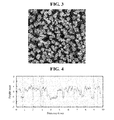
- FIG. 3 is an AFM image of a 10 ⁇ m ⁇ 10 ⁇ m area of the surface of a piece of glass sheet that has been applied a layer of C18-OH thereto according to one embodiment of the present invention.
- FIG. 4 is a diagram showing thickness profile of the C18-OH layer shown in FIG. 3 as measured by AFM along a selected straight line in the AFM image.
- FIG. 5 is an AFM image of a 10 ⁇ m ⁇ 10 ⁇ m area of the surface of a piece of glass sheet that has been applied a layer of C18-OH thereto according to another embodiment of the present invention.
- FIG. 6 is a diagram showing thickness profile of the C18-OH layer shown in FIG. 5 as measured by AFM along a selected straight line in the AFM image.
- FIG. 7 is a diagram showing distribution of adhesion force as measured by AFM of the surface area of the glass sheet as shown in FIG. 3 .
- FIG. 8 is a diagram showing distribution of adhesion force as measured by AFM of the surface area of the glass sheet as shown in FIG. 5 .
- a hydrophilic group in proximity to an end of a main carbon chain includes, e.g., (i) a hydrophilic group linked to the carbon atom at the very end of the main carbon chain; (ii) a hydrophilic group connected to a carbon atom that is directly linked to the carbon atom at the very end of the main carbon chain; and (iii) a hydrophilic group connected to a carbon atom that is spaced by less than 4 carbon atoms from the carbon atom at the very end of the main carbon chain.
- Cn-OH and Cn-alcohol are used interchangeably to mean an organic material the molecule of which comprises a straight chain having a number of carbon atoms of n and a hydroxyl group (—OH) at one end thereof.
- C18-OH and C18-alcohol are used interchangeably to mean an alcohol having a straight carbon chain comprising 18 carbon atoms and a hydroxyl at one end thereof.
- examples of C18-OH would include, but are not limited to: aliphatic alcohols such as octadecan-1-ol (F001), nonadecan-2-ol (F002), decadecan-3-ol (F003), 17-methyl-octadecan-1-ol (F004), 16-methyl-octadecan-ol (F005), 16-ethyl-octadecan-1-ol (F006), and the like. Chemical formula of these C18-OH are illustrated below:
- a straight chain alcohol means an alcohol the molecule of which does not comprise a pendant group other than OH.
- a straight chain C18-OH can be octadecan-1-ol (F001), nonadecan-2-ol (F002), decadedan-3-ol (F003), and the like.
- a primary alcohol typically means that in the molecule of the alcohol, the carbon atom connected with the OH group is not connected with more than one carbon atoms.
- a secondary alcohol means that in the molecule of the alcohol, the carbon atom connected with the OH group is connected with two carbon atoms, and a tertiary alcohol means that in the molecule of the alcohol, the carbon atom connected with the OH group is connected with three carbon atoms.
- (F002) and (F003) above are secondary alcohols.
- Cn-COOH and Cn+1-acid are used interchangeably to mean an organic material the molecule of which comprises a straight chain having a number of carbon atoms of n+1 (including the carbon atom in the —COOH group) and a carboxyl group (—COOH) at one end thereof.
- —COOH carboxyl group
- —COH group in a C17-OH is converted into a —COOH group by, e.g., oxidation, it would become a C16-COOH, or alternatively, a C17-acid.
- straight chain C18-OH F001
- C17-COOH or C18-acid stearic acid
- discontinuous layer means a layer of a material interspersed by a different material.
- a discontinuous layer of an organic material on a surface of a sheet material may exhibit one or more of the following topography, inter alia: (i) a plurality of discrete islets; (ii) a plurality of bands; (iii) a plurality of patches; and (iv) a plurality of mounds.
- a self-assembled single-molecule layer is a monolayer in the meaning of the present application. It should be noted, however, that in a monolayer, although in most locations the molecules of the materials align side-by-side, it is not ruled out that in a small percentage of areas, stacking of molecules having the thickness of several molecules may be present.
- water contact angle means water contact angle measured when the measured surface is placed substantially horizontally and the water drop footprint on the surface is substantially circular.
- RAF f ⁇ ( max ) - f ⁇ ( min ) f ⁇ ( min ) ⁇ 100 ⁇ % , where f(max) is the maximal adhesion force measured by atomic force microscope (AFM), f(min) is the minimal adhesion force measured by AFM under the same measurement condition, and RAF is reduction of adhesion force.
- optical and/or electronic devices or the fabrication thereof require the use of an organic or inorganic material substrate having a surface with a high level of cleanliness and substantially free of scratches.
- the fabrication of LCD displays and photovoltaics typically require the use of glass substrates having pristine surfaces substantially free of inorganic particles and scratches.
- the production of such glass substrates typically require multiple steps of surface scoring, glass splitting, edge grinding and polishing, each of which could generate a large number of glass particles that can travel at a certain speed to impact the quality area of the glass surface.
- the flying particles can scratch the glass surface, leaving permanent damage, or adhere to the glass surface with a sufficiently strong bond that would survive subsequent washing and cleaning steps.
- Such residual glass particles on the glass surface can lead to defects in semiconductive devices such as transistors produced in downstream process.
- a glass substrate needs to be shipped from a substrate fabrication factory to a substrate user at a different location. Normally, multiple glass sheets are packed into a container, which is then shipped from one location to another. While typically the glass containers are sealed, particles and other contaminants may nonetheless come into contact with the quality surface area, causing unwanted surface damage.
- the present inventors found that a very thin layer of long-chain organic materials having a thickness on the nano-meter scale could provide scratch-resistance to the pristine surfaces of glass substrates produced for use in LCD displays. Further study detailed below shows that not even a full surface coverage is required to achieve significant protective effect. Moreover, such a thin, sparsely applied coating material can be very easily removed in a regular surface washing and cleaning step, and thus can be used in an existing glass substrate manufacturing production line without significant modification of process and equipment set-up.
- the surface protection method of the present invention can be used for any surface in need of protection, including organic and inorganic surfaces.
- the present invention would be particularly useful for protecting hydrophilic surfaces, such as those comprising hydrophilic surface groups, e.g., OH groups.
- hydrophilic surface groups e.g., OH groups.
- a number of glass, glass-ceramic, ceramic and crystalline materials are known to comprise surface —OH groups and therefore can be advantageously protected by using the present invention.
- the present invention will be further illustrated in greater detail below in the context of protecting surfaces of oxide glass sheets. However, one having ordinary skill in the art should understand that, upon reading the specification of the present application, the present invention can be applied to protect other material surfaces, mutatis mutandis.
- the hydrophilic group at the end or in proximity to the end of the main carbon chain of the long-chain organic material used in the process of the present invention can be a hydroxyl group (—OH), a carboxyl group (—COOH), an ether group, an amine group (—NH 2 ), an amide group (—CONH 2 ) or other groups.
- the hydrophilic group of the long-chain organic material can react with the hydrophilic group on the surface of the sheet material to be protected to form a relatively strong bond.
- the surface —OH group could react with a —OH group of the organic material to form a covalent bond schematically illustrated below:
- the molecules of the long-chain organic material may bond with the sheet surface through a hydrogen bond, van der Waals force or other mechanism.
- the main chain of the organic material would then extend away from the surface of the glass surface. If a plurality of organic material molecules are applied to the glass surface and bonded to the surface in close proximity to one another, the organic material molecules can form relatively dense “forest-like” patches of the organic material on the surface.
- patches of extending long carbon chains would function to reduce the frictional coefficient between particles (such as glass particles) and the glass surface, reduce the adhesion force between the glass particles and the glass surface, thereby protecting the glass surfaces from being scratched by the glass particles and reducing the number of glass particles that eventually bond to the glass surfaces with sufficient bonding strength to survive subsequent washing and cleaning
- modeling showed that increased surface roughness caused by discontinuous islets formed by the long-chain organic material is conducive to reduced surface adhesion to the glass particles. Therefore, because a full layer of coating of uniform thickness on the surface of the sheet surface may result in a low surface roughness, such uniform, full coating of the long-chain organic material could actually be less desirable than a discontinuous coating comprising a number of islets.
- the number of carbon atoms in the longest carbon chain in the molecules thereof should be at least 12. This is due to several reasons.
- First, short-chain organic molecules tend to have relatively high volatility around room temperature and glass finishing and handling temperature, thereby reducing its effectiveness in surface protection.
- Second, the short-chain organic materials, especially alcohols, tend to be unstable in air under the coating and/or surface finishing conditions, leading to less than desired surface protection capabilities.
- organic materials comprising more than 40 carbon atoms tend to have too high a melting point, and/or too low a partial pressure under the glass sheet finishing/handling conditions, making using them very difficult.
- Organic materials comprising at most 30 carbons in the main chain would be easier to work with than those having 40 carbons.
- Example lengths of the main chain of the organic material would then include, but are not limited to: at most 28 carbon atoms, at most 26 carbon atoms, at most 24 carbon atoms, at most 22 carbon atoms, and at most 20 carbon atoms.
- the main chain comprises at least 16 carbon atoms, in certain embodiments at least 18 carbon atoms.
- a 100% pure organic material is not necessary. Rather, a mixture of a variety of organic materials having a range of carbon atoms in their main chains may be advantageously used given its cost advantage over the pure material.
- a long-chain alcohol or long-chain acid is used as the surface protecting agent. While other chain lengths may work in different embodiments, a C18-alcohol, especially a primary C18-alcohol, represents a particularly advantageous choice. This is because its melting point, flash point, stability in air, capability to form desired coating patterns on glass surfaces, removability, cost, all taken together, present a compromise that is more appealing than its alternatives. In another embodiment, a C18-acid may be used in combination with a C18-alcohol.
- the density of the organic material upon application on the surface is desirably from 20 ng ⁇ cm ⁇ 2 to 160 ng ⁇ cm ⁇ 2 , in certain embodiments from 30 ng ⁇ cm ⁇ 2 to 150 ng ⁇ cm ⁇ 2 , in certain embodiments from 45 ng ⁇ cm ⁇ 2 to 140 ng ⁇ cm ⁇ 2 , in certain embodiments from 40 ng ⁇ cm ⁇ 2 to 120 ng ⁇ cm ⁇ 2 , in certain embodiments from 40 ng ⁇ cm ⁇ 2 to 100 ng ⁇ cm ⁇ 2 . If the density is higher than 160 ng ⁇ cm ⁇ 2 , the organic material may be difficult to remove at a later cleaning and washing step. If the density is lower than 20 ng ⁇ cm ⁇ 2 , the organic material coating layer may be insufficient to provide the desired particle protection and scratch resistance.
- the thickness of the coating varies from one location to another. Without intending to be bound by a particular theory, it is believed this is due to the different stacking of the molecules of the organic material, the different average distances between adjacent molecules, the different degrees to which the molecules are straightened on the surface, the different manners in which the organic molecules assemble on the surface, and the different native surface roughness of the clean surface of the sheet material bearing the coating. Nonetheless, in order to apply the organic material in a sufficiently short period of time, and to achieve a high level of removability at a later cleaning step, it is desired that the organic material layer has a thickness as low as practical—all while maintaining a desired level of surface protection.
- the average thickness of the layer of the long-chain organic material at the end of step (I) is at most 10 nm, in certain embodiments at most 8 nm, in certain other embodiments at most 6 nm, in certain other embodiments at most 4 nm.
- the average thickness of the layer of the long-chain organic material on the clean surface is at most three times of the length of the main carbon chain.
- the average thickness of the organic material coating on the clean surface be in the range of 1-9 nm, in certain embodiments in the range of 1-7 nm, in certain other embodiments in the range of 1-6 nm, in certain other embodiments in the range of 1-4 nm, in certain other embodiments in the range of 1-3 nm.
- the reason why the lower limit of the coating thickness can be lower than the length of the straight chain of the alcohol is because, inter alia: (i) in certain areas of the surface to be protected, the alcohol molecules may be absent; and (ii) the molecules may not be all completely perpendicular to the glass surface, resulting in a thickness lower than a completely straightened molecular chain.
- any 10 ⁇ m ⁇ 10 ⁇ m tested area exhibits an islet density in the range from 0.80n to 1.20n.
- the average distance between adjacent islets on the clean surface is in the range from 0.1 ⁇ m to 3 ⁇ m, in certain embodiments from 0.2 ⁇ m to 2.5 ⁇ m, in certain embodiments from 0.3 ⁇ m to 2.0 ⁇ m, in certain embodiments from 0.4 ⁇ m to 2.0 ⁇ m, in certain embodiments from 0.5 ⁇ m to 1.5 ⁇ m, in certain embodiments from 0.6 ⁇ m to 1.5 ⁇ m, in certain other embodiments from 1.0 ⁇ m to 1.5 ⁇ m.
- bare sheet material surface areas between the islets is significantly smaller than the average particles that the sheet material is exposed to during typical finishing, packaging and transportation conditions such as in the case of glass sheet material, such particles would then primarily contact the organic material on the surface.
- the probability of a particle impacting a bare surface is reduced to very low, in certain embodiments to close to zero.
- a thin coating formed by a plurality of coating islets would function substantially the same as a full coating layer without any bare sheet material exposed in terms of surface protection effect.
- the flexibility of the organic material molecules on the glass surface and the low frictional coefficient of the organic material with respect to the impacting particles would reduce the probability of particles adhering to or scratching the bare sheet material surface.
- the thin protective coating layer applied to the clean surface of the glass sheet material can be advantageously deposited during and before the sheet material finishing process, as mentioned supra.
- Glass sheet materials are often subjected to finishing such as bead removal, surface scoring, bending and separation, as well as edge grinding and polishing. In each of these operations, a number of glass particles can be generated and scattered in all directions. Efforts have been made in the past to contain the particles and remove those particles by fluid streams to reduce contact thereof with the quality surface. Nonetheless, a significant amount of particles still make their way to the main surfaces of the glass sheets.
- the present invention can be advantageously used in connection with glass sheet finishing. Surface protecting layer formed during or before the finishing operation by using the present invention can advantageously protect the glass surface.
- water may be used to cool down the tools and the glass sheet, and/or to remove the glass particles.
- the organic material can adhere to the sheet material surface with sufficient strength, such that the coating will not be unduly removed by the water used, and the surface protecting effect can be retained during the whole finishing operation.
- an organic material such as a long-chain alcohol or long-chain acid can increase the hydrophobicity of the coated surface as indicated by water contact angle.
- the sheet surface bearing the long-chain organic material exhibits a water contact angle of from 12° to 50°, in certain embodiments from 12° to 45°, in certain embodiments from 15° to 40°, in certain embodiments from 20° to 40°, in certain embodiments from 30° to 40°. If the water contact angle is too small, the amount of the organic material applied to the sheet surface may be insufficient to confer the desired level of particle protection. If water contact angle is too large, the amount of the organic material may have been too large to be efficiently removed at a later cleaning step.
- the long-chain organic material reduces the adhesion of particles to the sheet material surface.
- the sheet surface being an inorganic material surface, such as a glass surface, bearing the long-chain organic material exhibits a reduction of an adhesion force as measured by AFM of from 20% to 70%, in certain embodiments from 25% to 60%, in certain embodiments from 30% to 50%, in certain other embodiments from 30% to 40%.
- adhesion force is measured by an atomic force microscope (AFM) using a Si 3 N 4 (the surface of which is oxidized to SiO 2 if exposed to air) measuring tip. This level of adhesion force is particularly desirable for reduced glass particle adhesion to a glass surface.
- the glass substrate is washed and cleaned to remove the organic materials, any residual glass particles and other surface contaminants.
- Glass substrates used for LCD panel manufacture are required to have a high degree of cleanliness. Thanks to the nano-scale thickness of the organic material used in the present invention, the coating can be easily removed by using standard glass substrate cleaning agents, equipment and processes without the need of significant modification. Therefore, the present invention can be advantageously used to retrofit an existing glass production line.
- the substantially clean glass surface can exhibit a water contact angle from 0° to 10°, in certain embodiments form 0° to 8°, in certain embodiments form 0° to 6°, in certain embodiments form 0° to 5°, in certain embodiments form 0° to 3°.
- the organic material used as the coating in the present invention can be applied by various means.
- spray coating and dip coating are contemplated where the organic material is dispersed in a liquid media, such as a dispersant or a solvent, and the dispersion is applied to the sheet material surface by either spraying or dipping.
- a liquid media such as a dispersant or a solvent
- very low concentration of the organic material should be used in such dispersions in order not to form an overly thick coating on the glass surface.
- a non-toxic solvent or liquid media such as water, ethanol, acetone, or mixtures thereof, can be advantageously used.
- the organic material can be advantageously applied by using a carrier gas stream.
- the long-chain organic material is first loaded into the glass stream, which is then delivered to the glass surface, contacts the glass surface for a sufficient period of time to effect the formation of the layer of the long-chain organic material.
- the long-chain organic material may be present in solid, liquid or gas form in the carrier gas stream, it is advantageous the gas stream has a temperature higher than the melting point of the long-chain organic material such that the organic material is in liquid and/or gas state to avoid clogging of the channel containing the gas stream.
- Loading of the long-chain organic material into the gas stream can be effected by various means.
- the organic material in substantially pure form, may be heated to a certain temperature where it is in liquid and/or solid state with sufficient vapor pressure. The vapor is then allowed to flow to the sheet surface to complete the coating material deposition.
- a gas stream may be allowed to bubble through a liquid bath comprising the long-chain organic material at a certain temperature, such as a melt or a solution, whereby the gas stream becomes entrained with the organic material, and then further delivered to the vicinity of the sheet surface, where at least part of the organic material condenses on the sheet surface and adheres to the surface to form a thin layer of coating thereon.
- the temperature of the gas stream is advantageous to be at least 10° C. higher than the melting point of the long-chain organic material, in certain embodiments at least 20° C. higher than the melting point of the long-chain organic material; in certain other embodiments at least 30° C. higher than the melting point of the long-chain organic material.
- too high a temperature of the carrier gas stream can lead to disintegration, oxidation, reaction, burning or explosion of the long-chain organic material.
- the gas stream is advantageously maintained at a temperature not higher than 60° C. above the melting point, in certain embodiments not higher than 50° C. above the melting point.
- FIG. 1 schematically illustrates an embodiment of the present invention where a primary C18-OH is applied to both major surfaces of a glass sheet 101 traveling in a direction 103 to achieve the surface protection effect.
- air streams 105 , 107 are passed into solutions 109 , 111 of the C18-OH alcohol contained in vessels 109 and 111 , and then delivered, through nozzles 117 and 119 , to both major surfaces of the glass sheet.
- the nozzles are confined in enclosures 121 and 123 to prevent uncontrollable dissipation of the C18-OH.
- Effluent gas streams containing the residual C18-OH and optionally solvent are exhausted through outlet tubes 125 and 127 on the walls of the enclosures 121 and 123 .
- the nozzles 117 and 119 desirably have a length spanning the full width of the glass sheet 101 so that the full quality area of the glass sheet is exposed to the gas streams loaded with the C18-OH molecules.
- the sheet material such as glass is maintained at a temperature lower than the melting point of the long-chain organic material. If the temperature of the sheet material surface is too high, the organic material may be readily oxidized, or have too high a vapor pressure, leading to an insufficient coating with too low a density of the coating material or a layer of altered coating material that does not have the desired level of adhesion force, friction coefficient and hydrophobicity. Where air is used as the carrier gas, or the long-chain organic material is otherwise exposed to air, it is desired that the temperatures of the gas stream and the sheet material be maintained below the flash point for safety reasons.
- the organic material in step (I), has a main carbon chain comprising at most 40 carbon atoms, in certain embodiments at most 30 carbon atoms, in certain embodiments at most 28 carbon atoms, in certain embodiments at most 26 carbon atoms, in certain embodiments at most 24 carbon atoms, in certain other embodiments at most 22 carbon atoms, and the temperature of the sheet material is maintained below 55° C., in certain embodiments below 50° C., in certain embodiments below 40° C.
- the amount of the long-chain organic material deposited onto the sheet surface to be protected is determined by various factors, including, inter alia, the temperature of the carrier gas stream, the temperature of the sheet surface, the flow rate of the carrier gas stream, and the period of time the sheet surface is subject to contact with the carrier gas.
- An advantage of the present invention is, due to the small amount of coating material required, the coating process can be completed in a short period of time. This is particularly desirable for high-throughput glass finishing lines where the glass sheets are conveyed at a high speed.
- the contact time between the gas stream and the sheet surface is at most 2 minutes, in certain embodiments at most 1.5 minutes, in certain embodiments at most 1 minute, in certain embodiments at most 50 seconds, in certain embodiments at most 40 seconds, in certain embodiments at most 30 seconds, in certain embodiments at most 20 seconds, in certain embodiments at most 10 seconds.
- Glass sheet samples were prepared from Eagle XG® LCD glass substrates made by Corning Incorporated, Corning, N.Y., U.S.A. using an overflow fusion down-draw process.
- FIG. 2 illustrates the apparatus set-up used in the experiments in the present disclosure.
- solid octadecan-1-ol (Sigma Aldrich, Catalog #74723, 99% purity) was charged.
- the dish was then placed on a hot plate so that the C18-OH was heated to a temperature T 1 in air where the alcohol melts to form a liquid 203 covering the full bottom surface of the dish 201 .
- Vapor of the C18-OH was thus produced in the air immediately above the Petri dish 201 and would travel upwards due to diffusion and convection as illustrated by the arrow.
- a piece of glass sheet sample 205 having clean surfaces on both sides preheated to a temperature T 2 was then placed over the dish 201 at a distance of about 1 cm from the surface of the melt of the alcohol where it is maintained for a period of time tt.
- the temperature of the alcohol is measured at the surface of the melt.
- the glass sheet sample 201 was measured for surface particle count PC 1 using an Ethan system available from Accu_Fab Systems, U.S.A.
- the glass sheet sample was then subjected to scratching test. Scratching took place by contacting a 380 g aluminum bar wrapped with a paper (WR139 from Thilmany, Wis., U.S.A.) with the surface of the glass sheet sample to be tested. The aluminum bar, without an external force normal to the glass surface other than gravity exerted thereto, was then moved relative to the glass sheet surface back and forth at a speed of 100 mm/s for 10 times. The glass sheet sample was then cleaned in a 4% Semiclean KG solution at 160° F. (71° C.) for 15 minutes and then air dried. The air dried surface was then measured for surface particle count PC 2 using the Ethan system. An uncoated glass sheet sample was used as a control. A glass sheet sample protected with a plastic film (Visqueen®), was peeled off of the Visqueen® film, subjected to scratching as above, washed and the particle count determined, as another control, as indicated below.
- Visqueen® plastic film
- Coated glass sheet sample surfaces were also measured by AFM for the surface topography and adhesion force.
- the measuring tip of the AFM was made of Si 3 N 4 , the surface of which is believed to have been oxidized into SiO 2 due to exposure to air.
- T 1 80° C.
- tt 10 seconds.
- the coating temperature T 1 be low and coating time tt be short, as long as the desired level of surface protection effect is achieved.
- the lighter areas are those bearing larger amount of C18-OH coating, and the darker areas bear relatively smaller or no C18-OH coating, and the darkest areas are believed to be essentially free of C18-OH molecules because the surface adhesion force as measured in these areas by AFM is substantially the same as that of a bare glass sheet surface that had not been exposed to C18-OH vapor.
- FIG. 4 further illustrates the surface roughness of the same area shown in FIG. 3 along a horizontal line chosen in the image of FIG. 3 .
- the horizontal axis represents distance from one edge of the measured area; and the vertical axis shows the measured surface height relative to a reference plane.
- FIGS. 3 and 4 show that vapor deposition resulted in mounds of octadecanol about 1-2 nm high and fairly regularly spaced, the deposited particle sizes are generally less than 1 ⁇ m as indicated by the light regions in FIG. 3 .
- T 1 80° C.
- T 2 room temperature
- tt 10 seconds.
- the lighter areas are those bearing larger amount of C18-OH coating
- the darker areas bear relatively smaller or no C18-OH coating
- the darkest areas are believed to be essentially free of C18-OH molecules because the surface adhesion force as measured in these areas by AFM is substantially the same as that of a bare glass sheet surface that had not been exposed to C18-OH vapor.
- FIG. 6 further illustrates the surface roughness of the same area shown in FIG. 5 along a horizontal line chosen in the image of FIG. 5 .
- the horizontal axis represents distance from one edge of the measured area; and the vertical axis shows the measured surface height relative to a reference plane.
- FIGS. 5 and 6 again show that vapor deposition resulted in mounds of octadecan-1-ol about 1-2 nm high and fairly regularly spaced, the deposited particle sizes are generally less than 1 ⁇ m as indicated by the light regions in FIG. 5 .
- Comparison of FIG. 3 with FIG. 5 shows that smaller, but larger number of islets were formed at 80° C. than at 90° C.
- Adhesion force profiles of the two coated samples of FIGS. 3 and 5 are provided in FIGS. 7 and 8 , respectively. In these two figures, shown on the horizontal axes are measured adhesion force in nano Newton, and shown on the vertical axes are measured counts at a given adhesion force.
- the coated glass sheet sample was also measured for water surface contact angle. Finally, the glass sheet sample was cleaned by using 160° F. (71° C.) 4% Semiclean KG for 15 minutes followed by deionized water rinsing. Upon air drying, the glass sheet sample was measured for contact angle again at room temperature.
- FIGS. 3, 4, 5 and 6 show that the width of the deposited islets on the glass sheet surface decreases as the temperature of the C18-OH melt decreases, as expected.
- the lighter, coated regions in FIGS. 3 and 5 show lower adhesion forces (retraction forces) than the darkest regions which are believed to be bare glass surfaces, by about 30%-40%, clearly indicating that octadecan-1-ol, as deposited, provides a benefit in terms of a reduction in glass adhesion.
- the reduced surface adhesion force will translate into less adhesion of glass particles to the glass sheet surface.
- the glass sheet samples were also measured for horizontal water contact angles (i.e., water contact angles measured when the glass sheet samples were placed horizontally instead of vertically).
- TABLE III below reports water contact angle data for Eagle XG® upon being coated with octadecan-1-ol according to embodiments of the method of the present invention, or after being washed with Semiclean® KG. The reduction of contact angle upon washing indicates that clean glass values are achieved. Clean glass water surface contact angle values are on the order of 5-10°. Washability of the C18-OH coating formed in the experiments was also measurable and demonstrated by ESI/MS (Electrospray Ionization/Mass Spectroscopy). ESI/MS data showed that no residual organic material remained after normal cleaning using Semiclean® KG as described supra.
- Data ⁇ 2 are water contact angles of the glass sheet sample surface upon being cleaned as described above measured at room temperature.
- Data ⁇ 3 are measured water contact angles at room temperature of the same cleaned glass sheet sample surface two days after ⁇ 2 was measured.
Landscapes
- Chemical & Material Sciences (AREA)
- Engineering & Computer Science (AREA)
- Materials Engineering (AREA)
- Chemical Kinetics & Catalysis (AREA)
- General Chemical & Material Sciences (AREA)
- Geochemistry & Mineralogy (AREA)
- Life Sciences & Earth Sciences (AREA)
- Organic Chemistry (AREA)
- Mechanical Engineering (AREA)
- Ceramic Engineering (AREA)
- Inorganic Chemistry (AREA)
- Laminated Bodies (AREA)
- Surface Treatment Of Glass (AREA)
- Mining & Mineral Resources (AREA)
- Paints Or Removers (AREA)
Priority Applications (1)
| Application Number | Priority Date | Filing Date | Title |
|---|---|---|---|
| US13/303,655 US9434641B2 (en) | 2010-11-29 | 2011-11-23 | Method for protecting glass surface using long-chain organic material |
Applications Claiming Priority (2)
| Application Number | Priority Date | Filing Date | Title |
|---|---|---|---|
| US41760310P | 2010-11-29 | 2010-11-29 | |
| US13/303,655 US9434641B2 (en) | 2010-11-29 | 2011-11-23 | Method for protecting glass surface using long-chain organic material |
Publications (2)
| Publication Number | Publication Date |
|---|---|
| US20120132053A1 US20120132053A1 (en) | 2012-05-31 |
| US9434641B2 true US9434641B2 (en) | 2016-09-06 |
Family
ID=46125748
Family Applications (1)
| Application Number | Title | Priority Date | Filing Date |
|---|---|---|---|
| US13/303,655 Expired - Fee Related US9434641B2 (en) | 2010-11-29 | 2011-11-23 | Method for protecting glass surface using long-chain organic material |
Country Status (5)
| Country | Link |
|---|---|
| US (1) | US9434641B2 (enExample) |
| JP (1) | JP6005926B2 (enExample) |
| KR (1) | KR101948932B1 (enExample) |
| CN (1) | CN102584026B (enExample) |
| TW (1) | TWI567039B (enExample) |
Families Citing this family (8)
| Publication number | Priority date | Publication date | Assignee | Title |
|---|---|---|---|---|
| US9278878B2 (en) * | 2011-02-23 | 2016-03-08 | Corning Incorporated | Methods and apparatus for scoring thin glass |
| WO2014073455A1 (ja) * | 2012-11-09 | 2014-05-15 | 日本電気硝子株式会社 | ガラスフィルム積層体及び電子・電気デバイスの製造方法 |
| US8586188B1 (en) | 2012-11-28 | 2013-11-19 | Corning Incorporated | Protective films or papers for glass surfaces and methods thereof |
| WO2017034978A1 (en) * | 2015-08-21 | 2017-03-02 | Corning Incorporated | Methods of processing a glass web |
| CN108367970A (zh) * | 2015-10-02 | 2018-08-03 | 康宁股份有限公司 | 可除去的玻璃表面处理以及用于降低颗粒附着的方法 |
| TWI709544B (zh) * | 2016-10-12 | 2020-11-11 | 美商康寧公司 | 玻璃基板及處理玻璃基板的方法 |
| CN107876483A (zh) * | 2017-11-14 | 2018-04-06 | 江苏飞视文化发展有限公司 | 一种广告印刷清洗方法 |
| JP1637055S (enExample) | 2018-12-06 | 2019-07-22 |
Citations (13)
| Publication number | Priority date | Publication date | Assignee | Title |
|---|---|---|---|---|
| DE4103283A1 (de) | 1991-02-04 | 1992-08-06 | Buna Ag | Zwischenlagenmaterial fuer flachglas |
| US5910360A (en) * | 1996-06-11 | 1999-06-08 | Elf Atochem Vlissingen B.V. | Glass article carrying a transparent protective layer which is resistant to abrasion and can be labeled and process for obtaining it |
| US5997943A (en) * | 1996-04-02 | 1999-12-07 | Saint-Gobain Vitrage | Compound for a non-wettable coating, process for treatment of glass with the aid of the compound and products obtained |
| US6379746B1 (en) * | 1999-02-02 | 2002-04-30 | Corning Incorporated | Method for temporarily protecting glass articles |
| US6715316B2 (en) * | 2001-05-08 | 2004-04-06 | Corning Incorporated | Water-removable coatings for LCD glass |
| US20060007552A1 (en) | 2004-07-09 | 2006-01-12 | Seiko Epson Corporation | Method for manufacturing microlens and method for manufacturing organic electroluminescence element |
| US7108889B2 (en) * | 2004-05-18 | 2006-09-19 | Guardian Industries Corp. | Glass interleaving material and method |
| JP2008289967A (ja) | 2007-05-23 | 2008-12-04 | Samco Inc | 薄膜形成方法及び薄膜形成装置 |
| US20100297392A1 (en) * | 2009-05-22 | 2010-11-25 | Jonathan Chen | Slip agent for protecting glass |
| US20110143064A1 (en) | 2008-07-09 | 2011-06-16 | Saint-Gobain Emballage | Composition for reinforcing hollow glass and protecting same from scratching, corresponding treatment methods and resulting treated hollow glass |
| JP2011190039A (ja) | 2010-03-15 | 2011-09-29 | Nippon Electric Glass Co Ltd | ガラス基板搬送装置及びガラス基板搬送方法 |
| WO2011118502A1 (ja) | 2010-03-26 | 2011-09-29 | 旭硝子株式会社 | ガラス板梱包体 |
| US8304083B2 (en) * | 2005-11-17 | 2012-11-06 | Fujifilm Corporation | Hydrophilic member and process for producing the same |
-
2011
- 2011-11-23 US US13/303,655 patent/US9434641B2/en not_active Expired - Fee Related
- 2011-11-28 JP JP2011258775A patent/JP6005926B2/ja not_active Expired - Fee Related
- 2011-11-29 KR KR1020110126138A patent/KR101948932B1/ko not_active Ceased
- 2011-11-29 TW TW100143774A patent/TWI567039B/zh not_active IP Right Cessation
- 2011-11-29 CN CN201110463042.5A patent/CN102584026B/zh not_active Expired - Fee Related
Patent Citations (13)
| Publication number | Priority date | Publication date | Assignee | Title |
|---|---|---|---|---|
| DE4103283A1 (de) | 1991-02-04 | 1992-08-06 | Buna Ag | Zwischenlagenmaterial fuer flachglas |
| US5997943A (en) * | 1996-04-02 | 1999-12-07 | Saint-Gobain Vitrage | Compound for a non-wettable coating, process for treatment of glass with the aid of the compound and products obtained |
| US5910360A (en) * | 1996-06-11 | 1999-06-08 | Elf Atochem Vlissingen B.V. | Glass article carrying a transparent protective layer which is resistant to abrasion and can be labeled and process for obtaining it |
| US6379746B1 (en) * | 1999-02-02 | 2002-04-30 | Corning Incorporated | Method for temporarily protecting glass articles |
| US6715316B2 (en) * | 2001-05-08 | 2004-04-06 | Corning Incorporated | Water-removable coatings for LCD glass |
| US7108889B2 (en) * | 2004-05-18 | 2006-09-19 | Guardian Industries Corp. | Glass interleaving material and method |
| US20060007552A1 (en) | 2004-07-09 | 2006-01-12 | Seiko Epson Corporation | Method for manufacturing microlens and method for manufacturing organic electroluminescence element |
| US8304083B2 (en) * | 2005-11-17 | 2012-11-06 | Fujifilm Corporation | Hydrophilic member and process for producing the same |
| JP2008289967A (ja) | 2007-05-23 | 2008-12-04 | Samco Inc | 薄膜形成方法及び薄膜形成装置 |
| US20110143064A1 (en) | 2008-07-09 | 2011-06-16 | Saint-Gobain Emballage | Composition for reinforcing hollow glass and protecting same from scratching, corresponding treatment methods and resulting treated hollow glass |
| US20100297392A1 (en) * | 2009-05-22 | 2010-11-25 | Jonathan Chen | Slip agent for protecting glass |
| JP2011190039A (ja) | 2010-03-15 | 2011-09-29 | Nippon Electric Glass Co Ltd | ガラス基板搬送装置及びガラス基板搬送方法 |
| WO2011118502A1 (ja) | 2010-03-26 | 2011-09-29 | 旭硝子株式会社 | ガラス板梱包体 |
Non-Patent Citations (4)
| Title |
|---|
| "The boundary lubrication of glass glass contacts by mixed alkyl-alcohol and cationic surfactant systems" M. J. Adams, B. J. Briscoe, D. M. Gorman, F. Hollway, and S. A. Johnson in Lubrication at the Frontier, 1999, ed. D. Dawson et al., pp. 49-58. |
| "The influence of boron atoms introduced on the silica gel surface upon the properties of n-octadecanol films" A. L. Dawidowicz, J. Rayss, and K. Surowiec, Zeitschrift fuer Physikalische Chemie, V. 267, (1986), 401-411. |
| "The influence of thermal treatment of controlled porous glasses (CPG) on the properties of n-octadecanol films" A. L. Dawidowicz and J. Rayss, Zeitshcrift fuer Physikalische Chemie, V. 266, (1985), 1210-1218. |
| Fagerholm. "Modification of industrial E glass fibres by long chain alcohol adsorption", Colloids and Surfaces A: Physicochemical and Engineering Aspects 110, (1996), 11-22. |
Also Published As
| Publication number | Publication date |
|---|---|
| KR101948932B1 (ko) | 2019-02-15 |
| TW201228968A (en) | 2012-07-16 |
| US20120132053A1 (en) | 2012-05-31 |
| JP2012116748A (ja) | 2012-06-21 |
| TWI567039B (zh) | 2017-01-21 |
| CN102584026A (zh) | 2012-07-18 |
| KR20120058433A (ko) | 2012-06-07 |
| JP6005926B2 (ja) | 2016-10-12 |
| CN102584026B (zh) | 2017-05-31 |
Similar Documents
| Publication | Publication Date | Title |
|---|---|---|
| US20120132053A1 (en) | Glass surface protection using long-chain organic material | |
| CN1137864C (zh) | 临时保护玻璃制品的方法 | |
| US10106457B2 (en) | Vapor deposition systems and processes for the protection of glass sheets | |
| KR101643993B1 (ko) | 유리 필름 적층체 | |
| AU2010219836B2 (en) | Slot die coating process | |
| US11629096B2 (en) | Temporary bonding of glass pairs using cationic surfactants and/or organic salts | |
| JP4688431B2 (ja) | フラットパネルディスプレイ用マザーガラス保護フィルムおよびその用途 | |
| TW201825623A (zh) | 用於片材接合的矽氧烷電漿聚合物 | |
| CN106661380B (zh) | 环氧/氧杂环丁烷化合物、环氧官能化倍半硅氧烷和纳米颗粒基玻璃可uv固化涂料组合物 | |
| KR20170088953A (ko) | 얇은 유리 시트와 이를 형성하는 시스템 및 방법 | |
| TW200831426A (en) | Methods for protecting glass | |
| KR102659516B1 (ko) | 유리 적층체 | |
| JP2003054998A (ja) | Lcdガラスのための水で除去可能な被膜 | |
| JP2021514928A (ja) | 静電帯電の低減のための起伏加工済みガラス表面 | |
| US8586188B1 (en) | Protective films or papers for glass surfaces and methods thereof | |
| US10246374B2 (en) | Method for manufacturing glass film laminate, glass film laminate, and method for manufacturing electronic device | |
| TWI609001B (zh) | Glass substrate for display and its manufacturing method |
Legal Events
| Date | Code | Title | Description |
|---|---|---|---|
| AS | Assignment |
Owner name: CORNING INCORPORATED, NEW YORK Free format text: ASSIGNMENT OF ASSIGNORS INTEREST;ASSIGNORS:MATTHEWS, JAMES ROBERT;STEMPIN, JR., LOUIS JOSEPH;WALCZAK, WANDA JANINA;AND OTHERS;REEL/FRAME:027275/0950 Effective date: 20111123 |
|
| STCF | Information on status: patent grant |
Free format text: PATENTED CASE |
|
| FEPP | Fee payment procedure |
Free format text: MAINTENANCE FEE REMINDER MAILED (ORIGINAL EVENT CODE: REM.); ENTITY STATUS OF PATENT OWNER: LARGE ENTITY |
|
| LAPS | Lapse for failure to pay maintenance fees |
Free format text: PATENT EXPIRED FOR FAILURE TO PAY MAINTENANCE FEES (ORIGINAL EVENT CODE: EXP.); ENTITY STATUS OF PATENT OWNER: LARGE ENTITY |
|
| STCH | Information on status: patent discontinuation |
Free format text: PATENT EXPIRED DUE TO NONPAYMENT OF MAINTENANCE FEES UNDER 37 CFR 1.362 |
|
| FP | Expired due to failure to pay maintenance fee |
Effective date: 20200906 |