US9109943B2 - Weight-sensing surfaces with wireless communication for inventory tracking - Google Patents
Weight-sensing surfaces with wireless communication for inventory tracking Download PDFInfo
- Publication number
- US9109943B2 US9109943B2 US13/399,322 US201213399322A US9109943B2 US 9109943 B2 US9109943 B2 US 9109943B2 US 201213399322 A US201213399322 A US 201213399322A US 9109943 B2 US9109943 B2 US 9109943B2
- Authority
- US
- United States
- Prior art keywords
- consumption
- user
- quantity data
- consumable items
- identification
- Prior art date
- Legal status (The legal status is an assumption and is not a legal conclusion. Google has not performed a legal analysis and makes no representation as to the accuracy of the status listed.)
- Expired - Fee Related, expires
Links
Images




Classifications
-
- G—PHYSICS
- G06—COMPUTING OR CALCULATING; COUNTING
- G06Q—INFORMATION AND COMMUNICATION TECHNOLOGY [ICT] SPECIALLY ADAPTED FOR ADMINISTRATIVE, COMMERCIAL, FINANCIAL, MANAGERIAL OR SUPERVISORY PURPOSES; SYSTEMS OR METHODS SPECIALLY ADAPTED FOR ADMINISTRATIVE, COMMERCIAL, FINANCIAL, MANAGERIAL OR SUPERVISORY PURPOSES, NOT OTHERWISE PROVIDED FOR
- G06Q10/00—Administration; Management
- G06Q10/08—Logistics, e.g. warehousing, loading or distribution; Inventory or stock management
-
- H—ELECTRICITY
- H04—ELECTRIC COMMUNICATION TECHNIQUE
- H04B—TRANSMISSION
- H04B1/00—Details of transmission systems, not covered by a single one of groups H04B3/00 - H04B13/00; Details of transmission systems not characterised by the medium used for transmission
- H04B1/06—Receivers
- H04B1/08—Constructional details, e.g. cabinet
- H04B1/082—Constructional details, e.g. cabinet to be used in vehicles
-
- G—PHYSICS
- G01—MEASURING; TESTING
- G01G—WEIGHING
- G01G23/00—Auxiliary devices for weighing apparatus
- G01G23/18—Indicating devices, e.g. for remote indication; Recording devices; Scales, e.g. graduated
- G01G23/36—Indicating the weight by electrical means, e.g. using photoelectric cells
- G01G23/37—Indicating the weight by electrical means, e.g. using photoelectric cells involving digital counting
- G01G23/3728—Indicating the weight by electrical means, e.g. using photoelectric cells involving digital counting with wireless means
- G01G23/3735—Indicating the weight by electrical means, e.g. using photoelectric cells involving digital counting with wireless means using a digital network
-
- G—PHYSICS
- G01—MEASURING; TESTING
- G01G—WEIGHING
- G01G23/00—Auxiliary devices for weighing apparatus
- G01G23/01—Testing or calibrating of weighing apparatus
-
- G—PHYSICS
- G06—COMPUTING OR CALCULATING; COUNTING
- G06F—ELECTRIC DIGITAL DATA PROCESSING
- G06F16/00—Information retrieval; Database structures therefor; File system structures therefor
-
- G06F19/3475—
-
- G—PHYSICS
- G06—COMPUTING OR CALCULATING; COUNTING
- G06Q—INFORMATION AND COMMUNICATION TECHNOLOGY [ICT] SPECIALLY ADAPTED FOR ADMINISTRATIVE, COMMERCIAL, FINANCIAL, MANAGERIAL OR SUPERVISORY PURPOSES; SYSTEMS OR METHODS SPECIALLY ADAPTED FOR ADMINISTRATIVE, COMMERCIAL, FINANCIAL, MANAGERIAL OR SUPERVISORY PURPOSES, NOT OTHERWISE PROVIDED FOR
- G06Q10/00—Administration; Management
- G06Q10/08—Logistics, e.g. warehousing, loading or distribution; Inventory or stock management
- G06Q10/087—Inventory or stock management, e.g. order filling, procurement or balancing against orders
- G06Q10/0872—Inventory or stock management, e.g. order filling, procurement or balancing against orders using inventory planning
- G06Q10/08726—Inventory or stock management, e.g. order filling, procurement or balancing against orders using inventory planning for replenishment processing, procedures, or recommendations using forecasting or optimisation
-
- G—PHYSICS
- G16—INFORMATION AND COMMUNICATION TECHNOLOGY [ICT] SPECIALLY ADAPTED FOR SPECIFIC APPLICATION FIELDS
- G16H—HEALTHCARE INFORMATICS, i.e. INFORMATION AND COMMUNICATION TECHNOLOGY [ICT] SPECIALLY ADAPTED FOR THE HANDLING OR PROCESSING OF MEDICAL OR HEALTHCARE DATA
- G16H20/00—ICT specially adapted for therapies or health-improving plans, e.g. for handling prescriptions, for steering therapy or for monitoring patient compliance
- G16H20/60—ICT specially adapted for therapies or health-improving plans, e.g. for handling prescriptions, for steering therapy or for monitoring patient compliance relating to nutrition control, e.g. diets
-
- H—ELECTRICITY
- H04—ELECTRIC COMMUNICATION TECHNIQUE
- H04B—TRANSMISSION
- H04B1/00—Details of transmission systems, not covered by a single one of groups H04B3/00 - H04B13/00; Details of transmission systems not characterised by the medium used for transmission
- H04B1/06—Receivers
- H04B1/08—Constructional details, e.g. cabinet
- H04B1/086—Portable receivers
-
- G—PHYSICS
- G06—COMPUTING OR CALCULATING; COUNTING
- G06Q—INFORMATION AND COMMUNICATION TECHNOLOGY [ICT] SPECIALLY ADAPTED FOR ADMINISTRATIVE, COMMERCIAL, FINANCIAL, MANAGERIAL OR SUPERVISORY PURPOSES; SYSTEMS OR METHODS SPECIALLY ADAPTED FOR ADMINISTRATIVE, COMMERCIAL, FINANCIAL, MANAGERIAL OR SUPERVISORY PURPOSES, NOT OTHERWISE PROVIDED FOR
- G06Q10/00—Administration; Management
- G06Q10/08—Logistics, e.g. warehousing, loading or distribution; Inventory or stock management
- G06Q10/087—Inventory or stock management, e.g. order filling, procurement or balancing against orders
- G06Q10/0877—Inventory or stock management, e.g. order filling, procurement or balancing against orders by inventory control or reporting using inventory tracking or counting
Definitions
- the following relates generally to identifying and monitoring quantities of consumable items, and more specifically to identification of consumption metrics associated with one or more consumable items and the generation of information related to the consumption metrics.
- Consumable items are ubiquitous in residential, commercial, and industrial settings. In a residential setting, consumable items commonly include food items and health items such as medications, toothpaste, etc. Accurate inventory and monitoring of consumable items may assist a consumer in making a number of decisions, such as, for example, replenishing any depleted or nearly depleted items, selecting one or more items for a meal, and monitoring intake of various items. For example, information related to items in a consumer's refrigerator and/or pantry may be useful to a consumer in meal planning, identifying items needed from a store, etc. Additionally, information related to recent and historical consumption of items may be useful to determine intake of substances, such as sodium or sugars, and identify if consumption of any particular item should be increased or decreased based on recent and/or historical consumption information.
- substances such as sodium or sugars
- Information related to consumption as described above may be useful for entities other than individual consumers as well. For example, suppliers, manufacturers, and distributers of items may find information related to consumption of various items useful for business or advertising purposes. Health care providers may also use information related to consumption of items for health monitoring purposes. Safe and secure collection of such information, aggregation of such information, and delivery of such information would thus be beneficial.
- the described features generally relate to one or more improved systems, methods, and/or apparatuses for identifying and determining quantity data for consumable items from a plurality of weight sensing devices, determining a consumption metric for the consumable items, and generating consumption-related information based on the consumption metric.
- Consumption-related information may be used for a number of purposes, including for providing aggregate consumption information to suppliers, health advice, and recipes, for example.
- novel functionality is described for using identification and quantity data for consumable items to generate consumption-related information.
- Identification and quantity data for one or more consumable items are received from a number of weight sensing devices that determine identification and quantity data based on the weight of the item on the weight sensing device.
- a consumption metric for the one or more consumable items is determined based on the received data, and consumption-related information is generated based on the consumption metric.
- the number of weight sensing devices are associated with different users, and the consumption metric comprises an aggregate consumption metric for the one or more consumable items based on the received information from the number of different users.
- Such consumption-related information may include, for example, supply chain distribution information for use in providing sufficient supply for replenishment of the one or more consumable items for the number of users.
- the consumption-related information may include one or more recipes for a specific user based on the user's consumption metric for the one or more consumable items, and/or health advice for a specific user such as a warning to the user indicating that the user's consumption of one or more consumable items exceeds a predetermined difference from a target threshold.
- a method includes: receiving, at a computer system, identification and quantity data for one or more consumable items from a number of weight sensing devices remote from the computer system, determining a consumption metric for the one or more consumable items based on the received data, and generating consumption-related information based on the consumption metric.
- the number of weight sensing devices may be associated with a number of different users, and determining a consumption metric may include determining an aggregate consumption metric for the one or more consumable items based on the received information from the number of different users.
- Generating consumption-related information may include generating supply chain distribution information for use in providing sufficient supply for replenishment of the one or more consumable items for the number of users.
- the number of users may include one or more of: a defined geographic area, a defined demographic, a defined interest group, and a defined social network.
- the consumption-related information includes one or more recipes based on the consumption metric for the one or more consumable items.
- the consumption-related information comprises health advice for a user of a weight sensing surface such as a warning to the first user indicating that consumption of one or more consumable items exceeds a predetermined difference from a target threshold.
- generating consumption-related information includes generating a coupon for a user associated with a weight sensing surface for one or more consumable items consumed by the user.
- Generating consumption-related information may also include, in some examples, providing a directed advertisement to a user associated with a weight sensing surface based on the consumption metric for one or more consumable items consumed by the user.
- the receiving identification and quantity data may include periodically receiving identification and quantity data, and determining a consumption metric may be based on differences in quantity data over time, and/or be based on a rate of depletion of a consumable item. Determining a consumption metric may be based on an average rate of depletion of the first consumable item across a number of replenishments of the first consumable item.
- the generating of consumption-related information based on the consumption metric may include generating a replenishment notice to a user indicating that one or more consumable items are depleted or approaching depletion.
- generating consumption-related information based on the consumption metric includes determining that quantity data for one or more consumable items is below a quantity threshold associated with the consumable item, and generating the replenishment notice.
- the consumption metric may include a rate of consumption for a consumable item
- generating a replenishment notice may include determining, based on the rate of consumption, that the consumable item is forecast to be depleted within a preset time period, and generating the replenishment notice.
- the preset time period for the consumable item may be selectable by a user.
- an apparatus in one example, includes: a collector module that receives identification and quantity data for one or more consumable items from a number of remote weight sensing surfaces and determines a consumption metric for the one or more consumable items, and a consumption-related information generator module that generates consumption-related information based on the consumption metric.
- the collector module may determine an aggregate consumption metric for the one or more consumable items based on the received information from the number of users.
- the consumption-related information generator in an example, provides supply chain distribution information for use in providing sufficient supply of the one or more consumable items for the number of users based on the aggregate consumption metric.
- the number of users may include users within one or more of: a defined geographic area, a defined demographic, a defined interest group, and a defined social network.
- the consumption-related information includes one or more recipes based on the consumption metric for the one or more consumable items.
- the consumption-related information includes health advice for a first user of a first weight sensing surface. Such health advice may include, for example, a warning indicating that consumption of one or more consumable items exceeds a predetermined difference from a target threshold.
- the consumption-related information may include, in further examples, a coupon for a first user associated with a first weight sensing surface for one or more consumable items consumed by the first user.
- the consumption-related information comprises a directed advertisement to a first user associated with a first weight sensing surface based on the consumption metric for one or more consumable items consumed by the first user.
- the collector module receives periodic updates of identification and quantity data for the one or more consumable items, and determines the consumption metric based on a rate of depletion of the one or more consumable items.
- the consumption metric may be determined based on an average rate of depletion of one or more first consumable items across a plurality of replenishments of the one or more consumable items.
- the consumption-related information generator provides a replenishment notice to a user of a weight sensing surface indicating that one or more consumable items are depleted or approaching depletion.
- the consumption metric may comprise a rate of consumption for a consumable item, and the consumption-related information generator may determine, based on the rate of consumption, that the consumable item is forecast to be depleted within a preset time period, and generate the replenishment notice.
- a system includes: means for receiving identification and quantity data for one or more consumable items from a number of weight sensing means remote from the means for receiving; means for determining a consumption metric for the one or more consumable items based on the received data; and means for generating consumption-related information based on the consumption metric.
- the number of weight sensing means may be associated with a number of different users, and the means for determining a consumption metric may include means for determining an aggregate consumption metric for the one or more consumable items based on the received information from the number of different users.
- the means for generating consumption-related information includes means for generating supply chain distribution information for use in providing sufficient supply for replenishment of the one or more consumable items for the number of users.
- the number of users may include users within one or more of: a defined geographic area, a defined demographic, a defined interest group, and a defined social network.
- the means for receiving identification and quantity data includes means for periodically receiving identification and quantity data
- the means for determining a consumption metric includes means for determining a consumption metric based on differences in quantity data over time.
- a computer program product includes a non-transitory computer readable medium comprising: code for receiving, at a computer system, identification and quantity data for one or more consumable items from a number of weight sensing devices remote from the computer system, code for determining a consumption metric for the one or more consumable items based on the received data, and code for generating consumption-related information based on the consumption metric.
- the number of weight sensing devices are associated with a number of different users, and the code for determining a consumption metric may include code for determining an aggregate consumption metric for the one or more consumable items based on the received information from the number of different users.
- the code for generating consumption-related information may include code for generating supply chain distribution information for use in providing sufficient supply for replenishment of the one or more consumable items for the number of users.
- the number of users comprise users within one or more of: a defined geographic area, a defined demographic, a defined interest group, and a defined social network.
- the code for generating consumption-related information may include code for generating a coupon for a first user associated with a first weight sensing surface for one or more consumable items consumed by the first user.
- the code for generating consumption-related information may, in other examples, include code for providing a directed advertisement to a first user associated with a first weight sensing surface based on the consumption metric for one or more consumable items consumed by the first user.
- the code for receiving identification and quantity data may include, according to various examples, code for periodically receiving identification and quantity data, and the code for determining a consumption metric may include code for determining a consumption metric based on differences in quantity data over time.
- the code for receiving identification and quantity data includes code for periodically receiving identification and quantity data for a first consumable item, and the code for determining a consumption metric may include code for determining a consumption metric based on a rate of depletion of the first consumable item.
- FIG. 1 shows a block diagram of an example of a system of the disclosure
- FIG. 2 shows another block diagram of an alternative example of a system of the disclosure
- FIG. 3 shows another block diagram yet another alternative example of a system of the disclosure
- FIG. 4 shows a block diagram of an example of a central server computer system
- FIG. 5 shows a block diagram of an example of a user system
- FIG. 6 shows a block diagram of an example of a weight sensing module
- FIG. 7 shows a block diagram of an example of a grid of weight sensing modules
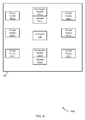
- FIG. 8 shows another block diagram of an example of a grid of weight sensing modules
- FIG. 9 shows a block diagram of an example of consumable item
- FIG. 10 shows a block diagram of an example of refillable container
- FIG. 11 shows a block diagram of an example of a programmable container
- FIG. 12 is a flowchart of a method for identifying items and quantity data and generating consumption-related information
- FIG. 13 is a flowchart of another method for identifying items and quantity data and determining aggregate consumption related to the items
- FIG. 14 is a flowchart of a method for generating health advice based on consumption data
- FIG. 15 is a flowchart of another method for generating health advice based on consumption data
- FIG. 16 is a flowchart of a method for providing recipe information based on item identification.
- FIG. 17 is a flowchart of a method for providing replenishment information based on item identification and quantity data.
- Systems are provided to determine an inventory of consumable items, determine a consumption metric related to the consumable items, and provide consumption-related information based on the consumption metric.
- Consumable items may include food or health related products, for example, and the consumption metric may include a quantity of the consumable items present or consumed by a consumer or in a household.
- a user such as an individual or household, may have a user system to report information related to consumable items and quantity data associated with the consumable items.
- Such a user system may include one or more weight sensing surfaces that can identify an item and determine quantity data related to the item based on an item weight detected by the weight sensing surface(s).
- Consumption-related information may be determined by identifying an item and a weight of the item, and differences in item weight over time.
- Consumption-related information may in some cases include aggregate consumption information for a group of users, which may be used for any of a number of purposes, such as supply chain management to ensure sufficient inventories of a product in a certain geographic area based on aggregate consumption information for a group of users in the geographic area, and advertising directed to the group of users, for example.
- consumption-related information may include times of consumption of items, which may be used, for example, by advertisers interested to know when items tend to be consumed, such as increased alcoholic beverage or soft drink consumption during certain sporting events or television shows.
- Consumption-related information may also include health related information, such as a warning about quantities of certain items (e.g. sodium) that have been consumed or a warning about late-night or non-mealtime snacking.
- health related information such as a warning about quantities of certain items (e.g. sodium) that have been consumed or a warning about late-night or non-mealtime snacking.
- systems may provide suggested recipes, coupons, advertising, warnings, articles, and/or other information to users based on consumption and/or inventory information.
- Information may be provided to a consumer, a corporate user such as advertiser or supplier, and/or a governmental or other entity that seeks to collect aggregate information related to one or more items, or consumption patterns for one or more groups of users. Privacy safeguards may be implemented to prevent unique consumer data from being provided absent permission from the particular consumer.
- a block diagram illustrates an example of a system 100 that includes a number of user systems 105 .
- a user system 105 is connected to one or more weight sensing surfaces 110 .
- the weight sensing surfaces 110 may include components to identify items placed on the surface, as well as a weight of the item.
- a weight sensing surface 110 may include one or more Radio Frequency Identification (RFID) interrogators that are able to read RFID tags that are located on consumable items. The RFID interrogators are also able to determine a location of the consumable items on the weight sensing surface 110 .
- RFID Radio Frequency Identification
- the weight sensing surfaces 110 may also be able to determine a weight of the item, which may be used to determine quantity data related to the item.
- the identification and quantity data may be sent over network 115 to a central server computer system 120 .
- RFID interrogators read a URL from an item's RFID tag and retrieve item information via network 115 from a remote server associated with the manufacturer of the item.
- a manufacturer may provide an item's original weight and contents, and also provide updates to item information, such as adding recall notices.
- the user systems 105 each may include a number of weight sensing surfaces 110 located in different areas, such as in a refrigerator, in a pantry, and/or in a medicine cabinet, for example.
- Each weight sensing surface 110 may operate to communicate with network 115 through a network connection, a wireless connection (e.g., a IEEE 802.11, ZigbeeTM, BluetoothTM connection, or other wireless standard), or may otherwise connect to a central node in a user system 105 that then communicates over network 115 .
- a wireless connection e.g., a IEEE 802.11, ZigbeeTM, BluetoothTM connection, or other wireless standard
- the central server computer system 120 may, for example, be made up one or more server computers, personal computers, workstations, web servers, or other suitable computing devices, and the individual computing device(s) for a given server may be local or remote from each other.
- the central server computer system 120 may collect item and quantity data and provide various consumption-related information based on the collected data.
- central server computer system 120 may receive identifying data from RFID tags and determine a particular item associated with the RFID tag based on the identifying data.
- a bag of sugar, for example, located on weight sensing surface 110 - a may have an RFID tag that reports an identification code upon interrogation by an RFID interrogator.
- the weight sensing surface 110 - a may provide a weight of the bag, along with the identification code, which is used by the central server computer system to determine that the identification code indicates that the item is sugar.
- the central server computer system 120 may also determine the weight of a full bag of sugar and determine a quantity of sugar present in the reported container. In other examples, the determination that the item is a bag of sugar and of the weight of a full bag of sugar may be accomplished by accessing a URL reported by the RFID tag on the item.
- the user system 105 queries the central server computer system 120 to determine item identification and full weight of the item, with an inventory of all items maintained by the user system 105 . The user system 105 in such examples may periodically report information to the central server computer system 120 related to item inventory and consumption data.
- Information may be reported back to a user of the user system 105 - a through an interface in user system 105 - a , through a wireless access system 125 and mobile devices 130 , and/or through a user-accessible web-based interface.
- a user of user system 105 - a may have a mobile device 130 - a that is used to monitor items that are located on weight sensing surface(s) 110 - a and access consumption-related information.
- Such information may be used to determine shopping lists or recipes, for example.
- a mobile device 130 may be one of a number of devices, such as a smartphone, a cellular phone, a VoIP phone, a personal digital assistant, a tablet computer, a laptop computer, a portable digital music player, or other mobile device that communicates voice and/or data, or any combination of the foregoing.
- a web-based interface may also be provided that a user may access from any web-enabled device to monitor and manage inventory, recipes, alerts, and user settings.
- the wireless access system 125 may include any suitable wireless network capable of transmitting data on any of a number of different wireless protocols. Such networks are well known and need not be described in further detail here.
- Consumption information may also be provided to an aggregate data customer system 135 , for use by an entity interested in aggregated consumption-related information.
- Consumption-related information may be provided that is aggregated information related to a group of user systems 105 , such as all user systems 105 located in a particular geographic area, user systems 105 associated with users having a particular common interest (e.g., runners, car enthusiasts, or members of a social network), or user systems 105 associated with a particular demographic, to name a few.
- the aggregate data customer system 135 in some examples may use such information to adjust a supply chain or distribution for consumable items. If the aggregate data customer system 135 is used by a grocery distributor, for example, aggregate data indicating that people in a particular geographic area have an abundance of eggs may lead the distributor to reduce the number of eggs requested from their egg supplier and reduce the number of eggs provided to grocery stores in that particular geographic area. Likewise, if aggregate data indicates people in a particular geographic area are low on eggs as a group, the distributor may increase the number of eggs requested from their egg supplier and increase the number of eggs provided to grocery stores in that particular geographic area in anticipation of an imminent increase in demand.
- aggregate data indicating that people of a particular demographic or group tend to consume particular items in relatively large quantities may prompt an advertising or coupon campaign directed to that demographic or group. For example, if car enthusiasts tend to consume relatively large quantities of beef, a beef supplier may decide to increase advertising in media known to be popular to car enthusiasts. Additionally, if the aggregate data customer system 135 is used by an advertising agency, aggregate data indicating consumption times that people of a particular demographic or group tend to consume particular items in relatively large quantities may prompt an advertising or coupon campaign directed to media viewed by consumers during such high-consumption times.
- users of user systems 105 may elect to provide information related their interests, social groups, and/or demographic information, and make this information available to aggregate data customer system 135 .
- a user may elect to make their individual information available to aggregate data customer system 135 along with their consumption information and other information. Coupons or other offers may be provided directly to individual users in such examples.
- Consumption-related information from a number of user systems 205 may be provided to central server computer system 120 - a .
- User systems 205 may be an example of user systems 105 of FIG. 1 .
- Central server computer system 120 - a collects the information and provides data to a supplier 210 .
- Supplier 210 may be a user of an aggregate data customer system 135 of FIG. 1 , for example.
- Supplier 210 may receive information related to one or more particular consumable items and make supply chain adjustments based on the data.
- supplier 210 may provide consumable items to a particular geographic region, or to multiple geographic regions. If data provided by central server computer system 120 - a indicate that user systems 205 in a particular geographic area have relatively high quantities of an item, and that user systems in a different geographic area have relatively low quantities of the item, the supplier 210 may elect to divert additional amounts of the item to the geographic area having relatively low quantities of the item in anticipation of increased demand in that area. In some examples, users of user systems 205 may elect to allow personally identifying information be provided to supplier 210 . The supplier 210 may then use this personally identifying information, along with the consumable items and consumption-related information, to provide directed advertising or coupons to a particular user.
- a user may consume a relatively large amount of milk, and a supplier may provide that user with coupons or advertising related to milk in an effort to bring that user to one of the supplier's stores.
- a supplier 210 may send a notice to a user that a particular item is running low, along with a coupon.
- a user of a user system 205 may enter into a replenishment agreement with supplier 210 to automatically replenish one or more consumable items when a quantity of that item drops below a certain threshold.
- Such thresholds may be set or adjusted by the user, and/or may be based on historical consumption patterns of the user (e.g., higher quantities of butter being used during holiday seasons).
- users of user systems 205 may elect to provide certain information related to user demographics, hobbies, activities, and/or interests.
- Supplier 210 may receive this information, along with the consumable items and consumption-related information, to provide directed advertising or coupons in particular locations or media known to be popular with such individuals, or at times during which such individuals are known to have increased consumption of particular items. For example, if a group of users have identified themselves as runners, consumable items and consumption-related information for that group of users may be used to identify items that may be worthwhile to advertise in locations, television shows, or publications that are known to be popular with runners.
- consumable item and associated consumption-related information may be used for numerous different purposes, and the examples described herein are provided for illustration and discussion only, and are not intended to limit the broad aspects of the disclosure in any way.
- Consumption-related information from a user system 305 is provided to central server computer system 120 - a .
- User system 305 may be an example of a user system 105 of FIG. 1 .
- Central server computer system 120 - b collects the information and accesses a health information database 310 .
- Health information database 310 may include data related to, for example, contents of different consumable items that may be evaluated to determine health advice for one or more users associated with the user system 305 .
- central server computer system 120 - b may track food consumption history for a user of user system 305 .
- the food consumed by the user may be evaluated, using health information database 310 , to determine if the user has a balanced diet, for example.
- Other examples include monitoring of aggregate consumption of different substances, such as sodium or vitamin C, and/or other substances that may have an impact on the overall health or well-being of the user.
- the time of consumption may also be monitored, to determine if the user has any habits that may have an impact of the user's health, such as late-night snacking.
- the health information database 310 may be used to provide health-related information to a user access device 315 .
- Such health-related information may include alerts about consumption levels, suggested recipes for a balanced diet, and relevant coupons and deals, for example.
- consumption of medication may be monitored to assist with verification that a user is taking prescribed medications according to their prescription.
- a medication container may have a tag, such as an RFID tag, that is identified by a weight sensing surface, with a weight monitored to verify that the weight of the item is decreasing according to the prescription.
- the medication may be provided in, or transferred to, a container having a tag.
- the container may be placed on a weight sensing surface of the user system 305 , and identified as containing a particular quantity of the blood pressure medication.
- the quantity of medication in the container is monitored, and differences in quantity over time is correlated to the expected differences in quantity according to the prescription for the medication.
- an alert may be provided to the user, a family member, and/or a health care provider.
- a prescription may be automatically re-ordered when a quantity associated with an item containing the prescribed drops below a certain level.
- the blood pressure medication may be automatically re-ordered when the quantity information indicates that fewer than a selectable number of days of the medication remain (e.g., fewer than seven days of medication assuming the medication is consumed according to the prescription).
- the system may send a notification to the user, a family member, and/or a health care provider indicating that physician approval is required.
- the user system 305 may access a user's calendar and an appointment scheduler for the health care provider and propose a day and time for a physician office visit.
- One input to the user system 305 may be a subsystem having one or more weight sensing surfaces, such as described above, that provides real-time, or near-real-time, quantity information about individual items consumed by the user.
- Other inputs could be services that track and report user body weight, and/or services that track other consumption such as through analyzing credit card statements or dining checks/receipts, for example.
- a service may provide consumption information based on information and/or photos of food items consumed by the user that are input using the user's mobile device.
- a user access device 315 may include an application that allows the user to enter information related to the user's meals, and/or take and send photos of meals.
- Health information database 310 includes data related to nutritional information in consumed foods, along with target consumption levels of various substances.
- Central server computer system 120 - b may query the health information database 310 to determine values associated with the user that are outside of the target ranges and provide one or more of the noted alerts, suggested recipes, and coupons to the user access device 315 .
- User access device 315 may be a user interface associated with user system, a separate access device, a mobile device such as device 130 of FIG. 1 , and the like.
- a report is provided to the user through email or other electronic delivery, as well as to the user's health care provider.
- users may receive discounts in health-related products or insurance based on consumption patterns, with the central server computer system 120 - b and health information database 310 providing information related to a particular user's consumption to determine if the user qualifies for such discounts.
- consumption-related information may be used for numerous different health-related purposes, and the examples described herein are provided for illustration and discussion only, and are not intended to limit the broad aspects of the disclosure in any way.
- a network interface module 405 provides an interconnection between components of the central server computer system 120 - c and the network 115 .
- a collector module 410 receives identification and quantity data for one or more consumable items over network interface 405 and network 115 from a plurality of remote weight sensing surfaces and determines a consumption metric for the one or more consumable items.
- a consumption-related information generator module 415 generates consumption-related information based on the consumption metric.
- a database 420 is coupled with the collector module 410 and consumption-related information generator module 415 and stores data related to consumable items and quantities, which may be used by collector module 410 and consumption-related information generator module 415 to determine, for example, consumption information for an item based on weight differences for the item over time.
- the consumption metric may be determined based on an average rate of depletion of a consumable item across a number of replenishments of the consumable item, with information related to such history stored in database 420 .
- the consumption-related information generator module 415 provides a replenishment notice to a user indicating that one or more consumable items are depleted or approaching depletion.
- the consumption metric in such a case may include a rate of consumption for a consumable item, and the consumption-related information generator module 415 determines, based on the rate of consumption, that the consumable item is forecast to be depleted within a preset time period, and generates the replenishment notice.
- the collector module determines an aggregate consumption metric for the one or more consumable items based on the received information from a group of users, similarly as described above, which may be used by the consumption-related information generator module to provide information such as described above related to advertising and/or supply chain distribution information for use in providing sufficient supply of consumable items for the group of users, for example.
- the consumption-related information generator module 415 may provide recipes based on the consumption metric for the one or more consumable items, or health advice for a user, similarly as described above. Recipes may be provided that would allow a user to effectively use items that are perishable and are approaching an expiration date. In some examples, recipes are provided that seek to achieve a balanced diet for the user, in which case historical consumption may be evaluated for use in determining foods that should be eaten to achieve a balanced diet. Such recipes may be accompanied with a list of additional items that are needed to prepare the meal(s) in the recipe, which a user may use as a shopping or food delivery list.
- the health advice may include, for example, a warning indicating that consumption of one or more consumable items exceeds a predetermined difference from a target consumption threshold.
- the health advice may include a warning indicating that recent sodium consumption has exceeded a threshold level, along with one or more suggested low-sodium recipes based on available items of the user.
- the consumption-related information generator module 415 may provide a coupon to a user for one or more consumable items consumed by the first user, or may provide a directed advertisement to the user based on the consumption metric for a consumable item.
- User system 500 may be an example of user system 110 and associated weight sensing surface(s) 115 of FIG. 1 .
- a controller module 505 provides input and output from the system 500 , such as through a wired or wireless network interface, and in some cases an associated user interface.
- the controller module 505 may contain a microprocessor capable of executing software algorithms.
- Weight sensing modules 510 may provide identification of consumable items along with associated weight information to the controller module 505 .
- Weight sensing module 510 may be an example of weight sensing surface 115 of FIG. 1 .
- a memory 515 may include random access memory (RAM) and read-only memory (ROM), and store computer-readable, computer-executable software code 520 containing instructions that are configured to, when executed (or when compiled and executed), cause the controller 505 to perform various functions described herein (e.g., determine weight and identification information of consumable items, etc.).
- a power source 525 may include a connection to a alternating current power input and provide power to the components of system 500 .
- the controller module 505 obtains information from the weight sensing modules 510 , which may be provided to an external system (such as central server computer system 120 of FIG. 1 ) through an input/output.
- the controller 505 may receive consumption-related information, such as described above, and provide the consumption-related information to the user interface.
- the controller 505 is configured to read the weight of items, and control the RF antennas associated with weight sensing modules 510 to determine the location and identification of consumable items located on one or more weight sensing surfaces.
- the components of the user system 500 may, individually or collectively, be implemented with one or more Application Specific Integrated Circuits (ASICs) adapted to perform some or all of the applicable functions in hardware.
- ASICs Application Specific Integrated Circuits
- Each of the noted modules may be a means for performing one or more functions related to operation of the user system 500 .
- weight sensing module 510 - a includes one or more weight sensors 605 , and an interrogator module 610 .
- Interrogator module 610 may be an RFID interrogator and includes an antenna 615 that is energized to transmit signals to RFID tags on consumable items that may be placed on the weight sensing module 510 - a , and receive signals from RFID tags in response to the transmitted signals.
- Weight sensing modules 710 - 735 may include weight sensing components such as piezoelectric devices that output a voltage that is proportional to the weight of an item located on the piezoelectric device.
- Other weight sensors may be used, such as surface pressure sensors, MEMS-based weight sensing surfaces, electrical sensors, mechanical sensors, electro-mechanical sensors, or combinations thereof, as will be recognized by one of skill in the art.
- the weight sensing surface 705 in this example, is arranged in a grid pattern with a number of weight sensing modules 710 - 735 .
- Each weight sensing module 710 - 735 includes a weight sensor 605 , interrogator module 610 , and antenna 615 .
- the weight sensing surface 705 in an example, is made up of a film constructed of two layers, with interrogator modules 610 - a through 610 - f , and associated antennas 615 - a through 615 - f located in the bottom “communication layer” of surface 705 , and weight sensors 605 - a through 605 - f located in the top layer of surface 705 .
- weight sensing modules 710 - 735 may be arranged in an array, with each antenna 615 - a through 615 - f able to individually to emit an RF signal.
- the power transmitted and received by the antennas 615 - a through 615 - f is low enough that only items located directly on or adjacent to an antenna 615 will be able to be interrogated. In such a manner, the item and its weight may be matched. In cases where an antenna 615 receives signals from more than one item, a signal strength may be used to determine the item that is closest to the interrogator, and thus the item located on that particular weight sensing module 710 - 735 . In some examples, a single controller is coupled with each antenna 615 in the grid, and in such cases a separate interrogator module 610 may not be required for each weight sending module 710 - 735 .
- weight sensing surface 705 may, individually or collectively, be implemented with one or more Application Specific Integrated Circuits (ASICs) adapted to perform some or all of the applicable functions in hardware.
- ASICs Application Specific Integrated Circuits
- Each of the noted modules may be a means for performing one or more functions related to operation of the surface 705 .
- locations of items may be determined through signal strengths from RFID tags that are received by two or more interrogator antennas.
- An example of such a system 800 is illustrated in FIG. 8 .
- a weight sensing surface 805 is provided that includes a grid of weight sensors 605 - g through 605 - l , and that includes two interrogator modules 610 - g and 610 - h which have associated antennas 615 - g and 615 - h .
- Weight of items placed on the portion of surface 805 associated with a particular weight sensor 605 - g through 605 - l may be provided to controller 810 .
- Controller 810 may be in communication with controller module 505 of FIG. 5 , in an example.
- controller 810 and interrogator modules 610 - g and 610 - h may be performed by controller module 505 of FIG. 5 .
- Interrogator modules 610 - g and 610 - h energize antennas 615 - g and 615 - h to interrogate RFID tags on items that are placed on surface 805 .
- the interrogator modules 610 - g and 610 - h receive signals from the RFID tags and provide the received signals to controller 810 .
- the relative signal strengths provided by the interrogator modules 610 - g and 610 - h are evaluated by controller 810 to determine a location of the associated item on the surface 805 .
- This location is matched with the weight determined by the weight sensor 605 of that location to provide weight and identification information for consumable items placed on the surface.
- the location, weight, and identification for items may be stored, and provided to a user of system 800 .
- location of an item may be identified to a user through illuminating an indicator, such as an LED incorporated into the weight sensing surface 805 at or near the location of an item of interest.
- consumable item 900 includes a container 905 that may hold consumable material, such as a food product.
- An identification tag 910 provides an identification of the consumable item.
- the identification tag 910 includes an RFID tag that outputs a unique identification associated with the consumable item 900 .
- RFID tags are well known, and many consumer products are provided with such RFID tags for inventory tracking purposes, etc. While RFID tags and interrogators are discussed in several examples, it will be understood that other identification technologies may be used, such as optical bar code technologies.
- the identification from the identification tag 910 is read by an interrogator, and provided to a controller that may match the identification with quantity data, such as weight data provided from a weight sensing surface as described herein.
- refillable containers may be provided that are usable with systems such as described herein.
- An example of a refillable container system 1000 is provided in FIG. 10 .
- a container 1005 includes an identification tag 1010 .
- Identification tag 1010 provides an identification of the consumable item, which may be programmed via a user interface in the user system to identify a particular item that is contained in the container 1005 .
- a user may put leftover food into a container, and place the container on a weight sensing surface.
- An interface associated with the system may identify the item on the weight sensing surface as a refillable container, and prompt the user to enter information related to the leftover food that is in the container, such as an identification of the food, and a date by which the food should be consumed or discarded.
- the identification tag may be programmed through a wireless connection to an external system, such as user system 500 of FIG. 5 for example.
- a user may input information related to the contents of the container 1005 into the system user interface and the system may transmit the information to the identification tag 1010 , such as through near field communication or other wireless communication.
- the identification tag 1010 then, when interrogated, may provide the information to the interrogating system.
- the identification tag 1010 is not programmable, and information related to the contents of the container is stored in the user system memory.
- a container system 1100 may be programmed to include information related to contents of the container.
- a refillable container 1105 includes a controller 1110 , user interface 1115 , and identification tag 1120 .
- controller 1110 may include a memory and processor that operates to receive user input from user interface 1115 to identify a consumable item that has been placed in the refillable container 1105 , along with related information, such as an identification of the consumable item, and a date by which the item should be consumed or discarded.
- the controller 1110 may wirelessly receive information about the consumable item that has been placed in the refillable container 1105 , along with related information, thus allowing programming of the container 1105 through either the user interface 1115 or through an external system interface such as described above with respect to FIG. 10 .
- identification and quantity data for one or more consumable items is received from a plurality of remote weight sensing devices.
- a weight sensing surface such as described above.
- a container of eggs may be placed on a weight sensing surface.
- the weight sensing surface may interrogate a tag on the egg container that identifies the container as containing eggs.
- a weight associated with the container is determined, with the weight and identification information received according to block 1205 .
- a time is associated with the weight and identification information that may be used to provide information related to the time of consumption.
- a consumption metric is determined for the one or more consumable items based on the received data, as noted at block 1210 .
- the received weight and identification data may be compared to one or more previous weights of that particular item, and a difference in weight used to determine a quantity of the item that has been consumed.
- a quantity of eggs consumed for one or more time periods may be determined as the consumption metric.
- Consumption-related information is generated, at block 1215 , based on the consumption metric.
- Such consumption-related information may include information such as described above, including aggregate consumption-related information, and health-related information.
- aggregate consumption-related information may include information for a group of users in a geographic area, in a social network, with a common set of interests, etc.
- Health-related information may include warnings that consumption of certain substances is above or below a target threshold, medication information, and/or recipe information such as described above.
- FIG. 13 illustrates a method 1300 for determining aggregate consumption information.
- the method 1300 may, for example, be performed by a central server computer system or user system of FIGS. 1 through 8 , or using any combination of the devices described for these figures.
- identification and quantity data for one or more consumable items is received from a plurality of remote weight sensing devices.
- a consumption metric is determined for the one or more consumable items based on the received data, as noted at block 1310 .
- the consumption metric for a plurality of users is aggregated, according to block 1315 .
- the plurality of users may be users in a particular geographic area, users with one or more common interests, or users of a particular demographic, for example.
- Aggregate consumption for the plurality of users is determined at block 1320 .
- Such aggregate consumption information may be used for any of a number of applications, such as market research, public health, supply chain management, to name but a few examples.
- supply chain distribution information is generated.
- Such supply chain distribution information may include, similarly as described above, an indication that demand in a particular geographic area or for a particular group of users is likely to be increased or decreased in the near future based on the aggregate consumption for the plurality of users.
- the method 1400 may, for example, be performed by a central server computer system, health information database, or user system of FIGS. 1 through 8 , or using any combination of the devices described for these figures.
- identification and quantity data for one or more consumable items is received.
- a health-related consumption metric is determined for the one or more consumable items based on the received data, according to block 1410 .
- Such a health-related consumption metric may include, for example, information related to a balanced diet, information related to intake of various substances, information related to the time of consumption of various items, and/or information related to quantities of prescribed medication that are present.
- health advice is generated based on the consumption metric.
- Such health advice may include, for example, recipes that may promote a balanced diet or adjust for intake quantities of a substance (e.g., increased whole grains when whole grain intake is below a target threshold). Health advice may also include an alarm or notification that intake of an item or substance is above or below a threshold level (e.g., sodium intake is too high, medications are not being taken properly, etc.).
- health advice is provided to one or more users. Such health advice may be provided, for example, to a user of the system, a health care professional, and/or a family member of the user. In some other examples, the health-related consumption metric may be used to qualify a user for discounted medical insurance premiums or discounted medical services.
- the method 1500 may, for example, be performed by a central server computer system, health information database, or user system of FIGS. 1 through 8 , or using any combination of the devices described for these figures.
- identification and quantity data is received for one or more consumable items.
- a consumption metric is determined for the one or more consumable items based on the received data.
- a difference between the consumption metric and a target consumption metric for a consumable item is determined at block 1515 .
- the consumption metric may be a sodium intake for a user of the system that is based on the sodium content of foods that the user has consumed over a set time period.
- a target sodium consumption metric may be established for the user based on, for example, the user's age and weight, and the difference determined based on the actual amount of sodium consumed and the target sodium consumption metric.
- the target consumption metric may also be based on times of consumption of items, such as a target to consume fewer than a certain number of calories after a certain time of day to help reduce late-night snacking, for example.
- Health advice is generated based on the difference between the consumption metric and the target consumption metric, at block 1520 .
- health advice is provided to one or more users.
- health advice may include, for example, recipes that may promote a balanced diet or adjust for intake quantities of a substance (e.g., decreased sodium when sodium intake is above a target threshold), or advice to take a nutritional supplement. Health advice may also include one or more recipes that compensate for differences between the consumption metric and target consumption metric. In some embodiments, health advice may be provided to third parties other than a user of the system, such as a family member or health care provider.
- Still other examples provide for efficient use of consumable items that may be present in a user system.
- One such example, described with reference to FIG. 16 provides a method 1600 to generate recipes to use items that may be at or approaching the end of their useful life.
- the method 1600 may, for example, be performed by a central server computer system, or user system of FIGS. 1 through 8 , or using any combination of the devices described for these figures.
- identification and quantity data is received for one or more consumable items from a plurality of remote weight sensing devices.
- a freshness expiration for one or more of the consumable items is determined.
- a consumable item may have a known freshness period, and the system may record the date on which an item is placed in the system, with freshness expiration based on such a date and the known freshness period.
- the identification of the consumable item may include freshness information and a date by which the item should be consumed or discarded.
- an RFID tag on a container of food may be programmed with an identification of the food and an expiration date.
- a recipe is generated based on one or more of the consumable items and freshness expiration. In such a manner, waste may be reduced by identifying products that may be in danger of spoiling and providing a convenient way to consume the items.
- the recipe may also include a listing of additional items needed that are not present in the user system, thus providing a convenient shopping list for the user to obtain additional items needed for the recipe.
- a number of different recipes are provided to give the user various options, one or more of which may be selected based on the current desires or mood of the user.
- the user may input a desired type of meal that is desired (e.g., an Italian meal), and recipes generated based on the input and consumable items that are present in the user's system.
- a method 1700 for providing notice to a user that an item is running low is described.
- the method 1700 may, for example, be performed by a central server computer system, or user system of FIGS. 1 through 8 , or using any combination of the devices described for these figures.
- identification and quantity data is received for one or more consumable items.
- a consumption metric is determined for the consumable item(s) based on differences in quantity over time and a threshold level associated with the item(s), according to block 1710 .
- a replenishment notice is generated to a user indicating that one or more consumable items are projected to be depleted within a preset time period based on the consumption metric, as indicated at block 1715 .
- a user may be notified that an item is almost empty.
- a user may set thresholds for generating such notices, in order to help insure that an item will not be empty.
- a user may set a threshold based on the tolerance for being without an item. For instance, if a user has a low tolerance for being without milk, a threshold may be set relatively conservatively to generate a replenishment notice in advance of running out of milk.
- various other thresholds may be set in accordance with user preferences and tolerances, as will be readily apparent to one skilled in the art.
- the system may adaptively set thresholds based on a user's history.
- a system may monitor when milk is replenished by a user and determine a threshold and a user's tolerance for being without milk based on historical data. If, in this example, a user is very rarely without milk and historically replenishes milk when 20% of the existing milk remains, the threshold may be set to generate a replenishment notice when the level of milk approaches 20%. Replenishment notices may also be provided, for example, when a product is approaching an expiration date, and/or when a manufacturer issues a recall for the item.
- Information and signals may be represented using any of a variety of different technologies and techniques.
- data, instructions, commands, information, signals, bits, symbols, and chips that may be referenced throughout the above description may be represented by voltages, currents, electromagnetic waves, magnetic fields or particles, optical fields or particles, or any combination thereof.
- DSP digital signal processor
- ASIC application specific integrated circuit
- FPGA field programmable gate array
- a general-purpose processor may be a microprocessor, but in the alternative, the processor may be any conventional processor, controller, microcontroller, or state machine.
- a processor may also be implemented as a combination of computing devices, e.g., a combination of a DSP and a microprocessor, multiple microprocessors, one or more microprocessors in conjunction with a DSP core, or any other such configuration.
- the functions described herein may be implemented in hardware, software executed by a processor, firmware, or any combination thereof. If implemented in software executed by a processor, the functions may be stored on or transmitted over as one or more instructions or code on a computer-readable medium. Other examples and implementations are within the scope and spirit of the disclosure and appended claims. For example, due to the nature of software, functions described above can be implemented using software executed by a processor, hardware, firmware, hardwiring, or combinations of any of these. Features implementing functions may also be physically located at various positions, including being distributed such that portions of functions are implemented at different physical locations.
- Computer-readable media includes both computer storage media and communication media including any medium that facilitates transfer of a computer program from one place to another.
- a storage medium may be any available medium that can be accessed by a general purpose or special purpose computer.
- computer-readable media can comprise RAM, ROM, EEPROM, CD-ROM or other optical disk storage, magnetic disk storage or other magnetic storage devices, or any other medium that can be used to carry or store desired program code means in the form of instructions or data structures and that can be accessed by a general-purpose or special-purpose computer, or a general-purpose or special-purpose processor.
- any connection is properly termed a computer-readable medium.
- Disk and disc include compact disc (CD), laser disc, optical disc, digital versatile disc (DVD), floppy disk and blu-ray disc where disks usually reproduce data magnetically, while discs reproduce data optically with lasers. Combinations of the above are also included within the scope of computer-readable media.
Landscapes
- Engineering & Computer Science (AREA)
- Business, Economics & Management (AREA)
- Economics (AREA)
- General Physics & Mathematics (AREA)
- Physics & Mathematics (AREA)
- Theoretical Computer Science (AREA)
- Marketing (AREA)
- Human Resources & Organizations (AREA)
- Entrepreneurship & Innovation (AREA)
- Operations Research (AREA)
- Quality & Reliability (AREA)
- Strategic Management (AREA)
- Tourism & Hospitality (AREA)
- Development Economics (AREA)
- General Business, Economics & Management (AREA)
- Computer Networks & Wireless Communication (AREA)
- Finance (AREA)
- Accounting & Taxation (AREA)
- Health & Medical Sciences (AREA)
- Epidemiology (AREA)
- General Health & Medical Sciences (AREA)
- Medical Informatics (AREA)
- Primary Health Care (AREA)
- Public Health (AREA)
- Signal Processing (AREA)
- Nutrition Science (AREA)
- General Engineering & Computer Science (AREA)
- Databases & Information Systems (AREA)
- Data Mining & Analysis (AREA)
- Medical Treatment And Welfare Office Work (AREA)
- Management, Administration, Business Operations System, And Electronic Commerce (AREA)
- Transceivers (AREA)
- Arrangements For Transmission Of Measured Signals (AREA)
Priority Applications (7)
| Application Number | Priority Date | Filing Date | Title |
|---|---|---|---|
| US13/399,322 US9109943B2 (en) | 2012-02-17 | 2012-02-17 | Weight-sensing surfaces with wireless communication for inventory tracking |
| GB1413447.2A GB2515664B (en) | 2012-02-17 | 2013-02-11 | Multifunction Control Indicator for a Vehicular Mobile Radio |
| PCT/US2013/026482 WO2013123422A2 (en) | 2012-02-17 | 2013-02-15 | Weight-sensing surfaces with wireless communication for inventory tracking |
| CN201380009602.7A CN104136895B (zh) | 2012-02-17 | 2013-02-15 | 用于库存跟踪的具有无线通信的重量感测平面 |
| KR1020147025502A KR101705749B1 (ko) | 2012-02-17 | 2013-02-15 | 재고 추적을 위해서 무선 통신을 이용하는 무게 감지 서피스들 |
| EP13707972.9A EP2815217A4 (en) | 2012-02-17 | 2013-02-15 | WEIGHT DETECTION SURFACES WITH WIRELESS COMMUNICATION FOR CAPTURING CAPACITY |
| JP2014557843A JP6022605B2 (ja) | 2012-02-17 | 2013-02-15 | インベントリ追跡のためのワイヤレス通信を用いた重量感知面 |
Applications Claiming Priority (1)
| Application Number | Priority Date | Filing Date | Title |
|---|---|---|---|
| US13/399,322 US9109943B2 (en) | 2012-02-17 | 2012-02-17 | Weight-sensing surfaces with wireless communication for inventory tracking |
Publications (2)
| Publication Number | Publication Date |
|---|---|
| US20130218511A1 US20130218511A1 (en) | 2013-08-22 |
| US9109943B2 true US9109943B2 (en) | 2015-08-18 |
Family
ID=47833370
Family Applications (1)
| Application Number | Title | Priority Date | Filing Date |
|---|---|---|---|
| US13/399,322 Expired - Fee Related US9109943B2 (en) | 2012-02-17 | 2012-02-17 | Weight-sensing surfaces with wireless communication for inventory tracking |
Country Status (6)
| Country | Link |
|---|---|
| US (1) | US9109943B2 (enExample) |
| EP (1) | EP2815217A4 (enExample) |
| JP (1) | JP6022605B2 (enExample) |
| KR (1) | KR101705749B1 (enExample) |
| GB (1) | GB2515664B (enExample) |
| WO (1) | WO2013123422A2 (enExample) |
Cited By (12)
| Publication number | Priority date | Publication date | Assignee | Title |
|---|---|---|---|---|
| US20160275424A1 (en) * | 2015-03-18 | 2016-09-22 | Quidsi, Inc. | Dynamically adjustable subscription renewal rate - product consumption input |
| US20160275530A1 (en) * | 2015-03-18 | 2016-09-22 | Quidsi, Inc. | Dynamically adjusted automated item replenishment |
| US10267671B2 (en) | 2016-10-17 | 2019-04-23 | Bradley Charles Ashmore | Meal lifecycle management system |
| US10318919B2 (en) | 2016-02-10 | 2019-06-11 | International Business Machines Corporation | Smart shelves for retail industry |
| US10403104B2 (en) | 2017-08-17 | 2019-09-03 | Vivek KANGRALKAR | System and method for tracking of deployed units |
| US10853761B1 (en) | 2016-06-24 | 2020-12-01 | Amazon Technologies, Inc. | Speech-based inventory management system and method |
| US11042840B2 (en) | 2016-11-17 | 2021-06-22 | Freshub Ltd | System and a method for managing inventory |
| US20220113182A1 (en) * | 2020-08-24 | 2022-04-14 | Inventor-E Limited | Communicating weight sensor units and techniques for using same |
| US11315071B1 (en) * | 2016-06-24 | 2022-04-26 | Amazon Technologies, Inc. | Speech-based storage tracking |
| US12073616B2 (en) | 2018-11-20 | 2024-08-27 | Electrolux Home Products, Inc. | System for integrated device connectivity and agile device control for dynamic object tracking and management |
| WO2025186640A1 (en) * | 2024-03-05 | 2025-09-12 | Hoopo Systems Ltd. | Method and system for determining the load status of a carrying platform using radar |
| US12651131B2 (en) | 2022-02-23 | 2026-06-09 | Inventor-E Limited | Communicating asset tags, dispensing enclosures and asset monitoring devices |
Families Citing this family (55)
| Publication number | Priority date | Publication date | Assignee | Title |
|---|---|---|---|---|
| JP3277536B2 (ja) | 1992-02-14 | 2002-04-22 | 大日本インキ化学工業株式会社 | 樹脂コンパウンド塗布装置および該装置を用いる樹脂組成物の製造法 |
| US9762437B2 (en) | 2012-07-17 | 2017-09-12 | The Procter & Gamble Company | Systems and methods for networking consumer devices |
| US20140022061A1 (en) * | 2012-07-17 | 2014-01-23 | Procter And Gamble, Inc. | Home network of connected consumer devices |
| US8886785B2 (en) | 2012-07-17 | 2014-11-11 | The Procter & Gamble Company | Home network of connected consumer devices |
| US20140058794A1 (en) * | 2012-08-27 | 2014-02-27 | Sap Ag | Method And System For Orders Planning And Optimization With Applications To Food Consumer Products Industry |
| US20140297738A1 (en) * | 2013-03-27 | 2014-10-02 | Bsh Home Appliances Corporation | Domestic appliance and gaming system interface |
| US9699502B1 (en) | 2015-01-16 | 2017-07-04 | Optimized Markets, Inc. | Automated allocation of media campaign assets to time and program in digital media delivery systems |
| US9916560B2 (en) | 2013-06-28 | 2018-03-13 | Wal-Mart Stores, Inc. | Inventory tracking |
| US9430753B2 (en) | 2013-06-28 | 2016-08-30 | Wal-Mart Stores, Inc. | Inventory tracking |
| US9773223B2 (en) | 2013-06-28 | 2017-09-26 | Wal-Mart Stores, Inc. | Inventory cache |
| US8977389B2 (en) | 2013-07-17 | 2015-03-10 | ColorCulture Network, LLC | Method, system and apparatus for dispensing products for a personal care service, instructing on providing a personal care treatment service, and selecting a personal care service |
| US9697550B2 (en) * | 2013-10-17 | 2017-07-04 | At&T Intellectual Property I, L.P. | Devices, methods, and computer readable storage devices for providing offers based on aggregate need |
| US9760856B2 (en) * | 2013-12-31 | 2017-09-12 | Tata Consultancy Services Limited | Inventory management |
| US9886710B2 (en) | 2014-03-25 | 2018-02-06 | Ebay Inc. | Data mesh visualization |
| US10438276B2 (en) | 2014-04-16 | 2019-10-08 | Ebay Inc. | Smart recurrent orders |
| JP6215140B2 (ja) * | 2014-05-30 | 2017-10-18 | 日本電信電話株式会社 | 服薬管理支援システム及び服薬管理支援方法 |
| US9449295B2 (en) | 2014-06-25 | 2016-09-20 | Amazon Technologies, Inc. | Tracking transactions by confluences and sequences of RFID signals |
| US9830484B1 (en) | 2014-06-25 | 2017-11-28 | Amazon Technologies, Inc. | Tracking locations and conditions of objects based on RFID signals |
| WO2015200915A1 (en) * | 2014-06-27 | 2015-12-30 | Sarangi Ritimukta | Systems and methods for a receptacle and related devices |
| US9996167B2 (en) | 2014-10-27 | 2018-06-12 | Amazon Technologies, Inc. | Dynamic RFID-based input devices |
| US9580294B2 (en) * | 2014-12-03 | 2017-02-28 | Brewer Science Inc. | Computer program and method for verifying container of material to be dispensed |
| WO2016089393A1 (en) * | 2014-12-03 | 2016-06-09 | Brewer Science Inc. | Computer program and method for verifying container of material to be dispensed |
| US10282698B2 (en) * | 2014-12-30 | 2019-05-07 | Ebay Inc. | Smart shelves |
| GB2550299A (en) | 2014-12-31 | 2017-11-15 | Wal Mart Stores Inc | System and method for monitoring gas emission of perishable products |
| US20160350706A1 (en) * | 2015-05-29 | 2016-12-01 | Endries International Inc. | Methods of ordering products |
| WO2017061282A1 (ja) * | 2015-10-05 | 2017-04-13 | コニカミノルタ株式会社 | ケアプラン調整システム及びケアプラン調整方法 |
| PL3378020T3 (pl) * | 2015-11-20 | 2025-12-22 | Ocado Innovation Limited | System zabezpieczonych pojemników do dostaw bez nadzoru |
| EP3193292A1 (en) * | 2016-01-18 | 2017-07-19 | Tata Consultancy Services Limited | A method and system for automatic replenishment and management of inventory |
| US10466111B2 (en) | 2016-05-05 | 2019-11-05 | Walmart Apollo, Llc | Systems and methods for monitoring temperature or movement of merchandise |
| US10360533B2 (en) * | 2016-05-27 | 2019-07-23 | Walmart Apollo, Llc | Product display surface apparatus and method |
| JP2017211168A (ja) * | 2016-05-27 | 2017-11-30 | シャープ株式会社 | 冷蔵庫、および広告表示プログラム |
| US11521144B2 (en) * | 2016-07-29 | 2022-12-06 | Bottomless, Inc. | Automated resupply based on sensor data |
| WO2018170293A1 (en) * | 2017-03-16 | 2018-09-20 | Walmart Apollo, Llc | An object location detection system |
| CA3063105A1 (en) | 2017-05-23 | 2018-11-29 | Walmart Apollo, Llc | Automated inspection system |
| US10748445B2 (en) * | 2017-07-12 | 2020-08-18 | Pagokids, LLC | Automated nutrition analytics systems and methods |
| US10547116B2 (en) * | 2017-08-01 | 2020-01-28 | University Of Cyprus | Wireless communication paradigm: realizing programmable wireless environments through software-controlled metasurfaces |
| US11321665B2 (en) * | 2017-08-29 | 2022-05-03 | Weightrx Inc. | System and method of automated tracking of consumable products |
| US20190117511A1 (en) * | 2017-10-20 | 2019-04-25 | Frantrice McMillan-Riley | Secure Medication Storage System and Method of Securely Storing Medication in Healthcare Facility |
| KR102027275B1 (ko) * | 2017-11-14 | 2019-10-01 | 김대훈 | 급식관리 시스템 및 이의 운영방법 |
| JP6691156B2 (ja) * | 2018-02-27 | 2020-04-28 | ソフトバンク株式会社 | 情報処理装置、情報処理方法、プログラム及び物品提供システム |
| US11448632B2 (en) | 2018-03-19 | 2022-09-20 | Walmart Apollo, Llc | System and method for the determination of produce shelf life |
| WO2020023762A1 (en) | 2018-07-26 | 2020-01-30 | Walmart Apollo, Llc | System and method for produce detection and classification |
| US11715059B2 (en) | 2018-10-12 | 2023-08-01 | Walmart Apollo, Llc | Systems and methods for condition compliance |
| WO2020106332A1 (en) | 2018-11-20 | 2020-05-28 | Walmart Apollo, Llc | Systems and methods for assessing products |
| CN112016933A (zh) * | 2019-05-13 | 2020-12-01 | 广州市中兴电子衡器厂 | 用于管理电子秤的物联溯源定位系统 |
| US11741557B2 (en) * | 2020-01-01 | 2023-08-29 | Rockspoon, Inc. | Biomarker-based food item design system and method |
| US11195189B1 (en) * | 2020-10-09 | 2021-12-07 | Georama, Inc. | Generating insights based on signals from measuring device |
| JP7533273B2 (ja) | 2021-02-19 | 2024-08-14 | トヨタ自動車株式会社 | 棚在庫管理システム、棚在庫管理方法、及びプログラム |
| JP7521452B2 (ja) | 2021-02-19 | 2024-07-24 | トヨタ自動車株式会社 | 棚在庫管理システム、棚在庫管理方法、及びプログラム |
| US12175476B2 (en) | 2022-01-31 | 2024-12-24 | Walmart Apollo, Llc | Systems and methods for assessing quality of retail products |
| JP2023113475A (ja) * | 2022-02-03 | 2023-08-16 | アサヒグループホールディングス株式会社 | 発注支援装置、発注支援システム、およびプログラム |
| EP4391294B1 (en) * | 2022-02-23 | 2026-06-10 | Controlant hf. | A method of operating a wireless logger device |
| US20230360782A1 (en) * | 2022-05-03 | 2023-11-09 | Sugarloaf River LLC | Inventory management systems for linen and other items |
| WO2024030861A1 (en) * | 2022-08-02 | 2024-02-08 | Liquid Insight LLC | Devices, systems, and methods for monitoring and predicting beverage product inventory |
| WO2024154841A1 (ko) * | 2023-01-18 | 2024-07-25 | 하상윤 | 치과 재료 재고 관리 시스템 및 방법 |
Citations (11)
| Publication number | Priority date | Publication date | Assignee | Title |
|---|---|---|---|---|
| US6204763B1 (en) * | 1999-03-22 | 2001-03-20 | Jujitsu Limited | Household consumable item automatic replenishment system including intelligent refrigerator |
| US20020161652A1 (en) | 2001-01-31 | 2002-10-31 | Paullin Andrew Rhodes | System and method for inventory monitoring and control of household consumable items |
| US20040238228A1 (en) | 2003-06-02 | 2004-12-02 | Montague David S. | Scale that provides a display of an individual's weight history on a remote computer |
| US20050060246A1 (en) | 2003-07-11 | 2005-03-17 | Roc Lastinger | System, method, and computer program product for monitoring inventory |
| US20050171854A1 (en) | 2004-01-30 | 2005-08-04 | Lyon Geoff M. | Load sensing inventory tracking method and system |
| JP2005342272A (ja) | 2004-06-04 | 2005-12-15 | Cleanup Corp | 食品管理装置 |
| US20060036395A1 (en) * | 2004-07-30 | 2006-02-16 | Shaya Steven A | Method and apparatus for measuring and controlling food intake of an individual |
| WO2006116665A1 (en) | 2005-04-26 | 2006-11-02 | Rf Code, Inc. | Presence, pattern and weight sensor surface |
| US20100049471A1 (en) | 2008-08-22 | 2010-02-25 | Permanens Llc | Weight management system using zero-readout weight sensor device and method of using same |
| US20100109876A1 (en) | 2008-11-04 | 2010-05-06 | Schmid-Schonbein Geert W | Devices, Systems and Methods to Control Caloric Intake |
| US20110282726A1 (en) * | 2001-10-02 | 2011-11-17 | International Business Machines Corporation | Providing consumers with incentives for healthy eating habits |
Family Cites Families (12)
| Publication number | Priority date | Publication date | Assignee | Title |
|---|---|---|---|---|
| JP4104212B2 (ja) * | 1998-06-30 | 2008-06-18 | 小島プレス工業株式会社 | 複合スイッチ装置 |
| JP3881884B2 (ja) * | 2001-12-14 | 2007-02-14 | 松下電器産業株式会社 | 食物貯蔵庫 |
| JP2003256730A (ja) * | 2002-03-05 | 2003-09-12 | Ricoh Co Ltd | 顧客支援システム、プログラムおよび記録媒体 |
| JP3614146B2 (ja) * | 2002-03-20 | 2005-01-26 | 松下電器産業株式会社 | 映像情報再生装置 |
| JP2004326147A (ja) * | 2003-04-21 | 2004-11-18 | Matsushita Electric Ind Co Ltd | 消費財発注装置と消費財発注システムと消費財発注方法と消費財発注プログラムとこのプログラムを記録した記録媒体と消費財発注装置を設けた冷蔵庫 |
| JP2005266863A (ja) * | 2004-03-16 | 2005-09-29 | Hitachi Software Eng Co Ltd | 飲料の消費予測システム |
| JP2006113787A (ja) * | 2004-10-14 | 2006-04-27 | Matsushita Electric Ind Co Ltd | 不要品判断方法及び物品管理システム |
| JP4404829B2 (ja) * | 2005-09-28 | 2010-01-27 | 日本電気株式会社 | 摂取カロリー管理システム、摂取カロリー管理方法、保管庫、及びプログラム |
| JP4596169B2 (ja) * | 2006-04-14 | 2010-12-08 | 株式会社デンソー | ダイアル式スイッチ装置 |
| JP2008301451A (ja) * | 2007-06-04 | 2008-12-11 | Sony Corp | 撮像装置 |
| JP2010231454A (ja) * | 2009-03-26 | 2010-10-14 | Panasonic Electric Works Co Ltd | 残量管理システム |
| JP5469363B2 (ja) * | 2009-04-20 | 2014-04-16 | 株式会社日本総合研究所 | 商品管理装置、商品管理方法および商品管理プログラム |
-
2012
- 2012-02-17 US US13/399,322 patent/US9109943B2/en not_active Expired - Fee Related
-
2013
- 2013-02-11 GB GB1413447.2A patent/GB2515664B/en active Active
- 2013-02-15 JP JP2014557843A patent/JP6022605B2/ja not_active Expired - Fee Related
- 2013-02-15 KR KR1020147025502A patent/KR101705749B1/ko not_active Expired - Fee Related
- 2013-02-15 EP EP13707972.9A patent/EP2815217A4/en not_active Withdrawn
- 2013-02-15 WO PCT/US2013/026482 patent/WO2013123422A2/en not_active Ceased
Patent Citations (11)
| Publication number | Priority date | Publication date | Assignee | Title |
|---|---|---|---|---|
| US6204763B1 (en) * | 1999-03-22 | 2001-03-20 | Jujitsu Limited | Household consumable item automatic replenishment system including intelligent refrigerator |
| US20020161652A1 (en) | 2001-01-31 | 2002-10-31 | Paullin Andrew Rhodes | System and method for inventory monitoring and control of household consumable items |
| US20110282726A1 (en) * | 2001-10-02 | 2011-11-17 | International Business Machines Corporation | Providing consumers with incentives for healthy eating habits |
| US20040238228A1 (en) | 2003-06-02 | 2004-12-02 | Montague David S. | Scale that provides a display of an individual's weight history on a remote computer |
| US20050060246A1 (en) | 2003-07-11 | 2005-03-17 | Roc Lastinger | System, method, and computer program product for monitoring inventory |
| US20050171854A1 (en) | 2004-01-30 | 2005-08-04 | Lyon Geoff M. | Load sensing inventory tracking method and system |
| JP2005342272A (ja) | 2004-06-04 | 2005-12-15 | Cleanup Corp | 食品管理装置 |
| US20060036395A1 (en) * | 2004-07-30 | 2006-02-16 | Shaya Steven A | Method and apparatus for measuring and controlling food intake of an individual |
| WO2006116665A1 (en) | 2005-04-26 | 2006-11-02 | Rf Code, Inc. | Presence, pattern and weight sensor surface |
| US20100049471A1 (en) | 2008-08-22 | 2010-02-25 | Permanens Llc | Weight management system using zero-readout weight sensor device and method of using same |
| US20100109876A1 (en) | 2008-11-04 | 2010-05-06 | Schmid-Schonbein Geert W | Devices, Systems and Methods to Control Caloric Intake |
Non-Patent Citations (1)
| Title |
|---|
| International Search Report and Written Opinion-PCT/US13/26482-ISA/EPO-Mar. 27, 2014. |
Cited By (18)
| Publication number | Priority date | Publication date | Assignee | Title |
|---|---|---|---|---|
| US20160275424A1 (en) * | 2015-03-18 | 2016-09-22 | Quidsi, Inc. | Dynamically adjustable subscription renewal rate - product consumption input |
| US20160275530A1 (en) * | 2015-03-18 | 2016-09-22 | Quidsi, Inc. | Dynamically adjusted automated item replenishment |
| US10817885B2 (en) * | 2015-03-18 | 2020-10-27 | Quidsi, Inc. | Dynamically adjusted automated item replenishment |
| US10318919B2 (en) | 2016-02-10 | 2019-06-11 | International Business Machines Corporation | Smart shelves for retail industry |
| US10853761B1 (en) | 2016-06-24 | 2020-12-01 | Amazon Technologies, Inc. | Speech-based inventory management system and method |
| US11315071B1 (en) * | 2016-06-24 | 2022-04-26 | Amazon Technologies, Inc. | Speech-based storage tracking |
| US10746588B2 (en) | 2016-10-17 | 2020-08-18 | Bradley Charles Ashmore | Meal lifecycle management system |
| US10267670B2 (en) | 2016-10-17 | 2019-04-23 | Bradley Charles Ashmore | Meal lifecycle management system |
| US10267671B2 (en) | 2016-10-17 | 2019-04-23 | Bradley Charles Ashmore | Meal lifecycle management system |
| US11287305B2 (en) | 2016-10-17 | 2022-03-29 | Bradley Charles Ashmore | Meal lifecycle management method and system |
| US11042840B2 (en) | 2016-11-17 | 2021-06-22 | Freshub Ltd | System and a method for managing inventory |
| US10748395B2 (en) | 2017-08-17 | 2020-08-18 | Vivek Kangralkar | System and method for tracking of deployed units |
| US10403104B2 (en) | 2017-08-17 | 2019-09-03 | Vivek KANGRALKAR | System and method for tracking of deployed units |
| US12073616B2 (en) | 2018-11-20 | 2024-08-27 | Electrolux Home Products, Inc. | System for integrated device connectivity and agile device control for dynamic object tracking and management |
| US20220113182A1 (en) * | 2020-08-24 | 2022-04-14 | Inventor-E Limited | Communicating weight sensor units and techniques for using same |
| US12140467B2 (en) * | 2020-08-24 | 2024-11-12 | Inventor-E Limited | Communicating weight sensor units and techniques for using same |
| US12651131B2 (en) | 2022-02-23 | 2026-06-09 | Inventor-E Limited | Communicating asset tags, dispensing enclosures and asset monitoring devices |
| WO2025186640A1 (en) * | 2024-03-05 | 2025-09-12 | Hoopo Systems Ltd. | Method and system for determining the load status of a carrying platform using radar |
Also Published As
| Publication number | Publication date |
|---|---|
| WO2013123422A3 (en) | 2014-05-22 |
| GB2515664B (en) | 2018-12-05 |
| GB201413447D0 (en) | 2014-09-10 |
| CN104136895A (zh) | 2014-11-05 |
| KR20140126744A (ko) | 2014-10-31 |
| GB2515664A (en) | 2014-12-31 |
| EP2815217A4 (en) | 2015-10-07 |
| KR101705749B1 (ko) | 2017-02-10 |
| WO2013123422A2 (en) | 2013-08-22 |
| EP2815217A2 (en) | 2014-12-24 |
| JP6022605B2 (ja) | 2016-11-09 |
| US20130218511A1 (en) | 2013-08-22 |
| JP2015513728A (ja) | 2015-05-14 |
Similar Documents
| Publication | Publication Date | Title |
|---|---|---|
| KR101705749B1 (ko) | 재고 추적을 위해서 무선 통신을 이용하는 무게 감지 서피스들 | |
| US12056751B2 (en) | Adaptive scheduling of electronic messaging based on predictive consumption of the sampling of items via a networked computing platform | |
| US12141853B2 (en) | Adaptive scheduling of electronic messaging based on predictive consumption of the sampling of items via a networked computing platform | |
| US11144980B2 (en) | Adaptive scheduling of electronic messaging based on predictive consumption of the sampling of items via a networked computing platform | |
| US10410177B2 (en) | Interactive inventory systems and methods | |
| CA2769630C (en) | Communicating price discounts | |
| US11157870B2 (en) | System for crowdsourced cold-chain compliant item selection | |
| US10719860B2 (en) | Adaptive scheduling to facilitate optimized distribution of subscribed items | |
| US20150379463A1 (en) | Systems and Methods for a Receptacle and Related Devices | |
| US20180197135A1 (en) | Apparatus and System For Remote Sensing, Monitoring, Analysis and Alerting of Environmental Attributes | |
| US11195189B1 (en) | Generating insights based on signals from measuring device | |
| JP7496503B2 (ja) | 献立提案システム、献立提案方法、プログラム、情報処理方法、及び情報処理装置 | |
| US20080249840A1 (en) | System and method for increasing demand for perishable goods at a point-of-sale location utilizing location-based communication | |
| US20230316220A1 (en) | Adaptive scheduling to facilitate optimized distribution of subscribed items | |
| CN101689261A (zh) | 增大对销售点场所的易腐品或易逝品的需求 | |
| US11741533B2 (en) | Product database systems and methods enabling the filtering of products and enhancing customer access | |
| CN107451736A (zh) | 智能冰箱物联网商业管理系统、控制方法、装置及冰箱 | |
| CN110544519A (zh) | 食材购买提醒方法、家电设备及计算机存储介质 | |
| US20240013243A1 (en) | Information processing system, information processing device, information processing method, and non-transitory recording medium | |
| CN104136895B (zh) | 用于库存跟踪的具有无线通信的重量感测平面 | |
| US20240202802A1 (en) | Intelligent food order selection and fulfillment platform | |
| US20160117691A1 (en) | Aggregating Foodstuff Data | |
| JP2005265274A (ja) | 食品を無駄無く食すのを促す方法、これを用いた冷蔵庫、および電子秤 | |
| US20260120161A1 (en) | Dynamic processing of electronic messaging data and protocols to automatically generate subscriptions based on location predictive retrieval using a networked, multi-stack computing environment | |
| Mann et al. | Consumer-driven Demand Estimation: Smart storage IoT in SSCM of perishables |
Legal Events
| Date | Code | Title | Description |
|---|---|---|---|
| AS | Assignment |
Owner name: QUALCOMM INCORPORATED, CALIFORNIA Free format text: ASSIGNMENT OF ASSIGNORS INTEREST;ASSIGNORS:MAGER, MICHAEL J.;BOYD, JOHN D.;KING, BENNETT M.;AND OTHERS;REEL/FRAME:027776/0953 Effective date: 20120221 |
|
| STCF | Information on status: patent grant |
Free format text: PATENTED CASE |
|
| FEPP | Fee payment procedure |
Free format text: MAINTENANCE FEE REMINDER MAILED (ORIGINAL EVENT CODE: REM.); ENTITY STATUS OF PATENT OWNER: LARGE ENTITY |
|
| LAPS | Lapse for failure to pay maintenance fees |
Free format text: PATENT EXPIRED FOR FAILURE TO PAY MAINTENANCE FEES (ORIGINAL EVENT CODE: EXP.); ENTITY STATUS OF PATENT OWNER: LARGE ENTITY |
|
| STCH | Information on status: patent discontinuation |
Free format text: PATENT EXPIRED DUE TO NONPAYMENT OF MAINTENANCE FEES UNDER 37 CFR 1.362 |
|
| FP | Lapsed due to failure to pay maintenance fee |
Effective date: 20190818 |