US8888929B2 - Device to capture the relative position of a component of which the position can change relative to a reference component of a washing handling device, and corresponding washing handling device - Google Patents

Device to capture the relative position of a component of which the position can change relative to a reference component of a washing handling device, and corresponding washing handling device Download PDF

Info

Publication number
US8888929B2
US8888929B2 US13/074,168 US201113074168A US8888929B2 US 8888929 B2 US8888929 B2 US 8888929B2 US 201113074168 A US201113074168 A US 201113074168A US 8888929 B2 US8888929 B2 US 8888929B2
Authority
US
United States
Prior art keywords
light
component
housing
light source
relative
Prior art date
Legal status (The legal status is an assumption and is not a legal conclusion. Google has not performed a legal analysis and makes no representation as to the accuracy of the status listed.)
Active, expires
Application number
US13/074,168
Other versions
US20120073613A1 (en
Inventor
Johann Schenkl
Johannes Baumer
Michael Sorgenfrei
Manfredi Signorino
Current Assignee (The listed assignees may be inaccurate. Google has not performed a legal analysis and makes no representation or warranty as to the accuracy of the list.)
emz Hanauer GmbH and Co KGaA
Original Assignee
emz Hanauer GmbH and Co KGaA
Priority date (The priority date is an assumption and is not a legal conclusion. Google has not performed a legal analysis and makes no representation as to the accuracy of the date listed.)
Filing date
Publication date
Application filed by emz Hanauer GmbH and Co KGaA filed Critical emz Hanauer GmbH and Co KGaA
Assigned to EMZ-HANAUER GMBH & CO. KGAA reassignment EMZ-HANAUER GMBH & CO. KGAA ASSIGNMENT OF ASSIGNORS INTEREST (SEE DOCUMENT FOR DETAILS). Assignors: BAUMER, JOHANNES, SIGNORINO, MANFREDI, SORGENFREI, MICHAEL, SCHENKL, JOHANN
Publication of US20120073613A1 publication Critical patent/US20120073613A1/en
Priority to US14/514,508 priority Critical patent/US9274012B2/en
Application granted granted Critical
Publication of US8888929B2 publication Critical patent/US8888929B2/en
Active legal-status Critical Current
Adjusted expiration legal-status Critical

Links

Images

Classifications

    • DTEXTILES; PAPER
    • D06TREATMENT OF TEXTILES OR THE LIKE; LAUNDERING; FLEXIBLE MATERIALS NOT OTHERWISE PROVIDED FOR
    • D06FLAUNDERING, DRYING, IRONING, PRESSING OR FOLDING TEXTILE ARTICLES
    • D06F34/00Details of control systems for washing machines, washer-dryers or laundry dryers
    • D06F34/14Arrangements for detecting or measuring specific parameters
    • D06F34/20Parameters relating to constructional components, e.g. door sensors
    • D06F33/02
    • D06F39/003
    • D06F39/004
    • GPHYSICS
    • G01MEASURING; TESTING
    • G01BMEASURING LENGTH, THICKNESS OR SIMILAR LINEAR DIMENSIONS; MEASURING ANGLES; MEASURING AREAS; MEASURING IRREGULARITIES OF SURFACES OR CONTOURS
    • G01B11/00Measuring arrangements characterised by the use of optical techniques
    • G01B11/16Measuring arrangements characterised by the use of optical techniques for measuring the deformation in a solid, e.g. optical strain gauge
    • GPHYSICS
    • G01MEASURING; TESTING
    • G01LMEASURING FORCE, STRESS, TORQUE, WORK, MECHANICAL POWER, MECHANICAL EFFICIENCY, OR FLUID PRESSURE
    • G01L1/00Measuring force or stress, in general
    • G01L1/24Measuring force or stress, in general by measuring variations of optical properties of material when it is stressed, e.g. by photoelastic stress analysis using infrared, visible light, ultraviolet
    • DTEXTILES; PAPER
    • D06TREATMENT OF TEXTILES OR THE LIKE; LAUNDERING; FLEXIBLE MATERIALS NOT OTHERWISE PROVIDED FOR
    • D06FLAUNDERING, DRYING, IRONING, PRESSING OR FOLDING TEXTILE ARTICLES
    • D06F2103/00Parameters monitored or detected for the control of domestic laundry washing machines, washer-dryers or laundry dryers
    • DTEXTILES; PAPER
    • D06TREATMENT OF TEXTILES OR THE LIKE; LAUNDERING; FLEXIBLE MATERIALS NOT OTHERWISE PROVIDED FOR
    • D06FLAUNDERING, DRYING, IRONING, PRESSING OR FOLDING TEXTILE ARTICLES
    • D06F2103/00Parameters monitored or detected for the control of domestic laundry washing machines, washer-dryers or laundry dryers
    • D06F2103/64Radiation, e.g. microwaves
    • D06F2202/12

Definitions

  • This invention concerns a device to capture the relative position of a component of which the position can change relative to a reference component of a washing handling device, in particular a washing machine or drier, and a corresponding washing handling device.
  • the document DE 698 07 055 T3 describes a washing machine where the present drum deflection and loading are determined using a Hall element and a magnet body associated with it.
  • Hall sensors too are subject to electromagnetic interference, and to obtain sufficiently good measurement results, large, homogeneous magnets are required.
  • Use of Hall sensors also has the disadvantage that to determine the present position in space, 3 field vectors are always required.
  • Use of a single dipole magnet is not enough, since its field component is not biunique.
  • strain gauges In the document DE 199 60 847 A1, the possibility of using strain gauges to determine the position of the tub in the housing of a washing machine is described. To evaluate the signals provided by strain gauges, relatively expensive and sensitive amplifier and compensation circuits are required.
  • the document DE 10 2004 043 752 B4 describes a measuring device with optical sensors to determine the present deflection of an axis of rotation of a washing drum relative to the tub of a washing machine.
  • the optical system described in it has the disadvantage that it must be integrated into the bearing arrangement of the drum, and this is structurally expensive.
  • a device to capture the relative position of a component of which the position can change relative to a reference component of a washing handling device, in particular a washing machine or drier comprising:
  • the position of the changeable-position component e.g. the tub of the washing handling device, relative to the reference component, e.g. the housing of the washing handling device or a component which is arranged in a fixed position in the washing handling device, is determined purely optically on the basis of the light reflection and the light intensity which is captured from it.
  • the reflecting surface can be a surface of a separate component, or be integrated into an existing component, e.g. a tub.
  • Such optical determination of position is possible using relatively inexpensively available components. It is not subject to any electromagnetic interference effects. No mechanical components which are moved relative to each other, and can be subject to wear, are required. By suitable formation of the beam path or reflection path or reflecting surfaces, permanently reliable results can be achieved.
  • reflection patterns e.g. a kind of reflection grid of reflecting and non-reflecting areas
  • convexly or concavely curved reflecting surfaces in particular spherically curved reflecting surfaces.
  • stepped reflecting surfaces or ones which are alternately convexly and concavely curved in sub-regions, e.g. for generating Fresnel structures, which make distance measurement easier.
  • the reflecting surface is in the form of a scattering reflecting surface, which reflects and scatters the light which the light source emits.
  • the light source is in the form of a light-emitting diode (LED), a laser diode or an infrared light source or similar. It is also possible to arrange the light source at a greater distance from the measuring point, and to guide the light to the measuring point via an optical waveguide.
  • the light receiver is in the form of a phototransistor, photodiode, photoresistor, passively operated LED or similar. Such light sources and light receivers are available inexpensively.
  • At least one pair of light source and light receiver are combined next to each other in one module.
  • the measured distance is always greater than the distance of light source and light receiver which are arranged next to each other.
  • multiple receivers are arranged, e.g. on two sides of the light source, or at regular angular distances around the light source, e.g. at an angular distance of 120°.
  • it is possible to improve the determination of position e.g. by capturing a relative tilt. It is also possible to compensate for measurement errors. In this way, positions can also be captured more easily in three dimensions.
  • the light-reflecting surfaces are arranged at an angle to each other. It is thus possible to provide two or three pairs of light source and light receiver, in a perpendicular arrangement to each other, and fixed in the housing, and to assign reflecting surfaces which are correspondingly perpendicularly aligned to each other to them. In this way, movements which are orthogonal to the reflecting surfaces can be determined.
  • the distance of the pairs of light source and light receiver relative to the light-reflecting surface assigned to them is different.
  • a pair of light source and light receiver can be arranged in an initial state at a first distance from the light-reflecting surface assigned to them, and another pair of light source and light receiver can be arranged in an initial state at a second distance from the light-reflecting surface assigned to them, the two light-reflecting surfaces being coupled to each other.
  • the orientations of the two pairs of light source and light receiver are essentially aligned.
  • An alternative version of the invention provides that instead of using multiple light sources, the light which a single light source emits is divided via a beam splitter, e.g. a prism or double-hole screen, into multiple light beams or pencils of rays, and radiated onto different light-reflecting surfaces at different distances or/and different alignments to the light source.
  • a beam splitter e.g. a prism or double-hole screen
  • the evaluation can then take place via corresponding light receivers, in the manner described above, and with the advantages described above.
  • a spring arrangement which is arranged so that it prestresses at least one pair of light source and light receiver and the light-reflecting surface into a predetermined initial position relative to each other, and is deformed on deflection, can also be provided.
  • the captured pressure or captured force and of the distance which changes depending on the pressure or force for example the fullness of a washing drum with water can be determined.
  • the quantity or mass of introduced washing can also be determined.
  • the invention also concerns a washing handling device, in particular a washing machine or drier, comprising:
  • the light-reflecting surface can be in the form of a surface of a separate component, or in the form of an integrated surface of a component of the washing handling device, e.g. the tub.
  • the housing for example the housing of the washing handling device, or a component arranged within the washing handling device, can be used. It is also possible to attach the sensor arrangement to the tub, and the light-reflecting surface to the housing of the washing handling device.
  • the changeable-position component is a tub in which a washing drum is rotatably carried, the tub being suspended in the housing so that its position can change.
  • the tub is carried in the housing by means of at least one passive or actively controllable damper, and in the latter case the damper characteristic can be adjusted according to the captured relative position of the drum receptacle in the housing.
  • the changeable-position component is a membrane which is prestressed by a spring and can be shifted in a housing, and which closes and seals a pressure chamber in the housing, it being possible to capture the relative position of the membrane relative to the housing according to the captured light reflection, taking account of the compression state of the spring.
  • the membrane is deflected to a greater or lesser extent against the spring force, compared with a pressure-free initial state. This deflection is captured on the basis of the light reflection.
  • conclusions can thus be drawn about the pressure in the pressure chamber. This pressure can give information about the present fullness of the tub with water or lye, for example.
  • the changeable-position component is a force sensor which is prestressed by a spring.
  • a force sensor which is prestressed by a spring.
  • the operating mode e.g. the spin speed, the quantity of water to be fed in, the damper characteristic of the actively controllable damper, etc. of the washing handling device can be adjusted.
  • FIG. 1 is a schematic drawing of a washing machine according to the invention
  • FIG. 2 is an enlarged schematic view of the measuring device according to FIG. 1 ;
  • FIG. 3 is an enlarged view of a measuring device according to the invention, to capture pressure
  • FIG. 4 is an enlarged view of a measuring device according to the invention, to capture force
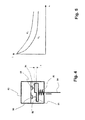
  • FIG. 5 is a diagram to explain the operation of the force measuring device according to FIG. 4 .
  • FIG. 6 is a schematic representation to explain the measuring process with an embodiment according to the invention.
  • a washing machine according to the invention is shown schematically, and identified as a whole by 10 .
  • This comprises a housing 12 , in which a tub 14 is displaceably suspended.
  • springs 16 , 18 , 20 , 22 which hold the tub 14 elastically in the upper housing region, are used.
  • the tub 14 is carried by four dampers 24 , 26 , 28 , 30 in the lower housing region.
  • the dampers 24 , 26 , 28 , 30 can be passive or actively controllable, and in the latter case, of active control, their damper characteristic can be changed.
  • the washing machine 10 also comprises a measuring device 32 to capture the position of the tub 14 relative to the housing 12 .
  • This measuring device 32 is shown enlarged in FIG. 2 .
  • Each of the light sources 34 , 38 , 42 emits a light beam 46 , 48 .
  • These light beams are scattered and reflected at the scattering reflecting surfaces 50 , 52 facing the pairs of light source and light receiver, so that depending on the present distance between the scattering reflecting surface and the light receiver 36 , 40 , 44 , at each light receiver 36 , 40 , 44 reflected (scattered) light can be captured with a definite intensity which represents the present distance.
  • the third scattering reflecting surface, facing the pair 42 , 44 is not shown in the figure. If the distance between light receiver 36 , 40 , 44 and associated scattering reflecting surface changes, the light intensity which the light receiver 36 , 40 , 44 captures also changes.
  • any deflections of the tub 14 , the scattering reflecting surfaces 50 , 52 and the third scattering reflecting surface (not drawn) which are permanently coupled to it relative to the module 60 , which is fixed in position and carries the pairs of light source and light receiver, can be captured in real time.
  • the present position (along all three spatial axes) of the tub 14 in the housing 12 of the washing machine 10 can be captured. This optical capture is to a large extent free of interference effects such as mechanical wear, electromagnetic interference fields, etc.
  • the deflection along the spatial axes X, Y and Z shown in FIG. 2 can be measured sequentially, i.e. in a time sequence, so that even mutual interference effects of the individual pairs of light source and light receiver can be prevented.
  • light which is polarised specifically for each measurement direction can be used.
  • optical components such as lenses, screens or filters can be used.
  • FIG. 3 shows the principle of the measuring device according to the invention, as used with a pressure sensor 62 .
  • the pressure sensor 62 comprises a housing 64 with a pressure connection, inlet and/or outlet 66 .
  • a movable membrane 68 which has an area 70 of which the shape is stable, said area 70 being attached to the housing 64 via flexible areas 72 , 74 so that it is sealed but displaceable, is arranged.
  • the membrane 68 delimits a pressure chamber 76 .
  • the membrane 68 is prestressed into an initial position via a compression spring 78 into the pressure chamber 76 . On its side facing away from the pressure chamber 76 , it has a scattering reflecting surface 78 .
  • a module 80 with a pair of light source and light receiver is arranged, and as described in relation to FIG. 2 , it emits a light beam to the membrane, and receives scattered reflected light from the membrane.
  • a contactless pressure sensor which can be used inexpensively in washing handling devices such as washing machines or driers, can be implemented in a technically simple way.
  • FIG. 4 shows another embodiment of the invention, but implemented as a force sensor.
  • a measuring rod 84 is displaceably received.
  • a first measuring sensor 86 and a second measuring sensor 88 are attached, each measuring sensor having a pair of light source and light receiver.
  • a reflecting surface carrier 90 which has two reflecting surfaces 92 , 94 , is coupled to the measuring rod 84 . They are essentially parallel to each other, but offset by a distance x.
  • the reflecting surface carrier 90 is prestressed via a compression spring 96 into an initial position.
  • the result at the measuring sensors 86 , 88 is different intensities of the reflected light at the reflecting surfaces 92 , 94 , so that conclusions can be drawn about the present position of the reflecting surface carrier 90 and thus of the measuring rod 84 .
  • the spring force F which is exerted on the compression spring 96 can be calculated directly. For example, if the measuring rod 84 is coupled to the tub 14 , it is possible to determine from this with what quantity/mass of washing or/and lye the tub 14 is filled.
  • the result is two different curves K 1 , K 2 for the intensities I of reflected light, as measured by the measuring sensors 86 , 88 .
  • This provides the possibility of a plausibility check, since the measurement results can always be compared with each other.
  • This also provides the possibility of calibration and compensation of the measuring system taking account of the known offset x, e.g. by coefficient formation and/or normalisation.
  • the evaluation can also be simplified in this way.
  • the light intensity I as is known, falls with the square of the travelled distance x (I ⁇ 1/x 2 ). In the case of quotient formation, instead of quadratic relations linear ones are obtained, which simplifies the computational evaluation.
  • FIG. 6 shows a possible arrangement of a measuring device 100 according to the invention in a washing machine, for 2 axes.
  • a reflecting surface carrier 102 with reflecting surfaces 104 , 106 arranged perpendicularly to each other, is attached in a way not shown to a tub, via fixing strips 108 , 110 .
  • a measuring sensor arrangement 112 with two measuring sensors 114 , 116 arranged orthogonally to each other, emits a pencil of rays 118 . This is reflected and scattered at the reflecting surface 104 , as shown by the pencil of rays 120 . Depending on the distance d, the result is a light intensity, which is captured by the sensor arrangement 114 . In this way, the present relative position between the fixed measuring sensor arrangement 112 and the reflecting surface carrier 102 , which is movable with the tub, can be determined. This measuring principle can be extended directly for the third spatial axis.

Landscapes

  • Physics & Mathematics (AREA)
  • General Physics & Mathematics (AREA)
  • Engineering & Computer Science (AREA)
  • Textile Engineering (AREA)
  • Main Body Construction Of Washing Machines And Laundry Dryers (AREA)
  • Cleaning In General (AREA)
  • Control Of Washing Machine And Dryer (AREA)

Abstract

A device to capture the relative position of a component (14) of which the position can change relative to a reference component (12) of a washing handling device (10), in particular a washing machine or drier, includes at least one light source (34, 38, 42), at least one light receiver (36, 40, 44), a light-reflecting surface (50, 52), which reflects light which the light source (34, 38, 42) emits to the light receiver (36, 40, 44). The device is designed to capture the present relative position of the changeable-position component (14) relative to the reference component (12), according to the reflected light which the light receiver (36, 40, 44) captures.

Description

BACKGROUND OF THE INVENTION
This invention concerns a device to capture the relative position of a component of which the position can change relative to a reference component of a washing handling device, in particular a washing machine or drier, and a corresponding washing handling device.
Such devices are known in various forms from the prior art. Thus the document DE 101 04 682 A1 shows a capacitive sensor, with which the axial distance of a tub relative to the housing of a washing machine is provided for the purpose of determining an imbalance, deflection in operation and the present loading of the washing drum. This solution has the disadvantage that capacitive sensors, in the context of the distances to be measured, are relatively difficult to evaluate, and are also subject to electromagnetic interference effects of the environment.
Another arrangement is known from the document DE 103 34 572 B3. In the case of the arrangement described in this document, a coil-based electromagnetic travel sensor is used to capture the deflection of the tub relative to the housing. Such electromagnetic travel sensors too are subject to interference effects and wear problems.
The document DE 698 07 055 T3 describes a washing machine where the present drum deflection and loading are determined using a Hall element and a magnet body associated with it. In this case, there is the problem that Hall sensors too are subject to electromagnetic interference, and to obtain sufficiently good measurement results, large, homogeneous magnets are required. Use of Hall sensors also has the disadvantage that to determine the present position in space, 3 field vectors are always required. Use of a single dipole magnet is not enough, since its field component is not biunique.
In the document DE 199 60 847 A1, the possibility of using strain gauges to determine the position of the tub in the housing of a washing machine is described. To evaluate the signals provided by strain gauges, relatively expensive and sensitive amplifier and compensation circuits are required.
The document DE 10 2004 043 752 B4 describes a measuring device with optical sensors to determine the present deflection of an axis of rotation of a washing drum relative to the tub of a washing machine. The optical system described in it has the disadvantage that it must be integrated into the bearing arrangement of the drum, and this is structurally expensive.
SUMMARY OF THE INVENTION
In contrast, it is the object of this invention to provide a device which is of the type described above, is structurally simple, is insensitive to external influences in operation, and has high measurement precision.
This object is achieved by a device to capture the relative position of a component of which the position can change relative to a reference component of a washing handling device, in particular a washing machine or drier, comprising:
    • at least one light source,
    • at least one light receiver,
    • a light-reflecting surface, which reflects light which the light source emits to the light receiver,
      the device being designed to capture the present relative position, or the distance of the changeable-position component, relative to the reference component, according to the reflected light which the light receiver captures.
According to the invention, the position of the changeable-position component, e.g. the tub of the washing handling device, relative to the reference component, e.g. the housing of the washing handling device or a component which is arranged in a fixed position in the washing handling device, is determined purely optically on the basis of the light reflection and the light intensity which is captured from it. The reflecting surface can be a surface of a separate component, or be integrated into an existing component, e.g. a tub. Such optical determination of position is possible using relatively inexpensively available components. It is not subject to any electromagnetic interference effects. No mechanical components which are moved relative to each other, and can be subject to wear, are required. By suitable formation of the beam path or reflection path or reflecting surfaces, permanently reliable results can be achieved. Thus reflection patterns, e.g. a kind of reflection grid of reflecting and non-reflecting areas, can be used. It is also possible to use convexly or concavely curved reflecting surfaces, in particular spherically curved reflecting surfaces. Similarly, it is also possible to use stepped reflecting surfaces, or ones which are alternately convexly and concavely curved in sub-regions, e.g. for generating Fresnel structures, which make distance measurement easier.
A further development of the invention provides that the reflecting surface is in the form of a scattering reflecting surface, which reflects and scatters the light which the light source emits.
According to the invention, it can also be provided that the light source is in the form of a light-emitting diode (LED), a laser diode or an infrared light source or similar. It is also possible to arrange the light source at a greater distance from the measuring point, and to guide the light to the measuring point via an optical waveguide. According to the invention, it can also be provided that the light receiver is in the form of a phototransistor, photodiode, photoresistor, passively operated LED or similar. Such light sources and light receivers are available inexpensively.
By pulsed control of the light source and/or light receiver, interference effects by external light can be determined and filtered out. Polarised light can also be used.
To simplify the structure of the solution according to the invention, it can be provided that at least one pair of light source and light receiver are combined next to each other in one module. Here it must be stated that the measured distance is always greater than the distance of light source and light receiver which are arranged next to each other.
In relation to this, according to a further development of the invention, it can be provided that at least two pairs of light source and light receiver, which are arranged at different alignments to each other, are arranged. It is thus possible to arrange such modules of pairs of light source and light receiver at different positions or/and with different alignment in the washing handling device, and thus to capture reliably relative movements between the changeable-position component and the reference component, in particular with reference to the housing, along different spatial axes.
According to the invention, it can also be provided that around a light source, multiple receivers are arranged, e.g. on two sides of the light source, or at regular angular distances around the light source, e.g. at an angular distance of 120°. In this way it is possible to improve the determination of position, e.g. by capturing a relative tilt. It is also possible to compensate for measurement errors. In this way, positions can also be captured more easily in three dimensions.
According to the invention, it can also be provided that the light-reflecting surfaces are arranged at an angle to each other. It is thus possible to provide two or three pairs of light source and light receiver, in a perpendicular arrangement to each other, and fixed in the housing, and to assign reflecting surfaces which are correspondingly perpendicularly aligned to each other to them. In this way, movements which are orthogonal to the reflecting surfaces can be determined.
Additionally, according to a further development of the invention, it can be provided that the distance of the pairs of light source and light receiver relative to the light-reflecting surface assigned to them is different. In other words, a pair of light source and light receiver can be arranged in an initial state at a first distance from the light-reflecting surface assigned to them, and another pair of light source and light receiver can be arranged in an initial state at a second distance from the light-reflecting surface assigned to them, the two light-reflecting surfaces being coupled to each other. In this way, when the light reflection which the two light receivers determine is evaluated, on the basis of the known difference of distance between the first and second distances, a plausibility check and compensation of the measurement result can be carried out. Preferably, the orientations of the two pairs of light source and light receiver are essentially aligned.
An alternative version of the invention provides that instead of using multiple light sources, the light which a single light source emits is divided via a beam splitter, e.g. a prism or double-hole screen, into multiple light beams or pencils of rays, and radiated onto different light-reflecting surfaces at different distances or/and different alignments to the light source. The evaluation can then take place via corresponding light receivers, in the manner described above, and with the advantages described above.
To measure pressure or force in a washing handling device, according to the invention a spring arrangement, which is arranged so that it prestresses at least one pair of light source and light receiver and the light-reflecting surface into a predetermined initial position relative to each other, and is deformed on deflection, can also be provided. On the basis of the captured pressure or captured force and of the distance which changes depending on the pressure or force, for example the fullness of a washing drum with water can be determined.
On the basis of the captured force (weight) which is exerted by a load of washing on a drum or tub or its suspension, for example the quantity or mass of introduced washing can also be determined.
The invention also concerns a washing handling device, in particular a washing machine or drier, comprising:
    • a housing,
    • a changeable-position component, which is carried movably in the housing, and
    • a device of the kind described above,
      wherein on one component out of housing or changeable-position component, a sensor arrangement with at least one pair of light source and light receiver is arranged, and on the other component out of housing and changeable-position component, the light-reflecting surface is arranged, and the present relative position of the changeable-position component relative to the housing can be determined according to the light reflection which the light receiver captures.
The light-reflecting surface can be in the form of a surface of a separate component, or in the form of an integrated surface of a component of the washing handling device, e.g. the tub. As the housing, for example the housing of the washing handling device, or a component arranged within the washing handling device, can be used. It is also possible to attach the sensor arrangement to the tub, and the light-reflecting surface to the housing of the washing handling device.
According to the invention, it can also be provided that the changeable-position component is a tub in which a washing drum is rotatably carried, the tub being suspended in the housing so that its position can change. In relation to this, according to the invention it is possible that the tub is carried in the housing by means of at least one passive or actively controllable damper, and in the latter case the damper characteristic can be adjusted according to the captured relative position of the drum receptacle in the housing.
Alternatively, according to the invention, it can be provided that the changeable-position component is a membrane which is prestressed by a spring and can be shifted in a housing, and which closes and seals a pressure chamber in the housing, it being possible to capture the relative position of the membrane relative to the housing according to the captured light reflection, taking account of the compression state of the spring. According to the present pressure in the pressure chamber, the membrane is deflected to a greater or lesser extent against the spring force, compared with a pressure-free initial state. This deflection is captured on the basis of the light reflection. Taking account of the spring characteristic, in particular the spring constant, and the known area of the membrane, conclusions can thus be drawn about the pressure in the pressure chamber. This pressure can give information about the present fullness of the tub with water or lye, for example.
According to another embodiment of the invention, it can be provided that the changeable-position component is a force sensor which is prestressed by a spring. Again, on the basis of the captured light reflection and the compression of the spring associated with it, and taking account of the spring characteristic, conclusions can be drawn about the force acting on the spring. In this way, for example, it is possible to determine what quantity of washing was introduced into the drum, and/or how much water or lye is in the tub.
According to the magnitudes which are captured using the device according to the invention, the operating mode, e.g. the spin speed, the quantity of water to be fed in, the damper characteristic of the actively controllable damper, etc. of the washing handling device can be adjusted.
BRIEF DESCRIPTION OF THE DRAWINGS
The invention is explained using an example, on the basis of the attached figures, of which:
FIG. 1 is a schematic drawing of a washing machine according to the invention;
FIG. 2 is an enlarged schematic view of the measuring device according to FIG. 1;
FIG. 3 is an enlarged view of a measuring device according to the invention, to capture pressure;
FIG. 4 is an enlarged view of a measuring device according to the invention, to capture force;
FIG. 5 is a diagram to explain the operation of the force measuring device according to FIG. 4, and
FIG. 6 is a schematic representation to explain the measuring process with an embodiment according to the invention.
DETAILED DESCRIPTION OF THE PREFERRED EMBODIMENT
In FIG. 1, a washing machine according to the invention is shown schematically, and identified as a whole by 10. This comprises a housing 12, in which a tub 14 is displaceably suspended. For suspension, four springs 16, 18, 20, 22, which hold the tub 14 elastically in the upper housing region, are used. The tub 14 is carried by four dampers 24, 26, 28, 30 in the lower housing region. The dampers 24, 26, 28, 30 can be passive or actively controllable, and in the latter case, of active control, their damper characteristic can be changed.
The washing machine 10 also comprises a measuring device 32 to capture the position of the tub 14 relative to the housing 12. This measuring device 32 is shown enlarged in FIG. 2.
It comprises three pairs of light source and light receiver, namely a first pair 34, 36, a second pair 38, 40 and a third pair 42, 44. Each of the light sources 34, 38, 42 emits a light beam 46, 48. These light beams are scattered and reflected at the scattering reflecting surfaces 50, 52 facing the pairs of light source and light receiver, so that depending on the present distance between the scattering reflecting surface and the light receiver 36, 40, 44, at each light receiver 36, 40, 44 reflected (scattered) light can be captured with a definite intensity which represents the present distance. The third scattering reflecting surface, facing the pair 42, 44, is not shown in the figure. If the distance between light receiver 36, 40, 44 and associated scattering reflecting surface changes, the light intensity which the light receiver 36, 40, 44 captures also changes.
With the measuring arrangement 32, any deflections of the tub 14, the scattering reflecting surfaces 50, 52 and the third scattering reflecting surface (not drawn) which are permanently coupled to it relative to the module 60, which is fixed in position and carries the pairs of light source and light receiver, can be captured in real time. In other words, with the measuring arrangement 32 the present position (along all three spatial axes) of the tub 14 in the housing 12 of the washing machine 10 can be captured. This optical capture is to a large extent free of interference effects such as mechanical wear, electromagnetic interference fields, etc. If necessary, the deflection along the spatial axes X, Y and Z shown in FIG. 2 can be measured sequentially, i.e. in a time sequence, so that even mutual interference effects of the individual pairs of light source and light receiver can be prevented. Alternatively, light which is polarised specifically for each measurement direction can be used.
To improve the measurement result, according to the invention optical components such as lenses, screens or filters can be used.
FIG. 3 shows the principle of the measuring device according to the invention, as used with a pressure sensor 62. The pressure sensor 62 comprises a housing 64 with a pressure connection, inlet and/or outlet 66. In the housing 64, a movable membrane 68, which has an area 70 of which the shape is stable, said area 70 being attached to the housing 64 via flexible areas 72, 74 so that it is sealed but displaceable, is arranged. The membrane 68 delimits a pressure chamber 76. The membrane 68 is prestressed into an initial position via a compression spring 78 into the pressure chamber 76. On its side facing away from the pressure chamber 76, it has a scattering reflecting surface 78.
On the side of the membrane 68 facing away from the pressure chamber 76, on the housing 64 a module 80 with a pair of light source and light receiver is arranged, and as described in relation to FIG. 2, it emits a light beam to the membrane, and receives scattered reflected light from the membrane. The distance d, which is given by the measurement result which the module 80 determines regarding the light intensity, describes the present compression state of the compression spring 78 relative to an initial state D. From this, taking account of the known spring constant c of the compression spring 78, according to Hooke's Law (F=c*[D−d]) the spring force F which is exerted on the compression spring 78 can be calculated directly.
Once the movable area A of the membrane 68 is also known, the pressure p in the pressure chamber 76 can be calculated directly from the determined spring force F and the relation p=F/A.
With the solution according to the invention shown in FIG. 3, a contactless pressure sensor, which can be used inexpensively in washing handling devices such as washing machines or driers, can be implemented in a technically simple way.
FIG. 4 shows another embodiment of the invention, but implemented as a force sensor. In a housing 82, a measuring rod 84 is displaceably received. In the housing 82, fixed in the housing, a first measuring sensor 86 and a second measuring sensor 88 are attached, each measuring sensor having a pair of light source and light receiver. A reflecting surface carrier 90, which has two reflecting surfaces 92, 94, is coupled to the measuring rod 84. They are essentially parallel to each other, but offset by a distance x. The reflecting surface carrier 90 is prestressed via a compression spring 96 into an initial position. Depending on the deflection of the reflecting surface carrier 90 relative to the housing 82, the result at the measuring sensors 86, 88 is different intensities of the reflected light at the reflecting surfaces 92, 94, so that conclusions can be drawn about the present position of the reflecting surface carrier 90 and thus of the measuring rod 84.
Again, on the basis of Hooke's Law (F=c*[D−d]) the spring force F which is exerted on the compression spring 96 can be calculated directly. For example, if the measuring rod 84 is coupled to the tub 14, it is possible to determine from this with what quantity/mass of washing or/and lye the tub 14 is filled.
On the basis of the reflecting surfaces 92, 94, which are offset from each other, the result is two different curves K1, K2 for the intensities I of reflected light, as measured by the measuring sensors 86, 88. This provides the possibility of a plausibility check, since the measurement results can always be compared with each other. This also provides the possibility of calibration and compensation of the measuring system taking account of the known offset x, e.g. by coefficient formation and/or normalisation. The evaluation can also be simplified in this way. The light intensity I, as is known, falls with the square of the travelled distance x (I˜1/x2). In the case of quotient formation, instead of quadratic relations linear ones are obtained, which simplifies the computational evaluation.
Finally, FIG. 6 shows a possible arrangement of a measuring device 100 according to the invention in a washing machine, for 2 axes. A reflecting surface carrier 102, with reflecting surfaces 104, 106 arranged perpendicularly to each other, is attached in a way not shown to a tub, via fixing strips 108, 110. A measuring sensor arrangement 112, with two measuring sensors 114, 116 arranged orthogonally to each other, emits a pencil of rays 118. This is reflected and scattered at the reflecting surface 104, as shown by the pencil of rays 120. Depending on the distance d, the result is a light intensity, which is captured by the sensor arrangement 114. In this way, the present relative position between the fixed measuring sensor arrangement 112 and the reflecting surface carrier 102, which is movable with the tub, can be determined. This measuring principle can be extended directly for the third spatial axis.
Although the preferred embodiments of the present invention have been described herein, the above description is merely illustrative. Further modification of the invention herein disclosed will occur to those skilled in the respective arts and all such modifications are deemed to be within the scope of the invention as defined by the appended claims.

Claims (15)

What is claimed is:
1. Device to capture the relative position of a component of which the position can change relative to a reference component of a washing handling device, in particular a washing machine or drier, comprising:
at least one light source,
at least one light receiver,
a light-reflecting surface, which reflects light which the light source emits to the light receiver,
the device being designed to capture the distance of the changeable position component relative to the reference component, according to the reflected light which the light receiver captures.
2. Device according to claim 1,
wherein the reflecting surface is in the form of a scattering reflecting surface, which scatters and reflects the light which the light source emits.
3. Device according to claim 1,
wherein the light emitted by the light source is polarised.
4. Device according to claim 1,
wherein the light source is in the form of a light-emitting diode (LED), a laser diode or an infrared light source.
5. Device according to claim 1,
wherein the light receiver is in the form of a phototransistor, photodiode, photoresistor, or passively operated LED.
6. Device according to claim 1,
wherein the light source and light receiver are combined next to each other in one module.
7. Device according to claim 1,
comprising two or more pairs of light source and light receiver, which are arranged at different alignments to each other.
8. Device according to claim 7,
wherein the distance of the pairs of light source and light receiver relative to the light-reflecting surface assigned to them is different.
9. Device according to claim 7,
wherein the light-reflecting surfaces are arranged at an angle to each other.
10. Device according to claim 1,
comprising a spring arrangement, which is arranged so that it prestresses at least one pair of light source and light receiver and the light-reflecting surface into a predetermined initial position relative to each other.
11. Washing handling device, in particular a washing machine or drier, comprising:
a housing,
a changeable-position component, which is carried movably in the housing, and
a device according to claim 1,
wherein on one component out of housing or changeable-position component, a sensor arrangement with at least one pair of light source and light receiver is arranged, and on the other component out of housing and changeable-position component, the light-reflecting surface is arranged, and the distance of the changeable-position component relative to the housing can be determined according to the light reflection which the light receiver captures.
12. Washing handling device according to claim 11,
wherein the changeable-position component is a tub in which a washing drum is rotatably carried, the tub being suspended in the housing so that its position can change.
13. Washing handling device according to claim 12,
wherein the tub is carried in the housing by means of at least one actively controllable damper, and the damper characteristic can be adjusted according to the captured relative position of the drum receptacle in the housing.
14. Washing handling device according to claim 11,
wherein the changeable-position component is a membrane which is prestressed by a spring and displaceable, and which closes and seals a pressure chamber, it being possible to capture the relative position of the membrane relative to the housing according to the captured light reflection, taking account of the compression state of the spring.
15. Washing handling device according to claim 11,
wherein the changeable-position component is a force sensor which is prestressed by a spring.
US13/074,168 2010-03-30 2011-03-29 Device to capture the relative position of a component of which the position can change relative to a reference component of a washing handling device, and corresponding washing handling device Active 2033-06-21 US8888929B2 (en)

Priority Applications (1)

Application Number Priority Date Filing Date Title
US14/514,508 US9274012B2 (en) 2010-03-30 2014-10-15 Device to capture relative position of a component of which the position can change relative to a reference component of a washing handling device, and corresponding washing handling device

Applications Claiming Priority (3)

Application Number Priority Date Filing Date Title
DE102010013386A DE102010013386A1 (en) 2010-03-30 2010-03-30 Layer-variable component's relative position detecting device for use in e.g. washing machine, has light sources emitting light, where device detects actual position of layer-variable component relative to housing according to light
DE102010013386.8 2010-03-30
DE102010013386 2010-03-30

Related Child Applications (1)

Application Number Title Priority Date Filing Date
US14/514,508 Continuation US9274012B2 (en) 2010-03-30 2014-10-15 Device to capture relative position of a component of which the position can change relative to a reference component of a washing handling device, and corresponding washing handling device

Publications (2)

Publication Number Publication Date
US20120073613A1 US20120073613A1 (en) 2012-03-29
US8888929B2 true US8888929B2 (en) 2014-11-18

Family

ID=44649982

Family Applications (2)

Application Number Title Priority Date Filing Date
US13/074,168 Active 2033-06-21 US8888929B2 (en) 2010-03-30 2011-03-29 Device to capture the relative position of a component of which the position can change relative to a reference component of a washing handling device, and corresponding washing handling device
US14/514,508 Expired - Fee Related US9274012B2 (en) 2010-03-30 2014-10-15 Device to capture relative position of a component of which the position can change relative to a reference component of a washing handling device, and corresponding washing handling device

Family Applications After (1)

Application Number Title Priority Date Filing Date
US14/514,508 Expired - Fee Related US9274012B2 (en) 2010-03-30 2014-10-15 Device to capture relative position of a component of which the position can change relative to a reference component of a washing handling device, and corresponding washing handling device

Country Status (3)

Country Link
US (2) US8888929B2 (en)
CN (1) CN102207377B (en)
DE (1) DE102010013386A1 (en)

Cited By (1)

* Cited by examiner, † Cited by third party
Publication number Priority date Publication date Assignee Title
US10465323B2 (en) 2015-01-13 2019-11-05 Emz-Hanauer Gmbh & Co. Kgaa Optical sensor for a laundry processing appliance

Families Citing this family (35)

* Cited by examiner, † Cited by third party
Publication number Priority date Publication date Assignee Title
CN103084969B (en) * 2011-11-01 2015-09-09 中芯国际集成电路制造(上海)有限公司 A kind of chemical-mechanical grinding device
US9212445B2 (en) 2011-12-16 2015-12-15 Whirlpool Corporation Method and apparatus for controlling the liquid filling in a laundry treating appliance
CN104294531B (en) * 2013-07-18 2017-12-08 博西华电器(江苏)有限公司 Washing machine and its method of work comprising detergent throwing device
CN103850095B (en) * 2013-09-23 2017-09-19 无锡小天鹅股份有限公司 Washing machine
CN103628277A (en) * 2013-09-23 2014-03-12 无锡小天鹅股份有限公司 Washing machine
DE102014205368A1 (en) * 2014-03-21 2015-09-24 Emz-Hanauer Gmbh & Co. Kgaa Washing machine
CN105019200B (en) * 2014-04-30 2017-02-15 海尔集团技术研发中心 Household dry cleaning machine and control method
CN105088674B (en) * 2014-05-16 2017-09-19 无锡小天鹅股份有限公司 Roller washing machine
CN105088683A (en) * 2014-05-16 2015-11-25 无锡小天鹅股份有限公司 Pulsator washing machine
CN105088653A (en) * 2014-05-16 2015-11-25 无锡小天鹅股份有限公司 Drum washing machine
CN105088681A (en) * 2014-05-16 2015-11-25 无锡小天鹅股份有限公司 Drum washing machine
WO2015172635A1 (en) * 2014-05-16 2015-11-19 无锡小天鹅股份有限公司 Pulsator washing machine
WO2015172642A1 (en) * 2014-05-16 2015-11-19 无锡小天鹅股份有限公司 Drum-type clothes washing machine
WO2015172633A1 (en) * 2014-05-16 2015-11-19 无锡小天鹅股份有限公司 Drum washing machine
WO2015172643A1 (en) * 2014-05-16 2015-11-19 无锡小天鹅股份有限公司 Drum-type clothes washing machine
CN105088676B (en) * 2014-05-16 2017-09-19 无锡小天鹅股份有限公司 Roller washing machine
WO2015172637A1 (en) * 2014-05-16 2015-11-19 无锡小天鹅股份有限公司 Drum washing machine
WO2015172640A1 (en) * 2014-05-16 2015-11-19 无锡小天鹅股份有限公司 Clothes washing machine
WO2015172641A1 (en) * 2014-05-16 2015-11-19 无锡小天鹅股份有限公司 Impeller-type clothes washing machine
CN105088677A (en) * 2014-05-16 2015-11-25 无锡小天鹅股份有限公司 Drum washing machine
WO2015172639A1 (en) * 2014-05-16 2015-11-19 无锡小天鹅股份有限公司 Drum-type clothes washing machine
CN105088609A (en) * 2014-05-16 2015-11-25 无锡小天鹅股份有限公司 Washing machine
CN105088662B (en) * 2014-05-16 2017-09-19 无锡小天鹅股份有限公司 Roller washing machine
WO2015172636A1 (en) * 2014-05-16 2015-11-19 无锡小天鹅股份有限公司 Drum washing machine
WO2015172634A1 (en) * 2014-05-16 2015-11-19 无锡小天鹅股份有限公司 Drum washing machine
CN104131439A (en) * 2014-07-31 2014-11-05 江苏新安电器有限公司 Optical roller-collision-resistant detection system and method based on roller washing machine
CN106319863A (en) * 2015-06-15 2017-01-11 青岛海尔滚筒洗衣机有限公司 Device for automatic identification of clothes quantities for washing machine, washing machine and control method
DE102016214821A1 (en) * 2016-08-10 2018-02-15 BSH Hausgeräte GmbH Laundry treatment device
US10976207B2 (en) * 2017-01-10 2021-04-13 Cornell University Sensors with elastomeric foams and uses thereof
EP3517678A1 (en) * 2018-01-29 2019-07-31 V-Zug AG Bearing device for a tub in a laundry processing apparatus
CN113279204B (en) * 2020-02-18 2024-07-23 佛山海尔滚筒洗衣机有限公司 Clothes processing equipment
CN112362028B (en) * 2020-09-25 2022-08-30 南京信息职业技术学院 Four-spring plane displacement type inclination and elevation angle tester and testing method
CN115198502B (en) * 2021-04-09 2025-10-24 深圳绿米联创科技有限公司 Drying method, device, electronic device and storage medium
CN115928375B (en) * 2022-12-29 2026-01-20 Tcl家用电器(合肥)有限公司 Control method of washing machine and washing machine
CN120063077B (en) * 2025-04-25 2025-12-26 杭州松下家用电器有限公司 Measuring jig and method for decorative ring of drum washing machine

Citations (11)

* Cited by examiner, † Cited by third party
Publication number Priority date Publication date Assignee Title
DE3016915A1 (en) 1980-05-02 1981-11-05 Fritz Bauer + Söhne oHG, 8503 Altdorf Shock absorber for washing-machine drum mounting - has variable-force damping element controlled by external regulator
US4662752A (en) 1985-11-04 1987-05-05 Actel Partnership Position and orientation (POSE) sensor and related method
US5259218A (en) * 1991-09-19 1993-11-09 Ellis Corporation Force minimizing suspension system for rotary washer/extractors
US5713221A (en) * 1996-08-23 1998-02-03 White Consolidated Industries, Inc. Optical out-of-balance sensor for a washer
DE19960874A1 (en) 1999-04-09 2000-10-19 Andrzej Ohrzal Barrier against snails or slugs, with electrically conducting surface
DE10104682A1 (en) 2001-02-02 2002-08-22 Henno Schotten Sensor for determining imbalance and weight of load for washing machines has isolated conductive surface as capacitive sensor between washing machine tub and housing
DE69807055T2 (en) 1998-07-16 2003-04-24 Samsung Electronics Co., Ltd. Washing machine
DE10334572B3 (en) 2003-07-28 2004-08-12 Miele & Cie. Kg Laundry weight determination method for washing machine using measuring circuit detecting lowering of washing liquid container resulting from weight of laundry
DE102004043752A1 (en) 2004-09-10 2006-03-30 Fag Kugelfischer Ag & Co. Ohg Measuring device with an optical sensor and a method with the measuring device
US20100129739A1 (en) * 2005-07-08 2010-05-27 Yasuhiro Hidaka Surface Position Detection Apparatus, Exposure Apparatus, and Exposure Method
US8561438B2 (en) * 2006-12-08 2013-10-22 Lg Electronics Inc. Complex washing machine and controlling method for the same

Family Cites Families (3)

* Cited by examiner, † Cited by third party
Publication number Priority date Publication date Assignee Title
DE19960847A1 (en) 1999-12-16 2001-06-28 Bsh Bosch Siemens Hausgeraete Laundry treatment machine
US6711466B2 (en) * 2002-01-07 2004-03-23 International Business Machines Corporation Method and system for maintaining a desired distance between a dispenser and a surface
CN2597944Y (en) * 2003-01-17 2004-01-07 中国科学院国家天文台南京天文光学技术研究所 A device for measuring the parallelism of workpieces

Patent Citations (12)

* Cited by examiner, † Cited by third party
Publication number Priority date Publication date Assignee Title
DE3016915A1 (en) 1980-05-02 1981-11-05 Fritz Bauer + Söhne oHG, 8503 Altdorf Shock absorber for washing-machine drum mounting - has variable-force damping element controlled by external regulator
US4662752A (en) 1985-11-04 1987-05-05 Actel Partnership Position and orientation (POSE) sensor and related method
US5259218A (en) * 1991-09-19 1993-11-09 Ellis Corporation Force minimizing suspension system for rotary washer/extractors
US5713221A (en) * 1996-08-23 1998-02-03 White Consolidated Industries, Inc. Optical out-of-balance sensor for a washer
DE69807055T2 (en) 1998-07-16 2003-04-24 Samsung Electronics Co., Ltd. Washing machine
DE69807055T3 (en) 1998-07-16 2006-06-29 Samsung Electronics Co., Ltd., Suwon Washing machine
DE19960874A1 (en) 1999-04-09 2000-10-19 Andrzej Ohrzal Barrier against snails or slugs, with electrically conducting surface
DE10104682A1 (en) 2001-02-02 2002-08-22 Henno Schotten Sensor for determining imbalance and weight of load for washing machines has isolated conductive surface as capacitive sensor between washing machine tub and housing
DE10334572B3 (en) 2003-07-28 2004-08-12 Miele & Cie. Kg Laundry weight determination method for washing machine using measuring circuit detecting lowering of washing liquid container resulting from weight of laundry
DE102004043752A1 (en) 2004-09-10 2006-03-30 Fag Kugelfischer Ag & Co. Ohg Measuring device with an optical sensor and a method with the measuring device
US20100129739A1 (en) * 2005-07-08 2010-05-27 Yasuhiro Hidaka Surface Position Detection Apparatus, Exposure Apparatus, and Exposure Method
US8561438B2 (en) * 2006-12-08 2013-10-22 Lg Electronics Inc. Complex washing machine and controlling method for the same

Non-Patent Citations (1)

* Cited by examiner, † Cited by third party
Title
Bauer, Fritz; "Vibratory Support for Washing Machines", DE 3016915 (Machine Translation). *

Cited By (1)

* Cited by examiner, † Cited by third party
Publication number Priority date Publication date Assignee Title
US10465323B2 (en) 2015-01-13 2019-11-05 Emz-Hanauer Gmbh & Co. Kgaa Optical sensor for a laundry processing appliance

Also Published As

Publication number Publication date
CN102207377A (en) 2011-10-05
DE102010013386A1 (en) 2011-10-06
US9274012B2 (en) 2016-03-01
CN102207377B (en) 2015-04-15
US20150042220A1 (en) 2015-02-12
US20120073613A1 (en) 2012-03-29

Similar Documents

Publication Publication Date Title
US8888929B2 (en) Device to capture the relative position of a component of which the position can change relative to a reference component of a washing handling device, and corresponding washing handling device
JP3171446B2 (en) Probe
US5118956A (en) Touch probe including a waveguide
CN109990728B (en) Machine geometry monitoring
CN1904544B (en) Laser tracking interferometer
US3224279A (en) Accelerometer
CN102798377B (en) Planar error measurement analysis system and method
US4493212A (en) Fiber optic mass sensor
US7926313B2 (en) Device for detecting the unbalance of a rotatable component of a domestic appliance
CN105352436A (en) Coordinate measuring device
CN103196568A (en) Wavelength detector and contact probe using it
JP2010515070A (en) Position detection system for non-contact interferometer type detection of target position and scanning system equipped with the position detection system
US20070177162A1 (en) Device for measuring changes in the position of the edge of a body
RU2453642C2 (en) Washing machine with weight sensor of load
CN1945208B (en) Position detecting device and inclination sensor device of surveying apparatus using the same
CN100580456C (en) Device for Measuring Acceleration Using Double Beam Fiber Optic Traps
US5837998A (en) Two-dimensional fiber optic acceleration and vibration sensor
US11340252B2 (en) Acceleration measuring device and acceleration measuring method of the same
US20120126152A1 (en) Method for the optical monitoring of a monitored zone and light sensor
US4865443A (en) Optical inverse-square displacement sensor
Li et al. Development of a high-sensitivity dual-axis optoelectronic level using double-layer liquid refraction
CN215984392U (en) Displacement detection device without lens
RU109572U1 (en) DEVICE FOR MEASURING A GRAVITATIONAL CONSTANT
EP4569078A1 (en) Optical reading devices comprising cell culture units wherein contractile tissue can be cultured
RU2454645C1 (en) Apparatus for measuring vibration acceleration

Legal Events

Date Code Title Description
AS Assignment

Owner name: EMZ-HANAUER GMBH & CO. KGAA, GERMANY

Free format text: ASSIGNMENT OF ASSIGNORS INTEREST;ASSIGNORS:SCHENKL, JOHANN;BAUMER, JOHANNES;SORGENFREI, MICHAEL;AND OTHERS;SIGNING DATES FROM 20110406 TO 20110420;REEL/FRAME:026218/0719

STCF Information on status: patent grant

Free format text: PATENTED CASE

MAFP Maintenance fee payment

Free format text: PAYMENT OF MAINTENANCE FEE, 4TH YEAR, LARGE ENTITY (ORIGINAL EVENT CODE: M1551)

Year of fee payment: 4

MAFP Maintenance fee payment

Free format text: PAYMENT OF MAINTENANCE FEE, 8TH YEAR, LARGE ENTITY (ORIGINAL EVENT CODE: M1552); ENTITY STATUS OF PATENT OWNER: LARGE ENTITY

Year of fee payment: 8