US8855399B2 - System, a method and a computer program product for CAD-based registration - Google Patents
System, a method and a computer program product for CAD-based registration Download PDFInfo
- Publication number
- US8855399B2 US8855399B2 US13/368,306 US201213368306A US8855399B2 US 8855399 B2 US8855399 B2 US 8855399B2 US 201213368306 A US201213368306 A US 201213368306A US 8855399 B2 US8855399 B2 US 8855399B2
- Authority
- US
- United States
- Prior art keywords
- run
- frame
- target
- targets
- wafer
- Prior art date
- Legal status (The legal status is an assumption and is not a legal conclusion. Google has not performed a legal analysis and makes no representation as to the accuracy of the status listed.)
- Active
Links
Images






Classifications
-
- G—PHYSICS
- G06—COMPUTING OR CALCULATING; COUNTING
- G06T—IMAGE DATA PROCESSING OR GENERATION, IN GENERAL
- G06T7/00—Image analysis
- G06T7/0002—Inspection of images, e.g. flaw detection
- G06T7/0004—Industrial image inspection
- G06T7/0008—Industrial image inspection checking presence/absence
-
- G—PHYSICS
- G06—COMPUTING OR CALCULATING; COUNTING
- G06F—ELECTRIC DIGITAL DATA PROCESSING
- G06F30/00—Computer-aided design [CAD]
- G06F30/30—Circuit design
- G06F30/39—Circuit design at the physical level
- G06F30/398—Design verification or optimisation, e.g. using design rule check [DRC], layout versus schematics [LVS] or finite element methods [FEM]
-
- G—PHYSICS
- G01—MEASURING; TESTING
- G01B—MEASURING LENGTH, THICKNESS OR SIMILAR LINEAR DIMENSIONS; MEASURING ANGLES; MEASURING AREAS; MEASURING IRREGULARITIES OF SURFACES OR CONTOURS
- G01B11/00—Measuring arrangements characterised by the use of optical techniques
- G01B11/14—Measuring arrangements characterised by the use of optical techniques for measuring distance or clearance between spaced objects or spaced apertures
-
- G—PHYSICS
- G01—MEASURING; TESTING
- G01N—INVESTIGATING OR ANALYSING MATERIALS BY DETERMINING THEIR CHEMICAL OR PHYSICAL PROPERTIES
- G01N21/00—Investigating or analysing materials by the use of optical means, i.e. using sub-millimetre waves, infrared, visible or ultraviolet light
-
- G—PHYSICS
- G01—MEASURING; TESTING
- G01N—INVESTIGATING OR ANALYSING MATERIALS BY DETERMINING THEIR CHEMICAL OR PHYSICAL PROPERTIES
- G01N21/00—Investigating or analysing materials by the use of optical means, i.e. using sub-millimetre waves, infrared, visible or ultraviolet light
- G01N21/84—Systems specially adapted for particular applications
- G01N21/88—Investigating the presence of flaws or contamination
- G01N21/95—Investigating the presence of flaws or contamination characterised by the material or shape of the object to be examined
- G01N21/9501—Semiconductor wafers
-
- G—PHYSICS
- G06—COMPUTING OR CALCULATING; COUNTING
- G06T—IMAGE DATA PROCESSING OR GENERATION, IN GENERAL
- G06T7/00—Image analysis
- G06T7/30—Determination of transform parameters for the alignment of images, i.e. image registration
- G06T7/32—Determination of transform parameters for the alignment of images, i.e. image registration using correlation-based methods
-
- G—PHYSICS
- G01—MEASURING; TESTING
- G01N—INVESTIGATING OR ANALYSING MATERIALS BY DETERMINING THEIR CHEMICAL OR PHYSICAL PROPERTIES
- G01N2201/00—Features of devices classified in G01N21/00
- G01N2201/10—Scanning
-
- G—PHYSICS
- G01—MEASURING; TESTING
- G01N—INVESTIGATING OR ANALYSING MATERIALS BY DETERMINING THEIR CHEMICAL OR PHYSICAL PROPERTIES
- G01N2201/00—Features of devices classified in G01N21/00
- G01N2201/12—Circuits of general importance; Signal processing
- G01N2201/125—Digital circuitry
-
- G—PHYSICS
- G01—MEASURING; TESTING
- G01N—INVESTIGATING OR ANALYSING MATERIALS BY DETERMINING THEIR CHEMICAL OR PHYSICAL PROPERTIES
- G01N2201/00—Features of devices classified in G01N21/00
- G01N2201/12—Circuits of general importance; Signal processing
- G01N2201/127—Calibration; base line adjustment; drift compensation
-
- G—PHYSICS
- G06—COMPUTING OR CALCULATING; COUNTING
- G06T—IMAGE DATA PROCESSING OR GENERATION, IN GENERAL
- G06T2207/00—Indexing scheme for image analysis or image enhancement
- G06T2207/30—Subject of image; Context of image processing
- G06T2207/30108—Industrial image inspection
- G06T2207/30148—Semiconductor; IC; Wafer
Definitions
- This invention relates to systems, methods and computer program products for CAD-based registration.
- FIG. 1 is an illustration of a wafer 10 such as ones which may be used in the fabrication of integrated circuits and other microdevices. While the term wafer may be used to refer only to the substrate material on which the integrated circuit is fabricated (e.g. a thin slice of semiconductor material, such as a silicon crystal), this term may also be used to refer to the entire construction, including the electronic circuit fabricated on the wafer.
- the wafer 10 is divided into multiple dies 11 which are illustrated in a widely implemented rectangular form.
- the term ‘die’ may also be used either for small blocks of semiconducting material, on which a given functional circuit is fabricated, or for such a block including the fabricated electric circuit.
- wafer 10 may be cut (“diced”) into its multiple dies 11 , wherein all of the dies of the wafer contain a copy of the same electronic circuit. While not necessarily so, each of the dies 11 is independently functional.
- U.S. Pat. No. 7,847,929 which is entitled “Methods and Apparatus for Inspecting a Plurality of Dies” discloses a method for inspecting a plurality of dies, that are typically disposed on a surface of a semiconducting wafer. Each of the dies includes respective functional features within the die. The method consists of identifying within a first die a first multiplicity of the functional features having respective characteristics, and measuring respective first locations of the first multiplicity with respect to an origin of the first die. Within a group of second dies a second multiplicity of the functional features having the respective characteristics is identified, respective second locations of the second multiplicity are measured. The second locations are compared to the first locations to determine a location of an origin of the group of the second dies.
- a system for location based wafer analysis comprising: a first input interface configured to obtain: (a) calibration information that includes displacements of multiple frames included in a wafer area of a reference wafer, and (b) a target database that includes a target image and location information for each out of multiple targets in each of the multiple frames; a second input interface, configured to obtain scanning image data of a scan of an inspected area of an inspected wafer; a correlator, configured to: (a) define for each out of multiple targets of the database a search window, based on the displacement of the frame in which the target is included; (b) calculate for each out of multiple targets a run-time displacement, based on a correlation of the target image of the target to at least a portion of an area of the scanned image which is defined by the corresponding search window; and (c) determine a frame run-time displacement for each of multiple run-time frames scanned, based on the target run-time displacement
- the processor is configured to detect defects in the inspected area with the help of at least one of the target run-time displacements, wherein the processor is configured to generate the inspection results in response to the detected defects.
- a system further comprising a processor which is configured to improve location accuracy of a scanning of at least one of the run-time frames by a sensor that scans the inspected area, based on the frame run-time displacement determined for another run-time frame.
- the first input interface is configured to obtain the location information in computer aided design (CAD) coordinates.
- CAD computer aided design
- the defect detection module is configured to report detected defects and to report location information of at least one of the defects in CAD coordinates.
- the correlator is configured to: (a) modify a comparison scheme based on the frame run-time displacement of the multiple run-time frames; and (b) compare an image obtained at the scanning to reference data, based on the modified comparison scheme; wherein the defect detection module is configured to detect the defects based on results of the comparing.
- the second input interface is configured to receive scanning image data of a series of inspected wafer areas, each of which covers a different die; wherein the correlator is configured to perform the following actions for each of the other wafer areas, other than the first: (a) defining search windows which correspond to a subgroup which includes at least some of the database targets, wherein the defining of each of the search windows is based on a frame run-time displacement determined for a previous inspected wafer area of the series, wherein the size of at least one of the search windows is smaller than the size of a search window defined for the corresponding target in the inspected area; (b) calculating a target run-time displacement for each of the targets of the subgroup, based on a correlation of the respective target image to a scanned image of the corresponding search window; and (c) detecting defects in the inspected wafer area, wherein the detecting is responsive to at least one of the target run-
- the first input interface is configured to obtain: (a) displacements of frames scanned in a first scanning direction; (b) displacements of frames scanned in a second scanning direction other than the first scanning direction; and (c) target information of targets in an analyzed frame, wherein the target information is based on results of a scanning of the analyzed frame in a first scanning direction;
- the second input interface is configured to obtain scanning image data of a frame included within the inspected area which corresponds to the analyzed frame and that was scanned in the second scanning direction;
- the correlator is further configured to: (a) compute an averaged displacement by averaging obtained frame-displacements of frames that are adjacent to the analyzed frame and whose target information of included targets is based on results of scanning in the second scanning direction; (b) define search windows which correspond to the targets of the analyzed frame, wherein the defining of each of the search windows is based on the averaged displacement; and (c
- a computerized method for location based wafer analysis comprising: obtaining: (a) calibration information that includes displacements of multiple frames included in a wafer area of a reference wafer, and (b) a target database that includes a target image and location information for each out of multiple targets in each of the multiple frames; scanning an inspected area of an inspected wafer to provide a scanned image of the inspected area; for each out of multiple targets of the database: (a) defining a corresponding search window based on the displacement of the frame in which the target is included; and (b) calculating a run-time displacement for the target, based on a correlation of the target image of the target to at least a portion of an area of the scanned image which is defined by the corresponding search window; determining a frame run-time displacement for each of multiple run-time frames scanned, based on the target run-time displacements calculated for targets of the respective run-time frame; and providing inspection results for
- a method further comprising detecting defects in the inspected area with the help of at least one of the target run-time displacements, wherein the providing comprises providing results of the defect detection.
- the scanning of the inspected area comprises improving location accuracy of the scanning of at least one of the run-time frames based on the frame run-time displacement determined for another run-time frame.
- obtaining of the location information of the targets includes obtaining the location information in computer aided design (CAD) coordinates.
- CAD computer aided design
- a method further comprising reporting defects, after the detecting, wherein the reporting comprises reporting location information of at least one of the defects in CAD coordinates.
- a method further comprising modifying a comparison scheme based on the frame run-time displacement of the multiple run-time frames; and comparing an image obtained at the scanning to reference data, based on the modified comparison scheme; wherein the detecting of the defects is based on results of the comparing.
- the scanning of the inspected area is the first in a series of scanning of multiple inspected wafer areas, each of which covers a different die; and for each of the inspected wafer areas other than the first:
- search windows which correspond to a subgroup which includes at least some of the database targets, wherein the defining of each of the search windows is based on a frame run-time displacement determined for a previous inspected wafer area of the series, wherein the size of at least one of the search windows is smaller than the size of a search window defined for the corresponding target in the inspected area; calculating a target run-time displacement for each of the targets of the subgroup, based on a correlation of the respective target image to a scanned image of the corresponding search window; and detecting defects in the inspected wafer area, wherein the detecting is responsive to at least one of the target run-time displacements.
- the obtaining comprises obtaining displacements of frames scanned in a first scanning direction, and displacements of frames scanned in a second scanning direction other than the first scanning direction;
- the obtaining further comprises obtaining target information of targets in an analyzed frame, wherein the target information is based on results of a scanning of the analyzed frame in a first scanning direction; wherein the scanning comprises scanning within the inspected area, in the second scanning direction, a frame that corresponds to the analyzed frame; wherein the method further comprises: (a) computing an averaged displacement by averaging obtained frame-displacements of frames that are adjacent to the analyzed frame and whose target information of included targets is based on results of scanning in the second scanning direction; (b) defining search windows which correspond to the targets of the analyzed frame, wherein the defining of each of the search windows is based on the averaged displacement; and (c) calculating a target run-time displacement for each of the targets of the analyzed frame, based on a correlation of the respective target image to a scanned image of the corresponding search window; wherein the detecting is responsive to at least one of the target run-time displacements.
- a program storage device readable by machine, tangibly embodying a program of instructions executable by the machine to perform method for wafer analysis, comprising the steps of: (a) obtaining: (i) calibration information that includes displacements of multiple frames included in a wafer area of a reference wafer, and (ii) a target database that includes a target image and location information for each out of multiple targets in each of the multiple frames; (b) scanning an inspected area of an inspected wafer to provide a scanned image of the inspected area; (c) for each out of multiple targets of the database: (i) defining a corresponding search window based on the displacement of the frame in which the target is included; and (ii) calculating a run-time displacement for the target, based on a correlation of the target image of the target to at least a portion of an area of the scanned image which is defined by the corresponding search window; (d) determining a frame run-time displacement for each
- a program storage device wherein the program of instructions further includes computer readable program code for causing the machine to detect defects in the inspected area with the help of at least one of the target run-time displacements, wherein the providing comprises providing results of the defect detection.
- a program storage device wherein the computer readable program code that is included in the program of instructions for causing the machine to perform the step of scanning the inspected area comprises instructions for improving location accuracy of the scanning of at least one of the run-time frames based on the frame run-time displacement determined for another run-time frame.
- a program storage device wherein the computer readable program code that is included in the program of instructions for causing the machine to perform the step of obtaining of the location information of the targets includes instructions for obtaining the location information in computer aided design (CAD) coordinates.
- CAD computer aided design
- a program storage device wherein the program of instructions further includes computer readable program code for causing the machine to report defects, after the detecting, wherein the reporting of the defects comprises reporting location information of at least one of the defects in CAD coordinates.
- a program storage device wherein the program of instructions further includes computer readable program code for causing the machine to modify a comparison scheme based on the frame run-time displacement of the multiple run-time frames; and to compare an image obtained at the scanning to reference data, based on the modified comparison scheme; wherein the detecting of the defects is based on results of the comparing.
- a program storage device wherein the scanning of the inspected area is the first in a series of scanning of multiple inspected wafer areas, each of which covers a different die; and wherein the program of instructions further includes computer readable program code for causing the machine to execute for each of the inspected wafer areas other than the first: (a) defining search windows which correspond to a subgroup which includes at least some of the database targets, wherein the defining of each of the search windows is based on a frame run-time displacement determined for a previous inspected wafer area of the series, wherein the size of at least one of the search windows is smaller than the size of a search window defined for the corresponding target in the inspected area; (b) calculating a target run-time displacement for each of the targets of the subgroup, based on a correlation of the respective target image to a scanned image of the corresponding search window; and (c) detecting defects in the inspected wafer area, wherein the detecting
- a program storage device wherein the computer readable program code that is included in the program of instructions for causing the machine to perform the step of obtaining comprises instructions for obtaining displacements of frames scanned in a first scanning direction, and displacements of frames scanned in a second scanning direction other than the first scanning direction; wherein the obtaining further comprises obtaining target information of targets in an analyzed frame, wherein the target information is based on results of a scanning of the analyzed frame in a first scanning direction; wherein the scanning comprises scanning within the inspected area, in the second scanning direction, a frame that corresponds to the analyzed frame; wherein the method further comprises: (a) computing an averaged displacement by averaging obtained frame-displacements of frames that are adjacent to the analyzed frame and whose target information of included targets is based on results of scanning in the second scanning direction; (b) defining search windows which correspond to the targets of the analyzed frame, wherein the defining of each of the search windows is based on
- FIG. 1 is an illustration of a wafer 10 such as ones which may be used in the fabrication of integrated circuits and other microdevices;
- FIGS. 2A and 2B illustrate a system for generating calibration information usable for wafer inspection of a wafer, according to an embodiment of the invention
- FIGS. 3-8 illustrate a computerized method for generating calibration information usable for wafer inspection, according to various embodiments of the invention
- FIG. 9 illustrates relationships between a scanned area, a scanned frame, and a die of a wafer, according to an embodiment of the invention.
- FIGS. 10A-10D illustrate relationships between various entities which may be utilized in various implementations of the invention, with respect to scanned image data and to design data, according to various embodiments of the invention
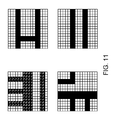
- FIG. 11 is a representation of several patterns which may be selected for targets, according to an embodiment of the invention.
- FIG. 12 illustrates frame displacements determined for multiple scanned frames scanned within a scanned area, according to an embodiment of the invention
- FIG. 13 illustrates a target image and a scanned image of a search window which is defined according to that target image, according to an embodiment of the invention
- FIG. 14 illustrates two search windows which are defined within a frame of a scanned image of a scanned area of the wafer, according to an embodiment of the invention.
- FIGS. 15A and 15B illustrate relationships between a wafer, dies of the wafer, a slice, and multiple scanned areas, according to an embodiment of the invention
- FIG. 16 illustrates scanning of a wafer in slices of alternating scanning directions, according to an embodiment of the invention
- FIGS. 17A and 17B illustrate relationships between an inspection machine and a CAD server, according to various embodiments of the invention
- FIGS. 18-21 illustrate a computerized method location based wafer analysis of at least one wafer, according to various embodiments of the invention.
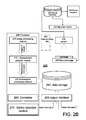
- FIG. 22 illustrates a system for location based wafer analysis, according to an embodiment of the invention.
- the phrase “for example,” “such as”, “for instance” and variants thereof describe non-limiting embodiments of the presently disclosed subject matter.
- Reference in the specification to “one case”, “some cases”, “other cases” or variants thereof means that a particular feature, structure or characteristic described in connection with the embodiment(s) is included in at least one embodiment of the presently disclosed subject matter.
- the appearance of the phrase “one case”, “some cases”, “other cases” or variants thereof does not necessarily refer to the same embodiment(s).
- one or more stages illustrated in the figures may be executed in a different order and/or one or more groups of stages may be executed simultaneously and vice versa.
- the figures illustrate a general schematic of the system architecture in accordance with an embodiment of the presently disclosed subject matter.
- Each module in the figures can be made up of any combination of software, hardware and/or firmware that performs the functions as defined and explained herein.
- the modules in the figures may be centralized in one location or dispersed over more than one location.
- FIG. 2 illustrates system 200 for generating calibration information usable for wafer inspection of a wafer, according to an embodiment of the invention.
- System 200 may be combined with an inspection machine that is used to inspect the wafer (e.g. during different stages of manufacturing thereof) or connected to such a machine, but this is not necessarily so.
- system 200 may be an inspection machine into which some or all of the modifications and/or features discussed below have been integrated.
- one or more of the components of system 200 may be used to generate calibration information that includes displacements determined for different parts of the wafer. Those displacements determined may later be used in manufacturing of the wafer, and/or in later stages of inspection of the wafer.
- wafer any person who is of skill in the art, wherever the term “wafer” is used—similar techniques, systems, methods and computer program products may be implemented for optical masks that are used for the manufacturing of wafers.
- system 200 may be used for inspection tools in which an entire wafer or at least an entire die is scanned for detection of potential defects (such as the Elite and the UVision systems by Applied Materials, Inc.), and/or for review tools which are typically of higher resolution (e.g. a scanning electron microscope, SEM) which are used for ascertaining whether a potential defect is indeed a defect.
- potential defects such as the Elite and the UVision systems by Applied Materials, Inc.
- review tools which are typically of higher resolution (e.g. a scanning electron microscope, SEM) which are used for ascertaining whether a potential defect is indeed a defect.
- Such review tools usually inspect fragments of a die, one at a time, in high resolution.
- such an inspection is not limited with respect to resolution or size of inspection area, and may be applied, by way of example, to review tools and to lower resolution wafer inspection tools alike.
- System 200 includes at least displacement analysis module 210 which determines displacements in the scanning of different parts of a wafer 100 , and subsequent processing module 220 which generates calibration information as well as additional information. As is demonstrated in some embodiments of the invention discussed below, the information generated by the subsequent processing module may be used to improve later scanning of the wafer, or of similar wafers.
- Each of displacement analysis module 210 and subsequent processing module 220 may be implemented by one or more hardware processors, either independent from those of the other modules, or shared with at least one of them.
- Those modules may also include software processing modules and/or firmware processing modules. For example, some or all of those modules may be implemented on a hardware processor 290 .
- the scanning of the wafer 100 may be implemented by any scanning, imaging and/or detecting apparatus, many of which are known in the art.
- Such an apparatus (denoted “sensor 230 ”) may be part of system 200 , but this is not necessarily so and the two may or may not be directly connected.
- Such an apparatus may be a scanning electron microscope, an optical inspection system and so forth.
- Wafer 100 may be similar to prior art wafer 10 discussed in the Background.
- a wafer 100 may be placed on a movable stage 232 .
- wafer 100 remains stationary with respect to movable stage 232 during the scanning of wafer 100 , and the respective movement between wafer 100 and sensor 230 (if required to image different parts of the wafer) is achieved by controllably moving movable stage 232 .
- movable stage 232 may be moved along an X-axis, a Y-axis, and possibly also a Z-axis direction (wherein the X and Y axes are perpendicular axes on the surface plane of movable stage 232 , and the Z-axis is perpendicular to both of those axes).
- sensor 230 may change a position in order to image different parts of wafer 100 .
- Displacement analysis module 210 receives information gathered in a scanning of an area 120 of wafer 100 (an example of such a scanned area 120 is provided in FIG. 9 ). It should be noted that while scanned area 120 is illustrated as a single continuous rectangular area, in other implementations the geometry and/or topology of the scanned area may vary. The scanning of the scanned area may be executed by sensor 230 , and may be based on scanning instructions retrieved from a scanning recipe (which may be stored in recipe database 234 ).
- the scanned area 120 is divided into multiple sub-areas, herein referred to as “scanned frames 130 ”.
- the dividing of the scanned area 120 into frames may be executed by the sensor 230 which scans the area 130 , by displacement analysis module 210 which processes the scanning data, or by another unit. While the frames 130 may be of identical shape and size, this is not necessarily so. As discussed below in greater detail, in some implementations dividing the scanned area 120 into frames 130 of varying sizes may be beneficial. Likewise, while the frames 130 are illustrated as nonoverlapping and as covering the entire scanned area 120 , this is not necessarily so. In some implementations one or more parts of scanned area 120 may be covered by more than one frame 130 , or by none at all. As will be demonstrated below, a displacement is determined by displacement analysis module 210 for each of those independent frames.
- each of the targets may be selected to include a pattern which is identifiable within its environment (e.g. by means of image processing).
- Each of the targets 140 has image data associated with it, as well as associated location information.
- the associated location information may be an assessed location, whose assessment may be facilitated by an alignment of the wafer with respect to sensor 230 (and/or to stage 232 ) prior to the scanning of area 120 .
- Such an alignment may be executed and/or controlled by alignment module 236 .
- Displacement analysis module 210 is configured to calculate a displacement for each target 140 out of multiple targets 140 selected in multiple scanned frames 130 which are included in scanned area 120 of wafer 100 . While not necessarily so, several targets 140 may be selected in each of the scanned frames 130 . Also, the multiple scanned frames 130 may be all of the plurality of frames defined within scanned area 120 , but a smaller amount of frames 130 may also be used.
- Displacement analysis module 210 is configured to calculate the displacement for each of the targets 140 based on a correlation of: (a) an image associated with the respective target 140 (an image which was obtained during a scanning of wafer 100 ), and (b) design data corresponding to the image.
- the design data may be, for example, computer aided design (CAD) data, which is used for the planning and/or manufacturing of wafer 100 .
- CAD computer aided design
- design data used in the specification should be expansively construed to cover any data indicative of physical design of a specimen and/or data derived from the physical design (e.g. through complex simulation, simple geometric and Boolean operations, etc.).
- CAD Computer Aided Design
- Design data can be provided in different formats as, by way of non-limiting example, GDSII format, OASIS format, etc.
- the displacement calculated for each of the multiple targets is indicative of the displacement of the corresponding target image to where it should have been, according to the design data.
- an estimated location of each scanned portion of the image with respect to some reference location of the image e.g. the topmost leftmost corner of that die
- the estimated location with respect to the scanned image may be translated to a supposed location with respect to the design data.
- Displacement analysis module 210 is further configured to determine a displacement (also referred to as “frame-displacement”) for each of the multiple scanned frames 130 , this determining based on the displacements calculated for multiple targets 140 in the respective scanned frame 130 .
- frame-displacement may have a physical meaning in at least some implementations of the invention, this is not necessarily so, and in other implementations its meaning may only be as an imaginary construct which is only defined as a result of a computation that is based on (though not necessarily solely on) the respective target-displacements.
- Subsequent processing module 220 utilizes the frame-displacements determined by displacement analysis module 210 .
- Subsequent processing module 210 is configured to generate calibration information that includes at least the displacements determined for the multiple scanned frames 130 .
- the calibration information may include additional information such as information regarding the locations of each of those frames 130 .
- subsequent processing module 220 further generates a target database that includes target image and location information of each target of a group of database targets, the group including multiple targets in each of the multiple scanned frames 130 .
- the calibration information and/or the target database may be stored in data storage 240 and/or transmitted to an external system (or another unit of system 200 ) via an output interface 295 .
- system 200 and of the various components thereof may be better understood in view of the process of operation. While not necessarily so, the process of operation of system 200 may correspond to some or all of the stages of method 500 . Likewise, method 500 and its possible implementations may possibly be implemented by a system such as system 200 . It is therefore noted that embodiments of the invention discussed in relation to method 500 may also be implemented, mutatis mutandis, in a hardware counterpart as various embodiments of system 200 , and vice versa.
- System 200 may enable utilizing the calibration information and the target database for determining location information in an inspection of another wafer.
- the location information may be used for example for detecting defects in an inspection image of such another wafer.
- system 200 may also include components which enable system 200 to utilize the calibration information and the target database for the determining of the location information in such an inspection (e.g. as exemplified in relation to the discussion of FIGS. 5 , 6 , 7 , and 8 ).
- system 200 may enable utilization of the calibration information and/or the target database for implementations other than defect detection (such as determining location information in an inspection of another wafer or otherwise); e.g. system 200 may enable utilizing that location information in correction of a location of an inspection beam (e.g. electrons beam) used for that inspection.
- an inspection beam e.g. electrons beam
- FIGS. 3 and 4 illustrate computerized method 500 for generating calibration information usable for wafer inspection, according to an embodiment of the invention.
- method 500 may be carried out by a system for generating calibration information usable for wafer inspection, such as system 200 .
- some or all of the disclosed stages of method 500 may be implemented for the same single wafer layer, and the method may be repeated (e.g. independently) for different layers (some or all of the layers of the respective wafer). Likewise, the method may be implemented for optical masks used in the manufacturing of wafers.
- method 500 includes stage 540 which is carried out for each scanned frame out of multiple scanned frames which are included in a scanned area of a wafer.
- the multiple scanned frames may include all of the plurality of scanned frames included in the scanned area of the wafer, or only some thereof.
- stage 540 includes: for each target out of multiple targets selected in the scanned frame, calculating a displacement (herein below also referred to as “target-displacement”) for the target.
- the calculating of the displacement for each of the targets in those scanned frames is based on a correlation of: (a) an image associated with the target and which was obtained during a scanning of the wafer, and (b) design data corresponding to the image.
- the design data may be computer aided design data (i.e. CAD data), but this is not necessarily so.
- stage 540 may be carried out by a displacement analysis module such as displacement analysis module 210 .
- the scanned area of the wafer may be a whole die or a part of it. Occasionally, the terms “the die area” or “the scanned area” would be used interchangeably with the term “the scanned area of the wafer”. It should be noted that when the term “the die area” or “the scanned area” is used, it is not limited to a single die or a portion thereof.
- the scanned area of the wafer may also be referred to as “reference area” or “reference die”, as displacements determined based on this area may later be used to correct displacement errors in other areas of the wafer (or of other, similar, wafers)
- the scanned area is divided into multiple scanned frames (e.g. frames 130 ). These frames may be adjacent and/or nonoverlapping with respect to one another, but neither of these characteristics is compulsory. Some of the ways in which such frames may be determined are discussed below. While not necessarily so, for the sake of clarity it is assumed that all the frames are rectangular, parallel to one another, and substantially parallel to at least one scanning axis in which the scanned area is imaged.
- each frame may be defined by its anchor/start point (X 0 , Y 0 ), and by its dimensions (d x , d y ).
- the frames may be of identical size, but this is not necessarily so, and frames of intentionally distinct sizes may be defined within the die area.
- a size of a frame may be 100 by 100 micrometers ( ⁇ m).
- frames may be defined in relation to a specific scanned image of the wafer, they could only be regarded as constructs which are defined in relation to the wafer and/or to design data (e.g. CAD data) that includes design details of the wafer.
- design data e.g. CAD data
- each target may be defined by its anchor/start/center point (X 0 , Y 0 ), and by its dimensions (d x , d y ).
- the targets may be of identical size.
- the targets may be selected based on an analysis of scanned image data acquired during a scanning of the scanned area, based on content thereof.
- each of the targets may include a pattern which is identifiable within its environment.
- the size of such an environment may vary, e.g. based on the expected dislocation errors in a given imaging scenario. It should be noted that in other implementations, the targets may be selected based on an analysis of the design data, in addition to or instead of the processing of the scanning image data.
- stage 540 of a target-displacement for each of the multiple targets is based on a correlation of an image associated with the respective target (an image which was obtained during a scanning of the wafer), and a corresponding design data.
- the images of the different targets may be of identical size (e.g. 32 by 32 pixels), but this is not necessarily so.
- most or all of the targets may include patterns that are identifiable within the environment of the respective target.
- the identifiability of the patterns of the targets may be a key factor in the selection (e.g. in stage 520 ) of the targets based on the scanned image.
- Some of the other factors that may affect the selection of the targets based on the scanned image are, for example, usability for determination of location and/or displacement in at least one direction.
- FIG. 11 is a representation of several patterns which may be selected for targets, according to an embodiment of the invention.
- each of the target images is a 16 ⁇ 16 pixels binary image.
- the targets may either be directly identifiable (e.g. as exemplified in FIG. 11 ), or identifiable after implementation of one or more image processing algorithms or filters (e.g. closing and opening image processing operations) to the image data.
- design data used in the specification should be expansively construed to cover any data indicative of physical design of a specimen and/or data derived from the physical design (e.g. through complex simulation, simple geometric and Boolean operations, etc.).
- CAD Computer Aided Design
- Design data can be provided in different formats as, by way of non-limiting example, GDSII format, OASIS format, etc.
- the displacement calculated for each of the multiple targets is indicative of the displacement of the corresponding target image to where it should have been, according to the design data.
- an estimated location of each scanned portion of the image with respect to some reference location of the image e.g. the topmost leftmost corner of that die
- the estimated location with respect to the scanned image may be translated to a supposed location with respect to the design data.
- Correlation between the target image and at least a portion of the design data may then be computed, and a similarly sized area of the design data in the environment of the supposed location whose correlation to the target image is the highest may then be selected.
- a distance between the supposed location and the location of the selected area may then be determined, and used as a base for the determination of the displacement (especially, the displacement may be equal to that distance).
- the selection of the selected area may follow a series of correlation steps (e.g.
- DIC Digital image correlation
- the target-displacements of the various targets may be determined as vectors (particularly, they may be determined as two dimensional vectors), but this is not necessarily so. Some or all of the target-displacements determined may be one dimensional (scalar). For example, if some (or all) of the targets are intended for determining of displacement only in one direction (e.g. an X-axis direction or a Y-axis direction), then a displacement value (scalar) may be determined for each such target, and not a vector. Clearly, even if a vector displacement is determined, a projection of that vector on any axis may be determined and later used in further computations.
- the calculating of stage 540 is not necessarily carried out for each of the plurality of targets selected in each of the frames.
- the number of targets selected in a given frame may be larger than the number of valid target-displacements required for successful execution of future stages of method 500 .
- some of the target images may not be successfully correlated to any area of the design data, and may therefore be considered defective and not used in later stages of method 500 .
- calculating of target-displacement for targets in one or more of the multiple scanned frames may also be implemented for targets other than the aforementioned group of multiple targets. For example, selection of the multiple targets, out of all of the targets for which target-displacement was calculated, may be carried out after the selection—e.g. during stage 550 of determining.
- Stage 550 of method 500 includes determining a displacement for each of the multiple scanned frames, wherein the determining of stage 550 is based on the displacements calculated for multiple targets in the respective scanned frame (that is, on the target-displacement of such targets). Such displacements determined in stage 550 for the scanned frames are also referred to as “frame-displacements”. Referring to the examples set forth in the previous drawings, stage 550 may be carried out by a displacement analysis module such as displacement analysis module 210 .
- the determining of frame-displacements in stage 540 may be carried out in different ways, and different types of frame-displacements may be determined (in different implementations of the invention or even in a single implementation).
- a vector (and especially a two-dimensional vector) displacement may be determined, indicating both direction of the displacement and the size thereof.
- a scalar indicating only the size of the displacement (either of a projection of the displacement on a known axis, or regardless of such an axis), only a direction of which, or another meaning.
- frame-displacement may have a physical meaning in at least some implementations of the invention, this is not necessarily so, and in other implementations its meaning may only be as an imaginary construct which is only defined as a result of a computation that is based on (though not necessarily only on) the respective target-displacements.
- the determining may include, for example, determining at least one (and possibly all) of the frame-displacements based on a result of averaging of the target displacements (wherein different types of averages may be implemented, e.g. arithmetic mean, median, geometric median, geometric mean, harmonic mean, quadratic mean, weighted mean, truncated mean, interquartile mean, midrange, winsorized mean, and so forth).
- arithmetic mean e.g. arithmetic mean, median, geometric median, geometric mean, harmonic mean, quadratic mean, weighted mean, truncated mean, interquartile mean, midrange, winsorized mean, and so forth.
- Such a frame-displacement may also be carried out by averaging target displacement in a first axis (e.g. the x-axis) independently from the averaging of the target displacements in another axis (e.g. the y-axis).
- the averaging of target displacements for providing components (“coordinates”) of the frame-displacement separately may be executed on different sub-groups of the multiple targets. If, continuing the example offered above with relation to stage 540 , a scalar displacement value is determined for each target in a frame, and not a vector, then each such target-displacement of a single target may only be averaged once—e.g. either for determination of x-axis frame-displacement value or for determination of y-axis frame-displacement value.
- FIG. 10A illustrates a scanned frame 130 and graphical representation of corresponding part of the design data, denoted 910 , according to an embodiment of the invention.
- the design data is also referred to below as “CAD data”. It however may be another type of data (e.g. either vector or grayscale intensity image format data, generated by a computer or not, etc.).
- the boundaries of the graphically represented corresponding part of the design data are selected based on preliminary registration of the scanning to the design data (e.g. based on registration of a corner of the die 110 —or of another die—before the scanning of the scanned area begins). It can be seen that due to displacement between the two regions (and also to other transformation such as linear stretching/compression, vertically, horizontally, or otherwise), different parts of the integrated circuit (illustrated by the background pattern in each of the areas denoted 910 and 130 ) are included in the scanned frame 130 and in the graphical representation of the corresponding part of the design data, denoted 910 .
- the frame-displacement that may be determined for scanned frame 130 (e.g.
- stage 550 may indicate an average displacement of different parts of the scanned frame 130 .
- an average displacement of different parts of the scanned frame 130 As aforementioned—not all of the parts of the scanned frame 130 are necessarily equally displaced. This may be the result of, for example, linear stretching or compression during the scan, scanning errors, and manufacturing errors.
- the scanned frame 130 includes multiple targets (represented by squares 140 ) which were selected in it (e.g. in stage 520 ).
- the targets (for which the notion 140 will be used below, for the sake of clarity) are illustrated as square targets, but, as aforementioned, this is not necessarily so.
- the selection of the different targets 140 may be based on the content of the corresponding areas in the scanned image 130 (which is illustrated as confined within the respective squares 140 ).
- FIG. 10B illustrates the scanned frame 130 of FIG. 10B and the corresponding graphical representation of design data (denoted 910 ). On the latter, two sets of areas are illustrated. The first set of areas, denoted 942 and represented in monotonously dotted border lines, are located in similar locations with respect to the area denoted 910 , as targets 140 . That is, the squares denoted 942 may be regarded as the assumed locations of the targets with respect to the CAD data.
- the second set of areas are areas that contain similar content to those of the respective targets 140 as illustrated in the example scanned frame 130 .
- Each area 940 in the example illustrated is located to the left and towards the top in respect to a corresponding area 942 . However, it is not necessary that all of the areas 940 would be displaced in similar direction with respect to the corresponding areas 942 .
- Each of the areas 940 may be selected based on a correlation of the respective target image with the design data. If the design data is provided in grayscale intensity image format, it can be correlated with the scanned image data in a reasonably straightforward manner. However, if the design data is provided in vectorial format, the correlation may require additional interchangeably steps. For example, the correlation may be preceded by processing the vectorial design data to provide a corresponding grayscale intensity format image, which may then be correlated with the respective target image. Alternatively, the respective target image (if provided in grayscale intensity image format) may be converted to a vector format, wherein the correlation is done in a vector space.
- Conversion of a vectorial design data to provide a corresponding grayscale intensity format image may be implemented in various ways, and may take into consideration (or otherwise simulate) various factors, such as target image pixel size, scanning machine characteristics and operating parameters, illumination parameters, optical parameters, target image statistics (e.g. average grey level), and so on and so forth.
- the distance between each of the targets and the corresponding area 940 may be determined (as well as projection of such distance on one or more axes, and/or direction of that distance with respect to any one or more such axes). For example, such distance may be determined between the corner pixels of each of the corresponding areas 940 and 942 .
- the calculating of the target-displacement for each of those targets may be determined on that distance and/or other parameters—such as those discussed above.
- the target-displacements 950 determined are equal (or at least based on, e.g. a truncated version thereof) to the distance between each two areas 940 and 950 , and on the direction of such a displacement.
- a displacement 950 may be represented by an x-axis displacement and a y-axis displacement (or any other suitable two projections on two axes).
- displacements 952 are determined along the y-axis, while for other targets displacements 954 are determined along the x-axis. It should be noted that while not illustrated, displacement along two (or more) axes may be determined for one or more of the targets.
- the target-displacements 952 and/or 954 may be equal to the projection of the distance between two corresponding areas 940 and 942 on the corresponding x or y axes, and may also be calculated based on that distance and/or on such a projection thereof.
- the corresponding frame-displacement 960 may be determined based on some or all of these target-displacements 950 . As aforementioned, the determining of the frame displacement 960 may be executed by averaging one or more groups of targets out of the multiple targets.
- the determining may include (or be preceded by) selection of the multiple targets that the displacements determined for which will be used for the determining of the frame-displacement of the scanned-frame in which those targets are included.
- the determining may include (or be preceded by) selection of the multiple targets out of all of the targets for which target-displacement was calculated and may be carried out after the selection (e.g. selecting 80% of the targets having the middle displacement values).
- Frame displacements may be determined in stage 540 to all of the plurality of scanned frames in the scanned area of the wafer, but this is not necessarily so.
- frame-displacement for some other scanned frames may not be determined at all, or may be determined in other ways—e.g. based on frame-displacements determined for adjacent scanned-frames rather than on the target-displacements of targets within the respective frames.
- the determining of the frame-displacement for each of the scanned frames may be based only on the target-displacements of the multiple targets in it, but this is not necessarily so, and in other implementations it may also depend on additional parameters (e.g. number of such targets, location of the frame with respect to the die, physical properties of the area of the wafer corresponding to the scanned frame, and so forth).
- stage 550 is illustrated as following stage 540 , it may be carried out partly concurrently with it. For example, determining a frame displacement for a first scanned frame which was previously scanned may be carried out before the target-displacement values have been determined for targets of a second scanned framed scanned later than the first scanned frame. Generally, stages 540 and/or 550 may be carried out at least partly while the scanned area is being scanned.
- FIG. 12 illustrates the frame displacements 960 determined for multiple scanned frames 130 scanned within scanned area 120 , according to an embodiment of the invention.
- method 500 further includes stage 560 of generating: (a) calibration information including the displacements determined for the multiple scanned frames; and (b) a target database that includes target image and location information of each target of a group of database targets, the group including multiple targets in each of the multiple scanned frames.
- the location information of each of those targets may be determined with respect to an anchor point of the frame in which it is included (the displacements of the frames with respect to an external anchor point are referred to in the formerly discussed calibration information).
- stage 560 may be carried out by a processing module such as subsequent processing module 220 .
- the generating of the calibration information may include generating of a table, an array (or any other one or more suitable data structures) that identify the different scanned frames, and include at least the frame-displacements determined for the multiple scanned frames.
- table 1 illustrates a data structure storing the calibration information generated in stage 560 , according to an embodiment of the invention.
- table 1 illustrates a data structure storing the calibration information generated in stage 560 , according to an embodiment of the invention.
- this is just an example, and other data structures may be implemented.
- each of the fields is optional, and may be differently implemented, or not implemented at all.
- the frame ID field stores an identifier identifying each of the multiple scanned frames.
- the unit digit represents the column
- the tenths digit represents the row, when referring to the example of FIG. 12 .
- the X start and the Y start fields indicate the position in which each scanned frame starts (e.g. the location of the top-left corner thereof).
- the units used may be those of the design data (e.g. CAD data)—such as micrometers ( ⁇ m)—and may be those of the scanned image—e.g. pixels.
- the X length and the Y length fields indicate the dimensions of each frame, e.g. in case different scanned frames are of different sizes.
- the units used may be those of the design data (e.g. CAD data)—such as micrometers ( ⁇ m)—and may be those of the scanned image—e.g. pixels.
- the X disp and the Y disp fields indicate the frame-displacement of the respective scanned frame.
- the units used may be those of the design data (e.g. CAD data)—such as micrometers ( ⁇ m)—and may be those of the scanned image—e.g. pixels.
- Other representations of the displacement may also be used (e.g. size and direction of displacement, (R, ⁇ )).
- the calibration information (which may also be referred to as “displacement map”) may later be used in the scanning of other dies of the wafer (or of other wafers) during run-time mode.
- the generating of the target database may include generating the target database that includes target image and location information of all of the multiple targets of stage 540 , but this is not necessarily so. Some of the targets whose target-displacement was used in stage 550 for the determining of the respective one or more frame-displacements may, in some implementations, not be included in the group of database targets.
- the number of targets from each of the scanned frames to be included in the group of database targets may be limited, for example, by memory size limitations of the recipe database (which may for example be part of the inspection tool).
- the generating of the target database may include generating the target database that includes the target images used for the correlation of stage 540 , this is not necessarily so, and in other implementations other images may be used for some or all of the database targets. For example, images of different size, resolution, color depth or location may be saved, for some or all of the database targets.
- the location information generated may be corrected location information corrected based on the frame-displacements determined. While the location information may be corrected based on the target-displacements of the respective targets, the correction based only on the respective frame-displacement may be favored.
- the group of database targets includes at least two target images which are saved for later X-axis displacement correction and at least two are saved for later Y-axis displacement correction in each of the scanned frames. Other minimum numbers of images may clearly be selected, and more than the minimal number of targets may be saved.
- the selection of targets to be saved i.e. the selection of the group of database targets
- the number of targets selected may be limited by the storage in the recipe (to which those targets may be saved, along with the displacement maps).
- Stage 560 may include saving of the calibration and/or the target database to one or more data storages (e.g. computer memory such as RAM, hard-disk, optical storage, etc.).
- the saving may include stage 561 of saving the location information of the database targets in design data coordinates (e.g. CAD data coordinates) such as micrometers.
- Stage 560 may be followed by stage 565 (illustrated in FIG. 4 ) of transmitting the calibration information and/or the database targets—or parts thereof.
- the transmitting may include transmitting such data to one or more databases, to other one or more components of the same system, or to one or more other machines.
- Stage 560 may be followed by stage 5400 of enabling utilizing the calibration information and the target database for determining location information in an inspection of another wafer.
- the location information may be used for example for detecting defects in an inspection image of such another wafer.
- method 500 may also include the actual utilization of the calibration information and the target database for the determining of the location information in such an inspection.
- method 500 may also include enabling utilization of the calibration information and/or the target database for implementations other than defect detection (such as determining location information in an inspection of another wafer or otherwise).
- method 500 may include enabling utilizing the calibration information and the target database for determining such location information in the inspection of the another wafer, and enabling utilizing that location information in correction of a location of an inspection beam (e.g. electrons beam) used for that inspection.
- an inspection beam e.g. electrons beam
- FIG. 4 illustrates computerized method 500 for generating calibration information usable for wafer inspection in more detail, according to an embodiment of the invention.
- the stages which are illustrated in FIG. 4 but not in FIG. 3 are optional, and the different possible combinations of those stages and of stages 540 , 550 and 560 may be implemented in different embodiments of the invention.
- Method 500 may include stage 510 of scanning the scanned area of the wafer to provide scanned image data.
- the scanning of the scanned area may be a part of larger parts of the wafer—e.g. a die, multiple dies, or even the entire wafer (or at least the parts of which that include electronic circuit parts).
- the scanning may be carried out in different techniques such as electron beam scanning and optical scanning.
- stage 510 may be carried out by any scanning, imaging and/or detecting apparatus such as sensor 230 .
- stages 520 , 530 , 540 , 550 , and/or 560 may be carried out at least partly concurrently with the scanning of one or more parts of the wafer, such as the scanning of the scanned area of the wafer in stage 510 .
- stage 510 may precede stage 540 , and possibly other stages of method 500 (e.g. stages 520 , 530 , 550 , 560 ).
- method 500 includes scanning of a reference die (or other scanned area), information gathered during such a scanning may be used to generate the calibration information which may later be used to correct displacement errors when other dies of the wafer (or of other wafers) are scanned.
- Method 500 may also include selection of the reference area (not illustrated), either prior to the scanning of at least part of the wafer, or as a result of such a scanning.
- the scanned area may be selected in different ways in different implementations of the invention—for example, it may be the first die of the first column (or the last die of that column) or of another column, it may be a substantially central reference die, etc.
- Method 500 may further include additional stages that precede the optional scanning of the scanned area in stage 510 , such as wafer alignment and translation of the wafer so that the reference area may be scanned.
- the global alignment of the wafer e.g. by aligning a stage on which the wafer is positioned
- the translation of the wafer may include translating the wafer to a position in which the reference die may be scanned.
- the information required for successful execution of such preliminary stages may be retrieved from a previously determined recipe (or recipe parameters) and/or from a configuration file (referred to as “config”) which does not pertain to a specific scan or to a specific layer of a wafer, but rather to a configuration of the scanning machine executed right after its manufacture (or at a later time, irrespective of any specific target to be scanned).
- config a configuration file
- Method 500 may include stage 520 of selecting the image for each of the multiple targets based on image processing of the scanned image data.
- stage 520 may be carried out by an image processing module such as image processing module 250 , which may and may not be part of the aforementioned displacement analysis module.
- the targets may be selected based on processing of the design data (in addition or instead of the selecting based on the scanned image data).
- the selecting of the images for the different targets may be based on the content of such images—and its suitability for correlation with design data.
- Stage 520 may include (or be followed by) stage 521 of saving the multiple images later used in stage 540 , based on the selection.
- the saving may include saving for each of the multiple targets position information with regard to the scanned data (e.g. positions in pixels) and/or an estimated location of those target images (with respect to the design data).
- scanned image information may be stored for a large number of targets (e.g. 100,000 targets in a die, each of which sized 32 ⁇ 32 pixels) whose estimated location is known (e.g. based on location information of the inspection system).
- the selecting of stage 520 may be at least partly concurrent to the scanning of stage 510 .
- Method 500 may also include stage 530 of defining the scanned frames based on image processing of the scanned image data.
- the defining of the scanned frames may also be based on (additionally or instead of the scanned image data) the design data, required abilities of correction in future scans, capabilities of the machinery used for the scanning of the scanned area, for the calculation of the target-displacements and/or for the determination of the frame-displacements, etc.
- the defining of a frame may include defining its dimensions and/or its location.
- stage 530 may be carried out by an image processing module such as image processing module 250 .
- the defining of stage 530 may be at least partly concurrent to the scanning of stage 510 , and/or to the selecting of stage 520 . It is noted that, according to an embodiment of the invention, the defining of the frames may be based on results of the calculating of stage 540 . For example, each frame may be defined so that the majority of the targets included therein have substantially similar target-displacements.
- method 500 may include loading definitions of predefined frames (e.g. from the recipe or the config).
- the number of frames defined in stage 530 may be, by way of example only, 100-200 per slice, wherein each die may hold some 200 slices (the scanning of any die of a wafer or part thereof may be executed in elongated slices, substantially parallel to each other, which are scanned serially, usually in alternating scanning direction).
- the number of scanned frames per slice may be 300, and the number of slices may be 500.
- the defining of the frames may be implemented in various ways.
- the determination of the frames may be a result of a balancing between the machine scanning capabilities and the required abilities of correction in future scans (which relates to the type of distortion encountered).
- stage 530 includes defining the frames during the run time of the scanning
- the distortion level may be measured during the set-up scanning, after data of multiple target windows is saved, and the frames may then be defined based on the distortion analysis. It is noted that if some areas of the scanned layer are not highly distorted, the amount of target windows in the (relatively large) frame defined may be reduced, thus saving data storage capacity, and future computation time.
- stage 540 may be based on frames of a fixed size (e.g. a minimal size), and based on the displacement determined for the targets of one or more of the frames, other frames may be defined (e.g. by splitting, combining, or otherwise modifying the preliminary frames).
- a fixed size e.g. a minimal size
- other frames may be defined (e.g. by splitting, combining, or otherwise modifying the preliminary frames).
- the calculating of the target-displacements and/or the determining of the frame-displacements may be implemented for X-axis displacements and for Y-axis displacements, e.g. as illustrated in FIG. 10D .
- a frame-displacement vector (if indeed implemented as a vector) for the scanned frames may be determined by determining two scalar components independently of each other.
- target-displacement values of targets that were selected for X-axis displacement information gathering may be used for determining of an X-axis displacement value
- values of targets that were selected for Y-axis displacement information gathering may be used for determining of a Y-axis displacement value
- those two values may be saved as a displacement vector (or alternatively just as two scalar values).
- stage 540 may include stage 541 of calculating in each of the multiple scanned frames only X-axis displacement for a first subgroup of the targets of the scanned frame, and/or stage 542 of calculating only Y-axis displacement for a second subgroup of other targets of the scanned frame. Both X-axis and Y-axis displacements may be determined for a third subgroup of yet other targets, if implemented.
- stage 550 of determining of the displacement for at least one of the scanned frames may further include stage 551 of determining for the scanned frame an X-axis displacement value for the frame based on the displacements determined for targets of a first subgroup of the targets of the frame (and, according to an embodiment of the invention, also of the third subgroup, but not of the second subgroup), and/or stage 552 of determining a Y-axis displacement value for the frame based on the displacements determined for the targets of the second subgroup (and, according to an embodiment of the invention, also of the third subgroup), wherein the determining of the Y-axis displacement value in stage 552 is irrespective of the displacements determined for the targets of the first subgroup.
- Stage 541 and/or 542 may be carried out, if implemented, for targets in one or more of the multiple frames, or in all of them.
- Stages 551 and/or 552 may be carried out, if implemented, for one or more of the multiple frames, or for all of them.
- FIG. 5 illustrates additional stages of method 500 , according to an embodiment of the invention.
- the stages illustrated in FIG. 5 are optional, and may be implemented in order to detect defects in a second wafer area other than the scanned area (whether on the same wafer or on another wafer) using the displacement values calculated for the scanned frames of the scanned area.
- Stage 570 which may be carried out after stage 560 (and possibly after stage 565 , if implemented), includes the scanning of a second wafer area. While not necessarily so, the second area is not the formerly discussed scanned area. As aforementioned, the second wafer area may be on the same wafer (e.g. another die, or within another die) or even on another wafer. If the second wafer area is located on another wafer, the other wafer and the originally scanned wafer would usually include similar electronic circuits (e.g. be wafers for the production of the same product, possibly from the same batch). The second wafer area would usually belong to the same layer as the originally scanned area (or to a corresponding layer, if it belongs to another wafer).
- the content of the second wafer area would usually be similar to some or all of the content of the initially scanned area.
- the second wafer area may be a similar die (on either the same wafer or a similar wafer).
- Multiple frames may be defined within the second wafer area, wherein each of those frames may correspond to one or the scanned frames for which a frame-displacement was determined.
- the displacement values of some scanned frames may be averaged.
- each of the frames defined in the second wafer area corresponds to exactly one of the scanned frames, and includes substantially similar content (with some leeway which may exist for example due to scanning inaccuracy errors and other causes of inaccuracies).
- stage 570 may be executed by the same scanning machine which was used for the scanning of the scanned area (e.g. in stage 510 ). Using the same scanning machine for the scanning of those two wafer areas enables, inter alia, to compensate for displacement errors which are characteristic of that machine (e.g. x-y stage disposition errors, charging pattern if it is an electron beam scanner, and so on).
- stage 570 may be carried out by any scanning, imaging and/or detecting apparatus, such as sensor 230 .
- the scanning of the second wafer area in stage 570 and possibly of other areas of the same wafer may be executed during defect-detection run time.
- defect detection run time many wafers may be scanned for the detection of defects. For example, an entire batch of wafers which are manufactured together may be inspected for defects, or even multiple such batches. Since many wafers are possibly inspected for defects during the defect-detection run-time, and since a lengthy run-time defect detection process delays the manufacturing process, reducing the time required for the run-time defect detection is beneficial in at least some scenarios. In such scenarios, fast techniques for compensating for location inaccuracies and displacements may be desirable.
- the defect detection of many similar wafers may utilize calibration information (and target database) which was generated following a single determining of the frame-displacements (e.g. in a single instance of stage 560 ), time-consuming processing that is invested in stage 560 and/or in one or more of the stages preceding stage 560 has relatively small implications on the per-wafer overall defect detection time (to which the relative part of the duration of displacement evaluation may be added).
- stages 570 through 5140 which are illustrated in FIGS. 5 and 6 may be repeated for N different wafer areas (this is illustrated by the “ ⁇ N times” denotement).
- the displacement values used for the second wafer area may be used for another area in the same wafer, and so on.
- the following discussion which pertains to FIGS. 5 and 6 would mainly focus on the implementation to a single wafer area (i.e. the second wafer area).
- Stage 580 which is initiated after the beginning of the scanning of stage 570 (and possibly when stage 570 is done), includes defining search windows in the scanned image (or, possibly, images) of the second wafer area.
- Each of the search windows defined in stage 580 corresponds to one of the database targets.
- a corresponding search windows may be defined for each of the database targets, but this is not necessarily so, and fewer search windows may also be defined.
- the defining of each of the search windows in stage 580 is based on the determined displacement of the respective scanned-frame in which the corresponding target is included. Referring to the examples set forth in the previous drawings, stage 580 may be carried out by a correlator such as correlator 260 .
- the location information generated in stage 560 of the group of database targets may be corrected location information corrected based on the frame-displacements determined. Such a correction may be (though not necessarily so) based only on the respective frame-displacement.
- the location information of the database targets may be corrected in stage 580 for the defining of the search windows.
- the defining of the search windows includes defining the location of each search window, and possibly also the size thereof. It is noted that not necessarily all of the search windows are of the same size (for example, if the variance of target-displacements of targets of a given scanned frame was high, such data may be saved in the calibration information—and larger search windows may be defined in corresponding frames of the second wafer area).
- the search windows defined are usually larger than the corresponding database targets, and are expected to include scanning image data similar to that of the corresponding target image (and clearly additional image data as well, of a nearby area of the wafer). For example, if a target image (e.g. similar to one of the illustrations of FIG. 11 ) is 32 ⁇ 32 pixels, then the corresponding search window defined in stage 580 may be, for example, 100 ⁇ 100 pixels.
- FIG. 13 illustrates one target image 410 (e.g. as stored in the target database) and a scanned image of a search window 180 which is defined according to that target image 410 , according to an embodiment of the invention.
- the search window defined (and the corresponding search image 180 ) is significantly larger than the target image 410 to which it corresponds, when comparing pixel size.
- Area 182 within the search window (this area is surrounded by a bold black border) corresponds to the target image 410 in size and in content.
- target image 410 and area 182 are not necessarily identical, e.g.
- FIG. 14 illustrates two search windows 180 which are defined within a frame of a scanned image of a scanned area of the wafer, according to an embodiment of the invention.
- Areas 184 are the estimated locations of targets. Based on those areas 184 the search windows 180 may be defined, and the areas 184 corresponding to the respective targets may be identified within the search windows 180 .
- stage 580 may be followed (or be at least partly concurrent with) stage 590 of correlating each of multiple target images (e.g. at least those for which a corresponding search window was defined in stage 580 ) to at least a portion of a scanned image of the corresponding search window.
- stage 590 may be carried out by a correlator such as correlator 260 .
- the correlating of stage 590 for each of the target images may include executing a series of correlations of the M by N pixels sized target image (e.g. 32 ⁇ 32 sized) with a series of similarly sized M by N pixels areas of the corresponding search window, and selecting the M by N area having the best correlation with the target image.
- the correlation may include correlations with all of the M by N pixels sized areas in the search window, but this is not necessarily so, and only some of them may be correlated.
- the correlation of the target image and the one or more portions of the scanned image of the corresponding search window may be symmetric for X-axis and Y-axis, this is not necessarily so.
- targets that are selected for X-axis displacement assessment may be correlated with more significance to X-axis correlation
- targets that are selected for Y-axis displacement assessment may be correlated with more significance to Y-axis correlation.
- a result of stage 590 may be an indication of part of the search window whose correlation to the target image is the best, and/or correlation results determined of multiple parts of the search window.
- Method 500 continues with stage 5100 of calculating a run-time displacement for each out of multiple database targets (possibly for all of them), wherein the calculating for each of the multiple targets is based on a correlation of the respective target image to at least a portion of a scanned image of the corresponding search window (e.g. the correlation of stage 590 ).
- the run-time displacements calculated for each of the multiple database targets is indicative of the displacement of a corresponding target image to where it should have been, according to the design data.
- the run-time displacement may be calculated based on the distance between the location of the correlated portion of the search window (e.g. area 182 of FIG. 13 ) and the location information of the corresponding database target (e.g. as retrieved from the target database).
- the run-time displacement may also be calculated based on a distance between those two locations along an axis (e.g. the X-axis and/or the Y-axis).
- the run-time displacement like the target displacement calculated in stage 540 , may be a scalar displacement or a vector displacement, and may pertain to the overall displacement or only to displacement along an axis. Referring to the examples set forth in the previous drawings, stage 5100 may be carried out by a correlator such as correlator 260 .
- method 500 includes carrying out for each out of multiple targets of the database the following actions: (a) defining a corresponding search window based on the determined displacement of the scanned-frame in which the target is included; and (b) calculating a run-time displacement for the target, based on a correlation of the target image to at least a portion of an area of the scanned image which is defined by the corresponding search window.
- Optional stage 5140 which is executed after stage 5100 , includes detecting defects in the second wafer area, wherein the detecting is provided with the help of at least one of the target run-time displacements, and possibly with the help of all of them.
- stage 5140 may be carried out by a defect detection module such as defect detection module 270 .
- Stage 5140 may be followed by a stage of reporting some or all of the defects (e.g. as part of the inspection results provided in stage 5150 ), wherein the reporting may include reporting location information of at least one of the defects (and possibly of all of them) in coordinates of the design data (e.g. in high accuracy, and relative to CAD origin or another anchor point identified therein). It should be noted that the determining of stage 5140 may include determining for each of the detected defects a location in coordinates of the design data (e.g. in CAD coordinates). The defects may be associated in high accuracy to design data, which may enable various utilizations such as (though not limited to) design based classification.
- the detecting of defects may be similar to known practices of defect detecting.
- the detecting of defects in stage 5140 may include comparing between the scanned image of the second wafer area, and reference data.
- reference data may be design data (e.g. CAD data) in Die-to-Database (D2 DB) defect detection techniques, and may be scanned image data of other parts of the wafer in Die-to-Die (D2D) or Cell-to-Cell (C2C) defect detection techniques.
- D2D Die-to-Database
- C2C Cell-to-Cell
- D2 DB detection defects in some parts of the second wafer area may be detected using D2D detection, while defects in other parts of the second wafer area may be detected using D2D and/or C2C detection.
- the decision as to what comparison technique may be based on a predetermined comparison scheme (also referred to as “layout” or “die layout”), in which different portions of each die are assigned different comparison techniques.
- a predetermined comparison scheme also referred to as “layout” or “die layout”
- stage 5140 Some of the manners by which the defect detection of stage 5140 may be executed with the help of one or more of the run-time displacements calculated in stage 5100 are detailed in relation to FIG. 6 .
- FIG. 6 illustrates additional stages of method 500 , according to an embodiment of the invention.
- the stages illustrated in FIG. 6 are optional, and may be implemented in order to detect defects in the second wafer area with the help of one or more of the run-time displacement values calculated in stage 5100 .
- Method 500 may include stage 5110 of determining a frame run-time displacement for each of multiple run-time frames scanned in the second wafer area, based on the target run-time displacements determined for multiple targets in the respective run-time frame.
- the determining of the frame run-time displacements in stage 5110 may be implemented similarly to the determining of the frame-displacements in stage 550 (for which several examples of implementation were provided), but this is not necessarily so.
- Frame run-time displacements may be determined in stage 5110 for all of the frames in the second wafer area, but not necessarily so. Also, frame run-time displacements may be determined in stage 5110 for all of the frames which correspond to the multiple scanned frames of stage 550 , but this is not necessarily so.
- run-time frame-displacements may have a physical meaning in at least some implementations of the invention, this is not necessarily so, and in other implementations its meaning may only be as an imaginary construct which is only defined as a result of a computation that is based on (though not necessarily only on) run-time displacements calculated for the respective targets.
- Method 500 may include stage 5150 of providing inspection results for the wafer which includes the second wafer area inspected wafer, with the help of at least one of the frame run-time displacements. This may be facilitated by executing stage 5140 as an intermediate step (and possibly other stages as well, such as stages 5120 and 5130 ), but this is not necessarily so.
- the providing of stage 5150 may include providing some or all of the results of the defect detection of stage 5140 .
- stage 5150 may be carried out by a processor such as processor 290 .
- the frame run-time displacements may also be utilized for other uses, such as improving an accuracy of the scanning of the inspection area, or parts thereof.
- the scanning of the inspected area may include improving location accuracy of the scanning of at least one of the run-time frames based on the frame run-time displacement determined for another run-time frame. This may be implemented, for example, by correcting a direction of an electron beam which is used for the scanning of a given frame (or part thereof) based on the run-time displacement of a previous frame.
- the improving of the accuracy may be implemented by correcting a direction and/or a location of a camera, a sensor, or a stage on which the wafer is placed, during a scanning of a given frame (or part thereof) based on the run-time displacement of a previous frame.
- Method 500 may include stage 5120 of modifying a comparison scheme, which is used for defect detection, based on the run-time displacements calculated for multiple database targets.
- the modifying of stage 5120 may include updating the comparison scheme.
- stage 5100 may be executed based on the calculations of stage 5100 and further based on the intermediary computations of stage 5110 (determining of the frame run-time displacements).
- computations other than those of stage 5110 may be used for the updating in stage 5120 .
- stage 5120 may be carried out by a defect detection module such as defect detection module 270 .
- stage 5120 may include stage 5121 of modifying the comparison scheme based on the frame run-time displacement of the multiple run-time frames.
- stage 5121 may be carried out by a defect detection module such as defect detection module 270 .
- the modifying of the comparison scheme may include, for example, modifying defect detection instructions which pertain to different areas within the second wafer area (e.g. use D2D comparison instead of C2C comparison), and/or modifying the definitions of the areas to which such instructions apply.
- the redefining of the boundaries of such areas may be based on the run-time displacements computed beforehand in stage 5110 and/or 5120 .
- Other parameters that may be included in the comparison scheme are, for example, instructions not to look for defects in some areas (e.g. “do not compare to reference image”), and sensitivity level indications, indicating what counts as a defect (e.g. threshold levels).
- Method 500 may further include stage 5130 of comparing a scanned image of at least a portion of the second wafer area to reference data, based on the modified comparison scheme.
- stage 5130 may be carried out by a defect detection module such as defect detection module 270 .
- the detecting of the defects in stage 5140 may be based on results of the comparing of stage 5130 .
- stages 570 through 5140 which are illustrated in FIGS. 5 and 6 may be repeated for N different wafer areas (this is illustrated by the “ ⁇ N times” denotement).
- Those N different wafer areas may be in a single wafer or in more than one wafer.
- that process of defect detection in each of those N different wafer areas may be based directly on the calibration information generated in stage 560 (based on the data of the original scanned area of the original wafer).
- the process of defect detection in some of those N different wafer areas may be based on calibration processes previously carried out for previously processed wafer areas. For example, the defect detection in a given die in a slice of the wafer may be based on displacement and/or calibration calculations which were used for previously processed dies of the same slice in that wafer.
- FIG. 7 illustrates additional stages of method 500 , according to an embodiment of the invention.
- the stages illustrated in FIG. 7 are optional, and may be implemented in order to detect defects in each wafer area of a series of wafer areas (in one or more wafers), with the help of run-time displacement values computed for another area of the series.
- stage 560 is fully executed.
- Optional stage 5200 includes scanning a series of multiple other wafer areas (i.e. other than the scanned area of the originally scanned wafer, indicated in stage 540 ), wherein each of these other wafer areas covers a different die (the entire die, or a portion thereof) of the same wafer.
- the series of other wafer areas may include, for example, all of the dies-area in a slice, wherein each die-area covers an area from a single die (but not necessarily all of it).
- the series of grey scanned areas 120 includes the portion of a single slice 150 in each of the dies 110 in a single column of the wafer 10 .
- the actual slice 150 scanned is not necessarily perfectly linear as illustrated in FIG. 15A
- the illustration of FIG. 15B is exaggerated with respect to normal conditions of wafer inspection.
- the diversions from linearity of the slice 150 are far smaller (e.g. up to a few pixels, possibly sub-pixels), and could not have been seen in the scale of FIG. 15B .
- stage 5200 may include multiple instances of stage 570 , executed for different wafer areas other than the scanned area of stage 540 .
- the series of other wafer areas may include the aforementioned second wafer area.
- Stage 5200 may be followed, if implemented, by stage 5210 in which for each of the other wafer areas (other than the second scanned area) the following stages 5211 , 5212 , and 5213 are carried out.
- Stage 5211 includes defining search windows which correspond to a subgroup which includes at least some of the database targets, wherein the defining of each of the search windows is based on a frame run-time displacement determined for a previous wafer area of the series.
- the search windows for the subgroup of a third wafer area may be defined based on the frame run-time displacement determined for the second wafer area
- the search windows for the subgroup of a sixth wafer area may be defined based on the frame run-time displacement determined for a fifth wafer area (but in other implementations also—either in addition or alternatively—based on the frame run-time displacement determined for another one or more previous wafer areas of the series such as the second and/or the third wafer areas).
- stage 5211 may be carried out by a correlator such as correlator 260 . It should be noted that search window in stage 5211 may be defined for other targets of the database targets, apart from those of the subgroup.
- the search window may be defined based on the frame run-time displacement determined in the previous wafer area for the frame in which the corresponding target is included.
- the search windows are defined based on the frame run-time displacement that was determined for a previous wafer area of the series, displacement values that are determined for one scanned area are used to refine the estimated location of the targets, and thereby possibly reduce the displacement error of the target location. Since the displacement errors may be smaller than would be possible without the correction, the size of the search windows may be reduced.
- the search window in which a matching for the target is looked for in the second wafer area may be significantly larger (e.g. a search window of 100 ⁇ 100).
- smaller search windows may possibly be defined for consecutive search areas of the series (because some accuracy may be gained from the matching of the target to an area within the search window of the first area).
- the size of at least one of the search windows defined for the subgroup targets is smaller than the size of a search window defined for the corresponding target in the second wafer area.
- subgroups of targets used in stage 5211 may differ between different wafer areas of the series.
- Stage 5212 includes calculating a target run-time displacement for each of the targets of the subgroup, based on a correlation of the respective target image to a scanned image of the corresponding search window. While not necessarily so, the calculating of the target displacement in stage 5212 may be implemented similarly to the calculating of stages 540 and/or 5100 . For example, it may include (or be preceded by) correlating a target image of each of the targets of the subgroup to at least a portion of a scanned image of the corresponding search window. Referring to the examples set forth in the previous drawings, stage 5212 may be carried out by a correlator such as correlator 260 .
- Stage 5213 includes detecting defects in the other wafer area, wherein the stage of detecting is responsive to at least one of the target run-time displacements.
- stage 5213 may be carried out by a defect detection module such as defect detection module 270 .
- the detecting of the defects in stage 5213 may be preceded by various stages, and especially it may be preceded by stages which are based on the calculating of the target run-time displacements for each of the respective other wafer areas in stage 5212 . While not necessarily so, such stages may be similar to stages 5110 , 5120 and 5130 , mutatis mutandis.
- method 500 may include for some or all of the other wafer areas executing the following stages, which are optional, and may be implemented in order to detect defect in the respective other wafer area with the help of one or more of the run-time displacement values calculated in stage 5212 :
- scanning of some or all of the areas of a wafer may be executed in elongated slices, substantially parallel to each other, which are scanned serially, usually in alternating scanning direction.
- a slice may include portions of multiple dies, and possibly from all of the dies in a column of dies in the wafer, e.g. as illustrated in FIG. 15A .
- the scanning of slices may be implemented by shifting the entire wafer by moving an entire stage on which the wafer is positioned along the elongated axis of the slice (e.g. the Y-axis direction). Once the scanning of a first slice in one direction is done, the adjacent slice may then be scanned in the opposite direction (e.g. by moving the stage in the opposite direction).
- method 500 may include stage 511 of scanning (prior to the calculating, e.g. as part of stage 510 ) the scanned area of the wafer in slices which are scanned in alternating scanning directions.
- the scanning directions may be opposing each other (or substantially opposing each other), but this is not necessarily so. While the following explanation refers to a situation in which slices are scanned in opposite direction, it may be applied (with the required modifications) to any situations in which different parts of the wafer are scanned in different directions.
- FIG. 16 illustrates scanning of wafer 100 in slices 150 of alternating scanning directions, according to an embodiment of the invention.
- the slices denoted 150 ( 1 ) are scanned in a first direction (from top to bottom of the drawings), while the slices denoted 150 ( 2 ) are scanned in the opposite direction (from bottom to top of the drawing).
- the scanned areas 120 of adjacent slices are therefore scanned in the opposing direction (some of those areas are denoted and highlighted as 120 ( 1 ) and 120 ( 2 ), respectively).
- stage 560 may, in such an implementation, include stage 562 of generating a first displacement map which includes frame-displacements of scanned frames scanned in a first scanning direction, and a second displacement map which includes frame-displacements of scanned frames scanned in a second scanning direction.
- stage 562 may be carried out by a processing module such as subsequent processing module 220 .
- Each of the displacement maps generated may be similar to the calibration information, but pertain only to areas of the wafer scanned in a similar scanning direction.
- the transmitting of stage 565 may include transmitting the first and the second displacement maps, possibly as separate data structures.
- the defect detection for defects in an analyzed frame of the second wafer area was disclosed above as being based on displacement determined for the respective scanned-frame of the scanned wafer area.
- the displacement information determined for that scanned frame may possibly be less accurate than displacement determined for adjacent frames which were scanned in the same direction.
- the displacement in each frame may depend on the charge accumulated during scanning—and if two frames are scanned in opposite direction and therefore are scanned after different accumulation of charge, the displacements for those frames may be different.
- FIG. 8 illustrates additional stages of method 500 , according to an embodiment of the invention.
- the stages illustrated in FIG. 8 are optional, and may be implemented in order to detect defects in the second wafer area, if at least some of its frames are scanned in a direction other than the direction in which the respective frames of the scanned area of the wafer were scanned.
- Stage 560 of generating of the target database may include stage 563 of generating target information of a subgroup that includes multiple targets in an analyzed frame out of the scanned frames, wherein the analyzed frame was scanned in a first scanning direction.
- the target information of each of the targets of the subgroup includes the target image associated with the target and location information.
- Stage 570 that includes scanning of a second wafer area other than the scanned area may include stage 571 of scanning the second wafer area which includes a frame that corresponds to the analyzed frame and is scanned in a second scanning direction which is opposite to the first scanning direction.
- the defining of the search windows may be implemented as stage 581 of defining search windows which correspond to the targets of the subgroup, wherein the defining of each of the search windows is based on the averaged displacement.
- Stage 581 may be followed by any combination of the aforementioned stages 590 , 5100 , 5110 , 5120 , 5130 and 5140 .
- stage 581 may be followed by calculating a target run-time displacement for each of the targets of the subgroup, based on a correlation of the respective target image to a scanned image of the corresponding search window; and detecting defects in the second wafer area, wherein the detecting is responsive to at least one of the target run-time displacements.
- system 200 may include recipe interface 238 for retrieving the recipe (e.g. from a storage, from an external system), and possibly also for sending updates to the recipe.
- recipe interface 238 for retrieving the recipe (e.g. from a storage, from an external system), and possibly also for sending updates to the recipe.
- the same components 234 and 238 may be used for retrieving, storing, and/or updating of the config.
- other database and/or interface may be used for the retrieving, storing and/or updating of the config.
- the recipe and/or the config may be receiving from an external machine such as a CAD server (illustrated in FIGS. 17A and 17B ) which is used for the storing and/or processing of the design data.
- system 200 Many variations and possible implementations of system 200 would become clear to a person who is of skill in the art in view of method 500 , and only some of those implementations will be discussed explicitly below.
- subsequent processing module 220 may be configured to subsequently save the location information of the database targets in CAD coordinates.
- System 200 may include an input interface 280 for receiving scanned image data (e.g. from sensor 230 , from an external sensor or an external inspection system, etc.).
- Input interface 280 may be configured for receiving scanned image data of the scanned area 120 of wafer 100 .
- sensor 230 may be configured to scan at least the scanned area 120 of wafer 100 , to provide corresponding scanned image data.
- System 200 may also include image processing module 250 , configured to process the scanned image data it receives.
- Image processing module 250 may be configured to select the image for each of the multiple targets 140 , based on image processing of the scanned image data.
- Image processing module 250 may be further configured to save the multiple images based on the selection.
- image processing module 250 may be configured to define the scanned frames based on image processing of the scanned image data.
- Subsequent processing module 220 may be configured to determine the displacement for at least one of the scanned frames 130 by determining for the scanned frame an X-axis displacement value for the frame 130 based on the displacements determined for targets 140 of a first subgroup of the targets 140 of the frame 130 , and determining a Y-axis displacement value for the frame 130 based on the displacements determined for the targets 140 of a second subgroup of other targets 140 of the scanned frame 130 . It should be noted that while not necessarily so, the determining of the Y-axis displacement value by subsequent processing module 220 is irrespective of the displacements determined by it for the targets 140 of the first subgroup.
- Input interface 280 may also be used for receiving scanned image data of a second wafer area other than the scanned area.
- the second wafer area may be another area on the same wafer 100 , or an area on another wafer.
- Sensor 230 if implemented, may be used for scanning the second wafer area. If the second wafer area belongs to another wafer, that other wafer may be positioned on the movable stage 232 before that scanning.
- system 200 may be used for defect detection, apart from the creation of the correlation information and of the target database.
- FIG. 2B illustrates system 200 , according to an embodiment of the invention.
- System 200 may also include correlator 260 .
- Correlator 260 may be configured to define search windows, each of which corresponds to one of the database targets, wherein the defining of each of the search windows is based on the determined displacement of the respective scanned-frame in which the corresponding target is included.
- Correlator 260 may further be configured to calculate a run-time displacement for multiple database targets, based on a correlation of the respective target image to at least a portion of a scanned image of the corresponding search window.
- defect detection based on the correlation information may be executed by a defect detection module thereof, denoted 270 .
- Defect detection module 270 may be used to detect defects in wafer areas other than scanned area 120 —either in the same wafer 100 or in other wafer or wafers—based on information generated by the subsequent processing module 220 .
- defect detection module 270 may be configured to detect defects in the second wafer area with the help of at least one of the target run-time displacements.
- System 200 may further include an output interface (whether output interface 295 or another output interface) which is configured to report at least some of the defects (e.g. to an external system, to a display unit, to a human operator, etc.).
- that reporting may include reporting location information of at least one of the defects in coordinates of the design data.
- Correlator 260 may be configured to determine a frame run-time displacement for each of multiple run-time frames scanned in the second wafer area, based on the target run-time displacements determined for multiple targets in the respective run-time frame; wherein defect detection module 270 in such an implementation may be further configured to modify a comparison scheme based on the frame run-time displacement of the multiple run-time frames. In such an implementation of system 200 , defect detection module 270 may further be configured to compare a scanned image of at least a portion of the second wafer area to reference data, based on the modified comparison scheme and to detect defects in the second wafer area based on results of the comparing.
- defect detection module may be used to detect defects in several other wafer areas (possibly in multiple wafers, e.g. all of the wafers of a batch).
- Input interface 280 may be configured to receive (and/or sensor 230 may be configured to scan and accordingly generate) scanned image data of a series of multiple other wafer areas other than the scanned area.
- this series includes the second wafer area, and that each of the other wafer areas covers a different die of the same wafer. However, as noted above, this is not necessarily so.
- correlator 260 may be configured to perform the following actions for each of the other wafer areas, other than the second scanned area:
- Defect detection module 270 in such an implementation may be configured to detect defects in the other wafer area in response to at least one of the target run-time displacements.
- Input interface 280 may be used for receiving scanning results of a scan of the scanned area 120 of wafer 100 that was scanned in slices scanned in alternating scanning directions, as well as other areas of that wafer or of other wafers.
- Sensor 230 if implemented, may be configured to scan the scanned area 120 of wafer 100 in slices scanned in alternating scanning directions, as well as other areas of that wafer or of other wafers, and to provide respective scanning results (e.g. via input interface 280 ).
- Subsequent processing module 220 may possibly be configured to generate, as part of the calibration information, a first displacement map which includes frame-displacements of scanned frames scanned in a first scanning direction, and a second displacement map which includes frame-displacements of scanned frames scanned in a second scanning direction.
- subsequent processing module 220 may be configured to generate, as part of the target database, target information of a subgroup that includes multiple targets in an analyzed frame out of the scanned frames, wherein the analyzed frame was scanned in a first scanning direction; wherein the target information of each of the targets of the subgroup includes the target image associated with the target and location information.
- input interface 280 may be configured to receive scanned image data of a second wafer area other than the scanned area, wherein the second wafer area includes a frame that corresponds to the analyzed frame and is scanned in a second scanning direction which is opposite to the first scanning direction
- correlator 260 may be configured, in such an implementation, to: (a) compute an averaged displacement by averaging frame-displacements of scanned frames that are adjacent to the analyzed frame and which were scanned in the second scanning direction; (b) define search windows which correspond to the targets of the subgroup, wherein the defining of each of the search windows is based on the averaged displacement; and (c) calculate a target run-time displacement for each of the targets of the subgroup, based on a correlation of the respective target image to a scanned image of the corresponding search window.
- Defect detection module 270 may be configured to detect defects in the second wafer area in response to at least one of the target run-time displacements.
- system 200 was described as a single system, it may be implemented in two or more systems which communicate which each other. For example, it may be implemented as an inspection machine and a CAD server, which stores and processes design data.
- FIGS. 17A and 17B illustrate two implementations of implementing system 200 as an inspection machine 2100 and a CAD server 2200 that communicate with each other (either directly or indirectly). It should be noted that for reasons of clarity, not all the functionalities and components discussed above in relation to the various implementations of system 200 are represented in FIGS. 17A and 17B .
- System 200 may include a recipe generator 2210 which is configured to determine (and possibly later update) a recipe which is used for the scanning of the wafer, and especially for the scanned area 120 and also of the other series of areas—e.g. if scanned by the same machine.
- a recipe generator 2210 which is configured to determine (and possibly later update) a recipe which is used for the scanning of the wafer, and especially for the scanned area 120 and also of the other series of areas—e.g. if scanned by the same machine.
- a communication module 2220 of the CAD server 2200 may be used to export the generated recipe to inspection machine 2100 , which imports it using communication module 2120 thereof.
- the transmission which includes that transmission of the recipe from the CAD server 2200 to the inspection machine 2100 may include transmission of some or more of the following information:
- Alignment module 236 as well as image processing module 250 may be implemented as part of the inspection machine, and may align the wafer 100 , e.g. using alignment that is based on coarse anchor points from the design data.
- Image processing module 250 in such an implementation would provide information on the selected targets (e.g. images and locations) to a design data processing module 2250 of the CAD server 2200 , which would extract design data images corresponding to the target images selected by the inspection system 2100 .
- design data processing module 2250 may be configured to generate those images in grayscale intensity image format from vectorial design data, in order to enable correlation with the target images.
- Design data processing module 2250 may be configured to transmit to displacement analysis modules design data which pertains to relatively small areas (also referred to as “CAD clips”).
- FIGS. 17A and 17B The significant difference between the two implementations illustrated in FIGS. 17A and 17B is the location of displacement analysis module 210 —in the implementation of FIG. 17A it is located in inspection machine 2100 , while in the implementation of FIG. 17B it is located in the CAD server 2200 .
- system 200 it would usually include one or more components that are capable, inter alia, of processing data.
- both displacement analysis module 210 and subsequent processing module 220 are capable of processing data. All such units which are capable of data processing may be implemented in hardware, software, or firmware, or any combination thereof. While in some implementations such processing capabilities may be implemented by dedicated software which is executed by general purpose processors, other implementations of the invention may require utilizing dedicated hardware or firmware, especially when volume and speed of processing of the data are of the essence.
- system 200 may be a suitably programmed computer.
- the invention contemplates a computer program being readable by a computer for executing the method of the invention.
- the invention further contemplates a machine-readable memory tangibly embodying a program of instructions executable by the machine for executing the method of the invention.
- method 500 is a computerized method, a program of instructions may be implemented, which when executed by one or more processors results in the execution of one of the aforementioned variations of method 500 .
- FIG. 18 illustrates computerized method 600 for location based wafer analysis of at least one wafer, according to an embodiment of the invention.
- method 600 may be carried out by a system such as system 300 . While not necessarily so, the process of operation of system 300 may correspond to some or all of the stages of method 600 . Likewise, method 600 and its possible implementations may possibly be implemented by a system such as system 300 . It is therefore noted that embodiments of the invention discussed in relation to method 600 may also be implemented, mutatis mutandis, in hardware counterpart as various embodiments of system 300 , and vice versa.
- calibration information and target database were generated—either according to the respective stages of method 500 or otherwise, the utilization of this data to detect defects does not necessarily depend on the process in which this information is generated.
- calibration information that includes frame displacements, and target database that includes target images and location information may possibly be generated without correlating between design data and scanned image data.
- Method 600 discloses a process which may be regarded as similar to that illustrated in FIGS. 5 , 6 , 7 and 8 —but which is irrespective of the way the calibration information and target database are implemented.
- similar numbering was used in the disclosure of method 600 —wherein the first digit in the number of each stage is changed from 5 to 6. That is—stage 670 is similar to stage 570 (though not necessarily identical or related), and so on. Therefore, for clarity and brevity of disclosure, some of the different variations, implementations and considerations which related to method 500 and its different stages are not necessarily explicitly repeated in full. That is, method 600 and each of its various stages may be implemented with the variations discussed in relation to the numerally corresponding stage of method 500 , even if not explicitly elaborated.
- Method 600 may start with stage 601 of obtaining: (a) calibration information that includes displacements of multiple frames included in a wafer area of a reference wafer, and (b) a target database that includes a target image and location information for each out of multiple targets in each of the multiple frames.
- stage 601 may be carried out by calibration data input interface 301 .
- Stage 601 does not have a single stage of method 500 which corresponds to it, but in some implementations thereof, the obtaining may include executing some or all of stage 510 through 560 of method 500 .
- the obtaining of the displacements of the multiple frames may be a part of obtaining calibration information including the same. Especially, this obtaining may include obtaining the calibration information as specified with respect to method 500 . For example, the obtaining may include obtaining the displacement for a system like system 200 .
- the obtaining of the location information of the targets may include obtaining the location information in computer aided design (CAD) coordinates.
- CAD computer aided design
- the obtaining may include obtaining the displacements and/or the target database from a database, from another machine, and/or from the same machine which executes method 600 .
- the machine from which the displacements and/or the target database is received may be a system like system 200 , but this is not necessarily so, and the displacement and/or the target database may be generated in a process which differs from the process of method 500 .
- the generation of the displacements may not be based on correlating any scanning image data to design data, but rather on comparing scanning imaged data to high resolution reference image data.
- method 600 is a computerized method for location based wafer analysis of at least one wafer.
- the reference wafer of stage 601 (which is optionally also the wafer that the target images of the database image) may be one of the one or more wafers analyzed in method 600 , but this is not necessarily so, and method 600 may include analysis of one or more wafers other than the reference wafer.
- Method 600 continues with stage 670 of scanning an inspected area of an inspected wafer (which, as aforementioned, may be either the reference wafer or another wafer).
- stage 670 of scanning an inspected area of an inspected wafer (which, as aforementioned, may be either the reference wafer or another wafer).
- the scanning of stage 670 provides a scanned image of the inspected area.
- stage 670 may be carried out by sensor 330 .
- the scanning may be implemented by any type of suitable sensor, such as an optical sensor, electron beam sensor, and so forth.
- Stage 680 of method 600 includes defining search windows, each of which corresponds to one of the targets of the database, wherein the defining of each of the search windows is based on the displacement of the respective frame in which the corresponding target is included (the displacement which was obtained in stage 601 ).
- stage 680 may be carried out by a correlator such as correlator 360 .
- the search windows may be defined with respect to the scanned image data of the inspected area obtained in stage 670 .
- Stage 6100 of method 600 includes calculating a run-time displacement for each of the targets, based on a correlation of the target image of the respective target to at least a portion of a scanned image of the corresponding search window.
- stage 6100 may be carried out by a correlator such as correlator 360 .
- method 600 includes carrying out for each out of multiple targets of the database the following actions: (a) defining a corresponding search window based on the displacement of the frame in which the target is included; and (b) calculating a run-time displacement for the target, based on a correlation of the target image of the target to at least a portion of an area of the scanned image which is defined by the corresponding search window.
- stage 6100 may be preceded by stage 690 that includes correlating each of multiple target images to at least a portion of a scanned image of the corresponding search window (a scanned image which is obtained in the scanning of stage 670 ).
- stage 690 may be carried out by a correlator such as correlator 360 .
- stage 6140 of method 600 includes detecting defects in the inspected area, wherein the detecting is provided with the help of at least one of the target run-time displacements (and possibly with the help of all of them).
- stage 6140 may be carried out by a processor such as processor 390 , and especially by a defect detection module such as defect detection module 370 .
- Method 600 may further include a stage of reporting the defects, after the detecting.
- this reporting may include reporting location information of at least one of the defects (and possibly of all of them) in coordinates of the design data (e.g. in CAD coordinates such as micrometers).
- the determining of stage 6140 may include determining for each of the detected defects a location in coordinates of the design data (e.g. in CAD coordinates).
- the detecting of defects may be similar to known practices of defect detecting.
- the detecting of defects in stage 6140 may include comparing between the scanned image of the second wafer area, and reference data.
- reference data may be design data (e.g. CAD data) in Die-to-Database (D2 DB) defect detection techniques, and may be scanned image data of other parts of the wafer in Die-to-Die (D2D) or Cell-to-Cell (C2C) defect detection techniques.
- D2D Die-to-Database
- C2C Cell-to-Cell
- D2 DB detection defects in some parts of the second wafer area may be detected using D2D detection, while defects in other parts of the second wafer area may be detected using D2D and/or C2C detection.
- the decision as to what comparison technique may be based on a predetermined comparison scheme in which different portions of each die are assigned different comparison techniques.
- stage 6140 Some of the manners by which the defect detection of stage 6140 may be executed with the help of one or more of the run-time displacements calculated in stage 5100 are detailed in relation to FIG. 19 .
- FIG. 19 illustrates additional stages of method 600 , according to an embodiment of the invention.
- the stages illustrated in FIG. 19 are optional, and may be implemented in order to detect defect in the inspected area with the help of one or more of the run-time displacement values calculated in stage 6100 .
- Method 600 may include stage 6110 of determining a frame run-time displacement for each of multiple run-time frames scanned in the second wafer area, based on the target run-time displacements determined for multiple targets in the respective run-time frame.
- the determining of the frame run-time displacements in stage 6110 may be implemented similarly to the determining of the frame-displacements in stage 550 of method 500 (for which several examples of implementation were provided), but this is not necessarily so.
- Frame run-time displacements may be determined in stage 6110 for all of the frames in the inspected area, but not necessarily so. Also, frame run-time displacements may be determined in stage 6110 for all of the frames which correspond to the multiple scanned frames of stage 650 , but this is not necessarily so.
- run-time frame-displacements may have a physical meaning in at least some implementations of the invention, this is not necessarily so, and in other implementations its meaning may only be as an imaginary construct which is only defined as a result of a computation that is based on (though not necessarily only on) run-time displacements calculated for the respective targets.
- Method 600 may include stage 6150 of providing inspection results for the inspected wafer, with the help of at least one of the frame run-time displacements. This may be facilitated by executing stage 6140 as an intermediate step (and possibly other stages as well, such as stages 6120 and 6130 ), but this is not necessarily so.
- the providing of stage 6150 may include providing some or all of the results of the defect detection of stage 6140 .
- stage 6150 may be carried out by a processor such as processor 390 .
- the frame run-time displacements may also be utilized for other uses, such as improving an accuracy of the scanning of the inspection area, or parts thereof.
- the scanning of the inspected area may include improving location accuracy of the scanning of at least one of the run-time frames based on the frame run-time displacement determined for another run-time frame. This may be implemented, for example, by correcting a direction of an electron beam which is used for the scanning of a given frame (or part thereof) based on the run-time displacement of a previous frame.
- the improving of the accuracy may be implemented by correcting a direction and/or a location of a camera, a sensor, or a stage on which the wafer is placed, during a scanning of a given frame (or part thereof) based on the run-time displacement of a previous frame.
- Method 600 may include stage 6120 of modifying a comparison scheme, which is used for defect detection, based on the run-time displacements calculated for multiple database targets.
- the modifying of stage 6120 may include updating the comparison scheme.
- stage 6100 may be executed based on the calculations of stage 6100 and further based on the intermediary computations of stage 6110 (determining of the frame run-time displacements).
- computations other than those of stage 6110 may be used for the updating in stage 6120 .
- stage 6120 may be carried out by a processor such as processor 390 , and especially by a defect detection module such as defect detection module 370 .
- stage 6120 may include stage 6121 of modifying the comparison scheme based on the frame run-time displacement of the multiple run-time frames.
- stage 6121 may be carried out by a processor such as processor 390 , and especially by a defect detection module such as defect detection module 370 .
- the modifying of the comparison scheme may include, for example, modifying defect detection instructions which pertain to different areas of the inspected area (e.g. use D2D comparison instead of C2C comparison), and/or modifying the definitions of the areas to which such instructions apply.
- the redefining of the boundaries of such areas may be based on the run-time displacements computed beforehand in stage 6110 and/or 6120 .
- Other parameters that may be included in the comparison scheme are, for example, instructions not to look for defects in some areas (e.g. “do not compare to reference image”), and sensitivity level indications, indicating what counts as a defect (e.g. threshold levels).
- Method 600 may further include stage 6130 of comparing a scanned image of at least a portion of the inspected area to reference data, based on the modified comparison scheme.
- stage 6130 may be carried out by a processor such as processor 390 , and especially by a defect detection module such as defect detection module 370 .
- the detecting of the defects in stage 6140 may be based on results of the comparing of stage 6130 .
- stages 670 through 6140 which are illustrated in FIGS. 18 and 19 may be repeated for N different wafer areas (this is illustrated by the “ ⁇ N times” denotement).
- Those N different wafer areas may be in a single wafer or in more than one wafer.
- that process of defect detection in each of those N different wafer areas may be based directly on the calibration information obtained in stage 601 (based on the data of the reference wafer).
- the process of defect detection in some of these N different wafer areas may be based on calibration processes previously carried out for previously processed wafer areas. For example, the defect detection in a given die in a slice of the wafer may be based on displacement and/or calibration calculations which were used for previously processed dies of the same slice in that wafer.
- FIG. 20 illustrates additional stages of method 600 , according to an embodiment of the invention.
- the stages illustrated in FIG. 20 are optional, and may be implemented in order to detect defects in each wafer area of a series of inspected wafer areas (in one or more wafers), with the help of run-time displacement values computed for another area of the series.
- Each of the stages illustrated in FIG. 20 is carried out—if implemented—after stage 601 is fully executed.
- Optional stage 6200 includes scanning a series of multiple inspected wafer areas, each of which covers a different die (the entire die, or a portion thereof) of the same wafer.
- the series of other wafer area may include for example all of the die-areas in a slice, wherein each die-area covers an area from a single die (but not necessarily all of it).
- the series of gray scanned areas 120 includes the portion of a single slice 150 in each of the dies 110 in a single column of the wafer 10 .
- stage 6200 may include multiple instances of stage 670 , executed for different inspected areas.
- the series of other wafer areas may include the aforementioned inspected area.
- Stage 6200 may be followed, if implemented, by stage 6210 in which, for each of the inspected areas other than the first inspected area of the series, the following stages 6211 , 6212 , and 6213 are carried out.
- Stage 6211 includes defining search windows which correspond to a subgroup which includes at least some of the database targets, wherein the defining of each of the search windows is based on a frame run-time displacement determined for a previous inspected wafer area of the series.
- the search windows for the subgroup of a third wafer area may be defined based on the frame run-time displacement determined for the inspected area
- the search windows for the subgroup of a sixth wafer area may be defined based on the frame run-time displacement determined for a fifth wafer area (but in other implementations also—either in addition or alternatively—based on the frame run-time displacement determined for another one or more previous wafer areas of the series such as the second and/or the third wafer areas).
- stage 6211 may be carried out by a correlator such as correlator 360 . It should be noted that search window in stage 6211 may be defined for other targets of the database targets, apart from those of the subgroup.
- the search window may be defined based on the frame run-time displacement determined in the previous inspected wafer area for the frame in which the corresponding target is included.
- the search windows are defined based on the frame run-time displacement that was determined for a previous inspected wafer area of the series, displacement values that are determined for one inspected area are used to refine the estimated location of the targets, and thereby possibly reduce the displacement error of the target location. Since the displacement errors may be smaller than would be possible without the correction, the size of the search windows may be reduced.
- a search window of 100 ⁇ 100 is defined for the first inspected area (in stage 680 ) for a 32 ⁇ 32 pixels sized target, even smaller windows may possibly be defined for consecutive inspected wafer areas of the series.
- the size of at least one of the search windows defined for the subgroup targets is smaller than the size of a search window defined for the corresponding target in the first inspected area. It should be noted that the subgroups of targets used in stage 6211 may differ between different wafer areas of the series.
- Stage 6212 includes calculating a target run-time displacement for each of the targets of the subgroup, based on a correlation of the respective target image to a scanned image of the corresponding search window. While not necessarily so, the calculating of the target displacement in stage 6212 may be implemented similarly to the calculating of stage 6100 . For example, it may include (or be preceded by) correlating a target image of each of the targets of the subgroup to at least a portion of a scanned image of the corresponding search window. Referring to the examples set forth in the previous drawings, stage 6212 may be carried out by a correlator such as correlator 360 .
- Stage 6213 includes detecting defects in that inspected wafer area of the series, wherein the detecting is responsive to at least one of the target run-time displacements.
- stage 6213 may be carried out by a processor such as processor 390 , and especially by a defect detection module such as defect detection module 370 .
- the detecting of the defects in stage 6213 may be preceded by various stages, and especially it may be preceded by stages which are based on the calculating of the target run-time displacements for each of the respective targets in stage 6212 . While not necessarily so, such stages may be similar to stages 6110 , 6120 and 6130 , mutatis mutandis.
- method 600 may include, for some or all of the inspected wafer areas of the series executing the following stages, which are optional, and may be implemented in order to detect defect in the respective other wafer area with the help of one or more of the run-time displacement values calculated in stage 6212 :
- the comparison scheme e.g. the inspection layout
- a given inspected wafer area that belongs in a first die is not required to be compared to a corresponding area of another die (e.g. in a preceding other wafer area of the series) for Die-to-Die defect detection, it may optionally be nevertheless compared to such a corresponding area, in order to update location information.
- scanning of some or all of the areas of a wafer may be executed in elongated slices, substantially parallel to each other, which are scanned serially, usually in alternating scanning direction.
- a slice may include portions of multiple dies, and possibly from all of the dies in a column of dies in the wafer, e.g. as illustrated in FIG. 15A .
- the scanning of slices may be implemented by shifting the entire wafer by moving an entire stage on which the wafer is positioned along the elongated axis of the slice (e.g. the Y-axis direction). Once the scanning of a first slice in one direction has completed, the adjacent slice may then be scanned in the opposite direction (e.g. by moving the stage in the opposite direction).
- FIG. 21 illustrates additional stages of method 600 , according to an embodiment of the invention.
- the stages illustrated in FIG. 21 are optional, and may be implemented in order to detect defects in the inspected area, if at least some of its frames are scanned in a direction other than the direction in which the respective frames of the scanned area of the wafer were scanned.
- Stage 601 may include stage 602 of obtaining displacements of frames scanned in a first scanning direction, and displacements of frames scanned in a second scanning direction other than the first scanning direction.
- the displacements of the frames scanned in a first scanning direction may be obtained in a first displacement map
- the displacement of the frames scanned in the second scanning direction may be obtained in a second displacement map.
- Each of the displacement maps generated may be similar to the calibration information, but pertain only to areas of the wafer scanned in a similar scanning direction.
- the scanning directions may oppose each other (or substantially oppose each other), but this is not necessarily so. While the following explanation refers to a situation in which slices are scanned in opposite directions, this may be applied (with the required modifications) to any situations in which different parts of the wafer are scanned in opposing directions.
- FIG. 16 illustrates scanning of wafer 100 in slices 150 of alternating scanning directions, according to an embodiment of the invention.
- the slices denoted 150 ( 1 ) are scanned in a first direction (from top to bottom of the drawings), while the slices denoted 150 ( 2 ) are scanned in the opposite direction (from bottom to top of the drawing).
- Stage 601 may also include stage 603 of obtaining target information of targets in an analyzed frame, wherein the target information is based on results of a scanning of the analyzed frame in a first scanning direction.
- Stage 670 that includes scanning of the inspected area may include stage 671 of scanning the inspected area which includes a frame that corresponds to the analyzed frame and is scanned in a second scanning direction which is opposite to the first scanning direction.
- stage 671 of scanning the inspected area which includes a frame that corresponds to the analyzed frame and is scanned in a second scanning direction which is opposite to the first scanning direction.
- some or all of the scanned-wafer features in each of the run-time frames (and especially in the frame that corresponds to the analyzed frame) and in a corresponding scanned frame substantially overlap.
- the defining of the search windows may be implemented as stage 681 of defining search windows which correspond to the targets of the subgroup, wherein the defining of each of the search windows is based on the averaged displacement.
- Stage 681 may be followed by any combination of the aforementioned stages 690 , 6100 , 6110 , 6120 , 6130 and 6140 .
- stage 681 may be followed by calculating a target run-time displacement for each of the targets of the subgroup, based on a correlation of the respective target image to a scanned image of the corresponding search window; and detecting defects in the inspected area, wherein the detecting is responsive to at least one of the target run-time displacements.
- FIG. 22 illustrates system 300 for location based wafer analysis, according to an embodiment of the invention.
- System 300 may be combined with an inspection machine that is used to inspect the wafer (e.g. during different stages of manufacturing thereof) or connected to such a machine, but this is not necessarily so.
- system 300 may be an inspection machine into which some or all of the modifications and/or features discussed below have been integrated.
- wafer any person who is of skill in the art, wherever the term “wafer” is used—similar techniques, systems, methods and computer program products may be implemented for optical masks that are used for the manufacturing of wafers.
- system 300 and of the various components thereof may be better understood in view of the process of operation. While not necessarily so, the process of operation of system 300 may correspond to some or all of the stages of method 600 . Likewise, method 600 and its possible implementations may possibly be implemented by a system such as system 300 . It is therefore noted that embodiments of the invention discussed in relation to method 600 may also be implemented, mutatis mutandis, in a hardware counterpart as various embodiments of system 300 , and vice versa.
- System 300 includes components which may be regarded as similar to some of the components of system 200 , and which operate irrespectively of the way the calibration information and target database are implemented or generated.
- similar numbering was used in the disclosure of system—wherein the first digit in the number of each component is changed from 2 to 3. That is—component 360 is similar to component 250 (though not necessarily identical or related), and so on. Therefore, for clarity and brevity of disclosure, some of the different variations, implementations and considerations which related to system 200 and its different components are not necessarily explicitly repeated in full. That is, system 300 and each of its various components may be implemented with the variations discussed in relation to the numerally corresponding component of system 200 , even if not explicitly elaborated.
- System 300 includes calibration data input interface 301 (also referred to as “first input interface” in the context of system 300 ) which is configured to obtain: (a) calibration information that includes at least displacements of multiple frames, which may consist of some or all of a plurality of frames included in a wafer area of a reference wafer, and (b) a target database that includes a target image and location information for each out of the multiple targets in each of the multiple frames.
- calibration data input interface 301 also referred to as “first input interface” in the context of system 300
- calibration information that includes at least displacements of multiple frames, which may consist of some or all of a plurality of frames included in a wafer area of a reference wafer
- a target database that includes a target image and location information for each out of the multiple targets in each of the multiple frames.
- System 300 further includes scanning image data input interface 302 (also referred to as “second input interface” in the context of system 300 ), that is configured to obtain scanning image data of a scan of an inspected area of an inspected wafer. While not necessarily so, input interface 302 may be similar to input interface 280 , and/or combined with an input interface 380 that is similar to input interface 280 .
- Correlator 360 of system 300 is configured to: (a) define for each out of multiple targets of the database a search window, based on the displacement of the frame in which the target is included; (b) calculate, for each out of multiple targets, a run-time displacement, based on a correlation of the target image of the target to at least a portion of an area of the scanned image which is defined by the corresponding search window; and (c) determine a frame run-time displacement for each of multiple run-time frames scanned, based on the target run-time displacements determined for multiple targets in the respective run-time frame.
- System 300 further includes processor 390 , which is configured to generate inspection results for the inspected wafer, with the help of at least one of the frame run-time displacements.
- Processor 390 may utilize the inspection results, and/or provide them to another component and/or external system (e.g. another processor, a data storage apparatus, a display, and so on).
- System 300 may include a defect detection module 370 that is configured to detect defects in the inspected area, wherein the detecting is provided with the help of at least one of the target run-time displacements.
- processor 390 may be configured to generate the inspection results in response to the detected defects.
- correlator 360 and defect detection module 370 may be implemented by one or more hardware processors, either independent of those of the other module, or shared with it. Those modules may also include software processing modules and/or firmware processing modules. For example, some or all of those modules may be implemented on a hardware processor 390 .
- Calibration data input interface 301 may be configured to obtain the location information in computer aided design (CAD) coordinates.
- CAD computer aided design
- Defect detection module 370 may be configured to report detected defects and to report location information of at least one of the defects in CAD coordinates.
- Correlator 360 may be configured to: (a) determine a frame run-time displacement for each of multiple run-time frames scanned, based on the target run-time displacements determined for multiple targets in the respective run-time frame; and possibly also to (b) modify a comparison scheme based on the frame run-time displacement of the multiple run-time frames; and (c) compare an image obtained at the scanning to reference data, based on the modified comparison scheme; wherein the defect detection module is configured to detect the defects based on results of the comparing.
- Scanning image data input interface 302 may be configured to receive scanning image data of a series of inspected wafer areas, each of which covers a different die, and correlator 360 may be configured to perform the following actions for each of the other wafer areas, other than the first: (a) defining search windows which correspond to a subgroup which includes at least some of the database targets, wherein the defining of each of the search windows is based on a frame run-time displacement determined for a previous inspected wafer area of the series, wherein the size of at least one of the search windows is smaller than the size of a search window defined for the corresponding target in the inspected area; (b) calculating a target run-time displacement for each of the targets of the subgroup, based on a correlation of the respective target image to a scanned image of the corresponding search window; and (c) detecting defects in the inspected wafer area, wherein the detecting is responsive to at least one of the target run-time displacements.
- Calibration data input interface 301 may be configured to obtain: (a) displacements of frames scanned in a first scanning direction; (b) displacements of frames scanned in a second scanning direction other than the first scanning direction; and (c) target information of targets in an analyzed frame, wherein the target information is based on results of a scanning of the analyzed frame in a first scanning direction.
- Scanning image data input interface 302 may be configured to obtain scanning image data of a frame included within the inspected area which corresponds to the analyzed frame and that was scanned in the second scanning direction.
- correlator 360 may be further configured to: (a) compute an averaged displacement by averaging obtained frame-displacements of frames that are adjacent to the analyzed frame and whose target information of included targets is based on results of scanning in the second scanning direction; (b) define search windows which correspond to the targets of the analyzed frame, wherein the defining of each of the search windows is based on the averaged displacement; and (c) calculate a target run-time displacement for each of the targets of the analyzed frame, based on a correlation of the respective target image to a scanned image of the corresponding search window, and defect detection module 370 may be configured to detect defects in response to at least one of the target run-time displacements.
- scanning image data input interface 302 may receive the scanning image data from a sensor 330 which is part of system 300 .
- Sensor 330 if implemented, may be is configured to scan one or more areas of the inspected wafer, including the inspected area.
- System 300 may include a processor (which may be a processor 390 or another processor), which is configured to improve location accuracy of a scanning of at least one of the run-time frames (e.g. by sensor 330 , or by an external sensor), based on the frame run-time displacement determined for another run-time frame.
- a processor may be configured to generate instructions for modifying a direction (or other parameters) of an electron beam which is used for the scanning of a given run-time frame, based on the run-time displacement of a previous frame.
- system 300 would usually include one or more components that are capable, inter alia, of processing data.
- both correlator 360 and defect detection module 370 are capable of processing data. All such units which are capable of data processing may be implemented in hardware, software, or firmware, or any combination thereof. While in some implementations such processing capabilities may be implemented by dedicated software which is executed by general purpose processors, other implementations of the invention may require utilizing dedicated hardware or firmware, especially when volume and speed of processing of the data are of the essence.
- system 300 may be a suitably programmed computer.
- the invention contemplates a computer program being readable by a computer for executing the method of the invention.
- the invention further contemplates a machine-readable memory tangibly embodying a program of instructions executable by the machine for executing the method of the invention.
- method 600 is a computerized method, a program of instructions may be implemented, which, when executed by one or more processors, results in the execution of one of the aforementioned variations of method 600 .
Landscapes
- Engineering & Computer Science (AREA)
- Physics & Mathematics (AREA)
- General Physics & Mathematics (AREA)
- Theoretical Computer Science (AREA)
- Biochemistry (AREA)
- Pathology (AREA)
- Health & Medical Sciences (AREA)
- Life Sciences & Earth Sciences (AREA)
- Chemical & Material Sciences (AREA)
- Analytical Chemistry (AREA)
- Immunology (AREA)
- General Health & Medical Sciences (AREA)
- Computer Vision & Pattern Recognition (AREA)
- Computer Hardware Design (AREA)
- Quality & Reliability (AREA)
- Evolutionary Computation (AREA)
- Geometry (AREA)
- General Engineering & Computer Science (AREA)
- Investigating Materials By The Use Of Optical Means Adapted For Particular Applications (AREA)
- Testing Or Measuring Of Semiconductors Or The Like (AREA)
- Image Analysis (AREA)
- Image Processing (AREA)
Priority Applications (6)
| Application Number | Priority Date | Filing Date | Title |
|---|---|---|---|
| US13/368,306 US8855399B2 (en) | 2012-02-07 | 2012-02-07 | System, a method and a computer program product for CAD-based registration |
| TW102104622A TWI519801B (zh) | 2012-02-07 | 2013-02-06 | 使用參考晶圓區域以檢查晶圓區域的系統、方法及程式儲存裝置 |
| JP2013036386A JP5864455B2 (ja) | 2012-02-07 | 2013-02-07 | Cadベースの位置合わせのためのシステム、方法、及びコンピュータプログラム製品 |
| KR1020130014058A KR101551753B1 (ko) | 2012-02-07 | 2013-02-07 | Cad기반 레지스트레이션을 위한 시스템, 방법 및 컴퓨터 프로그램 제품 |
| US14/478,859 US9355443B2 (en) | 2012-02-07 | 2014-09-05 | System, a method and a computer program product for CAD-based registration |
| KR1020150047604A KR101860506B1 (ko) | 2012-02-07 | 2015-04-03 | Cad기반 레지스트레이션을 위한 시스템, 방법 및 컴퓨터 프로그램 제품 |
Applications Claiming Priority (1)
| Application Number | Priority Date | Filing Date | Title |
|---|---|---|---|
| US13/368,306 US8855399B2 (en) | 2012-02-07 | 2012-02-07 | System, a method and a computer program product for CAD-based registration |
Related Child Applications (1)
| Application Number | Title | Priority Date | Filing Date |
|---|---|---|---|
| US14/478,859 Continuation US9355443B2 (en) | 2012-02-07 | 2014-09-05 | System, a method and a computer program product for CAD-based registration |
Publications (2)
| Publication Number | Publication Date |
|---|---|
| US20130202187A1 US20130202187A1 (en) | 2013-08-08 |
| US8855399B2 true US8855399B2 (en) | 2014-10-07 |
Family
ID=48902930
Family Applications (2)
| Application Number | Title | Priority Date | Filing Date |
|---|---|---|---|
| US13/368,306 Active US8855399B2 (en) | 2012-02-07 | 2012-02-07 | System, a method and a computer program product for CAD-based registration |
| US14/478,859 Active US9355443B2 (en) | 2012-02-07 | 2014-09-05 | System, a method and a computer program product for CAD-based registration |
Family Applications After (1)
| Application Number | Title | Priority Date | Filing Date |
|---|---|---|---|
| US14/478,859 Active US9355443B2 (en) | 2012-02-07 | 2014-09-05 | System, a method and a computer program product for CAD-based registration |
Country Status (4)
| Country | Link |
|---|---|
| US (2) | US8855399B2 (enExample) |
| JP (1) | JP5864455B2 (enExample) |
| KR (2) | KR101551753B1 (enExample) |
| TW (1) | TWI519801B (enExample) |
Cited By (3)
| Publication number | Priority date | Publication date | Assignee | Title |
|---|---|---|---|---|
| US10190991B2 (en) | 2016-11-03 | 2019-01-29 | Applied Materials Israel Ltd. | Method for adaptive sampling in examining an object and system thereof |
| US10902620B1 (en) | 2019-04-18 | 2021-01-26 | Applied Materials Israel Ltd. | Registration between an image of an object and a description |
| US11623237B2 (en) * | 2017-03-07 | 2023-04-11 | Tokyo Electron Limited | Droplet ejecting apparatus having correctable movement mechanism for workpiece table and droplet ejecting method |
Families Citing this family (16)
| Publication number | Priority date | Publication date | Assignee | Title |
|---|---|---|---|---|
| US9768082B2 (en) | 2009-02-13 | 2017-09-19 | Hermes Microvision Inc. | Method and machine for examining wafers |
| JP6205757B2 (ja) * | 2013-03-07 | 2017-10-04 | オムロン株式会社 | 制御システム、制御装置、画像処理装置、および、制御方法 |
| WO2015153872A1 (en) * | 2014-04-02 | 2015-10-08 | Kla-Tencor Corporation | A method, system and computer program product for generating high density registration maps for masks |
| GB2526359B (en) * | 2014-05-23 | 2020-07-22 | Advanced Risc Mach Ltd | Graphics processing systems |
| US9715724B2 (en) * | 2014-07-29 | 2017-07-25 | Applied Materials Israel Ltd. | Registration of CAD data with SEM images |
| US10012689B2 (en) | 2015-03-25 | 2018-07-03 | Applied Materials Israel Ltd. | Method of inspecting a specimen and system thereof |
| US10018571B2 (en) * | 2015-05-28 | 2018-07-10 | Kla-Tencor Corporation | System and method for dynamic care area generation on an inspection tool |
| US10545490B2 (en) | 2015-06-01 | 2020-01-28 | Applied Materials Israel Ltd. | Method of inspecting a specimen and system thereof |
| US10127651B2 (en) * | 2016-01-15 | 2018-11-13 | Kla-Tencor Corporation | Defect sensitivity of semiconductor wafer inspectors using design data with wafer image data |
| US11010886B2 (en) | 2016-05-17 | 2021-05-18 | Kla-Tencor Corporation | Systems and methods for automatic correction of drift between inspection and design for massive pattern searching |
| US10161882B1 (en) * | 2016-07-28 | 2018-12-25 | Applied Materials Israel Ltd. | Method of examining locations in a wafer with adjustable navigation accuracy and system thereof |
| KR101893823B1 (ko) * | 2016-10-04 | 2018-08-31 | 주식회사 고영테크놀러지 | 기판 검사장치 및 이를 이용한 기판의 왜곡 보상 방법 |
| US10600177B2 (en) * | 2017-08-09 | 2020-03-24 | Kla-Tencor Corporation | Nuisance reduction using location-based attributes |
| US11060981B2 (en) * | 2018-03-20 | 2021-07-13 | Applied Materials Israel Ltd. | Guided inspection of a semiconductor wafer based on spatial density analysis |
| KR102538785B1 (ko) * | 2018-07-27 | 2023-05-31 | 삼성전자주식회사 | 컴퓨터 지원 설계(cad) 파일로부터 웨이퍼 이미지를 생성하는 방법 및 시스템 |
| JP7404009B2 (ja) * | 2019-09-19 | 2023-12-25 | キオクシア株式会社 | 加工情報管理システム及び加工情報管理方法 |
Citations (16)
| Publication number | Priority date | Publication date | Assignee | Title |
|---|---|---|---|---|
| US5640200A (en) * | 1994-08-31 | 1997-06-17 | Cognex Corporation | Golden template comparison using efficient image registration |
| US20030223639A1 (en) * | 2002-03-05 | 2003-12-04 | Vladimir Shlain | Calibration and recognition of materials in technical images using specific and non-specific features |
| KR20040026157A (ko) * | 2002-09-23 | 2004-03-30 | 삼성전자주식회사 | 웨이퍼의 패턴 검사용 기준 이미지 설정 방법과 이 설정방법을 이용한 패턴 검사 방법 및 장치 |
| US7034272B1 (en) * | 1999-10-05 | 2006-04-25 | Electro Scientific Industries, Inc. | Method and apparatus for evaluating integrated circuit packages having three dimensional features |
| US20060288325A1 (en) * | 2005-06-15 | 2006-12-21 | Atsushi Miyamoto | Method and apparatus for measuring dimension of a pattern formed on a semiconductor wafer |
| US20070230770A1 (en) * | 2005-11-18 | 2007-10-04 | Ashok Kulkarni | Methods and systems for determining a position of inspection data in design data space |
| US20080181484A1 (en) * | 2007-01-31 | 2008-07-31 | Zeev Litichever | Advanced cell-to-cell inspection |
| US20090074299A1 (en) * | 2002-04-10 | 2009-03-19 | Lothar Wenzel | Increasing accuracy of discrete curve transform estimates for curve matching in four or more dimensions |
| US7539338B2 (en) * | 2004-06-01 | 2009-05-26 | Panasonic Corporation | Bump inspection apparatus and method for IC component, bump forming method for IC component, and mounting method for IC component |
| US7847929B2 (en) * | 2006-08-23 | 2010-12-07 | Applied Materials Israel, Ltd. | Methods and apparatus for inspecting a plurality of dies |
| US8090221B2 (en) * | 2007-07-09 | 2012-01-03 | Pixart Imaging Inc. | Method and apparatus for detecting displacement with sub-pixel accuracy |
| US20120057773A1 (en) * | 2010-08-10 | 2012-03-08 | Camtek Ltd. | Inspection recipe generation and inspection based on an inspection recipe |
| US8173962B2 (en) * | 2006-08-31 | 2012-05-08 | Hitachi High-Technologies Corporation | Pattern displacement measuring method and pattern measuring device |
| US20120207397A1 (en) * | 2009-10-22 | 2012-08-16 | Hitachi High-Technologies Corporation | Pattern Matching Method and Pattern Matching Apparatus |
| US8331670B2 (en) * | 2011-03-22 | 2012-12-11 | Konica Minolta Laboratory U.S.A., Inc. | Method of detection document alteration by comparing characters using shape features of characters |
| US8467595B2 (en) * | 2008-08-01 | 2013-06-18 | Hitachi High-Technologies Corporation | Defect review system and method, and program |
Family Cites Families (6)
| Publication number | Priority date | Publication date | Assignee | Title |
|---|---|---|---|---|
| JP2002340810A (ja) * | 2001-05-17 | 2002-11-27 | Hitachi Ltd | 検査点抽出方法およびその装置 |
| US20060100730A1 (en) | 2002-07-12 | 2006-05-11 | Parkes Alan S | Method for detection and relocation of wafer defects |
| US8103087B2 (en) * | 2006-01-20 | 2012-01-24 | Hitachi High-Technologies Corporation | Fault inspection method |
| JP2008128651A (ja) * | 2006-11-16 | 2008-06-05 | Olympus Corp | パターン位置合わせ方法、パターン検査装置及びパターン検査システム |
| US7877722B2 (en) * | 2006-12-19 | 2011-01-25 | Kla-Tencor Corp. | Systems and methods for creating inspection recipes |
| CN105118046B (zh) * | 2010-07-30 | 2018-05-18 | 克拉-坦科股份有限公司 | 基于区域的虚拟傅里叶滤波器 |
-
2012
- 2012-02-07 US US13/368,306 patent/US8855399B2/en active Active
-
2013
- 2013-02-06 TW TW102104622A patent/TWI519801B/zh active
- 2013-02-07 JP JP2013036386A patent/JP5864455B2/ja active Active
- 2013-02-07 KR KR1020130014058A patent/KR101551753B1/ko active Active
-
2014
- 2014-09-05 US US14/478,859 patent/US9355443B2/en active Active
-
2015
- 2015-04-03 KR KR1020150047604A patent/KR101860506B1/ko active Active
Patent Citations (17)
| Publication number | Priority date | Publication date | Assignee | Title |
|---|---|---|---|---|
| US5640200A (en) * | 1994-08-31 | 1997-06-17 | Cognex Corporation | Golden template comparison using efficient image registration |
| US7034272B1 (en) * | 1999-10-05 | 2006-04-25 | Electro Scientific Industries, Inc. | Method and apparatus for evaluating integrated circuit packages having three dimensional features |
| US20030223639A1 (en) * | 2002-03-05 | 2003-12-04 | Vladimir Shlain | Calibration and recognition of materials in technical images using specific and non-specific features |
| US20090074299A1 (en) * | 2002-04-10 | 2009-03-19 | Lothar Wenzel | Increasing accuracy of discrete curve transform estimates for curve matching in four or more dimensions |
| KR20040026157A (ko) * | 2002-09-23 | 2004-03-30 | 삼성전자주식회사 | 웨이퍼의 패턴 검사용 기준 이미지 설정 방법과 이 설정방법을 이용한 패턴 검사 방법 및 장치 |
| US7539338B2 (en) * | 2004-06-01 | 2009-05-26 | Panasonic Corporation | Bump inspection apparatus and method for IC component, bump forming method for IC component, and mounting method for IC component |
| US20060288325A1 (en) * | 2005-06-15 | 2006-12-21 | Atsushi Miyamoto | Method and apparatus for measuring dimension of a pattern formed on a semiconductor wafer |
| US7559047B2 (en) * | 2005-06-15 | 2009-07-07 | Hitachi High-Technologies Corporation | Method and apparatus for creating imaging recipe |
| US20070230770A1 (en) * | 2005-11-18 | 2007-10-04 | Ashok Kulkarni | Methods and systems for determining a position of inspection data in design data space |
| US7847929B2 (en) * | 2006-08-23 | 2010-12-07 | Applied Materials Israel, Ltd. | Methods and apparatus for inspecting a plurality of dies |
| US8173962B2 (en) * | 2006-08-31 | 2012-05-08 | Hitachi High-Technologies Corporation | Pattern displacement measuring method and pattern measuring device |
| US20080181484A1 (en) * | 2007-01-31 | 2008-07-31 | Zeev Litichever | Advanced cell-to-cell inspection |
| US8090221B2 (en) * | 2007-07-09 | 2012-01-03 | Pixart Imaging Inc. | Method and apparatus for detecting displacement with sub-pixel accuracy |
| US8467595B2 (en) * | 2008-08-01 | 2013-06-18 | Hitachi High-Technologies Corporation | Defect review system and method, and program |
| US20120207397A1 (en) * | 2009-10-22 | 2012-08-16 | Hitachi High-Technologies Corporation | Pattern Matching Method and Pattern Matching Apparatus |
| US20120057773A1 (en) * | 2010-08-10 | 2012-03-08 | Camtek Ltd. | Inspection recipe generation and inspection based on an inspection recipe |
| US8331670B2 (en) * | 2011-03-22 | 2012-12-11 | Konica Minolta Laboratory U.S.A., Inc. | Method of detection document alteration by comparing characters using shape features of characters |
Non-Patent Citations (1)
| Title |
|---|
| U.S. Appl. No. 13/368,305, filed Feb. 7, 2012. |
Cited By (3)
| Publication number | Priority date | Publication date | Assignee | Title |
|---|---|---|---|---|
| US10190991B2 (en) | 2016-11-03 | 2019-01-29 | Applied Materials Israel Ltd. | Method for adaptive sampling in examining an object and system thereof |
| US11623237B2 (en) * | 2017-03-07 | 2023-04-11 | Tokyo Electron Limited | Droplet ejecting apparatus having correctable movement mechanism for workpiece table and droplet ejecting method |
| US10902620B1 (en) | 2019-04-18 | 2021-01-26 | Applied Materials Israel Ltd. | Registration between an image of an object and a description |
Also Published As
| Publication number | Publication date |
|---|---|
| KR20150045413A (ko) | 2015-04-28 |
| KR101551753B1 (ko) | 2015-09-10 |
| KR101860506B1 (ko) | 2018-05-23 |
| US20150093014A1 (en) | 2015-04-02 |
| US9355443B2 (en) | 2016-05-31 |
| US20130202187A1 (en) | 2013-08-08 |
| JP5864455B2 (ja) | 2016-02-17 |
| KR20130091287A (ko) | 2013-08-16 |
| TW201346298A (zh) | 2013-11-16 |
| JP2013161485A (ja) | 2013-08-19 |
| TWI519801B (zh) | 2016-02-01 |
Similar Documents
| Publication | Publication Date | Title |
|---|---|---|
| US8855399B2 (en) | System, a method and a computer program product for CAD-based registration | |
| US9599575B2 (en) | System, a method and a computer program product for CAD-based registration | |
| TWI547818B (zh) | 判定用於晶圓缺陷之設計座標 | |
| US11644426B2 (en) | Methods and systems for generating calibration data for wafer analysis | |
| US9851714B2 (en) | Method of inspecting a specimen and system thereof | |
| JP2017523390A (ja) | 検査のための高解像度フルダイイメージデータの使用 | |
| JP6472447B2 (ja) | フォトマスク欠陥性における変化の監視 | |
| KR20160029088A (ko) | 디자인 데이터를 사용하여 반도체 웨이퍼 상의 반복적인 결함을 검출하기 위한 방법 및 시스템 | |
| KR20170129892A (ko) | 설계에 대한 검사의 서브-픽셀 정렬 | |
| CN103531500A (zh) | 晶圆缺陷检测设备的校准方法 | |
| KR102449376B1 (ko) | 다이 내부 검사에 있어서의 등록 및 설계 주변부에서 야기된 노이즈의 저감 | |
| EP1104915B1 (en) | Defect detection using gray level signatures | |
| CN110874837A (zh) | 一种基于局部特征分布的缺陷自动检测方法 | |
| CN107833841A (zh) | 缺陷检测方法 | |
| CN119472177B (zh) | 套刻误差测量方法、装置、存储介质及计算机设备 | |
| US10902620B1 (en) | Registration between an image of an object and a description | |
| KR20250107123A (ko) | 하나 이상의 반도체 시편에 대한 정보를 제공하는 이미지들 간의 등록을 위한 시스템 및 방법 |
Legal Events
| Date | Code | Title | Description |
|---|---|---|---|
| AS | Assignment |
Owner name: APPLIED MATERIALS ISRAEL, LTD., ISRAEL Free format text: ASSIGNMENT OF ASSIGNORS INTEREST;ASSIGNORS:GOREN, ZVI;BEN-DAVID, NIR;SIGNING DATES FROM 20120801 TO 20120802;REEL/FRAME:028808/0338 |
|
| STCF | Information on status: patent grant |
Free format text: PATENTED CASE |
|
| MAFP | Maintenance fee payment |
Free format text: PAYMENT OF MAINTENANCE FEE, 4TH YEAR, LARGE ENTITY (ORIGINAL EVENT CODE: M1551) Year of fee payment: 4 |
|
| MAFP | Maintenance fee payment |
Free format text: PAYMENT OF MAINTENANCE FEE, 8TH YEAR, LARGE ENTITY (ORIGINAL EVENT CODE: M1552); ENTITY STATUS OF PATENT OWNER: LARGE ENTITY Year of fee payment: 8 |
|
| MAFP | Maintenance fee payment |
Free format text: PAYMENT OF MAINTENANCE FEE, 12TH YEAR, LARGE ENTITY (ORIGINAL EVENT CODE: M1553); ENTITY STATUS OF PATENT OWNER: LARGE ENTITY Year of fee payment: 12 |