US8855047B2 - Method and apparatus for PCDP discard - Google Patents
Method and apparatus for PCDP discard Download PDFInfo
- Publication number
- US8855047B2 US8855047B2 US12/240,092 US24009208A US8855047B2 US 8855047 B2 US8855047 B2 US 8855047B2 US 24009208 A US24009208 A US 24009208A US 8855047 B2 US8855047 B2 US 8855047B2
- Authority
- US
- United States
- Prior art keywords
- pdcp
- entity
- sdu
- rlc
- timer
- Prior art date
- Legal status (The legal status is an assumption and is not a legal conclusion. Google has not performed a legal analysis and makes no representation as to the accuracy of the status listed.)
- Active, expires
Links
Images




Classifications
-
- H—ELECTRICITY
- H04—ELECTRIC COMMUNICATION TECHNIQUE
- H04L—TRANSMISSION OF DIGITAL INFORMATION, e.g. TELEGRAPHIC COMMUNICATION
- H04L1/00—Arrangements for detecting or preventing errors in the information received
- H04L1/12—Arrangements for detecting or preventing errors in the information received by using return channel
- H04L1/16—Arrangements for detecting or preventing errors in the information received by using return channel in which the return channel carries supervisory signals, e.g. repetition request signals
- H04L1/18—Automatic repetition systems, e.g. Van Duuren systems
- H04L1/1867—Arrangements specially adapted for the transmitter end
- H04L1/1874—Buffer management
-
- H01L1/188—
-
- H—ELECTRICITY
- H04—ELECTRIC COMMUNICATION TECHNIQUE
- H04L—TRANSMISSION OF DIGITAL INFORMATION, e.g. TELEGRAPHIC COMMUNICATION
- H04L1/00—Arrangements for detecting or preventing errors in the information received
- H04L1/12—Arrangements for detecting or preventing errors in the information received by using return channel
- H04L1/16—Arrangements for detecting or preventing errors in the information received by using return channel in which the return channel carries supervisory signals, e.g. repetition request signals
- H04L1/18—Automatic repetition systems, e.g. Van Duuren systems
- H04L1/1812—Hybrid protocols; Hybrid automatic repeat request [HARQ]
-
- H—ELECTRICITY
- H04—ELECTRIC COMMUNICATION TECHNIQUE
- H04L—TRANSMISSION OF DIGITAL INFORMATION, e.g. TELEGRAPHIC COMMUNICATION
- H04L1/00—Arrangements for detecting or preventing errors in the information received
- H04L1/12—Arrangements for detecting or preventing errors in the information received by using return channel
- H04L1/16—Arrangements for detecting or preventing errors in the information received by using return channel in which the return channel carries supervisory signals, e.g. repetition request signals
- H04L1/18—Automatic repetition systems, e.g. Van Duuren systems
- H04L1/1867—Arrangements specially adapted for the transmitter end
- H04L1/188—Time-out mechanisms
-
- H—ELECTRICITY
- H04—ELECTRIC COMMUNICATION TECHNIQUE
- H04L—TRANSMISSION OF DIGITAL INFORMATION, e.g. TELEGRAPHIC COMMUNICATION
- H04L47/00—Traffic control in data switching networks
- H04L47/10—Flow control; Congestion control
- H04L47/28—Flow control; Congestion control in relation to timing considerations
- H04L47/283—Flow control; Congestion control in relation to timing considerations in response to processing delays, e.g. caused by jitter or round trip time [RTT]
-
- H—ELECTRICITY
- H04—ELECTRIC COMMUNICATION TECHNIQUE
- H04L—TRANSMISSION OF DIGITAL INFORMATION, e.g. TELEGRAPHIC COMMUNICATION
- H04L47/00—Traffic control in data switching networks
- H04L47/10—Flow control; Congestion control
- H04L47/32—Flow control; Congestion control by discarding or delaying data units, e.g. packets or frames
-
- H—ELECTRICITY
- H04—ELECTRIC COMMUNICATION TECHNIQUE
- H04L—TRANSMISSION OF DIGITAL INFORMATION, e.g. TELEGRAPHIC COMMUNICATION
- H04L69/00—Network arrangements, protocols or services independent of the application payload and not provided for in the other groups of this subclass
- H04L69/04—Protocols for data compression, e.g. ROHC
-
- H—ELECTRICITY
- H04—ELECTRIC COMMUNICATION TECHNIQUE
- H04L—TRANSMISSION OF DIGITAL INFORMATION, e.g. TELEGRAPHIC COMMUNICATION
- H04L69/00—Network arrangements, protocols or services independent of the application payload and not provided for in the other groups of this subclass
- H04L69/28—Timers or timing mechanisms used in protocols
-
- H—ELECTRICITY
- H04—ELECTRIC COMMUNICATION TECHNIQUE
- H04L—TRANSMISSION OF DIGITAL INFORMATION, e.g. TELEGRAPHIC COMMUNICATION
- H04L69/00—Network arrangements, protocols or services independent of the application payload and not provided for in the other groups of this subclass
- H04L69/30—Definitions, standards or architectural aspects of layered protocol stacks
- H04L69/32—Architecture of open systems interconnection [OSI] 7-layer type protocol stacks, e.g. the interfaces between the data link level and the physical level
- H04L69/322—Intralayer communication protocols among peer entities or protocol data unit [PDU] definitions
- H04L69/324—Intralayer communication protocols among peer entities or protocol data unit [PDU] definitions in the data link layer [OSI layer 2], e.g. HDLC
-
- H—ELECTRICITY
- H04—ELECTRIC COMMUNICATION TECHNIQUE
- H04W—WIRELESS COMMUNICATION NETWORKS
- H04W28/00—Network traffic management; Network resource management
- H04W28/02—Traffic management, e.g. flow control or congestion control
- H04W28/0205—Traffic management, e.g. flow control or congestion control at the air interface
-
- H—ELECTRICITY
- H04—ELECTRIC COMMUNICATION TECHNIQUE
- H04W—WIRELESS COMMUNICATION NETWORKS
- H04W28/00—Network traffic management; Network resource management
- H04W28/02—Traffic management, e.g. flow control or congestion control
- H04W28/06—Optimizing the usage of the radio link, e.g. header compression, information sizing, discarding information
-
- H—ELECTRICITY
- H04—ELECTRIC COMMUNICATION TECHNIQUE
- H04W—WIRELESS COMMUNICATION NETWORKS
- H04W80/00—Wireless network protocols or protocol adaptations to wireless operation
- H04W80/02—Data link layer protocols
Definitions
- This application is related to wireless communications.
- the Third generation partnership project (3GPP) has initiated a long term evolution (LTE) program to bring new technology, new network architecture and configuration, and new applications and services to the wireless cellular network in order to provide improved spectral efficiency, reduced latency, faster user experiences and richer applications and services at lower cost.
- LTE long term evolution
- the LTE architecture protocol comprises multiple layers.
- FIG. 1 is an illustration of the LTE architecture's user plane protocol stack.
- Layer 1 refers to physical layer (PHY).
- PHY offers information transfer services to the higher layers by means of transportation channels, such as downlink (DL) and uplink (UL) transportation channels.
- Layer 2 is divided into three sublayers, Medium Access Control (MAC), Radio Link Control (RLC) and Packet Data Convergence Protocol (PDCP). Above the PDCP sublayer, in layer 3 is the Radio Resource Control (RRC) Layer within the control plane, and is the network layer (e.g. Internet Protocol (IP)) within the user plane.
- RRC Radio Resource Control
- IP Internet Protocol
- the RLC sublayer supports three types of data transmission modes, Acknowledge Mode (AM), Unacknowledged Mode (UM) and Transparent Mode (TM).
- RLC sublayer also supports segmentation of SDUs (Service Data Unit) and PDUs (Packet Data Unit).
- An RLC entity may segment an RLC SDU into one or multiple RLC PDU(s) corresponding to the RLC SDU.
- SDU and PDU is used interchangeably depending upon the layer view.
- a SDU is a packet that is interchanged, that is, received from an upper layer in the transmitting device, or passed to an upper layer in the receiving device.
- a PDU is a packet generated by a layer and passed on to a lower layer in the transmitting device, or received from a lower layer in the receiving device.
- a PDCP PDU is an RLC SDU.
- a RLC PDU is a MAC SDU, etc.
- PDU Packet Control Protocol
- SDU Packet Data Unit
- each layer adds information, in the form of a header, to SDU data to generate a PDU.
- the main services and functions provided by the RLC sublayer are:
- the PDCP sublayer provides PDCP Service data Unit (SDU) services through the service access point (SAP) for user-plane (U-plane) packet data and for control-plane (C-plane) RRC messages.
- SDU Service data Unit
- U-plane user-plane
- C-plane control-plane
- the PDCP is responsible for the following PDCP functions or procedures:
- ROHC header compression For user-plane traffic only; and ROHC-TCP and ROHC-real time protocol (RTP)/user datagram protocol (UDP)/Internet protocol (IP) will be supported.
- RTP ROHC-real time protocol
- UDP user datagram protocol
- IP Internet protocol
- the receiving PDCP entity When a PDCP PDU is received, the receiving PDCP entity performs the following PDCP procedures or functions:
- the PDCP sublayer transfers data between the RLC sublayer and the eNB.
- the source eNB forwards all downlink PDCP SDUs with their SN that have not been acknowledged by the wireless transmit/receive unit (WTRU) to the target eNB.
- the target eNB re-transmits and prioritizes all downlink PDCP SDUs forwarded by the source eNB.
- the source eNB also forwards uplink PDCP SDUs successfully received in-sequence to the system architecture evolution (SAE) Serving Gateway, and forwards uplink PDCP SDUs received out-of-sequence to the target eNB with their SN.
- SAE system architecture evolution
- the WTRU re-transmits the uplink PDCP SDUs that have not been successfully received by the source eNB.
- the PDCP sublayer buffers the PDCP SDUs in order to be able to (re)transmit any un-received SDUs, (e.g., during handover situations).
- the transmitting PDCP entity in the WTRU will retransmit the SDUs that were not acknowledged by the PDCP Status Report received from the Target eNB for example.
- the transmitting PDCP entity in the Source eNB forwards the SDUs that were not acknowledged to the Target eNB, and the Target eNB (re)transmits the SDUs that were not acknowledged by the PDCP Status Report received from the WTRU for example.
- a PDCP status report is used to convey the information on missing or acknowledged PDCP SDUs (or PDUs) at handover. Status reports are sent from the receiving PDCP entity to the transmitting PDCP entity. The purpose of PDCP Status Report is to identify which PDCP SDUs (or PDUs) need to be re-transmitted at events such as handover.
- Primitives are signals or indications exchanged between layers within the device. Primitives between PDCP and upper layers: In universal mobile telecommunication system (UMTS) releases (up to Release 6), the PDCP-DATA primitive only allowed for two primitives, which are PCDP-DATA-Req and PDCP-DATA-Ind. The functions of the two primitives are:
- PDCP-DATA-Req is used by upper user-plane protocol layers to request a transmission of upper layer PDU.
- PDCP-DATA-Ind is used to deliver PDCP SDU that has been received to upper user plane protocol layers.
- the RLC sublayer will also have its own transmit buffer, (i.e., in the RLC transmitting entity). This means that there are at least two transmit buffers in Layer 2, one at the PDCP sublayer and the other at the RLC sublayer.
- RLC SDU discard is one of the functions specified in the standards which specify that the triggers to initiate SDU discard include SDU discard timer expiration.
- This buffer may be used to store un-processed PDCP SDUs, or it may store partially processed PDCP SDUs, (for example, after applying one or more of the following processes/functions: sequence numbering, header compression, ciphering, integrity protection).
- Buffering PDCP SDUs at the transmitting PDCP entity introduces new challenges such as determining the triggers/events that will lead to discarding a PDCP SDU from the transmitting PDCP buffer, (i.e., emptying the SDU from the PDCP buffer). There is also a need to avoid PDCP transmit buffer overflow. Furthermore, in some cases, such as when there is a long delay in scheduling the data, some PDCP SDUs can become stale or useless for transmission as their latency already exceeds the maximum allowed by their Quality of Service (QoS) profile.
- QoS Quality of Service
- the transmitting RLC entity will have its own buffer and will implement timer-based SDU discard
- the overall transmitting layer 2 entity can be optimized by optimizing/coordinating the discard operations between the PDCP and RLC, and by enhancing the RLC reset or re-establishment procedures. Therefore, an improved data discard procedure, applicable to the advanced high-speed wireless communications device and that is directed to both PDCP and RLC sublayers, is highly desirable.
- This application discloses a SDU/PDU discard function in the PDCP sublayer, and techniques for coordinating or communicating between the PDCP and RLC discard functions.
- the transmitting PDCP entity initiates the PDCP SDU discard operation based on one or more of the following events or triggers: (1) the expiration of a SDU/PDU discard timer (or the passage or elapse of certain time interval); (2) the reception of a notification from the underlying RLC sublayer; and (3) the reception of a PDCP Status Report from the peer PDCP entity.
- the RLC layer may discard the corresponding RLC SDU based on a notification from the PDCP layer.
- FIG. 1 shows LTE architecture's user-plane protocol stack including the layer 2 sublayers packet data convergence protocol (PDCP), radio link control (RLC) and medium access control (MAC).
- PDCP packet data convergence protocol
- RLC radio link control
- MAC medium access control
- FIG. 2 shows the PDCP PDU structure comprising a PDCP SDU and a PDCP header. It is anticipated that the PDCP header may be either 1 or 2 bytes long.
- FIG. 3 shows the PDCP operations
- FIG. 4 shows some main functions of the LTE Layer 2 protocol stack at the transmitting device.
- FIG. 5 shows a transmit PDCP entity configured to assign the PDCP sequence number (SN) to SDUs before buffering;
- FIG. 6 shows a transmit PDCP entity configured to assign the PDCP SN to SDUs after buffering
- FIG. 7 shows a wireless communications system
- FIG. 8 is a functional block diagram of a WTRU and an E-UTRAN Node-B (eNB);
- FIG. 9 is a flow chart of a discard procedure
- FIG. 10 is a flow chart of another example discard procedure.
- FIG. 11 shows a flow chart of a PDCP SDU/PDU discard procedure.
- wireless transmit/receive unit includes but is not limited to a UE, a mobile station, a fixed or mobile subscriber unit, a pager, a cellular telephone, a personal digital assistant (PDA), a computer, or any other type of user device capable of operating in a wireless environment.
- eNB includes but is not limited to a Node-B, an Evolved Universal Terrestrial Radio Access Network (UTRAN) Node-B, a E-UTRAN Node-B, an evolved Node-B, a base station, a site controller, an access point (AP), or any other type of interfacing device capable of operating in a wireless environment.
- UTRAN Evolved Universal Terrestrial Radio Access Network
- AP access point
- the term PDCP refers to any of the following: a PDCP entity, the PDCP layer, PDCP sublayer or PDCP functions/protocol.
- the terms sublayer and layer may be used interchangeably.
- packet B corresponding to packet A refers to a packet B that was created as a result of performing procedure(s) or function(s) or action(s) on packet A.
- the term SDU/PDU refers to “SDU and/or its corresponding PDU.”
- the term SDUs/PDUs refers to “SDUs and/or their corresponding PDUs.”
- the term packet may refer to a PDCP packet or a RLC packet.
- the term PDCP packet refers to “PDCP SDU and/or its corresponding PDU.”
- the term RLC packet refers to “RLC SDU and/or its corresponding PDU(s).”
- the term reference event refers to an event that is typically associated with a packet and that is tied to the start or completion or progression of a procedure or function or action, such as the start or completion or progression of a PDCP procedure or function or action.
- the term setting a timer refers to initializing and starting a timer.
- acknowledgement is interchangeable with positive acknowledgment
- NACK nonacknowledgement
- the application discloses a SDU/PDU discard function in the PDCP sublayer, and for coordinating or communicating between the PDCP and RLC discard functions.
- the discard operations discussed herein will occur if the discarding entity has previously received the packets to be discarded (PDCP SDU/PDU or RLC SDU/PDU).
- the discarding entity may attempt to discard the packet in question regardless of whether or not it has previously received the packet to be discarded.
- the transmitting PDCP entity initiates the PDCP SDU discard operation based on one or more of the following events or triggers: (1) the expiration of a SDU/PDU discard timer (or the passage or elapse of certain time interval); (2) the reception of a notification from the underlying RLC sublayer; and (3) the reception of a PDCP Status Report from the peer PDCP entity.
- An elapsed time is measured from the time of occurrence of a reference event such as receiving the SDU from the upper layers (variant 1), or submitting the SDU/PDU to the lower layer (variant 2).
- a reference event such as receiving the SDU from the upper layers (variant 1), or submitting the SDU/PDU to the lower layer (variant 2).
- Other variants for reference events include storing the packet in a buffer, removing the packet from a buffer, or performing a certain PDCP procedure or function or action on the packet. The packet will be discarded if a certain (pre-configured) time threshold has elapsed.
- the transmitting PDCP entity may initialize a discard timer (DTP 1 ) when/upon receiving the SDU from the upper layers, (e.g., upon inserting the PDCP SDU into the PDCP transmit buffer).
- DTP 1 discard timer
- the transmitting PDCP entity may initialize the discard timer when/upon submitting the SDU/PDU to the lower layers for transmission, (i.e., to the RLC).
- the transmitting PDCP entity may have two SDU discard timers (DTP 1 and DTP 2 ); one corresponding to each of the above two variants.
- DTP will be used to generally refer to either one or both of those two discard timers, DTP 1 and DTP 2 , at PDCP.
- a new PDCP discard function is summarized as follows:
- Option 1 In the transmitting PDCP entity, a new discard timer (DTP 1 ) is started upon reception of a PDCP SDU from upper layers. When the discard timer (DTP 1 ) expires, the transmitting PDCP entity discards the associated SDU/PDU (or SDUs/PDUs, in case more than one SDU/PDU are associated with the same timer).
- DTP 1 discard timer
- DTP 1 can be implemented via the use of an incrementing counter of time units (incrementing timer) e.g. the incrementing timer is initialized to zero, and expires when it is equal to or higher than a certain (pre-configured) time threshold.
- DTP 1 can be implemented via the use of a decrementing counter of time units (decrementing timer) e.g. the decrementing timer is initialized to a certain (pre-configured) time threshold, and expires when it is equal to or lower than zero.
- DTP 1 can be implemented via the use of time-stamps.
- a time-stamp is created and associated with a PDCP SDU/PDU upon its reception from upper layers.
- the time-stamp records or stores (contains) the time of reception from upper layers. If the difference between the current time and the PDCP SDU's time-stamp reaches or exceeds a certain (pre-configured) time threshold, the transmitting PDCP entity discards the associated SDU/PDU (or SDUs/PDUs, in the case where more than one SDU/PDU are associated with the same time-stamp).
- Option 2 In the transmitting PDCP entity, a new discard timer (DTP 2 ) is started upon sending a PDCP SDU/PDU to lower layers for transmission (i.e. to RLC). When the discard timer (DTP 2 ) expires, the transmitting PDCP entity discards the associated SDU/PDU (or SDUs/PDUs, in case more than one SDU/PDU are associated with the same timer).
- DTP 2 discard timer
- DTP 2 can be implemented via the use of an incrementing counter of time units (incrementing timer) e.g. the incrementing timer is initialized to zero, and expires when it is equal to or higher than a certain (pre-configured) time threshold.
- DTP 2 can be implemented via the use of a decrementing counter of time units (decrementing timer) e.g. the decrementing timer is initialized to a certain (pre-configured) time threshold, and expires when it is equal to or lower than zero.
- DTP 2 can be implemented via the use of time-stamps.
- a time-stamp is created and associated with an PDCP SDU/PDU upon sending it to lower layers for transmission (i.e. to RLC).
- the time-stamp records or stores the time of sending to lower layers. If the difference between the current time and the PDCP SDU's time-stamp reaches or exceeds a certain (pre-configured) time threshold, the transmitting PDCP entity discards the associated SDU/PDU (or SDUs/PDUs, in the case where more than one SDU/PDU are associated with the same time-stamp).
- the transmitting PDCP entity may start a separate discard timer for every SDU it receives (i.e. there will be a per-packet measure of elapsed time, in the form of a timer, or in the form of a timestamp).
- the transmitting PDCP entity measures the time interval since reception of a PDCP SDU from upper layers.
- the transmitting PDCP entity determines if a certain time interval has elapsed. If so, at 1130 , the transmitting PDCP entity discards the associated SDU/PDU.
- the discard timer DTP is configured by other layers, (e.g., the Radio resource Control Layer (RRC)).
- RRC Radio resource Control Layer
- the values (thresholds) of the PDCP SDU discard timer may be specified on a per-RB basis. It may also be possible to adapt the value of the DTP, for example, via increasing the DTP value during handover scenarios.
- the transmitting RLC entity may have its own timer-based discard operation. If so, it is possible that the LTE RLC will start its own discard timer upon receiving the RLC SDU, (i.e., the PDCP PDU), from the upper layer, (i.e., from PDCP).
- the RLC discard timer is referred to as DTR. When the DTR expires, the transmitting RLC entity discards the associated SDU/PDU (or SDUs/PDUs, in case more than one SDU/PDU is associated with the same timer).
- DTR can be implemented via the use of an incrementing counter of time units (incrementing timer) e.g. the incrementing timer is initialized to zero, and expires when it is equal to or higher than a certain (pre-configured) time threshold.
- DTR can be implemented via the use of a decrementing counter of time units (decrementing timer) e.g. the decrementing timer is initialized to a certain (pre-configured) time threshold, and expires when it is equal to or lower than zero.
- DTR can be implemented via the use of time-stamps.
- a time-stamp is created and associated with an RLC SDU upon its reception from upper layers.
- the time-stamp records or stores the time of reception from upper layers. If the difference between the current time and the RLC SDU's time-stamp reaches or exceeds a certain (pre-configured) time threshold, the transmitting RLC entity discards the associated SDU (or SDUs/, in case more than one SDU are associated with the same time-stamp).
- a given packet (i.e. the SDU/PDU), will necessarily spend some time in the transmitting PDCP entity's buffer.
- the RLC timer-based discard functionality takes into account the time that a packet has spent in the PDCP layer.
- the overall efficiency may be further enhanced, if the overall value of the discard timer is shared among the PDCP and the RLC. For example, if the QoS profile of a certain RB requires that a packet is not delayed by more than Z time units (where Z (a threshold) is the number of time units configured by the network operator e.g. via RRC signaling), such that the overall time that the packet spends in the PDCP transmit buffer and/or the RLC transmit buffer does not exceed Z, and that the packet is properly discarded if the overall time that the packet spends in the PDCP transmit buffer and/or the RLC transmit buffer reaches or exceeds Z.
- Z a threshold
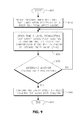
- the following example illustrates the above procedure and is also depicted as a flow diagram in FIG. 9 .
- a new discard timer (e.g., DTP 1 ) is started upon reception of an PDCP SDU from upper layers, whereby DTP 1 is initialized with value Z time units (assuming a decrementing timer implementation for DTP 1 ).
- DTP 1 is initialized with value Z time units (assuming a decrementing timer implementation for DTP 1 ).
- the transmitting PDCP entity submits/sends the PDCP SDU/PDU to lower layers, (i.e., to RLC), for transmission.
- the transmitting PDCP entity may provide along with the submitted PDCP PDU, (i.e., the RLC SDU), an indication of the remaining overall timer value, (i.e., Z-X e.g. in the case of a decrementing timer implementation), or of the time spent in the PDCP entity, (i.e., X e.g. in the case of an incrementing timer implementation).
- an indication may be signaled via new parameters for primitives, such as a new parameter for the RLC primitive RLC-yy-Data-Req (which is used by upper layers e.g. PDCP, to request the transmission of an RLC SDU).
- the discard timer is started upon reception of an RLC SDU, (i.e., PDCP PDU), from upper layers.
- the DTR is initialized with the value indicated/signaled from PDCP e.g. Z-X time units in the case where DTR is a decrementing timer or X time units in the case where DTR is an incrementing timer.
- RLC-yy-Data-Req may be any of the RLC-AM-Data-Req, RLC-UM-Data-Req, RLC-TM-Data-Req primitive, or any other type of primitive or signal or indication.
- the discard timer, (DTP 1 or DTR) expires, the transmitting entity, (PDCP or RLC), discards the associated SDU/PDU, (or SDUs/PDUs in case more than one SDU are associated with the same timer) at 940 .
- the primitives or signals or indications used for communicating/signaling between the PDCP and the RLC in the transmitting node are enhanced by the addition of new parameters that, for example, enable the PDCP to communicate/indicate the timer value that should be used by the RLC SDU discard operation.
- the previous operations and coordination between the PDCP and the RLC discard can be implemented via the use of time-stamps.
- a time-stamp is created and associated with an PDCP SDU upon its reception from upper layers.
- the time-stamp records or stores the time of reception from upper layers.
- the transmitting PDCP entity submits/sends the PDCP SDU/PDU to lower layers, (i.e., to RLC), for transmission.
- the transmitting PDCP entity may provide along with the submitted PDCP PDU, (i.e., the RLC SDU), the value of the time-stamp.
- the time-stamp is checked against the current time.
- the transmitting RLC entity discards the associated SDU/PDU (or SDUs/PDUs, in case more than one SDU/PDU are associated with the same time-stamp).
- an overall Layer 2 timer-based SDU discard function is implemented wherein a single timer is used, which is optionally located in the PDCP layer or entity, (i.e., the RLC SDU discard timer may not be needed).
- the PDCP layer or entity decides to discard a packet (e.g. upon expiration of the timer), it will communicate/signal to the RLC layer or entity, (e.g., via a primitive), an indication/identification of the packet discarded by PDCP. Upon receiving such indication, the transmitting RLC entity will also discard the SDU identified in the primitive.
- the transmitting PDCP entity notifies the transmitting RLC entity of the PDCP transmitting entity's discard decision and discarded packet information, and the mechanism is still applicable even if there is an RLC SDU discard timer in the transmitting RLC entity, (i.e., the two may co-exist).
- This mechanism may still be applicable when the PDCP discarding decision is based on criteria (events/triggers) other than the timer-based PDCP SDU discard.
- the transmitting PDCP entity determines whether to discard a packet (PDCP SDU/PDU) based on a trigger event, (for example, timer-based SDU/PDU discard, or reception of a PDCP Status Report from the peer PDCP entity acknowledging the PDCP SDU/PDU);
- a trigger event for example, timer-based SDU/PDU discard, or reception of a PDCP Status Report from the peer PDCP entity acknowledging the PDCP SDU/PDU
- the transmitting PDCP entity discards the packet
- the transmitting PDCP entity notifies the lower layer, (i.e., the transmitting RLC entity of the discard decision and of the discarded packet), via a signal, (e.g., a primitive and its parameters); and
- the transmitting RLC entity upon receiving the signal, (e.g., a primitive and its parameters), discards the identified packet, (i.e., the RLC SDU and/or its associated RLC PDUs).
- the timer-based discard may be removed from the RLC and a new timer-based discard mechanism is introduced/started in PDCP in order to optimize and simplify the overall Layer 2 operations.
- communicating or preserving the values of the PDCP and/or RLC discard timers is provided, instead of re-initializing the timers from default values when a WTRU moves to a target eNB or when a PDCP entity is re-established.
- QoS Quality of Service
- the source eNB may send the present (e.g. remaining, or approximate) value of the PDCP SDU discard timer (e.g. DTP) to the target eNB along with the forwarded PDCP SDU.
- the present (e.g. remaining, or approximate) value of the PDCP SDU discard timer e.g. DTP
- the source eNB may send the present (e.g. remaining, or approximate) value of the RLC SDU discard timer (e.g. DTR) to the target eNB along with the forwarded PDCP SDU.
- the RLC SDU discard timer e.g. DTR
- the source eNB may send the lower of the present (e.g. remaining, or approximate) value of the RLC SDU discard timer (e.g. DTR) or the PDCP SDU discard timer (e.g. DTP), to the target eNB along with the forwarded PDCP SDU.
- the RLC SDU discard timer e.g. DTR
- the PDCP SDU discard timer e.g. DTP
- the target eNB initializes the PDCP and/or RLC discard timers by using the value(s) sent from the source eNB, instead of re-initializing them from scratch (i.e. from the default values).
- the values of the PDCP discard timers in the PDCP entity are not re-initialized by the transmitting PDCP entity of the WTRU, but are preserved and continued during handover or during PDCP re-establishment in general.
- the transmitting RLC entity at the reset or re-establishment (e.g. during handover), discards/flushes the RLC PDUs (i.e. the segments or sub-segments) from its (re)transmit buffer, but keeps/maintains the RLC SDUs in its transmit buffer.
- the RLC PDUs i.e. the segments or sub-segments
- the transmitting RLC entity preserves (i.e. not re-initialize to default) the values of the RLC SDU discard timers associated with the RLC SDUs, and continues using those timers when the WTRU moves to the target eNB.
- the transmitting RLC entity discards/flushes the RLC PDUs (i.e. the segments or sub-segments) from its (re)transmit buffer, and also discards/flushes the RLC SDUs in its transmit buffer.
- the transmitting RLC entity (or the UE in general) preserves (i.e. not re-initialize to default) the values of the RLC SDU discard timers associated with the RLC SDUs, and associates those timer values with their corresponding SDU identifiers.
- the transmitting PDCP entity sends/submits RLC SDUs (i.e. PDCP PDUs) to the transmitting RLC entity.
- RLC SDUs i.e. PDCP PDUs
- the transmitting RLC entity finds/associates the corresponding timer values with the identified SDUs, and initializes/sets the RLC discard timers by using those found (associated) value(s). If no corresponding timer values are found (e.g. in case of new RLC SDUs), the RLC discard timers are simply re-initialized to the default values.
- the transmitting RLC entity discards/flushes the RLC PDUs (i.e. the segments or sub-segments) from its (re)transmit buffer, and also discards/flushes the RLC SDUs in its transmit buffer.
- the transmitting RLC entity (or the WTRU in general) communicates the values of the RLC SDU discard timers associated with those discarded RLC SDUs up to the transmitting PDCP entity (e.g. via a primitive or signal or indication and its respective parameters).
- the transmitting PDCP entity sends/submits RLC SDUs (i.e. PDCP PDUs) to the transmitting RLC entity, along with the value to be used for the RLC SDU discard timer (e.g. via a primitive and its respective parameters) which was previously communicated by the transmitting RLC entity (i.e. in the prior step).
- the transmitting RLC entity initializes/sets the RLC discard timers by using the value(s) communicated back from the transmitting PDCP entity.
- the transmitting RLC entity discards/flushes the RLC PDUs (i.e. the segments or sub-segments) from its (re)transmit buffer, and also discards/flushes the RLC SDUs in its transmit buffer.
- the transmitting PDCP entity sends/submits RLC SDUs (i.e. PDCP PDUs) to the transmitting RLC entity, along with the value to be used for the RLC SDU discard timer (e.g. via a primitive or signal or indication and its respective parameters). For example, such a value could be the time remaining before the PDCP discard timer expires.
- the transmitting RLC entity initializes/sets the RLC discard timers by using the value(s) communicated from the transmitting PDCP entity.
- Non-handover events or triggers that may lead to RLC re-establishment and the above PDCP behavior may include: RRC Connection Re-establishment, radio link failure, handover failure, integrity protection failure, RLC reaching the maximum number of transmissions, and RRC connection reconfiguration failure.
- PDCP SDU discard is triggered by a notification from the RLC sublayer.
- the RLC sublayer has its own triggers for SDU discard.
- the PDCP SDU discard mechanism is triggered via information it receives from the underlying RLC sublayer.
- the transmitting RLC entity communicates information to the transmitting PDCP entity (e.g. via a primitive or signal or indication and its respective parameters).
- the transmitting PDCP entity uses such information to discard a PDCP SDU from the PDCP transmit buffer.
- the communicated information includes an identifier of the SDU(s) to be discarded.
- the communicated information may also include one or more of the following:
- a simple discard signal (for one or more SDU(s)) sent from the transmitting RLC entity to the transmitting PDCP entity above, triggered by any RLC event.
- a discard signal (for one or more SDU(s)) sent from the transmitting RLC entity to the transmitting PDCP entity above, triggered by an RLC SDU discard event.
- Successful delivery notification/signal i.e. the delivery of the SDU to the peer RLC entity was successful
- RLC ARQ
- Status Reports or/and (possibly) HARQ.
- Failed delivery notification/signal i.e. the delivery of the SDU to the peer RLC entity was unsuccessful
- the information from the RLC (ARQ) Status Reports or/and (possibly) HARQ i.e. the delivery of the SDU to the peer RLC entity was unsuccessful
- the transmitting PDCP entity receives such discard trigger/signal from the underlying transmitting RLC entity, the transmitting PDCP entity discards the PDCP packet(s) to which the RLC SDU(s) correspond.
- Such a discard mechanisms may be applied in cases when there is no handover.
- PDCP SDU/PDU discard is triggered by information in the PDCP Status Report (or “PDCP Status PDU”).
- the PDCP sublayer receives PDCP Status Reports that are exchanged/sent from the receiving PDCP entity to the transmitting PDCP entity.
- the PDCP SDU discard mechanism is triggered via information that the PDCP sublayer receives from the PDCP Status Report as follows:
- the PDCP Status Report is used as a trigger for the PDCP SDU discard mechanism.
- the transmitting PDCP entity discards PDCP SDUs/PDUs that were positively acknowledged via the PDCP Status Report.
- SDU discard triggers described above may be used independently, or may be combined with each other, and that various combinations based on the above may be constructed.
- the transmitting PDCP entity may or may not utilize explicit signaling (e.g. a PDCP move receiving window (MRW) mechanism) to notify the peer (i.e. the receiving) PDCP entity of the discarded SDU(s)/PDU(s).
- explicit signaling e.g. a PDCP move receiving window (MRW) mechanism
- MMW PDCP move receiving window
- Such an explicit signal/message is used to convey the information (enable identification, etc.) on PDCP SDUs or PDUs that were discarded and/or can not be (re)transmitted by the transmitting PDCP entity.
- the receiving PDCP entity Upon receiving the message, the receiving PDCP entity will not wait for the packet(s) indicated/identified in the message, and can submit the earlier packets it has buffered to upper layers.
- a PDCP Control PDU may be used to carry such signal/message.
- an explicit signaling is used upon discard when discarding is triggered by the PDCP SDU timer-based discard trigger (i.e. upon timer expiration).
- the explicit signaling upon discard is triggered when the discard is not from a RLC delivery notification or PDCP Status Report (although it is possible to use it in such cases).
- Embodiment 1 The transmitting PDCP entity assigns the PDCP SN before inserting the SDU into the PDCP transmit buffer.
- FIG. 5 shows a transmit PDCP entity configured to assign the PDCP SN to SDUs at 510 before buffering at 520 .
- Embodiment 2 The transmitting PDCP entity assigns the PDCP SN after removing the SDU from the PDCP transmit buffer.
- FIG. 6 shows a transmit PDCP entity configured to assign the PDCP SN to SDUs at 620 after buffering at 610 .
- FIGS. 5 and 6 display certain PDCP functionalities, but it should be understood that this disclosure is applicable even if there are future changes or modifications to the PDCP sublayer's functionality, and it is also applicable when there are additional functionalities added to the PDCP sublayer.
- PDCP SDU discard with explicit signaling Signaling mechanisms upon discarding a PDCP SDU (this may be referred to as PDCP SDU discard with explicit signaling) are described below.
- the transmitting PDCP entity Upon discarding a PDCP SDU (due to a timer-discard, or other discard triggers), the transmitting PDCP entity sends a signaling message to the receiving PDCP entity to notify it of the SDU(s) discarded.
- the receiving PDCP entity adjusts/affects its operations accordingly.
- the receiving PDCP entity receive window functions will not wait for the discarded SDU(s), and also the duplicate detection function and/or the reordering function will not wait for the discarded SDU(s), e.g., via adjusting their next expected PDCP SN's, or the reception status of the corresponding PDCP SDU/PDU.
- Such signaling message may be referred to as a PDCP MRW message, or PDCP “Transmitter Status Report”, or any other name.
- a PDCP Control PDU may be used to carry such signaling message.
- Embodiment 1 The above PDCP SDU discard with explicit signaling mechanism is used in Embodiment 1 shown in FIG. 5 , (i.e., when sequence numbering 510 was done before the PDCP transmit buffering 520 ), as the SDUs in the buffer would already have sequence numbers associated with them, and it is beneficial to communicate that certain PDCP SDU SN's will not be delivered to the receiving PDCP entity.
- a transmitting PDCP entity that maps to (makes use of) UM RLC or TM RLC does not use explicit signaling upon discarding a PDCP SDU. This is especially useful if the PDCP reordering function at the receiving PDCP entity is not used. If PDCP reordering is used for UM or TM RLC modes, the PDCP discard with explicit signaling mechanism may be used.
- the PDCP transmitter upon discarding a PDCP SDU, updates the window's “lower edge” (thus expanding the window) that in turn allows for more PDCP packets to be processed by the PDCP transmitter.
- the receiving PDCP entity's receive window may also be advanced if the transmitting PDCP entity explicitly signaled the discard.
- an RLC delivery notification may be used to advance the PDCP transmit window, (e.g., for the packets that were successfully confirmed by RLC).
- the information contained in the PDCP Status Report may be used to advance the PDCP transmit window (e.g. for the packets that were successfully confirmed by PDCP Status Report).
- the receiving PDCP entity provides a service to upper layers (e.g. to the upper user-plane layers, or to the RRC layer) to inform them of SDUs that were discarded or that will not be delivered.
- upper layers e.g. to the upper user-plane layers, or to the RRC layer
- the PDCP-DATA-Ind primitive which is used to deliver a received PDCP SDU to upper layers is enhanced to additionally deliver discard information, (e.g., support a DiscardInfo primitive parameter), for one or more discarded PDCP packets (SDUs) that will not be delivered to upper layers.
- discard information e.g., support a DiscardInfo primitive parameter
- Non-handover events or triggers that may lead to RLC re-establishment and the above PDCP behavior may include: RRC Connection Re-establishment, radio link failure, handover failure, integrity protection failure, RLC reaching the maximum number of transmissions, and RRC connection reconfiguration failure.
- FIG. 8 is a functional block diagram of a WTRU 710 and the eNB 720 of the wireless communication network of FIG. 7 .
- the WTRU 710 is in communication with the evolved Node B (eNB) 720 and both are configured to perform methods as described above by their respective processors 815 and 825 .
- eNB evolved Node B
- the WTRU 710 includes the processor with a buffer 815 , a receiver 817 , a transmitter 816 , and an antenna 818 .
- the processor 815 is configured to perform PDCP discard and enhanced Layer 2 operations.
- the receiver 817 and the transmitter 816 are in communication with the processor 815 .
- the antenna 818 is in communication with both the receiver 817 and the transmitter 816 to facilitate the transmission and reception of wireless data.
- the eNB 720 includes the processor with a buffer 825 , a receiver 826 , a transmitter 827 , and an antenna 828 .
- the processor 825 is configured to perform PDCP discard and enhanced Layer 2 operations.
- the receiver 826 and the transmitter 827 are in communication with the processor 825 .
- the antenna 828 is in communication with both the receiver 817 and the transmitter 816 to facilitate the transmission and reception of wireless data.
- ROM read only memory
- RAM random access memory
- register cache memory
- semiconductor memory devices magnetic media such as internal hard disks and removable disks, magneto-optical media, and optical media such as CD-ROM disks, and digital versatile disks (DVDs).
- Suitable processors include, by way of example, a general purpose processor, a special purpose processor, a conventional processor, a digital signal processor (DSP), a plurality of microprocessors, one or more microprocessors in association with a DSP core, a controller, a microcontroller, Application Specific Integrated Circuits (ASICs), Field Programmable Gate Arrays (FPGAs) circuits, any other type of integrated circuit (IC), and/or a state machine.
- DSP digital signal processor
- ASICs Application Specific Integrated Circuits
- FPGAs Field Programmable Gate Arrays
- a processor in association with software may be used to implement a radio frequency transceiver for use in a wireless transmit receive unit (WTRU), user equipment (UE), terminal, base station, radio network controller (RNC), or any host computer.
- the WTRU may be used in conjunction with modules, implemented in hardware and/or software, such as a camera, a video camera module, a videophone, a speakerphone, a vibration device, a speaker, a microphone, a television transceiver, a hands free headset, a keyboard, a Bluetooth® module, a frequency modulated (FM) radio unit, a liquid crystal display (LCD) display unit, an organic light-emitting diode (OLED) display unit, a digital music player, a media player, a video game player module, an Internet browser, and/or any wireless local area network (WLAN) module.
- modules implemented in hardware and/or software, such as a camera, a video camera module, a videophone, a speakerphone, a vibration device, a speaker,
Landscapes
- Engineering & Computer Science (AREA)
- Computer Networks & Wireless Communication (AREA)
- Signal Processing (AREA)
- Computer Security & Cryptography (AREA)
- Mobile Radio Communication Systems (AREA)
- Communication Control (AREA)
- Data Exchanges In Wide-Area Networks (AREA)
Priority Applications (3)
| Application Number | Priority Date | Filing Date | Title |
|---|---|---|---|
| US12/240,092 US8855047B2 (en) | 2007-10-01 | 2008-09-29 | Method and apparatus for PCDP discard |
| US14/507,107 US9641655B2 (en) | 2007-10-01 | 2014-10-06 | Method and apparatus for PCDP discard |
| US15/583,420 US10630819B2 (en) | 2007-10-01 | 2017-05-01 | Method and apparatus for PCDP discard |
Applications Claiming Priority (2)
| Application Number | Priority Date | Filing Date | Title |
|---|---|---|---|
| US97667407P | 2007-10-01 | 2007-10-01 | |
| US12/240,092 US8855047B2 (en) | 2007-10-01 | 2008-09-29 | Method and apparatus for PCDP discard |
Related Child Applications (1)
| Application Number | Title | Priority Date | Filing Date |
|---|---|---|---|
| US14/507,107 Continuation US9641655B2 (en) | 2007-10-01 | 2014-10-06 | Method and apparatus for PCDP discard |
Publications (2)
| Publication Number | Publication Date |
|---|---|
| US20090103478A1 US20090103478A1 (en) | 2009-04-23 |
| US8855047B2 true US8855047B2 (en) | 2014-10-07 |
Family
ID=40417621
Family Applications (3)
| Application Number | Title | Priority Date | Filing Date |
|---|---|---|---|
| US12/240,092 Active 2033-01-11 US8855047B2 (en) | 2007-10-01 | 2008-09-29 | Method and apparatus for PCDP discard |
| US14/507,107 Active 2029-06-24 US9641655B2 (en) | 2007-10-01 | 2014-10-06 | Method and apparatus for PCDP discard |
| US15/583,420 Active US10630819B2 (en) | 2007-10-01 | 2017-05-01 | Method and apparatus for PCDP discard |
Family Applications After (2)
| Application Number | Title | Priority Date | Filing Date |
|---|---|---|---|
| US14/507,107 Active 2029-06-24 US9641655B2 (en) | 2007-10-01 | 2014-10-06 | Method and apparatus for PCDP discard |
| US15/583,420 Active US10630819B2 (en) | 2007-10-01 | 2017-05-01 | Method and apparatus for PCDP discard |
Country Status (14)
| Country | Link |
|---|---|
| US (3) | US8855047B2 (de) |
| EP (1) | EP2208301B1 (de) |
| JP (3) | JP5190514B2 (de) |
| KR (4) | KR101582019B1 (de) |
| CN (3) | CN101965705B (de) |
| AR (1) | AR068649A1 (de) |
| AU (1) | AU2008308944B2 (de) |
| DK (1) | DK2208301T3 (de) |
| ES (1) | ES2718087T3 (de) |
| MX (1) | MX2010003595A (de) |
| MY (1) | MY149427A (de) |
| PL (1) | PL2208301T3 (de) |
| TW (4) | TWM357141U (de) |
| WO (1) | WO2009045945A2 (de) |
Cited By (13)
| Publication number | Priority date | Publication date | Assignee | Title |
|---|---|---|---|---|
| US20110282980A1 (en) * | 2010-05-11 | 2011-11-17 | Udaya Kumar | Dynamic protection of a resource during sudden surges in traffic |
| US20140161009A1 (en) * | 2012-12-12 | 2014-06-12 | Microsoft Corporation | Batching Communication Events |
| US20150023370A1 (en) * | 2007-10-01 | 2015-01-22 | Interdigital Patent Holdings, Inc. | Method and apparatus for pcdp discard |
| US20150264615A1 (en) * | 2012-11-29 | 2015-09-17 | Huawei Technologies Co., Ltd. | Data transmission control method, apparatus and system |
| US20170311335A1 (en) * | 2014-11-07 | 2017-10-26 | Nec Corporation | Wireless communication system, base station, and communication method |
| US20190053326A1 (en) * | 2017-08-11 | 2019-02-14 | Lg Electronics Inc. | Method and device for transmitting data unit |
| WO2019190037A1 (en) * | 2018-03-30 | 2019-10-03 | Lg Electronics Inc. | Method and apparatus for performing retransmission after discarding procedure in wireless communication system |
| WO2019221421A1 (en) * | 2018-05-18 | 2019-11-21 | Lg Electronics Inc. | Method and apparatus for transmitting data units by user equipment in wireless communication system |
| US10917817B2 (en) | 2017-05-17 | 2021-02-09 | Telefonaktiebolaget Lm Ericsson (Publ) | Methods and apparatus for discarding packets in a wireless communication network |
| US11700548B2 (en) * | 2017-03-24 | 2023-07-11 | Motorola Mobility Llc | Split bearer packet data converge protocol protocol data unit routing |
| US11838134B2 (en) | 2018-06-20 | 2023-12-05 | Fujitsu Limited | Transmitting device and buffer control method |
| US12010202B2 (en) | 2021-12-29 | 2024-06-11 | Ofinno, Llc | Data unit in wireless system |
| US12255829B2 (en) | 2022-01-21 | 2025-03-18 | Ofinno, Llc | Data unit processing |
Families Citing this family (165)
| Publication number | Priority date | Publication date | Assignee | Title |
|---|---|---|---|---|
| GB2449629A (en) | 2007-05-01 | 2008-12-03 | Nec Corp | Buffering numbered unsegmented PDCP SDUs in 3GPP system to assist efficient hard handover |
| KR100907978B1 (ko) | 2007-09-11 | 2009-07-15 | 엘지전자 주식회사 | 이동통신 시스템에서 pdcp 계층의 상태보고 전송 방법 및 수신장치 |
| KR101513033B1 (ko) * | 2007-09-18 | 2015-04-17 | 엘지전자 주식회사 | 다중 계층 구조에서 QoS를 보장하기 위한 방법 |
| US8208394B2 (en) * | 2007-10-30 | 2012-06-26 | Qualcomm Incorporated | Service data unit discard timers |
| US8270369B1 (en) * | 2007-11-16 | 2012-09-18 | Marvell International Ltd. | Service data unit discard system for radio access networks |
| JP4952586B2 (ja) | 2008-01-07 | 2012-06-13 | 富士通株式会社 | パケットデータの廃棄方法、無線通信装置、移動通信システム |
| EP2667534B1 (de) | 2008-01-08 | 2018-07-04 | Unwired Planet International Limited | Verfahren und Anordnung in einem drahtlosen Kommunikationsnetzwerk |
| US8027356B2 (en) | 2008-01-31 | 2011-09-27 | Lg Electronics Inc. | Method for signaling back-off information in random access |
| KR101594359B1 (ko) | 2008-01-31 | 2016-02-16 | 엘지전자 주식회사 | 랜덤 접속에서 백오프 정보를 시그널링하는 방법 |
| US20100027524A1 (en) * | 2008-07-31 | 2010-02-04 | Nokia Corporation | Radio layer emulation of real time protocol sequence number and timestamp |
| US8325608B2 (en) * | 2008-08-07 | 2012-12-04 | Qualcomm Incorporated | Efficient packet handling for timer-based discard in a wireless communication system |
| US8443247B2 (en) * | 2008-12-12 | 2013-05-14 | Qualcomm Incorporated | Methods and systems using window start update for wireless communication HARQ connection |
| US20100202613A1 (en) * | 2009-01-07 | 2010-08-12 | Qualcomm Incorporated | Packet bundling at the pdcp layer with ciphering on the pdcp sdu |
| US8031607B2 (en) * | 2009-01-29 | 2011-10-04 | Alcatel Lucent | Implementation of internet protocol header compression with traffic management quality of service |
| EP2407001B1 (de) * | 2009-03-12 | 2013-12-25 | Nokia Solutions and Networks Oy | Gerät-zu-gerät-kommunikation |
| CN101925121B (zh) * | 2009-06-10 | 2014-03-19 | 中兴通讯股份有限公司 | 一种分组数据汇聚协议层重建的方法和装置 |
| CN101699898B (zh) * | 2009-11-03 | 2012-11-28 | 中兴通讯股份有限公司 | 一种分组业务域传输分组数据的方法和系统 |
| KR101638195B1 (ko) * | 2010-02-01 | 2016-07-08 | 삼성전자주식회사 | 통신 시스템에서 무선 링크 제어 계층 및 패킷 데이터 융합 프로토콜 계층 간의 플로우 제어를 위한 방법 및 장치 |
| KR101676045B1 (ko) * | 2010-02-09 | 2016-11-15 | 엘지전자 주식회사 | 무선 통신 시스템에서 로그된 측정 폐기 방법 및 장치 |
| EP2442610B1 (de) * | 2010-10-13 | 2017-12-06 | Alcatel Lucent | Geordnete Abgabe von Aufwärts-Nutzerverkehr während der Übergabe |
| PL3319395T3 (pl) | 2010-12-03 | 2023-09-04 | Interdigital Patent Holdings, Inc. | Sposób i urządzenie do wykonywania agregacji nośnych w technologii dostępu wieloradiowego |
| US8824290B2 (en) | 2011-01-07 | 2014-09-02 | Qualcomm Incorporated | Downlink flow control using packet dropping to control transmission control protocol (TCP) layer throughput |
| CN102905310A (zh) * | 2011-07-25 | 2013-01-30 | 中兴通讯股份有限公司 | 一种数据处理方法、装置及分组数据汇聚协议层模块 |
| WO2013066258A2 (en) * | 2011-11-04 | 2013-05-10 | Telefonaktiebolaget L M Ericsson (Publ) | Handling redundant data in a communication system |
| CN103167553A (zh) * | 2011-12-13 | 2013-06-19 | 华为技术有限公司 | 用于无线通信的方法和装置以及基站 |
| US8972568B2 (en) * | 2012-02-21 | 2015-03-03 | Telefonaktiebolaget L M Ericsson (Publ) | Quantifying user quality of experience by passive monitoring |
| US8958422B2 (en) * | 2012-03-17 | 2015-02-17 | Blackberry Limited | Handling packet data convergence protocol data units |
| US9391840B2 (en) * | 2012-05-02 | 2016-07-12 | Solarflare Communications, Inc. | Avoiding delayed data |
| KR101917766B1 (ko) * | 2012-05-25 | 2018-11-13 | 삼성전자주식회사 | 무선 통신 시스템에서 혼잡 제어 방법 및 장치 |
| US9119190B2 (en) | 2012-08-06 | 2015-08-25 | Qualcomm Incorporated | Method and apparatus for enhancing data retransmission to improve call performance |
| RU2603626C2 (ru) | 2012-08-23 | 2016-11-27 | Интердиджитал Пэйтент Холдингз, Инк. | Работа с множеством планировщиков в беспроводной системе |
| US9019843B2 (en) * | 2012-09-13 | 2015-04-28 | International Business Machines Corporation | Utilizing stored data to reduce packet data loss in a mobile data network with data breakout at the edge |
| CN103716114B (zh) * | 2012-09-28 | 2018-02-23 | 华为技术有限公司 | 数据传输业务中参数设置方法、终端和基站 |
| JP6130126B2 (ja) * | 2012-11-28 | 2017-05-17 | 株式会社Nttドコモ | 移動通信方法及び移動局 |
| JP6174365B2 (ja) * | 2013-04-25 | 2017-08-02 | 株式会社Nttドコモ | 基地局及び方法 |
| WO2014186944A1 (zh) | 2013-05-20 | 2014-11-27 | 华为技术有限公司 | 一种确认报文发送方法及其设备 |
| EP2830352A1 (de) * | 2013-07-24 | 2015-01-28 | Panasonic Intellectual Property Corporation of America | Effizienter Verwerfungsmechanismus in kleinzelligem Einsatz |
| US9648514B2 (en) | 2013-08-09 | 2017-05-09 | Blackberry Limited | Method and system for protocol layer enhancements in data offload over small cells |
| US20150089382A1 (en) * | 2013-09-26 | 2015-03-26 | Wu-chi Feng | Application context migration framework and protocol |
| JP6230859B2 (ja) * | 2013-09-26 | 2017-11-15 | 株式会社Nttドコモ | 移動通信システム及び無線基地局 |
| JP6262991B2 (ja) * | 2013-10-31 | 2018-01-17 | 株式会社Nttドコモ | ユーザ装置及び方法 |
| CN104812000A (zh) * | 2014-01-27 | 2015-07-29 | 中兴通讯股份有限公司 | 一种实现数据传输的方法及装置 |
| WO2015119410A1 (en) * | 2014-02-06 | 2015-08-13 | Lg Electronics Inc. | Method for processing a packet data convergence protocol service data unit at a user equipment in a dual connectivity system and device therefor |
| CN104837163B (zh) * | 2014-02-08 | 2019-10-25 | 夏普株式会社 | 用于删除无线链路控制服务数据单元的方法和基站 |
| JP2015177548A (ja) * | 2014-03-14 | 2015-10-05 | 宏達國際電子股▲ふん▼有限公司 | ユーザ機器及び基地局に適用しうる接続変更方法 |
| US20160013976A1 (en) * | 2014-07-14 | 2016-01-14 | Futurewei Technologies, Inc. | Wireless Through Link Traffic Reduction |
| CN104168214B (zh) * | 2014-08-21 | 2018-02-27 | 京信通信系统(中国)有限公司 | 一种丢弃分组数据的方法及装置 |
| CN105471763B (zh) * | 2014-09-04 | 2020-09-15 | 中兴通讯股份有限公司 | 控制报文传输方法及装置 |
| US10110713B2 (en) * | 2014-09-12 | 2018-10-23 | Samsung Electronics Co., Ltd. | Handling different protocol data unit types in a device to device communication system |
| US10638353B2 (en) * | 2014-11-14 | 2020-04-28 | Qualcomm Incorporated | Evolved data compression scheme for unreliable transmission modes |
| WO2016098982A1 (en) | 2014-12-18 | 2016-06-23 | Lg Electronics Inc. | Method for reconfiguring a pdcp reordering timer in a wireless communication system and device therefor |
| US10045254B2 (en) * | 2015-01-12 | 2018-08-07 | Mediatek Inc. | Wireless communication method and device |
| WO2016186697A1 (en) * | 2015-05-21 | 2016-11-24 | Intel IP Corporation | Pdcp status reporting for multi-rat offloading |
| WO2017008266A1 (zh) * | 2015-07-15 | 2017-01-19 | 富士通株式会社 | Lte和wlan聚合的数据处理方法、装置以及通信系统 |
| WO2017026686A1 (en) * | 2015-08-09 | 2017-02-16 | Lg Electronics Inc. | Method for performing uplink packet measurements in a wireless communication system and a device therefor |
| KR102699241B1 (ko) * | 2015-08-11 | 2024-08-27 | 엘지전자 주식회사 | 무선 통신 시스템에서 상향링크 패킷 지연 측정을 수행하기 위한 방법 및 이를 위한 장치 |
| US20180213426A1 (en) * | 2015-08-21 | 2018-07-26 | Samsung Electronics Co., Ltd. | Method for reporting latency of packet transmission in communication network |
| JP6654828B2 (ja) * | 2015-08-21 | 2020-02-26 | 株式会社Nttドコモ | 送信機 |
| US9999049B2 (en) * | 2015-08-31 | 2018-06-12 | Qualcomm Incorporated | Avoiding unnecessary protocol data unit (PDU) transmissions |
| GB2542614A (en) * | 2015-09-25 | 2017-03-29 | Tcl Communication Ltd | Systems and methods for reporting data reception status |
| WO2017061695A1 (en) | 2015-10-05 | 2017-04-13 | Lg Electronics Inc. | Method for transmitting a queuing delay measurement report in a wireless communication system and a device therefor |
| US10841203B2 (en) * | 2015-12-11 | 2020-11-17 | Qualcomm Incorporated | Coordination of multiple routes for a single IP connection |
| US10484129B2 (en) | 2016-01-21 | 2019-11-19 | Qualcomm Incorporated | Protocol layer packet coding for transmitter/receiver buffer optimization |
| WO2017143504A1 (en) * | 2016-02-23 | 2017-08-31 | Telefonaktiebolaget Lm Ericsson (Publ) | Methods used in user equipment and associated ues |
| US10862815B2 (en) * | 2016-05-01 | 2020-12-08 | Lg Electronics Inc. | Method for managing packets for V2X communication and apparatus therefor |
| CN109076568B (zh) * | 2016-05-19 | 2022-08-19 | 苹果公司 | 用于第五代(5g)可穿戴通信中的控制平面分组处理的高层设计 |
| US10477424B2 (en) * | 2016-07-04 | 2019-11-12 | Htc Corporation | Device and method of handling aggregation of cellular network and wireless local area network |
| US9999016B2 (en) * | 2016-09-04 | 2018-06-12 | Lg Electronics Inc. | Status report polling to avoid HFN de-synchronization |
| WO2018088793A1 (en) * | 2016-11-12 | 2018-05-17 | Lg Electronics Inc. | Method and device for transmitting data unit, and method and device for receiving data unit |
| CN108206787A (zh) * | 2016-12-17 | 2018-06-26 | 北京华为数字技术有限公司 | 一种拥塞避免方法和装置 |
| KR102582554B1 (ko) * | 2017-01-03 | 2023-09-25 | 삼성전자 주식회사 | 차세대 이동 통신 시스템에서 light connection을 지원하는 방법 및 장치 |
| CN108282824B (zh) * | 2017-01-05 | 2020-03-06 | 电信科学技术研究院 | 一种状态更新方法、节点和用户终端 |
| WO2018127982A1 (ja) | 2017-01-06 | 2018-07-12 | 富士通株式会社 | 無線通信装置、無線通信システム、および無線通信方法 |
| KR102721539B1 (ko) | 2017-02-02 | 2024-10-25 | 노키아 테크놀로지스 오와이 | 통신시스템에서의 데이터 처리 방법 |
| CN110268657B (zh) | 2017-02-13 | 2022-05-27 | 瑞典爱立信有限公司 | 用于监视无线电通信的技术 |
| KR102747545B1 (ko) * | 2017-02-21 | 2024-12-27 | 삼성전자주식회사 | 무선 통신 시스템에서 암호화 파라미터 값을 결정하기 위한 장치 및 방법 |
| MA46986B1 (fr) * | 2017-03-24 | 2020-03-31 | Ericsson Telefon Ab L M | Systèmes et procédés d'élimination de paquets dupliqués pour une transmission |
| CN108632177A (zh) * | 2017-03-24 | 2018-10-09 | 中兴通讯股份有限公司 | 一种控制包的传输方法及电子设备 |
| US10785670B2 (en) * | 2017-04-26 | 2020-09-22 | Motorola Mobility Llc | Packet data converge protocol protocol data unit pre-processing |
| CN108809542B (zh) * | 2017-05-05 | 2021-04-20 | 华为技术有限公司 | 一种数据传输的处理方法和装置 |
| ES2929734T3 (es) * | 2017-05-05 | 2022-12-01 | Asustek Comp Inc | Procedimiento y aparato de transmisión de duplicación de datos en un sistema de comunicación inalámbrica |
| CN108809540B (zh) * | 2017-05-05 | 2021-09-17 | 华为技术有限公司 | 数据处理方法及设备 |
| US10805836B2 (en) * | 2017-05-05 | 2020-10-13 | Qualcomm Incorporated | Packet duplication at a packet data convergence protocol (PDCP) entity |
| EP4203547A1 (de) * | 2017-06-16 | 2023-06-28 | Samsung Electronics Co., Ltd. | Verfahren und vorrichtung zur schnellen meldung von frequenzmessergebnissen in einem mobilkommunikationssystem der nächsten generation |
| CN108476435B (zh) * | 2017-06-19 | 2021-07-27 | 北京小米移动软件有限公司 | 数据处理方法及装置、用户设备和计算机可读存储介质 |
| WO2019014916A1 (zh) * | 2017-07-21 | 2019-01-24 | Oppo广东移动通信有限公司 | 处理数据的方法和设备 |
| WO2019019025A1 (zh) * | 2017-07-25 | 2019-01-31 | 北京小米移动软件有限公司 | 一种数据包丢弃方法、装置和系统 |
| WO2019019015A1 (zh) * | 2017-07-25 | 2019-01-31 | 北京小米移动软件有限公司 | 数据传输方法及装置、电子设备和计算机可读存储介质 |
| KR20200030031A (ko) | 2017-07-28 | 2020-03-19 | 광동 오포 모바일 텔레커뮤니케이션즈 코포레이션 리미티드 | 데이터 전송 방법, 단말 기기 및 네트워크 기기 |
| WO2019035670A1 (en) * | 2017-08-16 | 2019-02-21 | Samsung Electronics Co., Ltd. | METHOD AND APPARATUS FOR TRANSMITTING AND RECEIVING DOUBLE PACKETS IN A NEXT GENERATION MOBILE COMMUNICATION SYSTEM |
| US11425592B2 (en) * | 2017-09-12 | 2022-08-23 | Nokia Solutions And Networks Oy | Packet latency reduction in mobile radio access networks |
| CN109788516B (zh) * | 2017-11-13 | 2021-04-16 | 普天信息技术有限公司 | 一种lte切换过程中下行数据的确认方法及设备 |
| CN109802922A (zh) * | 2017-11-16 | 2019-05-24 | 电信科学技术研究院 | 一种缓存同步异常的处理方法和设备 |
| CN108200605B (zh) * | 2017-12-28 | 2021-09-24 | 京信网络系统股份有限公司 | 一种基站的数据传输方法和装置 |
| CN110011925B (zh) * | 2018-01-04 | 2022-09-13 | 维沃移动通信有限公司 | 一种sdu的处理方法和通信设备 |
| CN110012454B (zh) * | 2018-01-05 | 2023-07-14 | 夏普株式会社 | 用户设备和相关方法 |
| CN110035095A (zh) * | 2018-01-11 | 2019-07-19 | 中兴通讯股份有限公司 | 语音通道建立方法、装置、终端及计算机可读存储介质 |
| CN110167146B (zh) * | 2018-02-12 | 2023-06-09 | 维沃移动通信有限公司 | 一种sdu的处理方法和通信设备 |
| KR102585232B1 (ko) * | 2018-04-03 | 2023-10-06 | 삼성전자주식회사 | 이동통신시스템에서 데이터 수신율을 제어하는 방법 및 장치 |
| WO2019196031A1 (en) * | 2018-04-11 | 2019-10-17 | Zte Corporation | Discard timer operation in wireless communication |
| WO2019216576A1 (en) * | 2018-05-09 | 2019-11-14 | Lg Electronics Inc. | Method and apparatus for transmitting packet based on type of packet by transmission end in wireless communication system |
| CN110915255B (zh) * | 2018-06-07 | 2021-09-07 | 华为技术有限公司 | 一种下行数据的接收方法及终端设备 |
| WO2019233586A1 (en) * | 2018-06-07 | 2019-12-12 | Huawei Technologies Co., Ltd. | Apparatus and method for efficient packet transmission |
| EP3766279B1 (de) * | 2018-07-10 | 2022-12-21 | Samsung Electronics Co., Ltd. | Verfahren und system zur optimierung des rückkopplungsmechanismus in einer datenverbindungsschicht |
| KR102807428B1 (ko) | 2018-08-08 | 2025-05-15 | 삼성전자 주식회사 | 차세대 이동 통신 시스템에서 데이터 유실 없이 pdcp의 버전을 변경하는 방법 및 장치 |
| CN109195183B (zh) * | 2018-08-30 | 2022-03-25 | 京信网络系统股份有限公司 | Pdcp层的数据处理方法、装置和基站 |
| WO2020065585A1 (en) * | 2018-09-26 | 2020-04-02 | Telefonaktiebolaget Lm Ericsson (Publ) | Early data delivery for random access procedure |
| KR102694930B1 (ko) * | 2018-10-30 | 2024-08-14 | 삼성전자 주식회사 | 차세대 이동 통신 시스템에서 이더넷 프레임의 오버헤드를 줄이는 방법 및 장치 |
| WO2020091410A1 (en) | 2018-10-30 | 2020-05-07 | Samsung Electronics Co., Ltd. | Method and apparatus for reducing overhead of ethernet frame in next generation mobile communication system |
| EP3878116B1 (de) | 2018-11-09 | 2025-12-31 | Nokia Technologies Oy | Verwaltung von paketvervielfältigung |
| CN111866969B (zh) | 2019-04-30 | 2021-10-26 | 华为技术有限公司 | 一种数据处理方法、通信装置和系统 |
| CN112118192B (zh) | 2019-06-20 | 2022-11-18 | 华为技术有限公司 | 一种数据量整形方法、网络设备以及计算机程序产品 |
| CN112398790B (zh) * | 2019-08-15 | 2021-11-19 | 华为技术有限公司 | 通信方法、装置和计算机可读存储介质 |
| WO2021033978A1 (en) * | 2019-08-16 | 2021-02-25 | Lg Electronics Inc. | Method and apparatus for selectively retransmitting data in a wireless communication system |
| WO2021062756A1 (zh) * | 2019-09-30 | 2021-04-08 | Oppo广东移动通信有限公司 | 无线通信方法、装置和网络设备 |
| EP4042644A1 (de) * | 2019-10-30 | 2022-08-17 | Sony Group Corporation | Kommunikationsvorrichtung, infrastrukturausrüstung und verfahren |
| CN113225748A (zh) * | 2020-01-17 | 2021-08-06 | 普天信息技术有限公司 | 超帧号失步检测方法及装置 |
| KR102947835B1 (ko) * | 2020-04-07 | 2026-04-03 | 삼성전자 주식회사 | 차세대 이동 통신 시스템에서 하향링크 rrc 분할 메시지를 처리하는 방법 및 장치 |
| CN113709887B (zh) * | 2020-05-22 | 2025-11-11 | 维沃移动通信有限公司 | 数据发送方法和设备 |
| CN113709804A (zh) * | 2020-05-22 | 2021-11-26 | 维沃移动通信有限公司 | 数据传输方法、终端设备和网络设备 |
| US12381828B2 (en) * | 2020-07-17 | 2025-08-05 | Qualcomm Incorporated | Downlink data stall optimization by addressing an out-of-order packet sequence |
| US20230308229A1 (en) * | 2020-07-20 | 2023-09-28 | Nokia Technologies Oy | Apparatus, method, and computer program |
| EP4193514B1 (de) * | 2020-08-05 | 2024-10-02 | Lenovo (Singapore) Pte. Ltd. | Daten- und feedbackweiterleitung |
| US11785501B2 (en) * | 2020-08-11 | 2023-10-10 | Qualcomm Incorporated | Techniques for timer adjustment for packet loss |
| US20220070659A1 (en) * | 2020-08-28 | 2022-03-03 | Qualcomm Incorporated | Techniques for controlling a packet data convergence protocol mode at a user equipment |
| US20240007410A1 (en) * | 2020-10-16 | 2024-01-04 | Telefonaktiebolaget Lm Ericsson (Publ) | Packet transmission and reception in a wireless communication network |
| US12376191B2 (en) * | 2020-11-11 | 2025-07-29 | Qualcomm Incorporated | Handling unordered signaling radio bearer (SRB) packets |
| WO2022114607A1 (en) * | 2020-11-30 | 2022-06-02 | Lg Electronics Inc. | Method and apparatus for managing random access procedure for short data transmission based on discard timer in wireless communication system |
| WO2022110229A1 (zh) * | 2020-11-30 | 2022-06-02 | 北京小米移动软件有限公司 | 数据丢失检测方法、装置、通信设备及存储介质 |
| CN116783934A (zh) | 2020-12-17 | 2023-09-19 | 诺基亚通信公司 | 切换 |
| CN113472683B (zh) * | 2021-07-23 | 2024-10-29 | Oppo广东移动通信有限公司 | 数据丢弃方法、装置、终端及存储介质 |
| EP4385198B1 (de) * | 2021-09-08 | 2025-12-31 | LG Electronics Inc. | Verfahren und vorrichtung zur durchführung einer verwerfungsoperation auf frame-ebene durch eine benutzervorrichtung in einem drahtloskommunikationssystem |
| CN115834742B (zh) * | 2021-09-16 | 2024-11-22 | 大唐移动通信设备有限公司 | 定时器处理方法、装置及存储介质 |
| CN115811716A (zh) * | 2021-09-16 | 2023-03-17 | 大唐移动通信设备有限公司 | 数据处理方法、装置及设备 |
| CN115996422A (zh) * | 2021-10-19 | 2023-04-21 | 维沃移动通信有限公司 | 数据传输方法、装置及终端 |
| US20250324320A1 (en) * | 2021-11-26 | 2025-10-16 | Telefonaktiebolaget Lm Ericsson (Publ) | Ue, radio network node, and methods performed in a wireless communication network |
| CN116419274A (zh) * | 2021-12-31 | 2023-07-11 | 华为技术有限公司 | 数据传输的方法和装置 |
| US20250185052A1 (en) | 2022-04-21 | 2025-06-05 | Lg Electronics Inc. | Method and apparatus for transmitting data units for on-time service in wireless communication system |
| WO2023206133A1 (en) * | 2022-04-27 | 2023-11-02 | Lenovo (Beijing) Limited | Methods and apparatuses for enhancements of a data discarding operation |
| WO2023210957A1 (en) * | 2022-04-28 | 2023-11-02 | Lg Electronics Inc. | Method and apparatus for performing data transmissions based on congestion indicator in wireless communication system |
| US20250374092A1 (en) * | 2022-07-07 | 2025-12-04 | Intel Corporation | Enhanced gap management for packet data convergence protocol and radio link control count for wireless communications |
| EP4307591A3 (de) * | 2022-07-11 | 2024-04-10 | Nokia Technologies Oy | Vermeidung von uplink-datenduplizierung |
| CN117641420A (zh) * | 2022-08-09 | 2024-03-01 | 华为技术有限公司 | 数据处理方法及装置 |
| CN121125037A (zh) | 2022-08-10 | 2025-12-12 | 中兴通讯股份有限公司 | 无线网络中基于感知的数据传输和接收的方法、装置和系统 |
| CN117692957A (zh) * | 2022-09-02 | 2024-03-12 | 上海朗帛通信技术有限公司 | 一种被用于无线通信中的方法和装置 |
| WO2024045190A1 (en) * | 2022-09-02 | 2024-03-07 | Telefonaktiebolaget Lm Ericsson (Publ) | Methods and apparatuses for resource management in cloud |
| KR20250071930A (ko) * | 2022-09-16 | 2025-05-22 | 퀄컴 인코포레이티드 | 계층-2 절차에서의 pdu 폐기 표시 |
| WO2024065471A1 (en) * | 2022-09-29 | 2024-04-04 | Shenzhen Tcl New Technology Co., Ltd. | Wireless communication method and device |
| EP4591535A4 (de) * | 2022-11-04 | 2025-10-29 | Apple Inc | Pdcp-ablösungsindikationen für xr |
| EP4627831A4 (de) * | 2022-12-02 | 2025-12-31 | Ericsson Telefon Ab L M | Verfahren mit einem protokollstapel zum klären von daten in einem puffer |
| CN118283693A (zh) * | 2022-12-29 | 2024-07-02 | 荣耀终端有限公司 | 一种通信方法 |
| KR20240125368A (ko) * | 2023-02-10 | 2024-08-19 | 삼성전자주식회사 | 무선 통신 시스템에서 무선 링크 제어 서비스 데이터 유닛을 폐기하기 위한 방법 및 장치 |
| WO2024172613A1 (en) * | 2023-02-17 | 2024-08-22 | Samsung Electronics Co., Ltd. | Method and apparatus for handling extended reality traffic in a wireless network system |
| CN118524563A (zh) * | 2023-02-20 | 2024-08-20 | 华为技术有限公司 | 通信方法和通信装置 |
| CN118741599A (zh) * | 2023-03-31 | 2024-10-01 | 荣耀终端有限公司 | 信息指示方法、设备及存储介质 |
| WO2025033729A1 (en) * | 2023-08-07 | 2025-02-13 | Lg Electronics Inc. | Method and apparatus of performing transmissions based on remaining time of discard timer in wireless communication system |
| CN119946695A (zh) * | 2023-11-03 | 2025-05-06 | 成都华为技术有限公司 | 一种通信方法及装置 |
| WO2025160786A1 (en) * | 2024-01-31 | 2025-08-07 | Zte Corporation | Methods and devices for handling data unit transmission problems |
| US20250301368A1 (en) * | 2024-03-23 | 2025-09-25 | Samsung Electronics Co., Ltd. | Methods and systems for efficient transmission for extended reality |
| WO2025234743A1 (en) * | 2024-05-07 | 2025-11-13 | Samsung Electronics Co., Ltd. | A method and apparatus for protocol data convergence protocol (pdcp) sequence number (sn) gap reporting for extended reality |
| US12192111B1 (en) * | 2024-06-28 | 2025-01-07 | AerKodo, LLC | Notification of discarded PDCP SDUs in a wireless network apparatus |
| WO2026000426A1 (zh) * | 2024-06-28 | 2026-01-02 | Oppo广东移动通信有限公司 | 数据处理方法和通信设备 |
| WO2026032525A1 (en) * | 2024-08-08 | 2026-02-12 | Nokia Technologies Oy | Indicating discarding of transmitted data unit |
| GB2643249A (en) * | 2024-08-08 | 2026-02-11 | Nokia Technologies Oy | Informing of discarded data unit |
| CN122342144A (zh) * | 2024-10-29 | 2026-07-03 | 北京小米移动软件有限公司 | 通信方法、终端、网络设备、通信系统、计算机程序产品和存储介质 |
Citations (14)
| Publication number | Priority date | Publication date | Assignee | Title |
|---|---|---|---|---|
| US20010007137A1 (en) | 1999-12-31 | 2001-07-05 | Nokia Mobile Phones Ltd. | Method for making data transmission more effective and a data transmission protocol |
| US20010030965A1 (en) | 2000-02-14 | 2001-10-18 | Nokia Mobile Phones Ltd. | Data packet numbering in packet-switched data transmission |
| US20020041567A1 (en) * | 2000-10-07 | 2002-04-11 | Lg Electronics Inc. | Method for transmitting data from RLC layer in radio communication system |
| KR20030017953A (ko) | 2001-08-25 | 2003-03-04 | 엘지전자 주식회사 | 무선링크제어계층의 데이터 전송방법 |
| US20040185860A1 (en) * | 2002-05-08 | 2004-09-23 | Pekka Marjelund | Dynamic allocation of a radio resource |
| US6904016B2 (en) * | 2001-11-16 | 2005-06-07 | Asustek Computer Inc. | Processing unexpected transmission interruptions in a wireless communications system |
| US6925298B2 (en) * | 2002-08-26 | 2005-08-02 | Asustek Computer Inc. | Initialization for hyper frame number of signaling radio bearers |
| JP2005539465A (ja) | 2002-11-07 | 2005-12-22 | エルジー エレクトロニクス インコーポレイティド | 無線移動通信システムにおける受信ウインドウ移動方法 |
| US20060052137A1 (en) * | 2003-02-27 | 2006-03-09 | Peter Randall | Radio network controller (rnc) and method for optimising decision regarding operational states for an umts user equipment (ue) |
| JP2007028653A (ja) | 2003-08-14 | 2007-02-01 | Matsushita Electric Ind Co Ltd | ソフトハンドオーバー中のパケット再送の時間監視 |
| US7266105B2 (en) * | 2002-05-10 | 2007-09-04 | Innovative Sonic Limited | Method for determining triggering of a PDCP sequence number synchronization procedure |
| US7327734B2 (en) * | 2001-07-09 | 2008-02-05 | Lg Electronics Inc. | Packet data service in radio communication system |
| US20090046631A1 (en) * | 2007-08-14 | 2009-02-19 | Qualcomm Incorporated | TRANSPORT OF PDCP CONTROL PDUs WITHIN MAC FRAMES |
| US7796505B2 (en) * | 2005-01-26 | 2010-09-14 | M-Stack Limited | Method for processing traffic data in a wireless communications system |
Family Cites Families (9)
| Publication number | Priority date | Publication date | Assignee | Title |
|---|---|---|---|---|
| FI111423B (fi) * | 2000-11-28 | 2003-07-15 | Nokia Corp | Järjestelmä kanavanvaihdon jälkeen tapahtuvan tietoliikenteen salauksen varmistamiseksi |
| US20040224669A1 (en) * | 2003-05-08 | 2004-11-11 | Pedlar David W. | Apparatus and method of handling universal terrestrial radio access network radio resource control connecting messages in universal mobile telecommunications system user equipment |
| WO2004112305A1 (fr) | 2003-06-18 | 2004-12-23 | Utstarcom (China) Co. Ltd. | Procede et appareil permettant d'ecarter des unites de donnees de services dans un mode accuse de reception d'une rlc dans un systeme de communication sans fil |
| US20050286526A1 (en) * | 2004-06-25 | 2005-12-29 | Sood Sanjeev H | Optimized algorithm for stream re-assembly |
| CN100391201C (zh) * | 2005-02-28 | 2008-05-28 | 华为技术有限公司 | 一种保持分组数据协议汇聚子层序列号同步的方法 |
| RU2411660C2 (ru) | 2005-10-31 | 2011-02-10 | Эл Джи Электроникс Инк. | Способ передачи и приема информации о радиодоступе в системе беспроводной подвижной связи |
| CN1913534B (zh) * | 2006-08-17 | 2010-12-01 | 华为技术有限公司 | 一种数据处理方法及通信设备 |
| KR101513033B1 (ko) * | 2007-09-18 | 2015-04-17 | 엘지전자 주식회사 | 다중 계층 구조에서 QoS를 보장하기 위한 방법 |
| MX2010003595A (es) * | 2007-10-01 | 2010-08-04 | Interdigital Patent Holdings | Metodo y aparato para descartar pcdp. |
-
2008
- 2008-09-29 MX MX2010003595A patent/MX2010003595A/es active IP Right Grant
- 2008-09-29 EP EP08836684.4A patent/EP2208301B1/de active Active
- 2008-09-29 JP JP2010528048A patent/JP5190514B2/ja active Active
- 2008-09-29 KR KR1020137030186A patent/KR101582019B1/ko not_active Expired - Fee Related
- 2008-09-29 KR KR1020137001969A patent/KR101478927B1/ko not_active Expired - Fee Related
- 2008-09-29 AU AU2008308944A patent/AU2008308944B2/en active Active
- 2008-09-29 DK DK08836684.4T patent/DK2208301T3/en active
- 2008-09-29 US US12/240,092 patent/US8855047B2/en active Active
- 2008-09-29 KR KR1020107009741A patent/KR101132522B1/ko active Active
- 2008-09-29 CN CN200880109903.6A patent/CN101965705B/zh active Active
- 2008-09-29 ES ES08836684T patent/ES2718087T3/es active Active
- 2008-09-29 KR KR1020107012200A patent/KR101391382B1/ko active Active
- 2008-09-29 WO PCT/US2008/078083 patent/WO2009045945A2/en not_active Ceased
- 2008-09-29 PL PL08836684T patent/PL2208301T3/pl unknown
- 2008-09-29 CN CN201510162210.5A patent/CN104821865B/zh active Active
- 2008-09-29 MY MYPI2010001438A patent/MY149427A/en unknown
- 2008-09-30 TW TW097217570U patent/TWM357141U/zh not_active IP Right Cessation
- 2008-10-01 TW TW100144249A patent/TWI488456B/zh active
- 2008-10-01 TW TW097137835A patent/TWI492569B/zh active
- 2008-10-01 AR ARP080104290A patent/AR068649A1/es active IP Right Grant
- 2008-10-01 TW TW104105122A patent/TWI618377B/zh active
- 2008-10-06 CN CN200820179126XU patent/CN201444641U/zh not_active Expired - Fee Related
-
2013
- 2013-01-28 JP JP2013013499A patent/JP5521067B2/ja active Active
-
2014
- 2014-04-07 JP JP2014078900A patent/JP5724012B2/ja not_active Expired - Fee Related
- 2014-10-06 US US14/507,107 patent/US9641655B2/en active Active
-
2017
- 2017-05-01 US US15/583,420 patent/US10630819B2/en active Active
Patent Citations (20)
| Publication number | Priority date | Publication date | Assignee | Title |
|---|---|---|---|---|
| US6857095B2 (en) * | 1999-12-31 | 2005-02-15 | Nokia Mobile Phones, Ltd. | Method for making data transmission more effective and a data transmission protocol |
| US20010007137A1 (en) | 1999-12-31 | 2001-07-05 | Nokia Mobile Phones Ltd. | Method for making data transmission more effective and a data transmission protocol |
| US20010030965A1 (en) | 2000-02-14 | 2001-10-18 | Nokia Mobile Phones Ltd. | Data packet numbering in packet-switched data transmission |
| JP2007195219A (ja) | 2000-02-14 | 2007-08-02 | Nokia Corp | パケット交換データ伝送におけるデータ・パケット番号付加方式 |
| US20060098574A1 (en) | 2000-10-07 | 2006-05-11 | Lg Electronics Inc. | Method for transmitting data from RLC layer in radio communication system |
| US20020041567A1 (en) * | 2000-10-07 | 2002-04-11 | Lg Electronics Inc. | Method for transmitting data from RLC layer in radio communication system |
| US7054270B2 (en) | 2000-10-07 | 2006-05-30 | Lg Electronics Inc. | Method for transmitting data from RLC layer in radio communication system |
| US7327734B2 (en) * | 2001-07-09 | 2008-02-05 | Lg Electronics Inc. | Packet data service in radio communication system |
| KR20030017953A (ko) | 2001-08-25 | 2003-03-04 | 엘지전자 주식회사 | 무선링크제어계층의 데이터 전송방법 |
| US6904016B2 (en) * | 2001-11-16 | 2005-06-07 | Asustek Computer Inc. | Processing unexpected transmission interruptions in a wireless communications system |
| US20040185860A1 (en) * | 2002-05-08 | 2004-09-23 | Pekka Marjelund | Dynamic allocation of a radio resource |
| US7266105B2 (en) * | 2002-05-10 | 2007-09-04 | Innovative Sonic Limited | Method for determining triggering of a PDCP sequence number synchronization procedure |
| US6925298B2 (en) * | 2002-08-26 | 2005-08-02 | Asustek Computer Inc. | Initialization for hyper frame number of signaling radio bearers |
| JP2005539465A (ja) | 2002-11-07 | 2005-12-22 | エルジー エレクトロニクス インコーポレイティド | 無線移動通信システムにおける受信ウインドウ移動方法 |
| US20110149865A1 (en) | 2002-11-07 | 2011-06-23 | Lee Young-Dae | Apparatus and method for moving a receive window in a radio access network |
| US20060052137A1 (en) * | 2003-02-27 | 2006-03-09 | Peter Randall | Radio network controller (rnc) and method for optimising decision regarding operational states for an umts user equipment (ue) |
| JP2007028653A (ja) | 2003-08-14 | 2007-02-01 | Matsushita Electric Ind Co Ltd | ソフトハンドオーバー中のパケット再送の時間監視 |
| US20070106924A1 (en) | 2003-08-14 | 2007-05-10 | Matsushita Electric Industrial Co., Ltd. | Time monitoring of packet retransmissions during soft handover |
| US7796505B2 (en) * | 2005-01-26 | 2010-09-14 | M-Stack Limited | Method for processing traffic data in a wireless communications system |
| US20090046631A1 (en) * | 2007-08-14 | 2009-02-19 | Qualcomm Incorporated | TRANSPORT OF PDCP CONTROL PDUs WITHIN MAC FRAMES |
Non-Patent Citations (13)
Cited By (26)
| Publication number | Priority date | Publication date | Assignee | Title |
|---|---|---|---|---|
| US9641655B2 (en) * | 2007-10-01 | 2017-05-02 | Interdigital Patent Holdings, Inc. | Method and apparatus for PCDP discard |
| US10630819B2 (en) * | 2007-10-01 | 2020-04-21 | Interdigital Patent Holdings, Inc. | Method and apparatus for PCDP discard |
| US20150023370A1 (en) * | 2007-10-01 | 2015-01-22 | Interdigital Patent Holdings, Inc. | Method and apparatus for pcdp discard |
| US20170237837A1 (en) * | 2007-10-01 | 2017-08-17 | Interdigital Patent Holdings, Inc. | Method and Apparatus for PCDP Discard |
| US20110282980A1 (en) * | 2010-05-11 | 2011-11-17 | Udaya Kumar | Dynamic protection of a resource during sudden surges in traffic |
| US10440624B2 (en) * | 2012-11-29 | 2019-10-08 | Huawei Technologies Co. Ltd. | Data transmission control method, apparatus and system |
| US9949194B2 (en) * | 2012-11-29 | 2018-04-17 | Huawei Technologies Co., Ltd. | Data transmission control method, apparatus and system |
| US20180192343A1 (en) * | 2012-11-29 | 2018-07-05 | Huawei Technologies Co., Ltd. | Data transmission control method, apparatus and system |
| US20150264615A1 (en) * | 2012-11-29 | 2015-09-17 | Huawei Technologies Co., Ltd. | Data transmission control method, apparatus and system |
| US9282047B2 (en) * | 2012-12-12 | 2016-03-08 | Microsoft Technology Licensing, Llc | Batching communication events |
| US20140161009A1 (en) * | 2012-12-12 | 2014-06-12 | Microsoft Corporation | Batching Communication Events |
| US20170311335A1 (en) * | 2014-11-07 | 2017-10-26 | Nec Corporation | Wireless communication system, base station, and communication method |
| US11528715B2 (en) | 2014-11-07 | 2022-12-13 | Nec Corporation | Wireless communication system, base station, and communication method |
| US10548145B2 (en) * | 2014-11-07 | 2020-01-28 | Nec Corporation | Wireless communication system, base station, and communication method |
| US11700548B2 (en) * | 2017-03-24 | 2023-07-11 | Motorola Mobility Llc | Split bearer packet data converge protocol protocol data unit routing |
| US10917817B2 (en) | 2017-05-17 | 2021-02-09 | Telefonaktiebolaget Lm Ericsson (Publ) | Methods and apparatus for discarding packets in a wireless communication network |
| US10869360B2 (en) * | 2017-08-11 | 2020-12-15 | Lg Electronics Inc. | Method and device for transmitting data unit |
| US20190053326A1 (en) * | 2017-08-11 | 2019-02-14 | Lg Electronics Inc. | Method and device for transmitting data unit |
| US11201827B2 (en) | 2018-03-30 | 2021-12-14 | Lg Electronics Inc. | Method and apparatus for performing retransmission after discarding procedure in wireless communication system |
| WO2019190037A1 (en) * | 2018-03-30 | 2019-10-03 | Lg Electronics Inc. | Method and apparatus for performing retransmission after discarding procedure in wireless communication system |
| WO2019221421A1 (en) * | 2018-05-18 | 2019-11-21 | Lg Electronics Inc. | Method and apparatus for transmitting data units by user equipment in wireless communication system |
| US11388768B2 (en) * | 2018-05-18 | 2022-07-12 | Lg Electronics Inc. | Method and apparatus for performing a connection re-establishment and retransmission of packets by user equipment in wireless communication system |
| US11838134B2 (en) | 2018-06-20 | 2023-12-05 | Fujitsu Limited | Transmitting device and buffer control method |
| US12010202B2 (en) | 2021-12-29 | 2024-06-11 | Ofinno, Llc | Data unit in wireless system |
| US12375590B2 (en) | 2021-12-29 | 2025-07-29 | Ofinno, Llc | Data unit identification |
| US12255829B2 (en) | 2022-01-21 | 2025-03-18 | Ofinno, Llc | Data unit processing |
Also Published As
Similar Documents
| Publication | Publication Date | Title |
|---|---|---|
| US10630819B2 (en) | Method and apparatus for PCDP discard | |
| US20210144605A1 (en) | Method and apparatus for handling out-of-order packets during handover in a wireless communication system | |
| US8437306B2 (en) | Layer 2 tunneling of data during handover in a wireless communication system | |
| US20090103445A1 (en) | Method and apparatus for enhancing various pdcp and layer 2 operations | |
| US20090175163A1 (en) | Method and apparatus of performing packet data convergence protocol re-establishment |
Legal Events
| Date | Code | Title | Description |
|---|---|---|---|
| AS | Assignment |
Owner name: INTERDIGITAL PATENT HOLDINGS, INC., DELAWARE Free format text: ASSIGNMENT OF ASSIGNORS INTEREST;ASSIGNORS:SAMMOUR, MOHAMMED;TERRY, STEPHEN E.;REEL/FRAME:022061/0327;SIGNING DATES FROM 20081124 TO 20081217 Owner name: INTERDIGITAL PATENT HOLDINGS, INC., DELAWARE Free format text: ASSIGNMENT OF ASSIGNORS INTEREST;ASSIGNORS:SAMMOUR, MOHAMMED;TERRY, STEPHEN E.;SIGNING DATES FROM 20081124 TO 20081217;REEL/FRAME:022061/0327 |
|
| STCF | Information on status: patent grant |
Free format text: PATENTED CASE |
|
| CC | Certificate of correction | ||
| MAFP | Maintenance fee payment |
Free format text: PAYMENT OF MAINTENANCE FEE, 4TH YEAR, LARGE ENTITY (ORIGINAL EVENT CODE: M1551) Year of fee payment: 4 |
|
| MAFP | Maintenance fee payment |
Free format text: PAYMENT OF MAINTENANCE FEE, 8TH YEAR, LARGE ENTITY (ORIGINAL EVENT CODE: M1552); ENTITY STATUS OF PATENT OWNER: LARGE ENTITY Year of fee payment: 8 |
|
| MAFP | Maintenance fee payment |
Free format text: PAYMENT OF MAINTENANCE FEE, 12TH YEAR, LARGE ENTITY (ORIGINAL EVENT CODE: M1553); ENTITY STATUS OF PATENT OWNER: LARGE ENTITY Year of fee payment: 12 |