US8828337B2 - Microreactor - Google Patents
Microreactor Download PDFInfo
- Publication number
- US8828337B2 US8828337B2 US12/734,054 US73405408A US8828337B2 US 8828337 B2 US8828337 B2 US 8828337B2 US 73405408 A US73405408 A US 73405408A US 8828337 B2 US8828337 B2 US 8828337B2
- Authority
- US
- United States
- Prior art keywords
- cover
- microreactor
- microreactor according
- cavity
- side wall
- Prior art date
- Legal status (The legal status is an assumption and is not a legal conclusion. Google has not performed a legal analysis and makes no representation as to the accuracy of the status listed.)
- Active, expires
Links
Images




Classifications
-
- C—CHEMISTRY; METALLURGY
- C12—BIOCHEMISTRY; BEER; SPIRITS; WINE; VINEGAR; MICROBIOLOGY; ENZYMOLOGY; MUTATION OR GENETIC ENGINEERING
- C12M—APPARATUS FOR ENZYMOLOGY OR MICROBIOLOGY; APPARATUS FOR CULTURING MICROORGANISMS FOR PRODUCING BIOMASS, FOR GROWING CELLS OR FOR OBTAINING FERMENTATION OR METABOLIC PRODUCTS, i.e. BIOREACTORS OR FERMENTERS
- C12M23/00—Constructional details, e.g. recesses, hinges
- C12M23/38—Caps; Covers; Plugs; Pouring means
-
- B01F11/0014—
-
- B01F15/00876—
-
- B—PERFORMING OPERATIONS; TRANSPORTING
- B01—PHYSICAL OR CHEMICAL PROCESSES OR APPARATUS IN GENERAL
- B01F—MIXING, e.g. DISSOLVING, EMULSIFYING OR DISPERSING
- B01F31/00—Mixers with shaking, oscillating, or vibrating mechanisms
- B01F31/20—Mixing the contents of independent containers, e.g. test tubes
- B01F31/22—Mixing the contents of independent containers, e.g. test tubes with supporting means moving in a horizontal plane, e.g. describing an orbital path for moving the containers about an axis which intersects the receptacle axis at an angle
-
- B—PERFORMING OPERATIONS; TRANSPORTING
- B01—PHYSICAL OR CHEMICAL PROCESSES OR APPARATUS IN GENERAL
- B01F—MIXING, e.g. DISSOLVING, EMULSIFYING OR DISPERSING
- B01F35/00—Accessories for mixers; Auxiliary operations or auxiliary devices; Parts or details of general application
- B01F35/50—Mixing receptacles
- B01F35/53—Mixing receptacles characterised by the configuration of the interior, e.g. baffles for facilitating the mixing of components
-
- B—PERFORMING OPERATIONS; TRANSPORTING
- B01—PHYSICAL OR CHEMICAL PROCESSES OR APPARATUS IN GENERAL
- B01L—CHEMICAL OR PHYSICAL LABORATORY APPARATUS FOR GENERAL USE
- B01L3/00—Containers or dishes for laboratory use, e.g. laboratory glassware; Droppers
- B01L3/50—Containers for the purpose of retaining a material to be analysed, e.g. test tubes
- B01L3/508—Containers for the purpose of retaining a material to be analysed, e.g. test tubes rigid containers not provided for above
- B01L3/5085—Containers for the purpose of retaining a material to be analysed, e.g. test tubes rigid containers not provided for above for multiple samples, e.g. microtitration plates
-
- C—CHEMISTRY; METALLURGY
- C12—BIOCHEMISTRY; BEER; SPIRITS; WINE; VINEGAR; MICROBIOLOGY; ENZYMOLOGY; MUTATION OR GENETIC ENGINEERING
- C12M—APPARATUS FOR ENZYMOLOGY OR MICROBIOLOGY; APPARATUS FOR CULTURING MICROORGANISMS FOR PRODUCING BIOMASS, FOR GROWING CELLS OR FOR OBTAINING FERMENTATION OR METABOLIC PRODUCTS, i.e. BIOREACTORS OR FERMENTERS
- C12M23/00—Constructional details, e.g. recesses, hinges
- C12M23/02—Form or structure of the vessel
- C12M23/12—Well or multiwell plates
-
- C—CHEMISTRY; METALLURGY
- C12—BIOCHEMISTRY; BEER; SPIRITS; WINE; VINEGAR; MICROBIOLOGY; ENZYMOLOGY; MUTATION OR GENETIC ENGINEERING
- C12M—APPARATUS FOR ENZYMOLOGY OR MICROBIOLOGY; APPARATUS FOR CULTURING MICROORGANISMS FOR PRODUCING BIOMASS, FOR GROWING CELLS OR FOR OBTAINING FERMENTATION OR METABOLIC PRODUCTS, i.e. BIOREACTORS OR FERMENTERS
- C12M23/00—Constructional details, e.g. recesses, hinges
- C12M23/24—Gas permeable parts
-
- B—PERFORMING OPERATIONS; TRANSPORTING
- B01—PHYSICAL OR CHEMICAL PROCESSES OR APPARATUS IN GENERAL
- B01J—CHEMICAL OR PHYSICAL PROCESSES, e.g. CATALYSIS OR COLLOID CHEMISTRY; THEIR RELEVANT APPARATUS
- B01J2219/00—Chemical, physical or physico-chemical processes in general; Their relevant apparatus
- B01J2219/00274—Sequential or parallel reactions; Apparatus and devices for combinatorial chemistry or for making arrays; Chemical library technology
- B01J2219/00277—Apparatus
- B01J2219/00279—Features relating to reactor vessels
- B01J2219/00306—Reactor vessels in a multiple arrangement
- B01J2219/00313—Reactor vessels in a multiple arrangement the reactor vessels being formed by arrays of wells in blocks
- B01J2219/00315—Microtiter plates
-
- B—PERFORMING OPERATIONS; TRANSPORTING
- B01—PHYSICAL OR CHEMICAL PROCESSES OR APPARATUS IN GENERAL
- B01J—CHEMICAL OR PHYSICAL PROCESSES, e.g. CATALYSIS OR COLLOID CHEMISTRY; THEIR RELEVANT APPARATUS
- B01J2219/00—Chemical, physical or physico-chemical processes in general; Their relevant apparatus
- B01J2219/00274—Sequential or parallel reactions; Apparatus and devices for combinatorial chemistry or for making arrays; Chemical library technology
- B01J2219/00277—Apparatus
- B01J2219/00479—Means for mixing reactants or products in the reaction vessels
-
- B—PERFORMING OPERATIONS; TRANSPORTING
- B01—PHYSICAL OR CHEMICAL PROCESSES OR APPARATUS IN GENERAL
- B01L—CHEMICAL OR PHYSICAL LABORATORY APPARATUS FOR GENERAL USE
- B01L2300/00—Additional constructional details
- B01L2300/08—Geometry, shape and general structure
- B01L2300/0809—Geometry, shape and general structure rectangular shaped
- B01L2300/0829—Multi-well plates; Microtitration plates
-
- B—PERFORMING OPERATIONS; TRANSPORTING
- B01—PHYSICAL OR CHEMICAL PROCESSES OR APPARATUS IN GENERAL
- B01L—CHEMICAL OR PHYSICAL LABORATORY APPARATUS FOR GENERAL USE
- B01L2300/00—Additional constructional details
- B01L2300/08—Geometry, shape and general structure
- B01L2300/0848—Specific forms of parts of containers
- B01L2300/0858—Side walls
Definitions
- the invention relates to a microreactor with at least one cavity, which comprises a bottom, a side wall and an opening disposed opposite the bottom.
- microreactors for example, can be produced by means of conventional microreactor arrays (so-called microtitre plates).
- microtitre plates Just as the number of microreactors can be greatly varied, the volume of the individual reactors can also vary. Whilst mention is already be made of microreactors on scales of less than 10 ml, a further reduction in the volume to less than 1 ml, less than 500 ⁇ l, less than 100 ⁇ l or even less than 10 ⁇ l can take place.
- a microreactor serves as a reaction vessel for biochemical, chemical or enzymatic reactions as well as microbial fermentations.
- a reactor array permits the investigation of cell cultures with a high degree of parallelism with a small working volume, high data acquisition and the possibility of simplified automation. Such arrays are particularly well suited for the automation of screening tests under improved mixing and mass transfer conditions and they enable an operation which is isolated or sterile, aseptic or monoseptic to the exterior.
- Microreactor arrays such as for example microtitre plates, offer an ideal platform for achieving a high degree of parallelisation.
- the small reaction volumes e.g. >10 ⁇ l to ⁇ 10 ml per chamber
- the high degree of parallelisation e.g. 6 to 1536 chambers per plate
- the possibility of automating the cultivation processes form manipulatable by robots
- microreactor arrays represent overall the most cost-effective and promising bioreactor.
- OTR values of 0.05 mol/l/h The requirements of many microbial cultures often lie above OTR values of 0.05 mol/l/h, and in many cases they even reach OTR values of 0.1 mol/l/h in batch processes and even up to 0.3 mol/l/h in feed-batch processes.
- Higher OTRmax values of 0.1-0.15 have been able to be reached in square and round 96 deep-well plates. However, these values were only able to be reached with correspondingly small filling volumes of 200 ⁇ l. The liquid is thereby almost completely removed from the bottom and an optical measurement at the bottom is no longer possible. In addition, there are at present no deep-well plates with an optically transparent bottom, and this therefore makes an optical measurement through the bottom impossible.
- Microtitre plates are already used at present for the screening of biological systems.
- the individual reaction chambers are filled, inoculated and incubated on a rotary shaker.
- the input of oxygen into the reaction liquids is improved and thorough mixing of the reaction mixture is achieved.
- the microtitre plates are covered by an air-permeable membrane (pore size ⁇ 0.2 ⁇ m) or an airtight film or a cover construction or are cultivated open in a sterile environment.
- microtitre plates used for the described applications are nowadays offered in two basic designs by a very wide variety of manufacturers: With circular or with rectangular cavities.
- the first microtitre plates were produced in 1951 by the Hungarian Dr. G. Takatsky and had a round cross-section.
- Microtitre plates with a square and rectangular cross-section were then introduced in the 90s.
- Microtitre plates are used however in very many spheres of chemistry, medicine, biotechnology and biology, so that virtually no development especially for the cultivation of cells has taken place.
- microtitre plates There are various systems on the market for covering such microtitre plates. In the first place, most manufacturers of microtitre plates also supply a plastic cover, which is placed loosely onto the microtitre plate.
- mats of flexible plastic e.g.: silicon
- reaction vessels known and described according to the prior art are not suitable for the majority of applications (in particular chemical reactions with a gas phase or cell cultivations). They have the following drawbacks:
- the problem of the invention is to overcome the drawbacks of conventional microtitre plates described above and thus to extend the established concept of a microtitre plate as a vessel predominantly for chemical and biochemical reaction set-ups basically to the creation of a fully adequate and universally applicable reaction and cultivation system, in that the following points are preferably complied with.
- microreactor arrays they are:
- a cross-section intersecting the side wall parallel to the bottom has a shape diverging from a round, square or rectangular shape.
- Shape is understood here to mean the basic shape, this basic shape not being changed by smaller flow breakers.
- the problem is solved in that the round or square cavities known according to the prior art are changed in such a way that the positive properties of a flow disruption by the introduction of protrusions or indentations in the cavity and the positive properties of a round cavity and thus as undisrupted a flow as possible supplement one another in an ideal manner for the described case of application.
- a turbulent flow profile is formed which has a positive effect on the mixing and the mass transfer out of the gas phase into the liquid phase and vice versa.
- the formation of protrusions and indentations should be coordinated in such a way that drop and aerosol formation does not occur, which can lead to clogging of a placed-on cover (e.g. a membrane) or the collection or deposition of liquid or solid (e.g. biomasses) at the reactor walls.
- the effect of coordinating the flow-disrupting action is also that the liquid continuously wets the bottom and optical or other measurements at the cavity bottom are thus enabled.
- the possible filling volume can also be increased until spilling over of the liquid occurs at a corresponding shaking frequency.
- the first approach at a variation for the base area of the cavities proceeds from one extreme of a square base area and, by increasing the number of corners, approaches the other extreme of a round base area. It is therefore proposed that the cross-section should comprise more than four corners.
- the construction-relevant length of the base side of a polygon can also be calculated, with a given area of 112.16 mm 2 , by the construction of a triangle between a base side and two adjacent radii of the polygon. It is therefore alternatively proposed that the cross-section should comprise less than four corners.
- the shape can be described by the fact that a cross-section intersecting the side wall parallel to the bottom comprises at least one concave and/or convex segment of a circle, which projects with a radius into the cross-section or out of the latter, this radius amounting to between 0.067 and 0.49 times the diagonal of the cross-section.
- the basic shape of the cross-section is an arbitrary polygon or a circle which comprises a plurality of concave or convex segments of a circle.
- the cross-section can comprise an arc which forms a segment of a circle of more than 90°, or the cross-section can comprise more than 3, preferably more than 4 arcs, which form in each case a segment of a circle of more than 90°.
- a pentagon was selected as the initial shape and transformed gradually into a circle by rounding off the corners.
- the cross-section comprises corners with a radius of more than 0.5 mm.
- a fourth approach at modifying the originally circular basic shape of the cavity consists in introducing flow disruptors of differing shape and size.
- the base area arising here cannot in many cases be readily calculated.
- the area was measured after drawing with the software AutoCAD, Ver. 14.01 of the firm Autodesk Inc. and then scaled accordingly.
- a plurality of such regions be provided with different dimensions or that a plurality of such regions lie adjacent to one another.
- the region is a rectangle or a segment of a circle.
- the given cross-section of the employed geometry of the cavities can widen in the height direction, in order for example to guarantee better mould removal in the case of injection moulding, or narrow in the height direction, in order for example to increase further the filling volume at a corresponding shaking frequency, without spilling over of the liquid occurring.
- the transition can take place between one of the cavity geometries described here or can transform into a round, square or rectangular cavity geometry.
- a transition can also take place between a round, square or rectangular cavity geometry.
- a further cross-section intersecting the side wall parallel to the bottom has a round, square or rectangular shape.
- At least one component changing the cross-section is introduced into the cavity through the bottom or through a cover.
- the bottom be constituted by an optically transparent material.
- the microreactor comprises a plurality of cavities which are disposed particularly preferably in the form of an array.
- a microreactor in particular a previously described reactor—comprises a special cover.
- This cover preferably comprises a gas-permeable area, in order that, especially in the case of an array, each individual cavity is sealed against solids and liquids from the surroundings.
- each cavity it is advantageous if there is provided above each cavity an opening which is constituted in its shape and size, as well as the material closing it, such that evaporation from the reaction liquid is greatly reduced and a mass transfer from the surrounding gas phase into the liquid phase in the cavity and in the reverse direction is not adversely affected.
- the cover should comprise a reclosable area. It is particularly preferable if the cover is constituted in one piece with the wall and/or the bottom, apart from a gas-permeable and/or reclosable area.
- the cover comprises a sandwich material made from a firm, a flexible and/or a gas-permeable material.
- One embodiment makes provision such that the cover comprises a stable frame with a seal.
- the cover can be fixed in place by pretensioning against the wall and it can be fixed to the wall according to the Luer principle. It is preferable here for the male part of a Luer lock to be provided on the cover and for the wall to form the female counter-part.
- One variant makes provision such that the cover is connected to the wall by means of oblique planes displaceable against one another. This can be achieved for example by the fact that, for the detachment of the cover from the wall, a wedge can be inserted into a gap in order to detach the cover from the wall.
- holes are disposed in the cover into which a gripper can engage.
- the gripper for detaching the cover comprises an arrangement for applying a mechanical or pneumatic counter-pressure.
- holes can be provided in openings, through which the pins or hollow needles of a gripping arm can apply a mechanical or pneumatic pressure to the cavity in order to detach the cover from the reaction vessel arrangement.
- the cover is glued to the wall. Furthermore, the cover can be fixed in a latching manner to the wall or it can comprise a device for generating an underpressure in the cavity.
- the cover enables a supply and removal of reaction participants and sampling without interruption of the shaking process.
- microreactor forms a part of a microreactor array with a plurality of identical cavities and it preferably comprises a shaking device.
- the drawing shows measurement results and variants of embodiment in respect of microreactors, reactor arrays and various covers for reactors and reactor arrays.
- FIG. 1 shows variations of the number of corners of a cavity
- FIG. 2 shows variations of the formation of corners in a square cavity
- FIG. 3 shows variations of the formation of the corners in a pentagonal cavity
- FIG. 4 shows diagrammatic representations of cavities with rectangular and semicircular flow disrupters
- FIG. 5 shows diagrammatically the construction of a pentagonal base area with asymmetric semicircular chicanes
- FIG. 6 shows diagrammatically pentagonal and hexagonal base areas with asymmetric semicircular chicanes
- FIG. 7 shows diagrammatically square, pentagonal and hexagonal base areas with rounded corner chicanes and apex chicanes
- FIG. 8 shows a photograph of various microreactor geometries arranged as an array
- FIG. 9 shows a photograph of the prototypes of the cover with the Luer principle for microreactor arrays
- FIG. 10 shows diagrammatic representations to explain the Luer principle
- FIG. 11 shows diagrammatically an arrangement for holding the cover to a microreactor array by underpressure
- FIG. 12 shows diagrammatically the representation of hooks for holding the cover to a microreactor array
- FIG. 13 shows diagrammatically possibilities for detaching the cover from the microreactor array
- FIG. 14 shows diagrammatically a multifunctional cover placed onto a microreactor array
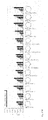
- FIG. 15 shows graphic representations of measurement results for the maximum oxygen transfer rate in different exemplary geometries
- FIG. 16 shows graphic representations of measurement results for the maximum oxygen transfer rate in further created exemplary geometries
- FIG. 17 shows, graphically represented, measurement results for the maximum oxygen transfer rate in the case of exemplary geometries with chicanes
- FIG. 18 shows measurement results for the maximum filling volume in created exemplary geometries
- FIG. 19 shows measurement results for the measurable filling height in a cavity in created exemplary geometries in the presence of an orbital shaking motion.
- FIG. 1 shows how the construction-relevant length of the base side of a polygon can be calculated for a given area—of 112.16 mm 2 in the present example—by the construction of a triangle between a base side and two adjacent radii of the polygon.
- the approach at a variation shown in FIG. 2 proceeds from a square, wherein the transition to the circular base area takes place by the construction of circles with increasing radius in the corners of the square.
- the magnitudes of the radius of the corner circle and the remaining straight line of the initial square are of relevance for the construction.
- Their calculation takes place by the construction and calculation of a kite polygon with the centrepoint of the corner circle in the corner of the initial square.
- FIG. 4 shows how an initially circular basic shape of a cavity can be modified, in that flow disrupters of different shape and size are introduced.
- the base area arising here cannot be readily calculated in many areas. In order to meet the stipulation of 112.16 mm 2 , the area was measured after drawing with a CAD system and then scaled. As examples, rectangular and hemispherical chicanes were installed here over the whole height of the cavity at its walls. These are however only examples and both the shape of the chicanes and their extension over the height of the cavity can vary in different examples of embodiment.
- FIGS. 5 to 7 show base area geometries which have emerged in the most diverse geometrical shapes from theoretical considerations of suitable transformations. In the case of all these basic shapes, circles of defined magnitude were introduced, the radius whereof was changed in 1 mm steps. The selection of the geometries resulting therefrom was made on the basis of a purely theoretical assessment of their influence on the flow in the cavity. Shapes with extremely strongly pronounced or very weakly pronounced flow disrupters are thus excluded from the consideration.
- FIGS. 6 and 7 show base areas of flow disruptors which proceed from a pentagonal or hexagonal base area. Their construction is represented by way of example in FIGS. 6 and 7 . The corners of these base areas have been rounded off, one or two millimeters having been adopted as the radius for the corner circles. A hemispherical chicane with a radius of 1 mm is disposed at each corner. This construction prescribes a direction of rotation for shaking for the cavities due to the lack of symmetry.
- FIG. 7 Further basic shapes of cavities are represented in FIG. 7 .
- the corners are again rounded off proceeding from square, pentagonal, hexagonal or heptagonal basic shapes, the area between these corners in this case not being flat, but having a point extending inwards. These points form the chicanes in these cavities.
- the array shown in FIG. 8 comprises different cavities and serves to investigate the performance function of different geometries.
- the cover of a microreactor array created as a prototype shown in FIG. 9 closes each individual cavity tightly against the surroundings and has an opening above each cavity, said opening being constituted such that evaporation of the reaction liquid is greatly reduced and a mass transfer from the surrounding gas phase into the liquid in the cavity and in the reverse direction is not adversely affected.
- Individual ones or all of the reactors of a microreactor array are constituted as Luer sleeves with respect to the cover formed with Luer cores.
- the embodiment of all the cavities as a Luer sleeves is advantageous, in order at the same time to achieve sealing of all the cavities with respect to the surroundings.
- the Luer principle shown in FIG. 10 has proved to be very advantageous with this prototype. It is capable of closing the individual reaction spaces firmly and tightly with respect to the surroundings.
- cavity 1 is closed with a cover 2 which serves as a covering.
- Cover 2 has conical locating elements 3 which lie adjacent to the cavity wall and seal cover 2 to cavity 1 .
- cover 2 has a gas-permeable film 4 , which is glued onto the cover or is welded thereto. This film provides for the necessary gas exchange, reduced evaporation and the monoseptic operation. It is intended to make the components—microreactor array and fitting cover with occluding gas-permeable film—available to the user pre-sterilised.
- FIG. 10B A further embodiment is shown in FIG. 10B .
- a flexible sealing layer 7 on which a gas-permeable film 8 lies, is provided here on cavities 5 , 6 .
- the microreactor array has a conical cavity in the body, which serves as a female Luer sleeve 9 .
- a cover 10 for the microreactor array has a Luer core 11 , which cooperates as the male part with sleeve 9 and holds the cover on the array.
- Flexible layer 7 is applied over the cavities. It seals by means of suitable contact pressure of the cover which, held by the Luer connection, seals all the wells.
- the Luer sleeves can be provided for example between the individual wells and on the frame of the microreactor array.
- FIG. 10C shows a possible arrangement. In the latter, the possible positions are shown for Luer sleeves as fixing points 12 on microreactor array 13 for the sealing of cavities 14 .
- FIG. 10D shows how the Luer principle can be applied to the whole of the microreactor array.
- At least two opposite sides of array frame 15 are bevelled here. They thus serve as a Luer core for cover 16 , which either forms a peripheral Luer sleeve or is put over the sides of array frame 15 only at the opposite-lying sides.
- Array cover 16 is thus constituted as a Luer sleeve and enters into a frictional connection with array frame 15 .
- a gas-permeable film 17 and a flexible cover layer 18 are again provided between cover 16 and the microreactor array frame.
- cover 19 In order to guarantee a uniform or sufficient contact pressure of cover 19 on flexible layer 20 at every point of microreactor array 21 , it is advantageous for cover 19 to bulge inwards, as is shown in FIG. 10E . This thus ensures a uniform stress distribution.
- FIG. 11 shows a variant of embodiment, wherein cover 22 is sucked onto microreactor array 23 by vacuum or underpressure.
- suction is applied through a hole 24 in the body of microreactor array 23 and an underpressure is thus generated and the cover is pulled by a suction cup or a similar intermediate piece 25 to microreactor array 23 .
- Flexible layer 26 with gas-permeable film 27 lying upon the latter is thus pressed onto the cavities in order to seal the latter.
- the pressing and sealing is active for as long as the vacuum is pulling, i.e. as long as the underpressure is generated. This connection can therefore easily be detached.
- Suction knobs 25 and holes 24 can be distributed arbitrarily on the array depending on the case of application.
- FIG. 12A shows how cover 30 is fixed to the plate geometry by means of a barbed hook 31 .
- barbed hook 31 hooks onto a member 32 . It is merely necessary here for cover 30 with its barbed hook 31 to be pushed onto microreactor array 33 from above or from the side. In the closed state, cover 30 is held so close to microreactor array 33 that it presses flexible layer 34 onto the cavities (not shown) and thus seals the latter.
- FIG. 12B shows a variant, in which barbed hook 35 hooks into a groove 36 in microreactor array 37 .
- barbed hook 35 of cover 30 In order subsequently to detach cover 30 again, it is advantageous for barbed hook 35 of cover 30 to be guided in a guide groove 38 . In the end position of guide groove 38 , barbed hook 35 is held by the spring tension of flexible layer 39 . For the purpose of engaging into and out of the end position, an external force must be applied to cover 30 by means of a gripping arm of a pipette robot or manually, which easily overcomes the spring tension of flexible layer 38 .
- FIG. 12D shows an alternative solution for fixing cover 40 on microreactor array 41 by the application of a spring tension by means of spring 42 on barbed hook 43 .
- a gripper 90 for example a gripping arm of a pipette robot or manually can the tension of spring 42 be counteracted and barbed hook 43 be splayed apart.
- cover 40 By moving cover 40 downwards and the subsequent release of spring 42 , cover 40 can be placed on and the barbed hook engaged onto side member 45 .
- FIG. 13 One possibility in this regard is shown in FIG. 13 .
- the overpressure can be applied by means of a compressed-air line through the hole in the Luer core, said compressed-air line being fitted on the gripping arm of a pipette robot.
- a compressed-air line 51 must be led to each Luer core 50 .
- FIG. 13B shows how pins 53 are provided on a plate 52 , said pins pressing Luer cores 54 loose from beneath.
- the plate is simply placed on pins 53 and pins 53 , guided through holes 55 in microreactor array base body 56 , push cover 57 against Luer cores 54 .
- FIG. 13C shows a solution for this.
- force 60 is applied only to external frame 61 of cover 62 , wherein bevelled shoe 63 are guided as fingers of a gripping arm horizontally beneath cover 62 .
- bevelled wall 64 of microreactor array 65 there is finally a deflection of force 60 into the vertical, whereby shoe 63 passes beneath cover 62 and raises the latter.
- the movement of shoes 63 forces a relative motion of microreactor array 65 with respect to cover 62 and thus detaches it.
- FIG. 13D A simple modification of this principle is shown in FIG. 13D .
- shoe 66 is bevelled upwardly.
- Cover 67 passes upwards over bevel 68 , microreactor array 69 remaining in its fixed position.
- FIG. 13E A further release mechanism is represented in FIG. 13E .
- This release mechanism manages without a special bevelled shoe at the fingers of a gripping arm.
- septum material of silicon or another flexible polymer which closes again by itself on account of its material properties, is provided for this.
- the septum should be pierceable with a cannula 80 , a pipette or a pipette needle in order to pipette sample material 81 into or out of the cavity interior.
- the reaction should continue to proceed unaffected.
- Sterile sampling is extraordinarily important especially with cellular applications, in order to not permit any contamination of the usually monoseptic culture management.
- the arrangement shown in FIG. 14 comprises a shaking device 91 and a cannula 80 , which is passed through an opening 82 in a rigid cover back 83 through a gas-permeable film 84 and a flexible cover layer 85 into a cavity 86 in order to remove reaction liquid from cavity 86 or to introduce the same into the cavity.
- holes 87 are provided in flexible cover layer 85 , said holes being aligned with openings 88 in rigid cover back 83 .
- a further important advantage of the invention lies in the prevention of the bottom of the cavity running dry.
- the layer thickness of the liquid present at the bottom of a well during the rotation of the shaker was calculated back via the fluorescence intensity of a fluorescein solution.
- the results described in FIG. 19 show that the more pronounced the corners and edges, the more the liquid is prevented from expanding over the cavity walls and thus from escaping from the bottom.
- the novel design of the cover of the microtitre plate overcomes a serious drawback which normally arises with cultivation in microtitre plates.
- the loss of liquid from the cavity arising in particular at higher cultivation temperatures is markedly reduced.
- a sufficient gas exchange between the surroundings and the reaction volume is enabled.
- Each cavity remains accessible for sampling through a septum.
- the invention offers the possibility for installing the system in automated systems (pipette robot; gripping arm) without major additional equipment or special applicators.
Landscapes
- Health & Medical Sciences (AREA)
- Chemical & Material Sciences (AREA)
- Zoology (AREA)
- Life Sciences & Earth Sciences (AREA)
- Engineering & Computer Science (AREA)
- Bioinformatics & Cheminformatics (AREA)
- Organic Chemistry (AREA)
- Wood Science & Technology (AREA)
- Clinical Laboratory Science (AREA)
- General Health & Medical Sciences (AREA)
- Biochemistry (AREA)
- Microbiology (AREA)
- General Engineering & Computer Science (AREA)
- Biotechnology (AREA)
- Genetics & Genomics (AREA)
- Biomedical Technology (AREA)
- Sustainable Development (AREA)
- Chemical Kinetics & Catalysis (AREA)
- Analytical Chemistry (AREA)
- Hematology (AREA)
- Apparatus Associated With Microorganisms And Enzymes (AREA)
- Physical Or Chemical Processes And Apparatus (AREA)
- Micromachines (AREA)
- Automatic Analysis And Handling Materials Therefor (AREA)
Applications Claiming Priority (7)
| Application Number | Priority Date | Filing Date | Title |
|---|---|---|---|
| DE102007048201.0 | 2007-10-08 | ||
| DE102007048201 | 2007-10-08 | ||
| DE102007048201 | 2007-10-08 | ||
| DE102008008256.2 | 2008-02-08 | ||
| DE102008008256 | 2008-02-08 | ||
| DE102008008256A DE102008008256A1 (de) | 2007-10-08 | 2008-02-08 | Mikroreaktor |
| PCT/DE2008/001623 WO2009046697A2 (de) | 2007-10-08 | 2008-10-08 | Mikroreaktor |
Publications (2)
| Publication Number | Publication Date |
|---|---|
| US20100248995A1 US20100248995A1 (en) | 2010-09-30 |
| US8828337B2 true US8828337B2 (en) | 2014-09-09 |
Family
ID=40418270
Family Applications (1)
| Application Number | Title | Priority Date | Filing Date |
|---|---|---|---|
| US12/734,054 Active 2029-06-21 US8828337B2 (en) | 2007-10-08 | 2008-10-08 | Microreactor |
Country Status (7)
| Country | Link |
|---|---|
| US (1) | US8828337B2 (cg-RX-API-DMAC7.html) |
| EP (1) | EP2205716B1 (cg-RX-API-DMAC7.html) |
| JP (1) | JP2011501689A (cg-RX-API-DMAC7.html) |
| CN (1) | CN101932693B (cg-RX-API-DMAC7.html) |
| DE (2) | DE102008008256A1 (cg-RX-API-DMAC7.html) |
| DK (1) | DK2205716T3 (cg-RX-API-DMAC7.html) |
| WO (1) | WO2009046697A2 (cg-RX-API-DMAC7.html) |
Cited By (8)
| Publication number | Priority date | Publication date | Assignee | Title |
|---|---|---|---|---|
| US9550972B2 (en) | 2014-09-29 | 2017-01-24 | General Electric Company | Devices, systems and methods for automated cell culturing |
| WO2022235597A1 (en) | 2021-05-07 | 2022-11-10 | Beckman Coulter, Inc. | Control of ph in parallel culture wells |
| WO2022236146A1 (en) | 2021-05-07 | 2022-11-10 | Beckman Coulter, Inc. | Container assembly for microbioreactor |
| WO2022236141A1 (en) | 2021-05-07 | 2022-11-10 | Beckman Coulter, Inc. | Container assembly for microbioreactor |
| US11635381B2 (en) | 2016-09-01 | 2023-04-25 | Rheinisch-Westfälisch Technische Hochschule (RWTH) Aachen | Method and device for measuring process parameters in liquid cultures |
| US11649425B2 (en) | 2017-06-08 | 2023-05-16 | Vitrolife A/S | Lid for culture dish |
| WO2025136489A1 (en) | 2023-12-19 | 2025-06-26 | Beckman Coulter, Inc. | Automated system for clone selection based on antibody production and measurement of cell health parameters |
| US12390785B2 (en) | 2019-11-28 | 2025-08-19 | Council Of Scientific And Industrial Research | Continuous flow reactor |
Families Citing this family (15)
| Publication number | Priority date | Publication date | Assignee | Title |
|---|---|---|---|---|
| EP2459739B1 (en) * | 2009-07-30 | 2016-09-28 | Helmholtz-Zentrum für Infektionsforschung GmbH | Methods and tests for screening bacterial biofilms |
| WO2011026559A1 (en) * | 2009-09-05 | 2011-03-10 | Lonza Biologics Plc | Deepwell plate system with lid |
| DE102009057223B4 (de) * | 2009-12-05 | 2016-03-24 | Chemagen Biopolymer-Technologie Aktiengesellschaft | Probengefäßmatrix und deren Herstellungsverfahren |
| GB201103665D0 (en) * | 2011-03-04 | 2011-04-13 | Univ Cardiff | Correlative microscopy |
| US9333471B2 (en) * | 2012-04-11 | 2016-05-10 | STAT—Diagnostica & Innovation, S.L. | Fluidically integrated magnetic bead beater |
| US9872448B2 (en) * | 2012-08-06 | 2018-01-23 | Council Of Scientific & Industrial Research | Bioreactor vessel for large scale growing of plants under aseptic condition |
| WO2018136752A2 (en) * | 2017-01-19 | 2018-07-26 | Essen Bioscience, Inc. | Methods and apparatus for perfusion and environment control of microplate labware |
| US11975330B2 (en) * | 2017-01-31 | 2024-05-07 | Myriad Women's Health, Inc. | Devices for handling laboratory plates and methods of using the same |
| WO2019014541A2 (en) * | 2017-07-13 | 2019-01-17 | Greiner Bio-One North America, Inc. | CULTURE PLATES FOR IMAGING |
| DE102018112895B4 (de) | 2018-05-30 | 2024-05-08 | Presens Precision Sensing Gmbh | System, Vorrichtung und Verfahren zur Erfassung mindestens einer Veränderlichen während eines biologisch / chemischen Prozesses |
| CN110907420B (zh) * | 2019-12-04 | 2021-07-02 | 中国科学院过程工程研究所 | 一种不互溶液-液相间传质平衡时间的测量装置及利用其的测量方法 |
| EP3910051A1 (en) | 2020-05-13 | 2021-11-17 | Evonik Operations GmbH | Bioreactors for orbitally shaking cell cultures, in particular suspension cultures |
| JP2022067072A (ja) * | 2020-10-19 | 2022-05-02 | Agcテクノグラス株式会社 | 培養容器 |
| EP3995211A1 (en) * | 2020-11-10 | 2022-05-11 | National Health Research Institutes | High-efficiency single-cell collection method |
| WO2024188448A1 (de) * | 2023-03-13 | 2024-09-19 | Hombrechtikon Systems Engineering Ag | Behälter, mischungsvorrichtung und verfahren zur verwendung einer mischungsvorrichtung |
Citations (14)
| Publication number | Priority date | Publication date | Assignee | Title |
|---|---|---|---|---|
| US5225164A (en) | 1991-09-30 | 1993-07-06 | Astle Thomas W | Microplate laboratory tray with rectilinear wells |
| US5792654A (en) | 1997-05-12 | 1998-08-11 | Neogen Corporation | Microorganism culture tray |
| WO1998045406A1 (en) | 1997-04-09 | 1998-10-15 | Minnesota Mining And Manufacturing Company | Method and devices for partitioning biological sample liquids into microvolumes |
| WO2002081075A1 (en) | 2001-04-06 | 2002-10-17 | Hte Aktiengesellschaft | Device for archiving and analyzing of materials |
| US20020195448A1 (en) * | 2001-06-22 | 2002-12-26 | Gregory Mathus | Apparatus for sealing test tubes and the like |
| WO2002102965A2 (en) | 2001-06-14 | 2002-12-27 | Millipore Corporation | Multiwell test apparatus |
| DE20121739U1 (de) | 2001-10-08 | 2003-08-28 | Mecadi GmbH-Chemicals/Processing, 66424 Homburg | Platte für parallelisierte Analysen und Synthesen |
| JP2003344433A (ja) | 2002-05-22 | 2003-12-03 | Okutekku:Kk | マイクロアレイ、マイクロアレイシステム及び被検物質の測定方法 |
| US20040029259A1 (en) * | 2002-04-26 | 2004-02-12 | Mcdevitt John T. | Method and system for the detection of cardiac risk factors |
| US6896848B1 (en) | 2000-12-19 | 2005-05-24 | Tekcel, Inc. | Microplate cover assembly |
| WO2005098397A1 (de) | 2004-04-02 | 2005-10-20 | Rwth Aachen | Verfahren und vorrichtung zur erfassung von prozessparametern von reaktionsflüssigkeiten in mehreren geschüttelten mikroreaktoren |
| EP1733793A2 (en) | 2005-06-16 | 2006-12-20 | Millipore Corporation | Multi-well filter plate with shifted wells and U-bottom receiver plate |
| EP1944080A1 (de) | 2007-01-11 | 2008-07-16 | F.Hoffmann-La Roche Ag | Vorrichtung und Verfahren zum Bewegen einer Flüssigkeit in einer Kavität |
| WO2009013869A1 (ja) | 2007-07-25 | 2009-01-29 | Panasonic Corporation | バイオセンサ |
Family Cites Families (7)
| Publication number | Priority date | Publication date | Assignee | Title |
|---|---|---|---|---|
| US6159368A (en) * | 1998-10-29 | 2000-12-12 | The Perkin-Elmer Corporation | Multi-well microfiltration apparatus |
| AT500167B1 (de) * | 2001-06-18 | 2007-10-15 | Greiner Bio One Gmbh | Reaktionsgefäss |
| DE10159091A1 (de) * | 2001-12-01 | 2003-06-12 | Evotec Ag | Trägersysteme und Verfahren zu ihrer Herstellung |
| US7211224B2 (en) * | 2002-05-23 | 2007-05-01 | Millipore Corporation | One piece filtration plate |
| EP1508373A3 (de) * | 2003-08-19 | 2005-08-03 | Herbener, Heinz-Gerd | Probenträger mit Flüssigkeitskanal |
| JP3978500B2 (ja) * | 2005-02-18 | 2007-09-19 | 国立大学法人埼玉大学 | 多種微量試料の注入、移行方法 |
| DE202006004642U1 (de) * | 2005-03-29 | 2006-06-08 | Sartorius Ag | Mikroarray-Vorrichtung zum Präparieren eines Probenträgers |
-
2008
- 2008-02-08 DE DE102008008256A patent/DE102008008256A1/de not_active Withdrawn
- 2008-10-08 WO PCT/DE2008/001623 patent/WO2009046697A2/de not_active Ceased
- 2008-10-08 DK DK08837177.8T patent/DK2205716T3/en active
- 2008-10-08 EP EP08837177.8A patent/EP2205716B1/de active Active
- 2008-10-08 DE DE112008002590.8T patent/DE112008002590B4/de active Active
- 2008-10-08 JP JP2010527321A patent/JP2011501689A/ja active Pending
- 2008-10-08 CN CN2008801192016A patent/CN101932693B/zh active Active
- 2008-10-08 US US12/734,054 patent/US8828337B2/en active Active
Patent Citations (16)
| Publication number | Priority date | Publication date | Assignee | Title |
|---|---|---|---|---|
| US5225164A (en) | 1991-09-30 | 1993-07-06 | Astle Thomas W | Microplate laboratory tray with rectilinear wells |
| WO1998045406A1 (en) | 1997-04-09 | 1998-10-15 | Minnesota Mining And Manufacturing Company | Method and devices for partitioning biological sample liquids into microvolumes |
| US5792654A (en) | 1997-05-12 | 1998-08-11 | Neogen Corporation | Microorganism culture tray |
| US6896848B1 (en) | 2000-12-19 | 2005-05-24 | Tekcel, Inc. | Microplate cover assembly |
| WO2002081075A1 (en) | 2001-04-06 | 2002-10-17 | Hte Aktiengesellschaft | Device for archiving and analyzing of materials |
| WO2002102965A2 (en) | 2001-06-14 | 2002-12-27 | Millipore Corporation | Multiwell test apparatus |
| US20020195448A1 (en) * | 2001-06-22 | 2002-12-26 | Gregory Mathus | Apparatus for sealing test tubes and the like |
| DE20121739U1 (de) | 2001-10-08 | 2003-08-28 | Mecadi GmbH-Chemicals/Processing, 66424 Homburg | Platte für parallelisierte Analysen und Synthesen |
| US20040029259A1 (en) * | 2002-04-26 | 2004-02-12 | Mcdevitt John T. | Method and system for the detection of cardiac risk factors |
| JP2003344433A (ja) | 2002-05-22 | 2003-12-03 | Okutekku:Kk | マイクロアレイ、マイクロアレイシステム及び被検物質の測定方法 |
| WO2005098397A1 (de) | 2004-04-02 | 2005-10-20 | Rwth Aachen | Verfahren und vorrichtung zur erfassung von prozessparametern von reaktionsflüssigkeiten in mehreren geschüttelten mikroreaktoren |
| US20070256510A1 (en) | 2004-04-02 | 2007-11-08 | Jochen Buchs | Method and Device for Recording Process Paramaters of Reaction Fluids in Several Agitated Microreactors |
| EP1733793A2 (en) | 2005-06-16 | 2006-12-20 | Millipore Corporation | Multi-well filter plate with shifted wells and U-bottom receiver plate |
| EP1944080A1 (de) | 2007-01-11 | 2008-07-16 | F.Hoffmann-La Roche Ag | Vorrichtung und Verfahren zum Bewegen einer Flüssigkeit in einer Kavität |
| WO2009013869A1 (ja) | 2007-07-25 | 2009-01-29 | Panasonic Corporation | バイオセンサ |
| US20100203621A1 (en) | 2007-07-25 | 2010-08-12 | Panasonic Corporation | Biosensor |
Non-Patent Citations (5)
| Title |
|---|
| Büchs J., "Introduction to advantages and problems of shaken cultures," Biochemical Engineering Journal 7, 2001, pp. 91-98. (Spec, p. 4). |
| English Translation of International Preliminary Report on Patentability for PCT/DE2008/001623 dated Jun. 15, 2010 and Written Opinion of International Searching Authority for PCT/DE2008/001623. |
| Hermann, R., Lehmann, M., Büchs, J., "Characterization of Gas-Liquid Mass Transfer Phenomena in Microtiter Plates," Biotechnol Bioeng, vol. 81, No. 2, Jan. 2003, pp. 178-186. (Spec, p. 2). |
| International Search Report for PCT/DE2008/001623 dated Jun. 4, 2009. |
| Kensy, F., John, G. T., Hofmann, B., Büchs, J., "Characterisation of operation conditions and online monitoring of physiological culture parameters in shaken 24-well microtiter plates," Bioprocess and Biosystems Engineering, 2005, 75, pp. 75-81. (Spec, p. 4). |
Cited By (9)
| Publication number | Priority date | Publication date | Assignee | Title |
|---|---|---|---|---|
| US9550972B2 (en) | 2014-09-29 | 2017-01-24 | General Electric Company | Devices, systems and methods for automated cell culturing |
| US10131868B2 (en) | 2014-09-29 | 2018-11-20 | General Electric Company | Devices, systems and methods for automated cell culturing |
| US11635381B2 (en) | 2016-09-01 | 2023-04-25 | Rheinisch-Westfälisch Technische Hochschule (RWTH) Aachen | Method and device for measuring process parameters in liquid cultures |
| US11649425B2 (en) | 2017-06-08 | 2023-05-16 | Vitrolife A/S | Lid for culture dish |
| US12390785B2 (en) | 2019-11-28 | 2025-08-19 | Council Of Scientific And Industrial Research | Continuous flow reactor |
| WO2022235597A1 (en) | 2021-05-07 | 2022-11-10 | Beckman Coulter, Inc. | Control of ph in parallel culture wells |
| WO2022236146A1 (en) | 2021-05-07 | 2022-11-10 | Beckman Coulter, Inc. | Container assembly for microbioreactor |
| WO2022236141A1 (en) | 2021-05-07 | 2022-11-10 | Beckman Coulter, Inc. | Container assembly for microbioreactor |
| WO2025136489A1 (en) | 2023-12-19 | 2025-06-26 | Beckman Coulter, Inc. | Automated system for clone selection based on antibody production and measurement of cell health parameters |
Also Published As
| Publication number | Publication date |
|---|---|
| CN101932693B (zh) | 2013-03-27 |
| DE102008008256A1 (de) | 2009-04-09 |
| EP2205716B1 (de) | 2017-09-27 |
| JP2011501689A (ja) | 2011-01-13 |
| EP2205716A2 (de) | 2010-07-14 |
| WO2009046697A9 (de) | 2009-07-23 |
| CN101932693A (zh) | 2010-12-29 |
| DE112008002590A5 (de) | 2010-06-24 |
| DE112008002590B4 (de) | 2022-02-24 |
| US20100248995A1 (en) | 2010-09-30 |
| WO2009046697A3 (de) | 2009-09-11 |
| DK2205716T3 (en) | 2017-12-04 |
| WO2009046697A2 (de) | 2009-04-16 |
Similar Documents
| Publication | Publication Date | Title |
|---|---|---|
| US8828337B2 (en) | Microreactor | |
| JP5490803B2 (ja) | 懸滴プレートおよび同懸滴プレートを使用する方法 | |
| US9388374B2 (en) | Microfluidic cell culture systems | |
| EP1910512B1 (en) | Multilayered cell culture apparatus | |
| US20020172621A1 (en) | Device having microchambers and microfluidics | |
| US20070031963A1 (en) | Cell culture flasks, systems, and methods for automated processing | |
| US20160250632A1 (en) | Fitted lid for multi-well plate | |
| EP2085463A1 (en) | Culture plate comprising a lid for lateral ventilation | |
| US9701934B2 (en) | Culture vessel and method of growing cells in culture vessel | |
| US20070036690A1 (en) | Inlet channel volume in a reactor | |
| WO2019055448A1 (en) | SUSPENDED CULTURE DEVICES AND ASSOCIATED SYSTEMS AND METHODS | |
| US20160102281A1 (en) | Hanging drop plate | |
| TWI802111B (zh) | 細胞活化反應器及細胞活化方法 | |
| US12496586B2 (en) | Microplate for containing a plurality of samples | |
| US20250375768A1 (en) | Cell culture devices and related methods | |
| WO2024170607A2 (en) | Cell culture insert for generation and hydrogel-encapsulation of 3d biological samples |
Legal Events
| Date | Code | Title | Description |
|---|---|---|---|
| AS | Assignment |
Owner name: M2P-LABS GMBH, GERMANY Free format text: ASSIGNMENT OF ASSIGNORS INTEREST;ASSIGNORS:KENSY, FRANK;MUELLER, CARSTEN;BUECHS, JOCHEN;AND OTHERS;SIGNING DATES FROM 20100408 TO 20100414;REEL/FRAME:024276/0832 |
|
| AS | Assignment |
Owner name: M2P-LABS GMBH, GERMANY Free format text: CHANGE OF ADDRESS;ASSIGNOR:M2P-LABS GMBH;REEL/FRAME:033358/0841 Effective date: 20111025 |
|
| STCF | Information on status: patent grant |
Free format text: PATENTED CASE |
|
| FEPP | Fee payment procedure |
Free format text: PAYOR NUMBER ASSIGNED (ORIGINAL EVENT CODE: ASPN); ENTITY STATUS OF PATENT OWNER: LARGE ENTITY |
|
| MAFP | Maintenance fee payment |
Free format text: PAYMENT OF MAINTENANCE FEE, 4TH YEAR, LARGE ENTITY (ORIGINAL EVENT CODE: M1551) Year of fee payment: 4 |
|
| MAFP | Maintenance fee payment |
Free format text: PAYMENT OF MAINTENANCE FEE, 8TH YEAR, LARGE ENTITY (ORIGINAL EVENT CODE: M1552); ENTITY STATUS OF PATENT OWNER: LARGE ENTITY Year of fee payment: 8 |