US8465798B2 - Method for manufacturing phosphor and light emitting device comprising the phosphor - Google Patents
Method for manufacturing phosphor and light emitting device comprising the phosphor Download PDFInfo
- Publication number
- US8465798B2 US8465798B2 US12/949,879 US94987910A US8465798B2 US 8465798 B2 US8465798 B2 US 8465798B2 US 94987910 A US94987910 A US 94987910A US 8465798 B2 US8465798 B2 US 8465798B2
- Authority
- US
- United States
- Prior art keywords
- fluorescent material
- solution
- nano
- agitating
- light emitting
- Prior art date
- Legal status (The legal status is an assumption and is not a legal conclusion. Google has not performed a legal analysis and makes no representation as to the accuracy of the status listed.)
- Expired - Fee Related, expires
Links
Images


Classifications
-
- C—CHEMISTRY; METALLURGY
- C09—DYES; PAINTS; POLISHES; NATURAL RESINS; ADHESIVES; COMPOSITIONS NOT OTHERWISE PROVIDED FOR; APPLICATIONS OF MATERIALS NOT OTHERWISE PROVIDED FOR
- C09K—MATERIALS FOR MISCELLANEOUS APPLICATIONS, NOT PROVIDED FOR ELSEWHERE
- C09K11/00—Luminescent materials, e.g. electroluminescent or chemiluminescent
- C09K11/02—Use of particular materials as binders, particle coatings or suspension media therefor
-
- C—CHEMISTRY; METALLURGY
- C09—DYES; PAINTS; POLISHES; NATURAL RESINS; ADHESIVES; COMPOSITIONS NOT OTHERWISE PROVIDED FOR; APPLICATIONS OF MATERIALS NOT OTHERWISE PROVIDED FOR
- C09K—MATERIALS FOR MISCELLANEOUS APPLICATIONS, NOT PROVIDED FOR ELSEWHERE
- C09K11/00—Luminescent materials, e.g. electroluminescent or chemiluminescent
-
- C—CHEMISTRY; METALLURGY
- C09—DYES; PAINTS; POLISHES; NATURAL RESINS; ADHESIVES; COMPOSITIONS NOT OTHERWISE PROVIDED FOR; APPLICATIONS OF MATERIALS NOT OTHERWISE PROVIDED FOR
- C09K—MATERIALS FOR MISCELLANEOUS APPLICATIONS, NOT PROVIDED FOR ELSEWHERE
- C09K11/00—Luminescent materials, e.g. electroluminescent or chemiluminescent
- C09K11/08—Luminescent materials, e.g. electroluminescent or chemiluminescent containing inorganic luminescent materials
- C09K11/77—Luminescent materials, e.g. electroluminescent or chemiluminescent containing inorganic luminescent materials containing rare earth metals
- C09K11/7728—Luminescent materials, e.g. electroluminescent or chemiluminescent containing inorganic luminescent materials containing rare earth metals containing europium
- C09K11/77342—Silicates
-
- H—ELECTRICITY
- H10—SEMICONDUCTOR DEVICES; ELECTRIC SOLID-STATE DEVICES NOT OTHERWISE PROVIDED FOR
- H10H—INORGANIC LIGHT-EMITTING SEMICONDUCTOR DEVICES HAVING POTENTIAL BARRIERS
- H10H20/00—Individual inorganic light-emitting semiconductor devices having potential barriers, e.g. light-emitting diodes [LED]
- H10H20/80—Constructional details
- H10H20/85—Packages
- H10H20/851—Wavelength conversion means
- H10H20/8511—Wavelength conversion means characterised by their material, e.g. binder
- H10H20/8512—Wavelength conversion materials
- H10H20/8513—Wavelength conversion materials having two or more wavelength conversion materials
-
- H—ELECTRICITY
- H10—SEMICONDUCTOR DEVICES; ELECTRIC SOLID-STATE DEVICES NOT OTHERWISE PROVIDED FOR
- H10H—INORGANIC LIGHT-EMITTING SEMICONDUCTOR DEVICES HAVING POTENTIAL BARRIERS
- H10H20/00—Individual inorganic light-emitting semiconductor devices having potential barriers, e.g. light-emitting diodes [LED]
- H10H20/01—Manufacture or treatment
- H10H20/036—Manufacture or treatment of packages
- H10H20/0361—Manufacture or treatment of packages of wavelength conversion means
-
- H—ELECTRICITY
- H10—SEMICONDUCTOR DEVICES; ELECTRIC SOLID-STATE DEVICES NOT OTHERWISE PROVIDED FOR
- H10W—GENERIC PACKAGES, INTERCONNECTIONS, CONNECTORS OR OTHER CONSTRUCTIONAL DETAILS OF DEVICES COVERED BY CLASS H10
- H10W90/00—Package configurations
- H10W90/701—Package configurations characterised by the relative positions of pads or connectors relative to package parts
- H10W90/751—Package configurations characterised by the relative positions of pads or connectors relative to package parts of bond wires
- H10W90/756—Package configurations characterised by the relative positions of pads or connectors relative to package parts of bond wires between a chip and a stacked lead frame, conducting package substrate or heat sink
Definitions
- the present invention relates to a method for manufacturing fluorescent body and a light emitting device including the fluorescent body manufactured by the manufacturing method.
- a light emitting diode (hereinafter, referred to as LED) can be used to configure a light emitting source by using a compound semiconductor material such as GaAs-based, AlGaAs-based, GaN-based, InGaN-based and InGaAlP-based material.
- Said LED is packaged and used as a light emitting device emitting various colors.
- the light emitting device is now used as a light source for many fields, for example, a lighting indicator, a character indicator and an image viewer which display colors.
- One aspect of this invention is a method for manufacturing a fluorescent material.
- the method includes:
- the first solution is at least one selected from the group consisting of DI water, ethanol, acetone, methanol and isopropyl alcohol.
- the method Prior to putting the fluorescent material into the first solution and agitating the fluorescent material and the first solution, the method further includes heating and agitating the first solution until the temperature of the first solution reaches a predetermined temperature.
- the putting the fluorescent material into the first solution and agitating the fluorescent material and the first solution includes heating and agitating such that the temperature of the solution does not fall below a predetermined temperature.
- the light emitting device includes:
- FIG. 1 is a view showing a light emitting device of the present invention.
- FIG. 2 is a view showing that a crack is created on the surface of a fluorescent material.
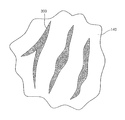
- FIG. 3 is a view showing that nano-fluorescent material is adsorbed in the crack on the surface of the fluorescent material in accordance with an embodiment of the present invention.
- FIGS. 4 to 8 are views describing a method for manufacturing the fluorescent material in accordance with the embodiment of the present invention.
- FIG. 1 is a view showing a light emitting device of the present invention.
- a light emitting device 100 includes a package body 110 , a light emitting element 120 , a resin 125 and lead frames 132 and 134 .
- the package body ( 110 ) is injected-molded in a predetermined shape by using at least one selected from the group consisting of PPA (Polyphthalamide), LCP (Liquid Crystal Polymer) and SPS(Syndiotactic polystyrene).
- a cavity 115 is formed having a constant depth in the upper part 112 of the package body 110 .
- the circumference of the cavity 115 may be formed inclined at a predetermined angle with respect to an axis perpendicular to the bottom surface of the cavity 115 .
- a plurality of the lead frames 132 and 134 are horizontally formed in the package body 110 .
- the cavity having a shape of a reflective cup is formed on the upper part of the package body 110 .
- the plurality of the lead frames 132 and 134 are exposed inside the cavity 115 and are electrically disconnected. Both ends of the plurality of the lead frames 132 and 134 are exposed to the outside of the package body 110 and are used as an electrode.
- a reflective material may be coated on the surfaces of the lead frames 132 and 134 .
- the light emitting element 120 is die-bonded to a first lead frame 132 among the plurality of the lead frames 132 and 134 .
- the light emitting element 120 is connected to the first lead frame 132 and a second lead frame 134 by means of a wire 122 .
- the light emitting element 120 may correspond to at least one of colored light emitting diodes, for example, at least one selected from the group consisting of a red light emitting diode, a green light emitting diode, a blue light emitting diode and ultraviolet (UV) light emitting diode.
- a red light emitting diode for example, at least one selected from the group consisting of a red light emitting diode, a green light emitting diode, a blue light emitting diode and ultraviolet (UV) light emitting diode.
- UV ultraviolet
- the resin 125 is formed in the area of the cavity 115 .
- the resin 125 includes a transparent silicon material or epoxy material.
- Fluorescent material 140 is added to the resin 125 .
- the fluorescent material 140 may correspond to a silicate based fluorescent material. Particularly, nano-sized fluorescent materials are formed on a part of the surface of the fluorescent material 140 .
- a convex lens may be formed on the resin 125 .
- a protective device such as a zener diode for protecting the light emitting element 120 may be mounted on the plurality of the lead frames 132 and 134 .
- the fluorescent material 140 added to the resin 125 may include many cracks 200 formed on the surface of the fluorescent material 140 (see FIG. 2 ).
- a plurality of the cracks having a shape depressed by a predetermined depth may be formed on the surface of the fluorescent material.
- the nano-sized fluorescent material is added to the fluorescent material in which the crack is formed such that the crack is filled with the nano-sized fluorescent material, i.e., nano-sized fluorescent powder (hereinafter, briefly referred to as a nano fluorescent material). That is, as shown in FIG. 3 , the cracks formed on the surface of the fluorescent material 140 are coated with or filled with sphere-shaped nano fluorescent material 300 , so that it is possible to reduce the optical scattering caused by the cracks.
- the nano fluorescent material 300 may be formed by using a thermo spray decomposition method.
- the nano fluorescent material 300 having the same color and quality may be used as nano particles for smoothly filling the irregular structure of the fluorescent material 140 .
- the nano fluorescent material 300 may include silicon based fluorescent material which is the same as fluorescer, for example, SrBaSiO:Eu.
- SrBaSiO:Eu silicon based fluorescent material which is the same as fluorescer
- the nano fluorescent material 300 and the fluorescent material 140 are attached to each other by van der vals force. As a result, luminous efficiency may be improved by as much as 20% to 30%.
- the sphere-shaped nano fluorescent material and a method of coating the nano fluorescent material on the surface (in particular, the crack) of the fluorescent material 140 will be described in detail.
- FIGS. 4 to 8 are views describing a method for manufacturing the fluorescent material in accordance with the embodiment of the present invention.
- an agitator 410 and a beaker 430 being placed on the agitator and receiving solution.
- DI water solution 401 is put into the beaker 430 and a magnetic bar 420 is put into the beaker 430 . Then, the agitator 410 is turned on.
- the magnetic bar 420 may not be fixed by a constituent such as an axis of rotation.
- the agitator 410 rotating the magnetic bar 420 does not contact with the magnetic bar 420 and is able to function as a magnetic agitator which rotates the magnetic bar 420 by applying a magnetic force from the outside.
- the magnetic agitator generates a rotating magnetic force by using a rotating electromagnet.
- a magnetic body (magnetic bar) external from the agitator is able to rotate by receiving the applied magnetic force.
- the agitator 410 is operated.
- the DI water 401 and the magnetic bar 420 are heated and agitated until the temperature of the DI water 401 reaches a predetermined temperature.
- the predetermined temperature is required to be about 50 degrees Celsius.
- ethanol, acetone, methanol and isopropyl alcohol and the like can be used instead of the DI water 401 .
- more various solutions can be used according to embodiments.
- a fluorescent material 510 is put into the DI water 401 and is additionally agitated for about 30 minutes.
- the fluorescent material 510 may be composed of a silicate based material and have a mean particle diameter of 15 ⁇ m. However, since the size and kind of the fluorescent material can be variously changed according to a fluorescent material to be manufactured, more detailed description thereof will be omitted.
- the DI water 401 and the fluorescent material 510 are mixed in the beaker 430 .
- a nano fluorescent material 610 is put into the beaker 430 and agitated.
- the nano fluorescent material 610 is composed of a fluorescent material having a size of from 100 nm to 400 nm Through a thermo spray decomposition process, the nano fluorescent material having a nano size may be formed. If the size of the nano fluorescent material 610 is less than 100 nm, luminance may be deteriorated.
- the nano fluorescent material 610 is composed of a fluorescent material having the same color as that of the foregoing fluorescent material 510 .
- the fluorescent material 510 is a yellow silicate fluorescent material
- the nano fluorescent material 610 is also formed of the yellow silicate fluorescent material. This intends that light having the same color is emitted through the resin to which the fluorescent material 510 is added, because the nano fluorescent material 610 is coated on the surface of the fluorescent material 510 .
- 10 gram of the nano fluorescent material 610 is put into the beaker 430 .
- a predetermined amount of acetic acid is put into the beaker 430 .
- 1 ml of the acetic acid together with the nano fluorescent material 610 are put into the beaker 430 .
- the temperature of the solution in the beaker 430 should not be equal to or less than a predetermined temperature, preferably, about 50 degrees Celsius.
- the agitation is performed for about one hour.
- a person performing the embodiment checks the fluorescent material distribution, while checking the beaker 430 .
- the reason why the acetic acid is put is that the nano fluorescent material 610 is well adsorbed into the cracks by etching the rough surface of the fluorescent material 510 .
- Any solution capable of etching the surface of the fluorescent material 510 , as well as the acetic acid can be variously used according to embodiments.
- a heater of the agitator 410 is turned off and the temperature of the solution of the beaker 430 is reduced.
- ZnSO 4 solution of 10% is put into the beaker 430 and more agitation is performed for about one hour.
- the reason why ZnSO 4 solution is put is that electrostatic force between particles of the solution is increased by ionizing the solution in the beaker 430 , so that the nano fluorescent material 610 is better adsorbed on the surface of the fluorescent material 510 .
- the agitator 410 is stopped and distribution state of the solution is checked. In other words, supernatant on the fluorescent material is checked whether it becomes transparent or not.
- the supernatant 810 is checked whether it becomes transparent or not and the agitation time may be increased or decreased according to the transparency of the supernatant 810 . If the supernatant 810 becomes transparent (the transparency at this time can be variously determined according to embodiments or a person performing the embodiment), this means that the nano fluorescent material 610 is well adsorbed on the surface of the fluorescent material 510 . Accordingly, the supernatant 810 is separated from a solution 820 including the fluorescent material. Here, it is possible to separate the supernatant 810 from the solution 820 including the fluorescent material by using a rotary pump. After the separation, the solution 820 including the fluorescent material is dried.
- the manufactured fluorescent material 510 corresponds to the fluorescent material 140 shown in FIG. 1 .
- Light emitted from the light emitting element 120 passes through a fluorescent material having a much reduced roughness of its surface, thereby reducing luminous efficiency degradation caused by light scatter.
Landscapes
- Chemical & Material Sciences (AREA)
- Engineering & Computer Science (AREA)
- Materials Engineering (AREA)
- Organic Chemistry (AREA)
- Inorganic Chemistry (AREA)
- Led Device Packages (AREA)
- Luminescent Compositions (AREA)
Abstract
-
- putting the fluorescent material into a first solution, and agitating the fluorescent material and the first solution;
- putting a nano fluorescent material having a nano size into the first solution, and agitating the nano fluorescent material having a nano size and the first solution; and
- separating supernatant from the first solution including the fluorescent material, and drying the fluorescent material.
-
- a body;
- a light emitting element mounted on a cavity formed in the body;
- a resin formed in the cavity; and
- a fluorescent material added to the resin,
- wherein a nano fluorescent material having a nano size is adsorbed in the fluorescent material.
Description
-
- putting the fluorescent material into a first solution, and agitating the fluorescent material and the first solution;
- putting a nano fluorescent material having a nano size into the first solution, and agitating the nano fluorescent material having a nano size and the first solution; and
- separating supernatant from the first solution including the fluorescent material, and drying the fluorescent material.
-
- a body;
- a light emitting element mounted on a cavity formed in the body;
- a resin formed in the cavity; and
- a fluorescent material added to the resin,
- wherein a nano fluorescent material having a nano size is adsorbed in the fluorescent material.
Claims (8)
Applications Claiming Priority (2)
| Application Number | Priority Date | Filing Date | Title |
|---|---|---|---|
| KR1020090120181A KR101072162B1 (en) | 2009-12-04 | 2009-12-04 | Method for manufacturing phosphor and light emitting device comprising the phosphor |
| KR10-2009-0120181 | 2009-12-04 |
Publications (2)
| Publication Number | Publication Date |
|---|---|
| US20110133630A1 US20110133630A1 (en) | 2011-06-09 |
| US8465798B2 true US8465798B2 (en) | 2013-06-18 |
Family
ID=43587510
Family Applications (1)
| Application Number | Title | Priority Date | Filing Date |
|---|---|---|---|
| US12/949,879 Expired - Fee Related US8465798B2 (en) | 2009-12-04 | 2010-11-19 | Method for manufacturing phosphor and light emitting device comprising the phosphor |
Country Status (6)
| Country | Link |
|---|---|
| US (1) | US8465798B2 (en) |
| EP (1) | EP2330172B1 (en) |
| JP (1) | JP5903212B2 (en) |
| KR (1) | KR101072162B1 (en) |
| CN (1) | CN102154002B (en) |
| TW (1) | TWI496871B (en) |
Families Citing this family (5)
| Publication number | Priority date | Publication date | Assignee | Title |
|---|---|---|---|---|
| KR101400343B1 (en) * | 2012-02-10 | 2014-05-30 | 한국광기술원 | Phosphor production method and manufacturing method of LED with phosphor coating |
| KR101945808B1 (en) * | 2012-08-06 | 2019-02-08 | 엘지이노텍 주식회사 | Light emitting device and light emitting device package |
| TWI484664B (en) * | 2012-09-11 | 2015-05-11 | Brightek Optoelectronic Co Ltd | Method for spreading fluorescent particles |
| TWI484669B (en) * | 2012-09-11 | 2015-05-11 | Brightek Optoelectronic Co Ltd | Light-emitting component packaging method |
| CN108689712B (en) * | 2018-06-26 | 2020-10-09 | 镭米光学科技(宁波)有限公司 | Integrated composite ceramic phosphor and preparation method thereof |
Citations (13)
| Publication number | Priority date | Publication date | Assignee | Title |
|---|---|---|---|---|
| US4208448A (en) * | 1978-10-27 | 1980-06-17 | Westinghouse Electric Corp. | Method for improving the performance of low pressure fluorescent discharge lamp which utilizes zinc silicate as a phosphor blend constituent |
| KR100204253B1 (en) | 1994-09-09 | 1999-06-15 | 니시무로 아츠시 | Phosphor and Display |
| EP0993020A1 (en) | 1998-09-28 | 2000-04-12 | Osram Sylvania Inc. | Phosphor coating for gas discharge lamps |
| US20010048966A1 (en) | 2000-01-14 | 2001-12-06 | Trumble Cathy Shaw | Luminescent nanophase binder systems for UV and VUV applications |
| KR20020072868A (en) | 2001-03-13 | 2002-09-19 | 삼성에스디아이 주식회사 | Phosphors adhered by nano-sized phosphors, preparing process thereof and Cathode Ray Tube using the same |
| US20040166318A1 (en) * | 1999-12-22 | 2004-08-26 | Georgia Tech Research Corporation | Rare earth oxide coated phosphors and a process for preparing the same |
| US20060071591A1 (en) * | 2004-09-02 | 2006-04-06 | Kabushiki Kaisha Toshiba | Semiconductor light emitting device |
| EP1710289A1 (en) | 2005-03-31 | 2006-10-11 | General Electric Company | Method for making phosphors |
| KR100717936B1 (en) | 2005-02-01 | 2007-05-11 | 주식회사 엘지화학 | Method for producing a novel blue phosphor having excellent flowability for improving the color shift of the LED lamp and the blue phosphor produced therefrom |
| KR100803620B1 (en) | 2006-12-28 | 2008-02-19 | 중앙대학교 산학협력단 | Phosphor for PD and LED coated with organic / inorganic nanocomposite and manufacturing method thereof |
| US20080230750A1 (en) | 2007-03-20 | 2008-09-25 | Evident Technologies, Inc. | Powdered quantum dots |
| WO2008122331A1 (en) | 2007-04-04 | 2008-10-16 | Merck Patent Gmbh | METHOD FOR PRODUCING ILLUMINANTS BASED ON ORTHOSILICATES FOR pcLEDs |
| JP2009510239A (en) | 2005-10-05 | 2009-03-12 | ギーゼッケ ウント デフリエント ゲーエムベーハー | Reliability assurance of valuable documents using functional materials |
Family Cites Families (5)
| Publication number | Priority date | Publication date | Assignee | Title |
|---|---|---|---|---|
| JP2514423B2 (en) * | 1989-03-15 | 1996-07-10 | 日亜化学工業株式会社 | Method for producing phosphor coated with silicon dioxide |
| JPH09255951A (en) * | 1996-03-25 | 1997-09-30 | Kasei Optonix Co Ltd | Blue light emitting phosphor |
| JPH11256149A (en) * | 1998-03-16 | 1999-09-21 | Matsushita Electric Ind Co Ltd | Red phosphor and fluorescent lamp using it |
| JP2002038150A (en) * | 2000-07-26 | 2002-02-06 | Toshiba Corp | Vacuum ultraviolet ray excited phosphor and light emitting device using the same |
| JP2002038148A (en) * | 2000-07-26 | 2002-02-06 | Toshiba Corp | Green phosphor, method of manufacturing the same, and light emitting device using the same |
-
2009
- 2009-12-04 KR KR1020090120181A patent/KR101072162B1/en not_active Expired - Fee Related
-
2010
- 2010-11-19 US US12/949,879 patent/US8465798B2/en not_active Expired - Fee Related
- 2010-11-29 JP JP2010264854A patent/JP5903212B2/en not_active Expired - Fee Related
- 2010-12-03 EP EP10193699.5A patent/EP2330172B1/en not_active Not-in-force
- 2010-12-06 TW TW099142300A patent/TWI496871B/en not_active IP Right Cessation
- 2010-12-06 CN CN201010625147.1A patent/CN102154002B/en not_active Expired - Fee Related
Patent Citations (15)
| Publication number | Priority date | Publication date | Assignee | Title |
|---|---|---|---|---|
| US4208448A (en) * | 1978-10-27 | 1980-06-17 | Westinghouse Electric Corp. | Method for improving the performance of low pressure fluorescent discharge lamp which utilizes zinc silicate as a phosphor blend constituent |
| KR100204253B1 (en) | 1994-09-09 | 1999-06-15 | 니시무로 아츠시 | Phosphor and Display |
| EP0993020A1 (en) | 1998-09-28 | 2000-04-12 | Osram Sylvania Inc. | Phosphor coating for gas discharge lamps |
| US20040166318A1 (en) * | 1999-12-22 | 2004-08-26 | Georgia Tech Research Corporation | Rare earth oxide coated phosphors and a process for preparing the same |
| US20010048966A1 (en) | 2000-01-14 | 2001-12-06 | Trumble Cathy Shaw | Luminescent nanophase binder systems for UV and VUV applications |
| KR100768177B1 (en) | 2001-03-13 | 2007-10-17 | 삼성에스디아이 주식회사 | Phosphors attached with nano-sized phosphors, a method of manufacturing the same, and a cathode ray tube manufactured using the same |
| KR20020072868A (en) | 2001-03-13 | 2002-09-19 | 삼성에스디아이 주식회사 | Phosphors adhered by nano-sized phosphors, preparing process thereof and Cathode Ray Tube using the same |
| US20060071591A1 (en) * | 2004-09-02 | 2006-04-06 | Kabushiki Kaisha Toshiba | Semiconductor light emitting device |
| KR100717936B1 (en) | 2005-02-01 | 2007-05-11 | 주식회사 엘지화학 | Method for producing a novel blue phosphor having excellent flowability for improving the color shift of the LED lamp and the blue phosphor produced therefrom |
| JP2006282996A (en) | 2005-03-31 | 2006-10-19 | General Electric Co <Ge> | Method for manufacturing a light emitter |
| EP1710289A1 (en) | 2005-03-31 | 2006-10-11 | General Electric Company | Method for making phosphors |
| JP2009510239A (en) | 2005-10-05 | 2009-03-12 | ギーゼッケ ウント デフリエント ゲーエムベーハー | Reliability assurance of valuable documents using functional materials |
| KR100803620B1 (en) | 2006-12-28 | 2008-02-19 | 중앙대학교 산학협력단 | Phosphor for PD and LED coated with organic / inorganic nanocomposite and manufacturing method thereof |
| US20080230750A1 (en) | 2007-03-20 | 2008-09-25 | Evident Technologies, Inc. | Powdered quantum dots |
| WO2008122331A1 (en) | 2007-04-04 | 2008-10-16 | Merck Patent Gmbh | METHOD FOR PRODUCING ILLUMINANTS BASED ON ORTHOSILICATES FOR pcLEDs |
Also Published As
| Publication number | Publication date |
|---|---|
| KR101072162B1 (en) | 2011-10-10 |
| CN102154002A (en) | 2011-08-17 |
| KR20110063221A (en) | 2011-06-10 |
| CN102154002B (en) | 2015-12-16 |
| JP2011116985A (en) | 2011-06-16 |
| TWI496871B (en) | 2015-08-21 |
| EP2330172A1 (en) | 2011-06-08 |
| JP5903212B2 (en) | 2016-04-13 |
| EP2330172B1 (en) | 2017-06-28 |
| US20110133630A1 (en) | 2011-06-09 |
| TW201137087A (en) | 2011-11-01 |
Similar Documents
| Publication | Publication Date | Title |
|---|---|---|
| CN103003388B (en) | Moisture-resistant phosphorescent substance and methods involving | |
| US8465798B2 (en) | Method for manufacturing phosphor and light emitting device comprising the phosphor | |
| CN100433386C (en) | Semiconductor light emitting device | |
| US9698315B2 (en) | Light emitting device | |
| KR20090132879A (en) | Light emitting device | |
| TW201306328A (en) | Light-emitting device package and light-emitting system using same | |
| JP6706448B2 (en) | LED device using neodymium/fluorine material | |
| US20050264194A1 (en) | Mold compound with fluorescent material and a light-emitting device made therefrom | |
| US9997679B2 (en) | Light-emitting device | |
| JP2009231569A (en) | Led light source and its chrominance adjusting method | |
| US7935981B2 (en) | Light emitting diode package | |
| CN102034918A (en) | Kit for optical semiconductor encapsulation | |
| KR20100049277A (en) | Light emitting diode pakage and method fabricating the same | |
| CN100429795C (en) | White-light luminescent component and its production | |
| CN113130721B (en) | LED device using tunable color filters using various neodymium and fluorine compounds | |
| JP2010206208A (en) | Light emitting diode package structure and manufacturing method therefor | |
| CN109585630B (en) | LED package structure and preparation method thereof, and LED lamp | |
| JP2004119838A (en) | Method for manufacturing optical semiconductor device | |
| KR20110081798A (en) | Light emitting device | |
| JP2011222718A (en) | Light-emitting diode package and method of manufacturing the same | |
| CN117038832A (en) | An LED display module and LED display panel | |
| KR20110103720A (en) | A phosphor manufacturing method and a light emitting device including the phosphor | |
| EP2375462A1 (en) | Light emitting diode package and method of fabricating the same | |
| CN109904298A (en) | LED encapsulation structure and preparation method thereof and LED light | |
| KR20120048994A (en) | Light emitting device and manufacturing method thereof |
Legal Events
| Date | Code | Title | Description |
|---|---|---|---|
| AS | Assignment |
Owner name: LG INNOTEK CO., LTD., KOREA, REPUBLIC OF Free format text: ASSIGNMENT OF ASSIGNORS INTEREST;ASSIGNORS:SONG, YUN SOO;LEE, SANG HYUK;REEL/FRAME:025771/0979 Effective date: 20110126 |
|
| FEPP | Fee payment procedure |
Free format text: PAYOR NUMBER ASSIGNED (ORIGINAL EVENT CODE: ASPN); ENTITY STATUS OF PATENT OWNER: LARGE ENTITY |
|
| STCF | Information on status: patent grant |
Free format text: PATENTED CASE |
|
| FPAY | Fee payment |
Year of fee payment: 4 |
|
| MAFP | Maintenance fee payment |
Free format text: PAYMENT OF MAINTENANCE FEE, 8TH YEAR, LARGE ENTITY (ORIGINAL EVENT CODE: M1552); ENTITY STATUS OF PATENT OWNER: LARGE ENTITY Year of fee payment: 8 |
|
| AS | Assignment |
Owner name: SUZHOU LEKIN SEMICONDUCTOR CO., LTD., CHINA Free format text: ASSIGNMENT OF ASSIGNORS INTEREST;ASSIGNOR:LG INNOTEK CO., LTD.;REEL/FRAME:056366/0335 Effective date: 20210520 |
|
| FEPP | Fee payment procedure |
Free format text: MAINTENANCE FEE REMINDER MAILED (ORIGINAL EVENT CODE: REM.); ENTITY STATUS OF PATENT OWNER: LARGE ENTITY |
|
| LAPS | Lapse for failure to pay maintenance fees |
Free format text: PATENT EXPIRED FOR FAILURE TO PAY MAINTENANCE FEES (ORIGINAL EVENT CODE: EXP.); ENTITY STATUS OF PATENT OWNER: LARGE ENTITY |
|
| STCH | Information on status: patent discontinuation |
Free format text: PATENT EXPIRED DUE TO NONPAYMENT OF MAINTENANCE FEES UNDER 37 CFR 1.362 |
|
| FP | Lapsed due to failure to pay maintenance fee |
Effective date: 20250618 |