US8340499B2 - Recording control apparatus and control method for the same - Google Patents
Recording control apparatus and control method for the same Download PDFInfo
- Publication number
- US8340499B2 US8340499B2 US12/034,395 US3439508A US8340499B2 US 8340499 B2 US8340499 B2 US 8340499B2 US 3439508 A US3439508 A US 3439508A US 8340499 B2 US8340499 B2 US 8340499B2
- Authority
- US
- United States
- Prior art keywords
- recording
- image quality
- unit
- information
- image data
- Prior art date
- Legal status (The legal status is an assumption and is not a legal conclusion. Google has not performed a legal analysis and makes no representation as to the accuracy of the status listed.)
- Expired - Fee Related, expires
Links
Images



Classifications
-
- H—ELECTRICITY
- H04—ELECTRIC COMMUNICATION TECHNIQUE
- H04N—PICTORIAL COMMUNICATION, e.g. TELEVISION
- H04N5/00—Details of television systems
- H04N5/76—Television signal recording
- H04N5/765—Interface circuits between an apparatus for recording and another apparatus
- H04N5/775—Interface circuits between an apparatus for recording and another apparatus between a recording apparatus and a television receiver
-
- H—ELECTRICITY
- H04—ELECTRIC COMMUNICATION TECHNIQUE
- H04N—PICTORIAL COMMUNICATION, e.g. TELEVISION
- H04N5/00—Details of television systems
- H04N5/76—Television signal recording
-
- G—PHYSICS
- G11—INFORMATION STORAGE
- G11B—INFORMATION STORAGE BASED ON RELATIVE MOVEMENT BETWEEN RECORD CARRIER AND TRANSDUCER
- G11B20/00—Signal processing not specific to the method of recording or reproducing; Circuits therefor
- G11B20/10—Digital recording or reproducing
-
- G—PHYSICS
- G11—INFORMATION STORAGE
- G11B—INFORMATION STORAGE BASED ON RELATIVE MOVEMENT BETWEEN RECORD CARRIER AND TRANSDUCER
- G11B31/00—Arrangements for the associated working of recording or reproducing apparatus with related apparatus
-
- H—ELECTRICITY
- H04—ELECTRIC COMMUNICATION TECHNIQUE
- H04N—PICTORIAL COMMUNICATION, e.g. TELEVISION
- H04N21/00—Selective content distribution, e.g. interactive television or video on demand [VOD]
- H04N21/40—Client devices specifically adapted for the reception of or interaction with content, e.g. set-top-box [STB]; Operations thereof
- H04N21/41—Structure of client; Structure of client peripherals
- H04N21/4104—Peripherals receiving signals from specially adapted client devices
- H04N21/4135—Peripherals receiving signals from specially adapted client devices external recorder
-
- H—ELECTRICITY
- H04—ELECTRIC COMMUNICATION TECHNIQUE
- H04N—PICTORIAL COMMUNICATION, e.g. TELEVISION
- H04N21/00—Selective content distribution, e.g. interactive television or video on demand [VOD]
- H04N21/40—Client devices specifically adapted for the reception of or interaction with content, e.g. set-top-box [STB]; Operations thereof
- H04N21/43—Processing of content or additional data, e.g. demultiplexing additional data from a digital video stream; Elementary client operations, e.g. monitoring of home network or synchronising decoder's clock; Client middleware
- H04N21/436—Interfacing a local distribution network, e.g. communicating with another STB or one or more peripheral devices inside the home
- H04N21/43615—Interfacing a Home Network, e.g. for connecting the client to a plurality of peripherals
-
- H—ELECTRICITY
- H04—ELECTRIC COMMUNICATION TECHNIQUE
- H04N—PICTORIAL COMMUNICATION, e.g. TELEVISION
- H04N21/00—Selective content distribution, e.g. interactive television or video on demand [VOD]
- H04N21/40—Client devices specifically adapted for the reception of or interaction with content, e.g. set-top-box [STB]; Operations thereof
- H04N21/45—Management operations performed by the client for facilitating the reception of or the interaction with the content or administrating data related to the end-user or to the client device itself, e.g. learning user preferences for recommending movies, resolving scheduling conflicts
- H04N21/4508—Management of client data or end-user data
- H04N21/4516—Management of client data or end-user data involving client characteristics, e.g. Set-Top-Box type, software version or amount of memory available
-
- H—ELECTRICITY
- H04—ELECTRIC COMMUNICATION TECHNIQUE
- H04N—PICTORIAL COMMUNICATION, e.g. TELEVISION
- H04N21/00—Selective content distribution, e.g. interactive television or video on demand [VOD]
- H04N21/40—Client devices specifically adapted for the reception of or interaction with content, e.g. set-top-box [STB]; Operations thereof
- H04N21/45—Management operations performed by the client for facilitating the reception of or the interaction with the content or administrating data related to the end-user or to the client device itself, e.g. learning user preferences for recommending movies, resolving scheduling conflicts
- H04N21/454—Content or additional data filtering, e.g. blocking advertisements
-
- H—ELECTRICITY
- H04—ELECTRIC COMMUNICATION TECHNIQUE
- H04N—PICTORIAL COMMUNICATION, e.g. TELEVISION
- H04N21/00—Selective content distribution, e.g. interactive television or video on demand [VOD]
- H04N21/40—Client devices specifically adapted for the reception of or interaction with content, e.g. set-top-box [STB]; Operations thereof
- H04N21/45—Management operations performed by the client for facilitating the reception of or the interaction with the content or administrating data related to the end-user or to the client device itself, e.g. learning user preferences for recommending movies, resolving scheduling conflicts
- H04N21/462—Content or additional data management e.g. creating a master electronic programme guide from data received from the Internet and a Head-end or controlling the complexity of a video stream by scaling the resolution or bit-rate based on the client capabilities
-
- H—ELECTRICITY
- H04—ELECTRIC COMMUNICATION TECHNIQUE
- H04N—PICTORIAL COMMUNICATION, e.g. TELEVISION
- H04N21/00—Selective content distribution, e.g. interactive television or video on demand [VOD]
- H04N21/80—Generation or processing of content or additional data by content creator independently of the distribution process; Content per se
- H04N21/83—Generation or processing of protective or descriptive data associated with content; Content structuring
- H04N21/84—Generation or processing of descriptive data, e.g. content descriptors
-
- H—ELECTRICITY
- H04—ELECTRIC COMMUNICATION TECHNIQUE
- H04N—PICTORIAL COMMUNICATION, e.g. TELEVISION
- H04N5/00—Details of television systems
- H04N5/76—Television signal recording
- H04N5/765—Interface circuits between an apparatus for recording and another apparatus
Definitions
- the present invention relates to a recording control apparatus that controls a plurality of recording devices connected thereto, and a control method for the recording control apparatus.
- Recording devices in recent years have a recording unit that records content onto a recording medium such as a DVD (Digital Versatile Disk), BD (Blu-ray Disk (R)), or HD-DVD (High Definition DVD). Besides this recording unit for such a recording medium, the recording devices typically have an HDD (Hard Disk Drive).
- a recording medium such as a DVD (Digital Versatile Disk), BD (Blu-ray Disk (R)), or HD-DVD (High Definition DVD).
- the recording devices typically have an HDD (Hard Disk Drive).
- a DVD recorder has an HDD and a DVD recording unit (DVD drive), where content can be recorded onto the HDD with HD (High Definition) image quality.
- HD High Definition
- a user can down-convert the content and record it onto a DVD with SD (Standard Definition) image quality.
- a BD recorder has an HDD and a BD recording unit (BD drive), where content can be recorded onto the HDD and the BD while HD image quality of the content is maintained.
- BD drive BD recording unit
- HDMI High Definition Multimedia Interface
- HDMI is a standard developed based on a digital video transmission technique called TMDS (Transition-Minimized Differential Signaling).
- TMDS Transition-Minimized Differential Signaling
- HDMI allows operations of connected devices to be controlled with each other by authenticating each other device through DDC (Display Data Channel) and by transmitting commands with CEC (Consumer Electronics Control).
- a user can use HDMI to control recording from a digital television receiver onto a recording device, and to control playback.
- the ability to connect a plurality of recording devices to a digital television receiver provides a user with the freedom to select a recording medium for recording content among a plurality of candidate recording media.
- a problem is that the user has to select which recording device to use at the time of recording or at the time of scheduling the recording.
- Japanese Patent Laid-Open No. 2006-54022 discloses a method of automatically selecting a recording device for recording content where a plurality of recording devices are connected to a digital television receiver. Specifically, user-preset priority of the recording devices and state information about each recording device are used.
- the state information may include whether or not each recording device is capable of recording, whether or not a recording medium is loaded, whether or not the recording medium is recordable (whether or not it is read-only), and whether or not the recording capacity of the recording medium is larger than the size of a program to be recorded.
- Japanese Patent Laid-Open No. 2006-165925 describes a method for a user to preset which recording medium to be used for recording and fixedly select a recording medium where a plurality of recording media that satisfy equal image quality performance are provided in a single recording device.
- Primary recording refers to the action of initially recording video content received via a broadcasting wave or the like.
- secondary recording the action of copying or moving the content once recorded in the HDD for primary recording onto a DVD or BD will hereinafter be referred to as secondary recording.
- a user often primarily records a program onto the HDD without determining beforehand whether or not the program is to be recorded secondarily. Therefore, it is often the case that, when the program once recorded in the HDD is desired to be recorded and saved in another recording medium, the user finds that the program has been primarily recorded with a recording device that does not allow the image quality or recording medium the user desires.
- the program must be degraded to SD image quality for secondary recording onto a recording medium if the program has been primarily recorded with a DVD recorder.
- the user may primarily record a program with the DVD recorder supporting only single-layer recording.
- the amount of data of the program may be larger than the recording capacity of single-layer recording.
- the program will be secondarily recorded onto one DVD with a degraded image quality, or the program will be divided and recorded onto two DVDS.
- the program has an amount of data that can be recorded onto one dual-layer DVD, such inconvenience as the image quality degradation or the divided program can be avoided by primarily recording the program with the DVD recorder supporting dual-layer recording.
- the techniques disclosed in the Japanese Patent Laid-Open No. 2006-54022 and Japanese Patent Laid-Open No. 2006-165925 take into account selecting a recording device optimal for primary recording, but does not take into account whether the recording device optimal for primary recording is also suitable for secondary recording. Therefore, the techniques disclosed in the Japanese Patent Laid-Open No. 2006-54022 and Japanese Patent Laid-Open No. 2006-165925 can simply be applied to select an unsuitable recording device for secondary recording when the user desires secondary recording.
- the present invention has been made to solve the above-described problems. It is an object of the present invention to provide a recording control apparatus and a control method for the recording control apparatus, in which a recording device capable of appropriate secondary recording of content can be automatically selected without requiring a user to be aware of the image quality, the recording capacity of recording media, limitations on the recording media, and so on.
- a recording control apparatus is a recording control apparatus that provides a recording instruction to at least any one of a plurality of recording devices to record content onto a recording unit provided in at least one recording device, the plurality of recording devices being connected to the recording control apparatus to allow transmission and reception of information
- the apparatus includes: a management unit configured to manage attribute information including at least information about a recording image quality of a recording medium recordable with each recording device; an acquisition unit configured to acquire image quality information about content to be recorded with at least any one recording device; and a selection unit configured to select a recording device for recording the content based on the image quality information about the content and the information about the recording image quality of the recording medium.
- a recording control apparatus is a recording control apparatus that provides a recording instruction to at least any one of a plurality of recording devices to record content onto a recording unit provided in at least one recording device, the plurality of recording devices being connected to the recording control apparatus to allow transmission and reception of information
- the apparatus includes: a management unit configured to manage attribute information including at least information about a recording medium recordable with each recording device; an acquisition unit configured to acquire limitation information applied when content to be recorded with at least any one recording device is recorded onto a recording medium; and a selection unit configured to select a recording device for recording the content based on the limitation information about the content and the information about the recording medium.
- a control method for a recording control apparatus is a control method for a recording control apparatus that provides a recording instruction to at least any one of a plurality of recording devices to record content onto a recording unit provided in at least one recording device, the plurality of recording devices being connected to the recording control apparatus to allow transmission and reception of information, the method includes: a management step of managing, in a storage unit, attribute information including at least information about a recording image quality of a recording medium recordable with each recording device; an acquisition step of acquiring image quality information about content to be recorded with at least any one recording device; and a selection step of selecting a recording device for recording the content based on the image quality information about the content and the information about the recording image quality of the recording medium.
- a control method for a recording control apparatus is a control method for a recording control apparatus that provides a recording instruction to at least any one of a plurality of recording devices to record content onto a recording unit provided in the at least one recording device, the plurality of recording devices being connected to the recording control apparatus to allow transmission and reception of information, the method includes: a management step of managing, in a storage unit, attribute information including at least information about a recording medium recordable with each recording device; an acquisition step of acquiring limitation information applied when content to be recorded with at least any one recording device is recorded onto a recording medium; and a selection step of selecting a recording device for recording the content based on the limitation information about the content and the information about the recording medium.
- a recording device capable of appropriate secondary recording of content can be automatically selected without requiring a user to be aware of the image quality, the recording capacity of recording media, limitations on the recording media, and so on.
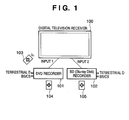
- FIG. 1 is a diagram showing a system configuration comprised of a digital television receiver to which the present invention can be applied and recording devices;
- FIG. 2 is a block diagram of the digital television receiver to which the present invention can be applied;
- FIG. 3 is a diagram showing a processing flow in which the recording devices are connected to the digital television receiver to which the present invention can be applied;
- FIG. 4 is a diagram illustrating a connected device list in a first embodiment of the present invention.
- FIG. 5 is a diagram showing a processing flow for selecting a recording device in the first embodiment of the present invention.
- FIG. 6 is a diagram showing a system configuration comprised of the digital television receiver to which the present invention can be applied and recording devices;
- FIG. 7 is a diagram showing the overview of the connected device list in a second embodiment of the present invention.
- FIG. 8 is a diagram showing an example of a priority setting screen in the second embodiment of the present invention.
- FIGS. 9A and 9B are diagrams showing a processing flow for selecting a recording device in the second embodiment of the present invention.
- FIG. 10 is a diagram showing a processing flow for selecting a recording device in a third embodiment of the present invention.
- FIG. 1 is a diagram showing a system configuration of a digital television receiver to which the present invention can be applied and recording devices.
- the digital television receiver corresponds to a recording control apparatus of the present invention.
- the recording control apparatus of the present invention is not limited to the digital television receiver but may be any form of apparatus that can perform control of the digital television receiver to be described later.
- a DVD recorder and a BD recorder correspond to recording devices of the present invention. It is to be understood that the recording devices are not limited to these recorders.
- FIG. 1 shows the DVD recorder 101 , the BD recorder 102 , and remote controls ( 103 , 104 , and 105 in FIG. 1 ) for the respective devices.
- the DVD recorder 101 is a recording device in which video content (e.g., a program) recorded in an HDD serving as a recording unit can be secondarily recorded onto a DVD with SD image quality.
- the BD recorder 102 is a recording device in which video content recorded in an HDD serving as a recording unit can be secondarily recorded onto a BD with HD image quality.
- the digital television receiver 100 and each of the DVD recorder 101 and BD recorder 102 are connected via a digital interface in compliance with the HDMI standard.
- the receiver and each recorder can control each other via HDMI.
- the relationship between the digital television receiver 100 and each recorder corresponds to that between Sink and Source in the HDMI standard. That is, the digital television receiver 100 is a Sink device, and each recorder connected to the digital television receiver 100 is a Source device.
- EDID Extended Display Identification Data
- EDID is display device information in compliance with the EDID standard established by VESA and stored in a data format defined in EIA/CEA-861B.
- this data may include video information, such as the resolution displayable by a digital television receiver and the aspect ratio, as well as audio information, manufacturer information, and product information.
- each recorder Based on EDID, each recorder outputs video and audio signals suitable for the digital television receiver 100 .
- the digital television receiver 100 as the Sink device can use DDC to acquire information about the connected recorders, such as address information and vendor information.
- the digital television receiver 100 can also use CEC to instruct each recorder on information acquisition and operation control. Besides basic control commands for controlling operations of connected devices, CEC also allows extension by a vendor's own control commands.
- a user can use the remote control 103 of the digital television receiver 100 to control recording operations and playback operations of the connected recorders ( 101 and 102 in FIG. 1 ) via the digital television receiver 100 .
- CEC is used for transmission of control commands when the digital television receiver 100 controls each recorder.
- FIG. 2 is a diagram showing an exemplary configuration of the digital television receiver 100 .
- a signal received by an antenna 201 is input to a tuner unit 202 .
- the tuner unit 202 processes the input signal for demodulation, error correction and the like, and generates a transport stream (hereinafter referred to as a TS).
- the tuner unit 202 further outputs the generated TS to a decoder unit 203 .
- the decoder unit 203 decodes the TS, which is input from the tuner unit 202 and includes time-division-multiplexed data for a plurality of channels, such as video data, audio data, and program information data. Specifically, the decoder unit 203 extracts from the TS the video data, audio data, and program information data for a channel designated via a remote control 218 and a remote control receiving unit 219 , and decodes these data items.
- the TS consists of packets, in which a PID (Packet Identifier) for identifying the type (video, audio, or data) is attached to the head of each packet.
- PID Packet Identifier
- a video processing/combining unit 204 combines the video data input from the decoder unit 203 with image data generated by an EPG (Electronic Program Guide) generation unit 210 (to be described later) as necessary and outputs the combined data to a display unit 205 .
- An audio processing unit 206 performs D/A conversion on the audio data input from the decoder unit 203 and outputs the audio data to an input switching unit 216 .
- the display unit 205 and the audio output unit 207 are shown to be included in the digital television receiver 100 .
- the present invention may adopt a configuration in which these display unit and audio output unit exist outside the receiver 100 .
- a data acquisition unit 208 acquires desired information from video signal information and program information data that are input from the decoder unit 203 , and outputs the information to a storage unit 209 .
- the video signal information includes, for example, information related to the program image quality, the signal format, scanning mode, frame rate, and color space information, written in a sequence header of the video data.
- the program information data includes data such as SDT (Service Description Table) and EIT (Event Information Table) according to “Service Information for Digital Broadcasting System”, a standard of Association of Radio Industries and Businesses (ARIB STD-B10).
- SDT Service Description Table
- EIT Event Information Table
- SDT includes information such as a service name corresponding to the broadcast channel, a service provider, and so on.
- EIT includes information such as an event name corresponding to the program, the starting time and duration of the event, and so on.
- An EPG generation unit 210 generates EPG display data by using the program information data input from the data acquisition unit 208 or the storage unit 209 .
- the generated EPG display data is output to the video processing/combining unit 204 .
- the storage unit 209 is configured to also store a connected device list to be described later.
- the connected device list may be stored in memory physically separate from the storage unit 209 .
- An external IF unit 211 is a digital interface in compliance with the HDMI standard and transmits and receives data to/from external devices, for example, recording devices such as the DVD recorder 101 and the BD recorder 102 . Specifically, the external IF unit 211 receives input of video data and audio data transmitted from the DVD recorder 101 and the BD recorder 102 . The external IF unit 211 also outputs control commands to the DVD recorder 101 and the BD recorder 102 by using CEC. The external devices can read information related to the digital television receiver 100 from an EDID ROM 220 .
- a command control unit 212 controls generation of the above-mentioned control commands for controlling operations of the external devices, and transmission of the control commands to the external devices via the external IF unit 211 .
- a separation unit 213 separates video and audio data and commands input from the external IF unit 211 .
- the separation unit 213 outputs the video data and the audio data to an HDCP (High-bandwidth Digital Content Protection System) decoding unit 214 and outputs the commands to the command control unit 212 .
- HDCP High-bandwidth Digital Content Protection System
- the HDCP decoding unit 214 acquires HDCP key data from a memory unit 215 and decodes encrypted video data and audio data.
- the decoded video data and audio data are output to an input switching unit 216 .
- the input switching unit 216 selects either the video data and audio data input from the decoder unit 203 and the audio processing unit or the video data and audio data of an external device input from the HDCP decoding unit 214 , and outputs the selected video data to the video processing/combining unit 204 and the selected audio data to the audio output unit 207 .
- a control unit 217 shown in FIG. 2 to be connected to the storage unit 209 and the command control unit 212 , centrally controls the above-described components.
- step S 301 the control unit 217 detects connection of the recorders. Specifically, power is supplied to the external IF unit 211 of the digital television receiver 100 from the recorders connected by HDMI. The external IF unit 211 detects the power supply and returns a command to the recorders indicating connection. In response to this, the recorders read device information about the digital television receiver 100 from the EDID ROM 220 . This sequential processing allows the control unit 217 to detect the connection of the recorders.
- step S 302 the control unit 217 acquires device information about the recorders for which the connection has been detected.
- HDMI is standardized so that the physical address, device properties, and manufacturer information can be identified between devices connected with each other. Therefore, once the recorders and the digital television receiver 100 are connected, the digital television receiver 100 can acquire device information about the recorders.
- HDMI allows vendor commands of CEC to be uniquely defined. Therefore, vendor commands can be defined to allow the digital television receiver 100 to acquire device information such as information about recording media the recorders support and image quality information about the recording media.
- the present invention is not limited by the above-described method of acquiring the device information via HDMI.
- FIG. 4 shows an example of the connected device list generated based on the device information acquired from the recorders ( 101 , 102 in FIG. 1 ) connected to the digital television receiver 100 .
- the connected device list is management information for managing various kinds of information about external devices connected to the digital television receiver 100 .
- the DVD recorder 101 and the BD recorder 102 serving as recording devices correspond to the connected external devices, various kinds of attribute information about these recorders are managed as the connected device list.
- the connected device list is stored in the storage unit 209 .
- An “Input Port” item corresponds to an input channel of the external IF unit 211 provided in the digital television receiver 100 .
- a “Physical Address” item manages identification information unique to each recorder.
- a “Device Attribute” item manages the device type differentiated by, for example, the logical address defined by CEC.
- a “Vendor ID” item manages ID information set for the manufacturer of each device.
- a “Vendor Specific Data” item manages information such as the product code and the device type name of each device.
- An “HDD Recording Image Quality” item manages information about the image quality level at which video signals are recorded onto the HDD provided in each connected device.
- information indicating HD image quality is managed. That is, in this embodiment, the highest one of recordable image quality levels is managed.
- a “Medium Recording” item manages information indicating whether or not each connected device supports recording onto a recording medium.
- the flag “Y” indicating the recordability is managed in the Medium Recording item.
- a “Supported Media” item manages information about the type of recording medium supported by each connected device.
- a “Medium Recording Image Quality” item manages information about the recording image quality with which content is recorded onto the recording medium of each connected device.
- the medium supported by the DVD recorder 101 is DVD
- information indicating SD image quality is managed as the medium recording image quality.
- the medium supported by the BD recorder 102 is BD
- recording image quality information indicating HD image quality is managed as the medium recording image quality.
- information such as “SD image quality” is directly managed as the medium recording image quality.
- the present invention is also realized by managing information that allows indirect determination of the medium recording image quality. For example, when information indicating DVD as the supported medium is managed, it is possible to determine that the medium recording image quality is SD image quality because the supported medium is DVD. As long as such determination logic can be implemented in the control unit of the digital television receiver 100 , the medium recording image quality need not be directly managed. In the present invention, even information type that allows indirect determination of the medium recording image quality is treated as information about the recording image quality.
- the present invention is not limited to the described items.
- other information may be managed, such as information about an audio format supported by each connected device.
- the digital television receiver 100 can acquire the information about the connected devices.
- step S 303 the control unit 217 determines whether or not the connected devices are already managed in the connected device list. This determination is performed by comparing the device information acquired in step S 302 and the connected device list stored in the storage unit 209 .
- step S 303 determines in step S 303 that the devices corresponding to the device information acquired in step S 302 are not managed in the connected device list
- the control unit 217 transitions to step S 304 . If the control unit 217 determines in step S 303 that the devices corresponding to the device information acquired in step S 302 are already registered in the connected device list, the control unit 217 terminates this processing flow.
- step S 304 the control unit 217 performs processing of generating the connected device list based on the device information acquired in step S 302 . If the connected device list already exists, the control unit 217 adds the acquired device information to the connected device list. If the connected device list does not exist, the control unit 217 generates the connected device list itself and writes the acquired device information into the list.
- FIG. 5 showing this processing flow will be referred to in the description below.
- the video content is assumed to be a broadcast program. Therefore, a scene is assumed in which the user gives an instruction to display an EPG and sets recording of the program through the displayed EPG.
- step S 501 when the user uses the remote control 218 or the like to input an instruction to display the EPG to the digital television receiver 100 , the digital television receiver 100 displays the EPG (S 501 ).
- step S 502 through the displayed EPG, the user inputs an instruction to select a program to be recorded.
- the control unit 217 recognizes the program to be recorded.
- the control unit 217 refers to the connected device list to determine whether or not two or more recording devices (recorders) are connected to the digital television receiver 100 .
- the connected device list includes the Device Attribute item.
- the Device Attribute item manages information for identifying whether a connected device is a recording device or a playback-only device, and so on.
- the control unit 217 can know whether two or more recording devices are connected by acquiring the information managed in the Device Attribute item and by making a determination.
- step S 503 determines in step S 503 that only one recorder is connected
- the control unit 217 proceeds to step S 507 to select this recorder as the recording target recorder. While this processing flow omits the case where no recorders are connected, the control unit 217 may determine in step S 503 whether or not no recorders are connected. If no recorders are connected, the control unit 217 may terminate the recording processing.
- control unit 217 determines in step S 503 that two or more recorders are connected to the digital television receiver 100 , the control unit 217 transitions to step S 504 .
- step S 504 the control unit 217 acquires image quality information about the user-selected program.
- image quality information about a program is described by a component descriptor contained in PMT (Program Map Table), EIT (Event Information Table), or the like included in SI (Service Information) transmitted as being multiplexed with a broadcast wave.
- the component descriptor defines the aspect ratio, resolution (the number of scanning lines), and scanning mode such as interlaced or progressive, of the broadcast program. Therefore, the digital television receiver 100 can acquire image quality information about the user-selected program by acquiring the component descriptor in the data acquisition unit 208 and storing it in the storage unit 209 .
- step S 505 the control unit 217 refers to the connected device list stored in the storage unit 209 to select one recorder. While two or more recorders are managed in the connected device list, the control unit 217 may select any one recorder.
- step S 506 based on the image quality information about the program and the medium recording image quality information about the recorder selected in step S 505 , the control unit 217 compares these information items.
- the medium recording image quality information about the recorder selected in step S 505 is information stored in the Medium Recording Image Quality item in the connected device list.
- the control unit 217 determines whether or not the medium recording image quality of the recorder is equal to the image quality of the program to be recorded, or the medium recording image quality is higher than the program image quality. For example, assume that the image quality information about the selected program includes an aspect ratio of 16:9, 1125 scanning lines, and interlaced scanning mode, and the medium recording image quality of the selected recorder is SD image quality. Since the number of scanning lines for SD image quality is 525, the program with 1125 scanning lines must have its image quality degraded for recording onto the medium. That is, it is determined that the program image quality is higher than the medium recording image quality of the recorder.
- information such as the number of recording pixels (the number of scanning lines) and aspect ratio determined from the information such as SD or HD managed as the medium recording image quality in the connected device list, is used for the comparison with the image quality information about the program.
- step S 506 If it is determined in step S 506 that the medium recording image quality of the selected recorder is equal to the program image quality, or the medium recording image quality is higher than the program image quality, the control unit 217 transitions to step S 507 . That is, the control unit 217 transitions to step S 507 if the medium recording image quality of the selected recorder is equal to or higher than the program image quality.
- step S 507 the control unit 217 sets the recorder selected in step S 505 as the recording target recorder for this program. That is, the control unit 217 selects the recorder for recording the program among the two or more recorders based on the image quality information about the program and the medium recording image quality information.
- step 508 by using a recording control command according to CEC of HDMI, the control unit 217 transmits to the recorder set in step S 507 an instruction to record the user-selected program onto the HDD.
- Information required for recording is transmitted as the recording instruction, such as the broadcast date, network, service, broadcast time, and broadcast duration.
- the recorder having received the instruction in step S 508 records the program onto the HDD (not shown) serving as a recording unit provided in the recorder. That is, the recorder primarily records the broadcast program onto the HDD. Also in the embodiments to be described later, it is assumed that a program to be recorded under the instruction of the digital television receiver 100 is first recorded onto the HDD serving as a recording unit for primary recording. However, while it is assumed that the HDD is used for primary recording in these embodiments, the present invention is not limited to the HDD. Memory such as ROM, or other recording mechanisms, may be used as long as it is a recording unit unintended for output as a recording medium.
- control unit 217 determines in step S 506 that the medium recording image quality of the selected recorder is lower than the program image quality, the control unit 217 transitions to step S 509 .
- step S 509 the control unit 217 determines whether or not the comparison and determination has been finished for all recorders managed in the connected device list. If the comparison has not been finished for all recorders, the control unit 217 returns to step S 505 and selects a new recorder from the connected device list. Processing thereafter is similar to that described above.
- control unit 217 determines in step S 509 that the comparison has been finished for all recorders managed in the connected device list, the control unit 217 transitions to step S 510 .
- Transition to step S 510 means that none of the connected recorders can record the program onto a medium without degrading the program image quality. Therefore, whichever recorder is selected, the image quality will be degraded when this program is secondarily recorded onto a medium.
- step S 510 the control unit 217 selects a recorder having the highest medium recording image quality among the recorders managed in the connected device list. As described above, even this selected recorder will degrade the image quality in secondary recording. However, the influence of the image quality degradation can be alleviated if the control unit 217 selects a recorder having the highest medium recording image quality.
- step S 510 the control unit 217 moves the processing to step S 508 .
- Processing in step S 508 will not be described because it is similar to that described above.
- control is performed to compare the image quality of the program to be recorded and the recording image quality of a recording medium for each recording device. Based on the result of this comparison, a recording device for primary recording of the program is selected.
- a recording control apparatus that can automatically select a recording device capable of optimal secondary recording of content such as a program without requiring a user to be aware of the image quality of the content and the image quality recordable by the recording devices.
- the recording device is selected based on the image quality information.
- the recording device may be selected based on sound quality information. For example, control is possible such that if the number of channels of the broadcast program is 5.1 ch, the BD recorder 102 is selected as the recording target recorder.
- the image quality information and the sound quality information may be combined to select the recording device.
- the sound quality information about the program may be acquired by referring to information such as an audio component descriptor or quality_indicator of EIT.
- the above description does not expressly consider the case where two or more recorders have the same medium recording image quality. If two or more recorders have the same medium recording image quality, various conditions may be used to select one recorder.
- the various conditions may include a condition that a recorder with larger HDD recording capacity should be selected, and a condition that a recorder frequently used by the user should be selected.
- an HD-DVD recorder 601 capable of recording video onto an HD-DVD (High Definition DVD) serving as a recording medium is connected to the digital television receiver 100 in addition to the configuration of the first embodiment. This configuration is shown as FIG. 6 .
- the user when the user (audience) sets recording of a program, the user specifies that a program be eventually recorded onto a recording medium. An optimal recording device is then selected among a plurality of connected recording devices.
- the second embodiment is characterized by taking the capacity of recording media into consideration during this selection control.
- the configuration of the digital television receiver 100 will not be described because it is similar to that described with reference to FIG. 2 in the above first embodiment.
- the maximum supported capacity of the recording medium recordable with each connected device is managed in addition to the various items managed in the connected device list in the first embodiment.
- FIG. 7 shows the connected device list in the second embodiment.
- the digital television receiver 100 can select an appropriate one of the recording devices by managing in advance the maximum supported capacity of the recording medium recordable with each recording device.
- the maximum supported capacity of the recording medium is related to the recording capability of a recording drive provided in a recording device. For example, if a DVD drive provided in a DVD recorder only supports one-sided single-layer recording onto a DVD-R, the maximum supported capacity of the recording medium for the DVD recorder is 4.7 GB. However, if the DVD drive supports one-sided dual-layer recording onto a DVD-R, the maximum supported capacity of the recording medium is 8.5 GB. Thus, the maximum supported capacity of the recording medium in this embodiment corresponds to the recording capacity of a recording medium having the largest capacity recordable with a recording device in question.
- the digital television receiver 100 acquires this maximum supported capacity from the connected devices.
- the vendor's own command in CEC of HDMI may be used for the acquisition. It is to be understood that other acquisition methods may be used. As described in the first embodiment, other means such as user input may also be used. Even without being directly acquired, the maximum supported capacity may be indirectly recognized by knowing the recording medium supported by each recording drive. What is important is that the digital television receiver 100 manages, in some form, information corresponding to the maximum supported capacity of the recording medium recordable with each recording device.
- a “Medium Maximum Supported Capacity” item manages the recording capacity of a recording medium having the largest capacity recordable with each connected device (recorder) as a numeric value.
- the present invention does not necessarily require managing this information as a numeric value.
- This setting screen is for setting the priority, which will be a condition in selecting a connected recorder in the digital television receiver 100 .
- This setting screen is preferably displayed when a new recorder is connected to the digital television receiver 100 .
- the present invention is not limited by display timing.
- FIG. 8 shows an example of the priority setting screen displayed on a display screen of the digital television receiver 100 .
- Priority setting fields 801 include items in which the priority of the recorders selected for recording a program are displayed and set.
- a device list 802 includes items in which a list of the recorders connected to the digital television receiver 100 is displayed.
- the user operates the priority setting fields 801 and the device list 802 with right and left keys provided on the remote control 103 .
- the user selects an item for the second priority in the priority setting fields 801 and then selects a recorder (here, the DVD recorder) that the user wants to give the second priority from the device list 802 .
- the user presses an enter key provided on the remote control 103 .
- the DVD recorder is set in the second priority field in the priority setting fields 801 .
- the priority set in the priority setting screen shown in FIG. 8 is managed in a Priority item (not shown) provided in the connected device list.
- Steps S 901 to S 902 will not be described because processing performed therein is similar to that in steps S 501 to S 502 in the above-described first embodiment.
- Step S 903 will not be described because processing performed therein is similar to that in step S 504 in the above-described first embodiment.
- step S 503 the step of checking whether or not two or more recorders are connected may be performed before step S 903 .
- step S 904 the control unit 217 selects a recorder included in the connected device list according to the above-described priority. At the initial stage of this processing flow, a recorder having the highest priority is selected. That is, the control unit 217 selects a recorder for recording the program by sequentially comparing the image quality information about the program and the recording image quality information about the recording medium according to the set priority.
- step S 905 the control unit 217 performs processing of comparing the medium recording image quality information about the selected recorder and the image quality information about the program acquired in step S 903 .
- the medium recording image quality information about the recorder selected in step S 904 is information stored in the Medium Recording Image Quality item in the connected device list.
- the control unit 217 determines whether or not the medium recording image quality of the recorder is equal to the image quality of the program to be recorded, or the medium recording image quality is higher than the program image quality. This determination will not be described in detail because it is similar to the determination processing described in step S 506 in the first embodiment.
- step S 905 determines in step S 905 that the medium recording image quality of the selected recorder is equal to the image quality of the program to be recorded, or the medium recording image quality is higher than the program image quality
- the processing transitions to step S 906 . That is, the processing transitions to step S 906 if the medium recording image quality of the selected recorder is equal to or higher than the program image quality.
- step S 906 the control unit 217 adds the recorder to be compared to a recording candidate device list.
- the recording candidate device list provides information for managing candidate devices for recording the program the user wants to record in this embodiment.
- the recording candidate device list may be managed as data separate from the connected device list. Alternatively, it may be managed as an item in the connected device list in such a manner that information identifying a recorder in question as a recording candidate is set for that recorder.
- step S 907 the control unit 217 determines whether or not the comparison processing in step S 905 has been finished for all recorders managed in the connected device list. If the comparison processing has been finished for all recorders, the control unit 217 moves the processing to step S 909 . If the comparison processing has not been finished for all recorders, the control unit 217 moves the processing to step S 904 . In step S 904 , the control unit 217 selects a recorder given the next priority and continues the processing from step S 904 .
- step S 905 If it is determined in step S 905 that the medium recording image quality of the selected recorder is lower than the program image quality, the control unit 217 moves the processing to step S 908 .
- step S 908 the control unit 217 determines whether or not the comparison processing in step S 905 has been finished for all recorders managed in the connected device list. If the comparison processing has not been finished for all recorders, the control unit 217 moves the processing to step S 904 . If it is determined that the comparison processing has been finished for all recorders, the control unit 217 moves the processing to step S 909 .
- step S 909 the control unit 217 determines whether or not two or more recorders have been set as candidates in the sequential processing up to this point. That is, the control unit 217 determines the number of recorders managed in the above-described recording candidate device list.
- step S 909 If it is determined in step S 909 that only one recorder is set as the candidate, the control unit 217 moves the processing to step S 910 .
- Transition to step S 910 means that only one of the connected recorders is capable of secondary recording without degrading the program image quality. Therefore, in step S 910 , the control unit 217 sets the one candidate recorder as the recording target recorder for the program the user wants to record.
- step S 909 If it is determined in step S 909 that no recorders are set as candidates, the control unit 217 moves the processing to step S 911 .
- Transition to step S 911 means that none of the connected recorders is capable of secondary recording without degrading the program image quality. Therefore, in step S 911 , according to the user-set priority, the control unit 217 sets a recorder having the highest priority as the recording target recorder for the program the user wants to record.
- step S 909 If it is determined in step S 909 that two or more recorders are set as candidates, the control unit 217 moves the processing to step S 912 .
- step S 912 the control unit 217 acquires the broadcast time of the program the user wants to record.
- the broadcast time of the program can be acquired by referring to the program information data stored in the storage unit 209 .
- step S 913 the control unit 217 computes the amount of data of the program the user wants to record.
- the amount of data of the program can be computed using the image quality information about the program acquired in step S 903 , the broadcast time of the program, and so on.
- the coding mode is MPEG-2 video coding, and the same bit rate is used irrespective of recording media.
- the coding mode, bit rate, and frame size may be processed as appropriate.
- step S 914 the control unit 217 selects one of the recorders managed in the recording candidate device list.
- the recorder is preferably selected in order of the set priority.
- step S 915 the control unit 217 compares the amount of data of the program computed in step S 913 and the medium maximum supported capacity of the recorder selected in step S 914 .
- the medium maximum supported capacity is information managed in the connected device list. If the control unit 217 determines that the data amount of the program is equal to the medium maximum supported capacity of the selected recorder, or the medium maximum supported capacity is larger than the amount of data of the program, the control unit 217 transitions to step S 916 . That is, the control unit 217 makes a determination for selecting a recorder capable of recording onto a recording medium having a maximum supported capacity (recordable capacity) equal to or larger than the amount of data of the program.
- step S 916 the control unit 217 sets the selected recorder as the target recorder to be used by the user for recording the program. That is, the recorder selected in step S 916 is a recorder that can record the program onto one recording medium without degrading the program image quality when the user secondarily records the recorded program onto a recording medium.
- step S 915 If it is determined in step S 915 that the amount of data of the program is larger than the medium maximum supported capacity of the selected recorder, it means that this recorder is incapable of secondary recording unless the program image quality is degraded or two or more recording media are used.
- the control unit 217 then transitions to step S 917 to determine whether or not the comparison has been finished for all recording candidate recorders.
- control unit 217 determines in step S 917 that the comparison has not been finished for all recorders, the control unit 217 transitions to step S 918 to select another candidate recorder and repeat the same processing from step S 914 .
- step S 917 determines in step S 917 that the comparison has been finished for all recorders. If the control unit 217 determines in step S 917 that the comparison has been finished for all recorders, the control unit 217 transitions to step S 919 .
- step S 919 the control unit 217 sets a recorder having the largest medium maximum supported capacity as the recording target recorder among the recorders set as candidate devices. This is because degradation in the image quality can be minimized when the program recorded in the HDD is secondarily recorded onto a recording medium and the user desires to store the program in one recording medium even at the expense of degradation in the program image quality.
- step S 508 described in the first embodiment will be performed after steps S 910 , S 911 , S 916 , and S 919 .
- processing may be performed such as displaying a message prompting the user to acknowledge recording of the program with the recorder finally determined as the recording target recorder.
- control is performed to compare the image quality of the program to be recorded and the recording image quality of a recording medium for each recording device. If this comparison indicates that two or more recording devices are connected that are capable of recording onto a recording medium without degrading the program image quality, the amount of data of the program is computed. The amount of data is compared with the maximum capacity of a recording medium supported by each recording device. Based on the result of this comparison, one recording device optimal for recording the program can be selected.
- a recording control apparatus that can automatically select a recording device capable of secondary recording of content such as a program with an optimal image quality without requiring a user to be aware of the image quality, the data amount, and the image quality recordable by the recording devices.
- HD-DVD and BD are both standards capable of recording video with HD image quality, there is currently no compatibility between these standards. Some content holders producing or holding video content such as movies only support either one of the HD-DVD and BD standards.
- secondary recording of the content onto a recording medium may involve situations such as where the recording medium is limited to a BD, or where recording onto an HD-DVD is permitted on condition that the image quality is degraded.
- This embodiment will be described about the method of selecting an optimal one of a plurality of recorders when conditioned content recordable onto only a particular recording medium is recorded with a recorder.
- this embodiment uses a digital copy control descriptor defined in “Service Information for Digital Broadcasting System” (ARIB STD-B10).
- the digital copy control descriptor represents copy control information for a recording device and so on.
- the digital copy control descriptor is used by a broadcaster (copyright holder) that broadcasts digitally recordable content for providing a recording device with information about recording and copying of the content.
- the recording device is requested to control recording and copying of the content according to the details described in the digital copy control descriptor.
- the digital copy control descriptor includes a broadcaster definition area in which a broadcaster can define its own limitations.
- information for limiting the recording medium is defined in this broadcaster definition area to provide the recording device with the information.
- Possible information provided through the broadcaster definition area may be information indicating recordability onto only an HD-DVD, information indicating recordability onto only a BD, or the like.
- Other possible information may be information indicating recordability onto a different recording medium on condition that the image quality is degraded. Such information will hereinafter be referred to as limitation information.
- a copyright protection mode may be utilized.
- the HD-DVD medium and the BD (Blu-ray Disk) medium use different copyright protection modes.
- the HD-DVD medium adopts AACS (Advanced Access Content System).
- the BD adopts its own protection mechanisms called ROM-Mark and BD+ (BD plus) in addition to AACS.
- bit string such as “00” is defined as the limitation information in the digital copy control descriptor.
- bit string such as “01” is defined as the limitation information in the digital copy control descriptor.
- the limitation information indicating recordability onto only a BD medium may be defined in the broadcaster definition area in the digital copy control descriptor for content the user wants to record.
- the content can be recorded onto the HDD of the HD-DVD recorder, but secondary recording of the content onto an HD-DVD still with HD image quality is not allowed according to the above information.
- the digital television receiver 100 needs to know in advance, from the connected recording devices (recorders), information about the recording medium type recordable with each recorder.
- the information managed in the “Supported Media” item in the connected device list shown as FIG. 4 in the first embodiment is exactly the information about the recording medium type.
- the information about the copyright protection mode acquired from each recorder also serves as the information about the recording medium type.
- the information about the recording medium type recordable with each recorder may be acquired in any manner. It is assumed in the description in this embodiment that the information about the recording medium type includes the information about the copyright protection mode.
- Steps S 1001 and S 1002 will not be described because processing therein is similar to that in steps S 501 and S 502 in the above-described first embodiment.
- step S 1003 the control unit 217 acquires the limitation information about the user-selected program.
- the limitation information can be acquired by referring to the digital copy control descriptor included in the program information data stored in the storage unit 209 .
- step S 1004 the control unit 217 selects a recorder connected to the digital television receiver 100 from the connected device list. While any methods may be adopted for selecting one of the recorders in the connected device list, it will be preferable to select one in order of priority as described in the second embodiment.
- step S 1005 the control unit 217 compares the limitation information acquired in step S 1003 and the information about copyright protection mode of the recorder selected in step S 1004 .
- the information about copyright protection mode of the selected recorder is acquired by referring to information managed in the connected device list or the like.
- step S 1005 the control unit 217 determines whether or not the user-selected program (content) can be recorded onto a recording medium with the selected recorder. If the control unit 217 determines that the program can be recorded onto a recording medium, the control unit 217 transitions to step S 1006 . In step S 1006 , the control unit 217 sets the selected recorder as the recording target recorder for the program.
- step S 1007 the control unit 217 performs processing of transmitting recording programming information to the recording target recorder.
- the recording target recorder will primarily record the program onto the HDD serving as a storage unit.
- step S 1005 determines in step S 1005 that the user-selected program cannot be recorded onto a recording medium with the selected recorder
- step S 1008 the control unit 217 determines whether or not the comparison has been finished for all recorders managed in the connected device list. If the comparison has not been finished for all recorders, the control unit 217 transitions to step S 1004 to select a new recorder and continue the processing. If the control unit 217 determines that the comparison has been finished for all recorders, the control unit 217 transitions to step S 1009 .
- step S 1009 it is determined that no recorders capable of recording the program onto a recording medium are connected. Although there is a limitation on second recording of the program, the program can be recorded onto the HDD. Therefore, the control unit 217 selects one recorder as the recording target recorder. The control unit 217 then transitions to step S 1007 . Any condition may be used for the control unit 217 to select one recorder in step S 1009 .
- an optimal one of the candidate recorders may be selected depending on the image quality information and the amount of data, as described in the second embodiment.
- control is performed to compare the limitation information for limiting a recording medium to which the program to be recorded can be output and the information about a recording medium for each recording device. Based on the result of this comparison, one recording device optimal for recording the program can be selected. That is, even if the recording medium usable for recording a program is limited to a recording medium of a particular standard, it is possible to provide a recording control apparatus that can automatically select a recording device capable of secondary recording of the program without requiring a user to be aware of the limitation.
- a computer program itself supplied to the computer to implement the above-described embodiments by the computer also realizes the present invention. That is, the computer program itself for implementing the functions of the above-described embodiments is also included in the present invention.
- the computer program for implementing the above-described embodiments may take any form as long as it is readable by the computer.
- the computer program may be configured as an object code, a program to be executed by an interpreter, or script data to be supplied to an OS.
- Storage media for supplying the program include, for example, magnetic storage media such as a flexible disk, hard disk, and magnetic tape, optical/magneto-optical storage media such as an MO, CD, and DVD, and nonvolatile semiconductor memory.
- Methods of supplying the computer program using the wired/wireless communication include a method utilizing a server on a computer network.
- a data file (program file) that can be the computer program forming the present invention is stored in the server.
- the program file may be an executable or may be a source code.
- the program file is downloaded and supplied to a client computer that accesses this server.
- the program file may be divided into segment files, each of which are located in different servers in a distributed manner.
- server apparatus that provides the client computer with the program file for implementing the above-described embodiments is also included in the present invention.
- a storage medium that stores the computer program for implementing the above-described embodiments in an encrypted form may be distributed to a user.
- the user who satisfies a predetermined condition may be supplied with key information for decrypting the encryption and may be allowed to install the decrypted computer program in the user's computer.
- the key information may be supplied by causing the user to download it from a homepage via, for example, the Internet.
- the computer program for implementing the above-described embodiments may utilize functions of an OS already running on the computer.
- part of the computer program for implementing the above-described embodiments may be configured as firmware in an expansion board or the like attached to the computer, or may be executed by a CPU privided on the expansion board or the like.
Landscapes
- Engineering & Computer Science (AREA)
- Multimedia (AREA)
- Signal Processing (AREA)
- Databases & Information Systems (AREA)
- Signal Processing For Digital Recording And Reproducing (AREA)
- Television Signal Processing For Recording (AREA)
- Two-Way Televisions, Distribution Of Moving Picture Or The Like (AREA)
Applications Claiming Priority (2)
| Application Number | Priority Date | Filing Date | Title |
|---|---|---|---|
| JP2007045645A JP5142554B2 (ja) | 2007-02-26 | 2007-02-26 | 記録制御装置及び記録制御装置の制御方法 |
| JP2007-045645 | 2007-02-26 |
Publications (2)
| Publication Number | Publication Date |
|---|---|
| US20080205857A1 US20080205857A1 (en) | 2008-08-28 |
| US8340499B2 true US8340499B2 (en) | 2012-12-25 |
Family
ID=39716017
Family Applications (1)
| Application Number | Title | Priority Date | Filing Date |
|---|---|---|---|
| US12/034,395 Expired - Fee Related US8340499B2 (en) | 2007-02-26 | 2008-02-20 | Recording control apparatus and control method for the same |
Country Status (4)
| Country | Link |
|---|---|
| US (1) | US8340499B2 (enExample) |
| JP (1) | JP5142554B2 (enExample) |
| KR (1) | KR100945737B1 (enExample) |
| CN (1) | CN101257602B (enExample) |
Cited By (4)
| Publication number | Priority date | Publication date | Assignee | Title |
|---|---|---|---|---|
| US20110035514A1 (en) * | 2009-08-05 | 2011-02-10 | Kabushiki Kaisha Toshiba | Information transmission apparatus |
| US20110050387A1 (en) * | 2009-09-01 | 2011-03-03 | Tae Hyoung Kim | Method for controlling external device and transmitting apparatus and receiving apparatus thereof |
| US20130057762A1 (en) * | 2010-05-19 | 2013-03-07 | Sharp Kabushiki Kaisha | Source device, sink device, system, and recording medium |
| US9071793B2 (en) | 2009-09-01 | 2015-06-30 | Lg Electronics Inc. | Method for controlling external device and remote controller thereof |
Families Citing this family (17)
| Publication number | Priority date | Publication date | Assignee | Title |
|---|---|---|---|---|
| JP2008306232A (ja) | 2007-06-05 | 2008-12-18 | Funai Electric Co Ltd | 映像受信装置及び放送受信装置 |
| JP5356169B2 (ja) * | 2008-09-26 | 2013-12-04 | シャープ株式会社 | デジタル放送受信装置 |
| CN101753903A (zh) * | 2008-12-15 | 2010-06-23 | 深圳Tcl新技术有限公司 | 在电子设备上显示菜单的方法以及电子设备 |
| JP2010193247A (ja) * | 2009-02-19 | 2010-09-02 | Sanyo Electric Co Ltd | Hdmi機器 |
| US8495687B2 (en) | 2009-03-16 | 2013-07-23 | Centurylink Intellectual Property Llc | DVR home network content shifting |
| JP5268729B2 (ja) * | 2009-03-24 | 2013-08-21 | 株式会社東芝 | 録画予約装置および録画予約方法 |
| US8239443B2 (en) | 2009-09-01 | 2012-08-07 | Rovi Technologies Corporation | Method and system for tunable distribution of content |
| JP5566947B2 (ja) * | 2011-05-12 | 2014-08-06 | 株式会社東芝 | 情報送信装置 |
| US20120297424A1 (en) * | 2011-05-18 | 2012-11-22 | International Business Machines Corporation | Proxy digital video recorder |
| US20160050454A1 (en) * | 2013-03-28 | 2016-02-18 | Irdeto B.V. | Protection of digital content |
| JP6134200B2 (ja) * | 2013-05-17 | 2017-05-24 | キヤノン株式会社 | 映像送信装置、制御方法、プログラム及び記憶媒体 |
| EP3013040A4 (en) | 2013-06-20 | 2016-12-28 | Sony Corp | PLAYING DEVICE, PLAYING METHOD AND RECORDING MEDIUM |
| EP3094096B1 (en) | 2014-01-06 | 2018-09-26 | LG Electronics Inc. | Method and device for transmitting and receiving broadcast signal on basis of color gamut resampling |
| JP6700658B2 (ja) * | 2014-11-28 | 2020-05-27 | シャープ株式会社 | 受信装置、受信方法、及びプログラム |
| JP2016122985A (ja) * | 2014-12-25 | 2016-07-07 | 株式会社東芝 | 画像処理システム、画像処理装置および画像処理方法 |
| US9369570B1 (en) * | 2015-05-18 | 2016-06-14 | Nice-Systems Ltd | Concurrent recordings of telephonic interactions |
| WO2019005041A1 (en) * | 2017-06-28 | 2019-01-03 | Rovi Guides, Inc. | SYSTEMS AND METHODS FOR REPLACING A STORED VERSION OF MULTIMEDIA CONTENT WITH A BETTER VERSION ADAPTED TO A USER |
Citations (19)
| Publication number | Priority date | Publication date | Assignee | Title |
|---|---|---|---|---|
| JP2001339696A (ja) | 2000-05-26 | 2001-12-07 | Sharp Corp | 電子番組ガイド表示制御装置および方法、並びに記録媒体 |
| WO2004086370A2 (en) | 2003-03-24 | 2004-10-07 | Matsushita Electric Industrial Co., Ltd. | Recording apparatus and content protection system |
| US20040228614A1 (en) * | 2003-05-14 | 2004-11-18 | Konica Minolta Photo Imaging, Inc. | Recording medium, image recording apparatus and image recording method |
| US20040246346A1 (en) * | 2003-06-03 | 2004-12-09 | Kim Yong-Ho | Photographing apparatus for automatically setting compression format and method thereof |
| US20050122863A1 (en) * | 2003-12-08 | 2005-06-09 | Canon Kabushiki Kaisha | Recording apparatus and recording method capable of recording series of content data on different recording media |
| US6931198B1 (en) * | 1998-07-15 | 2005-08-16 | Sony Corporation | Apparatus and method for downloading desired data signal to user-selectable storage unit |
| US20050265190A1 (en) * | 2004-05-27 | 2005-12-01 | Canon Kabushiki Kaisha | Recording apparatus |
| US20050265195A1 (en) * | 2004-05-28 | 2005-12-01 | Canon Kabushiki Kaisha | Recording apparatus and method |
| US20060018471A1 (en) * | 2004-07-09 | 2006-01-26 | Pioneer Corporation | Information recording apparatus and method, information reproducing apparatus and method, information recording/reproducing apparatus and method, and computer program product |
| JP2006054022A (ja) | 2004-08-16 | 2006-02-23 | Sony Corp | 記録制御装置、記録制御方法 |
| US20060110127A1 (en) * | 2004-11-19 | 2006-05-25 | Jerry Iggulden | Method and apparatus for making archival copies of audiovisual recordings |
| US20060114510A1 (en) * | 2004-11-30 | 2006-06-01 | Samsung Techwin Co., Ltd. | Apparatus and method for image conversion |
| JP2006165925A (ja) | 2004-12-07 | 2006-06-22 | Sharp Corp | 記録再生装置 |
| US20060140576A1 (en) * | 2004-12-27 | 2006-06-29 | Takeshi Oka | Information recording control apparatus and file recording control method |
| KR20060095170A (ko) | 2005-02-28 | 2006-08-31 | 주식회사 대우일렉트로닉스 | 콤보 시스템의 영상 데이터 기록 방법 |
| WO2006126632A1 (ja) | 2005-05-25 | 2006-11-30 | Pioneer Corporation | 好適操作を推薦する記録再生装置 |
| US20070036524A1 (en) * | 2005-08-12 | 2007-02-15 | Canon Kabushiki Kaisha | Image data recording apparatus and method |
| US20080050098A1 (en) * | 2006-08-28 | 2008-02-28 | Canon Kabushiki Kaisha | Recording apparatus |
| US20080063380A1 (en) * | 2004-06-08 | 2008-03-13 | Shuhei Sasakura | Recording/Reproduction Device |
Family Cites Families (3)
| Publication number | Priority date | Publication date | Assignee | Title |
|---|---|---|---|---|
| JP2005094624A (ja) * | 2003-09-19 | 2005-04-07 | Canon Inc | 記録装置 |
| KR20050091929A (ko) * | 2004-03-11 | 2005-09-16 | 주식회사 휴맥스 | 방송 녹화기기에서의 녹화 조건 설정방법 |
| KR100664830B1 (ko) * | 2005-01-20 | 2007-01-04 | 주식회사 휴맥스 | 방송 프로그램 녹화기에서의 녹화 화질 제어장치 및 방법 |
-
2007
- 2007-02-26 JP JP2007045645A patent/JP5142554B2/ja not_active Expired - Fee Related
-
2008
- 2008-02-20 KR KR1020080015233A patent/KR100945737B1/ko not_active Expired - Fee Related
- 2008-02-20 US US12/034,395 patent/US8340499B2/en not_active Expired - Fee Related
- 2008-02-26 CN CN200810008362XA patent/CN101257602B/zh not_active Expired - Fee Related
Patent Citations (21)
| Publication number | Priority date | Publication date | Assignee | Title |
|---|---|---|---|---|
| US6931198B1 (en) * | 1998-07-15 | 2005-08-16 | Sony Corporation | Apparatus and method for downloading desired data signal to user-selectable storage unit |
| JP2001339696A (ja) | 2000-05-26 | 2001-12-07 | Sharp Corp | 電子番組ガイド表示制御装置および方法、並びに記録媒体 |
| WO2004086370A2 (en) | 2003-03-24 | 2004-10-07 | Matsushita Electric Industrial Co., Ltd. | Recording apparatus and content protection system |
| KR20050118156A (ko) | 2003-03-24 | 2005-12-15 | 마쯔시다덴기산교 가부시키가이샤 | 기록장치 및 콘텐츠 보호 시스템 |
| US20040228614A1 (en) * | 2003-05-14 | 2004-11-18 | Konica Minolta Photo Imaging, Inc. | Recording medium, image recording apparatus and image recording method |
| US20040246346A1 (en) * | 2003-06-03 | 2004-12-09 | Kim Yong-Ho | Photographing apparatus for automatically setting compression format and method thereof |
| US20050122863A1 (en) * | 2003-12-08 | 2005-06-09 | Canon Kabushiki Kaisha | Recording apparatus and recording method capable of recording series of content data on different recording media |
| US20050265190A1 (en) * | 2004-05-27 | 2005-12-01 | Canon Kabushiki Kaisha | Recording apparatus |
| US20050265195A1 (en) * | 2004-05-28 | 2005-12-01 | Canon Kabushiki Kaisha | Recording apparatus and method |
| US20080063380A1 (en) * | 2004-06-08 | 2008-03-13 | Shuhei Sasakura | Recording/Reproduction Device |
| US20060018471A1 (en) * | 2004-07-09 | 2006-01-26 | Pioneer Corporation | Information recording apparatus and method, information reproducing apparatus and method, information recording/reproducing apparatus and method, and computer program product |
| JP2006054022A (ja) | 2004-08-16 | 2006-02-23 | Sony Corp | 記録制御装置、記録制御方法 |
| US20060110127A1 (en) * | 2004-11-19 | 2006-05-25 | Jerry Iggulden | Method and apparatus for making archival copies of audiovisual recordings |
| US20060114510A1 (en) * | 2004-11-30 | 2006-06-01 | Samsung Techwin Co., Ltd. | Apparatus and method for image conversion |
| JP2006165925A (ja) | 2004-12-07 | 2006-06-22 | Sharp Corp | 記録再生装置 |
| US20060140576A1 (en) * | 2004-12-27 | 2006-06-29 | Takeshi Oka | Information recording control apparatus and file recording control method |
| CN1801744A (zh) | 2004-12-27 | 2006-07-12 | 索尼株式会社 | 信息记录控制装置和文件记录控制方法 |
| KR20060095170A (ko) | 2005-02-28 | 2006-08-31 | 주식회사 대우일렉트로닉스 | 콤보 시스템의 영상 데이터 기록 방법 |
| WO2006126632A1 (ja) | 2005-05-25 | 2006-11-30 | Pioneer Corporation | 好適操作を推薦する記録再生装置 |
| US20070036524A1 (en) * | 2005-08-12 | 2007-02-15 | Canon Kabushiki Kaisha | Image data recording apparatus and method |
| US20080050098A1 (en) * | 2006-08-28 | 2008-02-28 | Canon Kabushiki Kaisha | Recording apparatus |
Non-Patent Citations (4)
| Title |
|---|
| The above references were cited in a Aug. 30, 2011 Japanese Office Action, which is enclosed without English Translation, that issued in Japanese Patent Application No. 2007-045645. |
| The above references were cited in a May 20, 2009 Korean Office Action that issued in Korean Patent Application No. 10-2008-0015233, which is enclosed without English Translation. |
| The above references were cited in a Nov. 13, 2009 Chinese Office Action which is enclosed with English Translation, that issued in Chinese Patent Application No. 200810008362.X. |
| Vangala V. Ramana et al, Adaptive write strategy selection mechanism for optical recording systems, pp. 161-167, IEEE, 2006. * |
Cited By (8)
| Publication number | Priority date | Publication date | Assignee | Title |
|---|---|---|---|---|
| US20110035514A1 (en) * | 2009-08-05 | 2011-02-10 | Kabushiki Kaisha Toshiba | Information transmission apparatus |
| US20110050387A1 (en) * | 2009-09-01 | 2011-03-03 | Tae Hyoung Kim | Method for controlling external device and transmitting apparatus and receiving apparatus thereof |
| US8717148B2 (en) * | 2009-09-01 | 2014-05-06 | Lg Electronics Inc. | Method for controlling external device and transmitting apparatus and receiving apparatus thereof |
| US9071793B2 (en) | 2009-09-01 | 2015-06-30 | Lg Electronics Inc. | Method for controlling external device and remote controller thereof |
| US9262047B2 (en) | 2009-09-01 | 2016-02-16 | Lg Electronics | Method for controlling external device and transmitting apparatus and receiving apparatus thereof |
| US9930395B2 (en) | 2009-09-01 | 2018-03-27 | Lg Electronics | Method for controlling external device and transmitting apparatus and receiving apparatus thereof |
| US20130057762A1 (en) * | 2010-05-19 | 2013-03-07 | Sharp Kabushiki Kaisha | Source device, sink device, system, and recording medium |
| US8650334B2 (en) * | 2010-05-19 | 2014-02-11 | Sharp Kabushiki Kaisha | Source device, sink device, system, and recording medium |
Also Published As
| Publication number | Publication date |
|---|---|
| KR20080079193A (ko) | 2008-08-29 |
| KR100945737B1 (ko) | 2010-03-05 |
| JP2008211468A (ja) | 2008-09-11 |
| JP5142554B2 (ja) | 2013-02-13 |
| CN101257602B (zh) | 2012-04-18 |
| CN101257602A (zh) | 2008-09-03 |
| US20080205857A1 (en) | 2008-08-28 |
Similar Documents
| Publication | Publication Date | Title |
|---|---|---|
| US20080205857A1 (en) | Recording control apparatus and control method for the same | |
| JP5091578B2 (ja) | 映像処理装置及び映像処理方法 | |
| JP4312934B2 (ja) | デジタルインタフェースを通して連結された機器間の特性情報による動作方法及びその制御装置 | |
| US9077859B2 (en) | Device for recording and playing contents, server for managing content location information, information recording medium, method for managing content information | |
| US20100188566A1 (en) | Video/audio signal input/output device, video/audio reproduction device, video/audio device network and signal reproducing method | |
| JP2012049730A (ja) | デジタル放送受信装置 | |
| JP2009111540A (ja) | 情報記録再生装置 | |
| JP2008005254A (ja) | サーバ装置、クライアント装置、コンテンツ再生システム、コンテンツ処理方法及びプログラム | |
| CA2748790A1 (en) | Transitioning between two high resolution video sources | |
| US20060168131A1 (en) | Electronic device and method for supporting different display modes | |
| US20100110292A1 (en) | Video apparatus and method of controlling the video apparatus | |
| EP2413591A1 (en) | Digital broadcast recording/reproducing apparatus | |
| US20100046910A1 (en) | Media signal sink and method for playing image thereof | |
| US8380046B2 (en) | Program recording assist apparatus, video recording and playback apparatus, and program recording assist method | |
| JP2007214830A (ja) | 映像出力装置 | |
| JP5349663B2 (ja) | 映像処理装置及び映像処理方法 | |
| JP2010114895A (ja) | 映像機器、映像機器の制御方法、及び記録媒体 | |
| JP5444722B2 (ja) | ダビング装置 | |
| US8041192B2 (en) | Image receiving apparatus for transmitting data to and receiving data from removable PVR device and data transmission and reception method thereof | |
| JP2006245682A (ja) | 番組録画装置及び番組録画方法 | |
| JP2017152960A (ja) | 録画再生装置 | |
| JP6646561B2 (ja) | 電子機器及び表示制御方法 | |
| JP2008118186A (ja) | 受信装置及び通信方法 | |
| JP2012123860A (ja) | 録画装置 | |
| JP2009044533A (ja) | 放送受信装置および鍵データ共有方法 |
Legal Events
| Date | Code | Title | Description |
|---|---|---|---|
| AS | Assignment |
Owner name: CANON KABUSHIKI KAISHA, JAPAN Free format text: ASSIGNMENT OF ASSIGNORS INTEREST;ASSIGNORS:KIKKAWA, TERUKI;SHIKATA, YASUSHI;ASANUMA, TOMOYA;AND OTHERS;REEL/FRAME:021510/0703 Effective date: 20080317 Owner name: CANON KABUSHIKI KAISHA,JAPAN Free format text: ASSIGNMENT OF ASSIGNORS INTEREST;ASSIGNORS:KIKKAWA, TERUKI;SHIKATA, YASUSHI;ASANUMA, TOMOYA;AND OTHERS;REEL/FRAME:021510/0703 Effective date: 20080317 |
|
| STCF | Information on status: patent grant |
Free format text: PATENTED CASE |
|
| FPAY | Fee payment |
Year of fee payment: 4 |
|
| FEPP | Fee payment procedure |
Free format text: MAINTENANCE FEE REMINDER MAILED (ORIGINAL EVENT CODE: REM.); ENTITY STATUS OF PATENT OWNER: LARGE ENTITY |
|
| LAPS | Lapse for failure to pay maintenance fees |
Free format text: PATENT EXPIRED FOR FAILURE TO PAY MAINTENANCE FEES (ORIGINAL EVENT CODE: EXP.); ENTITY STATUS OF PATENT OWNER: LARGE ENTITY |
|
| STCH | Information on status: patent discontinuation |
Free format text: PATENT EXPIRED DUE TO NONPAYMENT OF MAINTENANCE FEES UNDER 37 CFR 1.362 |
|
| FP | Lapsed due to failure to pay maintenance fee |
Effective date: 20201225 |