US8300080B2 - Techniques for detecting a display device - Google Patents
Techniques for detecting a display device Download PDFInfo
- Publication number
- US8300080B2 US8300080B2 US11/824,412 US82441207A US8300080B2 US 8300080 B2 US8300080 B2 US 8300080B2 US 82441207 A US82441207 A US 82441207A US 8300080 B2 US8300080 B2 US 8300080B2
- Authority
- US
- United States
- Prior art keywords
- monitor
- temporal watermark
- watermark signal
- display
- temporal
- Prior art date
- Legal status (The legal status is an assumption and is not a legal conclusion. Google has not performed a legal analysis and makes no representation as to the accuracy of the status listed.)
- Active, expires
Links
Images


Classifications
-
- H—ELECTRICITY
- H04—ELECTRIC COMMUNICATION TECHNIQUE
- H04N—PICTORIAL COMMUNICATION, e.g. TELEVISION
- H04N7/00—Television systems
- H04N7/14—Systems for two-way working
-
- G—PHYSICS
- G06—COMPUTING OR CALCULATING; COUNTING
- G06T—IMAGE DATA PROCESSING OR GENERATION, IN GENERAL
- G06T7/00—Image analysis
-
- H—ELECTRICITY
- H04—ELECTRIC COMMUNICATION TECHNIQUE
- H04N—PICTORIAL COMMUNICATION, e.g. TELEVISION
- H04N7/00—Television systems
- H04N7/14—Systems for two-way working
- H04N7/141—Systems for two-way working between two video terminals, e.g. videophone
- H04N7/147—Communication arrangements, e.g. identifying the communication as a video-communication, intermediate storage of the signals
-
- H—ELECTRICITY
- H04—ELECTRIC COMMUNICATION TECHNIQUE
- H04N—PICTORIAL COMMUNICATION, e.g. TELEVISION
- H04N7/00—Television systems
- H04N7/14—Systems for two-way working
- H04N7/15—Conference systems
Definitions
- a conference call typically includes video equipment to capture an image of various participants in a room, and audio equipment to record speech for the participants.
- video equipment to capture an image of various participants in a room
- audio equipment to record speech for the participants.
- active speaker detection (ASD) techniques may be used to focus the video camera on an active speaker. This may be accomplished by identifying a source for human speech within the image, and automatically moving or focusing the video camera on the identified source.
- ASD active speaker detection
- a system or apparatus may comprise a video camera operative to receive video information for an image, and a microphone operative to receive audio information for an image.
- the system may further comprise a monitor detection module communicatively coupled to the video camera and the microphone.
- the monitor detection module may be operative to detect a temporal watermark signal displayed by a monitor within the image, and determine a location for the monitor within the image based on the detection.
- the system may also include an active speaker detector (ASD) module communicatively coupled to the monitor detection module.
- the ASD module may be operative to determine whether a false positive is caused by the monitor.
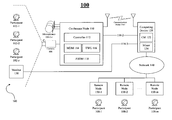
- FIG. 1 illustrates one embodiment of a video conference system.
- FIG. 3 illustrates one embodiment of a second graph.
- FIG. 4 illustrates one embodiment of a third graph.
- FIG. 1 illustrates a block diagram of a video conference system 100 .
- the video conference system 100 may be arranged to provide video conference services.
- a video conference is a set of interactive telecommunication technologies which allow two or more locations to interact via two-way video and audio transmissions simultaneously.
- Video conferences use telecommunications of audio and video to bring people at different sites together for a meeting. This can be as simple as a conversation between two people in private offices (point-to-point) or involve several sites (multi-point) with more than one person in large rooms at different sites.
- video conferencing can be used to share documents, computer-displayed information, and whiteboards.
- the video conference system 100 may comprise a conference node 110 .
- the conference node 110 may comprise a mobile or fixed electronic device having video conference equipment.
- the conference node 110 may comprise a controller 112 , a monitor detection module 114 , a temporal watermark generator 116 , and an active speaker detector module 118 .
- the conference node may further comprise a microphone array 104 comprising one or more microphones 104 - 1 - r , and one or more video cameras 106 - 1 - p , where r and p are positive integers and not necessarily equal.
- the video cameras 106 - 1 - p may comprise directional or omni-directional cameras capable of receiving or capturing video information of the participants 102 - 1 - s .
- one or more video cameras 106 - 1 - p may be implemented as a ring camera or “ringcam.”
- a ringcam is a high-resolution omni-directional camera that captures 360-degrees of video. It is typically constructed of separate or discrete digital cameras, each having some desired level of resolution such as 640 ⁇ 480 or 800 ⁇ 600, for example. Images from each camera are stitched together in real-time to form a high resolution panorama. Digitally stitching together images and then feeding them through a processing device (e.g., controller 112 or computing device 120 ) enables the capture of images from all around the conference room 160 .
- a processing device e.g., controller 112 or computing device 120
- the microphones 104 - 1 - r may receive voice information from the participants 102 - 1 - s at different time intervals relative to each other.
- the ASD module 118 may use this time difference to identify a source for the voice information. Once the source for the voice information is identified, the controller 112 may use visual cues from the video camera 106 - 1 - p to pinpoint, enlarge and emphasize the face of the dominant speaker.
- the conference room 160 may include a display device such as a monitor 130 .
- the monitor 130 may represent any display device capable of reproducing audio and video information, such as a cathode ray tube (CRT) monitor, a liquid crystal display (LCD) monitor, a thin-film transistor (TFT) LCD monitor, a projector screen, a television, a digital television, and so forth.
- the monitor 130 may display various participants, including participants 102 - 1 - s and/or participants 108 - 1 - m .
- the computing device 120 may include a client module 122 executing a MICROSOFT LIVE MEETING CONSOLE that displays each participant to a video conference call using the monitor 130 .
- the client module 122 can also be used to share documents, computer-displayed information, and whiteboards. Such information may be organized and displayed by the monitor 130 in multiple windows of various configurations and arrangements.
- the monitor 130 displays various types of audio and video information that may cause the ASD module 118 to select a false positive. For example, since the monitor 130 displays audio and video reproductions of various participants to a video conference call, when the monitor 130 reproduces audio information and video information for a dominant speaker, the ASD module 118 may falsely identify the monitor 130 as the dominant speaker. This may result in the controller 112 to erroneously focus the video camera 106 on the monitor 130 . In fact in some cases, a local participant 102 - 1 - s may be the dominant speaker in the conference room 160 and may also be reproduced via the monitor 130 in the same conference room 160 , thereby causing the ASD module 118 to select the monitor 130 in favor of the actual dominant speaker 102 - 1 - s . In these and other scenarios, the presence of the monitor 130 may lead to reduced accuracy and performance in the ASD module 118 .
- the conference node 110 may include a monitor detection module 114 .
- the monitor detection module 114 may be communicatively coupled to the video camera 106 and the microphone 104 .
- the monitor detection module 114 may be operative to detect a temporal watermark signal displayed by a monitor 130 within an image, video frame or block of video frames taken of the conference room 160 by the video camera 106 .
- the temporal watermark signal may be added to the video signal displayed by the monitor 130 via a temporal watermark generator 116 of the conference node 110 and a mixer 124 of the computing device 120 .
- the monitor detection module 114 may determine a location for the monitor 130 within the conference room 160 based on the monitor detection operations.
- the monitor detection module 114 may output a monitor detection signal to the ASD module 118 that may be used by the ASD module 118 to filter out the monitor 130 from ASD selection operations.
- the conference node 110 may include a temporal watermark generator 116 .
- the temporal watermark generator 116 may be operative to generate a temporal watermark signal for display by the monitor 130 .
- the temporal watermark signal should be substantially undetectable by humans but robustly detectable by an automated system using video analysis techniques.
- the temporal watermark generator 116 may output the temporal watermark signal to the monitor 130 via the mixer 124 of computing device 120 and connections 114 - 2 , 114 - 3 .
- FIG. 1 shows the temporal watermark generator 116 as implemented by the conference node 110 , it may be appreciated that the temporal watermark generator 116 may be implemented in other elements of the video conference system 100 as desired for a given set of performance or design constraints.
- the temporal watermark generator 116 may be implemented as part of the computing device 120 and still fall within the intended scope of the embodiments.
- FIG. 2 illustrates one embodiment of a graph 200 .
- the graph 200 illustrates a graph having time intervals from 0 to 10 seconds for the X-axis, and luminance offset values from 0 to 5 values for the Y-axis.
- the graph 200 also illustrates a periodic ramp function DC offset pattern or signal 202 suitable for use as a temporal watermark signal for the monitor 130 .
- the monitor 130 typically displays multiple pixels, with each pixel having a pixel value in some range. For example, given an 8-bit color image, each pixel may have a value from 0-255, with each pixel value representing some range of colors.
- the periodic ramp function DC offset pattern may be introduced into the video signal by modifying one or more pixel values to increase or decrease in value.
- the monitor 130 uses a YUV model to define a color space in terms of one luma and two chrominance components.
- the Y component represents the luma component (the brightness)
- the U and V components represent the chrominance or color components.
- the Y component for one or more pixel values may be increased from 0 to 10 seconds by a luminance offset value from 0 to 5 as shown in the respective X-axis, Y-axis of the graph 500 .
- the monitor 130 will slowly increase and decrease the brightness or Y component over time.
- the rate of increase and decrease of the Y component will be controlled to reduce or prevent human perception, but is robustly detectable by the monitor detection module 114 which analyzes the video image having the monitor 130 with the oscillating signal.
- the video camera 106 will record an image or series of images with the temporal watermark signal, and output the images to the monitor detection module 114 .
- the monitor detection module 114 may then analyze the images in pixel blocks in order to determine the presence of the temporal watermark signal, and thereby the location of the monitor 130 .
- FIG. 3 illustrates one embodiment of graphs 300 -A, 300 -B.
- the graphs 300 -A, 300 -B each illustrate a graph having a frame history from 0 to 300 frames for the X-axis, and luminance values (Y) from 231 to 236 for the Y-axis.
- the graphs 300 -A, 300 -B also illustrate respective pixel history envelopes 302 , 304 for the monitor 130 displaying an image with the embedded signal 202 as described with reference to FIG. 2 .
- the pixel history envelopes 302 , 304 may be plotted using various techniques, including the following pseudo-code designed to plot the pixel history of a selected point in a given AVI file:
- the pixel history envelope 302 slowly oscillates between 231 to 236 in a number of periodic cycles, with each periodic cycle repeating approximately every 50 frames.
- the pixel history envelope 302 may be smoothed using, for example, a five (5) point moving average to create a smoothed pixel history envelope 304 .
- the smoothed pixel history envelope 304 may be used to facilitate detection of the temporal watermark signal.
- FIG. 4 illustrates one embodiment of a graph 400 .
- the graph 400 illustrates an example of a correlation for the smoothed pixel history envelope 304 .
- the monitor detection module 114 may be arranged to receive the smoothed pixel history envelope 304 , and analyze the received signal using cross-correlation techniques in order to detect the presence of the 0.5 Hertz (Hz) signal 202 in the captured images of the video camera 106 . Typically only a few periods are needed to accurately perform the detection operations.
- FIG. 4 illustrates a correlation signal 402 representing the results of the cross-correlation analysis performed by the monitor detection module 114 .
- a matched filtering technique may be used to detect the embedded temporal watermark signal as well.
- the number and types of watermark detection techniques suitable for use with a given implementation may vary considerably as long as the particular temporal watermark signal is tuned to the monitor detection technique. The embodiments are not limited in this context.
- saturated (e.g., white) or under-saturated (e.g., black) pixel blocks may be difficult to detect, but improved morphology and/or image processing techniques can be used to fill-in these particular areas.
- the monitor detection technique could be temporally filtered over many seconds (e.g., 60 seconds) in order to improve accuracy.
- the monitor detection module 114 should be enabled to perform monitor detection only when the automatic exposure control (AEC) and/or automatic gain control (AGC) is converged to exclude false negatives in the temporal filtering. Device movement does not necessarily need special handling as long as the temporal filtering duration is of a relatively limited duration.
- the conference node 110 may include an ASD module 118 .
- the ASD module 118 may be communicatively coupled to the monitor detection module 118 .
- the ASD module 118 may be operative to determine whether a dominant or actively speaking participant from among the participants 102 - 1 - s or the participants 108 - 1 - m in the video conference call is displayed by the monitor 130 .
- the ASD module 118 may receive a monitor detection signal from the monitor detection module 114 .
- the monitor detection signal may indicate the presence of the monitor 130 within the conference room 160 .
- the monitor detection signal may indicate an approximate location for the monitor 130 . Given the location of the monitor 130 , the ASD module 118 can use the pixel blocks at the location of the monitor 130 to reduce false positives.
- the ASD module 118 can use the monitor detection results as input into a training algorithm, or a set of hard-coded rules.
- An example of a hard-coded rule may be that detected speakers must have less than some predetermined threshold value of monitor pixels, such as less than approximately 25% monitor pixels. It may be undesirable, although feasible, to remove the entire monitor region from the ASD module 118 selection algorithm since a dominant speaker can potentially be standing in front of the monitor 130 .
- the monitor detection module 114 and/or the ASD module 118 can be arranged to perform block-based processing. Block-based processing also reduces computational load. As a result, the ASD module 118 may select an actively speaking participant for a conference call that is not displayed by the monitor 130 .
- Operations for the video conference system 100 may be further described with reference to one or more logic flows. It may be appreciated that the representative logic flows do not necessarily have to be executed in the order presented, or in any particular order, unless otherwise indicated. Moreover, various activities described with respect to the logic flows can be executed in serial or parallel fashion. The logic flows may be implemented using one or more elements of the video conference system 100 or alternative elements as desired for a given set of design and performance constraints.
- FIG. 5 illustrates a logic flow 500 .
- Logic flow 500 may be representative of the operations executed by one or more embodiments described herein. As shown in logic flow 500 , the logic flow 500 may receive a sequence of images having a monitor within the image at block 502 . The logic flow 500 may detect a temporal watermark signal displayed by the monitor at block 504 . The logic flow 500 may determine a location for the monitor within the image based on the detection at block 206 . The embodiments are not limited in this context.
- the logic flow 500 may receive an image having a monitor within the image at block 502 .
- the video camera 106 may capture real-time video images of the participants 102 - 1 - s and the monitor 130 in the conference room 160 .
- the streaming video may be communicated from the conference node 110 to the computing device 120 via a wireless shared media 114 - 1 or a wired communications media 114 - 2 .
- the computing device 120 may include a client module 122 implementing video conferencing software to display images of the participants in the video conference call, including the local participants 102 - 1 - s and the remote participants 108 - 1 - m .
- the computing device 120 may also communicate the streaming video captured by the video camera 106 to the remote nodes 150 - 1 - m via a network 140 .
- the network 140 may comprise any type of suitable network, including a packet-switched network, a circuit-switched network, or a combination of both, with the appropriate interfaces and equipment.
- the microphones 104 and ASD module 118 may be used determine a dominant or active speaker from among the participants 102 - 1 - s using various sound source localization techniques. Once a dominant speaker has been identified and located, the controller 112 may cause the video camera 106 to automatically focus on the dominant speaker, or the client module 122 may modify its graphic user interface (GUI) to display the dominant speaker in a different manner.
- GUI graphic user interface
- An example of the latter case may be enlarging the GUI window displaying the dominant speaker relative to the other GUI windows, moving the GUI window displaying the dominant speaker to a different location on the monitor 130 , and so forth.
- the logic flow 500 may detect a temporal watermark signal displayed by the monitor at block 504 .
- the monitor detection module 114 may implement various video analysis techniques to detect a temporal watermark signal injected into the video signal displayed by the monitor 130 via the temporal watermark generator 116 .
- the temporal watermark generator 116 may output a generated temporal watermark signal to the computing device 120 via connections 114 - 2 , 114 - 3 .
- the computing device 120 may include a mixer 124 .
- the mixer 124 may receive as input the temporal watermark signal and a video signal for the monitor 130 .
- the mixer 124 may be arranged to mix or add the temporal watermark signal to the video signal to embed the temporal watermark signal into the video signal.
- the mixer 124 may output the mixed signal to a video card of the monitor 130 for subsequent display by the monitor 130 .
- the monitor detection module 114 may detect a temporal watermark signal displayed by the monitor 130 in accordance with the following pseudo-code:
- the logic flow 500 may determine a location for the monitor within the image based on the detection at block 506 .
- the monitor detection module 114 and/or the ASD module 118 may analyze the video frames to isolate a location for the monitor 130 .
- the modules 114 and/or 118 may perform video analysis on a per block basis in order to determine an approximate region within a video frame or group of video frames where the oscillation occurs.
- the pixel blocks corresponding to the identified region may then be tagged or identified as monitor pixel blocks.
- the ASD module 118 may then use the monitor pixel blocks to filter out the monitor 130 from ASD selection operations.
- the ASD module 118 may use the monitor pixel blocks to determine whether an actively speaking participant in a conference call is displayed by the monitor 130 . The ASD module 118 may then select an actively speaking participant for a video conference call that is not displayed by the monitor 130 .
- FIG. 6 illustrates a block diagram of a computing system architecture 600 suitable for implementing various embodiments, including the video conference system 100 . It may be appreciated that the computing system architecture 600 is only one example of a suitable computing environment and is not intended to suggest any limitation as to the scope of use or functionality of the embodiments. Neither should the computing system architecture 600 be interpreted as having any dependency or requirement relating to any one or combination of components illustrated in the exemplary computing system architecture 600 .
- program modules include any software element arranged to perform particular operations or implement particular abstract data types. Some embodiments may also be practiced in distributed computing environments where operations are performed by one or more remote processing devices that are linked through a communications network. In a distributed computing environment, program modules may be located in both local and remote computer storage media including memory storage devices.
- the computing system architecture 600 includes a general purpose computing device such as a computer 610 .
- the computer 610 may include various components typically found in a computer or processing system. Some illustrative components of computer 610 may include, but are not limited to, a processing unit 620 and a memory unit 630 .
- the computer 610 may include one or more processing units 620 .
- a processing unit 620 may comprise any hardware element or software element arranged to process information or data.
- Some examples of the processing unit 620 may include, without limitation, a complex instruction set computer (CISC) microprocessor, a reduced instruction set computing (RISC) microprocessor, a very long instruction word (VLIW) microprocessor, a processor implementing a combination of instruction sets, or other processor device.
- CISC complex instruction set computer
- RISC reduced instruction set computing
- VLIW very long instruction word
- the processing unit 620 may be implemented as a general purpose processor.
- the processing unit 620 may be implemented as a dedicated processor, such as a controller, microcontroller, embedded processor, a digital signal processor (DSP), a network processor, a media processor, an input/output (I/O) processor, a media access control (MAC) processor, a radio baseband processor, a field programmable gate array (FPGA), a programmable logic device (PLD), an application specific integrated circuit (ASIC), and so forth.
- DSP digital signal processor
- the computer 610 may include one or more memory units 630 coupled to the processing unit 620 .
- a memory unit 630 may be any hardware element arranged to store information or data.
- Some examples of memory units may include, without limitation, random-access memory (RAM), dynamic RAM (DRAM), Double-Data-Rate DRAM (DDRAM), synchronous DRAM (SDRAM), static RAM (SRAM), read-only memory (ROM), programmable ROM (PROM), erasable programmable ROM (EPROM), EEPROM, Compact Disk ROM (CD-ROM), Compact Disk Recordable (CD-R), Compact Disk Rewriteable (CD-RW), flash memory (e.g., NOR or NAND flash memory), content addressable memory (CAM), polymer memory (e.g., ferroelectric polymer memory), phase-change memory (e.g., ovonic memory), ferroelectric memory, silicon-oxide-nitride-oxide-silicon (SONOS) memory, disk (e.g., floppy disk,
- the computer 610 may include a system bus 621 that couples various system components including the memory unit 630 to the processing unit 620 .
- a system bus 621 may be any of several types of bus structures including a memory bus or memory controller, a peripheral bus, and a local bus using any of a variety of bus architectures.
- bus architectures include Industry Standard Architecture (ISA) bus, Micro Channel Architecture (MCA) bus, Enhanced ISA (EISA) bus, Video Electronics Standards Association (VESA) local bus, Peripheral Component Interconnect (PCI) bus also known as Mezzanine bus, and so forth.
- ISA Industry Standard Architecture
- MCA Micro Channel Architecture
- EISA Enhanced ISA
- VESA Video Electronics Standards Association
- PCI Peripheral Component Interconnect
- the computer 610 may include various types of storage media.
- Storage media may represent any storage media capable of storing data or information, such as volatile or non-volatile memory, removable or non-removable memory, erasable or non-erasable memory, writeable or re-writeable memory, and so forth.
- Storage media may include two general types, including computer readable media or communication media.
- Computer readable media may include storage media adapted for reading and writing to a computing system, such as the computing system architecture 600 . Examples of computer readable media for computing system architecture 600 may include, but are not limited to, volatile and/or nonvolatile memory such as ROM 631 and RAM 632 .
- Communication media typically embodies computer readable instructions, data structures, program modules or other data in a modulated data signal such as a carrier wave or other transport mechanism and includes any information delivery media.
- modulated data signal means a signal that has one or more of its characteristics set or changed in such a manner as to encode information in the signal.
- communication media includes wired media such as a wired network or direct-wired connection, and wireless media such as acoustic, radio-frequency (RF) spectrum, infrared and other wireless media. Combinations of the any of the above should also be included within the scope of computer readable media.
- the memory unit 630 includes computer storage media in the form of volatile and/or nonvolatile memory such as ROM 631 and RAM 632 .
- a basic input/output system 633 (BIOS), containing the basic routines that help to transfer information between elements within computer 610 , such as during start-up, is typically stored in ROM 631 .
- RAM 632 typically contains data and/or program modules that are immediately accessible to and/or presently being operated on by processing unit 620 .
- FIG. 6 illustrates operating system 634 , application programs 635 , other program modules 636 , and program data 637 .
- the computer 610 may also include other removable/non-removable, volatile/nonvolatile computer storage media.
- FIG. 6 illustrates a hard disk drive 640 that reads from or writes to non-removable, nonvolatile magnetic media, a magnetic disk drive 651 that reads from or writes to a removable, nonvolatile magnetic disk 652 , and an optical disk drive 655 that reads from or writes to a removable, nonvolatile optical disk 656 such as a CD ROM or other optical media.
- removable/non-removable, volatile/nonvolatile computer storage media that can be used in the exemplary operating environment include, but are not limited to, magnetic tape cassettes, flash memory cards, digital versatile disks, digital video tape, solid state RAM, solid state ROM, and the like.
- the hard disk drive 641 is typically connected to the system bus 621 through a non-removable memory interface such as interface 640
- magnetic disk drive 651 and optical disk drive 655 are typically connected to the system bus 621 by a removable memory interface, such as interface 650 .
- the drives and their associated computer storage media discussed above and illustrated in FIG. 6 provide storage of computer readable instructions, data structures, program modules and other data for the computer 610 .
- hard disk drive 641 is illustrated as storing operating system 644 , application programs 645 , other program modules 646 , and program data 647 .
- operating system 644 application programs 645 , other program modules 646 , and program data 647 are given different numbers here to illustrate that, at a minimum, they are different copies.
- a user may enter commands and information into the computer 610 through input devices such as a keyboard 662 and pointing device 661 , commonly referred to as a mouse, trackball or touch pad.
- Other input devices may include a microphone, joystick, game pad, satellite dish, scanner, or the like.
- These and other input devices are often connected to the processing unit 620 through a user input interface 660 that is coupled to the system bus, but may be connected by other interface and bus structures, such as a parallel port, game port or a universal serial bus (USB).
- a monitor 684 or other type of display device is also connected to the system bus 621 via an interface, such as a video interface 682 .
- computers may also include other peripheral output devices such as speakers 687 and printer 686 , which may be connected through an output peripheral interface 683 .
- the network connections shown are exemplary and other techniques for establishing a communications link between the computers may be used. Further, the network connections may be implemented as wired or wireless connections. In the latter case, the computing system architecture 600 may be modified with various elements suitable for wireless communications, such as one or more antennas, transmitters, receivers, transceivers, radios, amplifiers, filters, communications interfaces, and other wireless elements.
- a wireless communication system communicates information or data over a wireless communication medium, such as one or more portions or bands of RF spectrum, for example. The embodiments are not limited in this context.
- video conference system 100 and/or computing system architecture 600 may be implemented as a part, component or sub-system of an electronic device.
- electronic devices may include, without limitation, a processing system, computer, server, work station, appliance, terminal, personal computer, laptop, ultra-laptop, handheld computer, minicomputer, mainframe computer, distributed computing system, multiprocessor systems, processor-based systems, consumer electronics, programmable consumer electronics, personal digital assistant, television, digital television, set top box, telephone, mobile telephone, cellular telephone, handset, wireless access point, base station, subscriber station, mobile subscriber center, radio network controller, router, hub, gateway, bridge, switch, machine, or combination thereof.
- the embodiments are not limited in this context.
- various embodiments may be implemented as an article of manufacture.
- the article of manufacture may include a storage medium arranged to store logic and/or data for performing various operations of one or more embodiments. Examples of storage media may include, without limitation, those examples as previously described.
- the article of manufacture may comprise a magnetic disk, optical disk, flash memory or firmware containing computer program instructions suitable for execution by a general purpose processor or application specific processor. The embodiments, however, are not limited in this context.
- Various embodiments may be implemented using hardware elements, software elements, or a combination of both.
- hardware elements may include any of the examples as previously provided for a logic device, and further including microprocessors, circuits, circuit elements (e.g., transistors, resistors, capacitors, inductors, and so forth), integrated circuits, logic gates, registers, semiconductor device, chips, microchips, chip sets, and so forth.
- Examples of software elements may include software components, programs, applications, computer programs, application programs, system programs, machine programs, operating system software, middleware, firmware, software modules, routines, subroutines, functions, methods, procedures, software interfaces, application program interfaces (API), instruction sets, computing code, computer code, code segments, computer code segments, words, values, symbols, or any combination thereof. Determining whether an embodiment is implemented using hardware elements and/or software elements may vary in accordance with any number of factors, such as desired computational rate, power levels, heat tolerances, processing cycle budget, input data rates, output data rates, memory resources, data bus speeds and other design or performance constraints, as desired for a given implementation.
- Coupled and “connected” along with their derivatives. These terms are not necessarily intended as synonyms for each other. For example, some embodiments may be described using the terms “connected” and/or “coupled” to indicate that two or more elements are in direct physical or electrical contact with each other. The term “coupled,” however, may also mean that two or more elements are not in direct contact with each other, but yet still co-operate or interact with each other.
Landscapes
- Engineering & Computer Science (AREA)
- Multimedia (AREA)
- Signal Processing (AREA)
- Computer Vision & Pattern Recognition (AREA)
- Physics & Mathematics (AREA)
- General Physics & Mathematics (AREA)
- Theoretical Computer Science (AREA)
- Two-Way Televisions, Distribution Of Moving Picture Or The Like (AREA)
- Burglar Alarm Systems (AREA)
- Closed-Circuit Television Systems (AREA)
Priority Applications (6)
| Application Number | Priority Date | Filing Date | Title |
|---|---|---|---|
| US11/824,412 US8300080B2 (en) | 2007-06-29 | 2007-06-29 | Techniques for detecting a display device |
| KR1020097027254A KR101497168B1 (ko) | 2007-06-29 | 2008-06-02 | 디스플레이 장치 검출 기법 |
| JP2010514923A JP5140726B2 (ja) | 2007-06-29 | 2008-06-02 | 表示装置を検出する技術 |
| PCT/US2008/065579 WO2009005928A2 (en) | 2007-06-29 | 2008-06-02 | Techniques for detecting a display device |
| EP08769995.5A EP2172016B1 (en) | 2007-06-29 | 2008-06-02 | Techniques for detecting a display device |
| US13/644,866 US8614734B2 (en) | 2007-06-29 | 2012-10-04 | Techniques for detecting a display device |
Applications Claiming Priority (1)
| Application Number | Priority Date | Filing Date | Title |
|---|---|---|---|
| US11/824,412 US8300080B2 (en) | 2007-06-29 | 2007-06-29 | Techniques for detecting a display device |
Related Child Applications (1)
| Application Number | Title | Priority Date | Filing Date |
|---|---|---|---|
| US13/644,866 Continuation US8614734B2 (en) | 2007-06-29 | 2012-10-04 | Techniques for detecting a display device |
Publications (2)
| Publication Number | Publication Date |
|---|---|
| US20090002480A1 US20090002480A1 (en) | 2009-01-01 |
| US8300080B2 true US8300080B2 (en) | 2012-10-30 |
Family
ID=40159893
Family Applications (2)
| Application Number | Title | Priority Date | Filing Date |
|---|---|---|---|
| US11/824,412 Active 2031-07-28 US8300080B2 (en) | 2007-06-29 | 2007-06-29 | Techniques for detecting a display device |
| US13/644,866 Expired - Fee Related US8614734B2 (en) | 2007-06-29 | 2012-10-04 | Techniques for detecting a display device |
Family Applications After (1)
| Application Number | Title | Priority Date | Filing Date |
|---|---|---|---|
| US13/644,866 Expired - Fee Related US8614734B2 (en) | 2007-06-29 | 2012-10-04 | Techniques for detecting a display device |
Country Status (5)
| Country | Link |
|---|---|
| US (2) | US8300080B2 (enExample) |
| EP (1) | EP2172016B1 (enExample) |
| JP (1) | JP5140726B2 (enExample) |
| KR (1) | KR101497168B1 (enExample) |
| WO (1) | WO2009005928A2 (enExample) |
Cited By (2)
| Publication number | Priority date | Publication date | Assignee | Title |
|---|---|---|---|---|
| US8988485B2 (en) | 2013-03-14 | 2015-03-24 | Microsoft Technology Licensing, Llc | Dynamic wireless configuration for video conference environments |
| US10951859B2 (en) | 2018-05-30 | 2021-03-16 | Microsoft Technology Licensing, Llc | Videoconferencing device and method |
Families Citing this family (29)
| Publication number | Priority date | Publication date | Assignee | Title |
|---|---|---|---|---|
| US8385233B2 (en) * | 2007-06-12 | 2013-02-26 | Microsoft Corporation | Active speaker identification |
| US8320606B1 (en) | 2008-08-29 | 2012-11-27 | Adobe Systems Incorporated | Video watermarking with fast detection |
| US8385590B1 (en) * | 2008-11-05 | 2013-02-26 | Adobe Systems Incorporated | Video watermarking with temporal patterns |
| US8698872B2 (en) * | 2011-03-02 | 2014-04-15 | At&T Intellectual Property I, Lp | System and method for notification of events of interest during a video conference |
| US20120265858A1 (en) * | 2011-04-12 | 2012-10-18 | Jorg-Ulrich Mohnen | Streaming portions of a quilted graphic 2d image representation for rendering into a digital asset |
| US8698874B2 (en) | 2011-06-10 | 2014-04-15 | Microsoft Corporation | Techniques for multiple video source stitching in a conference room |
| WO2012169679A1 (ko) * | 2011-06-10 | 2012-12-13 | 엘지전자 주식회사 | 디스플레이 장치, 디스플레이 장치의 제어 방법 및 디스플레이 장치의 음성인식 시스템 |
| JP4937417B1 (ja) * | 2011-06-14 | 2012-05-23 | 株式会社ナナオ | 文字領域画素判定装置またはその方法 |
| EP2618564A1 (en) * | 2012-01-18 | 2013-07-24 | Harman Becker Automotive Systems GmbH | Method for operating a conference system and device for a conference system |
| US9065971B2 (en) * | 2012-12-19 | 2015-06-23 | Microsoft Technology Licensing, Llc | Video and audio tagging for active speaker detection |
| KR102106539B1 (ko) | 2013-07-01 | 2020-05-28 | 삼성전자주식회사 | 화상 통화동안 비디오 컨텐츠를 인증하는 방법 및 디바이스 |
| US9215543B2 (en) * | 2013-12-03 | 2015-12-15 | Cisco Technology, Inc. | Microphone mute/unmute notification |
| US9614724B2 (en) | 2014-04-21 | 2017-04-04 | Microsoft Technology Licensing, Llc | Session-based device configuration |
| US9384335B2 (en) | 2014-05-12 | 2016-07-05 | Microsoft Technology Licensing, Llc | Content delivery prioritization in managed wireless distribution networks |
| US9430667B2 (en) | 2014-05-12 | 2016-08-30 | Microsoft Technology Licensing, Llc | Managed wireless distribution network |
| US10111099B2 (en) | 2014-05-12 | 2018-10-23 | Microsoft Technology Licensing, Llc | Distributing content in managed wireless distribution networks |
| US9384334B2 (en) | 2014-05-12 | 2016-07-05 | Microsoft Technology Licensing, Llc | Content discovery in managed wireless distribution networks |
| US9874914B2 (en) | 2014-05-19 | 2018-01-23 | Microsoft Technology Licensing, Llc | Power management contracts for accessory devices |
| US9882990B2 (en) | 2014-06-02 | 2018-01-30 | Microsoft Technology Licensing, Llc | Enhanced discovery for ad-hoc meetings |
| US10439832B2 (en) | 2014-06-02 | 2019-10-08 | Microsoft Technology Licensing, Llc | Enhanced discovery for AD-HOC meetings |
| US10037202B2 (en) | 2014-06-03 | 2018-07-31 | Microsoft Technology Licensing, Llc | Techniques to isolating a portion of an online computing service |
| US9367490B2 (en) | 2014-06-13 | 2016-06-14 | Microsoft Technology Licensing, Llc | Reversible connector for accessory devices |
| EP3101838A1 (en) * | 2015-06-03 | 2016-12-07 | Thomson Licensing | Method and apparatus for isolating an active participant in a group of participants |
| US10235129B1 (en) | 2015-06-29 | 2019-03-19 | Amazon Technologies, Inc. | Joining users to communications via voice commands |
| US9952821B2 (en) * | 2015-09-01 | 2018-04-24 | Electronics And Telecommunications Research Institute | Screen position sensing method in multi display system, content configuring method, watermark image generating method for sensing screen position server, and display terminal |
| KR102468760B1 (ko) * | 2015-09-01 | 2022-11-18 | 한국전자통신연구원 | 다중 디스플레이 시스템에서의 스크린 위치 센싱 방법 및 컨텐츠 구성 방법 및 스크린 위치 센싱을 위한 워터마크 영상 생성 방법 및 서버 및 디스플레이 단말 |
| US10419511B1 (en) * | 2016-10-04 | 2019-09-17 | Zoom Video Communications, Inc. | Unique watermark generation and detection during a conference |
| CN112004046A (zh) * | 2019-05-27 | 2020-11-27 | 中兴通讯股份有限公司 | 一种基于视频会议的图像处理方法和装置 |
| JP2024077978A (ja) * | 2022-11-29 | 2024-06-10 | 株式会社リコー | 会議システム、表示制御方法、及びプログラム |
Citations (24)
| Publication number | Priority date | Publication date | Assignee | Title |
|---|---|---|---|---|
| US3118340A (en) | 1964-01-21 | Panoramic motion picture camera arrangement | ||
| WO1996007979A1 (en) | 1994-09-08 | 1996-03-14 | Andrew Welch | Method and apparatus for determining the location of a reflective object within a video field |
| JPH08125835A (ja) | 1994-10-25 | 1996-05-17 | Matsushita Electric Ind Co Ltd | 全方位撮影装置及び全方位画像合成装置 |
| US5818514A (en) | 1994-12-01 | 1998-10-06 | Lucent Technologies Inc. | Video conferencing system and method for providing enhanced interactive communication |
| US5959662A (en) | 1998-05-04 | 1999-09-28 | Siemens Information And Communication Networks, Inc. | System and method for enhanced video conferencing security |
| KR20000044079A (ko) | 1998-12-30 | 2000-07-15 | 전주범 | 화상회의 시스템의 카메라 제어방법 |
| KR20000044065A (ko) | 1998-12-30 | 2000-07-15 | 전주범 | 화상회의 시스템의 카메라 제어장치 |
| WO2001037552A1 (en) | 1999-11-15 | 2001-05-25 | Ericsson Inc. | Picture position indicator for picture phone |
| US6353662B1 (en) | 1997-10-17 | 2002-03-05 | At&T Corp. | Method and apparatus for eliminating nuisance signals in multi-party calls |
| US6483532B1 (en) | 1998-07-13 | 2002-11-19 | Netergy Microelectronics, Inc. | Video-assisted audio signal processing system and method |
| US20030037109A1 (en) | 2000-08-11 | 2003-02-20 | Newman Harvey B. | Virtual room videoconferencing system |
| US6611281B2 (en) | 2001-11-13 | 2003-08-26 | Koninklijke Philips Electronics N.V. | System and method for providing an awareness of remote people in the room during a videoconference |
| US6628767B1 (en) | 1999-05-05 | 2003-09-30 | Spiderphone.Com, Inc. | Active talker display for web-based control of conference calls |
| US6795106B1 (en) | 1999-05-18 | 2004-09-21 | Intel Corporation | Method and apparatus for controlling a video camera in a video conferencing system |
| US7020337B2 (en) | 2002-07-22 | 2006-03-28 | Mitsubishi Electric Research Laboratories, Inc. | System and method for detecting objects in images |
| US7031499B2 (en) | 2002-07-22 | 2006-04-18 | Mitsubishi Electric Research Laboratories, Inc. | Object recognition system |
| US7081915B1 (en) * | 1998-06-17 | 2006-07-25 | Intel Corporation | Control of video conferencing using activity detection |
| US7092001B2 (en) | 2003-11-26 | 2006-08-15 | Sap Aktiengesellschaft | Video conferencing system with physical cues |
| US7099510B2 (en) | 2000-11-29 | 2006-08-29 | Hewlett-Packard Development Company, L.P. | Method and system for object detection in digital images |
| US7119829B2 (en) | 2003-07-31 | 2006-10-10 | Dreamworks Animation Llc | Virtual conference room |
| US7197186B2 (en) | 2003-06-17 | 2007-03-27 | Mitsubishi Electric Research Laboratories, Inc. | Detecting arbitrarily oriented objects in images |
| US7212651B2 (en) | 2003-06-17 | 2007-05-01 | Mitsubishi Electric Research Laboratories, Inc. | Detecting pedestrians using patterns of motion and appearance in videos |
| US20070127819A1 (en) * | 2005-12-05 | 2007-06-07 | Samsung Electronics Co., Ltd. | Method and apparatus for object detection in sequences |
| US20070297682A1 (en) * | 2006-06-22 | 2007-12-27 | Microsoft Corporation | Identification Of People Using Multiple Types Of Input |
Family Cites Families (7)
| Publication number | Priority date | Publication date | Assignee | Title |
|---|---|---|---|---|
| JPH06276514A (ja) * | 1993-03-19 | 1994-09-30 | Fujitsu Ltd | テレビ会議システムにおけるカメラ制御方式 |
| JPH09307870A (ja) * | 1996-05-16 | 1997-11-28 | Nec Corp | テレビ会議システムにおけるカメラ自動方向制御装置 |
| US7260722B2 (en) * | 2001-12-28 | 2007-08-21 | Itt Manufacturing Enterprises, Inc. | Digital multimedia watermarking for source identification |
| US6885757B2 (en) * | 2002-04-18 | 2005-04-26 | Sarnoff Corporation | Method and apparatus for providing an asymmetric watermark carrier |
| CN1647571A (zh) * | 2002-04-19 | 2005-07-27 | 皇家飞利浦电子股份有限公司 | 情况互动设备 |
| CN101609546B (zh) * | 2005-08-04 | 2012-05-23 | 日本电信电话株式会社 | 电子水印检测方法和电子水印检测装置 |
| US7570641B2 (en) * | 2005-08-23 | 2009-08-04 | Macrovision Corporation | Techniques for watermarking and distributing content |
-
2007
- 2007-06-29 US US11/824,412 patent/US8300080B2/en active Active
-
2008
- 2008-06-02 JP JP2010514923A patent/JP5140726B2/ja not_active Expired - Fee Related
- 2008-06-02 WO PCT/US2008/065579 patent/WO2009005928A2/en not_active Ceased
- 2008-06-02 KR KR1020097027254A patent/KR101497168B1/ko not_active Expired - Fee Related
- 2008-06-02 EP EP08769995.5A patent/EP2172016B1/en not_active Not-in-force
-
2012
- 2012-10-04 US US13/644,866 patent/US8614734B2/en not_active Expired - Fee Related
Patent Citations (24)
| Publication number | Priority date | Publication date | Assignee | Title |
|---|---|---|---|---|
| US3118340A (en) | 1964-01-21 | Panoramic motion picture camera arrangement | ||
| WO1996007979A1 (en) | 1994-09-08 | 1996-03-14 | Andrew Welch | Method and apparatus for determining the location of a reflective object within a video field |
| JPH08125835A (ja) | 1994-10-25 | 1996-05-17 | Matsushita Electric Ind Co Ltd | 全方位撮影装置及び全方位画像合成装置 |
| US5818514A (en) | 1994-12-01 | 1998-10-06 | Lucent Technologies Inc. | Video conferencing system and method for providing enhanced interactive communication |
| US6353662B1 (en) | 1997-10-17 | 2002-03-05 | At&T Corp. | Method and apparatus for eliminating nuisance signals in multi-party calls |
| US5959662A (en) | 1998-05-04 | 1999-09-28 | Siemens Information And Communication Networks, Inc. | System and method for enhanced video conferencing security |
| US7081915B1 (en) * | 1998-06-17 | 2006-07-25 | Intel Corporation | Control of video conferencing using activity detection |
| US6483532B1 (en) | 1998-07-13 | 2002-11-19 | Netergy Microelectronics, Inc. | Video-assisted audio signal processing system and method |
| KR20000044079A (ko) | 1998-12-30 | 2000-07-15 | 전주범 | 화상회의 시스템의 카메라 제어방법 |
| KR20000044065A (ko) | 1998-12-30 | 2000-07-15 | 전주범 | 화상회의 시스템의 카메라 제어장치 |
| US6628767B1 (en) | 1999-05-05 | 2003-09-30 | Spiderphone.Com, Inc. | Active talker display for web-based control of conference calls |
| US6795106B1 (en) | 1999-05-18 | 2004-09-21 | Intel Corporation | Method and apparatus for controlling a video camera in a video conferencing system |
| WO2001037552A1 (en) | 1999-11-15 | 2001-05-25 | Ericsson Inc. | Picture position indicator for picture phone |
| US20030037109A1 (en) | 2000-08-11 | 2003-02-20 | Newman Harvey B. | Virtual room videoconferencing system |
| US7099510B2 (en) | 2000-11-29 | 2006-08-29 | Hewlett-Packard Development Company, L.P. | Method and system for object detection in digital images |
| US6611281B2 (en) | 2001-11-13 | 2003-08-26 | Koninklijke Philips Electronics N.V. | System and method for providing an awareness of remote people in the room during a videoconference |
| US7020337B2 (en) | 2002-07-22 | 2006-03-28 | Mitsubishi Electric Research Laboratories, Inc. | System and method for detecting objects in images |
| US7031499B2 (en) | 2002-07-22 | 2006-04-18 | Mitsubishi Electric Research Laboratories, Inc. | Object recognition system |
| US7197186B2 (en) | 2003-06-17 | 2007-03-27 | Mitsubishi Electric Research Laboratories, Inc. | Detecting arbitrarily oriented objects in images |
| US7212651B2 (en) | 2003-06-17 | 2007-05-01 | Mitsubishi Electric Research Laboratories, Inc. | Detecting pedestrians using patterns of motion and appearance in videos |
| US7119829B2 (en) | 2003-07-31 | 2006-10-10 | Dreamworks Animation Llc | Virtual conference room |
| US7092001B2 (en) | 2003-11-26 | 2006-08-15 | Sap Aktiengesellschaft | Video conferencing system with physical cues |
| US20070127819A1 (en) * | 2005-12-05 | 2007-06-07 | Samsung Electronics Co., Ltd. | Method and apparatus for object detection in sequences |
| US20070297682A1 (en) * | 2006-06-22 | 2007-12-27 | Microsoft Corporation | Identification Of People Using Multiple Types Of Input |
Non-Patent Citations (5)
| Title |
|---|
| "EF400", http://www.aspi.com/products/echofree/ef400.html. |
| "European Search Report", Mailed Date: Feb. 14, 2011, Application No. EP/08769995, Filed Date: Feb. 10, 2011, Pages 5. (MS# 319714.03). |
| Busso, et al., "Smart Room: Participant and Speaker Localization and Identification", pp. 1-4. |
| International Search Report for PCT Application No. PCT/US2008/065579 mailed Jan. 6, 2009, 2 pages. |
| Tapia, et al., "Concept and Partial Prototype Video: Ubiquitous Video Communication with the Perception of Eye Contact", pp. 1-2. |
Cited By (2)
| Publication number | Priority date | Publication date | Assignee | Title |
|---|---|---|---|---|
| US8988485B2 (en) | 2013-03-14 | 2015-03-24 | Microsoft Technology Licensing, Llc | Dynamic wireless configuration for video conference environments |
| US10951859B2 (en) | 2018-05-30 | 2021-03-16 | Microsoft Technology Licensing, Llc | Videoconferencing device and method |
Also Published As
| Publication number | Publication date |
|---|---|
| KR20100028060A (ko) | 2010-03-11 |
| US8614734B2 (en) | 2013-12-24 |
| EP2172016A2 (en) | 2010-04-07 |
| WO2009005928A3 (en) | 2009-02-26 |
| JP5140726B2 (ja) | 2013-02-13 |
| EP2172016B1 (en) | 2013-07-17 |
| US20130027506A1 (en) | 2013-01-31 |
| WO2009005928A2 (en) | 2009-01-08 |
| KR101497168B1 (ko) | 2015-03-03 |
| US20090002480A1 (en) | 2009-01-01 |
| EP2172016A4 (en) | 2011-03-16 |
| JP2010532953A (ja) | 2010-10-14 |
Similar Documents
| Publication | Publication Date | Title |
|---|---|---|
| US8614734B2 (en) | Techniques for detecting a display device | |
| US11356488B2 (en) | Frame synchronous rendering of remote participant identities | |
| US8274544B2 (en) | Automated videography systems | |
| US8289371B2 (en) | Smart cropping of video images in a videoconferencing session | |
| US8237771B2 (en) | Automated videography based communications | |
| CA2723368C (en) | Techniques to manage media content for a multimedia conference event | |
| EP1905243A1 (en) | Processing method and device with video temporal up-conversion | |
| US20050002535A1 (en) | Remote audio device management system | |
| CN109345485A (zh) | 一种图像增强方法、装置、电子设备及存储介质 | |
| US12634579B2 (en) | Autonomous video conferencing system with virtual director assistance | |
| WO2022062471A1 (zh) | 一种音频数据的处理方法、设备和系统 | |
| EP4106326A1 (en) | Multi-camera automatic framing | |
| US20220230267A1 (en) | Image processing method and apparatus based on video conference | |
| US20150092013A1 (en) | Method and a device for transmitting at least a portion of a signal during a video conference session | |
| US12450860B2 (en) | Video processing method and associated system on chip | |
| CN112291507A (zh) | 视频画面的调节方法、装置、电子设备及存储介质 | |
| CN115499615B (zh) | 一种视频会议的智能导播方法、装置及系统 | |
| US20250343987A1 (en) | Systems and methods for framing meeting environments and participants using camera spatial positioning information | |
| HK1143016B (en) | Techniques for detecting a display device | |
| HK1143016A (en) | Techniques for detecting a display device | |
| TWI857325B (zh) | 用來藉助於手勢偵測進行局部強調之視訊處理方法以及系統晶片 | |
| CN108769525B (zh) | 一种图像调整方法、装置、设备及存储介质 | |
| US20250260781A1 (en) | Systems and methods for framing meeting environments and participants | |
| TWI798867B (zh) | 視訊處理方法與相關的系統晶片 | |
| US12277799B2 (en) | Video image composition method and electronic device |
Legal Events
| Date | Code | Title | Description |
|---|---|---|---|
| AS | Assignment |
Owner name: MICROSOFT CORPORATION, WASHINGTON Free format text: ASSIGNMENT OF ASSIGNORS INTEREST;ASSIGNOR:CUTLER, ROSS G.;REEL/FRAME:020237/0585 Effective date: 20070628 |
|
| STCF | Information on status: patent grant |
Free format text: PATENTED CASE |
|
| AS | Assignment |
Owner name: MICROSOFT TECHNOLOGY LICENSING, LLC, WASHINGTON Free format text: ASSIGNMENT OF ASSIGNORS INTEREST;ASSIGNOR:MICROSOFT CORPORATION;REEL/FRAME:034542/0001 Effective date: 20141014 |
|
| FPAY | Fee payment |
Year of fee payment: 4 |
|
| MAFP | Maintenance fee payment |
Free format text: PAYMENT OF MAINTENANCE FEE, 8TH YEAR, LARGE ENTITY (ORIGINAL EVENT CODE: M1552); ENTITY STATUS OF PATENT OWNER: LARGE ENTITY Year of fee payment: 8 |
|
| MAFP | Maintenance fee payment |
Free format text: PAYMENT OF MAINTENANCE FEE, 12TH YEAR, LARGE ENTITY (ORIGINAL EVENT CODE: M1553); ENTITY STATUS OF PATENT OWNER: LARGE ENTITY Year of fee payment: 12 |