US8252946B2 - Crystalline forms of tigecycline hydrochloride - Google Patents
Crystalline forms of tigecycline hydrochloride Download PDFInfo
- Publication number
- US8252946B2 US8252946B2 US12/742,706 US74270608A US8252946B2 US 8252946 B2 US8252946 B2 US 8252946B2 US 74270608 A US74270608 A US 74270608A US 8252946 B2 US8252946 B2 US 8252946B2
- Authority
- US
- United States
- Prior art keywords
- tigecycline
- crystalline form
- hydrochloric acid
- tigecycline hydrochloride
- hydrochloride according
- Prior art date
- Legal status (The legal status is an assumption and is not a legal conclusion. Google has not performed a legal analysis and makes no representation as to the accuracy of the status listed.)
- Active, expires
Links
- QEDIYYMHQZCIGI-RYFUPDHPSA-N Cl.[H][C@@]12C[C@]3([H])CC4=C(C(=O)C3=C(O)[C@]1(O)C(=O)C(C(N)=O)=C(O)[C@H]2N(C)C)C(O)=C(NC(=O)CCC(C)(C)C)C=C4N(C)C Chemical compound Cl.[H][C@@]12C[C@]3([H])CC4=C(C(=O)C3=C(O)[C@]1(O)C(=O)C(C(N)=O)=C(O)[C@H]2N(C)C)C(O)=C(NC(=O)CCC(C)(C)C)C=C4N(C)C QEDIYYMHQZCIGI-RYFUPDHPSA-N 0.000 description 1
Images


Classifications
-
- C—CHEMISTRY; METALLURGY
- C07—ORGANIC CHEMISTRY
- C07C—ACYCLIC OR CARBOCYCLIC COMPOUNDS
- C07C237/00—Carboxylic acid amides, the carbon skeleton of the acid part being further substituted by amino groups
- C07C237/24—Carboxylic acid amides, the carbon skeleton of the acid part being further substituted by amino groups having the carbon atom of at least one of the carboxamide groups bound to a carbon atom of a ring other than a six-membered aromatic ring of the carbon skeleton
- C07C237/26—Carboxylic acid amides, the carbon skeleton of the acid part being further substituted by amino groups having the carbon atom of at least one of the carboxamide groups bound to a carbon atom of a ring other than a six-membered aromatic ring of the carbon skeleton of a ring being part of a condensed ring system formed by at least four rings, e.g. tetracycline
-
- A—HUMAN NECESSITIES
- A61—MEDICAL OR VETERINARY SCIENCE; HYGIENE
- A61P—SPECIFIC THERAPEUTIC ACTIVITY OF CHEMICAL COMPOUNDS OR MEDICINAL PREPARATIONS
- A61P31/00—Antiinfectives, i.e. antibiotics, antiseptics, chemotherapeutics
-
- A—HUMAN NECESSITIES
- A61—MEDICAL OR VETERINARY SCIENCE; HYGIENE
- A61P—SPECIFIC THERAPEUTIC ACTIVITY OF CHEMICAL COMPOUNDS OR MEDICINAL PREPARATIONS
- A61P31/00—Antiinfectives, i.e. antibiotics, antiseptics, chemotherapeutics
- A61P31/04—Antibacterial agents
-
- C—CHEMISTRY; METALLURGY
- C07—ORGANIC CHEMISTRY
- C07B—GENERAL METHODS OF ORGANIC CHEMISTRY; APPARATUS THEREFOR
- C07B2200/00—Indexing scheme relating to specific properties of organic compounds
- C07B2200/13—Crystalline forms, e.g. polymorphs
-
- C—CHEMISTRY; METALLURGY
- C07—ORGANIC CHEMISTRY
- C07C—ACYCLIC OR CARBOCYCLIC COMPOUNDS
- C07C2603/00—Systems containing at least three condensed rings
- C07C2603/02—Ortho- or ortho- and peri-condensed systems
- C07C2603/40—Ortho- or ortho- and peri-condensed systems containing four condensed rings
- C07C2603/42—Ortho- or ortho- and peri-condensed systems containing four condensed rings containing only six-membered rings
- C07C2603/44—Naphthacenes; Hydrogenated naphthacenes
- C07C2603/46—1,4,4a,5,5a,6,11,12a- Octahydronaphthacenes, e.g. tetracyclines
Definitions
- the present invention relates to crystalline forms A and B of Tigecycline hydrochloride and to methods for the preparation of the same. Furthermore the present invention relates to the use of crystalline forms A and B of Tigecycline hydrochloride as intermediates for the formulation of an anti-infective medicament. Moreover the present invention relates to pharmaceutical compositions comprising crystalline form A of Tigecycline hydrochloride in an effective amount and to the use of crystalline form A of Tigecycline hydrochloride as anti-infective medicament.
- Tigecycline (4S,4aS,5aR,12aS)-4,7-Bis(dimethylamino)-9-[[[(1,1-dimethylethyl)amino]acetyl]amino]-1,4,4a,5,5a,6,11,12a-octahydro-3,10,12,12a-tetrahydroxy-1,11-dioxo-2-naphthacenecarboxamide, is a 9-t-butylglycylamido derivative of minocycline (Merck Index 14 th Edition, monograph number 9432, CAS Registry Number 220620-09-7).
- Tigecycline is more active against tetracycline-resistant strains and also more tolerable.
- Tigecycline possesses activity against bacterial isolates containing the two major determinants responsible for tetracycline-resistance: ribosomal protection and active efflux of the drug out of the bacterial cell.
- Tigecycline possesses broad spectrum activity, e.g. it is active against gram-positive pathogens (e.g. methicillin-resistant Staphylococcus aureus , vancomycin-resistant Enterococci ), gram-negative pathogens (e.g.
- U.S. Pat. No. 5,675,030 mentions a process for the preparation of Tigecycline hydrochloride by “treating” the free base with hydrochloric acid, but neither an explicit method for the preparation of crystalline Tigecycline hydrochloride, nor the existence of a crystalline form of Tigecycline hydrochloride are described.
- Example 9 of said patent an aqueous solution of Tigecycline hydrochloride is lyophilized, whereas, according to U.S. Pat. No. 5,675,030, Tigecycline hydrochloride dihydrate of unknown solid state is obtained. However, repeating the experiment resulted in amorphous Tigecycline hydrochloride.
- WO 2005/056538, WO 2006/130418, WO 2006/130431, WO 2006/130500 and WO 2006/130501 disclose Tigecycline, acid addition salts of Tigecycline and processes for the preparation of the same as well. However, in literature no crystalline Tigecycline hydrochloride is described.
- Tigecycline is available on the market as lyophilized powder for injection, the originator is Wyeth. During the formulation process Tigecycline is first dissolved in water and then lyophilized. Therefore a crystalline form of Tigecycline or an alternative crystalline acid addition salt of Tigecycline should show high water solubility.
- the commercial Tygacil® 2 nd generation product contains, according to the originator, following ingredients:
- the ratio of Tigecycline to hydrochloric acid can be chosen such, that there is no need for pH-adjustment anymore.
- crystalline solids have improved chemical and physical stability over the amorphous form and forms with low crystallinity, therefore crystalline Tigecycline hydrochloride is more preferred than amorphous Tigecycline hydrochloride.
- crystalline Tigecycline hydrochloride with suitable solubility and stability properties for the formulation of an anti-infective medicament.
- the present invention refers to crystalline form A of Tigecycline hydrochloride.
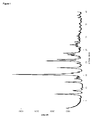
- Crystalline form A of Tigecycline hydrochloride can be described by an X-ray powder diffraction pattern comprising peaks at 2-theta angles of 7.6° ⁇ 0.2°, 9.1 ⁇ 0.2°, 12.2 ⁇ 0.2°, 13.7 ⁇ 0.2°, 15.2 ⁇ 0.2°, 18.0 ⁇ 0.2°, 20.6 ⁇ 0.2°, 22.8 ⁇ 0.2° and 23.7 ⁇ 0.2°.
- crystalline form A of Tigecycline hydrochloride can be described by an infrared spectrum comprising peaks at wavenumbers of 3443 ⁇ 2 cm ⁇ 1 , 3278 ⁇ 2 cm ⁇ 1 , 2393 ⁇ 2 cm ⁇ 1 , 1689 ⁇ 2 cm ⁇ 1 , 1651 ⁇ 2 cm ⁇ 1 , 1544 ⁇ 2 cm ⁇ 1 , 1362 ⁇ 2 cm ⁇ 1 , 1271 ⁇ 2 cm ⁇ 1 , 1130 ⁇ 2 cm ⁇ 1 , 1050 ⁇ 2 cm ⁇ 1 , 871 ⁇ 2 cm ⁇ 1 and 808 ⁇ 2 cm ⁇ 1 .
- a first process for the preparation of crystalline form A of Tigecycline hydrochloride comprising the steps of:
- the present invention refers to crystalline form B of Tigecycline hydrochloride.
- Crystalline form B of Tigecycline hydrochloride can be described by an X-ray powder diffraction pattern comprising peaks at 2-theta angles of 5.8° ⁇ 0.2°, 7.0 ⁇ 0.2°, 9.1 ⁇ 0.2°, 9.7 ⁇ 0.2°, 14.1 ⁇ 0.2°, 15.5 ⁇ 0.2°, 17.3 ⁇ 0.2°, 18.3 ⁇ 0.2°, 19.6 ⁇ 0.2°, 22.4 ⁇ 0.2°, 25.5 ⁇ 0.2°, 27.1 ⁇ 0.2° and 28.5 ⁇ 0.2°.
- crystalline form B of Tigecycline hydrochloride can be described by an infrared spectrum comprising peaks at wavenumbers of 3365 ⁇ 2 cm ⁇ 1 , 3228 ⁇ 2 cm ⁇ 1 , 1685 ⁇ 2 cm ⁇ 1 , 1648 ⁇ 2 cm ⁇ 1 , 1545 ⁇ 2 cm ⁇ 1 , 1360 ⁇ 2 cm ⁇ 1 , 1263 ⁇ 2 cm ⁇ 1 , 1204 ⁇ 2 cm ⁇ 1 and 872 ⁇ 2 cm ⁇ 1 .
- a process for the preparation of crystalline form B of Tigecycline hydrochloride comprising the steps of:
- the present invention relates to the use of crystalline forms A and B of Tigecycline hydrochloride as intermediates for the formulation of an anti-infective medicament.
- compositions comprising crystalline form A of Tigecycline hydrochloride in an effective amount.
- the present invention refers to the use of crystalline form A of Tigecycline hydrochloride as an anti-infective medicament.
- FIG. 1 X-ray powder diffraction pattern of crystalline form A of Tigecycline hydrochloride
- FIG. 2 Infrared spectrum of crystalline form A of Tigecycline hydrochloride
- FIG. 3 Differential Scanning calorimetric curve of crystalline form A of Tigecycline hydrochloride
- FIG. 4 X-ray powder diffraction pattern of crystalline form B of Tigecycline hydrochloride
- FIG. 5 Infrared spectrum of crystalline form B of Tigecycline hydrochloride
- FIG. 6 Differential Scanning calorimetric curve of crystalline form B of Tigecycline hydrochloride
- amorphous relates to solid material which lacks a regular crystalline structure.
- room temperature indicates that the applied temperature is not critical and that no exact temperature value has to be kept. Usually, “room temperature” is understood to mean temperatures of about 15° C. to about 25° C. [see e.g. EU Pharmacopoeia 6.0, 1.2 (2008)].
- concentrated hydrochloric acid relates to hydrochloric acid having a hydrochloride concentration of 37%.
- the present invention relates to crystalline forms A and B of Tigecycline hydrochloride and to processes for the preparation thereof.
- FIG. A The chemical structure of Tigecycline hydrochloride is shown in FIG. A.
- FIG. A Chemical Structure of Tigecycline Hydrochloride
- the crystalline forms A and B of Tigecycline hydrochloride may be characterized e.g. by a typical X-ray powder diffraction pattern, an infrared spectrum or a differential scanning calorimetric curve. Each of these characteristics on its own is sufficient to unambiguously define and identify the crystalline form of Tigecycline hydrochloride but they also may be combined with each other.
- the present invention relates to crystalline form A of Tigecycline hydrochloride characterized by an X-ray powder diffraction pattern with peaks at 2-theta angles of 7.6° ⁇ 0.2°, 9.1 ⁇ 0.2°, 12.2 ⁇ 0.2°, 13.7 ⁇ 0.2°, 15.2 ⁇ 0.2°, 18.0 ⁇ 0.2°, 20.6 ⁇ 0.2°, 22.8 ⁇ 0.2° and 23.7 ⁇ 0.2°.
- a characteristic X-ray powder diffraction pattern of crystalline form A of Tigecycline hydrochloride is shown in FIG. 1 and some characteristic peaks are listed in Table 2.
- the present invention relates to crystalline form A of Tigecycline hydrochloride characterized by an X-ray powder diffraction pattern substantially in accordance with Table 2 and FIG. 1 .
- Crystalline form A of Tigecycline hydrochloride also may be characterized by a typical infrared spectrum as shown in FIG. 2 . Accordingly in a further preferred embodiment, the present invention relates to crystalline form A of Tigecycline hydrochloride characterized by an infrared spectrum substantially in accordance with FIG. 2 .
- Characteristic bands are present at wavenumbers of 3443 ⁇ 2 cm ⁇ 1 , 3278 ⁇ 2 cm ⁇ 1 , 2393 ⁇ 2 cm ⁇ 1 , 1689 ⁇ 2 cm ⁇ 1 , 1651 ⁇ 2 cm ⁇ 1 , 1544 ⁇ 2 cm ⁇ 1 , 1362 ⁇ 2 cm ⁇ 1 , 1271 ⁇ 2 cm ⁇ 1 , 1130 ⁇ 2 cm ⁇ 1 , 1050 ⁇ 2 cm ⁇ 1 , 871 ⁇ 2 cm ⁇ 1 and 808 ⁇ 2 cm ⁇ 1 .
- crystalline form A of Tigecycline hydrochloride may be characterized by a typical differential scanning calorimetric curve as shown in FIG. 3 .
- the curve displays a first endothermic peak with a maximum at about 59° C., which may be due to desolvation.
- the second endothermic peak with a maximum at about 232° C. may be due to the melting process.
- a melting point of 232° C. proves high thermal stability.
- the present invention relates to crystalline form A of Tigecycline hydrochloride characterized by a differential scanning calorimetric curve substantially in accordance with FIG. 3 .
- the present invention provides a first process for the preparation of crystalline form A of Tigecycline hydrochloride, comprising the steps of:
- Any form of Tigecycline may be used in step a) of the above processes, e.g. amorphous forms, crystalline forms, mixtures of amorphous and crystalline forms, mixtures of different crystalline forms, hydrates or solvates.
- Suitable crystalline forms may be forms I to V of WO 2006/128150, forms I and II of WO 2007/127292 or mixtures thereof.
- the concentration of Tigecycline in step a) of the above processes depends on the form of Tigecycline and on the solvent used. Generally the second process asks for lower concentrations than the first, because prior to the acid addition Tigecycline is completely dissolved.
- Tigecycline preferably is used at a concentration ranging from 5 to 200 g/L, more preferably from 10 to 50 g/L. Concentrations preferably ranging from 5 to 50 g/L, most preferably from 5 to 15 g/L are applied in the second process.
- Suitable solvents in step a) of the above processes are for example ketones such as acetone or ethylmethylketone, nitriles such as acetonitrile, esters such as methylacetate, ethylacetate and isopropylacetate and ethers such as tetrahydrofuran and 1,4-dioxane.
- ketones such as acetone or ethylmethylketone
- nitriles such as acetonitrile
- esters such as methylacetate, ethylacetate and isopropylacetate
- ethers such as tetrahydrofuran and 1,4-dioxane.
- mixtures of polar and apolar solvents such as dimethylformamid/diethylether.
- the solvent is chosen from acetone or acetonitrile, most preferably the solvent is acetonitrile.
- hydrochloric acid may be used in step b) of the above described processes.
- Either diluted or concentrated hydrochloric acid having a concentration ranging from 3 to 38% can be employed.
- hydrochloric acid having a concentration of about 10 to 37%, most preferably having a concentration of about 18% is used.
- the ratio of Tigecycline to hydrochloric acid used may vary. Typically about 0.9 to about 1.5 equivalents, most preferably 1.0 to 1.4 equivalents of hydrochloric acid to 1 equivalent Tigecycline (mol:mol) will be employed. However, the ratio should be chosen such that no free base is present anymore ( ⁇ 1.0 mol equivalent HCl in crystal structure) and that the amount of undesired byproducts is as low as possible. In addition the ratio also depends on the concentration of the hydrochloric acid used.
- 1.0 equivalent hydrochloric acid is preferably used in order to find at least 1.0 mol equivalent HCl in the crystal lattice of Tigecycline hydrochloride and keeping undesired by products under an acceptable limit.
- Table 3 shows the amount of hydrochloride in the crystal structure of Tigecycline hydrochloride and the undesired byproducts found in dependence on the amount and concentration of hydrochloric acid used. The inventors found 0.9 to 1.4 mol equivalents HCl in the crystal lattice, therefore form A is a monohydrochloride.
- Form A of Tigecycline hydrochloride is also a particularly suitable form for the isolation of Tigecycline hydrochloride in the last step of the synthesis.
- the water content of crystalline form A of Tigecycline hydrochloride may vary from about 0-6.0% e.g. the water content is 0% when stored at 1.7% relative humidity at 25° C., 2.7% when stored at 42.7% relative humidity at 25° C. and 5.8% when stored at 80% relative humidity at 25° C.
- the present invention relates to crystalline form B of Tigecycline hydrochloride characterized by an X-ray powder diffraction pattern with peaks at 2-theta angles of 5.8° ⁇ 0.2°, 7.0 ⁇ 0.2°, 9.1 ⁇ 0.2°, 9.7 ⁇ 0.2°, 14.1 ⁇ 0.2°, 15.5 ⁇ 0.2°, 17.3 ⁇ 0.2°, 18.3 ⁇ 0.2°, 19.6 ⁇ 0.2°, 22.4 ⁇ 0.2°, 25.5 ⁇ 0.2°, 27.1 ⁇ 0.2° and 28.5 ⁇ 0.2°.
- a characteristic X-ray powder diffraction pattern of crystalline form B of Tigecycline hydrochloride is shown in FIG. 4 and some characteristic peaks are listed in Table 4.
- the present invention relates to crystalline form B of Tigecycline hydrochloride characterized by an X-ray powder diffraction pattern substantially in accordance with Table 4 and FIG. 4 .
- Crystalline form B of Tigecycline hydrochloride also may be characterized by a typical infrared spectrum as shown in FIG. 5 . Accordingly in a further preferred embodiment, the present invention relates to crystalline form B of Tigecycline hydrochloride characterized by an infrared spectrum substantially in accordance with FIG. 5 . Characteristic bands are present at wavenumbers of 3365 ⁇ 2 cm ⁇ 1 , 3228 ⁇ 2 cm ⁇ 1 , 1685 ⁇ 2 cm ⁇ 1 , 1648 ⁇ 2 cm ⁇ 1 , 1545 ⁇ 2 cm ⁇ 1 , 1360 ⁇ 2 cm ⁇ 1 , 1263 ⁇ 2 cm ⁇ 1 , 1204 ⁇ 2 cm ⁇ 1 and 872 ⁇ 2 cm ⁇ 1 .
- the DSC curve in FIG. 6 shows a broad endotherm from the beginning of the measurement until about 170° C. with a maximum at about 92° C. This peak may be due to desolvation.
- the present invention provides a process for the preparation of crystalline form B of Tigecycline hydrochloride, comprising the steps of:
- Any form of Tigecycline may be used in step a) of the above process, e.g. amorphous forms, crystalline forms, mixtures of amorphous and crystalline forms, mixtures of different crystalline forms, hydrates or solvates.
- Suitable crystalline forms may be forms I to V of WO 2006/128150, forms I and II of WO 2007/127292 or mixtures thereof.
- the concentration of Tigecycline in step a) of the above process depends on the form of Tigecycline used.
- Tigecycline preferably is used at a concentration ranging from 5 to 100 g/L, more preferably from 5 to 50 g/L and most preferably the concentration ranges from 5 g/L to 15 g/L.
- crystalline form B of Tigecycline hydrochloride does only crystallize from methylenchloride.
- solvents like for example alcohols such as ethanol, isopropanol or 2-butanol, ketones such as acetone or ethylmethylketone, nitriles such as acetonitrile, esters such as methylacetate, ethylacetate and isopropylacetate or ethers such as tetrahydrofuran and 1,4-dioxane crystalline form B of Tigecycline hydrochloride does not crystallize.
- the inventors of the present invention found out that the methylenechloride content of crystalline form B of Tigecycline hydrochloride ranges from 0.4 to 0.5 mol (analyzed by GC, Table 5).
- hydrochloric acid can be used in step b) of the above described process.
- Either diluted or concentrated hydrochloric acid having a concentration in the range from 3 to 38% can be employed.
- hydrochloric acid having a concentration of about 10 to 37%, most preferably having a concentration of about 18% is used.
- the ratio of Tigecycline to hydrochloric acid used may vary. Typically about 0.9 to about 1.5 equivalents, most preferably 1.0 to 1.4 equivalents of hydrochloric acid to 1 equivalent Tigecycline (mol:mol) will be employed. Table 5 displays that the amount of hydrochloride in the crystal lattice is 1.0 mol equivalent no matter if 1.0 or 1.4 mol equivalent hydrochloric acid are used. Therefore crystalline form B of Tigecycline hydrochloride is a monohydrochloride.
- the crystalline form B of Tigecycline hydrochloride crystallizes in small needles having a length ranging from about 10-15 ⁇ m.
- the finished dosage form contains lyophilized amorphous Tigecycline respectively Tigecycline hydrochloride. Before lyophilizing, Tigecycline respectively Tigecycline hydrochloride is dissolved in water, thus water solubility is an important factor to consider. Table 6 displays the solubility data of the different crystalline forms of Tigecycline free base compared with these of crystalline forms A and B of Tigecycline hydrochloride.
- Crystalline form A of Tigecycline hydrochloride clearly shows the highest water solubility.
- crystalline form A shows higher water solubility than forms I, II, III, IV and V of WO 2006/128150 and also higher water solubility than crystalline forms I and II of WO 2007/127292.
- form B of Tigecycline hydrochloride shows lower solubility than form A.
- form B nearly shows the same water solubility as the most soluble free base, namely form IV of WO 2006/128150. Consequently the crystalline forms of Tigecycline hydrochloride of the present invention, especially form A, are particularly suitable forms for the lyophilization process in order to formulate an anti-infective medicament.
- the crystalline forms of Tigecycline hydrochloride of the present invention represent thermodynamically stable forms, which means they do not convert into other crystalline or amorphous forms when storing them even at elevated temperatures.
- the crystalline forms A and B of Tigecycline hydrochloride of the present invention did not convert into other crystalline or amorphous forms after storing for 7 days at 80° C.
- Tigecycline must be available in a physical stable form as well, in order to avoid degradation and as a consequence the building of undesired byproducts.
- Table 7 displays the stability data of the different crystalline forms of Tigecycline free base compared with the stability data of the crystalline forms of Tigecycline hydrochloride from the present invention. After storing for 7 days at 80° C. one can see that forms I and II of WO 2006/128150 show a tremendous increase in total impurities. All the other crystalline forms of Tigecycline respectively Tigecycline hydrochloride which have been tested showed satisfying stability data when considering that 7 days at 80° C. are extreme conditions, which an active pharmaceutical ingredient will never experience in his life-cycle under ordinary circumstances. For example the 4-Epi-Tigecycline content of crystalline form A of Tigecycline hydrochloride practically did not change and also the increase of total impurities was low.
- crystalline forms A and B of Tigecycline hydrochloride of the present invention show better physical stability than amorphous Tigecycline hydrochloride.
- amorphous Tigecycline hydrochloride was prepared by lyophilization and stored for about 9 months at room temperature. The batch showed a 4-Epi-Tigecycline content of 19.56% and 21.55% total impurities. Therefore amorphous Tigecycline hydrochloride is not suitable as an intermediate for the formulation of an anti-infective medicament, due to the low stability.
- crystalline forms A and B of Tigecycline hydrochloride, especially form A possess excellent water solubility and good physical and thermodynamical stability and are therefore suitable intermediates for the formulation of an anti-infective medicament.
- Water solubility is an important factor to consider as Tigecycline respectively Tigecycline hydrochloride is dissolved in water before lyophilization during the formulation process. That's why the crystalline forms of the present invention, especially form A which shows the highest water solubility, are particularly suitable intermediates for the formulation of an anti-infective medicament.
- thermodynamical and physical stabilities of the crystalline forms of the present invention were satisfying as well.
- the two crystalline forms of the present invention neither showed a noticeable increase in impurities nor a conversion of the crystal structure after storing at extreme conditions.
- novel crystalline form A of Tigecycline hydrochloride of the present invention may be used alone as antibacterial drug or in the form of a suitable pharmaceutical composition containing the novel form.
- the present invention relates to the use of crystalline form A of Tigecycline hydrochloride as an anti-infective medicament.
- novel forms A and B of Tigecycline hydrochloride are particularly useful for the treatment of infections. Therefore, the present invention relates to the use of crystalline forms A and B of Tigecycline hydrochloride as intermediates for the formulation of an anti-infective medicament.
- compositions comprising an effective amount of crystalline form A of Tigecycline hydrochloride.
- X-ray powder diffraction pattern (XRPD) were collected on a Unisantis XMD 300 X-ray powder diffractometer with a position sensitive detector in parallel beam optics using the following acquisition conditions: tube anode: Cu, 40 kV, 0.8 mA; 3-43° theta/2 ⁇ eta; simultaneous detection of regions of 10° per step with detector resolution 1024 , counting time 300 seconds per step. Samples were measured at room temperature in a standard sample holder on a rotating sample spinner. A typical precision of the 2-theta values is in the range of ⁇ about 0.2° 2-Theta. Thus a diffraction peak that appears at 5.0° 2-theta can appear between 4.8° and 5.2° 2-theta on most X-ray diffractometers under standard conditions.
- Infrared spectra were collected on a MKII Golden GateTM Single Reflection Diamond ATR (attenuated total reflection) cell with a Bruker Tensor 27 FTIR spectrometer with 4 cm ⁇ 1 resolution at ambient conditions.
- IR Infrared spectra
- a spatula tip of a sample was applied to the surface of the diamond in powder form. Then the sample was pressed onto the diamond with a sapphire anvil and the spectrum was recorded. A spectrum of the clean diamond was used as background spectrum.
- a typical precision of the wavenumber values is in the range of about ⁇ 2 cm ⁇ 1 .
- an infrared peak that appears at 1716 cm ⁇ 1 can appear between 1714 and 1718 cm ⁇ 1 on most infrared spectrometers under standard conditions.
- DSC Differential scanning calorimetry
- a suspension of Tigecycline was prepared by mixing a solid Tigecycline sample and acetonitrile in amounts as shown in Table A. The mixture was than stirred for 1 hour at room temperature before 5 N hydrochloric acid was added in amounts corresponding to Table A. After stirring for about 20 hours the solid was filtered off and dried at room temperature under vacuum to obtain crystalline form A of Tigecycline hydrochloride.
- a suspension of Tigecycline was prepared by mixing a solid Tigecycline sample and acetonitrile in amounts as shown in Table B. The mixture was than stirred for about 1 hour at room temperature before concentrated hydrochloric acid was added in amounts corresponding to Table B. After stirring for about 4 hours the solid was filtered off and dried at room temperature under vacuum to obtain crystalline form A of Tigecycline hydrochloride.
- a solution of Tigecycline was prepared by mixing 500 mg of a solid Tigecycline sample with 10 ml acetone. Within about 5 minutes a precipitate appeared and the suspension was further stirred for 1.75 h. 143 ⁇ l (1.0 mol equivalent) 5N hydrochloric acid were added to the suspension and stirring was continued for 5 hours. Finally the solid was filtered off, washed with acetone and dried at room temperature under vacuum to obtain 440 mg (97% yield) of crystalline form A of Tigecycline hydrochloride (98.73% purity by HPLC).
- Tigecycline (Tygacil® 50 mg, Wyeth, powder for infusion) were dissolved in 1 ml acetone and the solution was stirred at room temperature. After about one minute an orange precipitate appeared (form VI). Afterwards 8.4 mg (1 eq) concentrated hydrochloric acid were added and the suspension was stirred at room temperature. The colour of the suspension changed after about 5 minutes from orange to yellow and the suspension was stirred for 2.5 hours at room temperature. The solid was filtered off, washed with acetone and dried under vacuum at room temperature to obtain 51.8 mg (98% yield) of crystalline form A of Tigecycline hydrochloride.
- Tigecycline (Tygacil® 50 mg, Wyeth®, powder for infusion) were dissolved in 500 ⁇ l ethylmethylketone and the solution was stirred at room temperature. After about one minute an orange precipitate appeared (essentially pure form Ill). Afterwards 8.4 mg (1 eq) concentrated hydrochloric acid were added and the suspension was stirred for approximately 3 hours. The solid was filtered off, washed with ethylmethylketone and dried under vacuum at room temperature to obtain 43.7 mg (82% yield) of crystalline form A of Tigecycline hydrochloride.
- a suspension of Tigecycline was prepared by mixing a solid Tigecycline sample and methylenchloride in amounts as shown in Table C. The mixture was than stirred at room temperature and 5N hydrochloric acid was added in amounts corresponding to Table C. After stirring for about 92 hours the solid was filtered off and dried at room temperature under vacuum to obtain crystalline form B of Tigecycline hydrochloride.
- a saturated solution of Tigecycline respectively Tigecycline hydrochloride in distilled water was prepared and the suspension was stirred at room temperature for 30 minutes with a stirring speed of 1000 U/min. The suspension was filtrated through a 0.45 ⁇ m filter. Finally the resulting solution was diluted 10000-fold and measured against water at a wavelength of 347 nm.
Landscapes
- Chemical & Material Sciences (AREA)
- Organic Chemistry (AREA)
- Health & Medical Sciences (AREA)
- Chemical Kinetics & Catalysis (AREA)
- Life Sciences & Earth Sciences (AREA)
- General Chemical & Material Sciences (AREA)
- Medicinal Chemistry (AREA)
- Nuclear Medicine, Radiotherapy & Molecular Imaging (AREA)
- Communicable Diseases (AREA)
- Pharmacology & Pharmacy (AREA)
- Oncology (AREA)
- Animal Behavior & Ethology (AREA)
- General Health & Medical Sciences (AREA)
- Public Health (AREA)
- Veterinary Medicine (AREA)
- Pharmaceuticals Containing Other Organic And Inorganic Compounds (AREA)
- Organic Low-Molecular-Weight Compounds And Preparation Thereof (AREA)
Applications Claiming Priority (4)
| Application Number | Priority Date | Filing Date | Title |
|---|---|---|---|
| EP07120732 | 2007-11-14 | ||
| EP07120732 | 2007-11-14 | ||
| EP07120732.8 | 2007-11-14 | ||
| PCT/EP2008/065398 WO2009062963A1 (en) | 2007-11-14 | 2008-11-12 | Crystalline forms of tigecycline hydrochloride |
Publications (2)
| Publication Number | Publication Date |
|---|---|
| US20110105772A1 US20110105772A1 (en) | 2011-05-05 |
| US8252946B2 true US8252946B2 (en) | 2012-08-28 |
Family
ID=39186791
Family Applications (2)
| Application Number | Title | Priority Date | Filing Date |
|---|---|---|---|
| US12/742,706 Active 2029-02-25 US8252946B2 (en) | 2007-11-14 | 2008-11-12 | Crystalline forms of tigecycline hydrochloride |
| US13/550,665 Abandoned US20130012481A1 (en) | 2007-11-14 | 2012-07-17 | Crystalline forms of tigecycline hydrochloride |
Family Applications After (1)
| Application Number | Title | Priority Date | Filing Date |
|---|---|---|---|
| US13/550,665 Abandoned US20130012481A1 (en) | 2007-11-14 | 2012-07-17 | Crystalline forms of tigecycline hydrochloride |
Country Status (9)
| Country | Link |
|---|---|
| US (2) | US8252946B2 (enExample) |
| EP (1) | EP2220033B1 (enExample) |
| JP (1) | JP5574967B2 (enExample) |
| CN (1) | CN101861300B (enExample) |
| CA (1) | CA2704536C (enExample) |
| ES (1) | ES2532880T3 (enExample) |
| IL (1) | IL205451A0 (enExample) |
| SI (1) | SI2220033T1 (enExample) |
| WO (1) | WO2009062963A1 (enExample) |
Families Citing this family (4)
| Publication number | Priority date | Publication date | Assignee | Title |
|---|---|---|---|---|
| CN102285898A (zh) * | 2011-06-29 | 2011-12-21 | 赵军旭 | 替加环素盐酸盐的晶型及其制备方法 |
| CN106431963B (zh) * | 2015-08-13 | 2019-03-05 | 江苏豪森药业集团有限公司 | 替加环素的新晶型及其制备方法 |
| JP6883593B2 (ja) * | 2016-06-22 | 2021-06-09 | 山東亨利醫藥科技有限責任公司 | 9−アミノメチル基置換のテトラサイクリン系化合物の結晶型及びその製造方法 |
| CN111060641B (zh) * | 2019-12-27 | 2020-10-23 | 瀚晖制药有限公司 | 一种注射用替加环素中9-硝基米诺环素的检测方法 |
Citations (10)
| Publication number | Priority date | Publication date | Assignee | Title |
|---|---|---|---|---|
| US5675030A (en) * | 1994-11-16 | 1997-10-07 | American Cyanamid Company | Method for selective extracting a 7-(hydrogen or substituted amino)-9- (substituted glycyl) amido!-6-demethyl-6-deoxytetracycline compound |
| WO2005056538A1 (en) | 2003-12-08 | 2005-06-23 | Wyeth | Oxazole derivatives of tetracyclines |
| WO2006128150A2 (en) | 2005-05-27 | 2006-11-30 | Wyeth | Crystalline solid forms of tigecycline and methods of preparing same |
| WO2006130500A2 (en) | 2005-05-27 | 2006-12-07 | Wyeth | Tigecycline and methods of preparing 9-aminominocycline |
| WO2006130418A1 (en) | 2005-05-27 | 2006-12-07 | Wyeth | Tigecycline and methods of preparation |
| WO2006130501A2 (en) | 2005-05-27 | 2006-12-07 | Wyeth | Tigecycline and methods of preparing 9-nitrominocycline |
| WO2006130431A1 (en) | 2005-05-27 | 2006-12-07 | Wyeth | Methods of purifying tigecycline |
| WO2007127292A2 (en) | 2006-04-24 | 2007-11-08 | Teva Pharmaceutical Industries Ltd. | Tigeycline crystalline forms and processes for preparation thereof |
| WO2008066935A2 (en) | 2006-11-29 | 2008-06-05 | Teva Pharmaceutical Industries Ltd. | Crystalline forms of tigecycline and processes for preparation thereof |
| WO2008155405A1 (en) | 2007-06-21 | 2008-12-24 | Sandoz Ag | Crystalline solid forms |
Family Cites Families (1)
| Publication number | Priority date | Publication date | Assignee | Title |
|---|---|---|---|---|
| CN101386582A (zh) * | 2007-09-14 | 2009-03-18 | 上海来益生物药物研究开发中心有限责任公司 | 替加环素盐及其制备方法 |
-
2008
- 2008-11-12 ES ES08849962.9T patent/ES2532880T3/es active Active
- 2008-11-12 WO PCT/EP2008/065398 patent/WO2009062963A1/en not_active Ceased
- 2008-11-12 JP JP2010533564A patent/JP5574967B2/ja active Active
- 2008-11-12 US US12/742,706 patent/US8252946B2/en active Active
- 2008-11-12 SI SI200831397T patent/SI2220033T1/sl unknown
- 2008-11-12 CN CN200880116248.7A patent/CN101861300B/zh active Active
- 2008-11-12 CA CA2704536A patent/CA2704536C/en not_active Expired - Fee Related
- 2008-11-12 EP EP08849962.9A patent/EP2220033B1/en active Active
-
2010
- 2010-04-29 IL IL205451A patent/IL205451A0/en active IP Right Grant
-
2012
- 2012-07-17 US US13/550,665 patent/US20130012481A1/en not_active Abandoned
Patent Citations (12)
| Publication number | Priority date | Publication date | Assignee | Title |
|---|---|---|---|---|
| US5675030A (en) * | 1994-11-16 | 1997-10-07 | American Cyanamid Company | Method for selective extracting a 7-(hydrogen or substituted amino)-9- (substituted glycyl) amido!-6-demethyl-6-deoxytetracycline compound |
| WO2005056538A1 (en) | 2003-12-08 | 2005-06-23 | Wyeth | Oxazole derivatives of tetracyclines |
| WO2006128150A2 (en) | 2005-05-27 | 2006-11-30 | Wyeth | Crystalline solid forms of tigecycline and methods of preparing same |
| WO2006130500A2 (en) | 2005-05-27 | 2006-12-07 | Wyeth | Tigecycline and methods of preparing 9-aminominocycline |
| WO2006130418A1 (en) | 2005-05-27 | 2006-12-07 | Wyeth | Tigecycline and methods of preparation |
| WO2006130501A2 (en) | 2005-05-27 | 2006-12-07 | Wyeth | Tigecycline and methods of preparing 9-nitrominocycline |
| WO2006130431A1 (en) | 2005-05-27 | 2006-12-07 | Wyeth | Methods of purifying tigecycline |
| US20070049561A1 (en) * | 2005-05-27 | 2007-03-01 | Lalitha Krishnan | Methods of purifying tigecycline |
| WO2007127292A2 (en) | 2006-04-24 | 2007-11-08 | Teva Pharmaceutical Industries Ltd. | Tigeycline crystalline forms and processes for preparation thereof |
| US20080090789A1 (en) | 2006-04-24 | 2008-04-17 | Teva Pharmaceutical Industries Ltd. | Tigecycline crystalline forms and processes for preparation thereof |
| WO2008066935A2 (en) | 2006-11-29 | 2008-06-05 | Teva Pharmaceutical Industries Ltd. | Crystalline forms of tigecycline and processes for preparation thereof |
| WO2008155405A1 (en) | 2007-06-21 | 2008-12-24 | Sandoz Ag | Crystalline solid forms |
Non-Patent Citations (14)
| Title |
|---|
| Caira M.R., "Crystalline Polymorphism of Organic Compounds", vol. 198, Jan. 1, 1998, pp. 163-208. |
| D. Milatovic et al., Antimicrob. Agents Chemoth. 47: 400-404, (2003). |
| DJ. Biedenbach et al., Diagnostic Microbiology and Infectious Disease 2001 ; 40: 173-177. |
| EU Pharmacopoeia 6.0, 1.2 (2008). |
| G.A. Pankey, Journal of Antimicrobial Chemotherapy 2005; 56: 470-480. |
| H. W. Boucher et al., Antimicrob. Agents Chemoth. 44: 2225-2229, (2000). |
| International Preliminary Report on Patentability, (2005). |
| International Search Report and Written Opinion issued Feb. 5, 2009 in parent PCT application. |
| Morissette et al. in Drug Delivery Reviews, 56 (2004) 275-300. * |
| PJ. Petersen et al., Antimicrob. Agents Chemoth. 2002; 46: 2595-2601. |
| PJ. Petersen et al., Antimicrob. Agents Chemoth.1999; 43: 738-744. |
| R. Harris et al., P&T 2006; 31 : 18-59. |
| R. Patel et al., Diagnostic Microbiology and Infectious Disease 2000; 38: 177-179. |
| T. Hirata et al., Antimicrob. Agents Chemoth. 2004; 48: 2179-2184. |
Also Published As
| Publication number | Publication date |
|---|---|
| SI2220033T1 (sl) | 2015-07-31 |
| JP2011503142A (ja) | 2011-01-27 |
| EP2220033B1 (en) | 2014-12-17 |
| JP5574967B2 (ja) | 2014-08-20 |
| IL205451A0 (en) | 2010-12-30 |
| CN101861300A (zh) | 2010-10-13 |
| US20110105772A1 (en) | 2011-05-05 |
| CA2704536A1 (en) | 2009-05-22 |
| CA2704536C (en) | 2017-04-25 |
| CN101861300B (zh) | 2014-07-09 |
| EP2220033A1 (en) | 2010-08-25 |
| WO2009062963A1 (en) | 2009-05-22 |
| US20130012481A1 (en) | 2013-01-10 |
| ES2532880T3 (es) | 2015-04-01 |
Similar Documents
| Publication | Publication Date | Title |
|---|---|---|
| US20110124893A1 (en) | Antibiotic compounds | |
| US20100160264A1 (en) | Crystalline solid forms | |
| US8012951B2 (en) | 7-N-substituted phenyl tetracycline compounds | |
| US20020128237A1 (en) | 7-N-substituted phenyl tetracycline compounds | |
| US20130012481A1 (en) | Crystalline forms of tigecycline hydrochloride | |
| JP2008545702A (ja) | チゲサイクリンの精製法 | |
| AU2009236631A1 (en) | Substituted tetracycline compounds | |
| KR20080016893A (ko) | 티게사이클린 및 9-니트로미노사이클린의 제조방법 | |
| JP2008545701A (ja) | チゲサイクリンおよび製法 | |
| MX2007014734A (es) | Tigeciclina y metodos para preparar 9-aminominociclina. | |
| US8513224B2 (en) | Crystalline form C of tigecycline dihydrochloride and methods for its preparation | |
| US20100256402A1 (en) | Novel solvate | |
| US20120302633A1 (en) | Novel polymorph of the hydrochloride of the (4-hydroxycarbamoyl-phenyl)-carbamic acid (6-dimethylamino methyl-2-naphthalenyl) ester | |
| KR102205843B1 (ko) | 9-아미노메틸 치환된 테트라사이클린 화합물의 결정형 및 그것의 제조 방법 | |
| US9511145B2 (en) | Stable tigecycline composition |
Legal Events
| Date | Code | Title | Description |
|---|---|---|---|
| AS | Assignment |
Owner name: SANDOZ AG, SWITZERLAND Free format text: ASSIGNMENT OF ASSIGNORS INTEREST;ASSIGNORS:WIESER, JOSEF;HOTTER, ANDREAS;PICHLER, ARTHUR;REEL/FRAME:024379/0561 Effective date: 20100426 |
|
| STCF | Information on status: patent grant |
Free format text: PATENTED CASE |
|
| FPAY | Fee payment |
Year of fee payment: 4 |
|
| MAFP | Maintenance fee payment |
Free format text: PAYMENT OF MAINTENANCE FEE, 8TH YEAR, LARGE ENTITY (ORIGINAL EVENT CODE: M1552); ENTITY STATUS OF PATENT OWNER: LARGE ENTITY Year of fee payment: 8 |
|
| MAFP | Maintenance fee payment |
Free format text: PAYMENT OF MAINTENANCE FEE, 12TH YEAR, LARGE ENTITY (ORIGINAL EVENT CODE: M1553); ENTITY STATUS OF PATENT OWNER: LARGE ENTITY Year of fee payment: 12 |