US809886A - Horse-collar. - Google Patents
Horse-collar. Download PDFInfo
- Publication number
- US809886A US809886A US13268002A US1902132680A US809886A US 809886 A US809886 A US 809886A US 13268002 A US13268002 A US 13268002A US 1902132680 A US1902132680 A US 1902132680A US 809886 A US809886 A US 809886A
- Authority
- US
- United States
- Prior art keywords
- collar
- casing
- line
- horse
- stitching
- Prior art date
- Legal status (The legal status is an assumption and is not a legal conclusion. Google has not performed a legal analysis and makes no representation as to the accuracy of the status listed.)
- Expired - Lifetime
Links
- 244000105975 Antidesma platyphyllum Species 0.000 description 9
- 235000009424 haa Nutrition 0.000 description 9
- 239000004744 fabric Substances 0.000 description 6
- 239000010985 leather Substances 0.000 description 5
- 239000000463 material Substances 0.000 description 5
- 239000004753 textile Substances 0.000 description 4
- 230000001154 acute effect Effects 0.000 description 3
- 238000010276 construction Methods 0.000 description 3
- 241000283086 Equidae Species 0.000 description 2
- 241000272525 Anas platyrhynchos Species 0.000 description 1
- 241000270609 Caretta caretta Species 0.000 description 1
- 229920000742 Cotton Polymers 0.000 description 1
- 230000007547 defect Effects 0.000 description 1
Images

Classifications
-
- B—PERFORMING OPERATIONS; TRANSPORTING
- B68—SADDLERY; UPHOLSTERY
- B68B—HARNESS; DEVICES USED IN CONNECTION THEREWITH; WHIPS OR THE LIKE
- B68B3/00—Traction harnesses; Traction harnesses combined with devices referred to in group B68B1/00
- B68B3/04—Horse collars; Manufacturing same
Definitions
- My invention relates to improvements in horsecollars, and particularly to horsecollars the casings of which are made of textile material, such as canvas, duck, &c.
- the object of my invention is to generally improve the construction of collars of this class, and more particularly inthe manner of forming the hame-crevice between the fore wale and after-Wale and also in the manner of forming and stufling the upper end of the collar.
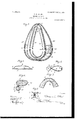
- Figure 1 is a plan view oi the two sections of textile material for forming the casing before they are stitched together.
- Fig. 2 is a plan view of the casing before it has been turned.
- Fig. 3 is a section of the casing before being turned, such section being on the line 3 3 of Fig. 2.
- Fig. 4 is a similar view of the casing after being turned and stitched to form the fore and after wales and the harnecrevice.
- Fig. 5 is a perspective view of a completed collar.
- Fig. 6 is a section on the line 6 6 of Fig. 5.
- Fig. 7 is a partial vertical section through the upper ends of the forewales on the line 7 7 of Fig. 5.
- Fig. 8 is a sectional detail, on an enlarged scale, showing the manner of forming the hams-crevice.
- a and B indicate, respectively, the two blanks of which the casing is made, and, as shown, the blank A is somewhat wider than section B.
- Each blank may be cut in a single piece, but preferably for the sake of economy in the use of material it will consist of two duplicate pieces joined end to end by stitching, as indicated at 10.
- the blank B has secured to it a reinforcing-piece c, preferably of leather, across its line of stitching 10, and also two leather chafe or wear pads e e to prevent wear on the fabric by the logger-heads when the collar is in use.
- the two blanks are stitched together by rows of stitches a and I) along their edges, the blank B having first been puckered or gathered, the line of gathers or puckers being produced as usual,
- the bag is then turned inside out, which results in bringing the raw edges and the stitches a and b on the inside of the bag and the reinforcing-piece c and the chatepads e on the outside.
- the two sides are brought together and sewed from the outside on a line d parallel to one edge of the bag, the wider side of which is drawn toward this edge, so as to carry the scam I) to the opposite side and form a fullness at this part sullicient when the parts are sewed on the line (Z to form a rim part of uniform width.
- the line of stitchingd is through or close to the line of stitching which holds the puckers.
- thiswelldefined hame-crevice is one in which the hames will fit and the fore-wales will overlap the hames to such an extent as to ell'ectually prevent the accidental disengagement of the hames from the collar.
- the stuffing is thus continuous at the upper portion of the collar, so that at the top no acute angle can be formed by the two sides of the collarthat is, the two sides meet a curved portiorieven when the hames are clamped tightly on it, and consequently the collar will not pinch the horses neck at the top.
- This feature of the invention is more particularly shown in Figs. 5 and 7, where it will be seen that the stuffing material extends across the top of the collar and effectually prevents the collar from being bent to form an acute angle.
- a leather chafe-piece k may be secured to the inside of the collar at the top. After the casing has been stuffed the ends will be closed in any suitable manner, as by stitching the material together.
- a casing for a horse-collar section consisting of a tube or bag of fabric having its edges connected by inside seams with a line of puckers at one side of the casin and a line of stitches parallel to one edge 0 the casing and extending through said puckers and separating the casing into rim and body portions, substantially as set forth.
- a casing for a horse-collar consisting of two curved strips of fabric joined at the edges with the seams at the inside, one strip wider than the other and with a seam puckering a portion thereof, and the two strips connected by an outside row of stitches extending parallel to the folded edge of the wider strip and through the puckered portion, substantially as set forth.
- a collar-casing consisting of two pieces of fabric of different widths, one having a series of puckers, the two connected together at the edges and by a line of stitches extending through the puckers, forming a main portion and a rim portion, substantially as set forth.
Landscapes
- Engineering & Computer Science (AREA)
- Mechanical Engineering (AREA)
- Footwear And Its Accessory, Manufacturing Method And Apparatuses (AREA)
Description
PATENTED JAN. 9, 1906.
C. L. ALLEN.
HORSE COLLAR.
APPLICATION FILED NOV. 24, 1902.
2 SHEETS-SHEET 1.
Witnesses (town 1 PATBNTED JAN; 9, 1906.
C. L. ALLEN.
HORSE COLLAR.
APPLICATION FILED NOV. 24. 1902.
2 SHEETS-SHEET 2.
(Inventor TTED STATES PATEN OFFICE.
CLARENCE L. ALLEN. OF ATLANTA, GEORGIA, ASSIGNOR TO COTTON COLLAR COMPANY, OF ATLANTA, GEORGIA, A CORPORATION OF GEORGIA.
. HORSE-COLLAR.
Specification of Letters Patent.
Patented Jan. 9", 1906.
lb (LZZ whmn it may concern:
Be it known that I, CLARENCE L. ALLEN, a citizen of the United States, residing at Atlanta, in the county of Fulton and State of Georgia, have invented certain new and useful Improvements in Horse-Collars, of which the following is a specification.
My invention relates to improvements in horsecollars, and particularly to horsecollars the casings of which are made of textile material, such as canvas, duck, &c.
The object of my invention is to generally improve the construction of collars of this class, and more particularly inthe manner of forming the hame-crevice between the fore wale and after-Wale and also in the manner of forming and stufling the upper end of the collar.
The invention will be fully described hereinafter, reference beinghad to the accompanying drawings, in which Figure 1 is a plan view oi the two sections of textile material for forming the casing before they are stitched together. Fig. 2 is a plan view of the casing before it has been turned. Fig. 3 is a section of the casing before being turned, such section being on the line 3 3 of Fig. 2. Fig. 4 is a similar view of the casing after being turned and stitched to form the fore and after wales and the harnecrevice. Fig. 5 is a perspective view of a completed collar. Fig. 6 is a section on the line 6 6 of Fig. 5. Fig. 7 is a partial vertical section through the upper ends of the forewales on the line 7 7 of Fig. 5. Fig. 8 is a sectional detail, on an enlarged scale, showing the manner of forming the hams-crevice.
A and B indicate, respectively, the two blanks of which the casing is made, and, as shown, the blank A is somewhat wider than section B. Each blank may be cut in a single piece, but preferably for the sake of economy in the use of material it will consist of two duplicate pieces joined end to end by stitching, as indicated at 10. The blank B has secured to it a reinforcing-piece c, preferably of leather, across its line of stitching 10, and also two leather chafe or wear pads e e to prevent wear on the fabric by the logger-heads when the collar is in use. The two blanks are stitched together by rows of stitches a and I) along their edges, the blank B having first been puckered or gathered, the line of gathers or puckers being produced as usual,
as indicated at S, to give the proper shape to the collar. The bag is then turned inside out, which results in bringing the raw edges and the stitches a and b on the inside of the bag and the reinforcing-piece c and the chatepads e on the outside. After turning the bag the two sides are brought together and sewed from the outside on a line d parallel to one edge of the bag, the wider side of which is drawn toward this edge, so as to carry the scam I) to the opposite side and form a fullness at this part sullicient when the parts are sewed on the line (Z to form a rim part of uniform width. The line of stitchingd is through or close to the line of stitching which holds the puckers. The latter are therefore on both sides of the line Z and shape both the rim and body portions of the casing, which is completed by the said line of stitching d from the outside, so that it is not necessary to turn the completed casing, as heretofore required in some constructions. It will also be seen that the casing is completely formed by the shape of the blanks and the puckering, so that it is not necessary to use a multiplicity of pieces. Of course the section of the collar-casing at each side of the collar may be made separately and the two then sewed together by a line of stitching 10.
To secure a welldefined hame-crevice, I employ a strip of leather g, say, one-half inch wide and lay it over the row of stitching d and then secure it to the casing by two rows of stitching is Z along its edges and through both sections of the casing, as indicated in Figs. 4 and 6 and on enlarged scale in Fig.8. This will add greatly to the durability of the collar, inasmuch as the leather strip 9 will form a fiat groove between the rim and body and will protect the row of stitching (Z from the hames and will also allord a more durable wearing-surface against which the hames will bear. It will also be seen that thiswelldefined hame-crevice is one in which the hames will fit and the fore-wales will overlap the hames to such an extent as to ell'ectually prevent the accidental disengagement of the hames from the collar.
Another feature of my invention, which in the practical use of the collar is extremely desirable, is the manner of forming the top of the collar. Heretoforc in collars of this de scription the collar has been made in two sections, one for each side, which sectionswere stuffed before being connected at their top ends, and the result was that when the hames were secured in place the two sides of the collar formed an acute angle at the top of the collar and pinched the horses neck. By my invention this defect is also obviated, because I make the casing of the collar continuous from end to end before stuffing and then stuff it from end to end and bend the stuffed casing to bring the two ends together, the middle portion of the casing forming the upper portion of the collar and the two end portions forming the lower part of the collar. The stuffing is thus continuous at the upper portion of the collar, so that at the top no acute angle can be formed by the two sides of the collarthat is, the two sides meet a curved portiorieven when the hames are clamped tightly on it, and consequently the collar will not pinch the horses neck at the top. This feature of the invention is more particularly shown in Figs. 5 and 7, where it will be seen that the stuffing material extends across the top of the collar and effectually prevents the collar from being bent to form an acute angle. If preferred, a leather chafe-piece k may be secured to the inside of the collar at the top. After the casing has been stuffed the ends will be closed in any suitable manner, as by stitching the material together.
Without limiting myself to the precise details of construction illustrated and described, I claim- 1. A casing for a horse-collar section consisting of a tube or bag of fabric having its edges connected by inside seams with a line of puckers at one side of the casin and a line of stitches parallel to one edge 0 the casing and extending through said puckers and separating the casing into rim and body portions, substantially as set forth.
2. The combination in a horse-collar section, of a casing of textile fabric consisting of blanks with the edges meeting and sewed together at the inside and divided into hame and body portions by a line of stitching at the outside, substantially as set forth.
3. The combination in a horse-collar section, of a casing of textile fabric consisting of blanks with the edges meeting and sewed together by seams at the inside and divided into hame and body portions by a line of stitching at the outside, and With a line of puckers through which the said line of stitching extends, substantially as set forth.
4. A casing for a horse-collar consisting of two curved strips of fabric joined at the edges with the seams at the inside, one strip wider than the other and with a seam puckering a portion thereof, and the two strips connected by an outside row of stitches extending parallel to the folded edge of the wider strip and through the puckered portion, substantially as set forth.
5. A collar-casing consisting of two pieces of fabric of different widths, one having a series of puckers, the two connected together at the edges and by a line of stitches extending through the puckers, forming a main portion and a rim portion, substantially as set forth.
In testimony whereof I have signed my name to this specification in the presence of two subscribing witnesses.
CLARENCE L. ALLEN.
Witnesses:
J. J. EAGAN, A. B. LovETT.
Priority Applications (1)
| Application Number | Priority Date | Filing Date | Title |
|---|---|---|---|
| US13268002A US809886A (en) | 1902-11-24 | 1902-11-24 | Horse-collar. |
Applications Claiming Priority (1)
| Application Number | Priority Date | Filing Date | Title |
|---|---|---|---|
| US13268002A US809886A (en) | 1902-11-24 | 1902-11-24 | Horse-collar. |
Publications (1)
| Publication Number | Publication Date |
|---|---|
| US809886A true US809886A (en) | 1906-01-09 |
Family
ID=2878367
Family Applications (1)
| Application Number | Title | Priority Date | Filing Date |
|---|---|---|---|
| US13268002A Expired - Lifetime US809886A (en) | 1902-11-24 | 1902-11-24 | Horse-collar. |
Country Status (1)
| Country | Link |
|---|---|
| US (1) | US809886A (en) |
-
1902
- 1902-11-24 US US13268002A patent/US809886A/en not_active Expired - Lifetime
Similar Documents
| Publication | Publication Date | Title |
|---|---|---|
| US699151A (en) | Casing for horse-collars. | |
| US672976A (en) | Horse-collar. | |
| US536959A (en) | William pl lankford | |
| US765557A (en) | Horse-collar. | |
| US792808A (en) | Casing for horse-collars. | |
| US887688A (en) | Horse-collar. | |
| US782616A (en) | Combined horse-collar and pad. | |
| US689273A (en) | Horse-collar. | |
| US374024A (en) | Harness-pad | |
| US330623A (en) | Horse-collar | |
| US1017477A (en) | Horse-collar. | |
| US1526443A (en) | Horse collar | |
| US674179A (en) | Waist. | |
| US595376A (en) | Corset | |
| US788412A (en) | Method of making horse-collars. | |
| US508128A (en) | Back-band | |
| US1080901A (en) | Sweat collar-pad. | |
| US329111A (en) | William h | |
| US252032A (en) | Combined shoulder and neck pad for horse-collars | |
| US555943A (en) | Collar | |
| US293446A (en) | Thomas s | |
| US691568A (en) | Seam for sewed articles. | |
| US1532516A (en) | Horse collar | |
| US168756A (en) | Improvement in combined names and collars | |
| US454469A (en) | gould |