US7903646B2 - Wireless communication system allowing group identification information to be publicly available and to be hidden, wireless access point device, and communication method and program for wireless access point device - Google Patents
Wireless communication system allowing group identification information to be publicly available and to be hidden, wireless access point device, and communication method and program for wireless access point device Download PDFInfo
- Publication number
- US7903646B2 US7903646B2 US11/071,039 US7103905A US7903646B2 US 7903646 B2 US7903646 B2 US 7903646B2 US 7103905 A US7103905 A US 7103905A US 7903646 B2 US7903646 B2 US 7903646B2
- Authority
- US
- United States
- Prior art keywords
- access point
- wireless access
- group identification
- identification information
- wireless
- Prior art date
- Legal status (The legal status is an assumption and is not a legal conclusion. Google has not performed a legal analysis and makes no representation as to the accuracy of the status listed.)
- Expired - Fee Related, expires
Links
- 238000004891 communication Methods 0.000 title claims abstract description 54
- 238000000034 method Methods 0.000 title claims description 20
- 238000012545 processing Methods 0.000 claims abstract description 76
- 230000004044 response Effects 0.000 claims description 47
- 238000004590 computer program Methods 0.000 claims description 10
- 239000000523 sample Substances 0.000 description 10
- 238000001514 detection method Methods 0.000 description 7
- 238000010586 diagram Methods 0.000 description 6
- 230000005540 biological transmission Effects 0.000 description 4
- 230000006870 function Effects 0.000 description 4
- 230000006866 deterioration Effects 0.000 description 3
- 235000003642 hunger Nutrition 0.000 description 3
- 230000037351 starvation Effects 0.000 description 3
- 238000004364 calculation method Methods 0.000 description 1
- 238000012790 confirmation Methods 0.000 description 1
- 238000007796 conventional method Methods 0.000 description 1
- 230000000694 effects Effects 0.000 description 1
- 238000012986 modification Methods 0.000 description 1
- 230000004048 modification Effects 0.000 description 1
- 230000003287 optical effect Effects 0.000 description 1
- 238000000060 site-specific infrared dichroism spectroscopy Methods 0.000 description 1
Images


Classifications
-
- H—ELECTRICITY
- H04—ELECTRIC COMMUNICATION TECHNIQUE
- H04L—TRANSMISSION OF DIGITAL INFORMATION, e.g. TELEGRAPHIC COMMUNICATION
- H04L12/00—Data switching networks
- H04L12/28—Data switching networks characterised by path configuration, e.g. LAN [Local Area Networks] or WAN [Wide Area Networks]
-
- H—ELECTRICITY
- H04—ELECTRIC COMMUNICATION TECHNIQUE
- H04L—TRANSMISSION OF DIGITAL INFORMATION, e.g. TELEGRAPHIC COMMUNICATION
- H04L63/00—Network architectures or network communication protocols for network security
- H04L63/08—Network architectures or network communication protocols for network security for authentication of entities
- H04L63/0892—Network architectures or network communication protocols for network security for authentication of entities by using authentication-authorization-accounting [AAA] servers or protocols
-
- H—ELECTRICITY
- H04—ELECTRIC COMMUNICATION TECHNIQUE
- H04W—WIRELESS COMMUNICATION NETWORKS
- H04W12/00—Security arrangements; Authentication; Protecting privacy or anonymity
- H04W12/02—Protecting privacy or anonymity, e.g. protecting personally identifiable information [PII]
-
- H—ELECTRICITY
- H04—ELECTRIC COMMUNICATION TECHNIQUE
- H04W—WIRELESS COMMUNICATION NETWORKS
- H04W12/00—Security arrangements; Authentication; Protecting privacy or anonymity
- H04W12/06—Authentication
-
- H—ELECTRICITY
- H04—ELECTRIC COMMUNICATION TECHNIQUE
- H04W—WIRELESS COMMUNICATION NETWORKS
- H04W48/00—Access restriction; Network selection; Access point selection
- H04W48/08—Access restriction or access information delivery, e.g. discovery data delivery
- H04W48/12—Access restriction or access information delivery, e.g. discovery data delivery using downlink control channel
-
- H—ELECTRICITY
- H04—ELECTRIC COMMUNICATION TECHNIQUE
- H04W—WIRELESS COMMUNICATION NETWORKS
- H04W84/00—Network topologies
- H04W84/02—Hierarchically pre-organised networks, e.g. paging networks, cellular networks, WLAN [Wireless Local Area Network] or WLL [Wireless Local Loop]
- H04W84/10—Small scale networks; Flat hierarchical networks
- H04W84/12—WLAN [Wireless Local Area Networks]
-
- H—ELECTRICITY
- H04—ELECTRIC COMMUNICATION TECHNIQUE
- H04W—WIRELESS COMMUNICATION NETWORKS
- H04W12/00—Security arrangements; Authentication; Protecting privacy or anonymity
- H04W12/60—Context-dependent security
- H04W12/69—Identity-dependent
- H04W12/73—Access point logical identity
Definitions
- the present invention relates to a wireless communication system allowing group identification information to be publicly available and to be hidden, a wireless access point device, and a communication method and program for a wireless access point device.
- a conventional wireless LAN system based on the IEEE 802.11X standards needs to set the same group identifier (SSID) in an access point and a terminal.
- This setup which requires consideration of a difference in topology such as an ad hoc mode or an infrastructure mode, suits a user who is rather familiar to a personal computer (PC), but does not suit a PC beginner.
- Recent techniques in this field include a system in which an application on a terminal automatically detects a plurality of nearby group identifiers (SSID), creates a list of access points to which the terminal can be connected based on detection results, and causes a user to select an access point to be connected from the list.
- SSID group identifier
- Wired Equivalent Privacy is generally used as a security system.
- WEP Wired Equivalent Privacy
- a key shared between a wireless access point and a wireless client is used to encrypt communication data to be transmitted.
- information cannot be read as long as a cipher key is not decrypted.
- the cipher key according to the WEP encryption system can logically be decrypted with much time, which infers that the WEP can never provide a perfect security system.
- SSID group identifier
- the access point devices having a stealth mode with the group identifier (SSID) hidden intentionally may accept a connection to a new wireless terminal
- the user of a wireless terminal previously learns the group identifier (SSID) and individually performs setup.
- an administrator of the access point device cancels the stealth mode temporarily, and causes the user to select a list of access points that can be accessed. Accordingly, the administrator of the access, point device and the user of the wireless terminal conventionally require complicate operations, remarkably reducing convenience and operability of the system.
- FIG. 1 is a configuration diagram of a wireless communication system according to an embodiment of the present invention
- FIG. 2 is another configuration diagram of the wireless communication system according to a first embodiment of the present invention
- FIG. 3 is a sequence chart of a processing according to the first embodiment
- FIG. 4 is another sequence chart of the processing according to the first embodiment
- FIG. 5 is a process flowchart of a wireless terminal
- FIG. 6 is a process flowchart of an access point device
- FIG. 7 is another process flowchart of the access point device
- FIG. 8 is a process flowchart of a host PC according to the first embodiment
- FIG. 9 is a structural diagram of a data frame format of beacon information
- FIG. 10 is a sequence chart of a processing according to a second embodiment
- FIG. 11 is another sequence chart of the processing according to the second embodiment.
- FIG. 12 is a process flowchart of a host PC according to the second embodiment.
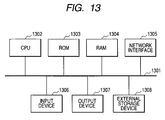
- FIG. 13 is a block diagram showing an example hardware configuration of a computer.
- FIG. 1 is a configuration diagram of a wireless communication system according to an embodiment of the present invention.
- a wireless access point device 102 establishes a wireless communication link with wireless terminals 105 to 108 .
- An authentication server terminal 104 , the wireless access point device 102 , and a host PC 103 are connected to a network 101 via wires, and provide a data transmission control function and a path selection function in the network 101 .
- the authentication server terminal 104 also performs control regarding an authentication sequence processing between an arbitrary client terminal within the network 101 and each of the wireless terminals 105 to 108 that are accepted to connect to the wireless access point device 102 .
- FIG. 2 is a system configuration diagram according to a first embodiment which illustrates a case where a wireless terminal 3 ( 107 ) enters an area forming a group of a wireless terminal 1 ( 105 ) and a wireless terminal 2 ( 106 ) based on a group identifier: SSID 1 . Details of reference numerals and names that are used in the drawing are the same as FIG. 1 .
- FIG. 9 illustrates an IEEE 802.11 management frame data format including a beacon frame structure, which is used in this embodiment.
- frame data 901 represents a structure of a beacon frame, and includes an SSID 902 .
- the SSID 902 is an area in which information on a group identifier is set, and includes an Element ID 903 , a Length 904 , and a group identifier (SSID) 905 .
- the Element ID 903 represents an information element identifier
- the Length 904 represents the length of SSID data set in an SSID 905 area having a maximum size of 32 bytes.
- FIGS. 3 to 8 are used to describe a wireless communication system according to the first embodiment of the present invention.
- FIG. 3 is a sequence chart 1 of a processing according to the first embodiment
- FIG. 4 is a sequence chart 2 of the processing according to the first embodiment
- FIG. 5 is a process flowchart of the wireless terminal 107 according to the first embodiment
- FIG. 6 is a process flowchart 1 of the access point device 102 according to the first embodiment
- FIG. 7 is a process flowchart 2 of the access point device according to the first embodiment
- FIG. 8 is a process flowchart of the host PC 103 according to the first embodiment.
- the power of the wireless access point device 102 in the wireless communication system is turned on, and starts to send out a beacon signal M 300 .
- the Length 904 is “0,” and data is not set in the group identifier (SSID) 905 .
- the beacon signal M 300 indicates a state where a stealth mode is ON. In such a state, when the wireless terminal 2 ( 106 ) detects the beacon signal M 300 ⁇ Step S 501 of FIG. 5 : YES> and finds that the group identifier (SSID) 905 does not exist ⁇ Step S 502 of FIG.
- the wireless terminal 2 ( 106 ) makes an inquiry about whether or not a wireless cell is available in the vicinity. In order to find the wireless access point device 102 that is connection-acceptable, the wireless terminal 2 ( 106 ) sends out an entry request message (probe request or the like for IEEE 802.11b) M 301 , and activates a response timer (Step S 503 of FIG. 5 ).
- an entry request message probe request or the like for IEEE 802.11b
- the wireless access point device 102 Upon reception of the entry request message M 301 ⁇ Step S 601 of FIG. 6 : YES>, the wireless access point device 102 sends an entry response message (probe response or the like for IEEE 802.11b) M 302 to the wireless terminal 2 ( 106 ) (Step S 602 of FIG. 6 ). Subsequently, the wireless access point device 102 sends an entry request message M 303 to the host PC 103 (Step S 603 of FIG. 6 ), and activates an entry start timer (Step S 604 of FIG. 6 ).
- an entry response message probe response or the like for IEEE 802.11b
- the wireless terminal 2 ( 106 ) Upon reception of the entry response message M 302 ⁇ Step S 504 of FIG. 5 : YES>, the wireless terminal 2 ( 106 ) shifts to a state for detecting a new beacon signal (Step S 501 of FIG. 5 ). If the entry response message M 302 cannot be received ⁇ Step S 504 of FIG. 5 : NO>, the wireless terminal 2 ( 106 ) checks whether or not the timer has expired, and if the timer has not expired ⁇ Step S 505 of FIG. 5 : NO>, shifts back to a state of waiting for the entry response message M 302 from the wireless access point device 102 (Step S 504 of FIG. 5 ). If the timer has expired ⁇ Step S 505 of FIG. 5 : YES>, the wireless terminal 2 ( 106 ) shifts to the state for detecting a new beacon signal (Step S 501 of FIG. 5 ).
- the host PC 103 judges whether or not the received entry request message M 303 has been sent from a registered terminal that is previously registered in a memory. If being requested from the registered (permitted) terminal ⁇ Step S 802 of FIG. 8 : YES>, the host PC 103 sends an entry start message M 304 to the wireless access point device 102 (Step S 803 of FIG. 8 ), and activates an entry start timer (Step S 804 of FIG. 8 ).
- the entry start message M 304 Upon reception of the entry start message M 304 ⁇ Step S 605 of FIG.
- the wireless access point device 102 starts to send out a beacon signal M 305 .
- a beacon signal M 305 indicates a state where the stealth mode is OFF (Step S 608 of FIG. 6 ).
- the wireless terminal 1 ( 105 ) detects the beacon signal M 305 ⁇ Step S 501 of FIG. 5 : YES>.
- the wireless terminal 1 ( 105 ) After that, by a selection operation of the wireless terminal 1 ( 105 ) by the user, the wireless terminal 1 ( 105 ) sends a wireless authentication request to the wireless access point device 102 , and executes an authentication sequence processing M 306 (Step S 506 of FIG. 5 ).
- the wireless access point device 102 Upon reception of the wireless authentication request ⁇ Step S 701 of FIG. 7 : YES>, the wireless access point device 102 executes the authentication sequence processing M 306 with respect to the wireless terminal 1 ( 105 ) (Step S 702 of FIG. 7 ).
- the wireless terminal 1 ( 105 ) executes an association processing M 307 with respect to the wireless access point device 102 (Step S 508 of FIG. 5 and Step S 702 of FIG. 7 ).
- the wireless access point device 102 shifts to a state of waiting for execution completion detection of a RADIUS authentication sequence M 308 that is executed between the wireless terminal 1 ( 105 ) and the authentication server terminal 104 (Step S 704 of FIG. 7 ).
- the wireless access point device 102 sends an entry notification message M 309 to the host PC 103 , and activates a timer for waiting to receive an entry end message (Step S 705 of FIG. 7 ).
- the wireless terminal 2 ( 106 ) detects the beacon signal M 305 ⁇ Step S 501 of FIG. 5 : YES>.
- the wireless terminal 2 ( 106 ) After that, by a selection operation of the wireless terminal 2 ( 106 ) by the user, the wireless terminal 2 ( 106 ) sends a wireless authentication request to the wireless access point device 102 , and executes an authentication sequence processing M 310 (Step S 506 of FIG. 5 ).
- the wireless access point device 102 Upon reception of the wireless authentication request ⁇ Step S 701 of FIG. 7 : YES>, the wireless access point device 102 executes the authentication sequence processing M 310 with respect to the wireless terminal 2 ( 106 ) (Step S 702 of FIG. 7 ).
- the wireless terminal 2 ( 106 ) executes an association processing M 311 with respect to the wireless access point device 102 (Step S 508 of FIG. 5 and Step S 702 of FIG. 7 ).
- the wireless access point device 102 shifts to a state of waiting for execution completion detection of a RADIUS authentication sequence M 312 that is executed between the wireless terminal 2 ( 106 ) and the authentication server terminal 104 (Step S 704 of FIG. 7 ).
- the wireless access point device 102 sends an entry notification message M 313 to the host PC 103 , and activates a timer for waiting to receive an entry end message (Step S 705 of FIG. 7 ).
- the host PC 103 receives the entry notification messages M 313 .
- the host PC 103 sends an entry end message M 314 to the wireless access point device 102 (Step S 807 of FIG. 8 ).
- the host PC 103 Upon reception of the entry end message M 314 ⁇ Step S 706 of FIG. 7 : YES> or upon expiration of the timer for waiting to receive an entry end message ⁇ Step S 707 of FIG.
- the wireless access point device 102 starts to send out a beacon signal M 315 (Step S 708 of FIG. 7 ).
- the Length 904 is “0,” and data is not set in the group identifier (SSID) 905 .
- the beacon signal M 315 indicates the state where the stealth mode is ON.
- the host PC 103 judges whether or not the received entry request message M 303 has been sent from a registered terminal. If being requested from a non-registered terminal ⁇ Step S 802 of FIG. 8 : NO>, the host PC 103 shifts back to a state of waiting for the entry request message M 303 (Step S 801 of FIG. 8 ). As a result, if the wireless access point device 102 cannot receive the entry start message M 304 ⁇ Step S 605 of FIG.
- Step S 606 of FIG. 6 NO>, shifts back to a state of waiting for the entry start message M 304 from the host PC 103 (Step S 605 of FIG. 6 ).
- Step S 606 of FIG. 6 YES>, the wireless access point device 102 starts to send out another beacon signal.
- the Length 904 is “0,” and data is not set in the group identifier (SSID) 905 .
- the beacon signal indicates the state where the stealth mode is ON.
- the wireless terminal 3 ( 107 ) detects the beacon signal M 315 without the SSID ⁇ Step S 501 of FIG. 5 : YES>. If the group identifier (SSID) 905 does not exist ⁇ Step S 502 of FIG.
- the wireless terminal 3 in order to find the wireless access point device 102 that is connection-acceptable, the wireless terminal 3 ( 107 ) sends out the entry request message (probe request or the like for IEEE 802.11b) M 400 , and activates a response timer (Step S 503 of FIG. 5 ).
- the wireless access point device 102 Upon reception of the entry request message M 400 ⁇ Step S 601 of FIG. 6 : YES>, the wireless access point device 102 sends an entry response message (probe response or the like for IEEE 802.11b) M 401 to the wireless terminal 3 ( 107 ) (Step S 602 of FIG. 6 ), sends an entry request message M 402 to the host PC 103 (Step S 603 of FIG. 6 ), and activates the entry start timer (Step S 604 of FIG. 6 ).
- an entry response message probe response or the like for IEEE 802.11b
- the wireless terminal 3 ( 107 ) Upon reception of the entry response message M 401 ⁇ Step S 504 of FIG. 5 : YES>, the wireless terminal 3 ( 107 ) shifts to a state for detecting a new beacon signal (Step S 501 of FIG. 5 ). If the entry response message M 401 cannot be received ⁇ Step S 504 of FIG. 5 : NO>, the wireless terminal 3 ( 107 ) checks whether or not the timer has expired, and if the timer has not expired ⁇ Step S 505 of FIG. 5 : NO>, shifts back to a state of waiting for the entry response message M 401 from the wireless access point device 102 (Step S 504 of FIG. 5 ). If the timer has expired ⁇ Step S 505 of FIG. 5 : YES>, the wireless terminal 3 ( 107 ) shifts to the state for detecting a new beacon signal (Step S 501 of FIG. 5 ).
- the host PC 103 judges whether or not the received entry request message M 402 has been sent from a registered terminal. If being requested from the registered (permitted) terminal ⁇ Step S 802 of FIG. 8 : YES>, the host PC 103 sends an entry start message M 403 to the wireless access point device 102 (Step S 803 of FIG. 8 ), and activates an entry start timer (Step S 804 of FIG. 8 ).
- the wireless access point device 102 starts to send out a beacon signal M 404 .
- an authorized group identifier data is set in the group identifier (SSID) 905 , and a predetermined value is set in the Length 904 .
- the beacon signal M 404 indicates the state where the stealth mode is OFF (Step S 608 of FIG. 6 ).
- the wireless terminal 3 ( 107 ) detects the beacon signal M 404 ⁇ Step S 501 of FIG. 5 : YES>.
- the wireless terminal 3 ( 107 ) After that, by a selection operation of the wireless terminal 3 ( 107 ) by the user, the wireless terminal 3 ( 107 ) sends a wireless authentication request to the wireless access point device 102 , and executes an authentication sequence processing M 405 (Step S 506 of FIG. 5 ).
- the wireless access point device 102 Upon reception of the wireless authentication request ⁇ Step S 701 of FIG. 7 : YES>, the wireless access point device 102 executes the authentication sequence processing M 405 with respect to the wireless terminal 3 ( 107 ) (Step S 702 of FIG. 7 ).
- the wireless terminal 3 ( 107 ) executes an association processing M 406 with respect to the wireless access point device 102 (Step S 508 of FIG. 5 and Step S 702 of FIG. 7 ).
- the wireless access point device 102 shifts to a state of waiting for execution completion detection of a RADIUS authentication sequence M 407 that is executed between the wireless terminal 3 ( 107 ) and the authentication server terminal 104 (Step S 704 of FIG. 7 ).
- the wireless access point device 102 sends an entry notification message M 408 to the host PC 103 , and activates a timer for waiting to receive an entry end message (Step S 705 of FIG. 7 ).
- the host PC 103 receives the entry notification messages M 408 .
- the host PC 103 sends an entry end message M 409 to the wireless access point device 102 (Step S 807 of FIG. 8 ).
- the host PC 103 Upon reception of the entry end message M 409 ⁇ Step S 706 of FIG. 7 : YES> or upon expiration of the timer for waiting to receive an entry end message ⁇ Step S 707 of FIG.
- the wireless access point device 102 starts to send out a beacon signal M 410 (Step S 708 of FIG. 7 ).
- the Length 904 is “0,” and data is not set in the group identifier (SSID) 905 .
- the beacon signal M 410 indicates the state where the stealth mode is ON.
- FIGS. 10 to 12 are used to describe a wireless communication system according to a second embodiment of the present invention.
- FIG. 10 is a sequence chart 1 of a processing according to the second embodiment
- FIG. 11 is another sequence chart 2 of the processing according to the second embodiment
- FIG. 12 is a process flowchart of the host PC 103 according to the second embodiment.
- the power of the wireless access point device 102 in the wireless communication system is turned on, and starts to send out a beacon signal M 300 .
- the Length 904 is “0,” and data is not set in the group identifier (SSID) 905 .
- the beacon signal M 300 indicates the state where the stealth mode is ON. In such a state, when the wireless terminal 1 ( 105 ) detects the beacon signal M 300 ⁇ Step S 501 of FIG. 5 : YES> and finds that the group identifier (SSID) 905 does not exist ⁇ Step S 502 of FIG.
- the wireless terminal 1 ( 105 ) makes the inquiry about whether or not a wireless cell is available in the vicinity.
- the wireless terminal 1 ( 105 ) sends out an entry request message (probe request or the like for IEEE 802.11b) M 1001 , and activates a response timer (Step S 503 of FIG. 5 ).
- the wireless access point device 102 Upon reception of the entry request message M 1001 ⁇ Step S 601 of FIG. 6 : YES>, the wireless access point device 102 sends an entry response message (probe response or the like for IEEE 802.11b) M 1002 to the wireless terminal 1 ( 105 ) (Step S 602 of FIG. 6 ).
- the wireless access point device 102 sends an entry request message M 1003 to the host PC 103 (Step S 603 of FIG. 6 ), and activates an entry start timer (Step S 604 of FIG. 6 ).
- the wireless terminal 1 ( 105 ) Upon reception of the entry response message M 1002 ⁇ Step S 504 of FIG. 5 : YES>, the wireless terminal 1 ( 105 ) shifts to the state for detecting a new beacon signal (Step S 501 of FIG. 5 ). If the entry response message M 1002 cannot be received ⁇ Step S 504 of FIG. 5 : NO>, the wireless terminal 1 ( 105 ) checks whether or not the timer has expired, and if the timer has not expired ⁇ Step S 505 of FIG. 5 : NO>, shifts back to the state of waiting for the entry response message M 1002 from the wireless access point device 102 (Step S 504 of FIG. 5 ). If the timer has expired ⁇ Step S 505 of FIG. 5 : YES>, the wireless terminal 1 ( 105 ) shifts to the state for detecting a new beacon signal (Step S 501 of FIG. 5 ).
- the wireless terminal 1 ( 105 ) when the wireless terminal 2 ( 106 ) detects the beacon signal M 300 ⁇ Step S 501 of FIG. 5 : YES> and finds that the group identifier (SSID) 905 does not exist ⁇ Step S 502 of FIG. 5 : NO>, the wireless terminal 1 ( 105 ) makes the inquiry about whether or not a wireless cell is available in the vicinity. In order to find the wireless access point device 102 that is connection-acceptable, the wireless terminal 2 ( 106 ) sends out an entry request message (probe request or the like for IEEE 802.11b) M 1004 , and activates a response timer (Step S 503 of FIG. 5 ).
- an entry request message probe request or the like for IEEE 802.11b
- the wireless access point device 102 Upon reception of the entry request message M 1004 ⁇ Step S 601 of FIG. 6 : YES>, the wireless access point device 102 sends an entry response message (probe response or the like for IEEE 802.11b) M 1005 to the wireless terminal 2 ( 106 ) (Step S 602 of FIG. 6 ). Then, the wireless access point device 102 sends an entry request message M 1006 to the host PC 103 (Step S 603 of FIG. 6 ), and activates an entry start timer (Step S 604 of FIG. 6 ). Upon reception of the entry response message M 1005 ⁇ Step S 504 of FIG.
- the wireless terminal 2 ( 106 ) shifts to the state for detecting a new beacon signal (Step S 501 of FIG. 5 ). If the entry response message M 1005 cannot be received ⁇ Step S 504 of FIG. 5 : NO>, the wireless terminal 2 ( 106 ) checks whether or not the timer has expired, and if the timer has not expired ⁇ Step S 505 of FIG. 5 : NO>, shifts back to the state of waiting for the entry response message M 1005 from the wireless access point device 102 (Step S 504 of FIG. 5 ). If the timer has expired ⁇ Step S 505 of FIG. 5 : YES>, the wireless terminal 2 ( 106 ) shifts to the state for detecting a new beacon signal (Step S 501 of FIG. 5 ).
- the wireless terminal 3 ( 107 ) detects the beacon signal M 300 ⁇ Step S 501 of FIG. 5 : YES> and finds that the group identifier (SSID) 905 does not exist ⁇ Step S 502 of FIG. 5 : NO>, the wireless terminal 1 ( 105 ) makes the inquiry about whether or not a wireless cell is available in the vicinity. In order to find the wireless access point device 102 that is connection-acceptable, the wireless terminal 3 ( 107 ) sends out an entry request message (probe request or the like for IEEE 802.11b) M 1007 , and activates a response timer (Step S 503 of FIG. 5 ).
- an entry request message probe request or the like for IEEE 802.11b
- the wireless access point device 102 Upon reception of the entry request message M 1007 ⁇ Step S 601 of FIG. 6 : YES>, the wireless access point device 102 sends an entry response message (probe response or the like for IEEE 802.11b) M 1008 to the wireless terminal 3 ( 107 ) (Step S 602 of FIG. 6 ). Then, the wireless access point device 102 sends an entry request message M 1009 to the host PC 103 (Step S 603 of FIG. 6 ), and activates an entry start timer (Step S 604 of FIG. 6 ). Upon reception of the entry response message M 1008 ⁇ Step S 504 of FIG.
- the wireless terminal 3 ( 107 ) shifts to the state for detecting a new beacon signal (Step S 501 of FIG. 5 ). If the entry response message M 1008 cannot be received ⁇ Step S 504 of FIG. 5 : NO>, the wireless terminal 3 ( 107 ) checks whether or not the timer has expired, and if the timer has not expired ⁇ Step S 505 of FIG. 5 : NO>, shifts back to the state of waiting for the entry response message M 1008 from the wireless access point device 102 (Step S 504 of FIG. 5 ). If the timer has expired ⁇ Step S 505 of FIG. 5 : YES>, the wireless terminal 3 ( 107 ) shifts to the state for detecting a new beacon signal (Step S 501 of FIG. 5 ).
- the host PC 103 judges whether or not the entry request message M 1003 is from the registered terminal. If being requested from the registered terminal ⁇ Step S 1202 of FIG. 12 : YES>, the host PC 103 activates the entry start timer (Step S 1203 of FIG. 12 ).
- the host PC 103 receives the entry request message M 1006 and the entry request message M 1009 from the wireless terminal 2 ( 106 ) and the wireless terminal 3 ( 107 ), respectively. At this time, it is judged whether or not an entry processing relating to the wireless terminal under registration has been completed. If not completed ⁇ Step S 1204 of FIG. 12 : NO>, the host PC 103 checks whether or not the timer has expired, and if the timer has not expired ⁇ Step S 1205 of FIG. 12 : NO>, shifts back to the state of waiting for the entry request message from the wireless access point device 102 (Step S 1204 of FIG. 12 ).
- Step S 1205 of FIG. 12 YES>
- the host PC 103 sends an entry start message M 1010 to the wireless access point device 102 , and activates an entry terminal authentication timer (Step S 1206 of FIG. 12 ).
- the wireless access point device 102 starts to send a beacon signal M 1011 .
- the beacon signal M 1011 indicates the state where the stealth mode is OFF (Step S 608 of FIG. 6 ).
- the wireless terminal 1 ( 105 ) detects the beacon signal M 1011 ⁇ Step S 501 of FIG. 5 : YES>.
- the wireless terminal 1 ( 105 ) sends a wireless authentication request to the wireless access point device 102 , and executes an authentication sequence processing M 1012 (Step S 506 of FIG. 5 ).
- the wireless access point device 102 executes the authentication sequence processing M 1012 with respect to the wireless terminal 1 ( 105 ) (Step S 702 of FIG. 7 ).
- the wireless terminal 1 ( 105 ) executes an association processing M 1013 with respect to the wireless access point device 102 (Step S 508 of FIG. 5 and Step S 702 of FIG. 7 ).
- the wireless access point device 102 shifts to a state of waiting for execution completion detection of a RADIUS authentication sequence M 1014 that is executed between the wireless terminal 1 ( 105 ) and the authentication server terminal 104 (Step S 704 of FIG. 7 ).
- the wireless access point device 102 sends an entry notification message M 1015 to the host PC 103 , and activates the timer for waiting to receive the entry end message (Step S 705 of FIG. 7 ).
- the wireless terminal 2 ( 106 ) detects the beacon signal M 1011 ⁇ Step S 501 of FIG. 5 : YES>.
- the wireless terminal 2 ( 106 ) After that, by the selection operation of the wireless terminal 2 ( 106 ) by the user, the wireless terminal 2 ( 106 ) sends a wireless authentication request to the wireless access point device 102 , and executes an authentication sequence processing M 1101 (Step S 506 of FIG. 5 ).
- the wireless access point device 102 Upon reception of the wireless authentication request ⁇ Step S 701 of FIG. 7 : YES>, the wireless access point device 102 executes the authentication sequence processing M 1101 with respect to the wireless terminal 2 ( 106 ) (Step S 702 of FIG. 7 ).
- the wireless terminal 2 ( 106 ) executes an association processing M 1102 with respect to the wireless access point device 102 (Step S 508 of FIG. 5 and Step S 702 of FIG. 7 ).
- the wireless access point device 102 shifts to a state of waiting for execution completion detection of a RADIUS authentication sequence M 1103 that is executed between the wireless terminal 2 ( 106 ) and the authentication server terminal 104 (Step S 704 of FIG. 7 ).
- the wireless access point device 102 sends an entry notification message M 1104 to the host PC 103 , and activates the timer for waiting to receive an entry end message (Step S 705 of FIG. 7 ).
- the wireless terminal 3 ( 107 ) also detects the beacon signal M 1011 ⁇ Step S 501 of FIG. 5 : YES> similarly to the cases with the wireless terminal 1 ( 105 ) and the wireless terminal 2 ( 106 ).
- the group identifier (SSID) 905 exists ⁇ Step S 502 of FIG. 5 : YES>, so the wireless access point device 102 is listed up as a wireless access point device to which the wireless terminal 3 ( 107 ) can be connected.
- the wireless terminal 3 ( 107 ) sends a wireless authentication request to the wireless access point device 102 , and executes an authentication sequence processing M 1105 (Step S 506 of FIG. 5 ).
- the wireless access point device 102 executes the authentication sequence processing M 1105 with respect to the wireless terminal 3 ( 107 ) (Step S 702 of FIG. 7 ).
- the wireless terminal 3 ( 107 ) executes an association processing M 1106 with respect to the wireless access point device 102 (Step S 508 of FIG. 5 and Step S 702 of FIG. 7 ).
- the wireless access point device 102 shifts to a state of waiting for execution completion detection of a RADIUS authentication sequence M 1107 that is executed between the wireless terminal 3 ( 107 ) and the authentication server terminal 104 (Step S 704 of FIG. 7 ).
- the wireless access point device 102 sends an entry notification message M 1108 to the host PC 103 , and activates the timer for waiting to receive an entry end message (Step S 705 of FIG. 7 ).
- the host PC 103 Upon reception of the entry notification messages M 1015 , M 1104 , and M 1108 , the host PC 103 checks whether or not the entry processing relating to each wireless terminal whose entry was previously registered has been completed. If not completed ⁇ Step S 1207 of FIG. 12 : NO>, the host PC 103 checks whether or not the timer has expired, and if the timer has not expired ⁇ Step S 1205 of FIG. 12 : NO>, shifts back to the state of waiting for the entry request message from the wireless access point device 102 (Step S 1207 of FIG. 12 ).
- Step S 1207 of FIG. 12 NO>
- the host PC 103 checks whether or not the timer has expired, and if the timer has not expired ⁇ Step S 1208 of FIG. 12 : NO>, shifts back to the state of waiting for the entry notification message from the wireless access point device 102 (Step S 1207 of FIG. 12 ).
- the host PC 103 which has received the entry notification messages M 1015 , M 1104 , and M 1108 ⁇ Step S 1207 of FIG. 12 : YES>, checks whether or not the entry processing relating to each wireless terminal whose entry was previously registered has been completed. If completed ⁇ Step S 1207 of FIG. 12 : YES>, or if the entry start timer has expired ⁇ Step S 1208 of FIG. 12 : YES>, the host PC 103 sends an entry end message M 1109 to the wireless access point device 102 (Step S 1209 of FIG. 12 ). If the wireless access point device 102 receives the entry end message M 1109 ⁇ Step S 706 of FIG.
- the wireless access point device 102 starts to send out a beacon signal M 1110 (Step S 708 of FIG. 7 ).
- the Length 904 is “0,” and data is not set in the group identifier (SSID) 905 .
- the beacon signal M 1110 indicates the state where the stealth mode is ON.
- the timer is activated to start a period in which wireless terminal devices other than the desired wireless terminal device are capable of entry. If the activated timer has expired, or if connection requests have been received from all the connectable wireless terminal devices, the entry start can be instructed to a wireless access point device.
- the processing of accepting connection with the wireless access point device may similarly be realized without the selection operation of the wireless terminal by the user.
- the application on the wireless terminal may automatically select one from among a plurality of listed-up wireless access point devices as appropriate to thereby execute the processing of accepting the connection.
- the description of the above-mentioned embodiments illustrates that the wireless terminals 1 , 2 , and 3 each send an entry request message to the wireless access point device so that the sequence processing such as the wireless authentication can be executed on each wireless terminal.
- sequence processing such as the wireless authentication
- the description of the above-mentioned embodiments illustrates that the host PC is provided within the network to execute the entry registration of the wireless terminals and other such control.
- the series of control processings executed by the host PC may similarly be executed by the wireless access point device.
- the host PC and the wireless access point device may be integrated into a single device to thereby realize the system.
- FIG. 13 shows a hardware configuration as described above, which includes the wireless access point device 102 , the host PC 103 , the authentication server terminal 104 , and the wireless terminals 105 to 108 .
- the configuration includes a bus 1301 that is connected to a central processing unit (CPU) 1302 , a ROM 1303 , a RAM 1304 , a network interface 1305 , an input device 1306 , an output device 1307 , and an external storage device 1308 .
- CPU central processing unit
- ROM read-only memory
- RAM random access memory
- the CPU 1302 performs a data processing or calculation and control the other configuration elements connected to the CPU 1302 through the bus 1301 .
- the ROM 1303 previously stores a control procedure (computer program) of the CPU 1302 .
- the computer program is loaded by the execution of the CPU 1302 .
- the external storage device 1308 stores a computer program, and the computer program is copied to the RAM 1304 before its execution.
- the RAM 1304 is used as a work memory for data input/output and data send/receive and as a temporary memory for control of each configuration element.
- the external storage device 1308 is, for example, a hard disk drive or a CD-ROM, and holds its contents even after the shutdown.
- the CPU 1302 executes a computer program to perform the processings of the flowcharts of FIGS. 5 to 8 and 12 .
- the network interface 1305 is an interface for connecting to the network 101 shown in FIG. 1 , a wireless LAN, etc.
- the input device 1306 is, for example, a keyboard and a mouse, and allows various designations and inputs.
- the output device 1307 is, for example, a display.
- the group identifier (SSID) is made publicly available, and a connection permission is granted to a wireless terminal used by an authorized conference participant.
- the wireless access point device executes an SSID stealth function to hide the SSID from the third party, thereby avoiding their unauthorized access.
- the host PC instructs the wireless access point device to turn the stealth mode off and the connection permission is granted to the wireless terminal.
- the stealth function is again executed.
- the wireless access point device having a stealth mode in which the group identifier (SSID) is hidden intentionally from the beacon information, receives a connection request from the pre-registered or permitted wireless terminal, the host PC performs management control to make publicly available the group identifier (SSID) included in the beacon information without such a conventional method as to have the administrator to cancel the stealth mode. Accordingly, the wireless terminal can appropriately select one from among wireless access point devices to which the wireless terminal can be connected based on the group identifier (SSID), thereby eliminating the difficulty in operation from the administrator and the wireless terminal user and producing an effect of enhanced convenience.
- SSID group identifier
- the group identifier (SSID) that can identify the service area of a wireless LAN under operation is made publicly available only when a wireless terminal is connected thereto or the connection is accepted. Accordingly, the group identifier (SSID) does not need to be constantly sent out by being included in the beacon information, thereby improving security.
- the present invention can also realized by a program executed by a computer.
- a means for supplying the program to the computer for example, a computer-readable recording medium, such as a CD-ROM, on which the program is recorded, or a transmission medium, for example, the Internet for transmitting the program.
- a computer program product using the computer-readable recording medium on which the program is recorded.
- the above-mentioned program, recording medium, transmission medium, and computer program product are included in the scope of the present invention. It is possible to use as the recording medium, for example, a flexible disk, a hard disk, an optical disk, magneto-optical disk, a CD-ROM, a magnetic tape, a non-volatile memory card, and a ROM.
- the present invention makes it possible to cancel the stealth mode by making the group identification information publicly available as necessary, and set the stealth mode by hiding the group identification information.
Landscapes
- Engineering & Computer Science (AREA)
- Computer Networks & Wireless Communication (AREA)
- Signal Processing (AREA)
- Computer Security & Cryptography (AREA)
- Business, Economics & Management (AREA)
- Accounting & Taxation (AREA)
- Computer Hardware Design (AREA)
- Computing Systems (AREA)
- General Engineering & Computer Science (AREA)
- Mobile Radio Communication Systems (AREA)
- Small-Scale Networks (AREA)
Applications Claiming Priority (2)
| Application Number | Priority Date | Filing Date | Title |
|---|---|---|---|
| JP2004062392A JP4164456B2 (ja) | 2004-03-05 | 2004-03-05 | 無線通信システム、無線アクセスポイント装置、無線アクセスポイント装置の通信方法、及び無線アクセスポイント装置を制御するためのプログラム |
| JP2004-062392 | 2004-03-05 |
Publications (2)
| Publication Number | Publication Date |
|---|---|
| US20050195781A1 US20050195781A1 (en) | 2005-09-08 |
| US7903646B2 true US7903646B2 (en) | 2011-03-08 |
Family
ID=34909269
Family Applications (1)
| Application Number | Title | Priority Date | Filing Date |
|---|---|---|---|
| US11/071,039 Expired - Fee Related US7903646B2 (en) | 2004-03-05 | 2005-03-02 | Wireless communication system allowing group identification information to be publicly available and to be hidden, wireless access point device, and communication method and program for wireless access point device |
Country Status (4)
| Country | Link |
|---|---|
| US (1) | US7903646B2 (enExample) |
| JP (1) | JP4164456B2 (enExample) |
| KR (1) | KR100778186B1 (enExample) |
| CN (1) | CN100446468C (enExample) |
Cited By (7)
| Publication number | Priority date | Publication date | Assignee | Title |
|---|---|---|---|---|
| US20070026856A1 (en) * | 2005-07-29 | 2007-02-01 | Microsoft Corporation | Transmitting a communication from a wireless access point indicating hidden networks |
| US20070141986A1 (en) * | 2005-12-20 | 2007-06-21 | Microsoft Corporation | Proximity service discovery in wireless networks |
| US20070141988A1 (en) * | 2005-12-20 | 2007-06-21 | Microsoft Corporation | Mechanism to convey discovery information in a wireless network |
| US9105031B2 (en) | 2008-02-22 | 2015-08-11 | Microsoft Technology Licensing, Llc | Authentication mechanisms for wireless networks |
| US10225782B2 (en) | 2015-12-08 | 2019-03-05 | Industrial Technology Research Institute | Wireless communication device and operating method using the same |
| US10681151B2 (en) | 2006-05-15 | 2020-06-09 | Microsoft Technology Licensing, Llc | Notification framework for wireless networks |
| US10965672B2 (en) | 2018-04-13 | 2021-03-30 | At&T Intellectual Property I, L.P. | Network service control for access to wireless radio networks |
Families Citing this family (28)
| Publication number | Priority date | Publication date | Assignee | Title |
|---|---|---|---|---|
| JP5002149B2 (ja) * | 2005-02-03 | 2012-08-15 | キヤノン株式会社 | 通信装置及び通信方法 |
| JP4508033B2 (ja) * | 2005-08-11 | 2010-07-21 | ソニー株式会社 | 無線通信システム、端末およびその状態報知方法ならびにプログラム |
| US8259691B2 (en) | 2006-09-05 | 2012-09-04 | Marvell International Ltd. | System and method for identifying an access point |
| JP4777229B2 (ja) * | 2006-12-20 | 2011-09-21 | キヤノン株式会社 | 通信システム、管理装置、管理装置の制御方法、及び当該制御方法をコンピュータに実行させるためのコンピュータプログラム |
| US8060741B2 (en) * | 2006-12-29 | 2011-11-15 | Industrial Technology Research Institute | System and method for wireless mobile network authentication |
| US20090322521A1 (en) * | 2007-04-26 | 2009-12-31 | Jacobson Kirk D | System and method for utilizing a security beacon device |
| JP5389801B2 (ja) * | 2008-06-30 | 2014-01-15 | パナソニック株式会社 | 無線通信システム、通信端末、管理端末、通信方法、及び集積回路 |
| CN102006653B (zh) * | 2009-08-28 | 2014-02-19 | 华为技术有限公司 | 接入控制方法和接入点 |
| JP5304668B2 (ja) * | 2010-01-22 | 2013-10-02 | ソニー株式会社 | 無線通信装置、プログラム、無線通信方法、および無線通信システム |
| US8856290B2 (en) * | 2011-10-24 | 2014-10-07 | General Instrument Corporation | Method and apparatus for exchanging configuration information in a wireless local area network |
| US9191699B2 (en) | 2011-12-29 | 2015-11-17 | Sonos, Inc. | Systems and methods for connecting an audio controller to a hidden audio network |
| US9400320B2 (en) | 2012-04-04 | 2016-07-26 | Qualcomm Incorporated | Methods and apparatus for efficient transport and management of a positioning and timing almanac |
| US8918232B2 (en) * | 2013-01-11 | 2014-12-23 | General Motors Llc | Short range wireless communication between a vehicle and a handheld communications device |
| AU2013384733B2 (en) * | 2013-03-27 | 2016-05-19 | Lg Electronics Inc. | Method and device for performing channel access in WLAN system |
| US10021737B2 (en) | 2013-09-17 | 2018-07-10 | Qualcomm Incorporated | Techniques for determining common characteristics of groups of wireless access points |
| US9226119B2 (en) * | 2013-11-20 | 2015-12-29 | Qualcomm Incorporated | Using sensor data to provide information for proximally-relevant group communications |
| CN105453498B (zh) * | 2014-06-18 | 2019-04-12 | 华为技术有限公司 | 一种控制业务数据流的方法及装置 |
| CN111478836B (zh) * | 2014-07-10 | 2024-02-20 | 松下电器(美国)知识产权公司 | 车载网络系统、电子控制单元、接收方法以及发送方法 |
| CN104302015A (zh) * | 2014-09-15 | 2015-01-21 | 浙江生辉照明有限公司 | 隐藏ssid的自动适配wi-fi网络连接方法及系统 |
| US9820218B2 (en) * | 2014-12-05 | 2017-11-14 | Qualcomm Incorporated | Systems and methods for efficient access point discovery |
| US9843579B2 (en) * | 2015-01-22 | 2017-12-12 | Sonicwall Inc. | Dynamically generated SSID |
| JP6504907B2 (ja) * | 2015-05-08 | 2019-04-24 | キヤノン株式会社 | 通信装置、通信装置の制御方法及びプログラム |
| US10165605B2 (en) * | 2015-08-27 | 2018-12-25 | Qualcomm Incorporated | Discontinuous receive for contention-based radio access technologies |
| JP6519678B2 (ja) * | 2018-02-28 | 2019-05-29 | セイコーエプソン株式会社 | 無線通信システム、無線通信端末、無線通信装置、無線通信方法、無線通信端末制御プログラム |
| JP7243281B2 (ja) * | 2019-02-22 | 2023-03-22 | 富士通株式会社 | 無線制御システム、制御装置及び無線制御方法 |
| JP6790162B2 (ja) * | 2019-03-27 | 2020-11-25 | キヤノン株式会社 | 通信装置、通信装置の制御方法及びプログラム |
| JP7418114B2 (ja) * | 2019-11-27 | 2024-01-19 | キヤノン株式会社 | 通信装置、その制御方法、およびそのプログラム |
| JP7647173B2 (ja) * | 2021-03-01 | 2025-03-18 | 株式会社Jvcケンウッド | 端末装置、無線通信システム |
Citations (6)
| Publication number | Priority date | Publication date | Assignee | Title |
|---|---|---|---|---|
| US20020176366A1 (en) | 2001-03-13 | 2002-11-28 | Microsoft Corporation | System and method for achieving zero-configuration wireless computing and computing device incorporating same |
| JP2003101553A (ja) | 2001-09-20 | 2003-04-04 | Canon Inc | 無線通信装置、無線通信システム、通信接続方法、プログラム、及び記憶媒体 |
| TW577237B (en) | 2002-11-18 | 2004-02-21 | Inst Information Industry | Load balance system and method of wireless LAN |
| US20040131187A1 (en) * | 2002-07-23 | 2004-07-08 | Naoya Takao | Terminal apparatus, communication method, and communication system |
| US20040248557A1 (en) | 2003-06-04 | 2004-12-09 | Nec Corporation | Method, system, and program for connecting network service, storage medium storing same program, access point structure and wireless user terminal |
| US7554979B2 (en) * | 2005-02-03 | 2009-06-30 | Canon Kabushiki Kaisha | Communication apparatus and method having function of transmitting notification signal while hiding group identification information |
Family Cites Families (9)
| Publication number | Priority date | Publication date | Assignee | Title |
|---|---|---|---|---|
| FI20000760A0 (fi) * | 2000-03-31 | 2000-03-31 | Nokia Corp | Autentikointi pakettidataverkossa |
| JP3600568B2 (ja) * | 2001-09-28 | 2004-12-15 | 株式会社東芝 | 無線lanアクセスポイント |
| JP3612528B2 (ja) * | 2001-10-29 | 2005-01-19 | Necインフロンティア株式会社 | パラメータ設定システム |
| US7200112B2 (en) * | 2002-01-02 | 2007-04-03 | Winphoria Networks, Inc. | Method, system, and apparatus for a mobile station to sense and select a wireless local area network (WLAN) or a wide area mobile wireless network (WWAN) |
| KR100863487B1 (ko) * | 2002-01-25 | 2008-10-14 | 주식회사 지에스인스트루먼트 | 범용 컴퓨터장치로 구현되는 무선랜 억세스 포인트 및 그 구현 방법 |
| US7702775B2 (en) * | 2002-04-08 | 2010-04-20 | Airmagnet Inc. | Monitoring a local area network |
| JP4397168B2 (ja) * | 2002-08-21 | 2010-01-13 | レノボ シンガポール プライヴェート リミテッド | コンピュータ装置、無線ネットワークの接続方法 |
| US7260393B2 (en) * | 2003-09-23 | 2007-08-21 | Intel Corporation | Systems and methods for reducing communication unit scan time in wireless networks |
| CN101156463B (zh) * | 2003-11-19 | 2015-11-25 | 黑莓有限公司 | 为wlan启用无线通信设备提供网络广播信息的方法和装置 |
-
2004
- 2004-03-05 JP JP2004062392A patent/JP4164456B2/ja not_active Expired - Fee Related
-
2005
- 2005-03-02 US US11/071,039 patent/US7903646B2/en not_active Expired - Fee Related
- 2005-03-04 CN CNB2005100541200A patent/CN100446468C/zh not_active Expired - Fee Related
- 2005-03-05 KR KR1020050018391A patent/KR100778186B1/ko not_active Expired - Fee Related
Patent Citations (9)
| Publication number | Priority date | Publication date | Assignee | Title |
|---|---|---|---|---|
| US20020176366A1 (en) | 2001-03-13 | 2002-11-28 | Microsoft Corporation | System and method for achieving zero-configuration wireless computing and computing device incorporating same |
| JP2002344458A (ja) | 2001-03-13 | 2002-11-29 | Microsoft Corp | ゼロ構成方法および記録媒体 |
| JP2003101553A (ja) | 2001-09-20 | 2003-04-04 | Canon Inc | 無線通信装置、無線通信システム、通信接続方法、プログラム、及び記憶媒体 |
| US20040131187A1 (en) * | 2002-07-23 | 2004-07-08 | Naoya Takao | Terminal apparatus, communication method, and communication system |
| TW577237B (en) | 2002-11-18 | 2004-02-21 | Inst Information Industry | Load balance system and method of wireless LAN |
| US20040095942A1 (en) | 2002-11-18 | 2004-05-20 | Institute For Information Industry | System and method for balancing load in a wireless LAN |
| US20040248557A1 (en) | 2003-06-04 | 2004-12-09 | Nec Corporation | Method, system, and program for connecting network service, storage medium storing same program, access point structure and wireless user terminal |
| JP2004363878A (ja) | 2003-06-04 | 2004-12-24 | Nec Corp | ネットワークサービス接続方法/プログラム/記録媒体/システム、アクセスポイント、無線利用者端末 |
| US7554979B2 (en) * | 2005-02-03 | 2009-06-30 | Canon Kabushiki Kaisha | Communication apparatus and method having function of transmitting notification signal while hiding group identification information |
Non-Patent Citations (1)
| Title |
|---|
| English Translation of Chinese Office Action dated Apr. 11, 2008 for Chinese Patent Application No. 2005100541200, which is the foreign counterpart of the present application is provided. (2 pages). |
Cited By (12)
| Publication number | Priority date | Publication date | Assignee | Title |
|---|---|---|---|---|
| US20070026856A1 (en) * | 2005-07-29 | 2007-02-01 | Microsoft Corporation | Transmitting a communication from a wireless access point indicating hidden networks |
| US8116287B2 (en) * | 2005-07-29 | 2012-02-14 | Microsoft Corporation | Transmitting a communication from a wireless access point indicating hidden networks |
| US20070141986A1 (en) * | 2005-12-20 | 2007-06-21 | Microsoft Corporation | Proximity service discovery in wireless networks |
| US20070141988A1 (en) * | 2005-12-20 | 2007-06-21 | Microsoft Corporation | Mechanism to convey discovery information in a wireless network |
| US8478300B2 (en) | 2005-12-20 | 2013-07-02 | Microsoft Corporation | Proximity service discovery in wireless networks |
| US8559350B2 (en) | 2005-12-20 | 2013-10-15 | Microsoft Corporation | Mechanism to convey discovery information in a wireless network |
| US10681151B2 (en) | 2006-05-15 | 2020-06-09 | Microsoft Technology Licensing, Llc | Notification framework for wireless networks |
| US9105031B2 (en) | 2008-02-22 | 2015-08-11 | Microsoft Technology Licensing, Llc | Authentication mechanisms for wireless networks |
| US9591483B2 (en) | 2008-02-22 | 2017-03-07 | Microsoft Technology Licensing, Llc | Authentication mechanisms for wireless networks |
| US10225782B2 (en) | 2015-12-08 | 2019-03-05 | Industrial Technology Research Institute | Wireless communication device and operating method using the same |
| US10965672B2 (en) | 2018-04-13 | 2021-03-30 | At&T Intellectual Property I, L.P. | Network service control for access to wireless radio networks |
| US11601429B2 (en) | 2018-04-13 | 2023-03-07 | At&T Intellectual Property I, L.P. | Network service control for access to wireless radio networks |
Also Published As
| Publication number | Publication date |
|---|---|
| CN100446468C (zh) | 2008-12-24 |
| JP4164456B2 (ja) | 2008-10-15 |
| KR100778186B1 (ko) | 2007-11-22 |
| US20050195781A1 (en) | 2005-09-08 |
| CN1665202A (zh) | 2005-09-07 |
| KR20060043432A (ko) | 2006-05-15 |
| JP2005252812A (ja) | 2005-09-15 |
Similar Documents
| Publication | Publication Date | Title |
|---|---|---|
| US20050195781A1 (en) | Wireless communication system allowing group identification information to be publicly available and to be hidden, wireless access point device, and communication method and program for wireless access point device | |
| US11671813B2 (en) | Function execution device and communication terminal | |
| US11012149B2 (en) | Communication device and terminal device | |
| JP5560639B2 (ja) | 画像処理装置、画像処理装置が実行する方法、プログラムおよび記録媒体 | |
| US7424605B2 (en) | Communication system, server device, client device and method for controlling the same | |
| US9338818B2 (en) | Wireless communication apparatus for wireless network and computer readable media | |
| EP1589703B1 (en) | System and method for accessing a wireless network | |
| EP2713672B1 (en) | Wireless slave devices configuration and communication therewith | |
| US9307574B2 (en) | Wireless communication system and wireless communication apparatus | |
| US10172081B2 (en) | Information processing system and information processing method | |
| US20100293300A1 (en) | Communication apparatus, control method of communication apparatus, and program | |
| JP4047203B2 (ja) | ネットワークシステム、無線通信端末と無線通信するアクセスポイント及び無線通信端末が接続するアクセスポイントの指定方法 | |
| JP5545433B2 (ja) | 携帯電子装置および携帯電子装置の動作制御方法 | |
| JP2018158527A (ja) | 無線ネットワーク機器、画像形成装置、無線ネットワークシステム及びプログラム | |
| JP2021090229A (ja) | 無線通信装置 | |
| JP6376250B2 (ja) | 無線通信装置 | |
| JP7036440B2 (ja) | 通信装置、通信システム、通信方法及びプログラム | |
| US20110013610A1 (en) | Communication method and wireless apparatus using the communication method | |
| JP6662124B2 (ja) | 通信装置、履歴情報管理方法及び履歴情報管理プログラム |
Legal Events
| Date | Code | Title | Description |
|---|---|---|---|
| AS | Assignment |
Owner name: CANON KABUSHIKI KAISHA, JAPAN Free format text: ASSIGNMENT OF ASSIGNORS INTEREST;ASSIGNOR:IKEDA, NOBUHIRO;REEL/FRAME:016356/0602 Effective date: 20050221 |
|
| FEPP | Fee payment procedure |
Free format text: PAYER NUMBER DE-ASSIGNED (ORIGINAL EVENT CODE: RMPN); ENTITY STATUS OF PATENT OWNER: LARGE ENTITY Free format text: PAYOR NUMBER ASSIGNED (ORIGINAL EVENT CODE: ASPN); ENTITY STATUS OF PATENT OWNER: LARGE ENTITY |
|
| STCF | Information on status: patent grant |
Free format text: PATENTED CASE |
|
| FPAY | Fee payment |
Year of fee payment: 4 |
|
| FEPP | Fee payment procedure |
Free format text: MAINTENANCE FEE REMINDER MAILED (ORIGINAL EVENT CODE: REM.); ENTITY STATUS OF PATENT OWNER: LARGE ENTITY |
|
| LAPS | Lapse for failure to pay maintenance fees |
Free format text: PATENT EXPIRED FOR FAILURE TO PAY MAINTENANCE FEES (ORIGINAL EVENT CODE: EXP.); ENTITY STATUS OF PATENT OWNER: LARGE ENTITY |
|
| STCH | Information on status: patent discontinuation |
Free format text: PATENT EXPIRED DUE TO NONPAYMENT OF MAINTENANCE FEES UNDER 37 CFR 1.362 |
|
| FP | Lapsed due to failure to pay maintenance fee |
Effective date: 20190308 |