US7285449B2 - Semiconductor device manufacture method including process of implanting impurity into gate electrode independently from source /drain and semiconductor device manufactured by the method - Google Patents
Semiconductor device manufacture method including process of implanting impurity into gate electrode independently from source /drain and semiconductor device manufactured by the method Download PDFInfo
- Publication number
- US7285449B2 US7285449B2 US10/298,641 US29864102A US7285449B2 US 7285449 B2 US7285449 B2 US 7285449B2 US 29864102 A US29864102 A US 29864102A US 7285449 B2 US7285449 B2 US 7285449B2
- Authority
- US
- United States
- Prior art keywords
- gate electrode
- film
- semiconductor substrate
- forming
- sidewall spacers
- Prior art date
- Legal status (The legal status is an assumption and is not a legal conclusion. Google has not performed a legal analysis and makes no representation as to the accuracy of the status listed.)
- Expired - Lifetime, expires
Links
Images




Classifications
-
- H—ELECTRICITY
- H10—SEMICONDUCTOR DEVICES; ELECTRIC SOLID-STATE DEVICES NOT OTHERWISE PROVIDED FOR
- H10D—INORGANIC ELECTRIC SEMICONDUCTOR DEVICES
- H10D64/00—Electrodes of devices having potential barriers
- H10D64/01—Manufacture or treatment
- H10D64/015—Manufacture or treatment removing at least parts of gate spacers, e.g. disposable spacers
-
- H—ELECTRICITY
- H10—SEMICONDUCTOR DEVICES; ELECTRIC SOLID-STATE DEVICES NOT OTHERWISE PROVIDED FOR
- H10D—INORGANIC ELECTRIC SEMICONDUCTOR DEVICES
- H10D30/00—Field-effect transistors [FET]
- H10D30/01—Manufacture or treatment
- H10D30/021—Manufacture or treatment of FETs having insulated gates [IGFET]
- H10D30/0223—Manufacture or treatment of FETs having insulated gates [IGFET] having source and drain regions or source and drain extensions self-aligned to sides of the gate
- H10D30/0227—Manufacture or treatment of FETs having insulated gates [IGFET] having source and drain regions or source and drain extensions self-aligned to sides of the gate having both lightly-doped source and drain extensions and source and drain regions self-aligned to the sides of the gate, e.g. lightly-doped drain [LDD] MOSFET or double-diffused drain [DDD] MOSFET
-
- H—ELECTRICITY
- H10—SEMICONDUCTOR DEVICES; ELECTRIC SOLID-STATE DEVICES NOT OTHERWISE PROVIDED FOR
- H10D—INORGANIC ELECTRIC SEMICONDUCTOR DEVICES
- H10D64/00—Electrodes of devices having potential barriers
- H10D64/01—Manufacture or treatment
- H10D64/013—Manufacture or treatment of electrodes having a conductor capacitively coupled to a semiconductor by an insulator
- H10D64/01302—Manufacture or treatment of electrodes having a conductor capacitively coupled to a semiconductor by an insulator the insulator being formed after the semiconductor body, the semiconductor being silicon
- H10D64/01304—Manufacture or treatment of electrodes having a conductor capacitively coupled to a semiconductor by an insulator the insulator being formed after the semiconductor body, the semiconductor being silicon characterised by the conductor
- H10D64/01306—Manufacture or treatment of electrodes having a conductor capacitively coupled to a semiconductor by an insulator the insulator being formed after the semiconductor body, the semiconductor being silicon characterised by the conductor the conductor comprising a layer of silicon contacting the insulator, e.g. polysilicon
-
- H—ELECTRICITY
- H10—SEMICONDUCTOR DEVICES; ELECTRIC SOLID-STATE DEVICES NOT OTHERWISE PROVIDED FOR
- H10D—INORGANIC ELECTRIC SEMICONDUCTOR DEVICES
- H10D64/00—Electrodes of devices having potential barriers
- H10D64/01—Manufacture or treatment
- H10D64/021—Manufacture or treatment using multiple gate spacer layers, e.g. bilayered sidewall spacers
-
- H—ELECTRICITY
- H10—SEMICONDUCTOR DEVICES; ELECTRIC SOLID-STATE DEVICES NOT OTHERWISE PROVIDED FOR
- H10D—INORGANIC ELECTRIC SEMICONDUCTOR DEVICES
- H10D84/00—Integrated devices formed in or on semiconductor substrates that comprise only semiconducting layers, e.g. on Si wafers or on GaAs-on-Si wafers
- H10D84/01—Manufacture or treatment
- H10D84/0123—Integrating together multiple components covered by H10D12/00 or H10D30/00, e.g. integrating multiple IGBTs
- H10D84/0126—Integrating together multiple components covered by H10D12/00 or H10D30/00, e.g. integrating multiple IGBTs the components including insulated gates, e.g. IGFETs
- H10D84/0165—Integrating together multiple components covered by H10D12/00 or H10D30/00, e.g. integrating multiple IGBTs the components including insulated gates, e.g. IGFETs the components including complementary IGFETs, e.g. CMOS devices
- H10D84/017—Manufacturing their source or drain regions, e.g. silicided source or drain regions
-
- H—ELECTRICITY
- H10—SEMICONDUCTOR DEVICES; ELECTRIC SOLID-STATE DEVICES NOT OTHERWISE PROVIDED FOR
- H10D—INORGANIC ELECTRIC SEMICONDUCTOR DEVICES
- H10D84/00—Integrated devices formed in or on semiconductor substrates that comprise only semiconducting layers, e.g. on Si wafers or on GaAs-on-Si wafers
- H10D84/01—Manufacture or treatment
- H10D84/0123—Integrating together multiple components covered by H10D12/00 or H10D30/00, e.g. integrating multiple IGBTs
- H10D84/0126—Integrating together multiple components covered by H10D12/00 or H10D30/00, e.g. integrating multiple IGBTs the components including insulated gates, e.g. IGFETs
- H10D84/0165—Integrating together multiple components covered by H10D12/00 or H10D30/00, e.g. integrating multiple IGBTs the components including insulated gates, e.g. IGFETs the components including complementary IGFETs, e.g. CMOS devices
- H10D84/0172—Manufacturing their gate conductors
- H10D84/0177—Manufacturing their gate conductors the gate conductors having different materials or different implants
-
- H—ELECTRICITY
- H10—SEMICONDUCTOR DEVICES; ELECTRIC SOLID-STATE DEVICES NOT OTHERWISE PROVIDED FOR
- H10D—INORGANIC ELECTRIC SEMICONDUCTOR DEVICES
- H10D84/00—Integrated devices formed in or on semiconductor substrates that comprise only semiconducting layers, e.g. on Si wafers or on GaAs-on-Si wafers
- H10D84/01—Manufacture or treatment
- H10D84/02—Manufacture or treatment characterised by using material-based technologies
- H10D84/03—Manufacture or treatment characterised by using material-based technologies using Group IV technology, e.g. silicon technology or silicon-carbide [SiC] technology
- H10D84/038—Manufacture or treatment characterised by using material-based technologies using Group IV technology, e.g. silicon technology or silicon-carbide [SiC] technology using silicon technology, e.g. SiGe
Definitions
- the present invention relates to a semiconductor device and its manufacture method, and more particularly to a method of manufacturing a MOS FET whose gate electrode, source and drain regions are implanted with impurities and a semiconductor device fabricated by such a method.
- Polysilicon or amorphous silicon is used as the material of the gate electrode of a MOSFET. Impurities are implanted into a gate electrode either by implanting p- or n-type impurities into a silicon film to be used as the gate electrode before the silicon film is patterned or by patterning a silicon film and thereafter implanting impurities into the source and drain regions and the gate electrode at the same time.
- FIG. 5A shows examples of the cross sectional shape of a gate electrode.
- An element separation insulating film 501 is formed in the surface layer of a silicon substrate 500 .
- Gate electrodes 502 and 503 are formed in active regions defined by the element separation insulating film 501 .
- the gate electrodes 502 and 503 are formed by patterning a silicon film without annealing the phosphorous (P) and boron (B) implanted areas of the silicon film.
- the silicon film implanted with boron and patterned can form the gate electrode 503 having generally a rectangular shape.
- the silicon film implanted with phosphorous and patterned forms the gate electrode 502 having a cross sectional shape with its middle region being constricted.
- FIG. 5B is a cross sectional view of a gate electrode formed by implanting impurities into a silicon film and annealing before the film is patterned.
- a gate electrode 503 A having a rectangular cross section can be obtained, whereas in the area where phosphorous was implanted, the cross sectional shape of a gate electrode 502 A is likely to have a trapezoidal shape with a bell-bottom.
- Variations of the cross sectional shape raise no serious problem if a minimum processing size is relatively large.
- a silicon oxide film or a silicon oxynitride film formed on the surface of a gate electrode is very thin. If there are variations of the cross sectional shape of a gate electrode, it is difficult to form a very thin film with good reproductivity.
- impurities are implanted into source and drain regions and a gate electrode at the same time, it is not possible to independently control the impurity concentrations of the source and drain regions and the gate electrode.
- the dose of the source and drain regions is also 7 ⁇ 10 15 cm ⁇ 2 .
- the source and drain regions extend just under the gate electrode so that the influence of short channel effects becomes high.
- An object of this invention is to provide a semiconductor device manufacturing method capable of reducing variations of the cross sectional shape of a gate electrode and setting the impurity concentration of the gate electrode independently from that of the source and drain regions.
- Another object of the invention is to provide a semiconductor device manufactured by such a semiconductor device manufacturing method.
- a method of manufacturing a semiconductor device comprising: (a) a step of forming a gate electrode comprising semiconductor over a partial surface area of a semiconductor substrate; (b) a step of forming a mask member over a surface of the semiconductor substrate in an area adjacent to the gate electrode; (c) a step of implanting impurities into the gate electrode; (d) a step of removing the mask member; and (e) a step of implanting impurities into a surface layer of the semiconductor substrate on both sides of the gate electrode to form source and drain regions.
- the impurities are implanted by covering the surface of the semiconductor substrate with a mask member, the impurities can be implanted only into the gate electrode without implanting the impurities in the surface layer (source and drain regions) of the semiconductor substrate.
- a semiconductor device having the structure as defined in the following can be manufactured.
- a semiconductor device comprising: a semiconductor substrate; a gate insulating film made of a first insulating material and formed on a partial surface area of the semiconductor substrate; a gate electrode formed on the gate insulating film; first films made of a second insulating material and covering sidewalls of the gate electrode and first areas of the semiconductor substrate continuous with the sidewalls of the gate electrode, the first films being conformal to an underlying surface; second films made of a third insulating material and covering surfaces of the first films, the second films being conformal to the surfaces of the first films; sidewall spacers made of a fourth insulating material and disposed over the second films; extension regions of a first conductivity type disposed in a surface layer of the semiconductor substrate corresponding to the first areas; source and drain regions of the first conductivity type disposed in the surface layer of the semiconductor substrate corresponding to second areas outside of the first areas relative to the gate electrode; and high impurity concentration regions having an impurity concentration higher than an impurity concentration of
- a method of manufacturing a semiconductor device comprising the steps of: (i) forming a gate electrode consisting of semiconductor over a partial surface area of a semiconductor substrate; (j) implanting impurities into a surface layer of the semiconductor substrate by using said gate electrode as a mask; (k) forming first sidewall spacers consisting of insulating material on sidewalls of said gate electrode; (l) implanting impurities into the surface layer of the semiconductor substrate by using said gate electrode and said first sidewall spacers as a mask; (m) forming second sidewall spacers consisting of insulating material on sidewalls of said first sidewall spacers; (n) implanting impurities into said gate electrode; and (o) performing a heat treatment to activate the implanted impurities.
- Impurities can be implanted into the gate electrode without implanting the extension regions, source and drain regions below the first and the second sidewall spacers because the first and the second sidewall spacers are formed on the sidewall of the gate electrode.
- a semiconductor device comprising: a semiconductor substrate; a gate insulating film consisting of first insulating material formed on a partial surface area of said semiconductor substrate; a gate electrode formed on said gate insulating film; impurity diffusion regions formed in a surface layer of said semiconductor substrate on both sides of said gate electrode, each of said impurity diffusion regions including a first region, a second region deeper than the first region, and a third region deeper than the second region in this order from said gate electrode; sidewall spacers formed on sidewalls of said gate electrode and reaching halfway an upper surface of the second region; and a metal silicide film formed on an upper surface of the second region not covered with said sidewall spacer and on a surface of the third region.
- a gate electrode is patterned prior to implanting impurities into a semiconductor layer. It is therefore possible to reduce variations of the cross sectional shape of a gate electrode.
- FIGS. 1A to 1O are cross sectional views of a substrate illustrating a semiconductor device manufacturing method according to a first embodiment of the invention.
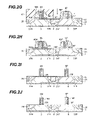
- FIGS. 2A to 2N are cross sectional views of a substrate illustrating a semiconductor device manufacturing method according to a second embodiment of the invention.
- FIGS. 3A to 3M are cross sectional views of a substrate illustrating a semiconductor device manufacturing method according to a third embodiment of the invention.
- FIGS. 4A to 4H are cross sectional views of a substrate illustrating a semiconductor device manufacturing method according to a fourth embodiment of the invention.
- FIGS. 5A and 5B are cross sectional views showing examples of a gate electrode formed by a prior art method.
- FIGS. 1A to 1O a semiconductor device manufacturing method according to the first embodiment of the invention will be described.
- an element separation insulating film 2 of silicon oxide is formed by known shallow trench isolation technique. Active regions are defined by the element separation insulating film 2 .
- a p-type well 3 is formed in the area where an n-channel MOS FET is to be formed, and an n-type well 4 is formed in the area where a p-channel MOSFET is to be formed.
- a silicon oxynitride (SiON) film having a thickness of 1.2 nm is formed on the surface of the substrate 1 .
- the SiON film is formed by forming a silicon oxide film by thermally oxidizing the surface of the substrate 1 and thereafter annealing the silicon oxide film in a nitrogen atmosphere.
- a non-doped polysilicon film having a thickness of 110 nm is formed by chemical vapor deposition (CVD).
- the surface of the polysilicon film is covered with a resist pattern to etch the polysilicon film.
- a gate electrode 6 N made of polysilicon is left, and on the surface of the n-type well 4 , a gate electrode 6 P made of polysilicon is left.
- Etching the polysilicon film may be performed by reactive ion etching using HBr and O 2 .
- the gate length is, for example, 40 to 100 nm. Since impurity is not implanted in the polysilicon film, it is possible to suppress variations of the cross sectional shapes of the gate electrodes 6 N and 6 P.
- the resist pattern is removed. At this time, the SiON film not covered with the gate electrodes 6 N and 6 P is removed.
- the area where the n-type well 4 is formed is covered with a resist pattern 7 .
- the gate electrode 6 N As shown in FIG. 1B , the area where the n-type well 4 is formed is covered with a resist pattern 7 .
- arsenic (As) ions are implanted into a surface layer of the p-type well 3 under the conditions of an acceleration energy of 5 keV and a dose of 1 ⁇ 10 15 cm ⁇ 2 .
- An ion beam is inclined from the substrate normal direction toward the gate length direction (carrier motion direction) and has an incidence angle of 0 to 7°. This arsenic ion implantation forms n-type extension regions 8 N of the source and drain regions.
- boron (B) ions are implanted into the surface layer of the p-type well 3 under the conditions of an acceleration energy of 9 keV and a dose of 4 ⁇ 10 14 cm ⁇ 2 .
- An ion beam is inclined from the substrate normal direction toward the gate length direction and has an incidence angle of 15 to 30°. This boron ion implantation forms p-type pocket regions 9 N. After ion implantation, the resist pattern 7 is removed.
- the area where the p-type well 3 is formed is covered with a resist pattern 11 .
- B ions are implanted into a surface layer of the n-type well 4 under the conditions of an acceleration energy of 0.5 keV and a dose of 8 ⁇ 10 14 cm ⁇ 2 .
- An ion beam is inclined from the substrate normal direction toward the gate length direction and has an incidence angle of 0 to 7°. This B ion implantation forms p-type extension regions 8 P of the source and drain regions.
- As ions are implanted into the surface layer of the n-type well 4 under the conditions of an acceleration energy of 60 keV and a dose of 4 ⁇ 10 14 cm ⁇ 2 .
- An ion beam is inclined from the substrate normal direction toward the gate length direction and has an incidence angle of 15 to 30°. This As ion implantation forms n-type pocket regions 9 P. After ion implantation, the resist pattern 11 is removed.
- a silicon oxide film 15 having a thickness of 10 to 20 nm is formed on or over the surfaces of the gate electrodes 6 N and 6 P and substrate 1 by CVD.
- a silicon nitride film 16 having a thickness of 20 nm is formed by CVD.
- a thick silicon oxide film 17 having a thickness of 100 to 300 nm is formed by CVD.
- the thick silicon oxide film 17 is anisotropically etched to leave a mask member 17 a of silicon oxide on the sidewalls of the gate electrode 6 N and a mask member 17 b of silicon oxide on the sidewalls of the gate electrode 6 P.
- the mask member 17 a is disposed on or over a ring area surrounding the gate electrode 6 N of the surface of the substrate 1 .
- the mask member 17 b is disposed on a ring area surrounding the gate electrode 6 P of the surface of the substrate 1 .
- the area where the n-type well 4 is formed is covered with a resist pattern 19 .
- P ions are implanted into the gate electrode 6 N under the conditions of acceleration energy of 8 keV and a dose of 7 ⁇ 10 15 cm ⁇ 2 . Since the substrate surface layer near the gate electrode 6 N is covered with the mask member 17 a , P ions are not implanted into the substrate surface layer near the gate electrode.
- a high impurity concentration region 20 doped with P ions is formed. After P ions are implanted, the resist pattern 19 is removed.
- the area where the p-type well 3 is formed is covered with a resist pattern 23 .
- B ions are implanted into the gate electrode 6 P under the conditions of acceleration energy of 3 keV and a dose of 4 ⁇ 10 15 cm ⁇ 2 . Since the substrate surface layer near the gate electrode 6 P is covered with the mask member 17 b , B ions are not implanted into the substrate surface layer near the gate electrode.
- a high impurity concentration region 24 doped with B ions is formed. After B ions are implanted, the resist pattern 23 is removed.
- the mask members 17 a and 17 b shown in FIG. 1H are removed by hydrofluoric acid (HF). Since the element separation insulating film 2 of silicon oxide is covered with the silicon nitride film 16 , the surface layer of the element separation insulating film 2 can be prevented from being etched by HF.
- HF hydrofluoric acid
- an insulating film 26 of silicon oxide is deposited to a thickness of 80 nm by CVD.
- This insulating film 26 may be made of silicon nitride.
- the silicon oxide film 15 , silicon nitride film 16 and insulating film 26 shown in FIG. 1J are anisotropically etched. As viewed along a direction in parallel to the substrate normal, a silicon oxide film 15 N is left in a ring area adjacent to and surrounding the gate electrode 6 N and on the sidewalls of the gate electrode 6 N. The silicon oxide film 15 N is conformal to the underlying surface.
- a silicon nitride film 16 N is left on the surface of the silicon oxide film 15 N.
- the silicon nitride film 16 N is also conformal to the underlying surface.
- sidewall spacers 26 N of silicon oxide are left on the surface of the silicon nitride film 16 N.
- a silicon oxide film 15 P, a silicon nitride film 16 P and sidewall spacers 26 P are left.
- the area where the n-type well 4 is formed is covered with a resist pattern 30 .
- P ions are implanted into the surface layer of the p-type well 3 under the conditions of an acceleration energy of 8 keV and a dose of 2 ⁇ 10 15 cm ⁇ 2 .
- P ion implantation forms source and drain regions 31 N.
- P ions are also implanted into the gate electrode 6 N.
- a total dose of P ions into the gate electrode 6 N is therefore 9 ⁇ 10 15 cm ⁇ 2 .
- the resist pattern 30 is removed.
- the area where the p-type well 3 is formed is covered with a resist pattern 34 .
- B ions are implanted into the surface layer of the n-type well 4 under the conditions of an acceleration energy of 3 keV and a dose of 2 ⁇ 10 15 cm ⁇ 2 .
- P ion implantation forms source and drain regions 31 P.
- B ions are also implanted into the gate electrode 6 P.
- a total dose of B ions into the gate electrode 6 P is therefore 6 ⁇ 10 15 cm ⁇ 2 .
- a cobalt (Co) film is formed on the surfaces of the gate electrodes 6 N and 6 P, sidewall spacers 26 N and 26 P and substrate 1 .
- a heat treatment is performed to proceed a silicide reaction between the Co film and silicon.
- a cobalt silicide (CoSi) film 33 N is therefore formed on the surfaces of the source and drain regions 31 N and n-type high impurity concentration region 20 , and a CoSi film 34 N is formed on the upper surface of the gate electrode 6 N.
- a cobalt silicide (CoSi 2 ) film 33 P is formed on the surfaces of the source and drain regions 31 P and p-type high impurity concentration region 24 , and a CoSi 2 film 34 P is formed on the upper surface of the gate electrode 6 P. After the silicide reaction, an unreacted Co film is removed.
- ions are implanted into the gate electrodes 6 N and 6 P.
- the source and drain regions are maintained covered with the mask members 17 a and 17 b , although the impurities are implanted into the gate electrodes 6 N and 6 P, they are not implanted into the source and drain regions. It is therefore possible to set the impurity concentration of the gate electrodes 6 N and 6 P independently from that of the source and drain regions.
- these high impurity concentration regions 20 and 24 in the areas not covered with the mask members 17 a and 17 b are formed, these high impurity concentration regions are sufficiently remote from the gate electrodes 6 N and 6 P so that the operation of MOSFETs are not adversely affected.
- the sidewalls of the gate electrodes 6 N and 6 P are covered with the silicon oxide films 15 N and 15 P as shown in FIG. 1O . Since the dielectric constant of silicon oxide is lower than that of silicon nitride, parasitic capacitance between the gate electrode 6 N and extension regions 8 N and between the gate electrode 6 P and extension regions 8 P can be reduced more than the case wherein the silicon nitride films 16 N and 16 P are in direct contact with the sidewalls of the gate electrodes 6 N and 6 P.
- the structure shown in FIG. 2A corresponds to the structure shown in FIG. 1G of the first embodiment with the extension regions 8 N and 8 P and pocket regions 9 N and 9 P being removed.
- the structure shown in FIG. 2A can be formed by omitting the ion implantation process shown in FIG. 1B for forming the extension regions 8 N and pocket regions 9 N and the ion implantation process shown in FIG. 1C for forming the extension regions 8 P and pocket regions 9 P. Similar to the first embodiment, after P ions are implanted into the gate electrode 6 N, the resist pattern 19 is removed.
- the area where the p-type well 3 is formed is covered with a resist pattern 23 , and B ions are implanted into the gate electrode 6 P.
- the ion implantation conditions are the same as those for B ions of the first embodiment described with FIG. 1H . After B ions are implanted, the resist pattern 23 is removed.
- the mask members 17 a and 17 b shown in FIG. 2B are removed by hydrofluoric acid (HF). Since the element separation insulating film 2 of silicon oxide is covered with the silicon nitride film 16 , the surface layer of the element separation insulating film 2 is prevented from being etched by hydrofluoric acid.
- HF hydrofluoric acid
- a silicon nitride film 40 is deposited on or over the silicon nitride film 16 to a thickness of 80 nm by CVD.
- the silicon nitride films 40 and 16 shown in FIG. 2D are anisotropically etched to leave silicon nitride films 16 N and 40 N on the sidewalls of the gate electrode 6 N and silicon nitride films 16 P and 40 P on the sidewalls of the gate electrode 6 P.
- the silicon nitride films 40 N and 40 P are disposed on or over the surface of the substrate 1 in an area narrower than the area where the mask members 17 a and 17 b shown in FIG. 2A are disposed.
- the area where the n-type well 4 is formed is covered with a resist pattern 41 , and P ions are implanted into the surface layer of the p-type well 3 by using as a mask the gate electrode 6 N and silicon nitride films 16 N and 40 N.
- This P ion implantation forms source and drain regions 31 N.
- the ion implantation conditions are the same as those of P ions for forming the source and drain regions 31 N of the first embodiment described with reference to FIG. 1L . In this case, P ions are implanted also into the gate electrode 6 N. After P ions are implanted, the resist pattern 41 is removed.
- the area where the p-type well 3 is formed is covered with a resist pattern 42 , and B ions are implanted into the surface layer of the n-type well 4 by using as a mask the gate electrode 6 P and silicon nitride films 16 P and 40 P.
- This B ion implantation forms source and drain regions 31 P.
- the ion implantation conditions are the same as those of B ions for forming the source and drain regions 31 P of the first embodiment described with reference to FIG. 1M . In this case, B ions are implanted also into the gate electrode 6 P.
- the resist pattern 42 shown in FIG. 2G is removed.
- a heat treatment is performed for 3 seconds at 1000° C. to activate implanted impurity ions.
- the silicon nitride films 16 N, 16 P, 40 N and 40 P shown in FIG. 2H are etched and removed by phosphoric acid.
- the silicon oxide film 15 shown in FIG. 21 is anisotropically etched. Sidewall spacers 15 N of silicon oxide are left on the sidewalls of the gate electrode 6 N, and sidewall spacers 15 P are left on the sidewalls of the gate electrode 6 P.
- the area where the n-type well 4 is formed is covered with a resist pattern 45 .
- As ions are implanted to form extension regions 8 N and B ions are implanted to form pocket regions 9 N.
- These ion implantation conditions are the same as those for forming the extension regions 8 N and pocket regions 9 N of the first embodiment described with the process shown in FIG. 1B .
- the resist pattern 45 is removed.
- the area where the p-type well 3 is formed is covered with a resist pattern 46 .
- B ions are implanted to form extension regions 8 P and P ions are implanted to form pocket regions 9 P.
- These ion implantation conditions are the same as those for forming the extension regions 8 P and pocket regions 9 P of the first embodiment described with the process shown in FIG. 1C .
- the resist pattern 46 is removed.
- a heat treatment is performed for a very short time at 1050° C. to activate impurity ions implanted into the extension regions 8 N and 8 P and pocket regions 9 N and 9 P.
- This heat treatment time is sufficiently shorter than the heat treatment time (3 seconds) for activating the impurities implanted into the source and drain regions 31 N and 31 P. It is therefore possible to prevent the diffusion of impurities implanted into the extension regions 8 N and 8 P.
- the position at which the concentration distribution of impurities in the extension regions 8 N and 8 P in the depth direction takes a maximum value is shallower than that at which the concentration distribution of impurities in the source and drain regions 31 N and 31 P takes a maximum value.
- sidewall spacers 47 N of silicon nitride are formed on the outer sidewalls of the sidewall spacers 15 N, at the same time when sidewall spacers 47 P of silicon nitride are formed on the outer sidewalls of the sidewall spacers 15 P.
- These sidewall spacers 47 N and 47 P can be formed by depositing a silicon nitride film having a thickness of 80 nm and thereafter anisotropically etching it.
- the sidewall spacers 47 N reach at least the boundaries of the source and drain regions 31 N on the gate electrode 6 N side.
- the sidewall spacers 47 P reach at least the boundaries of the source and drain regions 31 P on the gate electrode 6 P side.
- CoSi 2 films 33 N, 33 P, 34 N and 34 P are formed on the upper surfaces of the source and drain regions 31 N, 31 P and gate electrodes 6 N and 6 P.
- the process of forming the CoSi 2 films 33 N, 33 P, 34 N and 34 P is the same as that of forming the CoSi 2 films 33 N, 33 P, 34 N and 34 P of the first embodiment shown in FIG. 1O .
- impurities are implanted only into the gate electrodes 6 N and 6 P without implanting impurities into the source and drain regions. It is therefore possible to set the impurity concentration of the gate electrodes 6 N and 6 P independently from that of the source and drain regions.
- ion implantation for forming the extension regions 8 N and 8 P is performed under the existence of the thin sidewall spacers 15 N and 15 P having a thickness in the order of 10 to 20 nm formed on the sidewalls of the gate electrodes 6 N and 6 P. It is therefore possible to prevent the ends of the extension regions 8 N and 8 P from entering farther under the gate electrodes 6 N and 6 P.
- the structure shown in FIG. 3A is the same as that of the first embodiment shown in FIG. 1A .
- the structure shown in FIG. 3A can be formed.
- an insulating film 50 having a thickness of, for example, 200 nm is formed by a spin-on-glass method, burying the gate electrodes 6 N and 6 P.
- the insulating film 50 is subjected to chemical mechanical polishing (CMP) until the upper surfaces of the gate electrodes 6 N and 6 P are exposed. It is not necessarily required to completely expose the upper surfaces of the gate electrodes 6 N and 6 P, but a thin film may be left on the gate electrodes to such an extent that the thin film will not function as a mask during ion implantation.
- CMP chemical mechanical polishing
- a film on the gate electrodes 6 N and 6 P can be thinned to a desired thickness by making the surface of the insulating film 50 by CMP or etch-back flatter than the surface of the insulating film immediately after it was formed.
- the surface area of the insulating film 50 above the n-type well 4 is covered with a resist pattern 51 . It is not necessarily required to cover the whole area above the n-type well 4 , but it is sufficient that at least the area above the gate electrode 6 P is covered with the insulating film 51 .
- P ions are implanted into the gate electrode 6 N.
- the P ion implantation conditions are the same as those for P ion implantation into the gate electrode 6 N of the first embodiment process described with reference to FIG. 1G . Since the substrate surface near the gate electrode 6 N is covered with the insulating film 50 , P ions are not implanted into the surface layer of the substrate 1 . After P ion implantation, the resist pattern 51 is removed.
- the surface area of the insulating film 50 above the p-type well 3 is covered with a resist pattern 52 . It is sufficient that at least the area above the gate electrode 6 N is covered with the insulating film 50 .
- B ions are implanted into the gate electrode 6 P.
- the B ion implantation conditions are the same as those for B ion implantation into the gate electrode 6 P of the first embodiment process described with reference to FIG. 1H . Since the substrate surface near the gate electrode 6 P is covered with the insulating film 50 , B ions are not implanted into the surface layer of the substrate 1 . After B ion implantation, the resist pattern 52 is removed.
- the insulating film 50 shown in FIG. 3E is removed by hydrofluoric acid.
- the insulating film 50 formed by SOG has an etching rate faster than the element separation insulating film 2 . It is therefore expected that the element separation insulating film 2 is hardly thinned while the insulating film 50 is etched.
- the area where the n-type well 4 is formed is covered with a resist pattern 53 .
- As ions are implanted to form extension regions 8 N and B ions are implanted to form pocket regions 9 N.
- the ion implantation conditions are the same as those for forming the extension regions 8 N and pocket regions 9 N of the first embodiment described with reference to FIG. 1B .
- the resist pattern 53 is removed.
- the area where the p-type well 3 is formed is covered with a resist pattern 54 .
- B ions are implanted to form extension regions 8 P and As ions are implanted to form pocket regions 9 P.
- the ion implantation conditions are the same as those for forming the extension regions 8 P and pocket regions 9 P of the first embodiment described with reference to FIG. 1C .
- the resist pattern 54 is removed.
- sidewall spacers 55 N and 55 P of silicon oxide or silicon nitride are formed on the sidewalls of the gate electrodes 6 N and 6 P.
- the sidewall spacers 55 N and 55 P are formed by a deposition process of a silicon oxide film or a silicon nitride film by CVD and an anisotropic etching process.
- the area where the n-type well 4 is formed is covered with a resist pattern 56 .
- a resist pattern 56 By using as a mask the gate electrode 6 N and sidewall spacers 55 N, P ions are implanted to form source and drain regions 31 N.
- the ion implantation conditions are the same as those for forming the source and drain regions 31 N described with the first embodiment process shown in FIG. 1L . After P ion implantation, the resist pattern 56 is removed.
- the area where the p-type well 3 is formed is covered with a resist pattern 57 .
- B ions are implanted to form source and drain regions 31 P.
- the ion implantation conditions are the same as those for forming the source and drain regions 31 P described with the first embodiment process shown in FIG. 1M .
- the resist pattern 57 shown in FIG. 3K is removed.
- a heat treatment is performed for about 3 seconds at a temperature of 1050° C. to activate implanted impurity ions.
- CoSi 2 films 33 N are formed on the surfaces of the source and drain regions 31 N and a CoSi 2 film 34 N is formed on the upper surface of the gate electrode 6 N, at the same time when CoSi 2 films 33 P are formed on the surfaces of the source and drain regions 31 P and a CoSi 2 film 34 P is formed on the upper surface of the gate electrode 6 P.
- impurities are implanted into the gate electrodes 6 N and 6 P by masking the surface layer of the substrate with the insulating film 50 . It is therefore possible to set the impurity concentration of the gate electrode independently from that of the source and drain regions.
- the surface of the substrate 1 in the process shown in FIG. 3B , although the surface of the substrate 1 is covered with the insulating film 50 formed by SOG, the surface of the substrate 1 may be covered with a resist film formed by spin-coating resist. After the surface of the substrate 1 is covered with the resist film, the surface of the resist film is planarized by CMP or etch-back to expose the upper surfaces of the gate electrodes 6 N and 6 P as shown in FIG. 3C .
- FIGS. 4A to 4H a semiconductor device manufacturing method according to a fourth embodiment of the invention will be described.
- the active region where a p-channel MOSFET is formed is shown, an n-channel MOSFET is formed in another active region not shown.
- a gate insulating film 5 P, a gate electrode 6 P, extension regions 8 P and pocket regions 9 P are formed on and in the surface layer of a silicon substrate 1 .
- the processes up to this structure are the same as the p-channel MOSFET forming processes of the first embodiment shown in FIGS. 1A to 1C .
- the height of the gate electrode 6 P is 110 nm and the gate length is 40 nm.
- the processes of forming an n-channel MOSFET are also the same as the n-channel MOSFET forming processes of the first embodiment shown in FIGS. 1A and 1B .
- a silicon nitride film is formed to a thickness of 40 to 100 nm by CVD, covering the whole surface of the substrate.
- the silicon nitride film is anisotropically etched to leave sidewall spacers 60 on the sidewalls of the gate electrode 6 P.
- boron (B) ions are implanted into the surface layer of the substrate 1 under the conditions of an acceleration energy of 1 to 2.5 keV and a dose of 2 ⁇ 10 15 cm ⁇ 2 .
- Source and drain regions 61 are therefore formed in the substrate surface layer outside of the sidewall spacers 60 , the source and drain regions being deeper than the extension regions 8 P.
- B ions are also implanted into the gate electrode 6 P, a region 62 implanted with B ions is only an upper partial region of the gate electrode 6 P and does not reach the bottom of the gate electrode.
- phosphorous (P) ions are implanted, for example, under the conditions of an acceleration energy of 3 to 6 keV and a dose of 5 ⁇ 10 15 cm ⁇ 2 .
- a silicon oxide film 65 is deposited on or over the whole surface of the substrate 1 to a thickness of 20 to 50 nm by CVD.
- the silicon oxide film 65 is anisotropically etched to leave second layer sidewall spacers 65 a on the first layer sidewall spacers 60 .
- B ions are implanted into the gate electrode 6 P under the conditions of an acceleration energy of 4 keV and a dose of 5 ⁇ 10 15 cm ⁇ 2 .
- B ions are also implanted into the substrate surface layer outside of the second layer sidewall spacers 65 a to form impurity diffusion regions 67 .
- P ions are implanted under the conditions of an acceleration energy of 10 keV and a dose of 8 ⁇ 10 15 cm ⁇ 2 .
- RTA rapid thermal annealing
- Impurities implanted into the gate electrode 6 P and substrate surface layer are therefore activated and diffused along the lateral and depth directions.
- the ends of the source and gate regions 61 on the gate electrode side enter the insides of the boundaries of the first layer sidewall spacers 60
- the ends of the impurity diffusion regions 67 on the gate electrode side enter the insides of the boundaries of the second layer sidewall spacers 65 a . Therefore, the first layer sidewall spacers 60 reach halfway the upper surfaces of the source and drain regions, namely cover the partial upper surfaces of the source and drain regions 61 .
- the second sidewall spacers 65 a shown in FIG. 4F are removed.
- the second layer sidewall spacers 65 a can be selectively removed by a wet process using hydrofluoric acid because the first layer sidewall spacers 60 are made of silicon nitride and the second layer sidewall spacers 65 a are made of silicon oxide.
- metal silicide films 68 of cobalt silicide or the like are formed on the gate electrode 6 P and on the surface of the active region not covered with the gate electrode 6 P and sidewall spacers 60 .
- the metal silicide films 68 can be formed, for example, by depositing a cobalt film on or over the substrate whole surface, performing a heat treatment to silicidize cobalt, and thereafter removing an unreacted cobalt film.
- the gate electrode is formed by patterning a polysilicon film not implanted with impurities, a variation of the cross section of the gate electrode 6 P can be suppressed.
- Impurities are not implanted to the bottom of the gate electrode 6 P during the ion implantation process for the source and drain regions 61 shown in FIG. 4B , but are implanted to the deep region of the gate electrode 6 P during the later process shown in FIG. 4E .
- Impurity ion implantation into the gate electrode 6 P shown in FIG. 4E and heat treatment shown in FIG. 4F are preferably performed under the condition that impurities implanted into the gate electrode 6 P reach the bottom of the gate electrodes 6 P after the heat treatment. By performing the impurity ion implantation and heat treatment under this condition, depletion of the gate electrode 6 P can be prevented.
- the source and drain regions 61 are shallow as compared to the height of the gate electrode 6 P.
- the acceleration energy for implanting impurity ions into the gate electrode 6 P shown in FIG. 4E is therefore generally higher than the acceleration energy of impurity ion implantation for forming the source and drain regions 61 shown in FIG. 4B .
- the sidewalls of the gate electrode 6 P While impurities are implanted into the gate electrode 6 P, the sidewalls of the gate electrode 6 P have two layers of the sidewall spacers 60 and 65 a which function as an ion implantation mask. Although the impurity diffusion regions 67 formed while impurities are implanted into the gate electrode are deeper than the source and drain regions 61 , the impurity diffusion regions are remote from the channel just under the gate electrode 6 P. The impurity diffusion regions 67 are therefore not likely to cause the punch-through phenomenon.
- the total thickness of two layers of the sidewall spacers 60 and 65 a necessary for preventing the punch-through phenomenon depends on the acceleration energy and dose when B ions are implanted into the gate electrode. If the acceleration energy is 4 keV and the dose is 1 ⁇ 10 15 cm ⁇ 2 , 4 ⁇ 10 15 cm ⁇ 2 , 8 ⁇ 10 15 cm ⁇ 2 or 1 ⁇ 10 16 cm ⁇ 2 , then it is preferable to set the total thickness of two layers of the sidewall spacers 60 and 65 a to 40 nm, 60 nm, 80 nm or 100 nm or thicker.
- the first layer sidewall spacers 60 shown in FIG. 4F are made of silicon nitride and the second layer sidewall spacers 65 a shown in FIG. 4F are made of silicon oxide. Since two layers of the sidewall spacers are made of insulating materials having different etching characteristics, only the second layer sidewall spacers 65 a can be selectively removed.
- the second layer sidewall spacers 65 a are made of silicon oxide, the second layer sidewall spacers 65 a can be removed by a pre-treatment of the silicidation process shown in FIG. 4H . Therefore, without increasing the number of processes, the second layer sidewall spacers 65 a can be removed.
- the upper surface of the gate electrode 6 P is exposed while impurities are implanted into the gate electrode 6 P shown in FIG. 4E . If a film of silicon oxide, silicon nitride or the like is formed on the gate electrode, atoms (nitrogen, oxygen) in the film are diffused into the gate electrode in some cases by the knock-on phenomenon. In the fourth embodiment, it is possible to prevent unexpected impurities from being diffused into the gate electrode.
- the sidewall spacers 60 formed on the extension regions 8 P shown in FIG. 4A are left unetched. If the sidewall spacers 60 are to be removed, the surface layer of the extension region 8 P is etched very slightly while the sidewall spacers 60 are removed. In such a case, this etch amount is required to be considered when the depth of the junction of the extension region 8 P is controlled. In the fourth embodiment, since there is no process of etching the sidewall spacers 60 , the depth of the extension region 8 P can be controlled only by the impurity ion implantation conditions.
- the silicon oxide film 65 which is formed by the process shown in FIG. 4C after the source and drain regions 61 are formed by the process shown in FIG.
- the source and drain regions 61 may be thinner than the first layer sidewall spacers 60 .
- a thermal load applied to the source and drain regions 61 can therefore be mitigated and impurity re-diffusion can be suppressed. Since the re-diffusion of the source and drain regions 61 can be suppressed, it is possible to prevent the short channel effects
Landscapes
- Insulated Gate Type Field-Effect Transistor (AREA)
- Electrodes Of Semiconductors (AREA)
- Metal-Oxide And Bipolar Metal-Oxide Semiconductor Integrated Circuits (AREA)
Abstract
Description
Claims (8)
Priority Applications (1)
| Application Number | Priority Date | Filing Date | Title |
|---|---|---|---|
| US11/898,830 US8088666B2 (en) | 2001-11-26 | 2007-09-17 | Semiconductor device manufacture method including process of implanting impurity into gate electrode independently from source/drain and semiconductor device manufactured by the method |
Applications Claiming Priority (4)
| Application Number | Priority Date | Filing Date | Title |
|---|---|---|---|
| JP2001-358754 | 2001-11-26 | ||
| JP2001358754 | 2001-11-26 | ||
| JP2002-314613 | 2002-10-29 | ||
| JP2002314613A JP3980461B2 (en) | 2001-11-26 | 2002-10-29 | Manufacturing method of semiconductor device |
Related Child Applications (1)
| Application Number | Title | Priority Date | Filing Date |
|---|---|---|---|
| US11/898,830 Division US8088666B2 (en) | 2001-11-26 | 2007-09-17 | Semiconductor device manufacture method including process of implanting impurity into gate electrode independently from source/drain and semiconductor device manufactured by the method |
Publications (2)
| Publication Number | Publication Date |
|---|---|
| US20030098486A1 US20030098486A1 (en) | 2003-05-29 |
| US7285449B2 true US7285449B2 (en) | 2007-10-23 |
Family
ID=26624679
Family Applications (2)
| Application Number | Title | Priority Date | Filing Date |
|---|---|---|---|
| US10/298,641 Expired - Lifetime US7285449B2 (en) | 2001-11-26 | 2002-11-19 | Semiconductor device manufacture method including process of implanting impurity into gate electrode independently from source /drain and semiconductor device manufactured by the method |
| US11/898,830 Expired - Fee Related US8088666B2 (en) | 2001-11-26 | 2007-09-17 | Semiconductor device manufacture method including process of implanting impurity into gate electrode independently from source/drain and semiconductor device manufactured by the method |
Family Applications After (1)
| Application Number | Title | Priority Date | Filing Date |
|---|---|---|---|
| US11/898,830 Expired - Fee Related US8088666B2 (en) | 2001-11-26 | 2007-09-17 | Semiconductor device manufacture method including process of implanting impurity into gate electrode independently from source/drain and semiconductor device manufactured by the method |
Country Status (2)
| Country | Link |
|---|---|
| US (2) | US7285449B2 (en) |
| JP (1) | JP3980461B2 (en) |
Cited By (1)
| Publication number | Priority date | Publication date | Assignee | Title |
|---|---|---|---|---|
| US20060134874A1 (en) * | 2004-12-17 | 2006-06-22 | Yamaha Corporation | Manufacture method of MOS semiconductor device having extension and pocket |
Families Citing this family (10)
| Publication number | Priority date | Publication date | Assignee | Title |
|---|---|---|---|---|
| US20050026342A1 (en) * | 2003-07-28 | 2005-02-03 | Ka-Hing Fung | Semiconductor device having improved short channel effects, and method of forming thereof |
| WO2005057662A2 (en) * | 2003-12-10 | 2005-06-23 | Koninklijke Philips Electronics N.V. | Method and apparatus for fabricating ultra-shallow junction metal-oxide semiconductor integrated circuit devices. |
| JP4172796B2 (en) * | 2004-11-24 | 2008-10-29 | 株式会社東芝 | Manufacturing method of semiconductor device |
| US7348248B2 (en) * | 2005-07-12 | 2008-03-25 | Taiwan Semiconductor Manufacturing Company, Ltd. | CMOS transistor with high drive current and low sheet resistance |
| JPWO2007080647A1 (en) * | 2006-01-13 | 2009-06-11 | 富士通マイクロエレクトロニクス株式会社 | Manufacturing method of semiconductor device |
| JP5034332B2 (en) * | 2006-06-14 | 2012-09-26 | 富士通セミコンダクター株式会社 | Manufacturing method of semiconductor device |
| JP2008071851A (en) * | 2006-09-13 | 2008-03-27 | Sony Corp | Semiconductor device and manufacturing method of semiconductor device |
| US20090104745A1 (en) * | 2007-10-23 | 2009-04-23 | Hyesook Hong | Integration method for dual doped polysilicon gate profile and cd control |
| DE102010063778B4 (en) | 2010-12-21 | 2018-05-09 | Globalfoundries Dresden Module One Limited Liability Company & Co. Kg | Process for producing a gate electrode structure with increased structuring uniformity |
| US10964815B2 (en) * | 2018-06-12 | 2021-03-30 | Taiwan Semiconductor Manufacturing Company Ltd. | CMOS finFET with doped spacers and method for forming the same |
Citations (11)
| Publication number | Priority date | Publication date | Assignee | Title |
|---|---|---|---|---|
| US4735917A (en) * | 1986-04-28 | 1988-04-05 | General Electric Company | Silicon-on-sapphire integrated circuits |
| US5552346A (en) * | 1995-04-27 | 1996-09-03 | Taiwan Semiconductor Manufacturing Co. | Planarization and etch back process for semiconductor layers |
| JPH09186317A (en) | 1995-12-28 | 1997-07-15 | Mitsubishi Electric Corp | Manufacture of semiconductor device |
| JPH09275149A (en) | 1996-04-04 | 1997-10-21 | Taiwan Moshii Denshi Kofun Yugenkoshi | Method of manufacturing complementary MOS field effect transistor |
| JP2000150880A (en) | 1998-11-18 | 2000-05-30 | Toshiba Corp | Method for manufacturing semiconductor device |
| US6271125B1 (en) * | 1999-02-18 | 2001-08-07 | Taiwan Semiconductor Manufacturing Company | Method to reduce contact hole aspect ratio for embedded DRAM arrays and logic devices, via the use of a tungsten bit line structure |
| JP2001297996A (en) | 2000-04-13 | 2001-10-26 | Nec Corp | Circuit manufacturing method and apparatus, annealing control method and apparatus, information storage medium |
| US6582995B2 (en) * | 2001-07-11 | 2003-06-24 | Taiwan Semiconductor Manufacturing Co., Ltd. | Method for fabricating a shallow ion implanted microelectronic structure |
| US6599819B1 (en) * | 1999-05-26 | 2003-07-29 | Fujitsu Limited | Semiconductor device with source/drain regions of high impurity concentration and its manufacture |
| US6734070B1 (en) * | 2003-03-17 | 2004-05-11 | Oki Electric Industry Co., Ltd. | Method of fabricating a semiconductor device with field-effect transistors having shallow source and drain junctions |
| US6808974B2 (en) * | 2001-05-15 | 2004-10-26 | International Business Machines Corporation | CMOS structure with maximized polysilicon gate activation and a method for selectively maximizing doping activation in gate, extension, and source/drain regions |
Family Cites Families (9)
| Publication number | Priority date | Publication date | Assignee | Title |
|---|---|---|---|---|
| JPH0423439A (en) | 1990-05-18 | 1992-01-27 | Fujitsu Ltd | Manufacture of semiconductor device |
| JPH05326552A (en) | 1992-03-19 | 1993-12-10 | Oki Electric Ind Co Ltd | Semiconductor element and its manufacture |
| JP3274254B2 (en) | 1993-09-25 | 2002-04-15 | 株式会社リコー | Semiconductor device and manufacturing method thereof |
| JPH07122737A (en) | 1993-10-22 | 1995-05-12 | Sanyo Electric Co Ltd | Semiconductor device and its manufacture |
| JP4109364B2 (en) * | 1998-11-30 | 2008-07-02 | 富士通株式会社 | Manufacturing method of semiconductor device |
| JP2001015735A (en) * | 1999-06-29 | 2001-01-19 | Nec Corp | Semiconductor device and manufacturing method thereof |
| US6294415B1 (en) * | 2000-04-26 | 2001-09-25 | United Microelectronics Corp. | Method of fabricating a MOS transistor |
| JP4443008B2 (en) * | 2000-06-30 | 2010-03-31 | 富士通株式会社 | Semiconductor device and manufacturing method thereof |
| KR100327347B1 (en) * | 2000-07-22 | 2002-03-06 | Samsung Electronics Co Ltd | Metal oxide semiconductor field effect transistor having reduced resistance between source and drain and fabricating method thereof |
-
2002
- 2002-10-29 JP JP2002314613A patent/JP3980461B2/en not_active Expired - Fee Related
- 2002-11-19 US US10/298,641 patent/US7285449B2/en not_active Expired - Lifetime
-
2007
- 2007-09-17 US US11/898,830 patent/US8088666B2/en not_active Expired - Fee Related
Patent Citations (12)
| Publication number | Priority date | Publication date | Assignee | Title |
|---|---|---|---|---|
| US4735917A (en) * | 1986-04-28 | 1988-04-05 | General Electric Company | Silicon-on-sapphire integrated circuits |
| US5552346A (en) * | 1995-04-27 | 1996-09-03 | Taiwan Semiconductor Manufacturing Co. | Planarization and etch back process for semiconductor layers |
| JPH09186317A (en) | 1995-12-28 | 1997-07-15 | Mitsubishi Electric Corp | Manufacture of semiconductor device |
| JPH09275149A (en) | 1996-04-04 | 1997-10-21 | Taiwan Moshii Denshi Kofun Yugenkoshi | Method of manufacturing complementary MOS field effect transistor |
| JP2000150880A (en) | 1998-11-18 | 2000-05-30 | Toshiba Corp | Method for manufacturing semiconductor device |
| US6271125B1 (en) * | 1999-02-18 | 2001-08-07 | Taiwan Semiconductor Manufacturing Company | Method to reduce contact hole aspect ratio for embedded DRAM arrays and logic devices, via the use of a tungsten bit line structure |
| US6599819B1 (en) * | 1999-05-26 | 2003-07-29 | Fujitsu Limited | Semiconductor device with source/drain regions of high impurity concentration and its manufacture |
| JP2001297996A (en) | 2000-04-13 | 2001-10-26 | Nec Corp | Circuit manufacturing method and apparatus, annealing control method and apparatus, information storage medium |
| US6423602B2 (en) | 2000-04-13 | 2002-07-23 | Nec Corporation | Circuit manufacturing method and apparatus, anneal control method and apparatus, information storage medium |
| US6808974B2 (en) * | 2001-05-15 | 2004-10-26 | International Business Machines Corporation | CMOS structure with maximized polysilicon gate activation and a method for selectively maximizing doping activation in gate, extension, and source/drain regions |
| US6582995B2 (en) * | 2001-07-11 | 2003-06-24 | Taiwan Semiconductor Manufacturing Co., Ltd. | Method for fabricating a shallow ion implanted microelectronic structure |
| US6734070B1 (en) * | 2003-03-17 | 2004-05-11 | Oki Electric Industry Co., Ltd. | Method of fabricating a semiconductor device with field-effect transistors having shallow source and drain junctions |
Non-Patent Citations (1)
| Title |
|---|
| Japanese Office Action dated Dec. 26, 2006 (mailing date), issued in corresponding Japanese Patent Application No. 2002-314613. |
Cited By (1)
| Publication number | Priority date | Publication date | Assignee | Title |
|---|---|---|---|---|
| US20060134874A1 (en) * | 2004-12-17 | 2006-06-22 | Yamaha Corporation | Manufacture method of MOS semiconductor device having extension and pocket |
Also Published As
| Publication number | Publication date |
|---|---|
| JP2003224270A (en) | 2003-08-08 |
| US8088666B2 (en) | 2012-01-03 |
| JP3980461B2 (en) | 2007-09-26 |
| US20030098486A1 (en) | 2003-05-29 |
| US20080311721A1 (en) | 2008-12-18 |
Similar Documents
| Publication | Publication Date | Title |
|---|---|---|
| US8088666B2 (en) | Semiconductor device manufacture method including process of implanting impurity into gate electrode independently from source/drain and semiconductor device manufactured by the method | |
| US6852597B2 (en) | Method for fabricating power semiconductor device having trench gate structure | |
| US4753898A (en) | LDD CMOS process | |
| US5296401A (en) | MIS device having p channel MOS device and n channel MOS device with LDD structure and manufacturing method thereof | |
| US7585739B2 (en) | Semiconductor device and method of fabricating the same | |
| US5714393A (en) | Diode-connected semiconductor device and method of manufacture | |
| US6709939B2 (en) | Method for fabricating semiconductor device | |
| US7009258B2 (en) | Method of building a CMOS structure on thin SOI with source/drain electrodes formed by in situ doped selective amorphous silicon | |
| JP2003188373A (en) | Semiconductor device and method of manufacturing the same | |
| US6943084B2 (en) | Semiconductor device on silicon-on-insulator and method for manufacturing the semiconductor device | |
| US6562686B2 (en) | Method for fabricating semiconductor device | |
| US8004050B2 (en) | Semiconductor device comprising gate electrode having arsenic and phosphorous | |
| US6200846B1 (en) | Semiconductor device with capacitor formed on substrate and its manufacture method | |
| KR980012599A (en) | Methods of forming transistors using salicide process technology | |
| KR100613279B1 (en) | MOS transistor and its manufacturing method | |
| JP2602589B2 (en) | Method for manufacturing LDD transistor | |
| JP2001203348A (en) | Semiconductor device and manufacturing method thereof | |
| JPH07106569A (en) | Semiconductor device and manufacturing method thereof | |
| JPH07122741A (en) | Method for manufacturing semiconductor device | |
| JPH07226512A (en) | Semiconductor device | |
| KR20050010678A (en) | Method for fabricating semiconductor device | |
| JP2001203351A (en) | Semiconductor device and method of manufacturing the same | |
| JP2001230408A (en) | Method for manufacturing semiconductor device |
Legal Events
| Date | Code | Title | Description |
|---|---|---|---|
| AS | Assignment |
Owner name: FUJITSU LIMITED, JAPAN Free format text: ASSIGNMENT OF ASSIGNORS INTEREST;ASSIGNORS:SAMBONSUGI, YASUHIRO;KOKURA, HIKARU;REEL/FRAME:013507/0029 Effective date: 20021106 |
|
| STCF | Information on status: patent grant |
Free format text: PATENTED CASE |
|
| FEPP | Fee payment procedure |
Free format text: PAYOR NUMBER ASSIGNED (ORIGINAL EVENT CODE: ASPN); ENTITY STATUS OF PATENT OWNER: LARGE ENTITY |
|
| AS | Assignment |
Owner name: FUJITSU MICROELECTRONICS LIMITED, JAPAN Free format text: ASSIGNMENT OF ASSIGNORS INTEREST;ASSIGNOR:FUJITSU LIMITED;REEL/FRAME:021976/0089 Effective date: 20081104 Owner name: FUJITSU MICROELECTRONICS LIMITED,JAPAN Free format text: ASSIGNMENT OF ASSIGNORS INTEREST;ASSIGNOR:FUJITSU LIMITED;REEL/FRAME:021976/0089 Effective date: 20081104 |
|
| AS | Assignment |
Owner name: FUJITSU SEMICONDUCTOR LIMITED, JAPAN Free format text: CHANGE OF NAME;ASSIGNOR:FUJITSU MICROELECTRONICS LIMITED;REEL/FRAME:024651/0744 Effective date: 20100401 |
|
| FPAY | Fee payment |
Year of fee payment: 4 |
|
| FPAY | Fee payment |
Year of fee payment: 8 |
|
| AS | Assignment |
Owner name: FUJITSU SEMICONDUCTOR LIMITED, JAPAN Free format text: CHANGE OF ADDRESS;ASSIGNOR:FUJITSU SEMICONDUCTOR LIMITED;REEL/FRAME:041188/0401 Effective date: 20160909 |
|
| MAFP | Maintenance fee payment |
Free format text: PAYMENT OF MAINTENANCE FEE, 12TH YEAR, LARGE ENTITY (ORIGINAL EVENT CODE: M1553); ENTITY STATUS OF PATENT OWNER: LARGE ENTITY Year of fee payment: 12 |