US7276866B2 - Moving control apparatus and moving control method - Google Patents
Moving control apparatus and moving control method Download PDFInfo
- Publication number
- US7276866B2 US7276866B2 US11/275,763 US27576306A US7276866B2 US 7276866 B2 US7276866 B2 US 7276866B2 US 27576306 A US27576306 A US 27576306A US 7276866 B2 US7276866 B2 US 7276866B2
- Authority
- US
- United States
- Prior art keywords
- driver
- movable element
- thrust
- induced voltage
- thrust ripple
- Prior art date
- Legal status (The legal status is an assumption and is not a legal conclusion. Google has not performed a legal analysis and makes no representation as to the accuracy of the status listed.)
- Active, expires
Links
- 238000000034 method Methods 0.000 title claims description 31
- 238000012937 correction Methods 0.000 claims abstract description 105
- 238000005259 measurement Methods 0.000 claims abstract description 35
- 238000004519 manufacturing process Methods 0.000 claims description 13
- 230000005856 abnormality Effects 0.000 claims description 10
- 238000001514 detection method Methods 0.000 claims description 10
- 239000000758 substrate Substances 0.000 claims description 5
- 235000012431 wafers Nutrition 0.000 description 26
- 230000014509 gene expression Effects 0.000 description 14
- 230000003287 optical effect Effects 0.000 description 14
- 239000004065 semiconductor Substances 0.000 description 10
- 230000006870 function Effects 0.000 description 7
- 230000005291 magnetic effect Effects 0.000 description 7
- 238000010276 construction Methods 0.000 description 6
- 238000005286 illumination Methods 0.000 description 6
- 230000008569 process Effects 0.000 description 6
- 230000001133 acceleration Effects 0.000 description 5
- 230000005347 demagnetization Effects 0.000 description 5
- 238000010586 diagram Methods 0.000 description 5
- 238000006073 displacement reaction Methods 0.000 description 5
- 230000002706 hydrostatic effect Effects 0.000 description 4
- 238000012545 processing Methods 0.000 description 4
- 230000008901 benefit Effects 0.000 description 3
- 230000004048 modification Effects 0.000 description 3
- 238000012986 modification Methods 0.000 description 3
- 230000001105 regulatory effect Effects 0.000 description 3
- 230000008859 change Effects 0.000 description 2
- 239000013256 coordination polymer Substances 0.000 description 2
- 238000005530 etching Methods 0.000 description 2
- 238000007689 inspection Methods 0.000 description 2
- 238000005389 semiconductor device fabrication Methods 0.000 description 2
- 230000006641 stabilisation Effects 0.000 description 2
- 238000011105 stabilization Methods 0.000 description 2
- 238000003860 storage Methods 0.000 description 2
- 239000010409 thin film Substances 0.000 description 2
- 230000002159 abnormal effect Effects 0.000 description 1
- 230000006978 adaptation Effects 0.000 description 1
- 230000015572 biosynthetic process Effects 0.000 description 1
- 230000015556 catabolic process Effects 0.000 description 1
- 238000006243 chemical reaction Methods 0.000 description 1
- 230000001427 coherent effect Effects 0.000 description 1
- 239000000470 constituent Substances 0.000 description 1
- 238000006731 degradation reaction Methods 0.000 description 1
- 230000001419 dependent effect Effects 0.000 description 1
- 238000011161 development Methods 0.000 description 1
- 230000009189 diving Effects 0.000 description 1
- 238000005538 encapsulation Methods 0.000 description 1
- 239000003302 ferromagnetic material Substances 0.000 description 1
- 239000010408 film Substances 0.000 description 1
- 230000004907 flux Effects 0.000 description 1
- 238000010348 incorporation Methods 0.000 description 1
- 230000003993 interaction Effects 0.000 description 1
- 238000005468 ion implantation Methods 0.000 description 1
- 150000002500 ions Chemical class 0.000 description 1
- 239000004973 liquid crystal related substance Substances 0.000 description 1
- 238000001459 lithography Methods 0.000 description 1
- 239000000463 material Substances 0.000 description 1
- 238000000691 measurement method Methods 0.000 description 1
- 230000007246 mechanism Effects 0.000 description 1
- QSHDDOUJBYECFT-UHFFFAOYSA-N mercury Chemical compound [Hg] QSHDDOUJBYECFT-UHFFFAOYSA-N 0.000 description 1
- 229910052753 mercury Inorganic materials 0.000 description 1
- 230000003647 oxidation Effects 0.000 description 1
- 238000007254 oxidation reaction Methods 0.000 description 1
- 238000012858 packaging process Methods 0.000 description 1
- 229920002120 photoresistant polymer Polymers 0.000 description 1
- 230000009467 reduction Effects 0.000 description 1
- 230000001846 repelling effect Effects 0.000 description 1
- 238000007493 shaping process Methods 0.000 description 1
- 229910052710 silicon Inorganic materials 0.000 description 1
- 239000010703 silicon Substances 0.000 description 1
- 238000012360 testing method Methods 0.000 description 1
- 238000007740 vapor deposition Methods 0.000 description 1
- 229910052724 xenon Inorganic materials 0.000 description 1
- FHNFHKCVQCLJFQ-UHFFFAOYSA-N xenon atom Chemical compound [Xe] FHNFHKCVQCLJFQ-UHFFFAOYSA-N 0.000 description 1
Images




Classifications
-
- G—PHYSICS
- G03—PHOTOGRAPHY; CINEMATOGRAPHY; ANALOGOUS TECHNIQUES USING WAVES OTHER THAN OPTICAL WAVES; ELECTROGRAPHY; HOLOGRAPHY
- G03F—PHOTOMECHANICAL PRODUCTION OF TEXTURED OR PATTERNED SURFACES, e.g. FOR PRINTING, FOR PROCESSING OF SEMICONDUCTOR DEVICES; MATERIALS THEREFOR; ORIGINALS THEREFOR; APPARATUS SPECIALLY ADAPTED THEREFOR
- G03F7/00—Photomechanical, e.g. photolithographic, production of textured or patterned surfaces, e.g. printing surfaces; Materials therefor, e.g. comprising photoresists; Apparatus specially adapted therefor
- G03F7/70—Microphotolithographic exposure; Apparatus therefor
- G03F7/70691—Handling of masks or workpieces
- G03F7/70716—Stages
- G03F7/70725—Stages control
-
- G—PHYSICS
- G03—PHOTOGRAPHY; CINEMATOGRAPHY; ANALOGOUS TECHNIQUES USING WAVES OTHER THAN OPTICAL WAVES; ELECTROGRAPHY; HOLOGRAPHY
- G03F—PHOTOMECHANICAL PRODUCTION OF TEXTURED OR PATTERNED SURFACES, e.g. FOR PRINTING, FOR PROCESSING OF SEMICONDUCTOR DEVICES; MATERIALS THEREFOR; ORIGINALS THEREFOR; APPARATUS SPECIALLY ADAPTED THEREFOR
- G03F7/00—Photomechanical, e.g. photolithographic, production of textured or patterned surfaces, e.g. printing surfaces; Materials therefor, e.g. comprising photoresists; Apparatus specially adapted therefor
- G03F7/70—Microphotolithographic exposure; Apparatus therefor
- G03F7/70691—Handling of masks or workpieces
- G03F7/70758—Drive means, e.g. actuators, motors for long- or short-stroke modules or fine or coarse driving
-
- H—ELECTRICITY
- H02—GENERATION; CONVERSION OR DISTRIBUTION OF ELECTRIC POWER
- H02P—CONTROL OR REGULATION OF ELECTRIC MOTORS, ELECTRIC GENERATORS OR DYNAMO-ELECTRIC CONVERTERS; CONTROLLING TRANSFORMERS, REACTORS OR CHOKE COILS
- H02P23/00—Arrangements or methods for the control of AC motors characterised by a control method other than vector control
- H02P23/04—Arrangements or methods for the control of AC motors characterised by a control method other than vector control specially adapted for damping motor oscillations, e.g. for reducing hunting
-
- H—ELECTRICITY
- H02—GENERATION; CONVERSION OR DISTRIBUTION OF ELECTRIC POWER
- H02P—CONTROL OR REGULATION OF ELECTRIC MOTORS, ELECTRIC GENERATORS OR DYNAMO-ELECTRIC CONVERTERS; CONTROLLING TRANSFORMERS, REACTORS OR CHOKE COILS
- H02P25/00—Arrangements or methods for the control of AC motors characterised by the kind of AC motor or by structural details
- H02P25/02—Arrangements or methods for the control of AC motors characterised by the kind of AC motor or by structural details characterised by the kind of motor
- H02P25/06—Linear motors
-
- H—ELECTRICITY
- H02—GENERATION; CONVERSION OR DISTRIBUTION OF ELECTRIC POWER
- H02P—CONTROL OR REGULATION OF ELECTRIC MOTORS, ELECTRIC GENERATORS OR DYNAMO-ELECTRIC CONVERTERS; CONTROLLING TRANSFORMERS, REACTORS OR CHOKE COILS
- H02P6/00—Arrangements for controlling synchronous motors or other dynamo-electric motors using electronic commutation dependent on the rotor position; Electronic commutators therefor
- H02P6/14—Electronic commutators
- H02P6/16—Circuit arrangements for detecting position
- H02P6/18—Circuit arrangements for detecting position without separate position detecting elements
- H02P6/182—Circuit arrangements for detecting position without separate position detecting elements using back-emf in windings
Definitions
- the present invention relates to a moving control technique for positioning an object by moving it.
- FIG. 12 shows an example of the construction of a stage apparatus and its control system for positioning an object in a semiconductor exposure apparatus, a machine tool or the like (for example, see Japanese Patent No. 3176766).
- a table top plate 101 is supported with guides 102 movably in leftward and rightward directions of the surface of the drawing.
- Four movable magnets 105 are arranged on the table top plate 101 such that the polarities of the magnets are alternately changed with respect to a vertical direction of the surface of the drawing.
- the movable magnets 105 and coils 104 arrayed at equal intervals in a moving direction of the table top plate 101 form a liner motor.
- the position information of the table top plate 101 in the moving direction is inputted by a position detector 106 and a counter unit 107 into a servo controller 108 and a phase selection controller 109 .
- the servo controller 108 calculates a control command to the linear motor.
- the phase selection controller 109 calculates a rectification value to the respective linear motor coils 104 based on the relative positional relation between the movable magnets 105 and the linear motor coils 104 obtained from the position measurement value of the table top plate 101 .
- a multiplier 119 multiplies the above control command to the linear motor by the above rectification value via a filter circuit 113 and sends the command to the respective current amplifiers 111 , to appropriately cause a thrust with the linear motor coils 104 , thereby attains position control of the table top plate 101 .
- a thrust constant of the linear motor is represented with a thrust [N] to a current 1.0 [A] flowing through the coil, as N/A. It is ideal that the thrust constant is constant regardless of the relational position between the coils and the movable magnets, but actually, it is known that the thrust constant varies within a predetermined amplitude.
- the variation of the thrust constant is called a “thrust ripple”. For example, in a case where a 1% thrust ripple exists, the thrust constant, normally 1[N], varies within a range from 0.99 to 1.0 [N] depending on the position.
- indices representing the performance of a semiconductor exposure apparatus is throughput as the number of processed wafers per hour. To realize high throughput, it is necessary to increase the speed and acceleration upon driving of the stage. As the influence of the thrust ripple is multiplication to the thrust, the error of thrust is increased as the thrust of the linear motor is increased.
- the positional deviation of the stage is increased since the actual thrust is extremely shifted from a desired value, and as a result, stabilization time required before the positional deviation of the stage is converged to a predetermined value and exposure becomes possible is increased.
- the increase in the stabilization time reduces the throughput.
- the use of a scan type exposure apparatus which performs exposure while scanning a reticle stage and a wafer stage in synchronization with each other is a main stream. The wafer is exposed when the reticle stage and the wafer stage are scanned at a constant speed.
- the scan type exposure apparatus is influenced by the thrust ripple upon acceleration/deceleration of stage scanning and upon constant speed stage scanning.
- thrust ripple correction As thrust ripple correction, a method of previously measuring a thrust ripple, then generating a correction table and a correction function based on a stage position, and performing thrust ripple correction upon driving, has been performed. Further, a method for measuring a thrust ripple and generating a correction table and a correction function has been proposed (see Japanese Patent No. 3176766 and Japanese Patent Application Laid-Open No. 7-161798).
- a correction function is generated from data upon actual stage driving. More specifically, parameters are set respectively for a thrust ripple due to occurrence of a driving force for a stage driving amplifier, a thrust ripple due to viscosity of the linear motor, and a thrust ripple having a constant amplitude characteristic of the linear motor.
- the parameters are estimated by an adaptation mechanism.
- the above three types of items include a thrust ripple other than the thrust ripple in real meaning as variation of thrust constant dependent on the stage position.
- a command value to the current driver is limited with an upper value and a lower value.
- the command to the current driver before correction is almost the limit value and a correction regarding the thrust ripple is performed on the command to the current driver, the command to the current driver exceeds the limit value by multiplication by a correction value.
- a thrust ripple correction method for reliable convergence of command to the current driver between the limitation values is needed.
- linear motor having the simplest structure using one stator and one movable element is widely used. Also, a thrust ripple measurement method with a simple structure applicable to this linear motor is desired.
- a linear-motor thrust ripple correction table may be obtained before the linear motor is incorporated in the exposure apparatus. Further, a method for measuring a thrust ripple before the motor is incorporated in the exposure is needed.
- the present invention has been made in consideration of the above problems, and has its object to accurately measure a thrust ripple and correct it.
- he present invention provides a moving control apparatus comprising: a moving member provided movably at least in one direction; a driver having a movable element connected to the moving member and a stator to displace the movable element; a controller which energizes the driver to cause the movable element to generate a thrust; a position detector which detects a relative position between the movable element and the stator in the driver; a measurement unit which drives the movable element of the driver and measures an induced voltage generated in the driver; and a correction calculator which calculates a thrust ripple correction value to correct a thrust ripple as a variation of a thrust generated in the driver from the measured induced voltage and the relative position in the driver, and multiplies a command to the driver by the correction value.
- the present invention provides a moving control method for a moving control apparatus, having a moving member provided movably at least in one direction and a driver having a movable element connected to the moving member and a stator to displace the movable element, wherein the driver is energized to cause the movable element to generate a thrust, comprising: a position detection step of detecting a relative position between the movable element and the stator in the driver; a measurement step of driving the movable element of the driver and measuring an induced voltage generated in the driver; and a correction calculation step of calculating a thrust ripple correction value to correct a thrust ripple as a variation of a thrust generated in the driver from the measured induced voltage and the relative position in the driver, and multiplies a command to the driver by the correction value.
- an abnormality detection apparatus comprising: a moving member provided movably at least in one direction; a driver having a movable element connected to the moving member and a stator to displace the movable element; a controller which energizes the driver to cause the movable element to generate a thrust; a measurement unit which drives the movable element of the driver and measures an induced voltage generated in the driver; and a detector which detects an abnormality using the result of measurement by the measurement unit.
- the present invention provides an abnormality detection method for an apparatus, having a moving member provided movably at least in one direction and a driver having a movable element connected to the moving member and a stator to displace the movable element, and a controller which energizes the driver to cause the movable element to generate a thrust, comprising: a measurement step of driving the movable element of the driver and measuring an induced voltage generated in the driver; and a detection step of detecting an abnormality using the result of measurement at the measurement step.
- an exposure apparatus which uses the above moving control apparatus for relatively positioning an original plate and a substrate and exposing them, and a device fabrication method for fabricating a device using the exposure apparatus, are included in an applicable scope of the present invention.
- a thrust ripple can be accurately measured and corrected.
- an abnormal state or trouble such as coil breakage or its positional shift, magnet demagnetization or its positional shift, can be efficiently detected by utilizing the induced voltage.
- FIG. 1 is a schematic side view showing a construction of an exposure apparatus for semiconductor device fabrication as an embodiment of the present invention
- FIG. 2 is a top view showing a schematic structure of a reticle stage mounted in the exposure apparatus in FIG. 1 ;
- FIG. 3 is a cross-sectional view showing the structure of a liner motor
- FIGS. 4A to 4C are graphs showing the relation between a force applied to movable elements and a position when a constant current is passed through coils;
- FIGS. 5A and 5B are graphs showing the relation between a force generated upon appropriately selecting energization of the coils and the position;
- FIG. 6 is a graph showing an example of a thrust ripple due to magnets
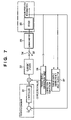
- FIG. 7 is a block diagram of a stage control system according to the embodiment of the present invention.
- FIG. 8 is a block diagram showing an example of a coil selection circuit
- FIG. 9 is a control sequence diagram according to the embodiment of the present invention.
- FIGS. 10A and 10B are graphs showing examples of the thrust ripple coefficient and a corresponding thrust ripple correction coefficient
- FIG. 11 is a top view showing the structure of the reticle stage according to another embodiment of the present invention.
- FIG. 12 is a block diagram showing an example of the construction of the stage apparatus for positioning of an object and its control system
- FIG. 13 is a flowchart showing a micro device fabrication flow
- FIG. 14 is a flowchart showing a wafer process.
- the present invention is applicable to, as well as a device fabrication apparatus to be described below, various machine tools, high-precision processing apparatuses and various precision measuring equipments, and a method for fabrication of semiconductor device using the device fabrication apparatus.
- the object of the present invention can also be achieved by providing a storage medium (or recording medium) holding software program code for realizing a ripple correction method, a device fabrication method and the like to be described as embodiments to a system or an apparatus, reading the program code with a computer (e.g., CPU, MPU) of the system or apparatus from the storage medium, then executing the program.
- a storage medium or recording medium holding software program code for realizing a ripple correction method, a device fabrication method and the like to be described as embodiments to a system or an apparatus, reading the program code with a computer (e.g., CPU, MPU) of the system or apparatus from the storage medium, then executing the program.
- a computer e.g., CPU, MPU
- FIG. 1 is a schematic side view showing a construction of an exposure apparatus for semiconductor device fabrication as a preferred embodiment of the present invention.
- FIG. 2 is a top view showing a schematic structure of a reticle stage mounted in the exposure apparatus in FIG. 1 .
- the exposure apparatus of the present embodiment has an illumination apparatus 1 , a reticle stage 2 carrying a reticle, a projection optical system 103 , a wafer stage 4 carrying a wafer, and an exposure apparatus main body 5 .
- the exposure apparatus projection-exposes a circuit pattern formed on the reticle (original plate) to the wafer (substrate). For example, a step and repeat projection exposure method or a step and scan projection exposure method is employed.
- the illumination apparatus 1 having a light source unit and an illumination optical system, illuminates the reticle where a circuit pattern is formed.
- laser for example is used as a light source.
- ArF excimer laser having a wavelength of about 193 nm, KrF excimer laser having a wavelength of about 248 nm, F2 excimer laser having a wavelength of about 153 nm, or the like is used, however, the laser type is not limited to excimer laser.
- YAG laser may be used. Further, the number of lasers is not limited.
- a light beam shaping optical system to shape a collimated light beam from the laser light source to a desired beam shape and an incoherent optical system to convert a coherent light beam to an incoherent light beam.
- a light source available as the light source unit is not limited to the laser, but a single or plural lamps such as mercury lamps and xenon lamps can be used.
- the illumination optical system including a lens, a mirror, a light integrator, an aperture and the like, is used for illumination of the reticle.
- an optical system having only plural lens elements an optical system having plural lens elements and at least one concave mirror (catadioptric optical system), an optical system having plural lens elements and at least one diffraction optical element such as a kinoform, or a full reflecting mirror type optical system can be employed.
- the exposure apparatus having the above construction can be utilized in fabrication of a semiconductor device where a fine pattern is formed such as a semiconductor integrated circuit, a micro machine and a thin film magnetic head.
- the reticle stage 2 is supported in a non-contact manner with a stage base 11 having a mirror-finished upper surface 11 a as a reference surface via a hydrostatic guide bearing (not shown).
- the hydrostatic guide bearing has high rigidity.
- the displacement of the reticle stage 2 in a Z-direction and a swinging direction (a rotational direction about an X-axis or a Y-axis) with respect to the stage base 11 is regulated (the reticle stage is restrained from moving in the direction).
- the displacement of the reticle stage 2 is enabled only along a horizontal plane as an X-Y direction.
- the stage base 11 has side surfaces (yaw guide surfaces about a Z-axis) 11 b which are also mirror-finished.
- the displacement of the stage in the X-direction and a ⁇ z direction as a rotational direction about the Z-axis is regulated. Accordingly, the reticle stage 2 can be moved only in the Y-axis direction on the stage base 11 , and the displacements in the other directions are regulated with the rigidity of the hydrostatic guide bearing (the reticle stage is restrained from moving in the directions).
- the reticle stage 2 is provided with a pair of movable element units 12 on left and right sides in the Y-axis direction.
- the respective movable element units 12 form a left linear motor and right linear motor in cooperation with respectively corresponding stator units 13 .
- the structure of the linear motor will be described later.
- the stage base 11 and the left and right stator units 13 are supported with a reference base (not shown).
- the reticle stage 2 is provided with a reflecting mirror 14 to reflect a measuring light from a laser interferometer (not shown) for measurement of displacement or moved position of the reticle stage 2 in the Y-axis direction.
- the linear motor generates a driving force in the Y-axis direction by appropriately passing a current to coils with a current driver to be described later (see FIG. 7 ), to drive the reticle stage 2 , thereby achieve position control.
- the reticle stage 2 carries the reticle (original plate) (not shown). Exposure light from the illumination optical system 1 passes through the reticle, thus exposure to the wafer (substrate) on the wafer stage 4 (not shown) is performed via a reduced projection optical system 3 .
- FIG. 3 is a cross-sectional view showing the structure of the liner motor.
- the movable element unit 12 has a magnet unit 21 as a magnet group of plural permanent magnets and a movable element plate 22 to hold the magnet unit 21 and attach the unit to the stage surface.
- the magnet unit 21 has eight main pole magnets 21 a where the orientation of the magnetic pole is in the Z direction and ten sub pole magnets 21 b where the orientation of the magnetic pole is in the Y direction.
- the magnetic pole orientations of the main pole magnets 21 a are alternately opposite via the sub pole magnet 21 b , and arranged in the Y-direction at equal intervals.
- the sub pole magnets 21 b are set in an orientation such that the polarity of a portion of each main pole magnet 21 a facing the coil 23 is repelling the sub pole magnet 21 b and a magnetic flux from the main pole magnet 21 a can be efficiently utilized.
- the coils 23 are arranged at equal intervals in the Y-direction on yokes 24 of ferromagnetic material such that the coils 23 hold the movable element unit 12 from upper and lower positions.
- the upper and lower coils e.g., coils a and a′ are serially connected such that the currents flow through the coils in the same direction, and are driven with one current driver. However, it may be arranged such that these coils are not serially connected and are driven with different drivers. Note that in the following description, the upper and lower coils are serially connected.
- FIGS. 4A to 4C respectively show a force applied to the movable element unit 12 from the respective coils when a predetermined current is passed through the respective coils a to c in FIG. 3 in the same direction and the movable element unit 12 is moved in the Y-axis direction.
- the applied force is an approximately sine wave force between ⁇ 2.5 MP and 0.5 MP, then, before ⁇ 2.5 MP and after 0.5 MP, the force is reduced since only a part of the coil faces the magnet of the movable element unit 12 .
- the applied force is an approximately sine wave between ⁇ MP and 2 MP, and the phase is shifted by 90° from that of the coil a.
- the applied force is appropriately a sine wave between 0.5 MP and 3.5 MP, and the phase is shifted by 180° from that of the coil a.
- the coils a and c it can be arranged such that a current is passed through the coil a before 0.5 MP, then a current in the opposite direction to the previous current is passed through the coil c from 0.5 MP, thereby an approximately sine wave is continuously generated.
- the coils a and c, in opposite orientations, are connected, and a current is passed through only one of the coils using a selection switch in correspondence with positional relation between the coil and the magnet, it is not necessary to provide current drivers for the respective coils.
- a current is passed through the coils alternately in opposite directions at 3MP intervals, an approximately sine wave force can be continuously generated.
- FIGS. 5A and 5B if a current is passed through the coil b as a representative coil and its alternate subsequent coils, an approximately sine wave force can be continuously generated as shown in FIGS. 5A and 5B .
- the coil group represented by the coil a will be called an “A-phase”, and the coil group represented by the coil b, a “B-phase”.
- the waveforms in FIGS. 5A and 5B are sine waves
- fb K *sin( ⁇ * y ) (3)
- the waveforms are not ideal sine waves as in the expressions (2) and (3) due to positional shift upon magnet assembly, shift of magnetic characteristic of the magnet itself or the like. Accordingly, the value K in the expression (6) is not constant.
- thrust unevenness due to magnet shift or the like has a period MP/2 as shown in FIG. 6 .
- the thrust unevenness will be called a thrust ripple, and “ ⁇ ” in FIG. 6 , a ripple rate.
- the value K in the expression (6) is not constant. In this manner, two types of thrust ripples, i.e., the thrust ripple by the magnet and the thrust ripple by the coil, exist. As the accuracy in coil positioning can be increased, the thrust ripple is caused mainly by the magnet.
- FIG. 7 is a block diagram of a stage control system according to the embodiment.
- a current driver 32 a linear motor 33 , a selection switch 34 , a thrust ripple correction table 36 , a thrust ripple correction table calculator 37 , and an induced voltage inlet 38 are provided in the left and right linear motors.
- a coil selection circuit as shown in FIG. 8 is incorporated in the linear motor 33 in FIG. 7 .
- the coil selection circuit selects one of the A-phase coils and one of the B-phase coils and connects the selected coils to the current driver based on a coil selection command in correspondence with the positional relation between the coils and magnets.
- coils A 1 and B 1 are selected.
- the number of the A-phase coils is An, and that of the B-phase coils, Bn (n is a natural number). These numbers of coils are determined based on a coil pitch and a necessary stage stroke.
- S1 A general initialization operation is performed. At this time, the selection switch 34 in FIG. 7 is connected to the current driver 32 side. By the initialization operation, initialization of the laser interferometer and reticle original point detection are completed, and then a position servo system is enabled to function to drive the reticle stage to an arbitrary position.
- stage control system performs digital signal processing.
- the induced voltage is inputted through an AD (analog-digital) converter into a digital calculator.
- stage position information and stage speed information are also obtained.
- the stage speed may be calculated from a difference between time discrete position measurement values.
- the stage speed is increased, the induced voltage is increased, and might exceed the upper limit of an input value to the AD converter. Accordingly, the stage speed is appropriately set such that the induced voltage does not exceed the upper limit of the AD converter and obtain a good S/N ratio.
- the coefficient K can be represented with the induced voltage and the stage speed v at that time.
- a value obtained by dividing the induced voltage by the stage speed v at that time will be called a normalized induced voltage.
- Respective A-phase and B-phase normalized induced voltages Va and Vb are calculated by dividing the A-phase and B-phase induced voltages by the stage speed.
- the thrust coefficient K as a linear motor is obtained by multiplying the respective phase normalized induced voltages by the rectification values ca and cb in the expressions (4) and (5) and summing the results.
- the thrust coefficient K includes no disturbance force applied to the stage. Further, as the coefficient is calculated based on the induced voltage measured by actual interaction between the magnets and the coils, the constant is a pure linear motor thrust coefficient. A value obtained by diving the coefficient K by a K mean value Km will be called a thrust ripple coefficient. A reciprocal of the thrust ripple coefficient is obtained, and will be called a thrust ripple correction coefficient.
- FIGS. 10A and 10B are graphs showing examples of the thrust ripple coefficient and a corresponding thrust ripple correction coefficient.
- the thrust ripple correction table 36 in FIG. 7 is generated using the thrust ripple correction coefficient.
- the stage position information is used as an argument in the thrust ripple correction table 36 , the accuracy is increased as the table is generated at fine intervals.
- the memory capacity is limited. Accordingly, it is preferable that a correction table value is generated by a several tenth to hundredth part of the period of the thrust ripple, and the table value is interpolated using a well-known interpolation method, thereby a correction value is calculated.
- the thrust ripple correction table 36 holding the correction values generated as above is stored in the memory of the exposure apparatus.
- FIG. 7 conceptually shows the function of the thrust ripple correction table calculator 37 to generate the thrust ripple correction table 36 from the induced voltage data.
- the calculator having this function may be provided in the exposure apparatus, or the thrust ripple correction table may be generated by another calculator and duplicated into the memory of the exposure apparatus.
- the thrust ripple correction table 36 performs correction by multiplying the command value from the controller 31 to the current driver 32 by the correction value and sends the command value to the current driver 32 .
- the linear motor behaves as if it has the thrust constant Km having a constant value as its thrust characteristic.
- two type of thrust ripples caused by the magnet and by the coil exist in the linear motor, and in other words, if demagnetization of the magnet or its positional shift, or the positional shift of the coil does not occur, the thrust ripple does not change. Accordingly, once the thrust ripple correction table is generated upon starting of the apparatus, the same table can be used. When the apparatus has been used many years and the influence of demagnetization of the magnet or the like appears, the thrust ripple correction table 36 can be generated again by the above procedure.
- the thrust ripple coefficient may be divided by a minimum value Kmin of the thrust ripple coefficient in place of the mean value Km.
- the thrust ripple coefficient is equal to or greater than “1.0”
- the thrust ripple correction coefficient as a reciprocal is equal to or less than “1.0”
- the correction value obtained from the thrust ripple correction table is equal to or less than “1.0”.
- a command value to the current driver is limited with upper and lower limit values.
- the command to the driver before correction is almost the upper limit value
- the command to the current driver exceeds the limit value by multiplication by the correction value.
- the correction value obtained from the thrust ripple correction table is equal to or less than “1.0”
- the command to the current driver can be reliably converged between the limit values by managing the command to the current driver before correction.
- the pair of upper and lower coils are serially connected, however, it may be arranged such that the coils are not serially connected but the current drivers are respective provided as described above.
- a thrust ripple correction table for right upper linear motor a thrust ripple correction table for a right lower linear motor, a thrust ripple correction table for a left upper linear motor and a thrust ripple correction table for a left lower linear motor are provided, and the thrust ripples are respectively corrected.
- the left and right stator units are fixed to the reference base, however, not to transmit the reaction force from the linear motor to the reference base, it may be arranged such that the stator units are movable in the Y-axis direction.
- the positions of the stator units as well as the position of the reticle stage are measured.
- the positional relation between the movable element magnets and the coils is calculated from the respective measurement values. Then the generation of the thrust ripple correction table and the calculation of the correction value form the thrust ripple correction table are performed.
- the magnet is employed as the movable element, and the coil, as the stator, however, the members of these elements may be exchanged.
- the advantages of the present invention can be attained. In this case, as it is not necessary to selectively change the coil, the coil selection circuit in FIG. 8 can be omitted.
- the magnet is held between the coils, however, other structures may be employed.
- the coil may be held between the magnets.
- the linear motor has a two phase structure having the A-phase and the B-phase, however, three or more phases may be employed as long as a normalized induced voltage is generated from an induced voltage in each phase, then the thrust coefficient and the thrust ripple coefficient are calculated from the sum of results of multiplication by rectification values in the respective phases, and the thrust ripple correction coefficient and the thrust ripple correction table are generated.
- FIG. 11 is a top view showing the structure of the reticle stage according to another embodiment mounted in the exposure apparatus in FIG. 1 .
- the same constituent elements as those in FIG. 2 have the same reference numerals.
- movable elements 12 and 43 are provided respectively for the reticle stage 2 and a sub stage 41 .
- the both stages are connected with a connecting member 42 , and the selection switch as shown in FIG. 7 corresponding to one stage is connected to the current driver side, while the selection switch corresponding to the other stage is connected to the induced voltage inlet side. Then, a series of operations to drive the linear motor connected to the current driver side and generate the thrust ripple correction table from the induced voltage in the linear motor connected to the induced voltage inlet side are performed.
- the stage connected to the current driver side is connected to the induced voltage inlet side while the stage connected to the induced voltage inlet side is connected to the current driver side, and the thrust ripple correction table for the other stage is generated.
- a member using electromagnetic force such as an electromagnet, a member utilizing a negative pressure force to atmospheric pressure such as a vacuum chuck, or a fixing member using bolt fastening may be used.
- the stage is driven with one or more of the movable elements, and the induced voltage corresponding to movable element(s) not driven in driving is measured and the subsequent processing is performed, thus the thrust ripple correction table is generated. Then, the stage is driven with the other movable element(s) such that the induced voltage corresponding to the movable element(s) previously used in driving is measured.
- the thrust ripple correction table corresponding to each of the movable elements for the linear motor can be generated when it is incorporated in the apparatus, and drive control with corrected thrust ripple can be performed.
- the selection switch is set to the current driver side or the induced voltage inlet side by phase.
- A-phase and B-phase 2-phase (A-phase and B-phase) drive
- the A-phase is set to the current driver side
- the B-phase is set to the induced voltage inlet side
- the stage is driven only with the A-phase.
- the thrust is zero in a position in the driving only with the A-phase.
- the stage When the stage is stopped in this position where the thrust in the A-phase is zero, the stage cannot be driven from the position. Accordingly, it is necessary to consider the stage stop position upon take-in of the induced voltage. As described above, for the measurement of induced voltage, a high stage speed is not necessary, and a somewhat uneven speed may be allowed as long as the position and speed of the stage can be measured.
- the stage Once the stage begins to move, the stage passes through the position where the A-phase thrust is zero by the inertia of the stage, the driving for the induced voltage measurement can be performed without any problem only if the initial position and the stop position of the stage are checked.
- the selection switch is changed so as to drive the stage by the B-phase, and the A-phase induced voltage measurement is performed. Then, the above-described series of calculations are made.
- the two-phase driving there is a position where the thrust is zero upon driving only with one phase, however, in use of a three or more phase linear motor driven with two or more phases, as there is no position where the thrust is zero, it is not necessary to consider the stop position upon driving.
- the induced voltage measurement is sequentially performed and the thrust ripple correction table is calculated by phase. In this arrangement, even in a case where the number of movable elements is one, the thrust ripple correction table can be generated and drive control with corrected thrust ripple can be performed.
- the induced voltage is measured by driving the stage using a part of the linear motor.
- another driving unit may be provided.
- another linear motor may be provided upon measurement, or driving may be performed with a robot hand.
- Manual driving is not inconceivable, however, as extreme speed unevenness may cause an error in calculation of normalized induced voltage, the manual driving is not preferable.
- the thrust ripple correction table can be generated in other apparatus than the exposure apparatus.
- the present invention can be utilized for other purposes than the generation of the thrust ripple correction table.
- the invention is applicable to an apparatus or method for detection of abnormality or trouble of a linear motor represented by coil breakage.
- the induced voltage data read from the induced voltage inlet shown in FIG. 7 is compared with previously experimentally obtained normal waveform data or the like, thereby abnormality or trouble such as breakage of coil or coil wiring, coil positional shift and demagnetization or positional shift of the magnet can be efficiently detected.
- FIG. 13 shows a micro device (semiconductor chip such as an IC or LSI, a liquid crystal panel, a CCD, a thin-film magnetic head, a micro machine or the like) fabrication flow.
- a semiconductor device circuit is designed.
- exposure control data for the exposure apparatus is generated based on the designed circuit pattern.
- step S 3 wafer fabrication
- a wafer is fabricated by using material such as silicon.
- step S 4 wafer process
- an actual circuit is formed on the wafer by a lithography technique using the exposure apparatus in which the above exposure control data has been inputted and the wafer.
- Step S 5 Fabrication
- Step S 5 includes an assembly process (dicing and bonding), a packaging process (chip encapsulation) and the like.
- step S 6 inspections such as an operation check, a durability test and the like are performed on the semiconductor device formed at step 5 .
- the semiconductor device is completed through these processes, and is shipped (step S 7 ).
- FIG. 14 shows the detailed flow of the wafer process.
- step S 11 oxidation
- step S 12 CVD
- step S 13 electrode formation
- electrodes are formed by vapor deposition on the wafer.
- step S 14 ion implantation
- ions are injected in the wafer.
- step S 15 resist processing
- the wafer is coated with photoresist.
- step S 16 exposure
- step S 18 exposure-printed on the wafer by the above-described exposure apparatus.
- step S 17 development
- the exposed wafer is developed.
- step S 18 etching
- step S 19 resist stripping
- the thrust ripple coefficient can be obtained based on the induced voltage of the linear motor, a pure thrust ripple without influence such as disturbance can be obtained.
- the correction is performed using the thrust ripple correction table generated from the thrust ripple upon stage driving, even there is a thrust ripple in the linear motor, excellent positioning control can be performed as if there is no thrust ripple.
- the command to the current driver can be reliably converged between limit values by management of the command to the current driver before correction.
- the thrust ripple correction table can be generated for the respective movable elements of the linear motor when the motor is incorporated in the apparatus, and drive control can be performed with the corrected thrust ripple.
- the thrust ripple correction table can be generated and drive control with corrected thrust ripple can be performed. Further, the thrust ripple correction table can be generated without the apparatus.
- trouble such as coil breakage or its positional shift, magnet demagnetization or its positional shift can be efficiently detected by examining the induced voltage data.
Landscapes
- Engineering & Computer Science (AREA)
- Power Engineering (AREA)
- Physics & Mathematics (AREA)
- General Physics & Mathematics (AREA)
- Exposure And Positioning Against Photoresist Photosensitive Materials (AREA)
- Control Of Position Or Direction (AREA)
- Control Of Linear Motors (AREA)
Applications Claiming Priority (2)
| Application Number | Priority Date | Filing Date | Title |
|---|---|---|---|
| JP2005-023931 | 2005-01-31 | ||
| JP2005023931A JP2006211873A (ja) | 2005-01-31 | 2005-01-31 | 移動体制御装置及び移動体制御方法 |
Publications (2)
| Publication Number | Publication Date |
|---|---|
| US20060170888A1 US20060170888A1 (en) | 2006-08-03 |
| US7276866B2 true US7276866B2 (en) | 2007-10-02 |
Family
ID=36756152
Family Applications (1)
| Application Number | Title | Priority Date | Filing Date |
|---|---|---|---|
| US11/275,763 Active 2026-05-05 US7276866B2 (en) | 2005-01-31 | 2006-01-27 | Moving control apparatus and moving control method |
Country Status (2)
| Country | Link |
|---|---|
| US (1) | US7276866B2 (enExample) |
| JP (1) | JP2006211873A (enExample) |
Cited By (3)
| Publication number | Priority date | Publication date | Assignee | Title |
|---|---|---|---|---|
| US20070279614A1 (en) * | 2004-08-30 | 2007-12-06 | Canon Kabushiki Kaisha | Linear Motor and Exposure Apparatus Having the Same |
| US20110029197A1 (en) * | 2008-04-02 | 2011-02-03 | Nissan Motor Co., Ltd. | Electrically-powered actuator driving control apparatus and driving control method and vehicle having electrically-powered actuator driving control apparatus |
| US20130285578A1 (en) * | 2011-01-21 | 2013-10-31 | Panasonic Corporation | Method for driving linear actuator |
Families Citing this family (18)
| Publication number | Priority date | Publication date | Assignee | Title |
|---|---|---|---|---|
| JP2006211873A (ja) | 2005-01-31 | 2006-08-10 | Canon Inc | 移動体制御装置及び移動体制御方法 |
| JP2008118778A (ja) * | 2006-11-02 | 2008-05-22 | Toto Ltd | 永久磁石型同期機の初期位相検出方法、永久磁石型同期機の制御方法、移動装置、電子部品の製造装置、電子部品の検査装置、精密部品の製造装置、精密部品の検査装置 |
| FR2909493B1 (fr) * | 2006-12-05 | 2009-01-16 | Air Liquide | Procede d'amortissement du deplacement d'un piston d'un moteur electrodynamique lineaire sous l'action d'une force exterieure |
| JP6444127B2 (ja) * | 2013-10-16 | 2018-12-26 | キヤノン株式会社 | ステージ装置、リソグラフィ装置、それを用いた物品の製造方法 |
| CN105830321B (zh) * | 2013-12-20 | 2019-04-09 | 株式会社富士 | 线性马达的推力常数导出方法、移动控制方法、线性马达的推力常数导出装置及移动控制装置 |
| JP6438219B2 (ja) * | 2014-06-17 | 2018-12-12 | キヤノン株式会社 | ステージ装置、リソグラフィ装置、物品の製造方法、および決定方法 |
| US10029366B2 (en) * | 2014-11-21 | 2018-07-24 | Canon Kabushiki Kaisha | Control device for motor drive device, control device for multi-axial motor, and control method for motor drive device |
| JP6576111B2 (ja) * | 2015-06-12 | 2019-09-18 | キヤノン株式会社 | 駆動システム、モータの制御方法、リソグラフィ装置および物品製造方法 |
| WO2019163588A1 (ja) * | 2018-02-20 | 2019-08-29 | 日本電産株式会社 | モータ制御システム、およびパワーステアリングシステム |
| WO2019163587A1 (ja) * | 2018-02-20 | 2019-08-29 | 日本電産株式会社 | モータ制御システム、およびパワーステアリングシステム |
| CN111713004B (zh) * | 2018-02-20 | 2023-09-12 | 日本电产株式会社 | 马达控制系统和助力转向系统 |
| JP2020124010A (ja) * | 2019-01-29 | 2020-08-13 | キヤノン株式会社 | 制御装置、露光装置、および物品の製造方法 |
| JP7389597B2 (ja) * | 2019-09-20 | 2023-11-30 | キヤノン株式会社 | ステージ装置、リソグラフィ装置、および物品製造方法 |
| JP7490436B2 (ja) * | 2020-04-20 | 2024-05-27 | キヤノン株式会社 | 駆動システム、リソグラフィ装置および物品の製造方法。 |
| JP2022019448A (ja) * | 2020-07-17 | 2022-01-27 | キヤノン株式会社 | 搬送システム、制御システム及び制御方法 |
| CN112234890B (zh) * | 2020-09-21 | 2021-08-17 | 瑞声新能源发展(常州)有限公司科教城分公司 | 一种直线电机推力波动的抑制方法、相关设备和介质 |
| CN112234891B (zh) * | 2020-09-21 | 2022-05-27 | 瑞声新能源发展(常州)有限公司科教城分公司 | 直线电机推力波动的抑制方法、装置、电机、介质及设备 |
| KR102611428B1 (ko) * | 2021-12-20 | 2023-12-07 | 한국공학대학교산학협력단 | 고정자와 이동자를 포함하는 선형 반송 시스템의 추력 리플을 제어하는 장치 및 방법 |
Citations (14)
| Publication number | Priority date | Publication date | Assignee | Title |
|---|---|---|---|---|
| JPH07161798A (ja) | 1993-12-06 | 1995-06-23 | Canon Inc | 位置決めテーブル装置 |
| US5666038A (en) | 1993-06-24 | 1997-09-09 | Canon Kabushiki Kaisha | Positioning table device including correction of energization electric current to selected coils of a permanent magnet of a drive device |
| US5684856A (en) | 1991-09-18 | 1997-11-04 | Canon Kabushiki Kaisha | Stage device and pattern transfer system using the same |
| US5917580A (en) | 1996-08-29 | 1999-06-29 | Canon Kabushiki Kaisha | Scan exposure method and apparatus |
| JP3176766B2 (ja) | 1993-06-24 | 2001-06-18 | キヤノン株式会社 | 位置決めテーブル装置 |
| JP2001175332A (ja) | 1999-12-22 | 2001-06-29 | Nikon Corp | ステージの駆動方法、ステージ装置及び露光装置 |
| US6442858B1 (en) | 1999-02-03 | 2002-09-03 | Canon Kabushiki Kaisha | Positioning apparatus, exposure apparatus, device manufacturing method, and positioning method |
| US6495847B1 (en) | 1998-12-24 | 2002-12-17 | Canon Kabushiki Kaisha | Stage control apparatus and exposure apparatus |
| US20040112164A1 (en) | 2002-09-30 | 2004-06-17 | Canon Kabushiki Kaisha | Alignment apparatus, exposure apparatus, and device manufacturing method |
| US6867849B2 (en) | 2000-06-01 | 2005-03-15 | Canon Kabushiki Kaisha | Stage apparatus which supports interferometer, stage position measurement method, projection exposure apparatus, projection exposure apparatus maintenance method, semiconductor device manufacturing method, and semiconductor manufacturing factory |
| US20050248744A1 (en) * | 2003-02-17 | 2005-11-10 | Nikon Corporation | Stage device, exposure apparatus, and method of manufacturing devices |
| US20060082225A1 (en) | 2003-02-13 | 2006-04-20 | Canon Kabushiki Kaisha | Linear motor, moving stage system, exposure apparatus, and device manufacturing method |
| US20060170888A1 (en) | 2005-01-31 | 2006-08-03 | Canon Kabushiki Kaisha | Moving control apparatus and moving control method |
| US7154242B2 (en) | 2002-05-08 | 2006-12-26 | Canon Kabushiki Kaisha | Moving member mechanism and control method therefor |
-
2005
- 2005-01-31 JP JP2005023931A patent/JP2006211873A/ja not_active Withdrawn
-
2006
- 2006-01-27 US US11/275,763 patent/US7276866B2/en active Active
Patent Citations (16)
| Publication number | Priority date | Publication date | Assignee | Title |
|---|---|---|---|---|
| US5684856A (en) | 1991-09-18 | 1997-11-04 | Canon Kabushiki Kaisha | Stage device and pattern transfer system using the same |
| US5666038A (en) | 1993-06-24 | 1997-09-09 | Canon Kabushiki Kaisha | Positioning table device including correction of energization electric current to selected coils of a permanent magnet of a drive device |
| JP3176766B2 (ja) | 1993-06-24 | 2001-06-18 | キヤノン株式会社 | 位置決めテーブル装置 |
| JPH07161798A (ja) | 1993-12-06 | 1995-06-23 | Canon Inc | 位置決めテーブル装置 |
| US5917580A (en) | 1996-08-29 | 1999-06-29 | Canon Kabushiki Kaisha | Scan exposure method and apparatus |
| US6495847B1 (en) | 1998-12-24 | 2002-12-17 | Canon Kabushiki Kaisha | Stage control apparatus and exposure apparatus |
| US6442858B1 (en) | 1999-02-03 | 2002-09-03 | Canon Kabushiki Kaisha | Positioning apparatus, exposure apparatus, device manufacturing method, and positioning method |
| JP2001175332A (ja) | 1999-12-22 | 2001-06-29 | Nikon Corp | ステージの駆動方法、ステージ装置及び露光装置 |
| US6867849B2 (en) | 2000-06-01 | 2005-03-15 | Canon Kabushiki Kaisha | Stage apparatus which supports interferometer, stage position measurement method, projection exposure apparatus, projection exposure apparatus maintenance method, semiconductor device manufacturing method, and semiconductor manufacturing factory |
| US7154242B2 (en) | 2002-05-08 | 2006-12-26 | Canon Kabushiki Kaisha | Moving member mechanism and control method therefor |
| US20040112164A1 (en) | 2002-09-30 | 2004-06-17 | Canon Kabushiki Kaisha | Alignment apparatus, exposure apparatus, and device manufacturing method |
| US20060028310A1 (en) | 2002-09-30 | 2006-02-09 | Canon Kabushiki Kaisha | Alignment apparatus, exposure apparatus, and device manufacturing method |
| US20060082225A1 (en) | 2003-02-13 | 2006-04-20 | Canon Kabushiki Kaisha | Linear motor, moving stage system, exposure apparatus, and device manufacturing method |
| US7067942B2 (en) | 2003-02-13 | 2006-06-27 | Canon Kabushiki Kaisha | Linear motor, moving stage system, exposure apparatus, and device manufacturing method |
| US20050248744A1 (en) * | 2003-02-17 | 2005-11-10 | Nikon Corporation | Stage device, exposure apparatus, and method of manufacturing devices |
| US20060170888A1 (en) | 2005-01-31 | 2006-08-03 | Canon Kabushiki Kaisha | Moving control apparatus and moving control method |
Cited By (6)
| Publication number | Priority date | Publication date | Assignee | Title |
|---|---|---|---|---|
| US20070279614A1 (en) * | 2004-08-30 | 2007-12-06 | Canon Kabushiki Kaisha | Linear Motor and Exposure Apparatus Having the Same |
| US7602088B2 (en) * | 2004-08-30 | 2009-10-13 | Canon Kabushiki Kaisha | Linear motor and exposure apparatus having the same |
| US20110029197A1 (en) * | 2008-04-02 | 2011-02-03 | Nissan Motor Co., Ltd. | Electrically-powered actuator driving control apparatus and driving control method and vehicle having electrically-powered actuator driving control apparatus |
| US8447468B2 (en) * | 2008-04-02 | 2013-05-21 | Nissan Motor Co., Ltd. | Electrically-powered actuator driving control apparatus and driving control method and vehicle having electrically-powered actuator driving control apparatus |
| US20130285578A1 (en) * | 2011-01-21 | 2013-10-31 | Panasonic Corporation | Method for driving linear actuator |
| US9621095B2 (en) * | 2011-01-21 | 2017-04-11 | Panasonic Intellectual Property Management Co., Ltd. | Method for driving linear actuator |
Also Published As
| Publication number | Publication date |
|---|---|
| JP2006211873A (ja) | 2006-08-10 |
| US20060170888A1 (en) | 2006-08-03 |
Similar Documents
| Publication | Publication Date | Title |
|---|---|---|
| US7276866B2 (en) | Moving control apparatus and moving control method | |
| US6359677B2 (en) | Stage apparatus, exposure apparatus using the same, and a device manufacturing method | |
| US6414742B1 (en) | Stage apparatus, and exposure apparatus and device manufacturing method using the same | |
| US20110248578A1 (en) | Positioning apparatus | |
| US6741328B2 (en) | Exposure apparatus and its control method, stage apparatus, and device manufacturing method | |
| US7795833B2 (en) | Driving apparatus, exposure apparatus, and device manufacturing method | |
| US8140288B2 (en) | On-machine methods for identifying and compensating force-ripple and side-forces produced by actuators on a multiple-axis stage | |
| US7468589B2 (en) | Lithographic apparatus having a controlled motor, and motor control system and method | |
| Kim et al. | Positioning performance and straightness error compensation of the magnetic levitation stage supported by the linear magnetic bearing | |
| US9013134B2 (en) | Method for determing a commutation offset and for determining a compensation map for a stage | |
| US20080067968A1 (en) | Identifying and compensating force-ripple and side-forces produced by linear actuators | |
| US6867534B2 (en) | Low-mass and compact stage devices exhibiting six degrees of freedom of fine motion, and microlithography systems comprising same | |
| JPH09219353A (ja) | ステージ装置、及びこれを用いた露光装置やデバイス生産方法 | |
| US7656062B2 (en) | Split coil linear motor for z force | |
| US7586218B2 (en) | Moving apparatus, exposure apparatus, and device manufacturing method | |
| Hu et al. | Extended range six-DOF high-precision positioner for wafer processing | |
| JP2021177688A (ja) | ステージ装置、リソグラフィ装置、物品の製造方法、および制御方法 | |
| US10158313B2 (en) | Current controller for cryogenically cooled motor | |
| JP4487168B2 (ja) | ステージ装置及びその駆動方法、並びに露光装置 | |
| KR20210034489A (ko) | 스테이지 장치, 리소그래피 장치, 및 물품제조방법 | |
| JP4739442B2 (ja) | ステージ装置、及びステージ装置の制御方法、それを用いた露光装置及びデバイスの製造方法 | |
| US5714860A (en) | Stage device capable of applying a damping force to a movable member | |
| US20220326627A1 (en) | Actuator assemblies comprising piezo actuators or electrostrictive actuators | |
| US20050156473A1 (en) | Polyphase linear motor and its drive method, and stage device, exposure system, and device manufacturing method using the polyphase linear motor | |
| CN111226173B (zh) | 电机、双行程平台和光刻设备 |
Legal Events
| Date | Code | Title | Description |
|---|---|---|---|
| AS | Assignment |
Owner name: CANON KABUSHIKI KAISHA, JAPAN Free format text: ASSIGNMENT OF ASSIGNORS INTEREST;ASSIGNOR:ASANO, MR TOSIYA;REEL/FRAME:017076/0097 Effective date: 20060125 |
|
| STCF | Information on status: patent grant |
Free format text: PATENTED CASE |
|
| FPAY | Fee payment |
Year of fee payment: 4 |
|
| FPAY | Fee payment |
Year of fee payment: 8 |
|
| MAFP | Maintenance fee payment |
Free format text: PAYMENT OF MAINTENANCE FEE, 12TH YEAR, LARGE ENTITY (ORIGINAL EVENT CODE: M1553); ENTITY STATUS OF PATENT OWNER: LARGE ENTITY Year of fee payment: 12 |