US6593243B1 - Method of manufacturing semiconductor device - Google Patents

Method of manufacturing semiconductor device Download PDF

Info

Publication number
US6593243B1
US6593243B1 US09/632,163 US63216300A US6593243B1 US 6593243 B1 US6593243 B1 US 6593243B1 US 63216300 A US63216300 A US 63216300A US 6593243 B1 US6593243 B1 US 6593243B1
Authority
US
United States
Prior art keywords
etching
layer
semiconductor device
mask material
manufacturing
Prior art date
Legal status (The legal status is an assumption and is not a legal conclusion. Google has not performed a legal analysis and makes no representation as to the accuracy of the status listed.)
Expired - Fee Related
Application number
US09/632,163
Inventor
Hajime Kimura
Current Assignee (The listed assignees may be inaccurate. Google has not performed a legal analysis and makes no representation or warranty as to the accuracy of the list.)
Renesas Electronics Corp
Original Assignee
Mitsubishi Electric Corp
Priority date (The priority date is an assumption and is not a legal conclusion. Google has not performed a legal analysis and makes no representation as to the accuracy of the date listed.)
Filing date
Publication date
Application filed by Mitsubishi Electric Corp filed Critical Mitsubishi Electric Corp
Assigned to MITSUBISHI DENKI KABUSHIKI KAISHA reassignment MITSUBISHI DENKI KABUSHIKI KAISHA (ASSIGNMENT OF ASSIGNOR'S INTEREST) RE-RECORD TO CORRECT THE RECORDATION DATE OF 08/30/2000 TO 08/03/2000 PREVIOUSLY RECORDED AT REEL 11127 FRAME 0613. Assignors: KIMURA, HAJIME
Assigned to MITSUBISHI DENKI KABUSHIKI KAISHA reassignment MITSUBISHI DENKI KABUSHIKI KAISHA INVALID ASSIGNMENT, SEE RECORDING ON REEL 011303, FRAME 0290 (RE-RECORD TO CORRECT THE RECORDATION DATE). Assignors: KIMURA, HAJIME
Application granted granted Critical
Publication of US6593243B1 publication Critical patent/US6593243B1/en
Assigned to RENESAS ELECTRONICS CORPORATION reassignment RENESAS ELECTRONICS CORPORATION ASSIGNMENT OF ASSIGNORS INTEREST (SEE DOCUMENT FOR DETAILS). Assignors: MITSUBISHI DENKI KABUSHIKI KAISHA
Anticipated expiration legal-status Critical
Expired - Fee Related legal-status Critical Current

Links

Images

Classifications

    • H10P14/61
    • H10P50/71
    • H10P50/283

Definitions

  • the present invention relates to methods of manufacturing semiconductor devices and, more particularly to a method of manufacturing a semiconductor device capable of forming a pattern such as an extremely fine interconnection with accuracy.
  • Interconnections are increasingly becoming smaller in semiconductor devices. Thus, it is becoming difficult to form such extremely fine interconnection patterns only by means of lithography.
  • a hard mask including for example a silicon oxide film is applied in place of a photoresist pattern as a mask material.
  • an insulating film mask (hard mask) 104 b is formed having a prescribed dimension.
  • insulating film 104 a is a silicon oxide film
  • a prescribed insulating film mask 104 b is formed by isotropically etching insulating film 104 a in a hydrofluoric solution.
  • insulating film mask 104 b is formed by isotropically etching insulating film 104 a .
  • an extremely thin hard mask may be formed. In this case, to achieve a desired interconnection dimension, control of a thickness of insulating film 104 as the hard mask becomes extremely difficult.
  • An object of the present invention is to provide a method of manufacturing a semiconductor device capable of providing a mask material with a desired dimension without any variation in thickness of the mask material and preventing a layer to be the mask material from coming off a semiconductor substrate.
  • a prescribed layer is formed on a main surface of a semiconductor substrate.
  • a layer, which is to be used as a mask material when patterning the prescribed layer, is formed thereon.
  • a photoresist pattern is formed on the layer to be the mask material.
  • the layer to be the mask material is etched to form the mask material.
  • the prescribed layer is etched using the mask material as a mask to form a prescribed pattern.
  • the layer to be the mask material is etched in a gas phase ambient using the photoresist pattern as the mask.
  • the layer to be the mask material is etched in the gas phase ambient using the photoresist pattern as the mask.
  • the mask material can be formed without causing the layer to be the mask material to come off the semiconductor substrate.
  • a desired mask material can be formed without causing any variation in thickness of the mask material.
  • the step of forming the mask material preferably includes: a first etching step of anisotropically etching the layer to be the mask material to expose a surface of the prescribed layer using the photoresist pattern as the mask; and a second etching step of etching a side surface of the layer to be the mask material positioned under the photoresist pattern in the gas phase ambient to form the mask material.
  • the mask material having a desired dimension can be formed with accuracy without causing any decrease in thickness of the layer to be the mask material. Even when the dimension of a prescribed pattern is to be changed to comply with the change in design rule of a semiconductor device, for example, the thickness of the layer to be the mask material needs not be considered.
  • the second etching step includes,a step of removing a polymer film formed on the side surface of the layer to be the mask material in the first etching step.
  • Removal of the polymer film enables uniform etching in the second etching step to form the mask material with high dimensional accuracy.
  • the step of forming the photoresist pattern includes a step of forming an anti-reflection film as an underlying film
  • the second etching step includes a step of etching the exposed side surface of the layer to be the mask material using the anti-reflection film as the mask.
  • halation is prevented by the anti-reflection film during exposure, so that a finer photoresist pattern is formed and a fine mask material can readily be formed with high dimensional accuracy.
  • etching of the layer to be the mask material preferably involves making of a gas including CF 4 , O 2 and N 2 into a plasma for etching in the plasma ambient.
  • a thickness of the layer to be the mask material is smaller than a length over which the layer to be the mask material is etched along the main surface of the semiconductor substrate in the step of forming the mask material.
  • the step of forming the mask material preferably includes the step of forming the mask material by isotropically etching in the gas phase ambient.
  • the gas phase ambient preferably includes hydrofluoric acid (HF) in a gas phase.
  • an interconnection which is the most highly required to be fine in the semiconductor device, can readily be formed with dimensional accuracy.
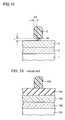
  • FIG. 1 is a cross sectional view shown in conjunction with a step of a method of manufacturing a semiconductor device according to the first embodiment of the present invention.
  • FIGS. 2 to 5 are cross sectional views respectively shown in conjunction with steps performed after the steps shown in conjunction with FIGS. 1 to 4 in the first embodiment of the present invention.
  • FIG. 6 is a cross sectional view shown in conjunction with a step of a method of manufacturing a semiconductor device according to the second embodiment of the present invention.
  • FIG. 7 is a cross sectional view shown in conjunction with a step performed after the step shown in FIG. 6 in the second embodiment of the present invention.
  • FIGS. 8 to 10 are diagrams respectively showing the first to third patterns each relating to a pressure during etching and an etching time in the step shown in conjunction with FIG. 7 in the second embodiment of the present invention.
  • FIG. 11 is a cross sectional view shown in conjunction with a step of a method of manufacturing a semiconductor device according to the third embodiment of the present invention.
  • FIG. 12 is a cross sectional view shown in conjunction with a step performed after the step shown in FIG. 11 in the third embodiment of the present invention.
  • FIG. 13 is a cross sectional view shown in conjunction with a step of a conventional method of manufacturing a semiconductor device.
  • FIGS. 14 and 15 are cross sectional views respectively shown in conjunction with steps performed after the steps shown in FIGS. 13 and 14 .
  • a method of manufacturing a semiconductor device will be described.
  • a polycrystalline silicon film 2 is formed on a silicon substrate 1 for example by CVD.
  • a tungsten silicide film 3 is formed on polycrystalline silicon film 2 for example by sputtering.
  • An insulating film 4 such as a silicon oxide film which is to be a hard mask is formed on tungsten silicide film 3 .
  • a photoresist pattern 5 is formed on insulating film 4 .
  • a hard mask 4 b is formed having a desired dimension.
  • photoresist pattern 5 covering hard mask 4 b is removed.
  • photoresist pattern 5 covering hard mask 4 b is removed.
  • an interconnection 6 including polycrystalline silicon film 2 a and tungsten silicide film 3 a is formed.
  • interconnection 6 an interconnection of a polycide structure including polycrystalline silicon film 2 a and tungsten silicide film 3 a has been described by way of example as interconnection 6 , the method of manufacturing the semiconductor device can also be applied to an interconnection including a metal film such as a tungsten film or that including only a polycrystalline silicon film.
  • silicon oxide film is used as the layer to be hard mask 4 b in the present embodiment
  • a silicon nitride film may also be applied.
  • etching can be performed with high selectivity along the main surface of silicon substrate 1 with respect to underlying tungsten silicide film 3 .
  • a fluorocarbon based polymer film (not shown) is formed on the exposed side surface insulating film 4 a .
  • the polymer film can uniformly be removed.
  • hard mask 4 b can be formed with higher dimensional accuracy. It is noted that the etching of the polymer film will be described in greater detail in the second embodiment section.
  • photoresist pattern 5 is directly formed on insulating film 4 including the silicon oxide film, as shown in FIG. 1 or the like. If a design rule decreases to at most 0.3 ⁇ m, it becomes difficult to accurately patterning the photoresist pattern on the silicon oxide film due to lithography characteristic.
  • an anti-reflection film (ARC) is applied.
  • ARC anti-reflection film
  • a method of manufacturing the semiconductor device with application of the anti-reflection film will be described.
  • an inorganic anti-reflection film such as a plasma nitride film is particularly described by way of example.
  • an anti-reflection film 7 (not shown) such as a silicon nitride film is formed after insulating film 4 is formed. Thereafter, as shown in FIG. 6, a photoresist is applied onto anti-reflection film 7 and a desired photoresist pattern 5 is formed.
  • tungsten silicide film 3 is exposed and insulating film 4 a is formed.
  • a fluorocarbon based polymer film 8 is formed on the exposed side surface of insulating film 4 a.
  • photoresist pattern 5 positioned on anti-reflection film 7 is removed.
  • hard mask 4 b is formed. It is noted that, polymer film 8 is uniformly removed if a pressure of the gas phase hydrofluoric acid ambient is set in a range of several kPa to several tens of kPa.
  • anti-reflection film 7 is removed by wet etching or dry etching.
  • an interconnection 6 including polycrystalline silicon film 2 a and tungsten silicide film 3 a is formed as shown in FIG. 5 shown in conjunction with the first embodiment.
  • the step shown in conjunction with FIG. 7 has been described as performing etching with a pressure of the gas phase hydrofluoric acid ambient being maintained at several kPa to several tens of kPa.
  • three patterns of relationships between the pressure and the etching time can be obtained for example as shown in FIGS. 8 to 10 .
  • the pressure gradually increases over the etching time.
  • the pressure changes in a serrated form over the etching time.
  • the pressure increases at the start of etching and then maintained at a constant value.
  • a maximum pressure p corresponds to the above mentioned pressure of the gas phase hydrofluoric acid in the first and third patterns, whereas a pressure p, i.e., average pressure overtime, corresponds to that in the second pattern.
  • anti-reflection film 7 can be removed by wet etching using a solution including thermal phosphoric acid with a small amount of hydrofluoric acid. If a gas including CHF 3 , CF 4 , Ar and O 2 is used, anti-reflection film 7 can be removed by dry etching. Further, in the method using dry etching, an anti-reflection film including a silicon nitride film can be removed.
  • a method of manufacturing a semiconductor device according to the third embodiment of the present invention will be described.
  • etching must be performed twice to form hard mask 4 b .
  • a method of forming a hard mask only by one etching will be described.
  • an insulating film 4 with a prescribed thickness is formed on tungsten silicide film 3 .
  • a photoresist pattern 5 is formed on insulating film 4 . It is noted that the prescribed thickness of insulating film 4 will later be described.
  • insulating film 4 is isotropically etched using photoresist pattern 5 as a mask in a gas phase hydrofluoric acid ambient.
  • a hard mask 4 b is formed under photoresist pattern 5 as shown in FIG. 12 .
  • photoresist pattern 5 is removed, and tungsten silicide film 3 and polycrystalline silicon film 2 are anisotropically etched using hard mask 4 b as a mask, so that a desired interconnection (not shown) is formed.
  • a semiconductor device having a fine interconnection is formed.

Landscapes

  • Drying Of Semiconductors (AREA)
  • Internal Circuitry In Semiconductor Integrated Circuit Devices (AREA)

Abstract

A polycrystalline silicon film 2 and tungsten silicide film 3 are formed on a silicon substrate 1. An insulating film to be a hard mask is formed on tungsten silicide film 3. A photoresist pattern 5 is formed on the insulating film. The insulating film is anisotropically etched using photoresist pattern 5 as a mask. By etching the exposed side surface of insulating film 4 a in a gas phase hydrofluoric acid ambient, a hard mask 4 b is formed. Thus, a mask material with a desired dimension is obtained without causing any variation in thickness of the mask material, and the layer to be the mask material is prevented from coming off the semiconductor substrate.

Description

BACKGROUND OF THE INVENTION
1. Field of the Invention
The present invention relates to methods of manufacturing semiconductor devices and, more particularly to a method of manufacturing a semiconductor device capable of forming a pattern such as an extremely fine interconnection with accuracy.
2. Description of the Background Art
Interconnections are increasingly becoming smaller in semiconductor devices. Thus, it is becoming difficult to form such extremely fine interconnection patterns only by means of lithography. To meet the requirements for such semiconductor devices, a hard mask including for example a silicon oxide film is applied in place of a photoresist pattern as a mask material.
Now, an exemplary method of manufacturing a semiconductor device using the hard mask will be described with reference to the drawings. Referring to FIG. 13, a polycrystalline silicon film 102 is formed for example by CVD (Chemical Vapor Deposition) on a silicon substrate 101. A tungsten silicide film 103 is formed for example by sputtering on polycrystalline silicon film 102. An insulating film 104, which is to be a hard mask, is formed on tungsten silicide film 103. A prescribed photoresist pattern 105 is formed on insulating film 104.
Referring to FIG. 14, by anisotropically etching insulating film 104 using photoresist pattern 105 as a mask, a surface of tungsten silicide film 103 is exposed and insulating film 104 a is formed.
Referring now to FIG. 15, by removing photoresist pattern 105 and isotropically etching insulating film 104 a, an insulating film mask (hard mask) 104 b is formed having a prescribed dimension.
At the time, for example, if insulating film 104 a is a silicon oxide film, a prescribed insulating film mask 104 b is formed by isotropically etching insulating film 104 a in a hydrofluoric solution.
Then, by anisotropically etching tungsten silicide film 103 and polycrystalline silicon film 102 using insulating film mask 104 b as a mask, an interconnection (not shown) having a prescribed dimension is formed. Thus, a semiconductor device is formed having fine interconnections.
As described above, insulating film mask 104 b is formed by isotropically etching insulating film 104 a. In a semiconductor device or the like in which insulating film mask 104 b (hard mask) is ultimately removed after forming a desired interconnection, an extremely thin hard mask may be formed. In this case, to achieve a desired interconnection dimension, control of a thickness of insulating film 104 as the hard mask becomes extremely difficult.
As a result, when an interconnection dimension must be changed to comply with the change of a design rule of a semiconductor device, a thickness of an insulating film as a hard mask must be considered. Accordingly, it becomes extremely difficult to form a desired hard mask.
In addition, when insulating film 104 a is isotropically etched in a hydrofluoric solution, insulating films 104 a and 104 b as hard masks may come off silicon substrate 101. Thus, a desired interconnection cannot be formed.
SUMMARY OF THE INVENTION
The present invention is made to solve the aforementioned problems. An object of the present invention is to provide a method of manufacturing a semiconductor device capable of providing a mask material with a desired dimension without any variation in thickness of the mask material and preventing a layer to be the mask material from coming off a semiconductor substrate.
The method of manufacturing the semiconductor device according to the present invention is provided with the following steps. A prescribed layer is formed on a main surface of a semiconductor substrate. A layer, which is to be used as a mask material when patterning the prescribed layer, is formed thereon. A photoresist pattern is formed on the layer to be the mask material. Using the photoresist pattern as the mask, the layer to be the mask material is etched to form the mask material. The prescribed layer is etched using the mask material as a mask to form a prescribed pattern. In the step of forming the mask material, the layer to be the mask material is etched in a gas phase ambient using the photoresist pattern as the mask.
According to the manufacturing method, in the step of forming the mask material, the layer to be the mask material is etched in the gas phase ambient using the photoresist pattern as the mask. As compared with the case of etching in a liquid phase, the mask material can be formed without causing the layer to be the mask material to come off the semiconductor substrate. In addition, as the layer to be the mask material is covered by the photoresist pattern, a desired mask material can be formed without causing any variation in thickness of the mask material. As a result, by etching the prescribed layer using the mask material as the mask, a prescribed fine pattern can readily be formed with extremely high dimensional accuracy.
More specifically, the step of forming the mask material preferably includes: a first etching step of anisotropically etching the layer to be the mask material to expose a surface of the prescribed layer using the photoresist pattern as the mask; and a second etching step of etching a side surface of the layer to be the mask material positioned under the photoresist pattern in the gas phase ambient to form the mask material.
In this case, the mask material having a desired dimension can be formed with accuracy without causing any decrease in thickness of the layer to be the mask material. Even when the dimension of a prescribed pattern is to be changed to comply with the change in design rule of a semiconductor device, for example, the thickness of the layer to be the mask material needs not be considered.
More preferably, the second etching step includes,a step of removing a polymer film formed on the side surface of the layer to be the mask material in the first etching step.
Removal of the polymer film enables uniform etching in the second etching step to form the mask material with high dimensional accuracy.
More preferably, the step of forming the photoresist pattern includes a step of forming an anti-reflection film as an underlying film, and the second etching step includes a step of etching the exposed side surface of the layer to be the mask material using the anti-reflection film as the mask.
In this case, halation is prevented by the anti-reflection film during exposure, so that a finer photoresist pattern is formed and a fine mask material can readily be formed with high dimensional accuracy.
When a silicon nitride film is applied as the layer to be the mask material, in the second etching step, etching of the layer to be the mask material preferably involves making of a gas including CF4, O2 and N2 into a plasma for etching in the plasma ambient.
Further, a thickness of the layer to be the mask material is smaller than a length over which the layer to be the mask material is etched along the main surface of the semiconductor substrate in the step of forming the mask material. The step of forming the mask material preferably includes the step of forming the mask material by isotropically etching in the gas phase ambient.
In this case, only one isotropic etching enables formation of the mask material.
When the layer to be the mask material includes a silicon oxide film, the gas phase ambient preferably includes hydrofluoric acid (HF) in a gas phase.
Preferably, the prescribed layer is a conductive layer and the prescribed pattern includes an interconnection.
In this case, an interconnection, which is the most highly required to be fine in the semiconductor device, can readily be formed with dimensional accuracy.
The foregoing and other objects, features, aspects and advantages of the present invention will become more apparent from the following detailed description of the present invention when taken in conjunction with the accompanying drawings.
BRIEF DESCRIPTION OF THE DRAWINGS
FIG. 1 is a cross sectional view shown in conjunction with a step of a method of manufacturing a semiconductor device according to the first embodiment of the present invention.
FIGS. 2 to 5 are cross sectional views respectively shown in conjunction with steps performed after the steps shown in conjunction with FIGS. 1 to 4 in the first embodiment of the present invention.
FIG. 6 is a cross sectional view shown in conjunction with a step of a method of manufacturing a semiconductor device according to the second embodiment of the present invention.
FIG. 7 is a cross sectional view shown in conjunction with a step performed after the step shown in FIG. 6 in the second embodiment of the present invention.
FIGS. 8 to 10 are diagrams respectively showing the first to third patterns each relating to a pressure during etching and an etching time in the step shown in conjunction with FIG. 7 in the second embodiment of the present invention.
FIG. 11 is a cross sectional view shown in conjunction with a step of a method of manufacturing a semiconductor device according to the third embodiment of the present invention.
FIG. 12 is a cross sectional view shown in conjunction with a step performed after the step shown in FIG. 11 in the third embodiment of the present invention.
FIG. 13 is a cross sectional view shown in conjunction with a step of a conventional method of manufacturing a semiconductor device.
FIGS. 14 and 15 are cross sectional views respectively shown in conjunction with steps performed after the steps shown in FIGS. 13 and 14.
DESCRIPTION OF THE PREFERRED EMBODIMENTS
First Embodiment
A method of manufacturing a semiconductor device according to the first embodiment of the present invention will be described. First, as shown in FIG. 1, a polycrystalline silicon film 2 is formed on a silicon substrate 1 for example by CVD. A tungsten silicide film 3 is formed on polycrystalline silicon film 2 for example by sputtering. An insulating film 4 such as a silicon oxide film which is to be a hard mask is formed on tungsten silicide film 3. A photoresist pattern 5 is formed on insulating film 4.
Then, as shown in FIG. 2, by anisotropically etching insulating film 4 using photoresist pattern 5 as a mask by reactive ion etching using a mixture gas including CHF3, CF4 and Ar under a pressure of for example 2 Pa to 30 Pa, the surface of tungsten silicide film 3 is exposed and insulating film 4 a is formed.
Then, as shown in FIG. 3, by etching (ΔL) the exposed side surface of insulating film 4 a using photoresist pattern 5 as a mask in an ambient of a gas phase hydrofluoric acid (HF) with a vapor steam (in an amount of several %), a hard mask 4 b is formed having a desired dimension.
Next, referring to FIG. 4, photoresist pattern 5 covering hard mask 4 b is removed. Then, as shown in FIG. 5, by anisotropically etching tungsten silicide film 3 and polycrystalline silicon film 2 using hard mask 4 b as a mask by reactive ion etching using Cl2 gas or HBr with O2 under a pressure of for example at most 1 Pa, an interconnection 6 including polycrystalline silicon film 2 a and tungsten silicide film 3 a is formed.
Thereafter, hard mask 4 b is removed. Thus, fine interconnection 6 is formed. As a result, a semiconductor device having fine interconnection 6 is formed with high dimensional accuracy.
In the above described method of manufacturing the semiconductor device, etching is performed by hydrofluoric acid in the gas phase in the step shown in conjunction with FIG. 3. When the dimension of photoresist pattern 5 is at most 0.3 μm, wet etching in a liquid phase such as a hydrofluoric acid (HF) solution may cause insulating film 4 a to come off silicon substrate 1.
In the present embodiment, since etching is performed by using the gas phase hydrofluoric acid as hydrofluoric acid, insulating film 4 a is prevented from coming off. In the gas phase hydrofluoric acid ambient, insulating film 4 a can be more selectively etched as compared with etching of tungsten silicide film 3 or the photoresist pattern, and the dimension of hard mask 4 b can be precisely controlled in an unit of about 0.001 μm.
In addition, as the upper surface of insulating film 4 a is covered by photoresist pattern 5, only the dimension of hard mask 4 b can be controlled without causing any variation in thickness.
It is noted that, in the present embodiment, an interconnection of a polycide structure including polycrystalline silicon film 2 a and tungsten silicide film 3 a has been described by way of example as interconnection 6, the method of manufacturing the semiconductor device can also be applied to an interconnection including a metal film such as a tungsten film or that including only a polycrystalline silicon film.
Further, although the silicon oxide film is used as the layer to be hard mask 4 b in the present embodiment, a silicon nitride film may also be applied. When the silicon nitride film is applied, in the step shown in conjunction with FIG. 3, by etching insulating film 4 a in a plasma ambient using a mixture gas of CF4, O2 and N2, etching can be performed with high selectivity along the main surface of silicon substrate 1 with respect to underlying tungsten silicide film 3.
Further, in the step shown in conjunction with FIG. 2, a fluorocarbon based polymer film (not shown) is formed on the exposed side surface insulating film 4 a. In the step shown in conjunction with FIG. 3, by etching insulating film 4 a in a gas phase hydrofluoric acid ambient under a pressure of several kPa to several tens of kPa, particularly, the polymer film can uniformly be removed. As a result, hard mask 4 b can be formed with higher dimensional accuracy. It is noted that the etching of the polymer film will be described in greater detail in the second embodiment section.
Second Embodiment
In the first embodiment, photoresist pattern 5 is directly formed on insulating film 4 including the silicon oxide film, as shown in FIG. 1 or the like. If a design rule decreases to at most 0.3 μm, it becomes difficult to accurately patterning the photoresist pattern on the silicon oxide film due to lithography characteristic.
To avoid the above mentioned problem, in most cases, an anti-reflection film (ARC) is applied. In the second embodiment, a method of manufacturing the semiconductor device with application of the anti-reflection film will be described. In the present embodiment, an inorganic anti-reflection film such as a plasma nitride film is particularly described by way of example.
First, in the step shown in conjunction with FIG. 1 of the first embodiment, an anti-reflection film 7 (not shown) such as a silicon nitride film is formed after insulating film 4 is formed. Thereafter, as shown in FIG. 6, a photoresist is applied onto anti-reflection film 7 and a desired photoresist pattern 5 is formed.
By anisotropically etching anti-reflection film 7 and insulating film 4 using photoresist pattern 5 as a mask, the surface of tungsten silicide film 3 is exposed and insulating film 4 a is formed. At the time, as described in the first embodiment, a fluorocarbon based polymer film 8 is formed on the exposed side surface of insulating film 4 a.
Then, as shown in FIG. 7, photoresist pattern 5 positioned on anti-reflection film 7 is removed. By etching insulating film 4 a using anti-reflection film 7 as a mask in a gas phase hydrofluoric acid ambient, hard mask 4 b is formed. It is noted that, polymer film 8 is uniformly removed if a pressure of the gas phase hydrofluoric acid ambient is set in a range of several kPa to several tens of kPa.
Subsequently, anti-reflection film 7 is removed by wet etching or dry etching. By anisotropically etching tungsten silicide film 3 and polycrystalline silicon film 2 using hard mask 4 b as a mask, an interconnection 6 including polycrystalline silicon film 2 a and tungsten silicide film 3 a is formed as shown in FIG. 5 shown in conjunction with the first embodiment.
Thereafter, hard mask 4 b is removed to provide fine interconnection 6. Thus, a semiconductor device having fine interconnection 6 with high dimensional accuracy is formed.
In the above described method of manufacturing the semiconductor device, halation during exposure is prevented by use of the anti-reflection film to form finer photoresist pattern 5, so that hard mask 4 b with higher dimensional accuracy can be formed.
The step shown in conjunction with FIG. 7 has been described as performing etching with a pressure of the gas phase hydrofluoric acid ambient being maintained at several kPa to several tens of kPa. In this case, three patterns of relationships between the pressure and the etching time can be obtained for example as shown in FIGS. 8 to 10.
Referring to the first pattern shown in FIG. 8, the pressure gradually increases over the etching time. Referring to the second pattern shown in FIG. 9, the pressure changes in a serrated form over the etching time. Referring to the third pattern shown in FIG. 10, the pressure increases at the start of etching and then maintained at a constant value. A maximum pressure p corresponds to the above mentioned pressure of the gas phase hydrofluoric acid in the first and third patterns, whereas a pressure p, i.e., average pressure overtime, corresponds to that in the second pattern.
Appropriate selection of the etching pattern enables the hard mask with higher dimensional accuracy to be readily formed.
It is noted that, in the step shown in conjunction with FIG. 7, when the silicon oxynitride film is applied as anti-reflection film 7, anti-reflection film 7 can be removed by wet etching using a solution including thermal phosphoric acid with a small amount of hydrofluoric acid. If a gas including CHF3, CF4, Ar and O2 is used, anti-reflection film 7 can be removed by dry etching. Further, in the method using dry etching, an anti-reflection film including a silicon nitride film can be removed.
Third Embodiment
A method of manufacturing a semiconductor device according to the third embodiment of the present invention will be described. In the above described first and second embodiments, etching must be performed twice to form hard mask 4 b. In the present embodiment, a method of forming a hard mask only by one etching will be described.
First, in the step shown in conjunction with FIG. 1 which has been described in the first embodiment, an insulating film 4 with a prescribed thickness is formed on tungsten silicide film 3. A photoresist pattern 5 is formed on insulating film 4. It is noted that the prescribed thickness of insulating film 4 will later be described.
Then, as shown in FIG. 11, insulating film 4 is isotropically etched using photoresist pattern 5 as a mask in a gas phase hydrofluoric acid ambient. At the time, as the insulating film is isotropically etched, a hard mask 4 b is formed under photoresist pattern 5 as shown in FIG. 12.
Then, to form hard mask 4 b, a thickness t of silicon oxide film 4 must be smaller than a length ΔL (on one side) over which insulating film 4 under photoresist pattern 5 is etched along the main surface of silicon substrate 1.
Thereafter, photoresist pattern 5 is removed, and tungsten silicide film 3 and polycrystalline silicon film 2 are anisotropically etched using hard mask 4 b as a mask, so that a desired interconnection (not shown) is formed. Thus, a semiconductor device having a fine interconnection is formed.
In the above described method of manufacturing the semiconductor device, the thickness of insulating film 4 is smaller than length ΔL (on one side) over which insulating film 4 under photoresist pattern 5 is etched along the main surface of silicon substrate 1, so that only one isotropic etching enables formation of hard mask 4 b, thereby reducing the number of steps.
In addition, each of the above embodiments has been described as forming the interconnection, the application of the above described hard mask can also be used for formation of other fine patterns to facilitate formation of patterns with high dimensional accuracy.
Although the present invention has been described and illustrated in detail, it is clearly understood that the same is by way of illustration and example only and is not to be taken by way of limitation, the spirit and scope of the present invention being limited only by the terms of the appended claims.

Claims (19)

What is claimed is:
1. A method of manufacturing a semiconductor device, comprising the steps of:
forming a prescribed layer on a main surface of a semiconductor substrate;
forming a first layer to be a mask material used for patterning said prescribed layer on said prescribed layer;
forming a photoresist pattern on said first layer;
forming said mask material, including the steps of
etching said first layer using said photoresist pattern as a mask to form said mask material, thereafter,
etching said mask material in a gas phase ambient using said photoresist pattern as said mask so as to substantially reduce the width of said mask material; and
etching said prescribed layer using said mask material as said mask to form a prescribed pattern.
2. The method of manufacturing the semiconductor device according to claim 1, wherein said first layer includes a silicon oxide film, and said gas phase ambient includes a gas phase hydrofluoric acid (HF).
3. The method of manufacturing the semiconductor device according to claim 1, wherein said prescribed layer is a conductive layer, and said prescribed pattern includes an interconnection.
4. The method of manufacturing the semiconductor device according to claim 1, further including the step of removing the photoresist pattern before the step of etching said prescribed layer using said mask material as said mask to form a prescribed pattern.
5. The method of manufacturing the semiconductor device according to claim 1, further including the step of removing the mask material after the prescribed pattern is formed.
6. The method of manufacturing the semiconductor device according to claim 1, wherein said step of forming said mask material includes the step of etching a layer to serve as said mask material so that a width across the entire thickness of the mask material is less than the width of the bottom surface of the photoresist pattern.
7. The method of manufacturing the semiconductor device according to claim 1, wherein the etching of said mask material in the gas phase ambient, entire side surfaces of the mask material exposed by the etching of said first layer are laterally etched.
8. The method of manufacturing the semiconductor device according to claim 1, wherein a thickness of said first layer is smaller than a length over which said first layer is etched along a main surface of said semiconductor substrate in said step of forming said mask material, and said step of forming said mask material include the step of forming said mask material by isotropically etching in said gas phase ambient.
9. The method of manufacturing the semiconductor device according to claim 8, wherein said first layer includes a silicon oxide film, and said gas phase ambient includes a gas phase hydrofluoric acid (HF).
10. The method of manufacturing the semiconductor device according to claim 1, wherein said step of forming said mask material includes the first etching step anisotropically etching said first layer using said photoresist pattern as a mask to expose a surface of said prescribed layer, and
the second etching step etching a side surface of said mask material positioned under said photoresist pattern to form said mask material, said side surface exposed by said first etching step in said gas phase ambient.
11. The method of manufacturing the semiconductor device according to claim 10, wherein said first layer is a silicon nitride film, and said second etching step makes a gas including CF4, O2 and N2 into a plasma and is performed in said plasma ambient.
12. The method of manufacturing the semiconductor device according to claim 10, wherein said first layer includes a silicon oxide film, and said gas phase ambient includes a gas phase hydrofluoric acid (HF).
13. The method of manufacturing the semiconductor device according to claim 10, wherein said step of forming said photoresist pattern includes the step of forming an anti-reflection film as an underlying film, and said second etching step includes the step of etching said exposed side surface using said anti-reflection film as a mask.
14. The method of manufacturing the semiconductor device according to claim 13, wherein said first layer is a silicon nitride film, and said second etching step makes a gas including CF4, O2 and N2 into a plasma and is performed in said plasma ambient.
15. The method of manufacturing the semiconductor device according to claim 13, wherein said first layer includes a silicon oxide film, and said gas phase ambient includes a gas phase hydrofluoric acid (HF).
16. The method of manufacturing the semiconductor device according to claim 10, wherein said second etching step includes the step of removing a polymer film formed on said side surface in said first-etching step.
17. The method of manufacturing the semiconductor device according to claim 16, wherein said step of forming said photoresist pattern includes the step of forming an anti-reflection film as an underlying film, and said second etching step includes the step of etching said exposed side surface using said anti-reflection film as a mask.
18. The method of manufacturing thee semiconductor device according to claim 16, wherein said first layer is a silicon nitride film, and said second etching step makes a gas including CF4, O2 and N2 into a plasma and is performed in said plasma ambient.
19. The method of manufacturing the semiconductor device according to claim 16, wherein said first layer includes a silicon oxide film, and said gas phase ambient includes a gas phase hydrofluoric acid (HF).
US09/632,163 2000-02-16 2000-08-03 Method of manufacturing semiconductor device Expired - Fee Related US6593243B1 (en)

Applications Claiming Priority (2)

Application Number Priority Date Filing Date Title
JP2000037764A JP2001230233A (en) 2000-02-16 2000-02-16 Method for manufacturing semiconductor device
JP2000-037764 2000-02-16

Publications (1)

Publication Number Publication Date
US6593243B1 true US6593243B1 (en) 2003-07-15

Family

ID=18561605

Family Applications (1)

Application Number Title Priority Date Filing Date
US09/632,163 Expired - Fee Related US6593243B1 (en) 2000-02-16 2000-08-03 Method of manufacturing semiconductor device

Country Status (4)

Country Link
US (1) US6593243B1 (en)
JP (1) JP2001230233A (en)
KR (1) KR100374955B1 (en)
TW (1) TW471069B (en)

Cited By (3)

* Cited by examiner, † Cited by third party
Publication number Priority date Publication date Assignee Title
US20040253829A1 (en) * 2003-06-14 2004-12-16 Peter Friis Methods to planarize semiconductor device and passivation layer
US20080233730A1 (en) * 2007-03-23 2008-09-25 Hynix Semiconductor Inc. Method for fabricating semiconductor device
CN108962746A (en) * 2017-05-25 2018-12-07 南亚科技股份有限公司 patterning method

Families Citing this family (5)

* Cited by examiner, † Cited by third party
Publication number Priority date Publication date Assignee Title
KR20040005385A (en) * 2002-07-10 2004-01-16 주식회사 하이닉스반도체 Method for forming gate in semiconductor device
KR101009005B1 (en) * 2003-06-18 2011-01-17 주식회사 포스코 Central Alignment and Entry Device of Mailing Needle in Annealing Furnace
KR100955926B1 (en) * 2003-06-27 2010-05-03 주식회사 하이닉스반도체 Metal wiring formation method of semiconductor device
KR100714287B1 (en) * 2005-02-25 2007-05-02 주식회사 하이닉스반도체 Pattern formation method of semiconductor device
KR100948093B1 (en) * 2007-12-21 2010-03-16 주식회사 하이닉스반도체 Semiconductor device and manufacturing method thereof

Citations (12)

* Cited by examiner, † Cited by third party
Publication number Priority date Publication date Assignee Title
JPH05160081A (en) 1991-06-03 1993-06-25 Sony Corp Dry etching method
JPH06275574A (en) 1993-03-18 1994-09-30 Sony Corp Dry etching method
US5429070A (en) * 1989-06-13 1995-07-04 Plasma & Materials Technologies, Inc. High density plasma deposition and etching apparatus
US5472564A (en) * 1988-02-09 1995-12-05 Fujitsu Limited Method of dry etching with hydrogen bromide or bromide
JPH0817330A (en) 1993-07-16 1996-01-19 Matsushita Electric Ind Co Ltd Field emission electron source and method of manufacturing the same
US5541127A (en) * 1991-04-17 1996-07-30 Mitsubishi Denki Kabushiki Kaisha Manufacturing method of sidewall insulating film
US5856227A (en) * 1997-05-01 1999-01-05 Taiwan Semiconductor Manufacturing Company, Ltd. Method of fabricating a narrow polycide gate structure on an ultra-thin gate insulator layer
US5930594A (en) * 1995-07-13 1999-07-27 Commissariat A L'energie Method of manufacturing rigid floating microstructure elements and a device equipped with such elements
US6004853A (en) * 1999-05-27 1999-12-21 Vanguard International Semiconductor Corporation Method to improve uniformity and the critical dimensions of a DRAM gate structure
US6235638B1 (en) * 1999-02-16 2001-05-22 Micron Technology, Inc. Simplified etching technique for producing multiple undercut profiles
US6261934B1 (en) * 1998-03-31 2001-07-17 Texas Instruments Incorporated Dry etch process for small-geometry metal gates over thin gate dielectric
US6316166B1 (en) * 1998-06-30 2001-11-13 Hyundai Electronics Industries Co., Ltd. Method of forming micro pattern of semiconductor device

Patent Citations (12)

* Cited by examiner, † Cited by third party
Publication number Priority date Publication date Assignee Title
US5472564A (en) * 1988-02-09 1995-12-05 Fujitsu Limited Method of dry etching with hydrogen bromide or bromide
US5429070A (en) * 1989-06-13 1995-07-04 Plasma & Materials Technologies, Inc. High density plasma deposition and etching apparatus
US5541127A (en) * 1991-04-17 1996-07-30 Mitsubishi Denki Kabushiki Kaisha Manufacturing method of sidewall insulating film
JPH05160081A (en) 1991-06-03 1993-06-25 Sony Corp Dry etching method
JPH06275574A (en) 1993-03-18 1994-09-30 Sony Corp Dry etching method
JPH0817330A (en) 1993-07-16 1996-01-19 Matsushita Electric Ind Co Ltd Field emission electron source and method of manufacturing the same
US5930594A (en) * 1995-07-13 1999-07-27 Commissariat A L'energie Method of manufacturing rigid floating microstructure elements and a device equipped with such elements
US5856227A (en) * 1997-05-01 1999-01-05 Taiwan Semiconductor Manufacturing Company, Ltd. Method of fabricating a narrow polycide gate structure on an ultra-thin gate insulator layer
US6261934B1 (en) * 1998-03-31 2001-07-17 Texas Instruments Incorporated Dry etch process for small-geometry metal gates over thin gate dielectric
US6316166B1 (en) * 1998-06-30 2001-11-13 Hyundai Electronics Industries Co., Ltd. Method of forming micro pattern of semiconductor device
US6235638B1 (en) * 1999-02-16 2001-05-22 Micron Technology, Inc. Simplified etching technique for producing multiple undercut profiles
US6004853A (en) * 1999-05-27 1999-12-21 Vanguard International Semiconductor Corporation Method to improve uniformity and the critical dimensions of a DRAM gate structure

Cited By (5)

* Cited by examiner, † Cited by third party
Publication number Priority date Publication date Assignee Title
US20040253829A1 (en) * 2003-06-14 2004-12-16 Peter Friis Methods to planarize semiconductor device and passivation layer
US6987068B2 (en) * 2003-06-14 2006-01-17 Intel Corporation Methods to planarize semiconductor device and passivation layer
US20080233730A1 (en) * 2007-03-23 2008-09-25 Hynix Semiconductor Inc. Method for fabricating semiconductor device
CN108962746A (en) * 2017-05-25 2018-12-07 南亚科技股份有限公司 patterning method
CN108962746B (en) * 2017-05-25 2020-10-09 南亚科技股份有限公司 patterning method

Also Published As

Publication number Publication date
TW471069B (en) 2002-01-01
KR20010081947A (en) 2001-08-29
JP2001230233A (en) 2001-08-24
KR100374955B1 (en) 2003-03-06

Similar Documents

Publication Publication Date Title
KR100381885B1 (en) Method of manufacturing semiconductor device having minute gate electrodes
US5994234A (en) Method for dry-etching a polycide film
JP2004519838A (en) Method for etching titanium nitride
JPH05136105A (en) Method for selectively etching surface of structure
US7307009B2 (en) Phosphoric acid free process for polysilicon gate definition
US6399286B1 (en) Method of fabricating reduced critical dimension for conductive line and space
US6593243B1 (en) Method of manufacturing semiconductor device
JP3088178B2 (en) Polysilicon film etching method
US6211557B1 (en) Contact structure using taper contact etching and polycide step
JP3312604B2 (en) Method for manufacturing semiconductor device
JP2822952B2 (en) Method for manufacturing semiconductor device
JPH08321484A (en) Method for manufacturing semiconductor device
TW200532800A (en) Method for fabricating a hard mask polysilicon gate
JPH0346252A (en) Semiconductor integrated circuit and manufacture
US6743726B2 (en) Method for etching a trench through an anti-reflective coating
JP2004363371A (en) Method of manufacturing electronic device
JPH11330045A (en) Etching method for laminated film of oxide film and silicon layer
KR100587039B1 (en) Contact hole formation method of semiconductor device
JPH09321024A (en) Method for manufacturing semiconductor device
US20030064599A1 (en) Pattern forming method
JP2002141328A (en) Semiconductor device and manufacturing method thereof
JP3067739B2 (en) Etching method
KR100223265B1 (en) Contact hole formation method of semiconductor device
KR100465638B1 (en) Etching Method of Semiconductor Device
KR19990065142A (en) Method for forming vertical profile pattern of material layer containing silicon

Legal Events

Date Code Title Description
AS Assignment

Owner name: MITSUBISHI DENKI KABUSHIKI KAISHA, JAPAN

Free format text: (ASSIGNMENT OF ASSIGNOR'S INTEREST) RE-RECORD TO CORRECT THE RECORDATION DATE OF 08/30/2000 TO 08/03/2000 PREVIOUSLY RECORDED AT REEL 11127 FRAME 0613.;ASSIGNOR:KIMURA, HAJIME;REEL/FRAME:011303/0290

Effective date: 20000630

AS Assignment

Owner name: MITSUBISHI DENKI KABUSHIKI KAISHA, JAPAN

Free format text: INVALID ASSIGNMENT;ASSIGNOR:KIMURA, HAJIME;REEL/FRAME:011127/0613

Effective date: 20000630

FEPP Fee payment procedure

Free format text: PAYOR NUMBER ASSIGNED (ORIGINAL EVENT CODE: ASPN); ENTITY STATUS OF PATENT OWNER: LARGE ENTITY

FPAY Fee payment

Year of fee payment: 4

FPAY Fee payment

Year of fee payment: 8

AS Assignment

Owner name: RENESAS ELECTRONICS CORPORATION, JAPAN

Free format text: ASSIGNMENT OF ASSIGNORS INTEREST;ASSIGNOR:MITSUBISHI DENKI KABUSHIKI KAISHA;REEL/FRAME:025980/0219

Effective date: 20110307

REMI Maintenance fee reminder mailed
LAPS Lapse for failure to pay maintenance fees
STCH Information on status: patent discontinuation

Free format text: PATENT EXPIRED DUE TO NONPAYMENT OF MAINTENANCE FEES UNDER 37 CFR 1.362

FP Lapsed due to failure to pay maintenance fee

Effective date: 20150715