US6539117B2 - System and method for rendering image based data - Google Patents
System and method for rendering image based data Download PDFInfo
- Publication number
- US6539117B2 US6539117B2 US09/290,047 US29004799A US6539117B2 US 6539117 B2 US6539117 B2 US 6539117B2 US 29004799 A US29004799 A US 29004799A US 6539117 B2 US6539117 B2 US 6539117B2
- Authority
- US
- United States
- Prior art keywords
- data
- word
- image
- row
- text
- Prior art date
- Legal status (The legal status is an assumption and is not a legal conclusion. Google has not performed a legal analysis and makes no representation as to the accuracy of the status listed.)
- Expired - Lifetime
Links
Images




Classifications
-
- G—PHYSICS
- G06—COMPUTING OR CALCULATING; COUNTING
- G06F—ELECTRIC DIGITAL DATA PROCESSING
- G06F40/00—Handling natural language data
- G06F40/10—Text processing
- G06F40/103—Formatting, i.e. changing of presentation of documents
- G06F40/106—Display of layout of documents; Previewing
Definitions
- the present invention generally relates to data processing and, in particular, to a system and method for rendering image based data via a display screen such that each word of a row of text is simultaneously visible.
- portable communications devices have been developed that allow a user to transmit and receive information when the user is at a plurality of possible locations. For example, a user traveling to different cities or other locations can utilize a portable communications device to establish communication with remote communications devices and/or networks.
- Most portable communications devices include a data interface that interfaces data between the portable communications device and outside systems or devices.
- the data interface can be connected to and receive data from a telephone line. The data received by the data interface can then be displayed to the user via a display screen associated with the portable communications device.
- the data transmitted to the portable communications device is not always defined by ASCII code words.
- image based data (such as facsimile data, for example) is transmitted to the portable communications device.
- Image based data does not include ASCII code words but instead includes data strings that are associated with each pixel of the image defined by the image based data.
- the data strings define the color or shade of the pixels of the image.
- an optical character recognition (OCR) device may be used to scan the lines of text and to define ASCII code words through well known techniques.
- OCR techniques are not always accurate, and the conversion of the image based data into ASCII code words may increase the number of errors in the data.
- utilization of OCR devices in portable communications devices usually increases the size and the power of the portable communications devices to undesirable levels. Therefore, it is not always desirable to convert image based data into ASCII code words before displaying the data to the user in portable communications devices.
- the present invention overcomes the inadequacies and deficiencies of the prior art as discussed hereinbefore.
- the present invention provides a system and method for rendering image based data via a display screen such that each word of a row of text is simultaneously visible.
- the present invention utilizes a data interface, a display device, and a data manager.
- the data interface receives image based data that is used by the display device to display an image.
- the data manager identifies word blocks defined by the received data.
- the data manager uses the word blocks to define a first row of the image. In this regard, the data manager determines whether images respectively defined by each of the word blocks would be visible if the word blocks are rendered to the first row of the display screen.
- the data manager defines a second row and renders the one word block to the second row.
- the present invention can also be viewed as providing a method for rendering image based data.
- the method can be broadly conceptualized by the following steps: receiving image based data; identifying word blocks defined by the image based data; rendering portions of the data defining at least one of the word blocks on a row of a display screen; selecting one of the word blocks; determining whether an image associated with the selected word block fits on the row of the display screen, and rendering a portion of the data defining the selected word block based on the determining step.
- FIG. 1A is a diagram illustrating a conventional communications system displaying a portion of a line of text.
- FIG. 1B is a diagram illustrating the communications system of FIG. 1A when the system displays the remaining portion of the line of text.
- FIG. 2 is a diagram illustrating a communications system of the present invention displaying the line of text shown in FIGS. 1A and 1B.
- FIG. 3 is a block diagram illustrating the communications system of FIG. 2 .
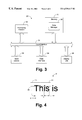
- FIG. 4 is a diagram illustrating a word block.
- FIG. 5 is a flow chart illustrating the architecture and functionality of the communications system depicted by FIG. 3 .
- FIG. 6 is a flow chart illustrating a more detailed view of the flow chart of FIG. 5 .
- FIG. 1A shows an image produced by a display screen 12 of a conventional communications system 14 .
- the communications system 14 has received image based data defining a line of text.
- the complete line reads, “This is a line of text transmitted from a remote location.”
- the width (i.e., distance in the x-direction) of the display screen 12 is too small to display the complete line of text, only a portion of the line of text is visible.
- the user may pan the image to display the remainder of the words in the line, as shown by FIG. 1 B.
- having to pan the image to read the remainder of the line is inconvenient and inefficient.
- FIG. 2 shows a communications system 20 in accordance with the present invention.
- the line of text is displayed by two rows of the display screen 12 such that each word of the line of text is simultaneously visible to the user.
- FIG. 3 shows a more detailed view of the communications system 20 .
- the communications system 20 includes a data interface 24 , a data manager 26 , and a display unit 28 .
- the data interface 24 is configured to receive data that is to be displayed by the display unit 28 .
- the data interface 24 may connect to a telephone connection or other type of medium that connects the data interface 24 with a remote network (not shown) or with a remote communications device (not shown), or the data interface 24 may be configured to receive data stored on a computer disk (not shown).
- the display unit 28 includes a display screen 12 (FIG. 2) that can be used via conventional techniques to display an image based on data received by the display unit 28 .
- the data manager 26 is configured to control the rendering of the data received from data interface 24 .
- the data manager 26 can be implemented in software, hardware, or a combination thereof. In the preferred embodiment, as illustrated by way of example in FIG. 3, the data manager 26 of the present invention along with its associated methodology is implemented in software and stored in computer memory 29 .
- the data manager 26 when implemented in software, can be stored and transported on any computer-readable medium for use by or in connection with an instruction execution system, apparatus, or device, such as a computer-based system, processor-containing system, or other system that can fetch the instructions from the instruction execution system, apparatus, or device and execute the instructions.
- a “computer-readable medium” can be any means that can contain, store, communicate, propagate, or transport the program for use by or in connection with the instruction execution system, apparatus, or device.
- the computer readable medium can be, for example but not limited to, an electronic, magnetic, optical, electromagnetic, infrared, or semiconductor system, apparatus, device, or propagation medium.
- the computer-readable medium would include the following: an electrical connection (electronic) having one or more wires, a portable computer diskette (magnetic), a random access memory (RAM) (magnetic), a read-only memory (ROM) (magnetic), an erasable programmable read-only memory (EPROM or Flash memory) (magnetic), an optical fiber (optical), and a portable compact disc read-only memory (CDROM) (optical).
- an electrical connection electronic having one or more wires
- a portable computer diskette magnetic
- RAM random access memory
- ROM read-only memory
- EPROM or Flash memory erasable programmable read-only memory
- CDROM portable compact disc read-only memory
- the computer-readable medium could even be paper or another suitable medium upon which the program is printed, as the program can be electronically captured, via for instance optical scanning of the paper or other medium, then compiled, interpreted or otherwise processed in a suitable manner if necessary, and then stored in a computer memory.
- the data manager 26 may be magnetically stored and transported on a conventional portable computer diskette.
- one or more conventional processing elements 32 such as a digital signal processor (DSP) communicate to and drive the other elements within the system 20 via a local interface 33 , which can include one or more buses.
- DSP digital signal processor
- an input device 35 can be used to input data from the user of the system 20 .
- the data received by the data interface 24 is image based data. Therefore, the data received by data interface 24 defines an image by providing a value for each pixel associated with the display screen 12 .
- the data manager 26 is preferably configured to divide the image into a plurality of cells and to determine which cells include text.
- OCR optical character recognition
- the image is first separated into a plurality of cells, and then each cell is analyzed to determine which portions of the cells include text and which portions only include background. Thereafter, the cells can be further analyzed to determine which characters are defined by the text so that the text can be defined by ASCII code words.
- a word block is a group of cells that include text defining a part of a particular word.
- FIG. 4 depicts a word block 41 associated with an image of the word “This.”
- Word blocks 41 are separated from other word blocks 41 by a width (i.e., distance in the x-direction) of background that is relatively large compared to the widths of background that separate the characters of a word. Therefore, by analyzing the width of background space between text, the data manager 26 can identify word blocks 41 . As an example, referring to FIG.
- the distance “a” is much smaller than the distance “b.” Therefore, based on the widths of “a” and “b,” the data manager 26 can determine that the text defining the characters “h” and “i” (in the word “This”) are associated with the same word whereas the text defining the characters “s” (in the word “This”) and “i” (in the word “is”) is associated with different words.
- the data manager 26 is designed to identify text that is separated from other text by at least a threshold width as the end of a word, and any text between two adjacent word ends is identified as a portion of a word.
- the text defining “T” and “s” in the word “This” is identified as the ends of the same word by analyzing the width of background space, as described hereinabove. Since the text defining “h” and “i” (in the word “This”) is between the text associated with the word ends, the text defining “h” and “i” (in the word “This”) is also associated with the word block 41 . Note that it is not necessary for the data manager 26 to actually determine the ASCII code for the characters that are included in the identified word. It is sufficient for the data manager 26 to identify which text (and, therefore, which portions of the image based data received by data interface 24 ) are associated with the word block 41 .
- the data manager 26 is designed to transmit the data defining each identified word block 41 to the display unit 28 such that the display screen 12 of the display unit 28 displays multiple rows of text.
- the data manager 26 is configured to define the first row of the display screen 12 with an identified word block 41 .
- the portions of the image based data defining the identified word block 41 are transmitted to the display unit 28 .
- the data manager 26 may transmit to the display unit 28 each cell 44 that includes text associated with the first word block 41 .
- the image produced by this word block 41 is positioned as the first word on the first row of the display screen 12 .
- the data manager 26 is then designed to render each consecutive word block 41 of the text in sequence on the same row of the display screen 12 until the data manager 26 determines that the row is complete.
- the row is complete when the next word block 41 would not be visible on the display screen 12 or, in other words, until the row extends further than a threshold width.
- the threshold width should be less than the width of the display screen 12 .
- the data manager 26 determines that the row is complete, the data manager 26 is designed to render the next word block 41 (and any remaining word blocks 41 ) on the next row until the next row becomes complete. This process is repeated until all of the word blocks 41 have been rendered. Therefore, each word of each row displayed by the screen display 12 is visible to the user, and there is no need for the user to pan the image horizontally (i.e., in the x-direction).
- identifying the data associated with different words may be employed without dividing the image into cells 44 . Any technique capable of identifying the words defined by the image based data is sufficient for implementing the present invention. It should be noted that a word is “identified” when the data and/or cells defining the word is distinguished from the data and/or cells defining the background or other words. It is not necessary for the characters of the word to be determined in order for the word to be “identified.”
- the communications system 20 receives image based data via data interface 24 , as shown by block 52 of FIG. 5 .
- the image based data defines an image having lines or rows of text, such as the row of text depicted by FIGS. 1A and 1B, for example.
- the data manager 26 defines data cells 44 based on the received data, as shown by block 55 .
- the data manager 26 analyzes the cells 44 to identify word blocks 41 , as depicted by block 58 .
- a word block 41 is a group of cells 44 including text that is separated by less than a threshold width. Word blocks 41 can have various shapes and/or sizes, and the aforementioned threshold width preferably corresponds to the maximum width that may exist between characters of the same word.
- the data manager 26 defines multiple rows of text and displays these rows of text on the display screen 12 , as shown by blocks 62 and 65 .
- the data manager 26 selects the first word block 41 that is to be displayed on the row of text. For example, assuming that the image data defines the phrase “This is a line of text transmitted from a remote location,” the data manager selects the word block 41 defining the word “This.”
- the data manager 26 transmits the data defining this first word block 41 to the display unit 28 to be rendered as the first word on the first row of the image produced by the screen display 12 , as shown by block 67 of FIG. 6 . If the first word block 41 is associated with a start of a paragraph, then the image of the first word block 41 should be indented.
- the data manager 26 selects the next word block 41 defined by the data (assuming that another word block 41 exists) and determines whether the next word block 41 fits on the same row of text, as shown by blocks 69 and 71 .
- the next word block 41 fits on the row of text when the image of the next word block 41 can be simultaneously displayed on the same row of the screen display 12 along with the images of all of the other word blocks 41 already defining the row.
- next word block 41 does not fit on the row. Otherwise, the next word block 41 fits on the row and can be rendered or positioned next to the last word block 41 presently on the row, as shown by block 73 . Note that it is desirable to ensure that a minimum separation width exists between the words defined by two adjacent word blocks so that the words can be identified by the user.
- next word block 41 defines the word “is” which is positioned next to the first word block 41 defining the word “This.”
- the data manager 26 determines whether the word block 41 just rendered defines the last word of a paragraph in block 75 . If so, the data manager 26 proceeds to block 65 (FIG. 5 ). Otherwise, the data manager 26 returns to block 69 and determines in block 71 whether the next word block 41 (i.e., the word block 41 defining the word “a” in the foregoing example) fits on the row of text. The aforementioned process is repeated until there are no more word blocks 41 to display, until the next word block 41 will not fit on the row of text being defined by the data manager 26 , or until the end of the paragraph is reached.
- next word block 41 is rendered as the first word on the new row of the display screen 12 , as shown by blocks 62 , 65 and 71 (FIGS. 5 and 6 ). Then, the process of selecting the next word block 41 and rendering the next word block 41 to the same row is repeated, as shown by blocks 69 - 75 .
- the end of the first row displayed by the display screen 12 is reached after the word blocks 41 defining the words “This is a line of text transmitted from a remote” have been rendered.
- the word “location” would not be simultaneously visible with the other words if positioned next to the word “remote” (i.e., since the word block 41 defining the word “remote” does not fit on the same row of the screen display 12 ), the data block 41 defining the word “location” is rendered as the first word of a new row. Therefore, the word “location” is displayed on the new row of the display screen, as shown by FIG. 2 .
- each word block 41 of the data has been rendered. Since none of the rows of text produced by the aforementioned process are wider than the display screen 12 , each word of each row is visible to the user when the row is being displayed by the display screen 12 . Consequently, the user does not need to horizontally pan the image of the display screen 12 in order to read each word of any row.
- the data manager 26 preferably detects the beginning of a paragraph (and, therefore, the end of the preceding paragraph) by analyzing the image based data received at block 52 .
- the beginning of a paragraph is normally indented, or the distance between the text of paragraphs is normally greater than the distance between the textual lines of a paragraph. Therefore, the data manager 26 can detect the beginning or ending of a paragraph by analyzing the width of blank space preceding a line of text or by analyzing the distance between the lines of text defined by the image based data.
- the data manager 26 determines that the line of text is the first line of a paragraph. Furthermore, if the blank space separating a line of text from an adjacent line of text exceeds another threshold value, then the data manager 26 determines that the line of text is either the first line or the last line of a paragraph depending on whether the line of text precedes or follows the adjacent line of text. Once the first and last lines of each paragraph have been determined, the data manager 26 can identify the first and last word blocks 41 in each paragraph.
- the first word block 41 of a paragraph is the first word block 41 on the first line of a paragraph
- the last word block 41 of a paragraph is the last word block 41 on the last line of the paragraph.
Landscapes
- Engineering & Computer Science (AREA)
- Theoretical Computer Science (AREA)
- Audiology, Speech & Language Pathology (AREA)
- Health & Medical Sciences (AREA)
- Computational Linguistics (AREA)
- General Health & Medical Sciences (AREA)
- Physics & Mathematics (AREA)
- General Engineering & Computer Science (AREA)
- General Physics & Mathematics (AREA)
- Artificial Intelligence (AREA)
- Controls And Circuits For Display Device (AREA)
- Digital Computer Display Output (AREA)
- User Interface Of Digital Computer (AREA)
- Mobile Radio Communication Systems (AREA)
- Information Transfer Between Computers (AREA)
Priority Applications (4)
| Application Number | Priority Date | Filing Date | Title |
|---|---|---|---|
| US09/290,047 US6539117B2 (en) | 1999-04-12 | 1999-04-12 | System and method for rendering image based data |
| EP99122948A EP1045312A3 (en) | 1999-04-12 | 1999-11-18 | System and method for rendering image based data |
| JP2000109592A JP2001005582A (ja) | 1999-04-12 | 2000-04-11 | 画像ベースのデータを描画するシステムおよび方法 |
| US10/179,652 US6754391B2 (en) | 1999-04-12 | 2002-06-25 | Systems and methods for rendering image-based data |
Applications Claiming Priority (1)
| Application Number | Priority Date | Filing Date | Title |
|---|---|---|---|
| US09/290,047 US6539117B2 (en) | 1999-04-12 | 1999-04-12 | System and method for rendering image based data |
Related Child Applications (1)
| Application Number | Title | Priority Date | Filing Date |
|---|---|---|---|
| US10/179,652 Division US6754391B2 (en) | 1999-04-12 | 2002-06-25 | Systems and methods for rendering image-based data |
Publications (2)
| Publication Number | Publication Date |
|---|---|
| US20010031087A1 US20010031087A1 (en) | 2001-10-18 |
| US6539117B2 true US6539117B2 (en) | 2003-03-25 |
Family
ID=23114314
Family Applications (2)
| Application Number | Title | Priority Date | Filing Date |
|---|---|---|---|
| US09/290,047 Expired - Lifetime US6539117B2 (en) | 1999-04-12 | 1999-04-12 | System and method for rendering image based data |
| US10/179,652 Expired - Fee Related US6754391B2 (en) | 1999-04-12 | 2002-06-25 | Systems and methods for rendering image-based data |
Family Applications After (1)
| Application Number | Title | Priority Date | Filing Date |
|---|---|---|---|
| US10/179,652 Expired - Fee Related US6754391B2 (en) | 1999-04-12 | 2002-06-25 | Systems and methods for rendering image-based data |
Country Status (3)
| Country | Link |
|---|---|
| US (2) | US6539117B2 (https=) |
| EP (1) | EP1045312A3 (https=) |
| JP (1) | JP2001005582A (https=) |
Cited By (11)
| Publication number | Priority date | Publication date | Assignee | Title |
|---|---|---|---|---|
| US20030122790A1 (en) * | 2002-01-02 | 2003-07-03 | Manish Sharma | Stylus based input devices utilizing a magnetic random access momory array |
| US20030122789A1 (en) * | 2002-01-02 | 2003-07-03 | Manish Sharma | Integrated digitizing tablet and display apparatus and method of operation |
| US20030122788A1 (en) * | 2002-01-02 | 2003-07-03 | Manish Sharma | Integrated digitizing tablet and color display apparatus and method of operation |
| US20040073262A1 (en) * | 2000-11-02 | 2004-04-15 | Cardiac Pacemakers, Inc. | Technique for discriminating between coordinated and uncoordinated cardiac rhythms |
| US20040205602A1 (en) * | 2001-07-25 | 2004-10-14 | Douglas Croeni | Page layout design using geometric interference schema |
| US20050237309A1 (en) * | 2004-04-26 | 2005-10-27 | Manish Sharma | Input device including a layer of particles |
| US7165264B1 (en) * | 2001-07-26 | 2007-01-16 | Digeo, Inc. | Client-side tool for splitting or truncating text strings for interactive television |
| US20100253862A1 (en) * | 2008-01-25 | 2010-10-07 | Mitsuru Takahashi | Projection display device and caption display method |
| US20110115796A1 (en) * | 2009-11-16 | 2011-05-19 | Apple Inc. | Text rendering and display using composite bitmap images |
| US20140071343A1 (en) * | 2012-09-10 | 2014-03-13 | Apple Inc. | Enhanced closed caption feature |
| US9734132B1 (en) * | 2011-12-20 | 2017-08-15 | Amazon Technologies, Inc. | Alignment and reflow of displayed character images |
Families Citing this family (11)
| Publication number | Priority date | Publication date | Assignee | Title |
|---|---|---|---|---|
| US20020056085A1 (en) * | 2000-03-21 | 2002-05-09 | Christer Fahraeus | Method and system for transferring and displaying graphical objects |
| US20040061717A1 (en) * | 2002-09-30 | 2004-04-01 | Menon Rama R. | Mechanism for voice-enabling legacy internet content for use with multi-modal browsers |
| JP4900640B2 (ja) * | 2005-03-30 | 2012-03-21 | 京セラ株式会社 | 携帯端末装置およびその文書表示制御方法 |
| US20070211062A1 (en) * | 2006-03-13 | 2007-09-13 | International Business Machines Corporation | Methods and systems for rendering complex text using glyph identifiers in a presentation data stream |
| US7966557B2 (en) * | 2006-03-29 | 2011-06-21 | Amazon Technologies, Inc. | Generating image-based reflowable files for rendering on various sized displays |
| US8633930B2 (en) * | 2007-03-26 | 2014-01-21 | Apple Inc. | Non-linear text flow |
| CN101984419B (zh) * | 2010-10-21 | 2013-08-28 | 优视科技有限公司 | 用于对网页图片内容进行段落重排的方法及装置 |
| US10169600B2 (en) * | 2015-10-13 | 2019-01-01 | International Business Machines Corporation | Encryption policies for various nodes of a file |
| CN113168271A (zh) * | 2018-12-07 | 2021-07-23 | 三菱电机株式会社 | 输入显示控制装置、输入显示控制方法以及输入显示系统 |
| USD1026932S1 (en) * | 2020-09-18 | 2024-05-14 | Ascender AI LLC | Display screen or portion thereof with animated UI |
| USD1123985S1 (en) * | 2022-12-06 | 2026-04-28 | Read TwoGether Ltd. | Display screen with a graphical user interface |
Citations (15)
| Publication number | Priority date | Publication date | Assignee | Title |
|---|---|---|---|---|
| US5179599A (en) | 1991-06-17 | 1993-01-12 | Hewlett-Packard Company | Dynamic thresholding system for documents using structural information of the documents |
| US5212739A (en) | 1990-10-17 | 1993-05-18 | Hewlett-Packard Company | Noise tolerant optical character recognition system |
| US5237627A (en) | 1991-06-27 | 1993-08-17 | Hewlett-Packard Company | Noise tolerant optical character recognition system |
| US5280367A (en) | 1991-05-28 | 1994-01-18 | Hewlett-Packard Company | Automatic separation of text from background in scanned images of complex documents |
| US5546474A (en) | 1993-12-21 | 1996-08-13 | Hewlett-Packard Company | Detection of photo regions in digital images |
| US5548700A (en) * | 1989-12-29 | 1996-08-20 | Xerox Corporation | Editing text in an image |
| US5553205A (en) | 1992-04-20 | 1996-09-03 | Microsoft Corporation | System and method of transferring a bit-mapped image using raster columns |
| US5596655A (en) | 1992-08-18 | 1997-01-21 | Hewlett-Packard Company | Method for finding and classifying scanned information |
| US5613019A (en) * | 1993-05-20 | 1997-03-18 | Microsoft Corporation | System and methods for spacing, storing and recognizing electronic representations of handwriting, printing and drawings |
| US5634094A (en) * | 1987-10-23 | 1997-05-27 | Canon Kabushiki Kaisha | Text processing apparatus |
| US5734761A (en) * | 1994-06-30 | 1998-03-31 | Xerox Corporation | Editing scanned document images using simple interpretations |
| US5787418A (en) * | 1996-09-03 | 1998-07-28 | International Business Machine Corporation | Find assistant for creating database queries |
| US5897644A (en) * | 1996-09-25 | 1999-04-27 | Sun Microsystems, Inc. | Methods and apparatus for fixed canvas presentations detecting canvas specifications including aspect ratio specifications within HTML data streams |
| US5953735A (en) * | 1991-03-20 | 1999-09-14 | Forcier; Mitchell D. | Script character processing method and system with bit-mapped document editing |
| US6029171A (en) * | 1997-02-10 | 2000-02-22 | Actioneer, Inc. | Method and apparatus for group action processing between users of a collaboration system |
Family Cites Families (3)
| Publication number | Priority date | Publication date | Assignee | Title |
|---|---|---|---|---|
| CA1223366A (en) * | 1984-09-27 | 1987-06-23 | Abijah S. Fox | System for automatic adjustment and editing of handwritten text images |
| US5220649A (en) * | 1991-03-20 | 1993-06-15 | Forcier Mitchell D | Script/binary-encoded-character processing method and system with moving space insertion mode |
| US6195475B1 (en) * | 1998-09-15 | 2001-02-27 | Hewlett-Packard Company | Navigation system for handheld scanner |
-
1999
- 1999-04-12 US US09/290,047 patent/US6539117B2/en not_active Expired - Lifetime
- 1999-11-18 EP EP99122948A patent/EP1045312A3/en not_active Withdrawn
-
2000
- 2000-04-11 JP JP2000109592A patent/JP2001005582A/ja active Pending
-
2002
- 2002-06-25 US US10/179,652 patent/US6754391B2/en not_active Expired - Fee Related
Patent Citations (15)
| Publication number | Priority date | Publication date | Assignee | Title |
|---|---|---|---|---|
| US5634094A (en) * | 1987-10-23 | 1997-05-27 | Canon Kabushiki Kaisha | Text processing apparatus |
| US5548700A (en) * | 1989-12-29 | 1996-08-20 | Xerox Corporation | Editing text in an image |
| US5212739A (en) | 1990-10-17 | 1993-05-18 | Hewlett-Packard Company | Noise tolerant optical character recognition system |
| US5953735A (en) * | 1991-03-20 | 1999-09-14 | Forcier; Mitchell D. | Script character processing method and system with bit-mapped document editing |
| US5280367A (en) | 1991-05-28 | 1994-01-18 | Hewlett-Packard Company | Automatic separation of text from background in scanned images of complex documents |
| US5179599A (en) | 1991-06-17 | 1993-01-12 | Hewlett-Packard Company | Dynamic thresholding system for documents using structural information of the documents |
| US5237627A (en) | 1991-06-27 | 1993-08-17 | Hewlett-Packard Company | Noise tolerant optical character recognition system |
| US5553205A (en) | 1992-04-20 | 1996-09-03 | Microsoft Corporation | System and method of transferring a bit-mapped image using raster columns |
| US5596655A (en) | 1992-08-18 | 1997-01-21 | Hewlett-Packard Company | Method for finding and classifying scanned information |
| US5613019A (en) * | 1993-05-20 | 1997-03-18 | Microsoft Corporation | System and methods for spacing, storing and recognizing electronic representations of handwriting, printing and drawings |
| US5546474A (en) | 1993-12-21 | 1996-08-13 | Hewlett-Packard Company | Detection of photo regions in digital images |
| US5734761A (en) * | 1994-06-30 | 1998-03-31 | Xerox Corporation | Editing scanned document images using simple interpretations |
| US5787418A (en) * | 1996-09-03 | 1998-07-28 | International Business Machine Corporation | Find assistant for creating database queries |
| US5897644A (en) * | 1996-09-25 | 1999-04-27 | Sun Microsystems, Inc. | Methods and apparatus for fixed canvas presentations detecting canvas specifications including aspect ratio specifications within HTML data streams |
| US6029171A (en) * | 1997-02-10 | 2000-02-22 | Actioneer, Inc. | Method and apparatus for group action processing between users of a collaboration system |
Cited By (18)
| Publication number | Priority date | Publication date | Assignee | Title |
|---|---|---|---|---|
| US20040073262A1 (en) * | 2000-11-02 | 2004-04-15 | Cardiac Pacemakers, Inc. | Technique for discriminating between coordinated and uncoordinated cardiac rhythms |
| US20040205602A1 (en) * | 2001-07-25 | 2004-10-14 | Douglas Croeni | Page layout design using geometric interference schema |
| US7165264B1 (en) * | 2001-07-26 | 2007-01-16 | Digeo, Inc. | Client-side tool for splitting or truncating text strings for interactive television |
| US20030122789A1 (en) * | 2002-01-02 | 2003-07-03 | Manish Sharma | Integrated digitizing tablet and display apparatus and method of operation |
| US20030122788A1 (en) * | 2002-01-02 | 2003-07-03 | Manish Sharma | Integrated digitizing tablet and color display apparatus and method of operation |
| US6760016B2 (en) * | 2002-01-02 | 2004-07-06 | Hewlett-Packard Development Company, L.P. | Integrated digitizing tablet and color display apparatus and method of operation |
| US6781578B2 (en) * | 2002-01-02 | 2004-08-24 | Hewlett-Packard Development Company, L.P. | Stylus based input devices utilizing a magnetic random access momory array |
| US6798404B2 (en) * | 2002-01-02 | 2004-09-28 | Hewlett-Packard Development Company, L.P. | Integrated digitizing tablet and display apparatus and method of operation |
| US20030122790A1 (en) * | 2002-01-02 | 2003-07-03 | Manish Sharma | Stylus based input devices utilizing a magnetic random access momory array |
| US20050237309A1 (en) * | 2004-04-26 | 2005-10-27 | Manish Sharma | Input device including a layer of particles |
| US7532203B2 (en) | 2004-04-26 | 2009-05-12 | Samsung Electronic Co., Ltd. | Data input device that utilizes a layer of magnetic particles to store non-volatile input data that is magnetically coupled to an underlying MRAM array |
| US20100253862A1 (en) * | 2008-01-25 | 2010-10-07 | Mitsuru Takahashi | Projection display device and caption display method |
| US8587731B2 (en) * | 2008-01-25 | 2013-11-19 | Nec Display Solutions, Ltd. | Projection display device and caption display method |
| US20110115796A1 (en) * | 2009-11-16 | 2011-05-19 | Apple Inc. | Text rendering and display using composite bitmap images |
| US8922582B2 (en) | 2009-11-16 | 2014-12-30 | Martin J. Murrett | Text rendering and display using composite bitmap images |
| US9734132B1 (en) * | 2011-12-20 | 2017-08-15 | Amazon Technologies, Inc. | Alignment and reflow of displayed character images |
| US20140071343A1 (en) * | 2012-09-10 | 2014-03-13 | Apple Inc. | Enhanced closed caption feature |
| US9628865B2 (en) * | 2012-09-10 | 2017-04-18 | Apple Inc. | Enhanced closed caption feature |
Also Published As
| Publication number | Publication date |
|---|---|
| JP2001005582A (ja) | 2001-01-12 |
| US20010031087A1 (en) | 2001-10-18 |
| US20020164079A1 (en) | 2002-11-07 |
| EP1045312A2 (en) | 2000-10-18 |
| EP1045312A3 (en) | 2006-07-05 |
| US6754391B2 (en) | 2004-06-22 |
Similar Documents
| Publication | Publication Date | Title |
|---|---|---|
| US6539117B2 (en) | System and method for rendering image based data | |
| EP0483936A2 (en) | Pseudo-bar code control of image transmission | |
| JPS6343036B2 (https=) | ||
| WO2004084538A1 (ja) | 画像領域指定機能を有する画像処理装置 | |
| EP0702289A1 (en) | A method of automatically recognizing a language in which digital data are received | |
| JPH0721310A (ja) | 文書認識装置 | |
| US7616813B2 (en) | Background area extraction in document layout analysis | |
| US6269186B1 (en) | Image processing apparatus and method | |
| US7042594B1 (en) | System and method for saving handwriting as an annotation in a scanned document | |
| US6999621B2 (en) | Text discrimination method and related apparatus | |
| JPH07160812A (ja) | 画像処理装置及び方法 | |
| JPH11284846A (ja) | 画像処理装置 | |
| JPH07288679A (ja) | 画像処理装置 | |
| JP3171626B2 (ja) | 文字認識の処理領域・処理条件指定方法 | |
| JPH10232926A (ja) | 画像処理装置及びその方法 | |
| EP0767941B1 (en) | Automatic determination of landscape scan in binary images | |
| US20110007972A1 (en) | Image processing device, image processing method and computer-readable medium | |
| JPH0490083A (ja) | 文字認識装置 | |
| JP2928807B2 (ja) | 認識データ修正装置 | |
| JP2002049890A (ja) | 画像認識装置、画像認識方法および画像認識プログラムを記録したコンピュータ読取可能な記録媒体 | |
| JPH0222427B2 (https=) | ||
| JPH1049602A (ja) | 帳票認識方法 | |
| JPH03164885A (ja) | 光学式文字読取装置 | |
| JPH09282468A (ja) | 画像処理装置およびその方法 | |
| JP2002373341A (ja) | 網掛け領域検出装置、網掛け領域検出方法、プログラムおよび記憶媒体 |
Legal Events
| Date | Code | Title | Description |
|---|---|---|---|
| AS | Assignment |
Owner name: HEWLETT-PACKARD COMPANY, CALIFORNIA Free format text: ASSIGNMENT OF ASSIGNORS INTEREST;ASSIGNOR:CARAU SR., FRANK P.;REEL/FRAME:010138/0100 Effective date: 19990503 Owner name: HEWLETT-PACKARD COMPANY, CALIFORNIA Free format text: ASSIGNMENT OF ASSIGNORS INTEREST;ASSIGNOR:CARAU, FRANK P. SR.;REEL/FRAME:010138/0001 Effective date: 19990503 |
|
| STCF | Information on status: patent grant |
Free format text: PATENTED CASE |
|
| AS | Assignment |
Owner name: HEWLETT-PACKARD DEVELOPMENT COMPANY, L.P., TEXAS Free format text: ASSIGNMENT OF ASSIGNORS INTEREST;ASSIGNOR:HEWLETT-PACKARD COMPANY;REEL/FRAME:013862/0623 Effective date: 20030728 |
|
| FPAY | Fee payment |
Year of fee payment: 4 |
|
| FPAY | Fee payment |
Year of fee payment: 8 |
|
| FPAY | Fee payment |
Year of fee payment: 12 |