US6514336B1 - Method of growing piezoelectric lanthanide gallium crystals - Google Patents
Method of growing piezoelectric lanthanide gallium crystals Download PDFInfo
- Publication number
- US6514336B1 US6514336B1 US09/686,898 US68689800A US6514336B1 US 6514336 B1 US6514336 B1 US 6514336B1 US 68689800 A US68689800 A US 68689800A US 6514336 B1 US6514336 B1 US 6514336B1
- Authority
- US
- United States
- Prior art keywords
- group
- elements selected
- exceeding
- lanthanide
- value
- Prior art date
- Legal status (The legal status is an assumption and is not a legal conclusion. Google has not performed a legal analysis and makes no representation as to the accuracy of the status listed.)
- Expired - Lifetime, expires
Links
- 239000013078 crystal Substances 0.000 title claims abstract description 174
- 238000000034 method Methods 0.000 title claims abstract description 80
- 229910052733 gallium Inorganic materials 0.000 title claims abstract description 50
- GYHNNYVSQQEPJS-UHFFFAOYSA-N Gallium Chemical compound [Ga] GYHNNYVSQQEPJS-UHFFFAOYSA-N 0.000 title claims abstract description 47
- 229910052747 lanthanoid Inorganic materials 0.000 title claims abstract description 36
- 150000002602 lanthanoids Chemical class 0.000 title claims abstract description 36
- 239000000155 melt Substances 0.000 claims abstract description 37
- 239000000203 mixture Substances 0.000 claims abstract description 35
- 238000012546 transfer Methods 0.000 claims abstract description 4
- 229910052746 lanthanum Inorganic materials 0.000 claims description 41
- 229910052777 Praseodymium Inorganic materials 0.000 claims description 40
- 229910052684 Cerium Inorganic materials 0.000 claims description 39
- 229910052732 germanium Inorganic materials 0.000 claims description 32
- 229910052779 Neodymium Inorganic materials 0.000 claims description 31
- 229910052788 barium Inorganic materials 0.000 claims description 30
- 229910052791 calcium Inorganic materials 0.000 claims description 30
- 229910052745 lead Inorganic materials 0.000 claims description 29
- 229910052710 silicon Inorganic materials 0.000 claims description 29
- 229910052712 strontium Inorganic materials 0.000 claims description 29
- QVGXLLKOCUKJST-UHFFFAOYSA-N atomic oxygen Chemical compound [O] QVGXLLKOCUKJST-UHFFFAOYSA-N 0.000 claims description 25
- 229910052760 oxygen Inorganic materials 0.000 claims description 25
- 239000001301 oxygen Substances 0.000 claims description 25
- 239000000126 substance Substances 0.000 claims description 23
- 229910052715 tantalum Inorganic materials 0.000 claims description 22
- 229910052720 vanadium Inorganic materials 0.000 claims description 21
- 229910052787 antimony Inorganic materials 0.000 claims description 20
- 229910052738 indium Inorganic materials 0.000 claims description 20
- 229910052718 tin Inorganic materials 0.000 claims description 20
- 229910052758 niobium Inorganic materials 0.000 claims description 18
- 229910052731 fluorine Inorganic materials 0.000 claims description 14
- 239000011737 fluorine Substances 0.000 claims description 14
- 238000002109 crystal growth method Methods 0.000 claims description 12
- 229910052741 iridium Inorganic materials 0.000 claims description 12
- 229910052719 titanium Inorganic materials 0.000 claims description 12
- FZLIPJUXYLNCLC-UHFFFAOYSA-N lanthanum atom Chemical compound [La] FZLIPJUXYLNCLC-UHFFFAOYSA-N 0.000 claims description 11
- 229910052735 hafnium Inorganic materials 0.000 claims description 10
- 229910052726 zirconium Inorganic materials 0.000 claims description 10
- 230000009471 action Effects 0.000 claims description 4
- 230000008878 coupling Effects 0.000 claims description 4
- 238000010168 coupling process Methods 0.000 claims description 4
- 238000005859 coupling reaction Methods 0.000 claims description 4
- 238000007493 shaping process Methods 0.000 claims description 4
- 229910052693 Europium Inorganic materials 0.000 claims description 3
- 229910052772 Samarium Inorganic materials 0.000 claims description 3
- 229910052706 scandium Inorganic materials 0.000 claims description 3
- 229910052692 Dysprosium Inorganic materials 0.000 claims description 2
- 229910052691 Erbium Inorganic materials 0.000 claims description 2
- 229910052688 Gadolinium Inorganic materials 0.000 claims description 2
- 229910052689 Holmium Inorganic materials 0.000 claims description 2
- 229910052771 Terbium Inorganic materials 0.000 claims description 2
- 229910052776 Thorium Inorganic materials 0.000 claims description 2
- 229910052775 Thulium Inorganic materials 0.000 claims description 2
- 229910052769 Ytterbium Inorganic materials 0.000 claims description 2
- 238000007792 addition Methods 0.000 claims description 2
- 229910052782 aluminium Inorganic materials 0.000 claims description 2
- 229910052785 arsenic Inorganic materials 0.000 claims description 2
- 229910052790 beryllium Inorganic materials 0.000 claims description 2
- 229910052796 boron Inorganic materials 0.000 claims description 2
- 229910052793 cadmium Inorganic materials 0.000 claims description 2
- 229910052792 caesium Inorganic materials 0.000 claims description 2
- 229910052729 chemical element Inorganic materials 0.000 claims description 2
- 229910052804 chromium Inorganic materials 0.000 claims description 2
- 229910052802 copper Inorganic materials 0.000 claims description 2
- 229910052737 gold Inorganic materials 0.000 claims description 2
- 229910052742 iron Inorganic materials 0.000 claims description 2
- 229910052744 lithium Inorganic materials 0.000 claims description 2
- 229910052749 magnesium Inorganic materials 0.000 claims description 2
- 229910052748 manganese Inorganic materials 0.000 claims description 2
- 229910052753 mercury Inorganic materials 0.000 claims description 2
- 229910052750 molybdenum Inorganic materials 0.000 claims description 2
- 229910052759 nickel Inorganic materials 0.000 claims description 2
- 229910052762 osmium Inorganic materials 0.000 claims description 2
- 229910052763 palladium Inorganic materials 0.000 claims description 2
- 229910052698 phosphorus Inorganic materials 0.000 claims description 2
- 229910052697 platinum Inorganic materials 0.000 claims description 2
- 229910052700 potassium Inorganic materials 0.000 claims description 2
- 229910052702 rhenium Inorganic materials 0.000 claims description 2
- 229910052703 rhodium Inorganic materials 0.000 claims description 2
- 229910052707 ruthenium Inorganic materials 0.000 claims description 2
- 229910052709 silver Inorganic materials 0.000 claims description 2
- 229910052708 sodium Inorganic materials 0.000 claims description 2
- 229910052721 tungsten Inorganic materials 0.000 claims description 2
- LEONUFNNVUYDNQ-UHFFFAOYSA-N vanadium atom Chemical compound [V] LEONUFNNVUYDNQ-UHFFFAOYSA-N 0.000 claims description 2
- 229910052727 yttrium Inorganic materials 0.000 claims description 2
- 229910052725 zinc Inorganic materials 0.000 claims description 2
- YCKRFDGAMUMZLT-UHFFFAOYSA-N Fluorine atom Chemical compound [F] YCKRFDGAMUMZLT-UHFFFAOYSA-N 0.000 claims 5
- 238000010897 surface acoustic wave method Methods 0.000 abstract description 20
- 235000012431 wafers Nutrition 0.000 abstract description 12
- 238000004519 manufacturing process Methods 0.000 abstract description 11
- 239000011575 calcium Substances 0.000 description 12
- XKRFYHLGVUSROY-UHFFFAOYSA-N Argon Chemical compound [Ar] XKRFYHLGVUSROY-UHFFFAOYSA-N 0.000 description 10
- GKOZUEZYRPOHIO-UHFFFAOYSA-N iridium atom Chemical compound [Ir] GKOZUEZYRPOHIO-UHFFFAOYSA-N 0.000 description 10
- PXGOKWXKJXAPGV-UHFFFAOYSA-N Fluorine Chemical compound FF PXGOKWXKJXAPGV-UHFFFAOYSA-N 0.000 description 9
- 239000000463 material Substances 0.000 description 8
- 239000000843 powder Substances 0.000 description 8
- 238000001816 cooling Methods 0.000 description 7
- 238000002425 crystallisation Methods 0.000 description 7
- 230000008025 crystallization Effects 0.000 description 7
- 238000010438 heat treatment Methods 0.000 description 7
- 230000008569 process Effects 0.000 description 7
- IJGRMHOSHXDMSA-UHFFFAOYSA-N Atomic nitrogen Chemical compound N#N IJGRMHOSHXDMSA-UHFFFAOYSA-N 0.000 description 6
- 238000000137 annealing Methods 0.000 description 6
- 229910052786 argon Inorganic materials 0.000 description 5
- 238000001035 drying Methods 0.000 description 5
- 238000002156 mixing Methods 0.000 description 5
- 239000007858 starting material Substances 0.000 description 5
- 239000000758 substrate Substances 0.000 description 5
- CURLTUGMZLYLDI-UHFFFAOYSA-N Carbon dioxide Chemical compound O=C=O CURLTUGMZLYLDI-UHFFFAOYSA-N 0.000 description 4
- 238000005231 Edge Defined Film Fed Growth Methods 0.000 description 4
- BPQQTUXANYXVAA-UHFFFAOYSA-N Orthosilicate Chemical compound [O-][Si]([O-])([O-])[O-] BPQQTUXANYXVAA-UHFFFAOYSA-N 0.000 description 4
- 239000012298 atmosphere Substances 0.000 description 4
- 238000012512 characterization method Methods 0.000 description 4
- 239000012300 argon atmosphere Substances 0.000 description 3
- 238000010276 construction Methods 0.000 description 3
- 238000005520 cutting process Methods 0.000 description 3
- QZQVBEXLDFYHSR-UHFFFAOYSA-N gallium(III) oxide Inorganic materials O=[Ga]O[Ga]=O QZQVBEXLDFYHSR-UHFFFAOYSA-N 0.000 description 3
- MRELNEQAGSRDBK-UHFFFAOYSA-N lanthanum oxide Inorganic materials [O-2].[O-2].[O-2].[La+3].[La+3] MRELNEQAGSRDBK-UHFFFAOYSA-N 0.000 description 3
- 239000007788 liquid Substances 0.000 description 3
- 238000002844 melting Methods 0.000 description 3
- 230000008018 melting Effects 0.000 description 3
- 229910052757 nitrogen Inorganic materials 0.000 description 3
- KTUFCUMIWABKDW-UHFFFAOYSA-N oxo(oxolanthaniooxy)lanthanum Chemical compound O=[La]O[La]=O KTUFCUMIWABKDW-UHFFFAOYSA-N 0.000 description 3
- 238000003825 pressing Methods 0.000 description 3
- 239000007787 solid Substances 0.000 description 3
- VYPSYNLAJGMNEJ-UHFFFAOYSA-N Silicium dioxide Chemical compound O=[Si]=O VYPSYNLAJGMNEJ-UHFFFAOYSA-N 0.000 description 2
- 239000001569 carbon dioxide Substances 0.000 description 2
- 229910002092 carbon dioxide Inorganic materials 0.000 description 2
- 238000013461 design Methods 0.000 description 2
- 230000002708 enhancing effect Effects 0.000 description 2
- 230000008014 freezing Effects 0.000 description 2
- 238000007710 freezing Methods 0.000 description 2
- 239000011810 insulating material Substances 0.000 description 2
- 238000012986 modification Methods 0.000 description 2
- 230000004048 modification Effects 0.000 description 2
- ZKATWMILCYLAPD-UHFFFAOYSA-N niobium pentoxide Chemical compound O=[Nb](=O)O[Nb](=O)=O ZKATWMILCYLAPD-UHFFFAOYSA-N 0.000 description 2
- 239000006104 solid solution Substances 0.000 description 2
- 238000004781 supercooling Methods 0.000 description 2
- OYPRJOBELJOOCE-UHFFFAOYSA-N Calcium Chemical compound [Ca] OYPRJOBELJOOCE-UHFFFAOYSA-N 0.000 description 1
- XUIMIQQOPSSXEZ-UHFFFAOYSA-N Silicon Chemical compound [Si] XUIMIQQOPSSXEZ-UHFFFAOYSA-N 0.000 description 1
- 230000004075 alteration Effects 0.000 description 1
- 238000004458 analytical method Methods 0.000 description 1
- DSAJWYNOEDNPEQ-UHFFFAOYSA-N barium atom Chemical compound [Ba] DSAJWYNOEDNPEQ-UHFFFAOYSA-N 0.000 description 1
- 230000015556 catabolic process Effects 0.000 description 1
- 230000010267 cellular communication Effects 0.000 description 1
- 229910052681 coesite Inorganic materials 0.000 description 1
- 238000005336 cracking Methods 0.000 description 1
- 229910052906 cristobalite Inorganic materials 0.000 description 1
- 238000006731 degradation reaction Methods 0.000 description 1
- 238000009826 distribution Methods 0.000 description 1
- 230000008030 elimination Effects 0.000 description 1
- 238000003379 elimination reaction Methods 0.000 description 1
- 238000007667 floating Methods 0.000 description 1
- DPANTMKNJKZCOY-UHFFFAOYSA-N gallium tantalum Chemical compound [Ga][Ta] DPANTMKNJKZCOY-UHFFFAOYSA-N 0.000 description 1
- GNPVGFCGXDBREM-UHFFFAOYSA-N germanium atom Chemical compound [Ge] GNPVGFCGXDBREM-UHFFFAOYSA-N 0.000 description 1
- 239000012535 impurity Substances 0.000 description 1
- 230000001939 inductive effect Effects 0.000 description 1
- 239000011261 inert gas Substances 0.000 description 1
- 238000003780 insertion Methods 0.000 description 1
- 230000037431 insertion Effects 0.000 description 1
- 238000011835 investigation Methods 0.000 description 1
- JEIPFZHSYJVQDO-UHFFFAOYSA-N iron(III) oxide Inorganic materials O=[Fe]O[Fe]=O JEIPFZHSYJVQDO-UHFFFAOYSA-N 0.000 description 1
- YOBAEOGBNPPUQV-UHFFFAOYSA-N iron;trihydrate Chemical compound O.O.O.[Fe].[Fe] YOBAEOGBNPPUQV-UHFFFAOYSA-N 0.000 description 1
- 230000005499 meniscus Effects 0.000 description 1
- 239000012299 nitrogen atmosphere Substances 0.000 description 1
- 239000008188 pellet Substances 0.000 description 1
- 230000000704 physical effect Effects 0.000 description 1
- 238000012545 processing Methods 0.000 description 1
- 229910052761 rare earth metal Inorganic materials 0.000 description 1
- 150000002910 rare earth metals Chemical group 0.000 description 1
- 239000011819 refractory material Substances 0.000 description 1
- SIXSYDAISGFNSX-UHFFFAOYSA-N scandium atom Chemical compound [Sc] SIXSYDAISGFNSX-UHFFFAOYSA-N 0.000 description 1
- 239000010703 silicon Substances 0.000 description 1
- 239000000377 silicon dioxide Substances 0.000 description 1
- 238000007711 solidification Methods 0.000 description 1
- 230000008023 solidification Effects 0.000 description 1
- 229910052682 stishovite Inorganic materials 0.000 description 1
- 238000006467 substitution reaction Methods 0.000 description 1
- GUVRBAGPIYLISA-UHFFFAOYSA-N tantalum atom Chemical compound [Ta] GUVRBAGPIYLISA-UHFFFAOYSA-N 0.000 description 1
- PBCFLUZVCVVTBY-UHFFFAOYSA-N tantalum pentoxide Inorganic materials O=[Ta](=O)O[Ta](=O)=O PBCFLUZVCVVTBY-UHFFFAOYSA-N 0.000 description 1
- 238000007669 thermal treatment Methods 0.000 description 1
- 229910052905 tridymite Inorganic materials 0.000 description 1
- 238000009736 wetting Methods 0.000 description 1
Images




Classifications
-
- C—CHEMISTRY; METALLURGY
- C30—CRYSTAL GROWTH
- C30B—SINGLE-CRYSTAL GROWTH; UNIDIRECTIONAL SOLIDIFICATION OF EUTECTIC MATERIAL OR UNIDIRECTIONAL DEMIXING OF EUTECTOID MATERIAL; REFINING BY ZONE-MELTING OF MATERIAL; PRODUCTION OF A HOMOGENEOUS POLYCRYSTALLINE MATERIAL WITH DEFINED STRUCTURE; SINGLE CRYSTALS OR HOMOGENEOUS POLYCRYSTALLINE MATERIAL WITH DEFINED STRUCTURE; AFTER-TREATMENT OF SINGLE CRYSTALS OR A HOMOGENEOUS POLYCRYSTALLINE MATERIAL WITH DEFINED STRUCTURE; APPARATUS THEREFOR
- C30B15/00—Single-crystal growth by pulling from a melt, e.g. Czochralski method
-
- C—CHEMISTRY; METALLURGY
- C30—CRYSTAL GROWTH
- C30B—SINGLE-CRYSTAL GROWTH; UNIDIRECTIONAL SOLIDIFICATION OF EUTECTIC MATERIAL OR UNIDIRECTIONAL DEMIXING OF EUTECTOID MATERIAL; REFINING BY ZONE-MELTING OF MATERIAL; PRODUCTION OF A HOMOGENEOUS POLYCRYSTALLINE MATERIAL WITH DEFINED STRUCTURE; SINGLE CRYSTALS OR HOMOGENEOUS POLYCRYSTALLINE MATERIAL WITH DEFINED STRUCTURE; AFTER-TREATMENT OF SINGLE CRYSTALS OR A HOMOGENEOUS POLYCRYSTALLINE MATERIAL WITH DEFINED STRUCTURE; APPARATUS THEREFOR
- C30B29/00—Single crystals or homogeneous polycrystalline material with defined structure characterised by the material or by their shape
- C30B29/10—Inorganic compounds or compositions
- C30B29/16—Oxides
- C30B29/22—Complex oxides
- C30B29/30—Niobates; Vanadates; Tantalates
Definitions
- the SAW devices are currently used, for example, as bandpass filters, resonators, delay lines and converters, in a broad range of wireless applications, cellular communication devices and cable TV.
- Piezoelectric material based on lanthanide gallium crystals including the langasite family of crystals, i.e. La 3 Ga 3 SiO 14 , referred to as langasite (LGS), La 3 Ga 5.5 Nb 0.5 O 14 , referred to as langanite (LGN), and langatate La 3 Ga 5.5 Ta 0.5 O 14 (LGT) are known to be useful for piezoelectric applications.
- LGS langasite
- LGN La 3 Ga 5.5 Nb 0.5 O 14
- LGT langatate La 3 Ga 5.5 Ta 0.5 O 14
- a SAW device having a LGS single crystal substrate is disclosed in U.S. Pat. No. 5,821,673, U.K. Pat. No 2,328,815, RU Pat. No 2073952, and U.S. Pat. No. 5,917,265.
- a LGT single crystal substrate having a prescribed range of Euler angles for substrate and crystal orientation to improve signal processing in a SAWdevice, is disclosed in U.S. Pat. No. 6,097,
- a SAW device comprising a wafer constructed of a trigonal langasite crystal cut at predominated cut angles is disclosed in U.S. Pat. No. 5,981,673.
- An optimal cut for SAW devices made from langatate crystals is disclosed in U.S. Pat. No. 6,097,131.
- a substrate for piezoelectric device and SAW devices composed of a single crystal of langanite is proposed in JP Pat. No 11106294A.
- the crystallization process also depends on the conditions of heat and mass exchange in the crystal-melt system, which is generally described in the publication “Some aspects of the macroscopic theory of oriented crystallization from the melt”, E. A. Brener and V. A. Tatarchenko, Acta Physica Academias scientiarum Hungaricas, 47 (1-3) (1979) 133-138.
- a Stepanov crystal growth method based on a capillary formed pole of melt by means of a special mould and the crystallization of the pole outside the container is generally described in “Capillary shaping in crystal growth from melts” V. A. Tatarchenko, Journal of Crystal Growth 37 (1977) 272-284 and “Crystallization stability during capillary shaping” G, I.
- EFG crystal growth method is a method of profiled crystal growth or a method of edge defined film fed growth.
- the capillary action shaping technique, CAST differs from the EFG technique in the construction of the forming mould and a presence of forced inert gas cooling.
- the Stepanov, EFG and CAST methods are described in the publication “Growth the profiled single crystals by Stepanov technique” P. I. Antonov, L. M. Zatulovskii, A. C. Kostyugov, (eds) Leningrad “Nauka” (1981) 280 pp.
- the method proposed for growing a piezoelectric material based on lanthanide gallium crystals is the conventional Czochralski crystal growth method.
- the growth of the langasite family of crystals by the Czochralski method is accurately described in “Investigation of trigonal (La 1-x Nd x ) 3 Ga 2 SiO 14 crystals” A. A. Kaminskii, B. V. Mill, G. G. Khodzhabagyan, A. F. Konstantinova, A. I. Okorochkov, and I. M.
- a method of growing single crystals of lanthanum-gallium silicate is disclosed in RU Pat. No 2126064, RU Pat. No 2143015, RU Pat. No 2126063, RU Pat. No 2108417, RU Pat. No 2108418, and W.O. Pat. No 9961686A1.
- the essence of the method consists in the selection of the orientation of the seed crystal ensuring growth by the Czochralski method of single crystals of lanthanum-gallium silicate along the directions ⁇ 01.1>, ⁇ 02.1>, ⁇ 02.3>, ⁇ 03.2> or at 54 degrees to the “Y” axis.
- a method of growing of lanthanum gallium tantalum single crystal (LGT) is disclosed in JP Pat. No 11322495A and JP Pat. No 11199392A in which langatate crystals are doped with Pr, Nd, Ce, Sm and Eu impurities are grown by the Czochralski method.
- the lanthanide gallium melt needs to be held (soaked) at a certain temperature for a considerable time (4-20 hours).
- An appropriate thermal treatment of the melt is needed in order to obtain stable physical properties, which then permits further precise control of the melt temperature.
- An associated problem is the duration of the growth process and therefore its cost increases by up to 30%.
- the present invention provides a method for producing lanthanide gallium crystals in which, to control heat and mass transfer and to maintain a steady state of crystal melt interface, the growing crystal is pulled through a forming mould dipped into the melt contained in a crucible. While a lanthanide gallium single crystal is growing, a mixed oxide charge of the same composition as the melt may be continuously added to the melt such that the quantity of melt is maintained substantially stable. Crystals produced by this method exhibit less variability in piezoelectric properties.
- the shape of the solid-liquid interface is determined by the shape of the freezing isotherm. Consequently, the objects of the invention are achieved by controlling the shape of the freezing isotherm during the main part of the crystal growth. There may be some variation from the desired conditions at the beginning and the end of the growth.
- the thermal conditions are determined by the crucible and forming mould sizes and their location in the heating environment as well as the furnace design and the insulating material employed.
- the preferred embodiments of the present invention also provide an optimal growth direction for the crystal aligned with axis perpendicular to such a crystallographic plane of lanthanide gallium crystal that an improved temperature stability, lower power flow angle, and reduced diffraction are present in a SAW device cut in this plane. Consequently, the other objects of the invention are achieved by choosing an optimum growth direction for piezoelectric applications independently of the crystallization rate. Optimal orientation allows the cutting of wafers at an angle of 90 degrees to growth axis to ensure minimal losses of material. This also means that the temperature coefficient of frequency in the wafer is close to zero.
- the optimally oriented lanthanum gallium crystals which are grown are more suitable for the mass-production slicing of crystals into wafers for SAW devices, suitable sizes of which may be 2 inches or more in diameter.
- FIG. 1 shows a schematic view of the different furnaces used to produce different sizes of piezoelectric lanthanum gallium single crystals
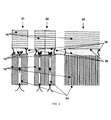
- FIG. 2 a is a schematic showing the seed crystal oriented along the crystallographic z-axis and the optimally oriented wafers cut from grown boule;
- FIG. 2 b is a schematic showing the seed crystal oriented at a degrees to the “Y” axis and the optimally oriented wafers cut from grown boule;
- FIG. 3 shows the different constructions of forming moulds
- FIGS. 4 a and 4 b are tables of the results of growing crystals using various compositions and the parameters used in the growing operation.
- Crystal growth is accomplished with a crystal grower machine (Kristall-3M) which includes a furnace as shown in FIG. 1 .
- the furnace comprises a housing 10 formed from refractory and insulating materials and having a crucible 11 located therein.
- the crucible 11 holds a forming mould 14 dipped into a melt 15 .
- the housing includes an aperture for insertion of a seed crystal 12 .
- An RF inductive heating coil 13 surrounds the housing 10 at the level of the crucible 11 .
- Ln 3+ is at least one of the elements selected from the group consisting of La, Ce, Pr, and Nd
- Me 2+ is at least one of the elements selected from the group consisting of Ca, Sr, Ba, and Pb
- Me 3+ is at least one of the elements selected from the group consisting of Ga, Sc, and In
- Me 4+ is at least one of the elements selected from the group consisting of Si and Ge
- Me 5+ is at least one of the elements selected from the group consisting of Nb, Ta, Sb, and V
- x is a value not exceeding one
- y is a value not exceeding (2 ⁇ x); 0.92 ⁇ a ⁇ 1.07; 0.9 ⁇ b ⁇ 1.1; and 0.99 ⁇ c ⁇ 1.02
- Ln 3+ is at least one of the elements selected from the group consisting of La, Ce, Pr, and Nd
- Me 2+ is at least one of the elements selected from the group consisting of Ca, Sr, Ba, and Pb
- Me 4+ is at least one of the elements selected from the group consisting of Ti, Zr, Hf, Sn, Ce, Pr, Si and Ge
- Me 5+ is at least one of the elements selected from the group consisting of Nb, Ta, Sb, and V
- x is a value not exceeding one
- y is a value not exceeding (2 ⁇ x); 0.86 ⁇ a ⁇ 1.1; 0.85 ⁇ b ⁇ 1.3; and 0.94 ⁇ c ⁇ 1.08
- Ln 3+ is at least one of the elements selected from the group consisting of La, Ce, Pr, and Nd
- Me 2+ is at least one of the elements selected from the group consisting of Ca, Sr, Ba, and Pb
- Me 3+ is at least one of the elements selected from the group consisting of Ga, Sc, and In
- Me 4+ is at least one of the elements selected from the group consisting of Si, Ge, and Sn
- x is a value not exceeding two; 0.86 ⁇ a ⁇ 1.1; 0.85 ⁇ b ⁇ 1.3; and 0.94 ⁇ c ⁇ 1.08
- Ln 3+ is at least one of the elements selected from the group consisting of La, Ce, Pr, and Nd
- Me 2+ is at least one of the elements selected from the group consisting of Ca, Sr, Ba, and Pb
- Me 3+ is at least one of the elements selected from the group consisting of Ga, Sc, and In
- Me 4+ is at least one of the elements selected from the group consisting of Si and Ge
- Me 5+ is at least one of the elements selected from the group consisting of Nb, Ta, Sb, and V
- ⁇ represents oxygen vacancies of quantity z not exceeding 0.2 formula units
- x is a value not exceeding one
- y is a value not exceeding (2 ⁇ x); 0.92 ⁇ a ⁇ 1.07; 0.9 ⁇ b ⁇ 1.1; and 0.99 ⁇ c ⁇ 1.02
- Ln 3+ is at least one of the elements selected from the group consisting of La, Ce, Pr, and Nd
- Me 2+ is at least one of the elements selected from the group consisting of Ca, Sr, Ba, and Pb
- Me 4+ is at least one of the elements selected from the group consisting of Ti, Zr, Hf, Sn, Ce, Pr, Si and Ge
- Me 5+ is at least one of the elements selected from the group consisting of Nb, Ta, Sb, and V
- ⁇ represents oxygen vacancies of quantity z not exceeding 0.2 formula units
- x is a value not exceeding one
- y is a value not exceeding (2 ⁇ x); 0.86 ⁇ a ⁇ 1.1; 0.85 ⁇ b ⁇ 1.3; and 0.94 ⁇ c ⁇ 1.08
- Ln 3+ is at least one of the elements selected from the group consisting of La, Ce, Pr, and Nd
- Me 2+ is at least one of the elements selected from the group consisting of Ca, Sr, Ba, and Pb
- Me 3+ is at least one of the elements selected from the group consisting of Ga, Sc, and In
- Me 4+ is at least one of the elements selected from the group consisting of Si, Ge, and Sn
- ⁇ represents oxygen vacancies of quantity z not exceeding 0.2 formula units
- x is a value not exceeding a two; 0.86 ⁇ a ⁇ 1.1; 0.85 ⁇ b ⁇ 1.3; and 0.94 ⁇ c ⁇ 1.08
- Ln 3+ is at least one of the elements selected from the group consisting of La, Ce, Pr, and Nd
- Me 2+ is at least one of the elements selected from the group consisting of Ca, Sr, Ba, and Pb
- Me 3+ is at least one of the elements selected from the group consisting of Ga, Sc, and In
- Me 4+ is at least one of the elements selected from the group consisting of Si and Ge
- Me 5+ is at least one of the elements selected from the group consisting of Nb, Ta, Sb, and V
- F z is fluorine of quantity z not exceeding 0.2 formula units
- x is a value not exceeding one
- y is a value not exceeding (2 ⁇ x); 0.92 ⁇ a ⁇ 1.07; 0.9 ⁇ b ⁇ 1.1; and 0.99 ⁇ c ⁇ 1.02.
- Ln 3+ is at least one of the elements selected from the group consisting of La, Ce, Pr, and Nd
- Me 4+ is at least one of the elements selected from the group consisting of Ca, Sr, Ba, and Pb
- Me 4+ is at least one of the elements selected from the group consisting of Ti, Zr, Hf, Sn, Ce, Pr, Si and Ge
- Me 5+ is at least one of the elements selected from the group consisting of Nb, Ta, Sb, and V
- F z is fluorine of quantity z not exceeding 0.2 formula units
- x is a value not exceeding unit
- y is a value not exceeding (2 ⁇ x); 0.86 ⁇ a ⁇ 1.1; 0.85 ⁇ b ⁇ 1.3; and 0.94 ⁇ c ⁇ 1.08.
- Ln 3+ is at least one of the elements selected from the group consisting of La, Ce, Pr, and Nd
- Me 2+ is at least one of the elements selected from the group consisting of Ca, Sr, Ba, and Pb
- Me 3+ is at least one of the elements selected from the group consisting of Ga, Sc, and In
- Me 4+ is at least one of the elements selected from the group consisting of Si, Ge, and Sn
- F z is fluorine of quantity z not exceeding 0.2 formula units
- x is a value not exceeding two; 0.86 ⁇ a ⁇ 1.1; 0.85 ⁇ b ⁇ 1.3; and 0.94 ⁇ c ⁇ 1.08.
- the raw oxide powder materials mentioned in formulae (1)-(9) are dried at 1000° C. then mixed in the appropriate proportions and pressed into pellets (where appropriate), and loaded into the crucible.
- the materials are then melted and the melt 15 may be doped with the oxides of micro additions of the chemical elements Li, Be, B, Na, Mg, Al, P, K, Ca, Sc, Ti, V, Cr, Mn, Fe, Co, Ni, Cu, Zn, Ge, As, Se, Rb, Sr, Y, Mo, Ru, Rh, Pd, Ag, Cd, In, Sn, Sb, Cs, Ba, Ce, Sm, Eu, Gd, Tb, Dy, Ho, Er, Tm, Yb, Lu, Hf, Ta, W, Re, Os, Ir, Pt, Au, Hg, TI, Pb, Bi, U, Th at a quantity between 1 ⁇ 10 17 atom/cm 3 and 5 ⁇ 10 19 atom/cm 3 .
- the seed crystal 12 may be arbitrary orientated, including orientation coinciding with the Z-axis (see FIG. 2 a ) or orientation aligned with the ⁇ -Y axis perpendicular to a crystallographic plane of lanthanum gallium crystal (FIG. 2 b ). Crystals sliced along the crystallographic plane have an optimized combination of a minimal power flow angle, a minimal temperature coefficient of frequency, negligible diffraction, and high electromechanical coupling factor. With an ⁇ -Y axis orientation it is possible to cut wafers 30 at an angle of 90 degrees to the growth axis to ensure minimal losses of material and a crystal temperature coefficient of frequency close to zero.
- the seed crystal 12 oriented at ⁇ degrees to the “Y” axis or having another optimal orientation or an arbitrary orientation, is brought in contact with the surface of the melt 15 .
- the growing crystal 16 is drawn from the melt 15 through the forming mould 14 dipped in the melt 15 .
- the forming moulds 14 are fixed independently of the crucible 11 to facilitate mould replacement and prevent deformation on the melt 15 solidification.
- the forming mould is set in crucible 11 to control heat and mass transfer and to maintain a steady state of the crystal melt interface.
- the main task to solve is the creation of a temperature distribution near the solid-liquid interface such that the profile of isotherms in the melt 15 define geometrical form of the pulling crystal.
- the forming mould 14 has an arbitrary cross-sectional form including round or square, and a height less than the crucible 11 height.
- Different constructions of forming moulds 14 used in Stepanov's, EFG and CAST crystal growth methods are presented in FIG. 3 .
- the single-capillary 31 , double-capillary 32 , and multi-capillary 33 forming mould designs are presented as examples.
- the capillary moulds for types 31 and 32 comprise two or more parallel vertical plates 38 of equal length and 1 mm thickness, with a 1 mm-space to provide the capillary action.
- the multi-capillary moulds 33 have from 20 to 120 channels with 0.1 mm deep grooves on the surface of the plates. While the crystal is drawn through a forming mould the melt 15 moves up in capillary channels 34 under action of surface tension forces as a result of wetting 35 of the walls.
- the crystals are grown in an argon atmosphere, in a mixture of argon and oxygen (the content of oxygen is up to 20 vol %), in a mixture of argon and carbon dioxide (the content of carbon dioxide is up to 20 vol %), in a mixture of argon and fluorine (the content of fluorine is up to 3 vol %), in a nitrogen atmosphere, in a mixture of nitrogen and oxygen (the content of oxygen is up to 20 vol %), or in a mixture of nitrogen and fluorine (the content of fluorine is up to 3 vol %).
- the crystals grown varied from colourless, through pale yellow and dark orange, to oxblood red in colour, depending on the oxygen content in the atmosphere in the growth chamber.
- a high oxygen content (approximately 8-20 vol % of oxygen) yields the oxblood red colour, whereas an oxygen content of about 2-8 vol % yields the darker orange colour.
- the crystals grown in an oxygen free atmosphere were colourless. This shading colour is caused by oxygen vacancies formed, the quantity of which depends on the amount of oxygen in the growth atmosphere.
- the crystal is drawn through a forming mould when the pulling speed is in the range 0.1 mm per hour-3 mm per hour.
- the crystal growth is actualized both with and without rotation of the seed crystal.
- the crystal When the crystal is grown from the melt 15 without rotation, its cross-section is determined by the shape of the melt column, because the cross-section of the pulled crystal 16 is determined by inter-section of the melt column and the melt-crystal interface 36 .
- a crystal 16 has an approximately round cross-section profile when it is pulled from a melt 15 with rotation. The rotation rate may be varied between 1 and 30 revolutions per minute.
- An increased amount of crystal and a reduced quantity of melt in the crucible alters the thermal conditions in the melt-crystal interface 36 . This alteration may result in interface instability, and degradation of crystal quality.
- a mixed oxide charge having a composition of the melt 15 is continuously added to the melt 15 while a crystal 16 is drawn from the melt 15 .
- a single crystal of La 3 Ga 5.5 Nb 0.5 O 14 was grown by a drawing seed crystal 12 from a melt 15 through a dipped forming mould 14 as shown in FIG. 1 .
- the starting materials were prepared by drying and mixing 99.999% pure La 2 O 3 , Ga 2 O 3 , and Nb 2 O 5 powders in a stoichiometric ratio, pressing, and then melting in several steps in a cylindrical iridium crucible 11 of 150 mm diameter and 150 mm height with a wall thickness 2.0 mm.
- the thermal unit 10 of the CRYSTAL-3M growth machine Mounted in the thermal unit 10 of the CRYSTAL-3M growth machine, the iridium crucible 11 containing a 120-mm diameter forming mould was heated by a conventional RF heating method. Growth was performed in an atmosphere of mixed argon and oxygen the oxygen content of which was 1.5 vol %.
- the revolving seed crystal 12 oriented at 54 deg to the “Y” axis was brought in contact with the surface of melt 15 at a frequency of rotation of 3-18 1/minute.
- the crystal growth process continued until the solidified fraction g was approximately 0.48.
- the pulling rate was 0.5 mm/hour.
- After-growth annealing of the 100-mm diameter crystal was performed at average rate of cooling of 25° C./hour.
- the grown crystal was an ochre color.
- the method ensures growing of high-quality crystals which may be used for manufacture of crystal elements of SAW filters.
- the cutting of the grown langanite boule is effected perpendicularly relative to axis of growth, thus reducing the cost of crystal wafers and thus enhancing efficiency.
- a single crystal of La 3 Ga 5 SiO 14 was grown by drawing a seed crystal 12 from a melt 15 through a dipped forming mould 14 as shown in FIG. 1 .
- the starting materials were prepared by drying, mixing 99.999% pure La 2 O 3 , Ga 2 O 3 , and SiO 2 powders in a stoichiometric ratio, pressing, and then melting these powders in several steps in a cylindrical iridium crucible 11 having 120 mm in diameter and 120 mm in height with a wall thickness 2.0 mm.
- a cylindrical iridium crucible 11 Mounted in the thermal unit 10 of the CRYSTAL-3M growth machine the iridium crucible 11 containing a 90-mm diameter forming mould was heated by a conventional RF heating method. Growth was performed in an argon atmosphere.
- the revolving seed crystal 12 oriented at 54 deg to the “Y” axis was brought in contact with the surface of the melt 15 at a frequency of rotation of 3-18 1/minute.
- the crystal growth process was continued until the solidified fraction g was approximately 0.7.
- the pulling rate was 0.7 mm/hour.
- After-growth annealing of the 83-mm diameter crystal was performed at average rate of cooling of 35° C./hour.
- the grown crystal was a colorless.
- the method ensures growing high-quality crystals which may be used for manufacture of crystal elements of SAW filters.
- the cutting of the grown langasite boule is effected perpendicularly relative to axis of growth, thus reducing the cost of crystal wafers and thus enhancing efficiency.
- a single crystal of La 3 Ga 5.5 Ta 0.5 O 14 was grown by drawing a seed crystal 12 from a melt 15 through a dipped forming mould 14 as shown in FIG. 3 .
- the starting materials were prepared by drying and mixing 99.999% pure La 2 O 3 , Ga 2 O 3 , and Ta 2 O 5 powders in a stoichiometric ratio, pressing, and then melting these powders in several steps in a cylindrical iridium crucible 11 having 120 mm diameter and 120 mm height with a wall thickness 2.0 mm.
- a cylindrical iridium crucible 11 having 120 mm diameter and 120 mm height with a wall thickness 2.0 mm.
- the thermal unit 10 of the CRYSTAL-3M growth machine the iridium crucible 11 containing a 88-mm ⁇ 88-mm forming mould was heated by a conventional RF heating method. Growth was performed in a mixture of nitrogen and oxygen (the content of oxygen is up to 20 vol %).
- the revolving seed crystal 12 oriented along the crystallographic Z-axis was brought in contact with the surface of the melt 15 at frequency of rotation of 1-7 1/minute.
- the crystal growth process was continued until the solidified fraction g was approximately 0.6.
- the pulling rate was 0.7 mm/hour.
- After-growth annealing of the 80-mm diameter crystal was performed at an average rate of cooling of 35° C./hour.
- the grown crystal was a dark red color. The method ensures growing high-quality crystals which may be used for the manufacture of crystal elements of SAW filters.
- a single crystal of La 2.995 Ca 0.005 Si 0.995 Ta 0.005 Ga 5 O 13.9 ⁇ 0.1 was grown by seed crystal 12 from a melt 15 through a dipped forming mould 14 as shown in FIG. 3 .
- the starting materials were prepared by drying and mixing 99.999% pure oxide powders of lanthanum, gallium, silicon, calcium and tantalum.
- the pressed mixture was melted in several steps in a cylindrical iridium crucible 11 100 mm in diameter and 100 mm in height with a wall thickness 2.0 mm.
- the metallic gallium in the preset range of concentration was added to the melt.
- Mounted in the thermal unit 10 of the CRYSTAL-3M growth machine the iridium crucible 11 containing a 75-mm ⁇ 75-mm forming mould was heated by a conventional RF heating method. Growth was performed in an argon atmosphere.
- a seed crystal 12 oriented along the crystallographic Z-axis was brought into contact with the surface of melt 15 without rotation of the crystal holder.
- the pulling rate was 1 mm/hour.
- the crystal growth process was continued until the solidified fraction g was approximately 0.45.
- After-growth annealing of 75-mm ⁇ 75-mm crosssection crystal was performed at average rate of cooling of 30° C./hour.
- the grown crystal was colorless. The method ensures the growing of high-quality crystals which may be used for manufacture of crystal elements for surface acoustic wave filters.
- a single crystal of La 2.5 Ba 2+ 0.5 ScGe 1.5 V 0.5 Ga 3 O 13.975 F 0.5 was grown by drawing a seed crystal 12 from a melt 15 through a dipped forming mould 14 as shown in FIG. 3 .
- the starting materials were prepared by drying and mixing 99.999% pure oxide powders of lanthanum, gallium, barium, scandium, germanium and vanadium in the preset range of concentration.
- the pressed mixture was melted in several steps in a cylindrical iridium crucible 11 having 100 mm diameter and 100 mm height with a wall thickness 2.0 mm.
- the iridium crucible 11 containing a 75-mm ⁇ 75-mm forming mould was heated by a conventional RF heating method. Growth was performed in a mixture of argon and fluorine (the content of fluorine was 0.5 vol %).
- the revolving seed crystal 12 oriented at 54 deg to the “Y” axis was brought into contact with the surface of the melt 15 at frequency of rotation of 2-11 1/minute.
- the pulling rate was 1.2 mm/hour.
- the crystal growth process was continued until the solidified fraction g was approximately 0.5.
- After-growth annealing of the 75-mm diameter crystal was performed at an average rate of cooling of 30° C./hour.
- the grown crystal was colorless. The method ensures growing high-quality crystals which may be used for manufacture of crystal elements for surface acoustic wave filters.
- FIGS. 4 a and 4 b Further results of growing with still different technological parameters are presented in FIGS. 4 a and 4 b.
Landscapes
- Chemical & Material Sciences (AREA)
- Engineering & Computer Science (AREA)
- Crystallography & Structural Chemistry (AREA)
- Materials Engineering (AREA)
- Metallurgy (AREA)
- Organic Chemistry (AREA)
- Inorganic Chemistry (AREA)
- Crystals, And After-Treatments Of Crystals (AREA)
Abstract
Description
Claims (31)
Priority Applications (2)
| Application Number | Priority Date | Filing Date | Title |
|---|---|---|---|
| US09/686,898 US6514336B1 (en) | 2000-10-12 | 2000-10-12 | Method of growing piezoelectric lanthanide gallium crystals |
| CA002349144A CA2349144A1 (en) | 2000-10-12 | 2001-05-29 | Mixed vanadate single crystal |
Applications Claiming Priority (2)
| Application Number | Priority Date | Filing Date | Title |
|---|---|---|---|
| US09/686,898 US6514336B1 (en) | 2000-10-12 | 2000-10-12 | Method of growing piezoelectric lanthanide gallium crystals |
| CA002349144A CA2349144A1 (en) | 2000-10-12 | 2001-05-29 | Mixed vanadate single crystal |
Publications (1)
| Publication Number | Publication Date |
|---|---|
| US6514336B1 true US6514336B1 (en) | 2003-02-04 |
Family
ID=25682598
Family Applications (1)
| Application Number | Title | Priority Date | Filing Date |
|---|---|---|---|
| US09/686,898 Expired - Lifetime US6514336B1 (en) | 2000-10-12 | 2000-10-12 | Method of growing piezoelectric lanthanide gallium crystals |
Country Status (2)
| Country | Link |
|---|---|
| US (1) | US6514336B1 (en) |
| CA (1) | CA2349144A1 (en) |
Cited By (13)
| Publication number | Priority date | Publication date | Assignee | Title |
|---|---|---|---|---|
| US20070164630A1 (en) * | 2006-01-17 | 2007-07-19 | Shujun Zhang | High temperature piezoelectric material |
| US20080315234A1 (en) * | 2005-12-22 | 2008-12-25 | Acol Technologies Sa | Optically Active Compositions and Combinations of Same with Indium Gallium Nitride Semiconductors |
| CN100550542C (en) * | 2005-04-05 | 2009-10-14 | 中国科学院福建物质结构研究所 | A kind of laser crystal doping neodymium lanthanum potassium molybdate |
| CN103952761A (en) * | 2014-03-07 | 2014-07-30 | 安徽火天晶体科技有限公司 | Iron, chromium, manganese or cobalt doped lanthanum-gallium tantalate and lanthanum-gallium niobate crystals and melt method growth method thereof |
| CN103952762A (en) * | 2014-03-07 | 2014-07-30 | 安徽火天晶体科技有限公司 | Iron, chromium, manganese or cobalt and aluminum co doped lanthanum-gallium tantalate and lanthanum-gallium niobate crystals and melt method growth method thereof |
| CN106835283A (en) * | 2015-12-03 | 2017-06-13 | 中国科学院新疆理化技术研究所 | Sulphur antimony sodium barium optical crystal and preparation method and purposes |
| CN106835282A (en) * | 2015-12-03 | 2017-06-13 | 中国科学院新疆理化技术研究所 | Selenium antimony sodium barium optical crystal and preparation method and purposes |
| US20180245237A1 (en) * | 2015-08-19 | 2018-08-30 | Citizen Finedevice Co., Ltd. | Method of production of langatate-based single crystal and langatate-based single crystal |
| US10227709B2 (en) * | 2010-11-24 | 2019-03-12 | Siemens Medical Solutions Usa, Inc. | Crystal growth atmosphere for oxyorthosilicate materials production |
| US10774440B2 (en) | 2010-11-24 | 2020-09-15 | Siemens Medical Solutions Usa, Inc. | Crystal growth atmosphere for oxyorthosilicate materials production |
| CN111958186A (en) * | 2020-08-18 | 2020-11-20 | 天津航天机电设备研究所 | Method for reducing magnesium-lithium alloy processing temperature by low-temperature device and application |
| CN112607775A (en) * | 2020-12-28 | 2021-04-06 | 中山大学 | Ho3+Activated green down-conversion phosphor and method of making |
| CN112803224A (en) * | 2021-01-19 | 2021-05-14 | 山东大学 | Mid-infrared band difference frequency laser based on gallium-lanthanum niobate crystal |
Families Citing this family (1)
| Publication number | Priority date | Publication date | Assignee | Title |
|---|---|---|---|---|
| CN102329609A (en) * | 2011-07-20 | 2012-01-25 | 合肥工业大学 | Temperature-sensitive color change fluorescent material and preparation method thereof |
Citations (15)
| Publication number | Priority date | Publication date | Assignee | Title |
|---|---|---|---|---|
| RU2108417C1 (en) | 1996-06-27 | 1998-04-10 | Товарищество с ограниченной ответственностью фирма "ФОМОС" | Method for growing single crystals of lanthanum-gallium silicate |
| RU2108418C1 (en) | 1997-03-12 | 1998-04-10 | Товарищество с ограниченной ответственностью фирма "ФОМОС" | Method for growing single crystals of lanthanum-gallium silicate |
| US5821673A (en) | 1996-05-29 | 1998-10-13 | Santech Company Limited | Wafer and surface acoustic wave device |
| RU2126063C1 (en) | 1996-09-23 | 1999-02-10 | Рафида Девелопментс Инкорпорейтед | Method of producing mixture for growing of single crystals of lanthanum-gallium silicate |
| RU2126064C1 (en) | 1997-09-24 | 1999-02-10 | Рафида Девелопментс Инкорпорейтед | Method of growing single crystals of lanthanum-gallium silicate |
| GB2328815A (en) | 1997-08-27 | 1999-03-03 | Murata Manufacturing Co | Surface acoustic wave device having a langasite single crystal substrate |
| JPH11106294A (en) | 1997-10-01 | 1999-04-20 | Kyocera Corp | Substrate for piezoelectric device and surface acoustic wave device using the same |
| US5917265A (en) | 1996-01-10 | 1999-06-29 | Sawtek Inc. | Optimal cut for saw devices on langasite |
| WO1999035739A1 (en) | 1998-01-06 | 1999-07-15 | Sawtek Inc. | An optimal cut for saw devices on langanite |
| JPH11199392A (en) | 1998-01-13 | 1999-07-27 | Victor Co Of Japan Ltd | Photorefractive crystal and manufacturing method thereof |
| US5981673A (en) | 1995-03-10 | 1999-11-09 | The University Of North Carolina At Chapel Hill | Nonaqueous polymerization of fluoromonomers |
| JPH11322495A (en) | 1998-03-17 | 1999-11-24 | Victor Co Of Japan Ltd | Langasite type crystal and its production |
| WO1999061686A1 (en) | 1998-05-22 | 1999-12-02 | Tovarischestvo S Ogranichennoi Otvetstvennostiju Firma 'fomos' | Method for producing monocrystals of lanthanum and gallium silicate |
| RU2143015C1 (en) | 1999-04-06 | 1999-12-20 | Всероссийский научно-исследовательский институт синтеза минерального сырья | Method of growing monocrystals of lanthanum gallic silicate |
| US6097131A (en) | 1998-03-19 | 2000-08-01 | Sawtek Inc. | Optimal cut for SAW devices on langatate |
-
2000
- 2000-10-12 US US09/686,898 patent/US6514336B1/en not_active Expired - Lifetime
-
2001
- 2001-05-29 CA CA002349144A patent/CA2349144A1/en not_active Abandoned
Patent Citations (15)
| Publication number | Priority date | Publication date | Assignee | Title |
|---|---|---|---|---|
| US5981673A (en) | 1995-03-10 | 1999-11-09 | The University Of North Carolina At Chapel Hill | Nonaqueous polymerization of fluoromonomers |
| US5917265A (en) | 1996-01-10 | 1999-06-29 | Sawtek Inc. | Optimal cut for saw devices on langasite |
| US5821673A (en) | 1996-05-29 | 1998-10-13 | Santech Company Limited | Wafer and surface acoustic wave device |
| RU2108417C1 (en) | 1996-06-27 | 1998-04-10 | Товарищество с ограниченной ответственностью фирма "ФОМОС" | Method for growing single crystals of lanthanum-gallium silicate |
| RU2126063C1 (en) | 1996-09-23 | 1999-02-10 | Рафида Девелопментс Инкорпорейтед | Method of producing mixture for growing of single crystals of lanthanum-gallium silicate |
| RU2108418C1 (en) | 1997-03-12 | 1998-04-10 | Товарищество с ограниченной ответственностью фирма "ФОМОС" | Method for growing single crystals of lanthanum-gallium silicate |
| GB2328815A (en) | 1997-08-27 | 1999-03-03 | Murata Manufacturing Co | Surface acoustic wave device having a langasite single crystal substrate |
| RU2126064C1 (en) | 1997-09-24 | 1999-02-10 | Рафида Девелопментс Инкорпорейтед | Method of growing single crystals of lanthanum-gallium silicate |
| JPH11106294A (en) | 1997-10-01 | 1999-04-20 | Kyocera Corp | Substrate for piezoelectric device and surface acoustic wave device using the same |
| WO1999035739A1 (en) | 1998-01-06 | 1999-07-15 | Sawtek Inc. | An optimal cut for saw devices on langanite |
| JPH11199392A (en) | 1998-01-13 | 1999-07-27 | Victor Co Of Japan Ltd | Photorefractive crystal and manufacturing method thereof |
| JPH11322495A (en) | 1998-03-17 | 1999-11-24 | Victor Co Of Japan Ltd | Langasite type crystal and its production |
| US6097131A (en) | 1998-03-19 | 2000-08-01 | Sawtek Inc. | Optimal cut for SAW devices on langatate |
| WO1999061686A1 (en) | 1998-05-22 | 1999-12-02 | Tovarischestvo S Ogranichennoi Otvetstvennostiju Firma 'fomos' | Method for producing monocrystals of lanthanum and gallium silicate |
| RU2143015C1 (en) | 1999-04-06 | 1999-12-20 | Всероссийский научно-исследовательский институт синтеза минерального сырья | Method of growing monocrystals of lanthanum gallic silicate |
Non-Patent Citations (15)
| Title |
|---|
| "Capillary shaping in crystal growth from melts", V.A. Tatarchenko, Journal of Crystal Growth 37 (1977), pp. 272 and 274. |
| "Crystallization stability during capillary shaping", G.I. Babkin, E.A. Brener and V.A. Tatarchenko, Journal of Crystal Growth 50 (1980), pp. 45-50. |
| "Czochralski growth and characterization of piezoelectric single crystals with langasite structure: La3Ga5SiO14 (LGS), La3Ga5.5Nb0.5O14 (LGN) and La3Ga5.5Ta0.5O14 (LGT), II. Piezoelectric and elastic properties", J. Bohm, E. Chilla,. |
| "Czochralski growth of RE3Ga5SiO14 (RE = La, Pr, Nd) single crystals for the analysis of the influence of rare earth susbstitution on piezoelectricity" J. Sato, H. Takeda, H. Morikoshi, K. Shimamura, P. Rudolph, T. Fukuda, Journal of Crystal Growth 191 (1998), pp. 746-753. |
| "Growth and characterization of La3Ta0.5Ga5.5O14 single crystals", Hiroyuki Kawanaka, Hiroaki Takeda, Kiyoshi Shimamura, Tsuguo Fukuda, Journal of Crystal Growth 183 (1998), pp. 274-277. |
| "Growth and characterization of lanthanum gallium silicate La3Ga5SiO14 single crystals for piezoelectric applications", Kiyoshi Shimamura, Hiroaki Takeda, Takuya Kohno, Tsuguo Fukuda, Journal of Crystal Growth 163 (1996), pp. 388-392. |
| "Growth of 3-inch Langasite Single Crystal and Its Application to Substrate for Surface Acoustic Wave Filters", Satoshi Uda, Akihiro Bungo, Chunyun Jian, Japan Journal Applied Physics vol. 38 (1999), pp. 5516-5519. |
| "Growth of a 3'' langasite crystal with clear faceting", Satoshi Uda, Oleg Buzanov, Journal of Crystal Growth 211 (200), pp. 318-324. |
| "Growth of a 3″ langasite crystal with clear faceting", Satoshi Uda, Oleg Buzanov, Journal of Crystal Growth 211 (200), pp. 318-324. |
| "Investigation of trigonal (La1-xNdx)3Ga5SiO14 crystals", A.A. Kaminskii, B.V. Mill, G.G. Khodzhabagyan, A.F. Konstantinova, A.I. Okorochkov, and I.M. Silvestrova, Physics Status Solid (a) 80 (1983), pp. 387-398. |
| "Production of profiled single crystals and articles using the Stepanov method", P.I. Antonov, L.M. Zatulovskii, A.C. Kostyugov, (eds), Leningrad "Nauka" (1981), pp. 30 and 31. |
| "Some aspects of the macroscopic theory of oriented crystallization from the melt", E.A. Brener and V.A. Tatarcchenko, Acta Physica Academiae Scientiarum Hungaricae, Tomus 47 (1-3), (1979), pp. 133-138. |
| C. Flannery, H.-J. Frohlich, T. Hauke, R.B. Heimann, M. Hengst, U. Straube, Journal of Crystal Growth 216 (2000), pp. 293-298. |
| Czochralski growth and characterization of piezoelectric single crystals with langasite structure: La3Ga5SiO14 (LGS), La3Ga5.5Nb0.5O14 (LGN), and. |
| La3Ga5.5Ta0.5O14 (LGT), Part I., J. Bohm, R.B. Heimann, M. Hengst, R. Roewer, J. Schindler, Journal of Crystal Growth 204 (1999), pp. 128-136. |
Cited By (18)
| Publication number | Priority date | Publication date | Assignee | Title |
|---|---|---|---|---|
| CN100550542C (en) * | 2005-04-05 | 2009-10-14 | 中国科学院福建物质结构研究所 | A kind of laser crystal doping neodymium lanthanum potassium molybdate |
| US20080315234A1 (en) * | 2005-12-22 | 2008-12-25 | Acol Technologies Sa | Optically Active Compositions and Combinations of Same with Indium Gallium Nitride Semiconductors |
| US20070164630A1 (en) * | 2006-01-17 | 2007-07-19 | Shujun Zhang | High temperature piezoelectric material |
| WO2007084523A3 (en) * | 2006-01-17 | 2008-06-19 | Penn State Res Found | High temperature piezoelectric materials |
| US7622851B2 (en) | 2006-01-17 | 2009-11-24 | The Penn State Research Foundation | High temperature piezoelectric material |
| US10774440B2 (en) | 2010-11-24 | 2020-09-15 | Siemens Medical Solutions Usa, Inc. | Crystal growth atmosphere for oxyorthosilicate materials production |
| US10227709B2 (en) * | 2010-11-24 | 2019-03-12 | Siemens Medical Solutions Usa, Inc. | Crystal growth atmosphere for oxyorthosilicate materials production |
| CN103952762A (en) * | 2014-03-07 | 2014-07-30 | 安徽火天晶体科技有限公司 | Iron, chromium, manganese or cobalt and aluminum co doped lanthanum-gallium tantalate and lanthanum-gallium niobate crystals and melt method growth method thereof |
| CN103952761A (en) * | 2014-03-07 | 2014-07-30 | 安徽火天晶体科技有限公司 | Iron, chromium, manganese or cobalt doped lanthanum-gallium tantalate and lanthanum-gallium niobate crystals and melt method growth method thereof |
| US20180245237A1 (en) * | 2015-08-19 | 2018-08-30 | Citizen Finedevice Co., Ltd. | Method of production of langatate-based single crystal and langatate-based single crystal |
| US10793968B2 (en) * | 2015-08-19 | 2020-10-06 | Citizen Finedevice Co., Ltd. | Method of production of langatate-based single crystal and langatate-based single crystal |
| CN106835283A (en) * | 2015-12-03 | 2017-06-13 | 中国科学院新疆理化技术研究所 | Sulphur antimony sodium barium optical crystal and preparation method and purposes |
| CN106835282A (en) * | 2015-12-03 | 2017-06-13 | 中国科学院新疆理化技术研究所 | Selenium antimony sodium barium optical crystal and preparation method and purposes |
| CN106835283B (en) * | 2015-12-03 | 2019-03-26 | 中国科学院新疆理化技术研究所 | Sulphur antimony sodium barium optical crystal and preparation method and purposes |
| CN111958186A (en) * | 2020-08-18 | 2020-11-20 | 天津航天机电设备研究所 | Method for reducing magnesium-lithium alloy processing temperature by low-temperature device and application |
| CN111958186B (en) * | 2020-08-18 | 2021-11-30 | 天津航天机电设备研究所 | Method for reducing magnesium-lithium alloy processing temperature by low-temperature device and application |
| CN112607775A (en) * | 2020-12-28 | 2021-04-06 | 中山大学 | Ho3+Activated green down-conversion phosphor and method of making |
| CN112803224A (en) * | 2021-01-19 | 2021-05-14 | 山东大学 | Mid-infrared band difference frequency laser based on gallium-lanthanum niobate crystal |
Also Published As
| Publication number | Publication date |
|---|---|
| CA2349144A1 (en) | 2002-11-29 |
Similar Documents
| Publication | Publication Date | Title |
|---|---|---|
| US6514336B1 (en) | Method of growing piezoelectric lanthanide gallium crystals | |
| JP2022533397A (en) | Piezoelectric single crystal M3RE(PO4)3 and its growth method and application | |
| RU2108418C1 (en) | Method for growing single crystals of lanthanum-gallium silicate | |
| JP3994361B2 (en) | Method for producing langasite type crystal | |
| CN1251625A (en) | Langasite wafer and method for producing the same | |
| US4970060A (en) | Pure or mixed monocrystalline boules of lanthanum orthogallate | |
| EP1867761A1 (en) | Gallate single crystal, process for producing the same, piezoelectric device for high-temperature use and piezoelectric sensor for high-temperature use | |
| WO2003033780A1 (en) | Method of growing piezoelectric lanthanide gallium crystals | |
| US4962087A (en) | Epitaxial superconducting scructure on lattice matched lanthanum orthogallate | |
| EP0179851B1 (en) | A method of synthesizing thin, single crystal layers of silver thiogallate (aggas2) | |
| JP6635366B2 (en) | Piezoelectric material, manufacturing method thereof, piezoelectric element and combustion pressure sensor | |
| EP0018111B1 (en) | Method of producing ferrite single crystals | |
| US4634492A (en) | Chrysoberyl single crystal and method of producing the same | |
| JP2002356396A (en) | Method for producing langasite-type single crystal | |
| US8377203B2 (en) | Oxide single crystal and method for production thereof, and single crystal wafer | |
| US4996186A (en) | Flux method for producing crystals of superconducting YBa2 Cu3 O7 | |
| US5900054A (en) | Method of manufacturing oxide single crystal | |
| JP2000247793A (en) | Preparation of langacite type crystal | |
| KR950007601B1 (en) | Process for preparing crystallized LiNbO₃ raw powder | |
| RU2172362C2 (en) | Monocrystal for manufacture of disks in surface acoustic wave devices and method of obtaining monocrystal | |
| RU2156327C2 (en) | Method of preparing charge for growing lanthanum-gallium silicate monocrystals | |
| JP3115145B2 (en) | Single crystal manufacturing method | |
| JP3021937B2 (en) | Method for producing cadmium manganese tellurium single crystal | |
| RU1816813C (en) | Process for preparing potassium and lead orthosilicate monocrystals | |
| KR970007336B1 (en) | Method of manufacturing single crystal of piezoelectric element and laser oscillator material |
Legal Events
| Date | Code | Title | Description |
|---|---|---|---|
| AS | Assignment |
Owner name: UTAR LABORATORIES CANADA INC., CANADA Free format text: ASSIGNMENT OF ASSIGNORS INTEREST;ASSIGNORS:ZAVARTSEV, IOURI D.;ZAGOUMENNY, ALEXANDER I.;ZERROUK, A. FAOUZI;AND OTHERS;REEL/FRAME:011726/0014;SIGNING DATES FROM 20001108 TO 20001114 |
|
| AS | Assignment |
Owner name: UTAR SCIENTIFIC, INC., CANADA Free format text: CHANGE OF NAME;ASSIGNOR:UTAR LABORATORIES CANADA, INC.;REEL/FRAME:012747/0441 Effective date: 20001114 |
|
| STCF | Information on status: patent grant |
Free format text: PATENTED CASE |
|
| CC | Certificate of correction | ||
| AS | Assignment |
Owner name: SOUTHBOURNE INVESTMENTS LIMITED, CHANNEL ISLANDS Free format text: ASSIGNMENT OF ASSIGNORS INTEREST;ASSIGNOR:GLENFIELD PARTNERS LTD.;REEL/FRAME:016153/0197 Effective date: 20041124 Owner name: GLENFIELD PARTNERS LTD., MONACO Free format text: ASSIGNMENT OF ASSIGNORS INTEREST;ASSIGNOR:UTAR SCIENTIFIC INC.;REEL/FRAME:016153/0201 Effective date: 20021223 |
|
| FPAY | Fee payment |
Year of fee payment: 4 |
|
| FPAY | Fee payment |
Year of fee payment: 8 |
|
| FPAY | Fee payment |
Year of fee payment: 12 |