US6355634B1 - Aromatic compounds - Google Patents
Aromatic compounds Download PDFInfo
- Publication number
- US6355634B1 US6355634B1 US08/483,727 US48372795A US6355634B1 US 6355634 B1 US6355634 B1 US 6355634B1 US 48372795 A US48372795 A US 48372795A US 6355634 B1 US6355634 B1 US 6355634B1
- Authority
- US
- United States
- Prior art keywords
- carbon atoms
- methyl
- substituted
- unsubstituted
- phenyl
- Prior art date
- Legal status (The legal status is an assumption and is not a legal conclusion. Google has not performed a legal analysis and makes no representation as to the accuracy of the status listed.)
- Expired - Lifetime
Links
- 0 *OCc1ccccc1/C(=*\[Y])C(=O)OC Chemical compound *OCc1ccccc1/C(=*\[Y])C(=O)OC 0.000 description 7
- JBBHBHAUKDYPLM-UHFFFAOYSA-N CC1=CC=C2OC(C)OC2=C1 Chemical compound CC1=CC=C2OC(C)OC2=C1 JBBHBHAUKDYPLM-UHFFFAOYSA-N 0.000 description 3
- AUMGINAMECMDBX-UHFFFAOYSA-N C=C1SCCN=C1C Chemical compound C=C1SCCN=C1C AUMGINAMECMDBX-UHFFFAOYSA-N 0.000 description 2
- YHBPCTBGLNRJDY-UHFFFAOYSA-N CC1=CC=C2OCC(=O)C2=C1 Chemical compound CC1=CC=C2OCC(=O)C2=C1 YHBPCTBGLNRJDY-UHFFFAOYSA-N 0.000 description 2
- GPASKFIFXOCRNP-UHFFFAOYSA-N CN=C(C)C Chemical compound CN=C(C)C GPASKFIFXOCRNP-UHFFFAOYSA-N 0.000 description 2
- BOISSEVCCSNIAW-NMDSXKJTSA-N C/C=C(/C(=O)OC)C1=C(C[U])C=CC=C1.C/N=C(/C(=O)OC)C1=C(C[U])C=CC=C1.C=C(C(=O)OC)C1=C(C[U])C=CC=C1 Chemical compound C/C=C(/C(=O)OC)C1=C(C[U])C=CC=C1.C/N=C(/C(=O)OC)C1=C(C[U])C=CC=C1.C=C(C(=O)OC)C1=C(C[U])C=CC=C1 BOISSEVCCSNIAW-NMDSXKJTSA-N 0.000 description 1
- GCDBWHWLJRDBEU-UHFFFAOYSA-N CC(C)=C(Cl)C1=CC=C2OCOC2=C1 Chemical compound CC(C)=C(Cl)C1=CC=C2OCOC2=C1 GCDBWHWLJRDBEU-UHFFFAOYSA-N 0.000 description 1
- WQNMMRUYFYJZIF-UHFFFAOYSA-N CC(C)=CC1=CC=C2OCOC2=C1 Chemical compound CC(C)=CC1=CC=C2OCOC2=C1 WQNMMRUYFYJZIF-UHFFFAOYSA-N 0.000 description 1
- PIRKUASEMSLVFD-UHFFFAOYSA-N CC(C)=NO.II Chemical compound CC(C)=NO.II PIRKUASEMSLVFD-UHFFFAOYSA-N 0.000 description 1
- JRKUIEMRMSDLJH-UHFFFAOYSA-N CC1=CC2=C(C=C1)OC(F)(F)C(F)O2 Chemical compound CC1=CC2=C(C=C1)OC(F)(F)C(F)O2 JRKUIEMRMSDLJH-UHFFFAOYSA-N 0.000 description 1
- KWWWNRAITBACJW-UHFFFAOYSA-N CC1=CC=C(C2(C)CC2(Cl)Cl)C=C1 Chemical compound CC1=CC=C(C2(C)CC2(Cl)Cl)C=C1 KWWWNRAITBACJW-UHFFFAOYSA-N 0.000 description 1
- YLUSJJFZQSUHFA-UHFFFAOYSA-N CC1=CC=C2OC(=O)CC2=C1 Chemical compound CC1=CC=C2OC(=O)CC2=C1 YLUSJJFZQSUHFA-UHFFFAOYSA-N 0.000 description 1
- INKNSUJYCYQECI-UHFFFAOYSA-N CC1=CC=C2OC(C)(C)OC2=C1 Chemical compound CC1=CC=C2OC(C)(C)OC2=C1 INKNSUJYCYQECI-UHFFFAOYSA-N 0.000 description 1
- QLRDXWPKCPREBO-UHFFFAOYSA-N CC1=CC=C2OC(C3=CC=CC=C3)OC2=C1 Chemical compound CC1=CC=C2OC(C3=CC=CC=C3)OC2=C1 QLRDXWPKCPREBO-UHFFFAOYSA-N 0.000 description 1
- MZTWUDZOKJFJEH-UHFFFAOYSA-N CC1=CC=C2OCC(C)(C)COC2=C1 Chemical compound CC1=CC=C2OCC(C)(C)COC2=C1 MZTWUDZOKJFJEH-UHFFFAOYSA-N 0.000 description 1
- AMZLAOHBQRCFQR-UHFFFAOYSA-N CC1=CC=C2OCOCC2=C1 Chemical compound CC1=CC=C2OCOCC2=C1 AMZLAOHBQRCFQR-UHFFFAOYSA-N 0.000 description 1
- DBUAZGWOALDAGR-UHFFFAOYSA-N CC1=CC=CC(OC2=C(Cl)C=C(C(F)(F)F)C=N2)=C1 Chemical compound CC1=CC=CC(OC2=C(Cl)C=C(C(F)(F)F)C=N2)=C1 DBUAZGWOALDAGR-UHFFFAOYSA-N 0.000 description 1
- ATUOYWHBWRKTHZ-UHFFFAOYSA-N CCC Chemical compound CCC ATUOYWHBWRKTHZ-UHFFFAOYSA-N 0.000 description 1
- NHFPTGVMJFAXPW-SSZFMOIBSA-N CO/N=C(\C(=O)OC)C1=C(CON=C(C)C)C=CC=C1 Chemical compound CO/N=C(\C(=O)OC)C1=C(CON=C(C)C)C=CC=C1 NHFPTGVMJFAXPW-SSZFMOIBSA-N 0.000 description 1
- IIRUQMCUYDGMBK-JXMROGBWSA-N CO/N=C/C1=CC(C)=CC=C1 Chemical compound CO/N=C/C1=CC(C)=CC=C1 IIRUQMCUYDGMBK-JXMROGBWSA-N 0.000 description 1
- FGXOSOPBWUURGV-UHFFFAOYSA-N COC1=C2OCOCC2=CC(C)=C1 Chemical compound COC1=C2OCOCC2=CC(C)=C1 FGXOSOPBWUURGV-UHFFFAOYSA-N 0.000 description 1
- ZPOZDPGNEUVWIU-UHFFFAOYSA-N COOCC1=CC(C)=CC=C1 Chemical compound COOCC1=CC(C)=CC=C1 ZPOZDPGNEUVWIU-UHFFFAOYSA-N 0.000 description 1
- FKFBQANUVJBKQY-UHFFFAOYSA-N [CH2-]OC1=CC=C2OCOC2=C1 Chemical compound [CH2-]OC1=CC=C2OCOC2=C1 FKFBQANUVJBKQY-UHFFFAOYSA-N 0.000 description 1
Classifications
-
- C—CHEMISTRY; METALLURGY
- C07—ORGANIC CHEMISTRY
- C07D—HETEROCYCLIC COMPOUNDS
- C07D213/00—Heterocyclic compounds containing six-membered rings, not condensed with other rings, with one nitrogen atom as the only ring hetero atom and three or more double bonds between ring members or between ring members and non-ring members
- C07D213/02—Heterocyclic compounds containing six-membered rings, not condensed with other rings, with one nitrogen atom as the only ring hetero atom and three or more double bonds between ring members or between ring members and non-ring members having three double bonds between ring members or between ring members and non-ring members
- C07D213/04—Heterocyclic compounds containing six-membered rings, not condensed with other rings, with one nitrogen atom as the only ring hetero atom and three or more double bonds between ring members or between ring members and non-ring members having three double bonds between ring members or between ring members and non-ring members having no bond between the ring nitrogen atom and a non-ring member or having only hydrogen or carbon atoms directly attached to the ring nitrogen atom
- C07D213/24—Heterocyclic compounds containing six-membered rings, not condensed with other rings, with one nitrogen atom as the only ring hetero atom and three or more double bonds between ring members or between ring members and non-ring members having three double bonds between ring members or between ring members and non-ring members having no bond between the ring nitrogen atom and a non-ring member or having only hydrogen or carbon atoms directly attached to the ring nitrogen atom with substituted hydrocarbon radicals attached to ring carbon atoms
- C07D213/28—Radicals substituted by singly-bound oxygen or sulphur atoms
- C07D213/30—Oxygen atoms
-
- A—HUMAN NECESSITIES
- A01—AGRICULTURE; FORESTRY; ANIMAL HUSBANDRY; HUNTING; TRAPPING; FISHING
- A01N—PRESERVATION OF BODIES OF HUMANS OR ANIMALS OR PLANTS OR PARTS THEREOF; BIOCIDES, e.g. AS DISINFECTANTS, AS PESTICIDES OR AS HERBICIDES; PEST REPELLANTS OR ATTRACTANTS; PLANT GROWTH REGULATORS
- A01N37/00—Biocides, pest repellants or attractants, or plant growth regulators containing organic compounds containing a carbon atom having three bonds to hetero atoms with at the most two bonds to halogen, e.g. carboxylic acids
- A01N37/36—Biocides, pest repellants or attractants, or plant growth regulators containing organic compounds containing a carbon atom having three bonds to hetero atoms with at the most two bonds to halogen, e.g. carboxylic acids containing at least one carboxylic group or a thio analogue, or a derivative thereof, and a singly bound oxygen or sulfur atom attached to the same carbon skeleton, this oxygen or sulfur atom not being a member of a carboxylic group or of a thio analogue, or of a derivative thereof, e.g. hydroxy-carboxylic acids
-
- A—HUMAN NECESSITIES
- A01—AGRICULTURE; FORESTRY; ANIMAL HUSBANDRY; HUNTING; TRAPPING; FISHING
- A01N—PRESERVATION OF BODIES OF HUMANS OR ANIMALS OR PLANTS OR PARTS THEREOF; BIOCIDES, e.g. AS DISINFECTANTS, AS PESTICIDES OR AS HERBICIDES; PEST REPELLANTS OR ATTRACTANTS; PLANT GROWTH REGULATORS
- A01N37/00—Biocides, pest repellants or attractants, or plant growth regulators containing organic compounds containing a carbon atom having three bonds to hetero atoms with at the most two bonds to halogen, e.g. carboxylic acids
- A01N37/44—Biocides, pest repellants or attractants, or plant growth regulators containing organic compounds containing a carbon atom having three bonds to hetero atoms with at the most two bonds to halogen, e.g. carboxylic acids containing at least one carboxylic group or a thio analogue, or a derivative thereof, and a nitrogen atom attached to the same carbon skeleton by a single or double bond, this nitrogen atom not being a member of a derivative or of a thio analogue of a carboxylic group, e.g. amino-carboxylic acids
- A01N37/50—Biocides, pest repellants or attractants, or plant growth regulators containing organic compounds containing a carbon atom having three bonds to hetero atoms with at the most two bonds to halogen, e.g. carboxylic acids containing at least one carboxylic group or a thio analogue, or a derivative thereof, and a nitrogen atom attached to the same carbon skeleton by a single or double bond, this nitrogen atom not being a member of a derivative or of a thio analogue of a carboxylic group, e.g. amino-carboxylic acids the nitrogen atom being doubly bound to the carbon skeleton
-
- A—HUMAN NECESSITIES
- A01—AGRICULTURE; FORESTRY; ANIMAL HUSBANDRY; HUNTING; TRAPPING; FISHING
- A01N—PRESERVATION OF BODIES OF HUMANS OR ANIMALS OR PLANTS OR PARTS THEREOF; BIOCIDES, e.g. AS DISINFECTANTS, AS PESTICIDES OR AS HERBICIDES; PEST REPELLANTS OR ATTRACTANTS; PLANT GROWTH REGULATORS
- A01N43/00—Biocides, pest repellants or attractants, or plant growth regulators containing heterocyclic compounds
- A01N43/02—Biocides, pest repellants or attractants, or plant growth regulators containing heterocyclic compounds having rings with one or more oxygen or sulfur atoms as the only ring hetero atoms
- A01N43/04—Biocides, pest repellants or attractants, or plant growth regulators containing heterocyclic compounds having rings with one or more oxygen or sulfur atoms as the only ring hetero atoms with one hetero atom
- A01N43/06—Biocides, pest repellants or attractants, or plant growth regulators containing heterocyclic compounds having rings with one or more oxygen or sulfur atoms as the only ring hetero atoms with one hetero atom five-membered rings
-
- A—HUMAN NECESSITIES
- A01—AGRICULTURE; FORESTRY; ANIMAL HUSBANDRY; HUNTING; TRAPPING; FISHING
- A01N—PRESERVATION OF BODIES OF HUMANS OR ANIMALS OR PLANTS OR PARTS THEREOF; BIOCIDES, e.g. AS DISINFECTANTS, AS PESTICIDES OR AS HERBICIDES; PEST REPELLANTS OR ATTRACTANTS; PLANT GROWTH REGULATORS
- A01N43/00—Biocides, pest repellants or attractants, or plant growth regulators containing heterocyclic compounds
- A01N43/02—Biocides, pest repellants or attractants, or plant growth regulators containing heterocyclic compounds having rings with one or more oxygen or sulfur atoms as the only ring hetero atoms
- A01N43/04—Biocides, pest repellants or attractants, or plant growth regulators containing heterocyclic compounds having rings with one or more oxygen or sulfur atoms as the only ring hetero atoms with one hetero atom
- A01N43/06—Biocides, pest repellants or attractants, or plant growth regulators containing heterocyclic compounds having rings with one or more oxygen or sulfur atoms as the only ring hetero atoms with one hetero atom five-membered rings
- A01N43/10—Biocides, pest repellants or attractants, or plant growth regulators containing heterocyclic compounds having rings with one or more oxygen or sulfur atoms as the only ring hetero atoms with one hetero atom five-membered rings with sulfur as the ring hetero atom
-
- A—HUMAN NECESSITIES
- A01—AGRICULTURE; FORESTRY; ANIMAL HUSBANDRY; HUNTING; TRAPPING; FISHING
- A01N—PRESERVATION OF BODIES OF HUMANS OR ANIMALS OR PLANTS OR PARTS THEREOF; BIOCIDES, e.g. AS DISINFECTANTS, AS PESTICIDES OR AS HERBICIDES; PEST REPELLANTS OR ATTRACTANTS; PLANT GROWTH REGULATORS
- A01N43/00—Biocides, pest repellants or attractants, or plant growth regulators containing heterocyclic compounds
- A01N43/02—Biocides, pest repellants or attractants, or plant growth regulators containing heterocyclic compounds having rings with one or more oxygen or sulfur atoms as the only ring hetero atoms
- A01N43/24—Biocides, pest repellants or attractants, or plant growth regulators containing heterocyclic compounds having rings with one or more oxygen or sulfur atoms as the only ring hetero atoms with two or more hetero atoms
- A01N43/26—Biocides, pest repellants or attractants, or plant growth regulators containing heterocyclic compounds having rings with one or more oxygen or sulfur atoms as the only ring hetero atoms with two or more hetero atoms five-membered rings
- A01N43/28—Biocides, pest repellants or attractants, or plant growth regulators containing heterocyclic compounds having rings with one or more oxygen or sulfur atoms as the only ring hetero atoms with two or more hetero atoms five-membered rings with two hetero atoms in positions 1,3
- A01N43/30—Biocides, pest repellants or attractants, or plant growth regulators containing heterocyclic compounds having rings with one or more oxygen or sulfur atoms as the only ring hetero atoms with two or more hetero atoms five-membered rings with two hetero atoms in positions 1,3 with two oxygen atoms in positions 1,3, condensed with a carbocyclic ring
-
- A—HUMAN NECESSITIES
- A01—AGRICULTURE; FORESTRY; ANIMAL HUSBANDRY; HUNTING; TRAPPING; FISHING
- A01N—PRESERVATION OF BODIES OF HUMANS OR ANIMALS OR PLANTS OR PARTS THEREOF; BIOCIDES, e.g. AS DISINFECTANTS, AS PESTICIDES OR AS HERBICIDES; PEST REPELLANTS OR ATTRACTANTS; PLANT GROWTH REGULATORS
- A01N43/00—Biocides, pest repellants or attractants, or plant growth regulators containing heterocyclic compounds
- A01N43/34—Biocides, pest repellants or attractants, or plant growth regulators containing heterocyclic compounds having rings with one nitrogen atom as the only ring hetero atom
- A01N43/40—Biocides, pest repellants or attractants, or plant growth regulators containing heterocyclic compounds having rings with one nitrogen atom as the only ring hetero atom six-membered rings
-
- C—CHEMISTRY; METALLURGY
- C07—ORGANIC CHEMISTRY
- C07C—ACYCLIC OR CARBOCYCLIC COMPOUNDS
- C07C251/00—Compounds containing nitrogen atoms doubly-bound to a carbon skeleton
- C07C251/32—Oximes
- C07C251/50—Oximes having oxygen atoms of oxyimino groups bound to carbon atoms of substituted hydrocarbon radicals
- C07C251/60—Oximes having oxygen atoms of oxyimino groups bound to carbon atoms of substituted hydrocarbon radicals of hydrocarbon radicals substituted by carboxyl groups
-
- C—CHEMISTRY; METALLURGY
- C07—ORGANIC CHEMISTRY
- C07C—ACYCLIC OR CARBOCYCLIC COMPOUNDS
- C07C255/00—Carboxylic acid nitriles
- C07C255/01—Carboxylic acid nitriles having cyano groups bound to acyclic carbon atoms
- C07C255/11—Carboxylic acid nitriles having cyano groups bound to acyclic carbon atoms containing cyano groups and singly-bound oxygen atoms bound to the same saturated acyclic carbon skeleton
- C07C255/13—Carboxylic acid nitriles having cyano groups bound to acyclic carbon atoms containing cyano groups and singly-bound oxygen atoms bound to the same saturated acyclic carbon skeleton containing cyano groups and etherified hydroxy groups bound to the carbon skeleton
-
- C—CHEMISTRY; METALLURGY
- C07—ORGANIC CHEMISTRY
- C07C—ACYCLIC OR CARBOCYCLIC COMPOUNDS
- C07C255/00—Carboxylic acid nitriles
- C07C255/63—Carboxylic acid nitriles containing cyano groups and nitrogen atoms further bound to other hetero atoms, other than oxygen atoms of nitro or nitroso groups, bound to the same carbon skeleton
- C07C255/64—Carboxylic acid nitriles containing cyano groups and nitrogen atoms further bound to other hetero atoms, other than oxygen atoms of nitro or nitroso groups, bound to the same carbon skeleton with the nitrogen atoms further bound to oxygen atoms
-
- C—CHEMISTRY; METALLURGY
- C07—ORGANIC CHEMISTRY
- C07C—ACYCLIC OR CARBOCYCLIC COMPOUNDS
- C07C323/00—Thiols, sulfides, hydropolysulfides or polysulfides substituted by halogen, oxygen or nitrogen atoms, or by sulfur atoms not being part of thio groups
- C07C323/50—Thiols, sulfides, hydropolysulfides or polysulfides substituted by halogen, oxygen or nitrogen atoms, or by sulfur atoms not being part of thio groups containing thio groups and carboxyl groups bound to the same carbon skeleton
- C07C323/51—Thiols, sulfides, hydropolysulfides or polysulfides substituted by halogen, oxygen or nitrogen atoms, or by sulfur atoms not being part of thio groups containing thio groups and carboxyl groups bound to the same carbon skeleton having the sulfur atoms of the thio groups bound to acyclic carbon atoms of the carbon skeleton
- C07C323/56—Thiols, sulfides, hydropolysulfides or polysulfides substituted by halogen, oxygen or nitrogen atoms, or by sulfur atoms not being part of thio groups containing thio groups and carboxyl groups bound to the same carbon skeleton having the sulfur atoms of the thio groups bound to acyclic carbon atoms of the carbon skeleton the carbon skeleton containing six-membered aromatic rings
-
- C—CHEMISTRY; METALLURGY
- C07—ORGANIC CHEMISTRY
- C07D—HETEROCYCLIC COMPOUNDS
- C07D213/00—Heterocyclic compounds containing six-membered rings, not condensed with other rings, with one nitrogen atom as the only ring hetero atom and three or more double bonds between ring members or between ring members and non-ring members
- C07D213/02—Heterocyclic compounds containing six-membered rings, not condensed with other rings, with one nitrogen atom as the only ring hetero atom and three or more double bonds between ring members or between ring members and non-ring members having three double bonds between ring members or between ring members and non-ring members
- C07D213/04—Heterocyclic compounds containing six-membered rings, not condensed with other rings, with one nitrogen atom as the only ring hetero atom and three or more double bonds between ring members or between ring members and non-ring members having three double bonds between ring members or between ring members and non-ring members having no bond between the ring nitrogen atom and a non-ring member or having only hydrogen or carbon atoms directly attached to the ring nitrogen atom
- C07D213/24—Heterocyclic compounds containing six-membered rings, not condensed with other rings, with one nitrogen atom as the only ring hetero atom and three or more double bonds between ring members or between ring members and non-ring members having three double bonds between ring members or between ring members and non-ring members having no bond between the ring nitrogen atom and a non-ring member or having only hydrogen or carbon atoms directly attached to the ring nitrogen atom with substituted hydrocarbon radicals attached to ring carbon atoms
- C07D213/44—Radicals substituted by doubly-bound oxygen, sulfur, or nitrogen atoms, or by two such atoms singly-bound to the same carbon atom
- C07D213/53—Nitrogen atoms
-
- C—CHEMISTRY; METALLURGY
- C07—ORGANIC CHEMISTRY
- C07D—HETEROCYCLIC COMPOUNDS
- C07D279/00—Heterocyclic compounds containing six-membered rings having one nitrogen atom and one sulfur atom as the only ring hetero atoms
- C07D279/10—1,4-Thiazines; Hydrogenated 1,4-thiazines
- C07D279/12—1,4-Thiazines; Hydrogenated 1,4-thiazines not condensed with other rings
-
- C—CHEMISTRY; METALLURGY
- C07—ORGANIC CHEMISTRY
- C07D—HETEROCYCLIC COMPOUNDS
- C07D307/00—Heterocyclic compounds containing five-membered rings having one oxygen atom as the only ring hetero atom
- C07D307/02—Heterocyclic compounds containing five-membered rings having one oxygen atom as the only ring hetero atom not condensed with other rings
- C07D307/34—Heterocyclic compounds containing five-membered rings having one oxygen atom as the only ring hetero atom not condensed with other rings having two or three double bonds between ring members or between ring members and non-ring members
- C07D307/38—Heterocyclic compounds containing five-membered rings having one oxygen atom as the only ring hetero atom not condensed with other rings having two or three double bonds between ring members or between ring members and non-ring members with substituted hydrocarbon radicals attached to ring carbon atoms
- C07D307/52—Radicals substituted by nitrogen atoms not forming part of a nitro radical
-
- C—CHEMISTRY; METALLURGY
- C07—ORGANIC CHEMISTRY
- C07D—HETEROCYCLIC COMPOUNDS
- C07D307/00—Heterocyclic compounds containing five-membered rings having one oxygen atom as the only ring hetero atom
- C07D307/77—Heterocyclic compounds containing five-membered rings having one oxygen atom as the only ring hetero atom ortho- or peri-condensed with carbocyclic rings or ring systems
- C07D307/78—Benzo [b] furans; Hydrogenated benzo [b] furans
- C07D307/79—Benzo [b] furans; Hydrogenated benzo [b] furans with only hydrogen atoms, hydrocarbon or substituted hydrocarbon radicals, directly attached to carbon atoms of the hetero ring
- C07D307/81—Radicals substituted by nitrogen atoms not forming part of a nitro radical
-
- C—CHEMISTRY; METALLURGY
- C07—ORGANIC CHEMISTRY
- C07D—HETEROCYCLIC COMPOUNDS
- C07D307/00—Heterocyclic compounds containing five-membered rings having one oxygen atom as the only ring hetero atom
- C07D307/77—Heterocyclic compounds containing five-membered rings having one oxygen atom as the only ring hetero atom ortho- or peri-condensed with carbocyclic rings or ring systems
- C07D307/78—Benzo [b] furans; Hydrogenated benzo [b] furans
- C07D307/82—Benzo [b] furans; Hydrogenated benzo [b] furans with hetero atoms or with carbon atoms having three bonds to hetero atoms with at the most one bond to halogen, e.g. ester or nitrile radicals, directly attached to carbon atoms of the hetero ring
- C07D307/83—Oxygen atoms
-
- C—CHEMISTRY; METALLURGY
- C07—ORGANIC CHEMISTRY
- C07D—HETEROCYCLIC COMPOUNDS
- C07D307/00—Heterocyclic compounds containing five-membered rings having one oxygen atom as the only ring hetero atom
- C07D307/77—Heterocyclic compounds containing five-membered rings having one oxygen atom as the only ring hetero atom ortho- or peri-condensed with carbocyclic rings or ring systems
- C07D307/78—Benzo [b] furans; Hydrogenated benzo [b] furans
- C07D307/82—Benzo [b] furans; Hydrogenated benzo [b] furans with hetero atoms or with carbon atoms having three bonds to hetero atoms with at the most one bond to halogen, e.g. ester or nitrile radicals, directly attached to carbon atoms of the hetero ring
- C07D307/84—Carbon atoms having three bonds to hetero atoms with at the most one bond to halogen
-
- C—CHEMISTRY; METALLURGY
- C07—ORGANIC CHEMISTRY
- C07D—HETEROCYCLIC COMPOUNDS
- C07D317/00—Heterocyclic compounds containing five-membered rings having two oxygen atoms as the only ring hetero atoms
- C07D317/08—Heterocyclic compounds containing five-membered rings having two oxygen atoms as the only ring hetero atoms having the hetero atoms in positions 1 and 3
- C07D317/10—Heterocyclic compounds containing five-membered rings having two oxygen atoms as the only ring hetero atoms having the hetero atoms in positions 1 and 3 not condensed with other rings
- C07D317/32—Heterocyclic compounds containing five-membered rings having two oxygen atoms as the only ring hetero atoms having the hetero atoms in positions 1 and 3 not condensed with other rings with hetero atoms or with carbon atoms having three bonds to hetero atoms with at the most one bond to halogen, e.g. ester or nitrile radicals, directly attached to ring carbon atoms
- C07D317/34—Oxygen atoms
-
- C—CHEMISTRY; METALLURGY
- C07—ORGANIC CHEMISTRY
- C07D—HETEROCYCLIC COMPOUNDS
- C07D317/00—Heterocyclic compounds containing five-membered rings having two oxygen atoms as the only ring hetero atoms
- C07D317/08—Heterocyclic compounds containing five-membered rings having two oxygen atoms as the only ring hetero atoms having the hetero atoms in positions 1 and 3
- C07D317/44—Heterocyclic compounds containing five-membered rings having two oxygen atoms as the only ring hetero atoms having the hetero atoms in positions 1 and 3 ortho- or peri-condensed with carbocyclic rings or ring systems
- C07D317/46—Heterocyclic compounds containing five-membered rings having two oxygen atoms as the only ring hetero atoms having the hetero atoms in positions 1 and 3 ortho- or peri-condensed with carbocyclic rings or ring systems condensed with one six-membered ring
-
- C—CHEMISTRY; METALLURGY
- C07—ORGANIC CHEMISTRY
- C07D—HETEROCYCLIC COMPOUNDS
- C07D317/00—Heterocyclic compounds containing five-membered rings having two oxygen atoms as the only ring hetero atoms
- C07D317/08—Heterocyclic compounds containing five-membered rings having two oxygen atoms as the only ring hetero atoms having the hetero atoms in positions 1 and 3
- C07D317/44—Heterocyclic compounds containing five-membered rings having two oxygen atoms as the only ring hetero atoms having the hetero atoms in positions 1 and 3 ortho- or peri-condensed with carbocyclic rings or ring systems
- C07D317/46—Heterocyclic compounds containing five-membered rings having two oxygen atoms as the only ring hetero atoms having the hetero atoms in positions 1 and 3 ortho- or peri-condensed with carbocyclic rings or ring systems condensed with one six-membered ring
- C07D317/48—Methylenedioxybenzenes or hydrogenated methylenedioxybenzenes, unsubstituted on the hetero ring
- C07D317/50—Methylenedioxybenzenes or hydrogenated methylenedioxybenzenes, unsubstituted on the hetero ring with only hydrogen atoms, hydrocarbon or substituted hydrocarbon radicals, directly attached to atoms of the carbocyclic ring
- C07D317/58—Radicals substituted by nitrogen atoms
-
- C—CHEMISTRY; METALLURGY
- C07—ORGANIC CHEMISTRY
- C07D—HETEROCYCLIC COMPOUNDS
- C07D317/00—Heterocyclic compounds containing five-membered rings having two oxygen atoms as the only ring hetero atoms
- C07D317/08—Heterocyclic compounds containing five-membered rings having two oxygen atoms as the only ring hetero atoms having the hetero atoms in positions 1 and 3
- C07D317/44—Heterocyclic compounds containing five-membered rings having two oxygen atoms as the only ring hetero atoms having the hetero atoms in positions 1 and 3 ortho- or peri-condensed with carbocyclic rings or ring systems
- C07D317/46—Heterocyclic compounds containing five-membered rings having two oxygen atoms as the only ring hetero atoms having the hetero atoms in positions 1 and 3 ortho- or peri-condensed with carbocyclic rings or ring systems condensed with one six-membered ring
- C07D317/48—Methylenedioxybenzenes or hydrogenated methylenedioxybenzenes, unsubstituted on the hetero ring
- C07D317/62—Methylenedioxybenzenes or hydrogenated methylenedioxybenzenes, unsubstituted on the hetero ring with hetero atoms or with carbon atoms having three bonds to hetero atoms with at the most one bond to halogen, e.g. ester or nitrile radicals, directly attached to atoms of the carbocyclic ring
-
- C—CHEMISTRY; METALLURGY
- C07—ORGANIC CHEMISTRY
- C07D—HETEROCYCLIC COMPOUNDS
- C07D317/00—Heterocyclic compounds containing five-membered rings having two oxygen atoms as the only ring hetero atoms
- C07D317/08—Heterocyclic compounds containing five-membered rings having two oxygen atoms as the only ring hetero atoms having the hetero atoms in positions 1 and 3
- C07D317/44—Heterocyclic compounds containing five-membered rings having two oxygen atoms as the only ring hetero atoms having the hetero atoms in positions 1 and 3 ortho- or peri-condensed with carbocyclic rings or ring systems
- C07D317/46—Heterocyclic compounds containing five-membered rings having two oxygen atoms as the only ring hetero atoms having the hetero atoms in positions 1 and 3 ortho- or peri-condensed with carbocyclic rings or ring systems condensed with one six-membered ring
- C07D317/48—Methylenedioxybenzenes or hydrogenated methylenedioxybenzenes, unsubstituted on the hetero ring
- C07D317/62—Methylenedioxybenzenes or hydrogenated methylenedioxybenzenes, unsubstituted on the hetero ring with hetero atoms or with carbon atoms having three bonds to hetero atoms with at the most one bond to halogen, e.g. ester or nitrile radicals, directly attached to atoms of the carbocyclic ring
- C07D317/64—Oxygen atoms
-
- C—CHEMISTRY; METALLURGY
- C07—ORGANIC CHEMISTRY
- C07D—HETEROCYCLIC COMPOUNDS
- C07D319/00—Heterocyclic compounds containing six-membered rings having two oxygen atoms as the only ring hetero atoms
- C07D319/04—1,3-Dioxanes; Hydrogenated 1,3-dioxanes
- C07D319/08—1,3-Dioxanes; Hydrogenated 1,3-dioxanes condensed with carbocyclic rings or ring systems
-
- C—CHEMISTRY; METALLURGY
- C07—ORGANIC CHEMISTRY
- C07D—HETEROCYCLIC COMPOUNDS
- C07D319/00—Heterocyclic compounds containing six-membered rings having two oxygen atoms as the only ring hetero atoms
- C07D319/10—1,4-Dioxanes; Hydrogenated 1,4-dioxanes
- C07D319/14—1,4-Dioxanes; Hydrogenated 1,4-dioxanes condensed with carbocyclic rings or ring systems
- C07D319/16—1,4-Dioxanes; Hydrogenated 1,4-dioxanes condensed with carbocyclic rings or ring systems condensed with one six-membered ring
- C07D319/18—Ethylenedioxybenzenes, not substituted on the hetero ring
-
- C—CHEMISTRY; METALLURGY
- C07—ORGANIC CHEMISTRY
- C07D—HETEROCYCLIC COMPOUNDS
- C07D319/00—Heterocyclic compounds containing six-membered rings having two oxygen atoms as the only ring hetero atoms
- C07D319/10—1,4-Dioxanes; Hydrogenated 1,4-dioxanes
- C07D319/14—1,4-Dioxanes; Hydrogenated 1,4-dioxanes condensed with carbocyclic rings or ring systems
- C07D319/16—1,4-Dioxanes; Hydrogenated 1,4-dioxanes condensed with carbocyclic rings or ring systems condensed with one six-membered ring
- C07D319/20—1,4-Dioxanes; Hydrogenated 1,4-dioxanes condensed with carbocyclic rings or ring systems condensed with one six-membered ring with substituents attached to the hetero ring
-
- C—CHEMISTRY; METALLURGY
- C07—ORGANIC CHEMISTRY
- C07D—HETEROCYCLIC COMPOUNDS
- C07D321/00—Heterocyclic compounds containing rings having two oxygen atoms as the only ring hetero atoms, not provided for by groups C07D317/00 - C07D319/00
- C07D321/02—Seven-membered rings
-
- C—CHEMISTRY; METALLURGY
- C07—ORGANIC CHEMISTRY
- C07D—HETEROCYCLIC COMPOUNDS
- C07D333/00—Heterocyclic compounds containing five-membered rings having one sulfur atom as the only ring hetero atom
- C07D333/02—Heterocyclic compounds containing five-membered rings having one sulfur atom as the only ring hetero atom not condensed with other rings
- C07D333/04—Heterocyclic compounds containing five-membered rings having one sulfur atom as the only ring hetero atom not condensed with other rings not substituted on the ring sulphur atom
- C07D333/06—Heterocyclic compounds containing five-membered rings having one sulfur atom as the only ring hetero atom not condensed with other rings not substituted on the ring sulphur atom with only hydrogen atoms, hydrocarbon or substituted hydrocarbon radicals, directly attached to the ring carbon atoms
- C07D333/22—Radicals substituted by doubly bound hetero atoms, or by two hetero atoms other than halogen singly bound to the same carbon atom
-
- C—CHEMISTRY; METALLURGY
- C07—ORGANIC CHEMISTRY
- C07D—HETEROCYCLIC COMPOUNDS
- C07D333/00—Heterocyclic compounds containing five-membered rings having one sulfur atom as the only ring hetero atom
- C07D333/02—Heterocyclic compounds containing five-membered rings having one sulfur atom as the only ring hetero atom not condensed with other rings
- C07D333/04—Heterocyclic compounds containing five-membered rings having one sulfur atom as the only ring hetero atom not condensed with other rings not substituted on the ring sulphur atom
- C07D333/26—Heterocyclic compounds containing five-membered rings having one sulfur atom as the only ring hetero atom not condensed with other rings not substituted on the ring sulphur atom with hetero atoms or with carbon atoms having three bonds to hetero atoms with at the most one bond to halogen, e.g. ester or nitrile radicals, directly attached to ring carbon atoms
- C07D333/28—Halogen atoms
-
- C—CHEMISTRY; METALLURGY
- C07—ORGANIC CHEMISTRY
- C07C—ACYCLIC OR CARBOCYCLIC COMPOUNDS
- C07C2601/00—Systems containing only non-condensed rings
- C07C2601/02—Systems containing only non-condensed rings with a three-membered ring
-
- C—CHEMISTRY; METALLURGY
- C07—ORGANIC CHEMISTRY
- C07C—ACYCLIC OR CARBOCYCLIC COMPOUNDS
- C07C2601/00—Systems containing only non-condensed rings
- C07C2601/12—Systems containing only non-condensed rings with a six-membered ring
- C07C2601/14—The ring being saturated
Definitions
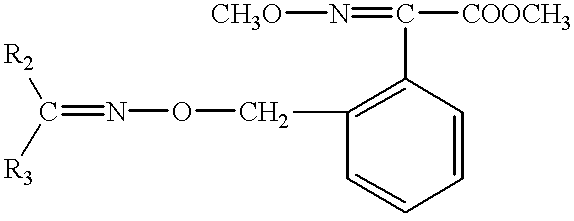
- the present invention relates to oxime ethers of the general formula
- R 1 is C 1-4 alkyl
- (Y—X) is CH 2 ⁇ , C 1-2 alkylthio-CH ⁇ or C 1-2 alkyl-ON ⁇
- Z is an aldimino or ketimino group, namely in particular a group
- R 2 is hydrogen, C 1-4 alkyl, C 1-4 haloalkyl, C 3-6 cycloalkyl, C 2-4 alkenyl, C 2-4 alkynyl, C 1-2 alkoxymethyl, C 1-2 alkylthiomethyl, C 1-4 alkylsulfonyl, C 1-3 alkoxy, C 1-3 alkylthio or cyano
- R 3 is C 1-6 alkyl, aryl-C 1-4 alkyl, heteroaryl-C 1-4 alkyl, C 2-12 alkenyl, aryl-C 2-4 alkenyl, aryloxy-C 1-4 alkyl, heteroaryloxy-C 1-4 alkyl, heteroaryl-C 2-4 alkenyl, C 3-6 cycloalkyl, aryl, heteroaryl, C 2-5 alkanoyl, aroyl or heteroaroyl, or R 2 and R 3 together with the carbon atom to which they are bonded form a substituted or unsubsti
- the compounds according to the invention have fungicidal properties and are suitable as fungicidal active compounds, in particular for use in agriculture and horticulture.
- the invention furthermore relates to a process for the preparation of the compounds according to the invention, to fungicidal compositions comprising such compounds as active substances, and to the use of such compounds and compositions for controlling fungi in agriculture and in horticulture.
- the present invention relates to oxime ethers of the formula I in which R 1 is C 1-4 alkyl, (Y—X) is CH 2 ⁇ , C 1-2 alkylthio-CH ⁇ or C 1-2 alkyl-ON ⁇ and Z is an aldimino or ketimino group, namely in particular a group
- R 2 is hydrogen, C 1-4 alkyl, C 1-4 haloalkyl or C 3-6 cycloalkyl and R 3 is C 1-6 alkyl, aryl-C 1-4 alkyl, heteroaryl-C 1-4 alkyl, C 2-6 alkenyl, aryl-C 2-4 alkenyl, heteroaryl-C 2-4 alkenyl, C 3-6 cycloalkyl, aryl, heteroaryl, C 2-5 alkanoyl, aroyl or heteroaroyl, or R 2 and R 3 together with the carbon atom to which they are bonded form a substituted or unsubstituted four- to seven-membered saturated ring which may contain an oxygen or sulfur atom and which can additionally have a substituted or unsubstituted fused benzene ring.
- alkyl and alkenyl can be straight-chain or branched, depending on the number of carbon atoms.
- the alkenyl groups can have one or more double bonds.
- Halogen as a substituent is fluorine, chlorine, bromine or iodine, fluorine, chlorine and bromine being preferred.
- a haloalkyl group can have one or more identical or different halogen substituents.
- Aryl is understood as meaning, in particular, phenyl, naphthyl, phenanthryl or fluorenyl.
- Heteroaryl is a heterocyclic group having aromatic character and 1-3 hetero atoms N, O and/or S.
- Preferred rings are triazole or other five-membered and six-membered rings having 1-2 hetero atoms which, in turn, can additionally have one or two fused benzene rings.
- Het*group examples which may mentioned and which do not represent any limitation but which, for the sake of simplicity, are referred to as “Het*group” in the following text, are pyrrolyl, pyridyl, furyl, thienyl, isoxazolyl, thiazolyl, pyrazinyl, pyridazinyl, imidazolyl, pyrimidinyl or triazolyl, or such a group with fused benzene, for example quinolinyl, quinoxalinyl, benzofuryl, benzothienyl or dibenzofuryl.
- the preferred aryl radical is phenyl, whether on its own or as part of another substituent. Accordingly, benzoyl is preferred as aroyl.
- Trifluoromethyl, difluoromethoxy and trifluoromethoxy are preferred.
- the aryl groups in particular phenyl
- Examples of such groups are 5-benzofuryl, 6-benzodioxanyl and 5-( 1,3-benzodioxolyl).
- the compounds of the formula I If asymmetric carbon atoms are present in the compounds of the formula I, the compounds exist in optically active form. Merely because of the presence of the aliphatic or imino double bond X ⁇ C and the imino double bond of the aldimino or ketimino group Z, the compounds exist in any case in the [E] or [Z] form. Atropisomerism can also occur.
- the formula I is intended to embrace all these isomeric forms which are possible as well as their mixtures, for example racemic mixtures and any desired [E/Z] mixtures.
- R 1 is preferably methyl; and, independently thereof, (Y—X) is preferably methylene, methylthiomethylene (CH—SCH 3 ) or methoxyimino (N-OCH 3 ); compounds in which R 1 is methoxyimino are particularly preferred.
- R 2 is preferably hydrogen, C 1-4 alkyl (in particular methyl or ethyl), C 1-4 haloalkyl (in particular trifluoromethyl) or C 3-6 cycloalkyl (in particular cyclopropyl), and R 3 is preferably substituted or unsubstituted phenyl, naphthyl (in particular ⁇ -naphthyl) or benzyl, possible substituents preferably being up to three identical or different halogen atoms (in particular fluorine, chlorine and/or bromine), C 1-4 alkyl groups (in particular methyl), C 1-4 haloalkyl groups (in particular trifluoromethyl), C 1-4 haloalkoxy groups (in particular trifluoromethoxy) and alkylenedioxy (in particular 3,4-methylenedioxy), or heteroaryl, in particular furyl which is unsubstituted or substituted by up to two methyl
- R 2 is preferably methyl.
- R 1 is methyl
- (Y—Z) is CH 2
- Z is a group (R 2 )(R 3 )C ⁇ N—
- R 2 is methyl and R 3 is 3-tifluoromethylbenzyl, 4-chloro-3-trifluoromethylbenzyl, 1,4,8-trimethylnona-1,3,7-trienyl, phenyl, 3-chlorophenyl, 4-chlorophenyl, 3-bromophenyl, 3,4-dichlorophenyl, 3,5-dichlorophenyl, 3-nitrophenyl, 4-nitrophenyl, 2-fluoro-5-methylphenyl, 4-methoxyphenyl, 3,4,5-trimethoxyphenyl, 3-trifluoromethoxyphenyl, 3,5-di(trifluoromethyl)phenyl, ⁇ -naphthyl, 2-furyl, 2-thienyl, 2-pyridyl, 2-benzofuryl or 5-chloro
- R 1 is methyl
- (Y—X) is CH 2
- Z is a group (R 2 )(R 3 )C ⁇ N—
- R 2 is trifluoromethyl
- R 3 is 2-( ⁇ -naphthyl)ethenyl, phenyl, 3-chlorophenyl, 4-chlorophenyl, p-tolyl, ⁇ , ⁇ , ⁇ -trifluoro-m-tolyl, ⁇ -naphthyl or 2-pyridyl;
- R 1 is methyl
- (Y—X) is CH 2
- Z is a group (R 2 )(R 3 )C ⁇ N—
- R 2 is cyclopropyl
- R 3 is phenyl, 3-chlorophenyl, 4-chlorophenyl, 3-bromophenyl, ⁇ , ⁇ , ⁇ -trifluoro-m-tolyl, 4-phenoxyphenyl or ⁇ -naphthyl;
- R 1 is methyl
- (Y—X) is methylthiomethylene
- Z is a group (R 2 )(R 3 )C ⁇ N—
- R 2 is trifluoromethyl
- R 3 is 2-( ⁇ -naphthyl)ethenyl, phenyl, 3-chlorophenyl, 4-chlorophenyl, p-tolyl, ⁇ , ⁇ , ⁇ -trifluoro-m-tolyl, ⁇ -naphthyl or 2-pyridyl;
- R 1 is methyl
- (Y—X) is methylthiomethylene
- Z is a group R 2 R 3 C ⁇ N—
- R 2 is cyclopropyl
- R 3 is phenyl, 3-chlorophenyl, 4-chlorophenyl, 3-bromophenyl, ⁇ , ⁇ , ⁇ -trifluoro-m-tolyl, 4-phenoxyphenyl or ⁇ -naphthyl;
- R 1 is methyl
- (Y—X) is methoxyimino
- Z is a group R 2 R 3 C ⁇ N—
- R 2 is trifluoromethyl
- R 3 is 2-( ⁇ -naphthyl)ethenyl, phenyl, 3-chlorophenyl, 4-chlorophenyl, p-tolyl, ⁇ , ⁇ , ⁇ -trifluoro-m-tolyl, ⁇ -naphthyl or 2-pyridyl;
- the process according to the invention for the preparation of the compounds of the formula I comprises reacting an oxime Z—OH, in particular an oxime of the general formula
- R 1 and Y—X are as defined above and U is a leaving group.
- the reaction can be effected in an organic solvent, for example methylene chloride, with phase-transfer catalysis, in the presence of an aqueous basic solution, for example sodium hydroxide solution, and in the presence of a phase-transfer catalyst, for example tetrabutylammonium hydrogen sulfate, at room temperature [see, for example, W. E. Keller, “Phasen-Transfer Reactions” [Phase-Transfer Reactions], Fluka-Compendium Vol. I and II, George Thieme Verlag, Stuttgart (1986/1987), in which particular mention is made of Chemistry Letters 1980, pages 869-870].
- an organic solvent for example methylene chloride
- phase-transfer catalyst for example tetrabutylammonium hydrogen sulfate
- the oximes Z—OH for example those of the formula II, which are used as starting materials in the process according to the invention are either known or can be prepared by methods known per se, for example by reacting the corresponding carbonyl compound R 2 R 3 C ⁇ O with hydroxylamine chloride in the presence of a base, for example sodium hydroxide or potassium hydroxide or pyridine. More methods can be found in Houben-Weyl, “Methoden der Organischen Chemie” [Methods of Organic Chemistry], Volume X/4, pages 3-308 (1968) “Hergori und Umwandlung von Oximen” [Preparation and Conversion of Oximes].
- the starting materials of the formula III i.e. the alkyl ⁇ -(2-UCH 2 -phenyl)-acrylates of the formula IIIa, the alkyl ⁇ -(2-UCH 2 -phenyl)- ⁇ -(C 1-2 alkylthio)acrylates of the formula IIIb and the alkyl 2-(2-UCH 2 -phenyl)glyoxylate O—(C 1-2 alkyl)oxime of the formula IIIc
- EP 348 766 describes the preparation of methyl ⁇ -(2-bromomethylphenyl)acrylate
- EP 310 954 and Angew. Chem. 71, 349-365 (1959) describe the preparation of methyl ⁇ -(2-bromomethylphenyl)- ⁇ methylthioacrylate
- EP 363 818 and also Angew. Chem. 71, 349-365 (1959) describe the preparation of methyl 2-(2-bromomethylphenyl)glyoxylate O-methyloxime.
- the compounds according to the invention have a fungicidal action and can accordingly be used for controlling, or preventing, fungal attack in agriculture, in horticulture and in the protection of wood. They are particularly suitable for inhibiting the growth of or for destroying phytopathogenic fungi on parts of plants, for example leaves, stalks, roots, tubors, fruit or flowers, and on seed, as well as for destroying harmful soil fungi. Furthermore, wood-destroying and wood-discolouring fungi can be controlled using the compounds according to the invention.
- the compounds according to the invention are effective, for example, in the control of fungi of the classes of the Deuteromycetes, Ascomycetes, Basidiomycetes and phycomycetes.
- the compounds according to the invention are particularly suitable for controlling the following pathogens:
- Powdery mildews for example Erysiphe graminis, Erysiphe cichoracearum, Podosphaera leucotricha, Uncinula necator, Sphaerotheca spp.
- Rusts for example Puccinia tritici, Puccinia recondita, Puccinia hordei, Puccinia coronata, Puccinia striiformis, Puccinia arachidis, Hemileia vastatrix, Uromyces fabae )
- Cercospora spp. for example Cercospora arachidicola, Cercospora beticola
- Mycosphaerella spp. for example Mycosphaerella fijiensis
- Alternaria spp. for example Alternaria brassicae, Alternaria mali .
- Septoria spp. for example Septoria nodorum
- Helminthosporium spp. for example Helminthosporium teres, Helminthosporium oryzea
- Plasmopara spp. for example Plasmopara viticola
- Pseudoperonospora spp. for example Pseudoperonospora cubensis
- Phytophthora spp. for example Phytophthora infestans
- Pseudocercosporella spp. for example Pseudocercosporella herpotrichoides
- Piricularia spp. for example Piricularia oryzae
- the compounds act for example against fungi of the genera Tilletia, Ustilago, Rhizoctonia, Verticillium, Fusarium, Pythium, Gaeumannomyces, Sclerotinia, Monilia, Botrytis, Peronospora, Bremia, Gloeosporium, Cercosporidium, Penicillium, Ceratocystis, Rhynchosporium, Pyrenophora, Diaporthe, Ramularia and Leptosphaeria.
- certain representatives of the compounds according to the invention have an action against fungi which damage wood, for example those of the genera Coniophora, Gloeophyllum, Poria, Merulius, Trametes, Aureobasidium, Sclerophoma and Trichoderma.
- the compounds of the formula I according to the invention are distinguished by a prophylactic and curative, but mainly by a noticeable systemic action.
- compositions for example solutions, suspensions, emulsions, emulsifiable concentrates and preparations in the form of powders.
- the fungicidal compositions according to the invention comprise an effective amount of at least one compound of the general formula I, as defined above, as well as formulation auxiliaries.
- the compositions advantageously comprise at least one of the following formulation auxiliaries:
- solid carriers the following are mainly suitable: natural mineral substances, such as kaolin, clays, kieselguhr, talc, bentonite, chalk, for example whiting, magnesium carbonate, limestone, quartz, dolomite, attapulgite, montmorillonite and diatomaceous earth; synthetic mineral substances, such as highly-disperse silica, aluminium oxide and silicates; organic substances, such as cellulose, starch, urea and synthetic resins; and fertilisers, such as phosphates and nitrates, it being possible for such carriers to be, for example, in the form of granules or powders.
- natural mineral substances such as kaolin, clays, kieselguhr, talc, bentonite, chalk, for example whiting, magnesium carbonate, limestone, quartz, dolomite, attapulgite, montmorillonite and diatomaceous earth
- synthetic mineral substances such as highly-disperse silica, aluminium oxide and silicates
- solvents or dispersants the following are mainly suitable: aromatics, such as toluene, xylenes, benzene and alkylnaphthalenes; chlorinated aromatics and chlorinated aliphatic hydrocarbons, such as chlorobenzenes, chloroethylenes and methylene chloride; aliphatic hydrocarbons, such as cyclohexane and paraffins, for example mineral oil fractions; alcohols, such as butanol and glycol, as well as their ethers and esters; ketones, such as acetone, methyl ethyl ketone, methyl isobutyl ketone and cyclohexanone; and strongly polar solvents and dispersants such as dimethylformamide, N-methylpyrrolidone and dimethyl sulfoxide, such solvents and dispersants preferably having flash points of at least 30° C.
- aromatics such as toluene, xylenes, benzene and alkyln
- liquefied gaseous extenders or carriers which are products which are gaseous at room temperature and under atmospheric pressure
- aerosol propellants such as (halo)hydrocarbons.
- water it is also possible for, for example, organic solvents to be used as auxiliary solvents.
- the surfactants can be nonionic compounds, such as condensation products of fatty acids, fatty alcohols or fatty-substituted phenols with ethylene oxide; fatty acid esters and fatty acid ethers of sugars or polyhydric alcohols; the products obtained from sugars or polyhydric alcohols by condensation with ethylene oxide; block copolymers of ethylene oxide with propylene oxide; or alkyldimethylamine oxides.
- the surfactants can also represent anionic compounds, such as soaps; fatty sulfate esters, for example dodecyl sodium sulfate, octadecyl sodium sulfate and cetyl sodium sulfate; alkylsulfonates, arylsulfonates and fatty-aromatic sulfonates, such as alkylbenzenesulfonates, for example calcium dodecylbenzenesulfonate, and butylnaphthalenesulfonate; and more complex fatty sulfonates, for example the amide condensation products of oleic acid and N-methyltaurine, and the sodium sulfonate of dioctyl succinate.
- anionic compounds such as soaps
- fatty sulfate esters for example dodecyl sodium sulfate, octadecyl sodium sulfate and cetyl sodium sulfate
- the surfactants can be cationic compounds, such as alkyldimethyl-benzylammonium chlorides, dialkyldimethylammonium chlorides, alkyltrimethylammonium chlorides and ethoxylated quaternary ammonium chlorides.
- dispersants (without surfactant action) the following are mainly suitable: lignin, sodium salts and ammonium salts of ligninsulfonic acid, sodium salts of maleic anhydride/diisobutylene copolymers, sodium salts and ammonium salts of sulfonated polycondensation products of naphthalene and formaldehyde, and sulfite waste liquors.
- dispersants which can be employed and are particularly suitable as thickeners or anti-settling agents are methylcellulose, carboxymethylcellulose, hydroxyethylcellulose, polyvinyl alcohol, alginates, caseinates and blood albumin.
- Suitable stabilisers are acid-binding agents, for example epichlorohydrin, phenyl glycidyl ether and soya epoxides; antioxidants, for example gallic esters and butylhydroxytoluene; UV absorbers, for example substituted benzophenones, diphenylacrylonitrile acid esters and cinnamic esters; and deactivators, for example salts of ethylenediaminetetraacetic acid, and polyglycols.
- acid-binding agents for example epichlorohydrin, phenyl glycidyl ether and soya epoxides
- antioxidants for example gallic esters and butylhydroxytoluene
- UV absorbers for example substituted benzophenones, diphenylacrylonitrile acid esters and cinnamic esters
- deactivators for example salts of ethylenediaminetetraacetic acid, and polyglycols.
- the fungicidal compositions according to the invention can also comprise other active compounds, for example other types of fungicidal compositions, insecticidal and acaricidal compositions, bactericides, plant growth regulators and fertilisers.
- Such combination compositions are suitable for broadening the spectrum of action or for specifically influencing plant growth.
- compositions according to the invention comprise between 0.0001 and 85 percent by weight of a compound or compounds according to the invention as active substance(s), depending on the nature of these compositions. They can be in a form which is suitable for storage and transport. In such forms, for example emulsifiable concentrates, the concentration of active substance is usually in the higher range of the above concentration interval. These forms can then be diluted with identical or different formulation auxiliaries to concentrations of active substance which are suitable for use in practice, and such concentrations are usually in the lower range of the above concentration interval.
- Emulsifiable concentrates generally comprise 5 to 85 percent by weight, preferably 25 to 75 percent by weight, of the compound(s) according to the invention.
- Suitable as use forms are, inter alia, ready-for-use solutions, emulsions and suspensions, which are suitable, for example, as spray mixtures.
- the concentrations in such spray mixtures can be, for example, between 0.0001 and 20 percent by weight.
- the concentration of active substance is preferably from 0.5 to 20 percent by weight, while the concentration of active substance in the spray mixtures formulated in the low-volume method and in the high-volume method is preferably from 0.02 to 1.0, or 0.002 to 0.1, percent by weight.
- the fungicidal compositions according to the invention can be prepared by mixing at least one compound according to the invention with formulation auxiliaries.
- the active substance can be mixed with a solid carrier, for example by concomitant grinding; or the solid carrier can be impregnated with a solution or suspension of the active substance, and the solvent or dispersant can then be removed by evaporation, heating or by filtering off with suction under reduced pressure.
- a solid carrier for example by concomitant grinding
- the solvent or dispersant can then be removed by evaporation, heating or by filtering off with suction under reduced pressure.
- the compounds according to the invention can be mixed with a surfactant and a solid carrier to form a wettable powder which is dispersible in water, or they can be mixed with a solid pregranulated carrier to form a product in the form of granules.
- a compound according to the invention can be dissolved in a solvent which is not miscible with water, for example an alicyclic ketone, which advantageously contains dissolved emulsifier, so that the solution is self-emulsifying when added to water.
- the active substance can be mixed with an emulsifier, and the mixture can then be diluted with water to the desired concentration.
- the active substance can be dissolved in a solvent and the solution can then be mixed with an emulsifier.
- Such a mixture can equally be diluted with water to the desired concentration. In this manner, emulsifiable concentrates, or ready-for-use emulsions, are obtained.
- the mixture is rendered neutral using saturated sodium hydrogen carbonate solution, and the organic phase is separated off, washed three times with water and dried over anhydrous sodium sulfate. After the organic solvent has been distilled off, the oil which remains is purified by chromatography on silica gel using diethyl ether/n-hexane (1:1) as the mobile phase.
- An emulsifiable concentrate has, for example, the following composition:
- the active substance and the emulsifiers are dissolved in the solvent and in the solubiliser. By emulsifying this concentrate in water, a ready-for-use spray liquor of any desired dilution can be prepared.
- a wettable powder has, for example, the following composition:
- the components are mixed with each other and ground finely in a suitable mill. By dispersing the mixture in water, a suspension which is suitable as ready-for-use spray mixture is obtained.
- oat seedlings cv. “Selma” are infected with Puccinia coronata by spraying with an aqueous spore suspension (approx. 150,000 uredospores/ml). The test plants are subsequently incubated for 24 hours at 20-24° C. and under dew-point conditions. The oat seedlings are then sprayed thoroughly from all sides with a spray mixture prepared with a wettable powder of the active substance (with 160 ppm of active ingredient). They are cultured further in a controlled-environment cabinet at 19° C. and with a photoperiod of 14 hours. The test is evaluated 9-10 days after infection by determining the leaf area infected with Puccinia coronata as a percentage compared with the infected, untreated control.
- the following compounds show an action of more than 75% when used at a dosage rate of 160 ppm: 3, 8, 9, 11, 12, 17, 78, 90, 107, 128, 131, 133, 138, 148.
- the following compounds show an action of more than 75% when used at a dosage rate of 160 ppm: 1, 3, 4, 5, 7A, 8, 9, 10, 11, 13, 15, 16, 18, 23, 24, 25, 27, 29, 31, 33, 34, 37, 39, 40, 52, 53, 70, 86, 89, 105, 119, 120, 126, 127, 128, 135, 137, 141, 149.
- Two apple seedlings cv. “Golden Delicious” are sprayed with a conidia suspension of Venturia inaequalis and subsequently incubated at 18° C. and under dew-point conditions. After 24 hours, the plants are sprayed thoroughly from all sides with a spray mixture prepared with a wettable powder of the active substance (with 50 ppm of active ingredient). The treated apple seedlings are subsequently cultured further in the greenhouse. 9-10 days after the treatment, the test is evaluated by determining the leaf area covered in Venturia inaequalis as a percentage compared with the infected control.
- the following compounds show an action of more than 75% when used at a dosage rate of 50 ppm: 1, 3, 7A, 8, 9, 10, 12, 13, 14, 15, 17, 19, 20, 22, 24, 28, 29, 30, 31, 32, 33, 34, 36, 38, 44, 49, 54, 61, 64, 66, 78, 82, 83, 85, 105, 106, 117, 124, 131, 134, 135, 139, 142, 147, 154, 157.
- the following compounds show an action of more than 75% at a dosage rate of 50 ppm: 1, 3, 4, 8, 9, 12, 13, 14, 17, 20, 22, 23, 24, 25, 26, 28, 29, 30, 31, 32, 33, 34, 36, 38, 54, 55, 67, 92, 105, 124, 130, 136, 138, 143, 150, 157.
- tomato plants cv. “Roter Gnom” are sprayed with a zoospore suspension of fungus and incubated in a cabinet at 18 to 20° C. and saturated atmospheric humidity. The humidification is interrupted after 24 hours. After the plants have dried, they are sprayed with a mixture which contains the active substance, formulated as a wettable powder, at a concentration of 200 ppm. After the spray coating has dried on, the plants are returned to the humid cabinet for 4 days. Number and size of the typical lesions which have developed after this period are used as a scale for assessing the activity of the tested substances.
- the active substance formulated as a wettable powder at a concentration of 60 ppm (relative to the soil volume) is placed on the soil surface of potted tomato plants, aged three weeks, cv. “Roter Gnom”. After a waiting period of three days, the underside of the leaves of the plants is sprayed with a zoospore suspension of Phytophthora infestans. They are then kept for 5 days in a spray cabinet at 18 to 20° C. and saturated atmospheric humidity. After this time, typical lesions develop, whose number and size is used for assessing the activity of the tested substances.
- Compounds from Tables 1-3 effect inhibition of the disease level to less than 20%.
- 2 grapevine seedlings cv. Riesling ⁇ Sylvaner each in the 4-5 leaf stage, are sprayed thoroughly from all sides with a spray mixture prepared with a wettable powder of the active substance (with 160 ppm of active ingredient) and subsequently cultured further in a controlled-environment cabinet at 17° C., 70-80% relative atmospheric humidity and with a photoperiod of 16 hours.
- the test plants are infected by spraying the undersides of the leaves with zoosporangia of Plasmopara viticola, suspended in distilled water (approx. 300,000 sporangia/ml). The grapevine plants are then incubated as follows: 1 day at 22° C.
- the grapevines are transferred to a controlled-environment cabinet with dew-point conditions at 22° C. on day 5 after the infection.
- the tests are carried out in each case on day 6 after the infection by determining the leaf area infected with Plasmopara viticola as a percentage compared with the infected, untreated control.
- the following compounds show an action of more than 75% at a dosage rate of 160 ppm: 3, 4, 8, 9, 11, 12, 17, 22, 24, 28, 29, 30, 31, 32, 36, 38, 41, 43, 45, 53, 61, 62, 82, 102, 107, 120, 125, 129, 135, 138, 147, 150.
Landscapes
- Chemical & Material Sciences (AREA)
- Organic Chemistry (AREA)
- Life Sciences & Earth Sciences (AREA)
- Wood Science & Technology (AREA)
- Environmental Sciences (AREA)
- Plant Pathology (AREA)
- Health & Medical Sciences (AREA)
- Engineering & Computer Science (AREA)
- Dentistry (AREA)
- General Health & Medical Sciences (AREA)
- Agronomy & Crop Science (AREA)
- Zoology (AREA)
- Pest Control & Pesticides (AREA)
- Agricultural Chemicals And Associated Chemicals (AREA)
- Organic Low-Molecular-Weight Compounds And Preparation Thereof (AREA)
- Pyridine Compounds (AREA)
- Plural Heterocyclic Compounds (AREA)
- Furan Compounds (AREA)
- Heterocyclic Compounds That Contain Two Or More Ring Oxygen Atoms (AREA)
- Heterocyclic Compounds Containing Sulfur Atoms (AREA)
- Nitrogen- Or Sulfur-Containing Heterocyclic Ring Compounds With Rings Of Six Or More Members (AREA)
- Management, Administration, Business Operations System, And Electronic Commerce (AREA)
- Investigating Or Analysing Materials By The Use Of Chemical Reactions (AREA)
Abstract
Description


| TABLE 1 |
 |
| Physical | Method | ||||
| Example | Y-X | R2 | R3 | data (MS) | 1/2/3/4 |
| 5 | CH2 | H | 4-chlorophenyl | 329(1); 115 | 1 |
| 6 | CH2 | H | phenyl | 295(2); 115 | 2 |
| 7 | CH2 | 4-tert-butyl- | 343(6); 115 | 2 |
| cyclohexylidene |
| 7a | CH2 | CH3 | 3,4-methylene- | 353(6); 115 | 1 |
| dioxyphenyl | |||||
| 8 | CH3S—CH | CH3 | 3,4-dichlorophenyl | 424(2); 161 | 3 |
| 9 | CH3S—CH | CH3 | β-naphthyl | 405(1); 161 | 3 |
| 10 | CH3S—CH | CH3 | 2-thienyl | 314(29); 161 | 3 |
| 11 | CH3S—CH | CH3 | 2-pyridyl | 356(<0.5); 161 | 3 |
| TABLE 2 |
 |
| Physical | ||||
| Example | R2 | R3 | data | |
| 12 | CH3 | α,α,α-trifluoro-m-tolyl | oil | 408(<0.5); 186 |
| 13 | CH3 | 3,4-dichlorophenyl | m.p. 1.3-105° C. | |
| 14 | CH3 | 2-thienyl | oil | 346(2); 116 |
| 15 | CH3 | 2-pyridyl | m.p. 82-84° C. | |
| 16 | 1,2,3,4-tetrahydro-α-naphthylidene | oil | 366(1); 116 |
| 17 | CH3 | 4-chlorophenyl | cryst. | 343(2); 116 |
| 18 | n-propyl | phenyl | cryst. | 368(<0.5); 116 |
| 19 | CH3 | 4-methoxyphenyl | cryst. | 370(10); 116 |
| 20 | CH3 | 3,4,5-trimethoxyphenyl | oil | 430(49); 116 |
| 21 | CH3 | 2-furyl | m.p. 95-97° C. | |
| 22 | CH3 | 3-bromophenyl | cryst. | 389(0.5); 116 |
| 23 | CH3 | 1,4,8-trimethylnona-1,3,7-trienyl | oil | 426(2); 116 |
| 24 | CH3 | 3-trifluoromethylbenzyl | oil | 422(4); 116 |
| 25 | CH3 | 4-nitrophenyl | cryst. | 354(1); 116 |
| 26 | CH3 | 3-nitrophenyl | cryst. | 354(0.5); 116 |
| 27 | CF3 | phenyl | cryst. | 222(4); 116 |
| 28 | CH3CH2— | phenyl | oil | 323(2); 116 |
| 29 | i-propyl | phenyl | oil | 368(1); 116 |
| 30 | CF3 | 3-bromophenyl | oil | 252(2); 116 |
| 31 | CF3 | 4-tolyl | cryst. | 222(6); 116 |
| 32 | CH3 | 2-benzofuryl | m.p. 110-112° C. | |
| 33 | CH3 | 3,5-di(trifluoromethyl)phenyl | m.p. 76-78° C. | |
| 34 | CH3 | 4-fluorophenyl | m.p. 89-90° C. | |
| 35 | CH3O—CH2— | β-naphthyl | oil | 420(4); 45 |
| 36 | cyclopropyl | phenyl | oil | 355(3); 116 |
| 37 | CH3 | 1-phenoxyethyl | cryst. | 291(63); 116 |
| 38 | CH3 | 3,4-methylenedioxyphenyl | oil | 384(12); 116 |
| 39 | CF3 | 3-trifluoromethylphenyl | oil | 240(3); 116 |
| 40 | CH3 | 3-fluorophenyl | ||
| 41 | cyclopropyl | 3,4-methylenedioxyphenyl | ||
| 42 | iospropyl | 3,4-methylenedioxyphenyl | ||
| 43 | CH3 | 6-(1,4-benzodioxanyl) | ||
| 44 | cyclopropyl | 6-(1,4-benzodioxanyl) | ||
| 45 | CH3 | 3,4-(difluoromethylenedioxy)phenyl | ||
| 46 | CH3 | 3,4-(difluoromethylenedioxy)benzyl | ||
| 47 | CH3 | 3,4-ethylenedioxybenzyl | ||
| 48 | CH3 | 2,3-(difluoromethylenedioxy)phenyl | ||
| 49 | CH3 | 4-methoxy-3-(methylthiomethyl)phenyl | ||
| 50 | CH3 |
 |
||
| 51 | CH3 |
 |
||
| 52 |
 |
| 53 |
 |
| 54 | CH3 | 3,4-methylenedioxybenzyl | ||
| 55 | CH3 | 6-nitro-3,4-(methylenedioxy)phenyl | ||
| 56 | H | 3,4-(difluoromethylenedioxy)phenyl | ||
| 57 | CH3 | 2-(3,4-methylenedioxyphenyl)ethenyl | ||
| 58 | CH3 | 2-(3,4-methylenedioxyphenyl)ethyl | ||
| 59 | CH3 | 4-methoxy-3-(methylsulfinylmethyl)phenyl | ||
| 60 | CH3 | 4-methoxy-3-(methylsulfonylmethyl)phenyl | ||
| 61 | CH3 | 3,4-propylenedioxyphenyl | ||
| 62 | CH3 |
 |
||
| 63 | CH3 |
 |
||
| 64 | CH3 | 3,4-methylenedioxybenzoyl | ||
| 65 | CH3 |
 |
||
| 66 | CH3 | 3-allyloxyphenyl | ||
| 67 | CH3 | 3-propargyloxyphenyl | ||
| 68 | CH3 | 3-cyclopropylmethoxyphenyl | oil | 410(8); 116 |
| 69 | CH3 | 3-(2,2-dichlorovinyloxy)phenyl | ||
| 70 | CH3 | 3-cyanophenyl | ||
| 71 | CH3 | 3-thiocyanatophenyl | ||
| 72 | CH3 | 4-(2,2-dichlorovinyl)phenyl | ||
| 73 | CH3 | 5-(2-cyanobenzofuryl | ||
| 74 | CH3 |
 |
||
| 75 | CH3 |
 |
||
| 76 | CH3 |
 |
||
| 77 | H |
 |
||
| 78 | CH3 | 4-difluoromethoxyphenyl | ||
| 79 | CH3 | 3-acetoxyphenyl | ||
| 80 | CH3 |
 |
||
| 81 | CH3 |
 |
||
| 82 | CH3 | 4-methoxy-3-nitrophenyl | ||
| 83 | CH3 | 4-methoxy-3-(methoxymethyl)phenyl | ||
| 84 | CH3 | 3-allyloxy-4-methoxyphenyl | ||
| 85 | CH3 | 3-ethoxy-4-methoxyphenyl | ||
| 86 | CH3 |
 |
oil | |
| 87 | CH3 | 3-(2,5-dimethylthienyl) | ||
| 88 | CH3 | 2-(5-methylthienyl) | ||
| 89 | cyclopropyl | 4-fluorophenyl | ||
| 90 | CH3 | 4-fluoro-3-trifluoromethylphenyl | ||
| 91 | H | 3-nitrophenyl | ||
| 92 | CH3 | 3-cyanomethoxyphenyl | ||
| 93 | CH3 | 4-fluoro-3-phenoxyphenyl | ||
| 94 | CH3 | 4-thioCyanato-3-trifluormethylphenyl | ||
| 95 | CH3CH═CH | 3,4-methylenedioxyphenyl | ||
| 96 | CN | 3,4-methylenedioxyphenyl | ||
| 97 | CH3SO2 | 3,4-methylenedioxyphenyl | ||
| 98 | CH3CH2 | 3,4-(difluoromethylenedioxy)phenyl | ||
| 99 | CH3CH2CH2 | 3,4-(difluoromethylenedioxy)phenyl | ||
| 100 | isopropyl | 3,4-(difluoromethylenedioxy)phenyl | ||
| 101 | cyclopropyl | 3,4-(difluoromethylenedioxy)phenyl | ||
| 102 | CH3OCH2 | 3,4-(difluoromethylenedioxy)phenyl | ||
| 103 | CH3 | 1-(3,4-methylenedioxyphenyl)ethyl | ||
| 104 | H | 1-methyl-1-(3,4-methylenedioxyphenyl)ethyl | ||
| 105 | H | 2-thienOyl | ||
| 106 | CH3 | 4-(pentafluoroethoxy)phenyl | ||
| 107 | CH3 | 4-(2,2,2-tifluoroethoxy)phenyl | oil | |
| 108 | CH3 | 4-(1,1,2,3,3,3-hexafluoropropoxy)phenyl | ||
| 109 | CH3SCH2 | 3,4-methylenedioxyphenyl | ||
| 110 | CH3CH2 | 2-thienyl | ||
| 111 | CH3CH2CH2 | 4-tolyl | ||
| 112 | CH3 | 4-chloro-2-methoxyphenyl | ||
| 113 | CH3CH═CH | 3-trifluoromethylphenyl | ||
| 114 | H |
 |
||
| 115 | CH3 |
 |
||
| 116 | CH3 |
 |
||
| 117 | CH3 |
 |
||
| 118 | CH3 |
 |
||
| 119 | CH3 | 6-methoxy-β-naphthyl | ||
| 120 | CH3CH2 | β-naphthyl | ||
| 121 | CH3CH2CH2 | β-naphthyl | ||
| 122 | isopropyl | β-naphthyl | ||
| 123 | tert-butyl | β-naphthyl | ||
| 124 | CH3S | phenyl | oil | |
| 125 | CH3S | 4-chlorophenyl | ||
| 126 | CH3S | 3-trifluoromethylphenyl | ||
| 127 | CH3O | 4-chlorophenyl | ||
| 128 | CH3 | 4-fluorobenzoyl | ||
| 129 | CH3 | 3-bromobenzoyl | ||
| 130 | CH3 | 3-nitrobenzoyl | ||
| 131 | CH3 | 3-trifluoromethylbenzoyl | ||
| 132 | CH3 | 2-toluoyl | ||
| 133 | CH3 | 4-chloro-3-trifluoromethylbenzyl | ||
| 134 | CH3 | phenyl | ||
| 135 | CH3 | 3-chlorophenyl | ||
| 136 | CH3 | 3,5-dichlorophenyl | ||
| 137 | CH3 | 6-fluoro-3-tolyl | ||
| 138 | CH3 | 3-trifluoromethoxyphenyl | oil | 425(1); 116 |
| 139 | CH3 | 2-(5-chlorothienyl) | ||
| 140 | CF3 | 2-(β-naphthyl)ethenyl | ||
| 141 | CF3 | 3-chlorophenyl | ||
| 142 | CF3 | 4-chlorophenyl | ||
| 143 | CF3 | β-naphthyl | ||
| 144 | CF3 | 2-pyridyl | ||
| 145 | cyclopropyl | 3-chlorophenyl | ||
| 146 | cyclopropyl | 4-chlorophenyl | ||
| 147 | cyclopropyl | 3-bromophenyl | ||
| 148 | cyclopropyl | 3-trifluoromethylphenyl | ||
| 149 | cyclopropyl | 4-phenoxyphenyl | ||
| 150 | cyclopropyl | β-naphthyl | ||
| TABLE 3 |
 |
| Physical | ||||
| Example | Y-X | R2 | R3 | data (MS) |
| 151 | CH2 | CH3 | 4-fluorophenyl | 341(3); 115 |
| 152 *) | CH2 | CH3 | 2-thienyl | 329(4); 115 |
| 153 *) | CH2 | CH3 | 2-thienyl | 329(6); 115 |
| 154 | CH2 | CH3 | 3,4-dichlorophenyl | 391(2); 115 |
| 155 | CH2 | CH3 | phenyl | 205(0, 5); 115 |
| 156 | CH2 | CH3 | 4-nitrophenyl | 368(2); 115 |
| 157 | CH2 | CH3 | β-naphthyl | 373(7); 115 |
| *) Compounds 152 and 153 are E/Z isomers (not attributed). | ||||
| mg/litre | ||
| Active substance of Tables 1 to 3 | 100 | ||
| Nonylphenol (10)ethoxylate | 50 | ||
| (nonionic emulsifier) | |||
| Calcium dodecylbenzenesulfonate | 25 | ||
| (anionic emulsifier) | |||
| N-Methyl-2-pyrrolidone (solubiliser) | 200 | ||
| Mixture of alkylbenzenes (solvent) | to 1 litre | ||
| Percent | ||
| by weight | ||
| Active substance of Tables 1 to 3 | 25.0 | ||
| Silica (hydrated; carrier) | 20.0 | ||
| Sodium laurylsulfate (wetting agent) | 2.0 | ||
| Sodium lignosulfonate (dispersant) | 4.0 | ||
| Kaolin (carrier) | 49.0 | ||
Claims (6)

Priority Applications (1)
| Application Number | Priority Date | Filing Date | Title |
|---|---|---|---|
| US08/483,727 US6355634B1 (en) | 1990-06-05 | 1995-06-07 | Aromatic compounds |
Applications Claiming Priority (9)
| Application Number | Priority Date | Filing Date | Title |
|---|---|---|---|
| CH189190 | 1990-06-05 | ||
| CH1891/90 | 1990-06-05 | ||
| CH01208/91A CH689421A5 (en) | 1991-04-23 | 1991-04-23 | Aromatic aldimine and ketimine oxime ether(s) |
| CH1208/91 | 1991-04-23 | ||
| US70691791A | 1991-05-29 | 1991-05-29 | |
| US85159592A | 1992-03-16 | 1992-03-16 | |
| US97935492A | 1992-11-20 | 1992-11-20 | |
| US08/114,991 US6407100B1 (en) | 1990-06-05 | 1993-09-01 | Fungicidal aromatic oximes |
| US08/483,727 US6355634B1 (en) | 1990-06-05 | 1995-06-07 | Aromatic compounds |
Related Parent Applications (1)
| Application Number | Title | Priority Date | Filing Date |
|---|---|---|---|
| US08/114,991 Division US6407100B1 (en) | 1990-06-05 | 1993-09-01 | Fungicidal aromatic oximes |
Publications (1)
| Publication Number | Publication Date |
|---|---|
| US6355634B1 true US6355634B1 (en) | 2002-03-12 |
Family
ID=25686997
Family Applications (2)
| Application Number | Title | Priority Date | Filing Date |
|---|---|---|---|
| US08/114,991 Expired - Lifetime US6407100B1 (en) | 1990-06-05 | 1993-09-01 | Fungicidal aromatic oximes |
| US08/483,727 Expired - Lifetime US6355634B1 (en) | 1990-06-05 | 1995-06-07 | Aromatic compounds |
Family Applications Before (1)
| Application Number | Title | Priority Date | Filing Date |
|---|---|---|---|
| US08/114,991 Expired - Lifetime US6407100B1 (en) | 1990-06-05 | 1993-09-01 | Fungicidal aromatic oximes |
Country Status (27)
| Country | Link |
|---|---|
| US (2) | US6407100B1 (en) |
| EP (4) | EP0460575B1 (en) |
| JP (1) | JP3000240B2 (en) |
| KR (1) | KR0172948B1 (en) |
| AR (1) | AR247725A1 (en) |
| AT (3) | ATE182880T1 (en) |
| BR (1) | BR9102305A (en) |
| CA (1) | CA2043733C (en) |
| CZ (1) | CZ279709B6 (en) |
| DE (3) | DE59109146D1 (en) |
| DK (3) | DK0694529T3 (en) |
| ES (3) | ES2091834T3 (en) |
| GR (2) | GR3021080T3 (en) |
| HU (2) | HU0000906D0 (en) |
| IE (3) | IE83213B1 (en) |
| IL (2) | IL98341A (en) |
| LU (1) | LU90620I2 (en) |
| LV (1) | LV10609B (en) |
| MD (1) | MD1025C2 (en) |
| NL (1) | NL350004I2 (en) |
| NZ (1) | NZ238346A (en) |
| PH (1) | PH11991042549B1 (en) |
| PL (1) | PL168218B1 (en) |
| PT (1) | PT97848B (en) |
| RU (1) | RU2077527C1 (en) |
| SG (1) | SG42939A1 (en) |
| SK (1) | SK278282B6 (en) |
Cited By (36)
| Publication number | Priority date | Publication date | Assignee | Title |
|---|---|---|---|---|
| US20020173529A1 (en) * | 1997-04-18 | 2002-11-21 | Stefan Dutzmann | Fungicide active substance combinations |
| US6624183B2 (en) | 1999-12-13 | 2003-09-23 | Bayer Aktiengesellschaft | Fungicidal combinations of active substances |
| US20030229087A1 (en) * | 2000-05-11 | 2003-12-11 | Astrid Mauler-Machnik | Fungicidal combinations of active agents |
| US20040029944A1 (en) * | 2001-01-16 | 2004-02-12 | Thomas Grote | Fungicide mixtures |
| US20040248955A1 (en) * | 2001-08-24 | 2004-12-09 | Ulrike Wachendorff-Neumann | Fungicide active substance combinaitons |
| US20050009703A1 (en) * | 2001-08-16 | 2005-01-13 | Ulrike Wachendorff-Neumann | Fungicidal active substance combinations containing trifloxystrobin |
| US20050043559A1 (en) * | 2003-06-16 | 2005-02-24 | Albrecht Marhold | Preparation of fluorinated acetophenones |
| US20050101639A1 (en) * | 2002-03-01 | 2005-05-12 | Eberhard Ammermann | Fungicidal mixtures based on prothioconazole and a strobilurin derivative |
| US20050124498A1 (en) * | 2002-03-01 | 2005-06-09 | Fritz Maurer | Halobenzyl substituted phenylaceto esters and amides and use thereof for prevention of harmful organisms |
| US20050182051A1 (en) * | 2002-04-05 | 2005-08-18 | Eberhard Ammermann | Fungicidal mixtures based on benzamidoxime derivative and a strobilurin derivative |
| US20060004070A1 (en) * | 2002-06-24 | 2006-01-05 | Ulrike Wachendorff-Neumann | Fungicidal active substance combinations |
| US20060014738A1 (en) * | 2002-06-24 | 2006-01-19 | Ulrike Wachendorff-Neumann | Fungicidal combination of active substances |
| US20060035942A1 (en) * | 2002-06-24 | 2006-02-16 | Ulrike Wachendorff-Neumann | Fungicidal combinations of active substances |
| US20060178771A1 (en) * | 2001-09-10 | 2006-08-10 | Werner Kluft | Monitoring system and method for the in-process monitoring of machine-tool components |
| US20070054804A1 (en) * | 2003-09-11 | 2007-03-08 | Bayer Cropscience Aktiengesellschaft | Use of fungicides for disinfecting cereal seed |
| US20070060579A1 (en) * | 2003-10-10 | 2007-03-15 | Ulrike Wachendorff-Neumann | Synergistic fungicidal active substance combinations |
| US20070293550A1 (en) * | 2004-04-27 | 2007-12-20 | Bayer Cropscience Aktiengesellschaft | Use of Alkyl Carboxylic Acid Amides as Penetration Enhancers |
| US20070298966A1 (en) * | 2004-10-08 | 2007-12-27 | Bayercropscience Ag | Fungicidal Combinations of Active Ingredients |
| US20080269051A1 (en) * | 2004-10-12 | 2008-10-30 | Bayer Corpscience Ag | Fungicidal Active Compound Combinations |
| US20090018015A1 (en) * | 2003-10-23 | 2009-01-15 | Ulrike Wachendorff-Neumann | Synergistic Fungicidal Active Combinations |
| US20090170918A1 (en) * | 2005-09-09 | 2009-07-02 | Hilmar Wolf | Solid Formulation of Fungicidal Mixtures |
| US20090280981A1 (en) * | 2006-05-18 | 2009-11-12 | Peter Jeschke | Synergistic active ingredient combinations |
| US20090286681A1 (en) * | 2005-07-28 | 2009-11-19 | Bayer Cropscience Ag | Synergistic Fungicidal Active Compounde Combinations Containing a Carboxamide, an Azole, a Second Azole or a Strobilurin |
| US20100234366A1 (en) * | 2006-03-29 | 2010-09-16 | Bsf Se | Use of Strobilurins for the Treatment of Disorders of Iron Metabolism |
| US20100267790A1 (en) * | 2007-11-05 | 2010-10-21 | Basf Se | Method, Use and Agent for Protecting a Plant Against Phakopsora |
| US20100273648A1 (en) * | 2005-04-06 | 2010-10-28 | Ulrike Wachendorff-Neumann | Synergistic Fungicidal Active Substance Combinations |
| US7838464B2 (en) | 2002-11-12 | 2010-11-23 | Basf Aktiengesellschaft | Method for yield improvement in glyphosate-resistent legumes |
| US20110166109A1 (en) * | 2009-07-16 | 2011-07-07 | Bayer Cropscience Ag | Synergistic Active Compound Combinations Comprising Phenyltriazoles |
| US8044036B2 (en) | 2005-05-24 | 2011-10-25 | Bayer Cropscience Ag | Fungicidal active ingredient combination |
| CN102428928A (en) * | 2011-11-04 | 2012-05-02 | 利尔化学股份有限公司 | Bactericidal pesticide composition |
| CN102657188A (en) * | 2012-04-24 | 2012-09-12 | 陕西韦尔奇作物保护有限公司 | A kind of high-efficiency bactericidal composition |
| CN103524378A (en) * | 2013-10-23 | 2014-01-22 | 江苏七洲绿色化工股份有限公司 | Preparation method of trifloxystrobin |
| CN103719086A (en) * | 2011-03-31 | 2014-04-16 | 陕西汤普森生物科技有限公司 | Sterilization composite containing trifloxystrobin and antibiotics compound |
| US9012360B2 (en) | 2009-03-25 | 2015-04-21 | Bayer Intellectual Property Gmbh | Synergistic combinations of active ingredients |
| CN115836049A (en) * | 2020-07-08 | 2023-03-21 | 巴斯夫欧洲公司 | Use of strobilurin-type compounds to control phytopathogenic fungi containing the amino acid substitution F129L in the mitochondrial cytochrome b protein conferring tolerance to Qo inhibitor VI |
| CN116354848A (en) * | 2023-04-13 | 2023-06-30 | 波顿香料股份有限公司 | A kind of ginger aroma compound and its preparation method and ginger aroma base |
Families Citing this family (101)
| Publication number | Priority date | Publication date | Assignee | Title |
|---|---|---|---|---|
| ATE161007T1 (en) * | 1990-06-27 | 1997-12-15 | Basf Ag | O-BENZYL OXIMETHERS AND PLANT PROTECTION PRODUCTS CONTAINING THESE COMPOUNDS |
| GB9018408D0 (en) * | 1990-08-22 | 1990-10-03 | Ici Plc | Fungicides |
| JPH07500822A (en) * | 1991-10-25 | 1995-01-26 | ノバルティス アクチエンゲゼルシャフト | 2-(2-benzo(b)thienyl)-3-methoxyacrylate and -2-iminoacetate derivatives used as pest control agents |
| TW221965B (en) * | 1992-02-28 | 1994-04-01 | Ciba Geigy | |
| GB9221584D0 (en) * | 1992-10-14 | 1992-11-25 | Ici Plc | Chemical process |
| TW279845B (en) * | 1992-12-01 | 1996-07-01 | Ciba Geigy Ag | |
| AU690190B2 (en) * | 1994-01-05 | 1998-04-23 | Bayer Aktiengesellschaft | Pesticides |
| CZ220296A3 (en) * | 1994-01-27 | 1996-10-16 | Ciba Geigy Ag | Process for preparing derivatives of arylacetic acid esters and intermediates employed in the process |
| SK282153B6 (en) | 1994-02-04 | 2001-11-06 | Basf Aktiengesellschaft | Phenyl acetic acid derivatives, process and intermediate products for their production and agents containing them |
| KR970006238B1 (en) * | 1994-03-15 | 1997-04-25 | Korea Res Inst Chem Tech | Propenoic ester derivatives having 4-hydroxy pyrazole group |
| GB9405492D0 (en) * | 1994-03-21 | 1994-05-04 | Zeneca Ltd | Chemical compounds |
| AU686821B2 (en) † | 1994-06-10 | 1998-02-12 | Basf Aktiengesellschaft | Method of preparing alpha-methoxyiminocarboxylic acid methylamides, and intermediates used in the method |
| DE4442560A1 (en) * | 1994-11-30 | 1996-06-05 | Basf Ag | Iminooxybenzylcrotonic acid esters, process for their preparation and their use |
| JPH11501015A (en) * | 1995-02-24 | 1999-01-26 | イー・アイ・デユポン・ドウ・ヌムール・アンド・カンパニー | Fungicidal and fungicidal cyclic amide |
| UA54395C2 (en) * | 1995-06-16 | 2003-03-17 | Баєр Акціенгезельшафт | Phytobactericidal composition, a method of controlling and preventing plant diseases, a plant propagating material |
| MY115814A (en) * | 1995-06-16 | 2003-09-30 | Bayer Ip Gmbh | Crop protection compositions |
| DE19523288A1 (en) * | 1995-06-27 | 1997-01-02 | Basf Ag | Iminooxybenzyl compounds, process for their preparation and their use |
| US5935908A (en) * | 1995-08-15 | 1999-08-10 | Novartis Crop Protection, Inc. | Pesticidal indazole derivatives |
| CN1203583A (en) * | 1995-11-29 | 1998-12-30 | 诺瓦提斯公司 | Process for preparation of methoxyminophenylglyoxylic acid derivatives |
| TR199801045T2 (en) * | 1995-12-07 | 1998-09-21 | Novartis Ag | Pesticides |
| ES2175151T3 (en) | 1995-12-07 | 2002-11-16 | Bayer Ag | PROCEDURE FOR PREPARATION OF PESTICIDES. |
| AU1546197A (en) | 1996-02-05 | 1997-08-28 | Basf Aktiengesellschaft | Pyrimidine derivatives, process and intermediate products for their preparation and pesticides or fungicides containing these derivatives |
| AU2696697A (en) * | 1996-04-26 | 1997-11-19 | Novartis Ag | Pesticidal compositions |
| TR199700975A2 (en) * | 1996-09-27 | 1998-04-21 | Novartis Ag | Salg�n hastal�k ila�lar� (pepticides). |
| RU2193848C2 (en) * | 1996-12-13 | 2002-12-10 | Байер Аг | Fungicidal composition for plants and method for its application |
| AP1119A (en) | 1996-12-13 | 2002-11-29 | Bayer Ag | A microbicide composition for plant protection. |
| DE19711168A1 (en) | 1997-03-18 | 1998-09-24 | Basf Ag | Phenylketiminooxybenzyl compounds, process for their preparation and their use |
| DE19716237A1 (en) | 1997-04-18 | 1998-10-22 | Basf Ag | Substituted benzyloxyimino compounds |
| US6084120A (en) * | 1997-07-09 | 2000-07-04 | Hoffmann-La Roche Inc. | β-Alkoxyacrylates against malaria |
| CN1062711C (en) | 1998-02-10 | 2001-03-07 | 化工部沈阳化工研究院 | Pesticide and fungicide of unsaturated oximido ethers |
| DE69906170T2 (en) * | 1998-02-10 | 2003-10-23 | Dow Agrosciences Llc, Indianapolis | Unsaturated oxime ethers and their use as fungicides or insecticides |
| US6313344B1 (en) | 1998-05-27 | 2001-11-06 | Bayer Aktiengesellschaft | Organic compounds |
| UA70327C2 (en) | 1998-06-08 | 2004-10-15 | Баєр Акціенгезельшафт | Method of combating phytopathogenic diseases on crop plants and a fungicidal composition |
| FR2787295A1 (en) * | 1998-12-22 | 2000-06-23 | Rhone Poulenc Agrochimie | Compositions for treating phytopathogenic fungi contain strobilurin derivative and fungicidal phosphorous acid derivative, especially fosetyl-Al |
| GB9900963D0 (en) | 1999-01-15 | 1999-03-10 | Novartis Ag | Organic compounds |
| GB9908530D0 (en) | 1999-04-14 | 1999-06-09 | Novartis Ag | Organic compounds |
| GB9912219D0 (en) | 1999-05-26 | 1999-07-28 | Novartis Ag | Organic compounds |
| GB9912220D0 (en) | 1999-05-26 | 1999-07-28 | Novartis Ag | Organic compounds |
| EP1265837B1 (en) | 1999-12-07 | 2004-06-09 | Basf Aktiengesellschaft | Method for producing o-chloromethyl benzoic acid chlorides |
| DE10019758A1 (en) | 2000-04-20 | 2001-10-25 | Bayer Ag | Fungicidal combinations containing known methoxyimino-acetic acid amide derivatives useful for the control of phytopathogenic fungi |
| GB0010200D0 (en) * | 2000-04-26 | 2000-06-14 | Novartis Ag | Organic compounds |
| DE10059605A1 (en) | 2000-12-01 | 2002-06-06 | Bayer Ag | Fungicidal active ingredient combinations |
| CN1179942C (en) * | 2002-09-13 | 2004-12-15 | 湖南化工研究院 | Sulfurous unsaturated oximinoethers with bactericidal activity and preparing process thereof |
| DE10335183A1 (en) * | 2003-07-30 | 2005-02-24 | Bayer Cropscience Ag | Fungicidal drug combinations |
| TW200526126A (en) * | 2003-10-01 | 2005-08-16 | Basf Ag | Fungicidal mixture for controlling rice pathogens |
| CN100377646C (en) * | 2003-10-01 | 2008-04-02 | 巴斯福股份公司 | Fungicidal mixtures for the control of rice pathogens |
| UA85690C2 (en) | 2003-11-07 | 2009-02-25 | Басф Акциенгезелльшафт | MIXTURE FOR AGRICULTURAL APPLICATION CONTAINING STROBILURIN AND THE ETHYLENE MODULER, METHOD OF TREATMENT AND ANTI-DISEASE CONTROL |
| CN1303061C (en) * | 2004-03-05 | 2007-03-07 | 同济大学 | Liquid phase synthesis process of oxime strain ester by poly-ethandiol |
| CN100357263C (en) * | 2004-03-05 | 2007-12-26 | 同济大学 | Preparation process of oxime strain ester |
| AU2005237235B8 (en) | 2004-04-30 | 2010-10-21 | Basf Aktiengesellschaft | Fungicidal mixtures |
| CN100430373C (en) * | 2005-04-05 | 2008-11-05 | 湖南化工研究院 | Biologically active bistrifluoromethylphenyl-containing methoxyacrylate compound and preparation method thereof |
| EP2255648A3 (en) | 2005-06-09 | 2011-03-02 | Bayer CropScience AG | Agent combinations |
| DE102005026482A1 (en) | 2005-06-09 | 2006-12-14 | Bayer Cropscience Ag | Active substance combination, useful e.g. for combating unwanted phytopathogenic fungus, comprises herbicides e.g. glyphosate and active substances e.g. strobilurin, triazoles, valinamide and carboxamide |
| HRP20100248T1 (en) * | 2005-10-28 | 2010-06-30 | Basf Se | PROCEDURE FOR INJECTION OF RESISTANCE TO DAMAGES |
| DE102005057837A1 (en) | 2005-12-03 | 2007-06-06 | Bayer Cropscience Ag | Fungicidal combination of active ingredients |
| DE102005058838A1 (en) * | 2005-12-09 | 2007-06-14 | Bayer Cropscience Ag | Fungicidal combination of active ingredients |
| DE102005060281A1 (en) * | 2005-12-16 | 2007-06-21 | Bayer Cropscience Ag | Fungicidal combination of active ingredients |
| WO2007104658A2 (en) * | 2006-03-14 | 2007-09-20 | Basf Se | Method of inducing tolerance of plants against bacterioses |
| CN101437396B (en) | 2006-03-24 | 2012-12-05 | 巴斯夫欧洲公司 | Method for combating phytopathogenic fungi |
| US8420569B2 (en) | 2006-09-18 | 2013-04-16 | Basf Se | Pesticidal mixtures |
| CL2008000357A1 (en) | 2007-02-06 | 2009-09-11 | Basf Se | Agent containing at least one gaba antagonist, such as fipronil, at least one azole fungicide, such as triconazole, and at least one gibberellin; and its use to improve germination and / or emergence and / or vitality of plants. |
| CA2682294A1 (en) | 2007-04-23 | 2008-10-30 | Basf Se | Plant productivity enhancement by combining chemical agents with transgenic modifications |
| EP2000030A1 (en) | 2007-06-06 | 2008-12-10 | Bayer CropScience AG | Fungicidal active agent compounds |
| UA104411C2 (en) * | 2007-06-29 | 2014-02-10 | Басф Се | Method and using of a strobilurin fungicide for increasing germination and/or seedling emergence and/or to increase the height of plants and/or length of a root of plants |
| DE102007045920B4 (en) | 2007-09-26 | 2018-07-05 | Bayer Intellectual Property Gmbh | Synergistic drug combinations |
| PT2205082E (en) | 2007-09-26 | 2012-05-02 | Basf Se | Ternary fungicidal compositions comprising boscalid and chlorothalonil |
| EP2100506A2 (en) | 2009-01-23 | 2009-09-16 | Bayer CropScience AG | Uses of fluopyram |
| EP2458994A1 (en) | 2009-07-28 | 2012-06-06 | Basf Se | A method for increasing the level of free amino acids in storage tissues of perennial plants |
| WO2011026796A1 (en) | 2009-09-01 | 2011-03-10 | Basf Se | Synergistic fungicidal mixtures comprising lactylates and method for combating phytopathogenic fungi |
| WO2011036111A2 (en) | 2009-09-25 | 2011-03-31 | Basf Se | Method for reducing pistillate flower abortion in plants |
| WO2011092147A1 (en) | 2010-01-29 | 2011-08-04 | Bayer Cropscience Ag | Method to reduce the frequency and/or intensity of blossom-end rot disorder in horticultural crops |
| BR112013014913A2 (en) | 2010-12-20 | 2016-07-19 | Basf Se | pesticide mixtures, pesticidal or parasiticidal composition, method to protect vegetables from insect attack or infestation, to control insects, to control harmful phytopathogenic fungi, to protect vegetables from harmful phytopathogenic fungi, to protect material propagation of plants, for the protection of animals against parasitic infestation or infection, for the treatment of parasites infected or infected with |
| EP2481284A3 (en) | 2011-01-27 | 2012-10-17 | Basf Se | Pesticidal mixtures |
| CN102067856B (en) * | 2011-02-23 | 2014-03-05 | 陕西美邦农药有限公司 | Bactericidal composition containing polyoxin and oxazole compounds |
| WO2012127009A1 (en) | 2011-03-23 | 2012-09-27 | Basf Se | Compositions containing polymeric, ionic compounds comprising imidazolium groups |
| CN102217617A (en) * | 2011-03-25 | 2011-10-19 | 陕西汤普森生物科技有限公司 | Pesticide composition containing trifloxystrobin |
| CN102217618B (en) * | 2011-03-31 | 2014-03-05 | 陕西汤普森生物科技有限公司 | A bactericidal composition containing trifloxystrobin and antibiotic compounds |
| AR085588A1 (en) | 2011-04-13 | 2013-10-09 | Bayer Cropscience Ag | COMBINATIONS OF ACTIVE COMPOUNDS |
| AR085587A1 (en) | 2011-04-13 | 2013-10-09 | Bayer Cropscience Ag | COMBINATIONS OF ACTIVE COMPOUNDS |
| US20140200136A1 (en) | 2011-09-02 | 2014-07-17 | Basf Se | Agricultural mixtures comprising arylquinazolinone compounds |
| WO2013144924A1 (en) | 2012-03-29 | 2013-10-03 | Rallis India Ltd. | An improved process for the synthesis of strobilurin fungicides viz trifloxystrobin and kresoxim-methyl |
| CN102640757B (en) * | 2012-04-13 | 2013-11-27 | 永农生物科学有限公司 | Compound pesticide bactericidal composition containing trifloxystrobin |
| CN102669139A (en) * | 2012-05-24 | 2012-09-19 | 利民化工股份有限公司 | Water dispersible granule formulated by trifloxystrobin and cymoxanil and preparation method thereof |
| BR122019015109B1 (en) | 2012-06-20 | 2020-04-07 | Basf Se | pesticide mixture, composition, agricultural composition, methods for combating or controlling invertebrate pests, for the protection of growing plants or plant propagation material, for the protection of plant propagation material and the use of a pesticide mixture |
| US20150257383A1 (en) | 2012-10-12 | 2015-09-17 | Basf Se | Method for combating phytopathogenic harmful microbes on cultivated plants or plant propagation material |
| JP6576829B2 (en) | 2012-12-20 | 2019-09-18 | ビーエーエスエフ アグロ ベー.ブイ. | Composition comprising a triazole compound |
| EP2783569A1 (en) | 2013-03-28 | 2014-10-01 | Basf Se | Compositions comprising a triazole compound |
| EP2835052A1 (en) | 2013-08-07 | 2015-02-11 | Basf Se | Fungicidal mixtures comprising pyrimidine fungicides |
| EP3041355B1 (en) | 2013-09-03 | 2017-08-09 | Bayer CropScience AG | Use of fungicidal agents for controlling chalara fraxinea on ash trees |
| WO2015036059A1 (en) | 2013-09-16 | 2015-03-19 | Basf Se | Fungicidal pyrimidine compounds |
| CA2923101A1 (en) | 2013-09-16 | 2015-03-19 | Basf Se | Fungicidal pyrimidine compounds |
| EP2979549A1 (en) | 2014-07-31 | 2016-02-03 | Basf Se | Method for improving the health of a plant |
| CN107075712A (en) | 2014-10-24 | 2017-08-18 | 巴斯夫欧洲公司 | Non-amphoteric, quaternizable and water-soluble polymers that alter the surface charge of solid particles |
| EP2910126A1 (en) | 2015-05-05 | 2015-08-26 | Bayer CropScience AG | Active compound combinations having insecticidal properties |
| CN105028427B (en) * | 2015-07-02 | 2017-03-01 | 江西禾益化工股份有限公司 | A kind of bactericidal composition containing Yekuzuo and trifloxystrobin |
| HUE054279T2 (en) | 2015-07-02 | 2021-08-30 | Basf Agro Bv | Pesticidal compositions comprising a triazole compound |
| GB201903942D0 (en) * | 2019-03-22 | 2019-05-08 | Syngenta Crop Protection Ag | Microbiocidal compounds |
| EP3965575A1 (en) | 2019-05-10 | 2022-03-16 | Bayer CropScience LP | Active compound combinations |
| JPWO2021153758A1 (en) * | 2020-01-31 | 2021-08-05 | ||
| IL297583B1 (en) * | 2020-04-28 | 2026-07-01 | Basf Se | Use of strobilurin type compounds for combating phytopathogenic fungi containing an amino acid substitution f129l in the mitochondrial cytochrome b protein conferring resistance to qo inhibitors ii |
| KR20240124393A (en) | 2021-12-27 | 2024-08-16 | 바이엘 크롭사이언스 케이. 케이. | Pest control agents and pest control methods |
Citations (1)
| Publication number | Priority date | Publication date | Assignee | Title |
|---|---|---|---|---|
| US5346902A (en) * | 1990-08-22 | 1994-09-13 | Imperial Chemical Industries Plc | Fungicidal diazinyl dioxime |
Family Cites Families (10)
| Publication number | Priority date | Publication date | Assignee | Title |
|---|---|---|---|---|
| NZ213630A (en) * | 1984-10-19 | 1990-02-26 | Ici Plc | Acrylic acid derivatives and fungicidal compositions |
| GB8521082D0 (en) | 1985-08-22 | 1985-09-25 | Ici Plc | Fungicides |
| DE3623921A1 (en) * | 1986-07-16 | 1988-01-21 | Basf Ag | OXIMETHER AND FUNGICIDES CONTAINING THEM |
| GB8617648D0 (en) | 1986-07-18 | 1986-08-28 | Ici Plc | Fungicides |
| DE3733870A1 (en) * | 1987-10-07 | 1989-04-27 | Basf Ag | ORTHO-SUBSTITUTED CARBONIC ACID BENZYL ESTERS AND FUNGICIDES CONTAINING THESE COMPOUNDS |
| DE3821503A1 (en) * | 1988-06-25 | 1989-12-28 | Basf Ag | (ALPHA) -ARYL ACRYLIC ACID ESTERS AND FUNGICIDES CONTAINING THEM |
| DE3835028A1 (en) * | 1988-10-14 | 1990-04-19 | Basf Ag | OXIMETHER DERIVATIVES, METHOD FOR THE PRODUCTION THEREOF AND FUNGICIDES CONTAINING THEM |
| DE68928783T2 (en) * | 1988-11-21 | 1998-12-24 | Zeneca Ltd., London | Intermediate compounds for the production of fungicides |
| ATE161007T1 (en) * | 1990-06-27 | 1997-12-15 | Basf Ag | O-BENZYL OXIMETHERS AND PLANT PROTECTION PRODUCTS CONTAINING THESE COMPOUNDS |
| JPH06504538A (en) * | 1991-01-30 | 1994-05-26 | ゼネカ・リミテッド | Fungicide |
-
1991
- 1991-05-30 PH PH42549A patent/PH11991042549B1/en unknown
- 1991-05-31 NZ NZ238346A patent/NZ238346A/en not_active IP Right Cessation
- 1991-06-03 EP EP91109035A patent/EP0460575B1/en not_active Expired - Lifetime
- 1991-06-03 DK DK95112791T patent/DK0694529T3/en active
- 1991-06-03 DK DK91109035.5T patent/DK0460575T3/en not_active Application Discontinuation
- 1991-06-03 AT AT95112791T patent/ATE182880T1/en not_active IP Right Cessation
- 1991-06-03 AT AT98115073T patent/ATE233236T1/en not_active IP Right Cessation
- 1991-06-03 AR AR91319853A patent/AR247725A1/en active
- 1991-06-03 EP EP95112790A patent/EP0703215A1/en not_active Withdrawn
- 1991-06-03 CA CA002043733A patent/CA2043733C/en not_active Expired - Lifetime
- 1991-06-03 ES ES91109035T patent/ES2091834T3/en not_active Expired - Lifetime
- 1991-06-03 DE DE59109146T patent/DE59109146D1/en not_active Expired - Lifetime
- 1991-06-03 PT PT97848A patent/PT97848B/en not_active IP Right Cessation
- 1991-06-03 EP EP98115073A patent/EP0893434B1/en not_active Expired - Lifetime
- 1991-06-03 SG SG1996001100A patent/SG42939A1/en unknown
- 1991-06-03 EP EP95112791A patent/EP0694529B1/en not_active Expired - Lifetime
- 1991-06-03 ES ES98115073T patent/ES2192722T3/en not_active Expired - Lifetime
- 1991-06-03 DK DK98115073T patent/DK0893434T3/en active
- 1991-06-03 AT AT91109035T patent/ATE143003T1/en active
- 1991-06-03 DE DE59108191T patent/DE59108191D1/en not_active Expired - Lifetime
- 1991-06-03 ES ES95112791T patent/ES2137421T3/en not_active Expired - Lifetime
- 1991-06-03 DE DE59109247T patent/DE59109247D1/en not_active Expired - Lifetime
- 1991-06-03 IL IL9834191A patent/IL98341A/en not_active IP Right Cessation
- 1991-06-04 IE IE970618A patent/IE83213B1/en not_active IP Right Cessation
- 1991-06-04 CZ CS911688A patent/CZ279709B6/en not_active IP Right Cessation
- 1991-06-04 HU HU0000906A patent/HU0000906D0/en unknown
- 1991-06-04 BR BR919102305A patent/BR9102305A/en not_active IP Right Cessation
- 1991-06-04 KR KR1019910009225A patent/KR0172948B1/en not_active Expired - Lifetime
- 1991-06-04 IE IE20010092A patent/IE83646B1/en not_active IP Right Cessation
- 1991-06-04 IE IE189991A patent/IE80848B1/en not_active IP Right Cessation
- 1991-06-04 RU SU914895703A patent/RU2077527C1/en active
- 1991-06-04 PL PL91290533A patent/PL168218B1/en unknown
- 1991-06-04 SK SK1688-91A patent/SK278282B6/en not_active IP Right Cessation
- 1991-06-04 HU HU871/91A patent/HU218303B/en unknown
- 1991-06-05 JP JP3160979A patent/JP3000240B2/en not_active Expired - Lifetime
-
1993
- 1993-05-25 LV LVP-93-420A patent/LV10609B/en unknown
- 1993-09-01 US US08/114,991 patent/US6407100B1/en not_active Expired - Lifetime
-
1994
- 1994-07-11 MD MD94-0259A patent/MD1025C2/en unknown
-
1995
- 1995-06-07 US US08/483,727 patent/US6355634B1/en not_active Expired - Lifetime
-
1996
- 1996-05-30 IL IL11848696A patent/IL118486A0/en unknown
- 1996-09-19 GR GR960402334T patent/GR3021080T3/en unknown
-
1999
- 1999-10-27 GR GR990402732T patent/GR3031643T3/en unknown
-
2000
- 2000-08-05 LU LU90620C patent/LU90620I2/en unknown
-
2002
- 2002-07-17 NL NL350004C patent/NL350004I2/en unknown
Patent Citations (1)
| Publication number | Priority date | Publication date | Assignee | Title |
|---|---|---|---|---|
| US5346902A (en) * | 1990-08-22 | 1994-09-13 | Imperial Chemical Industries Plc | Fungicidal diazinyl dioxime |
Cited By (67)
| Publication number | Priority date | Publication date | Assignee | Title |
|---|---|---|---|---|
| US20090306109A1 (en) * | 1997-04-18 | 2009-12-10 | Stefan Dutzmann | Fungicide active substance combinations |
| US9445601B2 (en) | 1997-04-18 | 2016-09-20 | Bayer Intellectual Property Gmbh | Fungicide active substance combinations |
| US20020173529A1 (en) * | 1997-04-18 | 2002-11-21 | Stefan Dutzmann | Fungicide active substance combinations |
| US9253982B2 (en) | 1997-04-18 | 2016-02-09 | Bayer Intellectual Property Gmbh | Fungicide active substance combinations |
| US8846738B2 (en) | 1997-04-18 | 2014-09-30 | Bayer Intellectual Property Gmbh | Fungicide active substance combinations |
| US8637534B2 (en) | 1997-04-18 | 2014-01-28 | Bayer Intellectual Property Gmbh | Fungicide active substance combinations |
| US7956009B2 (en) | 1999-12-13 | 2011-06-07 | Bayer Cropscience Ag | Fungicidal combinations of active substances |
| US7208510B2 (en) | 1999-12-13 | 2007-04-24 | Bayer Aktiengesellschaft | Fungicidal combinations of active substances |
| US20040029840A1 (en) * | 1999-12-13 | 2004-02-12 | Ulrike Wachendorff-Neumann | Fungicidal combinations of active substances |
| US20070161688A1 (en) * | 1999-12-13 | 2007-07-12 | Ulrike Wachendorff-Neumann | Fungicidal combinations of active substances |
| US7115593B2 (en) | 1999-12-13 | 2006-10-03 | Bayer Aktiengesellschaft | Fungicidal combinations of active substances |
| US6624183B2 (en) | 1999-12-13 | 2003-09-23 | Bayer Aktiengesellschaft | Fungicidal combinations of active substances |
| US20030229087A1 (en) * | 2000-05-11 | 2003-12-11 | Astrid Mauler-Machnik | Fungicidal combinations of active agents |
| US20040029944A1 (en) * | 2001-01-16 | 2004-02-12 | Thomas Grote | Fungicide mixtures |
| US20050009703A1 (en) * | 2001-08-16 | 2005-01-13 | Ulrike Wachendorff-Neumann | Fungicidal active substance combinations containing trifloxystrobin |
| US8101772B2 (en) | 2001-08-16 | 2012-01-24 | Bayer Cropscience Ag | Fungicidal active substance combinations containing trifloxystrobin |
| US8461349B2 (en) | 2001-08-16 | 2013-06-11 | Bayer Cropscience Ag | Fungicidal active substance combinations containing trifloxystrobin |
| US9326514B2 (en) | 2001-08-16 | 2016-05-03 | Bayer Intellectual Property Gmbh | Fungicidal active substance combinations containing trifloxystrobin |
| US20040248955A1 (en) * | 2001-08-24 | 2004-12-09 | Ulrike Wachendorff-Neumann | Fungicide active substance combinaitons |
| US20060178771A1 (en) * | 2001-09-10 | 2006-08-10 | Werner Kluft | Monitoring system and method for the in-process monitoring of machine-tool components |
| US20050124498A1 (en) * | 2002-03-01 | 2005-06-09 | Fritz Maurer | Halobenzyl substituted phenylaceto esters and amides and use thereof for prevention of harmful organisms |
| US20050101639A1 (en) * | 2002-03-01 | 2005-05-12 | Eberhard Ammermann | Fungicidal mixtures based on prothioconazole and a strobilurin derivative |
| US10645930B2 (en) | 2002-03-01 | 2020-05-12 | Basf Se | Fungicidal mixtures based on prothioconazole and a strobilurin derivative |
| US20050182051A1 (en) * | 2002-04-05 | 2005-08-18 | Eberhard Ammermann | Fungicidal mixtures based on benzamidoxime derivative and a strobilurin derivative |
| US20060035942A1 (en) * | 2002-06-24 | 2006-02-16 | Ulrike Wachendorff-Neumann | Fungicidal combinations of active substances |
| US20060014738A1 (en) * | 2002-06-24 | 2006-01-19 | Ulrike Wachendorff-Neumann | Fungicidal combination of active substances |
| US20060004070A1 (en) * | 2002-06-24 | 2006-01-05 | Ulrike Wachendorff-Neumann | Fungicidal active substance combinations |
| US7838464B2 (en) | 2002-11-12 | 2010-11-23 | Basf Aktiengesellschaft | Method for yield improvement in glyphosate-resistent legumes |
| US20110034333A1 (en) * | 2002-11-12 | 2011-02-10 | Peter Oakley | Method for yield improvement in glyphosate-resistent legumes |
| US7148384B2 (en) | 2003-06-16 | 2006-12-12 | Bayer Aktiengesellschaft | Preparation of fluorinated acetophenones |
| US20050043559A1 (en) * | 2003-06-16 | 2005-02-24 | Albrecht Marhold | Preparation of fluorinated acetophenones |
| US20070054804A1 (en) * | 2003-09-11 | 2007-03-08 | Bayer Cropscience Aktiengesellschaft | Use of fungicides for disinfecting cereal seed |
| US8415274B2 (en) | 2003-10-10 | 2013-04-09 | Bayer Cropscience Ag | Synergistic fungicidal active substance combinations |
| US9844220B2 (en) | 2003-10-10 | 2017-12-19 | Fmc Corporation | Synergistic fungicidal active substance combinations |
| US20070060579A1 (en) * | 2003-10-10 | 2007-03-15 | Ulrike Wachendorff-Neumann | Synergistic fungicidal active substance combinations |
| US9288988B2 (en) | 2003-10-10 | 2016-03-22 | Fmc Corporation | Synergistic fungicidal active substance combinations |
| US9049867B2 (en) | 2003-10-10 | 2015-06-09 | Bayer Intellectual Property Gmbh | Synergistic fungicidal active substance combinations |
| US9006143B2 (en) | 2003-10-10 | 2015-04-14 | Bayer Intellectual Property Gmbh | Synergistic fungicidal active substance combinations |
| US9717247B2 (en) | 2003-10-23 | 2017-08-01 | Bayer Cropscience Ag | Synergistic fungicidal active combinations |
| US9339037B2 (en) | 2003-10-23 | 2016-05-17 | Bayer Cropscience Ag | Synergistic fungicidal active combinations |
| US20090018015A1 (en) * | 2003-10-23 | 2009-01-15 | Ulrike Wachendorff-Neumann | Synergistic Fungicidal Active Combinations |
| US8124564B2 (en) | 2004-04-27 | 2012-02-28 | Bayer Cropscience Ag | Use of alkyl carboxylic acid amides as penetration enhancers |
| US20070293550A1 (en) * | 2004-04-27 | 2007-12-20 | Bayer Cropscience Aktiengesellschaft | Use of Alkyl Carboxylic Acid Amides as Penetration Enhancers |
| US20070298966A1 (en) * | 2004-10-08 | 2007-12-27 | Bayercropscience Ag | Fungicidal Combinations of Active Ingredients |
| US10244755B2 (en) | 2004-10-08 | 2019-04-02 | Bayer Cropscience Aktiengesellschaft | Fungicidal active compound combinations |
| US9155312B2 (en) | 2004-10-08 | 2015-10-13 | Bayer Intellectual Property Gmbh | Fungicidal combinations of active ingredients |
| US20080269051A1 (en) * | 2004-10-12 | 2008-10-30 | Bayer Corpscience Ag | Fungicidal Active Compound Combinations |
| US20100273648A1 (en) * | 2005-04-06 | 2010-10-28 | Ulrike Wachendorff-Neumann | Synergistic Fungicidal Active Substance Combinations |
| US8575064B2 (en) | 2005-04-06 | 2013-11-05 | Bayer Cropscience Ag | Synergistic fungicidal active substance combinations |
| US8044036B2 (en) | 2005-05-24 | 2011-10-25 | Bayer Cropscience Ag | Fungicidal active ingredient combination |
| US20090286681A1 (en) * | 2005-07-28 | 2009-11-19 | Bayer Cropscience Ag | Synergistic Fungicidal Active Compounde Combinations Containing a Carboxamide, an Azole, a Second Azole or a Strobilurin |
| US20110218100A1 (en) * | 2005-07-28 | 2011-09-08 | Bayer Cropscience Ag | Synergistic Fungicidal Active Compound Combinations Containing a Carboxamide, an Azole, a Second Azole or a Strobilurin |
| US8765636B2 (en) | 2005-07-28 | 2014-07-01 | Bayer Intellectual Property Gmbh | Synergistic fungicidal active compound combinations containing a carboxamide, an azole, a second azole or a strobilurin |
| US20090170918A1 (en) * | 2005-09-09 | 2009-07-02 | Hilmar Wolf | Solid Formulation of Fungicidal Mixtures |
| US20100234366A1 (en) * | 2006-03-29 | 2010-09-16 | Bsf Se | Use of Strobilurins for the Treatment of Disorders of Iron Metabolism |
| US20090280981A1 (en) * | 2006-05-18 | 2009-11-12 | Peter Jeschke | Synergistic active ingredient combinations |
| US8324130B2 (en) | 2006-05-18 | 2012-12-04 | Bayer Cropscience Ag | Synergistic active ingredient combinations |
| US20100267790A1 (en) * | 2007-11-05 | 2010-10-21 | Basf Se | Method, Use and Agent for Protecting a Plant Against Phakopsora |
| US9012360B2 (en) | 2009-03-25 | 2015-04-21 | Bayer Intellectual Property Gmbh | Synergistic combinations of active ingredients |
| US20110166109A1 (en) * | 2009-07-16 | 2011-07-07 | Bayer Cropscience Ag | Synergistic Active Compound Combinations Comprising Phenyltriazoles |
| CN103719086A (en) * | 2011-03-31 | 2014-04-16 | 陕西汤普森生物科技有限公司 | Sterilization composite containing trifloxystrobin and antibiotics compound |
| CN102428928A (en) * | 2011-11-04 | 2012-05-02 | 利尔化学股份有限公司 | Bactericidal pesticide composition |
| CN102657188A (en) * | 2012-04-24 | 2012-09-12 | 陕西韦尔奇作物保护有限公司 | A kind of high-efficiency bactericidal composition |
| CN103524378B (en) * | 2013-10-23 | 2015-04-15 | 江苏七洲绿色化工股份有限公司 | Preparation method of trifloxystrobin |
| CN103524378A (en) * | 2013-10-23 | 2014-01-22 | 江苏七洲绿色化工股份有限公司 | Preparation method of trifloxystrobin |
| CN115836049A (en) * | 2020-07-08 | 2023-03-21 | 巴斯夫欧洲公司 | Use of strobilurin-type compounds to control phytopathogenic fungi containing the amino acid substitution F129L in the mitochondrial cytochrome b protein conferring tolerance to Qo inhibitor VI |
| CN116354848A (en) * | 2023-04-13 | 2023-06-30 | 波顿香料股份有限公司 | A kind of ginger aroma compound and its preparation method and ginger aroma base |
Also Published As
Similar Documents
| Publication | Publication Date | Title |
|---|---|---|
| US6407100B1 (en) | Fungicidal aromatic oximes | |
| KR100187541B1 (en) | Methyl ester of aldimino- or ketimino-oxy-ortho-tolylacrylic acid, preparation method thereof and fungicide containing the same | |
| WO1994026700A1 (en) | O-benzyl oxime ether derivatives and their use as pesticides | |
| US5376677A (en) | Benzo[b]thiophene derivatives | |
| US5965613A (en) | Derivatives of acrylic acid | |
| IE921241A1 (en) | Aromatic compounds | |
| EP0621864B1 (en) | 2-(2-BENZO(b)THIENYL)-3-METHOXYACRYLATE AND -2-IMINOACETATE DERIVATIVES TO BE USED AS PESTICIDES | |
| WO1993016986A1 (en) | Azo oxime ethers and their use as fungicides | |
| LT3956B (en) | Fungicidal oxime esters, process for preparing thereof, fungicidal preparation, method of fungi control | |
| HK1005721B (en) | Aromatic compounds | |
| CH689421A5 (en) | Aromatic aldimine and ketimine oxime ether(s) |
Legal Events
| Date | Code | Title | Description |
|---|---|---|---|
| AS | Assignment |
Owner name: CIBA-GEIGY CORPORATION, NEW YORK Free format text: ASSIGNMENT OF ASSIGNORS INTEREST;ASSIGNORS:ISENRING, HANS P.;WEISS, BETTINA;REEL/FRAME:007557/0024 Effective date: 19910516 |
|
| AS | Assignment |
Owner name: SYNGENTA INVESTMENT CORPORATION, DELAWARE Free format text: ASSIGNMENT OF ASSIGNORS INTEREST;ASSIGNOR:NOVARTIS CORPORATION;REEL/FRAME:012235/0620 Effective date: 20011008 Owner name: NOVARTIS CORPORATION, NEW YORK Free format text: CHANGE OF NAME;ASSIGNOR:CIBA-GEIGY CORPORATION;REEL/FRAME:012235/0640 Effective date: 19981013 Owner name: BAYER AKTIENGESELLSCHAFT, GERMANY Free format text: ASSIGNMENT OF ASSIGNORS INTEREST;ASSIGNOR:SYNGENTA INVESTMENT CORPORATION;REEL/FRAME:012235/0666 Effective date: 20011011 |
|
| STCF | Information on status: patent grant |
Free format text: PATENTED CASE |
|
| FPAY | Fee payment |
Year of fee payment: 4 |
|
| FEPP | Fee payment procedure |
Free format text: PAYER NUMBER DE-ASSIGNED (ORIGINAL EVENT CODE: RMPN); ENTITY STATUS OF PATENT OWNER: LARGE ENTITY Free format text: PAYOR NUMBER ASSIGNED (ORIGINAL EVENT CODE: ASPN); ENTITY STATUS OF PATENT OWNER: LARGE ENTITY |
|
| FPAY | Fee payment |
Year of fee payment: 8 |
|
| FEPP | Fee payment procedure |
Free format text: PAYER NUMBER DE-ASSIGNED (ORIGINAL EVENT CODE: RMPN); ENTITY STATUS OF PATENT OWNER: LARGE ENTITY |
|
| FPAY | Fee payment |
Year of fee payment: 12 |
|
| AS | Assignment |
Owner name: BAYER INTELLECTUAL PROPERTY GMBH, GERMANY Free format text: ASSIGNMENT OF ASSIGNORS INTEREST;ASSIGNOR:BAYER AKTIENGESELLSCHAFT;REEL/FRAME:045036/0410 Effective date: 20171212 |