US5298564A - Composition for cross-linking of ethylene-polymer, method for cross-linking ethylene-polymer, and cross-linkable composition - Google Patents
Composition for cross-linking of ethylene-polymer, method for cross-linking ethylene-polymer, and cross-linkable composition Download PDFInfo
- Publication number
- US5298564A US5298564A US08/053,342 US5334293A US5298564A US 5298564 A US5298564 A US 5298564A US 5334293 A US5334293 A US 5334293A US 5298564 A US5298564 A US 5298564A
- Authority
- US
- United States
- Prior art keywords
- ethylene
- cross
- group
- polymer
- bis
- Prior art date
- Legal status (The legal status is an assumption and is not a legal conclusion. Google has not performed a legal analysis and makes no representation as to the accuracy of the status listed.)
- Expired - Lifetime
Links
- 239000000203 mixture Substances 0.000 title claims abstract description 74
- 238000004132 cross linking Methods 0.000 title claims abstract description 42
- 238000000034 method Methods 0.000 title claims abstract description 38
- 229920000573 polyethylene Polymers 0.000 title claims description 10
- VGGSQFUCUMXWEO-UHFFFAOYSA-N Ethene Chemical compound C=C VGGSQFUCUMXWEO-UHFFFAOYSA-N 0.000 claims abstract description 48
- 239000005977 Ethylene Substances 0.000 claims abstract description 48
- 229920000642 polymer Polymers 0.000 claims abstract description 35
- 125000000217 alkyl group Chemical group 0.000 claims abstract description 19
- 125000004432 carbon atom Chemical group C* 0.000 claims abstract description 18
- 150000002978 peroxides Chemical class 0.000 claims abstract description 17
- -1 --C.tbd.C-- Chemical group 0.000 claims abstract description 16
- ZOKCNEIWFQCSCM-UHFFFAOYSA-N (2-methyl-4-phenylpent-4-en-2-yl)benzene Chemical compound C=1C=CC=CC=1C(C)(C)CC(=C)C1=CC=CC=C1 ZOKCNEIWFQCSCM-UHFFFAOYSA-N 0.000 claims abstract description 9
- 125000003710 aryl alkyl group Chemical group 0.000 claims abstract description 8
- 125000003118 aryl group Chemical group 0.000 claims abstract description 8
- 125000000816 ethylene group Chemical group [H]C([H])([*:1])C([H])([H])[*:2] 0.000 claims abstract description 6
- DDTBPAQBQHZRDW-UHFFFAOYSA-N cyclododecane Chemical group C1CCCCCCCCCCC1 DDTBPAQBQHZRDW-UHFFFAOYSA-N 0.000 claims abstract description 4
- 150000001451 organic peroxides Chemical class 0.000 claims description 46
- 229920001577 copolymer Polymers 0.000 claims description 22
- 150000001875 compounds Chemical class 0.000 claims description 16
- CCNDOQHYOIISTA-UHFFFAOYSA-N 1,2-bis(2-tert-butylperoxypropan-2-yl)benzene Chemical compound CC(C)(C)OOC(C)(C)C1=CC=CC=C1C(C)(C)OOC(C)(C)C CCNDOQHYOIISTA-UHFFFAOYSA-N 0.000 claims description 8
- XMNIXWIUMCBBBL-UHFFFAOYSA-N 2-(2-phenylpropan-2-ylperoxy)propan-2-ylbenzene Chemical compound C=1C=CC=CC=1C(C)(C)OOC(C)(C)C1=CC=CC=C1 XMNIXWIUMCBBBL-UHFFFAOYSA-N 0.000 claims description 8
- KCYVHFFDTZVJAD-UHFFFAOYSA-N [4-(2,4-dimethyl-4-phenyl-3-propan-2-ylpentan-2-yl)peroxy-2,4-dimethyl-3-propan-2-ylpentan-2-yl]benzene Chemical compound C=1C=CC=CC=1C(C)(C)C(C(C)C)C(C)(C)OOC(C)(C)C(C(C)C)C(C)(C)C1=CC=CC=C1 KCYVHFFDTZVJAD-UHFFFAOYSA-N 0.000 claims description 7
- 239000007787 solid Substances 0.000 claims description 5
- 229940117958 vinyl acetate Drugs 0.000 claims description 5
- DMWVYCCGCQPJEA-UHFFFAOYSA-N 2,5-bis(tert-butylperoxy)-2,5-dimethylhexane Chemical compound CC(C)(C)OOC(C)(C)CCC(C)(C)OOC(C)(C)C DMWVYCCGCQPJEA-UHFFFAOYSA-N 0.000 claims description 4
- BIISIZOQPWZPPS-UHFFFAOYSA-N 2-tert-butylperoxypropan-2-ylbenzene Chemical compound CC(C)(C)OOC(C)(C)C1=CC=CC=C1 BIISIZOQPWZPPS-UHFFFAOYSA-N 0.000 claims description 4
- 239000004698 Polyethylene Substances 0.000 claims description 4
- HQQADJVZYDDRJT-UHFFFAOYSA-N ethene;prop-1-ene Chemical group C=C.CC=C HQQADJVZYDDRJT-UHFFFAOYSA-N 0.000 claims description 4
- OTMBZPVYOQYPBE-UHFFFAOYSA-N 1,1-bis(tert-butylperoxy)cyclododecane Chemical compound CC(C)(C)OOC1(OOC(C)(C)C)CCCCCCCCCCC1 OTMBZPVYOQYPBE-UHFFFAOYSA-N 0.000 claims description 2
- HSLFISVKRDQEBY-UHFFFAOYSA-N 1,1-bis(tert-butylperoxy)cyclohexane Chemical compound CC(C)(C)OOC1(OOC(C)(C)C)CCCCC1 HSLFISVKRDQEBY-UHFFFAOYSA-N 0.000 claims description 2
- HQOVXPHOJANJBR-UHFFFAOYSA-N 2,2-bis(tert-butylperoxy)butane Chemical compound CC(C)(C)OOC(C)(CC)OOC(C)(C)C HQOVXPHOJANJBR-UHFFFAOYSA-N 0.000 claims description 2
- BMTAFVWTTFSTOG-UHFFFAOYSA-N Butylate Chemical compound CCSC(=O)N(CC(C)C)CC(C)C BMTAFVWTTFSTOG-UHFFFAOYSA-N 0.000 claims description 2
- 239000004709 Chlorinated polyethylene Substances 0.000 claims description 2
- IAQRGUVFOMOMEM-UHFFFAOYSA-N butene Natural products CC=CC IAQRGUVFOMOMEM-UHFFFAOYSA-N 0.000 claims description 2
- BXIQXYOPGBXIEM-UHFFFAOYSA-N butyl 4,4-bis(tert-butylperoxy)pentanoate Chemical compound CCCCOC(=O)CCC(C)(OOC(C)(C)C)OOC(C)(C)C BXIQXYOPGBXIEM-UHFFFAOYSA-N 0.000 claims description 2
- 150000001934 cyclohexanes Chemical group 0.000 claims 2
- 101150108015 STR6 gene Proteins 0.000 claims 1
- 125000000113 cyclohexyl group Chemical group [H]C1([H])C([H])([H])C([H])([H])C([H])(*)C([H])([H])C1([H])[H] 0.000 abstract description 2
- 125000000843 phenylene group Chemical group C1(=C(C=CC=C1)*)* 0.000 abstract description 2
- 101100386054 Saccharomyces cerevisiae (strain ATCC 204508 / S288c) CYS3 gene Proteins 0.000 abstract 1
- 101150035983 str1 gene Proteins 0.000 abstract 1
- 230000000052 comparative effect Effects 0.000 description 21
- 238000002474 experimental method Methods 0.000 description 21
- 239000000654 additive Substances 0.000 description 16
- 238000002156 mixing Methods 0.000 description 12
- 239000007788 liquid Substances 0.000 description 11
- 238000007710 freezing Methods 0.000 description 10
- 230000008014 freezing Effects 0.000 description 10
- 230000000996 additive effect Effects 0.000 description 9
- 238000010586 diagram Methods 0.000 description 9
- 230000000694 effects Effects 0.000 description 7
- 238000012360 testing method Methods 0.000 description 7
- 239000003963 antioxidant agent Substances 0.000 description 6
- 230000003078 antioxidant effect Effects 0.000 description 6
- 238000010438 heat treatment Methods 0.000 description 5
- 238000004519 manufacturing process Methods 0.000 description 5
- YXIWHUQXZSMYRE-UHFFFAOYSA-N 1,3-benzothiazole-2-thiol Chemical compound C1=CC=C2SC(S)=NC2=C1 YXIWHUQXZSMYRE-UHFFFAOYSA-N 0.000 description 4
- NLZUEZXRPGMBCV-UHFFFAOYSA-N Butylhydroxytoluene Chemical compound CC1=CC(C(C)(C)C)=C(O)C(C(C)(C)C)=C1 NLZUEZXRPGMBCV-UHFFFAOYSA-N 0.000 description 4
- PPBRXRYQALVLMV-UHFFFAOYSA-N Styrene Chemical compound C=CC1=CC=CC=C1 PPBRXRYQALVLMV-UHFFFAOYSA-N 0.000 description 4
- XYLMUPLGERFSHI-UHFFFAOYSA-N alpha-Methylstyrene Chemical compound CC(=C)C1=CC=CC=C1 XYLMUPLGERFSHI-UHFFFAOYSA-N 0.000 description 4
- 238000006243 chemical reaction Methods 0.000 description 4
- 238000006116 polymerization reaction Methods 0.000 description 4
- NALFRYPTRXKZPN-UHFFFAOYSA-N 1,1-bis(tert-butylperoxy)-3,3,5-trimethylcyclohexane Chemical compound CC1CC(C)(C)CC(OOC(C)(C)C)(OOC(C)(C)C)C1 NALFRYPTRXKZPN-UHFFFAOYSA-N 0.000 description 3
- KOMNUTZXSVSERR-UHFFFAOYSA-N 1,3,5-tris(prop-2-enyl)-1,3,5-triazinane-2,4,6-trione Chemical compound C=CCN1C(=O)N(CC=C)C(=O)N(CC=C)C1=O KOMNUTZXSVSERR-UHFFFAOYSA-N 0.000 description 3
- 229920001684 low density polyethylene Polymers 0.000 description 3
- 239000004702 low-density polyethylene Substances 0.000 description 3
- 239000000047 product Substances 0.000 description 3
- 230000000979 retarding effect Effects 0.000 description 3
- 239000004594 Masterbatch (MB) Substances 0.000 description 2
- 230000032683 aging Effects 0.000 description 2
- 239000006227 byproduct Substances 0.000 description 2
- 239000003054 catalyst Substances 0.000 description 2
- 230000002708 enhancing effect Effects 0.000 description 2
- 229920001903 high density polyethylene Polymers 0.000 description 2
- 239000004700 high-density polyethylene Substances 0.000 description 2
- 238000002844 melting Methods 0.000 description 2
- 230000008018 melting Effects 0.000 description 2
- 239000012778 molding material Substances 0.000 description 2
- 238000000465 moulding Methods 0.000 description 2
- VLTRZXGMWDSKGL-UHFFFAOYSA-N perchloric acid Chemical compound OCl(=O)(=O)=O VLTRZXGMWDSKGL-UHFFFAOYSA-N 0.000 description 2
- 150000002989 phenols Chemical class 0.000 description 2
- 239000003381 stabilizer Substances 0.000 description 2
- 239000000126 substance Substances 0.000 description 2
- 229920002554 vinyl polymer Polymers 0.000 description 2
- ICLPNZMYHDVKKI-UHFFFAOYSA-N 1,1,3-trimethyl-3-phenyl-2h-indene Chemical compound C12=CC=CC=C2C(C)(C)CC1(C)C1=CC=CC=C1 ICLPNZMYHDVKKI-UHFFFAOYSA-N 0.000 description 1
- FXNDIJDIPNCZQJ-UHFFFAOYSA-N 2,4,4-trimethylpent-1-ene Chemical compound CC(=C)CC(C)(C)C FXNDIJDIPNCZQJ-UHFFFAOYSA-N 0.000 description 1
- HXIQYSLFEXIOAV-UHFFFAOYSA-N 2-tert-butyl-4-(5-tert-butyl-4-hydroxy-2-methylphenyl)sulfanyl-5-methylphenol Chemical compound CC1=CC(O)=C(C(C)(C)C)C=C1SC1=CC(C(C)(C)C)=C(O)C=C1C HXIQYSLFEXIOAV-UHFFFAOYSA-N 0.000 description 1
- FRIBMENBGGCKPD-UHFFFAOYSA-N 3-(2,3-dimethoxyphenyl)prop-2-enal Chemical compound COC1=CC=CC(C=CC=O)=C1OC FRIBMENBGGCKPD-UHFFFAOYSA-N 0.000 description 1
- 241001480748 Argas Species 0.000 description 1
- OWYWGLHRNBIFJP-UHFFFAOYSA-N Ipazine Chemical compound CCN(CC)C1=NC(Cl)=NC(NC(C)C)=N1 OWYWGLHRNBIFJP-UHFFFAOYSA-N 0.000 description 1
- UBUCNCOMADRQHX-UHFFFAOYSA-N N-Nitrosodiphenylamine Chemical compound C=1C=CC=CC=1N(N=O)C1=CC=CC=C1 UBUCNCOMADRQHX-UHFFFAOYSA-N 0.000 description 1
- OAICVXFJPJFONN-UHFFFAOYSA-N Phosphorus Chemical compound [P] OAICVXFJPJFONN-UHFFFAOYSA-N 0.000 description 1
- XTXRWKRVRITETP-UHFFFAOYSA-N Vinyl acetate Chemical compound CC(=O)OC=C XTXRWKRVRITETP-UHFFFAOYSA-N 0.000 description 1
- VOOVDZMAQQVAEW-PFONDFGASA-N [(z)-2-methyl-4-phenylpent-3-en-2-yl]benzene Chemical compound C=1C=CC=CC=1C(/C)=C\C(C)(C)C1=CC=CC=C1 VOOVDZMAQQVAEW-PFONDFGASA-N 0.000 description 1
- WLZCQPVDETWQQZ-UHFFFAOYSA-N [2-methyl-4-(4-methyl-2,4-diphenyl-3-propan-2-ylpentan-2-yl)peroxy-4-phenyl-3-propan-2-ylpentan-2-yl]benzene Chemical compound C=1C=CC=CC=1C(C)(C)C(C(C)C)C(C)(C=1C=CC=CC=1)OOC(C)(C=1C=CC=CC=1)C(C(C)C)C(C)(C)C1=CC=CC=C1 WLZCQPVDETWQQZ-UHFFFAOYSA-N 0.000 description 1
- 230000002378 acidificating effect Effects 0.000 description 1
- QVGXLLKOCUKJST-UHFFFAOYSA-N atomic oxygen Chemical compound [O] QVGXLLKOCUKJST-UHFFFAOYSA-N 0.000 description 1
- 239000006229 carbon black Substances 0.000 description 1
- 239000012986 chain transfer agent Substances 0.000 description 1
- 238000009833 condensation Methods 0.000 description 1
- 230000005494 condensation Effects 0.000 description 1
- 238000001816 cooling Methods 0.000 description 1
- 229920006037 cross link polymer Polymers 0.000 description 1
- 239000003431 cross linking reagent Substances 0.000 description 1
- 230000003247 decreasing effect Effects 0.000 description 1
- 230000002950 deficient Effects 0.000 description 1
- 230000003111 delayed effect Effects 0.000 description 1
- LSXWFXONGKSEMY-UHFFFAOYSA-N di-tert-butyl peroxide Chemical compound CC(C)(C)OOC(C)(C)C LSXWFXONGKSEMY-UHFFFAOYSA-N 0.000 description 1
- 230000000447 dimerizing effect Effects 0.000 description 1
- 239000000945 filler Substances 0.000 description 1
- 230000020169 heat generation Effects 0.000 description 1
- 238000010348 incorporation Methods 0.000 description 1
- 230000001788 irregular Effects 0.000 description 1
- 239000000178 monomer Substances 0.000 description 1
- 229910017464 nitrogen compound Inorganic materials 0.000 description 1
- 150000002830 nitrogen compounds Chemical class 0.000 description 1
- SSDSCDGVMJFTEQ-UHFFFAOYSA-N octadecyl 3-(3,5-ditert-butyl-4-hydroxyphenyl)propanoate Chemical compound CCCCCCCCCCCCCCCCCCOC(=O)CCC1=CC(C(C)(C)C)=C(O)C(C(C)(C)C)=C1 SSDSCDGVMJFTEQ-UHFFFAOYSA-N 0.000 description 1
- ANISOHQJBAQUQP-UHFFFAOYSA-N octyl prop-2-enoate Chemical compound CCCCCCCCOC(=O)C=C ANISOHQJBAQUQP-UHFFFAOYSA-N 0.000 description 1
- 229910052760 oxygen Inorganic materials 0.000 description 1
- 239000001301 oxygen Substances 0.000 description 1
- 239000008188 pellet Substances 0.000 description 1
- 150000003017 phosphorus Chemical class 0.000 description 1
- 229910052698 phosphorus Inorganic materials 0.000 description 1
- 239000011574 phosphorus Substances 0.000 description 1
- 239000000049 pigment Substances 0.000 description 1
- 239000004014 plasticizer Substances 0.000 description 1
- 230000002035 prolonged effect Effects 0.000 description 1
- 239000002994 raw material Substances 0.000 description 1
- 239000011541 reaction mixture Substances 0.000 description 1
- 239000002990 reinforced plastic Substances 0.000 description 1
- 239000011369 resultant mixture Substances 0.000 description 1
- 238000003860 storage Methods 0.000 description 1
- 150000003463 sulfur Chemical class 0.000 description 1
- 150000003464 sulfur compounds Chemical class 0.000 description 1
- 229920003051 synthetic elastomer Polymers 0.000 description 1
- 230000001988 toxicity Effects 0.000 description 1
- 231100000419 toxicity Toxicity 0.000 description 1
- 229920006305 unsaturated polyester Polymers 0.000 description 1
- 229920006337 unsaturated polyester resin Polymers 0.000 description 1
- 125000000391 vinyl group Chemical group [H]C([*])=C([H])[H] 0.000 description 1
- 238000004383 yellowing Methods 0.000 description 1
Images


Classifications
-
- C—CHEMISTRY; METALLURGY
- C08—ORGANIC MACROMOLECULAR COMPOUNDS; THEIR PREPARATION OR CHEMICAL WORKING-UP; COMPOSITIONS BASED THEREON
- C08K—Use of inorganic or non-macromolecular organic substances as compounding ingredients
- C08K5/00—Use of organic ingredients
- C08K5/01—Hydrocarbons
-
- C—CHEMISTRY; METALLURGY
- C08—ORGANIC MACROMOLECULAR COMPOUNDS; THEIR PREPARATION OR CHEMICAL WORKING-UP; COMPOSITIONS BASED THEREON
- C08K—Use of inorganic or non-macromolecular organic substances as compounding ingredients
- C08K5/00—Use of organic ingredients
- C08K5/04—Oxygen-containing compounds
- C08K5/14—Peroxides
Definitions
- This invention relates to a composition for cross-linking ethylene.polymer which enables an ethylene.polymer to be cross-linked by heating while simultaneously retarding scorch and enhancing the degree of cross-linking, and to a method for cross-linking ethylene.polymer.
- This invention further relates to a composition for the production of a cross-linked ethylene.polymer, which composition retains a liquid state at normal room temperature, exhibits only slight volatility, and exhibits high aging stability.
- a well-known problem in the production of shaped articles of a cross-linked ethylene.polymer is that the compound suffers scorching in the molding device to such an extent that the appearance of the molded article is degraded, the amount of the compound extruded becomes irregular, and the products come to lack uniformity.
- Japanese Patent Publication SHO 54(1979)-8500 discloses a method for preventing scorch by addition of a selected vinyl compound such as, for example, ⁇ -methylstyrene or an acrylic ester.
- U.S. Pat. No. 3,335,124 discloses a method for preventing scorch by addition of a sulfur compound.
- U.S. Pat. No. 3,202,648 discloses one based on the addition of a nitrogen compound, and Japanese Patent Publication SHO 47(1972)-36866 discloses one based on the addition of a phenol type compound.
- DCP Dicumylperoxide
- Japanese Patent Publication HEI 2(1990)-031106 discloses an organic peroxide mixture consisting of 25 to 10% by weight of bis( ⁇ -t-butylperoxyisopropyl)benzene and 75 to 90% by weight of isopropylcumyl-t-butylperoxy and Japanese Patent Public Disclosure SHO 54(1979)-132644 discloses a DCP substituted with an alkyl group.
- Japanese Patent Publication SHO 54(1979)-8500 is effective for retarding scorching but has little or no effect toward enhancing the degree of cross-linking.
- ⁇ -methylstyrene and acrylic ester are low molecular weights and, therefore, are susceptible of volatilization. They are volatilized, therefore, while they are being mixed with the ethylene.polymer or while the composition produced by the mixing is being stored and are degraded in their ability to retard scorching and are apt to cause inconsistency in the quality of the cross-linked polymer.
- organic peroxides which are in the liquid state at normal room temperature it is preferable during winter to use an organic peroxide having a lower melting point than the organic peroxides disclosed in Japanese Patent Publication HEI 2(1990)-31106 and Japanese Patent Public Disclosure SHO 54(1979)-132644. Furthermore the organic peroxides which are liquid at room temperature and have a low vapor pressure are required. Further, it is required that such liquid peroxides don't suffer yellowing and lowering of active oxygen during storage.
- MSD is used as a chain transfer agent for the purpose of lowering the molecular weight.
- the present inventors conducted a prolonged study on the problems of the prior art described above and consequently found a composition for cross-linking of ethylene.polymer, a method for cross-linking the ethylene.polymer, and a cross-linkable composition comprising the aforementioned cross-linking composition and an ethylene.polymer.
- This invention was completed as a result.
- this invention is directed to (a) a composition for cross-linking of ethylene polymer consisting essentially of 2,4-diphenyl-4-methyl-1-pentene and at least one organic peroxide selected from the group consisting of [1] peroxides represented by the formula (I): ##STR3## (wherein R 1 stands for one member selected from the group consisting of alkyl groups, aryl groups, and alkyl-substituted aryl groups having 1 to 9 carbon atoms, R 2 for one member selected from the group consisting of phenylene group, ethylene group, --C.tbd.C--, and alkyl groups, aryl groups, and alkyl-substituted aryl groups having 1 to 9 carbon atoms, and n for 1 or 2) and [2] peroxides represented by the formula (II): ##STR4## (wherein the two R 3 's independently stand for one member selected from the group consisting of alkyl groups, aryl
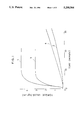
- FIG. 1 is a diagram showing the results of the test with Curelastometer performed in Example 1 and Comparative Experiment 1.
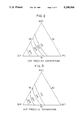
- FIG. 2 is a diagram showing the DCP crystallizing temperature of a composition of DCP, MSD, and IPC indicated in Example 52.
- FIG. 3 is a diagram showing the DCP crystallizing temperature of a composition of DCP, MSD, and BCP indicated in Example 53.
- FIG. 4 is a diagram showing the DCP crystallizing temperature of a composition of DCP, MSD, and 25B indicated in Example 54.
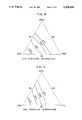
- FIG. 5 is a diagram showing the DBC crystallizing temperature of a composition of DBC, MSD, and IPC indicated in Example 55.
- FIG. 6 is a diagram showing the DBC crystallizing temperature of a composition of DBC, MSD, and BCP indicated in Example 56.
- FIG. 7 is a diagram showing the DBC crystallizing temperature of a composition of DBC, MSD, and 25B indicated in Example 57.
- FIG. 8 is a diagram showing the DCP and DBC crystallizing temperature of a composition of DCP, MSD, and DBC indicated in Example 58.
- the compounds represented by the aforementioned formula (I) which are usable as the organic peroxide in this invention include dialkylperoxides such as dicumylperoxide, t-butylcumylperoxide, 2,5-bis(t-butylperoxy)-2,5-dimethylhexane, 2,5-bis(t-butylperoxy)2,5-dimethylhexyne-3, di-t-butylperoxide, isopropylcumyl-t-butylperoxide, and bis( ⁇ -t-butylperoxyisopropyl)benzene, for example.
- dialkylperoxides such as dicumylperoxide, t-butylcumylperoxide, 2,5-bis(t-butylperoxy)-2,5-dimethylhexane, 2,5-bis(t-butylperoxy)2,5-dimethylhexyne-3, di-t-butylperoxide
- the compounds represented by the aforementioned formula (II) which are usable as the organic peroxide in this invention include peroxyketals such as 1,1-bis(t-butylperoxy)cyclohexane, 1,1-bis(t-butylperoxy)3,3,5-trimethylcyclohexane, n-butyl-4,4-bis(t-butylperoxy)valerate, ethyl-3,3-bis(t-butylperoxy)butylate, 2,2-bis(t-butylperoxy)butane, 1,1-bis(t-butylperoxy)cyclododecane and 3,3,6,6,9,9-hexamethyl-1,2,4,5-tetraoxycyclononane, for example.
- peroxyketals such as 1,1-bis(t-butylperoxy)cyclohexane, 1,1-bis(t-butylperoxy)3,3,5-trimethylcyclohexane, n-butyl-4
- organic peroxides represented by the aforementioned formula (I) include those in which R 1 and R 2 in the formula are the same or different and the organic peroxide represented by the aforementioned formula (II) include those in which R 4 and R 5 in the formula are the same or different.
- DCP and bis( ⁇ -t-butylperoxyisopropyl)benzene prove to be particularly preferable on account of their high cross-linking efficiency and low volatility. Since these compounds are in a solid state at 25° C., however, they are difficult to handle.
- a composition having a high cross-linking efficiency, low volatility, and a freezing temperature of not more than 25° C. can be obtained by incorporating therewith MSD and isopropylcumyl-t-butylperoxide which is in a liquid state even at -10° C.
- the gravimetric mixing ratio of the organic peroxide and the MSD in the composition of the present invention is in the range of 1:0.02 to 1:2. If the mixing ratio of the MSD to the organic peroxide is less than 1:0.02, the effect toward improving the cross-linking degree and scorch retardation is not sufficient. If this ratio exceeds 1:2, there ensues the disadvantage that the cross-linking degree is insufficient.
- the amounts of the organic peroxide and the MSD to be incorporated are desired to be in the ranges of 0.3 to 5 parts by weight and 0.1 to 3 parts by weight, respectively based on 100 parts by weight of the ethylene.polymer.
- the amount of the organic peroxide is less than 0.3 part by weight, the improvement in the cross-linking degree is not sufficient. If this amount exceeds 5 parts by weight, the cross-linking degree is unduly high and the cross-linked ethylene.polymer becomes brittle. If the amount of the MSD is less than 0.1 part by weight, the produced cross-linked ethylene.polymer is deficient in terms of scorch retardation. If this amount exceeds 3 parts by weight, the degree of ethylene.polymer cross-linking is low.
- the ethylene.polymers which are usable in this invention include polyethylene, ethylene/propylene copolymer (EPR), ethylene/butene copolymer, ethylene/pentene copolymer, ethylene/vinylacetate copolymer (EVA), ethylene/propylene/diene copolymer, (EPDM), ethylene/ethylacrylate copolymer (EEA), ethylene/glycidyl methacrylate copolymer (EGMA), ethylene/methylmethacrylate copolymer, ethylene/acrylonitrile copolymer, and chlorinated polyethylene.
- EPR ethylene/propylene copolymer
- EVA ethylene/butene copolymer
- EVA ethylene/pentene copolymer
- EVA ethylene/vinylacetate copolymer
- ESA ethylene/propylene/diene copolymer
- EPDM ethylene/ethylacrylate copolymer
- EGMA ethylene
- cross-linkable composition of this invention which has the aforementioned organic peroxide and MSD incorporated in an ethylene polymer can contain various commonly used additives.
- the MSD which is used in this invention is generally produced by dimerizing ⁇ -methylstyrene in the presence of an acidic catalyst.
- the MSD produced by this method contains as by-products of reaction not more than 5% of 2,4-diphenyl-4-methyl-2-pentene and not more than 1% of 1,1,3-trimethyl-3-phenylindane. The inclusion of these by-products poses no problem because these compounds do not participate in the cross-linking reaction.
- the reaction mixture may incorporate therein various additives such as, for example, antioxidant, pigment, stabilizer for UV light, filler, plasticizer, and coagent which are generally used in the cross-linking process.
- additives such as, for example, antioxidant, pigment, stabilizer for UV light, filler, plasticizer, and coagent which are generally used in the cross-linking process.
- phenol type compounds, phosphorus type compounds, and sulfur type compounds may be cited as examples of the antioxidant or the stabilizer for UV light.
- the antioxidant inherently functions to inhibit the reaction of cross-linking. In spite of this fact, the composition of this invention can manifest its effect even in the presence of these additives.
- the cross-linking temperature of the composition of this invention is generally in the range of from 110° C. to 220° C. It is preferred to obtain a suitable cross-linking time, this temperature is selected in the range of from 130° C. to 200° C.
- the ethylene.polymers which have been cross-linked by the use of the composition of this invention can be used as conventional molding materials.
- cross-linkable composition of this invention already incorporating therein the organic peroxide, MSD and an ethylene.polymer can be safely transported and stored. Thus, the production of a cross-linked ethylene.polymer can be simplified.
- the organic peroxide and the MSD are mixed with an ethylene.polymer in the mixing ratio mentioned above.
- the proportion of the organic peroxide is desired to be not less than 5 parts by weight and not more than 50 parts by weight and that of the MSD to be not less than 3 parts by weight and not more than 50 parts by weight.
- the mixing ratio of the organic peroxide to the MSD in the raw material may be fixed as already described.
- the cross-linkable composition of this invention has the following characteristic merits. It precludes the phenomenon of scorching during the process of cross-linking and enhances the final cross-linking degree of the cross-linked product as compared with the product crosslinked by an organic peroxide alone for cross-linking.
- the addition of the MSD to the organic peroxide which is in a solid state at 25° C. brings about an effect of lowering the freezing temperature of the composition and allowing production of a composition which is in a liquid state at or below room temperature, in addition to the effect described above.
- This composition possesses high stability against aging, low vapor pressure and low volatilizing speed.
- the effects mentioned above are attained even in the presence of an antioxidant.
- DCP Dicumylperoxide (purity 99%; produced by Nippon Oil & Fats Co., Ltd. and marketed as "Percumyl D")
- DBC Bis ( ⁇ -t-butylperoxyisopropyl)benzene (m/p 65/35 and purity 99%, produced by Nippon Oil & Fats Co., Ltd. and marketed as "Perbutyl P")
- IPC Isopropylcumyl-t-butylperoxide (m/p 60/40 and purity 94%; produced by Nippon Oil & Fats Co., Ltd. and marketed as "Perbutyl IPC")
- IPCC Isopropylcumylcumylperoxide [synthesized by the condensation of isopropylcumyl alcohol (m/p 60/40) and cumene hydroperoxide at a molar ratio of 1/1 in the presence of a perchloric acid catalyst]
- PEP36 A phosphorus type antioxidant (produced by Adeka Argas and marketed as "MARK PEP36")
- Irganox (produced by Nippon Ciba Geigy and marketed as "Irganox 1076")
- CB Carbon black (produced by Mitsubishi Chemical Industries, Ltd. and marketed as "HAF")
- a composition was obtained by mixing 500 g of low-density polyethylene (produced by Nippon Unicar K.K. and marketed as "NUC-9025”) and 12.5 g of DCP and 5 g of MSD. This composition was kneaded with a hot roll at about 110° C. for about 20 minutes. The resultant blend was subjected to a heating test by the use of an instrument (produced by Toyo Boldwin K.K. and marketed as "JSR Curelastometer III”). The maximum torque was measured at 180° C. And, the sample was tested for scorch time at 145° C. The scorch time represented the time required for the torque to rise from the minimum level to 10% of the maximum level at 180° C. The results are shown in Tale 1. The relation between the magnitude of torque determined with the Curelastometer and the time is shown in FIG. 1. In FIG. 1, curve 1 represents the data obtained at 180° C. and curve 2 those obtained at 145° C.
- Example 1 The procedure of Example 1 was faithfully repeated, except that the use of MSD was omitted. The results are shown in Table 1. The relation between the magnitude of torque obtained with the Curelastometer and the time is shown in FIG. 1. In the diagram, curve 3 represent the data obtained at 180° C. and curve 4 those obtained at 145° C.
- Example 1 registered high cross-linking speed and high cross-linking degree at the higher temperature of 180° C. and conversely low cross-linking speed at the lower temperature of 145° C., as compared with Comparative Experiment 1. This fact indicates that Example 1 delayed the scorch time and enhanced the cross-linking degree.
- Example 1 The procedure of Example 1 was repeated, except that the organic peroxide or the additives were changed to the compounds indicated in Table 1. The results are shown in Table 1.
- a composition was obtained by mixing 500 g of a high-density polyethylene (produced by Espolymer K.K. and marketed as "HDF6080V") with varying organic peroxides and additives indicated in Table 2.
- the compositions were severally kneaded by the use of a hot roll at about 130° C. for about 20 minutes. Then, they were tested by following the procedure of Example 1. The results are shown in Table 2.
- a composition was obtained by mixing 500 g of an ethylene/propylene copolymer (produced by Japan Synthetic Rubber Co., Ltd. and marketed as "JSR-EPO2P") with 12.5 g of 3M and 2.5 g of MSD. This composition was kneaded by the use of a hot roll at about 40° C. for about 20 minutes. Then, it was subjected to a heating test by the use of the Curelastometer. The maximum torque at 145° C. was found to be 2.32 kgf.cm. The scorch time at 110° C. was 18 minutes.
- Example 35 The procedure of Example 35 was repeated, except that the use of MSD was omitted.
- the maximum torque at 145° C. was 1.28 kgf.cm and the scorch time at 110° C. was 11 minutes.
- Example 35 The procedure of Example 35 was repeated, except that 2.5 g of ⁇ MS was used in the place of MSD.
- the maximum torque at 145° C. was 1.55 kgf.cm.
- the scorch time at 110° C. was 15 minutes.
- a composition was obtained by mixing 500 g of an ethylene/vinylacetate copolymer (vinyl acetate content 10% by weight; produced by Sumitomo Chemical Company, Ltd. and marketed as "Evatate D2021") with 12.5 g of DCP and 2.5 g of MSD. This composition was kneaded by the use of a hot roll at about 90° C. for about 20 minutes. It was then subjected to a heating test by the use of the Curelastometer. The maximum torque at 180° C. was 2.35 kgf.cm and the scorch time at 145° C. was 25 minutes.
- Example 36 The procedure of Example 36 was repeated, except that the use of MSD was omitted.
- the maximum torque at 180° C. was 1.90 kgf.cm and the scorch time at 145° C. was 13 minutes.
- Example 36 The procedure of Example 36 was repeated, except that 2.5 g of n-octyl acrylate was used in the place of MSD.
- the maximum torque at 180° C. was 1.85 kgf.cm and the scorch time at 145° C. was 18 minutes.
- compositions were obtained by mixing various organic peroxides with MSD as indicated in Table 3 at ratios indicated in the same table. These compositions were separately placed in test tubes 20 mm in inside diameter, stirred, and cooled at a temperature decreasing rate of 0.5° C. per minute. During the process of cooling, the temperatures at which the compositions start to crystallize (freezing temperature) were recorded. The results are shown in Table 3.
- compositions were left standing in a constant temperature bath at 30° C. for one month and then subjected to a color difference test by the use of an instrument (produced by Nippon Oenshoku Kogyo Co., Ltd. and marketed as "Color and Loior Difference Meter Z-1001-DP"). The results are shown in Table 3.
- compositions were obtained by mixing 20 g of each of the compositions described above with 1,000 g of low-density polyethylene pellets (produced by Nippon-Unicar K.K. and marketed as "NUC-9025").
- the produced compositions were severally placed in bags made of polyethylene sheet 0.05 mm in thickness, sealed airtightly therein, and left standing at a temperature of about 15° C. for 30 days.
- the amounts of these composition volatilized during this period were determined from the changes in weight. The results are shown in Table 3.
- compositions were obtained that contained the various organic peroxides indicated in Table 3 individually or in pairs at ratios also indicated in the table. These compositions were subjected to the same test as in Example 37. The results are shown in Table 3.
- compositions according with this invention showed lower freezing temperatures than the compositions omitting the addition of MSD. It is also clear that Examples 39 to 43 and 50 produced compositions for cross-linking which were in a liquid state at temperatures not exceeding 20° C.
- compositions of Examples 37 to 51 showed lower degrees of coloration after one month's standing at 30° C. than those of Comparative Experiments 31 to 44.
- Example 37 The amount of volatilization of the composition was smaller in Example 37 than in Comparative Experiment 32. It will be further noted that among the compositions of Examples 37 to 51, those of DCP, DBC, and IPC with MSD showed particularly small amounts of volatilization (Examples 37 to 42, 44 to 46, and 48).
- compositions of various organic peroxides indicated in Table 4 with MSD were tested for freezing temperature by following the procedure of Example 52. The results are shown in FIGS. 3 to 8.
- FIGS. 2 to 8 clearly show that the compositions of DCP and DBC with MSD which were in a solid state at 25° C. showed lower freezing temperatures and that the incorporation of other liquid organic peroxides contributed to lowering the freezing temperatures.
Landscapes
- Chemical & Material Sciences (AREA)
- Health & Medical Sciences (AREA)
- Chemical Kinetics & Catalysis (AREA)
- Medicinal Chemistry (AREA)
- Polymers & Plastics (AREA)
- Organic Chemistry (AREA)
- Compositions Of Macromolecular Compounds (AREA)
- Processes Of Treating Macromolecular Substances (AREA)
Priority Applications (1)
| Application Number | Priority Date | Filing Date | Title |
|---|---|---|---|
| US08/053,342 US5298564A (en) | 1990-04-16 | 1993-04-28 | Composition for cross-linking of ethylene-polymer, method for cross-linking ethylene-polymer, and cross-linkable composition |
Applications Claiming Priority (8)
| Application Number | Priority Date | Filing Date | Title |
|---|---|---|---|
| JP9768690 | 1990-04-16 | ||
| JP21500890 | 1990-08-16 | ||
| JP2-215008 | 1990-08-16 | ||
| JP2-97686 | 1990-09-18 | ||
| JP3081263A JP2855875B2 (ja) | 1990-04-16 | 1991-03-22 | エチレン系ポリマーの架橋可能な組成物及び架橋方法 |
| JP3-81263 | 1991-03-22 | ||
| US68487691A | 1991-04-15 | 1991-04-15 | |
| US08/053,342 US5298564A (en) | 1990-04-16 | 1993-04-28 | Composition for cross-linking of ethylene-polymer, method for cross-linking ethylene-polymer, and cross-linkable composition |
Related Parent Applications (1)
| Application Number | Title | Priority Date | Filing Date |
|---|---|---|---|
| US68487691A Division | 1990-04-16 | 1991-04-15 |
Publications (1)
| Publication Number | Publication Date |
|---|---|
| US5298564A true US5298564A (en) | 1994-03-29 |
Family
ID=27303545
Family Applications (1)
| Application Number | Title | Priority Date | Filing Date |
|---|---|---|---|
| US08/053,342 Expired - Lifetime US5298564A (en) | 1990-04-16 | 1993-04-28 | Composition for cross-linking of ethylene-polymer, method for cross-linking ethylene-polymer, and cross-linkable composition |
Country Status (5)
| Country | Link |
|---|---|
| US (1) | US5298564A (ja) |
| EP (1) | EP0453204B1 (ja) |
| JP (1) | JP2855875B2 (ja) |
| DE (1) | DE69121005T2 (ja) |
| DK (1) | DK0453204T3 (ja) |
Cited By (9)
| Publication number | Priority date | Publication date | Assignee | Title |
|---|---|---|---|---|
| WO1999033069A1 (en) * | 1997-12-22 | 1999-07-01 | Asea Brown Boveri Ab | An electric dc-cable with an insulation system |
| US6072007A (en) * | 1998-04-21 | 2000-06-06 | Elf Atochem Italia S.R.L. | Peroxidic compositions |
| EP1041583A1 (en) * | 1999-03-31 | 2000-10-04 | Union Carbide Chemicals & Plastics Technology Corporation | A crosslinkable polyethylene composition |
| US6143822A (en) * | 1999-03-18 | 2000-11-07 | Union Carbide Chemicals & Plastics Technology Corporation | Polyethylene crosslinkable composition |
| US6277925B1 (en) | 1999-03-18 | 2001-08-21 | Hercules Incorporated | Allyl compounds, compositions containing allyl compounds and processes for forming and curing polymer compositions |
| US20040072930A1 (en) * | 2002-10-10 | 2004-04-15 | Lee Lester Y. | Flame retardant insulation composition having improved scorch resistance |
| US20080254289A1 (en) * | 2005-02-28 | 2008-10-16 | Jan-Ove Bostrom | Scorch-Retarding Polymer Composition |
| US9758638B2 (en) | 2012-09-27 | 2017-09-12 | Dow Global Technologies Llc | Process for reducing peroxide migration in crosslinkable ethylene-based polymer compositions |
| US11236220B2 (en) | 2017-04-27 | 2022-02-01 | Dow Global Technologies Llc | Polyethylene blend composition |
Families Citing this family (6)
| Publication number | Priority date | Publication date | Assignee | Title |
|---|---|---|---|---|
| DE69508090T2 (de) * | 1994-07-21 | 1999-09-02 | Akzo Nobel N.V. | Modifizierung von (co)polymeren mit cyclischen ketonperoxiden |
| DE19701915A1 (de) * | 1997-01-21 | 1998-07-23 | Peroxid Chemie Gmbh | UHF-Vernetzung von Polyethylen |
| US6103807A (en) * | 1998-03-19 | 2000-08-15 | Solvay Polyolefins Europe-Belgium (Societe Anonyme) | Ethylene-polymer-based composition, process for obtaining and using same |
| ES2335894T3 (es) * | 2005-02-28 | 2010-04-06 | Borealis Technology Oy | Procedimiento para preparar composiciones polimericas reticuladas. |
| JP7619749B2 (ja) * | 2021-06-29 | 2025-01-22 | 株式会社Eneos Nuc | 架橋性樹脂組成物および電線・ケーブル |
| WO2025149484A1 (en) * | 2024-01-08 | 2025-07-17 | Borealis Gmbh | Polymer composition |
Citations (7)
| Publication number | Priority date | Publication date | Assignee | Title |
|---|---|---|---|---|
| US3202648A (en) * | 1961-11-08 | 1965-08-24 | Fmc Corp | Scorch-resistant polyethylene compositions and method |
| US3335124A (en) * | 1963-11-15 | 1967-08-08 | Union Carbide Canada Ltd | Rate-controlled vulcanization of polyethylene |
| US3954907A (en) * | 1974-11-27 | 1976-05-04 | Union Carbide Corporation | Composition with selected vinyl compounds and process for avoiding scorching of ethylene polymer composition |
| JPS548500A (en) * | 1977-06-21 | 1979-01-22 | Nippon Signal Co Ltd:The | Vehicle detector of ultrasonic type |
| US4298713A (en) * | 1978-12-28 | 1981-11-03 | Mitsui Petrochemical Industries, Ltd. | Process for preparing low density ethylene copolymers |
| FR2535329A1 (fr) * | 1982-11-01 | 1984-05-04 | Nippon Oils & Fats Co Ltd | Procede de durcissement pour resine polyester insaturee |
| JPH0231106A (ja) * | 1988-07-20 | 1990-02-01 | Kanai Hiroyuki | 自動車用ホイールのリム径及びリム幅の測定検査方法 |
-
1991
- 1991-03-22 JP JP3081263A patent/JP2855875B2/ja not_active Expired - Fee Related
- 1991-04-15 DK DK91303291.8T patent/DK0453204T3/da active
- 1991-04-15 DE DE69121005T patent/DE69121005T2/de not_active Expired - Lifetime
- 1991-04-15 EP EP91303291A patent/EP0453204B1/en not_active Expired - Lifetime
-
1993
- 1993-04-28 US US08/053,342 patent/US5298564A/en not_active Expired - Lifetime
Patent Citations (8)
| Publication number | Priority date | Publication date | Assignee | Title |
|---|---|---|---|---|
| US3202648A (en) * | 1961-11-08 | 1965-08-24 | Fmc Corp | Scorch-resistant polyethylene compositions and method |
| US3335124A (en) * | 1963-11-15 | 1967-08-08 | Union Carbide Canada Ltd | Rate-controlled vulcanization of polyethylene |
| US3954907A (en) * | 1974-11-27 | 1976-05-04 | Union Carbide Corporation | Composition with selected vinyl compounds and process for avoiding scorching of ethylene polymer composition |
| JPS548500A (en) * | 1977-06-21 | 1979-01-22 | Nippon Signal Co Ltd:The | Vehicle detector of ultrasonic type |
| US4298713A (en) * | 1978-12-28 | 1981-11-03 | Mitsui Petrochemical Industries, Ltd. | Process for preparing low density ethylene copolymers |
| FR2535329A1 (fr) * | 1982-11-01 | 1984-05-04 | Nippon Oils & Fats Co Ltd | Procede de durcissement pour resine polyester insaturee |
| US4507432A (en) * | 1982-11-01 | 1985-03-26 | Nippon Oil & Fats Co., Ltd. | Curing method for unsaturated polyester resin |
| JPH0231106A (ja) * | 1988-07-20 | 1990-02-01 | Kanai Hiroyuki | 自動車用ホイールのリム径及びリム幅の測定検査方法 |
Cited By (14)
| Publication number | Priority date | Publication date | Assignee | Title |
|---|---|---|---|---|
| WO1999033069A1 (en) * | 1997-12-22 | 1999-07-01 | Asea Brown Boveri Ab | An electric dc-cable with an insulation system |
| US6072007A (en) * | 1998-04-21 | 2000-06-06 | Elf Atochem Italia S.R.L. | Peroxidic compositions |
| US6143822A (en) * | 1999-03-18 | 2000-11-07 | Union Carbide Chemicals & Plastics Technology Corporation | Polyethylene crosslinkable composition |
| US6277925B1 (en) | 1999-03-18 | 2001-08-21 | Hercules Incorporated | Allyl compounds, compositions containing allyl compounds and processes for forming and curing polymer compositions |
| EP1041583A1 (en) * | 1999-03-31 | 2000-10-04 | Union Carbide Chemicals & Plastics Technology Corporation | A crosslinkable polyethylene composition |
| US6231978B1 (en) | 1999-03-31 | 2001-05-15 | Union Carbide Chemicals & Plastics Technology Corporation | Crosslinkable polyethylene composition |
| US20040072930A1 (en) * | 2002-10-10 | 2004-04-15 | Lee Lester Y. | Flame retardant insulation composition having improved scorch resistance |
| WO2004037912A3 (en) * | 2002-10-10 | 2004-08-05 | Equistar Chem Lp | Flame retardant insulation composition having improved scorch resistance |
| US6984677B2 (en) | 2002-10-10 | 2006-01-10 | Equistar Chemicals, Lp | Flame retardant insulation composition having improved scorch resistance |
| US10665361B2 (en) | 2005-02-25 | 2020-05-26 | Borealis Technology Oy | Scorch-retarding polymer composition |
| US20080254289A1 (en) * | 2005-02-28 | 2008-10-16 | Jan-Ove Bostrom | Scorch-Retarding Polymer Composition |
| US9758638B2 (en) | 2012-09-27 | 2017-09-12 | Dow Global Technologies Llc | Process for reducing peroxide migration in crosslinkable ethylene-based polymer compositions |
| US10259930B2 (en) | 2012-09-27 | 2019-04-16 | Dow Global Technologies Llc | Process for reducing peroxide migration in crosslinkable ethylene-based polymer compositions |
| US11236220B2 (en) | 2017-04-27 | 2022-02-01 | Dow Global Technologies Llc | Polyethylene blend composition |
Also Published As
| Publication number | Publication date |
|---|---|
| DE69121005D1 (de) | 1996-08-29 |
| DE69121005T2 (de) | 1996-12-19 |
| EP0453204B1 (en) | 1996-07-24 |
| EP0453204A1 (en) | 1991-10-23 |
| JP2855875B2 (ja) | 1999-02-10 |
| DK0453204T3 (da) | 1996-09-02 |
| JPH04218546A (ja) | 1992-08-10 |
Similar Documents
| Publication | Publication Date | Title |
|---|---|---|
| EP0453204B1 (en) | Composition for cross-linking of ethylene-polymer, method for cross-linking ethylene-polymer, and cross-linkable composition | |
| US5292791A (en) | Mixture suited for crosslinking polymers, and process for crosslinking polymers with extension of the scorch time | |
| US4737547A (en) | Polyolefin blends containing reactive agents | |
| US4136055A (en) | Compositions of antioxidants of reduced volatility | |
| US4707524A (en) | Controlled-rheology polypropylene | |
| EP0369604B1 (en) | Grafted polymers and process for their preparation | |
| WO2008045718A2 (en) | Nitroxide compounds for minimizing scorch in crosslinkable compositions | |
| JPH07119318B2 (ja) | 安定剤組成物 | |
| US4385143A (en) | Stabilizer for synthetic resins | |
| US4268637A (en) | Elimination of bloom in [vul-cup] peroxide crosslinked elastomer compounds | |
| US2852488A (en) | Stabilized polyolefinic compositions and method for preparing same | |
| US3986981A (en) | Antioxidants of bisphenolic polymers | |
| US3357944A (en) | Stabilization of synthetic organic polymeric substances with oxalobis | |
| US3900442A (en) | Titanium dioxide pigmented polymer compositions with improved visible and ultraviolet light stability | |
| US4719257A (en) | Polyolefin resin composition | |
| EP0063855B1 (en) | Flame retardant polymer compositions | |
| US5180764A (en) | Stabilized polypropylene resin compositions containing a dinitrodiamine compound | |
| JPS60124642A (ja) | 安定化されたポリオレフィン組成物 | |
| US3243408A (en) | Stabilized polyolefin compositions | |
| US4240954A (en) | Polymers stabilized against degradation by ultraviolet radiation | |
| US6066698A (en) | Peroxidic compositions | |
| US4387170A (en) | Process for the production of foamed materials from polyolefins | |
| US5070124A (en) | Sulfide antioxidants for stabilizing crosslinked polyolefins | |
| US3821161A (en) | Aromatic diimides of 3,5-dialkyl-4-hydroxyphenylsubstituted amines | |
| US3239483A (en) | Stabilization of polyisobutylene polymers with sulfur and benzotriazoles |
Legal Events
| Date | Code | Title | Description |
|---|---|---|---|
| STPP | Information on status: patent application and granting procedure in general |
Free format text: APPLICATION UNDERGOING PREEXAM PROCESSING |
|
| AS | Assignment |
Owner name: NIPPON OIL & FATS CO., LTD., JAPAN Free format text: ASSIGNMENT OF ASSIGNORS INTEREST;ASSIGNORS:SUYAMA, SHUJI;ISHIGAKI, HIDEYO;REEL/FRAME:006800/0932 Effective date: 19910328 |
|
| FEPP | Fee payment procedure |
Free format text: PAYER NUMBER DE-ASSIGNED (ORIGINAL EVENT CODE: RMPN); ENTITY STATUS OF PATENT OWNER: LARGE ENTITY Free format text: PAYOR NUMBER ASSIGNED (ORIGINAL EVENT CODE: ASPN); ENTITY STATUS OF PATENT OWNER: LARGE ENTITY |
|
| FEPP | Fee payment procedure |
Free format text: PAYOR NUMBER ASSIGNED (ORIGINAL EVENT CODE: ASPN); ENTITY STATUS OF PATENT OWNER: LARGE ENTITY |
|
| FPAY | Fee payment |
Year of fee payment: 4 |
|
| FEPP | Fee payment procedure |
Free format text: PAYOR NUMBER ASSIGNED (ORIGINAL EVENT CODE: ASPN); ENTITY STATUS OF PATENT OWNER: LARGE ENTITY Free format text: PAYER NUMBER DE-ASSIGNED (ORIGINAL EVENT CODE: RMPN); ENTITY STATUS OF PATENT OWNER: LARGE ENTITY |
|
| FEPP | Fee payment procedure |
Free format text: PAYER NUMBER DE-ASSIGNED (ORIGINAL EVENT CODE: RMPN); ENTITY STATUS OF PATENT OWNER: LARGE ENTITY Free format text: PAYOR NUMBER ASSIGNED (ORIGINAL EVENT CODE: ASPN); ENTITY STATUS OF PATENT OWNER: LARGE ENTITY |
|
| FPAY | Fee payment |
Year of fee payment: 8 |
|
| FPAY | Fee payment |
Year of fee payment: 12 |