US5259109A - Machine for the automatic fitting of piston rings onto pistons - Google Patents

Machine for the automatic fitting of piston rings onto pistons Download PDF

Info

Publication number
US5259109A
US5259109A US07/922,849 US92284992A US5259109A US 5259109 A US5259109 A US 5259109A US 92284992 A US92284992 A US 92284992A US 5259109 A US5259109 A US 5259109A
Authority
US
United States
Prior art keywords
piston
spacers
rails
machine
spacer
Prior art date
Legal status (The legal status is an assumption and is not a legal conclusion. Google has not performed a legal analysis and makes no representation as to the accuracy of the status listed.)
Expired - Fee Related
Application number
US07/922,849
Inventor
Michel A. Fefeu
Alfred Schreiber
Donatus O. Nwokoye
Francois G. Charton
Current Assignee (The listed assignees may be inaccurate. Google has not performed a legal analysis and makes no representation or warranty as to the accuracy of the list.)
Perfect Circle Europe SA
Original Assignee
Floquet Monopole SRL
Priority date (The priority date is an assumption and is not a legal conclusion. Google has not performed a legal analysis and makes no representation as to the accuracy of the date listed.)
Filing date
Publication date
Application filed by Floquet Monopole SRL filed Critical Floquet Monopole SRL
Assigned to FLOQUET MONOPOLE reassignment FLOQUET MONOPOLE ASSIGNMENT OF ASSIGNORS INTEREST. Assignors: CHARTON, FRANCOIS G., FEFEU, MICHEL A., NWOKOYE, DONATUS O., SCHREIBER, ALFRED
Application granted granted Critical
Publication of US5259109A publication Critical patent/US5259109A/en
Assigned to PERFECT CIRCLE EUROPE reassignment PERFECT CIRCLE EUROPE CHANGE OF NAME (SEE DOCUMENT FOR DETAILS). Assignors: MONOPOLE, FLOQUET
Anticipated expiration legal-status Critical
Expired - Fee Related legal-status Critical Current

Links

Images

Classifications

    • BPERFORMING OPERATIONS; TRANSPORTING
    • B23MACHINE TOOLS; METAL-WORKING NOT OTHERWISE PROVIDED FOR
    • B23PMETAL-WORKING NOT OTHERWISE PROVIDED FOR; COMBINED OPERATIONS; UNIVERSAL MACHINE TOOLS
    • B23P19/00Machines for simply fitting together or separating metal parts or objects, or metal and non-metal parts, whether or not involving some deformation; Tools or devices therefor so far as not provided for in other classes
    • B23P19/04Machines for simply fitting together or separating metal parts or objects, or metal and non-metal parts, whether or not involving some deformation; Tools or devices therefor so far as not provided for in other classes for assembling or disassembling parts
    • B23P19/08Machines for placing washers, circlips, or the like on bolts or other members
    • B23P19/084Machines for placing washers, circlips, or the like on bolts or other members for placing resilient or flexible rings, e.g. O-rings, circlips
    • B23P19/088Piston rings in piston grooves
    • BPERFORMING OPERATIONS; TRANSPORTING
    • B25HAND TOOLS; PORTABLE POWER-DRIVEN TOOLS; MANIPULATORS
    • B25BTOOLS OR BENCH DEVICES NOT OTHERWISE PROVIDED FOR, FOR FASTENING, CONNECTING, DISENGAGING OR HOLDING
    • B25B27/00Hand tools, specially adapted for fitting together or separating parts or objects whether or not involving some deformation, not otherwise provided for
    • B25B27/02Hand tools, specially adapted for fitting together or separating parts or objects whether or not involving some deformation, not otherwise provided for for connecting objects by press fit or detaching same
    • B25B27/12Hand tools, specially adapted for fitting together or separating parts or objects whether or not involving some deformation, not otherwise provided for for connecting objects by press fit or detaching same mounting or demounting piston rings
    • YGENERAL TAGGING OF NEW TECHNOLOGICAL DEVELOPMENTS; GENERAL TAGGING OF CROSS-SECTIONAL TECHNOLOGIES SPANNING OVER SEVERAL SECTIONS OF THE IPC; TECHNICAL SUBJECTS COVERED BY FORMER USPC CROSS-REFERENCE ART COLLECTIONS [XRACs] AND DIGESTS
    • Y10TECHNICAL SUBJECTS COVERED BY FORMER USPC
    • Y10TTECHNICAL SUBJECTS COVERED BY FORMER US CLASSIFICATION
    • Y10T29/00Metal working
    • Y10T29/53Means to assemble or disassemble
    • Y10T29/53313Means to interrelatedly feed plural work parts from plural sources without manual intervention
    • YGENERAL TAGGING OF NEW TECHNOLOGICAL DEVELOPMENTS; GENERAL TAGGING OF CROSS-SECTIONAL TECHNOLOGIES SPANNING OVER SEVERAL SECTIONS OF THE IPC; TECHNICAL SUBJECTS COVERED BY FORMER USPC CROSS-REFERENCE ART COLLECTIONS [XRACs] AND DIGESTS
    • Y10TECHNICAL SUBJECTS COVERED BY FORMER USPC
    • Y10TTECHNICAL SUBJECTS COVERED BY FORMER US CLASSIFICATION
    • Y10T29/00Metal working
    • Y10T29/53Means to assemble or disassemble
    • Y10T29/53478Means to assemble or disassemble with magazine supply
    • YGENERAL TAGGING OF NEW TECHNOLOGICAL DEVELOPMENTS; GENERAL TAGGING OF CROSS-SECTIONAL TECHNOLOGIES SPANNING OVER SEVERAL SECTIONS OF THE IPC; TECHNICAL SUBJECTS COVERED BY FORMER USPC CROSS-REFERENCE ART COLLECTIONS [XRACs] AND DIGESTS
    • Y10TECHNICAL SUBJECTS COVERED BY FORMER USPC
    • Y10TTECHNICAL SUBJECTS COVERED BY FORMER US CLASSIFICATION
    • Y10T29/00Metal working
    • Y10T29/53Means to assemble or disassemble
    • Y10T29/536Piston ring inserter or remover
    • YGENERAL TAGGING OF NEW TECHNOLOGICAL DEVELOPMENTS; GENERAL TAGGING OF CROSS-SECTIONAL TECHNOLOGIES SPANNING OVER SEVERAL SECTIONS OF THE IPC; TECHNICAL SUBJECTS COVERED BY FORMER USPC CROSS-REFERENCE ART COLLECTIONS [XRACs] AND DIGESTS
    • Y10TECHNICAL SUBJECTS COVERED BY FORMER USPC
    • Y10TTECHNICAL SUBJECTS COVERED BY FORMER US CLASSIFICATION
    • Y10T29/00Metal working
    • Y10T29/53Means to assemble or disassemble
    • Y10T29/53613Spring applier or remover
    • Y10T29/5363Circular spring
    • YGENERAL TAGGING OF NEW TECHNOLOGICAL DEVELOPMENTS; GENERAL TAGGING OF CROSS-SECTIONAL TECHNOLOGIES SPANNING OVER SEVERAL SECTIONS OF THE IPC; TECHNICAL SUBJECTS COVERED BY FORMER USPC CROSS-REFERENCE ART COLLECTIONS [XRACs] AND DIGESTS
    • Y10TECHNICAL SUBJECTS COVERED BY FORMER USPC
    • Y10TTECHNICAL SUBJECTS COVERED BY FORMER US CLASSIFICATION
    • Y10T29/00Metal working
    • Y10T29/53Means to assemble or disassemble
    • Y10T29/53657Means to assemble or disassemble to apply or remove a resilient article [e.g., tube, sleeve, etc.]

Definitions

  • the present invention relates to a machine for the automatic fitting of piston rings onto pistons, in particular onto the pistons of internal combustion engines.
  • scraper rings of small thickness each consisting of two split and flat rings which may have a thickness of 4/10th mm, commonly termed “rails”, and separated by a spring-ring, also split, of special shape, commonly termed “spacer”, these members being constituted of a steel alloy and having, once superimposed and placed into the corresponding groove of the piston, a total thickness on the order of 2 mm.
  • the resilient spacer may have different configurations and may comprise for example, on the radially inward side, a corrugated peripheral step, by virtue of which this spacer, through its radial resilience, exerts an outward radial pressure on the two rails, necessary in order to produce the leaktightness around the piston when it is placed in its cylinder.
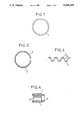
  • FIGS. 1 through 4 of the accompanying drawings show by way of example the constituent members of such a scraper piston ring.
  • FIG. 1 shows a rail 1 seen from above and FIG. 2 a spacer 2 also seen from above, with its steps 3, FIG. 3 being a profile view of this spacer 2.
  • FIG. 4 shows in cross section the scraper piston ring constituted by the stacking of two rails 1 and of a spacer 2, the radially outward part of this piston ring corresponding to the left part of the figure. Owing to the small thickness of the rails 1 and the special profile of the spacer 2, their fitting into the grooves of the pistons has hitherto been carried out manually.
  • the object of the present invention is to solve the problems which arise when it is desired to produce a machine for the automatic fitting of such piston rings.
  • Spacers and rails being of very different shapes, as has just been seen, the machine will have specific dispositions in order to permit their sequential insertion into the groove in question of the piston, and these dispositions, both as regards the rails and as regards the spacers, may have a certain number of variants.
  • a machine which comprises a hollow magazine-tube comprising at the end a widened bore terminating on the outside with a bevel and constituting a seating for a piston, so that the piston groove to be equipped is situated in the vicinity of said bevel, onto which tube is threaded a stack of said spacers which can be slid automatically and step by step onto the tube by an axially movable pusher, and wherein there is further provided, on the other side of said stack from said pusher, and in the vicinity of the abovementioned bevel, an axially movable stop adapted to occupy successively two axially offset positions, namely a first position in which it blocks said stack of spacers between it and said pusher, the last spacer of the stack, against which it bears, then bearing radially against said bevel, and a second position in which this stop is separated from said last spacer, thus permitting it to slide onto said bevel and to enter the
  • the machine may essentially comprise, for the fitting of the rails into said groove of the piston, on either side of the previously fitted spacer, a magazine-tube onto which is threaded a stack of rails resting on a pusher, said tube being movable vertically along its axis, a set of slides with recesses suitable for sliding in a fixed casing in a direction perpendicular to said axis, and a set of grips which are movable both in the direction perpendicular to said axis and vertically in the direction of this axis, these grips having the function of pushing said rails in turn respectively into the recesses of the slides and of guiding said piston downward when, after they have been brought back up, these grips permit said rails to be released from said slides and to enter said groove of the piston.
  • the machine may comprise the additional feature that said slides have, just in front of said recesses, sloping thresholds slightly compressing the rails radially inward during the upward movements of said magazine-tube, said recesses being delimited moreover by stops stopping said rails at said recesses.
  • FIG. 1 shows a top view of a rail 1
  • FIG. 2 shows a top view of a spacer 2, with its steps 3;
  • FIG. 3 shows a profile view of spacer 2
  • FIG. 4 shows cross sectional view of the scraper piston ring constituted by the stacking of two rails 1 and of a spacer 2;
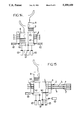
  • FIGS. 5a through 5e show diagrammatically, in axial half-cross sections, the various phases of operation of the machine, for the fitting of a spacer into a piston groove wherein FIG. 5b' is an enlarged view of the circled portion in FIG. 5b;
  • FIGS. 6a through 6f show diagrammatically in axial half-cross sections, the various phases of operation of the machine, for fitting two rails, on either side of the spacer already fitted, in said groove;
  • FIGS. 7a through 7f show diagrammatically in axial half-cross sections, another system for separating and for distributing spacers in another type of machine according to the invention
  • FIGS. 8a through 8c describe diagrammatically the mode of distribution of the rails.
  • FIGS. 9 through 15 show the various phases of operation of the machine, in diagrammatic views.
  • FIGS. 5a through 5e a hollow magazine-tube has been referenced 4, and a stack of spacers similar to those of FIGS. 2 and 3 has been referenced 5, these spacers being resiliently distended owing to their engagement onto a tube of diamater slightly greater than their diameter at rest.
  • the tube 4 comprises at its upper end a widened bore 6 terminating on the outside with a bevel 7 and constituting a seating for a piston 8.
  • the depth of the bore 6 is such that the lower wall of the piston groove 9 to be equipped once put into place is located in the region of the upper edge of this bore.
  • the machine additionally comprises an annular and axially movable pusher 10 engaged on the tube 4 underneath the stack 5, and a stop 11, also annular and axially movable, disposed above said stack.
  • the pusher 10 and the stop 11 are seen to be separated from the stack 5 of the spacers, the stop 11 being in its low position (referred to above as "first position").
  • a piston 8 is put into place in the bore 6, and then the pusher 10 is pushed upward so as to press the stack 5 between it and the stop 11.
  • the upper spacer 2 then bears radially against the bevel 7 (FIG. 5b).
  • the pusher 10 is then brought back down so that the stack 5 does not block the upper spacer 2, allowing for the corrugated profile of the spacers and for their steps (FIG. 5c).
  • the stop 11 is brought into its high position (second position), which permits the spacer 2 bearing radially against the bevel 7 to slide upward on the latter, because of its spring effect, and to enter the corresponding groove 9 of the piston 8 (FIG. 5d). All these movements are of course performed automatically and as rapidly as possible.
  • FIGS. 6a through 6f show the part of the machine which is designed to fit the rails 1 on either side of the spacer 2 already fitted into the groove 9 of the piston 8.
  • This part of the machine comprises: a hollow magazine-tube 13 which is movable vertically along its axis 14, and also in rotation about this axis, this tube 13 being arranged so as to ensure the axial positioning of the piston 8; a fixed casing 15 in which a certain number of slides 16 (at least two) can slide; and a certain number of expansible grips 17 (at least two) capable of moving both axially and perpendicularly to the axis 14, these grips 17 being arranged so as to ensure the opening and the release of the rails 1, and also to ensure the centering of the piston 8.
  • the slides 16 advance toward the axis 14, as do the grips 17, which also have a downward movement (FIG. 6a).
  • the magazine-tube 13 and its pusher 18 rise, bringing the stack 12 of the rails into the position shown in FIG. 6b.
  • the upper rail 1 of the stack 12 can be seen to enter a first recess 19 of the slide 16, after having crossed a sloping threshold 20 of the slide 16 (while being momentarily compressed) and after having been stopped by a stop 21 of the slide 16.
  • the magazine-tube 13 and its pusher 18 descend (FIG.
  • the magazine-tube 13 and its pusher 18 move back up (FIG. 6d) and the same operation as that of FIG. 6b is reproduced for the next rail 1 of the stack (second recess 22 of the slide 16, sloping threshold 23, stop 24, all operating in the same manner).
  • the slide 16 is thus equipped with two rails 1.
  • the magazine-tube 13 and its pusher 18 then move back down once again, and the grips 17 move back, as do the slides 16, so as to drive the rails 1 into the recesses 19 and 22 of the slides 16 (FIG. 6e).
  • the general principle of this machine resides in that it comprises mainly:
  • a feed system consisting of two distributors for the rails 1, with simultaneous separation and feed, and of a distributor for the spacer 2, separation of spacers being performed separately from feeding of spacers;
  • a fixed casing B for receiving the piston ring members and the piston comprising housings h receiving the rails 1 and spacers 2 of the piston ring and ensuring their positioning before assembly with the aid of sliding stops, slides t being provided for each rail and spacer;
  • a sliding plate 60 ensuring the successive positionings of the piston 8 at the time of the release of each piston ring member 1, 2 into the groove 9 of the piston.
  • the separation of the last spacer 2 from a stack 35 is carried out by means of the following members: a magazine-tube 34 onto which the spacers 2 are threaded; a fixed annular stop 41 ensuring the positioning of the end spacer 2; and a pusher 40 which is movable axially along the tube 34 (by analogy with the system of FIGS. 5a through 5e, the same references, increased by 30, have been given to similar members--except for the spacers 2).
  • the system For the distribution of the spacers 2 in the abovementioned casing B (which will be seen later), the system comprises a platform P for receiving the spacer 2 after separation, and a pusher p.
  • the magazine-tube 34 rises, which releases the last spacer 2, which falls onto the platform P; the pusher p inserts it into the casing (FIG. 7d). Next, the tube 34 moves back down (FIG. 7e) and the position of FIG. 7b is restored (FIG. 7f). The process is then repeated in the same manner for the following spacers.
  • two magazine-tubes 43 are used (FIGS. 8a through 8c) which may be diameterically opposed with respect to the center of the casing B and on which the stacks 42 of rails 1 are threaded, without any stress.
  • Two platforms P' receive the last rail 1, and the latter, at the lower part of each of the magazine-tubes 43, is put into position by a pusher p'.
  • the pusher p' pushes the last rail 1 into the casing B (FIG. 8b) and then the next rail 1 descends by gravity onto the platform P' (FIG. 8c).
  • the piston always has the reference 8, and the groove to be equipped with a piston ring, 9.
  • the four expansible and sliding grips are referenced 47; they are movable horizontally by means of jacks 62 which are themselves movable vertically by means of jacks 63.
  • the reference 60 is given to a sliding plate suitable for moving vertically under the action of a jack 61.
  • FIG. 9 shows the casing B being fed with members 2, 1 1 and 1 2 .
  • the left half shows the initial state of the various movable parts, and the right half their final state, which each time constitutes the initial state of the next phase of operation.
  • the three members 2, 1 1 and 1 2 of the piston ring are on their respective thrust platforms P and P'; the slides t are closed, as are the grips 47, which are then in the low position.
  • the plate 60 is also in the low position, underneath the slides t.
  • the members 2, 1 1 and 1 2 are pushed simultaneously into the casing B, the grips 47 rise as far as the spacer 2 and separate radially outward, as do the slides t.
  • the plate 60 rises as far as the upper level of the casing B.
  • the members 2, 1 1 and 1 2 are in their respective housings 1 and are expanded. New members are distributed, on the platforms P and P'.
  • the grips 47 descend (FIG. 11) until they are below the upper housing 1, which permits the automatic insertion of the spacer 2 into the groove 9.
  • the grips 47 are then brought back up so as to re-center the spacer 2 on the piston 8; the plate 60 is lowered and stopped precisely, as are the grips 47, into a position for which the upper rail 1 1 can be released into the groove 9 of the piston, above the spacer 2 (FIG. 12).
  • the grips 47 are raised above the rail 1 1 so as to re-center it, as well as the spacer 2, on the piston 8, after which the plate 60 is lowered, as are the grips 47, into a position for which the second rail 1 2 can be released into the groove 9, underneath the spacer 2.
  • the complete piston ring is then in place on the piston 8 (FIG. 13).
  • the grips 47 are raised once again so as to center this piston ring on the piston.
  • the plate 60 is then caused to rise and the piston 8, and the latter, with its rod, is removed.
  • this final state (right half of FIG. 14), the grips 47 are separated and in the high position, the slides t are mutually separated.
  • the plate 60 and the grips 47 are lowered again, the grips and the slides t are closed again and the initial state of FIG. 9 is restored.
Landscapes

  • Engineering & Computer Science (AREA)
  • Mechanical Engineering (AREA)
  • Automatic Assembly (AREA)

Abstract

A machine for automatically distributing piston rings and spacers into the grooves of a piston is disclosed. The machine comprises magazine tubes onto which stacks of the spacers and rails are threaded. The machine further comprises a widened bore in which the piston is seated as rails or spacers are automatically released from the tubes and threaded into the piston grooves.

Description

FIELD OF THE INVENTION
The present invention relates to a machine for the automatic fitting of piston rings onto pistons, in particular onto the pistons of internal combustion engines.
BACKGROUND OF THE INVENTION
These may be in particular, but not exclusively, scraper rings of small thickness, each consisting of two split and flat rings which may have a thickness of 4/10th mm, commonly termed "rails", and separated by a spring-ring, also split, of special shape, commonly termed "spacer", these members being constituted of a steel alloy and having, once superimposed and placed into the corresponding groove of the piston, a total thickness on the order of 2 mm. The resilient spacer may have different configurations and may comprise for example, on the radially inward side, a corrugated peripheral step, by virtue of which this spacer, through its radial resilience, exerts an outward radial pressure on the two rails, necessary in order to produce the leaktightness around the piston when it is placed in its cylinder.
FIGS. 1 through 4 of the accompanying drawings show by way of example the constituent members of such a scraper piston ring.
FIG. 1 shows a rail 1 seen from above and FIG. 2 a spacer 2 also seen from above, with its steps 3, FIG. 3 being a profile view of this spacer 2. FIG. 4 shows in cross section the scraper piston ring constituted by the stacking of two rails 1 and of a spacer 2, the radially outward part of this piston ring corresponding to the left part of the figure. Owing to the small thickness of the rails 1 and the special profile of the spacer 2, their fitting into the grooves of the pistons has hitherto been carried out manually.
SUMMARY OF THE INVENTION
The object of the present invention is to solve the problems which arise when it is desired to produce a machine for the automatic fitting of such piston rings.
Spacers and rails being of very different shapes, as has just been seen, the machine will have specific dispositions in order to permit their sequential insertion into the groove in question of the piston, and these dispositions, both as regards the rails and as regards the spacers, may have a certain number of variants.
With respect firstly to the distribution of the spacers, it will be possible for example to use a machine which comprises a hollow magazine-tube comprising at the end a widened bore terminating on the outside with a bevel and constituting a seating for a piston, so that the piston groove to be equipped is situated in the vicinity of said bevel, onto which tube is threaded a stack of said spacers which can be slid automatically and step by step onto the tube by an axially movable pusher, and wherein there is further provided, on the other side of said stack from said pusher, and in the vicinity of the abovementioned bevel, an axially movable stop adapted to occupy successively two axially offset positions, namely a first position in which it blocks said stack of spacers between it and said pusher, the last spacer of the stack, against which it bears, then bearing radially against said bevel, and a second position in which this stop is separated from said last spacer, thus permitting it to slide onto said bevel and to enter the corresponding groove of said piston by radial tightening.
Preferably, provision is additionally made so that for said second position of said stop, said pusher is also separated from said stack of spacers, so as to permit a slight downward movement of the latter, with the exception of the last spacer so as not to hinder said radial tightening of said last spacer, to be inserted into the groove in question of the piston.
The mode of operation of a machine thus designed will be better understood by reading the following example of an embodiment.
With regard, now, to the rails, to be brought into the same groove of the piston on either side of the spacer just considered, it is proposed that the machine may essentially comprise, for the fitting of the rails into said groove of the piston, on either side of the previously fitted spacer, a magazine-tube onto which is threaded a stack of rails resting on a pusher, said tube being movable vertically along its axis, a set of slides with recesses suitable for sliding in a fixed casing in a direction perpendicular to said axis, and a set of grips which are movable both in the direction perpendicular to said axis and vertically in the direction of this axis, these grips having the function of pushing said rails in turn respectively into the recesses of the slides and of guiding said piston downward when, after they have been brought back up, these grips permit said rails to be released from said slides and to enter said groove of the piston.
Advantageously, the machine may comprise the additional feature that said slides have, just in front of said recesses, sloping thresholds slightly compressing the rails radially inward during the upward movements of said magazine-tube, said recesses being delimited moreover by stops stopping said rails at said recesses.
It will be seen more precisely below how such a machine can be constituted, with other possible dispositions and variants.
BRIEF DESCRIPTION OF THE DRAWINGS
All these embodiments of the invention will now be described as examples which are by no means limitative with reference to the drawings in which:
FIG. 1 shows a top view of a rail 1;
FIG. 2 shows a top view of a spacer 2, with its steps 3;
FIG. 3 shows a profile view of spacer 2;
FIG. 4 shows cross sectional view of the scraper piston ring constituted by the stacking of two rails 1 and of a spacer 2;
FIGS. 5a through 5e show diagrammatically, in axial half-cross sections, the various phases of operation of the machine, for the fitting of a spacer into a piston groove wherein FIG. 5b' is an enlarged view of the circled portion in FIG. 5b;
FIGS. 6a through 6f show diagrammatically in axial half-cross sections, the various phases of operation of the machine, for fitting two rails, on either side of the spacer already fitted, in said groove;
FIGS. 7a through 7f show diagrammatically in axial half-cross sections, another system for separating and for distributing spacers in another type of machine according to the invention;
FIGS. 8a through 8c describe diagrammatically the mode of distribution of the rails; and
FIGS. 9 through 15 show the various phases of operation of the machine, in diagrammatic views.
DESCRIPTION OF THE PREFERRED EMBODIMENT
In FIGS. 5a through 5e a hollow magazine-tube has been referenced 4, and a stack of spacers similar to those of FIGS. 2 and 3 has been referenced 5, these spacers being resiliently distended owing to their engagement onto a tube of diamater slightly greater than their diameter at rest. The tube 4 comprises at its upper end a widened bore 6 terminating on the outside with a bevel 7 and constituting a seating for a piston 8. The depth of the bore 6 is such that the lower wall of the piston groove 9 to be equipped once put into place is located in the region of the upper edge of this bore. The machine additionally comprises an annular and axially movable pusher 10 engaged on the tube 4 underneath the stack 5, and a stop 11, also annular and axially movable, disposed above said stack.
This being so, in the initial position of FIG. 5a, the pusher 10 and the stop 11 are seen to be separated from the stack 5 of the spacers, the stop 11 being in its low position (referred to above as "first position"). A piston 8 is put into place in the bore 6, and then the pusher 10 is pushed upward so as to press the stack 5 between it and the stop 11. The upper spacer 2 then bears radially against the bevel 7 (FIG. 5b). The pusher 10 is then brought back down so that the stack 5 does not block the upper spacer 2, allowing for the corrugated profile of the spacers and for their steps (FIG. 5c).
Next the stop 11 is brought into its high position (second position), which permits the spacer 2 bearing radially against the bevel 7 to slide upward on the latter, because of its spring effect, and to enter the corresponding groove 9 of the piston 8 (FIG. 5d). All these movements are of course performed automatically and as rapidly as possible.
Lastly, the stop 11 is brought back down into its first position, the piston 8 is removed in order to go to the position for fitting the rails 1 (FIG. 5e), and the initial state of FIG. 5a is re-established.
FIGS. 6a through 6f show the part of the machine which is designed to fit the rails 1 on either side of the spacer 2 already fitted into the groove 9 of the piston 8.
This part of the machine comprises: a hollow magazine-tube 13 which is movable vertically along its axis 14, and also in rotation about this axis, this tube 13 being arranged so as to ensure the axial positioning of the piston 8; a fixed casing 15 in which a certain number of slides 16 (at least two) can slide; and a certain number of expansible grips 17 (at least two) capable of moving both axially and perpendicularly to the axis 14, these grips 17 being arranged so as to ensure the opening and the release of the rails 1, and also to ensure the centering of the piston 8.
A stack 12 of rails 1 being threaded without stress onto the magazine-tube 13 and being carried by a pusher 18, the operation of this system is as follows:
the slides 16 advance toward the axis 14, as do the grips 17, which also have a downward movement (FIG. 6a). The magazine-tube 13 and its pusher 18 rise, bringing the stack 12 of the rails into the position shown in FIG. 6b. The upper rail 1 of the stack 12 can be seen to enter a first recess 19 of the slide 16, after having crossed a sloping threshold 20 of the slide 16 (while being momentarily compressed) and after having been stopped by a stop 21 of the slide 16. Next the magazine-tube 13 and its pusher 18 descend (FIG. 6c), and the magazine-tube 13 pivots through 180° on its axis 14 so that the slot of the next rail 1 is diametrically opposed to that of the preceding rail, given that in the stack 12 the slots of the rails are as a rule all aligned.
Next, the magazine-tube 13 and its pusher 18 move back up (FIG. 6d) and the same operation as that of FIG. 6b is reproduced for the next rail 1 of the stack (second recess 22 of the slide 16, sloping threshold 23, stop 24, all operating in the same manner). The slide 16 is thus equipped with two rails 1. The magazine-tube 13 and its pusher 18 then move back down once again, and the grips 17 move back, as do the slides 16, so as to drive the rails 1 into the recesses 19 and 22 of the slides 16 (FIG. 6e). After which it is sufficient to cause the piston 8 to descend, guided by the grips 17, until it is stopped against the top of the magazine-tube 13, and then to cause the two rails 1 to enter the groove 9, on either side of the spacer 2 fitted previously (FIG. 6f). In order to do this it is sufficient to cause the grips 17 to move back up, which releases the rails 1 from the slides 16 and allows them to enter the groove 9.
A complete machine will now be described implementing either some of the dispositions which have just been described, in particular for the spacers, or other dispositions, in particular in order to carry out the fitting of the rails.
The general principle of this machine resides in that it comprises mainly:
a feed system consisting of two distributors for the rails 1, with simultaneous separation and feed, and of a distributor for the spacer 2, separation of spacers being performed separately from feeding of spacers;
a fixed casing B for receiving the piston ring members and the piston, comprising housings h receiving the rails 1 and spacers 2 of the piston ring and ensuring their positioning before assembly with the aid of sliding stops, slides t being provided for each rail and spacer;
a system of expansible and sliding grips 47 ensuring the opening and the release of the members 1, 2 of the piston ring as well as the centering of the piston 8; and
a sliding plate 60 ensuring the successive positionings of the piston 8 at the time of the release of each piston ring member 1, 2 into the groove 9 of the piston.
There may be, for example, four expansible grips, three housings 1 and four slides t for each member 2, 11 or 12.
With reference to FIGS. 7a through 7f the system for separating and distributing the spacers 2 will firstly be described.
The separation of the last spacer 2 from a stack 35 is carried out by means of the following members: a magazine-tube 34 onto which the spacers 2 are threaded; a fixed annular stop 41 ensuring the positioning of the end spacer 2; and a pusher 40 which is movable axially along the tube 34 (by analogy with the system of FIGS. 5a through 5e, the same references, increased by 30, have been given to similar members--except for the spacers 2).
For the distribution of the spacers 2 in the abovementioned casing B (which will be seen later), the system comprises a platform P for receiving the spacer 2 after separation, and a pusher p.
The operation of the device is as follows:
The initial state being that of FIG. 7a, the pusher 40 descends and pushes the stack 35 of the spacers against the fixed stop 41 (FIG. 7b). The pusher 40 moves back up (FIG. 7c).
The magazine-tube 34 rises, which releases the last spacer 2, which falls onto the platform P; the pusher p inserts it into the casing (FIG. 7d). Next, the tube 34 moves back down (FIG. 7e) and the position of FIG. 7b is restored (FIG. 7f). The process is then repeated in the same manner for the following spacers.
For the distribution of the rails 1, two magazine-tubes 43 are used (FIGS. 8a through 8c) which may be diameterically opposed with respect to the center of the casing B and on which the stacks 42 of rails 1 are threaded, without any stress. Two platforms P' receive the last rail 1, and the latter, at the lower part of each of the magazine-tubes 43, is put into position by a pusher p'. Starting from the initial state in FIG. 8a, the pusher p' pushes the last rail 1 into the casing B (FIG. 8b) and then the next rail 1 descends by gravity onto the platform P' (FIG. 8c).
It should be noted that, since the upper groove 9 of the piston 8 is beveled at its lower part, the following order should be observed for the insertion of the rails 1 and spacers 2 of the piston ring: spacer 2, upper rail 1 (above the spacer), lower rail 12 (underneath the spacer). Consequently, the abovementioned three members are disposed in the casing B as follows: spacer 2 on top, upper rail 11 in the middle, lower rail 12 underneath.
This being so, the general operation of the machine will be described below with reference to FIGS. 9 through 15.
In all these figures, the piston always has the reference 8, and the groove to be equipped with a piston ring, 9. The four expansible and sliding grips are referenced 47; they are movable horizontally by means of jacks 62 which are themselves movable vertically by means of jacks 63. The reference 60 is given to a sliding plate suitable for moving vertically under the action of a jack 61.
FIG. 9 shows the casing B being fed with members 2, 11 and 12. In this figure, as in the following figures, the left half shows the initial state of the various movable parts, and the right half their final state, which each time constitutes the initial state of the next phase of operation. In the initial state of FIG. 9, the three members 2, 11 and 12 of the piston ring are on their respective thrust platforms P and P'; the slides t are closed, as are the grips 47, which are then in the low position. The plate 60 is also in the low position, underneath the slides t.
The members 2, 11 and 12 are pushed simultaneously into the casing B, the grips 47 rise as far as the spacer 2 and separate radially outward, as do the slides t. The plate 60 rises as far as the upper level of the casing B. Thus the members 2, 11 and 12 are in their respective housings 1 and are expanded. New members are distributed, on the platforms P and P'.
Next, (FIG. 10) the piston 8 is brought down onto the plate 60 and descends with it (jacks 61), guided by the grips 47. The plate 60 is stopped precisely in a position in which its groove 9 comes to the level of the spacer 2.
The grips 47 descend (FIG. 11) until they are below the upper housing 1, which permits the automatic insertion of the spacer 2 into the groove 9.
The grips 47 are then brought back up so as to re-center the spacer 2 on the piston 8; the plate 60 is lowered and stopped precisely, as are the grips 47, into a position for which the upper rail 11 can be released into the groove 9 of the piston, above the spacer 2 (FIG. 12).
As previously, the grips 47 are raised above the rail 11 so as to re-center it, as well as the spacer 2, on the piston 8, after which the plate 60 is lowered, as are the grips 47, into a position for which the second rail 12 can be released into the groove 9, underneath the spacer 2. The complete piston ring is then in place on the piston 8 (FIG. 13).
The grips 47 are raised once again so as to center this piston ring on the piston. The plate 60 is then caused to rise and the piston 8, and the latter, with its rod, is removed. In this final state (right half of FIG. 14), the grips 47 are separated and in the high position, the slides t are mutually separated. From the initial state of FIG. 15, the plate 60 and the grips 47 are lowered again, the grips and the slides t are closed again and the initial state of FIG. 9 is restored.

Claims (7)

We claim:
1. A machine for automatically fitting piston rings onto pistons, the rings comprising two rails stepped, on a radially inward side, by a spacer interposed between the rings, the machine comprising a hollow magazine tube for the insertion of the spacers into piston grooves, the hollow magazine-tube having a widened bore and an outside portion with a bevel at one end, the bore comprising a seating for a piston for situating said piston grooves near the bevel, the machine further comprising an axially movable pusher for automatically threading a stack of the spacers onto the tube and wherein there is further provided, on a side of the stack opposite the pusher and near the bevel, an axially movable stop adapted to successively occupy two axially offset positions, a first of the positions comprising the stack of spacers between the stop and the pusher, a last of the spacers in the stack bearing radially against the bevel, and a second of the positions comprising a separation between the stop and the last spacer whereby the last spacer is able to slide onto the bevel and to enter one of the piston grooves by radial tightening.
2. The machine according to claim 1 wherein the second position further comprises a separation between the pusher and the stack of spacers, whereby a slight downward movement of all the spacers except the last spacer is permitted such that the radial tightening of the last spacer is not hindered.
3. The machine according to claim 1 further comprising a second magazine-tube onto which is threaded a stack of rails resting on a pusher, the second tube being movable vertically along its axis, a set of slides with recesses suitable for sliding in a fixed casing in a direction perpendicular to the axis, and a set of grips which are movable both in a direction perpendicular to the axis and vertically in a direction parallel to the axis, the grips being capable of successively pushing the rails into the recesses of the slides and being capable of guiding the piston downward after the rails have been released from the slides and entered the grooves of the piston.
4. The machine as claimed in claim 3 wherein a portion of each of the slides in front of the recesses comprises a sloping threshold slightly compressing the rails radially inward during the upward movements of the magazine-tube, the recesses being delimited by stops for stopping the rails at the recesses.
5. A machine for the automatic fitting of piston rings comprising rails and spacers onto pistons, the machine comprising:
a feed system comprising two distributors for simultaneous separation and feed of rails and a distributor for spacers;
a fixed casing for receiving piston rings and a piston, comprising housings for receiving the piston rings and ensuring their positioning before assembly by means of sliding stops, slides being provided for each member;
a system of expansible and sliding grips for opening and releasing the piston rings and centering the piston; and
a sliding plate for positioning the piston when a rail or a spacer is released into a groove of the piston.
6. The machine as claimed in claim 5, wherein the distributor for the spacers comprises a magazine-tube onto which the spacers are threaded, a fixed annular stop for positioning of an end spacer, and a pusher which is movable axially along the tube, the tube comprising a beveled portion followed by a portion of narrowing diameter, whereby the end spacer is centered.
7. The machine as claimed in claim 5, further comprising means for synchronizing closure and separation of the grips respectively with closure and separation of the slides.
US07/922,849 1991-07-31 1992-07-31 Machine for the automatic fitting of piston rings onto pistons Expired - Fee Related US5259109A (en)

Applications Claiming Priority (2)

Application Number Priority Date Filing Date Title
FR9109751A FR2679812B1 (en) 1991-07-31 1991-07-31 MACHINE FOR THE AUTOMATIC LAYING OF SEGMENTS ON PISTONS.
FR9109751 1991-07-31

Publications (1)

Publication Number Publication Date
US5259109A true US5259109A (en) 1993-11-09

Family

ID=9415786

Family Applications (1)

Application Number Title Priority Date Filing Date
US07/922,849 Expired - Fee Related US5259109A (en) 1991-07-31 1992-07-31 Machine for the automatic fitting of piston rings onto pistons

Country Status (5)

Country Link
US (1) US5259109A (en)
EP (1) EP0526329B1 (en)
JP (1) JP2706406B2 (en)
DE (1) DE69205644T2 (en)
FR (1) FR2679812B1 (en)

Cited By (10)

* Cited by examiner, † Cited by third party
Publication number Priority date Publication date Assignee Title
US5404629A (en) * 1993-10-15 1995-04-11 Micro-Precision Operations, Inc. Piston ring apparatus
US5588208A (en) * 1993-12-22 1996-12-31 Honda Giken Kogyo Kabushiki Kaisha Method of assembling set oil ring on piston
US5626604A (en) * 1995-12-05 1997-05-06 Cordis Corporation Hand held stent crimping device
US5737831A (en) * 1993-10-15 1998-04-14 Micro-Precision Operations, Inc. Piston ring apparatus
US5836952A (en) * 1996-08-21 1998-11-17 Cordis Corporation Hand-held stent crimper
US6718607B1 (en) * 1999-03-08 2004-04-13 Gillet Outillage Equipment for fixing an elastic clamp band
WO2005056999A1 (en) * 2003-12-12 2005-06-23 Hirata Corporation Installation device and installation method for piston ring
US9463540B2 (en) 2014-06-12 2016-10-11 Honda Motor Co., Ltd. Piston rail ring installer and method
US20170028519A1 (en) * 2015-07-27 2017-02-02 C.T.I. Traffic Industries Co.,Ltd. Auxiliary device for installing piston rings
CN108544216A (en) * 2018-06-19 2018-09-18 滨州渤海活塞有限公司 Piston circlip automatic assembling apparatus and method

Families Citing this family (8)

* Cited by examiner, † Cited by third party
Publication number Priority date Publication date Assignee Title
FR2702408B1 (en) * 1993-03-09 1995-04-28 Renault Automation Device and method for mounting a set of segments in receiving grooves carried by a piston head of a heat engine.
FR2760991B3 (en) * 1997-03-24 1999-05-14 Renault Automation DEVICE FOR FITTING A PISTON HEAD OF A HEAT ENGINE WITH A SET OF SEGMENTS
FR2760990B1 (en) * 1997-03-24 1999-05-14 Renault Automation DEVICE FOR FITTING A PISTON HEAD OF A HEAT ENGINE WITH A SET OF SEGMENTS
FR2763876B1 (en) * 1997-05-27 1999-08-27 Renault Automation DEVICE FOR DEPLOYING SPREADING ELEMENTS THAT ARE IN THE CONSTITUTION OF AN OIL SCRAPER SEGMENT
JP2001507074A (en) 1997-09-01 2001-05-29 ラフカ・ゲゼルシャフト・ミト・ベシュレンクテル・ハフツング Adhesive varnish accepting powder pigment
JP2011255427A (en) * 2010-06-04 2011-12-22 Toyota Motor Corp Piston ring assembling device and method of assembling piston ring
JP6012096B2 (en) * 2012-06-27 2016-10-25 ダイハツ工業株式会社 Piston ring assembly device
JP7220961B2 (en) * 2020-12-07 2023-02-13 ダイハツ工業株式会社 How to assemble piston rings

Citations (12)

* Cited by examiner, † Cited by third party
Publication number Priority date Publication date Assignee Title
US2792625A (en) * 1956-03-21 1957-05-21 Gen Motors Corp Ring assembly machine
GB802780A (en) * 1956-03-21 1958-10-08 Gen Motors Corp Improvements in or relating to apparatus for assembling piston rings on a piston
US3793695A (en) * 1972-08-29 1974-02-26 Sealed Power Corp Device for automatically loading an oil ring spacer-expander into the oil ring groove of a piston
US4047276A (en) * 1975-11-28 1977-09-13 Designeers Midwest Apparatus for dispensing rings and for applying piston rings to pistons
JPS5511773A (en) * 1978-07-13 1980-01-26 Takagi Seisakusho:Kk Piston ring assembler
JPS55137849A (en) * 1979-04-04 1980-10-28 Hitachi Seiki Co Ltd Method and device for automatically fitting spacer for combined ring of piston
JPS5645339A (en) * 1979-09-12 1981-04-25 Mitsubishi Motors Corp Automatic fitting device for piston ring
JPS63150119A (en) * 1986-12-15 1988-06-22 Isuzu Motors Ltd Piston ring assembling device
JPS63196329A (en) * 1987-02-10 1988-08-15 Honda Motor Co Ltd Side rail ring assembly device for assembling the oil ring into the oil ring groove of the piston
JPS63196328A (en) * 1987-02-06 1988-08-15 Honda Motor Co Ltd Spacer ring installation device for the assembled oil ring into the oil ring groove of the piston
SU1425026A2 (en) * 1987-03-04 1988-09-23 Всесоюзный Проектно-Технологический Институт Энергетического Машиностроения Arrangement for installing resilient rings into grooves of cylindrical locating parts
US4967459A (en) * 1988-11-18 1990-11-06 Renault Automation Unit for distributing and installing rings on pistons

Family Cites Families (2)

* Cited by examiner, † Cited by third party
Publication number Priority date Publication date Assignee Title
JPS54137175A (en) * 1978-04-18 1979-10-24 Honda Motor Co Ltd Automatic apparatus of slidingly fitting piston rings
FR2661854B1 (en) * 1990-05-14 1992-07-24 Renault Automation DEVICE FOR SUPPLYING SEGMENTS TO A MACHINE, ESPECIALLY AUTOMATIC, FOR PLACING SEGMENTS ON PISTONS OF INTERNAL COMBUSTION ENGINES.

Patent Citations (12)

* Cited by examiner, † Cited by third party
Publication number Priority date Publication date Assignee Title
US2792625A (en) * 1956-03-21 1957-05-21 Gen Motors Corp Ring assembly machine
GB802780A (en) * 1956-03-21 1958-10-08 Gen Motors Corp Improvements in or relating to apparatus for assembling piston rings on a piston
US3793695A (en) * 1972-08-29 1974-02-26 Sealed Power Corp Device for automatically loading an oil ring spacer-expander into the oil ring groove of a piston
US4047276A (en) * 1975-11-28 1977-09-13 Designeers Midwest Apparatus for dispensing rings and for applying piston rings to pistons
JPS5511773A (en) * 1978-07-13 1980-01-26 Takagi Seisakusho:Kk Piston ring assembler
JPS55137849A (en) * 1979-04-04 1980-10-28 Hitachi Seiki Co Ltd Method and device for automatically fitting spacer for combined ring of piston
JPS5645339A (en) * 1979-09-12 1981-04-25 Mitsubishi Motors Corp Automatic fitting device for piston ring
JPS63150119A (en) * 1986-12-15 1988-06-22 Isuzu Motors Ltd Piston ring assembling device
JPS63196328A (en) * 1987-02-06 1988-08-15 Honda Motor Co Ltd Spacer ring installation device for the assembled oil ring into the oil ring groove of the piston
JPS63196329A (en) * 1987-02-10 1988-08-15 Honda Motor Co Ltd Side rail ring assembly device for assembling the oil ring into the oil ring groove of the piston
SU1425026A2 (en) * 1987-03-04 1988-09-23 Всесоюзный Проектно-Технологический Институт Энергетического Машиностроения Arrangement for installing resilient rings into grooves of cylindrical locating parts
US4967459A (en) * 1988-11-18 1990-11-06 Renault Automation Unit for distributing and installing rings on pistons

Cited By (14)

* Cited by examiner, † Cited by third party
Publication number Priority date Publication date Assignee Title
US5404629A (en) * 1993-10-15 1995-04-11 Micro-Precision Operations, Inc. Piston ring apparatus
US5592740A (en) * 1993-10-15 1997-01-14 Micro Precision Operations, Inc. Piston ring method
US5737831A (en) * 1993-10-15 1998-04-14 Micro-Precision Operations, Inc. Piston ring apparatus
US5588208A (en) * 1993-12-22 1996-12-31 Honda Giken Kogyo Kabushiki Kaisha Method of assembling set oil ring on piston
US5626604A (en) * 1995-12-05 1997-05-06 Cordis Corporation Hand held stent crimping device
US5836952A (en) * 1996-08-21 1998-11-17 Cordis Corporation Hand-held stent crimper
US6718607B1 (en) * 1999-03-08 2004-04-13 Gillet Outillage Equipment for fixing an elastic clamp band
WO2005056999A1 (en) * 2003-12-12 2005-06-23 Hirata Corporation Installation device and installation method for piston ring
US20070056162A1 (en) * 2003-12-12 2007-03-15 Shigeru Uemura Installation device and installation method for piston ring
US7757368B2 (en) 2003-12-12 2010-07-20 Hirata Corporation Installation device and installation method for piston ring
US9463540B2 (en) 2014-06-12 2016-10-11 Honda Motor Co., Ltd. Piston rail ring installer and method
US20170028519A1 (en) * 2015-07-27 2017-02-02 C.T.I. Traffic Industries Co.,Ltd. Auxiliary device for installing piston rings
US9789571B2 (en) * 2015-07-27 2017-10-17 C.T.I. Traffic Industries Co., Ltd. Auxiliary device for installing piston rings
CN108544216A (en) * 2018-06-19 2018-09-18 滨州渤海活塞有限公司 Piston circlip automatic assembling apparatus and method

Also Published As

Publication number Publication date
FR2679812A1 (en) 1993-02-05
DE69205644T2 (en) 1996-04-04
JP2706406B2 (en) 1998-01-28
JPH05220631A (en) 1993-08-31
DE69205644D1 (en) 1995-11-30
EP0526329A1 (en) 1993-02-03
FR2679812B1 (en) 1995-11-10
EP0526329B1 (en) 1995-10-25

Similar Documents

Publication Publication Date Title
US5259109A (en) Machine for the automatic fitting of piston rings onto pistons
US5634367A (en) Press forming device
US4183132A (en) Elastic ring fitting device
SE501555C2 (en) Process for expanding a pipe end as well as tools for carrying out the method
US5243846A (en) Crimping apparatus with loading and unloading apparatus
US2268787A (en) Sheet metal perforating apparatus
JP2564912B2 (en) Piston ring assembly machine
US4698902A (en) Method of making commutator rings
JPS58181526A (en) Automatic inserter for piston ring
JPH06198521A (en) Method and device for automatically fitting retaining ring
CA2489635A1 (en) Device for automatically mounting and dismantling tools on a robot
US4587708A (en) Chuck jaw changer for a machine tool
US3263477A (en) Apparatus for forming metallic ring members
US5285568A (en) Apparatus for the automatic installation of expander rings into split piston rings
US2231899A (en) Matrix and method of making the same
CN219561971U (en) Stacking tool for welding motor stator steel sheets
EP0274224A1 (en) Loading a segmented die and ejecting a component formed therein
JPH10235527A (en) Piston ring mounting device
JPH084973B2 (en) Assembly device for piston ring piston ring groove
CN218168484U (en) Reducing die
KR101452821B1 (en) Device for uni-directional splitting the rod and cap of a connecting rod
JP3095430B2 (en) Removal device for storage holder for beads with filler
CN216991722U (en) Motor car brake lining jump ring installation device
US4102244A (en) Pot broach
JPS58181525A (en) Automatic inserter for piston ring

Legal Events

Date Code Title Description
AS Assignment

Owner name: FLOQUET MONOPOLE, FRANCE

Free format text: ASSIGNMENT OF ASSIGNORS INTEREST.;ASSIGNORS:FEFEU, MICHEL A.;SCHREIBER, ALFRED;NWOKOYE, DONATUS O.;AND OTHERS;REEL/FRAME:006277/0773

Effective date: 19920915

FEPP Fee payment procedure

Free format text: PAYOR NUMBER ASSIGNED (ORIGINAL EVENT CODE: ASPN); ENTITY STATUS OF PATENT OWNER: LARGE ENTITY

FPAY Fee payment

Year of fee payment: 4

AS Assignment

Owner name: PERFECT CIRCLE EUROPE, FRANCE

Free format text: CHANGE OF NAME;ASSIGNOR:MONOPOLE, FLOQUET;REEL/FRAME:008587/0418

Effective date: 19960531

FPAY Fee payment

Year of fee payment: 8

REMI Maintenance fee reminder mailed
LAPS Lapse for failure to pay maintenance fees

Free format text: PATENT EXPIRED FOR FAILURE TO PAY MAINTENANCE FEES (ORIGINAL EVENT CODE: EXP.); ENTITY STATUS OF PATENT OWNER: LARGE ENTITY

STCH Information on status: patent discontinuation

Free format text: PATENT EXPIRED DUE TO NONPAYMENT OF MAINTENANCE FEES UNDER 37 CFR 1.362

FP Lapsed due to failure to pay maintenance fee

Effective date: 20051109