US5219829A - Process and apparatus for the preparation of pulverulent metal oxides for ceramic compositions - Google Patents
Process and apparatus for the preparation of pulverulent metal oxides for ceramic compositions Download PDFInfo
- Publication number
- US5219829A US5219829A US07/787,332 US78733291A US5219829A US 5219829 A US5219829 A US 5219829A US 78733291 A US78733291 A US 78733291A US 5219829 A US5219829 A US 5219829A
- Authority
- US
- United States
- Prior art keywords
- reaction
- metal
- nitrate
- microwaves
- process according
- Prior art date
- Legal status (The legal status is an assumption and is not a legal conclusion. Google has not performed a legal analysis and makes no representation as to the accuracy of the status listed.)
- Expired - Fee Related
Links
- 238000000034 method Methods 0.000 title claims abstract description 62
- 230000008569 process Effects 0.000 title claims abstract description 58
- 229910044991 metal oxide Inorganic materials 0.000 title claims abstract description 39
- 150000004706 metal oxides Chemical class 0.000 title claims abstract description 39
- 239000000203 mixture Substances 0.000 title claims description 52
- 239000000919 ceramic Substances 0.000 title claims description 37
- 238000002360 preparation method Methods 0.000 title claims description 14
- 238000006243 chemical reaction Methods 0.000 claims abstract description 94
- NHNBFGGVMKEFGY-UHFFFAOYSA-N Nitrate Chemical compound [O-][N+]([O-])=O NHNBFGGVMKEFGY-UHFFFAOYSA-N 0.000 claims abstract description 54
- 229910002651 NO3 Inorganic materials 0.000 claims abstract description 53
- 229910001960 metal nitrate Inorganic materials 0.000 claims abstract description 40
- 238000000227 grinding Methods 0.000 claims abstract description 37
- 239000000463 material Substances 0.000 claims abstract description 36
- 239000002904 solvent Substances 0.000 claims abstract description 18
- 238000001704 evaporation Methods 0.000 claims description 11
- 239000007789 gas Substances 0.000 claims description 11
- 230000008020 evaporation Effects 0.000 claims description 9
- GQPLMRYTRLFLPF-UHFFFAOYSA-N nitrous oxide Inorganic materials [O-][N+]#N GQPLMRYTRLFLPF-UHFFFAOYSA-N 0.000 claims description 9
- 238000005979 thermal decomposition reaction Methods 0.000 claims description 7
- PNEYBMLMFCGWSK-UHFFFAOYSA-N aluminium oxide Inorganic materials [O-2].[O-2].[O-2].[Al+3].[Al+3] PNEYBMLMFCGWSK-UHFFFAOYSA-N 0.000 claims description 6
- HBMJWWWQQXIZIP-UHFFFAOYSA-N silicon carbide Chemical compound [Si+]#[C-] HBMJWWWQQXIZIP-UHFFFAOYSA-N 0.000 claims description 5
- 229910010271 silicon carbide Inorganic materials 0.000 claims description 5
- XLYOFNOQVPJJNP-UHFFFAOYSA-N water Substances O XLYOFNOQVPJJNP-UHFFFAOYSA-N 0.000 claims description 5
- GRYLNZFGIOXLOG-UHFFFAOYSA-N Nitric acid Chemical compound O[N+]([O-])=O GRYLNZFGIOXLOG-UHFFFAOYSA-N 0.000 claims description 4
- FEWJPZIEWOKRBE-UHFFFAOYSA-N Tartaric acid Natural products [H+].[H+].[O-]C(=O)C(O)C(O)C([O-])=O FEWJPZIEWOKRBE-UHFFFAOYSA-N 0.000 claims description 4
- 229910017604 nitric acid Inorganic materials 0.000 claims description 4
- 150000007524 organic acids Chemical class 0.000 claims description 4
- 235000002906 tartaric acid Nutrition 0.000 claims description 4
- 239000011975 tartaric acid Substances 0.000 claims description 4
- 239000000843 powder Substances 0.000 abstract description 49
- 238000005245 sintering Methods 0.000 abstract description 14
- 230000000694 effects Effects 0.000 abstract description 13
- 239000002245 particle Substances 0.000 abstract description 13
- 238000000354 decomposition reaction Methods 0.000 abstract description 4
- 238000010438 heat treatment Methods 0.000 abstract description 4
- 239000000243 solution Substances 0.000 description 65
- 239000000047 product Substances 0.000 description 25
- 230000001808 coupling effect Effects 0.000 description 13
- 239000007787 solid Substances 0.000 description 13
- 239000000126 substance Substances 0.000 description 12
- 239000007795 chemical reaction product Substances 0.000 description 8
- 229910052751 metal Inorganic materials 0.000 description 8
- 239000002184 metal Substances 0.000 description 8
- 239000000499 gel Substances 0.000 description 7
- PEDCQBHIVMGVHV-UHFFFAOYSA-N Glycerine Chemical compound OCC(O)CO PEDCQBHIVMGVHV-UHFFFAOYSA-N 0.000 description 6
- 230000008878 coupling Effects 0.000 description 6
- 238000010168 coupling process Methods 0.000 description 6
- 238000005859 coupling reaction Methods 0.000 description 6
- 238000002156 mixing Methods 0.000 description 6
- 230000005855 radiation Effects 0.000 description 6
- VYPSYNLAJGMNEJ-UHFFFAOYSA-N Silicium dioxide Chemical compound O=[Si]=O VYPSYNLAJGMNEJ-UHFFFAOYSA-N 0.000 description 5
- XLOMVQKBTHCTTD-UHFFFAOYSA-N Zinc monoxide Chemical compound [Zn]=O XLOMVQKBTHCTTD-UHFFFAOYSA-N 0.000 description 5
- 150000002823 nitrates Chemical class 0.000 description 5
- XMTQQYYKAHVGBJ-UHFFFAOYSA-N 3-(3,4-DICHLOROPHENYL)-1,1-DIMETHYLUREA Chemical compound CN(C)C(=O)NC1=CC=C(Cl)C(Cl)=C1 XMTQQYYKAHVGBJ-UHFFFAOYSA-N 0.000 description 4
- IJGRMHOSHXDMSA-UHFFFAOYSA-N Atomic nitrogen Chemical compound N#N IJGRMHOSHXDMSA-UHFFFAOYSA-N 0.000 description 4
- MCMNRKCIXSYSNV-UHFFFAOYSA-N Zirconium dioxide Chemical compound O=[Zr]=O MCMNRKCIXSYSNV-UHFFFAOYSA-N 0.000 description 4
- 238000004458 analytical method Methods 0.000 description 4
- 230000008901 benefit Effects 0.000 description 4
- 230000015572 biosynthetic process Effects 0.000 description 4
- 238000009826 distribution Methods 0.000 description 4
- 239000005293 duran Substances 0.000 description 4
- 239000004570 mortar (masonry) Substances 0.000 description 4
- 238000000926 separation method Methods 0.000 description 4
- 238000003860 storage Methods 0.000 description 4
- 238000000975 co-precipitation Methods 0.000 description 3
- 238000010924 continuous production Methods 0.000 description 3
- 239000011521 glass Substances 0.000 description 3
- 239000011572 manganese Substances 0.000 description 3
- 238000004519 manufacturing process Methods 0.000 description 3
- 229910003455 mixed metal oxide Inorganic materials 0.000 description 3
- RVTZCBVAJQQJTK-UHFFFAOYSA-N oxygen(2-);zirconium(4+) Chemical compound [O-2].[O-2].[Zr+4] RVTZCBVAJQQJTK-UHFFFAOYSA-N 0.000 description 3
- 238000012545 processing Methods 0.000 description 3
- 238000005507 spraying Methods 0.000 description 3
- 239000007858 starting material Substances 0.000 description 3
- QGZKDVFQNNGYKY-UHFFFAOYSA-N Ammonia Chemical compound N QGZKDVFQNNGYKY-UHFFFAOYSA-N 0.000 description 2
- QCWXUUIWCKQGHC-UHFFFAOYSA-N Zirconium Chemical compound [Zr] QCWXUUIWCKQGHC-UHFFFAOYSA-N 0.000 description 2
- BTGZYWWSOPEHMM-UHFFFAOYSA-N [O].[Cu].[Y].[Ba] Chemical compound [O].[Cu].[Y].[Ba] BTGZYWWSOPEHMM-UHFFFAOYSA-N 0.000 description 2
- 238000001354 calcination Methods 0.000 description 2
- 229910010293 ceramic material Inorganic materials 0.000 description 2
- XTVVROIMIGLXTD-UHFFFAOYSA-N copper(II) nitrate Chemical compound [Cu+2].[O-][N+]([O-])=O.[O-][N+]([O-])=O XTVVROIMIGLXTD-UHFFFAOYSA-N 0.000 description 2
- 239000007822 coupling agent Substances 0.000 description 2
- 239000013078 crystal Substances 0.000 description 2
- 238000002474 experimental method Methods 0.000 description 2
- XLYOFNOQVPJJNP-UHFFFAOYSA-M hydroxide Chemical compound [OH-] XLYOFNOQVPJJNP-UHFFFAOYSA-M 0.000 description 2
- 150000004679 hydroxides Chemical class 0.000 description 2
- 230000003993 interaction Effects 0.000 description 2
- 239000007788 liquid Substances 0.000 description 2
- NUJOXMJBOLGQSY-UHFFFAOYSA-N manganese dioxide Chemical compound O=[Mn]=O NUJOXMJBOLGQSY-UHFFFAOYSA-N 0.000 description 2
- 229910052757 nitrogen Inorganic materials 0.000 description 2
- 238000006068 polycondensation reaction Methods 0.000 description 2
- 239000002244 precipitate Substances 0.000 description 2
- 239000002994 raw material Substances 0.000 description 2
- VWDWKYIASSYTQR-UHFFFAOYSA-N sodium nitrate Chemical compound [Na+].[O-][N+]([O-])=O VWDWKYIASSYTQR-UHFFFAOYSA-N 0.000 description 2
- 238000002411 thermogravimetry Methods 0.000 description 2
- 230000004580 weight loss Effects 0.000 description 2
- 229910052727 yttrium Inorganic materials 0.000 description 2
- VWQVUPCCIRVNHF-UHFFFAOYSA-N yttrium atom Chemical compound [Y] VWQVUPCCIRVNHF-UHFFFAOYSA-N 0.000 description 2
- 229910021521 yttrium barium copper oxide Inorganic materials 0.000 description 2
- 239000011787 zinc oxide Substances 0.000 description 2
- 229910052726 zirconium Inorganic materials 0.000 description 2
- PAWQVTBBRAZDMG-UHFFFAOYSA-N 2-(3-bromo-2-fluorophenyl)acetic acid Chemical compound OC(=O)CC1=CC=CC(Br)=C1F PAWQVTBBRAZDMG-UHFFFAOYSA-N 0.000 description 1
- ZSLUVFAKFWKJRC-IGMARMGPSA-N 232Th Chemical compound [232Th] ZSLUVFAKFWKJRC-IGMARMGPSA-N 0.000 description 1
- 229910018404 Al2 O3 Inorganic materials 0.000 description 1
- 229910001047 Hard ferrite Inorganic materials 0.000 description 1
- PWHULOQIROXLJO-UHFFFAOYSA-N Manganese Chemical compound [Mn] PWHULOQIROXLJO-UHFFFAOYSA-N 0.000 description 1
- 229910007277 Si3 N4 Inorganic materials 0.000 description 1
- 229910001035 Soft ferrite Inorganic materials 0.000 description 1
- 229910052776 Thorium Inorganic materials 0.000 description 1
- 229910052770 Uranium Inorganic materials 0.000 description 1
- GNKHOVDJZALMGA-UHFFFAOYSA-N [Y].[Zr] Chemical compound [Y].[Zr] GNKHOVDJZALMGA-UHFFFAOYSA-N 0.000 description 1
- 150000004703 alkoxides Chemical class 0.000 description 1
- 229910021529 ammonia Inorganic materials 0.000 description 1
- 150000001450 anions Chemical class 0.000 description 1
- 239000007864 aqueous solution Substances 0.000 description 1
- QVGXLLKOCUKJST-UHFFFAOYSA-N atomic oxygen Chemical compound [O] QVGXLLKOCUKJST-UHFFFAOYSA-N 0.000 description 1
- IWOUKMZUPDVPGQ-UHFFFAOYSA-N barium nitrate Inorganic materials [Ba+2].[O-][N+]([O-])=O.[O-][N+]([O-])=O IWOUKMZUPDVPGQ-UHFFFAOYSA-N 0.000 description 1
- 230000005540 biological transmission Effects 0.000 description 1
- 238000009529 body temperature measurement Methods 0.000 description 1
- 239000003990 capacitor Substances 0.000 description 1
- 150000004649 carbonic acid derivatives Chemical class 0.000 description 1
- 150000001768 cations Chemical class 0.000 description 1
- 230000008859 change Effects 0.000 description 1
- 238000012512 characterization method Methods 0.000 description 1
- 239000002131 composite material Substances 0.000 description 1
- 238000001816 cooling Methods 0.000 description 1
- 239000010949 copper Substances 0.000 description 1
- 230000001419 dependent effect Effects 0.000 description 1
- 238000013461 design Methods 0.000 description 1
- 230000006866 deterioration Effects 0.000 description 1
- 238000007598 dipping method Methods 0.000 description 1
- 238000007599 discharging Methods 0.000 description 1
- 230000002349 favourable effect Effects 0.000 description 1
- 239000012527 feed solution Substances 0.000 description 1
- 239000012467 final product Substances 0.000 description 1
- 239000000413 hydrolysate Substances 0.000 description 1
- 230000007062 hydrolysis Effects 0.000 description 1
- 238000006460 hydrolysis reaction Methods 0.000 description 1
- 239000012784 inorganic fiber Substances 0.000 description 1
- 238000011835 investigation Methods 0.000 description 1
- 229910052748 manganese Inorganic materials 0.000 description 1
- MIVBAHRSNUNMPP-UHFFFAOYSA-N manganese(2+);dinitrate Chemical compound [Mn+2].[O-][N+]([O-])=O.[O-][N+]([O-])=O MIVBAHRSNUNMPP-UHFFFAOYSA-N 0.000 description 1
- 239000000155 melt Substances 0.000 description 1
- 238000002844 melting Methods 0.000 description 1
- 230000008018 melting Effects 0.000 description 1
- 150000002739 metals Chemical class 0.000 description 1
- -1 microwave filters Substances 0.000 description 1
- 238000012986 modification Methods 0.000 description 1
- 230000004048 modification Effects 0.000 description 1
- 210000003739 neck Anatomy 0.000 description 1
- ZQPKENGPMDNVKK-UHFFFAOYSA-N nitric acid;plutonium Chemical compound [Pu].O[N+]([O-])=O ZQPKENGPMDNVKK-UHFFFAOYSA-N 0.000 description 1
- 239000003758 nuclear fuel Substances 0.000 description 1
- 229910052574 oxide ceramic Inorganic materials 0.000 description 1
- 239000011224 oxide ceramic Substances 0.000 description 1
- SIWVEOZUMHYXCS-UHFFFAOYSA-N oxo(oxoyttriooxy)yttrium Chemical compound O=[Y]O[Y]=O SIWVEOZUMHYXCS-UHFFFAOYSA-N 0.000 description 1
- 239000001301 oxygen Substances 0.000 description 1
- 229910052760 oxygen Inorganic materials 0.000 description 1
- 239000011148 porous material Substances 0.000 description 1
- 230000001376 precipitating effect Effects 0.000 description 1
- 238000001556 precipitation Methods 0.000 description 1
- 238000004886 process control Methods 0.000 description 1
- 238000010298 pulverizing process Methods 0.000 description 1
- 238000010926 purge Methods 0.000 description 1
- 239000000376 reactant Substances 0.000 description 1
- 239000011226 reinforced ceramic Substances 0.000 description 1
- 239000012783 reinforcing fiber Substances 0.000 description 1
- 230000004044 response Effects 0.000 description 1
- 239000012266 salt solution Substances 0.000 description 1
- 150000003839 salts Chemical class 0.000 description 1
- 238000012216 screening Methods 0.000 description 1
- 239000011343 solid material Substances 0.000 description 1
- 239000008247 solid mixture Substances 0.000 description 1
- 230000002269 spontaneous effect Effects 0.000 description 1
- 230000006641 stabilisation Effects 0.000 description 1
- 238000011105 stabilization Methods 0.000 description 1
- 239000000758 substrate Substances 0.000 description 1
- 239000002887 superconductor Substances 0.000 description 1
- 238000006557 surface reaction Methods 0.000 description 1
- 239000000725 suspension Substances 0.000 description 1
- 238000012360 testing method Methods 0.000 description 1
- JFALSRSLKYAFGM-UHFFFAOYSA-N uranium(0) Chemical compound [U] JFALSRSLKYAFGM-UHFFFAOYSA-N 0.000 description 1
- 229910002007 uranyl nitrate Inorganic materials 0.000 description 1
- 238000004876 x-ray fluorescence Methods 0.000 description 1
- 239000011701 zinc Substances 0.000 description 1
- OERNJTNJEZOPIA-UHFFFAOYSA-N zirconium nitrate Inorganic materials [Zr+4].[O-][N+]([O-])=O.[O-][N+]([O-])=O.[O-][N+]([O-])=O.[O-][N+]([O-])=O OERNJTNJEZOPIA-UHFFFAOYSA-N 0.000 description 1
- 229910001928 zirconium oxide Inorganic materials 0.000 description 1
- LBVWQMVSUSYKGQ-UHFFFAOYSA-J zirconium(4+) tetranitrite Chemical compound [Zr+4].[O-]N=O.[O-]N=O.[O-]N=O.[O-]N=O LBVWQMVSUSYKGQ-UHFFFAOYSA-J 0.000 description 1
Images


Classifications
-
- C—CHEMISTRY; METALLURGY
- C01—INORGANIC CHEMISTRY
- C01B—NON-METALLIC ELEMENTS; COMPOUNDS THEREOF; METALLOIDS OR COMPOUNDS THEREOF NOT COVERED BY SUBCLASS C01C
- C01B13/00—Oxygen; Ozone; Oxides or hydroxides in general
- C01B13/14—Methods for preparing oxides or hydroxides in general
- C01B13/18—Methods for preparing oxides or hydroxides in general by thermal decomposition of compounds, e.g. of salts or hydroxides
- C01B13/185—Preparing mixtures of oxides
-
- C—CHEMISTRY; METALLURGY
- C01—INORGANIC CHEMISTRY
- C01G—COMPOUNDS CONTAINING METALS NOT COVERED BY SUBCLASSES C01D OR C01F
- C01G25/00—Compounds of zirconium
- C01G25/02—Oxides
-
- C—CHEMISTRY; METALLURGY
- C01—INORGANIC CHEMISTRY
- C01G—COMPOUNDS CONTAINING METALS NOT COVERED BY SUBCLASSES C01D OR C01F
- C01G3/00—Compounds of copper
- C01G3/006—Compounds containing copper, with or without oxygen or hydrogen, and containing two or more other elements
-
- C—CHEMISTRY; METALLURGY
- C01—INORGANIC CHEMISTRY
- C01G—COMPOUNDS CONTAINING METALS NOT COVERED BY SUBCLASSES C01D OR C01F
- C01G51/00—Compounds of cobalt
- C01G51/80—Compounds containing cobalt, with or without oxygen or hydrogen, and containing one or more other elements
- C01G51/82—Compounds containing cobalt, with or without oxygen or hydrogen, and containing two or more other elements
-
- C—CHEMISTRY; METALLURGY
- C01—INORGANIC CHEMISTRY
- C01P—INDEXING SCHEME RELATING TO STRUCTURAL AND PHYSICAL ASPECTS OF SOLID INORGANIC COMPOUNDS
- C01P2002/00—Crystal-structural characteristics
- C01P2002/80—Crystal-structural characteristics defined by measured data other than those specified in group C01P2002/70
- C01P2002/88—Crystal-structural characteristics defined by measured data other than those specified in group C01P2002/70 by thermal analysis data, e.g. TGA, DTA, DSC
-
- C—CHEMISTRY; METALLURGY
- C01—INORGANIC CHEMISTRY
- C01P—INDEXING SCHEME RELATING TO STRUCTURAL AND PHYSICAL ASPECTS OF SOLID INORGANIC COMPOUNDS
- C01P2004/00—Particle morphology
- C01P2004/60—Particles characterised by their size
- C01P2004/61—Micrometer sized, i.e. from 1-100 micrometer
-
- C—CHEMISTRY; METALLURGY
- C01—INORGANIC CHEMISTRY
- C01P—INDEXING SCHEME RELATING TO STRUCTURAL AND PHYSICAL ASPECTS OF SOLID INORGANIC COMPOUNDS
- C01P2004/00—Particle morphology
- C01P2004/60—Particles characterised by their size
- C01P2004/62—Submicrometer sized, i.e. from 0.1-1 micrometer
-
- C—CHEMISTRY; METALLURGY
- C01—INORGANIC CHEMISTRY
- C01P—INDEXING SCHEME RELATING TO STRUCTURAL AND PHYSICAL ASPECTS OF SOLID INORGANIC COMPOUNDS
- C01P2006/00—Physical properties of inorganic compounds
- C01P2006/80—Compositional purity
-
- C—CHEMISTRY; METALLURGY
- C01—INORGANIC CHEMISTRY
- C01P—INDEXING SCHEME RELATING TO STRUCTURAL AND PHYSICAL ASPECTS OF SOLID INORGANIC COMPOUNDS
- C01P2006/00—Physical properties of inorganic compounds
- C01P2006/80—Compositional purity
- C01P2006/82—Compositional purity water content
-
- Y—GENERAL TAGGING OF NEW TECHNOLOGICAL DEVELOPMENTS; GENERAL TAGGING OF CROSS-SECTIONAL TECHNOLOGIES SPANNING OVER SEVERAL SECTIONS OF THE IPC; TECHNICAL SUBJECTS COVERED BY FORMER USPC CROSS-REFERENCE ART COLLECTIONS [XRACs] AND DIGESTS
- Y10—TECHNICAL SUBJECTS COVERED BY FORMER USPC
- Y10S—TECHNICAL SUBJECTS COVERED BY FORMER USPC CROSS-REFERENCE ART COLLECTIONS [XRACs] AND DIGESTS
- Y10S505/00—Superconductor technology: apparatus, material, process
- Y10S505/725—Process of making or treating high tc, above 30 k, superconducting shaped material, article, or device
- Y10S505/737—From inorganic salt precursors, e.g. nitrates
Definitions
- the invention relates to a process for the preparation of pulverulent metal oxides for ceramic compositions from solutions of the corresponding metal nitrates by evaporation of the solvent (water or dilute nitric acid) and thermal decomposition of the metal nitrate or of mixtures of metal nitrates by means of microwaves. Furthermore, the invention relates to an apparatus for carrying out the process.
- the main purpose of the invention is to prepare metal oxide powders, in particular to prepare pulverulent mixtures of oxides of various metals, for further processing to give ceramic compositions for, for example, varistors, piezoelectrics, ceramic superconductors, soft/hard ferrites, capacitors, microwave filters, ceramic sensors, such as oxygen partial-pressure sensors, and the like.
- the performance characteristics of the ceramics mentioned depend not only on the homogeneity of the ceramic structure but also, in the case of mixed oxide ceramics, very significantly on the homogeneity of the metal oxide mixture for the preparation of the ceramic. This is why the use of highly homogeneous, very fine and sinter-active powders or powder mixtures is indispensable for preparing ceramic structural components of the type mentioned.
- the so-called mixed oxide process dry metal oxides and/or carbonates are mixed in the desired ratio of the composition of the ceramic to be prepared, and, if desired, ground and then calcined in a crucible or in a rotary kiln at temperatures below the sintering temperature of the desired ceramic.
- a vigorous grinding process is often required. During this process, material rubbed off from the grinding bodies reaches the powder material, which may result in a deterioration of the mechanical and electrical properties of the ceramics obtained from the powders.
- the initial forms of the substrates are here preferably metal nitrates and metal alkoxides.
- the mixture of the dissolved components is sprayed into a hot reaction space, in which the solution droplets are dried and converted to oxide particles while still in the air. Since delivery of energy to the droplets or particles only takes place slowly and from the surface, hollow spheres are usually formed in the spraying process (E. Ivers-Tiffee, K. Seitz "Characterization of Varistortype, Raw Materials Prepared by the Evaporative Decomposition of Solution Technique", American Ceramic Bulletin 66 [9], pages 1384-1388 (1987)).
- a ceramic is prepared from a powder comprising hollow spheres, some of these hollow spaces are exposed after sintering upon investigation of the structure. Ceramics with pores of this type have significantly lower strength compared with tight-burned ceramics.
- the hydroxides of the initially introduced metal salts are precipitated from a mixed salt solution by increasing the pH, usually by adding ammonia, and the hydroxide mixtures are processed further to give the mixed oxide powder.
- the difficulties of the process are the complicated process control (after extensive empirical preliminary experiments) in order to achieve simultaneous precipitation of the hydroxides of the different metal cations.
- additional measures must be taken for the coprecipitation process, in order to obtain a sufficiently homogeneous composition of the hydroxide mixture precipitate, for example the addition of certain anions.
- the sol/gel process is an elegant and, in terms of the desired product properties, satisfactory method.
- mixtures of metal alcoholates are preferably slowly hydrolysed and then subjected to a polycondensation process which converts the hydrolysate into a gel, which is then calcined to give the metal oxide powder.
- the advantages of the sol/gel process are, if the process of alcoholate hydrolysis and polycondensation is carried out with appropriate care, the homogeneous composition of the gel and the small particle size and sintering activity of the metal oxide powders obtainable from the gel.
- a particular disadvantage are the high production costs, determined in particular by the raw materials cost, of metal oxide powders obtained in this manner.
- An operative disadvantage worth mentioning is the low solids content of the starting solutions and the gels as a result of the complex organic molecular radicals.
- the known processes are mostly limited essentially to the one-component system manganese (for the production of dry-cell anodes), to the preparation of mixed oxides for glass- or ceramic-reinforced composites or structural components and to the preparation of mixed oxides of uranium and thorium (for the production of nuclear fuel elements), for which one example each is given, but the first two of which do not start from dissolved but from solid metal nitrate.
- solid manganese nitrate 150 g is subjected to pulsing microwave irradiation (2.45 GHz, 600 W) for 12 minutes (in each case, 15 s of irradiation time with pauses inbetween of 10 s) and, after a pause of 25 minutes, again subjected to this pulsing microwave irradiation for 2 minutes.
- the manganese dioxide obtained is finely ground in a ball mill.
- a fiber-reinforced fracture-resistant ceramic material is obtained by the following principle: inorganic fibers (SiC; Si 3 N 4 ), oxidic materials (glass; Al 2 O 3 ; ZrO 2 ), a solid nitrate (NaNO 3 ; Zr(NO 3 ) 4 ) and a coupling agent (preferably glycerol) are mixed and subjected in a heat-resistant reaction vessel (diameter: 2.5 cm, height: 2cm) to microwave radiation (2.45 GHz) for 1 to 2 h, during which temperatures of around 1000° C. are reached.
- the melt produced leads to a fractureresistant ceramic article.
- the long duration of the microwave irradiation serves, inter alia, to obtain an ordered spatial orientation of the reinforcing fibers.
- the oxidic materials are produced from solutions of plutonium nitrate or uranyl nitrate or mixtures of these nitrates in a microwave field by heating the solution to 100° to 120° C., evaporating the solvent until a moist nitrate cake is obtained, heating the nitrate cake to 350° to 400° C. for converting the metal nitrate into the metal oxide and then calcining the metal oxide at 700° to 800° C.
- the reaction set-up essentially comprises a circulating continuous belt carrying a plurality of open and rotating reaction dishes which pass through at least three microwave chambers arranged one after the other, in which the nitrate solution is first evaporated, the nitrate cake obtained, after a steep increase in temperature with constant temperature control and adjustment, is then denitrated to give the metal oxide and finally the metal oxide obtained is calcined to give the process product upon passing through a plurality of microwave chambers, likewise with constant temperature measurement and adjustment.
- the temperature of the irradiated material is adjusted by mechanical vertical movements of the reaction dishes moving horizontally and rotating on the continuous belt in the microwave field.
- a further disadvantage which can be derived from U.S. Pat. No. 4,444,723, is that nitrate materials initially introduced in dry form or obtained by evaporating a nitrate solution, after reaching a higher temperature and thus enhanced coupling properties with microwaves, have the tendency often to heat up rapidly and with glowing in an uncontrollable manner, which may lead to rapid sintering of the material. Owing to the regular inhomogeneities of the microwave field, possibly also owing to other causes, the glowing is often only limited locally.
- the reaction is interrupted by switching off the microwave field and then continued, the same areas glow again, while the portions of the reaction material next to them take a different course of the reaction.
- the final products do not conform to the requirements of compositions or powders for preparing high-performance ceramics with respect to particle size homogeneity (if sintering to give more compact units has not already taken place) or with respect to a homogeneous distribution of the elements.
- the process products do not turn out to be nitrate-free with certainty
- the reaction of solid metal nitrates encounters difficulties whenever the nitrate form is incapable of coupling with the incoming microwave irradiation at low temperatures, for example room temperature.
- An example of such a metal oxide is alumina. If nevertheless it is desired to decompose such a metal nitrate thermally by means of microwaves, the nitrate or mixed nitrate has to be heated to the coupling temperature either by means of a thermal energy source or a coupling agent (say glycerol, according to the teaching of German Offenlegungsschrift 36 11 141, or ammonium nitrate which decomposes without leaving a residue) has to be added.
- an object of the invention is to provide a universal process and apparatuses adapted thereto, by means of which metal oxide powders, but in particular mixed metal oxide powders, useful for high-performance ceramics having extremely homogeneous ratios of the particle size and distribution of the elements in the mixed oxide powder, can be obtained in an effective manner at low cost and for direct further processing to give the desired ceramic.
- the object is achieved by a process for the preparation of pulverulent metal oxides for ceramic compositions from the corresponding metal nitrates dissolved in water or in dilute nitric acid, by evaporation of the solvent and thermal decomposition of the metal nitrate by means of microwaves, characterized in that metal nitrate solution is initially introduced into a reaction vessel such that when the solvent is evaporated by means of microwave irradiation until nitrous gases are formed and, while microwave irradiation is continued, further metal nitrate solution is added continuously onto the porous metal oxide containing sponge in a manner such that the solvent rapidly evaporates and the newly added metal nitrate is immediately converted to the metal oxide.
- the invention further provides an apparatus for continuous
- a central idea of the invention is the concept that the disadvantages which must always be accepted when fairly large volumes of, in particular, mixed metal nitrate solutions are converted in a conventional manner into the oxidic metal oxides by means of microwaves, i.e. on the one hand the possible incomplete conversion of the nitrates into the oxides and on the other hand the appearance of oxidic products of inhomogeneous composition with respect to the distribution of the elements, can be avoided by starting the reaction not with the entire batch but using the (mixed) nitrate solution to be converted continuously in small portions so that the solvent portion of the solution added per time unit is rapidly evaporated and the solid metal nitrate which in each case is formed in small amounts per time unit is decomposed to give the metal oxide in a rapid reaction.
- reaction proceeds in the manner described, separation processes as a result of different metal nitrate solubilities during the, as it were, spontaneous evaporation of the starting solution and further inhomogenizing effects during the thermal decomposition of the solid mixed nitrate to give the oxidic form are prevented.
- nitrate solution is initially introduced into a storage vessel, for example made of Duran® glass, (Schott, Mainz, Germany) and this solution is evaporated to dryness by means of microwave irradiation, which results in a nitrate cake of temperatures of around 100° to 120° C., and irradiation is then continued until nitrous gases have been formed, the nitrate composition is converted in many cases readily into a finely porous oxide or nitrate/oxide sponge, which continues to form during the subsequent continuous addition of further nitrate solution and, at the end of addition of nitrate solution and its conversion, turns out to be a purely oxidic, nitrate-free product.
- a storage vessel for example made of Duran® glass, (Schott, Mainz, Germany) and this solution is evaporated to dryness by means of microwave irradiation, which results in a nitrate cake of temperatures of around 100° to 120° C., and irradiation is then continued until
- the oxide sponge removed after cooling can be readily ground, for example in an agate mortar, to give a fine powder, which can be directly plasticized and compacted.
- the material turns out to be extremely homogeneous; the distribution of elements is completely uniform over the entire product (no variation of the element mixing ratios as a function, for example, of the depth of the sample removed from the reaction material), and the oxide or mixed oxide crystallites obtained regularly have particle sizes in the range from 1 to 10 ⁇ m.
- any solid bridges have been formed between the particles of the final product, they can be destroyed by crushing, if desired by gently grinding, the process product.
- the sponge-like porous consistency of the product formed has an excellent effect of the conversion of further starting material on the sponge substance. If this desired porous, sponge-like consistency of the metal oxide formed should not form or should form incompletely with certain metal nitrates, the addition of an organic acid soluble in the starting nitrate solution and precipitating in the form of crystals upon evaporation of the solvent, for example tartaric acid, ensures that the oxidic process product formed is porous and sponge-like. Furthermore, such an addition has an accelerating effect on the conversion.
- the organic acid is added in an amount of 1-30% b.w., more preferably, 5-10% b.w., of the total solution.
- the favorable effect mentioned of the metal oxide sponge on the further conversion of metal nitrate solution to the metal oxide is based on a thermal effect and probably also on a surface effect of the porous, sponge-like product composition.
- the thermal effect can be explained by the fact that the freshly added nitrate solution, aided by the heat release of the solid material, can evaporate on the heated sponge mass almost spontaneously--which would not be possible to achieve by pure addition of microwave energy--and that the solid nitrate formed in the meantime is immediately present at a temperature which, in the usual case, is above the minimum coupling temperature with the microwaves.
- the high overall rate of conversion also explains the uniformity and especially the small particle size of the crystallites of the oxidic process product.
- the process of the invention makes it possible, in a very simple manner, to control the process procedure without interruption or change in energy of the microwave field acting on the reaction mass by controlling the adjustment and stabilization of the substance temperatures in the reaction vessel via the feed stream of fresh metal nitrate solution.
- a balanced metering in of the fresh solution also avoids glowing of the reaction or product composition.
- the risk of glowing of the microwave-irradiated substance after formation of the sponge-like product is very small anyway, probably because the microwave energy absorbed over the very large surface of the sponge substance is easily removed by thermal irradiation or convection.
- the selection of microwave radiation is such that the frequency, wattage, and time is sufficient to decompose the bulk of the nitrate to oxide. The determination thereof may be made with routine experimentation. Conventional microwave equipment is sufficient to effect the process.
- the reaction also works if smaller amounts of nitrate solution are initially introduced or, with the microwave field in place, only a higher first feed dose of nitrate solution are initially introduced or, with the microwave field in place, only a higher first feed dose of nitrate solution is chosen.
- One of ordinary skill in the art can determine operating parameters with only routine experimentation, as the specific amounts of starting materials are not critical within a wide range, and the starting solution concentration affects the time taken to produce the sponge but not the ability to do so.
- the reaction space can also be carried out continuously by designing the reaction space in the manner of a rotary kiln and adding the nitrate solution at one end thereof and removing the reaction product (metal oxide or mixed metal oxide) at the other end thereof.
- the reaction tube can be made of Duran or quartz glass and is disposed in a microwave resonator space which in turn is surrounded by a radiation-shielding casing.
- the preparation of the metal oxides in a rotary tube may be conducted in the presence of grinding bodies, thereby advantageously combining the process with a continuous gentle grinding process for immediate pulverization of the metal oxide sponge formed otherwise and for destroying any solid bridges formed in the reaction product, in which the grinding bodies furthermore have an energy-transferring function analogous to that of the metal oxide sponge.
- These grinding bodies preferably in spherical form, can be, for example, alumina, which, although having poor coupling properties with microwaves, is heated to the general reaction temperatures in the course of the thermal decomposition of the metal nitrate or the mixed metal nitrate.
- grinding bodies consisting of a material which readily couples with microwaves even at low temperatures, and thus heats due to the interaction with the incoming radiation.
- An example of such a material is silicon carbide. This results in the practical advantage of using alumina grinding bodies for nitrates which have good coupling properties and of silicon carbide grinding bodies for nitrates which have poor coupling properties.
- the technical idea of using grinding bodies made of a material which itself either has good coupling properties with microwaves and is heated in the process or which has no to poor coupling properties with microwaves and is not substantially heated directly by the incoming energy can be put to use to particular further advantage by initially introducing into the rotating tube a reaction bed comprising a mixture of grinding bodies of good coupling properties and grinding bodies of poor coupling properties.
- the obtainable technical effect is that, depending on the coupling properties of the different materials of the grinding bodies, the mixing ratio of the materials of the grinding bodies and the incoming microwave energy density, the reaction bed can be brought to a predeterminable starting temperature level before the beginning of the reaction by irradiation, after which the nitrate solution to be converted is then added continuously.
- a temperature level of the mixture comprising reaction bed and product formed can be set to a predeterminable value, i.e. the general reaction temperature can be adjusted and ,kept constant with particular ease during the course of the reaction, in particular after the equilibrium between starting nitrate solution fed in and oxidic reaction product discharged has been reached. This excellently ensures an optimal temperature control matched to the particular starting solution of the metal nitrate or mixed metal nitrate.
- the reaction bed comprising the grinding bodies which themselves either consist of material having good or poor coupling properties with microwaves (for example silicon carbide grinding bodies and alumina grinding bodies), it is also possible to use grinding bodies which themselves already comprise a mixture of materials having good and poor coupling properties.
- the use of grinding bodies of uniform (coupling or non-coupling) composition is preferable in those cases where it is of interest to readjust the temperature level of the reaction bed mixture in a convenient manner via the mixing ratio of the grinding bodies having good and poor coupling properties with microwaves, which can be effected by additionally metering in grinding bodies of the suitable thermally active species to the reaction bed mixture or by removing in grinding bodies of the other species having an opposite thermal effect from the reaction bed mixture. If the various materials of the grinding body can already easily be distinguished optically, the reaction bed mixture can be separated manually without much trouble; a separation can furthermore be carried out quickly by screening, if grinding body species of different specific diameters are present.
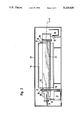
- FIG. 1 shows a microwave reaction plant for preparing oxidic powders from aqueous nitrate solutions in a quasi batchwise/continuous process
- FIG. 2 shows a microwave rotary kiln for preparing oxidic powders from aqueous nitrate solutions in a continuous process.
- FIG. 3 is a graph which shows the performance of the varistor ceramic of the present invention compared with the performance of a conventional varistor ceramic.
- the apparatus according to FIG. 1 includes three-neck flask 1 as a reaction vessel connected to a storage vessel 2 for a metal nitrate solution 3 to be converted in the reaction vessel.
- the nitrate solution 3 is added to the reaction vessel 1 through a feed inlet 5 in a meterable feed stream via a control valve 4.
- the nitrate solution 3 can also be injected or sprayed into the reaction vessel 1.
- the reaction vessel 1 is enclosed in a chamber 6 of a microwave resonator. Through the upper shielding of the chamber 6, the feed inlet 5, a purge gas feedline 7 and a gas discharge line 8 (if appropriate connected to a downstream suction pump--not shown) pass and are connected to the necks of the three-neck flask 1.
- the output of the microwave generator (not shown) and its operating time is adjusted by means of adjusting devices 9 and 10.
- Reference numeral 11 designates the oxidic reaction product.
- the apparatus according to FIG. 2, i.e. a microwave reaction plant for carrying out the process according to the invention continuously, comprises as an essential component a rotation reaction tube 12, which can be manufactured, for example, from Duran or quartz glass, into which a feed inlet device 13 for adding the nitrate or mixed nitrate solution 3 to be converted opens.
- a discharge device 14 is positioned for discharging and collecting the oxidic process product.
- the reaction tube 12 runs through a microwave resonator 15, is supported at each end on a bearing 16 and can be made to rotate by means of a drive unit 17, the power transmission taking place, for example, by means of a driving belt 18.
- the starting solution contained the substances and amounts of substances listed below as an aqueous solution; the concentration of the solution was about 20% by weight, calculated as the oxide form of the dissolved substances:
- Thermogravimetric analysis showed that complete conversion to the oxides had taken place.
- the weight loss of the samples was about 1% by weight at 800° C. The weight loss took place continuously, starting at about 50° C. onwards, which indicates moisture adsorbed on the surface and does not indicate subsequent conversion of nitrate which may not have been converted completely to the oxide.
- a nitric acid solution of zirconium oxycarbonate and yttrium oxide were reacted using an experimental set-up such as described in FIG. 1 at a microwave frequency of 2.45 GHz and a microwave output of 1000 watt, in which the composition of the starting solution was about 90 mol % of zirconium and about 10 mol % of yttrium and the concentration by weight, relative to the oxides, was that of a 20% solution.
- a varistor powder was prepared in a reaction setup according to FIG. 2 comprising a rotating pipe 12 made of Duran glass of 500 mm in length and an internal diameter of about 80 mm at a microwave frequency of 2.45 GHz and a microwave output of 2 ⁇ 500 watt as follows:
- the purely oxidic pulverulent product obtained in this way predominantly had particle sizes in the range from 1 to 15 ⁇ m, even though finer particles were also present.
- the powder obtained was plasticised, compacted and sintered at 1150° C. without difficulties to give a varistor ceramic.
- the electrical values of the varistor ceramic were those of the varistor ceramic according to Example 1.
Landscapes
- Chemical & Material Sciences (AREA)
- Organic Chemistry (AREA)
- Inorganic Chemistry (AREA)
- Compositions Of Oxide Ceramics (AREA)
- Oxygen, Ozone, And Oxides In General (AREA)
- Inorganic Compounds Of Heavy Metals (AREA)
Applications Claiming Priority (2)
| Application Number | Priority Date | Filing Date | Title |
|---|---|---|---|
| DE4034786A DE4034786A1 (de) | 1990-11-02 | 1990-11-02 | Verfahren und vorrichtung zur herstellung von pulverfoermigen metalloxiden fuer keramische massen |
| DE4034786 | 1990-11-02 |
Publications (1)
| Publication Number | Publication Date |
|---|---|
| US5219829A true US5219829A (en) | 1993-06-15 |
Family
ID=6417470
Family Applications (1)
| Application Number | Title | Priority Date | Filing Date |
|---|---|---|---|
| US07/787,332 Expired - Fee Related US5219829A (en) | 1990-11-02 | 1991-11-04 | Process and apparatus for the preparation of pulverulent metal oxides for ceramic compositions |
Country Status (4)
| Country | Link |
|---|---|
| US (1) | US5219829A (de) |
| EP (1) | EP0483654A1 (de) |
| JP (1) | JPH04292404A (de) |
| DE (1) | DE4034786A1 (de) |
Cited By (20)
| Publication number | Priority date | Publication date | Assignee | Title |
|---|---|---|---|---|
| US5581589A (en) * | 1994-04-14 | 1996-12-03 | Japan Atomic Energy Research Institute | Method and apparatus for producing gel particles |
| WO1997013137A3 (en) * | 1995-10-03 | 1997-08-14 | Cem Corp | Microwave assisted chemical processes |
| US5863468A (en) * | 1997-10-31 | 1999-01-26 | Raychem Corporation | Preparation of calcined ceramic powders |
| US6105887A (en) * | 1997-10-02 | 2000-08-22 | Japan Nuclear Cycle Development Institute | Method for homogeneously mixing uranium/plutonium mixed oxide |
| US6383519B1 (en) | 1999-01-26 | 2002-05-07 | Vita Special Purpose Corporation | Inorganic shaped bodies and methods for their production and use |
| US6458162B1 (en) | 1999-08-13 | 2002-10-01 | Vita Special Purpose Corporation | Composite shaped bodies and methods for their production and use |
| RU2226498C2 (ru) * | 2002-07-09 | 2004-04-10 | Государственное унитарное предприятие "Всероссийский научно-исследовательский институт химической технологии" | Способ получения оксидов металлов, их смесей и твердых растворов |
| US6736799B1 (en) | 2000-10-24 | 2004-05-18 | Vita Licensing, Inc. | Delivery device for biological composites and method of preparation thereof |
| WO2004058638A1 (de) * | 2002-12-23 | 2004-07-15 | Universität Tübingen | Verfahren zur herstellung von nitrathaltigen precursoren für metalloxide und oxocuprat-supraleiter |
| WO2004078884A1 (en) * | 2003-03-05 | 2004-09-16 | Korea Research Institute Of Chemical Technology | Method for continuous preparation of nanometer-sized hydrous zirconia sol using microwave |
| US20040254538A1 (en) * | 2000-10-24 | 2004-12-16 | Murphy James P. | Delivery device for biological composites and method of preparation thereof |
| US20050053538A1 (en) * | 2003-09-04 | 2005-03-10 | Holloway Paul H. | Method of producing nanosized oxide powders |
| US20050077646A1 (en) * | 2002-01-11 | 2005-04-14 | Japan Vilene Co., Ltd. | Process for producing electret and production apparatus |
| US20050118095A1 (en) * | 2003-03-07 | 2005-06-02 | Kim Hee Y. | Method for continuous preparation of nanometer-sized hydrous zirconia sol |
| US20050288795A1 (en) * | 2004-06-23 | 2005-12-29 | Bagga Charanpreet S | Shapeable bone graft substitute and instruments for delivery thereof |
| US20080187571A1 (en) * | 2006-06-29 | 2008-08-07 | Orthovita, Inc. | Bioactive bone graft substitute |
| US20090157182A1 (en) * | 2004-02-03 | 2009-06-18 | Orthovita, Inc. | Bone Restorative Carrier Mediums |
| US20110151027A1 (en) * | 2009-12-21 | 2011-06-23 | Theodore D Clineff | Strontium-doped calcium phosphate bone graft materials |
| CN102491431A (zh) * | 2011-11-24 | 2012-06-13 | 新疆大学 | 一种微波一步法制备四氧化三钴八面体的方法 |
| US8551525B2 (en) | 2010-12-23 | 2013-10-08 | Biostructures, Llc | Bone graft materials and methods |
Families Citing this family (6)
| Publication number | Priority date | Publication date | Assignee | Title |
|---|---|---|---|---|
| JPH10337401A (ja) * | 1997-03-12 | 1998-12-22 | Nukem Nuklear Gmbh | 含塩溶液の濃縮のための方法及び装置 |
| DE19836989A1 (de) * | 1998-08-14 | 2000-02-24 | Bosch Gmbh Robert | Verfahren zur Herstellung keramischer Pulver unter Einsatz von gasverdrängenden oder gaserzeugenden Zusatzstoffen |
| JP5555869B2 (ja) * | 2009-10-20 | 2014-07-23 | 独立行政法人日本原子力研究開発機構 | 製品添加によるマイクロ波吸収・発熱効果を利用した酸化ニッケルの製造方法 |
| JP5531341B2 (ja) * | 2009-10-20 | 2014-06-25 | 独立行政法人日本原子力研究開発機構 | ハイブリッド加熱法による金属酸化物粒子の製造方法 |
| CN109930111B (zh) * | 2019-04-16 | 2021-01-01 | 太原开元智能装备有限公司 | 连续粉末镀膜装置 |
| CN110092408A (zh) * | 2019-05-12 | 2019-08-06 | 广东工业大学 | 一种连续生产氧化铜的方法 |
Citations (4)
| Publication number | Priority date | Publication date | Assignee | Title |
|---|---|---|---|---|
| US4004933A (en) * | 1972-01-14 | 1977-01-25 | Foseco International Limited | Production of porous ceramic materials |
| US4444723A (en) * | 1981-04-16 | 1984-04-24 | Tokyo Shibaura Denki Kabushiki Kaisha | Denitration systems |
| US4983573A (en) * | 1987-06-09 | 1991-01-08 | E. I. Du Pont De Nemours And Company | Process for making 90° K. superconductors by impregnating cellulosic article with precursor solution |
| US5081102A (en) * | 1988-11-09 | 1992-01-14 | Rockwell International Corporation | Preparation of precursor superconductor metal oxide powders by spray calcination from atomized nitrate solution |
Family Cites Families (4)
| Publication number | Priority date | Publication date | Assignee | Title |
|---|---|---|---|---|
| JPS59114498A (ja) * | 1982-12-21 | 1984-07-02 | 動力炉・核燃料開発事業団 | マイクロ波による連続濃縮・脱硝装置 |
| US4695695A (en) * | 1985-04-03 | 1987-09-22 | The United States Of America As Represented By The United States Department Of Energy | Mixture for producing fracture-resistant, fiber-reinforced ceramic material by microwave heating |
| US4784686A (en) * | 1987-04-24 | 1988-11-15 | The United States Of America As Represented By The United States Department Of Energy | Synthesis of ultrafine powders by microwave heating |
| AT391848B (de) * | 1988-06-22 | 1990-12-10 | Andritz Ag Maschf | Verfahren und vorrichtung zur gewinnung von metalloxiden |
-
1990
- 1990-11-02 DE DE4034786A patent/DE4034786A1/de not_active Withdrawn
-
1991
- 1991-10-23 EP EP91118039A patent/EP0483654A1/de not_active Withdrawn
- 1991-10-28 JP JP3307105A patent/JPH04292404A/ja active Pending
- 1991-11-04 US US07/787,332 patent/US5219829A/en not_active Expired - Fee Related
Patent Citations (4)
| Publication number | Priority date | Publication date | Assignee | Title |
|---|---|---|---|---|
| US4004933A (en) * | 1972-01-14 | 1977-01-25 | Foseco International Limited | Production of porous ceramic materials |
| US4444723A (en) * | 1981-04-16 | 1984-04-24 | Tokyo Shibaura Denki Kabushiki Kaisha | Denitration systems |
| US4983573A (en) * | 1987-06-09 | 1991-01-08 | E. I. Du Pont De Nemours And Company | Process for making 90° K. superconductors by impregnating cellulosic article with precursor solution |
| US5081102A (en) * | 1988-11-09 | 1992-01-14 | Rockwell International Corporation | Preparation of precursor superconductor metal oxide powders by spray calcination from atomized nitrate solution |
Cited By (42)
| Publication number | Priority date | Publication date | Assignee | Title |
|---|---|---|---|---|
| US5581589A (en) * | 1994-04-14 | 1996-12-03 | Japan Atomic Energy Research Institute | Method and apparatus for producing gel particles |
| WO1997013137A3 (en) * | 1995-10-03 | 1997-08-14 | Cem Corp | Microwave assisted chemical processes |
| US5840583A (en) * | 1995-10-03 | 1998-11-24 | Cem Corporation | Microwave assisted chemical processes |
| US6105887A (en) * | 1997-10-02 | 2000-08-22 | Japan Nuclear Cycle Development Institute | Method for homogeneously mixing uranium/plutonium mixed oxide |
| US5863468A (en) * | 1997-10-31 | 1999-01-26 | Raychem Corporation | Preparation of calcined ceramic powders |
| US6383519B1 (en) | 1999-01-26 | 2002-05-07 | Vita Special Purpose Corporation | Inorganic shaped bodies and methods for their production and use |
| US8303976B2 (en) | 1999-01-26 | 2012-11-06 | Orthovita, Inc. | Inorganic shaped bodies and methods for their production and use |
| US6521246B2 (en) | 1999-01-26 | 2003-02-18 | Vita Special Purpose Corporation | Inorganic shaped bodies and methods for their production and use |
| US20030175321A1 (en) * | 1999-01-26 | 2003-09-18 | Sapieszko Ronald S. | Inorganic shaped bodies and methods for their production and use |
| US20060039951A1 (en) * | 1999-01-26 | 2006-02-23 | Vita Special Purpose Corporation | Inorganic shaped bodies and methods for their production and use |
| US6991803B2 (en) | 1999-01-26 | 2006-01-31 | Vita Special Purpose Corporation | Inorganic shaped bodies and methods for their production and use |
| US20030138473A1 (en) * | 1999-08-13 | 2003-07-24 | Antony Koblish | Composite shaped bodies and methods for their production and use |
| US6458162B1 (en) | 1999-08-13 | 2002-10-01 | Vita Special Purpose Corporation | Composite shaped bodies and methods for their production and use |
| US8734822B2 (en) | 1999-08-13 | 2014-05-27 | Orthovita, Inc. | Composite shaped bodies and methods for their production and use |
| US20070122447A1 (en) * | 1999-08-13 | 2007-05-31 | Vita Special Purpose Corporation | Shaped bodies and methods for their production and use |
| US6863899B2 (en) | 1999-08-13 | 2005-03-08 | Vita Special Purpose Corporation | Composite shaped bodies and methods for their production and use |
| US8685429B2 (en) | 1999-08-13 | 2014-04-01 | Orthovita, Inc. | Shaped bodies and methods for their production and use |
| US20060184131A1 (en) * | 2000-10-24 | 2006-08-17 | Vita Special Purpose Corporation | Delivery device for biological composites and method of preparation thereof |
| US20040254538A1 (en) * | 2000-10-24 | 2004-12-16 | Murphy James P. | Delivery device for biological composites and method of preparation thereof |
| US8876911B2 (en) | 2000-10-24 | 2014-11-04 | Orthovita, Inc. | Delivery device for biological composites and method of preparation thereof |
| US6736799B1 (en) | 2000-10-24 | 2004-05-18 | Vita Licensing, Inc. | Delivery device for biological composites and method of preparation thereof |
| US7052517B2 (en) | 2000-10-24 | 2006-05-30 | Vita Special Purpose Corporation | Delivery device for biological composites and method of preparation thereof |
| US20050077646A1 (en) * | 2002-01-11 | 2005-04-14 | Japan Vilene Co., Ltd. | Process for producing electret and production apparatus |
| RU2226498C2 (ru) * | 2002-07-09 | 2004-04-10 | Государственное унитарное предприятие "Всероссийский научно-исследовательский институт химической технологии" | Способ получения оксидов металлов, их смесей и твердых растворов |
| WO2004058638A1 (de) * | 2002-12-23 | 2004-07-15 | Universität Tübingen | Verfahren zur herstellung von nitrathaltigen precursoren für metalloxide und oxocuprat-supraleiter |
| WO2004078884A1 (en) * | 2003-03-05 | 2004-09-16 | Korea Research Institute Of Chemical Technology | Method for continuous preparation of nanometer-sized hydrous zirconia sol using microwave |
| US20050118095A1 (en) * | 2003-03-07 | 2005-06-02 | Kim Hee Y. | Method for continuous preparation of nanometer-sized hydrous zirconia sol |
| US20050053538A1 (en) * | 2003-09-04 | 2005-03-10 | Holloway Paul H. | Method of producing nanosized oxide powders |
| US7135161B2 (en) * | 2003-09-04 | 2006-11-14 | University Of Florida Research Foundation, Inc. | Method of producing nanosized oxide powders |
| US20090157182A1 (en) * | 2004-02-03 | 2009-06-18 | Orthovita, Inc. | Bone Restorative Carrier Mediums |
| US8287915B2 (en) | 2004-02-03 | 2012-10-16 | Orthovita, Inc. | Bone restorative carrier mediums |
| US20050288795A1 (en) * | 2004-06-23 | 2005-12-29 | Bagga Charanpreet S | Shapeable bone graft substitute and instruments for delivery thereof |
| US10441683B2 (en) | 2004-06-23 | 2019-10-15 | Orthovita, Inc. | Method for restoring bone using shapeable bone graft substitute and instruments for delivery thereof |
| US9789225B2 (en) | 2004-06-23 | 2017-10-17 | Orthovita, Inc. | Shapeable bone graft substitute and instruments for delivery thereof |
| US9220595B2 (en) | 2004-06-23 | 2015-12-29 | Orthovita, Inc. | Shapeable bone graft substitute and instruments for delivery thereof |
| US8303967B2 (en) | 2006-06-29 | 2012-11-06 | Orthovita, Inc. | Bioactive bone graft substitute |
| US8460686B2 (en) | 2006-06-29 | 2013-06-11 | Orthovita, Inc. | Bioactive bone graft substitute |
| US20080187571A1 (en) * | 2006-06-29 | 2008-08-07 | Orthovita, Inc. | Bioactive bone graft substitute |
| US20110151027A1 (en) * | 2009-12-21 | 2011-06-23 | Theodore D Clineff | Strontium-doped calcium phosphate bone graft materials |
| US8551525B2 (en) | 2010-12-23 | 2013-10-08 | Biostructures, Llc | Bone graft materials and methods |
| US9220596B2 (en) | 2010-12-23 | 2015-12-29 | Biostructures, Llc | Bone graft materials and methods |
| CN102491431A (zh) * | 2011-11-24 | 2012-06-13 | 新疆大学 | 一种微波一步法制备四氧化三钴八面体的方法 |
Also Published As
| Publication number | Publication date |
|---|---|
| EP0483654A1 (de) | 1992-05-06 |
| JPH04292404A (ja) | 1992-10-16 |
| DE4034786A1 (de) | 1992-05-07 |
Similar Documents
| Publication | Publication Date | Title |
|---|---|---|
| US5219829A (en) | Process and apparatus for the preparation of pulverulent metal oxides for ceramic compositions | |
| KR102241096B1 (ko) | 큐빅 구조를 가지는 가넷형 산화물 고체전해질의 제조방법 | |
| Xu et al. | Synthesis of solid, spherical CeO2 particles prepared by the spray hydrolysis reaction method | |
| JPS6112558B2 (de) | ||
| US5523065A (en) | Process for making ultra-fine barium titanate particles | |
| JP4440475B2 (ja) | Uf6の乾式法転換によって得られる二酸化ウランの、噴霧乾燥による、成型可能な粉末の調製 | |
| US5660774A (en) | Process for making a sintered body from ultra-fine superconductive particles | |
| KR920000783B1 (ko) | 네오디뮴 티타네이트 또는 바륨 네오디뮴 티타네이트의 제조방법 | |
| JPS6228089B2 (de) | ||
| Suryanarayana et al. | Fabrication of UO2 pellets by gel pelletization technique without addition of carbon as pore former | |
| US5660773A (en) | Process for making ultra-fine yttrium-iron-garnet particles | |
| RU2467983C1 (ru) | Способ получения нанокристаллических порошков и керамических материалов на основе смешанных оксидов редкоземельных элементов и металлов подгруппы ivb | |
| Inagaki et al. | Synthesis and sintering of Li2SnO3 | |
| Hong et al. | Synthesis and sintering of Ca0. 5Sr0. 5Zr4P6O24 powders by the decomposition/combustion of Ca-, Sr-, nitrate-ammonium dihydrogen phosphate-urea mixtures | |
| JPH0574530B2 (de) | ||
| Cho et al. | Preparation of spherical Zr0. 8Sn0. 2TiO4 powder by ultrasonic spray pyrolysis | |
| US5308807A (en) | Production of lead zirconate titanates using zirconia sol as a reactant | |
| JPH0572332B2 (de) | ||
| RU2058958C1 (ru) | Способ получения высокотемпературной сверхпроводящей керамики | |
| JP7476729B2 (ja) | セリウム系複合酸化物粒子およびその製造方法、ならびに燃料電池用の反応防止層 | |
| JP3748084B2 (ja) | NiO/YSZ複合粉末の製造方法 | |
| Niesz et al. | Handling and green forming of fine powders | |
| Tursiloadi et al. | Crystallization and sintering behavior of PZT prepared from metal alkoxides | |
| Lal et al. | Preparation of Ferrite Powders by Chemical Methods—A Review | |
| JPH0572331B2 (de) |
Legal Events
| Date | Code | Title | Description |
|---|---|---|---|
| AS | Assignment |
Owner name: MERCK PATENT GESELLSCHAFT MIT BESCHRANKTER HAFTUN Free format text: ASSIGNMENT OF ASSIGNORS INTEREST.;ASSIGNORS:BAUER, GERD;KUNTZ, MATTHIAS;GROBELSEK, INGRID;AND OTHERS;REEL/FRAME:005924/0960 Effective date: 19911029 |
|
| FEPP | Fee payment procedure |
Free format text: PAYOR NUMBER ASSIGNED (ORIGINAL EVENT CODE: ASPN); ENTITY STATUS OF PATENT OWNER: LARGE ENTITY |
|
| FEPP | Fee payment procedure |
Free format text: PAYER NUMBER DE-ASSIGNED (ORIGINAL EVENT CODE: RMPN); ENTITY STATUS OF PATENT OWNER: LARGE ENTITY |
|
| REMI | Maintenance fee reminder mailed | ||
| LAPS | Lapse for failure to pay maintenance fees | ||
| FP | Lapsed due to failure to pay maintenance fee |
Effective date: 19970518 |
|
| STCH | Information on status: patent discontinuation |
Free format text: PATENT EXPIRED DUE TO NONPAYMENT OF MAINTENANCE FEES UNDER 37 CFR 1.362 |