US5032549A - Highly porous ceramic material for absorption and adsorption purposes, particularly for animal litter/bedding - Google Patents
Highly porous ceramic material for absorption and adsorption purposes, particularly for animal litter/bedding Download PDFInfo
- Publication number
- US5032549A US5032549A US07/474,638 US47463890A US5032549A US 5032549 A US5032549 A US 5032549A US 47463890 A US47463890 A US 47463890A US 5032549 A US5032549 A US 5032549A
- Authority
- US
- United States
- Prior art keywords
- ceramic material
- porous ceramic
- clay
- highly porous
- parts
- Prior art date
- Legal status (The legal status is an assumption and is not a legal conclusion. Google has not performed a legal analysis and makes no representation as to the accuracy of the status listed.)
- Expired - Lifetime
Links
Images
Classifications
-
- A—HUMAN NECESSITIES
- A01—AGRICULTURE; FORESTRY; ANIMAL HUSBANDRY; HUNTING; TRAPPING; FISHING
- A01K—ANIMAL HUSBANDRY; AVICULTURE; APICULTURE; PISCICULTURE; FISHING; REARING OR BREEDING ANIMALS, NOT OTHERWISE PROVIDED FOR; NEW BREEDS OF ANIMALS
- A01K1/00—Housing animals; Equipment therefor
- A01K1/015—Floor coverings, e.g. bedding-down sheets ; Stable floors
- A01K1/0152—Litter
- A01K1/0154—Litter comprising inorganic material
-
- C—CHEMISTRY; METALLURGY
- C04—CEMENTS; CONCRETE; ARTIFICIAL STONE; CERAMICS; REFRACTORIES
- C04B—LIME, MAGNESIA; SLAG; CEMENTS; COMPOSITIONS THEREOF, e.g. MORTARS, CONCRETE OR LIKE BUILDING MATERIALS; ARTIFICIAL STONE; CERAMICS; REFRACTORIES; TREATMENT OF NATURAL STONE
- C04B14/00—Use of inorganic materials as fillers, e.g. pigments, for mortars, concrete or artificial stone; Treatment of inorganic materials specially adapted to enhance their filling properties in mortars, concrete or artificial stone
- C04B14/02—Granular materials, e.g. microballoons
- C04B14/04—Silica-rich materials; Silicates
- C04B14/10—Clay
- C04B14/12—Expanded clay
-
- C—CHEMISTRY; METALLURGY
- C04—CEMENTS; CONCRETE; ARTIFICIAL STONE; CERAMICS; REFRACTORIES
- C04B—LIME, MAGNESIA; SLAG; CEMENTS; COMPOSITIONS THEREOF, e.g. MORTARS, CONCRETE OR LIKE BUILDING MATERIALS; ARTIFICIAL STONE; CERAMICS; REFRACTORIES; TREATMENT OF NATURAL STONE
- C04B20/00—Use of materials as fillers for mortars, concrete or artificial stone according to more than one of groups C04B14/00 - C04B18/00 and characterised by shape or grain distribution; Treatment of materials according to more than one of the groups C04B14/00 - C04B18/00 specially adapted to enhance their filling properties in mortars, concrete or artificial stone; Expanding or defibrillating materials
- C04B20/10—Coating or impregnating
- C04B20/1055—Coating or impregnating with inorganic materials
-
- C—CHEMISTRY; METALLURGY
- C04—CEMENTS; CONCRETE; ARTIFICIAL STONE; CERAMICS; REFRACTORIES
- C04B—LIME, MAGNESIA; SLAG; CEMENTS; COMPOSITIONS THEREOF, e.g. MORTARS, CONCRETE OR LIKE BUILDING MATERIALS; ARTIFICIAL STONE; CERAMICS; REFRACTORIES; TREATMENT OF NATURAL STONE
- C04B38/00—Porous mortars, concrete, artificial stone or ceramic ware; Preparation thereof
- C04B38/009—Porous or hollow ceramic granular materials, e.g. microballoons
-
- C—CHEMISTRY; METALLURGY
- C04—CEMENTS; CONCRETE; ARTIFICIAL STONE; CERAMICS; REFRACTORIES
- C04B—LIME, MAGNESIA; SLAG; CEMENTS; COMPOSITIONS THEREOF, e.g. MORTARS, CONCRETE OR LIKE BUILDING MATERIALS; ARTIFICIAL STONE; CERAMICS; REFRACTORIES; TREATMENT OF NATURAL STONE
- C04B38/00—Porous mortars, concrete, artificial stone or ceramic ware; Preparation thereof
- C04B38/10—Porous mortars, concrete, artificial stone or ceramic ware; Preparation thereof by using foaming agents or by using mechanical means, e.g. adding preformed foam
-
- C—CHEMISTRY; METALLURGY
- C04—CEMENTS; CONCRETE; ARTIFICIAL STONE; CERAMICS; REFRACTORIES
- C04B—LIME, MAGNESIA; SLAG; CEMENTS; COMPOSITIONS THEREOF, e.g. MORTARS, CONCRETE OR LIKE BUILDING MATERIALS; ARTIFICIAL STONE; CERAMICS; REFRACTORIES; TREATMENT OF NATURAL STONE
- C04B41/00—After-treatment of mortars, concrete, artificial stone or ceramics; Treatment of natural stone
- C04B41/45—Coating or impregnating, e.g. injection in masonry, partial coating of green or fired ceramics, organic coating compositions for adhering together two concrete elements
- C04B41/50—Coating or impregnating, e.g. injection in masonry, partial coating of green or fired ceramics, organic coating compositions for adhering together two concrete elements with inorganic materials
Definitions
- the present invention relates to highly porous ceramic material for adsorption and absorption purposes, particularly for animal litter or bedding, a process for the production thereof and the use thereof.
- the known calcium silicate granular material advantageously has a microporous structure which, as a result of its capillary action, is able to absorb oleophilic and hydrophilic liquids, and also gaseous substances.
- an anionic surface-active agent surfactant
- the object of the present invention is to provide a material for adsorption and absorption purposes, particularly for use as animal litter which, whilst retaining the favorable characteristics of the known, aforementioned material, can be produced less expensively and with greater flexibility with respect to product parameters, and particularly by means of a continuous process.
- a highly porous ceramic material which is characterized by a porosity of 50 to 300%, preferably 200 to 250%; a water absorption capacity of 50 to 200%, preferably 100 to 150%; a pH-value in the range 5 to 9, preferably 7 to 8; a bulk density of 400 to 700 g/l; an internal surface (BET-N 2 ) between 20 and 200 m 2 /g, preferably between 80 and 150 m 2 /g; which can be produced by firing a foamed mixture of clay or clays, optionally containing aggregate or aggregates, anionic or cationic surfactant or surfactants and deflocculant or deflocculants.
- the process according to the invention for producing such porous ceramic materials is characterized by mixing 45 to 80 parts by weight of clay, 0 to 50 parts by weight of additives with a high specific surface, 15 to 30 parts by weight of water and 0.01 to 0.03 parts by weight of deflocculant; preparing a foamed mixture accompanied by the addition of surfactants; shaping and drying the foamed mixture to give shaped clay members; crushing the dried shape clay members; screening the crushed shaped clay members and returning the fines to the starting mixture; and firing the crushed shaped clay members with a chosen particle size range at a product temperature in the shaped clay member between 600° and 1000° C., preferably 700° to 800° C.
- clays as brick clay, Westerwald stoneware clay, fine stoneware clay, kaolin, montmorillonite, bentonite and marl.
- inorganic or organic materials with a high specific surface such as e.g. calcite quartz sand, dolomite, feldspar, chamotte kieselguhr, sepiolite, bentonite and/or organic materials, such as sawdust or coal.
- the time from clay preparation up to the fired product in the case of porosities over 100% amounts to up to 2 hours and less, the short process time largely resulting from the brief drying and firing time.
- the process according to the invention takes place in such a way that clay is mixed with water and deflocculant to give a low water content, thixotropic suspension.
- This suspension can be produced with clearly defined finished foam quantities, preferably with a liter weight of 30 to 80 g/l.
- Another process for preparing a foam suspension from a clay suspension consists of adding surfactant to the clay suspension and for foaming to take place in a dispersing plant, accompanied by the addition of compressed air. It is possible to use conventional dispersing plants, such as are e.g. marketed by Hansa Mixer, Bremen under the trade name "Hansa Mixer", which supply clearly defined compressed air quantities under a pressure of under 1 to 10 bar.
- the dispersing plant has a fine dosing pump, by means of which liquid can be added before and optionally during the foaming process.
- a substance counteracting the deflocculating action of the deflocculant is used, e.g. dilute hydrochloric acid, so that it is possible to produce highly viscous, thixotropic, inherently stable foam suspensions.
- the inherently stable, thixotropic foam suspension is then dried, it being possible for water vapor to pass unhindered through the pores as a result of the high inherent porosity of the material. It is particularly advantageous if the starting material mixture has a relatively low water content.
- the dried material is provided in the form of strands with a diameter of approximately 1 cm, it being possible to work with drying times of e.g. no more than 5 minutes with temperatures of 200° C. Prior to firing, the dried material is crushed into granular form.
- Treatment at higher temperature is not desired for the inventive use of the material as an absorbent or as animal litter, because it leads to an embrittlement of the material and to a reduction of the internal surface. Due to the hard fracture surface formed and the reduction of the internal surface, embrittlement undesirably leads to a poorer liquid absorption.
- the material produced according to the invention and fired at low temperatures has a marked odor binding action and a good water absorption capacity due to the large internal surface.
- porous ceramic materials are chemically neutral, i.e. have a pH-value of 5 to 8.
- it can be advantageous to stabilize the pH-value e.g. by acid or acid salt treatment, so that the pH-value is reliably kept in the range of 5 to 8, because this pH-value is particularly favorable for the odor binding of basic constituents.
- the invention allows for continuous operation of the process for producing the material according to the invention.
- the invention also relates to the ceramic material in solid and/or granular form as a thermal and/or noise insulating material for building purposes, as well as the use of the ceramic material in solid and/or granular form as an aggregate for high temperature building materials, such as furnace building materials, refractory building materials and the like.
- the quantity of the remaining aggregates i.e. magnesite, quartz sand and the like is adjusted in accordance with the particular function.
- the rotary drier which was preheated to 200° C., passes the foam clay material, after a drying time of 5 minutes, into a crushing mill, where the dried foam clay material is crushed, the crushed foam clay particles are then separated in a screening plant into a particle fraction with sizes between 2.5 and 4 mm, which are passed to the kiln, and a particle fraction with sizes below 2.5 mm, which are returned to the starting mixture.
- the dried clay foam particles for firing are passed into a continuously operated kiln heated to 1000° C. and fired there for 5 minutes. The fired ceramic product is cooled and delivered to a packaging installation.
- 800 g of kaolin, 200 liters of water, 200 g of sepiolite and 50 g of waterglass are thoroughly mixed in a mixer.
- the mixture is continuously delivered to a second mixer, which has a further feed for a Hostapur foam with a liter weight of 50 g/l, so that there is always a ratio of approximately 100 g of Hostapur per 800 Kg of kaolin.
- the resulting foam/clay suspension mixture is then pressed through a mold, so that strands with a diameter of 1.5 cm are obtained.
- the strands of dried clay are allowed to dry at ambient temperature.
- the dried foam/clay strands are crushed in a crusher and led to a screening plant, where a fraction of the crushed material with a diameter less than 1 mm is returned to the starting mixture, whereas the remaining particles are fed into a kiln, which is worked at a temperature of 800° C.
- the crushed, dried foam/clay particles are fired for 10 minutes in the kiln.
- the resulting porous product is cooled and led into a spray drum, where it is treated with a mixture of 31% by weight of 85% phosphoric acid and 69% by weight of an aluminium sulphate solution having a pH-value of 2 to 3.5 and a density of 1.3 to 1.34.
- the material sprayed with the buffer solution is then dried again and supplied to a packaging installation.
- the materials according to the invention have a pH-value of 7 to 8, a water absorption capacity of 50 to 150% by weight, an internal surface of 20 to 200 m 2 /g and a pore diameter of ⁇ 1 mm.
Landscapes
- Chemical & Material Sciences (AREA)
- Engineering & Computer Science (AREA)
- Ceramic Engineering (AREA)
- Organic Chemistry (AREA)
- Structural Engineering (AREA)
- Materials Engineering (AREA)
- Inorganic Chemistry (AREA)
- Life Sciences & Earth Sciences (AREA)
- Dispersion Chemistry (AREA)
- Environmental Sciences (AREA)
- Biodiversity & Conservation Biology (AREA)
- Animal Husbandry (AREA)
- Zoology (AREA)
- Civil Engineering (AREA)
- Solid-Sorbent Or Filter-Aiding Compositions (AREA)
- Housing For Livestock And Birds (AREA)
Abstract
Highly porous ceramic material for adsorption and absorption purposes, particularly for animal litter, characterized by a porosity of 50 to 300%, preferably 200 to 250%; a water absorption capacity of 50 to 200%, preferably 100 to 150%; a pH-value in the range 5 to 9, preferably 7 to 8; a bulk density of 400 to 700 g/l; an internal surface (BET-N2) between 20 and 200 m2 /g, preferably between 80 and 150 m2 /g; which can be produced by firing a foamed mixture of clay or clays, optionally aggregate or aggregates, anionic or cationic surfactant or surfactants and deflocculant or deflocculants, process for the production thereof and use thereof.
Description
This application is a continuation of application Ser. No. 297,986, filed Jan. 17, 1989, now abandoned, which is a divisional application of Ser. No. 71,539, filed Jul. 8, 1987, now U.S. Pat. No. 4,824,810, which is a continuation of application Ser. No. 810,014, filed Dec. 17, 1985 now abandoned.
The present invention relates to highly porous ceramic material for adsorption and absorption purposes, particularly for animal litter or bedding, a process for the production thereof and the use thereof.
There is a continual need for highly porous, non-rotting materials for adsorption or absorption of liquids and gases and more particularly for use as animal litter.
Calcium silicate granules have hitherto been advantageously used for this purpose as described in from European patents Nos. 00 13 935 and 0 014 343, as well as German patents Nos. 31 21 403 and 29 02 079.
The known calcium silicate granular material advantageously has a microporous structure which, as a result of its capillary action, is able to absorb oleophilic and hydrophilic liquids, and also gaseous substances.
The known calcium silicate granular material with a microporous structure from finely ground silicon dioxide-containing material, such as quartz flour, is intimately mixed with calcium oxide-containing material, such as lime and water, accompanied by the addition of an anionic surface-active agent (surfactant). It is then foamed, followed by autoclave hardening and subsequent crushing with classification, then drying and optionally cooling. The absorbent produced according to this known process has proved highly suitable.
The object of the present invention is to provide a material for adsorption and absorption purposes, particularly for use as animal litter which, whilst retaining the favorable characteristics of the known, aforementioned material, can be produced less expensively and with greater flexibility with respect to product parameters, and particularly by means of a continuous process.
According to the invention, these advantages are achieved with a highly porous ceramic material, which is characterized by a porosity of 50 to 300%, preferably 200 to 250%; a water absorption capacity of 50 to 200%, preferably 100 to 150%; a pH-value in the range 5 to 9, preferably 7 to 8; a bulk density of 400 to 700 g/l; an internal surface (BET-N2) between 20 and 200 m2 /g, preferably between 80 and 150 m2 /g; which can be produced by firing a foamed mixture of clay or clays, optionally containing aggregate or aggregates, anionic or cationic surfactant or surfactants and deflocculant or deflocculants. The process according to the invention for producing such porous ceramic materials is characterized by mixing 45 to 80 parts by weight of clay, 0 to 50 parts by weight of additives with a high specific surface, 15 to 30 parts by weight of water and 0.01 to 0.03 parts by weight of deflocculant; preparing a foamed mixture accompanied by the addition of surfactants; shaping and drying the foamed mixture to give shaped clay members; crushing the dried shape clay members; screening the crushed shaped clay members and returning the fines to the starting mixture; and firing the crushed shaped clay members with a chosen particle size range at a product temperature in the shaped clay member between 600° and 1000° C., preferably 700° to 800° C.
It is particularly advantageous to use as the clay such clays as brick clay, Westerwald stoneware clay, fine stoneware clay, kaolin, montmorillonite, bentonite and marl.
It is particularly advantageous to use as the aggregates inorganic or organic materials with a high specific surface, such as e.g. calcite quartz sand, dolomite, feldspar, chamotte kieselguhr, sepiolite, bentonite and/or organic materials, such as sawdust or coal.
As a result of the process according to the invention it is possible to economically produce highly porous ceramic products with porosities greater than 100% and preferably 200 to 250%, whereby the pore size and type can be significantly controlled.
Advantageously the time from clay preparation up to the fired product in the case of porosities over 100% amounts to up to 2 hours and less, the short process time largely resulting from the brief drying and firing time.
Normally the process according to the invention takes place in such a way that clay is mixed with water and deflocculant to give a low water content, thixotropic suspension. This suspension can be produced with clearly defined finished foam quantities, preferably with a liter weight of 30 to 80 g/l. Another process for preparing a foam suspension from a clay suspension consists of adding surfactant to the clay suspension and for foaming to take place in a dispersing plant, accompanied by the addition of compressed air. It is possible to use conventional dispersing plants, such as are e.g. marketed by Hansa Mixer, Bremen under the trade name "Hansa Mixer", which supply clearly defined compressed air quantities under a pressure of under 1 to 10 bar. The dispersing plant has a fine dosing pump, by means of which liquid can be added before and optionally during the foaming process. Advantageously when performing the process according to the invention a substance counteracting the deflocculating action of the deflocculant is used, e.g. dilute hydrochloric acid, so that it is possible to produce highly viscous, thixotropic, inherently stable foam suspensions.
The inherently stable, thixotropic foam suspension is then dried, it being possible for water vapor to pass unhindered through the pores as a result of the high inherent porosity of the material. It is particularly advantageous if the starting material mixture has a relatively low water content. Generally the dried material is provided in the form of strands with a diameter of approximately 1 cm, it being possible to work with drying times of e.g. no more than 5 minutes with temperatures of 200° C. Prior to firing, the dried material is crushed into granular form.
As a result of the porosity of the material, much as during drying, very favorable working is possible during firing. At a kiln temperature of 1000° C., corresponding to a material temperature between approximately 600° and 800° C., it is possible within a firing time of less than 5 minutes, including the heating and cooling times, to produce porous granulate suitable for absorption and adsorption purposes, particularly for use as animal litter. During this temperature treatment, the clays solidify to such an extent that they are water-insoluble.
Treatment at higher temperature is not desired for the inventive use of the material as an absorbent or as animal litter, because it leads to an embrittlement of the material and to a reduction of the internal surface. Due to the hard fracture surface formed and the reduction of the internal surface, embrittlement undesirably leads to a poorer liquid absorption. The material produced according to the invention and fired at low temperatures has a marked odor binding action and a good water absorption capacity due to the large internal surface.
It is also advantageous that porous ceramic materials are chemically neutral, i.e. have a pH-value of 5 to 8. In a particularly preferred use of the absorbent or adsorbent material according to the invention as animal litter or bedding, it can be advantageous to stabilize the pH-value, e.g. by acid or acid salt treatment, so that the pH-value is reliably kept in the range of 5 to 8, because this pH-value is particularly favorable for the odor binding of basic constituents.
Finally, the invention allows for continuous operation of the process for producing the material according to the invention.
The invention also relates to the ceramic material in solid and/or granular form as a thermal and/or noise insulating material for building purposes, as well as the use of the ceramic material in solid and/or granular form as an aggregate for high temperature building materials, such as furnace building materials, refractory building materials and the like.
For example when producing refractory building materials, the quantity of the remaining aggregates, i.e. magnesite, quartz sand and the like is adjusted in accordance with the particular function.
Particularly preferred embodiments of the porous material according to the invention or the process of the invention can be gathered from the corresponding subclaims.
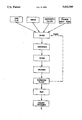
Further features and advantages of the invention can be gathered from the following description of specific embodiments with respect to the diagrammatic drawing, which is a flow chart of the performance of the process according to the invention.
500 Kg of brick clay with 200 liters of water, 400 Kg of kieselguhr, 100 g of sodium polyphosphate, 100 g of sodium dodecyl sulphonate and 5 Kg of recycled foam clay fines, are added to a mixer, vigorously stirred for approximately 5 minutes and the resulting, highly thixotropic clay suspension is fed into a mold system and in 1 cm diameter strands introduced into a rotary drier. The rotary drier, which was preheated to 200° C., passes the foam clay material, after a drying time of 5 minutes, into a crushing mill, where the dried foam clay material is crushed, the crushed foam clay particles are then separated in a screening plant into a particle fraction with sizes between 2.5 and 4 mm, which are passed to the kiln, and a particle fraction with sizes below 2.5 mm, which are returned to the starting mixture. The dried clay foam particles for firing are passed into a continuously operated kiln heated to 1000° C. and fired there for 5 minutes. The fired ceramic product is cooled and delivered to a packaging installation.
800 g of kaolin, 200 liters of water, 200 g of sepiolite and 50 g of waterglass are thoroughly mixed in a mixer. The mixture is continuously delivered to a second mixer, which has a further feed for a Hostapur foam with a liter weight of 50 g/l, so that there is always a ratio of approximately 100 g of Hostapur per 800 Kg of kaolin. The resulting foam/clay suspension mixture is then pressed through a mold, so that strands with a diameter of 1.5 cm are obtained. The strands of dried clay are allowed to dry at ambient temperature. The dried foam/clay strands are crushed in a crusher and led to a screening plant, where a fraction of the crushed material with a diameter less than 1 mm is returned to the starting mixture, whereas the remaining particles are fed into a kiln, which is worked at a temperature of 800° C. The crushed, dried foam/clay particles are fired for 10 minutes in the kiln. The resulting porous product is cooled and led into a spray drum, where it is treated with a mixture of 31% by weight of 85% phosphoric acid and 69% by weight of an aluminium sulphate solution having a pH-value of 2 to 3.5 and a density of 1.3 to 1.34. The material sprayed with the buffer solution is then dried again and supplied to a packaging installation.
For example, the materials according to the invention have a pH-value of 7 to 8, a water absorption capacity of 50 to 150% by weight, an internal surface of 20 to 200 m2 /g and a pore diameter of <1 mm.
The features disclosed in the above description, the drawing and the claims can be essential to the realization of the various embodiments of the invention, either singly or in random combinations.
Claims (11)
1. A highly porous ceramic material for use as an adsorbent or absorbent, having a porosity of 50 to 300 volume parts of pores per 100 volume parts of solid material; a water absorption capacity of 50 to 200%; a pH-value of 5 to 9; a bulk density of 400 to 700 g/liter; and an internal surface (BET-N2) between 20 and 200 m2 /g, prepared by the process which comprises forming a starting mixture containing 45 to 80 parts by weight of a clay selected from the group consisting of brick clay, Westerwald stoneware clay, fine stoneware clay, kaolin, montmorillonite, bentonite and marl, 0 to 50 parts by weight of an aggregate with a high specific surface selected from the group consisting of calcite, quartz sand, dolomite, feldspar, chamotte, sepiolite, sawdust and coal, 15 to 30 parts by weight of water, 0.01 to 0.03 parts by weight of deflocculant and 0.001 to 0.01 parts by weight of a surfactant; foaming the starting mixture under pressure at a pressure of 1 to 10 bar by compressed air at a temperature between ambient temperature and 95° C. to form a foam; shaping and drying the foam to give a shaped clay member; crushing the dried shaped clay member; screening the crushed shaped clay member and returning fines to the starting mixture; and firing the crushed shaped clay member with a chosen particle size range at a product temperature in the shaped clay member between 600° and 1000° C.
2. The highly porous ceramic material according to claim 1, wherein the porosity is 200 to 250 volume parts of pores per 100 volume parts of solid material; the water absorption capacity is 100 to 150%; the pH-value is 7 to 8; and the internal surface (BET-N2) is between 80 and 150 m2 /g.
3. The highly porous ceramic material according to claim 1, wherein the crushed shaped clay member is fired at a product temperature in the shaped clay member between 700° to 800° C.
4. The highly porous ceramic material according to claim 1, wherein the clay material is dried at a temperature between ambient temperature and 200° C.
5. The highly porous ceramic material according to claim 1, wherein the crushed shaped clay member is fired in less than 5 minutes at a kiln temperature of 1000° C., corresponding to a product temperature between 600° and 800° C.
6. The highly porous ceramic material according to claim 1, wherein the process further comprises treating the fired, porous ceramic material with an acid or an acid salt so that the pH-value of the ceramic material after treatment is between 5 and 8.
7. The highly porous ceramic material according to claim 6, wherein the acid treatment takes place in a spray drum.
8. The highly porous ceramic material according to claim 1, wherein the mixture has between 60 to 75 parts by weight of clay; 15 to 20 parts by weight of water; and 10 to 20 parts by weight of the aggregate.
9. The highly porous ceramic material according to claim 1, wherein the process further comprises adding a deflocculant-counteracting agent to the starting mixture or to the foam to produce a highly viscous, thixotropic, inherently stable foam.
10. The highly porous ceramic material according to claim 9, wherein the deflocculant-counteracting agent is dilute hydrochloric acid.
11. Animal litter, which comprises the adsorbent or absorbent as claimed in claim 1.
Applications Claiming Priority (2)
| Application Number | Priority Date | Filing Date | Title |
|---|---|---|---|
| DE3414965 | 1984-04-19 | ||
| DE3414965A DE3414965C2 (en) | 1984-04-19 | 1984-04-19 | Process for the production of porous ceramic bodies for use as adsorbents or absorbents, in particular animal litter |
Related Parent Applications (1)
| Application Number | Title | Priority Date | Filing Date |
|---|---|---|---|
| US07297986 Continuation | 1989-01-17 |
Publications (1)
| Publication Number | Publication Date |
|---|---|
| US5032549A true US5032549A (en) | 1991-07-16 |
Family
ID=6234087
Family Applications (2)
| Application Number | Title | Priority Date | Filing Date |
|---|---|---|---|
| US07/071,539 Expired - Lifetime US4824810A (en) | 1984-04-19 | 1985-02-09 | Highly porous ceramic material for absorption and adsorption purposes, particularly for animal litter/bedding, process for the production thereof and the use thereof |
| US07/474,638 Expired - Lifetime US5032549A (en) | 1984-04-19 | 1990-02-01 | Highly porous ceramic material for absorption and adsorption purposes, particularly for animal litter/bedding |
Family Applications Before (1)
| Application Number | Title | Priority Date | Filing Date |
|---|---|---|---|
| US07/071,539 Expired - Lifetime US4824810A (en) | 1984-04-19 | 1985-02-09 | Highly porous ceramic material for absorption and adsorption purposes, particularly for animal litter/bedding, process for the production thereof and the use thereof |
Country Status (6)
| Country | Link |
|---|---|
| US (2) | US4824810A (en) |
| EP (1) | EP0182793B1 (en) |
| JP (1) | JPS61501907A (en) |
| AU (1) | AU571060B2 (en) |
| DE (2) | DE3414965C2 (en) |
| WO (1) | WO1985004862A1 (en) |
Cited By (11)
| Publication number | Priority date | Publication date | Assignee | Title |
|---|---|---|---|---|
| US5418195A (en) * | 1992-10-28 | 1995-05-23 | Ecc International Limited | Porous ceramic granules |
| US6354831B1 (en) | 1998-04-20 | 2002-03-12 | R & R Holdings, Inc. | Porous gas burner |
| US20050005870A1 (en) * | 2003-07-11 | 2005-01-13 | The Clorox Company | Composite absorbent particles |
| US20050169952A1 (en) * | 2004-01-29 | 2005-08-04 | Ed Roddenbery | Active agent delivery device |
| US20060119010A1 (en) * | 2004-08-13 | 2006-06-08 | Heinrich Schnorrer | Moldable substance |
| US20080308045A1 (en) * | 2003-07-11 | 2008-12-18 | The Clorox Company | Composite Absorbent Particles |
| US7603964B2 (en) | 2005-04-29 | 2009-10-20 | The Clorox Company | Composite particle animal litter and method thereof |
| WO2009133212A1 (en) | 2008-04-29 | 2009-11-05 | Sepiol, S.A. | Method for producing low-density agglomerating pet litter, and resulting litter |
| US20110123474A1 (en) * | 2009-11-24 | 2011-05-26 | Jenkins Dennis B | Non-Visible Activated Carbon in Absorbent Materials |
| EP2377612A1 (en) * | 2010-04-19 | 2011-10-19 | Süd-Chemie Ag | Adsorbent for adsorption of basic compounds |
| US11918969B2 (en) | 2019-12-06 | 2024-03-05 | The Clorox Company | Low dusting, small clumping highly absorptive animal litter |
Families Citing this family (26)
| Publication number | Priority date | Publication date | Assignee | Title |
|---|---|---|---|---|
| DE3414967C2 (en) * | 1984-04-19 | 1986-06-05 | Effem Gmbh, 2810 Verden | Process for producing a light ceramic material for building purposes and using this material |
| DE3705204A1 (en) * | 1987-02-19 | 1988-09-01 | Effem Gmbh | PLANT SUBSTRATE AND THEIR USE |
| PT90971B (en) * | 1988-06-24 | 1995-01-31 | Wattsblake Bearne & Co Plc | PROCESS FOR THE PREPARATION OF A GRANULAR, POROUS CERAMIC MATERIAL |
| US5005520A (en) * | 1989-04-24 | 1991-04-09 | Michael Richard D | Animal litter deodorizing additive |
| US5189987A (en) * | 1989-06-23 | 1993-03-02 | The Clorox Company | Odor controlling animal litter with pine oil |
| DE4011254C1 (en) * | 1990-04-05 | 1991-06-20 | Effem Gmbh, 2810 Verden, De | |
| US5038721A (en) * | 1990-04-10 | 1991-08-13 | The Procter & Gamble Company | Animal waste collection system comprising nonsorbent, nonclumping litter, liquid sorbent means and filter |
| US5031578A (en) * | 1990-04-10 | 1991-07-16 | The Procter & Gamble Company | Pet litter box system which prevents the development of unpleasant odors |
| US5397392A (en) * | 1994-03-07 | 1995-03-14 | Wessco, Inc. | Material for use as soil stabilizer and as soil substitute |
| DE4420839A1 (en) * | 1994-06-15 | 1995-12-21 | Steag Ag | Method and device for separating vaporous alkali and heavy metal compounds from hot combustion gases |
| DE4442810A1 (en) * | 1994-12-01 | 1996-06-05 | Cerasiv Gmbh | Granules for the production of highly porous moldings |
| US5806462A (en) * | 1996-06-13 | 1998-09-15 | Parr; Michael J. | Clumping animal litter |
| DE19826205A1 (en) * | 1998-06-08 | 1999-12-09 | Schuett Hans Werner | Process for foaming and consolidating swellable clays |
| US6096126A (en) * | 1998-08-10 | 2000-08-01 | Profile Products L.L.C. | Sports field soil conditioner |
| US6155749A (en) * | 1998-09-29 | 2000-12-05 | Profile Products Llc | Sports field soil conditioner |
| GB9825926D0 (en) * | 1998-11-27 | 1999-01-20 | Ecc Int Ltd | Refractory products and their manufacture |
| DE10010210C1 (en) * | 2000-03-02 | 2001-12-13 | Masterfoods Gmbh | Process for producing porous ceramic granules loaded with volatile substances and their use |
| US20030192485A1 (en) * | 2002-04-10 | 2003-10-16 | William Opfel | Method and systems for disinfecting animal bedding and stalls |
| US20030192816A1 (en) * | 2002-04-10 | 2003-10-16 | William Opfel | Cleaning system for animal litter and bedding |
| US6854421B2 (en) * | 2002-04-10 | 2005-02-15 | Equidry Bedding Products, Llc | Animal litter and methods of fabricating same |
| WO2003086055A2 (en) * | 2002-04-10 | 2003-10-23 | Equidry Bedding Products, Llc | Venting system for animal stall |
| US6810831B1 (en) | 2002-05-29 | 2004-11-02 | Equidry Bedding Products, Llc | Animal arena surface amendment |
| US20060201444A1 (en) * | 2005-03-11 | 2006-09-14 | Coss Donna J | Horse arena composition and method |
| US8273676B2 (en) * | 2007-04-18 | 2012-09-25 | Church & Dwight Co., Inc. | Puffed bentonite litter |
| CN101830729B (en) * | 2010-06-21 | 2012-06-27 | 中国建筑股份有限公司 | Porous ceramic filter and preparation method thereof |
| JP5950996B2 (en) * | 2014-12-26 | 2016-07-13 | ユニ・チャーム株式会社 | Animal litter |
Citations (8)
| Publication number | Priority date | Publication date | Assignee | Title |
|---|---|---|---|---|
| US1998686A (en) * | 1933-09-09 | 1935-04-23 | United States Gypsum Co | Process of producing cellular ceramic products |
| US2543987A (en) * | 1947-08-23 | 1951-03-06 | Stark Ceramics Inc | Method of producing porous, lightweight, burned argillaceous material |
| US3993498A (en) * | 1974-04-08 | 1976-11-23 | Cullinan Holdings Limited | Granular carrier material |
| US4275684A (en) * | 1979-01-19 | 1981-06-30 | Effem Gmbh | Animal litter |
| US4318996A (en) * | 1980-04-21 | 1982-03-09 | Princeton Organics Incorporated | Lightweight ceramic composition |
| US4341561A (en) * | 1981-04-22 | 1982-07-27 | The Babcock & Wilcox Company | Foamed insulating refractory |
| US4356271A (en) * | 1980-05-27 | 1982-10-26 | Aluminum Company Of America | Noncollapsible ceramic foam |
| US4424280A (en) * | 1981-05-27 | 1984-01-03 | Centre De Recherche Industrielle Du Quebec | Ceramic foams and process of preparing the same |
Family Cites Families (7)
| Publication number | Priority date | Publication date | Assignee | Title |
|---|---|---|---|---|
| US1963030A (en) * | 1932-03-21 | 1934-06-12 | Edward R Powell | Method of forming cellular ceramic building material |
| GB697712A (en) * | 1951-12-28 | 1953-09-30 | Robert Wyndham Young | Improvements relating to the manufacture of light-weight cellular material from clay |
| DE2022419A1 (en) * | 1970-05-08 | 1971-11-25 | Krause Heinz Josef | Porous granules and shaped articles from mineral powders |
| FR2190753A1 (en) * | 1972-06-27 | 1974-02-01 | Rouanet Henri | Porous aggregate from clay - by kneading clay with water and surfactant, blowing in air, drying, crushing and firing |
| US4123284A (en) * | 1977-05-06 | 1978-10-31 | R. T. Vanderbilt Company, Inc. | Porous ceramic bodies |
| US4158685A (en) * | 1978-03-16 | 1979-06-19 | Kaiser Aluminum & Chemical Corporation | Foamed insulation refractory |
| DE3121403C2 (en) * | 1981-05-29 | 1993-07-15 | Mars Inc., 22102 McLean, Va. | Animal litter and methods of making the same |
-
1984
- 1984-04-19 DE DE3414965A patent/DE3414965C2/en not_active Expired
-
1985
- 1985-02-09 US US07/071,539 patent/US4824810A/en not_active Expired - Lifetime
- 1985-02-09 AU AU39361/85A patent/AU571060B2/en not_active Expired
- 1985-02-09 DE DE8585900975T patent/DE3572963D1/en not_active Expired
- 1985-02-09 JP JP60500762A patent/JPS61501907A/en active Granted
- 1985-02-09 WO PCT/DE1985/000035 patent/WO1985004862A1/en not_active Ceased
- 1985-02-09 EP EP85900975A patent/EP0182793B1/en not_active Expired
-
1990
- 1990-02-01 US US07/474,638 patent/US5032549A/en not_active Expired - Lifetime
Patent Citations (8)
| Publication number | Priority date | Publication date | Assignee | Title |
|---|---|---|---|---|
| US1998686A (en) * | 1933-09-09 | 1935-04-23 | United States Gypsum Co | Process of producing cellular ceramic products |
| US2543987A (en) * | 1947-08-23 | 1951-03-06 | Stark Ceramics Inc | Method of producing porous, lightweight, burned argillaceous material |
| US3993498A (en) * | 1974-04-08 | 1976-11-23 | Cullinan Holdings Limited | Granular carrier material |
| US4275684A (en) * | 1979-01-19 | 1981-06-30 | Effem Gmbh | Animal litter |
| US4318996A (en) * | 1980-04-21 | 1982-03-09 | Princeton Organics Incorporated | Lightweight ceramic composition |
| US4356271A (en) * | 1980-05-27 | 1982-10-26 | Aluminum Company Of America | Noncollapsible ceramic foam |
| US4341561A (en) * | 1981-04-22 | 1982-07-27 | The Babcock & Wilcox Company | Foamed insulating refractory |
| US4424280A (en) * | 1981-05-27 | 1984-01-03 | Centre De Recherche Industrielle Du Quebec | Ceramic foams and process of preparing the same |
Cited By (19)
| Publication number | Priority date | Publication date | Assignee | Title |
|---|---|---|---|---|
| US5418195A (en) * | 1992-10-28 | 1995-05-23 | Ecc International Limited | Porous ceramic granules |
| US6354831B1 (en) | 1998-04-20 | 2002-03-12 | R & R Holdings, Inc. | Porous gas burner |
| US9253961B2 (en) | 2003-07-11 | 2016-02-09 | The Clorox Company | Composite absorbent particles |
| US20050005870A1 (en) * | 2003-07-11 | 2005-01-13 | The Clorox Company | Composite absorbent particles |
| US20080184939A1 (en) * | 2003-07-11 | 2008-08-07 | The Clorox Company | Composite Absorbent Particles |
| US20080308045A1 (en) * | 2003-07-11 | 2008-12-18 | The Clorox Company | Composite Absorbent Particles |
| US20090007852A1 (en) * | 2003-07-11 | 2009-01-08 | The Clorox Company | Composite Absorbent Particles |
| US9283540B2 (en) | 2003-07-11 | 2016-03-15 | The Clorox Company | Composite absorbent particles |
| US20050169952A1 (en) * | 2004-01-29 | 2005-08-04 | Ed Roddenbery | Active agent delivery device |
| US7399324B2 (en) | 2004-01-29 | 2008-07-15 | Camovision Of Georgia, Llc | Active agent delivery device |
| US20060119010A1 (en) * | 2004-08-13 | 2006-06-08 | Heinrich Schnorrer | Moldable substance |
| US7603964B2 (en) | 2005-04-29 | 2009-10-20 | The Clorox Company | Composite particle animal litter and method thereof |
| WO2009133212A1 (en) | 2008-04-29 | 2009-11-05 | Sepiol, S.A. | Method for producing low-density agglomerating pet litter, and resulting litter |
| US20110123474A1 (en) * | 2009-11-24 | 2011-05-26 | Jenkins Dennis B | Non-Visible Activated Carbon in Absorbent Materials |
| US10071363B2 (en) | 2009-11-24 | 2018-09-11 | The Clorox Company | Non-visible activated carbon in absorbent materials |
| EP2377612A1 (en) * | 2010-04-19 | 2011-10-19 | Süd-Chemie Ag | Adsorbent for adsorption of basic compounds |
| WO2011131629A1 (en) * | 2010-04-19 | 2011-10-27 | Süd-Chemie AG | Adsorbent for adsorption of basic compounds |
| US11918969B2 (en) | 2019-12-06 | 2024-03-05 | The Clorox Company | Low dusting, small clumping highly absorptive animal litter |
| US12390787B2 (en) | 2019-12-06 | 2025-08-19 | The Clorox Company | Low dusting, small clumping highly absorptive animal litter |
Also Published As
| Publication number | Publication date |
|---|---|
| AU571060B2 (en) | 1988-03-31 |
| AU3936185A (en) | 1985-11-15 |
| EP0182793B1 (en) | 1989-09-13 |
| DE3414965C2 (en) | 1986-06-19 |
| US4824810A (en) | 1989-04-25 |
| WO1985004862A1 (en) | 1985-11-07 |
| JPS61501907A (en) | 1986-09-04 |
| JPH0372035B2 (en) | 1991-11-15 |
| DE3572963D1 (en) | 1989-10-19 |
| EP0182793A1 (en) | 1986-06-04 |
| DE3414965A1 (en) | 1986-01-02 |
Similar Documents
| Publication | Publication Date | Title |
|---|---|---|
| US4824810A (en) | Highly porous ceramic material for absorption and adsorption purposes, particularly for animal litter/bedding, process for the production thereof and the use thereof | |
| US4824811A (en) | Lightweight ceramic material for building purposes, process for the production thereof and the use thereof | |
| EP0595543B1 (en) | Porous ceramic granules | |
| US4275684A (en) | Animal litter | |
| EP0071897B1 (en) | Light-weight building material and method for its production | |
| US5175131A (en) | Plant substrate and uses thereof | |
| RU2397967C1 (en) | Method of making semi-finished product for producing construction materials | |
| EP0348241B1 (en) | Ceramic material | |
| DE2402132C3 (en) | Lightweight granules made from silicon and aluminum-containing materials and the process for their production | |
| CA2051807A1 (en) | Process for producing a porous ceramic granular material for use as an adsorbent and/or absorbent, particularly as animal litter | |
| Ivanov | Optimization of the structure and properties of foam-glass ceramics | |
| CA2663806C (en) | The manufacturing method of construction materials using waterworks sludge | |
| CA1247147A (en) | Highly porous ceramic materials for ad- or absorption purposes, more particularly for animal litter, and methods for their production | |
| RU2151122C1 (en) | Method of manufacture of wall ceramic structures | |
| JPH0151468B2 (en) | ||
| JPH11156326A (en) | Method of solidifying fly ash | |
| US3998650A (en) | Expanded synthetic calcium silicates | |
| RU2045495C1 (en) | Raw material mixture for manufacture of building products | |
| SU1726417A1 (en) | Stock for producing filler | |
| EP0013915B1 (en) | Use of optionally crushed lightweight building elements based on fibre reinforced calcium silicate compositions | |
| EP0111878A2 (en) | Process for producing masses containing silicon, calcium and oxygen in bound form, and absorbing or adsorbing material for liquids and gases | |
| CA1241350A (en) | Light ceramic materials for building purposes and methods for their production | |
| CZ2006793A3 (en) | The method of manufacturing industrial silicate granulate, especially kaolin, clay, betonite and fired | |
| KR19980046660A (en) | Method for manufacturing artificial lightweight aggregate for concrete structure | |
| JPH06315318A (en) | Storage carrier for active substance using plant cultivation base material |
Legal Events
| Date | Code | Title | Description |
|---|---|---|---|
| STCF | Information on status: patent grant |
Free format text: PATENTED CASE |
|
| REMI | Maintenance fee reminder mailed | ||
| FPAY | Fee payment |
Year of fee payment: 4 |
|
| SULP | Surcharge for late payment | ||
| FPAY | Fee payment |
Year of fee payment: 8 |
|
| FPAY | Fee payment |
Year of fee payment: 12 |