US5019520A - Method for preparing a high mobility, lightly-doped channel mis-type FET with reduced latch up and punchthrough - Google Patents

Method for preparing a high mobility, lightly-doped channel mis-type FET with reduced latch up and punchthrough Download PDF

Info

Publication number
US5019520A
US5019520A US07/516,643 US51664390A US5019520A US 5019520 A US5019520 A US 5019520A US 51664390 A US51664390 A US 51664390A US 5019520 A US5019520 A US 5019520A
Authority
US
United States
Prior art keywords
peak
impurity concentration
energy
channel
misfet
Prior art date
Legal status (The legal status is an assumption and is not a legal conclusion. Google has not performed a legal analysis and makes no representation as to the accuracy of the status listed.)
Expired - Lifetime
Application number
US07/516,643
Inventor
Shigeki Komori
Shigeru Kusunoki
Katsuhiro Tsukamoto
Current Assignee (The listed assignees may be inaccurate. Google has not performed a legal analysis and makes no representation or warranty as to the accuracy of the list.)
Mitsubishi Electric Corp
Original Assignee
Mitsubishi Electric Corp
Priority date (The priority date is an assumption and is not a legal conclusion. Google has not performed a legal analysis and makes no representation as to the accuracy of the date listed.)
Filing date
Publication date
Application filed by Mitsubishi Electric Corp filed Critical Mitsubishi Electric Corp
Assigned to MITSUBISHI DENKI KABUSHIKI KAISHA reassignment MITSUBISHI DENKI KABUSHIKI KAISHA ASSIGNMENT OF ASSIGNORS INTEREST. Assignors: KOMORI, SHIGEKI, KUSUNOKI, SHIGERU, TSUKAMOTO, KATSUHIRO
Priority to US07/637,243 priority Critical patent/US5208473A/en
Application granted granted Critical
Publication of US5019520A publication Critical patent/US5019520A/en
Anticipated expiration legal-status Critical
Expired - Lifetime legal-status Critical Current

Links

Images

Classifications

    • HELECTRICITY
    • H10SEMICONDUCTOR DEVICES; ELECTRIC SOLID-STATE DEVICES NOT OTHERWISE PROVIDED FOR
    • H10DINORGANIC ELECTRIC SEMICONDUCTOR DEVICES
    • H10D30/00Field-effect transistors [FET]
    • H10D30/01Manufacture or treatment
    • H10D30/021Manufacture or treatment of FETs having insulated gates [IGFET]
    • H10D30/0223Manufacture or treatment of FETs having insulated gates [IGFET] having source and drain regions or source and drain extensions self-aligned to sides of the gate
    • H10D30/0227Manufacture or treatment of FETs having insulated gates [IGFET] having source and drain regions or source and drain extensions self-aligned to sides of the gate having both lightly-doped source and drain extensions and source and drain regions self-aligned to the sides of the gate, e.g. lightly-doped drain [LDD] MOSFET or double-diffused drain [DDD] MOSFET
    • HELECTRICITY
    • H10SEMICONDUCTOR DEVICES; ELECTRIC SOLID-STATE DEVICES NOT OTHERWISE PROVIDED FOR
    • H10DINORGANIC ELECTRIC SEMICONDUCTOR DEVICES
    • H10D62/00Semiconductor bodies, or regions thereof, of devices having potential barriers
    • H10D62/10Shapes, relative sizes or dispositions of the regions of the semiconductor bodies; Shapes of the semiconductor bodies
    • H10D62/17Semiconductor regions connected to electrodes not carrying current to be rectified, amplified or switched, e.g. channel regions
    • H10D62/213Channel regions of field-effect devices
    • H10D62/221Channel regions of field-effect devices of FETs
    • H10D62/235Channel regions of field-effect devices of FETs of IGFETs
    • H10D62/314Channel regions of field-effect devices of FETs of IGFETs having vertical doping variations 
    • HELECTRICITY
    • H10SEMICONDUCTOR DEVICES; ELECTRIC SOLID-STATE DEVICES NOT OTHERWISE PROVIDED FOR
    • H10DINORGANIC ELECTRIC SEMICONDUCTOR DEVICES
    • H10D62/00Semiconductor bodies, or regions thereof, of devices having potential barriers
    • H10D62/10Shapes, relative sizes or dispositions of the regions of the semiconductor bodies; Shapes of the semiconductor bodies
    • H10D62/17Semiconductor regions connected to electrodes not carrying current to be rectified, amplified or switched, e.g. channel regions
    • H10D62/351Substrate regions of field-effect devices
    • H10D62/357Substrate regions of field-effect devices of FETs
    • H10D62/364Substrate regions of field-effect devices of FETs of IGFETs
    • H10D62/371Inactive supplementary semiconductor regions, e.g. for preventing punch-through, improving capacity effect or leakage current
    • YGENERAL TAGGING OF NEW TECHNOLOGICAL DEVELOPMENTS; GENERAL TAGGING OF CROSS-SECTIONAL TECHNOLOGIES SPANNING OVER SEVERAL SECTIONS OF THE IPC; TECHNICAL SUBJECTS COVERED BY FORMER USPC CROSS-REFERENCE ART COLLECTIONS [XRACs] AND DIGESTS
    • Y10TECHNICAL SUBJECTS COVERED BY FORMER USPC
    • Y10STECHNICAL SUBJECTS COVERED BY FORMER USPC CROSS-REFERENCE ART COLLECTIONS [XRACs] AND DIGESTS
    • Y10S438/00Semiconductor device manufacturing: process
    • Y10S438/965Shaped junction formation

Definitions

  • This invention relates to a method for preparing a metal-insulator-semiconductor (MIS) type field effect transistor (FET). More particularly, it relates to a minute size MIS type FET having a short channel between a source and a drain.
  • MIS metal-insulator-semiconductor
  • a punch-through phenomenon in a FET is explained.
  • widths of depletion layers 15a and 15b are increased.
  • the widths of the layers 15a and 15b are increased particularly in a deeper region where the effect of the voltage of the gate electrode 8 becomes extinct. If the depletion layer 15b on the drain side and the depletion layer 15a on the source side connect to each other at a region deeper than a channel layer 9, the carriers flow from the source 10a to the drain 10b through the depletion layers, as shown by an arrow.
  • the punch-through phenomenon means the flow of carriers which can not be controlled by the gate electrode 8 and which proceeds from the source 10a towards the drain 10b through a region deeper than the channel layer 9.
  • the source 10a and the drain 10b usually have a high impurity concentration of approximately 10 20 cm -3 , whereas the substrate 1 has a low impurity concentration of approximately 10 15 cm -3 .
  • the depletion layer spreads wider on the substrate side in the vicinity of each boundary of the source 10a and the drain 10b.
  • the punch-through phenomenon is most likely to occur when the channel 9 is of shorter length and the source 10a and the drain 10b are closer to each other. That is, a small size FET with a short channel length is more susceptible to the punch-through phenomenon.
  • the small size FET having a channel length less than 2 ⁇ m is formed within a well formed in a substrate and having an impurity concentration higher than that of the substrate.
  • the high impurity concentration in the well acts to reduce the widths of the depletion layers in the vicinity of the boundaries of the source and the drain to suppress the punch-through phenomenon.
  • FIGS. 5A to 5G an example of the conventional method for producing the small-size FET is explained.
  • an oxide film 2 is formed by thermal oxidation on a major surface of a silicon substrate 1.
  • a nitride film 3 is formed by a chemical vapor deposition (CVD) method on the oxide film 2.
  • a first conductivity type impurity layer 11 for forming the well is formed by implanting impurity ions through both the nitride film 3 and the oxide film 2.
  • impurities in the impurity layer 11 are driven to a depth of 4 to 5 ⁇ m by diffusion by a heat treatment at a high temperature of 1180° C. for six hours or more, to form a well 11a having an impurity concentration higher than that of the substrate 1.
  • the nitride film 3 is patterned using a resist mask 4 to form a nitride pattern 3a to expose partial areas of the oxide layer 2. Impurity ions are implanted through the exposed partial area of the oxide film 2 to form a high concentration impurity region 12 of the first conductivity type.
  • a field oxide film 2a is formed by thermal oxidation using the nitride film pattern 3a as a mask.
  • the nitride film pattern 3a is then removed simultaneously with the oxide film 2 thereunder .
  • the high concentration impurity region 12a remaining below the field oxide film 2a acts to cut a parasitic channel below the field oxide film 2a.
  • a channel dope layer 7 of the first conductivity type is formed in the vicinity of the surface of the well 11a by ion implantation at a lower energy.
  • the function of the channel dope layer 7 is to control the threshold voltage of the FET.
  • a gate oxide film 13 is then formed on the surface of the well 11a.
  • an electrically conductive layer is deposited on the gate oxide film 13 by a CVD or vacuum evaporation method and the conductivity layer is then patterned to form a gate electrode 8.
  • impurities are introduced by ion implantation using the gate electrode and the field oxide film 2a as a mask to form source and drain regions 10 of a second conductivity type. In this manner, a minute size MISFET is formed within the well 11a.
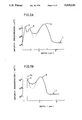
  • the impurity concentration distribution in the silicon substrate 1 in the cross-section taken along a line 6A--6A in FIG. 5G is shown in FIG. 6A, wherein the abscissa denotes the depth ( ⁇ m) from the surface of the substrate 1 and the ordinate the impurity concentration (cm -3 ).
  • the concentration peak shown by an arrow 7 near the surface of the substrate 1 represents the impurity concentration in the channel dope layer 7.
  • the region indicated by an arrow 11a represents the impurity concentration distribution in the well 11a.
  • the region indicated by an arrow 1 represents the impurity concentration in the substrate 1 itself.
  • FIG. 6B is similar to FIG. 6A but shows the impurity concentration in the sectional plane taken along a line 6B--6B in FIG. 5G.
  • a straight vertical line shown by an arrow 2a indicates the bottom surface of the field oxide film 2a.
  • the concentration peak beneath the bottom of the field oxide film 2a, indicated by an arrow 12a, represents an impurity concentration distribution in a channel cut region 12a.
  • FIG. 7 there is shown the effect of the impurity concentration on the carrier mobility in the silicon.
  • the abscissa represents the total impurity concentration (cm -3 ) and the ordinate the mobility (cm -2 /v.sec).
  • a curve 7A shows the electron mobility and a curve 7B the hole mobility.
  • a well having a high impurity concentration is desirable to prevent the punch-through phenomenon effectively in the small size FET.
  • the impurity concentration in the well 11a is increased, the impurity concentration in the channel layer 9 is also increased inevitably.
  • the carrier mobility in the channel 9 is lowered, and then the operating speed of the FET is lowered.
  • the carrier mobility is lowered abruptly.
  • the conventional method for preparing the FET suffers from an inconvenience that the impurity concentration in the well must be increased to reduce the size of the FET and, on the other hand, if the impurity concentration in the well is increased, the operating speed of the FET is lowered.
  • the present invention provides a method for preparing a MISFET of a minute size with the channel length between a source and a drain of not more than 2 ⁇ m, comprising the steps of forming a mask exposing a region for forming a well on a planar surface of a semiconductor substrate, and introducing impurity ions at a predetermined energy into the well region by using the mask, the predetermined energy level being such as to form a peak of the impurity concentration distribution at a position deeper than the bottom surface of the source and the drain and to maintain at least a partial layer of the channel at an impurity concentration lower than 10 16 cm -3 .
  • a minute size FET which is less susceptible to a punch-through phenomenon and which has a high switching speed may be produced, since the impurity concentration in the well may be raised by ion implantation without raising the impurity concentration in the channel layer.
  • FIGS. 1A to 1F are diagrammatic sectional views for illustrating the method for preparing the minute size MISFET according to an embodiment of the present invention.
  • FIG. 2A shows the impurity concentration distribution in a cross-section taken along a line 2A--2A in FIG. 1F.
  • FIG. 2B shows the impurity concentration distribution in a cross-section taken along a line 2B--2B in FIG. 1F.
  • FIGS. 3A and 3B show the relation between the ion accelerating voltage and the depth of the concentration peak of the implanted ions.
  • FIG. 4 is a diagrammatic cross-sectional view for illustrating the punch-through phenomenon in the FET.
  • FIGS. 5A to 5G are diagrammatic cross-sectional views for illustrating a method for preparing a conventional minute size MISFET.
  • FIGS. 6A shows the impurity concentration distribution in a cross-section taken along a line 6A--6A in FIG. 5G.
  • FIG. 6B shows the impurity concentration distribution in a cross-section taken along a line 6B--6B in FIG. 5G.
  • FIG. 7 shows the effect of the total impurity concentration on the carrier mobility.
  • FIGS. 1A to 1F a method for preparing a minute size FET according to an embodiment of the present invention is explained in detail.
  • a thermally oxidized film 2 is formed on a planar surface of a first conductivity type silicon substrate 1.
  • a nitride film is formed on the thermally oxidized film 2 by the CVD method and patterned using a resist mask 4 to form a nitride film pattern 3a.
  • thermal oxidation is performed, using the nitride film pattern 3a as a mask, to form a field oxide film 2a.
  • the nitride film pattern 3a is then removed.
  • impurities are introduced by ion implantation into the silicon substrate 1, using a high energy of not less than 200 KeV and at a dosage of about 2 ⁇ 10 12 cm -2 , for forming a first high impurity concentration layer 5 of the first conductivity type. Then, using a higher level energy and at a higher dosage of about 1 ⁇ 10 13 cm -2 , impurities are introduced by ion implantation, for forming a second high impurity concentration layer 6 of the first conductivity type having a higher impurity concentration under the first high impurity concentration layer 5. These first and second high impurity concentration layers 5, 6 constitute a high impurity concentration well.
  • impurity ions are introduced, using a lower level energy, for forming a first conductivity type channel dope layer 7 adapted for controlling the threshold voltage of the FET, at a position shallower than the first impurity concentration layer 5.
  • a gate oxide film 13 having a thickness of about 100 to 200 ⁇ is formed by thermal oxidation.
  • An electrically conductive layer is deposited on the gate oxide film 13 by a CVD or vacuum evaporation method and patterned to form a gate electrode 8.
  • impurities are introduced by ion implantation using the gate electrode 8 and the field oxide film 2a as a mask, for forming source and drain regions 10 of a second conductivity type. In this manner, a minute size MISFET is formed.
  • FIG. 2A shows the impurity concentration distribution in the substrate 1 in a cross-section taken along a line 2A--2A in FIG. 1F.
  • the abscissa shows the depth ( ⁇ m) from the surface of the substrate 1 and the ordinate shows the impurity concentration (cm -3 ).
  • the concentration peak at the shallowest point, shown by an arrow 7, represents the impurity concentration distribution in the channel dope layer 7.
  • the second concentration peak at a position deeper than the channel dope layer 7, shown by an arrow 5, represents the impurity concentration distribution in the first high impurity concentration layer 5.
  • the impurity concentration in this first high concentration impurity layer 5 is higher than that in the well 11a in FIG. 6A and prevents the punch-through phenomenon more effectively.
  • the third concentration peak at a position deeper than the first high impurity concentration layer 5, shown by an arrow 6, represents the impurity concentration distribution in the second high impurity concentration layer 6.
  • this second high impurity concentration layer 6 may be omitted.
  • the second high impurity concentration layer 6 functions to prevent the latch-up phenomenon. This latch-up phenomenon is described in detail in "VSLI TECHNOLOGY” edited by S. M. Sze, published by McGraw Hill International Company.
  • the substrate 1 of the first conductivity type also includes a second conductivity type well including a channel dope layer 7 of the second conductivity type and first and second high impurity concentration layers 5, 6 of the second conductivity type, in which a FET having first conductivity type source and drain 10 is formed.
  • FIG. 2B is similar to FIG. 2A but shows the impurity concentration distribution in a cross-section taken along a line 2B--2B in FIG. 1F.
  • a straight vertical line shown by an arrow 2a indicates the bottom surface of the field oxide film 2a.
  • the concentration peak beneath the bottom surface of the field oxide film 2a, shown by an arrow 5, represents the impurity concentration distribution in the first high impurity concentration region 5. That is, the first high impurity concentration region 5 functions as a channel cutting region also.
  • FIG. 3A shows the relation between the energy level for accelerating boron ions and the depth of the concentration peak of the implanted ions.
  • the abscissa shows the level of the accelerating energy (MeV) and the ordinate shows the depth of the concentration peak ( ⁇ m).
  • the curve A represents boron introduced into SiO 2 and a curve B represents boron introduced into silicon.
  • FIG. 3B is similar to FIG. 3A, but a curve C represents phosphorus introduced by ion implantation and a curve D represents phosphorus introduced into silicon.
  • the depth of the concentration peak of introduced ions may be controlled by the accelerating energy level.
  • the channel dope layer 7 and the first and second high impurity concentration layers 9, 6 can be formed at desired depths.
  • the relation between the accelerating voltage and the depth of ion concentration peak in the case of introducing ions into a certain substance may be determined by a relatively easy test.
  • the present invention provides a method for preparing a minute size FET less susceptible to the punch-through phenomenon and having a high switching speed because the impurity concentration in the well may be increased by ion implantation without increasing the impurity concentration in the channel layer.

Landscapes

  • Insulated Gate Type Field-Effect Transistor (AREA)
  • Metal-Oxide And Bipolar Metal-Oxide Semiconductor Integrated Circuits (AREA)

Abstract

A method for preparing a MISFET of a minute size with the channel length of not more than 2 μm between a source and a drain, comprises the steps of forming a mask for exposing a region for forming a well on a planar surface of a semiconductor substrate, and introducing ions at a predetermined energy into the well region by using the mask. The predetermined energy is such as to form a peak of the impurity concentration distribution at a position deeper than the bottom surface of the source and the drain and to maintain the layer of at least a partial layer of the channel at an impurity concentration lower than 1016 cm-3 so that a high speed carrier movement in the channel is provided without causing a punch-through phenomenon.

Description

BACKGROUND OF THE INVENTION
1. Field of the Invention
This invention relates to a method for preparing a metal-insulator-semiconductor (MIS) type field effect transistor (FET). More particularly, it relates to a minute size MIS type FET having a short channel between a source and a drain.
2. Description of the Background Art
Referring to a diagrammatic sectional view of FIG. 4, a punch-through phenomenon in a FET is explained. In this figure, on raising a voltage applied across a drain 10b and a source 10a of a second conductivity type formed on a semiconductor substrate 1 of a first conductivity type, widths of depletion layers 15a and 15b are increased. The widths of the layers 15a and 15b are increased particularly in a deeper region where the effect of the voltage of the gate electrode 8 becomes extinct. If the depletion layer 15b on the drain side and the depletion layer 15a on the source side connect to each other at a region deeper than a channel layer 9, the carriers flow from the source 10a to the drain 10b through the depletion layers, as shown by an arrow. Thus the punch-through phenomenon means the flow of carriers which can not be controlled by the gate electrode 8 and which proceeds from the source 10a towards the drain 10b through a region deeper than the channel layer 9.
The source 10a and the drain 10b usually have a high impurity concentration of approximately 1020 cm-3, whereas the substrate 1 has a low impurity concentration of approximately 1015 cm-3. Thus the depletion layer spreads wider on the substrate side in the vicinity of each boundary of the source 10a and the drain 10b.
As may be seen from FIG. 4, the punch-through phenomenon is most likely to occur when the channel 9 is of shorter length and the source 10a and the drain 10b are closer to each other. That is, a small size FET with a short channel length is more susceptible to the punch-through phenomenon. A demand exists, however, for a smaller and smaller size FET for raising the degree of integration of semiconductor IC devices. Thus the small size FET having a channel length less than 2 μm is formed within a well formed in a substrate and having an impurity concentration higher than that of the substrate. The high impurity concentration in the well acts to reduce the widths of the depletion layers in the vicinity of the boundaries of the source and the drain to suppress the punch-through phenomenon.
Referring to FIGS. 5A to 5G, an example of the conventional method for producing the small-size FET is explained.
First referring to FIG. 5A, an oxide film 2 is formed by thermal oxidation on a major surface of a silicon substrate 1. A nitride film 3 is formed by a chemical vapor deposition (CVD) method on the oxide film 2. A first conductivity type impurity layer 11 for forming the well is formed by implanting impurity ions through both the nitride film 3 and the oxide film 2.
Referring to FIG. 5B, impurities in the impurity layer 11 are driven to a depth of 4 to 5 μm by diffusion by a heat treatment at a high temperature of 1180° C. for six hours or more, to form a well 11a having an impurity concentration higher than that of the substrate 1.
Referring to FIG. 5C, the nitride film 3 is patterned using a resist mask 4 to form a nitride pattern 3a to expose partial areas of the oxide layer 2. Impurity ions are implanted through the exposed partial area of the oxide film 2 to form a high concentration impurity region 12 of the first conductivity type.
Referring to FIG. 5D, after removal of the resist mask 4, a field oxide film 2a is formed by thermal oxidation using the nitride film pattern 3a as a mask. The nitride film pattern 3a is then removed simultaneously with the oxide film 2 thereunder . The high concentration impurity region 12a remaining below the field oxide film 2a acts to cut a parasitic channel below the field oxide film 2a.
Referring to FIG. 5E, a channel dope layer 7 of the first conductivity type is formed in the vicinity of the surface of the well 11a by ion implantation at a lower energy. The function of the channel dope layer 7 is to control the threshold voltage of the FET. A gate oxide film 13 is then formed on the surface of the well 11a.
Referring to FIG. 5F, an electrically conductive layer is deposited on the gate oxide film 13 by a CVD or vacuum evaporation method and the conductivity layer is then patterned to form a gate electrode 8.
Referring to FIG. 5G, impurities are introduced by ion implantation using the gate electrode and the field oxide film 2a as a mask to form source and drain regions 10 of a second conductivity type. In this manner, a minute size MISFET is formed within the well 11a.
The impurity concentration distribution in the silicon substrate 1 in the cross-section taken along a line 6A--6A in FIG. 5G is shown in FIG. 6A, wherein the abscissa denotes the depth (μm) from the surface of the substrate 1 and the ordinate the impurity concentration (cm-3). The concentration peak shown by an arrow 7 near the surface of the substrate 1 represents the impurity concentration in the channel dope layer 7. The region indicated by an arrow 11a represents the impurity concentration distribution in the well 11a. The region indicated by an arrow 1 represents the impurity concentration in the substrate 1 itself.
FIG. 6B is similar to FIG. 6A but shows the impurity concentration in the sectional plane taken along a line 6B--6B in FIG. 5G. A straight vertical line shown by an arrow 2a indicates the bottom surface of the field oxide film 2a. The concentration peak beneath the bottom of the field oxide film 2a, indicated by an arrow 12a, represents an impurity concentration distribution in a channel cut region 12a.
Referring to FIG. 7, there is shown the effect of the impurity concentration on the carrier mobility in the silicon. The abscissa represents the total impurity concentration (cm-3) and the ordinate the mobility (cm-2 /v.sec). A curve 7A shows the electron mobility and a curve 7B the hole mobility. As described hereinabove, a well having a high impurity concentration is desirable to prevent the punch-through phenomenon effectively in the small size FET. However, as may be seen from FIG. 6A, if the impurity concentration in the well 11a is increased, the impurity concentration in the channel layer 9 is also increased inevitably. In this case, as may be seen from FIG. 7, the carrier mobility in the channel 9 is lowered, and then the operating speed of the FET is lowered. Particularly, when the total impurity concentration becomes higher than 1016 cm-3, the carrier mobility is lowered abruptly.
As described hereinabove, the conventional method for preparing the FET suffers from an inconvenience that the impurity concentration in the well must be increased to reduce the size of the FET and, on the other hand, if the impurity concentration in the well is increased, the operating speed of the FET is lowered.
SUMMARY OF THE INVENTION
It is therefore an object of the present invention to provide a method for preparing a minute size FET less susceptible to a punch-through phenomenon and having a high switching speed.
The present invention provides a method for preparing a MISFET of a minute size with the channel length between a source and a drain of not more than 2 μm, comprising the steps of forming a mask exposing a region for forming a well on a planar surface of a semiconductor substrate, and introducing impurity ions at a predetermined energy into the well region by using the mask, the predetermined energy level being such as to form a peak of the impurity concentration distribution at a position deeper than the bottom surface of the source and the drain and to maintain at least a partial layer of the channel at an impurity concentration lower than 1016 cm-3.
According to the method for preparing the MISFET of the present invention, a minute size FET which is less susceptible to a punch-through phenomenon and which has a high switching speed may be produced, since the impurity concentration in the well may be raised by ion implantation without raising the impurity concentration in the channel layer.
The foregoing and other objects, features, aspects and advantages of the present invention will become more apparent from the following detailed description of the present invention when taken in conjunction with the accompanying drawings.
BRIEF DESCRIPTION OF THE DRAWINGS
FIGS. 1A to 1F are diagrammatic sectional views for illustrating the method for preparing the minute size MISFET according to an embodiment of the present invention.
FIG. 2A shows the impurity concentration distribution in a cross-section taken along a line 2A--2A in FIG. 1F.
FIG. 2B shows the impurity concentration distribution in a cross-section taken along a line 2B--2B in FIG. 1F.
FIGS. 3A and 3B show the relation between the ion accelerating voltage and the depth of the concentration peak of the implanted ions.
FIG. 4 is a diagrammatic cross-sectional view for illustrating the punch-through phenomenon in the FET.
FIGS. 5A to 5G are diagrammatic cross-sectional views for illustrating a method for preparing a conventional minute size MISFET.
FIGS. 6A shows the impurity concentration distribution in a cross-section taken along a line 6A--6A in FIG. 5G.
FIG. 6B shows the impurity concentration distribution in a cross-section taken along a line 6B--6B in FIG. 5G.
FIG. 7 shows the effect of the total impurity concentration on the carrier mobility.
DESCRIPTION OF THE PREFERRED
Referring to FIGS. 1A to 1F, a method for preparing a minute size FET according to an embodiment of the present invention is explained in detail.
Referring first to FIG. 1A, a thermally oxidized film 2 is formed on a planar surface of a first conductivity type silicon substrate 1. A nitride film is formed on the thermally oxidized film 2 by the CVD method and patterned using a resist mask 4 to form a nitride film pattern 3a.
Referring to FIG. 1B, after the resist mask 4 is removed, thermal oxidation is performed, using the nitride film pattern 3a as a mask, to form a field oxide film 2a. The nitride film pattern 3a is then removed.
Referring to FIG. 1C, with the thermally oxidized film 2 of 300Å in thickness and the with the field oxidized film 2a of 5000Å in thickness, impurities are introduced by ion implantation into the silicon substrate 1, using a high energy of not less than 200 KeV and at a dosage of about 2×1012 cm-2, for forming a first high impurity concentration layer 5 of the first conductivity type. Then, using a higher level energy and at a higher dosage of about 1×1013 cm-2, impurities are introduced by ion implantation, for forming a second high impurity concentration layer 6 of the first conductivity type having a higher impurity concentration under the first high impurity concentration layer 5. These first and second high impurity concentration layers 5, 6 constitute a high impurity concentration well.
Referring to FIG. 1D, impurity ions are introduced, using a lower level energy, for forming a first conductivity type channel dope layer 7 adapted for controlling the threshold voltage of the FET, at a position shallower than the first impurity concentration layer 5.
Referring to FIG. 1E, after the thermally oxidized layer 2 is removed, a gate oxide film 13 having a thickness of about 100 to 200Å is formed by thermal oxidation. An electrically conductive layer is deposited on the gate oxide film 13 by a CVD or vacuum evaporation method and patterned to form a gate electrode 8.
Referring to FIG. 1F, impurities are introduced by ion implantation using the gate electrode 8 and the field oxide film 2a as a mask, for forming source and drain regions 10 of a second conductivity type. In this manner, a minute size MISFET is formed.
FIG. 2A shows the impurity concentration distribution in the substrate 1 in a cross-section taken along a line 2A--2A in FIG. 1F. The abscissa shows the depth (μm) from the surface of the substrate 1 and the ordinate shows the impurity concentration (cm-3). The concentration peak at the shallowest point, shown by an arrow 7, represents the impurity concentration distribution in the channel dope layer 7. The second concentration peak at a position deeper than the channel dope layer 7, shown by an arrow 5, represents the impurity concentration distribution in the first high impurity concentration layer 5. The impurity concentration in this first high concentration impurity layer 5 is higher than that in the well 11a in FIG. 6A and prevents the punch-through phenomenon more effectively.
The third concentration peak at a position deeper than the first high impurity concentration layer 5, shown by an arrow 6, represents the impurity concentration distribution in the second high impurity concentration layer 6. When only FETs having the same conductivity type channels are formed on a substrate, this second high impurity concentration layer 6 may be omitted. However, in a complementary MISFET device in which FETs having different conductivity types are formed on the same substrate, the second high impurity concentration layer 6 functions to prevent the latch-up phenomenon. This latch-up phenomenon is described in detail in "VSLI TECHNOLOGY" edited by S. M. Sze, published by McGraw Hill International Company. In the complementary MISFET device, the substrate 1 of the first conductivity type also includes a second conductivity type well including a channel dope layer 7 of the second conductivity type and first and second high impurity concentration layers 5, 6 of the second conductivity type, in which a FET having first conductivity type source and drain 10 is formed.
FIG. 2B is similar to FIG. 2A but shows the impurity concentration distribution in a cross-section taken along a line 2B--2B in FIG. 1F. A straight vertical line shown by an arrow 2a indicates the bottom surface of the field oxide film 2a. The concentration peak beneath the bottom surface of the field oxide film 2a, shown by an arrow 5, represents the impurity concentration distribution in the first high impurity concentration region 5. That is, the first high impurity concentration region 5 functions as a channel cutting region also.
FIG. 3A shows the relation between the energy level for accelerating boron ions and the depth of the concentration peak of the implanted ions. The abscissa shows the level of the accelerating energy (MeV) and the ordinate shows the depth of the concentration peak (μm). The curve A represents boron introduced into SiO2 and a curve B represents boron introduced into silicon.
FIG. 3B is similar to FIG. 3A, but a curve C represents phosphorus introduced by ion implantation and a curve D represents phosphorus introduced into silicon.
As may be seen from FIGS. 3A and 3B, the depth of the concentration peak of introduced ions may be controlled by the accelerating energy level. Thus it will be understood that, in the embodiment shown in FIGS. 1A to 1F, the channel dope layer 7 and the first and second high impurity concentration layers 9, 6 can be formed at desired depths. The relation between the accelerating voltage and the depth of ion concentration peak in the case of introducing ions into a certain substance may be determined by a relatively easy test.
From the foregoing it is seen that the present invention provides a method for preparing a minute size FET less susceptible to the punch-through phenomenon and having a high switching speed because the impurity concentration in the well may be increased by ion implantation without increasing the impurity concentration in the channel layer.
Although the present invention has been described and illustrated in detail, it is clearly understood that the same is by way of illustration and example only and is not to be taken by way of limitation, the spirit and scope of the present invention being limited only by the terms of the appended claims.

Claims (12)

What is claimed is:
1. A method for making a MISFET having a channel length of not more than 2 μm between a source and a drain, comprising the steps of:
forming a mask for exposing a region for forming a well on a planar surface of a semiconductor substrate; and
introducing impurity ions at a predetermined energy into said well region by using said mask;
said predetermined energy includes a plurality of energy levels so as to form peaks of the impurity concentration distribution at positions deeper than the bottom surface of said source and said drain and to maintain at least a partial layer of said channel at a low impurity concentration to enable a high speed carrier movement in said channel;
a first one of said energy levels causing a first peak of said impurity concentration distribution adjacent to the bottom of said channel, said first peak acting to control the threshold voltage of said MISFET, and a second one of said energy levels causing a second peak of the impurity concentration distribution at a position deeper than said first peak, said second peak acting to suppress the punch-through phenomenon in said MISFET.
2. The method according to claim 1 wherein said predetermined energy includes a third one of said energy levels causing a third peak of said impurity concentration distribution at a position deeper than said second peak, said third peak acting to prevent a latch-up phenomenon of said MISFET.
3. The method according to claim 1 wherein said predetermined energy is changed continuously from said first energy level to said second energy level.
4. The method according to claim 1, wherein said predetermined level is changed continuously from said second energy level to said first energy level.
5. The method according to claim 2, wherein said predetermined energy is changed continuously from said first energy level to said third energy level.
6. The method according to claim 2, wherein said predetermined energy is changed continuously from said third energy level to said first energy level.
7. A method of making a MISFET having a channel length of not more than 2 μm between a source and a drain, comprising the steps of
forming a mask for exposing a region for forming a well on a planar surface of a semiconductor substrate, and
introducing impurity ions at predetermined energy levels into said well region by using said mask,
continuously changing the energy from one of the predetermined energy levels to another of the predetermined energy levels,
said predetermined energy levels being such as to produce peaks of the impurity concentration distribution at positions deeper than the bottom surface of said source and said drain and to maintain at least a partial layer of said channel at a low impurity concentration to enable a high speed carrier movement in said channel without causing a punch-through phenomenon.
8. The method according to claim 7 wherein the low impurity concentration in said partial layer of said channel is lower than 1016 cm-3.
9. A method for making a MISFET of a minute size having a channel length of not more than 2 μm between a source and a drain, comprising the steps of:
forming a mask for exposing a region for forming a well on a planar surface of a semiconductor substrate; and
introducing impurity ions at a predetermined energy into said well region by using said mask;
said predetermined energy includes a plurality of energy levels so as to form peaks of the impurity concentration distribution at positions deeper than the bottom surface of said source and said drain and to maintain at least a partial layer of said channel at an impurity concentration lower than 1016 cm-3 to enable a high speed carrier movement in said channel;
a first one of said energy levels causing a first peak of said impurity concentration distribution adjacent to the bottom of said channel, said first peak acting to control the threshold voltage of said MISFET, and a second one of said energy levels causing a second peak of the impurity concentration distribution at a position deeper than said first peak, said second peak acting to suppress the punch-through phenomenon in said MISFET;
wherein said predetermined energy is changed continuously from said first energy level to said second energy level.
10. A method for making a MISFET of a minute size having a channel length of not more than 2 μm between a source and a drain, comprising the steps of:
forming a mask for exposing a region for forming a well on a planar surface of a semiconductor substrate; and
introducing impurity ions at a predetermined energy into said well region by using said mask;
said predetermined energy includes a plurality of energy levels so as to form peaks of the impurity concentration distribution at positions deeper than the bottom surface of said source and said drain and to maintain at least a partial layer of said channel at an impurity concentration lower than 1016 cm-3 to enable a high speed carrier movement in said channel;
a first one of said energy levels causing a first peak of said impurity concentration distribution adjacent to the bottom of said channel, said first peak acting to control the threshold voltage of said MISFET, and a second one of said energy levels causing a second peak of the impurity concentration distribution at a position deeper than said first peak, said second peak acting to suppress the punch-through phenomenon in said MISFET;
wherein said predetermined energy is changed continuously from said second energy level to said first energy level.
11. A method for making a MISFET of a minute size having a channel length of not more than 2 μm between a source and a drain, comprising the steps of:
forming a mask for exposing a region for forming a well on a planar surface of a semiconductor substrate; and
introducing impurity ions at a predetermined energy into said well region by using said mask;
said predetermined energy includes a plurality of energy levels so as to form peaks of the impurity concentration distribution at positions deeper than the bottom surface of said source and said drain and to maintain at least a partial layer of said channel at an impurity concentration lower than 1016 cm-3 to enable a high speed carrier movement in said channel;
a first one of said energy levels causing a first peak of said impurity concentration distribution adjacent to the bottom of said channel, said first peak acting to control the threshold voltage of said MISFET, and a second one of said energy levels causing a second peak of the impurity concentration distribution at a position deeper than said first peak, said second peak acting to suppress the punch-through phenomenon in said MISFET;
wherein said predetermined energy includes a third one of said energy levels causing a third peak of said impurity concentration distribution at a position deeper than said second peak, said third peak acting to prevent a latch-up phenomenon of said MISFET;
and wherein said predetermined energy is changed continuously from said first energy level to said third energy level.
12. A method for making a MISFET of a minute size having a channel length of not more than 2 μm between a source and a drain, comprising the steps of:
forming a mask for exposing a region for forming a well on a planar surface of a semiconductor substrate; and
introducing impurity ions at a predetermined energy into said well region by using said mask;
said predetermined energy includes a plurality of energy levels so as to form peaks of the impurity concentration distribution at positions deeper than the bottom surface of said source and said drain and to maintain at least a partial layer of said channel at an impurity concentration lower than 1016 cm-3 to enable a high speed carrier movement in said channel;
a first one of said energy levels causing a first peak of said impurity concentration distribution adjacent to the bottom of said channel, said first peak acting to control the threshold voltage of said MISFET, and a second one of said energy levels causing a second peak of the impurity concentration distribution at a position deeper than said first peak, said second peak acting to suppress the punch-through phenomenon in said MISFET;
wherein said predetermined energy includes a third one of said energy levels causing a third peak of said impurity concentration distribution at a position deeper than said second peak, said third peak acting to prevent a latch-up phenomenon of said MISFET;
and wherein said predetermined energy is changed continuously from said third energy level to said first energy level.
US07/516,643 1989-11-29 1990-04-30 Method for preparing a high mobility, lightly-doped channel mis-type FET with reduced latch up and punchthrough Expired - Lifetime US5019520A (en)

Priority Applications (1)

Application Number Priority Date Filing Date Title
US07/637,243 US5208473A (en) 1989-11-29 1991-01-03 Lightly doped MISFET with reduced latchup and punchthrough

Applications Claiming Priority (2)

Application Number Priority Date Filing Date Title
JP1311264A JP2668141B2 (en) 1989-11-29 1989-11-29 MIS type FET
JP1-311264 1989-11-29

Related Child Applications (1)

Application Number Title Priority Date Filing Date
US07/637,243 Division US5208473A (en) 1989-11-29 1991-01-03 Lightly doped MISFET with reduced latchup and punchthrough

Publications (1)

Publication Number Publication Date
US5019520A true US5019520A (en) 1991-05-28

Family

ID=18015049

Family Applications (1)

Application Number Title Priority Date Filing Date
US07/516,643 Expired - Lifetime US5019520A (en) 1989-11-29 1990-04-30 Method for preparing a high mobility, lightly-doped channel mis-type FET with reduced latch up and punchthrough

Country Status (2)

Country Link
US (1) US5019520A (en)
JP (1) JP2668141B2 (en)

Cited By (17)

* Cited by examiner, † Cited by third party
Publication number Priority date Publication date Assignee Title
US5196361A (en) * 1991-05-15 1993-03-23 Intel Corporation Method of making source junction breakdown for devices with source-side erasing
US5219776A (en) * 1990-07-30 1993-06-15 Sharp Kabushiki Kaisha Method of manufacturing semiconductor device
US5290714A (en) * 1990-01-12 1994-03-01 Hitachi, Ltd. Method of forming semiconductor device including a CMOS structure having double-doped channel regions
US5293060A (en) * 1991-07-17 1994-03-08 Mitsubishi Denki Kabushiki Kaisha Semiconductor device with diffusion well isolation
EP0697740A3 (en) * 1994-08-18 1996-04-24 Sun Microsystems Inc High performance junction transistor, low threshold voltage
WO1996016432A3 (en) * 1994-11-16 1996-08-15 Matsushita Electric Industrial Co Ltd Channel or source/drain structure of mosfet and method for fabricating the same
US5573962A (en) * 1995-12-15 1996-11-12 Vanguard International Semiconductor Corporation Low cycle time CMOS process
US5573963A (en) * 1995-05-03 1996-11-12 Vanguard International Semiconductor Corporation Method of forming self-aligned twin tub CMOS devices
US5624859A (en) * 1995-06-07 1997-04-29 Advanced Micro Devices, Inc. Method for providing device isolation and off-state leakage current for a semiconductor device
US5825066A (en) * 1996-05-08 1998-10-20 Advanced Micro Devices, Inc. Control of juction depth and channel length using generated interstitial gradients to oppose dopant diffusion
US5830788A (en) * 1996-06-21 1998-11-03 Matsushita Electric Industrial Co., Ltd. Method for forming complementary MOS device having asymmetric region in channel region
US6057184A (en) * 1997-03-21 2000-05-02 International Business Machines Corporation Semiconductor device fabrication method using connecting implants
US6180443B1 (en) * 1998-05-04 2001-01-30 Lg Semicon Co., Ltd. Semiconductor device and method of fabricating the same
US6476457B2 (en) * 1999-05-10 2002-11-05 Hyundai Electronics Industries Co, Ltd. Semiconductor device with drift layer
US20050014324A1 (en) * 2002-08-14 2005-01-20 Advanced Analogic Technologies, Inc. Method of fabricating isolated semiconductor devices in epi-less substrate
US8129262B1 (en) * 2000-03-31 2012-03-06 National Semiconductor Corporation Fabrication of field-effect transistor with vertical body-material dopant profile tailored to alleviate punchthrough and reduce current leakage
US10431582B2 (en) * 2016-05-31 2019-10-01 Taiwan Semiconductor Manufacturing Company, Ltd. High speed semiconductor device

Families Citing this family (3)

* Cited by examiner, † Cited by third party
Publication number Priority date Publication date Assignee Title
JP2741807B2 (en) * 1991-10-31 1998-04-22 シャープ株式会社 Method for manufacturing semiconductor device
JP2687890B2 (en) * 1994-08-01 1997-12-08 日本電気株式会社 Method for manufacturing MOS type semiconductor device
JP2002198529A (en) * 2000-10-18 2002-07-12 Hitachi Ltd Semiconductor device and method of manufacturing the same

Citations (3)

* Cited by examiner, † Cited by third party
Publication number Priority date Publication date Assignee Title
US3289504A (en) * 1963-03-15 1966-12-06 Bergonzo Pierre Automatic lathe
US4354307A (en) * 1979-12-03 1982-10-19 Burroughs Corporation Method for mass producing miniature field effect transistors in high density LSI/VLSI chips
US4734382A (en) * 1987-02-20 1988-03-29 Fairchild Semiconductor Corporation BiCMOS process having narrow bipolar emitter and implanted aluminum isolation

Family Cites Families (1)

* Cited by examiner, † Cited by third party
Publication number Priority date Publication date Assignee Title
JP2635096B2 (en) * 1988-05-06 1997-07-30 株式会社日立製作所 Semiconductor device and manufacturing method thereof

Patent Citations (3)

* Cited by examiner, † Cited by third party
Publication number Priority date Publication date Assignee Title
US3289504A (en) * 1963-03-15 1966-12-06 Bergonzo Pierre Automatic lathe
US4354307A (en) * 1979-12-03 1982-10-19 Burroughs Corporation Method for mass producing miniature field effect transistors in high density LSI/VLSI chips
US4734382A (en) * 1987-02-20 1988-03-29 Fairchild Semiconductor Corporation BiCMOS process having narrow bipolar emitter and implanted aluminum isolation

Cited By (40)

* Cited by examiner, † Cited by third party
Publication number Priority date Publication date Assignee Title
US5290714A (en) * 1990-01-12 1994-03-01 Hitachi, Ltd. Method of forming semiconductor device including a CMOS structure having double-doped channel regions
US5219776A (en) * 1990-07-30 1993-06-15 Sharp Kabushiki Kaisha Method of manufacturing semiconductor device
US5196361A (en) * 1991-05-15 1993-03-23 Intel Corporation Method of making source junction breakdown for devices with source-side erasing
US5293060A (en) * 1991-07-17 1994-03-08 Mitsubishi Denki Kabushiki Kaisha Semiconductor device with diffusion well isolation
US5401671A (en) * 1991-07-17 1995-03-28 Mitsubishi Denki Kabushiki Kaisha Method of manufacturing a semiconductor device
EP0697740A3 (en) * 1994-08-18 1996-04-24 Sun Microsystems Inc High performance junction transistor, low threshold voltage
US5622880A (en) * 1994-08-18 1997-04-22 Sun Microsystems, Inc. Method of making a low power, high performance junction transistor
US5719422A (en) * 1994-08-18 1998-02-17 Sun Microsystems, Inc. Low threshold voltage, high performance junction transistor
US6031272A (en) * 1994-11-16 2000-02-29 Matsushita Electric Industrial Co., Ltd. MOS type semiconductor device having an impurity diffusion layer with a nonuniform impurity concentration profile in a channel region
WO1996016432A3 (en) * 1994-11-16 1996-08-15 Matsushita Electric Industrial Co Ltd Channel or source/drain structure of mosfet and method for fabricating the same
US6355963B1 (en) 1994-11-16 2002-03-12 Matsushita Electric Industrial Co., Ltd. MOS type semiconductor device having an impurity diffusion layer
US5573963A (en) * 1995-05-03 1996-11-12 Vanguard International Semiconductor Corporation Method of forming self-aligned twin tub CMOS devices
US5624859A (en) * 1995-06-07 1997-04-29 Advanced Micro Devices, Inc. Method for providing device isolation and off-state leakage current for a semiconductor device
US5573962A (en) * 1995-12-15 1996-11-12 Vanguard International Semiconductor Corporation Low cycle time CMOS process
US5825066A (en) * 1996-05-08 1998-10-20 Advanced Micro Devices, Inc. Control of juction depth and channel length using generated interstitial gradients to oppose dopant diffusion
US5830788A (en) * 1996-06-21 1998-11-03 Matsushita Electric Industrial Co., Ltd. Method for forming complementary MOS device having asymmetric region in channel region
US6031268A (en) * 1996-06-21 2000-02-29 Matsushita Electric Industrial Co., Ltd. Complementary semiconductor device and method for producing the same
US6057184A (en) * 1997-03-21 2000-05-02 International Business Machines Corporation Semiconductor device fabrication method using connecting implants
US6180443B1 (en) * 1998-05-04 2001-01-30 Lg Semicon Co., Ltd. Semiconductor device and method of fabricating the same
US6476457B2 (en) * 1999-05-10 2002-11-05 Hyundai Electronics Industries Co, Ltd. Semiconductor device with drift layer
US8129262B1 (en) * 2000-03-31 2012-03-06 National Semiconductor Corporation Fabrication of field-effect transistor with vertical body-material dopant profile tailored to alleviate punchthrough and reduce current leakage
US20050014324A1 (en) * 2002-08-14 2005-01-20 Advanced Analogic Technologies, Inc. Method of fabricating isolated semiconductor devices in epi-less substrate
US20050142724A1 (en) * 2002-08-14 2005-06-30 Advanced Analogic Technologies, Inc. Method of fabricating isolated semiconductor devices in epi-less substrate
US20050142791A1 (en) * 2002-08-14 2005-06-30 Advanced Analogic Technologies, Inc. Method of fabricating isolated semiconductor devices in epi-less substrate
US20050142792A1 (en) * 2002-08-14 2005-06-30 Advanced Analogic Technologies, Inc. Method of fabricating isolated semiconductor devices in epi-less substrate
US20050158939A1 (en) * 2002-08-14 2005-07-21 Advanced Analogic Technologies, Inc Method of fabricating isolated semiconductor devices in epi-less substrate
US20060223257A1 (en) * 2002-08-14 2006-10-05 Advanced Analogic Technologies, Inc. Method Of Fabricating Isolated Semiconductor Devices In Epi-Less Substrate
US7276431B2 (en) 2002-08-14 2007-10-02 Advanced Analogic Technologies, Inc. Method of fabricating isolated semiconductor devices in epi-less substrate
US7279378B2 (en) 2002-08-14 2007-10-09 Advanced Analogic Technologies, Inc. Method of fabricating isolated semiconductor devices in epi-less substrate
US7329583B2 (en) 2002-08-14 2008-02-12 Advanced Analogic Technologies, Inc. Method of fabricating isolated semiconductor devices in epi-less substrate
US7422938B2 (en) 2002-08-14 2008-09-09 Advanced Analogic Technologies, Inc. Method of fabricating isolated semiconductor devices in epi-less substrate
US7445979B2 (en) 2002-08-14 2008-11-04 Advanced Analogic Technologies, Inc. Method of fabricating isolated semiconductor devices in epi-less substrate
US7449380B2 (en) 2002-08-14 2008-11-11 Advanced Analogic Technologies, Inc. Method of fabricating isolated semiconductor devices in epi-less substrate
US7666756B2 (en) * 2002-08-14 2010-02-23 Advanced Analogic Technologies, Inc. Methods of fabricating isolation structures in epi-less substrate
US20050014329A1 (en) * 2002-08-14 2005-01-20 Advanced Analogic Technologies, Inc. Method of fabricating isolated semiconductor devices in epi-less substrate
US10431582B2 (en) * 2016-05-31 2019-10-01 Taiwan Semiconductor Manufacturing Company, Ltd. High speed semiconductor device
US10741553B2 (en) * 2016-05-31 2020-08-11 Taiwan Semiconductor Manufacturing Company, Ltd. Method of making a high speed semiconductor device
US20200357799A1 (en) * 2016-05-31 2020-11-12 Taiwan Semiconductor Manufacturing Company, Ltd. Method of making a semiconductor device, semiconductor device and ring oscillator
US11552076B2 (en) * 2016-05-31 2023-01-10 Taiwan Semiconductor Manufacturing Company, Ltd. Method of making a semiconductor device, semiconductor device and ring oscillator
US11990474B2 (en) * 2016-05-31 2024-05-21 Taiwan Semiconductor Manufacturing Company, Ltd. Method of making a semiconductor device

Also Published As

Publication number Publication date
JP2668141B2 (en) 1997-10-27
JPH03171672A (en) 1991-07-25

Similar Documents

Publication Publication Date Title
US5208473A (en) Lightly doped MISFET with reduced latchup and punchthrough
US5019520A (en) Method for preparing a high mobility, lightly-doped channel mis-type FET with reduced latch up and punchthrough
US4599118A (en) Method of making MOSFET by multiple implantations followed by a diffusion step
EP0208935B1 (en) Narrow channel width fet
US6614075B2 (en) Semiconductor device and method of manufacturing the same
KR100468342B1 (en) LDMOS device with self-aligned RESURF region and method of manufacturing the same
US6576929B2 (en) Silicon carbide semiconductor device and manufacturing method
USRE32800E (en) Method of making mosfet by multiple implantations followed by a diffusion step
US4912053A (en) Ion implanted JFET with self-aligned source and drain
EP1058303A1 (en) Fabrication of VDMOS structure with reduced parasitic effects
KR0157609B1 (en) Manufacturing method of CMOS semiconductor device
KR100373580B1 (en) Manufacturing method of semiconductor device inverse injection part with self-aligned punch-through prevention pocket
EP0631689A1 (en) Threshold adjustment in vertical dmos devices
US4707456A (en) Method of making a planar structure containing MOS and bipolar transistors
EP0083447A2 (en) Triple diffused short channel device structure
US5111258A (en) Semiconductor device with a multi-stepped source region and method for producing the same
US4994881A (en) Bipolar transistor
US6362025B1 (en) Method of manufacturing a vertical-channel MOSFET
JPH07122657A (en) Semiconductor memory and fabrication thereof
JPH06104446A (en) Semiconductor device
US7279367B1 (en) Method of manufacturing a thyristor semiconductor device
US6800528B2 (en) Method of fabricating LDMOS semiconductor devices
US5866463A (en) Method of manufacturing a semiconductor apparatus
KR100523053B1 (en) Smart power device built-in SiGe HBT and fabrication method of the same
JPH09134965A (en) Semiconductor device and manufacturing method thereof

Legal Events

Date Code Title Description
AS Assignment

Owner name: MITSUBISHI DENKI KABUSHIKI KAISHA, JAPAN

Free format text: ASSIGNMENT OF ASSIGNORS INTEREST.;ASSIGNORS:KOMORI, SHIGEKI;KUSUNOKI, SHIGERU;TSUKAMOTO, KATSUHIRO;REEL/FRAME:005319/0366

Effective date: 19900319

STCF Information on status: patent grant

Free format text: PATENTED CASE

FEPP Fee payment procedure

Free format text: PAYOR NUMBER ASSIGNED (ORIGINAL EVENT CODE: ASPN); ENTITY STATUS OF PATENT OWNER: LARGE ENTITY

FPAY Fee payment

Year of fee payment: 4

FPAY Fee payment

Year of fee payment: 8

FPAY Fee payment

Year of fee payment: 12