US4058640A - Electrical insulation of metallic conductors - Google Patents
Electrical insulation of metallic conductors Download PDFInfo
- Publication number
- US4058640A US4058640A US05/684,308 US68430876A US4058640A US 4058640 A US4058640 A US 4058640A US 68430876 A US68430876 A US 68430876A US 4058640 A US4058640 A US 4058640A
- Authority
- US
- United States
- Prior art keywords
- dispersion
- coating
- zone
- wires
- storage zone
- Prior art date
- Legal status (The legal status is an assumption and is not a legal conclusion. Google has not performed a legal analysis and makes no representation as to the accuracy of the status listed.)
- Expired - Lifetime
Links
- 239000004020 conductor Substances 0.000 title claims abstract description 6
- 238000010292 electrical insulation Methods 0.000 title claims abstract description 4
- 239000006185 dispersion Substances 0.000 claims abstract description 71
- 238000000576 coating method Methods 0.000 claims abstract description 58
- 239000011248 coating agent Substances 0.000 claims abstract description 53
- 238000003860 storage Methods 0.000 claims abstract description 25
- 239000000463 material Substances 0.000 claims abstract description 11
- 238000001816 cooling Methods 0.000 claims abstract description 8
- 238000000034 method Methods 0.000 claims abstract description 8
- 239000002245 particle Substances 0.000 claims description 32
- 229920005989 resin Polymers 0.000 description 9
- 239000011347 resin Substances 0.000 description 9
- 238000003801 milling Methods 0.000 description 8
- 210000003298 dental enamel Anatomy 0.000 description 6
- LYCAIKOWRPUZTN-UHFFFAOYSA-N Ethylene glycol Chemical compound OCCO LYCAIKOWRPUZTN-UHFFFAOYSA-N 0.000 description 5
- -1 aromatic dicarboxylic acids Chemical class 0.000 description 4
- 229920001577 copolymer Polymers 0.000 description 4
- 229920003055 poly(ester-imide) Polymers 0.000 description 4
- XLYOFNOQVPJJNP-UHFFFAOYSA-N water Substances O XLYOFNOQVPJJNP-UHFFFAOYSA-N 0.000 description 4
- PEDCQBHIVMGVHV-UHFFFAOYSA-N Glycerine Chemical compound OCC(O)CO PEDCQBHIVMGVHV-UHFFFAOYSA-N 0.000 description 3
- ZMXDDKWLCZADIW-UHFFFAOYSA-N N,N-Dimethylformamide Chemical compound CN(C)C=O ZMXDDKWLCZADIW-UHFFFAOYSA-N 0.000 description 3
- DNIAPMSPPWPWGF-UHFFFAOYSA-N Propylene glycol Chemical compound CC(O)CO DNIAPMSPPWPWGF-UHFFFAOYSA-N 0.000 description 3
- MTHSVFCYNBDYFN-UHFFFAOYSA-N diethylene glycol Chemical compound OCCOCCO MTHSVFCYNBDYFN-UHFFFAOYSA-N 0.000 description 3
- 150000002148 esters Chemical class 0.000 description 3
- 229920000728 polyester Polymers 0.000 description 3
- HZAXFHJVJLSVMW-UHFFFAOYSA-N 2-Aminoethan-1-ol Chemical compound NCCO HZAXFHJVJLSVMW-UHFFFAOYSA-N 0.000 description 2
- NIXOWILDQLNWCW-UHFFFAOYSA-N 2-Propenoic acid Natural products OC(=O)C=C NIXOWILDQLNWCW-UHFFFAOYSA-N 0.000 description 2
- IJGRMHOSHXDMSA-UHFFFAOYSA-N Atomic nitrogen Chemical compound N#N IJGRMHOSHXDMSA-UHFFFAOYSA-N 0.000 description 2
- 239000004952 Polyamide Substances 0.000 description 2
- KKEYFWRCBNTPAC-UHFFFAOYSA-N Terephthalic acid Chemical compound OC(=O)C1=CC=C(C(O)=O)C=C1 KKEYFWRCBNTPAC-UHFFFAOYSA-N 0.000 description 2
- 238000005299 abrasion Methods 0.000 description 2
- 238000005054 agglomeration Methods 0.000 description 2
- 230000002776 aggregation Effects 0.000 description 2
- 150000001412 amines Chemical class 0.000 description 2
- 150000008064 anhydrides Chemical class 0.000 description 2
- 150000004984 aromatic diamines Chemical class 0.000 description 2
- 125000003118 aryl group Chemical group 0.000 description 2
- CDQSJQSWAWPGKG-UHFFFAOYSA-N butane-1,1-diol Chemical compound CCCC(O)O CDQSJQSWAWPGKG-UHFFFAOYSA-N 0.000 description 2
- 239000003054 catalyst Substances 0.000 description 2
- 239000011362 coarse particle Substances 0.000 description 2
- 125000005442 diisocyanate group Chemical group 0.000 description 2
- 239000004744 fabric Substances 0.000 description 2
- 239000011521 glass Substances 0.000 description 2
- 238000000227 grinding Methods 0.000 description 2
- VKYKSIONXSXAKP-UHFFFAOYSA-N hexamethylenetetramine Chemical compound C1N(C2)CN3CN1CN2C3 VKYKSIONXSXAKP-UHFFFAOYSA-N 0.000 description 2
- NAQMVNRVTILPCV-UHFFFAOYSA-N hexane-1,6-diamine Chemical compound NCCCCCCN NAQMVNRVTILPCV-UHFFFAOYSA-N 0.000 description 2
- 150000003949 imides Chemical class 0.000 description 2
- QQVIHTHCMHWDBS-UHFFFAOYSA-N isophthalic acid Chemical compound OC(=O)C1=CC=CC(C(O)=O)=C1 QQVIHTHCMHWDBS-UHFFFAOYSA-N 0.000 description 2
- 239000003960 organic solvent Substances 0.000 description 2
- 229920003023 plastic Polymers 0.000 description 2
- 239000004033 plastic Substances 0.000 description 2
- 229920002647 polyamide Polymers 0.000 description 2
- 238000006068 polycondensation reaction Methods 0.000 description 2
- 229920000036 polyvinylpyrrolidone Polymers 0.000 description 2
- 239000001267 polyvinylpyrrolidone Substances 0.000 description 2
- 235000013855 polyvinylpyrrolidone Nutrition 0.000 description 2
- 239000000843 powder Substances 0.000 description 2
- 238000002360 preparation method Methods 0.000 description 2
- CYIDZMCFTVVTJO-UHFFFAOYSA-N pyromellitic acid Chemical compound OC(=O)C1=CC(C(O)=O)=C(C(O)=O)C=C1C(O)=O CYIDZMCFTVVTJO-UHFFFAOYSA-N 0.000 description 2
- 239000002904 solvent Substances 0.000 description 2
- 239000007858 starting material Substances 0.000 description 2
- 150000005846 sugar alcohols Polymers 0.000 description 2
- ARCGXLSVLAOJQL-UHFFFAOYSA-N trimellitic acid Chemical compound OC(=O)C1=CC=C(C(O)=O)C(C(O)=O)=C1 ARCGXLSVLAOJQL-UHFFFAOYSA-N 0.000 description 2
- SRPWOOOHEPICQU-UHFFFAOYSA-N trimellitic anhydride Chemical compound OC(=O)C1=CC=C2C(=O)OC(=O)C2=C1 SRPWOOOHEPICQU-UHFFFAOYSA-N 0.000 description 2
- FHBXQJDYHHJCIF-UHFFFAOYSA-N (2,3-diaminophenyl)-phenylmethanone Chemical compound NC1=CC=CC(C(=O)C=2C=CC=CC=2)=C1N FHBXQJDYHHJCIF-UHFFFAOYSA-N 0.000 description 1
- SMZOUWXMTYCWNB-UHFFFAOYSA-N 2-(2-methoxy-5-methylphenyl)ethanamine Chemical compound COC1=CC=C(C)C=C1CCN SMZOUWXMTYCWNB-UHFFFAOYSA-N 0.000 description 1
- IHEDBVUTTQXGSJ-UHFFFAOYSA-M 2-[bis(2-oxidoethyl)amino]ethanolate;titanium(4+);hydroxide Chemical compound [OH-].[Ti+4].[O-]CCN(CC[O-])CC[O-] IHEDBVUTTQXGSJ-UHFFFAOYSA-M 0.000 description 1
- AIFLGMNWQFPTAJ-UHFFFAOYSA-J 2-hydroxypropanoate;titanium(4+) Chemical compound [Ti+4].CC(O)C([O-])=O.CC(O)C([O-])=O.CC(O)C([O-])=O.CC(O)C([O-])=O AIFLGMNWQFPTAJ-UHFFFAOYSA-J 0.000 description 1
- HLBLWEWZXPIGSM-UHFFFAOYSA-N 4-Aminophenyl ether Chemical compound C1=CC(N)=CC=C1OC1=CC=C(N)C=C1 HLBLWEWZXPIGSM-UHFFFAOYSA-N 0.000 description 1
- NLHHRLWOUZZQLW-UHFFFAOYSA-N Acrylonitrile Chemical compound C=CC#N NLHHRLWOUZZQLW-UHFFFAOYSA-N 0.000 description 1
- RYGMFSIKBFXOCR-UHFFFAOYSA-N Copper Chemical compound [Cu] RYGMFSIKBFXOCR-UHFFFAOYSA-N 0.000 description 1
- PIICEJLVQHRZGT-UHFFFAOYSA-N Ethylenediamine Chemical compound NCCN PIICEJLVQHRZGT-UHFFFAOYSA-N 0.000 description 1
- 239000001828 Gelatine Substances 0.000 description 1
- 229920000877 Melamine resin Polymers 0.000 description 1
- CERQOIWHTDAKMF-UHFFFAOYSA-N Methacrylic acid Chemical compound CC(=C)C(O)=O CERQOIWHTDAKMF-UHFFFAOYSA-N 0.000 description 1
- FXHOOIRPVKKKFG-UHFFFAOYSA-N N,N-Dimethylacetamide Chemical compound CN(C)C(C)=O FXHOOIRPVKKKFG-UHFFFAOYSA-N 0.000 description 1
- SECXISVLQFMRJM-UHFFFAOYSA-N N-Methylpyrrolidone Chemical compound CN1CCCC1=O SECXISVLQFMRJM-UHFFFAOYSA-N 0.000 description 1
- WHNWPMSKXPGLAX-UHFFFAOYSA-N N-Vinyl-2-pyrrolidone Chemical compound C=CN1CCCC1=O WHNWPMSKXPGLAX-UHFFFAOYSA-N 0.000 description 1
- 239000004962 Polyamide-imide Substances 0.000 description 1
- 239000004642 Polyimide Substances 0.000 description 1
- 229920002125 Sokalan® Polymers 0.000 description 1
- 229910000831 Steel Inorganic materials 0.000 description 1
- GSEJCLTVZPLZKY-UHFFFAOYSA-N Triethanolamine Chemical compound OCCN(CCO)CCO GSEJCLTVZPLZKY-UHFFFAOYSA-N 0.000 description 1
- ZJCCRDAZUWHFQH-UHFFFAOYSA-N Trimethylolpropane Chemical compound CCC(CO)(CO)CO ZJCCRDAZUWHFQH-UHFFFAOYSA-N 0.000 description 1
- 239000002253 acid Substances 0.000 description 1
- 150000007513 acids Chemical class 0.000 description 1
- 238000007792 addition Methods 0.000 description 1
- 150000001298 alcohols Chemical class 0.000 description 1
- 125000005907 alkyl ester group Chemical group 0.000 description 1
- HFACYLZERDEVSX-UHFFFAOYSA-N benzidine Chemical compound C1=CC(N)=CC=C1C1=CC=C(N)C=C1 HFACYLZERDEVSX-UHFFFAOYSA-N 0.000 description 1
- 230000015572 biosynthetic process Effects 0.000 description 1
- 229920003086 cellulose ether Polymers 0.000 description 1
- 239000003795 chemical substances by application Substances 0.000 description 1
- 238000004140 cleaning Methods 0.000 description 1
- 230000001427 coherent effect Effects 0.000 description 1
- 150000001875 compounds Chemical class 0.000 description 1
- 238000009833 condensation Methods 0.000 description 1
- 239000000470 constituent Substances 0.000 description 1
- 238000010276 construction Methods 0.000 description 1
- 229910052802 copper Inorganic materials 0.000 description 1
- 239000010949 copper Substances 0.000 description 1
- 238000004132 cross linking Methods 0.000 description 1
- 150000004985 diamines Chemical class 0.000 description 1
- 150000001991 dicarboxylic acids Chemical class 0.000 description 1
- ZZTCPWRAHWXWCH-UHFFFAOYSA-N diphenylmethanediamine Chemical compound C=1C=CC=CC=1C(N)(N)C1=CC=CC=C1 ZZTCPWRAHWXWCH-UHFFFAOYSA-N 0.000 description 1
- 239000000975 dye Substances 0.000 description 1
- 230000000694 effects Effects 0.000 description 1
- 229920001971 elastomer Polymers 0.000 description 1
- 238000004534 enameling Methods 0.000 description 1
- UIWXSTHGICQLQT-UHFFFAOYSA-N ethenyl propanoate Chemical compound CCC(=O)OC=C UIWXSTHGICQLQT-UHFFFAOYSA-N 0.000 description 1
- 238000001704 evaporation Methods 0.000 description 1
- 230000008020 evaporation Effects 0.000 description 1
- 238000002474 experimental method Methods 0.000 description 1
- 239000000945 filler Substances 0.000 description 1
- 238000001914 filtration Methods 0.000 description 1
- 239000012530 fluid Substances 0.000 description 1
- 238000004108 freeze drying Methods 0.000 description 1
- 229920000159 gelatin Polymers 0.000 description 1
- 235000019322 gelatine Nutrition 0.000 description 1
- 230000005484 gravity Effects 0.000 description 1
- 235000010299 hexamethylene tetramine Nutrition 0.000 description 1
- 239000004312 hexamethylene tetramine Substances 0.000 description 1
- 125000002887 hydroxy group Chemical group [H]O* 0.000 description 1
- WGCNASOHLSPBMP-UHFFFAOYSA-N hydroxyacetaldehyde Natural products OCC=O WGCNASOHLSPBMP-UHFFFAOYSA-N 0.000 description 1
- 230000001788 irregular Effects 0.000 description 1
- 238000004519 manufacturing process Methods 0.000 description 1
- JDSHMPZPIAZGSV-UHFFFAOYSA-N melamine Chemical compound NC1=NC(N)=NC(N)=N1 JDSHMPZPIAZGSV-UHFFFAOYSA-N 0.000 description 1
- 239000000155 melt Substances 0.000 description 1
- 229910052751 metal Inorganic materials 0.000 description 1
- 239000002184 metal Substances 0.000 description 1
- 239000000203 mixture Substances 0.000 description 1
- KYTZHLUVELPASH-UHFFFAOYSA-N naphthalene-1,2-dicarboxylic acid Chemical compound C1=CC=CC2=C(C(O)=O)C(C(=O)O)=CC=C21 KYTZHLUVELPASH-UHFFFAOYSA-N 0.000 description 1
- 230000003472 neutralizing effect Effects 0.000 description 1
- 229910052757 nitrogen Inorganic materials 0.000 description 1
- BBJSDUUHGVDNKL-UHFFFAOYSA-J oxalate;titanium(4+) Chemical compound [Ti+4].[O-]C(=O)C([O-])=O.[O-]C(=O)C([O-])=O BBJSDUUHGVDNKL-UHFFFAOYSA-J 0.000 description 1
- 150000004986 phenylenediamines Chemical class 0.000 description 1
- 239000000049 pigment Substances 0.000 description 1
- 229920000058 polyacrylate Polymers 0.000 description 1
- 239000004584 polyacrylic acid Substances 0.000 description 1
- 229920002312 polyamide-imide Polymers 0.000 description 1
- 229920001721 polyimide Polymers 0.000 description 1
- 229920001228 polyisocyanate Polymers 0.000 description 1
- 239000005056 polyisocyanate Substances 0.000 description 1
- 229920000642 polymer Polymers 0.000 description 1
- 238000006116 polymerization reaction Methods 0.000 description 1
- 229920002635 polyurethane Polymers 0.000 description 1
- 239000004814 polyurethane Substances 0.000 description 1
- 229920002451 polyvinyl alcohol Polymers 0.000 description 1
- 235000019422 polyvinyl alcohol Nutrition 0.000 description 1
- 238000004062 sedimentation Methods 0.000 description 1
- 238000000926 separation method Methods 0.000 description 1
- 239000007787 solid Substances 0.000 description 1
- 238000001228 spectrum Methods 0.000 description 1
- 239000003381 stabilizer Substances 0.000 description 1
- 239000010959 steel Substances 0.000 description 1
- 150000003457 sulfones Chemical class 0.000 description 1
- 239000000725 suspension Substances 0.000 description 1
- 229920003002 synthetic resin Polymers 0.000 description 1
- 239000000057 synthetic resin Substances 0.000 description 1
- 150000000000 tetracarboxylic acids Chemical class 0.000 description 1
- 239000002562 thickening agent Substances 0.000 description 1
- 239000013008 thixotropic agent Substances 0.000 description 1
- 230000009974 thixotropic effect Effects 0.000 description 1
- 238000001238 wet grinding Methods 0.000 description 1
- GKXVJHDEWHKBFH-UHFFFAOYSA-N xylylenediamine group Chemical group C=1(C(=CC=CC1)CN)CN GKXVJHDEWHKBFH-UHFFFAOYSA-N 0.000 description 1
Images

Classifications
-
- H—ELECTRICITY
- H01—ELECTRIC ELEMENTS
- H01B—CABLES; CONDUCTORS; INSULATORS; SELECTION OF MATERIALS FOR THEIR CONDUCTIVE, INSULATING OR DIELECTRIC PROPERTIES
- H01B13/00—Apparatus or processes specially adapted for manufacturing conductors or cables
- H01B13/06—Insulating conductors or cables
- H01B13/065—Insulating conductors with lacquers or enamels
Definitions
- the present invention relates to a process for coating wires with aqueous dispersions of coating materials.
- Metallic conductors are usually coated with synthetic resins which are applied in the form of solutions in organic solvents. On subsequent baking of the applied coating, the solvent evaporates and contributes to pollution of the environment.
- German Published Application No. 2,351,078 describes wire enamels based on aqueous polyester-imide dispersions wherein the preferred particle diameter is from 0.05 to 1.5 / u.
- the dispersion is prepared, and then applied to copper wires, in two separate steps.
- German Printed Application No. 1,285,081 describes wire enamels comprising aqueous polyester dispersions.
- the preparation of the dispersion and coating are carried out in two separate steps; to achieve a uniform coating, continuous filtration of the dispersion is recommended.
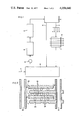
- a starting dispersion of the coating material is introduced into a storage zone A;
- part of the dispersion is continuously withdrawn from the storage zone A and fed to a dispersing zone B, where it is homogenized and brought to a mean particle size of less then 10 ⁇ u, whilst keeping the temperature of the dispersion below 60° C;
- the dispersion is cooled to below 40° C in a cooling zone C;
- the dispersion is then fed continuously to a fractionating zone D in which it is separated, according to particle size, into
- the fine fraction at below 40° C, is passed continuously through one or more coating zones E and then recycled to the storage zone A, and at the same time one or more wires of diameter greater than 0.05 mm are drawn through coating zone(s) E and provided with a coating which is then baked.
- FIG. 1 is a schematic representation illustrating a preferred embodiment of a dispersing and coating system of the present invention
- FIG. 2 is an enlarged sectional view of an embodiment of the dispersing zone B shown in FIG. 1;
- FIG. 3 is an enlarged sectional view of an embodiment of the fractionating zone D shown in FIG. 1;
- FIG. 4 is an enlarged sectional view of an embodiment of the coating apparatus E shown in FIG. 1.
- the starting dispersion is introduced via line 11 into the storage zone A from where it is withdrawn, advantageously by a pump 12, and fed to the dispersing zone B.
- the homogenized and comminuted dispersion is cooled in the cooling zone C and is then fed to the fractionating zone D, where it is separated into a coarse fraction and a fine fraction.
- the coarse fraction is recycled directly to the storage zone A via line 13; the fine fraction is also returned to the storage zone, via line 14, but through the coating zone E. Wires 15 are drawn through the coating zone E, and coated there.
- Resins which may be used for wire enameling according to the invention are any polymeric organic coating materials suitable for this purpose.
- the following are particularly suitable:
- Polyesters of aromatic dicarboxylic acids and polyhydric alcohols which are preferably crosslinked by co-condensation of tris-hydroxyethyl-isocyanurate; polyamide-imides, manufactured by reacting trimellitic anhydride or its derivatives with aromatic diamines or diisocyanates, or by reacting diimide-dicarboxylic acids with diisocyanates, eg. in accordance with German Printed Application Nos.
- polyimides based on aromatic tetracarboxylic acid dianhydrides or their derivatives and aromatic diamines
- polyurethanes of a mixture of a hydroxyl-containing polyester and a blocked polyisocyanate polyamides of dicarboxylic acids and diamines
- polyacrylates based on copolymers of esters of acrylic acid or methacrylic acid.
- any polymeric organic resin which can be converted into a dispersion and which melts at an elevated temperature and gives a coherent coating when applied to a wire.
- Heat-resistant polymers which, after baking on the wire, have a maximum use temperature, measured according to DIN 53,446, of above 100° C, preferably above 150° C, are preferred.
- Polyester-imides which are polycondensation products of aromatic polycarboxylic acids, polyhydric alcohols and polyfunctional amines are particularly preferred. Those in general contain from 0.5 to 7, preferably from 1 to 5, percent by weight of imide nitrogen in the form of 5-membered imide rings which are fused to aromatic nuclei. They may be manufactured from the following starting materials:
- aromatic tricarboxylic or tetracarboxylic acids their anhydrides or esters, eg. trimellitic acid, pyromellitic acid or their anhydrides, if appropriate together with aromatic dicarboxylic acids or their esters, eg. terephthalic acid, isophthalic acid or naphthalenedicarboxylic acid, and their lower alkyl ester,
- di-primary or tri-primary amines eg. ethylenediamine, hexamethylenediamine, benzidine, diaminodiphenylmethane, diaminobenzophenone, diaminodiphenyl ether or diaminondiphenyl sulfone, phenylenediamine,toluylenediamines, xylylenediamines or melamine.
- polyester-imides are described, eg., in German Printed Applications Nos. 1,445,263, 1,495,100, 1,495,152 and 1,645,435 and in German Published Application No. 2,412,471.
- Aqueous resin dispersions containing from 10 to 60 percent by weight of the resin are employed in the process according to the invention.
- the dispersion may contain the following constituents:
- suspension stabilizers eg. polyvinylpyrrolidone, copolymers of vinyl propionate and vinyl-pyrrolidone, polyacrylic acid or partially saponified copolymers of acrylic esters and acrylonitrile,
- surface-active compounds eg, polyvinyl alcohols, cellulose ethers or gelatine,
- flow improvers eg. butanediol, diethylene glycol, glycol monoethers, dimethylformamide, dimethylacetamide or N-methylpyrrolidone,
- thickeners eg. high molecular weight polyvinylpyrrolidone or vinylpyrrolidone copolymers
- anit-thixotropic agents eg. ethanolamine or triethanolamine
- neutralizing agents eg. hexamethylenetetramine or other amines
- baking catalysts eg. oxotitanates, triethanolamine titanate, titanium lactate or titanium oxalate, such catalysts being particularly important in the case of polyester-imide dispersions, and
- pigments where special effects are desired, pigments, fillers or dyes.
- the starting dispersion of the organic resin can be manufactured either directly by polymerization or polycondensation in aqueous dispersion, or by freeze-drying, in accordance with the method of German Published Application No. 2,460,472, a solution of the resin in an organic solvent, and dispersing the resulting powder in water. Finally, it is also possible to mill the solid resin, in the dry state, in conventional mechanical mills, eg. impact disc mills or pin mills, and then to disperse it in water.
- the dispersion can be subjected to a preliminary milling treatment by comminuting the particles, in conventional ball mills, to a mean particles size of less than 10 ⁇ u and preferably less than 5 ⁇ u.
- a preliminary milling treatment by comminuting the particles, in conventional ball mills, to a mean particles size of less than 10 ⁇ u and preferably less than 5 ⁇ u.
- mean particle size is to be understood as the d 50 value of the number-average; the particle size was measured by means of a sedimentation balance.
- the starting dispersion is fed intermittently to the storage zone by making additions at substantial intervals of time.
- the dispersion contained in the storage zone A sould if possible be agitated so that there are not stagnating zones in which excessive agglomeration of the resin particles occurs. This is advantageously achieved by providing the storage vessel with a stirrer.
- Part of the dispersion is continuously withdrawn from the storage zone A, advantageously by means of a pump, and fed to a dispersing zone B.
- a pump Any type of pump suitable for thixotropic fluids may be used, in particle a gear pump, but also a centrifugal pump or hose pump.
- the dispersion is fed to the dispersing zone B, where it is homogenized and brought to a mean particle size of less than 10 ⁇ u, preferably less than 5 ⁇ u and especially less than 3 ⁇ u.
- the dispersing zone must be in the form of a mill. In this case it is essential that milling should take place with little abrasion, ie. during grinding particles, eg. glass splinters or metal powder, should not be abraded from the grinding medium.
- a particularly suitable milling apparatus comprises several discs provided with grooves in which balls move, and is shown in FIG. 2.
- Discs 22 are attached to a shaft 21, which can be cooled, by means of dovetails (not shown), so that the discs rotate with the shaft but are movable in the axial direction.
- Discs 24 are joined to the housing 23, which can be cooled, by means of rubber rings 25. The discs 24 cannot rotate but also have some freedom of movement in the axial direction.
- the discs are provided with concentric grooves in which several balls 26 run. The maximum depth of these grooves is preferably greater than one-third of the diameter of the balls.
- the dispersion passes between the discs in the direction indicated by the arrows, and its particles are comminuted by the balls.
- the material of construction of the discs should have a lower modulus of elasticity than that of the balls. Particularly little abrasion on milling occurs if the discs are made of polyamide and the balls of steel or, better still, of glass. Other suitable equipment may be employed instead of this preferred milling and dispersing apparatus.
- dispersion can also be achieved by using an oversize pump for taking the dispersion from the storage zone, eg. by using a powerful gear pump.
- Some milling must, however, always be carried out in the dispersing zone since the formation of agglomerates in the storage zone A, in the fractionating zone D and in the coating zone E can never be entirely avoided. These agglomerated particles are comminuted to the required small particle size in the dispersing zone B.
- the enameled wires are no longer up to specification after an on-stream period of only 8 hours, ie. they exhibit, eg., an irregular surface and insufficient dielectric strength according to DIN 53,481.
- the dispersing zone is cooled, so that the temperature of the dispersion in this zone is kept below 60° and preferably below 40° C. If the temperature of the dispersion rises to too high a level, the dispersion has a greater tendency to agglomerate; in the extreme case, sticky lumps form which clog the coating apparatus.
- the temperature in the coating zone must be even lower, it is necessary in most cases, particularly if intensive milling is carried out, to cool the dispersion further. This is advantageously done in a cooling zone C, where the dispersion is cooled to below 40° and preferably below 30° C.
- the dispersion is then fed to a fractionating zone D, in which a separation according to particle size is carried out.
- a separation according to particle size is carried out.
- a coarse fraction which contains larger particles, ie. particles having a mean size greater than that of the fine fraction.
- This coarse fraction is directly recycled to the storage zone A, whilst the fine fraction first passes through the coating zones.
- FIG. 3 A particularly advantageous embodiment of the fractionating zone is shown in FIG. 3:
- the dispersion is injected through an orifice 32 tangentially into an inner cylinder 31, where it forms a vortex, as a result of which the coarse particles (coarse fraction 33) accumulate against the outer wall of the cylinder 31 and flow, over an overflow edge, into the annular space 35 and from there leave through an orifice 36.
- the fine fraction 34 accumulates in the center and flows through a distributor tube 37, which is slotted and covered with filter cloth 38, and then through orifices 39 into the coating zones.
- the fine fraction flows to one or more coating zones E. Since the coating zones are, in general, open systems, the temperature of the dispersion should advantageously be below room temperature to keep water losses due to evaporation to a minimum. For this reason it may be necessary first to cool the dispersion, in a separate cooling zone C, to a temperature below 40° and preferably below 30° C. The fine dispersion flows through the coating zone and is subsequently recycled to the storage zone A.
- the invention can be carried out using a single coating zone; in practice, a plurality of coating apparatuses, advantageously from about 3 to 30, are arranged in parallel.
- FIG. 4 shows a section through an advantageous embodiment of a coating apparatus:
- the dispersion enters the coating vessel through an orifice 42, tangentially to the applicator roll 41, and leaves the vessel again through an outlet 43 connected to a constant-level device, not shown in the drawing.
- the wire 44 rests on the applicator roll, the roll being rotated by the moving wire.
- the wire is drawn through two pairs of felt wiper pads 45 and 46.
- the applicator roll is advantageously made of plastics material of specific gravity equal to or less than that of the dispersion; as a result, the roll floats on the dispersion.
- the constant-level device can therefore be used to adjust the pressure of the roll against the wire and hence also to regulate the amount of enamel picked up by the wire.
- the roll is provided with one fine thread or two fine threads (one left-hand, the other right-hand) cut on its surface, so that the wire, on passing through the pair of felt wiper pads 46, executes a horizontal and vertical movement, as a result of which the felt pads are self-cleaning.
- wires are passed over one applicator roll in each coating unit.
- the wires in general have a diameter greater than 0.05 mm and preferably from 0.1 to 2 mm. No only round, but also flat, wires can be coated. After coating, the wires pass through an oven in which the enamel is baked, in general at from 200° to 600° C.
- the wires are drawn more than once through the coating apparatus and the oven; the number of passes may be up to 20. In general, from 1 to 10 ⁇ u of coating is applied per pass.
- those parts of the circulation system of the invention which which the dispersion comes into contact should be made of electrically non-conducting material, ie. the lines through which the dispersion passes, and the coating apparatuses, should advantageously be made of plastics material.
- the ratio of the volume V 1 of dispersion applied in a coating zone to the volume V 2 of the fine despersion introduced into this coating zones, each volume being per unit time, should preferably be less than 1:30 and in particular less than 1:50. With n coating units connected in parallel, the ratio n ⁇ V 2 to the volume V 3 of dispersion taken from the storage zone A per unit time should preferably be less than 1:10 and in particular less than 1:20. A total of preferably less than 1/500 of the dispersion V 3 which is being circulated should be consumed in the coating operation.
Landscapes
- Engineering & Computer Science (AREA)
- Manufacturing & Machinery (AREA)
- Paints Or Removers (AREA)
- Processes Specially Adapted For Manufacturing Cables (AREA)
Applications Claiming Priority (2)
| Application Number | Priority Date | Filing Date | Title |
|---|---|---|---|
| DE19752523099 DE2523099C3 (de) | 1975-05-24 | Verfahren zur Elektroisolierung von metallischen Leitern | |
| DT2523099 | 1975-05-24 |
Publications (1)
| Publication Number | Publication Date |
|---|---|
| US4058640A true US4058640A (en) | 1977-11-15 |
Family
ID=5947352
Family Applications (1)
| Application Number | Title | Priority Date | Filing Date |
|---|---|---|---|
| US05/684,308 Expired - Lifetime US4058640A (en) | 1975-05-24 | 1976-05-07 | Electrical insulation of metallic conductors |
Country Status (4)
| Country | Link |
|---|---|
| US (1) | US4058640A (en:Method) |
| JP (1) | JPS51143880A (en:Method) |
| FR (1) | FR2312843A1 (en:Method) |
| IT (1) | IT1059103B (en:Method) |
Cited By (5)
| Publication number | Priority date | Publication date | Assignee | Title |
|---|---|---|---|---|
| US4145474A (en) * | 1976-07-01 | 1979-03-20 | Maillefer S.A. | Method of manufacturing insulated electric wire of the enamelled-wire type by extrusion |
| US4186241A (en) * | 1977-12-03 | 1980-01-29 | Dr. Beck & Co. Ag | Insulated wire and method for producing same |
| US4252842A (en) * | 1977-02-17 | 1981-02-24 | Basf Aktiengesellschaft | Electrical insulation of metallic conductors |
| US4808436A (en) * | 1986-12-22 | 1989-02-28 | Essex Group, Inc. | Method for equilibrating polyamide magnet wire coatings and enamel compositions |
| US4913963A (en) * | 1986-12-22 | 1990-04-03 | Essex Group, Inc. | Magnet wire with equilibrating polyamide insulation |
Families Citing this family (1)
| Publication number | Priority date | Publication date | Assignee | Title |
|---|---|---|---|---|
| JPS60175631U (ja) * | 1984-04-27 | 1985-11-21 | 東洋ゴム工業株式会社 | 制振構造体 |
Citations (2)
| Publication number | Priority date | Publication date | Assignee | Title |
|---|---|---|---|---|
| US3148169A (en) * | 1960-12-01 | 1964-09-08 | Gen Electric | Curable polyethylene composition comprising a peroxide containing tertiary carbon atos, clay filler, and an electrical conductor insulated with the composition |
| US3171866A (en) * | 1960-12-01 | 1965-03-02 | Gen Electric | Peroxide cured polyethylene with polyvinyl chloride filler and wire coated with the same |
Family Cites Families (3)
| Publication number | Priority date | Publication date | Assignee | Title |
|---|---|---|---|---|
| JPS4837740B1 (en:Method) * | 1969-06-25 | 1973-11-13 | ||
| DE2035538C3 (de) * | 1970-07-17 | 1980-01-10 | Supraton F. J. Zucker Kg, 4040 Neuss | Verfahren und Vorrichtung zur Herstellung von graphischen Farben, insbesondere Druckfarben |
| BE789700A (fr) * | 1971-10-06 | 1973-02-01 | Grow Chemical Corp | Procede de peinture |
-
1976
- 1976-04-14 IT IT22315/76A patent/IT1059103B/it active
- 1976-05-07 US US05/684,308 patent/US4058640A/en not_active Expired - Lifetime
- 1976-05-07 JP JP51051421A patent/JPS51143880A/ja active Pending
- 1976-05-24 FR FR7615664A patent/FR2312843A1/fr active Granted
Patent Citations (2)
| Publication number | Priority date | Publication date | Assignee | Title |
|---|---|---|---|---|
| US3148169A (en) * | 1960-12-01 | 1964-09-08 | Gen Electric | Curable polyethylene composition comprising a peroxide containing tertiary carbon atos, clay filler, and an electrical conductor insulated with the composition |
| US3171866A (en) * | 1960-12-01 | 1965-03-02 | Gen Electric | Peroxide cured polyethylene with polyvinyl chloride filler and wire coated with the same |
Cited By (5)
| Publication number | Priority date | Publication date | Assignee | Title |
|---|---|---|---|---|
| US4145474A (en) * | 1976-07-01 | 1979-03-20 | Maillefer S.A. | Method of manufacturing insulated electric wire of the enamelled-wire type by extrusion |
| US4252842A (en) * | 1977-02-17 | 1981-02-24 | Basf Aktiengesellschaft | Electrical insulation of metallic conductors |
| US4186241A (en) * | 1977-12-03 | 1980-01-29 | Dr. Beck & Co. Ag | Insulated wire and method for producing same |
| US4808436A (en) * | 1986-12-22 | 1989-02-28 | Essex Group, Inc. | Method for equilibrating polyamide magnet wire coatings and enamel compositions |
| US4913963A (en) * | 1986-12-22 | 1990-04-03 | Essex Group, Inc. | Magnet wire with equilibrating polyamide insulation |
Also Published As
| Publication number | Publication date |
|---|---|
| JPS51143880A (en) | 1976-12-10 |
| FR2312843B1 (en:Method) | 1980-05-23 |
| IT1059103B (it) | 1982-05-31 |
| DE2523099A1 (de) | 1977-02-17 |
| DE2523099B2 (de) | 1977-07-07 |
| FR2312843A1 (fr) | 1976-12-24 |
Similar Documents
| Publication | Publication Date | Title |
|---|---|---|
| US3966655A (en) | Manufacture of polyester imide dispersions | |
| DE1520012C3 (de) | Verfahren zur Herstellung von Polykondensaten mit wiederkehrenden Imideinheiten | |
| US4058640A (en) | Electrical insulation of metallic conductors | |
| JP3463066B2 (ja) | 半導電性ポリイミド系無端ベルトとその製造方法 | |
| US3444183A (en) | Film-forming composition | |
| US4354965A (en) | Polyetheramideimide resins and electrical conductors insulated therewith | |
| DE60015649T2 (de) | Polyamidsäure enthaltende und mit Feinpartikeln dispergierte Zusammensetzung und Verfahren zu ihrer Herstellung | |
| GB2032926A (en) | Aromatic polyimide resin composition | |
| US4252842A (en) | Electrical insulation of metallic conductors | |
| US4124419A (en) | Self-bonding varnish for magnet wire and magnets produced using said | |
| CN114752081B (zh) | 黑色聚酰亚胺膜用炭黑分散液的制备方法 | |
| CA1280841C (en) | High temperature wire coating powder | |
| DE69821664T2 (de) | Wärmehärtbare Harzzusammensetzung | |
| US8097693B2 (en) | Endless tubular polyimide film | |
| US4018736A (en) | Manufacture of polyester-imide powders | |
| DE2523099C3 (de) | Verfahren zur Elektroisolierung von metallischen Leitern | |
| GB1590464A (en) | Aqueous polyimide dispersions | |
| US3994863A (en) | Process for the manufacture of polyester imides using melamine as the polyamine reactant | |
| JPH05186728A (ja) | 耐熱性セラミックインキ | |
| CH450598A (de) | Uberzugsmasse und Verwendung derselben | |
| US4246377A (en) | Process for increasing molecular weight of polybutylene terephthalate | |
| GB1558616A (en) | Aqueous wire enamel dispersions and their manufacture | |
| US4115337A (en) | Process for manufacturing enamels of polyester-polyimide resins, particularly for coating electric conductors | |
| SU979465A1 (ru) | Способ получени порошковой композиции дл покрытий | |
| GB2080316A (en) | Polyetheramideimide Resins and Electrical Conductors Insulated Therewith |