US3776632A - Cleaning mechanism for photoconductive surfaces - Google Patents
Cleaning mechanism for photoconductive surfaces Download PDFInfo
- Publication number
- US3776632A US3776632A US00228873A US3776632DA US3776632A US 3776632 A US3776632 A US 3776632A US 00228873 A US00228873 A US 00228873A US 3776632D A US3776632D A US 3776632DA US 3776632 A US3776632 A US 3776632A
- Authority
- US
- United States
- Prior art keywords
- belt
- liquid
- machine
- diluent
- image
- Prior art date
- Legal status (The legal status is an assumption and is not a legal conclusion. Google has not performed a legal analysis and makes no representation as to the accuracy of the status listed.)
- Expired - Lifetime
Links
- 238000004140 cleaning Methods 0.000 title claims abstract description 72
- 239000007788 liquid Substances 0.000 claims abstract description 82
- 238000012546 transfer Methods 0.000 claims abstract description 31
- 239000002245 particle Substances 0.000 claims abstract description 26
- 239000003085 diluting agent Substances 0.000 claims description 43
- 239000000463 material Substances 0.000 claims description 17
- 230000000694 effects Effects 0.000 claims description 4
- 239000004744 fabric Substances 0.000 claims description 4
- 238000006073 displacement reaction Methods 0.000 claims description 3
- 238000005286 illumination Methods 0.000 claims description 2
- 239000000725 suspension Substances 0.000 claims description 2
- 238000005201 scrubbing Methods 0.000 description 7
- 238000010276 construction Methods 0.000 description 3
- 238000011161 development Methods 0.000 description 3
- 238000012423 maintenance Methods 0.000 description 3
- 239000000853 adhesive Substances 0.000 description 2
- 230000001070 adhesive effect Effects 0.000 description 2
- 238000013459 approach Methods 0.000 description 2
- 239000012141 concentrate Substances 0.000 description 2
- 238000012937 correction Methods 0.000 description 2
- 238000001704 evaporation Methods 0.000 description 2
- 230000008020 evaporation Effects 0.000 description 2
- 239000012530 fluid Substances 0.000 description 2
- CNPVJWYWYZMPDS-UHFFFAOYSA-N 2-methyldecane Chemical compound CCCCCCCCC(C)C CNPVJWYWYZMPDS-UHFFFAOYSA-N 0.000 description 1
- 229910001369 Brass Inorganic materials 0.000 description 1
- 239000004215 Carbon black (E152) Substances 0.000 description 1
- 241000274177 Juniperus sabina Species 0.000 description 1
- 239000004677 Nylon Substances 0.000 description 1
- 239000004372 Polyvinyl alcohol Substances 0.000 description 1
- 229910000746 Structural steel Inorganic materials 0.000 description 1
- 239000010951 brass Substances 0.000 description 1
- 230000006835 compression Effects 0.000 description 1
- 238000007906 compression Methods 0.000 description 1
- 239000003292 glue Substances 0.000 description 1
- 230000005484 gravity Effects 0.000 description 1
- 229930195733 hydrocarbon Natural products 0.000 description 1
- 150000002430 hydrocarbons Chemical class 0.000 description 1
- 238000000034 method Methods 0.000 description 1
- 229920001778 nylon Polymers 0.000 description 1
- 230000003287 optical effect Effects 0.000 description 1
- 229920002451 polyvinyl alcohol Polymers 0.000 description 1
- 230000000717 retained effect Effects 0.000 description 1
- 235000001520 savin Nutrition 0.000 description 1
- 239000011359 shock absorbing material Substances 0.000 description 1
- 230000003068 static effect Effects 0.000 description 1
- 238000003466 welding Methods 0.000 description 1
Images



Classifications
-
- G—PHYSICS
- G03—PHOTOGRAPHY; CINEMATOGRAPHY; ANALOGOUS TECHNIQUES USING WAVES OTHER THAN OPTICAL WAVES; ELECTROGRAPHY; HOLOGRAPHY
- G03G—ELECTROGRAPHY; ELECTROPHOTOGRAPHY; MAGNETOGRAPHY
- G03G21/00—Arrangements not provided for by groups G03G13/00 - G03G19/00, e.g. cleaning, elimination of residual charge
- G03G21/0088—Arrangements not provided for by groups G03G13/00 - G03G19/00, e.g. cleaning, elimination of residual charge removing liquid developer
Definitions
- ABSTRACT A cleaning system for the moving photoconductive surface of an image transfer electrostatic copying system using a developer made up of toner particles and a liquid carrier in which a cleaning belt with a rough surface is constrained to cause an area of the belt surface to contact the photoconductive surface at a location past the image transfer station with the belt being driven in a direction opposite to the direction of movement of the photoconductive surface and with clear carrier liquid being metered across the photoconductive surface just ahead of the cleaning belt at a rate which is approximately equal to the rate at which the carrier liquid evaporates from the developer.
- the belt is reciprocated transversely and preferably the photoconductive surface is flooded with light as it leaves the image transfer station.
- CLEANING MECHANISM FOR PHOTOCONDUCTIYE SURFACES BACKGROUND OF THE INVENTION 155,108, filed June 21, 1971 discloses a Method of Contact Transfer of Developed Electrostatic Images and Means for Practicing the Same.
- a photoconductive surface is moved successively past a charging station and an exposure station and a developing station and an image transfer station. In the course of its operation, the surface first receives a static charge and then is exposed to the image to be copied to produce a latent electrostatic image on the surface.
- the latent image is developed by subjecting the surface to the action of a developer comprising particles of a tacky toner in a suitable carrier. Following this development of the image, the surface is brought into intimate contact with the material on which the copy is to be made. Owing to the greater affinity of the tacky toner for the copy material, such as paper, than for thephotoconductive surface, the image is transferred to the copy material.
- One object of our invention is to provide a cleaning mechanism for the photoconductive surface of an image transfer electrostatic copying machine.
- Another object of our invention is to provide a cleaning mechanism which effectively cleans a photoconductive surface of toner particles adhered thereto.
- a further object of our invention is to provide a cleaning mechanism for photoconductive surfaces which does not require frequent maintenance.
- Still another object of our invention is to provide a cleaning mechanism for a photoconductive surface which is simple in construction and in operation for the result achieved thereby.
- our invention contemplates the provision of a cleaning mechanism for the moving photoconductive surface of an image transfer electrostatic copying machine using liquid developer comprising toner particles in a carrier in which an area of the rough surface of a cleaning belt driven in a direction opposite to the movement of the drum surface, engages the drum surface at a location past the image transfer station and in which developer liquid is metered into the surface just ahead of the belt at a rate substantially equal to the rate at which liquid evaporates from the developer system of the machine.
- the belt may be reciprocated transversely as it is driven to enhance the scrubbing action thereof.
- FIG. 1 is a schematic view of an image transfer electrostatic copying machine incorporating one form of our cleaning mechanism.
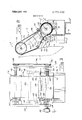
- FIG. 2 is a sectional view of the form of our cleaning mechanism for photoconductive surfaces illustrated in FIG. 1.
- FIG. 3 is a top plan view of the form of our cleaning mechanism illustrated in FIG. 2 taken along the line 3-3 of FIG. 2.
- FIG. 4 is an end elevation of the form of our cleaning mechanism shown in FIG. 2 taken along the line 4-4 of FIG. 2.
- FIG. 5 is an end elevation of the mechanism illustrated in FIG. 3 taken along the line 5-5 of FIG. 3.
- FIG. 6 is a fragmentary sectional view of one form of cleaning belt which we may employ in our system.
- FIG. 7 is a fragmentary perspective view of the liquid metering portion of our cleaning mechanism for photoconductive surfaces.
- FIG; 8 is a sectional view of the liquid supply pump of our cleaning mechanism for photoconductive surfaces.
- FIG. 9 is a perspective view of an alternate form of our cleaning mechanism for photoconductive surfaces.
- FIG. 10 is a fragmentary sectional view of the form of our cleaning mechanism illustrated in FIG. 9 showing an alternate arrangement of the doctor blade thereof.
- FIG. 1 one form of image transfer electrophotographic copying apparatus, indicated generally by the reference character 10, with which our cleaning system can be used, includes a drum 12, having a photoconductive surface 14.
- Drum 12 is supported on a shaft 16 adapted to be driven in any suitable manner in the direction of the arrow in FIG. 1 to carry the photoconductive surface past an exhaust discharge lamp 18, a charging station at which a corona 20 applies a charge to the surface, past an exposure station at which the machine optics 22 expose the surface to an image of the material to be copied and to a developing station at which a tray 24 carrying developer liquid is located.
- the surface 14 carrying the developed image leaves the developer tank, it is subjected to light from a lamp 26 which is adapted to bleed any background charge off the surface.
- the image travels through a transfer region at which the image is transferred to the surface of suitable copy material, such as paper 28, which is fed from a supply roll 30-and through a heater 32 around guide rolls 34 and 36 into contact with the drum.
- suitable copy material such as paper 28
- the paper and the drum surface move together the toner particles making up the developed image are transferred to the paper until the paper arrives at a pair of rolls 38 and 40 which deliver the copy to the user of the machine.
- a suitable cutter may be incorporated in the machine to cut the copy to length.
- a first pump 42 is adapted to supply developer liquid to the tray 24 through a line 44. Overflow from the tray 24 is collected in a trough 46 from whence the developer flows through a line 48 and through a toner concentrate sensing arrangement 50 to a supply tank 52.
- a line 54 connects the tank 52 to the intake of pump 42.
- a second pump 56 connected to tank 52 by a line 58 feeds developer from the tank to a line 60 leading into an impingement mill indicated generally by the reference character 62 which feeds developer to tank 52 through a line 64.
- additional concentrate is fed to the mill 62 from a supply tank 66 through a pipe 68.
- the developer supply apparatus including mill 62 is described in greater detail in our copending application Ser. No. 212,155 filed Dec. 27, 1971. Our system differs from that disclosed in the last-mentioned application only in that, for a reason which will be apparent from the following description, clear carrier liquid is not supplied directly to the mill 62.
- One carrier liquid or diluent which we may use is an isomerized paraffinic hydrocarbon having a specific gravity of 0.75 at 60F. and a kauri-butanol number of 27. This material is manufactured by Standard Oil Company of New Jersey and sold under the trademark ISOPAR G. Other diluents and examples of toners we may employ are disclosed in our firstmentioned copending application.
- the form of our cleaning mechanism indicated generally by the reference character 70 illustrated in FIG. 1 includes spaced brackets 74 and 76 carried by a channel iron 72 of the frame of the machine 10. Respective flexible mounting elements 78 on the brackets 74 and 76 position a tank 80 which rests on a pad 82 of any suitable shockabsorbing material such, for example, as synthetic rubher, on the channel 72.
- a tank 80 which rests on a pad 82 of any suitable shockabsorbing material such, for example, as synthetic rubher, on the channel 72.
- a bracket 89 in the tank 80 carries an applicator member such as a sponge 88 adapted to applydeveloper liquid to the cleaner belt in a manner to
- a pair of brackets 90 and 92 on the sides of the tank 80 carry respective bearings .96 and 98 which rotatably receive a shaft 100.
- Shaft 100 extends through bearings 108 and 109 in the sides 102 and 104 of a cleaning belt frame including a center web 106 extending between sides 102 and 104 and secured thereto by any suitable means such as by welding.
- Shafts 100 and 110 receive respective belt-supporting rolls 112 and 114 for rotation therewith and for axial movement relative thereto by means of splines or the like. Rolls 112 and 114 carry the cleaning belt 116.
- a pair of spaced brackets 118 secured to the underside of web 106 carry a guide bar 120 adapted to engage the inner surface of belt 116 to cause the outer surface thereof to conform to the surface of drum 12 over a relatively large area.
- Another pair of spaced brackets 112 secured to the underside of the web 106 pivotally carry arms 124 and 126 which rotatably support a belt tensioning roller 128 adapted to engage the outer surface of the belt 1 16.
- Springs 130 extending between web 106 and the arms 124 and 126 urges roller 128 into engagement with belt 116 with sufficient force to give the belt the desired tension.
- a guide bar 131 is supported by the frame in a position to engage the outer surface of the outer stand of the belt 116 to increase the area of contact between the belt 1 16 and the rollers 112 and 114 to ensure good driving contact therebetween.
- Tank 80 supports a splash shield 133.
- a motor 132 supported on the frame side 102 is adapted to be energized to drive shaft 100 to rotate roll 112.
- a sprocket wheel 134 carried by shaft 100 at its end remote from motor 132 drives a pitch chain 136 which engages a sprocket wheel 138 carried by shaft 110 for rotation therewith. It will thus be seen that as motor 132 drives shaft 100, rollers 112 and 114 are driven to drive belt 116 by virtue of their frictional engagement therewith. We so arrange our system that the portion of the belt 116 in engagement with drum 12 is driven in a direction opposite to the direction of movement of the drum surface.
- Tank 80 rotatably supports a shaft 152 located within the tank adjacent to the top thereof.
- Shaft 152 carries a wiper blade 154 adapted to engage the outersurface of belt 116 as it emerges from the tank to remove excess liquid therefrom.
- a spring 158 acts on an arm 156 carried by shaft 152 at a location outside the tank to urge blade 154 into engagement with the outer surface of the belt 116.
- the cleaning belt may be any suitable type which will afford the desired scrubbing action on the surface 14 of drum 12.
- One form of belt which we have found gives a good scrubbing action is made up of three layers 160, 162 and 164, of fine, sheer, plain-woven linen cloth such as lawn. These layers may be held together by use of a suitable adhesive such as a polyvinyl alcohol glue. Over the layers of lawn we apply a layer 166 of nylon fabric having a pile 168. We adhere the layer 166 to layer 164. The various layers are assembled on a suitable mandrel and taped thereon until the adhesive sets. After removal, the
- edges are stitched together by means of stitching 170.
- a tank 172 holds a supply of the liquid diluent which is fed to a pump assembly indicated generally by the reference character 176 through a line 174.
- Pump 176 delivers a metered amount of diluent through a line 178 to a manifold 180.
- Manifold 180 extends over substantially the entire width of the drum 12 and is provided with a plurality of spaced outlet openings 182 through which diluent trickles onto the surface 14.
- pump 176 includes a housing 186 carrying a base plate 188 and provided with a cover plate 190 secured to the housing by any suitable means such as by screws 192.
- a recess 194 in the cover plate 190 is adapted to receive the upper end of a flexible diaphragm 196.
- Pump 176 includes a piston 198 secured to the diaphragm 196 and adapted to be driven so as to reciprocate the diaphragm with a predetermined stroke.
- a motor 200 is adapted to be energized to drive the input of a gear box 202 having an output shaft 204 carrying an eccentric 206.
- the eccentric 206 drivingly engages a follower plate 208 on the upper end of the rod of piston 198.
- An opening 210 in base plate 188 receives an inlet valve 212 which admits fluid into housing 186 through a fitting 214 during the upstroke of piston 198.
- a second opening 216 in base plate 188 receives an outlet valve 218 which permits liquid to flow out of housing 186 through a fitting 220 during the downstroke of the piston 198. It will readily be appreciated that we connect line 174 to fitting 214 and we connect fitting 220 to the line 178.
- a positive displacement pump which delivers the liquid diluent to the manifold 180.
- the amount of diluent supplied to the surface 14 through the openings 182 is approximately equal to the amount of diluent which is lost by evaporation in the course of the normal operation of the machine incorporating our cleaning system.
- the pump 176 is designed to deliver liquid at a minimum rate of about milliliters per hour.
- pump 176 delivers sufficient liquid to the manifold as to maintain the total amount of lsopar substantially constant. We achieve this by making the holes 182 of such a size that liquid normally is retained in the manifold 180 under surface tension at the holes.
- the liquid supplied to the surface of the drum softens the residual toner to facilitate its removal under the scrubbing action of the belt 116.
- the wiper blade 154 removes the toner and diluent from the surface of the belt to permit it to flow into the tank 80 from whence it flows through tube 86 back to the supply tank 52. With this arrangement, cleaning of the belt 116 by a serviceman is required at only relatively infrequent intervals.
- FIG. 9 we have shown a, possible alternate arrangement in which rollers 210 and 212 support a belt 214 which may be of the same material as is the belt 116.
- Belt 214 has a width which approaches that of the drum l2 so as effectively to clean the entire surface thereof.
- the belt 214 is driven in a direction opposite to the direction of rotation of the drum.
- the same liquid feeding manifold 180 is used to apply liquid developer to the drum surface as it approaches the cleaning belt.
- a shaft 220 supports a doctor blade 218 over the belt so that the blade engages the belt to remove liquid and toner particles from the belt.
- shaft 220 In order to facilitate passage of the liquid back to the tray 216, we arrange shaft 220 at an angle of about 30 to the direction of travel of the belt.
- An arm 222 carried by shaft 220 receives one end of a spring 224 to bias the blade 218 into engagement with the belt.
- doctor blade shaft 228 on the tank 216 to-cause the blade 226 to engage the belt 214 at a location at which it is trained around the roll 212.
- a spring 232 acting on an arm 230 on shaft 228 urges the blade into engagement with belt 214.
- liquid collected by the blade 226 is permitted to pass into the tank 216 through a plurality of holes 234 formed in the blade.
- a guide portion 236 secured to the edge of the blade directs liquid back toward the tank 216 thus to prevent it from being carried around with the belt.
- Doctor blades 218 and 226 as well as guideportion 236 may be made from any suitable relatively rigid material such as brass sheet.
- a lamp 18 illuminates surface 14 to afford an exhaust exposure which substantially eliminates any charge remaining on the drum.
- the surface passes a corona 20 which applies a predetermined electrostatic charge to the surface.
- the surface is exposed through the machine optics 22 to an image of the original to be copied.
- the resultant latent image is developed in tank 24 with tacky toner particles.
- the surface may again be exposed to light from a source 26 to overcome the effect of any residual background charge.
- the image is brought into contact with paper 28 to which the image is transferred as a result of the fact that the tacky toner particles have greater affinity for the paper than they do for the photoconductive surface 14.
- the copy paper carrying the developed image is removed by takeoff rolls 38 and 40.
- the surface As the surface leaves the takeoff rolls it is first subjected to light from a source 184 to remove any remanent image charge. Any toner deposit which has not been transferred has a relatively low optical density so that light from the lamp 184 substantially reduces the charge to facilitate cleaning.
- clear liquid carrier is applied across the surface from the manifold 180 at a rate which is approximately that at which carrier liquid is lost from the system by evaporation. This clear diluent softens any residual toner deposite on the drum.
- the surface passes by the belt 116 which, as is pointed out hereinabove, is driven in a direction opposite to the direction of movement of the drum surface.
- An electrophotographic copying machine including in combination, a member having a photoconductive surface, means for forming a latent electrostatic image on said surface, a first reservoir for holding a supply of liquid developer comprising tacky toner particles suspended in a carrier liquid, means including said reservoir for developing said image with said developer liquid, means holding a supply of copy material, means for transferring a developed image from said surface to said copy material, a cleaning station, means for moving said member sequentially to carry said surface past said image forming means and said developing means and said transferring means and said cleaning station, an endless belt at said cleaning station in contact with said surface, a second reservoir for holding a supply of clear carrier liquid, means independent of said belt for flowing clear developer liquid from said second reservoir onto said surface in advance of its arrival at said belt, means for driving said belt to remove residual toner from said surface to which said clear liquid has been applied, and means for conducting said liquid which has been flowed onto said surface and toner particles removed from said surface by said belt to said first reservoir.
- a machine as in claim 2 in which said member is a drum, said machine including means for driving said drum, the surface of said belt engaging said drum, and means for driving said belt to move the belt surface engaging the drum in a direction opposite to the direction of movement of the drum surface engaged thereby.
- said cleaning means comprises means for constraining said belt to engage said drum over an arcuate area.
- a machine as in claim 4 in which said belt comprises a pile fabric.
- said applying means comprises means for metering said clear carrier liquid onto said surface at a predetermined rate.
- said metering means comprises a manifold extending across said surface, said manifold having openings adjacent to said surface, and means for supplying clear carrier liquid to said manifold.
- said manifold supplying means comprising a pump adapted to be actuated to force liquid into said manifold to overcome said surface tension and means for periodically actuating said pump.
- An electrophotographic copying machine including in combination, a member having a photoconductive surface, means for producing a latent electrostatic image extending over an area of said surface, means for driving said member in a certain direction to move said area successively past a developing station and and an image transfer station and a cleaning station, a first reservoir for holding a supply of liquid developer comprising tacky toner particles suspended in a diluent liquid, means for maintaining a suspension of said toner particles in said diluent liquid in said reservoir, means at said developing station for applying liquid developer from said first reservoir to said surface to develop said image, means at said image transfer station for transferring the developed image to copy material, an endless cleaning belt, means mounting said belt at said cleaning station with a portion thereof in engagement with said surface, meansfor driving said endless belt to move said portion thereof in a relative direction opposite to the direction of movement of said member surface, a second reservoir for holding a supply of clear diluent liquid, and means independent of said belt and located between said transfer station and said cleaning station for flowing clear dil
- a machine as in claim including a source of illumination disposed between said transfer station and said cleaning station to reduce the remanent image charge to facilitate cleaning.
- a machine as in claim 10 including a doctor blade in engagement with the surface of said belt.
- a machine as in claim 10 including means for reciprocating said belt in a direction transversely of its length.
- An electrophotographic copying machine including in combination, a member having a photoconductive surface, means for producing a latent electrostatic image extending over an area of said surface, means for driving said member in a certain direction to move said area successively past a developing station and an image transfer station and a cleaning station, means at said developing station for applying liquid developer comprising toner particles and a diluent to said surface to develop said image, means for holding a supply of said liquid developer, measn for feeding developer from said supply to said developer applying means, means at said image transfer station for tranferring the developed image to copy material, means at said cleaning station for applying clear diluent to said surface, a cleaning belt, means mounting said belt at said cleaning station with a portion thereof in engagement with said surface, means for driving said belt to move said portion thereof in a direction relatively opposite to the direction of movement of said member surface, means for collecting diluent fed to said surface and toner particles removed from said surface at said cleaning station and means for directing collected diluent and toner to said
- a machine as in claim 14 in which said collecting means comprises a tray, a doctor blade and means mounting said blade adjacent to said belt with the length thereof at an angle to the belt length to cause liquid collected thereby to flow along the blade toward the tray.
- said collecting means comprises a tray, a doctor blade, means mounting said blade on said tray adjacent to said belt, said blade being provided with holes to permit liquid collected by the blade to pass therethrough, and a guide for directing liquid passing through said holes to said tray.
- said diluent applying means comprises a manifold extending across said surface, said manifold being formed with holes opening toward said surface, the size of said holes being such as normally to hold said diluent therein by surface tension, a pump for supplying diluent to said manifold and means for driving said pump to supply diluent to said manifold to overcome the effect of said surface tension.
Landscapes
- Physics & Mathematics (AREA)
- General Physics & Mathematics (AREA)
- Cleaning In Electrography (AREA)
Applications Claiming Priority (1)
| Application Number | Priority Date | Filing Date | Title |
|---|---|---|---|
| US22887372A | 1972-02-24 | 1972-02-24 |
Publications (1)
| Publication Number | Publication Date |
|---|---|
| US3776632A true US3776632A (en) | 1973-12-04 |
Family
ID=22858881
Family Applications (1)
| Application Number | Title | Priority Date | Filing Date |
|---|---|---|---|
| US00228873A Expired - Lifetime US3776632A (en) | 1972-02-24 | 1972-02-24 | Cleaning mechanism for photoconductive surfaces |
Country Status (6)
| Country | Link |
|---|---|
| US (1) | US3776632A (OSRAM) |
| JP (1) | JPS4898839A (OSRAM) |
| AU (1) | AU5253473A (OSRAM) |
| DE (1) | DE2308693A1 (OSRAM) |
| FR (1) | FR2173071A1 (OSRAM) |
| IT (1) | IT978174B (OSRAM) |
Cited By (14)
| Publication number | Priority date | Publication date | Assignee | Title |
|---|---|---|---|---|
| US3947108A (en) * | 1974-05-20 | 1976-03-30 | Xerox Corporation | Cleaning system |
| US3955533A (en) * | 1972-09-27 | 1976-05-11 | Smith Ian E | Squeegee roller system for removing excess developer liquid from photoconductive surfaces |
| US4043659A (en) * | 1974-05-24 | 1977-08-23 | Xerox Corporation | Cleaning blade toner arrestor |
| US4077711A (en) * | 1974-05-28 | 1978-03-07 | Ricoh Company, Ltd. | Electrophotographic copying apparatus of wet developing type |
| US4080059A (en) * | 1975-01-23 | 1978-03-21 | Ricoh Company, Ltd. | Apparatus for cleaning a photosensitive member of an electrophotographic copying machine |
| US4089683A (en) * | 1975-10-29 | 1978-05-16 | Xerox Corporation | Liquid developer cleaning means |
| US4185909A (en) * | 1972-04-13 | 1980-01-29 | Canon Kabushiki Kaisha | Cleaning method and device for electrophotographic machine |
| US4190464A (en) * | 1971-06-03 | 1980-02-26 | Canon Kabushiki Kaisha | Method for cleaning a photoconductive surface with liquid toner |
| US4253761A (en) * | 1976-04-17 | 1981-03-03 | Kabushiki-Kaisha Kip | Cleaning devices for use in electrophotographic apparatus |
| US4330199A (en) * | 1972-04-13 | 1982-05-18 | Canon Kabushiki Kaisha | Electrophotographic device |
| WO1989012260A1 (en) * | 1988-06-06 | 1989-12-14 | Spectrum Sciences B.V. | Cleaning station |
| EP0371991A4 (en) * | 1987-07-23 | 1990-12-05 | Precision Images Corporation | Liquid toner recycling system and method |
| US5450186A (en) * | 1994-06-17 | 1995-09-12 | Lundy; Douglas A. | Retractable flexible cleaner brush |
| DE102005049505A1 (de) * | 2005-10-13 | 2007-04-19 | Eastman Kodak Co. | Vorrichtung zur Reinigung eines Transportbandes für Bedruckstoff |
Families Citing this family (2)
| Publication number | Priority date | Publication date | Assignee | Title |
|---|---|---|---|---|
| JPS5158347A (en) * | 1974-11-18 | 1976-05-21 | Canon Kk | Denshishashinsochi |
| CA1062325A (en) * | 1975-02-06 | 1979-09-11 | Savin Business Machines Corporation | Photoconductor drum cleaning apparatus |
Citations (10)
| Publication number | Priority date | Publication date | Assignee | Title |
|---|---|---|---|---|
| US2728103A (en) * | 1950-07-22 | 1955-12-27 | Congoleum Nairn Inc | Wiper for calender rolls |
| US3276896A (en) * | 1959-04-13 | 1966-10-04 | Rca Corp | Electrostatic printing |
| US3318212A (en) * | 1965-09-20 | 1967-05-09 | Xerox Corp | Duplex xerographic reproduction |
| US3405683A (en) * | 1963-06-22 | 1968-10-15 | Azoplate Corp | Apparatus for the development of latent electrostatic images |
| US3526457A (en) * | 1967-06-20 | 1970-09-01 | Xerox Corp | Cleaning apparatus for electrostatic copying machines |
| US3576624A (en) * | 1967-10-17 | 1971-04-27 | Australia Res Lab | Electrostatic printing method employing a pigmented light filter |
| US3622237A (en) * | 1968-05-02 | 1971-11-23 | Ricoh Kk | Electrostatographic light sensitized drum cleaning arrangement in wet-type development |
| US3652319A (en) * | 1969-12-30 | 1972-03-28 | Xerox Corp | Cyclic imaging system |
| US3656948A (en) * | 1969-11-20 | 1972-04-18 | Xerox Corp | Selective removal of liquid developer in a cyclical electrophotographic process |
| US3711796A (en) * | 1970-03-30 | 1973-01-16 | Canon Kk | Electrophotographic copying machine |
-
1972
- 1972-02-24 US US00228873A patent/US3776632A/en not_active Expired - Lifetime
-
1973
- 1973-01-15 IT IT19232/73A patent/IT978174B/it active
- 1973-01-25 JP JP48009999A patent/JPS4898839A/ja active Pending
- 1973-02-20 FR FR7305977A patent/FR2173071A1/fr not_active Withdrawn
- 1973-02-22 DE DE19732308693 patent/DE2308693A1/de active Pending
- 1973-02-23 AU AU52534/73A patent/AU5253473A/en not_active Expired
Patent Citations (10)
| Publication number | Priority date | Publication date | Assignee | Title |
|---|---|---|---|---|
| US2728103A (en) * | 1950-07-22 | 1955-12-27 | Congoleum Nairn Inc | Wiper for calender rolls |
| US3276896A (en) * | 1959-04-13 | 1966-10-04 | Rca Corp | Electrostatic printing |
| US3405683A (en) * | 1963-06-22 | 1968-10-15 | Azoplate Corp | Apparatus for the development of latent electrostatic images |
| US3318212A (en) * | 1965-09-20 | 1967-05-09 | Xerox Corp | Duplex xerographic reproduction |
| US3526457A (en) * | 1967-06-20 | 1970-09-01 | Xerox Corp | Cleaning apparatus for electrostatic copying machines |
| US3576624A (en) * | 1967-10-17 | 1971-04-27 | Australia Res Lab | Electrostatic printing method employing a pigmented light filter |
| US3622237A (en) * | 1968-05-02 | 1971-11-23 | Ricoh Kk | Electrostatographic light sensitized drum cleaning arrangement in wet-type development |
| US3656948A (en) * | 1969-11-20 | 1972-04-18 | Xerox Corp | Selective removal of liquid developer in a cyclical electrophotographic process |
| US3652319A (en) * | 1969-12-30 | 1972-03-28 | Xerox Corp | Cyclic imaging system |
| US3711796A (en) * | 1970-03-30 | 1973-01-16 | Canon Kk | Electrophotographic copying machine |
Non-Patent Citations (1)
| Title |
|---|
| IBM Technical Disclosure Bulletin, Vol. 9, No. 11, Apr. 1967, pg. 1528 Photoconductor Cleaning System, T. M. Hider * |
Cited By (14)
| Publication number | Priority date | Publication date | Assignee | Title |
|---|---|---|---|---|
| US4190464A (en) * | 1971-06-03 | 1980-02-26 | Canon Kabushiki Kaisha | Method for cleaning a photoconductive surface with liquid toner |
| US4330199A (en) * | 1972-04-13 | 1982-05-18 | Canon Kabushiki Kaisha | Electrophotographic device |
| US4185909A (en) * | 1972-04-13 | 1980-01-29 | Canon Kabushiki Kaisha | Cleaning method and device for electrophotographic machine |
| US3955533A (en) * | 1972-09-27 | 1976-05-11 | Smith Ian E | Squeegee roller system for removing excess developer liquid from photoconductive surfaces |
| US3947108A (en) * | 1974-05-20 | 1976-03-30 | Xerox Corporation | Cleaning system |
| US4043659A (en) * | 1974-05-24 | 1977-08-23 | Xerox Corporation | Cleaning blade toner arrestor |
| US4077711A (en) * | 1974-05-28 | 1978-03-07 | Ricoh Company, Ltd. | Electrophotographic copying apparatus of wet developing type |
| US4080059A (en) * | 1975-01-23 | 1978-03-21 | Ricoh Company, Ltd. | Apparatus for cleaning a photosensitive member of an electrophotographic copying machine |
| US4089683A (en) * | 1975-10-29 | 1978-05-16 | Xerox Corporation | Liquid developer cleaning means |
| US4253761A (en) * | 1976-04-17 | 1981-03-03 | Kabushiki-Kaisha Kip | Cleaning devices for use in electrophotographic apparatus |
| EP0371991A4 (en) * | 1987-07-23 | 1990-12-05 | Precision Images Corporation | Liquid toner recycling system and method |
| WO1989012260A1 (en) * | 1988-06-06 | 1989-12-14 | Spectrum Sciences B.V. | Cleaning station |
| US5450186A (en) * | 1994-06-17 | 1995-09-12 | Lundy; Douglas A. | Retractable flexible cleaner brush |
| DE102005049505A1 (de) * | 2005-10-13 | 2007-04-19 | Eastman Kodak Co. | Vorrichtung zur Reinigung eines Transportbandes für Bedruckstoff |
Also Published As
| Publication number | Publication date |
|---|---|
| AU5253473A (en) | 1974-08-29 |
| JPS4898839A (OSRAM) | 1973-12-14 |
| FR2173071A1 (OSRAM) | 1973-10-05 |
| IT978174B (it) | 1974-09-20 |
| DE2308693A1 (de) | 1973-09-13 |
Similar Documents
| Publication | Publication Date | Title |
|---|---|---|
| US3955533A (en) | Squeegee roller system for removing excess developer liquid from photoconductive surfaces | |
| US3781107A (en) | Cleaning apparatus | |
| US3900003A (en) | Liquid developing device for electrophotography | |
| JP3574205B2 (ja) | 現像剤装置 | |
| US3678896A (en) | Conveyor system | |
| US3572288A (en) | Development apparatus | |
| US3256002A (en) | Xerographic fixing device | |
| US3752576A (en) | Transport for particulate material | |
| US3914046A (en) | Electrophotographic copying apparatus | |
| US3606532A (en) | Photoelectrostatic duplicator | |
| JPH01195485A (ja) | 回転ブラシ型清掃装置を備えた複写機 | |
| US4743939A (en) | Intermediate transfer apparatus | |
| US3687708A (en) | Liquid development of latent electrostatic images | |
| US3375806A (en) | Xerographic donor development apparatus | |
| US2844123A (en) | Belt development electrode | |
| US3278972A (en) | Xerographic plate cleaning apparatus | |
| US3709594A (en) | Method and apparatus for electrostatic color printing | |
| US3711796A (en) | Electrophotographic copying machine | |
| DE2308693A1 (de) | Verfahren zur reinigung der photoleitenden oberflaeche eines kopiergeraetes und elektrostatisches kopiergeraet zur durchfuehrung des verfahrens | |
| US3570453A (en) | Development apparatus | |
| US3957509A (en) | Method and apparatus for removing contaminants from an electrostatic imaging surface | |
| US3848204A (en) | Pressure adjustable electrophotographic printing machine transfer apparatus | |
| US4378422A (en) | Method and apparatus for transferring developed electrostatic images to a carrier sheet | |
| US3639051A (en) | Electrostatic copier | |
| US4547060A (en) | Charging apparatus |