US3673750A - Bottom for buildings without basement, and a method of making such bottom - Google Patents
Bottom for buildings without basement, and a method of making such bottom Download PDFInfo
- Publication number
- US3673750A US3673750A US831907A US3673750DA US3673750A US 3673750 A US3673750 A US 3673750A US 831907 A US831907 A US 831907A US 3673750D A US3673750D A US 3673750DA US 3673750 A US3673750 A US 3673750A
- Authority
- US
- United States
- Prior art keywords
- blocks
- layer
- heat
- building
- concrete
- Prior art date
- Legal status (The legal status is an assumption and is not a legal conclusion. Google has not performed a legal analysis and makes no representation as to the accuracy of the status listed.)
- Expired - Lifetime
Links
- 238000004519 manufacturing process Methods 0.000 title abstract description 6
- 239000002689 soil Substances 0.000 claims abstract description 33
- 229910000831 Steel Inorganic materials 0.000 claims abstract description 29
- 239000010959 steel Substances 0.000 claims abstract description 29
- 239000011150 reinforced concrete Substances 0.000 claims abstract description 22
- 239000004927 clay Substances 0.000 claims abstract description 21
- 239000003864 humus Substances 0.000 claims abstract description 18
- 239000008188 pellet Substances 0.000 claims abstract description 16
- 239000004567 concrete Substances 0.000 claims description 51
- 238000004873 anchoring Methods 0.000 claims description 18
- 238000005266 casting Methods 0.000 claims description 12
- 239000000463 material Substances 0.000 claims description 9
- 238000011065 in-situ storage Methods 0.000 claims description 8
- 238000000034 method Methods 0.000 claims description 6
- 230000002093 peripheral effect Effects 0.000 claims description 2
- 238000000465 moulding Methods 0.000 description 10
- 230000002787 reinforcement Effects 0.000 description 9
- 239000004568 cement Substances 0.000 description 8
- 230000003014 reinforcing effect Effects 0.000 description 7
- 238000009413 insulation Methods 0.000 description 6
- 101100074333 Pisum sativum LECA gene Proteins 0.000 description 4
- 238000009408 flooring Methods 0.000 description 4
- 239000011230 binding agent Substances 0.000 description 3
- 238000009412 basement excavation Methods 0.000 description 2
- 230000002349 favourable effect Effects 0.000 description 2
- 239000011368 organic material Substances 0.000 description 2
- FGRBYDKOBBBPOI-UHFFFAOYSA-N 10,10-dioxo-2-[4-(N-phenylanilino)phenyl]thioxanthen-9-one Chemical compound O=C1c2ccccc2S(=O)(=O)c2ccc(cc12)-c1ccc(cc1)N(c1ccccc1)c1ccccc1 FGRBYDKOBBBPOI-UHFFFAOYSA-N 0.000 description 1
- 101100264195 Caenorhabditis elegans app-1 gene Proteins 0.000 description 1
- 229910000746 Structural steel Inorganic materials 0.000 description 1
- 239000010425 asbestos Substances 0.000 description 1
- 239000011449 brick Substances 0.000 description 1
- 238000010276 construction Methods 0.000 description 1
- 238000009826 distribution Methods 0.000 description 1
- 239000011810 insulating material Substances 0.000 description 1
- 238000005192 partition Methods 0.000 description 1
- 229920000915 polyvinyl chloride Polymers 0.000 description 1
- 239000004800 polyvinyl chloride Substances 0.000 description 1
- 229910052895 riebeckite Inorganic materials 0.000 description 1
- 238000005245 sintering Methods 0.000 description 1
- 239000002002 slurry Substances 0.000 description 1
- 238000003892 spreading Methods 0.000 description 1
- 239000000126 substance Substances 0.000 description 1
Images




Classifications
-
- E—FIXED CONSTRUCTIONS
- E04—BUILDING
- E04B—GENERAL BUILDING CONSTRUCTIONS; WALLS, e.g. PARTITIONS; ROOFS; FLOORS; CEILINGS; INSULATION OR OTHER PROTECTION OF BUILDINGS
- E04B1/00—Constructions in general; Structures which are not restricted either to walls, e.g. partitions, or floors or ceilings or roofs
- E04B1/0007—Base structures; Cellars
-
- E—FIXED CONSTRUCTIONS
- E02—HYDRAULIC ENGINEERING; FOUNDATIONS; SOIL SHIFTING
- E02D—FOUNDATIONS; EXCAVATIONS; EMBANKMENTS; UNDERGROUND OR UNDERWATER STRUCTURES
- E02D27/00—Foundations as substructures
- E02D27/01—Flat foundations
- E02D27/02—Flat foundations without substantial excavation
-
- E—FIXED CONSTRUCTIONS
- E02—HYDRAULIC ENGINEERING; FOUNDATIONS; SOIL SHIFTING
- E02D—FOUNDATIONS; EXCAVATIONS; EMBANKMENTS; UNDERGROUND OR UNDERWATER STRUCTURES
- E02D31/00—Protective arrangements for foundations or foundation structures; Ground foundation measures for protecting the soil or the subsoil water, e.g. preventing or counteracting oil pollution
- E02D31/02—Protective arrangements for foundations or foundation structures; Ground foundation measures for protecting the soil or the subsoil water, e.g. preventing or counteracting oil pollution against ground humidity or ground water
-
- E—FIXED CONSTRUCTIONS
- E04—BUILDING
- E04B—GENERAL BUILDING CONSTRUCTIONS; WALLS, e.g. PARTITIONS; ROOFS; FLOORS; CEILINGS; INSULATION OR OTHER PROTECTION OF BUILDINGS
- E04B1/00—Constructions in general; Structures which are not restricted either to walls, e.g. partitions, or floors or ceilings or roofs
- E04B1/62—Insulation or other protection; Elements or use of specified material therefor
-
- E—FIXED CONSTRUCTIONS
- E04—BUILDING
- E04B—GENERAL BUILDING CONSTRUCTIONS; WALLS, e.g. PARTITIONS; ROOFS; FLOORS; CEILINGS; INSULATION OR OTHER PROTECTION OF BUILDINGS
- E04B5/00—Floors; Floor construction with regard to insulation; Connections specially adapted therefor
- E04B5/16—Load-carrying floor structures wholly or partly cast or similarly formed in situ
- E04B5/32—Floor structures wholly cast in situ with or without form units or reinforcements
- E04B2005/322—Floor structures wholly cast in situ with or without form units or reinforcements with permanent forms for the floor edges
Definitions
- ABSTRACT A bottom for buildings without basement founded on the soil after removal of only the humus layer and a method of making same, A foundation wall of heat and moisture insulating blocks having the same height as the foundation wall and placed in juxtaposition extends along the outer wall of the building, a heat and moisture insulating layer of pellets of burnt expanded clay is placed directly on the soil inwardly of the foundation wall, and a steel reinforced concrete layer is cast directly on top of the layer of pellets of burnt expanded clay using the foundation wall as form side wall, and is integrally united with the foundation wall.
- the purpose of the present invention is to provide a farreaching rationalization of the erection of buildings without basements and to conduct this rationalization as far as possible with due consideration of the usual requirements as to the heat and moisture insulation of the bottoms of buildings of this type.
- the invention has for one of its objects to provide, notwithstanding the far-reaching rationalization, a fully reliable and sufficiently strong bottom for buildings without basement.
- Characteristic of the bottom according to the present invention is that it is founded on soil from which only the humus layer has been removed and which has been levelled and possibly also compacted, and comprises the following parts: a foundation wall of prefabricated heat and moisture insulating blocks following in the plane the extension of the outer walls of the building to be erected and suited to support said outer walls, the heat and moisture insulating blocks being placed in juxtaposition on the soil and having the same height as the foundation wall; a heat and moisture insulating layer of grains of burnt expanded clay laid within the confines of the foundation wall directly on the soil from which only the humus layer has been removed and which has been levelled; and a layer of steel reinforced concrete cast in situ on top of said heat and moisture insulating layer using the foundation as a form side wall, whereby said layer will become integral with said foundation wall and reinforce it, said layer of reinforced steel concrete being suited as a direct support for the flooring of the building.
- a bottom of the type defined is attained only if all the requirements stipulated are satisfied at the same time
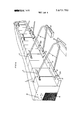
- FIGS. 1-5 illustrate one embodiment of the invention and FIG. 6 illustrates another embodiment of the invention.
- FIG. I is a cross section, taken at right angles to the longitudinal direction of the foundation, of one of the heat and moisture insulating blocks utilized for erection of the foundation wall;
- FIG. 2 is a section on line 11-" in FIG. 1, of some of the blocks placed in juxtaposition for erection of said foundation wall;
- FIG. 3 is a vertical cross section of the foundation wall and the adjoining portions of the building bottom as well as the aids exploited in erecting the foundation wall and supporting it during the making ofthe building bottom;
- FIG. 4 is a perspective view of part of the foundation wall and the adjoining portions of the building bottom as well as the aids exploited in erecting the foundation wall and supporting it during the work phases to be carried out after the erection of the foundation for making the building bottom;
- FIG. 5 is a fragmentary vertical section of the finished building bottom
- FIG. 6 is a perspective view and section of parts of anodier embodiment of the building bottom.
- the nature of the bottom suggested by the present invention for buildings without basement will appear from the following description of the method of making such bottom.
- the first phase of the making of the bottom comprises prefabricating the heat and moisture insulating blocks 1 to be used for the erection of the foundation wall.
- these blocks shall have a considerably higher combined heat and moisture insulating capacity than building blocks of steel reinforced concrete and also conventional light-weight concrete.
- Particularly advantageous for the purpose of the invention both from an economical viewpoint and the viewpoint of heat and moisture insulation are blocks of so-called light-weight clinker concrete.
- blocks of light-weight clinker concrete is to be understood primarily grains or crushed pieces of burnt expanded clay, for instance the material known and commercially available under the trade mark LECA.”
- Such grains are produced from selected clay which with the admixture of organic material hm been burnt to initial sintering in a rotary kiln and which as a result of the admixture of the organic material effected prior to burning and as a result of the burning being carried out in a rotary kiln displays a blistery structure (mainly closed cells) as distinct from a porous structure (open cells).
- This material is known to have favorable properties as a heat insulating material, to possess a heat insulation capacity which is relatively insignificantly deteriorated by moisture, and to have a relatively small tendency of absorbing and conducting moisture.
- this material is a capillary breaking material.
- Light-weight clinker concrete having light-weight LECA" clinker as an aggregate is likewise known to possess much of the favorable moisture and heat insulating properties of the LECA" material.
- the excavating work can be restricted, without detriment to a satisfactory heat and moisture insulation of the building in relation to the soil, to the removal of the humus layer (in most cases to a depth of only one or two decimeters) from the soil beneath and in the immediate environment of the building to be erected.
- An excavation to a greater depth for accommodating the conventional gravel layers that break the capillary force thus is not required, nor is an excavation to a frost-free depth.
- the soil from which the humus layer has been removed is then levelled by equalization of height differences, and, if necessary, the soil and the filled-out low points can be compacted.
- the levelling may be carried out by placing a thin cement or concrete layer directly on the soil as in the embodiment shown in FIG. 6.
- wooden laths 2 are placed on the soil from which the humus layer has been removed and which has been levelled, said wooden laths serving as supporting and aligning means at the placing of the heat and moisture insulating light-weight clinker blocks 1 constituting the foundation wall.
- These supports and the aligning means are laid outside and along the outer contours of the plan of the building to be erected and are suitably secured in position by soil nails (nails having bent upper hook-shaped ends, which are driven into the soil) as will appear from FIG. 4.
- the prefabricated light-weight clinker concrete blocks 1 have an upwardly open U-shaped groove in their top surface.
- the blocks 1 are placed with this groove facing upwardly along the wooden laths 2 in application against the side of said laths.
- an upwardly open channel 3 will be formed, which extends throughout the length of the foundation wall.
- the juxtaposed blocks 1 are supported on the outer side also by tubular V- shaped elements 4 which have one arm secured to the laths 2 and the other arm applied against the outer sides of the bloc ks l constituting the foundation wall.
- the tubular V-shaped elements 4 are adjustably blocked up by means of wooden wedges 5, as will appear from FIG. 4.
- the V-shaped elements 4 are provided at their arm ends with angle-iron pieces 6, 7 welded thereto.
- the pieces 6 have nail holes to permit provisionally nailing them to the lath 2 as will appear from FIG. 4.
- a heat and moisture insulating layer 8 of grains or pellets of burnt expanded clay preferably LECA" pellets or grains, is spread on the soil within the confines of the foundation wall.
- These pellets or grains may suitably have a grain size of 8-16 mm.
- the grains of burnt expanded clay can be loosely spread within the foundation wall, but it is also possible to have the heat and moisture insulating layer 8 in the form of a bonded layer of grains of burnt expanded clay.
- the grains of burnt expanded clay shall only be coated with a binder, for instance a cement slurry or possibly a bituminous binder, so that the communicating passageways between the individual grains are not clogged by the binder.
- a binder for instance a cement slurry or possibly a bituminous binder.
- the heat and moisture insulating layer 8 may suitably be slightly compacted on spreading.
- a layer 9 of steel reinforced concrete suited as a direct support for a flooring is then cast in situ on top of the heat and moisture insulating layer 8, the foundation wall formed by the blocks 1 being exploited as form side walls.
- the concrete layer 9 will thus become integral with and thereby strengthen the foundation wall.
- a particularly careful vibration should suitably be effected in the area closest to the foundation wall.
- reinforcing rods 10 serving as longitudinal reinforcement have been disposed in the upwardly open channel 3 in the foundation wall.
- reinforcing rods 11, preferably in the form of frames embracing the longitudinal reinforcement 10 have been arranged so as to extend through the joints between the blocks 1 into the space accommodating the concrete layer 9.
- said reinforcing rods 11 will be embedded in the concrete layer 9 at the casting thereof.
- concrete 12 is poured into the channel 3 for embedding the reinforcing rods 10, 11 in the foundation wall. This will firmly anchor the foundation wall to the concrete layer 9 by means of the reinforcing rods 11 arranged in the joints between the blocks 1.
- the aids utilized for externally supporting the foundation wall are removed. They can then be utilized for the erection of another building.
- the foundation wall formed by the blocks I can be utilized as a support for the outer walls of the building, after the concrete has set.
- an outer wall of prefabricated concrete elements 13 erected on the foundation wall with the interposition of insulating board 17 while the right-hand portion of FIG. 5 shows an outer wall consisting of an internal lath work I5 containing a heat insulation 14, and an external coat [6 of facade bricks. This outer wall is also placed on the foundation wall with the interposition of a moisture insulation.
- a building bottom constructed in accordance with the invention is suitable not only for one-storied buildings but also for multistoried buildings.
- FIG. 5 also shows the exploitation of the concrete layer 9 as a direct support for a flooring 18 of parquet, linoleum, asbestos polyvinyl chloride boards or the like.
- V-shaped elements and wooden laths have been used for fixation and supporting the prefabricated heat and moisture insulating blocks constituting the foundation wall, during the casting in situ of the layer of steel reinforced concrete.
- a longitudinal reinforcement has also been arranged in the blocks constituting the foundation wall, and this longitudinal reinforcement has been connected with the layer of steel reinforced concrete with the aid of frame means.
- the construction of the bottom of the building without basement can also be further rationalized in that the longitudinal reinforcement and the frame means as well as the supporting structures can be dispensed with if the bottom is designed and made in accordance with what is described below in connection with the embodiment of the invention illustrated in FIG. 6.
- the bottom comprises prefabricated heat and moisture insulating blocks 1 which preferably consist of light-weight clinker concrete blocks.
- a heat and moisture insulating layer 8 of grains or pellets of burnt expanded clay which is placed on the soil from which only the humus layer has been removed and which has been levelled and possibly also compacted, and on top of said layer 8 a layer 9 of steel reinforced concrete cast in situ with the use of the blocks 1 as a form side wall, whereby said layer 9 becomes in tegral with the foundation wall thus reinforcing it.
- the em bodiment shown in FIG. 6 differs from that shown in FIGS.
- the prefabricated blocks 1 should preferably be placed on the levelling layer 20 while this layer is still moist and capable of bonding with the heat and moisture insulating blocks to be united with them afier setting and hardening.
- a still better support for and anchoring of the prefabricated blocks constituting the foundation wall is realized by providing, as shown in FIG. 6, along the foundation wall and extending over but part of the height thereof a projecting longitudinal anchoring means or moulding 21 which is made integral with and of the same material as the levelling layer 20.
- Said moulding 21 should be cast at least on the outer side of the foundation wall, but it is preferred to provide such a moulding on each side of the foundation wall, as is shown in the drawing.
- This reinforcement can also serve to take up temperature strains from the outer wall.
- the layer 9 of steel reinforced concrete is cast with the use of the foundation wall as a form side wall.
- the layer 9 one should in order to realize as good a bond as possible between the prefabricated blocks 1 and the layer 9, thoroughly vibrate the concrete at least in the area adjacent the foundation wall so that the concrete penetrates into the prefabricated blocks thereby providing not only a chemical bond but also a mechanical bond between said blocks and the layer 9 of steel concrete.
- the latter should preferably be designed in the manner shown in FIG. 6, that is the facing end surfaces of the prefabricated heat and moisture insulating blocks should be bevelled at the edge facing inwardly towards the layer 9 of steel concrete. If the mouldings 21 have been reinforced the reinforcement therein contributes to transferring loads to the concrete bottom.
- the mouldings 21 should preferably extend 4O -lOO mm outwardly from the foundation wall and in an upward direction along it, mm being preferred for both of these two dimensions.
- the time consumed for the various working phases is as follows: removal of humus layer and rough levelling, 2 days; fine levelling by means of a cement or concrete layer, placing prefabricated light-weight clinker concrete blocks and casting the mouldings of cement or concrete layer, 2 days; laying the heat and moisture insulating layer of grains or pellets of burnt expanded clay within the confines of the foundation wall (material consumption about 60 mm. of grains of burnt expanded clay), 1 day; placing a reinforcement (grid reinforcement) for the layer of steel concrete cast in situ, about I to l 1% days; casting the layer of steel reinforced concrete and grinding thereof for permitting laying the flooring directly on the concrete layer, 2 days.
- a reinforcement grid reinforcement
- a bottom comprising prefabricated heat and moisture insulating light weight clinker concrete blocks, said blocks having the same height as said bottom and placed in juxtaposition on the soil so as to follow in the plane the extension of the outer walls of the building; a heat and moisture insulating layer of pellets of burnt expanded clay, said insulating layer being placed within the confines of the row of said blocks on the soil from which only the humus layer has been removed; and a layer of steel reinforced concrete formed by being cast directly on top of said heat and moisture insulating layer using said blocks as a form side wall and being integral with said blocks.
- levelling means for levelling the soil beneath said blocks, consisting of a thin layer of concrete.
- a bottom comprising prefabricated heat and moisture insulating light weight clinker concrete blocks, said blocks having the same height as said bottom and placed in juxtaposition on the soil so as to follow in the plane the extension of the outer walls of said building; a heat and moisture insulating layer of pellets of burnt expanded clay, said insulating layer being placed within the confines of the row of said blocks; levelling means for levelling the soil beneath said blocks, said levelling means comprising a thin layer of concrete; longitudinal anchoring means along at least the inner side of said blocks, said anchoring means being formed integral with said levelling means and extending a short distance in an upward direction on said blocks, and a layer of steel reinforced concrete formed by casting said concrete directly on top of said heat and moisture insulating layer using said blocks as side walls and being integral with said blocks.
- step of integrally uniting said steel reinforced concrete layer with said blocks comprises bevelling said heat and moisture insulating blocks at their facing end surfaces at the vertical edge facing said steel reinforced concrete layer.
Landscapes
- Engineering & Computer Science (AREA)
- Architecture (AREA)
- Structural Engineering (AREA)
- Civil Engineering (AREA)
- Life Sciences & Earth Sciences (AREA)
- Mining & Mineral Resources (AREA)
- Paleontology (AREA)
- General Life Sciences & Earth Sciences (AREA)
- General Engineering & Computer Science (AREA)
- Physics & Mathematics (AREA)
- Electromagnetism (AREA)
- Hydrology & Water Resources (AREA)
- Environmental & Geological Engineering (AREA)
- Foundations (AREA)
- Building Environments (AREA)
Applications Claiming Priority (1)
| Application Number | Priority Date | Filing Date | Title |
|---|---|---|---|
| SE6807760A SE388449B (sv) | 1968-06-10 | 1968-06-10 | Botten till kellarlost bostadshus och forfarande for dess framstellning |
Publications (1)
| Publication Number | Publication Date |
|---|---|
| US3673750A true US3673750A (en) | 1972-07-04 |
Family
ID=20272233
Family Applications (1)
| Application Number | Title | Priority Date | Filing Date |
|---|---|---|---|
| US831907A Expired - Lifetime US3673750A (en) | 1968-06-10 | 1969-06-10 | Bottom for buildings without basement, and a method of making such bottom |
Country Status (9)
| Country | Link |
|---|---|
| US (1) | US3673750A (de) |
| AT (1) | AT316814B (de) |
| BE (1) | BE734290A (de) |
| CH (1) | CH517868A (de) |
| DE (1) | DE1928268A1 (de) |
| FR (1) | FR2010593A1 (de) |
| GB (1) | GB1274511A (de) |
| NL (1) | NL6908798A (de) |
| SE (1) | SE388449B (de) |
Cited By (18)
| Publication number | Priority date | Publication date | Assignee | Title |
|---|---|---|---|---|
| US3956859A (en) * | 1973-05-29 | 1976-05-18 | A. B. Grona & Company Kb | Foundation of a heated building without a cellar |
| US4265062A (en) * | 1979-02-02 | 1981-05-05 | Klibofske Virgil L | Foundation covering |
| DE3809242A1 (de) * | 1987-03-19 | 1988-10-20 | Tanaka Homes Co | Fundament fuer holzbauwerke und verfahren zu dessen errichtung |
| US5082393A (en) * | 1987-05-29 | 1992-01-21 | Ringesten Bjoern | Method for forming road and ground constructions |
| WO1992007714A1 (en) * | 1990-10-25 | 1992-05-14 | Erik Arne Kristoffer Westin | Multi-component composition for system of joists and floor, and method of manufacturing such composition |
| DE29709300U1 (de) * | 1997-05-27 | 1998-02-12 | Thermozell Entwicklungs- Und Vertriebs Ges.M.B.H., Glanegg | Fundament sowie Sockelelement für die Verwendung darin |
| US5794393A (en) * | 1996-05-29 | 1998-08-18 | Fearn; Richard Neil | Concrete foundation wall form apparatus and method |
| US5934036A (en) * | 1996-11-01 | 1999-08-10 | Gallagher, Jr.; Daniel P. | Insulated concrete slab assembly |
| US6212831B1 (en) | 2000-04-28 | 2001-04-10 | Wisconsin Poured Wall Products | Foundation insulation covering |
| US20070059107A1 (en) * | 2005-09-09 | 2007-03-15 | Van Riper Edwin D | Slab-on-ground foundation design method |
| NL1032284C2 (nl) * | 2005-10-03 | 2008-02-06 | Sietse Wiersma | Kruipruimteloos bouwen. |
| US8011158B1 (en) | 2007-04-27 | 2011-09-06 | Sable Developing, Inc. | Footing for support of structure such as building |
| US8656653B1 (en) * | 2012-11-07 | 2014-02-25 | GO Logic, L.L.C. | Building foundation construction and methods |
| CN106759843A (zh) * | 2016-12-27 | 2017-05-31 | 宁波二十冶建设有限公司 | 一种地下室外墙防水结构及其施工方法 |
| CN109809591A (zh) * | 2019-02-19 | 2019-05-28 | 深圳市建筑设计研究总院有限公司 | 模块式医院污水处理站 |
| CN113668591A (zh) * | 2021-08-20 | 2021-11-19 | 青岛前盛业建设工程有限公司 | 一种建筑复合地基桩顶预刺入式褥垫层结构 |
| US11608633B2 (en) * | 2017-10-04 | 2023-03-21 | Fastbrick Ip Pty Ltd. | Block for use in automated building construction |
| US12571221B2 (en) | 2022-07-13 | 2026-03-10 | Fab-Form Industries Ltd. | Form support and length-adjustable assembly therefor |
Families Citing this family (3)
| Publication number | Priority date | Publication date | Assignee | Title |
|---|---|---|---|---|
| GB9301889D0 (en) * | 1993-01-30 | 1993-03-17 | Roxbury Ltd | Improvements in or relating to the erection of building structures |
| SE532781C2 (sv) * | 2008-08-28 | 2010-04-06 | Epscement Internat Ab | Grund och metod att gjuta grund för byggnader |
| CN107973575B (zh) * | 2017-12-15 | 2020-10-09 | 贵州绿联固体废物治理研究院有限公司 | 利用建筑垃圾生产的灰渣混凝土条板的制备方法 |
Citations (8)
| Publication number | Priority date | Publication date | Assignee | Title |
|---|---|---|---|---|
| US895243A (en) * | 1908-03-30 | 1908-08-04 | Sydney L Davis | Interlocking concrete curb-block. |
| GB232332A (en) * | 1924-01-17 | 1925-04-17 | Godfrey Herbert Swanton | Improvements in the construction of roadway conduits for gas mains, electric conductors and the like |
| US1849421A (en) * | 1929-04-19 | 1932-03-15 | James J Dyer | Road making |
| GB457318A (en) * | 1936-06-16 | 1936-11-26 | John Ellis & Sons Ltd | Improvements relating to moulded kerbs and the like |
| US2252980A (en) * | 1937-12-08 | 1941-08-19 | Rhett Albert Haskell | Concrete floor and roof joist |
| US2648101A (en) * | 1948-10-11 | 1953-08-11 | Earl W Smith | Building construction |
| GB773192A (en) * | 1953-10-08 | 1957-04-24 | Dick Martin | Beams |
| FR73369E (fr) * | 1957-12-13 | 1960-06-27 | Procédé de construction et dispositifs de mise en oeuvre d'un tel procédé |
-
1968
- 1968-06-10 SE SE6807760A patent/SE388449B/xx unknown
-
1969
- 1969-06-02 CH CH834569A patent/CH517868A/de not_active IP Right Cessation
- 1969-06-03 DE DE19691928268 patent/DE1928268A1/de active Pending
- 1969-06-06 AT AT539169A patent/AT316814B/de not_active IP Right Cessation
- 1969-06-06 GB GB28898/69A patent/GB1274511A/en not_active Expired
- 1969-06-09 BE BE734290D patent/BE734290A/xx unknown
- 1969-06-10 US US831907A patent/US3673750A/en not_active Expired - Lifetime
- 1969-06-10 NL NL6908798A patent/NL6908798A/xx unknown
- 1969-06-10 FR FR6919125A patent/FR2010593A1/fr not_active Withdrawn
Patent Citations (8)
| Publication number | Priority date | Publication date | Assignee | Title |
|---|---|---|---|---|
| US895243A (en) * | 1908-03-30 | 1908-08-04 | Sydney L Davis | Interlocking concrete curb-block. |
| GB232332A (en) * | 1924-01-17 | 1925-04-17 | Godfrey Herbert Swanton | Improvements in the construction of roadway conduits for gas mains, electric conductors and the like |
| US1849421A (en) * | 1929-04-19 | 1932-03-15 | James J Dyer | Road making |
| GB457318A (en) * | 1936-06-16 | 1936-11-26 | John Ellis & Sons Ltd | Improvements relating to moulded kerbs and the like |
| US2252980A (en) * | 1937-12-08 | 1941-08-19 | Rhett Albert Haskell | Concrete floor and roof joist |
| US2648101A (en) * | 1948-10-11 | 1953-08-11 | Earl W Smith | Building construction |
| GB773192A (en) * | 1953-10-08 | 1957-04-24 | Dick Martin | Beams |
| FR73369E (fr) * | 1957-12-13 | 1960-06-27 | Procédé de construction et dispositifs de mise en oeuvre d'un tel procédé |
Non-Patent Citations (1)
| Title |
|---|
| Concrete Masonry Age, 863 E. Leodora Glendora, California, pages 1, 12, and 20 of November 1960 * |
Cited By (21)
| Publication number | Priority date | Publication date | Assignee | Title |
|---|---|---|---|---|
| US3956859A (en) * | 1973-05-29 | 1976-05-18 | A. B. Grona & Company Kb | Foundation of a heated building without a cellar |
| US4265062A (en) * | 1979-02-02 | 1981-05-05 | Klibofske Virgil L | Foundation covering |
| DE3809242A1 (de) * | 1987-03-19 | 1988-10-20 | Tanaka Homes Co | Fundament fuer holzbauwerke und verfahren zu dessen errichtung |
| US5082393A (en) * | 1987-05-29 | 1992-01-21 | Ringesten Bjoern | Method for forming road and ground constructions |
| WO1992007714A1 (en) * | 1990-10-25 | 1992-05-14 | Erik Arne Kristoffer Westin | Multi-component composition for system of joists and floor, and method of manufacturing such composition |
| US5794393A (en) * | 1996-05-29 | 1998-08-18 | Fearn; Richard Neil | Concrete foundation wall form apparatus and method |
| US5934036A (en) * | 1996-11-01 | 1999-08-10 | Gallagher, Jr.; Daniel P. | Insulated concrete slab assembly |
| DE29709300U1 (de) * | 1997-05-27 | 1998-02-12 | Thermozell Entwicklungs- Und Vertriebs Ges.M.B.H., Glanegg | Fundament sowie Sockelelement für die Verwendung darin |
| DE19801123B4 (de) * | 1997-05-27 | 2004-02-26 | Thermozell Entwicklungs- Und Vertriebs Ges.M.B.H. | Fundamentaufbau sowie Sockelelement für die Verwendung darin |
| US6212831B1 (en) | 2000-04-28 | 2001-04-10 | Wisconsin Poured Wall Products | Foundation insulation covering |
| US20070059107A1 (en) * | 2005-09-09 | 2007-03-15 | Van Riper Edwin D | Slab-on-ground foundation design method |
| NL1032284C2 (nl) * | 2005-10-03 | 2008-02-06 | Sietse Wiersma | Kruipruimteloos bouwen. |
| US8011158B1 (en) | 2007-04-27 | 2011-09-06 | Sable Developing, Inc. | Footing for support of structure such as building |
| US8656653B1 (en) * | 2012-11-07 | 2014-02-25 | GO Logic, L.L.C. | Building foundation construction and methods |
| CN106759843A (zh) * | 2016-12-27 | 2017-05-31 | 宁波二十冶建设有限公司 | 一种地下室外墙防水结构及其施工方法 |
| US11608633B2 (en) * | 2017-10-04 | 2023-03-21 | Fastbrick Ip Pty Ltd. | Block for use in automated building construction |
| US12065826B2 (en) | 2017-10-04 | 2024-08-20 | Fastbrick Ip Pty Ltd | Block for use in automated building construction |
| CN109809591A (zh) * | 2019-02-19 | 2019-05-28 | 深圳市建筑设计研究总院有限公司 | 模块式医院污水处理站 |
| CN109809591B (zh) * | 2019-02-19 | 2024-05-31 | 深圳市建筑设计研究总院有限公司 | 模块式医院污水处理站 |
| CN113668591A (zh) * | 2021-08-20 | 2021-11-19 | 青岛前盛业建设工程有限公司 | 一种建筑复合地基桩顶预刺入式褥垫层结构 |
| US12571221B2 (en) | 2022-07-13 | 2026-03-10 | Fab-Form Industries Ltd. | Form support and length-adjustable assembly therefor |
Also Published As
| Publication number | Publication date |
|---|---|
| DE1928268A1 (de) | 1969-12-18 |
| GB1274511A (en) | 1972-05-17 |
| FR2010593A1 (de) | 1970-02-20 |
| SE388449B (sv) | 1976-10-04 |
| NL6908798A (de) | 1969-12-12 |
| CH517868A (de) | 1972-01-15 |
| BE734290A (de) | 1969-11-17 |
| AT316814B (de) | 1974-07-25 |
Similar Documents
| Publication | Publication Date | Title |
|---|---|---|
| US8539721B2 (en) | Lightweight building structure produced by using a mortar and a method for the production | |
| US4570398A (en) | Sprayed concrete basement structure | |
| EP1192321A1 (de) | Integrales system zur herstellung von betonwänden | |
| US3956859A (en) | Foundation of a heated building without a cellar | |
| DE1928268A1 (de) | Grundplatte fuer nicht unterkellerte Wohnhaeuser sowie Verfahren zur Herstellung der Grundplatte | |
| US2250319A (en) | Building wall | |
| US3605353A (en) | Building panel and building construction | |
| PL167666B1 (pl) | Sposób wznoszenia konstrukcji fundamentu dla posadowienia budynku PL | |
| DE19801123A1 (de) | Fundamentaufbau sowie Sockelelement für die Verwendung darin | |
| US3638381A (en) | Insulated masonry building wall construction | |
| CN211523291U (zh) | 一种具备保温防水的伸缩缝结构 | |
| KR100207857B1 (ko) | 주택의 조적식 외벽 구조 및 그 시공 방법 | |
| RU2859328C1 (ru) | Блок строительный и способ его изготовления | |
| US2106387A (en) | Building unit and wall | |
| RU2816140C1 (ru) | Способ строительства малоэтажного дома | |
| SU1330243A1 (ru) | Способ замоноличивани стыков сборных железобетонных элементов в гидротехнических сооружени х | |
| RU2166591C2 (ru) | Облицовка стен зданий | |
| JP2835815B2 (ja) | 木造建築物等用の基礎構造体とその施工法 | |
| EP1120505A2 (de) | Trocken stapelbarer Ziegel zum Errichten von hochbelastbarem Mauerwerk | |
| Deepak | Interlocking dry stacked masonry | |
| SU1454923A1 (ru) | Узел соединени плит покрыти с пролетной конструкцией | |
| US1051376A (en) | Concrete floor construction. | |
| GB2390102A (en) | Suspended concrete floor with insulation overlying the support beams | |
| Seeley | Walls | |
| WO2005021874A2 (en) | Slab off grade building foundation system |