US2024915A - Comb for sheep shearing machines - Google Patents
Comb for sheep shearing machines Download PDFInfo
- Publication number
- US2024915A US2024915A US713393A US71339334A US2024915A US 2024915 A US2024915 A US 2024915A US 713393 A US713393 A US 713393A US 71339334 A US71339334 A US 71339334A US 2024915 A US2024915 A US 2024915A
- Authority
- US
- United States
- Prior art keywords
- comb
- tines
- cutter
- width
- spaces
- Prior art date
- Legal status (The legal status is an assumption and is not a legal conclusion. Google has not performed a legal analysis and makes no representation as to the accuracy of the status listed.)
- Expired - Lifetime
Links
- 241001494479 Pecora Species 0.000 title description 18
- 238000010008 shearing Methods 0.000 title description 8
- 210000001520 comb Anatomy 0.000 description 7
- 208000027418 Wounds and injury Diseases 0.000 description 3
- 230000006378 damage Effects 0.000 description 3
- 208000014674 injury Diseases 0.000 description 3
- 210000002445 nipple Anatomy 0.000 description 3
- 230000001154 acute effect Effects 0.000 description 2
- 230000003292 diminished effect Effects 0.000 description 2
- 230000000717 retained effect Effects 0.000 description 2
- 210000002268 wool Anatomy 0.000 description 2
- 230000000295 complement effect Effects 0.000 description 1
- 230000008602 contraction Effects 0.000 description 1
- 230000001066 destructive effect Effects 0.000 description 1
- 230000000694 effects Effects 0.000 description 1
- 230000004048 modification Effects 0.000 description 1
- 238000012986 modification Methods 0.000 description 1
- 238000007493 shaping process Methods 0.000 description 1
- 238000010626 work up procedure Methods 0.000 description 1
Images
Classifications
-
- B—PERFORMING OPERATIONS; TRANSPORTING
- B26—HAND CUTTING TOOLS; CUTTING; SEVERING
- B26B—HAND-HELD CUTTING TOOLS NOT OTHERWISE PROVIDED FOR
- B26B19/00—Clippers or shavers operating with a plurality of cutting edges, e.g. hair clippers, dry shavers
- B26B19/24—Clippers or shavers operating with a plurality of cutting edges, e.g. hair clippers, dry shavers specially adapted for shearing animals, e.g. sheep
Definitions
- One object of the present invention is to provide means for substantially eliminating these inconveniences and losses.
- the problem has been solved by a modification in comb design which results in automatic rejection of burr as the comb passes into the wool, or results in the holding of burrs between the comb tine spaces so loosely that they are released and rejected downward when they are struck by the cutter.
- Another object of the invention is to minimize risk of slitting and slashing the teats and the skin of the sheep.
- all known sheep shearing machine combs the spacings between the comb tines and at and rearward of the arc which is traversed by the points of the cutter are so wide and the pitch of the lateral faces of the teeth is so nearly erect with respect to the comb face, that folds of the sheeps skin may be drawn or forced up between the tines so that they come above the comb face and are struck by the cutter. This condition is most notable in the case of wrinkly sheep.
- the comb tines are formed substantially parallel with each other and with parallel or substantially parallel side edges with parallel side edges extending from the gullets to about the are which is swept by the cutter points, and the spaces between the tines rearward of the are are made quite narrow compared with the spaces in combs of conventional design.
- the underneath edges of the teeth are also chamfered obtusely so that the interspaces are less wedgelike in section than in combs of conventional design, and the sides of the tines are shaped convex from about the cutter sweep arc line to their points.
- the spaces between the tines should flare rapidly from about the cutter point sweep arc forwardly to the tips.
- Burrs which enter the tine spaces in my comb are held unstably between the comb tines and are dislodged when struck by the cutter and are immediately released downward. Risk of cutter and comb breakages referable to this cause is thus substantially eliminated. Also the sheeps skin is caused to draw flatwise'under the comb so that its tendency to extrude upward between the comb teeth and come into the swath of the cutter is diminished.
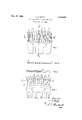
- Fig. 1 is an underneath plan of the comb
- Fig. 3 a longitudinal section through the comb on the centre line or" one of the tine spacings line 3-3 Fig. 1;
- Fig. 4 a transverse section on the line 4 4 Fig. '1.
- the sides A of the comb tines B are convexed (Cirapidly to their points D from a position about thearc XY which is swept by the cutter-points, and back from about that are to the gullet's IF they are quite parallel or are convexed on a very long and gradually increasing radius
- the spacings 'G are-thus substantially parallel rearward of the arc XY to the gullets, while near the tine tips D, where burrs are usually caught, they offer an'obtus'e entry in the flare shape of the space, so that the burrs are held sounstably between the tines that they are released and rejected downwardlydmmediately they are struck bythecutter.
- The'unde'rneath edges of the tines are obtuselyrhamfered as shown at Hin'Figs. 3 and 4, the chamfering merging into the sides'of the tines close to the tips as shown in Fig. 4;
- the obtuse angle H of the tooth chamferings facilitates the release of burrs downwardly.
- This shaping of the tines and the skin'spreadin'g effect which results from the sectional shape of the chamferings on the lower'edges of the tine 'sides operates to keep the'skin'ofthe'sheep down so that skin folds and teats will not 'obtru'de above the comb face where theywould be gashed by the cutter.
- Figs. 3 and 4' show a full thickness new comb.
- a sheep shearing machine comb having'a plurality of tines substantially uniform in width, 5 the tines being so disposed that the spaces intervening the tines are also substantially uniform in width rearward of the cutter sweep arc, and so that the width of the spaces approximates but does not exceed onetenth of an inch, the width of the tines approximating one eighth of an inch, the said tines being tapered to the points forwardly of the cutter sweep arc, and the undersides of the tines being chamfered obtusely.
- a sheep shearing machine comb having its tines disposed substantially in parallel, with relatively narrow intervening spaces of uniform width, the width of the spaces being sufiiciently small to prevent burrs from being retained between the tines, or the skin of the sheep from being injured by the device, said tines being substantially uniform in widthfrom the gullets to about the cutter tip sweep'arc and thence tapered convexly to the points, the top edges of: said tines being substantially rectangular in section, and the under surface of the tines having slanting faces tapering downwardly to an apex, the said slan ng facesbeing'concave in cross section.
- a sheepshearing machine comb having its tines disposed substantially in parallel, with relatively narrow intervening spaces of uniform width, the-width of the spaces being sufficiently small to prevent burrs from being retained between the tines, or the skin of the sheep from being injured by the device, said tines being substantially uniform in width from "the gullets to about the cutter tip sweep arc andv thence tapered convexly to the points, the top edges of 40 said tines being substantially rectangular in section; and the under surfaces of the time having slanting faces tapering downwardly to an apex, the said slanting faces being concave both in transverse section and along their longitudinal extent.
- A'sheep shearing machine comb having its tines disposed substantially in parallel; with 'relatively narrow intervening spaces of uniform width, the width of the spaces being sufficiently
Landscapes
- Life Sciences & Earth Sciences (AREA)
- Animal Behavior & Ethology (AREA)
- Animal Husbandry (AREA)
- Forests & Forestry (AREA)
- Engineering & Computer Science (AREA)
- Mechanical Engineering (AREA)
- Knives (AREA)
Description
Dec. 17, 1935.
COMB FOR SHEEP SHEARING MACHINES Filed Feb. 28, 1934 H 5Q$QQQQQQQQy F/G4 c. G. DUFTY 2,24,9l5
Patented Dec. 17, 1935 UNITED STATES PATENT ori ice Clifford George Dufty, Quirindi, New South Wales, Australia Application February 28, 1934, Serial No. 713,393 In Australia March 13, 1933 4 Claims.
It is universal practice in the design of sheep shearing machine combs to form the comb tines with concaved lateral contours and progressively acute in section from root to tip; the interspaces are necessarily of complementary shape; between the tine tips the clearance space is maximum, and thence back to the root line :the clearance space narrows progressively into :the gullets. From the tine tips to back beyond the cutter tip sweep arc the contraction in the width of the clearance spaces is very slow. The result is that burrs which pass into the interspaces during the passage of the shear through the wool are liable to become wedged between the tines and are held as rigid obstructions to the cutter movement. Very frequently breakage of the comb teeth occurs when heavy burrs so held are struck by the cutter, or the cutting edges of the comb tines and the cutter teeth are injured, and destructive mechanical stresses are imposed on parts of the handpiece and on the flexible shaft. Losses by comb and cutter breakage and injury to machines and shafts in the shearing of sheep which carry heavy burr are in many cases quite serious; heretofore these losses have been tolerated, no means being available for obviating them.
One object of the present invention is to provide means for substantially eliminating these inconveniences and losses. The problem has been solved by a modification in comb design which results in automatic rejection of burr as the comb passes into the wool, or results in the holding of burrs between the comb tine spaces so loosely that they are released and rejected downward when they are struck by the cutter.
Another object of the invention is to minimize risk of slitting and slashing the teats and the skin of the sheep. In all known sheep shearing machine combs the spacings between the comb tines and at and rearward of the arc which is traversed by the points of the cutter are so wide and the pitch of the lateral faces of the teeth is so nearly erect with respect to the comb face, that folds of the sheeps skin may be drawn or forced up between the tines so that they come above the comb face and are struck by the cutter. This condition is most notable in the case of wrinkly sheep. Considerable injury to the sheep results, as the skin folds which are obtruded above the comb face are slit and slashed by the cutter and teats are frequently cut off. My comb minimizes these injuries to the sheep because the spaces between its teeth, from about the cutter tip are back to the gullets, are substantially parallel sided and very narrow, and the bottom edges of the teeth are obtusely chamfered, so that it is practically impossible for the sheeps skin to work up between the comb teeth; the design of my 5 comb is such that it tends to ride down the skin folds and slack skin which it encounters and to spread the skin under the comb, so preventing contact of the cutter with it.
To attain these objects the comb tines are formed substantially parallel with each other and with parallel or substantially parallel side edges with parallel side edges extending from the gullets to about the are which is swept by the cutter points, and the spaces between the tines rearward of the are are made quite narrow compared with the spaces in combs of conventional design. The underneath edges of the teeth are also chamfered obtusely so that the interspaces are less wedgelike in section than in combs of conventional design, and the sides of the tines are shaped convex from about the cutter sweep arc line to their points. The narrowing of the spacings between the tines and the desirability of limiting the width of the tines renders it necessary to provide a larger number of tines for a comb of any given width than would be otherwise necessary. Thus in practice a 2 inch comb has ten tines usually, whilst for serving the purposes of my invention 2 inch combs are formed with thirteen tines. Whatever the comb width may be the width across the tine faces should be one eighth of an inch or slightly less and the width of the spacings intervening the tines should not exceed one tenthof an inch. The width of the intervening spaces may be reduced to one twelfth of an inch but the advantage of the invention would be definitely diminished if their width is in excess of one tenth of an inch.
The distinction between my comb and combs which are now in use is that in my comb the intervening spaces (regarded in top plan view) are relatively narrow and. are practically parallel from the gullets up to the cutter sweep arc, and that the top edges of the tines are substantially rectangular in section, while the underneath edges are chamfered obtusely; whereas in the known combs the tine spacings are relatively wide compared with the width of the tines and their sides slope concavely from the tine tips back past the cutter sweep arc to the gullets and the chamfering is quite acute from behind the cutter sweep are up to the tine points. In my comb it is necessary in order to obtain the fullest advantage thereof that .so that they are very nearly parallel.
the spaces between the tines should flare rapidly from about the cutter point sweep arc forwardly to the tips.
Burrs which enter the tine spaces in my comb are held unstably between the comb tines and are dislodged when struck by the cutter and are immediately released downward. Risk of cutter and comb breakages referable to this cause is thus substantially eliminated. Also the sheeps skin is caused to draw flatwise'under the comb so that its tendency to extrude upward between the comb teeth and come into the swath of the cutter is diminished.
For better explanation, an explanatory sheet of drawings is attached hereto:
In the drawing:-
Fig. 1 is an underneath plan of the comb;
Fig.2atopplanofit;
Fig. 3 a longitudinal section through the comb on the centre line or" one of the tine spacings line 3-3 Fig. 1; and
Fig. 4 a transverse section on the line 4 4 Fig. '1.
The sides A of the comb tines B are convexed (Cirapidly to their points D from a position about thearc XY which is swept by the cutter-points, and back from about that are to the gullet's IF they are quite parallel or are convexed on a very long and gradually increasing radius The spacings 'G are-thus substantially parallel rearward of the arc XY to the gullets, while near the tine tips D, where burrs are usually caught, they offer an'obtus'e entry in the flare shape of the space, so that the burrs are held sounstably between the tines that they are released and rejected downwardlydmmediately they are struck bythecutter. The'unde'rneath edges of the tines are obtuselyrhamfered as shown at Hin'Figs. 3 and 4, the chamfering merging into the sides'of the tines close to the tips as shown in Fig. 4; The obtuse angle H of the tooth chamferings facilitates the release of burrs downwardly. This shaping of the tines and the skin'spreadin'g effect which results from the sectional shape of the chamferings on the lower'edges of the tine 'sides operates to keep the'skin'ofthe'sheep down so that skin folds and teats will not 'obtru'de above the comb face where theywould be gashed by the cutter. The
narrowness' of the spacings 'is' a factor in theobtaining of'these' results.
For better clarity th'thickness of the comb is shown"exaggerated in thedrawing; Figs. 3 and 4' show a full thickness new comb. The
'combis 'too thin forlise when it has been repeatedly resharp'ened so that its 'face has come down to the top edges of the chamferings L. Having now particularly described and ascertained the nature of my said invention and in what manner the same is to be performed, I declare that what I claim is:-
1. A sheep shearing machine comb having'a plurality of tines substantially uniform in width, 5 the tines being so disposed that the spaces intervening the tines are also substantially uniform in width rearward of the cutter sweep arc, and so that the width of the spaces approximates but does not exceed onetenth of an inch, the width of the tines approximating one eighth of an inch, the said tines being tapered to the points forwardly of the cutter sweep arc, and the undersides of the tines being chamfered obtusely. 2: A sheep shearing machine comb having its tines disposed substantially in parallel, with relatively narrow intervening spaces of uniform width, the width of the spaces being sufiiciently small to prevent burrs from being retained between the tines, or the skin of the sheep from being injured by the device, said tines being substantially uniform in widthfrom the gullets to about the cutter tip sweep'arc and thence tapered convexly to the points, the top edges of: said tines being substantially rectangular in section, and the under surface of the tines having slanting faces tapering downwardly to an apex, the said slan ng facesbeing'concave in cross section. r
3. A sheepshearing machine comb having its tines disposed substantially in parallel, with relatively narrow intervening spaces of uniform width, the-width of the spaces being sufficiently small to prevent burrs from being retained between the tines, or the skin of the sheep from being injured by the device, said tines being substantially uniform in width from "the gullets to about the cutter tip sweep arc andv thence tapered convexly to the points, the top edges of 40 said tines being substantially rectangular in section; and the under surfaces of the time having slanting faces tapering downwardly to an apex, the said slanting faces being concave both in transverse section and along their longitudinal extent.
4. A'sheep shearing machine comb having its tines disposed substantially in parallel; with 'relatively narrow intervening spaces of uniform width, the width of the spaces being sufficiently
Applications Claiming Priority (1)
| Application Number | Priority Date | Filing Date | Title |
|---|---|---|---|
| AU2024915X | 1933-03-13 |
Publications (1)
| Publication Number | Publication Date |
|---|---|
| US2024915A true US2024915A (en) | 1935-12-17 |
Family
ID=3837943
Family Applications (1)
| Application Number | Title | Priority Date | Filing Date |
|---|---|---|---|
| US713393A Expired - Lifetime US2024915A (en) | 1933-03-13 | 1934-02-28 | Comb for sheep shearing machines |
Country Status (1)
| Country | Link |
|---|---|
| US (1) | US2024915A (en) |
Cited By (7)
| Publication number | Priority date | Publication date | Assignee | Title |
|---|---|---|---|---|
| US2603865A (en) * | 1949-12-30 | 1952-07-22 | Sneed Wellington Arthur | Hair clipper |
| US2636265A (en) * | 1949-12-30 | 1953-04-28 | Sneed Wellington Arthur | Hair clipper |
| US2641833A (en) * | 1951-05-10 | 1953-06-16 | Waldo H Need | Hair clipper with improved reciprocable cutter blade |
| US3166957A (en) * | 1961-11-27 | 1965-01-26 | Philips Corp | Method of manufacturing cutting plates |
| US20110225830A1 (en) * | 2010-03-19 | 2011-09-22 | Moseman Russell L | Low resistance hair clipper blade tooth profile |
| USD720897S1 (en) * | 2011-10-06 | 2015-01-06 | Heiniger Ag | Clipper for animals such as sheep |
| USD1141216S1 (en) * | 2025-05-30 | 2026-08-11 | Ningbo Iclipper Electric Appliance Co., Ltd | Clipper head |
-
1934
- 1934-02-28 US US713393A patent/US2024915A/en not_active Expired - Lifetime
Cited By (8)
| Publication number | Priority date | Publication date | Assignee | Title |
|---|---|---|---|---|
| US2603865A (en) * | 1949-12-30 | 1952-07-22 | Sneed Wellington Arthur | Hair clipper |
| US2636265A (en) * | 1949-12-30 | 1953-04-28 | Sneed Wellington Arthur | Hair clipper |
| US2641833A (en) * | 1951-05-10 | 1953-06-16 | Waldo H Need | Hair clipper with improved reciprocable cutter blade |
| US3166957A (en) * | 1961-11-27 | 1965-01-26 | Philips Corp | Method of manufacturing cutting plates |
| US20110225830A1 (en) * | 2010-03-19 | 2011-09-22 | Moseman Russell L | Low resistance hair clipper blade tooth profile |
| US9027252B2 (en) | 2010-03-19 | 2015-05-12 | Wahl Clipper Corporation | Low resistance hair clipper blade tooth profile |
| USD720897S1 (en) * | 2011-10-06 | 2015-01-06 | Heiniger Ag | Clipper for animals such as sheep |
| USD1141216S1 (en) * | 2025-05-30 | 2026-08-11 | Ningbo Iclipper Electric Appliance Co., Ltd | Clipper head |
Similar Documents
| Publication | Publication Date | Title |
|---|---|---|
| DE3221855C2 (en) | ||
| EP0132259B1 (en) | Saw blade | |
| US4036236A (en) | Surgical saw | |
| US3171457A (en) | Carcass saw blade | |
| DE112015004291T5 (en) | Cutting blade for vibrating tool | |
| DE10116675A1 (en) | harvester | |
| US1596241A (en) | Hair-clipping machine | |
| DE950249C (en) | Arrangement for cutting straw on a beater bar threshing drum | |
| US1523518A (en) | Saw | |
| US2787882A (en) | Garden hand rake | |
| US2199299A (en) | Shear tooth clipper blade | |
| DE2254647B2 (en) | SAW LINK FOR A SAW CHAIN | |
| GB2126065A (en) | Cutter bar | |
| DE2164548B2 (en) | Device for cutting hedges | |
| US1699044A (en) | Comb | |
| EP0868887B1 (en) | Cutting tool for preparing a side cavity in a tooth | |
| DE19629337C2 (en) | Clipper | |
| DE964639C (en) | Saw chain tooth with angled planer knife | |
| US1944526A (en) | Shoddy-picker | |
| DE949843C (en) | Circular saw blade for cutting hardwood | |
| DE8012451U1 (en) | ENDLESS LENGTH OF A CLOSED ROUND CUTTING TOOL | |
| US1820434A (en) | Saw | |
| JP3103974B2 (en) | A tool for removing extraneous matter from livestock hides | |
| AU667125B2 (en) | An improved comb | |
| DE642331C (en) | Skin removal device |