US20120249505A1 - Method and apparatus for driving an electroluminescent display - Google Patents
Method and apparatus for driving an electroluminescent display Download PDFInfo
- Publication number
- US20120249505A1 US20120249505A1 US13/409,656 US201213409656A US2012249505A1 US 20120249505 A1 US20120249505 A1 US 20120249505A1 US 201213409656 A US201213409656 A US 201213409656A US 2012249505 A1 US2012249505 A1 US 2012249505A1
- Authority
- US
- United States
- Prior art keywords
- pulses
- segment
- electroluminescent
- electrode
- pulse
- Prior art date
- Legal status (The legal status is an assumption and is not a legal conclusion. Google has not performed a legal analysis and makes no representation as to the accuracy of the status listed.)
- Granted
Links
Images


Classifications
-
- G—PHYSICS
- G09—EDUCATION; CRYPTOGRAPHY; DISPLAY; ADVERTISING; SEALS
- G09G—ARRANGEMENTS OR CIRCUITS FOR CONTROL OF INDICATING DEVICES USING STATIC MEANS TO PRESENT VARIABLE INFORMATION
- G09G3/00—Control arrangements or circuits, of interest only in connection with visual indicators other than cathode-ray tubes
- G09G3/04—Control arrangements or circuits, of interest only in connection with visual indicators other than cathode-ray tubes for presentation of a single character by selection from a plurality of characters, or by composing the character by combination of individual elements, e.g. segments using a combination of such display devices for composing words, rows or the like, in a frame with fixed character positions
-
- H—ELECTRICITY
- H05—ELECTRIC TECHNIQUES NOT OTHERWISE PROVIDED FOR
- H05B—ELECTRIC HEATING; ELECTRIC LIGHT SOURCES NOT OTHERWISE PROVIDED FOR; CIRCUIT ARRANGEMENTS FOR ELECTRIC LIGHT SOURCES, IN GENERAL
- H05B45/00—Circuit arrangements for operating light-emitting diodes [LED]
- H05B45/60—Circuit arrangements for operating LEDs comprising organic material, e.g. for operating organic light-emitting diodes [OLED] or polymer light-emitting diodes [PLED]
-
- G—PHYSICS
- G09—EDUCATION; CRYPTOGRAPHY; DISPLAY; ADVERTISING; SEALS
- G09G—ARRANGEMENTS OR CIRCUITS FOR CONTROL OF INDICATING DEVICES USING STATIC MEANS TO PRESENT VARIABLE INFORMATION
- G09G2310/00—Command of the display device
- G09G2310/06—Details of flat display driving waveforms
-
- G—PHYSICS
- G09—EDUCATION; CRYPTOGRAPHY; DISPLAY; ADVERTISING; SEALS
- G09G—ARRANGEMENTS OR CIRCUITS FOR CONTROL OF INDICATING DEVICES USING STATIC MEANS TO PRESENT VARIABLE INFORMATION
- G09G2320/00—Control of display operating conditions
- G09G2320/06—Adjustment of display parameters
- G09G2320/0693—Calibration of display systems
-
- Y—GENERAL TAGGING OF NEW TECHNOLOGICAL DEVELOPMENTS; GENERAL TAGGING OF CROSS-SECTIONAL TECHNOLOGIES SPANNING OVER SEVERAL SECTIONS OF THE IPC; TECHNICAL SUBJECTS COVERED BY FORMER USPC CROSS-REFERENCE ART COLLECTIONS [XRACs] AND DIGESTS
- Y02—TECHNOLOGIES OR APPLICATIONS FOR MITIGATION OR ADAPTATION AGAINST CLIMATE CHANGE
- Y02B—CLIMATE CHANGE MITIGATION TECHNOLOGIES RELATED TO BUILDINGS, e.g. HOUSING, HOUSE APPLIANCES OR RELATED END-USER APPLICATIONS
- Y02B20/00—Energy efficient lighting technologies, e.g. halogen lamps or gas discharge lamps
- Y02B20/30—Semiconductor lamps, e.g. solid state lamps [SSL] light emitting diodes [LED] or organic LED [OLED]
Definitions
- the described embodiments relate to electroluminescent displays. More particularly, the described embodiments relate to methods and apparatus for driving electroluminescent displays.
- Illuminated displays can be a popular way of marketing or advertising. Traditionally, such illuminated displays may employ fluorescent lighting or other forms of light emitting bulbs or tubes as a light source.
- a method of driving an electroluminescent segment comprising a phosphor layer disposed between a first electrode and a second electrode, the electroluminescent segment being associated with a parasitic resistance.
- the method includes applying a series of first pulses to the first electrode, the first pulses alternating in polarity; and applying a series of second pulses to the second electrode for illuminating the electroluminescent segment, each of the second pulses corresponding to a first pulse and having an opposite polarity to the corresponding first pulse, the width of each of the second pulses being based on the parasitic resistance associated with the electroluminescent segment.
- the series of first pulses form a square waveform.
- each of the first pulses forms a ramping waveform, and the first pulses alternate between ascending ramps and descending ramps.
- each of the second pulses are aligned with a specific ramp level of the corresponding first pulse to illuminate the electroluminescent segment at a predetermined brightness.
- the width of each of the first pulses is the same as the width of the corresponding second pulse.
- each of the second pulses discharges and re-charges the electroluminescent segment.
- the width of each of the second pulses controls the charge time of the electroluminescent segment, the maximum charge time be equal to the following equation wherein ⁇ is the electric permittivity of the electroluminescent segment, A is the area of the electroluminescent segment, ⁇ is the electrical resistivity of the electroluminescent segment and Rp is the parasitic resistance.
- the parasitic resistance comprises current resistance, segment lead resistance, and cable resistance.
- an apparatus for driving an electroluminescent segment comprising a phosphor layer disposed between a first electrode and a second electrode, the electroluminescent segment being associated with a parasitic resistance.
- the apparatus includes a first drive circuit for applying a series of first pulses to the first electrode, the first pulses alternating in polarity; and a second drive circuit for applying a series of second pulses to the second electrode for illuminating the electroluminescent segment, each of the second pulses corresponding to one of the first pulses and having an opposite polarity to the corresponding first pulse, the width of the second pulses being based on the parasitic resistance associated with the electroluminescent segment.
- the series of first pulses form a square waveform.
- the first pulses form a ramping waveform, and the first pulses alternate between ascending ramping waveforms and descending ramping waveforms.
- the second drive circuit aligns each of the second pulses with a specific ramp level of the corresponding first pulse in accordance with a dimming control signal, and the apparatus further comprises a control unit for generating the dimming control signal.
- the width of the second pulses are varied by the second drive circuit in accordance with a pulse width control signal; and the apparatus further comprises a control circuit for generating the pulse width control signal.
- the width of each of the second pulses controls the brightness of the illumination of the electroluminescent segment.
- the second drive circuit provides a current spike to the second electrode during a first portion of each second pulse and provides a constant current to the second electrode during a second portion of each second pulse.
- the width of each of the first pulses is the same as the width of the corresponding second pulse.
- an electroluminescent display includes a plurality of electroluminescent segments, each electroluminescent segment comprising a phosphor layer disposed between a first electrode and a second electrode, each electroluminescent segment being associated with a parasitic resistance; a plurality of first drive circuits, each first drive circuit coupled to one of the plurality of first electrodes, each first drive circuit applying a series of first pulses to the corresponding first electrode, the first pulses alternating in polarity; and a plurality of second drive circuits, each second drive circuit coupled to one of the plurality of second electrodes, each second drive circuit applying a series of second pulses to the corresponding second electrode for illuminating the corresponding electroluminescent segment, each of the second pulses corresponding to one of the first pulses and having an opposite polarity to the corresponding first pulse, the width of the second pulses being based on the parasitic resistance associated with the corresponding electroluminescent segment.
- the electroluminescent display also includes a control unit for generating a plurality of pulse width control signals, wherein each of the second drive circuits varies the width of the corresponding second pulses in accordance with one of the pulse width control signals.
- the width of each series of second pulses controls the brightness of the illumination of the corresponding electroluminescent segment.
- an electroluminescent display includes: a common electrode; a plurality of electroluminescent segments mounted on the common electrode, each segment comprising a segment electrode and a phosphor layer disposed between the common electrode and the segment electrode, each electroluminescent segment being associated with a parasitic resistance; a first drive circuit coupled to the common electrode, the first drive circuit applying a series of first pulses to the common electrode, the first pulses alternating in polarity; and a plurality of second drive circuits, each second drive circuit coupled to one of the plurality of second electrodes, each second drive circuit applying a series of second pulses to the corresponding second electrode for illuminating the corresponding electroluminescent segment, each of the second pulses corresponding to one of the first pulses and having an opposite polarity to the corresponding first pulse, the width of the second pulses being based on the parasitic resistance associated with the corresponding electroluminescent segment.
- a method of driving an electroluminescent segment comprising a phosphor layer disposed between first and second electrodes.
- the method includes measuring intrinsic properties of the electroluminescent segment; measuring parasitic resistance associated with the electroluminescent segment; calculating a charge time for the electroluminescent segment based on the intrinsic properties and the parasitic resistance; storing the calculated charge time in memory; applying a series of first pulses to the first electrode, the first pulses alternating in polarity; and applying a series of second pulses to the second electrode for illuminating the electroluminescent segment, each second pulse corresponding to one of the first pulses and having an opposite polarity to the corresponding first pulse, the width of the second pulses being based on the stored charge time.
- FIG. 1 is a side view of an electroluminescent segment in accordance with an embodiment
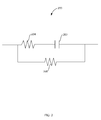
- FIG. 2 is a circuit diagram of an impedance network that models the electroluminescent segment of FIG. 1 ;
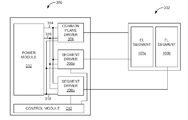
- FIG. 3 is a block diagram of an apparatus for driving an electroluminescent display in accordance with an embodiment
- FIG. 4 is a schematic of the voltage waveforms generated by a dimming common plane driver and a segment driver in accordance with an embodiment
- FIG. 5 is a schematic of the voltage waveforms generated by a non-dimming common plane driver and a segment driver in accordance with an embodiment
- FIG. 6 is a circuit diagram of a dimming common plane driver in accordance with an embodiment
- FIG. 7 is a circuit diagram of a non-dimming common plane driver in accordance with an embodiment
- FIG. 8 is a circuit diagram of the segment driver of FIG. 3 in accordance with an embodiment
- FIG. 9 is a schematic of the current waveform of the segment driver of FIG. 8 in accordance with an embodiment
- FIG. 10 is a block diagram of an apparatus for driving an electroluminescent display in accordance with an alternate embodiment.
- FIG. 11 is a schematic of the voltage waveform generated by a pair of segment drivers of FIG. 10 in accordance with an embodiment.
- Some of the embodiments described herein relate to methods and apparatus for driving an electroluminescent display in a manner in which the power required is reduced.
- the brightness of the display may be varied in a controlled manner.
- An electroluminescent display emits light in response to the application of a high-frequency voltage.
- An electroluminescent display may be divided into a number of electroluminescent segments that can be individually illuminated.
- the electroluminescent segments may be arranged to form a matrix or grid.
- the electroluminescent segments may have other shapes and arrangements.
- Each electroluminescent segment typically comprises an electroluminescent substance (i.e. a phosphor substance) disposed between two electrodes.
- one of the electrodes is common to some or all electroluminescent segments in a display.
- the electrodes of each electroluminescent segment are electrically isolated from those of other segments.
- Application of a sufficiently high frequency alternating current (AC) voltage across the electrodes of an electroluminescent segment will produce electroluminescence or illumination of the segment.
- AC alternating current
- the electroluminescent segment 100 comprises a number of parallel layers 102 , 104 , 106 , and 108 .
- the electroluminescent segment 100 is comprised of four layers, a front electrode layer 102 , an electroluminescent layer 104 , a dielectric layer 106 and a rear electrode layer 108 .
- the electroluminescent layer 104 is activated and emits light in the direction indicated by arrow 110 .
- the front electrode layer 102 is comprised of an optically transparent and electrically conductive material such as indium-tin-oxide (ITO).
- ITO indium-tin-oxide
- the electroluminescent layer 104 is formed on the front electrode layer 102 .
- the electroluminescent layer 104 may be made of any suitable phosphor such as copper activated zinc sulfide (ZnS), or manganese (Mn) activated zinc sulfide (ZnS).
- ZnS copper activated zinc sulfide
- Mn manganese activated zinc sulfide
- the electroluminescent layer 104 is 20-micron thick zinc sulfide (ZnS) doped with a small amount of copper (CU 2+ ) ions.
- the dielectric layer 106 may be comprised of electrically insulating material that provides a barrier to the flow of electronics. Suitable insulating material includes conventional dielectric powder, such as white dielectric powder, in a suitable binder. In one embodiment, the dielectric layer 106 is 33-micron thick barium titanate (BaTiO 3 ).
- the rear electrode layer 108 is formed on the dielectric layer 106 and may be comprised of any suitable electrically conductive material.
- the rear electrode layer 108 may be comprised of the same material as the front electrode layer 102 , such as ITO, or different material.
- the rear electrode layer 108 may be comprised of a suitable opaque material such as silver (Ag), gold (Au) or graphite-based material. In some cases, the rear electrode 108 is silver (Ag).
- the electroluminescent segment 100 may comprise additional layers.
- the electroluminescent segment 100 may further comprise an encapsulation layer that acts as a water barrier to protect the electroluminescent layer 104 from atmospheric moisture.
- the electroluminescent segment 100 may also include a substrate upon which the layers are formed.
- the substrate may be comprised of any suitable transparent or translucent material, such as glass or plastic.
- the substrate may be rigid or flexible.
- the electroluminescent segment 100 acts as a photoemissive capacitor. Specifically, the electroluminescent segment 100 is charged to a predetermined voltage (e.g. 160 V) which generates an electric field (e.g. 2.5 ⁇ 10 6 Vm ⁇ 2 ). The externally applied electric field is then suddenly reversed, thereby discharging the electroluminescent segment 100 and recharging it with the opposite polarity. During the repolarization, the electrons in the semiconductive electroluminescent layer 104 (e.g. the zinc sulfide (ZnS) layer) collide with the dopant ions (e.g. the copper (CU 2+ ) ions) with sufficient energy to ionize then.
- a predetermined voltage e.g. 160 V
- an electric field e.g. 2.5 ⁇ 10 6 Vm ⁇ 2
- the externally applied electric field is then suddenly reversed, thereby discharging the electroluminescent segment 100 and recharging it with the opposite polarity.
- the ionized impurity extracts an electron from the conduction band of the electroluminescent layer 104 (e.g. the zinc sulfide (ZnS) layer) putting it in a metastable electronically excited state, which subsequently relaxes to the ground state photoemmissively. Accordingly, current is passed and light is emitted only during the repolarization periods, which typically only last a few microseconds.
- the electroluminescent layer 104 e.g. the zinc sulfide (ZnS) layer
- FIG. 2 illustrates an impedance network 200 that can be used to model the electroluminescent segment 100 .
- the impedance network 200 comprises a capacitor 202 , a first resistor 204 and a second resistor 206 .
- the capacitor 202 represents the capacitance of the electroluminescent segment 100
- the first resistor 204 represents the resistance of the electroluminescent segment 100
- the second resistor 206 represents the resistance of the DC leakage paths through the capacitor 202 .
- the capacitance C 202 of the capacitor 202 and the resistances R 204 and R 206 of the first and second resistors 204 and 206 respectively, can be represented by the intrinsic properties of the electroluminescent segment 100 as is shown in equation (1) where A is the area of the electroluminescent segment, ⁇ is the electric permittivity of the electroluminescent segment, and ⁇ is the electrical resistivity of the electroluminescent segment.
- the relaxation time ⁇ of the circuit can be represented by equation (2). It can be seen from equation (2) that the relaxation time ⁇ is dependent only on the intrinsic properties of the electroluminescent segment, and not on extrinsic factors such as the size (area) or geometry of the electroluminescent segment.
- the electroluminescent segment 100 may be illuminated by a driving circuit or apparatus that supplies a series of alternating positive and negative pulses to the electrodes of the electroluminescent segment 100 .
- Each pulse causes a discharge and subsequent recharge of the capacitor 202 . As described above, it is the discharge that triggers illumination of the electroluminescent segment 100 .
- One cycle comprises both a positive and negative pulse and each half cycle comprises a single negative or positive pulse. The rate at which a cycle repeats is referred to as the frequency f.
- the electroluminescent segment 100 presents a complex impedance to the driving circuit, and like any complex impedance, energy is consumed only by the real component. In addition, the energy required to charge the capacitor 202 does not contribute to the power dissipation, and is returned during the subsequent half cycle. Accordingly, the power dissipation P(t) of an electroluminescent segment 100 is given by equation (3), and the energy E C consumed by the electroluminescent segment during each half cycle is given by equation (4) where i(t) is the current flowing across the electroluminescent segment 100 .
- the current i(t) can be represented by equation (5) where V 0 is the maximum voltage of the driving pulses.
- the integration is taken over the entire half cycle, which is typically much longer than the relaxation time ⁇ of equation (2). Accordingly, the integral is taken from zero to infinity so that the energy consumed by the electroluminescent segment 100 during each half cycle is reduced to equation (6). Since there are two pulses per cycle, the total power dissipation per cycle is represented by equation (7).
- the total resistance in the circuit typically includes not only the intrinsic resistance R 204 of the electroluminescent segment 100 itself, but also the parasitic resistance R p in the circuit.
- the parasitic resistance R p is defined as the sum of the resistances introduced in the cables, backplane and screen printed electrodes. Accordingly, the efficiency of the electroluminescent segment 100 can be improved by decreasing the parasitic resistance R p without increasing the power consumption.
- the power coefficient ⁇ is defined as the percentage of the power delivered to the electroluminescent segment 100 (i.e. the intrinsic resistance R 204 ) as opposed to the parasitic resistance R p and is represented by equation (8). Equation (8) can be re-written in terms of the intrinsic properties of the electroluminescent segment 100 as shown in equation (9).
- Equation (9) An examination of equation (9) reveals that when the parasitic resistance R p is zero, the power coefficient ⁇ is equal to 1 and maximum power is delivered to the electroluminescent segment 100 . Where, however, the parasitic resistance R p is greater than zero, the power coefficient ⁇ and thus the efficiency of the electroluminescent segment 100 decreases with the increasing electroluminescent segment area A. Accordingly, if the parasitic resistance R p is greater than zero, a larger (i.e. greater area) electroluminescent segment 100 will require more power to achieve the same level of luminescence. However, it will be illustrated below that the affect of the size (i.e. area) of the electroluminescent segment 100 on the power requirements can be significantly reduced by carefully choosing the driving pulse profiles.
- the power coefficient ⁇ may be re-written in terms of the electroluminescent segment 100 capacitance C 202 instead of the electroluminescent segment area A as shown in equation (10).
- the luminescent intensity I is directly proportional to the consumed power P as shown in equation (11), where ⁇ is defined as the luminescent efficiency coefficient. Where, however, the power coefficient ⁇ is greater than 1, the luminescent intensity I is reduced in accordance with the power coefficient ⁇ as shown in equation (12).
- Equation (12) can be rearranged so that the luminescent efficiency coefficient is represented by equation (13).
- Equation (14) can then be rearranged as shown in equation (15) to give the luminescent intensity I.
- I A fV 0 2 ⁇ ⁇ ⁇ ( 14 )
- I fV 0 2 ⁇ ⁇ ⁇ ⁇ A ( 15 )
- the luminescent characteristics of an electroluminescent segment 100 can be calculated from equations (13) and (10) respectively by measuring R p and C 202 . Then the luminescent intensity I can be calculated from equation (15). The total power demand on the power supply can then be calculated from equation (16).
- the time required to charge the capacitor 202 can be calculated. Specifically, the time t c to charge the capacitor 202 to x % of the maximum voltage is expressed in equation (17). If it is assumed that the capacitor 202 is charged when it has reached 95% of its maximum voltage, equation (17) reduces to equation (18).
- t C - ( R 204 + R p ) ⁇ C 202 ⁇ ⁇ ln ⁇ ( 1 - x ⁇ / ⁇ 100 ) ( 17 )
- FIG. 3 in which an apparatus 300 for driving an electroluminescent display 302 in accordance with an embodiment is illustrated.
- the apparatus 300 is designed to take advantage of the observations made by the inventors as described above. Particularly, the apparatus 300 is designed to take advantage of the relationship between the charge time t c and parasitic resistance R p to reduce the power consumption of the electroluminescent display 302 .
- the electroluminescent display 302 includes one or more electroluminescent segments 100 a and 100 b that are individually coupled to the apparatus 300 .
- each electroluminescent segment 100 a and 100 b comprises an electroluminescent substance (i.e. phosphor substance) disposed between two electrodes.
- At least two of the electroluminescent segments 100 a and 100 b have a common electrode.
- all of the electroluminescent segments 100 a and 100 b share a common electrode.
- there may be more than one common electrode where each common electrode is shared by two or more electroluminescent segments.
- the electroluminescent segments 100 a and 100 b are arranged to form a matrix or grid.
- the electroluminescent segments 100 a and 100 b may have other shapes and arrangements.
- the apparatus 300 comprises a common plane driver 304 , one or more segment drivers 308 a and 308 b (typically one for each electroluminescent segment 100 a and 100 b ), a power module 310 and a control unit 312 .
- the common plane driver 304 and the segment drivers 308 a and 308 b work together to provide an AC voltage across one or more electroluminescent segments 100 a and 100 b to illuminate the one or more electroluminescent segments 100 a and 100 b .
- the common plane driver 304 may be a non-dimming common plane driver or a dimming common plane driver.
- a non-dimming common plane driver allows the electroluminescent segments to be either illuminated or not, whereas a dimming common plane driver allows the luminescence or brightness of the electroluminescent segments to be varied in a controlled manner.
- a non-dimming common plane driver may supply a series of pulses to the common electrode (i.e. the front electrode) of the one or more electroluminescent segments 100 a and 100 b .
- Each segment driver 308 a and 308 b then supplies a series of pulses of opposite polarity to the non-dimming common electrode pulses to the other electrode of one of the electroluminescent segments 100 a or 100 b .
- the width of the segment driver 308 a or 308 b pulses is typically smaller than the width of the non-dimming common plane driver pulses.
- Each segment driver pulse generates a voltage potential across the corresponding electroluminescent segment 100 a or 100 b , which causes a discharge and subsequent recharge of the electroluminescent segment 100 a or 100 b .
- Light is emitted during the discharge.
- An exemplary set of voltage waveforms generated by a non-dimming common plane driver and a segment driver 308 a or 308 b is illustrated in FIG. 4 .
- An exemplary non-dimming common plane driver will be described in reference to FIG. 7 .
- a dimming common plane driver may supply a series of upward (ascending) and downward (descending) voltage ramps to the common electrode (i.e. the front electrode) of the one or more electroluminescent segments 100 a and 100 b .
- Each segment driver 308 a and 308 b then supplies a series of pulses of opposite polarity to the direction of the ramp to the other electrode of one of the electroluminescent segments 100 a or 100 b .
- the dimming common plane driver ramp is an upward (or ascending) ramp, then the corresponding segment driver pulse will be negative, and if the ramp is a downward (or descending) ramp, then the corresponding segment driver pulse will be positive.
- the width of the segment driver 308 a or 308 b pulses is typically smaller than the width of the dimming common plane driver ramps.
- Each segment driver pulse generates a voltage potential across the corresponding electroluminescent segment 100 a or 100 b , which causes a quick discharge and a subsequent recharge of the electroluminescent segment 100 a or 100 b .
- the quick discharge results in illumination of the corresponding electroluminescent segment.
- the amount of illumination or brightness will depend on the voltage produced by the dimming common plane driver at the time the corresponding segment driver pulse is triggered. Specifically, the greater the difference between the segment driver pulse voltage and the dimming common plane driver ramp voltage, the greater the brightness.
- An exemplary set of voltage waveforms generated by a dimming common plane driver and a segment driver 308 a or 308 b is illustrated in FIG. 5 .
- An exemplary dimming common plane driver will be described in reference to FIG. 6 .
- the power module 310 is electrically coupled or connected to the common plane and segment drivers 304 , 308 a and 308 b to provide power to the drivers 308 a and 308 b .
- the power module 310 generates and provides three DC voltages 314 , 316 and 318 to the drivers.
- the first DC voltage 314 will be referred to as the positive voltage rail and controls the maximum voltage of the common plane and segment driver pulses and ramps.
- the second DC voltage 316 will be referred to as the negative voltage rail and controls the minimum voltage of the common plane and segment driver pulses and ramps.
- the third DC voltage 318 will be referred to as the digital voltage signal and provides power to various electrical components within the common plane and segment drivers.
- the power module 310 may provide other voltages.
- the control unit 312 is electrically coupled or connected to the segment drivers 308 a and 308 b to provide timing information to the segment drivers 308 a and 308 b .
- the control unit 312 may, for example, comprise a memory or other similar storage device that stores a sequence of commands to control the illumination of the electroluminescent segments 100 a and 100 b .
- the sequence of commands may include which of the electroluminescent segments to illuminate when, for how long, and at what brightness.
- the control unit 312 generates high and low control signals for each segment driver 308 a and 308 b which control the timing or width, or both, of the pulses generated by the segment drivers 308 a and 308 b .
- the high and low control signals are used to control the timing of the pulses generated by the segment drivers 308 a and 308 b to align them with a certain ramp level of the ramping waveform generated by a dimming common plane driver
- the high and low control signals may be referred to as dimming control signals.
- the high and low control signals are used to control the width of the pulses generated by the segment drivers 308 a and 308 b the high and low control signals may be referred to as pulse width control signals.
- FIG. 4 illustrates the voltage waveforms 402 and 404 generated by a non-dimming common plane driver and a segment driver 308 a or 308 b , respectively in accordance with an embodiment.
- a non-dimming common plane driver may supply a square wave to the common electrode (i.e. the front electrode), and the segment driver 308 a or 308 b may supply a series of complementary pulses of opposite polarity to the other electrode (i.e. the rear or back electrode 108 ) of one electroluminescent segment 100 a or 100 b .
- each segment driver pulse generates a voltage potential across the corresponding electroluminescent segment 100 a or 100 b , which causes a discharge and then subsequent recharge of the electroluminescent segment 100 a or 100 b .
- Light is emitted by the corresponding electroluminescent segment 100 a or 100 b during the discharge.
- the charge time of an electroluminescent segment 100 a or 100 b is based on the parasitic resistance R p of the electroluminescent segment circuit. Since the width of the pulse determines the period of time voltage is supplied across the electroluminescent segment (and thus the time the electroluminescent segment is charged), the pulse width of the segment driver pulse is also dependent on the parasitic resistance R p . Where the parasitic resistance R p is equal to zero, equation (18) reduces to 3 ⁇ / ⁇ . Therefore the absolute minimum pulse width to achieve the maximum luminescence is 3 ⁇ / ⁇ .
- ⁇ is equal to 490 pF/cm 2 and ⁇ is equal 930 ⁇ /cm 2 the minimum width of the segment pulse to achieve the maximum luminescence is roughly 1.5 ⁇ s.
- Introducing parasitic resistance R p into the circuitry increases the charge time (and thus the pulse width) to achieve the maximum luminescence at a rate of 3 ⁇ R p per unit area.
- the charge time (and thus pulse width) to achieve the maximum luminescence can be determined from equation (18). If the pulse width (and thus charge time) is less than the pulse width calculated according to equation (18), the electroluminescent segment 100 a or 100 b will not achieve maximum luminescence. On the other hand, if the pulse width (and thus charge time) is greater than the pulse width calculated according to equation (18), power will be wasted.
- each segment driver 308 a or 308 b that shares a particular common electrode triggers its pulses at different times during the cycle.
- the pulses from the first segment driver 308 a would typically not overlap in time with the pulses generated by the second segment driver 308 b .
- the frequency of the square wave generated by the non-dimming common plane driver is typically selected to be long enough to allow each of the electroluminescent segments sharing a common electrode to be activated by a segment pulse during one half cycle.
- FIG. 5 illustrates the waveforms 502 and 504 generated by a dimming common plane driver and a segment driver 308 a or 308 b , respectively.
- a dimming common plane driver supplies a ramping waveform to the common electrode (i.e. the front electrode), and, similar to FIG. 4 , the segment driver 308 a or 308 b supplies a series of opposite polarity pulses to the other electrode (i.e. the rear electrode) of one electroluminescent segment 100 a or 100 b .
- the segment driver pulses of FIG. 5 operate in the same manner as the segment driver pulses shown in FIG. 4 .
- each segment driver pulse generates a voltage potential across the corresponding electroluminescent segment, which causes a discharge and subsequent recharge of the electroluminescent segment 100 a or 100 b .
- Light is emitted by the corresponding electroluminescent segment 100 a or 100 b during the discharge.
- the segment driver pulses can be fired at specific points along the ramp affording a continuum of light intensity.
- the brightness is determined by the difference between the segment driver pulse voltage and the dimming common plane driver ramp voltage.
- the segment driver pulses can be triggered at different points along the ramp to either increase or decrease the difference between the voltages (and thus the brightness).
- the flat portions of the common plane waveform typically provide the greatest difference between the common plane driver ramp voltage and the segment driver pulse voltage and thus can be used to achieve maximum light intensity.
- the segment drivers are configured to generate pulses that are opposite in polarity to the direction of the ramp. For example, when the common driver ramp is an upward or ascending ramp, the segment drivers generate negative pulses, and when the common driver ramp is a downward or descending ramp, the segment drivers are configured to generate positive pulses.
- the segment driver pulse is triggered in the earlier part of the upward ramp (i.e. when the ramp voltage is lower)
- the intensity or brightness of the illumination of the corresponding electroluminescent segment will be lower.
- the segment driver pulse is triggered in the latter part of the upward ramp (i.e. when the ramp voltage is higher)
- the intensity or brightness of the illumination of the corresponding electroluminescent segment 100 a or 100 b will be higher.
- a descending ramp the lower the voltage of the dimming common plane driver waveform at the time the segment driver pulse is triggered, the more dim the illumination.
- the dimming common plane driver 600 receives three DC voltage signals (the positive voltage rail 314 , the negative voltage rail 316 and a digital voltage signal 318 ) from the power module 310 and generates the ramping waveform 502 shown in FIG. 5 .
- the dimming common plane driver 600 receives three DC voltage signals (the positive voltage rail 314 , the negative voltage rail 316 and a digital voltage signal 318 ) from the power module 310 and generates the ramping waveform 502 shown in FIG. 5 .
- the dimming common plane driver 600 receives three DC voltage signals (the positive voltage rail 314 , the negative voltage rail 316 and a digital voltage signal 318 ) from the power module 310 and generates the ramping waveform 502 shown in FIG. 5 .
- the dimming common plane driver 600 comprises four capacitors 602 , 604 , 606 and 608 ; seven diodes 610 , 612 , 614 , 616 , 618 , 620 and 622 ; eleven transistors 624 , 626 , 628 , 630 , 632 , 634 , 636 , 638 , 640 , 642 and 644 ; thirteen resistors 646 , 648 , 650 , 652 , 654 , 656 , 658 , 660 , 662 , 664 , 666 , 668 and 670 ; and a sequencer 672 .
- the sequencer 672 controls the operation of the dimming common plane driver 600 . More specifically, the sequencer 672 controls the timing (i.e. frequency) of the waveform generated by the dimming common plane driver 600 . In one embodiment, the sequencer 672 is pre-loaded with the timing information. In other embodiments, the timing information is received dynamically from the control unit 312 .
- the sequencer 672 may be implemented by a microcontroller, such as the PIC16F876 microcontroller.
- sequencer 672 sets the bases of the fourth and fifth transistors 630 and 632 high. This drives the second and fourth transistors 626 and 628 into conduction, causing the third capacitor 606 to charge to the positive voltage rail 314 through the third resistor 650 .
- the time constant ⁇ of the RC circuit is equal to R 650 *C 606 where R 650 is the resistance in ohms of the third resistor 650 and C 606 is the capacitance in Farads of the third capacitor 606 .
- the time which is required to charge the capacitor to x % of its maximum voltage is expressed in equation (19).
- the capacitor is deemed to be charged when it reaches 95% of its maximum voltage. This reduces equation (19) to 3 ⁇ . Thus the capacitor will be charged within 3 time constants. Firing the segment driver pulse anytime within this charging period will illuminate the corresponding electroluminescent segment 100 a or 100 b with varying intensities.
- the segment drivers are configured to generate pulses that are opposite in polarity to the direction of the ramp generated by the dimming common plane driver.
- the segment drivers may generate a negative pulse when the ramp is an upward or ascending ramp, and a positive pulse when the ramp is a downward or descending ramp. Accordingly, during the first frequency half cycle the higher the voltage of the dimming common plane driver waveform at the time the segment driver pulse is triggered, the brighter the illumination. For example, if the segment driver pulse is triggered in the earlier part of the upward ramp (i.e. when the ramp voltage is lower), the intensity or brightness of the illumination of the corresponding electroluminescent segment will be lower. Conversely, if the segment driver pulse is triggered in the latter part of the upward ramp (i.e. when the ramp voltage is higher), the intensity or brightness of the illumination of the corresponding electroluminescent segment 100 a or 100 b will be higher.
- the voltage is held constant. This will be referred to as the “flat period” of the first frequency half cycle.
- the maximum luminescence or brightness is achieved when the segment driver pulse is triggered during the “flat period.”
- the sequencer 672 drives the bases of the fourth and fifth transistors 630 and 632 low. This drives the ninth transistor 640 into conduction, causing the third capacitor 606 to charge to the negative voltage rail 316 through the seventh resistor 658 . This generates the downward (or descending) ramping portion of the waveform shown in FIG. 5 .
- the time constant ⁇ of the RC circuit is equal to R 658 *C 606 where R 658 is the resistance in ohms of the seventh resistor 658 and C 606 is the capacitance in Farads of the third capacitor 606 .
- the time which is required to charge the capacitor to x % of its maximum charge is expressed in equation (19).
- the capacitor is deemed to be charged when it reaches 95% of its maximum charge. This reduces equation (19) to 3 ⁇ . Thus the capacitor will be charged within 3 time constants. Firing the segment driver pulse anytime within this charging period will illuminate the corresponding electroluminescent segment 100 a or 100 b with varying intensities.
- the segment drivers may be configured to generate pulses that are opposite in polarity to the direction of the ramp.
- the segment drivers may generate a negative pulse when the ramp is an upward or ascending ramp, and a positive pulse when the ramp is a downward or descending ramp.
- the lower the voltage of the dimming common plane driver at the time the segment driver pulse is triggered the brighter the illumination.
- the segment driver pulse is triggered in the earlier part of the downward ramp (i.e. when the ramp voltage is higher)
- the intensity or brightness of the illumination of the corresponding electroluminescent segment will be lower.
- the segment driver pulse is triggered in the latter part of the downward ramp (i.e. when the ramp voltage is lower)
- the intensity or brightness of the illumination of the corresponding electroluminescent segment will be higher.
- the voltage is held constant. This will be referred to as the “flat period” of the second frequency half cycle.
- the maximum luminescence or brightness may be achieved when the segment driver pulse is triggered during the “flat period.”
- the complete ramping waveform 502 shown in FIG. 5 appears on the gate of the sixth transistor 634 .
- the sixth transistor 634 is configured as a source follower and drives a voltage follower output stage comprising the first and third transistors 624 and 628 on the high side, and the tenth and eleventh transistors 642 and 644 on the low side.
- the seventh and eighth transistors 636 and 638 and the sixth and eighth resistors 656 and 660 act as current limiters. Specifically, the seventh and eighth transistors 636 and 638 and the sixth and eighth resistors 656 and 660 limit the current flowing through the voltage follower output stage (e.g. first and third transistors 624 and 628 or tenth and eleventh transistors 642 and 644 ).
- the voltage follower output stage e.g. first and third transistors 624 and 628 or tenth and eleventh transistors 642 and 644 .
- the third and seventh diodes 614 and 622 work in conjunction with the first and fourth capacitors 602 and 608 to shunt transient overvoltages caused by the voltage doubling effect of the corresponding electroluminescent segment 100 a or 100 b capacitive load during switching.
- the first and second diodes 610 and 612 eliminate base leakage currents assuring definite cut-off of the fifth transistor 632 .
- the sequencer 672 may also generate one or more synchronization signals at a predetermined time before the start of each half cycle so that the segment drivers 308 a and 308 b can synchronize their pulses with the waveform generated by the dimming common plane driver 600 .
- the sequencer 672 generates two synchronization signals. The first synchronization signal is generated at a predetermined time prior to the start of the first half cycle, and the second synchronization signal is generated at a predetermined time prior to the start of the second half cycle.
- the sequencer 672 may generate only a single synchronization signal which is used to carry the timing information for both half cycles.
- the predetermined time is 10 ⁇ s. However, other suitable predetermined times may be used.
- the components of the dimming common plane driver 600 have the values and types as set out in Table 1.
- the non-dimming common plane driver 700 receives three DC voltage signals (the positive voltage rail 314 , the negative voltage rail 316 and a digital voltage signal 318 ) from the power module 310 and generates the square waveform 402 shown in FIG. 4 .
- the positive voltage rail 314 the positive voltage rail 314
- the negative voltage rail 316 the negative voltage rail 316
- a digital voltage signal 318 the square waveform 402 shown in FIG. 4 .
- the non-dimming common plane driver 700 comprises three capacitors 702 , 704 and 706 ; four diodes 708 , 710 , 712 , and 714 ; four transistors 716 , 718 , 720 and 722 ; nine resistors 724 , 726 , 728 , 730 , 732 , 734 , 736 , 738 , and 740 and a sequencer 742 .
- the sequencer 742 controls the operation of the non-dimming common plane driver 700 . More specifically, the sequencer 742 controls the timing (i.e. frequency) of the voltage waveform generated by the non-dimming common plane driver 700 . In one embodiment, the sequencer 742 is pre-loaded with the timing information. In other embodiments, the sequencer 742 may receive the timing information dynamically from the control unit 312 .
- the sequencer 742 may be implemented by a microcontroller, such as the PIC16F876 microcontroller.
- the sequencer 742 sets the base of the second transistor 718 high.
- the third and fourth resistors 728 and 730 form a resistive divider that raises the gate of the first transistor 716 to a percentage of the positive voltage rail 314 .
- the resistive divider raises the gate of the first transistor 716 to R 730 /(R 728 +R 730 )*Positive Voltage Rail 314 where R 728 is the resistance of the third resistor 728 and R 730 is the resistance of the fourth resistor 730 .
- the gate of first transistor 716 will be roughly 65 V, or 15 V below the positive voltage rail 314 .
- the first transistor 716 acts as a source follower, preventing the voltage drop across the first resistor 724 from exceeding a predetermined voltage (i.e. 13V). Therefore, current through the first transistor's 716 drain is limited to the predetermined voltage/R 724 where R 724 is the resistance of the first resistor 724 . For example, where the predetermined voltage is 13 V and the resistance R 724 of the first resistor 724 is 82 ⁇ the current through the first transistor's 716 drain is limited to 13 V/82 ⁇ or 160 mA.
- the first capacitor 702 allows instantaneous high current transients.
- the sequencer 742 drives the base of the third transistor 720 low.
- the seventh and eighth resistors 736 and 738 form a resistive divider that raises the gate of the fourth transistor 722 to a percentage of the negative voltage rail 316 .
- the resistive divider raises the gate of the first transistor 716 to R 736 /(R 736 +R 738 )*Negative Voltage Rail 316 where R 736 is the resistance of the seventh resistor 736 and R 738 is the resistance of the eighth resistor 738 .
- the gate of fourth transistor 722 will be roughly ⁇ 65 V, or 15 V above the negative voltage rail 316 .
- the fourth transistor 722 acts as a source follower, preventing the voltage drop across the ninth resistor 740 from exceeding a predetermined voltage (i.e. 13V). Therefore, current through the fourth transistor's 722 drain is limited to the predetermined voltage/R 740 where R 740 is the resistance of the ninth resistor 740 . For example, where the predetermined voltage is 13V and the resistance R 740 of the ninth resistor 740 is 82 ⁇ the current through the fourth transistor's 722 drain is limited to 13V/82 ⁇ or 160 mA.
- the third capacitor 706 allows instantaneous high current transients.
- the sequencer 742 may also generate a synchronization signal a predetermined time before the start of each half cycle so that the segment driver can synchronize its pulses with those of the dimming common plane driver 700 .
- the sequencer 742 generates two synchronization signals. The first synchronization signal is generated at a predetermined time prior to the start of the first half cycle, and the second synchronization signal is generated at a predetermined time prior to the start of the second half cycle.
- the sequencer 742 may generate only a single synchronization signal which is used to carry the timing information for both half cycles.
- the predetermined time is 10 ⁇ s. However, other suitable predetermined times may be used.
- the components of the non-dimming common plane driver 700 have the values and types as set out in Table 2.
- each electroluminescent segment 100 a and 100 b can be considered a capacitor with a capacitance of ⁇ A.
- the purpose of the segment driver 308 is to quickly discharge and recharge the capacitor. Light is emitted during the discharge which typically lasts from about 100 ns to a few micro seconds. As described above, the rate at which the discharge and recharge is repeated is referred to as the frequency f.
- the segment driver 308 receives three DC voltage signals (the positive voltage rail 314 , the negative voltage rail 316 and a digital voltage signal 318 ) from the power module 310 , two control signals (a high control signal and a low control signal) from the control unit 312 , and generates the series of positive and negative pulses shown in FIGS. 4 and 5 .
- the segment driver 308 comprises a high-side circuit 802 for generating the positive pulses, and a complementary low-side circuit 804 for generating the negative pules.
- the high-side circuit 802 comprises a capacitor 806 , a diode 808 , two transistors 810 and 812 and four resistors 814 , 816 , 818 and 820 .
- the second transistor 812 conducts through the voltage divider formed by the second and third resistors 816 and 818 , raising the gate of the first transistor 810 to a percentage of the positive voltage rail 314 .
- the voltage divider formed by the second and third resistors 816 and 818 raises the gate of the first transistor 810 to R 818 /(R 816 +R 818 )*Positive Voltage Rail 314 where R 816 is the resistance of the second resistor 816 and R 818 is the resistance of the third resistor 818 .
- R 816 is the resistance of the second resistor 816
- R 818 is the resistance of the third resistor 818 .
- the gate of the first transistor 810 will be roughly 65 V, or 15 V below the positive voltage rail 314 .
- the first transistor 810 acts as a saturated switch, passing a transient current spike (referred to as the “spike”) through the first capacitor 806 .
- the spike time can be calculated by solving the current-time profile of a capacitor (the electroluminescent segment capacitor) discharging into another capacitor (the segment driver capacitor) through a resistor (the resistance of the current path).
- Equation (20) V S is the voltage of the electroluminescent segment 100 a or 100 b
- V 0 is the positive voltage rail 314
- C S is the capacitance of the electroluminescent segment 100 a or 100 b
- C 2 is the capacitance of the first capacitor 806
- R is the total resistance (including parasitic resistance R p ) of the electroluminescent segment's 100 a or 100 b current path.
- V S ⁇ ( t ) V 0 1 + C 2 C S + C 2 ⁇ ⁇ ⁇ C S + C 2 C S ⁇ C 2 ⁇ R ⁇ ( - t ) - 1 ⁇ ( 20 )
- any residual current drawn by the load passes through the first resistor 814 .
- the first resistor 814 limits the current through the first transistor 810 to a predetermined level (i.e. 160 mA).
- the first transistor 810 acts as a saturated switch.
- the first transistor 810 is cut off and the first capacitor 806 discharges through the first resistor 814 .
- the resistance of the first resistor 814 is selected so that the first capacitor 806 is fully discharged before the start of the next cycle.
- the low-side circuit 804 is a mirror image of the high-side circuit 802 .
- the low-side circuit 804 comprises a capacitor 822 , a diode 824 , two transistors 826 and 828 and four resistors 830 , 832 , 834 and 836 .
- the third transistor 826 conducts through the voltage divider formed by the sixth and seventh resistors 832 and 834 , raising the gate of the fourth transistor 828 to a percentage of the negative voltage rail 316 .
- the voltage divider formed by the sixth and seventh resistors 832 and 834 raises the gate of the fourth transistor 828 to R 832 /(R 832 +R 834 )*Negative Voltage Rail 316 where R 832 is the resistance of the sixth resistor 832 and R 834 is the resistance of the seventh resistor 834 .
- R 832 is the resistance of the sixth resistor 832
- R 834 is the resistance of the seventh resistor 834 .
- the gate of fourth transistor 828 will be roughly ⁇ 65 V, or 15 V above the negative voltage rail 316 .
- the fourth transistor 828 acts as a saturated switch, passing a transient current spike (referred to as the “spike”) through the second capacitor 822 .
- the spike time can be generated from equation (21).
- any residual current drawn by the load passes through the eighth resistor 836 .
- the eighth resistor 836 limits the current through the fourth transistor 828 to a predetermined level (i.e. 160 mA).
- the fourth transistor 828 acts as a saturated switch.
- the fourth transistor 828 is cut off and the second capacitor 822 discharges through the eighth resistor 836 .
- the resistance of the eighth resistor 836 is selected so that the second capacitor 822 is fully discharged before the start of the second half of the subsequent cycle.
- the components of the segment driver 308 have the values and types as set out in Table 3.
- FIG. 9 illustrates the current profile 902 of the segment driver 308 of FIG. 8 . It can be seen from FIG. 9 that during each half cycle there is a current spike 904 , 906 and a current limited period 908 , 910 .
- the first current spike 904 and the first current limited period 908 are generated by the high-side circuit 802 of FIG. 8 and the second current spike 906 and the second current limited period 910 are generated by the low-side circuit 804 of FIG. 8 .
- the corresponding electroluminescent segment 100 a or 100 b is discharged (causing illumination of the electroluminescent segment 100 a or 100 b ), and during the current limited period the corresponding electroluminescent segment is charged.
- the width of the segment driver pulses may be selected to be large enough to encompass the sum of the spike time and the charge time, practically the spike time is so small relative to the charge time that an acceptable pulse width can be selected based on the charge time alone.
- the electroluminescent display 1000 includes one or more electroluminescent segments 100 a and 100 b that are individually coupled to the apparatus 1000 .
- each electroluminescent segment 100 a and 100 b comprises an electroluminescent substance (i.e. phosphor substance) disposed between two electrodes.
- the electrodes of each electroluminescent segment 100 a and 100 b are electrically isolated from those of other segments.
- the electroluminescent segments 100 a and 100 b are arranged to form a matrix or grid. In other embodiments, the electroluminescent segments 100 a and 100 b may have other shapes and arrangements.
- the apparatus 1000 comprises one or more pairs of segment drivers 1008 a , 1008 b , 1008 c and 1008 d (typically one pair for each electroluminescent segment 100 a and 100 b ), a power module 1010 and a control unit 1012 .
- Each pair of segment drivers works together to provide an AC voltage to one electroluminescent segment 100 a or 100 b .
- one segment driver of each pair i.e. segment driver 1008 a or segment driver 1008 c
- the other segment driver of the pair i.e. segment driver 1008 b or segment driver 1008 d
- the segments drivers 1008 a , 1008 b , 1008 c , and 1008 d typically operate in the same manner as the segment drivers 308 a and 308 b described above. Specifically, each segment driver 1008 a , 1008 b , 1008 c , and 1008 d generates a series of pulses of alternating polarity. Typically, the width of the pulses for each pair of segment drivers is the same. Similar to the embodiment described in relation to FIG. 3 , the pulse width required to achieve the maximum luminescence may be calculated from the parasitic resistance R p using equation (18). In this embodiment, dimming or brightness may be controlled by decreasing the segment driver pulse width below the pulse width required to achieve the maximum luminescence. Typically, the shorter the pulse width, the less bright (or more dim) the illumination, and the wider the pulse width (up to the pulse width calculated from equation (18)) the brighter the illumination.
- the power module 1010 and the control unit 1012 typically operate in the same manner as power module 310 and control unit 312 of FIG. 3 respectively.
- FIG. 11 illustrates the voltage waveforms 1102 and 1104 generated by a pair of segment drivers 1108 a or 1108 b , respectively in accordance with an embodiment.
- the segment drivers 1008 a and 1008 b supply complimentary pulses of the same width to the two electrodes (i.e. front and rear electrode) of an electroluminescent segment 100 a or 100 b .
- Each pair of corresponding pulses generates a voltage potential across the corresponding electroluminescent segment 100 a or 100 b , which causes a discharge and then subsequent recharge of the electroluminescent segment 100 a or 100 b .
- Light is emitted by the corresponding electroluminescent segment 100 a or 100 b during the discharge.
- the brightness of the illumination may be controlled by shortening or lengthening the pulse width. Typically a shorter pulse width will generate less illumination (i.e. the illumination will be less bright), and a longer pulse width will generate more illumination (i.e. the illumination will be brighter).
Landscapes
- Engineering & Computer Science (AREA)
- Physics & Mathematics (AREA)
- Computer Hardware Design (AREA)
- General Physics & Mathematics (AREA)
- Theoretical Computer Science (AREA)
- Electroluminescent Light Sources (AREA)
- Control Of Indicators Other Than Cathode Ray Tubes (AREA)
- Resistance Heating (AREA)
- Control Of El Displays (AREA)
Abstract
Description
- This application is a continuation of International patent application no. PCT/CA2010/001293, filed on Aug. 23, 2010, which claims priority from U.S. provisional patent application No. 61/239,216, filed on Sep. 2, 2009; the contents of which are both incorporated herein by reference.
- The described embodiments relate to electroluminescent displays. More particularly, the described embodiments relate to methods and apparatus for driving electroluminescent displays.
- Illuminated displays can be a popular way of marketing or advertising. Traditionally, such illuminated displays may employ fluorescent lighting or other forms of light emitting bulbs or tubes as a light source.
- More recently, it has become possible to generate light from a flat luminescent substrate in response to electrical stimulation of the substrate. This effect can be used to create an electroluminescent display. However, it is generally believed in the art that electroluminescent displays containing large electroluminescent segments are impractical and difficult to produce due to the unusually large amounts of power they require, with ever-reducing luminescent output.
- It is desired to address or ameliorate one or more shortcomings or disadvantages associated with existing illuminated displays and/or methods for driving such displays, or to at least to provide a useful alternative thereto.
- In one broad aspect, there is provided a method of driving an electroluminescent segment, the electroluminescent segment comprising a phosphor layer disposed between a first electrode and a second electrode, the electroluminescent segment being associated with a parasitic resistance. The method includes applying a series of first pulses to the first electrode, the first pulses alternating in polarity; and applying a series of second pulses to the second electrode for illuminating the electroluminescent segment, each of the second pulses corresponding to a first pulse and having an opposite polarity to the corresponding first pulse, the width of each of the second pulses being based on the parasitic resistance associated with the electroluminescent segment.
- In some embodiments, the series of first pulses form a square waveform.
- In other embodiments, each of the first pulses forms a ramping waveform, and the first pulses alternate between ascending ramps and descending ramps. In some embodiments, each of the second pulses are aligned with a specific ramp level of the corresponding first pulse to illuminate the electroluminescent segment at a predetermined brightness.
- In some embodiments, the width of each of the first pulses is the same as the width of the corresponding second pulse.
- In some embodiments, each of the second pulses discharges and re-charges the electroluminescent segment.
- In some embodiments the width of each of the second pulses controls the charge time of the electroluminescent segment, the maximum charge time be equal to the following equation wherein γ is the electric permittivity of the electroluminescent segment, A is the area of the electroluminescent segment, ρ is the electrical resistivity of the electroluminescent segment and Rp is the parasitic resistance.
-
- In some embodiments, the parasitic resistance comprises current resistance, segment lead resistance, and cable resistance.
- In another broad aspect, there is provided an apparatus for driving an electroluminescent segment, the electroluminescent segment comprising a phosphor layer disposed between a first electrode and a second electrode, the electroluminescent segment being associated with a parasitic resistance. The apparatus includes a first drive circuit for applying a series of first pulses to the first electrode, the first pulses alternating in polarity; and a second drive circuit for applying a series of second pulses to the second electrode for illuminating the electroluminescent segment, each of the second pulses corresponding to one of the first pulses and having an opposite polarity to the corresponding first pulse, the width of the second pulses being based on the parasitic resistance associated with the electroluminescent segment.
- In some embodiments, the series of first pulses form a square waveform.
- In other embodiments, the first pulses form a ramping waveform, and the first pulses alternate between ascending ramping waveforms and descending ramping waveforms. In some embodiments, the second drive circuit aligns each of the second pulses with a specific ramp level of the corresponding first pulse in accordance with a dimming control signal, and the apparatus further comprises a control unit for generating the dimming control signal.
- In some embodiments, the width of the second pulses are varied by the second drive circuit in accordance with a pulse width control signal; and the apparatus further comprises a control circuit for generating the pulse width control signal.
- In some embodiments, the width of each of the second pulses controls the brightness of the illumination of the electroluminescent segment.
- In some embodiments, the second drive circuit provides a current spike to the second electrode during a first portion of each second pulse and provides a constant current to the second electrode during a second portion of each second pulse.
- In some embodiments, the width of each of the first pulses is the same as the width of the corresponding second pulse.
- In another broad aspect, there is provided an electroluminescent display. The electroluminescent display includes a plurality of electroluminescent segments, each electroluminescent segment comprising a phosphor layer disposed between a first electrode and a second electrode, each electroluminescent segment being associated with a parasitic resistance; a plurality of first drive circuits, each first drive circuit coupled to one of the plurality of first electrodes, each first drive circuit applying a series of first pulses to the corresponding first electrode, the first pulses alternating in polarity; and a plurality of second drive circuits, each second drive circuit coupled to one of the plurality of second electrodes, each second drive circuit applying a series of second pulses to the corresponding second electrode for illuminating the corresponding electroluminescent segment, each of the second pulses corresponding to one of the first pulses and having an opposite polarity to the corresponding first pulse, the width of the second pulses being based on the parasitic resistance associated with the corresponding electroluminescent segment.
- In some embodiments, the electroluminescent display also includes a control unit for generating a plurality of pulse width control signals, wherein each of the second drive circuits varies the width of the corresponding second pulses in accordance with one of the pulse width control signals.
- In some embodiments, the width of each series of second pulses controls the brightness of the illumination of the corresponding electroluminescent segment.
- In another broad aspect, there is provided an electroluminescent display. The electroluminescent display includes: a common electrode; a plurality of electroluminescent segments mounted on the common electrode, each segment comprising a segment electrode and a phosphor layer disposed between the common electrode and the segment electrode, each electroluminescent segment being associated with a parasitic resistance; a first drive circuit coupled to the common electrode, the first drive circuit applying a series of first pulses to the common electrode, the first pulses alternating in polarity; and a plurality of second drive circuits, each second drive circuit coupled to one of the plurality of second electrodes, each second drive circuit applying a series of second pulses to the corresponding second electrode for illuminating the corresponding electroluminescent segment, each of the second pulses corresponding to one of the first pulses and having an opposite polarity to the corresponding first pulse, the width of the second pulses being based on the parasitic resistance associated with the corresponding electroluminescent segment.
- In another broad aspect, there is provided a method of driving an electroluminescent segment, the electroluminescent segment comprising a phosphor layer disposed between first and second electrodes. The method includes measuring intrinsic properties of the electroluminescent segment; measuring parasitic resistance associated with the electroluminescent segment; calculating a charge time for the electroluminescent segment based on the intrinsic properties and the parasitic resistance; storing the calculated charge time in memory; applying a series of first pulses to the first electrode, the first pulses alternating in polarity; and applying a series of second pulses to the second electrode for illuminating the electroluminescent segment, each second pulse corresponding to one of the first pulses and having an opposite polarity to the corresponding first pulse, the width of the second pulses being based on the stored charge time.
- A preferred embodiment of the present invention will now be described in detail with reference to the drawings, in which:
-
FIG. 1 is a side view of an electroluminescent segment in accordance with an embodiment; -
FIG. 2 is a circuit diagram of an impedance network that models the electroluminescent segment ofFIG. 1 ; -
FIG. 3 is a block diagram of an apparatus for driving an electroluminescent display in accordance with an embodiment; -
FIG. 4 is a schematic of the voltage waveforms generated by a dimming common plane driver and a segment driver in accordance with an embodiment; -
FIG. 5 is a schematic of the voltage waveforms generated by a non-dimming common plane driver and a segment driver in accordance with an embodiment; -
FIG. 6 is a circuit diagram of a dimming common plane driver in accordance with an embodiment; -
FIG. 7 is a circuit diagram of a non-dimming common plane driver in accordance with an embodiment; -
FIG. 8 is a circuit diagram of the segment driver ofFIG. 3 in accordance with an embodiment; -
FIG. 9 is a schematic of the current waveform of the segment driver ofFIG. 8 in accordance with an embodiment; -
FIG. 10 is a block diagram of an apparatus for driving an electroluminescent display in accordance with an alternate embodiment; and -
FIG. 11 is a schematic of the voltage waveform generated by a pair of segment drivers ofFIG. 10 in accordance with an embodiment. - Some of the embodiments described herein relate to methods and apparatus for driving an electroluminescent display in a manner in which the power required is reduced. In some embodiments, the brightness of the display may be varied in a controlled manner.
- An electroluminescent display emits light in response to the application of a high-frequency voltage. An electroluminescent display may be divided into a number of electroluminescent segments that can be individually illuminated. Optionally, the electroluminescent segments may be arranged to form a matrix or grid. In other embodiments, the electroluminescent segments may have other shapes and arrangements.
- Each electroluminescent segment typically comprises an electroluminescent substance (i.e. a phosphor substance) disposed between two electrodes. In some cases, one of the electrodes is common to some or all electroluminescent segments in a display. In other cases, the electrodes of each electroluminescent segment are electrically isolated from those of other segments. Application of a sufficiently high frequency alternating current (AC) voltage across the electrodes of an electroluminescent segment will produce electroluminescence or illumination of the segment.
- Reference is now made to
FIG. 1 , in which an exemplary electroluminescent segment 100 is illustrated. The electroluminescent segment 100 comprises a number of parallel layers 102, 104, 106, and 108. In the embodiment shown inFIG. 1 , the electroluminescent segment 100 is comprised of four layers, a front electrode layer 102, an electroluminescent layer 104, a dielectric layer 106 and a rear electrode layer 108. When a voltage is applied across the front and rear electrode layers 102 and 108, the electroluminescent layer 104 is activated and emits light in the direction indicated by arrow 110. - The front electrode layer 102 is comprised of an optically transparent and electrically conductive material such as indium-tin-oxide (ITO).
- The electroluminescent layer 104 is formed on the front electrode layer 102. The electroluminescent layer 104 may be made of any suitable phosphor such as copper activated zinc sulfide (ZnS), or manganese (Mn) activated zinc sulfide (ZnS). In some cases, the electroluminescent layer 104 is 20-micron thick zinc sulfide (ZnS) doped with a small amount of copper (CU2+) ions.
- After the electroluminescent layer 104 is the dielectric layer 106. The dielectric layer 106 may be comprised of electrically insulating material that provides a barrier to the flow of electronics. Suitable insulating material includes conventional dielectric powder, such as white dielectric powder, in a suitable binder. In one embodiment, the dielectric layer 106 is 33-micron thick barium titanate (BaTiO3).
- The rear electrode layer 108 is formed on the dielectric layer 106 and may be comprised of any suitable electrically conductive material. The rear electrode layer 108 may be comprised of the same material as the front electrode layer 102, such as ITO, or different material. For example, the rear electrode layer 108 may be comprised of a suitable opaque material such as silver (Ag), gold (Au) or graphite-based material. In some cases, the rear electrode 108 is silver (Ag).
- In some cases, the electroluminescent segment 100 may comprise additional layers. For example, the electroluminescent segment 100 may further comprise an encapsulation layer that acts as a water barrier to protect the electroluminescent layer 104 from atmospheric moisture. The electroluminescent segment 100 may also include a substrate upon which the layers are formed. The substrate may be comprised of any suitable transparent or translucent material, such as glass or plastic. The substrate may be rigid or flexible.
- The electroluminescent segment 100 acts as a photoemissive capacitor. Specifically, the electroluminescent segment 100 is charged to a predetermined voltage (e.g. 160 V) which generates an electric field (e.g. 2.5×10⁶ Vm−2). The externally applied electric field is then suddenly reversed, thereby discharging the electroluminescent segment 100 and recharging it with the opposite polarity. During the repolarization, the electrons in the semiconductive electroluminescent layer 104 (e.g. the zinc sulfide (ZnS) layer) collide with the dopant ions (e.g. the copper (CU2+) ions) with sufficient energy to ionize then. The ionized impurity extracts an electron from the conduction band of the electroluminescent layer 104 (e.g. the zinc sulfide (ZnS) layer) putting it in a metastable electronically excited state, which subsequently relaxes to the ground state photoemmissively. Accordingly, current is passed and light is emitted only during the repolarization periods, which typically only last a few microseconds.
- Reference is now made to
FIG. 2 , which illustrates animpedance network 200 that can be used to model the electroluminescent segment 100. Theimpedance network 200 comprises acapacitor 202, afirst resistor 204 and asecond resistor 206. Thecapacitor 202 represents the capacitance of the electroluminescent segment 100, thefirst resistor 204 represents the resistance of the electroluminescent segment 100, and thesecond resistor 206 represents the resistance of the DC leakage paths through thecapacitor 202. The capacitance C202 of thecapacitor 202 and the resistances R204 and R206 of the first andsecond resistors -
- Typically the
second resistor 206 is insignificant and thus can be ignored. If thesecond resistor 206 is ignored, the relaxation time τ of the circuit can be represented by equation (2). It can be seen from equation (2) that the relaxation time τ is dependent only on the intrinsic properties of the electroluminescent segment, and not on extrinsic factors such as the size (area) or geometry of the electroluminescent segment. -
- The electroluminescent segment 100 may be illuminated by a driving circuit or apparatus that supplies a series of alternating positive and negative pulses to the electrodes of the electroluminescent segment 100. Each pulse causes a discharge and subsequent recharge of the
capacitor 202. As described above, it is the discharge that triggers illumination of the electroluminescent segment 100. One cycle comprises both a positive and negative pulse and each half cycle comprises a single negative or positive pulse. The rate at which a cycle repeats is referred to as the frequency f. - The electroluminescent segment 100 presents a complex impedance to the driving circuit, and like any complex impedance, energy is consumed only by the real component. In addition, the energy required to charge the
capacitor 202 does not contribute to the power dissipation, and is returned during the subsequent half cycle. Accordingly, the power dissipation P(t) of an electroluminescent segment 100 is given by equation (3), and the energy EC consumed by the electroluminescent segment during each half cycle is given by equation (4) where i(t) is the current flowing across the electroluminescent segment 100. The current i(t) can be represented by equation (5) where V0 is the maximum voltage of the driving pulses. -
- The integration is taken over the entire half cycle, which is typically much longer than the relaxation time τ of equation (2). Accordingly, the integral is taken from zero to infinity so that the energy consumed by the electroluminescent segment 100 during each half cycle is reduced to equation (6). Since there are two pulses per cycle, the total power dissipation per cycle is represented by equation (7).
-
- An examination of equation (7) reveals that the total power dissipation P is independent of the resistance in the circuit, even though the resistance is the dissipative element. The total resistance in the circuit typically includes not only the intrinsic resistance R204 of the electroluminescent segment 100 itself, but also the parasitic resistance Rp in the circuit. The parasitic resistance Rp is defined as the sum of the resistances introduced in the cables, backplane and screen printed electrodes. Accordingly, the efficiency of the electroluminescent segment 100 can be improved by decreasing the parasitic resistance Rp without increasing the power consumption.
- The power coefficient ∈ is defined as the percentage of the power delivered to the electroluminescent segment 100 (i.e. the intrinsic resistance R204) as opposed to the parasitic resistance Rp and is represented by equation (8). Equation (8) can be re-written in terms of the intrinsic properties of the electroluminescent segment 100 as shown in equation (9).
-
- An examination of equation (9) reveals that when the parasitic resistance Rp is zero, the power coefficient ∈ is equal to 1 and maximum power is delivered to the electroluminescent segment 100. Where, however, the parasitic resistance Rp is greater than zero, the power coefficient ∈ and thus the efficiency of the electroluminescent segment 100 decreases with the increasing electroluminescent segment area A. Accordingly, if the parasitic resistance Rp is greater than zero, a larger (i.e. greater area) electroluminescent segment 100 will require more power to achieve the same level of luminescence. However, it will be illustrated below that the affect of the size (i.e. area) of the electroluminescent segment 100 on the power requirements can be significantly reduced by carefully choosing the driving pulse profiles.
- The power coefficient ∈ may be re-written in terms of the electroluminescent segment 100 capacitance C202 instead of the electroluminescent segment area A as shown in equation (10).
-
- When the power coefficient ∈ is equal to 1, the luminescent intensity I is directly proportional to the consumed power P as shown in equation (11), where κ is defined as the luminescent efficiency coefficient. Where, however, the power coefficient ∈ is greater than 1, the luminescent intensity I is reduced in accordance with the power coefficient ∈ as shown in equation (12).
-
I=κP (11) -
I=κ∈P (12) - Equation (12) can be rearranged so that the luminescent efficiency coefficient is represented by equation (13).
-
- The luminescent output per unit of area I/A is given by equation (14). Equation (14) can then be rearranged as shown in equation (15) to give the luminescent intensity I.
-
- Accordingly, the luminescent characteristics of an electroluminescent segment 100, such as the luminescent efficiency coefficient κ and the power efficiency ∈, can be calculated from equations (13) and (10) respectively by measuring Rp and C202. Then the luminescent intensity I can be calculated from equation (15). The total power demand on the power supply can then be calculated from equation (16).
-
P=fV 0 2 γA (16) - Once Rp and C202 have been measured, the time required to charge the
capacitor 202 can be calculated. Specifically, the time tc to charge thecapacitor 202 to x % of the maximum voltage is expressed in equation (17). If it is assumed that thecapacitor 202 is charged when it has reached 95% of its maximum voltage, equation (17) reduces to equation (18). -
- Reference is now made to
FIG. 3 , in which anapparatus 300 for driving anelectroluminescent display 302 in accordance with an embodiment is illustrated. Theapparatus 300 is designed to take advantage of the observations made by the inventors as described above. Particularly, theapparatus 300 is designed to take advantage of the relationship between the charge time tc and parasitic resistance Rp to reduce the power consumption of theelectroluminescent display 302. - The
electroluminescent display 302 includes one or moreelectroluminescent segments apparatus 300. As described above, eachelectroluminescent segment electroluminescent segments FIG. 3 , all of theelectroluminescent segments electroluminescent segments electroluminescent segments - The
apparatus 300 comprises acommon plane driver 304, one ormore segment drivers electroluminescent segment power module 310 and acontrol unit 312. Thecommon plane driver 304 and thesegment drivers electroluminescent segments electroluminescent segments common plane driver 304 may be a non-dimming common plane driver or a dimming common plane driver. A non-dimming common plane driver allows the electroluminescent segments to be either illuminated or not, whereas a dimming common plane driver allows the luminescence or brightness of the electroluminescent segments to be varied in a controlled manner. - For example, a non-dimming common plane driver may supply a series of pulses to the common electrode (i.e. the front electrode) of the one or more
electroluminescent segments segment driver electroluminescent segments segment driver electroluminescent segment electroluminescent segment segment driver FIG. 4 . An exemplary non-dimming common plane driver will be described in reference toFIG. 7 . - A dimming common plane driver, on the other hand, may supply a series of upward (ascending) and downward (descending) voltage ramps to the common electrode (i.e. the front electrode) of the one or more
electroluminescent segments segment driver electroluminescent segments segment driver electroluminescent segment electroluminescent segment segment driver FIG. 5 . An exemplary dimming common plane driver will be described in reference toFIG. 6 . - The
power module 310 is electrically coupled or connected to the common plane andsegment drivers drivers power module 310 generates and provides threeDC voltages first DC voltage 314 will be referred to as the positive voltage rail and controls the maximum voltage of the common plane and segment driver pulses and ramps. Thesecond DC voltage 316 will be referred to as the negative voltage rail and controls the minimum voltage of the common plane and segment driver pulses and ramps. Thethird DC voltage 318 will be referred to as the digital voltage signal and provides power to various electrical components within the common plane and segment drivers. In other embodiments, thepower module 310 may provide other voltages. - The
control unit 312 is electrically coupled or connected to thesegment drivers segment drivers control unit 312 may, for example, comprise a memory or other similar storage device that stores a sequence of commands to control the illumination of theelectroluminescent segments - In one embodiment, the
control unit 312 generates high and low control signals for eachsegment driver segment drivers segment drivers segment drivers - Reference is now made to
FIG. 4 , which illustrates thevoltage waveforms segment driver FIG. 4 , a non-dimming common plane driver may supply a square wave to the common electrode (i.e. the front electrode), and thesegment driver electroluminescent segment electroluminescent segment electroluminescent segment electroluminescent segment - As described in equation (18), the charge time of an
electroluminescent segment electroluminescent segment electroluminescent segment - Typically, each
segment driver first segment driver 308 a would typically not overlap in time with the pulses generated by thesecond segment driver 308 b. Accordingly, the frequency of the square wave generated by the non-dimming common plane driver is typically selected to be long enough to allow each of the electroluminescent segments sharing a common electrode to be activated by a segment pulse during one half cycle. - Reference is now made to
FIG. 5 , which illustrates thewaveforms segment driver FIG. 5 , a dimming common plane driver supplies a ramping waveform to the common electrode (i.e. the front electrode), and, similar toFIG. 4 , thesegment driver electroluminescent segment FIG. 5 operate in the same manner as the segment driver pulses shown inFIG. 4 . Specifically, each segment driver pulse generates a voltage potential across the corresponding electroluminescent segment, which causes a discharge and subsequent recharge of theelectroluminescent segment electroluminescent segment - Specifically, the brightness is determined by the difference between the segment driver pulse voltage and the dimming common plane driver ramp voltage. The greater the difference between the two voltages, the greater the brightness. Conversely the smaller the difference between the two voltages, the dimmer the illumination. Accordingly, the segment driver pulses can be triggered at different points along the ramp to either increase or decrease the difference between the voltages (and thus the brightness). The flat portions of the common plane waveform typically provide the greatest difference between the common plane driver ramp voltage and the segment driver pulse voltage and thus can be used to achieve maximum light intensity.
- In one embodiment, such as the embodiment shown in
FIG. 5 , the segment drivers are configured to generate pulses that are opposite in polarity to the direction of the ramp. For example, when the common driver ramp is an upward or ascending ramp, the segment drivers generate negative pulses, and when the common driver ramp is a downward or descending ramp, the segment drivers are configured to generate positive pulses. - Therefore for an ascending ramp, the higher the voltage of the dimming common plane driver waveform at the time the segment driver pulse is triggered, the brighter the illumination. For example, if the segment driver pulse is triggered in the earlier part of the upward ramp (i.e. when the ramp voltage is lower), the intensity or brightness of the illumination of the corresponding electroluminescent segment will be lower. Conversely, if the segment driver pulse is triggered in the latter part of the upward ramp (i.e. when the ramp voltage is higher), the intensity or brightness of the illumination of the corresponding
electroluminescent segment - Reference is now made to
FIG. 6 , in which a dimmingcommon plane driver 600 in accordance with an exemplary embodiment is illustrated. The dimmingcommon plane driver 600 receives three DC voltage signals (thepositive voltage rail 314, thenegative voltage rail 316 and a digital voltage signal 318) from thepower module 310 and generates the rampingwaveform 502 shown inFIG. 5 . In the embodiment shown inFIG. 6 , the dimmingcommon plane driver 600 comprises fourcapacitors diodes transistors resistors sequencer 672. - The
sequencer 672 controls the operation of the dimmingcommon plane driver 600. More specifically, thesequencer 672 controls the timing (i.e. frequency) of the waveform generated by the dimmingcommon plane driver 600. In one embodiment, thesequencer 672 is pre-loaded with the timing information. In other embodiments, the timing information is received dynamically from thecontrol unit 312. Thesequencer 672 may be implemented by a microcontroller, such as the PIC16F876 microcontroller. - At the beginning of each frequency cycle the
sequencer 672 sets the bases of the fourth andfifth transistors fourth transistors third capacitor 606 to charge to thepositive voltage rail 314 through thethird resistor 650. - This generates the upward (or ascending) ramping portion of the
waveform 502 shown inFIG. 5 . The time constant τ of the RC circuit is equal to R650*C606 where R650 is the resistance in ohms of thethird resistor 650 and C606 is the capacitance in Farads of thethird capacitor 606. The time which is required to charge the capacitor to x % of its maximum voltage is expressed in equation (19). -
T=τ ln(1−x/100) (19) - In some embodiments, the capacitor is deemed to be charged when it reaches 95% of its maximum voltage. This reduces equation (19) to 3τ. Thus the capacitor will be charged within 3 time constants. Firing the segment driver pulse anytime within this charging period will illuminate the
corresponding electroluminescent segment - Typically, the segment drivers are configured to generate pulses that are opposite in polarity to the direction of the ramp generated by the dimming common plane driver. For example, the segment drivers may generate a negative pulse when the ramp is an upward or ascending ramp, and a positive pulse when the ramp is a downward or descending ramp. Accordingly, during the first frequency half cycle the higher the voltage of the dimming common plane driver waveform at the time the segment driver pulse is triggered, the brighter the illumination. For example, if the segment driver pulse is triggered in the earlier part of the upward ramp (i.e. when the ramp voltage is lower), the intensity or brightness of the illumination of the corresponding electroluminescent segment will be lower. Conversely, if the segment driver pulse is triggered in the latter part of the upward ramp (i.e. when the ramp voltage is higher), the intensity or brightness of the illumination of the corresponding
electroluminescent segment - Once the
third capacitor 606 has been charged to thepositive voltage rail 314, the voltage is held constant. This will be referred to as the “flat period” of the first frequency half cycle. The maximum luminescence or brightness is achieved when the segment driver pulse is triggered during the “flat period.” - At the end of the first frequency half cycle, the
sequencer 672 drives the bases of the fourth andfifth transistors ninth transistor 640 into conduction, causing thethird capacitor 606 to charge to thenegative voltage rail 316 through theseventh resistor 658. This generates the downward (or descending) ramping portion of the waveform shown inFIG. 5 . The time constant τ of the RC circuit is equal to R658*C606 where R658 is the resistance in ohms of theseventh resistor 658 and C606 is the capacitance in Farads of thethird capacitor 606. The time which is required to charge the capacitor to x % of its maximum charge is expressed in equation (19). - In some embodiments, the capacitor is deemed to be charged when it reaches 95% of its maximum charge. This reduces equation (19) to 3τ. Thus the capacitor will be charged within 3 time constants. Firing the segment driver pulse anytime within this charging period will illuminate the
corresponding electroluminescent segment - As described above, the segment drivers may be configured to generate pulses that are opposite in polarity to the direction of the ramp. For example, the segment drivers may generate a negative pulse when the ramp is an upward or ascending ramp, and a positive pulse when the ramp is a downward or descending ramp. Accordingly, in the second half cycle, the lower the voltage of the dimming common plane driver at the time the segment driver pulse is triggered, the brighter the illumination. For example, if the segment driver pulse is triggered in the earlier part of the downward ramp (i.e. when the ramp voltage is higher), the intensity or brightness of the illumination of the corresponding electroluminescent segment will be lower. Conversely, if the segment driver pulse is triggered in the latter part of the downward ramp (i.e. when the ramp voltage is lower), the intensity or brightness of the illumination of the corresponding electroluminescent segment will be higher.
- Once the
third capacitor 606 has been charged to thenegative voltage rail 316, the voltage is held constant. This will be referred to as the “flat period” of the second frequency half cycle. The maximum luminescence or brightness may be achieved when the segment driver pulse is triggered during the “flat period.” - The complete ramping
waveform 502 shown inFIG. 5 appears on the gate of thesixth transistor 634. Thesixth transistor 634 is configured as a source follower and drives a voltage follower output stage comprising the first andthird transistors eleventh transistors - The seventh and
eighth transistors eighth resistors 656 and 660 act as current limiters. Specifically, the seventh andeighth transistors eighth resistors 656 and 660 limit the current flowing through the voltage follower output stage (e.g. first andthird transistors eleventh transistors 642 and 644). - The third and
seventh diodes fourth capacitors electroluminescent segment - The first and
second diodes fifth transistor 632. - The
sequencer 672 may also generate one or more synchronization signals at a predetermined time before the start of each half cycle so that thesegment drivers common plane driver 600. In some embodiments, thesequencer 672 generates two synchronization signals. The first synchronization signal is generated at a predetermined time prior to the start of the first half cycle, and the second synchronization signal is generated at a predetermined time prior to the start of the second half cycle. In other embodiments, thesequencer 672 may generate only a single synchronization signal which is used to carry the timing information for both half cycles. In some embodiments, the predetermined time is 10 μs. However, other suitable predetermined times may be used. - In one embodiment, the components of the dimming
common plane driver 600 have the values and types as set out in Table 1. -
TABLE 1 Element Type Value/ Part Number 602 Capacitor 0.1 F 100 V 604 Capacitor 0.1 F 606 Capacitor 560 pF 608 Capacitor 0.1 F 100 V 610 3 Amp Medium Power Silicon 1N4148 Rectifier Diode 612 3 Amp Medium Power Silicon 1N4148 Rectifier Diode 614 3 Amp Medium Power Silicon RF071 Rectifier Diode 616 3 Amp Medium Power Silicon RF071 Rectifier Diode 618 3 Amp Medium Power Silicon RF071 Rectifier Diode 620 3 Amp Medium Power Silicon RF071 Rectifier Diode 622 3 Amp Medium Power Silicon RF071 Rectifier Diode 624 NPN Bipolar Transistor MMST5551 626 PNP Bipolar Transistor MMST5401 628 NPN Darlington Bipolar 2SD1535 Transistor 630 NPN Bipolar Transistor MMST5551 632 PNP Bipolar Transistor MMST5401 634 N- Channel MOSFET ZVN4424 636 NPN Bipolar Transistor MMST5551 638 PNP Bipolar Transistor MMST5401 640 NPN Bipolar Transistor MMST5551 642 PNP Darlington Bipolar FJPF9020 Transistor 644 PNP Bipolar Transistor MMST5401 646 Resistor 75 KΩ 648 Resistor 4.7 KΩ 650 Resistor 150 KΩ 652 Resistor 2.4 KΩ 654 Resistor 4.7 KΩ 656 Resistor 1R 658 Resistor 150 KΩ 660 Resistor 1R 662 Resistor 75 KΩ 664 Resistor 75 MΩ 666 Resistor 2.2 MΩ 668 Resistor 75 KΩ 670 Resistor 2.4 KΩ 670 Sequencer PIC12F629-I/SN - Reference is now made to
FIG. 7 , in which a non-dimmingcommon plane driver 700 in accordance with an embodiment is illustrated. The non-dimmingcommon plane driver 700 receives three DC voltage signals (thepositive voltage rail 314, thenegative voltage rail 316 and a digital voltage signal 318) from thepower module 310 and generates thesquare waveform 402 shown inFIG. 4 . In the embodiment shown inFIG. 7 , the non-dimmingcommon plane driver 700 comprises threecapacitors diodes transistors resistors sequencer 742. - The
sequencer 742 controls the operation of the non-dimmingcommon plane driver 700. More specifically, thesequencer 742 controls the timing (i.e. frequency) of the voltage waveform generated by the non-dimmingcommon plane driver 700. In one embodiment, thesequencer 742 is pre-loaded with the timing information. In other embodiments, thesequencer 742 may receive the timing information dynamically from thecontrol unit 312. Thesequencer 742 may be implemented by a microcontroller, such as the PIC16F876 microcontroller. - At the beginning of each frequency cycle the
sequencer 742 sets the base of thesecond transistor 718 high. The third andfourth resistors first transistor 716 to a percentage of thepositive voltage rail 314. Specifically, the resistive divider raises the gate of thefirst transistor 716 to R730/(R728+R730)*Positive Voltage Rail 314 where R728 is the resistance of thethird resistor 728 and R730 is the resistance of thefourth resistor 730. For example, where the third andfourth resistors positive voltage rail 314 is 80 V, the gate offirst transistor 716 will be roughly 65 V, or 15 V below thepositive voltage rail 314. - This drives the
first transistor 716 into saturation with a light load. However, under heavy load conditions, thefirst transistor 716 acts as a source follower, preventing the voltage drop across thefirst resistor 724 from exceeding a predetermined voltage (i.e. 13V). Therefore, current through the first transistor's 716 drain is limited to the predetermined voltage/R724 where R724 is the resistance of thefirst resistor 724. For example, where the predetermined voltage is 13 V and the resistance R724 of thefirst resistor 724 is 82Ω the current through the first transistor's 716 drain is limited to 13 V/82Ω or 160 mA. Thefirst capacitor 702 allows instantaneous high current transients. - At the end of one frequency half cycle, the
sequencer 742 drives the base of thethird transistor 720 low. The seventh andeighth resistors fourth transistor 722 to a percentage of thenegative voltage rail 316. Specifically, the resistive divider raises the gate of thefirst transistor 716 to R736/(R736+R738)*Negative Voltage Rail 316 where R736 is the resistance of theseventh resistor 736 and R738 is the resistance of theeighth resistor 738. For example, where the sixth andseventh resistors fourth transistor 722 will be roughly −65 V, or 15 V above thenegative voltage rail 316. - This drives the
fourth transistor 722 into saturation with a light load. However, under heavy load conditions, thefourth transistor 722 acts as a source follower, preventing the voltage drop across theninth resistor 740 from exceeding a predetermined voltage (i.e. 13V). Therefore, current through the fourth transistor's 722 drain is limited to the predetermined voltage/R740 where R740 is the resistance of theninth resistor 740. For example, where the predetermined voltage is 13V and the resistance R740 of theninth resistor 740 is 82Ω the current through the fourth transistor's 722 drain is limited to 13V/82Ω or 160 mA. Thethird capacitor 706 allows instantaneous high current transients. - The
sequencer 742 may also generate a synchronization signal a predetermined time before the start of each half cycle so that the segment driver can synchronize its pulses with those of the dimmingcommon plane driver 700. In some embodiments, thesequencer 742 generates two synchronization signals. The first synchronization signal is generated at a predetermined time prior to the start of the first half cycle, and the second synchronization signal is generated at a predetermined time prior to the start of the second half cycle. In other embodiments, thesequencer 742 may generate only a single synchronization signal which is used to carry the timing information for both half cycles. In some embodiments, the predetermined time is 10 μs. However, other suitable predetermined times may be used. - In one embodiment, the components of the non-dimming
common plane driver 700 have the values and types as set out in Table 2. -
TABLE 2 Element Type Value/ Part Number 702 Capacitor 0.68 F 100 V 704 Capacitor 0.1 F 706 Capacitor 0.68 F 100 V 708 High Voltage Fast Diode FR071M2STR 710 High Conductance Fast Diode 1N914 712 High Conductance Fast Diode 1N914 714 High Voltage Fast Diode FR071M2STR 716 HEXFET P-Channel Power IRF9620 MOSFET 718 NPN Small Signal Transistor MMST5551 720 PNP Small Signal Transistor MMST5401 722 HEXFET P-Channel Power IRF720 MOSFET 724 Resistor 82R 0.5 W 726 Resistor 10 KΩ 728 Resistor 3.9 KΩ 730 Resistor 18 KΩ 732 Resistor 5.1 KΩ 734 Resistor 5.1 KΩ 736 Resistor 18 KΩ 738 Resistor 3.9 KΩ 740 Resistor 82R 0.5 W 742 FLASH-Based 8-bit CMOS PIC12F629-I/SN Microcontroller - Reference is now made to
FIG. 8 , in which asegment driver 308 in accordance with an embodiment is illustrated. As described above, eachelectroluminescent segment segment driver 308 is to quickly discharge and recharge the capacitor. Light is emitted during the discharge which typically lasts from about 100 ns to a few micro seconds. As described above, the rate at which the discharge and recharge is repeated is referred to as the frequency f. - The
segment driver 308 receives three DC voltage signals (thepositive voltage rail 314, thenegative voltage rail 316 and a digital voltage signal 318) from thepower module 310, two control signals (a high control signal and a low control signal) from thecontrol unit 312, and generates the series of positive and negative pulses shown inFIGS. 4 and 5 . In the embodiment shown inFIG. 8 , thesegment driver 308 comprises a high-side circuit 802 for generating the positive pulses, and a complementary low-side circuit 804 for generating the negative pules. - The high-
side circuit 802 comprises acapacitor 806, adiode 808, twotransistors resistors second transistor 812 conducts through the voltage divider formed by the second andthird resistors first transistor 810 to a percentage of thepositive voltage rail 314. Specifically, the voltage divider formed by the second andthird resistors first transistor 810 to R818/(R816+R818)*Positive Voltage Rail 314 where R816 is the resistance of thesecond resistor 816 and R818 is the resistance of thethird resistor 818. For example, where the second andthird resistors first transistor 810 will be roughly 65 V, or 15 V below thepositive voltage rail 314. - Initially, the
first transistor 810 acts as a saturated switch, passing a transient current spike (referred to as the “spike”) through thefirst capacitor 806. The spike time can be calculated by solving the current-time profile of a capacitor (the electroluminescent segment capacitor) discharging into another capacitor (the segment driver capacitor) through a resistor (the resistance of the current path). This model results in a system of two simultaneous linear differential equations that is readily solvable, and leads to the solution shown in equation (20) where VS is the voltage of theelectroluminescent segment positive voltage rail 314, CS is the capacitance of theelectroluminescent segment first capacitor 806, and R is the total resistance (including parasitic resistance Rp) of the electroluminescent segment's 100 a or 100 b current path. -
- After the current spike, any residual current drawn by the load passes through the
first resistor 814. At heavy loads thefirst resistor 814 limits the current through thefirst transistor 810 to a predetermined level (i.e. 160 mA). At light loads, thefirst transistor 810 acts as a saturated switch. - During the second half of the cycle, the
first transistor 810 is cut off and thefirst capacitor 806 discharges through thefirst resistor 814. The resistance of thefirst resistor 814 is selected so that thefirst capacitor 806 is fully discharged before the start of the next cycle. - The low-
side circuit 804 is a mirror image of the high-side circuit 802. Specifically, the low-side circuit 804 comprises acapacitor 822, adiode 824, twotransistors resistors third transistor 826 conducts through the voltage divider formed by the sixth andseventh resistors fourth transistor 828 to a percentage of thenegative voltage rail 316. Specifically, the voltage divider formed by the sixth andseventh resistors fourth transistor 828 to R832/(R832+R834)*Negative Voltage Rail 316 where R832 is the resistance of thesixth resistor 832 and R834 is the resistance of theseventh resistor 834. For example, where the sixth andseventh resistors fourth transistor 828 will be roughly −65 V, or 15 V above thenegative voltage rail 316. - Initially, the
fourth transistor 828 acts as a saturated switch, passing a transient current spike (referred to as the “spike”) through thesecond capacitor 822. The spike time can be generated from equation (21). - After the current spike, any residual current drawn by the load passes through the
eighth resistor 836. At heavy loads theeighth resistor 836 limits the current through thefourth transistor 828 to a predetermined level (i.e. 160 mA). At light loads, thefourth transistor 828 acts as a saturated switch. - During the subsequent first half of the next cycle, the
fourth transistor 828 is cut off and thesecond capacitor 822 discharges through theeighth resistor 836. The resistance of theeighth resistor 836 is selected so that thesecond capacitor 822 is fully discharged before the start of the second half of the subsequent cycle. - In one embodiment, the components of the
segment driver 308 have the values and types as set out in Table 3. -
TABLE 3 Element Type Value/ Part Number 806 Capacitor 0.68 μF 100 V 808 Diode RF071M2STR 810 P- Channel MOSFET ZVP4424 812 NPN Bipolar Transistor MMST5551 814 Resistor 85R ½ W 816 Resistor 3.9 KΩ 818 Resistor 18 KΩ 820 Resistor 5.1 KΩ 822 Capacitor 0.68 μF 100 V 824 Diode RF071M2STR 826 N- Channel MOSFET ZVN4424 828 PNP Bipolar Transistor MMST5401 830 Resistor 5.1 KΩ 832 Resistor 18 KΩ 834 Resistor 3.9 KΩ 836 Resistor 85R ½ W - Reference is now made to
FIG. 9 , which illustrates thecurrent profile 902 of thesegment driver 308 ofFIG. 8 . It can be seen fromFIG. 9 that during each half cycle there is acurrent spike limited period current spike 904 and the first currentlimited period 908 are generated by the high-side circuit 802 ofFIG. 8 and the secondcurrent spike 906 and the second currentlimited period 910 are generated by the low-side circuit 804 ofFIG. 8 . As described above, during thecurrent spike electroluminescent segment electroluminescent segment - Reference is now made to
FIG. 10 , in which anapparatus 1000 for driving anelectroluminescent display 1002 in accordance with an alternate embodiment is illustrated. Theelectroluminescent display 1000 includes one or moreelectroluminescent segments apparatus 1000. As described above, eachelectroluminescent segment FIG. 10 (contrary to the embodiment shown inFIG. 3 ) there is no common electrode between theelectroluminescent segments electroluminescent segment electroluminescent segments electroluminescent segments - The
apparatus 1000 comprises one or more pairs of segment drivers 1008 a, 1008 b, 1008 c and 1008 d (typically one pair for eachelectroluminescent segment power module 1010 and acontrol unit 1012. Each pair of segment drivers works together to provide an AC voltage to oneelectroluminescent segment electroluminescent segment electroluminescent segment - The segments drivers 1008 a, 1008 b, 1008 c, and 1008 d typically operate in the same manner as the
segment drivers FIG. 3 , the pulse width required to achieve the maximum luminescence may be calculated from the parasitic resistance Rp using equation (18). In this embodiment, dimming or brightness may be controlled by decreasing the segment driver pulse width below the pulse width required to achieve the maximum luminescence. Typically, the shorter the pulse width, the less bright (or more dim) the illumination, and the wider the pulse width (up to the pulse width calculated from equation (18)) the brighter the illumination. - The
power module 1010 and thecontrol unit 1012 typically operate in the same manner aspower module 310 andcontrol unit 312 ofFIG. 3 respectively. - Reference is now made to
FIG. 11 , which illustrates thevoltage waveforms FIG. 11 , the segment drivers 1008 a and 1008 b supply complimentary pulses of the same width to the two electrodes (i.e. front and rear electrode) of anelectroluminescent segment electroluminescent segment electroluminescent segment electroluminescent segment - The present invention has been described here by way of example only. Various modifications and variations may be made to these exemplary embodiments without departing from the spirit and scope of the invention, which is limited only by the appended claims.
Claims (21)
Priority Applications (1)
| Application Number | Priority Date | Filing Date | Title |
|---|---|---|---|
| US13/409,656 US8810555B2 (en) | 2009-09-02 | 2012-03-01 | Method and apparatus for driving an electroluminescent display |
Applications Claiming Priority (3)
| Application Number | Priority Date | Filing Date | Title |
|---|---|---|---|
| US23921609P | 2009-09-02 | 2009-09-02 | |
| PCT/CA2010/001293 WO2011026217A1 (en) | 2009-09-02 | 2010-08-23 | Method and apparatus for driving an electroluminescent display |
| US13/409,656 US8810555B2 (en) | 2009-09-02 | 2012-03-01 | Method and apparatus for driving an electroluminescent display |
Related Parent Applications (1)
| Application Number | Title | Priority Date | Filing Date |
|---|---|---|---|
| PCT/CA2010/001293 Continuation WO2011026217A1 (en) | 2009-09-02 | 2010-08-23 | Method and apparatus for driving an electroluminescent display |
Publications (2)
| Publication Number | Publication Date |
|---|---|
| US20120249505A1 true US20120249505A1 (en) | 2012-10-04 |
| US8810555B2 US8810555B2 (en) | 2014-08-19 |
Family
ID=43648800
Family Applications (1)
| Application Number | Title | Priority Date | Filing Date |
|---|---|---|---|
| US13/409,656 Active US8810555B2 (en) | 2009-09-02 | 2012-03-01 | Method and apparatus for driving an electroluminescent display |
Country Status (6)
| Country | Link |
|---|---|
| US (1) | US8810555B2 (en) |
| EP (1) | EP2474202A4 (en) |
| JP (1) | JP2013504081A (en) |
| AU (1) | AU2010291810A1 (en) |
| CA (1) | CA2772982A1 (en) |
| WO (1) | WO2011026217A1 (en) |
Cited By (3)
| Publication number | Priority date | Publication date | Assignee | Title |
|---|---|---|---|---|
| US9724211B1 (en) * | 2012-06-04 | 2017-08-08 | Christopher C. Snell | Prosthetic devices having electronic display and methods of fabrication thereof |
| US20240105103A1 (en) * | 2020-11-27 | 2024-03-28 | Lumineq Oy | Method for driving a thin film electroluminescent display and arrangement for driving a thin film electroluminescent display |
| US20240282226A1 (en) * | 2023-02-16 | 2024-08-22 | Seiko Epson Corporation | Driver And Electro-Optical Device |
Families Citing this family (3)
| Publication number | Priority date | Publication date | Assignee | Title |
|---|---|---|---|---|
| JP6165059B2 (en) * | 2010-12-03 | 2017-07-19 | フィリップス ライティング ホールディング ビー ヴィ | Adaptive drive circuit for driving a light source circuit |
| TWI441140B (en) * | 2011-07-18 | 2014-06-11 | Ampower Technology Co Ltd | Led driving system and display device using the same |
| WO2023012409A1 (en) * | 2021-08-05 | 2023-02-09 | Lumineq Oy | A method for driving a thin-film electroluminescent display and a thin-film electroluminescent display |
Citations (2)
| Publication number | Priority date | Publication date | Assignee | Title |
|---|---|---|---|---|
| US20030034939A1 (en) * | 2001-08-17 | 2003-02-20 | Lg Electronics Inc. | Driving apparatus of electroluminescent display device and driving method thereof |
| US20080309593A1 (en) * | 2004-08-05 | 2008-12-18 | Takayuki Ito | Liquid Crystal Display Device |
Family Cites Families (35)
| Publication number | Priority date | Publication date | Assignee | Title |
|---|---|---|---|---|
| US3629653A (en) | 1970-03-23 | 1971-12-21 | Us Of America The | Crossed grid el display driver technique |
| JPS5437800B2 (en) | 1973-06-19 | 1979-11-16 | ||
| JPS5772195A (en) * | 1980-10-22 | 1982-05-06 | Fujitsu Ltd | Method of driving matrix display unit |
| US4467325A (en) | 1981-11-02 | 1984-08-21 | Sperry Corporation | Electro-optically addressed flat panel display |
| JPS6344693A (en) * | 1986-08-13 | 1988-02-25 | 伊勢電子工業株式会社 | Driving of thin film el display device |
| JP2617924B2 (en) | 1986-09-26 | 1997-06-11 | 松下電器産業株式会社 | Method of manufacturing electroluminescence display device |
| JPS63199396A (en) * | 1987-02-16 | 1988-08-17 | 伊勢電子工業株式会社 | Circuit and method for driving thin film el display device |
| JP2797185B2 (en) * | 1987-09-16 | 1998-09-17 | 富士通株式会社 | Matrix display panel drive circuit |
| JPH0748140B2 (en) * | 1988-07-18 | 1995-05-24 | シャープ株式会社 | Driving method of display device |
| DE3850964T2 (en) | 1988-06-07 | 1995-02-09 | Sharp Kk | Method and device for controlling a capacitive display device. |
| JP2619027B2 (en) * | 1988-11-30 | 1997-06-11 | シャープ株式会社 | Display device driving method and device |
| JPH0333791A (en) * | 1989-06-29 | 1991-02-14 | Komatsu Ltd | Driving circuit for el display device |
| JP2619084B2 (en) * | 1989-12-16 | 1997-06-11 | シャープ株式会社 | Display device |
| FI87707C (en) | 1990-06-20 | 1993-02-10 | Planar Int Oy | Method and apparatus for limiting the power consumption of an AC type electroluminescence display |
| JP3326857B2 (en) * | 1992-06-26 | 2002-09-24 | 株式会社デンソー | EL display device |
| GB9317408D0 (en) * | 1993-08-20 | 1993-10-06 | Ultra Silicon Techn Uk Ltd | Ac thin film electroluminescent device |
| JPH07295509A (en) * | 1994-04-25 | 1995-11-10 | Tec Corp | El element driving method |
| US5736973A (en) | 1995-11-01 | 1998-04-07 | Digital Ocean, Inc. | Integrated backlight display system for a personal digital assistant |
| JP3447185B2 (en) * | 1996-10-15 | 2003-09-16 | 富士通株式会社 | Display device using flat display panel |
| WO1998046048A1 (en) | 1997-04-07 | 1998-10-15 | Siemens Aktiengesellschaft | Control device for regulating the brightness of an electroluminescent light |
| JP3644240B2 (en) * | 1998-03-24 | 2005-04-27 | セイコーエプソン株式会社 | Digital driver circuit for electro-optical device and electro-optical device including the same |
| US6191535B1 (en) | 1998-11-27 | 2001-02-20 | Sanyo Electric Co., Ltd. | Electroluminescence display apparatus |
| JP3353731B2 (en) | 1999-02-16 | 2002-12-03 | 日本電気株式会社 | Organic electroluminescence element driving device |
| JP2002023695A (en) * | 2000-05-01 | 2002-01-23 | Sharp Corp | EL display device |
| JP2001312245A (en) * | 2000-05-02 | 2001-11-09 | Sharp Corp | Drive circuit for EL display device |
| JP3681121B2 (en) * | 2001-06-15 | 2005-08-10 | キヤノン株式会社 | Driving circuit and display device |
| CN1320514C (en) | 2001-08-01 | 2007-06-06 | 皇家飞利浦电子股份有限公司 | Method and device for gamma correction |
| JP4650601B2 (en) | 2001-09-05 | 2011-03-16 | 日本電気株式会社 | Current drive element drive circuit, drive method, and image display apparatus |
| CN1139907C (en) | 2001-10-12 | 2004-02-25 | 清华大学 | Driving method and driving circuit for grey display of organic electroluminescent display device |
| US6541921B1 (en) * | 2001-10-17 | 2003-04-01 | Sierra Design Group | Illumination intensity control in electroluminescent display |
| CN100334613C (en) | 2002-12-16 | 2007-08-29 | 黄志伟 | Driver chip for electroluminescent cold light |
| JP2004302025A (en) | 2003-03-31 | 2004-10-28 | Tohoku Pioneer Corp | Driving method and driving-gear for light emitting display panel |
| US20070080905A1 (en) | 2003-05-07 | 2007-04-12 | Toshiba Matsushita Display Technology Co., Ltd. | El display and its driving method |
| GB2404774B (en) * | 2003-08-07 | 2007-02-14 | Pelikon Ltd | Electroluminescent displays |
| KR100727354B1 (en) | 2005-11-09 | 2007-06-13 | 주식회사 유양정보통신 | Light-emitting diode constant current pulse width modulation drive circuit |
-
2010
- 2010-08-23 WO PCT/CA2010/001293 patent/WO2011026217A1/en not_active Ceased
- 2010-08-23 CA CA2772982A patent/CA2772982A1/en not_active Abandoned
- 2010-08-23 EP EP10813189.7A patent/EP2474202A4/en not_active Withdrawn
- 2010-08-23 JP JP2012527161A patent/JP2013504081A/en active Pending
- 2010-08-23 AU AU2010291810A patent/AU2010291810A1/en not_active Abandoned
-
2012
- 2012-03-01 US US13/409,656 patent/US8810555B2/en active Active
Patent Citations (2)
| Publication number | Priority date | Publication date | Assignee | Title |
|---|---|---|---|---|
| US20030034939A1 (en) * | 2001-08-17 | 2003-02-20 | Lg Electronics Inc. | Driving apparatus of electroluminescent display device and driving method thereof |
| US20080309593A1 (en) * | 2004-08-05 | 2008-12-18 | Takayuki Ito | Liquid Crystal Display Device |
Cited By (4)
| Publication number | Priority date | Publication date | Assignee | Title |
|---|---|---|---|---|
| US9724211B1 (en) * | 2012-06-04 | 2017-08-08 | Christopher C. Snell | Prosthetic devices having electronic display and methods of fabrication thereof |
| US20240105103A1 (en) * | 2020-11-27 | 2024-03-28 | Lumineq Oy | Method for driving a thin film electroluminescent display and arrangement for driving a thin film electroluminescent display |
| US20240282226A1 (en) * | 2023-02-16 | 2024-08-22 | Seiko Epson Corporation | Driver And Electro-Optical Device |
| US12322307B2 (en) * | 2023-02-16 | 2025-06-03 | Seiko Epson Corporation | Driver and electro-optical device |
Also Published As
| Publication number | Publication date |
|---|---|
| US8810555B2 (en) | 2014-08-19 |
| EP2474202A4 (en) | 2013-10-02 |
| AU2010291810A1 (en) | 2012-04-05 |
| CA2772982A1 (en) | 2011-03-10 |
| JP2013504081A (en) | 2013-02-04 |
| WO2011026217A1 (en) | 2011-03-10 |
| EP2474202A1 (en) | 2012-07-11 |
Similar Documents
| Publication | Publication Date | Title |
|---|---|---|
| US8810555B2 (en) | Method and apparatus for driving an electroluminescent display | |
| US5384517A (en) | Electroluminescent element including a thin-film transistor for charge control | |
| EP0595792B1 (en) | Method and apparatus for driving capacitive display device | |
| EP0068630A1 (en) | Electroluminescent display device | |
| CN100380429C (en) | Display device and pre-charging device | |
| JPH11143429A (en) | Luminous display and its driving method | |
| EP1727207A3 (en) | Flat panel display | |
| EP1064642A1 (en) | Organic electroluminescent display device | |
| JP2009511978A (en) | Radiation display device | |
| JP2775941B2 (en) | EL device driving device | |
| KR101400475B1 (en) | LED driving circuit comprising delay time circuit to a current source | |
| US20080265795A1 (en) | Circuit-Arrangement for Modulating an Led and Method for Operating Same | |
| US9916784B2 (en) | Integrated drive circuit for multi-segment electroluminescent displays | |
| JP3432986B2 (en) | Organic EL display | |
| US12175920B2 (en) | Organic light-emitting diode (OLED) display capable of increasing the number of brightness adjustable levels | |
| US7133009B2 (en) | Capacitively switched matrixed EL display | |
| CN102905414B (en) | Light-emitting device | |
| JPH04245294A (en) | Aging method for el panel | |
| US20130162690A1 (en) | Breakover Conduction Driving Method | |
| US8493773B2 (en) | Memory based illumination device | |
| JPH0115876B2 (en) | ||
| JPH0422368Y2 (en) | ||
| JP2004093633A (en) | EL display panel driving device and EL display panel driving method | |
| JP2003015576A (en) | Drive device for segment type display element | |
| JPS5935031B2 (en) | EL display device drive device |
Legal Events
| Date | Code | Title | Description |
|---|---|---|---|
| AS | Assignment |
Owner name: SCOBIL INDUSTRIES CORP., CANADA Free format text: ASSIGNMENT OF ASSIGNORS INTEREST;ASSIGNORS:PIETRO, WILLIAM JOSEPH;FIELDER, SCOTT STEPHEN;REEL/FRAME:032612/0884 Effective date: 20090912 |
|
| STCF | Information on status: patent grant |
Free format text: PATENTED CASE |
|
| MAFP | Maintenance fee payment |
Free format text: PAYMENT OF MAINTENANCE FEE, 4TH YR, SMALL ENTITY (ORIGINAL EVENT CODE: M2551) Year of fee payment: 4 |
|
| MAFP | Maintenance fee payment |
Free format text: PAYMENT OF MAINTENANCE FEE, 8TH YR, SMALL ENTITY (ORIGINAL EVENT CODE: M2552); ENTITY STATUS OF PATENT OWNER: SMALL ENTITY Year of fee payment: 8 |
|
| FEPP | Fee payment procedure |
Free format text: MAINTENANCE FEE REMINDER MAILED (ORIGINAL EVENT CODE: REM.); ENTITY STATUS OF PATENT OWNER: SMALL ENTITY |