US20030196439A1 - Gas turbine, combined cycle plant and compressor - Google Patents
Gas turbine, combined cycle plant and compressor Download PDFInfo
- Publication number
- US20030196439A1 US20030196439A1 US10/443,875 US44387503A US2003196439A1 US 20030196439 A1 US20030196439 A1 US 20030196439A1 US 44387503 A US44387503 A US 44387503A US 2003196439 A1 US2003196439 A1 US 2003196439A1
- Authority
- US
- United States
- Prior art keywords
- compressor
- gas
- supplied
- liquid droplets
- combustor
- Prior art date
- Legal status (The legal status is an assumption and is not a legal conclusion. Google has not performed a legal analysis and makes no representation as to the accuracy of the status listed.)
- Granted
Links
Images





Classifications
-
- F—MECHANICAL ENGINEERING; LIGHTING; HEATING; WEAPONS; BLASTING
- F02—COMBUSTION ENGINES; HOT-GAS OR COMBUSTION-PRODUCT ENGINE PLANTS
- F02C—GAS-TURBINE PLANTS; AIR INTAKES FOR JET-PROPULSION PLANTS; CONTROLLING FUEL SUPPLY IN AIR-BREATHING JET-PROPULSION PLANTS
- F02C7/00—Features, components parts, details or accessories, not provided for in, or of interest apart form groups F02C1/00 - F02C6/00; Air intakes for jet-propulsion plants
- F02C7/12—Cooling of plants
- F02C7/14—Cooling of plants of fluids in the plant, e.g. lubricant or fuel
- F02C7/141—Cooling of plants of fluids in the plant, e.g. lubricant or fuel of working fluid
-
- F—MECHANICAL ENGINEERING; LIGHTING; HEATING; WEAPONS; BLASTING
- F02—COMBUSTION ENGINES; HOT-GAS OR COMBUSTION-PRODUCT ENGINE PLANTS
- F02C—GAS-TURBINE PLANTS; AIR INTAKES FOR JET-PROPULSION PLANTS; CONTROLLING FUEL SUPPLY IN AIR-BREATHING JET-PROPULSION PLANTS
- F02C9/00—Controlling gas-turbine plants; Controlling fuel supply in air- breathing jet-propulsion plants
- F02C9/48—Control of fuel supply conjointly with another control of the plant
-
- F—MECHANICAL ENGINEERING; LIGHTING; HEATING; WEAPONS; BLASTING
- F01—MACHINES OR ENGINES IN GENERAL; ENGINE PLANTS IN GENERAL; STEAM ENGINES
- F01K—STEAM ENGINE PLANTS; STEAM ACCUMULATORS; ENGINE PLANTS NOT OTHERWISE PROVIDED FOR; ENGINES USING SPECIAL WORKING FLUIDS OR CYCLES
- F01K21/00—Steam engine plants not otherwise provided for
- F01K21/04—Steam engine plants not otherwise provided for using mixtures of steam and gas; Plants generating or heating steam by bringing water or steam into direct contact with hot gas
- F01K21/047—Steam engine plants not otherwise provided for using mixtures of steam and gas; Plants generating or heating steam by bringing water or steam into direct contact with hot gas having at least one combustion gas turbine
-
- F—MECHANICAL ENGINEERING; LIGHTING; HEATING; WEAPONS; BLASTING
- F02—COMBUSTION ENGINES; HOT-GAS OR COMBUSTION-PRODUCT ENGINE PLANTS
- F02C—GAS-TURBINE PLANTS; AIR INTAKES FOR JET-PROPULSION PLANTS; CONTROLLING FUEL SUPPLY IN AIR-BREATHING JET-PROPULSION PLANTS
- F02C3/00—Gas-turbine plants characterised by the use of combustion products as the working fluid
- F02C3/20—Gas-turbine plants characterised by the use of combustion products as the working fluid using a special fuel, oxidant, or dilution fluid to generate the combustion products
- F02C3/30—Adding water, steam or other fluids for influencing combustion, e.g. to obtain cleaner exhaust gases
-
- F—MECHANICAL ENGINEERING; LIGHTING; HEATING; WEAPONS; BLASTING
- F02—COMBUSTION ENGINES; HOT-GAS OR COMBUSTION-PRODUCT ENGINE PLANTS
- F02C—GAS-TURBINE PLANTS; AIR INTAKES FOR JET-PROPULSION PLANTS; CONTROLLING FUEL SUPPLY IN AIR-BREATHING JET-PROPULSION PLANTS
- F02C7/00—Features, components parts, details or accessories, not provided for in, or of interest apart form groups F02C1/00 - F02C6/00; Air intakes for jet-propulsion plants
- F02C7/08—Heating air supply before combustion, e.g. by exhaust gases
-
- F—MECHANICAL ENGINEERING; LIGHTING; HEATING; WEAPONS; BLASTING
- F02—COMBUSTION ENGINES; HOT-GAS OR COMBUSTION-PRODUCT ENGINE PLANTS
- F02C—GAS-TURBINE PLANTS; AIR INTAKES FOR JET-PROPULSION PLANTS; CONTROLLING FUEL SUPPLY IN AIR-BREATHING JET-PROPULSION PLANTS
- F02C7/00—Features, components parts, details or accessories, not provided for in, or of interest apart form groups F02C1/00 - F02C6/00; Air intakes for jet-propulsion plants
- F02C7/12—Cooling of plants
- F02C7/14—Cooling of plants of fluids in the plant, e.g. lubricant or fuel
- F02C7/141—Cooling of plants of fluids in the plant, e.g. lubricant or fuel of working fluid
- F02C7/143—Cooling of plants of fluids in the plant, e.g. lubricant or fuel of working fluid before or between the compressor stages
-
- F—MECHANICAL ENGINEERING; LIGHTING; HEATING; WEAPONS; BLASTING
- F02—COMBUSTION ENGINES; HOT-GAS OR COMBUSTION-PRODUCT ENGINE PLANTS
- F02C—GAS-TURBINE PLANTS; AIR INTAKES FOR JET-PROPULSION PLANTS; CONTROLLING FUEL SUPPLY IN AIR-BREATHING JET-PROPULSION PLANTS
- F02C7/00—Features, components parts, details or accessories, not provided for in, or of interest apart form groups F02C1/00 - F02C6/00; Air intakes for jet-propulsion plants
- F02C7/12—Cooling of plants
- F02C7/14—Cooling of plants of fluids in the plant, e.g. lubricant or fuel
- F02C7/141—Cooling of plants of fluids in the plant, e.g. lubricant or fuel of working fluid
- F02C7/143—Cooling of plants of fluids in the plant, e.g. lubricant or fuel of working fluid before or between the compressor stages
- F02C7/1435—Cooling of plants of fluids in the plant, e.g. lubricant or fuel of working fluid before or between the compressor stages by water injection
-
- F—MECHANICAL ENGINEERING; LIGHTING; HEATING; WEAPONS; BLASTING
- F04—POSITIVE - DISPLACEMENT MACHINES FOR LIQUIDS; PUMPS FOR LIQUIDS OR ELASTIC FLUIDS
- F04D—NON-POSITIVE-DISPLACEMENT PUMPS
- F04D29/00—Details, component parts, or accessories
- F04D29/58—Cooling; Heating; Diminishing heat transfer
- F04D29/582—Cooling; Heating; Diminishing heat transfer specially adapted for elastic fluid pumps
- F04D29/5846—Cooling; Heating; Diminishing heat transfer specially adapted for elastic fluid pumps cooling by injection
-
- F—MECHANICAL ENGINEERING; LIGHTING; HEATING; WEAPONS; BLASTING
- F05—INDEXING SCHEMES RELATING TO ENGINES OR PUMPS IN VARIOUS SUBCLASSES OF CLASSES F01-F04
- F05D—INDEXING SCHEME FOR ASPECTS RELATING TO NON-POSITIVE-DISPLACEMENT MACHINES OR ENGINES, GAS-TURBINES OR JET-PROPULSION PLANTS
- F05D2270/00—Control
- F05D2270/01—Purpose of the control system
- F05D2270/05—Purpose of the control system to affect the output of the engine
- F05D2270/053—Explicitly mentioned power
-
- F—MECHANICAL ENGINEERING; LIGHTING; HEATING; WEAPONS; BLASTING
- F05—INDEXING SCHEMES RELATING TO ENGINES OR PUMPS IN VARIOUS SUBCLASSES OF CLASSES F01-F04
- F05D—INDEXING SCHEME FOR ASPECTS RELATING TO NON-POSITIVE-DISPLACEMENT MACHINES OR ENGINES, GAS-TURBINES OR JET-PROPULSION PLANTS
- F05D2270/00—Control
- F05D2270/30—Control parameters, e.g. input parameters
- F05D2270/303—Temperature
-
- Y—GENERAL TAGGING OF NEW TECHNOLOGICAL DEVELOPMENTS; GENERAL TAGGING OF CROSS-SECTIONAL TECHNOLOGIES SPANNING OVER SEVERAL SECTIONS OF THE IPC; TECHNICAL SUBJECTS COVERED BY FORMER USPC CROSS-REFERENCE ART COLLECTIONS [XRACs] AND DIGESTS
- Y02—TECHNOLOGIES OR APPLICATIONS FOR MITIGATION OR ADAPTATION AGAINST CLIMATE CHANGE
- Y02E—REDUCTION OF GREENHOUSE GAS [GHG] EMISSIONS, RELATED TO ENERGY GENERATION, TRANSMISSION OR DISTRIBUTION
- Y02E20/00—Combustion technologies with mitigation potential
- Y02E20/14—Combined heat and power generation [CHP]
-
- Y—GENERAL TAGGING OF NEW TECHNOLOGICAL DEVELOPMENTS; GENERAL TAGGING OF CROSS-SECTIONAL TECHNOLOGIES SPANNING OVER SEVERAL SECTIONS OF THE IPC; TECHNICAL SUBJECTS COVERED BY FORMER USPC CROSS-REFERENCE ART COLLECTIONS [XRACs] AND DIGESTS
- Y02—TECHNOLOGIES OR APPLICATIONS FOR MITIGATION OR ADAPTATION AGAINST CLIMATE CHANGE
- Y02E—REDUCTION OF GREENHOUSE GAS [GHG] EMISSIONS, RELATED TO ENERGY GENERATION, TRANSMISSION OR DISTRIBUTION
- Y02E20/00—Combustion technologies with mitigation potential
- Y02E20/16—Combined cycle power plant [CCPP], or combined cycle gas turbine [CCGT]
-
- Y—GENERAL TAGGING OF NEW TECHNOLOGICAL DEVELOPMENTS; GENERAL TAGGING OF CROSS-SECTIONAL TECHNOLOGIES SPANNING OVER SEVERAL SECTIONS OF THE IPC; TECHNICAL SUBJECTS COVERED BY FORMER USPC CROSS-REFERENCE ART COLLECTIONS [XRACs] AND DIGESTS
- Y02—TECHNOLOGIES OR APPLICATIONS FOR MITIGATION OR ADAPTATION AGAINST CLIMATE CHANGE
- Y02T—CLIMATE CHANGE MITIGATION TECHNOLOGIES RELATED TO TRANSPORTATION
- Y02T50/00—Aeronautics or air transport
- Y02T50/60—Efficient propulsion technologies, e.g. for aircraft
Definitions
- This invention relates to a gas turbine, and more particularly to a gas turbine wherein liquid droplets are injected into compressor inlet air of the gas turbine.
- the present invention further relates to a combined cycle plant, and more particularly to a combined cycle plant wherein liquid droplets are injected into inlet air of a compressor which composes the combined cycle plant.
- the present invention relates also to a compressor, and more particularly to a compressor wherein liquid droplets are injected into compressor inlet air.
- Japanese Patent Laid-Open Application No. Hei 7-97933, Japanese Utility Model Publication Application No. Sho 61-37794 or Japanese Patent Laid-Open Application No. Hei 5-195809 merely discloses to drop the temperature of inlet air to be introduced into a compressor in order to augment the power output.
- Japanese Patent Laid-Open Application No. Sho 61-283723 to evaporate liquid droplets during compression to utilize them as a medium for cooling the blades of a turbine and to augment the turbine cycle characteristic, it does not achieve both of power augmentation and thermal efficiency augmentation.
- a gas turbine comprising a compressor for compressing and discharging gas supplied thereto, a combustor in which fuel is combusted with the gas discharged from the compressor, a turbine driven by the combusted gas of the combustor, and a liquid droplet injection device for injecting liquid droplets into gas to be supplied into the compressor to make the temperature of the gas to be introduced into the compressor lower than the temperature of external air so that the injected liquid droplets introduced into the compressor together with the gas may be evaporated while flowing down in the compressor.
- liquid droplets can be injected into inlet air to be introduced into the entrance of the compressor on power demand to achieve both of augmentation of the power output and augmentation of the thermal efficiency with a simple equipment which is suitable for practical use.
- a gas turbine comprising a compressor for compressing and discharging gas supplied thereto, a combustor in which fuel is combusted with the gas discharged from the compressor, a turbine driven by the combusted gas of the combustor, and a liquid droplet injection device provided on the upstream side of the compressor for injecting liquid droplets having droplet diameters principally of 50 ⁇ m or less into gas to be supplied to the compressor.
- a combine cycle plant comprising a gas turbine including a compressor for compressing and discharging gas supplied thereto, a combustor in which fuel is combusted with the gas discharged from the compressor, a turbine driven by the combusted gas of the combustor, a heat recovery boiler for generating steam using exhaust gas from the turbine as a heat source, a steam turbine driven by the steam generated by the heat recovery boiler, and a liquid droplet injection device for injecting liquid droplets into gas to be supplied to the compressor of the gas turbine to make the temperature of the gas to enter the compressor lower than the temperature of external air so that the injected liquid droplets introduced into the compressor together with the gas may be evaporated while flowing down in the compressor.
- the thermal efficiency can be augmented while also the power output can be augmented on power demand.
- a compressor to which gas is supplied and which compresses and discharges the supplied gas, comprising a liquid droplet injection device for injecting liquid droplets into gas to be supplied to an entrance of the compressor to make the temperature of the gas to enter the compressor lower than the temperature of external air so that the injected liquid droplets introduced into the compressor together with the gas may be evaporated while flowing down in the compressor.
- a liquid droplet injection device for injecting liquid droplets into gas to be supplied to a compressor of a gas turbine which includes the compressor for compressing an discharging gas supplied thereto, a combustor in which fuel is combusted with the gas discharged from the compressor, and a turbine driven by the combusted gas of the combustor, wherein the liquid droplet injection device injects liquid droplets to make the temperature of the gas to enter the compressor lower than the temperature of external air so that the injected liquid droplets introduced into the compressor together with the gas may be evaporated while flowing down in the compressor.
- FIG. 1 is a schematic view of an embodiment of the present invention
- FIG. 2 is a similar view showing another embodiment of the present invention.
- FIG. 3 is a similar view showing a further embodiment of the present invention.
- FIG. 4 is a diagram illustrating a temperature distribution of compressed air in a compressor
- FIG. 5 is a diagram illustrating a relationship between the air temperature and the absolute humidity on a psychrometric chart in a compressor process
- FIG. 6 is a diagram illustrating a relationship between the inlet air temperature and the inlet air mass flow rate
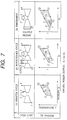
- FIG. 7 is a diagrammatic view illustrating thermal cycle diagrams of the present invention and other methods for comparison;
- FIG. 8 is a schematic view showing a detailed structure of a gas turbine
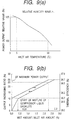
- FIGS. 9 ( a ) and 9 ( b ) are diagrams illustrating a relationship between the water drop injection amount and the increasing ratio of the power output of the gas turbine;
- FIG. 10 is a diagrammatic view illustrating a relationship between the axial velocity and the velocity triangle
- FIG. 11 is a schematic view showing an arrangement of atomizing nozzles in an inlet air compartment.
- FIG. 12 is a diagram illustrating a difference between compressor discharge temperatures before and after injection.
- a gas turbine of the embodiment of the present invention includes, as shown in FIG. 1, a compressor 1 for compressing and discharging gas, a combustor 5 to which the gas compressed by the compressor 1 is supplied, a turbine 2 driven by the combustion gas by the combustor 5 , a generator 3 connected to a shaft of the turbine 2 , and a electric power grid 4 for transmitting power generated by the generator 3 .
- Exhaust gas 7 from the gas turbine is discharged into the atmospheric air through a stack 8 .
- An inlet air compartment 10 for taking in inlet air 6 to be supplied to the compressor 1 is connected to the compressor 1 .
- a rouver 9 is disposed on the upstream side of the inlet air compartment 10 .
- An air filter is disposed adjacent the rouver 9 on the compressor side (rear flow side). Since the air filter is provided immediately rearwardly of the position of the rouver 9 , it is omitted in FIG. 1.
- the inlet air compartment 10 in the present embodiment presents an inlet air path to the entrance of the compressor on the downstream side of the air filter.
- T 1 denotes an inlet air temperature 20 before the inlet air enters the compressor 1 , T 2 a compressor discharge air temperature 21 , T 3 a combustion temperature 22 , and T 4 an exhaust gas temperature 23 exhausted from the turbine 2 .
- the first embodiment further includes a liquid droplet injection device which discharges fine droplets into the inlet air compartment 10 .
- a liquid droplet injection device which discharges fine droplets into the inlet air compartment 10 .
- an atomizing nozzle 11 is disposed.
- the Sauter mean particle diameter (S.M.D.) of liquid droplets discharged is, for example, approximately 10 ⁇ m.
- Feed water means 13 is connected to the atomizing nozzle 11 .
- the atomizing nozzle 11 includes atomization means for producing such fine droplets, only the feed water means 13 may be connected, but atomization means may otherwise be provided in addition to the atomizing nozzle 11 .
- a construction which includes separate atomization means will be hereinafter described in detail in connection with the second embodiment.
- the feed water means 13 has a control valve 15 for controlling the flow rate, a feed water pump 16 , a feed water tank 17 , and a feed water equipment 18 for supplying water to the feed water tank 17 .
- the control valve 15 is electrically connected to a function generator 24 to which a signal based on the power output of the generator 3 and a load instruction signal Pd 25 are inputted via an addition section and which outputs an opening signal for the control valve 15 or the like and other instructions.
- the control valve 15 is communicated with the function generator 24 , for example, by a signal cable 26 or the like.
- the load instruction signal Pd 25 may be introduced into the function generator 24 .
- the inlet air 6 passes through the rouver 9 and comes into the inlet air compartment 10 , and water of the feed water tank 17 passes through the control valve 15 of a predetermined opening and passes the feed water means 13 so that fine droplets are discharged from the atomizing nozzle 11 .
- a control valve 14 is additionally controlled to a predetermined opening to control the particle diameter of discharged liquid droplets.
- the inlet air 6 contains the liquid droplets to from a mist flow and enters the compressor 1 after the mist flow is partially evaporated to cool the inlet air.
- the liquid droplets contained in the inlet air are evaporated in the inside of the compressor 1 and cool the compressed air.
- FIG. 4 shows a temperature distribution of compressed air in the compressor.
- the air temperature T 21 at the exit of the compressor 1 exhibits a larger amount of drop in a case 28 wherein water is injected and water droplets are evaporated in the compressor 1 than another case 27 wherein no water droplets are injected. Also in the compressor, the air temperature T 21 exhibits a continuous drop.
- the compressed air is mixed with fuel and the fuel is combusted in the combustor 5 to form gas of a high temperature and a high pressure, which flows into and works in the turbine 2 .
- the mechanical energy of the turbine 2 is converted into electric energy by the generator 3 , and the electric energy is fed to the electric power grid 4 .
- the exhaust gas 7 after the work is completed is discharged into the atmospheric air through the stack 8 .
- the power output increasing mechanism according to the present embodiment can be summarized qualitatively in the following manner.
- FIG. 11 shows an outline of arrangement of the atomizing nozzle 11 in the inlet air compartment 10 .
- a large number of atomizing nozzles 11 are arranged in a predetermined imaginary section of the inlet air flow path. For example, they are arranged in a plane substantially perpendicular to a flowing direction of inlet air. The atomizing nozzles 11 are arranged such that the distances between adjacent ones of them may be equal to each other in the longitudinal direction of the cross section of the inlet air path. Meanwhile, the atomizing nozzles 11 are arranged such that the distances between adjacent ones of them may be equal to each other in the lateral direction of the cross section of the inlet air flow path. As a whole, a large number of atomizing nozzles 11 can be arranged in a region of the inlet air compartment 10 forming the inlet air flow path except portions in the proximity of wall faces as seen in FIG. 11.
- the distances between adjacent ones of the injection nozzles can be set in a similar manner also in the other embodiments.
- water droplets can be distributed homogeneously into inlet air to be conveyed to the entrance of the compressor.
- the atomizing nozzles 11 are positioned on the downstream side with respect to the air filter of the rouver 9 . Consequently, the liquid droplets can be supplied on a flow of inlet air stably to the compressor 1 . This is because the possibility that, where liquid droplets are supplied to the upstream side, water droplets may adhere to the air filter of the rouver 9 or the air filter may suffer from choking can be suppressed.
- the atomizing nozzles 11 are preferably disposed at a distance from the entrance of the compressor 1 taking an evaporation amount when liquid droplets flow in the inlet air compartment 10 and so forth into consideration. Where a so-called IGV is disposed at the entrance of the compressor 1 , the atomizing nozzles 11 are disposed on the upstream side of the IGV. It is to be noted that, where a silencer or the like is provided, the atomizing nozzles 11 are positioned on the downstream side of the silencer or the like.
- evaporation of liquid droplets can begin with a stage nearer to the first stage side to effectively perform reduction of the driving power of the compressor.
- FIG. 8 is a schematic view showing a detailed structure of a gas turbine to which the present invention is applied.
- Liquid droplets injected into inlet air from the atomizing nozzles 11 flow on an air flow into the compressor through the entrance.
- the average air flow speed of inlet air flowing in the inlet air compartment is, for example, 20 m/s.
- Liquid droplets 37 move on gas paths of the compressor 1 along stream line.
- the inlet air is heated by adiabatic compression, and while the liquid droplets are evaporated from the surfaces thereof by the heat, they are transported to the rear stage blade side while decreasing the particle diameters thereof.
- the temperature of the air in the compressor drops by a larger amount than where the present invention is not applied (refer to FIG. 4). If the particle diameters of the liquid droplets are large, the liquid droplets will collide with the blades or the casing of the compressor 1 and acquire heat from the metal so that they are evaporated, and consequently, the temperature decreasing effect of the working fluid may possibly be hindered. Therefore, from such a point of view, preferably the particle diameters of liquid droplets are small.
- a distribution in particle diameter is present with injected liquid droplets.
- liquid droplets to be injected are controlled so that they may have particle diameters principally of 50 ⁇ m or less.
- the liquid droplets are controlled so that the largest particle diameter may be equal to or smaller than 50 ⁇ m.
- the particle diameters are preferably set to 30 ⁇ m or less in Sauter mean particle diameter (S.M.D.). Since liquid droplets injected from the injection nozzles have a distribution in grain site, measurement is not easy with the largest particle diameter mentioned above, and therefore, for practical use, a result of measurement with the Sauter mean particle diameter (S.M.D.) as described above can be used.
- the particle diameters are small, since the injection nozzles which produce liquid droplets of small particle diameters require a high precision production technique, the range of the particle diameter for practical use is defined by a technically available lower limit. Therefore, from such a point of view as just described, the lower limit to, for example, the principal particle diameter, the largest particle diameter or the average particle diameter is 1 ⁇ m. Further, since the energy for production of liquid droplets in most cases increases as the particle diameter of them decreases, the lower limit may be determined otherwise taking the energy used for production of liquid droplets into consideration. Where the particle diameter of liquid droplets is set to a value around which the liquid droplets float in the atmospheric air and do not drop readily, the liquid droplets usually exhibit good heat transfer characteristics.
- the mass flow rate of the working liquid increases. If the evaporation in the compressor is completed, then the gas in the compressor 1 is further subject to adiabatic compression.
- the isobaric specific heatof the water steam has a value substantially equal to twice that of the air around a representative temperature (300° C.) in the compressor, the water steam has an effect in heat capacity equivalent to that obtained where, in conversion into air, an amount of air having a weight approximately twice that of water droplets to be evaporated is increased as the working liquid.
- the working fluid (air) pressurized by the compressor is raised in temperature by combustion of fuel in the combustor and then flows into the turbine, in which it performs an expanding work.
- This work is called shaft power of the turbine and is equal to a difference between enthalpies of air at the entrance and the exit of the turbine.
- the supply amount of the fuel is controlled so that the gas temperature at the entrance of the turbine may not exceed a predetermined temperature.
- a turbine entrance temperature is calculated form an exhaust gas temperature at the exit of the turbine and a measured value of the pressure Pcd at the exit of the compressor, and the fuel flow rate to the combustor 5 is controlled so that the calculated value may be equal to a value obtained before the present invention is applied.
- the fuel supply amount is increased by an amount corresponding to a drop of the gas temperature T 2 ′ at the exit of the compressor as described above.
- the combustion temperature is invariable and the weight ratio of injected water is approximately several percent with respect to the inlet air, since the pressure at the entrance of the turbine and the pressure at the exit of the compressor are approximately equal before and after injection is performed, also the gas temperature T 4 at the exit of the turbine does not exhibit a variation. Consequently, the shaft power of the turbine does not exhibit a variation before and after injection.
- the net power output of the gas turbine is a difference of the power of the compressor from the shaft power of the turbine, after all, by applying the present invention, the net power output of the gas turbine can be increased by an amount corresponding to a reduced amount of the power of the compressor.
- the electric output QE of the turbine 2 is obtained by subtracting the work Cp (T 2 ⁇ T 1 ) of the compressor 1 from the shaft power Cp (T 3 ⁇ T 5 ) of the turbine 2 and can be represented approximately by the following expression (1):
- the increased amount of the fuel substantially entirely contributes to an increase of the power output of the gas turbine.
- the increased amount of the power output provides a thermal efficiency of 100%. Consequently, the thermal efficiency of the gas turbine can be augmented.
- an increase of the total power output of the gas turbine can be anticipated by mixing water mist into inlet air of the compressor 1 .
- the prior art wherein water is injected into the entrance of a combustor contemplates increases of the power output by increasing the working fluid, since the work of the compressor 1 is not decreased, the thermal efficiency is dropped conversely.
- FIG. 7 illustrates a heat cycle of the present invention and another heat cycle for comparison.
- the area of a closed region of a cycle chart indicates a gas turbine power output per unit inlet air flow rate, that is, a specific power output.
- Reference numerals in FIG. 7 denote the working fluid at the corresponding locations of the cycle charts.
- reference numeral 1 denotes the entrance of the compressor, 1 ′ the entrance to an intercooler from the first stage compressor, 1 ′′ the entrance of the second stage compressor after the working fluid goes out from the intercooler, 2 the entrance of the combustor in a Brayton cycle, 2 ′ the entrance of the combustor after the working fluid goes out from the second stage compressor, 3 the entrance of the turbine after the working fluid goes out from the combustor, and 4 the exit of the turbine.
- the temperature T ⁇ entropy S charts in the lower stage of FIG. 7 illustrate comparison in characteristic where the values of the temperature T ⁇ entropy S at the positions 1 , 3 and 4 of the cycles described above are fixed.
- the magnitude of the specific power output decreases in order of that obtained by injecting fine water droplets mentioned hereinabove in an inlet air compartment of a compressor to introduce water droplets through the entrance of the compressor as in the present embodiment, that obtained by such an intercooling cycle as disclosed in Japanese Patent Laid-Open Application No. Hei 6-10702, and that obtained by an ordinary Brayton cycle.
- the difference between the specific power outputs by the intercooling cycle and the present invention originates from the fact that, according to the present invention, water droplets introduced into the compressor are continuously evaporated from the entrance portion of the compressor, and this appears in the shapes of the cycles.
- the present embodiment is superior to the Brayton cycle as described hereinabove, and consequently, the present invention achieves a higher thermal efficiency than the intercooling cycle.
- liquid droplets injected from the atomizing nozzles 11 preferably have such a size that substantially all of them are evaporated before they come to the exit of the compressor 1 .
- the size of liquid droplets may be such that they are evaporated by less than 100% but by an upper limit which can be achieved by the construction described above. In practical use, liquid droplets should be evaporated by 90% or more at the exit of the compressor.
- the particle diameter of the liquid droplets should be 30 ⁇ m or less in Sauter mean particle diameter (S.M.D.).
- the lower limit to the particle diameter is given by a lower limit which can be achieved technically. Accordingly, the lower limit to the particle diameter is, for example, 1 ⁇ m.
- the amount of liquid droplets to be introduced in can be adjusted by the temperature and the humidity or a degree of the increase of the power output. Taking an amount by which injected liquid droplets are evaporated within a range from the injection location to the entrance of the compressor into consideration, liquid droplets can be introduced by an amount equal to or more than 0.2 weight % of the mass flow rate of the inlet air.
- the upper limit is determined so that the functions of the compressor can be maintained good. For example, the upper limit may be set to 5 weight %, and the range of introduction can be set lower than 5 weight %.
- liquid droplets may be introduced by a rate equal to or higher than 0.8 weight % but equal to or lower than 6 weight %.
- the consumption amount of injection water exhibits a maximum used amount where the power output dropping when it is high in temperature in summer is to be recuperated to a rated power output.
- the consumption amount of pressurized air when air is supplied upon formation of mist cannot be ignored and should preferably be smaller than the consumption water amount as a target. Accordingly, only if the particle diameter condition is satisfied, it is economical that no air is supplied to form liquid droplets of the particle diameter mentioned above.
- a generating plant which can suppress a variation of the power output all through a year can be provided by controlling the flow rate of mist in response to the ambient temperature. For example, the opening of the control valve 15 is adjusted so that the flow rate of mist is increased when the temperature of air to be introduced into the compressor is high comparing with that when the air temperature is low.
- the system is operated so that the liquid droplets are supplied upon equal combustion temperature operation.
- the thermal efficiency can be augmented and the power output can be augmented.
- the combustion temperature can be lowered to lower the power output of the shaft of the turbine.
- the present embodiment can be applied to save the fuel.
- the power output can be controlled in response to a requested load.
- gas in the compressor can be cooled. Consequently, where this is utilized to use bleed extraction of the compressor for cooling the blades of the gas turbine, the bleed extraction amount for cooling can be reduced. Further, since the amount of the working liquid in the gas turbine can be increased by this, a high thermal efficiency and increase in power output can be anticipated.
- the load instruction signal Pd 25 can be set to a rated value so that the flow rate of injected liquid droplets may be automatically controlled.
- the step of increasing the amount of liquid to be injected from the atomizing nozzles 11 and the step of increasing the amount of fuel to be supplied to the combustor are used.
- the amount of liquid to be injected is decreased and the amount of fuel to be supplied to the combustor is decreased.
- the amount of fuel to be supplied to the combustor is increased after the amount of liquid to be injected is increased.
- the amount of fuel to be supplied to the combustor is decreased before the amount of fuel to be injected from the atomizing nozzles 11 is decreased.
- Operation control when operation with a fixed combustion temperature is performed may be such as follows.
- the function generator 24 calculates an injection water amount so as to correspond to an aimed power output based on a load instruction signal Pd 25 and issues an instruction to increase the opening to the control valve 15 .
- the function generator 24 further calculates a compressed air amount necessary for a predetermined amount of water to be introduced via the control valve 15 to and injected by the atomizing nozzles 11 and necessary for predetermined particle diameters to be obtained, and issues an instruction to increase the opening to the control valve 14 . Consequently, predetermined compressed air is introduced into the atomizing nozzles 11 through the control valve 14 . Meanwhile, the fuel flow rate is maintained fixed. Subsequently, exhaust gas temperature control is entered to increase the fuel flow rate so that the combustion temperature (an estimated value may be used) may become equal to its aimed value.
- An exhaust gas temperature control curve which presents an aimed value for the exhaust gas temperature during operation may be represented by a function of the compressor discharge pressure Pcd and the injection amount or may be an ordinary control curve applied for a case wherein no injection is involved. Or, a value obtained by adding a suitable bias to an aimed exhaust gas temperature estimated from an ordinary control curve may be used.
- the power output can be adjusted while preventing the situation that the combustion temperature exceeds its allowable value.
- the decreasing of the injection amount may be performed sufficiently slowly comparing with the increasing of the injection amount which is performed when the power output is to be increased in such a manner that the fuel flow rate is decreased in accordance with exhaust gas temperature control similar to that for the increasing of the power output.
- operation may be performed setting the injection amount to a predetermined value taking an amount of rise of the power output based on measured values of ambient conditions such as an ambient temperature and a humidity into consideration.
- ambient conditions such as an ambient temperature and a humidity into consideration.
- the injection amount or the like is calculated as a function of the ambient temperature, the humidity and an amount of rise of the power output and is set to a desired value. Consequently, also constant injection amount operation wherein the injection amount is not varied in response to a small variation of the power output or a variation of the air temperature becomes possible.
- the present system has an effect in that operation control is facilitated.
- the ambient conditions are measured again, and re-setting of the injection amount is performed to allow adjustment of the amount of rise of the power output comparatively readily in conformity with the ambient conditions.
- the operation of the gas turbine described above may be recognized also as control of the water droplet injection device for injecting water droplets into inlet air to be supplied to the compressor 1 of the gas turbine.
- the water droplet injection device is operated in such a manner as described above, the effect described above can be provided to a gas turbine in which the water droplet injection device is disposed.
- the second embodiment is different from the first embodiment described above principally in that atomization means for obtaining liquid droplets of the fine particle diameters described above is provided together with the atomizing nozzles 11 .
- the second embodiment includes means for supplying pressurized air to the atomizing nozzles 11 .
- the present embodiment includes, in addition to the atomizing nozzles 11 provided with feed water means 13 , air supply means 12 for supplying pressurized air to the atomizing nozzles 11 .
- the air supply means 12 includes an accumulator 29 provided separately from the compressor 1 for supplying pressurized air, and includes a path which introduces pressurized air from the accumulator 29 to the atomizing nozzles 11 via the control valve 14 .
- the present embodiment includes the control valve 14 for controlling the flow rate of gas to the atomizing nozzles 11 .
- a control valve 14 a for controlling the amount of pressurized air to be supplied to the injection nozzles is disposed.
- the control valve 14 and the control valve 15 are electrically connected to a function generator 24 which receives a signal based on the power output of the generator 3 and a power demand signal Pd 25 via an addition section and outputs opening signals for the control valve 14 , the control valve 15 and so forth and other instructions.
- the control valve 14 and the control valve 15 are connected to the function generator 24 , for example, by a signal cable 26 or the like.
- the power demand signal 25 may be introduced directly to the function generator 24 .
- Inlet air 6 comes to the inlet air compartment 10 through the rouver 9 , and water of the feed water tank 17 passes through the control valve 15 of a predetermined opening and is supplied to the atomizing nozzles 11 through the feed water means 13 . Further, pressurized air produced by the accumulator 29 is supplied to the atomizing nozzles 11 through the control valve 14 of a predetermined opening. Then, fine liquid droplets are injected from the atomizing nozzles 11 .
- the nozzles may be of the type wherein the amounts of air and liquid to be supplied can be adjusted to adjust the particle diameters in a desired range within the range described hereinabove.
- the inlet air 6 contains the liquid droplets to form a mist flow and flows into the compressor 1 after part of the mist flow is evaporated to cool the inlet air.
- the liquid droplets contained in the inlet air are evaporated in the inside of the compressor 1 and cool the compressed air.
- the fuel is mixed and combusted with the compressed air in the combustor 5 to produce gas of a high temperature and a high pressure, which then flows into and works in the turbine 2 .
- the mechanical energy is converted into electric energy by the generator 3 , and the electric energy is fed to the electric power grid 4 .
- the exhaust gas 7 after completing the work is discharged to the atmospheric air through the stack 8 .
- the accumulator 29 may supply gas from an atomization compressor for supplying care prensed air to feel no 33 le in case of suing feel oil.
- the amount of air to be supplied to the atomizing nozzles 11 may be increased so that the particle diameter of liquid droplets injected from the injection nozzles may be a desired magnitude.
- the amount of air to be supplied is adjusted so that a desired particle diameter of liquid droplets may be obtained when an allowable maximum amount of liquid is supplied. Consequently, when the amount of liquid to be injected is lower than the maximum injection liquid amount therefore, the diameter of the liquid droplets is reduced from that obtained when the amount of water is the maximum injection water amount, and a good condition can be obtained.
- the air supply means 12 includes a path which communicates bleed extraction from a mid stage of the compressor 1 with the atomizing nozzles 11 or another path which is branched from a path along which compressed air discharged from the compressor 1 flows and is communicated with the atomizing nozzles 11 .
- the path includes a control valve 14 b for controlling the amount of pressurized air to be supplied. In conformity with a demand to make injection effective or a like demand, the path may have a cooler 19 for adjusting the temperature of compressed air to a desired temperature.
- control valve 15 is closed while only the control valve 14 b is opened so that only a desired amount of liquid droplets can be injected into inlet air.
- liquid droplets As liquid droplets are supplied from the atomizing nozzles 11 , they can be injected homogeneously into the inlet air, and the temperature distribution of the inlet air can be made homogeneous.
- the third embodiment is different from the first embodiment or the second embodiment principally in that it further includes a water recovery equipment 31 installed at an exhaust section of the turbine 2 and, in order to recover water in turbine exhaust gas and re-utilize the water as injection water, it further includes a path for supplying water recovered by the water recovery equipment 31 to the feed water tank 17 .
- Inlet air 6 passes through the rouver 9 and comes into the inlet air compartment 10 , and water recovered by the water recovery equipment 31 is stored once into the water supply tank and then passes through the control valve 15 of a predetermined opening and then through the feed water means 13 so that fine droplets are thereafter injected from the atomizing nozzles 11 .
- the control valve 14 is simultaneoulsy set to a predetermined opening to adjust the particle diameter of injected liquid droplets.
- the inlet air 6 contains the liquid droplets to form a mist flow, and the mist flow enters the compressor 1 after part of it is evaporated to cool the inlet air.
- the liquid droplets contained in the inlet air are evaporated in the inside of the compressor 1 to cool the compressed air.
- the water recovery efficiency can be augmented by disposing the water recovery equipment 31 described above at the exit of the heat recovery boiler 30 .
- the fourth embodiment is characterized over the first embodiment or the second embodiment in that the fuel for the combustor 5 is liquified natural gas (LNG). Consequently, the fourth embodiment includes, in addition to the construction of the first embodiment or the second embodiment, a liquified natural gas storage section 33 which serves also as a cold heat source, and includes, as the water recovery equipment 31 , a heat exchanger 32 for raising the temperature of natural gas supplied from the liquified natural gas storage section 33 to evaporate the natural gas and a path 34 for introducing the evaporated natural gas to the combustor 5 .
- the heat exchanger 32 is installed so as to utilize exhaust gas of the gas turbine.
- the heat exchanger 32 recovers water in the exhaust gas.
- the heat exchanger 32 includes a path for supplying the water recovered by the heat exchanger 32 to the feed water tank 17 .
- a fifth embodiment will be described with reference to FIG. 1.
- the present embodiment is a gas turbine which includes a combination of water injection into inlet air and an inlet air cooling equipment.
- the fifth embodiment is a modification to the first embodiment or the second embodiment described above in that a cooling coil 35 connected to an external cold heat source 36 is provided additionally on the rear face of the rouver 9 and a cold heat medium is circulated by a pump 42 .
- the cooling coil 35 may otherwise be disposed on the front face of the rouver 9 .
- Inlet air 6 passes through the rouver 9 and comes into the inlet air compartment 10 , whereafter it is cooled when it passes the cooling coil 35 , and water of the feed water tank 17 passes through the control valve 15 of a predetermined opening and further through the feed water means 13 so that fine liquid droplets are thereafter injected from the atomizing nozzles 11 .
- the control valve 14 is simultaneously set to a predetermined opening to adjust the particle diameter of injected liquid droplets.
- the inlet air 6 contains the liquid droplets to form a mist flow, and the mist flow flows into the compressor 1 after part of it is evaporated to cool the inlet air.
- the liquid droplets contained in the inlet air are evaporated in the inside of the compressor 1 to cool the compressed air.
- FIG. 2 shows the atomizing nozzles 11 so as to facilitate understanding of the position of them. While FIG. 2 shows a construction which includes air supply means 12 for supplying pressurized inlet air, such air supply means 12 as in the embodiment 1 need not be provided only if such desired liquid droplets as described above are obtained.
- the atomizing nozzles 11 are disposed in a spaced relationship from the entrance of the compressor 1 in this manner.
- the atomizing nozzles 11 are suitably disposed at one of the following positions ( 11 a or 11 b ).
- the inlet air compartment 10 includes a silencer 41 :
- the atomizing nozzles 11 a are disposed on the downstream side of the silencer 41 .
- the atomizing nozzles 11 are preferably installed at a distance to the compressor taking a flying distance over which liquid droplets are evaporated before they are introduced into the compressor into consideration. (2) Or, the atomizing nozzles 11 b are disposed on the upstream side of the silencer.
- the distribution of water droplets in the inlet air can be made more homogeneous before the water droplets enter the compressor. Further, where a portion of the rouver 9 extends wider than the inlet air compartment 10 on the downstream of the rouver 9 or a like case, installation or maintenance of the atomizing nozzles 11 is easy. 2. Where the inlet air compartment 10 does not include a silencer:
- the atomizing nozzles 11 are positioned between the rouver 9 and the entrance of the compressor 1 .
- the atomizing nozzles 11 are preferably installed at a distance to the compressor taking a flying distance over which liquid droplets are evaporated before they are introduced into the compressor into consideration.
- Inlet air 6 passes through the rouver 9 and comes into the inlet air compartment 10 , and then, where a silencer is present, the inlet air 6 passes through the silencer. Meanwhile, water from the feed water tank 17 passes through the control valve 15 of a predetermined opening and further through the feed water means 13 so that fine liquid droplets are injected from the atomizing nozzles 11 . Where air supply from the air supply means 12 is necessary to inject fine liquid droplets, the control valve 14 is simultaneously set to a predetermined opening to adjust the particle diameter of injected liquid droplets.
- the inlet air 6 contains the liquid droplets to form a mist flow and flows into the compressor 1 after it cools the inlet air. The liquid droplets contained in the inlet air are evaporated in the inside of the compressor 1 and cool the compressed air.
- recuperation of the power output of the gas turbine can be performed further efficiently by a synergetic effect of the two principles of increase of the inlet air mass flow rate and reduction of the compressor work by cooling of inlet air.
- the injection nozzles are arranged at a location spaced by a suitable distance from the entrance of the compressor in the inlet air compartment, then since part of the injected water is evaporated to cool the inlet air to a temperature in the proximity of the wet bulb temperature, similar effects are exhibited although some difference may be present from those obtained where an air cooler is installed in an inlet air flow path.
- the working fluid of the compressor 1 can be cooled effectively both inside the compressor 1 and outside the compressor 1 , and the power output increase can be made larger where the distance is provided than where the atomizing nozzles 11 are arranged in the proximity of the entrance of the compressor.
- FIGS. 5 and 6 illustrate a status variation of the working fluid and a relationship between the inlet air temperature and the inlet mass flow rate in the process wherein external air is introduced into and compressed by the compressor 1 , respectively.
- FIG. 5 illustrates a status variation where the ambient conditions are set to 30° C. and 70% in relative humidity (R.H.).
- the ambient condition is indicated by a point A. If it is assumed that external air is evaporatively cooled along a constant wet bulb temperature line on a psychrometric chart until it enters a saturation state before to flows into the compressor, then the state of the inlet air changes to a state B at the entrance of the compressor 1 .
- the humidity of gas to be introduced into the compressor 1 by injection of liquid droplets described above is preferably raised approximately to 90% or more from the point of view to maximize evaporation prior to introduction into the compressor. From the point of view to achieve better cooling of inlet air, the humidity should be raised to 95% or more. Those liquid droplets which have not ben evaporate in the inlet air compartment 10 are continuously evaporated in the compression process from B to C.
- the inlet air flow rate increase when the temperature drops from T 1 to T 1 ′ increase from W to W′ as schematically shown in FIG. 6.
- the remaining liquid droplets are introduced into and evaporated in the compressor 1 so that they contribute to reduction of the work of the compressor 1 .
- FIG. 9 illustrates a relationship between the water drop injection amount and the increasing rate of the power output of the gas turbine.
- (a) of FIG. 9 illustrates a variation of the power output relative value to the inlet air temperature
- (b) of FIG. 9 illustrates a relationship between the injection amount and the power output increase.
- the thermal efficiency augmentation ratio upon 2.3% injection is 2.8% in relative value.
- the consumed water amount necessary to recuperate the power output of the gas turbine to an output exhibited upon 5° C. base load operation is approximately 2.3 weight % of the inlet mass flow rate.
- Details of output increase when operation is performed until the output of the gas turbine is recuperated to a maximum value are roughly estimated as follows: the portion which is based on cooling before the compressor 1 is entered is approximately 35%; the portion which is based on cooling by evaporation in the inside of the compressor is approximately 37%; and the portion which is based on a difference in amount of the working fluid which passes through the turbine and the compressor and increase of the low pressure specific heat arising from steam contained in the working fluid is approximately 28%.
- the injection water amount may be further increased so that power output increase up to an allowable power output level can be obtained with an injection flow rate of approximately 5 weight %.
- the evaporation action of water droplets in the compressor 1 has an increasing influence upon the power output increase by an action (cooling action) outside the compressor 1 .
- FIG. 12 illustrates a relationship of a difference between the discharge temperature of the compressor before and after injection to the injection amount. It can be seen that evaporation and cooling before liquid droplets flow into the entrance of the compressor 1 can be performed efficiently with a low flow rate.
- the humidity which is reached by the inlet air flowing into the entrance of the compressor 1 is in the proximity of approximately 95%.
- the solid line indicates a difference between the temperature of gas at the exit of the compressor 1 and the temperature prior to injection calculated from two conditions that the absolute humidity of the gas at the exit of the compressor 1 and the enthalpy of gas at the exit of the compressor 1 calculated under the assumption that liquid droplets flowing into the compressor 1 are evaporated by the entire amount are equal to those values prior to the injection.
- the line is obtained under the assumption that there is no reduction in power. However, actual values indicated by blank round marks (interconnected by a broken line for facilitated understanding) are higher than those values presented by the line, and reduction in power is actually present. This arises from the fact that the temperature drop amount by evaporation is amplified in a compression step in a stage later than the evaporation point.
- the evaporation amount of liquid droplets introduced into the compressor 1 by the atomizing nozzles 11 on the front stage side is preferably made larger than the evaporation amount on the rear stage side and to evaporate liquid droplets introduced into the compressor 1 principally on the front stage side is effective to reduction in power.
- Liquid droplets are injected by such an amount that the temperature of compressed air discharged from the compressor 1 is lowered by 5° C. or more from that prior to the injection. From the point of view to achieve further increase in power output, the amount of liquid droplets is set to such a degree that the temperature is lowered by 25° C. or more. It is to be noted that the upper limit can be determined from the point of view of practical use. For example, it is reasonable to set the amount of liquid droplets so that the temperature is lowered by 50° C. or less.
- a seventh embodiment will be described with reference to FIG. 1.
- the seventh embodiment is different from the first embodiment or the second embodiment in that it includes a mechanism which can control the temperature of liquid droplets to be injected.
- the seventh embodiment is, for example, a combined plant, and in addition to the construction of the gas turbine described above, a heat recovery boiler 30 wherein exhaust gas of the turbine 2 is used as a heat source is installed. Further, though not shown in FIG. 1, a steam turbine which is driven by steam generated by the heat recovery boiler 30 is provided. Further, at least a generator which is driven by the gas turbine or the steam turbine is provided.
- the air supply means 12 includes a path for supplying steam generated by the heat recovery boiler 30 to the atomizing nozzles 11 , and a control valve 14 c is disposed in the path.
- Inlet air 6 passes through the rouver 9 and comes into the inlet air compartment 10 , and water of the feed water tank 17 passes through the control valve 15 of a predetermined opening and then through the feed water means 13 so that fine liquid droplets are injected from the atomizing nozzles 11 .
- the steam supply amount is controlled by the control valve 14 c.
- the amount of compressed air can be controlled by the control valve 14 a provided in the path from the accumulator 29 to the atomizing nozzles 11 .
- the inlet air 6 contains the liquid droplets of the desired temperature to form a mist flow, which flows into the compressor 1 after it cools the inlet air.
- the liquids droplets contained in the inlet air are evaporated in the inside of the compressor 1 and cool the compressed air.
- the evaporation rate of liquid droplets can be controlled by controlling the temperature of injection liquid. If the water temperature is raised, then evaporation of liquid droplets can be shifted to the front stage side of the compressor. Consequently, the work amount of the compressor 1 can be further reduced. While the temperature of water droplets to be injected varies depending upon conditions, the appropriate range for practical use is 10 to 80° C.
- control of the bleed extraction gas temperature of the compressor or a system which controls using temperature controlling means such as a heater 51 provided at a suitable location of the feed water means 13 may be employed.
- the air supply means 12 described hereinabove is not provided, it is effective to provide the heater 51 .
- provision of the heater 51 is effective in a combined plant, particularly a cogeneration plant, since steam can be utilized effectively.
- the heater 51 is effective since steam of the heat recovery boiler 30 can be utilized even where separately provided heating means or the like is not disposed. It is to be noted that separate steam generation means may be provided.
- glycerin or ethylene glycol is added into the feed water tank 17 and stored as mixture in the feed water tank 17 .
- the eighth embodiment is different from the first embodiment or the second embodiment principally in that steam is supplied into inlet air to be introduced into the compressor 1 .
- the gas turbine includes a path for supplying steam generated by the heat recovery boiler 30 to the air supply means 12 so that steam supplied from the atomizing nozzles 11 can be injected.
- Inlet air 6 passes through the rouver 9 and comes into the inlet air compartment 10 , and the control valve 15 is closed. Steam generated by the heat recovery boiler 30 passes through the control valve 14 c of a predetermined opening and then through the air supply means 12 so that it is injected from the atomizing nozzles 11 . If it is assumed that the air supply means 12 is not provided but only the feed water means 13 is provided, through not shown, the gas turbine may be constructed such that, in place of supply water from the feed water tank 17 , the steam is supplied from the feed water means 13 to the atomizing nozzles 11 .
- separately provided steam supplying nozzles to which steam generated by the heat recovery boiler 30 is supplied may be disposed. It is to be noted that the amount, the temperature or the like of steam to be injected into inlet air is controlled, although it is different depending upon the steam source, by an aimed temperature of inlet air to enter the compressor 1 .
- the inlet air temperature which has been, for example, approximately 10° C. can be raised to approximately 50° C. before it is supplied to the compressor 1 .
- the present embodiment is effective when the demand is reduced depending upon a season since, even when the requested load decrease and the power output is to be reduced, since the operation having the thermal efficiency higher than that achieved by a conventional part load operation method by IGV control or the like can be performed.
- a plant wherein steam is generated using exhaust gas of a gas turbine such as a combined cycle plant or a cogeneration plant
- also effective utilization of surplus steam can be achieved since residual steam can be used for generation.
- the present embodiment includes, in addition to the first embodiment or the second embodiment, means such as a notice for sending pressurized air to a mid stage of a compressor.
- a basic construction similar to that of the first embodiment described above can be applied to the ninth embodiment.
- a flow control valve 47 is provided in a line 59 for feeding compressed air supplied from a compressed air source 43 to a mid stage of the compressor 1 .
- the compressed air source 43 can supply air from a compressor installed outside or an atomization compressor for fuel injection. Or, although the effect is somewhat inferior, air may be recirculated from a discharging location of the compressor 1 . In this instance, since a lower temperature of the bleed provides a higher thermal efficiency, cooling means 48 is preferably provided intermediately of the feed air line 59 .
- the feed air amount is selected as a function of the injection amount so that the axial velocity may be held at its designed value even if the injection amount varies.
- the opening of the control valve 15 for a water amount is increased and the opening of the flow control valve 47 is increased by an instruction signal from the function generator 24 in response to an increase of an aimed power output based on the power demand signal 25 .
- the amount of water to be supplied from the control valve 15 and the amount of compressed air to be supplied from the flow control valve 47 may have a relationship of a monotone increasing function.
- the present embodiment is constructed such that, in a gas turbine of the type wherein bleed extraction of the compressor 1 is supplied into a cooling flow path formed in a turbine blade to cool the turbine blade, the bleed extraction flow rate is controlled in response to the temperature of the bleed extraction of the compressor.
- the flow rate after the bleed extraction stage can substantially be increased by decreasing the bleed extraction quantity from a bleed extraction line 56 of the compressor 1 , which is provided for cooling the turbine blade, in conformity with a drop of the temperature of the bleed extraction gas.
- a flow control valve 55 or a motor valve with an intermediate opening set is provided in the bleed extraction line 56 .
- the bleed extraction may have a relationship of a monotone decreasing function with the flow control valve 55 using an instruction signal from a bleed extraction amount control function generator 58 in response to a decrease of an aimed bleed extraction quantity based on a temperature signal of a temperature detector 57 which detects the temperature of the bleed extraction.
- the opening of the valve is controlled to a predetermined value in response to a temperature when the bleed extraction temperature reaches a preset value.
- each of the embodiments is regarded as a single unit of a compressor, reduction of required power of the compressor can be realized by a simple apparatus.
- each of the embodiments described above is regarded as a liquid droplet injection apparatus for injecting liquid droplets into inlet air of the compressor of the gas turbine, augmentation of the power output and augmentation of the thermal stress of the gas turbine which includes the apparatus can be realized with a simple apparatus.
Landscapes
- Engineering & Computer Science (AREA)
- Chemical & Material Sciences (AREA)
- Combustion & Propulsion (AREA)
- Mechanical Engineering (AREA)
- General Engineering & Computer Science (AREA)
- Physics & Mathematics (AREA)
- Thermal Sciences (AREA)
- Structures Of Non-Positive Displacement Pumps (AREA)
- Engine Equipment That Uses Special Cycles (AREA)
- Compressor (AREA)
- Nozzles (AREA)
- Jet Pumps And Other Pumps (AREA)
Abstract
Description
- 1. Field of the Invention
- This invention relates to a gas turbine, and more particularly to a gas turbine wherein liquid droplets are injected into compressor inlet air of the gas turbine. The present invention further relates to a combined cycle plant, and more particularly to a combined cycle plant wherein liquid droplets are injected into inlet air of a compressor which composes the combined cycle plant. The present invention relates also to a compressor, and more particularly to a compressor wherein liquid droplets are injected into compressor inlet air.
- 2. Description of the Related Art
- When the air temperature rises in summer or the like, the power output of a gas turbine drops, and various constructions are disclosed for a method of power recuperation.
- In Japanese Patent Laid-Open Application No. Hei 7-97933, Japanese Utility Model Laid-Open Application No. Sho 61-37794 or Japanese Patent Laid-Open Application No. Hei 5-195809, it is disclosed to cool compressor inlet air.
- Meanwhile, in Japanese Patent Laid-Open Application No. Sho 61-283723, it is disclosed to supply water from an entrance of a compressor and a mid stage of the compressor in a combined system of a gasification furnace and a gas turbine.
- Further, in Japanese Utility Model Laid-Open Application No. Sho 56-43433, it is disclosed to provide a supply hole for water droplets in a compressor, and in Japanese Patent Laid-Open Application No. Hei 2-211331, a gas turbine which includes two high pressure and low pressure compressors and an intercooler provided between the compressors is disclosed. Meanwhile, in Japanese Patent Laid-Open Application No. Hei 6-10702, an apparatus wherein, in a compressor group which includes a plurality of compressor stages, water is injected into an intermediate location between the compressor stage on the upstream and the compressor stage on the downstream in order to reduce power consumption.
- However, Japanese Patent Laid-Open Application No. Hei 7-97933, Japanese Utility Model Publication Application No. Sho 61-37794 or Japanese Patent Laid-Open Application No. Hei 5-195809 merely discloses to drop the temperature of inlet air to be introduced into a compressor in order to augment the power output. Although it is disclosed in Japanese Patent Laid-Open Application No. Sho 61-283723 to evaporate liquid droplets during compression to utilize them as a medium for cooling the blades of a turbine and to augment the turbine cycle characteristic, it does not achieve both of power augmentation and thermal efficiency augmentation.
- For a gas turbine, a combined cycle plant or a compressor, it is demanded to achieve both of power augmentation and thermal efficiency augmentation.
- Meanwhile, in order to achieve both effects of augmentation of the power output and thermal efficiency augmentation as in Japanese Patent Laid-Open Application No. Hei 6-10702 or Japanese Patent Laid-Open Application No. Hei 2-21133, a specific equipment is required for a flow path of high pressure gas at an intermediate portion of a compressor, and there is a problem in that the compressor configuration is complicated and increased in scale as a whole. Further, in Japanese Utility Model Laid-Open Application No. Sho 56-43433, a casing and nozzles in a compressor are required to have a special construction.
- Where an actual gas turbine, combined plant and compressor are taken into consideration, it is demanded that power augmentation and thermal efficiency augmentation can be achieved with a simple equipment.
- It is an object of the present invention to provide a gas turbine, a combined plant and a compressor by which both of augmentation of the power output and augmentation of the thermal efficiency can be achieved by injecting liquid droplets into inlet air introduced into an entrance of a compressor.
- In order to attain the object described above, according to an aspect of the present invention, there is provided a gas turbine, comprising a compressor for compressing and discharging gas supplied thereto, a combustor in which fuel is combusted with the gas discharged from the compressor, a turbine driven by the combusted gas of the combustor, and a liquid droplet injection device for injecting liquid droplets into gas to be supplied into the compressor to make the temperature of the gas to be introduced into the compressor lower than the temperature of external air so that the injected liquid droplets introduced into the compressor together with the gas may be evaporated while flowing down in the compressor.
- With the gas turbine, liquid droplets can be injected into inlet air to be introduced into the entrance of the compressor on power demand to achieve both of augmentation of the power output and augmentation of the thermal efficiency with a simple equipment which is suitable for practical use.
- According to another aspect of the present invention, there is provided a gas turbine, comprising a compressor for compressing and discharging gas supplied thereto, a combustor in which fuel is combusted with the gas discharged from the compressor, a turbine driven by the combusted gas of the combustor, and a liquid droplet injection device provided on the upstream side of the compressor for injecting liquid droplets having droplet diameters principally of 50 μm or less into gas to be supplied to the compressor.
- With the gas turbine, fine liquid droplets can be supplied into inlet air to the compressor by a simple equipment which is suitable for practical use, and water droplets can be conveyed well by an inlet air flow to be supplied to the compressor. Accordingly, gas which contains liquid droplets can be transported efficiently from the entrance of the compressor into the compressor. Further, the liquid droplets introduced into the compressor can be evaporated in a good state. Consequently, augmentation of the power output and augmentation of the thermal efficiency can be achieved.
- According to a further aspect of the present invention, there is provided a combine cycle plant, comprising a gas turbine including a compressor for compressing and discharging gas supplied thereto, a combustor in which fuel is combusted with the gas discharged from the compressor, a turbine driven by the combusted gas of the combustor, a heat recovery boiler for generating steam using exhaust gas from the turbine as a heat source, a steam turbine driven by the steam generated by the heat recovery boiler, and a liquid droplet injection device for injecting liquid droplets into gas to be supplied to the compressor of the gas turbine to make the temperature of the gas to enter the compressor lower than the temperature of external air so that the injected liquid droplets introduced into the compressor together with the gas may be evaporated while flowing down in the compressor.
- With the combined cycle plant, the thermal efficiency can be augmented while also the power output can be augmented on power demand.
- According to a still further aspect of the present invention, there is provided a compressor to which gas is supplied and which compresses and discharges the supplied gas, comprising a liquid droplet injection device for injecting liquid droplets into gas to be supplied to an entrance of the compressor to make the temperature of the gas to enter the compressor lower than the temperature of external air so that the injected liquid droplets introduced into the compressor together with the gas may be evaporated while flowing down in the compressor.
- With the compressor, driving power for the compressor can be reduced by a simple equipment which is suitable for practical use.
- According to a yet further aspect of the present invention, there is provided a liquid droplet injection device for injecting liquid droplets into gas to be supplied to a compressor of a gas turbine which includes the compressor for compressing an discharging gas supplied thereto, a combustor in which fuel is combusted with the gas discharged from the compressor, and a turbine driven by the combusted gas of the combustor, wherein the liquid droplet injection device injects liquid droplets to make the temperature of the gas to enter the compressor lower than the temperature of external air so that the injected liquid droplets introduced into the compressor together with the gas may be evaporated while flowing down in the compressor.
- With the liquid droplet injection device, both of augmentation of the power output and augmentation of the thermal efficiency of a gas turbine or the like in which the present apparatus is disposed can be achieved.
- The above and other objects, features and advantages of the present invention will become apparent from the following description and the appended claims, taken in conjunction with the accompanying drawings in which like parts or elements are denoted by like reference characters.
- FIG. 1 is a schematic view of an embodiment of the present invention;
- FIG. 2 is a similar view showing another embodiment of the present invention;
- FIG. 3 is a similar view showing a further embodiment of the present invention;
- FIG. 4 is a diagram illustrating a temperature distribution of compressed air in a compressor;
- FIG. 5 is a diagram illustrating a relationship between the air temperature and the absolute humidity on a psychrometric chart in a compressor process;
- FIG. 6 is a diagram illustrating a relationship between the inlet air temperature and the inlet air mass flow rate;
- FIG. 7 is a diagrammatic view illustrating thermal cycle diagrams of the present invention and other methods for comparison;
- FIG. 8 is a schematic view showing a detailed structure of a gas turbine;
- FIGS. 9(a) and 9(b) are diagrams illustrating a relationship between the water drop injection amount and the increasing ratio of the power output of the gas turbine;
- FIG. 10 is a diagrammatic view illustrating a relationship between the axial velocity and the velocity triangle;
- FIG. 11 is a schematic view showing an arrangement of atomizing nozzles in an inlet air compartment; and
- FIG. 12 is a diagram illustrating a difference between compressor discharge temperatures before and after injection.
- A first embodiment of the present invention will be described with reference to FIG. 1.
- A gas turbine of the embodiment of the present invention includes, as shown in FIG. 1, a
compressor 1 for compressing and discharging gas, acombustor 5 to which the gas compressed by thecompressor 1 is supplied, aturbine 2 driven by the combustion gas by thecombustor 5, agenerator 3 connected to a shaft of theturbine 2, and aelectric power grid 4 for transmitting power generated by thegenerator 3.Exhaust gas 7 from the gas turbine is discharged into the atmospheric air through a stack 8. - In the following embodiment, it is assumed that the gas supplied to the
compressor 1 is air. - An
inlet air compartment 10 for taking ininlet air 6 to be supplied to thecompressor 1 is connected to thecompressor 1. Usually, arouver 9 is disposed on the upstream side of theinlet air compartment 10. An air filter is disposed adjacent therouver 9 on the compressor side (rear flow side). Since the air filter is provided immediately rearwardly of the position of therouver 9, it is omitted in FIG. 1. - While the form wherein the
rouver 9 is disposed on the upstream side of the inlet air compartment is shown in FIG. 1, where the air filter is located intermediately of the intake air compartment, theinlet air compartment 10 in the present embodiment presents an inlet air path to the entrance of the compressor on the downstream side of the air filter. - While the
compressor 1, theturbine 2 and thegenerator 3 are connected to a common shaft in FIG. 1, thecompressor 1 and theturbine 2 may otherwise have different shafts. - It is to be noted that, in FIG. 1, reference character T 1 denotes an
inlet air temperature 20 before the inlet air enters thecompressor 1, T2 a compressordischarge air temperature 21, T3 acombustion temperature 22, and T4 anexhaust gas temperature 23 exhausted from theturbine 2. - Unless otherwise specified, those of numerals mentioned herein below which are same as those mentioned above denote the same objects.
- The first embodiment further includes a liquid droplet injection device which discharges fine droplets into the
inlet air compartment 10. For example, an atomizingnozzle 11 is disposed. The Sauter mean particle diameter (S.M.D.) of liquid droplets discharged is, for example, approximately 10 μm. Feed water means 13 is connected to theatomizing nozzle 11. Where the atomizingnozzle 11 includes atomization means for producing such fine droplets, only the feed water means 13 may be connected, but atomization means may otherwise be provided in addition to theatomizing nozzle 11. A construction which includes separate atomization means will be hereinafter described in detail in connection with the second embodiment. - The feed water means 13 has a
control valve 15 for controlling the flow rate, afeed water pump 16, afeed water tank 17, and afeed water equipment 18 for supplying water to thefeed water tank 17. - The
control valve 15 is electrically connected to afunction generator 24 to which a signal based on the power output of thegenerator 3 and a loadinstruction signal Pd 25 are inputted via an addition section and which outputs an opening signal for thecontrol valve 15 or the like and other instructions. Thecontrol valve 15 is communicated with thefunction generator 24, for example, by asignal cable 26 or the like. In some cases, the loadinstruction signal Pd 25 may be introduced into thefunction generator 24. - The
inlet air 6 passes through therouver 9 and comes into theinlet air compartment 10, and water of thefeed water tank 17 passes through thecontrol valve 15 of a predetermined opening and passes the feed water means 13 so that fine droplets are discharged from the atomizingnozzle 11. Where air supply from air supply mean 12 is required in order to discharge fine droplets, acontrol valve 14 is additionally controlled to a predetermined opening to control the particle diameter of discharged liquid droplets. Theinlet air 6 contains the liquid droplets to from a mist flow and enters thecompressor 1 after the mist flow is partially evaporated to cool the inlet air. The liquid droplets contained in the inlet air are evaporated in the inside of thecompressor 1 and cool the compressed air. - FIG. 4 shows a temperature distribution of compressed air in the compressor. The air temperature T 21 at the exit of the
compressor 1 exhibits a larger amount of drop in acase 28 wherein water is injected and water droplets are evaporated in thecompressor 1 than anothercase 27 wherein no water droplets are injected. Also in the compressor, the air temperature T21 exhibits a continuous drop. - After the liquid droplets are substantially evaporated in the
compressor 1, the compressed air is mixed with fuel and the fuel is combusted in thecombustor 5 to form gas of a high temperature and a high pressure, which flows into and works in theturbine 2. The mechanical energy of theturbine 2 is converted into electric energy by thegenerator 3, and the electric energy is fed to theelectric power grid 4. Theexhaust gas 7 after the work is completed is discharged into the atmospheric air through the stack 8. - By the present embodiment, power output augmentation can be achieved and thermal efficiency can be augmented.
- The power output increasing mechanism according to the present embodiment can be summarized qualitatively in the following manner.
- 1) Cooling of inlet air, which is to be introduced into the
compressor 1, along a constant wet bulb temperature line on a psychrometric chart in theinlet air compartment 10, 2) cooling of internal gas by evaporation of liquid droplets introduced into thecompressor 1, 3) a difference between amounts of working fluid passing through theturbine 2 and thecompressor 1 which corresponds to an evaporation amount in thecompressor 1, 4) an increase in isobaric specific heat of mixture caused bymixture of air and steam which has a higher isobaricspecific heat than that of pure air, and so forth. - FIG. 11 shows an outline of arrangement of the atomizing
nozzle 11 in theinlet air compartment 10. - A large number of
atomizing nozzles 11 are arranged in a predetermined imaginary section of the inlet air flow path. For example, they are arranged in a plane substantially perpendicular to a flowing direction of inlet air. The atomizing nozzles 11 are arranged such that the distances between adjacent ones of them may be equal to each other in the longitudinal direction of the cross section of the inlet air path. Meanwhile, the atomizingnozzles 11 are arranged such that the distances between adjacent ones of them may be equal to each other in the lateral direction of the cross section of the inlet air flow path. As a whole, a large number ofatomizing nozzles 11 can be arranged in a region of theinlet air compartment 10 forming the inlet air flow path except portions in the proximity of wall faces as seen in FIG. 11. - The distances between adjacent ones of the injection nozzles can be set in a similar manner also in the other embodiments.
- By the arrangement, water droplets can be distributed homogeneously into inlet air to be conveyed to the entrance of the compressor.
- Meanwhile, in a conventional inlet air cooling apparatus which includes atomizing nozzles outside an inlet air compartment or on the upstream side of an air filter, since the evaporation efficiency is low, injection of a large amount of water is required, and therefore, a recovery apparatus which recovers almost all of injected liquid and a large scale circulation system which supplies the recovered liquid to the
atomizing nozzles 11 again are provided usually. However, in the present embodiment, there is an advantage also in that, since the evaporation efficiency can be augmented to a value close to 1, no such large scale equipment need be provided. - The atomizing nozzles 11 are positioned on the downstream side with respect to the air filter of the
rouver 9. Consequently, the liquid droplets can be supplied on a flow of inlet air stably to thecompressor 1. This is because the possibility that, where liquid droplets are supplied to the upstream side, water droplets may adhere to the air filter of therouver 9 or the air filter may suffer from choking can be suppressed. - Further, the atomizing
nozzles 11 are preferably disposed at a distance from the entrance of thecompressor 1 taking an evaporation amount when liquid droplets flow in theinlet air compartment 10 and so forth into consideration. Where a so-called IGV is disposed at the entrance of thecompressor 1, the atomizingnozzles 11 are disposed on the upstream side of the IGV. It is to be noted that, where a silencer or the like is provided, the atomizingnozzles 11 are positioned on the downstream side of the silencer or the like. - On the other hand, where the
atomizing nozzles 11 are disposed in the proximity of the boundary between thecompressor 1 and theinlet air compartment 10, if fine droplets can be injected or in a like case, it is easy to grasp particle diameters of liquid droplets to enter the compressor. - For example, evaporation of liquid droplets can begin with a stage nearer to the first stage side to effectively perform reduction of the driving power of the compressor.
- FIG. 8 is a schematic view showing a detailed structure of a gas turbine to which the present invention is applied. Liquid droplets injected into inlet air from the atomizing
nozzles 11 flow on an air flow into the compressor through the entrance. The average air flow speed of inlet air flowing in the inlet air compartment is, for example, 20 m/s.Liquid droplets 37 move on gas paths of thecompressor 1 along stream line. In the compressor, the inlet air is heated by adiabatic compression, and while the liquid droplets are evaporated from the surfaces thereof by the heat, they are transported to the rear stage blade side while decreasing the particle diameters thereof. In this process, since the latent heat of evaporation necessary for evaporation is supplied from the air (sensible heat) in the compressor, the temperature of the air in the compressor drops by a larger amount than where the present invention is not applied (refer to FIG. 4). If the particle diameters of the liquid droplets are large, the liquid droplets will collide with the blades or the casing of thecompressor 1 and acquire heat from the metal so that they are evaporated, and consequently, the temperature decreasing effect of the working fluid may possibly be hindered. Therefore, from such a point of view, preferably the particle diameters of liquid droplets are small. - A distribution in particle diameter is present with injected liquid droplets. From the point of view of suppression of collision with the blades or the casing of the
compressor 1 or prevention of erosion of the blades, liquid droplets to be injected are controlled so that they may have particle diameters principally of 50 μm or less. From the point of view of reduction of an influence acting upon the blades, preferably the liquid droplets are controlled so that the largest particle diameter may be equal to or smaller than 50 μm. - Furthermore, since liquid droplets having smaller particle diameters can be distributed more homogeneously into flowing-in air, and from the point of view of suppression of production of a temperature distribution in the compressor, the particle diameters are preferably set to 30 μm or less in Sauter mean particle diameter (S.M.D.). Since liquid droplets injected from the injection nozzles have a distribution in grain site, measurement is not easy with the largest particle diameter mentioned above, and therefore, for practical use, a result of measurement with the Sauter mean particle diameter (S.M.D.) as described above can be used. It is to be noted that, although preferably the particle diameters are small, since the injection nozzles which produce liquid droplets of small particle diameters require a high precision production technique, the range of the particle diameter for practical use is defined by a technically available lower limit. Therefore, from such a point of view as just described, the lower limit to, for example, the principal particle diameter, the largest particle diameter or the average particle diameter is 1 μm. Further, since the energy for production of liquid droplets in most cases increases as the particle diameter of them decreases, the lower limit may be determined otherwise taking the energy used for production of liquid droplets into consideration. Where the particle diameter of liquid droplets is set to a value around which the liquid droplets float in the atmospheric air and do not drop readily, the liquid droplets usually exhibit good heat transfer characteristics.
- As liquid droplets are evaporated, the mass flow rate of the working liquid increases. If the evaporation in the compressor is completed, then the gas in the
compressor 1 is further subject to adiabatic compression. In this instance, since the isobaric specific heatof the water steam has a value substantially equal to twice that of the air around a representative temperature (300° C.) in the compressor, the water steam has an effect in heat capacity equivalent to that obtained where, in conversion into air, an amount of air having a weight approximately twice that of water droplets to be evaporated is increased as the working liquid. In particular, there is an effect (heat rises suppression effect) in drop of the discharge air temperature T2′ of the compressor. An action that the discharge air temperature of the compressor is dropped by evaporation of water droplets in the compressor occurs in this manner. Since the power of the compressor is equal to a difference between enthalpies of air at the entrance and the exit of the compressor and the enthalpy of air increases in proportion to the temperature, as the air temperature at the exit of the compressor drops, the required work for the compressor can be reduced. - The working fluid (air) pressurized by the compressor is raised in temperature by combustion of fuel in the combustor and then flows into the turbine, in which it performs an expanding work. This work is called shaft power of the turbine and is equal to a difference between enthalpies of air at the entrance and the exit of the turbine. The supply amount of the fuel is controlled so that the gas temperature at the entrance of the turbine may not exceed a predetermined temperature. For example, a turbine entrance temperature is calculated form an exhaust gas temperature at the exit of the turbine and a measured value of the pressure Pcd at the exit of the compressor, and the fuel flow rate to the
combustor 5 is controlled so that the calculated value may be equal to a value obtained before the present invention is applied. If such constant combustion temperature control is effected, then the fuel supply amount is increased by an amount corresponding to a drop of the gas temperature T2′ at the exit of the compressor as described above. Further, if the combustion temperature is invariable and the weight ratio of injected water is approximately several percent with respect to the inlet air, since the pressure at the entrance of the turbine and the pressure at the exit of the compressor are approximately equal before and after injection is performed, also the gas temperature T4 at the exit of the turbine does not exhibit a variation. Consequently, the shaft power of the turbine does not exhibit a variation before and after injection. On the other hand, since the net power output of the gas turbine is a difference of the power of the compressor from the shaft power of the turbine, after all, by applying the present invention, the net power output of the gas turbine can be increased by an amount corresponding to a reduced amount of the power of the compressor. - The electric output QE of the
turbine 2 is obtained by subtracting the work Cp (T2−T1) of thecompressor 1 from the shaft power Cp (T3−T5) of theturbine 2 and can be represented approximately by the following expression (1): - Q E /Cp=T3−T4−(T2−T1) (1)
- Normally, since operation is performed so that the combustion temperature T 3 may be constant, the gas turbine output temperature T4 does not exhibit a variation, and also the shaft power Gp (T3−T4) of the turbine is constant. In this instance, if the compressor exit temperature T2 drops to T2′ (<T2) as a result of mixture of water mist, a power increases T2−T2′ equivalent to a drop of the work of the compressor is obtained. Meanwhile, the thermal efficiency η of the gas turbine is given approximately by the following expression (2):

- In this instance, since T 2′ <T2, the second term on the right side is small, and it can be seen that also the thermal efficiency is augmented by injection of water. In other words, while the heat energy Cp (T4−T1) (the numerator of the second term of the expression 2) exhausted from a heat engine, that is, the gas turbine, to the outside of the system does not exhibit a great difference before and after application of the present invention, where the present invention is applied, the fuel energy Cp (T3−T2′) supplied increases by an amount equal to Cp (T2−T2′), that is, a drop of the work of the compressor. Meanwhile, since the amount of the drop of the work of the compressor is equal to the power output increase as described above, it is considered that the increased amount of the fuel substantially entirely contributes to an increase of the power output of the gas turbine. In this manner, the increased amount of the power output provides a thermal efficiency of 100%. Consequently, the thermal efficiency of the gas turbine can be augmented. In this manner, in the present embodiment, in order to reduce the work of the compressor which is not disclosed explicitly in the prior art wherein inlet air is cooled, an increase of the total power output of the gas turbine can be anticipated by mixing water mist into inlet air of the
compressor 1. On the other hand, while the prior art wherein water is injected into the entrance of a combustor contemplates increases of the power output by increasing the working fluid, since the work of thecompressor 1 is not decreased, the thermal efficiency is dropped conversely. - FIG. 7 illustrates a heat cycle of the present invention and another heat cycle for comparison. The area of a closed region of a cycle chart indicates a gas turbine power output per unit inlet air flow rate, that is, a specific power output. Reference numerals in FIG. 7 denote the working fluid at the corresponding locations of the cycle charts. In FIG. 7,
reference numeral 1 denotes the entrance of the compressor, 1′ the entrance to an intercooler from the first stage compressor, 1″ the entrance of the second stage compressor after the working fluid goes out from the intercooler, 2 the entrance of the combustor in a Brayton cycle, 2′ the entrance of the combustor after the working fluid goes out from the second stage compressor, 3 the entrance of the turbine after the working fluid goes out from the combustor, and 4 the exit of the turbine. - The temperature T−entropy S charts in the lower stage of FIG. 7 illustrate comparison in characteristic where the values of the temperature T−entropy S at the
positions - As apparently seen from FIG. 7, the magnitude of the specific power output decreases in order of that obtained by injecting fine water droplets mentioned hereinabove in an inlet air compartment of a compressor to introduce water droplets through the entrance of the compressor as in the present embodiment, that obtained by such an intercooling cycle as disclosed in Japanese Patent Laid-Open Application No. Hei 6-10702, and that obtained by an ordinary Brayton cycle. Particularly, the difference between the specific power outputs by the intercooling cycle and the present invention originates from the fact that, according to the present invention, water droplets introduced into the compressor are continuously evaporated from the entrance portion of the compressor, and this appears in the shapes of the cycles.
- While the thermal efficiency of the intercooling cycle is inferior to that of the Brayton cycle, the present embodiment is superior to the Brayton cycle as described hereinabove, and consequently, the present invention achieves a higher thermal efficiency than the intercooling cycle.
- Generally, as the position at which injected liquid droplets are evaporated in the
compressor 1 approaches the entrance of thecompressor 1, the air temperature at the exit of thecompressor 1 drops, which is superior in terms of increase in power output and thermal efficiency augmentation. Accordingly, where the method wherein injected liquid droplets are mixed into theinlet air 6 is employed, the effect increases as the particle diameters of the injected liquid droplets decrease. This is because mist is evaporated quickly after it flows into thecompressor 1. Further, the injected liquid droplets float in the air and are introduced smoothly into the compressor together with the inlet air. - Consequently, liquid droplets injected from the atomizing
nozzles 11 preferably have such a size that substantially all of them are evaporated before they come to the exit of thecompressor 1. Practically, the size of liquid droplets may be such that they are evaporated by less than 100% but by an upper limit which can be achieved by the construction described above. In practical use, liquid droplets should be evaporated by 90% or more at the exit of the compressor. - For example, when the discharge pressure P cd of the
compressor 1 is 0.84 MPa, if the evaporation ratio is calculated taking a correlation between measurement values of an absolute humidity at the exit of thecompressor 1 and another absolute humidity at the position of the EGV estimated from the ambient conditions into consideration, then the liquid droplets are evaporated by 95% or more before they come to the exit of the compressor. - The time within which air passes through the compressor is short, and in order to allow liquid droplets to be evaporated well within the time to raise the evaporation efficiency, preferably the particle diameter of the liquid droplets should be 30 μm or less in Sauter mean particle diameter (S.M.D.).
- It is to be noted that, since atomizing nozzles which make liquid droplets of small particle diameters require a manufacturing technique of a high degree of accuracy, the lower limit to the particle diameter is given by a lower limit which can be achieved technically. Accordingly, the lower limit to the particle diameter is, for example, 1 μm.
- This is because, where the liquid droplets are excessively large, it is difficult to evaporate liquid droplets well by the compressor.
- The amount of liquid droplets to be introduced in can be adjusted by the temperature and the humidity or a degree of the increase of the power output. Taking an amount by which injected liquid droplets are evaporated within a range from the injection location to the entrance of the compressor into consideration, liquid droplets can be introduced by an amount equal to or more than 0.2 weight % of the mass flow rate of the inlet air. The upper limit is determined so that the functions of the compressor can be maintained good. For example, the upper limit may be set to 5 weight %, and the range of introduction can be set lower than 5 weight %.
- While adjustment is possible taking a summer season or the like or a drying condition or the like into consideration, in order to achieve a further increase in power output and so forth, liquid droplets may be introduced by a rate equal to or higher than 0.8 weight % but equal to or lower than 6 weight %.
- Comparing with a conventional liquid droplet injection device of the type wherein liquid droplets (for example, 100 to 150 μm and so forth) are merely injected into introduced air in order to lower the temperature of air to be introduced into the entrance of a compressor and, after the injection, the water is recovered and utilized for injection again, it is required to inject only a small amount of liquid droplets in the present embodiment.
- The consumption amount of injection water exhibits a maximum used amount where the power output dropping when it is high in temperature in summer is to be recuperated to a rated power output. The consumption amount of pressurized air when air is supplied upon formation of mist cannot be ignored and should preferably be smaller than the consumption water amount as a target. Accordingly, only if the particle diameter condition is satisfied, it is economical that no air is supplied to form liquid droplets of the particle diameter mentioned above.
- Based on the present embodiment, a generating plant which can suppress a variation of the power output all through a year can be provided by controlling the flow rate of mist in response to the ambient temperature. For example, the opening of the
control valve 15 is adjusted so that the flow rate of mist is increased when the temperature of air to be introduced into the compressor is high comparing with that when the air temperature is low. - Further, preferably the system is operated so that the liquid droplets are supplied upon equal combustion temperature operation. By this, the thermal efficiency can be augmented and the power output can be augmented.
- Further, in a gas turbine which is not used for generation or a gas turbine for obtaining torque when it is driven, the combustion temperature can be lowered to lower the power output of the shaft of the turbine. Particularly upon part load operation, the present embodiment can be applied to save the fuel.
- In the present embodiment, within a range higher than a level to which the power output is restricted from the ambient temperature, the power output can be controlled in response to a requested load.
- Further, since the power output can be augmented even if the combustion temperature is not raised, a gas turbine which has a long life can be provided.
- Further, according to the present embodiment, gas in the compressor can be cooled. Consequently, where this is utilized to use bleed extraction of the compressor for cooling the blades of the gas turbine, the bleed extraction amount for cooling can be reduced. Further, since the amount of the working liquid in the gas turbine can be increased by this, a high thermal efficiency and increase in power output can be anticipated.
- In FIG. 1, the load
instruction signal Pd 25 can be set to a rated value so that the flow rate of injected liquid droplets may be automatically controlled. - Subsequently, an operation method and control of the gas turbine will be described.
- When it is intended to increase the power output of the gas turbine, the step of increasing the amount of liquid to be injected from the atomizing
nozzles 11 and the step of increasing the amount of fuel to be supplied to the combustor are used. On the other hand, when it is intended to decrease the power output of the gas turbine, the amount of liquid to be injected is decreased and the amount of fuel to be supplied to the combustor is decreased. - When it is intended to increase the power output of the gas turbine, the amount of fuel to be supplied to the combustor is increased after the amount of liquid to be injected is increased. On the contrary, when it is intended to decrease the power output of the gas turbine, the amount of fuel to be supplied to the combustor is decreased before the amount of fuel to be injected from the
atomizing nozzles 11 is decreased. - An example of operation when the gas turbine is in a base load operation state will be described below.
- Operation control when operation with a fixed combustion temperature is performed may be such as follows. The
function generator 24 calculates an injection water amount so as to correspond to an aimed power output based on a loadinstruction signal Pd 25 and issues an instruction to increase the opening to thecontrol valve 15. Thefunction generator 24 further calculates a compressed air amount necessary for a predetermined amount of water to be introduced via thecontrol valve 15 to and injected by the atomizingnozzles 11 and necessary for predetermined particle diameters to be obtained, and issues an instruction to increase the opening to thecontrol valve 14. Consequently, predetermined compressed air is introduced into theatomizing nozzles 11 through thecontrol valve 14. Meanwhile, the fuel flow rate is maintained fixed. Subsequently, exhaust gas temperature control is entered to increase the fuel flow rate so that the combustion temperature (an estimated value may be used) may become equal to its aimed value. - An exhaust gas temperature control curve which presents an aimed value for the exhaust gas temperature during operation may be represented by a function of the compressor discharge pressure Pcd and the injection amount or may be an ordinary control curve applied for a case wherein no injection is involved. Or, a value obtained by adding a suitable bias to an aimed exhaust gas temperature estimated from an ordinary control curve may be used.
- When the power output of the gas turbine reached in this manner has a deviation from its aimed value, if the power output is to be increased, the injection amount is increased in accordance with the procedure described above, whereafter exhaust gas temperature control is entered. On the other hand, if the power output is to be decreased, the fuel flow rate is reduced first, and then the injection amount is decreased.
- Where the
function generator 24 which effects such control as described above is provided, the power output can be adjusted while preventing the situation that the combustion temperature exceeds its allowable value. - It is to be noted that, when the power output is to be decreased, the decreasing of the injection amount may be performed sufficiently slowly comparing with the increasing of the injection amount which is performed when the power output is to be increased in such a manner that the fuel flow rate is decreased in accordance with exhaust gas temperature control similar to that for the increasing of the power output.
- In order to realize an aimed power output, instead of continuously varying the injection amount as described above, operation may be performed setting the injection amount to a predetermined value taking an amount of rise of the power output based on measured values of ambient conditions such as an ambient temperature and a humidity into consideration. For example, the injection amount or the like is calculated as a function of the ambient temperature, the humidity and an amount of rise of the power output and is set to a desired value. Consequently, also constant injection amount operation wherein the injection amount is not varied in response to a small variation of the power output or a variation of the air temperature becomes possible. The present system has an effect in that operation control is facilitated. Further preferably, after a predetermined time elapses after the setting described hereinabove, the ambient conditions are measured again, and re-setting of the injection amount is performed to allow adjustment of the amount of rise of the power output comparatively readily in conformity with the ambient conditions.
- The operation of the gas turbine described above may be recognized also as control of the water droplet injection device for injecting water droplets into inlet air to be supplied to the
compressor 1 of the gas turbine. Where the water droplet injection device is operated in such a manner as described above, the effect described above can be provided to a gas turbine in which the water droplet injection device is disposed. - A second embodiment will be described with reference to FIG. 1.
- The second embodiment is different from the first embodiment described above principally in that atomization means for obtaining liquid droplets of the fine particle diameters described above is provided together with the
atomizing nozzles 11. For example, the second embodiment includes means for supplying pressurized air to theatomizing nozzles 11. - More particularly, the present embodiment includes, in addition to the
atomizing nozzles 11 provided with feed water means 13, air supply means 12 for supplying pressurized air to theatomizing nozzles 11. The air supply means 12 includes anaccumulator 29 provided separately from thecompressor 1 for supplying pressurized air, and includes a path which introduces pressurized air from theaccumulator 29 to theatomizing nozzles 11 via thecontrol valve 14. Further, the present embodiment includes thecontrol valve 14 for controlling the flow rate of gas to theatomizing nozzles 11. In the case of the present embodiment, acontrol valve 14 a for controlling the amount of pressurized air to be supplied to the injection nozzles is disposed. - The
control valve 14 and thecontrol valve 15 are electrically connected to afunction generator 24 which receives a signal based on the power output of thegenerator 3 and a powerdemand signal Pd 25 via an addition section and outputs opening signals for thecontrol valve 14, thecontrol valve 15 and so forth and other instructions. Thecontrol valve 14 and thecontrol valve 15 are connected to thefunction generator 24, for example, by asignal cable 26 or the like. Depending upon the case, thepower demand signal 25 may be introduced directly to thefunction generator 24. -
Inlet air 6 comes to theinlet air compartment 10 through therouver 9, and water of thefeed water tank 17 passes through thecontrol valve 15 of a predetermined opening and is supplied to theatomizing nozzles 11 through the feed water means 13. Further, pressurized air produced by theaccumulator 29 is supplied to theatomizing nozzles 11 through thecontrol valve 14 of a predetermined opening. Then, fine liquid droplets are injected from theatomizing nozzles 11. The nozzles may be of the type wherein the amounts of air and liquid to be supplied can be adjusted to adjust the particle diameters in a desired range within the range described hereinabove. Theinlet air 6 contains the liquid droplets to form a mist flow and flows into thecompressor 1 after part of the mist flow is evaporated to cool the inlet air. The liquid droplets contained in the inlet air are evaporated in the inside of thecompressor 1 and cool the compressed air. - After the liquid droplets are substantially evaporated in the
compressor 1, the fuel is mixed and combusted with the compressed air in thecombustor 5 to produce gas of a high temperature and a high pressure, which then flows into and works in theturbine 2. The mechanical energy is converted into electric energy by thegenerator 3, and the electric energy is fed to theelectric power grid 4. Theexhaust gas 7 after completing the work is discharged to the atmospheric air through the stack 8. - Since the
separate accumulator 29 is disposed, the power of the compressor is not decreased, and in addition to the effects of augmentation of the power output of the gas turbine and augmentation of the thermal efficiency of the gas turbine, a further effect is sometimes provided from the point of view of an arrangement or from the point of view of power saving. - Further, though not shown in the drawings, the
accumulator 29 may supply gas from an atomization compressor for supplying care prensed air to feel no 33 le in case of suing feel oil. - For the nozzles described above, those of air mist nozzles of the internal mixing type with which liquid droplets of a desired particle diameter can be obtained may be used.
- Upon operation and control of the gas turbine, when it is intended to increase the power output of the gas turbine, in addition to the increase of the amount of water to be injected as described above, the amount of air to be supplied to the
atomizing nozzles 11 may be increased so that the particle diameter of liquid droplets injected from the injection nozzles may be a desired magnitude. - When to decrease the power output, the amount of liquid to be supplied to the
atomizing nozzles 11 is decreased and the amount of air to be supplied to theatomizing nozzles 11 is decreased to adjust the particle diameter of liquid droplets. - Further, in order to facilitate operation, not the amount of air and the amount of liquid to be supplied to the
atomizing nozzles 11 is adjusted, but only the amount of liquid to be supplied may be adjusted while the air amount is fixed. - In this instance, the amount of air to be supplied is adjusted so that a desired particle diameter of liquid droplets may be obtained when an allowable maximum amount of liquid is supplied. Consequently, when the amount of liquid to be injected is lower than the maximum injection liquid amount therefore, the diameter of the liquid droplets is reduced from that obtained when the amount of water is the maximum injection water amount, and a good condition can be obtained.
- Further, in addition to the
accumulator 29 described above or without the separate provision of theaccumulator 29, the following construction may be employed. - The air supply means 12 includes a path which communicates bleed extraction from a mid stage of the
compressor 1 with theatomizing nozzles 11 or another path which is branched from a path along which compressed air discharged from thecompressor 1 flows and is communicated with theatomizing nozzles 11. The path includes acontrol valve 14 b for controlling the amount of pressurized air to be supplied. In conformity with a demand to make injection effective or a like demand, the path may have a cooler 19 for adjusting the temperature of compressed air to a desired temperature. - Consequently, where the arrangement described above is provided together with the
accumulator 29, the power of theaccumulator 29 installed separately can be reduced by first using bleed extraction from the mid stage or discharged air and then using compressed air from theaccumulator 29 for a short amount. Further, where the construction described above is employed in place of theaccumulator 29, simplification of the equipment can be anticipated. - Further, in the construction wherein compressed air from the mid stage of the
compressor 1 or compressed air discharged from thecompressor 1 is supplied in order to atomize liquid droplets as described above, in a process of start up of a plant or when the ambient temperature is extremely low, only supply air is supplied. Consequently, in the former case, operation wherein the discharged amount of NOx is controlled can be performed, but in the latter case, the inlet air temperature can be raised, and operation wherein icing can be prevented can be performed. - In particular, in the construction which includes the
control valve 14 b described above, thecontrol valve 15 is closed while only thecontrol valve 14 b is opened so that only a desired amount of liquid droplets can be injected into inlet air. - As liquid droplets are supplied from the atomizing
nozzles 11, they can be injected homogeneously into the inlet air, and the temperature distribution of the inlet air can be made homogeneous. - A third embodiment will be described with reference to FIG. 1.
- The third embodiment is different from the first embodiment or the second embodiment principally in that it further includes a
water recovery equipment 31 installed at an exhaust section of theturbine 2 and, in order to recover water in turbine exhaust gas and re-utilize the water as injection water, it further includes a path for supplying water recovered by thewater recovery equipment 31 to thefeed water tank 17. - Of the recovery equipment, equipments which make use of various principles such as condensation by cooling or physical absorption can be adapted.
-
Inlet air 6 passes through therouver 9 and comes into theinlet air compartment 10, and water recovered by thewater recovery equipment 31 is stored once into the water supply tank and then passes through thecontrol valve 15 of a predetermined opening and then through the feed water means 13 so that fine droplets are thereafter injected from theatomizing nozzles 11. Where air supply from the air supply means 12 is necessary to inject the fine droplets, thecontrol valve 14 is simultaneoulsy set to a predetermined opening to adjust the particle diameter of injected liquid droplets. Theinlet air 6 contains the liquid droplets to form a mist flow, and the mist flow enters thecompressor 1 after part of it is evaporated to cool the inlet air. The liquid droplets contained in the inlet air are evaporated in the inside of thecompressor 1 to cool the compressed air. - After the liquid droplets are substantially evaporated in the
compressor 1, fuel is mixed with the compressed air and combusted in thecombustor 5 to produce gas of a high temperature and a high pressure, which then flows into and works in theturbine 2. The mechanical energy is converted into electrical energy by thegenerator 3, and the electrical energy is supplied to theelectric power grid 4. The exhaust gas after completing of the work is discharged into the atmospheric air through the stack 8. - By the third embodiment, in addition to the effects of augmentation of the power output of the gas turbine and augmentation of the thermal efficiency of the gas turbine, water can be utilized effectively, and saving of water can be achieved.
- It is to be noted that, in a gas turbine plant which includes a
heat recovery boiler 30, the water recovery efficiency can be augmented by disposing thewater recovery equipment 31 described above at the exit of theheat recovery boiler 30. - A fourth embodiment will be described with reference to FIG. 1.
- The fourth embodiment is characterized over the first embodiment or the second embodiment in that the fuel for the
combustor 5 is liquified natural gas (LNG). Consequently, the fourth embodiment includes, in addition to the construction of the first embodiment or the second embodiment, a liquified naturalgas storage section 33 which serves also as a cold heat source, and includes, as thewater recovery equipment 31, aheat exchanger 32 for raising the temperature of natural gas supplied from the liquified naturalgas storage section 33 to evaporate the natural gas and apath 34 for introducing the evaporated natural gas to thecombustor 5. Theheat exchanger 32 is installed so as to utilize exhaust gas of the gas turbine. - Further, the
heat exchanger 32 recovers water in the exhaust gas. In order to recover water in the exhaust gas and re-utilize the water as injection water, theheat exchanger 32 includes a path for supplying the water recovered by theheat exchanger 32 to thefeed water tank 17. - Here, where operation similar to that of the embodiments described above is performed, in addition to the effects of augmentation of the power output of the gas turbine and augmentation of the thermal efficiency of the gas turbine, such effects that an equipment for evaporation of LNG is unnecessary and that water can be recovered are obtained. Also effective utilization of non-utilized energy is achieved.
- A fifth embodiment will be described with reference to FIG. 1. The present embodiment is a gas turbine which includes a combination of water injection into inlet air and an inlet air cooling equipment.
- The fifth embodiment is a modification to the first embodiment or the second embodiment described above in that a cooling
coil 35 connected to an externalcold heat source 36 is provided additionally on the rear face of therouver 9 and a cold heat medium is circulated by apump 42. The coolingcoil 35 may otherwise be disposed on the front face of therouver 9. -
Inlet air 6 passes through therouver 9 and comes into theinlet air compartment 10, whereafter it is cooled when it passes the coolingcoil 35, and water of thefeed water tank 17 passes through thecontrol valve 15 of a predetermined opening and further through the feed water means 13 so that fine liquid droplets are thereafter injected from theatomizing nozzles 11. Where air supply from the air supply means 12 is necessary to inject the fine droplets, thecontrol valve 14 is simultaneously set to a predetermined opening to adjust the particle diameter of injected liquid droplets. Theinlet air 6 contains the liquid droplets to form a mist flow, and the mist flow flows into thecompressor 1 after part of it is evaporated to cool the inlet air. The liquid droplets contained in the inlet air are evaporated in the inside of thecompressor 1 to cool the compressed air. - After the liquid droplets are substantially evaporated in the
compressor 1, fuel is mixed with the compressed air and combusted in thecombustor 5 to make gas of a high temperature and a high pressure, which flows into and works in theturbine 2. The mechanical energy is converted into electrical energy by thegenerator 3, and the electrical energy is fed to theelectric power grid 4. Theexhaust gas 7 after completion of the work is discharged into the atmospheric air through the stack 8. - In the present equipment, in addition to the effects of augmentation of the power output of the gas turbine and augmentation of the thermal efficiency of the gas turbine which are achieved by the
embodiment 1, increase of the power output is anticipated by a synergetic effect of increase of the inlet air mass flow rate by cooling of the inlet air and decrease of the work of thecompressor 1 by injection of water. Typically, by setting the capacity of the coolingcoil 35 so that it can cool to a dew point at which inlet air cooling can operate efficiently, a high increased power output can be obtained while saving water. The present embodiment is advantageous where it is applied to a district in which shortage of water is forecast in summer. - A sixth embodiment of the present invention will be described with reference to FIG. 2. The sixth embodiment clearly indicates, comparing with the first embodiment or the second embodiment, that the
atomizing nozzles 11 are positioned in the inlet air compartment adjacent therouver 9. FIG. 2 shows theatomizing nozzles 11 so as to facilitate understanding of the position of them. While FIG. 2 shows a construction which includes air supply means 12 for supplying pressurized inlet air, such air supply means 12 as in theembodiment 1 need not be provided only if such desired liquid droplets as described above are obtained. - From the point of view to promote evaporation prior to flowing in to the
compressor 1 to raise the efficiency in cooling of inlet air, preferably theatomizing nozzles 11 are disposed in a spaced relationship from the entrance of thecompressor 1 in this manner. - Describing in more detail, the atomizing
nozzles 11 are suitably disposed at one of the following positions (11 a or 11 b). Where theinlet air compartment 10 includes a silencer 41: - (1) The atomizing nozzles 11 a are disposed on the downstream side of the
silencer 41. - Consequently, also a sound insulating material can be prevented from being wet by the silencer. The atomizing nozzles 11 are preferably installed at a distance to the compressor taking a flying distance over which liquid droplets are evaporated before they are introduced into the compressor into consideration. (2) Or, the atomizing
nozzles 11 b are disposed on the upstream side of the silencer. - For example, where the
atomizing nozzles 11 b are disposed in the proximity and on the downstream side of therouver 9 in the inlet air compartment, the distribution of water droplets in the inlet air can be made more homogeneous before the water droplets enter the compressor. Further, where a portion of therouver 9 extends wider than theinlet air compartment 10 on the downstream of therouver 9 or a like case, installation or maintenance of theatomizing nozzles 11 is easy. 2. Where theinlet air compartment 10 does not include a silencer: - The atomizing nozzles 11 are positioned between the
rouver 9 and the entrance of thecompressor 1. The atomizing nozzles 11 are preferably installed at a distance to the compressor taking a flying distance over which liquid droplets are evaporated before they are introduced into the compressor into consideration. -
Inlet air 6 passes through therouver 9 and comes into theinlet air compartment 10, and then, where a silencer is present, theinlet air 6 passes through the silencer. Meanwhile, water from thefeed water tank 17 passes through thecontrol valve 15 of a predetermined opening and further through the feed water means 13 so that fine liquid droplets are injected from theatomizing nozzles 11. Where air supply from the air supply means 12 is necessary to inject fine liquid droplets, thecontrol valve 14 is simultaneously set to a predetermined opening to adjust the particle diameter of injected liquid droplets. Theinlet air 6 contains the liquid droplets to form a mist flow and flows into thecompressor 1 after it cools the inlet air. The liquid droplets contained in the inlet air are evaporated in the inside of thecompressor 1 and cool the compressed air. - Consequently, recuperation of the power output of the gas turbine can be performed further efficiently by a synergetic effect of the two principles of increase of the inlet air mass flow rate and reduction of the compressor work by cooling of inlet air.
- More particularly, if the injection nozzles are arranged at a location spaced by a suitable distance from the entrance of the compressor in the inlet air compartment, then since part of the injected water is evaporated to cool the inlet air to a temperature in the proximity of the wet bulb temperature, similar effects are exhibited although some difference may be present from those obtained where an air cooler is installed in an inlet air flow path. The working fluid of the
compressor 1 can be cooled effectively both inside thecompressor 1 and outside thecompressor 1, and the power output increase can be made larger where the distance is provided than where theatomizing nozzles 11 are arranged in the proximity of the entrance of the compressor. - FIGS. 5 and 6 illustrate a status variation of the working fluid and a relationship between the inlet air temperature and the inlet mass flow rate in the process wherein external air is introduced into and compressed by the
compressor 1, respectively. - FIG. 5 illustrates a status variation where the ambient conditions are set to 30° C. and 70% in relative humidity (R.H.).
- The ambient condition is indicated by a point A. If it is assumed that external air is evaporatively cooled along a constant wet bulb temperature line on a psychrometric chart until it enters a saturation state before to flows into the compressor, then the state of the inlet air changes to a state B at the entrance of the
compressor 1. The humidity of gas to be introduced into thecompressor 1 by injection of liquid droplets described above is preferably raised approximately to 90% or more from the point of view to maximize evaporation prior to introduction into the compressor. From the point of view to achieve better cooling of inlet air, the humidity should be raised to 95% or more. Those liquid droplets which have not ben evaporate in theinlet air compartment 10 are continuously evaporated in the compression process from B to C. If it is assumed that saturation is kept during the process of evaporation, then boiling is completed with the state C, and in the process from C to D, single phase compression is entered and the temperature rises. If it is assumed that evaporation is an isoentropic process, the boiling end point comes to super-saturation of the state C′. Since the evaporation rate from liquid droplets is actually finite, it is considered that the state variation is non-isothermal and follows a locus of a broken line displaced from a saturation line. In contrast, in an ordinary compression process, the status traces the locus from A to D′. - Where, in FIG. 5, the temperature at A is represented by T 1 and the temperature at B is represented by T1′, the inlet air flow rate increase when the temperature drops from T1 to T1′ increase from W to W′ as schematically shown in FIG. 6. The remaining liquid droplets are introduced into and evaporated in the
compressor 1 so that they contribute to reduction of the work of thecompressor 1. - FIG. 9 illustrates a relationship between the water drop injection amount and the increasing rate of the power output of the gas turbine. (a) of FIG. 9 illustrates a variation of the power output relative value to the inlet air temperature, and (b) of FIG. 9 illustrates a relationship between the injection amount and the power output increase.
- Values illustrated are obtained where the calculation conditions are, for example, 35° C. in ambient condition, 53% in relative humidity, 417 kg/s in compressor air capacity characteristic, 0.915 in compressor polytropic efficiency, 0.89 in turbine adiabatic efficiency, 1,290° C. in combustion temperature, 20% in compressor extraction quantity, 1.48 MPa in discharge pressure, and 0.25 MPa in evaporation stage pressure drop. If water at room temperature is injected, then 0.35% of the inlet air flow rate is evaporated in the inlet air compartment before it flows into the compressor. Consequently, as the inlet air temperature drops and the density of air rises, the inlet mass flow rate of the compressor increases by several %, which contributes to power output increase of the gas turbine. The remaining injected water accompanies the air flow and is sucked, while remaining in the form of liquid droplets, into the compressor, in which it is evaporated and contributes to reduction of the work of the compressor.
- The thermal efficiency augmentation ratio upon 2.3% injection is 2.8% in relative value. The consumed water amount necessary to recuperate the power output of the gas turbine to an output exhibited upon 5° C. base load operation is approximately 2.3 weight % of the inlet mass flow rate. Details of output increase when operation is performed until the output of the gas turbine is recuperated to a maximum value are roughly estimated as follows: the portion which is based on cooling before the
compressor 1 is entered is approximately 35%; the portion which is based on cooling by evaporation in the inside of the compressor is approximately 37%; and the portion which is based on a difference in amount of the working fluid which passes through the turbine and the compressor and increase of the low pressure specific heat arising from steam contained in the working fluid is approximately 28%. - Though not shown on the scale of FIG. 9, the injection water amount may be further increased so that power output increase up to an allowable power output level can be obtained with an injection flow rate of approximately 5 weight %. As the injection amount increases, the evaporation action of water droplets in the
compressor 1 has an increasing influence upon the power output increase by an action (cooling action) outside thecompressor 1. - Meanwhile, FIG. 12 illustrates a relationship of a difference between the discharge temperature of the compressor before and after injection to the injection amount. It can be seen that evaporation and cooling before liquid droplets flow into the entrance of the
compressor 1 can be performed efficiently with a low flow rate. The humidity which is reached by the inlet air flowing into the entrance of thecompressor 1 is in the proximity of approximately 95%. The solid line indicates a difference between the temperature of gas at the exit of thecompressor 1 and the temperature prior to injection calculated from two conditions that the absolute humidity of the gas at the exit of thecompressor 1 and the enthalpy of gas at the exit of thecompressor 1 calculated under the assumption that liquid droplets flowing into thecompressor 1 are evaporated by the entire amount are equal to those values prior to the injection. The line is obtained under the assumption that there is no reduction in power. However, actual values indicated by blank round marks (interconnected by a broken line for facilitated understanding) are higher than those values presented by the line, and reduction in power is actually present. This arises from the fact that the temperature drop amount by evaporation is amplified in a compression step in a stage later than the evaporation point. - Also from this, it is considered that the evaporation amount of liquid droplets introduced into the
compressor 1 by the atomizingnozzles 11 on the front stage side is preferably made larger than the evaporation amount on the rear stage side and to evaporate liquid droplets introduced into thecompressor 1 principally on the front stage side is effective to reduction in power. - Liquid droplets are injected by such an amount that the temperature of compressed air discharged from the
compressor 1 is lowered by 5° C. or more from that prior to the injection. From the point of view to achieve further increase in power output, the amount of liquid droplets is set to such a degree that the temperature is lowered by 25° C. or more. It is to be noted that the upper limit can be determined from the point of view of practical use. For example, it is reasonable to set the amount of liquid droplets so that the temperature is lowered by 50° C. or less. - A seventh embodiment will be described with reference to FIG. 1.
- The seventh embodiment is different from the first embodiment or the second embodiment in that it includes a mechanism which can control the temperature of liquid droplets to be injected.
- The seventh embodiment is, for example, a combined plant, and in addition to the construction of the gas turbine described above, a
heat recovery boiler 30 wherein exhaust gas of theturbine 2 is used as a heat source is installed. Further, though not shown in FIG. 1, a steam turbine which is driven by steam generated by theheat recovery boiler 30 is provided. Further, at least a generator which is driven by the gas turbine or the steam turbine is provided. The air supply means 12 includes a path for supplying steam generated by theheat recovery boiler 30 to theatomizing nozzles 11, and acontrol valve 14 c is disposed in the path. -
Inlet air 6 passes through therouver 9 and comes into theinlet air compartment 10, and water of thefeed water tank 17 passes through thecontrol valve 15 of a predetermined opening and then through the feed water means 13 so that fine liquid droplets are injected from theatomizing nozzles 11. In this instance, the steam supply amount is controlled by thecontrol valve 14 c. - Further, where compressed air is supplied to the
atomizing nozzles 11 additionally, the amount of compressed air can be controlled by thecontrol valve 14 a provided in the path from theaccumulator 29 to theatomizing nozzles 11. - Consequently, since the heating temperature can be adjusted, the temperature of liquid droplets to be injected and so forth are controlled. The
inlet air 6 contains the liquid droplets of the desired temperature to form a mist flow, which flows into thecompressor 1 after it cools the inlet air. The liquids droplets contained in the inlet air are evaporated in the inside of thecompressor 1 and cool the compressed air. - According to the present embodiment, in addition to achievement of augmentation of the power output of the gas turbine of the
embodiment 1 and augmentation of the thermal efficiency of the gas turbine, the evaporation rate of liquid droplets can be controlled by controlling the temperature of injection liquid. If the water temperature is raised, then evaporation of liquid droplets can be shifted to the front stage side of the compressor. Consequently, the work amount of thecompressor 1 can be further reduced. While the temperature of water droplets to be injected varies depending upon conditions, the appropriate range for practical use is 10 to 80° C. As a method of controlling the water temperature, in addition to a method of mixing steam into the injection nozzles, control of the bleed extraction gas temperature of the compressor or a system which controls using temperature controlling means such as aheater 51 provided at a suitable location of the feed water means 13 may be employed. - Where the air supply means 12 described hereinabove is not provided, it is effective to provide the
heater 51. In the method shown in FIG. 1 wherein steam is supplied, provision of theheater 51 is effective in a combined plant, particularly a cogeneration plant, since steam can be utilized effectively. Theheater 51 is effective since steam of theheat recovery boiler 30 can be utilized even where separately provided heating means or the like is not disposed. It is to be noted that separate steam generation means may be provided. - Or, also it is effective to mix combustible liquid having a high steam partial pressure into injection water. For example, mixture of water and alcohol or the like is injected from the
atomizing nozzles 11. For example, antifreezing solution is used. Where glycerin or ethylene grycol is added to water to form mist, the reduction efficiency of the power of the compressor is high since it volatilizes at a low temperature. Further, since the freezing point drops, there is no possibility of icing of liquid droplets even in winter or the like. - For a concrete construction in a season such as winter, glycerin or ethylene glycol is added into the
feed water tank 17 and stored as mixture in thefeed water tank 17. - An eighth embodiment will be described with reference to FIG. 1. The gas turbine of the present embodiment can augment the thermal efficiency also upon part load operation.
- The eighth embodiment is different from the first embodiment or the second embodiment principally in that steam is supplied into inlet air to be introduced into the
compressor 1. - More particularly, the gas turbine includes a path for supplying steam generated by the
heat recovery boiler 30 to the air supply means 12 so that steam supplied from the atomizingnozzles 11 can be injected. -
Inlet air 6 passes through therouver 9 and comes into theinlet air compartment 10, and thecontrol valve 15 is closed. Steam generated by theheat recovery boiler 30 passes through thecontrol valve 14 c of a predetermined opening and then through the air supply means 12 so that it is injected from theatomizing nozzles 11. If it is assumed that the air supply means 12 is not provided but only the feed water means 13 is provided, through not shown, the gas turbine may be constructed such that, in place of supply water from thefeed water tank 17, the steam is supplied from the feed water means 13 to theatomizing nozzles 11. Or, though not shown, in addition to theatomizing nozzles 11, separately provided steam supplying nozzles to which steam generated by theheat recovery boiler 30 is supplied may be disposed. It is to be noted that the amount, the temperature or the like of steam to be injected into inlet air is controlled, although it is different depending upon the steam source, by an aimed temperature of inlet air to enter thecompressor 1. - The
inlet air 6 whose temperature has been controlled to the desired temperature is flowed into thecompressor 1. - According to the eighth embodiment, for a thermal efficiency augmentation method for part load operation, the following method can be used.
- For example, in winter or a like season, when such a situation that the demand for power is less and part load operation cannot be avoided is entered, by injecting steam into inlet air as described above, the inlet air temperature which has been, for example, approximately 10° C. can be raised to approximately 50° C. before it is supplied to the
compressor 1. - Since the temperature of inlet air can be raised by injecting steam into the entrance of the compressor, the density of the air decreases and the inlet mass flow rate of the compressor decreases, and consequently, the power output of the gas turbine can be reduced while suppressing drop of the thermal efficiency. This is because base load operation can be performed while avoiding part load operation of the gas turbine.
- The present embodiment is effective when the demand is reduced depending upon a season since, even when the requested load decrease and the power output is to be reduced, since the operation having the thermal efficiency higher than that achieved by a conventional part load operation method by IGV control or the like can be performed. Particularly in a plant wherein steam is generated using exhaust gas of a gas turbine such as a combined cycle plant or a cogeneration plant, also effective utilization of surplus steam can be achieved since residual steam can be used for generation.
- It is to be noted that, as the case may be, instead of using steam from a heat recovery boiler, separate steam generation means may be provided.
- A ninth embodiment will be described with reference to FIG. 1.
- The present embodiment includes, in addition to the first embodiment or the second embodiment, means such as a notice for sending pressurized air to a mid stage of a compressor.
- A basic construction similar to that of the first embodiment described above can be applied to the ninth embodiment. A
flow control valve 47 is provided in aline 59 for feeding compressed air supplied from acompressed air source 43 to a mid stage of thecompressor 1. Thecompressed air source 43 can supply air from a compressor installed outside or an atomization compressor for fuel injection. Or, although the effect is somewhat inferior, air may be recirculated from a discharging location of thecompressor 1. In this instance, since a lower temperature of the bleed provides a higher thermal efficiency, cooling means 48 is preferably provided intermediately of thefeed air line 59. - If
liquid droplets 37 are evaporated to cool air in thecompressor 1, the density of the air becomes higher, and consequently, anaxial velocity 46 drops. - Consequently, the velocity triangle is distorted as seen in FIG. 10, and the incident angle of an air flow to a
blade 45 is displaced from a designed value like from 46 a to 46 b, and a reverse flow develops along the face of the blade. Consequently, the adiabatic efficiency of thecompressor 1 drops. As the adiabatic efficiency drops, the discharging temperature of thecompressor 1 rises, and as a result, the reduction effect of the work of the compressor decreases. Since it is considered that this phenomenon becomes more significant as the injection water amount increases, limitation is applied to the injection amount in a practical phase. In order to eliminate this, the axial velocity should be recuperated by feeding air to thecompressor 1. As the position at which air is fed, a position at which evaporation of water droplets is substantially completed is selected effectively. Preferably, the feed air amount is selected as a function of the injection amount so that the axial velocity may be held at its designed value even if the injection amount varies. - The opening of the
control valve 15 for a water amount is increased and the opening of theflow control valve 47 is increased by an instruction signal from thefunction generator 24 in response to an increase of an aimed power output based on thepower demand signal 25. - The amount of water to be supplied from the
control valve 15 and the amount of compressed air to be supplied from theflow control valve 47 may have a relationship of a monotone increasing function. - Upon decreasing of the power output, the openings of the valves mentioned above are controlled so as to be decreased.
- By the construction, the restriction to the injection amount is moderated, and the width of power decrease of the compressor per unit air flow rate increases since no degradation of the adiabatic effect is invited. Further, also the effect that the power output increase of the gas turbine is increased by increase of operating liquid by air feeding is exhibited.
- A tenth embodiment of the present invention will be described with reference to FIG. 3.
- The present embodiment is constructed such that, in a gas turbine of the type wherein bleed extraction of the
compressor 1 is supplied into a cooling flow path formed in a turbine blade to cool the turbine blade, the bleed extraction flow rate is controlled in response to the temperature of the bleed extraction of the compressor. - Instead of feeding compressed air to a mid stage of the
compressor 1 of the type wherein a turbine blade is cooled, the flow rate after the bleed extraction stage can substantially be increased by decreasing the bleed extraction quantity from ableed extraction line 56 of thecompressor 1, which is provided for cooling the turbine blade, in conformity with a drop of the temperature of the bleed extraction gas. - To this end, a
flow control valve 55 or a motor valve with an intermediate opening set is provided in thebleed extraction line 56. - If water droplets are evaporated to cool air in the
compressor 1, then since also the temperature of the bleed extraction drops, the amount of air required for bleed extraction of the compressor for cooling the blades of the turbine may be small. The bleed extraction may have a relationship of a monotone decreasing function with theflow control valve 55 using an instruction signal from a bleed extraction amountcontrol function generator 58 in response to a decrease of an aimed bleed extraction quantity based on a temperature signal of atemperature detector 57 which detects the temperature of the bleed extraction. - Where a motor valve with an intermediate opening set is used, the opening of the valve is controlled to a predetermined value in response to a temperature when the bleed extraction temperature reaches a preset value.
- Since the amount of air of the compressor at a stage following the bleed extraction point can be increased by decreasing the bleed extraction amount, the axial velocity is recuperated and the adiabatic efficiency of the compressor is augmented, and the temperature of gas at the exit of the compressor drops and the power of the compressor per unit air amount decreases. Further, since the amount of air supplied to the turbine increases, the shaft power increases. Those actions further augment both of the power output and the heat efficiency.
- As regards the embodiments which relates to a gas turbine described above, they can be applied to a combined cycle plant which employs the gas turbine and includes a heat recovery boiler which generates steam using exhaust gas from the turbine as a heat source and a steam turbine which is driven by the steam generated by the heat recovery boiler.
- Consequently, augmentation of the power output and augmentation of the heat efficiency of the combined cycle plant can be achieved by such a simple apparatus which is suitable for practical use as described above.
- Further, even if each of the embodiments is regarded as a single unit of a compressor, reduction of required power of the compressor can be realized by a simple apparatus.
- In particular, if such fine liquid droplets as described above are injected into inlet air supplied to the entrance of a compressor so that they are evaporated in the compressor, then the following principal effects described above can be achieved. In this instance, for the gas to be supplied into the compressor as the inlet air, ammonia, freon and so forth can be used in addition to air. Further, for liquid droplets to be injected, where air is used, water and so forth can be used as indicated in the examples of gas turbine described hereinabove. In the case of a compressor where ammonia is employed as the inlet air, liquid ammonia can be injected, but where freon gas is employed as the inlet air, liquid freon can be injected.
- Comparing with an alternative case wherein liquid droplets and mist are not mixed into inlet air to enter the compressor, part of them is evaporated to cool the inlet air before it enters the entrance of the
compressor 1 while water droplets can be evaporated continuously from the entrance portion of the compressor, and consequently, the gas temperature in the compressor exhibits a continuous drop. Also the discharge temperature drops. Furthermore, when the liquid droplets introduced into the compressor are evaporated in the compressor to increase the mass flow rate and then evaporation is substantially completed in the compressor, then the gas in the compressor is subject to adiabatic compression, and there is an effect similar to that of an increase of the working fluid. If the injection amount is increased, then also the compressor power ratio (isoentropic compression work of dry air/compression work in an isoentropic two phase compression process including evaporation of liquid) can be further reduced. - Further, even if each of the embodiments described above is regarded as a liquid droplet injection apparatus for injecting liquid droplets into inlet air of the compressor of the gas turbine, augmentation of the power output and augmentation of the thermal stress of the gas turbine which includes the apparatus can be realized with a simple apparatus.
- Having now fully described the invention, it will be apparent to one of ordinary skill in the art that many changes and modifications can be made thereto without departing from the spirit and scope of the invention as set forth herein.
Claims (35)
Priority Applications (2)
| Application Number | Priority Date | Filing Date | Title |
|---|---|---|---|
| US10/443,875 US7441399B2 (en) | 1995-12-28 | 2003-05-23 | Gas turbine, combined cycle plant and compressor |
| US11/397,599 US7404287B2 (en) | 1995-12-28 | 2006-04-05 | Gas turbine, combined cycle plant and compressor |
Applications Claiming Priority (7)
| Application Number | Priority Date | Filing Date | Title |
|---|---|---|---|
| JP34207095 | 1995-12-28 | ||
| JP7-342070 | 1995-12-28 | ||
| JP8252703A JP2877098B2 (en) | 1995-12-28 | 1996-09-25 | Gas turbines, combined cycle plants and compressors |
| JP8-252703 | 1996-09-25 | ||
| US08/767,813 US6378284B1 (en) | 1995-12-28 | 1996-12-17 | Gas turbine, combined cycle plant and compressor |
| US09/960,358 US6581368B2 (en) | 1995-12-28 | 2001-09-24 | Gas turbine, combined cycle plant and compressor |
| US10/443,875 US7441399B2 (en) | 1995-12-28 | 2003-05-23 | Gas turbine, combined cycle plant and compressor |
Related Parent Applications (1)
| Application Number | Title | Priority Date | Filing Date |
|---|---|---|---|
| US09/960,358 Continuation US6581368B2 (en) | 1995-12-28 | 2001-09-24 | Gas turbine, combined cycle plant and compressor |
Related Child Applications (1)
| Application Number | Title | Priority Date | Filing Date |
|---|---|---|---|
| US11/397,599 Continuation US7404287B2 (en) | 1995-12-28 | 2006-04-05 | Gas turbine, combined cycle plant and compressor |
Publications (2)
| Publication Number | Publication Date |
|---|---|
| US20030196439A1 true US20030196439A1 (en) | 2003-10-23 |
| US7441399B2 US7441399B2 (en) | 2008-10-28 |
Family
ID=26540833
Family Applications (9)
| Application Number | Title | Priority Date | Filing Date |
|---|---|---|---|
| US08/767,813 Expired - Lifetime US6378284B1 (en) | 1995-12-28 | 1996-12-17 | Gas turbine, combined cycle plant and compressor |
| US09/264,814 Expired - Lifetime US6216443B1 (en) | 1995-12-28 | 1999-03-09 | Gas turbine, combined cycle plant and compressor |
| US09/645,402 Expired - Lifetime US6357236B1 (en) | 1995-12-28 | 2000-08-25 | Gas turbine, combined cycle plant and compressor |
| US09/645,400 Expired - Lifetime US6286301B1 (en) | 1995-12-28 | 2000-08-25 | Gas turbine, combined cycle plant and compressor |
| US09/651,131 Expired - Fee Related US6598401B1 (en) | 1995-12-28 | 2000-08-30 | Gas turbine combined cycle plant and compressor |
| US09/742,100 Expired - Fee Related US6609360B2 (en) | 1995-12-28 | 2000-12-22 | Gas turbine, combined cycle plant and compressor |
| US09/960,358 Expired - Lifetime US6581368B2 (en) | 1995-12-28 | 2001-09-24 | Gas turbine, combined cycle plant and compressor |
| US10/443,875 Expired - Fee Related US7441399B2 (en) | 1995-12-28 | 2003-05-23 | Gas turbine, combined cycle plant and compressor |
| US11/397,599 Expired - Fee Related US7404287B2 (en) | 1995-12-28 | 2006-04-05 | Gas turbine, combined cycle plant and compressor |
Family Applications Before (7)
| Application Number | Title | Priority Date | Filing Date |
|---|---|---|---|
| US08/767,813 Expired - Lifetime US6378284B1 (en) | 1995-12-28 | 1996-12-17 | Gas turbine, combined cycle plant and compressor |
| US09/264,814 Expired - Lifetime US6216443B1 (en) | 1995-12-28 | 1999-03-09 | Gas turbine, combined cycle plant and compressor |
| US09/645,402 Expired - Lifetime US6357236B1 (en) | 1995-12-28 | 2000-08-25 | Gas turbine, combined cycle plant and compressor |
| US09/645,400 Expired - Lifetime US6286301B1 (en) | 1995-12-28 | 2000-08-25 | Gas turbine, combined cycle plant and compressor |
| US09/651,131 Expired - Fee Related US6598401B1 (en) | 1995-12-28 | 2000-08-30 | Gas turbine combined cycle plant and compressor |
| US09/742,100 Expired - Fee Related US6609360B2 (en) | 1995-12-28 | 2000-12-22 | Gas turbine, combined cycle plant and compressor |
| US09/960,358 Expired - Lifetime US6581368B2 (en) | 1995-12-28 | 2001-09-24 | Gas turbine, combined cycle plant and compressor |
Family Applications After (1)
| Application Number | Title | Priority Date | Filing Date |
|---|---|---|---|
| US11/397,599 Expired - Fee Related US7404287B2 (en) | 1995-12-28 | 2006-04-05 | Gas turbine, combined cycle plant and compressor |
Country Status (6)
| Country | Link |
|---|---|
| US (9) | US6378284B1 (en) |
| EP (2) | EP0781909B1 (en) |
| JP (1) | JP2877098B2 (en) |
| KR (1) | KR970044622A (en) |
| CN (2) | CN1107161C (en) |
| DE (2) | DE69635318T2 (en) |
Cited By (10)
| Publication number | Priority date | Publication date | Assignee | Title |
|---|---|---|---|---|
| US20050066664A1 (en) * | 2003-09-30 | 2005-03-31 | Takanori Shibata | Gas turbine installation |
| FR2871518A1 (en) * | 2004-06-09 | 2005-12-16 | Man B & W Diesel Ag | METHOD FOR MANAGING A TURBOCHARGER AND TURBOCHARGER FOR CARRYING OUT SAID METHOD |
| US20060070383A1 (en) * | 2004-10-06 | 2006-04-06 | Drnevich Raymond F | Gas turbine power augmentation method |
| US20070044485A1 (en) * | 2005-08-26 | 2007-03-01 | George Mahl | Liquid Natural Gas Vaporization Using Warm and Low Temperature Ambient Air |
| US20090038313A1 (en) * | 2007-08-07 | 2009-02-12 | General Electric Company | Method and apparatus for supplying pressure for spray inlet temperature suppressor of gas turbines |
| US20090263878A1 (en) * | 2004-02-26 | 2009-10-22 | Satish Mahadeorao Totey | Pluripotent embryonic-like stem cells derived from corneal limbus, methods of isolation and uses thereof |
| US20110270503A1 (en) * | 2010-04-29 | 2011-11-03 | Alstom Technology Ltd. | Selecting and applying to fuel-flow splits bias values to correct for elevated inlet air humidity |
| CN104981588A (en) * | 2013-02-12 | 2015-10-14 | 西门子公司 | Steam-temperature control device for a gas- and steam turbine plant |
| US9728106B2 (en) | 2012-07-06 | 2017-08-08 | Snecma | Device for simulating the ingestion of chunks of ice by an engine |
| US20180135467A1 (en) * | 2016-11-14 | 2018-05-17 | General Electric Company | Cooling of gas turbine at varying loads |
Families Citing this family (198)
| Publication number | Priority date | Publication date | Assignee | Title |
|---|---|---|---|---|
| JP2877098B2 (en) * | 1995-12-28 | 1999-03-31 | 株式会社日立製作所 | Gas turbines, combined cycle plants and compressors |
| US6389799B1 (en) * | 1997-04-22 | 2002-05-21 | Hitachi, Ltd. | Gas turbine Installation |
| USRE38831E1 (en) | 1997-06-30 | 2005-10-18 | Hitachi, Ltd. | Gas turbine having water spray injection control |
| SG104914A1 (en) | 1997-06-30 | 2004-07-30 | Hitachi Ltd | Gas turbine |
| USRE39092E1 (en) * | 1997-06-30 | 2006-05-09 | Hitachi, Ltd. | Gas turbine with water injection |
| EP0903483A1 (en) * | 1997-09-17 | 1999-03-24 | Romabau AG | Method and device for cooling a gas flow in a gas turbine |
| NL1011383C2 (en) * | 1998-06-24 | 1999-12-27 | Kema Nv | Apparatus for compressing a gaseous medium and systems comprising such an apparatus. |
| US6470667B1 (en) | 1998-07-24 | 2002-10-29 | General Electric Company | Methods and apparatus for water injection in a turbine engine |
| US6484508B2 (en) | 1998-07-24 | 2002-11-26 | General Electric Company | Methods for operating gas turbine engines |
| US6467252B1 (en) * | 1998-07-24 | 2002-10-22 | General Electric Company | Nozzles for water injection in a turbine engine |
| DE69833500T2 (en) * | 1998-10-23 | 2006-10-26 | Hitachi, Ltd. | ACCESSORIES FOR ENERGY EFFORT BY GAS TURBINE AND AIR HUMIDIFIER |
| DE19852060A1 (en) * | 1998-11-11 | 2000-05-25 | Steag Ag | Method and device for conditioning supply air for an engine or machine |
| DE19900026B4 (en) * | 1999-01-02 | 2016-01-21 | Alstom Technology Ltd. | Gas turbine with steam injection |
| JP2004108379A (en) * | 1999-04-05 | 2004-04-08 | Yoshihide Nakamura | Gas turbine plant |
| US6250064B1 (en) | 1999-05-07 | 2001-06-26 | General Electric Co. | Gas turbine inlet air integrated water saturation and supersaturation system and related process |
| US6578354B2 (en) | 2000-01-21 | 2003-06-17 | Hitachi, Ltd. | Gas turbine electric power generation equipment and air humidifier |
| US7096659B1 (en) * | 2000-01-21 | 2006-08-29 | Hitachi, Ltd. | Gas turbine electric power generation equipment and air humidifier |
| JP3750474B2 (en) * | 2000-03-08 | 2006-03-01 | 株式会社日立製作所 | Cogeneration facility and operation method thereof |
| US6449953B1 (en) * | 2000-04-28 | 2002-09-17 | General Electric Company | Methods for reducing gas turbine engine emissions |
| SE518504C2 (en) * | 2000-07-10 | 2002-10-15 | Evol Ingenjoers Ab Fa | Process and systems for power generation, as well as facilities for retrofitting in power generation systems |
| US6553768B1 (en) * | 2000-11-01 | 2003-04-29 | General Electric Company | Combined water-wash and wet-compression system for a gas turbine compressor and related method |
| US6598801B1 (en) | 2000-11-17 | 2003-07-29 | General Electric Company | Methods and apparatus for injecting water into gas turbine engines |
| US6634165B2 (en) * | 2000-12-28 | 2003-10-21 | General Electric Company | Control system for gas turbine inlet-air water-saturation and supersaturation system |
| US6715916B2 (en) * | 2001-02-08 | 2004-04-06 | General Electric Company | System and method for determining gas turbine firing and combustion reference temperatures having correction for water content in fuel |
| US7251926B2 (en) | 2001-07-26 | 2007-08-07 | Hitachi, Ltd. | Gas turbine installation |
| JP3888095B2 (en) | 2001-07-26 | 2007-02-28 | 株式会社日立製作所 | Gas turbine equipment |
| US6523346B1 (en) | 2001-11-02 | 2003-02-25 | Alstom (Switzerland) Ltd | Process for controlling the cooling air mass flow of a gas turbine set |
| GB2382848A (en) * | 2001-12-06 | 2003-06-11 | Alstom | Gas turbine wet compression |
| GB2382847A (en) * | 2001-12-06 | 2003-06-11 | Alstom | Gas turbine wet compression |
| US6460490B1 (en) | 2001-12-20 | 2002-10-08 | The United States Of America As Represented By The Secretary Of The Navy | Flow control system for a forced recirculation boiler |
| EP1474595B1 (en) * | 2002-01-07 | 2007-03-14 | ALSTOM Technology Ltd | Method for operating a gas turbine group |
| WO2003071113A1 (en) * | 2002-02-19 | 2003-08-28 | Alstom Technology Ltd | Turboblower and method for operating such a turboblower |
| GB0211350D0 (en) * | 2002-05-16 | 2002-06-26 | Rolls Royce Plc | A gas turbine engine |
| AU2002342497A1 (en) | 2002-06-13 | 2003-12-31 | Alstom Technology Ltd | Method for operating a gas turbine installation, and gas turbine installation |
| DE10228986A1 (en) * | 2002-06-28 | 2004-02-19 | Alstom (Switzerland) Ltd. | Intercooling method and gas turbine system with intercooling |
| DE10331978A1 (en) * | 2002-07-14 | 2004-02-12 | Rerum Cognitio-Gesellschaft für Marktintegration Deutscher Innovationen und Forschungsprodukte mbH | Process for compressing the working fluid during a water-steam combination process in multi-stage turbocompressors comprises intercooling in the individual compressor stages by the addition of a coolant to the working fluid |
| US7310950B2 (en) * | 2002-09-13 | 2007-12-25 | Siemens Power Generation, Inc. | Inlet airflow cooling control for a power generating system |
| US20040050055A1 (en) * | 2002-09-13 | 2004-03-18 | Spraying Systems, Co. | Gas turbine power augmenting spray nozzle assembly |
| US6804964B2 (en) * | 2002-09-19 | 2004-10-19 | Siemens Westinghouse Power Corporation | Water recovery from combustion turbine exhaust |
| US20040055900A1 (en) * | 2002-09-23 | 2004-03-25 | Siemens Westinghouse Power Corporation | Apparatus and methods for sampling and analyzing inlet air associated with combustion turbine |
| US7028485B1 (en) * | 2002-10-02 | 2006-04-18 | Mee Industries, Inc. | Surge prevention for compressor inlet air fogging |
| DE10254824A1 (en) * | 2002-11-25 | 2004-06-09 | Alstom Technology Ltd | Intake silencer for gas turbines |
| DE10254825A1 (en) * | 2002-11-25 | 2004-06-03 | Alstom Technology Ltd | Water spray device for gas turbines |
| DE10256193A1 (en) * | 2002-12-02 | 2004-06-09 | Alstom Technology Ltd | Method for controlling the liquid injection into an inflow channel of an engine or machine |
| JP2006517636A (en) * | 2003-02-11 | 2006-07-27 | アルストム テクノロジー リミテッド | Operation method of gas turbine group |
| ES2441241T3 (en) * | 2003-03-28 | 2014-02-03 | Siemens Aktiengesellschaft | Method for controlling the hot gas temperature of a gas turbine |
| JP2006521494A (en) * | 2003-03-28 | 2006-09-21 | シーメンス アクチエンゲゼルシヤフト | Temperature measuring apparatus and temperature adjusting method for hot gas of gas turbine |
| EP1623104A1 (en) * | 2003-05-15 | 2006-02-08 | Alstom Technology Ltd | Device for damping sound in a duct |
| ITMI20031245A1 (en) * | 2003-06-19 | 2004-12-20 | Edoardo Lossa S P A | TREATMENT AND PRESSURE WATER SYSTEM FOR ADIABATIC COOLING AIR COOLING |
| DE10333208A1 (en) * | 2003-07-22 | 2005-03-31 | Alstom Technology Ltd | Method for operating an air-breathing engine |
| CN101571055B (en) * | 2003-07-24 | 2011-12-21 | 株式会社日立制作所 | Method for operation for gas turbine power generation facility |
| DE10337240A1 (en) * | 2003-08-13 | 2005-03-17 | Siemens Ag | Method and device for obtaining water from a power plant |
| DE10342097A1 (en) * | 2003-09-10 | 2005-04-07 | Alstom Technology Ltd | Axial Compressor |
| DE10347831A1 (en) * | 2003-10-10 | 2005-04-28 | Alstom Technology Ltd Baden | Method for anti-icing control of water injected in compressor inlet flow of gas turbine entails stopping water injection when minimum permissible saturation temperature of inlet flow is reached |
| US20050087987A1 (en) * | 2003-10-23 | 2005-04-28 | Mr. CHUN-MING KUO | [household emergency power generator] |
| WO2005042947A1 (en) * | 2003-10-30 | 2005-05-12 | Alstom Technology Ltd | Method for operating a power plant |
| WO2005042929A1 (en) * | 2003-10-30 | 2005-05-12 | Alstom Technology Ltd | Power plant |
| DE10352088A1 (en) * | 2003-11-07 | 2005-08-11 | Alstom Technology Ltd | Method for operating a sputtering device |
| US6938405B2 (en) * | 2003-11-13 | 2005-09-06 | General Electric Company | Spray nozzle grid configuration for gas turbine inlet misting system |
| US20050193739A1 (en) * | 2004-03-02 | 2005-09-08 | General Electric Company | Model-based control systems and methods for gas turbine engines |
| US7262712B2 (en) * | 2004-04-12 | 2007-08-28 | Safe Flight Instrument Corporation | Helicopter tactile exceedance warning system |
| DE102004019970B4 (en) * | 2004-04-23 | 2007-07-26 | Siemens Ag | Arrangement and method for introducing a fluid into a working medium of a gas turbine plant with a compressor |
| EP1769147B1 (en) | 2004-07-19 | 2009-07-29 | Alstom Technology Ltd | Method for operating a gas turbine group |
| JP4328269B2 (en) | 2004-07-28 | 2009-09-09 | 株式会社日立製作所 | Gas turbine equipment |
| JP4691950B2 (en) * | 2004-10-14 | 2011-06-01 | 株式会社日立製作所 | Gas turbine and refrigerant supply method thereof |
| US7228682B2 (en) * | 2004-12-16 | 2007-06-12 | Yefim Kashler | System for augmented electric power generation with distilled water output |
| WO2006119409A2 (en) | 2005-05-02 | 2006-11-09 | Vast Power Portfolio, Llc | West compression apparatus and method |
| US7390353B2 (en) * | 2005-07-18 | 2008-06-24 | Siemens Power Generation, Inc. | System for removing water from flue gas |
| US20070130949A1 (en) * | 2005-12-08 | 2007-06-14 | Avistar, Inc. | Method and apparatus for cooling and repairing of power plant boiler |
| US20070214804A1 (en) * | 2006-03-15 | 2007-09-20 | Robert John Hannan | Onboard Regasification of LNG |
| KR20080111463A (en) | 2006-03-15 | 2008-12-23 | 우드사이드 에너지 리미티드 | LK N's Regasification |
| US20070214805A1 (en) * | 2006-03-15 | 2007-09-20 | Macmillan Adrian Armstrong | Onboard Regasification of LNG Using Ambient Air |
| US8069677B2 (en) * | 2006-03-15 | 2011-12-06 | Woodside Energy Ltd. | Regasification of LNG using ambient air and supplemental heat |
| US7644573B2 (en) * | 2006-04-18 | 2010-01-12 | General Electric Company | Gas turbine inlet conditioning system and method |
| JP5193197B2 (en) * | 2006-07-06 | 2013-05-08 | アルストム テクノロジー リミテッド | Gas turbine operating method and gas turbine for carrying out the method |
| US7681401B2 (en) * | 2006-08-24 | 2010-03-23 | General Electric Company | Methods and systems for operating a gas turbine |
| US20080115529A1 (en) * | 2006-11-16 | 2008-05-22 | Conocophillips Company | Liquefied natural gas plant with enhanced operating flexibility |
| US7841186B2 (en) * | 2007-01-31 | 2010-11-30 | Power Systems Mfg., Llc | Inlet bleed heat and power augmentation for a gas turbine engine |
| JP5119676B2 (en) * | 2007-02-14 | 2013-01-16 | 株式会社日立製作所 | High humidity gas turbine |
| JP4466667B2 (en) * | 2007-03-19 | 2010-05-26 | 株式会社日立製作所 | High-humidity air-utilizing gas turbine, control device for high-humidity air-utilizing gas turbine, and control method for high-humidity air-utilizing gas turbine |
| JP4859981B2 (en) * | 2007-04-26 | 2012-01-25 | 株式会社日立製作所 | Gas turbine equipment and its remodeling method |
| CN100455781C (en) * | 2007-06-29 | 2009-01-28 | 中国船舶重工集团公司第七�三研究所 | Wet compression-rear surface cooling-regenerative cycle combustion turbine |
| JP4120699B2 (en) * | 2007-07-06 | 2008-07-16 | 株式会社日立製作所 | Gas turbine power generation equipment and air humidifier |
| JP4371278B2 (en) * | 2007-08-07 | 2009-11-25 | 株式会社日立製作所 | High humidity gas turbine equipment |
| US8360711B2 (en) * | 2007-08-22 | 2013-01-29 | General Electric Company | Apparatus and method for pressurized inlet evaporative cooling of gas turbine engines |
| US8291714B2 (en) | 2007-12-06 | 2012-10-23 | Rolls-Royce Power Endgineering PLC | Radial staging method and configuration of a liquid injection system for power plants |
| ITMI20072404A1 (en) * | 2007-12-20 | 2009-06-21 | Nuovo Pignone Spa | METHOD FOR THE CONTROLLED PURGE OF THE FUEL SUPPLY SYSTEM IN THE COMBUSTOR OF A GAS TURBINE |
| US20090235634A1 (en) * | 2008-03-24 | 2009-09-24 | General Electric Company | System for extending the turndown range of a turbomachine |
| US20090249794A1 (en) * | 2008-04-02 | 2009-10-08 | General Electric Company | Systems and Methods for Augmenting Power Output of a Turbine During a Transient Event |
| US20090252598A1 (en) * | 2008-04-02 | 2009-10-08 | General Electric Company | Gas turbine inlet temperature suppression during under frequency events and related method |
| WO2009126784A2 (en) | 2008-04-09 | 2009-10-15 | Sustainx, Inc. | Systems and methods for energy storage and recovery using compressed gas |
| US8240140B2 (en) | 2008-04-09 | 2012-08-14 | Sustainx, Inc. | High-efficiency energy-conversion based on fluid expansion and compression |
| US8448433B2 (en) | 2008-04-09 | 2013-05-28 | Sustainx, Inc. | Systems and methods for energy storage and recovery using gas expansion and compression |
| US20100307156A1 (en) | 2009-06-04 | 2010-12-09 | Bollinger Benjamin R | Systems and Methods for Improving Drivetrain Efficiency for Compressed Gas Energy Storage and Recovery Systems |
| US7958731B2 (en) | 2009-01-20 | 2011-06-14 | Sustainx, Inc. | Systems and methods for combined thermal and compressed gas energy conversion systems |
| US8037678B2 (en) | 2009-09-11 | 2011-10-18 | Sustainx, Inc. | Energy storage and generation systems and methods using coupled cylinder assemblies |
| US8250863B2 (en) | 2008-04-09 | 2012-08-28 | Sustainx, Inc. | Heat exchange with compressed gas in energy-storage systems |
| US8474255B2 (en) | 2008-04-09 | 2013-07-02 | Sustainx, Inc. | Forming liquid sprays in compressed-gas energy storage systems for effective heat exchange |
| US8359856B2 (en) | 2008-04-09 | 2013-01-29 | Sustainx Inc. | Systems and methods for efficient pumping of high-pressure fluids for energy storage and recovery |
| US7802426B2 (en) | 2008-06-09 | 2010-09-28 | Sustainx, Inc. | System and method for rapid isothermal gas expansion and compression for energy storage |
| US8677744B2 (en) | 2008-04-09 | 2014-03-25 | SustaioX, Inc. | Fluid circulation in energy storage and recovery systems |
| US8225606B2 (en) | 2008-04-09 | 2012-07-24 | Sustainx, Inc. | Systems and methods for energy storage and recovery using rapid isothermal gas expansion and compression |
| US8479505B2 (en) | 2008-04-09 | 2013-07-09 | Sustainx, Inc. | Systems and methods for reducing dead volume in compressed-gas energy storage systems |
| JP4558816B2 (en) * | 2008-06-05 | 2010-10-06 | 株式会社日本自動車部品総合研究所 | Exhaust gas purification device for internal combustion engine |
| US7536863B1 (en) * | 2008-07-14 | 2009-05-26 | Wylie Inventions, Inc | Combined cycle |
| US8858720B2 (en) * | 2008-12-09 | 2014-10-14 | Chevron Belgium Nv | Method for cleaning deposits from turbocharger and supercharger compressors |
| US8220275B2 (en) * | 2009-01-14 | 2012-07-17 | General Electric Company | Inlet bleed heat system thermal lag mitigation using compressor interstage bleeds |
| JP5024460B2 (en) * | 2009-01-14 | 2012-09-12 | トヨタ自動車株式会社 | engine |
| JP5062333B2 (en) | 2009-01-14 | 2012-10-31 | トヨタ自動車株式会社 | engine |
| US20100186367A1 (en) * | 2009-01-27 | 2010-07-29 | General Electric Company | Gas turbine with introduction of nitrogen |
| US7963110B2 (en) | 2009-03-12 | 2011-06-21 | Sustainx, Inc. | Systems and methods for improving drivetrain efficiency for compressed gas energy storage |
| US8707709B2 (en) * | 2009-03-31 | 2014-04-29 | General Electric Company | Systems and methods for controlling compressor extraction cooling |
| US8267639B2 (en) * | 2009-03-31 | 2012-09-18 | General Electric Company | Systems and methods for providing compressor extraction cooling |
| US8355854B2 (en) * | 2009-05-08 | 2013-01-15 | General Electric Company | Methods relating to gas turbine control and operation |
| US8104274B2 (en) | 2009-06-04 | 2012-01-31 | Sustainx, Inc. | Increased power in compressed-gas energy storage and recovery |
| EP2449226B1 (en) | 2009-06-30 | 2019-03-06 | Cummins Power Generation IP, Inc. | Apparatus, systems and methods to address evaporative cooling and wet compression for engine thermal management |
| US20110016870A1 (en) * | 2009-07-23 | 2011-01-27 | Yefim Kashler | Method and apparatus for improved gas turbine efficiency and augmented power output |
| JP2011085102A (en) * | 2009-10-19 | 2011-04-28 | Toshiba Corp | Apparatus and method for cooling intake air of gas turbine |
| WO2011056855A1 (en) | 2009-11-03 | 2011-05-12 | Sustainx, Inc. | Systems and methods for compressed-gas energy storage using coupled cylinder assemblies |
| US8475117B2 (en) * | 2009-11-10 | 2013-07-02 | General Electric Company | Gas turbine compressor and method of operation |
| CA2777868C (en) * | 2009-11-25 | 2018-07-31 | Exxonmobil Upstream Research Company | Centrifugal wet gas compression or expansion with a slug suppressor and/or atomizer |
| US8272222B2 (en) * | 2010-01-04 | 2012-09-25 | General Electric Company | Inlet bleed heat system with ejector/mixer nozzles for noise reduction |
| US8191362B2 (en) | 2010-04-08 | 2012-06-05 | Sustainx, Inc. | Systems and methods for reducing dead volume in compressed-gas energy storage systems |
| US8171728B2 (en) | 2010-04-08 | 2012-05-08 | Sustainx, Inc. | High-efficiency liquid heat exchange in compressed-gas energy storage systems |
| US8234863B2 (en) | 2010-05-14 | 2012-08-07 | Sustainx, Inc. | Forming liquid sprays in compressed-gas energy storage systems for effective heat exchange |
| US8495872B2 (en) | 2010-08-20 | 2013-07-30 | Sustainx, Inc. | Energy storage and recovery utilizing low-pressure thermal conditioning for heat exchange with high-pressure gas |
| US20130139517A1 (en) * | 2010-08-27 | 2013-06-06 | Hitachi, Ltd. | Solar Assisted Gas Turbine System |
| EP2623741B1 (en) * | 2010-09-30 | 2018-11-28 | Mitsubishi Hitachi Power Systems, Ltd. | Combined cycle power generation plant utilzing solar heat |
| US8978386B2 (en) * | 2010-09-30 | 2015-03-17 | Mitsubishi Hitachi Power Systems, Ltd. | Gas turbine system, control device for gas turbine system, and control method for gas turbine system |
| CN102330573A (en) * | 2010-10-22 | 2012-01-25 | 靳北彪 | Pressure gas turbine booster system |
| US8578708B2 (en) | 2010-11-30 | 2013-11-12 | Sustainx, Inc. | Fluid-flow control in energy storage and recovery systems |
| US20120159924A1 (en) * | 2010-12-23 | 2012-06-28 | General Electric Company | System and method for increasing efficiency and water recovery of a combined cycle power plant |
| TW201226828A (en) * | 2010-12-24 | 2012-07-01 | Transworld University | Vaporization method |
| WO2012105053A1 (en) | 2011-02-04 | 2012-08-09 | 株式会社日立製作所 | Control device for gas turbine power generation plant |
| WO2012120556A1 (en) | 2011-03-07 | 2012-09-13 | 株式会社 日立製作所 | Solar heat steam cycle system |
| EP2715075A2 (en) | 2011-05-17 | 2014-04-09 | Sustainx, Inc. | Systems and methods for efficient two-phase heat transfer in compressed-air energy storage systems |
| US20130091834A1 (en) | 2011-10-14 | 2013-04-18 | Sustainx, Inc. | Dead-volume management in compressed-gas energy storage and recovery systems |
| ITCO20110073A1 (en) * | 2011-12-23 | 2013-06-24 | Nuovo Pignone Spa | SYSTEM INCLUDING A CONDENSED WATER RECOVERY DEVICE |
| CN103047011A (en) * | 2012-01-14 | 2013-04-17 | 陈大兵 | System and method for heating inlet gas of gas turbine |
| US20130199150A1 (en) * | 2012-02-03 | 2013-08-08 | General Electric Company | Steam injection assembly for a combined cycle system |
| US20130199196A1 (en) * | 2012-02-07 | 2013-08-08 | General Electric Company | System and method for gas turbine part load efficiency improvement |
| US20130199192A1 (en) * | 2012-02-07 | 2013-08-08 | General Electric Company | System and method for gas turbine nox emission improvement |
| EP2818665A4 (en) * | 2012-02-24 | 2016-03-23 | Mitsubishi Hitachi Power Sys | GAS TURBINE SYSTEM ASSISTED BY SOLAR HEAT |
| CN102562310A (en) * | 2012-03-12 | 2012-07-11 | 云南大学 | Method for reducing temperature of high-temperature metal piece of gas turbine by ammonia decomposition catalysis reaction |
| DE102012211862A1 (en) * | 2012-07-06 | 2014-01-09 | Siemens Aktiengesellschaft | Process for the production of water from the exhaust gas stream of a gas turbine plant |
| JP2014029118A (en) * | 2012-07-31 | 2014-02-13 | Hitachi Ltd | Spraying equipment |
| AU2012216352B2 (en) | 2012-08-22 | 2015-02-12 | Woodside Energy Technologies Pty Ltd | Modular LNG production facility |
| CN102817714A (en) * | 2012-09-03 | 2012-12-12 | 中国船舶重工集团公司第七○三研究所 | Combustion gas turbine circulating device with intermediate water spray cooling and steam reinjection |
| US9279365B2 (en) * | 2012-09-04 | 2016-03-08 | General Electric Company | Power augmentation systems and methods for grid frequency control |
| US10047672B2 (en) * | 2012-09-10 | 2018-08-14 | General Electric Company | Gas turbine wet compression system using electrohydrodynamic (EHD) atomization |
| US9897003B2 (en) * | 2012-10-01 | 2018-02-20 | General Electric Company | Apparatus and method of operating a turbine assembly |
| US8567177B1 (en) * | 2012-11-30 | 2013-10-29 | Yoganeck, LLC | Gas turbine engine system with water recycling feature |
| JP6092613B2 (en) * | 2012-12-26 | 2017-03-08 | 三菱日立パワーシステムズ株式会社 | Axial flow compressor and operation method of axial flow compressor |
| US9206740B2 (en) | 2013-01-04 | 2015-12-08 | Honeywell International Inc. | Liquid injection inlet particle separator systems and methods |
| EP2765282A1 (en) * | 2013-02-08 | 2014-08-13 | Alstom Technology Ltd | Power generating unit and method for operating such a power generating unit |
| WO2014131598A1 (en) | 2013-02-28 | 2014-09-04 | Siemens Aktiengesellschaft | Method for operating a gas turbine |
| US9482236B2 (en) * | 2013-03-13 | 2016-11-01 | Rolls-Royce Corporation | Modulated cooling flow scheduling for both SFC improvement and stall margin increase |
| US20140360217A1 (en) * | 2013-06-11 | 2014-12-11 | Bha Altair, Llc | Cooling system for use in a turbine assembly and method of assembly |
| US9617874B2 (en) * | 2013-06-17 | 2017-04-11 | General Electric Technology Gmbh | Steam power plant turbine and control method for operating at low load |
| EP2824285B1 (en) * | 2013-07-11 | 2016-03-16 | Alstom Technology Ltd | Gas turbine engine comprising an inlet flow control arrangement |
| CN103629153A (en) * | 2013-10-09 | 2014-03-12 | 孙敏超 | Single-stage turbo machine capable of compressing air |
| JP6261956B2 (en) | 2013-11-11 | 2018-01-17 | 三菱日立パワーシステムズ株式会社 | High humidity gas turbine system |
| FR3014504A1 (en) * | 2013-12-10 | 2015-06-12 | Air Liquide | METHOD OF COMPRESSING GAS WITH EXCESS REFRIGERANT INTO COMPRESSOR INLET |
| US10126048B2 (en) | 2014-04-07 | 2018-11-13 | Mitsubishi Heavy Industries Compressor Corporation | Floating liquefied-gas production facility |
| FI127654B (en) * | 2014-05-21 | 2018-11-30 | Finno Energy Oy | System and method for generating electric energy |
| US20160040596A1 (en) * | 2014-08-08 | 2016-02-11 | General Electric Company | Turbomachine system including an inlet bleed heat system and method of operating a turbomachine at part load |
| US20160115867A1 (en) * | 2014-10-27 | 2016-04-28 | General Electric Company | Water delivery system for gas turbine compressor |
| US20160273409A1 (en) * | 2015-03-19 | 2016-09-22 | General Electric Company | Power generation system having compressor creating excess air flow and turbo-expander for supplemental generator |
| ES2786301T3 (en) | 2015-06-24 | 2020-10-09 | Aaf Ltd | System to reduce the inlet air temperature of a device |
| CN104912669B (en) * | 2015-06-25 | 2017-06-06 | 上海电气燃气轮机有限公司 | The air inlet air conditioning system and its application method of Combined cycle gas-steam turbine power plant |
| KR101835421B1 (en) | 2015-12-31 | 2018-03-08 | 한국항공우주연구원 | Ring type injection apparatus for wet compression |
| FI127178B (en) * | 2016-02-09 | 2017-12-29 | Finno Energy Oy | Combustion chamber arrangements and systems comprising said arrangement |
| US10619568B2 (en) * | 2016-05-27 | 2020-04-14 | General Elecric Company | System and method of compressor inlet temperature control with mixing chamber |
| CN105964129B (en) * | 2016-06-28 | 2018-12-25 | 江苏亿金环保科技有限公司 | Desulphurizing and dust-removing integral system |
| CN106014644A (en) * | 2016-07-11 | 2016-10-12 | 南京力合联升电力节能科技有限公司 | Gas turbine intake heating control system |
| CN106050430A (en) * | 2016-07-11 | 2016-10-26 | 南京力合联升电力节能科技有限公司 | Inlet air cooling control system for gas turbine |
| JP6805924B2 (en) | 2017-03-27 | 2020-12-23 | 株式会社Ihi | Combustion equipment and gas turbine engine system |
| JP6772925B2 (en) | 2017-03-27 | 2020-10-21 | 株式会社Ihi | Combustion equipment and gas turbine engine system |
| US20180306112A1 (en) * | 2017-04-20 | 2018-10-25 | General Electric Company | System and Method for Regulating Flow in Turbomachines |
| CN108318252B (en) * | 2018-01-22 | 2020-06-16 | 哈尔滨工程大学 | Modular water spraying device for humidification test of inlet of gas compressor |
| CN108457749A (en) * | 2018-01-22 | 2018-08-28 | 哈尔滨工程大学 | A kind of device of gas turbine inlet air zone of control spraying humidification |
| US10961909B2 (en) | 2018-05-15 | 2021-03-30 | General Electric Company | Variable evaporative cooling system |
| RU2693951C1 (en) * | 2018-07-31 | 2019-07-08 | Российская Федерация, от имени которой выступает Государственная корпорация по космической деятельности "РОСКОСМОС" | Combined aircraft engine |
| CN109342066B (en) * | 2018-08-16 | 2020-09-04 | 国网浙江省电力有限公司电力科学研究院 | Method for positioning fault combustion cylinder of heavy-duty gas turbine |
| JP2020076362A (en) * | 2018-11-07 | 2020-05-21 | 川崎重工業株式会社 | Gas turbine system |
| CN109723556B (en) * | 2018-12-29 | 2021-02-09 | 国电环境保护研究院有限公司 | Control system and control method for efficiency improvement of gas turbine based on SCR and spray |
| FR3095475B1 (en) * | 2019-04-24 | 2021-04-16 | Safran Helicopter Engines | Turbomachine regulation method comprising a device for temporarily increasing power |
| CN111636965B (en) * | 2020-06-03 | 2021-07-27 | 北京首钢股份有限公司 | Load enhancement device and method for gas turbine |
| US11668239B2 (en) | 2020-06-24 | 2023-06-06 | General Electric Company | System and method for controlling temperature in an air intake |
| CN114635798A (en) * | 2020-12-15 | 2022-06-17 | 华能北京热电有限责任公司 | Spray cooling device for reducing inlet air temperature of gas turbine compressor |
| MX2023009883A (en) * | 2021-02-23 | 2023-11-09 | Stellar Energy Americas Inc | Turbine inlet air cooling systems with condensate water recovery. |
| EP4170186A1 (en) * | 2021-10-21 | 2023-04-26 | Siemens Energy Global GmbH & Co. KG | Compressor, in particular radial compressor |
| CN114151188B (en) * | 2021-12-06 | 2023-11-03 | 中国空气动力研究与发展中心空天技术研究所 | Engine inlet air cooling method |
| US11739696B2 (en) * | 2021-12-13 | 2023-08-29 | Pratt & Whitney Canada Corp. | System and method for synthesizing engine output power |
| US12031485B1 (en) * | 2023-04-21 | 2024-07-09 | Rtx Corporation | Water storage precooling and water cycle chiller |
| CN116480463A (en) * | 2023-06-08 | 2023-07-25 | 盐城工学院 | Gas turbine air inlet system |
| US20250122833A1 (en) * | 2023-10-17 | 2025-04-17 | Ge Infrastructure Technology Llc | Airless sprint & water wash system |
| CN117345770B (en) * | 2023-12-05 | 2024-02-20 | 中国航发四川燃气涡轮研究院 | Air inlet cabin system of air compressor tester |
Citations (2)
| Publication number | Priority date | Publication date | Assignee | Title |
|---|---|---|---|---|
| US4731990A (en) * | 1985-07-30 | 1988-03-22 | Michael Munk | Internal combustion engine system and method with reduced noxious emissions |
| US5525268A (en) * | 1993-12-06 | 1996-06-11 | Cool Fog Systems, Inc. | Humidifying system |
Family Cites Families (52)
| Publication number | Priority date | Publication date | Assignee | Title |
|---|---|---|---|---|
| US2686631A (en) * | 1948-05-08 | 1954-08-17 | United Aircraft Corp | Coolant injection system for gas turbines |
| US2974482A (en) * | 1955-04-25 | 1961-03-14 | Curtiss Wright Corp | Coolant injection system for engines |
| GB1093682A (en) * | 1966-07-22 | 1967-12-06 | Rolls Royce | Improvements in or relating to power plants |
| US3571543A (en) | 1968-09-30 | 1971-03-23 | G & W Electric Speciality Co | Multiple position vacuum interrupter switching device |
| US3894691A (en) * | 1970-12-31 | 1975-07-15 | Thomas R Mee | Nozzle for producing small droplets of controlled size |
| US3703807A (en) * | 1971-01-15 | 1972-11-28 | Laval Turbine | Combined gas-steam turbine power plant |
| NL154369B (en) | 1973-12-21 | 1977-08-15 | Hazemeijer Bv | ELECTRICAL HIGH VOLTAGE SWITCH WITH TWO SWITCHING RANKS CONNECTED IN SERIES. |
| US3908903A (en) * | 1974-02-11 | 1975-09-30 | Jr Samuel L Burns | Snow making apparatus and method |
| CH569861A5 (en) * | 1974-04-09 | 1975-11-28 | Bbc Sulzer Turbomaschinen | |
| CH584837A5 (en) * | 1974-11-22 | 1977-02-15 | Sulzer Ag | |
| US3978661A (en) * | 1974-12-19 | 1976-09-07 | International Power Technology | Parallel-compound dual-fluid heat engine |
| GB1576427A (en) | 1976-04-29 | 1980-10-08 | English Clays Lovering Pochin | Magnetic separators |
| US4101073A (en) * | 1977-08-25 | 1978-07-18 | Spray Engineering Company | Two-fluid spray nozzle producing fine atomization of liquid |
| DE2818905C3 (en) | 1978-04-28 | 1982-12-09 | Siemens AG, 1000 Berlin und 8000 München | Medium voltage electrical switchgear panel |
| JPS5643433U (en) | 1979-09-11 | 1981-04-20 | ||
| JPS5917209B2 (en) | 1979-09-18 | 1984-04-20 | 東レ株式会社 | Special alternating twisted yarn |
| US4418527A (en) * | 1980-04-21 | 1983-12-06 | Schlom Leslie A | Precooler for gas turbines |
| US4483137A (en) * | 1981-07-30 | 1984-11-20 | Solar Turbines, Incorporated | Gas turbine engine construction and operation |
| JPS58117306A (en) * | 1981-12-29 | 1983-07-12 | Hitachi Ltd | Combined plant |
| JPS6137794A (en) | 1984-07-31 | 1986-02-22 | Mitsui Petrochem Ind Ltd | Organoplatinum complex and antitumor agent containing it |
| JPS6137714A (en) | 1984-07-31 | 1986-02-22 | Pola Chem Ind Inc | Method for filling and molding solid cosmetic composition and apparatus therefor |
| JPS6137794U (en) | 1984-08-13 | 1986-03-08 | 株式会社和光札幌 | Continuous washing machine for root vegetables |
| US4572428A (en) * | 1985-01-08 | 1986-02-25 | Herrmidifier Company, Inc. | In duct atomizing humidification and evaporative cooling system |
| JPS61283723A (en) | 1985-06-10 | 1986-12-13 | Toyota Motor Corp | Cooling device in intercooler |
| US4928478A (en) * | 1985-07-22 | 1990-05-29 | General Electric Company | Water and steam injection in cogeneration system |
| US4702074A (en) * | 1985-07-30 | 1987-10-27 | Michael Munk | Internal combustion engine system with fog injection and heat exchange |
| US4667465A (en) * | 1985-07-30 | 1987-05-26 | Michael Munk | Internal combustion engine system and method with reduced noxious emissions |
| JPS63248931A (en) * | 1987-04-06 | 1988-10-17 | Hitachi Ltd | Method to prevent air moisture from freezing at compressor inlet |
| US5054279A (en) * | 1987-11-30 | 1991-10-08 | General Electric Company | Water spray ejector system for steam injected engine |
| US4926620A (en) * | 1988-07-08 | 1990-05-22 | The Dow Chemical Company | Cleaning gas turbine inlet air |
| US4949544A (en) | 1988-12-06 | 1990-08-21 | General Electric Company | Series intercooler |
| US5083423A (en) * | 1989-01-11 | 1992-01-28 | Stewart & Stevenson Services, Inc. | Apparatus and method for optimizing the air inlet temperature of gas turbines |
| US4951460A (en) * | 1989-01-11 | 1990-08-28 | Stewart & Stevenson Services, Inc. | Apparatus and method for optimizing the air inlet temperature of gas turbines |
| AU5276890A (en) * | 1989-03-09 | 1990-10-09 | Grant, Michael John | Plant spraying apparatus and method |
| US5203161A (en) * | 1990-10-30 | 1993-04-20 | Lehto John M | Method and arrangement for cooling air to gas turbine inlet |
| US5282726A (en) | 1991-06-21 | 1994-02-01 | Praxair Technology, Inc. | Compressor supercharger with evaporative cooler |
| JP3181084B2 (en) | 1992-01-21 | 2001-07-03 | 東北電力株式会社 | Air cooling system for gas turbine combustion |
| US5353585A (en) * | 1992-03-03 | 1994-10-11 | Michael Munk | Controlled fog injection for internal combustion system |
| EP0561011A1 (en) | 1992-03-16 | 1993-09-22 | Asea Brown Boveri Ag | Intercooled compressor |
| US6119445A (en) * | 1993-07-22 | 2000-09-19 | Ormat Industries Ltd. | Method of and apparatus for augmenting power produced from gas turbines |
| US5436414A (en) | 1993-07-16 | 1995-07-25 | Eaton Corporation | Drive mechanism for circuit interrupters |
| IL110361A (en) * | 1993-07-22 | 2003-03-12 | Ormat Ind Ltd | Method of and apparatus for augmenting power produced by gas turbines |
| JPH0797933A (en) | 1993-09-29 | 1995-04-11 | Toshiba Corp | Intake cooling system for gas turbine |
| DE69533558T2 (en) * | 1994-08-25 | 2005-11-24 | Clean Energy Systems, Inc., Sacramento | GAS MANAGER FOR A LOW ENVIRONMENTAL ENERGY GENERATION SYSTEM |
| US5537974A (en) * | 1994-09-29 | 1996-07-23 | Spread Spectrum | Method and apparatus for using exhaust gas condenser to reclaim and filter expansion fluid which has been mixed with combustion gas in combined cycle heat engine expansion process |
| BR9503588A (en) * | 1995-08-09 | 1997-09-30 | Edison Tito Guimaraes | Air cooling process and installation |
| US5790972A (en) * | 1995-08-24 | 1998-08-04 | Kohlenberger; Charles R. | Method and apparatus for cooling the inlet air of gas turbine and internal combustion engine prime movers |
| JP2877098B2 (en) * | 1995-12-28 | 1999-03-31 | 株式会社日立製作所 | Gas turbines, combined cycle plants and compressors |
| FR2744561B1 (en) | 1996-02-02 | 1998-02-27 | Gec Alsthom T & D Sa | CIRCUIT BREAKER WITH METAL ENCLOSURE TO EARTH |
| US5930990A (en) * | 1996-05-14 | 1999-08-03 | The Dow Chemical Company | Method and apparatus for achieving power augmentation in gas turbines via wet compression |
| US5867977A (en) | 1996-05-14 | 1999-02-09 | The Dow Chemical Company | Method and apparatus for achieving power augmentation in gas turbines via wet compression |
| JP2002322916A (en) * | 2001-04-26 | 2002-11-08 | Toshiba Corp | Gas turbine intake cooling system |
-
1996
- 1996-09-25 JP JP8252703A patent/JP2877098B2/en not_active Expired - Fee Related
- 1996-11-30 KR KR1019960060270A patent/KR970044622A/en not_active Ceased
- 1996-12-17 US US08/767,813 patent/US6378284B1/en not_active Expired - Lifetime
- 1996-12-18 EP EP96120449A patent/EP0781909B1/en not_active Expired - Lifetime
- 1996-12-18 EP EP03010606A patent/EP1340895B1/en not_active Expired - Lifetime
- 1996-12-18 DE DE69635318T patent/DE69635318T2/en not_active Expired - Lifetime
- 1996-12-18 DE DE69630359T patent/DE69630359T2/en not_active Expired - Lifetime
- 1996-12-27 CN CN96123194A patent/CN1107161C/en not_active Expired - Fee Related
-
1999
- 1999-03-09 US US09/264,814 patent/US6216443B1/en not_active Expired - Lifetime
-
2000
- 2000-08-25 US US09/645,402 patent/US6357236B1/en not_active Expired - Lifetime
- 2000-08-25 US US09/645,400 patent/US6286301B1/en not_active Expired - Lifetime
- 2000-08-30 US US09/651,131 patent/US6598401B1/en not_active Expired - Fee Related
- 2000-12-22 US US09/742,100 patent/US6609360B2/en not_active Expired - Fee Related
-
2001
- 2001-09-24 US US09/960,358 patent/US6581368B2/en not_active Expired - Lifetime
-
2003
- 2003-03-06 CN CNB031199399A patent/CN1228541C/en not_active Expired - Fee Related
- 2003-05-23 US US10/443,875 patent/US7441399B2/en not_active Expired - Fee Related
-
2006
- 2006-04-05 US US11/397,599 patent/US7404287B2/en not_active Expired - Fee Related
Patent Citations (2)
| Publication number | Priority date | Publication date | Assignee | Title |
|---|---|---|---|---|
| US4731990A (en) * | 1985-07-30 | 1988-03-22 | Michael Munk | Internal combustion engine system and method with reduced noxious emissions |
| US5525268A (en) * | 1993-12-06 | 1996-06-11 | Cool Fog Systems, Inc. | Humidifying system |
Cited By (16)
| Publication number | Priority date | Publication date | Assignee | Title |
|---|---|---|---|---|
| US7444819B2 (en) * | 2003-09-30 | 2008-11-04 | Hitachi, Ltd. | Gas turbine installation including a compressed air humidifier and method |
| US20050066664A1 (en) * | 2003-09-30 | 2005-03-31 | Takanori Shibata | Gas turbine installation |
| US20090263878A1 (en) * | 2004-02-26 | 2009-10-22 | Satish Mahadeorao Totey | Pluripotent embryonic-like stem cells derived from corneal limbus, methods of isolation and uses thereof |
| FR2871518A1 (en) * | 2004-06-09 | 2005-12-16 | Man B & W Diesel Ag | METHOD FOR MANAGING A TURBOCHARGER AND TURBOCHARGER FOR CARRYING OUT SAID METHOD |
| US20060070383A1 (en) * | 2004-10-06 | 2006-04-06 | Drnevich Raymond F | Gas turbine power augmentation method |
| US7137257B2 (en) * | 2004-10-06 | 2006-11-21 | Praxair Technology, Inc. | Gas turbine power augmentation method |
| US20070044485A1 (en) * | 2005-08-26 | 2007-03-01 | George Mahl | Liquid Natural Gas Vaporization Using Warm and Low Temperature Ambient Air |
| US8601821B2 (en) * | 2007-08-07 | 2013-12-10 | General Electric Company | Method and apparatus for supplying pressure for spray inlet temperature suppressor of gas turbines |
| US20090038313A1 (en) * | 2007-08-07 | 2009-02-12 | General Electric Company | Method and apparatus for supplying pressure for spray inlet temperature suppressor of gas turbines |
| US20110270503A1 (en) * | 2010-04-29 | 2011-11-03 | Alstom Technology Ltd. | Selecting and applying to fuel-flow splits bias values to correct for elevated inlet air humidity |
| US8566001B2 (en) * | 2010-04-29 | 2013-10-22 | Alstom Technology Ltd. | Selecting and applying to fuel-flow splits bias values to correct for elevated inlet air humidity |
| US9728106B2 (en) | 2012-07-06 | 2017-08-08 | Snecma | Device for simulating the ingestion of chunks of ice by an engine |
| CN104981588A (en) * | 2013-02-12 | 2015-10-14 | 西门子公司 | Steam-temperature control device for a gas- and steam turbine plant |
| CN104981588B (en) * | 2013-02-12 | 2016-12-14 | 西门子公司 | Vapor (steam) temperature adjusting means for combustion gas and steam turbine plant |
| US10156355B2 (en) | 2013-02-12 | 2018-12-18 | Siemens Aktiengesellschaft | Steam temperature control device for a gas and steam turbine plant |
| US20180135467A1 (en) * | 2016-11-14 | 2018-05-17 | General Electric Company | Cooling of gas turbine at varying loads |
Also Published As
| Publication number | Publication date |
|---|---|
| US6357236B1 (en) | 2002-03-19 |
| US6216443B1 (en) | 2001-04-17 |
| DE69630359T2 (en) | 2004-06-24 |
| US20070022734A1 (en) | 2007-02-01 |
| US6286301B1 (en) | 2001-09-11 |
| EP0781909B1 (en) | 2003-10-15 |
| EP1340895A3 (en) | 2003-11-05 |
| DE69630359D1 (en) | 2003-11-20 |
| US7404287B2 (en) | 2008-07-29 |
| EP0781909A2 (en) | 1997-07-02 |
| KR970044622A (en) | 1997-07-26 |
| JPH09236024A (en) | 1997-09-09 |
| EP0781909A3 (en) | 2000-01-19 |
| CN1228541C (en) | 2005-11-23 |
| US6598401B1 (en) | 2003-07-29 |
| EP1340895A2 (en) | 2003-09-03 |
| US7441399B2 (en) | 2008-10-28 |
| CN1162063A (en) | 1997-10-15 |
| US6378284B1 (en) | 2002-04-30 |
| US20020026783A1 (en) | 2002-03-07 |
| US6609360B2 (en) | 2003-08-26 |
| US20030029157A1 (en) | 2003-02-13 |
| EP1340895B1 (en) | 2005-10-19 |
| DE69635318D1 (en) | 2005-11-24 |
| US6581368B2 (en) | 2003-06-24 |
| CN1456795A (en) | 2003-11-19 |
| JP2877098B2 (en) | 1999-03-31 |
| CN1107161C (en) | 2003-04-30 |
| DE69635318T2 (en) | 2006-05-24 |
Similar Documents
| Publication | Publication Date | Title |
|---|---|---|
| US6357236B1 (en) | Gas turbine, combined cycle plant and compressor | |
| EP1062415B1 (en) | Apparatus for water injection in a turbine | |
| EP1225306B2 (en) | Control system and method for gas turbine inlet-air water-saturation and supersaturation system | |
| US6470667B1 (en) | Methods and apparatus for water injection in a turbine engine | |
| US7685827B2 (en) | Gas turbine cooling systems and methods of assembly | |
| JP2005511948A (en) | Method and apparatus for achieving increased power in a gas turbine using wet compression | |
| JP2009047170A (en) | Cooling medium supply method for combustion turbine | |
| EP2818665A1 (en) | Solar heat assisted gas turbine system | |
| EP2610465B1 (en) | Solar gas turbine system | |
| JP3937640B2 (en) | Gas turbine, combined cycle plant and compressor | |
| EP1528239B1 (en) | Apparatus for operating gas turbine engines with intercoolers between compressors | |
| JP2980095B2 (en) | Gas turbines, combined cycle plants and compressors | |
| JP3567090B2 (en) | Gas turbines, combined cycle plants and compressors | |
| JPH1113486A (en) | gas turbine | |
| US20020178731A1 (en) | Gas turbine plant and process for limiting a critical process value |
Legal Events
| Date | Code | Title | Description |
|---|---|---|---|
| FEPP | Fee payment procedure |
Free format text: PAYOR NUMBER ASSIGNED (ORIGINAL EVENT CODE: ASPN); ENTITY STATUS OF PATENT OWNER: LARGE ENTITY |
|
| FEPP | Fee payment procedure |
Free format text: PAYER NUMBER DE-ASSIGNED (ORIGINAL EVENT CODE: RMPN); ENTITY STATUS OF PATENT OWNER: LARGE ENTITY Free format text: PAYOR NUMBER ASSIGNED (ORIGINAL EVENT CODE: ASPN); ENTITY STATUS OF PATENT OWNER: LARGE ENTITY |
|
| FPAY | Fee payment |
Year of fee payment: 4 |
|
| AS | Assignment |
Owner name: MITSUBISHI HITACHI POWER SYSTEMS, LTD., JAPAN Free format text: CHANGE OF NAME;ASSIGNOR:HITACHI, LTD.;REEL/FRAME:033003/0648 Effective date: 20140201 |
|
| AS | Assignment |
Owner name: MITSUBISHI HITACHI POWER SYSTEMS, LTD., JAPAN Free format text: CONFIRMATORY ASSIGNMENT;ASSIGNOR:HITACHI, LTD.;REEL/FRAME:033917/0209 Effective date: 20140917 |
|
| REMI | Maintenance fee reminder mailed | ||
| LAPS | Lapse for failure to pay maintenance fees | ||
| STCH | Information on status: patent discontinuation |
Free format text: PATENT EXPIRED DUE TO NONPAYMENT OF MAINTENANCE FEES UNDER 37 CFR 1.362 |
|
| STCH | Information on status: patent discontinuation |
Free format text: PATENT EXPIRED DUE TO NONPAYMENT OF MAINTENANCE FEES UNDER 37 CFR 1.362 |
|
| FP | Lapsed due to failure to pay maintenance fee |
Effective date: 20161028 |