US20030189563A1 - Image display device - Google Patents
Image display device Download PDFInfo
- Publication number
- US20030189563A1 US20030189563A1 US10/404,105 US40410503A US2003189563A1 US 20030189563 A1 US20030189563 A1 US 20030189563A1 US 40410503 A US40410503 A US 40410503A US 2003189563 A1 US2003189563 A1 US 2003189563A1
- Authority
- US
- United States
- Prior art keywords
- voltage
- drain
- signal lines
- drain signal
- pixel
- Prior art date
- Legal status (The legal status is an assumption and is not a legal conclusion. Google has not performed a legal analysis and makes no representation as to the accuracy of the status listed.)
- Abandoned
Links
Images




Classifications
-
- G—PHYSICS
- G09—EDUCATION; CRYPTOGRAPHY; DISPLAY; ADVERTISING; SEALS
- G09G—ARRANGEMENTS OR CIRCUITS FOR CONTROL OF INDICATING DEVICES USING STATIC MEANS TO PRESENT VARIABLE INFORMATION
- G09G3/00—Control arrangements or circuits, of interest only in connection with visual indicators other than cathode-ray tubes
- G09G3/20—Control arrangements or circuits, of interest only in connection with visual indicators other than cathode-ray tubes for presentation of an assembly of a number of characters, e.g. a page, by composing the assembly by combination of individual elements arranged in a matrix no fixed position being assigned to or needed to be assigned to the individual characters or partial characters
- G09G3/2007—Display of intermediate tones
- G09G3/2011—Display of intermediate tones by amplitude modulation
-
- G—PHYSICS
- G09—EDUCATION; CRYPTOGRAPHY; DISPLAY; ADVERTISING; SEALS
- G09G—ARRANGEMENTS OR CIRCUITS FOR CONTROL OF INDICATING DEVICES USING STATIC MEANS TO PRESENT VARIABLE INFORMATION
- G09G3/00—Control arrangements or circuits, of interest only in connection with visual indicators other than cathode-ray tubes
- G09G3/20—Control arrangements or circuits, of interest only in connection with visual indicators other than cathode-ray tubes for presentation of an assembly of a number of characters, e.g. a page, by composing the assembly by combination of individual elements arranged in a matrix no fixed position being assigned to or needed to be assigned to the individual characters or partial characters
- G09G3/34—Control arrangements or circuits, of interest only in connection with visual indicators other than cathode-ray tubes for presentation of an assembly of a number of characters, e.g. a page, by composing the assembly by combination of individual elements arranged in a matrix no fixed position being assigned to or needed to be assigned to the individual characters or partial characters by control of light from an independent source
- G09G3/36—Control arrangements or circuits, of interest only in connection with visual indicators other than cathode-ray tubes for presentation of an assembly of a number of characters, e.g. a page, by composing the assembly by combination of individual elements arranged in a matrix no fixed position being assigned to or needed to be assigned to the individual characters or partial characters by control of light from an independent source using liquid crystals
- G09G3/3611—Control of matrices with row and column drivers
- G09G3/3648—Control of matrices with row and column drivers using an active matrix
- G09G3/3659—Control of matrices with row and column drivers using an active matrix the addressing of the pixel involving the control of two or more scan electrodes or two or more data electrodes, e.g. pixel voltage dependant on signal of two data electrodes
-
- G—PHYSICS
- G09—EDUCATION; CRYPTOGRAPHY; DISPLAY; ADVERTISING; SEALS
- G09G—ARRANGEMENTS OR CIRCUITS FOR CONTROL OF INDICATING DEVICES USING STATIC MEANS TO PRESENT VARIABLE INFORMATION
- G09G3/00—Control arrangements or circuits, of interest only in connection with visual indicators other than cathode-ray tubes
- G09G3/20—Control arrangements or circuits, of interest only in connection with visual indicators other than cathode-ray tubes for presentation of an assembly of a number of characters, e.g. a page, by composing the assembly by combination of individual elements arranged in a matrix no fixed position being assigned to or needed to be assigned to the individual characters or partial characters
- G09G3/34—Control arrangements or circuits, of interest only in connection with visual indicators other than cathode-ray tubes for presentation of an assembly of a number of characters, e.g. a page, by composing the assembly by combination of individual elements arranged in a matrix no fixed position being assigned to or needed to be assigned to the individual characters or partial characters by control of light from an independent source
- G09G3/36—Control arrangements or circuits, of interest only in connection with visual indicators other than cathode-ray tubes for presentation of an assembly of a number of characters, e.g. a page, by composing the assembly by combination of individual elements arranged in a matrix no fixed position being assigned to or needed to be assigned to the individual characters or partial characters by control of light from an independent source using liquid crystals
- G09G3/3611—Control of matrices with row and column drivers
- G09G3/3685—Details of drivers for data electrodes
- G09G3/3688—Details of drivers for data electrodes suitable for active matrices only
Definitions
- the present invention relates to an image display device, and more particularly to an image display device formed of a liquid crystal display device, for example.
- a liquid crystal display device which is configured such that a pair of substrates are arranged to face each other in an opposed manner by way of liquid crystal, on each pixel region formed on a liquid-crystal-side surface of one substrate out of such a pair of substrates, a first pixel electrode and a second pixel electrode which generate a lateral electric field in the liquid crystal are arranged, and signals are supplied to respective pixel electrodes through a first switching element and a second switching element (see JP-A-6-148596).
- the above-mentioned liquid crystal display device described in JP-A-6-148596 is configured such that with respect to a pixel region in a matrix array of n rows and m columns, n pieces of scanning lines (gate signal lines) and (m+1) pieces of signal lines (drain signal lines) which cross these scanning lines are provided.
- n pieces of scanning lines gate signal lines
- m+1 pieces of signal lines which cross these scanning lines
- two switching elements are provided per one pixel region, wherein gate electrodes of these two switching elements are connected to the same gate signal line.
- the drain electrode of the first switching element is connected to the (i)th drain signal line and the source electrode of the first switching element is connected to the first pixel electrode. Further, the drain electrode of the second switching element is connected to the (i+1)th drain signal line and the source electrode of the second switching element is connected to the second pixel electrode.
- the drain electrode of the first switching element is connected to the (i+1)th drain signal line and the source electrode of the first switching element is connected to the first pixel electrode.
- the drain electrode of the second switching element is connected to the (i+2)th drain signal line and the source electrode of the second switching element is connected to the second pixel electrode.
- the (i+1)th drain signal line is used in common by the pixel regions of the (i)th column and the pixel regions of (i+1)th column. Then, by repeating the similar constitution, the first to the (m+1)th drain signal lines are allocated to the pixel regions of the 1st column to the (m)th column.
- the scanning signal to the gate signal line so as to operate the switching element and, at the same time, by applying a given video signal to the (i)th, the (i+1)th and the (i+2)th drain signal lines, the voltage is written in the first and the second pixel electrodes of the pixel regions of the (i)th column and the pixel regions of the (i+1)th column, wherein display is performed by controlling the behavior of the liquid crystal based on the electric field in the lateral direction (direction horizontal to the substrate surface) which is generated between the first and second pixel electrodes.
- the liquid crystal display device having such a constitution requires the complicated driving thereof.
- the present invention has been made under such circumstances and it is an object of the present invention to provide an image display device which can simplify driving thereof.
- the image display device comprises, for example,
- each pixel including a first pixel electrode and a second pixel electrode
- a circuit which applies a first voltage which assumes either one of a positive polarity and a negative polarity with respect to a center voltage which is substantially fixed irrelevant to gray scale data and changes a magnitude thereof in response to the gray scale data to the first pixel electrode and, at the same time, applies a second voltage which assumes another one of the positive polarity and the negative polarity with respect to the center voltage and changes a magnitude thereof in response to the gray scale data to the second pixel electrode.
- the image display device is, for example, based on the constitution of means 1 and is characterized in that the circuit inverts the polarity of the second voltage with respect to the first voltage in each pixel for every one frame or two or more frames.
- the image display device is, for example, based on the constitution of means 1 or 2 and is characterized in that each pixel includes a first switching element and a second switching element, the first voltage is written in the first pixel electrode through the first switching element, and the second voltage is written in the second pixel electrode through the second switching element.
- the image display device comprises, for example,
- drain signal lines wherein two drain signal lines consisting of a first drain signal line and a second drain signal line are made to correspond to one row of the plurality of pixels
- a video driving circuit which applies a first signal to the first drain signal lines and a second signal to the second drain signal lines, wherein
- each pixel includes a first switching element and a second switching element which are operated in response to the common gate signal line, a first pixel electrode to which the first signal is supplied from the first drain signal line through the first switching element, and a second pixel electrode to which the second signal is supplied from the second drain signal line through the second switching element,
- the first signal is a first voltage which is a voltage having either one of a positive polarity and a negative polarity with respect to a center voltage which is substantially fixed irrelevant to gray scale data and changes a magnitude thereof in response to the gray scale data, and
- the second signal is a second voltage which is a voltage having another of the positive polarity and the negative polarity with respect to the center voltage and changes a magnitude thereof in response to the gray scale data.
- the image display device is, for example, based on the constitution of means 4 and is characterized in that the video driving circuit includes an alternating circuit which inverts the polarity of the second signal with respect to the first signal applied to each drain signal line for every one frame or two or more frames.
- the image display device comprises, for example,
- drain signal lines wherein two drain signal lines consisting of a first drain signal line and a second drain signal line are made to correspond to one row of the plurality of pixels
- a video driving circuit which applies a first signal to the first drain signal lines and a second signal to the second drain signal lines, wherein
- each pixel includes a first switching element and a second switching element which are operated in response to the common gate signal line, a first pixel electrode to which the first signal is supplied from the first drain signal line through the first switching element, and a second pixel electrode to which the second signal is supplied from the second drain signal line through the second switching element,
- the first signal is either one of a reference voltage which is substantially fixed irrelevant to gray scale data and a first voltage which has one polarity with respect to the reference voltage and changes a magnitude thereof in response to the gray scale data, and
- the second signal is another of the reference voltage and the first voltage.
- the image display device is, for example, based on the constitution of means 6 and is characterized in that the video driving circuit includes an alternating circuit which changes over the first signal applied to the first drain signal line to either the reference voltage or the first voltage for every one frame or two or more frames.
- the image display device comprises, for example,
- drain signal lines wherein two drain signal lines consisting of a first drain signal line and a second drain signal line are made to correspond to one row of the plurality of pixels
- a video driving circuit which applies a first signal to the first drain signal lines and a second signal to the second drain signal lines, wherein
- each pixel includes a first switching element and a second switching element which are operated in response to the common gate signal line, a first pixel electrode to which the first signal is supplied from the first drain signal line through the first switching element, and a second pixel electrode to which the second signal is supplied from the second drain signal line through the second switching element, and
- the image display device is, for example, based on the constitution of means 8 and is characterized in that the video driving circuit changes over the first state and the second state for every one frame or two or more frames.
- the image display device comprises, for example,
- (m+1) drain signal lines in which the first drain signal line is used corresponding to the pixels of the first column, the (m+1)th drain signal line is used corresponding to the pixels of the (m)th column, and each drain signal line from the second to (m)th drain signal lines is used in common for columns of pixels which are arranged at both sides of the drain signal line whereby two drain signal lines correspond to one pixel,
- a scanning driving circuit which applies the scanning signals to the first gate signal lines and the second gate signal lines, and
- a video driving circuit which applies video signals to the drain signal lines.
- the image display device is, for example, based on the constitution of means 10 and is characterized in that each pixel includes a first switching element and a second switching element which are operated in response to the common first gate signal line or second gate signal line, a first pixel electrode to which the video signal is supplied from corresponding one drain signal line through the first switching element, and a second pixel electrode to which the video signal is supplied from corresponding another drain signal line through the second switching element.
- the image display device is, for example, based on the constitution of means 10 or 11 and is characterized in that the video signal which is applied to one drain signal line out of the two drain signal lines which correspond to one pixel is a first voltage which is a voltage having either one of a positive polarity and a negative polarity with respect to a center voltage which is substantially fixed irrelevant to gray scale data and changes a magnitude thereof in response to the gray scale data, and
- the video signal which is applied to another drain signal line out of the two drain signal lines which correspond to one pixel is a second voltage which is a voltage having another of the positive polarity and the negative polarity with respect to the center voltage and changes a magnitude thereof in response to the gray scale data.
- the image display device is, for example, based on the constitution of means 12 and is characterized in that the video driving circuit includes an alternating circuit which inverts the polarity of the video signal applied to another drain signal line with respect to the video signal applied to one drain signal line for every one frame or two or more frames.
- the image display device is, for example, based on the constitution of means 10 or 11 and is characterized in that the video signal which is applied to one drain signal line out of the two drain signal lines which correspond to one pixel is either one of a reference voltage which is substantially fixed irrelevant to gray scale data and a first voltage which has one polarity with respect to the reference voltage and changes a magnitude thereof in response to the gray scale data, and
- the video signal which is applied to another drain signal line out of the two drain signal lines which correspond to one pixel is another of the reference voltage and the first voltage.
- the image display device is, for example, based on the constitution of means 14 and is characterized in that the video driving circuit includes an alternating circuit which changes over the video signal applied to one drain signal line to either the reference voltage or the first voltage for every one frame or two or more frames.
- the image display device is, for example, based on the constitution of means 10 or 11 and is characterized in that the video driving circuit changes over
- a first state in which the video signal which is applied to one drain signal line out of the two drain signal lines which correspond to one pixel is either one of a first reference voltage which is substantially fixed irrelevant to gray scale data and a first voltage which has one polarity with respect to the first reference voltage and changes a magnitude thereof in response to the gray scale data, and the video signal which is applied to another drain signal line out of the two drain signals which correspond to one pixel is another of the first reference voltage and the first voltage, and
- a second state in which the video signal which is applied to one drain signal line out of the two drain signal lines which correspond to one pixel is either one of a second reference voltage which is substantially fixed irrelevant to the gray scale data and is different from the first reference voltage and a second voltage which has the other polarity with respect to the second reference voltage and changes a magnitude thereof in response to the gray scale data, and the video signal which is applied to another drain signal line out of the two drain signal lines which correspond to one pixel is another of the second reference voltage and the second voltage.
- the image display device is, for example, based on the constitution of means 16 and is characterized in that the video driving circuit changes over the first state and the second state for every one frame or two or more frames.
- the image display device comprises, for example, a plurality of pixels which are arranged in a column direction as well as in a row direction, wherein
- gate signal lines which select respective pixels arranged in odd columns and gate signal lines which select respective pixels arranged in even columns are separately provided, and
- each pixel includes a pair of switching elements which are operated in response to scanning signals from the gate signal line, and a pair of pixel electrodes to which video signals are supplied from respective drain signal lines which are respectively arranged at both sides of the pixel through the pair of switching elements.
- the image display device is, for example, based on the constitution of means 18 and is characterized in that each pixel arranged in the row direction is positioned between the gate signal line which selects each pixel arranged in the odd column in the row and the gate signal line which selects each pixel arranged in the even column in the row.
- the image display device is, for example, based on the constitution of means 18 or 19 and is characterized in that out of the respective drain signal lines, from the drain signal lines at one side, signals which constitute the reference with respect to the video signals of the drain signal lines at another side are supplied.
- the image display device comprises, for example,
- each pixel includes a first switching element and a second switching element which are operated in response to the common gate signal line, a first pixel electrode to which video signals are supplied from the drain signal line through the first switching element, and a second pixel electrode to which a reference voltage is supplied from the counter voltage signal line through the second switching element, and
- a first reference voltage and a second reference voltage which differ from each other in voltage are alternately supplied to the counter voltage signal lines every one or more lines.
- the image display device is, for example, based on the constitution of means 21 and is characterized in that the image display device includes a video signal driving circuit which changes over polarities of the video signals to be applied to the drain signal lines every horizontal period which is equal to the number of alternating first reference voltage and second reference voltage.
- the image display device is, for example, based on the constitution of means 21 or 22 and is characterized in that the image display device includes a common circuit which changes over the reference voltage applied to respective counter voltage signal lines from one to another out of the first reference voltage and the second reference voltage for every one frame or two or more frames.
- the image display device is, for example, based on the constitution of any one of means 1 to 23 and is characterized in that the pixels are pixels of a liquid crystal display device.
- FIG. 1 is a schematic constitutional view showing one embodiment of an image display device according to the present invention.
- FIG. 2 is an equivalent circuit diagram showing one embodiment of the constitution of a pixel of the image display device shown in FIG. 1.
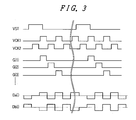
- FIG. 3 is a timing waveform chart showing scanning signals and video signals supplied to the pixel shown in FIG. 2.
- FIG. 4A to FIG. 4B are graphs showing gray scale voltages supplied to a pair of pixel electrodes shown in FIG. 2.
- FIG. 5 is a timing waveform chart showing the relationship among a gate line voltage, a drain line voltage and a pixel voltage supplied to the pixel shown in FIG. 2.
- FIG. 6 is a circuit diagram showing one embodiment of the constitution of a video driving circuit shown in FIG. 1.
- FIG. 7 is a circuit diagram showing another embodiment of the constitution of a video driving circuit shown in FIG.
- FIG. 8 is a timing waveform chart showing the relationship of the signals generated in the video driving circuits shown in FIG. 6 or FIG. 7.
- FIG. 9A to FIG. 9B are graphs showing another embodiment of gray scale voltages supplied to a pair of pixel electrodes.
- FIG. 10 is a circuit diagram showing another embodiment of the constitution of the video driving circuit shown in FIG. 1.
- FIG. 11 is a schematic constitutional view showing another embodiment of the image display device according to the present invention.
- FIG. 12 is a circuit diagram showing one embodiment of the constitution of a video driving circuit shown in FIG. 11.
- FIG. 13 is a circuit diagram showing another embodiment of the constitution of the video driving circuit shown in FIG. 11.
- FIG. 14 is a schematic constitutional view showing another embodiment of the image display device according to the present invention.
- FIG. 15 is an equivalent circuit diagram showing one embodiment of the constitution of a pixel of the image display device shown in FIG. 14.
- FIG. 16 is a timing waveform chart showing scanning signals and video signals supplied to the pixel shown in FIG. 15.
- FIG. 17 is a view showing the sequence of writing voltage to respective pixels shown in FIG. 15.
- FIG. 18 is a circuit diagram showing one embodiment of the constitution of the video driving circuit shown in FIG. 14.
- FIG. 19 is a circuit diagram showing another embodiment of the constitution of the video driving circuit shown in FIG. 14.
- FIG. 20 is a constitutional view showing another embodiment of the constitution of the video driving circuit shown in FIG. 14.
- FIG. 21A and FIG. 21B are views showing the relationship between gray scale data and video signals used in the video driving circuit shown in FIG. 20.
- FIG. 22 is a timing waveform chart showing the relationship between a gate line voltage, a drain line voltage and a pixel voltage supplied to each pixel using the video driving circuit shown in FIG. 20.
- FIG. 23 is a schematic constitutional view showing another embodiment of the image display device according to the present invention.
- FIG. 24 is an equivalent circuit diagram showing one embodiment of the constitution of a pixel of the image display device shown in FIG. 23.
- FIG. 25 is a circuit diagram showing one embodiment of the constitution of a common circuit shown in FIG. 23.
- FIG. 26 is a timing waveform chart showing the relationship between an output from the common circuit shown in FIG. 25 and other signals.
- FIG. 27 is a timing waveform chart showing the relationship between a gate line voltage, a drain line voltage, a counter voltage signal line voltage and a pixel voltage supplied to a pixel shown in FIG. 24.
- FIG. 28 is a circuit diagram showing one embodiment of the constitution of a video driving circuit shown in FIG. 23.
- FIG. 29A and FIG. 29B are views showing gray scale voltages supplied to a pair of pixel electrodes of each pixel shown in FIG. 24.
- FIG. 30 is a circuit diagram showing another embodiment of the constitution of the video driving circuit shown in the embodiment 1.
- the liquid crystal display device explained hereinafter is a so-called active matrix type liquid crystal display device, for example, wherein a so-called low-temperature polysilicon is used as a material of a semiconductor layers of each transistor element formed in the liquid crystal display device.
- the material of the semiconductor layer is not limited to the low-temperature polysilicon and the present invention is applicable to the liquid crystal display device which uses the semiconductor layers made of amorphous silicon, for example.
- FIG. 1 is a schematic constitutional view showing one embodiment of an image display device according to the present invention.
- the respective gate signal lines GL have at least one-end sides thereof connected to a scanning driving circuit 20 and scanning signals G( 1 ), G( 2 ), . . . , G(n) are sequentially supplied to the respective gate signal lines GL by the scanning driving circuit 20 .
- the respective drain signal lines DL have at least one-end sides thereof connected to a video driving circuit 30 and video signals Da( 1 ), Db( 1 ), Da( 2 ), Db( 2 ), . . . , Da(m), Db(m) are supplied from the left side in the drawing, for example, by the video driving circuit 30 at the timing of supplying the above-mentioned scanning signals G.
- Each region which is surrounded by a pair of gate signal lines GL which are arranged close to each other and a pair of drain signal lines DL which are arranged to close to each other and to which the video signals Da, Db are supplied is defined as a pixel region and a liquid crystal display part 10 is constituted of a mass of these pixel regions.
- n gate signal lines GL and 2m drain signal lines DL are provided.
- scanning driving control signals 21 and video driving control signals 31 are respectively inputted from a timing control circuit 50 so that the above-mentioned scanning signals G and the video signals Da, Db are outputted from the scanning driving circuit 20 and the video driving circuit 30 .
- numeral 51 indicates external input signals such as power supply and display data.
- FIG. 2 is an equivalent circuit diagram showing one embodiment of the constitution of respective pixel regions in the above-mentioned liquid crystal display part 10 .
- These thin film transistors 1 a , 1 b are respectively constituted of a MIS (metal insulator semiconductor) type transistor and gate electrodes of these transistors 1 a , 1 b are connected to the above-mentioned gate signal lines GL.
- MIS metal insulator semiconductor
- one electrode (referred to as a drain electrode for the sake of convenience) is connected to the drain signal line DL to which the video signal Da is supplied, while out of respective electrodes of the thin film transistor 1 b except for the gate electrode, one electrode (referred to as a drain electrode for the sake of convenience) is connected to the drain signal line DL to which the video signal Db is supplied.
- the pixel electrode 2 a is connected to another electrode (referred to as a source electrode for the sake of convenience), while out of respective electrodes of the thin film transistor 1 b except for the gate electrode, the pixel electrode 2 b is connected to another electrode (referred to as a source electrode for the sake of convenience).
- Liquid crystal 3 a is present between the pixel electrode 2 a and the pixel electrode 2 b and the liquid crystal 3 a is operated by an electric field generated due to the voltage difference between the pixel electrode 2 a and the pixel electrode 2 b such that the optical transmissivity of the liquid crystal is changed.
- VST indicates a start signal and VCK 1 and VCK 2 indicate clock signals and these signals constitute a portion of the above-mentioned scanning driving control signals 21 .
- phases of the scanning signals G( 1 ), G( 2 ), G( 3 ), . . . are sequentially changed in synchronism with the clock signals VCK 1 and VCK 2 .
- the (i)th video signals Da(i), Db(i) have polarities which are opposite to each other and these polarities are changed over for every period of the start signal VST so that a so-called alternating is performed.
- the video signals Da, Db which are supplied to each pixel region driven by the scanning signal G( 1 ) of the 1st row have the polarity in the succeeding frame which is opposite to the polarity of the preceding frame. Further, in the drawing, the polarities of the video signals Da(i), Db(i) are changed over also for every 1 horizontal period.
- FIG. 4A and FIG. 4B are graphs showing gray scale voltages Vda′(i), Vdb′(i) which are supplied to a pair of pixel electrodes.
- the voltage is elevated in a rectilinear manner in response to the gray scale data using the center voltage Vcent as the reference, while with respect to the gray scale voltage Vdb′(i) of the video signal Db(i), the voltage is in a rectilinear manner lowered in response to the gray scale data using the center voltage Vcent as the reference.
- the gray scale voltage Vda′(i) of the video signal Da(i) supplied to the pixel electrode 2 a side assumes VLC/2 in the+direction with respect to the center voltage Vcent
- the gray scale voltage Vdb′(i) of the video signal Db(i) supplied to the pixel electrode 2 b side assumes VLC/2 in the ⁇ direction with respect to the center voltage Vcent.
- the potential difference between the pixel electrode 2 a and the pixel electrode 2 b becomes VLC so that the liquid crystal 3 a is operated with intensity of electric field corresponding to such a potential difference.
- the voltage is lowered in a rectilinear manner in response to the gray scale data using the center voltage Vcent as the reference, while with respect to the gray scale voltage Vdb′(i) of the video signal Db(i), the voltage is in a rectilinear manner elevated in response to the gray scale data using the center voltage Vcent as the reference.
- the center voltage Vcent is substantially set to a fixed value irrelevant to the gray scale data.
- FIG. 5 is a timing waveform chart showing the relationship among the gate line voltage Vg(j) applied to the gate signal line GL, the drain line voltages Vda(i), Vdb(i) applied to each drain signal line DL and the pixel voltages Vpa(i, j), Vpb(i, j) of the pixel electrode 2 a and the pixel electrode 2 b in the pixel arranged at the j-th row and the (i)th column.
- the gray scale voltages Vda′(i), Vdb′(i) which respectively correspond to the gray scale data are applied to a pair of drain signal lines DL. Accordingly, the drain line voltages Vda(i), Vdb(i) are respectively formed such that they have polarities opposite to each other with respect to the center voltage Vcent as the center and the independent drain line voltages Vda(i), Vdb(i) have their polarities inverted during a period that the gate line voltage Vg(j) is inputted.
- the inversion of the polarities means that the relationship of magnitude of the drain line voltages Vda(i) and Vdb(i) is reversed.
- the pixel voltages Vpa(i, j), Vpb(i, j) respond such that the pixel voltages Vpa(i, j), Vpb(i, j) assume the equal value with the drain line voltages Vda(i), Vdb(i) respectively when the gate line voltage Vg(j). assumes “H” level.
- the change of voltage due to the feed-through depends on respective amplitudes of the drain line voltages Vda(i), Vdb(i) and the gate line voltage Vg(j) and hence, when there exists the relationship Vda(i) ⁇ Vdb(i), the relationship ⁇ Va ⁇ Vb is established.
- the polarities of the drain line voltages Vda(i), Vdb(i) are changed at a period that the next gate line voltage Vg(j) is inputted and hence, the feed-through voltages ⁇ Va, ⁇ Vb of pixel electrodes 2 a , 2 b respectively assume values different from the values in the preceding frame. That is, the next feed-through voltage ⁇ Va is equal to the feed-through voltage ⁇ Vb in the preceding frame and the next feed-through voltage ⁇ Vb is equal to the feed-through voltage ⁇ Va in the preceding frame.
- this feed-through voltage difference ( ⁇ Va ⁇ Vb) assumes the value whose polarity is inverted and whose absolute value is equal and hence, a direct-current components due to the feed-through becomes zero and hence, it is possible to obviate drawbacks such as flickering and sticking attributed to the direct-current components. Accordingly, the high quality display can be realized.
- FIG. 6 is a circuit diagram showing one embodiment of the constitution of the above-mentioned video driving circuit 30 .
- the video driving circuit 30 is constituted of the drain driver 310 and the alternating circuit 320 .
- the signal Doa(i) having the positive polarity and the signal Dob(i) having the negative polarity are respectively supplied to a pair of drain signal lines DL at the pixels of the (i)th column, while the signal Doa(i+1) having the positive polarity and the signal Dob(i+1) having the negative polarity are respectively supplied to a pair of drain signal lines DL at the pixels of the (i+1)th column.
- the alternating signals M 1 , M 2 are inputted together with the above-mentioned signals Doa(i), Dob(i), Doa(i+1), Dob(i+1).
- the alternating signals M 1 , M 2 are inputted with the relationship of logic inversion such that when one signal assumes “H”, another signal assumes “L”.
- the video driving circuit 30 having such a constitution has the alternating circuit 320 separately from the drain driver 310 and hence, it is unnecessary for the drain driver 310 to perform the alternating by itself. Accordingly, in the drain driver 310 , it is possible to always set the output signals Doa(i), Doa(i+1) to a positive polarity and the output signals Dob(i), Dob(i+1) to a negative polarity. Due to such a provision, it is possible to obtain advantageous effects that the drain driver 310 can simplify the constitution thereof and, at the same time, can reduce the power consumption.
- the electric fields applied to respective liquid crystals in the pixels of the (i)th column and the pixels of the (i+1)th column have polarities opposite to each other. Accordingly, by inverting the alternating signals M 1 , M 2 at the time of scanning the next row, so-called dot inversion driving can be realized.
- FIG. 7 is a circuit diagram showing another embodiment of the above-mentioned video driving circuit 30 and corresponds to FIG. 6.
- the constitution which makes this embodiment different from the embodiment shown in FIG. 6 lies in that a drain driver 311 from which the output signals Doa(i), Doa(i+1) assuming a positive polarity with respect to the center voltage Vcent are outputted and a drain driver 312 from which the output signals Dob(i), Dob(i+1) assuming a negative polarity with respect to the center voltage Vcent are outputted are provided separately from each other.
- the video driving circuit 30 having such a constitution can obtain an advantageous effect that by making respective drain drivers 311 , 312 separately input the power supply voltage and gray scale voltage corresponding to the gray scale data, the same type of driver can be used as respective drain drivers 311 , 312 .
- FIG. 8 is a timing waveform chart showing the scanning signals G( 1 ), G( 2 ), G( 3 ), . . . video signals Doa(i), Dob(i), Da(i), Db(i) and the like when the video driving circuit 30 shown in FIG. 6 or FIG. 7 is used and corresponds to FIG. 3.
- the alternating signals M 1 , M 2 have polarities opposite to each other and these polarities are inverted every one selection period of the scanning signal.
- the output signal Doa(i) from the drain drivers 310 , 311 , 312 the output signal Doa(i) always assumes a positive polarity with respect to the center voltage Vcent
- the output Dob(i) always assumes a negative polarity with respect to the center voltage Vcent.
- the video signals Da(i), Db(i) respectively change the polarities thereof in response to the alternating signals M 1 , M 2 .
- FIG. 9A and FIG. 9B are graphs showing another embodiment of the gray scale voltages Vda′(i), Vdb′(i) which are supplied to a pair of pixel electrodes and correspond to FIG. 4A and FIG. 4B.
- the constitution which makes this embodiment different from the embodiment shown in FIG. 4A and FIG. 4B lies in that one gray scale voltage is increased with a positive gradient with respect to the gray scale data and another gray scale voltage assumes a reference voltage VREF which is a substantially fixed value.
- the respective gray scale voltages Vda′(i) and Vdb′(i) have characteristics that they are both in a rectilinear manner elevated with respect to the reference voltage VREF which is substantially a fixed value.
- the present invention is not limited to such a case and it is needless say that they may have the gently-curved characteristics.
- the reference voltage VREF may be set larger than one gray scale voltage which is changed in response to the gray scale data.
- FIG. 10 is a circuit diagram showing another embodiment of the above-mentioned video driving circuit 30 and corresponds to FIG. 7.
- the constitution which makes this embodiment different from the embodiment shown in FIG. 7 lies in that the drain driver 312 is not provided, and to the input of the alternating circuit 320 , the terminal Dob which supplies the reference voltage VREF in place of the output signals Dob(i), Dob(i+1) from the drain driver 312 is connected.
- FIG. 11 is a schematic constitutional view showing another embodiment of the image display device according to the present invention and corresponds to FIG. 1.
- the constitution which makes this embodiment 2 different from the embodiment shown in FIG. 1 lies in that a video driving circuit 36 is provided at one-extending-end side of the drain signal lines DL and a video driving circuit 37 is provided at another-extending-end side of the drain signal lines DL. Video driving control signals 35 are inputted to the video driving circuit 37 from a timing control circuit 50 .
- FIG. 12 is a circuit diagram showing one embodiment of constitutions of the video driving circuits 36 and 37 shown in FIG. 11 and corresponds to FIG. 7.
- the video driving circuit 36 is constituted of the drain driver 311 and the alternating circuit 360 .
- the drain driver 311 is configured such that, in each pixel, out of video signals supplied to a pair of respective drain signal lines DL, one signals Doa(i), Doa(i+1) are outputted to the alternating circuit 360 .
- the alternating circuit 360 is constituted of transistors 361 to 364 , wherein an ON/OFF control of the transistors 361 , 364 is performed in response to the alternating signal M 1 and an ON-OFF control of the transistors 362 , 363 is performed in response to the alternating signal M 2 .
- the video driving circuit 37 is constituted of a drain driver 312 and an alternating circuit 370 .
- the drain driver 312 is configured such that, in each pixel, out of video signals supplied to a pair of respective drain signal lines DL, another signals Dob(i), Dob(i+1) are outputted to the alternating circuit 370 .
- the gray scale voltages Vda′(i), Vdb′(i) the voltages having characteristics shown in FIG. 4A and FIG. 4B are used.
- the alternating circuit 370 is constituted of transistors 371 to 374 , wherein an ON/OFF control of the transistors 371 , 374 is performed in response to the alternating signal M 2 and an ON-OFF control of the transistors 372 , 373 is performed in response to the alternating signal M 1 .
- FIG. 13 is a circuit diagram showing another embodiment of constitutions of video driving circuits and corresponds to FIG. 12.
- the constitution which makes this embodiment different from the embodiment shown in FIG. 12 lies in that without providing the drain driver 312 at the video driving circuit 37 side, the reference voltages VREF are supplied to all circuits in place of outputs from the drain driver 312 .
- the gray scale voltages Vda′(i), Vdb′(i) having the characteristics shown in FIG. 9A and FIG. 9B are outputted from the video driving circuits 36 , 37 .
- a wiring layer which supplies the reference voltage VREF can be formed without making this wiring layer and other wiring layer cross each other and hence, a large line width can be set whereby the reference voltage VREF of high accuracy can be obtained.
- FIG. 14 is a schematic constitutional view showing another embodiment of the image display device according to the present invention and corresponds to FIG. 1.
- respective gate signal lines GL are arranged such that, from the upper side in the drawing, the next gate signal line GL is arranged with respect to the first gate signal line GL with a relatively wide gap therebetween, and the further next gate signal line GL is arranged close to the next gate signal line GL, and the still further next gate signal line GL is arranged with respect to the further next gate signal line GL with a relatively wide gap therebetween, and such a relationship is repeated. Then, starting from the first gate signal line GL, the scanning signals Ga( 1 ), Gb( 1 ), Ga( 2 ), Gb( 2 ), . . . Gb(n) are sequentially supplied.
- respective drain signal lines DL are respectively arranged equidistantly and the video signals D( 1 ), D( 2 ), D( 3 ), . . . , D(m+1) are sequentially supplied from the left side of the drawing.
- FIG. 15 is an equivalent circuit diagram showing one embodiment of the constitution of each pixel in the image display device shown in FIG. 14 and corresponds to FIG. 2.
- the constitution which makes this equivalent circuit different from the equivalent circuit shown in FIG. 2 lies in that, first of all, in one pixel region, when the thin film transistors 1 c , 1 d are operated in response to the scanning signal Gb from the lower-side gate. signal line GL, respective thin film transistors 1 a , 1 b in the neighboring pixel regions at the left and right sides (x direction) are operated in response to the scanning signal Ga from the upper-side gate signal line GL.
- respective pixels which are arranged in the vertical direction are configured such that, in each pixel, respective thin film transistors 1 a , 1 b , 1 c , 1 d are operated in response to the scanning signal Gb from the lower-side gate signal line GL or the scanning signal Ga from the upper-side gate signal line GL.
- respective drain electrodes of a pair of respective thin film transistors 1 a , 1 b , 1 c , 1 d in each pixel are connected to one and another drain signal lines DL which define the pixel regions. Then, except for the drain signal lines DL arranged at both ends, the drain signal line DL between each two of pixels to which the video signals D( 2 ) to D(m) are inputted is used in common by the pixel in the different column.
- the pixel electrodes 2 a , 2 b , 2 c , 2 d are connected to respective source electrodes of respective thin film transistors 1 a , 1 b , 1 c , 1 d.
- the drain line selection signals L 1 , L 2 are explained later.
- FIG. 17 is a view showing the sequence of writing a voltage in respective pixels shown in FIG. 15.
- the pixels are expressed by 3 ⁇ 4, wherein when the scanning signal Ga( 1 ) is applied, the pixels of the first row and odd columns are selected and the voltage is written in these pixels. Subsequently, when the scanning signal Gb( 1 ) is applied, the pixels of the first row and even columns are selected and the voltage is written in these pixels. There after, with respect to pixels of the second and other following rows, the pixels are selected in the order of odd columns and even columns and the voltages are written in the pixels.
- FIG. 18 is a circuit diagram showing one embodiment of the constitution of the video driving circuit 30 shown in FIG. 14 and corresponds to FIG. 7.
- the constitution which makes this embodiment different from the constitution shown in FIG. 7 lies in that a drain line selection circuit 330 is newly added to the output of the alternating circuit 320 .
- the drain line selection circuit 330 is constituted of transistors 331 to 334 , wherein a drain line selection signal L 1 is supplied to the gate electrodes of the transistors 333 , 334 and a drain line selection signal L 2 is supplied to the gate electrodes of the transistors 331 , 332 .
- drain line selection signals L 1 , L 2 are respectively inputted with the inversion relationship.
- the outputs Doa(i), Dob(i) from the drain drivers 311 , 312 are supplied in the normal sequence or in the reverse sequence by the alternating circuit 320 and, thereafter, when the drain line selection signal L 1 assumes “H” and the drain line selection signal L 2 assumes “L”, the outputs Doa(i), Dob(i) at the left side and the right side of the alternating circuit 320 are directly supplied to the drain signal lines DL as the video signals D( 2 i ⁇ 1) and D( 2 i), while when the drain line selection signal L 1 assumes “L” and the drain line selection signal L 2 assumes “H”, the outputs are shifted to the next by one and are supplied to the drain signal lines DL as the video signals D( 2 i) and D( 2 i+1),
- the selection of the respective pixels which are arranged in a matrix array is, as shown in FIG. 17, enables the distribution of the video signals such that, in response to the scanning signals Ga( 1 ), Ga( 2 ), . . . from one gate signal line GL, for example, the pixels of odd columns are selected and hence, through a pair of drain signal lines Dl which are arranged at both sides of each pixel of odd columns, the video signals D( 2 i ⁇ 1) and D( 2 i) are supplied to a pair of pixel electrodes 2 a , 2 b in the pixel, and thereafter, in response to the scanning signals Gb( 1 ), Gb( 2 ), . . .
- the pixels of even columns are selected and hence, through a pair of drain signal lines Dl which are arranged at both sides of each pixel of even column, the video signals D( 2 i) and D( 2 i+1) are supplied to a pair of pixel electrodes 2 c , 2 d in the pixel.
- Such an operation can be achieved by adding the above-mentioned drain line selection circuit 330 to the conventional drain drivers 311 , 312 and hence, it is possible to obtain an advantageous effect that the drain drivers 311 , 312 can be used as it is.
- the drain driver 310 shown in FIG. 6 may be used in place of the drain drivers 311 , 312 .
- gray scale voltages Vda′(i), Vdb′(i) the voltages having the characteristics shown in FIG. 4A and FIG. 4B are used.
- FIG. 19 is a circuit diagram showing another embodiment of the constitution of the above-mentioned video driving circuit 30 and corresponds to FIG. 18.
- terminals Dob which supply the reference voltage VREF are connected to the input of the alternating circuit 320 in place of the output Dob(i), Dob(i+1) from the drain driver 312 .
- the reference voltage VREF is supplied to one drain signal line DL as the video signal D and the gray scale voltage output Doa(i) which uses the reference voltage VREF as the reference is supplied to another drain signal line DL as the video signal D.
- the gray scale voltages Vda′(i), Vdb′(i) the voltages having the characteristics shown in FIG. 9A and FIG. 9B are used.
- FIG. 20 is a circuit diagram showing another embodiment of the constitution of the above-mentioned video driving circuit 30 and corresponds to FIG. 19.
- the constitution which makes this embodiment different from the constitution shown in FIG. 19 lies in that, first of all, the video driving circuit 30 is not provided with the alternating circuit 320 . Further, the video driving circuit 30 includes drain line selection circuits 340 which connect the drain signal lines DL of even columns to which the video signals D( 2 i) are supplied to a common voltage VCOM and select the drain signal lines DL of odd columns.
- the common voltage VCOM may be connected to the drain signal lines DL of odd columns in place of the drain signal lines DL of even columns.
- the drain line selection circuit 340 is configured to output the output Doc(i) from the drain driver 313 directly as the video signal D( 2 i ⁇ 1) or as the video signal D( 2 i+1) by shifting by one in response to the drain line selection signals L 1 , L 2 .
- FIG. 21A to FIG. 21B are views showing the relationship between the gray scale data and the video signals used in the video driving circuit 30 shown in FIG. 20.
- the video signals Vd( 2 i) in the drain signal lines DL of even columns assume two states indicated by VC 1 in FIG. 21A and VC 2 in FIG., 21 B by changing over the alternating signals M 1 , M 2 without depending on the gray scale data.
- the video signals Vd( 2 i ⁇ 1) in the drain signal lines DL of odd columns are set such that the signals are changed with respect to the gray scale data with a positive or negative gradient using the above-mentioned two voltage stages VC 1 , VC 2 as the references.
- the drain driver 313 the polarities of the output Doc(i) is changed over so as to perform the operations shown in these drawings in response to the alternating signals M 1 , M 2 .
- FIG. 22 is a timing waveform chart showing the relationship among the gate line voltage, drain line voltages and the pixel voltage supplied to each pixel in the video driving circuit 30 shown in FIG. 20.
- the gate line voltage Vga(j) which selects the pixels of j row and odd columns, the drain line voltages Vd( 2 i ⁇ 1), Vd( 2 i) of ( 2 i ⁇ 1) row and ( 2 i) column, and the pixel voltages Vpa( 2 i ⁇ 1, j), Vpb( 2 i ⁇ 1, j) of a pair of pixel electrodes 2 a , 2 b of pixels of j row and ( 2 i ⁇ 1) column are indicated.
- the common voltage VCOM which is supplied to the drain signal lines DL of even rows assume two voltage states VC 1 , VC 2 and are configured to be changed over every frame period. Further, as the output voltage Vdoc(i) of the drain driver 313 , the voltage which assumes a positive polarity or a negative polarity with respect to the common VCOM is supplied. The polarity is changed over at a cycle equal to the changeover cycle of the common voltage VCOM. The voltage differene between the output voltage Vdoc(i) and the common voltage Vcom constitutes the liquid crystal driving voltage VLC.
- the pixel voltages Vpa( 2 i ⁇ 1, j), Vpb( 2 i ⁇ 1, j) of a pair of pixel electrodes 2 a , 2 b are configured to respond such that when the gate line voltage Vga(j) assumes “H”, the pixel voltages Vpa( 2 i ⁇ 1, j), Vpb( 2 i ⁇ 1, j) become respectively equal to the drain line voltages Vd( 2 i ⁇ 1), Vd( 2 i).
- FIG. 23 is a schematic constitutional view showing another embodiment of the image display device according to the present invention and corresponds to FIG. 1.
- the constitution which makes this embodiment different from the embodiment shown in FIG. 1 lies in that respective regions which are surrounded by gate signal lines GL which extend in the x direction and are arranged in parallel in the y direction and drain signal lines DL which extend in the y direction and are arranged in parallel in the x direction constitute the pixel regions.
- the image display device includes counter voltage signal lines CL which run through respective pixel regions arranged in the x direction and common signals C( 1 ) to C(n) are supplied to these counter voltage signal lines CL from a common circuit 60 . Accordingly, with respect to the pixel regions having the matrix array of n rows and m columns, n pieces of gate signal lines GL, m pieces of drain signal lines DL and n pieces of counter voltage signal lines CL are provided.
- control signals 61 are inputted to the common circuit 60 from the timing control circuit 50 .
- FIG. 24 is an equivalent circuit diagram showing one embodiment of the constitution of the pixel of the image display device shown in FIG. 23.
- FIG. 25 is a circuit diagram showing one embodiment of the constitution of the common circuit 60 shown in FIG. 23.
- the common circuit 60 is constituted of transistors 611 to 614 and the common voltage VC 1 , VC 2 and alternating signals M 1 , M 2 are inputted.
- the alternating signal M 1 is served for operating the transistors 611 and 612
- the alternating signal M 2 is served for operating the transistors 613 and 614 .
- FIG. 26 is a timing waveform chart of the scanning signals G(i), the common voltages VC 1 , VC 2 , the alternating signals M 1 , M 2 , the common signals C( 2 k ⁇ 1) which are supplied to the counter voltage signal lines CL of odd rows, and the common signals C( 2 k) which are supplied to the counter voltage signal lines CL of even rows of the image display device shown in FIG. 23.
- the scanning signals G( 1 ), G( 2 ), G( 3 ), . . . which are supplied to respective gate signal lines GL are configured to sequentially change phases thereof in synchronism with clock signals VCK 1 , VCK 2 .
- the common signals C( 2 k ⁇ 1) which are supplied to the counter voltage signal lines CL of odd rows and the common signals C( 2 k) which are supplied to the counter voltage signal lines CL of even rows are configured to change at the same phases as the alternating signals M 1 , M 2 .
- FIG. 27 is a timing waveform chart showing the relationship among the gate line voltage Vg(j) of j row which is supplied to the pixels shown in FIG. 24, the drain line voltage Vd(i) of row (i), the counter voltage signal line voltage Vc (j) of j row, and the pixel voltages Vpe(i,j), Vpf(i,j) of the pixel electrodes 2 e , 2 f of the pixel region of j row and i column.
- the drain line voltage Vd(i) is applied such that the difference between the drain line voltage Vd(i) and the counter voltage signal line voltage Vc(j) assumes the liquid crystal driving voltage VLC.
- the voltage changes ⁇ Ve, ⁇ Vf are generated by the feed-through.
- FIG. 28 is a circuit diagram showing one embodiment of the constitution of the video driving circuit 30 shown in FIG. 23.
- the video driving circuit 30 includes a drain driver 313 and its outputs Doc(i), Doc(i+1), Doc(i+2), . . . are respectively outputted to respective drain signal lies DL as video signals D(i), D(i+1), D(i+2), . . . .
- respective video signals D(i), D(i+1), D(i+2), . . . have polarities thereof changed every 1 horizontal period and are changed over between a case in which these signals take a positive polarity with respect to the common voltage VC 1 as shown in FIG. 29A and a case in which these signals take a negative polarity with respect to the common voltage VC 2 as shown in FIG. 29B.
- Vc(i) indicates a common voltage supplied to the counter voltage signal lines CL
- Vd(i) indicates a voltage of the video signal D(i) supplied to the drain signal line DL
- Vdoc(i) indicates a voltage of an output Doc(i) from a drain driver 313 .
- the changeover of the output Doc(i) from the drain driver 313 for every 1 horizontal period is configured to correspond to the distribution of VC 1 , VC 2 for every row in the common circuit 60 shown in FIG. 25.
- the period (every frame period) of the alternating signals M 1 , M 2 of the common circuit 60 and the alternating period (every 1 horizontal period) of the drain driver 313 are made different from each other.
- the polarity of the counter voltage signal line CL is changed over every 1 row in the common circuit 60 in the above-mentioned embodiment, it is needless to say that the polarity of the counter voltage signal line CL can be changed over every 2 rows or every 3 or more rows.
- the alternating period of the drain driver 313 is also set to every 2 horizontal periods or every 3 or more horizontal periods corresponding to the above-mentioned changeover of the polarity of the counter voltage signal line CL.
- FIG. 30 shows a circuit diagram showing another embodiment of the constitution of the video driving circuit 30 described in the embodiment 1.
- This embodiment is configured such that, of a pair of pixel electrodes 2 a , 2 b , a voltage of a common voltage VCOM is written in one pixel electrode and an output of the drain driver 313 is written in another pixel electrode.
- the voltage of the common voltage VCOM is configured to be changed over between two states of VC 1 or VC 2 in response to alternating signals M 1 , M 2 not shown in the drawing.
- an output Doc(i) from the drain driver 313 is also changed over between two cases, that is, a case in which the output Doc(i) assumes a positive polarity with respect to the voltage VC 1 and in which the output Doc(i) assumes a negative polarity with respect to the voltage VC 2 in response to the alternating signals M 1 , M 2 in the same manner.
- Such a constitution is similar to the constitutions which are described in conjunction with FIG. 21A and FIG. 21B as well as FIG. 29A and FIG. 29B.
- the common voltage VCOM and the output Doc(i) of the drain driver 313 are changed over at the same alternating period.
- the output Doc(i) of the drain driver 313 is outputted as the video signals Da(i) and the output Doc(i+2) of the drain driver 313 is outputted as the video signal Da(i+2) to the left-side drain signal line DL in one pixel.
- the output Doc(i+1) of the drain driver 313 may be outputted as the video signal Db(i+1) for the right-side drain signal line DL in one pixel.
- the reason that the drain signal lines DL are connected in a zigzag manner is to reverse the polarities of voltages applied to neighboring pixels as pixels of different columns. Accordingly, even when the outputs Doc(i), Doc(i+1), Doc(i+2) from the drain driver 313 may have the same polarity, it is possible to apply voltages of reverse polarities to the neighboring pixels.
- the liquid crystal driving voltage VLC may be reduced corresponding to the increase of the gray scale data.
Landscapes
- Engineering & Computer Science (AREA)
- Physics & Mathematics (AREA)
- Computer Hardware Design (AREA)
- General Physics & Mathematics (AREA)
- Theoretical Computer Science (AREA)
- Chemical & Material Sciences (AREA)
- Crystallography & Structural Chemistry (AREA)
- Liquid Crystal Display Device Control (AREA)
- Liquid Crystal (AREA)
- Control Of Indicators Other Than Cathode Ray Tubes (AREA)
Applications Claiming Priority (2)
| Application Number | Priority Date | Filing Date | Title |
|---|---|---|---|
| JP2002-106415 | 2002-04-09 | ||
| JP2002106415A JP2003302942A (ja) | 2002-04-09 | 2002-04-09 | 画像表示装置 |
Publications (1)
| Publication Number | Publication Date |
|---|---|
| US20030189563A1 true US20030189563A1 (en) | 2003-10-09 |
Family
ID=28672416
Family Applications (1)
| Application Number | Title | Priority Date | Filing Date |
|---|---|---|---|
| US10/404,105 Abandoned US20030189563A1 (en) | 2002-04-09 | 2003-04-02 | Image display device |
Country Status (2)
| Country | Link |
|---|---|
| US (1) | US20030189563A1 (enExample) |
| JP (1) | JP2003302942A (enExample) |
Cited By (7)
| Publication number | Priority date | Publication date | Assignee | Title |
|---|---|---|---|---|
| US20050168425A1 (en) * | 2004-01-29 | 2005-08-04 | Naoki Takada | Driving circuit for a display device |
| US20100302471A1 (en) * | 2009-05-29 | 2010-12-02 | Samsung Electronics Co., Ltd. | Liquid crystal display |
| US20110102415A1 (en) * | 2009-10-30 | 2011-05-05 | Yoon Hyun-Sik | Display apparatus |
| US20150061987A1 (en) * | 2008-12-24 | 2015-03-05 | Samsung Display Co., Ltd. | Display panel |
| CN111417895A (zh) * | 2017-12-22 | 2020-07-14 | 株式会社半导体能源研究所 | 显示装置 |
| US20220299831A1 (en) * | 2018-01-19 | 2022-09-22 | Semiconductor Energy Laboratory Co., Ltd. | Display Apparatus |
| US20230206872A1 (en) * | 2021-12-29 | 2023-06-29 | Novatek Microelectronics Corp. | Timing control circuit and operation method thereof |
Families Citing this family (6)
| Publication number | Priority date | Publication date | Assignee | Title |
|---|---|---|---|---|
| JP5089252B2 (ja) * | 2006-08-07 | 2012-12-05 | 株式会社ジャパンディスプレイウェスト | 電気光学素子の駆動方法、画素回路、電気光学装置および電子機器 |
| JP2008250118A (ja) | 2007-03-30 | 2008-10-16 | Seiko Epson Corp | 液晶装置、液晶装置の駆動回路、液晶装置の駆動方法および電子機器 |
| JP5201082B2 (ja) * | 2009-06-04 | 2013-06-05 | 株式会社Jvcケンウッド | 液晶表示装置 |
| KR101725341B1 (ko) * | 2009-08-13 | 2017-04-11 | 삼성디스플레이 주식회사 | 액정 표시 장치 |
| JP5691758B2 (ja) * | 2011-04-06 | 2015-04-01 | 株式会社Jvcケンウッド | 液晶表示装置及びその駆動方法 |
| JP5842632B2 (ja) * | 2012-01-26 | 2016-01-13 | セイコーエプソン株式会社 | 電気光学装置および電子機器 |
Citations (5)
| Publication number | Priority date | Publication date | Assignee | Title |
|---|---|---|---|---|
| US5500538A (en) * | 1990-12-20 | 1996-03-19 | Semiconductor Energy Laboratory Co., Ltd. | Electro-optical device and method of driving the same |
| US6118421A (en) * | 1995-09-29 | 2000-09-12 | Sharp Kabushiki Kaisha | Method and circuit for driving liquid crystal panel |
| US6226057B1 (en) * | 1997-04-18 | 2001-05-01 | Hyundai Electronics Industries Co., Ltd. | Liquid crystal display having overlapped pixel electrodes and method for fabricating the same |
| US6411273B1 (en) * | 1997-04-22 | 2002-06-25 | Matsushita Electric Industrial Co., Ltd. | Drive circuit for active matrix liquid crystal display |
| US6563481B1 (en) * | 1999-02-10 | 2003-05-13 | Nec Corporation | Active matrix liquid crystal display device, method of manufacturing the same, and method of driving the same |
-
2002
- 2002-04-09 JP JP2002106415A patent/JP2003302942A/ja active Pending
-
2003
- 2003-04-02 US US10/404,105 patent/US20030189563A1/en not_active Abandoned
Patent Citations (5)
| Publication number | Priority date | Publication date | Assignee | Title |
|---|---|---|---|---|
| US5500538A (en) * | 1990-12-20 | 1996-03-19 | Semiconductor Energy Laboratory Co., Ltd. | Electro-optical device and method of driving the same |
| US6118421A (en) * | 1995-09-29 | 2000-09-12 | Sharp Kabushiki Kaisha | Method and circuit for driving liquid crystal panel |
| US6226057B1 (en) * | 1997-04-18 | 2001-05-01 | Hyundai Electronics Industries Co., Ltd. | Liquid crystal display having overlapped pixel electrodes and method for fabricating the same |
| US6411273B1 (en) * | 1997-04-22 | 2002-06-25 | Matsushita Electric Industrial Co., Ltd. | Drive circuit for active matrix liquid crystal display |
| US6563481B1 (en) * | 1999-02-10 | 2003-05-13 | Nec Corporation | Active matrix liquid crystal display device, method of manufacturing the same, and method of driving the same |
Cited By (18)
| Publication number | Priority date | Publication date | Assignee | Title |
|---|---|---|---|---|
| US20050168425A1 (en) * | 2004-01-29 | 2005-08-04 | Naoki Takada | Driving circuit for a display device |
| US20150061987A1 (en) * | 2008-12-24 | 2015-03-05 | Samsung Display Co., Ltd. | Display panel |
| US9576547B2 (en) * | 2008-12-24 | 2017-02-21 | Samsung Display Co., Ltd. | Display panel with alternating sub-pixel electrodes |
| US20100302471A1 (en) * | 2009-05-29 | 2010-12-02 | Samsung Electronics Co., Ltd. | Liquid crystal display |
| US9411206B2 (en) | 2009-05-29 | 2016-08-09 | Samsung Display Co., Ltd. | Liquid crystal display |
| US9195107B2 (en) | 2009-05-29 | 2015-11-24 | Samsung Display Co., Ltd. | Liquid crystal display |
| EP2317502A3 (en) * | 2009-10-30 | 2014-07-09 | Samsung Display Co., Ltd. | Display apparatus |
| US8963822B2 (en) | 2009-10-30 | 2015-02-24 | Samsung Display Co., Ltd. | Display apparatus |
| CN102053413A (zh) * | 2009-10-30 | 2011-05-11 | 三星电子株式会社 | 显示设备 |
| US20110102415A1 (en) * | 2009-10-30 | 2011-05-05 | Yoon Hyun-Sik | Display apparatus |
| CN111417895A (zh) * | 2017-12-22 | 2020-07-14 | 株式会社半导体能源研究所 | 显示装置 |
| EP3731008A4 (en) * | 2017-12-22 | 2021-07-21 | Semiconductor Energy Laboratory Co., Ltd. | DISPLAY DEVICE |
| US11217190B2 (en) | 2017-12-22 | 2022-01-04 | Semiconductor Energy Laboratory Co., Ltd. | Display device including pixels and source drive circuit |
| US20220299831A1 (en) * | 2018-01-19 | 2022-09-22 | Semiconductor Energy Laboratory Co., Ltd. | Display Apparatus |
| US11815775B2 (en) * | 2018-01-19 | 2023-11-14 | Semiconductor Energy Laboratory Co., Ltd. | Display apparatus having pixels connected to first and second wirings set to different potentials |
| US12353105B2 (en) | 2018-01-19 | 2025-07-08 | Semiconductor Energy Laboratory Co., Ltd. | Display apparatus |
| US20230206872A1 (en) * | 2021-12-29 | 2023-06-29 | Novatek Microelectronics Corp. | Timing control circuit and operation method thereof |
| US11823637B2 (en) * | 2021-12-29 | 2023-11-21 | Novatek Microelectronics Corp. | Timing control circuit and operation method thereof |
Also Published As
| Publication number | Publication date |
|---|---|
| JP2003302942A (ja) | 2003-10-24 |
Similar Documents
| Publication | Publication Date | Title |
|---|---|---|
| US8031148B2 (en) | Liquid crystal display, apparatus for driving a liquid crystal display, and method of generating gray voltages | |
| KR100997978B1 (ko) | 액정 표시 장치 | |
| CA2046357C (en) | Liquid crystal display | |
| KR101026802B1 (ko) | 액정 표시 장치 및 그 구동 방법 | |
| KR101018755B1 (ko) | 액정 표시 장치 | |
| JP4420620B2 (ja) | 画像表示装置 | |
| KR20100075023A (ko) | 표시 장치 | |
| US8872742B2 (en) | LCD and drive method thereof | |
| US20070018923A1 (en) | Driving circuit, display device, and driving method for the display device | |
| KR101152137B1 (ko) | 액정 표시 장치 | |
| TWI425468B (zh) | 液晶顯示裝置 | |
| JP3147104B2 (ja) | アクティブマトリクス型液晶表示装置とその駆動方法 | |
| JP2003302942A (ja) | 画像表示装置 | |
| KR101108155B1 (ko) | 액정 표시 장치 및 그의 구동 방법 | |
| KR101074381B1 (ko) | 횡전계방식 액정표시장치 | |
| JP2008233454A (ja) | 電気光学装置、駆動方法、駆動回路および電子機器 | |
| CN106502008A (zh) | 液晶显示装置以及液晶显示方法 | |
| KR100744136B1 (ko) | 인버젼 방식으로 디스플레이 패널을 구동하는 방법 및 그방법에 의해 구동되는 디스플레이 패널 | |
| WO2009148006A1 (ja) | 表示装置 | |
| KR101308457B1 (ko) | 액정표시장치 | |
| WO2010125716A1 (ja) | 表示装置および表示装置の駆動方法 | |
| KR100909048B1 (ko) | 액정표시장치 및 그 구동방법 | |
| KR20030083310A (ko) | 액정표시장치 | |
| KR100366749B1 (ko) | 컬러 액정 표시 패널 및 컬러 액정 표시 장치 | |
| KR101298402B1 (ko) | 액정패널 및 그를 포함하는 액정표시장치 |
Legal Events
| Date | Code | Title | Description |
|---|---|---|---|
| AS | Assignment |
Owner name: HITACHI DEVICE ENGINEERING CO., LTD., JAPAN Free format text: ASSIGNMENT OF ASSIGNORS INTEREST;ASSIGNORS:SATO, HIDEO;SATO, TOMOHIKO;MAKI, MASAHIRO;AND OTHERS;REEL/FRAME:014138/0445;SIGNING DATES FROM 20030320 TO 20030404 Owner name: HITACHI DISPLAYS, LTD., JAPAN Free format text: ASSIGNMENT OF ASSIGNORS INTEREST;ASSIGNORS:SATO, HIDEO;SATO, TOMOHIKO;MAKI, MASAHIRO;AND OTHERS;REEL/FRAME:014138/0445;SIGNING DATES FROM 20030320 TO 20030404 |
|
| STCB | Information on status: application discontinuation |
Free format text: ABANDONED -- FAILURE TO RESPOND TO AN OFFICE ACTION |