US1982996A - Fly - Google Patents
Fly Download PDFInfo
- Publication number
- US1982996A US1982996A US737434A US73743434A US1982996A US 1982996 A US1982996 A US 1982996A US 737434 A US737434 A US 737434A US 73743434 A US73743434 A US 73743434A US 1982996 A US1982996 A US 1982996A
- Authority
- US
- United States
- Prior art keywords
- fly
- strip
- zipper
- edge
- strips
- Prior art date
- Legal status (The legal status is an assumption and is not a legal conclusion. Google has not performed a legal analysis and makes no representation as to the accuracy of the status listed.)
- Expired - Lifetime
Links
- 239000004744 fabric Substances 0.000 description 10
- 238000010276 construction Methods 0.000 description 4
- 239000000463 material Substances 0.000 description 4
- 230000000295 complement effect Effects 0.000 description 3
- 238000000034 method Methods 0.000 description 3
- 238000000926 separation method Methods 0.000 description 1
Images

Classifications
-
- A—HUMAN NECESSITIES
- A41—WEARING APPAREL
- A41D—OUTERWEAR; PROTECTIVE GARMENTS; ACCESSORIES
- A41D1/00—Garments
- A41D1/06—Trousers
Definitions
- This invention relates to 'y construction for trousers and particularly to a fly closed by a slide fastener of the zipper type.
- One of the objects of the invention is to provide Y5 affly construction in which, notwithstanding the employment of the zipper slide fastener, the right fly as well as the left is made of one integral piece of conventional shape instead of requiring the use of an additional piece of cloth at the 10 bottom of the right fly.
- Another object of the invention is the provision .of a yconstruction comprising theright and vleft cooperating flies, curved at their lower ends in conventional manner, with one strip of the zipper slide fastener extending along that edge "of the right fly which will be stitched to the right front of the trousers down to a point adjacent the beginning of the lateral curvature of the fiy, and then being diverted from its rectilinear course a'nd extended across the fly to the opposite edge,
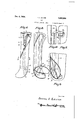
- - Figures 1 and2 are respectively, viewsin side '35 elevation of the confronting-faces of the right and left nies with the zipper strips in position;
- Figure 3 is a cross section taken along the line 3-3 of Figure 1;
- Figure 4 is a perspective view showing the flies l with the zipper vtype fastening in assembled relation: o
- Figure 5 is a cross section taken along the line 5-5 of Figure 4; l
- Figure 6 is a perspective view of the lower por- -45 tion of a ny'e'mbracing the features of the present invention illustrating one method of finishing the lower ends of the zipper" strips:
- Figure 7 is a plan view of Figure 6;
- Figure 8 is a perspective view of the assembled flies with the lower end of the leftl fly turned up illustrating ⁇ another method for finishing the lower ends of the zipper" type strips;
- Figure 9 is a similar view, part being broken away showing still a third method for finishing
- Figure 10 is an inside view in elevation illustrating the concealed padding for preventing the slide pushing a hole through the material when the trousers are pressed;
- Figure 11 is a similar view from the outside of 60 the trousers, a layer of the fabric being broken away to reveal the pad.
- the flies are narrow fabric strips having parallel edges extending for more than half the length of the fly, the edges then curving in the same direction, one being concave and the other being convex so that the fly has a lateral curved and substantially pointed extension to one side. It is customary where a slide fastener of the zipper type is 4ernployed to make theedge of the y remote from the free edge straight throughout its length and to attach one of the zipper strips to this straight edge by stitching.
- the zipper strip is customarily formed of a series of hooks attached to one piece of braid by way of finish to another lpiece of braid, the longitudinal edge of the zipper strip opposite the hooks being open between i f the two pieces of braid. It is customary in the art to insert a roughly triangular piece of fabric. additional to the flies, between the pieces of braid constituting the zipper" strip, and to stitch it in place. This necessitates not only the employ- 85. ment of additional material, but lalso an added step in the construction of the ily. involving anadded item of expense, and besides it makes an inferior crotch finish.
- the numerals 1 and 2 represent respectively, the right and left flies.
- a zipper ⁇ strip 3 is arranged with its fabric edge adjacent the edge of the fly I which will be stitched to the right side of the trousers and continuing down to the point 4 which in the embodiment of the invention shown is somewhat more than half way down the edge kof the fly, from which point the zipper strip is'de- ⁇ 105 flected away from the edge with which it has substantially coincided and extends inclinedly across the fly to the yopposite edge. That portion of the zipper strip which parallels the edge of the ily is stitched to the fiy by a single row of stitching 11.0
- the complementary zipper strip 10 extends longitudinallyof the intermediate portion of the left ily 2 preferably parallel to the edges of said fly, and below the middle of the 'y itis made to veer toward the convex edge of the ily with a curvature'corresponding to that of the zipper strip 3, the relation of the zipper strips being illustrated in the assembled ily shown in Figure 4.
- a buier strip 11 of any suitable material crosses the linear junction of the slide fastener adjacent the lower ends of the series of hooks 12, andthat just below the said buffer strip, the zipper strips are positively locked together -by a staple 13.
- the buffer strip is for the purpose of engaging the slide 14 at the lower limit of its travel bringing it yieldingly to a stop and preventing its direct engagement with the staple 13 which might be torn from the fabric by violent operation of the slide.
- FIG 6 another form is illustrated of nishing the lower ends of the flies.
- the lower end Wner as the lower end 16 of the 16 of the. zipper strip 10 is surged to the convex edge of the left ily 2, in the same manner ⁇ 'as in Figure 8.
- the lower end 15 of the zipper strip 3 is stitched to the face of the ily 1, being folded about the convex edge of said y and stitched beneath the lining 19 of said fly as best illustrated in Figure 7.
- Fly assembly comprising right and left flies the lower ends of saidies being laterally curved and adapted to be substantially congruently arranged, a slide fastener of the zipper type closing said flies, comprising strips having series of hooks, and a slide for interdigitating said hooks, one strip being sewn on the right ily adjacent and substantially parallel to the edge of said fly remote from its free edge, to a point yadjacent the beginning of the curved portion of said ily, from which point it is diverted from said edge in a downwardly inclined direction to the opposite edge, the other strip being sewn approximately along the middle of the left fly and having its lower portion diverted with a curvature corresponding tothat of the first strip, and means for uniting said strips at the lower limit of the opening range of said slide fastener.
- fly assembly comprising right and left flies in lapped relation, the lower ends of said flies being laterally curved and adapted to be substantially congruently arranged, a slide fastener of the zipper type closingsaid flies, comprising strips having series of hooks, and a slide forinterdigitating'said hooks, one strip being sewn on the right fly adjacent and substantially parallel to the edge of said ily remote from its free edge, to a point adjacent the beginning of the curved'11u portion of said ily, from which point it is diverted from said edge in a downwardly inclined direction to the opposite edge, the other strip v being sewn approximately along the middle of the left fly and having its lower portion diverted with a curvature corresponding to that of the rst strip, a staple uniting said strips adjacent the lower limit of the opening range.of said slide fastener, and a. fabric buffer secured to both strips above said staple intersecting the line of separation between said strips".
- Fly assembly comprising right and left ies in lapped relation, the lower ends of said flies being laterally curved and adapted to be substantially congruently arranged, a slide fastener of the zipper type closing said flies, comprising strips having series of hooks, and a slide for interdigitating said hooks, one strip being sewn on to the right ily adjacent and substantially parallel to the edge 4of said fly remote from the free edge to a" ⁇ 130 point adjacent the beginning of the curved portion of Asaid y, from which point it is diverted in a downwardly inclined direction to the opposite edge of the y, the other strip being sewn approximately along the middle of the left ily""l35 and having its lower portion diverted with an inclination corresponding to that of the first strip, means for uniting said strips at the lower limit of the opening range of saidslide fastener, said strips, without hooks, extending below said uniting means, the lower end portion of the strip on the left y being surged to the convexedge of said fly.
- Fly assembly comprising right and left flies in lapped relation, the lower ends of said ilies being laterally curved and adapted to be substantially congruently arranged, a slide fastener of the zipper type closing said ily, comprising strips having series of hooks, and a slide for interdigitating said hooks, one strip being sewn on to the right fly adjacent and. substantially parallel to the edge of the ily remote from the free edge, to a point adjacent the beginning of the curved portion of said fly, from which point it is directed in a downwardly inclined direction to the opposite edge of the ily, the complementary strip 4being sewn'approximately along the middle of the left fiy and having its lower portion diverted'.
- Fly assembly comprising right and left ies in lapped relation, the lower ends of said flies being laterally curved and adapted to be substantially congruently arranged, a slide fastener of the zipper type closing said flies, comprising strips having series of hooks, and a slide for interdigitating said hooks, one strip being sewn on the right ily adjacent to and substantially parallel with the edge of said fly remote from its free edge to a point adjacent thev beginning of the curved portion of said fly, from which point it is diverted from said edge in a downwardly inclined direction to the opposite edge, the complementary strip being sewn to the left fly in operative relation to the first strip.
Landscapes
- Engineering & Computer Science (AREA)
- Textile Engineering (AREA)
- Details Of Garments (AREA)
Description
Dec.4, 1934. L EV|NE 41,982,996 FLY Filed July 28. 1934 2 sheets-sheet 1 1. I F19. 2. Z
gmc/wrom Z l IRA/ING I. LUE V/NE l. I. LEVINE Dec; 4, 1934,
FLY
Filed July 28, 1934 2 Sheets-Sheet 2 Dev/Nc; I. LEV/N5 Patented Dec. 4, 1934 PATENT OFFICE FLY Irving I. Levine, Norfolk, va., signor of mehalf to Solomon Mednick, Norfolk, Va.
Application July 28, 1934, Serial N0. 737,434
8 Claims. (Cl. ,2P-234) This invention relates to 'y construction for trousers and particularly to a fly closed by a slide fastener of the zipper type.
One of the objects of the invention is to provide Y5 affly construction in which, notwithstanding the employment of the zipper slide fastener, the right fly as well as the left is made of one integral piece of conventional shape instead of requiring the use of an additional piece of cloth at the 10 bottom of the right fly.
Another object of the invention is the provision .of a yconstruction comprising theright and vleft cooperating flies, curved at their lower ends in conventional manner, with one strip of the zipper slide fastener extending along that edge "of the right fly which will be stitched to the right front of the trousers down to a point adjacent the beginning of the lateral curvature of the fiy, and then being diverted from its rectilinear course a'nd extended across the fly to the opposite edge,
and the left fly having on its inner side the coop-l erating zipper strip extending 'lengthwise of the'fiy intermediate its longitudinal edges, and curving to correspond tothe curvature of the complernentary zipper strip.
Other objects of the invention relate to several novel arrangements for finishing the raw lower ends of the cooperating zipper strips. y In the drawings which accompany and form a part of the following specification and throughout the several figures of which the same characters of reference have been employed to designate identical parts:
-Figures 1 and2 are respectively, viewsin side '35 elevation of the confronting-faces of the right and left nies with the zipper strips in position;
Figure 3 is a cross section taken along the line 3-3 of Figure 1;
Figure 4 is a perspective view showing the flies l with the zipper vtype fastening in assembled relation: o
, Figure 5 is a cross section taken along the line 5-5 of Figure 4; l
Figure 6 is a perspective view of the lower por- -45 tion of a ny'e'mbracing the features of the present invention illustrating one method of finishing the lower ends of the zipper" strips:
Figure 7 is a plan view of Figure 6; Figure 8 is a perspective view of the assembled flies with the lower end of the leftl fly turned up illustrating `another method for finishing the lower ends of the zipper" type strips; Figure 9 is a similar view, part being broken away showing still a third method for finishing Figure 10 is an inside view in elevation illustrating the concealed padding for preventing the slide pushing a hole through the material when the trousers are pressed; and
Figure 11 is a similar view from the outside of 60 the trousers, a layer of the fabric being broken away to reveal the pad.
Before adverting to a detailed description of the present invention, it may b'e stated in distinguishing the new from what is old, vthat the flies are narrow fabric strips having parallel edges extending for more than half the length of the fly, the edges then curving in the same direction, one being concave and the other being convex so that the fly has a lateral curved and substantially pointed extension to one side. It is customary where a slide fastener of the zipper type is 4ernployed to make theedge of the y remote from the free edge straight throughout its length and to attach one of the zipper strips to this straight edge by stitching. The zipper strip is customarily formed of a series of hooks attached to one piece of braid by way of finish to another lpiece of braid, the longitudinal edge of the zipper strip opposite the hooks being open between i f the two pieces of braid. It is customary in the art to insert a roughly triangular piece of fabric. additional to the flies, between the pieces of braid constituting the zipper" strip, and to stitch it in place. This necessitates not only the employ- 85. ment of additional material, but lalso an added step in the construction of the ily. involving anadded item of expense, and besides it makes an inferior crotch finish.
It was with the object of improving the cony struction of the fly as well as lessening the cost of making the same that the principalv .feature of the present invention was evolved which avoids using an additional piece of material.
Referring -now in detail tothe several figures and first adverting to the group of Figures 1 to 5, inclusive, the numerals 1 and 2 represent respectively, the right and left flies. On the outer faceof the right fiy a zipper `strip 3 is arranged with its fabric edge adjacent the edge of the fly I which will be stitched to the right side of the trousers and continuing down to the point 4 which in the embodiment of the invention shown is somewhat more than half way down the edge kof the fly, from which point the zipper strip is'de- `105 flected away from the edge with which it has substantially coincided and extends inclinedly across the fly to the yopposite edge. That portion of the zipper strip which parallels the edge of the ily is stitched to the fiy by a single row of stitching 11.0
5 while the portion of'said "zipper strip which extends across the y is stitched thereto by double rows of stitching 6 and 7. The lower edge 8 of this zipper strip is finished in any of the three modes presently to be described and the upper edge of the zipper" strip may be sewed into the belt line in the manner indicated at 9 in Figure 10 and which is well known in the tailoring art.
The complementary zipper strip 10 extends longitudinallyof the intermediate portion of the left ily 2 preferably parallel to the edges of said fly, and below the middle of the 'y itis made to veer toward the convex edge of the ily with a curvature'corresponding to that of the zipper strip 3, the relation of the zipper strips being illustrated in the assembled ily shown in Figure 4.
It will be observed that a buier strip 11 of any suitable material crosses the linear junction of the slide fastener adjacent the lower ends of the series of hooks 12, andthat just below the said buffer strip, the zipper strips are positively locked together -by a staple 13. The buffer strip is for the purpose of engaging the slide 14 at the lower limit of its travel bringing it yieldingly to a stop and preventing its direct engagement with the staple 13 which might be torn from the fabric by violent operation of the slide.
Below the staple 13 the hooks are absent from the zipper` strips leaving the fabric ends 15 and 16 which may be nished in any of severalways, one of which is illustrated in Figure 8, showing that the end 16 of the zi per" strip 10 is cut flush with the convexedge the left y and surged together with `the ily edge 17. Il'he lower end 15 of the zipper strip 3 terminates short of the convex edge of the right fly 1 being stitched to the face of said fly with its free edge 18 turned under.
In Figure 6 another form is illustrated of nishing the lower ends of the flies. The lower end Wner as the lower end 16 of the 16 of the. zipper strip 10 is surged to the convex edge of the left ily 2, in the same manner` 'as in Figure 8. The lower end 15 of the zipper strip 3 is stitched to the face of the ily 1, being folded about the convex edge of said y and stitched beneath the lining 19 of said fly as best illustrated in Figure 7.
Still another mode of nishing the ends ofthe flies is illustrated in Figure 9 in which the end 16 of the zipper strip 10 terminates beneath the surging at the convex edge of the left y 2 while the lower end 15 of the zipper strip 3 is stitched against the fly 2 and has its free edge surged to the convex edge of the ily 2 in the same manzipper strip 10. zlpper" strips are concealed between plies of the waist band of the trousers inthe manner known to the art and which forms no part of the present invention. However, it has been discovered that in pressing garments having flies provided with the zipper type closure, protection is needed to keep the slide from pushing a hole through the lfront of the trousers by the pressing action. To avoid this a small patch of fabric 201s sewn on the opposite face of the left fly to that upon which the zipper strip 10 is secured, said patch being posi. tioned to come between the slide and the left front of the trousers when the zipper slide is in closed position, its function being to pad the slide and prevent it working through the front of the trousers when under pressure. y
While I have in the above description defined 'I'he upper ends of the 'l what I believe to be preferred and practical forms in lapped relation,
of the invention, it will be understood to those skilled in the art that the specific details of construction as shown and described are merely by way of example excepting as they illustrate the subject matter of the claims and are not to be construed as limiting the scope of the invention.
What I claim is: 1. Fly assembly comprising right and left flies the lower ends of saidies being laterally curved and adapted to be substantially congruently arranged, a slide fastener of the zipper type closing said flies, comprising strips having series of hooks, and a slide for interdigitating said hooks, one strip being sewn on the right ily adjacent and substantially parallel to the edge of said fly remote from its free edge, to a point yadjacent the beginning of the curved portion of said ily, from which point it is diverted from said edge in a downwardly inclined direction to the opposite edge, the other strip being sewn approximately along the middle of the left fly and having its lower portion diverted with a curvature corresponding tothat of the first strip, and means for uniting said strips at the lower limit of the opening range of said slide fastener.
2. Fly assembly comprising right and left flies in lapped relation, the lower ends of said flies being laterally curved and adapted to be substantially congruently arranged, a slide fastener of the zipper type closingsaid flies, comprising strips having series of hooks, and a slide forinterdigitating'said hooks, one strip being sewn on the right fly adjacent and substantially parallel to the edge of said ily remote from its free edge, to a point adjacent the beginning of the curved'11u portion of said ily, from which point it is diverted from said edge in a downwardly inclined direction to the opposite edge, the other strip v being sewn approximately along the middle of the left fly and having its lower portion diverted with a curvature corresponding to that of the rst strip, a staple uniting said strips adjacent the lower limit of the opening range.of said slide fastener, and a. fabric buffer secured to both strips above said staple intersecting the line of separation between said strips".
3. Fly assembly comprising right and left ies in lapped relation, the lower ends of said flies being laterally curved and adapted to be substantially congruently arranged, a slide fastener of the zipper type closing said flies, comprising strips having series of hooks, and a slide for interdigitating said hooks, one strip being sewn on to the right ily adjacent and substantially parallel to the edge 4of said fly remote from the free edge to a"`130 point adjacent the beginning of the curved portion of Asaid y, from which point it is diverted in a downwardly inclined direction to the opposite edge of the y, the other strip being sewn approximately along the middle of the left ily""l35 and having its lower portion diverted with an inclination corresponding to that of the first strip, means for uniting said strips at the lower limit of the opening range of saidslide fastener, said strips, without hooks, extending below said uniting means, the lower end portion of the strip on the left y being surged to the convexedge of said fly.
4'. Fly as claimed in claim 3, the lower end 145 portions of both strips being surged to the convex edge of the left y. j
5. Fly as claimed in claim 3, the lower end of the strip on the left ily being surged to the convex edge of said ily, and the lower end ofthe strip on the right 'y being sewed to the face of said right y, terminating short of the convex edge of said fly.
6. Fly as claimed in claim 3p, the right ily having a lining, the lower end of the strip on said left fly being surged to the convex edge of said left fly and the lower end of the strip `on the right fly being stitched to the face of said right y and being folded over the convex edge of said right fly and having its free end sewn between the said fly and the lining thereof.
7. Fly assembly comprising right and left flies in lapped relation, the lower ends of said ilies being laterally curved and adapted to be substantially congruently arranged, a slide fastener of the zipper type closing said ily, comprising strips having series of hooks, and a slide for interdigitating said hooks, one strip being sewn on to the right fly adjacent and. substantially parallel to the edge of the ily remote from the free edge, to a point adjacent the beginning of the curved portion of said fly, from which point it is directed in a downwardly inclined direction to the opposite edge of the ily, the complementary strip 4being sewn'approximately along the middle of the left fiy and having its lower portion diverted'.
with an inclination corresponding to that of the first strip, means for uniting said strips at the lower limit of the opening range of said slide fastener, and a pad sewn across the strip which is secured to the left fly, above said slide in relation to the front of the trousers, when said slide is at the upper limit of its range of movement to prevent said slide wearing a hole in the superposed trousers fabric.
8. Fly assembly comprising right and left ies in lapped relation, the lower ends of said flies being laterally curved and adapted to be substantially congruently arranged, a slide fastener of the zipper type closing said flies, comprising strips having series of hooks, and a slide for interdigitating said hooks, one strip being sewn on the right ily adjacent to and substantially parallel with the edge of said fly remote from its free edge to a point adjacent thev beginning of the curved portion of said fly, from which point it is diverted from said edge in a downwardly inclined direction to the opposite edge, the complementary strip being sewn to the left fly in operative relation to the first strip.
IRVING I. LEVINE.
Priority Applications (1)
| Application Number | Priority Date | Filing Date | Title |
|---|---|---|---|
| US737434A US1982996A (en) | 1934-07-28 | 1934-07-28 | Fly |
Applications Claiming Priority (1)
| Application Number | Priority Date | Filing Date | Title |
|---|---|---|---|
| US737434A US1982996A (en) | 1934-07-28 | 1934-07-28 | Fly |
Publications (1)
| Publication Number | Publication Date |
|---|---|
| US1982996A true US1982996A (en) | 1934-12-04 |
Family
ID=24963911
Family Applications (1)
| Application Number | Title | Priority Date | Filing Date |
|---|---|---|---|
| US737434A Expired - Lifetime US1982996A (en) | 1934-07-28 | 1934-07-28 | Fly |
Country Status (1)
| Country | Link |
|---|---|
| US (1) | US1982996A (en) |
Cited By (1)
| Publication number | Priority date | Publication date | Assignee | Title |
|---|---|---|---|---|
| US20070266478A1 (en) * | 2006-05-05 | 2007-11-22 | Girod Elizabeth M | Garments having an inside out appearance |
-
1934
- 1934-07-28 US US737434A patent/US1982996A/en not_active Expired - Lifetime
Cited By (2)
| Publication number | Priority date | Publication date | Assignee | Title |
|---|---|---|---|---|
| US20070266478A1 (en) * | 2006-05-05 | 2007-11-22 | Girod Elizabeth M | Garments having an inside out appearance |
| US7350242B2 (en) * | 2006-05-05 | 2008-04-01 | Girod Elizabeth M | Garments having an inside out appearance |
Similar Documents
| Publication | Publication Date | Title |
|---|---|---|
| US2013847A (en) | Garment pocket | |
| US2264314A (en) | Garment | |
| US2301047A (en) | Stiffening fabric | |
| US562784A (en) | Gentleman s storm-legging | |
| US2489053A (en) | Fly closure | |
| US1915597A (en) | Garment | |
| US2434233A (en) | Fly closure | |
| US2166088A (en) | Garment | |
| US2084593A (en) | Corset stay and corset closure | |
| US2630575A (en) | Waistband | |
| US2318295A (en) | Jacket construction | |
| US1375048A (en) | Bonnet | |
| US1884159A (en) | Garment | |
| US2291589A (en) | Garment | |
| US1360715A (en) | Waterproof garment | |
| US2209197A (en) | Garment pocket | |
| US1478521A (en) | Waistband for trousers | |
| US2102039A (en) | Garment | |
| US2137085A (en) | Vest pocket construction | |
| US2228036A (en) | Slide fastened trouser fly construction | |
| US2340626A (en) | Garment | |
| US1433565A (en) | Lining | |
| US2270065A (en) | Collar | |
| US2676323A (en) | Removable storm lining for topcoats | |
| US2650366A (en) | Zipper fastened trouser fly |