US1857575A - Submarine lifeboat - Google Patents
Submarine lifeboat Download PDFInfo
- Publication number
- US1857575A US1857575A US516769A US51676931A US1857575A US 1857575 A US1857575 A US 1857575A US 516769 A US516769 A US 516769A US 51676931 A US51676931 A US 51676931A US 1857575 A US1857575 A US 1857575A
- Authority
- US
- United States
- Prior art keywords
- boat
- submarine
- life
- crew
- hatch
- Prior art date
- Legal status (The legal status is an assumption and is not a legal conclusion. Google has not performed a legal analysis and makes no representation as to the accuracy of the status listed.)
- Expired - Lifetime
Links
- XLYOFNOQVPJJNP-UHFFFAOYSA-N water Substances O XLYOFNOQVPJJNP-UHFFFAOYSA-N 0.000 description 14
- 230000003578 releasing effect Effects 0.000 description 10
- 238000010276 construction Methods 0.000 description 8
- 238000007789 sealing Methods 0.000 description 3
- 230000002441 reversible effect Effects 0.000 description 2
- 241001522301 Apogonichthyoides nigripinnis Species 0.000 description 1
- 240000001973 Ficus microcarpa Species 0.000 description 1
- 235000019506 cigar Nutrition 0.000 description 1
- 230000005484 gravity Effects 0.000 description 1
- 239000000463 material Substances 0.000 description 1
- QVRVXSZKCXFBTE-UHFFFAOYSA-N n-[4-(6,7-dimethoxy-3,4-dihydro-1h-isoquinolin-2-yl)butyl]-2-(2-fluoroethoxy)-5-methylbenzamide Chemical compound C1C=2C=C(OC)C(OC)=CC=2CCN1CCCCNC(=O)C1=CC(C)=CC=C1OCCF QVRVXSZKCXFBTE-UHFFFAOYSA-N 0.000 description 1
Images
Classifications
-
- B—PERFORMING OPERATIONS; TRANSPORTING
- B63—SHIPS OR OTHER WATERBORNE VESSELS; RELATED EQUIPMENT
- B63G—OFFENSIVE OR DEFENSIVE ARRANGEMENTS ON VESSELS; MINE-LAYING; MINE-SWEEPING; SUBMARINES; AIRCRAFT CARRIERS
- B63G8/00—Underwater vessels, e.g. submarines; Equipment specially adapted therefor
- B63G8/40—Rescue equipment for personnel
- B63G8/41—Capsules, chambers, water-tight boats or the like, detachable from the submarine
Definitions
- This invention relates to submarine ves sels, and particularly to a life boat for vessels of this character.
- the main object of our invention is toprovide a life boat affording a means of escaping from the submarine vessel in the event that the vessel is unable to rise to the surface of the water or in the event that some ofthe crew are required to leave the vesselfor the surface vide a life boat for the purpose described which isadapted to'be attached to the deck of the submarine vessel for free communication between the vessel and boat at all times or whenever needed, and which boat is capable of being easily and rapidly sealed hermetically and released from the submarine vessel t rise to the surface ofthe water.
- a still further object of the invention is to provide novel fastening and releasing meansl for connecting the boat to the ⁇ vessel whereby a positive locking or vreleasing actionA may be effected withoutliability of the binding of the Afastening and releasing meansduring a fastening or releasing action. 4
- a still further obj ect of the invention is to provide a life boat or safety boat for submarinevessels'which isof novel construction andV shape, so as to avoid resistance to the movement of the vessel through the Vwater when applied to the submarine vessel.
- a still further object ofthe invention is to provide a life boat of the character described which by reason of its shape can not'pitcho'r move up and down on its horizontal transverse axis, which can only roll to a limited eX- tent, and which if accidentally displaced from an upright or normal position will automatically" return to such position whenever free to do so in the water.
- a still further objectof the invention is to providenovel means wherebythe crew of a submarine may, on leaving the submarine, en-
- a still further object. of the invention is to provide novel means for holding and'releasing a buoy upon the release of thelife boat, for indicating at the surface the positionof the submarine.
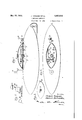
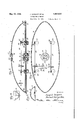
- VFig. 2 is a top plan view of the submarine showing thelife boat in horizontal section.
- .Y Fig. 3 isl atop plan view of the life boaton a reduced scale.
- l K l .Fig 4 is atransverse life boa-t. ,Y
- Fig. 5 is a vertical longitudinal section on an enlarged scale throughthe life boatand deck of the submarine.
- Fig. 7 is a viewshowing the buoy holding section through the andreleasing means. 1 v
- Fig. 8 is a view of the roll indicator.
- 1 designates a submarine vessel of any Vordinary forni
- 2 the flat top deckA ofthe submarine
- 3 the 4conningtower
- .4 the j ori-ica periscope, .which parts may be of ordinary or 'f any approved construction..4 A
- theplug may be operated from Veither thel outside or the inside vofY the submarine.
- a A life boat or safety boat 9 is 4releasably at- .i
- This boat 9 is made ofmetal or other suitable 'material' and comprises a body of maximum. depth and width at the center and having a fiat bottomv 10, the said body being both longitudinally and transversely of concavo-convex form and tapering from its center toward each end.
- the boat in other words, may be described as consisting of a body portion of the shape from its center toward each# end of a cigar divided horizontally along its longitudinal axis and having a flat bottom. It' has been found Ainpractice ⁇ that a boat of this shape willeasily iloat to the surface from a considerable depth, and will readily ridethe sur-l face of the water with arminimum degree of roll and without pitching.
- a rollV angle indicator for indicating any degree to which the boat may belaterally displaced from anormal position. This may consist, as shown. particularly .in Fig. 8',.ofa pivoted and weighted indicator armf 11 of pendulum type, movable over a. suitable indi.- ca-ting scale 12. While the use of a pitch angle indicator, as stated, is not necessary, one of a type similar to the roll angle indi.- cater ⁇ may be employed, ifdesired.
- the boat 9 is provided in its top wall with an entrance or exit door or hatchlfand. in its bottom wall with a similar vhatch 14,.. said hatches beinginalinement with each other.
- a screw plug 15 is provided, which is adapted to-be usedl in. connectionV with suitable sealing. means to close the hatch water-tight.
- This plug is provided with suitable operating handles 16V andwith a bulls-eye 17 of'gl'ass or other suitable materi-alv for. admitting light to the interior of the craft..
- the hatch 14 is. designed to be closed by a plugl 17 similar. in construction to the N plug 6,y said plug. 17 having oppositely projectingheads 18, provided with.
- The-boat 9 is provided in its bottom near each end with gage recesses 20 adapted for engagement with pins 21 on the deck 2 to S0 adaptthe boat to bey accurately applied in operative position:v
- the boat 9' is adapted to be secured in operative position and to-be instantaneously releasedi when required by lfastening means'of novel construction.
- the .-1.32 yfastening. means comprises front and.
- Theguide head 26- is movablein-thetube or opening 22 to center the-screw 24 and' stem 25 and guide thesametosecure accuracy of 1m movement of the screw intoy and out ofthelt" socket 23..
- operating shafts 29, and on saidshaiits 29- are H sprocket wheels 30 connected by chainsV 31'34" with a double sprocket wheel-'32V on: a drive sha-ift 33 oli-which* is a hand.
- the closure plug 6 will first be released to open the hatch 5, and may be supported by a member of the screw or other suitable means while the plug 7 is being removed from below to open the hatch 14 and during the passage of the crew through the opened hatches from the vessel into the life boat.
- the plug 6 is reapplied to close the hatch 5, thus sealing said hatch against the inlet of water, and the plug 17 is reapplied to seal the hatch 14 against the entrance of water to the boat 9.
- the boat 9 thus being placed in condition for rise to the surface, the wheel 14 is operated to release the screws 24 from engagement with the screw sockets 23, whereupon the boat 9 will rise to the surface of the water and the members of the crew at their convenience may remove the closure 14 to unseal the hatch 13 so as to allow the members of the crew to pass out, or, in the event that they are far from shore or from other Vessels, the hatches 13 and 14 may be kept sealed so that the crew may remain afloat in the boat 9 until their rescue is effected.
- the boat 9 may be provided with a Hag or other suitable device which may be raised to indicate its location in the water, and thus call attention to the plight of the members of the submarine crew therein, or that a radio apparatus ofsuitable type may be carried in the boat so that proper messages may be transmitted to shore or to other vessels so that help may be quickly summoned.
- a locking dog V0r device 38 is provided to hold the reel 37 from rotation and the cable36 from unwinding, and -thisdognormally underlies a detent pro- ,3. jection 39 at one end of the-bottom 10 of the boat 9, so that as long as the boatv 9 is, attached to the submarine, the cable is held from unwindingandthe buoy 37 from' upward movement in thewater.
- a submarine vessel hav- 1,25 ing a top deck provided with an inlet and exit opening, a life boat adapted to rest uponA said deck and having an inlet and exit opening in its bottom to register with the opening in the deck, reversible ⁇ and interchangeable :11.30
- lif'e ⁇ boat releasably connected: therewith, and Y a buoy' connected tothe submarine and autofmaticaflly released for movement to the surface to indicate the position of the submarineby upward movement of the life boat when the life boa-t is released.
- a submarine vessel having a to-p deck provided with an' inlet and eXit opening therein and threaded sockets, a life boat adapted to rest uponsaid deck and having in its bottoma coacting inlet and exit opening, means for sealing said openings in thev vessel and life boat, a plurality of vertically disposed threaded fa'stening screws on the life boat for engagementV with the threaded ⁇ sockets for securing the life boat tothe submarine, gears on saidV fastening vscrews withiny the sealed lifeboat, parallel horizonta-lv 'shafts connecting the gears in pairs, an opera-ting shaft between the Vfirst-named shafts, and gearing between the operating shaft and' each of-thefirstnamed shafts for rsimultaneously operating said firstsnamed shafts 'for' simultaneously disengaging said fastening screws.
Landscapes
- Engineering & Computer Science (AREA)
- Mechanical Engineering (AREA)
- Aviation & Aerospace Engineering (AREA)
- Emergency Lowering Means (AREA)
Description
May 10, 1932. J. VASQUEZ ET AL SUBMARINE LIFEBOAT Filed Feb. 18, 1931 2 Sheets-Sheet l May 1 0, 1932. J. VASQUEZ r-:T AL
SUBMABINE LIFEBOAT Filed Feb. 18. 1931 2 Sheets-Sheet 2 `at any time. Y
-A further object of the invention 1s to pro- Patented May 10, ,1932
JOAQUIN VASQUEZ AND MANUEL BERNARDEZ, OF PONTEVEDRA, SPAIN'v Y SUBMARNE ,LIFEBOAT Y Application led February 18, 1931. SerialNo. 516,769.k
This invention relates to submarine ves sels, and particularly to a life boat for vessels of this character. Y
. Y The main object of our invention is toprovide a life boat affording a means of escaping from the submarine vessel in the event that the vessel is unable to rise to the surface of the water or in the event that some ofthe crew are required to leave the vesselfor the surface vide a life boat for the purpose described which isadapted to'be attached to the deck of the submarine vessel for free communication between the vessel and boat at all times or whenever needed, and which boat is capable of being easily and rapidly sealed hermetically and released from the submarine vessel t rise to the surface ofthe water.
A still further object of the invention is to provide novel fastening and releasing meansl for connecting the boat to the `vessel whereby a positive locking or vreleasing actionA may be effected withoutliability of the binding of the Afastening and releasing meansduring a fastening or releasing action. 4
A still further obj ect of the invention is to provide a life boat or safety boat for submarinevessels'which isof novel construction andV shape, so as to avoid resistance to the movement of the vessel through the Vwater when applied to the submarine vessel. 1'
A still further object ofthe invention is to provide a life boat of the character described which by reason of its shape can not'pitcho'r move up and down on its horizontal transverse axis, which can only roll to a limited eX- tent, and which if accidentally displaced from an upright or normal position will automatically" return to such position whenever free to do so in the water.
. A still further objectof the invention is to providenovel means wherebythe crew of a submarine may, on leaving the submarine, en-
ter the lifeboat and seal 'the hatches or doorways in both the submarineand the life boat, so as to prevent any entrance of water into the submarine through the escape hatch after the releaseof the life boat. v, Y
A still further object. of the invention is to provide novel means for holding and'releasing a buoy upon the release of thelife boat, for indicating at the surface the positionof the submarine. Y With these and other objects in view, the invention consists of the features of construction, Acombination Aand arrangement of parts, hereinafter fully described and claimed,ref erence being had' to the accompanying drawings, in which Fig. l isa side elevation of a submarine vessel, partially in section, showing the application of our invention thereto.
VFig. 2 isa top plan view of the submarine showing thelife boat in horizontal section. .Y Fig. 3 isl atop plan view of the life boaton a reduced scale. l K l .Fig 4 is atransverse life boa-t. ,Y
Fig. 5 is a vertical longitudinal section on an enlarged scale throughthe life boatand deck of the submarine. V V- i Fig; (iis a horizontal longitudinal section` through the life boat looking in "an upward direction.. l f
Fig. 7 is a viewshowing the buoy holding section through the andreleasing means. 1 v
Fig. 8 is a view of the roll indicator. v
Referring now more particularly to lthe drawings, 1 designates a submarine vessel of any Vordinary forni, 2 the flat top deckA ofthe submarine, 3 the 4conningtower, and .4 the j ori-ica periscope, .which parts may be of ordinary or 'f any approved construction..4 A
In the deck-2 is an internallyfthreaded en-V trance and exit doorway or hatch, through which the crew 'may enter and leave the'sub- Vwhereby. theplug may be operated from Veither thel outside or the inside vofY the submarine.
A A life boat or safety boat 9 is 4releasably at- .i
tached tothe submarine 1. This boat 9 is made ofmetal or other suitable 'material' and comprises a body of maximum. depth and width at the center and having a fiat bottomv 10, the said body being both longitudinally and transversely of concavo-convex form and tapering from its center toward each end. The boat, in other words, may be described as consisting of a body portion of the shape from its center toward each# end of a cigar divided horizontally along its longitudinal axis and having a flat bottom. It' has been found Ainpractice` that a boat of this shape willeasily iloat to the surface from a considerable depth, and will readily ridethe sur-l face of the water with arminimum degree of roll and without pitching. This shape of' boat,.also, if turned over or submerged4 in .the Water in any other than an upright posi- 'tion will automatically returnto an; upright position. Thus the life boat when. released from the submarine vessel will' under all conditions rise to the surface in an upright position. unless. prevented from assuming such positionby an encountered obstacle. Since a boat of this shape willnot pitch or move upwardly or'downwardly vertically on its horizontal transverse axis, it is not necessary to employ any-indicating means to enable the crew confined therein, during anv escape action,to'determine the degree of longitudinal instability,.since normallyv instability of this character will not occur. We,.therefore,pro vide a rollV angle indicator for indicating any degree to which the boat may belaterally displaced from anormal position. This may consist, as shown. particularly .in Fig. 8',.ofa pivoted and weighted indicator armf 11 of pendulum type, movable over a. suitable indi.- ca-ting scale 12. While the use of a pitch angle indicator, as stated, is not necessary, one of a type similar to the roll angle indi.- cater` may be employed, ifdesired.
The boat 9 is provided in its top wall with an entrance or exit door or hatchlfand. in its bottom wall with a similar vhatch 14,.. said hatches beinginalinement with each other. For closing theihatch 1-3, a screw plug 15 ,is provided, which is adapted to-be usedl in. connectionV with suitable sealing. means to close the hatch water-tight. This plug is provided with suitable operating handles 16V andwith a bulls-eye 17 of'gl'ass or other suitable materi-alv for. admitting light to the interior of the craft.. The hatch 14 is. designed to be closed by a plugl 17 similar. in construction to the N plug 6,y said plug. 17 having oppositely projectingheads 18, provided with. manipulating handles 19, whereby the'plug may be operated fromeither theinside orthe outside 'of the boat 9.. Normally the crew will enter the submarine vessel. through. the hatches 13,14 andV 5,: and leave the submarine in reverse order through the same hatches. Vhen the life boat9 is released-from the submarine its passengers when reaching the surface,- may unsealand leave-through. the hatch-13 at all er socket 23 and iscarried. by ai stemy 25 on;
clockwise directionl for fastening or releastimes-when the boat is in its normal upright position. If, through any cause, the boat 9 should become turned up-side-down or inverted, the passengers may unseal the hatch Y 14 and pass out therethrough. If desired, '40 additional hatches may be provided in the sides ofV the boat to enable the crew to enter andV leave the boat with greater ease and facility, or to enable the crew to escape through a side hatch in the event that either the top hatch. or thebott'omlhatch` should be submerged.
The-boat 9 is provided in its bottom near each end with gage recesses 20 adapted for engagement with pins 21 on the deck 2 to S0 adaptthe boat to bey accurately applied in operative position:v The boat 9'is adapted to be secured in operative position and to-be instantaneously releasedi when required by lfastening means'of novel construction. The .-1.32 yfastening. means comprises front and. rear pairs of internally threadedy guide tubes or openings 22 in the bottomV 10 equidistantliyf'in Yfrontand rear of the waist and on opposite sides of the keel line of the boat, whichopen-gli,0 ingsor tubes register with internally threaded keeper sockets-23 in the deck 2.Y A thread'- edfplug. or screw 241s movablein each guide tube or opening 22 and the registeringv keep- 05 which7 isa guide head 26V and;V a worm wheel 2.7. Theguide head 26-is movablein-thetube or opening 22 to center the-screw 24 and' stem 25 and guide thesametosecure accuracy of 1m movement of the screw intoy and out ofthelt" socket 23.. Theworm wheel of the rotaryrfastening. and releasing screws on 'each side of the-keellineare engaged by worms' 28V on. operating shafts 29, and on saidshaiits 29- are H sprocket wheels 30 connected by chainsV 31'34" with a double sprocket wheel-'32V on: a drive sha-ift 33 oli-which* is a hand. wheel 34 whereby the shafts and-worms may-be simultaneously Vrota-ted.y either in a clockwise or a counter- HP ing movements. When applying'the lifeboat in position upon the submarine, the boat is centered in position'and the operating` means oi t'hefastening screws actuated t'o move said 1 r screws 'down' into Vthe sockets 23 and thus l?? firmly secure the life boat to'l the submarine. In: releasing the life boat from the submarine for an; escape action it ismerely necessary'to operate the wheel 34 in the proper' direction tov withdraw the screws 24 from the sockets 23, whereupon the boat willi bef released and rise to the surface. Thisperation of simultaneously releasing the screws inithe man-` ner describedA ensures equal unscrewingrmovements-.of all thel screws to the same degree from the socketsY so that the screws Willbecome disengaged: ifromithesocketsfat the same instant,V therebyl obviatin'gf. liabilitvl of one or more screws binding',- whichw'ould be the case taneously release, as the tendency of the boat to rise would cause binding of the unreleased screws in the keeper sockets.
It will be observed that the shape and arrangement of the boat is such that it is of proper streamline conformation such as to allow of its easy passage through the water,`
ber at the top of the submarine which doesnot interfere with its normal operation. In the event that the vessel from anycause is unable to rise to the surface of the water, or it is desired to send some of the crew to the surface of the waterfrom the submerged submarine, this may be effected in a certain and positive manner. In such an escape operation, the closure plug 6 will first be released to open the hatch 5, and may be supported by a member of the screw or other suitable means while the plug 7 is being removed from below to open the hatch 14 and during the passage of the crew through the opened hatches from the vessel into the life boat. After the members of the crew have passed'from the submarine to the boat 9, the plug 6 is reapplied to close the hatch 5, thus sealing said hatch against the inlet of water, and the plug 17 is reapplied to seal the hatch 14 against the entrance of water to the boat 9. The boat 9 thus being placed in condition for rise to the surface, the wheel 14 is operated to release the screws 24 from engagement with the screw sockets 23, whereupon the boat 9 will rise to the surface of the water and the members of the crew at their convenience may remove the closure 14 to unseal the hatch 13 so as to allow the members of the crew to pass out, or, in the event that they are far from shore or from other Vessels, the hatches 13 and 14 may be kept sealed so that the crew may remain afloat in the boat 9 until their rescue is effected. Of course, it will be understood that the boat 9 may be provided with a Hag or other suitable device which may be raised to indicate its location in the water, and thus call attention to the plight of the members of the submarine crew therein, or that a radio apparatus ofsuitable type may be carried in the boat so that proper messages may be transmitted to shore or to other vessels so that help may be quickly summoned.
It will be seen from the foregoing that .by the use of the closures 6 and 127 of the type disclosed hatches 5 and 14 may be sealed from either within or without the submarine and the boat, respectively. By this means it is possible for the members ofthe crew of the submarine on leaving the submarine through Y .rine unable to `rise to the the hatch: 5 to clos'esaid hatch against any entranceof water tothe submarine before closing the hatch 14 in the life boat, thus leaving Asubmarinemaybe released for movementV of the buoy to the surface, so that the point of location of the submarine maybe indicated at .the surface. As vshown .particularly in Figs. 1, 2 and 7 the buoy 35is fastened to one end of a rope or cable 36 wound. about a suitable reel 37 permanently mounted on thesubso marine and to which the other end of the rope or cable is fastened. A locking dog V0r device 38 is provided to hold the reel 37 from rotation and the cable36 from unwinding, and -thisdognormally underlies a detent pro- ,3. jection 39 at one end of the-bottom 10 of the boat 9, so that as long as the boatv 9 is, attached to the submarine, the cable is held from unwindingandthe buoy 37 from' upward movement in thewater. When, however, the boat 20 9 is released from the submarine, for passage to the surface, theflatch 38 is released and` is retracted by gravity orby the action of `a spring, or by the pressure'on the buoy, and the `reel is thereby released, Qallowing the cable to` unwind and-the buoy to move upward to,- the surface ofthe water. By this meanslthe escape of the crew from a subma- `surface may not.V only be eifected, but at the same timemeans 5100 released to indicate the vpoint'at which the f submarine is submerged, thusavoidingthe difficulties generally `encountered in` locatin a submariner under these conditions. A A
From thefore `oing description, taken in 105 connection with tie drawings, the. construction, mode of operation andy advantages of ourimproved means for permitting of the escape ofthe. crew of a submerged submarine unable to, rise from thesurface', and means 11,10 `for indicating theV point of location of 1,such submarine, will be` readily understood and Vappreciated by those `versed 'in the art, without a further` and .extended description. Wfhile the constructions disclosed are 'preif-15 ferred it will,y of course, `be `understood that vchanges in the form,'construction and pro- `portions of parts, as well as in thel arranges ment of the parts, may be made within the f scope of theappendedclaims without departing from thespirit or sacriiicinganyof Y the advantagesof theV invention. Y
Havingthusfully described our invention, we claim L Y 1. In combination, a submarine vessel hav- 1,25 ing a top deck provided with an inlet and exit opening, a life boat adapted to rest uponA said deck and having an inlet and exit opening in its bottom to register with the opening in the deck, reversible `and interchangeable :11.30
screw` for respectively closingy the opening 1n the deckl andi the'. openinginf the life boat,V said. plugs beingV operable from either the inside or the outside of the life boat, andi meansi for attaching the life boat to and releasing it from the submarine.A
2; In. combination, a submarine vessel, a
lif'e` boat releasably connected: therewith, and Y a buoy' connected tothe submarine and autofmaticaflly released for movement to the surface to indicate the position of the submarineby upward movement of the life boat when the life boa-t is released.
3. In` combination, a: submarine, a. life boat detachably connected therewith, a buoy, a reel, a cable connecting the reel and'buoy, and means forA holding the reel' from unwinding motion when-the life boat is in operative position on thesubmarine and for automaticallyk releasing the reel' forunwind-ing motion through the upward movement of the life boat when the life boat is released from the submarine,
4; In combination, a submarine, ai life boat detachably connected therewith, a buoy, a reel, cable connecting the reel and buoy, a: locking and releasing wheel carried by the reel, ain-automatically'retractible dog for engagement withfrthe wheel to hold the reel from unwinding motion, and a detent on the life boat for engagement with said dog to hold' the same in lockingposition and adaptf ed on the upward movement of they released life boat to. yfree the dog for automatic re- ,Y
traction.
l 5. In combination, a submarine vessel having a to-p deck provided with an' inlet and eXit opening therein and threaded sockets, a life boat adapted to rest uponsaid deck and having in its bottoma coacting inlet and exit opening, means for sealing said openings in thev vessel and life boat, a plurality of vertically disposed threaded fa'stening screws on the life boat for engagementV with the threaded` sockets for securing the life boat tothe submarine, gears on saidV fastening vscrews withiny the sealed lifeboat, parallel horizonta-lv 'shafts connecting the gears in pairs, an opera-ting shaft between the Vfirst-named shafts, and gearing between the operating shaft and' each of-thefirstnamed shafts for rsimultaneously operating said firstsnamed shafts 'for' simultaneously disengaging said fastening screws. Y
In testimony whereof we. affix our signatures. v Y
Y JOAQUIN VASQUEZ VMANUEL. BERNARDEZ.'
Priority Applications (1)
| Application Number | Priority Date | Filing Date | Title |
|---|---|---|---|
| US516769A US1857575A (en) | 1931-02-18 | 1931-02-18 | Submarine lifeboat |
Applications Claiming Priority (1)
| Application Number | Priority Date | Filing Date | Title |
|---|---|---|---|
| US516769A US1857575A (en) | 1931-02-18 | 1931-02-18 | Submarine lifeboat |
Publications (1)
| Publication Number | Publication Date |
|---|---|
| US1857575A true US1857575A (en) | 1932-05-10 |
Family
ID=24057014
Family Applications (1)
| Application Number | Title | Priority Date | Filing Date |
|---|---|---|---|
| US516769A Expired - Lifetime US1857575A (en) | 1931-02-18 | 1931-02-18 | Submarine lifeboat |
Country Status (1)
| Country | Link |
|---|---|
| US (1) | US1857575A (en) |
-
1931
- 1931-02-18 US US516769A patent/US1857575A/en not_active Expired - Lifetime
Similar Documents
| Publication | Publication Date | Title |
|---|---|---|
| US2359366A (en) | Submerged barge and towboat | |
| US1814689A (en) | Salvage and rescue submarine | |
| US1857575A (en) | Submarine lifeboat | |
| US2030768A (en) | Lifesaving equipment for marine vessels | |
| US1801729A (en) | Mooring buoy | |
| US2347690A (en) | Salvaging apparatus for sunken vessels | |
| US1130301A (en) | Life-boat. | |
| US2338067A (en) | Submarine salvaging and lifesaving apparatus | |
| US1475290A (en) | Boat-launching device | |
| US1752063A (en) | Lifeboat | |
| NO133579B (en) | ||
| RU2238878C2 (en) | Training tower | |
| US1352992A (en) | Observation-station | |
| US1840094A (en) | Safety device for submarines | |
| US1773223A (en) | Submarine boat | |
| US1754213A (en) | Ship's life-saving apparatus | |
| RU2081783C1 (en) | Submarine lifesaving gear | |
| US1803944A (en) | Life saving and salvage apparatus for use with submarines | |
| US1801232A (en) | Salvaging apparatus for submarines | |
| US1623148A (en) | Rescuing device for sunken ships | |
| US2261513A (en) | Mechanical boat lifter and indicator | |
| US2303831A (en) | Escape bell for submarines | |
| US1399196A (en) | Submarine rescue craft | |
| US2014742A (en) | Submarine vessel | |
| US2116200A (en) | Apparatus for effecting the escape of persons from sunken vessels |