US1663017A - Partition sheet for loose-leaf devices - Google Patents
Partition sheet for loose-leaf devices Download PDFInfo
- Publication number
- US1663017A US1663017A US120551A US12055126A US1663017A US 1663017 A US1663017 A US 1663017A US 120551 A US120551 A US 120551A US 12055126 A US12055126 A US 12055126A US 1663017 A US1663017 A US 1663017A
- Authority
- US
- United States
- Prior art keywords
- sheet
- cards
- series
- loose
- projections
- Prior art date
- Legal status (The legal status is an assumption and is not a legal conclusion. Google has not performed a legal analysis and makes no representation as to the accuracy of the status listed.)
- Expired - Lifetime
Links
- 238000005192 partition Methods 0.000 title description 10
- 239000011230 binding agent Substances 0.000 description 15
- 230000015572 biosynthetic process Effects 0.000 description 4
- 238000010276 construction Methods 0.000 description 4
- 238000005755 formation reaction Methods 0.000 description 4
- 239000000463 material Substances 0.000 description 3
- 230000008719 thickening Effects 0.000 description 3
- 230000000694 effects Effects 0.000 description 2
- 230000003247 decreasing effect Effects 0.000 description 1
- 230000003467 diminishing effect Effects 0.000 description 1
- 238000012423 maintenance Methods 0.000 description 1
- PXUQTDZNOHRWLI-OXUVVOBNSA-O malvidin 3-O-beta-D-glucoside Chemical compound COC1=C(O)C(OC)=CC(C=2C(=CC=3C(O)=CC(O)=CC=3[O+]=2)O[C@H]2[C@@H]([C@@H](O)[C@H](O)[C@@H](CO)O2)O)=C1 PXUQTDZNOHRWLI-OXUVVOBNSA-O 0.000 description 1
- 238000004519 manufacturing process Methods 0.000 description 1
- 230000004048 modification Effects 0.000 description 1
- 238000012986 modification Methods 0.000 description 1
- 229920000136 polysorbate Polymers 0.000 description 1
Images
Classifications
-
- B—PERFORMING OPERATIONS; TRANSPORTING
- B42—BOOKBINDING; ALBUMS; FILES; SPECIAL PRINTED MATTER
- B42F—SHEETS TEMPORARILY ATTACHED TOGETHER; FILING APPLIANCES; FILE CARDS; INDEXING
- B42F3/00—Sheets temporarily attached together involving perforations; Means therefor; Sheet details therefor
- B42F3/003—Perforated or punched sheets
Definitions
- such account leaves will be described as cards.
- cards In practice such cards are of various sizes and are usually 'of paper stock of ordinary thickness. Their depth from top to bottom) is such that they may e applied to the binder prongs in overlapped relation with a narrow p portion of each card exposed, thus forming a series of such cards from top to bottomof 'the binder.
- Such overlapping of the cards causes the thickness of the series 4to build up gradually in the ,direction in which .the ards or sheets are applied, reaching its maximum Where there is a maximum of such cards overlapping -each other, the thickness then diminishing toward theA opposite end of the series. Ordinarily the greatest thickness of the series develops near the central portion, measuring. from top to bottom.
- a single binder may contain a large num. ber of such series of overlapped sheets, say twenty-five or more.
- the book or binder device With the ordinary at division or partition sheets between these respective series the book or binder device mayl befilled solidly throughout the middle portion thereof whileat the top and bottom portions there is considerable space. This v arises from the fact that at the very top and at the very bottom ofthe device there may be only say twenty-five of the cards .between the two outer covers, while at the same time there may be in the middle two hundred and fifty or'more of .such cards between the opposed covers.
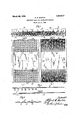
- Figure 1 is a fragmentar elevation of a binder which may be consideredv to be of the. kindshown in my said patent and containing several series .of overlapped cards and division sheets 1n vtheirl normal arrangement, the series of cards he.
- Fig. 2 is a face view of a-d1v1 sion sheetshown lone type of embossed formations therein thickness of the sheet at upper and lower vportions thereof;
- Fig. 3 is a fragmentary section, on an enlarged scale, of a porticn of Fig. 2 as on the line 3-.3 thereof;
- Fig. pis a face'view similar to thatof Fig. 2 vshowing a division sheet having the' pre-- ferred construction and arrangement of integral-v thickening means,vhere shown as embossed or pressed-up elements in taperel and Acontinuous form;
- Fig. 5 is lan enlarge or increasing the effective vlos - sectional view as on the line --5 of Fig. 4;
- Fig. 6 is a fragmentary bottom edge view of the sheet of Fig. 4.v
- the partition sheet 16 is to be considered as being of paper stock of good quality and of such thicknesses is ordinarily used for division sheets in looseleaf binders. Ordinaril. what is known -as thirty-pound to thirtyfour-pound stock is used for such purposes.
- the material is pressed out of its normally flat shape, preferably by means of heated dies and a .preliminary application of steam, with rib-like. projections 11 extending longitudinally up and .down in substantially parallel arranrrement and projecting away fromthe general plane of the sheet, forming a ⁇ corrugated structure.
- Fig.6 shows how t e edge of the sheet' has a sinuous formation and how these rib-like projections are formed alternately in posite sides of the sheet.
- Fig. 4 may also 11 are prefera ly close together and-extend from one side edge of the sheet tothe other, excepting that where the holes 13' forthe prongsoccur the rib-like formationmay be omitted, and the vri ht-hand edge as shown purposesof applying index 'tabs thereto.
- the desideratum is to havethe .whole ⁇ gen eral area of the sheet at both the top and the bottom portions thereof well 'covered by such sheet-thickening formations, and to have the thickening effects produced in gradually increasing amounts from nothing to such an amount as is necessary for the dcsi red results.
- the ⁇ .maximum extent thereof, and 'where it should begin are variables depending upon such factors as the thickness of the cards belng employed in a particular book or binder,
- Fig. ⁇ 1 therefore illustrateshovv this.; .objection is overcome by maintaining the several series of cards in a fairly fiat shape through the use of division, sheets as lherein described.
- and 3 shows la pluralityv of circular androunded projections as 20, 21, 22, 23, 24, 25 and 26 extend. ing on' one side only of the general. plane of the sheet 30 and gradually decreasing in height fromthe maximum in the edge line .
- a partition -sheet for loose-leaf binders of the characterdescribed said sheet being gibstantially rectangularv and 4having side having insensata side 'edge' portion thereof for holding-1t in the binder, thealpper and jacent to v andtop .andbottom edges defining the vsu antially rectangular shape, .the sheet -over the Whole general surface of such end portions respectively between said hold-ingv means and the opposite side edge and providing such end portions with an effective thickness greater 'than that of the normal thickness of the sheet material from which made, the middle portions in the up and down directions of the sheetbetween said' end portions and between said holding means at one side edge portion and the side edge opposite thereto being free of such' projections.
- a partition sheet for loose-leaf binders of the character described said sheet having means at a side. edge portion thereof for holding the sheet in the binder, the upper and lower end portions of the sheet being formed-With integral projections extending over the whole general surface of such end portions respectively p andv providing ⁇ sucli end portions With an effective thickness the sheet material from which the partition sheet .is made, said proJections increasing gradually in height from positions nearer to the medial ,portion of the sheet toward the upper and the lower ends of the sheet respec tively.
Landscapes
- Sheet Holders (AREA)
Description
Patented Mar. 20, 1928.
UTED. 'i
ALFRED M. MARTIN,
0F CHICAGO, ILLINOIS.
PARTITION 'SHEET FOR LOOSE-LEAF DEVICES.
Application filed July 6,
My Patent No. 1,269,479'of June 11, 1918 on loose-leaf binders shows a type of looseleaf binder with which the present 'partition sheet is peculiarly advantageous. In that patent Figs, 8 and 9 illustrate a form of partition sheet described. therein as an indexed leaf for separating the account leaves. y
In the present specification such account leaves will be described as cards. In practice such cards are of various sizes and are usually 'of paper stock of ordinary thickness. Their depth from top to bottom) is such that they may e applied to the binder prongs in overlapped relation with a narrow p portion of each card exposed, thus forming a series of such cards from top to bottomof 'the binder.- Such overlapping of the cards causes the thickness of the series 4to build up gradually in the ,direction in which .the ards or sheets are applied, reaching its maximum Where there is a maximum of such cards overlapping -each other, the thickness then diminishing toward theA opposite end of the series. Ordinarily the greatest thickness of the series develops near the central portion, measuring. from top to bottom.
A single binder may contain a large num. ber of such series of overlapped sheets, say twenty-five or more. With the ordinary at division or partition sheets between these respective series the book or binder device mayl befilled solidly throughout the middle portion thereof whileat the top and bottom portions there is considerable space. This v arises from the fact that at the very top and at the very bottom ofthe device there may be only say twenty-five of the cards .between the two outer covers, while at the same time there may be in the middle two hundred and fifty or'more of .such cards between the opposed covers.
The object ofthe present improvements,
like that of the device ofl Fig. 8 of my said patent,'is toprovide ai division or partition sheet for such uses which will occupy space between adjacent series of the overlapped cards, preferably at bothv the top and bottom ortions of the overlapping series,
where y each series will be maintained more nearly flat when the book is opened and therefore be more free ofthe upwardly bulging effect. of the middle portion of the series, with certain advantages in practice such as a more free, movement of the cards on the binder prongs, the cards being relieved of .1926. serial N0. 120,551.
masse from one side ofthe book to the other' more freely and more easily. In this connection it may be mentioned that the maintenance of such-a Amore Hat surface atthe top of the series `is of particular advantage in the act of writing on the upper cards since otherwise this upper portion of the series would slope downward and away from the writer. Such a slope may be to quite a great extent; for instancethere maybe a difference of more than an inch and a half between the thickness at the middle and at the ends in a binder designed yfor two-inch capacity. 1
While had in mind these advantages in the division sheet shown in Fig. 8 of my -said patent, I have found that such applied thicknesses as are therein illustrated have various' objections, suchas the Working loose of the applied parts, the catching thereagainst of the overlapped cards in the device during manipulations, the unnecessary stiffness of -the sheet and its lack .of pliability in certain directions and at particular places, too .great cost, and increasedweight. The present improvements .have for their specic 'objects the overcoming of thoseobjec-v tions While providing -the described advanta ecus results.
n the drawings Figure 1 is a fragmentar elevation of a binder which may be consideredv to be of the. kindshown in my said patent and containing several series .of overlapped cards and division sheets 1n vtheirl normal arrangement, the series of cards he.
ing shown in edge view at right angles to the longitudinal direction of the series respectively; Fig. 2 is a face view of a-d1v1 sion sheetshown lone type of embossed formations therein thickness of the sheet at upper and lower vportions thereof; Fig. 3 is a fragmentary section, on an enlarged scale, of a porticn of Fig. 2 as on the line 3-.3 thereof; Fig. pis a face'view similar to thatof Fig. 2 vshowing a division sheet having the' pre-- ferred construction and arrangement of integral-v thickening means,vhere shown as embossed or pressed-up elements in taperel and Acontinuous form; Fig. 5 is lan enlarge or increasing the effective vlos - sectional view as on the line --5 of Fig. 4;
and Fig. 6 is a fragmentary bottom edge view of the sheet of Fig. 4.v
Referring first tol the preferred'construction Of-Figs. 4, 5 and 6, the partition sheet 16 is to be considered as being of paper stock of good quality and of such thicknesses is ordinarily used for division sheets in looseleaf binders. Ordinaril. what is known -as thirty-pound to thirtyfour-pound stock is used for such purposes. At both top and bottom portions of sheet '10 the material is pressed out of its normally flat shape, preferably by means of heated dies and a .preliminary application of steam, with rib-like. projections 11 extending longitudinally up and .down in substantially parallel arranrrement and projecting away fromthe general plane of the sheet, forming a` corrugated structure. Fig.6 shows how t e edge of the sheet' has a sinuous formation and how these rib-like projections are formed alternately in posite sides of the sheet.
the ,0P-
These rib-like formations 11 I- respectively decrease in relative height or vprojection away from the general plane of the sheet to a point 12, wherethey merge into the general plane of the sheet. Withsuch an arrangement and construction the end portion of t e sheet becomes gradually thickened effectively from, some 'place which may be near the middle of the sheet toward the end.
These lon and narrow and preferably gradually wi enin and thickening projections fin Fig. 4 may also 11 are prefera ly close together and-extend from one side edge of the sheet tothe other, excepting that where the holes 13' forthe prongsoccur the rib-like formationmay be omitted, and the vri ht-hand edge as shown purposesof applying index 'tabs thereto. The desideratum is to havethe .whole `gen eral area of the sheet at both the top and the bottom portions thereof well 'covered by such sheet-thickening formations, and to have the thickening effects produced in gradually increasing amounts from nothing to such an amount as is necessary for the dcsi red results.
As to the amount-of effective thickness which should be developed in the.' sheet, the` .maximum extent thereof, and 'where it should begin are variables depending upon such factors as the thickness of the cards belng employed in a particular book or binder,
the-depth of'such cards, and their particular arrangement' with respect to the degree or amount ofthe part of each card exposed beyond the overlap of the next in the' series.'
With cards of the thickness ordinarily employed the actual amount of effective thickness developed in each sheet isA not very reat, say only about lone-sixteenth of an inch at the top and bottom. This matter .of theeective thickness of .the division e Afree of them for the` ,within the scope .lower end portions of the sheet sheets is not highly critical as the main object is to overcome the great dlsparitybe- -tween the middle and ends of the book.
Small variations from a truly Hat'sha'pe of the series of cards are not important. It will be clear from a foregoing statement that .the partition or division sheets 10 in Fig. 1
them. Fig.` 1 therefore illustrateshovv this.; .objection is overcome by maintaining the several series of cards in a fairly fiat shape through the use of division, sheets as lherein described. A
The modification of Figs, 2| and 3 shows la pluralityv of circular androunded projections as 20, 21, 22, 23, 24, 25 and 26 extend. ing on' one side only of the general. plane of the sheet 30 and gradually decreasing in height fromthe maximum in the edge line .There are numerous up-and-down lines of such projections 20 to 2 6. inclusive, andsuch projections cover the whole general area of the end portions of the sheet. They reduce a sheet .whichgradually becomes e ectively ofpro'ections denominated 20 to theinnermostlme ofprojcctions denominated 26.
thicker both toward the upper and the lower I hese circular projections, likethose of Fig.l 4, may beformed -by dies, preferably to practices well understood in thepaperforming art. "Asheety so formed maintains -1tsgeneralshape uite well under conditions of use.;` Whet erin accordance with Fig. 4 or Fig.' 2, ithas notable properties of flexibility-. The cards ,do not catch upon such projections, and nothing hasfbeen added in weightto the sheet.' The manufacturing operations aresimple and of low cost.
ica
with steam to soften the paper, according y l I am aware-of various other forms and' arrangements .of-- projections which 'may be emplo ed, 'and I contemplate as being include herein all constructions..which fall of the appended claims.I
@I-clamzf 1. A partition -sheet for loose-leaf binders of the characterdescribed, said sheet being gibstantially rectangularv and 4having side having insensata side 'edge' portion thereof for holding-1t in the binder, thealpper and jacent to v andtop .andbottom edges defining the vsu antially rectangular shape, .the sheet -over the Whole general surface of such end portions respectively between said hold-ingv means and the opposite side edge and providing such end portions with an effective thickness greater 'than that of the normal thickness of the sheet material from which made, the middle portions in the up and down directions of the sheetbetween said' end portions and between said holding means at one side edge portion and the side edge opposite thereto being free of such' projections.
2. A partition sheet for loose-leaf binders of the character described, said sheet having means at a side. edge portion thereof for holding the sheet in the binder, the upper and lower end portions of the sheet being formed-With integral projections extending over the whole general surface of such end portions respectively p andv providing` sucli end portions With an effective thickness the sheet material from which the partition sheet .is made, said proJections increasing gradually in height from positions nearer to the medial ,portion of the sheet toward the upper and the lower ends of the sheet respec tively.
3. Theconibination .of claim 2 hereof lin which said projections are continuous and rib-like and extend substantially parallel with the side edges of the sheet.
ALFRED M. MARTIN.
lgreater than that of the normal thickness of
Priority Applications (1)
| Application Number | Priority Date | Filing Date | Title |
|---|---|---|---|
| US120551A US1663017A (en) | 1926-07-06 | 1926-07-06 | Partition sheet for loose-leaf devices |
Applications Claiming Priority (1)
| Application Number | Priority Date | Filing Date | Title |
|---|---|---|---|
| US120551A US1663017A (en) | 1926-07-06 | 1926-07-06 | Partition sheet for loose-leaf devices |
Publications (1)
| Publication Number | Publication Date |
|---|---|
| US1663017A true US1663017A (en) | 1928-03-20 |
Family
ID=22391019
Family Applications (1)
| Application Number | Title | Priority Date | Filing Date |
|---|---|---|---|
| US120551A Expired - Lifetime US1663017A (en) | 1926-07-06 | 1926-07-06 | Partition sheet for loose-leaf devices |
Country Status (1)
| Country | Link |
|---|---|
| US (1) | US1663017A (en) |
Cited By (2)
| Publication number | Priority date | Publication date | Assignee | Title |
|---|---|---|---|---|
| US3059288A (en) * | 1961-04-19 | 1962-10-23 | Stanray Corp | Flexible panel protective spacers |
| US3366118A (en) * | 1966-08-29 | 1968-01-30 | Lewis R. Beyer | Sheet lifter |
-
1926
- 1926-07-06 US US120551A patent/US1663017A/en not_active Expired - Lifetime
Cited By (2)
| Publication number | Priority date | Publication date | Assignee | Title |
|---|---|---|---|---|
| US3059288A (en) * | 1961-04-19 | 1962-10-23 | Stanray Corp | Flexible panel protective spacers |
| US3366118A (en) * | 1966-08-29 | 1968-01-30 | Lewis R. Beyer | Sheet lifter |
Similar Documents
| Publication | Publication Date | Title |
|---|---|---|
| US325676A (en) | jenkins | |
| US2876907A (en) | Sorting device | |
| US2050308A (en) | Sample and advertising file | |
| US1583980A (en) | Packing pad | |
| US1902206A (en) | Holder for transparent pie covers | |
| US1611585A (en) | Means for facilitating the addressing of envelopes | |
| US1876998A (en) | Partition sheet for binders | |
| US1905097A (en) | Loose leaf memorandum book | |
| DE1161513B (en) | Hinged lid box | |
| US1538106A (en) | Egg carton | |
| US1820222A (en) | File, temporary binder, loose leaf book and the like | |
| US1214213A (en) | Document-file. | |
| US1854751A (en) | Partition sheet | |
| US1365935A (en) | Indexing device | |
| US349188A (en) | Document envelope | |
| DE560942C (en) | Steep index, consisting of a number of pockets that can be set one after the other in a container, each designed to hold several sheets or cards | |
| DE507634C (en) | Staple for holding documents together or the like. | |
| DE466949C (en) | Card for relay cards, which is made from one piece together with its carrier | |
| DE1252581B (en) | Emstuckige self-supporting, nestable and stackable egg tray with ribs running at right angles to each other | |
| US1765192A (en) | Visible index | |
| AT98434B (en) | Template card for address duplicating machines. | |
| US1548332A (en) | Loose-leaf book | |
| US1812886A (en) | Partition sheet | |
| GB537688A (en) | Improvements in and relating to the production of laminated fibrous material | |
| US1911852A (en) | Reference file |