US12258333B2 - N-(hydroxyalkyl (hetero)aryl) tetrahydrofuran carboxamides as modulators of sodium channels - Google Patents
N-(hydroxyalkyl (hetero)aryl) tetrahydrofuran carboxamides as modulators of sodium channels Download PDFInfo
- Publication number
- US12258333B2 US12258333B2 US18/491,021 US202318491021A US12258333B2 US 12258333 B2 US12258333 B2 US 12258333B2 US 202318491021 A US202318491021 A US 202318491021A US 12258333 B2 US12258333 B2 US 12258333B2
- Authority
- US
- United States
- Prior art keywords
- pain
- compound
- pharmaceutically acceptable
- acceptable salt
- halo
- Prior art date
- Legal status (The legal status is an assumption and is not a legal conclusion. Google has not performed a legal analysis and makes no representation as to the accuracy of the status listed.)
- Active
Links
Images


Classifications
-
- A—HUMAN NECESSITIES
- A61—MEDICAL OR VETERINARY SCIENCE; HYGIENE
- A61K—PREPARATIONS FOR MEDICAL, DENTAL OR TOILETRY PURPOSES
- A61K31/00—Medicinal preparations containing organic active ingredients
- A61K31/33—Heterocyclic compounds
- A61K31/395—Heterocyclic compounds having nitrogen as a ring hetero atom, e.g. guanethidine or rifamycins
- A61K31/435—Heterocyclic compounds having nitrogen as a ring hetero atom, e.g. guanethidine or rifamycins having six-membered rings with one nitrogen as the only ring hetero atom
- A61K31/44—Non condensed pyridines; Hydrogenated derivatives thereof
- A61K31/4427—Non condensed pyridines; Hydrogenated derivatives thereof containing further heterocyclic ring systems
- A61K31/443—Non condensed pyridines; Hydrogenated derivatives thereof containing further heterocyclic ring systems containing a five-membered ring with oxygen as a ring hetero atom
-
- A—HUMAN NECESSITIES
- A61—MEDICAL OR VETERINARY SCIENCE; HYGIENE
- A61P—SPECIFIC THERAPEUTIC ACTIVITY OF CHEMICAL COMPOUNDS OR MEDICINAL PREPARATIONS
- A61P29/00—Non-central analgesic, antipyretic or antiinflammatory agents, e.g. antirheumatic agents; Non-steroidal antiinflammatory drugs [NSAID]
-
- C—CHEMISTRY; METALLURGY
- C07—ORGANIC CHEMISTRY
- C07D—HETEROCYCLIC COMPOUNDS
- C07D405/00—Heterocyclic compounds containing both one or more hetero rings having oxygen atoms as the only ring hetero atoms, and one or more rings having nitrogen as the only ring hetero atom
- C07D405/02—Heterocyclic compounds containing both one or more hetero rings having oxygen atoms as the only ring hetero atoms, and one or more rings having nitrogen as the only ring hetero atom containing two hetero rings
- C07D405/12—Heterocyclic compounds containing both one or more hetero rings having oxygen atoms as the only ring hetero atoms, and one or more rings having nitrogen as the only ring hetero atom containing two hetero rings linked by a chain containing hetero atoms as chain links
Definitions
- Navs Voltage-gated sodium channels
- excitable cell types e.g. neurons, skeletal myocytes, cardiac myocytes.
- the evidence for the role of these channels in normal physiology, the pathological states arising from mutations in sodium channel genes, preclinical work in animal models, and the clinical pharmacology of known sodium channel modulating agents all point to the central role of Navs in pain sensation (Rush, A. M. and T. R. Cummins, Painful Research: Identification of a Small - Molecule Inhibitor that Selectively Targets Na V 1.8 Sodium Channels. Mol. Interv., 2007.
- Na V 1.8 appears to be a driver of hyper-excitablility (Rush, A. M., et al., A single sodium channel mutation produces hyper- or hypoexcitability in different types of neurons. Proc. Natl. Acad. Sci. USA, 2006. 103(21): p. 8245-50).
- Na V 1.8 mRNA expression levels have been shown to increase in the DRG (Sun, W., et al., Reduced conduction failure of the main axon of polymodal nociceptive C-fibers contributes to painful diabetic neuropathy in rats. Brain, 135(Pt 2): p. 359-75; Strickland, I.
- the invention relates to a compound described herein, or a pharmaceutically acceptable salt thereof.
- the invention relates to a method of inhibiting a voltage gated sodium channel in a subject by administering the compound, pharmaceutically acceptable salt, or pharmaceutical composition to the subject.
- the invention relates to a method of treating or lessening the severity in a subject of a variety of diseases, disorders, or conditions, including, but not limited to, chronic pain, gut pain, neuropathic pain, musculoskeletal pain, acute pain, inflammatory pain, cancer pain, idiopathic pain, postsurgical pain (e.g., bunionectomy pain, herniorrhaphy pain or abdominoplasty pain), visceral pain, multiple sclerosis, Charcot-Marie-Tooth syndrome, incontinence, pathological cough, and cardiac arrhythmia, by administering the compound, pharmaceutically acceptable salt, or pharmaceutical composition to the subject.
- diseases, disorders, or conditions including, but not limited to, chronic pain, gut pain, neuropathic pain, musculoskeletal pain, acute pain, inflammatory pain, cancer pain, idiopathic pain, postsurgical pain (e.g., bunionectomy pain, herniorrhaphy pain or abdominoplasty pain), visceral pain, multiple sclerosis, Charcot-Marie-Tooth
- FIG. 1 depicts an XRPD pattern characteristic of amorphous Compound 1.
- FIG. 2 depicts an XRPD pattern characteristic of amorphous Compound 7.
- FIG. 3 depicts an XRPD pattern characteristic of amorphous Compound 8.
- FIG. 5 depicts an XRPD pattern characteristic of amorphous Compound 21.
- FIG. 6 depicts an XRPD pattern characteristic of amorphous Compound 35.
- the invention relates to a compound of formula (I)
- compounds of the invention refers to the compounds of formula (I), and all of the embodiments thereof (e.g., formulas (I-A), etc.), as described herein, and to the compounds identified in Table A.
- the compounds of the invention comprise multiple variable groups (e.g., R 1 , X 3a , R 5b , etc.).
- combinations of groups envisioned by this invention are those combinations that result in the formation of stable or chemically feasible compounds.
- the term “stable,” in this context, refers to compounds that are not substantially altered when subjected to conditions to allow for their production, detection, and preferably their recovery, purification, and use for one or more of the purposes disclosed herein.
- a stable compound or chemically feasible compound is one that is not substantially altered when kept at a temperature of 40° C. or less, in the absence of moisture or other chemically reactive conditions, for at least a week.
- a substituent depicted as “CF 3 ” or “F 3 C” in a chemical structure refers to a trifluoromethyl substituent, regardless of which depiction appears in the chemical structure.
- halo means F, Cl, Br or I.
- alkyl refers to a straight or branched hydrocarbon chain radical group consisting solely of carbon and hydrogen atoms, containing no unsaturation, and having the specified number of carbon atoms, which is attached to the rest of the molecule by a single bond.
- a “C 1 -C 6 alkyl” group is an alkyl group having between one and six carbon atoms.
- alkenyl refers to a straight or branched hydrocarbon chain radical group consisting solely of carbon and hydrogen atoms, containing one or more carbon-carbon double bonds, and having the specified number of carbon atoms, which is attached to the rest of the molecule by a single bond.
- a “C 2 -C 6 alkenyl” group is an alkenyl group having between two and six carbon atoms.
- alkoxy refers to a radical of the formula —OR a where R a is an alkyl group having the specified number of carbon atoms.
- R a is an alkyl group having the specified number of carbon atoms.
- a “C 1 -C 6 alkoxy” group is a radical of the formula —OR a where R a is an alkyl group having the between one and six carbon atoms.
- haloalkoxy refers to an alkoxy group having the specified number of carbon atoms, wherein one or more of the hydrogen atoms of the of the alkyl group are replaced by halo groups.
- the term “optionally substituted” refers to a group that is either unsubstituted or substituted with the subsequently identified substituents.
- a group that is “optionally substituted with 1-2 halo” is either unsubstituted, substituted with 1 halo group, or substituted with 2 halo groups.
- the compounds of the invention include all stereoisomers (e.g., enantiomers and diastereomers), double bond isomers (e.g., (Z) and (E)), conformational isomers, and tautomers of the compounds identified by the chemical names and chemical structures provided herein.
- stereoisomers e.g., enantiomers and diastereomers
- double bond isomers e.g., (Z) and (E)
- conformational isomers e.g., (Z) and (E)
- tautomers e.g., tautomers of the compounds identified by the chemical names and chemical structures provided herein.
- single stereoisomers, double bond isomers, conformational isomers, and tautomers as well as mixtures of stereoisomers, double bond isomers, conformational isomers, and tautomers are within the scope of the invention.
- the compound may have any configuration, or a mixture of configurations, at the stereocenter.
- the prefix “rac-,” when used in connection with a chiral compound, refers to a racemic mixture of the compound.
- the (R)- and (S)-designators in the chemical name reflect the relative stereochemistry of the compound.
- the prefix “rel-,” when used in connection with a chiral compound, refers to a single enantiomer of unknown absolute configuration.
- the (R)- and (S)-designators in the chemical name reflect the relative stereochemistry of the compound, but do not necessarily reflect the absolute stereochemistry of the compound. Where the relative stereochemistry of a given stereocenter is unknown, no stereochemical designator is provided. In some instances, the absolute configuration of some stereocenters is known, while only the relative configuration of the other stereocenters is known.
- the stereochemical designators associated with the stereocenters of known absolute configuration are marked with an asterisk (*), e.g., (R*)- and (S*)—, while the stereochemical designators associated with stereocenters of unknown absolute configuration are not so marked.
- the unmarked stereochemical designators associated with the stereocenters of unknown absolute configuration reflect the relative stereochemistry of those stereocenters with respect to other stereocenters of unknown absolute configuration, but do not necessarily reflect the relative stereochemistry with respect to the stereocenters of known absolute configuration.
- amorphous refers to a solid material having no long-range order in the position of its molecules.
- Amorphous solids are generally glasses or supercooled liquids in which the molecules are arranged in a random manner so that there is no well-defined arrangement, e.g., molecular packing, and no long-range order.
- Amorphous solids are generally rather isotropic, i.e., exhibit similar properties in all directions and do not have definite melting points. Instead, they typically exhibit a glass transition temperature which marks a transition from glassy amorphous state to supercooled liquid amorphous state upon heating.
- an amorphous material is a solid material having no sharp characteristic crystalline peak(s) in its X-ray power diffraction (XRPD) pattern (i.e., is not crystalline as determined by XRPD). Instead, one or several broad peaks (e.g., halos) appear in its XRPD pattern.
- XRPD X-ray power diffraction
- peaks are characteristic of an amorphous solid. See US 2004/0006237 for a comparison of XRPDs of an amorphous material and crystalline material.
- a solid material may comprise an amorphous compound, and the material may, for example, be characterized by a lack of sharp characteristic crystalline peak(s) in its XRPD spectrum (i.e., the material is not crystalline, but is amorphous, as determined by XRPD). Instead, one or several broad peaks (e.g., halos) may appear in the XRPD pattern of the material. See US 2004/0006237 for a representative comparison of XRPDs of an amorphous material and crystalline material.
- a solid material comprising an amorphous compound
- Other techniques such as, for example, solid state NMR may also be used to characterize crystalline or amorphous forms.
- crystalline refers to a crystal structure (or polymorph) having a particular molecular packing arrangement in the crystal lattice. Crystalline forms can be identified and distinguished from each other by one or more characterization techniques including, for example, X-ray powder diffraction (XRPD), single crystal X-ray diffraction, and solid state nuclear magnetic resonance (e.g., 13 C, 19 F, 15 N, and 31 P SSNMR).
- XRPD X-ray powder diffraction
- single crystal X-ray diffraction single crystal X-ray diffraction
- solid state nuclear magnetic resonance e.g., 13 C, 19 F, 15 N, and 31 P SSNMR
- any atom not specifically designated as a particular isotope in any compound of the invention is meant to represent any stable isotope of the specified element.
- an atom is not specifically designated as a particular isotope in any compound of the invention, no effort was made to enrich that atom in a particular isotope, and therefore a person of ordinary skill in the art would understand that such atom likely was present at approximately the natural abundance isotopic composition of the specified element.
- stable when referring to an isotope, means that the isotope is not known to undergo spontaneous radioactive decay.
- Stable isotopes include, but are not limited to, the isotopes for which no decay mode is identified in V. S. Shirley & C. M. Lederer, Isotopes Project, Nuclear Science Division, Lawrence Berkeley Laboratory, Table of Nuclides (January 1980).
- H refers to hydrogen and includes any stable isotope of hydrogen, namely 1 H and D.
- an atom is designated as “H”
- protium As used herein, “ 1 H” refers to protium. Where an atom in a compound of the invention, or a pharmaceutically acceptable salt thereof, is designated as protium, protium is present at the specified position at at least the natural abundance concentration of protium.
- D As used herein, “D,” “d,” and “ 2 H” refer to deuterium.
- the compounds of the invention, and pharmaceutically acceptable salts thereof include each constituent atom at approximately the natural abundance isotopic composition of the specified element.
- the compounds of the invention, and pharmaceutically acceptable salts thereof include one or more atoms having an atomic mass or mass number which differs from the atomic mass or mass number of the most abundant isotope of the specified element (“isotope-labeled” compounds and salts).
- isotope-labeled compounds and salts include without limitation isotopes of hydrogen, carbon, nitrogen, oxygen, and phosphorus, for example 2 H, 13 C, 15 N, 18 O, 17 O, and 31 P, respectively.
- the isotope-labeled compounds and salts can be used in a number of beneficial ways, including as medicaments.
- the isotope-labeled compounds and salts are deuterium (2H)-labeled.
- Deuterium ( 2 H)-labeled compounds and salts are therapeutically useful with potential therapeutic advantages over the non- 2 H-labeled compounds.
- deuterium ( 2 H)-labeled compounds and salts can have higher metabolic stability as compared to those that are not isotope-labeled owing to the kinetic isotope effect described below. Higher metabolic stability translates directly into an increased in vivo half-life or lower dosages, which under most circumstances would represent a preferred embodiment of the present invention.
- the isotope-labeled compounds and salts can usually be prepared by carrying out the procedures disclosed in the synthesis schemes, the examples and the related description, replacing a non-isotope-labeled reactant by a readily available isotope-labeled reactant.
- the deuterium ( 2 H)-labeled compounds and salts can manipulate the rate of oxidative metabolism of the compound by way of the primary kinetic isotope effect.
- the primary kinetic isotope effect is a change of the rate for a chemical reaction that results from exchange of isotopic nuclei, which in turn is caused by the change in ground state energies of the covalent bonds involved in the reaction. Exchange of a heavier isotope usually results in a lowering of the ground state energy for a chemical bond and thus causes a reduction in the rate-limiting bond breakage. If the bond breakage occurs in or in the vicinity of a saddle-point region along the coordinate of a multi-product reaction, the product distribution ratios can be altered substantially.
- the concentration of an isotope (e.g., deuterium) incorporated at a given position of an isotope-labeled compound of the invention, or a pharmaceutically acceptable salt thereof, may be defined by the isotopic enrichment factor.
- isotopic enrichment factor means the ratio between the abundance of an isotope at a given position in an isotope-labeled compound (or salt) and the natural abundance of the isotope.
- the isotopic enrichment factor is at least 3500 ( ⁇ 52.5% deuterium incorporation), at least 4000 ( ⁇ 60% deuterium incorporation), at least 4500 ( ⁇ 67.5% deuterium incorporation), at least 5000 ( ⁇ 75% deuterium incorporation), at least 5500 ( ⁇ 82.5% deuterium incorporation), at least 6000 ( ⁇ 90% deuterium incorporation), at least 6333.3 ( ⁇ 95% deuterium incorporation), at least 6466.7 ( ⁇ 97% deuterium incorporation), at least 6600 ( ⁇ 99% deuterium incorporation), or at least 6633.3 ( ⁇ 99.5% deuterium incorporation).
- the invention relates to a compound of formula (I-A)
- X 2a , X 3a , X 5a , X 6a , R d , R 4b1 , R 4b2 , R 5b1 , R 5b2 , X 3c , X 4c , X 5c , X 6c , and R 2c are defined as set forth above in connection with formula (I).
- the invention relates to a compound of formula (I-A-1)
- R d , R 4b1 , R 4b2 , R 5b2 , R 5b2 , R 2c , R 3c , and R 4c are defined as set forth above in connection with formula (I).
- the invention relates to a compound of formula (I-A-2)
- R d , R 4b1 , R 4b2 , R 5b1 , R 5b2 , R 2c , R 3c , and R 4c are defined as set forth above in connection with formula (I).
- the invention relates to a compound of formula (I-A-3)
- R d , R 4b2 , R 2c , R 3c , and R 4c are defined as set forth above in connection with formula (I).
- the invention relates to a compound of formula (I-B)
- X 2a , X 3a , X 5a , X 6a , R d , R 4b1 , R 4b2 , R 5b1 , R 5b2 , X 3c , X 4c , X 5c , X 6c , and R 2c are defined as set forth above in connection with formula (I).
- the invention relates to a compound of formula (I-B-1)
- R d , R 4b1 , R 4b2 , R 5b1 , R 5b2 , R 2c , R 3c , and R 4c are defined as set forth above in connection with formula (I).
- the invention relates to a compound of formula (I-B-2)
- R d , R 4b1 , R 4b2 , R 5b1 , R 5b2 , R 2c , R 3c , and R 4c are defined as set forth above in connection with formula (I).
- the invention relates to a compound of formula (I-B-3)
- the invention relates to a compound of formula (I-C-1)
- R d , R 4b1 , R 4b2 , R 5b1 , R 5b2 , R 2c , R 3c , and R 4c are defined as set forth above in connection with formula (I).
- R d , R 4b1 , R 4b2 , R 5b1 , R 5b2 , R 2c , R 3c , and R 4c are defined as set forth above in connection with formula (I).
- the invention relates to a compound of formula (I-C-3)
- R d , R 4b2 , R 2c , R 3c , and R 4c are defined as set forth above in connection with formula (I).
- the invention relates to a compound of any one of formulas (I), (I-A), (I-B), and (I-C), or a pharmaceutically acceptable salt thereof, wherein X 2a is C—R 2a .
- X 2a is C—R 2a ; and R 2a is H.
- the invention relates to a compound of any one of formulas (I), (I-A), (I-B), and (I-C), or a pharmaceutically acceptable salt thereof, wherein X 3a is N. In other embodiments, X 3a is N + —O ⁇ .
- the invention relates to a compound of any one of formulas (I), (I-A), (I-B), and (I-C), or a pharmaceutically acceptable salt thereof, wherein X 5a is N or C—R 5a ; and R 5a is H, halo, or CH 2 OH. In other embodiments, X 5a is N. In other embodiments, X 5a is C—R 5a . In other embodiments, X 5a is C—R 5a ; and R 5a is H, halo, or CH 2 OH. In other embodiments, X 5a is C—R 5a ; and R 5a is H, F, or CH 2 OH.
- X 5a is C—R 5a ; and R 5a is H. In other embodiments, X 5a is C—R 5a ; and R 5a is halo. In other embodiments, X 5a is C—R 5a ; and R 5a is F. In other embodiments, X 5a is C—R 5a ; and R 5a is CH 2 OH.
- the invention relates to a compound of any one of formulas (I), (I-A), (I-A-1), (I-A-2), (I-B), (I-B-1), (I-B-2), (I-C), (I-C-1), and (I-C-2), or a pharmaceutically acceptable salt thereof, wherein R 4b1 is H or C 1 -C 6 alkyl. In other embodiments, R 4b1 is H. In other embodiments, R 4b1 is C 1 -C 6 alkyl. In other embodiments, R 4b1 is H or CH 3 . In other embodiments, R 4b1 is CH 3 .
- the invention relates to a compound of any one of formulas (I), (I-A), (I-A-1), (I-A-2), (I-A-3), (I-B), (I-B-1), (I-B-2), (I-B-3), (I-C), (I-C-1), (I-C-2), and (I-C-3), or a pharmaceutically acceptable salt thereof, wherein R 4b2 is H or C 1 -C 6 alkyl. In other embodiments, R 5b2 is H. In other embodiments, R 5b2 is C 1 -C 6 alkyl. In other embodiments, R 4b2 is H or CH 3 . In other embodiments, R 5b2 is CH 3 .
- the invention relates to a compound of any one of formulas (I), (I-A), (I-A-1), (I-A-2), (I-B), (I-B-1), (I-B-2), (I-C), (I-C-1), and (I-C-2), or a pharmaceutically acceptable salt thereof, wherein R 5b1 is C 1 -C 6 alkyl or C 1 -C 6 haloalkyl. In other embodiments, R 5b1 is C 1 -C 6 alkyl. In other embodiments, R 5b1 is C 1 -C 6 haloalkyl. In other embodiments, R 5b1 is CH 3 or CF 3 . In other embodiments, R 5b1 is CH 3 . In other embodiments, R 5b1 is CF 3 .
- the invention relates to a compound of any one of formulas (I), (I-A), (I-A-1), (I-A-2), (I-B), (I-B-1), (I-B-2), (I-C), (I-C-1), and (I-C-2), or a pharmaceutically acceptable salt thereof, wherein R 5b2 is C 1 -C 6 alkyl or C 1 -C 6 haloalkyl. In other embodiments, R 5b2 is C 1 -C 6 alkyl. In other embodiments, R 5b2 is C 1 -C 6 haloalkyl. In other embodiments, R 5b2 is CH 3 or CF 3 . In other embodiments, R 5b2 is CH 3 . In other embodiments, R 5b2 is CF 3 .
- the invention relates to a compound of any one of formulas (I), (I-A), (I-A-1), (I-A-2), (I-A-3), (I-B), (I-B-1), (I-B-2), (I-B-3), (I-C), (I-C-1), (I-C-2), and (I-C-3), or a pharmaceutically acceptable salt thereof, wherein R 2c is OH, halo, C 1 -C 6 alkyl, C 1 -C 6 alkoxy, or C 1 -C 6 haloalkoxy. In other embodiments, R 2c is OH. In other embodiments, R 2c is halo. In other embodiments, R 2c is C 1 -C 6 alkyl.
- R 2c is C 1 -C 6 alkoxy. In other embodiments, R 2c is C 1 -C 6 haloalkoxy. In other embodiments, R 2c is OH, Cl, CH 3 , OCH 3 , OCD 3 , OCH 2 CH 3 , OCH(CH 3 ) 2 , OCH 2 CH 2 F, or OCH 2 CHF 2 . In other embodiments, R 2c is Cl. In other embodiments, R 2c is CH 3 . In other embodiments, R 2c is OCH 3 . In other embodiments, R 2c is OCD 3 . In other embodiments, R 2c is OCH 2 CH 3 . In other embodiments, R 2c is OCH(CH 3 ) 2 . In other embodiments, R 2c is OCH 2 CH 2 F. In other embodiments, R 2c is OCH 2 CHF 2 .
- the invention relates to a compound of any one of formulas (I), (I-A), (I-B), and (I-C), or a pharmaceutically acceptable salt thereof, wherein X 3c is N or C—R 3c ; and R 3c is H, halo, C 1 -C 6 alkyl, or C 1 -C 6 haloalkyl.
- X 3c is N.
- X 3c is C—R 3c .
- X 3c is C—R 3c ; and R 3c is H.
- X 3c is C—R 3c ; and R 3c is halo.
- X 3c is C—R 3c ; and R 3c is C 1 -C 6 alkyl. In other embodiments, X 3c is C—R 3c ; and R 3c is C 1 -C 6 haloalkyl. In other embodiments, X 3c is C—R 3c ; and R 3c is H, F, CH 3 , CHF 2 , or CF 3 . In other embodiments, X 3c is C—R 3c ; and R 3c is F. In other embodiments, X 3c is C—R 3c ; and R 3c is CH 3 . In other embodiments, X 3c is C—R 3c ; and R 3c is CHF 2 . In other embodiments, X 3c is C—R 3c ; and R 3c is CF 3 .
- the invention relates to a compound of any one of formulas (I-A-1), (I-A-2), (I-A-3), (I-B-1), (I-B-2), (I-B-3), (I-C-1), (I-C-2), and (I-C-3), or a pharmaceutically acceptable salt thereof, wherein R 3c is H, halo, C 1 -C 6 alkyl, or C 1 -C 6 haloalkyl. In other embodiments, R 3c is H. In other embodiments, R 3c is halo. In other embodiments, R 3c is C 1 -C 6 alkyl. In other embodiments, R 3c is C 1 -C 6 haloalkyl.
- R 3c is H, F, CH 3 , CHF 2 , or CF 3 . In other embodiments, R 3c is F. In other embodiments, R 3c is CH 3 . In other embodiments, R 3c is CHF 2 . In other embodiments, R 3c is CF 3 .
- the invention relates to a compound of any one of formulas (I), (I-A), (I-B), and (I-C), or a pharmaceutically acceptable salt thereof, wherein X 3 C is C—R 3c ; and R 2c and R 3c , together with the carbon atoms to which they are attached, form a ring of formula:
- the ring is of formula:
- the invention relates to a compound of any one of formulas (I-A-1), (I-A-2), (I-A-3), (I-B-1), (I-B-2), (I-B-3), (I-C-1), (I-C-2), and (I-C-3), or a pharmaceutically acceptable salt thereof, wherein R 2c and R 3c , together with the carbon atoms to which they are attached, form a ring of formula:
- the ring is of formula:
- the invention relates to a compound of any one of formulas (I), (I-A), (I-B), and (I-C), or a pharmaceutically acceptable salt thereof, wherein X 4c is C—R 4c ; and R 4c is H, halo, C 1 -C 6 haloalkyl, C 1 -C 6 alkoxy, or C 1 -C 6 haloalkoxy.
- X 4c is C—R 4c .
- X 4c is C—R 4c ; and R 4c is H.
- X 4c is C—R 4c ; and R 4c is halo.
- the invention relates to a compound of formula
- the invention relates to a compound of formula
- the invention relates to the foregoing compound in non-salt form.
- Such compound is considered to be a “compound of the invention,” as that term is used herein.
- the invention relates to a compound of formula
- the invention relates to the foregoing compound in non-salt form.
- Such compound is considered to be a “compound of the invention,” as that term is used herein.
- the invention relates to the foregoing compound in non-salt form.
- Such compound is considered to be a “compound of the invention,” as that term is used herein.
- the invention relates to a compound of formula
- the invention relates to the foregoing compound in non-salt form.
- Such compound is considered to be a “compound of the invention,” as that term is used herein.
- the invention relates to a compound of formula
- the invention relates to the foregoing compound in non-salt form.
- Such compound is considered to be a “compound of the invention,” as that term is used herein.
- the invention relates to a compound of formula
- the invention relates to the foregoing compound in non-salt form.
- Such compound is considered to be a “compound of the invention,” as that term is used herein.
- the compound has the absolute and relative stereochemistry corresponding to the first eluting isomer when the two enantiomers of rac-(5-((2R,3S,4S,5R)-3-(3-(difluoromethyl)-4-fluoro-2-methoxyphenyl)-4,5-dimethyl-5-(trifluoromethyl)tetrahydrofuran-2-carboxamido)pyrimidin-2-yl)methyl benzoate are separated by SFC as described in Example 6.
- the invention relates to the foregoing compound in non-salt form. Such compound is considered to be a “compound of the invention,” as that term is used herein.
- the invention relates to a compound of formula
- the compound has the absolute and relative stereochemistry corresponding to the second eluting isomer when the two enantiomers of rac-(5-((2R,3S,4S,5R)-3-(3-(difluoromethyl)-4-fluoro-2-methoxyphenyl)-4,5-dimethyl-5-(trifluoromethyl)tetrahydrofuran-2-carboxamido)pyrimidin-2-yl)methyl benzoate are separated by SFC as described in Example 6.
- the invention relates to the foregoing compound in non-salt form. Such compound is considered to be a “compound of the invention,” as that term is used herein.
- the invention relates to a compound of formula
- the invention relates to the foregoing compound in non-salt form.
- Such compound is considered to be a “compound of the invention,” as that term is used herein.
- the invention relates to a compound of formula
- the invention relates to the foregoing compound in non-salt form.
- Such compound is considered to be a “compound of the invention,” as that term is used herein.
- the invention relates to a compound of formula
- the invention relates to the foregoing compound in non-salt form.
- Such compound is considered to be a “compound of the invention,” as that term is used herein.
- the invention relates to a compound of formula
- the invention relates to the foregoing compound in non-salt form.
- Such compound is considered to be a “compound of the invention,” as that term is used herein.
- the invention relates to a compound rel-(2S,3R,4R,5S)—N-(6-((R*)-1,2-dihydroxyethyl)pyridin-3-yl)-3-(4-fluoro-2-methoxy-3-methylphenyl)-4,5-dimethyl-5-(trifluoromethyl)tetrahydrofuran-2-carboxamide, or a pharmaceutically acceptable salt thereof, wherein the compound has the absolute and relative stereochemistry corresponding to the first eluting isomer when the two diastereoisomers rel-(2S,3R,4R,5S)—N-(6-((R*)-2,2-dimethyl-1,3-dioxolan-4-yl)pyridin-3-yl)-3-(4-fluoro-2-methoxy-3-methylphenyl)-4,5-dimethyl-5-(trifluoromethyl)tetrahydrofuran-2-carboxamide and rel-(2S,3R
- the invention relates to a compound rel-(2R,3S,4S,5R)—N-(6-((R*)-1,2-dihydroxyethyl)pyridin-3-yl)-3-(4-fluoro-2-methoxy-3-methylphenyl)-4,5-dimethyl-5-(trifluoromethyl)tetrahydrofuran-2-carboxamide, or a pharmaceutically acceptable salt thereof, wherein the compound has the absolute and relative stereochemistry of the second eluting isomer when the two diastereoisomers rel-(2S,3R,4R,5S)—N-(6-((R*)-2,2-dimethyl-1,3-dioxolan-4-yl)pyridin-3-yl)-3-(4-fluoro-2-methoxy-3-methylphenyl)-4,5-dimethyl-5-(trifluoromethyl)tetrahydrofuran-2-carboxamide and rel-(2R,
- the invention relates to a compound of formula
- the invention relates to the foregoing compound in non-salt form.
- Such compound is considered to be a “compound of the invention,” as that term is used herein.
- the invention relates to a compound of formula
- the invention relates to the foregoing compound in non-salt form.
- Such compound is considered to be a “compound of the invention,” as that term is used herein.
- the invention relates to a compound of formula
- the invention relates to the foregoing compound in non-salt form.
- Such compound is considered to be a “compound of the invention,” as that term is used herein.
- the invention relates to a compound of formula
- the compound has the absolute and relative stereochemistry corresponding to the first eluting isomer when the two enantiomers of rac-(2R,3S,4S,5R)—N-(6-(((tert-butyldimethylsilyl)oxy)methyl)pyridin-3-yl)-3-(3,4-difluoro-2-methylphenyl)-4,5-dimethyl-5-(trifluoromethyl)tetrahydrofuran-2-carboxamide are separated by SFC as described in Example 9.
- the invention relates to the foregoing compound in non-salt form.
- the invention relates to a compound of formula
- the compound has the absolute and relative stereochemistry corresponding to the second eluting isomer when the two enantiomers of rac-(2R,3S,4S,5R)—N-(6-(((tert-butyldimethylsilyl)oxy)methyl)pyridin-3-yl)-3-(3,4-difluoro-2-methylphenyl)-4,5-dimethyl-5-(trifluoromethyl)tetrahydrofuran-2-carboxamide are separated by SFC as described in Example 9.
- the invention relates to the foregoing compound in non-salt form.
- the invention relates to a compound of formula
- the invention relates to the foregoing compound in non-salt form.
- Such compound is considered to be a “compound of the invention,” as that term is used herein.
- the invention relates to a compound of formula
- the invention relates to the foregoing compound in non-salt form.
- Such compound is considered to be a “compound of the invention,” as that term is used herein.
- the invention relates to a compound of formula
- the compound has the absolute and relative stereochemistry corresponding to the first eluting isomer when the two diastereoisomers of (2R,3S,4S,5R)—N-(6-(1-((tert-butyldimethylsilyl)oxy)-2-methoxyethyl)pyridin-3-yl)-3-(3,4-difluoro-2-methoxyphenyl)-4,5-dimethyl-5-(trifluoromethyl)tetrahydrofuran-2-carboxamide are separated by SFC as described in Example 2, Step 2.
- the invention relates to the foregoing compound in non-salt form. Such compound is considered to be a “compound of the invention,” as that term is used herein.
- the invention relates to a compound of formula
- the invention relates to a compound of formula
- the invention relates to the foregoing compound in non-salt form.
- Such compound is considered to be a “compound of the invention,” as that term is used herein.
- the invention relates to a compound of formula
- the invention relates to the foregoing compound in non-salt form.
- Such compound is considered to be a “compound of the invention,” as that term is used herein.
- the invention relates to a compound rel-(2R*,3S*,4S*,5R*)-3-(3,4-difluoro-2-methoxyphenyl)-N-(6-((1R,2R)-1,2-dihydroxypropyl)pyridin-3-yl)-4,5-dimethyl-5-(trifluoromethyl)tetrahydrofuran-2-carboxamide, or a pharmaceutically acceptable salt thereof, wherein the compound has the absolute and relative stereochemistry corresponding to the first eluting isomer when the two diastereoisomers rel-(2R*,3S*,4S*,5R*)-3-(3,4-difluoro-2-methoxyphenyl)-4,5-dimethyl-5-(trifluoromethyl)-N-(6-((4R,5R)-2,2,5-trimethyl-1,3-dioxolan-4-yl)pyridin-3-yl)tetra
- the invention relates to a compound rel-(2R*,3S*,4S*,5R*)-3-(3,4-difluoro-2-methoxyphenyl)-N-(6-((1S,2S)-1,2-dihydroxypropyl)pyridin-3-yl)-4,5-dimethyl-5-(trifluoromethyl)tetrahydrofuran-2-carboxamide, or a pharmaceutically acceptable salt thereof, wherein the compound has the absolute and relative stereochemistry corresponding to the second eluting isomer when the two diastereoisomers rel-(2R*,3S*,4S*,5R*)-3-(3,4-difluoro-2-methoxyphenyl)-4,5-dimethyl-5-(trifluoromethyl)-N-(6-((4R,5R)-2,2,5-trimethyl-1,3-dioxolan-4-yl)pyridin-3-yl)tetra
- the invention relates to a compound of formula
- the invention relates to a compound of formula
- the invention relates to the foregoing compound in non-salt form.
- Such compound is considered to be a “compound of the invention,” as that term is used herein.
- the invention relates to a compound rel-(2S,3R,5S)-3-(2-chloro-4-(trifluoromethoxy)phenyl)-N-(6-((R*)-1,2-dihydroxyethyl)pyridin-3-yl)-5-methyl-5-(trifluoromethyl)tetrahydrofuran-2-carboxamide, or a pharmaceutically acceptable salt thereof, wherein the compound has the absolute and relative stereochemistry corresponding to the first eluting isomer when the two diastereomers rel-(2R,3S,5R)-3-(2-chloro-4-(trifluoromethoxy)phenyl)-N-(6-((R*)-2,2-dimethyl-1,3-dioxolan-4-yl)pyridin-3-yl)-5-methyl-5-(trifluoromethyl)tetrahydrofuran-2-carboxamide and rel-(2S,3R,5S)-3-(2-chloro-4
- the invention provides compounds, and pharmaceutically acceptable salts thereof, that are inhibitors of voltage-gated sodium channels, and thus the present compounds, and pharmaceutically acceptable salts thereof, are useful for the treatment of diseases, disorders, and conditions including, but not limited to chronic pain, gut pain, neuropathic pain, musculoskeletal pain, acute pain, inflammatory pain, cancer pain, idiopathic pain, postsurgical pain (e.g., bunionectomy pain, herniorrhaphy pain or abdominoplasty pain), visceral pain, multiple sclerosis, Charcot-Marie-Tooth syndrome, incontinence, pathological cough, or cardiac arrhythmia.
- diseases, disorders, and conditions including, but not limited to chronic pain, gut pain, neuropathic pain, musculoskeletal pain, acute pain, inflammatory pain, cancer pain, idiopathic pain, postsurgical pain (e.g., bunionectomy pain, herniorrhaphy pain or abdominoplasty pain), visceral pain, multiple sclerosis, Charcot-Marie-Tooth syndrome
- compositions comprising a compound as described herein, or a pharmaceutically acceptable salt thereof, and optionally comprise a pharmaceutically acceptable carrier, adjuvant or vehicle.
- these compositions optionally further comprise one or more additional therapeutic agents.
- the additional therapeutic agent is a sodium channel inhibitor.
- the term “pharmaceutically acceptable salt” refers to those salts which are, within the scope of sound medical judgment, suitable for use in contact with the tissues of humans and lower animals without undue toxicity, irritation, allergic response and the like, and are commensurate with a reasonable benefit/risk ratio.
- a “pharmaceutically acceptable salt” of a compound of this invention includes any non-toxic salt that, upon administration to a recipient, is capable of providing, either directly or indirectly, a compound of this invention or an inhibitorily active metabolite or residue thereof.
- the salt may be in pure form, in a mixture (e.g., solution, suspension, or colloid) with one or more other substances, or in the form of a hydrate, solvate, or co-crystal.
- the term “inhibitorily active metabolite or residue thereof” means that a metabolite or residue thereof is also an inhibitor of a voltage-gated sodium channel.
- Pharmaceutically acceptable salts are well known in the art. For example, S. M. Berge, et al. describe pharmaceutically acceptable salts in detail in J Pharmaceutical Sciences, 1977, 66, 1-19, incorporated herein by reference.
- Pharmaceutically acceptable salts of the compound of this invention include those derived from suitable inorganic and organic acids and bases.
- Examples of pharmaceutically acceptable, nontoxic acid addition salts are salts of an amino group formed with inorganic acids such as hydrochloric acid, hydrobromic acid, phosphoric acid, sulfuric acid and perchloric acid or with organic acids such as acetic acid, oxalic acid, maleic acid, tartaric acid, citric acid, succinic acid or malonic acid or by using other methods used in the art such as ion exchange.
- salts include adipate, alginate, ascorbate, aspartate, benzenesulfonate, benzoate, bisulfate, borate, butyrate, camphorate, camphorsulfonate, citrate, cyclopentanepropionate, digluconate, dodecylsulfate, ethanesulfonate, formate, fumarate, glucoheptonate, glycerophosphate, gluconate, hemisulfate, heptanoate, hexanoate, hydroiodide, 2-hydroxy-ethanesulfonate, lactobionate, lactate, laurate, lauryl sulfate, malate, maleate, malonate, methanesulfonate, 2-naphthalenesulfonate, nicotinate, nitrate, oleate, oxalate, palmitate, pamoate, pectinate,
- Salts derived from appropriate bases include alkali metal, alkaline earth metal, ammonium and N + (C 1-4 alkyl) 4 salts.
- Representative alkali or alkaline earth metal salts include sodium, lithium, potassium, calcium, magnesium, and the like.
- Further pharmaceutically acceptable salts include, when appropriate, nontoxic ammonium, quaternary ammonium, and amine cations formed using counterions such as halide, hydroxide, carboxylate, sulfate, phosphate, nitrate, lower alkyl sulfonate and aryl sulfonate.
- the pharmaceutically acceptable compositions of the invention additionally comprise a pharmaceutically acceptable carrier, adjuvant, or vehicle, which, as used herein, includes any and all solvents, diluents, or other liquid vehicle, dispersion or suspension aids, surface active agents, isotonic agents, thickening or emulsifying agents, preservatives, solid binders, lubricants and the like, as suited to the particular dosage form desired.
- a pharmaceutically acceptable carrier, adjuvant, or vehicle which, as used herein, includes any and all solvents, diluents, or other liquid vehicle, dispersion or suspension aids, surface active agents, isotonic agents, thickening or emulsifying agents, preservatives, solid binders, lubricants and the like, as suited to the particular dosage form desired.
- Remington's Pharmaceutical Sciences, Sixteenth Edition, E. W. Martin (Mack Publishing Co., Easton, Pa., 1980) discloses various carriers used in formulating pharmaceutically acceptable compositions and
- any conventional carrier medium is incompatible with the compounds of the invention, such as by producing any undesirable biological effect or otherwise interacting in a deleterious manner with any other component(s) of the pharmaceutically acceptable composition, its use is contemplated to be within the scope of this invention.
- materials which can serve as pharmaceutically acceptable carriers include, but are not limited to, ion exchangers, alumina, aluminum stearate, lecithin, serum proteins, such as human serum albumin, buffer substances such as phosphates, glycine, sorbic acid, or potassium sorbate, partial glyceride mixtures of saturated vegetable fatty acids, water, salts or electrolytes, such as protamine sulfate, disodium hydrogen phosphate, potassium hydrogen phosphate, sodium chloride, zinc salts, colloidal silica, magnesium trisilicate, polyvinyl pyrrolidone, polyacrylates, waxes, polyethylene-polyoxypropylene-block polymers, wool fat, sugars such as lactose, glucose and sucrose; starches such as corn starch and potato starch; cellulose and its derivatives such as sodium carboxymethyl cellulose, ethyl cellulose and cellulose acetate; powdered tragacanth; malt; gelatin; talc
- the invention features a pharmaceutical composition
- a pharmaceutical composition comprising a compound of the invention, or a pharmaceutically acceptable salt thereof, and a pharmaceutically acceptable carrier.
- the invention features a pharmaceutical composition
- a pharmaceutical composition comprising a therapeutically effective amount of a compound, or a pharmaceutically acceptable salt thereof, and one or more pharmaceutically acceptable carriers or vehicles.
- the invention features a method of inhibiting a voltage-gated sodium channel in a subject comprising administering to the subject a compound of the invention or a pharmaceutically acceptable salt thereof or a pharmaceutical composition thereof.
- the voltage-gated sodium channel is Na V 1.8.
- the invention features a method of treating or lessening the severity in a subject of chronic pain, gut pain, neuropathic pain, musculoskeletal pain, acute pain, inflammatory pain, cancer pain, idiopathic pain, postsurgical pain (e.g., bunionectomy pain, herniorrhaphy pain or abdominoplasty pain), visceral pain, multiple sclerosis, Charcot-Marie-Tooth syndrome, incontinence, pathological cough, or cardiac arrhythmia comprising administering an effective amount of a compound of the invention, a pharmaceutically acceptable salt thereof or a pharmaceutical composition thereof.
- postsurgical pain e.g., bunionectomy pain, herniorrhaphy pain or abdominoplasty pain
- visceral pain e.g., multiple sclerosis, Charcot-Marie-Tooth syndrome, incontinence, pathological cough, or cardiac arrhythmia
- administering an effective amount of a compound of the invention, a pharmaceutically acceptable salt thereof or a pharmaceutical composition thereof.
- the invention features a method of treating or lessening the severity in a subject of chronic pain, gut pain, neuropathic pain, musculoskeletal pain, acute pain, inflammatory pain, cancer pain, idiopathic pain, postsurgical pain, herniorrhaphy pain, bunionectomy pain, multiple sclerosis, Charcot-Marie-Tooth syndrome, incontinence, or cardiac arrhythmia comprising administering an effective amount of a compound of the invention, a pharmaceutically acceptable salt thereof or a pharmaceutical composition thereof.
- the invention features a method of treating or lessening the severity in a subject of gut pain, wherein gut pain comprises inflammatory bowel disease pain, Crohn's disease pain or interstitial cystitis pain wherein said method comprises administering an effective amount of a compound of the invention, a pharmaceutically acceptable salt thereof or a pharmaceutical composition thereof.
- the invention features a method of treating or lessening the severity in a subject of neuropathic pain comprising administering an effective amount of a compound of the invention, a pharmaceutically acceptable salt thereof or a pharmaceutical composition thereof.
- the neuropathic pain comprises post-herpetic neuralgia, small fiber neuropathy, diabetic neuropathy, or idiopathic small-fiber neuropathy.
- the neuropathic pain comprises diabetic neuropathy (e.g., diabetic peripheral neuropathy).
- the phrase “idiopathic small-fiber neuropathy” shall be understood to include any small fiber neuropathy.
- the invention features a method of treating or lessening the severity in a subject of neuropathic pain, wherein neuropathic pain comprises post-herpetic neuralgia, diabetic neuralgia, painful HIV-associated sensory neuropathy, trigeminal neuralgia, burning mouth syndrome, post-amputation pain, phantom pain, painful neuroma; traumatic neuroma; Morton's neuroma; nerve entrapment injury, spinal stenosis, carpal tunnel syndrome, radicular pain, sciatica pain; nerve avulsion injury, brachial plexus avulsion injury; complex regional pain syndrome, drug therapy induced neuralgia, cancer chemotherapy induced neuralgia, anti-retroviral therapy induced neuralgia; post spinal cord injury pain, small fiber neuropathy, idiopathic small-fiber neuropathy, idiopathic sensory neuropathy or trigeminal autonomic cephalalgia wherein said method comprises administering an effective amount of a compound of the invention,
- the invention features a method of treating or lessening the severity in a subject of musculoskeletal pain comprising administering an effective amount of a compound of the invention, a pharmaceutically acceptable salt thereof or a pharmaceutical composition thereof.
- the musculoskeletal pain comprises osteoarthritis pain.
- the invention features a method of treating or lessening the severity in a subject of musculoskeletal pain, wherein musculoskeletal pain comprises osteoarthritis pain, back pain, cold pain, burn pain or dental pain wherein said method comprises administering an effective amount of a compound of the invention, a pharmaceutically acceptable salt thereof or a pharmaceutical composition thereof.
- the invention features a method of treating or lessening the severity in a subject of inflammatory pain, wherein inflammatory pain comprises rheumatoid arthritis pain or vulvodynia wherein said method comprises administering an effective amount of a compound of the invention, a pharmaceutically acceptable salt thereof or a pharmaceutical composition thereof.
- the invention features a method of treating or lessening the severity in a subject of inflammatory pain, wherein inflammatory pain comprises rheumatoid arthritis pain wherein said method comprises administering an effective amount of a compound of the invention, a pharmaceutically acceptable salt thereof or a pharmaceutical composition thereof.
- the invention features a method of treating or lessening the severity in a subject of idiopathic pain, wherein idiopathic pain comprises fibromyalgia pain wherein said method comprises administering an effective amount of a compound of the invention, a pharmaceutically acceptable salt thereof or a pharmaceutical composition thereof.
- the invention features a method of treating or lessening the severity in a subject of pathological cough wherein said method comprises administering an effective amount of a compound of the invention, a pharmaceutically acceptable salt thereof or a pharmaceutical composition thereof.
- the invention features a method of treating or lessening the severity in a subject of acute pain comprising administering an effective amount of a compound of the invention, a pharmaceutically acceptable salt thereof or a pharmaceutical composition thereof.
- the acute pain comprises acute post-operative pain.
- the invention features a method of treating or lessening the severity in a subject of postsurgical pain (e.g., joint replacement pain, soft tissue surgery pain, herniorrhaphy pain, bunionectomy pain or abdominoplasty pain) comprising administering an effective amount of a compound of the invention, a pharmaceutically acceptable salt thereof or a pharmaceutical composition thereof.
- postsurgical pain e.g., joint replacement pain, soft tissue surgery pain, herniorrhaphy pain, bunionectomy pain or abdominoplasty pain
- the invention features a method of treating or lessening the severity in a subject of bunionectomy pain comprising administering an effective amount of a compound of the invention, a pharmaceutically acceptable salt thereof or a pharmaceutical composition thereof.
- the invention features a method of treating or lessening the severity in a subject of herniorrhaphy pain comprising administering an effective amount of a compound of the invention, a pharmaceutically acceptable salt thereof or a pharmaceutical composition thereof.
- the invention features a method of treating or lessening the severity in a subject of abdominoplasty pain comprising administering an effective amount of a compound of the invention, a pharmaceutically acceptable salt thereof or a pharmaceutical composition thereof.
- the invention features a method wherein the subject is treated with one or more additional therapeutic agents administered concurrently with, prior to, or subsequent to treatment with an effective amount of the compound, pharmaceutically acceptable salt or pharmaceutical composition.
- the additional therapeutic agent is a sodium channel inhibitor.
- the invention features a compound of the invention, or a pharmaceutically acceptable salt or pharmaceutical composition thereof, for use in a method of inhibiting a voltage-gated sodium channel in a subject.
- the voltage-gated sodium channel is Na V 1.8.
- the invention features a compound of the invention, or a pharmaceutically acceptable salt or pharmaceutical composition thereof, for use in a method of treating or lessening the severity in a subject of musculoskeletal pain, wherein musculoskeletal pain comprises osteoarthritis pain, back pain, cold pain, burn pain or dental pain.
- the invention features a compound of the invention, or a pharmaceutically acceptable salt or pharmaceutical composition thereof, for use in a method of treating or lessening the severity in a subject of a neurodegenerative disease.
- the neurodegenerative disease comprises multiple sclerosis.
- the neurodegenerative disease comprises Pitt Hopkins Syndrome (PTHS).
- the invention features a compound of the invention, or a pharmaceutically acceptable salt or pharmaceutical composition thereof, for use in a method of inhibiting a voltage-gated sodium channel in a biological sample comprising contacting the biological sample with an effective amount of a compound of the invention, a pharmaceutically acceptable salt thereof or a pharmaceutical composition thereof.
- the voltage-gated sodium channel is Na V 1.8.
- the invention provides the use of a compound of the invention, a pharmaceutically acceptable salt thereof, or a pharmaceutical composition thereof for the manufacture of a medicament for use in a treating or lessening the severity in a subject of neuropathic pain
- neuropathic pain comprises post-herpetic neuralgia, diabetic neuralgia, painful HIV-associated sensory neuropathy, trigeminal neuralgia, burning mouth syndrome, post-amputation pain, phantom pain, painful neuroma; traumatic neuroma; Morton's neuroma; nerve entrapment injury, spinal stenosis, carpal tunnel syndrome, radicular pain, sciatica pain; nerve avulsion injury, brachial plexus avulsion injury; complex regional pain syndrome, drug therapy induced neuralgia, cancer chemotherapy induced neuralgia, anti-retroviral therapy induced neuralgia; post spinal cord injury pain, small fiber neuropathy, idiopathic small-fiber neuropathy, idiopathic sensory neuropathy or
- the invention provides the use of a compound of the invention, a pharmaceutically acceptable salt thereof, or a pharmaceutical composition thereof for the manufacture of a medicament for use in treating or lessening the severity in a subject of inflammatory pain, wherein inflammatory pain comprises rheumatoid arthritis pain.
- the invention provides the use of a compound of the invention, a pharmaceutically acceptable salt thereof, or a pharmaceutical composition thereof for the manufacture of a medicament for use in treating or lessening the severity in a subject of idiopathic pain, wherein idiopathic pain comprises fibromyalgia pain.
- the invention provides the use of a compound of the invention, a pharmaceutically acceptable salt thereof, or a pharmaceutical composition thereof for the manufacture of a medicament for use in treating or lessening the severity in a subject of pathological cough.
- the invention provides the use of a compound of the invention, a pharmaceutically acceptable salt thereof, or a pharmaceutical composition thereof for the manufacture of a medicament for use in treating or lessening the severity in a subject of acute pain.
- the acute pain comprises acute post-operative pain.
- the invention provides the use of a compound of the invention, a pharmaceutically acceptable salt thereof, or a pharmaceutical composition thereof for the manufacture of a medicament for use in treating or lessening the severity in a subject of postsurgical pain (e.g., joint replacement pain, soft tissue surgery pain, herniorrhaphy pain, bunionectomy pain or abdominoplasty pain).
- postsurgical pain e.g., joint replacement pain, soft tissue surgery pain, herniorrhaphy pain, bunionectomy pain or abdominoplasty pain.
- the invention provides the use of a compound of the invention, a pharmaceutically acceptable salt thereof, or a pharmaceutical composition thereof for the manufacture of a medicament for use in treating or lessening the severity in a subject of herniorrhaphy pain.
- the invention provides the use of a compound of the invention, a pharmaceutically acceptable salt thereof, or a pharmaceutical composition thereof for the manufacture of a medicament for use in treating or lessening the severity in a subject of bunionectomy pain.
- the invention provides the use of a compound of the invention, a pharmaceutically acceptable salt thereof, or a pharmaceutical composition thereof for the manufacture of a medicament for use in treating or lessening the severity in a subject of abdominoplasty pain.
- the invention provides the use of a compound of the invention, a pharmaceutically acceptable salt thereof, or a pharmaceutical composition thereof for the manufacture of a medicament for use in treating or lessening the severity of acute pain, sub-acute and chronic pain, nociceptive pain, neuropathic pain, inflammatory pain, nociplastic pain, arthritis, migraine, cluster headaches, trigeminal neuralgia, herpetic neuralgia, general neuralgias, epilepsy, epilepsy conditions, neurodegenerative disorders, psychiatric disorders, anxiety, depression, bipolar disorder, myotonia, arrhythmia, movement disorders, neuroendocrine disorders, ataxia, central neuropathic pain of multiple sclerosis and irritable bowel syndrome, incontinence, pathological cough, visceral pain, osteoarthritis pain, postherpetic neuralgia, diabetic neuropathy, radicular pain, sciatica, back pain, unspecific chronic back pain, head pain, neck pain, moderate pain, severe pain, intractable pain, no
- the invention provides the use of a compound of the invention, a pharmaceutically acceptable salt thereof, or a pharmaceutical composition thereof for the manufacture of a medicament for use in treating or lessening the severity of trigeminal neuralgia, migraines treated with botox, cervical radiculopathy, occipital neuralgia, axillary neuropathy, radial neuropathy, ulnar neuropathy, brachial plexopathy, thoracic radiculopathy, intercostal neuralgia, lumbrosacral radiculopathy, iliolingual neuralgia, pudendal neuralgia, femoral neuropathy, meralgia paresthetica, saphenous neuropathy, sciatic neuropathy, peroneal neuropathy, tibial neuropathy, lumbosacral plexopathy, traumatic neuroma stump pain or postamputation pain.
- an “effective amount” of a compound of the invention, a pharmaceutically acceptable salt thereof, or a pharmaceutical composition thereof is that amount effective for treating or lessening the severity of one or more of the conditions recited above.
- the total daily usage of the compounds, salts, and compositions of the invention will be decided by the attending physician within the scope of sound medical judgment.
- the specific effective dose level for any particular subject or organism will depend upon a variety of factors including the disorder being treated and the severity of the disorder; the activity of the specific compound or salt employed; the specific composition employed; the age, body weight, general health, sex and diet of the subject; the time of administration, route of administration, and rate of excretion of the specific compound or salt employed; the duration of the treatment; drugs used in combination or coincidental with the specific compound or salt employed, and like factors well known in the medical arts.
- the term “subject” or “patient,” as used herein, means an animal, preferably a mammal, and most preferably a human.
- sterile injectable aqueous or oleaginous suspensions may be formulated according to the known art using suitable dispersing or wetting agents and suspending agents.
- the sterile injectable preparation may also be a sterile injectable solution, suspension or emulsion in a nontoxic parenterally acceptable diluent or solvent, for example, as a solution in 1,3-butanediol.
- acceptable vehicles and solvents that may be employed are water, Ringer's solution, U.S.P. and isotonic sodium chloride solution.
- sterile, fixed oils are conventionally employed as a solvent or suspending medium.
- any bland fixed oil can be employed including synthetic mono- or diglycerides.
- fatty acids such as oleic acid are used in the preparation of injectables.
- the injectable formulations can be sterilized, for example, by filtration through a bacterial-retaining filter, or by incorporating sterilizing agents in the form of sterile solid compositions which can be dissolved or dispersed in sterile water or other sterile injectable medium prior to use.
- compositions for rectal or vaginal administration are preferably suppositories which can be prepared by mixing the compound or salt of this invention with suitable non-irritating excipients or carriers such as cocoa butter, polyethylene glycol or a suppository wax which are solid at ambient temperature but liquid at body temperature and therefore melt in the rectum or vaginal cavity and release the active compound.
- suitable non-irritating excipients or carriers such as cocoa butter, polyethylene glycol or a suppository wax which are solid at ambient temperature but liquid at body temperature and therefore melt in the rectum or vaginal cavity and release the active compound.
- Solid dosage forms for oral administration include capsules, tablets, pills, powders, and granules.
- the active compound or salt is mixed with at least one inert, pharmaceutically acceptable excipient or carrier such as sodium citrate or dicalcium phosphate and/or a) fillers or extenders such as starches, lactose, sucrose, glucose, mannitol, and silicic acid, b) binders such as, for example, carboxymethylcellulose, alginates, gelatin, polyvinylpyrrolidinone, sucrose, and acacia, c) humectants such as glycerol, d) disintegrating agents such as agar-agar, calcium carbonate, potato or tapioca starch, alginic acid, certain silicates, and sodium carbonate, e) solution retarding agents such as paraffin, f) absorption accelerators such as quaternary ammonium compounds, g) wetting agents such as, for example, cetyl alcohol and
- Solid compositions of a similar type may also be employed as fillers in soft and hard-filled gelatin capsules using such excipients as lactose or milk sugar as well as high molecular weight polyethylene glycols and the like.
- the solid dosage forms of tablets, dragees, capsules, pills, and granules can be prepared with coatings and shells such as enteric coatings and other coatings well known in the pharmaceutical formulating art. They may optionally contain opacifying agents and can also be of a composition that they release the active ingredient(s) only, or preferentially, in a certain part of the intestinal tract, optionally, in a delayed manner. Examples of embedding compositions that can be used include polymeric substances and waxes. Solid compositions of a similar type may also be employed as fillers in soft and hard-filled gelatin capsules using such excipients as lactose or milk sugar as well as high molecular weight polyethylene glycols and the like.
- the active compound or salt can also be in microencapsulated form with one or more excipients as noted above.
- the solid dosage forms of tablets, dragees, capsules, pills, and granules can be prepared with coatings and shells such as enteric coatings, release controlling coatings and other coatings well known in the pharmaceutical formulating art.
- the active compound or salt may be admixed with at least one inert diluent such as sucrose, lactose or starch.
- Such dosage forms may also comprise, as is normal practice, additional substances other than inert diluents, e.g., tableting lubricants and other tableting aids such a magnesium stearate and microcrystalline cellulose.
- the dosage forms may also comprise buffering agents. They may optionally contain opacifying agents and can also be of a composition that they release the active ingredient(s) only, or preferentially, in a certain part of the intestinal tract, optionally, in a delayed manner.
- buffering agents include polymeric substances and waxes.
- the compounds of the invention are useful as inhibitors of voltage-gated sodium channels.
- the compounds are inhibitors of Na V 1.8 and thus, without wishing to be bound by any particular theory, the compounds, salts, and compositions are particularly useful for treating or lessening the severity of a disease, condition, or disorder where activation or hyperactivity of Na V 1.8 is implicated in the disease, condition, or disorder.
- the compounds, salts, and pharmaceutically acceptable compositions of the invention can be employed in combination therapies, that is, the compounds, salts, and pharmaceutically acceptable compositions can be administered concurrently with, prior to, or subsequent to, one or more other desired therapeutics or medical procedures.
- the particular combination of therapies (therapeutics or procedures) to employ in a combination regimen will take into account compatibility of the desired therapeutics and/or procedures and the desired therapeutic effect to be achieved.
- the therapies employed may achieve a desired effect for the same disorder (for example, an inventive compound may be administered concurrently with another agent used to treat the same disorder), or they may achieve different effects (e.g., control of any adverse effects).
- additional therapeutic agents that are normally administered to treat or prevent a particular disease, or condition, are known as “appropriate for the disease, or condition, being treated.”
- exemplary additional therapeutic agents include, but are not limited to: non-opioid analgesics (indoles such as Etodolac, Indomethacin, Sulindac, Tolmetin; naphthylalkanones such as Nabumetone; oxicams such as Piroxicam; para-aminophenol derivatives, such as Acetaminophen; propionic acids such as Fenoprofen, Flurbiprofen, Ibuprofen, Ketoprofen, Naproxen, Naproxen sodium, Oxaprozin; salicylates such as Aspirin, Choline magnesium trisalicylate, Diflunisal; fenamates such as meclofenamic acid, Mefenamic acid; and pyrazoles such as Phenylbutazone); or opioid (narcotic)
- nondrug analgesic approaches may be utilized in conjunction with administration of one or more compounds of the invention.
- anesthesiologic intraspinal infusion, neural blockade
- neurosurgical neurolysis of CNS pathways
- neurostimulatory transcutaneous electrical nerve stimulation, dorsal column stimulation
- physiatric physical therapy, orthotic devices, diathermy
- psychologic psychologic
- additional appropriate therapeutic agents are selected from the following:
- the additional appropriate therapeutic agents are selected from V-116517, Pregabalin, controlled release Pregabalin, Ezogabine (Potiga®). Ketamine/amitriptyline topical cream (Amiket®), AVP-923, Perampanel (E-2007), Ralfinamide, transdermal bupivacaine (Eladur®), CNV1014802, JNJ-10234094 (Carisbamate), BMS-954561 or ARC-4558.
- the additional appropriate therapeutic agents are selected from N-(6-amino-5-(2,3,5-trichlorophenyl)pyridin-2-yl)acetamide; N-(6-amino-5-(2-chloro-5-methoxyphenyl)pyridin-2-yl)-1-methyl-1H-pyrazole-5-carboxamide; or 3-((4-(4-(trifluoromethoxy)phenyl)-1H-imidazol-2-yl)methyl)oxetan-3-amine.
- the additional therapeutic agent is selected from a GlyT2/5HT2 inhibitor, such as Operanserin (VVZ149), a TRPV modulator such as CA008, CMX-020, NE06860, FTABS, CNTX4975, MCP101, MDR16523, or MDR652, a EGRI inhibitor such as Brivoglide (AYX1), an NGF inhibitor such as Tanezumab, Fasinumab, ASP6294, MEDI7352, a Mu opioid agonist such as Cebranopadol, NKTR181 (oxycodegol), a CB-1 agonist such as NEO1940 (AZN1940), an imidazoline 12 agonist such as CR4056 or a p75NTR-Fc modulator such as LEVI-04.
- a GlyT2/5HT2 inhibitor such as Operanserin (VZ149), a TRPV modulator such as CA008, CMX-020, NE06860, FTA
- the additional therapeutic agent is oliceridine or ropivacaine (TLC590).
- the additional therapeutic agent is a Na V 1.7 blocker such as ST-2427 or ST-2578 and those disclosed in WO2010129864, WO2015157559, WO2017059385, WO2018183781, WO2018183782, WO2020072835, and WO2022036297 the entire contents of each application hereby incorporated by reference.
- the additional therapeutic agent is a Na V 1.7 blocker disclosed in WO2020072835.
- the additional therapeutic agent is a Na V 1.7 blocker disclosed in WO2022036297.
- the additional therapeutic agent is ASP18071, CC-8464, ANP-230, ANP-231, NOC-100, NTX-1175, ASN008, NW3509, AM-6120, AM-8145, AM-0422, BL-017881, NTM-006, Opiranserin (UnafrarTM), brivoligide, SR419, NRD.E1, LX9211, LY3016859, ISC-17536, NFX-88, LAT-8881, AP-235, NYX 2925, CNTX-6016, S-600918, S-637880, RQ-00434739, KLS-2031, MEDI 7352, or XT-150.
- the additional therapeutic agent is Olinvyk, Zynrelef, Seglentis, Neumentum, Nevakar, HTX-034, CPL-01, ACP-044, HRS-4800, Tarlige, BAY2395840, LY3526318, Eliapixant, TRV045, RTA901, NRD1355-E1, MT-8554, LY3556050, AP-325, tetrodotoxin, Otenaproxesul, CFTX-1554, Funapide, iN1011-N17, JMKX000623, ETX-801, or ACD440.
- the additional therapeutic agent is a compound disclosed in WO2021257490, WO2021257420, WO2021257418, WO2020014246, WO2020092187, WO2020092667, WO2020261114, CN112457294, CN112225695, CN111808019, WO2021032074, WO2020151728, WO2020140959, WO2022037641, WO2022037647, CN112300051, CN112300069, WO2014120808, WO2015089361, WO2019014352, WO2021113627, WO2013086229, WO2013134518, WO2014211173, WO2014201206, WO2016141035, WO2021252818, WO2021252822, and WO2021252820.
- the additional therapeutic agent is a compound disclosed in WO2013086229. In some embodiments, the additional therapeutic agent is a compound disclosed in WO2013134518. In some embodiments, the additional therapeutic agent is a compound disclosed in WO2014211173. In some embodiments, the additional therapeutic agent is a compound disclosed in WO2014201206. In some embodiments, the additional therapeutic agent is a compound disclosed in WO2016141035. In some embodiments, the additional therapeutic agent is a compound disclosed in WO2021252818. In some embodiments, the additional therapeutic agent is a compound disclosed in WO2021252822. In some embodiments, the additional therapeutic agent is a compound disclosed in WO2021252820. In some embodiments, the additional therapeutic agent is a compound disclosed in WO2020072835. In some embodiments, the additional therapeutic agent is a compound disclosed in WO2022036297.
- the additional therapeutic agent is a sodium channel inhibitor (also known as a sodium channel blocker), such as the Na V 1.7 and Na V 1.8 blockers identified above.
- a sodium channel inhibitor also known as a sodium channel blocker
- the amount of additional therapeutic agent present in the compositions of this invention may be no more than the amount that would normally be administered in a composition comprising that therapeutic agent as the only active agent.
- the amount of additional therapeutic agent in the presently disclosed compositions may range from about 10% to 100% of the amount normally present in a composition comprising that agent as the only therapeutically active agent.
- the invention in another aspect, includes a composition for coating an implantable device comprising a compound or salt of the invention as described generally above, and in classes and subclasses herein, and a carrier suitable for coating said implantable device.
- the invention includes an implantable device coated with a composition comprising a compound or salt of the invention as described generally above, and in classes and subclasses herein, and a carrier suitable for coating said implantable device. Suitable coatings and the general preparation of coated implantable devices are described in U.S. Pat.
- the coatings are typically biocompatible polymeric materials such as a hydrogel polymer, polymethyldisiloxane, polycaprolactone, polyethylene glycol, polylactic acid, ethylene vinyl acetate, and mixtures thereof.
- the coatings may optionally be further covered by a suitable topcoat of fluorosilicone, polysaccharides, polyethylene glycol, phospholipids or combinations thereof to impart controlled release characteristics in the composition.
- Another aspect of the invention relates to inhibiting Na V 1.8 activity in a biological sample or a subject, which method comprises administering to the subject, or contacting said biological sample with a compound of the invention, a pharmaceutically acceptable salt thereof, or a pharmaceutical composition thereof.
- biological sample includes, without limitation, cell cultures or extracts thereof, biopsied material obtained from a mammal or extracts thereof, and blood, saliva, urine, feces, semen, tears, or other body fluids or extracts thereof.
- Inhibition of Na V 1.8 activity in a biological sample is useful for a variety of purposes that are known to one of skill in the art. Examples of such purposes include, but are not limited to, the study of sodium channels in biological and pathological phenomena; and the comparative evaluation of new sodium channel inhibitors.
- the compounds of the invention can be prepared from known materials by the methods described in the Examples, other similar methods, and other methods known to one skilled in the art.
- the functional groups of the intermediate compounds in the methods described below may need to be protected by suitable protecting groups.
- Protecting groups may be added or removed in accordance with standard techniques, which are well-known to those skilled in the art. The use of protecting groups is described in detail in T. G. M. Wuts et al., Greene's Protective Groups in Organic Synthesis (4th ed. 2006).
- the invention in another aspect, relates to radiolabeled analogs of the compounds of the invention.
- the term “radiolabeled analogs of the compounds of the invention” refers to compounds that are identical to the compounds of the invention, as described herein, including all embodiments thereof, except that one or more atoms has been replaced with a radioisotope of the atom present in the compounds of the invention.
- radioisotope refers to an isotope of an element that is known to undergo spontaneous radioactive decay.
- radioisotopes include 3 H, 14 C, 32 P, 35 S, 18 F, 36 Cl, and the like, as well as the isotopes for which a decay mode is identified in V. S. Shirley & C. M. Lederer, Isotopes Project, Nuclear Science Division, Lawrence Berkeley Laboratory, Table of Nuclides (January 1980).
- radiolabeled analogs can be used in a number of beneficial ways, including in various types of assays, such as substrate tissue distribution assays.
- assays such as substrate tissue distribution assays.
- tritium ( 3 H)— and/or carbon-14 ( 14 C)-labeled compounds may be useful for various types of assays, such as substrate tissue distribution assays, due to relatively simple preparation and excellent detectability.
- the invention relates to pharmaceutically acceptable salts of the radiolabeled analogs, in accordance with any of the embodiments described herein in connection with the compounds of the invention.
- the invention relates to pharmaceutical compositions comprising the radiolabeled analogs, or pharmaceutically acceptable salts thereof, and a pharmaceutically acceptable carrier, adjuvant or vehicle, in accordance with any of the embodiments described herein in connection with the compounds of the invention.
- the invention relates to methods of inhibiting voltage-gated sodium channels and methods of treating or lessening the severity of various diseases and disorders, including pain, in a subject comprising administering an effective amount of the radiolabeled analogs, pharmaceutically acceptable salts thereof, and pharmaceutical compositions thereof, in accordance with any of the embodiments described herein in connection with the compounds of the invention.
- the invention relates to radiolabeled analogs, pharmaceutically acceptable salts thereof, and pharmaceutical compositions thereof, for use, in accordance with any of the embodiments described herein in connection with the compounds of the invention.
- the invention relates to the use of the radiolabeled analogs, or pharmaceutically acceptable salts thereof, and pharmaceutical compositions thereof, for the manufacture of medicaments, in accordance with any of the embodiments described herein in connection with the compounds of the invention.
- radiolabeled analogs, pharmaceutically acceptable salts thereof, and pharmaceutical compositions thereof can be employed in combination therapies, in accordance with any of the embodiments described herein in connection with the compounds of the invention.
- LC/MS analysis was conducted using an Acquity UPLC BEH C 8 column (50 ⁇ 2.1 mm, 1.7 m particle) made by Waters (pn: 186002877) with a (2.1 ⁇ 5 mm, 1.7 ⁇ m particle) guard column (pn: 186003978), and a dual gradient run from 2-98% mobile phase B over 4.45 minutes.
- Mobile phase A H 2 O (10 mM ammonium formate with 0.05% ammonium hydroxide).
- XRPD X-ray powder diffraction
- X-ray powder diffraction analysis Method B X-ray powder diffraction (XRPD) analysis was performed at room temperature in transmission mode using a PANalytical Empyrean system equipped with a sealed tube source and a PIXcel 3D Medipix-3 detector (Malvern PANalytical Inc, Westborough, Massachusetts).
- the X-Ray generator operated at a voltage of 45 kV and a current of 40 mA with copper radiation (1.54060 ⁇ ).
- the powder sample was placed on a 96 well sample holder with mylar film and loaded into the instrument. The sample was scanned over the range of about 3° to about 40° 2 ⁇ with a step size of 0.01313030 and 49 s per step.
- E-VIPR Electrical stimulation voltage ion probe reader HEK Human embryonic kidney KIR2.1 Inward-rectifier potassium ion channel 2.1 DMEM Dulbecco's Modified Eagle's Medium FBS Fetal bovine serum NEAA Non-essential amino acids HEPES 2-[4-(2-Hydroxyethyl)piperazin-1-yl]ethanesulfonic acid DiSBAC 6 (3) Bis-(1,3-dihexyl-thiobarbituric acid) trimethine oxonol CC2-DMPE Chlorocoumarin-2-dimyristoyl phosphatidylethanolamine VABSC-1 Voltage Assay Background Suppression Compound HS Human serum BSA Bovine Serum Albumin
- NEt 3 (7.7 mL, 55.2 mmol) was added to a solution of ethyl 2-diazo-3-oxo-pentanoate (6.69 g, 39.3 mmol) in DCM (80 mL) with stirring at 0° C. under nitrogen.
- Trimethylsilyl trifluoromethanesulfonate (8.5 mL, 47.0 mmol) was added dropwise over 5 min and the mixture was stirred for a further 30 min at 0° C.
- the reaction mixture was diluted with pentane (100 mL), the layers separated and the organic phase washed with dilute aqueous sodium bicarbonate (100 mL) and brine (100 mL).
- the reaction was degassed before tetrakis(triphenylphosphine)palladium (0) (4 g, 3.46 mmol) was added. After further degassing, the reaction was heated at 100° C. for 2 h. The reaction was diluted in water and the aqueous layer extracted with EtOAc (2 ⁇ 100 mL). The combined organic layers were concentrated in vacuo.
- the aqueous layer was further extracted with MTBE (2 ⁇ 5 L), and the combined organic layers were washed with brine (2 L), dried (Na 2 SO 4 ), filtered, and then treated with activated carbon (50 g, 5% w/w) with stirring for 1 h.
- the mixture was filtered through celite, washing with MTBE (2 ⁇ 4 L), and the filtrate was concentrated in vacuo.
- the mixture was filtered, washing with MTBE (2 L).
- the reactor was rinsed with MTBE (4 L), which was used to rinse the solids, which were then compressed and dried on the Buchner funnel for 2 h.
- the solid product cake was loosened then dried under a stream of nitrogen and under vacuum overnight on the Buchner funnel.
- the isolated solids were dried in a convection oven at 40° C.
- Oxalyl chloride (738 ⁇ L, 8.460 mmol) was added dropwise to a solution of (2R,3S,4S,5R)-3-(3,4-difluoro-2-methoxy-phenyl)-4,5-dimethyl-5-(trifluoromethyl)tetrahydrofuran-2-carboxylic acid (1.5 g, 4.234 mmol) and DMF (31 ⁇ L, 0.4004 mmol) in dichloromethane (10 mL). After stirring for 30 min at ambient temperature, the solution was concentrated in vacuo.
- Compound 1 was analyzed by X-ray powder diffraction analysis Method A and determined to be amorphous (see FIG. 1 ).
- step 15 purification was performed by chiral SFC using a Chiralcel OD-H column, 5 m particle size, 25 cm ⁇ 10 mm from Daicel Corporation (Mobile phase: 12% MeOH (containing 20 mM Ammonia), 88% CO 2 . Flow: 10 mL/min.) on a Minigram SFC instrument from Berger Instruments:
- Compound 7 was analyzed by X-ray powder diffraction analysis Method B and determined to be amorphous (see FIG. 2 ).
- Compound 8 was analyzed by X-ray powder diffraction analysis Method B and determined to be amorphous (see FIG. 3 ).
- step 15 purification was performed by chiral SFC using a Chiralcel OD-H column, Sum particle size, 25 cm ⁇ 10 mm from Daicel Corporation (Mobile phase: 22% MeOH (containing 20 mM Ammonia), 78% CO 2 . Flow: 10 mL/min.) on a Minigram SFC instrument from Berger Instruments:
- Example 2 The following compounds were made using the method described in Example 1, except that 6-(1-((tert-butyldimethylsilyl)oxy)-2-fluoroethyl)pyridin-3-amine was used as the coupling partner in the amide coupling step 14.
- the chiral SFC separation step 15 was carried out using a Chiralpak IB column, 5 m particle size, 25 cm ⁇ 20 mm from Daicel (Mobile phase: 5% IPA (containing 20 mM Ammonia), 95% CO 2 . Flow: 100 mL/min.) on a Prep-100 SFC instrument from Waters.
- the conditions used for the deprotection step 16 were those described in Example 2 step 3 utilizing THF as the solvent rather than 2-MeTHF:
- Compound 16 was analyzed by X-ray powder diffraction analysis Method B and determined to be crystalline (see FIG. 4 ).
- T3P 1000 ⁇ L of 50% w/v, 1.571 mmol was added to a mixture of (2R,3S,4S,5R)-3-(3,4-difluoro-2-methoxyphenyl)-4,5-dimethyl-5-(trifluoromethyl)tetrahydrofuran-2-carboxylic acid (130 mg, 0.3486 mmol), rac-6-(1-((tert-butyldimethylsilyl)oxy)-2-methoxyethyl)pyridin-3-amine (108 mg, 0.3824 mmol) and Et3N (100 ⁇ L, 0.7175 mmol) in EtOAc (1.5 mL). The clear mixture was stirred at ambient temperature for 2 h.
- reaction was stirred at ambient temperature over the weekend (convenience).
- the reaction mixture was quenched with saturated aqueous NaHCO 3 (10 mL), stirred for 10 min and extracted with ethyl acetate (2 ⁇ 10 mL).
- the combined organic extracts were dried (MgSO4), filtered and concentrated in vacuo.
- Compound 21 was analyzed by X-ray powder diffraction analysis Method B and determined to be amorphous (see FIG. 5 ).
- step 2 The following compounds were made using the method described in Example 2, except that 6-(1-((tert-butyldimethylsilyl)oxy)-3-methoxypropyl)pyridin-3-amine was used as the coupling partner in the amide coupling step 1.
- step 2 purification was performed by chiral SFC using a Chiralpak IB column, 5 ⁇ m particle size, 25 cm ⁇ 20 mm from Daicel (Mobile phase: 5% MeOH (containing 20 mM Ammonia), 95 CO 2 . Flow: 100 mL/min.) on a Prep-100 SFC instrument from Waters:
- Triethylamine (8.05 g, 11.2 mL, 78.8 mmol) was added to a stirred solution of ethyl 2-diazo-3-oxobutanoate (5.0 g, 31.4 mmol) in DCM (50 mL) at 0° C.
- TBSOTf (9.24 g, 8.2 mL, 34.3 mmol) was added slowly and the reaction mixture was stirred for 30 min at 0° C. The reaction mixture was washed with a 30% NaHCO 3 solution (200 mL).
- the mixture was quenched by slow addition of water (100 mL) causing effervescence and of a saturated sodium bicarbonate solution (100 mL). The mixture was stirred for 30 min. The aqueous phase was collected and washed with DCM (3 ⁇ 50 mL). The combined organic extracts were washed with a saturated sodium bicarbonate solution (5 ⁇ 100 mL), dried (MgSO 4 ), filtered and concentrated in vacuo to give a yellow waxy solid. The waxy solid was re-dissolved in EtOAc (100 mL). Charcoal (15 g) was added and the mixture was stirred at ambient temperature overnight. The mixture was filtered through a pad of celite.
- the resulting mixture was stirred under an atmospheric pressure of hydrogen for 120 h.
- the mixture was filtered through a celite cartridge washing with MeOH.
- the filtrates were concentrated in vacuo to an approximate volume of 20 mL and added to a flask containing dihydroxypalladium (230 mg of 20% w/w, 0.3276 mmol).
- the resulting mixture was stirred under a balloon atmosphere of hydrogen for 12 h.
- the reaction mixture was filtered through a celite cartridge, washing with MeOH.
- Potassium tert-butoxide (11.40 g, 101.6 mmol) was added to a stirred solution of a mixture of isomers of methyl 3-(4-fluoro-2-hydroxy-3-methylphenyl)-4,5-dimethyl-5-(trifluoromethyl)tetrahydrofuran-2-carboxylate (8.896 g, 25.39 mmol), of which methyl rac-(2S,3S,4S,5R)-3-(4-fluoro-2-hydroxy-3-methylphenyl)-4,5-dimethyl-5-(trifluoromethyl)tetrahydrofuran-2-carboxylate was the major isomer, in tetrahydrofuran (125 mL) at 0° C.
- step 8 purification was performed by chiral SFC using a Lux i-Cellulose-5 column, 5 mm particle size, 25 cm ⁇ 20 mm from Daicel Corporation (Mobile phase: 15% MeOH (containing 20 mM Ammonia), 85% CO 2 . Flow: 100 mL/min.) on a Prep-100 SFC instrument from Waters:
- step 5 methyl iodide was used in place of ethyl iodide as the alkylating agent.
- step 7 in the case of compounds 44 and 45, (S)-6-(2,2-dimethyl-1,3-dioxolan-4-yl)pyridine-3-amine was used in place of (R)-6-(2,2-dimethyl-1,3-dioxolan-4-yl)pyridine-3-amine.
- step 8 purification was performed by chiral SFC using a (R,R)-Whelk-O1 column, 5 um particle size, 25 cm ⁇ 21.1 mm from Daicel (Mobile phase: 5 to 25% MeOH (containing 20 mM Ammonia), 95 to 75% CO 2 . Flow: 100 mL/min.) on a Minigram SFC instrument from Berger Instruments.
- DCM was used as the solvent rather than a mixture of THF and water:
- T3P (310 ⁇ L of 50% w/w, 0.5208 mmol) was added to a solution of a mixture of rac-(2R,3S,4S,5R)-3-(3-(difluoromethyl)-4-fluoro-2-methoxyphenyl)-4,5-dimethyl-5-(trifluoromethyl)tetrahydrofuran-2-carboxylic acid and rac-(2S,3R,4S,5R)-3-(3-(difluoromethyl)-4-fluoro-2-methoxyphenyl)-4,5-dimethyl-5-(trifluoromethyl)tetrahydrofuran-2-carboxylic acid (100 mg, 0.2589 mmol), (S)-6-(2,2-dimethyl-1,3-dioxolan-4-yl)pyridin-3-amine (78 mg, 0.4016 mmol) and triethylamine (110 ⁇ L, 0.7892 mmol) in
- reaction mixture was stirred at 50° C. for 30 min and then at ambient temperature overnight.
- the reaction mixture was partitioned between EtOAc and water and passed through a Whatmann phase separation filter paper.
- the organic phase was concentrated concentrated in vacuo and loaded onto to silica.
- step 5 purification was performed by chiral SFC using a (R,R)-Whelk-O1 column, 5 um particle size, 25 cm ⁇ 21.1 mm from Daicel (Mobile phase: 5 to 55% MeOH, 95 to 45% CO 2 . Flow: 100 mL/min.) on a Minigram SFC instrument from Berger Instruments.
- the conditions used in step 6 were similar to those described in Example 1 step 16:
- step 1 was prepared in 3 steps using the conditions described in Example 11 steps 1, 2 and 3 and the coupling partner was 1-bromo-3-(difluoromethyl) 4 -fluoro-2-methoxybenzene.
- step 4 methyl 5-aminopicolinate was used as the amine coupling partner.
- the ester formed in step 4 was reduced overnight at 50° C. using an excess of NaBH 4 in MeOH as the solvent, conditions well known in the art.
- the deprotection step 6 was not required:
- step 1 was prepared in 3 steps using the conditions described in Example 11 steps 1, 2 and 3 and the coupling partner was 1-bromo-3-(difluoromethyl)-4-fluoro-2-methoxybenzene.
- step 4 (5-aminopyrimidin-2-yl)methyl benzoate was used as the amine coupling partner.
- the chiral SFC separation step 5 was carried out using a Chiralpak IG column, 5 ⁇ m particle size, 25 cm ⁇ 20 mm from Daicel (Mobile phase: 17% MeOH (containing 20 mM Ammonia), 83% CO 2 .
- step 1 was prepared in 3 steps using the conditions described in Example 11 steps 1, 2 and 3 and the coupling partner was 1-bromo-3-(difluoromethyl)-4-fluoro-2-methoxybenzene.
- step 4 1-(5-aminopyridin-2-yl)ethan-1-one was used as the amine coupling partner.
- the chiral SFC separation step 5 was carried out using a Chiralpak IG column, 5 ⁇ m particle size, 25 cm ⁇ 10 mm from Daicel (Mobile phase: 25% IPA (containing 20 mM Ammonia), 75% CO 2 .
- step 5 The first eluting isomers in the SFC separation (step 5) was a mixture of epimers at the hydroxyethyl position, which was not further separated and is referred to herein as compound 56.
- the second eluting isomers in the SFC separation was a mixture of epimers at the hydroxyethyl position, compounds 57 and 58, which were further separated by chiral SFC using a Chiralpak IG column, 5 ⁇ m particle size, 25 cm ⁇ 10 mm from Daicel (Mobile phase: 25% IPA (containing 20 mM Ammonia), 75% CO 2 . Flow: 10 mL/min.) on a Minigram SFC instrument from Berger Instruments:
- Tetrakis(triphenylphosphine)palladium (0) (1.3 g, 1.125 mmol) was added to a mixture of (2-chloro-4-(trifluoromethoxy)phenyl)boronic acid (5 g, 20.80 mmol), ethyl 5-methyl-5-(trifluoromethyl)-3-(((trifluoromethyl)sulfonyl)oxy)-4,5-dihydrofuran-2-carboxylate (8 g, 21.49 mmol) and aqueous sodium carbonate (28.2 mL of 2 M, 56.40 mmol) in dioxane (85 mL). The reaction mixture was heated at 100° C. for 3 h.
- a pressure tube was loaded with magnesium powder (2.35 g, 96.69 mmol) and purged with nitrogen.
- MeOH MeOH (20 mL)
- ethyl 3-(2-chloro-4-(trifluoromethoxy)phenyl)-5-methyl-5-(trifluoromethyl)-4,5-dihydrofuran-2-carboxylate 2 g, 4.777 mmol
- the reaction mixture was degassed with nitrogen before adding a few drops of 1,2-dibromoethane (80 mg, 0.4258 mmol). The reaction mixture was stirred vigorously and heated at 50° C. for 5 h.
- the mixture was cooled down to ambient temperature and quenched by pouring it slowly onto cooled 1M solution of HCl. The mixture was stirred for 30 min until a clear solution was obtained. The mixture was partitioned with TBME. The separated aqueous layer was washed with TBME ( ⁇ 3). The combined organic phases were passed through a phase separator cartridge.
- reaction mixture was stirred and warmed up to ambient temperature over 1.5 h.
- the reaction mixture was concentrated in vacuo.
- the residue was taken up in 2-methyltetrahydrofuran (2 mL) and added to an ice cooled solution of (R)-6-(2,2-dimethyl-1,3-dioxolan-4-yl)pyridin-3-amine (90 mg, 0.4634 mmol) and TEA (178 ⁇ L, 1.277 mmol) in a mixture of 2-methyltetrahydrofuran (2 mL) and NMP (0.1 mL).
- the resulting mixture was stirred and warmed up to ambient temperature over 18 h.
- the reaction mixture was quenched with water (5 mL) and the layers separated.
- step 5 purification was performed by chiral SFC using a Chiralcel OD-H column, 5 um particle size, 25 cm ⁇ 10 mm from Daicel (Mobile phase: 15% MeOH (containing 20 mM Ammonia), 85% CO 2 . Flow: 10 mL/min.) on a Minigram SFC instrument from Berger Instruments:
- the mixture was degassed and placed under a nitrogen atmosphere.
- the reaction was stirred at 100° C. for 2 h.
- the mixture was partitioned between water and ethyl acetate.
- the aqueous layer was extracted 3 times with ethyl acetate.
- the organic phases were combined and passed through a Whatmann phase separation filter paper.
- a pressure tube was loaded with magnesium powder (200 mg, 8.229 mmol) and purged with nitrogen.
- To the reaction vessel was added a solution of ethyl rac-(4S,5R)-3-(3,4-difluoro-2-methylphenyl)-4,5-dimethyl-5-(trifluoromethyl)-4,5-dihydrofuran-2-carboxylate (2.02 g, 5.545 mmol) in MeOH (30 mL). The mixture was degassed and placed under a nitrogen atmosphere. A few drops of 1,2-dibromoethane (5 ⁇ L, 0.058 mmol) were added. The reaction mixture was stirred vigorously and heated at 70° C. for 6 h.
- the reaction mixture turned yellow on addition of potassium t-butoxide.
- the reaction was stirred for 1 h at ambient temperature.
- the reaction was diluted with ethyl acetate and 1N NaOH.
- the aqueous layer was separated.
- the organic layer was washed further with 1M NaOH ( ⁇ 2).
- the combined organic layers were passed through a Whatmann phase separation filter paper.
- T mixture of diastereoisomers obtained in Step 5 was separated by chiral SFC using a (R,R)-Whelk-01 column, 5 um particle size, 25 cm ⁇ 21 mm Mobile phase: 5 to 45% MeOH (containing 20 mM Ammonia), 95 to 55% CO 2 . Flow: 100 mL/min.) on a Minigram SFC instrument from Berger Instruments:
- step 2 The following compounds were made using the method described in Example 9, except that the product of step 2 was prepare by reaction of ethyl rac-(4R,5R)-4,5-dimethyl-5-(trifluoromethyl)-3-(((trifluoromethyl)sulfonyl)oxy)-4,5-dihydrofuran-2-carboxylate and (2-methoxy-3-(trifluoromethyl)phenyl)boronic acid using the Suzuki condition of step 2 with K 2 CO 3 as the base.
- step 6 purification was performed by chiral SFC using a (R,R)-Whelk-O1 column, 5 um particle size, 25 cm ⁇ 21.1 mm from Daicel (Mobile phase: 5 to 20% MeOH (containing 20 mM Ammonia), 95 to 80% CO 2 . Flow: 100 mL/min.) on a Minigram SFC instrument from Berger Instruments:
- step 6 purification was performed by chiral SFC using a Chiralcel 01 column, 5 urn particle size, 25 cm ⁇ 20 mm from Daicel (Mobile phase: 2 to 7% MeOH (containing 20 mM Ammonia), 98 to 93% CO 2 . Flow: 75 mL/min.) on a Prep-100 SFC instrument from Waters:
- step 6 purification was performed by chiral SFC using a (R,R)-Whelk-O1 column, 5 ⁇ m particle size, 25 cm ⁇ 21.1 mm from Daicel (Mobile phase: 5 to 15% IPA (containing 20 mM Ammonia), 95 to 85% CO 2 . Flow: 100 mL/min.) on a Minigram SFC instrument from Berger Instruments:
- step 2 was prepared by reaction of ethyl rac-(4R,5R)-4,5-dimethyl-5-(trifluoromethyl)-3-(((trifluoromethyl)sulfonyl)oxy)-4,5-dihydrofuran-2-carboxylate and (2-methoxy-3-(trifluoromethyl)phenyl)boronic acid using the Suzuki conditions of step 2 with K 2 C 3 as the base.
- the amine used in the amide coupling step 5 was 6-(((tert-butyldimethylsilyl)oxy)methyl)pyridin-3-amine.
- step 6 purification was performed by chiral SFC using a (R,R)-Whelk-1 column, 5 ⁇ m particle size, 25 cm ⁇ 21.1 mm from Daicel (Mobile phase: 40% MeOH (containing 20 mM Ammonia), 60% CO 2 . Flow: 100 mL/min.) on a Minigram SFC instrument from Berger Instruments:
- reaction mixture was degassed (N 2 /vac cycles ⁇ 5) and heated at 90° C. for 2 h.
- the mixture was concentrated in vacuo.
- Purification by reversed phase HPLC-MS using a X-bridge C18 OBD column (150 ⁇ 19 mm, 5 m particle size) from Waters gave (2R,3S,4S,5R)-3-(3,4-difluoro-2-methoxyphenyl)-N-(5-fluoro-6-(hydroxymethyl)pyridin-3-yl)-4,5-dimethyl-5-(trifluoromethyl)tetrahydrofuran-2-carboxamide (83, 41.3 mg, 46%).
- the reaction mixture was evacuated and back filled with nitrogen ( ⁇ 3 cycles).
- Pd(dppf)Cl 2 (4 g, 5.467 mmol) was added and the mixture was heated to 80° C. for 20 h.
- the reaction mixture was cooled down to ambient temperature and partitioned between ethyl acetate (300 mL) and water (100 mL).
- the mixture was filtered through a pad of celite, washing with ethyl acetate (5 ⁇ 100 mL) until no more product came off The filtrate phases were separated.
- the aqueous layer was extracted with ethyl acetate (2 ⁇ 100 mL).
- the combined organic layers were passed through a Whatmann phase separation filter paper.
- the mixture was diluted with water (50 mL) and ethyl acetate (100 mL). A white solid was filtered and washed with ethyl acetate. The filtrate was washed with sodium thiosulphate (shaken vigorously at every wash to remove traces of iodine) (3 ⁇ 50 ml) followed by a brine solution.
- Potassium tert-butoxide (398 mg, 3.547 mmol) was added to a solution of a mixture of ethyl rac-(2S,3S,4S,5R)-3-(6-(difluoromethyl)-2-methoxypyridin-3-yl)-4,5-dimethyl-5-(trifluoromethyl)tetrahydrofuran-2-carboxylate and ethyl rac-(2R,3R,4S,5R)-3-(6-(difluoromethyl)-2-methoxypyridin-3-yl)-4,5-dimethyl-5-(trifluoromethyl)tetrahydrofuran-2-carboxylate (700 mg, 1.762 mmol) in 2-MeTHF (20 mL).
- Triethylamine (225 ⁇ L, 1.614 mmol) and T3P (450 ⁇ L of 50% w/w, 0.7559 mmol) were successively added to a solution of methyl 5-aminopicolinate (102.5 mg, 0.6737 mmol) and a mixture of rac-(2R,3S,4S,5R)-3-(6-(difluoromethyl)-2-methoxypyridin-3-yl)-4,5-dimethyl-5-(trifluoromethyl)tetrahydrofuran-2-carboxylic acid and rac-(2S,3R,4S,5R)-3-(6-(difluoromethyl)-2-methoxypyridin-3-yl)-4,5-dimethyl-5-(trifluoromethyl)tetrahydrofuran-2-carboxylic acid (200 mg, 0.5416 mmol) in ethyl acetate (4 mL).
- LiBH 4 (75 ⁇ L, 2 M in THF solution, 0.1500 mmol) was added to a solution of methyl rac-5-((2R,3S,4S,5R)-3-(6-(difluoromethyl)-2-methoxypyridin-3-yl)-4,5-dimethyl-5-(trifluoromethyl)tetrahydrofuran-2-carboxamido)picolinate (40 mg, 0.07946 mmol) in THF (2 mL). The reaction mixture was stirred at ambient temperature overnight. A further 50 ⁇ l of a 2M LiBH 4 solution in THF was added and the mixture was stirred for a further 2 h. The reaction was quenched by addition of a 2M HCl solution.
- the following compounds were made using the method described in Example 11, except that the conditions used for the Suzuki coupling step 3 are those described in Example 9 step 2 and the coupling partner was 1-bromo-4-(difluoromethyl)-3-fluoro-2-methoxybenzene rather than 3-bromo-6-(difluoromethyl)-2-methoxypyridine.
- the reduction step 4 was carried out under an atmospheric pressure of hydrogen.
- the conditions for the amide coupling step 6 were those described in Example 9 step 5 using 6-(((tert-butyldimethylsilyl)oxy)methyl)pyridin-3-amine as the coupling partner.
- the LiBH 4 reduction step 7 was not required.
- the separation step 8 was carried by chiral SFC using a (R,R)-Whelk-01 column, 21 ⁇ 250 mm (Mobile phase: 10 to 25% IPA (containing 20 mM Ammonia), 90 to 75% CO 2 . Flow: 100 mL/min.).
- a TBS deprotection step was carried out overnight at ambient temperature as a last step in the sequence, using TFA in excess and DCM as the solvent:
- Nickel dichloride hexahydrate (1.8 g, 7.573 mmol) was added to a solution of (R)-3-(4-(benzyloxy)-3-fluoro-2-methoxyphenyl)-4,5-dimethyl-5-(trifluoromethyl)furan-2(5H)-one (3 g, 7.311 mmol) in MeOH (300 mL) and THF (60 mL) at ⁇ 40° C. under nitrogen.
- NaBH 4 (1.4 g, 37.00 mmol) was added portion-wise and the reaction mixture was stirred ⁇ 40° C.
- Oxalyl chloride 25 ⁇ L, 0.287 mmol was added to a solution of (2R,3S,4S,5R)-3-(4-(difluoromethoxy)-3-fluoro-2-methoxyphenyl)-4,5-dimethyl-5-(trifluoromethyl)tetrahydrofuran-2-carboxylic acid (50 mg, 0.124 mmol) and DMF (2 ⁇ L, 0.026 mmol) in DCM (500 ⁇ L). The reaction mixture was stirred at ambient temperature for 30 min.
- reaction mixture was concentrated in vacuo then dissolved in DCM (1 mL) and treated with Et 3 N (25 ⁇ L, 0.179 mmol) and (5-aminopyrimidin-2-yl)methyl benzoate. The mixture was stirred at ambient temperature for 1 h and then quenched by the addition of MeOH (100 ⁇ L). The mixture was concentrated in vacuo.
- Step 9 was replaced by TBS deprotection using TFA/DCM/water (5 mL of 9:3:1 ratio) and heating at 50° C. for 30 min.
- NMO 104 mL of 50% w/v aqueous solution, 443.89 mmol
- OsO 4 (19 mL of 4% w/v aqueous solution, 2.989 mmol) were added to a stirred solution of 5-nitro-2-vinylpyridine (22 g, 146.53 mmol) in acetone (250 mL).
- the reaction mixture was stirred for 3 h at ambient temperature.
- the acetone was removed in vacuo and the mixture was partitioned with ethyl acetate (150 mL). The organic layer was separated, dried (MgSO 4 ), filtered and concentrated in vacuo.
- Pd/C (10 wt % loading, wet, Degussa, 285 mg, 0.268 mmol) was added to a solution of rac-2-(2,2-dimethyl-1,3-dioxolan-4-yl)-5-nitropyridine (2 g, 8.920 mmol) in ethyl acetate (60 mL).
- the reaction mixture was degassed for 5 min with argon and stirred under a balloon atmosphere of hydrogen for 6 h.
- the reaction mixture was filtered through a pad of celite.
- reaction mixture was degassed with nitrogen gas for 10 min and stirred overnight under a balloon atmosphere of hydrogen.
- the reaction mixture was filtered through a pad of celite, washing with ethyl acetate (50 mL). The filtrates were concentrated in vacuo. Purification by silica gel chromatography (basic SiO 2 , 50 to 70% ethyl acetate in hexanes) gave rac-6-(1-((tert-butyldimethylsilyl)oxy)-2-methoxyethyl)pyridin-3-amine (2.1 g, 71%) as a solid.
- Benzyl (2-chloropyrimidin-5-yl)carbamate 25 g, 94.81 mmol
- potassium vinyltrifluoroborate 40 g, 298.62 mmol
- Cs 2 CO 3 92.5 g, 283.90 mmol
- the flask was flanked with a reflux condenser and the apparatus was degassed and purged with nitrogen gas for 15 min.
- PdCl 2 (PPh 3 ) 2 (6.25 g, 8.90 mmol) was added. The mixture was heated to 110° C. overnight.
- PPTS (2.42 g, 9.6298 mmol) was added to a solution of benzyl rac-(2-(1,2-dihydroxyethyl)pyrimidin-5-yl)carbamate (13.80 g, 45.318 mmol) in 2,2-dimethoxypropane (100 mL). The reaction mixture was stirred at 60° C. overnight. The mixture was diluted with water (200 mL) and extracted with EtOAc (3 ⁇ 150 mL). The combined organic layers were dried (Na 2 SO 4 ), filtered and concentrated in vacuo.
- Pinacolborane (5.5 mL, 37.91 mmol) was added dropwise.
- the reaction mixture was left to cool overnight to ambient temperature.
- the reaction mixture was added carefully dropwise over 30 min to a stirred solution of 1 M HCl (50 ml) (vigorous effervescence observed) and left to stand for 1 h until all the Mg solids had dissolved.
- the mixture was diluted with TBME (100 mL). The aqueous layer was separated and extracted twice with TBME.
- Triethylamine (23.232 g, 32 mL, 229.59 mmol) was added to a mixture of paraformaldehyde (20 g, 322.23 mmol) and MgCl 2 (20 g, 210.06 mmol) in THF (500 mL) under argon. The reaction mixture was stirred at room temperature for 10 min before adding 2-bromo-5-fluorophenol (20 g, 104.71 mmol). The reaction was heated to reflux for 2 h then allowed to cool to ambient temperature.
- Lithium aluminium hydride 120 mL of 2 M, 240.00 mmol was added at 0° C. under argon to a stirred suspension of methyl 5-aminopicolinate (21.05 g, 138.35 mmol) in dry THF (400 mL). The suspension was stirred at ambient temperature overnight then heated at 90° C. for 6 h. The reaction was left standing at room temperature for 30 h, after which time it was cooled back down to 0° C. The reaction was quenched by successive addition of water (9.3 mL, dropwise), 15% NaOH in water (9.3 mL) and then more water (28 mL). A white precipitate was filtered off, washing with additional THF (300 mL).
- Benzoyl chloride (4.62 mL, 39.80 mmol) was added dropwise to a mixture of (5-bromopyrimidin-2-yl)methanol (7.2 g, 38.09 mmol) and triethylamine (7 mL, 50.22 mmol) in DCM (40 mL). The mixture was stirred under nitrogen at ambient temperature until reaction completion. The reaction mixture was washed with NaOH 0.5 M. The organic layer was separated, dried (MgSO4) and concentrated in vacuo to give (5-bromopyrimidin-2-yl)methyl benzoate (11.05 g, 99%). ESI-MS m/z calc. 291.9847, found 293.0 (M+1) + ; Retention time: 0.82 minutes.
- TBSOTf (10.005 g, 8.7 mL, 37.849 mmol) was added to a stirred solution of 1-(5-bromopyridin-2-yl)ethan-1-one (5 g, 24.996 mmol) and Et 3 N (5.372 g, 7.4 mL, 53.092 mmol) in toluene (80 mL) under nitrogen.
- the reaction was heated to 80° C. for 2 h.
- the upper toluene phase was separated and concentrated under reduced pressure to give a yellow oil.
- Selectfluor (8.9 g, 25.123 mmol) was added at ambient temperature to the oil redissolved in acetonitrile (80 mL).
- nBuLi 25 mL of 2 M, 50.000 mmol was added to a stirred solution of 2,5-dibromopyridine (10 g, 42.213 mmol) in toluene (300 mL) at ⁇ 78° C.
- the reaction mixture was stirred for 45 min at ⁇ 78° C.
- a solution of N,3-dimethoxy-N-methylpropanamide (7.5 g, 50.961 mmol) in toluene (100 mL) was added to the mixture and the stirring was continued for a further 30 min at ⁇ 78° C.
- the reaction mixture was quenched with an aqueous saturated ammonium chloride (200 mL) solution.
Landscapes
- Chemical & Material Sciences (AREA)
- Organic Chemistry (AREA)
- Health & Medical Sciences (AREA)
- General Health & Medical Sciences (AREA)
- Veterinary Medicine (AREA)
- Pharmacology & Pharmacy (AREA)
- Life Sciences & Earth Sciences (AREA)
- Animal Behavior & Ethology (AREA)
- Medicinal Chemistry (AREA)
- Public Health (AREA)
- Pain & Pain Management (AREA)
- Rheumatology (AREA)
- Chemical Kinetics & Catalysis (AREA)
- General Chemical & Material Sciences (AREA)
- Nuclear Medicine, Radiotherapy & Molecular Imaging (AREA)
- Epidemiology (AREA)
- Pharmaceuticals Containing Other Organic And Inorganic Compounds (AREA)
- Plural Heterocyclic Compounds (AREA)
- Furan Compounds (AREA)
Abstract
Description

or a pharmaceutically acceptable salt thereof, wherein:
-
- X2a is N, N+—O−, or C—R2a
- X3a is N or N+—O−;
- X5a is N, N—O−, or C—R5a;
- X6a is N, N—O−, or C—R6a;
- Rd is (CH2)m(CHRe)n(CH2)pH;
- m, n, and p are each independently 0 or 1;
- Re is H, OH, halo, C1-C6 alkoxy, or C1-C6 haloalkoxy;
- R2a and R6a are each independently H, halo, C1-C6 alkyl, or C1-C6 haloalkyl;
- R5a is H, halo, CH2OH, C1-C6 alkyl, or C1-C6 haloalkyl;
- R4b1 and R4b2 are each independently H, C1-C6 alkyl, C3-C6 cycloalkyl, or C1-C6 haloalkyl;
- R5b1 and R5b2 are each independently H, C1-C6 alkyl, C3-C6 cycloalkyl, or C1-C6 haloalkyl;
- X3c is N or C—R3c;
- X4c is N or C—R4c
- X5c is N or C—R5c;
- X6c is N or C—R6c
- R2c is H, OH, halo, C1-C6 alkyl, C2-C6 alkenyl, C1-C6 haloalkyl, C1-C6 alkoxy, C1-C6 haloalkoxy,
- or -L1-L2-(C3-C6 cycloalkyl), wherein said cycloalkyl is optionally substituted with 1-2 halo;
- L1 is a bond or O;
- L2 is a bond or C1-C6 alkylene;
- R3c is H, halo, C1-C6 alkyl, or C1-C6 haloalkyl; or X3c is C—R3c, and R2c and R3c, together with the carbon atoms to which they are attached, form a ring of formula:

-
- Z1 and Z2 are each independently O or CH2;
- each R is independently H or halo;
- R4c is H, halo, C1-C6 alkyl, C1-C6 haloalkyl, C1-C6 alkoxy, or C1-C6 haloalkoxy;
- R5c is H, halo, C1-C6 alkyl, or C1-C6 haloalkyl; and
- R6c is H, halo, C1-C6 alkyl, or C1-C6 haloalkyl;
- provided that no more than two of X2a, X3a, X5a, and X6a are N or N+—O−; and
- provided that no more than one of X3c, X4c, X5c, and X6c is N.

Moreover, a substituent depicted as “CF3” or “F3C” in a chemical structure refers to a trifluoromethyl substituent, regardless of which depiction appears in the chemical structure.


denotes that the configuration of the stereocenter is unspecified. The compound may have any configuration, or a mixture of configurations, at the stereocenter.

denotes the relative stereochemistry of the stereocenter, relative to other stereocenter(s) to which bold or hashed straight bonds are attached.

denotes the absolute stereochemistry of the stereocenter, as well as the relative stereochemistry of the stereocenter, relative to other stereocenter(s) to which bold or hashed wedge bonds are attached.

or a pharmaceutically acceptable salt thereof, wherein X2a, X3a, X5a, X6a, Rd, R4b1, R4b2, R5b1, R5b2, X3c, X4c, X5c, X6c, and R2c are defined as set forth above in connection with formula (I).

or a pharmaceutically acceptable salt thereof, wherein Rd, R4b1, R4b2, R5b2, R5b2, R2c, R3c, and R4c are defined as set forth above in connection with formula (I).

or a pharmaceutically acceptable salt thereof, wherein Rd, R4b1, R4b2, R5b1, R5b2, R2c, R3c, and R4c are defined as set forth above in connection with formula (I).

or a pharmaceutically acceptable salt thereof, wherein Rd, R4b2, R2c, R3c, and R4c are defined as set forth above in connection with formula (I).

or a pharmaceutically acceptable salt thereof, wherein X2a, X3a, X5a, X6a, Rd, R4b1, R4b2, R5b1, R5b2, X3c, X4c, X5c, X6c, and R2c are defined as set forth above in connection with formula (I).

or a pharmaceutically acceptable salt thereof, wherein Rd, R4b1, R4b2, R5b1, R5b2, R2c, R3c, and R4c are defined as set forth above in connection with formula (I).

or a pharmaceutically acceptable salt thereof, wherein Rd, R4b1, R4b2, R5b1, R5b2, R2c, R3c, and R4c are defined as set forth above in connection with formula (I).

or a pharmaceutically acceptable salt thereof, wherein Rd, R4b2, R2c, R3c, and R4c are defined as set forth above in connection with formula (I).

or a pharmaceutically acceptable salt thereof, wherein X2a, X3a, X5a, X6a, Rd, R4b1, R4b2, R5b1, R5b2, X3c, X4c, X5c, X6c, and R2c are defined as set forth above in connection with formula (I).

or a pharmaceutically acceptable salt thereof, wherein Rd, R4b1, R4b2, R5b1, R5b2, R2c, R3c, and R4c are defined as set forth above in connection with formula (I).

or a pharmaceutically acceptable salt thereof, wherein Rd, R4b1, R4b2, R5b1, R5b2, R2c, R3c, and R4c are defined as set forth above in connection with formula (I).

or a pharmaceutically acceptable salt thereof, wherein Rd, R4b2, R2c, R3c, and R4c are defined as set forth above in connection with formula (I).

In other embodiments, the ring is of formula:


In other embodiments, the ring is of formula:

| TABLE A |
| Compound Structures and Names. |
 |
 |
 |
 |
 |
 |
 |
 |
 |
 |
 |
 |
 |
 |
 |
 |
 |
 |
 |
 |
 |
 |
 |
 |
 |
 |
 |
 |
 |
 |
 |
 |
 |
 |
 |
 |
 |
 |
 |
 |
 |
 |
 |
 |
 |
 |
 |
 |
 |
 |
 |
 |
 |
 |
 |
 |
 |
 |
 |
 |
 |
 |
 |
 |
 |
 |
 |
 |
 |
 |
 |
 |
 |
 |
 |
 |
 |
 |
 |
 |
 |
 |
 |
 |
 |
 |
 |
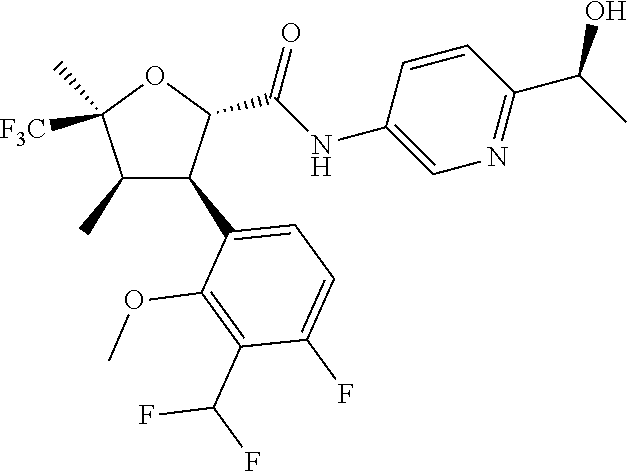 |
 |
 |
 |
 |
 |
 |

or a pharmaceutically acceptable salt thereof. In other embodiments, the invention relates to the foregoing compound in non-salt form. Such compound is considered to be a “compound of the invention,” as that term is used herein.

or a pharmaceutically acceptable salt thereof. In other embodiments, the invention relates to the foregoing compound in non-salt form. Such compound is considered to be a “compound of the invention,” as that term is used herein.

or a pharmaceutically acceptable salt thereof, wherein the compound has the absolute and relative stereochemistry corresponding to the first eluting isomer when the two diastereoisomers of (2R,3S,4S,5R)-3-(3,4-difluoro-2-methoxyphenyl)-N-(6-(2,2-dimethyl-1,3-dioxolan-4-yl)pyridin-3-yl)-4,5-dimethyl-5-(trifluoromethyl)tetrahydrofuran-2-carboxamide are separated by SFC as described in Example 1,

or a pharmaceutically acceptable salt thereof, wherein the compound has the absolute and relative stereochemistry corresponding to the second eluting isomer when the two diastereoisomers of (2R,3S,4S,5R)-3-(3,4-difluoro-2-methoxyphenyl)-N-(6-(2,2-dimethyl-1,3-dioxolan-4-yl)pyridin-3-yl)-4,5-dimethyl-5-(trifluoromethyl)tetrahydrofuran-2-carboxamide are separated by SFC as described in Example 1,

or a pharmaceutically acceptable salt thereof. In other embodiments, the invention relates to the foregoing compound in non-salt form. Such compound is considered to be a “compound of the invention,” as that term is used herein.

or a pharmaceutically acceptable salt thereof. In other embodiments, the invention relates to the foregoing compound in non-salt form. Such compound is considered to be a “compound of the invention,” as that term is used herein.

or a pharmaceutically acceptable salt thereof, wherein the compound has the absolute and relative stereochemistry of the first eluting isomer when rac-(2R,3S,4S,5R)-3-(3-(difluoromethyl)-4-fluoro-2-methoxyphenyl)-N-(6-(hydroxymethyl)pyridin-3-yl)-4,5-dimethyl-5-(trifluoromethyl)tetrahydrofuran-2-carboxamide is separated by SFC as described in Example 6. In other embodiments, the invention relates to the foregoing compound in non-salt form. Such compound is considered to be a “compound of the invention,” as that term is used herein.

or a pharmaceutically acceptable salt thereof, wherein the compound has the absolute and relative stereochemistry of the second eluting isomer when rac-(2R,3S,4S,5R)-3-(3-(difluoromethyl)-4-fluoro-2-methoxyphenyl)-N-(6-(hydroxymethyl)pyridin-3-yl)-4,5-dimethyl-5-(trifluoromethyl)tetrahydrofuran-2-carboxamide is separated by SFC as described in Example 6. In other embodiments, the invention relates to the foregoing compound in non-salt form. Such compound is considered to be a “compound of the invention,” as that term is used herein.

or a pharmaceutically acceptable salt thereof. In other embodiments, the invention relates to the foregoing compound in non-salt form. Such compound is considered to be a “compound of the invention,” as that term is used herein.

or a pharmaceutically acceptable salt thereof. In other embodiments, the invention relates to the foregoing compound in non-salt form. Such compound is considered to be a “compound of the invention,” as that term is used herein.

or a pharmaceutically acceptable salt thereof. In other embodiments, the invention relates to the foregoing compound in non-salt form. Such compound is considered to be a “compound of the invention,” as that term is used herein.

or a pharmaceutically acceptable salt thereof, wherein the compound has the absolute and relative stereochemistry corresponding to the first eluting isomer when the two enantiomers of rac-(5-((2R,3S,4S,5R)-3-(3-(difluoromethyl)-4-fluoro-2-methoxyphenyl)-4,5-dimethyl-5-(trifluoromethyl)tetrahydrofuran-2-carboxamido)pyrimidin-2-yl)methyl benzoate are separated by SFC as described in Example 6. In other embodiments, the invention relates to the foregoing compound in non-salt form. Such compound is considered to be a “compound of the invention,” as that term is used herein.

or a pharmaceutically acceptable salt thereof, wherein the compound has the absolute and relative stereochemistry corresponding to the second eluting isomer when the two enantiomers of rac-(5-((2R,3S,4S,5R)-3-(3-(difluoromethyl)-4-fluoro-2-methoxyphenyl)-4,5-dimethyl-5-(trifluoromethyl)tetrahydrofuran-2-carboxamido)pyrimidin-2-yl)methyl benzoate are separated by SFC as described in Example 6. In other embodiments, the invention relates to the foregoing compound in non-salt form. Such compound is considered to be a “compound of the invention,” as that term is used herein.

or a pharmaceutically acceptable salt thereof. In other embodiments, the invention relates to the foregoing compound in non-salt form. Such compound is considered to be a “compound of the invention,” as that term is used herein.

or a pharmaceutically acceptable salt thereof. In other embodiments, the invention relates to the foregoing compound in non-salt form. Such compound is considered to be a “compound of the invention,” as that term is used herein.

or a pharmaceutically acceptable salt thereof. In other embodiments, the invention relates to the foregoing compound in non-salt form. Such compound is considered to be a “compound of the invention,” as that term is used herein.

or a pharmaceutically acceptable salt thereof. In other embodiments, the invention relates to the foregoing compound in non-salt form. Such compound is considered to be a “compound of the invention,” as that term is used herein.

or a pharmaceutically acceptable salt thereof. In other embodiments, the invention relates to the foregoing compound in non-salt form. Such compound is considered to be a “compound of the invention,” as that term is used herein.

or a pharmaceutically acceptable salt thereof. In other embodiments, the invention relates to the foregoing compound in non-salt form. Such compound is considered to be a “compound of the invention,” as that term is used herein.

or a pharmaceutically acceptable salt thereof. In other embodiments, the invention relates to the foregoing compound in non-salt form. Such compound is considered to be a “compound of the invention,” as that term is used herein.

or a pharmaceutically acceptable salt thereof, wherein the compound has the absolute and relative stereochemistry corresponding to the first eluting isomer when the two enantiomers of rac-(2R,3S,4S,5R)—N-(6-(((tert-butyldimethylsilyl)oxy)methyl)pyridin-3-yl)-3-(3,4-difluoro-2-methylphenyl)-4,5-dimethyl-5-(trifluoromethyl)tetrahydrofuran-2-carboxamide are separated by SFC as described in Example 9. In other embodiments, the invention relates to the foregoing compound in non-salt form.

or a pharmaceutically acceptable salt thereof, wherein the compound has the absolute and relative stereochemistry corresponding to the second eluting isomer when the two enantiomers of rac-(2R,3S,4S,5R)—N-(6-(((tert-butyldimethylsilyl)oxy)methyl)pyridin-3-yl)-3-(3,4-difluoro-2-methylphenyl)-4,5-dimethyl-5-(trifluoromethyl)tetrahydrofuran-2-carboxamide are separated by SFC as described in Example 9. In other embodiments, the invention relates to the foregoing compound in non-salt form.

or a pharmaceutically acceptable salt thereof. In other embodiments, the invention relates to the foregoing compound in non-salt form. Such compound is considered to be a “compound of the invention,” as that term is used herein.

or a pharmaceutically acceptable salt thereof. In other embodiments, the invention relates to the foregoing compound in non-salt form. Such compound is considered to be a “compound of the invention,” as that term is used herein.

or a pharmaceutically acceptable salt thereof, wherein the compound has the absolute and relative stereochemistry corresponding to the first eluting isomer when the two diastereoisomers of (2R,3S,4S,5R)—N-(6-(1-((tert-butyldimethylsilyl)oxy)-2-methoxyethyl)pyridin-3-yl)-3-(3,4-difluoro-2-methoxyphenyl)-4,5-dimethyl-5-(trifluoromethyl)tetrahydrofuran-2-carboxamide are separated by SFC as described in Example 2,

or a pharmaceutically acceptable salt thereof, wherein the compound had the absolute and relative stereochemistry corresponding to the second eluting isomer when the two diastereoisomers of (2R,3S,4S,5R)—N-(6-(1-((tert-butyldimethylsilyl)oxy)-2-methoxyethyl)pyridin-3-yl)-3-(3,4-difluoro-2-methoxyphenyl)-4,5-dimethyl-5-(trifluoromethyl)tetrahydrofuran-2-carboxamide are separated by SFC as described in Example 2,

or a pharmaceutically acceptable salt thereof. In other embodiments, the invention relates to the foregoing compound in non-salt form. Such compound is considered to be a “compound of the invention,” as that term is used herein.

or a pharmaceutically acceptable salt thereof. In other embodiments, the invention relates to the foregoing compound in non-salt form. Such compound is considered to be a “compound of the invention,” as that term is used herein.

or a pharmaceutically acceptable salt thereof. In other embodiments, the invention relates to the foregoing compound in non-salt form. Such compound is considered to be a “compound of the invention,” as that term is used herein.

or a pharmaceutically acceptable salt thereof. In other embodiments, the invention relates to the foregoing compound in non-salt form. Such compound is considered to be a “compound of the invention,” as that term is used herein.
-
- (1) an opioid analgesic, e.g. morphine, heroin, hydromorphone, oxymorphone, levorphanol, levallorphan, methadone, meperidine, fentanyl, cocaine, codeine, dihydrocodeine, oxycodone, hydrocodone, propoxyphene, nalmefene, nalorphine, naloxone, naltrexone, buprenorphine, butorphanol, nalbuphine, pentazocine, or difelikefalin;
- (2) a nonsteroidal antiinflammatory drug (NSAID), e.g. aspirin, diclofenac, diflunisal, etodolac, fenbufen, fenoprofen, flufenisal, flurbiprofen, ibuprofen (including without limitation intravenous ibuprofen (e.g., Caldolor®)), indomethacin, ketoprofen, ketorolac (including without limitation ketorolac tromethamine (e.g., Toradol®)), meclofenamic acid, mefenamic acid, meloxicam, IV meloxicam (e.g., Anjeso®), nabumetone, naproxen, nimesulide, nitroflurbiprofen, olsalazine, oxaprozin, phenylbutazone, piroxicam, sulfasalazine, sulindac, tolmetin or zomepirac;
- (3) a barbiturate sedative, e.g. amobarbital, aprobarbital, butabarbital, butalbital, mephobarbital, metharbital, methohexital, pentobarbital, phenobarbital, secobarbital, talbutal, thiamylal or thiopental;
- (4) a benzodiazepine having a sedative action, e.g. chlordiazepoxide, clorazepate, diazepam, flurazepam, lorazepam, oxazepam, temazepam or triazolam;
- (5) a histamine (H1) antagonist having a sedative action, e.g. diphenhydramine, pyrilamine, promethazine, chlorpheniramine or chlorcyclizine;
- (6) a sedative such as glutethimide, meprobamate, methaqualone or dichloralphenazone;
- (7) a skeletal muscle relaxant, e.g. baclofen, carisoprodol, chlorzoxazone, cyclobenzaprine, methocarbamol or orphenadrine;
- (8) an NMDA receptor antagonist, e.g. dextromethorphan ((+)-3-hydroxy-N-methylmorphinan) or its metabolite dextrorphan ((+)-3-hydroxy-N-methylmorphinan), ketamine, memantine, pyrroloquinoline quinine, cis-4-(phosphonomethyl)-2-piperidinecarboxylic acid, budipine, EN-3231 (MorphiDex®), a combination formulation of morphine and dextromethorphan), topiramate, neramexane or perzinfotel including an NR2B antagonist, e.g. ifenprodil, traxoprodil or (−)—(R)-6-{2-[4-(3-fluorophenyl)-4-hydroxy-1-piperidinyl]-1-hydroxyethyl-3,4-dihydro-2(1H)-quinolinone;
- (9) an alpha-adrenergic, e.g. doxazosin, tamsulosin, clonidine, guanfacine, dexmedetomidine, modafinil, or 4-amino-6,7-dimethoxy-2-(5-methane-sulfonamido-1,2,3,4-tetrahydroisoquinolin-2-yl)-5-(2-pyridyl) quinazoline;
- (10) a tricyclic antidepressant, e.g. desipramine, imipramine, amitriptyline or nortriptyline;
- (11) an anticonvulsant, e.g. carbamazepine (Tegretol®), lamotrigine, topiramate, lacosamide (Vimpat®) or valproate;
- (12) a tachykinin (NK) antagonist, particularly an NK-3, NK-2 or NK-1 antagonist, e.g. (alphaR,9R)-7-[3,5-bis(trifluoromethyl)benzyl]-8,9,10,11-tetrahydro-9-methyl-5-(4-methylphenyl)-7H-[1,4]diazocino[2,1-g][1,7]-naphthyridine-6-13-dione (TAK-637), 5-[[(2R,3S)-2-[(1R)-1-[3,5-bis(trifluoromethyl)phenyl]ethoxy-3-(4-fluorophenyl)-4-morpholinyl]-methyl]-1,2-dihydro-3H-1,2,4-triazol-3-one (MK-869), aprepitant, lanepitant, dapitant or 3-[[2-methoxy-5-(trifluoromethoxy)phenyl]-methylamino]-2-phenylpiperidine (2S,3S);
- (13) a muscarinic antagonist, e.g oxybutynin, tolterodine, propiverine, tropsium chloride, darifenacin, solifenacin, temiverine and ipratropium;
- (14) a COX-2 selective inhibitor, e.g. celecoxib, rofecoxib, parecoxib, valdecoxib, deracoxib, etoricoxib, or lumiracoxib;
- (15) a coal-tar analgesic, in particular paracetamol;
- (16) a neuroleptic such as droperidol, chlorpromazine, haloperidol, perphenazine, thioridazine, mesoridazine, trifluoperazine, fluphenazine, clozapine, olanzapine, risperidone, ziprasidone, quetiapine, sertindole, aripiprazole, sonepiprazole, blonanserin, iloperidone, perospirone, raclopride, zotepine, bifeprunox, asenapine, lurasidone, amisulpride, balaperidone, palindore, eplivanserin, osanetant, rimonabant, meclinertant, Miraxion® or sarizotan;
- (17) a vanilloid receptor agonist (e.g. resinferatoxin or civamide) or antagonist (e.g. capsazepine, GRC-15300);
- (18) a beta-adrenergic such as propranolol;
- (19) a local anesthetic such as mexiletine;
- (20) a corticosteroid such as dexamethasone;
- (21) a 5-HT receptor agonist or antagonist, particularly a 5-HT1B/1D agonist such as eletriptan, sumatriptan, naratriptan, zolmitriptan or rizatriptan;
- (22) a 5-HT2A receptor antagonist such as R(+)-alpha-(2,3-dimethoxy-phenyl)-1-[2-(4-fluorophenylethyl)]-4-piperidinemethanol (MDL-100907);
- (23) a cholinergic (nicotinic) analgesic, such as ispronicline (TC-1734), (E)-N-methyl-4-(3-pyridinyl)-3-buten-1-amine (RJR-2403), (R)-5-(2-azetidinylmethoxy)-2-chloropyridine (ABT-594) or nicotine;
- (24) Tramadol®, Tramadol ER (Ultram ER®), IV Tramadol, Tapentadol ER (Nucynta®);
- (25) a PDE5 inhibitor, such as 5-[2-ethoxy-5-(4-methyl-1-piperazinyl-sulphonyl)phenyl]-1-methyl-3-n-propyl-1,6-dihydro-7H-pyrazolo[4,3-d]pyrimidin-7-one (sildenafil), (6R,12aR)-2,3,6,7,12,12a-hexahydro-2-methyl-6-(3,4-methylenedioxyphenyl)-pyrazino[2′,1′:6,1]-pyrido[3,4-b]indole-1,4-dione (IC-351 or tadalafil), 2-[2-ethoxy-5-(4-ethyl-piperazin-1-yl-1-sulphonyl)-phenyl]-5-methyl-7-propyl-3H-imidazo[5,1-f][1,2,4]triazin-4-one (vardenafil), 5-(5-acetyl-2-butoxy-3-pyridinyl)-3-ethyl-2-(1-ethyl-3-azetidinyl)-2,6-dihydro-7H-pyrazolo[4,3-d]pyrimidin-7-one, 5-(5-acetyl-2-propoxy-3-pyridinyl)-3-ethyl-2-(1-isopropyl-3-azetidinyl)-2,6-dihydro-7H-pyrazolo[4,3-d]pyrimidin-7-one, 5-[2-ethoxy-5-(4-ethylpiperazin-1-ylsulphonyl)pyridin-3-yl]-3-ethyl-2-[2-methoxyethyl]-2,6-dihydro-7H-pyrazolo[4,3-d]pyrimidin-7-one, 4-[(3-chloro-4-methoxybenzyl)amino]-2-[(2S)-2-(hydroxymethyl)pyrrolidin-1-yl]-N-(pyrimidin-2-ylmethyl)pyrimidine-5-carboxamide, 3-(1-methyl-7-oxo-3-propyl-6,7-dihydro-1H-pyrazolo[4,3-d]pyrimidin-5-yl)-N-[2-(1-methylpyrrolidin-2-yl)ethyl]-4-propoxybenzenesulfonamide;
- (26) an alpha-2-delta ligand such as gabapentin (Neurontin®), gabapentin GR (Gralise®), gabapentin, enacarbil (Horizant®), pregabalin (Lyrica®), 3-methyl gabapentin, (1[alpha],3[alpha],5[alpha])(3-amino-methyl-bicyclo[3.2.0]hept-3-yl)-acetic acid, (3S,5R)-3-aminomethyl-5-methyl-heptanoic acid, (3S,5R)-3-amino-5-methyl-heptanoic acid, (3S,5R)-3-amino-5-methyl-octanoic acid, (2S,4S)-4-(3-chlorophenoxy)proline, (2S,4S)-4-(3-fluorobenzyl)-proline, [(1R,5R,6S)-6-(aminomethyl)bicyclo[3.2.0]hept-6-yl]acetic acid, 3-(1-aminomethyl-cyclohexylmethyl)-4H-[1,2,4]oxadiazol-5-one, C-[1-(1H-tetrazol-5-ylmethyl)-cycloheptyl]-methylamine, (3S,4S)-(1-aminomethyl-3,4-dimethyl-cyclopentyl)-acetic acid, (3S,5R)-3-aminomethyl-5-methyl-octanoic acid, (3S,5R)-3-amino-5-methyl-nonanoic acid, (3S,5R)-3-amino-5-methyl-octanoic acid, (3R,4R,5R)-3-amino-4,5-dimethyl-heptanoic acid and (3R,4R,5R)-3-amino-4,5-dimethyl-octanoic acid;
- (27) a cannabinoid such as KHK-6188;
- (28) metabotropic glutamate subtype 1 receptor (mGluR1) antagonist;
- (29) a serotonin reuptake inhibitor such as sertraline, sertraline metabolite demethylsertraline, fluoxetine, norfluoxetine (fluoxetine desmethyl metabolite), fluvoxamine, paroxetine, citalopram, citalopram metabolite desmethylcitalopram, escitalopram, d,l-fenfluramine, femoxetine, ifoxetine, cyanodothiepin, litoxetine, dapoxetine, nefazodone, cericlamine and trazodone;
- (30) a noradrenaline (norepinephrine) reuptake inhibitor, such as maprotiline, lofepramine, mirtazepine, oxaprotiline, fezolamine, tomoxetine, mianserin, bupropion, bupropion metabolite hydroxybupropion, nomifensine and viloxazine (Vivalan®), especially a selective noradrenaline reuptake inhibitor such as reboxetine, in particular (S,S)-reboxetine;
- (31) a dual serotonin-noradrenaline reuptake inhibitor, such as venlafaxine, venlafaxine metabolite O-desmethylvenlafaxine, clomipramine, clomipramine metabolite desmethylclomipramine, duloxetine (Cymbalta®), milnacipran and imipramine;
- (32) an inducible nitric oxide synthase (iNOS) inhibitor such as S-[2-[(1-iminoethyl)amino]ethyl]-L-homocysteine, S-[2-[(1-iminoethyl)-amino]ethyl]-4,4-dioxo-L-cysteine, S-[2-[(1-iminoethyl)amino]ethyl]-2-methyl-L-cysteine, (2S,5Z)-2-amino-2-methyl-7-[(1-iminoethyl)amino]-5-heptenoic acid, 2-[[(1R,3S)-3-amino-4-hydroxy-1-(5-thiazolyl)-butyl]thio]-S-chloro-S-pyridinecarbonitrile; 2-[[(1R,3S)-3-amino-4-hydroxy-1-(5-thiazolyl)butyl]thio]-4-chlorobenzonitrile, (2S,4R)-2-amino-4-[[2-chloro-5-(trifluoromethyl)phenyl]thio]-5-thiazolebutanol, 2-[[(1R,3S)-3-amino-4-hydroxy-1-(5-thiazolyl) butyl]thio]-6-(trifluoromethyl)-3-pyridinecarbonitrile, 2-[[(1R,3S)-3-amino-4-hydroxy-1-(5-thiazolyl)butyl]thio]-5-chlorobenzonitrile, N-[4-[2-(3-chlorobenzylamino)ethyl]phenyl]thiophene-2-carboxamidine, NXN-462, or guanidinoethyldisulfide;
- (33) an acetylcholinesterase inhibitor such as donepezil;
- (34) a prostaglandin E2 subtype 4 (EP4) antagonist such as N-[({2-[4-(2-ethyl-4,6-dimethyl-1H-imidazo[4,5-c]pyridin-1-yl)phenyl]ethyl}amino)-carbonyl]-4-methylbenzenesulfonamide or 4-[(15)-1-({[5-chloro-2-(3-fluorophenoxy)pyridin-3-yl]carbonyl}amino)ethyl]benzoic acid;
- (35) a leukotriene B4 antagonist; such as 1-(3-biphenyl-4-ylmethyl-4-hydroxy-chroman-7-yl)-cyclopentanecarboxylic acid (CP-105696), 5-[2-(2-Carboxyethyl)-3-[6-(4-methoxyphenyl)-5E-hexenyl]oxyphenoxy]-valeric acid (ONO-4057) or DPC-11870;
- (36) a 5-lipoxygenase inhibitor, such as zileuton, 6-[(3-fluoro-5-[4-methoxy-3,4,5,6-tetrahydro-2H-pyran-4-yl])phenoxy-methyl]-1-methyl-2-quinolone (ZD-2138), or 2,3,5-trimethyl-6-(3-pyridylmethyl)-1,4-benzoquinone (CV-6504);
- (37) a sodium channel blocker, such as lidocaine, lidocaine plus tetracaine cream (ZRS-201) or eslicarbazepine acetate;
- (38) aNaV1.7 blocker, such as XEN-402, XEN403, TV-45070, PF-05089771, CNV1014802, GDC-0276, RG7893 BIIB-074 (Vixotrigine), BIIB-095, ASP-1807, DSP-3905, OLP-1002, RQ-00432979, FX-301, DWP-1706, DWP-17061, IMB-110, IMB-111, IMB-112 and such as those disclosed in WO2011/140425 (US2011/306607); WO2012/106499 (US2012196869); WO2012/112743 (US2012245136); WO2012/125613 (US2012264749), WO2012/116440 (US2014187533), WO2011026240 (US2012220605), U.S. Pat. Nos. 8,883,840, 8,466,188, WO2013/109521 (US2015005304), WO2020/117626, and CN111217776, the entire contents of each application hereby incorporated by reference;
- (38a) a NaV1.7 blocker such as (2-benzylspiro[3,4-dihydropyrrolo[1,2-a]pyrazine-1,4′-piperidine]-1′-yl)-(4-isopropoxy-3-methyl-phenyl)methanone, 2,2,2-trifluoro-1-[1′-[3-methoxy-4-[2-(trifluoromethoxy)ethoxy]benzoyl]-2,4-dimethyl-spiro[3,4-dihydropyrrolo[1,2-a]pyrazine-1,4′-piperidine]-6-yl]ethanone, [8-fluoro-2-methyl-6-(trifluoromethyl)spiro[3,4-dihydropyrrolo[1,2-a]pyrazine-1,4′-piperidine]-1′-yl]-(4-isobutoxy-3-methoxy-phenyl)methanone, 1-(4-benzhydrylpiperazin-1-yl)-3-[2-(3,4-dimethylphenoxy)ethoxy]propan-2-ol, (4-butoxy-3-methoxy-phenyl)-[2-methyl-6-(trifluoromethyl)spiro[3,4-dihydropyrrolo[1,2-a]pyrazine-1,4′-piperidine]-1′-yl]methanone, [8-fluoro-2-methyl-6-(trifluoromethyl)spiro[3,4-dihydropyrrolo[1,2-a]pyrazine-1,4′-piperidine]-1′-yl]-(5-isopropoxy-6-methyl-2-pyridyl)methanone, (4-isopropoxy-3-methyl-phenyl)-[2-methyl-6-(1,1,2,2,2-pentafluoroethyl)spiro[3,4-dihydropyrrolo[1,2-a]pyrazine-1,4′-piperidine]-1′-yl]methanone, 5-[2-methyl-4-[2-methyl-6-(2,2,2-trifluoroacetyl)spiro[3,4-dihydropyrrolo[1,2-a]pyrazine-1,4′-piperidine]-1′-carbonyl]phenyl]pyridine-2-carbonitrile, (4-isopropoxy-3-methyl-phenyl)-[6-(trifluoromethyl)spiro[3,4-dihydro-2H-pyrrolo[1,2-a]pyrazine-1,4′-piperidine]-1′-yl]methanone, 2,2,2-trifluoro-1-[1′-[3-methoxy-4-[2-(trifluoromethoxy)ethoxy]benzoyl]-2-methyl-spiro[3,4-dihydropyrrolo[1,2-a]pyrazine-1,4′-piperidine]-6-yl]ethanone, 2,2,2-trifluoro-1-[1′-(5-isopropoxy-6-methyl-pyridine-2-carbonyl)-3,3-dimethyl-spiro[2,4-dihydropyrrolo[1,2-a]pyrazine-1,4′-piperidine]-6-yl]ethanone, 2,2,2-trifluoro-1-[1′-(5-isopentyloxypyridine-2-carbonyl)-2-methyl-spiro[3,4-dihydropyrrolo[1,2-a]pyrazine-1,4′-piperidine]-6-yl]ethanone, (4-isopropoxy-3-methoxy-phenyl)-[2-methyl-6-(trifluoromethyl)spiro[3,4-dihydropyrrolo[1,2-a]pyrazine-1,4′-piperidine]-1′-yl]methanone, 2,2,2-trifluoro-1-[1′-(5-isopentyloxypyridine-2-carbonyl)-2,4-dimethyl-spiro[3,4-dihydropyrrolo[1,2-a]pyrazine-1,4′-piperidine]-6-yl]ethanone, 1-[(3S)-2,3-dimethyl-1′-[4-(3,3,3-trifluoropropoxymethyl)benzoyl]spiro[3,4-dihydropyrrolo[1,2-a]pyrazine-1,4′-piperidine]-6-yl]-2,2,2-trifluoro-ethanone, [8-fluoro-2-methyl-6-(trifluoromethyl)spiro[3,4-dihydropyrrolo[1,2-a]pyrazine-1,4′-piperidine]-1′-yl]-[3-methoxy-4-[(1R)-1-methylpropoxy]phenyl]methanone, 2,2,2-trifluoro-1-[1′-(5-isopropoxy-6-methyl-pyridine-2-carbonyl)-2,4-dimethyl-spiro[3,4-dihydropyrrolo[1,2-a]pyrazine-1,4′-piperidine]-6-yl]ethanone, 1-[1′-[4-methoxy-3-(trifluoromethyl)benzoyl]-2-methyl-spiro[3,4-dihydropyrrolo[1,2-a]pyrazine-1,4′-piperidine]-6-yl]-2,2-dimethyl-propan-1-one, (4-isopropoxy-3-methyl-phenyl)-[2-methyl-6-(trifluoromethyl)spiro[3,4-dihydropyrrolo[1,2-a]pyrazine-1,4′-piperidine]-1′-yl]methanone, [2-methyl-6-(1-methylcyclopropanecarbonyl)spiro[3,4-dihydropyrrolo[1,2-a]pyrazine-1,4′-piperidine]-1′-yl]-[4-(3,3,3-trifluoropropoxymethyl)phenyl]methanone, 4-bromo-N-(4-bromophenyl)-3-[(1-methyl-2-oxo-4-piperidyl)sulfamoyl]benzamide or (3-chloro-4-isopropoxy-phenyl)-[2-methyl-6-(1,1,2,2,2-pentafluoroethyl)spiro[3,4-dihydropyrrolo[1,2-a]pyrazine-1,4′-piperidine]-1′-yl]methanone.
- (39) a NaV1.8 blocker, such as PF-04531083, PF-06372865 and such as those disclosed in WO2008/135826 (US2009048306), WO2006/011050 (US2008312235), WO2013/061205 (US2014296313), US20130303535, WO2013131018, U.S. Pat. No. 8,466,188, WO2013114250 (US2013274243), WO2014/120808 (US2014213616), WO2014/120815 (US2014228371) WO2014/120820 (US2014221435), WO2015/010065 (US20160152561), WO2015/089361 (US20150166589), WO2019/014352 (US20190016671), WO2018/213426, WO2020/146682, WO2020/146612, WO2020/014243, WO2020/014246, WO2020/092187, WO2020/092667 (US2020140411), WO2020/261114, WO2020/140959, WO2020/151728, WO2021/032074, CN112390745, CN111808019, CN112225695, CN112457294, CN112300051, CN112300069, CN112441969, and CN112479996 (WO2021/047622), the entire contents of each application hereby incorporated by reference;
- (39a) a NaV1.8 blocker such as 4,5-dichloro-2-(4-fluoro-2-methoxyphenoxy)-N-(2-oxo-1,2-dihydropyridin-4-yl)benzamide, 2-(4-fluoro-2-methoxyphenoxy)-N-(2-oxo-1,2-dihydropyridin-4-yl)-4-(perfluoroethyl)benzamide, 4,5-dichloro-2-(4-fluorophenoxy)-N-(2-oxo-1,2-dihydropyridin-4-yl)benzamide, 4,5-dichloro-2-(3-fluoro-4-methoxyphenoxy)-N-(2-oxo-1,2-dihydropyridin-4-yl)benzamide, 2-(4-fluoro-2-methoxyphenoxy)-N-(2-oxo-1,2-dihydropyridin-4-yl)-5-(trifluoromethyl)benzamide, N-(2-oxo-1,2-dihydropyridin-4-yl)-2-(4-(trifluoromethoxy)phenoxy)-4-(trifluoromethyl)benzamide, 2-(4-fluorophenoxy)-N-(2-oxo-1,2-dihydropyridin-4-yl)-4-(perfluoroethyl)benzamide, 5-chloro-2-(4-fluoro-2-methoxyphenoxy)-N-(2-oxo-1,2-dihydropyridin-4-yl)benzamide, N-(2-oxo-1,2-dihydropyridin-4-yl)-2-(4-(trifluoromethoxy)phenoxy)-5-(trifluoromethyl)benzamide, 2-(4-fluoro-2-methylphenoxy)-N-(2-oxo-1,2-dihydropyridin-4-yl)-5-(trifluoromethyl)benzamide, 2-(2-chloro-4-fluorophenoxy)-N-(2-oxo-1,2-dihydropyridin-4-yl)-5-(trifluoromethyl)benzamide, 5-chloro-2-(4-fluoro-2-methylphenoxy)-N-(2-oxo-1,2-dihydropyridin-4-yl)benzamide, 4-chloro-2-(4-fluoro-2-methylphenoxy)-N-(2-oxo-1,2-dihydropyridin-4-yl)benzamide, 5-chloro-2-(2-chloro-4-fluorophenoxy)-N-(2-oxo-1,2-dihydropyridin-4-yl)benzamide, 2-((5-fluoro-2-hydroxybenzyl)oxy)-N-(2-oxo-1,2-dihydropyridin-4-yl)-4-(trifluoromethyl)benzamide, N-(2-oxo-1,2-dihydropyridin-4-yl)-2-(o-tolyloxy)-5-(trifluoromethyl)benzamide, 2-(2,4-difluorophenoxy)-N-(2-oxo-1,2-dihydropyridin-4-yl)-4-(trifluoromethyl)benzamide, N-(2-oxo-1,2-dihydropyridin-4-yl)-2-(2-(trifluoromethoxy)phenoxy)-5-(trifluoromethyl)benzamide, 2-(4-fluorophenoxy)-N-(2-oxo-1,2-dihydropyridin-4-yl)-5-(trifluoromethyl)benzamide, 2-(4-fluoro-2-methyl-phenoxy)-N-(2-oxo-1H-pyridin-4-yl)-4-(trifluoromethyl)benzamide, [4-[[2-(4-fluoro-2-methyl-phenoxy)-4-(trifluoromethyl)benzoyl]amino]-2-oxo-1-pyridyl]methyl dihydrogen phosphate, 2-(4-fluoro-2-(methyl-d3)phenoxy)-N-(2-oxo-1,2-dihydropyridin-4-yl)-4-(trifluoromethyl)benzamide, (4-(2-(4-fluoro-2-(methyl-d3)phenoxy)-4-(trifluoromethyl)benzamido)-2-oxopyridin-1(2H)-yl)methyl dihydrogen phosphate, 3-(4-fluoro-2-methoxyphenoxy)-N-(3-(methylsulfonyl)phenyl)quinoxaline-2-carboxamide, 3-(2-chloro-4-fluorophenoxy)-N-(3-sulfamoylphenyl)quinoxaline-2-carboxamide, 3-(2-chloro-4-methoxyphenoxy)-N-(3-sulfamoylphenyl)quinoxaline-2-carboxamide, 3-(4-chloro-2-methoxyphenoxy)-N-(3-sulfamoylphenyl)quinoxaline-2-carboxamide, 4-(3-(4-(trifluoromethoxy)phenoxy)quinoxaline-2-carboxamido)picolinic acid, 2-(2,4-difluorophenoxy)-N-(3-sulfamoylphenyl)quinoline-3-carboxamide, 2-(4-fluoro-2-methoxyphenoxy)-N-(3-sulfamoylphenyl)quinoline-3-carboxamide, 3-(2,4-difluorophenoxy)-N-(3-sulfamoylphenyl)quinoxaline-2-carboxamide, N-(3-sulfamoylphenyl)-2-(4-(trifluoromethoxy)phenoxy)quinoline-3-carboxamide, N-(3-sulfamoylphenyl)-3-(4-(trifluoromethoxy)phenoxy)quinoxaline-2-carboxamide, 3-(4-chloro-2-methylphenoxy)-N-(3-sulfamoylphenyl)quinoxaline-2-carboxamide, 5-(3-(4-(trifluoromethoxy)phenoxy)quinoxaline-2-carboxamido)picolinic acid, 3-(4-fluoro-2-methoxyphenoxy)-N-(2-oxo-2,3-dihydro-1H-benzo[d]imidazol-5-yl)quinoxaline-2-carboxamide, 3-(4-fluoro-2-methoxyphenoxy)-N-(pyridin-4-yl)quinoxaline-2-carboxamide, 3-(4-fluorophenoxy)-N-(3-sulfamoylphenyl)quinoxaline-2-carboxamide, N-(3-cyanophenyl)-3-(4-fluoro-2-methoxyphenoxy)quinoxaline-2-carboxamide, N-(4-carbamoylphenyl)-3-(4-fluoro-2-methoxyphenoxy)quinoxaline-2-carboxamide, 4-(3-(4-(trifluoromethoxy)phenoxy)quinoxaline-2-carboxamido)benzoic acid, N-(4-cyanophenyl)-3-(4-fluoro-2-methoxyphenoxy)quinoxaline-2-carboxamide, 5-(4,5-dichloro-2-(4-fluoro-2-methoxyphenoxy)benzamido)picolinic acid, 5-(2-(2,4-dimethoxyphenoxy)-4,6-bis(trifluoromethyl)benzamido)picolinic acid, 4-(4,5-dichloro-2-(4-fluoro-2-methoxyphenoxy)benzamido)benzoic acid, 5-(2-(4-fluoro-2-methoxyphenoxy)-4,6-bis(trifluoromethyl)benzamido)picolinic acid, 4-(2-(4-fluoro-2-methoxyphenoxy)-4-(perfluoroethyl)benzamido)benzoic acid, 5-(2-(4-fluoro-2-methoxyphenoxy)-4-(perfluoroethyl)benzamido)picolinic acid, 4-(2-(4-fluoro-2-methylphenoxy)-4-(trifluoromethyl)benzamido)benzoic acid, 5-(4,5-dichloro-2-(4-fluoro-2-methoxyphenoxy)benzamido)picolinic acid, 4-(2-(2-chloro-4-fluorophenoxy)-4-(perfluoroethyl)benzamido)benzoic acid, 4-(2-(4-fluoro-2-methylphenoxy)-4-(perfluoroethyl)benzamido)benzoic acid, 4-(4,5-dichloro-2-(4-(trifluoromethoxy)phenoxy)benzamido)benzoic acid, 4-(4,5-dichloro-2-(4-chloro-2-methylphenoxy)benzamido)benzoic acid, 5-(4-(tert-butyl)-2-(4-fluoro-2-methoxyphenoxy)benzamido)picolinic acid, 5-(4,5-dichloro-2-(4-(trifluoromethoxy)phenoxy)benzamido)picolinic acid, 4-(4,5-dichloro-2-(4-fluoro-2-methylphenoxy)benzamido)benzoic acid, 5-(4,5-dichloro-2-(2,4-dimethoxyphenoxy)benzamido)picolinic acid, 5-(4,5-dichloro-2-(2-chloro-4-fluorophenoxy)benzamido)picolinic acid, 5-(4,5-dichloro-2-(4-fluoro-2-methylphenoxy)benzamido)picolinic acid, 4-(4,5-dichloro-2-(4-chloro-2-methoxyphenoxy)benzamido)benzoic acid, 5-(4,5-dichloro-2-(2,4-difluorophenoxy)benzamido)picolinic acid, 2-(4-fluorophenoxy)-N-(3-sulfamoylphenyl)-5-(trifluoromethyl)benzamide, 2-(4-fluorophenoxy)-N-(3-sulfamoylphenyl)-4-(trifluoromethyl)benzamide, 2-(2-chloro-4-fluorophenoxy)-N-(3-sulfamoylphenyl)-5-(trifluoromethyl)benzamide, 2-(4-fluorophenoxy)-N-(3-sulfamoylphenyl)-4-(trifluoromethyl)benzamide, 2-(2-chloro-4-fluorophenoxy)-N-(3-sulfamoylphenyl)-6-(trifluoromethyl)benzamide, 2-(2-chloro-4-fluorophenoxy)-5-(difluoromethyl)-N-(3-sulfamoylphenyl)benzamide, 2-(4-fluorophenoxy)-4-(perfluoroethyl)-N-(3-sulfamoylphenyl)benzamide, 2-(4-chloro-2-methoxyphenoxy)-4-(perfluoroethyl)-N-(3-sulfamoylphenyl)benzamide, 2-(4-fluoro-2-methoxyphenoxy)-N-(3-sulfamoylphenyl)-5-(trifluoromethyl)benzamide, 5-chloro-2-(4-fluoro-2-methylphenoxy)-N-(3-sulfamoylphenyl)benzamide, 4,5-dichloro-2-(4-fluoro-2-methoxyphenoxy)-N-(3-sulfamoylphenyl)benzamide, 2,4-dichloro-6-(4-chloro-2-methoxyphenoxy)-N-(3-sulfamoylphenyl)benzamide, 2,4-dichloro-6-(4-fluoro-2-methylphenoxy)-N-(3-sulfamoylphenyl)benzamide, 2-(4-fluoro-2-methoxyphenoxy)-N-(3-sulfamoylphenyl)-4,6-bis(trifluoromethyl)benzamide, 2-(4-fluoro-2-methylphenoxy)-N-(3-sulfamoylphenyl)-4,6-bis(trifluoromethyl)benzamide, 5-chloro-2-(2-chloro-4-fluorophenoxy)-N-(3-sulfamoylphenyl)benzamide, 2-(4-fluoro-2-methoxyphenoxy)-N-(3-sulfamoylphenyl)-4-(trifluoromethoxy)benzamide, 2-(4-fluoro-2-methoxyphenoxy)-N-(3-sulfamoylphenyl)-4-(trifluoromethyl)benzamide, 4,5-dichloro-2-(4-fluorophenoxy)-N-(3-sulfamoylphenyl)benzamide, 2-(4-fluoro-2-methoxyphenoxy)-4-(perfluoroethyl)-N-(3-sulfamoylphenyl)benzamide, 5-fluoro-2-(4-fluoro-2-methylphenoxy)-N-(3-sulfamoylphenyl)benzamide, 2-(2-chloro-4-fluorophenoxy)-4-cyano-N-(3-sulfamoylphenyl)benzamide, N-(3-sulfamoylphenyl)-2-(4-(trifluoromethoxy)phenoxy)-4-(trifluoromethyl)benzamide, N-(3-carbamoyl-4-fluoro-phenyl)-2-fluoro-6-[2-(trideuteriomethoxy)-4-(trifluoromethoxy)phenoxy]-3-(trifluoromethyl)benzamide, N-(3-carbamoyl-4-fluoro-phenyl)-2-fluoro-6-[2-methoxy-4-(trifluoromethoxy)phenoxy]-3-(trifluoromethyl)benzamide, N-(3-carbamoyl-4-fluoro-phenyl)-2-fluoro-6-[2-(trideuteriomethoxy)-4-(trifluoromethoxy)phenoxy]-3-(trifluoromethoxy)benzamide, 4-[[2-fluoro-6-[2-methoxy-4-(trifluoromethoxy)phenoxy]-3-(trifluoromethyl)benzoyl]amino]pyridine-2-carboxamide, 4-[[3-chloro-2-fluoro-6-[2-methoxy-4-(trifluoromethoxy)phenoxy]benzoyl]amino]pyridine-2-carboxamide, 4-[[2-fluoro-6-[2-(trideuteriomethoxy)-4-(trifluoromethoxy)phenoxy]-3-(trifluoromethyl)benzoyl]amino]pyridine-2-carboxamide, N-(3-carbamoyl-4-fluoro-phenyl)-3-(difluoromethyl)-2-fluoro-6-[2-methoxy-4-(trifluoromethoxy)phenoxy]benzamide, 4-[[2-fluoro-6-[2-(trideuteriomethoxy)-4-(trifluoromethoxy)phenoxy]-3-(trifluoromethoxy)benzoyl]amino]pyridine-2-carboxamide, N-(3-carbamoyl-4-fluoro-phenyl)-6-[2-chloro-4-(trifluoromethoxy)phenoxy]-2-fluoro-3-(trifluoromethyl)benzamide, N-(3-carbamoyl-4-fluoro-phenyl)-2-fluoro-6-[2-methyl-4-(trifluoromethoxy)phenoxy]-3-(trifluoromethyl)benzamide, N-(3-carbamoyl-4-fluoro-phenyl)-2,3,4-trifluoro-6-[2-methoxy-4-(trifluoromethoxy)phenoxy]benzamide, N-(2-carbamoyl-4-pyridyl)-3-fluoro-5-[2-methoxy-4-(trifluoromethoxy)phenoxy]-2-(trifluoromethyl)pyridine-4-carboxamide, 4-[[6-[2-(difluoromethoxy)-4-(trifluoromethoxy)phenoxy]-2-fluoro-3-(trifluoromethyl)benzoyl]amino]pyridine-2-carboxamide, N-(3-carbamoyl-4-fluoro-phenyl)-6-[3-chloro-4-(trifluoromethoxy)phenoxy]-2-fluoro-3-(trifluoromethyl)benzamide, N-(3-carbamoyl-4-fluoro-phenyl)-2-fluoro-6-[4-(trifluoromethoxy)phenoxy]-3-(trifluoromethyl)benzamide, N-(4-carbamoyl-3-fluoro-phenyl)-2-fluoro-6-[2-methoxy-4-(trifluoromethoxy)phenoxy]-3-(trifluoromethyl)benzamide, 4-[[2-fluoro-6-[2-(trideuteriomethoxy)-4-(trifluoromethoxy)phenoxy]-4-(trifluoromethyl)benzoyl]amino]pyridine-2-carboxamide, N-(3-carbamoyl-4-fluoro-phenyl)-2-fluoro-6-[3-fluoro-4-(trifluoromethoxy)phenoxy]-3-(trifluoromethyl)benzamide, N-(3-carbamoyl-4-fluoro-phenyl)-2-[2-methoxy-4-(trifluoromethoxy)phenoxy]-5-(1,1,2,2,2-pentafluoroethyl)benzamide, 4-[[4-(difluoromethoxy)-2-fluoro-6-[2-methoxy-4-(trifluoromethoxy)phenoxy]benzoyl]amino]pyridine-2-carboxamide, N-(3-carbamoyl-4-fluoro-phenyl)-2-fluoro-6-[2-fluoro-4-(trifluoromethoxy)phenoxy]-3-(trifluoromethyl)benzamide, 4-[[4-cyclopropyl-2-fluoro-6-[2-methoxy-4-(trifluoromethoxy)phenoxy]benzoyl]amino]pyridine-2-carboxamide, N-(3-carbamoyl-4-fluoro-phenyl)-5-fluoro-2-[2-methoxy-4-(trifluoromethoxy)phenoxy]-4-(trifluoromethyl)benzamide, 5-[[2-fluoro-6-[2-(trideuteriomethoxy)-4-(trifluoromethoxy)phenoxy]-3-(trifluoromethyl)benzoyl]amino]pyridine-2-carboxamide, N-(3-carbamoyl-4-fluoro-phenyl)-2-fluoro-6-(4-fluorophenoxy)-3-(trifluoromethyl)benzamide, 4-(2-fluoro-6-(2-methoxy-4-(trifluoromethoxy)phenoxy)-3-(trifluoromethyl)benzamido)picolinamide, or 4-[[2-fluoro-6-[3-fluoro-2-methoxy-4-(trifluoromethoxy)phenoxy]-3-(trifluoromethyl)benzoyl]amino]pyridine-2-carboxamide;
- (40) a combined NaV1.7 and NaV1.8 blocker, such as DSP-2230, Lohocla201 or BL-1021;
- (41) a 5-HT3 antagonist, such as ondansetron;
- (42) a TPRV 1 receptor agonist, such as capsaicin (NeurogesX®, Qutenza®); and the pharmaceutically acceptable salts and solvates thereof,
- (43) a nicotinic receptor antagonist, such as varenicline;
- (44) an N-type calcium channel antagonist, such as Z-160;
- (45) a nerve growth factor antagonist, such as tanezumab;
- (46) an endopeptidase stimulant, such as senrebotase;
- (47) an angiotensin II antagonist, such as EMA-401;
- (48) acetaminophen (including without limitation intravenous acetaminophen (e.g., Ofirmev®));
- (49) bupivacaine (including without limitation bupivacaine liposome injectable suspension (e.g., Exparel®) bupivacaine ER (Posimir), bupivacaine collagen (Xaracoll) and transdermal bupivacaine (Eladur®)); and
- (50) bupivacaine and meloxicam combination (e.g., HTX-011).
-
- 1. A compound of formula (I)

-
- or a pharmaceutically acceptable salt thereof, wherein:
- X2a is N, N+—O−, or C—R2a;
- X3a is N or N+—O−;
- X5a is N, N+—O−, or C—R5a;
- X6a is N, N+—O−, or C—R6a;
- Rd is (CH2)m(CHRe)n(CH2)pH;
- m, n, and p are each independently 0 or 1;
- Re is H, OH, halo, C1-C6 alkoxy, or C1-C6 haloalkoxy;
- R2a and R6a are each independently H, halo, C1-C6 alkyl, or C1-C6 haloalkyl;
- R5a is H, halo, CH2OH, C1-C6 alkyl, or C1-C6 haloalkyl;
- R4b1 and R4b2 are each independently H, C1-C6 alkyl, C3-C6 cycloalkyl, or C1-C6 haloalkyl;
- R5b1 and R5b2 are each independently H, C1-C6 alkyl, C3-C6 cycloalkyl, or C1-C6 haloalkyl;
- X3c is N or C—R3c;
- X4c is N or C—R4c;
- X5c is N or C—R5c;
- X6c is N or C—R6c;
- R2c is H, OH, halo, C1-C6 alkyl, C2-C6 alkenyl, C1-C6 haloalkyl, C1-C6 alkoxy, C1-C6 haloalkoxy,
- or -L1-L2-(C3-C6 cycloalkyl), wherein said cycloalkyl is optionally substituted with 1-2 halo;
- L1 is a bond or O;
- L2 is a bond or C1-C6 alkylene;
- R3c is H, halo, C1-C6 alkyl, or C1-C6 haloalkyl; or X3c is C—R3c, and R2c and R3c, together with the carbon atoms to which they are attached, form a ring of formula:
- or a pharmaceutically acceptable salt thereof, wherein:

-
-
- Z1 and Z2 are each independently O or CH2;
- each R is independently H or halo;
- R4c is H, halo, C1-C6 alkyl, C1-C6 haloalkyl, C1-C6 alkoxy, or C1-C6 haloalkoxy;
- R5c is H, halo, C1-C6 alkyl, or C1-C6 haloalkyl; and
- R6c is H, halo, C1-C6 alkyl, or C1-C6 haloalkyl;
- provided that no more than two of X2a, X3a, X5a, and X6a are N or N+—O−; and
- provided that no more than one of X3c, X4c, X5c, and X6c is N.
- 2. The compound of clause 1, wherein the compound has formula (I-A)
-

-
- or a pharmaceutically acceptable salt thereof.
- 3. The compound of clause 1, wherein the compound has formula (I-A-1)

-
- or a pharmaceutically acceptable salt thereof.
- 4. The compound of clause 1, wherein the compound has formula (I-B)

-
- or a pharmaceutically acceptable salt thereof.
- 5. The compound of clause 1, wherein the compound has formula (I-B-1)

-
- or a pharmaceutically acceptable salt thereof.
- 6. The compound of any one of
clauses 1, 2, and 4, or a pharmaceutically acceptable salt thereof, wherein X2a is C—R2a; and R2a is H. - 7. The compound of any one of
clauses 1, 2, 4, and 6, or a pharmaceutically acceptable salt thereof, wherein X3a is N. - 8. The compound of any one of
clauses 1, 2, 4, and 6, or a pharmaceutically acceptable salt thereof, wherein X3a is N+—O−. - 9. The compound of any one of
clauses 1, 2, 4, and 6-8, or a pharmaceutically acceptable salt thereof, wherein X5a is N or C—R5a; and R5a is H, halo, or CH2OH. - 10. The compound of clause 9, or a pharmaceutically acceptable salt thereof, wherein X5a is N.
- 11. The compound of clause 9, or a pharmaceutically acceptable salt thereof, wherein X5a is C—R5a; and R5a is H, F, or CH2OH.
- 12. The compound of any one of
clauses 1, 2, 4, and 6-11, or a pharmaceutically acceptable salt thereof, wherein X6a is N or C—R6a; and R6a is H. - 13. The compound of clause 12, or a pharmaceutically acceptable salt thereof, wherein X6a is C—R6a; and R6a is H.
- 14. The compound of any one of clauses 1-13, or a pharmaceutically acceptable salt thereof, wherein R4b1 is H or C1-C6 alkyl.
- 15. The compound of clause 14, or a pharmaceutically acceptable salt thereof, wherein R4b1 is H or CH3.
- 16. The compound of any one of clauses 1-15, or a pharmaceutically acceptable salt thereof, wherein R4b2 is H or C1-C6 alkyl.
- 17. The compound of clause 16, or a pharmaceutically acceptable salt thereof, wherein R4b2 is H or CH3.
- 18. The compound of any one of clauses 1-17, or a pharmaceutically acceptable salt thereof, wherein R5b1 is C1-C6 alkyl or C1-C6 haloalkyl.
- 19. The compound of clause 18, or a pharmaceutically acceptable salt thereof, wherein R5b1 is CH3 or CF3.
- 20. The compound of any one of clauses 1-19, or a pharmaceutically acceptable salt thereof, wherein R5b2 is C1-C6 alkyl or C1-C6 haloalkyl.
- 21. The compound of
clause 20, or a pharmaceutically acceptable salt thereof, wherein R52 is CH3 or CF3. - 22. The compound of any one of clauses 1-21, or a pharmaceutically acceptable salt thereof, wherein R2c is OH, halo, C1-C6 alkyl, C1-C6 alkoxy, or C1-C6 haloalkoxy.
- 23. The compound of clause 22, or a pharmaceutically acceptable salt thereof, wherein R2c is OH, Cl, CH3, OCH3, OCD3, OCH2CH3, OCH(CH3)2, OCH2CH2F, or OCH2CHF2.
- 24. The compound of any one of clauses 1-23, or a pharmaceutically acceptable salt thereof, wherein X3c is N or C—R3c; and R3c is H, halo, C1-C6 alkyl, or C1-C6 haloalkyl.
- 25. The compound of clause 24, or a pharmaceutically acceptable salt thereof, wherein X3c is N.
- 26. The compound of clause 24, or a pharmaceutically acceptable salt thereof, wherein X3c is C—R3c; and R3c is H, F, CH3, CHF2, or CF3.
- 27. The compound of any one of clauses 1-23, or a pharmaceutically acceptable salt thereof, wherein X3c is C—R3c; and R2c and R3c, together with the carbon atoms to which they are attached, form a ring of formula:

-
- 28. The compound of clause 27, or a pharmaceutically acceptable salt thereof, wherein the ring is of formula:

-
- 29. The compound of any one of clauses 1-28, or a pharmaceutically acceptable salt thereof, wherein X4c is C—R4c; and R4c is H, halo, C1-C6 haloalkyl, C1-C6 alkoxy, or C1-C6 haloalkoxy.
- 30. The compound of clause 29, or a pharmaceutically acceptable salt thereof, wherein X4c is C—R4c; and R4c is H, F, CHF2, OCH2CH3, OCHF2, OCF3.
- 31. The compound of any one of clauses 1-30, or a pharmaceutically acceptable salt thereof, wherein X5c is C—R5c; and R5c is H.
- 32. The compound of any one of clauses 1-31, or a pharmaceutically acceptable salt thereof, wherein X6c is C—R6c; and R6c is H.
- 33. The compound of any one of clauses 1-32, or a pharmaceutically acceptable salt thereof, wherein Rd is (CH2)pH.
- 34. The compound of clause 33, or a pharmaceutically acceptable salt thereof, wherein Rd is H or CH3.
- 35. The compound of any one of clauses 1-32, or a pharmaceutically acceptable salt thereof, wherein Rd is (CHRe)n(CH2)pH.
- 36. The compound of
clause 35, or a pharmaceutically acceptable salt thereof, wherein Rd is CH2F, CH2OH, or CH(OH)CH3. - 37. The compound of any one of clauses 1-32, or a pharmaceutically acceptable salt thereof, wherein Rd is (CH2)m(CHRe)nH.
- 38. The compound of clause 37, or a pharmaceutically acceptable salt thereof, wherein Rd is CH2OCH3 or CH2CH2OCH3.
- 39. A compound selected from Table A, or a pharmaceutically acceptable salt thereof.
- 40. The compound of any one of clauses 1-39 in non-salt form.
- 41. A pharmaceutical composition comprising a therapeutically effective amount of the compound of any one of clauses 1-39, or a pharmaceutically acceptable salt thereof, or the compound of clause 40 and one or more pharmaceutically acceptable carriers or vehicles.
- 42. A pharmaceutical composition comprising the compound of any one of clauses 1-39, or a pharmaceutically acceptable salt thereof, or the compound of clause 40 and one or more pharmaceutically acceptable carriers or vehicles.
- 43. A method of inhibiting a voltage-gated sodium channel in a subject comprising administering to the subject the compound of any one of clauses 1-39, or a pharmaceutically acceptable salt thereof, the compound of clause 40, or the pharmaceutical composition of clause 41 or 42.
- 44. The method of clause 43, wherein the voltage-gated sodium channel is NaV1.8.
- 45. A method of treating or lessening the severity in a subject of chronic pain, gut pain, neuropathic pain, musculoskeletal pain, acute pain, inflammatory pain, cancer pain, idiopathic pain, postsurgical pain, visceral pain, multiple sclerosis, Charcot-Marie-Tooth syndrome, incontinence, pathological cough, or cardiac arrhythmia comprising administering to the subject an effective amount of the compound of any one of clauses 1-39, or a pharmaceutically acceptable salt thereof, the compound of clause 40, or the pharmaceutical composition of clause 41 or 42.
- 46. The method of clause 45, where the method comprises treating or lessening the severity in the subject of neuropathic pain.
- 47. The method of clause 46, wherein the neuropathic pain comprises post-herpetic neuralgia.
- 48. The method of clause 46, wherein the neuropathic pain comprises small-fiber neuropathy.
- 49. The method of clause 46, wherein the neuropathic pain comprises idiopathic small-fiber neuropathy.
- 50. The method of clause 46, wherein the neuropathic pain comprises diabetic neuropathy.
- 51. The method of
clause 50, wherein the diabetic neuropathy comprises diabetic peripheral neuropathy. - 52. The method of clause 45, wherein the method comprises treating or lessening the severity in the subject of musculoskeletal pain.
- 53. The method of clause 52, wherein the musculoskeletal pain comprises osteoarthritis pain.
- 54. The method of clause 45, wherein the method comprises treating or lessening the severity in the subject of acute pain.
- 55. The method of clause 54, wherein the acute pain comprises acute post-operative pain.
- 56. The method of clause 45, wherein the method comprises treating or lessening the severity in the subject of postsurgical pain.
- 57. The method of clause 56, wherein the postsurgical pain comprises bunionectomy pain.
- 58. The method of clause 56, wherein the postsurgical pain comprises abdominoplasty pain.
- 59. The method of clause 56, wherein the postsurgical pain comprises herniorrhaphy pain.
- 60. The method of clause 45, wherein the method comprises treating or lessening the severity in the subject of visceral pain.
- 61. The method of any one of clauses 43-60, wherein said subject is treated with one or more additional therapeutic agents administered concurrently with, prior to, or subsequent to treatment with the compound, pharmaceutically acceptable salt, or pharmaceutical composition.
- 62. Use of the compound of any one of clauses 1-39, or a pharmaceutically acceptable salt thereof, the compound of clause 40, or the pharmaceutical composition of clause 41 or 42, as a medicament.
| Abbreviation | Meaning |
| NMR | Nuclear magnetic resonance |
| ESI-MS | Electrospray mass spectrometry |
| LC/MS | Liquid chromatography-mass spectrometry |
| UPLC | Ultra performance liquid chromatography |
| HPLC/MS/MS | High performance liquid chromatography/ |
| tandem mass spectrometry | |
| IS | Internal standard |
| HPLC | High performance liquid chromatography |
| SFC | Supercritical fluid chromatography |
| ESI | Electrospray ionization |
| g | Grams |
| mg | Milligrams |
| kg | Kilograms |
| L | Liter(s) |
| mL | Milliliters |
| μL | Microliters |
| nL | Nanoliters |
| mol | Moles |
| mmol | Millimoles |
| hr, h | Hours |
| min | Minutes |
| ms | Millisecond |
| mm | Millimeters |
| μm | Micrometers |
| nm | Nanometer |
| MHz | Megahertz |
| Hz | Hertz |
| N | Normal (concentration) |
| M | Molar (concentration) |
| mM | Millimolar (concentration) |
| μM | Micromolar (concentration) |
| ppm | Parts per million |
| % w/v | Weight-volume concentration |
| % w/w | Weight-weight concentration |
| t-BuOH | Tert-butyl alcohol |
| CDI | 1,1′-Carbonyl diimidazole |
| DAST | Diethylaminosulfur trifluoride |
| DCM | Dichloromethane |
| DCE | Dichloroethane |
| DIEA, DIPEA | N,N-Diisopropyl ethyl amine |
| DMA | N,N-Dimethylacetamide |
| DMAP | N,N-Dimethylaminopyridine |
| DMF | N,N-Dimethylformamide |
| DMSO | Dimethyl sulfoxide |
| DRG | Dorsal root ganglia |
| EDC.HCl | Ethyl carbodiimide hydrochloride |
| EtOH | Ethanol |
| EtOAc | Ethyl acetate |
| HATU | 1-[Bis(dimethylamino)methylene]-1H-1,2,3- |
| triazolo[4,5-b]pyridinium3-Oxide hexafluorophosphate | |
| HOBt | Hydroxybenzotriazole |
| EDCl | 1-Ethyl-3-(3-dimethylaminopropyl)carbodiimide |
| T3P | Propylphosphonic anhydride, i.e., 2,4,6-tripropyl- |
| 1,3,5,2,4,6-trioxatriphosphinane 2,4,6-trioxide | |
| KOAc | Potassium acetate |
| m-CPBA | Meta-chloroperoxybenzoic acid |
| MeOH | Methanol |
| MTBE | Methyl tert-butyl ether |
| NaOH | Sodium hydroxide |
| NBS | N-Bromosuccinimide |
| NMP | N-Methylpyrrolidone |
| NMO | N-Methylmorpholine N-oxide |
| PPTS | Pyridinium para-toluene sulfonate |
| TBAB | Tetra-n-butylammonium bromide |
| TBAF | Tetra-n-butylammonium fluoride |
| TBSCl | Tert-butyldimethylsilyl chloride |
| TBSOTf | Tert-butyldimethylsilyl trifluoromethanesulfonate |
| THF | Tetrahydrofuran |
| TEA | Triethylamine |
| TFA | Trifluoroacetic acid |
| RB | Round bottom (flask) |
| RT | Room temperature |
| ca. | Circa (approximately) |
| E-VIPR | Electrical stimulation voltage ion probe reader |
| HEK | Human embryonic kidney |
| KIR2.1 | Inward-rectifier potassium ion channel 2.1 |
| DMEM | Dulbecco's Modified Eagle's Medium |
| FBS | Fetal bovine serum |
| NEAA | Non-essential amino acids |
| HEPES | 2-[4-(2-Hydroxyethyl)piperazin-1-yl]ethanesulfonic acid |
| DiSBAC6(3) | Bis-(1,3-dihexyl-thiobarbituric acid) trimethine oxonol |
| CC2-DMPE | Chlorocoumarin-2-dimyristoyl phosphatidylethanolamine |
| VABSC-1 | Voltage Assay Background Suppression Compound |
| HS | Human serum |
| BSA | Bovine Serum Albumin |


Step 1:
| Cmpd No. | Compound Name | LC/MS | NMR (shifts in ppm) |
| 3 | rel-(2R*,3S*,4S*,5R*)-3-(3,4- | ESI-MS m/z calc. | 1H NMR (500 MHz, |
| difluoro-2-methoxyphenyl)-N- | 504.16837, found 505.0 | DMSO-d6) δ 10.37 (s, | |
| (6-((1R,2R)-1,2- | (M + 1)+; 503.1 (M − 1)−; | 1H), 8.68 (d, J = 2.2 Hz, | |
| dihydroxypropyl)pyridin-3-yl)- | Retention time: 3.08 | 1H), 7.97 (dd, J = 8.5, 2.5 | |
| 4,5-dimethyl-5- | minutes | Hz, 1H), 7.40 (d, J = 8.5 | |
| (trifluoromethyl)tetrahydrofuran- | Hz, 1H), 7.20-7.13 (m, | ||
| 2-carboxamide | 2H), 5.20 (d, J = 5.3 Hz, | ||
| (Precursor was the first eluting | 1H), 5.09 (d, J = 10.3 Hz, | ||
| peak by SFC on Chiralcel OD- | 1H), 4.46 (d, J = 5.5 Hz, | ||
| H column, rt = 4.36 min) | 1H), 4.30 (t, J = 5.2 Hz, | ||
| 1H), 4.25 (dd, J = 10.1, | |||
| 7.8 Hz, 1H), 3.95 (d, J = | |||
| 2.1 Hz, 3H), 3.81-3.75 | |||
| (m, 1H), 2.77 (p, J = 7.2 | |||
| Hz, 1H), 1.61 (s, 3H), | |||
| 0.94 (d, J = 6.4 Hz, 3H), | |||
| 0.74 (d, J = 7.3 Hz, 3H) | |||
| ppm. | |||
| 4 | rel-(2R*,3S*,4S*,5R*)-3-(3,4- | ESI-MS m/z calc. | 1H NMR (500 MHz, |
| difluoro-2-methoxyphenyl)-N- | 504.16837, found 505.0 | DMSO-d6) δ 10.37 (s, | |
| (6-((1S,2S)-1,2- | (M + 1)+; 503.1 (M − 1)−; | 1H), 8.65 (d, J = 2.5 Hz, | |
| dihydroxypropyl)pyridin-3-yl)- | Retention time: 3.08 | 1H), 7.99 (dd, J = 8.6, 2.5 | |
| 4,5-dimethyl-5- | minutes | Hz, 1H), 7.40 (d, J = 8.5 | |
| (trifluoromethyl)tetrahydrofuran- | Hz, 1H), 7.20-7.13 (m, | ||
| 2-carboxamide | 2H), 5.20 (d, J = 5.3 Hz, | ||
| (Precursor was the second | 1H), 5.09 (d, J = 10.3 Hz, | ||
| eluting peak by SFC on | 1H), 4.45 (d, J = 5.5 Hz, | ||
| Chiralcel OD-H column, rt = | 1H), 4.30 (t, J = 5.2 Hz, | ||
| 5.28 min) | 1H), 4.25 (dd, J = 10.4, | ||
| 7.6 Hz, 1H), 3.95 (d, J = | |||
| 2.0 Hz, 3H), 3.81-3.75 | |||
| (m, 1H), 2.80-2.73 (m, | |||
| 1H), 1.61 (s, 3H), 0.94 (d, | |||
| J = 6.4 Hz, 3H), 0.73 (d, | |||
| J = 6.5 Hz, 3H) ppm. | |||
| Cmpd No. | Compound Name | LC/MS | NMR (shifts in ppm) |
| 5 | (2S,3R,4R,5S)-3-(3,4-difluoro- | ESI-MS m/z calc. | 1H NMR (400 MHz, |
| 2-methoxyphenyl)-N-(6-((S)- | 490.1527, found 491.2 | DMSO-d6) δ 10.39 (s, | |
| 1,2-dihydroxyethyl)pyridin-3- | (M + 1)+; 489.2 (M − 1)−; | 1H), 8.65 (dd, J = 2.5, 0.7 | |
| yl)-4,5-dimethyl-5- | Retention time: 2.97 | Hz, 1H), 8.00 (dd, J = | |
| (trifluoromethyl)tetrahydrofuran- | minutes | 8.6, 2.5 Hz, 1H), 7.43 (d, | |
| 2-carboxamide | J = 8.5 Hz, 1H), 7.17 (dd, | ||
| J = 8.6, 5.2 Hz, 2H), 5.33 | |||
| (d, J = 4.9 Hz, 1H), 5.10 | |||
| (d, J = 10.3 Hz, 1H), 4.63 | |||
| (t, J = 5.9 Hz, 1H), 4.54 | |||
| (dt, J = 6.9, 4.5 Hz, 1H), | |||
| 4.24 (dd, J = 10.3, 7.6 Hz, | |||
| 1H), 3.95 (d, J = 2.2 Hz, | |||
| 3H), 3.63 (ddd, J = 10.9, | |||
| 6.0, 4.1 Hz, 1H), 3.44 | |||
| (ddd, J = 10.9, 6.8, 5.8 | |||
| Hz, 1H), 2.77 (t, J = 7.5 | |||
| Hz, 1H), 1.61 (s, 3H), | |||
| 0.80-0.68 (m, 3H) ppm. | |||
| Cmpd No. | Compound Name | LC/MS | NMR (shifts in ppm) |
| 6 | (2R,3S,4S,5R)-N-(6-((S)-1,2- | ESI-MS m/z calc. | 1H NMR (500 MHz, |
| dihydroxyethyl)pyridin-3-yl)-3- | 504.16837, found 505.4 | DMSO-d6) δ 10.36 (s, | |
| (2-ethoxy-3,4-difluorophenyl)- | (M + 1)+; 503.5 (M − 1)−; | 1H), 8.65 (s, 1H), 7.97 (d, | |
| 4,5-dimethyl-5- | Retention time: 3.12 | J = 9.2 Hz, 1H), 7.42 (d, | |
| (trifluoromethyl)tetrahydrofuran- | minutes | J = 8.6 Hz, 1H), 7.16 (dd, | |
| 2-carboxamide | J = 8.5, 4.6 Hz, 2H), 5.31 | ||
| (s, 1H), 5.08 (d, J= 10.6 | |||
| Hz, 1H), 4.62 (t, J = 5.7 | |||
| Hz, 1H), 4.53 (s, 1H), | |||
| 4.27 (dd, J = 10.5, 7.5 Hz, | |||
| 1H), 4.24-4.09 (m, 2H), | |||
| 3.62 (s, 1H), 3.44 (d, J = | |||
| 9.8 Hz, 1H), 2.74 (p, J = | |||
| 7.4 Hz, 1H), 1.60 (s, 3H), | |||
| 1.35 (t, J = 7.0 Hz, 3H), | |||
| 0.73 (d, J = 7.3 Hz, 3H) | |||
| ppm. | |||
| 7 | (2R,3S,4S,5R)-N-(6-((R)-1,2- | ESI-MS m/z calc. | 1H NMR (500 MHz, |
| dihydroxyethyl)pyridin-3-yl)-3- | 504.16837, found 505.4 | DMSO-d6) δ 10.36 (s, | |
| (2-ethoxy-3,4-difluorophenyl)- | (M + 1)+; 503.5 (M − 1)−; | 1H), 8.63 (dd, J = 2.5, 0.8 | |
| 4,5-dimethyl-5- | Retention time: 3.11 | Hz, 1H), 7.99 (dd, J = | |
| (trifluoromethyl)tetrahydrofuran- | minutes | 8.5, 2.6 Hz, 1H), 7.42 (d, | |
| 2-carboxamide | J = 8.5 Hz, 1H), 7.21- | ||
| 7.08 (m, 2H), 5.31 (d, J = | |||
| 4.9 Hz, 1H), 5.08 (d, J = | |||
| 10.5 Hz, 1H), 4.62 (t, J = | |||
| 5.9 Hz, 1H), 4.53 (dt, J = | |||
| 6.8, 4.5 Hz, 1H), 4.27 | |||
| (dd, J = 10.5, 7.5 Hz, | |||
| 1H), 4.24-4.08 (m, 2H), | |||
| 3.62 (ddd, J = 10.9, 6.0, | |||
| 4.1 Hz, 1H), 3.44 (ddd, | |||
| J = 11.0, 6.8, 5.8 Hz, 1H), | |||
| 2.74 (p, J = 7.5 Hz, 1H), | |||
| 1.60 (s, 3H), 1.35 (t, J = | |||
| 7.0 Hz, 3H), 0.77-0.67 | |||
| (m, 3H) ppm. | |||
| Cmpd No. | Compound Name | LC/MS | NMR (shifts in ppm) |
| 8 | (2R,3S,4S,5R)-3-(3,4-difluoro- | ESI-MS m/z calc. | 1H NMR (500 MHz, |
| 2-(methoxy-d3)phenyl)-N-(6- | 493.17154, found 494.3 | DMSO-d6) δ 10.37 (s, | |
| ((R)-1,2- | (M + 1)+; 492.3 (M − 1)−; | 1H), 8.65 (dd, J = 2.6, 0.7 | |
| dihydroxyethyl)pyridin-3-yl)- | Retention time: 2.99 | Hz, 1H), 8.00 (dd, J = | |
| 4,5-dimethyl-5- | minutes | 8.5, 2.5 Hz, 1H), 7.43 (d, | |
| (trifluoromethyl)tetrahydrofuran- | J = 8.5 Hz, 1H), 7.18- | ||
| 2-carboxamide | 7.13 (m, 2H), 5.32 (d, J = | ||
| 4.9 Hz, 1H), 5.09 (d, J = | |||
| 10.3 Hz, 1H), 4.62 (t, J = | |||
| 5.9 Hz, 1H), 4.54 (dt, J = | |||
| 6.8, 4.5 Hz, 1H), 4.24 | |||
| (dd, J = 10.3, 7.6 Hz, | |||
| 1H), 3.63 (ddd, J = 11.0, | |||
| 6.1, 4.2 Hz, 1H), 3.48- | |||
| 3.42 (m, 1H), 2.77 (t, J = | |||
| 7.5 Hz, 1H), 1.61 (s, 3H), | |||
| 0.76-0.71 (m, 3H) ppm. | |||
| Cmpd | NMR (shifts in | ||
| No. | Compound Name | LC/MS | ppm) |
| 9 | rel-(2R*,3S*,4S*,5R*)-3-(3,4- | ESI-MS m/z | 1H NMR (400 |
| difluoro-2-isopropoxyphenyl)- | calc. | MHz, Methanol- | |
| N-(2-(1,2- | 519.17926, | d4) δ 9.02 (s, | |
| dihydroxyethyl)pyrimidin-5- | found | 2H), 7.14 (ddd, | |
| yl)-4,5-dimethyl-5- | 520.3 | J = 8.4, 5.6, | |
| (trifluoromethyl)tetrahydrofuran- | (M + 1)+; | 2.1 Hz, 1H), 6.97 | |
| 2-carboxamide | 518.2 | (ddd, J = 9.9, 8.9, | |
| (Precursor was the first eluting | (M − 1)−; | 7.5 Hz, 1H), 5.08 | |
| peak by SFC on Chiralpak IB | Retention | (d, J = 10.7 Hz, | |
| column, rt = 0.80 min) | time: 3.2 | 1H), 4.78 (dd, J = | |
| minutes | 6.0, 4.6 Hz, 1H), | ||
| 4.66 (pd, J = 6.1, | |||
| 1.2 Hz, 1H), 4.37 | |||
| (dd, J = 10.7, 7.9 | |||
| Hz, 1H), 3.94- | |||
| 3.78 (m, 2H), | |||
| 2.78 (p, J = 7.6 | |||
| Hz, 1H), 1.67 (d, | |||
| J = 1.2 Hz, 3H), | |||
| 1.40 (dd, J = 6.2, | |||
| 1.0 Hz, 3H), 1.25 | |||
| (d, J = 6.1 Hz, | |||
| 3H), 0.79 (dt, J = | |||
| 7.4, 2.3 Hz, 3H) | |||
| ppm; alcohols | |||
| OH and amide | |||
| NH not observed. | |||
| 10 | rel-(2R*,3S*,4S*,5R*)-3-(3,4- | ESI-MS m/z | 1H NMR (400 |
| difluoro-2-isopropoxyphenyl)- | calc. | MHz, Methanol- | |
| N-(2-(1,2- | 519.17926, | d4) δ 9.02 (s, | |
| dihydroxyethyl)pyrimidin-5- | found | 2H), 7.14 (ddd, | |
| yl)-4,5-dimethyl-5- | 520.3 | J = 8.3, 5.6, | |
| (trifluoromethyl)tetrahydrofuran- | (M + 1)+; | 2.1 Hz, 1H), 6.97 | |
| 2-carboxamide | 518.2 | (ddd, J = 9.9, 8.9, | |
| (Precursor was the second | (M − 1)−; | 7.6 Hz, 1H), 5.08 | |
| eluting peak by SFC on | Retention | (d, J = 10.7 Hz, | |
| Chiralpak IB column, rt = 0.95 | time: 3.19 | 1H), 4.78 (dd, J = | |
| min) | minutes | 6.0, 4.6 Hz, 1H), | |
| 4.66 (pd, J = 6.2, | |||
| 1.3 Hz, 1H), 4.37 | |||
| (dd, J = 10.7, 7.9 | |||
| Hz, 1H), 3.94- | |||
| 3.77 (m, 2H), | |||
| 2.78 (p, J = 7.6 | |||
| Hz, 1H), 1.67 (d, | |||
| J = 1.1 Hz, 3H), | |||
| 1.40 (dd, J = 6.1, | |||
| 0.9 Hz, 3H), 1.25 | |||
| (d, J = 6.1 Hz, | |||
| 3H), 0.80 (dt, J = | |||
| 7.6, 2.3 Hz, 3H) | |||
| ppm; alcohols | |||
| OH and amide | |||
| NH not observed. | |||
| Cmpd | NMR (shifts in | ||
| No. | Compound Name | LC/MS | ppm) |
| 11 | rel-(2R*,3S*,4S*,5R*)-3-(3,4- | ESI-MS | 1H NMR (500 |
| difluoro-2-methoxyphenyl)-N- | m/z calc. | MHz, DMSO-d6) | |
| (2-(1,2- | 491.14795, | δ 10.50 (s, 1H), | |
| dihydroxyethyl)pyrimidin-5- | found 492.0 | 8.99 (s, 2H), | |
| yl)-4,5-dimethyl-5- | (M + 1)+; | 7.19-7.16 (m, | |
| (trifluoromethyl)tetrahydrofuran- | 490.1 | 2H), 5.17 (d, J = | |
| 2-carboxamide | (M − 1)−; | 6.0 Hz, 1H), 5.14 | |
| (Precursor was the first eluting | Retention | (d, J = 10.4 Hz, | |
| peak by SFC on Chiralcel OD- | time: 2.94 | 1H), 4.59 (dt, J = | |
| H column, rt = 2.91 min) | minutes | 12.6, 6.0 Hz, 2H), | |
| 4.25 (dd, J = 10.3, | |||
| 7.7 Hz, 1H), 3.95 | |||
| (d, J = 2.1 Hz, | |||
| 3H), 3.71 (dt, J = | |||
| 11.5, 6.0 Hz, 1H), | |||
| 3.65-3.61 (m, | |||
| 1H), 2.80-2.75 | |||
| (m, 1H), 1.62 (s, | |||
| 3H), 0.74 (d, J = | |||
| 7.4 Hz, 3H) ppm. | |||
| 12 | rel-(2R*,3S*,4S*,5R*)-3-(3,4- | ESI-MS | 1H NMR (500 |
| difluoro-2-methoxyphenyl)-N- | m/z calc. | MHz, DMSO-d6) | |
| (2-(1,2- | 491.14795, | δ 10.50 (s, 1H), | |
| dihydroxyethyl)pyrimidin-5- | found 492.0 | 8.99 (s, 2H), | |
| yl)-4,5-dimethyl-5- | (M + 1)+; | 7.19-7.14 (m, | |
| (trifluoromethyl)tetrahydrofuran- | 490.1 | 2H), 5.17 (br s, | |
| 2-carboxamide | (M − 1)−; | 1H), 5.15 (d, J = | |
| (Precursor was the second | Retention | 10.2 Hz, 1H), | |
| eluting peak by SFC on | time: 2.94 | 4.61-4.58 (m, | |
| Chiralcel OD-H column, rt = | minutes | 2H), 4.25 (dd, J = | |
| 3.79 min) | 10.3, 7.6 Hz, 1H), | ||
| 3.95 (d, J = 2.0 | |||
| Hz, 3H), 3.73- | |||
| 3.70 (m, 1H), | |||
| 3.65-3.61 (m, | |||
| 1H), 2.80-2.74 (m, | |||
| 1H), 1.62 (s, 3H), | |||
| 0.74 (d, J = 7.4 | |||
| Hz, 3H) ppm. | |||
| Cmpd | |||
| No. | Compound Name | LC/MS | NMR (shifts in ppm) |
| 13 | (2R,3S,4S,5R)-N-(6-((R)-1,2- | 1H NMR (400 MHz, | |
| dihydroxyethyl)pyridin-3-yl)-3- | DMSO-d6) δ 10.40 (s, | ||
| (3-fluoro-2-methoxyphenyl)- | 1H), 8.63 (d, J = 2.0 | ||
| 4,5-dimethyl-5- | Hz, 1H), 7.99 (dd, J = | ||
| (trifluoromethyl)tetrahydrofuran- | 2.0, 6.8 Hz, 1H), 7.42 | ||
| 2-carboxamide | (d, J = 6.8 Hz, 1H), | ||
| 7.24-7.06 (m, 3H), | |||
| 5.31 (d, J = 4.0 Hz, | |||
| 1H), 5.08 (d, J = 8.4 | |||
| Hz, 1H), 4.61 (t, J = | |||
| 4.8 Hz, 1H), 4.52 (m, | |||
| 1H), 4.29 (dd, J = 4.8, | |||
| 8.4 Hz, 1H), 3.86 (s, | |||
| 3H), 3.60 (m, 1H), | |||
| 3.43 (m, 1H), 2.76 | |||
| (qint, J = 6.0 Hz, 1H), | |||
| 1.59 (s, 3H), 0.71 (d, | |||
| J = 5.2 Hz, 3H) ppm. | |||
| Cmpd | NMR (shifts in | ||
| No. | Compound Name | LC/MS | ppm) |
| 14 | (2R,3S,4S,5R)-3-(3,4-difluoro- | ESI-MS | 1H NMR (500 |
| 2-methoxyphenyl)-N-(6- | m/z calc. | MHz, DMSO-d6) | |
| (hydroxymethyl)pyridin-3-yl)- | 460.14215, | δ 10.37 (s, 1H), | |
| 4,5-dimethyl-5- | found 461.7 | 8.68 (d, J = 2.5 | |
| (trifluoromethyl)tetrahydrofuran- | (M + 1)+; | Hz, 1H), 8.03 (dd, | |
| 2-carboxamide | 459.6 | J = 8.5, 2.5 Hz, | |
| (M − 1)−; | 1H), 7.42 (d, J = | ||
| Retention | 8.5 Hz, 1H), 7.18 | ||
| time: 3.11 | (dd, J = 9.9, 6.5 | ||
| minutes | Hz, 2H), 5.36 (t, | ||
| J = 5.8 Hz, 1H), | |||
| 5.10 (d, J = 10.3 | |||
| Hz, 1H), 4.52 (d, | |||
| J = 5.8 Hz, 2H), | |||
| 4.26 (dd, J = 10.3, | |||
| 7.7 Hz, 1H), 3.97 | |||
| (d, J = 2.0 Hz, | |||
| 3H), 2.78 (t, J = | |||
| 7.5 Hz, 1H), 1.62 | |||
| (s, 3H), 0.77-0.73 | |||
| (m, 3H) ppm. | |||
| Cmpd | NMR (shifts in | ||
| No. | Compound Name | LC/MS | ppm) |
| 15 | (2R,3S,4S,5R)-3-(3,4-difluoro- | ESI-MS | 1H NMR (500 |
| 2-methoxyphenyl)-N-(2- | m/z calc. | MHz, DMSO-d6) | |
| (hydroxymethyl)pyrimidin-5- | 461.1374, | δ 10.47 (s, 1H), | |
| yl)-4,5-dimethyl-5- | found 462.6 | 8.98 (s, 2H), | |
| (trifluoromethyl)tetrahydrofuran- | (M + 1)+; | 7.20-7.13 (m, | |
| 2-carboxamide | 460.5 | 2H), 5.25 (t, J = | |
| (M − 1)−; | 6.3 Hz, 1H), 5.14 | ||
| Retention | (d, J = 10.3 Hz, | ||
| time: 3.09 | 1H), 4.55 (d, J = | ||
| minutes | 6.1 Hz, 2H), 4.25 | ||
| (dd, J = 10.3, 7.5 | |||
| Hz, 1H), 3.95 (d, | |||
| J = 2.0 Hz, 3H), | |||
| 2.77 (dq, J = 7.5, | |||
| 7.5 Hz, 1H), 1.62 | |||
| (s, 3H), 0.73 (d, | |||
| J = 6.2 Hz, 3H) | |||
| ppm. | |||
| Cmpd | NMR (shifts in | ||
| No. | Compound Name | LC/MS | ppm) |
| 16 | rel-(2R*,3S*,4S*,5R*)-3-(3,4- | ESI-MS | 1H NMR (500 |
| difluoro-2-methoxyphenyl)-N- | m/z calc. | MHz, DMSO-d6) | |
| (6-(2-fluoro-1- | 492.1484, | δ 10.41 (s, 1H), | |
| hydroxyethyl)pyridin-3-yl)-4,5- | found 493.3 | 8.70 (d, J = 2.4 | |
| dimethyl-5- | (M + 1)+; | Hz, 1H), 8.06 | |
| (trifluoromethyl)tetrahydrofuran- | 491.3 | (dd, J = 8.6, 2.5 | |
| 2-carboxamide | (M − 1)−; | Hz, 1H), 7.50 (d, | |
| (Precursor was the first eluting | Retention | J = 8.5 Hz, 1H), | |
| peak by SFC on Chiralpak IB | time: 3.28 | 7.23-7.07 (m, | |
| column, rt = 0.46 min) | minutes | 2H), 5.86 (d, J = | |
| 5.2 Hz, 1H), 5.10 | |||
| (d, J = 10.2 Hz, | |||
| 1H), 4.81 (dtd, J = | |||
| 20.5, 5.8, 3.3 Hz, | |||
| 1H), 4.73-4.55 | |||
| (m, 1H), 4.55- | |||
| 4.36 (m, 1H), | |||
| 4.25 (dd, J = | |||
| 10.3, 7.7 Hz, | |||
| 1H), 3.95 (d, J = | |||
| 2.0 Hz, 3H), 2.77 | |||
| (p, J = 7.5 Hz, | |||
| 1H), 1.61 (s, 3H), | |||
| 0.74 (dd, J = 7.4, | |||
| 2.5 Hz, 3H) ppm. | |||
| 17 | rel-(2R*,3S*,4S*,5R*)-3-(3,4- | ESI-MS | 1H NMR (500 |
| difluoro-2-methoxyphenyl)-N- | m/z calc. | MHz, DMSO-d6) | |
| (6-(2-fluoro-1- | 492.1484, | δ 10.37 (s, 1H), | |
| hydroxyethyl)pyridin-3-yl)-4,5- | found 493.3 | 8.67 (d, J = 2.4 | |
| dimethyl-5- | (M + 1)+; | Hz, 1H), 7.99 | |
| (trifluoromethyl)tetrahydrofuran- | 491.3 | (dd, J = 8.5, 2.5 | |
| 2-carboxamide | (M − 1)−; | Hz, 1H), 7.45 (d, | |
| (Precursor was the second | Retention | J = 8.5 Hz, 1H), | |
| eluting peak by SFC on | time: 3.28 | 7.19-7.05 (m, | |
| Chiralpak IB column, rt = 0.75 | minutes | 2H), 5.82 (s, 1H), | |
| min) | 5.05 (d, J = 10.3 | ||
| Hz, 1H), 4.76 | |||
| (ddd, J = 20.5, | |||
| 6.3, 3.2 Hz, 1H), | |||
| 4.59 (ddd, J = | |||
| 47.6, 9.4, 3.3 Hz, | |||
| 1H), 4.45 (ddd, | |||
| J = 47.9, 9.3, 6.3 | |||
| Hz, 1H), 4.20 | |||
| (dd, J = 10.3, 7.6 | |||
| Hz, 1H), 3.91 (d, | |||
| J = 2.0 Hz, 3H), | |||
| 2.73 (q, J = 7.5 | |||
| Hz, 1H), 1.56 (s, | |||
| 3H), 0.69 (dd, J = | |||
| 7.3, 2.5 Hz, 3H) | |||
| ppm. | |||

Step 1:
| Cmpd | NMR (shifts in | ||
| No. | Compound Name | LC/MS | ppm) |
| 22 | rel-(2R*,3S*,4S*,5R*)-3-(3,4- | ESI-MS | 1H NMR (400 |
| difluoro-2-methoxyphenyl)-N- | m/z calc. | MHz, DMSO-d6) | |
| (6-(1-hydroxy-3- | 518.184, | δ 10.37 (s, 1H), | |
| methoxypropyl)pyridin-3-yl)- | found 519.0 | 8.64 (dd, J = 2.6, | |
| 4,5-dimethyl-5- | (M + 1)+; | 0.7 Hz, 1H), 8.01 | |
| (trifluoromethyl)tetrahydrofuran- | 517.0 | (dd, J = 8.5, 2.5 | |
| 2-carboxamide | (M − 1)−; | Hz, 1H), 7.43 (d, | |
| (Precursor was the first eluting | Retention | J = 8.5 Hz, 1H), | |
| peak by SFC on Chiralpak IB | time: 3.20 | 7.17 dd, J = 9.0, | |
| column, rt = 0.37 min) | minutes | 6.3 Hz, 2H), 5.32 | |
| (d, J = 5.2 Hz, | |||
| 1H), 5.09 (d, J = | |||
| 10.4 Hz, 1H), | |||
| 4.61 (dt, J = 9.0, | |||
| 4.7 Hz, 1H), 4.25 | |||
| (dd, J = 10.3, 7.6 | |||
| Hz, 1H), 3.95 (d, | |||
| J = 2.2 Hz, 3H), | |||
| 3.46 (ddd, J = 9.4, | |||
| 7.5, 6.7 Hz, 1H), | |||
| 3.38-3.33 (m, | |||
| 1H), 3.20 (s, 3H), | |||
| 2.77 (p, J = 7.5 | |||
| Hz, 1H), 1.96 | |||
| (dtd, J = 14.4, 7.4, | |||
| 4.3 Hz, 1H), 1.73 | |||
| (dddd, J = 13.6, | |||
| 8.6, 6.7, 5.1 Hz, | |||
| 1H), 1.61 (s, 3H), | |||
| 0.77-0.70 (m, 3H) | |||
| ppm. | |||
| 23 | rel-(2R*,3S*,4S*,5R*)-3-(3,4- | ESI-MS | 1H NMR (400 |
| difluoro-2-methoxyphenyl)-N- | m/z calc. | MHz, DMSO-d6) | |
| (6-(1-hydroxy-3- | 518.184, | δ 10.36 (s, 1H), | |
| methoxypropyl)pyridin-3 -yl)- | found 519.0 | 8.67 (dd, J = 2.6, | |
| 4,5-dimethyl-5- | (M + 1)+; | 0.7 Hz, 1H), 7.99 | |
| (trifluoromethyl)tetrahydrofuran- | 517.0 | (dd, J = 8.5, 2.5 | |
| 2-carboxamide | (M − 1)−; | Hz, 1H), 7.43 (d, | |
| (Precursor was the second | Retention | J = 8.5 Hz, 1H), | |
| eluting peak by SFC on | time: 3.20 | 7.22-7.13 (m, | |
| Chiralpak IB column, rt = 0.75 | minutes | 2H), 5.32 (d, J = | |
| min) | 5.2 Hz, 1H), 5.09 | ||
| (d, J = 10.3 Hz, | |||
| 1H), 4.61 (dt, J = | |||
| 9.0, 4.7 Hz, 1H), | |||
| 4.25 (dd, J = 10.3, | |||
| 7.6 Hz, 1H), 3.95 | |||
| (d, J = 2.2 Hz, | |||
| 3H), 3.46 (dt, J = | |||
| 9.4, 7.2 Hz, 1H), | |||
| 3.39-3.32 (m, | |||
| 1H), 3.21 (s, 3H), | |||
| 2.77 (p, J = 7.5 | |||
| Hz, 1H), 1.96 | |||
| (dtd, J = 14.2, 7.4, | |||
| 4.2 Hz, 1H), 1.80- | |||
| 1.67 (m, 1H), | |||
| 1.61 (s, 3H), | |||
| 0.77-0.70 (m, 3H) | |||
| ppm. | |||


Step 1:
| Cmpd | NMR (shifts in | ||
| No. | Compound Name | LC/MS | ppm) |
| 26 | rel-(2R,3S,5R)-3-(3,4-difluoro- | ESI-MS | 1H NMR (500 |
| 2-methoxyphenyl)-N-(6-((S*)- | m/z calc. | MHz, DMSO-d6) | |
| 1,2-dihydroxyethyl)pyridin-3- | 476.13705, | δ 10.08 (s, 1H), | |
| yl)-5-methyl-5- | found 477.4 | 8.65 (d, J = 2.3 | |
| (trifluoromethyl)tetrahydrofuran- | (M + 1)+; | Hz, 1H), 7.96 (dd, | |
| 2-carboxamide | 475.5 | J = 8.5, 2.5 Hz, | |
| (Precursor was the first eluting | (M − 1)−; | 1H), 7.42 (d, J = | |
| peak by SFC on Chiralpak IA | Retention | 8.5 Hz, 1H), 7.21- | |
| column, rt = 0.70 min) | time: 2.78 | 7.15 (m, 2H), | |
| minutes | 5.32 (d, J = 4.9 | ||
| Hz, 1H), 4.66- | |||
| 4.62 (m, 2H), | |||
| 4.54 (dt, J = 6.7, | |||
| 4.5 Hz, 1H), 4.08- | |||
| 4.02 (m, 1H), | |||
| 3.87 (d, J = 1.8 | |||
| Hz, 3H), 3.64 | |||
| (ddd, J = 10.5, | |||
| 6.0, 4.4 Hz, 1H), | |||
| 3.48-3.43 (m, | |||
| 1H), 2.47 (s, 1H), | |||
| 2.45 (s, 1H), 1.57 | |||
| (s, 3H) ppm. | |||
| 27 | rel-(2S,3R,5S)-3-(3,4-difluoro- | ESI-MS | 1H NMR (500 |
| 2-methoxyphenyl)-N-(6-((S*)- | m/z calc. | MHz, DMSO-d6) | |
| 1,2-dihydroxyethyl)pyridin-3- | 476.13705, | δ 10.09 (s, 1H), | |
| yl)-5-methyl-5- | found 477.3 | 8.64 (d, J = 2.3 | |
| (trifluoromethyl)tetrahydrofuran- | (M + 1)+; | Hz, 1H), 7.97 (dd, | |
| 2-carboxamide | 475.5 | J = 8.5, 2.5 Hz, | |
| (Precursor was the second | (M − 1)−; | 1H), 7.42 (d, J = | |
| eluting peak by SFC on | Retention | 8.5 Hz, 1H), 7.22- | |
| Chiralpak IA column, rt = 0.87 | time: 2.78 | 7.15 (m, 2H), | |
| min) | minutes | 5.32 (d, J = 4.9 | |
| Hz, 1H), 4.66- | |||
| 4.62 (m, 2H), | |||
| 4.54 (dt, J = 6.7, | |||
| 4.5 Hz, 1H), 4.05 | |||
| (q, J = 10.1 Hz, | |||
| 1H), 3.88 (d, J = | |||
| 1.9 Hz, 3H), 3.63 | |||
| (ddd, J = 10.4, | |||
| 6.0, 4.2 Hz, 1H), | |||
| 3.45 (ddd, J = | |||
| 11.0, 6.9, 5.8 Hz, | |||
| 1H), 2.47 (s, 1H), | |||
| 2.45 (s, 1H), 1.57 | |||
| (s, 3H) ppm. | |||
| Cmpd | NMR (shifts in | ||
| No. | Compound Name | LC/MS | ppm) |
| 28 | rel-(2S,3R,5S)-3-(3,4-difluoro- | ESI-MS | 1H NMR (500 |
| 2-methoxyphenyl )-N-(2-(1,2- | m/z calc. | MHz, DMSO-d6) | |
| dihydroxyethyl)pyrimidin-5- | 477.13232, | δ 10.25 (s, 1H), | |
| yl)-5-methyl-5- | found 478.0 | 8.96 (s, 2H), | |
| (trifluoromethyl)tetrahydrofuran- | (M + 1)+; | 7.23-7.15 (m, | |
| 2-carboxamide | 476.0 | 2H), 5.17 (d, J = | |
| (Precursor was the first eluting | (M − 1)−; | 6.0 Hz, 1H), 4.68 | |
| peak by SFC on Chiralcel OJ | Retention | (d, J = 10.1 Hz, | |
| column, rt = 4.75 min) | time: 2.78 | 1H), 4.60 (dt, J = | |
| minutes | 10.2, 5.9 Hz, 2H), | ||
| 4.04 (q, J = 10.3 | |||
| Hz, 1H), 3.88 (d, | |||
| J = 2.0 Hz, 3H), | |||
| 3.72 (dt, J = 11.6, | |||
| 6.0 Hz, 1H), 3.64 | |||
| (dt, J = 11.2, 6.0 | |||
| Hz, 1H), 1.58 (s, | |||
| 3H) ppm. 2 | |||
| protons hidden by | |||
| DMSO signal. | |||
| 29 | rel-(2R,3S,5R)-3-(3,4-difluoro- | ESI-MS | 1H NMR (500 |
| 2-methoxy phenyl)-N-(2-(1,2- | m/z calc. | MHz, DMSO-d6) | |
| dihydroxyethyl)pyrimidin-5- | 477.13232, | δ 10.25 (s, 1H), | |
| yl)-5-methyl-5- | found 478.0 | 8.96 (s, 2H), | |
| (trifluoromethyl)tetrahydrofuran- | (M + 1)+; | 7.23-7.15 (m, | |
| 2-carboxamide | 476.0 | 2H), 5.17 (d, J = | |
| (Precursor was the second | (M − 1)−; | 6.0 Hz, 1H), 4.68 | |
| eluting peak by SFC on | Retention | (d, J = 10.2 Hz, | |
| Chiralcel OJ column, rt = 5.42 | time: 2.78 | 1H), 4.60 (dt, J = | |
| min) | minutes | 11.4, 5.9 Hz, 2H), | |
| 4.04 (q, J = 10.1 | |||
| Hz, 1H), 3.89 (d, | |||
| J = 2.0 Hz, 3H), | |||
| 3.72 (dt, J = 11.5, | |||
| 6.0 Hz, 1H), 3.64 | |||
| (dt, J = 11.0, 5.9 | |||
| Hz, 1H), 1.58 (s, | |||
| 3H) ppm. 2 | |||
| protons hidden by | |||
| DMSO signal. | |||
| 30 | rel-(2S,3R,5S)-3-(3,4-difluoro- | ESI-MS | 1H NMR (500 |
| 2-methoxyphenyl)-N-(2-(1,2- | m/z calc. | MHz, DMSO-d6) | |
| dihydroxyethyl)pyrimidin-5- | 477.13232, | δ 10.25 (s, 1H), | |
| yl)-5-methyl-5- | found 477.8 | 8.96 (s, 2H), | |
| (trifluoromethyl)tetrahydrofuran- | (M + 1)+; | 7.23-7.15 (m, | |
| 2-carboxamide | 476.0 | 2H), 5.17 (d, J = | |
| (Precursor was the third eluting | (M − 1)−; | 6.0 Hz, 1H), 4.68 | |
| peak by SFC on Chiralcel OJ | Retention | (d, J = 10.1 Hz, | |
| column, rt = 10.45 min) | time: 2.78 | 1H), 4.62-4.57 (m, | |
| minutes | 2H), 4.04 (q, J = | ||
| 11.0, 10.5 Hz, | |||
| 1H), 3.88 (d, J = | |||
| 1.9 Hz, 3H), 3.72 | |||
| (dt, J = 11.5, 6.0 | |||
| Hz, 1H), 3.64 (dt, | |||
| J = 11.1, 6.0 Hz, | |||
| 1H), 1.58 (s, 3H) | |||
| ppm. 2 protons | |||
| hidden by DMSO | |||
| signal. | |||
| 31 | rel-(2R,3S,5R)-3-(3,4-difluoro- | ESI-MS | 1H NMR (500 |
| 2-methoxyphenyl )-N-(2-(1,2- | m/z calc. | MHz, DMSO-d6) | |
| dihydroxyethyl)pyrimidin-5- | 477.13232, | δ 10.25 (s, 1H), | |
| yl)-5-methyl-5- | found 478.0 | 8.96 (s, 2H), | |
| (trifluoromethyl)tetrahydrofuran- | (M + 1)+; | 7.23-7.15 (m, | |
| 2-carboxamide | 476.0 | 2H), 5.17 (d, J = | |
| (Precursor was the fourth | (M − 1)−; | 6.0 Hz, 1H), 4.68 | |
| eluting peak by SFC on | Retention | (d, J = 10.1 Hz, | |
| Chiralcel OJ column, rt = 12.17 | time: 2.78 | 1H), 4.62-4.57 | |
| min) | minutes | (m, 2H), 4.04 (q, | |
| J = 10.2 Hz, 1H), | |||
| 3.88 (d, J = 1.9 | |||
| Hz, 3H), 3.72 (dt, | |||
| J = 11.5, 5.9 Hz, | |||
| 1H), 3.64 (dt, J = | |||
| 11.0, 5.9 Hz, 1H), | |||
| 1.58 (s, 3H) ppm. | |||
| 2 protons hidden | |||
| by DMSO signal. | |||
| Cmpd | NMR (shifts | ||
| No. | Compound Name | LC/MS | in ppm) |
| 32 | rel-(2S,3R,5S)-N-(6-((S*)-1,2- | ESI-MS m/z calc. | |
| dihydroxyethyl)pyridin-3-yl)-3- | 490.1527, found | ||
| (2-ethoxy-3,4-difluorophenyl)- | 491.4 (M + 1)+; | ||
| 5-methyl-5- | 489.5 (M − 1)−; | ||
| (trifluoromethyl)tetrahydrofuran- | Retention time: | ||
| 2-carboxamide | 2.93 minutes | ||
| (Precursor was the first eluting | |||
| peak by SFC on (R,R)-Whelk- | |||
| O1 column, rt = 3.62 min) | |||
| 33 | rel-(2R,3S,5R)-N-(6-((S*)-1,2- | ESI-MS m/z calc. | |
| dihydroxyethyl)pyridin-3-yl)-3- | 490.1527, found | ||
| (2-ethoxy-3,4-difluorophenyl)- | 491.4 (M + 1)+; | ||
| 5-methyl-5- | 489.5 (M − 1)−; | ||
| (trifluoromethyl)tetrahydrofuran- | Retention time: | ||
| 2-carboxamide | 2.92 minutes | ||
| (Precursor was the second | |||
| eluting peak by SFC on (R,R)- | |||
| Whelk-O1 column, rt = 4.18 | |||
| min) | |||
| 34 | rel-(2S,3R,5S)-N-(6-((R*)-1,2- | ESI-MS m/z calc. | |
| dihydroxyethyl)pyridin-3-yl)-3- | 490.1527, found | ||
| (2-ethoxy-3,4-difluorophenyl)- | 491.4 (M + 1)+; | ||
| 5-methyl-5- | 489.5 (M − 1)−; | ||
| (trifluoromethyl)tetrahydrofuran- | Retention time: | ||
| 2-carboxamide | 2.93 minutes | ||
| (Precursor was the first eluting | |||
| peak by SFC on (R,R)-Whelk- | |||
| O1 column, rt = 3.62 min) | |||
| 35 | rel-(2R,3S,5R)-N-(6-((R*)-1,2- | ESI-MS m/z calc. | |
| dihydroxyethyl)pyridin-3-yl)-3- | 490.1527, found | ||
| (2-ethoxy-3,4-difluorophenyl)- | 491.4 (M + 1)+; | ||
| 5-methyl-5- | 489.5 (M − 1)−; | ||
| (trifluoromethyl)tetrahydrofuran- | Retention time: | ||
| 2-carboxamide | 2.92 minutes | ||
| (Precursor was the second | |||
| eluting peak by SFC on (R,R)- | |||
| Whelk-O1 column, rt = 4.18 | |||
| min) | |||

Step 1:
| Cmpd | NMR (shifts in | ||
| No. | Compound Name | LC/MS | ppm) |
| 38 | (2R,3S,4S,5R)-3-(2-(2,2- | ESI-MS | 1H NMR (500 |
| difluoroethoxy)-3,4- | m/z calc. | MHz, DMSO- | |
| difluorophenyl)-N-(6-((R)-1,2- | 540.14954, | d6) δ 10.35 (s, | |
| dihydroxyethyl)pyridin-3-yl)- | found 541.2 | 1H), 8.64 (dd, | |
| 4,5-dimethyl-5- | (M + 1)+; | J = 2.5, 0.8 Hz, | |
| (trifluoromethyl)tetrahydrofuran- | 539.1 | 1H), 8.00 (dd, | |
| 2-carboxamide | (M − 1)−; | J = 8.6, 2.5 Hz, | |
| Retention | 1H), 7.42 (d, | ||
| time: 3.07 | J = 8.5 Hz, | ||
| minutes | 1H), 7.32-6.98 | ||
| (m, 2H), 6.39 | |||
| (tt, J = 53.9, | |||
| 2.9 Hz, 1H), | |||
| 5.32 (d, J = 4.9 | |||
| Hz, 1H), 5.11 | |||
| (d, J = 10.6 Hz, | |||
| 1H), 4.63 (t, J = | |||
| 5.9 Hz, 1H), | |||
| 4.58-4.34 (m, | |||
| 3H), 4.29 (dd, | |||
| J = 10.6, 7.3 Hz, | |||
| 1H), 3.63 (ddd, | |||
| J = 10.6, 6.1, | |||
| 4.2 Hz, 1H), | |||
| 3.44 (ddd, J = | |||
| 11.0, 6.9, 5.8 | |||
| Hz, 1H), 2.78 | |||
| (p, J = 7.4 Hz, | |||
| 1H), 1.59 (s, | |||
| 3H), 0.73 (d, J = | |||
| 7.3 Hz, 3H) | |||
| ppm. | |||
| Cmpd | NMR (shifts in | ||
| No. | Compound Name | LC/MS | ppm) |
| 39 | (2R,3S,4S,5R)-3-(3,4-difluoro- | ESI-MS | 1H NMR (500 |
| 2-hydroxyphenyl)-N-(2- | m/z calc. | MHz, DMSO-d6) | |
| (hydroxymethyl)pyrimidin-5- | 447.12173, | δ 10.53 (s, 1H), | |
| yl)-4,5-dimethyl-5- | found 448.6 | 10.40 (s, 1H), | |
| (trifluoromethyl)tetrahydrofuran- | (M + 1)+; | 8.99 (s, 2H), 7.05 | |
| 2-carboxamide | 446.5 | (ddd, J = 8.3, 5.7, | |
| (M − 1)−; | 1.9 Hz, 1H), 6.87- | ||
| Retention | 6.78 (m, 1H), | ||
| time: 2.46 | 5.26 (t, J = 6.5 | ||
| minutes | Hz, 1H), 5.15 (d, | ||
| J = 10.3 Hz, 1H), | |||
| 4.56 (d, J = 5.4 | |||
| Hz, 2H), 4.25 (dd, | |||
| J = 10.3, 7.6 Hz, | |||
| 1H), 2.84 (t, J = | |||
| 7.5 Hz, 1H), 1.61 | |||
| (s, 3H), 0.77-0.65 | |||
| (m, 3H) ppm. | |||


Step 1:
| Cmpd | NMR (shifts in | ||
| No. | Compound Name | LC/MS | ppm) |
| 42 | rel-(2R,3S,4S,5R)-N-(6-((S*)- | ESI-MS | 1H NMR (400 |
| 1,2-dihydroxyethyl)pyridine-3- | m/z calc. | MHz, Methanol- | |
| yl)-3-(2-ethoxy-4-fluoro-3- | 500.19342, | d4) δ 8.67 (dd, J = | |
| methylphenyl)-4,5-dimethyl-5- | found 501.3 | 2.6, 0.7 Hz, 1H), | |
| (trifluoromethyl)tetrahydrofuran- | (M + 1)+; | 8.04 (dd, J = 8.6, | |
| 2-carboxamide | 499.3 | 2.5 Hz, 1H), 7.52 | |
| (Precursor was the first eluting | (M − 1)−; | (dt, J = 8.6, 0.7 | |
| peak by SFC on Chiralpak IC | Retention | Hz, 1H), 7.20 (dd, | |
| column, rt = 0.85 min) | time: 3.19 | J = 8.7, 6.3 Hz, | |
| minutes | 1H), 6.86 (t, J = | ||
| 8.8 Hz, 1H), 5.02 | |||
| (d, J = 10.8 Hz, | |||
| 1H), 4.71 (dd, J = | |||
| 6.6, 4.2 Hz, 1H), | |||
| 4.34 (dd, J = 10.8, | |||
| 7.9 Hz, 1H), 3.96- | |||
| 3.82 (m, 2H), | |||
| 3.79 (dd, J = 11.3, | |||
| 4.2 Hz, 1H), 3.65 | |||
| (dd, J = 11.3, 6.7 | |||
| Hz, 1H), 2.77 (p, | |||
| J = 7.6 Hz, 1H), | |||
| 2.19 (d, J = 2.1 | |||
| Hz, 3H), 1.67 (d, | |||
| J = 1.1 Hz, 3H), | |||
| 1.43 (t, J = 7.0 | |||
| Hz, 3H), 0.80 (dt, | |||
| J = 7.4, 2.4 Hz, | |||
| 3H) ppm; | |||
| alcohols OH and | |||
| amide NH not | |||
| observed. | |||
| 43 | rel-(2S,3R,4R,5S)-N-(6-((S*)- | ESI-MS | 1H NMR (400 |
| 1,2-dihydroxyethyl)pyridin-3- | m/z calc. | MHz, Methanol- | |
| yl)-3-(2-ethoxy-4-fluoro-3- | 500.19342, | d4) δ 8.67 (dd, | |
| methylphenyl)-4,5-dimethyl-5- | found 501.3 | J = 2.5, 0.7 Hz, | |
| (trifluoromethyl)tetrahydrofuran- | (M + 1)+; | 1H), 8.04 (dd, J = | |
| 2-carboxamide | 499.2 | 8.6, 2.5 Hz, 1H), | |
| (Precursor was the second | (M − 1)−; | 7.52 (dt, J = 8.6, | |
| eluting peak by SFC on | Retention | 0.7 Hz, 1H), 7.20 | |
| Chiralpak IC column, rt = 1.00 | time: 3.19 | (dd, J = 8.8, 6.3 | |
| min) | minutes | Hz, 1H), 6.86 (t, | |
| J = 8.8 Hz, 1H), | |||
| 5.03 (d, J = 10.8 | |||
| Hz, 1H), 4.71 (dd, | |||
| J = 6.6, 4.2 Hz, | |||
| 1H), 4.34 (dd, J = | |||
| 10.8, 7.9 Hz, 1H), | |||
| 3.96-3.82 (m, | |||
| 2H), 3.79 (dd, J = | |||
| 11.3, 4.2 Hz, 1H), | |||
| 3.65 (dd, J = 11.3, | |||
| 6.6 Hz, 1H), 2.77 | |||
| (p, J = 7.6 Hz, | |||
| 1H), 2.19 (d, J = | |||
| 2.1 Hz, 3H), 1.67 | |||
| (d, J = 1.2 Hz, | |||
| 3H), 1.43 (t, J = | |||
| 7.0 Hz, 3H), 0.80 | |||
| (dt, J = 7.5, 2.4 | |||
| Hz, 3H) ppm; | |||
| alcohols OH and | |||
| amide NH not | |||
| observed. | |||
| Cmpd | NMR (shifts in | ||
| No. | Compound Name | LC/MS | ppm) |
| 44 | rel-(2S,3R,4R,5S)-N-(6-((S*)- | ESI-MS | 1H NMR (500 |
| 1,2-dihydroxyethyl)138yridine- | m/z calc. | MHz, DMSO-d6) | |
| 3-yl)-3-(4-fluoro-2-methoxy-3- | 486.1778, | δ 10.40 (s, 1H), | |
| methylphenyl)-4,5-dimethyl-5- | found 487.6 | 8.65 (d, J = 2.4 | |
| (trifluoromethyl)tetrahydrofuran- | (M + 1)+; | Hz, 1H), 8.01 (dd, | |
| 2-carboxamide | 485.6 | J = 8.6, 2.6 Hz, | |
| (Precursor was the first eluting | (M − 1)−; | 1H), 7.44 (d, J = | |
| peak by SFC on (R,R)-Whelk- | Retention | 8.5 Hz, 1H), 7.25- | |
| O1 column, rt = 1.31 min) | time: 3.02 | 7.06 (m, 2H), | |
| minutes | 7.01-6.94 (m, | ||
| 1H), 5.05 (d, J = | |||
| 10.6 Hz, 1H), | |||
| 4.55 (dd, J = 6.8, | |||
| 4.2 Hz, 1H), 4.28 | |||
| (dd, J = 10.7, 7.6 | |||
| Hz, 1H), 3.72 (s, | |||
| 3H), 3.62 (dd, J = | |||
| 11.0, 4.2 Hz, 1H), | |||
| 3.44 (dd, J = 11.0, | |||
| 6.8 Hz, 2H), 2.73 | |||
| (p, J = 7.4 Hz, | |||
| 1H), 2.16 (d, J = | |||
| 2.0 Hz, 3H), 1.62 | |||
| (s, 3H), 0.73 (d, | |||
| J = 7.4 Hz, 3H) | |||
| ppm. | |||
| 45 | rel-(2R,3S,4S,5R)-N-(6-((S*)- | ESI-MS | 1H NMR (500 |
| 1,2-dihydroxyethyl)pyridin-3- | m/z calc. | MHz, DMSO-d6) | |
| yl)-3-(4-fluoro-2-methoxy-3- | 486.1778, | δ 10.36 (s, 1H), | |
| methylphenyl)-4,5-dimethyl-5- | found 487.6 | 8.68-8.59 (m, | |
| (trifluoromethyl)tetrahydrofuran- | (M + 1)+; | 1H), 7.95 (dd, J = | |
| 2-carboxamide | 485.6 | 8.5, 2.5 Hz, 1H), | |
| (Precursor was the second | (M − 1)−; | 7.40 (d, J = 8.5 | |
| eluting peak by SFC on (R,R)- | Retention | Hz, 1H), 7.19 (dd, | |
| Whelk-O1 column, rt = 2.20 | time: 3.02 | J = 8.7, 6.5 Hz, | |
| min) | minutes | 1H), 6.97 (t, J = | |
| 8.8 Hz, 1H), 5.30 | |||
| (d, J = 4.9 Hz, | |||
| 1H), 5.03 (d, J = | |||
| 10.6 Hz, 1H), | |||
| 4.61 (t, J = 5.9 | |||
| Hz, 1H), 4.52 (dt, | |||
| J = 6.7, 4.5 Hz, | |||
| 1H), 4.27 (dd, J = | |||
| 10.7, 7.6 Hz, 1H), | |||
| 3.71 (s, 3H), 3.61 | |||
| (ddd, J = 10.4, | |||
| 6.0, 4.1 Hz, 1H), | |||
| 3.43 (ddd, J = | |||
| 10.9, 6.9, 5.8 Hz, | |||
| 1H), 2.71 (p, J = | |||
| 7.5 Hz, 1H), 2.14 | |||
| (d, J = 2.0 Hz, | |||
| 3H), 1.60 (s, 3H), | |||
| 0.77-0.68 (m, 3H) | |||
| ppm. | |||
| 46 | rel-(2S,3R,4R,5S)-N-(6-((R*)- | ESI-MS | |
| 1,2-dihydroxyethyl)pyridin-3- | m/z calc. | ||
| yl)-3-(4-fluoro-2-methoxy-3- | 486.1778, | ||
| methylphenyl)-4,5-dimethyl-5- | found 487.6 | ||
| (trifluoromethyl)tetrahydrofuran- | (M + 1)+; | ||
| 2-carboxamide | 485.6 | ||
| (Precursor was the first eluting | (M − 1)−; | ||
| peak by SFC on (R,R)-Whelk- | Retention | ||
| O1 column, rt = 1.26 min) | time: 3.02 | ||
| minutes | |||
| 47 | rel-(2R,3S,4S,5R)-N-(6-((R*)- | ESI-MS | 1H NMR (500 |
| 1,2-dihydroxyethyl)pyridin-3- | m/z calc. | MHz, DMSO-d6) | |
| yl)-3-(4-fluoro-2-methoxy-3- | 486.1778, | δ 10.37 (s, 1H), | |
| methylphenyl)-4,5-dimethyl-5- | found 487.6 | 8.63 (d, J = 2.5 | |
| (trifluoromethyl)tetrahydrofuran- | (M + 1)+; | Hz, 1H), 7.99 (dd, | |
| 2-carboxamide | 485.6 | J = 8.6, 2.6 Hz, | |
| (Precursor was the second | (M − 1)−; | 1H), 7.41 (d, J = | |
| eluting peak by SFC on (R,R)- | Retention | 8.5 Hz, 1H), 7.20 | |
| Whelk-O1 column, rt = 2.10 | time: 3.02 | (dd, J = 8.7, 6.5 | |
| min) | minutes | Hz, 1H), 6.98 (t, | |
| J = 8.8 Hz, 1H), | |||
| 5.31 (d, J = 4.9 | |||
| Hz, 1H), 5.04 (d, | |||
| J = 10.6 Hz, 1H), | |||
| 4.62 (t, J = 5.9 | |||
| Hz, 1H), 4.53 (dt, | |||
| J = 7.0, 4.5 Hz, | |||
| 1H), 4.28 (dd, J = | |||
| 10.6, 7.5 Hz, 1H), | |||
| 3.72 (s, 3H), 3.62 | |||
| (ddd, J = 10.5, | |||
| 6.1, 4.2 Hz, 1H), | |||
| 3.49-3.39 (m, | |||
| 1H), 2.72 (p, J = | |||
| 7.5 Hz, 1H), 2.15 | |||
| (d, J = 2.0 Hz, | |||
| 3H), 1.61 (s, 3H), | |||
| 0.73 (d, J = 7.0 | |||
| Hz, 3H) ppm. | |||


Step 1:
| Cmpd | NMR (shifts in | ||
| No. | Compound Name | LC/MS | ppm) |
| 50 | rel-(2S,3R,4R,5S)-3-(3- | ESI-MS | 1H NMR (500 |
| (difluoromethyl)-4-fluoro-2- | m/z calc. | MHz, | |
| methoxyphenyl)-N-(6-((R*)- | 522.15894, | Chloroform-d) δ | |
| 1,2-dihydroxyethyl)pyridin-3- | found 523.2 | 8.67 (s, 1H), | |
| yl)-4,5-dimethyl-5- | (M + 1)+; | 8.57(s, 1H), 8.18 | |
| (trifluoromethyl)tetrahydrofuran- | 521.1 | (d, J = 8.6 Hz, | |
| 2-carboxamide | (M − 1)−; | 1H), 7.59-7.49 | |
| (Precursor was the first eluting | Retention | (m, 1H), 7.37 (d, | |
| peak by SFC on (R,R)-Whelk- | time: 2.97 | J = 8.5 Hz, 1H), | |
| O1 column, rt = 1.16 min) | minutes | 7.10-6.80 (m, | |
| 2H), 5.02 (d, J = | |||
| 10.6 Hz, 1H), | |||
| 4.83 (s, 1H), 4.15 | |||
| (dd, J = 10.6, 8.4 | |||
| Hz, 1H), 3.92 (dd, | |||
| J = 11.3, 3.7 Hz, | |||
| 1H), 3.84 (s, 3H), | |||
| 3.76 (dd, J = 11.4, | |||
| 5.3 Hz, 1H), 2.78 | |||
| (p, J = 7.7 Hz, | |||
| 1H), 1.69 (s, 3H), | |||
| 0.81 (dd, J = 7.6, | |||
| 2.4 Hz, 3H) ppm; | |||
| alcohols OH not | |||
| observed. | |||
| 51 | rel-(2R,3S,4S,5R)-3-(3- | ESI-MS | 1H NMR (500 |
| (difluoromethyl)-4-fluoro-2- | m/z calc. | MHz, | |
| methoxyphenyl)-N-(6-((R*)- | 522.15894, | Chloroform-d) δ | |
| 1,2-dihydroxyethyl)pyridin-3- | found 523.2 | 8.69 (s, 1H), 8.23 | |
| yl)-4,5-dimethyl-5- | (M + 1)+; | (dd, J = 8.6, 2.3 | |
| (trifluoromethyl)tetrahydrofuran- | 521.1 | Hz, 1H), 7.53 (dd, | |
| 2-carboxamide | (M − 1)−; | J = 8.9, 5.8 Hz, | |
| (Precursor was the second | Retention | 1H), 7.39 (d, J = | |
| eluting peak by SFC on (R,R)- | time: 2.97 | 8.6 Hz, 1H), 7.05- | |
| Whelk-O1 column, rt = 1.78 | minutes | 6.79 (m, 2H), | |
| min) | 5.02 (d, J = 10.6 | ||
| Hz, 1H), 4.85 (t, | |||
| J = 4.6 Hz, 1H), | |||
| 4.15 (dt, J = 10.8, | |||
| 7.9 Hz, 1H), 3.92 | |||
| (dd, J = 11.5, 3.8 | |||
| Hz, 1H), 3.84 (s, | |||
| 3H), 3.76 (dd, J = | |||
| 11.4, 5.4 Hz, 1H), | |||
| 2.78 (p, J = 7.7 | |||
| Hz, 1H), 1.70 (d, | |||
| J = 3.6 Hz, 3H), | |||
| 0.81 (dt, J = 7.8, | |||
| 2.1 Hz, 3H) ppm; | |||
| alcohols OH and | |||
| amide NH not | |||
| observed. | |||
| Cmpd No. | Compound Name | LC/MS | NMR (shifts in ppm) |
| 52 | rel-(2S,3R,4R,5S)-3-(3- | ESI-MS m/z calc. | 1H NMR (500 MHz, |
| (difluoromethyl)-4-fluoro-2- | 492.14838, found 493.4 | Methanol-d4) δ 9.03 (d, J = | |
| methoxyphenyl)-N-(6- | (M + 1)+; 491.3 (M − 1)−; | 2.4 Hz, 1H), 8.37 (dd, J = | |
| (hydroxymethyl)pyridin-3-yl)- | Retention time: | 8.8, 2.3 Hz, 1H), 7.74 | |
| 4,5-dimethyl-5- | 2.76 minutes | (d, J = 8.8 Hz, 1H), 7.60 | |
| (trifluoromethyl)tetrahydrofuran- | (dd, J = 8.8, 6.1 Hz, 1H), | ||
| 2-carboxamide | 7.19-6.88 (m, 2H), 5.12 | ||
| (First eluting peak by SFC on | (d, J = 10.4 Hz, 1H), 4.81 | ||
| Chiralpak AS-H column, 10 × | (s, 2H), 4.36 (dd, J = | ||
| 250 mm (Mobile phase: 20% | 10.5, 8.2 Hz, 1H), 3.86 (s, | ||
| MeOH (containing 20 mM | 3H), 2.83 (p, J = 7.7 Hz, | ||
| Ammonia), 80% CO2. Flow: | 1H), 1.69 (d, J = 1.2 Hz, | ||
| 10 mL/min.), rt = 1.99 min) | 3H), 0.84 (dt, J = 7.6, 2.4 | ||
| Hz, 3H) ppm; alcohol | |||
| OH and amide NH | |||
| not observed. | |||
| 53 | rel-(2R,3S,4S,5R)-3-(3- | ESI-MS m/z calc. | 1H NMR (500 MHz, |
| (difluoromethyl)-4-fluoro-2- | 492.14838, found | Methanol-d4) δ 8.67 (d, J = | |
| methoxyphenyl)-N-(6- | 493.4 (M + 1)+; | 2.5 Hz, 1H), 8.07 (dd, J = | |
| (hydroxymethyl)pyridin-3-yl)- | Retention time: | 8.5, 2.5 Hz, 1H), 7.59 | |
| 4,5-dimethyl-5- | 2.77 minutes | (dd, J = 8.8, 6.0 Hz, 1H), | |
| (trifluoromethyl)tetrahydrofuran- | 7.50 (d, J = 8.5 Hz, 1H), | ||
| 2-carboxamide | 7.15-6.90 (m, 2H), 5.08 | ||
| (Second eluting peak by SFC | (d, J = 10.4 Hz, 1H), 4.64 | ||
| on Chiralpak AS-H column, 10 × | (s, 2H), 4.34 (dd, J = | ||
| 250 mm (Mobile phase: 20% | 10.5, 8.2 Hz, 1H), 3.86 (s, | ||
| MeOH (containing 20 mM | 3H), 2.82 (p, J = 7.7 Hz, | ||
| Ammonia), 80% CO2. Flow: | 1H), 1.68 (d, J = 1.2 Hz, | ||
| 10 mL/min.), rt = 3.05 min) | 3H), 0.83 (dt, J = 7.5, 2.3 | ||
| Hz, 3H) ppm; alcohol | |||
| OH and amide NH | |||
| not observed. | |||
| Cmpd No. | Compound Name | LC/MS | NMR (shifts in ppm) |
| 54 | rel-(2R,3S,4S,5R)-3-(3- | ESI-MS m/z calc. | 1H NMR (500 MHz, |
| (difluoromethyl)-4-fluoro-2- | 493.14362, found 494.6 | Methanol-d4) δ 9.04 (s, | |
| methoxyphenyl)-N-(2- | (M + 1)+; 492.5 (M − 1)−; | 2H), 7.60 (dd, J = 8.9, 6.1 | |
| (hydroxymethyl)pyrimidin-5- | Retention time: | Hz, 1H), 7.27-6.80 (m, | |
| yl)-4,5-dimethyl-5- | 3.06 minutes | 2H), 5.11 (d, J = 10.4 Hz, | |
| (trifluoromethyl) | 1H), 4.72 (s, 2H), 4.35 | ||
| tetrahydrofuran-2-carboxamide | (dd, J = 10.4, 8.2 Hz, | ||
| (Precursor was the first | 1H), 3.86 (s, 3H), 2.83 (p, | ||
| eluting peak by SFC on | J = 7.7 Hz, 1H), 1.69 (d, | ||
| Chiralpak IG column, | J = 1.2 Hz, 3H), 0.83 (dq, | ||
| rt = 1.31 min) | J = 7.5, 2.3 Hz, 3H) ppm; | ||
| alcohol OH and amide | |||
| NH not observed. | |||
| 55 | rel-(2S,3R,4R,5S)-3-(3- | ESI-MS m/z calc. | 1H NMR (500 MHz, |
| (difluoromethyl)-4-fluoro-2- | 493.14362, found 494.6 | Methanol-d4) δ 9.04 (s, | |
| methoxyphenyl)-N-(2- | (M + 1)+; 492.5 (M − 1)−; | 2H), 7.60 (dd, J = 8.8, 6.0 | |
| (hydroxymethyl)pyrimidin-5- | Retention time: | Hz, 1H), 7.21-6.86 (m, | |
| yl)-4,5-dimethyl-5- | 3.06 minutes | 2H), 5.11 (d, J = 10.4 Hz, | |
| (trifluoromethyl) | 1H), 4.72 (s, 2H), 4.35 | ||
| tetrahydrofuran-2-carboxamide | (dd, J = 10.4, 8.2 Hz, | ||
| (Precursor was the second | 1H), 3.86 (s, 3H), 2.83 (p, | ||
| eluting peak by SFC on | J = 7.7 Hz, 1H), 1.69 (d, | ||
| Chiralpak IG column, | J = 1.4 Hz, 3H), 0.83 (dt, | ||
| rt = 1.47 min) | J = 7.5, 2.4 Hz, 3H) ppm; | ||
| alcohol OH and amide | |||
| NH not observed. | |||
| Cmpd No. | Compound Name | LC/MS | NMR (shifts in ppm) |
| 56 | rel-(2R,3S,4S,5R)-3-(3- | ESI-MS m/z calc. | 1H NMR (500 MHz, |
| (difluoromethyl)-4-fluoro-2- | 506.16403, found 507.6 | Methanol-d4) δ 8.66 (dt, | |
| methoxyphenyl)-N-(6-(1- | (M + 1)+; 505.5 (M − 1)−; | J = 2.6, 0.8 Hz, 1H), 8.06 | |
| hydroxyethyl)pyridin-3- | Retention time: | (ddd, J = 8.5, 2.5, 0.9 Hz, | |
| yl)-4,5-dimethyl-5- | 3.23 minutes | 1H), 7.62-7.57 (m, 1H), | |
| (trifluoromethyl) | 7.53-7.48 (m, 1H), 7.14- | ||
| tetrahydrofuran-2- | 6.91 (m, 2H), 5.07 (d, | ||
| carboxamide (mixture | J = 10.4 Hz, 1H), 4.82 (q, | ||
| of epimers at | J = 6.6 Hz, 1H), 4.34 (dd, | ||
| hydroxyethyl position) | J = 10.4, 8.2 Hz, 1H), 3.86 | ||
| (Precursor was the first eluting | (s, 3H), 2.82 (p, J = 7.6 | ||
| peak by SFC on Chiralpak IG | Hz, 1H), 1.68 (d, J = 1.2 | ||
| column, rt = 2.51 min; | Hz, 3H), 1.43 (d, J = 6.5 | ||
| epimers not separated) | Hz, 3H), 0.86-0.80 (m, 3H) | ||
| ppm; alcohol OH and | |||
| amide NH not observed. | |||
| 57 | rel-(2S,3R,4R,5S)-3-(3- | ESI-MS m/z calc. | 1H NMR (500 MHz, |
| (difluoromethyl)-4-fluoro-2- | 506.16403, found 507.4 | Methanol-d4) δ 8.66 (d, | |
| methoxyphenyl)-N-(6-(1- | (M + 1)+; 505.3 (M − 1)−; | J = 2.5 Hz, 1H), 8.05 (dd, | |
| hydroxyethyl)pyridin-3-yl)-4,5- | Retention time: | J = 8.5, 2.5 Hz, 1H), 7.59 | |
| dimethyl-5-(trifluoromethyl) | 3.21 minutes | (dd, J = 8.9, 6.1 Hz, 1H), | |
| tetrahydrofuran- | 7.51 (d, J = 8.6 Hz, 1H), | ||
| 2-carboxamide | 7.16-6.91 (m, 2H), 5.07 | ||
| (Precursor was the second | (d, J = 10.4 Hz, 1H), 4.86- | ||
| eluting peak by SFC on | 4.79 (m, 1H), 4.34 (dd, | ||
| Chiralpak IG column, rt = 3.51 | J = 10.4, 8.2 Hz, 1H), 3.86 | ||
| min; first eluting peak by SFC | (s, 3H), 2.82 (p, J = 7.7 | ||
| on Chiralpak IG column in the | Hz, 1H), 1.68 (d, J = 1.3 | ||
| final step, rt = 3.44 min) | Hz, 3H), 1.43 (d, J = 6.6 | ||
| Hz, 3H), 0.83 (dq, J = | |||
| 7.4, 2.4 Hz, 3H) ppm; | |||
| alcohol OH and amide | |||
| NH not observed. | |||
| 58 | rel-(2S,3R,4R,5S)-3-(3- | ESI-MS m/z calc. | 1H NMR (500 MHz, |
| (difluoromethyl)-4-fluoro-2- | 506.16403, found 507.4 | Methanol-d4) δ 8.66 (d, | |
| methoxyphenyl)-N-(6-(1- | (M + 1)+; 505.3 (M − 1)−; | J = 2.5 Hz, 1H), 8.05 (dd, | |
| hydroxyethyl)pyridin-3-yl)-4,5- | Retention time: | J = 8.5, 2.5 Hz, 1H), 7.59 | |
| dimethyl-5-(trifluoromethyl) | 3.21 minutes | (dd, J = 8.8, 6.0 Hz, 1H), | |
| tetrahydrofuran- | 7.51 (d, J = 8.6 Hz, 1H), | ||
| 2-carboxamide | 7.14-6.91 (m, 2H), 5.07 | ||
| (Precursor was the second | (d, J = 10.4 Hz, 1H), 4.86- | ||
| eluting peak by SFC on | 4.79 (m, 1H), 4.34 (dd, | ||
| Chiralpak IG column, rt = 3.51 | J = 10.4, 8.2 Hz, 1H), 3.86 | ||
| min; second eluting peak by | (s, 3H), 2.82 (p, J = 7.7 | ||
| SFC on Chiralpak IG column in | Hz, 1H), 1.68 (d, J = 1.2 | ||
| the final step, rt = 4.33 min) | Hz, 3H), 1.43 (d, J = 6.6 | ||
| Hz, 3H), 0.83 (dq, J = | |||
| 7.4, 2.3 Hz, 3H) ppm; | |||
| alcohol OH and amide | |||
| NH not observed. | |||

Step 1:
| Cmpd No. | Compound Name | LC/MS | NMR (shifts in ppm) |
| 60 | 5-((2R,3S,4S,5R)-3-(3,4- | ESI-MS m/z calc. | 1H NMR (500 MHz, |
| difluoro-2-methoxyphenyl)- | 506.1476, found 507.3 | DMSO-d6) δ 10.46 (s, | |
| 4,5-dimethyl-5- | (M + 1)+; 505.3 (M − 1)−; | 1H), 8.66 (d, J = 1.9 Hz, | |
| (trifluoromethyl)tetrahydrofuran- | Retention time: | 1H), 7.54 (dd, J = 8.8, 2.0 | |
| 2-carboxamido)-2-((R)-1,2- | 2.84 minutes | Hz, 1H), 7.47 (d, J = 8.7 | |
| dihydroxyethyl)pyridine | Hz, 1H), 7.17 (dd, J = | ||
| 1-oxide | 11.2, 6.6 Hz, 2H), 5.64 | ||
| (d, J = 5.4 Hz, 1H), 5.08 | |||
| (d, J = 10.1 Hz, 1H), 5.03- | |||
| 4.98 (m, 1H), 4.77 (t, | |||
| J = 6.0 Hz, 1H), 4.24 (dd, | |||
| J = 10.1, 7.7 Hz, 1H), 3.95 | |||
| (d, J = 2.1 Hz, 3H), 3.66 | |||
| (ddd, J = 10.9, 6.0, 3.4 | |||
| Hz, 1H), 3.46 (dt, J = | |||
| 10.9, 6.0 Hz, 1H), 2.76 | |||
| (q, J = 7.6 Hz, 1H), 1.60 | |||
| (s, 3H), 0.73 (d, J = | |||
| 7.1 Hz, 3H) ppm. | |||

Step 1:
| Cmpd No. | Compound Name | LC/MS | NMR (shifts in ppm) |
| 63 | rel-(2R,3S,5S)-3-(2-chloro- | ESI-MS m/z calc. | 1H NMR (500 MHz, |
| 4-(trifluoromethoxy)phenyl)- | 528.0887, found 529.2 | DMSO-d6) δ 10.05 (s, | |
| N-(6-((R*)-1,2- | (M + 1)+; 527.1 (M − 1)−; | 1H), 8.62 (d, J = 2.5 Hz, | |
| dihydroxyethyl)pyridin- | Retention time: | 1H), 7.96 (dd, J = 8.5, 2.5 | |
| 3-yl)-5-methyl-5- | 3.1 minutes | Hz, 1H), 7.87 (d, J = 8.7 | |
| (trifluoromethyl)tetra- | Hz, 1H), 7.62-7.54 (m, | ||
| hydrofuran- | 1H), 7.48-7.43 (m, 1H), | ||
| 2-carboxamide | 7.41 (d, J = 8.5 Hz, 1H), | ||
| (Precursor was the first | 5.31 (d, J = 4.8 Hz, 1H), | ||
| eluting peak by SFC on | 4.92 (d, J = 9.3 Hz, 1H), | ||
| Chiralcel OD-H column, | 4.63 (t, J = 5.8 Hz, 1H), | ||
| rt = 3.33 min) | 4.54 (q, J = 4.8 Hz, 1H), | ||
| 4.30-4.15 (m, 1H), 3.67- | |||
| 3.58 (m, 1H), 3.45 (dt, | |||
| J = 11.1, 6.2 Hz, 1H), 2.81 | |||
| (dd, J = 13.7, 8.2 Hz, | |||
| 1H), 2.25 (dd, J = 13.8, | |||
| 11.7 Hz, 1H), 1.59 | |||
| (s, 3H) ppm. | |||
| 64 | rel-(2S,3R,5R)-3-(2-chloro- | ESI-MS m/z calc. | 1H NMR (500 MHz, |
| 4-(trifluoromethoxy)phenyl)- | 528.0887, found 529.2 | DMSO-d6) δ 10.04 (s, | |
| N-(6-((R*)-1,2- | (M + 1)+; 527.1 (M − 1)−; | 1H), 8.62 (d, J = 2.5 Hz, | |
| dihydroxyethyl)pyridin- | Retention time: | 1H), 7.96 (dd, J = 8.6, 2.6 | |
| 3-yl)-5-methyl-5- | 3.1 minutes | Hz, 1H), 7.87 (d, J = 8.8 | |
| (trifluoromethyl)tetra- | Hz, 1H), 7.58 (dd, J = | ||
| hydrofuran- | 2.6, 0.9 Hz, 1H), 7.48- | ||
| 2-carboxamide | 7.43 (m, 1H), 7.41 (d, J = | ||
| (Precursor was the second | 8.5 Hz, 1H), 5.31 (d, J = | ||
| eluting peak by SFC on | 4.9 Hz, 1H), 4.92 (d, J = | ||
| Chiralcel OD-H column, | 9.5 Hz, 1H), 4.63 (t, J = | ||
| rt = 4.17 min) | 5.9 Hz, 1H), 4.54 (dt, J = | ||
| 6.8, 4.6 Hz, 1H), 4.24 (q, | |||
| J = 10.1, 9.7 Hz, 1H), | |||
| 3.63 (ddd, J = 10.5, 6.1, | |||
| 4.2 Hz, 1H), 3.45 (ddd, | |||
| J = 11.0, 6.9, 5.8 Hz, 1H), | |||
| 2.81 (dd, J = 13.8, 8.2 Hz, | |||
| 1H), 2.32-2.19 (m, 1H), | |||
| 1.59 (s, 3H) ppm. | |||


Step 1:
| Cmpd No. | Compound Name | LC/MS | NMR (shifts in ppm) |
| 69 | rel-(2S,3R,4R,5S)-N-(6-((R*)- | ESI-MS m/z calc. | 1H NMR (500 MHz, |
| 1,2-dihydroxyethyl)pyridin-3- | 522.15894, found 523.1 | DMSO-d6) δ 10.35 (s, | |
| yl)-3-(2-methoxy-3- | (M + 1)+; 521.2 (M − 1)−; | 1H), 8.66 (d, J = 2.4 Hz, | |
| (trifluoromethyl)phenyl)- | Retention time: | 1H), 7.97 (dd, J = 8.5, 2.6 | |
| 4,5-dimethyl-5- | 3.14 minutes | Hz, 1H), 7.71 (d, J = 7.8 | |
| (trifluoromethyl)tetra- | Hz, 1H), 7.64 (d, J = 7.9 | ||
| hydrofuran-2-carboxamide | Hz, 1H), 7.42 (d, J = 8.6 | ||
| (Precursor was the first | Hz, 1H), 7.37 (t, J = 7.9 | ||
| eluting peak by SFC on | Hz, 1H), 5.31 (d, J = 4.9 | ||
| (R,R)-Whelk-O1 column, | Hz, 1H), 5.13 (d, J = 10.3 | ||
| rt = 1.08 min) | Hz, 1H), 4.62 (t, J = 5.9 | ||
| Hz, 1H), 4.57-4.50 (m, | |||
| 1H), 4.36 (dd, J = 10.3, | |||
| 7.8 Hz, 1H), 3.83 (s, 3H), | |||
| 3.63 (ddd, J = 10.5, 6.0, | |||
| 4.1 Hz, 1H), 3.48-3.40 | |||
| (m, 1H), 2.85 (p, J = 7.6 | |||
| Hz, 1H), 1.65 (s, 3H), | |||
| 0.74 (d, J = 7.3 Hz, 3H) | |||
| ppm. | |||
| 70 | rel-(2R,3S,4S,5R)-N-(6-((R*)- | ESI-MS m/z calc. | 1H NMR (500 MHz, |
| 1,2-dihydroxyethyl)pyridin-3- | 522.15894, found 523.1 | DMSO-d6) δ 10.36 (s, | |
| yl)-3-(2-methoxy-3- | (M + 1)+; 521.2 (M − 1)−; | 1H), 8.64 (d, J = 2.6 Hz, | |
| (trifluoromethyl)phenyl)-4,5- | Retention time: | 1H), 7.99 (dd, J = 8.6, 2.6 | |
| dimethyl-5- | 3.14 minutes | Hz, 1H), 7.73-7.68 (m, | |
| (trifluoromethyl)tetra- | 1H), 7.65-7.60 (m, 1H), | ||
| hydrofuran-2-carboxamide | 7.41 (d, J = 8.5 Hz, 1H), | ||
| (Precursor was the second | 7.36 (t, J = 7.9 Hz, 1H), | ||
| eluting peak by SFC on | 5.31 (d, J = 4.7 Hz, 1H), | ||
| (R,R)-Whelk-O1 column, | 5.13 (d, J = 10.3 Hz, 1H), | ||
| rt = 1.62 min) | 4.62 (t, J = 5.9 Hz, 1H), | ||
| 4.53 (q, J = 5.3, 4.2 Hz, | |||
| 1H), 4.35 (dd, J = 10.3, | |||
| 7.8 Hz, 1H), 3.82 (s, 3H), | |||
| 3.65-3.58 (m, 1H), 3.43 | |||
| (dt, J = 11.5, 6.2 Hz, 1H), | |||
| 2.85 (p, J = 7.6 Hz, 1H), | |||
| 1.64 (s, 3H), 0.73 (d, J = | |||
| 7.4 Hz, 3H) ppm. | |||
| Cmpd No. | Compound Name | LC/MS | NMR (shifts in ppm) |
| 71 | rel-(2R,3S,4S,5R)-N-(2-(1,2- | ESI-MS m/z calc. | 1H NMR (400 MHz, |
| dihydroxyethyl)pyrimidin-5- | 523.1542, found 524.2 | Methanol-d4) δ 9.09 (s, | |
| yl)-3-(2-methoxy-3- | (M + 1)+; 522.2 (M − 1)−; | 2H), 7.72 (d, J = 8.0 Hz, | |
| (trifluoromethyl)phenyl)- | Retention time: | 1H), 7.62 (d, J = 7.5 Hz, | |
| 4,5-dimethyl-5- | 3.07 minutes | 1H), 7.34 (t, J = 7.9 Hz, | |
| (trifluoromethyl)tetra- | 1H), 5.18 (d, J = 10.4 Hz, | ||
| hydrofuran- | 1H), 4.85-4.77 (m, 1H), | ||
| 2-carboxamide | 4.45 (dd, J = 10.4, 8.3 Hz, | ||
| (Precursor was the first | 1H), 3.93 (dd,J = 11.3, | ||
| eluting peak by SFC on | 4.7 Hz, 1H), 3.89 (s, 3H), | ||
| Chiralcel OJ column, | 3.85 (dd, J = 11.4, 5.9 Hz, | ||
| rt = 2.01 min) | 1H), 2.91 (p, J = 7.6 Hz, | ||
| 1H), 1.72 (d, J = 1.1 Hz, | |||
| 3H), 0.87-0.78 (m, 3H) | |||
| ppm; amide NH and | |||
| alcohols OH not | |||
| observed. | |||
| 72 | rel-(2S,3R,4R,5S)-N-(2-(1,2- | ESI-MS m/z calc. | 1H NMR (400 MHz, |
| dihydroxyethyl)pyrimidin-5- | 523.1542, found 524.2 | Methanol-d4) δ 9.03 (s, | |
| yl)-3-(2-methoxy-3- | (M + 1)+; 522.2 (M − 1)−; | 2H), 7.69 (d, J = 7.7 Hz, | |
| (trifluoromethyl)phenyl)- | Retention time: | 1H), 7.59 (d, J = 7.8 Hz, | |
| 4,5-dimethyl-5- | 3.07 minutes | 1H), 7.31 (t, J = 7.8 Hz, | |
| (trifluoromethyl)tetra- | 1H), 5.15 (d, J = 10.3 Hz, | ||
| hydrofuran- | 1H), 4.77 (s, 1H), 4.46- | ||
| 2-carboxamide | 4.36 (m, 1H), 3.92 (s, | ||
| (Precursor was the second | 1H), 3.86 (s, 3H), 3.82 (d, | ||
| eluting peak by SFC on | J = 6.5 Hz, 1H), 2.88 (t, | ||
| Chiralcel OJ column, | J = 7.7 Hz, 1H), 1.69 (s, | ||
| rt = 2.21 min) | 3H), 0.84-0.74 (m, 3H) | ||
| ppm; amide NH and | |||
| alcohols OH not | |||
| observed. | |||
| 73 | rel-(2R,3S,4S,5R)-N-(2-(1,2- | ESI-MS m/z calc. | 1H NMR (400 MHz, |
| dihydroxyethyl)pyrimidin-5- | 523.1542, found 524.2 | Methanol-d4) δ 9.03 (s, | |
| yl)-3-(2-methoxy-3- | (M + 1)+; 522.2 (M − 1)−; | 2H), 7.69 (d, J = 7.7 Hz, | |
| (trifluoromethyl)phenyl)- | Retention time: | 1H), 7.59 (d, J = 7.8 Hz, | |
| 4,5-dimethyl-5- | 3.07 minutes | 1H), 7.31 (t, J = 7.8 Hz, | |
| (trifluoromethyl)tetra- | 1H), 5.15 (d, J = 10.3 Hz, | ||
| hydrofuran- | 1H), 4.77 (s, 1H), 4.46- | ||
| 2-carboxamide | 4.36 (m, 1H), 3.92 (s, | ||
| (Precursor was the third | 1H), 3.86 (s, 3H), 3.82 (d, | ||
| eluting peak by SFC on | J = 6.5 Hz, 1H), 2.88 (t, | ||
| Chiralcel OJ column, | J = 7.7 Hz, 1H), 1.69 (s, | ||
| rt = 2.39 min) | 3H), 0.84-0.74 (m, 3H) | ||
| ppm; amide NH and | |||
| alcohols OH not | |||
| observed. | |||
| 74 | rel-(2S,3R,4R,5S)-N-(2-(1,2- | ESI-MS m/z calc. | 1H NMR (400 MHz, |
| dihydroxyethyl)pyrimidin-5- | 523.1542, found 524.2 | Methanol-d4) δ 9.03 (s, | |
| yl)-3-(2-methoxy-3- | (M + 1)+; 522.2 (M − 1)−; | 2H), 7.69 (d, J = 7.9 Hz, | |
| (trifluoromethyl)phenyl)- | Retention time: | 1H), 7.59 (d, J = 7.3 Hz, | |
| 4,5-dimethyl-5- | 3.13 minutes | 1H), 7.31 (t, J = 7.8 Hz, | |
| (trifluoromethyl)tetra- | 1H), 5.15 (d, J = 10.4 Hz, | ||
| hydrofuran- | 1H), 4.80-4.73 (m, 2H), | ||
| 2-carboxamide | 4.42 (dd, J = 10.3, 8.2 Hz, | ||
| (Precursor was the fourth | 1H), 3.92-3.88 (m, 1H), | ||
| eluting peak by SFC on | 3.87 (d, J = 3.9 Hz, 3H), | ||
| Chiralcel OJ column, | 3.81 (dd, J = 11.3, 6.0 Hz, | ||
| rt = 2.55 min) | 1H), 2.93-2.84 (m, 1H), | ||
| 1.69 (d, J = 1.2 Hz, 3H), | |||
| 0.85-0.76 (m, 3H) ppm; | |||
| amide NH and alcohols | |||
| OH not observed. | |||
| Cmpd No. | Compound Name | LC/MS | NMR (shifts in ppm) |
| 75 | rel-(2R,3S,4S,5R)-N-(6-((R*)- | ESI-MS m/z calc. | |
| 1,2-dihydroxyethyl)pyridin-3- | 548.1582, found 549.2 | ||
| yl)-3-(7-ethoxy-2,2- | (M + 1)+; 547.1 (M − 1)−; | ||
| difluorobenzo[d][1,3]dioxol-4- | Retention time: | ||
| yl)-4,5-dimethyl-5- | 3.38 minutes | ||
| (trifluoromethyl)tetra- | |||
| hydrofuran-2-carboxamide | |||
| (Precursor was the first eluting | |||
| peak by SFC on Lux | |||
| i-Cellulose-5 column, 20 × 250 | |||
| mm (Mobile phase: 25% | |||
| MeOH (containing 20 mM | |||
| Ammonia), 75% CO2. Flow: | |||
| 10 mL/min.), rt = 2.66 min) | |||
| 76 | rel-(2S,3R,4R,5S)-N-(6-((R*)- | ESI-MS m/z calc. | 1H NMR (400 MHz, |
| 1,2-dihydroxyethyl)pyridin-3- | 548.1582, found 549.2 | Methanol-d4) δ 8.70 (dd, | |
| yl)-3-(7-ethoxy-2,2- | (M + 1)+; 547.1 (M − 1)−; | J = 2.6, 0.8 Hz, 1H), 8.07 | |
| difluorobenzo[d][1,3]dioxol-4- | Retention time: | (dd, J = 8.6, 2.5 Hz, 1H), | |
| yl)-4,5-dimethyl-5- | 3.38 minutes | 7.53 (dt, J = 8.6, 0.7 Hz, | |
| (trifluoromethyl)tetra- | 1H), 7.07 (d, J = 8.9 Hz, | ||
| hydrofuran-2-carboxamide | 1H), 6.86 (d, J = 8.9 Hz, | ||
| (Precursor was the second | 1H), 5.15 (d, J = 9.8 Hz, | ||
| eluting peak by SFC on Lux | 1H), 4.72 (dd, J = 6.7, 4.1 | ||
| i-Cellulose-5 column, 20 × 250 | Hz, 1H), 4.26-4.11 (m, | ||
| mm (Mobile phase: 25% | 3H), 3.80 (dd, J = 11.3, | ||
| MeOH (containing 20 mM | 4.2 Hz, 1H), 3.66 (dd, J = | ||
| Ammonia), 75% CO2. Flow: | 11.3, 6.7 Hz, 1H), 2.80 | ||
| 10 mL/min.), rt = 3.18 min) | (p, J = 7.6 Hz, 1H), 1.66 | ||
| (s, 3H), 1.41 (t, J = 7.0 | |||
| Hz, 3H), 0.92 (dd, J = | |||
| 7.7, 2.1 Hz, 3H) ppm; | |||
| amide NH and alcohols | |||
| OH not observed. | |||
| Cmpd No. | Compound Name | LC/MS | NMR (shifts in ppm) |
| 77 | rel-(2R,3S,4R,5S)-3-(3,4- | ESI-MS m/z calc. | 1H NMR (400 MHz, |
| difluoro-2-methylphenyl)-N-(6- | 444.14725, found 445.1 | DMSO-d6) δ 10.09 (s, | |
| (hydroxymethyl)pyridin-3-yl)- | (M + 1)+; 443.1 (M − 1)−; | 1H), 8.62 (d, J = 2.4 Hz, | |
| 4,5-dimethyl-5- | Retention time: | 1H), 7.99 (dd, J = 8.5, 2.5 | |
| (trifluoromethyl)tetra- | 3.07 minutes | Hz, 1H), 7.48-7.27 (m, | |
| hydrofuran-2-carboxamide | 3H), 6.94 (s, 1H), 5.35 (t, | ||
| (Precursor was the first | J = 5.8 Hz, 1H), 4.65 (d, | ||
| eluting peak by SFC on | J = 9.5 Hz, 1H), 4.49 (d, | ||
| (R,R)-Whelk-O1 column, | J = 5.7 Hz, 2H), 3.82-3.71 | ||
| rt = 1.80 min) | (m, 1H), 2.25 (d, J = 2.0 | ||
| Hz, 3H), 1.60 (s, 3H), | |||
| 0.95 (d, J = 6.9 Hz, 3H) | |||
| ppm. | |||
| 78 | rel-(2S,3R,4R,5S)-3-(3,4- | ESI-MS m/z calc. | 1H NMR (400 MHz, |
| difluoro-2-methylphenyl)-N-(6- | 444.14725, found 445.2 | DMSO-d6) δ 10.40 (s, | |
| (hydroxymethyl)pyridin-3-yl)- | (M + 1)+; 443.1 (M − 1)−; | 1H), 8.67 (d, J = 2.4 Hz, | |
| 4,5-dimethyl-5- | Retention time: | 1H), 8.01 (dd, J = 8.5, 2.5 | |
| (trifluoromethyl)tetra- | 3.12 minutes | Hz, 1H), 7.40 (d, J = 8.5 | |
| hydrofuran-2-carboxamide | Hz, 1H), 7.25 (t, J = 9.2 | ||
| (Precursor was the second | Hz, 1H), 7.18 (dd, J = | ||
| eluting peak by SFC on | 8.8, 3.5 Hz, 1H), 5.35 (t, | ||
| (R,R)-Whelk-O1 column, | J = 5.8 Hz, 1H), 5.17 (d, | ||
| rt = 1.89 min) | J = 10.5 Hz, 1H), 4.50 (d, | ||
| J = 5.8 Hz, 2H), 4.18 (dd, | |||
| J = 10.5, 7.5 Hz, 1H), 2.85 | |||
| (t, J = 7.5 Hz, 1H), 2.28 | |||
| (d, J = 1.9 Hz, 3H), 1.63 | |||
| (s, 3H), 0.68 (d, J = 7.2 | |||
| Hz, 3H) ppm. | |||
| 79 | rel-(2S,3R,4S,5R)-3-(3,4- | ESI-MS m/z calc. | 1H NMR (400 MHz, |
| difluoro-2-methylphenyl)-N-(6- | 444.14725, found 445.2 | DMSO-d6) δ 10.06 (s, | |
| (hydroxymethyl)pyridin-3-yl)- | (M + 1)+; 443.1 (M − 1)−; | 1H), 8.61 (dd, J = 2.6, 0.8 | |
| 4,5-dimethyl-5- | Retention time: | Hz, 1H), 7.99 (dd, J = | |
| (trifluoromethyl)tetra- | 3.07 minutes | 8.5, 2.5 Hz, 1H), 7.48- | |
| hydrofuran-2-carboxamide | 7.27 (m, 3H), 5.34 (s, | ||
| (Precursor was the third | 1H), 4.64 (d, J = 9.5 Hz, | ||
| eluting peak by SFC on | 1H), 4.49 (s, 2H), 3.83- | ||
| (R,R)-Whelk-O1 column, | 3.73 (m, 1H), 2.54 (br s, | ||
| rt = 2.42 min) | 1H), 2.25 (d, J = 1.9 Hz, | ||
| 3H), 1.60 (s, 3H), 0.95 (d, | |||
| J = 7.0 Hz, 3H) ppm. | |||
| 80 | rel-(2R,3S,4S,5R)-3-(3,4- | ESI-MS m/z calc. | 1H NMR (400 MHz, |
| difluoro-2-methylphenyl)-N-(6- | 444.14725, found 445.2 | DMSO-d6) δ 10.37 (s, | |
| (hydroxymethyl)pyridin-3-yl)- | (M + 1)+; 443.1 (M − 1)−; | 1H), 8.66 (dd, J = 2.5, 0.8 | |
| 4,5-dimethyl-5- | Retention time: | Hz, 1H), 8.01 (dd, J = | |
| (trifluoromethyl)tetra- | 3.12 minutes | 8.5, 2.5 Hz, 1H), 7.40 | |
| hydrofuran-2-carboxamide | (dd, J = 8.5, 0.7 Hz, 1H), | ||
| (Precursor was the fourth | 7.27 (q, J = 9.1 Hz, 1H), | ||
| eluting peak by SFC on | 7.17 (dd, J = 8.9, 3.4 Hz, | ||
| (R,R)-Whelk-O1 column, | 1H), 5.34 (t, J = 5.8 Hz, | ||
| rt = 2.68 min) | 1H), 5.16 (d, J = 10.5 Hz, | ||
| 1H), 4.50 (d, J = 5.6 Hz, | |||
| 2H), 4.18 (dd, J = 10.5, | |||
| 7.5 Hz, 1H), 2.85 (p, J = | |||
| 7.3 Hz, 1H), 2.28 (d, J = | |||
| 1.8 Hz, 3H), 1.63 (s, 3H), | |||
| 0.71-0.65 (m, 3H) ppm. | |||
| Cmpd No. | Compound Name | LC/MS | NMR (shifts in ppm) |
| 81 | rel-(2S,3R,4R,5S)-N-(6- | ESI-MS m/z calc. | 1H NMR (400 MHz, |
| (hydroxymethyl)pyridin-3-yl)- | 492.14838, found 493.1 | DMSO-d6) δ 10.37 (s, | |
| 3-(2-methoxy-3- | (M + 1)+; 491.1 (M − 1)−; | 1H), 8.65 (dd, J = 2.6, 0.7 | |
| (trifluoromethyl) | Retention time: | Hz, 1H), 8.01 (dd, J = | |
| phenyl)-4,5-dimethyl-5- | 3.24 minutes | 8.5, 2.6 Hz, 1H), 7.74- | |
| (trifluoromethyl)tetra- | 7.67 (m, 1H), 7.64 (dd, | ||
| hydrofuran-2-carboxamide | J = 8.0, 1.5 Hz, 1H), 7.44- | ||
| (Precursor was the first | 7.33 (m, 2H), 5.35 (d, J = | ||
| eluting peak by SFC on | 5.4 Hz, 1H), 5.13 (d, J = | ||
| (R,R)-Whelk-O1 column, | 10.4 Hz, 1H), 4.50 (d, J = | ||
| rt = 2.05 min) | 4.8 Hz, 2H), 4.37 (dd, J = | ||
| 10.3, 7.8 Hz, 1H), 3.83 (s, | |||
| 3H), 2.85 (p, J = 7.6 Hz, | |||
| 1H), 1.64 (s, 3H), 0.73 (d, | |||
| J = 7.3 Hz, 3H) ppm. | |||
| 82 | rel-(2R,3S,4S,5R)-N-(6- | ESI-MS m/z calc. | 1H NMR (400 MHz, |
| (hydroxymethyl)pyridin-3-yl)- | 492.14838, found 493.1 | DMSO-d6) δ 10.37 (s, | |
| 3-(2-methoxy-3- | (M + 1)+; 491.1 (M − 1)−; | 1H), 8.66 (dd, J = 2.6, 0.7 | |
| (trifluoromethyl)phenyl)- | Retention time: | Hz, 1H), 8.01 (dd, J = | |
| 4,5-dimethyl-5- | 3.24 minutes | 8.5, 2.5 Hz, 1H), 7.71 (d, | |
| (trifluoromethyl)tetra- | J = 7.8 Hz, 1H), 7.64 (d, | ||
| hydrofuran-2-carboxamide | J = 7.5 Hz, 1H), 7.44-7.33 | ||
| (Precursor was the second | (m, 2H), 5.35 (s, 1H), | ||
| eluting peak by SFC on | 5.13 (d, J = 10.3 Hz, 1H), | ||
| (R,R)-Whelk-O1 column, | 4.50 (s, 2H), 4.37 (dd, J = | ||
| rt = 3.15 min) | 10.4, 7.8 Hz, 1H), 3.83 (s, | ||
| 3H), 2.86 (t, J = 7.6 Hz, | |||
| 1H), 1.65 (s, 3H), 0.74 (d, | |||
| J = 7.3 Hz, 3H) ppm. | |||

Step 1:
| Cmpd No. | Compound Name | LC/MS | NMR (shifts in ppm) |
| 84 | (2R,3S,4S,5R)-3-(3,4-difluoro- | ESI-MS m/z calc. | 1H NMR (500 MHz, |
| 2-methoxyphenyl)-N-(6- | 474.1578, found 475.4 | DMSO-d6) δ 10.35 (s, | |
| ((R)-1-hydroxyethyl)pyridin- | (M + 1)+; 473.4 (M − 1)−; | 1H), 8.66 (d, J = 2.5 Hz, | |
| 3-yl)-4,5-dimethyl-5- | Retention time: | 1H), 7.99 (dd, J = 8.5, 2.5 | |
| (trifluoromethyl)tetra- | 3.23 minutes | Hz, 1H), 7.45 (d, J = 8.5 | |
| hydrofuran-2-carboxamide | Hz, 1H), 7.17 (dd, J = | ||
| 9.3, 6.3 Hz, 2H), 5.28 (d, | |||
| J = 4.7 Hz, 1H), 5.09 (d, | |||
| J = 10.3 Hz, 1H), 4.72- | |||
| 4.64 (m, 1H), 4.25 (dd, | |||
| J = 10.3, 7.7 Hz, 1H), 3.95 | |||
| (d, J = 2.0 Hz, 3H), 2.77 | |||
| (p, J = 7.5 Hz, 1H), 1.61 | |||
| (s, 3H), 1.32 (d, J = 6.5 | |||
| Hz, 3H), 0.74 (d, J = | |||
| 7.4 Hz, 3H) ppm. | |||
| 85 | (2R,3S,4S,5R)-3-(3,4-difluoro- | ESI-MS m/z calc. | 1H NMR (500 MHz, |
| 2-methoxyphenyl)-N-(6- | 474.1578, found 475.5 | DMSO-d6) δ 10.36 (s, | |
| ((S)-1-hydroxyethyl)pyridin- | (M + 1)+; 473.4 (M − 1)−; | 1H), 8.66-8.62 (m, 1H), | |
| 3-yl)-4,5-dimethyl-5- | Retention time: | 8.01 (dd, J = 8.5, 2.6 Hz, | |
| (trifluoromethyl)tetra- | 3.23 minutes | 1H), 7.44 (d, J = 8.5 Hz, | |
| hydrofuran-2-carboxamide | 1H), 7.17 (dd, J = 9.6, 6.4 | ||
| Hz, 2H), 5.29 (d, J = 4.6 | |||
| Hz, 1H), 5.09 (d, J = 10.4 | |||
| Hz, 1H), 4.71-4.64 (m, | |||
| 1H), 4.24 (dd, J = 10.3, | |||
| 7.7 Hz, 1H), 3.95 (d, J = | |||
| 2.0 Hz, 3H), 2.77 (p, J = | |||
| 7.5 Hz, 1H), 1.61 (s, 3H), | |||
| 1.32 (d, J = 6.5 Hz, 3H), | |||
| 0.76-0.71 (m, 3H) ppm. | |||
| 86 | (2R,3S,4S,5R)-3-(3,4-difluoro- | ESI-MS m/z calc. | 1H NMR (400 MHz, |
| 2-methoxyphenyl)-N-(5- | 461.1374, found 462.4 | DMSO-d6) δ 10.95 (s, | |
| (hydroxymethyl)pyrazin-2-yl)- | (M + 1)+; 460.4 (M − 1)−; | 1H), 9.18 (d, J = 1.5 Hz, | |
| 4,5-dimethyl-5- | Retention time: | 1H), 8.45 (dd, J = 1.5, 0.8 | |
| (trifluoromethyl)tetra- | 3.19 minutes | Hz, 1H), 7.26-7.09 (m, | |
| hydrofuran-2-carboxamide | 2H), 5.53 (t, J = 5.8 Hz, | ||
| 1H), 5.25 (d, J = 10.5 Hz, | |||
| 1H), 4.59 (d, J = 5.7 Hz, | |||
| 2H), 4.27 (dd, J = 10.5, | |||
| 7.6 Hz, 1H), 3.95 (d, J = | |||
| 2.2 Hz, 3H), 2.78 (p, J = | |||
| 7.5 Hz, 1H), 1.61 (s, 3H), | |||
| 0.75-0.69 (m, 3H) ppm. | |||
| 87 | (2R,3S,4S,5R)-N-(5,6- | ESI-MS m/z calc. | 1H NMR (500 MHz, |
| bis(hydroxymethyl)pyridin-3- | 490.1527, found 491.3 | DMSO-d6) δ 10.40 (s, | |
| yl)-3-(3,4-difluoro-2- | (M + 1)+; 489.3 (M − 1)−; | 1H), 8.62 (d, J = 2.5 Hz, | |
| methoxyphenyl)-4,5-dimethyl- | Retention time: | 1H), 8.09 (d, J = 2.4 Hz, | |
| 5-(trifluoromethyl)tetra- | 3.04 minutes | 1H), 7.17 (dd, J = 10.4, | |
| hydrofuran-2-carboxamide | 6.6 Hz, 2H), 5.29 (t, J = | ||
| 5.4 Hz, 1H), 5.09 (d, J = | |||
| 10.4 Hz, 1H), 5.01 (t, J = | |||
| 5.5 Hz, 1H), 4.61 (d, J = | |||
| 5.4 Hz, 2H), 4.50 (d, J = | |||
| 5.5 Hz, 2H), 4.25 (dd, J = | |||
| 10.4, 7.6 Hz, 1H), 3.96 | |||
| (d, J = 2.1 Hz, 3H), 2.77 | |||
| (p, J = 7.5 Hz, 1H), 1.61 | |||
| (s, 3H), 0.78-0.67 | |||
| (m, 3H) ppm. | |||


Step 1:
| Cmpd No. | Compound Name | LC/MS | NMR (shifts in ppm) |
| 90 | rel-(2S,3R,4R,5S)-3-(4- | ESI-MS m/z calc. | 1H NMR (500 MHz, |
| (difluoromethyl)-3-fluoro-2- | 492.14838, found 493.3 | DMSO-d6) δ 10.37 (s, | |
| methoxyphenyl)-N-(6- | (M + 1)+; 491.2 (M − 1)−; | 1H), 8.66 (d, J = 2.5 Hz, | |
| (hydroxymethyl)pyridin-3-yl)- | Retention time: | 1H), 8.01 (dd, J = 8.4, 2.5 | |
| 4,5-dimethyl-5- | 3.16 minutes | Hz, 1H), 7.40 (d, J = 8.5 | |
| (trifluoromethyl)tetra- | Hz, 1H), 7.39-7.06 (m, | ||
| hydrofuran-2-carboxamide | 3H), 5.34 (s, 1H), 5.13 (d, | ||
| (Precursor was the first | J = 10.2 Hz, 1H), 4.50 (s, | ||
| eluting peak by SFC on | 2H), 4.32 (dd, J = 10.3, | ||
| (R,R)-Whelk-O1 column, | 7.7 Hz, 1H), 3.93 (d, J = | ||
| rt = 1.06 min) | 1.8 Hz, 3H), 2.82 (p, J = | ||
| 7.5 Hz, 1H), 1.62 (s, 3H), | |||
| 0.74 (d, J = 7.2 Hz, 3H) | |||
| ppm. | |||
| 91 | rel-(2R,3S,4S,5R)-3-(4- | ESI-MS m/z calc. | |
| (difluoromethyl)-3-fluoro-2- | 492.14838, found 493.3 | ||
| methoxyphenyl)-N-(6- | (M + 1)+; 491.3 (M − 1)−; | ||
| (hydroxymethyl)pyridin-3-yl)- | Retention time: | ||
| 4,5-dimethyl-5- | 3.16 minutes | ||
| (trifluoromethyl)tetra- | |||
| hydrofuran-2-carboxamide | |||
| (Precursor was the second | |||
| eluting peak by SFC on | |||
| (R,R)-Whelk-O1 column, | |||
| rt = 1.51 min) | |||

Step 1:
| Cmpd No. | Compound Name | LC/MS | NMR (shifts in ppm) |
| 18 | (2R,3S,4S,5R)-3-(4- | ESI-MS m/z calc. | 1H NMR (500 MHz, |
| (difluoromethoxy)-3-fluoro-2- | 508.14328, found 509.6 | DMSO-d6) δ 10.36 (s, | |
| methoxyphenyl)-N-(6- | (M + 1)+; 507.6 (M − 1)−; | 1H), 8.66 (d, J = 2.5 Hz, | |
| (hydroxymethyl)pyridin-3-yl)- | Retention time: | 1H), 8.01 (dd, J = 8.5, 2.6 | |
| 4,5-dimethyl-5- | 3.22 minutes. | Hz, 1H), 7.43-7.37 (m, | |
| (trifluoromethyl)tetra- | 1H), 7.24 (t, J = 74 Hz, | ||
| hydrofuran-2-carboxamide | 1H), 7.20-7.14 (m, 1H), | ||
| 7.12-7.06 (m, 1H), 5.34 | |||
| (t, J = 5.8 Hz, 1H), 5.09 | |||
| (d, J = 10.4 Hz, 1H), 4.49 | |||
| (d, J = 5.8 Hz, 2H), 4.26 | |||
| (dd, J = 10.4, 7.6 Hz, | |||
| 1H), 3.93 (d, J = 1.9 Hz, | |||
| 3H), 2.77 (p, J = 7.5 Hz, | |||
| 1H), 1.61 (s, 3H), 0.73 (d, | |||
| J = 7.5 Hz, 3H) ppm. | |||

Step 1:
| Compound Name | LC/MS | NMR (shifts in ppm) | ||
| rac-6-((4R,5S)- | ESI-MS m/z calc. | 1H NMR (400 MHz, | ||
| 2,2,5-trimethyl- | 208.1212, found | DMSO-d6) δ 7.88 (d, J = | ||
| 1,3-dioxolan-4- | 209.0 (M + 1)+; | 2.7 Hz, 1H), 7.13 (d, J = | ||
| yl)pyridin-3-amine | Retention time: | 8.4 Hz, 1H), 6.93 (dd, J = | ||
| 1.39 minutes | 8.4, 2.7 Hz, 1H), 5.30 (s, | |||
| 2H), 4.35 (d, J = 8.4 Hz, | ||||
| 1H), 3.97-3.93 (m, 1H), | ||||
| 1.40 (s, 3H), 1.38 (s, 3H), | ||||
| 1.20 (d, J = 6.0 Hz, 3H) | ||||
| ppm. | ||||

Step 1:

Step 1:

Step 1:

Step 1:

Step 1:

Step 1:

Step 1:

Step 1:

Step 1:

Step 1:

Step 1:

Step 1:
| Compound Name | LC/MS | NMR (shifts in ppm) | ||
| 1-bromo-4- | ESI-MS m/z calc. | 1H NMR (500 MHz, | ||
| (difluoromethyl)- | 253.95541; | Chloroform-d) δ 7.35 (dd, | ||
| 3-fluoro-2- | Retention time: | J = 8.5, 1.8 Hz, 1H), 7.10 | ||
| methoxybenzene | 0.92 minutes | (ddt, J = 8.5, 6.5, 1.1 Hz, | ||
| 1H), 6.77 (t, J = 54.8 Hz, | ||||
| 1H), 3.92 (d, J = 1.5 Hz, | ||||
| 3H) ppm. | ||||

Step 1:

Step 1:

Step 1:
-
- 100 mg/mL Pluronic F-127 (Sigma #P2443), in dry DMSO
- Compound Plates: Corning 384-well Polypropylene Round Bottom #3656
- Cell Plates: 384-well tissue culture treated plates (Greiner #781091-2B)
-
- Sodium Chloride 160 mM (9.35 g/L), Potassium Chloride, 4.5 mM (0.335 g/L),
Glucose 10 mM (1.8 g/L), Magnesium Chloride (Anhydrous) 1 mM (0.095 g/L),Calcium Chloride 2 mM (0.222 g/L),HEPES 10 mM (2.38 g/L) in water.
Na/TMA Cl Bath 1 Buffer: - Sodium Chloride 96 mM (5.61 g/L), Potassium Chloride 4.5 mM (0.335 g/L),
- Tetramethylammonium (TMA)-Cl 64 mM (7.01 g/L),
Glucose 10 mM (1.8 g/L), - Magnesium Chloride (Anhydrous) 1 mM (0.095 g/L),
Calcium Chloride 2 mM (0.222 g/L) HEPES 10 mM (2.38 g/L) in water.
- Sodium Chloride 160 mM (9.35 g/L), Potassium Chloride, 4.5 mM (0.335 g/L),
-
- Bath 1 Buffer containing 0.5% β-cyclodextrin (made fresh prior to each use, Sigma #C4767), 8 μM CC2-DMPE and 2 μM DiSBAC6(3). The solution was made by adding 10% Pluronic F127 stock equal to combined volumes of CC2-DMPE and DiSBAC6(3).
-
- 1) To reach the final concentration in each well, 375 nL of each compound was pre-spotted (in neat DMSO) into polypropylene compound plates at 240× desired final concentration from an intermediate stock concentration of 0.075 mM, in an 11 point dose response, 3-fold dilution, resulting in a top dose of 300 nM final concentration in the cell plate. Vehicle control (neat DMSO), and positive control (an established NaV1.8 inhibitor, 25 μM final in assay in DMSO) were added manually to the outermost columns of each plate respectively. The compound plate was backfilled with 45 μL per well of Compound Loading Buffer resulting in a 240-fold dilution of compound following a 1:1 transfer of compound into the cell plate (see Step 6). Final DMSO concentration for all wells in the assay was 0.625% (0.75% DMSO was supplemented to the Compound Loading Buffer for a final DMSO concentration of 0.625%). This assay dilution protocol was adjusted to enable a higher dose range to be tested in the presence of HS or if the final assay volume was altered.
- 2) Hexyl Dye Solution was prepared.
- 3) Cell plates were prepared. On the day of the assay, the media was aspirated, and the cells were washed three times with 80 μL of Bath-1 buffer, maintaining 25 μL residual volume in each well.
- 4) 25 μL per well of Hexyl Dye Solution was dispensed into the cell plates. The cells were incubated for 20 minutes at room temperature or ambient conditions in darkness.
- 5) 45 μL per well of Compound Loading Buffer was dispensed into compound plates.
- 6) The cell plates were washed three times with 80 μL per well of Bath-1 Buffer, leaving 25 L of residual volume. Then 25 μL per well from compound plate was transferred to each cell plate. The mixture was incubated for 30 minutes at room temperature/ambient conditions.
- 7) The cell plate containing compound was read on E-VIPR using the current-controlled amplifier to deliver stimulation wave pulses using a symmetrical biphasic waveform. The user-programmed electrical stimulus protocols were 1.25-4 Amps and 4 millisecond pulse width (dependent on electrode composition) were delivered at 10 Hz for 10 seconds. A pre-stimulus recording was performed for each well for 0.5 seconds to obtain the un-stimulated intensities baseline. The stimulatory waveform was followed by 0.5 seconds of post-stimulation recording to examine the relaxation to the resting state. All E-VIPR responses were measured at 200 Hz acquisition rate.
Data Analysis:
where X is the ratio response of the test compound (i.e. the maximum amplitude of the ratio response or number of action potential peaks, at the beginning of the pulse train in the presence of the test compound). Using this analysis protocol, dose response curves were plotted and IC50 values were generated for various compounds of the present invention.
Claims (22)


Priority Applications (2)
| Application Number | Priority Date | Filing Date | Title |
|---|---|---|---|
| US18/491,021 US12258333B2 (en) | 2021-06-04 | 2023-10-20 | N-(hydroxyalkyl (hetero)aryl) tetrahydrofuran carboxamides as modulators of sodium channels |
| US19/058,229 US20250353836A1 (en) | 2021-06-04 | 2025-02-20 | N-(hydroxyalkyl (hetero)aryl) tetrahydrofuran carboxamides as modulators of sodium channels |
Applications Claiming Priority (3)
| Application Number | Priority Date | Filing Date | Title |
|---|---|---|---|
| US202163196946P | 2021-06-04 | 2021-06-04 | |
| US17/831,842 US11827627B2 (en) | 2021-06-04 | 2022-06-03 | N-(hydroxyalkyl (hetero)aryl) tetrahydrofuran carboxamides as modulators of sodium channels |
| US18/491,021 US12258333B2 (en) | 2021-06-04 | 2023-10-20 | N-(hydroxyalkyl (hetero)aryl) tetrahydrofuran carboxamides as modulators of sodium channels |
Related Parent Applications (1)
| Application Number | Title | Priority Date | Filing Date |
|---|---|---|---|
| US17/831,842 Continuation US11827627B2 (en) | 2021-06-04 | 2022-06-03 | N-(hydroxyalkyl (hetero)aryl) tetrahydrofuran carboxamides as modulators of sodium channels |
Related Child Applications (1)
| Application Number | Title | Priority Date | Filing Date |
|---|---|---|---|
| US19/058,229 Continuation US20250353836A1 (en) | 2021-06-04 | 2025-02-20 | N-(hydroxyalkyl (hetero)aryl) tetrahydrofuran carboxamides as modulators of sodium channels |
Publications (2)
| Publication Number | Publication Date |
|---|---|
| US20240182455A1 US20240182455A1 (en) | 2024-06-06 |
| US12258333B2 true US12258333B2 (en) | 2025-03-25 |
Family
ID=82483401
Family Applications (3)
| Application Number | Title | Priority Date | Filing Date |
|---|---|---|---|
| US17/831,842 Active US11827627B2 (en) | 2021-06-04 | 2022-06-03 | N-(hydroxyalkyl (hetero)aryl) tetrahydrofuran carboxamides as modulators of sodium channels |
| US18/491,021 Active US12258333B2 (en) | 2021-06-04 | 2023-10-20 | N-(hydroxyalkyl (hetero)aryl) tetrahydrofuran carboxamides as modulators of sodium channels |
| US19/058,229 Pending US20250353836A1 (en) | 2021-06-04 | 2025-02-20 | N-(hydroxyalkyl (hetero)aryl) tetrahydrofuran carboxamides as modulators of sodium channels |
Family Applications Before (1)
| Application Number | Title | Priority Date | Filing Date |
|---|---|---|---|
| US17/831,842 Active US11827627B2 (en) | 2021-06-04 | 2022-06-03 | N-(hydroxyalkyl (hetero)aryl) tetrahydrofuran carboxamides as modulators of sodium channels |
Family Applications After (1)
| Application Number | Title | Priority Date | Filing Date |
|---|---|---|---|
| US19/058,229 Pending US20250353836A1 (en) | 2021-06-04 | 2025-02-20 | N-(hydroxyalkyl (hetero)aryl) tetrahydrofuran carboxamides as modulators of sodium channels |
Country Status (33)
| Country | Link |
|---|---|
| US (3) | US11827627B2 (en) |
| EP (2) | EP4699607A3 (en) |
| JP (1) | JP2024522292A (en) |
| KR (1) | KR20240031300A (en) |
| CN (1) | CN117794920A (en) |
| AR (1) | AR126073A1 (en) |
| AU (1) | AU2022284886A1 (en) |
| CA (1) | CA3221259A1 (en) |
| CL (1) | CL2023003625A1 (en) |
| CO (1) | CO2023017899A2 (en) |
| CR (1) | CR20230586A (en) |
| DK (1) | DK4347031T3 (en) |
| DO (1) | DOP2023000267A (en) |
| EC (1) | ECSP23095485A (en) |
| ES (1) | ES3058787T3 (en) |
| FI (1) | FI4347031T3 (en) |
| GE (1) | GEAP202416430A (en) |
| HR (1) | HRP20251504T1 (en) |
| IL (1) | IL308953A (en) |
| JO (1) | JOP20230316B1 (en) |
| LT (1) | LT4347031T (en) |
| MA (1) | MA64853B1 (en) |
| MD (1) | MD4347031T2 (en) |
| MX (1) | MX2023014378A (en) |
| PE (1) | PE20241335A1 (en) |
| PL (1) | PL4347031T3 (en) |
| PT (1) | PT4347031T (en) |
| RS (1) | RS67577B1 (en) |
| SI (1) | SI4347031T1 (en) |
| SM (1) | SMT202500481T1 (en) |
| TW (1) | TW202313593A (en) |
| UY (1) | UY39800A (en) |
| WO (1) | WO2022256622A1 (en) |
Families Citing this family (25)
| Publication number | Priority date | Publication date | Assignee | Title |
|---|---|---|---|---|
| US12310975B2 (en) | 2019-10-17 | 2025-05-27 | Arvinas Operations, Inc. | Modulators of BCL6 proteolysis and associated methods of use |
| MX2022006865A (en) | 2019-12-06 | 2022-07-11 | Vertex Pharma | Substituted tetrahydrofurans as modulators of sodium channels. |
| CN117794920A (en) | 2021-06-04 | 2024-03-29 | 沃泰克斯药物股份有限公司 | N-(Hydroxyalkyl(hetero)aryl)tetrahydrofurancarboxamide as a sodium channel modulator |
| JP2025513455A (en) | 2022-04-22 | 2025-04-24 | バーテックス ファーマシューティカルズ インコーポレイテッド | Heteroaryl compounds for the treatment of pain - Patents.com |
| KR20250052383A (en) | 2022-08-24 | 2025-04-18 | 지앙수 헨그루이 파마슈티컬스 컴퍼니 리미티드 | Heterocyclic compound, method for preparing same and medical application thereof |
| WO2024046253A1 (en) * | 2022-08-28 | 2024-03-07 | 上海汇伦医药股份有限公司 | Sodium channel regulator and use thereof |
| WO2024123815A1 (en) * | 2022-12-06 | 2024-06-13 | Vertex Pharmaceuticals Incorporated | Process for the synthesis of substituted tetrahydrofuran modulators of sodium channels |
| IL321882A (en) * | 2023-01-06 | 2025-09-01 | Haisco Pharmaceutical Group Co Ltd | Tetrahydrothiophene derivative and use thereof in medicine |
| WO2024188367A1 (en) * | 2023-03-10 | 2024-09-19 | 西藏海思科制药有限公司 | Tetrahydrofuran derivative and use thereof in medicine |
| CN121039124A (en) * | 2023-04-20 | 2025-11-28 | 海思科医药集团股份有限公司 | A heterocyclic compound and its pharmaceutical applications |
| CN119371405A (en) | 2023-07-26 | 2025-01-28 | 上海闻耐医药科技有限公司 | Polysubstituted pyrrolidine derivatives, preparation method and use thereof |
| WO2025092922A1 (en) * | 2023-11-02 | 2025-05-08 | Iongen Therapeutics Co., Ltd. | Compounds, compositions and methods thereof |
| CN119504808A (en) * | 2023-11-20 | 2025-02-25 | 四川科伦药物研究院有限公司 | Compound, preparation method and use thereof |
| WO2025131098A1 (en) * | 2023-12-21 | 2025-06-26 | 武汉熙瑞医药科技有限公司 | Benzene-ring-containing polycyclic compound, pharmaceutical composition thereof and use thereof |
| WO2025162194A1 (en) * | 2024-01-31 | 2025-08-07 | 上海汇伦医药股份有限公司 | Novel sodium channel modulator compound and use thereof |
| WO2025168043A1 (en) * | 2024-02-08 | 2025-08-14 | 上海枢境生物科技有限公司 | Fused ring derivative, preparation method therefor and use thereof |
| CN120040429B (en) * | 2024-02-23 | 2026-03-31 | 山东盛迪医药有限公司 | Crystalline form of a substituted tetrahydrofuran derivative and its uses |
| CN120040431A (en) * | 2024-02-23 | 2025-05-27 | 山东盛迪医药有限公司 | Pharmaceutically acceptable salts of substituted tetrahydrofuran derivatives, crystalline forms and uses thereof |
| CN117902972B (en) * | 2024-03-19 | 2024-06-11 | 深圳创元生物医药科技有限公司 | Preparation method of 2, 4-dihydroxyphenylacetic acid |
| WO2025209562A1 (en) * | 2024-04-03 | 2025-10-09 | 武汉人福创新药物研发中心有限公司 | Tetrahydrofuran pyridone compound serving as nav1.8 inhibitor |
| CN118388466A (en) * | 2024-04-23 | 2024-07-26 | 安润医药科技(苏州)有限公司 | Amide derivatives as sodium channel modulators and uses thereof |
| WO2025252109A1 (en) * | 2024-06-04 | 2025-12-11 | 成都苑东生物制药股份有限公司 | Substituted tetrahydrofuran derivative, and preparation method therefor and use thereof |
| WO2026012382A1 (en) * | 2024-07-10 | 2026-01-15 | 海思科医药集团股份有限公司 | Pharmaceutical formulation of thiocyclopentyl derivative and pharmaceutical use thereof |
| WO2026030525A1 (en) | 2024-07-31 | 2026-02-05 | Vertex Pharmaceuticals Incorporated | Zilvetrigine dosage forms and dosing regimens for treating pain |
| CN119285621B (en) * | 2024-12-13 | 2025-07-18 | 嘉兴安帝康生物科技有限公司 | Tetrahydrofuran carboxamide compounds as sodium channel modulators and their application in medicine |
Citations (431)
| Publication number | Priority date | Publication date | Assignee | Title |
|---|---|---|---|---|
| JPS62198664A (en) | 1986-02-25 | 1987-09-02 | Daicel Chem Ind Ltd | Production of pyridone-3-carboxamide |
| JPS62198663A (en) | 1986-02-25 | 1987-09-02 | Daicel Chem Ind Ltd | Production of 5-bromopyridone-3-carboxamide compound |
| US4844732A (en) | 1985-10-24 | 1989-07-04 | Daicel Chemical Industries Ltd. | Pyridine-3-carboxamide derivatives |
| WO1991000858A1 (en) | 1989-07-07 | 1991-01-24 | Schering Corporation | Pharmaceutically active compounds |
| WO1992001696A1 (en) | 1990-07-24 | 1992-02-06 | Beecham Group Plc | Cephalosporins and homologues, preparations and pharmaceutical compositions |
| WO1993000313A2 (en) | 1991-06-27 | 1993-01-07 | Virginia Commonwealth University | Sigma receptor ligands and the use thereof |
| JPH05107574A (en) | 1991-03-12 | 1993-04-30 | Mitsui Petrochem Ind Ltd | Organic nonlinear optical material |
| WO1993017007A1 (en) | 1992-02-25 | 1993-09-02 | Recordati Industria Chimica E Farmaceutica S.P.A. | Heterobicyclic compounds |
| US5304121A (en) | 1990-12-28 | 1994-04-19 | Boston Scientific Corporation | Drug delivery system making use of a hydrogel polymer coating |
| WO1994008962A1 (en) | 1992-10-14 | 1994-04-28 | Merck & Co., Inc. | Fibrinogen receptor antagonists |
| US5356897A (en) | 1991-09-09 | 1994-10-18 | Fujisawa Pharmaceutical Co., Ltd. | 3-(heteroaryl)-pyrazololi[1,5-a]pyrimidines |
| US5387709A (en) | 1990-07-31 | 1995-02-07 | Lipha Lyonnaise Industrielle Pharmaceutique | Substituted sulfonamides, process of preparation and medicines containing same |
| US5403842A (en) | 1992-02-25 | 1995-04-04 | Recordati S.A., Chemical And Pharmaceutical Company | Benzopyran and benzothiopyran derivatives |
| GB2300856A (en) | 1995-05-16 | 1996-11-20 | Pfizer Ltd | Beta-lactam preparation |
| WO1997014419A1 (en) | 1995-10-20 | 1997-04-24 | Flora Inc. | Transdermal delivery of alpha adrenoceptor blocking agents |
| WO1997027852A1 (en) | 1996-01-30 | 1997-08-07 | Merck & Co., Inc. | Inhibitors of farnesyl-protein transferase |
| WO1998016186A2 (en) | 1996-10-16 | 1998-04-23 | Icn Pharmaceuticals, Inc. | Monocyclic l-nucleosides, analogs and uses thereof |
| WO1998018466A2 (en) | 1996-10-31 | 1998-05-07 | Harbor Branch Oceanographic Institution, Inc. | Anti-neurogenic inflammatory compounds and compositions and methods of use thereof |
| JPH10213820A (en) | 1997-01-31 | 1998-08-11 | Canon Inc | Liquid crystal element and liquid crystal device |
| US5886026A (en) | 1993-07-19 | 1999-03-23 | Angiotech Pharmaceuticals Inc. | Anti-angiogenic compositions and methods of use |
| WO1999026941A1 (en) | 1997-11-26 | 1999-06-03 | Axys Pharmaceuticals, Inc. | Substituted amidinoaryl derivatives and their use as anticoagulants |
| US5942508A (en) | 1997-02-04 | 1999-08-24 | Senju Pharmaceutical Co., Ltd. | Method for solubilizing pyridonecarboxylic acid solubilizer thereof and aqueous solution containing solubilized pyridonecarboxylic acid |
| US5968965A (en) | 1996-01-30 | 1999-10-19 | Merck & Co., Inc. | Inhibitors of farnesyl-protein transferase |
| US5977108A (en) | 1995-06-30 | 1999-11-02 | Eisai Co., Ltd | Heterocycle-containing carboxylic acid derivative and drug containing the same |
| WO2000018725A1 (en) | 1998-09-30 | 2000-04-06 | The Procter & Gamble Company | 2-substituted ketoamides |
| WO2000025789A1 (en) | 1998-10-29 | 2000-05-11 | Merck & Co., Inc. | A method of treating endometriosis |
| US6099562A (en) | 1996-06-13 | 2000-08-08 | Schneider (Usa) Inc. | Drug coating with topcoat |
| WO2000064876A1 (en) | 1999-04-28 | 2000-11-02 | Aventis Pharma Deutschland Gmbh | Tri-aryl acid derivatives as ppar receptor ligands |
| US6179882B1 (en) | 1996-03-22 | 2001-01-30 | L'oreal | Keratin fibre dye composition containing pyrazolopyrimidinoxo compounds, use thereof as dye couplers, and dyeing methods |
| WO2001012183A1 (en) | 1999-08-16 | 2001-02-22 | Merck & Co., Inc. | Heterocycle amides as cell adhesion inhibitors |
| WO2001019798A2 (en) | 1999-09-17 | 2001-03-22 | Cor Therapeutics Inc. | INHIBITORS OF FACTOR Xa |
| WO2001019788A2 (en) | 1999-09-17 | 2001-03-22 | Cor Therapeutics, Inc. | BENZAMIDES AND RELATED INHIBITORS OF FACTOR Xa |
| WO2001030795A1 (en) | 1999-10-29 | 2001-05-03 | Pfizer Products Inc. | Hygromycin derivatives |
| WO2001064642A2 (en) | 2000-02-29 | 2001-09-07 | Cor Therapeutics, Inc. | Benzamides and related inhibitors of factor xa |
| WO2001066098A2 (en) | 2000-03-09 | 2001-09-13 | Aventis Pharma Deutschland Gmbh | Therapeutic uses of ppar mediators |
| WO2002008748A2 (en) | 2000-07-10 | 2002-01-31 | Aurora Biosciences Corporation | Ion channel assay methods |
| US6355669B1 (en) | 1997-10-22 | 2002-03-12 | Eisai Co., Ltd. | Retinoic acid agonists as preventive and therapeutic agents for nephritis |
| WO2002020492A1 (en) | 2000-09-06 | 2002-03-14 | Neurogen Corporation | Aryl substituted tetrahydroindazoles and their use as ligands for the gaba-a receptor |
| WO2002036553A2 (en) | 2000-11-04 | 2002-05-10 | Aventis Pharma Limited | Substituted alkanoic acids |
| WO2002051831A1 (en) | 2000-12-23 | 2002-07-04 | Aventis Pharma Deutschland Gmbh | Oxybenzamides derivatives as factor xa inhibitors |
| WO2002055012A2 (en) | 2001-01-16 | 2002-07-18 | Astrazeneca Ab | Therapeutic heterocyclic compounds |
| WO2002060905A2 (en) | 2000-10-24 | 2002-08-08 | Glaxo Group Ltd | METHOD FOR PREPARING HIV PROTEASE INHIBITOR INTERMEDIATES |
| WO2002070483A1 (en) | 2001-03-05 | 2002-09-12 | E. I. Du Pont De Nemours And Company | Heterocyclic diamide invertebrate pest control agents |
| WO2002083628A1 (en) | 2001-04-13 | 2002-10-24 | Boehringer Ingelheim Pharmaceuticals, Inc. | 1,4-disubstituted benzo-fused compounds |
| WO2003000245A1 (en) | 2001-06-22 | 2003-01-03 | Poseidon Pharmaceuticals A/S | Compounds for use in disorders associated with mast cell or basophil activity |
| JP2003034671A (en) | 2001-05-17 | 2003-02-07 | Nippon Nohyaku Co Ltd | Benzamide derivatives, agricultural and horticultural agents and methods of using the same |
| WO2003026652A1 (en) | 2001-09-21 | 2003-04-03 | Bristol-Myers Squibb Company | Lactam-containing compounds and derivatives thereof as factor xa inhibitors |
| WO2003037871A1 (en) | 2001-11-01 | 2003-05-08 | Astrazeneca Ab | Therapeutic quinolone compounds with 5-ht-antagonistic properties |
| WO2003045921A1 (en) | 2001-11-28 | 2003-06-05 | Fujisawa Pharmaceutical Co., Ltd. | Heterocyclic amide compounds as apolipoprotein b inhibitors |
| WO2003048081A2 (en) | 2001-12-04 | 2003-06-12 | Bristol-Myers Squibb Company | Glycinamides as factor xa inhibitors |
| WO2003062221A1 (en) | 2002-01-22 | 2003-07-31 | E.I. Du Pont De Nemours And Company | Diamide invertebrate pest control agents |
| EP1336602A1 (en) | 2002-02-13 | 2003-08-20 | Giovanni Scaramuzzino | Nitrate prodrugs able to release nitric oxide in a controlled and selective way and their use for prevention and treatment of inflammatory, ischemic and proliferative diseases |
| WO2003068230A1 (en) | 2002-02-14 | 2003-08-21 | Pharmacia Corporation | Substituted pyridinones as modulators of p38 map kinase |
| WO2003070193A2 (en) | 2002-02-20 | 2003-08-28 | Sirna Therapeutics, Inc | RNA INTERFERENCE MEDIATED INHIBITION OF HIV GENE EXPRESSION USING SHORT INTERFERING NUCLEIC ACID (siNA) |
| WO2003070912A2 (en) | 2001-06-06 | 2003-08-28 | Sirna Therapeutics, Inc. | RNA INTERFERENCE MEDIATED INHIBITION OF EPIDERMAL GROWTH FACTOR RECEPTOR GENE EXPRESSION USING SHORT INTERFERING NUCLEIC ACID (siNA) |
| WO2003072099A1 (en) | 2002-02-21 | 2003-09-04 | Eli Lilly And Company | Peroxisome proliferator activated receptor modulators |
| WO2003072757A2 (en) | 2002-02-28 | 2003-09-04 | Biota, Inc. | Nucleotide mimics and their prodrugs |
| US20030195231A1 (en) | 2000-01-24 | 2003-10-16 | Hiroshi Takemoto | Compounds exhibiting thrombopoietin receptor agonism |
| WO2004041277A1 (en) | 2002-11-01 | 2004-05-21 | Merck & Co., Inc. | Carbonylamino-benzimidazole derivatives as androgen receptor modulators |
| WO2004063151A2 (en) | 2003-01-03 | 2004-07-29 | Bristol-Myers Squibb Company | Novel tyrosine kinase inhibitors |
| WO2004062601A2 (en) | 2003-01-08 | 2004-07-29 | Chiron Corporation | Antibacterial agents |
| US20040180936A1 (en) | 1999-11-05 | 2004-09-16 | Societe De Conseils De Recherches Et D'applications Scientifieques (S.C.R.A.S.) | Heterocyclic compounds and their use as medicaments |
| WO2004083174A2 (en) | 2003-03-18 | 2004-09-30 | Bristol-Myers Squibb Company | Sulfonyl-amidino containing and tetrahydropyrimidino containing compounds as factor xa inhibitors |
| WO2004090154A2 (en) | 2003-04-01 | 2004-10-21 | Activx Biosciences, Inc. | Acyl- phosphate and phosphonate probes and methods of their synthesis and use in proteomic analysis |
| WO2004091499A2 (en) | 2003-04-09 | 2004-10-28 | Neose Technologies, Inc. | Intracellular formation of peptide conjugates |
| US20040229839A1 (en) | 2003-05-14 | 2004-11-18 | Biocryst Pharmaceuticals, Inc. | Substituted nucleosides, preparation thereof and use as inhibitors of RNA viral polymerases |
| WO2005000298A2 (en) | 2003-06-03 | 2005-01-06 | Novartis Ag | 5-membered heterocycle-based p-38 inhibitors |
| WO2005000300A1 (en) | 2003-06-27 | 2005-01-06 | Vernalis (Cambridge) Limited | Substituted 5-membered ring compounds and their use |
| WO2005000309A2 (en) | 2003-06-27 | 2005-01-06 | Ionix Pharmaceuticals Limited | Chemical compounds |
| US20050009894A1 (en) | 2001-10-26 | 2005-01-13 | Aventis Pharma S.A. | Benzimidazole derivatives and their use as KDR kinase protein inhibitors |
| WO2005013914A2 (en) | 2003-08-08 | 2005-02-17 | Vertex Pharmaceuticals Incorporated | Heteroarylaminosulfonylphenyl derivatives for use as sodium or calcium channel blockers in the treatment of pain |
| WO2005019237A1 (en) | 2003-08-21 | 2005-03-03 | Griffith University | Novel sulfenamides |
| WO2005019236A1 (en) | 2003-08-21 | 2005-03-03 | Griffith University | Novel sulfenamide oxides |
| WO2005021568A2 (en) | 2003-08-27 | 2005-03-10 | Biota, Inc. | Novel tricyclic nucleosides or nucleotides as therapeutic agents |
| WO2005044797A1 (en) | 2003-11-06 | 2005-05-19 | Addex Pharmaceuticals Sa | Allosteric modulators of metabotropic glutamate receptors |
| WO2005049019A1 (en) | 2003-11-24 | 2005-06-02 | Novo Nordisk A/S | N-heteroaryl indole carboxamides and analogues thereof, for use as glucokinase activators in the treatment of diabetes |
| JP2005145858A (en) | 2003-11-13 | 2005-06-09 | Nippon Steel Chem Co Ltd | Method for producing heterocyclic compound |
| WO2005051393A1 (en) | 2003-11-25 | 2005-06-09 | Pfizer Products Inc. | Method of treatment of atherosclerosis |
| WO2006011050A2 (en) | 2004-07-23 | 2006-02-02 | Pfizer Limited | Pyridine derivatives |
| WO2006017896A1 (en) | 2004-08-16 | 2006-02-23 | The University Of Queensland | Metabolism-modulating agents and uses therefor |
| WO2006028904A1 (en) | 2004-09-02 | 2006-03-16 | Vertex Pharmaceuticals Incorporated | Quinazolines useful as modulators of ion channels |
| WO2006094347A1 (en) | 2005-03-08 | 2006-09-14 | Biota Scientific Management Pty Ltd. | Bicyclic nucleosides and nucleotides as therapeutic agents |
| WO2006113615A2 (en) | 2005-04-15 | 2006-10-26 | Sloan-Kettering Institute For Cancer Research | Anti-microbial agents and uses thereof |
| WO2006122072A2 (en) | 2005-05-09 | 2006-11-16 | Vertex Pharmaceuticals Incorporated | Processes for preparing biaryl ureas and analogs thereof |
| WO2006123257A2 (en) | 2005-05-18 | 2006-11-23 | Addex Pharma Sa | Phenyl-3-{(3-(1h-pyrrol-2-yl)-[1, 2 , 4]0xadiaz0l-5-yl]piperidin-1-yl}-methanone derivatives and related compounds as positive allosteric modulators of metabotropic glutamate receptors |
| WO2006124780A2 (en) | 2005-05-12 | 2006-11-23 | Kalypsys, Inc. | Ih-benzo [d] imidazole compounds as inhibitors of b-raf kinase |
| WO2006127329A1 (en) | 2005-05-20 | 2006-11-30 | Vertex Pharmaceuticals Incorporated | Quinoline derivatives useful as modulators of ion channels |
| WO2006130493A2 (en) | 2005-05-31 | 2006-12-07 | Vertex Pharmaceuticals Incorporated | Heterocycles useful as modulators of ion channels |
| WO2007024021A1 (en) | 2005-08-26 | 2007-03-01 | Fuji Film Corporation | Impregnating oil composition for sintered bearing, bearing apparatus and sliding member |
| WO2007052843A1 (en) | 2005-11-04 | 2007-05-10 | Takeda Pharmaceutical Company Limited | Heterocyclic amide compound and use thereof |
| US20070105943A1 (en) | 2003-09-30 | 2007-05-10 | Kazutaka Nakamoto | Novel antifungal agent containing heterocyclic compound |
| WO2007081966A2 (en) | 2006-01-09 | 2007-07-19 | University Of Southern California | Small molecules for treating cancer and abnormal cell proliferation disorders |
| WO2007081597A2 (en) | 2005-10-21 | 2007-07-19 | Glaxo Group Limited | Peri condensed tricyclic compounds useful as antibacterial agents |
| WO2007088999A1 (en) | 2006-01-31 | 2007-08-09 | Mitsubishi Tanabe Pharma Corporation | Trisubstituted amine compound |
| WO2007095187A2 (en) | 2006-02-13 | 2007-08-23 | Trustees Of Boston University | Compositions and methods for antibiotic potentiation and drug discovery |
| WO2007106525A1 (en) | 2006-03-13 | 2007-09-20 | The Regents Of The University Of California | Piperidinyl, indolyl, pirinidyl, morpholinyl and benzimidazolyl urea derivatives as inhibitors of soluble epoxide hydrolase for the treatment of hypertension, inflammations and other diseases |
| WO2007109105A2 (en) | 2006-03-16 | 2007-09-27 | Oregon Health & Science University | Flavivirus inhibition by sultams and related compounds |
| US20070238733A1 (en) | 2006-04-11 | 2007-10-11 | Pramod Joshi | Compositions useful as inhibitors of voltage-gated sodium channels |
| WO2007146712A2 (en) | 2006-06-09 | 2007-12-21 | Kemia, Inc. | Therapy using cytokine inhibitors |
| WO2008001195A2 (en) | 2006-06-27 | 2008-01-03 | Glenmark Pharmaceuticals S.A. | Novel processes for the preparation of dpp iv inhibitors |
| WO2008005542A2 (en) | 2006-07-07 | 2008-01-10 | Gilead Sciences, Inc., | Antiviral phosphinate compounds |
| EP1882475A1 (en) | 2006-07-26 | 2008-01-30 | Novartis AG | Method of treating disorders mediated by the fibroblast growth factor receptor |
| WO2008014291A2 (en) | 2006-07-25 | 2008-01-31 | Irm Llc | Compounds and compositions as hedgehog signaling pathway modulators |
| WO2008018129A1 (en) | 2006-08-09 | 2008-02-14 | Shinichiro Isobe | Method of detecting protein and fluorescent dye to be used therefor |
| WO2008019124A1 (en) | 2006-08-08 | 2008-02-14 | Millennium Pharmaceuticals, Inc. | Heteroaryl compounds useful as inhibitors of e1 activating enzymes |
| WO2008033746A2 (en) | 2006-09-11 | 2008-03-20 | Curis, Inc. | Tyrosine kinase inhibitors containing a zinc binding moiety |
| WO2008033743A1 (en) | 2006-09-11 | 2008-03-20 | Curis, Inc. | Substituted 2-indolinone as ptk inhibitors containing a zinc binding moiety |
| WO2008065068A2 (en) | 2006-11-27 | 2008-06-05 | Novartis Ag | Substituted dihydroimidazoles and their use in the treatment of tumors |
| WO2008073670A2 (en) | 2006-12-08 | 2008-06-19 | Millennium Pharmaceuticals, Inc. | Unit dose formulations and methods of treating thrombosis with an oral factor xa inhibitor |
| WO2008094507A2 (en) | 2007-01-26 | 2008-08-07 | Cellicon Biotechnologies, Inc. | Novel fusion compounds |
| WO2008115263A2 (en) | 2007-03-20 | 2008-09-25 | Curis, Inc. | Raf kinase inhibitors containing a zinc binding moiety |
| WO2008115262A2 (en) | 2007-03-20 | 2008-09-25 | Curis, Inc. | Hsp90 inhibitors containing a zinc binding moiety |
| WO2008133753A2 (en) | 2006-12-20 | 2008-11-06 | Abbott Laboratories | Anti-viral compounds |
| WO2008135826A2 (en) | 2007-05-03 | 2008-11-13 | Pfizer Limited | 2 -pyridine carboxamide derivatives as sodium channel modulators |
| WO2008156783A2 (en) | 2007-06-18 | 2008-12-24 | University Of Louisville Research Foundation, Inc. | Family of pfkfb3 inhibitors with anti-neoplastic activities |
| WO2009000413A1 (en) | 2007-06-26 | 2008-12-31 | Sanofi-Aventis | A regioselective copper catalyzed synthesis of benzimidazoles and azabenzimidazoles |
| WO2009012482A2 (en) | 2007-07-19 | 2009-01-22 | H.Lundbeck A/S | 5-membered heterocyclic amides and related compounds |
| JP2009051828A (en) | 2007-07-30 | 2009-03-12 | Mitsubishi Tanabe Pharma Corp | Pharmaceutical composition |
| JP2009051827A (en) | 2007-07-30 | 2009-03-12 | Mitsubishi Tanabe Pharma Corp | Pharmaceutical composition |
| WO2009036051A1 (en) | 2007-09-10 | 2009-03-19 | Curis, Inc. | Bcl-2 inhibitors containing a zinc binding moiety |
| WO2009036012A1 (en) | 2007-09-10 | 2009-03-19 | Curis, Inc. | Hsp90 inhibitors containing a zinc binding moiety |
| WO2009036066A1 (en) | 2007-09-10 | 2009-03-19 | Curis, Inc. | Vegfr inhibitors containing a zinc binding moiety |
| WO2009041521A1 (en) | 2007-09-26 | 2009-04-02 | Astellas Pharma Inc. | Quinolone derivative |
| US20090099233A1 (en) | 2007-10-11 | 2009-04-16 | Pramod Joshi | Heteroaryl amides useful as inhibitors of voltage-gated sodium channels |
| WO2009049183A1 (en) | 2007-10-11 | 2009-04-16 | Vertex Pharmaceuticals Incorporated | Aryl amides useful as inhibitors of voltage-gated sodium channels |
| WO2009049181A1 (en) | 2007-10-11 | 2009-04-16 | Vertex Pharmaceuticals Incorporated | Amides useful as inhibitors of voltage-gated sodium channels |
| WO2009047798A2 (en) | 2007-10-08 | 2009-04-16 | Advinus Therapeutics Private Limited | Acetamide derivatives as glucokinase activators, their process and medicinal applications |
| WO2009056693A1 (en) | 2007-08-09 | 2009-05-07 | Sanofi-Aventis | Novel derivatives of n, n'- 2, 4-dianilinopyrimidines, preparation thereof as medicaments pharmaceutical compositions and in particular as ikk inhibitors |
| WO2009069132A2 (en) | 2007-11-29 | 2009-06-04 | Ramot At Tel Aviv University Ltd. | Novel reverse transcriptase inhibitors |
| WO2009076593A1 (en) | 2007-12-13 | 2009-06-18 | Vertex Pharmaceuticals Incorporated | Modulators of cystic fibrosis transmembrane conductance regulator |
| US20090163545A1 (en) | 2007-12-21 | 2009-06-25 | University Of Rochester | Method For Altering The Lifespan Of Eukaryotic Organisms |
| WO2009091941A1 (en) | 2008-01-17 | 2009-07-23 | Purdue Research Foundation | Small molecule inhibitors of hiv proteases |
| WO2009114470A2 (en) | 2008-03-10 | 2009-09-17 | Curis, Inc. | Tetrahydroindole and tetrahdyroindazole as hsp90 inhibitors containing a zinc binding moiety |
| WO2009126691A1 (en) | 2008-04-09 | 2009-10-15 | Infinity Pharmaceuticals, Inc | Inhibitors of fatty acid amide hydrolase |
| JP2009242540A (en) | 2008-03-31 | 2009-10-22 | Sumitomo Chemical Co Ltd | Composition, optical film and its producing method, optical member and display apparatus |
| US20090326020A1 (en) | 2008-06-16 | 2009-12-31 | University Of Tennessee Research Foundation | Compounds for treatment of cancer |
| WO2010003048A1 (en) | 2008-07-03 | 2010-01-07 | Sirtris Pharmaceuticals, Inc. | Benzimidazoles and related analogs as sirtuin modulators |
| WO2010027512A2 (en) | 2008-09-06 | 2010-03-11 | Chemgenes Corporation | Rna synthesis - phosphoramidites for synthetic rna in the reverse direction, and application in convenient introduction of ligands, chromophores and modifications of synthetic rna at the 3' - end |
| JP2010059131A (en) | 2008-09-05 | 2010-03-18 | Sumitomo Chemical Co Ltd | Composition, optical film and method for producing the same, optical member, and display device |
| US20100069417A1 (en) | 2007-01-05 | 2010-03-18 | Sanofi-Aventis | Novel phenyl(4-phenylpyrimidin-2-yl)amine derivatives, their preparation, as medicaments, pharmaceutical compositions and in particular as ikk inhibitors |
| WO2010031713A1 (en) | 2008-09-18 | 2010-03-25 | F. Hoffmann-La Roche Ag | Substituted pyrrolidine-2-carboxamides |
| WO2010037127A1 (en) | 2008-09-29 | 2010-04-01 | Sirtris Pharmaceuticals, Inc. | Chromenone analogs as sirtuin modulators |
| US20100093668A1 (en) | 2007-01-05 | 2010-04-15 | Sanofi-Aventis | N,n'-2,4-dianilinopyrimidine derivatives, preparation thereof as drugs, pharmaceutical compositions essentially as ikk inhibitors |
| US20100099694A1 (en) | 2007-01-05 | 2010-04-22 | Sanofi-Aventis | 2-anilino-4-heteroaryl pyrimidine derivatives, and preparation thereof as medicaments, pharmaceutical compositions, and in particular ikk inhibitors |
| WO2010048149A2 (en) | 2008-10-20 | 2010-04-29 | Kalypsys, Inc. | Heterocyclic modulators of gpr119 for treatment of disease |
| CA2742435A1 (en) | 2008-11-05 | 2010-05-14 | Michael Maue | New halogen-substituted compounds |
| WO2010060952A1 (en) | 2008-11-27 | 2010-06-03 | Boehringer Ingelheim International Gmbh | 6,7,8,9-tetrahydro-5h-1,4,7,10a-tetraaza-cyclohept[f]indene derivatives, pharmaceutical compositions containing these compounds, their use and processes for preparing them |
| WO2010063996A2 (en) | 2008-12-02 | 2010-06-10 | Summit Corporation Plc | Antibacterial compounds |
| US20100152190A1 (en) | 2008-09-18 | 2010-06-17 | David Joseph Bartkovitz | Substituted Pyrrolidine-2-Carboxamides |
| WO2010066028A1 (en) | 2008-12-10 | 2010-06-17 | Merck Frosst Canada Ltd. | 3,4 - substituted piperidine derivatives as renin inhibitors |
| WO2010072607A1 (en) | 2008-12-23 | 2010-07-01 | F. Hoffmann-La Roche Ag | Dihydropyridone amides as p2x7 modulators |
| WO2010075282A1 (en) | 2008-12-22 | 2010-07-01 | University Of Washington | Molecular inhibitors of the wnt/beta-catenin pathway |
| US20100186626A1 (en) | 2009-01-28 | 2010-07-29 | Samsung Electronics Co., Ltd. | Ink composition of inkjet recording and method thereof |
| WO2010107739A2 (en) | 2009-03-18 | 2010-09-23 | The Board Of Trustees Of The Leland Stanford Junior University | Methods and compositions of treating a flaviviridae family viral infection |
| WO2010115736A2 (en) | 2009-04-02 | 2010-10-14 | Merck Serono S.A. | Dihydroorotate dehydrogenase inhibitors |
| WO2010129864A2 (en) | 2009-05-07 | 2010-11-11 | The Board Of Trustees Of The Leland Stanford Junior University | Methods and compositions for studying, imaging, and treating pain |
| WO2010129323A1 (en) | 2009-04-28 | 2010-11-11 | Universal Display Corporation | Iridium complex with methyl-d3 substitution |
| WO2010138576A1 (en) | 2009-05-27 | 2010-12-02 | Abbott Laboratories | Pyrimidine inhibitors of kinase activity |
| WO2010137351A1 (en) | 2009-05-29 | 2010-12-02 | Raqualia Pharma Inc. | Aryl substituted carboxamide derivatives as calcium or sodium channel blockers |
| WO2010138575A1 (en) | 2009-05-27 | 2010-12-02 | Abbott Laboratories | Pyrimidine inhibitors of kinase activity |
| WO2011005860A2 (en) | 2009-07-07 | 2011-01-13 | Alnylam Pharmaceuticals, Inc. | 5' phosphate mimics |
| WO2011026240A1 (en) | 2009-09-04 | 2011-03-10 | Zalicus Pharmaceuticals Ltd. | Oxopiperazine derivatives for the treatment of pain and epilepsy |
| WO2011032169A2 (en) | 2009-09-14 | 2011-03-17 | Phusis Therapeutics Inc. | Pharmaceutical compositions and formulations including inhibitors of the pleckstrin homology domain and methods for using same |
| WO2011037731A1 (en) | 2009-09-25 | 2011-03-31 | Anacor Pharmaceuticals, Inc. | Boron containing small molecules |
| WO2011047320A2 (en) | 2009-10-16 | 2011-04-21 | Rib-X Pharmaceuticals, Inc. | Antimicrobial compounds and methods of making and using the same |
| WO2011103468A2 (en) | 2010-02-19 | 2011-08-25 | Chemgenes Corporation | Phosphoramidites for synthetic rna in the reverse direction |
| WO2011109059A1 (en) | 2010-03-01 | 2011-09-09 | Gtx, Inc. | Compounds for treatment of cancer |
| WO2011140425A1 (en) | 2010-05-06 | 2011-11-10 | Vertex Pharmaceuticals Incorporated | Heterocyclic chromene-spirocyclic piperidine amides as modulators of ion channels |
| WO2011141909A2 (en) | 2010-05-10 | 2011-11-17 | Radikal Therapeutics Inc. | Lipoic acid and nitroxide derivatives and uses thereof |
| WO2011151619A1 (en) | 2010-06-01 | 2011-12-08 | Summit Corporation Plc | Compounds for the treatment of clostridium difficile associated disease |
| WO2012007409A1 (en) | 2010-07-12 | 2012-01-19 | F. Hoffmann-La Roche Ag | N-substituted pyrrolidines |
| WO2012016133A2 (en) | 2010-07-29 | 2012-02-02 | President And Fellows Of Harvard College | Ros1 kinase inhibitors for the treatment of glioblastoma and other p53-deficient cancers |
| WO2012017020A1 (en) | 2010-08-04 | 2012-02-09 | Novartis Ag | N-((6-amino-pyridin-3-yl)methyl)-heteroaryl-carboxamides as inhibitors of plasma kallikrein |
| WO2012020725A1 (en) | 2010-08-10 | 2012-02-16 | 塩野義製薬株式会社 | Heterocyclic derivative having npy y5 receptor antagonism |
| WO2012048222A1 (en) | 2010-10-08 | 2012-04-12 | Abbott Laboratories | FURO[3,2-d]PYRIMIDINE COMPOUNDS |
| WO2012049460A1 (en) | 2010-10-13 | 2012-04-19 | Antoxis Limited | Compound |
| WO2012052540A1 (en) | 2010-10-21 | 2012-04-26 | Universitaet Des Saarlandes | Selective cyp11b1 inhibitors for the treatment of cortisol dependent diseases |
| WO2012056113A1 (en) | 2010-10-27 | 2012-05-03 | Sirtuin Valley Oy | Composition and method for influencing energy metabolism and treating metabolic and other disorders |
| US20120108630A1 (en) | 2008-02-12 | 2012-05-03 | The Board Of Trustees Of The Leland Stanford Junior University | Hedgehog Pathway Antagonists and Methods of Use |
| WO2012069856A1 (en) | 2010-11-26 | 2012-05-31 | Liverpool School Of Tropical Medicine | Antimalarial compounds |
| WO2012073138A1 (en) | 2010-11-29 | 2012-06-07 | Pfizer Inc. | Monobactams |
| WO2012080727A2 (en) | 2010-12-14 | 2012-06-21 | Electrophoretics Limited | Casein kinase 1delta (ck1delta) inhibitors |
| WO2012094328A2 (en) | 2011-01-03 | 2012-07-12 | Curis, Inc. | Hedgehog antagonists having zinc binding moieties |
| WO2012097330A2 (en) | 2011-01-14 | 2012-07-19 | University Of Washington | Compositions and methods for treating degenerative muscle conditions |
| US20120196869A1 (en) | 2011-02-02 | 2012-08-02 | Sara Sabina Hadida Ruah | Pyrrolopyrazine-spirocyclic piperidine amides as modulators of ion channels |
| WO2012106534A2 (en) | 2011-02-02 | 2012-08-09 | The Regents Of The University Of California | Hiv integrase inhibitors |
| WO2012106449A1 (en) | 2011-02-02 | 2012-08-09 | Bio-Rad Laboratories, Inc. | Apatite surface neutralization with alkali solutions |
| WO2012112743A1 (en) | 2011-02-18 | 2012-08-23 | Vertex Pharmaceuticals Incorporated | Chroman - spirocyclic piperidine amides as modulators of ion channels |
| JP2012167027A (en) | 2011-02-10 | 2012-09-06 | Shionogi & Co Ltd | Condensed heterocyclic derivative having npy y5 receptor antagonism |
| WO2012116440A1 (en) | 2011-03-03 | 2012-09-07 | Zalicus Pharmaceuticals Ltd. | Benzimidazole inhibitors of the sodium channel |
| WO2012125797A1 (en) | 2011-03-15 | 2012-09-20 | Abbott Laboratories | Nuclear hormone receptor modulators |
| WO2012125613A1 (en) | 2011-03-14 | 2012-09-20 | Vertex Pharmaceuticals Incorporated | Morpholine-spirocyclic piperidine amides as modulators of ion channels |
| WO2012129562A2 (en) | 2011-03-24 | 2012-09-27 | The Scripps Research Institute | Compounds and methods for inducing chondrogenesis |
| US20120264055A1 (en) | 2011-04-13 | 2012-10-18 | Sumitomo Chemical Company, Limited | Photoresist composition |
| WO2012155066A2 (en) | 2011-05-11 | 2012-11-15 | Shaomeng Wang | Spiro-oxindole mdm2 antagonists |
| WO2012166951A1 (en) | 2011-05-31 | 2012-12-06 | Receptos, Inc. | Novel glp-1 receptor stabilizers and modulators |
| WO2012170371A1 (en) | 2011-06-10 | 2012-12-13 | N30 Pharmaceuticals, Llc | Compounds as s-nitrosoglutathione reductase inhibitors |
| WO2012178123A1 (en) | 2011-06-22 | 2012-12-27 | Vertex Pharmaceuticals Incorporated | Compounds useful as inhibitors of atr kinase |
| WO2013005057A1 (en) | 2011-07-07 | 2013-01-10 | Centro Nacional De Investigaciones Oncológicas (Cnio) | New compounds |
| WO2013004995A1 (en) | 2011-07-07 | 2013-01-10 | Takeda Pharmaceutical Company Limited | Pyrimidinone compounds and their use |
| WO2013022740A2 (en) | 2011-08-05 | 2013-02-14 | Corning Incorporated | Gpr35 ligands and the uses thereof |
| WO2013040059A1 (en) | 2011-09-12 | 2013-03-21 | Merck Patent Gmbh | Novel imidazole amines as modulators of kinase activity |
| WO2013049725A2 (en) | 2011-09-30 | 2013-04-04 | Tufts University | Methods of using adenosine a1 receptor activation for treating depression |
| WO2013061205A2 (en) | 2011-10-26 | 2013-05-02 | Pfizer Limited | Chemical compounds |
| WO2013086229A1 (en) | 2011-12-07 | 2013-06-13 | Amgen Inc. | Bicyclic aryl and heteroaryl sodium channel inhibitors |
| US8466188B2 (en) | 2006-10-12 | 2013-06-18 | Xenon Pharmaceuticals Inc. | Use of spiro-oxindole compounds as therapeutic agents |
| US20130158031A1 (en) | 2011-12-19 | 2013-06-20 | Su Zhou Jing Hong Biotech Co., Ltd. | Alkyne-bridged hetero-aromatics and uses thereof |
| US8486950B2 (en) | 2009-06-11 | 2013-07-16 | F. Hoffmann-La Roche Ag | Janus kinase inhibitor compounds and methods |
| WO2013109521A1 (en) | 2012-01-16 | 2013-07-25 | Vertex Pharmaceuticals Incorporated | Pyran-spirocyclic piperidine amides as modulators of ion channels |
| WO2013114250A1 (en) | 2012-02-03 | 2013-08-08 | Pfizer Inc. | Benziimidazole and imidazopyridine derivatives as sodium channel modulators |
| WO2013117707A1 (en) | 2012-02-08 | 2013-08-15 | Graffinity Pharmaceuticals Gmbh | Ligands for antibody and fc-fusion protein purification by affinity chromotography iv |
| WO2013124040A1 (en) | 2012-02-22 | 2013-08-29 | Merck Patent Gmbh | Liquid crystalline medium |
| WO2013131018A1 (en) | 2012-03-02 | 2013-09-06 | Zalicus Pharmaceuticals Ltd. | Biaryl inhibitors of the sodium channel |
| WO2013132991A1 (en) | 2012-03-08 | 2013-09-12 | 富士フイルム株式会社 | Compound, liquid crystal composition, polymer material and film |
| WO2013132376A1 (en) | 2012-03-06 | 2013-09-12 | Pfizer Inc. | Macrocyclic derivatives for the treatment of proliferative diseases |
| WO2013134518A1 (en) | 2012-03-09 | 2013-09-12 | Amgen Inc. | Sulfamide sodium channel inhibitors |
| JP2013195630A (en) | 2012-03-19 | 2013-09-30 | Fujifilm Corp | Light reflective film, car windshield and glass for building material |
| WO2013151975A1 (en) | 2012-04-02 | 2013-10-10 | Northeastern University | Compositions and methods for the inhibition of methyltransferases |
| US20130303535A1 (en) | 2008-12-26 | 2013-11-14 | Dainippon Sumitomo Pharma Co., Ltd. | Novel bicyclic heterocyclic compound |
| WO2013178570A1 (en) | 2012-05-30 | 2013-12-05 | F. Hoffmann-La Roche Ag | Substituted pyrrolidine-2-carboxamides |
| WO2013188881A1 (en) | 2012-06-15 | 2013-12-19 | President And Fellows Of Harvard College | Compounds, compositions and methods for treating or preventing neurodegenerative disorders |
| JP2013254084A (en) | 2012-06-06 | 2013-12-19 | Jsr Corp | Photoresist composition, resist pattern formation method, polymer, compound and method of producing compound |
| US20140005181A1 (en) | 2012-06-21 | 2014-01-02 | Sanford-Burnham Medical Research Institute | Small molecule antagonists of the apelin receptor for the treatment of disease |
| WO2014003153A1 (en) | 2012-06-28 | 2014-01-03 | 協和発酵キリン株式会社 | Substituted amide compound |
| WO2014005125A2 (en) | 2012-06-29 | 2014-01-03 | Biotium, Inc. | Fluorescent compounds and uses thereof |
| US20140011763A1 (en) | 2012-07-06 | 2014-01-09 | Research Foundation Of The City University Of New York | 1,2,3-Triazolyl Purine Derivatives |
| WO2014014874A1 (en) | 2012-07-17 | 2014-01-23 | Boehringer Ingelheim International Gmbh | Pyrazole derivatives which inhibit leukotriene production |
| WO2014015523A1 (en) | 2012-07-27 | 2014-01-30 | Hutchison Medipharma Limited | Novel heteroaryl and heterocycle compounds, compositions and methods |
| WO2014018891A1 (en) | 2012-07-27 | 2014-01-30 | Biogen Idec Ma Inc. | Compounds that are s1p modulating agents and/or atx modulating agents |
| WO2014020152A1 (en) | 2012-08-02 | 2014-02-06 | Graffinity Pharmaceuticals Gmbh | Ligands for apheresis and immunoabsorption |
| WO2014039595A1 (en) | 2012-09-06 | 2014-03-13 | Bristol-Myers Squibb Company | Imidazopyridazine jak3 inhibitors and their use for the treatment of inflammatory and autoimmune diseases |
| WO2014045156A1 (en) | 2012-09-21 | 2014-03-27 | Pfizer Inc. | Novel bicyclic pyridinones |
| WO2014047110A2 (en) | 2012-09-20 | 2014-03-27 | Temple University - Of The Commonwealth System Of Higher Education | Substituted alkyl diaryl derivatives, methods of preparation and uses |
| WO2014075393A1 (en) | 2012-11-16 | 2014-05-22 | Merck Sharp & Dohme Corp. | Purine inhibitors of human phosphatidylinositol 3-kinase delta |
| WO2014078479A2 (en) | 2012-11-14 | 2014-05-22 | The Board Of Regents Of The University Of Texas System | INHIBITION OF HIF-2α HETERODIMERIZATION WITH HIF1β (ARNT) |
| WO2014088920A1 (en) | 2012-12-06 | 2014-06-12 | Merck Sharp & Dohme Corp. | Disulfide masked prodrug compositions and methods |
| US20140200215A1 (en) | 2013-01-15 | 2014-07-17 | Intermune, Inc. | Lysophosphatidic acid receptor antagonists |
| WO2014108407A1 (en) | 2013-01-08 | 2014-07-17 | Savira Pharmaceuticals Gmbh | Pyridone derivatives and their use in the treatment, amelioration or prevention of a viral disease |
| US20140213623A1 (en) | 2008-06-16 | 2014-07-31 | Gtx, Inc. | Compounds for treatment of cancer |
| US20140213616A1 (en) | 2013-01-31 | 2014-07-31 | Vertex Pharmaceuticals Incorporated | Pyridone amides as modulators of sodium channels |
| WO2014120820A1 (en) | 2013-01-31 | 2014-08-07 | Vertex Pharmaceuticals Incorporated | Amides as modulators of sodium channels |
| WO2014118133A1 (en) | 2013-01-29 | 2014-08-07 | Amakem Nv | Pyridine derivatives as soft rock inhibitors |
| WO2014120815A1 (en) | 2013-01-31 | 2014-08-07 | Vertex Pharmaceuticals Incorporated | Quinoline and quinazoline amides as modulators of sodium channels |
| WO2014130856A2 (en) | 2013-02-21 | 2014-08-28 | Wayne Rothbaum | Treatment of skeletal-related disorders |
| WO2014134127A1 (en) | 2013-02-26 | 2014-09-04 | Northeastern University | Cannabinergic nitrate esters and related analogs |
| WO2014151958A1 (en) | 2013-03-14 | 2014-09-25 | VenatoRx Pharmaceuticals, Inc. | Beta-lactamase inhibitors |
| WO2014179785A1 (en) | 2013-05-03 | 2014-11-06 | Inscent, Inc. | Improved honeybee repellents and uses thereof |
| US8883840B2 (en) | 2009-06-29 | 2014-11-11 | Xenon Pharmaceuticals Inc. | Enantiomers of spiro-oxindole compounds and their uses as therapeutic agents |
| JP2014232188A (en) | 2013-05-29 | 2014-12-11 | コニカミノルタ株式会社 | Cellulose acylate film, circularly polarizing plate and image display device |
| WO2014201173A1 (en) | 2013-06-12 | 2014-12-18 | Amgen Inc. | Bicyclic sulfonamide compounds as sodium channel inhibitors |
| WO2014200078A1 (en) | 2013-06-14 | 2014-12-18 | 塩野義製薬株式会社 | Amino-triazine derivatives and pharmaceutical composition containing said derivatives |
| WO2014202763A1 (en) | 2013-06-20 | 2014-12-24 | Ab Science | Benzimidazole derivatives as selective proteine kinase inhibitors |
| WO2015003991A1 (en) | 2013-07-12 | 2015-01-15 | Syngenta Participations Ag | Novel microbiocides |
| WO2015003723A1 (en) | 2013-07-12 | 2015-01-15 | Københavns Universitet | Substituted 4-proline derivatives as iglur antagonists |
| WO2015003816A2 (en) | 2013-07-12 | 2015-01-15 | Helmholtz-Zentrum für Infektionsforschung GmbH | Cystobactamides |
| WO2015010065A1 (en) | 2013-07-19 | 2015-01-22 | Vertex Pharmaceuticals Incorporated | Sulfonamides as modulators of sodium channels |
| WO2015011284A2 (en) | 2013-07-25 | 2015-01-29 | Fondazione Telethon | Inhibitors of fapp2 and uses thereof |
| WO2015035051A1 (en) | 2013-09-04 | 2015-03-12 | Board Of Regents Of The University Of Texas System | Methods and compositions for selective and targeted cancer therapy |
| US20150076062A1 (en) | 2012-01-25 | 2015-03-19 | Universite de Bordeaux | Hydrogel-based decontamination of aqueous samples containing nanoparticles |
| WO2015038596A1 (en) | 2013-09-11 | 2015-03-19 | Emory University | Nucleotide and nucleoside compositions and uses related thereto |
| WO2015049651A1 (en) | 2013-10-01 | 2015-04-09 | Glaxosmithkline Intellectual Property Development Limited | Compounds for affinity chromatography and for extending the half-life of a therapeutic agent |
| WO2015051173A2 (en) | 2013-10-02 | 2015-04-09 | Moderna Therapeutics, Inc | Polynucleotide molecules and uses thereof |
| WO2015054337A1 (en) | 2013-10-09 | 2015-04-16 | Emory University | Heterocyclic coupling catalysts and methods related thereto |
| WO2015084796A1 (en) | 2013-12-03 | 2015-06-11 | E. I. Du Pont De Nemours And Company | Pyrrolidinones as herbicides |
| WO2015085238A1 (en) | 2013-12-05 | 2015-06-11 | The Regents Of The University Of California, A California Corporation | Inhibitors of lpxc |
| US20150166589A1 (en) | 2013-12-13 | 2015-06-18 | Vertex Pharmaceuticals Incorporated | Prodrugs of pyridone amides useful as modulators of sodium channels |
| WO2015089511A2 (en) | 2013-12-13 | 2015-06-18 | Moderna Therapeutics, Inc. | Modified nucleic acid molecules and uses thereof |
| US20150166890A1 (en) | 2013-12-16 | 2015-06-18 | Merck Patent Gmbh | Liquid-crystalline medium |
| WO2015103317A1 (en) | 2013-12-30 | 2015-07-09 | Lifesci Pharmaceuticals, Inc. | Therapeutic inhibitory compounds |
| US20150210640A1 (en) | 2012-07-19 | 2015-07-30 | Sumitomo Dainippon Pharma Co., Ltd. | 1-(cycloalkyl-carbonyl)proline derivative |
| WO2015157559A2 (en) | 2014-04-09 | 2015-10-15 | Siteone Therapeutics, Inc. | 10',11'-modified saxitoxins for the treatment of pain |
| WO2015162244A1 (en) | 2014-04-25 | 2015-10-29 | Basf Se | N-acylamidine compounds |
| US20150305999A1 (en) | 2012-11-09 | 2015-10-29 | L'oreal | Composition comprising a dicarbonyl derivative and method for straightening the hair using this composition |
| US20150322027A1 (en) | 2014-05-09 | 2015-11-12 | Shin-Etsu Chemical Co., Ltd. | Monomer, polymer, resist composition, and patterning process |
| US20150361038A1 (en) | 2014-06-16 | 2015-12-17 | University Of Maryland, Baltimore | Lrrk2 gtp binding inhibitors for treatment of parkinson's disease and neuroinflammatory disorders |
| WO2015196118A1 (en) | 2014-06-19 | 2015-12-23 | Moderna Therapeutics, Inc. | Alternative nucleic acid molecules and uses thereof |
| WO2015196128A2 (en) | 2014-06-19 | 2015-12-23 | Moderna Therapeutics, Inc. | Alternative nucleic acid molecules and uses thereof |
| WO2015196130A2 (en) | 2014-06-19 | 2015-12-23 | Moderna Therapeutics, Inc. | Alternative nucleic acid molecules and uses thereof |
| US20150376174A1 (en) | 2013-01-31 | 2015-12-31 | Teijin Pharma Limited | Azole benzene derivative |
| WO2016003929A1 (en) | 2014-07-01 | 2016-01-07 | Rempex Pharmaceuticals, Inc. | Boronic acid derivatives and therapeutic uses thereof |
| WO2016007837A1 (en) | 2014-07-11 | 2016-01-14 | Spero Therapeutics, Inc. | Carbonyl linked bicyclic heteroaryl antibiotic tolerance inhibitors |
| WO2016011209A1 (en) | 2014-07-16 | 2016-01-21 | Lifesci Pharmaceuticals, Inc. | Therapeutic inhibitory compounds |
| WO2016012457A1 (en) | 2014-07-21 | 2016-01-28 | Université De Strasbourg | Molecules presenting dual emission properties |
| US20160046863A1 (en) | 2014-08-15 | 2016-02-18 | Merck Patent Gmbh | Liquid-crystalline medium |
| WO2016029146A1 (en) | 2014-08-22 | 2016-02-25 | University Of Washington | Specific inhibitors of methionyl-trna synthetase |
| WO2016040505A1 (en) | 2014-09-10 | 2016-03-17 | Epizyme, Inc. | Smyd inhibitors |
| WO2016040449A1 (en) | 2014-09-10 | 2016-03-17 | Raze Therapeutics, Inc. | 3-phosphoglycerate dehydrogenase inhibitors and uses thereof |
| WO2016073633A1 (en) | 2014-11-05 | 2016-05-12 | University Of Kansas | SMALL MOLECULE INHIBITORS OF THE MITOCHONDRIAL PERMEABILITY TRANSITION PORE (mtPTP) |
| JP2016079098A (en) | 2014-10-10 | 2016-05-16 | 塩野義製薬株式会社 | Cephem compound |
| EP3023816A1 (en) | 2013-09-30 | 2016-05-25 | LG Chem, Ltd. | Composition for manufacturing optical device having negative optical dispersion and optical anisotropic body manufactured therefrom |
| WO2016094682A2 (en) | 2014-12-10 | 2016-06-16 | Mars, Incorporated | Flavor compositions and pet food products containing the same |
| FR3030242A1 (en) | 2014-12-18 | 2016-06-24 | Oreal | EMULSION CONTAINING A GEMINE SURFACTANT HAVING TWO AMIDE FATTY GROUPS AND A WATER SOLUBLE ORGANIC UV FILTER |
| US20160238930A1 (en) | 2015-02-13 | 2016-08-18 | Shin-Etsu Chemical Co., Ltd. | Hemiacetal compound, polymer, resist composition, and patterning process |
| CN105906591A (en) | 2016-04-22 | 2016-08-31 | 中国药科大学 | Synthesis method of 2-amino-gamma-butyrolactone hydrochloride |
| WO2016141035A1 (en) | 2015-03-02 | 2016-09-09 | Amgen Inc. | Bicyclic ketone sulfonamide compounds |
| WO2016145142A1 (en) | 2015-03-10 | 2016-09-15 | Emory University | Nucleotide and nucleoside therapeutics compositions and uses related thereto |
| CN105985330A (en) | 2015-02-04 | 2016-10-05 | 苏州旺山旺水生物医药有限公司 | Heterocyclic compound, preparation method therefor and use of heterocyclic compound |
| WO2016172631A2 (en) | 2015-04-24 | 2016-10-27 | President And Fellows Of Harvard College | Substrate selective inhibitors of insulin-degrading enzyme (ide) and uses thereof |
| WO2016170010A1 (en) | 2015-04-20 | 2016-10-27 | Universite de Bordeaux | Lipid based nanocarrier compositions loaded with metal nanoparticles and therapeutic agent |
| US20160333009A1 (en) | 2015-05-15 | 2016-11-17 | Gilead Sciences, Inc. | Benzimidazole and imadazopyridine carboximidamide compounds |
| WO2016196593A1 (en) | 2015-06-02 | 2016-12-08 | E I Du Pont De Nemours And Company | Substituted cyclic amides and their use as herbicides |
| WO2016198908A1 (en) | 2015-06-09 | 2016-12-15 | Abbvie Inc. | Ror nuclear receptor modulators |
| WO2017001924A1 (en) | 2015-07-01 | 2017-01-05 | Lifesci Pharmaceuticals, Inc. | Therapeutic inhibitory compouds |
| WO2017011371A1 (en) | 2015-07-10 | 2017-01-19 | Arvinas, Inc | Mdm2-based modulators of proteolysis and associated methods of use |
| CN106518767A (en) | 2015-09-11 | 2017-03-22 | 中国人民解放军军事医学科学院毒物药物研究所 | Substituted benzopyrazole diarylurea compound, preparation method and medical application thereof |
| CN106518766A (en) | 2015-09-11 | 2017-03-22 | 中国人民解放军军事医学科学院毒物药物研究所 | Novel diaryl urea compounds, and preparation method and medical applications thereof |
| WO2017051319A1 (en) | 2015-09-21 | 2017-03-30 | Glenmark Pharmaceuticals S.A. | Aryl and heteroaryl ether compounds as ror gamma modulators |
| WO2017059446A1 (en) | 2015-10-01 | 2017-04-06 | Memorial Sloan-Kettering Cancer Center | Anthranilyl-adenosinemonosulfamate analogs and uses thereof |
| WO2017059385A1 (en) | 2015-09-30 | 2017-04-06 | Siteone Therapeutics, Inc. | 11,13-modified saxitoxins for the treatment of pain |
| WO2017062751A1 (en) | 2015-10-08 | 2017-04-13 | The Regents Of The University Of California | Compounds and methods for promoting stress resistance |
| WO2017066782A1 (en) | 2015-10-16 | 2017-04-20 | Modernatx, Inc. | Hydrophobic mrna cap analogs |
| WO2017066791A1 (en) | 2015-10-16 | 2017-04-20 | Modernatx, Inc. | Sugar substituted mrna cap analogs |
| WO2017066781A1 (en) | 2015-10-16 | 2017-04-20 | Modernatx, Inc. | Mrna cap analogs with modified phosphate linkage |
| WO2017066705A1 (en) | 2015-10-14 | 2017-04-20 | Aquinnah Pharmaceuticals, Inc. | Compounds, compositions and methods of use against stress granules |
| WO2017090743A1 (en) | 2015-11-27 | 2017-06-01 | 田辺三菱製薬株式会社 | Novel imidazole compound and use thereof as melanocortin receptor agonist |
| WO2017103615A1 (en) | 2015-12-16 | 2017-06-22 | Liverpool School Of Tropical Medicine | Combination product |
| CN107033149A (en) | 2017-06-12 | 2017-08-11 | 上海交通大学 | A kind of enzyme inhibitors of new DPP 4 and its preparation and application |
| US20170256727A1 (en) | 2016-03-02 | 2017-09-07 | Samsung Electronics Co., Ltd. | Organometallic compound and organic light-emitting device including the same |
| WO2017158381A1 (en) | 2016-03-18 | 2017-09-21 | Mission Therapeutics Limited | 4,6 dihydropyrrolo [3,4-c] pyrazole-5 (1h)-carbonitrile derivates for trating cancer |
| WO2017161028A1 (en) | 2016-03-16 | 2017-09-21 | Kura Oncology, Inc. | Substituted inhibitors of menin-mll and methods of use |
| WO2017173274A1 (en) | 2016-03-31 | 2017-10-05 | Vertex Pharmaceuticals Incorporated | Modulators of cystic fibrosis transmembrane conductance regulator |
| WO2017223260A1 (en) | 2016-06-23 | 2017-12-28 | Albert Einstein College Of Medicine, Inc. | Pu.1 inhibitors |
| WO2018014819A1 (en) | 2016-07-21 | 2018-01-25 | 北京航空航天大学 | Spiro-organosilicon compound and use thereof |
| WO2018045106A1 (en) | 2016-08-30 | 2018-03-08 | Ohio State Innovation Foundation | Anti-fungal treatment |
| WO2018055235A1 (en) | 2016-09-21 | 2018-03-29 | University Of Helsinki | Isoxazole-amides for treating cardiac diseases |
| WO2018060110A1 (en) | 2016-09-28 | 2018-04-05 | Merck Patent Gmbh | Polymerisable liquid crystal material and polymerised liquid crystal film |
| WO2018064119A1 (en) | 2016-09-28 | 2018-04-05 | Blade Therapeutics, Inc. | Calpain modulators and therapeutic uses thereof |
| WO2018067636A1 (en) | 2016-10-04 | 2018-04-12 | Massachusetts Institute Of Technology | Compositions and methods for selective carbonylation of heterocyclic compounds |
| US20180201600A1 (en) | 2015-07-06 | 2018-07-19 | Bayer Cropscience Aktiengesellschaft | Nitrogen-containing heterocycles as pesticides |
| WO2018138358A1 (en) | 2017-01-30 | 2018-08-02 | Université de Liège | Perk and ire-1a inhibitors against neurodevelopmental disorders |
| WO2018161033A1 (en) | 2017-03-02 | 2018-09-07 | Wright, Adrian | Small molecule ire1-alpha inhibitors |
| WO2018183782A1 (en) | 2017-03-29 | 2018-10-04 | Siteone Therapeutics, Inc. | 11,13-modified saxitoxins for the treatment of pain |
| WO2018183923A1 (en) | 2017-03-31 | 2018-10-04 | Epizyme, Inc. | Methods of using ehmt2 inhibitors |
| WO2018177297A1 (en) | 2017-03-28 | 2018-10-04 | 中国海洋大学 | Substituted lactam compound, and preparation method therefor and use thereof |
| WO2018183781A1 (en) | 2017-03-29 | 2018-10-04 | Siteone Therapeutics, Inc. | 11,13-modified saxitoxins for the treatment of pain |
| WO2018186365A1 (en) | 2017-04-03 | 2018-10-11 | 京都薬品工業株式会社 | Read-through inducing agent and pharmaceutical application thereof |
| WO2018191146A1 (en) | 2017-04-10 | 2018-10-18 | Navitor Pharmaceuticals, Inc. | Heteroaryl rheb inhibitors and uses thereof |
| CN108689942A (en) | 2017-04-11 | 2018-10-23 | 广东东阳光药业有限公司 | Nitrogenous dicyclic compound and its preparation method and application |
| WO2018195439A2 (en) | 2017-04-20 | 2018-10-25 | The Regents Of The University Of California | K-ras modulators |
| WO2018195450A1 (en) | 2017-04-21 | 2018-10-25 | Epizyme, Inc. | Combination therapies with ehmt2 inhibitors |
| WO2018213426A1 (en) | 2017-05-16 | 2018-11-22 | Vertex Pharmaceuticals Incorporated | Deuterated pyridone amides and prodrugs thereof as modulators of sodium channels |
| WO2018237194A1 (en) | 2017-06-21 | 2018-12-27 | Wave Life Sciences Ltd. | COMPOUNDS, COMPOSITIONS AND METHODS OF SYNTHESIS |
| US20190016671A1 (en) | 2017-07-11 | 2019-01-17 | Vertex Pharmaceuticals Incorporated | Carboxamides as modulators of sodium channels |
| CN109320509A (en) | 2017-07-31 | 2019-02-12 | 海南轩竹医药科技有限公司 | FXR receptor stimulating agent |
| WO2019036562A1 (en) | 2017-08-18 | 2019-02-21 | Saint Louis University | Err inverse agonists |
| WO2019036657A1 (en) | 2017-08-17 | 2019-02-21 | Kyn Therapeutics | Ahr inhibitors and uses thereof |
| CN109384712A (en) | 2017-08-14 | 2019-02-26 | 北京宽厚医药科技有限公司 | Target the application in NK1 receptor antagonist and its treatment of the Nausea and vomiting caused by chemotherapy |
| CN109553608A (en) | 2017-09-26 | 2019-04-02 | 北京大学 | The purposes of a kind of five yuan of 6-membered heterocyclic compounds and preparation method thereof and treatment tumour |
| WO2019079596A1 (en) | 2017-10-18 | 2019-04-25 | Epizyme, Inc. | Methods of using ehmt2 inhibitors in immunotherapies |
| WO2019079607A1 (en) | 2017-10-18 | 2019-04-25 | Epizyme, Inc. | Methods of using ehmt2 inhibitors in treating or preventing blood disorders |
| WO2019084271A1 (en) | 2017-10-25 | 2019-05-02 | Children's Medical Center Corporation | Papd5 inhibitors and methods of use thereof |
| WO2019086579A1 (en) | 2017-11-01 | 2019-05-09 | Genkyotex Suisse Sa | Use of nox inhibitors for treatment of cancer |
| WO2019094732A1 (en) | 2017-11-10 | 2019-05-16 | Academia Sinica | Inhibitors of cyclic-amp response element-binding protein |
| WO2019097515A1 (en) | 2017-11-15 | 2019-05-23 | Metabomed Ltd | Acss2 inhibitors and methods of use thereof |
| WO2019122420A1 (en) | 2017-12-22 | 2019-06-27 | Universite de Bordeaux | Method for metal ion detection in aqueous solutions using nucleolipid compounds |
| KR20190076339A (en) | 2017-12-22 | 2019-07-02 | 한미약품 주식회사 | Novel 2,6-naphthyridine 2-oxide derivatives and use thereof |
| WO2019137201A1 (en) | 2018-01-09 | 2019-07-18 | 四川科伦博泰生物医药股份有限公司 | Heteroarylo tetrahydropyridine compound and preparation method, pharmaceutical composition, and application thereof |
| WO2019154956A1 (en) | 2018-02-08 | 2019-08-15 | Enyo Pharma | Non-fused thiophene derivatives and their uses |
| WO2019195439A1 (en) | 2018-04-05 | 2019-10-10 | St. Jude Medical, Cardiology Division, Inc. | High density electrode mapping catheter |
| WO2019207081A1 (en) | 2018-04-27 | 2019-10-31 | Merck Patent Gmbh | Polymerisable liquid crystal material and polymerised liquid crystal film |
| WO2019206925A1 (en) | 2018-04-27 | 2019-10-31 | Merck Patent Gmbh | Polymerisable liquid crystal material and polymerised liquid crystal film |
| US20190343817A1 (en) | 2018-02-12 | 2019-11-14 | Vertex Pharmaceuticals Incorporated | Method of treating pain |
| WO2019222414A1 (en) | 2018-05-16 | 2019-11-21 | Belite Bio, Llc | Fatty acid analogues and methods of use |
| WO2019246343A1 (en) | 2018-06-21 | 2019-12-26 | Taiwanj Pharmaceuticals Co., Ltd. | Nadph oxidase inhibitors, pharmaceutical composition comprising the same, and application thereof |
| WO2020014246A1 (en) | 2018-07-09 | 2020-01-16 | Lieber Institute, Inc. | Pyridine carboxamide compounds for inhibiting nav1.8 |
| WO2020014243A1 (en) | 2018-07-09 | 2020-01-16 | Lieber Institute, Inc. | PYRIDAZINE COMPOUNDS FOR INHIBITING Nav1.8 |
| US20200024270A1 (en) | 2010-03-01 | 2020-01-23 | Gtx, Inc. | Compounds for treatment of cancer |
| US20200030312A1 (en) | 2017-03-28 | 2020-01-30 | Ocean University Of China | Lactam Compound, Preparation Method and Use thereof |
| WO2020025030A1 (en) | 2018-08-01 | 2020-02-06 | 上海轶诺药业有限公司 | Preparation and application of aromatic compound having immunoregulatory function |
| WO2020033413A2 (en) | 2018-08-07 | 2020-02-13 | Tosk, Inc. | Modulators of ras gtpase |
| WO2020034058A1 (en) | 2018-08-13 | 2020-02-20 | Rhodia Operations | PROCESS FOR REDUCTIVE AMINATION OF α,β-UNSATURATED CARBONYL COMPOUND |
| WO2020034062A1 (en) | 2018-08-13 | 2020-02-20 | Rhodia Operations | Process for the reductive amination of a carbonyl compound |
| WO2020051207A2 (en) | 2018-09-04 | 2020-03-12 | Magenta Therapeutics Inc. | Aryl hydrocarbon receptor antagonists and methods of use |
| US20200079795A1 (en) | 2016-12-12 | 2020-03-12 | Hangzhou Innogate Pharma Co., Ltd. | Heterocyclic compound as syk inhibitor and/or syk-hdac dual inhibitor |
| KR102092838B1 (en) | 2018-10-02 | 2020-03-24 | 성균관대학교산학협력단 | Novel furanic polycarbonate and synthesis method thereof |
| WO2020069330A2 (en) | 2018-09-28 | 2020-04-02 | Acucela Inc. | Inhibitors of vap-1 |
| WO2020072835A1 (en) | 2018-10-03 | 2020-04-09 | Siteone Therapeutics, Inc. | 11,13-modified saxitoxins for the treatment of pain |
| WO2020073949A1 (en) | 2018-10-10 | 2020-04-16 | 江苏豪森药业集团有限公司 | Regulator of nitrogen-containing heteroaromatic derivatives, preparation method therefor and use thereof |
| WO2020081572A1 (en) | 2018-10-15 | 2020-04-23 | Dana-Farber Cancer Institute, Inc. | Transcriptional enhanced associate domain (tead) transcription factor inhibitors and uses thereof |
| WO2020092187A1 (en) | 2018-11-02 | 2020-05-07 | Merck Sharp & Dohme Corp. | 2-amino-n-phenyl-nicotinamides as nav1.8 inhibitors |
| US20200140411A1 (en) | 2018-11-02 | 2020-05-07 | Merck Sharp & Dohme Corp. | 2-amino-n-heteroaryl-nicotinamides as nav1.8 inhibitors |
| CN111217776A (en) | 2020-01-19 | 2020-06-02 | 中国人民解放军军事科学院军事医学研究院 | Amide derivative containing benzo heterocyclic structure, composition and application |
| KR20200065978A (en) | 2018-11-30 | 2020-06-09 | 롯데케미칼 주식회사 | Method for producing conjugated dien and aromatic vinyl based copolymer and tire comprising the conjugated dien and aromatic vinyl based copolymer prepared using the same |
| WO2020117626A1 (en) | 2018-12-05 | 2020-06-11 | Merck Sharp & Dohme Corp. | 4-amino or 4-alkoxy-substituted aryl sulfonamide compounds with selective activity in voltage-gated sodium channels |
| WO2020118036A1 (en) | 2018-12-06 | 2020-06-11 | The Children's Medical Center Corporation | Antibacterial compounds and uses thereof |
| WO2020123675A1 (en) | 2018-12-11 | 2020-06-18 | Duke University | Compositions and methods for the treatment of cancer |
| WO2020140959A1 (en) | 2019-01-04 | 2020-07-09 | 江苏恒瑞医药股份有限公司 | 6-oxo-1,6-dihydropyridazine derivative, preparation method therefor and medical use thereof |
| WO2020146682A1 (en) | 2019-01-10 | 2020-07-16 | Vertex Pharmaceuticals Incorporated | Carboxamides as modulators of sodium channels |
| WO2020146612A1 (en) | 2019-01-10 | 2020-07-16 | Vertex Pharmaceuticals Incorporated | Esters and carbamates as modulators of sodium channels |
| WO2020147739A1 (en) | 2019-01-15 | 2020-07-23 | 武汉朗来科技发展有限公司 | Lysophosphatidic acid receptor antagonists and preparation method therefor |
| WO2020152079A1 (en) | 2019-01-22 | 2020-07-30 | Merck Patent Gmbh | Method for the preparation of a liquid crystal polymer film |
| WO2020151728A1 (en) | 2019-01-25 | 2020-07-30 | 江苏恒瑞医药股份有限公司 | 2-oxo-1,2-dihydropyridin derivative, preparation method therefor and medical uses thereof |
| WO2020159576A1 (en) | 2019-01-28 | 2020-08-06 | Mitochondria Emotion, Inc. | Mitofusin activators and methods of use thereof |
| WO2020160225A1 (en) | 2019-01-30 | 2020-08-06 | Ohio State Innovation Foundation | ESTROGEN RECEPTOR BETA (ERβ) AGONISTS FOR THE TREATMENT OF FIBROTIC CONDITIONS |
| WO2020191227A1 (en) | 2019-03-20 | 2020-09-24 | Cornell University | Methods for controlling prostaglandin-mediated biological processes |
| WO2020191501A1 (en) | 2019-03-27 | 2020-10-01 | Algernon Pharmaceuticals Inc. | Methods and uses of bemithyl and derivatives for treating lung disease, fatty liver disease, and kidney disorders |
| CN111808019A (en) | 2020-09-08 | 2020-10-23 | 上海济煜医药科技有限公司 | A kind of cyclic compound and its application |
| WO2020221677A1 (en) | 2019-04-30 | 2020-11-05 | Merck Patent Gmbh | Reactive mesogens |
| WO2020230134A1 (en) | 2019-05-14 | 2020-11-19 | Metabomed Ltd | Acss2 inhibitors and methods of use thereof |
| WO2020228922A1 (en) | 2019-05-10 | 2020-11-19 | Wacker Chemie Ag | Cationic germanium (ii) compounds, process for preparing same, and their use as catalysts in hydrosilylation |
| WO2020251974A1 (en) | 2019-06-10 | 2020-12-17 | Kymera Therapeutics, Inc. | Smarca inhibitors and uses thereof |
| WO2020254493A1 (en) | 2019-06-21 | 2020-12-24 | Bayer Aktiengesellschaft | Thienylhydroxyisoxazolines and derivatives thereof |
| WO2020261114A1 (en) | 2019-06-27 | 2020-12-30 | Glaxosmithkline Intellectual Property Development Limited | 2,3-dihydroquinazolin compounds as nav1.8 inhibitors |
| WO2021001739A1 (en) | 2019-07-02 | 2021-01-07 | Effector Therapeutics, Inc. | Translational enhancers and related methods |
| CN112225695A (en) | 2020-12-15 | 2021-01-15 | 上海济煜医药科技有限公司 | Oxynitride and preparation method and application thereof |
| CN112300069A (en) | 2019-07-31 | 2021-02-02 | 明慧医药(上海)有限公司 | A kind of selective sodium channel regulator and its preparation and application |
| CN112300051A (en) | 2019-07-31 | 2021-02-02 | 明慧医药(上海)有限公司 | Selective sodium channel regulator and preparation and application thereof |
| CN112390745A (en) | 2019-08-19 | 2021-02-23 | 江苏恒瑞医药股份有限公司 | Pyridine nicotinamide derivatives, preparation method and medical application thereof |
| WO2021032074A1 (en) | 2019-08-19 | 2021-02-25 | 江苏恒瑞医药股份有限公司 | Benzamide fused aromatic ring derivative, preparation method therefor and application thereof in medicine |
| CN112409331A (en) | 2019-08-21 | 2021-02-26 | 上海翰森生物医药科技有限公司 | Heterocyclic derivative inhibitor, preparation method and application thereof |
| CN112441969A (en) | 2019-08-30 | 2021-03-05 | 明慧医药(上海)有限公司 | Selective sodium channel regulator and preparation and application thereof |
| CN112457294A (en) | 2021-01-27 | 2021-03-09 | 上海济煜医药科技有限公司 | Compound serving as NaV1.8 retarder and preparation method and application thereof |
| CN112479996A (en) | 2019-09-12 | 2021-03-12 | 上海济煜医药科技有限公司 | Pyridine oxynitride and preparation method and application thereof |
| WO2021074357A1 (en) | 2019-10-17 | 2021-04-22 | Enyo Pharma | Thiophene derivatives for use in treating portal inflammation and fibrosis |
| WO2021113627A1 (en) | 2019-12-06 | 2021-06-10 | Vertex Pharmaceuticals Incorporated | Substituted tetrahydrofurans as modulators of sodium channels |
| WO2021125797A1 (en) | 2019-12-20 | 2021-06-24 | 주식회사 삼양홀딩스 | Composition having improved solubility and bioavailability of olaparib |
| WO2021239117A1 (en) | 2020-05-28 | 2021-12-02 | Cullgen (Shanghai) , Inc. | Modified proteins and protein degraders |
| WO2021252818A1 (en) | 2020-06-10 | 2021-12-16 | Amgen Inc. | Cyclopropyl dihydroquinoline sulfonamide compounds |
| WO2021252822A1 (en) | 2020-06-10 | 2021-12-16 | Amgen Inc. | Heteroalkyl dihydroquinoline sulfonamide compounds |
| WO2021252820A1 (en) | 2020-06-10 | 2021-12-16 | Amgen Inc. | Cyclobutyl dihydroquinoline sulfonamide compounds |
| WO2021257490A1 (en) | 2020-06-17 | 2021-12-23 | Merck Sharp & Dohme Corp. | 2-oxoimidazolidine-4-carboxamides as nav1.8 inhibitors |
| WO2021257418A1 (en) | 2020-06-17 | 2021-12-23 | Merck Sharp & Dohme Corp. | 2-oxo-oxazolidine-5-carboxamides as nav1.8 inhibitors |
| WO2021257420A1 (en) | 2020-06-17 | 2021-12-23 | Merck Sharp & Dohme Corp. | 5-oxopyrrolidine-3-carboxamides as nav1.8 inhibitors |
| WO2022023772A1 (en) | 2020-07-31 | 2022-02-03 | AdoRx Therapeutics Limited | Antagonist compounds |
| WO2022036297A1 (en) | 2020-08-14 | 2022-02-17 | Siteone Therapeutics, Inc. | Non-hydrated ketone inhibitors of nav1.7 for the treatment of pain |
| WO2022037647A1 (en) | 2020-08-19 | 2022-02-24 | 江苏恒瑞医药股份有限公司 | Crystalline form of selective nav inhibitor and preparation method therefor |
| WO2022037641A1 (en) | 2020-08-19 | 2022-02-24 | 江苏恒瑞医药股份有限公司 | Prodrug of selective nav inhibitor and crystal form thereof |
| WO2022063902A1 (en) | 2020-09-24 | 2022-03-31 | Merck Patent Gmbh | Polymerizable liquid crystal material and polymerized liquid crystal film |
| WO2022070048A1 (en) | 2020-09-29 | 2022-04-07 | Cadila Healthcare Limited | Novel amide derivatives |
| WO2022086986A1 (en) | 2020-10-21 | 2022-04-28 | Kura Oncology, Inc. | Treatment of hematological malignancies with inhibitors of menin |
| US20230009251A1 (en) | 2021-06-04 | 2023-01-12 | Vertex Pharmaceuticals Incorporated | N-(hydroxyalkyl (hetero)aryl) tetrahydrofuran carboxamides as modulators of sodium channels |
Family Cites Families (2)
| Publication number | Priority date | Publication date | Assignee | Title |
|---|---|---|---|---|
| IT1254134B (en) | 1992-01-16 | 1995-09-08 | Angeletti P Ist Richerche Bio | Chemically modified antisense oligonucleotides |
| CA2672549A1 (en) | 2001-11-14 | 2003-06-12 | Ben-Zion Dolitzky | Amorphous and crystalline forms of losartan potassium and process for their preparation |
-
2022
- 2022-06-03 CN CN202280054039.4A patent/CN117794920A/en active Pending
- 2022-06-03 EP EP25210969.9A patent/EP4699607A3/en active Pending
- 2022-06-03 LT LTEPPCT/US2022/032116T patent/LT4347031T/en unknown
- 2022-06-03 HR HRP20251504TT patent/HRP20251504T1/en unknown
- 2022-06-03 RS RS20251262A patent/RS67577B1/en unknown
- 2022-06-03 SM SM20250481T patent/SMT202500481T1/en unknown
- 2022-06-03 IL IL308953A patent/IL308953A/en unknown
- 2022-06-03 CA CA3221259A patent/CA3221259A1/en active Pending
- 2022-06-03 FI FIEP22740607.1T patent/FI4347031T3/en active
- 2022-06-03 PL PL22740607.1T patent/PL4347031T3/en unknown
- 2022-06-03 US US17/831,842 patent/US11827627B2/en active Active
- 2022-06-03 GE GEAP202416430A patent/GEAP202416430A/en unknown
- 2022-06-03 DK DK22740607.1T patent/DK4347031T3/en active
- 2022-06-03 TW TW111120776A patent/TW202313593A/en unknown
- 2022-06-03 MA MA64853A patent/MA64853B1/en unknown
- 2022-06-03 KR KR1020247000231A patent/KR20240031300A/en active Pending
- 2022-06-03 PE PE2023003208A patent/PE20241335A1/en unknown
- 2022-06-03 MX MX2023014378A patent/MX2023014378A/en unknown
- 2022-06-03 WO PCT/US2022/032116 patent/WO2022256622A1/en not_active Ceased
- 2022-06-03 SI SI202230218T patent/SI4347031T1/en unknown
- 2022-06-03 ES ES22740607T patent/ES3058787T3/en active Active
- 2022-06-03 PT PT227406071T patent/PT4347031T/en unknown
- 2022-06-03 AU AU2022284886A patent/AU2022284886A1/en active Pending
- 2022-06-03 JP JP2023574395A patent/JP2024522292A/en active Pending
- 2022-06-03 MD MDE20240380T patent/MD4347031T2/en unknown
- 2022-06-03 CR CR20230586A patent/CR20230586A/en unknown
- 2022-06-03 AR ARP220101477A patent/AR126073A1/en unknown
- 2022-06-03 UY UY0001039800A patent/UY39800A/en unknown
- 2022-06-03 EP EP22740607.1A patent/EP4347031B1/en active Active
-
2023
- 2023-10-20 US US18/491,021 patent/US12258333B2/en active Active
- 2023-12-03 JO JOJO/P/2023/0316A patent/JOP20230316B1/en active
- 2023-12-04 DO DO2023000267A patent/DOP2023000267A/en unknown
- 2023-12-04 CL CL2023003625A patent/CL2023003625A1/en unknown
- 2023-12-20 EC ECSENADI202395485A patent/ECSP23095485A/en unknown
- 2023-12-20 CO CONC2023/0017899A patent/CO2023017899A2/en unknown
-
2025
- 2025-02-20 US US19/058,229 patent/US20250353836A1/en active Pending
Patent Citations (536)
| Publication number | Priority date | Publication date | Assignee | Title |
|---|---|---|---|---|
| US4844732A (en) | 1985-10-24 | 1989-07-04 | Daicel Chemical Industries Ltd. | Pyridine-3-carboxamide derivatives |
| JPS62198663A (en) | 1986-02-25 | 1987-09-02 | Daicel Chem Ind Ltd | Production of 5-bromopyridone-3-carboxamide compound |
| JPS62198664A (en) | 1986-02-25 | 1987-09-02 | Daicel Chem Ind Ltd | Production of pyridone-3-carboxamide |
| WO1991000858A1 (en) | 1989-07-07 | 1991-01-24 | Schering Corporation | Pharmaceutically active compounds |
| WO1992001696A1 (en) | 1990-07-24 | 1992-02-06 | Beecham Group Plc | Cephalosporins and homologues, preparations and pharmaceutical compositions |
| US5387709A (en) | 1990-07-31 | 1995-02-07 | Lipha Lyonnaise Industrielle Pharmaceutique | Substituted sulfonamides, process of preparation and medicines containing same |
| US5304121A (en) | 1990-12-28 | 1994-04-19 | Boston Scientific Corporation | Drug delivery system making use of a hydrogel polymer coating |
| JPH05107574A (en) | 1991-03-12 | 1993-04-30 | Mitsui Petrochem Ind Ltd | Organic nonlinear optical material |
| WO1993000313A2 (en) | 1991-06-27 | 1993-01-07 | Virginia Commonwealth University | Sigma receptor ligands and the use thereof |
| US5356897A (en) | 1991-09-09 | 1994-10-18 | Fujisawa Pharmaceutical Co., Ltd. | 3-(heteroaryl)-pyrazololi[1,5-a]pyrimidines |
| US5403842A (en) | 1992-02-25 | 1995-04-04 | Recordati S.A., Chemical And Pharmaceutical Company | Benzopyran and benzothiopyran derivatives |
| WO1993017007A1 (en) | 1992-02-25 | 1993-09-02 | Recordati Industria Chimica E Farmaceutica S.P.A. | Heterobicyclic compounds |
| WO1994008962A1 (en) | 1992-10-14 | 1994-04-28 | Merck & Co., Inc. | Fibrinogen receptor antagonists |
| US5886026A (en) | 1993-07-19 | 1999-03-23 | Angiotech Pharmaceuticals Inc. | Anti-angiogenic compositions and methods of use |
| GB2300856A (en) | 1995-05-16 | 1996-11-20 | Pfizer Ltd | Beta-lactam preparation |
| US5977108A (en) | 1995-06-30 | 1999-11-02 | Eisai Co., Ltd | Heterocycle-containing carboxylic acid derivative and drug containing the same |
| WO1997014419A1 (en) | 1995-10-20 | 1997-04-24 | Flora Inc. | Transdermal delivery of alpha adrenoceptor blocking agents |
| WO1997027852A1 (en) | 1996-01-30 | 1997-08-07 | Merck & Co., Inc. | Inhibitors of farnesyl-protein transferase |
| US5968965A (en) | 1996-01-30 | 1999-10-19 | Merck & Co., Inc. | Inhibitors of farnesyl-protein transferase |
| US6179882B1 (en) | 1996-03-22 | 2001-01-30 | L'oreal | Keratin fibre dye composition containing pyrazolopyrimidinoxo compounds, use thereof as dye couplers, and dyeing methods |
| US6099562A (en) | 1996-06-13 | 2000-08-08 | Schneider (Usa) Inc. | Drug coating with topcoat |
| WO1998016186A2 (en) | 1996-10-16 | 1998-04-23 | Icn Pharmaceuticals, Inc. | Monocyclic l-nucleosides, analogs and uses thereof |
| WO1998018466A2 (en) | 1996-10-31 | 1998-05-07 | Harbor Branch Oceanographic Institution, Inc. | Anti-neurogenic inflammatory compounds and compositions and methods of use thereof |
| JPH10213820A (en) | 1997-01-31 | 1998-08-11 | Canon Inc | Liquid crystal element and liquid crystal device |
| US5942508A (en) | 1997-02-04 | 1999-08-24 | Senju Pharmaceutical Co., Ltd. | Method for solubilizing pyridonecarboxylic acid solubilizer thereof and aqueous solution containing solubilized pyridonecarboxylic acid |
| US6355669B1 (en) | 1997-10-22 | 2002-03-12 | Eisai Co., Ltd. | Retinoic acid agonists as preventive and therapeutic agents for nephritis |
| WO1999026941A1 (en) | 1997-11-26 | 1999-06-03 | Axys Pharmaceuticals, Inc. | Substituted amidinoaryl derivatives and their use as anticoagulants |
| WO2000018725A1 (en) | 1998-09-30 | 2000-04-06 | The Procter & Gamble Company | 2-substituted ketoamides |
| WO2000025789A1 (en) | 1998-10-29 | 2000-05-11 | Merck & Co., Inc. | A method of treating endometriosis |
| WO2000064876A1 (en) | 1999-04-28 | 2000-11-02 | Aventis Pharma Deutschland Gmbh | Tri-aryl acid derivatives as ppar receptor ligands |
| WO2001012183A1 (en) | 1999-08-16 | 2001-02-22 | Merck & Co., Inc. | Heterocycle amides as cell adhesion inhibitors |
| WO2001019798A2 (en) | 1999-09-17 | 2001-03-22 | Cor Therapeutics Inc. | INHIBITORS OF FACTOR Xa |
| WO2001019788A2 (en) | 1999-09-17 | 2001-03-22 | Cor Therapeutics, Inc. | BENZAMIDES AND RELATED INHIBITORS OF FACTOR Xa |
| WO2001030795A1 (en) | 1999-10-29 | 2001-05-03 | Pfizer Products Inc. | Hygromycin derivatives |
| US20040180936A1 (en) | 1999-11-05 | 2004-09-16 | Societe De Conseils De Recherches Et D'applications Scientifieques (S.C.R.A.S.) | Heterocyclic compounds and their use as medicaments |
| US20030195231A1 (en) | 2000-01-24 | 2003-10-16 | Hiroshi Takemoto | Compounds exhibiting thrombopoietin receptor agonism |
| WO2001064642A2 (en) | 2000-02-29 | 2001-09-07 | Cor Therapeutics, Inc. | Benzamides and related inhibitors of factor xa |
| WO2001064643A2 (en) | 2000-02-29 | 2001-09-07 | Cor Therapeutics, Inc. | BENZAMIDES AND RELATED INHIBITORS OF FACTOR Xa |
| US20020002183A1 (en) | 2000-02-29 | 2002-01-03 | Bing-Yan Zhu | Benzamides and related inhibitors of factor Xa |
| WO2001066098A2 (en) | 2000-03-09 | 2001-09-13 | Aventis Pharma Deutschland Gmbh | Therapeutic uses of ppar mediators |
| WO2002008748A2 (en) | 2000-07-10 | 2002-01-31 | Aurora Biosciences Corporation | Ion channel assay methods |
| WO2002020492A1 (en) | 2000-09-06 | 2002-03-14 | Neurogen Corporation | Aryl substituted tetrahydroindazoles and their use as ligands for the gaba-a receptor |
| WO2002060905A2 (en) | 2000-10-24 | 2002-08-08 | Glaxo Group Ltd | METHOD FOR PREPARING HIV PROTEASE INHIBITOR INTERMEDIATES |
| WO2002036553A2 (en) | 2000-11-04 | 2002-05-10 | Aventis Pharma Limited | Substituted alkanoic acids |
| WO2002051831A1 (en) | 2000-12-23 | 2002-07-04 | Aventis Pharma Deutschland Gmbh | Oxybenzamides derivatives as factor xa inhibitors |
| WO2002055012A2 (en) | 2001-01-16 | 2002-07-18 | Astrazeneca Ab | Therapeutic heterocyclic compounds |
| WO2002070483A1 (en) | 2001-03-05 | 2002-09-12 | E. I. Du Pont De Nemours And Company | Heterocyclic diamide invertebrate pest control agents |
| WO2002083628A1 (en) | 2001-04-13 | 2002-10-24 | Boehringer Ingelheim Pharmaceuticals, Inc. | 1,4-disubstituted benzo-fused compounds |
| JP2003034671A (en) | 2001-05-17 | 2003-02-07 | Nippon Nohyaku Co Ltd | Benzamide derivatives, agricultural and horticultural agents and methods of using the same |
| WO2003070912A2 (en) | 2001-06-06 | 2003-08-28 | Sirna Therapeutics, Inc. | RNA INTERFERENCE MEDIATED INHIBITION OF EPIDERMAL GROWTH FACTOR RECEPTOR GENE EXPRESSION USING SHORT INTERFERING NUCLEIC ACID (siNA) |
| WO2003000245A1 (en) | 2001-06-22 | 2003-01-03 | Poseidon Pharmaceuticals A/S | Compounds for use in disorders associated with mast cell or basophil activity |
| WO2003026652A1 (en) | 2001-09-21 | 2003-04-03 | Bristol-Myers Squibb Company | Lactam-containing compounds and derivatives thereof as factor xa inhibitors |
| US20050009894A1 (en) | 2001-10-26 | 2005-01-13 | Aventis Pharma S.A. | Benzimidazole derivatives and their use as KDR kinase protein inhibitors |
| WO2003037871A1 (en) | 2001-11-01 | 2003-05-08 | Astrazeneca Ab | Therapeutic quinolone compounds with 5-ht-antagonistic properties |
| WO2003045921A1 (en) | 2001-11-28 | 2003-06-05 | Fujisawa Pharmaceutical Co., Ltd. | Heterocyclic amide compounds as apolipoprotein b inhibitors |
| WO2003048158A1 (en) | 2001-12-04 | 2003-06-12 | Bristol-Myers Squibb Company | Glycinamides as factor xa inhibitors |
| WO2003048081A2 (en) | 2001-12-04 | 2003-06-12 | Bristol-Myers Squibb Company | Glycinamides as factor xa inhibitors |
| WO2003062221A1 (en) | 2002-01-22 | 2003-07-31 | E.I. Du Pont De Nemours And Company | Diamide invertebrate pest control agents |
| EP1336602A1 (en) | 2002-02-13 | 2003-08-20 | Giovanni Scaramuzzino | Nitrate prodrugs able to release nitric oxide in a controlled and selective way and their use for prevention and treatment of inflammatory, ischemic and proliferative diseases |
| JP2005531501A (en) | 2002-02-14 | 2005-10-20 | ファルマシア・コーポレーション | Substituted pyridinones as modulators of P38 MAP kinase |
| WO2003068230A1 (en) | 2002-02-14 | 2003-08-21 | Pharmacia Corporation | Substituted pyridinones as modulators of p38 map kinase |
| WO2003070193A2 (en) | 2002-02-20 | 2003-08-28 | Sirna Therapeutics, Inc | RNA INTERFERENCE MEDIATED INHIBITION OF HIV GENE EXPRESSION USING SHORT INTERFERING NUCLEIC ACID (siNA) |
| WO2003072099A1 (en) | 2002-02-21 | 2003-09-04 | Eli Lilly And Company | Peroxisome proliferator activated receptor modulators |
| WO2003072757A2 (en) | 2002-02-28 | 2003-09-04 | Biota, Inc. | Nucleotide mimics and their prodrugs |
| WO2004041277A1 (en) | 2002-11-01 | 2004-05-21 | Merck & Co., Inc. | Carbonylamino-benzimidazole derivatives as androgen receptor modulators |
| WO2004063151A2 (en) | 2003-01-03 | 2004-07-29 | Bristol-Myers Squibb Company | Novel tyrosine kinase inhibitors |
| CA2851462A1 (en) | 2003-01-08 | 2004-07-29 | University Of Washington | Antibacterial agents |
| WO2004062601A2 (en) | 2003-01-08 | 2004-07-29 | Chiron Corporation | Antibacterial agents |
| WO2004083174A2 (en) | 2003-03-18 | 2004-09-30 | Bristol-Myers Squibb Company | Sulfonyl-amidino containing and tetrahydropyrimidino containing compounds as factor xa inhibitors |
| WO2004090154A2 (en) | 2003-04-01 | 2004-10-21 | Activx Biosciences, Inc. | Acyl- phosphate and phosphonate probes and methods of their synthesis and use in proteomic analysis |
| WO2004091499A2 (en) | 2003-04-09 | 2004-10-28 | Neose Technologies, Inc. | Intracellular formation of peptide conjugates |
| US20040229839A1 (en) | 2003-05-14 | 2004-11-18 | Biocryst Pharmaceuticals, Inc. | Substituted nucleosides, preparation thereof and use as inhibitors of RNA viral polymerases |
| WO2005000298A2 (en) | 2003-06-03 | 2005-01-06 | Novartis Ag | 5-membered heterocycle-based p-38 inhibitors |
| WO2005000309A2 (en) | 2003-06-27 | 2005-01-06 | Ionix Pharmaceuticals Limited | Chemical compounds |
| WO2005000300A1 (en) | 2003-06-27 | 2005-01-06 | Vernalis (Cambridge) Limited | Substituted 5-membered ring compounds and their use |
| WO2005013914A2 (en) | 2003-08-08 | 2005-02-17 | Vertex Pharmaceuticals Incorporated | Heteroarylaminosulfonylphenyl derivatives for use as sodium or calcium channel blockers in the treatment of pain |
| WO2005019237A1 (en) | 2003-08-21 | 2005-03-03 | Griffith University | Novel sulfenamides |
| WO2005019236A1 (en) | 2003-08-21 | 2005-03-03 | Griffith University | Novel sulfenamide oxides |
| WO2005021568A2 (en) | 2003-08-27 | 2005-03-10 | Biota, Inc. | Novel tricyclic nucleosides or nucleotides as therapeutic agents |
| US20070105943A1 (en) | 2003-09-30 | 2007-05-10 | Kazutaka Nakamoto | Novel antifungal agent containing heterocyclic compound |
| WO2005044797A1 (en) | 2003-11-06 | 2005-05-19 | Addex Pharmaceuticals Sa | Allosteric modulators of metabotropic glutamate receptors |
| JP2005145858A (en) | 2003-11-13 | 2005-06-09 | Nippon Steel Chem Co Ltd | Method for producing heterocyclic compound |
| WO2005049019A1 (en) | 2003-11-24 | 2005-06-02 | Novo Nordisk A/S | N-heteroaryl indole carboxamides and analogues thereof, for use as glucokinase activators in the treatment of diabetes |
| WO2005051393A1 (en) | 2003-11-25 | 2005-06-09 | Pfizer Products Inc. | Method of treatment of atherosclerosis |
| WO2006011050A2 (en) | 2004-07-23 | 2006-02-02 | Pfizer Limited | Pyridine derivatives |
| US20080312235A1 (en) | 2004-07-23 | 2008-12-18 | Charlotte Alice Louise Lane | Pyridine Derivatives |
| WO2006017896A1 (en) | 2004-08-16 | 2006-02-23 | The University Of Queensland | Metabolism-modulating agents and uses therefor |
| WO2006028904A1 (en) | 2004-09-02 | 2006-03-16 | Vertex Pharmaceuticals Incorporated | Quinazolines useful as modulators of ion channels |
| WO2006094347A1 (en) | 2005-03-08 | 2006-09-14 | Biota Scientific Management Pty Ltd. | Bicyclic nucleosides and nucleotides as therapeutic agents |
| WO2006113615A2 (en) | 2005-04-15 | 2006-10-26 | Sloan-Kettering Institute For Cancer Research | Anti-microbial agents and uses thereof |
| WO2006122072A2 (en) | 2005-05-09 | 2006-11-16 | Vertex Pharmaceuticals Incorporated | Processes for preparing biaryl ureas and analogs thereof |
| WO2006124780A2 (en) | 2005-05-12 | 2006-11-23 | Kalypsys, Inc. | Ih-benzo [d] imidazole compounds as inhibitors of b-raf kinase |
| WO2006123257A2 (en) | 2005-05-18 | 2006-11-23 | Addex Pharma Sa | Phenyl-3-{(3-(1h-pyrrol-2-yl)-[1, 2 , 4]0xadiaz0l-5-yl]piperidin-1-yl}-methanone derivatives and related compounds as positive allosteric modulators of metabotropic glutamate receptors |
| WO2006127329A1 (en) | 2005-05-20 | 2006-11-30 | Vertex Pharmaceuticals Incorporated | Quinoline derivatives useful as modulators of ion channels |
| WO2006130493A2 (en) | 2005-05-31 | 2006-12-07 | Vertex Pharmaceuticals Incorporated | Heterocycles useful as modulators of ion channels |
| WO2007024021A1 (en) | 2005-08-26 | 2007-03-01 | Fuji Film Corporation | Impregnating oil composition for sintered bearing, bearing apparatus and sliding member |
| WO2007081597A2 (en) | 2005-10-21 | 2007-07-19 | Glaxo Group Limited | Peri condensed tricyclic compounds useful as antibacterial agents |
| WO2007052843A1 (en) | 2005-11-04 | 2007-05-10 | Takeda Pharmaceutical Company Limited | Heterocyclic amide compound and use thereof |
| WO2007081966A2 (en) | 2006-01-09 | 2007-07-19 | University Of Southern California | Small molecules for treating cancer and abnormal cell proliferation disorders |
| WO2007088999A1 (en) | 2006-01-31 | 2007-08-09 | Mitsubishi Tanabe Pharma Corporation | Trisubstituted amine compound |
| WO2007095187A2 (en) | 2006-02-13 | 2007-08-23 | Trustees Of Boston University | Compositions and methods for antibiotic potentiation and drug discovery |
| WO2007097940A2 (en) | 2006-02-13 | 2007-08-30 | Trustees Of Boston University | Reca inhibitors with antibiotic activity, compositions and methods of use |
| WO2007106525A1 (en) | 2006-03-13 | 2007-09-20 | The Regents Of The University Of California | Piperidinyl, indolyl, pirinidyl, morpholinyl and benzimidazolyl urea derivatives as inhibitors of soluble epoxide hydrolase for the treatment of hypertension, inflammations and other diseases |
| WO2007109105A2 (en) | 2006-03-16 | 2007-09-27 | Oregon Health & Science University | Flavivirus inhibition by sultams and related compounds |
| WO2007120647A2 (en) | 2006-04-11 | 2007-10-25 | Vertex Pharmaceuticals Incorporated | Compositions useful as inhibitors of voltage-gated sodium channels |
| US20070238733A1 (en) | 2006-04-11 | 2007-10-11 | Pramod Joshi | Compositions useful as inhibitors of voltage-gated sodium channels |
| US8841483B2 (en) | 2006-04-11 | 2014-09-23 | Vertex Pharmaceuticals Incorporated | Compositions useful as inhibitors of voltage-gated sodium channels |
| WO2007146712A2 (en) | 2006-06-09 | 2007-12-21 | Kemia, Inc. | Therapy using cytokine inhibitors |
| WO2008001195A2 (en) | 2006-06-27 | 2008-01-03 | Glenmark Pharmaceuticals S.A. | Novel processes for the preparation of dpp iv inhibitors |
| WO2008005542A2 (en) | 2006-07-07 | 2008-01-10 | Gilead Sciences, Inc., | Antiviral phosphinate compounds |
| WO2008014291A2 (en) | 2006-07-25 | 2008-01-31 | Irm Llc | Compounds and compositions as hedgehog signaling pathway modulators |
| EP1882475A1 (en) | 2006-07-26 | 2008-01-30 | Novartis AG | Method of treating disorders mediated by the fibroblast growth factor receptor |
| WO2008019124A1 (en) | 2006-08-08 | 2008-02-14 | Millennium Pharmaceuticals, Inc. | Heteroaryl compounds useful as inhibitors of e1 activating enzymes |
| WO2008018129A1 (en) | 2006-08-09 | 2008-02-14 | Shinichiro Isobe | Method of detecting protein and fluorescent dye to be used therefor |
| WO2008033746A2 (en) | 2006-09-11 | 2008-03-20 | Curis, Inc. | Tyrosine kinase inhibitors containing a zinc binding moiety |
| WO2008033743A1 (en) | 2006-09-11 | 2008-03-20 | Curis, Inc. | Substituted 2-indolinone as ptk inhibitors containing a zinc binding moiety |
| US8466188B2 (en) | 2006-10-12 | 2013-06-18 | Xenon Pharmaceuticals Inc. | Use of spiro-oxindole compounds as therapeutic agents |
| WO2008065068A2 (en) | 2006-11-27 | 2008-06-05 | Novartis Ag | Substituted dihydroimidazoles and their use in the treatment of tumors |
| WO2008073670A2 (en) | 2006-12-08 | 2008-06-19 | Millennium Pharmaceuticals, Inc. | Unit dose formulations and methods of treating thrombosis with an oral factor xa inhibitor |
| WO2008133753A2 (en) | 2006-12-20 | 2008-11-06 | Abbott Laboratories | Anti-viral compounds |
| US20100093668A1 (en) | 2007-01-05 | 2010-04-15 | Sanofi-Aventis | N,n'-2,4-dianilinopyrimidine derivatives, preparation thereof as drugs, pharmaceutical compositions essentially as ikk inhibitors |
| US20100069417A1 (en) | 2007-01-05 | 2010-03-18 | Sanofi-Aventis | Novel phenyl(4-phenylpyrimidin-2-yl)amine derivatives, their preparation, as medicaments, pharmaceutical compositions and in particular as ikk inhibitors |
| US20100099694A1 (en) | 2007-01-05 | 2010-04-22 | Sanofi-Aventis | 2-anilino-4-heteroaryl pyrimidine derivatives, and preparation thereof as medicaments, pharmaceutical compositions, and in particular ikk inhibitors |
| WO2008094507A2 (en) | 2007-01-26 | 2008-08-07 | Cellicon Biotechnologies, Inc. | Novel fusion compounds |
| WO2008115262A2 (en) | 2007-03-20 | 2008-09-25 | Curis, Inc. | Hsp90 inhibitors containing a zinc binding moiety |
| WO2008115263A2 (en) | 2007-03-20 | 2008-09-25 | Curis, Inc. | Raf kinase inhibitors containing a zinc binding moiety |
| US20090048306A1 (en) | 2007-05-03 | 2009-02-19 | Pfizer, Inc. | Pyridine derivatives |
| WO2008135826A2 (en) | 2007-05-03 | 2008-11-13 | Pfizer Limited | 2 -pyridine carboxamide derivatives as sodium channel modulators |
| WO2008156783A2 (en) | 2007-06-18 | 2008-12-24 | University Of Louisville Research Foundation, Inc. | Family of pfkfb3 inhibitors with anti-neoplastic activities |
| US20090074884A1 (en) | 2007-06-18 | 2009-03-19 | University Of Louisville Research Foundation, Inc. | Family of pfkfb3 inhibitors with anti-neoplastic activities |
| WO2009000413A1 (en) | 2007-06-26 | 2008-12-31 | Sanofi-Aventis | A regioselective copper catalyzed synthesis of benzimidazoles and azabenzimidazoles |
| WO2009012482A2 (en) | 2007-07-19 | 2009-01-22 | H.Lundbeck A/S | 5-membered heterocyclic amides and related compounds |
| JP2009051827A (en) | 2007-07-30 | 2009-03-12 | Mitsubishi Tanabe Pharma Corp | Pharmaceutical composition |
| JP2009051828A (en) | 2007-07-30 | 2009-03-12 | Mitsubishi Tanabe Pharma Corp | Pharmaceutical composition |
| WO2009056693A1 (en) | 2007-08-09 | 2009-05-07 | Sanofi-Aventis | Novel derivatives of n, n'- 2, 4-dianilinopyrimidines, preparation thereof as medicaments pharmaceutical compositions and in particular as ikk inhibitors |
| WO2009036012A1 (en) | 2007-09-10 | 2009-03-19 | Curis, Inc. | Hsp90 inhibitors containing a zinc binding moiety |
| WO2009036066A1 (en) | 2007-09-10 | 2009-03-19 | Curis, Inc. | Vegfr inhibitors containing a zinc binding moiety |
| WO2009036051A1 (en) | 2007-09-10 | 2009-03-19 | Curis, Inc. | Bcl-2 inhibitors containing a zinc binding moiety |
| WO2009041521A1 (en) | 2007-09-26 | 2009-04-02 | Astellas Pharma Inc. | Quinolone derivative |
| US20100256113A1 (en) | 2007-09-26 | 2010-10-07 | Astellas Pharma Inc. | Quinolone derivative |
| WO2009047798A2 (en) | 2007-10-08 | 2009-04-16 | Advinus Therapeutics Private Limited | Acetamide derivatives as glucokinase activators, their process and medicinal applications |
| US8865771B2 (en) | 2007-10-11 | 2014-10-21 | Vertex Pharamaceuticals Incorporated | Amides useful as inhibitors of voltage-gated sodium channels |
| US8779197B2 (en) | 2007-10-11 | 2014-07-15 | Vertex Pharmaceuticals Incorporated | Aryl amides useful as inhibitors of voltage-gated sodium channels |
| US20090118333A1 (en) | 2007-10-11 | 2009-05-07 | Weichuan Caroline Chen | Amides useful as inhibitors of voltage-gated sodium channels |
| US20130231370A1 (en) | 2007-10-11 | 2013-09-05 | Vertex Pharmaceuticals Incorporated | Amides useful as inhibitors of voltage-gated sodium channels |
| US8519137B2 (en) | 2007-10-11 | 2013-08-27 | Vertex Pharmaceuticals Incorporated | Heteroaryl amides useful as inhibitors of voltage-gated sodium channels |
| US20090118338A1 (en) | 2007-10-11 | 2009-05-07 | Weichuan Caroline Chen | Aryl amides useful as inhibitors of voltage-gated sodium channels |
| US8389734B2 (en) | 2007-10-11 | 2013-03-05 | Vertex Pharmaceuticals Incorporated | Amides useful as inhibitors of voltage-gated sodium channels |
| RU2010118481A (en) | 2007-10-11 | 2011-11-20 | Вертекс Фармасьютикалз Инкорпорейтед (Us) | AMIDES APPLICABLE AS INHIBITORS OF POTENTIAL DEPENDENT SODIUM CHANNELS |
| RU2010118467A (en) | 2007-10-11 | 2011-11-20 | Вертекс Фармасьютикалз Инкорпорейтед (Us) | ARILAMIDES SUITABLE AS INHIBITORS OF POTENTIAL DEPENDENT SODIUM CHANNELS |
| JP2011500600A (en) | 2007-10-11 | 2011-01-06 | バーテックス ファーマシューティカルズ インコーポレイテッド | Arylamides useful as inhibitors of voltage-gated sodium channels |
| WO2009049181A1 (en) | 2007-10-11 | 2009-04-16 | Vertex Pharmaceuticals Incorporated | Amides useful as inhibitors of voltage-gated sodium channels |
| JP2011500599A (en) | 2007-10-11 | 2011-01-06 | バーテックス ファーマシューティカルズ インコーポレイテッド | Amides useful as inhibitors of voltage-gated sodium channels |
| CN101883758A (en) | 2007-10-11 | 2010-11-10 | 沃泰克斯药物股份有限公司 | Arylamides as voltage-gated sodium channel inhibitors |
| WO2009049183A1 (en) | 2007-10-11 | 2009-04-16 | Vertex Pharmaceuticals Incorporated | Aryl amides useful as inhibitors of voltage-gated sodium channels |
| CN101855210A (en) | 2007-10-11 | 2010-10-06 | 沃泰克斯药物股份有限公司 | Amides useful as voltage-gated sodium channel inhibitors |
| US20090099233A1 (en) | 2007-10-11 | 2009-04-16 | Pramod Joshi | Heteroaryl amides useful as inhibitors of voltage-gated sodium channels |
| WO2009069132A2 (en) | 2007-11-29 | 2009-06-04 | Ramot At Tel Aviv University Ltd. | Novel reverse transcriptase inhibitors |
| WO2009076593A1 (en) | 2007-12-13 | 2009-06-18 | Vertex Pharmaceuticals Incorporated | Modulators of cystic fibrosis transmembrane conductance regulator |
| US20090163545A1 (en) | 2007-12-21 | 2009-06-25 | University Of Rochester | Method For Altering The Lifespan Of Eukaryotic Organisms |
| WO2009091941A1 (en) | 2008-01-17 | 2009-07-23 | Purdue Research Foundation | Small molecule inhibitors of hiv proteases |
| US20120108630A1 (en) | 2008-02-12 | 2012-05-03 | The Board Of Trustees Of The Leland Stanford Junior University | Hedgehog Pathway Antagonists and Methods of Use |
| WO2009114470A2 (en) | 2008-03-10 | 2009-09-17 | Curis, Inc. | Tetrahydroindole and tetrahdyroindazole as hsp90 inhibitors containing a zinc binding moiety |
| JP2009242540A (en) | 2008-03-31 | 2009-10-22 | Sumitomo Chemical Co Ltd | Composition, optical film and its producing method, optical member and display apparatus |
| WO2009126691A1 (en) | 2008-04-09 | 2009-10-15 | Infinity Pharmaceuticals, Inc | Inhibitors of fatty acid amide hydrolase |
| US20110257196A1 (en) | 2008-06-16 | 2011-10-20 | Yan Lu | Compounds for treatment of cancer |
| US20140213623A1 (en) | 2008-06-16 | 2014-07-31 | Gtx, Inc. | Compounds for treatment of cancer |
| US20090326020A1 (en) | 2008-06-16 | 2009-12-31 | University Of Tennessee Research Foundation | Compounds for treatment of cancer |
| WO2010003048A1 (en) | 2008-07-03 | 2010-01-07 | Sirtris Pharmaceuticals, Inc. | Benzimidazoles and related analogs as sirtuin modulators |
| JP2010059131A (en) | 2008-09-05 | 2010-03-18 | Sumitomo Chemical Co Ltd | Composition, optical film and method for producing the same, optical member, and display device |
| WO2010027512A2 (en) | 2008-09-06 | 2010-03-11 | Chemgenes Corporation | Rna synthesis - phosphoramidites for synthetic rna in the reverse direction, and application in convenient introduction of ligands, chromophores and modifications of synthetic rna at the 3' - end |
| WO2010031713A1 (en) | 2008-09-18 | 2010-03-25 | F. Hoffmann-La Roche Ag | Substituted pyrrolidine-2-carboxamides |
| US20100152190A1 (en) | 2008-09-18 | 2010-06-17 | David Joseph Bartkovitz | Substituted Pyrrolidine-2-Carboxamides |
| US20100075948A1 (en) | 2008-09-18 | 2010-03-25 | Qingjie Ding | Substituted Pyrrolidine-2-Carboxamides |
| WO2010037127A1 (en) | 2008-09-29 | 2010-04-01 | Sirtris Pharmaceuticals, Inc. | Chromenone analogs as sirtuin modulators |
| WO2010037129A1 (en) | 2008-09-29 | 2010-04-01 | Sirtris Pharmaceuticals Inc. | Quinazolinone, quinolone and related analogs as sirtuin modulators |
| WO2010048149A2 (en) | 2008-10-20 | 2010-04-29 | Kalypsys, Inc. | Heterocyclic modulators of gpr119 for treatment of disease |
| US20110301181A1 (en) | 2008-11-05 | 2011-12-08 | Bayer Cropscience Ag | halogen-substituted compounds |
| WO2010051926A2 (en) | 2008-11-05 | 2010-05-14 | Bayer Cropscience Aktiengesellschaft | New halogen-substituted bonds |
| CA2742435A1 (en) | 2008-11-05 | 2010-05-14 | Michael Maue | New halogen-substituted compounds |
| WO2010060952A1 (en) | 2008-11-27 | 2010-06-03 | Boehringer Ingelheim International Gmbh | 6,7,8,9-tetrahydro-5h-1,4,7,10a-tetraaza-cyclohept[f]indene derivatives, pharmaceutical compositions containing these compounds, their use and processes for preparing them |
| WO2010063996A2 (en) | 2008-12-02 | 2010-06-10 | Summit Corporation Plc | Antibacterial compounds |
| WO2010066028A1 (en) | 2008-12-10 | 2010-06-17 | Merck Frosst Canada Ltd. | 3,4 - substituted piperidine derivatives as renin inhibitors |
| WO2010075282A1 (en) | 2008-12-22 | 2010-07-01 | University Of Washington | Molecular inhibitors of the wnt/beta-catenin pathway |
| CN102264722A (en) | 2008-12-23 | 2011-11-30 | 霍夫曼-拉罗奇有限公司 | Dihydropyridone amides as p2x7 modulators |
| WO2010072607A1 (en) | 2008-12-23 | 2010-07-01 | F. Hoffmann-La Roche Ag | Dihydropyridone amides as p2x7 modulators |
| US20130303535A1 (en) | 2008-12-26 | 2013-11-14 | Dainippon Sumitomo Pharma Co., Ltd. | Novel bicyclic heterocyclic compound |
| US20100186626A1 (en) | 2009-01-28 | 2010-07-29 | Samsung Electronics Co., Ltd. | Ink composition of inkjet recording and method thereof |
| WO2010107739A2 (en) | 2009-03-18 | 2010-09-23 | The Board Of Trustees Of The Leland Stanford Junior University | Methods and compositions of treating a flaviviridae family viral infection |
| WO2010115736A2 (en) | 2009-04-02 | 2010-10-14 | Merck Serono S.A. | Dihydroorotate dehydrogenase inhibitors |
| WO2010129323A1 (en) | 2009-04-28 | 2010-11-11 | Universal Display Corporation | Iridium complex with methyl-d3 substitution |
| WO2010129864A2 (en) | 2009-05-07 | 2010-11-11 | The Board Of Trustees Of The Leland Stanford Junior University | Methods and compositions for studying, imaging, and treating pain |
| WO2010138576A1 (en) | 2009-05-27 | 2010-12-02 | Abbott Laboratories | Pyrimidine inhibitors of kinase activity |
| WO2010138575A1 (en) | 2009-05-27 | 2010-12-02 | Abbott Laboratories | Pyrimidine inhibitors of kinase activity |
| WO2010137351A1 (en) | 2009-05-29 | 2010-12-02 | Raqualia Pharma Inc. | Aryl substituted carboxamide derivatives as calcium or sodium channel blockers |
| US8486950B2 (en) | 2009-06-11 | 2013-07-16 | F. Hoffmann-La Roche Ag | Janus kinase inhibitor compounds and methods |
| US8883840B2 (en) | 2009-06-29 | 2014-11-11 | Xenon Pharmaceuticals Inc. | Enantiomers of spiro-oxindole compounds and their uses as therapeutic agents |
| WO2011005860A2 (en) | 2009-07-07 | 2011-01-13 | Alnylam Pharmaceuticals, Inc. | 5' phosphate mimics |
| WO2011026240A1 (en) | 2009-09-04 | 2011-03-10 | Zalicus Pharmaceuticals Ltd. | Oxopiperazine derivatives for the treatment of pain and epilepsy |
| US20120220605A1 (en) | 2009-09-04 | 2012-08-30 | Zalicus Pharmaceuticals Ltd. | Oxopiperazine derivatives for the treatment of pain and epilepsy |
| WO2011032169A2 (en) | 2009-09-14 | 2011-03-17 | Phusis Therapeutics Inc. | Pharmaceutical compositions and formulations including inhibitors of the pleckstrin homology domain and methods for using same |
| WO2011037731A1 (en) | 2009-09-25 | 2011-03-31 | Anacor Pharmaceuticals, Inc. | Boron containing small molecules |
| WO2011047320A2 (en) | 2009-10-16 | 2011-04-21 | Rib-X Pharmaceuticals, Inc. | Antimicrobial compounds and methods of making and using the same |
| WO2011098398A1 (en) | 2010-02-09 | 2011-08-18 | F. Hoffmann-La Roche Ag | Substituted pyrrolidine-2-carboxamides |
| WO2011103468A2 (en) | 2010-02-19 | 2011-08-25 | Chemgenes Corporation | Phosphoramidites for synthetic rna in the reverse direction |
| WO2011109059A1 (en) | 2010-03-01 | 2011-09-09 | Gtx, Inc. | Compounds for treatment of cancer |
| US20200024270A1 (en) | 2010-03-01 | 2020-01-23 | Gtx, Inc. | Compounds for treatment of cancer |
| WO2011140425A1 (en) | 2010-05-06 | 2011-11-10 | Vertex Pharmaceuticals Incorporated | Heterocyclic chromene-spirocyclic piperidine amides as modulators of ion channels |
| US20110306607A1 (en) | 2010-05-06 | 2011-12-15 | Vertex Pharmaceuticals Incorporated | Heterocyclic chromene-spirocyclic piperidine amides as modulators of ion channels |
| WO2011141909A2 (en) | 2010-05-10 | 2011-11-17 | Radikal Therapeutics Inc. | Lipoic acid and nitroxide derivatives and uses thereof |
| WO2011151619A1 (en) | 2010-06-01 | 2011-12-08 | Summit Corporation Plc | Compounds for the treatment of clostridium difficile associated disease |
| WO2012007409A1 (en) | 2010-07-12 | 2012-01-19 | F. Hoffmann-La Roche Ag | N-substituted pyrrolidines |
| WO2012016133A2 (en) | 2010-07-29 | 2012-02-02 | President And Fellows Of Harvard College | Ros1 kinase inhibitors for the treatment of glioblastoma and other p53-deficient cancers |
| WO2012017020A1 (en) | 2010-08-04 | 2012-02-09 | Novartis Ag | N-((6-amino-pyridin-3-yl)methyl)-heteroaryl-carboxamides as inhibitors of plasma kallikrein |
| WO2012020725A1 (en) | 2010-08-10 | 2012-02-16 | 塩野義製薬株式会社 | Heterocyclic derivative having npy y5 receptor antagonism |
| WO2012048222A1 (en) | 2010-10-08 | 2012-04-12 | Abbott Laboratories | FURO[3,2-d]PYRIMIDINE COMPOUNDS |
| WO2012049460A1 (en) | 2010-10-13 | 2012-04-19 | Antoxis Limited | Compound |
| WO2012052540A1 (en) | 2010-10-21 | 2012-04-26 | Universitaet Des Saarlandes | Selective cyp11b1 inhibitors for the treatment of cortisol dependent diseases |
| WO2012056113A1 (en) | 2010-10-27 | 2012-05-03 | Sirtuin Valley Oy | Composition and method for influencing energy metabolism and treating metabolic and other disorders |
| WO2012069856A1 (en) | 2010-11-26 | 2012-05-31 | Liverpool School Of Tropical Medicine | Antimalarial compounds |
| WO2012073138A1 (en) | 2010-11-29 | 2012-06-07 | Pfizer Inc. | Monobactams |
| WO2012080729A2 (en) | 2010-12-14 | 2012-06-21 | Electrophoretics Limited | CASEIN KINASE 1δ (CK1δ) INHIBITORS |
| WO2012080727A2 (en) | 2010-12-14 | 2012-06-21 | Electrophoretics Limited | Casein kinase 1delta (ck1delta) inhibitors |
| WO2012094328A2 (en) | 2011-01-03 | 2012-07-12 | Curis, Inc. | Hedgehog antagonists having zinc binding moieties |
| WO2012097330A2 (en) | 2011-01-14 | 2012-07-19 | University Of Washington | Compositions and methods for treating degenerative muscle conditions |
| WO2012106449A1 (en) | 2011-02-02 | 2012-08-09 | Bio-Rad Laboratories, Inc. | Apatite surface neutralization with alkali solutions |
| WO2012106534A2 (en) | 2011-02-02 | 2012-08-09 | The Regents Of The University Of California | Hiv integrase inhibitors |
| WO2012106499A1 (en) | 2011-02-02 | 2012-08-09 | Vertex Pharmaceuticals Incorporated | Pyrrolopyrazine-spirocyclic piperidine amides as modulators of ion channels |
| US20120196869A1 (en) | 2011-02-02 | 2012-08-02 | Sara Sabina Hadida Ruah | Pyrrolopyrazine-spirocyclic piperidine amides as modulators of ion channels |
| JP2012167027A (en) | 2011-02-10 | 2012-09-06 | Shionogi & Co Ltd | Condensed heterocyclic derivative having npy y5 receptor antagonism |
| WO2012112743A1 (en) | 2011-02-18 | 2012-08-23 | Vertex Pharmaceuticals Incorporated | Chroman - spirocyclic piperidine amides as modulators of ion channels |
| US20120245136A1 (en) | 2011-02-18 | 2012-09-27 | Sara Sabina Hadida-Ruah | Chroman-spirocyclic piperidine amides as modulators of ion channels |
| US20140187533A1 (en) | 2011-03-03 | 2014-07-03 | Zalicus Pharmaceuticals Ltd. | Benzimidazole inhibitors of the sodium channel |
| WO2012116440A1 (en) | 2011-03-03 | 2012-09-07 | Zalicus Pharmaceuticals Ltd. | Benzimidazole inhibitors of the sodium channel |
| US20120264749A1 (en) | 2011-03-14 | 2012-10-18 | Sara Sabina Hadida-Ruah | Morpholine-spirocyclic piperidine amides as modulators of ion channels |
| WO2012125613A1 (en) | 2011-03-14 | 2012-09-20 | Vertex Pharmaceuticals Incorporated | Morpholine-spirocyclic piperidine amides as modulators of ion channels |
| WO2012125797A1 (en) | 2011-03-15 | 2012-09-20 | Abbott Laboratories | Nuclear hormone receptor modulators |
| WO2012129562A2 (en) | 2011-03-24 | 2012-09-27 | The Scripps Research Institute | Compounds and methods for inducing chondrogenesis |
| US20120264055A1 (en) | 2011-04-13 | 2012-10-18 | Sumitomo Chemical Company, Limited | Photoresist composition |
| WO2012155066A2 (en) | 2011-05-11 | 2012-11-15 | Shaomeng Wang | Spiro-oxindole mdm2 antagonists |
| WO2012166951A1 (en) | 2011-05-31 | 2012-12-06 | Receptos, Inc. | Novel glp-1 receptor stabilizers and modulators |
| WO2012170371A1 (en) | 2011-06-10 | 2012-12-13 | N30 Pharmaceuticals, Llc | Compounds as s-nitrosoglutathione reductase inhibitors |
| WO2012178123A1 (en) | 2011-06-22 | 2012-12-27 | Vertex Pharmaceuticals Incorporated | Compounds useful as inhibitors of atr kinase |
| WO2013005057A1 (en) | 2011-07-07 | 2013-01-10 | Centro Nacional De Investigaciones Oncológicas (Cnio) | New compounds |
| WO2013004995A1 (en) | 2011-07-07 | 2013-01-10 | Takeda Pharmaceutical Company Limited | Pyrimidinone compounds and their use |
| WO2013022740A2 (en) | 2011-08-05 | 2013-02-14 | Corning Incorporated | Gpr35 ligands and the uses thereof |
| WO2013040059A1 (en) | 2011-09-12 | 2013-03-21 | Merck Patent Gmbh | Novel imidazole amines as modulators of kinase activity |
| WO2013049725A2 (en) | 2011-09-30 | 2013-04-04 | Tufts University | Methods of using adenosine a1 receptor activation for treating depression |
| US20140296313A1 (en) | 2011-10-26 | 2014-10-02 | Pfizer Limited | (4-Phenylimidazol-2-yl) Ethylamine Derivatives Useful As Sodium Channel Modulators |
| WO2013061205A2 (en) | 2011-10-26 | 2013-05-02 | Pfizer Limited | Chemical compounds |
| WO2013086229A1 (en) | 2011-12-07 | 2013-06-13 | Amgen Inc. | Bicyclic aryl and heteroaryl sodium channel inhibitors |
| US20130158031A1 (en) | 2011-12-19 | 2013-06-20 | Su Zhou Jing Hong Biotech Co., Ltd. | Alkyne-bridged hetero-aromatics and uses thereof |
| US20150005304A1 (en) | 2012-01-16 | 2015-01-01 | Vertex Pharmaceuticals Incorporated | Pyran-Spirocyclic Piperidine Amides as Modulators of Ion Channels |
| WO2013109521A1 (en) | 2012-01-16 | 2013-07-25 | Vertex Pharmaceuticals Incorporated | Pyran-spirocyclic piperidine amides as modulators of ion channels |
| US20150076062A1 (en) | 2012-01-25 | 2015-03-19 | Universite de Bordeaux | Hydrogel-based decontamination of aqueous samples containing nanoparticles |
| US20130274243A1 (en) | 2012-02-03 | 2013-10-17 | Pfizer Limited | Chemical Compounds |
| WO2013114250A1 (en) | 2012-02-03 | 2013-08-08 | Pfizer Inc. | Benziimidazole and imidazopyridine derivatives as sodium channel modulators |
| WO2013117707A1 (en) | 2012-02-08 | 2013-08-15 | Graffinity Pharmaceuticals Gmbh | Ligands for antibody and fc-fusion protein purification by affinity chromotography iv |
| WO2013124040A1 (en) | 2012-02-22 | 2013-08-29 | Merck Patent Gmbh | Liquid crystalline medium |
| WO2013131018A1 (en) | 2012-03-02 | 2013-09-06 | Zalicus Pharmaceuticals Ltd. | Biaryl inhibitors of the sodium channel |
| WO2013132376A1 (en) | 2012-03-06 | 2013-09-12 | Pfizer Inc. | Macrocyclic derivatives for the treatment of proliferative diseases |
| WO2013132991A1 (en) | 2012-03-08 | 2013-09-12 | 富士フイルム株式会社 | Compound, liquid crystal composition, polymer material and film |
| WO2013134518A1 (en) | 2012-03-09 | 2013-09-12 | Amgen Inc. | Sulfamide sodium channel inhibitors |
| JP2013195630A (en) | 2012-03-19 | 2013-09-30 | Fujifilm Corp | Light reflective film, car windshield and glass for building material |
| WO2013151975A1 (en) | 2012-04-02 | 2013-10-10 | Northeastern University | Compositions and methods for the inhibition of methyltransferases |
| WO2013178570A1 (en) | 2012-05-30 | 2013-12-05 | F. Hoffmann-La Roche Ag | Substituted pyrrolidine-2-carboxamides |
| JP2013254084A (en) | 2012-06-06 | 2013-12-19 | Jsr Corp | Photoresist composition, resist pattern formation method, polymer, compound and method of producing compound |
| WO2013188881A1 (en) | 2012-06-15 | 2013-12-19 | President And Fellows Of Harvard College | Compounds, compositions and methods for treating or preventing neurodegenerative disorders |
| WO2016100385A2 (en) | 2012-06-15 | 2016-06-23 | President And Fellows Of Harvard College | Compounds, compositions and methods for treating or preventing neurodegenerative disorders |
| US20140005181A1 (en) | 2012-06-21 | 2014-01-02 | Sanford-Burnham Medical Research Institute | Small molecule antagonists of the apelin receptor for the treatment of disease |
| WO2014003153A1 (en) | 2012-06-28 | 2014-01-03 | 協和発酵キリン株式会社 | Substituted amide compound |
| WO2014005125A2 (en) | 2012-06-29 | 2014-01-03 | Biotium, Inc. | Fluorescent compounds and uses thereof |
| US20140011763A1 (en) | 2012-07-06 | 2014-01-09 | Research Foundation Of The City University Of New York | 1,2,3-Triazolyl Purine Derivatives |
| WO2014014874A1 (en) | 2012-07-17 | 2014-01-23 | Boehringer Ingelheim International Gmbh | Pyrazole derivatives which inhibit leukotriene production |
| US20150210640A1 (en) | 2012-07-19 | 2015-07-30 | Sumitomo Dainippon Pharma Co., Ltd. | 1-(cycloalkyl-carbonyl)proline derivative |
| WO2014015675A1 (en) | 2012-07-27 | 2014-01-30 | Hutchison Medipharma Limited | Novel heteroaryl and heterocycle compounds, compositions and methods |
| WO2014015523A1 (en) | 2012-07-27 | 2014-01-30 | Hutchison Medipharma Limited | Novel heteroaryl and heterocycle compounds, compositions and methods |
| WO2014018891A1 (en) | 2012-07-27 | 2014-01-30 | Biogen Idec Ma Inc. | Compounds that are s1p modulating agents and/or atx modulating agents |
| WO2014020152A1 (en) | 2012-08-02 | 2014-02-06 | Graffinity Pharmaceuticals Gmbh | Ligands for apheresis and immunoabsorption |
| WO2014039595A1 (en) | 2012-09-06 | 2014-03-13 | Bristol-Myers Squibb Company | Imidazopyridazine jak3 inhibitors and their use for the treatment of inflammatory and autoimmune diseases |
| WO2014047110A2 (en) | 2012-09-20 | 2014-03-27 | Temple University - Of The Commonwealth System Of Higher Education | Substituted alkyl diaryl derivatives, methods of preparation and uses |
| WO2014045156A1 (en) | 2012-09-21 | 2014-03-27 | Pfizer Inc. | Novel bicyclic pyridinones |
| US20150305999A1 (en) | 2012-11-09 | 2015-10-29 | L'oreal | Composition comprising a dicarbonyl derivative and method for straightening the hair using this composition |
| WO2014078479A2 (en) | 2012-11-14 | 2014-05-22 | The Board Of Regents Of The University Of Texas System | INHIBITION OF HIF-2α HETERODIMERIZATION WITH HIF1β (ARNT) |
| WO2014075393A1 (en) | 2012-11-16 | 2014-05-22 | Merck Sharp & Dohme Corp. | Purine inhibitors of human phosphatidylinositol 3-kinase delta |
| WO2014088920A1 (en) | 2012-12-06 | 2014-06-12 | Merck Sharp & Dohme Corp. | Disulfide masked prodrug compositions and methods |
| WO2014108407A1 (en) | 2013-01-08 | 2014-07-17 | Savira Pharmaceuticals Gmbh | Pyridone derivatives and their use in the treatment, amelioration or prevention of a viral disease |
| US20140200215A1 (en) | 2013-01-15 | 2014-07-17 | Intermune, Inc. | Lysophosphatidic acid receptor antagonists |
| WO2014118133A1 (en) | 2013-01-29 | 2014-08-07 | Amakem Nv | Pyridine derivatives as soft rock inhibitors |
| US10087143B2 (en) | 2013-01-31 | 2018-10-02 | Vertex Pharmaceuticals Incorporated | Pyridone amides as modulators of sodium channels |
| US20190248745A1 (en) | 2013-01-31 | 2019-08-15 | Vertex Pharmaceuticals Incorporated | Pyridone amides as modulators of sodium channels |
| WO2014120815A1 (en) | 2013-01-31 | 2014-08-07 | Vertex Pharmaceuticals Incorporated | Quinoline and quinazoline amides as modulators of sodium channels |
| WO2014120820A1 (en) | 2013-01-31 | 2014-08-07 | Vertex Pharmaceuticals Incorporated | Amides as modulators of sodium channels |
| US9393235B2 (en) | 2013-01-31 | 2016-07-19 | Vertex Pharmaceuticals Incorporated | Pyridone amides as modulators of sodium channels |
| US20150376174A1 (en) | 2013-01-31 | 2015-12-31 | Teijin Pharma Limited | Azole benzene derivative |
| US9421196B2 (en) | 2013-01-31 | 2016-08-23 | Vertex Pharmaceuticals Incorporated | Amides as modulators of sodium channels |
| US20170037009A1 (en) | 2013-01-31 | 2017-02-09 | Vertex Pharmaceuticals Incorporated | Pyridone amides as modulators of sodium channels |
| US9758483B2 (en) | 2013-01-31 | 2017-09-12 | Vertex Pharmaceuticals Incorporated | Pyridone amides as modulators of sodium channels |
| US9783501B2 (en) | 2013-01-31 | 2017-10-10 | Vertex Pharmaceuticals Incorporated | Substituted quinolines as modulators of sodium channels |
| US20150336945A1 (en) | 2013-01-31 | 2015-11-26 | Vertex Pharmaceuticals Incorporated | Quinoline and quinazoline amides as modulators of sodium channels |
| US20150328196A1 (en) | 2013-01-31 | 2015-11-19 | Vertex Pharmaceuticals Incorporated | Amides as modulators of sodium channels |
| US20180016235A1 (en) | 2013-01-31 | 2018-01-18 | Vertex Pharmaceuticals Incorporated | Pyridone amides as modulators of sodium channels |
| WO2014120808A1 (en) | 2013-01-31 | 2014-08-07 | Vertex Parmaceuticals Incorporated | Pyridone amides as modulators of sodium channels |
| US20140221435A1 (en) | 2013-01-31 | 2014-08-07 | Vertex Pharmaceuticals Incorporated | Amides as modulators of sodium channels |
| US11673864B2 (en) | 2013-01-31 | 2023-06-13 | Vertex Pharmaceuticals Incorporated | Pyridone amides as modulators of sodium channels |
| US9139529B2 (en) | 2013-01-31 | 2015-09-22 | Vertex Pharmaceuticals Incorporated | Substituted quinoxalines as sodium channel modulators |
| US20150246028A1 (en) | 2013-01-31 | 2015-09-03 | Vertex Pharmaceuticals Incorporated | Pyridone amides as modulators of sodium channels |
| US9108903B2 (en) | 2013-01-31 | 2015-08-18 | Vertex Pharmaceuticals Incorporated | Amides as modulators of sodium channels |
| US20140228371A1 (en) | 2013-01-31 | 2014-08-14 | Vertex Pharmaceuticals Incorporated | Quinoline and quinazoline amides as modulators of sodium channels |
| US20210047271A1 (en) | 2013-01-31 | 2021-02-18 | Vertex Pharmaceuticals Incorporated | Pyridone amides as modulators of sodium channels |
| WO2014120808A9 (en) | 2013-01-31 | 2015-05-14 | Vertex Parmaceuticals Incorporated | Pyridone amides as modulators of sodium channels |
| US9051270B2 (en) | 2013-01-31 | 2015-06-09 | Vertex Pharmaceuticals Incorporated | Pyridone amides as modulators of sodium channels |
| US10738009B2 (en) | 2013-01-31 | 2020-08-11 | Vertex Pharmaceuticals Incorporated | Pyridone amides as modulators of sodium channels |
| US20140213616A1 (en) | 2013-01-31 | 2014-07-31 | Vertex Pharmaceuticals Incorporated | Pyridone amides as modulators of sodium channels |
| WO2014130856A2 (en) | 2013-02-21 | 2014-08-28 | Wayne Rothbaum | Treatment of skeletal-related disorders |
| WO2014134127A1 (en) | 2013-02-26 | 2014-09-04 | Northeastern University | Cannabinergic nitrate esters and related analogs |
| WO2014151958A1 (en) | 2013-03-14 | 2014-09-25 | VenatoRx Pharmaceuticals, Inc. | Beta-lactamase inhibitors |
| WO2014179785A1 (en) | 2013-05-03 | 2014-11-06 | Inscent, Inc. | Improved honeybee repellents and uses thereof |
| JP2014232188A (en) | 2013-05-29 | 2014-12-11 | コニカミノルタ株式会社 | Cellulose acylate film, circularly polarizing plate and image display device |
| WO2014201173A1 (en) | 2013-06-12 | 2014-12-18 | Amgen Inc. | Bicyclic sulfonamide compounds as sodium channel inhibitors |
| WO2014201206A1 (en) | 2013-06-12 | 2014-12-18 | Amgen Inc. | Bicyclic sulfonamide compounds as sodium channel inhibitors |
| US20160115151A1 (en) | 2013-06-14 | 2016-04-28 | Shionogi & Co., Ltd. | Aminotriazine derivative and pharmaceutical composition comprising the same |
| WO2014200078A1 (en) | 2013-06-14 | 2014-12-18 | 塩野義製薬株式会社 | Amino-triazine derivatives and pharmaceutical composition containing said derivatives |
| WO2014202763A1 (en) | 2013-06-20 | 2014-12-24 | Ab Science | Benzimidazole derivatives as selective proteine kinase inhibitors |
| WO2015003816A2 (en) | 2013-07-12 | 2015-01-15 | Helmholtz-Zentrum für Infektionsforschung GmbH | Cystobactamides |
| WO2015003723A1 (en) | 2013-07-12 | 2015-01-15 | Københavns Universitet | Substituted 4-proline derivatives as iglur antagonists |
| WO2015003991A1 (en) | 2013-07-12 | 2015-01-15 | Syngenta Participations Ag | Novel microbiocides |
| US20160145304A1 (en) | 2013-07-12 | 2016-05-26 | Helmholtz-Zentrum für Infektionsforschung GmbH | Cystobactamides |
| US20160152561A1 (en) | 2013-07-19 | 2016-06-02 | Vertex Pharmaceuticals Incorporated | Sulfonamides as modulators of sodium channels |
| WO2015010065A1 (en) | 2013-07-19 | 2015-01-22 | Vertex Pharmaceuticals Incorporated | Sulfonamides as modulators of sodium channels |
| US11203571B2 (en) | 2013-07-19 | 2021-12-21 | Vertex Pharmaceuticals Incorporated | Sulfonamides as modulators of sodium channels |
| WO2015011284A2 (en) | 2013-07-25 | 2015-01-29 | Fondazione Telethon | Inhibitors of fapp2 and uses thereof |
| WO2015035051A1 (en) | 2013-09-04 | 2015-03-12 | Board Of Regents Of The University Of Texas System | Methods and compositions for selective and targeted cancer therapy |
| WO2015038596A1 (en) | 2013-09-11 | 2015-03-19 | Emory University | Nucleotide and nucleoside compositions and uses related thereto |
| EP3023816A1 (en) | 2013-09-30 | 2016-05-25 | LG Chem, Ltd. | Composition for manufacturing optical device having negative optical dispersion and optical anisotropic body manufactured therefrom |
| US20160208171A1 (en) | 2013-09-30 | 2016-07-21 | Lg Chem, Ltd. | Composition for manufacturing optical elements with negative optical dispersion, and optically anisotropic body manufactured therefrom |
| WO2015049651A1 (en) | 2013-10-01 | 2015-04-09 | Glaxosmithkline Intellectual Property Development Limited | Compounds for affinity chromatography and for extending the half-life of a therapeutic agent |
| WO2015051173A2 (en) | 2013-10-02 | 2015-04-09 | Moderna Therapeutics, Inc | Polynucleotide molecules and uses thereof |
| WO2015054337A1 (en) | 2013-10-09 | 2015-04-16 | Emory University | Heterocyclic coupling catalysts and methods related thereto |
| WO2015084796A1 (en) | 2013-12-03 | 2015-06-11 | E. I. Du Pont De Nemours And Company | Pyrrolidinones as herbicides |
| WO2015085238A1 (en) | 2013-12-05 | 2015-06-11 | The Regents Of The University Of California, A California Corporation | Inhibitors of lpxc |
| WO2015089361A1 (en) | 2013-12-13 | 2015-06-18 | Vertex Pharmaceuticals Incorporated | Prodrugs of pyridone amides useful as modulators of sodium channels |
| US20150166589A1 (en) | 2013-12-13 | 2015-06-18 | Vertex Pharmaceuticals Incorporated | Prodrugs of pyridone amides useful as modulators of sodium channels |
| US20180044361A1 (en) | 2013-12-13 | 2018-02-15 | Vertex Pharmaceuticals Incorporated | Prodrugs of pyridone amides useful as modulators of sodium channels |
| US20190276483A1 (en) | 2013-12-13 | 2019-09-12 | Vertex Pharmaceuticals Incorporated | Prodrugs of pyridone amides useful as modulators of sodium channels |
| US9464102B2 (en) | 2013-12-13 | 2016-10-11 | Vertex Pharmaceuticals Incorporated | Prodrugs of pyridone amides useful as modulators of sodium channels |
| US9163042B2 (en) | 2013-12-13 | 2015-10-20 | Vertex Pharmaceuticals Incorporated | Prodrugs of pyridone amides useful as modulators of sodium channels |
| US9828397B2 (en) | 2013-12-13 | 2017-11-28 | Vertex Pharmaceuticals Incorporated | Prodrugs of pyridone amides useful as modulators of sodium channels |
| US10253054B2 (en) | 2013-12-13 | 2019-04-09 | Vertex Pharmaceuticals Incorporated | Prodrugs of pyridone amides useful as modulators of sodium channels |
| WO2015089511A2 (en) | 2013-12-13 | 2015-06-18 | Moderna Therapeutics, Inc. | Modified nucleic acid molecules and uses thereof |
| US10787472B2 (en) | 2013-12-13 | 2020-09-29 | Vertex Pharmaceuticals Incorporated | Prodrugs of pyridone amides useful as modulators of sodium channels |
| US20160009743A1 (en) | 2013-12-13 | 2016-01-14 | Vertex Pharmaceuticals Incorporated | Prodrugs of pyridone amides useful as modulators of sodium channels |
| US20160376295A1 (en) | 2013-12-13 | 2016-12-29 | Vertex Pharmaceuticals Incorporated | Prodrugs of pyridone amides useful as modulators of sodium channels |
| US11773119B2 (en) | 2013-12-13 | 2023-10-03 | Vertex Pharmaceuticals Incorporated | Prodrugs of pyridone amides useful as modulators of sodium channels |
| US20200377535A1 (en) | 2013-12-13 | 2020-12-03 | Vertex Pharmaceuticals Incorporated | Prodrugs of pyridone amides useful as modulators of sodium channels |
| US20150166890A1 (en) | 2013-12-16 | 2015-06-18 | Merck Patent Gmbh | Liquid-crystalline medium |
| WO2015103317A1 (en) | 2013-12-30 | 2015-07-09 | Lifesci Pharmaceuticals, Inc. | Therapeutic inhibitory compounds |
| WO2015157559A2 (en) | 2014-04-09 | 2015-10-15 | Siteone Therapeutics, Inc. | 10',11'-modified saxitoxins for the treatment of pain |
| WO2015162244A1 (en) | 2014-04-25 | 2015-10-29 | Basf Se | N-acylamidine compounds |
| US20150322027A1 (en) | 2014-05-09 | 2015-11-12 | Shin-Etsu Chemical Co., Ltd. | Monomer, polymer, resist composition, and patterning process |
| US20150361038A1 (en) | 2014-06-16 | 2015-12-17 | University Of Maryland, Baltimore | Lrrk2 gtp binding inhibitors for treatment of parkinson's disease and neuroinflammatory disorders |
| WO2015196118A1 (en) | 2014-06-19 | 2015-12-23 | Moderna Therapeutics, Inc. | Alternative nucleic acid molecules and uses thereof |
| WO2015196130A2 (en) | 2014-06-19 | 2015-12-23 | Moderna Therapeutics, Inc. | Alternative nucleic acid molecules and uses thereof |
| WO2015196128A2 (en) | 2014-06-19 | 2015-12-23 | Moderna Therapeutics, Inc. | Alternative nucleic acid molecules and uses thereof |
| WO2016003929A1 (en) | 2014-07-01 | 2016-01-07 | Rempex Pharmaceuticals, Inc. | Boronic acid derivatives and therapeutic uses thereof |
| WO2016007837A1 (en) | 2014-07-11 | 2016-01-14 | Spero Therapeutics, Inc. | Carbonyl linked bicyclic heteroaryl antibiotic tolerance inhibitors |
| WO2016011209A1 (en) | 2014-07-16 | 2016-01-21 | Lifesci Pharmaceuticals, Inc. | Therapeutic inhibitory compounds |
| WO2016012457A1 (en) | 2014-07-21 | 2016-01-28 | Université De Strasbourg | Molecules presenting dual emission properties |
| US20160046863A1 (en) | 2014-08-15 | 2016-02-18 | Merck Patent Gmbh | Liquid-crystalline medium |
| WO2016029146A1 (en) | 2014-08-22 | 2016-02-25 | University Of Washington | Specific inhibitors of methionyl-trna synthetase |
| WO2016040505A1 (en) | 2014-09-10 | 2016-03-17 | Epizyme, Inc. | Smyd inhibitors |
| WO2016040449A1 (en) | 2014-09-10 | 2016-03-17 | Raze Therapeutics, Inc. | 3-phosphoglycerate dehydrogenase inhibitors and uses thereof |
| JP2016079098A (en) | 2014-10-10 | 2016-05-16 | 塩野義製薬株式会社 | Cephem compound |
| WO2016073633A1 (en) | 2014-11-05 | 2016-05-12 | University Of Kansas | SMALL MOLECULE INHIBITORS OF THE MITOCHONDRIAL PERMEABILITY TRANSITION PORE (mtPTP) |
| WO2016094682A2 (en) | 2014-12-10 | 2016-06-16 | Mars, Incorporated | Flavor compositions and pet food products containing the same |
| FR3030242A1 (en) | 2014-12-18 | 2016-06-24 | Oreal | EMULSION CONTAINING A GEMINE SURFACTANT HAVING TWO AMIDE FATTY GROUPS AND A WATER SOLUBLE ORGANIC UV FILTER |
| CN105985330A (en) | 2015-02-04 | 2016-10-05 | 苏州旺山旺水生物医药有限公司 | Heterocyclic compound, preparation method therefor and use of heterocyclic compound |
| US20160238930A1 (en) | 2015-02-13 | 2016-08-18 | Shin-Etsu Chemical Co., Ltd. | Hemiacetal compound, polymer, resist composition, and patterning process |
| WO2016141035A1 (en) | 2015-03-02 | 2016-09-09 | Amgen Inc. | Bicyclic ketone sulfonamide compounds |
| WO2016145142A1 (en) | 2015-03-10 | 2016-09-15 | Emory University | Nucleotide and nucleoside therapeutics compositions and uses related thereto |
| WO2016170010A1 (en) | 2015-04-20 | 2016-10-27 | Universite de Bordeaux | Lipid based nanocarrier compositions loaded with metal nanoparticles and therapeutic agent |
| WO2016172631A2 (en) | 2015-04-24 | 2016-10-27 | President And Fellows Of Harvard College | Substrate selective inhibitors of insulin-degrading enzyme (ide) and uses thereof |
| US20160333009A1 (en) | 2015-05-15 | 2016-11-17 | Gilead Sciences, Inc. | Benzimidazole and imadazopyridine carboximidamide compounds |
| WO2016196593A1 (en) | 2015-06-02 | 2016-12-08 | E I Du Pont De Nemours And Company | Substituted cyclic amides and their use as herbicides |
| WO2016198908A1 (en) | 2015-06-09 | 2016-12-15 | Abbvie Inc. | Ror nuclear receptor modulators |
| WO2017001924A1 (en) | 2015-07-01 | 2017-01-05 | Lifesci Pharmaceuticals, Inc. | Therapeutic inhibitory compouds |
| US20180201600A1 (en) | 2015-07-06 | 2018-07-19 | Bayer Cropscience Aktiengesellschaft | Nitrogen-containing heterocycles as pesticides |
| WO2017011371A1 (en) | 2015-07-10 | 2017-01-19 | Arvinas, Inc | Mdm2-based modulators of proteolysis and associated methods of use |
| CN106518766A (en) | 2015-09-11 | 2017-03-22 | 中国人民解放军军事医学科学院毒物药物研究所 | Novel diaryl urea compounds, and preparation method and medical applications thereof |
| CN106518767A (en) | 2015-09-11 | 2017-03-22 | 中国人民解放军军事医学科学院毒物药物研究所 | Substituted benzopyrazole diarylurea compound, preparation method and medical application thereof |
| WO2017051319A1 (en) | 2015-09-21 | 2017-03-30 | Glenmark Pharmaceuticals S.A. | Aryl and heteroaryl ether compounds as ror gamma modulators |
| WO2017059385A1 (en) | 2015-09-30 | 2017-04-06 | Siteone Therapeutics, Inc. | 11,13-modified saxitoxins for the treatment of pain |
| WO2017059446A1 (en) | 2015-10-01 | 2017-04-06 | Memorial Sloan-Kettering Cancer Center | Anthranilyl-adenosinemonosulfamate analogs and uses thereof |
| WO2017062751A1 (en) | 2015-10-08 | 2017-04-13 | The Regents Of The University Of California | Compounds and methods for promoting stress resistance |
| WO2017066705A1 (en) | 2015-10-14 | 2017-04-20 | Aquinnah Pharmaceuticals, Inc. | Compounds, compositions and methods of use against stress granules |
| WO2017066781A1 (en) | 2015-10-16 | 2017-04-20 | Modernatx, Inc. | Mrna cap analogs with modified phosphate linkage |
| WO2017066782A1 (en) | 2015-10-16 | 2017-04-20 | Modernatx, Inc. | Hydrophobic mrna cap analogs |
| WO2017066791A1 (en) | 2015-10-16 | 2017-04-20 | Modernatx, Inc. | Sugar substituted mrna cap analogs |
| WO2017090743A1 (en) | 2015-11-27 | 2017-06-01 | 田辺三菱製薬株式会社 | Novel imidazole compound and use thereof as melanocortin receptor agonist |
| JPWO2017090743A1 (en) | 2015-11-27 | 2018-09-13 | 田辺三菱製薬株式会社 | Use as novel imidazole compounds and melanocortin receptor agonists |
| US20180258076A1 (en) | 2015-11-27 | 2018-09-13 | Mitsubishi Tanabe Pharma Corporation | Novel imidazole compound and use thereof as melanocortin receptor agonist |
| WO2017103615A1 (en) | 2015-12-16 | 2017-06-22 | Liverpool School Of Tropical Medicine | Combination product |
| US20170256727A1 (en) | 2016-03-02 | 2017-09-07 | Samsung Electronics Co., Ltd. | Organometallic compound and organic light-emitting device including the same |
| WO2017161028A1 (en) | 2016-03-16 | 2017-09-21 | Kura Oncology, Inc. | Substituted inhibitors of menin-mll and methods of use |
| WO2017158381A1 (en) | 2016-03-18 | 2017-09-21 | Mission Therapeutics Limited | 4,6 dihydropyrrolo [3,4-c] pyrazole-5 (1h)-carbonitrile derivates for trating cancer |
| WO2017173274A1 (en) | 2016-03-31 | 2017-10-05 | Vertex Pharmaceuticals Incorporated | Modulators of cystic fibrosis transmembrane conductance regulator |
| CN105906591A (en) | 2016-04-22 | 2016-08-31 | 中国药科大学 | Synthesis method of 2-amino-gamma-butyrolactone hydrochloride |
| WO2017223260A1 (en) | 2016-06-23 | 2017-12-28 | Albert Einstein College Of Medicine, Inc. | Pu.1 inhibitors |
| WO2018014819A1 (en) | 2016-07-21 | 2018-01-25 | 北京航空航天大学 | Spiro-organosilicon compound and use thereof |
| WO2018045106A1 (en) | 2016-08-30 | 2018-03-08 | Ohio State Innovation Foundation | Anti-fungal treatment |
| WO2018055235A1 (en) | 2016-09-21 | 2018-03-29 | University Of Helsinki | Isoxazole-amides for treating cardiac diseases |
| WO2018064119A1 (en) | 2016-09-28 | 2018-04-05 | Blade Therapeutics, Inc. | Calpain modulators and therapeutic uses thereof |
| WO2018060110A1 (en) | 2016-09-28 | 2018-04-05 | Merck Patent Gmbh | Polymerisable liquid crystal material and polymerised liquid crystal film |
| WO2018067636A1 (en) | 2016-10-04 | 2018-04-12 | Massachusetts Institute Of Technology | Compositions and methods for selective carbonylation of heterocyclic compounds |
| US20200079795A1 (en) | 2016-12-12 | 2020-03-12 | Hangzhou Innogate Pharma Co., Ltd. | Heterocyclic compound as syk inhibitor and/or syk-hdac dual inhibitor |
| WO2018138358A1 (en) | 2017-01-30 | 2018-08-02 | Université de Liège | Perk and ire-1a inhibitors against neurodevelopmental disorders |
| WO2018161033A1 (en) | 2017-03-02 | 2018-09-07 | Wright, Adrian | Small molecule ire1-alpha inhibitors |
| WO2018177297A1 (en) | 2017-03-28 | 2018-10-04 | 中国海洋大学 | Substituted lactam compound, and preparation method therefor and use thereof |
| US20200030312A1 (en) | 2017-03-28 | 2020-01-30 | Ocean University Of China | Lactam Compound, Preparation Method and Use thereof |
| WO2018183782A1 (en) | 2017-03-29 | 2018-10-04 | Siteone Therapeutics, Inc. | 11,13-modified saxitoxins for the treatment of pain |
| WO2018183781A1 (en) | 2017-03-29 | 2018-10-04 | Siteone Therapeutics, Inc. | 11,13-modified saxitoxins for the treatment of pain |
| WO2018183923A1 (en) | 2017-03-31 | 2018-10-04 | Epizyme, Inc. | Methods of using ehmt2 inhibitors |
| WO2018186365A1 (en) | 2017-04-03 | 2018-10-11 | 京都薬品工業株式会社 | Read-through inducing agent and pharmaceutical application thereof |
| WO2018191146A1 (en) | 2017-04-10 | 2018-10-18 | Navitor Pharmaceuticals, Inc. | Heteroaryl rheb inhibitors and uses thereof |
| CN108689942A (en) | 2017-04-11 | 2018-10-23 | 广东东阳光药业有限公司 | Nitrogenous dicyclic compound and its preparation method and application |
| WO2018195439A2 (en) | 2017-04-20 | 2018-10-25 | The Regents Of The University Of California | K-ras modulators |
| WO2018195450A1 (en) | 2017-04-21 | 2018-10-25 | Epizyme, Inc. | Combination therapies with ehmt2 inhibitors |
| WO2018213426A1 (en) | 2017-05-16 | 2018-11-22 | Vertex Pharmaceuticals Incorporated | Deuterated pyridone amides and prodrugs thereof as modulators of sodium channels |
| US20210155643A1 (en) | 2017-05-16 | 2021-05-27 | Vertex Pharmaceuticals Incorporated | Deuterated pyridone amides and prodrugs thereof as modulators of sodium channels |
| US11358977B2 (en) | 2017-05-16 | 2022-06-14 | Vertex Pharmaceuticals Incorporated | Deuterated pyridone amides and prodrugs thereof as modulators of sodium channels |
| CN107033149A (en) | 2017-06-12 | 2017-08-11 | 上海交通大学 | A kind of enzyme inhibitors of new DPP 4 and its preparation and application |
| WO2018237194A1 (en) | 2017-06-21 | 2018-12-27 | Wave Life Sciences Ltd. | COMPOUNDS, COMPOSITIONS AND METHODS OF SYNTHESIS |
| WO2019014352A1 (en) | 2017-07-11 | 2019-01-17 | Vertex Pharmaceuticals Incorporated | Carboxamides as modulators of sodium channels |
| US20210094906A1 (en) | 2017-07-11 | 2021-04-01 | Vertex Pharmaceuticals Incorporated | Carboxamides as modulators of sodium channels |
| US10647661B2 (en) | 2017-07-11 | 2020-05-12 | Vertex Pharmaceuticals Incorporated | Carboxamides as modulators of sodium channels |
| US20230286907A1 (en) | 2017-07-11 | 2023-09-14 | Vertex Pharmaceuticals Incorporated | Carboxamides as modulators of sodium channels |
| US11603351B2 (en) | 2017-07-11 | 2023-03-14 | Vertex Pharmaceuticals Incorporated | Carboxamides as modulators of sodium channels |
| US20190016671A1 (en) | 2017-07-11 | 2019-01-17 | Vertex Pharmaceuticals Incorporated | Carboxamides as modulators of sodium channels |
| CN109320509A (en) | 2017-07-31 | 2019-02-12 | 海南轩竹医药科技有限公司 | FXR receptor stimulating agent |
| CN109384712A (en) | 2017-08-14 | 2019-02-26 | 北京宽厚医药科技有限公司 | Target the application in NK1 receptor antagonist and its treatment of the Nausea and vomiting caused by chemotherapy |
| WO2019036657A1 (en) | 2017-08-17 | 2019-02-21 | Kyn Therapeutics | Ahr inhibitors and uses thereof |
| WO2019036562A1 (en) | 2017-08-18 | 2019-02-21 | Saint Louis University | Err inverse agonists |
| CN109553608A (en) | 2017-09-26 | 2019-04-02 | 北京大学 | The purposes of a kind of five yuan of 6-membered heterocyclic compounds and preparation method thereof and treatment tumour |
| WO2019079607A1 (en) | 2017-10-18 | 2019-04-25 | Epizyme, Inc. | Methods of using ehmt2 inhibitors in treating or preventing blood disorders |
| WO2019079596A1 (en) | 2017-10-18 | 2019-04-25 | Epizyme, Inc. | Methods of using ehmt2 inhibitors in immunotherapies |
| WO2019084271A1 (en) | 2017-10-25 | 2019-05-02 | Children's Medical Center Corporation | Papd5 inhibitors and methods of use thereof |
| WO2019086579A1 (en) | 2017-11-01 | 2019-05-09 | Genkyotex Suisse Sa | Use of nox inhibitors for treatment of cancer |
| WO2019094732A1 (en) | 2017-11-10 | 2019-05-16 | Academia Sinica | Inhibitors of cyclic-amp response element-binding protein |
| WO2019097515A1 (en) | 2017-11-15 | 2019-05-23 | Metabomed Ltd | Acss2 inhibitors and methods of use thereof |
| KR20190076339A (en) | 2017-12-22 | 2019-07-02 | 한미약품 주식회사 | Novel 2,6-naphthyridine 2-oxide derivatives and use thereof |
| WO2019122420A1 (en) | 2017-12-22 | 2019-06-27 | Universite de Bordeaux | Method for metal ion detection in aqueous solutions using nucleolipid compounds |
| WO2019137201A1 (en) | 2018-01-09 | 2019-07-18 | 四川科伦博泰生物医药股份有限公司 | Heteroarylo tetrahydropyridine compound and preparation method, pharmaceutical composition, and application thereof |
| WO2019154956A1 (en) | 2018-02-08 | 2019-08-15 | Enyo Pharma | Non-fused thiophene derivatives and their uses |
| WO2019154953A1 (en) | 2018-02-08 | 2019-08-15 | Enyo Pharma | Non-fused thiophene derivatives and their uses |
| US20190343817A1 (en) | 2018-02-12 | 2019-11-14 | Vertex Pharmaceuticals Incorporated | Method of treating pain |
| US20210052610A1 (en) | 2018-02-12 | 2021-02-25 | Vertex Pharmaceuticals Incorporated | A method of treating pain |
| US11529337B2 (en) | 2018-02-12 | 2022-12-20 | Vertex Pharmaceuticals Incorporated | Method of treating pain |
| WO2019195439A1 (en) | 2018-04-05 | 2019-10-10 | St. Jude Medical, Cardiology Division, Inc. | High density electrode mapping catheter |
| WO2019206925A1 (en) | 2018-04-27 | 2019-10-31 | Merck Patent Gmbh | Polymerisable liquid crystal material and polymerised liquid crystal film |
| WO2019207081A1 (en) | 2018-04-27 | 2019-10-31 | Merck Patent Gmbh | Polymerisable liquid crystal material and polymerised liquid crystal film |
| WO2019222414A1 (en) | 2018-05-16 | 2019-11-21 | Belite Bio, Llc | Fatty acid analogues and methods of use |
| WO2019246343A1 (en) | 2018-06-21 | 2019-12-26 | Taiwanj Pharmaceuticals Co., Ltd. | Nadph oxidase inhibitors, pharmaceutical composition comprising the same, and application thereof |
| WO2020014246A1 (en) | 2018-07-09 | 2020-01-16 | Lieber Institute, Inc. | Pyridine carboxamide compounds for inhibiting nav1.8 |
| WO2020014243A1 (en) | 2018-07-09 | 2020-01-16 | Lieber Institute, Inc. | PYRIDAZINE COMPOUNDS FOR INHIBITING Nav1.8 |
| WO2020025030A1 (en) | 2018-08-01 | 2020-02-06 | 上海轶诺药业有限公司 | Preparation and application of aromatic compound having immunoregulatory function |
| WO2020033413A2 (en) | 2018-08-07 | 2020-02-13 | Tosk, Inc. | Modulators of ras gtpase |
| WO2020034058A1 (en) | 2018-08-13 | 2020-02-20 | Rhodia Operations | PROCESS FOR REDUCTIVE AMINATION OF α,β-UNSATURATED CARBONYL COMPOUND |
| WO2020034062A1 (en) | 2018-08-13 | 2020-02-20 | Rhodia Operations | Process for the reductive amination of a carbonyl compound |
| WO2020051207A2 (en) | 2018-09-04 | 2020-03-12 | Magenta Therapeutics Inc. | Aryl hydrocarbon receptor antagonists and methods of use |
| WO2020069330A2 (en) | 2018-09-28 | 2020-04-02 | Acucela Inc. | Inhibitors of vap-1 |
| KR102092838B1 (en) | 2018-10-02 | 2020-03-24 | 성균관대학교산학협력단 | Novel furanic polycarbonate and synthesis method thereof |
| WO2020072835A1 (en) | 2018-10-03 | 2020-04-09 | Siteone Therapeutics, Inc. | 11,13-modified saxitoxins for the treatment of pain |
| WO2020073949A1 (en) | 2018-10-10 | 2020-04-16 | 江苏豪森药业集团有限公司 | Regulator of nitrogen-containing heteroaromatic derivatives, preparation method therefor and use thereof |
| WO2020081572A1 (en) | 2018-10-15 | 2020-04-23 | Dana-Farber Cancer Institute, Inc. | Transcriptional enhanced associate domain (tead) transcription factor inhibitors and uses thereof |
| WO2020092187A1 (en) | 2018-11-02 | 2020-05-07 | Merck Sharp & Dohme Corp. | 2-amino-n-phenyl-nicotinamides as nav1.8 inhibitors |
| US20200140411A1 (en) | 2018-11-02 | 2020-05-07 | Merck Sharp & Dohme Corp. | 2-amino-n-heteroaryl-nicotinamides as nav1.8 inhibitors |
| WO2020092667A1 (en) | 2018-11-02 | 2020-05-07 | Merck Sharp & Dohme Corp. | 2-amino-n-heteroaryl-nicotinamides as nav1.8 inhibitors |
| KR20200065978A (en) | 2018-11-30 | 2020-06-09 | 롯데케미칼 주식회사 | Method for producing conjugated dien and aromatic vinyl based copolymer and tire comprising the conjugated dien and aromatic vinyl based copolymer prepared using the same |
| WO2020117626A1 (en) | 2018-12-05 | 2020-06-11 | Merck Sharp & Dohme Corp. | 4-amino or 4-alkoxy-substituted aryl sulfonamide compounds with selective activity in voltage-gated sodium channels |
| WO2020118036A1 (en) | 2018-12-06 | 2020-06-11 | The Children's Medical Center Corporation | Antibacterial compounds and uses thereof |
| WO2020123675A1 (en) | 2018-12-11 | 2020-06-18 | Duke University | Compositions and methods for the treatment of cancer |
| WO2020140959A1 (en) | 2019-01-04 | 2020-07-09 | 江苏恒瑞医药股份有限公司 | 6-oxo-1,6-dihydropyridazine derivative, preparation method therefor and medical use thereof |
| WO2020146612A1 (en) | 2019-01-10 | 2020-07-16 | Vertex Pharmaceuticals Incorporated | Esters and carbamates as modulators of sodium channels |
| US20230062053A1 (en) | 2019-01-10 | 2023-03-02 | Vertex Pharmaceuticals Incorporated | Carboxamides as modulators of sodium channels |
| WO2020146682A1 (en) | 2019-01-10 | 2020-07-16 | Vertex Pharmaceuticals Incorporated | Carboxamides as modulators of sodium channels |
| US20220110923A1 (en) | 2019-01-10 | 2022-04-14 | Vertex Pharmaceuticals Incorporated | Esters and carbamates as modulators of sodium channels |
| WO2020147739A1 (en) | 2019-01-15 | 2020-07-23 | 武汉朗来科技发展有限公司 | Lysophosphatidic acid receptor antagonists and preparation method therefor |
| WO2020152079A1 (en) | 2019-01-22 | 2020-07-30 | Merck Patent Gmbh | Method for the preparation of a liquid crystal polymer film |
| WO2020151728A1 (en) | 2019-01-25 | 2020-07-30 | 江苏恒瑞医药股份有限公司 | 2-oxo-1,2-dihydropyridin derivative, preparation method therefor and medical uses thereof |
| WO2020159576A1 (en) | 2019-01-28 | 2020-08-06 | Mitochondria Emotion, Inc. | Mitofusin activators and methods of use thereof |
| WO2020160225A1 (en) | 2019-01-30 | 2020-08-06 | Ohio State Innovation Foundation | ESTROGEN RECEPTOR BETA (ERβ) AGONISTS FOR THE TREATMENT OF FIBROTIC CONDITIONS |
| WO2020191227A1 (en) | 2019-03-20 | 2020-09-24 | Cornell University | Methods for controlling prostaglandin-mediated biological processes |
| WO2020191501A1 (en) | 2019-03-27 | 2020-10-01 | Algernon Pharmaceuticals Inc. | Methods and uses of bemithyl and derivatives for treating lung disease, fatty liver disease, and kidney disorders |
| WO2020221677A1 (en) | 2019-04-30 | 2020-11-05 | Merck Patent Gmbh | Reactive mesogens |
| WO2020228922A1 (en) | 2019-05-10 | 2020-11-19 | Wacker Chemie Ag | Cationic germanium (ii) compounds, process for preparing same, and their use as catalysts in hydrosilylation |
| WO2021229571A1 (en) | 2019-05-14 | 2021-11-18 | Metabomed Ltd | Imidazole 3-oxide derivative based acss2 inhibitors and methods of use thereof |
| WO2020230136A1 (en) | 2019-05-14 | 2020-11-19 | Metabomed Ltd | Acss2 inhibitors and methods of use thereof |
| WO2020230134A1 (en) | 2019-05-14 | 2020-11-19 | Metabomed Ltd | Acss2 inhibitors and methods of use thereof |
| WO2020251974A1 (en) | 2019-06-10 | 2020-12-17 | Kymera Therapeutics, Inc. | Smarca inhibitors and uses thereof |
| WO2020254493A1 (en) | 2019-06-21 | 2020-12-24 | Bayer Aktiengesellschaft | Thienylhydroxyisoxazolines and derivatives thereof |
| WO2020261114A1 (en) | 2019-06-27 | 2020-12-30 | Glaxosmithkline Intellectual Property Development Limited | 2,3-dihydroquinazolin compounds as nav1.8 inhibitors |
| WO2021001739A1 (en) | 2019-07-02 | 2021-01-07 | Effector Therapeutics, Inc. | Translational enhancers and related methods |
| CN112300069A (en) | 2019-07-31 | 2021-02-02 | 明慧医药(上海)有限公司 | A kind of selective sodium channel regulator and its preparation and application |
| CN112300051A (en) | 2019-07-31 | 2021-02-02 | 明慧医药(上海)有限公司 | Selective sodium channel regulator and preparation and application thereof |
| WO2021032074A1 (en) | 2019-08-19 | 2021-02-25 | 江苏恒瑞医药股份有限公司 | Benzamide fused aromatic ring derivative, preparation method therefor and application thereof in medicine |
| CN112390745A (en) | 2019-08-19 | 2021-02-23 | 江苏恒瑞医药股份有限公司 | Pyridine nicotinamide derivatives, preparation method and medical application thereof |
| CN112409331A (en) | 2019-08-21 | 2021-02-26 | 上海翰森生物医药科技有限公司 | Heterocyclic derivative inhibitor, preparation method and application thereof |
| CN112441969A (en) | 2019-08-30 | 2021-03-05 | 明慧医药(上海)有限公司 | Selective sodium channel regulator and preparation and application thereof |
| WO2021047622A1 (en) | 2019-09-12 | 2021-03-18 | 上海济煜医药科技有限公司 | Pyridine oxynitride, preparation method therefor and use thereof |
| CN112479996A (en) | 2019-09-12 | 2021-03-12 | 上海济煜医药科技有限公司 | Pyridine oxynitride and preparation method and application thereof |
| WO2021074357A1 (en) | 2019-10-17 | 2021-04-22 | Enyo Pharma | Thiophene derivatives for use in treating portal inflammation and fibrosis |
| US11834441B2 (en) | 2019-12-06 | 2023-12-05 | Vertex Pharmaceuticals Incorporated | Substituted tetrahydrofurans as modulators of sodium channels |
| WO2021113627A1 (en) | 2019-12-06 | 2021-06-10 | Vertex Pharmaceuticals Incorporated | Substituted tetrahydrofurans as modulators of sodium channels |
| US20230286961A1 (en) | 2019-12-06 | 2023-09-14 | Vertex Pharmaceuticals Incorporated | Substituted tetrahydrofurans as modulators of sodium channels |
| US20210198241A1 (en) | 2019-12-06 | 2021-07-01 | Vertex Pharmaceuticals Incorporated | Substituted tetrahydrofurans as modulators of sodium channels |
| WO2021125797A1 (en) | 2019-12-20 | 2021-06-24 | 주식회사 삼양홀딩스 | Composition having improved solubility and bioavailability of olaparib |
| CN111217776A (en) | 2020-01-19 | 2020-06-02 | 中国人民解放军军事科学院军事医学研究院 | Amide derivative containing benzo heterocyclic structure, composition and application |
| WO2021239117A1 (en) | 2020-05-28 | 2021-12-02 | Cullgen (Shanghai) , Inc. | Modified proteins and protein degraders |
| WO2021252822A1 (en) | 2020-06-10 | 2021-12-16 | Amgen Inc. | Heteroalkyl dihydroquinoline sulfonamide compounds |
| WO2021252818A1 (en) | 2020-06-10 | 2021-12-16 | Amgen Inc. | Cyclopropyl dihydroquinoline sulfonamide compounds |
| WO2021252820A1 (en) | 2020-06-10 | 2021-12-16 | Amgen Inc. | Cyclobutyl dihydroquinoline sulfonamide compounds |
| WO2021257420A1 (en) | 2020-06-17 | 2021-12-23 | Merck Sharp & Dohme Corp. | 5-oxopyrrolidine-3-carboxamides as nav1.8 inhibitors |
| WO2021257418A1 (en) | 2020-06-17 | 2021-12-23 | Merck Sharp & Dohme Corp. | 2-oxo-oxazolidine-5-carboxamides as nav1.8 inhibitors |
| WO2021257490A1 (en) | 2020-06-17 | 2021-12-23 | Merck Sharp & Dohme Corp. | 2-oxoimidazolidine-4-carboxamides as nav1.8 inhibitors |
| WO2022023772A1 (en) | 2020-07-31 | 2022-02-03 | AdoRx Therapeutics Limited | Antagonist compounds |
| WO2022036297A1 (en) | 2020-08-14 | 2022-02-17 | Siteone Therapeutics, Inc. | Non-hydrated ketone inhibitors of nav1.7 for the treatment of pain |
| WO2022037641A1 (en) | 2020-08-19 | 2022-02-24 | 江苏恒瑞医药股份有限公司 | Prodrug of selective nav inhibitor and crystal form thereof |
| WO2022037647A1 (en) | 2020-08-19 | 2022-02-24 | 江苏恒瑞医药股份有限公司 | Crystalline form of selective nav inhibitor and preparation method therefor |
| CN111808019A (en) | 2020-09-08 | 2020-10-23 | 上海济煜医药科技有限公司 | A kind of cyclic compound and its application |
| WO2022063902A1 (en) | 2020-09-24 | 2022-03-31 | Merck Patent Gmbh | Polymerizable liquid crystal material and polymerized liquid crystal film |
| WO2022070048A1 (en) | 2020-09-29 | 2022-04-07 | Cadila Healthcare Limited | Novel amide derivatives |
| WO2022086986A1 (en) | 2020-10-21 | 2022-04-28 | Kura Oncology, Inc. | Treatment of hematological malignancies with inhibitors of menin |
| CN112225695A (en) | 2020-12-15 | 2021-01-15 | 上海济煜医药科技有限公司 | Oxynitride and preparation method and application thereof |
| CN112457294A (en) | 2021-01-27 | 2021-03-09 | 上海济煜医药科技有限公司 | Compound serving as NaV1.8 retarder and preparation method and application thereof |
| US20230009251A1 (en) | 2021-06-04 | 2023-01-12 | Vertex Pharmaceuticals Incorporated | N-(hydroxyalkyl (hetero)aryl) tetrahydrofuran carboxamides as modulators of sodium channels |
| US11827627B2 (en) | 2021-06-04 | 2023-11-28 | Vertex Pharmaceuticals Incorporated | N-(hydroxyalkyl (hetero)aryl) tetrahydrofuran carboxamides as modulators of sodium channels |
Non-Patent Citations (47)
| Title |
|---|
| Akopian, A.N., L. Sivilotti, and J.N. Wood, A tetrodotoxin-resistant voltage-gated sodium channel expressed by sensory neurons. Nature, 1996. 379(6562): p. 257-262. |
| Berge S.M., et al. "Pharmaceutical Salts," J. Pharmaceutical Sciences, 66, (Jan. 1977), pp. 1-19. |
| Black, J.A., et al., "Multiple sodium channel isoforms and mitogen-activated protein kinases are present in painful human neuromas." Ann Neurol, 2008. 64(6): p. 644-653. |
| Blair, N.T. and B.P. Bean, Roles of tetrodotoxin (TTX)-sensitive Na+ current, TTX-resistant Na+ current, and Ca2+ current in the action potentials of nociceptive sensory neurons. J. Neurosci., 2002. 22(23): p. 10277-10290. |
| CAS No. 169211-44-3; 5-[3-(1,3-dihexylhexahydro-4,6-dioxo-2-thioxo-5-pyrimidinyl)-2-propen-1-ylidene]-1,3-dihexyldihydro-2-thioxo-4,6(1H,5H)-pyrimidinedione. |
| CAS No. 393782-57-5; tetradecanoic acid, 1,1′-[(1R)-1-[8-(6-chloro-7-hydroxy-2-oxo-2H-1-benzopyran-3-yl)-3-hydroxy-3-oxido-8-oxo-2,4-dioxa-7-aza-3-phosphaoct-1-yl]-1,2-ethanediyl] ester). |
| CAS Registry Compounds, database entry dates no later than Oct. 2017. |
| CAS Registry Compounds, database entry dates no later than Sep. 2018. |
| Catterall, W. A., Goldin, A. L., and Waxman, S. G., International Union of Pharmacology. XLVII. "Nomenclature and structure-function relationships of voltage-gated sodium channels." Pharmacol Rev 57 (4), p. 397 (2005). |
| Chahine, M., Chatelier, A., Babich, O., and Krupp, J. J., "Voltage-gated sodium channels in neurological disorders." CNS Neurol Disord Drug Targets 7 (2), p. 144-158 (2008). |
| Choi, J.S. and S.G. Waxman, "Physiological interactions between NaV1.7 and NaV1.8 sodium channels: a computer simulation study." J Neurophysiol. 106(6): p. 3173-3184. |
| Coward, K., et al., "Immunolocalization of SNS/PN3 and NaN/SNS2 sodium channels in human pain states." Pain, 2000. 85(1-2): p. 41-50. |
| Dieleman, J.P., et al., "Incidence rates and treatment of neuropathic pain conditions in the general population." Pain, 2008. 137(3): p. 681-688. |
| Ding, Qingjie et al., "Discovery of RG7388, a Potent and Selective p53-MDM2 Inhibitor in Clinical Development," J. Med. Chem., 56(14), pp. 5979-5983 (2013). |
| Dong, X.W., et al., "Small interfering RNA-mediated selective knockdown of Na(V)1.8. tetrodotoxin-resistant sodium channel reverses mechanical allodynia in neuropathic rats." Neuroscience, 2007. 146(2): p. 812-821. |
| England, S., "Voltage-gated sodium channels: the search for subtype-selective analgesics." Expert Opin Investig Drugs 17 (12), p. 1849-1864 (2008). |
| Fornwald et al., Gene Expression in Mammalian Cells Using BacMam, a Modified Baculovirus System, 1350 Methods in Molecular Biology 95-116 (2016). |
| Gonzalez, J.E. and Tsien, R.Y. "Voltage Sensing by Fluorescence Resonance Energy Transfer in Single Cells," Biophys. J. 69, (Oct. 1995), pp. 1272-1280. |
| Gonzalez, J.E. and Tsien, R.Y. Improved indicators of cell membrane potential that use fluorescence resonance energy transfer, Chem. Biol. 4, (1997), pp. 269-277. |
| Harbeson, S.L. and R. D. Tung, "Deuterium in Drug Discovery and Development," Ann. Rep. Med. Chem., 46, (2011), pp. 403-417. |
| Huang, C.J. et al. "Characterization of voltage-gated sodium channel blockers by electrical stimulation and fluorescence detection of membrane potential," Nature Biotech. 24, 4, (Apr. 2006), pp. 439-446. |
| Huang, H.L., et al., Proteomic profiling of neuromas reveals alterations in protein composition and local protein synthesis in hyper-excitable nerves. Mol. Pain, 2008. 4: p. 33. |
| Instruction Manual for Chiralpak AS-H, Chiral Technologies, Inc., Daicel Group (Jul. 2013), 4 pages. |
| International Search Report and Written Opinion for PCT/US2020/063290, Feb. 2, 2021, 13 pgs. |
| International Search Report and Written Opinion for PCT/US2022/032116, Sep. 23, 2022, 13 pgs. |
| Jarvis, M.F., et al., "A-803467, a potent and selective Nav1.8 sodium channel blocker, attenuates neuropathic and inflammatory pain in the rat." Proc Natl Acad Sci. U S A, May 15, 2007. 104(20): p. 8520-8525. |
| Joshi, S.K., et al., "Involvement of the TTX-resistant sodium channel Nav1.8 in inflammatory and neuropathic, but not post-operative, pain states." Pain, 2006. 123(1-2): pp. 75-82. |
| Kato, Tetsuzo et al., "Antitumor activity of compounds derived from diketene and their related compounds," Pharm. Inst., 97(6), pp. 676-684 (1977). |
| Krafte, D. S. and Bannon, A. W., Sodium channels and nociception: recent concepts and therapeutic opportunities. Curr. Opin. Pharmacol. 8(1), p. 50-56 (2008). |
| Lai, J., et al., "Inhibition of neuropathic pain by decreased expression of the tetrodotoxin-resistant sodium channel, NaV1.8." Pain, 2002. 95(1-2): p. 143-152. |
| Liu, Jianzhong et al., "Pd(II)—Catalyzed Pyridine N-Oxides Directed Arylation of Unactivated Csp3-H Bonds," Am. Chem. Society, 80(9), pp. 4618-4626 (2015). |
| National Center for Biotechnology Information (2022); Pub Chem Compound Summary for CID 136583999, Created Jan. 24, 2019; Retrieved Apr. 1, 2022 from https://pubchem.ncbi.nim.nih.gov/compound/136583999 (Year: 2019). |
| Qiu, F., et al., "Increased expression of tetrodotoxin-resistant sodium channels NaV1.8 and NaV1.9 within dorsal root ganglia in a rat model of bone cancer pain." Neurosci. Lett. 512(2): p. 61-66). |
| Regis' Chiral Stationary Phase, Pirkle-Type, Polysaccharide-Based, and Crown Ether Phases, Regis Technologies, Inc., (Oct. 2008), 4 pages. |
| Renganathan, M., T.R. Cummins, and S.G. Waxman, "Contribution of Na(V)1.8 sodium channels to action potential electrogenesis in DRG neurons." J Neurophysiol., 2001. 86(2): p. 629-640. |
| Roza, C., et al., The tetrodotoxin-resistant Na+ channel Nav1.8 is essential for the expression of spontaneous activity in damaged sensory axons of mice. J. Physiol., 2003. 550(Pt 3): p. 921-926. |
| Ruangsri, S., et al., Relationship of axonal voltage-gated sodium channel 1.8 (NaV1.8) mRNA accumulation to sciatic nerve injury-induced painful neuropathy in rats. J. Biol. Chem. 286(46): p. 39836-39847. |
| Rush, A.M., et al., A single sodium channel mutation produces hyper- or hypoexcitability in different types of neurons. Proc. Natl. Acad. Sci. USA, 2006. 103(21): p. 8245-8250). |
| Rush, AM. and T.R. Cummins, Painful Research: Identification of a Small-Molecule Inhibitor that Selectively Targets Nav1.8 Sodium Channels. Mol. Interv., 2007. 7(4): p. 192-195). |
| Sheldrick, G.M., "A Short History of SHELX.," Acta Crystallographica Section A, A64, (2008), pp. 112-122. http://dx.doi.org/10.1107/301087673070413930. |
| Soderpalm, B., Anticonvulsants: aspects of their mechanisms of action. Eur. J. Pain 6 Suppl. A, p. 3-9 (2002). |
| Strickland, I.T., et al., "Changes in the expression of NaV1.7, NaV1.8 and NaV1.9 in a distinct population of dorsal root ganglia innervating the rat knee joint in a model of chronic inflammatory joint pain." Eur J Pain, 2008. 12(5): p. 564-572. |
| Sun, W., et al., "Reduced conduction failure of the main axon of polymodal nociceptive C-fibres contributes to painful diabetic neuropathy in rats." Brain. 135(Pt 2): p. 359-375. |
| US 11,566,021 B2, 01/2023, Durrant et al. (withdrawn) |
| Wang et al., "NHC-Catalyzed Asymmetric Synthesis of Functionalized Succinimides from Enals and α-Ketoamides," Chem. A EP Jour. 21(22), (2015), pp. 8033-8037. |
| Wang, G. K., Mitchell, J., and Wang, S. Y., "Block of persistent late Na+ currents by antidepressant sertraline and paroxetine." J Membr Biol 222 (2), p. 79-90 (2008). |
| Yiangou, Y., et al., "SNS/PN3 and SNS2/NaN sodium channel-like immunoreactivity in human adult and neonate injured sensory nerves." FEBS Lett, 2000. 467(2-3): p. 249-252. |
Also Published As
Similar Documents
| Publication | Publication Date | Title |
|---|---|---|
| US11827627B2 (en) | N-(hydroxyalkyl (hetero)aryl) tetrahydrofuran carboxamides as modulators of sodium channels | |
| US20240400544A1 (en) | N-(hydroxyalkyl (hetero)aryl) tetrahydrofuran carboxamide analogs as modulators of sodium channels | |
| US11919887B2 (en) | Substituted tetrahydrofurans as modulators of sodium channels | |
| US20240294512A1 (en) | Hydroxy and (halo)alkoxy substituted tetrahydrofurans as modulators of sodium channels | |
| US20250213555A1 (en) | Substituted tetrahydrofuran analogs as modulators of sodium channels | |
| US12440481B2 (en) | Esters and carbamates as modulators of sodium channels | |
| US12441703B2 (en) | Carboxamides as modulators of sodium channels | |
| AU2022283934A1 (en) | Substituted tetrahydrofuran-2-carboxamides as modulators of sodium channels | |
| US20250388541A1 (en) | Heteroaryl compounds for the treatment of pain | |
| HK40121637A (en) | Substituted tetrahydrofurans as modulators of sodium channels | |
| EA051527B1 (en) | N-(HYDROXYALKYL(HETERA)ARYL)TETRAHYDROFURANCARBOXAMIDES AS SODIUM CHANNEL MODULATORS | |
| HK40080163A (en) | Substituted tetrahydrofurans as modulators of sodium channels |
Legal Events
| Date | Code | Title | Description |
|---|---|---|---|
| FEPP | Fee payment procedure |
Free format text: ENTITY STATUS SET TO UNDISCOUNTED (ORIGINAL EVENT CODE: BIG.); ENTITY STATUS OF PATENT OWNER: LARGE ENTITY |
|
| STPP | Information on status: patent application and granting procedure in general |
Free format text: NON FINAL ACTION MAILED |
|
| STPP | Information on status: patent application and granting procedure in general |
Free format text: NOTICE OF ALLOWANCE MAILED -- APPLICATION RECEIVED IN OFFICE OF PUBLICATIONS |
|
| AS | Assignment |
Owner name: VERTEX PHARMACEUTICALS (SAN DIEGO) LLC, CALIFORNIA Free format text: ASSIGNMENT OF ASSIGNORS INTEREST;ASSIGNORS:STAMOS, DEAN;SCHMIDT, YVONNE;PONTILLO, JOSEPH;AND OTHERS;SIGNING DATES FROM 20220720 TO 20221007;REEL/FRAME:070256/0462 Owner name: VERTEX PHARMACEUTICALS (EUROPE) LIMITED, UNITED KINGDOM Free format text: ASSIGNMENT OF ASSIGNORS INTEREST;ASSIGNORS:DURRANT, STEVEN JOHN;SKERRATT, SARAH;PULLIN, ROBERT;AND OTHERS;SIGNING DATES FROM 20220712 TO 20220815;REEL/FRAME:070256/0865 Owner name: VERTEX PHARMACEUTICALS INCORPORATED, MASSACHUSETTS Free format text: ASSIGNMENT OF ASSIGNORS INTEREST;ASSIGNORS:THOMSON, STEPHEN ANDREW;CARVALHO MEIRELES, LIDIO MARX;SIGNING DATES FROM 20220715 TO 20220722;REEL/FRAME:070256/0854 Owner name: VERTEX PHARMACEUTICALS INCORPORATED, MASSACHUSETTS Free format text: ASSIGNMENT OF ASSIGNORS INTEREST;ASSIGNOR:VERTEX PHARMACEUTICALS (EUROPE) LIMITED;REEL/FRAME:070256/0797 Effective date: 20220928 Owner name: VERTEX PHARMACEUTICALS INCORPORATED, MASSACHUSETTS Free format text: ASSIGNMENT OF ASSIGNORS INTEREST;ASSIGNOR:VERTEX PHARMACEUTICALS (SAN DIEGO) LLC;REEL/FRAME:070256/0634 Effective date: 20221013 |
|
| STPP | Information on status: patent application and granting procedure in general |
Free format text: PUBLICATIONS -- ISSUE FEE PAYMENT VERIFIED |
|
| STCF | Information on status: patent grant |
Free format text: PATENTED CASE |