US11626279B2 - Compositions and methods for making silicon containing films - Google Patents

Compositions and methods for making silicon containing films Download PDF

Info

Publication number
US11626279B2
US11626279B2 US14/383,690 US201314383690A US11626279B2 US 11626279 B2 US11626279 B2 US 11626279B2 US 201314383690 A US201314383690 A US 201314383690A US 11626279 B2 US11626279 B2 US 11626279B2
Authority
US
United States
Prior art keywords
silicon
films
film
deposition
deposited
Prior art date
Legal status (The legal status is an assumption and is not a legal conclusion. Google has not performed a legal analysis and makes no representation as to the accuracy of the status listed.)
Active, expires
Application number
US14/383,690
Other versions
US20150014823A1 (en
Inventor
Anupama Mallikarjunan
Andrew David Johnson
Meiliang Wang
Raymond Nicholas Vrtis
Bing Han
Xinjian Lei
Mark Leonard O'Neill
Current Assignee (The listed assignees may be inaccurate. Google has not performed a legal analysis and makes no representation or warranty as to the accuracy of the list.)
Versum Materials US LLC
Original Assignee
Versum Materials US LLC
Priority date (The priority date is an assumption and is not a legal conclusion. Google has not performed a legal analysis and makes no representation as to the accuracy of the date listed.)
Filing date
Publication date
Application filed by Versum Materials US LLC filed Critical Versum Materials US LLC
Priority to US14/383,690 priority Critical patent/US11626279B2/en
Assigned to AIR PRODUCTS AND CHEMICALS, INC. reassignment AIR PRODUCTS AND CHEMICALS, INC. ASSIGNMENT OF ASSIGNORS INTEREST (SEE DOCUMENT FOR DETAILS). Assignors: WANG, Meiliang, JOHNSON, ANDREW DAVID, HAN, BING, LEI, XINJIAN, MALLIKARJUNAN, ANUPAMA, O'NEILL, MARK LEONARD, VRTIS, RAYMOND NICHOLAS
Publication of US20150014823A1 publication Critical patent/US20150014823A1/en
Assigned to CITIBANK, N.A., AS COLLATERAL AGENT reassignment CITIBANK, N.A., AS COLLATERAL AGENT PATENT SECURITY AGREEMENT Assignors: VERSUM MATERIALS US, LLC
Assigned to VERSUM MATERIALS US, LLC reassignment VERSUM MATERIALS US, LLC ASSIGNMENT OF ASSIGNORS INTEREST (SEE DOCUMENT FOR DETAILS). Assignors: AIR PRODUCTS AND CHEMICALS, INC.
Assigned to VERSUM MATERIALS US, LLC reassignment VERSUM MATERIALS US, LLC RELEASE BY SECURED PARTY (SEE DOCUMENT FOR DETAILS). Assignors: CITIBANK, N.A., AS AGENT
Application granted granted Critical
Publication of US11626279B2 publication Critical patent/US11626279B2/en
Active legal-status Critical Current
Adjusted expiration legal-status Critical

Links

Images

Classifications

    • CCHEMISTRY; METALLURGY
    • C23COATING METALLIC MATERIAL; COATING MATERIAL WITH METALLIC MATERIAL; CHEMICAL SURFACE TREATMENT; DIFFUSION TREATMENT OF METALLIC MATERIAL; COATING BY VACUUM EVAPORATION, BY SPUTTERING, BY ION IMPLANTATION OR BY CHEMICAL VAPOUR DEPOSITION, IN GENERAL; INHIBITING CORROSION OF METALLIC MATERIAL OR INCRUSTATION IN GENERAL
    • C23CCOATING METALLIC MATERIAL; COATING MATERIAL WITH METALLIC MATERIAL; SURFACE TREATMENT OF METALLIC MATERIAL BY DIFFUSION INTO THE SURFACE, BY CHEMICAL CONVERSION OR SUBSTITUTION; COATING BY VACUUM EVAPORATION, BY SPUTTERING, BY ION IMPLANTATION OR BY CHEMICAL VAPOUR DEPOSITION, IN GENERAL
    • C23C16/00Chemical coating by decomposition of gaseous compounds, without leaving reaction products of surface material in the coating, i.e. chemical vapour deposition [CVD] processes
    • C23C16/22Chemical coating by decomposition of gaseous compounds, without leaving reaction products of surface material in the coating, i.e. chemical vapour deposition [CVD] processes characterised by the deposition of inorganic material, other than metallic material
    • C23C16/30Deposition of compounds, mixtures or solid solutions, e.g. borides, carbides, nitrides
    • C23C16/40Oxides
    • C23C16/401Oxides containing silicon
    • HELECTRICITY
    • H01ELECTRIC ELEMENTS
    • H01LSEMICONDUCTOR DEVICES NOT COVERED BY CLASS H10
    • H01L21/00Processes or apparatus adapted for the manufacture or treatment of semiconductor or solid state devices or of parts thereof
    • H01L21/02Manufacture or treatment of semiconductor devices or of parts thereof
    • H01L21/02104Forming layers
    • H01L21/02107Forming insulating materials on a substrate
    • H01L21/02109Forming insulating materials on a substrate characterised by the type of layer, e.g. type of material, porous/non-porous, pre-cursors, mixtures or laminates
    • H01L21/02112Forming insulating materials on a substrate characterised by the type of layer, e.g. type of material, porous/non-porous, pre-cursors, mixtures or laminates characterised by the material of the layer
    • H01L21/02123Forming insulating materials on a substrate characterised by the type of layer, e.g. type of material, porous/non-porous, pre-cursors, mixtures or laminates characterised by the material of the layer the material containing silicon
    • H01L21/02164Forming insulating materials on a substrate characterised by the type of layer, e.g. type of material, porous/non-porous, pre-cursors, mixtures or laminates characterised by the material of the layer the material containing silicon the material being a silicon oxide, e.g. SiO2
    • H10P14/69215
    • CCHEMISTRY; METALLURGY
    • C23COATING METALLIC MATERIAL; COATING MATERIAL WITH METALLIC MATERIAL; CHEMICAL SURFACE TREATMENT; DIFFUSION TREATMENT OF METALLIC MATERIAL; COATING BY VACUUM EVAPORATION, BY SPUTTERING, BY ION IMPLANTATION OR BY CHEMICAL VAPOUR DEPOSITION, IN GENERAL; INHIBITING CORROSION OF METALLIC MATERIAL OR INCRUSTATION IN GENERAL
    • C23CCOATING METALLIC MATERIAL; COATING MATERIAL WITH METALLIC MATERIAL; SURFACE TREATMENT OF METALLIC MATERIAL BY DIFFUSION INTO THE SURFACE, BY CHEMICAL CONVERSION OR SUBSTITUTION; COATING BY VACUUM EVAPORATION, BY SPUTTERING, BY ION IMPLANTATION OR BY CHEMICAL VAPOUR DEPOSITION, IN GENERAL
    • C23C16/00Chemical coating by decomposition of gaseous compounds, without leaving reaction products of surface material in the coating, i.e. chemical vapour deposition [CVD] processes
    • C23C16/22Chemical coating by decomposition of gaseous compounds, without leaving reaction products of surface material in the coating, i.e. chemical vapour deposition [CVD] processes characterised by the deposition of inorganic material, other than metallic material
    • C23C16/30Deposition of compounds, mixtures or solid solutions, e.g. borides, carbides, nitrides
    • C23C16/40Oxides
    • C23C16/401Oxides containing silicon
    • C23C16/402Silicon dioxide
    • CCHEMISTRY; METALLURGY
    • C23COATING METALLIC MATERIAL; COATING MATERIAL WITH METALLIC MATERIAL; CHEMICAL SURFACE TREATMENT; DIFFUSION TREATMENT OF METALLIC MATERIAL; COATING BY VACUUM EVAPORATION, BY SPUTTERING, BY ION IMPLANTATION OR BY CHEMICAL VAPOUR DEPOSITION, IN GENERAL; INHIBITING CORROSION OF METALLIC MATERIAL OR INCRUSTATION IN GENERAL
    • C23CCOATING METALLIC MATERIAL; COATING MATERIAL WITH METALLIC MATERIAL; SURFACE TREATMENT OF METALLIC MATERIAL BY DIFFUSION INTO THE SURFACE, BY CHEMICAL CONVERSION OR SUBSTITUTION; COATING BY VACUUM EVAPORATION, BY SPUTTERING, BY ION IMPLANTATION OR BY CHEMICAL VAPOUR DEPOSITION, IN GENERAL
    • C23C16/00Chemical coating by decomposition of gaseous compounds, without leaving reaction products of surface material in the coating, i.e. chemical vapour deposition [CVD] processes
    • C23C16/44Chemical coating by decomposition of gaseous compounds, without leaving reaction products of surface material in the coating, i.e. chemical vapour deposition [CVD] processes characterised by the method of coating
    • C23C16/50Chemical coating by decomposition of gaseous compounds, without leaving reaction products of surface material in the coating, i.e. chemical vapour deposition [CVD] processes characterised by the method of coating using electric discharges
    • C23C16/505Chemical coating by decomposition of gaseous compounds, without leaving reaction products of surface material in the coating, i.e. chemical vapour deposition [CVD] processes characterised by the method of coating using electric discharges using radio frequency discharges
    • HELECTRICITY
    • H01ELECTRIC ELEMENTS
    • H01LSEMICONDUCTOR DEVICES NOT COVERED BY CLASS H10
    • H01L21/00Processes or apparatus adapted for the manufacture or treatment of semiconductor or solid state devices or of parts thereof
    • H01L21/02Manufacture or treatment of semiconductor devices or of parts thereof
    • H01L21/02104Forming layers
    • H01L21/02107Forming insulating materials on a substrate
    • H01L21/02109Forming insulating materials on a substrate characterised by the type of layer, e.g. type of material, porous/non-porous, pre-cursors, mixtures or laminates
    • H01L21/02205Forming insulating materials on a substrate characterised by the type of layer, e.g. type of material, porous/non-porous, pre-cursors, mixtures or laminates the layer being characterised by the precursor material for deposition
    • H01L21/02208Forming insulating materials on a substrate characterised by the type of layer, e.g. type of material, porous/non-porous, pre-cursors, mixtures or laminates the layer being characterised by the precursor material for deposition the precursor containing a compound comprising Si
    • HELECTRICITY
    • H01ELECTRIC ELEMENTS
    • H01LSEMICONDUCTOR DEVICES NOT COVERED BY CLASS H10
    • H01L21/00Processes or apparatus adapted for the manufacture or treatment of semiconductor or solid state devices or of parts thereof
    • H01L21/02Manufacture or treatment of semiconductor devices or of parts thereof
    • H01L21/02104Forming layers
    • H01L21/02107Forming insulating materials on a substrate
    • H01L21/02225Forming insulating materials on a substrate characterised by the process for the formation of the insulating layer
    • H01L21/0226Forming insulating materials on a substrate characterised by the process for the formation of the insulating layer formation by a deposition process
    • H01L21/02263Forming insulating materials on a substrate characterised by the process for the formation of the insulating layer formation by a deposition process deposition from the gas or vapour phase
    • H01L21/02271Forming insulating materials on a substrate characterised by the process for the formation of the insulating layer formation by a deposition process deposition from the gas or vapour phase deposition by decomposition or reaction of gaseous or vapour phase compounds, i.e. chemical vapour deposition
    • HELECTRICITY
    • H01ELECTRIC ELEMENTS
    • H01LSEMICONDUCTOR DEVICES NOT COVERED BY CLASS H10
    • H01L21/00Processes or apparatus adapted for the manufacture or treatment of semiconductor or solid state devices or of parts thereof
    • H01L21/02Manufacture or treatment of semiconductor devices or of parts thereof
    • H01L21/02104Forming layers
    • H01L21/02107Forming insulating materials on a substrate
    • H01L21/02225Forming insulating materials on a substrate characterised by the process for the formation of the insulating layer
    • H01L21/0226Forming insulating materials on a substrate characterised by the process for the formation of the insulating layer formation by a deposition process
    • H01L21/02263Forming insulating materials on a substrate characterised by the process for the formation of the insulating layer formation by a deposition process deposition from the gas or vapour phase
    • H01L21/02271Forming insulating materials on a substrate characterised by the process for the formation of the insulating layer formation by a deposition process deposition from the gas or vapour phase deposition by decomposition or reaction of gaseous or vapour phase compounds, i.e. chemical vapour deposition
    • H01L21/02274Forming insulating materials on a substrate characterised by the process for the formation of the insulating layer formation by a deposition process deposition from the gas or vapour phase deposition by decomposition or reaction of gaseous or vapour phase compounds, i.e. chemical vapour deposition in the presence of a plasma [PECVD]
    • HELECTRICITY
    • H01ELECTRIC ELEMENTS
    • H01LSEMICONDUCTOR DEVICES NOT COVERED BY CLASS H10
    • H01L21/00Processes or apparatus adapted for the manufacture or treatment of semiconductor or solid state devices or of parts thereof
    • H01L21/02Manufacture or treatment of semiconductor devices or of parts thereof
    • H01L21/02104Forming layers
    • H01L21/02107Forming insulating materials on a substrate
    • H01L21/02225Forming insulating materials on a substrate characterised by the process for the formation of the insulating layer
    • H01L21/0226Forming insulating materials on a substrate characterised by the process for the formation of the insulating layer formation by a deposition process
    • H01L21/02263Forming insulating materials on a substrate characterised by the process for the formation of the insulating layer formation by a deposition process deposition from the gas or vapour phase
    • H01L21/02271Forming insulating materials on a substrate characterised by the process for the formation of the insulating layer formation by a deposition process deposition from the gas or vapour phase deposition by decomposition or reaction of gaseous or vapour phase compounds, i.e. chemical vapour deposition
    • H01L21/0228Forming insulating materials on a substrate characterised by the process for the formation of the insulating layer formation by a deposition process deposition from the gas or vapour phase deposition by decomposition or reaction of gaseous or vapour phase compounds, i.e. chemical vapour deposition deposition by cyclic CVD, e.g. ALD, ALE, pulsed CVD
    • H01L29/4908
    • H01L29/51
    • H01L29/7869
    • HELECTRICITY
    • H10SEMICONDUCTOR DEVICES; ELECTRIC SOLID-STATE DEVICES NOT OTHERWISE PROVIDED FOR
    • H10DINORGANIC ELECTRIC SEMICONDUCTOR DEVICES
    • H10D30/00Field-effect transistors [FET]
    • H10D30/60Insulated-gate field-effect transistors [IGFET]
    • H10D30/67Thin-film transistors [TFT]
    • H10D30/6729Thin-film transistors [TFT] characterised by the electrodes
    • H10D30/6737Thin-film transistors [TFT] characterised by the electrodes characterised by the electrode materials
    • H10D30/6739Conductor-insulator-semiconductor electrodes
    • HELECTRICITY
    • H10SEMICONDUCTOR DEVICES; ELECTRIC SOLID-STATE DEVICES NOT OTHERWISE PROVIDED FOR
    • H10DINORGANIC ELECTRIC SEMICONDUCTOR DEVICES
    • H10D30/00Field-effect transistors [FET]
    • H10D30/60Insulated-gate field-effect transistors [IGFET]
    • H10D30/67Thin-film transistors [TFT]
    • H10D30/674Thin-film transistors [TFT] characterised by the active materials
    • H10D30/6741Group IV materials, e.g. germanium or silicon carbide
    • H10D30/6743Silicon
    • HELECTRICITY
    • H10SEMICONDUCTOR DEVICES; ELECTRIC SOLID-STATE DEVICES NOT OTHERWISE PROVIDED FOR
    • H10DINORGANIC ELECTRIC SEMICONDUCTOR DEVICES
    • H10D30/00Field-effect transistors [FET]
    • H10D30/60Insulated-gate field-effect transistors [IGFET]
    • H10D30/67Thin-film transistors [TFT]
    • H10D30/674Thin-film transistors [TFT] characterised by the active materials
    • H10D30/6755Oxide semiconductors, e.g. zinc oxide, copper aluminium oxide or cadmium stannate
    • HELECTRICITY
    • H10SEMICONDUCTOR DEVICES; ELECTRIC SOLID-STATE DEVICES NOT OTHERWISE PROVIDED FOR
    • H10DINORGANIC ELECTRIC SEMICONDUCTOR DEVICES
    • H10D64/00Electrodes of devices having potential barriers
    • H10D64/60Electrodes characterised by their materials
    • H10D64/66Electrodes having a conductor capacitively coupled to a semiconductor by an insulator, e.g. MIS electrodes
    • H10D64/68Electrodes having a conductor capacitively coupled to a semiconductor by an insulator, e.g. MIS electrodes characterised by the insulator, e.g. by the gate insulator
    • H10P14/6334
    • H10P14/6336
    • H10P14/6339
    • H10P14/6681
    • HELECTRICITY
    • H01ELECTRIC ELEMENTS
    • H01LSEMICONDUCTOR DEVICES NOT COVERED BY CLASS H10
    • H01L21/00Processes or apparatus adapted for the manufacture or treatment of semiconductor or solid state devices or of parts thereof
    • H01L21/02Manufacture or treatment of semiconductor devices or of parts thereof
    • H01L21/04Manufacture or treatment of semiconductor devices or of parts thereof the devices having potential barriers, e.g. a PN junction, depletion layer or carrier concentration layer
    • H01L21/34Manufacture or treatment of semiconductor devices or of parts thereof the devices having potential barriers, e.g. a PN junction, depletion layer or carrier concentration layer the devices having semiconductor bodies not provided for in groups H01L21/18, H10D48/04 and H10D48/07, with or without impurities, e.g. doping materials
    • H01L21/44Manufacture of electrodes on semiconductor bodies using processes or apparatus not provided for in groups H01L21/38 - H01L21/428
    • H01L21/441Deposition of conductive or insulating materials for electrodes
    • H01L21/443Deposition of conductive or insulating materials for electrodes from a gas or vapour, e.g. condensation
    • H10D64/011

Definitions

  • silicon-containing films such as but not limited to, stoichiometric or non-stoichiometric silicon oxide or silicon dioxide (SiO 2 ) films, for use in various electronic applications.
  • Thin films of silicon oxide are commonly used as dielectrics in semiconductor manufacturing because of their dielectric properties.
  • silicon oxide films can be used as gate insulation layers, diffusion masks, sidewall spacers, hard mask, anti-reflection coating, passivation and encapsulation, and a variety of other uses. Silicon oxide films are also becoming increasingly important for passivation of other compound semiconductor devices.
  • the element nitrogen (N) may be added to the silicon oxide film to form a silicon oxynitride film that may provide a certain dielectric performance such as lower leakage current.
  • the element geranium (Ge) may be added to the silicon oxide film to provide a Ge-doped SiO 2 that may reduce the deposition temperature of the film.
  • Still other elements, such as boron (B) or carbon (C) may be added to the silicon oxide film to increase the etch resistance.
  • the elements may be incorporated as impurities during the deposition process. For example, if an organic precursor is used, carbon (C) and/or hydrogen (H) may be incorporated into the resultant film.
  • PECVD plasma enhanced chemical vapor deposition
  • Tetraethyoxysilane or TEOS molecular formula Si(OC 2 H 5 ) 4
  • TEOS molecular formula Si(OC 2 H 5 ) 4
  • TEOS is supplied as a stable, inert, high vapor pressure liquid, and is less hazardous than other precursors such as silane (SiH 4 ).
  • deposition temperatures there is a general drive to move to lower deposition temperatures, or deposition temperatures of 400° C. or below, for various reasons such as cost (for example, the ability to use cheaper substrates), and thermal budget (for example, due to the integration of temperature-sensitive high performance films).
  • cost for example, the ability to use cheaper substrates
  • thermal budget for example, due to the integration of temperature-sensitive high performance films.
  • gapfill and conformality are better at these lower deposition temperatures.
  • the quality of these films are poorer.
  • the TEOS-deposited films do not have a stoichiometric composition, are hydrogen rich, and accordingly have a low film density, and fast etch rate.
  • the performance of these films under thermal and/or electrical stress e.g.
  • Thin film transistors (TFTs) for flat panel displays benefit from lower processing temperature so that alternative substrates (that are lighter and less expensive than current glass) can be used. For this reason, plasma enhanced chemical vapor deposition (PECVD) has emerged as the preferred method for depositing films used for TFTs.
  • PECVD plasma enhanced chemical vapor deposition
  • AOS amorphous oxide semiconductors
  • IGZO Indium Gallium Zinc Oxide
  • Alternative AOS materials include ITZO, AlInOx, ZTO, ZnON, and MgZnO.
  • IGZO materials have a temperature limitation of ⁇ 350° C. Novel gate metals may also have temperature limitations.
  • the PECVD films deposited from standard precursors such as silane or TEOS cannot balance all the requirements such as density, electrical quality and conformality.
  • standard precursors such as silane or TEOS
  • TEOS tetraethyorthosilicate
  • P-1 The Application of Tetraethoxysilane (TEOS) Oxide to a-Si:H TFTs as the Gate Insulator
  • J. K. Lee et al., ISSN 0098-0966X/98/2901 (1998) (“Lee et al.”) describes the use of a bottom gate a-Si:H thin film transtitor (TFT) with tetraethoxysilane (TEOS) deposited oxide as a gate insulator.
  • TFT thin film transtitor
  • the TEOS oxide film of 2000 ⁇ deposited at 300° C. has a high breakdown strength which is twice that of the SiNx film of 2000 ⁇ prepared by PECVD.
  • the authors demonstrate in Table 2 that a TEOS 1800 A/SiNx 500 A stack has better TFT properties than a much thicker Al 2 O 3 1000 A/SiNx 4000 A stack. According to the authors' conclusion, productivity (in terms of throughput) can be increased without lowering production yield by decreasing the total gate insulator thickness.
  • He et al. The reference entitled “Thickness Dependence of Properties of Plasma Deposited Amorphous SiO2 Films”, L. N. He et al., Jpn. J. Appl. Phys. Vol. 40 (2001), pp. 4672-4676 (“He et al.”) teaches a process for preparing amorphous SiO 2 films prepared by PECVD at 300° C. using mixtures of SiH 4 —O 2 . The [O 2 ]/[SiH 4 ] ratio was maintained at 1.5, in which oxide films having a stoichiometric composition could be obtained.
  • Si—O—Si stretching mode, stress, the density of Si dangling bonds and buffered HF (BHF) etch rate were investigated as a function of film thickness. It was found that the peak frequency of Si—O—Si stretching mode centered at around 1050 cm ⁇ 1 increased from 1050 to 1075 cm ⁇ 1 with increasing film thickness from 0.1 to 1.1 ⁇ m. By comparison with calculations based on the effect of multiple reflections in film/substrate system, it was found that the shift of the Si—O—Si stretching mode to high frequencies was due not only to the effect of multiple reflections, but also to the physical effect of thermal heating and/or ion bombardment during film growth, which would contribute to rearrangement of the Si—O—Si bonding network.
  • BHF buffered HF
  • He et al. shows in FIGS. 5 a and 5 b that the buffered hydrofluoric acid (BHF) etch rate in A/second and the density of the Si dangling bonds in the film shown as (Ns) value increases as the film thickness in ⁇ m decreases.
  • BHF buffered hydrofluoric acid
  • He et al. teaches that a passivation layer requires nearly 0.1 ⁇ m thickness whereas a gate dielectric layer requires less than 0.1 ⁇ m thickness.
  • the thinner gate dielectric layers are desirable to increase capacitance, and therefore decrease the threshold voltage required, to turn the transistor on or off.
  • practical considerations such as film leakage current, breakdown voltage and ability to deposit pin-hole free dielectrics or conformal dielectrics dictate that thicker films need to be used.
  • the reference authored by Lee et al demonstrates this problem and shows that a thinner gate dielectric or dielectric stack can have a significant benefit for a device such as a TFT. Hence, there is a need to solve the problem of depositing high quality but thinner films.
  • the quality of thin films can be measured by several properties such as density, stress, refractive index, transparency, wet etch rate, dry etch resistance and selectivity, film composition and deviation from stoichiometry, impurity content, trapped moisture, trapped hydrogen (in different bound chemical forms and mobile forms).
  • Some electrical properties of interest are breakdown voltage, leakage, charge to breakdown, interface states, interface charge, surface charge, fixed charge, bulk traps, mobile charge, interface traps, dielectric constant; and the stability of these parameters when the thin film is subjected to electrical and/or thermal stresses.
  • the structural, optical and electrical properties are usually interrelated and are of particular interest for the gate insulator or passivation insulator for the TFT application. For example, a higher density film is expected to have less impurities or defects, and hence, better barrier or electrical insulator performance.
  • the density and index of refraction of the films were found to be 2.25 g/cm 3 and 1.46, respectively, independent of deposition conditions.
  • the etch rate of the films in a 25° C. P-etch solution e.g., volume ratio of 15 parts HF (49%):10 parts HNO 3 (70%): 300 parts H 2 O
  • aspect ratios at approximately 1.3 the films exhibited a step coverage better than 55%.
  • He et al. II teach the preparation of amorphous SiO 2 (a-SiO 2 ) films at 300° C. by means of plasma-enhanced chemical vapor deposition (PE-CVD) using a SiH 4 —O 2 mixture.
  • PE-CVD plasma-enhanced chemical vapor deposition
  • Purified DES is nonpyrophoric and nontoxic and its oxide film is superior to silane for low temperature oxide for step coverage over an aluminum substrate.
  • Hochberg et al. also deposited P-doped Si oxide films by the addition of tri-Me phosphite to diethylsilane.
  • the growth rates were correlated with the processing parameters to show that the deposition process follows the heterogeneous bimolecular reaction kinetics.
  • IR spectroscopy was used to detect the presence of HSi—O 3 bending band (880 cm ⁇ 1) in SiO 2 films prepared under certain processing conditions. Based on the reaction kinetic model, the processing conditions were optimized to reduce the SiH incorporation and mobile charge carrier concentration in SiO 2 films.
  • Oxide films with optimal properties were synthesized at a deposition temperature of 300° C., total pressure of 0.3 Torr, DES flow rate of 15 sccm, and N 2 O/DES flow rate ratio of 16. Comparative values of refractive index, stress, hardness and Young's modulus are presented as a function of processing variables and related to film density and resulting film compositions.
  • the pressure dependence of the deposition rate revealed a threshold of 950 mTorr for gas phase reactions at a deposition temperature of 450° C.
  • Analysis of the films by Rutherford backscattering spectroscopy has indicated that as-deposited films are stoichiometric SiO 2 for deposition temperatures ⁇ 450° C. Best case across wafer uniformity was ⁇ 5% for a caged boat.
  • Wet chemical and reactive ion etch rates were found to be comparable to those of thermal oxides after annealing.
  • Cross sectional scanning electron microscopy images of the SiO 2 films deposited on 2 ⁇ m deep 1 ⁇ m wide silicon trenches revealed a conformality of 80%. The electrical properties of films deposited at 450° C. were studied.
  • the electrical properties of the films were studied as-deposited and after annealing the films in a cold-wall rapid thermal annealing (RTA) system.
  • RTAs were performed at temperatures ranging from 950 to 1100° C. in Ar, N 2 , or O 2 ambients.
  • Current-voltage, current-temperature, and capacitance-voltage measurements were performed for the electrical characterization.
  • Catastrophic breakdown field measurements have shown electric field strengths of 9.5 MV/cm for as deposited 500 ⁇ films.
  • a study of the leakage current conduction mechanisms has indicated that as-deposited films exhibit trap conduction mechanisms at high electric fields and temperatures.
  • U.S. Pat. No. 4,981,724 (“the '724 patent”) teaches a chemical vapor deposition process for depositing silicon dioxide comprising the steps of heating a substrate upon which deposition is desired to a temperature of from about 325° C. to about 700° C. in a vacuum having a pressure of from about 0.1 to about 1.5 torr and introducing a silane selected from the group consisting of alkylsilane arylsilane and araylkylsilane wherein the alkyl- aryl- or aralkyl-moiety comprises from 2-6 carbons and oxygen or carbon dioxide into the vacuum.
  • the silicon-containing feed consists essentially of diethysilane.
  • U.S. Pat. No. 5,040,046 (“the '046 patent”) describes a process for forming silicon dioxide SiO 2 or silicon nitride Si 3 N 4 layers on selected substrates which includes reacting diethylsilane C 4 H 12 Si with a selected oxygen-containing compound or nitrogen-containing compound in a plasma enhanced chemical vapor deposition (PECVD) chamber.
  • PECVD plasma enhanced chemical vapor deposition
  • the conformality of the coatings formed is in the range of 85 percent to 98 percent.
  • the diethylsilane liquid source for the associated gas flow processing system may be maintained and operated at a source temperature as low as room temperature.
  • U.S. Publ. No. 2009/0104790 (“the '790 Publ.) teaches a method for forming a semiconductor structure by reacting a Si precursor and an atomic O or N precursor at a processing temperature of approximately 150° C. or less to form a Si oxide or Si—N containing layer over a substrate.
  • the Si oxide or Si—N containing layer is UV cured within an O-containing environment.
  • thinner films are desirable.
  • gate insulation layers are desirable to increase capacitance (and therefore decrease the threshold voltage required to turn the transistor on or off).
  • Thinner films may also be less expensive and more environmentally friendly due to less chemical use.
  • the size of the device can also be decreased, helping with benefits of miniaturization.
  • thinner films will have higher throughput and decrease the cycle time of the production process.
  • practical considerations such as film leakage current and ability to deposit pin-hole free dielectrics dictate that thicker films need to be used. Hence, there is a need to resolve the problem of depositing high quality thin films which have optimal properties.
  • the above references illustrate that it is challenging b obtain high quality films at lower deposition temperatures.
  • Described herein are methods to deposit silicon-containing films and apparatus comprising silicon containing films.
  • a method for depositing a silicon-containing film on at least one surface of a substrate comprising: providing the at least one surface of the substrate in a reaction chamber; introducing into the reaction chamber an alkylsilane precursor having a formula R 1 R 2 R 3 SiH; wherein R 1 is chosen from the group consisting of a C 1-10 linear or branched alkyl group; a C 4 to C 10 cyclic alkyl group; a C 3 to C 12 alkenyl group a C 3 to C 12 alkynyl group; and a C 6 to C 10 aryl group; R 2 and R 3 are independently selected from hydrogen a C 1-10 linear or branched alkyl group; a C 4 to C 10 cyclic alkyl group; a C 3 to C 12 alkenyl group; a C 3 to C 12 alkynyl group; and a C 6 to C 10 aryl group and wherein R 1 and any one of R 2 and R 3 can be linked to form
  • the silicon containing film comprises a thickness ranging from 2 nanometers (nm) to 200 nm and a density of about 2.2 grams per cubic centimeter (g/cm 3 or g/cc) or greater; wherein the deposition process is selected from a group consisting of chemical vapor deposition (CVD), plasma enhanced chemical vapor deposition (PECVD), cyclic chemical vapor deposition (CCVD), plasma enhanced cyclic chemical vapor deposition (PECCVD, atomic layer deposition (ALD), and plasma enhanced atomic layer deposition (PEALD).
  • CVD chemical vapor deposition
  • PECVD plasma enhanced chemical vapor deposition
  • CCVD cyclic chemical vapor deposition
  • PECCVD plasma enhanced cyclic chemical vapor deposition
  • ALD atomic layer deposition
  • PEALD plasma enhanced atomic layer deposition
  • a silicon-containing film comprising a thickness of from about 2 nm to about 200 nm; and a density of about 2.2 g/cm 3 or greater; wherein the silicon-containing thin film is deposited by a deposition process selected from a group consisting of chemical vapor deposition (CVD), plasma enhanced chemical vapor deposition (PECVD), cyclic chemical vapor deposition (CCVD), plasma enhanced cyclic chemical vapor deposition (PECCVD, atomic layer deposition (ALD), and plasma enhanced atomic layer deposition (PEALD), and the vapor deposition is conducted at one or more temperatures ranging from about 25° C. to about 400° C. using an alkylsilane precursor selected from the group consisting of diethylsilane, triethylsilane, and combinations thereof.
  • CVD chemical vapor deposition
  • PECVD plasma enhanced chemical vapor deposition
  • CCVD cyclic chemical vapor deposition
  • PECCVD plasma enhanced cyclic chemical vapor deposition
  • a method for depositing a silicon containing film on at least one surface in a thin film transistor device comprising: providing the at least one surface of the thin film transistor in a reaction chamber; introducing into the reaction chamber an alkylsilane precursor having a formula R 1 R 2 R 3 SiH; wherein R 1 is chosen from the group consisting of a C 1-10 linear or branched alkyl group; a C 4 to C 10 cyclic alkyl group; a C 3 to C 12 alkenyl group; a C 3 to C 12 alkynyl group and a C 6 to C 10 aryl group; R 2 and R 3 are independent/selected from hydrogen a C 1-10 linear or branched alkyl group; a C 4 to C 10 cyclic alkyl group; a C 3 to C 12 alkenyl group; a C 3 to C 12 alkynyl group; and a C 6 to C 10 aryl group and wherein R 1 and any one of R 2
  • the silicon containing film comprises a thickness ranging from 2 nanometers to 200 nanometers and a density of 2.2 g/cm 3 or greater; wherein the deposition process is selected from a group consisting of chemical vapor deposition (CVD), plasma enhanced chemical vapor deposition (PECVD), cyclic chemical vapor deposition (CCVD), plasma enhanced cyclic chemical vapor deposition (PECCVD, atomic layer deposition (ALD), and plasma enhanced atomic layer deposition (PEALD).
  • CVD chemical vapor deposition
  • PECVD plasma enhanced chemical vapor deposition
  • CCVD cyclic chemical vapor deposition
  • PECCVD plasma enhanced cyclic chemical vapor deposition
  • ALD atomic layer deposition
  • PEALD plasma enhanced atomic layer deposition
  • the low temperature silicon-containing films described herein have a thickness ranging from about 2 nm to about 200 nm; and density of about 2.2 g/cm 3 or greater. In this or other embodiments, the density of the silicon-containing film is 2.25 g/cm 3 or greater. In the embodiments described herein, the density of the silicon-containing film increased as the thickness of the film decreased.
  • FIG. 1 A shows the effect of film thickness on measured density for diethylsilane (2ES) films deposited using the BL-2 process conditions described in Table 1 of the Examples at 3 different temperatures: 400° C., 300° C., and 200° C.
  • FIG. 1 B shows the effect of film thickness on measured density for diethylsilane (2ES) films deposited using the BL-3 process conditions described in the Table 1 of the Examples at 3 different temperatures: 400° C., 300° C., and 200° C.
  • FIG. 1 C shows the effect of film thickness on measured density for tetraethoxysilane (TEOS) films deposited using the BL-2 process conditions described in the Table 1 of the Examples at 3 different temperatures: 400° C., 300° C., and 200° C.
  • TEOS tetraethoxysilane
  • FIG. 1 D shows the effect of film thickness on measured density for TEOS films deposited using the BL-3 process conditions described in the Table 1 of the Examples at 3 different temperatures: 400° C., 300° C., and 200° C.
  • FIG. 2 A shows the effect of film thickness on measured density for triethylsilane (3ES) films deposited using the BL-2 process conditions described in Table 1 of the Examples at 3 different temperatures: 400° C., 300° C., and 200° C.
  • FIG. 2 B shows the effect of film thickness on measured density for triethylsilane (3ES) films deposited using the BL-3 process conditions described in Table 1 of the Examples at 3 different temperatures: 400° C., 300° C., and 200° C.
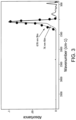
  • FIG. 3 shows FTIR spectra of thin (e.g., 76 nanometers (nm)) and thick films (e.g., 678 nm) of a diethylsilane (2ES) film deposited using the BL-2 process conditions described in Table 1 of the Examples at 400° C.
  • thin e.g., 76 nanometers (nm)
  • thick films e.g., 678 nm
  • 2ES diethylsilane
  • FIG. 4 A shows a comparison of dielectric constant (“K”) values of TEO-deposited films and 2ES-deposited films deposited using the BL-1 process conditions described in Table 1 at 3 different temperatures: 400° C., 300° C., and 200° C.
  • FIG. 4 B shows a comparison of wet etch rate (WER) of TEO-deposited films and 2ES-deposited films deposited using the BL-1 process conditions described in Table 1 at 3 different temperatures: 400° C., 300° C., and 200° C.
  • WER wet etch rate
  • FIG. 5 shows a comparison of the leakage current vs. electric field deposited TEOS films and the 2ES-deposited films deposited using the BL-3 process conditions described in Table 1 at 300° C.
  • FIG. 6 shows a comparison of the flatband voltage (Vfb) vs. thickness measured in Angstroms ( ⁇ ) for 2ES and TEOS SiO 2 deposited films using conditions in Table 1.
  • FIGS. 7 a , 7 b , 7 c , and 7 d provide examples of various embodiments of the apparatus described herein.
  • FIG. 8 provides the relationship between leakage current measured in amperes versus electric field measured in (MV/cm) for 3ES films that were deposited at the following temperatures: 100° C., 125° C., and 150° C. using the process conditions in Table 2.
  • FIG. 9 provides the wet etch rate of for 3ES films that were deposited at the following temperatures: 100° C., 125° C., and 150° C. using the process conditions in Table 2.
  • FIG. 10 provides the relationship between leakage current measured in amperes versus electric field measured in (MV/cm) for 2ES films that were deposited at 100° C. using the process conditions in Table 3.
  • FIG. 11 provides the relationship between the percentage change ii dielectric constant (K) and density for the low temperature oxide film described in Example 6.
  • Apparatuses comprising metal oxides or transparent metal oxides such as, for example, IGZO-based TFTs, are being implemented for display devices such as without limitation mobile displays.
  • the composition of the transparent metal oxide comprises IGZO
  • the thermal budget which relates to the upper limit of the processing temperature that the apparatus can be subjected to, requires one or more gate insulation films be deposited at a temperature of 300° C. or less.
  • the one or more gate insulation layers comprises a stoichiometric or non-stoichiometric silicon oxide or silicon dioxide film having a density of about 2.2 g/cm 3 or greater and a thickness that ranges from about 2 nanometers to about 200 nms.
  • the desired properties for a silicon containing film that can be used as one or more gate insulation layers for a metal oxide layer in a display device comprise one or more of the following: a deposition temperature of about 400° C. or less; a density of about 2.2 g/cm 3 or 2.2 g/cc or greater; a conformality of about 50% or greater; a O/Si ratio that ranges from about 1.9 to about 2.1 (as measured by X-ray photospectrometry XPS); a leakage current density of about 1 ⁇ 10 7 A/cm 2 or less up to 7 MV/cm; and combinations thereof.
  • the silicon containing film or layer has a hydrogen content of about 5 atomic percent (%) or less when measured using an analytical technique such as Rutherford backscattering, hydrogen forward scattering (HFS) or other methods. Also disclosed herein are methods for forming these silicon containing films at temperatures of about 400° C. or less for use as gate insulation layers. This invention will enable end users to obtain higher quality devices; e.g. faster IGZO-based TFTs and/or cheaper production by lowering processing temperature and enabling alternative substrates among other options.
  • gate insulation layer could mean, without limitation, a passivation layer, a gate dielectric layer, an etch stop layer, or other suitable layer in a display device such as a TFT device, a OLED device, a LED device or other display devices.
  • silicon-containing films can mean a silicon, amorphous silicon, crystalline silicon, microcrystalline silicon, polycrystalline silicon, stoichiometric or non-stoichiometric silicon oxide, stoichiometric or non-stoichiometric silicon dioxide, carbon doped silicon oxide, silicon carbo-nitride, and silicon oxynitride films.
  • the one or more silicon-containing films are comprised of silicon oxide or silicon dioxide.
  • metal oxide or “transparent metal oxide” means one or more layers within the device that is suitable for use in a display device.
  • the metal oxide layer exhibits one or more the following properties: has requisite transparency for use in a display device, exhibits high electron mobility, and can be manufactured at low processing temperatures (e.g., 300° C. or below).
  • metal oxides include but are not limited to, Indium Gallium Zinc Oxide (IGZO), a-IGZO (amorphous indium gallium zinc oxide), Indium Tin Zinc Oxide (ITZO), Aluminum Indium Oxide (AlInOx), Zinc Tin Oxide (ZTO), Zinc Oxynitride (ZnON), Magnesium Zinc Oxide, zinc oxide (ZnO), InGaZnON, ZnON, ZnSnO, CdSnO, GaSnO, TiSnO, CuAlO, SrCuO, LaCuOS, GaN, InGaN, AlGaN or InGaAlN and combinations thereof.
  • the display device may further include, without limitation, gate electrode layer(s), source drain layer(s), and other layers.
  • the apparatus and method described herein may be used to deposit the at least one silicon-containing and metal oxide layer onto at least a portion of a substrate.
  • suitable substrates include but are not limited to, glass, plastics, stainless steel, organic or polymer films, silicon, SiO 2 , Si 3 N 4 , OSG, FSG, silicon carbide, hydrogenated silicon carbide, silicon nitride, hydrogenated silicon nitride, silicon carbonitride, hydrogenated silicon carbonitride, boronitride, antireflective coatings, photoresists, organic polymers, porous organic and inorganic materials, metals such as copper, aluminum, chromium, molybdenum and gate electrodes such as but not limited to TiN, Ti(C)N, TaN, Ta(C)N, Ta, W, WN, silicon, ITO or other gate electrodes.
  • the silicon-containing films are compatible with a variety of subsequent processing steps such as, for example, chemical mechanical planarization (CMP) and anisotropic etching processes.
  • CMP chemical mechanical planarization
  • the silicon-containing layer described herein has a dielectric constant that ranges from about 4.0 to about 5.5 or from about 4.0 to 4.5.
  • FIGS. 7 a through 7 d provide various examples of embodiments of the apparatus described herein.
  • the silicon-containing film is deposited as a single gate insulation layer 30 onto at least a portion of a gate electrode and a transparent metal oxide 20 is deposited on the gate insulation layer 30 that can be use, for example, in a display device.
  • the silicon-containing film is deposited onto one or more silicon-containing films below the metal oxide layer 120 which is shown as gate insulation layer 2 , or 140 on FIG. 7 b , and gate insulation layer 1 , or 130 on FIG.
  • the silicon-containing films in the double gate insulation or multi-layered are different types of silicon-containing films.
  • the silicon-containing films in the double or multi-layered structures can be the same types of silicon-containing films but alternated in a variety of ways, such as without limitation, SixOy, SiwNz, SixOy, and SiwNz; SixOy, SixOy, and SiwNz; SixOy, SiwNz, and SiwNz; and various combinations thereof. While the exemplary structures shown in FIGS.
  • FIGS. 7 a through 7 d show the one or more gate insulation layers deposited onto at least a portion of a gate electrode and then a transparent metal oxide film is deposited on the gate insulation layer(s), it is understood that the one or more layers are not limited to arrangement of layers depicted in FIGS. 7 a through 7 d and may be above or below metal oxide layer and one or more gate insulation layer(s), sandwiched, imbedded, surrounded, have intervening layers which are not silicon-containing, or any other spatial relationships with respect to each other and are subsequently not limited thereto.
  • the display device comprises one gate insulation layer deposited onto the gate electrode and then metal oxide layer is deposited on the gate insulation layer such as that shown in FIG. 7 a wherein the gate insulation layer 1 comprises silicon oxide, silicon carboxide, preferably with a density about 2.2 g/cm 3 or greater and a thickness ranging from about 2 nm to about 200 nm.
  • the display device comprises at least two gate insulation layers deposited onto the gate electrode and then metal oxide layer is deposited on the gate insulation layers such as that shown in FIG.
  • the gate insulation layers comprise: a silicon-containing layer selected from the group consisting of silicon nitride and silicon carbonitride as gate insulation layer 1 or 130 and a silicon-containing layer selected from the group consisting of silicon carbide, silicon oxide, silicon carboxide, and silicon carboxynitride as gate insulation layer 2 or 140 , preferably a silicon oxide with density about 2.2 g/cm 3 or greater and a thickness which ranges from about 2 nm to about 200 nm.
  • the transparent metal oxide layer 120 comprises IGZO and the at least two gate insulation layers act as a bi-layer gate dielectric.
  • the display device comprises at least one gate insulation layers deposited onto the metal oxide layer such as that shown in FIGS. 7 c and 7 d or apparatus 200 and 300 respectively.
  • apparatus 200 comprises a transparent metal oxide 220 and a gate insulation layer deposited thereupon wherein the gate insulation layer 1 or 230 comprises silicon oxide, silicon carboxide, preferably with a density about 2.2 g/cm 3 or greater and a thickness ranging from about 2 nm to about 200 nm.
  • the metal oxide layer 320 comprises IGZO and the at least two gate insulation layers can also act as a barrier to protect the IGZO film from diffusion of atmospheric impurities (e.g., be hermetic) while not impacting to any great significance the resistivity of the IGZO film post treatment.
  • the apparatus comprises a high density silicon nitride film (e.g., having a density of 2.4 g/cm 3 or greater) as gate insulation layer 1 or 330 and is deposited by the prescursor trisilylamine (TSA) and ammonia (NH 3 ) at one or more temperatures that range from 80 to 400° C.
  • TSA trisilylamine
  • NH 3 ammonia
  • the device further comprises a silicon oxide film as gate insulation layer 2 or 340 to prevent the diffusion of active hydrogen contained in the silicon nitride to the IGZO located beneath the oxide.
  • the silicon oxide film can be deposited at one or more temperatures ranging from 80° C. to 400° C. It is desirable that the precursor selected and the deposition process conditions impart a minimum of hydrogen, hydroxyl groups, or other moieties such as carbon, hydrocarbons or other functional groups which can react with the metal oxide such as IGZO and lower. It is desirable that the precursor selected and the deposition process conditions impart a minimum of hydrogen, hydroxyl groups, or other moieties such as carbon, hydrocarbons or other functional groups which may react with the transparent metal oxide such as IGZO and lower.
  • the gate insulation layer 2 is deposited from a silicon-containing precursor for example diethylsilane(2ES) or triethylsilane(3ES) which has less Si—H groups than silane because it is known that Si—H may react with the transparent metal oxide, thus damaging the electric property of the transparent metal oxide layer.
  • a silicon-containing precursor for example diethylsilane(2ES) or triethylsilane(3ES) which has less Si—H groups than silane because it is known that Si—H may react with the transparent metal oxide, thus damaging the electric property of the transparent metal oxide layer.
  • a silicon-containing precursor for example diethylsilane(2ES) or triethylsilane(3ES) which has less Si—H groups than silane because it is known that Si—H may react with the transparent metal oxide, thus damaging the electric property of the transparent metal oxide layer.
  • deposition processes The method used to form the one or more silicon-containing film(s) or layer(s) and the metal oxide layer(s) are referred to herein as deposition processes.
  • suitable deposition processes for the method disclosed herein include, but are not limited to, chemical vapor depositions (CVD), cyclic CVD (CCVD), MOCVD (Metal Organic CVD), thermal chemical vapor deposition, plasma enhanced chemical vapor deposition (“PECVD”), high density PECVD, photon assisted CVD, plasma-photon assisted (“PPECVD”), cryogenic chemical vapor deposition, chemical assisted vapor deposition, hot-filament chemical vapor deposition, CVD of a liquid polymer precursor, deposition from supercritical fluids, and low energy CVD (LECVD).
  • CVD chemical vapor depositions
  • CCVD cyclic CVD
  • MOCVD Metal Organic CVD
  • PECVD plasma enhanced chemical vapor deposition
  • PECVD plasma enhanced chemical vapor deposition
  • high density PECVD high density PE
  • the films are deposited via atomic layer deposition (ALD), plasma enhanced ALD (PEALD) or plasma enhanced cyclic CVD (PECCVD) process.
  • ALD atomic layer deposition
  • PEALD plasma enhanced ALD
  • PECCVD plasma enhanced cyclic CVD
  • the term “chemical vapor deposition processes” refers to any process wherein a substrate is exposed to one or more volatile precursors, which react and/or decompose on the substrate surface to produce the desired deposition.
  • atomic layer deposition process refers to a self-limiting (e.g., the amount of film material deposited in each reaction cycle is constant), sequential surface chemistry that deposits films of materials onto substrates of varying compositions.
  • the precursors, reagents and sources used herein may be sometimes described as “gaseous”, it is understood that the precursors can also be liquid or solid which are transported with or without an inert gas into the reactor via direct vaporization, bubbling or sublimation.
  • the vaporized precursors can pass through a plasma generator.
  • the one or more films is deposited using an ALD process.
  • the one or more films is deposited using a CCVD process.
  • the one or more films is deposited using a thermal CVD process.
  • reactor as used herein, includes without limitation, reaction chamber or deposition chamber.
  • the method disclosed herein avoids pre-reaction of the precursors by using ALD or CCVD methods that separate the precursors prior to and/or during the introduction to the reactor.
  • deposition techniques such as ALD or CCVD processes are used to deposit the film.
  • the film is deposited via an ALD process by exposing the substrate surface alternatively to the one or more the silicon-containing precursor, oxygen source, nitrogen-containing source, or other precursor or reagent. Film growth proceeds by self-limiting control of surface reaction, the pulse length of each precursor or reagent, and the deposition temperature. However, once the surface of the substrate is saturated, the film growth ceases.
  • precursor materials for deposition depends upon the desired resultant dielectric material or film.
  • a precursor material may be chosen for its content of chemical elements, its stoichiometric ratios of the chemical elements, its deposition rate control, and/or the resultant dielectric film or coating that are formed under CVD.
  • the precursor material may also be chosen for various other characteristics such as cost, non-toxicity, handling characteristics, ability to maintain liquid phase at room temperature, volatility, molecular weight, etc.
  • the thin (e.g., about 2 nm to about 200 nm) silicon-containing films disclosed herein are deposited using a silicon-containing precursor, such as but not limited to alkylsilanes having the following formula: R 1 R 2 R 3 SiH wherein R 1 is chosen from the group consisting of a C 1-10 linear or branched alkyl group; a C 4 to C 10 cyclic alkyl group; a C 3 to C 12 alkenyl group; a C 3 to C 12 alkynyl group; and a C 6 to C 10 aryl group; R 2 and R 3 are independently selected from hydrogen; a C 1-10 linear or branched alkyl group; a C 4 to C 10 cyclic alkyl group; a C 3 to C 12 alkenyl group; a C 3 to C 12 alkynyl group; and a C 6 to C 10 aryl group and wherein R 1 and any one of R 2 and R 3 can be linked to form a ring when R 2 and R
  • alkylsilanes that can be used in the method described herein or to deposit on or more silicon-containing layers in the apparatus described herein, include but are not limited to, diethylsilane (2ES), di(tert-butyl)silane, di(iso-propyl)silane, di(sec-butyl)silane, di(iso-butyl)silane, di(tert-amyl)silane, triethylsilane (3ES), tri(tert-butyl)silane, tri(iso-propyl)silane, tri(sec-butyl)silane, tri(iso-butyl)silane, tri(tert-amyl)silane, tert-butyldiethylsilane, tert-butyldipropylsilane, diethylisopropylsilane, cyclopentylsilane, and phenylsilane, die
  • alkyl denotes a linear, or branched functional group having from 1 to 10 or 1 to 4 carbon atoms.
  • exemplary alkyl groups include, but are not limited to, methyl, ethyl, n-propyl, isopropyl, n-butyl, isobutyl, sec-butyl, tert-butyl, n-pentyl, iso-pentyl, tert-pentyl, hexyl, isohexyl, and neohexyl.
  • the alkyl group may have one or more functional groups such as, but not limited to, an alkoxy group, a dialkylamino group or combinations thereof, attached thereto. In other embodiments, the alkyl group does not have one or more functional groups attached thereto.
  • cyclic alkyl denotes a cyclic functional group having from 3 to 12 or from 4 to 10 carbon atoms.
  • exemplary cyclic alkyl groups include, but are not limited to, cyclobutyl, cyclopentyl, cyclohexyl, and cyclooctyl groups.
  • aryl denotes an aromatic cyclic functional group having from 6 to 12 carbon atoms.
  • exemplary aryl groups include, but are not limited to, phenyl, benzyl, chlorobenzyl, tolyl, and o-xylyl.
  • alkenyl group denotes a group which has one or more carbon-carbon double bonds and has from 2 to 12 or from 2 to 6 carbon atoms.
  • alkenyl groups include, but are not limited to, vinyl or allyl groups
  • alkynyl group denotes a group which has one or more carbon-carbon triple bonds and has from 2 to 12 or from 2 to 6 carbon atoms.
  • alkoxy denotes an alkyl group which has is linked to an oxygen atom (e.g., R—O) and may have from 1 to 12, or from 1 to 6 carbon atoms.
  • exemplary alkoxy groups include, but are not limited to, methoxy (—OCH 3 ), ethoxy (—OCH 2 CH 3 ), n-propoxy (—OCH 2 CH 2 CH 3 ), and iso-propoxy (—OCHMe 2 ).
  • one or more of the alkyl group, alkenyl group, alkynyl group, alkoxy group, and/or aryl group in the formulas above may be substituted or have one or more atoms or group of atoms substituted in place of, for example, a hydrogen atom.
  • substituents include, but are not limited to, oxygen, sulfur, halogen atoms (e.g., F, Cl, I, or Br), nitrogen, and phosphorous.
  • one or more of the alkyl group, alkenyl group, alkynyl group, alkoxy group, and/or aryl in the formula may be unsubstituted.
  • substituents R 1 and R 2 or substitutents R 1 and R 3 are linked in the above formula are linked to form a ring structure when R 2 and R 3 are not hydrogen.
  • R 1 and R 2 or R 1 and R 3 are linked together to form a ring, R 1 will include a bond (instead of a hydrogen substituent) for linking to R 2 or R 3 and vice versa.
  • R 1 may be selected from a linear or branched C 1 to C 10 alkylene moiety; a C 2 to C 12 alkenylene moiety; a C 2 to C 12 alkynylene moiety; a C 4 to C 10 cyclic alkyl moiety; and a C 6 to C 10 arylene moiety.
  • the ring structure can be unsaturated such as, for example, a cyclic alkyl ring, or saturated, for example, an aryl ring. Further, in these embodiments, the ring structure can also be substituted or substituted. In other embodiments, substituent R 1 and R 2 or substituent R 1 and R 3 are not linked.
  • the thin silicon oxide containing films used as gate insulation layers are deposited using the methods described above are formed in the presence of oxygen using an oxygen source, reagent or precursor comprising oxygen.
  • oxygen source gases include but not limited to, for example, water (H 2 O) (e.g., deionized water, purifier water, and/or distilled water), oxygen (O 2 ), oxygen plasma, ozone (O 3 ), NO, N 2 O, carbon monoxide (CO), carbon dioxide (CO 2 ) and combinations thereof.
  • the deposition methods disclosed herein may involve one or more inert gases for purging, controlling the plasma or as carrier gases.
  • the silicon-containing precursor may have one or more substituents comprising oxygen atoms. In these embodiments, the need for an oxygen source during the deposition process may be minimized.
  • the silicon-containing precursor has one of more substituents comprising oxygen atoms and also uses an oxygen source.
  • the oxygen source comprises an oxygen source gas that is introduced into the reactor at a flow rate ranging from about 1 to about 2000 square cubic centimeters (sccm) or from about 1 to about 1000 sccm.
  • the oxygen source can be introduced for a time that ranges from about 0.1 to about 100 seconds.
  • the oxygen source comprises water having a temperature of 10° C. or greater.
  • the precursor pulse can have a pulse duration that is greater than 0.01 seconds, and the oxygen source can have a pulse duration that is less than 0.01 seconds, while the water pulse duration can have a pulse duration that is less than 0.01 seconds.
  • the purge duration between the pulses that can be as low as 0 seconds or is continuously pulsed without a purge in-between.
  • the oxygen source or reagent is provided in a molecular amount less than a 1:1 ratio to the silicon precursor, so that at least some carbon is retained in the as deposited dielectric film.
  • the silicon-containing layer further comprises nitrogen.
  • the silicon-containing layer deposited using the methods described herein are formed in the presence of nitrogen-containing source.
  • the silicon-containing film 140 or gate insulation layer 1 comprises silicon nitride and is deposited using the methods described above are formed in the presence of nitrogen using a nitrogen, reagent or precursor comprising nitrogen.
  • a nitrogen-containing source may be introduced into the reactor in the form of at least one nitrogen source and/or may be present incidentally in the other precursors used in the deposition process.
  • Suitable nitrogen-containing source gases may include, for example, ammonia, hydrazine, monoalkylhydrazine, dialkylhydrazine, nitrogen, nitrogen/hydrogen, ammonia plasma, nitrogen plasma, nitrogen/hydrogen plasma, NF 3 and mixture thereof.
  • NF 3 is used to reduce the hydrogen content in the resulting films because hydrogen can react with the metal oxide thereby adversely effecting the performance of the display devices.
  • the nitrogen-containing source comprises an ammonia plasma or hydrogen/nitrogen plasma source gas that is introduced into the reactor at a flow rate ranging from about 1 to about 2000 square cubic centimeters (sccm) or from about 1 to about 1000 sccm.
  • the nitrogen-containing source can be introduced for a time that ranges from about 0.1 to about 100 seconds.
  • the deposition methods disclosed herein may involve one or more purge gases.
  • the purge gas which is used to purge away unconsumed reactants and/or reaction byproducts, is an inert gas that does not react with the precursors.
  • Exemplary purge gases include, but are not limited to, argon (Ar), nitrogen (N 2 ), helium (He), xenon (Xe), neon, hydrogen (H 2 ), and mixtures thereof.
  • a purge gas such as Ar is supplied into the reactor at a flow rate ranging from about 10 to about 2000 sccm for about 0.1 to 1000 seconds, thereby purging the unreacted material and any byproduct that may remain in the reactor.
  • the respective step of supplying the precursors, oxygen source, the nitrogen-containing source, and/or other precursors, source gases, and/or reagents may be performed by changing the time for supplying them to change the stoichiometric composition of the resulting dielectric film.
  • Energy is applied to the at least one of the silicon-containing precursor, oxygen-containing source, nitrogen-containing source, reducing agent, other precursors and/or combination thereof to induce reaction and to form the silicon-containing film or coating on the substrate.
  • Such energy can be provided by, but not limited to, thermal, plasma, pulsed plasma, helicon plasma, high density plasma, inductively coupled plasma, X-ray, e-beam, photon, remote plasma methods, and combinations thereof.
  • a secondary RF frequency source can be used to modify the plasma characteristics at the substrate surface.
  • the plasma-generated process may comprise a direct plasma-generated process in which plasma is directly generated in the reactor, or alternatively a remote plasma-generated process in which plasma is generated outside of the reactor and supplied into the reactor.
  • the silicon-containing precursors may be delivered to the reaction chamber such as a CVD or ALD reactor in a variety of ways.
  • a liquid delivery system may be utilized.
  • a combined liquid delivery and flash vaporization process unit may be employed, such as, for example, the turbo vaporizer manufactured by MSP Corporation of Shoreview, Minn., to enable low volatility materials to be volumetrically delivered, which leads to reproducible transport and deposition without thermal decomposition of the precursor.
  • the precursors described herein may be delivered in neat liquid form, or alternatively, may be employed in solvent formulations or compositions comprising same.
  • the precursor formulations may include solvent component(s) of suitable character as may be desirable and advantageous in a given end use application to form a film on a substrate.
  • the gas lines connecting from the precursor canisters to the reaction chamber are heated to one or more temperatures depending upon the process requirements and the container of the at least one silicon-containing precursor is kept at one or more temperatures for bubbling.
  • a solution comprising the at least one silicon-containing precursor is injected into a vaporizer kept at one or more temperatures for direct liquid injection.
  • the rate of the deposition of the silicon-containing films or silicon oxide films described herein can be in the range of 0.1 nm to 5000 nm per minute.
  • the rate can be controlled by varying any one or more of the following non-limiting parameters: deposition temperature, the vaporizer temperature, the flow of the line flow controller (LFC), the flow rate of the reactive of O 2 gas and/or the pressure at the CVD reactor.
  • Choice of precursor can also determine the deposition rate.
  • the temperature of the reactor or deposition chamber for the deposition may range from one of the following endpoints: ambient temperature 25° C.; 50° C.; 75° C.; 100° C.; 125° C.; 150° C.; 175° C.; 200° C.; 225° C.; 250° C.; 300° C.; 325° C.; and any combinations thereof.
  • the deposition temperature may range from about 25° C. to about 325° C., 25 to about 300° C., 100° C. to 250° C., 150° C. to 325° C., or 100° C. to 300° C., or any combinations of the temperature end-points described herein.
  • the pressure of the reactor or deposition chamber may range from about 0.1 Torr to about 1000 Torr.
  • the respective step of supplying the precursors, the oxygen source, and/or other precursors, source gases, and/or reagents may be performed by changing the time for supplying them to change the stoichiometric composition of the resulting dielectric film.
  • the substrate may be exposed to a pre-deposition treatment such as, but not limited to, a plasma treatment, chemical treatment, ultraviolet light exposure, electron beam exposure, and/or other treatments to affect one or more properties of the film.
  • a pre-deposition treatment such as, but not limited to, a plasma treatment, chemical treatment, ultraviolet light exposure, electron beam exposure, and/or other treatments to affect one or more properties of the film.
  • a plasma treatment such as, but not limited to, a plasma treatment, chemical treatment, ultraviolet light exposure, electron beam exposure, and/or other treatments to affect one or more properties of the film.
  • a pre-deposition treatment such as, but not limited to, a plasma treatment, chemical treatment, ultraviolet light exposure, electron beam exposure, and/or other treatments to affect one or more properties of the film.
  • a pre-deposition treatment such as, but not limited to, a plasma treatment, chemical treatment, ultraviolet light exposure, electron beam exposure, and/or other treatments to affect one or more properties of the film.
  • the resultant films or coatings may be exposed to a post-deposition treatment such as, but not limited to, a plasma treatment, chemical treatment, ultraviolet light exposure, electron bean exposure, and/or other treatments to affect one or more properties of the film.
  • a post-deposition treatment such as, but not limited to, a plasma treatment, chemical treatment, ultraviolet light exposure, electron bean exposure, and/or other treatments to affect one or more properties of the film.
  • the steps of the methods described herein may be performed in a variety of orders, may be performed sequentially or concurrently (e.g., during at least a portion of another step), and any combination thereof.
  • the respective step of supplying the precursors and the nitrogen-containing source gases may be performed by varying the duration of the time for supplying them to change the stoichiometric composition of the resulting dielectric film.
  • the resultant dielectric films or coatings may be exposed to a post-deposition treatment such as, but not limited to, a plasma treatment, chemical treatment, ultraviolet light exposure, electron beam exposure, and/or other treatments to affect one or more properties of the film.
  • a post-deposition treatment such as, but not limited to, a plasma treatment, chemical treatment, ultraviolet light exposure, electron beam exposure, and/or other treatments to affect one or more properties of the film.
  • a layer which has a composition gradient from top to bottom e.g., a film comprising SiCO or SiO2 as one layer and comprising SiNC or Si 3 N 4 as the other layer.
  • the film is deposited from a first reagent mixture comprising a silicon containing precursor and a oxygen containing precursor, eg 2ES and O 2 , ozone, or N 2 O, and then replacing the flow of the oxygen containing gas with an nitrogen containing gas, e.g., N 2 , ammonia, or hydrazine. If the silicon containing precursor already contains nitrogen ten the second step may be performed using just an inert gas or hydrogen.
  • the changing of the oxygen to nitrogen containing or inert gases can be gradual or abrupt resulting in either a gradiated layer or a bilayer structure.
  • a bilayer or gradiated layer is advantageous for some applications such as, without limitation, different application needs for metal oxide and IGZO interfaces to the silicon containing film.
  • the thin silicon-containing films have applications which include, but are not limited to, computer chips, optical devices, magnetic information storages, coatings on a supporting material or substrate, microelectromechanical systems (MEMS), nanoelectromechanical systems, thin film transistor (TFT), and liquid crystal displays (LCD).
  • MEMS microelectromechanical systems
  • TFT thin film transistor
  • LCD liquid crystal displays
  • a mercury probe was utilized for all film measurements where dielectric constant, electrical breakdown field and leakage are presented.
  • XPS X-ray Photoelectron Spectroscopy
  • RBS Rutherford Backscattering Spectrometry
  • HSS Hydrogen Forward Scattering
  • the etch test is carried out in 6:1 BOE solution.
  • Exemplary dielectric films are placed in HF solution for 30 seconds, followed by rinsing in deionized (DI) water and drying before being measured again for the loss of the material during the etch. The process is repeated till the films are completely etched. The etch rate is then calculated from the slope of the etch time vs thickness etched.
  • DI deionized
  • FTIR data was collected on the wafers using a Thermo Nicolet 750 system in a nitrogen purged cell. Background spectra were collected on similar medium resistivity wafers to eliminate CO 2 and water from the spectra. Data was obtained in the range of from 4000 to 400 cm ⁇ 1 by collecting 32 scans with a resolution of 4 cm ⁇ 1 . The OMNIC software package was used to process the data.
  • Density was measured by X-Ray Reflectivity (XRR). All samples with nominal thicknesses ⁇ 200 nm were scanned using low-resolution optics (error bar+/ ⁇ 0.01 g/cm 3 ). All samples with nominal thicknesses>200 nm were scanned using high-resolution optics (error bar+/ ⁇ 0.005 g/cm 3 ). Samples were scanned over the range 0.2 ⁇ 2 ⁇ 1 using a step size of 0.001 and a count time of 1 s/step. Data were analyzed using a two-layer model with the substrate defined as Si and film as SiO 2 .
  • Table 1 provides a summary of the three different process conditions that were used for compare the deposition performance of the precursors studied. These are labeled herein as BL-1, BL-2 and BL-3.
  • Silicon oxide films were deposited from the silicon precursors 2ES and 3ES SiO 2 films were deposited at different temperature and process conditions using the general deposition conditions described above.
  • BL-1 and BL-2 conditions are identical except for precursor flow. While BL-1 process has the highest deposition rate due to higher precursor flow, it is not the most important criterion for gate insulation layers.
  • BL-3 is a lower pressure condition and generally gives poorer films.
  • a comparison of same amount of Si-feed between precursors was used to understand whether a truly better quality film can be produced. As seen in FIGS. 1 A and 2 A , generally higher densities are obtained for films>200 nm with BL-2 process (>2.2 g/cc) and FIG.
  • FIG. 1 A shows the effect of film thickness on measured density for 2ES films deposited by BL-2 process condition at 3 temperatures: 400° C., 300° C., and 200° C.
  • the density of the films surprisingly increased as the thickness decreased particularly at a deposition condition of 300° C.
  • FIG. 1 B shows the effect of film thickness on measured density for 2ES films deposited by BL-3 process condition at 3 temperatures: 400° C., 300° C., and 200° C.
  • FIG. 2 A shows the effect of film thickness on measured density for 3ES films deposited by BL-2 process conditions at 3 temperatures: 400° C., 300° C., and 200° C. Surprisingly, the density of the films increased as the thickness decreased, especially at 200° C.
  • FIG. 2 B shows the effect of film thickness on measured density for 3ES films deposited by BL-3 process conditions at 3 temperatures: 400° C., 300° C., and 200° C. Surprisingly, like in FIG. 2 A , the density of the films increased as the thickness decreased, especially at 200° C.
  • FIG. 3 provides a comparison of FTIR spectra of thin (76 nanometer (nm)) and thick films (678 nm) of 2ES oxide deposited by the BL2 condition at 400° C.
  • the spectra indicate that both films are SiO 2 only.
  • the absence of Si—H or C—H peaks in the FTIR spectra for the 2ES-deposited films indicates good decomposition of the precursor molecule during the deposition process even at low temperatures.
  • the difference between the shoulder to peak ratio of the ⁇ 1050 cm ⁇ 1 peak as thickness increases has been explained by different mechanisms such as strain relaxation, geometric effects, in-situ annealing effects and oxygen deficiency. This effect is observed in high quality thermally grown SiO 2 films.
  • the H-content in atomic % and measured by RBS for the DES deposited films which were deposited at a BL-1 process condition at deposition temperature of 350° C. and 250° C. were 2.0% (density of 2.25 g/cm 3 ) and 2.8% (density of 2.26 g/cm 3 ), respectively.
  • SiO 2 films were deposited using the process conditions described above in the general deposition conditions and in Table 1.
  • TEOS deposited silicon oxide films having different thicknesses were deposited at the same BL-2 and BL-3 process conditions described above in Table 1.
  • the TEOS-deposited films at lower deposition temperatures such as 200° C., the TEOS-deposited films generally had lower density than the 2ES or 3ES films.
  • a similar effect was observed when comparing the data in FIG. 1 D with the data for the 2ES films and 3ES films in FIGS. 1 B and 2 B ) for the same deposition temperatures.
  • the 2ES and 3ES films generally exhibited equal or higher density for the thinner films. In general, the density of TEOS film drops to ⁇ 2.2 g/cc for ⁇ 200 nm films for both process conditions.
  • FIG. 4 A shows a comparison of dielectric constant (“K”) values of TEOS-deposited films and 2ES-deposited films which were deposited using the BL-1 condition described above at 3 different temperatures: 400° C., 300° C., and 200° C.
  • the dielectric constant of a good quality thermally grown or convention chemical vapor deposited SiO 2 is 4.0.
  • the K value varies as a function of process conditions. It is possible to optimize the process to get K values of 4.1 to 4.3 for a good quality 400° C. PECVD SiO 2 films.
  • the film quality typically degrades as evidenced by poorer film density and the increasing ability of the film to absorb moisture, which thereby increases the K value.
  • FIG. 4 A shows that the 2ES-deposited films have better K values than the TEOS-deposited films at deposition temperatures of 200° C. and 300° C. This indicates that these films are denser and of better quality than the TEOS films deposited at the same process condition. Similar behavior was also seen for the BL-2 and BL-3 process conditions.
  • FIG. 4 B shows a comparison of wet etch rate (WER) of TEOS-deposited films and 2ES-deposited films which were deposited using the BL-1 condition described above at 3 different temperatures: 400° C., 300° C., and 200° C.
  • WER wet etch rate
  • FIG. 5 shows the leakage current versus electric field for the 300° C. deposited TEOS films vs. the DES-deposited films at the BL3 processing condition.
  • the leakage current for the DES-deposited films remained low whereas the TEOS-deposited films exhibited poor leakage. Thoughout all the other deposition temperatures and process conditions, DES was clearly better than TEOS.
  • the interface and bulk charges in 2ES and TEOS SiO 2 films are compared in FIG. 6 by tracking the flatband voltage (Vfb).
  • Vfb flatband voltage
  • the flatband voltage becomes more negative as the film becomes thicker, indicating more bulk charges (e.g., defective bonds) in the film.
  • 2ES films showed the ability to keep Vfb close to 0 V, minimizing both interface and bulk charges.
  • the precursors are not compared at the same process condition as their film thicknesses were different; and that affects the Vfb value.
  • the stoichiometry of the SiO 2 was measured by XPS and the O/Si ratio was found to be 2.17 for TEOS oxide and 2.1 for 2ES oxide at 200° C. and BL-1 condition. Without being bound by theory, it is proposed that an O/Si ratio>2.0 is possibly due to Si—OH groups in the film. It is seen that 2ES has less deviation from stoichiometry and appears to be consistent with the dielectric constant and WER data.
  • the precursors described herein have the capability to deposit thinner films (e.g., 2 nm to 200 nm) of higher quality due to such surface mobility and chemical reactivity improvements. This is surprising because the thinner DES or 3ES films had better density.
  • Process conditions for the 3ES silicon oxide films were screened using a design of experiment (DOE) methodology summarized below: precursor flow from 10 to 200 sccm; O 2 /He flow from 100 to 1000 sccm, pressure from 0.75 to 10 torr; Low-frequency (LF) power 0 to 100 W; and deposition temperature ranged from 25 to 350° C.
  • DOE experiments were used to determine what process parameters produced the optimal film for use as a gate insulating layer in a display device.
  • SiO 2 films were deposited using the precursor 3ES at even lower deposition temperatures, such as 100° C., 125° C. and 150° C. then described above in the previous examples.
  • the process parameters such as precursor flow, chamber pressure and power density
  • high density and thin SiO 2 films are obtained.
  • Table 2 shows a summary of the three process conditions used for 3ES film deposited at different temperatures 100° C., 125° C. and 150° C., as well as certain film properties, such as thickness, k value and density which were measured using the methods described herein in the general deposition conditions.
  • the films deposited using 3ES had a thickness less than 200 nm, a k value between 4 to 5, and a density higher than 2.2 g/cm 3 .
  • FIG. 8 shows the leakage current vs electric field for the 3ES deposited films at the three different deposition temperatures.
  • the leakage current for the 3ES-deposited films is comparable to thermal oxide leakage current.
  • the break down voltage is comparable or even better then thermal oxide. Breakdown voltage refers to the voltage at which the electric current begins to flow when a formed film is placed between the electrodes and voltage is applied. Since thin films such as silicon oxide films play the role of blocking the flow of charges in a semiconductor device, breakdown voltage is a very important indicator as an electrical property of a thin film.
  • the material In order for a film, such as a silicon oxide film, to be used as an insulation material in a semiconductor device, the material should have a breakdown voltage of about 8 ⁇ 12 MV/cm in general (so-called intrinsic breakdown region, exhibited by a thermally oxidized silicon oxide film). If there are any weak spots or defects in the films, the breakdown voltage is reduced.
  • FIG. 8 shows that the breakdown voltage of the 3ES-deposited silicon oxide is comparable to or even better then the thermal oxide.
  • FIG. 9 provides the WER of the 3ES-deposited SiO 2 films at 100° C., 125° C. and 150° C. using the process conditions shown in Table 2.
  • the WER of the film does not appear to have a significant big change when the film is deposited at lower deposition temperatures. This confirms the superior quality of the 3ES films at low temperatures.
  • Precursor flow 27 48 27 (sccm) He (carrier, sccm) 1000 1000 1000 O 2 (sccm) 1000 1000 1000 1000 Pressure (torr) 9.2 9.2 9.2 9.2 Spacing (mils) 500 500 500 Power density 1.75 2.5 2.5 (W/cm 2 ) Film thickness (nm) 165 113 173 Film Density (g/cm 3 ) 2.26 2.29 2.28 K value 4.67 4.62 4.42
  • Process conditions for the 2ES silicon oxide films were screened at T ⁇ 200 C. using a design of experiment (DOE) methodology summarized below: typical precursor flow rates were 25-150 sccms, plasma power density was 0.5-3 W/cm 2 , and pressure was 0.75-12 torr.
  • DOE design of experiment
  • the SiO 2 films are also deposited at a deposition temperature of 100° C. using 2ES.
  • process parameters such as precursor flow, chamber pressure and power density, and other process conditions.
  • Table 3 shows a summary of the process conditions used for 2ES film deposited at 100° C. as well as the certain film properties, such as thickness, k value and density which were obtained using the methods described herein.
  • the film had a thickness less than 200 nm and density higher than 2.2 g/cc.
  • FIG. 10 shows the leakage current vs. electric field for the 2ES film deposited at 100° C. with process conditions in Table 3.
  • the leakage current for the 2ES-deposited films is comparable to thermal oxide leakage current.
  • FIG. 10 shows that the break down voltage for the 100° C. deposited 2ES film is comparable or even better then thermal oxide.
  • the present example is used to show the deposition of thin and high density SiO 2 film using 3ES provides a wide process window.
  • Table 4 provides the process conditions for two 3ES deposited, SiO 2 films and film properties at different precursor flows, 29 sccm and 68 sccm. Although the table shows a wide range of deposition rates, high density films were obtained.
  • XPS is used to exam the carbon concentration in the film. The relative atomic percentage is measured at the surface and after 50 nm sputtering. Table 5 shows the process conditions and film properties of two 3ES films deposited at 100° C. and 150° C. Table 6 provides the XPS data of the films. No carbon was detected in the bulk film and the O/Si ratio of the film was very close to 2.0 or stoichiometric.
  • the optimized low temperature oxide has good stability as shown herein in Tables 7a and 7b and FIG. 11 .
  • Tables 7a and 7b shows the k value change of several SiO 2 films deposited by 3ES after 3 weeks in air. It can be seen that the film in table 7 a are very stable after 3 weeks (less than 2.5% change in k value) while those in table 7 b are not so stable (3-20% change in k value).
  • the average density of the films in table 7 a is higher than in table 7 b , which is consistent with stability. So the optimized film has good stability despite being very thin. In general, a trend is seen between density and k stability, with the highest density (2.28 g/cc) film showing 0% change in k value and the films with ⁇ 2.23 g/cm 3 showing significant change in k value (>3%).
  • the electric breakdown field and leakage current are also measured for the 3ES SiO 2 films after 3 months
  • the leakage current and break down electric field for the 3ES-deposited films is comparable to thermal oxide, showing a leakage current less than 10 ⁇ 7 A/cm 2 below electric field 6 MV/cm and the breakdown voltage higher than 7 MV/cm.
  • Table 7a shows the stability of K value of the low temperature oxide.
  • Table 7b shows the stability of K value of the low temperature oxide.

Landscapes

  • Chemical & Material Sciences (AREA)
  • Engineering & Computer Science (AREA)
  • Chemical Kinetics & Catalysis (AREA)
  • General Chemical & Material Sciences (AREA)
  • Materials Engineering (AREA)
  • Mechanical Engineering (AREA)
  • Metallurgy (AREA)
  • Organic Chemistry (AREA)
  • Physics & Mathematics (AREA)
  • Plasma & Fusion (AREA)
  • Inorganic Chemistry (AREA)
  • Condensed Matter Physics & Semiconductors (AREA)
  • General Physics & Mathematics (AREA)
  • Manufacturing & Machinery (AREA)
  • Computer Hardware Design (AREA)
  • Microelectronics & Electronic Packaging (AREA)
  • Power Engineering (AREA)
  • Formation Of Insulating Films (AREA)
  • Chemical Vapour Deposition (AREA)
  • Thin Film Transistor (AREA)
  • Electrodes Of Semiconductors (AREA)

Abstract

Described herein are low temperature processed high quality silicon containing films. Also disclosed are methods of forming silicon containing films at low temperatures. In one aspect, there are provided silicon-containing film having a thickness of about 2 nm to about 200 nm and a density of about 2.2 g/cm3 or greater wherein the silicon-containing thin film is deposited by a deposition process selected from a group consisting of chemical vapor deposition (CVD), plasma enhanced chemical vapor deposition (PECVD), cyclic chemical vapor deposition (CCVD), plasma enhanced cyclic chemical vapor deposition (PECCVD, atomic layer deposition (ALD), and plasma enhanced atomic layer deposition (PEALD), and the vapor deposition is conducted at one or more temperatures ranging from about 25° C. to about 400° C. using an alkylsilane precursor selected from the group consisting of diethylsilane, triethylsilane, and combinations thereof.

Description

CROSS REFERENCE TO RELATED APPLICATIONS
This patent application claims the priority benefit of U.S. Provisional Patent Application Ser. No. 61/608,955 filed Mar. 9, 2012.
BACKGROUND OF THE INVENTION
Disclosed herein are methods and compositions to prepare silicon-containing films, such as but not limited to, stoichiometric or non-stoichiometric silicon oxide or silicon dioxide (SiO2) films, for use in various electronic applications.
Thin films of silicon oxide are commonly used as dielectrics in semiconductor manufacturing because of their dielectric properties. In the manufacturing of silicon-based semiconductor devices, silicon oxide films can be used as gate insulation layers, diffusion masks, sidewall spacers, hard mask, anti-reflection coating, passivation and encapsulation, and a variety of other uses. Silicon oxide films are also becoming increasingly important for passivation of other compound semiconductor devices.
Other elements besides silica and oxygen may be present in silicon dioxide films. These other elements may sometimes be intentionally added into the compositional mixture and/or deposition process depending upon the resultant application of the film or desired end-properties. For example, the element nitrogen (N) may be added to the silicon oxide film to form a silicon oxynitride film that may provide a certain dielectric performance such as lower leakage current. The element geranium (Ge) may be added to the silicon oxide film to provide a Ge-doped SiO2 that may reduce the deposition temperature of the film. Still other elements, such as boron (B) or carbon (C), may be added to the silicon oxide film to increase the etch resistance. In other cases, the elements may be incorporated as impurities during the deposition process. For example, if an organic precursor is used, carbon (C) and/or hydrogen (H) may be incorporated into the resultant film.
For several applications, plasma enhanced chemical vapor deposition (PECVD) process is used to produce silicon oxide films at lower temperatures than thermal CVD. Tetraethyoxysilane or TEOS (molecular formula Si(OC2H5)4) is a common precursor for depositing a silicon oxide film via PECVD. It is typically used in combination with a high flow of oxygen sources such as O2 or O3 to minimize residual carbon contamination in the deposited films. TEOS is supplied as a stable, inert, high vapor pressure liquid, and is less hazardous than other precursors such as silane (SiH4).
There is a general drive to move to lower deposition temperatures, or deposition temperatures of 400° C. or below, for various reasons such as cost (for example, the ability to use cheaper substrates), and thermal budget (for example, due to the integration of temperature-sensitive high performance films). In addition, for films deposited via PECVD using TEOS, gapfill and conformality are better at these lower deposition temperatures. However, the quality of these films are poorer. In this regard, the TEOS-deposited films do not have a stoichiometric composition, are hydrogen rich, and accordingly have a low film density, and fast etch rate. The performance of these films under thermal and/or electrical stress (e.g. leakage current and breakdown voltage after annealing or the flatband voltage shift under Bias Temperature Stressing) is correspondingly worse. Hence, there is a need for alternative precursors that deposit at lower deposition temperature ranges but provide a better quality silicon oxide or silicon dioxide film than TEOS.
Thin film transistors (TFTs) for flat panel displays benefit from lower processing temperature so that alternative substrates (that are lighter and less expensive than current glass) can be used. For this reason, plasma enhanced chemical vapor deposition (PECVD) has emerged as the preferred method for depositing films used for TFTs. AOS (amorphous oxide semiconductors) are fast emerging as a-Si replacement for TFTs that gives higher performance, and are processable at lower T. Indium Gallium Zinc Oxide (IGZO) and variations are main candidates. Alternative AOS materials include ITZO, AlInOx, ZTO, ZnON, and MgZnO. IGZO materials have a temperature limitation of <350° C. Novel gate metals may also have temperature limitations. Furthermore, it is desirable to further lower the processing temperature to <200° C. for plastic substrates, the PECVD films deposited from standard precursors such as silane or TEOS cannot balance all the requirements such as density, electrical quality and conformality. Hence, there is a need for alternative precursor chemistries that can work in conjunction with deposition and process engineering methods to produce high quality TFT films at lower deposition temperatures.
In case of silicon oxides, TEOS (tetraethyorthosilicate) is the preferred liquid precursor for forming silicon oxide or silicon dioxide films via PECVD and is usually reacted with oxygen. However, the reference entitled “P-1: The Application of Tetraethoxysilane (TEOS) Oxide to a-Si:H TFTs as the Gate Insulator”, J. K. Lee et al., ISSN 0098-0966X/98/2901 (1998) (“Lee et al.”) describes the use of a bottom gate a-Si:H thin film transtitor (TFT) with tetraethoxysilane (TEOS) deposited oxide as a gate insulator. In Lee et al., the TEOS oxide film of 2000 Å deposited at 300° C. has a high breakdown strength which is twice that of the SiNx film of 2000 Å prepared by PECVD. The authors demonstrate in Table 2 that a TEOS 1800 A/SiNx 500 A stack has better TFT properties than a much thicker Al2O3 1000 A/SiNx 4000 A stack. According to the authors' conclusion, productivity (in terms of throughput) can be increased without lowering production yield by decreasing the total gate insulator thickness.
The reference entitled “Monte Carlo Simulation of Surface Kinectics During Plasma Enchanced Chemical Vapor Deposition of SiO2 Using Oxygen/Tetraethoxysilane Chemistry”, P. J. Stout et al., J. Vac. Sci. Techynol. A 11(5), September/October 1993, pp. 2562-71 (“Stout et al.”), provides a multi-step theoretical model for the PECVD deposition mechanism of high O2/TEOS ratio films. In the model described in Stout et al., Si(OR)n(OH)4-n where n=1-3 and O species are incident on the substrate. The SiO2 network then propagates by elimination of —OH groups.
Si—OR+Si—OH→Si—O—Si+R—OH
Si—OH+Si—OH→Si—O—Si+H2O
Stout et al. shows that Si(OR)n(OH)4-n species can occur if the last reaction does not happen completely, such as with a low temperature deposition process. Thus, the resultant film may contain Si—OH bonding.
The reference entitled “Thickness Dependence of Properties of Plasma Deposited Amorphous SiO2 Films”, L. N. He et al., Jpn. J. Appl. Phys. Vol. 40 (2001), pp. 4672-4676 (“He et al.”) teaches a process for preparing amorphous SiO2 films prepared by PECVD at 300° C. using mixtures of SiH4—O2. The [O2]/[SiH4] ratio was maintained at 1.5, in which oxide films having a stoichiometric composition could be obtained. The Si—O—Si stretching mode, stress, the density of Si dangling bonds and buffered HF (BHF) etch rate were investigated as a function of film thickness. It was found that the peak frequency of Si—O—Si stretching mode centered at around 1050 cm−1 increased from 1050 to 1075 cm−1 with increasing film thickness from 0.1 to 1.1 μm. By comparison with calculations based on the effect of multiple reflections in film/substrate system, it was found that the shift of the Si—O—Si stretching mode to high frequencies was due not only to the effect of multiple reflections, but also to the physical effect of thermal heating and/or ion bombardment during film growth, which would contribute to rearrangement of the Si—O—Si bonding network. He et al. shows in FIGS. 5 a and 5 b that the buffered hydrofluoric acid (BHF) etch rate in A/second and the density of the Si dangling bonds in the film shown as (Ns) value increases as the film thickness in μm decreases. It is stated in literature that thicker PECVD SiO2 films have a lower degree of disorder in the bonding network, less defects, and a lower BHF etch rate. The lower BHF etch rate is indicative of decreased microvoids. All the above properties are therefore a proxy for increased film density. The reason is expected to be the effects of thermal heating and ion bombardment during film growth, which would contribute to the arrangement of the Si—O—Si bonding network. Thus, it is inferred from the findings in He et al. that thinner films would be of poorer quality than thicker films.
He et al. teaches that a passivation layer requires nearly 0.1 μm thickness whereas a gate dielectric layer requires less than 0.1 μm thickness. In gate dielectric layer applications, the thinner gate dielectric layers are desirable to increase capacitance, and therefore decrease the threshold voltage required, to turn the transistor on or off. However, practical considerations such as film leakage current, breakdown voltage and ability to deposit pin-hole free dielectrics or conformal dielectrics dictate that thicker films need to be used. The reference authored by Lee et al demonstrates this problem and shows that a thinner gate dielectric or dielectric stack can have a significant benefit for a device such as a TFT. Hence, there is a need to solve the problem of depositing high quality but thinner films. This problem is especially critical when a lower deposition temperature is needed. It can be inferred from Stout et al, that if Si—OH reaction does not complete (e.g. because the deposition is conducted at a low temperature), the TEOS-deposited SiO2 films can have residual silanol (Si—OH) incorporation.
The quality of thin films can be measured by several properties such as density, stress, refractive index, transparency, wet etch rate, dry etch resistance and selectivity, film composition and deviation from stoichiometry, impurity content, trapped moisture, trapped hydrogen (in different bound chemical forms and mobile forms). Some electrical properties of interest are breakdown voltage, leakage, charge to breakdown, interface states, interface charge, surface charge, fixed charge, bulk traps, mobile charge, interface traps, dielectric constant; and the stability of these parameters when the thin film is subjected to electrical and/or thermal stresses. The structural, optical and electrical properties are usually interrelated and are of particular interest for the gate insulator or passivation insulator for the TFT application. For example, a higher density film is expected to have less impurities or defects, and hence, better barrier or electrical insulator performance.
It is generally recognized that extremely thin films (few angstroms thick) may have different properties than thicker films. Such effects may be due to, for example, the stabilization time needed for the initial deposition (e.g. plasma-based deposition), nucleation effects (which may depend on substrate), stress effects due to the substrate, and combinations thereof. As the film grows thicker, the effect of thermal annealing and densification improves the properties of the film to be more bulk-like.
The reference entitled “Low pressure chemical vapor deposition of silicon dioxide using ditheylsilane” Chem Mater 5, 1993, p. 1710 by Levy, Grow and Chakravarthy teach a low-pressure chemical vapor deposition of SiO2 films by using diethylsilane as a precursor. These films were deposited at temperature ranging from 350 to 475° C. with the growth rate observed to follow an Arrhenius behavior with apparent activation energy of 10 kcal/mol. The growth rate was seen to increase with higher pressure and to vary as a function of the square root of the O flow rate and O/DES ratio. In both the pressure and the O/DES ratio studies conducted at 400° C., there were points of abrupt cessation in deposition. The density and index of refraction of the films were found to be 2.25 g/cm3 and 1.46, respectively, independent of deposition conditions. The etch rate of the films in a 25° C. P-etch solution (e.g., volume ratio of 15 parts HF (49%):10 parts HNO3 (70%): 300 parts H2O) decreased with higher deposition or annealing temperatures reflecting densification of the material. For aspect ratios at approximately 1.3, the films exhibited a step coverage better than 55%.
The reference entitled, “Diethylsilane on silicon surfaces: Adsorption and decomposition kinetics” Coon, P. A. et al., J. Vac. Sci. Technol. B, Vol 10 (1992), pp. 221-227, (“Coon et al.”) studied the adsorption and decomposition kinetics of diethylsilane (DES), (CH3CH2)2SiH2, on silicon surfaces, using laser-induced thermal desorption (LITD), temperature programmed desorption, and Fourier transform infrared (FTIR) spectroscopic techniques. LITD measurements determined that the initial reactive sticking coefficient of DES on Si(111) 7×7 decreased versus surface temperature from S0≅1.7×10⁻³ at 200 K to S0≅4×10⁻⁵ at 440 K. The temperature-dependent sticking coefficients suggested a precursor-mediated adsorption mechanism. FTIR studies on high surface area porous silicon surfaces indicated that DES adsorbs dissociatively at 300° C. and produces SiH and SiC2H5 surface species. Annealing studies also revealed that the hydrogen coverage on porous silicon increased as the SiC2H5 surface species decomposed. CH2═CH2 and H2 were the observed desorption products at 700 and 810 K, respectively, following DES adsorption on Si(111) 7×7. The ethylene desorption and growth of hydrogen coverage during ethyl group decomposition were consistent with a β-hydride elimination mechanism for the SiC2H5 surface species, i.e., SiC2H5→SiH+CH2═CH2. Isothermal LITD studies monitored the decomposition kinetics of SiC2H5 on Si(111) 7×7 as a function of time following DES exposures. The first-order decomposition kinetics were Ed=36 kcal/mol and vd=2.7×10⁹ s−1. These decomposition kinetics suggest that the silicon surface catalyzes the β-hydride elimination reaction.
The reference entitled “Study of Plasma-Deposited Amorphous SiO2 films Using Infrared Absorption Techniques”, He L. et al., Thin Solid Films 384(2) (2001), pp. 195-199, (“He et al. II”) teach the preparation of amorphous SiO2 (a-SiO2) films at 300° C. by means of plasma-enhanced chemical vapor deposition (PE-CVD) using a SiH4—O2 mixture. The properties of infrared (IR) absorption for Si—O bonds have been investigated as a function of film thickness (d). He et al. II teaches that the apparent absorbances, α app, for both 800 and 1050 cm−1 bands, arising from Si—O bending and stretching modes, respectively, were proportional to d as αapp=k×d. The proportionally constants k for 800 and 1050 cm−1 bands are estimated to be 3.2×10³ and 2.9×104 cm−1, respectively. Consequently, the film thickness for PE-CVD a-SiO2 can be determined nondestructively using IR absorption techniques. However, the integrated absorption intensity for the 1050 cm−1 bands increased with increasing film thickness. In contrast, the integrated absorption intensity for 800 cm−1 band was independent of film thickness. The properties of infrared absorption for both Si—O stretching and bending modes are discussed.
The reference entitled “The LPCVD of silicon oxide films below 400 DegC from liquid sources”, Hochberg, A. K. et al., J. Electrochem. Soc. FIELD Full Journal Title: Journal of the Electrochemical Society 136(6), (1989), pp. 1843-4 (“Hochberg et al.”) found diethylsilane (DES) to be a safe, easily delivered, suitable source for low temperature, low pressure chemical vapor deposition (LPCVD) of SiO2 films, after testing various Si compounds including TEOS and tetra-, methoxy-, tetrabutoxy-, and tetrapropoxy-silane. Hochberg et al. teaches that DES produced reasonably conformal films below 400° C. (i.e. 300 degrees lower than from tetraethoxysilane for the equivalent deposition rate). Purified DES is nonpyrophoric and nontoxic and its oxide film is superior to silane for low temperature oxide for step coverage over an aluminum substrate. Hochberg et al. also deposited P-doped Si oxide films by the addition of tri-Me phosphite to diethylsilane.
The reference entitled “SiO2 films by low pressure chemical vapor deposition using diethylsilane: processing and characterization”, Huo, D. T. et al., J. Vac. Sci. Technol., Journal of Vacuum Science & Technology, Vol. 9(5) (1991), pp. 2602-2606 (“Huo et al.”), used diethylsilane to prepare SiO2 films on Si wafers by a low pressure chemical vapor deposition technique at low temperatures (≤400° C.). The deposited films have good conformality (85%), a low residual carbon concentration (<1 atomic %) and a low residual stress (<109 dyne/cm2); which compared favorably with films prepared by other processes. The growth rates were correlated with the processing parameters to show that the deposition process follows the heterogeneous bimolecular reaction kinetics. IR spectroscopy was used to detect the presence of HSi—O3 bending band (880 cm−1) in SiO2 films prepared under certain processing conditions. Based on the reaction kinetic model, the processing conditions were optimized to reduce the SiH incorporation and mobile charge carrier concentration in SiO2 films.
The reference entitled “A Comparative Study of Plasma Enhanced Chemically Vapor Deposited Si—O—H and Si—N—C—H films Using the Environmentally Benign Precursor Diethylsilane”, Levy, R. A. et al., Materials Letters, Vol. 54(2-3) (2002), pp. 102-107 (Levy I et al.) used diethylsilane (DES) as the precursor with either N2O or NH3 to synthesize S—O—H or Si—N—C—H films by plasma enhanced chemical vapor deposition (PECVD). The growth rates were observed to decrease with higher temperature while increase with total pressure. Oxide films with optimal properties were synthesized at a deposition temperature of 300° C., total pressure of 0.3 Torr, DES flow rate of 15 sccm, and N2O/DES flow rate ratio of 16. Comparative values of refractive index, stress, hardness and Young's modulus are presented as a function of processing variables and related to film density and resulting film compositions.
The reference entitled “Plasma enhanced chemical vapor deposition of Si—N—C—H films from environmentally benign organosilanes” Levy, R. A et al., Mater. Lett. FIELD Full Journal Title: Materials Letters, Vol. 24(1,2,3) (1995), pp. 47-52, (Levy III et al.), used precursors diethylsilane (DES) and di-t-butylsilane with NH3 to synthesize hydrogenated silicon carbonitride films by plasma enhanced chemical vapor deposition. The growth kinetics and film properties were examined as a function of deposition temperature, pressure, and NH3/organosilane ratio.
The reference entitled “Low Pressure Chemical Vapor Deposition of Silicon Dioxide below 500° C. by the Pyrolysis of Diethylsilane in Oxygen”, Patterson, J. D. et al., Journal of Vacuum Science & Technology B: Microelectronics and Nanometer Structures Vol. 10(2) (1992), pp. 625-632 (“Patterson et al.”), teaches a low pressure chemical vapor deposition (LPCVD) of SiO2 in a horizontal LPCVD furnace using liquid diethylsilane and oxygen. A temperature deposition window ranging from 425-500° C. was observed resulting in a maximum deposition rate of 275 Å/min. The pressure dependence of the deposition rate revealed a threshold of 950 mTorr for gas phase reactions at a deposition temperature of 450° C. Analysis of the films by Rutherford backscattering spectroscopy has indicated that as-deposited films are stoichiometric SiO2 for deposition temperatures≤450° C. Best case across wafer uniformity was ±5% for a caged boat. Wet chemical and reactive ion etch rates were found to be comparable to those of thermal oxides after annealing. Cross sectional scanning electron microscopy images of the SiO2 films deposited on 2 μm deep 1 μm wide silicon trenches revealed a conformality of 80%. The electrical properties of films deposited at 450° C. were studied. The electrical properties of the films were studied as-deposited and after annealing the films in a cold-wall rapid thermal annealing (RTA) system. RTAs were performed at temperatures ranging from 950 to 1100° C. in Ar, N2, or O2 ambients. Current-voltage, current-temperature, and capacitance-voltage measurements were performed for the electrical characterization. Catastrophic breakdown field measurements have shown electric field strengths of 9.5 MV/cm for as deposited 500 Å films. A study of the leakage current conduction mechanisms has indicated that as-deposited films exhibit trap conduction mechanisms at high electric fields and temperatures. However, if deposition is followed by a RTA in Ar or O2, the leakage current follows closely the Fowler-Nordheim mechanism and yields a leakage-current electric field dependence comparable to a thermal oxide. Results have shown that values as low as 6×10¹⁰/cm2 for fixed charge density can be obtained if oxide deposition is followed by a RTA in Ar or N2.
The reference entitled “Enhancement of mechanical properties of organosilicon thin films deposited from diethylsilane” Ross, A. D. et al., Journal of Vacuum Science and Technology A: Vacuum, Surfaces and Films Vol. 23(3) (2005), pp. 465-469 (Ross et al.), used the pulsed-plasma enhanced chemical vapor deposition was to deposit organosilicon thin films from diethylsilane and oxygen. Fourier-transform infrared (FTIR) analysis showed significant organic content as well as hydroxyl and silanol moieties in the as-deposited materials. FTIR showed a complete removal of hydroxyl groups after annealing at 400° C. for 1 h. This removal indicates a condensation reaction between proximal hydroxyl groups leading to the formation of additional Si—O—Si linkages, which would increase both the hardness and modulus of the film. Mechanical property measurements were in accordance with this hypothesis, as both the hardness and modulus increased by over 50% after annealing. Film structure and properties were strongly dependent on the precursor feed ratio.
The reference entitled, “Mechanisms of silicon dioxide deposition from the low pressure chemical vapor deposition of diethylsilane/oxygen mixtures”, Martin, J. G. et. al., Journal of the Electrochemical Society 142(11) (1995), pp. 3873-80 (“Martin et al.), performed studies of the gas-phase products, silicon dioxide film properties, and kinetics of the diethylsilane/oxygen reaction under low pressure chemical vapor deposition (LPCVD), and conditions in both packed and unpacked stirred flow reactors. Effects of flow rate, reactant compn., pressure, and various additives (e.g., ethene, helium, toluene, methylchloride, and various peroxide) on the reaction products, product yields, and reaction rates confirm the free radical nature of the reaction and provide mechanistic interpretations for the cutoff and start-up problems sometimes encountered in the film deposition process. Additions of free radical source molecules promote the reaction. Thus process temperatures of about 400° C.+/−20° C. can be used in the LPCVD process without effecting either film quality or film deposition rate. This process temperature lowering was a main study objective. Best results, as judged by film quality and uniformity, were achieved by matching the LPCVD reactor residence time of the DES/O2/promoter reaction mixture to the decomposition lifetime of the promoter. Effective process temperatures were 315° C. with added t-BuOOH, 270° C. with added n-BuNO3, and 250° C. with added (t-BuO)2.
U.S. Pat. No. 4,981,724 (“the '724 patent”) teaches a chemical vapor deposition process for depositing silicon dioxide comprising the steps of heating a substrate upon which deposition is desired to a temperature of from about 325° C. to about 700° C. in a vacuum having a pressure of from about 0.1 to about 1.5 torr and introducing a silane selected from the group consisting of alkylsilane arylsilane and araylkylsilane wherein the alkyl- aryl- or aralkyl-moiety comprises from 2-6 carbons and oxygen or carbon dioxide into the vacuum. In one embodiment of the '724 patent, the silicon-containing feed consists essentially of diethysilane.
U.S. Pat. No. 5,040,046 (“the '046 patent”) describes a process for forming silicon dioxide SiO2 or silicon nitride Si3N4 layers on selected substrates which includes reacting diethylsilane C4H12Si with a selected oxygen-containing compound or nitrogen-containing compound in a plasma enhanced chemical vapor deposition (PECVD) chamber. The conformality of the coatings formed is in the range of 85 percent to 98 percent. The diethylsilane liquid source for the associated gas flow processing system may be maintained and operated at a source temperature as low as room temperature.
U.S. Publ. No. 2009/0104790 (“the '790 Publ.) teaches a method for forming a semiconductor structure by reacting a Si precursor and an atomic O or N precursor at a processing temperature of approximately 150° C. or less to form a Si oxide or Si—N containing layer over a substrate. The Si oxide or Si—N containing layer is UV cured within an O-containing environment.
As previously discussed above, certain applications such as those for gate insulation layers in a display device, thinner films are desirable. In this regard, gate insulation layers are desirable to increase capacitance (and therefore decrease the threshold voltage required to turn the transistor on or off). Thinner films may also be less expensive and more environmentally friendly due to less chemical use. The size of the device can also be decreased, helping with benefits of miniaturization. In certain instances, thinner films will have higher throughput and decrease the cycle time of the production process. However, practical considerations such as film leakage current and ability to deposit pin-hole free dielectrics dictate that thicker films need to be used. Hence, there is a need to resolve the problem of depositing high quality thin films which have optimal properties. The above references illustrate that it is challenging b obtain high quality films at lower deposition temperatures.
BRIEF SUMMARY OF THE INVENTION
Described herein are methods to deposit silicon-containing films and apparatus comprising silicon containing films.
In one aspect, there is provided a method for depositing a silicon-containing film on at least one surface of a substrate, the method comprising: providing the at least one surface of the substrate in a reaction chamber; introducing into the reaction chamber an alkylsilane precursor having a formula R1R2R3SiH; wherein R1 is chosen from the group consisting of a C1-10 linear or branched alkyl group; a C4 to C10 cyclic alkyl group; a C3 to C12 alkenyl group a C3 to C12 alkynyl group; and a C6 to C10 aryl group; R2 and R3 are independently selected from hydrogen a C1-10 linear or branched alkyl group; a C4 to C10 cyclic alkyl group; a C3 to C12 alkenyl group; a C3 to C12 alkynyl group; and a C6 to C10 aryl group and wherein R1 and any one of R2 and R3 can be linked to form a ring when R2 and R3 are not hydrogen; introducing into the reaction chamber an oxygen source; and depositing by a deposition process the silicon containing film on the at least one surface of the substrate at one or more reaction temperatures ranging from 25° C. to 400° C. wherein the silicon containing film comprises a thickness ranging from 2 nanometers (nm) to 200 nm and a density of about 2.2 grams per cubic centimeter (g/cm3 or g/cc) or greater; wherein the deposition process is selected from a group consisting of chemical vapor deposition (CVD), plasma enhanced chemical vapor deposition (PECVD), cyclic chemical vapor deposition (CCVD), plasma enhanced cyclic chemical vapor deposition (PECCVD, atomic layer deposition (ALD), and plasma enhanced atomic layer deposition (PEALD).
In another aspect, there is provided a silicon-containing film comprising a thickness of from about 2 nm to about 200 nm; and a density of about 2.2 g/cm3 or greater; wherein the silicon-containing thin film is deposited by a deposition process selected from a group consisting of chemical vapor deposition (CVD), plasma enhanced chemical vapor deposition (PECVD), cyclic chemical vapor deposition (CCVD), plasma enhanced cyclic chemical vapor deposition (PECCVD, atomic layer deposition (ALD), and plasma enhanced atomic layer deposition (PEALD), and the vapor deposition is conducted at one or more temperatures ranging from about 25° C. to about 400° C. using an alkylsilane precursor selected from the group consisting of diethylsilane, triethylsilane, and combinations thereof.
In a further aspect, there if provided a method for depositing a silicon containing film on at least one surface in a thin film transistor device, comprising: providing the at least one surface of the thin film transistor in a reaction chamber; introducing into the reaction chamber an alkylsilane precursor having a formula R1R2R3SiH; wherein R1 is chosen from the group consisting of a C1-10 linear or branched alkyl group; a C4 to C10 cyclic alkyl group; a C3 to C12 alkenyl group; a C3 to C12 alkynyl group and a C6 to C10 aryl group; R2 and R3 are independent/selected from hydrogen a C1-10 linear or branched alkyl group; a C4 to C10 cyclic alkyl group; a C3 to C12 alkenyl group; a C3 to C12 alkynyl group; and a C6 to C10 aryl group and wherein R1 and any one of R2 and R3 can be linked to form a ring when R2 and R3 are not hydrogen; introducing into the reaction chamber an oxygen source; and depositing by a deposition process the silicon containing film on the at least one surface of the thin film transistor device at one or more reaction temperatures ranging from 25° C. to 400° C. wherein the silicon containing film comprises a thickness ranging from 2 nanometers to 200 nanometers and a density of 2.2 g/cm3 or greater; wherein the deposition process is selected from a group consisting of chemical vapor deposition (CVD), plasma enhanced chemical vapor deposition (PECVD), cyclic chemical vapor deposition (CCVD), plasma enhanced cyclic chemical vapor deposition (PECCVD, atomic layer deposition (ALD), and plasma enhanced atomic layer deposition (PEALD).
In a still further aspect, the low temperature silicon-containing films described herein have a thickness ranging from about 2 nm to about 200 nm; and density of about 2.2 g/cm3 or greater. In this or other embodiments, the density of the silicon-containing film is 2.25 g/cm3 or greater. In the embodiments described herein, the density of the silicon-containing film increased as the thickness of the film decreased.
BRIEF DESCRIPTION OF SEVERAL VIEWS OF THE DRAWINGS
FIG. 1A shows the effect of film thickness on measured density for diethylsilane (2ES) films deposited using the BL-2 process conditions described in Table 1 of the Examples at 3 different temperatures: 400° C., 300° C., and 200° C.
FIG. 1B shows the effect of film thickness on measured density for diethylsilane (2ES) films deposited using the BL-3 process conditions described in the Table 1 of the Examples at 3 different temperatures: 400° C., 300° C., and 200° C.
FIG. 1C shows the effect of film thickness on measured density for tetraethoxysilane (TEOS) films deposited using the BL-2 process conditions described in the Table 1 of the Examples at 3 different temperatures: 400° C., 300° C., and 200° C.
FIG. 1D shows the effect of film thickness on measured density for TEOS films deposited using the BL-3 process conditions described in the Table 1 of the Examples at 3 different temperatures: 400° C., 300° C., and 200° C.
FIG. 2A shows the effect of film thickness on measured density for triethylsilane (3ES) films deposited using the BL-2 process conditions described in Table 1 of the Examples at 3 different temperatures: 400° C., 300° C., and 200° C.
FIG. 2B shows the effect of film thickness on measured density for triethylsilane (3ES) films deposited using the BL-3 process conditions described in Table 1 of the Examples at 3 different temperatures: 400° C., 300° C., and 200° C.
FIG. 3 shows FTIR spectra of thin (e.g., 76 nanometers (nm)) and thick films (e.g., 678 nm) of a diethylsilane (2ES) film deposited using the BL-2 process conditions described in Table 1 of the Examples at 400° C.
FIG. 4A shows a comparison of dielectric constant (“K”) values of TEO-deposited films and 2ES-deposited films deposited using the BL-1 process conditions described in Table 1 at 3 different temperatures: 400° C., 300° C., and 200° C.
FIG. 4B shows a comparison of wet etch rate (WER) of TEO-deposited films and 2ES-deposited films deposited using the BL-1 process conditions described in Table 1 at 3 different temperatures: 400° C., 300° C., and 200° C.
FIG. 5 shows a comparison of the leakage current vs. electric field deposited TEOS films and the 2ES-deposited films deposited using the BL-3 process conditions described in Table 1 at 300° C.
FIG. 6 shows a comparison of the flatband voltage (Vfb) vs. thickness measured in Angstroms (Å) for 2ES and TEOS SiO2 deposited films using conditions in Table 1.
FIGS. 7 a, 7 b, 7 c, and 7 d provide examples of various embodiments of the apparatus described herein.
FIG. 8 provides the relationship between leakage current measured in amperes versus electric field measured in (MV/cm) for 3ES films that were deposited at the following temperatures: 100° C., 125° C., and 150° C. using the process conditions in Table 2.
FIG. 9 provides the wet etch rate of for 3ES films that were deposited at the following temperatures: 100° C., 125° C., and 150° C. using the process conditions in Table 2.
FIG. 10 provides the relationship between leakage current measured in amperes versus electric field measured in (MV/cm) for 2ES films that were deposited at 100° C. using the process conditions in Table 3.
FIG. 11 provides the relationship between the percentage change ii dielectric constant (K) and density for the low temperature oxide film described in Example 6.
DETAILED DESCRIPTION OF THE INVENTION
Apparatuses comprising metal oxides or transparent metal oxides such as, for example, IGZO-based TFTs, are being implemented for display devices such as without limitation mobile displays. In one particular embodiment wherein the composition of the transparent metal oxide comprises IGZO, the thermal budget, which relates to the upper limit of the processing temperature that the apparatus can be subjected to, requires one or more gate insulation films be deposited at a temperature of 300° C. or less. In this or other embodiments, the one or more gate insulation layers comprises a stoichiometric or non-stoichiometric silicon oxide or silicon dioxide film having a density of about 2.2 g/cm3 or greater and a thickness that ranges from about 2 nanometers to about 200 nms. In this regard, the desired properties for a silicon containing film that can be used as one or more gate insulation layers for a metal oxide layer in a display device comprise one or more of the following: a deposition temperature of about 400° C. or less; a density of about 2.2 g/cm3 or 2.2 g/cc or greater; a conformality of about 50% or greater; a O/Si ratio that ranges from about 1.9 to about 2.1 (as measured by X-ray photospectrometry XPS); a leakage current density of about 1×10⁷ A/cm2 or less up to 7 MV/cm; and combinations thereof. In addition to the foregoing, in certain embodiments, the silicon containing film or layer has a hydrogen content of about 5 atomic percent (%) or less when measured using an analytical technique such as Rutherford backscattering, hydrogen forward scattering (HFS) or other methods. Also disclosed herein are methods for forming these silicon containing films at temperatures of about 400° C. or less for use as gate insulation layers. This invention will enable end users to obtain higher quality devices; e.g. faster IGZO-based TFTs and/or cheaper production by lowering processing temperature and enabling alternative substrates among other options.
Described herein is a method to deposit a silicon containing film that can be employed as one or more gate insulation layers for a display device which comprises at least one silicon-containing layer and at least one transparent metal oxide layer. The term gate insulation layer could mean, without limitation, a passivation layer, a gate dielectric layer, an etch stop layer, or other suitable layer in a display device such as a TFT device, a OLED device, a LED device or other display devices. The term silicon-containing films as used herein can mean a silicon, amorphous silicon, crystalline silicon, microcrystalline silicon, polycrystalline silicon, stoichiometric or non-stoichiometric silicon oxide, stoichiometric or non-stoichiometric silicon dioxide, carbon doped silicon oxide, silicon carbo-nitride, and silicon oxynitride films. Of the foregoing, the one or more silicon-containing films are comprised of silicon oxide or silicon dioxide. The term “metal oxide” or “transparent metal oxide” means one or more layers within the device that is suitable for use in a display device. In this regard, the metal oxide layer exhibits one or more the following properties: has requisite transparency for use in a display device, exhibits high electron mobility, and can be manufactured at low processing temperatures (e.g., 300° C. or below). Examples of metal oxides include but are not limited to, Indium Gallium Zinc Oxide (IGZO), a-IGZO (amorphous indium gallium zinc oxide), Indium Tin Zinc Oxide (ITZO), Aluminum Indium Oxide (AlInOx), Zinc Tin Oxide (ZTO), Zinc Oxynitride (ZnON), Magnesium Zinc Oxide, zinc oxide (ZnO), InGaZnON, ZnON, ZnSnO, CdSnO, GaSnO, TiSnO, CuAlO, SrCuO, LaCuOS, GaN, InGaN, AlGaN or InGaAlN and combinations thereof. In addition to the one or more gate insulation layers and metal oxide layer, the display device may further include, without limitation, gate electrode layer(s), source drain layer(s), and other layers. The apparatus and method described herein may be used to deposit the at least one silicon-containing and metal oxide layer onto at least a portion of a substrate. Examples of suitable substrates include but are not limited to, glass, plastics, stainless steel, organic or polymer films, silicon, SiO2, Si3N4, OSG, FSG, silicon carbide, hydrogenated silicon carbide, silicon nitride, hydrogenated silicon nitride, silicon carbonitride, hydrogenated silicon carbonitride, boronitride, antireflective coatings, photoresists, organic polymers, porous organic and inorganic materials, metals such as copper, aluminum, chromium, molybdenum and gate electrodes such as but not limited to TiN, Ti(C)N, TaN, Ta(C)N, Ta, W, WN, silicon, ITO or other gate electrodes. The silicon-containing films are compatible with a variety of subsequent processing steps such as, for example, chemical mechanical planarization (CMP) and anisotropic etching processes. In one particular embodiment, the silicon-containing layer described herein has a dielectric constant that ranges from about 4.0 to about 5.5 or from about 4.0 to 4.5.
FIGS. 7 a through 7 d provide various examples of embodiments of the apparatus described herein. In one embodiment 10 of the apparatus described herein and shown in FIG. 7 a , the silicon-containing film is deposited as a single gate insulation layer 30 onto at least a portion of a gate electrode and a transparent metal oxide 20 is deposited on the gate insulation layer 30 that can be use, for example, in a display device. In an alternative embodiment 100 of the apparatus described herein and shown in FIG. 7 b , the silicon-containing film is deposited onto one or more silicon-containing films below the metal oxide layer 120 which is shown as gate insulation layer 2, or 140 on FIG. 7 b , and gate insulation layer 1, or 130 on FIG. 7 b , to provide a double gate insulation layer structure or multi-layered gate insulation layer structure. In one embodiment, the silicon-containing films in the double gate insulation or multi-layered are different types of silicon-containing films. Alternatively, the silicon-containing films in the double or multi-layered structures can be the same types of silicon-containing films but alternated in a variety of ways, such as without limitation, SixOy, SiwNz, SixOy, and SiwNz; SixOy, SixOy, and SiwNz; SixOy, SiwNz, and SiwNz; and various combinations thereof. While the exemplary structures shown in FIGS. 7 a through 7 d show the one or more gate insulation layers deposited onto at least a portion of a gate electrode and then a transparent metal oxide film is deposited on the gate insulation layer(s), it is understood that the one or more layers are not limited to arrangement of layers depicted in FIGS. 7 a through 7 d and may be above or below metal oxide layer and one or more gate insulation layer(s), sandwiched, imbedded, surrounded, have intervening layers which are not silicon-containing, or any other spatial relationships with respect to each other and are subsequently not limited thereto.
In one particular embodiment, the display device comprises one gate insulation layer deposited onto the gate electrode and then metal oxide layer is deposited on the gate insulation layer such as that shown in FIG. 7 a wherein the gate insulation layer 1 comprises silicon oxide, silicon carboxide, preferably with a density about 2.2 g/cm3 or greater and a thickness ranging from about 2 nm to about 200 nm. In another particular embodiment, the display device comprises at least two gate insulation layers deposited onto the gate electrode and then metal oxide layer is deposited on the gate insulation layers such as that shown in FIG. 7 b wherein the gate insulation layers comprise: a silicon-containing layer selected from the group consisting of silicon nitride and silicon carbonitride as gate insulation layer 1 or 130 and a silicon-containing layer selected from the group consisting of silicon carbide, silicon oxide, silicon carboxide, and silicon carboxynitride as gate insulation layer 2 or 140, preferably a silicon oxide with density about 2.2 g/cm3 or greater and a thickness which ranges from about 2 nm to about 200 nm. In one particular embodiment of the apparatus 100 shown in 7 b, the transparent metal oxide layer 120 comprises IGZO and the at least two gate insulation layers act as a bi-layer gate dielectric. In yet another particular embodiment, the display device comprises at least one gate insulation layers deposited onto the metal oxide layer such as that shown in FIGS. 7 c and 7 d or apparatus 200 and 300 respectively. In one particular embodiment of FIG. 7 c , apparatus 200 comprises a transparent metal oxide 220 and a gate insulation layer deposited thereupon wherein the gate insulation layer 1 or 230 comprises silicon oxide, silicon carboxide, preferably with a density about 2.2 g/cm3 or greater and a thickness ranging from about 2 nm to about 200 nm. In one particular embodiment of the apparatus 300 shown in 7 d, the metal oxide layer 320 comprises IGZO and the at least two gate insulation layers can also act as a barrier to protect the IGZO film from diffusion of atmospheric impurities (e.g., be hermetic) while not impacting to any great significance the resistivity of the IGZO film post treatment. In this particular embodiment, the apparatus comprises a high density silicon nitride film (e.g., having a density of 2.4 g/cm3 or greater) as gate insulation layer 1 or 330 and is deposited by the prescursor trisilylamine (TSA) and ammonia (NH3) at one or more temperatures that range from 80 to 400° C. The device further comprises a silicon oxide film as gate insulation layer 2 or 340 to prevent the diffusion of active hydrogen contained in the silicon nitride to the IGZO located beneath the oxide. The silicon oxide film can be deposited at one or more temperatures ranging from 80° C. to 400° C. It is desirable that the precursor selected and the deposition process conditions impart a minimum of hydrogen, hydroxyl groups, or other moieties such as carbon, hydrocarbons or other functional groups which can react with the metal oxide such as IGZO and lower. It is desirable that the precursor selected and the deposition process conditions impart a minimum of hydrogen, hydroxyl groups, or other moieties such as carbon, hydrocarbons or other functional groups which may react with the transparent metal oxide such as IGZO and lower. In this regard, the gate insulation layer 2 is deposited from a silicon-containing precursor for example diethylsilane(2ES) or triethylsilane(3ES) which has less Si—H groups than silane because it is known that Si—H may react with the transparent metal oxide, thus damaging the electric property of the transparent metal oxide layer. While not being bound to theory, for an apparatus having at least two gate insulation layers comprising a silicon oxide layer and a silicon nitride layer, the Applicants believe that the selection of the silicon oxide precursor and its deposition parameters and the silicon nitride and its deposition parameters are important to ensure that the attributes of one or more gate insulation layers do not adversely impact the resistivity of the transparent metal oxide layer.
The method used to form the one or more silicon-containing film(s) or layer(s) and the metal oxide layer(s) are referred to herein as deposition processes. Examples of suitable deposition processes for the method disclosed herein include, but are not limited to, chemical vapor depositions (CVD), cyclic CVD (CCVD), MOCVD (Metal Organic CVD), thermal chemical vapor deposition, plasma enhanced chemical vapor deposition (“PECVD”), high density PECVD, photon assisted CVD, plasma-photon assisted (“PPECVD”), cryogenic chemical vapor deposition, chemical assisted vapor deposition, hot-filament chemical vapor deposition, CVD of a liquid polymer precursor, deposition from supercritical fluids, and low energy CVD (LECVD). In certain embodiments, the films are deposited via atomic layer deposition (ALD), plasma enhanced ALD (PEALD) or plasma enhanced cyclic CVD (PECCVD) process. As used herein, the term “chemical vapor deposition processes” refers to any process wherein a substrate is exposed to one or more volatile precursors, which react and/or decompose on the substrate surface to produce the desired deposition. As used herein, the term “atomic layer deposition process” refers to a self-limiting (e.g., the amount of film material deposited in each reaction cycle is constant), sequential surface chemistry that deposits films of materials onto substrates of varying compositions. Although the precursors, reagents and sources used herein may be sometimes described as “gaseous”, it is understood that the precursors can also be liquid or solid which are transported with or without an inert gas into the reactor via direct vaporization, bubbling or sublimation. In some case, the vaporized precursors can pass through a plasma generator. In one embodiment, the one or more films is deposited using an ALD process. In another embodiment, the one or more films is deposited using a CCVD process. In a further embodiment, the one or more films is deposited using a thermal CVD process. The term “reactor” as used herein, includes without limitation, reaction chamber or deposition chamber.
In certain embodiments, the method disclosed herein avoids pre-reaction of the precursors by using ALD or CCVD methods that separate the precursors prior to and/or during the introduction to the reactor. In this connection, deposition techniques such as ALD or CCVD processes are used to deposit the film. In one embodiment, the film is deposited via an ALD process by exposing the substrate surface alternatively to the one or more the silicon-containing precursor, oxygen source, nitrogen-containing source, or other precursor or reagent. Film growth proceeds by self-limiting control of surface reaction, the pulse length of each precursor or reagent, and the deposition temperature. However, once the surface of the substrate is saturated, the film growth ceases.
The selection of precursor materials for deposition depends upon the desired resultant dielectric material or film. For example, a precursor material may be chosen for its content of chemical elements, its stoichiometric ratios of the chemical elements, its deposition rate control, and/or the resultant dielectric film or coating that are formed under CVD. The precursor material may also be chosen for various other characteristics such as cost, non-toxicity, handling characteristics, ability to maintain liquid phase at room temperature, volatility, molecular weight, etc. The thin (e.g., about 2 nm to about 200 nm) silicon-containing films disclosed herein are deposited using a silicon-containing precursor, such as but not limited to alkylsilanes having the following formula: R1R2R3SiH wherein R1 is chosen from the group consisting of a C1-10 linear or branched alkyl group; a C4 to C10 cyclic alkyl group; a C3 to C12 alkenyl group; a C3 to C12 alkynyl group; and a C6 to C10 aryl group; R2 and R3 are independently selected from hydrogen; a C1-10 linear or branched alkyl group; a C4 to C10 cyclic alkyl group; a C3 to C12 alkenyl group; a C3 to C12 alkynyl group; and a C6 to C10 aryl group and wherein R1 and any one of R2 and R3 can be linked to form a ring when R2 and R3 are not hydrogen.
Examples of alkylsilanes, that can be used in the method described herein or to deposit on or more silicon-containing layers in the apparatus described herein, include but are not limited to, diethylsilane (2ES), di(tert-butyl)silane, di(iso-propyl)silane, di(sec-butyl)silane, di(iso-butyl)silane, di(tert-amyl)silane, triethylsilane (3ES), tri(tert-butyl)silane, tri(iso-propyl)silane, tri(sec-butyl)silane, tri(iso-butyl)silane, tri(tert-amyl)silane, tert-butyldiethylsilane, tert-butyldipropylsilane, diethylisopropylsilane, cyclopentylsilane, and phenylsilane.
In the formulas above and throughout the description, the term “alkyl” denotes a linear, or branched functional group having from 1 to 10 or 1 to 4 carbon atoms. Exemplary alkyl groups include, but are not limited to, methyl, ethyl, n-propyl, isopropyl, n-butyl, isobutyl, sec-butyl, tert-butyl, n-pentyl, iso-pentyl, tert-pentyl, hexyl, isohexyl, and neohexyl. In certain embodiments, the alkyl group may have one or more functional groups such as, but not limited to, an alkoxy group, a dialkylamino group or combinations thereof, attached thereto. In other embodiments, the alkyl group does not have one or more functional groups attached thereto.
In the formulas above and throughout the description, the term “cyclic alkyl” denotes a cyclic functional group having from 3 to 12 or from 4 to 10 carbon atoms. Exemplary cyclic alkyl groups include, but are not limited to, cyclobutyl, cyclopentyl, cyclohexyl, and cyclooctyl groups.
In the formulas above and throughout the description, the term “aryl” denotes an aromatic cyclic functional group having from 6 to 12 carbon atoms. Exemplary aryl groups include, but are not limited to, phenyl, benzyl, chlorobenzyl, tolyl, and o-xylyl.
In the formulas above and throughout the description, the term “alkenyl group” denotes a group which has one or more carbon-carbon double bonds and has from 2 to 12 or from 2 to 6 carbon atoms. Exemplary alkenyl groups include, but are not limited to, vinyl or allyl groups
In the formulas above and throughout the description, the term “alkynyl group” denotes a group which has one or more carbon-carbon triple bonds and has from 2 to 12 or from 2 to 6 carbon atoms.
In the formulas above and throughout the description, the term “alkoxy” denotes an alkyl group which has is linked to an oxygen atom (e.g., R—O) and may have from 1 to 12, or from 1 to 6 carbon atoms. Exemplary alkoxy groups include, but are not limited to, methoxy (—OCH3), ethoxy (—OCH2CH3), n-propoxy (—OCH2CH2CH3), and iso-propoxy (—OCHMe2).
In certain embodiments, one or more of the alkyl group, alkenyl group, alkynyl group, alkoxy group, and/or aryl group in the formulas above may be substituted or have one or more atoms or group of atoms substituted in place of, for example, a hydrogen atom. Exemplary substituents include, but are not limited to, oxygen, sulfur, halogen atoms (e.g., F, Cl, I, or Br), nitrogen, and phosphorous. In other embodiments, one or more of the alkyl group, alkenyl group, alkynyl group, alkoxy group, and/or aryl in the formula may be unsubstituted.
In certain embodiments, substituents R1 and R2 or substitutents R1 and R3 are linked in the above formula are linked to form a ring structure when R2 and R3 are not hydrogen. As the skilled person will understand, where R1 and R2 or R1 and R3 are linked together to form a ring, R1 will include a bond (instead of a hydrogen substituent) for linking to R2 or R3 and vice versa. Thus, in the example above R1 may be selected from a linear or branched C1 to C10 alkylene moiety; a C2 to C12 alkenylene moiety; a C2 to C12 alkynylene moiety; a C4 to C10 cyclic alkyl moiety; and a C6 to C10 arylene moiety. In these embodiments, the ring structure can be unsaturated such as, for example, a cyclic alkyl ring, or saturated, for example, an aryl ring. Further, in these embodiments, the ring structure can also be substituted or substituted. In other embodiments, substituent R1 and R2 or substituent R1 and R3 are not linked.
In certain embodiments, the thin silicon oxide containing films used as gate insulation layers are deposited using the methods described above are formed in the presence of oxygen using an oxygen source, reagent or precursor comprising oxygen. Suitable oxygen source gases include but not limited to, for example, water (H2O) (e.g., deionized water, purifier water, and/or distilled water), oxygen (O2), oxygen plasma, ozone (O3), NO, N2O, carbon monoxide (CO), carbon dioxide (CO2) and combinations thereof. The deposition methods disclosed herein may involve one or more inert gases for purging, controlling the plasma or as carrier gases. In certain embodiments, the silicon-containing precursor may have one or more substituents comprising oxygen atoms. In these embodiments, the need for an oxygen source during the deposition process may be minimized. In other embodiments, the silicon-containing precursor has one of more substituents comprising oxygen atoms and also uses an oxygen source.
In certain embodiments, the oxygen source comprises an oxygen source gas that is introduced into the reactor at a flow rate ranging from about 1 to about 2000 square cubic centimeters (sccm) or from about 1 to about 1000 sccm. The oxygen source can be introduced for a time that ranges from about 0.1 to about 100 seconds. In one particular embodiment, the oxygen source comprises water having a temperature of 10° C. or greater. In embodiments wherein the film is deposited by an ALD or a cyclic CVD process, the precursor pulse can have a pulse duration that is greater than 0.01 seconds, and the oxygen source can have a pulse duration that is less than 0.01 seconds, while the water pulse duration can have a pulse duration that is less than 0.01 seconds. In yet another embodiment, the purge duration between the pulses that can be as low as 0 seconds or is continuously pulsed without a purge in-between. The oxygen source or reagent is provided in a molecular amount less than a 1:1 ratio to the silicon precursor, so that at least some carbon is retained in the as deposited dielectric film.
In certain embodiments, the silicon-containing layer further comprises nitrogen. In these embodiments, the silicon-containing layer deposited using the methods described herein are formed in the presence of nitrogen-containing source. In one particular embodiment such as that depicted in FIG. 7 b , the silicon-containing film 140 or gate insulation layer 1 comprises silicon nitride and is deposited using the methods described above are formed in the presence of nitrogen using a nitrogen, reagent or precursor comprising nitrogen. A nitrogen-containing source may be introduced into the reactor in the form of at least one nitrogen source and/or may be present incidentally in the other precursors used in the deposition process. Suitable nitrogen-containing source gases may include, for example, ammonia, hydrazine, monoalkylhydrazine, dialkylhydrazine, nitrogen, nitrogen/hydrogen, ammonia plasma, nitrogen plasma, nitrogen/hydrogen plasma, NF3 and mixture thereof. In one particular embodiment, NF3 is used to reduce the hydrogen content in the resulting films because hydrogen can react with the metal oxide thereby adversely effecting the performance of the display devices. In certain embodiments, the nitrogen-containing source comprises an ammonia plasma or hydrogen/nitrogen plasma source gas that is introduced into the reactor at a flow rate ranging from about 1 to about 2000 square cubic centimeters (sccm) or from about 1 to about 1000 sccm. The nitrogen-containing source can be introduced for a time that ranges from about 0.1 to about 100 seconds.
The deposition methods disclosed herein may involve one or more purge gases. The purge gas, which is used to purge away unconsumed reactants and/or reaction byproducts, is an inert gas that does not react with the precursors. Exemplary purge gases include, but are not limited to, argon (Ar), nitrogen (N2), helium (He), xenon (Xe), neon, hydrogen (H2), and mixtures thereof. In certain embodiments, a purge gas such as Ar is supplied into the reactor at a flow rate ranging from about 10 to about 2000 sccm for about 0.1 to 1000 seconds, thereby purging the unreacted material and any byproduct that may remain in the reactor.
The respective step of supplying the precursors, oxygen source, the nitrogen-containing source, and/or other precursors, source gases, and/or reagents may be performed by changing the time for supplying them to change the stoichiometric composition of the resulting dielectric film.
Energy is applied to the at least one of the silicon-containing precursor, oxygen-containing source, nitrogen-containing source, reducing agent, other precursors and/or combination thereof to induce reaction and to form the silicon-containing film or coating on the substrate. Such energy can be provided by, but not limited to, thermal, plasma, pulsed plasma, helicon plasma, high density plasma, inductively coupled plasma, X-ray, e-beam, photon, remote plasma methods, and combinations thereof. In certain embodiments, a secondary RF frequency source can be used to modify the plasma characteristics at the substrate surface. In embodiments wherein the deposition involves plasma, the plasma-generated process may comprise a direct plasma-generated process in which plasma is directly generated in the reactor, or alternatively a remote plasma-generated process in which plasma is generated outside of the reactor and supplied into the reactor.
The silicon-containing precursors may be delivered to the reaction chamber such as a CVD or ALD reactor in a variety of ways. In one embodiment, a liquid delivery system may be utilized. In an alternative embodiment, a combined liquid delivery and flash vaporization process unit may be employed, such as, for example, the turbo vaporizer manufactured by MSP Corporation of Shoreview, Minn., to enable low volatility materials to be volumetrically delivered, which leads to reproducible transport and deposition without thermal decomposition of the precursor. In liquid delivery formulations, the precursors described herein may be delivered in neat liquid form, or alternatively, may be employed in solvent formulations or compositions comprising same. Thus, in certain embodiments, the precursor formulations may include solvent component(s) of suitable character as may be desirable and advantageous in a given end use application to form a film on a substrate.
In certain embodiments, the gas lines connecting from the precursor canisters to the reaction chamber are heated to one or more temperatures depending upon the process requirements and the container of the at least one silicon-containing precursor is kept at one or more temperatures for bubbling. In other embodiments, a solution comprising the at least one silicon-containing precursor is injected into a vaporizer kept at one or more temperatures for direct liquid injection.
The rate of the deposition of the silicon-containing films or silicon oxide films described herein can be in the range of 0.1 nm to 5000 nm per minute. The rate can be controlled by varying any one or more of the following non-limiting parameters: deposition temperature, the vaporizer temperature, the flow of the line flow controller (LFC), the flow rate of the reactive of O2 gas and/or the pressure at the CVD reactor. Choice of precursor can also determine the deposition rate.
The temperature of the reactor or deposition chamber for the deposition may range from one of the following endpoints: ambient temperature 25° C.; 50° C.; 75° C.; 100° C.; 125° C.; 150° C.; 175° C.; 200° C.; 225° C.; 250° C.; 300° C.; 325° C.; and any combinations thereof. In this regard, the deposition temperature may range from about 25° C. to about 325° C., 25 to about 300° C., 100° C. to 250° C., 150° C. to 325° C., or 100° C. to 300° C., or any combinations of the temperature end-points described herein.
The pressure of the reactor or deposition chamber may range from about 0.1 Torr to about 1000 Torr. The respective step of supplying the precursors, the oxygen source, and/or other precursors, source gases, and/or reagents may be performed by changing the time for supplying them to change the stoichiometric composition of the resulting dielectric film.
The substrate may be exposed to a pre-deposition treatment such as, but not limited to, a plasma treatment, chemical treatment, ultraviolet light exposure, electron beam exposure, and/or other treatments to affect one or more properties of the film. For example, it may be advantageous to subject the IGZO film to a N2O or O2 or O3 plasma treatment or an O3 chemical treatment to ensure complete oxidation of the IGZO. This allows for the semiconducting properties to be preserved or enhanced prior to film deposition.
The resultant films or coatings may be exposed to a post-deposition treatment such as, but not limited to, a plasma treatment, chemical treatment, ultraviolet light exposure, electron bean exposure, and/or other treatments to affect one or more properties of the film.
In the method described herein, it is understood that the steps of the methods described herein may be performed in a variety of orders, may be performed sequentially or concurrently (e.g., during at least a portion of another step), and any combination thereof. The respective step of supplying the precursors and the nitrogen-containing source gases may be performed by varying the duration of the time for supplying them to change the stoichiometric composition of the resulting dielectric film.
The resultant dielectric films or coatings may be exposed to a post-deposition treatment such as, but not limited to, a plasma treatment, chemical treatment, ultraviolet light exposure, electron beam exposure, and/or other treatments to affect one or more properties of the film.
In certain embodiments, it may be advantageous to deposit a layer which has a composition gradient from top to bottom. e.g., a film comprising SiCO or SiO2 as one layer and comprising SiNC or Si3N4 as the other layer. In these embodiments, the film is deposited from a first reagent mixture comprising a silicon containing precursor and a oxygen containing precursor, eg 2ES and O2, ozone, or N2O, and then replacing the flow of the oxygen containing gas with an nitrogen containing gas, e.g., N2, ammonia, or hydrazine. If the silicon containing precursor already contains nitrogen ten the second step may be performed using just an inert gas or hydrogen. The changing of the oxygen to nitrogen containing or inert gases can be gradual or abrupt resulting in either a gradiated layer or a bilayer structure. Such a bilayer or gradiated layer is advantageous for some applications such as, without limitation, different application needs for metal oxide and IGZO interfaces to the silicon containing film.
In addition to the foregoing, the thin silicon-containing films have applications which include, but are not limited to, computer chips, optical devices, magnetic information storages, coatings on a supporting material or substrate, microelectromechanical systems (MEMS), nanoelectromechanical systems, thin film transistor (TFT), and liquid crystal displays (LCD).
The following examples illustrate the method for preparing the silicon containing film described herein and are not intended to limit it in any way.
EXAMPLES General Deposition Conditions
In the following examples, unless stated otherwise, properties were obtained from sample films that were deposited onto medium resistivity (8-12 Ωcm) single crystal silicon wafer substrates. All depositions were performed on an Applied Materials Precision 5000 system in a 200 mm DXZ chamber fitted with an Advanced Energy 2000 RF generator, using a TEOS process kit. The PECVD chamber is equipped with direct liquid injection delivery capability. All precursors were liquids with delivery temperatures dependent on the precursor's boiling point. Unless otherwise stated, typical precursor flow rates were 25-150 sccm, plasma power density was 0.5-3 W/cm2, and pressure was 0.75-12 torr. Thickness and refractive index (RI) at 648 nm) were measured by a reflectometer. A mercury probe was utilized for all film measurements where dielectric constant, electrical breakdown field and leakage are presented. X-ray Photoelectron Spectroscopy (XPS) and Rutherford Backscattering Spectrometry (RBS)/Hydrogen Forward Scattering (HFS) were performed to determine the film composition. Hydrogen Forward Scattering (HFS) was used to quantify the hydrogen content in the films.
The etch test is carried out in 6:1 BOE solution. Exemplary dielectric films are placed in HF solution for 30 seconds, followed by rinsing in deionized (DI) water and drying before being measured again for the loss of the material during the etch. The process is repeated till the films are completely etched. The etch rate is then calculated from the slope of the etch time vs thickness etched.
FTIR data was collected on the wafers using a Thermo Nicolet 750 system in a nitrogen purged cell. Background spectra were collected on similar medium resistivity wafers to eliminate CO2 and water from the spectra. Data was obtained in the range of from 4000 to 400 cm−1 by collecting 32 scans with a resolution of 4 cm−1. The OMNIC software package was used to process the data.
Dielectric constants, k, are calculated from a C—V curve measured with a MDC Mercury Probe. The dielectric constant is then calculated from formula k=the capacitance x the contact area/the thickness of the film.
Density was measured by X-Ray Reflectivity (XRR). All samples with nominal thicknesses<200 nm were scanned using low-resolution optics (error bar+/−0.01 g/cm3). All samples with nominal thicknesses>200 nm were scanned using high-resolution optics (error bar+/−0.005 g/cm3). Samples were scanned over the range 0.2≤2≤1 using a step size of 0.001 and a count time of 1 s/step. Data were analyzed using a two-layer model with the substrate defined as Si and film as SiO2.
Table 1 provides a summary of the three different process conditions that were used for compare the deposition performance of the precursors studied. These are labeled herein as BL-1, BL-2 and BL-3.
TABLE 1
Summary of process conditions used for comparing precursors
Process Condition BL-1 BL-2 BL-3
Precursor Flow 107 45 27
(sccm)
He (carrier, sccm) 1000 1000 1000
O2 (oxygen source) 1100 1100 700
Pressure (torr) 8.2 8.2 3.5
Spacing (mils) 500 500 800
Power Density 2.27 2.27 0.87
(W/cm2)
Example 1 Deposition of Diethylsilane (2ES) and Triethylsilane (3ES) at Deposition Temperatures of 200° C., 250° C., 300° C., 350° C., and 400° C.
Silicon oxide films were deposited from the silicon precursors 2ES and 3ES SiO2 films were deposited at different temperature and process conditions using the general deposition conditions described above. BL-1 and BL-2 conditions are identical except for precursor flow. While BL-1 process has the highest deposition rate due to higher precursor flow, it is not the most important criterion for gate insulation layers. BL-3 is a lower pressure condition and generally gives poorer films. A comparison of same amount of Si-feed between precursors was used to understand whether a truly better quality film can be produced. As seen in FIGS. 1A and 2A, generally higher densities are obtained for films>200 nm with BL-2 process (>2.2 g/cc) and FIG. 1B, 2B; slightly lower densities were obtained with BL-3 process (˜2.2 g/cc). The BL-1 process conditions were not explored in further detail as the densities were expected to be in between those of the BL-2 and BL-3 process conditions.
FIG. 1A shows the effect of film thickness on measured density for 2ES films deposited by BL-2 process condition at 3 temperatures: 400° C., 300° C., and 200° C. Referring to FIG. 1A, the density of the films surprisingly increased as the thickness decreased, particularly at a deposition condition of 300° C. FIG. 1B shows the effect of film thickness on measured density for 2ES films deposited by BL-3 process condition at 3 temperatures: 400° C., 300° C., and 200° C. Referring to FIG. 1B, the density of the films surprisingly increased as the thickness decreased, this is particularly apparent at a deposition condition of 300° C.
FIG. 2A shows the effect of film thickness on measured density for 3ES films deposited by BL-2 process conditions at 3 temperatures: 400° C., 300° C., and 200° C. Surprisingly, the density of the films increased as the thickness decreased, especially at 200° C.
FIG. 2B shows the effect of film thickness on measured density for 3ES films deposited by BL-3 process conditions at 3 temperatures: 400° C., 300° C., and 200° C. Surprisingly, like in FIG. 2A, the density of the films increased as the thickness decreased, especially at 200° C.
FIG. 3 provides a comparison of FTIR spectra of thin (76 nanometer (nm)) and thick films (678 nm) of 2ES oxide deposited by the BL2 condition at 400° C. The spectra indicate that both films are SiO2 only. The absence of Si—H or C—H peaks in the FTIR spectra for the 2ES-deposited films indicates good decomposition of the precursor molecule during the deposition process even at low temperatures. Referring again to FIG. 3 , the difference between the shoulder to peak ratio of the ˜1050 cm−1 peak as thickness increases has been explained by different mechanisms such as strain relaxation, geometric effects, in-situ annealing effects and oxygen deficiency. This effect is observed in high quality thermally grown SiO2 films.
The H-content in atomic % and measured by RBS for the DES deposited films which were deposited at a BL-1 process condition at deposition temperature of 350° C. and 250° C. were 2.0% (density of 2.25 g/cm3) and 2.8% (density of 2.26 g/cm3), respectively. This shows that both DES deposited films had very low total hydrogen content (<5%) as measured by RBS/HFS. This is also confirmed by a FTIR analysis of these films which showed no detectable Si—H and very minimal Si—OH bonding.
Example 2 Comparison of Silicon Oxide Films Deposited Using BL2 Process Condition and Tetraethoxysilane (TEOS) vs. Diethysilane (2ES)
SiO2 films were deposited using the process conditions described above in the general deposition conditions and in Table 1. In FIGS. 1C and 1D, TEOS deposited silicon oxide films having different thicknesses were deposited at the same BL-2 and BL-3 process conditions described above in Table 1. Referring to FIG. 1C, compared to the 2ES and 3ES films deposited using BL-2 at identical deposition temperatures (see FIG. 1A and FIG. 2A), at lower deposition temperatures such as 200° C., the TEOS-deposited films generally had lower density than the 2ES or 3ES films. A similar effect was observed when comparing the data in FIG. 1D with the data for the 2ES films and 3ES films in FIGS. 1B and 2B) for the same deposition temperatures. The 2ES and 3ES films generally exhibited equal or higher density for the thinner films. In general, the density of TEOS film drops to <2.2 g/cc for <200 nm films for both process conditions.
FIG. 4A shows a comparison of dielectric constant (“K”) values of TEOS-deposited films and 2ES-deposited films which were deposited using the BL-1 condition described above at 3 different temperatures: 400° C., 300° C., and 200° C. The dielectric constant of a good quality thermally grown or convention chemical vapor deposited SiO2 is 4.0. For PECVD oxides deposited at 400° C., the K value varies as a function of process conditions. It is possible to optimize the process to get K values of 4.1 to 4.3 for a good quality 400° C. PECVD SiO2 films. However, at increasingly lower deposition temperatures, the film quality typically degrades as evidenced by poorer film density and the increasing ability of the film to absorb moisture, which thereby increases the K value. FIG. 4A shows that the 2ES-deposited films have better K values than the TEOS-deposited films at deposition temperatures of 200° C. and 300° C. This indicates that these films are denser and of better quality than the TEOS films deposited at the same process condition. Similar behavior was also seen for the BL-2 and BL-3 process conditions.
FIG. 4B shows a comparison of wet etch rate (WER) of TEOS-deposited films and 2ES-deposited films which were deposited using the BL-1 condition described above at 3 different temperatures: 400° C., 300° C., and 200° C. FIG. 4B shows that the 2ES deposited films had lower WER than the TEOS deposited films at all temperatures. This confirms the superior quality of the 2ES films for certain applications. Similar behavior was also seen for the BL-2 and BL-3 process conditions.
FIG. 5 shows the leakage current versus electric field for the 300° C. deposited TEOS films vs. the DES-deposited films at the BL3 processing condition. The leakage current for the DES-deposited films remained low whereas the TEOS-deposited films exhibited poor leakage. Thoughout all the other deposition temperatures and process conditions, DES was clearly better than TEOS.
The interface and bulk charges in 2ES and TEOS SiO2 films are compared in FIG. 6 by tracking the flatband voltage (Vfb). For TEOS films, the flatband voltage becomes more negative as the film becomes thicker, indicating more bulk charges (e.g., defective bonds) in the film. In contrast, 2ES films showed the ability to keep Vfb close to 0 V, minimizing both interface and bulk charges. In this plot, the precursors are not compared at the same process condition as their film thicknesses were different; and that affects the Vfb value.
The stoichiometry of the SiO2 was measured by XPS and the O/Si ratio was found to be 2.17 for TEOS oxide and 2.1 for 2ES oxide at 200° C. and BL-1 condition. Without being bound by theory, it is proposed that an O/Si ratio>2.0 is possibly due to Si—OH groups in the film. It is seen that 2ES has less deviation from stoichiometry and appears to be consistent with the dielectric constant and WER data.
Without being bound by theory, the precursors described herein have the capability to deposit thinner films (e.g., 2 nm to 200 nm) of higher quality due to such surface mobility and chemical reactivity improvements. This is surprising because the thinner DES or 3ES films had better density.
Example 3 Deposition of Thin SiO2 Films Using 3ES with High Density and Electric Properties
Process conditions for the 3ES silicon oxide films were screened using a design of experiment (DOE) methodology summarized below: precursor flow from 10 to 200 sccm; O2/He flow from 100 to 1000 sccm, pressure from 0.75 to 10 torr; Low-frequency (LF) power 0 to 100 W; and deposition temperature ranged from 25 to 350° C. The DOE experiments were used to determine what process parameters produced the optimal film for use as a gate insulating layer in a display device.
SiO2 films were deposited using the precursor 3ES at even lower deposition temperatures, such as 100° C., 125° C. and 150° C. then described above in the previous examples. By optimizing the process parameters, such as precursor flow, chamber pressure and power density, high density and thin SiO2 films are obtained. Table 2 shows a summary of the three process conditions used for 3ES film deposited at different temperatures 100° C., 125° C. and 150° C., as well as certain film properties, such as thickness, k value and density which were measured using the methods described herein in the general deposition conditions. In general, the films deposited using 3ES had a thickness less than 200 nm, a k value between 4 to 5, and a density higher than 2.2 g/cm3.
FIG. 8 shows the leakage current vs electric field for the 3ES deposited films at the three different deposition temperatures. The leakage current for the 3ES-deposited films is comparable to thermal oxide leakage current. The break down voltage is comparable or even better then thermal oxide. Breakdown voltage refers to the voltage at which the electric current begins to flow when a formed film is placed between the electrodes and voltage is applied. Since thin films such as silicon oxide films play the role of blocking the flow of charges in a semiconductor device, breakdown voltage is a very important indicator as an electrical property of a thin film. In order for a film, such as a silicon oxide film, to be used as an insulation material in a semiconductor device, the material should have a breakdown voltage of about 8˜12 MV/cm in general (so-called intrinsic breakdown region, exhibited by a thermally oxidized silicon oxide film). If there are any weak spots or defects in the films, the breakdown voltage is reduced. FIG. 8 shows that the breakdown voltage of the 3ES-deposited silicon oxide is comparable to or even better then the thermal oxide.
The wet etch rate was also obtained for these films using also studied with 0.5% HF and the method described above in the general deposition conditions. FIG. 9 provides the WER of the 3ES-deposited SiO2 films at 100° C., 125° C. and 150° C. using the process conditions shown in Table 2. The WER of the film does not appear to have a significant big change when the film is deposited at lower deposition temperatures. This confirms the superior quality of the 3ES films at low temperatures.
TABLE 2
Summary of process conditions used for 3ES film deposited at different
temperatures
100° C., 125° C. and 150° C. and the films properties.
Process conditions 3ES 100° C. 3ES 125° C. 3ES 150° C.
Precursor flow 27 48 27
(sccm)
He (carrier, sccm) 1000 1000 1000
O2 (sccm) 1000 1000 1000
Pressure (torr) 9.2 9.2 9.2
Spacing (mils) 500 500 500
Power density 1.75 2.5 2.5
(W/cm2)
Film thickness (nm) 165 113 173
Film Density (g/cm3) 2.26 2.29 2.28
K value 4.67 4.62 4.42
Example 4 Deposition of Thin SiO2 Films Using 2ES with High Density and Electric Properties
Process conditions for the 2ES silicon oxide films were screened at T<200 C. using a design of experiment (DOE) methodology summarized below: typical precursor flow rates were 25-150 sccms, plasma power density was 0.5-3 W/cm2, and pressure was 0.75-12 torr.
The SiO2 films are also deposited at a deposition temperature of 100° C. using 2ES. By optimizing the process parameters, such as precursor flow, chamber pressure and power density, and other process conditions, high density and thin SiO2 films are obtained. Table 3 shows a summary of the process conditions used for 2ES film deposited at 100° C. as well as the certain film properties, such as thickness, k value and density which were obtained using the methods described herein. The film had a thickness less than 200 nm and density higher than 2.2 g/cc.
FIG. 10 shows the leakage current vs. electric field for the 2ES film deposited at 100° C. with process conditions in Table 3. The leakage current for the 2ES-deposited films is comparable to thermal oxide leakage current. FIG. 10 shows that the break down voltage for the 100° C. deposited 2ES film is comparable or even better then thermal oxide.
TABLE 3
Summary of process conditions used for 2ES-deposited SiO2
film at 100° C. and film properties.
Process conditions 2ES 100° C.
Precursor flow (sccm) 38
He (carrier, sccm) 1000
O2 (sccm) 1000
Pressure (Torr) 10
Spacing (mils) 500
Power density (W/cm2) 1.5
Film thickness (nm) 195
Density (g/cm3) 2.21
K value 5.05
Example 5 Deposition of Thin SiO2 Films Using 3ES at 100° C. With High Density
The present example is used to show the deposition of thin and high density SiO2 film using 3ES provides a wide process window. Table 4 provides the process conditions for two 3ES deposited, SiO2 films and film properties at different precursor flows, 29 sccm and 68 sccm. Although the table shows a wide range of deposition rates, high density films were obtained.
TABLE 4
Summary of Process Conditions for 100° C. 3ES Depositions
Process conditions 100° C. 100° C.
Precursor flow (sccm) 29 68
He (carrier, sccm) 1000 1000
O2 (sccm) 1000 1000
Pressure (Torr) 9.2 9.2
Spacing (mils) 500 500
Power density (W/cm2) 2.5 2.5
Deposition rate (nm/min) 27 89
Film thickness (nm) 160 222
K value 4.77 5.07
Density (g/cm3) 2.26 2.23
Example 6 Compositional Data of Thin SiO2 Films Deposited Using 3ES at 100° C. and 150° C.
XPS is used to exam the carbon concentration in the film. The relative atomic percentage is measured at the surface and after 50 nm sputtering. Table 5 shows the process conditions and film properties of two 3ES films deposited at 100° C. and 150° C. Table 6 provides the XPS data of the films. No carbon was detected in the bulk film and the O/Si ratio of the film was very close to 2.0 or stoichiometric.
TABLE 5
Summary of process conditions and film properties of 3ES films.
Process conditions 3ES 150° C. 3ES 100° C.
Precursor flow (sccm) 68 50
He (carrier, sccm) 1000 1000
O2 (sccm) 1000 1000
Pressure (Torr) 9.2 9
Spacing (mils) 500 700
Power density (W/cm2) 2.5 2.0
Film thickness (nm) 210 206
K value 4.69 4.84
Density (g/cm3) 2.25 2.27
TABLE 6
XPS data of 3ES films deposited Using Table 5 Process Conditions.
Relative Atomic Percent
Sample ID Location Condition O N C Si O/Si
3ES A As Received 62.0 ND 8.5 29.5 2.10
150° C. After 500 Å 66.8 ND ND 33.2 2.01
Sputter
B As Received 63.0 ND 9.4 27.7 2.28
After 500 Å 67.3 ND ND 32.7 2.06
Sputter
3ES A As Received 57.5 ND 15.7  26.9 2.1
100° C. After 500 Å 66.7 ND 33.3 2.0
Sputter
B As Received 61.4 ND 9.4 29.3 2.1
After 500 Å 66.5 ND 33.5 2.0
Sputter
Example 6 Stability Analysis of Thin SiO2 Films Deposited Using 3ES Stability
The optimized low temperature oxide has good stability as shown herein in Tables 7a and 7b and FIG. 11 . Tables 7a and 7b shows the k value change of several SiO2 films deposited by 3ES after 3 weeks in air. It can be seen that the film in table 7 a are very stable after 3 weeks (less than 2.5% change in k value) while those in table 7 b are not so stable (3-20% change in k value). The average density of the films in table 7 a is higher than in table 7 b, which is consistent with stability. So the optimized film has good stability despite being very thin. In general, a trend is seen between density and k stability, with the highest density (2.28 g/cc) film showing 0% change in k value and the films with <2.23 g/cm3 showing significant change in k value (>3%).
The electric breakdown field and leakage current are also measured for the 3ES SiO2 films after 3 months The leakage current and break down electric field for the 3ES-deposited films is comparable to thermal oxide, showing a leakage current less than 10−7 A/cm2 below electric field 6 MV/cm and the breakdown voltage higher than 7 MV/cm.
Table 7a shows the stability of K value of the low temperature oxide.
Temperature (° C.)
100 100 125 125 125 150 150 150
Thickness (nm) 160 263 225 113 166 174 210 173
Density (g/cm3) 2.26 2.26 2.26 2.29 2.26 2.26 2.25 2.28
K 4.77 4.98 4.80 4.61 4.62 4.40 4.69 4.42
K (3 weeks later) 4.87 4.97 4.91 4.62 4.72 4.36 4.73 4.42
Table 7b shows the stability of K value of the low temperature oxide.
Temperature (° C.)
100 100 125 150 150 150
Thickness 223 260 443 232 224 263
Density 2.23 2.21 2.23 2.25 2.26 2.22
K 5.07 5.43 5.07 4.74 4.47 4.77
K (3 weeks 5.24 6.05 6.00 4.96 4.74 5.48
later)
The working example and embodiments of this invention listed above, are exemplary of numerous embodiments that may be made of this invention. It is contemplated that numerous materials other than those specifically disclosed may be made. Numerous other configurations of the process may also be used, and the materials used in the process may be elected from numerous materials other than those specifically disclosed.

Claims (13)

The invention claimed is:
1. A method for depositing a silicon-containing film on at least one surface of a device comprising a metal oxide, the method comprising:
providing the at least one surface of the device in a reaction chamber;
introducing an alkylsilane precursor selected from the group consisting of diethylsilane and triethylsilane into the reaction chamber;
introducing into the reaction chamber an oxygen source; and
depositing by a PECVD deposition process the silicon containing film on the at least one surface of the device at one or more reaction temperatures ranging from 25° C. to 150° C. wherein the silicon containing film comprises a thickness ranging from about 2 nanometers to about 200 nanometers and a density of about 2.25 g/cm3 or greater,
wherein the metal oxide comprises at least one member selected from the group consisting of indium gallium zinc oxide, indium tin oxide, aluminum indium oxide, zinc tin oxide, zinc oxynitride, magnesium zinc oxide, zinc oxide, lnGaZnON, ZnON, ZnSnO, CdSnO, GaSnO, TiSnO, CuAlO, SrCuO, and LaCuOS,
wherein the silicon-containing film has a hydrogen content of about 5 atomic % or less, and
wherein the silicon-containing film has a O/Si ratio that ranges from about 1.9 to about 2.1.
2. The method of claim 1 wherein the device further comprises a gate electrode.
3. The method of claim 1 wherein the alkylsilane precursor comprises diethylsilane.
4. The method of claim 1 wherein the oxygen source is selected from the group consisting of water (H2O), oxygen (O2), oxygen plasma, ozone (O3), NO, N2O, carbon monoxide (CO), carbon dioxide (CO2) and combinations thereof.
5. The method of claim 1, wherein the deposition process is plasma enhanced chemical vapor deposition (PECVD) with dual RF frequency sources.
6. The method of claim 1, wherein the alkylsilane precursor comprises triethylsilane.
7. The method of claim 1 wherein the silicon-containing film having a leakage current less than 10−7 A/cm2 below electric field 6 MV/cm and the breakdown voltage is higher than 7 MV/cm.
8. A method for depositing a silicon containing film on at least one surface in a thin film transistor device, comprising:
providing the at least one surface of the thin film transistor in a reaction chamber;
introducing an alkylsilane precursor selected from the group consisting of diethylsilane and triethylsilane into the reaction chamber;
introducing into the reaction chamber an oxygen source; and
depositing via a PECVD deposition process the silicon containing film on the at least one surface of the thin film transistor device at one or more reaction temperatures ranging from 25° C. to 150° C. wherein the silicon containing film comprises a thickness ranging from about 2 nanometers to about 200 nanometers and a density of about 2.2 g/cm3 or greater, and
wherein the silicon-containing film having a leakage current less than 10−7 A/cm2 below electric field 6 MV/cm and the breakdown voltage is higher than 7 MV/cm.
9. The method of claim 8, wherein the alkylsilane precursor comprises diethylsilane.
10. The method of claim 8, wherein the oxygen source is selected from the group consisting of water (H2O), oxygen (O2), oxygen plasma, ozone (O3), NO, N2O, carbon monoxide (CO), carbon dioxide (CO2) and combinations thereof.
11. The method of claim 8, wherein the deposition process comprises plasma enhanced chemical vapor deposition (PECVD) with dual RF frequency sources.
12. The method of claim 8, wherein the silicon containing layer is a gate insulation layer in a thin film transistor device.
13. The method of claim 8 wherein the silicon-containing film has a O/Si ratio which ranges from about 1.9 to about 2.1.
US14/383,690 2012-03-09 2013-03-08 Compositions and methods for making silicon containing films Active 2033-08-03 US11626279B2 (en)

Priority Applications (1)

Application Number Priority Date Filing Date Title
US14/383,690 US11626279B2 (en) 2012-03-09 2013-03-08 Compositions and methods for making silicon containing films

Applications Claiming Priority (3)

Application Number Priority Date Filing Date Title
US201261608955P 2012-03-09 2012-03-09
PCT/US2013/029900 WO2013134653A1 (en) 2012-03-09 2013-03-08 Methods for making silicon containing films on thin film transistor devices
US14/383,690 US11626279B2 (en) 2012-03-09 2013-03-08 Compositions and methods for making silicon containing films

Publications (2)

Publication Number Publication Date
US20150014823A1 US20150014823A1 (en) 2015-01-15
US11626279B2 true US11626279B2 (en) 2023-04-11

Family

ID=47915349

Family Applications (1)

Application Number Title Priority Date Filing Date
US14/383,690 Active 2033-08-03 US11626279B2 (en) 2012-03-09 2013-03-08 Compositions and methods for making silicon containing films

Country Status (7)

Country Link
US (1) US11626279B2 (en)
EP (1) EP2823083B1 (en)
JP (3) JP6092902B2 (en)
KR (2) KR101996942B1 (en)
CN (1) CN104284997B (en)
TW (1) TWI502645B (en)
WO (1) WO2013134653A1 (en)

Cited By (1)

* Cited by examiner, † Cited by third party
Publication number Priority date Publication date Assignee Title
US20220102534A1 (en) * 2019-02-15 2022-03-31 Semiconductor Energy Laboratory Co., Ltd. Method for fabricating semiconductor device

Families Citing this family (387)

* Cited by examiner, † Cited by third party
Publication number Priority date Publication date Assignee Title
US10378106B2 (en) 2008-11-14 2019-08-13 Asm Ip Holding B.V. Method of forming insulation film by modified PEALD
US9394608B2 (en) 2009-04-06 2016-07-19 Asm America, Inc. Semiconductor processing reactor and components thereof
US8802201B2 (en) 2009-08-14 2014-08-12 Asm America, Inc. Systems and methods for thin-film deposition of metal oxides using excited nitrogen-oxygen species
US9312155B2 (en) 2011-06-06 2016-04-12 Asm Japan K.K. High-throughput semiconductor-processing apparatus equipped with multiple dual-chamber modules
US10364496B2 (en) 2011-06-27 2019-07-30 Asm Ip Holding B.V. Dual section module having shared and unshared mass flow controllers
US10854498B2 (en) 2011-07-15 2020-12-01 Asm Ip Holding B.V. Wafer-supporting device and method for producing same
US20130023129A1 (en) 2011-07-20 2013-01-24 Asm America, Inc. Pressure transmitter for a semiconductor processing environment
US9017481B1 (en) 2011-10-28 2015-04-28 Asm America, Inc. Process feed management for semiconductor substrate processing
US9659799B2 (en) 2012-08-28 2017-05-23 Asm Ip Holding B.V. Systems and methods for dynamic semiconductor process scheduling
US10714315B2 (en) 2012-10-12 2020-07-14 Asm Ip Holdings B.V. Semiconductor reaction chamber showerhead
US20160376700A1 (en) 2013-02-01 2016-12-29 Asm Ip Holding B.V. System for treatment of deposition reactor
US9589770B2 (en) 2013-03-08 2017-03-07 Asm Ip Holding B.V. Method and systems for in-situ formation of intermediate reactive species
US9484191B2 (en) 2013-03-08 2016-11-01 Asm Ip Holding B.V. Pulsed remote plasma method and system
US9240412B2 (en) 2013-09-27 2016-01-19 Asm Ip Holding B.V. Semiconductor structure and device and methods of forming same using selective epitaxial process
US10683571B2 (en) 2014-02-25 2020-06-16 Asm Ip Holding B.V. Gas supply manifold and method of supplying gases to chamber using same
US10167557B2 (en) 2014-03-18 2019-01-01 Asm Ip Holding B.V. Gas distribution system, reactor including the system, and methods of using the same
US11015245B2 (en) 2014-03-19 2021-05-25 Asm Ip Holding B.V. Gas-phase reactor and system having exhaust plenum and components thereof
FR3023654B1 (en) * 2014-07-09 2016-08-26 Commissariat Energie Atomique ENCAPSULATION OF AN ORGANIC OPTOELECTRONIC COMPONENT
US10858737B2 (en) 2014-07-28 2020-12-08 Asm Ip Holding B.V. Showerhead assembly and components thereof
US9890456B2 (en) 2014-08-21 2018-02-13 Asm Ip Holding B.V. Method and system for in situ formation of gas-phase compounds
US9657845B2 (en) 2014-10-07 2017-05-23 Asm Ip Holding B.V. Variable conductance gas distribution apparatus and method
US10941490B2 (en) 2014-10-07 2021-03-09 Asm Ip Holding B.V. Multiple temperature range susceptor, assembly, reactor and system including the susceptor, and methods of using the same
KR102263121B1 (en) 2014-12-22 2021-06-09 에이에스엠 아이피 홀딩 비.브이. Semiconductor device and manufacuring method thereof
US10529542B2 (en) 2015-03-11 2020-01-07 Asm Ip Holdings B.V. Cross-flow reactor and method
US10276355B2 (en) 2015-03-12 2019-04-30 Asm Ip Holding B.V. Multi-zone reactor, system including the reactor, and method of using the same
US9777025B2 (en) * 2015-03-30 2017-10-03 L'Air Liquide, Société pour l'Etude et l'Exploitation des Procédés Georges Claude Si-containing film forming precursors and methods of using the same
EP3298177A1 (en) * 2015-05-22 2018-03-28 Dow Corning Corporation Pentachlorosilane
CN104985177B (en) * 2015-06-18 2017-05-17 南开大学 Method for preparing nanometer germanium particles with passivated surfaces
US10458018B2 (en) 2015-06-26 2019-10-29 Asm Ip Holding B.V. Structures including metal carbide material, devices including the structures, and methods of forming same
US10600673B2 (en) 2015-07-07 2020-03-24 Asm Ip Holding B.V. Magnetic susceptor to baseplate seal
US9960072B2 (en) 2015-09-29 2018-05-01 Asm Ip Holding B.V. Variable adjustment for precise matching of multiple chamber cavity housings
US10211308B2 (en) 2015-10-21 2019-02-19 Asm Ip Holding B.V. NbMC layers
US10322384B2 (en) 2015-11-09 2019-06-18 Asm Ip Holding B.V. Counter flow mixer for process chamber
US11139308B2 (en) 2015-12-29 2021-10-05 Asm Ip Holding B.V. Atomic layer deposition of III-V compounds to form V-NAND devices
US10529554B2 (en) 2016-02-19 2020-01-07 Asm Ip Holding B.V. Method for forming silicon nitride film selectively on sidewalls or flat surfaces of trenches
US10468251B2 (en) 2016-02-19 2019-11-05 Asm Ip Holding B.V. Method for forming spacers using silicon nitride film for spacer-defined multiple patterning
CN109072426B (en) * 2016-02-26 2021-12-03 弗萨姆材料美国有限责任公司 Compositions and methods of depositing silicon-containing films using the same
US10501866B2 (en) 2016-03-09 2019-12-10 Asm Ip Holding B.V. Gas distribution apparatus for improved film uniformity in an epitaxial system
US10343920B2 (en) 2016-03-18 2019-07-09 Asm Ip Holding B.V. Aligned carbon nanotubes
US9892913B2 (en) 2016-03-24 2018-02-13 Asm Ip Holding B.V. Radial and thickness control via biased multi-port injection settings
US10865475B2 (en) 2016-04-21 2020-12-15 Asm Ip Holding B.V. Deposition of metal borides and silicides
US10190213B2 (en) 2016-04-21 2019-01-29 Asm Ip Holding B.V. Deposition of metal borides
US10032628B2 (en) 2016-05-02 2018-07-24 Asm Ip Holding B.V. Source/drain performance through conformal solid state doping
US10367080B2 (en) 2016-05-02 2019-07-30 Asm Ip Holding B.V. Method of forming a germanium oxynitride film
KR102592471B1 (en) 2016-05-17 2023-10-20 에이에스엠 아이피 홀딩 비.브이. Method of forming metal interconnection and method of fabricating semiconductor device using the same
US11453943B2 (en) 2016-05-25 2022-09-27 Asm Ip Holding B.V. Method for forming carbon-containing silicon/metal oxide or nitride film by ALD using silicon precursor and hydrocarbon precursor
US10388509B2 (en) 2016-06-28 2019-08-20 Asm Ip Holding B.V. Formation of epitaxial layers via dislocation filtering
US10612137B2 (en) 2016-07-08 2020-04-07 Asm Ip Holdings B.V. Organic reactants for atomic layer deposition
US9859151B1 (en) 2016-07-08 2018-01-02 Asm Ip Holding B.V. Selective film deposition method to form air gaps
US10714385B2 (en) 2016-07-19 2020-07-14 Asm Ip Holding B.V. Selective deposition of tungsten
KR102354490B1 (en) 2016-07-27 2022-01-21 에이에스엠 아이피 홀딩 비.브이. Method of processing a substrate
US9887082B1 (en) 2016-07-28 2018-02-06 Asm Ip Holding B.V. Method and apparatus for filling a gap
US9812320B1 (en) 2016-07-28 2017-11-07 Asm Ip Holding B.V. Method and apparatus for filling a gap
KR102532607B1 (en) 2016-07-28 2023-05-15 에이에스엠 아이피 홀딩 비.브이. Substrate processing apparatus and method of operating the same
US10395919B2 (en) 2016-07-28 2019-08-27 Asm Ip Holding B.V. Method and apparatus for filling a gap
US10658518B2 (en) * 2016-08-19 2020-05-19 Rutgers, The State University Of New Jersey Magnesium zinc oxide-based high voltage thin film transistor
KR102613349B1 (en) 2016-08-25 2023-12-14 에이에스엠 아이피 홀딩 비.브이. Exhaust apparatus and substrate processing apparatus and thin film fabricating method using the same
US10410943B2 (en) 2016-10-13 2019-09-10 Asm Ip Holding B.V. Method for passivating a surface of a semiconductor and related systems
US10643826B2 (en) 2016-10-26 2020-05-05 Asm Ip Holdings B.V. Methods for thermally calibrating reaction chambers
US11532757B2 (en) 2016-10-27 2022-12-20 Asm Ip Holding B.V. Deposition of charge trapping layers
US10643904B2 (en) 2016-11-01 2020-05-05 Asm Ip Holdings B.V. Methods for forming a semiconductor device and related semiconductor device structures
US10714350B2 (en) 2016-11-01 2020-07-14 ASM IP Holdings, B.V. Methods for forming a transition metal niobium nitride film on a substrate by atomic layer deposition and related semiconductor device structures
US10435790B2 (en) 2016-11-01 2019-10-08 Asm Ip Holding B.V. Method of subatmospheric plasma-enhanced ALD using capacitively coupled electrodes with narrow gap
US10229833B2 (en) 2016-11-01 2019-03-12 Asm Ip Holding B.V. Methods for forming a transition metal nitride film on a substrate by atomic layer deposition and related semiconductor device structures
US10134757B2 (en) 2016-11-07 2018-11-20 Asm Ip Holding B.V. Method of processing a substrate and a device manufactured by using the method
KR102546317B1 (en) 2016-11-15 2023-06-21 에이에스엠 아이피 홀딩 비.브이. Gas supply unit and substrate processing apparatus including the same
US10340135B2 (en) 2016-11-28 2019-07-02 Asm Ip Holding B.V. Method of topologically restricted plasma-enhanced cyclic deposition of silicon or metal nitride
KR102762543B1 (en) 2016-12-14 2025-02-05 에이에스엠 아이피 홀딩 비.브이. Substrate processing apparatus
US11581186B2 (en) 2016-12-15 2023-02-14 Asm Ip Holding B.V. Sequential infiltration synthesis apparatus
US11447861B2 (en) 2016-12-15 2022-09-20 Asm Ip Holding B.V. Sequential infiltration synthesis apparatus and a method of forming a patterned structure
KR102700194B1 (en) 2016-12-19 2024-08-28 에이에스엠 아이피 홀딩 비.브이. Substrate processing apparatus
US10269558B2 (en) 2016-12-22 2019-04-23 Asm Ip Holding B.V. Method of forming a structure on a substrate
US10867788B2 (en) 2016-12-28 2020-12-15 Asm Ip Holding B.V. Method of forming a structure on a substrate
US11390950B2 (en) 2017-01-10 2022-07-19 Asm Ip Holding B.V. Reactor system and method to reduce residue buildup during a film deposition process
US10655221B2 (en) 2017-02-09 2020-05-19 Asm Ip Holding B.V. Method for depositing oxide film by thermal ALD and PEALD
US10176984B2 (en) 2017-02-14 2019-01-08 Lam Research Corporation Selective deposition of silicon oxide
US10468261B2 (en) 2017-02-15 2019-11-05 Asm Ip Holding B.V. Methods for forming a metallic film on a substrate by cyclical deposition and related semiconductor device structures
US10242866B2 (en) 2017-03-08 2019-03-26 Lam Research Corporation Selective deposition of silicon nitride on silicon oxide using catalytic control
US10529563B2 (en) 2017-03-29 2020-01-07 Asm Ip Holdings B.V. Method for forming doped metal oxide films on a substrate by cyclical deposition and related semiconductor device structures
US10283353B2 (en) 2017-03-29 2019-05-07 Asm Ip Holding B.V. Method of reforming insulating film deposited on substrate with recess pattern
US10559461B2 (en) 2017-04-19 2020-02-11 Lam Research Corporation Selective deposition with atomic layer etch reset
KR102457289B1 (en) 2017-04-25 2022-10-21 에이에스엠 아이피 홀딩 비.브이. Method for depositing a thin film and manufacturing a semiconductor device
CN114875388A (en) * 2017-05-05 2022-08-09 Asm Ip 控股有限公司 Plasma enhanced deposition method for controlled formation of oxygen-containing films
US10892156B2 (en) 2017-05-08 2021-01-12 Asm Ip Holding B.V. Methods for forming a silicon nitride film on a substrate and related semiconductor device structures
US10770286B2 (en) 2017-05-08 2020-09-08 Asm Ip Holdings B.V. Methods for selectively forming a silicon nitride film on a substrate and related semiconductor device structures
US10446393B2 (en) 2017-05-08 2019-10-15 Asm Ip Holding B.V. Methods for forming silicon-containing epitaxial layers and related semiconductor device structures
US10504742B2 (en) 2017-05-31 2019-12-10 Asm Ip Holding B.V. Method of atomic layer etching using hydrogen plasma
US10886123B2 (en) 2017-06-02 2021-01-05 Asm Ip Holding B.V. Methods for forming low temperature semiconductor layers and related semiconductor device structures
US12040200B2 (en) 2017-06-20 2024-07-16 Asm Ip Holding B.V. Semiconductor processing apparatus and methods for calibrating a semiconductor processing apparatus
US11306395B2 (en) 2017-06-28 2022-04-19 Asm Ip Holding B.V. Methods for depositing a transition metal nitride film on a substrate by atomic layer deposition and related deposition apparatus
US10685834B2 (en) 2017-07-05 2020-06-16 Asm Ip Holdings B.V. Methods for forming a silicon germanium tin layer and related semiconductor device structures
KR20190009245A (en) 2017-07-18 2019-01-28 에이에스엠 아이피 홀딩 비.브이. Methods for forming a semiconductor device structure and related semiconductor device structures
US11374112B2 (en) 2017-07-19 2022-06-28 Asm Ip Holding B.V. Method for depositing a group IV semiconductor and related semiconductor device structures
US10541333B2 (en) 2017-07-19 2020-01-21 Asm Ip Holding B.V. Method for depositing a group IV semiconductor and related semiconductor device structures
US11018002B2 (en) 2017-07-19 2021-05-25 Asm Ip Holding B.V. Method for selectively depositing a Group IV semiconductor and related semiconductor device structures
US10590535B2 (en) 2017-07-26 2020-03-17 Asm Ip Holdings B.V. Chemical treatment, deposition and/or infiltration apparatus and method for using the same
US10312055B2 (en) * 2017-07-26 2019-06-04 Asm Ip Holding B.V. Method of depositing film by PEALD using negative bias
US10605530B2 (en) 2017-07-26 2020-03-31 Asm Ip Holding B.V. Assembly of a liner and a flange for a vertical furnace as well as the liner and the vertical furnace
TWI815813B (en) 2017-08-04 2023-09-21 荷蘭商Asm智慧財產控股公司 Showerhead assembly for distributing a gas within a reaction chamber
US10692741B2 (en) 2017-08-08 2020-06-23 Asm Ip Holdings B.V. Radiation shield
US10770336B2 (en) 2017-08-08 2020-09-08 Asm Ip Holding B.V. Substrate lift mechanism and reactor including same
US11139191B2 (en) 2017-08-09 2021-10-05 Asm Ip Holding B.V. Storage apparatus for storing cassettes for substrates and processing apparatus equipped therewith
US11769682B2 (en) 2017-08-09 2023-09-26 Asm Ip Holding B.V. Storage apparatus for storing cassettes for substrates and processing apparatus equipped therewith
US10249524B2 (en) 2017-08-09 2019-04-02 Asm Ip Holding B.V. Cassette holder assembly for a substrate cassette and holding member for use in such assembly
USD900036S1 (en) 2017-08-24 2020-10-27 Asm Ip Holding B.V. Heater electrical connector and adapter
US11830730B2 (en) 2017-08-29 2023-11-28 Asm Ip Holding B.V. Layer forming method and apparatus
KR102491945B1 (en) 2017-08-30 2023-01-26 에이에스엠 아이피 홀딩 비.브이. Substrate processing apparatus
US11056344B2 (en) 2017-08-30 2021-07-06 Asm Ip Holding B.V. Layer forming method
US11295980B2 (en) 2017-08-30 2022-04-05 Asm Ip Holding B.V. Methods for depositing a molybdenum metal film over a dielectric surface of a substrate by a cyclical deposition process and related semiconductor device structures
KR102401446B1 (en) 2017-08-31 2022-05-24 에이에스엠 아이피 홀딩 비.브이. Substrate processing apparatus
US10607895B2 (en) 2017-09-18 2020-03-31 Asm Ip Holdings B.V. Method for forming a semiconductor device structure comprising a gate fill metal
KR102630301B1 (en) 2017-09-21 2024-01-29 에이에스엠 아이피 홀딩 비.브이. Method of sequential infiltration synthesis treatment of infiltrateable material and structures and devices formed using same
US10844484B2 (en) 2017-09-22 2020-11-24 Asm Ip Holding B.V. Apparatus for dispensing a vapor phase reactant to a reaction chamber and related methods
US10658205B2 (en) 2017-09-28 2020-05-19 Asm Ip Holdings B.V. Chemical dispensing apparatus and methods for dispensing a chemical to a reaction chamber
US10403504B2 (en) 2017-10-05 2019-09-03 Asm Ip Holding B.V. Method for selectively depositing a metallic film on a substrate
US10319588B2 (en) 2017-10-10 2019-06-11 Asm Ip Holding B.V. Method for depositing a metal chalcogenide on a substrate by cyclical deposition
US10923344B2 (en) 2017-10-30 2021-02-16 Asm Ip Holding B.V. Methods for forming a semiconductor structure and related semiconductor structures
US10910262B2 (en) 2017-11-16 2021-02-02 Asm Ip Holding B.V. Method of selectively depositing a capping layer structure on a semiconductor device structure
KR102443047B1 (en) 2017-11-16 2022-09-14 에이에스엠 아이피 홀딩 비.브이. Substrate processing apparatus method and apparatus manufactured thereby
US10460930B2 (en) 2017-11-22 2019-10-29 Lam Research Corporation Selective growth of SiO2 on dielectric surfaces in the presence of copper
US11022879B2 (en) 2017-11-24 2021-06-01 Asm Ip Holding B.V. Method of forming an enhanced unexposed photoresist layer
TWI779134B (en) 2017-11-27 2022-10-01 荷蘭商Asm智慧財產控股私人有限公司 A storage device for storing wafer cassettes and a batch furnace assembly
US11639811B2 (en) 2017-11-27 2023-05-02 Asm Ip Holding B.V. Apparatus including a clean mini environment
US10290508B1 (en) 2017-12-05 2019-05-14 Asm Ip Holding B.V. Method for forming vertical spacers for spacer-defined patterning
US10872771B2 (en) 2018-01-16 2020-12-22 Asm Ip Holding B. V. Method for depositing a material film on a substrate within a reaction chamber by a cyclical deposition process and related device structures
TWI852426B (en) 2018-01-19 2024-08-11 荷蘭商Asm Ip私人控股有限公司 Deposition method
KR102695659B1 (en) 2018-01-19 2024-08-14 에이에스엠 아이피 홀딩 비.브이. Method for depositing a gap filling layer by plasma assisted deposition
USD903477S1 (en) 2018-01-24 2020-12-01 Asm Ip Holdings B.V. Metal clamp
US11018047B2 (en) 2018-01-25 2021-05-25 Asm Ip Holding B.V. Hybrid lift pin
US10535516B2 (en) 2018-02-01 2020-01-14 Asm Ip Holdings B.V. Method for depositing a semiconductor structure on a surface of a substrate and related semiconductor structures
USD880437S1 (en) 2018-02-01 2020-04-07 Asm Ip Holding B.V. Gas supply plate for semiconductor manufacturing apparatus
US11081345B2 (en) 2018-02-06 2021-08-03 Asm Ip Holding B.V. Method of post-deposition treatment for silicon oxide film
US10896820B2 (en) 2018-02-14 2021-01-19 Asm Ip Holding B.V. Method for depositing a ruthenium-containing film on a substrate by a cyclical deposition process
KR102657269B1 (en) 2018-02-14 2024-04-16 에이에스엠 아이피 홀딩 비.브이. Method for depositing a ruthenium-containing film on a substrate by a cyclic deposition process
US10731249B2 (en) 2018-02-15 2020-08-04 Asm Ip Holding B.V. Method of forming a transition metal containing film on a substrate by a cyclical deposition process, a method for supplying a transition metal halide compound to a reaction chamber, and related vapor deposition apparatus
US10658181B2 (en) 2018-02-20 2020-05-19 Asm Ip Holding B.V. Method of spacer-defined direct patterning in semiconductor fabrication
KR102636427B1 (en) 2018-02-20 2024-02-13 에이에스엠 아이피 홀딩 비.브이. Substrate processing method and apparatus
US10975470B2 (en) 2018-02-23 2021-04-13 Asm Ip Holding B.V. Apparatus for detecting or monitoring for a chemical precursor in a high temperature environment
US11473195B2 (en) 2018-03-01 2022-10-18 Asm Ip Holding B.V. Semiconductor processing apparatus and a method for processing a substrate
US11404275B2 (en) 2018-03-02 2022-08-02 Lam Research Corporation Selective deposition using hydrolysis
CN121398097A (en) * 2018-03-09 2026-01-23 应用材料公司 High-pressure annealing treatment for metallic materials
US11629406B2 (en) 2018-03-09 2023-04-18 Asm Ip Holding B.V. Semiconductor processing apparatus comprising one or more pyrometers for measuring a temperature of a substrate during transfer of the substrate
US11114283B2 (en) 2018-03-16 2021-09-07 Asm Ip Holding B.V. Reactor, system including the reactor, and methods of manufacturing and using same
KR102646467B1 (en) 2018-03-27 2024-03-11 에이에스엠 아이피 홀딩 비.브이. Method of forming an electrode on a substrate and a semiconductor device structure including an electrode
US10510536B2 (en) 2018-03-29 2019-12-17 Asm Ip Holding B.V. Method of depositing a co-doped polysilicon film on a surface of a substrate within a reaction chamber
US11088002B2 (en) 2018-03-29 2021-08-10 Asm Ip Holding B.V. Substrate rack and a substrate processing system and method
US11230766B2 (en) 2018-03-29 2022-01-25 Asm Ip Holding B.V. Substrate processing apparatus and method
KR102501472B1 (en) 2018-03-30 2023-02-20 에이에스엠 아이피 홀딩 비.브이. Substrate processing method
KR102600229B1 (en) 2018-04-09 2023-11-10 에이에스엠 아이피 홀딩 비.브이. Substrate supporting device, substrate processing apparatus including the same and substrate processing method
KR102709511B1 (en) 2018-05-08 2024-09-24 에이에스엠 아이피 홀딩 비.브이. Methods for depositing an oxide film on a substrate by a cyclical deposition process and related device structures
US12025484B2 (en) 2018-05-08 2024-07-02 Asm Ip Holding B.V. Thin film forming method
US12272527B2 (en) 2018-05-09 2025-04-08 Asm Ip Holding B.V. Apparatus for use with hydrogen radicals and method of using same
TWI879056B (en) 2018-05-11 2025-04-01 荷蘭商Asm Ip私人控股有限公司 Methods for forming a doped metal carbide film on a substrate and related semiconductor device structures
KR102596988B1 (en) 2018-05-28 2023-10-31 에이에스엠 아이피 홀딩 비.브이. Method of processing a substrate and a device manufactured by the same
US11718913B2 (en) 2018-06-04 2023-08-08 Asm Ip Holding B.V. Gas distribution system and reactor system including same
TWI840362B (en) 2018-06-04 2024-05-01 荷蘭商Asm Ip私人控股有限公司 Wafer handling chamber with moisture reduction
US11286562B2 (en) 2018-06-08 2022-03-29 Asm Ip Holding B.V. Gas-phase chemical reactor and method of using same
US10797133B2 (en) 2018-06-21 2020-10-06 Asm Ip Holding B.V. Method for depositing a phosphorus doped silicon arsenide film and related semiconductor device structures
KR102568797B1 (en) 2018-06-21 2023-08-21 에이에스엠 아이피 홀딩 비.브이. Substrate processing system
CN112292477A (en) 2018-06-27 2021-01-29 Asm Ip私人控股有限公司 Cyclic deposition methods for forming metal-containing materials and films and structures containing metal-containing materials
KR102854019B1 (en) 2018-06-27 2025-09-02 에이에스엠 아이피 홀딩 비.브이. Periodic deposition method for forming a metal-containing material and films and structures comprising the metal-containing material
KR102686758B1 (en) 2018-06-29 2024-07-18 에이에스엠 아이피 홀딩 비.브이. Method for depositing a thin film and manufacturing a semiconductor device
US10612136B2 (en) 2018-06-29 2020-04-07 ASM IP Holding, B.V. Temperature-controlled flange and reactor system including same
US10388513B1 (en) 2018-07-03 2019-08-20 Asm Ip Holding B.V. Method for depositing silicon-free carbon-containing film as gap-fill layer by pulse plasma-assisted deposition
US10755922B2 (en) 2018-07-03 2020-08-25 Asm Ip Holding B.V. Method for depositing silicon-free carbon-containing film as gap-fill layer by pulse plasma-assisted deposition
US10767789B2 (en) 2018-07-16 2020-09-08 Asm Ip Holding B.V. Diaphragm valves, valve components, and methods for forming valve components
US10483099B1 (en) 2018-07-26 2019-11-19 Asm Ip Holding B.V. Method for forming thermally stable organosilicon polymer film
US11053591B2 (en) 2018-08-06 2021-07-06 Asm Ip Holding B.V. Multi-port gas injection system and reactor system including same
US10883175B2 (en) 2018-08-09 2021-01-05 Asm Ip Holding B.V. Vertical furnace for processing substrates and a liner for use therein
US10829852B2 (en) 2018-08-16 2020-11-10 Asm Ip Holding B.V. Gas distribution device for a wafer processing apparatus
US11430674B2 (en) 2018-08-22 2022-08-30 Asm Ip Holding B.V. Sensor array, apparatus for dispensing a vapor phase reactant to a reaction chamber and related methods
KR102707956B1 (en) 2018-09-11 2024-09-19 에이에스엠 아이피 홀딩 비.브이. Method for deposition of a thin film
US11024523B2 (en) 2018-09-11 2021-06-01 Asm Ip Holding B.V. Substrate processing apparatus and method
US11049751B2 (en) 2018-09-14 2021-06-29 Asm Ip Holding B.V. Cassette supply system to store and handle cassettes and processing apparatus equipped therewith
US20200098562A1 (en) * 2018-09-26 2020-03-26 Lam Research Corporation Dual frequency silane-based silicon dioxide deposition to minimize film instability
CN110970344B (en) 2018-10-01 2024-10-25 Asmip控股有限公司 Substrate holding device, system including the same and method of using the same
US11232963B2 (en) 2018-10-03 2022-01-25 Asm Ip Holding B.V. Substrate processing apparatus and method
KR102592699B1 (en) 2018-10-08 2023-10-23 에이에스엠 아이피 홀딩 비.브이. Substrate support unit and apparatuses for depositing thin film and processing the substrate including the same
US10847365B2 (en) 2018-10-11 2020-11-24 Asm Ip Holding B.V. Method of forming conformal silicon carbide film by cyclic CVD
US10811256B2 (en) 2018-10-16 2020-10-20 Asm Ip Holding B.V. Method for etching a carbon-containing feature
KR102546322B1 (en) 2018-10-19 2023-06-21 에이에스엠 아이피 홀딩 비.브이. Substrate processing apparatus and substrate processing method
KR102605121B1 (en) 2018-10-19 2023-11-23 에이에스엠 아이피 홀딩 비.브이. Substrate processing apparatus and substrate processing method
USD948463S1 (en) 2018-10-24 2022-04-12 Asm Ip Holding B.V. Susceptor for semiconductor substrate supporting apparatus
CN109461767B (en) * 2018-10-25 2022-03-29 深圳市金鑫城纸品有限公司 Manufacturing method of super junction structure
US10381219B1 (en) 2018-10-25 2019-08-13 Asm Ip Holding B.V. Methods for forming a silicon nitride film
US12378665B2 (en) 2018-10-26 2025-08-05 Asm Ip Holding B.V. High temperature coatings for a preclean and etch apparatus and related methods
US11087997B2 (en) 2018-10-31 2021-08-10 Asm Ip Holding B.V. Substrate processing apparatus for processing substrates
KR102748291B1 (en) 2018-11-02 2024-12-31 에이에스엠 아이피 홀딩 비.브이. Substrate support unit and substrate processing apparatus including the same
US11572620B2 (en) 2018-11-06 2023-02-07 Asm Ip Holding B.V. Methods for selectively depositing an amorphous silicon film on a substrate
US11031242B2 (en) 2018-11-07 2021-06-08 Asm Ip Holding B.V. Methods for depositing a boron doped silicon germanium film
US10818758B2 (en) 2018-11-16 2020-10-27 Asm Ip Holding B.V. Methods for forming a metal silicate film on a substrate in a reaction chamber and related semiconductor device structures
US10847366B2 (en) 2018-11-16 2020-11-24 Asm Ip Holding B.V. Methods for depositing a transition metal chalcogenide film on a substrate by a cyclical deposition process
US10559458B1 (en) 2018-11-26 2020-02-11 Asm Ip Holding B.V. Method of forming oxynitride film
US12040199B2 (en) 2018-11-28 2024-07-16 Asm Ip Holding B.V. Substrate processing apparatus for processing substrates
US11217444B2 (en) 2018-11-30 2022-01-04 Asm Ip Holding B.V. Method for forming an ultraviolet radiation responsive metal oxide-containing film
KR102636428B1 (en) 2018-12-04 2024-02-13 에이에스엠 아이피 홀딩 비.브이. A method for cleaning a substrate processing apparatus
US11158513B2 (en) 2018-12-13 2021-10-26 Asm Ip Holding B.V. Methods for forming a rhenium-containing film on a substrate by a cyclical deposition process and related semiconductor device structures
TWI874340B (en) 2018-12-14 2025-03-01 荷蘭商Asm Ip私人控股有限公司 Method of forming device structure, structure formed by the method and system for performing the method
KR102708746B1 (en) 2018-12-19 2024-09-20 엘지디스플레이 주식회사 Thin film trnasistors and display device comprising the same
EA202191727A1 (en) * 2018-12-21 2021-09-03 Агк Гласс Юроп METAL COATING METHOD
TWI819180B (en) 2019-01-17 2023-10-21 荷蘭商Asm 智慧財產控股公司 Methods of forming a transition metal containing film on a substrate by a cyclical deposition process
KR102727227B1 (en) 2019-01-22 2024-11-07 에이에스엠 아이피 홀딩 비.브이. Semiconductor processing device
CN111524788B (en) 2019-02-01 2023-11-24 Asm Ip私人控股有限公司 Method for forming topologically selective films of silicon oxide
JP7509548B2 (en) 2019-02-20 2024-07-02 エーエスエム・アイピー・ホールディング・ベー・フェー Cyclic deposition method and apparatus for filling recesses formed in a substrate surface - Patents.com
TWI873122B (en) 2019-02-20 2025-02-21 荷蘭商Asm Ip私人控股有限公司 Method of filling a recess formed within a surface of a substrate, semiconductor structure formed according to the method, and semiconductor processing apparatus
KR102626263B1 (en) 2019-02-20 2024-01-16 에이에스엠 아이피 홀딩 비.브이. Cyclical deposition method including treatment step and apparatus for same
TWI838458B (en) 2019-02-20 2024-04-11 荷蘭商Asm Ip私人控股有限公司 Apparatus and methods for plug fill deposition in 3-d nand applications
TWI842826B (en) 2019-02-22 2024-05-21 荷蘭商Asm Ip私人控股有限公司 Substrate processing apparatus and method for processing substrate
KR102858005B1 (en) 2019-03-08 2025-09-09 에이에스엠 아이피 홀딩 비.브이. Method for Selective Deposition of Silicon Nitride Layer and Structure Including Selectively-Deposited Silicon Nitride Layer
US11742198B2 (en) 2019-03-08 2023-08-29 Asm Ip Holding B.V. Structure including SiOCN layer and method of forming same
KR102782593B1 (en) 2019-03-08 2025-03-14 에이에스엠 아이피 홀딩 비.브이. Structure Including SiOC Layer and Method of Forming Same
CN109935519B (en) * 2019-03-26 2020-11-03 深圳市华星光电技术有限公司 Method for improving film forming uniformity of gate insulating layer
JP2020167398A (en) 2019-03-28 2020-10-08 エーエスエム・アイピー・ホールディング・ベー・フェー Door openers and substrate processing equipment provided with door openers
KR102809999B1 (en) 2019-04-01 2025-05-19 에이에스엠 아이피 홀딩 비.브이. Method of manufacturing semiconductor device
US11447864B2 (en) 2019-04-19 2022-09-20 Asm Ip Holding B.V. Layer forming method and apparatus
KR20200125453A (en) 2019-04-24 2020-11-04 에이에스엠 아이피 홀딩 비.브이. Gas-phase reactor system and method of using same
KR102869364B1 (en) 2019-05-07 2025-10-10 에이에스엠 아이피 홀딩 비.브이. Method for Reforming Amorphous Carbon Polymer Film
KR20200130121A (en) 2019-05-07 2020-11-18 에이에스엠 아이피 홀딩 비.브이. Chemical source vessel with dip tube
KR20200130652A (en) 2019-05-10 2020-11-19 에이에스엠 아이피 홀딩 비.브이. Method of depositing material onto a surface and structure formed according to the method
JP7598201B2 (en) 2019-05-16 2024-12-11 エーエスエム・アイピー・ホールディング・ベー・フェー Wafer boat handling apparatus, vertical batch furnace and method
JP7612342B2 (en) 2019-05-16 2025-01-14 エーエスエム・アイピー・ホールディング・ベー・フェー Wafer boat handling apparatus, vertical batch furnace and method
USD975665S1 (en) 2019-05-17 2023-01-17 Asm Ip Holding B.V. Susceptor shaft
USD947913S1 (en) 2019-05-17 2022-04-05 Asm Ip Holding B.V. Susceptor shaft
USD935572S1 (en) 2019-05-24 2021-11-09 Asm Ip Holding B.V. Gas channel plate
USD922229S1 (en) 2019-06-05 2021-06-15 Asm Ip Holding B.V. Device for controlling a temperature of a gas supply unit
KR20200141002A (en) 2019-06-06 2020-12-17 에이에스엠 아이피 홀딩 비.브이. Method of using a gas-phase reactor system including analyzing exhausted gas
KR102918757B1 (en) 2019-06-10 2026-01-28 에이에스엠 아이피 홀딩 비.브이. Method for cleaning quartz epitaxial chambers
KR20200143254A (en) 2019-06-11 2020-12-23 에이에스엠 아이피 홀딩 비.브이. Method of forming an electronic structure using an reforming gas, system for performing the method, and structure formed using the method
USD944946S1 (en) 2019-06-14 2022-03-01 Asm Ip Holding B.V. Shower plate
KR20220019292A (en) * 2019-06-17 2022-02-16 어플라이드 머티어리얼스, 인코포레이티드 High Density Plasma CVD Microcrystalline or Amorphous SI Films for Display
CN114174553A (en) * 2019-06-21 2022-03-11 弗萨姆材料美国有限责任公司 Composition and method for depositing silicon-containing films using the same
USD931978S1 (en) 2019-06-27 2021-09-28 Asm Ip Holding B.V. Showerhead vacuum transport
KR102911421B1 (en) 2019-07-03 2026-01-12 에이에스엠 아이피 홀딩 비.브이. Temperature control assembly for substrate processing apparatus and method of using same
JP7499079B2 (en) 2019-07-09 2024-06-13 エーエスエム・アイピー・ホールディング・ベー・フェー Plasma device using coaxial waveguide and substrate processing method
CN112216646B (en) 2019-07-10 2026-02-10 Asmip私人控股有限公司 Substrate support assembly and substrate processing apparatus including the thereof
KR102895115B1 (en) 2019-07-16 2025-12-03 에이에스엠 아이피 홀딩 비.브이. Substrate processing apparatus
KR102860110B1 (en) 2019-07-17 2025-09-16 에이에스엠 아이피 홀딩 비.브이. Methods of forming silicon germanium structures
KR20210010816A (en) 2019-07-17 2021-01-28 에이에스엠 아이피 홀딩 비.브이. Radical assist ignition plasma system and method
US11643724B2 (en) 2019-07-18 2023-05-09 Asm Ip Holding B.V. Method of forming structures using a neutral beam
TWI839544B (en) 2019-07-19 2024-04-21 荷蘭商Asm Ip私人控股有限公司 Method of forming topology-controlled amorphous carbon polymer film
KR102903090B1 (en) 2019-07-19 2025-12-19 에이에스엠 아이피 홀딩 비.브이. Method of Forming Topology-Controlled Amorphous Carbon Polymer Film
CN112309843B (en) 2019-07-29 2026-01-23 Asmip私人控股有限公司 Selective deposition method for achieving high dopant incorporation
CN112309900B (en) 2019-07-30 2025-11-04 Asmip私人控股有限公司 Substrate processing equipment
KR20210015655A (en) 2019-07-30 2021-02-10 에이에스엠 아이피 홀딩 비.브이. Substrate processing apparatus and method
CN112309899B (en) 2019-07-30 2025-11-14 Asmip私人控股有限公司 Substrate processing equipment
US11587814B2 (en) 2019-07-31 2023-02-21 Asm Ip Holding B.V. Vertical batch furnace assembly
US11227782B2 (en) 2019-07-31 2022-01-18 Asm Ip Holding B.V. Vertical batch furnace assembly
US11587815B2 (en) 2019-07-31 2023-02-21 Asm Ip Holding B.V. Vertical batch furnace assembly
KR20210018759A (en) 2019-08-05 2021-02-18 에이에스엠 아이피 홀딩 비.브이. Liquid level sensor for a chemical source vessel
KR20210018761A (en) 2019-08-09 2021-02-18 에이에스엠 아이피 홀딩 비.브이. heater assembly including cooling apparatus and method of using same
WO2021034641A1 (en) * 2019-08-16 2021-02-25 Versum Materials Us, Llc Silicon compounds and methods for depositing films using same
USD965044S1 (en) 2019-08-19 2022-09-27 Asm Ip Holding B.V. Susceptor shaft
USD965524S1 (en) 2019-08-19 2022-10-04 Asm Ip Holding B.V. Susceptor support
JP7810514B2 (en) 2019-08-21 2026-02-03 エーエスエム・アイピー・ホールディング・ベー・フェー Film-forming raw material mixed gas generating device and film-forming device
USD979506S1 (en) 2019-08-22 2023-02-28 Asm Ip Holding B.V. Insulator
USD930782S1 (en) 2019-08-22 2021-09-14 Asm Ip Holding B.V. Gas distributor
USD940837S1 (en) 2019-08-22 2022-01-11 Asm Ip Holding B.V. Electrode
USD949319S1 (en) 2019-08-22 2022-04-19 Asm Ip Holding B.V. Exhaust duct
KR20210024423A (en) 2019-08-22 2021-03-05 에이에스엠 아이피 홀딩 비.브이. Method for forming a structure with a hole
TWI838570B (en) 2019-08-23 2024-04-11 荷蘭商Asm Ip私人控股有限公司 Method for depositing silicon oxide film having improved quality by peald using bis(diethylamino)silane
US11286558B2 (en) 2019-08-23 2022-03-29 Asm Ip Holding B.V. Methods for depositing a molybdenum nitride film on a surface of a substrate by a cyclical deposition process and related semiconductor device structures including a molybdenum nitride film
KR102868968B1 (en) 2019-09-03 2025-10-10 에이에스엠 아이피 홀딩 비.브이. Methods and apparatus for depositing a chalcogenide film and structures including the film
KR102806450B1 (en) 2019-09-04 2025-05-12 에이에스엠 아이피 홀딩 비.브이. Methods for selective deposition using a sacrificial capping layer
KR102733104B1 (en) 2019-09-05 2024-11-22 에이에스엠 아이피 홀딩 비.브이. Substrate processing apparatus
KR102808971B1 (en) * 2019-09-10 2025-05-16 어플라이드 머티어리얼스, 인코포레이티드 High-density plasma CVD for display encapsulation applications
US12469693B2 (en) 2019-09-17 2025-11-11 Asm Ip Holding B.V. Method of forming a carbon-containing layer and structure including the layer
US11562901B2 (en) 2019-09-25 2023-01-24 Asm Ip Holding B.V. Substrate processing method
CN112593212B (en) 2019-10-02 2023-12-22 Asm Ip私人控股有限公司 Method for forming topologically selective silicon oxide film through cyclic plasma enhanced deposition process
TW202128273A (en) 2019-10-08 2021-08-01 荷蘭商Asm Ip私人控股有限公司 Gas injection system, reactor system, and method of depositing material on surface of substratewithin reaction chamber
TWI846953B (en) 2019-10-08 2024-07-01 荷蘭商Asm Ip私人控股有限公司 Substrate processing device
KR20210042810A (en) 2019-10-08 2021-04-20 에이에스엠 아이피 홀딩 비.브이. Reactor system including a gas distribution assembly for use with activated species and method of using same
KR102879443B1 (en) 2019-10-10 2025-11-03 에이에스엠 아이피 홀딩 비.브이. Method of forming a photoresist underlayer and structure including same
US12009241B2 (en) 2019-10-14 2024-06-11 Asm Ip Holding B.V. Vertical batch furnace assembly with detector to detect cassette
TWI834919B (en) 2019-10-16 2024-03-11 荷蘭商Asm Ip私人控股有限公司 Method of topology-selective film formation of silicon oxide
US11637014B2 (en) 2019-10-17 2023-04-25 Asm Ip Holding B.V. Methods for selective deposition of doped semiconductor material
KR102845724B1 (en) 2019-10-21 2025-08-13 에이에스엠 아이피 홀딩 비.브이. Apparatus and methods for selectively etching films
KR20210050453A (en) 2019-10-25 2021-05-07 에이에스엠 아이피 홀딩 비.브이. Methods for filling a gap feature on a substrate surface and related semiconductor structures
US11646205B2 (en) 2019-10-29 2023-05-09 Asm Ip Holding B.V. Methods of selectively forming n-type doped material on a surface, systems for selectively forming n-type doped material, and structures formed using same
KR102890638B1 (en) 2019-11-05 2025-11-25 에이에스엠 아이피 홀딩 비.브이. Structures with doped semiconductor layers and methods and systems for forming same
US11501968B2 (en) 2019-11-15 2022-11-15 Asm Ip Holding B.V. Method for providing a semiconductor device with silicon filled gaps
KR102861314B1 (en) 2019-11-20 2025-09-17 에이에스엠 아이피 홀딩 비.브이. Method of depositing carbon-containing material on a surface of a substrate, structure formed using the method, and system for forming the structure
CN112951697B (en) 2019-11-26 2025-07-29 Asmip私人控股有限公司 Substrate processing apparatus
KR20210065848A (en) 2019-11-26 2021-06-04 에이에스엠 아이피 홀딩 비.브이. Methods for selectivley forming a target film on a substrate comprising a first dielectric surface and a second metallic surface
CN112885692B (en) 2019-11-29 2025-08-15 Asmip私人控股有限公司 Substrate processing apparatus
CN112885693B (en) 2019-11-29 2025-06-10 Asmip私人控股有限公司 Substrate processing apparatus
JP7527928B2 (en) 2019-12-02 2024-08-05 エーエスエム・アイピー・ホールディング・ベー・フェー Substrate processing apparatus and substrate processing method
KR20210070898A (en) 2019-12-04 2021-06-15 에이에스엠 아이피 홀딩 비.브이. Substrate processing apparatus
CN112992667A (en) 2019-12-17 2021-06-18 Asm Ip私人控股有限公司 Method of forming vanadium nitride layer and structure including vanadium nitride layer
US11482414B2 (en) * 2019-12-18 2022-10-25 L'Air Liquide, Société Anonyme pour l'Etude et l'Exploitation des Procédés Georges Claude Ultra-low temperature ALD to form high-quality Si-containing film
KR20210080214A (en) 2019-12-19 2021-06-30 에이에스엠 아이피 홀딩 비.브이. Methods for filling a gap feature on a substrate and related semiconductor structures
WO2021124006A1 (en) * 2019-12-20 2021-06-24 株式会社半導体エネルギー研究所 Inorganic light emitting element, semiconductor device and method for producing inorganic light emitting element
JP7636892B2 (en) 2020-01-06 2025-02-27 エーエスエム・アイピー・ホールディング・ベー・フェー Channeled Lift Pins
KR20210089077A (en) 2020-01-06 2021-07-15 에이에스엠 아이피 홀딩 비.브이. Gas supply assembly, components thereof, and reactor system including same
US11993847B2 (en) 2020-01-08 2024-05-28 Asm Ip Holding B.V. Injector
KR102882467B1 (en) 2020-01-16 2025-11-05 에이에스엠 아이피 홀딩 비.브이. Method of forming high aspect ratio features
KR102675856B1 (en) 2020-01-20 2024-06-17 에이에스엠 아이피 홀딩 비.브이. Method of forming thin film and method of modifying surface of thin film
TWI889744B (en) 2020-01-29 2025-07-11 荷蘭商Asm Ip私人控股有限公司 Contaminant trap system, and baffle plate stack
TWI871421B (en) 2020-02-03 2025-02-01 荷蘭商Asm Ip私人控股有限公司 Devices and structures including a vanadium or indium layer and methods and systems for forming the same
KR20210100010A (en) 2020-02-04 2021-08-13 에이에스엠 아이피 홀딩 비.브이. Method and apparatus for transmittance measurements of large articles
US11776846B2 (en) 2020-02-07 2023-10-03 Asm Ip Holding B.V. Methods for depositing gap filling fluids and related systems and devices
KR102916725B1 (en) 2020-02-13 2026-01-23 에이에스엠 아이피 홀딩 비.브이. Substrate processing apparatus including light receiving device and calibration method of light receiving device
TW202146691A (en) 2020-02-13 2021-12-16 荷蘭商Asm Ip私人控股有限公司 Gas distribution assembly, shower plate assembly, and method of adjusting conductance of gas to reaction chamber
TWI855223B (en) 2020-02-17 2024-09-11 荷蘭商Asm Ip私人控股有限公司 Method for growing phosphorous-doped silicon layer
JP7657767B2 (en) * 2020-02-20 2025-04-07 株式会社ニコン Transistor, electronic device, and method for manufacturing transistor
TWI895326B (en) 2020-02-28 2025-09-01 荷蘭商Asm Ip私人控股有限公司 System dedicated for parts cleaning
KR20210113043A (en) 2020-03-04 2021-09-15 에이에스엠 아이피 홀딩 비.브이. Alignment fixture for a reactor system
KR20210116240A (en) 2020-03-11 2021-09-27 에이에스엠 아이피 홀딩 비.브이. Substrate handling device with adjustable joints
US11876356B2 (en) 2020-03-11 2024-01-16 Asm Ip Holding B.V. Lockout tagout assembly and system and method of using same
KR102775390B1 (en) 2020-03-12 2025-02-28 에이에스엠 아이피 홀딩 비.브이. Method for Fabricating Layer Structure Having Target Topological Profile
US12173404B2 (en) 2020-03-17 2024-12-24 Asm Ip Holding B.V. Method of depositing epitaxial material, structure formed using the method, and system for performing the method
KR102755229B1 (en) 2020-04-02 2025-01-14 에이에스엠 아이피 홀딩 비.브이. Thin film forming method
TWI887376B (en) 2020-04-03 2025-06-21 荷蘭商Asm Ip私人控股有限公司 Method for manufacturing semiconductor device
TWI888525B (en) 2020-04-08 2025-07-01 荷蘭商Asm Ip私人控股有限公司 Apparatus and methods for selectively etching silcon oxide films
US11821078B2 (en) 2020-04-15 2023-11-21 Asm Ip Holding B.V. Method for forming precoat film and method for forming silicon-containing film
KR20210128343A (en) 2020-04-15 2021-10-26 에이에스엠 아이피 홀딩 비.브이. Method of forming chromium nitride layer and structure including the chromium nitride layer
CN111378968A (en) * 2020-04-16 2020-07-07 深圳先进电子材料国际创新研究院 Anti-corrosion nano coating and plasma preparation method thereof
US11996289B2 (en) 2020-04-16 2024-05-28 Asm Ip Holding B.V. Methods of forming structures including silicon germanium and silicon layers, devices formed using the methods, and systems for performing the methods
TW202143328A (en) 2020-04-21 2021-11-16 荷蘭商Asm Ip私人控股有限公司 Method for adjusting a film stress
KR102866804B1 (en) 2020-04-24 2025-09-30 에이에스엠 아이피 홀딩 비.브이. Vertical batch furnace assembly comprising a cooling gas supply
TW202208671A (en) 2020-04-24 2022-03-01 荷蘭商Asm Ip私人控股有限公司 Methods of forming structures including vanadium boride and vanadium phosphide layers
TWI884193B (en) 2020-04-24 2025-05-21 荷蘭商Asm Ip私人控股有限公司 Method of forming vanadium nitride–containing layer and structure comprising the same
TWI887400B (en) 2020-04-24 2025-06-21 荷蘭商Asm Ip私人控股有限公司 Methods and apparatus for stabilizing vanadium compounds
KR20210132600A (en) 2020-04-24 2021-11-04 에이에스엠 아이피 홀딩 비.브이. Methods and systems for depositing a layer comprising vanadium, nitrogen, and a further element
KR102783898B1 (en) 2020-04-29 2025-03-18 에이에스엠 아이피 홀딩 비.브이. Solid source precursor vessel
KR20210134869A (en) 2020-05-01 2021-11-11 에이에스엠 아이피 홀딩 비.브이. Fast FOUP swapping with a FOUP handler
JP7726664B2 (en) 2020-05-04 2025-08-20 エーエスエム・アイピー・ホールディング・ベー・フェー Substrate processing system for processing a substrate
JP7736446B2 (en) 2020-05-07 2025-09-09 エーエスエム・アイピー・ホールディング・ベー・フェー Reactor system with tuned circuit
KR102788543B1 (en) 2020-05-13 2025-03-27 에이에스엠 아이피 홀딩 비.브이. Laser alignment fixture for a reactor system
TW202146699A (en) 2020-05-15 2021-12-16 荷蘭商Asm Ip私人控股有限公司 Method of forming a silicon germanium layer, semiconductor structure, semiconductor device, method of forming a deposition layer, and deposition system
KR102905441B1 (en) 2020-05-19 2025-12-30 에이에스엠 아이피 홀딩 비.브이. Substrate processing apparatus
KR102795476B1 (en) 2020-05-21 2025-04-11 에이에스엠 아이피 홀딩 비.브이. Structures including multiple carbon layers and methods of forming and using same
KR20210145079A (en) 2020-05-21 2021-12-01 에이에스엠 아이피 홀딩 비.브이. Flange and apparatus for processing substrates
KR102702526B1 (en) 2020-05-22 2024-09-03 에이에스엠 아이피 홀딩 비.브이. Apparatus for depositing thin films using hydrogen peroxide
KR20210146802A (en) 2020-05-26 2021-12-06 에이에스엠 아이피 홀딩 비.브이. Method for depositing boron and gallium containing silicon germanium layers
TWI876048B (en) 2020-05-29 2025-03-11 荷蘭商Asm Ip私人控股有限公司 Substrate processing device
TW202212620A (en) 2020-06-02 2022-04-01 荷蘭商Asm Ip私人控股有限公司 Apparatus for processing substrate, method of forming film, and method of controlling apparatus for processing substrate
KR20210156219A (en) 2020-06-16 2021-12-24 에이에스엠 아이피 홀딩 비.브이. Method for depositing boron containing silicon germanium layers
KR102916735B1 (en) 2020-06-24 2026-01-23 에이에스엠 아이피 홀딩 비.브이. Method for forming a layer provided with silicon
TWI873359B (en) 2020-06-30 2025-02-21 荷蘭商Asm Ip私人控股有限公司 Substrate processing method
US12431354B2 (en) 2020-07-01 2025-09-30 Asm Ip Holding B.V. Silicon nitride and silicon oxide deposition methods using fluorine inhibitor
TW202202649A (en) 2020-07-08 2022-01-16 荷蘭商Asm Ip私人控股有限公司 Substrate processing method
KR20220010438A (en) 2020-07-17 2022-01-25 에이에스엠 아이피 홀딩 비.브이. Structures and methods for use in photolithography
KR20220011092A (en) 2020-07-20 2022-01-27 에이에스엠 아이피 홀딩 비.브이. Method and system for forming structures including transition metal layers
TWI878570B (en) 2020-07-20 2025-04-01 荷蘭商Asm Ip私人控股有限公司 Method and system for depositing molybdenum layers
TW202219303A (en) 2020-07-27 2022-05-16 荷蘭商Asm Ip私人控股有限公司 Thin film deposition process
KR20220020210A (en) 2020-08-11 2022-02-18 에이에스엠 아이피 홀딩 비.브이. Methods for Depositing a Titinum Aluminun Carbide Film Structuru on a Substrate and Releated Semiconductor Structures
KR102915124B1 (en) 2020-08-14 2026-01-19 에이에스엠 아이피 홀딩 비.브이. Method for processing a substrate
US12040177B2 (en) 2020-08-18 2024-07-16 Asm Ip Holding B.V. Methods for forming a laminate film by cyclical plasma-enhanced deposition processes
KR20220026500A (en) 2020-08-25 2022-03-04 에이에스엠 아이피 홀딩 비.브이. Method of cleaning a surface
TW202534193A (en) 2020-08-26 2025-09-01 荷蘭商Asm Ip私人控股有限公司 Method of forming metal silicon oxide layer and metal silicon oxynitride layer
KR20220027772A (en) 2020-08-27 2022-03-08 에이에스엠 아이피 홀딩 비.브이. Method and system for forming patterned structures using multiple patterning process
TWI904232B (en) 2020-09-10 2025-11-11 荷蘭商Asm Ip私人控股有限公司 Methods for depositing gap filing fluids and related systems and devices
USD990534S1 (en) 2020-09-11 2023-06-27 Asm Ip Holding B.V. Weighted lift pin
KR20220036866A (en) 2020-09-16 2022-03-23 에이에스엠 아이피 홀딩 비.브이. Silicon oxide deposition method
USD1012873S1 (en) 2020-09-24 2024-01-30 Asm Ip Holding B.V. Electrode for semiconductor processing apparatus
TWI889903B (en) 2020-09-25 2025-07-11 荷蘭商Asm Ip私人控股有限公司 Semiconductor processing method
US12009224B2 (en) 2020-09-29 2024-06-11 Asm Ip Holding B.V. Apparatus and method for etching metal nitrides
KR20220045900A (en) 2020-10-06 2022-04-13 에이에스엠 아이피 홀딩 비.브이. Deposition method and an apparatus for depositing a silicon-containing material
CN114388427A (en) 2020-10-06 2022-04-22 Asm Ip私人控股有限公司 Method and system for forming silicon nitride on sidewalls of features
CN114293174A (en) 2020-10-07 2022-04-08 Asm Ip私人控股有限公司 Gas supply unit and substrate processing apparatus including the same
TW202229613A (en) 2020-10-14 2022-08-01 荷蘭商Asm Ip私人控股有限公司 Method of depositing material on stepped structure
KR102873665B1 (en) 2020-10-15 2025-10-17 에이에스엠 아이피 홀딩 비.브이. Method of manufacturing semiconductor device, and substrate treatment apparatus using ether-cat
TW202217037A (en) 2020-10-22 2022-05-01 荷蘭商Asm Ip私人控股有限公司 Method of depositing vanadium metal, structure, device and a deposition assembly
US11658026B2 (en) * 2020-10-23 2023-05-23 Applied Materials, Inc. Conformal silicon oxide film deposition
TW202223136A (en) 2020-10-28 2022-06-16 荷蘭商Asm Ip私人控股有限公司 Method for forming layer on substrate, and semiconductor processing system
TW202229620A (en) 2020-11-12 2022-08-01 特文特大學 Deposition system, method for controlling reaction condition, method for depositing
TW202229795A (en) 2020-11-23 2022-08-01 荷蘭商Asm Ip私人控股有限公司 A substrate processing apparatus with an injector
TW202235649A (en) 2020-11-24 2022-09-16 荷蘭商Asm Ip私人控股有限公司 Methods for filling a gap and related systems and devices
TW202235675A (en) 2020-11-30 2022-09-16 荷蘭商Asm Ip私人控股有限公司 Injector, and substrate processing apparatus
US12255053B2 (en) 2020-12-10 2025-03-18 Asm Ip Holding B.V. Methods and systems for depositing a layer
TW202233884A (en) 2020-12-14 2022-09-01 荷蘭商Asm Ip私人控股有限公司 Method of forming structures for threshold voltage control
US11946137B2 (en) 2020-12-16 2024-04-02 Asm Ip Holding B.V. Runout and wobble measurement fixtures
TW202232639A (en) 2020-12-18 2022-08-16 荷蘭商Asm Ip私人控股有限公司 Wafer processing apparatus with a rotatable table
TW202231903A (en) 2020-12-22 2022-08-16 荷蘭商Asm Ip私人控股有限公司 Transition metal deposition method, transition metal layer, and deposition assembly for depositing transition metal on substrate
TW202242184A (en) 2020-12-22 2022-11-01 荷蘭商Asm Ip私人控股有限公司 Precursor capsule, precursor vessel, vapor deposition assembly, and method of loading solid precursor into precursor vessel
TW202226899A (en) 2020-12-22 2022-07-01 荷蘭商Asm Ip私人控股有限公司 Plasma treatment device having matching box
USD981973S1 (en) 2021-05-11 2023-03-28 Asm Ip Holding B.V. Reactor wall for substrate processing apparatus
USD1023959S1 (en) 2021-05-11 2024-04-23 Asm Ip Holding B.V. Electrode for substrate processing apparatus
USD980813S1 (en) 2021-05-11 2023-03-14 Asm Ip Holding B.V. Gas flow control plate for substrate processing apparatus
USD980814S1 (en) 2021-05-11 2023-03-14 Asm Ip Holding B.V. Gas distributor for substrate processing apparatus
USD990441S1 (en) 2021-09-07 2023-06-27 Asm Ip Holding B.V. Gas flow control plate
USD1099184S1 (en) 2021-11-29 2025-10-21 Asm Ip Holding B.V. Weighted lift pin
USD1060598S1 (en) 2021-12-03 2025-02-04 Asm Ip Holding B.V. Split showerhead cover
CN114107939B (en) * 2022-01-27 2022-05-17 上海陛通半导体能源科技股份有限公司 Metal film deposition method
CN116497340B (en) * 2023-06-21 2023-09-12 上海陛通半导体能源科技股份有限公司 Method for forming low-temperature silicon oxycarbide film
WO2025037849A1 (en) * 2023-08-11 2025-02-20 주성엔지니어링(주) Method for forming thin film
WO2026010361A1 (en) * 2024-07-04 2026-01-08 주성엔지니어링(주) Electronic device and electronic device control method

Citations (21)

* Cited by examiner, † Cited by third party
Publication number Priority date Publication date Assignee Title
US4981724A (en) 1988-10-27 1991-01-01 Hochberg Arthur K Deposition of silicon oxide films using alkylsilane liquid sources
US5040046A (en) 1990-10-09 1991-08-13 Micron Technology, Inc. Process for forming highly conformal dielectric coatings in the manufacture of integrated circuits and product produced thereby
JPH05145074A (en) 1991-11-20 1993-06-11 Toshiba Corp Thin film transistor and manufacturing method thereof
JPH0697158A (en) 1991-09-12 1994-04-08 Semiconductor Energy Lab Co Ltd Optical vapor-phase reaction method
JPH1092815A (en) 1996-09-18 1998-04-10 Toshiba Corp Method for manufacturing semiconductor device
US6207590B1 (en) 1999-11-19 2001-03-27 Wafertech, Inc. Method for deposition of high stress silicon dioxide using silane based dual frequency PECVD process
US20040094808A1 (en) * 2002-11-14 2004-05-20 Sharp Laboratories Of America, Inc. Oxide interface and a method for fabricating oxide thin films
JP2005191482A (en) 2003-12-26 2005-07-14 Semiconductor Leading Edge Technologies Inc Semiconductor device and manufacturing method thereof
KR20060006015A (en) 2003-03-28 2006-01-18 도요 세이칸 가부시키가이샤 Chemical vapor deposition film by the plasma CD method and its formation method
JP2006190872A (en) 2005-01-07 2006-07-20 Fujitsu Ltd Manufacturing method of semiconductor device
JP2007048811A (en) 2005-08-08 2007-02-22 Asm Japan Kk Inter-wiring layer insulating film for semiconductor device and manufacturing method thereof
KR20070037505A (en) 2004-08-11 2007-04-04 메이덴샤 코포레이션 Oxide film formation method and apparatus
US20070190768A1 (en) 2006-01-31 2007-08-16 Motoyuki Sato Manufacturing method of semiconductor device
EP1862566A1 (en) 2006-05-30 2007-12-05 Air Products and Chemicals, Inc. Diethylsilane as a silicone source in the deposition of metal silicate films
US20080139003A1 (en) * 2006-10-26 2008-06-12 Shahid Pirzada Barrier coating deposition for thin film devices using plasma enhanced chemical vapor deposition process
US20090104790A1 (en) 2007-10-22 2009-04-23 Applied Materials, Inc. Methods for Forming a Dielectric Layer Within Trenches
US20100220254A1 (en) * 2009-02-27 2010-09-02 Beijing Boe Optoelectronics Technology Co., Ltd. Tft-lcd array substrate and method of manufacturing the same
JP2010263103A (en) 2009-05-08 2010-11-18 Konica Minolta Holdings Inc Thin film transistor and manufacturing method thereof
US20110001135A1 (en) 2009-07-01 2011-01-06 National Chiao Tung University Method for manufacturing self-aligned thin-film transistor and structure thereof
KR20110122830A (en) 2009-02-06 2011-11-11 도쿠리츠교세이호징 붓시쯔 자이료 겐큐키코 Insulation material, film-forming method using this insulation material, and insulation film
TW201202466A (en) 2010-06-02 2012-01-16 Air Prod & Chem Organoaminosilane precursors and methods for depositing films comprising same

Family Cites Families (7)

* Cited by examiner, † Cited by third party
Publication number Priority date Publication date Assignee Title
JP3149223B2 (en) * 1991-10-07 2001-03-26 東京エレクトロン株式会社 Film formation method
AU8757198A (en) * 1997-07-07 1999-02-08 Penn State Research Foundation, The Low temperature, high quality silicon dioxide thin films deposited using tetramethylsilane (tms)
CA2670809A1 (en) * 2007-02-27 2008-09-04 Sixtron Advanced Materials, Inc. Method for forming a film on a substrate
JP5200436B2 (en) * 2007-07-18 2013-06-05 富士通セミコンダクター株式会社 Manufacturing method of semiconductor device
JP5213422B2 (en) * 2007-12-04 2013-06-19 キヤノン株式会社 Oxide semiconductor element having insulating layer and display device using the same
JP5727204B2 (en) * 2009-12-11 2015-06-03 株式会社半導体エネルギー研究所 Method for manufacturing semiconductor device
EP3432707B1 (en) * 2016-03-22 2021-05-26 Scientific Anglers LLC Fly fishing line and method for manufacturing same

Patent Citations (24)

* Cited by examiner, † Cited by third party
Publication number Priority date Publication date Assignee Title
US4981724A (en) 1988-10-27 1991-01-01 Hochberg Arthur K Deposition of silicon oxide films using alkylsilane liquid sources
US5040046A (en) 1990-10-09 1991-08-13 Micron Technology, Inc. Process for forming highly conformal dielectric coatings in the manufacture of integrated circuits and product produced thereby
JPH0697158A (en) 1991-09-12 1994-04-08 Semiconductor Energy Lab Co Ltd Optical vapor-phase reaction method
JPH05145074A (en) 1991-11-20 1993-06-11 Toshiba Corp Thin film transistor and manufacturing method thereof
JPH1092815A (en) 1996-09-18 1998-04-10 Toshiba Corp Method for manufacturing semiconductor device
US6207590B1 (en) 1999-11-19 2001-03-27 Wafertech, Inc. Method for deposition of high stress silicon dioxide using silane based dual frequency PECVD process
US20040094808A1 (en) * 2002-11-14 2004-05-20 Sharp Laboratories Of America, Inc. Oxide interface and a method for fabricating oxide thin films
KR20060006015A (en) 2003-03-28 2006-01-18 도요 세이칸 가부시키가이샤 Chemical vapor deposition film by the plasma CD method and its formation method
JP2005191482A (en) 2003-12-26 2005-07-14 Semiconductor Leading Edge Technologies Inc Semiconductor device and manufacturing method thereof
KR20070037505A (en) 2004-08-11 2007-04-04 메이덴샤 코포레이션 Oxide film formation method and apparatus
JP2006190872A (en) 2005-01-07 2006-07-20 Fujitsu Ltd Manufacturing method of semiconductor device
JP2007048811A (en) 2005-08-08 2007-02-22 Asm Japan Kk Inter-wiring layer insulating film for semiconductor device and manufacturing method thereof
US20070190768A1 (en) 2006-01-31 2007-08-16 Motoyuki Sato Manufacturing method of semiconductor device
EP1862566A1 (en) 2006-05-30 2007-12-05 Air Products and Chemicals, Inc. Diethylsilane as a silicone source in the deposition of metal silicate films
US20080139003A1 (en) * 2006-10-26 2008-06-12 Shahid Pirzada Barrier coating deposition for thin film devices using plasma enhanced chemical vapor deposition process
US20090104790A1 (en) 2007-10-22 2009-04-23 Applied Materials, Inc. Methods for Forming a Dielectric Layer Within Trenches
KR20110122830A (en) 2009-02-06 2011-11-11 도쿠리츠교세이호징 붓시쯔 자이료 겐큐키코 Insulation material, film-forming method using this insulation material, and insulation film
US20100220254A1 (en) * 2009-02-27 2010-09-02 Beijing Boe Optoelectronics Technology Co., Ltd. Tft-lcd array substrate and method of manufacturing the same
JP2010263103A (en) 2009-05-08 2010-11-18 Konica Minolta Holdings Inc Thin film transistor and manufacturing method thereof
US20110001135A1 (en) 2009-07-01 2011-01-06 National Chiao Tung University Method for manufacturing self-aligned thin-film transistor and structure thereof
KR20110002405A (en) 2009-07-01 2011-01-07 네이셔널 치아오 텅 유니버시티 Method for manufacturing self-aligned thin film transistor and structure thereof
JP2011014858A (en) 2009-07-01 2011-01-20 National Chiao Tung Univ Method of manufacturing self-alignment thin film transistor and structure of the same
TW201202466A (en) 2010-06-02 2012-01-16 Air Prod & Chem Organoaminosilane precursors and methods for depositing films comprising same
US20120128897A1 (en) 2010-06-02 2012-05-24 Air Products And Chemicals, Inc. Organoaminosilane Precursors and Methods for Depositing Films Comprising Same

Non-Patent Citations (4)

* Cited by examiner, † Cited by third party
Title
K. Kawase et al., "Densification of chemical vapor deposition silicon dioxide film using oxygen radical oxidation", Journal of Applied Physics, vol. 111, No. 3, Feb. 1, 2012, 7 pages.
Kawase (Japanese Journal of Applied Physics 48 (2009)101401). *
R. A. Levy, et al., "A comparative study of plasma enhanced chemically vapor deposited Si—O—H and Si—N—C—H films using the environmentally benign precursor diethylsilane", Materials Letters, vol. 54, No. 2-3, May 1, 2002, pp. 102-107.
S.W. Hsieh, et al., "Characteristics of Low-temperature and Low-energy Plasma-enhanced chemical vapor deposited SiO2", Journal of Applied Physics, vol. 74, No. 4, Aug. 15, 1993, pp. 2638-2648.

Cited By (2)

* Cited by examiner, † Cited by third party
Publication number Priority date Publication date Assignee Title
US20220102534A1 (en) * 2019-02-15 2022-03-31 Semiconductor Energy Laboratory Co., Ltd. Method for fabricating semiconductor device
US12176419B2 (en) * 2019-02-15 2024-12-24 Semiconductor Energy Laboratory Co., Ltd. Method for fabricating semiconductor device

Also Published As

Publication number Publication date
KR20140138276A (en) 2014-12-03
KR20170102369A (en) 2017-09-08
JP2015517200A (en) 2015-06-18
TWI502645B (en) 2015-10-01
EP2823083A1 (en) 2015-01-14
CN104284997A (en) 2015-01-14
JP2017103481A (en) 2017-06-08
TW201338040A (en) 2013-09-16
US20150014823A1 (en) 2015-01-15
JP6092902B2 (en) 2017-03-08
WO2013134653A1 (en) 2013-09-12
JP2019117932A (en) 2019-07-18
CN104284997B (en) 2016-08-17
EP2823083B1 (en) 2023-10-04
KR101996942B1 (en) 2019-07-05

Similar Documents

Publication Publication Date Title
US11626279B2 (en) Compositions and methods for making silicon containing films
KR102029286B1 (en) Barrier materials for display devices
KR101950952B1 (en) Methods to prepare silicon-containing films
US8703624B2 (en) Dielectric films comprising silicon and methods for making same
US11649547B2 (en) Deposition of carbon doped silicon oxide
EP2363512A1 (en) Methods to prepare silicon-containing films

Legal Events

Date Code Title Description
AS Assignment

Owner name: AIR PRODUCTS AND CHEMICALS, INC., PENNSYLVANIA

Free format text: ASSIGNMENT OF ASSIGNORS INTEREST;ASSIGNORS:MALLIKARJUNAN, ANUPAMA;JOHNSON, ANDREW DAVID;WANG, MEILIANG;AND OTHERS;SIGNING DATES FROM 20140902 TO 20140910;REEL/FRAME:034173/0196

AS Assignment

Owner name: CITIBANK, N.A., AS COLLATERAL AGENT, DELAWARE

Free format text: PATENT SECURITY AGREEMENT;ASSIGNOR:VERSUM MATERIALS US, LLC;REEL/FRAME:040503/0442

Effective date: 20160930

AS Assignment

Owner name: VERSUM MATERIALS US, LLC, ARIZONA

Free format text: ASSIGNMENT OF ASSIGNORS INTEREST;ASSIGNOR:AIR PRODUCTS AND CHEMICALS, INC.;REEL/FRAME:041772/0733

Effective date: 20170214

STPP Information on status: patent application and granting procedure in general

Free format text: RESPONSE TO NON-FINAL OFFICE ACTION ENTERED AND FORWARDED TO EXAMINER

STPP Information on status: patent application and granting procedure in general

Free format text: FINAL REJECTION MAILED

AS Assignment

Owner name: VERSUM MATERIALS US, LLC, ARIZONA

Free format text: RELEASE BY SECURED PARTY;ASSIGNOR:CITIBANK, N.A., AS AGENT;REEL/FRAME:050647/0001

Effective date: 20191007

STCV Information on status: appeal procedure

Free format text: NOTICE OF APPEAL FILED

STCV Information on status: appeal procedure

Free format text: APPEAL BRIEF (OR SUPPLEMENTAL BRIEF) ENTERED AND FORWARDED TO EXAMINER

STPP Information on status: patent application and granting procedure in general

Free format text: RESPONSE TO NON-FINAL OFFICE ACTION ENTERED AND FORWARDED TO EXAMINER

STPP Information on status: patent application and granting procedure in general

Free format text: FINAL REJECTION MAILED

STCV Information on status: appeal procedure

Free format text: NOTICE OF APPEAL FILED

STCV Information on status: appeal procedure

Free format text: APPEAL BRIEF (OR SUPPLEMENTAL BRIEF) ENTERED AND FORWARDED TO EXAMINER

STCV Information on status: appeal procedure

Free format text: EXAMINER'S ANSWER TO APPEAL BRIEF MAILED

STCV Information on status: appeal procedure

Free format text: ON APPEAL -- AWAITING DECISION BY THE BOARD OF APPEALS

STCV Information on status: appeal procedure

Free format text: BOARD OF APPEALS DECISION RENDERED

STPP Information on status: patent application and granting procedure in general

Free format text: NOTICE OF ALLOWANCE MAILED -- APPLICATION RECEIVED IN OFFICE OF PUBLICATIONS

STCF Information on status: patent grant

Free format text: PATENTED CASE