US11587797B2 - Semiconductor device, method for manufacturing the same, and power converter - Google Patents
Semiconductor device, method for manufacturing the same, and power converter Download PDFInfo
- Publication number
- US11587797B2 US11587797B2 US16/583,096 US201916583096A US11587797B2 US 11587797 B2 US11587797 B2 US 11587797B2 US 201916583096 A US201916583096 A US 201916583096A US 11587797 B2 US11587797 B2 US 11587797B2
- Authority
- US
- United States
- Prior art keywords
- base plate
- metal component
- power module
- component
- bonding
- Prior art date
- Legal status (The legal status is an assumption and is not a legal conclusion. Google has not performed a legal analysis and makes no representation as to the accuracy of the status listed.)
- Active, expires
Links
Images




Classifications
-
- H—ELECTRICITY
- H10—SEMICONDUCTOR DEVICES; ELECTRIC SOLID-STATE DEVICES NOT OTHERWISE PROVIDED FOR
- H10W—GENERIC PACKAGES, INTERCONNECTIONS, CONNECTORS OR OTHER CONSTRUCTIONAL DETAILS OF DEVICES COVERED BY CLASS H10
- H10W74/00—Encapsulations, e.g. protective coatings
- H10W74/10—Encapsulations, e.g. protective coatings characterised by their shape or disposition
- H10W74/111—Encapsulations, e.g. protective coatings characterised by their shape or disposition the semiconductor body being completely enclosed
- H10W74/114—Encapsulations, e.g. protective coatings characterised by their shape or disposition the semiconductor body being completely enclosed by a substrate and the encapsulations
-
- H—ELECTRICITY
- H02—GENERATION; CONVERSION OR DISTRIBUTION OF ELECTRIC POWER
- H02M—APPARATUS FOR CONVERSION BETWEEN AC AND AC, BETWEEN AC AND DC, OR BETWEEN DC AND DC, AND FOR USE WITH MAINS OR SIMILAR POWER SUPPLY SYSTEMS; CONVERSION OF DC OR AC INPUT POWER INTO SURGE OUTPUT POWER; CONTROL OR REGULATION THEREOF
- H02M7/00—Conversion of AC power input into DC power output; Conversion of DC power input into AC power output
- H02M7/003—Constructional details, e.g. physical layout, assembly, wiring or busbar connections
-
- H01L21/4878—
-
- H—ELECTRICITY
- H10—SEMICONDUCTOR DEVICES; ELECTRIC SOLID-STATE DEVICES NOT OTHERWISE PROVIDED FOR
- H10W—GENERIC PACKAGES, INTERCONNECTIONS, CONNECTORS OR OTHER CONSTRUCTIONAL DETAILS OF DEVICES COVERED BY CLASS H10
- H10W70/00—Package substrates; Interposers; Redistribution layers [RDL]
- H10W70/01—Manufacture or treatment
- H10W70/02—Manufacture or treatment of conductive package substrates serving as an interconnection, e.g. of metal plates
- H10W70/027—Mechanical treatments, e.g. deforming, punching or cutting
-
- H01L23/4924—
-
- H—ELECTRICITY
- H02—GENERATION; CONVERSION OR DISTRIBUTION OF ELECTRIC POWER
- H02M—APPARATUS FOR CONVERSION BETWEEN AC AND AC, BETWEEN AC AND DC, OR BETWEEN DC AND DC, AND FOR USE WITH MAINS OR SIMILAR POWER SUPPLY SYSTEMS; CONVERSION OF DC OR AC INPUT POWER INTO SURGE OUTPUT POWER; CONTROL OR REGULATION THEREOF
- H02M7/00—Conversion of AC power input into DC power output; Conversion of DC power input into AC power output
- H02M7/42—Conversion of DC power input into AC power output without possibility of reversal
- H02M7/44—Conversion of DC power input into AC power output without possibility of reversal by static converters
- H02M7/48—Conversion of DC power input into AC power output without possibility of reversal by static converters using discharge tubes with control electrode or semiconductor devices with control electrode
- H02M7/53—Conversion of DC power input into AC power output without possibility of reversal by static converters using discharge tubes with control electrode or semiconductor devices with control electrode using devices of a triode or transistor type requiring continuous application of a control signal
- H02M7/537—Conversion of DC power input into AC power output without possibility of reversal by static converters using discharge tubes with control electrode or semiconductor devices with control electrode using devices of a triode or transistor type requiring continuous application of a control signal using semiconductor devices only, e.g. single switched pulse inverters
- H02M7/5387—Conversion of DC power input into AC power output without possibility of reversal by static converters using discharge tubes with control electrode or semiconductor devices with control electrode using devices of a triode or transistor type requiring continuous application of a control signal using semiconductor devices only, e.g. single switched pulse inverters in a bridge configuration
-
- H—ELECTRICITY
- H10—SEMICONDUCTOR DEVICES; ELECTRIC SOLID-STATE DEVICES NOT OTHERWISE PROVIDED FOR
- H10W—GENERIC PACKAGES, INTERCONNECTIONS, CONNECTORS OR OTHER CONSTRUCTIONAL DETAILS OF DEVICES COVERED BY CLASS H10
- H10W70/00—Package substrates; Interposers; Redistribution layers [RDL]
- H10W70/20—Conductive package substrates serving as an interconnection, e.g. metal plates
- H10W70/24—Conductive package substrates serving as an interconnection, e.g. metal plates characterised by materials
-
- H—ELECTRICITY
- H10—SEMICONDUCTOR DEVICES; ELECTRIC SOLID-STATE DEVICES NOT OTHERWISE PROVIDED FOR
- H10W—GENERIC PACKAGES, INTERCONNECTIONS, CONNECTORS OR OTHER CONSTRUCTIONAL DETAILS OF DEVICES COVERED BY CLASS H10
- H10W76/00—Containers; Fillings or auxiliary members therefor; Seals
- H10W76/10—Containers or parts thereof
- H10W76/12—Containers or parts thereof characterised by their shape
-
- H—ELECTRICITY
- H10—SEMICONDUCTOR DEVICES; ELECTRIC SOLID-STATE DEVICES NOT OTHERWISE PROVIDED FOR
- H10W—GENERIC PACKAGES, INTERCONNECTIONS, CONNECTORS OR OTHER CONSTRUCTIONAL DETAILS OF DEVICES COVERED BY CLASS H10
- H10W76/00—Containers; Fillings or auxiliary members therefor; Seals
- H10W76/10—Containers or parts thereof
- H10W76/12—Containers or parts thereof characterised by their shape
- H10W76/15—Containers comprising an insulating or insulated base
-
- H—ELECTRICITY
- H10—SEMICONDUCTOR DEVICES; ELECTRIC SOLID-STATE DEVICES NOT OTHERWISE PROVIDED FOR
- H10W—GENERIC PACKAGES, INTERCONNECTIONS, CONNECTORS OR OTHER CONSTRUCTIONAL DETAILS OF DEVICES COVERED BY CLASS H10
- H10W76/00—Containers; Fillings or auxiliary members therefor; Seals
- H10W76/40—Fillings or auxiliary members in containers, e.g. centering rings
- H10W76/42—Fillings
- H10W76/47—Solid or gel fillings
-
- H—ELECTRICITY
- H10—SEMICONDUCTOR DEVICES; ELECTRIC SOLID-STATE DEVICES NOT OTHERWISE PROVIDED FOR
- H10W—GENERIC PACKAGES, INTERCONNECTIONS, CONNECTORS OR OTHER CONSTRUCTIONAL DETAILS OF DEVICES COVERED BY CLASS H10
- H10W76/00—Containers; Fillings or auxiliary members therefor; Seals
- H10W76/60—Seals
-
- H—ELECTRICITY
- H10—SEMICONDUCTOR DEVICES; ELECTRIC SOLID-STATE DEVICES NOT OTHERWISE PROVIDED FOR
- H10W—GENERIC PACKAGES, INTERCONNECTIONS, CONNECTORS OR OTHER CONSTRUCTIONAL DETAILS OF DEVICES COVERED BY CLASS H10
- H10W90/00—Package configurations
-
- H—ELECTRICITY
- H10—SEMICONDUCTOR DEVICES; ELECTRIC SOLID-STATE DEVICES NOT OTHERWISE PROVIDED FOR
- H10W—GENERIC PACKAGES, INTERCONNECTIONS, CONNECTORS OR OTHER CONSTRUCTIONAL DETAILS OF DEVICES COVERED BY CLASS H10
- H10W95/00—Packaging processes not covered by the other groups of this subclass
-
- H—ELECTRICITY
- H10—SEMICONDUCTOR DEVICES; ELECTRIC SOLID-STATE DEVICES NOT OTHERWISE PROVIDED FOR
- H10W—GENERIC PACKAGES, INTERCONNECTIONS, CONNECTORS OR OTHER CONSTRUCTIONAL DETAILS OF DEVICES COVERED BY CLASS H10
- H10W40/00—Arrangements for thermal protection or thermal control
- H10W40/10—Arrangements for heating
-
- H—ELECTRICITY
- H10—SEMICONDUCTOR DEVICES; ELECTRIC SOLID-STATE DEVICES NOT OTHERWISE PROVIDED FOR
- H10W—GENERIC PACKAGES, INTERCONNECTIONS, CONNECTORS OR OTHER CONSTRUCTIONAL DETAILS OF DEVICES COVERED BY CLASS H10
- H10W72/00—Interconnections or connectors in packages
- H10W72/50—Bond wires
- H10W72/531—Shapes of wire connectors
- H10W72/5363—Shapes of wire connectors the connected ends being wedge-shaped
-
- H—ELECTRICITY
- H10—SEMICONDUCTOR DEVICES; ELECTRIC SOLID-STATE DEVICES NOT OTHERWISE PROVIDED FOR
- H10W—GENERIC PACKAGES, INTERCONNECTIONS, CONNECTORS OR OTHER CONSTRUCTIONAL DETAILS OF DEVICES COVERED BY CLASS H10
- H10W90/00—Package configurations
- H10W90/701—Package configurations characterised by the relative positions of pads or connectors relative to package parts
- H10W90/751—Package configurations characterised by the relative positions of pads or connectors relative to package parts of bond wires
- H10W90/753—Package configurations characterised by the relative positions of pads or connectors relative to package parts of bond wires between laterally-adjacent chips
Definitions
- the present invention relates to a semiconductor device, a method for manufacturing the same, and a power converter.
- a power module in which a power semiconductor element and a diode are bonded together on an insulating substrate, the power semiconductor element and the diode are sealed by an insulating sealing material such as a silicone gel and an epoxy resin.
- an insulating sealing material such as a silicone gel and an epoxy resin.
- a container-shaped member in which a base plate and a case component are bonded together, namely, a casing is previously prepared.
- the power semiconductor element and the like are disposed and sealed in the casing.
- the base plate and the case component are bonded together by solder as an adhesive such that the insulating sealing material does not leak from an inside of the casing constructed with the base plate and the case component.
- An object of the present invention is to provide a semiconductor device in which the base plate and the case component can be bonded with less man-hour and lower cost, a method for manufacturing the same, and a power converter including the semiconductor device.
- a semiconductor device includes a metal base plate, a case component, and a metal component.
- the metal component is fixed to the case component.
- a partial region of the metal component is exposed from the case component.
- the partial region is bonded to the base plate in a bonding portion. In the bonding portion, a surface of the partial region and a surface of the base plate are in direct contact with each other and integrated.
- a method for manufacturing a semiconductor device includes the steps of: preparing a metal base plate; forming a case component in a metal component by insert molding such that at least a part of the metal component is fixed; and bonding a partial region exposed from the case component in the insert-molded metal component and a based plate.
- a surface of the partial region and a surface of the base plate are in direct contact with each other and integrated.
- FIG. 1 is a schematic sectional view illustrating a configuration of a power module according to a first embodiment.
- FIG. 2 is a schematic enlarged sectional view illustrating a portion II surrounded by a dotted line in FIG. 1 .
- FIG. 3 is a schematic enlarged sectional view illustrating an example of an aspect in which a portion of a metal component in FIG. 2 is more correctly illustrated.
- FIG. 4 is a schematic sectional view illustrating a first process of a method for manufacturing the power module of the first embodiment.
- FIG. 5 is a schematic sectional view illustrating a second process of the method for manufacturing the power module of the first embodiment.
- FIG. 6 is a schematic sectional view illustrating a third process of the method for manufacturing the power module of the first embodiment.
- FIG. 7 is a schematic perspective view illustrating a tool used in an ultrasonic bonding process as a first example of the process in FIG. 6 .
- FIG. 8 is a schematic sectional view illustrating an aspect in which a pressure-bonding process is performed as a second example of the process in FIG. 6 .
- FIG. 9 is a schematic sectional view illustrating a configuration of a power module of a comparative example.
- FIG. 10 is a schematic enlarged sectional view illustrating a portion in FIG. 2 in a first modification of the power module of the first embodiment.
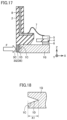
- FIG. 11 is a schematic enlarged sectional view illustrating the portion in FIG. 2 in a second modification of the power module of the first embodiment.
- FIG. 12 is a schematic enlarged sectional view illustrating the portion in FIG. 2 in a third modification of the power module of the first embodiment.
- FIG. 13 is a schematic enlarged sectional view illustrating the portion in FIG. 2 in a fourth modification of the power module of the first embodiment.
- FIG. 14 is a schematic enlarged sectional view illustrating the portion in FIG. 2 in a fifth modification of the power module of the first embodiment.
- FIG. 15 is a schematic sectional view illustrating a configuration of a power module according to a second embodiment.
- FIG. 16 is a schematic enlarged sectional view illustrating a portion XVI surrounded by a dotted line in FIG. 15 .
- FIG. 17 is a schematic sectional view illustrating particularly a process of causing the metal component and a base plate to adhere to each other in the method for manufacturing the power module of the second embodiment.
- FIG. 18 is a schematic enlarged sectional view illustrating a wedge-shaped portion formed in the base plate of the power module of the second embodiment.
- FIG. 19 is a schematic sectional view illustrating a first example in an aspect of the pressure-bonding process of the second embodiment.
- FIG. 20 is a schematic sectional view illustrating a second example in the aspect of the pressure-bonding process of the second embodiment.
- FIG. 21 is a schematic sectional view illustrating a third example in the aspect of the pressure-bonding process of the second embodiment.
- FIG. 22 is a schematic enlarged sectional view illustrating a portion in FIG. 16 in a first modification of the power module of the second embodiment.
- FIG. 23 is a schematic enlarged sectional view illustrating the portion in FIG. 16 in a second modification of the power module of the second embodiment.
- FIG. 24 is a schematic enlarged sectional view illustrating the portion in FIG. 16 in a third modification of the power module of the second embodiment.
- FIG. 25 is a schematic enlarged sectional view illustrating the portion illustrated in FIG. 16 of the fourth modification of the power module of the second embodiment.
- FIG. 26 is a schematic enlarged sectional view illustrating the portion in FIG. 16 in a fifth modification of the power module of the second embodiment.
- FIG. 27 is a schematic sectional view illustrating a configuration of a power module according to a third embodiment.
- FIG. 28 is a schematic enlarged sectional view illustrating a portion XXVIII surrounded by a dotted line in FIG. 27 .
- FIG. 29 is a schematic sectional view illustrating particularly the process of causing the metal component and the base plate to adhere to each other in the method for manufacturing the power module of the third embodiment.
- FIG. 30 is a schematic enlarged sectional view illustrating a portion of a slope formed in the base plate of the power module of the third embodiment.
- FIG. 31 is a schematic perspective view illustrating a first example of a jig bending the metal component along the slope of the base plate.
- FIG. 32 is a schematic sectional view taken along a line XXXII-XXXII in FIG. 31 .
- FIG. 33 is a schematic perspective view illustrating a second example of the jig bending the metal component along the slope of the base plate.
- FIG. 34 is a schematic sectional view taken along a line XXXIV-XXXIV in FIG. 33 .
- FIG. 35 is a schematic enlarged sectional view illustrating a portion in FIG. 28 in a first modification of the power module of the third embodiment.
- FIG. 36 is a schematic enlarged sectional view illustrating the portion in FIG. 28 in a second modification of the power module of the third embodiment.
- FIG. 37 is a schematic enlarged sectional view illustrating the portion in FIG. 28 in a third modification of the power module of the third embodiment.
- FIG. 38 is a schematic enlarged sectional view illustrating the portion in FIG. 28 in a fourth modification of the power module of the third embodiment.
- FIG. 39 is a schematic enlarged sectional view illustrating the portion in FIG. 28 in a fifth modification of the power module of the third embodiment.
- FIG. 40 is a schematic enlarged sectional view illustrating a process of bonding the base plate and the metal component of a first example of a power module according to a fourth embodiment in the portion in FIGS. 2 , 16 , and 28 .
- FIG. 41 is a schematic enlarged sectional view illustrating an aspect in which the base plate and the metal component are bonded together as in FIGS. 2 , 16 , and 28 in the first example of the power module of the fourth embodiment.
- FIG. 42 is a schematic enlarged sectional view illustrating the process of bonding the base plate and the metal component of a second example of the power module of the fourth embodiment in the portion in FIGS. 2 , 16 , and 28 .
- FIG. 43 is a schematic enlarged sectional view illustrating an aspect in which the base plate and the metal component are bonded together as in FIGS. 2 , 16 , and 28 in the second example of the power module of the fourth embodiment.
- FIG. 44 is a schematic enlarged sectional view illustrating the process of bonding the base plate and the metal component of a third example of the power module of the fourth embodiment and a bonded aspect.
- FIG. 45 is a block diagram illustrating a configuration of a power conversion system to which a power converter according to a fifth embodiment is applied.
- FIGS. 1 to 3 a configuration of a power module as a semiconductor device of a first embodiment will be described.
- An X-direction, a Y-direction, and a Z-direction are introduced for the convenience of description.
- FIG. 1 is a schematic sectional view illustrating the configuration of the power module of the first embodiment.
- FIG. 2 is a schematic enlarged sectional view illustrating a portion II surrounded by a dotted line in FIG. 1 .
- FIG. 3 is a schematic enlarged sectional view illustrating an example of an aspect in which a portion of a metal component in FIG. 2 is more correctly illustrated.
- a power module 100 of the first embodiment mainly includes a base plate 1 P, a case component 2 , a metal component 3 P, an insulating substrate 4 , and a semiconductor element 5 .
- Base plate 1 P radiates heat generated by the semiconductor element (to be described later) from a lower side in the Z-direction to an outside of power module 100 .
- base plate 1 P has a rectangular shape in planar view and a flat plate shape having a thickness in the Z-direction.
- base plate 1 P is made of a metal material, such as copper and aluminum, which has excellent thermal conductivity.
- Case component 2 is attached so as to substantially surround base plate 1 P in planar view.
- Case component 2 has a substantially rectangular frame shape in planar view.
- Case component 2 has a dimension larger than that of base plate 1 P in the Z-direction.
- case component 2 to base plate 1 P constitute a container-shaped casing by attaching case component 2 to base plate 1 P.
- Case component 2 can electrically be connected to the semiconductor element by connecting a bonding wire (to be described later), so that a lower region in the Z-direction may become thicker than an upper region in the Z-direction in an inner wall surface in the X-direction and the Y-direction.
- a step is formed at a boundary between a thicker area and a thinner area of the inner wall surface in the X-direction and the Y-direction.
- the inner wall surface may extend so as to be inclined with respect to other portions in the lowermost portion in the Z-direction.
- case component 2 is made of any insulating resin material selected from a group consisting of a sulfide resin, a polyphenylene sulfide resin (PPS resin), a polyethylene terephthalate resin (PBT resin), an unsaturated polyester resin, and an epoxy resin.
- metal component 3 P is fixed to case component 2 by an insert molding process. That is, in this case, case component 2 is an insert molding member formed by the insert molding process.
- metal component 3 P contacts with the lowermost surface of case component 2 , and is fixed to case component 2 .
- a region excluding the surface contacting with the lowermost surface of case component 2 is exposed from case component 2 .
- Such an aspect may be applied as an example of a fixing aspect by the insert molding process of the metal component 3 P to case component 2 in power module 100 .
- metal component 3 P is also fixed to case component 2 by the insert molding process similarly to metal component 3 P in FIGS. 1 and 2 .
- metal component 3 P in FIG. 3 includes an embedded region 3 A and an exposed region 3 B.
- Embedded region 3 A is a part of metal component 3 P, and is a region embedded in the resin material of case component 2 formed by the insert molding process. That is, embedded region 3 A is a region covered with and hidden behind case component 2 in metal component 3 P.
- Exposed region 3 B is a part of a region except for embedded region 3 A in metal component 3 P.
- Exposed region 3 B is a region where the surface is exposed from case component 2 without being covered with or hidden behind case component 2 formed by the insert molding process. That is, exposed region 3 B is a region that is not covered with case component 2 in metal component 3 P.
- metal component 3 P of power module 100 in FIG. 1 is embedded in case component 2 , and that a part of other regions is exposed from the lowermost portion of case component 2 .
- metal component 3 P is fixed to case component 2 in a portion where metal component 3 P is embedded in case component 2 .
- Such an aspect may be applied as an example of a fixing aspect by the insert molding process of the metal component 3 P to case component 2 in power module 100 . That is, metal component 3 P in power module 100 can be applied to both the aspect in which metal component 3 P contacts with the lowermost surface of case component 2 while a whole of a portion except for the contact portion is exposed as illustrated in FIG.
- metal component 3 P may be displayed as illustrated in FIG. 2 as a schematic diagram in which the aspect in FIG. 3 is simplified.
- metal component 3 P in FIG. 2 is common to metal component 3 P in FIG. 3 in that metal component 3 P extends in the Z-direction from the lowermost portion of case component 2 .
- FIG. 2 conceptually includes both the aspect in FIG. 2 and the aspect in FIG. 3 .
- metal component 3 P extends in the Z-direction, and has a rectangular frame shape (annular shape) in planar view.
- the present invention is not limited to the rectangular frame shape, but may have a circular frame shape in planar view.
- the region where of the metal component 3 P is exposed from the case component 2 is bonded to base plate 1 P at a bonding portion 13 P.
- bonding portion 13 P the surface of the partial region of metal component 3 P exposed from case component 2 and the surface of base plate 1 P are in direct contact with each other and integrated.
- direct contact means that no other material is included between a constituent material of metal component 3 P and a constituent material of base plate 1 P.
- the surface of metal component 3 P and the side surface of base plate 1 P are in direct contact with each other, and bonded together as bonding portion 13 P at the boundary between metal component 3 P and base plate 1 P.
- the side surface of the base plate 1 P is a surface extending in the Z-direction so as to connect a main surface on the upper side in the Z-direction of base plate 1 P and a main surface on the lower side in the Z-direction.
- bonding portion 13 P is disposed on the side surface that is the surface of base plate 1 P as a portion to which the surface of exposed region 3 B in FIG. 3 , for example, the partial region of metal component 3 P adheres.
- base plate 1 P is bonded so as to be fitted in exposed region 3 B that is fixed to and exposed from case component 2 .
- power module 100 includes the following members, and has the following configuration.
- Insulating substrate 4 is disposed on the upper side of the main surface on the upper side in the Z-direction of base plate 1 P.
- Semiconductor element 5 is bonded onto insulating substrate 4 .
- the lower main surface in the Z-direction of insulating substrate 4 is bonded to the upper main surface in the Z-direction of base plate 1 P by solder 6 .
- insulating substrate 4 has a rectangular shape in planar view and a flat plate shape having a thickness in the Z-direction.
- a plurality of insulating substrates 4 may be bonded together on the main surface on the upper side in the Z-direction of base plate 1 P at intervals.
- Insulating substrate 4 is made of a ceramic material such as aluminum oxide, aluminum nitride, and silicon nitride or a resin material such as an epoxy resin.
- semiconductor element 5 is a silicon semiconductor chip including a power semiconductor element.
- semiconductor element 5 has a square or rectangular flat shape.
- semiconductor element 5 is bonded onto the main surface on the upper side in the Z-direction of insulating substrate 4 by solder.
- a power control semiconductor element such as a MOSFET (Metal Oxide Semiconductor Field Effect Transistor) and an IGBT (Insulated Gate Bipolar Transistor), a reflux diode, or the like is used as the semiconductor element 5 .
- MOSFET Metal Oxide Semiconductor Field Effect Transistor
- IGBT Insulated Gate Bipolar Transistor
- Electrode 8 is formed so as to extend from the inside of case component 2 to the outside of case component 2 . That is, for example, electrode 8 extends upward in the Z-direction while being buried in case component 2 , and is exposed on the upper surface of case component 2 in the uppermost portion of electrode 8 although not illustrated. Electrode 8 is a terminal that electrically connects an internal circuit of power module 100 and an external circuit, namely, a terminal to which current and voltage are input and output. Although the lowermost portion of electrode 8 is buried in the casing, the uppermost surface of electrode 8 is exposed from case component 2 . The portion of electrode 8 exposed from case component 2 is electrically connected to semiconductor element 5 by bonding wire 7 .
- bonding wire 7 is a wire made of an aluminum alloy or a copper alloy having a wire diameter that is greater than or equal to 0.1 mm and less than or equal to 0.5 mm.
- Electrode 8 is a plate electrode made of copper.
- insulating sealing material 9 is a hard resin material such as an epoxy resin or a phenol resin.
- insulating sealing material 9 may be a soft resin material such as a silicone gel.
- FIG. 4 is a schematic sectional view illustrating a first process of the method for manufacturing the power module of the first embodiment.
- insulating substrate 4 having a conductive pattern (not illustrated) and base plate 1 P made of metal are prepared on each of the upper and lower main surfaces.
- Insulating substrate 4 is bonded to one main surface 1 A that is the upper main surface of base plate 1 P by solder 6 .
- base plate 1 P includes one rectangular main surface 1 A and the other main surface 1 B on an opposite side to main surface 1 A.
- a side surface 1 C extending in the Z-direction connecting one main surface 1 A and other main surface 1 B is formed in base plate 1 P.
- Semiconductor element 5 is mounted on the upper main surface of insulating substrate 4 before insulating substrate 4 is bonded to one main surface 1 A.
- FIG. 5 is a schematic sectional view illustrating a second process of the method for manufacturing the power module of the first embodiment.
- case component 2 including metal component 3 P and electrode 8 is prepared.
- Case component 2 is formed by insert molding such that at least a part of metal component 3 P is fixed.
- metal component 3 P may be fixed by adhering or welding to the lowermost surface in the Z-direction of case component 2 .
- embedded region 3 A that is a part of metal component 3 P may be fixed so as to be embedded in, covered with, and hidden behind case component 2 .
- Electrode 8 may also simultaneously be fixed to the inside of case component 2 as illustrated in FIG. 5 .
- base plate 1 P on which insulating substrate 4 is mounted as illustrated in FIG. 4 is also prepared.
- FIG. 6 is a schematic sectional view illustrating a third process of the method for manufacturing the power module of the first embodiment.
- base plate 1 P is bonded to the partial region of metal component 3 P, which is fixed to case component 2 by the insert molding in the process of FIG. 5 and exposed from case component 2 .
- the surface of the partial region of metal component 3 P namely, the surface of the region exposed from case component 2 and the surface of base plate 1 P are in direct contact with each other and integrated. That is, as indicated by an arrow in FIG. 5 , metal component 3 P of case component 2 is moved so as to contact with side surface 1 C of base plate 1 P on which insulating substrate 4 is mounted. Metal component 3 P is bonded to side surface 1 C.
- Stress F indicated by an arrow in the drawing is applied such that a part of the surface of the metal component 3 P adheres to side surface 1 C of the base plate 1 P while the part of the surface is in contact with side surface 1 C.
- stress F is substantially uniformly applied to four edges in a balanced manner.
- forces applied to each of the two opposing edges in the four edges are opposite in a direction and approximately equal in magnitude. Consequently, the force applied to base plate 1 P is balanced.
- metal component 3 P of case component 2 and base plate 1 P are directly sealed to each other by metal bonding by pressure causing metal component 3 P and base plate 1 P to adhere to each other.
- FIG. 7 is a schematic perspective view illustrating a tool used in an ultrasonic bonding process as a first example of the process in FIG. 6 .
- an ultrasonic bonding process is performed as the first example of the bonding process in FIG. 6 .
- an ultrasonic bonding tool 20 in FIG. 7 is used in the ultrasonic bonding process.
- ultrasonic bonding tool 20 is a container-shaped member having a rectangular shape in planar view as illustrated in FIG. 7 , and a spatial region is formed in ultrasonic bonding tool 20 .
- the ultrasonic bonding is performed by applying stress F as illustrated in FIG. 6 .
- the inner wall surface of ultrasonic bonding tool 20 is disposed so as to sandwich side surface 3 C, which is directed to the outside of base plate 1 P and extends in the Z-direction in the portion where metal component 3 P in FIG. 6 is exposed from case component 2 . That is, side surface 3 C is pressed against the inner wall surface of ultrasonic bonding tool 20 . At this point, ultrasonic vibration is applied to ultrasonic bonding tool 20 to apply stress F in the direction in which metal component 3 P and side surface 1 C of base plate 1 P adhere to each other. Exposed region 3 B and side surface 1 C of metal component 3 P adhere to each other in this manner to perform metallic bonding between exposed region 3 B and side surface 1 C. Thus, bonding portion 13 P that is a metallic-bonded portion is formed.
- FIG. 8 is a schematic sectional view illustrating an aspect in which a pressure-bonding process is performed as a second example of the process in FIG. 6 .
- the pressure-bonding process may be performed as a second example of the bonding process in FIG. 6 .
- a pressure-bonding jig 10 A is used in order to apply stress F indicated by the arrow in the drawings.
- a leading end that contacts with and applies the stress to side surface 3 C has a substantially flat shape. Consequently, pressure-bonding jig 10 A can contact with side surface 3 C having the substantially flat shape, and apply the large stress.
- a heating temperature of an object is less than or equal to 250° C.
- a pressurization time of the object is less than or equal to 2 seconds.
- stress F is uniformly applied to each of the four edges of rectangular base plate 1 P.
- FIG. 9 is a schematic sectional view illustrating a configuration of a power module of the comparative example.
- the same component of a power module 900 of the comparative example as the component of power module 100 is denoted by the same reference numeral as the components of power module 100 , and the description will not be repeated.
- base plate 1 P and case component 2 are bonded together by an adhesive 11 such as solder.
- the configuration of power module 900 is different from that of power module 100 in this point.
- the metal component fixed to case component 2 and case component 2 are bonded together with adhesive 11 interposed therebetween.
- adhesive 11 large thermal stress due to heating is applied as compared with the first embodiment.
- the resin material constituting case component 2 cannot withstand the large thermal stress applied during the bonding. That is, the resin material of case component 2 may be damaged by the thermal stress.
- the surface of exposed region 3 B of metal component 3 P and the surface of base plate 1 P are in direct contact with each other and integrated using the ultrasonic bonding process or the pressure-bonding process with no use of adhesive 11 .
- Bonding portion 13 P formed in this way is disposed as a portion where the surface of exposed region 3 B of metal component 3 P is in close contact with the surface of base plate 1 P.
- the thermal stress applied to case component 2 during the bonding process is smaller than the thermal stress applied to case component 2 during the bonding by adhesive 11 . For this reason, a burden placed on the resin material of case component 2 can be reduced. Consequently, the damage to case component 2 can be prevented.
- the application process and the curing process of adhesive 11 are eliminated, so that the manufacturing cost can also be reduced.
- exposed region 3 B of metal component 3 P extends from the lower side in the Z-direction of case component 2 , and is bonded to base plate 1 P.
- the present invention is not limited to the first embodiment.
- metal component 3 P and base plate 1 P may be bonded together as in each of the following modifications.
- FIG. 10 is a schematic enlarged sectional view illustrating a portion in FIG. 2 in a first modification of the power module of the first embodiment.
- FIG. 11 is a schematic enlarged sectional view illustrating the portion in FIG. 2 in a second modification of the power module of the first embodiment.
- FIG. 12 is a schematic enlarged sectional view illustrating the portion in FIG. 2 in a third modification of the power module of the first embodiment.
- FIG. 13 is a schematic enlarged sectional view illustrating the portion in FIG. 2 in a fourth modification of the power module of the first embodiment.
- FIG. 14 is a schematic enlarged sectional view illustrating the portion in FIG. 2 in a fifth modification of the power module of the first embodiment. All the configurations of the regions except for the regions illustrated in each of the modifications are similar to those in FIGS. 1 to 3 , and the illustration and description will not be repeated.
- a metal component 3 P 1 (the same shall apply hereinafter) that is metal component 3 P in FIG. 1 fixed to case component 2 in the insert molding process may be exposed from the surface except for the lowermost portion in the Z-direction of case component 2 .
- exposed region 3 B of metal component 3 P 1 may be exposed from the uppermost portion in the Z-direction of case component 2 , extend along the side surface of case component 2 extending in the Z-direction, and be bonded onto side surface 1 C of base plate 1 P.
- FIG. 10 a metal component 3 P 1 (the same shall apply hereinafter) that is metal component 3 P in FIG. 1 fixed to case component 2 in the insert molding process may be exposed from the surface except for the lowermost portion in the Z-direction of case component 2 .
- exposed region 3 B of metal component 3 P 1 may be exposed from the uppermost portion in the Z-direction of case component 2 , extend along the side surface of case component 2 extending in the Z-direction, and be bonded onto side surface 1 C of base plate 1 P
- exposed region 3 B of a metal component 3 P 2 may extend so as to contact with the side surface of case component 2 extending in the Z-direction, and be bonded onto side surface 1 C of base plate 1 P.
- exposed region 3 B of a metal component 3 P 3 may protrude from the inside of case component 2 in a central portion in the Z-direction of case component 2 , and extend downward in the Z-direction along the side surface of case component 2 extending in the Z-direction, and be bonded onto side surface 1 C of base plate 1 P.
- metal components 3 P 4 , 3 P 5 may have the configuration in which embedded region 3 A extends horizontally from the inside of case component 2 in the region having the large thickness in the X-direction in the lower portion in the Z-direction of case component 2 .
- exposed region 3 B protrudes from the side surface extending in the Z-direction of case component 2 having the large thickness in the X-direction, extends downward along the side surface of case component 2 extending in the Z-direction, and is bonded onto side surface 1 C of base plate 1 P.
- the end of embedded region 3 A is disposed inside the inner wall surface of the region having the reduced thickness in the X-direction on the upper side in the Z-direction of case component 2 .
- the end of embedded region 3 A is disposed at an X-coordinate position substantially identical to that of the inner wall surface in the region having the reduced thickness in the X-direction on the upper side in the Z-direction of case component 2 .
- Each of metal components 3 P in FIGS. 10 , 12 to 14 has embedded region 3 A in the uppermost portion in the Z-direction inside case component 2 , but may not have embedded region 3 A as in FIG. 2 .
- the surface of exposed region 3 B of metal component 3 P particularly means the inner wall surface opposed to side surface 1 C, and the surface of base plate 1 P particularly means side surface 1 C.
- the present invention is not limited thereto.
- surfaces such as the uppermost surface, the lowermost surface, and the outer wall surface except for the inner wall surface of exposed region 3 B of metal component 3 P, one main surface 1 A of base plate 1 P, and other main surface 1 B may be in direct contact with each other and integrated.
- FIG. 15 is a schematic sectional view illustrating a configuration of a power module according to a second embodiment.
- FIG. 16 is a schematic enlarged sectional view illustrating a portion XVI surrounded by a dotted line in FIG. 15 .
- a power module 200 of the second embodiment substantially has the configuration similar to that of power module 100 of the first embodiment.
- the same component as that in FIG. 1 is denoted by the same reference numeral, and the overlapping description will be omitted.
- the second embodiment is different from the first embodiment in the configurations of the base plate and the metal component.
- a wedge-shaped portion 1 D is formed on side surface 1 C that is a part of the surface of a base plate 1 Q.
- An exposed region 3 B which is a partial region of a metal component 3 Q, is in close contact with the surface of wedge-shaped portion 1 D.
- a bonding portion 13 Q is disposed as the closely contact portion. That is, a part of metal component 3 Q is fitted in wedge-shaped portion 1 D so as to follow the shape of wedge-shaped portion 1 D.
- Wedge-shaped portion 1 D is a portion where a member constituting base plate 1 is cut out so as to have a substantially V-shape in sectional view.
- metal component 3 Q is fitted in wedge-shaped portion 1 D. For this reason, similarly to wedge-shaped portion 1 D, metal component 3 Q is bent so as to have a substantially V-shape in sectional view.
- FIG. 15 can be interpreted as a schematic diagram in which embedded region 3 A in FIG. 16 is omitted.
- metal component 3 Q may be in contact with the lowermost surface of case component 2 , and the entire portion except for the contact portion may be exposed.
- FIG. 17 is a schematic sectional view illustrating particularly a process of causing the metal component and the base plate to adhere to each other in the method for manufacturing the power module of the second embodiment.
- base plate 1 Q in which wedge-shaped portion 1 D is formed on side surface 1 C is prepared.
- exposed region 3 B that is the partial region of metal component 3 Q is pressure-bonded to the V-shaped surface of wedge-shaped portion 1 D formed on side surface 1 C that is the surface of base plate 1 Q.
- stress F is applied to exposed region 3 B of metal component 3 Q so as to be directed to wedge-shaped portion 1 D in FIG. 17 .
- FIG. 18 is a schematic enlarged sectional view illustrating the wedge-shaped portion formed in the base plate of the power module of the second embodiment.
- wedge-shaped portion 1 D is formed by removing the components of base plate 1 Q in a depth direction intersecting side surface 1 C of base plate 1 Q.
- Wedge-shaped portion 1 D has a substantially isosceles triangle shape, and preferably an angle formed between wedge-shaped portion 1 D and side surface 1 C in FIG. 18 is greater than 90° and less than 180°.
- a depth of wedge-shaped portion 1 D indicated by X 1 in FIG. 18 is greater than or equal to 1 ⁇ 2 and less than or equal to double the thickness of base plate 1 Q.
- FIG. 19 is a schematic sectional view illustrating a first example in an aspect of the pressure-bonding process of the second embodiment.
- a pressure-bonding jig 10 B is used in the process of pressure-bonding metal component 3 Q to wedge-shaped portion 1 D of base plate 1 Q in the second embodiment.
- wedge-shaped portion 1 D has an isosceles triangular sectional shape as illustrated in FIG. 18 .
- Pressure-bonding jig 10 B has a shape in which the leading end is pointed in an isosceles triangle shape so as to be fitted in the isosceles triangle shape, namely, the V-shape of wedge-shaped portion 1 D.
- the angle of the isosceles triangle at the leading end of the pressure-bonding jig 10 B is substantially equal to the angle of wedge-shaped portion 1 D.
- Metal component 3 Q is pressed by the pressure-bonding jig 10 B under a heating condition.
- exposed region 3 B of metal component 3 Q is deformed so as to conform to the shapes of pressure-bonding jig 10 B and wedge-shaped portion 1 D on side surface 1 C.
- exposed region 3 B is fitted so as to invade into a notched portion of wedge-shaped portion 1 D, and exposed region 3 B and wedge-shaped portion 1 D adhere to each other. Consequently, the pressure bonding is performed.
- FIG. 20 is a schematic sectional view illustrating a second example in the aspect of the pressure-bonding process of the second embodiment.
- wedge-shaped portion 1 D has the shape similar to that of FIG. 19 .
- a flat portion extending along the Z-direction may be formed at the leading end of a pressure-bonding jig 10 C.
- the flat portion has a role of preventing formation of machining burrs on a periphery, namely, the side surface of metal component 3 Q fitted in wedge-shaped portion 1 D.
- the angle in the pointed portion of the isosceles triangle shape at the leading end of pressure-bonding jig 10 C is equal to that of pressure-bonding jig 10 B.
- FIG. 21 is a schematic sectional view illustrating a third example in the aspect of the pressure-bonding process of the second embodiment.
- wedge-shaped portion 1 D has the shape similar to that of FIG. 19 .
- the leading end of a pressure-bonding jig 10 D includes a tapered pointed portion fitted in wedge-shaped portion 1 D on only one side in the Z-direction (in FIG. 21 , only the upper side).
- the tapered pointed portion may be formed over the entire dimension of pressure-bonding jig 10 D in the Z-direction as illustrated in FIG. 21 .
- the tapered pointed portion may be formed only in the partial region such as the upper half in the Z-direction.
- the deformation of the lower portion in the Z-direction of base plate 1 Q can be prevented.
- the angle of the pointed portion at the leading end of pressure-bonding jig 10 D is equal to that of pressure-bonding jig 10 B.
- Pressure-bonding jig 10 D may include the tapered pointed portion only on the lower side in the Z-direction.
- the heating temperature of the object less than or equal to 250° C. in the pressure-bonding process.
- a pressurization time of the object is less than or equal to 2 seconds.
- stress F is uniformly applied to each of the four edges of rectangular base plate 1 Q. Consequently, metal component 3 Q of case component 2 and the base plate 1 Q are sealed.
- base plate 1 Q is placed on the upper surface of a jig 30 in the pressure-bonding process.
- exposed region 3 B of metal component 3 Q insert-molded in the lower portion of case component 2 is pressed into a recessed portion of wedge-shaped portion 1 D of the side surface of base plate 1 Q by the pressure-bonding process. Consequently, the surface of metal component 3 Q and the surface of wedge-shaped portion 1 D come into direct contact with each other and are integrated by the adherence. Thus, the surface of metal component 3 Q and the surface of wedge-shaped portion 1 D are bonded together.
- the sealing process can easily be performed so as to increase a degree of adhesion by the use of pressure-bonding jigs 10 B, 10 C, 10 D in FIGS.
- pressure-bonding jig 10 A having the flat leading end in FIG. 8 . Because pressure-bonding jigs 10 B, 10 C, 10 D have the pointed leading end, pressure-bonding jigs 10 B, 10 C, 10 D have the structure more suitable for the pressure-bonding process than pressure-bonding jig 10 A including the flat leading end.
- FIG. 22 is a schematic enlarged sectional view illustrating a portion in FIG. 16 in a first modification of the power module of the second embodiment.
- FIG. 23 is a schematic enlarged sectional view illustrating the portion in FIG. 16 in a second modification of the power module of the second embodiment.
- FIG. 24 is a schematic enlarged sectional view illustrating the portion in FIG. 16 in a third modification of the power module of the second embodiment.
- FIG. 25 is a schematic enlarged sectional view illustrating the portion in FIG. 16 in a fourth modification of the power module of the second embodiment.
- FIG. 26 is a schematic enlarged sectional view illustrating the portion in FIG. 16 in a fifth modification of the power module of the second embodiment. All the configurations of the regions except for the regions illustrated in each of the modifications are similar to those in FIGS. 15 to 17 , and the illustration and description will not be repeated.
- metal components 3 Q 1 , 3 Q 2 , 3 Q 3 , 3 Q 4 , 3 Q 5 of these modifications are similar to metal components 3 P 1 to 3 P 5 in FIGS. 10 to 14 except that metal components 3 Q 1 , 3 Q 2 , 3 Q 3 , 3 Q 4 , 3 Q 5 are pressure-bonded to wedge-shaped portion 1 D of base plate 1 Q, the detailed description will not be repeated.
- embedded region 3 A and exposed region 3 B having the configuration similar to that in FIGS. 10 to 14 may be included.
- the surface of exposed region 3 B of metal component 3 Q particularly means the inner wall surface opposed to side surface 1 C, and the surface of base plate 1 Q particularly means side surface 1 C.
- the present invention is not limited thereto.
- surfaces such as the uppermost surface, the lowermost surface, and the outer wall surface except for the inner wall surface of exposed region 3 B of metal component 3 Q, one main surface 1 A of base plate 1 Q, and other main surface 1 B may be in direct contact with each other and integrated. That is, the position where wedge-shaped portion 1 D is formed is not limited to the side surface 1 C in the surface of base plate 1 Q.
- wedge-shaped portion 1 D may be formed on one main surface 1 A or other main surface 1 B (see FIG. 4 ) of base plate 1 Q.
- FIG. 27 is a schematic sectional view illustrating a configuration of a power module according to a third embodiment.
- FIG. 28 is a schematic enlarged sectional view illustrating a portion XXVIII surrounded by a dotted line in FIG. 27 .
- a power module 300 of the third embodiment substantially has the configuration similar to that of power module 100 of the first embodiment.
- the same component as that in FIG. 1 is denoted by the same reference numeral, and the overlapping description will be omitted.
- the third embodiment is different from the first embodiment in the configurations of the base plate and the metal component.
- a slope 1 E connecting other main surface 1 B and side surface 1 C in an oblique direction with respect to one main surface 1 A and other main surface 1 B on an opposite side to main surface 1 A of a base plate 1 R and the Z-direction perpendicular to one main surface 1 A and other main surface 1 B are formed in power module 300 .
- a bonding portion 13 R is disposed on slope 1 E of base plate 1 R as a portion to which exposed region 3 B that is the partial region of metal component 3 adheres.
- slope 1 E is formed below side surface 1 C extending in the Z-direction.
- the present invention not limited to the third embodiment.
- slope 1 E may be formed on the upper side of side surface 1 C extending in the Z-direction.
- metal component 3 R is bonded along slope 1 E to form bonding portion 13 R. For this reason, metal component 3 R is bent so as to extend in the direction along slope 1 E, particularly on the lower side in the Z-direction in FIGS. 27 and 28 .
- FIG. 27 can be interpreted as a schematic diagram in which embedded region 3 A in FIG. 28 is omitted.
- metal component 3 R may be in contact with the lowermost surface of case component 2 , and the entire portion except for the contact portion may be exposed.
- FIG. 29 is a schematic sectional view illustrating particularly the process of causing the metal component and the base plate to adhere to each other in the method for manufacturing the power module of the third embodiment.
- base plate 1 R including slope 1 E that connects other main surface 1 B and side surface 1 C in the oblique direction with respect to one main surface 1 A and other main surface 1 B so as to extend and spread from immediately under side surface 1 C of base plate 1 R toward other main surface 1 B is prepared.
- exposed region 3 B of metal component 3 R is pressure-bonded onto slope 1 E of base plate 1 R.
- stress F is applied to exposed region 3 B of metal component 3 R in the direction inclined with respect to the horizontal direction, namely, the direction particularly along a normal to slope 1 E.
- metal component 3 is bent such that the surface of metal component follows slope 1 E particularly at the lower side.
- stress F is further applied.
- slope 1 E and metal component 3 R are bonded while adhering to each other. Consequently, bonding portion 13 R is formed.
- pressure-bonding jig 10 A in FIG. 8 may be used in the pressure-bonding process
- pressure-bonding jigs 10 B to 10 D in FIGS. 19 to 21 may be used.
- the heating temperature of the object is less than or equal to 250° C. in the pressure bonding process.
- a pressurization time of the object is less than or equal to 2 seconds.
- stress F is uniformly applied to each of the four edges of rectangular base plate 1 R. Consequently, metal component 3 R of case component 2 and base plate 1 R are sealed.
- FIG. 30 is a schematic enlarged sectional view illustrating the portion of the slope formed in the base plate of the power module of the third embodiment.
- slope 1 E is formed so as to extend from side surface 1 C of base plate 1 R in the oblique direction with respect to side surface 1 C.
- the angle formed with main surface 1 B as illustrated in FIG. 30 is greater than 90° and less than 180°.
- a dimension X 2 of slope 1 E in FIG. 30 is greater than or equal to 1 ⁇ 2 and less than or equal to double the thickness of base plate 1 Q.
- a dimension Z 1 of slope 1 E in FIG. 30 is greater than or equal to 1 ⁇ 3 and less than or equal to 2 ⁇ 3 of the thickness of base plate 1 Q.
- FIG. 31 is a schematic perspective view illustrating a first example of a jig bending the metal component along the slope of the base plate.
- FIG. 32 is a schematic sectional view taken along a line XXXII-XXXII in FIG. 31 .
- FIG. 33 is a schematic perspective view illustrating a second example of the jig bending the metal component along the slope of the base plate.
- FIG. 34 is a schematic sectional view taken along a line XXXIV-XXXIV in FIG. 33 .
- a slope forming jig 41 that is the first example is a jig that forms exposed region 3 B of metal component 3 R such that exposed region 3 B follows side surface 1 C of base plate 1 R and slope 1 E. For this reason, a plane extending and spreading in the vertical direction and a plane extending in the form of the slope from the vertically extending and spreading plane are continuously formed in the sectional view of FIG. 32 .
- a slope forming jig 42 that is the second example is a jig that forms exposed region 3 B of metal component 3 R such that exposed region 3 B follows slope 1 E of base plate 1 R. For this reason, in the sectional view of FIG.
- a slope forming slope 1 E is formed in the uppermost portion.
- the inner wall surfaces of slope forming jigs 41 , 42 are disposed so as to sandwich side surface 3 C, which is directed to the outside of base plate 1 R and extends in the Z-direction in the portion where metal component 3 R in FIG. 27 is exposed from case component 2 . That is, side surface 3 C is pressed against the inner wall surfaces of slope forming jigs 41 , 42 . Consequently, exposed region 3 B of insert-molded metal component 3 R is bent so as to have the shape following slope 1 E of base plate 1 R.
- metal component 3 R in which the insert molding or the like is formed on case component 2 adheres to slope 1 E formed in base plate 1 R, particularly pressure-bonded.
- the surface of metal component 3 R and slope 1 E of base plate 1 R are in direct contact with each other and integrated, which forms bonding portion 13 R.
- metal component 3 R is firmly bonded to slope 1 E by the pressure-bonding process.
- the sealing process can easily be performed so as to increase the degree of adhesion by the use of pressure-bonding jigs 10 B, 10 C, 10 D in FIGS. 19 to 21 or slope forming jigs 41 , 42 in FIGS. 31 to 34 rather than the use of pressure-bonding jig 10 A having the flat leading end in FIG. 8 .
- FIG. 35 is a schematic enlarged sectional view illustrating a portion in FIG. 28 in a first modification of the power module of the third embodiment.
- FIG. 36 is a schematic enlarged sectional view illustrating the portion in FIG. 28 in a second modification of the power module of the third embodiment.
- FIG. 37 is a schematic enlarged sectional view illustrating the portion in FIG. 28 in a third modification of the power module of the third embodiment.
- FIG. 38 is a schematic enlarged sectional view illustrating the portion in FIG. 28 in a fourth modification of the power module of the third embodiment.
- FIG. 39 is a schematic enlarged sectional view illustrating the portion in FIG. 28 in a fifth modification of the power module of the third embodiment. All the configurations of the regions except for the regions illustrated in each of the modifications are similar to those in FIGS. 15 to 17 , and the illustration and description will not be repeated.
- metal components 3 R 1 , 3 R 2 , 3 R 3 , 3 R 4 , 3 R 5 of these modifications are similar to metal components 3 P 1 to 3 P 5 in FIGS. 10 to 14 except that metal components 3 R 1 , 3 R 2 , 3 R 3 , 3 R 4 , 3 R 5 are pressure-bonded to slope 1 E of base plate 1 R, the detailed description will not be repeated.
- embedded region 3 A and exposed region 3 B having the configuration similar to that in FIGS. 10 to 14 may be included.
- the surface of exposed region 3 B of metal component 3 R particularly means the inner wall surface opposed to side surface 1 C, and the surface of base plate 1 R particularly means slope 1 E on the lower side of side surface 1 C.
- the present invention is not limited thereto.
- surfaces such as the uppermost surface, the lowermost surface, and the outer wall surface except for the inner wall surface of exposed region 3 B of metal component 3 Q and the slope formed on the upper side in the Z-direction of base plate 1 Q may be in direct contact with each other and integrated.
- FIG. 40 is a schematic enlarged sectional view illustrating the process of bonding the base plate and the metal component of a first example of a power module according to a fourth embodiment in the portion in FIGS. 2 , 16 , and 28 .
- FIG. 41 is a schematic enlarged sectional view illustrating an aspect in which the base plate and the metal component are bonded together as in FIGS. 2 , 16 , and 28 in the first example of the power module of the fourth embodiment.
- FIG. 42 is a schematic enlarged sectional view illustrating the process of bonding the base plate and the metal component of a second example of the power module of the fourth embodiment in the portion in FIGS. 2 , 16 , and 28 .
- FIG. 41 is a schematic enlarged sectional view illustrating the process of bonding the base plate and the metal component of a second example of the power module of the fourth embodiment in the portion in FIGS. 2 , 16 , and 28 .
- FIG. 41 is a schematic enlarged sectional view illustrating the process of bonding the
- FIG. 43 is a schematic enlarged sectional view illustrating an aspect in which the base plate and the metal component are bonded together as in FIGS. 2 , 16 , and 28 in the second example of the power module of the fourth embodiment.
- FIG. 44 is a schematic enlarged sectional view illustrating the process of bonding the base plate and the metal component of a third example of the power module of the fourth embodiment and a bonded aspect. All the configurations of the regions except for the regions illustrated in each of the examples are similar to those in FIGS. 1 to 3 , and the illustration and description will not be repeated.
- any position of the surface of metal component 3 insert-molded in case component 2 and any position of the surfaces of base plates 1 P to 1 R are in direct contact with each other and integrated.
- Several specific examples are illustrated in the fourth embodiment.
- a protrusion 1 F 1 extending upward in the Z-direction is formed on one main surface 1 A of a base plate 1 S 1 .
- Protrusion 1 F 1 is inserted into the spatial region sandwiched between the inclined surfaces of exposed region 3 B, and a pressure in a direction F indicated by the arrow in FIG. 40 is applied to perform the pressure-bonding process. Consequently, a power module 410 in which metal component 3 S 1 and base plate 1 S 1 are bonded by a protrusion 1 F 2 below the lowermost portion of case component 2 may be formed as illustrated in FIG. 41 .
- the inner edge is inclined on the outside of the lowermost portion in the Z-direction of case component 2 as in the first example, and a metal component 3 S 2 in which the inner edge is not inclined with respect to the Z-direction but extends in a cylindrical shape, namely, the Z-direction on the inside in the Z-direction is exposed.
- projection 1 F 1 is formed on base plate 1 S 1 as in FIG. 40 .
- Protrusion 1 F 1 is inserted into the spatial region sandwiched between exposed region 3 B, and the pressure in direction F indicated by the arrow in FIG. 42 is applied to perform the pressure-bonding process. Consequently, a power module 420 in which metal component 3 S 2 and base plate 1 S 1 are bonded by a protrusion 1 F 3 below the lowermost portion of case component 2 may be formed as illustrated in FIG. 43 .
- a thin frame-shaped metal component 3 S 3 formed by the insert molding is exposed in the lowermost portion in the Z-direction of case component 2 .
- a frame-shaped notch 1 G is formed at an outer edge of base plate 1 S 2 immediately below metal component 3 S 3 in order to reduce the thickness in the Z-direction as compared to the other regions.
- the component of thin base plate 1 S 2 is disposed immediately above notch 1 G, and the portion where the component of thin base plate 1 S 2 is disposed and metal component 3 S 3 adhere to each other. In this point, stress F indicated by the arrow is applied upward. Consequently, base plate 1 S 2 and metal component 3 S 3 are ultrasonic-bonded together.
- a power module 430 having such a configuration may be formed.
- a fifth embodiment is an application of the power semiconductor devices of the first to fourth embodiments to a power converter.
- the present invention is not limited to a specific power converter, the case that the present invention is applied to a three-phase inverter will be described below as the fifth embodiment.
- FIG. 45 is a block diagram illustrating a configuration of a power conversion system to which the power converter of the fifth embodiment is applied.
- the power conversion system in FIG. 45 includes a power supply 1000 , a power converter 2000 , and a load 3000 .
- Power supply 1000 is a DC power supply, and supplies DC power to power converter 2000 .
- Power supply 1000 is not particularly limited.
- power supply 1000 may be constructed with a DC system, a solar cell, or a storage battery, or constructed with a rectifier circuit or an AC-DC converter connected to an AC system.
- Power supply 1000 may be constructed with a DC-DC converter that converts the DC power output from the DC system into predetermined power.
- Power converter 2000 is a three-phase inverter connected between power supply 1000 and load 3000 , converts the DC power supplied from power supply 1000 into AC power, and supplies the AC power to load 3000 .
- power converter 2000 includes a main conversion circuit 2010 that converts the input DC power into the AC power and outputs the AC power and a control circuit 2030 that outputs a control signal controlling main conversion circuit 2010 to main conversion circuit 2010 .
- Load 3000 is a three-phase motor driven by the AC power supplied from power converter 2000 .
- Load 3000 is not limited to a specific application, but is a motor mounted on various electric appliances.
- load 3000 is used as a hybrid car, an electric car, a rail vehicle, an elevator, or a motor for an air conditioner.
- Main conversion circuit 2010 includes a switching element (not illustrated) and a reflux diode (not illustrated).
- the switching element switches voltage supplied from power supply 1000 , whereby main conversion circuit 2010 converts the DC power supplied from power supply 1000 into the AC power and supplies the AC power to load 3000 .
- main conversion circuit 2010 of the fifth embodiment is a two-level three-phase full bridge circuit, and is constructed with six switching elements and six reflux diodes connected in reversely parallel to six switching elements.
- An IGBT and the reflux diode of semiconductor element 5 included in the power module of any one of the first to fourth embodiments can be applied as each switching element and each reflux diode of main conversion circuit 2010 .
- the power module of any one of the first to fourth embodiments can be applied as a power semiconductor module 2020 constituting main conversion circuit 2010 .
- Six switching elements are connected in series in every two switching elements to constitute upper and lower arms, and each upper and lower arm constitutes each phase (U-phase, V-phase, W-phase) of the full bridge circuit.
- Output terminals of the upper and lower arms, namely, three output terminals of main conversion circuit 2010 are connected to load 3000 .
- Main conversion circuit 2010 includes a drive circuit (not illustrated) that drives each switching element.
- the drive circuit may be incorporated in power semiconductor module 2020 , or provided outside power semiconductor module 2020 .
- the drive circuit generates a drive signal driving the switching element included in main conversion circuit 2010 , and supplies the drive signal to a control electrode of the switching element of main conversion circuit 2010 .
- the drive signal turning on the switching element and the drive signal turning off the switching element are output to the control electrode of each switching element according to a control signal from a control circuit 2030 .
- power modules 100 , 200 of any one of the first to fourth embodiments are applied as the power semiconductor module included in main conversion circuit 2010 . For this reason, the manufacturing process and cost of the power module can be reduced in the power converter 2000 of the fifth embodiment.
- the present invention is not limited to the fifth embodiment, but can be applied to various power converters.
- the two-level power converter is used in the fifth embodiment, a three-level power converter may be used.
- a multilevel power converter may be used.
- the present invention may be applied to a single-phase inverter.
- the present invention may be applied to a DC-DC converter or an AC-DC converter.
- the power converter to which the present invention is applied is not limited to the case that the load is the motor.
- the power converter may be incorporated in a power supply device of an electric discharge machine or a laser processing machine or a power supply device of an induction heating cooker or a noncontact power supply system.
- the power converter to which the present invention is applied can be used as a power conditioner of a solar power generation system or a storage system.
Landscapes
- Engineering & Computer Science (AREA)
- Power Engineering (AREA)
- Cooling Or The Like Of Semiconductors Or Solid State Devices (AREA)
Applications Claiming Priority (3)
| Application Number | Priority Date | Filing Date | Title |
|---|---|---|---|
| JP2018217241A JP7045975B2 (ja) | 2018-11-20 | 2018-11-20 | 半導体装置およびその製造方法、ならびに電力変換装置 |
| JP2018-217241 | 2018-11-20 | ||
| JPJP2018-217241 | 2018-11-20 |
Publications (2)
| Publication Number | Publication Date |
|---|---|
| US20200161145A1 US20200161145A1 (en) | 2020-05-21 |
| US11587797B2 true US11587797B2 (en) | 2023-02-21 |
Family
ID=70470118
Family Applications (1)
| Application Number | Title | Priority Date | Filing Date |
|---|---|---|---|
| US16/583,096 Active 2040-07-27 US11587797B2 (en) | 2018-11-20 | 2019-09-25 | Semiconductor device, method for manufacturing the same, and power converter |
Country Status (4)
| Country | Link |
|---|---|
| US (1) | US11587797B2 (enExample) |
| JP (1) | JP7045975B2 (enExample) |
| CN (1) | CN111199960B (enExample) |
| DE (1) | DE102019217489A1 (enExample) |
Cited By (2)
| Publication number | Priority date | Publication date | Assignee | Title |
|---|---|---|---|---|
| US20210257269A1 (en) * | 2020-02-18 | 2021-08-19 | Fuji Electric Co., Ltd. | Semiconductor device |
| US20230067156A1 (en) * | 2021-08-27 | 2023-03-02 | Fuji Electric Co., Ltd. | Semiconductor device |
Families Citing this family (9)
| Publication number | Priority date | Publication date | Assignee | Title |
|---|---|---|---|---|
| DE112022000361T5 (de) * | 2021-02-03 | 2023-10-12 | Rohm Co., Ltd. | Halbleiterbauelement |
| WO2022208870A1 (ja) | 2021-04-02 | 2022-10-06 | 三菱電機株式会社 | 半導体装置および半導体装置の製造方法 |
| JP7751178B2 (ja) * | 2021-06-17 | 2025-10-08 | ミネベアパワーデバイス株式会社 | パワー半導体モジュール |
| JP7676993B2 (ja) * | 2021-06-25 | 2025-05-15 | 富士電機株式会社 | 半導体装置及び半導体装置の製造方法 |
| EP4174928A1 (de) * | 2021-10-28 | 2023-05-03 | Siemens Aktiengesellschaft | Halbleiterbauelement mit gedämpften bondflächen in einem gehäuse mit umspritzten pins |
| WO2024062633A1 (ja) * | 2022-09-22 | 2024-03-28 | 株式会社レゾナック | 積層体及び積層体の製造方法 |
| JP2024090870A (ja) * | 2022-12-23 | 2024-07-04 | 株式会社レゾナック | 積層体及び積層体の製造方法 |
| EP4586318A3 (en) * | 2023-08-21 | 2025-09-24 | Infineon Technologies AG | Housing, semiconductor module comprising a housing, and method for assembling a semiconductor module |
| WO2025204393A1 (ja) * | 2024-03-26 | 2025-10-02 | 住友電気工業株式会社 | 半導体装置 |
Citations (8)
| Publication number | Priority date | Publication date | Assignee | Title |
|---|---|---|---|---|
| US5606200A (en) | 1993-01-13 | 1997-02-25 | Fuji Electric Co., Ltd. | Resin sealed semiconductor device with improved structural integrity |
| US20050161778A1 (en) | 2001-12-13 | 2005-07-28 | Valeo Electronique Et Systemes De Liaison | Power module and power module assembly |
| US20060012032A1 (en) * | 2003-02-13 | 2006-01-19 | Stefan Paulus | Electronic device with semiconductor chip including a radiofrequency power module |
| JP2007305643A (ja) | 2006-05-09 | 2007-11-22 | Fuji Electric Device Technology Co Ltd | 半導体装置 |
| JP2014011236A (ja) | 2012-06-28 | 2014-01-20 | Honda Motor Co Ltd | 半導体装置、並びに、半導体装置の製造装置及び製造方法 |
| JP2014120592A (ja) | 2012-12-17 | 2014-06-30 | Daikin Ind Ltd | パワーモジュール |
| US9236316B2 (en) | 2012-03-22 | 2016-01-12 | Mitsubishi Electric Corporation | Semiconductor device and method for manufacturing the same |
| US20160336252A1 (en) * | 2014-01-27 | 2016-11-17 | Hitachi, Ltd. | Semiconductor Module |
Family Cites Families (4)
| Publication number | Priority date | Publication date | Assignee | Title |
|---|---|---|---|---|
| JP2004165181A (ja) * | 2002-06-26 | 2004-06-10 | Kyocera Corp | 半導体素子収納用パッケージおよび半導体装置 |
| DE102010038723B4 (de) * | 2010-07-30 | 2014-08-14 | Semikron Elektronik Gmbh & Co. Kg | Leistungshalbleitermodul mit mindestens einer Positioniervorrichtung für ein Substrat |
| KR20160035916A (ko) * | 2014-09-24 | 2016-04-01 | 삼성전기주식회사 | 전력 모듈 패키지 및 그 제조방법 |
| JP6813259B2 (ja) * | 2015-06-29 | 2021-01-13 | 富士電機株式会社 | 半導体装置 |
-
2018
- 2018-11-20 JP JP2018217241A patent/JP7045975B2/ja active Active
-
2019
- 2019-09-25 US US16/583,096 patent/US11587797B2/en active Active
- 2019-11-13 DE DE102019217489.2A patent/DE102019217489A1/de active Pending
- 2019-11-15 CN CN201911119678.0A patent/CN111199960B/zh active Active
Patent Citations (8)
| Publication number | Priority date | Publication date | Assignee | Title |
|---|---|---|---|---|
| US5606200A (en) | 1993-01-13 | 1997-02-25 | Fuji Electric Co., Ltd. | Resin sealed semiconductor device with improved structural integrity |
| US20050161778A1 (en) | 2001-12-13 | 2005-07-28 | Valeo Electronique Et Systemes De Liaison | Power module and power module assembly |
| US20060012032A1 (en) * | 2003-02-13 | 2006-01-19 | Stefan Paulus | Electronic device with semiconductor chip including a radiofrequency power module |
| JP2007305643A (ja) | 2006-05-09 | 2007-11-22 | Fuji Electric Device Technology Co Ltd | 半導体装置 |
| US9236316B2 (en) | 2012-03-22 | 2016-01-12 | Mitsubishi Electric Corporation | Semiconductor device and method for manufacturing the same |
| JP2014011236A (ja) | 2012-06-28 | 2014-01-20 | Honda Motor Co Ltd | 半導体装置、並びに、半導体装置の製造装置及び製造方法 |
| JP2014120592A (ja) | 2012-12-17 | 2014-06-30 | Daikin Ind Ltd | パワーモジュール |
| US20160336252A1 (en) * | 2014-01-27 | 2016-11-17 | Hitachi, Ltd. | Semiconductor Module |
Non-Patent Citations (2)
| Title |
|---|
| An Office Action mailed by the German Patent and Trademark Office dated Dec. 21, 2021, which corresponds to German Patent Application No. 10 2019 217 489.2 and is related to U.S. Appl. No. 16/583,096; with English language translation. |
| An Office Action; "Notice of Reasons for Refusal", mailed by the Japanese Patent Office dated Oct. 19, 2021, which corresponds to Japanese Patent Application No. 2018-217241 and is related to U.S. Appl. No. 16/583,096; with English language translation. |
Cited By (3)
| Publication number | Priority date | Publication date | Assignee | Title |
|---|---|---|---|---|
| US20210257269A1 (en) * | 2020-02-18 | 2021-08-19 | Fuji Electric Co., Ltd. | Semiconductor device |
| US20230067156A1 (en) * | 2021-08-27 | 2023-03-02 | Fuji Electric Co., Ltd. | Semiconductor device |
| US12506043B2 (en) * | 2021-08-27 | 2025-12-23 | Fuji Electric Co., Ltd. | Semiconductor device |
Also Published As
| Publication number | Publication date |
|---|---|
| JP2020088053A (ja) | 2020-06-04 |
| JP7045975B2 (ja) | 2022-04-01 |
| US20200161145A1 (en) | 2020-05-21 |
| CN111199960A (zh) | 2020-05-26 |
| CN111199960B (zh) | 2024-05-31 |
| DE102019217489A1 (de) | 2020-05-20 |
Similar Documents
| Publication | Publication Date | Title |
|---|---|---|
| US20200161145A1 (en) | Semiconductor device, method for manufacturing the same, and power converter | |
| CN111801794B (zh) | 半导体功率模块以及电力变换装置 | |
| JP6399272B1 (ja) | パワーモジュール及びその製造方法並びに電力変換装置 | |
| CN110178219B (zh) | 半导体装置以及电力变换装置 | |
| JP7014012B2 (ja) | 半導体装置、半導体装置の製造方法および電力変換装置 | |
| US20220415735A1 (en) | Power module and power conversion device | |
| EP2600398A1 (en) | Power semiconductor unit, power module, production method for power semiconductor unit and production method for power module | |
| US20220181221A1 (en) | Semiconductor module and power converter | |
| US11127603B2 (en) | Semiconductor module and power conversion device | |
| JP6447914B2 (ja) | パワーモジュールの直流側配線基板及びその製造方法 | |
| US20220199476A1 (en) | Semiconductor device, method for manufacturing semiconductor device, and power conversion device | |
| US20210020551A1 (en) | Power Semiconductor Device, Method for Manufacturing Power Semiconductor Device, and Power Conversion Device | |
| JP7134345B2 (ja) | 半導体モジュール、半導体モジュールの製造方法および電力変換装置 | |
| US20240222233A1 (en) | Semiconductor device and power converter | |
| JP2019197831A (ja) | 半導体装置およびその製造方法、ならびに電力変換装置 | |
| JP2009283567A (ja) | 半導体装置 | |
| JP7171516B2 (ja) | パワー半導体モジュール、電力変換装置およびパワー半導体モジュールの製造方法 | |
| CN117769761A (zh) | 功率模块以及电力转换装置 | |
| JP2022067815A (ja) | 半導体装置、電力変換装置および半導体装置の製造方法 | |
| CN115885386A (zh) | 半导体装置、电力变换装置以及移动体 | |
| JP6639740B1 (ja) | 半導体装置、電力変換装置及び半導体装置の製造方法 | |
| JP2024101621A (ja) | 半導体装置、電力変換装置および半導体装置の製造方法 | |
| JP2025019558A (ja) | 半導体装置および電力変換装置 | |
| US20220165631A1 (en) | Semiconductor device and power converter | |
| JP2012209598A (ja) | 半導体装置 |
Legal Events
| Date | Code | Title | Description |
|---|---|---|---|
| FEPP | Fee payment procedure |
Free format text: ENTITY STATUS SET TO UNDISCOUNTED (ORIGINAL EVENT CODE: BIG.); ENTITY STATUS OF PATENT OWNER: LARGE ENTITY |
|
| STPP | Information on status: patent application and granting procedure in general |
Free format text: NON FINAL ACTION MAILED |
|
| STPP | Information on status: patent application and granting procedure in general |
Free format text: RESPONSE TO NON-FINAL OFFICE ACTION ENTERED AND FORWARDED TO EXAMINER |
|
| STPP | Information on status: patent application and granting procedure in general |
Free format text: FINAL REJECTION MAILED |
|
| STCV | Information on status: appeal procedure |
Free format text: NOTICE OF APPEAL FILED |
|
| STCV | Information on status: appeal procedure |
Free format text: APPEAL BRIEF (OR SUPPLEMENTAL BRIEF) ENTERED AND FORWARDED TO EXAMINER |
|
| STCV | Information on status: appeal procedure |
Free format text: EXAMINER'S ANSWER TO APPEAL BRIEF MAILED |
|
| STCV | Information on status: appeal procedure |
Free format text: ON APPEAL -- AWAITING DECISION BY THE BOARD OF APPEALS |
|
| STCV | Information on status: appeal procedure |
Free format text: BOARD OF APPEALS DECISION RENDERED |
|
| STPP | Information on status: patent application and granting procedure in general |
Free format text: NOTICE OF ALLOWANCE MAILED -- APPLICATION RECEIVED IN OFFICE OF PUBLICATIONS |
|
| STCF | Information on status: patent grant |
Free format text: PATENTED CASE |
|
| MAFP | Maintenance fee payment |
Free format text: PAYMENT OF MAINTENANCE FEE, 4TH YEAR, LARGE ENTITY (ORIGINAL EVENT CODE: M1551); ENTITY STATUS OF PATENT OWNER: LARGE ENTITY Year of fee payment: 4 |