US11214852B2 - Alloys for turbocharger components - Google Patents
Alloys for turbocharger components Download PDFInfo
- Publication number
- US11214852B2 US11214852B2 US16/484,529 US201816484529A US11214852B2 US 11214852 B2 US11214852 B2 US 11214852B2 US 201816484529 A US201816484529 A US 201816484529A US 11214852 B2 US11214852 B2 US 11214852B2
- Authority
- US
- United States
- Prior art keywords
- alloy
- less
- turbocharger
- amount
- component according
- Prior art date
- Legal status (The legal status is an assumption and is not a legal conclusion. Google has not performed a legal analysis and makes no representation as to the accuracy of the status listed.)
- Active, expires
Links
Images

Classifications
-
- C—CHEMISTRY; METALLURGY
- C22—METALLURGY; FERROUS OR NON-FERROUS ALLOYS; TREATMENT OF ALLOYS OR NON-FERROUS METALS
- C22C—ALLOYS
- C22C19/00—Alloys based on nickel or cobalt
- C22C19/03—Alloys based on nickel or cobalt based on nickel
- C22C19/05—Alloys based on nickel or cobalt based on nickel with chromium
- C22C19/051—Alloys based on nickel or cobalt based on nickel with chromium and Mo or W
- C22C19/056—Alloys based on nickel or cobalt based on nickel with chromium and Mo or W with the maximum Cr content being at least 10% but less than 20%
-
- C—CHEMISTRY; METALLURGY
- C22—METALLURGY; FERROUS OR NON-FERROUS ALLOYS; TREATMENT OF ALLOYS OR NON-FERROUS METALS
- C22C—ALLOYS
- C22C19/00—Alloys based on nickel or cobalt
- C22C19/007—Alloys based on nickel or cobalt with a light metal (alkali metal Li, Na, K, Rb, Cs; earth alkali metal Be, Mg, Ca, Sr, Ba, Al Ga, Ge, Ti) or B, Si, Zr, Hf, Sc, Y, lanthanides, actinides, as the next major constituent
-
- F—MECHANICAL ENGINEERING; LIGHTING; HEATING; WEAPONS; BLASTING
- F01—MACHINES OR ENGINES IN GENERAL; ENGINE PLANTS IN GENERAL; STEAM ENGINES
- F01D—NON-POSITIVE DISPLACEMENT MACHINES OR ENGINES, e.g. STEAM TURBINES
- F01D5/00—Blades; Blade-carrying members; Heating, heat-insulating, cooling or antivibration means on the blades or the members
- F01D5/12—Blades
- F01D5/28—Selecting particular materials; Particular measures relating thereto; Measures against erosion or corrosion
-
- F—MECHANICAL ENGINEERING; LIGHTING; HEATING; WEAPONS; BLASTING
- F05—INDEXING SCHEMES RELATING TO ENGINES OR PUMPS IN VARIOUS SUBCLASSES OF CLASSES F01-F04
- F05D—INDEXING SCHEME FOR ASPECTS RELATING TO NON-POSITIVE-DISPLACEMENT MACHINES OR ENGINES, GAS-TURBINES OR JET-PROPULSION PLANTS
- F05D2220/00—Application
- F05D2220/40—Application in turbochargers
Definitions
- the present invention relates to the field of turbochargers, in particular turbochargers for use in internal combustion engines.
- Turbochargers are used to increase combustion air throughput and density, thereby increasing power and efficiency of internal combustion engines.
- the design and function of turbochargers are described in detail in the prior art, for example, U.S. Pat. Nos. 4,705,463, and 5,399,064, the disclosures of which are incorporated herein by reference.
- modern passenger car gasoline engines place very high demands on the thermal load capacity of exhaust turbochargers.
- the temperature on the turbine inlet may reach up to about 1050° C. under steady-state engine conditions.
- the turbine wheel is the component of the turbocharger that is subjected to the highest performance requirements, because of its high mechanical load in addition to the high temperature.
- MAR M 247 is used/contemplated for such demanding turbocharger components.
- MAR M 247 contains 1.5 wt.-% Hf and is, thus, very expensive.
- these alloys are also too expensive for the automotive industry.
- the alloys of the present invention are characterized by sufficient oxidation and corrosion resistance and excellent resistance against thermal fatigue. At the same time, these benefits are realized with an alloy that is very cost effective since it does not rely on larger amounts of expensive elements such as hafnium and rhenium. Finally, the alloy can be expected to have good workability due to the relatively low cobalt content.
- the present invention relates to turbo charger component, in particular a turbine wheel for an internal combustion engine, comprising a polycrystalline nickel-based alloy of the following composition:
- a turbo charger component in particular a turbine wheel for an internal combustion engine, comprising a polycrystalline nickel-based alloy of the following composition:
- FIG. 1 shows a calculation of the weight percentage of the ⁇ ′-phase for an exemplary alloy of the invention.
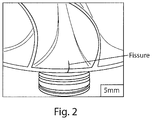
- FIG. 2 shows a thermos-fatigued turbocharger wheel after exposure to cyclic thermo-loading.
- the present invention relates to turbo charger component, in particular a turbine wheel for an internal combustion engine, comprising a polycrystalline nickel-based alloy of the following composition:
- the above alloy is a Ni-based alloy that contains Cr as one of its main alloying elements. Cr is an element indispensable for heightening oxidation resistance and contributes to the high temperature strength of the alloy.
- the alloy further contains at least 3.7 wt.-% Al to facilitate the formation of aluminum oxides on the surface of the turbocharger component. These oxides further increase the oxidation resistance of the turbocharger component by passivation.
- Al is also important for the generation of the ⁇ ′-phase in combination with Ti, Nb, and Ta.
- the proportion of the ⁇ ′-phase i.a. correlates to the amount of ⁇ ′-forming elements, in particular to aluminum.
- a total amount of 7.0 to 15.0 wt.-% of Al, Ti, Nb and Ta can be used to create a morphology wherein the proportion of the ⁇ ′-phase is greater than 40% after aging the component at 1000° C. for 300 hours.
- the amount (in the following also referred to as proportion) of the ⁇ ′-phase can be routinely determined for any given alloy.
- An exemplary method is an optical analysis, including preparing a metallographic section, with polishing and/or etching the cut surface of the specimen, obtaining a microphotography of the metallographic section, determining the area of a representative number of typically cuboidal ⁇ ′-phase domains, either manually or using automated image analysis, and relating that value to the total analyzed area.
- a representative number of domains may be considered to be the number of ⁇ ′-phase domains in one or more grains, typically 3 to 5 grains. In that case, the total analyzed area would be the total area of the grain.
- a representative number of domains may be considered to be at least 100 ⁇ ′-phase domains, with the amount of the ⁇ ′-phase in this case being the area of all ⁇ ′-phase domains in a given analyzed area in relation to said analyzed area.
- the obtained percentage is an area-percentage, but is representative for the volume (or weight) fraction of the ⁇ ′-phase in the alloy.
- the ⁇ ′-phase acts as a barrier to dislocation motion through the fcc Ni matrix and, thus, a high proportion of the ⁇ ′-phase is beneficial for obtaining high temperature creep resistance and strength.
- a proportion of the ⁇ ′-phase of greater than 40% at 1000° C. is considered to provide a balanced mix of high temperature strengthening, castability and workability.
- FIG. 1 shows the computed weight percentage of the ⁇ ′-phase in relation to temperature for an exemplary alloy according to the invention.
- FIG. 1 was calculated using the software JMatPro, obtainable from Sente Software Ltd., Guildford, UK. Further information on the prediction of the proportion of ⁇ ′-phase using JMatPro can be found in Modelling High Temperature Mechanical Properties and Microstructure Evolution in Ni-based Superalloys by N. Saunders, Z. Guo, A.
- the alloys of the present invention are stabilized at the grain boundaries to further improve LCF performance and strength.
- the alloys of the present invention are stabilized by precipitation of carbides.
- Carbides tend to accumulate at the grain boundaries.
- care has to be taken to avoid an excessive amount of carbides in the fcc Ni matrix which may participate in fatigue cracking and, thus, reduce in particular LCF performance.
- carbides at the grain boundaries are more effective in increasing the strength of the alloy than carbides randomly dispersed in the matrix. Therefore, the alloys of the present invention are required to have a low carbon content of 0.05 to 0.15 wt.-% C, to facilitate the formation of carbides at the grain boundaries and to minimize the negative effects associated with presence of carbides in the matrix.
- the elements Nb, Ta, Mo and W can form primary carbides MC as well as secondary carbides such as MC 6 and M 23 C 6 .
- carbides of the type MC tend to be unstable in Ni-based superalloys and tend to decompose into M 6 C in the range of 980 to 1040° C., if the alloy contains a sufficiently high amount of Mo and W. The reason for this is that the refractory elements Mo and W preferentially form carbides with Ni, Co and Cr.
- Exemplary carbides are (Ni,Co) 3 Mo 3 C and (Ni,Co) 2 W 4 C.
- M Mo or W
- Mo and W are used in a total amount of 2.0 to 5.0 wt.-%.
- the exact ratio of Mo to W is not critical, however, it is convenient to use a weight ratio of Mo:W of 0.7 to 1.8 to obtain a balanced mix of secondary effects, specifically solid solution strengthening of the alloy and adjusting its high temperature creep performance.
- the alloys of the present invention further contain Co.
- Co solid-dissolves in the fcc Ni matrix and improves in particular creep strength.
- Co also forms carbides such as (Ni,Co) 3 Mo 3 C and (Ni,Co) 2 W 4 C.
- carbides such as (Ni,Co) 3 Mo 3 C and (Ni,Co) 2 W 4 C.
- M 6 C carbides is also facilitated by the presence of 4.0 to 9.0 wt.-% Co.
- Co also helps in avoiding the depletion of Cr due to excessive chromium carbide formation. An excessive Cr depletion could result in insufficient chromium oxide formation and reduced oxidation and corrosion resistance.
- the alloys of the present invention are further relatively inexpensive since they avoid the use of expensive elements such as Re and Hf in larger amounts. More specifically, Re and Hf (if present) are each used in an amount of less than 1 wt.-%.
- the alloy may also contain other elements in minor amounts which add up to a total amount of less than 3 wt.-%, more specifically less than 2 wt.-%, in particular less than 1 wt.-%.
- these other elements will typically be impurities introduced from raw materials or during the preparation of the alloy. Examples include Fe, Mn, P, S, and Si which advantageously are each, independently from each other, present in amounts of less than 0.05 wt.-%.
- other elements purposefully added in minor amounts to fine-tune alloy properties are also intended to be included in this definition as long as their total amount, together with the total amount of the aforementioned impurities, is less than 3 wt.-%.
- Examples of elements which may be purposefully added in minor amounts to fine-tune alloy properties include B, Zr, and Y. These are typically added in very low amounts ( ⁇ 0.01 wt.-%) for grain boundary strengthening (B and Zr) or for improving adhesion of the oxide passivation layer (Zr and Y).
- embodiments of the invention may further comprise one of the following features or any combination of the following features:
- the alloy may contain 1.2 to 2.4 wt. % Ta, in particular 1.5 to 2.0 wt.-% Ta.
- the alloy may contain 0.3 to 1.5 wt.-% Nb, in particular 0.6 to 1.1 wt.-% Nb.
- the alloy may contain 4.0 to 5.5 wt.-% Al, in particular 4.3 to 5.1 wt.-% Al.
- the amount of Re and Hf in the alloy may be independently from each other less than 0.15 wt.-%, in particular less than 0.1 wt.-%.
- the weight ratio of Al to Ti in the alloy may be in the range of 1.1 to 1.9, or 1.3 to 1.8, and in particular 1.35 to 1.65.
- the alloy may contain 2.4 to 3.5 wt.-% Ti, in particular 2.7 to 3.2 wt.-% Ti.
- the alloy may contain 11.0 to 13.0 wt.-% Cr, in particular 11.7 to 12.3 wt.-% Cr.
- the alloy may contain 6.0 to 8.0 wt.-% Co, in particular 6.7 to 7.3 wt.-% Co.
- the alloy may contain a total amount of W and Mo of 2.0 to 5.0 wt.-%, in particular 2.5 to 4.5 wt.-%.
- the weight ratio of Mo to W may be in the range of 0.9 to 1.5, in particular 1.1 to 1.3.
- the alloy may contain 1.3 to 2.3 wt.-% Mo, in particular 1.5 to 2.0 wt.-% Mo.
- the alloy may contain 0.9 to 2.1 wt.-% W, in particular 1.2 to 1.8 wt.-% W.
- the alloy may contain 0.06 to 0.14 wt.-% C, in particular 0.08 to 0.12 wt.-% C.
- the alloy may contain a total amount of Al and Ti is in the range of 6.5 to 8.5 wt.-%, in particular 7.0 to 8.0 wt.-%.
- the alloy may contain 1.2 to 2.4 wt. % Ta, in particular 1.5 to 2.0 wt.-% Ta; and 0.3 to 1.5 wt.-% Nb, in particular 0.6 to 1.1 wt.-% Nb.
- the alloy may contain 4.0 to 5.5 wt.-% Al, in particular 4.3 to 5.1 wt.-% Al; and the weight ratio of Al to Ti in the alloy may be in the range of 1.1 to 1.9, or 1.3 to 1.8, and in particular 1.35 to 1.65.
- the alloy may contain 1.3 to 2.3 wt.-% Mo, in particular 1.5 to 2.0 wt.-% Mo; 0.9 to 2.1 wt.-% W, in particular 1.2 to 1.8 wt.-% W; and 2.4 to 3.5 wt.-% Ti, in particular 2.7 to 3.2 wt.-% Ti.
- the alloy may contain 1.2 to 2.4 wt. % Ta, in particular 1.5 to 2.0 wt.-% Ta; 0.3 to 1.5 wt.-% Nb, in particular 0.6 to 1.1 wt.-% Nb; and a total amount of Al and Ti is in the range of 6.5 to 8.5 wt.-%, in particular 7.0 to 8.0 wt.-%.
- the amount of the ⁇ ′-phase may be greater than 42%, in particular greater than 45%, after aging the component at 1000° C. for 300 hours.
- the amount of the ⁇ ′-phase may be in the range of between 40% and 65%, more specifically in the range of between 42% and 60%, and in particular between 45% and 55%, after aging the component at 1000° C. for 300 hours.
- the alloy may contain 1.2 to 2.4 wt. % Ta, in particular 1.5 to 2.0 wt.-% Ta; 0.3 to 1.5 wt.-% Nb, in particular 0.6 to 1.1 wt.-% Nb; and 4.0 to 5.5 wt.-% Al, in particular 4.3 to 5.1 wt.-% Al.
- the alloy may contain 2.4 to 3.5 wt.-% Ti, in particular 2.7 to 3.2 wt.-% Ti, and the weight ratio of Al to Ti in the alloy may be in the range of 1.1 to 1.9, or 1.3 to 1.8, and in particular 1.35 to 1.65.
- the alloy may contain a total amount of W and Mo of 2.0 to 5.0 wt.-%, in particular 2.5 to 4.5 wt.-%; and the weight ratio of Mo to W may be in the range of 0.9 to 1.5, in particular 1.1 to 1.3.
- the alloy may contain 11.0 to 13.0 wt.-% Cr, in particular 11.7 to 12.3 wt.-% Cr; and 6.0 to 8.0 wt.-% Co, in particular 6.7 to 7.3 wt.-% Co.
- the alloy may contain 1.3 to 2.3 wt.-% Mo, in particular 1.5 to 2.0 wt.-% Mo; and 0.9 to 2.1 wt.-% W, in particular 1.2 to 1.8 wt.-% W.
- the alloy may contain 1.2 to 2.4 wt. % Ta, in particular 1.5 to 2.0 wt.-% Ta; 0.3 to 1.5 wt.-% Nb, in particular 0.6 to 1.1 wt.-% Nb; and 4.0 to 5.5 wt.-% Al, in particular 4.3 to 5.1 wt.-% Al; and 0.06 to 0.14 wt.-% C, in particular 0.08 to 0.12 wt.-% C.
- a turbo charger component in particular a turbine wheel for an internal combustion engine, comprising a polycrystalline nickel-based alloy of the following composition:
- the alloy further comprises one or any combination of the following features:
- the alloy may contain 0.06 to 0.14 wt.-% C, in particular 0.08 to 0.12 wt.-% C.
- the alloy may contain a total amount of Al and Ti is in the range of 6.5 to 8.5 wt.-%, in particular 7.0 to 8.0 wt.-%.
- the alloy may contain 1.5 to 2.0 wt.-% Ta; and 0.6 to 1.1 wt.-% Nb.
- the alloy may contain 4.3 to 5.1 wt.-% Al.
- the alloy may contain 1.5 to 2.0 wt.-% Mo; 1.2 to 1.8 wt.-% W; and 2.7 to 3.2 wt.-% Ti.
- the alloy may contain 1.2 to 2.4 wt. % Ta, in particular 1.5 to 2.0 wt.-% Ta; 0.3 to 1.5 wt.-% Nb, in particular 0.6 to 1.1 wt.-% Nb; and a total amount of Al and Ti is in the range of 7.0 to 8.0 wt.-%.
- the alloy may contain 1.2 to 2.4 wt. % Ta, in particular 1.5 to 2.0 wt.-% Ta; 0.3 to 1.5 wt.-% Nb, in particular 0.6 to 1.1 wt.-% Nb; and 4.0 to 5.5 wt.-% Al, in particular 4.3 to 5.1 wt.-% Al.
- the alloy may contain 2.4 to 3.5 wt.-% Ti, in particular 2.7 to 3.2 wt.-% Ti, and the weight ratio of Al to Ti in the alloy may be in the range of 1.1 to 1.9, or 1.3 to 1.8, and in particular 1.35 to 1.65.
- the alloy may contain a total amount of W and Mo of 2.0 to 5.0 wt.-%, in particular 2.5 to 4.5 wt.-%; and the weight ratio of Mo to W may be in the range of 0.9 to 1.5, in particular 1.1 to 1.3.
- the alloy may contain 11.0 to 13.0 wt.-% Cr, in particular 11.7 to 12.3 wt.-% Cr; and 6.0 to 8.0 wt.-% Co, in particular 6.7 to 7.3 wt.-% Co.
- the alloy may contain 1.3 to 2.3 wt.-% Mo, in particular 1.5 to 2.0 wt.-% Mo; and 0.9 to 2.1 wt.-% W, in particular 1.2 to 1.8 wt.-% W.
- the alloy may contain 1.2 to 2.4 wt. % Ta, in particular 1.5 to 2.0 wt.-% Ta; 0.3 to 1.5 wt.-% Nb, in particular 0.6 to 1.1 wt.-% Nb; and 4.0 to 5.5 wt.-% Al, in particular 4.3 to 5.1 wt.-% Al; and 0.06 to 0.14 wt.-% C, in particular 0.08 to 0.12 wt.-% C.
- the amount of the ⁇ ′-phase in the alloy of the turbocharger component may be greater than 20%, more specifically greater than 42%, in particular greater than 45%, after aging the component at 1000° C. for 300 hours.
- the amount of the ⁇ ′-phase may be in the range of between 40% and 65%, more specifically in the range of between 42% and 60%, and in particular between 45% and 55%, after aging the component at 1000° C. for 300 hours.
- the definition of the amount of ⁇ ′-phase is as for the first aspect of the invention.
- the average size of the ⁇ ′-phase may advantageously be less than 1.0 ⁇ m, in particular less than 0.7 ⁇ m, and in particular less than 0.5 ⁇ m.
- the average size of the ⁇ ′-phase may advantageously be in the range of 0.1 to 1.0 ⁇ m, more specifically in the range of 0.2 to 0.6 ⁇ m, and in particular in the range of 0.25 to 0.50 ⁇ m.
- the average grain size may be determined using an optical analysis, including preparing a metallographic section, optionally with polishing and/or etching the cut surface of the specimen, obtaining a microphotography of the metallographic section, determining the average grain size of a representative number of typically cuboidal ⁇ ′-phase domains, either manually or using automated image analysis.
- a representative number of domains may be considered to be the number of ⁇ ′-phase domains in one or more grains, typically 3 to 5 grains.
- a representative number of domains may be considered to be at least 100 ⁇ ′-phase domains.
- the density of the alloy according to the present invention may be less 8.35 g/cm 3 , more specifically less than 8.30 g/cm 3 , in particular less than 8.25 g/cm 3 , at room temperature.
- the alloy according to the present invention may have a density in the range of 7.70 to 8.35 g/cm 3 , more specifically 7.80 to 8.30 g/cm 3 , in particular 7.90 to 8.25 g/cm 3 .
- alloys provide a very balanced mix of properties, including low fatigue after periodic cycling of thermal stresses, excellent LCF and TMF performance, and resistance to oxidation and corrosion in the presence of exhaust gases. Therefore, these alloys are very suitable for use as turbocharger components, in particular turbine wheels for an internal combustion engine.
- the alloy properties do not excessively deteriorate under service conditions.
- grain coarsening of the ⁇ ′-phase at high temperatures is a well-known phenomenon of nickel-based superalloys which deteriorates the mechanical properties of the alloy.
- the alloys of the present invention can be expected to perform well in this respect, with a coarsening of the ⁇ ′-phase of less than 600%, advantageously less than 450% and in particular less than 300%, after exposure to 1000° C. for 500 hours.
- Grain coarsening may be determined by comparing the average grain size of the ⁇ ′-phase before and after exposing a test specimen of the alloy to service-like conditions, such as 1000° C. for 500 hours.
- the average size of the ⁇ ′-phase may be determined using the above-referenced methods.
- TMF, LCF and TF performance are established in the art. Analysis of the TF performance may for exemplary be done by cyclic thermo-loading of the turbocharger component by inductive heating and air cooling, for instance using a cycle of the following steps: heating the turbocharger component with a heating rate of 20K/sec up to a temperature of 950° C., holding said temperature for 60 sec, and fan-assisted air cooling to 200° C.
- the temperature of the turbocharger component may be controlled by using a pyrometer. Thermal fatigue may be determined after thermo-loading cycles by checking for fissures, as shown in FIG. 2 for a turbocharger wheel.
Landscapes
- Chemical & Material Sciences (AREA)
- Engineering & Computer Science (AREA)
- Materials Engineering (AREA)
- Mechanical Engineering (AREA)
- Metallurgy (AREA)
- Organic Chemistry (AREA)
- General Engineering & Computer Science (AREA)
- Supercharger (AREA)
- Turbine Rotor Nozzle Sealing (AREA)
Abstract
Description
| Cr | 10.0 to 15.0 wt.-%; | |
| Co | 4.0 to 9.0 wt.-%; | |
| C | 0.05 to 0.15 wt.-%; | |
Al, Ti, Nb, and Ta in a total amount of 7.0 to 15.0 wt. %, with the proviso that the amount of Al is at least 3.7 wt.-%, the amount of the γ′-phase is greater than 40% after aging the component at 1000° C. for 300 hours; Mo and W in a total amount of 2.0 to 5.0 wt.-%, wherein Mo and W are present in the weight ratio of Mo:W=0.7 to 1.8;
optionally Re and Hf with the proviso that each element is present in an amount of less than 1 wt.-%;
optionally other elements in a total amount of less than 3 wt.-% (impurities), in particular, independently from each other, Fe, Mn, P, S, and Si in amounts of less than 0.05 wt.-%; and Ni as balance.
| Cr | 10.0 to 15.0 wt.-%; | |
| Co | 4.0 to 9.0 wt.-%; | |
| C | 0.05 to 0.15 wt.-%; | |
| Al | 4.0 to 5.5 wt.-%; | |
| Ta | 1.2 to 2.4 wt. %; | |
| Nb | 0.3 to 1.5 wt.-%; | |
| Mo | 1.3 to 2.3 wt.-%; | |
| W | 0.9 to 2.1 wt.-%; | |
| Ti | 2.4 to 3.5 wt.-%; | |
optionally Re and Hf with the proviso that each element is present in an amount of less than 1 wt.-%;
optionally other elements in a total amount of less than 3 wt.-% (impurities), in particular, independently from each other, Fe, Mn, P, S, and Si in amounts of less than 0.05 wt.-%; and Ni as balance.
| Cr | 10.0 to 15.0 wt.-%; | |
| Co | 4.0 to 9.0 wt.-%; | |
| C | 0.05 to 0.15 wt.-%; | |
Al, Ti, Nb, and Ta in a total amount of 7.0 to 15.0 wt.-%, with the proviso that the amount of Al is at least 3.7 wt.-%, the amount of the γ′-phase is greater than 40% after aging the component at 1000° C. for 300 hours; Mo and W in a total amount of 2.0 to 5.0 wt.-%, wherein Mo and W are present in the weight ratio of Mo:W=0.7 to 1.8;
optionally Re and Hf with the proviso that each element is present in an amount of less than 1 wt.-%;
optionally other elements in a total amount of less than 3 wt.-% (impurities), in particular, independently from each other, Fe, Mn, P, S, and Si in amounts of less than 0.05 wt.-%; and Ni as balance.
| Cr | 10.0 to 15.0 wt.-% | |
| Co | 4.0 to 9.0 wt.-%; | |
| C | 0.05 to 0.15 wt.-%; | |
| Al | 4.0 to 5.5 wt.-%; | |
| Ta | 1.2 to 2.4 wt. %; | |
| Nb | 0.3 to 1.5 wt.-%; | |
| Mo | 1.3 to 2.3 wt.-%; | |
| W | 0.9 to 2.1 wt.-%; | |
| Ti | 2.4 to 3.5 wt.-%; | |
optionally Re and Hf with the proviso that each element is present in an amount of less than 1 wt.-%;
optionally other elements in a total amount of less than 3 wt.-% (impurities), in particular, independently from each other, Fe, Mn, P, S, and Si in amounts of less than 0.05 wt.-%; and Ni as balance.
Claims (18)
Applications Claiming Priority (4)
| Application Number | Priority Date | Filing Date | Title |
|---|---|---|---|
| EP17155147 | 2017-02-08 | ||
| EP17155147 | 2017-02-08 | ||
| EP17155147.6 | 2017-02-08 | ||
| PCT/US2018/016558 WO2018148110A1 (en) | 2017-02-08 | 2018-02-02 | New alloys for turbocharger components |
Publications (2)
| Publication Number | Publication Date |
|---|---|
| US20200010932A1 US20200010932A1 (en) | 2020-01-09 |
| US11214852B2 true US11214852B2 (en) | 2022-01-04 |
Family
ID=58266345
Family Applications (1)
| Application Number | Title | Priority Date | Filing Date |
|---|---|---|---|
| US16/484,529 Active 2038-07-19 US11214852B2 (en) | 2017-02-08 | 2018-02-02 | Alloys for turbocharger components |
Country Status (6)
| Country | Link |
|---|---|
| US (1) | US11214852B2 (en) |
| EP (1) | EP3580365B1 (en) |
| JP (1) | JP2020509230A (en) |
| KR (1) | KR20190116390A (en) |
| CN (2) | CN110462078A (en) |
| WO (1) | WO2018148110A1 (en) |
Families Citing this family (1)
| Publication number | Priority date | Publication date | Assignee | Title |
|---|---|---|---|---|
| US11199101B2 (en) * | 2019-12-12 | 2021-12-14 | General Electric Company | System and method to apply multiple thermal treatments to workpiece and related turbomachine components |
Citations (9)
| Publication number | Priority date | Publication date | Assignee | Title |
|---|---|---|---|---|
| GB202180A (en) | 1922-09-02 | 1923-08-16 | Leo Alfred Girot | Fastening device for ropes |
| CA967405A (en) | 1970-07-13 | 1975-05-13 | Roger J. Schoerner | Aluminum alloy used for electrical conductors and other articles, and method of making same |
| US4063939A (en) | 1975-06-27 | 1977-12-20 | Special Metals Corporation | Composite turbine wheel and process for making same |
| CN1045607A (en) | 1989-03-15 | 1990-09-26 | 中国科学院金属研究所 | A kind of method that improves the superalloy performance |
| CN1076508A (en) | 1992-03-18 | 1993-09-22 | 西屋电气公司 | Gas turbine blade alloy |
| EP1462533A1 (en) | 2003-03-24 | 2004-09-29 | Daido Steel Co., Ltd. | Nickel base heat resistant cast alloy and turbine wheels made thereof |
| WO2008072303A1 (en) | 2006-12-11 | 2008-06-19 | Hitachi, Ltd. | Friction welding, process for producing centrifugal gas turbine, and process for producing turbo charger |
| US20140348689A1 (en) * | 2013-05-24 | 2014-11-27 | Rolls-Royce Plc | Nickel alloy |
| RU2585148C1 (en) | 2015-02-11 | 2016-05-27 | Акционерное общество "Научно-производственное объединение "Центральный научно-исследовательский институт технологии машиностроения" АО "НПО "ЦНИИТМАШ" | Heat-resistant nickel-based alloy for casting with equiaxial structure integrated wheels and working blades |
Family Cites Families (5)
| Publication number | Priority date | Publication date | Assignee | Title |
|---|---|---|---|---|
| US4186473A (en) * | 1978-08-14 | 1980-02-05 | General Motors Corporation | Turbine rotor fabrication by thermal methods |
| US4705463A (en) | 1983-04-21 | 1987-11-10 | The Garrett Corporation | Compressor wheel assembly for turbochargers |
| US5295785A (en) | 1992-12-23 | 1994-03-22 | Caterpillar Inc. | Turbocharger having reduced noise emissions |
| EP0637476B1 (en) * | 1993-08-06 | 2000-02-23 | Hitachi, Ltd. | Blade for gas turbine, manufacturing method of the same, and gas turbine including the blade |
| GB2536940A (en) * | 2015-04-01 | 2016-10-05 | Isis Innovation | A nickel-based alloy |
-
2018
- 2018-02-02 JP JP2019543052A patent/JP2020509230A/en active Pending
- 2018-02-02 WO PCT/US2018/016558 patent/WO2018148110A1/en not_active Ceased
- 2018-02-02 US US16/484,529 patent/US11214852B2/en active Active
- 2018-02-02 CN CN201880019832.4A patent/CN110462078A/en active Pending
- 2018-02-02 EP EP18703679.3A patent/EP3580365B1/en active Active
- 2018-02-02 KR KR1020197026272A patent/KR20190116390A/en not_active Withdrawn
- 2018-02-02 CN CN202511538630.9A patent/CN121406943A/en active Pending
Patent Citations (9)
| Publication number | Priority date | Publication date | Assignee | Title |
|---|---|---|---|---|
| GB202180A (en) | 1922-09-02 | 1923-08-16 | Leo Alfred Girot | Fastening device for ropes |
| CA967405A (en) | 1970-07-13 | 1975-05-13 | Roger J. Schoerner | Aluminum alloy used for electrical conductors and other articles, and method of making same |
| US4063939A (en) | 1975-06-27 | 1977-12-20 | Special Metals Corporation | Composite turbine wheel and process for making same |
| CN1045607A (en) | 1989-03-15 | 1990-09-26 | 中国科学院金属研究所 | A kind of method that improves the superalloy performance |
| CN1076508A (en) | 1992-03-18 | 1993-09-22 | 西屋电气公司 | Gas turbine blade alloy |
| EP1462533A1 (en) | 2003-03-24 | 2004-09-29 | Daido Steel Co., Ltd. | Nickel base heat resistant cast alloy and turbine wheels made thereof |
| WO2008072303A1 (en) | 2006-12-11 | 2008-06-19 | Hitachi, Ltd. | Friction welding, process for producing centrifugal gas turbine, and process for producing turbo charger |
| US20140348689A1 (en) * | 2013-05-24 | 2014-11-27 | Rolls-Royce Plc | Nickel alloy |
| RU2585148C1 (en) | 2015-02-11 | 2016-05-27 | Акционерное общество "Научно-производственное объединение "Центральный научно-исследовательский институт технологии машиностроения" АО "НПО "ЦНИИТМАШ" | Heat-resistant nickel-based alloy for casting with equiaxial structure integrated wheels and working blades |
Non-Patent Citations (2)
| Title |
|---|
| Chinese Office Action (with English language translation) dated Jan. 7, 2021, in Chinese Application No. 201880019832.4. |
| Written Opinion and International Search Report dated Apr. 30, 2018, in International Application No. PCT/US2018/016558. |
Also Published As
| Publication number | Publication date |
|---|---|
| EP3580365B1 (en) | 2021-01-06 |
| WO2018148110A1 (en) | 2018-08-16 |
| CN121406943A (en) | 2026-01-27 |
| KR20190116390A (en) | 2019-10-14 |
| JP2020509230A (en) | 2020-03-26 |
| CN110462078A (en) | 2019-11-15 |
| US20200010932A1 (en) | 2020-01-09 |
| EP3580365A1 (en) | 2019-12-18 |
Similar Documents
| Publication | Publication Date | Title |
|---|---|---|
| JP5296046B2 (en) | Ni-based alloy and turbine moving / stator blade of gas turbine using the same | |
| US8771440B2 (en) | Ni-based single crystal superalloy | |
| JP4036091B2 (en) | Nickel-base heat-resistant alloy and gas turbine blade | |
| JP5299899B2 (en) | Ni-base superalloy and manufacturing method thereof | |
| JP2004332061A (en) | High oxidation resistant Ni-base superalloy and gas turbine parts | |
| JP5526223B2 (en) | Ni-based alloy, gas turbine rotor blade and stator blade using the same | |
| RU2295585C2 (en) | High-strength nickel-based superalloy resistant to high-temperature corrosion and oxidation, and directionally solidified product of this superalloy | |
| JP2014523501A (en) | Turbocharger and components therefor | |
| US8916092B2 (en) | Ni-based alloy, and turbine rotor and stator blade for gas turbine | |
| JP5626920B2 (en) | Nickel-base alloy castings, gas turbine blades and gas turbines | |
| JP5063550B2 (en) | Nickel-based alloy and gas turbine blade using the same | |
| EP3580365B1 (en) | New alloys for turbocharger components | |
| JP2004256840A (en) | Composite strengthened Ni-base superalloy and method for producing the same | |
| JP6970438B2 (en) | Ni-based superalloy | |
| JP5427642B2 (en) | Nickel-based alloy and land gas turbine parts using the same | |
| JP4911753B2 (en) | Ni-base superalloy and gas turbine component using the same | |
| JP6045857B2 (en) | High-strength Ni-base superalloy and gas turbine turbine blade using the same | |
| JP5891463B2 (en) | Method for evaluating oxidation resistance of Ni-base superalloy | |
| JP3976214B2 (en) | Ni-base super heat-resistant casting alloy and Ni-base super heat-resistant alloy turbine wheel casting | |
| JP2013185210A (en) | Nickel-based alloy and gas turbine blade using the same | |
| JP5396445B2 (en) | gas turbine | |
| EP1760164A1 (en) | Nickel-base superalloy | |
| WO2020129282A1 (en) | Ni‑BASED SUPER-HEAT-RESISTANT ALLOY |
Legal Events
| Date | Code | Title | Description |
|---|---|---|---|
| AS | Assignment |
Owner name: BORGWARNER INC., MICHIGAN Free format text: ASSIGNMENT OF ASSIGNORS INTEREST;ASSIGNORS:SCHALL, GERALD;ZIEGLER, ALEXANDRA;REEL/FRAME:050000/0515 Effective date: 20180216 |
|
| FEPP | Fee payment procedure |
Free format text: ENTITY STATUS SET TO UNDISCOUNTED (ORIGINAL EVENT CODE: BIG.); ENTITY STATUS OF PATENT OWNER: LARGE ENTITY |
|
| STPP | Information on status: patent application and granting procedure in general |
Free format text: DOCKETED NEW CASE - READY FOR EXAMINATION |
|
| STPP | Information on status: patent application and granting procedure in general |
Free format text: NON FINAL ACTION MAILED |
|
| STPP | Information on status: patent application and granting procedure in general |
Free format text: DOCKETED NEW CASE - READY FOR EXAMINATION |
|
| STPP | Information on status: patent application and granting procedure in general |
Free format text: NON FINAL ACTION MAILED |
|
| STPP | Information on status: patent application and granting procedure in general |
Free format text: NOTICE OF ALLOWANCE MAILED -- APPLICATION RECEIVED IN OFFICE OF PUBLICATIONS |
|
| STPP | Information on status: patent application and granting procedure in general |
Free format text: PUBLICATIONS -- ISSUE FEE PAYMENT VERIFIED |
|
| STCF | Information on status: patent grant |
Free format text: PATENTED CASE |
|
| MAFP | Maintenance fee payment |
Free format text: PAYMENT OF MAINTENANCE FEE, 4TH YEAR, LARGE ENTITY (ORIGINAL EVENT CODE: M1551); ENTITY STATUS OF PATENT OWNER: LARGE ENTITY Year of fee payment: 4 |