US10818993B2 - Branch circuit - Google Patents
Branch circuit Download PDFInfo
- Publication number
- US10818993B2 US10818993B2 US16/202,502 US201816202502A US10818993B2 US 10818993 B2 US10818993 B2 US 10818993B2 US 201816202502 A US201816202502 A US 201816202502A US 10818993 B2 US10818993 B2 US 10818993B2
- Authority
- US
- United States
- Prior art keywords
- stub
- conductor
- arrangement
- point
- length
- Prior art date
- Legal status (The legal status is an assumption and is not a legal conclusion. Google has not performed a legal analysis and makes no representation as to the accuracy of the status listed.)
- Active, expires
Links
- 239000004020 conductor Substances 0.000 claims abstract description 247
- 230000000644 propagated effect Effects 0.000 claims description 31
- 230000005540 biological transmission Effects 0.000 description 118
- 239000010410 layer Substances 0.000 description 112
- 239000000758 substrate Substances 0.000 description 29
- 238000004891 communication Methods 0.000 description 17
- 230000008878 coupling Effects 0.000 description 16
- 238000010168 coupling process Methods 0.000 description 16
- 238000005859 coupling reaction Methods 0.000 description 16
- 230000003247 decreasing effect Effects 0.000 description 7
- 230000001902 propagating effect Effects 0.000 description 7
- 230000002238 attenuated effect Effects 0.000 description 6
- 238000004088 simulation Methods 0.000 description 6
- 230000000694 effects Effects 0.000 description 5
- 230000001965 increasing effect Effects 0.000 description 5
- 238000004904 shortening Methods 0.000 description 4
- 230000001629 suppression Effects 0.000 description 3
- 239000003990 capacitor Substances 0.000 description 2
- 230000015556 catabolic process Effects 0.000 description 2
- 230000007547 defect Effects 0.000 description 2
- 238000006731 degradation reaction Methods 0.000 description 2
- 239000002184 metal Substances 0.000 description 2
- 238000000034 method Methods 0.000 description 2
- 230000008901 benefit Effects 0.000 description 1
- 230000015572 biosynthetic process Effects 0.000 description 1
- 230000008859 change Effects 0.000 description 1
- 239000012792 core layer Substances 0.000 description 1
- 230000000593 degrading effect Effects 0.000 description 1
- 238000013461 design Methods 0.000 description 1
- 239000011888 foil Substances 0.000 description 1
- 230000014509 gene expression Effects 0.000 description 1
- 230000001939 inductive effect Effects 0.000 description 1
- 238000005259 measurement Methods 0.000 description 1
- 238000012986 modification Methods 0.000 description 1
- 230000004048 modification Effects 0.000 description 1
- 230000002093 peripheral effect Effects 0.000 description 1
- 230000002265 prevention Effects 0.000 description 1
- 230000009467 reduction Effects 0.000 description 1
- 230000008054 signal transmission Effects 0.000 description 1
- 229910000679 solder Inorganic materials 0.000 description 1
- 230000003313 weakening effect Effects 0.000 description 1
Images




Classifications
-
- H—ELECTRICITY
- H01—ELECTRIC ELEMENTS
- H01P—WAVEGUIDES; RESONATORS, LINES, OR OTHER DEVICES OF THE WAVEGUIDE TYPE
- H01P3/00—Waveguides; Transmission lines of the waveguide type
- H01P3/02—Waveguides; Transmission lines of the waveguide type with two longitudinal conductors
- H01P3/026—Coplanar striplines [CPS]
-
- H—ELECTRICITY
- H01—ELECTRIC ELEMENTS
- H01P—WAVEGUIDES; RESONATORS, LINES, OR OTHER DEVICES OF THE WAVEGUIDE TYPE
- H01P1/00—Auxiliary devices
- H01P1/20—Frequency-selective devices, e.g. filters
- H01P1/201—Filters for transverse electromagnetic waves
- H01P1/203—Strip line filters
- H01P1/20327—Electromagnetic interstage coupling
- H01P1/20354—Non-comb or non-interdigital filters
- H01P1/20381—Special shape resonators
-
- H—ELECTRICITY
- H01—ELECTRIC ELEMENTS
- H01P—WAVEGUIDES; RESONATORS, LINES, OR OTHER DEVICES OF THE WAVEGUIDE TYPE
- H01P5/00—Coupling devices of the waveguide type
- H01P5/02—Coupling devices of the waveguide type with invariable factor of coupling
-
- H—ELECTRICITY
- H01—ELECTRIC ELEMENTS
- H01P—WAVEGUIDES; RESONATORS, LINES, OR OTHER DEVICES OF THE WAVEGUIDE TYPE
- H01P1/00—Auxiliary devices
- H01P1/20—Frequency-selective devices, e.g. filters
Definitions
- the present invention relates to a branch circuit that transmits a different electromagnetic wave frequency for each branch.
- a transmission line connected to the antenna is branched, and the branched lines are connected to a first transmission/reception circuit unit for wireless communication in a first frequency band and a second transmission/reception circuit unit for wireless communication in a second frequency band, respectively.
- a transmission line connected to the antenna is branched, and the branched lines are connected to a first transmission/reception circuit unit for wireless communication in a first frequency band and a second transmission/reception circuit unit for wireless communication in a second frequency band, respectively.
- Japanese Patent Laid-Open No. 2016-15740 discloses a method of arranging a filter element that allows a signal of a desired frequency band to be passed in each transmission line.
- the present invention provides, at a low cost, a small branch circuit that has a different characteristic for each branch.
- One aspect of the present invention provides a branch circuit comprising: a first conductor and a second conductor as at least two branches from a predetermined branch point; a first stub which is connected to the first conductor at a first point; and a second stub which is connected to the second conductor at a second point, wherein the first point is a point where a length of a portion between the predetermined branch point and the first point of the first conductor is set to a first length which is determined in accordance with a characteristic of the first stub, and the second point is a point where a length of a portion between the predetermined branch point and the second point of the second conductor is set to a second length which is determined in accordance with a characteristic of the second stub and is different from the first length.
- FIGS. 1A and 1B are views showing examples of the first arrangement of a band stop filter
- FIG. 1C is a graph showing the characteristics of the band stop filter
- FIGS. 2A and 2B are a view showing an example of the first arrangement of the band stop filter and a graph showing the characteristics of the band stop filter, respectively;
- FIGS. 3A to 3E are views showing examples of the second arrangement of the band stop filter, and FIGS. 3F to 3J are graphs showing the characteristics of the band stop filter;
- FIGS. 4A to 4C are views showing examples of the second arrangement of the band stop filter, and FIGS. 4D to 4F are graphs showing the characteristics of the band stop filter;
- FIGS. 5A to 5E are views showing examples of the third arrangement of the band stop filter, and FIGS. 5F to 5J are graphs showing the characteristics of the band stop filter;
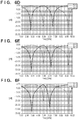
- FIGS. 6A to 6C are views showing examples of the third arrangement of the band stop filter, and FIGS. 6D to 6F are graphs showing the characteristics of the band stop filter;
- FIGS. 7A to 7C are views showing examples of the fourth arrangement of the band stop filter, and FIGS. 7D to 7F are graphs showing the characteristics of the band stop filter;
- FIG. 8 is a sectional view of a substrate on which the band stop filter is to be formed
- FIGS. 9A and 9B are a view showing an example of the fifth arrangement of the band stop filter and a graph showing the characteristics of the band stop filter, respectively;
- FIGS. 10A and 10B are a view showing an example of the fifth arrangement of the band stop filter and a graph showing the characteristics of the band stop filter, respectively;
- FIGS. 11A and 11B are a view showing an example of the fifth arrangement of the band stop filter and a graph showing the characteristics of the band stop filter, respectively;
- FIG. 12 is a view showing an example of the arrangement of a branch circuit in a wireless communication apparatus
- FIGS. 13A and 13B are a view showing an example of a stub which is to be connected to a second conductor, and a graph showing the characteristics of the stub to be connected to the second conductor;
- FIGS. 14A and 14B are a view showing an example of a stub which is to be connected to a first conductor and a graph showing the characteristics of the stub to be connected to the first conductor;
- FIGS. 15A and 15B are a view showing an example of the first arrangement of the branch circuit and a graph showing the characteristics the branch circuit, respectively;
- FIGS. 16A and 16B are a view showing an example of the second arrangement of the branch circuit and a graph showing the characteristics the branch circuit, respectively;
- FIGS. 17A and 17B are a view showing an example of the third arrangement of the branch circuit and a graph showing the characteristics the branch circuit, respectively;
- FIGS. 18A and 18B are a view showing an example of the fourth arrangement of the branch circuit and a graph showing the characteristics the branch circuit, respectively;
- FIGS. 19A and 19B are a view showing an example of the arrangement of a band stop filter for stopping the propagation of harmonics and a graph showing the characteristics of the band stop filter, respectively;
- FIGS. 20A and 20B are a view showing an example of a low pass filter according to the examples of the third and fourth arrangements of the branch circuit and a graph showing the characteristics of the branch circuit, respectively;
- FIGS. 21A and 21B are a view showing an example of the low pass filter according to the examples of the third and fourth arrangements of the branch circuit and a graph showing the characteristics of the branch circuit, respectively.
- a transmission line to be connected to the antenna will be branched.
- the branched transmission lines are connected to a transmission/reception circuit unit (first transmission/reception circuit unit) of a wireless communication function which is to use a first frequency band of a wireless IC that controls the wireless communication function and a transmission/reception circuit unit (second transmission/reception circuit unit) of a wireless communication function which is to use a second frequency band of the wireless IC, respectively.
- An electromagnetic wave output from each transmission/reception circuit unit and an electromagnetic wave received by the antenna are propagated through these transmission lines. Note that an electromagnetic wave includes signals and noise.
- such a branch circuit requires a function, such as a so-called diplexer, to divide the electromagnetic wave according to each frequency.
- a conductor pattern formed as conductive foil wiring on a substrate, is connected to each of the at least two transmission lines that have branched from a predetermined branch point in the branch circuit. This conductor pattern is formed so that it will function as a band stop filter that attenuates the electromagnetic waves of a plurality of specific frequencies.
- a coplanar line on a conductor substrate (to be referred as a “coplanar line” hereinafter) will be used in the band stop filter and the branch circuit using this band stop filter to be described hereinafter, and that each filter and each transmission line will be mounted on a general electronic circuit substrate formed from a plurality of layers.
- a coplanar line is formed by a center conductor and each ground conductor which is arranged a predetermined distance apart from the center conductor.
- the center conductor will be referred to as a “signal line” hereinafter.
- a line other than the coplanar line may be used as the transmission line.
- a microstrip line, a strip line, a slot line, a coplanar strip line, a suspended microstrip line, an inverted microstrip line, and the like may be used.
- FIG. 1A is an example of the arrangement of a band stop filter
- FIG. 1B is a view showing a state in which only the main portion of the band stop filter has been taken to further promote the understanding of the structure of FIG. 1A
- the band stop filter is implemented by connecting a conductor via to a signal line of a coplanar line and forming a meander-shaped conductor connected to the via in a layer below a layer where the signal line is to be arranged.
- a signal line (transmission line) is arranged in the first layer of a four-layer structure, and a meander-shaped conductor is formed in the third layer, as shown in FIG. 1A .
- the signal line formed in the first layer is a coplanar line
- the signal line and the ground conductor are formed so that the line is held between the ground conductors at a predetermined distance.
- the meander-shaped conductor but also a ground conductor can be arranged in the third layer.
- the meander-shaped conductor and the ground conductor are formed so that the ground conductor is arranged around the meander-shaped conductor at a predetermined distance.
- planar ground conductors each having a large area can be arranged in the second and fourth layers of the four-layer structure.
- these ground conductors are formed so as not to be set in a connected state with, for example, the conductor via which connects the signal line and the meander-shaped conductor shown in FIGS. 1A and 1B .
- the ground conductors formed in the respective layers can be connected to the (many) conductor vias as shown in FIG. 1A in order to achieve the same ground potential in each and every layer. Note that in each arrangement example, unless otherwise specified, assume that ground conductors are arranged in the respective plurality of layers, and that these layers are connected by corresponding conductor vias even in a case in which these components are not shown in the drawings.
- FIG. 1B shows the structure obtained by removing, from the structure of FIG. 1A , the ground conductors in the first, second, and fourth layers and further removing the conductor vias which connect the ground conductors.
- a planar conductor arranged around the meander-shaped conductor is the ground conductor formed in the third layer.
- the meander-shaped conductor is formed so as to be held between (large-area) ground conductors of the respective second and fourth layers and to be surrounded by a ground conductor in the third layer where the meander-shaped conductor is arranged.
- the ground conductor of the second layer held between the signal line and the meander-shaped conductor is configured to eliminate electromagnetic coupling between the signal line and the meander-shaped conductor.
- This meander-shaped conductor is a linear conductor with a uniform line width, and whose one end is connected to the via and whose other end is an open end to which nothing is electrically connected. It is possible, by having a meander shape, to reduce the entire size of the structure so that the structure will be mountable even on a small substrate.
- FIG. 1C shows a simulation result of a reflection coefficient S 11 and a transmission coefficient S 21 at input/output ends (Port 1 and Port 2 ) of the coplanar line in which the band stop filter as shown in FIGS. 1A and 1B is mounted.
- high attenuation is found in the curve of the transmission coefficient S 21 at a frequency near 2.45 GHz, and it can be understood that the propagation of an electromagnetic wave near 2.45 GHz is stopped.
- high attenuation is also found in the curve of the transmission coefficient S 21 near 7.1 GHz which is about triple of 2.45 GHz, and it can be understood that the propagation of an electromagnetic wave near 7.1 GHz is also stopped.
- a conductor portion (that is, the meander-shaped conductor) connected to the via will be referred to as a stub, and a conductor combining the via and the stub will be referred to as a resonance conductor hereinafter.
- the vias for connecting the ground conductors with each other are arranged around the stub, as shown in FIG. 1A . This allows the resonance frequency of the resonance conductor to be less susceptible to influences from a substrate shape, a substrate circuit, a component mounted on the substrate, and the like.
- a resonance conductor In a resonance conductor whose one end is connected to the signal line and whose other end has an open end as described above, resonance occurs in a frequency band of an electrical length ⁇ which is quadruple of the total length of the resonance conductor, thus stopping an electromagnetic wave at that frequency from propagating in a transmission line. That is, in order to stop the propagation of the electromagnetic wave in a certain frequency band with the electrical length ⁇ , the resonance conductor is designed so as to have a total length of ⁇ /4. Similarly, the electromagnetic wave in the frequency band with the electrical length ⁇ can also resonate in a resonance conductor having a total length of 3 ⁇ /4 and be stopped.
- a resonance conductor having a total length of L can stop the propagation of an electromagnetic wave having an electrical length of 4L and an electromagnetic wave having an electrical length of 4L/3.
- the total length of the resonance conductor is a quarter of the electrical length ⁇ of about 2.45 GHz and three quarters of the electrical length ⁇ of about 7.1 GHz, thereby stopping the propagation of the electromagnetic wave near 2.45 GHz and the electromagnetic wave near 7.1 GHz.
- f 1 (2.45 GHz in this arrangement example) be a frequency band serving as the first stopband and f 2 (7.1 GHz in this arrangement example) be a frequency band serving as the second stopband, the relation of f 2 ⁇ 3 ⁇ f 1 holds when the meander-shaped conductor has a uniform line width as in FIGS. 1A and 1B .
- FIG. 2A shows an example of the arrangement of a band stop filter that stops the plurality of desired frequency bands.
- FIG. 2B shows the characteristics of the band stop filter in FIG. 2A .
- a via is connected to a signal line of a coplanar line, and a spiral-shaped stub (stub 1 ) connected to the via is arranged in a layer below a layer where the signal line is arranged.
- a stub (stub 2 ) connected to the via is also arranged in a layer further under the layer where the stub 1 is arranged.
- the coplanar line can be formed in the first layer of a four-layer substrate, and the stub 1 and the stub 2 can be formed in the second layer and the third layer or the third layer and the fourth layer, respectively.
- the stub 1 has a uniform line width
- the stub 2 also has a uniform line width.
- each length of the stub 1 and the stub 2 is adjusted in accordance with, for example, a frequency band that stops propagation.
- a 2.45-GHz band and a 5.5-GHz band serve as frequency bands that stop propagation.
- FIG. 2B shows a simulation result of the reflection coefficient S 11 and the transmission coefficient S 21 at the input/output ends (Port 1 and Port 2 ) of the coplanar line in which the band stop filter is mounted as shown in FIG. 2A .
- the stopbands are formed in the 2.45-GHz band and the 5.5-GHz band, respectively, and the stopbands can be formed in the plurality of desired frequency bands by the structure of FIG. 2A .
- the stopbands in the plurality of desired frequency bands it is possible, by connecting a plurality of resonance conductors each having a predetermined length to the transmission line, to form the stopbands in the plurality of desired frequency bands.
- a loss will occur in a signal which propagates onto the transmission line if a discontinuous part such as a via is present in the transmission line. If a plurality of connecting portions exist on the signal line, a plurality of discontinuous parts may exist on the transmission line, thus greatly degrading the transmission characteristic of the transmission line.
- FIG. 2A adopts a structure in which a plurality of stubs branch off from one via connected to the signal line so as to minimize the number of connection points to the signal line of a resonance conductor connected to the signal line. This makes it possible to suppress the degradation in signal quality because the discontinuous parts of the signal line are decreased. Further, as in FIG. 2A , the respective stubs are arranged so as to overlap each other when viewed from a direction perpendicular to a substrate plane, allowing the filter to have a smaller mounting area and be mounted on a small substrate. Furthermore, it is also possible to reduce the size of the filter by sharing the via. As described above, it is possible, by connecting the plurality of stubs to one via connected to the signal line, to form a small filter which forms the stopbands in the plurality of desired frequency bands while suppressing the degradation in signal quality.
- the first arrangement example showed an arrangement in which a plurality of stubs, each having a length corresponding to the frequency band of a corresponding one of stopbands in order to obtain a plurality of desired stopbands, are connected to the via which is connected to the signal line.
- a filter arrangement that can implement a plurality of desired stopbands in a state in which a stub which is connected to a via is arranged in one layer will be described.
- f 1 be the frequency band serving as the first stopband
- f 2 be the frequency band serving as the second stopband
- the relation of f 2 ⁇ 3 ⁇ f 1 holds, and the stopbands can be set only under this relation.
- a filter arrangement will be described in which a first stopband f 1 and a second stopband f 2 can be set arbitrarily while being formed in one layer by adjusting the line width of the stub connected to the via.
- FIGS. 3A to 3J shows an example of the arrangement of a band stop filter according to this arrangement example.
- FIGS. 3A to 3E are views each showing the arrangement of the filter.
- FIGS. 3F to 3J shows a simulation result of the reflection coefficient S 11 and the transmission coefficient S 21 at input/output ends (Port 1 and Port 2 ) of a coplanar line in which the band stop filter in FIGS. 3A to 3E is mounted.
- a via is connected to the signal line of the coplanar line, and a meander-shaped stub connected to the via is arranged in a layer below a layer where the signal line is arranged.
- the stub has two or more different line widths and is arranged so that the line width of the portion of the stub which includes the open end is larger than that of the portion of the stub which includes the via-connection portion.
- the length ratio between the different line width portions of the stub is different in each of FIGS. 3A to 3E . Accordingly, each of FIGS. 3F to 3J shows a characteristic change when such a ratio changes.
- the first stopband (the stopband on the low frequency side) is not changed greatly, but the second stopband (the stopband on the high frequency side) is changed by changing the length ratio between a portion having a large stub line width and a portion having a small stub line width. That is, as seen in FIGS. 3F to 3J , while the frequency band f 1 serving as the first stopband is about 2.2 GHz in either case, the frequency band f 2 serving as the second stopband changes between 6.9 GHz and 7.4 GHz. That is, it is found that f 2 >3 ⁇ f 1 can be obtained by making an open end of the stub have a larger line width than the portion other than the open end.
- the second stopband (the stopband on the high frequency side) is 7.4 GHz as shown in FIG. 3H .
- FIG. 3H includes the second stopband in the high frequency band f 2 farthest from a stopband in the low frequency band f 1 . It is also found that the characteristics in FIGS. 3F and 3J are almost the same, and the characteristics in FIGS. 3G and 3I are almost the same.
- FIGS. 4A and 4F shows a filter structure and its characteristic when the portion having the large stub line width and the portion having the small stub line width are generally made equal to each other in length, and a line width is changed.
- FIG. 4A shows an arrangement in which the line-width ratio between a thin portion and a thick portion is the closest to 1
- FIG. 4C shows the arrangement in which the ratio is the farthest from 1
- FIG. 4B is the arrangement in which the ratio lies between those of FIGS. 4A and 4C .
- FIGS. 4D to 4F show characteristics in FIGS. 4A to 4C , respectively. As seen in FIGS. 4D to 4F , as the line-width ratio is away from 1, f 2 is away from f 1 , and a stopband shifts to a higher frequency band.
- the band stop filter as shown in FIGS. 1A and 1B , it is possible, by making the line width of the open end of the stub larger than the line width of the portion other than that, to set the relation between the frequency band f 1 serving as the first stopband and the frequency band f 2 serving as the second stopband to f 2 >3 ⁇ f 1 . It is also possible, by adjusting the line-width ratio and the length ratio between the portion having the large stub line width and the portion having the small stub line width, to adjust the frequency bands f 1 and f 2 of the stopbands. Note that the characteristics of the band stop filter structures in FIGS. 3A and 3E are almost the same and further, the characteristics of the band stop filter structures in FIGS.
- 3B and 3D are almost the same, as described above.
- the filter can be downsized by decreasing the line width of a conductor in a structure, it is possible to further downsize the band stop filter of FIG. 3A than that of FIG. 3E since FIG. 3A has a higher ratio of a small line width.
- the band stop filter that stops the plurality of frequency bands is formed not by connecting a plurality of resonance elements to a transmission line separately but by using a stub connected to the transmission line by one via. This makes it possible to reduce the loss of a signal propagating through the signal line in the same manner as the first arrangement example. Further, since this arrangement example does not require a plurality of resonance elements to be arranged, it becomes possible to downsize the electronic circuit that includes the band stop filter.
- This arrangement example will describe, in the same manner as the second arrangement example, a filter arrangement in which a plurality of desired stopbands are obtained while a stub which is connected to a via is arranged in one layer. Unlike the second arrangement example, in this arrangement example, it is possible to set the relation between a frequency band f 1 serving as the first stopband and a frequency band f 2 serving as the second stopband to f 2 ⁇ 3 ⁇ f 1 by decreasing the line width of the open end of the stub.
- FIGS. 5A to 5E shows a filter structure when the length ratio between the portions of the stub with different line widths is changed.
- FIGS. 5F to 5J show the respective characteristics of their filter structures. From FIGS. 5F to 5J , the first stopband (a stopband on the low frequency side) is about 2.6 GHz and is not changed greatly, but the second stopband (a stopband on the high frequency side) is changed when the length ratio between a portion having a large stub line width and a portion having a small stub line width is changed as in FIGS. 5 A to 5 E. If the length ratio between the portion having the large stub line width and the portion having the small stub line width is almost equal as shown in FIG.
- the second stopband (the stopband on the high frequency side) is about 6.6 GHz.
- this filter structure of FIG. 5C includes the stopband of the low frequency band f 2 closest to the frequency band f 1 of the stopband on the low frequency side.
- the characteristics in FIGS. 5F and 5J are almost the same, and the characteristics in FIGS. 5G and 5I are almost the same.
- the relation between the frequency band f 1 serving as the first stopband and the frequency band f 2 serving as the second stopband is f 2 ⁇ 3 ⁇ f 1 .
- FIGS. 6A to 6C shows a filter structure with different line widths and in which the length of a portion having a large stub line width and the length a portion having a small stub line width are generally equal to each other.
- FIGS. 6D to 6F show the characteristics of their filter structures. As seen in FIGS. 6D to 6F , the farther apart the line-width ratio is from 1 (the difference between the line width of a thick portion and the line width of a thin portion is large), the higher frequency band f 2 of the stopbands becomes closer to the lower frequency band f 1 and shifts to the lower frequency side.
- the filter structure by decreasing the line width of the portion of the stub which includes the open end, it is possible to set the relation between the frequency band f 1 serving as the first stopband and the frequency band f 2 serving as the second stopband to f 2 ⁇ 3 ⁇ f 1 . It is also possible to set a desired frequency band as a stopband by adjusting the ratio between the line-width ratio and the length of the portion having the large stub line width and the length of the portion having the small stub line width. At this time, it is also possible to downsize the filter structure by making the length of the portion having the large stub line width shorter than the length of the portion having the small stub line width.
- FIGS. 4A to 4F according to the second arrangement example and FIGS. 6A to 6F according to this arrangement example the larger an area occupied by the stub line width is, the larger the attenuation is in the transmission coefficient S 21 . That is, FIG. 4C of FIGS. 4A to 4C and FIG. 6C of FIGS. 6A to 6C obtain the largest attenuation with respect to the transmission coefficient S 21 . Therefore, it becomes possible to form a filter having a desired characteristic by determining the stub line width at the time of design so as to obtain a desired transmission characteristic (attenuation characteristic).
- the band stop filter that stops the plurality of frequency bands is formed by using a stub connected to the transmission line by one via. This makes it possible to reduce the loss of a signal propagating through the signal line in the same manner as the first and second arrangement examples. Further, since this arrangement example does not require a plurality of resonance elements to be arranged as well, it becomes possible to downsize the electronic circuit that includes the band stop filter. Furthermore, in the same manner as the second arrangement example, the band stop filter of this arrangement example is configured to arrange one stub in one layer, and thus is also applicable to, for example, a substrate which has fewer layers such as a two-layer substrate.
- the ground conductor is arranged around the stub in the layer where the stub is arranged. Further, in each filter structure of the first to third arrangement examples, the ground conductors are also arranged in the upper and lower layers, respectively, facing the layer where the stub is arranged, and the stub is arranged to be held between the ground conductors. That is, in each filter structure of the first to third arrangement examples, the ground conductor is arranged around the stub.
- FIG. 8 is a view for explaining the layer arrangement of an electronic circuit substrate that can be used in each arrangement example including this arrangement example.
- Each black portion is a metal layer where the conductor pattern of a circuit or the ground conductor is arranged.
- a four-layer substrate is assumed here, and four metal layers of the first to fourth layers are arranged in the manner shown in FIG. 8 .
- the stub according to each arrangement example described above is formed in the third layer. Note that the stubs of FIG. 2A are formed in, for example, the second and third layers.
- FIG. 7A shows the arrangement of a filter which is assumed to be mounted on a wireless LAN module substrate and which stops the propagation of electromagnetic waves in a 2.4-GHz band and a 5-GHz band.
- FIG. 7D shows a simulation result of the characteristic of a filter structure in FIG. 7A .
- This filter is applicable to, for example, an interface circuit that is to be mounted on a wireless LAN module substrate and emits noise in the 2.4 GHz band or the 5 GHz band.
- FIG. 7A shows a structure in which a ground conductor arranged on the same surface as a signal line has been removed to help the understanding of the structure.
- FIG. 7B shows a structure obtained by removing, from the structure of FIG. 7A , the ground conductor which is in a layer below the stub and is facing the layer where the stub is arranged. That is, it is an arrangement obtained by removing the ground conductor which is arranged in the fourth layer of FIG. 8 .
- FIG. 7E shows a simulation result of the characteristic in FIG. 7B . Comparing FIG. 7D with FIG. 7E , it is found that both the first stopband and the second stopband further shift to the high frequency side in the characteristic of FIG. 7E as compared to that of FIG. 7D .
- the total length of a resonance conductor needs a length equal to a quarter of an electrical length at the frequency of a stopband. That is, if the stopband is to be at a low frequency, the length of the resonance conductor has to be increased accordingly. In contrast, it is found, from the fact that both the first stopband and the second stopband further shift to the high frequency side in the characteristic of FIG. 7E as compared to that of FIG. 7D , that the ground conductor in the layer below the stub acts to make the electrical length of a current flowing onto the stub shorter.
- the electrical length becomes shorter due to an increase in the phase constant of an electromagnetic wave propagating through the stub when the resonance conductor resonates. That is, it is possible to downsize the stub by arranging a planar ground conductor with a large area in a layer below the stub (a layer on a side opposite to a layer where the signal line is arranged when viewed from a layer where the stub is arranged).
- FIG. 7C shows a structure obtained by further removing, from the structure of FIG. 7B , a ground conductor arranged in the same layer as the stub and arranged around the stub. That is, it is an arrangement obtained by removing the ground conductors arranged in the third and fourth layers shown in FIG. 8 .
- FIG. 7F shows a simulation result of the characteristic in FIG. 7C .
- both the first stopband and the second stopband further shift to the high frequency side in the characteristic of FIG. 7F as compared to that of FIG. 7E .
- the ground conductor arranged around the stub acts to shorten the electrical length of the current flowing onto the stub. This is because in an arrangement in which there are large-area ground conductors present in layers above and below the stub, the electrical length becomes shorter due to an increase the phase constant of the electromagnetic wave propagating through the stub when the resonance conductor resonates. That is, it is possible to downsize the stub by arranging the ground conductor around the stub.
- a filter structure that forms one resonance conductor by using a plurality of layers will be described.
- An effect obtained by removing some of the ground conductors arranged around the resonance conductor in such a structure will also be described.
- a substrate having the layer arrangement as that shown in FIG. 8 is also used in the filter structure according to this arrangement example.
- FIG. 9A shows the structure of a band stop filter in which spiral-shaped stubs are formed in the second and third layers, respectively, of the arrangement in FIG. 8 , and in which the ends of the stubs are connected to corresponding vias.
- the end of the stub which is formed in the second layer and is not connected to the stub in the third layer is connected to the signal line, and the end of the stub which is arranged in the third layer and is not connected to the stub in the second layer is an open end.
- the area required per layer to form each stub arrangement is reduced by using two layers to form the stubs as described above, and the filter structure can be mounted even on a small electronic circuit substrate. Note that the structure of FIG.
- 9A also has an arrangement in which the ground conductors are formed in the first and fourth layers, respectively, so that the ground conductors are arranged above and below the stubs, respectively. Further, in the second layer and the third layer where the respective stubs are to be arranged, a ground conductor is arranged around each stub. As a result, as has been described in the second arrangement example, it is possible to downsize each stub and suppress the emission of noise into a space.
- FIG. 10A shows the structure of a band stop filter in which spiral-shaped stubs are formed in two layers, that is, the third and fourth layers, respectively, of the arrangement in FIG. 8 , and the ends of the stubs are connected to corresponding vias.
- the end of the stub which is formed in the third layer and is not connected to the stub in the fourth layer is connected to the signal line, and the end of the stub which is formed in the fourth layer and is not connected to the stub in the third layer is an open end.
- This arrangement can also reduce the area required per layer to form each stub arrangement by using two layers to form the stubs, and the filter structure can be mounted even on a small electronic circuit substrate.
- each stub has a uniform line width, and the line widths of the stubs arranged in the third and fourth layers are 0.1 mm. Referring to FIG. 10B , it is apparent that the band widths of the first stopband and the second stopband become narrower than those of the characteristic related to the filter structure of FIG. 9A shown in FIG. 9B .
- Coupling here refers to any type of electromagnetic coupling that can include electrostatic coupling (capacitive coupling), magnetic coupling (inductive coupling), or electromagnetic coupling in which both types of coupling are present.
- electrostatic coupling capactive coupling
- magnetic coupling inductive coupling
- electromagnetic coupling in which both types of coupling are present.
- the passband characteristic may be influenced by the large bandwidth of the stopband of the filter.
- the bandwidth of the stopband can be reduced by removing some of the ground conductors arranged around the stubs as in FIG. 10A . In this case, however, it is apparent from referring to the transmission coefficient S 21 of FIG. 10B that attenuation is reduced in accordance with the reduction of the bandwidth.
- FIG. 11A shows a filter structure in which stubs are formed in two layers, the third and fourth layers, respectively. While a ground conductor is arranged in the second layer above the surface of the stub, a ground conductor is not arranged on the surface below the stub. In the third and fourth layers where the stubs are arranged, each ground conductor is arranged around the corresponding stub. Note that the line widths of the stubs are not uniform, the line width of the stub arranged in the third layer is 0.15 mm, and the line width of the stub arranged in the fourth layer is 0.05 mm. Comparing the characteristic in FIG. 10B with that in FIG. 11B , the second stopband of FIG.
- the stub arranged in the third layer and the stub arranged in the fourth layer are connected by a via as described above.
- the stub arranged in the fourth layer corresponds to a stub on the side of the open end.
- the same effect as that of the third arrangement example can be obtained even in an arrangement, as that according to this arrangement example, in which the coupling between the stubs and the ground conductors is weakened due to the two-layer formation of the stubs.
- the effects as those described in the second and third arrangement examples can also be obtained by the band stop filter arrangement according to this arrangement example.
- the coupling between the stubs and the ground conductors can be strengthened by increasing the stub line width, arranging a ground conductor around each stub, or decreasing the distance between the stubs and the ground conductors.
- the coupling between the stubs and the ground conductors can be weakened by reducing the stub line width, increasing the distances between the stubs and the ground conductors, or removing the ground conductor near the stub.
- FIG. 12 shows an example of the arrangement of the branch circuit according to this embodiment. Note that there will be described below a branch circuit that has a function of a so-called diplexer in which a transmission line, to which an electromagnetic wave received by an antenna is input, is branched into two transmission lines, and electromagnetic waves belonging to different frequency bands of the electromagnetic wave are propagated through the respective two branched transmission lines.
- the present invention is not limited to this, and it is possible to arrange a branch circuit that is branched by using transmission lines that have three or more different frequency characteristics in accordance with the following explanation.
- a branch circuit that is branched by using transmission lines that have three or more different frequency characteristics.
- a function of controlling the frequency characteristic of the above-described electromagnetic wave to be propagated of the branch circuit according to this embodiment will be referred to as a “diplexer function”.
- the branch circuit will be applied to a wireless LAN in compliance with IEEE802.11 standard series, and that the branch circuit will be arranged between a multiband antenna supporting a 2.4-GHz band and a 5-GHz band and two transmission/reception circuit units for performing wireless communication in the respective frequency bands.
- the branch circuit according to this embodiment is connected to one antenna, a first transmission/reception circuit unit configured to perform wireless communication by using a first frequency band (2.4-GHz band), and a second transmission/reception circuit unit configured to perform wireless communication by using a second frequency band (5-GHz band).
- 2.4-GHz band is a frequency band used to perform wireless communication in compliance with IEEE802.11b/g/n/ax standards
- 5-GHz band is a frequency band used to perform wireless communication in compliance with IEEE802.11a/n/ac/ax standards.
- FIG. 12 shows an example in which the branch circuit is connected to the first transmission/reception circuit unit, the second transmission/reception circuit unit, and the antenna by Port 1 , Port 2 , and Port 3 , respectively.
- the branch circuit has a first conductor pattern (first stub) that connects a branch point and Port 1 , is connected to a first conductor (signal line) through which an electromagnetic wave in the 2.4-GHz band is propagated, and cuts off the electromagnetic wave in the 5-GHz band.
- first conductor pattern first stub
- signal line first conductor
- the branch circuit also has a second conductor pattern (second stub) that connects the branch point and Port 2 , is connected to a second conductor (signal line) through which the electromagnetic wave in the 5-GHz band is propagated, and cuts off the electromagnetic wave in the 2.4-GHz band.
- second stub is connected to the corresponding conductor (signal line) by a via. This allows the conductor pattern connected to the second conductor to attenuate or cut off the electromagnetic wave in the 2.4-GHz band, which has been output from the first transmission/reception circuit unit to Port 1 , before the electromagnetic wave reaches the second transmission/reception circuit unit.
- the conductor pattern can be used to prevent an electromagnetic wave that has been output from one transmission/reception circuit unit from entering another transmission/reception circuit unit. Since this prevents each electromagnetic wave output from the first transmission/reception circuit unit and the second transmission/reception circuit unit from entering the other transmission/reception circuit unit, the electromagnetic wave is input to and emitted by the antenna with little loss.
- the first conductor attenuates or cuts off the 5-GHz band components, and an electromagnetic wave mainly containing the 2.4-GHz band components is input to the first transmission/reception circuit unit.
- the 2.4-GHz band components of an electromagnetic wave received by the antenna are attenuated or cut off by the second conductor, and an electromagnetic wave mainly containing the 5-GHz band components is input to the second transmission/reception circuit unit.
- FIG. 12 shows an example in which Port 3 connected to the antenna and the branch point of the branch circuit are connected by a third conductor (signal line).
- the present invention is not limited to this, and the antenna may be directly connected to the branch point. That is, the branch circuit suffices to have an arrangement in which at least two conductors, each connected to a conductor pattern for obtaining a different frequency characteristic, are connected to a branch point where at least one of input and output of an electromagnetic wave is to be performed.
- the branch point where at least one of the input and the output of an electromagnetic wave is to be performed may be used as Port 3 , and the third conductor may be omitted.
- a band stop filter (second stub) which is to be arranged in the second conductor will be described here.
- the second stub functions, in the second conductor, as a band stop filter that allows the propagation of an electromagnetic wave in the 5-GHz band while preventing the propagation of an electromagnetic wave in the 2.4-GHz band. That is, the second stub has a function that transmits an electromagnetic wave in the 5-GHz band and reflects a 2.4-GHz signal.
- a stopband that is generated at 7.1 GHz which is a stopband (attenuation band) on the side of the high frequency band may shift to a higher frequency band.
- This can be implemented by using, as described in the second arrangement example, a band stop filter whose line width of a portion including the open end in a linear conductor portion of a stub has been arranged to be larger than the line width of other portions in the linear conductor portion.
- FIG. 13A shows an arrangement example of a band stop filter which is to be connected to the second conductor to allow the propagation of a signal in the 5-GHz band while preventing the propagation of a signal in the 2.4-GHz band in the second conductor
- FIG. 13B shows the characteristics of this band stop filter.
- the linear conductor portion of the band stop filter has been formed to have a first line width portion and a second line width portion as in the second arrangement example described above.
- stopbands are present in the 2.4-GHz band and at 10.3 GHz, respectively, and the stopband on the high frequency side has further shifted toward the high frequency side compared to the arrangement using the conductor with the uniform line width as shown in FIGS.
- the band stop filter (first stub) to be arranged in the first conductor will be described next.
- the first stub functions, in the first conductor, as a band stop filter that allows the propagation of an electromagnetic wave in the 2.4-GHz band while preventing the propagation of an electromagnetic wave in the 5-GHz band. That is, the first stub has a function that transmits an electromagnetic wave in the 2.4-GHz band and reflects a 5-GHz signal.
- FIG. 14A shows this arrangement example
- FIG. 14B shows the frequency characteristic of this arrangement example. As is obvious from the transmission coefficient S 21 of FIG.
- the attenuation of the electromagnetic wave in the 2.4-GHz band falls within 1 dB, and an attenuation of 20 dB or more has been ensured in the 5-GHz band.
- the first stub has a uniform line width here as shown in FIG. 14A .
- the present invention is not limited to this, and for example, the first stub can be arranged so as to include a plurality of portions that have different line widths from each other when the attenuation of the electromagnetic wave in the 2.4-GHz band needs to be suppressed.
- a stub may be formed so that, for example, a frequency on the high frequency side will match a target stopband by adjusting the line width so as to make the stopband frequency on the high frequency side higher than the target stopband and extending the conductor length of the stub upon this adjustment. Since this extension of the conductor length will cause the stopbands to shift overall to the low frequency side, it will allow the stopband on the low frequency side to shift further to the low frequency side while setting the stopband frequency on the high frequency side to the target frequency.
- a stub may also be formed so that a frequency on the high frequency side will match a target stopband by adjusting the line width so as to make the stopband frequency on the high frequency side lower than the target stopband and shortening the conductor length of the stub upon this adjustment. Since this shortening of the conductor length will cause the stopbands to shift overall to the high frequency side, it will allow the stopband on the low frequency side to shift to the high frequency side while setting the stopband frequency on the high frequency side to the target frequency.
- the stopband by causing the stopband to shift to one of the high frequency side and the low frequency side based on the target frequency and the frequency characteristic of the stub, the ratio of lengths between conductor portions with different line widths, the line width ratio, the conductor length of the stub, and the like can be determined.
- FIGS. 15A and 15B An arrangement example of a branch circuit in which two stubs as those described above are each connected to a corresponding one of two conductors to be branched and the characteristic of this arrangement example will be described next with reference to FIGS. 15A and 15B .
- the positions at which these stubs are connected to the respective conductors will be described first.
- An electromagnetic wave in the 2.4-GHz band needs to be propagated between Port 1 and Port 3 while preventing the propagation of a signal in the 5-GHz band.
- a circuit on the side of Port 2 will be seen as an open end to which nothing is electrically connected from the branch point for the electromagnetic wave in the 2.4-GHz band.
- This can be implemented in the second conductor by arranging the second stub, which was shown in FIG. 13A , at a position apart from the branch point by a conductor length which is approximately a quarter of the electrical length of 2.45 GHz (the center frequency in the 2.4-GHz band).
- the above-described electrical length is the electrical length of the coplanar line which serves as the transmission line. As shown by the frequency characteristics of FIG.
- the band stop filter of FIG. 13A can reflect a signal in the 2.4-GHz band. That is, at the point where the band stop filter shown in FIG. 13A is arranged, the impedance is almost 0 for an electromagnetic wave in the 2.4-GHz band, and thus it can be handled in the same manner as when a signal line has been electrically grounded. Therefore, when the Port 3 side is seen from a point apart on the opposite side from Port 3 by an electrical length of approximately a quarter of 2.45 GHz from the point where the second stub of FIG. 13A is arranged, it seems to be an open end to which nothing is electrically connected.
- the second stub which reflects an electromagnetic wave in the 2.4-GHz band, at a position apart from the branch point by a length corresponding to the electrical length of the electromagnetic wave in the 2.4-GHz band, it becomes possible to prevent the propagation of the electromagnetic wave in the 2.4-GHz band to the Port 2 side.
- an electromagnetic wave in the 5-GHz band needs to be propagated between Port 2 and Port 3 while preventing the propagation of an electromagnetic wave in the 2.4-GHz band.
- a circuit on the side of Port 1 will be seen as an open end from the branch point for the electromagnetic wave in the 5.4-GHz band.
- This can be implemented in the first conductor by arranging the first stub, which was shown in FIG. 14A , at a position apart from the branch point by a conductor length which is approximately a quarter of the electrical length of 5.5 GHz (the center frequency in the 5-GHz band).
- the above-described electrical length is the electrical length of the coplanar line which serves as the transmission line. As shown by the frequency characteristics of FIG.
- the band stop filter of FIG. 14A can reflect the electromagnetic wave in the 5-GHz band.
- the band stop filter shown in FIG. 14A can be handled in the same manner as it is electrically grounded at the point where the band stop filter shown in FIG. 14A is arranged. Therefore, when the Port 1 side is seen from a point apart on the opposite side from Port 1 by a conductor length of approximately a quarter of the electrical length of 5.5 GHz from the point where the first stub of FIG. 14A is arranged, it seems to be in an electrically open state.
- the first stub which reflects an electromagnetic wave in the 5-GHz band, at a position apart from the branch point by a length corresponding to the electrical length of the electromagnetic wave in the 5-GHz band, it becomes possible to prevent the propagation of the electromagnetic wave in the 5-GHz band to the Port 1 side.
- FIG. 15B it is apparent from reference symbol S 13 representing a signal transmission coefficient from Port 3 to Port 1 that the loss of an electromagnetic wave in the 2.4-GHz band falls within 1 dB and that the electromagnetic wave is propagated from the Port 3 to Port 1 with little loss. Also, since an attenuation of 20 dB or more is ensured between Port 3 and Port 1 for an electromagnetic wave of the 5-GHz band, it is apparent that the electromagnetic wave in the 5-GHz band is barely propagated (is at least highly attenuated) from Port 3 to Port 1 . In addition, it is apparent from S 23 representing an electromagnetic wave transmission coefficient from Port 3 to Port 2 that the loss of an electromagnetic wave in the 5-GHz band falls within 1 dB and that the electromagnetic wave is propagated from the Port 3 to Port 2 with little loss.
- a transmission line of a predetermined conductor length is required from the branch point to a point where each stub is connected.
- the second conductor is formed by a linear transmission line
- the first conductor is formed by a linear transmission line that has a bent portion.
- the shapes of these transmission lines are not limited to these, and a transmission line that has, for example, a plurality of bent portions such as that having a meander shape may be used. This can shorten the total length in one direction of the branch circuit and allow downsizing (shortening of the length of one side of a region where at least the circuit is to be formed) of the circuit overall.
- the shape of the transmission line of the third conductor that connects the branch point to Port 3 for performing input/output need not be linear.
- the first stub and the second stub which has a different characteristic than the first stub (that is, which has at least a different shape from the first stub), are connected to the first conductor and the second conductor, respectively, that have been obtained by branching the transmission line into at least two branches from a predetermined branch point.
- a length (first length) between the branch point and the point (first point) where the first stub is connected to the first conductor is a length corresponding to the characteristic (for example, the frequency characteristic or the conductor length/shape of the stub) of the first stub.
- a length (second length) between the branch point and the point (second point) where the second stub is connected to the second conductor is a length corresponding to the characteristic (for example, the frequency characteristic or the conductor length/shape of the stub) of the second stub.
- a position where the stub is to be connected may be determined by the shape or the frequency characteristic regardless of the conductor length of the stub.
- the first stub may be designed in accordance with the electromagnetic frequency to be propagated in the second conductor, and the second stub may be designed in accordance with the electromagnetic frequency to be propagated in the first conductor.
- the first stub may be designed in accordance with the electromagnetic frequency to be propagated in the second conductor, and the second stub may be designed in accordance with the electromagnetic frequency to be propagated in the first conductor.
- the arrangement example A described a branch circuit in which two stubs were each connected to a corresponding one of two branched conductors. This arrangement example further develops the arrangement described in the arrangement example A, and describes an arrangement of a branch circuit in which suppression of a harmonic component that may be output from the first transmission/reception circuit unit has been considered. Note that a description of the same arrangements as those of the arrangement example A will be omitted.
- a harmonic component is generated at the time of the output.
- a component that has the wireless frequency of the signal is assumed to be the fundamental wave
- a component with double the frequency of the fundamental wave is referred to as the second harmonic
- a component with triple the frequency of the fundamental wave is referred to as the third harmonic
- a component with n times the fundamental wave is referred to as the nth harmonic.
- the first transmission/reception circuit unit can output an electromagnetic wave in the 2.4-GHz band which is the fundamental wave, but it can also simultaneously output an electromagnetic wave of 4.8 GHz to 5 GHz which is the second harmonic and an electromagnetic wave of 7.2 GHz to 7.5 GHz which is the third harmonic.
- attenuation is equal to or more than 15 dB in the range of 4.8 GHz to 5 GHz, and that the second harmonic component which can be output from the first transmission/reception circuit unit is hardly propagated between Port 1 and Port 3 .
- FIGS. 19A and 19B show the arrangement of a stub which is arranged to stop the propagation of an electromagnetic wave of 7.2 GHz to 7.5 GHz which is the third harmonic that may be output from the first transmission/reception circuit unit and the frequency characteristic of this arrangement, respectively.
- FIG. 19B it can be seen that the transmission coefficient S 21 is reduced in the range of 7.2 GHz to 7.5 GHz by the arrangement of FIG. 19A .
- FIGS. 16A and 16B show the arrangement example of a branch circuit when the stub of FIG. 19A is arranged in the first conductor and its characteristics, respectively.
- the arrangement of FIG. 16A is an arrangement in which a stub for stopping the propagation of the third harmonic of 7.2 GHz to 7.5 GHz which can be output from the first transmission/reception circuit unit for outputting an electromagnetic wave in the 2.4-GHz band has been additionally arranged in the arrangement example A shown in FIG. 15A .
- FIG. 16B it can be understood from seeing the transmission coefficient S 13 between Port 3 and Port 1 that an attenuation of 25 dB or more has been ensured in the range of 7.2 GHz to 7.5 GHz which is the third harmonic frequency band. Also, an attenuation of 15 dB or more can be ensured for an electromagnetic wave of 4.8 to 5 GHz which is the second harmonic by the stub of FIG. 14A described in the arrangement example A.
- the second and third harmonics that can be output from the first transmission/reception circuit unit can be stopped from being propagated between Port 1 and Port 3 to which the antenna is to be connected.
- This arrangement example further develops the arrangement described in the arrangement example B, and describes an arrangement of a branch circuit in which suppression of a harmonic component that can be output from the second transmission/reception circuit unit has been considered. Note that a description of the same arrangements as those of the arrangement example B will be omitted.
- the second transmission/reception circuit unit can output an electromagnetic wave in the 5-GHz band which is the fundamental wave, but it can also simultaneously output an electromagnetic wave of 10 GHz to 12 GHz which is the second harmonic and an electromagnetic wave of 15 GHz to 18 GHz which is the third harmonic.
- FIG. 16B upon observing the transmission coefficient S 23 between Port 3 and Port 2 in the arrangement example, it is apparent that the loss is 5 dB depending on the frequency in the range of 10 GHz to 12 GHz which is the frequency range of the second harmonic, and that the loss is 1 dB depending on the frequency in the range of 15 GHz to 18 GHz which is the frequency range of the third harmonic. That is, in the branch circuit shown in FIG. 16A , the second and third harmonics output from the second transmission/reception circuit unit can be propagated to Port 3 without large attenuation.
- this arrangement example combines the arrangement of the arrangement example B and a low pass filter for stopping the propagation of harmonics.
- FIGS. 20A and 20B show the arrangement of a conductor that is to operate as a low pass filter for stopping the propagation of the second harmonic (10 GHz to 12 GHz) and the third harmonic (15 GHz to 18 GHz) which can be generated from the second transmission/reception circuit unit, and its characteristics, respectively.
- the low pass filter shown in FIG. 20A is formed by two lines that have different line widths from each other.
- lines with the large line width function as parallel capacitor components (C elements) and lines with a smaller line width function as series inductor components (L elements). That is, the arrangement of FIG. 20A functions as three capacitor components in parallel and two inductor components in series.
- the low pass filter is implemented by the five L and C elements arranged in this manner.
- FIG. 20B it can be seen that the transmission coefficient S 21 between Port 1 and Port 2 is reduced in a frequency higher than 7.5 GHz by the arrangement of FIG. 20A .
- FIGS. 17A and 17B show the arrangement of a branch circuit including the low pass filter of FIG. 20A and its characteristic, respectively.
- the arrangement of FIG. 17A is an arrangement in which the low pass filter shown in FIG. 20A has been additionally arranged in the second conductor of the arrangement example B shown in FIG. 16A .
- FIG. 17B it can be understood from the transmission coefficient S 23 between Port 3 and Port 2 that an attenuation of 14 dB or more in the range of 10 GHz to 12 GHz which is the frequency range of the second harmonic and an attenuation of 35 dB or more in the range of 15 GHz to 18 GHz which is the frequency range of the third harmonic are ensured. That is, the propagation of the second harmonic (10 GHz to 12 GHz) and the third harmonic (15 GHz to 18 GHz) that may be transmitted from the second transmission/reception circuit unit is stopped by the low pass filter that is arranged on the branch circuit.
- each line with the smaller line width for forming the L element is assumed to have a meander shape for the sake of downsizing in this arrangement example, a linear line may be used as shown in FIG. 21A .
- the function as the low pass filter can be obtained, as shown in FIG. 21B , in the same manner as the arrangement of FIG. 20A .
- the number of C elements and the number of L elements to be formed by the lines with different line widths are not limited to three and two, respectively. It is possible to use a desired number C elements and a desired number of L elements to implement the desired low pass filter characteristic.
- the low pass filter may be formed by a ⁇ filter which is formed so that one L element is held between two C elements or a T filter which is formed so that one C element is held between two L elements.
- this arrangement example used lines with two different line widths to form the C element and L element, it is possible to use lines with three or more different line widths.
- this arrangement example assumed that the low pass filter will be formed in the same layer as the layer in which the second conductor is formed, the low pass filter may be formed in a different layer.
- This arrangement example further develops the arrangement described in the arrangement example B, and describes an arrangement of a branch circuit in which suppression of harmonic components that can be output from the first transmission/reception circuit unit and the second transmission/reception circuit unit has been considered.
- a low pas filter for stopping the propagation of harmonics is arranged on the third conductor of the arrangement example B so harmonics that can be generated from the first transmission/reception circuit unit and the second transmission/reception circuit unit will not be input to Port 3 .
- This arrangement will use the low pass filter shown in FIG. 20A .
- FIGS. 18A and 18B show the arrangement example of a branch circuit when the low pass filter has been arranged on the third conductor and the characteristic of this arrangement, respectively.
- the low pass filter By arranging the low pass filter on the third conductor, it is apparent from FIG. 18B that attenuation can be ensured in the high frequency band in not only the transmission coefficient S 23 between Port 2 and Port 3 but also in the transmission coefficient S 13 between Port 1 and Port 3 . That is, the arrangement of FIG. 18A can stop the propagation of harmonics higher than the third harmonic that can be output from the first transmission/reception circuit unit.
- a band stop filter which is to be arranged in the branch circuit that has the diplexer function used a meander-shaped structure that included many bent portions.
- a band stop filter which has another shape such as the band stop filters described in, for example, the arrangement examples 1 to 3.
- the shape is also not limited to these shapes, and any kind of shape such as a shape with fewer bent portions, a linear shape, an arc shape, or the like may be used.
- the first conductor, the second conductor, and the third conductor each may be formed, for example, by a line that has a plurality of bent portions such as a meander shape. This allows downsizing to be performed by shortening the total length in one direction of the branch circuit.
- the band filter may be formed in the same layer (first layer) as the line.
- the low pass filter may be arranged on a different layer from that of the line.
- it may be arranged so that the first conductor, the second conductor, and the third conductor are arranged on different layers from each other. This can raise the degree of freedom when the circuit pattern of the branch circuit that has the diplexer function is to be designed.
- Each of the arrangement examples A to D also described a branch circuit that has a function of a diplexer which serves as a three-port filter separating two frequency bands.
- This method is applicable to, for example, a branch circuit which has a triplexer function of separating three different frequency bands and a branch circuit that separates four or more different frequency bands. That is, by connecting one or more conductor structures, for stopping the propagation of an electromagnetic wave of a frequency band which is to be propagated through another branch line, to a position, in each branch line, corresponding to the frequency characteristic, it allows the propagation of a signal component in a predetermined frequency band while stopping the propagation of a signal component in another frequency band.
- a stub may be arranged for one or more conductors among the two or more conductors that have been branched. For example, in a case in which one branch path is used for signal measurement in a three-port diplexer that separates two frequency bands, a stub need not be arranged on a transmission line that does not need a specific frequency component of an electromagnetic wave to be cut off.
- branch circuit in each of the arrangement examples A to D was described as a transmission line for signal propagation, the branch circuit may be another branch circuit such as a power supply circuit.
- the present invention is applicable to a substrate other than the four-layer substrate shown in FIG. 8 .
- the present invention is applicable to a substrate with fewer layers such as a two-layer substrate.
- the transmission characteristic S 13 was used as the transmission characteristic between Port 3 and Port 1 in each description of the arrangement examples A to D, it has been confirmed that the transmission characteristic S 13 and a transmission characteristic S 31 are almost the same.
- the transmission characteristic S 23 was used as the transmission characteristic between Port 3 and Port 2 in each description, it has been confirmed that the transmission characteristic S 23 and a transmission characteristic S 32 also are almost the same.
Landscapes
- Physics & Mathematics (AREA)
- Electromagnetism (AREA)
- Control Of Motors That Do Not Use Commutators (AREA)
Abstract
Description
Claims (13)
Applications Claiming Priority (2)
| Application Number | Priority Date | Filing Date | Title |
|---|---|---|---|
| JP2017229364A JP7055006B2 (en) | 2017-11-29 | 2017-11-29 | Branch circuit |
| JP2017-229364 | 2017-11-29 |
Publications (2)
| Publication Number | Publication Date |
|---|---|
| US20190165442A1 US20190165442A1 (en) | 2019-05-30 |
| US10818993B2 true US10818993B2 (en) | 2020-10-27 |
Family
ID=66633627
Family Applications (1)
| Application Number | Title | Priority Date | Filing Date |
|---|---|---|---|
| US16/202,502 Active 2038-12-22 US10818993B2 (en) | 2017-11-29 | 2018-11-28 | Branch circuit |
Country Status (2)
| Country | Link |
|---|---|
| US (1) | US10818993B2 (en) |
| JP (1) | JP7055006B2 (en) |
Families Citing this family (1)
| Publication number | Priority date | Publication date | Assignee | Title |
|---|---|---|---|---|
| WO2021210080A1 (en) * | 2020-04-14 | 2021-10-21 | 三菱電機株式会社 | Heat dissipation structure, high frequency circuit, and antenna device |
Citations (6)
| Publication number | Priority date | Publication date | Assignee | Title |
|---|---|---|---|---|
| US6118355A (en) * | 1998-08-07 | 2000-09-12 | Alcatel | Dual band combiner arrangement |
| US20050012676A1 (en) * | 2003-07-16 | 2005-01-20 | Mccarthy Robert Daniel | N-port signal divider/combiner |
| US7598824B2 (en) * | 2006-03-15 | 2009-10-06 | M/A-Com Technology Solutions Holdings, Inc. | Splitter/combiner circuit |
| JP2016015740A (en) | 2012-08-10 | 2016-01-28 | 株式会社村田製作所 | Laminate and communication device |
| US10128552B2 (en) | 2015-01-20 | 2018-11-13 | Canon Kabushiki Kaisha | Structure and electronic circuit |
| WO2019128219A1 (en) * | 2017-12-29 | 2019-07-04 | 京信通信系统(中国)有限公司 | Combiner, phase shifter assembly and antenna |
Family Cites Families (17)
| Publication number | Priority date | Publication date | Assignee | Title |
|---|---|---|---|---|
| JPS5352336A (en) * | 1976-10-22 | 1978-05-12 | Mitsubishi Electric Corp | Dividing filter |
| JPS5873201A (en) * | 1981-10-27 | 1983-05-02 | Toshiba Corp | Low-pass filter |
| JPS60139311U (en) * | 1984-02-25 | 1985-09-14 | 株式会社村田製作所 | Spurious suppression structure |
| JPH057764Y2 (en) * | 1986-01-10 | 1993-02-26 | ||
| JPH029203A (en) * | 1988-06-28 | 1990-01-12 | Sharp Corp | Microwave filter |
| JPH02104002A (en) * | 1988-10-12 | 1990-04-17 | Fuji Elelctrochem Co Ltd | Microwave multiplexer |
| JPH03155201A (en) * | 1989-11-14 | 1991-07-03 | Matsushita Electric Ind Co Ltd | High frequency filter device |
| JPH03198402A (en) * | 1989-12-26 | 1991-08-29 | Matsushita Electric Ind Co Ltd | Microwave circuits, bias circuits and band rejection filters |
| JP4304784B2 (en) | 1999-09-22 | 2009-07-29 | 株式会社豊田中央研究所 | Semiconductor chip mounting substrate and high frequency device |
| US6307525B1 (en) * | 2000-02-25 | 2001-10-23 | Centurion Wireless Technologies, Inc. | Multiband flat panel antenna providing automatic routing between a plurality of antenna elements and an input/output port |
| JP4014924B2 (en) | 2002-05-07 | 2007-11-28 | Dxアンテナ株式会社 | Multi-frequency antenna |
| JP3972810B2 (en) | 2002-12-18 | 2007-09-05 | 株式会社村田製作所 | Duplexer and communication device |
| JP2004282582A (en) | 2003-03-18 | 2004-10-07 | Yazaki Corp | Antenna duplexer and in-vehicle communication system using the same |
| WO2008030772A2 (en) | 2006-09-07 | 2008-03-13 | Qualcomm Incorporated | Ku-band coaxial to microstrip mixed dielectric pcb interface with surface mount diplexer |
| JP2009239559A (en) | 2008-03-27 | 2009-10-15 | Yokogawa Electric Corp | High-frequency filter |
| JP6734099B2 (en) | 2016-03-30 | 2020-08-05 | 古河電気工業株式会社 | High frequency circuit board |
| JP6723076B2 (en) | 2016-05-31 | 2020-07-15 | キヤノン株式会社 | filter |
-
2017
- 2017-11-29 JP JP2017229364A patent/JP7055006B2/en not_active Expired - Fee Related
-
2018
- 2018-11-28 US US16/202,502 patent/US10818993B2/en active Active
Patent Citations (6)
| Publication number | Priority date | Publication date | Assignee | Title |
|---|---|---|---|---|
| US6118355A (en) * | 1998-08-07 | 2000-09-12 | Alcatel | Dual band combiner arrangement |
| US20050012676A1 (en) * | 2003-07-16 | 2005-01-20 | Mccarthy Robert Daniel | N-port signal divider/combiner |
| US7598824B2 (en) * | 2006-03-15 | 2009-10-06 | M/A-Com Technology Solutions Holdings, Inc. | Splitter/combiner circuit |
| JP2016015740A (en) | 2012-08-10 | 2016-01-28 | 株式会社村田製作所 | Laminate and communication device |
| US10128552B2 (en) | 2015-01-20 | 2018-11-13 | Canon Kabushiki Kaisha | Structure and electronic circuit |
| WO2019128219A1 (en) * | 2017-12-29 | 2019-07-04 | 京信通信系统(中国)有限公司 | Combiner, phase shifter assembly and antenna |
Also Published As
| Publication number | Publication date |
|---|---|
| JP2019102886A (en) | 2019-06-24 |
| US20190165442A1 (en) | 2019-05-30 |
| JP7055006B2 (en) | 2022-04-15 |
Similar Documents
| Publication | Publication Date | Title |
|---|---|---|
| US11063330B2 (en) | Filter | |
| US10741929B2 (en) | Antenna and wireless communication device | |
| US20140049343A1 (en) | Circuit substrate having noise suppression structure | |
| US10128552B2 (en) | Structure and electronic circuit | |
| WO2017091993A1 (en) | Multi-frequency communication antenna and base station | |
| US10236584B2 (en) | High-frequency transmission line and antenna device | |
| KR101560476B1 (en) | Electronic circuit and electronic device | |
| US20150222003A1 (en) | Microwave circuit | |
| US20210410269A1 (en) | High-frequency circuit and communication module | |
| US10818993B2 (en) | Branch circuit | |
| KR102424038B1 (en) | multiplexer | |
| JP2007005951A (en) | Transmission circuit, antenna duplexer, high-frequency switch circuit | |
| WO2019215970A1 (en) | Filter circuit and communication device | |
| JP7622871B2 (en) | FILTER DEVICE, ANTENNA DEVICE, AND ANTENNA MODULE | |
| KR20130008817A (en) | Microstrip transmission line apparatus having wide band planar filter | |
| US9859598B2 (en) | Electronic circuit | |
| JP6395638B2 (en) | Wireless device | |
| JP2009224566A (en) | Circuit and semiconductor circuit | |
| JP6867036B2 (en) | Wireless communication device and noise suppression method | |
| WO2017110639A1 (en) | High-frequency module | |
| KR101898634B1 (en) | Orthogonal polarization dual antenna device | |
| US12341231B2 (en) | Filter device | |
| JP7793882B2 (en) | Microstrip Antenna | |
| US9673499B2 (en) | Notch filter with arrow-shaped embedded open-circuited stub | |
| US12088026B2 (en) | Feeder line and antenna device using same |
Legal Events
| Date | Code | Title | Description |
|---|---|---|---|
| FEPP | Fee payment procedure |
Free format text: ENTITY STATUS SET TO UNDISCOUNTED (ORIGINAL EVENT CODE: BIG.); ENTITY STATUS OF PATENT OWNER: LARGE ENTITY |
|
| STPP | Information on status: patent application and granting procedure in general |
Free format text: APPLICATION DISPATCHED FROM PREEXAM, NOT YET DOCKETED |
|
| AS | Assignment |
Owner name: CANON KABUSHIKI KAISHA, JAPAN Free format text: ASSIGNMENT OF ASSIGNORS INTEREST;ASSIGNOR:SHIMURA, HAJIME;REEL/FRAME:048197/0227 Effective date: 20181112 |
|
| STPP | Information on status: patent application and granting procedure in general |
Free format text: DOCKETED NEW CASE - READY FOR EXAMINATION |
|
| STPP | Information on status: patent application and granting procedure in general |
Free format text: NON FINAL ACTION MAILED |
|
| STPP | Information on status: patent application and granting procedure in general |
Free format text: NOTICE OF ALLOWANCE MAILED -- APPLICATION RECEIVED IN OFFICE OF PUBLICATIONS |
|
| STPP | Information on status: patent application and granting procedure in general |
Free format text: NOTICE OF ALLOWANCE MAILED -- APPLICATION RECEIVED IN OFFICE OF PUBLICATIONS |
|
| STCF | Information on status: patent grant |
Free format text: PATENTED CASE |
|
| MAFP | Maintenance fee payment |
Free format text: PAYMENT OF MAINTENANCE FEE, 4TH YEAR, LARGE ENTITY (ORIGINAL EVENT CODE: M1551); ENTITY STATUS OF PATENT OWNER: LARGE ENTITY Year of fee payment: 4 |