US10695889B2 - Multi-angle two-dimensional ultrasonic vibration assisted nanofluid micro-lubrication grinding device - Google Patents
Multi-angle two-dimensional ultrasonic vibration assisted nanofluid micro-lubrication grinding device Download PDFInfo
- Publication number
- US10695889B2 US10695889B2 US15/755,251 US201715755251A US10695889B2 US 10695889 B2 US10695889 B2 US 10695889B2 US 201715755251 A US201715755251 A US 201715755251A US 10695889 B2 US10695889 B2 US 10695889B2
- Authority
- US
- United States
- Prior art keywords
- ultrasonic vibration
- grinding
- tangential
- workpiece
- nanofluid
- Prior art date
- Legal status (The legal status is an assumption and is not a legal conclusion. Google has not performed a legal analysis and makes no representation as to the accuracy of the status listed.)
- Expired - Fee Related, expires
Links
Images




Classifications
-
- B—PERFORMING OPERATIONS; TRANSPORTING
- B24—GRINDING; POLISHING
- B24B—MACHINES, DEVICES, OR PROCESSES FOR GRINDING OR POLISHING; DRESSING OR CONDITIONING OF ABRADING SURFACES; FEEDING OF GRINDING, POLISHING, OR LAPPING AGENTS
- B24B55/00—Safety devices for grinding or polishing machines; Accessories fitted to grinding or polishing machines for keeping tools or parts of the machine in good working condition
- B24B55/02—Equipment for cooling the grinding surfaces, e.g. devices for feeding coolant
-
- B—PERFORMING OPERATIONS; TRANSPORTING
- B24—GRINDING; POLISHING
- B24B—MACHINES, DEVICES, OR PROCESSES FOR GRINDING OR POLISHING; DRESSING OR CONDITIONING OF ABRADING SURFACES; FEEDING OF GRINDING, POLISHING, OR LAPPING AGENTS
- B24B1/00—Processes of grinding or polishing; Use of auxiliary equipment in connection with such processes
- B24B1/04—Processes of grinding or polishing; Use of auxiliary equipment in connection with such processes subjecting the grinding or polishing tools, the abrading or polishing medium or work to vibration, e.g. grinding with ultrasonic frequency
-
- B—PERFORMING OPERATIONS; TRANSPORTING
- B24—GRINDING; POLISHING
- B24B—MACHINES, DEVICES, OR PROCESSES FOR GRINDING OR POLISHING; DRESSING OR CONDITIONING OF ABRADING SURFACES; FEEDING OF GRINDING, POLISHING, OR LAPPING AGENTS
- B24B41/00—Component parts such as frames, beds, carriages, headstocks
- B24B41/06—Work supports, e.g. adjustable steadies
- B24B41/067—Work supports, e.g. adjustable steadies radially supporting workpieces
-
- B—PERFORMING OPERATIONS; TRANSPORTING
- B24—GRINDING; POLISHING
- B24B—MACHINES, DEVICES, OR PROCESSES FOR GRINDING OR POLISHING; DRESSING OR CONDITIONING OF ABRADING SURFACES; FEEDING OF GRINDING, POLISHING, OR LAPPING AGENTS
- B24B49/00—Measuring or gauging equipment for controlling the feed movement of the grinding tool or work; Arrangements of indicating or measuring equipment, e.g. for indicating the start of the grinding operation
- B24B49/02—Measuring or gauging equipment for controlling the feed movement of the grinding tool or work; Arrangements of indicating or measuring equipment, e.g. for indicating the start of the grinding operation according to the instantaneous size and required size of the workpiece acted upon, the measuring or gauging being continuous or intermittent
- B24B49/03—Measuring or gauging equipment for controlling the feed movement of the grinding tool or work; Arrangements of indicating or measuring equipment, e.g. for indicating the start of the grinding operation according to the instantaneous size and required size of the workpiece acted upon, the measuring or gauging being continuous or intermittent according to the final size of the previously ground workpiece
-
- B—PERFORMING OPERATIONS; TRANSPORTING
- B24—GRINDING; POLISHING
- B24B—MACHINES, DEVICES, OR PROCESSES FOR GRINDING OR POLISHING; DRESSING OR CONDITIONING OF ABRADING SURFACES; FEEDING OF GRINDING, POLISHING, OR LAPPING AGENTS
- B24B49/00—Measuring or gauging equipment for controlling the feed movement of the grinding tool or work; Arrangements of indicating or measuring equipment, e.g. for indicating the start of the grinding operation
- B24B49/10—Measuring or gauging equipment for controlling the feed movement of the grinding tool or work; Arrangements of indicating or measuring equipment, e.g. for indicating the start of the grinding operation involving electrical means
-
- B—PERFORMING OPERATIONS; TRANSPORTING
- B24—GRINDING; POLISHING
- B24B—MACHINES, DEVICES, OR PROCESSES FOR GRINDING OR POLISHING; DRESSING OR CONDITIONING OF ABRADING SURFACES; FEEDING OF GRINDING, POLISHING, OR LAPPING AGENTS
- B24B49/00—Measuring or gauging equipment for controlling the feed movement of the grinding tool or work; Arrangements of indicating or measuring equipment, e.g. for indicating the start of the grinding operation
- B24B49/14—Measuring or gauging equipment for controlling the feed movement of the grinding tool or work; Arrangements of indicating or measuring equipment, e.g. for indicating the start of the grinding operation taking regard of the temperature during grinding
-
- B—PERFORMING OPERATIONS; TRANSPORTING
- B24—GRINDING; POLISHING
- B24D—TOOLS FOR GRINDING, BUFFING OR SHARPENING
- B24D7/00—Bonded abrasive wheels, or wheels with inserted abrasive blocks, designed for acting otherwise than only by their periphery, e.g. by the front face; Bushings or mountings therefor
- B24D7/10—Bonded abrasive wheels, or wheels with inserted abrasive blocks, designed for acting otherwise than only by their periphery, e.g. by the front face; Bushings or mountings therefor with cooling provisions
Definitions
- the present invention relates to the field of grinding processing, in particular to a multi-angle two-dimensional ultrasonic vibration assisted nanofluid micro-lubrication grinding device.
- Nanofluid micro-lubrication grinding not only inherits all the advantages of micro-lubrication grinding, but also solves the heat exchange problem of the micro-lubrication grinding processing, thereby being a green and environmentally-friendly grinding processing technology with high efficiency and low power efficiency.
- a certain amount of nanoscale solid particles are added to degradable trace lubricating oil to generate nanofluid, and the nanofluid is atomized by high pressure air and is conveyed into a grinding area in a jet flow manner.
- the high-pressure air mainly plays the functions of cooling, removing abrasive dust and conveying the fluid;
- the trace lubricating oil mainly plays a lubricating function;
- the nano particles improve the heat exchange capability of the fluid in the grinding area so as to achieve a cooling function, and meanwhile the nano particles have good wear resistance and friction reduction properties and high carrying capacity, so that the lubricating effect of the grinding area is further improved, the surface quality and the burn phenomenon of the workpieces are significantly improved, the service life of the grinding wheel is prolonged, and the working environment is improved.
- Ultrasonic vibration refers to converting 220V or 380V AC into ultrasonic frequency electric oscillation signals with power of 300 W and frequency of 16 kHz via an ultrasonic generator and applying the electric signals to a transducer to produce mechanical vibration with the same frequency, the amplitude of the vibration is amplified by an amplitude modulator, and a large enough mechanical vibration amplitude is finally produced on the end part of a tool.
- the ultrasonic generator is mainly composed of an oscillator, a voltage amplifier, a power amplifier, an output transformer and other components.
- the oscillator is the core of the ultrasonic generator.
- the output waveform of the ultrasonic generator can be a sine wave or a non-sine wave, but the sine wave is the most common.
- An ultrasonic transducer is an energy conversion device that converts an alternating electrical signal into a sound signal or converting a sound signal in an external sound field into an electrical signal within an ultrasonic frequency range, and the commonly used transducers include hysteresis transducers and piezoelectric transducers.
- An ultrasonic amplitude modulator is an important component of an ultrasonic system, it is used for transferring mechanical energy converted from the electric energy transmitted by the transducer to a processed workpiece, and the ultrasonic amplitude modulator is a mechanical amplification stage of power ultrasonic amplitude and is used for improving the ultrasonic processing effect.
- the deformation amount of the processed surface and the abrasion degree of grinding wheel are all related to the interaction conditions of contact surfaces between abrasive particles and the workpiece in the grinding process, that is to say, are related to their time and space conditions.
- the interaction conditions of various contact surfaces between the abrasive particles and the workpiece are greatly different from those of ordinary grinding.
- small-amplitude high-frequency vibration generates no influence on the size and shape of the surface of the workpiece, but greatly changes the friction and wear conditions of the abrasive particles to produce additional reciprocating motion on the contact surfaces between the abrasive particles and the workpiece, so that the contact surfaces between the abrasive particles and the workpiece generate cyclical separation
- grinding liquid can better enter a friction area between the grinding wheel and a workpiece interface to reduce the generation of the grinding force and the grinding heat, and the outflow resistance of the abrasive dust can also be reduced so as to efficiently clean the abrasive dust in the grinding area.
- the ultrasonic vibration causes the abrasive particles to produce intermittent cutting action, while the impact load makes the material of the workpiece be convoluted more easily, more micro cracks are generated in a cutting area to reduce the grinding force and the friction coefficient.
- the plastic deformation of the material in the grinding process occurs mainly in sliding friction and plowing action phases, as the ultrasonic vibration grinding is pulsed intermittent grinding, the proportion of the sliding friction and plowing is relatively reduced, so that the grinding energy is reduced, and the surface thermal damage is also significantly reduced.
- an ultrasonic vibration grinding tool includes a connecting piece matched with a shank of a numerical control machine tool or a drilling machine, the connecting piece is used for connecting an ultrasonic vibration grinding compound processing tool with the shank of the numerical control machine tool or the drilling machine, different connecting pieces can be made according to different shanks, and this structure can be detached at any time to achieve multiple purposes of one machine.
- a main spindle is installed on the connecting piece, a transducer is installed on the main spindle, the transducer is connected with an amplitude change rod, a cutter is installed on the amplitude change rod, and the transducer is connected with an ultrasonic generator through a carbon brush.
- the ultrasonic vibration is applied to the main spindle, which involves the reformation of the machine tool, thereby being difficult to achieve, moreover, it is hard to guarantee the precision of the ultrasonic vibration applied to the main spindle of the machine tool, and the dissipation to the main spindle is relatively large, so that further improvement and optimization are needed.
- a low-temperature cooling and nano particle jet flow micro-lubrication coupled grinding medium supply system includes at least one micro-lubrication and low-temperature cooling nozzle combination unit which is arranged on a side face of a grinding wheel cover of a grinding wheel and is matched with the workpiece on a worktable; the unit includes a micro-lubrication atomizing micro-nozzle and a low-temperature cooling nozzle, the micro-lubrication atomizing micro-nozzle is connected with a nanofluid pipeline and a compressed air pipeline, and the low-temperature cooling nozzle is connected with a low-temperature cooling liquid pipeline; the nanofluid pipeline, the compressed air pipeline and the low-temperature cooling liquid pipeline of each unit are connected with a nanofluid supply system, a low-temperature medium supply system and a compressed air supply system through control valves, and the nanofluid supply system, the low-temperature medium supply system and the compressed air supply system are connected with a control device.
- the low-temperature cooling is combined with nano particle
- An ultrasonic vibration assisted grinding device includes a disc-shaped turntable lower base, a disc-shaped turntable upper base, an amplitude change rod clamping device lower base, an amplitude change rod clamping device upper base, an ultrasonic generator connected with an amplitude change rod and a workpiece supporting platform arranged on a dynamometer, the disc-shaped turntable lower base and the disc-shaped turntable upper base are in concentric locating rotary connection, and the amplitude change rod is fixed between the amplitude change rod clamping device lower base and the amplitude change rod clamping device upper base in a convolution clamping manner.
- the ultrasonic vibration on any direction is achieved by the precise rotation of the turntable lower base and the turntable upper base; the workpiece supporting platform plane can be conveniently adjusted to be horizontal in the convolution clamping manner; and the dynamometer is only connected with the turntable lower base, and thus the forces on three directions of the grinding wheel can also be measured when the amplitude change rod rotates at any angle.
- an ultrasonic vibrator is supported by a supporter with a disc and has only one supporting point, so that the stability of the system cannot be guaranteed.
- the one-dimensional ultrasonic vibration grinding has its limitations and needs to meet certain processing parameter conditions to achieve an ideal processing effect.
- the relative movement trajectories of the abrasive particles of the grinding wheel and the workpiece are consistent, excessive damage to a cutting edge is caused easily by the long-term operation, the grinding wheel needs to be re-polished, thereby delaying the processing period of the workpiece; and moreover, the workpiece is unlikely to be cooled due to the long-term operation, thereby generating thermal damage to the workpiece easily.
- the grinding force and the grinding temperature cannot be detected in real time and online in the prior art.
- the objective of the present invention is to provide a multi-angle two-dimensional ultrasonic vibration assisted nanofluid micro-lubrication grinding device.
- the device applies the variable-angle two-dimensional ultrasonic vibration technology to the grinding processing, and adjusts the angles of two ultrasonic vibrators to generate different combined vibration directions so as to change the relative movement trajectory of abrasive particles and a workpiece.
- a grinding force and a grinding temperature are detected in real time by a force measurement device and a temperature measurement device, meanwhile a grinding action mechanism is formed on an interface of a grinding wheel and the workpiece in cooperation with nanofluid micro-lubrication so as to further improve the processing quality of the workpiece and prevent the thermal damage to the workpiece.
- the multi-angle two-dimensional ultrasonic vibration assisted nanofluid micro-lubrication grinding device includes a workpiece fixture used for clamping a workpiece and a grinding wheel used for grinding the workpiece, wherein the workpiece fixture is connected with a two-dimensional ultrasonic vibration device to maintain the sharpness of a cutting edge of the grinding wheel; in order to prevent the thermal damage to the workpiece, a jetting mechanism used for jetting nanofluid to the workpiece is arranged on one side of the grinding wheel, and the two-dimensional ultrasonic vibration device and nanofluid jetted by the jetting mechanism form two-dimensional ultrasonic vibration and nanofluid micro-lubrication grinding coupling of the workpiece; the nanofluid is atomized and jetted to a grinding area by an oil-gas two-phase flow nozzle so as to form a grinding action mechanism on the ultrasonic vibration coupling; and while the cooling and lubricating performance in a grinding process is improved, the surface quality of the workpiece is further improved, and the grinding heat is effectively reduced.
- the two-dimensional ultrasonic vibration device includes a tangential ultrasonic vibration device and an axial ultrasonic vibration device, the tangential ultrasonic vibration device is arranged above or below the axial ultrasonic vibration device, and the tangential ultrasonic vibration device is parallel to the grinding direction of the grinding wheel; and
- the tangential ultrasonic vibration device is rotatably arranged relative to the axial ultrasonic vibration device, the adjusting range of an included angle is 40° to 180°, the angle is adjustable, so that the abrasive particles and the workpiece generate different relative movement trajectories, thereby achieving different grinding effects, forming more dense texture veins on the grinding surface of the workpiece and improving the surface quality of the workpiece.
- the tangential ultrasonic vibration device is arranged on a fixing plate, the fixing plate is arranged on a worktable, the axial ultrasonic vibration device is arranged above the tangential ultrasonic vibration device, the fixing plate is connected with a dynamometer, and the dynamometer is connected with a grinding force control system.
- a temperature collection element is arranged on the workpiece fixture or the workpiece, and the temperature collection element is connected with the temperature control system, wherein a through hole is formed in the workpiece, the temperature collection element such as a thermocouple wire is embedded in the hole and is led out from the bottom of the workpiece to be connected with the temperature control system.
- the tangential ultrasonic vibration device is fixed to the fixing plate through a tangential bracket with an L-shaped longitudinal section, the top of the tangential bracket supports a tangential amplitude change rod, one end of the tangential amplitude change rod is connected with a tangential transducer, the tangential transducer is connected with an ultrasonic generator, the other end of the tangential amplitude change rod is connected with a slide rail supporting seat, and the slide rail supporting seat supports the workpiece fixture;
- a universal joint is a universal ball joint, the universal ball joint includes a universal joint ball core, a universal joint ball shell and a universal joint nut, and Vaseline oil should be coated on contact areas of the three parts to reduce the energy loss in an ultrasonic vibration transfer process.
- the axial ultrasonic vibration device includes an axial amplitude change rod, one end of the axial amplitude change rod is connected with an axial transducer, the other end of the axial amplitude change rod is connected with an axial supporting seat, and the axial supporting seat is arranged in a depression on a lower surface of the slide rail supporting seat or an upper surface of the slide rail supporting seat through a T-shaped slide block; the axial transducer is connected with the ultrasonic generator;
- an arc-shaped slot for limiting the movement trajectory of the axial ultrasonic vibration device is arranged on the fixing plate, a slide bar is arranged on an axially adjustable bracket, and the slot moves along an arc-shaped slide rail;
- the chute is a T-shaped chute, and the slide bar can be replaced by a locating bolt.
- a slide block rolling ball is arranged on at least one side face of the T-shaped slide block to avoid the vibration damage to the slide rail supporting seat and the axial supporting seat; and or, a jack is arranged at the bottom of the T-shaped slide block, a jack rolling ball is arranged on a contact surface of the jack and the T-shaped slide block to reduce the energy consumed by the friction between a bottom surface of the TI-shaped slide block and the jack, the jack is an oil jack, which includes a lifting sleeve, the lifting sleeve is arranged in a shell, a hydraulic oil inlet and outlet is formed in the bottom of the shell, and hydraulic oil is pressurized into an oil cavity through an external oil pressurization device.
- the ultrasonic generator is mainly composed of a voltage amplifier, a power amplifier, an oscillator and an output transformer, and the oscillator is the core.
- the ultrasonic generator has a signal feedback function, and can provide a frequency tracking signal and an output power feedback signal.
- the output power of the ultrasonic generator will change, resulting in the instability of the mechanical vibration generated by the transducer.
- the power amplifier is adjusted via the power feedback signal to output a signal with stable power.
- the oscillator is adjusted via the frequency tracking signal, so that the frequency of the output signal can track a resonant frequency point of the transducer.
- the ultrasonic generator has a phase detection function and a phase adjustment function, so that ultrasonic vibrators on two different directions respectively generate ultrasonic vibration signals with a phase difference;
- both of the tangential transducer and the axial transducer are piezoelectric transducers, positive and negative ions in a piezoelectric ceramic crystal generate relative displacement via the piezoelectric inverse effect of the piezoelectric transducer under the action of an electric field force, thereby generating internal stress in the crystal and causing mechanical deformation of the crystal, and thus mechanical vibration having the same frequency as an ultrasonic electrical signal is generated.
- Both of the tangential amplitude change rod and the axial amplitude change rod are used for increasing the mechanical vibration generated by the transducers, a threaded hole is formed in the contact end face of the amplitude change rod and the transducer, and Vaseline oil is coated on the contact end face of the two to reduce the energy transfer loss between the transducer and the amplitude change rod, wherein shaft shoulders are arranged at positions changing from large end faces into small end faces on the amplitude change rods, so that the amplitude change rods form interference fit with bracket necks for respectively fixing a tangential ultrasonic vibrator and an axial ultrasonic vibrator to a tangential bracket and the axially adjustable bracket, and the shaft shoulders are arranged at positions changing from large end faces into small end faces on the two amplitude change rods, so that the amplitude change rods form interference fit with the bracket necks for respectively fixing the tangential ultrasonic vibrator and the axial ultrasonic vibrator to the tangential bracket and the axially adjustable bracket.
- a shaft shoulder neck is formed in the top of the tangential bracket, a shaft shoulder matched with the shaft shoulder neck is arranged on the circumference of the tangential amplitude change rod, so that the tangential amplitude change rod forms interference fit with the shaft shoulder neck, and a tangential bracket cover covers the shaft shoulder and is fixed with the tangential bracket;
- a workpiece groove used for fixing the workpiece is formed in the surface of the slide rail supporting seat, a workpiece locating stop block capable of moving axially is arranged in the workpiece groove, and a fixture bolt or screw capable of moving tangentially is arranged in the workpiece groove.
- a projection is arranged on the other side of the tangential bracket fixed with the fixing plate on the tangential bracket, the axially adjustable bracket is rotatably fixed to the tangential bracket through the projection, and the axial ultrasonic vibration device is supported by the axially adjustable bracket;
- a dial is arranged on the surrounding of the projection of the tangential bracket so as to indicate the rotation angle of the axially adjustable bracket relative to the tangential bracket;
- the longitudinal section of the axially adjustable bracket is L-shaped; and further, the height of the axially adjustable bracket is smaller than that of the tangential bracket.
- the jetting mechanism includes a nozzle, the grinding wheel is fixed in a grinding wheel cover, nozzles are respectively fixed to one or both sides of the bottom of the grinding wheel, and the nozzle is separately connected with a nanofluid conveying pipe and a compressed air conveying pipe; and
- nanofluid conveying pipe and the compressed air conveying pipe are fixed on the side face of the grinding wheel cover through a magnetic suction cup.
- the multi-angle two-dimensional ultrasonic vibration assisted nanofluid micro-lubrication grinding device provided by the present invention and the grinding force and grinding temperature measurement device thereof can be directly installed on the magnetic worktable of a precision grinding machine without reforming the processing main spindle of the precision grinding machine, thereby guaranteeing the processing precision of the machine tool and the effective transfer of the ultrasonic vibration energy.
- Multi-angle two-dimensional ultrasonic vibration can be achieved by the accurate adjustment of the angle between the tangential bracket and the axially adjustable bracket.
- the ultrasonic generator is adjusted to control the phase difference of ultrasonic electric signals on two directions, when the phase difference is ⁇ /2, the tangential ultrasonic vibration is coupled with the axial ultrasonic vibration, so that the abrasive particles of the grinding wheel and the workpiece form an elliptical relative movement trajectory, and a grinding-simulation movement trajectory is formed in combination with the feeding direction of the worktable, when the phase difference is 0 and ⁇ , the tangential ultrasonic vibration is coupled with the axial ultrasonic vibration, so that the abrasive particles of the grinding wheel and the workpiece form two groups of relative movement trajectories in which straight lines intersect with each other, and a honing-simulation movement trajectory is formed in combination with the feeding direction of the
- the tangential bracket and the axially adjustable bracket of the present invention are connected to the dynamometer through the fixing plate, the position of the dynamometer is not affected when the angle of the axially adjustable bracket is adjusted, and thus the normal grinding force, the tangential grinding force and the axial grinding force can still be measured conveniently; and the grinding temperature measurement device adopts an artificial thermocouple temperature measurement method to monitor the grinding state in real time.
- the device realizes on-line inspection of the grinding force and the grinding temperature at the same time, thereby not only saving time, but also avoiding processing errors caused by multiple times of assembly.
- the grinding force and the grinding temperature are key factors for evaluating the grinding effect, and guidance is provided for the grinding processing by means of the accurate measurement of the grinding force and the grinding temperature and the analysis of the experimental data.
- FIG. 1 is an axonometrical drawing of a multi-angle two-dimensional ultrasonic vibration assisted nanofluid micro-lubrication grinding device
- FIG. 2 is an axonometrical drawing of a first part, namely a multi-angle two-dimensional ultrasonic vibration device in first, second and third embodiments;
- FIG. 3 is a top view of the first, second and third embodiments
- FIG. 4 is a rotation section view of A-A in FIG. 3 ;
- FIG. 5 is a top view of a fourth embodiment
- FIG. 6 is a top view of a fifth embodiment
- FIG. 7 is an axonometrical drawing of a second part, namely the nanofluid micro-lubrication grinding device
- FIG. 8 is an axonometrical drawing of a third part, namely an online grinding force and grinding temperature measurement device;
- FIG. 9 is a mounting and locating schematic diagram of a fixing plate and a dynamometer in the fifth embodiment.
- FIG. 10 is a mounting and locating schematic diagram of a tangential bracket and the fixing plate in the fifth embodiment
- FIG. 11 is a mounting and locating schematic diagram of an axially adjustable bracket and the fixing plate in the fifth embodiment
- FIG. 12 is an assembly schematic diagram of the axially adjustable bracket and the tangential bracket in the fifth embodiment
- FIG. 13 is a mounting and locating schematic diagram of a tangential ultrasonic vibrator and the tangential bracket in the fifth embodiment
- FIG. 14 is an assembly structure diagram of a slide rail supporting seat, a slide block and an axial supporting seat in the fifth embodiment
- FIG. 15 is a vertical view of FIG. 14 ;
- FIG. 16 is a structural schematic diagram of a workpiece locating and clamping device
- FIG. 17 is a section view of an oil jack in the fifth embodiment.
- FIG. 18 ( a ) is a section view of an ultrasonic transducer in the fifth embodiment
- FIG. 18 ( b ) is a schematic diagram of an inverse piezoelectric effect of the ultrasonic transducer in the fifth embodiment
- FIG. 19 is a structural schematic diagram of an amplitude change rod in the fifth embodiment.
- FIG. 20 ( a ) is a relative movement trajectory of abrasive particles of a grinding wheel and a workpiece in two-dimensional ultrasonic vibration;
- FIG. 20 ( b ) is a relative movement trajectory of the abrasive particles of the grinding wheel for grinding the workpiece in two-dimensional ultrasonic vibration;
- FIG. 20 ( c ) is a relative movement trajectory of the abrasive particles of the grinding wheel for honing the workpiece in two-dimensional ultrasonic vibration;
- FIG. 20 ( d ) is a relative movement trajectory of the abrasive particles of the grinding wheel and the workpiece in one-dimensional tangential ultrasonic vibration;
- FIG. 20 ( e ) is a relative movement trajectory of the abrasive particles of the grinding wheel and the workpiece in one-dimensional axial ultrasonic vibration;
- FIG. 21 is a control chart of an ultrasonic generator in the fifth embodiment; wherein, I- 1 —axial negative electrode copper sheet, I- 2 —axial transducer, I- 3 —axial amplitude change rod, I- 4 —axially adjustable bracket cover screw, I- 5 —axially adjustable bracket cover, I- 6 —fixing plate, I- 7 —axial supporting seat, I- 8 —slide rail supporting seat, I- 9 —workpiece fixture, I- 10 —fixture screw, I- 11 —tangential workpiece locating screw, I- 12 —workpiece, I- 13 —workpiece locating stop block, I- 14 —axial workpiece locating screw, I- 15 —locating screw, I- 16 —oil jack shell, I- 17 —universal joint ball core, I- 18 —universal joint nut, I- 19 —universal joint ball shell, I- 20 —jack locating screw, I- 21 —tangential bracket cover, I- 22 —tangential bracket cover screw,
- the first embodiment of the present invention is as shown in FIG. 1 to FIG. 4 , FIG. 7 to FIG. 19 , FIG. 20 ( a ) to FIG. 20 ( c ) and FIG. 21 , and relates to a multi-angle two-dimensional ultrasonic vibration assisted nanofluid micro-lubrication grinding device in which a tangential direction parallel to the grinding direction and an axial direction vertical to the grinding direction are coupled, and a grinding force and grinding temperature measurement device thereof.
- the multi-angle two-dimensional ultrasonic vibration assisted nanofluid micro-lubrication grinding device, and the grinding force and grinding temperature measurement device thereof are formed by three parts, namely, a multi-angle two-dimensional ultrasonic vibration device I, a nanofluid micro-lubrication grinding device II and a grinding force and grinding temperature measurement device III.
- a tangential bracket I- 28 and an axially adjustable bracket I- 33 are respectively located and clamped on a fixing plate I- 6 through a tangential bracket locating screw I- 29 , an axially adjustable bracket locating bolt I- 32 and an axially adjustable bracket locating nut I- 31 ;
- a tangential bracket boss I- 42 serves as a rotation center of the axially adjustable bracket I- 33 , and in order to achieve accurate locating, a dial I- 23 is arranged on a part matching with the tangential bracket boss I- 42 on the bottom of the axially adjustable bracket I- 33 ; three threaded holes arranged to form a 120° angle on the circumference are formed in the tangential bracket boss I- 42 , an oil jack shell I- 16 and a tangential bracket I- 28 are connected in a locating manner through three jack locating screws I- 20 ; a tangential amplitude change rod I- 24 and an axial amplitude change rod I-
- the mounting manner of the first embodiment can be seen more intuitively, the included angle between a tangential ultrasonic vibrator and an axial ultrasonic vibrator mounted on a fixing plate I- 6 is 90°, in order to improve the stability of the entire ultrasonic system, an oil jack is mounted below a slide block I- 36 , the oil jack is in contact with a bottom surface of a T-shaped slide block I- 36 through a jack rolling ball I- 35 for supporting, and when the stability is improved, the energy consumed by the friction between the bottom surface of the T-shaped slide block and the oil jack can be effectively reduced; a chute I- 38 is formed in the fixing plate I- 6 for constraining the movement trajectory of the axially adjustable bracket I- 33 , the axially adjustable bracket locating bolt I- 32 is mounted in the chute for fixing the axially adjustable bracket I- 33 to the fixing plate I- 6 while facilitating the adjustment of the axially adjustable bracket I- 33 ; the T-shaped slide block I-
- the nanofluid micro-lubrication grinding device includes a grinding wheel cover II- 1 , magnetic suction cups II- 2 , a grinding wheel I- 3 , a nanofluid conveying pipe II- 4 , a compressed air conveying pipe II- 5 , a nozzle II- 6 and a magnetic worktable II- 7 , wherein two sides of the grinding wheel cover II- 1 are each provided with a magnetic suction cup II- 2 for fixing the nanofluid conveying pipe II- 4 and the compressed air conveying pipe II- 5 ; the nanofluid conveying pipe II- 4 and the compressed air conveying pipe II- 5 join at the nozzle II- 6 , so that nanofluid and compressed air are fully mixed in the inner cavity of the nozzle II- 6 to form aerial fog, and the aerial fog is jetted to an interface of the grinding wheel II- 3 and a workpiece I- 12 for lubricating and cooling.
- a dynamometer III- 4 is connected with a multi-degree of freedom two-dimensional ultrasonic vibration device through the fixing plate I- 6 , and the dynamometer III- 4 is adsorbed and fixed to the magnetic worktable II- 7 through a magnetic force;
- the grinding force measurement device includes a grinding force control system III- 1 , a grinding force information collector III- 2 , an amplifier III- 3 and the dynamometer III- 4 , when the workpiece I- 12 is subjected to a grinding force, a measurement signal is amplified by the amplifier III- 3 and is transferred to the grinding force information collector III- 2 and is finally transferred to the grinding force control system III- 1 , and the size of the grinding force is displayed;
- the grinding temperature measurement device includes a thermocouple III- 5 , a grinding temperature information collector III- 6 , a low pass filter III- 7 and a grinding temperature control system III- 8 , the measurement signal is transferred by the thermocouple III- 5 to the grinding temperature information collector III- 6 and
- An ultrasonic generator III- 9 provides ultrasonic frequency electric signals for a tangential transducer I- 25 and an axial transducer I- 2 , the ultrasonic frequency electric signals are transferred to an axial positive electrode copper sheet I- 34 and an axial negative electrode copper sheet I- 1 by a positive electrode conducting wire III- 11 and a negative electrode conducting wire III- 10 .
- the dynamometer III- 4 is connected with the fixing plate I- 6 through four fixing plate locating screws I- 30 , the stability of the fixing plate I- 6 directly affects the stability of the whole two-dimensional ultrasonic vibration system, therefore the spans of the four fixing plate locating screws I- 30 are as large as possible, and in order not to hinder the rotation of the axially adjustable bracket I- 33 and the mounting of the tangential bracket I- 28 , the top faces of the fixing plate locating screws I- 30 should be flush with the upper bottom surface of the fixing plate I- 6 .
- the tangential bracket I- 28 is fixed to the fixing plate I- 6 through four tangential bracket locating screws I- 29 ; the chute I- 38 does not extend to the bottom of the tangential bracket I- 28 , this is because both of the tangential bracket I- 28 and the axially adjustable bracket I- 33 have certain widths and certain limitations; and considering the rigidity of the fixing plate I- 6 and the stability of the axially adjustable bracket I- 33 , the chute I- 38 is not designed to be hollow.
- the axially adjustable bracket I- 33 is located and clamped with the fixing plate I- 6 through two groups of axially adjustable bracket locating bolts I- 32 and axially adjustable bracket locating nuts I- 31 ; and the two groups of axially adjustable bracket locating bolts I- 32 are embedded in the chute I- 38 and move along a movement trajectory constrained by the chute I- 38 .
- the axially adjustable bracket I- 33 is matched with the tangential bracket through the tangential bracket boss I- 42 on the tangential bracket I- 28 ;
- the scale lines on the tangential bracket boss I- 42 can accurately indicate the angle of the dial I- 23 on the axially adjustable bracket I- 33 so as to accomplish accurate angle adjustment, at this time, in the first embodiment, with respect to the position relation between the axially adjustable bracket I- 33 and the tangential bracket I- 28 , the scale line indicates 90°;
- three boss threaded holes I- 41 forming a 120° angle on the tangential bracket boss I- 42 are matched with the threaded holes in the oil jack shell I- 16 and are fixed by the jack locating screws I- 20 .
- the tangential ultrasonic vibrator is fixed to the tangential bracket I- 28 by the tangential bracket cover I- 21 , the tangential bracket cover I- 21 is fixed with the tangential bracket I- 28 by two tangential bracket cover screws I- 22 ; meanwhile, the tangential amplitude change rod I- 24 is provided with a shaft shoulder I- 40 to be matched and fixed with the shaft shoulder neck formed in the tangential bracket I- 28 ; and the mounting manner of the axial ultrasonic vibrator and the axially adjustable bracket I- 33 is the same as the mounting manner of the tangential ultrasonic vibrator and the tangential bracket I- 28 .
- the supporting seat contains three parts in total, which are respectively the slide rail supporting seat I- 8 , the T-shaped slide block I- 36 and an axial supporting seat I- 7 ; in order that the axial supporting seat I- 7 can be conveniently rotated to be clamped and located with the T-shaped slide block I- 36 through three locating screws I- 15 forming a 120° angle, the T-shaped slide block I- 36 is in contact fit with the slide rail supporting seat I- 8 through the slide block rolling balls I- 37 ; and in order to ensure the stability of the slide rail supporting seat I- 8 , the mounting between the axial supporting seat I- 7 and the T-shaped slide block I- 36 is crucially important, and thus when the two parts are mounted, it should be ensured that the locating screws I- 15 are tightly screwed.
- the assembly position relationship among the slide rail supporting seat I- 8 , the T-shaped slide block I- 36 and the axial supporting seat I- 7 can be clearly seen from the vertical view of the supporting seat, wherein a row of slide block rolling balls I- 37 is respectively arranged on the two sides of the T-shaped slide block I- 36 to contact two inner side faces of the slide rail supporting seat I- 8 so as to reduce the friction; the T-shaped slide block I- 36 and the slide rail supporting seat I- 8 generate tangential displacement movement, which is determined by certain amplitude generated by the slide rail supporting seat I- 8 , therefore there is a certain gap between the T-shaped slide block I- 36 and the slide rail supporting seat I- 8 along the tangential direction so as to provide a displacement space for the slide rail supporting seat I- 8 .
- the workpiece fixture I- 9 on the slide rail supporting seat I- 8 is located and clamped by three fixture screws I- 10 arranged in an L shape; the axial direction of the workpiece I- 12 is located and clamped by a workpiece locating stop block I- 13 and two axial locating screws I- 14 ; the tangential direction of the workpiece is located and clamped by two tangential locating screws I- 11 ; the reason why the workpiece locating stop block I- 13 is used is that the workpiece I- 12 is inconsistent in size, the workpiece I- 12 is hard to be kept stably just by the two axial locating screws I- 14 , and thus the workpiece locating stop block I- 13 can realize the stable mounting of the workpiece I- 12 .
- the oil jack includes a jack rolling ball I- 35 , an oil jack shell I- 16 and a lifting sleeve I- 44 , wherein the jack rolling ball I- 35 is fixed to the top end of the lifting sleeve I- 44 by four jack rolling ball locating screws I- 43 ; a sealing ring is arranged in a contact area of the lifting sleeve I- 44 and the inner cavity of the oil jack shell I- 16 to prevent the leakage of hydraulic oil; and an oil inlet and outlet I- 45 is formed in the bottom of the oil jack shell I- 16 , and the hydraulic oil is pumped into the oil jack shell I- 16 by external oil pumping equipment via the oil inlet and outlet I- 45 so as to achieve the up and down movement of the lifting sleeve I- 44 .
- piezoelectric ceramic pieces I- 46 are arranged in the tangential transducer I- 25 and are connected and fixed with the tangential transducer I- 25 through piezoelectric ceramic locating screws I- 47 ; a tangential positive electrode copper sheet I- 26 and a tangential negative electrode copper sheet I- 27 are arranged among the four piezoelectric ceramic pieces I- 46 in a crossing manner; the tangential transducer I- 25 converts the ultrasonic frequency electric signals generated by the ultrasonic generator III- 9 into mechanical vibration through the piezoelectric inverse effect of the piezoelectric ceramic I- 46 , when a certain number of charges are applied to the surface of the crystal of the piezoelectric ceramic I- 46 , the crystal generates deformation, which is the piezoelectric inverse effect, positive and negative ions in the crystal generate relative displacement under the action of an electric field force, so that internal stress is generated in the crystal, which causes mechanical deformation
- the reason why the tangential amplitude change rod I- 25 can amplify the amplitude of the ultrasonic vibration is that the vibration energy passing any section is invariable, so that the energy density is large on a place with a small section.
- the energy density is proportional to the amplitude A 2 , if the energy density is larger on the place with the small section, the amplitude is also larger, that is, the amplitude on the place with the small section of the amplitude change rod is amplified.
- the working principle of the axial amplitude change rod I- 3 is the same as that of the tangential amplitude change rod I- 25 .
- L represents the resonance length
- ⁇ represents an ultrasonic wavelength
- c represents the transmission speed of the ultrasonic wave in a medium
- f represents the ultrasonic vibration frequency
- a displacement node computational formula is:
- An amplification coefficient computational formula is:
- Mp represents an amplification coefficient
- N represents an area coefficient
- S 1,2 represents input and output end areas (mm2) of the amplitude change rod
- D 1,2 represents the diameters (mm) of an input end and an output end of the amplitude change rod in FIG. 19 .
- the diameters of the input end and the output end are set according to the necessary amplification coefficient of the amplitude change rod.
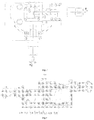
- a 220V AC power supply supplies power for an oscillating stage, a power stage and a phase detection part in the ultrasonic generator III- 9 , the oscillating stage generates an ultrasonic frequency signal, which is amplified by the amplifying stage, the power of the ultrasonic frequency signal is improved by the power stage, and then is transferred to the transducer by impedance matching, the output power of the ultrasonic generator III- 9 is compared with the power of the transducer by sampled signal feed, and if the output power of the ultrasonic generator III- 9 is not equal to the power of the transducer, the signal is fed back to the oscillating stage and the power stage to produce the power equal to that of the transducer; and the phase detection part and the phase adjustment part can detect and control the phases of the ultrasonic vibration on two directions so as to generate different phase differences to generate different movement trajectories.
- FIG. 5 , FIG. 7 to FIG. 19 and FIG. 21 are the second embodiment of the present invention
- the multi-angle two-dimensional ultrasonic vibration device I, the nanofluid micro-lubrication grinding device II and the grinding force and grinding temperature measurement device III are the same as those in the first embodiment, the difference lies in that by adjustment of the axial adjustable bracket I- 33 , the vibration directions of the axial ultrasonic vibrator and the tangential ultrasonic vibrator form an acute angle so as to further improve the relative movement trajectory of the abrasive particles of the grinding wheel II- 3 and the workpiece I- 12 , and the grinding-simulation movement trajectory and the honing-simulation movement trajectory can be more compact so as to achieve the ideal grinding effect.
- FIG. 6 , FIG. 7 to FIG. 19 and FIG. 21 are the third embodiment of the present invention
- the multi-angle two-dimensional ultrasonic vibration device I, the nanofluid micro-lubrication grinding device II and the grinding force and grinding temperature measurement device III in the third embodiment are the same as those in the first embodiment, the difference lies in that by adjustment of the axial adjustable bracket I- 33 , the vibration directions of the axial ultrasonic vibrator and the tangential ultrasonic vibrator form an obtuse angle so as to further improve the relative movement trajectory of the abrasive particles of the grinding wheel II- 3 and the workpiece I- 12 , and the grinding-simulation movement trajectory and the honing-simulation movement trajectory can be more compact so as to achieve the ideal grinding effect.
- FIG. 1 to FIG. 4 , FIG. 7 to FIG. 19 , FIG. 20( d ) and FIG. 21 are the fourth embodiment of the present invention
- the tangential ultrasonic vibration assisted nanofluid micro-lubrication grinding device and the grinding force and grinding temperature measurement device thereof are the same as the multi-angle two-dimensional ultrasonic vibration device I, the nanofluid micro-lubrication grinding device II and the grinding force and grinding temperature measurement device III in the first embodiment, which can be achieved by just controlling the ultrasonic generator, the ultrasonic generator III- 9 is controlled to only output a tangential ultrasonic signal, as the slide rail supporting seat I- 8 is connected with the axial supporting seat I- 7 through the T-shaped slide block I- 38 , when the tangential ultrasonic vibrator generates amplitude, the slide rail supporting seat I- 8 can freely vibrate along the tangential direction without being interfered by the axial supporting seat I- 7 , and thus the relative movement trajectory of the abrasive particles of the grinding wheel II- 3
- FIG. 1 to FIG. 4 , FIG. 7 to FIG. 19 , FIG. 20 ( e ) and FIG. 21 are the fifth embodiment of the present invention
- the axial ultrasonic vibration assisted nanofluid micro-lubrication grinding device and the grinding force and grinding temperature measurement device thereof are the same as the multi-angle two-dimensional ultrasonic vibration device I, the nanofluid micro-lubrication grinding device II and the grinding force and grinding temperature measurement device II in the first embodiment, which can be achieved by just controlling the ultrasonic generator, the ultrasonic generator II- 9 is controlled to only output an axial ultrasonic signal
- the axial ultrasonic vibrator drives the axial supporting seat to generate amplitude and transfer the amplitude to the slide rail supporting seat I- 8 , as the slide rail supporting seat I- 8 is connected with the tangential ultrasonic vibrator through the universal ball joint, the axial vibration of the slide rail supporting seat I- 8 is not interfered, and thus the relative movement trajectory of the abrasive particles of the grinding wheel II- 3 and the
- the ultrasonic generator III- 9 generates an ultrasonic frequency electric signal matching the power of the axial transducer I- 2 with the power of the tangential transducer I- 25 , the ultrasonic frequency electric signal is transferred to the axial transducer I- 2 or the tangential transducer I- 25 through the negative electrode conducting wire III- 10 and the positive electrode conducting wire III- 11 , the axial transducer I- 2 and the tangential transducer I- 25 convert the ultrasonic frequency electric signal into mechanical vibration of ultrasonic frequency and transfer the mechanical vibration of ultrasonic frequency to the axial amplitude change rod I- 2 and the tangential amplitude change rod I- 25 , the amplitude change rods amplify the amplitude of the mechanical vibration of ultrasonic frequency for a certain fold and transfer the mechanical vibration of ultrasonic frequency to the axial supporting seat I- 7 and the slide rail supporting seat I- 8 so as to drive the workpiece I- 12 and the abrasive particles of the
- the axial ultrasonic vibrator and the tangential ultrasonic vibrator By controlling the phase adjustment link in the ultrasonic generator III- 9 as shown in FIG. 21 , the axial ultrasonic vibrator and the tangential ultrasonic vibrator generate ultrasonic vibration signals with different phase difference, when the phase difference is ⁇ /2, the tangential ultrasonic vibration is coupled with axial ultrasonic vibration, so that the abrasive particles of the grinding wheel and the workpiece form the elliptical relative movement trajectory, and the grinding-simulation movement trajectory as shown in FIG.
- the angle of the axial adjustable bracket I- 33 is adjusted to further change the shape of the relative movement trajectory of the abrasive particles of the grinding wheel and the workpiece, so that the veins of the grinding-simulation movement trajectory and the honing-simulation movement trajectory are more compact so as to achieve the ideal surface quality and grinding effect of the workpiece.
- the grinding force generated by grinding the workpiece I- 12 by the grinding wheel II- 3 is transferred by the workpiece fixture I- 9 to the slide rail supporting seat I- 8 , and the tangential grinding force, the normal grinding force and the axial grinding force are respectively transferred to the fixing plate I- 6 on three different paths.
- the tangential grinding force is transferred to the tangential amplitude change rod I- 24 via the universal ball joint, the tangential amplitude change rod I- 24 is rigidly connected to the tangential bracket I- 28 , then the tangential bracket I- 28 is subjected to the tangential grinding force, and then is transferred to the fixing plate I- 6 ;
- the normal grinding force is transferred by the T-shaped slide block I- 36 to the jack rolling ball I- 35 , then is transferred to the tangential bracket boss I- 42 and is finally transferred to the fixing plate I- 6 ;
- the axial grinding force is transferred by the T-shaped slide block I- 36 to the axial supporting seat I- 7 , then is transferred to the axial amplitude change rod I- 3 , the axial amplitude change rod I- 3 is rigidly connected with the axially adjustable bracket I- 33 , so that the axially adjustable bracket I- 33 is subjected to the axial grinding force, and the axial grinding force is finally transferred to the fixing plate I-
- the grinding forces on the three directions are transferred by the fixing plate I- 6 to the dynamometer III- 4 , the measurement signal is transferred to the grinding force information collector III- 2 after being amplified by the amplifier III- 3 and is finally transferred to the grinding force control system III- 1 , and the size of the grinding force is displayed.
- the grinding temperature generated by grinding the workpiece I- 12 by the grinding wheel II- 3 is transferred by the thermocouple III- 5 to the grinding temperature information collector III- 6 , and then is transferred to the low pass filter III- 7 , some interference signals are filtered, the grinding temperature is finally transferred to the grinding temperature control system III- 8 , and the working end temperature of the thermocouple II- 5 , that is the temperature of the workpiece I- 12 is displayed.
- the magnetic worktable II- 7 is degaussed, and the dynamometer III- 4 and the whole equipment can be dismounted.
- a single abrasive particle introduces two-dimensional ultrasonic vibration excitation on the workpiece to cause the same to perform spiral or straight line staggered cutting in the grinding area, within a vibration period, the abrasive particle periodically changes the cutting direction, so that a plurality of grinding edges on the surrounding of the abrasive particle participate in the cutting to form a “multi-edge cutting” process, which is conducive to keeping the sharpness of the cutting edge of the abrasive particle and cooling the grinding temperature on the surface of the workpiece, which is different from the micro are type cutting mode in an ordinary grinding process, the cutting path is longer than that of the ordinary grinding, that is, the cutting action area of the single abrasive particle increases, and the cutting edges of all surfaces of the single abrasive particle periodically contact and cut the workpiece material, an intermittent processing state of sometime cutting and sometime separating in a micro-processing area, and a cutting process which is continuous macroscopically and is discontinuous microscopically is formed.
- the creation process of the two-dimensional ultrasonic assisted grinding surface is not limited to abrasive particle cutting traces without subsequent cutting edges, instead, spiral or linear staggered cutting trajectories of numerous abrasive particles, interfering trajectories to a certain extent can widen the cutting groove of the single abrasive particle, the greater the axial ultrasonic amplitude is, the wider the cutting groove of the abrasive particle is, the material volume removed within a unit time is increased, thereby improving the material removal efficiency, and meanwhile increasing the interference of the numerous abrasive particles, the un-removed traces of the abrasive particles are obviously reduced on the width and height, thereby reducing the roughness of the grinding surface and greatly improving the quality of the grinding surface.
- A represents the amplitude of the tangential ultrasonic vibration
- B represents the amplitude of the axial ultrasonic vibration
- f represents the ultrasonic vibration frequency
- v represents a worktable feeding speed
- ⁇ represents the phase difference between the tangential ultrasonic vibration and the axial ultrasonic vibration.
- the elliptic shape is determined by the phase difference ⁇ between the tangential ultrasonic vibration and the axial ultrasonic vibration, and several special cases are discussed below:
- the relative movement trajectory of the abrasive particles of the grinding wheel and the workpiece is a straight line passing by the origin, and the slope is the ratio of two amplitudes A/B.
- the frequency of harmonic vibration of the tangential ultrasonic vibration and the axial ultrasonic vibration is equal, the amplitude is equal to ⁇ square root over (A 2 +B 2 ) ⁇ , and vibration is generated along the straight line
- the relative movement trajectory of the abrasive particles of the grinding wheel and the workpiece is an ellipse with the coordinate axis as the main axis, the abrasive particles of the grinding wheel move along the elliptic trajectory, as shown in FIG. 20 ( a ) . While the abrasive particles of the grinding wheel perform the elliptic motion, the abrasive particles of the grinding wheel perform uniform linear motion along the tangential direction at a feeding speed v, and the obtained relative movement trajectory is the grinding-simulation movement trajectory as shown in FIG. 20 ( b ) .
- the angle of the axially adjustable bracket is adjusted to further change the inclination angle of the spiral and straight line staggered trajectories, and in cooperation with the nanofluid micro-lubrication grinding working condition, the abrasive particles of the grinding wheel generate more compact texture veins on the surface of the workpiece so as to obtain higher surface quality and grinding effect of the workpiece.
Landscapes
- Engineering & Computer Science (AREA)
- Mechanical Engineering (AREA)
- Grinding And Polishing Of Tertiary Curved Surfaces And Surfaces With Complex Shapes (AREA)
Abstract
Description
-
- a displacement node x0=64.625 mm.
x=A cos(2πft)+vt (6)
y=B cos(2πft+φ) (7)
S=√{square root over (x 2 +y 2)}=√{square root over (A 2 +B 2)}cos(2πft+φ) (10)
at the same frequency and the same amplitude. The relative movement trajectories of the abrasive particles of the grinding wheel and the workpiece when φ=0 and φ=π are synthesized to obtain the honing-simulation movement trajectory as shown in
Claims (10)
Applications Claiming Priority (6)
| Application Number | Priority Date | Filing Date | Title |
|---|---|---|---|
| CN2016210553513U | 2016-09-14 | ||
| CN201610824325.0A CN106181596B (en) | 2016-09-14 | 2016-09-14 | Multi-angle two-dimensional ultrasonic vibration assisted nano-fluid minimal quantity lubrication grinding device |
| CN2016210553513 | 2016-09-14 | ||
| CN201621055351.3U CN206047775U (en) | 2016-09-14 | 2016-09-14 | Multi-angle two-dimensional ultrasonic vibration assisted nano-fluid minimal quantity lubrication grinding device |
| CN2016108243250 | 2016-09-14 | ||
| PCT/CN2017/074305 WO2018049790A1 (en) | 2016-09-14 | 2017-02-21 | Multi-angle two-dimensional ultrasonic vibration assisted grinding device of nano-fluid minimum quantity lubrication type |
Publications (2)
| Publication Number | Publication Date |
|---|---|
| US20180354096A1 US20180354096A1 (en) | 2018-12-13 |
| US10695889B2 true US10695889B2 (en) | 2020-06-30 |
Family
ID=61618565
Family Applications (1)
| Application Number | Title | Priority Date | Filing Date |
|---|---|---|---|
| US15/755,251 Expired - Fee Related US10695889B2 (en) | 2016-09-14 | 2017-02-21 | Multi-angle two-dimensional ultrasonic vibration assisted nanofluid micro-lubrication grinding device |
Country Status (2)
| Country | Link |
|---|---|
| US (1) | US10695889B2 (en) |
| WO (1) | WO2018049790A1 (en) |
Families Citing this family (37)
| Publication number | Priority date | Publication date | Assignee | Title |
|---|---|---|---|---|
| AU2018381738B2 (en) * | 2017-12-06 | 2021-02-18 | Qingdao university of technology | Nano-fluid minimum quantity lubrication grinding apparatus with grinding fluid infiltration microchannel assisted by ultrasonic vibration |
| KR102096310B1 (en) * | 2018-11-23 | 2020-04-06 | 한국생산기술연구원 | Device for manufacturing soft magnetic material using ultrasonic vibration, manufacturing method thereof, and soft magnetic material manufactured using the same |
| CN109333254A (en) * | 2018-12-19 | 2019-02-15 | 太原理工大学 | One-dimensional vibration polishing device and method for inner and outer surfaces of complex structural parts |
| CN109759952B (en) * | 2019-01-28 | 2020-02-18 | 上海瑞吉机械传动技术有限公司 | Polishing detection device for flange plate of rubber flange type elastic coupling and coupling |
| CN109848850B (en) * | 2019-03-30 | 2024-06-25 | 浙江联宜电机有限公司 | Clamping and adsorbing device matched with circulation board |
| CN110076350B (en) * | 2019-04-30 | 2020-05-29 | 北京航空航天大学 | Ultrasonic stamping type cutting and extruding integrated processing method |
| CN110480512A (en) * | 2019-07-25 | 2019-11-22 | 浙江工业大学 | Ultrasonic vibration assists microchannel jet stream processing unit (plant) |
| CN110948268A (en) * | 2019-12-13 | 2020-04-03 | 青岛理工大学 | Multi-station turning tool head milling fixture system with intelligent detection of clamping force |
| CN111168485B (en) * | 2020-02-11 | 2024-06-07 | 华侨大学 | Ultrasonic vibration auxiliary self-rotation grinding machine tool and main shaft device thereof |
| CN111113166B (en) * | 2020-02-11 | 2024-06-07 | 华侨大学 | Main shaft structure of ultrasonic-assisted self-rotation grinding machine tool |
| CN111438569B (en) * | 2020-05-07 | 2024-12-13 | 岭南师范学院 | A lightweight micro-ultrasonic or micro-ultrasonic vibration assisted machining spindle |
| CN112025554B (en) * | 2020-09-14 | 2021-08-13 | 湖南理工学院 | Grinding method of nano-layer lubricated diamond wheel based on shock wave cavitation effect |
| CN112296861A (en) * | 2020-11-19 | 2021-02-02 | 辽宁科技大学 | Ultrasonic-assisted electromagnetic permanent magnet composite plane grinding device and method |
| CN112405126A (en) * | 2020-11-27 | 2021-02-26 | 辽宁科技大学 | Mechanical connecting rod type rotary ultrasonic magnetic force composite groove polishing device |
| CN112338659A (en) * | 2020-11-27 | 2021-02-09 | 重庆秦安机电股份有限公司 | Novel grinding device for machine tool spindle |
| CN112405128A (en) * | 2020-12-04 | 2021-02-26 | 辽宁科技大学 | Device and method for removing burrs at hole edges |
| CN112847073A (en) * | 2021-01-14 | 2021-05-28 | 高盈表业(深圳)有限公司 | Grinding and polishing device for shell surface of mechanical watch |
| CN113158478B (en) * | 2021-04-28 | 2023-07-28 | 苏州科技大学 | A Method for Solving the Cutting Thickness Distribution of Abrasive Particles in Ultrasonic Vibration Assisted Grinding |
| CN114102276A (en) * | 2021-12-16 | 2022-03-01 | 山东理工大学 | Ultrasonic-assisted machining high-shear low-pressure grinding device and method |
| CN114371061A (en) * | 2022-01-20 | 2022-04-19 | 郑州大学 | V-notch ultrasonic grinder for rotating bending fatigue specimens |
| CN114425737B (en) * | 2022-01-26 | 2023-06-16 | 黄河水利职业技术学院 | Intelligent ultrasonic polishing and cleaning device for interface cone |
| CN114102417B (en) * | 2022-01-27 | 2022-09-20 | 南通世睿智能设备有限公司 | Polishing device in pipe part |
| CN114626154B (en) * | 2022-03-10 | 2024-09-24 | 苏州科技大学 | Simulation method of dual ultrasonic vibration assisted grinding of workpiece surface |
| CN115365966A (en) * | 2022-04-07 | 2022-11-22 | 湖南科技学院 | Industrial design product appearance plastic repairing device and using method thereof |
| CN114440956B (en) * | 2022-04-11 | 2022-08-05 | 西安星通通信科技有限公司 | Three-dimensional test turntable with adjustable rigidity and rigidity debugging method thereof |
| CN114918746B (en) * | 2022-04-26 | 2023-03-10 | 深圳市中扬数控机床有限公司 | Ultrasonic knife handle and ultrasonic numerical control machine tool |
| CN114833585B (en) * | 2022-05-27 | 2023-10-20 | 广东腾兴智能装备有限公司 | Multi-angle cutting edging digit control machine tool |
| CN115122159B (en) * | 2022-06-14 | 2023-06-06 | 中国地质大学(武汉) | An ultrasonic vibration-assisted precision machining device and method for complex curved surfaces |
| CN115156627B (en) * | 2022-07-08 | 2024-12-24 | 浙江博秦精密工业有限公司 | A computer upper cover shell surface drawing device and process |
| CN116277248A (en) * | 2023-03-20 | 2023-06-23 | 江苏理工学院 | A device for removing fluorine-containing backsheet of decommissioned photovoltaic modules and its working method |
| CN116652823B (en) * | 2023-06-26 | 2024-03-22 | 浙江钱祥工具股份有限公司 | Automatic monitoring system and method for grinding machine |
| CN117428649A (en) * | 2023-12-08 | 2024-01-23 | 西北师范大学 | A magnetic grinding device and method for rapid polishing of shaft parts |
| CN118024081B (en) * | 2024-01-30 | 2026-04-14 | 南方科技大学 | Material processing method for coupling ultrasonic energy field and thermal energy field |
| CN117921452A (en) * | 2024-03-11 | 2024-04-26 | 江苏理工学院 | Force measuring mechanism for rotary ultrasonic auxiliary grinding |
| CN120002487B (en) * | 2025-03-20 | 2025-10-10 | 天津大学 | Ultrasonic longitudinal-torsional composite vibration grinding method and grinding device for inner hole of large-length-diameter-ratio pipe |
| CN120155840B (en) * | 2025-05-20 | 2025-10-24 | 宁波金凯机床股份有限公司 | A milling and grinding composite processing device for silicon carbide material |
| CN121132404B (en) * | 2025-11-19 | 2026-02-03 | 中北大学 | A diamond chemical mechanical polishing device based on three-frequency ultrasound assistance |
Citations (12)
| Publication number | Priority date | Publication date | Assignee | Title |
|---|---|---|---|---|
| GB946292A (en) | 1959-02-14 | 1964-01-08 | Council Scient Ind Res | Improvements in timepieces |
| JPS6362662A (en) | 1986-09-04 | 1988-03-18 | Junichiro Kumabe | Precise finishing method with grinding wheel overlapped with supersonic and low frequency vibration |
| CN101760285A (en) | 2010-01-11 | 2010-06-30 | 青岛理工大学 | Nano Grinding Technology and Nano Grinding Fluid |
| CN102490088A (en) | 2011-11-17 | 2012-06-13 | 北京理工大学 | Three-dimensional spiral line grinding method through ultrasonic vibration |
| CN203432882U (en) | 2013-09-18 | 2014-02-12 | 青岛理工大学 | Device for measuring particle size of nano particle jet flow trace lubrication grinding fog drops |
| CN103769959A (en) | 2014-01-27 | 2014-05-07 | 河北工业大学 | Ultrasonic micro grinding and processing equipment and technology thereof |
| CN104526471A (en) | 2014-12-02 | 2015-04-22 | 河南理工大学 | Ultrasonic 3D vibration and ELID (Electrolytic In-process Dressing) combined precision grinding system and method |
| US20150126097A1 (en) * | 2013-02-04 | 2015-05-07 | Qingdao Technological University | Nano fluid electrostatic atomization controllable jet minimal quantity lubrication grinding system |
| CN205006970U (en) | 2015-09-21 | 2016-02-03 | 青岛理工大学 | Cooling and electrostatic atomization film-forming bone surgery grinding experimental device |
| CN106181596A (en) | 2016-09-14 | 2016-12-07 | 青岛理工大学 | Multi-angle two-dimensional ultrasonic vibration assisted nano-fluid minimal quantity lubrication grinding device |
| US20180056481A1 (en) * | 2016-08-25 | 2018-03-01 | Okamoto Machine Tool Works, Ltd. | Automatic grinding apparatus |
| US9925638B2 (en) * | 2015-06-09 | 2018-03-27 | Qingdao Technological University | Minimal quantity lubrication grinding device integrating nanofluid electrostatic atomization with electrocaloric heat pipe |
Family Cites Families (1)
| Publication number | Priority date | Publication date | Assignee | Title |
|---|---|---|---|---|
| US3239965A (en) * | 1961-09-13 | 1966-03-15 | Sheffield Corp | Ultrasonic grinding apparatus |
-
2017
- 2017-02-21 US US15/755,251 patent/US10695889B2/en not_active Expired - Fee Related
- 2017-02-21 WO PCT/CN2017/074305 patent/WO2018049790A1/en not_active Ceased
Patent Citations (12)
| Publication number | Priority date | Publication date | Assignee | Title |
|---|---|---|---|---|
| GB946292A (en) | 1959-02-14 | 1964-01-08 | Council Scient Ind Res | Improvements in timepieces |
| JPS6362662A (en) | 1986-09-04 | 1988-03-18 | Junichiro Kumabe | Precise finishing method with grinding wheel overlapped with supersonic and low frequency vibration |
| CN101760285A (en) | 2010-01-11 | 2010-06-30 | 青岛理工大学 | Nano Grinding Technology and Nano Grinding Fluid |
| CN102490088A (en) | 2011-11-17 | 2012-06-13 | 北京理工大学 | Three-dimensional spiral line grinding method through ultrasonic vibration |
| US20150126097A1 (en) * | 2013-02-04 | 2015-05-07 | Qingdao Technological University | Nano fluid electrostatic atomization controllable jet minimal quantity lubrication grinding system |
| CN203432882U (en) | 2013-09-18 | 2014-02-12 | 青岛理工大学 | Device for measuring particle size of nano particle jet flow trace lubrication grinding fog drops |
| CN103769959A (en) | 2014-01-27 | 2014-05-07 | 河北工业大学 | Ultrasonic micro grinding and processing equipment and technology thereof |
| CN104526471A (en) | 2014-12-02 | 2015-04-22 | 河南理工大学 | Ultrasonic 3D vibration and ELID (Electrolytic In-process Dressing) combined precision grinding system and method |
| US9925638B2 (en) * | 2015-06-09 | 2018-03-27 | Qingdao Technological University | Minimal quantity lubrication grinding device integrating nanofluid electrostatic atomization with electrocaloric heat pipe |
| CN205006970U (en) | 2015-09-21 | 2016-02-03 | 青岛理工大学 | Cooling and electrostatic atomization film-forming bone surgery grinding experimental device |
| US20180056481A1 (en) * | 2016-08-25 | 2018-03-01 | Okamoto Machine Tool Works, Ltd. | Automatic grinding apparatus |
| CN106181596A (en) | 2016-09-14 | 2016-12-07 | 青岛理工大学 | Multi-angle two-dimensional ultrasonic vibration assisted nano-fluid minimal quantity lubrication grinding device |
Non-Patent Citations (2)
| Title |
|---|
| May 5, 2017 International Search Report issued in International Patent Application No. PCT/CN2017/074305. |
| May 5, 2017 Written Opinion issued in International Patent Application No. PCT/CN2017/074305. |
Also Published As
| Publication number | Publication date |
|---|---|
| US20180354096A1 (en) | 2018-12-13 |
| WO2018049790A1 (en) | 2018-03-22 |
Similar Documents
| Publication | Publication Date | Title |
|---|---|---|
| US10695889B2 (en) | Multi-angle two-dimensional ultrasonic vibration assisted nanofluid micro-lubrication grinding device | |
| CN106181596B (en) | Multi-angle two-dimensional ultrasonic vibration assisted nano-fluid minimal quantity lubrication grinding device | |
| CN206047775U (en) | Multi-angle two-dimensional ultrasonic vibration assisted nano-fluid minimal quantity lubrication grinding device | |
| US11597049B2 (en) | Nanofluid minimum quantity lubrication grinding device of ultrasonic vibration assisted grinding fluid micro-channel infiltration | |
| CN207915123U (en) | Ultrasonic vibration mechanism and device capable of adjusting spatial position of ultrasonic vibrator | |
| CN107336086A (en) | Ultrasonic vibration assisted grinding nano-fluid minimal quantity lubrication experiment system and method | |
| CN107855836B (en) | Nanofluid Minimal Quantity Lubrication Grinding Device | |
| CN109759308B (en) | Laser-assisted online measurement three-dimensional elliptical ultrasonic vibration-assisted micro-machining platform | |
| Liang et al. | Experimental study on brittle–ductile transition in elliptical ultrasonic assisted grinding (EUAG) of monocrystal sapphire using single diamond abrasive grain | |
| CN104624463B (en) | A two-dimensional ultrasonic vibration platform | |
| CN105382634A (en) | Ultrasonic vibration auxiliary grinding device | |
| CN105880140B (en) | A kind of two dimensional ultrasonic vibration platform based on flexible hinge structure | |
| CN203636513U (en) | Ultra-precision machining system with function of ultrasonic vibration assisted grinding/polishing | |
| CN107470995B (en) | A vibrating table for precision ultrasonic machining | |
| CN101758420B (en) | A system, apparatus and method for providing cooling | |
| CN206998465U (en) | One kind is used to be ground hard brittle material two dimensional ultrasonic vibration abrasive belt grinding device | |
| CN105149626B (en) | A kind of two piezoelectricity vertical ellipse vibration cutting devices for being suitable to vertical Excircle machining | |
| CN106425705A (en) | Ultrasonic vibration grinding device | |
| CN106002543A (en) | Initiative mild grinding and polishing device and method based on viscous-elastic material | |
| CN208961136U (en) | A piezoelectric stack parallel vibration-assisted swing cutting device | |
| JP2011183510A (en) | Ultrasonic-vibration-assisted grinding method and device therefor | |
| CN204997431U (en) | Flexible device of hinge serial -type elliptical vibration cutting | |
| CN107335601A (en) | A kind of single excitation two-dimensional ultrasonic vibration assist processing platform | |
| CN105127452A (en) | Parallel-type oval vibration turning device applicable to vertical type excircle machining | |
| CN102152229A (en) | Constant-pressure ultrasonic auxiliary excircle grinding device of adhesive grinding materials |
Legal Events
| Date | Code | Title | Description |
|---|---|---|---|
| AS | Assignment |
Owner name: QINGDAO TECHNOLOGICAL UNIVERSITY, CHINA Free format text: ASSIGNMENT OF ASSIGNORS INTEREST;ASSIGNORS:LI, CHANGHE;ZHANG, XIANPENG;ZHANG, YANBIN;AND OTHERS;REEL/FRAME:045036/0990 Effective date: 20180202 |
|
| FEPP | Fee payment procedure |
Free format text: ENTITY STATUS SET TO UNDISCOUNTED (ORIGINAL EVENT CODE: BIG.); ENTITY STATUS OF PATENT OWNER: SMALL ENTITY |
|
| FEPP | Fee payment procedure |
Free format text: ENTITY STATUS SET TO SMALL (ORIGINAL EVENT CODE: SMAL); ENTITY STATUS OF PATENT OWNER: SMALL ENTITY |
|
| STPP | Information on status: patent application and granting procedure in general |
Free format text: DOCKETED NEW CASE - READY FOR EXAMINATION |
|
| STPP | Information on status: patent application and granting procedure in general |
Free format text: NOTICE OF ALLOWANCE MAILED -- APPLICATION RECEIVED IN OFFICE OF PUBLICATIONS |
|
| STPP | Information on status: patent application and granting procedure in general |
Free format text: NOTICE OF ALLOWANCE MAILED -- APPLICATION RECEIVED IN OFFICE OF PUBLICATIONS |
|
| STCF | Information on status: patent grant |
Free format text: PATENTED CASE |
|
| FEPP | Fee payment procedure |
Free format text: MAINTENANCE FEE REMINDER MAILED (ORIGINAL EVENT CODE: REM.); ENTITY STATUS OF PATENT OWNER: SMALL ENTITY |
|
| LAPS | Lapse for failure to pay maintenance fees |
Free format text: PATENT EXPIRED FOR FAILURE TO PAY MAINTENANCE FEES (ORIGINAL EVENT CODE: EXP.); ENTITY STATUS OF PATENT OWNER: SMALL ENTITY |
|
| STCH | Information on status: patent discontinuation |
Free format text: PATENT EXPIRED DUE TO NONPAYMENT OF MAINTENANCE FEES UNDER 37 CFR 1.362 |
|
| FP | Lapsed due to failure to pay maintenance fee |
Effective date: 20240630 |