US10658556B2 - LED package structure and multilayer circuit board - Google Patents
LED package structure and multilayer circuit board Download PDFInfo
- Publication number
- US10658556B2 US10658556B2 US16/192,111 US201816192111A US10658556B2 US 10658556 B2 US10658556 B2 US 10658556B2 US 201816192111 A US201816192111 A US 201816192111A US 10658556 B2 US10658556 B2 US 10658556B2
- Authority
- US
- United States
- Prior art keywords
- layer
- opening
- electrode
- conductive
- circuit board
- Prior art date
- Legal status (The legal status is an assumption and is not a legal conclusion. Google has not performed a legal analysis and makes no representation as to the accuracy of the status listed.)
- Active
Links
Images




Classifications
-
- H01L33/62—
-
- H—ELECTRICITY
- H10—SEMICONDUCTOR DEVICES; ELECTRIC SOLID-STATE DEVICES NOT OTHERWISE PROVIDED FOR
- H10H—INORGANIC LIGHT-EMITTING SEMICONDUCTOR DEVICES HAVING POTENTIAL BARRIERS
- H10H20/00—Individual inorganic light-emitting semiconductor devices having potential barriers, e.g. light-emitting diodes [LED]
- H10H20/80—Constructional details
- H10H20/85—Packages
- H10H20/857—Interconnections, e.g. lead-frames, bond wires or solder balls
-
- H01L33/505—
-
- H01L33/52—
-
- H01L33/60—
-
- H—ELECTRICITY
- H05—ELECTRIC TECHNIQUES NOT OTHERWISE PROVIDED FOR
- H05K—PRINTED CIRCUITS; CASINGS OR CONSTRUCTIONAL DETAILS OF ELECTRIC APPARATUS; MANUFACTURE OF ASSEMBLAGES OF ELECTRICAL COMPONENTS
- H05K1/00—Printed circuits
- H05K1/02—Details
- H05K1/0201—Thermal arrangements, e.g. for cooling, heating or preventing overheating
- H05K1/0203—Cooling of mounted components
- H05K1/0204—Cooling of mounted components using means for thermal conduction connection in the thickness direction of the substrate
- H05K1/0206—Cooling of mounted components using means for thermal conduction connection in the thickness direction of the substrate by printed thermal vias
-
- H—ELECTRICITY
- H10—SEMICONDUCTOR DEVICES; ELECTRIC SOLID-STATE DEVICES NOT OTHERWISE PROVIDED FOR
- H10H—INORGANIC LIGHT-EMITTING SEMICONDUCTOR DEVICES HAVING POTENTIAL BARRIERS
- H10H20/00—Individual inorganic light-emitting semiconductor devices having potential barriers, e.g. light-emitting diodes [LED]
- H10H20/80—Constructional details
- H10H20/85—Packages
- H10H20/851—Wavelength conversion means
- H10H20/8514—Wavelength conversion means characterised by their shape, e.g. plate or foil
-
- H—ELECTRICITY
- H10—SEMICONDUCTOR DEVICES; ELECTRIC SOLID-STATE DEVICES NOT OTHERWISE PROVIDED FOR
- H10H—INORGANIC LIGHT-EMITTING SEMICONDUCTOR DEVICES HAVING POTENTIAL BARRIERS
- H10H20/00—Individual inorganic light-emitting semiconductor devices having potential barriers, e.g. light-emitting diodes [LED]
- H10H20/80—Constructional details
- H10H20/85—Packages
- H10H20/852—Encapsulations
-
- H—ELECTRICITY
- H10—SEMICONDUCTOR DEVICES; ELECTRIC SOLID-STATE DEVICES NOT OTHERWISE PROVIDED FOR
- H10H—INORGANIC LIGHT-EMITTING SEMICONDUCTOR DEVICES HAVING POTENTIAL BARRIERS
- H10H20/00—Individual inorganic light-emitting semiconductor devices having potential barriers, e.g. light-emitting diodes [LED]
- H10H20/80—Constructional details
- H10H20/85—Packages
- H10H20/855—Optical field-shaping means, e.g. lenses
- H10H20/856—Reflecting means
-
- H01L2224/48091—
-
- H01L2924/00014—
-
- H01L33/486—
-
- H—ELECTRICITY
- H05—ELECTRIC TECHNIQUES NOT OTHERWISE PROVIDED FOR
- H05K—PRINTED CIRCUITS; CASINGS OR CONSTRUCTIONAL DETAILS OF ELECTRIC APPARATUS; MANUFACTURE OF ASSEMBLAGES OF ELECTRICAL COMPONENTS
- H05K1/00—Printed circuits
- H05K1/02—Details
- H05K1/0296—Conductive pattern lay-out details not covered by sub groups H05K1/02 - H05K1/0295
- H05K1/0298—Multilayer circuits
-
- H—ELECTRICITY
- H05—ELECTRIC TECHNIQUES NOT OTHERWISE PROVIDED FOR
- H05K—PRINTED CIRCUITS; CASINGS OR CONSTRUCTIONAL DETAILS OF ELECTRIC APPARATUS; MANUFACTURE OF ASSEMBLAGES OF ELECTRICAL COMPONENTS
- H05K2201/00—Indexing scheme relating to printed circuits covered by H05K1/00
- H05K2201/10—Details of components or other objects attached to or integrated in a printed circuit board
- H05K2201/10007—Types of components
- H05K2201/10106—Light emitting diode [LED]
-
- H—ELECTRICITY
- H10—SEMICONDUCTOR DEVICES; ELECTRIC SOLID-STATE DEVICES NOT OTHERWISE PROVIDED FOR
- H10H—INORGANIC LIGHT-EMITTING SEMICONDUCTOR DEVICES HAVING POTENTIAL BARRIERS
- H10H20/00—Individual inorganic light-emitting semiconductor devices having potential barriers, e.g. light-emitting diodes [LED]
- H10H20/80—Constructional details
- H10H20/85—Packages
- H10H20/8506—Containers
Definitions
- the instant invention relates to a package structure; in particular, to an LED package structure.
- a conventional LED package structure a reflecting cup is formed on the lead frames by insert molding.
- the combining strength between the reflecting cup and the lead frames is not enough.
- the molding equipment is necessary when performing insert molding, so the manufacturing cost cannot be decreased due to the molding equipment.
- An LED package structure is provided in the instant disclosure, the problems of low combining strength and high manufacturing cost can be effectively solved by using a multilayer circuit board in the LED package structure.
- the multilayer circuit board of the LED package structure in the instant disclosure is provided with the first resin layer stacked on the conductive layer, such that the LED package structure has a small heat resistance so as to obtain a better light efficiency.
- the outer surface of the first resin layer is rough enough for effectively increasing the combining strength between the cover and the first resin layer when the cover is bonded on the first resin layer.
- the heat dissipating rate of the LED chip can be increased based on the multilayer circuit board having the thicker conductive layer.
- the periphery of the first opening and the periphery of the second opening are aligned and arranged around the LED chip to construct a reflecting wall, thereby light efficiency of the LED package structure is enhanced by reflecting light emitted from the LED chip by the reflecting wall.
- FIG. 1 is a top perspective view showing an LED package structure according to a first embodiment of the instant disclosure
- FIG. 2 is a bottom perspective view of FIG. 1 ;
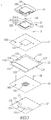
- FIG. 3 is an exploded view of the LED package structure
- FIG. 4 is an exploded view showing the LED chip, the Zener diode and phosphor sheet, which are separated from the multilayer circuit board;
- FIG. 5 is a top view of the multilayer circuit board
- FIG. 6 is a top exploded view of the multilayer circuit board
- FIG. 7 is a bottom exploded view of the multilayer circuit board
- FIG. 8 is a cross-sectional view of FIG. 1 along line X 1 -X 1 ;
- FIG. 9 is a top perspective view showing an LED package structure according to a second embodiment of the instant disclosure.
- FIG. 10 is a bottom perspective view of FIG. 9 ;
- FIG. 11A is a top perspective view showing an LED package structure according to a third embodiment of the instant disclosure.
- FIG. 11B is a cross-sectional view of FIG. 11A along line X 2 -X 2 ;
- FIG. 11C is a diagram showing the relative brightness versus light-emitting angle of the LED package structure according to the third embodiment of the instant disclosure.
- FIG. 12A is a perspective view showing an LED package structure according to a fourth embodiment of the instant disclosure.
- FIG. 12B is a cross-sectional view of FIG. 12A along line X 3 -X 3 ;
- FIG. 12C is a diagram showing the relative brightness versus light-emitting angle of the LED package structure according to the fourth embodiment of the instant disclosure.
- FIG. 13A is a perspective view showing an LED package structure according to a fifth embodiment of the instant disclosure.
- FIG. 13B is a cross-sectional view of FIG. 13A along line X 4 -X 4 ;
- FIG. 13C is a data sheet showing the relative brightness versus light-emitting angle of the LED package structure according to the fifth embodiment of the instant disclosure.
- FIG. 14A is a perspective view showing an LED package structure according to a sixth embodiment of the instant disclosure.
- FIG. 14B is a cross-sectional view of FIG. 14A along line X 5 -X 5 ;
- FIG. 14C is a diagram showing the relative brightness versus light-emitting angle of the LED package structure according to the sixth embodiment of the instant disclosure.
- FIGS. 1 through 8 show a first embodiment of the instant disclosure. References are hereunder made to the detailed descriptions and appended drawings in connection with the instant invention. However, the appended drawings are merely shown for exemplary purposes, rather than being used to restrict the scope of the instant invention.
- FIGS. 1 through 4 show an LED package structure 100 of the instant embodiment.
- the LED package structure 100 includes a multilayer circuit board 1 , an LED chip 2 , a Zener diode 3 , a cover 4 , an adhesive 5 , and a phosphor sheet 6 .
- the LED chip 2 and the Zener diode 3 are respectively mounted on two different planes of the multilayer circuit board 1 , and the cover 4 is fixed on the multilayer circuit board 1 by the adhesive 5 .
- the adhesive 5 can be UV gel, epoxy, or silicone.
- the multilayer circuit board 1 includes a conductive layer 11 , a first resin layer 12 , a first circuit layer 13 , a reflecting layer 14 , two first connecting pillars 15 penetrating the first resin layer 12 , a second resin layer 16 , a second circuit layer 17 , and two second connecting pillars 18 penetrating the second resin layer 16 .
- the first resin layer 12 , the first circuit layer 13 , and the reflecting layer 14 are arranged sequentially above the conductive layer 11 .
- the second resin layer 16 and the second circuit layer 17 are also arranged sequentially under the conductive layer 11 .
- the conductive layer 11 substantially has a square shape, and a thickness of the conductive layer 11 can be 50 ⁇ 500 ⁇ m.
- the conductive layer 11 has a first conductive portion 111 , a second conductive portion 112 separated from the first conductive portion 111 , a plurality of extending arms 113 (i.e., the plurality of first extending arms and the plurality of second extending arms) respectively extended from the first and the second conductive portions 111 , 112 , an insulating portion 114 arranged around a side wall of the first conductive portion 111 , a side wall of the second conductive portion 112 , and a side wall of each extending arm 113 .
- a top surface of the first conductive portion 111 , a top surface of the second conductive portion 112 , a top surface of each extending arm 113 , and a top surface of the insulating portion 114 are in a coplanar arrangement and are defined as a first surface 115 .
- a bottom surface of the first conductive portion 111 , a bottom surface of the second conductive portion 112 , a bottom surface of each extending arm 113 , and a bottom surface of the insulating portion 114 are also in a coplanar arrangement and are defined as a second surface 116 , which is opposite to the first surface 115 .
- the top surface of the first conductive portion 111 and the top surface of the second conductive portion 112 are coplanar with a top surface of the insulating portion 114
- the bottom surface of the first conductive portion 111 and the bottom surface of the second conductive portion 112 are coplanar with a bottom surface of the insulating portion 114
- the end surfaces 1131 of the plurality of extending arms 113 are flush with a side surface of the insulating portion 114 adjacent thereto, and the end surface 1131 of each extending arm 113 and the side surface of the insulating portion 114 are defined as a surrounding surface 117 .
- first and second conductive portions 111 , 112 are made of metal (for example, copper).
- the first and second conductive portions 111 , 112 are two different rectangular shapes, and the size of the first conductive portion 111 is greater than that of the second conductive portion 112 , such that the mounting region 1111 is arranged on the first conductive portion 111 .
- the first conductive portion 111 and the second conductive portion 112 are arranged in parallel with their longer side and are faced with each other.
- the extending arms 113 i.e., the first extending arms and the second extending arms
- One side of the first conductive portion 111 and one side of the second conductive portion 112 which are faced with each other and have no extending arm, are connected by the insulating portion 114 , thereby the relative position of the first and second conductive portions 111 , 112 can be maintained by the insulating portion 114 .
- the most part of the surrounding surface 117 of the conductive layer 11 is occupied by the insulating portion 114 , and a little part of the surrounding surface 117 of the conductive layer 11 is occupied by the extending arms 113 . Therefore, the cutting area of the metallic material of the conductive layer 11 can be reduced to avoid generating burr.
- the first resin layer 12 substantially has a square shape and is made of bismalimides triazine (BT) resin.
- the first resin layer 12 is disposed on the first surface 115 of the conductive layer 11 , and the outer edge of the first resin layer 12 in the instant embodiment substantially is aligned with the outer edge of the conductive layer 11 .
- the first resin layer 12 has a first opening 121 with a square shape and two first thru-holes 122 with a circular shape.
- the first opening 121 is substantially arranged on the center portion of the first resin layer 12 , and part of the first surface 115 of the conductive layer 11 is exposed from the first resin layer 12 via the first opening 121 , thereby a mounting region 1111 (as shown in FIG. 5 ) can be defined.
- the mounting region 111 of the conductive layer 11 is exposed from the first resin layer 12 via the first opening 121 , and the mounting region 111 can be defined on the first surface 115 .
- the two first thru-holes 122 are substantially and respectively arranged on two diagonally opposite sides of the first opening 121 , and part of the first conductive portion 111 and part of the second conductive portion 112 are exposed through the two first thru-holes 122 respectively.
- the first circuit layer 13 is made of metal (for example, copper), and the first circuit layer 13 is disposed on the first resin layer 12 .
- a thickness of the first circuit layer 13 is smaller than that of the conductive layer 11 , and the ratio of the thickness of the first circuit layer 13 to the thickness of the conductive layer 11 is 1/4.
- the first circuit layer 13 has a first electrode 131 , a second electrode 132 separated from the first electrode 131 , and two circular polarity recognitions 133 .
- the first and second electrodes 131 , 132 respectively cover the two first thru-holes 122 .
- the first electrode 131 has a ring portion 1311 and a carrying portion 1312 integrally connected to the ring portion 1311 .
- the ring portion 1311 is substantially a square ring shape.
- the ring portion 1311 has a second opening 1313 with a square shape. In other words, the second opening 1313 is formed on the first electrode 131 so as to divide the first electrode 131 into the ring portion 1311 and the carrying portion 1312 connected to the ring portion 1311 .
- a periphery of the second opening 1313 is aligned with a periphery of the first opening 121 , the second opening 1313 is in position corresponding to the first opening 121 , and the size of the second opening 1313 is substantially equal to that of the first opening 121 , so that the mounting region 1111 is exposed from the first electrode 131 via the second opening 1313 .
- the carrying portion 1312 in the instant embodiment is a square sheet extended from a corner of the ring portion 1311 .
- the second electrode 132 substantially has an L shape, and the corner of the L-shaped second electrode 132 is arranged around another corner of the ring portion 1311 .
- the light reflectivity of the reflecting layer 14 which corresponds to light having a wavelength of 400 ⁇ 470 nm, is substantially at least 80%.
- the reflecting layer 14 can be made of solder-resist ink or ceramic ink, and covers part of the first resin layer 12 and part of the first circuit layer 13 .
- the reflecting layer 14 substantially has a quadrilateral shape, and each corner of the reflecting layer 14 is formed with a notch 141 , which has a one-quarter arc shape.
- the outer edge of the reflecting layer 14 substantially is aligned with a bottom side of the cover 4 .
- the two polarity recognitions 133 are disposed on the first resin layer 12 , and are respectively arranged in two adjacent notches 141 of the reflecting layer 14 for recognizing the polarity of the LED package structure 100 .
- the reflecting layer 14 has a third opening 142 , the third opening 142 is larger than each of the first opening 121 and the second opening 1313 , and the first electrode 131 is arranged inside the third opening 142 , such that the mounting region 1111 of the conductive layer 11 and the carrying portion 1312 of the second electrode 132 can be exposed from the reflecting layer 14 via the third opening 142 .
- the second electrode 132 have two areas exposed from the reflecting layer 14 , and the two exposed areas of the second electrode 132 are respectively defined as a Zener diode wiring area 1321 and an LED chip wiring area 1322 .
- a fourth opening 143 and a fifth opening 144 are formed on the reflecting layer 14 to define the Zener diode wiring area 1321 and the LED chip wiring area 1322 .
- the Zener diode wiring area 1321 of the second electrode 132 and the LED chip wiring area 1322 of the second electrode 132 are respectively exposed from the reflecting layer 14 via the fourth opening 143 and the fifth opening 144 (as shown in FIG. 5 ).
- the distance between the LED chip 2 and the periphery of the third opening 142 is about 50 ⁇ 300 ⁇ m (for example, 150 ⁇ m is preferable), thereby increasing the light efficiency of the LED package structure 100 .
- the reflecting layer 14 having higher light reflectivity covers most of the first circuit layer 13 , and only the carrying portion 1312 , part of the ring portion 1311 , the Zener diode wiring area 1321 , and the LED chip wiring area 1322 are exposed from the reflecting layer 14 , thereby the light reflecting efficiency has a little influence by the first circuit layer 13 .
- the two first connecting pillars 15 can be made of copper, and are respectively disposed in the two first thru-holes 122 of the first resin layer 12 . Two ends of one of the two first connecting pillars 15 are respectively connected to the first electrode 131 and the first conductive portion 111 , and two ends of other one of the two first connecting pillars 15 are respectively connected to the second electrode 132 and the second conductive portion 112 .
- the second resin layer 16 substantially has a square shape and is made of bismalimides triazine (BT) resin.
- the second resin layer 16 is disposed on the second surface 116 of the conductive layer 11 , and the outer edge of the second resin layer 16 in the instant embodiment is substantially aligned with the outer edge of the conductive layer 11 .
- the second resin layer 16 has a plurality of penetrating holes 161 and two circular second thru-holes 162 .
- the penetrating holes 161 in the instant embodiment are substantially arranged on the center portion of the second resin layer 16 in a matrix arrangement. Specifically, the penetrating holes 161 are substantially arranged under the mounting region 1111 .
- the two second thru-holes 162 are respectively arranged on two diagonally opposite sides of the penetrating holes 161 , and part of the first conductive portion 111 and part of the second conductive portion 112 are exposed from by the two second thru-holes 162 respectively.
- the second circuit layer 17 substantially has a square shape and is made of metal (for example, copper).
- the second circuit layer 17 is disposed on the second resin layer 16 , and the outer edge of the second circuit layer 17 is arranged inside the outer edge of the second resin layer 16 (as shown in FIG. 2 ). In other words, an area of the second circuit layer 17 is smaller than that of the second resin layer 16 .
- a thickness of the second circuit layer 17 is smaller than the thickness of the conductive layer 11 , and the ratio of the thickness of the second circuit layer 17 to the thickness of the conductive layer 11 is 1/4.
- the second circuit layer 17 has a first soldering pad 171 and a second soldering pad 172 separated from the first soldering pad 171 .
- the second circuit layer 17 further has an isolation portion 173 arranged between the first and second soldering pads 171 , 172 for ensuring the electrical isolation between the first and second soldering pads 171 , 172 , thereby increasing the reliability of the LED package structure 100 . Furthermore, two second thru-holes 162 are covered by the first and second soldering pads 171 , 172 respectively.
- the first soldering pad 171 has a protruding portion 1711
- the second welding portion 172 has a concave portion 1721 arranged corresponding to the protruding portion 1711
- the concave portion 1721 surrounds a front part of the protruding portion 1711 .
- the first soldering pad 171 covers all of the penetrating holes 161 of the second resin layer 16
- the protruding portion 1711 covers at least two rows of the penetrating holes 161 .
- a projecting area defined by orthogonally projecting the mounting region 1111 onto the second circuit layer 17 is entirely arranged on the protruding portion 1711 .
- the mounting region 1111 is in position corresponding to the protruding portion 1711 .
- the isolation portion 173 covers the adjacent sides of the first and second soldering pads 171 , 172 for ensuring the electrical isolation between the first and second soldering pads 171 , 172 .
- the heat can be rapidly transmitted from the mounting region 1111 to the first soldering pad 171 by forming the penetrating holes 161 of the second resin layer 16 between the mounting region 1111 and the first soldering pad 171 , thereby increasing the heat dissipating efficiency of the LED package structure 100 .
- the mounting region 1111 can be entirely arranged above the first soldering pad 171 , thereby the heat dissipating area and the soldering area of the LED package structure 100 are increased.
- the two second connecting pillars 18 are made of metal (for example, copper) and the two second connecting pillars 18 are respectively disposed in the two second thru-holes 162 of the second resin layer 16 . Two ends of one of the two second connecting pillars 18 are respectively connected to the first soldering pad 171 and the first conductive portion 111 , and two ends of the other one of the two second connecting pillar 18 are respectively connected to the second soldering pad 172 and the second conductive portion 112 .
- the multilayer circuit board 1 of the instant embodiment has been disclosed in the above description, and the coefficient of thermal expansion (CTE) of the multilayer circuit board 1 can be uniformed by respectively stacking the first and second resin layers 12 , 16 on the two opposite surfaces of the conductive layer 11 , thereby warpage of the multilayer circuit board 1 can be reduced.
- CTE coefficient of thermal expansion
- the LED chip 2 in the instant embodiment is a vertical chip, but the LED chip 2 is not limited thereto.
- the LED chip 2 passes through the third opening 142 , the second opening 1313 , and the first opening 121 so as to mount on the mounting region 1111 of the conductive layer 11 for establishing an electrical connection between the mounting region 1111 of the conductive layer 11 and the bottom portion of the LED chip 2 .
- the height of a portion of the LED chip 2 protruding from the third opening 142 is at least 50% of the height of the LED chip 2 .
- the phosphor sheet 6 is bonded on the top surface of the LED chip 2 , and two openings formed on the phosphor sheet 6 are respectively exposing the electrodes of the LED chip 2 for wire bonding, thereby providing the electrodes of the LED chip 2 to respectively establish connections with metallic wires.
- the electrodes of the LED chip 2 exposed from the notches of the phosphor sheet 6 are electrically connected to the LED chip wiring area 1322 of the second electrode 132 of the first circuit layer 13 by wire bonding.
- the heat dissipating rate of the LED chip 2 can be increased based on the multilayer circuit board 1 having the thicker conductive layer 11 .
- the periphery of the first opening 121 of the first resin layer 12 , the periphery of the second opening 1313 of the first electrode 131 , and the periphery of the third opening 142 of the reflecting layer 14 are aligned with each other and arranged around the LED chip 2 to be formed as a reflecting wall (as shown in FIG. 8 ), thereby reflecting light emitted from the LED chip 2 to increase the light efficiency of the LED package structure 100 .
- the Zener diode 3 is fixed on the carrying portion 1312 of the first electrode 131 , and the Zener diode 3 is electrically connected to the Zener diode wiring area 1321 of the second electrode 132 by wire bonding. Accordingly, the carrying portion 1312 and the mounting region 1111 are arranged on two different planes, and the position of the carrying portion 1312 is higher than the position of the mounting region 1111 , so that light efficiency of the LED chip 2 is a little influence by the Zener diode 3 fixed on the carrying portion 1312 . Therefore, the light efficiency of the LED chip 2 can be enhanced by arranging the LED chip 2 and the Zener diode 3 on two different planes.
- the cover 4 includes a center portion and a surrounding portion surrounding the center portion.
- the cover 4 is fixed on the first resin layer 12 by the adhesive 5 , and the cover 4 covers the LED chip 2 , the Zener diode 3 , the first circuit layer 13 , and the reflecting layer 14 .
- the center portion of the cover 4 is in position corresponding to the LED chip 2 .
- the cover 4 in the instant embodiment can be a lens and is fixed on the first resin layer 12 by a UV adhesive 5 , but the manner of fixing the cover 4 on the first resin layer 12 is not limited to the UV adhesive 5 .
- the adhesive 5 is disposed on the first resin layer 12 with an open-loop, the open-loop of the adhesive 5 is corresponding to the outline of the cover 4 having the opening 41 .
- the first resin layer 12 in the instant embodiment is made of BT resin, which has glass fibers, so that the first resin layer 12 has a rough outer surface for effectively increasing the combining strength between the cover 4 and the first resin layer 12 when the cover 4 is bonded on the first resin layer 12 .
- each of the notches 141 of the reflecting layer 14 of the multilayer circuit board 1 having the one-quarter arc shape can be used for preventing the combination of the cover 4 and the first resin layer 12 from generating interference.
- an opening 41 which has a half arc shape, is formed on a bottom edge of the surrounding wall of the cover 4 adjacent to the multilayer circuit board 1 .
- An inner space defined by the cover 4 and the multilayer circuit board 1 is in air communication with an outer space via the opening 41 of the cover 4 .
- the opening 41 of the cover 4 is arranged away from the Zener diode 3 .
- the inner space of the cover 4 can be in air communication with the outer space by forming the opening 41 of the cover 4 , thereby preventing the cover 4 from cracking due to thermal expansion and contraction.
- the LED package structure 100 according to the preferable embodiment of the instant disclosure has been disclosed in the above description, but the LED package structure 100 is not limited thereto.
- FIGS. 9 and 10 show a second embodiment of the instant disclosure.
- the multilayer circuit board 1 of the LED package structure 100 of the second embodiment is provided without the second resin layer 16 and the second circuit layer 17 .
- the multilayer circuit board 1 of the second embodiment only includes the conductive layer 11 , the first resin layer 12 , the first circuit layer 13 , and the reflecting layer 14 as disclosed in the first embodiment, and the first conductive portion 111 and the second conductive portion 112 of the conductive layer 11 of the multilayer circuit board 1 in the second embodiment are respectively used as a positive electrode and a negative electrode of the LED package structure 100 .
- the multilayer circuit board 1 of the second embodiment which is provided without the second resin layer 16 , only has the first resin layer 12 stacked on the conductive layer 11 , so that the second embodiment of the LED package structure 100 has a small heat resistance for obtaining a better light efficiency.
- the construction of the cover 4 can be changed according to designer's request, such as the LED package structures 100 as shown in FIGS. 11A to 14C , which are a third embodiment through a sixth embodiment respectively.
- the cover 4 is a plano-convex cover, and the light-emitting angle of the LED package structure 100 in a horizontal or vertical direction is about 41 degrees.
- the cover 4 is a plano-concave cover, and the light-emitting angle of the LED package structure 100 in a horizontal or vertical direction is about 110 degrees.
- the cover 4 is a plano-Fresnel cover, and the light-emitting angle of the LED package structure 100 in a horizontal or vertical direction is about 107 degrees.
- FIGS. 11A through 11C the cover 4 is a plano-convex cover, and the light-emitting angle of the LED package structure 100 in a horizontal or vertical direction is about 41 degrees.
- the cover 4 is a plano-concave cover, and the light-emitting angle of the LED package structure 100 in a horizontal or vertical direction is about 110 degrees.
- the cover 4 is a plano-Fresnel cover, and the light-emitting angle of the LED package structure 100 in
- the cover 4 is a plano-convex cover, and the light-emitting angle of the LED package structure 100 in a horizontal or vertical direction is about 52 ⁇ 60 degrees.
- the cover 4 in each above embodiment has the same light-emitting angle in the horizontal direction and the vertical direction, but a designer can design the cover 4 having two different light-emitting angles in the horizontal direction and the vertical direction respectively.
- the light-emitting angle of the LED package structure 100 in the horizontal direction is about 78 degrees
- the light-emitting angle of the LED package structure 100 in the vertical direction is about 52 degrees.
- cover 4 can be formed with complex curvature in single axis or complex curvature in multi-axis.
- the LED package structure of the instant disclosure may have the following advantages.
- the multilayer circuit board is formed by respectively stacking the first and second resin layers on two opposite surfaces of the conductive layer, such that the coefficient of thermal expansion (CTE) of the multilayer circuit board can be uniform, thereby warpage of the multilayer circuit board can be prevented.
- the outer surface of the first resin layer is rough for effectively increasing the combining strength between the cover and the first resin layer when the cover is bonded on the first resin layer.
- the LED package structure has a small heat resistance for obtaining a better light efficiency.
- the heat dissipating rate of the LED chip can be increased based on the multilayer circuit board having the thicker conductive layer.
- the wall of the first resin layer defining the first opening, the wall of the first electrode defining the second opening, and the wall of the reflecting layer defining the third opening are aligned with each other and arranged around the LED chip to be formed as a reflecting wall, thereby the light efficiency of the LED package structure can be enhanced by reflecting light emitted from the LED chip via the reflecting wall.
- the most part of the surrounding surface of the conductive layer is occupied by the insulating portion 114 , and a little part of the surrounding surface of the conductive layer is occupied by the extending arms 113 . Accordingly, the cutting area of the metallic material of the conductive layer can be reduced to avoid generating burr.
- the reflecting layer covers most of the first circuit layer, and only the carrying portion, part of the ring portion, the Zener diode wiring area, and the LED chip wiring area are exposed from the reflecting layer, thereby the light reflecting efficiency has a little influence due to the first circuit layer.
- each of the notches of the reflecting layer of the multilayer circuit board having one-quarter arc shape can be used for preventing the combination of the cover and the first resin layer from generating interference.
- the carrying portion and the mounting region are arranged on two different planes, and the position of the carrying portion is higher than the position of the mounting region, so that the Zener diode fixed on the carrying portion can be configured to avoid influencing the light efficiency of the LED chip.
- the heat of the mounting region can be rapidly transmitted to the first soldering pad through the penetrating holes of the second resin layer between the mounting region and the first soldering pad, thereby the heat dissipating efficiency of the LED package structure can be increased.
- the mounting region can be entirely arranged above the first soldering pad by forming the protruding portion of the first soldering pad, thereby the heat dissipating area and the soldering area of the LED package structure can be increased.
- the inner space of the cover can be in air communication with the outer space by forming the opening of the cover, thereby a crack of the cover can be prevented due to thermal expansion and contraction.
Landscapes
- Engineering & Computer Science (AREA)
- Microelectronics & Electronic Packaging (AREA)
- Led Device Packages (AREA)
Abstract
Description
Claims (20)
Priority Applications (1)
| Application Number | Priority Date | Filing Date | Title |
|---|---|---|---|
| US16/192,111 US10658556B2 (en) | 2015-04-29 | 2018-11-15 | LED package structure and multilayer circuit board |
Applications Claiming Priority (5)
| Application Number | Priority Date | Filing Date | Title |
|---|---|---|---|
| CN201510216745.6 | 2015-04-29 | ||
| CN201510216745 | 2015-04-29 | ||
| CN201510216745.6A CN106206905B (en) | 2015-04-29 | 2015-04-29 | LED package structure |
| US14/886,924 US10170673B2 (en) | 2015-04-29 | 2015-10-19 | LED package structure and multilayer circuit board |
| US16/192,111 US10658556B2 (en) | 2015-04-29 | 2018-11-15 | LED package structure and multilayer circuit board |
Related Parent Applications (1)
| Application Number | Title | Priority Date | Filing Date |
|---|---|---|---|
| US14/886,924 Continuation US10170673B2 (en) | 2015-04-29 | 2015-10-19 | LED package structure and multilayer circuit board |
Publications (2)
| Publication Number | Publication Date |
|---|---|
| US20190088842A1 US20190088842A1 (en) | 2019-03-21 |
| US10658556B2 true US10658556B2 (en) | 2020-05-19 |
Family
ID=57205273
Family Applications (2)
| Application Number | Title | Priority Date | Filing Date |
|---|---|---|---|
| US14/886,924 Active 2036-09-05 US10170673B2 (en) | 2015-04-29 | 2015-10-19 | LED package structure and multilayer circuit board |
| US16/192,111 Active US10658556B2 (en) | 2015-04-29 | 2018-11-15 | LED package structure and multilayer circuit board |
Family Applications Before (1)
| Application Number | Title | Priority Date | Filing Date |
|---|---|---|---|
| US14/886,924 Active 2036-09-05 US10170673B2 (en) | 2015-04-29 | 2015-10-19 | LED package structure and multilayer circuit board |
Country Status (2)
| Country | Link |
|---|---|
| US (2) | US10170673B2 (en) |
| CN (2) | CN109560183B (en) |
Families Citing this family (10)
| Publication number | Priority date | Publication date | Assignee | Title |
|---|---|---|---|---|
| CN109560183B (en) * | 2015-04-29 | 2020-04-17 | 光宝光电(常州)有限公司 | Multi-layer circuit board and light emitting diode packaging structure |
| TWI634679B (en) * | 2017-03-27 | 2018-09-01 | 隆達電子股份有限公司 | Light-emitting diode device and its bracket |
| DE102017106959A1 (en) * | 2017-03-31 | 2018-10-04 | Osram Opto Semiconductors Gmbh | Lighting device and lighting system |
| CN112331623B (en) * | 2017-12-15 | 2024-09-20 | 光宝科技股份有限公司 | Light-emitting diode packaging structure and heat dissipation substrate |
| JP2019145593A (en) * | 2018-02-16 | 2019-08-29 | 京セラ株式会社 | Optical semiconductor device, optical semiconductor module, and method for manufacturing optical semiconductor module |
| CN109860165B (en) * | 2018-12-29 | 2024-09-06 | 广东晶科电子股份有限公司 | LED device and manufacturing method thereof |
| CN111520690B (en) * | 2019-02-01 | 2022-03-22 | 光宝光电(常州)有限公司 | Light source device |
| US11217572B2 (en) | 2019-02-01 | 2022-01-04 | Lite-On Opto Technology (Changzhou) Co., Ltd. | Light source device |
| CN111180568B (en) * | 2020-02-19 | 2024-12-27 | 松山湖材料实验室 | Light emitting diode packaging structure and preparation method thereof |
| CN113630958A (en) * | 2020-05-06 | 2021-11-09 | 鹏鼎控股(深圳)股份有限公司 | Circuit board, preparation method thereof and backlight plate |
Citations (5)
| Publication number | Priority date | Publication date | Assignee | Title |
|---|---|---|---|---|
| US5920117A (en) * | 1994-08-02 | 1999-07-06 | Fujitsu Limited | Semiconductor device and method of forming the device |
| US20090053459A1 (en) * | 1998-12-16 | 2009-02-26 | Ibiden Co., Ltd. | Conductive connecting pin and package substrate |
| US7884286B2 (en) * | 2000-02-25 | 2011-02-08 | Ibiden Co., Ltd. | Multilayer printed circuit board |
| US9066422B2 (en) * | 2010-01-08 | 2015-06-23 | Dai Nippon Printing Co., Ltd. | Electronic component |
| US10170673B2 (en) * | 2015-04-29 | 2019-01-01 | Lite-On Optotechnology (Changzhou) Co., Ltd. | LED package structure and multilayer circuit board |
Family Cites Families (12)
| Publication number | Priority date | Publication date | Assignee | Title |
|---|---|---|---|---|
| US5455456A (en) * | 1993-09-15 | 1995-10-03 | Lsi Logic Corporation | Integrated circuit package lid |
| WO1999034654A1 (en) * | 1997-12-29 | 1999-07-08 | Ibiden Co., Ltd. | Multilayer printed wiring board |
| US6906414B2 (en) * | 2000-12-22 | 2005-06-14 | Broadcom Corporation | Ball grid array package with patterned stiffener layer |
| US6949808B2 (en) * | 2001-11-30 | 2005-09-27 | Matsushita Electric Industrial Co., Ltd. | Solid-state imaging apparatus and manufacturing method thereof |
| US6614660B1 (en) * | 2002-04-30 | 2003-09-02 | Ultratera Corporation | Thermally enhanced IC chip package |
| US6849932B2 (en) * | 2002-09-03 | 2005-02-01 | Ultratera Corporation | Double-sided thermally enhanced IC chip package |
| DE10351934B4 (en) * | 2003-11-07 | 2017-07-13 | Tridonic Jennersdorf Gmbh | Light-emitting diode arrangement with heat dissipating board |
| CN1835211A (en) * | 2005-03-15 | 2006-09-20 | 王忠诚 | Electronic device circuit board and manufacturing method |
| CN103367619B (en) * | 2012-03-30 | 2015-12-02 | 光宝电子(广州)有限公司 | Metal standoff structure and light emitting diode construction |
| CN102832315B (en) * | 2012-05-07 | 2016-06-29 | 日月光半导体制造股份有限公司 | Light-emitting diode flip-chip packaging structure |
| CN102751425B (en) * | 2012-05-30 | 2016-05-04 | 日月光半导体制造股份有限公司 | Light-emitting diode packaging structure and its carrier |
| DE102012215788B4 (en) * | 2012-09-06 | 2014-05-22 | Osram Gmbh | Multi-layer LED printed circuit board |
-
2015
- 2015-04-29 CN CN201811419321.XA patent/CN109560183B/en active Active
- 2015-04-29 CN CN201510216745.6A patent/CN106206905B/en active Active
- 2015-10-19 US US14/886,924 patent/US10170673B2/en active Active
-
2018
- 2018-11-15 US US16/192,111 patent/US10658556B2/en active Active
Patent Citations (5)
| Publication number | Priority date | Publication date | Assignee | Title |
|---|---|---|---|---|
| US5920117A (en) * | 1994-08-02 | 1999-07-06 | Fujitsu Limited | Semiconductor device and method of forming the device |
| US20090053459A1 (en) * | 1998-12-16 | 2009-02-26 | Ibiden Co., Ltd. | Conductive connecting pin and package substrate |
| US7884286B2 (en) * | 2000-02-25 | 2011-02-08 | Ibiden Co., Ltd. | Multilayer printed circuit board |
| US9066422B2 (en) * | 2010-01-08 | 2015-06-23 | Dai Nippon Printing Co., Ltd. | Electronic component |
| US10170673B2 (en) * | 2015-04-29 | 2019-01-01 | Lite-On Optotechnology (Changzhou) Co., Ltd. | LED package structure and multilayer circuit board |
Also Published As
| Publication number | Publication date |
|---|---|
| US20160322550A1 (en) | 2016-11-03 |
| CN109560183A (en) | 2019-04-02 |
| US10170673B2 (en) | 2019-01-01 |
| CN106206905A (en) | 2016-12-07 |
| CN106206905B (en) | 2019-01-15 |
| US20190088842A1 (en) | 2019-03-21 |
| CN109560183B (en) | 2020-04-17 |
Similar Documents
| Publication | Publication Date | Title |
|---|---|---|
| US10658556B2 (en) | LED package structure and multilayer circuit board | |
| US9705052B1 (en) | LED package structure | |
| US7642563B2 (en) | LED package with metal PCB | |
| TWI505519B (en) | Light-emitting diode light bar and manufacturing method thereof | |
| JP4913099B2 (en) | Light emitting device | |
| WO2013168802A1 (en) | Led module | |
| JP6986453B2 (en) | Semiconductor laser device | |
| US9287482B2 (en) | Light emitting diode package | |
| JP2017117880A (en) | Optical element mounting package, optical element mounting mother board, and electronic apparatus | |
| TWI572067B (en) | Led package structure | |
| TW201740581A (en) | Light-emitting diode metal pad configuration for optimal thermal resistance, solder joint reliability, and surface mount technology processing yield | |
| US9537019B2 (en) | Semiconductor device | |
| US10880987B2 (en) | Circuit board and optical module having such circuit board | |
| US8258697B2 (en) | Light emitting device | |
| JP5936885B2 (en) | Semiconductor light emitting device | |
| WO2019059164A1 (en) | Light emitting element-accommodating member, array member, and light emitting device | |
| JP2024111284A (en) | Electronics | |
| JPWO2016042800A1 (en) | Light emitting module substrate, light emitting module, and lighting fixture | |
| JP5913432B2 (en) | Chip light emitting device | |
| TW201904093A (en) | Light emitting diode package structure, method for making the same, and flat panel light source having the same | |
| US20130113369A1 (en) | Led package module | |
| JP2013187269A (en) | Optical semiconductor device and manufacturing method of the same | |
| US9572204B2 (en) | Lighting device having sealing member covering inside of wall member surrounding light emitting elements | |
| JP2012049565A (en) | Electronic device | |
| TWI567928B (en) | Light emitting diode package structure |
Legal Events
| Date | Code | Title | Description |
|---|---|---|---|
| AS | Assignment |
Owner name: LITE-ON TECHNOLOGY CORPORATION, TAIWAN Free format text: ASSIGNMENT OF ASSIGNORS INTEREST;ASSIGNORS:LIN, CHEN-HSIU;YING, TSUNG-KANG;HUNG, PIN-FENG;REEL/FRAME:047516/0327 Effective date: 20151015 Owner name: LITE-ON OPTO TECHNOLOGY (CHANGZHOU) CO., LTD., CHI Free format text: ASSIGNMENT OF ASSIGNORS INTEREST;ASSIGNORS:LIN, CHEN-HSIU;YING, TSUNG-KANG;HUNG, PIN-FENG;REEL/FRAME:047516/0327 Effective date: 20151015 Owner name: LITE-ON OPTO TECHNOLOGY (CHANGZHOU) CO., LTD., CHINA Free format text: ASSIGNMENT OF ASSIGNORS INTEREST;ASSIGNORS:LIN, CHEN-HSIU;YING, TSUNG-KANG;HUNG, PIN-FENG;REEL/FRAME:047516/0327 Effective date: 20151015 |
|
| FEPP | Fee payment procedure |
Free format text: ENTITY STATUS SET TO UNDISCOUNTED (ORIGINAL EVENT CODE: BIG.); ENTITY STATUS OF PATENT OWNER: LARGE ENTITY |
|
| STPP | Information on status: patent application and granting procedure in general |
Free format text: APPLICATION DISPATCHED FROM PREEXAM, NOT YET DOCKETED |
|
| STPP | Information on status: patent application and granting procedure in general |
Free format text: DOCKETED NEW CASE - READY FOR EXAMINATION |
|
| STPP | Information on status: patent application and granting procedure in general |
Free format text: NON FINAL ACTION MAILED |
|
| STPP | Information on status: patent application and granting procedure in general |
Free format text: RESPONSE TO NON-FINAL OFFICE ACTION ENTERED AND FORWARDED TO EXAMINER |
|
| STPP | Information on status: patent application and granting procedure in general |
Free format text: NON FINAL ACTION MAILED |
|
| STPP | Information on status: patent application and granting procedure in general |
Free format text: RESPONSE TO NON-FINAL OFFICE ACTION ENTERED AND FORWARDED TO EXAMINER |
|
| STPP | Information on status: patent application and granting procedure in general |
Free format text: NOTICE OF ALLOWANCE MAILED -- APPLICATION RECEIVED IN OFFICE OF PUBLICATIONS |
|
| STPP | Information on status: patent application and granting procedure in general |
Free format text: PUBLICATIONS -- ISSUE FEE PAYMENT VERIFIED |
|
| STCF | Information on status: patent grant |
Free format text: PATENTED CASE |
|
| MAFP | Maintenance fee payment |
Free format text: PAYMENT OF MAINTENANCE FEE, 4TH YEAR, LARGE ENTITY (ORIGINAL EVENT CODE: M1551); ENTITY STATUS OF PATENT OWNER: LARGE ENTITY Year of fee payment: 4 |