US10569534B2 - Digital printing system - Google Patents
Digital printing system Download PDFInfo
- Publication number
- US10569534B2 US10569534B2 US16/226,726 US201816226726A US10569534B2 US 10569534 B2 US10569534 B2 US 10569534B2 US 201816226726 A US201816226726 A US 201816226726A US 10569534 B2 US10569534 B2 US 10569534B2
- Authority
- US
- United States
- Prior art keywords
- slice
- image
- ink
- tone
- Prior art date
- Legal status (The legal status is an assumption and is not a legal conclusion. Google has not performed a legal analysis and makes no representation as to the accuracy of the status listed.)
- Active
Links
Images




Classifications
-
- B—PERFORMING OPERATIONS; TRANSPORTING
- B41—PRINTING; LINING MACHINES; TYPEWRITERS; STAMPS
- B41J—TYPEWRITERS; SELECTIVE PRINTING MECHANISMS, i.e. MECHANISMS PRINTING OTHERWISE THAN FROM A FORME; CORRECTION OF TYPOGRAPHICAL ERRORS
- B41J2/00—Typewriters or selective printing mechanisms characterised by the printing or marking process for which they are designed
- B41J2/005—Typewriters or selective printing mechanisms characterised by the printing or marking process for which they are designed characterised by bringing liquid or particles selectively into contact with a printing material
- B41J2/0057—Typewriters or selective printing mechanisms characterised by the printing or marking process for which they are designed characterised by bringing liquid or particles selectively into contact with a printing material where an intermediate transfer member receives the ink before transferring it on the printing material
-
- B—PERFORMING OPERATIONS; TRANSPORTING
- B41—PRINTING; LINING MACHINES; TYPEWRITERS; STAMPS
- B41J—TYPEWRITERS; SELECTIVE PRINTING MECHANISMS, i.e. MECHANISMS PRINTING OTHERWISE THAN FROM A FORME; CORRECTION OF TYPOGRAPHICAL ERRORS
- B41J2/00—Typewriters or selective printing mechanisms characterised by the printing or marking process for which they are designed
- B41J2/005—Typewriters or selective printing mechanisms characterised by the printing or marking process for which they are designed characterised by bringing liquid or particles selectively into contact with a printing material
-
- B—PERFORMING OPERATIONS; TRANSPORTING
- B41—PRINTING; LINING MACHINES; TYPEWRITERS; STAMPS
- B41J—TYPEWRITERS; SELECTIVE PRINTING MECHANISMS, i.e. MECHANISMS PRINTING OTHERWISE THAN FROM A FORME; CORRECTION OF TYPOGRAPHICAL ERRORS
- B41J2/00—Typewriters or selective printing mechanisms characterised by the printing or marking process for which they are designed
- B41J2/005—Typewriters or selective printing mechanisms characterised by the printing or marking process for which they are designed characterised by bringing liquid or particles selectively into contact with a printing material
- B41J2/01—Ink jet
-
- B—PERFORMING OPERATIONS; TRANSPORTING
- B41—PRINTING; LINING MACHINES; TYPEWRITERS; STAMPS
- B41J—TYPEWRITERS; SELECTIVE PRINTING MECHANISMS, i.e. MECHANISMS PRINTING OTHERWISE THAN FROM A FORME; CORRECTION OF TYPOGRAPHICAL ERRORS
- B41J3/00—Typewriters or selective printing or marking mechanisms characterised by the purpose for which they are constructed
- B41J3/60—Typewriters or selective printing or marking mechanisms characterised by the purpose for which they are constructed for printing on both faces of the printing material
-
- B—PERFORMING OPERATIONS; TRANSPORTING
- B41—PRINTING; LINING MACHINES; TYPEWRITERS; STAMPS
- B41J—TYPEWRITERS; SELECTIVE PRINTING MECHANISMS, i.e. MECHANISMS PRINTING OTHERWISE THAN FROM A FORME; CORRECTION OF TYPOGRAPHICAL ERRORS
- B41J2/00—Typewriters or selective printing mechanisms characterised by the printing or marking process for which they are designed
- B41J2/005—Typewriters or selective printing mechanisms characterised by the printing or marking process for which they are designed characterised by bringing liquid or particles selectively into contact with a printing material
- B41J2/01—Ink jet
- B41J2002/012—Ink jet with intermediate transfer member
Definitions
- the present application is also a continuation-in-part of U.S. patent application Ser. No. 15/541,478 filed Jan. 14, 2016, which is incorporated by reference as if full set forth herein.
- U.S. patent application Ser. No. 15/541,478 is a National Phase Entry of PCT Application PCT/IB2016/50170 filed Jan. 14, 2016, which is incorporated by reference as if full set forth herein.
- the present invention in some embodiments thereof, relate to a digital printing system, and in particular to indirect printing systems having a belt serving as an intermediate transfer member.
- the present invention in some embodiments thereof, relates to systems and methods for printing ink images—for example, in a manner that compensates image non-uniformity effects.
- Digital printing techniques have been developed that allow a printer to receive instructions directly from a computer without the need to prepare printing plates.
- color laser printers that use the xerographic process.
- Color laser printers using dry toners are suitable for certain applications, but they do not produce images of a photographic quality acceptable for publications, such as magazines.
- a process that is better suited for short run high quality digital printing is used in the HP-Indigo printer.
- an electrostatic image is produced on an electrically charged image bearing cylinder by exposure to laser light.
- the electrostatic charge attracts oil-based inks to form a color ink image on the image bearing cylinder.
- the ink image is then transferred by way of a blanket cylinder onto paper or any other substrate.
- Inkjet and bubble jet processes are commonly used in home and office printers. In these processes droplets of ink are sprayed onto a final substrate in an image pattern. In general, the resolution of such processes is limited due to wicking by the inks into paper substrates.
- the substrate is therefore generally selected or tailored to suit the specific characteristics of the particular inkjet printing arrangement being used. Fibrous substrates, such as paper, generally require specific coatings engineered to absorb the liquid ink in a controlled fashion or to prevent its penetration below the surface of the substrate. Using specially coated substrates is, however, a costly option that is unsuitable for certain printing applications, especially for commercial printing.
- coated substrates creates its own problems in that the surface of the substrate remains wet and additional costly and time consuming steps are needed to dry the ink, so that it is not later smeared as the substrate is being handled, for example stacked or wound into a roll. Furthermore, excessive wetting of the substrate causes cockling and makes printing on both sides of the substrate (also termed perfecting or duplex printing) difficult, if not impossible.
- Using an indirect or offset printing technique overcomes many problems associated with inkjet printing directly onto the substrate. It allows the distance between the surface of the intermediate image transfer member and the inkjet print head to be maintained constant and reduces wetting of the substrate, as the ink can be dried on the intermediate image member before being applied to the substrate. Consequently, the final image quality on the substrate is less affected by the physical properties of the substrate.
- transfer members which receive ink droplets from an ink or bubble jet apparatus to form an ink image and transfer the image to a final substrate have been reported in the patent literature.
- Various ones of these systems utilize inks having aqueous carriers, non-aqueous carrier liquids or inks that have no carrier liquid at all (solid inks).
- aqueous based inks has a number of distinct advantages. Compared to non-aqueous based liquid inks, the carrier liquid is not toxic and there is no problem in dealing with the liquid that is evaporated as the image dries. As compared with solid inks, the amount of material that remains on the printed image can be controlled, allowing for thinner printed images and more vivid colors.
- the liquid is evaporated from the image on the intermediate transfer member, before the image is transferred to the final substrate in order to avoid bleeding of the image into the structure of the final substrate.
- Various methods are described in the literature for removing the liquid, including heating the image and a combination of coagulation of the image particles on the transfer member, followed by removal of the liquid by heating, air knife or other means.
- silicone coated transfer members are preferred, since this facilitates transfer of the dried image to the final substrate.
- silicone is hydrophobic which causes the ink droplets to bead on the transfer member. This makes it more difficult to remove the water in the ink and also results in a small contact area between the droplet and the blanket that renders the ink image unstable during rapid movement.
- Surfactants and salts have been used to reduce the surface tension of the droplets of ink so that they do not bead as much. While these do help to alleviate the problem partially, they do not solve it.
- a printing system for printing on front and reverse sides of a substrate, comprising a movable intermediate transfer member in the form of a flexible, substantially inextensible, belt guided to follow a closed path, an image forming station for depositing droplets of a liquid ink onto an outer surface of the belt to form an ink image, a drying station for drying the ink image on the belt to leave an ink residue film on the outer surface of the belt, first and second impression stations spaced from one another in the direction of movement of the belt, each impression station comprising an impression cylinder for supporting and transporting the substrate and a pressure cylinder carrying a compressible blanket for urging the belt against the substrate supported on the impression cylinder, and a transport system for transporting the substrate from the first impression station to the second impression station; wherein the pressure cylinder of at least the first impression station is movable between a first position in which the belt is urged towards the impression cylinder to cause the residue film on the outer surface of the belt to be transferred onto the front side of the
- the printing system of the invention allows different images to be printed consecutively on the same or opposite sides of the substrate. Different images may be printed consecutively on the same side of a substrate for increase the speed of the printing system by using different impression stations to print different color separations. Printing a second image on the same side of the substrate may also be used for the purpose of applying a varnish coating to a first image.
- Embodiments of the invention permit the use of a thin belt because the required conformability of the outer surface of the belt to the substrate is predominantly achieved by the thick blanket carried by the pressure cylinders.
- the thin belt may display some ability to conform to the topography of the surface of the substrate to allow for the roughness of the surface of the substrate and may include layers having some very slight inherent compressibility.
- the thickness of the compressible layer in the thin belt may be in the range of 100 to 400 ⁇ m, being typically around 125 ⁇ m, as compared to the thickness of the compressible layer in the blanket which may be in the range of 1 to 6 mm, being typically 2.5 mm.
- the belt has sufficient tensile strength in its lengthwise dimension (in the printing direction) to remain dimensionally stable in that direction.
- the printing system herein disclosed may comprise control systems to monitor any such change in the length of the belt, desirably its circumference varies by no more than 2% or no more than 1% or no more than 0.5% during operation of the system.
- the compressible blanket on the pressure cylinder may be continuous, but if it does not extend around the entire circumference of the pressure cylinder then it needs to have a circumferential length at least equal to the maximum length of each image to be printed onto a substrate.
- the compressible blanket surrounds most but not all of the pressure cylinder to leave a gap between its ends, so that when said gap faces the impression cylinder, the pressure cylinder can disengage therefrom.
- a lifting mechanism may be provided to lower the pressure cylinder for operation in the first mode and to raise the pressure cylinder for operation in the second mode.
- the mechanism may take the form of an eccentric supporting an axle of the pressure cylinder and a motor for rotating the eccentric to raise and lower the pressure cylinder.
- the mechanism may alternatively take the form of a linear actuator.
- the compressible blanket may extend over less than half of the pressure cylinder. In this case, displacement of the axle of the pressure cylinder is not necessary as operation of the pressure cylinder will automatically switch between the first and the second mode as the pressure cylinder rotates about its axis.
- the separation between the impression cylinders may be a whole number multiple of the circumference of the impression cylinder divided by the number of sheets of substrate that can be transported by the impression cylinder at one time but, in some embodiments of the present invention, such a relationship need not apply.
- the impression cylinder may have one or more sets of grippers for retaining the leading edge of each substrate sheet.
- the substrate transport system has significant inertia, it normally runs at constant speed and cannot be braked or accelerated between sheets. For this reason, the ink images to be printed on the substrate sheets need to positioned along the belt at regular intervals with the spacing between them corresponding to a whole number multiple of the length of the arc between consecutive grippers or the circumference of the impression cylinder if it can only support one substrate sheet at a time.
- the ink images to be printed on the reverse side of the substrate sheets need to be interleaved with the ink images to be printed on the front side of the substrate sheets and, to maximize the use of the surface of the belt, these images should be located at least approximately midway between the ink images intended for the front side of the substrate.
- the total distance traveled by the trailing edge of the substrate at the first impression station should be equal a whole number multiple of the distance on the belt between ink images intended to be printed on the front side of the substrate plus the offset between the images to be printed on the reverse side of the substrate and those to be printed on the front side. This distance is determined by the diameters and relative phasing of the grippers of the various cylinders of the perfecting system.
- Some embodiments relate to a digital printing system and method for depositing ink droplets onto a target surface in dependence upon a received electrical printing signal containing data indicating the desired image to be printed while improving the uniformity of intended tone reproduction of the printed image.
- Some embodiments relate to a digital printing system and method for depositing ink droplets onto a target surface in dependence upon a received electrical printing signal containing data indicating the desired image to be printed while improving the uniformity of intended tone reproduction of the printed image.
- the printing system comprises a multi-nozzle and multi-head print bar that defines print and cross-print directions, an image scanner for scanning a calibration image printed by the print bar, and a computing system operative during a calibration phase to analyze the output of the image scanner generated by scanning a calibration image, calibration image data from the scanner being analyzed slice by slice to develop a respective image-correction-function for each slice of the scanned calibration image, and to apply, during a print run, the image-correction function computed during the calibration phase to the received printing signal, on a slice by slice basis, in order to reduce errors between the desired image and the image printed by the print bar.
- Embodiments of the present invention relate to methods and systems for correcting image non-uniformity in printing systems where ink images are formed on a target surface by deposition of liquid ink droplets.
- the target surface may be a printing substrate (e.g., paper, cardboard, plastic, fabric, etc.) or an intermediate transfer member (ITM).
- ITM intermediate transfer member
- ink images may be formed upon the ITM as part of an indirect printing process where droplets of liquid inks are deposited on the outer surface of the ITM, modified thereon (e.g., chemically or physically treated, evaporated, dried, etc.) and transferred therefrom to a printing substrate.
- modified thereon e.g., chemically or physically treated, evaporated, dried, etc.
- present teachings are similarly applicable to printing systems wherein the ink is directly deposited to the printing substrate.
- FIGS. 2A and 2C-2D illustrate diverse apparatus that implement an indirect printing process.
- the ITM is a blanket mounted over a plurality of rollers, so as to form a continuous belt, while in the example of FIG. 2D the ITM is a rigid drum (or a blanket mounted thereupon).
- the apparatus of FIGS. 2A and 2C-2D all comprise an image forming system 300 including one or more print bars 302 —in the non-limiting examples of FIGS. 2A and 2C-2D each print bar deposits ink droplets of a different respective color (e.g., cyan, magenta, yellow and key (black)).
- a different respective color e.g., cyan, magenta, yellow and key (black
- the outer surface of the ITM is in relative motion along a ‘printing direction’ relative to print bars 302 .
- a relatively flat portion of the ITM moves in the ‘y’ direction.
- the ITM rotates in the ⁇ direction.
- FIG. 2B illustrates operation of a printing system (i.e. implementing either an indirect printing process or a direct printing process).
- a digital input image e.g., an array of pixels
- volatile or non-volatile computer memory or in other suitable storage is printed, yielding an ink-image.
- each position in the array of pixels has a different ‘input density value’ (e.g., a tone value) describing the density of color to be printed.
- input density value e.g., a tone value
- the orthogonal directions of the grid may correspond to the ‘print direction’ and the ‘cross-print’ direction.
- an ‘input density value’ is a tone value.
- One example of an ‘output density value’ is a luminance—however, it is possible to work with any input or output color space including but not limited to the RGB space, the CMYK space and the XYZ space.
- the input is in CMYK space.
- Certain embodiments are discussed below for the specific case where the input density value is a ‘tone value’ and the output density value is a ‘luminance’ It is appreciated that this is a specific case and is not intended as limiting—any input density value (e.g., in CMYK space) and any output density value may be substituted for ‘tone value’ and ‘luminance.’
- tone reproduction function (trf) describes a dependence (i.e. according to the physical and/or chemical parameters of the printing system or the printing process or setup/apparatus) of output density values upon input density values for a plurality of different input density values.
- tone value i.e. according to the physical and/or chemical parameters of the printing system or the printing process or setup/apparatus
- luminance i.e. luminance
- the trf is not limited to this specific case and can relate to any ‘input density value’ and ‘output density value.’
- FIGS. 2A and 2C-2D Additional details about the specific apparatus of FIGS. 2A and 2C-2D is discussed below in the section entitled “Additional Discussion About FIGS. 2A and 2C-2D .”
- the print bar 302 is disposed along an axis perpendicular to the printing direction, referred to as the ‘cross-print direction.’
- the cross-print direction is along the x-axis (not shown).
- the print bar 302 comprises an array of one or more print heads 600 (preferably, a plurality of print heads 600 ).
- FIG. 3 illustrates four such print heads 600 A- 600 D.
- Within each print head 600 are a plurality of nozzles via which liquid ink is deposited, as droplets, on the target surface.
- FIG. 4 discussed below, illustrates a single print head 600 .
- each nozzle should behave like every other nozzle with respect to deposition of such purportedly identical ink droplets.
- different nozzles may behave differently even in response to an instruction to deposit a monotone uniform image, leading the non-uniformities in the ink image formed on the target surface, even in situations where it is desired to generate a uniform (i.e. uniform in the cross-print direction) ink image (or portion thereof) of a single tone.
- image non-uniformity refers to non-uniform luminance observable in a section of an ink-image where the input digital image has a uniform tone value.
- a method of digital printing by a printing system that (i) comprises a multi-nozzle and multi-head print bar that defines print and cross-print directions and (ii) is configured to convert digital input images into ink images by droplet deposition onto a target surface is disclosed.
- the method comprises: a. performing a calibration by: i. printing on the target surface a digital input-calibration-image DICI by the print-bar of the printing system so as to generate an ink calibration-image; ii. optically imaging the ink calibration-image to obtain a digital output-calibration-image DOCI; iii. computing from the digital output-calibration-image DOCI a representative print-bar tone-reproduction-function trf(bar) for the entire print bar; iv.
- the printing system is configured so that images produced by the print-bar thereof are dividable into alternating single-print-head slices and interlace slices; B. within the single-print-head slices, the ICF is derived primarily from region-internal DOCI data; and iii. within the interlace slices, the ICF is derived primarily from extrapolation of region external DOCI data.
- a method of digital printing by a printing system that (i) comprises a multi-nozzle and multi-head print bar that defines print and cross-print directions and (ii) is configured to convert digital input images into ink images by droplet deposition onto a target surface is disclosed.
- the method comprises: a. performing a calibration by: i. printing on the target surface a digital input-calibration-image DICI by the print-bar of the printing system so as to generate an ink calibration-image; ii. optically imaging the ink calibration-image to obtain a digital output-calibration-image DOCI; iii. computing from the digital output-calibration-image DOCI a representative print-bar tone-reproduction-function trf(bar) for the entire print bar; iv.
- the printing system is configured so that images produced by the print-bar thereof comprise first and second distinct single-print-head slices and a mediating slice therebetween, the first and second single-print-head slices being respectively exclusive for first and second print-heads of the multi-head print bar;
- the mediating slice includes first and second sets of positions interlaced therein, positions of the first and second set respectively corresponding to nozzle positions for nozzles of the first and second print heads;
- the deriving of the ICF includes computing first and second extrapolation functions respectively describing extrapolation from the first and second single-print-head slices into the mediating region of DOCI data, or a derivative thereof; and iv. within the mediating region, (A) at positions of the first set, the ICF is derived primarily from the first extrapolation function and (B) at positions of the second set, the ICF is derived primarily from the second extrapolation function.
- a method of digital printing by a printing system that (i) comprises a multi-nozzle and multi-head print bar that defines print and cross-print directions and (ii) is configured to convert digital input images into ink images by droplet deposition onto a target surface is disclosed.
- the method comprises: a. performing a calibration by: i. printing on the target surface a digital input-calibration-image DICI by the print-bar of the printing system so as to generate an ink calibration-image; ii. optically imaging the ink calibration-image to obtain a digital output-calibration-image DOCI; iii. computing from the digital output-calibration-image DOCI a representative print-bar tone-reproduction-function trf(bar) for the entire print bar; iv.
- the printing system is configured so that images produced by the print-bar thereof comprise first and second of distinct single-print-head slices and a interlace slice therebetween, the first and second single-print-head slices being respectively exclusive for first and second print-heads;
- the interlace slice includes first and second sets of positions interlaced therein, positions of the first and second set respectively corresponding to nozzle positions for nozzles of the first and second print heads; and
- the ICF is computed by determining if a position in the mediating region corresponds to a nozzle position of the first print-head or the second print-head, and the ICF is computed according to the results of the determining.
- a method of digital printing by a printing system that (i) comprises a multi-nozzle and multi-head print bar that defines print and cross-print directions and (ii) is configured to convert digital input images into ink images by droplet deposition onto a target surface is disclosed.
- the method comprises: a. performing a calibration by: i. printing on the target surface a digital input-calibration-image DICI by the print-bar of the printing system so as to generate an ink calibration-image; ii. optically imaging the ink calibration-image to obtain a digital output-calibration-image DOCI; iii. computing from the digital output-calibration-image DOCI a representative print-bar tone-reproduction-function trf(bar) for the entire print bar; iv.
- the printing system is configured so that images produced by the print-bar thereof comprise first and second of distinct single-print-head slices and a mediating slice therebetween, the first and second single-print-head slices being respectively exclusive for first and second print-heads;
- the mediating region includes first P 1 and second P 2 positions, the first position P 1 being closer to the first single-print-head slice than the second P 2 position is to the first single-print-head slice, the second position P 2 being closer to the second single-print-head slice than the first position P 1 is to the second single-print-head slice;
- the deriving of the ICF includes computing first and second extrapolation functions respectively describing extrapolation from the first and second single-print-head slices into the mediating region of DOCI data, or a derivative thereof; and D. when computing ICF for the first position, a greater weight is assigned to the second extrapolation function than to the first extrapolation function; and v. when computing ICF for the second position, a greater weight is assigned to the first extrapolation function than to the second extrapolation function.
- a method of digital printing by a printing system configured to convert digital input images into ink images by droplet deposition onto a target surface, the printing system comprising a multi-nozzle and multi-head print bar that defines print and cross-print directions.
- the method comprises: a. performing a calibration by: i. printing on the target surface a digital input-calibration-image DICI by the print-bar of the printing system so as to generate an ink calibration-image; ii. optically imaging the ink calibration-image to obtain a digital output-calibration-image DOCI; iii. computing from the digital output-calibration-image DOCI a representative print-bar tone-reproduction-function trf(bar) for the entire print bar; iv.
- tsfs(DOCI) ⁇ tsf_slice 1 (DOCI)(tone-value), tsf_slice 2 (DOCI)(tone-value), . . . tsf_slice N (DOCI)(tone-value) ⁇ of slice-specific tone-shift functions; and vi.
- the printing system is configured so that images produced by the print-bar thereof are dividable into alternating single-print-head slices and interlace slices; ii. within the single-print-head slices, the ICF is derived primarily from region-internal DOCI data; and iii. within the interlace slices, the ICF is derived primarily from extrapolation of region external DOCI data.
- the printing system is configured so that images produced by the print-bar thereof comprise first and second distinct single-print-head slices and a mediating slice therebetween, the first and second single-print-head slices being respectively exclusive for first and second print-heads;
- the mediating slice includes first and second sets of positions interlaced therein, positions of the first and second set respectively corresponding to nozzle positions for nozzles of the first and second print heads;
- the deriving of the ICF includes computing first and second extrapolation functions respectively describing extrapolation from the first and second single-print-head slices into the mediating region of DOCI data, or a derivative thereof; and iv. within the mediating region, (A) at positions of the first set, the ICF is derived primarily from the first extrapolation function and (B) at positions of the second set, the ICF is derived primarily from the second extrapolation function.
- the printing system is configured so that images produced by the print-bar thereof comprise first and second of distinct single-print-head slices and a interlace slice therebetween, the first and second single-print-head slices being respectively exclusive for first and second print-heads;
- the interlace slice includes first and second sets of positions interlaced therein, positions of the first and second set respectively corresponding to nozzle positions for nozzles of the first and second print heads; and iii. within the interlace region, the ICF is computed by determining if a position in the mediating region corresponds to a nozzle position of the first print-head or the second print-head, and the ICF is computed according to the results of the determining.
- the printing system is configured so that images produced by the print-bar thereof comprise first and second of distinct single-print-head slices and a mediating slice therebetween, the first and second single-print-head slices being respectively exclusive for first and second print-heads;
- the mediating region includes first P 1 and second P 2 positions, the first position P 1 being closer to the first single-print-head slice than the second P 2 position is to the first single-print-head slice, the second position P 2 being closer to the second single-print-head slice than the first position P 1 is to the second single-print-head slice; iii.
- the deriving of the ICF includes computing first and second extrapolation functions respectively describing extrapolation from the first and second single-print-head slices into the mediating region of DOCI data, or a derivative thereof; and iv. when computing ICF for the first position, a greater weight is assigned to the second extrapolation function than to the first extrapolation function; and v. when computing ICF for the second position, a greater weight is assigned to the first extrapolation function than to the second extrapolation function.
- the target surface is a surface of an intermediate transfer member (ITM) (for example, a drum or a belt) of the printing system and the ink images formed on the ITM surface by the droplet deposition are subsequently transferred from the ITM to a printing substrate.
- ITM intermediate transfer member
- a digital printing system comprises: a. a multi-nozzle and multi-head print bar for depositing ink-droplets on a target surface in dependence to received electrical printing signals to form ink-images on the target surface, the multi-nozzle and multi-head print bar defining print and cross-print directions and being configured so that ink-images produced by the multi-head print-bar are dividable into alternating single-print-head slices and interlace slices; and b. a computing system for data-processing and for generating the electrical printing signals so as to control the print bar, the computer system configured to: i. perform a calibration by: A. causing the print bar to print a digital input-calibration-image DICI onto the target surface as to generate an ink calibration-image; B.
- a print-bar-spanning image-correction-function ICF cross-print-direction-location, tone-value
- the ICF is derived primarily from region-internal DOCI data and within the interlace slices, the ICF is derived primarily from extrapolation of region external DOCI data
- ii. apply the image-correction-function ICF to a uncorrected digital image UDI so as to compute a corrected digital image CDI
- a digital printing system comprises: a. a multi-nozzle and multi-head print bar for depositing ink-droplets on a target surface in dependence to received electrical printing signals to form ink-images on the target surface, the multi-nozzle and multi-head print bar defining print and cross-print directions and being configured so that ink-images produced by the multi-head print-bar comprise first and second distinct single-print-head slices and a mediating slice therebetween, the first and second single-print-head slices being respectively exclusive for first and second print-heads of the multi-head print bar, the mediating slice including first and second sets of positions interlaced therein, positions of the first and second set respectively corresponding to nozzle positions for nozzles of the first and second print heads; and b.
- a computing system for data-processing and for generating the electrical printing signals so as to control the print bar
- the computer system configured to: i. perform a calibration by: A. causing the print bar to print a digital input-calibration-image DICI onto the target surface as to generate an ink calibration-image; B. after the DICI is optically imaged into a digital output-calibration-image DOCI representing the ink-calibration image, processing the DOCI to compute therefrom a representative print-bar tone-reproduction-function trf(bar) for the entire print bar; C. for each slice slice i (DOCI) of a plurality ⁇ slice 1 (DOCI), slice 2 (DOCI) . . .
- slice N (DOCI) ⁇ of slices of the digital output-calibration-image DOCI, computing a respective slice-specific tone-reproduction-function trf(slice i (DOCI)); and D. deriving a print-bar-spanning image-correction-function ICF (cross-print-direction-location, tone-value) from the slice-specific and/or print-bar tone reproduction function(s) such that the deriving of the ICF includes computing first and second extrapolation functions respectively describing extrapolation from the first and second single-print-head slices into the mediating region of DOCI data, or a derivative thereof; and within the mediating region, (I) at positions of the first set, the ICF is derived primarily from the first extrapolation function and (II) at positions of the second set, the ICF is derived primarily from the second extrapolation function; and ii. apply the image-correction-function ICF to a uncorrected digital image UDI so as to compute a corrected digital image CDI
- a digital printing system comprises: a. a multi-nozzle and multi-head print bar for depositing ink-droplets on a target surface in dependence to received electrical printing signals to form ink-images on the target surface, the multi-nozzle and multi-head print bar defining print and cross-print directions and being configured so that ink-images produced by the multi-head print-bar comprise first and second of distinct single-print-head slices and a mediating slice therebetween, the first and second single-print-head slices being respectively exclusive for first and second of the print-heads of the multi-head print bar, the interlace slice including first and second sets of positions interlaced therein, positions of the first and second set respectively corresponding to nozzle positions for nozzles of the first and second print heads; and b.
- a computing system for data-processing and for generating the electrical printing signals so as to control the print bar
- the computer system configured to: i. perform a calibration by: A. causing the print bar to print a digital input-calibration-image DICI onto the target surface as to generate an ink calibration-image; B. after the DICI is optically imaged into a digital output-calibration-image DOCI representing the ink-calibration image, processing the DOCI to compute therefrom a representative print-bar tone-reproduction-function trf(bar) for the entire print bar; C. for each slice slice i (DOCI) of a plurality ⁇ slice 1 (DOCI), slice 2 (DOCI) . . .
- slice N (DOCI) ⁇ of slices of the digital output-calibration-image DOCI, computing a respective slice-specific tone-reproduction-function trf(slice i (DOCI)); and D. deriving a print-bar-spanning image-correction-function ICF (cross-print-direction-location, tone-value) from the slice-specific and/or print-bar tone reproduction function(s) such that within the interlace region, the ICF is computed by determining if a position in the mediating region corresponds to a nozzle position of the first print-head or the second print-head, and the ICF is computed according to the results of the determining; and ii. apply the image-correction-function ICF to a uncorrected digital image UDI so as to compute a corrected digital image CDI; and iii. cause the print bar to print the corrected digital image CDI onto the target surface.
- ICF print-bar-spanning image-correction-function
- a digital printing system comprises: a. a multi-nozzle and multi-head print bar for depositing ink-droplets on a target surface in dependence to received electrical printing signals to form ink-images on the target surface, the multi-nozzle and multi-head print bar defining print and cross-print directions and being configured so that ink-images produced by the multi-head print-bar comprise first and second of distinct single-print-head slices and a mediating slice therebetween, the first and second single-print-head slices being respectively exclusive for first and second print-heads, the mediating region includes first P 1 and second P 2 positions, the first position P 1 being closer to the first single-print-head slice than the second P 2 position is to the first single-print-head slice, the second position P 2 being closer to the second single-print-head slice than the first position P 1 is to the second single-print-head slice; and b.
- a computing system for data-processing and for generating the electrical printing signals so as to control the print bar
- the computer system configured to: i. perform a calibration by: A. causing the print bar to print a digital input-calibration-image DICI onto the target surface as to generate an ink calibration-image; B. after the DICI is optically imaged into a digital output-calibration-image DOCI representing the ink-calibration image, processing the DOCI to compute therefrom a representative print-bar tone-reproduction-function trf(bar) for the entire print bar; C. for each slice slice i (DOCI) of a plurality ⁇ slice 1 (DOCI), slice 2 (DOCI) . . .
- slice N (DOCI) ⁇ of slices of the digital output-calibration-image DOCI, computing a respective slice-specific tone-reproduction-function trf(slice i (DOCI)); and D. deriving a print-bar-spanning image-correction-function ICF (cross-print-direction-location, tone-value) from the slice-specific and/or print-bar tone reproduction function(s) such that (i) the deriving of the ICF includes computing first and second extrapolation functions respectively describing extrapolation from the first and second single-print-head slices into the mediating region of DOCI data, or a derivative thereof; and (ii) when computing ICF for the first position, a greater weight is assigned to the second extrapolation function than to the first extrapolation function; and (iii).
- ICF print-bar-spanning image-correction-function
- a digital printing system comprises: a. a multi-nozzle and multi-head print bar for depositing ink-droplets on a target surface in dependence to received electrical printing signals to form ink-images on the target surface, the multi-nozzle and multi-head print bar defining print and cross-print directions; and b. a computing system for data-processing and for generating the electrical printing signals so as to control the print bar, the computer system configured to: i. perform a calibration by: A. causing the print bar to print a digital input-calibration-image DICI onto the target surface as to generate an ink calibration-image; B.
- the computing system is further configured to derive the print-bar-spanning image-correction-function ICF (cross-print-direction-location, tone-value) from the tone-shift-function-set tsfs(DOCI) of slice-specific tone-shift functions.
- ICF print-bar-spanning image-correction-function
- the system further comprises: c. an intermediate transfer member (ITM) (for example, a drum or a belt); and d. an impression station, wherein: (i) the target surface on which the ink-images are formed by the print bar is a surface of the ITM; (ii) the ITM is guided so that ink images formed on the ITM surface are subsequently to the impression station; and (iii) the ink images are transferred, at the impression station, from the ITM to substrate.
- ITM intermediate transfer member
- FIG. 1A is a schematic representation of a printing system
- FIG. 1B is a view to an enlarged scale of part of the printing system of FIG. 1A ;
- FIGS. 1C and 1D are schematic representations of the two impression stations in FIG. 1B at different times during the operating cycle.
- FIGS. 2A and 2C-2D schematically illustrate printing systems.
- FIG. 2B is a flow chart of a method of operating a printing system.
- FIG. 3 schematically illustrates an array of print heads.
- FIG. 4 schematically illustrates nozzles disposed on a print head.
- FIG. 5 is a flow chart of a method of calibration.
- FIG. 6 illustrates slice ranges of a print-bar or portion thereof.
- FIG. 7A-7B illustrate nozzle positions and print-bar ranges.
- FIG. 8A illustrates an arbitrary image.
- FIG. 8B illustrates slices of the arbitrary image.
- FIG. 9A illustrates a calibration image
- FIG. 9B illustrates slices of the calibration image.
- FIG. 10 illustrates luminance as a function position in the cross-print direction for the case of a uniform tone value for an uncorrected image.
- FIGS. 11-13 and 15 are flow charts related to image calibration and/or printing.
- FIG. 14 illustrates both bar-wide and slice-specific TRF functions.
- FIG. 16 illustrates tone-shifting according to tone-reproduction functions.
- FIGS. 17A-17B and 18 illustrate corrected tone-value as a function of position in the cross-print direction for one example.
- FIG. 19 illustrates luminance as a function position in the cross-print direction for the case of a uniform tone value for the case where the image of FIG. 10 is corrected.
- FIG. 1A there is shown schematically a printing system 3100 having an intermediate transfer member 3102 in the form of a belt having a hydrophobic outer surface guided over various rollers of a belt conveyor system 3122 to travel in an endless loop. While circulating through the loop, the belt 3102 passes through various stations.
- print bars 3106 deposit droplets of inks onto the hydrophobic outer surface of the belt 3102 to form an ink image.
- the inks of the different bars 3106 are usually of different colors and all the inks have particles of resin and coloring agent in an aqueous carrier, apart from some transparent inks or varnishes which may not contain a pigment.
- an image forming station may comprise fewer or more print bars.
- an image forming system may have three print bars each jetting Cyan (C), Magenta (M) or Yellow (Y) inks, or four print bars with the addition of a Black ink (K).
- a gas e.g., air
- head units 3130 e.g., head units
- the belt 3102 then passes through a drying station 3108 where the ink droplets are dried and rendered tacky before they reach impression stations 3110 , 3110 ′ where the ink droplets are transferred onto sheets 3112 of substrate.
- Each impression station 3110 includes an impression cylinder 3110 a , 3110 a ′ and a pressure cylinder 3110 b , 3110 b ′ which have between them a nip within which the belt 3102 is pressed against a substrate.
- the substrate is formed as sheets 3112 that are transferred from an input stack 3114 to an output stack 3116 by a substrate transport system 3118 .
- the substrate transport system 3118 comprises a perfecting system to allow double-sided, or duplex, printing. which will be described below in more detail.
- Two impression stations 3110 , 3110 ′ are provided to enable printing on both sides of the substrate, or twice onto the same side, one impression station being positioned upstream and the other downstream of the transport system 3118 .
- the invention may comprise two or more impression stations.
- a printing system with four impression stations may be utilized in order to facilitate a higher rate of printing.
- the use of more than two impression stations may facilitate printing of specialized inks in addition to the traditional pigment-based inks.
- the invention is equally applicable to printing systems designed to print on a substrate in the form of a continuous web instead of individual sheets.
- the substrate transport system is accordingly adapted to convey the substrate from an input roller to a delivery roller.
- the belt 3102 in FIG. 1A passes through an optional cleaning and/or conditioning station 3120 before returning to the image forming station 3104 .
- the purpose of the station 3120 is to remove any ink that may still be adhering to the belt 3102 and/or to apply a conditioning agent, to assist in fixing the ink droplets to the outer surface of the belt 3102 .
- the conditioning agent may be polyethylenimine (PEI).
- PEI polyethylenimine
- the outer surface of the belt 3102 is made hydrophobic to assist in a clean transfer of the tacky ink image to the substrate at the impression station(s) 3110 .
- the conditioning station 3120 may also act to cool the belt 3102 before it returns to the image forming station 3104 .
- the belt 3102 in some embodiments of the invention is a thin belt having an inextensible base layer with a hydrophobic release layer on its outer surface.
- the base layer may suitably comprise a woven fabric that is stretched and laterally tensioned and guided by means of formations on its lateral edges which engage in guide channels.
- the lateral tension applied by the guide channels in which the side formations of the belt may engage need only be sufficient to maintain the belt 3102 flat as it passes beneath the print bars 3106 of the image forming station 3104 .
- the thin belt 3102 may further comprise a conformational layer with a thickness of 100 to 400 microns, but the ability to conform to the topography of the surface of a substrate may alternatively or additionally be provided by the composition of the release layer itself.
- the pressure cylinder 3110 b , 3110 b ′ in each of the impression stations 3110 , 3110 ′ carries a thick compressible blanket (not shown) that may typically have a thickness between 1 and 6 mm, typically 2.5 mm, that may be mounted on the cylinder in the same manner as the blanket of an offset litho press or may be a continuous blanket wrapped around or bonded to the entire circumference of the cylinder.
- the purpose of the blanket on the pressure cylinder is to provide the required overall conformability of the belt to the substrate, serving as a backing cushion to the belt at the impression station.
- Each of the thin belt and of the compressible blanket may be formed of several layers to modify any other desired capability, such as the mechanical, frictional, thermal and electrical properties of such multi-layered structures.
- a printer has previously been demonstrated that had a thick belt, combining the belt 3102 with a blanket but this construction requires the blanket to be replaced whenever the belt is worn despite the fact that the blanket has a greater working life. Separating the blanket from the belt and placing it on the pressure cylinder 3110 b allows the belt 3102 to be replaced less expensively.
- the thin belt 3102 is separate from the compressible blanket.
- the reduction in mass reduces the amount of power needed to drive the belt 3102 thereby improving the energy efficiency of the printing system.
- the thin belt being devoid of a compressible layer and substantially lacking compressibility is therefore also referred to as a light belt.
- the use of a light belt 3102 also results in the intermediate transfer member having a lower thermal inertia, which term represents the product of its mass and its specific heat.
- the belt 3102 is heated and cooled.
- the belt 3102 is heated as its travels through the heaters of the drying station 3108 and through two further optional heaters 3210 positioned immediately preceding the impression stations 3110 to render the ink film tacky.
- the temperature of the belt cannot however be high on entering the image forming station 3104 because it could cause the ink droplets to boil on impact.
- a function of the treatment station 3120 can be to cool the belt 3102 before it reaches the image forming station 3104 .
- the reduction in its thermal inertia considerably reduces the energy consumption of the printing system as less heat energy is stored in the belt 3102 when the ink images are being heated and therefore less energy needs to be removed, and wasted, by the treatment station 3120 .
- the substrate transport system in FIG. 1B comprises a feed cylinder 3212 that feeds substrate sheets 3112 from the stack 3114 (not shown, but previously illustrated in FIG. 1A ) to the impression cylinder 3110 a of the first impression station, at which an image is printed on the front side of each sheet 3112 .
- Two transport cylinders 3214 and 3216 have grippers that hold each sheet by its leading edge and advance each sheet in the manner shown in FIGS. 1C and 1D past a perfecting cylinder 3218 .
- FIGS. 1C and 1D past a perfecting cylinder 3218 .
- the perfecting cylinder 3218 also inverts the page orientation and this must be taken into account in the manner in which the ink images are formed on the belt 3102 .
- the afore mentioned cylinders may each have more than one sets of grippers that could hold more than one sheet of substrate on their respective circumference, for clarity a single set of grippers is schematically illustrated as 3314 and 3314 ′ in impression cylinders 3110 a and 3110 a′.
- the relative phase of the two impression cylinders can be adjusted as a function of the length of the substrate.
- the first impression station 3110 In order for an ink image to arrive at the second impression station 3110 ′, it must be capable of passing intact through the first impression station 3110 . For this reason, at least the first impression station 3110 must switch between two modes of operation. In the first, the belt 3102 is pressed against the substrate and image transfer takes place and in the second mode a gap remains between belt and the first impression cylinder so that the ink image intended for the second impression station may pass unscathed.
- switching between operating modes is effected by raising the axle of the pressure cylinder 3110 b .
- This may be carried out by using two eccentrics (one at each end) to supporting the axle of the pressure cylinder and a motor for rotating the eccentrics to raise and the lower the pressure cylinder.
- the axle may be journalled in slide blocks that are moved by a linear actuator. Such an approach may be used when the compressible blanket on the pressure cylinder encompasses the whole, or the majority, of the circumference of the pressure cylinder 3110 b.
- the pressure cylinder 3110 b is made with a larger diameter and the blanket overlies less than half of the circumference.
- the axis of the pressure cylinder may remain stationary as engagement between the pressure cylinder 3110 b and the impression cylinder 3110 a will only occur at times when the blanket on the pressure cylinder faces the impression cylinder and in any cycle of the pressure cylinder, the impression stage will alternate between the first and second modes of operation.
- FIGS. 1C and 1D ink images to be printed on the front side of the substrate are represented by dots and those to be printed on the reverse side a represented by dashes.
- FIG. 1C shows the instant at which the nip between the pressure cylinder 3110 b and the impression cylinder 3110 a of the first impression station has just been closed.
- a substrate sheet 3112 a on the impression cylinder is ready to receive the image 3310 , represented by dots, and an image 3312 , represented by dashes, has passed intact through the impression station while the nip was still open.
- a sheet 3112 b is supported front face down on the transport cylinder 3214 and a further sheet 3112 c is in the process of being transferred from the transport cylinder 3216 to the perfecting cylinder 3218 , the sheet 3112 c being shown at the point where its trailing edge has been captured by the perfecting cylinder 3218 and its leading edge released by the grippers of the transport cylinder 3216 .
- FIG. 1D Continued rotation of the various cylinders in the direction of the illustrated arrows results in the condition shown in FIG. 1D .
- the nip of the first impression station has been opened to allow a new image 3312 to pass through.
- the sheet 3112 a has been transported, front side up, to the transport cylinder 3214 and transferred onto the latter cylinder.
- the sheet 3112 b has in the meantime been transferred to the transport cylinder 3216 and the sheet 3112 c that was inverted by the perfecting cylinder 3218 is now supported by the second impression cylinder 3110 a ′ ready to pass through the closed nip of the second impression station to receive the image 3312 onto its reverse side.
- FIG. 1C shows the second impression station with its nip open and this avoids the surface of the belt being pressed against the impression cylinder 3110 a ′ when no substrate sheet is present. While this is preferable to avoid wear of the belt and possible dirtying of the impression cylinder if any ink remains on the belt, it is not essential.
- the spacing between the two impression stations is not critical to correct alignment of the images on the front and reserve sides of the substrate.
- the length of the path of the substrate sheets through the transport system needs only to match the spacing between the front and reverse ink images on the belt 3102 and this can be achieved by correct dimensioning of the diameters of the various cylinders 3214 , 3216 and 3218 and the relative phasing of their grippers.
- Embodiments of the present invention relate to novel techniques for reducing or eliminating such image non-uniformities. Towards this end, it is useful to print a digital calibration input image (DICI) having known properties (i.e. defined tone value as a function of pixel-location) and to compute correction data by analyzing the calibration ink image resulting from printing the digital calibration input image. The printing device then operates in accordance with the correction data, to reduce or eliminate image non-uniformity.
- DICI digital calibration input image
- FIGS. 2B and 5 respectively illustrate operation and calibration of a printing system (i.e. implementing either an indirect printing process or a direct printing process).
- FIG. 5 relates specifically to calibration—
- FIG. 2B relates to operation both in the context of calibration and in other contexts.
- One particular type of digital input image that is printed according to the FIG. 2B is a ‘digital input calibration image’ (DICI).
- DICI digital input calibration image
- Non-limiting examples of DICI are discussed below, with reference to FIGS. 9A-9B .
- the ink image obtained by printing the DICI is referred to as an ‘ink calibration image’ and may be located either on an ITM or on substrate.
- the ink calibration image is optically imaged (e.g., scanned or photographed) to acquire a digital output calibration image (DOCI) (e.g., an array of pixels) stored in volatile or non-volatile computer memory or in other storage.
- the DOCI may be electronically analyzed to yield correction data.
- the printing device then operates in accordance with the correction data, to reduce or eliminate image non-uniformity.
- a print head comprises a plurality of nozzles that may form an array of rows and columns with various possibilities of alignment or staggering.
- the nozzles are arranged in lines 604 A- 604 V.
- these lines are ‘diagonal’ or slanted and are neither in the print direction nor in the cross-print direction.
- each print head of this particular example has a parallelogram shape—the nozzle lines in this example are parallel to two sides of the parallelogram.
- print heads may have different shapes and be positioned in numerous manners in a print bar.
- the nozzles of two adjacent print heads may either exclusively deposit ink droplets in separate segments of the target surface or deposit ink droplets in at least partially overlapping segments.
- print heads having square or rectangular shape if aligned to form a single contiguous row may never “interact” with one another as far as the resulting ink image is concerned, namely each affecting different segments and lacking overlap.
- Print heads with such shapes if aligned on two or more rows staggered among them, e.g., forming a “brick-wall” structure, may “interact” with one another, at least part of their respective nozzles being able to deposit ink droplets on overlapping segments of the target surface.
- Additional print head shapes that may result in overlapping ink deposition include for example triangles and trapezes which may be each alternatively positioned “head up” and “head down” along the length of a print bar.
- Print heads having rhomboid shape may also be aligned to form a larger rhomboid, portions of which heads may interfere with portions of adjacent print heads.
- Such situation where nozzles of one print head are so positioned in relation to nozzles on an adjacent head so that the ink droplets each may deposit can share overlapping segment of target surface is exemplified in FIG. 3 .
- the print bar 302 is disposed along the cross-print direction i.e. along the X-axis.
- the print bar comprises multiple print heads immediately adjacent to each other and disposed along the axis defined by the cross-print direction.
- the print bar spans a certain range along the cross-print direction—this is referred to as the “print bar range” [x min print-bar , x max print-bar ] or the print bar length.
- the print-bar range is commensurate with one dimension of the target surface, and for instance would suit at least one dimension of a sheet of substrate, or the width of a web-substrate, or the cross-print dimension of an ITM.
- the print-bar range [x min print-bar , x max print-bar ] may be divided into a plurality of subranges, for instance according to the number and/or geometry of the print heads. Thus, as shown in FIG. 3 , the subrange of the print bar range (i.e.
- a portion of the X-axis) where print heads A-D are located includes the following seven portions: (i) Head-A-exclusive-portion 610 A of print-bar range, (ii) Head A-Head B multi-head portion 610 B of the print-bar range; (iii) Head-B-exclusive-portion 610 C of print-bar range, (iv) Head B-Head C multi-head portion 610 D of the print-bar range; (v) Head-C-exclusive-portion 610 E of print-bar range, (vi) Head C-Head D multi-head portion 610 F of the print-bar range; and (vii) Head-D-exclusive-portion 610 G of print-bar range.
- the print-bar range [x min print-bar , x max print-bar ] may be divided into “smaller subranges” that are even smaller than the subranges 610 A- 610 G described in FIG. 3 . These smaller subranges are referred to as the print-bar range slices.
- FIG. 6 illustrates eleven such ‘slices’ 620 A- 620 K, eight of which are within subrange 610 A and three of which are within subrange 610 B.
- the slices all have approximately the same thickness—this is certainly not a limitation, and only relates to that particular example.
- a ‘slice’ refers to a portion of any ‘physical’ image (i.e. ink image) or digital image (e.g., DICI or DOCI) defined by a sub-range in the cross-print direction.
- a ‘slice’ is an example of a ‘region’ or ‘sub-region’ or ‘sub-range’ of an ink or digital image.
- a slice may be of any thickness.
- a sub-slice of a slice is also, by definition, a slice. Particular examples of slices are discussed in the present disclosure.
- the term ‘mediating’ slice will now be defined with respect to a first slice defined by a range [x min first , x max first ] in the cross-print direction, a second slice defined by a range [x min second , x max second ] in the cross-print direction, and a third slice defined by a range [x min third , x max third ] in the cross-print direction.
- first slice defined by a range [x min first , x max first
- second slice defined by a range [x min second , x max second ] in the cross-print direction
- a third slice defined by a range [x min third , x max third ] in the cross-print direction.
- FIGS. 7A-7B refer to yet another example.
- FIG. 7A illustrates two print heads 1604 A and 1604 B.
- print head 1604 A includes 12 nozzles 1604 A A - 1604 A L disposed along a first line and print head 1604 B includes 10 nozzles 1604 B A - 1604 B J disposed along a second line.
- NP is an abbreviation for ‘nozzle position’ (i.e. position in the ‘cross-print’ direction).
- each nozzle has a position (NP i ) in the cross-print direction. Assuming that ink droplets are deposited directly beneath each nozzle, each nozzle position on the print head/print bar in the cross-print direction defines a cross-print-direction position of an “ink-image-pixel” in the ink-image that is printed to the target surface (i.e. substrate or ITM).
- target surface i.e. substrate or ITM
- nozzles are illustrated in FIG. 7A —their respective positions in the cross-print direction from the view point of the target surface are marked as NP i where i is a positive integer between 1 and 22.
- a nozzle ‘position’ relates to a position of the nozzle in the cross-print direction.
- slice 1620 A contains three nozzle-positions (NP 1 -NP 3 ), while slice 1620 B contains 1 nozzle-position (NP 4 ), and so on.
- FIGS. 7A-7B are 9 slices 1620 A- 1620 I.
- Slices A-Slices C 1620 A- 1620 C are “single-print head slices”—within each of slices 1620 A- 1620 C are only nozzle positions (i.e. position in the ‘cross-print’ direction) of nozzles of a single print head—in this case, of print head 1604 A.
- Slices H-Slices I 1620 H- 1620 I are also “single-print head slices”—within each of slices 16220 H- 1620 I are only nozzle positions of nozzles of a single print head—in this case of print head 1604 B.
- slices 1620 D- 1620 F are ‘interlace’ or ‘stitch’ slices.
- the interlace or stitch slices must include a sequence as follows (i.e. moving in a single direction in the cross-print direction): (i) a nozzle position of a nozzle of a first print head; (ii) a nozzle position of a nozzle of a second print head; and (iii) a nozzle position of a nozzle of the first print head.
- nozzle positions i.e.
- slice 1620 D is characterized by the nozzle-position sequence ⁇ NP 8 , NP 9 , NP 10 ⁇ , by the nozzle sequence ⁇ 1604 A H , 1604 B A , 1604 A I ⁇ , and by the print-head sequence ⁇ 1604 A, 1604 B, 1604 A ⁇ .
- a ‘stitch’ or ‘interlace slice’ is characterized by the print head sequence ⁇ . . . X . . . , Y . . . , X . . . ⁇ where X is a first print head and Y is second print head different from the first print head.
- ⁇ pattern include but are not limited to: (i) ⁇ X,Y,X ⁇ ; (ii) ⁇ Y,Y,Y,X,Y,X ⁇ ; (iii) ⁇ X,X,X,Y,X ⁇ ; (iv) ⁇ X,Y,Y,Y,X ⁇ ; (v) ⁇ X,Y,X,Y,X ⁇ ; and so on.
- the set of positions is an ‘interlace’ or ‘stitch set’ is the set is characterized by the print head sequence ⁇ . . . X . . . , Y . . . , X . . . ⁇ .
- each slice has an average position in the cross-print direction.
- the average position of slice A 1620 A is labeled as 1622 A
- the average position of slice B 1620 B is labeled as 1622 B
- FIG. 8A illustrates an arbitrary ink-image 700 formed on an ITM or on a substrate.
- FIG. 8B illustrates the same arbitrary ink-image divided into ‘ink-image slices.’
- the ink-image slices of FIG. 8B correspond to the print-bar range slices of FIG. 7 .
- ink-image slice 704 A is formed only by nozzles disposed within print-bar range slice 1620 A
- ink-image slice 704 B is formed only by nozzles disposed within print-bar range slice 1620 B, and so-on. Every image, no matter what its content, may be divided into ink-image slices (e.g., having a central or elongate axis along the ‘print direction’) that correspond to ink deposited from nozzles in corresponding print-bar range slices.
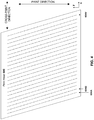
- FIG. 9A illustrates a multi-stripe digital input image that is particularly useful as a digital input calibration image (DICI).
- the image is divided into a plurality of stripes oriented along the cross-print direction.
- DICI digital input calibration image
- the stripe divisions of FIG. 9A are on the basis of position in the ‘printing direction’ and according to tone value.
- the further slice-subdivision of FIG. 9B yields a plurality of tiles TILE A A . . . TILE H J numbered as 712 (A,A) . . . 712 (H,J).
- 80 tiles are defined—80 being the product of the number of slices (8) and the number of stripes (10).
- Each stripe of the digital image of FIG. 9A has a uniform tone value.
- the digital input image has 10 stripes at 10 different tone-values. Because the tone-value of each stripe in the digital image is uniform, the average tone value within each tile within a specific stripe is necessarily equal to the average tone value of the slice as a whole. For the digital image, the respective tile-averaged tone values of each tile for all tiles within a particular stripe are all equal to each other.
- the resulting image When the digital image of FIG. 9A is printed to form the ink-image, the resulting image generally has the form of the digital image original—i.e. a plurality of generally monotonic stripes.
- the properties of the digital image described in the previous paragraph do not necessarily hold for the ink-image (i.e. where luminance values of the ink-image are considered instead of tone-values). Instead, the luminance value within each stripe may fluctuate.
- each stripe of the ink-image is divided into analogous tiles (i.e. according to the same slice-ranges used for the digital input image of FIG.
- tiles within each of the stripes do not necessarily share same tile-averaged luminance value, as was the case for the corresponding digital input image of FIG. 9B (i.e. where tile-average tone values were considered).
- tile-average tone values were considered.
- each tile within a stripe has both (i) an average position x in the cross-print direction (i.e. if the tile is defined by a slice having a range [x A ,x B ] in the cross print direction the average position x in the cross-print direction is (x A +x B )/2); and (ii) an average luminance value.
- target surface i.e. substrate or ITM
- DICI digital input calibration image
- DOCI digital output calibration image
- FIG. 10 also illustrates how the print bar length could be divided in subranges, some corresponding to the print heads, exemplified in the figure by 600 A to 600 D, other corresponding to further subdivision into smaller slices, exemplified in the figure by 704 A to 704 D.
- the width of a slice can be selected for any printing system according to each print bar and constituting print heads. In various embodiments, a slice has a width of no less than 4 pixels and optionally no more than 64 pixels, but this need not be limiting.
- the graph of FIG. 10 is a flat line at constant or “uniform” luminance value.
- Embodiments of the present invention relate to techniques for correcting for the non-uniformities similar to those presented in FIG. 10 .
- the first stage is a calibration stage where an ink-output is analyzed to generate correction data
- the second stage is an ‘online’ printing stage where the correction data is employed to reduce non-uniformities of the type presented in FIG. 10 .
- FIG. 11 is a flow chart of a method for calibration of a digital printer and subsequent on-line operation.
- FIGS. 12-15 relate to individual steps in FIG. 11 .
- FIGS. 11-15 will now be explained in terms of the digital image of FIGS. 9A-9B —however, once again it is noted that this is just an example and not intended as limiting.
- the calibration stage (i.e. steps S 101 -S 141 ) is based upon computing tone reproduction functions. In particular, it is possible to compute both (i) a print-bar wide tone reproduction function (see step S 121 and FIG. 12 which is an example implementation of step S 121 ) and (ii) a slice-specific tone reproduction functions for multiple slices in the cross-print direction see step S 131 and FIG. 13 which is an example implementation of step S 131 ).
- a print-bar wide tone reproduction function see step S 121 and FIG. 12 which is an example implementation of step S 121
- a slice-specific tone reproduction functions for multiple slices in the cross-print direction see step S 131 and FIG. 13 which is an example implementation of step S 131 .
- step S 101 of FIG. 11 a digital input-calibration-image DICI (e.g., that of FIGS. 9A-9B ) is printed on the target surface to generate an ink calibration-image.
- step S 111 the ink calibration-image is optically-imaged (e.g., scanned or photographed) to obtain therefrom a digital output-calibration-image DOCI.
- steps S 121 -S 141 the digital output-calibration-image DOCI is analyzed to generate calibration data. More specifically, (i) in steps S 121 and S 131 tone reproduction functions are computed; and (ii) in step S 141 , an image correction function ICF is computed from the tone reproduction functions.
- tone reproduction function describes the luminance obtained (i.e. by printing) in an ink image as a function of the tone-value in the digital image.
- FIG. 11 explains calibration and correction stages in terms of ‘off-line’ and ‘on-line.’ This is not a limitation as far as the former stage is concerned—any presently disclosed teaching may be implemented in the context of off-line calibration or on-line calibrations (e.g., instead of printing a single calibration image on a single target surface, different portions of the calibration image may be printed on different target surfaces, or portions thereof, or at different locations on a single target surface. Any reference herein to ‘off-line’ is therefore understood that ‘off-line’ is just a particular example of calibration stage. Additionally, ‘off-line’ and ‘on-line’ calibration may be combined.
- ‘off-line’ calibration may be conducted by printing a single calibration image on a single target surface to establish a first correction function, the efficacy of which may be subsequently monitored and/or ascertained using portions of a calibration image (e.g., same or different from first ‘off-line’ calibration image) printed on portions of different target surfaces (e.g., on the margins surrounding a desired image, to be possibly trimmed off if desired).
- the data acquired through ‘on-line’ calibration possibly in a ‘portion-wise’ manner on different target surfaces, can be combined to form a ‘complete’ calibration image to be analyzed as described in the exemplified context of ‘off-line’ calibration.
- Such ‘on-line’ calibration may prompt the generation of a second correction function.
- the DOCI (i.e. that was generated in step S 111 ) is analyzed in step S 121 (e.g., by electronic circuitry) to compute a representative bar-wide tone-reproduction function trf_bar_wide for the entire print bar.
- FIG. 12 describes one example of a technique for computing a bar-wide tone-reproduction function trf_bar_wide for the entire print bar.
- 10 ordered pairs are generated from the DOCI derived from this DICI.
- these 10 ordered pairs represent the print-bar-wide tone reproduction function.
- each stripe spans the entire image in the cross-print direction and is thus ‘print-bar-wide.’
- the average luminance value within a particular stripe is one example of a ‘print-bar-wide luminance value’ of a specific tone value (i.e. the digital input image tone value).
- a respective representative print-bar-wide luminance value is computed for each tone value (in this example, 10 tone values).
- These ordered pairs (Tone i bar-cal , representative_bar_wide_luminance(Tone i bar-cal )) (there are 10 of these pairs for the current example) may be said to represent the print-bar-wide tone reproduction function. Nevertheless, the function value is exactly represented only for 10 tone values. However, it is possible to interpolate between (or extrapolate past) these tone values and thus the print-bar-wide tone reproduction function may be computed for any arbitrary tone value from the ordered pair representation of the tone reproduction function.
- a “representative” value of luminance is some central tendency value (e.g., a first-order statistical moment such as an average, or a median value or any other representative value (e.g., a first statistical moment) known in the pertinent art).
- FIG. 14 is a graph of three tone reproduction functions—the tone reproduction function in the solid line is a bar-wide tone-reproduction function of the entire print bar.
- the DOCI (i.e. that was generated in step S 111 ) is analyzed in step S 131 (e.g., by electronic circuitry) to compute a plurality of slice-specific tone-reproduction functions specific to each slice.
- step S 131 e.g., by electronic circuitry
- 8 slice-specific tone reproduction functions are computed for slices 704 A- 704 H;
- each tone reproduction function is represented by 10 ordered pairs (tone value, average luminance value within a tile), where it is possible to interpolate between or extrapolate from the values of the 10 ordered pairs.
- 8 slices 704 A- 704 H collectively span the cross-print direction/the print-bar. For each slice slice[j], it is possible to compute a respective slice-specific tone-reproduction function trf_slice[j].
- the first slice 704 A slice[1] of the DOCI can be subdivided into 10 tiles: TILE A A . . . TILE A J .
- Each of these tiles is associated with a respective tone value of the 10 tone values in FIG. 9A .
- For each of these tiles it is possible to compute a respective tile-averaged luminance value.
- the slice[j]-calibration-set of tone values referred to in step S 325 of FIG. 13 is the same for each of the slices, and has 10 tone values ⁇ Tone Value 1 , Tone Value 2 . . . Tone Value 10 ⁇ , though this is not to be construed as a limitation.
- the slice[j]-calibration-set of tone values referred to in step S 325 of FIG. 13 is also the same as the bar-calibration-set of tone values referred to in Figure S301 of FIG. 12 .
- first slice 704 A slice[1] of the DOCI can—these ordered pairs are ⁇ (Tone Value 1 , average_luminance(TILE A A )), (Tone Value 2 , average_luminance(TILE A B )) . . . (Tone Value 10 , average_luminance(TILE A J )) ⁇ where the function average_luminance is the average luminance within a region of the DOCI (i.e. a region defined by a tile).
- These 10 ordered pairs serve as a representation of the tone reproduction function for the first slice 704 A.
- a slice is selected in step S 321 .
- the slice-specific tone reproduction function is computed for a plurality of discrete tone values, and in step S 329 the slice-specific tone reproduction function may be computed for other tone values by interpolation. If this procedure is complete for all slices (step S 333 ), the procedure terminates in step S 341 . Otherwise, another slice is selected S 337 and the procedure is repeated for the additional slice.
- FIG. 14 is a graph of three tone reproduction functions—the tone reproduction function in the solid line is a bar-wide tone-reproduction function of the entire print bar, while two of the functions in the broken line are slice-specific tone reproduction functions.
- step S 141 of FIG. 11 an image correction function ICF is computed from the tone bar-wide and slice-specific tone reproduction functions.
- ICF image correction function
- an image correction function ICF is computed piecewise for each slice of a plurality of slices.
- a slice is specified
- a tone shift function tsf (explained below) is computed for the specified slice
- steps S 379 and S 383 the ‘current slice’ is incremented if required.
- the luminance value obtained from an input tone value should be independent of location in the cross-print direction, and specified exactly by the print-bar-wide tone reproduction function trf_bar_wide that was computed in step S 121 of FIG. 11 .
- the slice-dependent tone reproduction functions each deviate from the print-bar-wide tone reproduction function trf_bar_wide.
- ICF image correction function
- a luminance obtained by printing any tone value is given by the print-bar-wide tone reproduction function trf_bar_wide—thus, for the tone-value 114 the luminance is 170.
- a tone value of 114 in the digital image yields a luminance value of 170 in the ink-image, irrespective of position in the cross-print direction.
- the tone value required to obtain a luminance of 170 depends on the position in the cross-print direction.
- inspection of trf_slice[1] indicates that in slice “1” slice[1], in order to obtain a luminance value of 170 the required tone value is 132 and
- inspection of trf_slice[2] indicates that in slice “2” slice[2], in order to obtain a luminance value of 170 the required tone value is 107.
- the tone shift functions are slice dependent.
- the tone shift function tsf_slice[1] should shift a tone value of 115 (which within the corresponding ink image would yield a luminance value of 170 in the absence of non-uniformities) to a tone value of 132.
- the tone shift function tsf_slice[2] should shift a tone value of 115 (which within the corresponding ink image would yield a luminance value of 170 in the absence of non-uniformities) to a tone value of 107.
- step S 375 the slice-specific tone-shift function tsf_slice[j] is set equal to trf_slice[j] ⁇ 1 (trf_bar_wide(tone)) where trf is an abbreviation for tone reproduction function, trf_slice[j] ⁇ 1 is the inverse function of the slice-specific tone reproduction function trf_slice[j] computed in step S 131 of FIG. 11 , and is trf_bar_wide the representative print-bar-wide tone reproduction function computed in step S 121 of FIG. 11 .
- step S 387 it is possible, in step S 387 , to derive the image correction function ICF—for example, for a given tone function and position in the cross-print direction the ICF may first require determining the relevant slice relevant_slice corresponding to the position in the cross-print direction, and then applying tsf_slice[relevant_slice] to the tone (i.e. shifting the tone).
- Steps S 201 - 211 relate to on-line operation according to the image correction function ICF corrected during the calibration stage.
- step S 201 the ICF is applied to a digital image to obtain a corrected digital image which, when printed by the printing system in step S 211 , is characterized by reduced deviations related to ‘image non-uniformities.’
- DOCI data (or DOCI luminance data) relates to output density values (e.g., luminance values) of the DOCI at location(s) therein.
- DOCI data of a ‘slice’ relates to output density values within the slice of the DOCI. It was already noted, above, that ‘luminance’ is only one example of an output density and whenever the term ‘luminance’ (or luminance data) appears it may refers to any output density (or data/values of any type of output density) including but not limited to ‘luminance.’
- a ‘derivative’ of a function ⁇ is not limited to its meaning in differential calculus (i.e. ⁇ ′ or
- the following functions may be considered a ‘derivative’ of DOCI data within a slice: (i) tone-reproduction functions as derived from DOCI data of the slice (ii) the tone-shift function as derived from DOCI data of the slice; and (iii) the image correlation function ICF as derived from DOCI of the slice.
- the trf_slice functions may be computed for any slice from the luminance of the DOCI within the slice.
- trf_slice[1] may be computed from the luminance of DOCI within slice[1]
- trf_slice[2] may be computed from the luminance of DOCI within slice[2]
- so on Since a slice of the DOCI is a ‘region’ of the DOCI, computing the trf function on a slice from luminance data within that slice is an example of computing the trf function from ‘regional-internal’ data.’
- trf_slice[i] or any slice[i] derivative of trf_slice[i]) on the luminance of regions of the DOCI outside of slice slice[i] (i is a positive integer).
- trf_slice[i] it is possible to compute the function trf_slice[i] function by the following steps: (i) determining trf_slice[j] function from luminance data within the DOCI(slice[j]) (where j is a positive integer, j ⁇ i); (ii) determining trf_slice[k] function from luminance data within the DOCI(slice[k]) (where k is a positive integer, k>i) and (iii) interpolating between the trf_slice[j] function on slice[j] and the function on slice[k] to compute the function on trf_slice[i].
- luminance data within DOCI(slice[i]) is considered ‘regional-internal’ and luminance data from portions of DOCI outside of DOCI(slice[i]) (e.g., in DOCI(slice[j]) and in DOCI(slice[k])) is considered ‘region-external.’
- trf on slice 1620 B may be preferable to derive trf on slice 1620 B from ‘region-internal’ DOCI luminance data within slice 1620 B since this ‘region-internal’ luminance data typically more accurately reflects printing within the slice 1620 B than interpolations from regions that are ‘external’ to slice 1620 B.
- luminance data of DOCI from slice 1620 B is ‘region-internal’ with respect to slice 1620 B; luminance data of DOCI from slices 1620 A and 1620 C are ‘region-external’ with respect to slice 1620 B.
- trf_slice[i] it is possible to compute the function trf_slice[i] function by to the following steps: (i) determining trf_slice[j] function from the DOCI(slice[j]) (where j is a positive integer, j ⁇ i); (ii) determining trf_slice[k] function from the DOCI(slice[k]) and (iii) extrapolating from trf_slice[j] function on slice[j] and the function trf_slice[k] on slice[k] to compute the function on trf_slice[i] on slice[j].
- trf may be computed by a mathematical combination (e.g., from multiple functions, each weighted by an appropriate weight). For the present disclosure, assigning a ‘lesser weight’ to a function applies to the case where a smaller non-zero weight is used, or by assigning a ‘zero weight’—i.e. not using the function.
- some portions of the range of the cross-print direction are exclusive to a ‘single print head’ (i.e. region 610 A is exclusive to Head A, region 610 C is exclusive to Head B, region 610 E is exclusive to Head C, region 610 G is exclusive to Head D), and (ii) some portions of the range of the cross-print direction are print-head ‘interlace regions’ including nozzles from two neighboring print heads—thus, region 610 B includes nozzles from print heads A and B, region 610 D includes nozzles from print heads B and C, and region 610 F includes nozzles from print heads C and D.
- slices 1620 D- 1620 G form the ‘mediating’ region which mediates between (i) the single-print-head-region exclusive to print head 1604 A which is formed by slices 1620 A- 1620 C and (ii) the single-print-head-region exclusive to print head 1604 B which is formed by slices 1620 H- 1620 I.
- each slice 1620 D- 1620 G is individually an ‘interlace region’ with respect to print heads 1604 A, 1604 B.
- trf-related function trf_related
- Print head 1604 A-nozzle locations within this mediating slice—some locations within the mediating slice (i.e. formed by slices 1620 D- 1620 G) are occupied by nozzles from print head 1604 A—as shown in FIG. 7A , these locations are NP 8 , NP 10 , NP 12 , NP 14 and NP 16 ).
- the trf-related function is computed from “region-external” DOCI luminance data (i.e. DOCI luminance data of slices 1620 A- 1620 C) rather than by relying only on region-internal DOCI luminance data of the mediating slice formed by slices 1620 D- 1620 G.
- Print head 1604 B-nozzle locations within this mediating slice—some locations within the mediating slice (i.e. formed by slices 1620 D- 1620 G) are occupied by nozzles from print head 1604 B—as shown in FIG. 7A , these locations are NP 9 , NP 11 , NP 13 , NP 15 and NP 17 ).
- the trf-related function is computed from “region-external” DOCI luminance data (i.e. DOCI luminance data of slices 1620 H- 1620 I) rather than by relying only on region-internal DOCI luminance data of the mediating slice formed by slices 1620 D- 1620 G.
- FIGS. 17A-17B illustrate, for a tone value of about 128, the ‘corrected tone value’ for different locations in the cross-print direction according to Technique A and Technique B.
- Techniques A and B are discussed below—presently, Technique A is presently preferred though in other embodiments, Technique B may be employed.
- the corrected tone value as a function of position in the cross-print direction is illustrated.
- the corrected tone value is the tsf(tone value) where (as noted above) tsf is an abbreviation for tone shift function.
- tsf is an abbreviation for tone shift function.
- a ‘corrected tone value’ of 128 indicates that no shift is required.
- slice 1704 A- 1704 I 7 slices are illustrated—slices 1704 A- 1704 I.
- Slices 1704 A, 1704 C, 1704 E, 1704 G and 1704 I are single-print-head slices and slices 1704 B, 1704 D, 1704 F and 1704 H are interlace slices which mediate between neighboring single-print-head slices.
- slice 1704 B mediates between neighboring slices 1704 A and 1704 C
- slice 1704 D mediates between neighboring slices 1704 C and 1704 E, and so on.
- the ink image may be divided into alternating single-print-head slices and interlace or stitch slices.
- nozzle positions only of nozzles of print head PH_A within the single-print head slice 1704 A are the nozzle positions only of nozzles of print head PH_A, within the single-print head slice 1704 C are the nozzle positions only of nozzles of print head PH_C (in this example, there is no print head labeled ‘PH_B’), and so on.
- Within mediating region 1704 B are nozzle positions of both print head PH_A and PH_C (i.e. interlaced)
- within mediating region 1704 D are nozzle positions of both print head PH_C and PH_E (i.e. interlaced) and so-on.
- the tone-shift function (i.e. illustrated by the ‘corrected tone’ value) and the ICF are computed primarily from DOCI luminance data within the respective single-print head slice.
- the tone-shift function (and the derived ICF) within 1704 A is computed primarily from DOCI data of the slice 1704 A
- the tone-shift function (and the derived ICF) within 1704 C is computed primarily from DOCI data of the slice 1704 C, and so on.
- the interlace slices 1704 B, 1704 D, 1704 F and 1704 H are handled differently.
- FIG. 17A within mediating slice 1704 B (e.g., a slice that is not a single print-head slice like 1704 A and 1704 C—e.g., slice 1704 B is an interlacing or stitch slice), there are two extrapolation functions—a first extrapolation function from one of the neighboring single-print-head slices 1704 A (having a “left position” relative to mediating slice 1704 B) and a second extrapolation function from the other of the neighboring single-print-head slices 1704 C (having a “right position” relative to mediating slice 1704 B).
- ‘left extrapolations’ i.e.
- extrapolations from the left neighbor of a mediating or interlace slice—for mediating slice 1704 B this refers to extrapolation from single-print-head slice 1704 A) are illustrated by the ‘square’ symbol
- ‘right extrapolations’ i.e. extrapolations from the right neighbor of a mediating or interlace slice—for mediating slice 1704 B this refers to extrapolation from single-print-head slice 1704 C
- ‘asterisk’ symbol i.e. extrapolations from the right neighbor of a mediating or interlace slice—for mediating slice 1704 B this refers to extrapolation from single-print-head slice 1704 C
- the corrected tone value (designated by the asterisks) within 1704 F is, roughly speaking, approximated by a line between (1.65, 125) and (1.71, 140) and is monotonically increasing on most of the slice 1704 F (i.e. most of the portion between about 1.65 and 1.71 ⁇ 10 4 pixel of the X-axis.
- the corrected tone value ‘jumps’ between (i) values of a ‘first approximation function’ appropriate for ‘print head A’ nozzles (i.e.
- FIG. 18 illustrates the function of FIG. 17A (i.e. computed according to ‘Technique A’) within slice 1704 F for 10 points.
- Each point of FIG. 18 is an ordered pair (x,y) where x is position in the cross-print direction and y is the corrected tone value.
- the points of FIG. 8 are thus (Pos A , corrected_tone_value(Pos A )), (Pos B , corrected_tone_value(Pos B )), and so on.
- the positions Pos A , Pos B , Pos E , Pos G , Pos I and Pos J (which define x values of points A, B, E, G, I and J) all correspond to positions of a nozzle of print-head PH_E.
- the positions Pos C , Pos D , Pos E , Pos H and Pos K (which define x values of points C, D, F, H and K) all correspond to positions of a nozzle of print-head PH_G.
- the corrected tone-value function is computed by extrapolating the ‘corrected tone-value function’ of slice 1704 E;
- the corrected tone-value function (i.e. and hence the ICF) is computed by extrapolating the ‘corrected tone-value function’ of slice 1704 G.
- the printing system is configured so that images produced by the print-bar thereof are dividable into alternating single-print-head slices and interlace slices—i.e. moving from left to right one alternatively passes through single-print-head slices and interlace slices.
- the ICF is derived primarily from region-internal DOCI data.
- the ICF is derived primarily from DOCI data of slice 1704 A
- the ICF is derived primarily from DOCI data of slice 1704 C, and so on.
- the ICF is derived primarily from extrapolation of region-external DOCI data.
- the ICF is derived primarily from extrapolation of DOCI data from region-external DOCI data (i.e. DOCI data from slices 1704 A and/or 1704 C is ‘region-external’ with respect to slice 1704 B)
- the ICF is derived primarily from extrapolation of DOCI data from region-external DOCI data (i.e. DOCI data from slices 1704 C and/or 1704 E is ‘region-external’ with respect to slice 1704 D), and so on.
- the printing system is configured so that images produced by the print-bar thereof comprise first 1704 E and second 1704 G distinct single-print-head slices and a mediating slice 1704 F (e.g., this also may be an ‘interlacing’ slice) therebetween—for example, slices 1704 E and 1704 G are respectively exclusive for first PH_E and second PH_G print-head.
- the mediating slice 1704 F includes first ⁇ Pos A , Pos B , Pos E , Pos G , Pos I and Pos J ⁇ and second ⁇ Pos C , Pos D , Pos F , Pos H and Pos K ⁇ sets of positions interlaced therein, positions of the first and second set respectively corresponding to nozzle positions for nozzles of the first PH_E and second PH_G print heads.
- the deriving of the ICF includes computing first (illustrated by hollow squares) and second (illustrated by asterisks) extrapolation functions respectively describing extrapolation from the first 1704 E and second 1704 G single-print-head slices into the mediating region 1704 F of DOCI data, or a derivative thereof—in this case the ‘derivative’ of the DOCI data is the corrected tone-value function which is derived from DOCI data (see, for example, FIGS. 11 and 15 ).
- the ICF is derived primarily from the first extrapolation function (illustrated by hollow squares) and (B) at positions ⁇ Pos C , Pos D , Pos F , Pos H and Pos K ⁇ of the second set, the ICF is derived primarily from the second extrapolation function (illustrated by the asterisks)
- the printing system is configured so that images produced by the print-bar thereof comprise first 1704 E and second 1704 G of single-print-head slices (e.g., distinct, non-overlapping slices) and a slice 1704 F therebetween (i.e. a mediating slice—e.g., an interlace slice), the first and second single-print-head slices being respectively exclusive for first PH_E and second PH_G print-heads.
- first 1704 E and second 1704 G of single-print-head slices e.g., distinct, non-overlapping slices
- a slice 1704 F therebetween i.e. a mediating slice—e.g., an interlace slice
- the interlace 1704 F slice includes first ⁇ Pos A , Pos B , Pos E , Pos G , Pos I and Pos J ⁇ and second ⁇ Pos C , Pos D , Pos F , Pos H and Pos K ⁇ sets of positions interlaced therein, positions of the first and second set respectively corresponding to nozzle positions for nozzles of the first PH_E and second PH_G print heads
- the ICF is computed by determining if a position in the mediating region corresponds to a nozzle position of the first print-head (e.g., if a position within 1704 F corresponds to a nozzle-position of a nozzle of print head PH_E, the ‘hollow square’ extrapolation from slice 1704 E is used) or of the second print-head (e.g., if a position within 1704 F corresponds to a nozzle-position of a nozzle of print head PH_G, the ‘asterisk’ extrapolation from slice 1704 G is used) print-head and the ICF is computed according to the results of the determining (i.e. the determining of the ‘print head’ source of a nozzle position within interlace region 1704 G).
- the mediating region 1704 F includes a first P 1 and a second P 2 positions (e.g., in FIG. 18 , the ‘first’ position can be Pos D and the ‘second’ position can be Pos E ), the first position P 1 being closer than the second P 2 position to the first single-print-head slice 1704 E (e.g., in FIG. 18 , Pos D is closer to slice 1704 E than Pos E is to slice 1704 E), the second position P 2 being closer to the second single-print-head slice 1704 G than the first position P 1 is to the second single-print-head slice (e.g., in FIG. 18 , Pos E is closer than Pos D to slice 1704 G).
- the deriving of the ICF includes computing first and second extrapolation functions (e.g., the first extrapolation function being illustrated in FIG. 18 by hollow squares and the second extrapolation function being illustrated by asterisks) respectively describing extrapolation from the first 1704 E and second 1704 G single-print-head slices into the mediating region 1704 G of DOCI data, or a derivative thereof (i.e. a derivative of the DOCI data—e.g., corrected-tone value function).
- first and second extrapolation functions e.g., the first extrapolation function being illustrated in FIG. 18 by hollow squares and the second extrapolation function being illustrated by asterisks
- a derivative thereof i.e. a derivative of the DOCI data—e.g., corrected-tone value function
- a greater weight is assigned to the second extrapolation function than to the first extrapolation function—e.g., when computing the ICF for Pos D of FIG. 18 , a greater weight is assigned to extrapolation from slice 1704 G (i.e. asterisks) than to extrapolation from slice 1704 E (i.e. hollow squares).
- a greater weight is assigned to the first extrapolation function than to the second extrapolation function—e.g., when computing the ICF for Pos E of FIG. 18 , a greater weight is assigned to extrapolation from slice 1704 E (i.e. hollow squares) than to extrapolation from slice 1704 G (i.e. asterisks).
- FIG. 10 illustrates (according to one example) for an ink image on a printing ‘target surface’ (i.e. substrate or ITM) the luminance as a function of cross-print-direction position for an example stripe having a tone-value and/or ‘intended luminance’ of about 158.0. Due to non-uniformity effects, the luminance is not, in fact, constant, but rather fluctuates as a function of position in the cross-print-direction, as shown in FIG. 10 .
- target surface i.e. substrate or ITM
- FIG. 19 illustrates (according to one example) the luminance as a function of cross-print-direction position when instead of printing the uncorrected digital input image, the digital input image is first corrected according to teachings disclosed herein.
- the standard deviation luminance i.e. indicating fluctuations around a mean
- the standard deviation is 1.4 (or less than 1%).
- the printing systems schematically illustrated in FIGS. 1 and 2 essentially includes three separate and mutually interacting systems, namely a blanket support system 100 , an image forming system 300 above the blanket system 100 , and a substrate transport system 500 below the blanket system 100 . While circulating in a loop, the blanket passes through various stations including a drying station 400 and at least one impression station 550 .
- the intermediate transfer member is an endless flexible belt
- the present invention is equally applicable to printing systems wherein the intermediate transfer member is a drum (schematically illustrated in FIG. 3 ), the specific designs of the various stations being accordingly adapted.
- the blanket system 100 includes an endless belt or blanket 102 that acts as an intermediate transfer member (ITM) and is guided over two or more rollers.
- ITM intermediate transfer member
- Such rollers are illustrated in FIG. 2A as elements 104 and 106 , whereas FIG. 2C displays two additional such blanket conveying rollers as 108 and 110 .
- One or more guiding roller is connected to a motor, such that the rotation of the roller is able to displace the blanket in the desired direction, and such cylinder may be referred to as a driving roller.
- the term “printing direction” means a direction from the image forming station where printing heads apply ink to outer surface of the ITM towards the location of the impression station, where the ink image is ultimately transferred to the printing substrate. In FIGS. 1 and 2 , the printing direction is illustrated as clockwise.
- the blanket can have multiple layers to impart desired properties to the transfer member.
- the transfer member may include in its underlying body any one of a reinforcement layer (e.g., a fabric) to provide desired mechanical characteristics (e.g., resistance to stretching), a compressible layer so that the blanket or the drum surface can conform to the printing substrate during transfer, a conformational layer to provide to the surface of the release layer sufficient conformability toward the topography of a substrate surface, and various other layers to achieve any desired friction, thermal and electrical properties or adhesion/connection between any such layers.
- a reinforcement layer e.g., a fabric
- desired mechanical characteristics e.g., resistance to stretching
- a compressible layer so that the blanket or the drum surface can conform to the printing substrate during transfer
- a conformational layer to provide to the surface of the release layer sufficient conformability toward the topography of a substrate surface
- various other layers to achieve any desired friction, thermal and electrical properties or adhesion/connection between any such layers.
- FIG. 2A illustrates a printing system suitable for use with a “thick belt”
- FIG. 2C illustrates a printing system suitable for a “thin belt”.
- an image made up of droplets of an aqueous ink is applied by image forming system 300 to an upper run of blanket 102 at a location referred herein as the image forming station.
- the term “run” is used to mean a length or segment of the blanket between any two given rollers over which the blanket is guided.
- the image forming system 300 includes print bars 302 which may each be slidably mounted on a frame positioned at a fixed height above the surface of the blanket 102 and include a strip of print heads with individually controllable print nozzles through which the ink is ejected to form the desired pattern.
- the image forming system can have any number of bars 302 , each of which may contain an ink of a different or of the same color, typically each jetting Cyan (C), Magenta (M), Yellow (Y) or Black (K) inks. It is possible for the print bars to deposit different shades of the same color (e.g., various shades of gray, including black) or customized mix of colors (e.g., brand colors) or for two print bars or more to deposit the same color (e.g., black). Additionally, the print bar can be used for pigmentless liquids (e.g., decorative or protective varnishes) and/or for specialty inks (e.g., achieving visual effect, such as metallic, sparkling, glowing or glittering look, or even scented effect).
- C Cyan
- M Magenta
- Y Yellow
- K Black
- the ink may be constantly recirculated, filtered, degassed and maintained at a desired temperature and pressure, as known to the person skilled in the art without the need for more detailed description.
- the blanket 102 it is of course essential for their operation to be correctly synchronized with the movement of blanket 102 . It is important for the blanket 102 to move with constant speed through the image forming station 300 , as any hesitation or vibration will affect the registration of the ink droplets of different colors.
- a blower 304 following each print bar 302 to blow a slow stream of a hot gas, preferably air, over the intermediate transfer member to commence the drying of the ink droplets deposited by the print bar 302 .
- a hot gas preferably air
- Such post jetting treatment of the just deposited ink droplets need not substantially dry them, but only enable the formation of a skin on their outer surface.
- the image forming station illustrated in FIG. 2C comprises optional rollers 132 to assist in guiding the blanket smoothly adjacent each printing bar 302 .
- the rollers 132 need not be precisely aligned with their respective print bars and may be located slightly (e.g., few millimeters) downstream or upstream of the print head jetting location.
- the frictional forces can maintain the belt taut and substantially parallel to the print bars.
- the underside of the blanket may therefore have high frictional properties as it is only ever in rolling contact with all the surfaces on which it is guided.
- FIG. 2A shows two impression stations with two impression cylinders 502 and 504 of the substrate transport system 500 and two respectively aligned pressure or nip rollers 142 , 144 , which can be raised and lowered from the lower run of the blanket.
- an impression cylinder and its corresponding pressure roller are both engaged with the blanket passing there-between, they form an impression station 550 .
- duplex printing is to permit duplex printing.
- the perfecting of the substrate is implemented by a perfecting cylinder 524 situated in between two transport rollers 522 and 526 which respectively transfer the substrate from the first impression cylinder 502 to the perfecting cylinder 524 and therefrom on its reverse side to the second impression cylinder 504 .
- duplex printing can also be achieved with a single impression station using an adapted perfecting system able to refeed to the impression station on the reverse side a substrate already printed on its first side. In the case of a simplex printer, only one impression station would be needed and a perfecting system would be superfluous. Perfecting systems are known in the art of printing and need not be detailed.
- FIG. 2C illustrates an alternative printing system suitable for a “thin belt” looped blanket which is compressed during engagement with the impression cylinder 506 by a pressure roller 146 which to achieve intimate contact between the release layer of the ITM and the substrate comprises the compressible layer substantially absent from the body of the transfer member.
- the compressible layer of the pressure roller 146 typically has the form of a replaceable compressible blanket 148 .
- Such compressible layer or blanket is releasably clamped or attached onto the outer surface of the pressure cylinder 146 and provides the conformability required to urge the release layer of the blanket 102 into contact with the substrate sheets 501 .
- Rollers 108 and 114 on each side of the impression station, or any other two rollers spanning this station closer to the nip (not shown), ensure that the belt is maintained in a desired orientation as it passes through the nip between the cylinders 146 and 506 of the impression station 550 .
- both the impression cylinder 506 and the pressure roller 146 bearing a compressible layer or blanket 148 can have as cross section in the plane of rotation a partly truncated circular shape.
- the pressure roller there is a discontinuity where the ends of the compressible layer are secured to the cylinder on which it is supported.
- the impression cylinder and pressure roller of impression station 550 rotate in synchronism so that the two discontinuities line up during cycles forming periodically an enlarged gap at which time the blanket can be totally disengaged from any of these cylinders and thus be displaced in suitable directions to achieve any desired alignment or at suitable speed that would locally differ from the speed of the blanket at the image forming station.
- This can be achieved by providing powered tensioning rollers or dancers 112 and 114 on opposite sides of the nip between the pressure and impression cylinders.
- roller 114 is illustrated in FIG. 2C as being in contact with the inner/underneath side of the blanket, alignment can similarly be achieved if it were positioned facing the release layer.
- ink images are printed by the image forming system 300 onto an upper run of blanket 102 . While being transported by the blanket 102 , the ink is heated to dry it by evaporation of most, if not all, of the liquid carrier.
- the carrier evaporation may start at the image forming station 300 and be pursued and/or completed at a drying station 400 able to substantially dry the ink droplets to form a residue film of ink solids remaining after evaporation of the liquid carrier.
- the residue film image is considered substantially dry or the image dried if any residual carrier they may contain does not hamper transfer to the printing substrate and does not wet the printing substrate.
- the dried ink image can be further heated to render tacky the film of ink solids before being transferred to the substrate at an impression station.
- Such optional pre-transfer heater 410 is shown in FIG. 2C .
- FIGS. 2A and 2C depict the image being impressed onto individual sheets 501 of a substrate which are conveyed by the substrate transport system 500 from an input stack 516 to an output stack 518 via the impression cylinders 502 , 504 or 506 .
- the substrate may be a continuous web, in which case the input and output stacks are replaced by a supply roller and a delivery roller.
- the substrate transport system needs to be adapted accordingly, for instance by using guide rollers and dancers taking slacks of web to properly align it with the impression station.
- Printing systems wherein the present invention may be practiced can comprise a drying system 400 .
- any drying system able to evaporate the ink carrier out of the ink image deposited at the image forming station 300 to substantially dry it by the time the image enters the impression station is suitable.
- Such system can be formed from one or more individual drying elements typically disposed above the blanket along its path.
- the drying element can be radiant heaters (e.g., IR or UV) or convection heaters (e.g., air blowers) or any other mean known to the person of skill in the art.
- the settings of such a system can be adjusted according to parameters known to professional printers, such factors including for instance the type of the inks and of the transfer member, the ink coverage, the length/area of the transfer member being subject to the drying, the printing speed, the presence/effect of a pre-transfer heater etc.
- Each station of such printing systems may be operated at same or different temperatures.
- the operating temperatures are typically selected to provide the optimal temperature suitable to achieve the purported goal of the specific station, preferably without negatively affecting the process at other steps. Therefore as well as providing heating means along the path of the blanket, it is possible to provide means for cooling it, for example by blowing cold air or applying a cooling liquid onto its surface.
- the treatment station may serve as a cooling station.
- the temperature at various stage of the process may also vary depending on the exact composition of the ITM, the inks and the conditioning fluid, if needed, being used and may even fluctuate at various locations along a given station.
- the temperature on the outer surface of the ITM at the image forming station is in a range between 40° C. and 160° C., or between 60° C. and 90° C.
- the temperature at the drying station is in a range between 90° C. and 300° C., or between 150° C. and 250° C., or between 180° C. and 225° C.
- the temperature at the impression station is in a range between 80° C. and 220° C., or between 100° C.
- the cooling temperature may be in a range between 40° C. and 90° C.
- the temperature of the transfer member may be raised by heating means positioned externally to the blanket support system, as illustrated by any of heaters 304 , 400 and 410 , when present in the printing system.
- the transfer member may be heated from within the support system. Such an option is illustrated by heating plates 130 of FIG. 2A .
- any of the guiding rollers conveying the looped blanket may also comprise internal heating elements.
- the ITM can be a belt formed of an initially flat elongate blanket strip of which the ends can be releasably fastened or permanently secured to one another to form a continuous loop.
- a releasable fastening for blanket 102 may be a zip fastener or a hook and loop fastener that lies substantially parallel to the axes of rollers 104 and 106 over which the blanket is guided.
- a zip fastener for instance, allow easy installation and replacement of the belt.
- a permanent securing may be achieved by soldering, welding, adhering, and taping the ends of the blanket to one another.
- the continuous belt may be formed by more than one elongated blanket strip and may therefore include more than one seam.
- the seam In order to avoid a sudden change in the tension of the belt as the seam passes over rollers or other parts of the support system, it is desirable to make the seam, as nearly as possible, of the same thickness as the remainder of the blanket. It is desirable to avoid an increase in the thickness or discontinuity of chemical and/or mechanical properties of the belt at the seam. Preferably, no ink image or part thereof is deposited on the seam, but only as close as feasible to such discontinuity on an area of the belt having substantially uniform properties/characteristics. Desirably, the seam passes impression stations at a time their impression rollers are not engaged with their corresponding pressure rollers. Alternatively, the belt may be seamless.
- the blanket support system further includes a continuous track that can engage formations on the side edges of the blanket to maintain the blanket taut in its width ways direction.
- the formations may be spaced projections, such as the teeth of one half of a zip fastener sewn or otherwise attached to each side edge of the blanket. Such lateral formations need not be regularly spaced. Alternatively, the formations may be a continuous flexible bead of greater thickness than the blanket.
- the lateral formations may be directly attached to the edges of the blanket or through an intermediate strip that can optionally provide suitable elasticity to engage the formations in their respective guiding track, while maintaining the blanket flat in particular at the image forming station.
- the lateral track guide channel may have any cross-section suitable to receive and retain the blanket lateral formations and maintain it taut. To reduce friction, the guide channel may have rolling bearing elements to retain the projections or the beads within the channel.
- the lateral formations may be made of any material able to sustain the operating conditions of the printing system, including the rapid motion of the blanket. Suitable materials can resist elevated temperatures in the range of about 50° C. to 250° C. Advantageously, such materials are also friction resistant and do not yield debris of size and/or amount that would negatively affect the movement of the belt during its operative lifespan.
- the lateral projections can be made of polyamide reinforced with molybdenum disulfide.
- lateral guide channels ensure accurate placement of the ink droplets on the blanket, their presence is particularly advantageous at the image forming station 300 .
- lateral guide channels may be desirable but less important.
- no guide channels are present.
- Such lateral formations and corresponding guide channels are typically not necessary when the intermediate transfer member is mounted on a rigid support.
- the ends of the blanket strip are advantageously shaped to facilitate guiding of the belt through the lateral channels and over the rollers during installation.
- Initial guiding of the belt into position may be done for instance by securing the leading edge of the belt strip introduced first in between the lateral channels to a cable which can be manually or automatically moved to install the belt.
- a cable which can be manually or automatically moved to install the belt.
- one or both lateral ends of the belt leading edge can be releasably attached to a cable residing within each channel. Advancing the cable(s) advances the belt along the channel path.
- the edge of the belt in the area ultimately forming the seam when both edges are secured one to the other can have lower flexibility than in the areas other than the seam. This local “rigidity” may ease the insertion of the lateral formations of the belt strip into their respective channels.
- the blanket support system may comprise various additional optional subsystems.
- the intermediate transfer member may be optionally treated to further increase the interaction of the compatible ink with the ITM, or further facilitate the release of the dried ink image to the substrate, or provide for a desired printing effect.
- the treating station may apply a physical treatment or a chemical treatment.
- the ITM is treated with a chemical agent also termed conditioning agent.
- the compositions being applied to the intermediate transfer member are often referred to as treatment solutions or conditioning fluids and the station at which such treatment may take place is referred to as a conditioning station.
- This station is typically located upstream the image forming station and the treatment is applied before an ink image is jetted.
- Such a station is schematically illustrated in FIG. 2A as roller 190 positioned on the external side of the blanket adjacent to roller 106 and in FIG. 2C as applicator 192 .
- Such a roller 190 or applicator 192 may be used to apply a thin even film of treatment solution containing a conditioning chemical agent.
- the conditioning fluid can alternatively be sprayed onto the surface of the blanket and optionally spread more evenly, for example by the application of a jet from an air knife.
- the conditioning solution may be applied by passing the blanket over a thin film of conditioning solution seeping through a cloth having no direct contact with the surface of the release layer.
- Surplus of treatment solution if any, can be removed by air knife, scrapper, squeegee rollers or any suitable manner.
- the film of conditioning solution being applied is typically very thin, the blanket surface is substantially dry upon entry through the image forming station.
- the conditioning solution is applied with every cycle of the belt. Alternatively, it may be applied periodically at intervals of suitable number of cycles.
- the blanket system may further comprise a cleaning station which may be used to gently remove any residual ink images or any other trace particle from the release layer. Such cleaning step may for instance be applied in between printing jobs to periodically “refresh” the belt.
- the cleaning station may comprise one or more devices each individually configured to remove same or different types of undesired residues from the surface of the release layer.
- the cleaning station may comprise a device configured to apply a cleaning fluid to the surface of the transfer member, for example a roller having cleaning liquid on its circumference, which preferably should be replaceable (e.g., a pad or piece of paper). Residual particles may optionally be further removed by an absorbent roller or by one or more scraper blades.
- the above descriptions are simplified and provided only for the purpose of enabling an understanding of exemplary printing systems and processes with which the presently claimed invention may be used.
- a number of different elements of the system must be properly synchronized.
- the position and speed of the blanket must be both known and controlled.
- the blanket can be marked at or near its edge with one or more markings spaced in the direction of motion of the blanket.
- One or more sensors can be located in the printing system along the path of the blanket to sense the timing of these markings as they pass the sensor.
- Signals from the sensor(s) can be sent to a controller which may also receive an indication of the speed of rotation and angular position of any of the rollers conveying the blanket, for example from encoders on the axis of one or both of the impression rollers.
- the sensor(s) may also determine the time at which the seam of the blanket passes the sensor. For maximum utility of the usable length of the blanket, it is desirable that the images on the blanket start as close to the seam as feasible.
- the control of the various stations of the printing system is important but need not be considered in detail in the present context. Exemplary control systems that may be suitable for printing systems in which the present invention can be practiced are disclosed in PCT Publication No. WO 2013/132424.
- a method of digital printing by a printing system configured to convert digital input images into ink images by droplet deposition onto a target surface.
- the printing system comprises a multi-nozzle and multi-head print bar that defines print and cross-print directions.
- the method comprises a. performing a calibration by: i. printing on the target surface a digital input-calibration-image DICI by the print-bar of the printing system so as to generate an ink calibration-image; ii. optically imaging the ink calibration-image to obtain a digital output-calibration-image DOCI; iii. computing from the digital output-calibration-image DOCI a representative print-bar tone-reproduction-function trf(bar) for the entire print bar; iv.
- tsfs(DOCI) ⁇ tsf_slice 1 (DOCI)(tone-value), tsf_slice 2 (DOCI)(tone-value), . . . tsf_slice N (DOCI)(tone-value) ⁇ of slice-specific tone-shift functions; and vi.
- a method of digital printing by a printing system configured to convert digital input images into ink images by droplet deposition onto a target surface.
- the printing system comprises a multi-nozzle and multi-head print bar that defines print and cross-print directions.
- the method comprises a. performing a calibration by: i. printing on the target surface a digital input-calibration-image DICI by the print-bar of the printing system so as to generate an ink calibration-image; ii. optically imaging the ink calibration-image to obtain a digital output-calibration-image DOCI; iii. computing from the digital output-calibration-image DOCI a representative print-bar tone-reproduction-function trf(bar) for the entire print bar; iv.
- the printing system is configured so that images produced by the print-bar thereof are dividable into alternating single-print-head slices and interlace slices; ii. within the single-print-head slices, the ICF is derived primarily from region-internal DOCI data; and iii. within the interlace slices, the ICF is derived primarily from extrapolation of region external DOCI data.
- the printing system is configured so that images produced by the print-bar thereof comprise first and second distinct single-print-head slices and a mediating slice therebetween, the first and second single-print-head slices being respectively exclusive for first and second print-heads;
- the mediating slice includes first and second sets of positions interlaced therein, positions of the first and second set respectively corresponding to nozzle positions for nozzles of the first and second print heads;
- the deriving of the ICF includes computing first and second extrapolation functions respectively describing extrapolation from the first and second single-print-head slices into the mediating region of DOCI data, or a derivative thereof; and iv. within the mediating region, (A) at positions of the first set, the ICF is derived primarily from the first extrapolation function and (B) at positions of the second set, the ICF is derived primarily from the second extrapolation function.
- the printing system is configured so that images produced by the print-bar thereof comprise first and second of distinct single-print-head slices and a interlace slice therebetween, the first and second single-print-head slices being respectively exclusive for first and second print-heads;
- the interlace slice includes first and second sets of positions interlaced therein, positions of the first and second set respectively corresponding to nozzle positions for nozzles of the first and second print heads; and iii. within the interlace region, the ICF is computed by determining if a position in the mediating region corresponds to a nozzle position of the first print-head or the second print-head, and the ICF is computed according to the results of the determining.
- the printing system is configured so that images produced by the print-bar thereof comprise first and second of distinct single-print-head slices and a mediating slice therebetween, the first and second single-print-head slices being respectively exclusive for first and second print-heads;
- the mediating region includes first P 1 and second P 2 positions, the first position P 1 being closer to the first single-print-head slice than the second P 2 position is to the first single-print-head slice, the second position P 2 being closer to the second single-print-head slice than the first position P 1 is to the second single-print-head slice; iii.
- the deriving of the ICF includes computing first and second extrapolation functions respectively describing extrapolation from the first and second single-print-head slices into the mediating region of DOCI data, or a derivative thereof; and iv. when computing ICF for the first position, a greater weight is assigned to the second extrapolation function than to the first extrapolation function; and v. when computing ICF for the second position, a greater weight is assigned to the first extrapolation function than to the second extrapolation function.
- the target surface is a surface of an intermediate transfer member (ITM) of the printing system and the ink images formed on the ITM surface by the droplet deposition are subsequently transferred from the ITM to a printing substrate.
- ITM intermediate transfer member
- the ITM is a drum.
- the ITM is a belt.
- the ink and/or target surface may provide any feature or combination of features disclosed in any of the following published patent applications, each of which are incorporated herein by reference in its entirety: WO 2013/132439; WO 2013/132432; WO 2013/132438; WO 2013/132339; WO 2013/132343; WO 2013/132345; and WO 2013/132340.
- the calibration image comprises a plurality of stripes, each having a uniform tone value.
- the stripes of the calibration image having same tone value span the entire print-bar.
- the digital input-calibration-image or portions thereof is printed on a single target surface.
- the digital input-calibration-image or portions thereof is printed on two or more different target surfaces.
- the calibration is performed off-line.
- the target surface consists of the calibration image or portions thereof that may be subsequently combined.
- the calibration is performed on-line.
- the target surface consists of a desired image and of the calibration image or portions thereof.
- the calibration image, or portions thereof that may be subsequently combined is printed on two or more different target surfaces.
- the calibration image or portions thereof can be printed on areas of the target surface not overlapping the desired image (e.g., in margins).
- the printing system comprises a plurality of print bars, each said print-bar depositing an ink having same or different color, the calibration being performed separately for each ink having a different color and/or for each print bar.
- the calibration is performed sequentially more than once to further refine the computing of the corrected digital image CDI—for example, after affecting a first correction the results may be analyzed and, if appropriate, an additional correction may be performed.
- the calibration is sequentially performed by sequences of any of off-line and on-line calibration stages that may be the same or different.
- the sequences of calibration can be off-line and off-line calibration, off-line and on-line calibration, on-line and off-line calibration, on-line and on-line calibration, and further combinations.
- Such multiple calibrations need not be immediately sequential, the “sequence” being “interrupted” by the printing of desired images on the target surfaces, such printing being devoid of calibration.
- the droplet deposition is by ink jetting.
- the ink images are deposited at a resolution between 100 dpi and 2000 dpi.
- the width of a slice of any slice disclosed herein is no less than 5 pixels, or is no less than 10 pixels, or no less than 20 pixels, or no less than 40 pixels, or no less than 60 pixels, or no less than 100 pixels.
- the target surface is a surface of an intermediate transfer member (ITM) (e.g., a drum or belt) of the printing system and the ink images formed on the ITM surface by the droplet deposition are subsequently transferred from the ITM to a printing substrate.
- ITM intermediate transfer member
- the ink images are deposited on a target surface being a printing substrate (e.g., selected from fibrous and non fibrous, coated and uncoated, flexible and rigid, sheets and webs delivered substrate of paper, cardboard, plastic and additional suitable material).
- a printing substrate e.g., selected from fibrous and non fibrous, coated and uncoated, flexible and rigid, sheets and webs delivered substrate of paper, cardboard, plastic and additional suitable material.
- the calibration is done upon installation or change of one or more print-heads within a print-bar.
- each of the verbs “comprise”, “include” and “have”, and conjugates thereof, are used to indicate that the object or objects of the verb are not necessarily a complete listing of features, members, steps, components, elements or parts of the subject or subjects of the verb.
- adjectives such as “substantially” and “about” that modify a condition or relationship characteristic of a feature or features of an embodiment of the present technology are to be understood to mean that the condition or characteristic is defined to within tolerances that are acceptable for operation of the embodiment for an application for which it is intended.
- each of the verbs “comprise”, “include” and “have”, and conjugates thereof, are used to indicate that the object or objects of the verb are not necessarily a complete listing of members, components, elements or parts of the subject or subjects of the verb.
- the singular form “a”, “an” and “the” include plural references unless the context clearly dictates otherwise.
- the term “an impression station” may include more than one such station.
Landscapes
- Ink Jet (AREA)
Abstract
Description
-
- Thus, for
slice 1 slice[1], tsf_slice[1] (115)=trf_slice[1]−1(trf_bar_wide(115))=trf_slice[1]−1(170)=132, the desired result. - For
slice 2 slice[1], tsf_slice[1] (115)=trf_slice[j]−1 (trf_bar_wide(115))=trf_slice[2]−1 (170)=107, the desired result.
- Thus, for
but rather refers to any function ‘derived’ from the function ƒ. By way of example (and referring to
Claims (11)
Priority Applications (5)
| Application Number | Priority Date | Filing Date | Title |
|---|---|---|---|
| US16/226,726 US10569534B2 (en) | 2012-03-05 | 2018-12-20 | Digital printing system |
| US16/737,859 US11104123B2 (en) | 2012-03-05 | 2020-01-08 | Digital printing system |
| US17/382,285 US11607878B2 (en) | 2012-03-05 | 2021-07-21 | Digital printing system |
| US18/107,874 US12053978B2 (en) | 2012-03-05 | 2023-02-09 | Digital printing system |
| US18/743,386 US20240416646A1 (en) | 2012-03-05 | 2024-06-14 | Digital printing system |
Applications Claiming Priority (19)
| Application Number | Priority Date | Filing Date | Title |
|---|---|---|---|
| US201261606913P | 2012-03-05 | 2012-03-05 | |
| US201261611286P | 2012-03-15 | 2012-03-15 | |
| US201261619016P | 2012-04-02 | 2012-04-02 | |
| US201261619546P | 2012-04-03 | 2012-04-03 | |
| US201261635156P | 2012-04-18 | 2012-04-18 | |
| US201261640493P | 2012-04-30 | 2012-04-30 | |
| PCT/IB2013/051717 WO2013132419A1 (en) | 2012-03-05 | 2013-03-05 | Digital printing system |
| GB1316203.7 | 2013-09-11 | ||
| GB1316203.7A GB2518169B (en) | 2013-09-11 | 2013-09-11 | Digital printing system |
| US201414382756A | 2014-09-03 | 2014-09-03 | |
| PCT/IB2014/064277 WO2015036906A1 (en) | 2013-09-11 | 2014-09-05 | Digital printing system |
| GB1500683.6A GB2534186A (en) | 2015-01-15 | 2015-01-15 | Printing system and method |
| GB1500683.6 | 2015-01-15 | ||
| PCT/IB2016/050170 WO2016113698A1 (en) | 2015-01-15 | 2016-01-14 | Printing system and method |
| US201614917020A | 2016-03-06 | 2016-03-06 | |
| US15/287,585 US9902147B2 (en) | 2012-03-05 | 2016-10-06 | Digital printing system |
| US201715541478A | 2017-07-04 | 2017-07-04 | |
| US15/871,652 US10179447B2 (en) | 2012-03-05 | 2018-01-15 | Digital printing system |
| US16/226,726 US10569534B2 (en) | 2012-03-05 | 2018-12-20 | Digital printing system |
Related Parent Applications (4)
| Application Number | Title | Priority Date | Filing Date |
|---|---|---|---|
| PCT/IB2016/050170 Continuation-In-Part WO2016113698A1 (en) | 2012-03-05 | 2016-01-14 | Printing system and method |
| US15/541,478 Continuation-In-Part US10214038B2 (en) | 2015-01-15 | 2016-01-14 | Printing system and method |
| US15/871,652 Continuation-In-Part US10179447B2 (en) | 2012-03-05 | 2018-01-15 | Digital printing system |
| US16/203,472 Continuation-In-Part US10569532B2 (en) | 2012-03-05 | 2018-11-28 | Digital printing system |
Related Child Applications (3)
| Application Number | Title | Priority Date | Filing Date |
|---|---|---|---|
| US15/287,585 Continuation-In-Part US9902147B2 (en) | 2012-03-05 | 2016-10-06 | Digital printing system |
| US16/203,472 Continuation-In-Part US10569532B2 (en) | 2012-03-05 | 2018-11-28 | Digital printing system |
| US16/737,859 Continuation-In-Part US11104123B2 (en) | 2012-03-05 | 2020-01-08 | Digital printing system |
Publications (2)
| Publication Number | Publication Date |
|---|---|
| US20190202198A1 US20190202198A1 (en) | 2019-07-04 |
| US10569534B2 true US10569534B2 (en) | 2020-02-25 |
Family
ID=67059077
Family Applications (1)
| Application Number | Title | Priority Date | Filing Date |
|---|---|---|---|
| US16/226,726 Active US10569534B2 (en) | 2012-03-05 | 2018-12-20 | Digital printing system |
Country Status (1)
| Country | Link |
|---|---|
| US (1) | US10569534B2 (en) |
Cited By (14)
| Publication number | Priority date | Publication date | Assignee | Title |
|---|---|---|---|---|
| US10926532B2 (en) | 2017-10-19 | 2021-02-23 | Landa Corporation Ltd. | Endless flexible belt for a printing system |
| US11267239B2 (en) | 2017-11-19 | 2022-03-08 | Landa Corporation Ltd. | Digital printing system |
| US11321028B2 (en) | 2019-12-11 | 2022-05-03 | Landa Corporation Ltd. | Correcting registration errors in digital printing |
| US11318734B2 (en) | 2018-10-08 | 2022-05-03 | Landa Corporation Ltd. | Friction reduction means for printing systems and method |
| US11465426B2 (en) | 2018-06-26 | 2022-10-11 | Landa Corporation Ltd. | Intermediate transfer member for a digital printing system |
| US11511536B2 (en) | 2017-11-27 | 2022-11-29 | Landa Corporation Ltd. | Calibration of runout error in a digital printing system |
| US11679615B2 (en) | 2017-12-07 | 2023-06-20 | Landa Corporation Ltd. | Digital printing process and method |
| US11707943B2 (en) | 2017-12-06 | 2023-07-25 | Landa Corporation Ltd. | Method and apparatus for digital printing |
| US11787170B2 (en) | 2018-12-24 | 2023-10-17 | Landa Corporation Ltd. | Digital printing system |
| US11833813B2 (en) | 2019-11-25 | 2023-12-05 | Landa Corporation Ltd. | Drying ink in digital printing using infrared radiation |
| US12001902B2 (en) | 2018-08-13 | 2024-06-04 | Landa Corporation Ltd. | Correcting distortions in digital printing by implanting dummy pixels in a digital image |
| US12011920B2 (en) | 2019-12-29 | 2024-06-18 | Landa Corporation Ltd. | Printing method and system |
| US12358277B2 (en) | 2019-03-31 | 2025-07-15 | Landa Corporation Ltd. | Systems and methods for preventing or minimizing printing defects in printing processes |
| US12430453B2 (en) | 2021-02-02 | 2025-09-30 | Landa Corporation Ltd. | Mitigating distortions in printed images |
Families Citing this family (6)
| Publication number | Priority date | Publication date | Assignee | Title |
|---|---|---|---|---|
| US10642198B2 (en) | 2012-03-05 | 2020-05-05 | Landa Corporation Ltd. | Intermediate transfer members for use with indirect printing systems and protonatable intermediate transfer members for use with indirect printing systems |
| GB201401173D0 (en) | 2013-09-11 | 2014-03-12 | Landa Corp Ltd | Ink formulations and film constructions thereof |
| GB2536489B (en) | 2015-03-20 | 2018-08-29 | Landa Corporation Ltd | Indirect printing system |
| US10994528B1 (en) | 2018-08-02 | 2021-05-04 | Landa Corporation Ltd. | Digital printing system with flexible intermediate transfer member |
| DE102019116103B4 (en) * | 2019-06-13 | 2021-04-22 | Notion Systems GmbH | Method for labeling a printed circuit board by creating shading in a functional lacquer layer |
| CN117162671A (en) * | 2023-09-05 | 2023-12-05 | 江苏劲嘉新型包装材料有限公司 | Printing equipment for outer packaging box production and method of use |
Citations (227)
| Publication number | Priority date | Publication date | Assignee | Title |
|---|---|---|---|---|
| GB748821A (en) | 1950-09-29 | 1956-05-09 | British Broadcasting Corp | Improvements in and relating to television cameras |
| US3697568A (en) | 1969-11-12 | 1972-10-10 | Rhone Poulenc Sa | Iminoxyorganosilanes |
| US3889802A (en) | 1970-04-17 | 1975-06-17 | Cornelius O Jonkers | Belt conveyor and method for operating such a conveyor |
| GB1496016A (en) | 1974-03-15 | 1977-12-21 | Magicam Inc | Composite cinematography and television |
| GB1522175A (en) | 1974-10-03 | 1978-08-23 | Magicam Inc | Optical node correcting circuit |
| JPS5578904A (en) | 1978-12-11 | 1980-06-14 | Haruo Yokoyama | Teeth of slide fastner |
| JPS6076343A (en) | 1983-10-03 | 1985-04-30 | Toray Ind Inc | Ink jet dying |
| JPS60199692A (en) | 1984-03-23 | 1985-10-09 | Seiko Epson Corp | printing device |
| US4642654A (en) | 1982-08-23 | 1987-02-10 | Canon Kabushiki Kaisha | Recording method |
| US5075731A (en) | 1990-03-13 | 1991-12-24 | Sharp Kabushiki Kaisha | Transfer roller device |
| EP0499857A1 (en) | 1991-02-13 | 1992-08-26 | Miles Inc. | Binder and vehicle for inks and other color formulations |
| JPH05297737A (en) | 1992-04-20 | 1993-11-12 | Fuji Xerox Co Ltd | Transfer material carrying device for image forming device |
| US5264904A (en) | 1992-07-17 | 1993-11-23 | Xerox Corporation | High reliability blade cleaner system |
| JPH06100807A (en) | 1992-09-17 | 1994-04-12 | Seiko Instr Inc | Recording ink |
| JPH06171076A (en) | 1992-12-07 | 1994-06-21 | Seiko Epson Corp | Transfer type inkjet printer |
| EP0606490A1 (en) | 1992-07-02 | 1994-07-20 | Seiko Epson Corporation | Intermediate transfer type ink jet recording method |
| EP0609076A2 (en) | 1993-01-28 | 1994-08-03 | Riso Kagaku Corporation | Emulsion inks for stencil printing |
| US5349905A (en) | 1992-03-24 | 1994-09-27 | Xerox Corporation | Method and apparatus for controlling peak power requirements of a printer |
| US5365324A (en) | 1990-10-12 | 1994-11-15 | Canon Kabushiki Kaisha | Multi-image forming apparatus |
| JPH06345284A (en) | 1993-06-08 | 1994-12-20 | Seiko Epson Corp | Belt conveyor and intermediate transfer type ink jet recording apparatus using the same |
| JPH07186453A (en) | 1993-12-27 | 1995-07-25 | Toshiba Corp | Color image forming device |
| JPH07238243A (en) | 1994-03-01 | 1995-09-12 | Seiko Instr Inc | Recording ink |
| WO1996004339A1 (en) | 1994-08-02 | 1996-02-15 | Lord Corporation | Aqueous silane adhesive compositions |
| JPH0862999A (en) | 1994-08-26 | 1996-03-08 | Toray Ind Inc | Intermediate transfer member and image forming method using the same |
| JPH08112970A (en) | 1994-10-17 | 1996-05-07 | Fuji Photo Film Co Ltd | Thermal transfer recording material |
| US5532314A (en) | 1995-05-03 | 1996-07-02 | Lord Corporation | Aqueous silane-phenolic adhesive compositions, their preparation and use |
| JP2529651B2 (en) | 1987-06-22 | 1996-08-28 | 大阪シ−リング印刷株式会社 | Thermal transfer ink and thermal transfer sheet using the same |
| WO1996031809A1 (en) | 1995-04-03 | 1996-10-10 | Indigo N.V. | Double-sided imaging |
| EP0530627B1 (en) | 1991-08-23 | 1997-03-05 | Seiko Epson Corporation | Transfer printing apparatus |
| WO1997007991A1 (en) | 1995-08-25 | 1997-03-06 | Avery Dennison Corporation | Water-activated polymers and adhesive image transfer technique |
| JPH09123432A (en) | 1995-11-02 | 1997-05-13 | Mita Ind Co Ltd | Transfer ink jet recorder |
| JPH09281851A (en) | 1996-04-15 | 1997-10-31 | Seiko Epson Corp | Image carrier belt drive mechanism |
| JPH09314867A (en) | 1996-05-31 | 1997-12-09 | Toshiba Corp | Image forming device |
| EP0854398A2 (en) | 1997-01-21 | 1998-07-22 | Xerox Corporation | Intermediate transfer members |
| GB2321430A (en) | 1997-01-24 | 1998-07-29 | Hewlett Packard Co | Method and apparatus for applying a stable printed image onto a fabric substrate |
| WO1999012633A1 (en) | 1997-09-11 | 1999-03-18 | Scapa Group Plc | Filter belt guide |
| US5889534A (en) | 1996-09-10 | 1999-03-30 | Colorspan Corporation | Calibration and registration method for manufacturing a drum-based printing system |
| JPH11106081A (en) | 1997-10-01 | 1999-04-20 | Ricoh Co Ltd | Photosensitive belt stopping mechanism of electrophotographic device |
| WO1999042509A1 (en) | 1998-02-20 | 1999-08-26 | Lord Corporation | Aqueous silane adhesive compositions |
| WO1999043502A2 (en) | 1998-02-24 | 1999-09-02 | Array Printers Ab | Direct electrostatic printing method and apparatus with increased print speed |
| US5991590A (en) | 1998-12-21 | 1999-11-23 | Xerox Corporation | Transfer/transfuse member release agent |
| US6045817A (en) | 1997-09-26 | 2000-04-04 | Diversey Lever, Inc. | Ultramild antibacterial cleaning composition for frequent use |
| JP2000108334A (en) | 1998-09-30 | 2000-04-18 | Brother Ind Ltd | Image forming device |
| JP2000108320A (en) | 1998-09-30 | 2000-04-18 | Brother Ind Ltd | Image forming device |
| US6072976A (en) | 1996-12-17 | 2000-06-06 | Bridgestone Corporation | Intermediate transfer member for electrostatic recording |
| US6078775A (en) | 1997-07-07 | 2000-06-20 | Fuji Xerox Co., Ltd. | Intermediate transfer body and image forming apparatus using the intermediate transfer body |
| US6094558A (en) | 1997-11-28 | 2000-07-25 | Hitachi Koki Co., Ltd. | Transfer belt and electrophotographic apparatus |
| JP2000206801A (en) | 1999-01-11 | 2000-07-28 | Canon Inc | Image forming device |
| US6109746A (en) | 1998-05-26 | 2000-08-29 | Eastman Kodak Company | Delivering mixed inks to an intermediate transfer roller |
| US6261688B1 (en) | 1999-08-20 | 2001-07-17 | Xerox Corporation | Tertiary amine functionalized fuser fluids |
| WO2001054902A1 (en) | 2000-01-27 | 2001-08-02 | Chartpak, Inc. | Improved pressure sensitive ink jet media for digital printing |
| EP1146090A2 (en) | 2000-04-10 | 2001-10-17 | Seiko Epson Corporation | Process for the preparation of pigment dispersion, pigment dispersion obtained by the same, ink jet recording ink comprising the same, and recording method and recording material using the same |
| US6357869B1 (en) | 1999-04-14 | 2002-03-19 | Hewlett-Packard Company | Print media vacuum holddown |
| RU2180675C2 (en) | 2000-05-11 | 2002-03-20 | ЗАО "Резинотехника" | Adhesive composition |
| US20020041317A1 (en) | 2000-06-21 | 2002-04-11 | Akio Kashiwazaki | Ink-jet ink, ink set, method for ink-jet printing, ink-jet printing apparatus, ink-jet printing unit and ink cartridge |
| EP0825029B1 (en) | 1996-08-22 | 2002-05-02 | Sony Corporation | Printer and printing method |
| US6400913B1 (en) | 2000-12-14 | 2002-06-04 | Xerox Corporation | Control registration and motion quality of a tandem xerographic machine using transfuse |
| US20020121220A1 (en) | 2000-12-28 | 2002-09-05 | Lin John Wei-Ping | Ink jet ink compositions and printing processes |
| WO2002068191A1 (en) | 2001-02-22 | 2002-09-06 | Chartpak, Inc. | Inkjet printable waterslide transferable media |
| EP1247821A2 (en) | 2001-04-05 | 2002-10-09 | Kansai Paint Co., Ltd. | Pigment dispersing resin |
| WO2002078868A2 (en) | 2001-03-28 | 2002-10-10 | Aprion Digital Ltd. | Method and compositions for preventing the agglomeration of aqueous pigment dispersions |
| JP2002304066A (en) | 2001-04-03 | 2002-10-18 | Pfu Ltd | Intermediate transfer body for color electrophotographic apparatus |
| WO2002094912A1 (en) | 2001-05-21 | 2002-11-28 | 3M Innovative Properties Company | Fluoropolymer bonding composition and method |
| US20030030686A1 (en) | 1998-04-27 | 2003-02-13 | Canon Kabushiki Kaisha | Method and apparatus for forming an image on a recording medium with contraction and expansion properties |
| US20030043258A1 (en) | 2001-08-30 | 2003-03-06 | Eastman Kodak Company | Image producing process and apparatus with magnetic load roller |
| US20030054139A1 (en) | 2001-06-29 | 2003-03-20 | 3M Innovative Properties Company | Imaged articles comprising a substrate having a primed surface |
| US20030063179A1 (en) | 2001-08-17 | 2003-04-03 | Fuji Photo Film Co., Ltd. | Image forming method and apparatus |
| US6554189B1 (en) | 1996-10-07 | 2003-04-29 | Metrologic Instruments, Inc. | Automated system and method for identifying and measuring packages transported through a laser scanning tunnel |
| US20030081964A1 (en) | 2001-11-01 | 2003-05-01 | Canon Kabushiki Kaisha | Image forming apparatus and intermediate transfer unit detachably mountable thereon |
| EP0867483B1 (en) | 1997-03-25 | 2003-06-04 | Seiko Epson Corporation | Ink composition comprising cationic, water-soluble resin |
| JP2003219271A (en) | 2002-01-24 | 2003-07-31 | Nippon Hoso Kyokai <Nhk> | Multipoint virtual studio synthesis system |
| JP2003246135A (en) | 2002-02-26 | 2003-09-02 | Ricoh Co Ltd | Image forming processing liquid and image forming method using the processing liquid |
| JP2003292855A (en) | 2002-04-08 | 2003-10-15 | Konica Corp | Ink for inkjet recording and method for forming image |
| JP2004009632A (en) | 2002-06-10 | 2004-01-15 | Konica Minolta Holdings Inc | Method for ink jet recording |
| JP2004019022A (en) | 2002-06-14 | 2004-01-22 | Fujicopian Co Ltd | Transfer sheet and image transfer method |
| JP2004025708A (en) | 2002-06-27 | 2004-01-29 | Konica Minolta Holdings Inc | Inkjet recording method |
| JP2004034441A (en) | 2002-07-02 | 2004-02-05 | Konica Minolta Holdings Inc | Image forming method |
| JP2004077669A (en) | 2002-08-13 | 2004-03-11 | Fuji Xerox Co Ltd | Image forming apparatus |
| US20040047666A1 (en) | 1998-07-03 | 2004-03-11 | Minolta Co., Ltd. | Image forming apparatus |
| CN1493514A (en) | 2002-08-08 | 2004-05-05 | 吉第联合股份公司 | Strip and belt joining device and its method |
| JP2004148687A (en) | 2002-10-30 | 2004-05-27 | Mitsubishi Heavy Ind Ltd | Variable cutoff printing machine |
| US20040123761A1 (en) | 2002-12-31 | 2004-07-01 | Eastman Kodak Company | Inkjet lithographic printing plates |
| US20040125188A1 (en) | 2002-12-31 | 2004-07-01 | Eastman Kodak Company | Digital offset lithographic printing |
| JP2004524190A (en) | 2001-03-20 | 2004-08-12 | アベリー・デニソン・コーポレイション | Combination printer |
| EP1454968A1 (en) | 2003-03-04 | 2004-09-08 | Seiko Epson Corporation | Pigment-dispersed aqueous recording liquid and printed material |
| US20040173111A1 (en) | 2000-10-13 | 2004-09-09 | Dainippon Screen Mfg. Co., Ltd. | Printing press equipped with color chart measuring apparatus |
| JP2004261975A (en) | 2003-02-17 | 2004-09-24 | Seiko Epson Corp | Liquid composition |
| US6811840B1 (en) | 1996-02-23 | 2004-11-02 | Stahls' Inc. | Decorative transfer process |
| JP2004325782A (en) | 2003-04-24 | 2004-11-18 | Canon Inc | Image forming device |
| US20040246326A1 (en) | 2001-10-26 | 2004-12-09 | Dwyer Daniel R. | Method and apparatus for decorating an imaging device |
| EP1503326A1 (en) | 2003-07-28 | 2005-02-02 | Hewlett-Packard Development Company, L.P. | Multicolor-printer and method of printing images |
| US20050031807A1 (en) | 2000-11-30 | 2005-02-10 | Dirk Quintens | Ink jet recording element |
| US6881458B2 (en) | 2002-06-03 | 2005-04-19 | 3M Innovative Properties Company | Ink jet receptive coating |
| JP2005114769A (en) | 2003-10-02 | 2005-04-28 | Ricoh Co Ltd | Image forming apparatus |
| JP2005215247A (en) | 2004-01-29 | 2005-08-11 | Toshiba Corp | Electrophotographic equipment |
| US20050195235A1 (en) | 2004-02-20 | 2005-09-08 | Katsuyuki Kitao | Position deviation detecting method and image forming device |
| JP2005319593A (en) | 2004-05-06 | 2005-11-17 | Nippon Paper Industries Co Ltd | Inkjet recording medium |
| US6966712B2 (en) | 2004-02-20 | 2005-11-22 | International Business Machines Corporation | Method and system for minimizing the appearance of image distortion in a high speed inkjet paper printing system |
| US20050272334A1 (en) | 2003-01-10 | 2005-12-08 | Yunzhang Wang | Textile substrates having layered finish structure for improving liquid repellency and stain release |
| JP2006001688A (en) | 2004-06-16 | 2006-01-05 | Ricoh Co Ltd | Drive control apparatus, control method, and image forming apparatus |
| US20060004123A1 (en) | 2004-06-30 | 2006-01-05 | Xerox Corporation | Phase change ink printing process |
| US6983692B2 (en) | 2003-10-31 | 2006-01-10 | Hewlett-Packard Development Company, L.P. | Printing apparatus with a drum and screen |
| JP2006095870A (en) | 2004-09-29 | 2006-04-13 | Fuji Photo Film Co Ltd | Inkjet printer, recording method thereof and ink and recording medium used in this printer |
| WO2006051733A1 (en) | 2004-11-15 | 2006-05-18 | Konica Minolta Medical & Graphic, Inc. | Inkjet printer |
| JP2006143778A (en) | 2004-11-16 | 2006-06-08 | Sun Bijutsu Insatsu Kk | Information-carrying sheet and printing ink for it |
| JP2006152133A (en) | 2004-11-30 | 2006-06-15 | Seiko Epson Corp | Ink jet ink and ink jet recording apparatus |
| CN1809460A (en) | 2003-06-23 | 2006-07-26 | 佳能株式会社 | Imaging method, imaging device, intermediate transfer body, and method of modifying the surface of an intermediate transfer body |
| US20060164489A1 (en) | 2005-01-26 | 2006-07-27 | Ramon Vega | Latent inkjet printing, to avoid drying and liquid-loading problems, and provide sharper imaging |
| RU2282643C1 (en) | 2004-12-30 | 2006-08-27 | Открытое акционерное общество "Балаковорезинотехника" | Method of attaching cured rubbers based on acrylate rubbers to metallic surfaces |
| US20060192827A1 (en) | 2005-01-18 | 2006-08-31 | Canon Kabushiki Kaisha | Ink, ink set, ink jet recording method, ink cartridge and ink jet recording apparatus |
| JP2006243212A (en) | 2005-03-02 | 2006-09-14 | Fuji Xerox Co Ltd | Image forming apparatus |
| JP2006263984A (en) | 2005-03-22 | 2006-10-05 | Fuji Photo Film Co Ltd | Inkjet recording method and device |
| US20060286462A1 (en) | 2005-06-16 | 2006-12-21 | Jackson Bruce J | System and method for transferring features to a substrate |
| JP2006347085A (en) | 2005-06-17 | 2006-12-28 | Fuji Xerox Co Ltd | Ink receiving particle, marking material, ink receiving method, recording method and recording apparatus |
| US20070025768A1 (en) | 2005-07-29 | 2007-02-01 | Makoto Komatsu | Imprinting apparatus and an image formation apparatus |
| JP2007041530A (en) | 2005-06-27 | 2007-02-15 | Fuji Xerox Co Ltd | Endless belt and image forming apparatus using the same |
| US7213900B2 (en) | 2001-12-06 | 2007-05-08 | Olympus Corporation | Recording sheet and image recording apparatus |
| US20070120927A1 (en) | 2005-11-30 | 2007-05-31 | Xerox Corporation | Phase change inks |
| US20070123642A1 (en) | 2005-11-30 | 2007-05-31 | Xerox Corporation | Phase change inks containing curable isocyanate-derived compounds |
| US20070147894A1 (en) | 2005-11-29 | 2007-06-28 | Yasuhiro Yokota | Oblique movement preventing device for endless belt and image forming apparatus with it |
| US20070144368A1 (en) | 2005-12-28 | 2007-06-28 | Avi Barazani | Grippers malfunction monitoring |
| US20070166071A1 (en) | 2006-01-18 | 2007-07-19 | Yasuo Shima | Belt member driving mechanism, belt member driving method and image forming apparatus |
| US20070199457A1 (en) | 2006-02-21 | 2007-08-30 | Cyman Theodore F Jr | Systems and methods for high speed variable printing |
| US7265819B2 (en) | 2000-11-30 | 2007-09-04 | Hewlett-Packard Development Company, L.P. | System and method for print system monitoring |
| JP2007253347A (en) | 2006-03-20 | 2007-10-04 | Ricoh Co Ltd | Joining member manufacturing method, endless joining belt, fixing unit, intermediate transfer unit, image forming apparatus, and sheet joining apparatus |
| WO2007145378A1 (en) | 2006-06-16 | 2007-12-21 | Canon Kabushiki Kaisha | Method for producing record product, and intermediate transfer body and image recording apparatus used therefor |
| US7334520B2 (en) | 2004-05-03 | 2008-02-26 | Heidelberger Druckmaschinen Ag | Printing press and device for the inline monitoring of printing quality in sheet-fed offset printing presses |
| US20080055356A1 (en) | 2006-09-01 | 2008-03-06 | Fujifilm Corporation | Inkjet recording apparatus and inkjet recording method |
| US20080112912A1 (en) | 2004-09-09 | 2008-05-15 | Christian Springob | Composition For Hair Care |
| JP2008137239A (en) | 2006-11-30 | 2008-06-19 | Kyocera Mita Corp | Inkjet recording method and inkjet recorder |
| WO2008078841A1 (en) | 2006-12-27 | 2008-07-03 | Ricoh Company, Ltd. | Ink-media set, ink composition, ink cartridge, inkjet recording method, inkjet recording apparatus, and ink recorded matter |
| US20080175612A1 (en) | 2007-01-18 | 2008-07-24 | Ricoh Company, Ltd. | Motor control device and image forming apparatus |
| US20080213548A1 (en) | 2007-01-26 | 2008-09-04 | Seiko Epson Corporation | Ink composition for ink jet recording, recording method, and recorded matter |
| US20080236480A1 (en) | 2007-03-29 | 2008-10-02 | Gentaro Furukawa | Solvent absorbing device and image forming apparatus |
| JP2008246990A (en) | 2007-03-30 | 2008-10-16 | Nippon Paper Industries Co Ltd | Inkjet recording medium |
| US20080253812A1 (en) | 2007-04-10 | 2008-10-16 | Xerox Corporation | Mechanism for transfix member with idle movement |
| JP2009045851A (en) | 2007-08-21 | 2009-03-05 | Fujifilm Corp | Image forming method and apparatus |
| US20090080949A1 (en) * | 2007-09-25 | 2009-03-26 | Jun Yamanobe | Image forming apparatus and image forming method |
| JP2009083314A (en) | 2007-09-28 | 2009-04-23 | Fujifilm Corp | Image forming method and ink jet recording apparatus |
| EP2065194A2 (en) | 2007-11-23 | 2009-06-03 | Tecno - Europa S.R.L. | Apparatus and method for decorating objects |
| US20090148200A1 (en) | 2007-12-05 | 2009-06-11 | Kabushiki Kaisha Toshiba | Belt transfer device for image forming apparatus |
| JP2009148908A (en) | 2007-12-18 | 2009-07-09 | Fuji Xerox Co Ltd | Intermediate transfer endless belt for inkjet recording and recording device |
| US7575314B2 (en) | 2004-12-16 | 2009-08-18 | Agfa Graphics, N.V. | Dotsize control fluid for radiation curable ink-jet printing process |
| US20090220873A1 (en) | 2008-02-28 | 2009-09-03 | Seiko Epson Corporation | Belt skew correction controlling method, belt transportation device, and recording apparatus |
| WO2009134273A1 (en) | 2008-05-02 | 2009-11-05 | Hewlett-Packard Development Company, L.P. | Inkjet imaging methods, imaging methods, and hard imaging devices |
| US20090279170A1 (en) | 2007-07-31 | 2009-11-12 | Yuichi Miyazaki | Surface film for polarizing sheet and polarizing sheet using same |
| US20100053292A1 (en) | 2008-08-29 | 2010-03-04 | Xerox Corporation | Dual blade release agent application apparatus |
| US20100053293A1 (en) | 2008-08-29 | 2010-03-04 | Xerox Corporation | System and method of adjusting blade loads for blades engaging image forming machine moving surfaces |
| WO2010042784A2 (en) | 2008-10-10 | 2010-04-15 | Massachusetts Institute Of Technology | Method of hydrolytically stable bonding of elastomers to substrates |
| US20100111577A1 (en) | 2008-10-30 | 2010-05-06 | Hewlett-Packard Development Company Lp | Release layer |
| WO2010073916A1 (en) | 2008-12-26 | 2010-07-01 | 日本パーカライジング株式会社 | Method of electrolytic ceramic coating for metal, electrolysis solution for electrolytic ceramic coating for metal, and metallic material |
| JP2010184376A (en) | 2009-02-10 | 2010-08-26 | Fujifilm Corp | Inkjet recording apparatus and inkjet recording method |
| EP2228210A1 (en) | 2008-01-04 | 2010-09-15 | Sakura Color Products Corporation | Fabric sheet changing in color with water |
| US20100231623A1 (en) | 2009-03-13 | 2010-09-16 | Katsuyuki Hirato | Image Forming Apparatus And Mist Recovery Method |
| US20100239789A1 (en) | 2006-08-31 | 2010-09-23 | Konica Minolta Opto, Inc. | Optical Film, Manufacturing Method for Optical Film, Polarizing Plate and Liquid Crystal Display Device |
| JP2010214885A (en) | 2009-03-18 | 2010-09-30 | Mitsubishi Heavy Ind Ltd | Blanket tension adjustment device and printing machine |
| JP2010234681A (en) | 2009-03-31 | 2010-10-21 | Riso Kagaku Corp | Image control device |
| CN101873982A (en) | 2007-10-31 | 2010-10-27 | 哈伯西有限公司 | Hybrid mesh belt |
| JP2010247381A (en) | 2009-04-13 | 2010-11-04 | Ricoh Co Ltd | Image forming method, image forming apparatus, processing liquid and recording liquid |
| JP2010247528A (en) | 2009-03-25 | 2010-11-04 | Konica Minolta Holdings Inc | Image forming method |
| JP2010260302A (en) | 2009-05-11 | 2010-11-18 | Riso Kagaku Corp | Image forming apparatus |
| JP2010260287A (en) | 2009-05-08 | 2010-11-18 | Canon Inc | Method for manufacturing recorded matter and image recording apparatus |
| JP2011002532A (en) | 2009-06-17 | 2011-01-06 | Seiko Epson Corp | Image forming apparatus and image forming method |
| EP2042318B1 (en) | 2007-09-28 | 2011-02-09 | FUJIFILM Corporation | Inkjet recording method |
| US20110128300A1 (en) | 2009-11-30 | 2011-06-02 | Disney Enterprises, Inc. | Augmented reality videogame broadcast programming |
| US20110150509A1 (en) | 2009-12-18 | 2011-06-23 | Canon Kabushiki Kaisha | Image forming apparatus |
| JP2011126031A (en) | 2009-12-15 | 2011-06-30 | Kao Corp | Ink set for inkjet recording |
| JP2011133884A (en) | 2009-11-30 | 2011-07-07 | Ricoh Co Ltd | Image forming apparatus, drive control method for image carrier, and program for implementing the method |
| JP2011144271A (en) | 2010-01-15 | 2011-07-28 | Toyo Ink Sc Holdings Co Ltd | Water-based pigment dispersion composition for inkjet |
| JP2011189627A (en) | 2010-03-15 | 2011-09-29 | Canon Inc | Method for acquiring reaction solution dot shape information |
| US20110249090A1 (en) | 2010-04-12 | 2011-10-13 | Moore John S | System and Method for Generating Three Dimensional Presentations |
| JP2011201951A (en) | 2010-03-24 | 2011-10-13 | Shin-Etsu Chemical Co Ltd | Silicone rubber composition, and method for improving compression set resistance of antistatic silicone rubber cured product |
| WO2011142404A1 (en) | 2010-05-12 | 2011-11-17 | Ricoh Company, Ltd. | Image forming apparatus and recording liquid |
| WO2012014825A1 (en) | 2010-07-30 | 2012-02-02 | Canon Kabushiki Kaisha | Intermediate transfer member for transfer ink jet recording |
| EP2042325B1 (en) | 2007-09-25 | 2012-02-22 | FUJIFILM Corporation | Image forming method and apparatus |
| US8122846B2 (en) | 2005-10-26 | 2012-02-28 | Micronic Mydata AB | Platforms, apparatuses, systems and methods for processing and analyzing substrates |
| US20120094091A1 (en) | 2010-10-19 | 2012-04-19 | N.R. Spuntech Industries Ltd. | In-line printing process on wet non-woven fabric and products thereof |
| US8162428B2 (en) | 2009-09-17 | 2012-04-24 | Xerox Corporation | System and method for compensating runout errors in a moving web printing system |
| US20120105562A1 (en) | 2010-11-01 | 2012-05-03 | Canon Kabushiki Kaisha | Image forming method and image forming apparatus |
| CN102555450A (en) | 2010-12-15 | 2012-07-11 | 富士施乐株式会社 | Coating apparatus and image forming apparatus |
| WO2012148421A1 (en) | 2011-04-29 | 2012-11-01 | Hewlett-Packard Development Company, L.P. | Thermal inkjet latex inks |
| US20120301186A1 (en) | 2011-05-23 | 2012-11-29 | Xerox Corporation | Web feed system having compensation roll |
| US20120314077A1 (en) | 2011-06-07 | 2012-12-13 | Verizon Patent And Licensing Inc. | Network synchronized camera settings |
| US20130044188A1 (en) | 2010-04-28 | 2013-02-21 | Fujifilm Corporation | Stereoscopic image reproduction device and method, stereoscopic image capturing device, and stereoscopic display device |
| US20130057603A1 (en) | 2011-09-07 | 2013-03-07 | Xerox Corporation | Method of increasing the life of a drum maintenance unit in a printer |
| WO2013060377A1 (en) | 2011-10-27 | 2013-05-02 | Hewlett Packard Indigo B.V. | Method of forming a release layer |
| US8434847B2 (en) | 2011-08-02 | 2013-05-07 | Xerox Corporation | System and method for dynamic stretch reflex printing |
| US20130120513A1 (en) | 2011-11-10 | 2013-05-16 | Xerox Corporation | Image receiving member with internal support for inkjet printer |
| US8469476B2 (en) | 2010-10-25 | 2013-06-25 | Xerox Corporation | Substrate media registration system and method in a printing system |
| US20130201237A1 (en) | 2012-02-07 | 2013-08-08 | Christopher Thomson | Multiple print head printing apparatus and method of operation |
| US20130242016A1 (en) | 2005-09-12 | 2013-09-19 | Electronics For Imaging, Inc. | Metallic ink jet printing system and method for graphics applications |
| US20140001013A1 (en) | 2012-06-27 | 2014-01-02 | Brother Kogyo Kabushiki Kaisha | Belt Unit and Image Forming Apparatus |
| US20140011125A1 (en) | 2011-03-25 | 2014-01-09 | Yoshihiko Inoue | Black resin composition, resin black matrix substrate, and touch panel |
| EP2683556A1 (en) | 2011-03-07 | 2014-01-15 | Hewlett-Packard Development Company, L.P. | Intermediate transfer members |
| CN103991293A (en) | 2013-02-14 | 2014-08-20 | 株式会社宫腰 | Transfer inkjet printer device |
| US20140232782A1 (en) | 2013-02-21 | 2014-08-21 | Seiko Epson Corporation | Ink composition and ink jet recording method |
| US20140267777A1 (en) | 2013-03-12 | 2014-09-18 | Thomson Licensing | Method for shooting a performance using an unmanned aerial vehicle |
| EP2075635B1 (en) | 2007-12-27 | 2014-10-08 | Aetas Technology Incorporated | Belt tension mechanism of an image forming device |
| US8867097B2 (en) | 2011-12-15 | 2014-10-21 | Canon Kabushiki Kaisha | Image processing apparatus and method for correcting image distortion using correction value |
| US8885218B2 (en) | 2012-06-14 | 2014-11-11 | Canon Kabushiki Kaisha | Image processing apparatus, image processing method, storage medium |
| US8891128B2 (en) | 2010-12-17 | 2014-11-18 | Fujifilm Corporation | Defective recording element detecting apparatus and method, and image forming apparatus and method |
| WO2015036906A1 (en) | 2013-09-11 | 2015-03-19 | Landa Coporation Ltd. | Digital printing system |
| US20150085037A1 (en) | 2013-09-20 | 2015-03-26 | Xerox Corporation | System and Method for Image Receiving Surface Treatment in an Indirect Inkjet Printer |
| US20150085036A1 (en) | 2013-09-20 | 2015-03-26 | Xerox Corporation | Coating for Aqueous Inkjet Transfer |
| US9004629B2 (en) | 2012-12-17 | 2015-04-14 | Xerox Corporation | Image quality by printing frequency adjustment using belt surface velocity measurement |
| CN104618642A (en) | 2015-01-19 | 2015-05-13 | 宇龙计算机通信科技(深圳)有限公司 | Photographing terminal and control method thereof |
| US20150195509A1 (en) | 2011-09-14 | 2015-07-09 | Motion Analysis Corporation | Systems and Methods for Incorporating Two Dimensional Images Captured by a Moving Studio Camera with Actively Controlled Optics into a Virtual Three Dimensional Coordinate System |
| US20150210065A1 (en) | 2014-01-28 | 2015-07-30 | Xerox Corporation | Aqueous ink jet blanket |
| US20150304531A1 (en) | 2012-11-26 | 2015-10-22 | Brainstorm Multimedia, S.L. | A method for obtaining and inserting in real time a virtual object within a virtual scene from a physical object |
| US9264559B2 (en) | 2013-12-25 | 2016-02-16 | Casio Computer Co., Ltd | Method, apparatus, and computer program product for printing image on distendable sheet |
| US9284469B2 (en) | 2014-04-30 | 2016-03-15 | Xerox Corporation | Film-forming hydrophilic polymers for transfix printing process |
| US20160222232A1 (en) | 2013-09-11 | 2016-08-04 | Landa Corporation Ltd. | Ink formulations and film constructions thereof |
| US9446586B2 (en) | 2013-08-09 | 2016-09-20 | The Procter & Gamble Company | Systems and methods for image distortion reduction in web printing |
| US20160286462A1 (en) | 2013-05-28 | 2016-09-29 | Cisco Technology, Inc. | Protection against fading in a network ring |
| US20160297978A1 (en) | 2012-03-05 | 2016-10-13 | Landa Corporation Ltd. | Ink film constructions |
| US20160297190A1 (en) | 2012-03-05 | 2016-10-13 | Landa Corporation Ltd. | Ink film constructions |
| WO2016166690A1 (en) | 2015-04-14 | 2016-10-20 | Landa Corporation Ltd. | Apparatus for threading an intermediate transfer member of a printing system |
| US20170028688A1 (en) | 2015-07-30 | 2017-02-02 | Eastman Kodak Company | Multilayered structure with water-impermeable substrate |
| US20170104887A1 (en) | 2015-10-13 | 2017-04-13 | Konica Minolta, Inc. | Image processing apparatus and image processing method |
| US20170244956A1 (en) | 2016-02-18 | 2017-08-24 | Landa Corporation Ltd. | System and method for generating videos |
| US9782993B2 (en) | 2013-09-11 | 2017-10-10 | Landa Corporation Ltd. | Release layer treatment formulations |
| US9884479B2 (en) | 2012-03-05 | 2018-02-06 | Landa Corporation Ltd. | Apparatus and method for control or monitoring a printing system |
| US20180093470A1 (en) | 2015-03-20 | 2018-04-05 | Landa Corporation Ltd. | Indirect printing system |
| US20180259888A1 (en) | 2017-03-07 | 2018-09-13 | Fuji Xerox Co., Ltd. | Lubricating device for belt-shaped member, fixing device, and image forming apparatus |
| US10179447B2 (en) | 2012-03-05 | 2019-01-15 | Landa Corporation Ltd. | Digital printing system |
| US10190012B2 (en) | 2012-03-05 | 2019-01-29 | Landa Corporation Ltd. | Treatment of release layer and inkjet ink formulations |
| US20190118530A1 (en) | 2012-03-05 | 2019-04-25 | Landa Corporation Ltd. | Digital printing process |
-
2018
- 2018-12-20 US US16/226,726 patent/US10569534B2/en active Active
Patent Citations (238)
| Publication number | Priority date | Publication date | Assignee | Title |
|---|---|---|---|---|
| GB748821A (en) | 1950-09-29 | 1956-05-09 | British Broadcasting Corp | Improvements in and relating to television cameras |
| US3697568A (en) | 1969-11-12 | 1972-10-10 | Rhone Poulenc Sa | Iminoxyorganosilanes |
| US3889802A (en) | 1970-04-17 | 1975-06-17 | Cornelius O Jonkers | Belt conveyor and method for operating such a conveyor |
| GB1496016A (en) | 1974-03-15 | 1977-12-21 | Magicam Inc | Composite cinematography and television |
| GB1522175A (en) | 1974-10-03 | 1978-08-23 | Magicam Inc | Optical node correcting circuit |
| JPS5578904A (en) | 1978-12-11 | 1980-06-14 | Haruo Yokoyama | Teeth of slide fastner |
| US4642654A (en) | 1982-08-23 | 1987-02-10 | Canon Kabushiki Kaisha | Recording method |
| JPS6076343A (en) | 1983-10-03 | 1985-04-30 | Toray Ind Inc | Ink jet dying |
| JPS60199692A (en) | 1984-03-23 | 1985-10-09 | Seiko Epson Corp | printing device |
| JP2529651B2 (en) | 1987-06-22 | 1996-08-28 | 大阪シ−リング印刷株式会社 | Thermal transfer ink and thermal transfer sheet using the same |
| US5075731A (en) | 1990-03-13 | 1991-12-24 | Sharp Kabushiki Kaisha | Transfer roller device |
| US5365324A (en) | 1990-10-12 | 1994-11-15 | Canon Kabushiki Kaisha | Multi-image forming apparatus |
| EP0499857A1 (en) | 1991-02-13 | 1992-08-26 | Miles Inc. | Binder and vehicle for inks and other color formulations |
| EP0530627B1 (en) | 1991-08-23 | 1997-03-05 | Seiko Epson Corporation | Transfer printing apparatus |
| US5349905A (en) | 1992-03-24 | 1994-09-27 | Xerox Corporation | Method and apparatus for controlling peak power requirements of a printer |
| JPH05297737A (en) | 1992-04-20 | 1993-11-12 | Fuji Xerox Co Ltd | Transfer material carrying device for image forming device |
| EP0606490A1 (en) | 1992-07-02 | 1994-07-20 | Seiko Epson Corporation | Intermediate transfer type ink jet recording method |
| US5264904A (en) | 1992-07-17 | 1993-11-23 | Xerox Corporation | High reliability blade cleaner system |
| JPH06100807A (en) | 1992-09-17 | 1994-04-12 | Seiko Instr Inc | Recording ink |
| JPH06171076A (en) | 1992-12-07 | 1994-06-21 | Seiko Epson Corp | Transfer type inkjet printer |
| EP0609076A2 (en) | 1993-01-28 | 1994-08-03 | Riso Kagaku Corporation | Emulsion inks for stencil printing |
| JPH06345284A (en) | 1993-06-08 | 1994-12-20 | Seiko Epson Corp | Belt conveyor and intermediate transfer type ink jet recording apparatus using the same |
| JPH07186453A (en) | 1993-12-27 | 1995-07-25 | Toshiba Corp | Color image forming device |
| JPH07238243A (en) | 1994-03-01 | 1995-09-12 | Seiko Instr Inc | Recording ink |
| WO1996004339A1 (en) | 1994-08-02 | 1996-02-15 | Lord Corporation | Aqueous silane adhesive compositions |
| JPH0862999A (en) | 1994-08-26 | 1996-03-08 | Toray Ind Inc | Intermediate transfer member and image forming method using the same |
| JPH08112970A (en) | 1994-10-17 | 1996-05-07 | Fuji Photo Film Co Ltd | Thermal transfer recording material |
| WO1996031809A1 (en) | 1995-04-03 | 1996-10-10 | Indigo N.V. | Double-sided imaging |
| US5532314A (en) | 1995-05-03 | 1996-07-02 | Lord Corporation | Aqueous silane-phenolic adhesive compositions, their preparation and use |
| WO1997007991A1 (en) | 1995-08-25 | 1997-03-06 | Avery Dennison Corporation | Water-activated polymers and adhesive image transfer technique |
| CN1200085A (en) | 1995-08-25 | 1998-11-25 | 艾弗里丹尼森有限公司 | Water-activated polymers and adhesive image transfer technique |
| JPH09123432A (en) | 1995-11-02 | 1997-05-13 | Mita Ind Co Ltd | Transfer ink jet recorder |
| US6811840B1 (en) | 1996-02-23 | 2004-11-02 | Stahls' Inc. | Decorative transfer process |
| JPH09281851A (en) | 1996-04-15 | 1997-10-31 | Seiko Epson Corp | Image carrier belt drive mechanism |
| JPH09314867A (en) | 1996-05-31 | 1997-12-09 | Toshiba Corp | Image forming device |
| EP0825029B1 (en) | 1996-08-22 | 2002-05-02 | Sony Corporation | Printer and printing method |
| US5889534A (en) | 1996-09-10 | 1999-03-30 | Colorspan Corporation | Calibration and registration method for manufacturing a drum-based printing system |
| US6554189B1 (en) | 1996-10-07 | 2003-04-29 | Metrologic Instruments, Inc. | Automated system and method for identifying and measuring packages transported through a laser scanning tunnel |
| US6072976A (en) | 1996-12-17 | 2000-06-06 | Bridgestone Corporation | Intermediate transfer member for electrostatic recording |
| EP0854398A2 (en) | 1997-01-21 | 1998-07-22 | Xerox Corporation | Intermediate transfer members |
| GB2321430A (en) | 1997-01-24 | 1998-07-29 | Hewlett Packard Co | Method and apparatus for applying a stable printed image onto a fabric substrate |
| EP0867483B1 (en) | 1997-03-25 | 2003-06-04 | Seiko Epson Corporation | Ink composition comprising cationic, water-soluble resin |
| US6078775A (en) | 1997-07-07 | 2000-06-20 | Fuji Xerox Co., Ltd. | Intermediate transfer body and image forming apparatus using the intermediate transfer body |
| WO1999012633A1 (en) | 1997-09-11 | 1999-03-18 | Scapa Group Plc | Filter belt guide |
| US6045817A (en) | 1997-09-26 | 2000-04-04 | Diversey Lever, Inc. | Ultramild antibacterial cleaning composition for frequent use |
| JPH11106081A (en) | 1997-10-01 | 1999-04-20 | Ricoh Co Ltd | Photosensitive belt stopping mechanism of electrophotographic device |
| US6094558A (en) | 1997-11-28 | 2000-07-25 | Hitachi Koki Co., Ltd. | Transfer belt and electrophotographic apparatus |
| WO1999042509A1 (en) | 1998-02-20 | 1999-08-26 | Lord Corporation | Aqueous silane adhesive compositions |
| WO1999043502A2 (en) | 1998-02-24 | 1999-09-02 | Array Printers Ab | Direct electrostatic printing method and apparatus with increased print speed |
| US20030030686A1 (en) | 1998-04-27 | 2003-02-13 | Canon Kabushiki Kaisha | Method and apparatus for forming an image on a recording medium with contraction and expansion properties |
| US6109746A (en) | 1998-05-26 | 2000-08-29 | Eastman Kodak Company | Delivering mixed inks to an intermediate transfer roller |
| US20040047666A1 (en) | 1998-07-03 | 2004-03-11 | Minolta Co., Ltd. | Image forming apparatus |
| JP2000108320A (en) | 1998-09-30 | 2000-04-18 | Brother Ind Ltd | Image forming device |
| JP2000108334A (en) | 1998-09-30 | 2000-04-18 | Brother Ind Ltd | Image forming device |
| US5991590A (en) | 1998-12-21 | 1999-11-23 | Xerox Corporation | Transfer/transfuse member release agent |
| JP2000206801A (en) | 1999-01-11 | 2000-07-28 | Canon Inc | Image forming device |
| US6357869B1 (en) | 1999-04-14 | 2002-03-19 | Hewlett-Packard Company | Print media vacuum holddown |
| US6261688B1 (en) | 1999-08-20 | 2001-07-17 | Xerox Corporation | Tertiary amine functionalized fuser fluids |
| WO2001054902A1 (en) | 2000-01-27 | 2001-08-02 | Chartpak, Inc. | Improved pressure sensitive ink jet media for digital printing |
| EP1146090A2 (en) | 2000-04-10 | 2001-10-17 | Seiko Epson Corporation | Process for the preparation of pigment dispersion, pigment dispersion obtained by the same, ink jet recording ink comprising the same, and recording method and recording material using the same |
| RU2180675C2 (en) | 2000-05-11 | 2002-03-20 | ЗАО "Резинотехника" | Adhesive composition |
| US20020041317A1 (en) | 2000-06-21 | 2002-04-11 | Akio Kashiwazaki | Ink-jet ink, ink set, method for ink-jet printing, ink-jet printing apparatus, ink-jet printing unit and ink cartridge |
| US20040173111A1 (en) | 2000-10-13 | 2004-09-09 | Dainippon Screen Mfg. Co., Ltd. | Printing press equipped with color chart measuring apparatus |
| US7265819B2 (en) | 2000-11-30 | 2007-09-04 | Hewlett-Packard Development Company, L.P. | System and method for print system monitoring |
| US20050031807A1 (en) | 2000-11-30 | 2005-02-10 | Dirk Quintens | Ink jet recording element |
| US6400913B1 (en) | 2000-12-14 | 2002-06-04 | Xerox Corporation | Control registration and motion quality of a tandem xerographic machine using transfuse |
| US20020121220A1 (en) | 2000-12-28 | 2002-09-05 | Lin John Wei-Ping | Ink jet ink compositions and printing processes |
| WO2002068191A1 (en) | 2001-02-22 | 2002-09-06 | Chartpak, Inc. | Inkjet printable waterslide transferable media |
| JP2004524190A (en) | 2001-03-20 | 2004-08-12 | アベリー・デニソン・コーポレイション | Combination printer |
| WO2002078868A2 (en) | 2001-03-28 | 2002-10-10 | Aprion Digital Ltd. | Method and compositions for preventing the agglomeration of aqueous pigment dispersions |
| JP2002304066A (en) | 2001-04-03 | 2002-10-18 | Pfu Ltd | Intermediate transfer body for color electrophotographic apparatus |
| EP1247821A2 (en) | 2001-04-05 | 2002-10-09 | Kansai Paint Co., Ltd. | Pigment dispersing resin |
| WO2002094912A1 (en) | 2001-05-21 | 2002-11-28 | 3M Innovative Properties Company | Fluoropolymer bonding composition and method |
| US7025453B2 (en) | 2001-06-29 | 2006-04-11 | 3M Innovative Properties Company | Imaged articles comprising a substrate having a primed surface |
| US20030054139A1 (en) | 2001-06-29 | 2003-03-20 | 3M Innovative Properties Company | Imaged articles comprising a substrate having a primed surface |
| US20030063179A1 (en) | 2001-08-17 | 2003-04-03 | Fuji Photo Film Co., Ltd. | Image forming method and apparatus |
| US20030043258A1 (en) | 2001-08-30 | 2003-03-06 | Eastman Kodak Company | Image producing process and apparatus with magnetic load roller |
| US20040246326A1 (en) | 2001-10-26 | 2004-12-09 | Dwyer Daniel R. | Method and apparatus for decorating an imaging device |
| US20030081964A1 (en) | 2001-11-01 | 2003-05-01 | Canon Kabushiki Kaisha | Image forming apparatus and intermediate transfer unit detachably mountable thereon |
| US7213900B2 (en) | 2001-12-06 | 2007-05-08 | Olympus Corporation | Recording sheet and image recording apparatus |
| JP2003219271A (en) | 2002-01-24 | 2003-07-31 | Nippon Hoso Kyokai <Nhk> | Multipoint virtual studio synthesis system |
| JP2003246135A (en) | 2002-02-26 | 2003-09-02 | Ricoh Co Ltd | Image forming processing liquid and image forming method using the processing liquid |
| JP2003292855A (en) | 2002-04-08 | 2003-10-15 | Konica Corp | Ink for inkjet recording and method for forming image |
| US6881458B2 (en) | 2002-06-03 | 2005-04-19 | 3M Innovative Properties Company | Ink jet receptive coating |
| JP2004009632A (en) | 2002-06-10 | 2004-01-15 | Konica Minolta Holdings Inc | Method for ink jet recording |
| JP2004019022A (en) | 2002-06-14 | 2004-01-22 | Fujicopian Co Ltd | Transfer sheet and image transfer method |
| JP2004025708A (en) | 2002-06-27 | 2004-01-29 | Konica Minolta Holdings Inc | Inkjet recording method |
| JP2004034441A (en) | 2002-07-02 | 2004-02-05 | Konica Minolta Holdings Inc | Image forming method |
| CN1493514A (en) | 2002-08-08 | 2004-05-05 | 吉第联合股份公司 | Strip and belt joining device and its method |
| JP2004077669A (en) | 2002-08-13 | 2004-03-11 | Fuji Xerox Co Ltd | Image forming apparatus |
| JP2004148687A (en) | 2002-10-30 | 2004-05-27 | Mitsubishi Heavy Ind Ltd | Variable cutoff printing machine |
| US20040125188A1 (en) | 2002-12-31 | 2004-07-01 | Eastman Kodak Company | Digital offset lithographic printing |
| US20040123761A1 (en) | 2002-12-31 | 2004-07-01 | Eastman Kodak Company | Inkjet lithographic printing plates |
| US20050272334A1 (en) | 2003-01-10 | 2005-12-08 | Yunzhang Wang | Textile substrates having layered finish structure for improving liquid repellency and stain release |
| JP2004261975A (en) | 2003-02-17 | 2004-09-24 | Seiko Epson Corp | Liquid composition |
| EP1454968A1 (en) | 2003-03-04 | 2004-09-08 | Seiko Epson Corporation | Pigment-dispersed aqueous recording liquid and printed material |
| JP2004325782A (en) | 2003-04-24 | 2004-11-18 | Canon Inc | Image forming device |
| CN1809460A (en) | 2003-06-23 | 2006-07-26 | 佳能株式会社 | Imaging method, imaging device, intermediate transfer body, and method of modifying the surface of an intermediate transfer body |
| EP1503326A1 (en) | 2003-07-28 | 2005-02-02 | Hewlett-Packard Development Company, L.P. | Multicolor-printer and method of printing images |
| JP2005114769A (en) | 2003-10-02 | 2005-04-28 | Ricoh Co Ltd | Image forming apparatus |
| US6983692B2 (en) | 2003-10-31 | 2006-01-10 | Hewlett-Packard Development Company, L.P. | Printing apparatus with a drum and screen |
| JP2005215247A (en) | 2004-01-29 | 2005-08-11 | Toshiba Corp | Electrophotographic equipment |
| US20050195235A1 (en) | 2004-02-20 | 2005-09-08 | Katsuyuki Kitao | Position deviation detecting method and image forming device |
| US6966712B2 (en) | 2004-02-20 | 2005-11-22 | International Business Machines Corporation | Method and system for minimizing the appearance of image distortion in a high speed inkjet paper printing system |
| US7334520B2 (en) | 2004-05-03 | 2008-02-26 | Heidelberger Druckmaschinen Ag | Printing press and device for the inline monitoring of printing quality in sheet-fed offset printing presses |
| JP2005319593A (en) | 2004-05-06 | 2005-11-17 | Nippon Paper Industries Co Ltd | Inkjet recording medium |
| JP2006001688A (en) | 2004-06-16 | 2006-01-05 | Ricoh Co Ltd | Drive control apparatus, control method, and image forming apparatus |
| US20060004123A1 (en) | 2004-06-30 | 2006-01-05 | Xerox Corporation | Phase change ink printing process |
| US20080112912A1 (en) | 2004-09-09 | 2008-05-15 | Christian Springob | Composition For Hair Care |
| JP2006095870A (en) | 2004-09-29 | 2006-04-13 | Fuji Photo Film Co Ltd | Inkjet printer, recording method thereof and ink and recording medium used in this printer |
| WO2006051733A1 (en) | 2004-11-15 | 2006-05-18 | Konica Minolta Medical & Graphic, Inc. | Inkjet printer |
| JP2006143778A (en) | 2004-11-16 | 2006-06-08 | Sun Bijutsu Insatsu Kk | Information-carrying sheet and printing ink for it |
| JP2006152133A (en) | 2004-11-30 | 2006-06-15 | Seiko Epson Corp | Ink jet ink and ink jet recording apparatus |
| US7575314B2 (en) | 2004-12-16 | 2009-08-18 | Agfa Graphics, N.V. | Dotsize control fluid for radiation curable ink-jet printing process |
| RU2282643C1 (en) | 2004-12-30 | 2006-08-27 | Открытое акционерное общество "Балаковорезинотехника" | Method of attaching cured rubbers based on acrylate rubbers to metallic surfaces |
| US20060192827A1 (en) | 2005-01-18 | 2006-08-31 | Canon Kabushiki Kaisha | Ink, ink set, ink jet recording method, ink cartridge and ink jet recording apparatus |
| US20060164489A1 (en) | 2005-01-26 | 2006-07-27 | Ramon Vega | Latent inkjet printing, to avoid drying and liquid-loading problems, and provide sharper imaging |
| JP2006243212A (en) | 2005-03-02 | 2006-09-14 | Fuji Xerox Co Ltd | Image forming apparatus |
| JP2006263984A (en) | 2005-03-22 | 2006-10-05 | Fuji Photo Film Co Ltd | Inkjet recording method and device |
| US20060286462A1 (en) | 2005-06-16 | 2006-12-21 | Jackson Bruce J | System and method for transferring features to a substrate |
| JP2006347085A (en) | 2005-06-17 | 2006-12-28 | Fuji Xerox Co Ltd | Ink receiving particle, marking material, ink receiving method, recording method and recording apparatus |
| JP2007041530A (en) | 2005-06-27 | 2007-02-15 | Fuji Xerox Co Ltd | Endless belt and image forming apparatus using the same |
| US20070025768A1 (en) | 2005-07-29 | 2007-02-01 | Makoto Komatsu | Imprinting apparatus and an image formation apparatus |
| US20130242016A1 (en) | 2005-09-12 | 2013-09-19 | Electronics For Imaging, Inc. | Metallic ink jet printing system and method for graphics applications |
| US8122846B2 (en) | 2005-10-26 | 2012-02-28 | Micronic Mydata AB | Platforms, apparatuses, systems and methods for processing and analyzing substrates |
| US20070147894A1 (en) | 2005-11-29 | 2007-06-28 | Yasuhiro Yokota | Oblique movement preventing device for endless belt and image forming apparatus with it |
| US20070123642A1 (en) | 2005-11-30 | 2007-05-31 | Xerox Corporation | Phase change inks containing curable isocyanate-derived compounds |
| US20070120927A1 (en) | 2005-11-30 | 2007-05-31 | Xerox Corporation | Phase change inks |
| US20070144368A1 (en) | 2005-12-28 | 2007-06-28 | Avi Barazani | Grippers malfunction monitoring |
| US20070166071A1 (en) | 2006-01-18 | 2007-07-19 | Yasuo Shima | Belt member driving mechanism, belt member driving method and image forming apparatus |
| US20070199457A1 (en) | 2006-02-21 | 2007-08-30 | Cyman Theodore F Jr | Systems and methods for high speed variable printing |
| JP2007253347A (en) | 2006-03-20 | 2007-10-04 | Ricoh Co Ltd | Joining member manufacturing method, endless joining belt, fixing unit, intermediate transfer unit, image forming apparatus, and sheet joining apparatus |
| WO2007145378A1 (en) | 2006-06-16 | 2007-12-21 | Canon Kabushiki Kaisha | Method for producing record product, and intermediate transfer body and image recording apparatus used therefor |
| US20100239789A1 (en) | 2006-08-31 | 2010-09-23 | Konica Minolta Opto, Inc. | Optical Film, Manufacturing Method for Optical Film, Polarizing Plate and Liquid Crystal Display Device |
| US20080055356A1 (en) | 2006-09-01 | 2008-03-06 | Fujifilm Corporation | Inkjet recording apparatus and inkjet recording method |
| JP2008137239A (en) | 2006-11-30 | 2008-06-19 | Kyocera Mita Corp | Inkjet recording method and inkjet recorder |
| WO2008078841A1 (en) | 2006-12-27 | 2008-07-03 | Ricoh Company, Ltd. | Ink-media set, ink composition, ink cartridge, inkjet recording method, inkjet recording apparatus, and ink recorded matter |
| US20080175612A1 (en) | 2007-01-18 | 2008-07-24 | Ricoh Company, Ltd. | Motor control device and image forming apparatus |
| US20080213548A1 (en) | 2007-01-26 | 2008-09-04 | Seiko Epson Corporation | Ink composition for ink jet recording, recording method, and recorded matter |
| US20080236480A1 (en) | 2007-03-29 | 2008-10-02 | Gentaro Furukawa | Solvent absorbing device and image forming apparatus |
| JP2008246990A (en) | 2007-03-30 | 2008-10-16 | Nippon Paper Industries Co Ltd | Inkjet recording medium |
| US20080253812A1 (en) | 2007-04-10 | 2008-10-16 | Xerox Corporation | Mechanism for transfix member with idle movement |
| US20090279170A1 (en) | 2007-07-31 | 2009-11-12 | Yuichi Miyazaki | Surface film for polarizing sheet and polarizing sheet using same |
| JP2009045851A (en) | 2007-08-21 | 2009-03-05 | Fujifilm Corp | Image forming method and apparatus |
| EP2042325B1 (en) | 2007-09-25 | 2012-02-22 | FUJIFILM Corporation | Image forming method and apparatus |
| EP2042317A1 (en) | 2007-09-25 | 2009-04-01 | Fujifilm Corporation | Image forming apparatus and image forming method |
| US20090080949A1 (en) * | 2007-09-25 | 2009-03-26 | Jun Yamanobe | Image forming apparatus and image forming method |
| JP2009083314A (en) | 2007-09-28 | 2009-04-23 | Fujifilm Corp | Image forming method and ink jet recording apparatus |
| EP2042318B1 (en) | 2007-09-28 | 2011-02-09 | FUJIFILM Corporation | Inkjet recording method |
| CN101873982A (en) | 2007-10-31 | 2010-10-27 | 哈伯西有限公司 | Hybrid mesh belt |
| EP2065194A2 (en) | 2007-11-23 | 2009-06-03 | Tecno - Europa S.R.L. | Apparatus and method for decorating objects |
| US20090148200A1 (en) | 2007-12-05 | 2009-06-11 | Kabushiki Kaisha Toshiba | Belt transfer device for image forming apparatus |
| JP2009148908A (en) | 2007-12-18 | 2009-07-09 | Fuji Xerox Co Ltd | Intermediate transfer endless belt for inkjet recording and recording device |
| EP2075635B1 (en) | 2007-12-27 | 2014-10-08 | Aetas Technology Incorporated | Belt tension mechanism of an image forming device |
| EP2228210A1 (en) | 2008-01-04 | 2010-09-15 | Sakura Color Products Corporation | Fabric sheet changing in color with water |
| US20090220873A1 (en) | 2008-02-28 | 2009-09-03 | Seiko Epson Corporation | Belt skew correction controlling method, belt transportation device, and recording apparatus |
| WO2009134273A1 (en) | 2008-05-02 | 2009-11-05 | Hewlett-Packard Development Company, L.P. | Inkjet imaging methods, imaging methods, and hard imaging devices |
| US20100053292A1 (en) | 2008-08-29 | 2010-03-04 | Xerox Corporation | Dual blade release agent application apparatus |
| US20100053293A1 (en) | 2008-08-29 | 2010-03-04 | Xerox Corporation | System and method of adjusting blade loads for blades engaging image forming machine moving surfaces |
| WO2010042784A2 (en) | 2008-10-10 | 2010-04-15 | Massachusetts Institute Of Technology | Method of hydrolytically stable bonding of elastomers to substrates |
| WO2010042784A3 (en) | 2008-10-10 | 2010-07-01 | Massachusetts Institute Of Technology | Method of hydrolytically stable bonding of elastomers to substrates |
| US20100111577A1 (en) | 2008-10-30 | 2010-05-06 | Hewlett-Packard Development Company Lp | Release layer |
| WO2010073916A1 (en) | 2008-12-26 | 2010-07-01 | 日本パーカライジング株式会社 | Method of electrolytic ceramic coating for metal, electrolysis solution for electrolytic ceramic coating for metal, and metallic material |
| JP2010184376A (en) | 2009-02-10 | 2010-08-26 | Fujifilm Corp | Inkjet recording apparatus and inkjet recording method |
| US20100231623A1 (en) | 2009-03-13 | 2010-09-16 | Katsuyuki Hirato | Image Forming Apparatus And Mist Recovery Method |
| JP2010214885A (en) | 2009-03-18 | 2010-09-30 | Mitsubishi Heavy Ind Ltd | Blanket tension adjustment device and printing machine |
| JP2010247528A (en) | 2009-03-25 | 2010-11-04 | Konica Minolta Holdings Inc | Image forming method |
| US8353589B2 (en) | 2009-03-25 | 2013-01-15 | Konica Minolta Holdings, Inc. | Image forming method |
| JP2010234681A (en) | 2009-03-31 | 2010-10-21 | Riso Kagaku Corp | Image control device |
| JP2010247381A (en) | 2009-04-13 | 2010-11-04 | Ricoh Co Ltd | Image forming method, image forming apparatus, processing liquid and recording liquid |
| JP2010260287A (en) | 2009-05-08 | 2010-11-18 | Canon Inc | Method for manufacturing recorded matter and image recording apparatus |
| JP2010260302A (en) | 2009-05-11 | 2010-11-18 | Riso Kagaku Corp | Image forming apparatus |
| JP2011002532A (en) | 2009-06-17 | 2011-01-06 | Seiko Epson Corp | Image forming apparatus and image forming method |
| US8162428B2 (en) | 2009-09-17 | 2012-04-24 | Xerox Corporation | System and method for compensating runout errors in a moving web printing system |
| US20120163846A1 (en) | 2009-11-30 | 2012-06-28 | Ricoh Company, Limited | Image Formation Apparatus, Driving Control Method, And Computer Program Product |
| US20110128300A1 (en) | 2009-11-30 | 2011-06-02 | Disney Enterprises, Inc. | Augmented reality videogame broadcast programming |
| JP2011133884A (en) | 2009-11-30 | 2011-07-07 | Ricoh Co Ltd | Image forming apparatus, drive control method for image carrier, and program for implementing the method |
| JP2011126031A (en) | 2009-12-15 | 2011-06-30 | Kao Corp | Ink set for inkjet recording |
| US20110150509A1 (en) | 2009-12-18 | 2011-06-23 | Canon Kabushiki Kaisha | Image forming apparatus |
| JP2011144271A (en) | 2010-01-15 | 2011-07-28 | Toyo Ink Sc Holdings Co Ltd | Water-based pigment dispersion composition for inkjet |
| JP2011189627A (en) | 2010-03-15 | 2011-09-29 | Canon Inc | Method for acquiring reaction solution dot shape information |
| JP2011201951A (en) | 2010-03-24 | 2011-10-13 | Shin-Etsu Chemical Co Ltd | Silicone rubber composition, and method for improving compression set resistance of antistatic silicone rubber cured product |
| US20110249090A1 (en) | 2010-04-12 | 2011-10-13 | Moore John S | System and Method for Generating Three Dimensional Presentations |
| US20130044188A1 (en) | 2010-04-28 | 2013-02-21 | Fujifilm Corporation | Stereoscopic image reproduction device and method, stereoscopic image capturing device, and stereoscopic display device |
| WO2011142404A1 (en) | 2010-05-12 | 2011-11-17 | Ricoh Company, Ltd. | Image forming apparatus and recording liquid |
| WO2012014825A1 (en) | 2010-07-30 | 2012-02-02 | Canon Kabushiki Kaisha | Intermediate transfer member for transfer ink jet recording |
| US20120094091A1 (en) | 2010-10-19 | 2012-04-19 | N.R. Spuntech Industries Ltd. | In-line printing process on wet non-woven fabric and products thereof |
| US8469476B2 (en) | 2010-10-25 | 2013-06-25 | Xerox Corporation | Substrate media registration system and method in a printing system |
| US20120105562A1 (en) | 2010-11-01 | 2012-05-03 | Canon Kabushiki Kaisha | Image forming method and image forming apparatus |
| CN102555450A (en) | 2010-12-15 | 2012-07-11 | 富士施乐株式会社 | Coating apparatus and image forming apparatus |
| US8891128B2 (en) | 2010-12-17 | 2014-11-18 | Fujifilm Corporation | Defective recording element detecting apparatus and method, and image forming apparatus and method |
| EP2683556A1 (en) | 2011-03-07 | 2014-01-15 | Hewlett-Packard Development Company, L.P. | Intermediate transfer members |
| US20140011125A1 (en) | 2011-03-25 | 2014-01-09 | Yoshihiko Inoue | Black resin composition, resin black matrix substrate, and touch panel |
| WO2012148421A1 (en) | 2011-04-29 | 2012-11-01 | Hewlett-Packard Development Company, L.P. | Thermal inkjet latex inks |
| US20120301186A1 (en) | 2011-05-23 | 2012-11-29 | Xerox Corporation | Web feed system having compensation roll |
| US20120314077A1 (en) | 2011-06-07 | 2012-12-13 | Verizon Patent And Licensing Inc. | Network synchronized camera settings |
| US8434847B2 (en) | 2011-08-02 | 2013-05-07 | Xerox Corporation | System and method for dynamic stretch reflex printing |
| US20130057603A1 (en) | 2011-09-07 | 2013-03-07 | Xerox Corporation | Method of increasing the life of a drum maintenance unit in a printer |
| US20150195509A1 (en) | 2011-09-14 | 2015-07-09 | Motion Analysis Corporation | Systems and Methods for Incorporating Two Dimensional Images Captured by a Moving Studio Camera with Actively Controlled Optics into a Virtual Three Dimensional Coordinate System |
| WO2013060377A1 (en) | 2011-10-27 | 2013-05-02 | Hewlett Packard Indigo B.V. | Method of forming a release layer |
| US20130120513A1 (en) | 2011-11-10 | 2013-05-16 | Xerox Corporation | Image receiving member with internal support for inkjet printer |
| US8867097B2 (en) | 2011-12-15 | 2014-10-21 | Canon Kabushiki Kaisha | Image processing apparatus and method for correcting image distortion using correction value |
| US20130201237A1 (en) | 2012-02-07 | 2013-08-08 | Christopher Thomson | Multiple print head printing apparatus and method of operation |
| US20190023000A1 (en) | 2012-03-05 | 2019-01-24 | Landa Corporation Ltd. | Apparatus and method for control or monitoring a printing system |
| US20190256724A1 (en) | 2012-03-05 | 2019-08-22 | Landa Corporation Ltd. | Ink film constructions |
| US10190012B2 (en) | 2012-03-05 | 2019-01-29 | Landa Corporation Ltd. | Treatment of release layer and inkjet ink formulations |
| US20190118530A1 (en) | 2012-03-05 | 2019-04-25 | Landa Corporation Ltd. | Digital printing process |
| US10179447B2 (en) | 2012-03-05 | 2019-01-15 | Landa Corporation Ltd. | Digital printing system |
| US10065411B2 (en) | 2012-03-05 | 2018-09-04 | Landa Corporation Ltd. | Apparatus and method for control or monitoring a printing system |
| US9884479B2 (en) | 2012-03-05 | 2018-02-06 | Landa Corporation Ltd. | Apparatus and method for control or monitoring a printing system |
| US20160297190A1 (en) | 2012-03-05 | 2016-10-13 | Landa Corporation Ltd. | Ink film constructions |
| US20160297978A1 (en) | 2012-03-05 | 2016-10-13 | Landa Corporation Ltd. | Ink film constructions |
| US8885218B2 (en) | 2012-06-14 | 2014-11-11 | Canon Kabushiki Kaisha | Image processing apparatus, image processing method, storage medium |
| US20140001013A1 (en) | 2012-06-27 | 2014-01-02 | Brother Kogyo Kabushiki Kaisha | Belt Unit and Image Forming Apparatus |
| US20150304531A1 (en) | 2012-11-26 | 2015-10-22 | Brainstorm Multimedia, S.L. | A method for obtaining and inserting in real time a virtual object within a virtual scene from a physical object |
| US9004629B2 (en) | 2012-12-17 | 2015-04-14 | Xerox Corporation | Image quality by printing frequency adjustment using belt surface velocity measurement |
| CN103991293A (en) | 2013-02-14 | 2014-08-20 | 株式会社宫腰 | Transfer inkjet printer device |
| US20140232782A1 (en) | 2013-02-21 | 2014-08-21 | Seiko Epson Corporation | Ink composition and ink jet recording method |
| US20140267777A1 (en) | 2013-03-12 | 2014-09-18 | Thomson Licensing | Method for shooting a performance using an unmanned aerial vehicle |
| US20160286462A1 (en) | 2013-05-28 | 2016-09-29 | Cisco Technology, Inc. | Protection against fading in a network ring |
| US9446586B2 (en) | 2013-08-09 | 2016-09-20 | The Procter & Gamble Company | Systems and methods for image distortion reduction in web printing |
| WO2015036906A1 (en) | 2013-09-11 | 2015-03-19 | Landa Coporation Ltd. | Digital printing system |
| US20160222232A1 (en) | 2013-09-11 | 2016-08-04 | Landa Corporation Ltd. | Ink formulations and film constructions thereof |
| US20190023919A1 (en) | 2013-09-11 | 2019-01-24 | Landa Corporation Ltd. | Ink formulations and film constructions thereof |
| US9782993B2 (en) | 2013-09-11 | 2017-10-10 | Landa Corporation Ltd. | Release layer treatment formulations |
| US20150085036A1 (en) | 2013-09-20 | 2015-03-26 | Xerox Corporation | Coating for Aqueous Inkjet Transfer |
| US20150085037A1 (en) | 2013-09-20 | 2015-03-26 | Xerox Corporation | System and Method for Image Receiving Surface Treatment in an Indirect Inkjet Printer |
| US9264559B2 (en) | 2013-12-25 | 2016-02-16 | Casio Computer Co., Ltd | Method, apparatus, and computer program product for printing image on distendable sheet |
| US20150210065A1 (en) | 2014-01-28 | 2015-07-30 | Xerox Corporation | Aqueous ink jet blanket |
| US9284469B2 (en) | 2014-04-30 | 2016-03-15 | Xerox Corporation | Film-forming hydrophilic polymers for transfix printing process |
| CN104618642A (en) | 2015-01-19 | 2015-05-13 | 宇龙计算机通信科技(深圳)有限公司 | Photographing terminal and control method thereof |
| US20180093470A1 (en) | 2015-03-20 | 2018-04-05 | Landa Corporation Ltd. | Indirect printing system |
| WO2016166690A1 (en) | 2015-04-14 | 2016-10-20 | Landa Corporation Ltd. | Apparatus for threading an intermediate transfer member of a printing system |
| US20190084295A1 (en) | 2015-04-14 | 2019-03-21 | Landa Corporation Ltd. | Apparatus for threading an intermediate transfer member of a printing system |
| US20170028688A1 (en) | 2015-07-30 | 2017-02-02 | Eastman Kodak Company | Multilayered structure with water-impermeable substrate |
| US20170104887A1 (en) | 2015-10-13 | 2017-04-13 | Konica Minolta, Inc. | Image processing apparatus and image processing method |
| US20170244956A1 (en) | 2016-02-18 | 2017-08-24 | Landa Corporation Ltd. | System and method for generating videos |
| US20180259888A1 (en) | 2017-03-07 | 2018-09-13 | Fuji Xerox Co., Ltd. | Lubricating device for belt-shaped member, fixing device, and image forming apparatus |
Non-Patent Citations (95)
| Title |
|---|
| "Amino Functional Silicone Polymers", in Xiameter.COPYRGT. 2009 Dow Corning Corporation. |
| "Solubility of Alcohol", in http://www.solubilityoflhings.com/water/alcohol; downloaded on Nov. 30, 2017. |
| Clariant, "Ultrafine Pigment Dispersion for Design and Creative Materials : Hostafine Pigment Preparation" Retrieved from the Internet : URL: http://www.clariant.com/C125720D00213963C/4352D0BC052E9OCEC1257479002707D9/$FILE/DP6208E_0608_FL_Hostafinefordesignandcreativematerials.pdf Jun. 19, 2008. |
| CN101873982A Machine Translation (by EPO and Google)—published Oct. 27, 2010; Habasit AG, Delair et al. |
| CN102555450A Machine Translation (by EPO and Google)—published Jul. 11, 2012; Fuji Xerox Co., Ltd, Motoharu et al. |
| CN103991293A Machine Translation (by EPO and Google)—published Aug. 20, 2014; Miyakoshi Printing Machinery Co., Ltd, Junichi et al. |
| CN104618642 Machine Translation (by EPO and Google); published on May 13, 2015, Yulong Comp Comm Tech Shenzhen. |
| CN1493514A Machine Translation (by EPO and Google)—published May 5, 2004; GD SPA, Boderi et al. |
| CN1809460A Machine Translation (by EPO and Google)—published Jul. 26, 2006; Canon KK. |
| Co-pending U.S. Appl. No. 16/203,472, filed Nov. 28, 2018. |
| Co-pending U.S. Appl. No. 16/219,582, filed Dec. 13, 2018. |
| Co-pending U.S. Appl. No. 16/231,693, filed Dec. 24, 2018. |
| Co-pending U.S. Appl. No. 16/258,758, filed Jan. 28, 2019. |
| Co-pending U.S. Appl. No. 16/303,613, filed Nov. 20, 2018. |
| Co-pending U.S. Appl. No. 16/303,615, filed Nov. 20, 2018. |
| Co-pending U.S. Appl. No. 16/303,631, filed Nov. 20, 2018. |
| Co-pending U.S. Appl. No. 16/432,934, filed Jun. 6, 2019. |
| Co-pending U.S. Appl. No. 16/433,970, filed Jun. 6, 2019. |
| Co-pending U.S. Appl. No. 16/512,915, filed Jul. 16, 2019. |
| Co-pending U.S. Appl. No. 16/542,362, filed Aug. 16, 2019. |
| Dynamic Viscosity of Common Liquids, The Engineering Toolbox, 2018. |
| Epomin Polyment, product information from Nippon Shokubai, dated Feb. 28, 2014. |
| Flexicon., "Bulk Handling Equipment and Systems: Carbon Black," 2018. |
| Handbook of Print Media, 2001, Springer Verlag, Berlin/Heidelberg/New York, pp. 127-136,748—With English Translation. |
| IP.com search (Year: 2019). * |
| JP2000108320 Machine Translation (by PlatPat English machine translation)—published Apr. 18, 2000 Brother Ind. Ltd. |
| JP2000108334A Machine Translation (by EPO and Google)—published Apr. 18, 2000; Brother Ind Ltd. |
| JP2000206801 Machine Translation (by PlatPat English machine translation); published on Jul. 28, 2000, Canon KK, Kobayashi et al. |
| JP2002304066A Machine Translation (by EPO and Google)—published Oct. 18, 2002; PFU Ltd. |
| JP2003219271 Machine Translation (by EPO and Google); published on Jul. 31, 2003, Japan Broadcasting. |
| JP2003246135 Machine Translation (by PlatPat English machine translation)—published Sep. 2, 2003 Ricoh KK, Morohoshi et al. |
| JP2003292855(A) Machine Translation (by EPO and Google)—published Oct. 15, 2003; Konishiroku Photo Ind. |
| JP2004009632(A) Machine Translation (by EPO and Google)—published Jan. 15, 2004; Konica Minolta Holdings Inc. |
| JP2004019022 Machine Translation (by EPO and Google)—published Jan. 22, 2004; Yamano et al. |
| JP2004025708(A) Machine Translation (by EPO and Google)—published Jan. 29, 2004; Konica Minolta Holdings Inc. |
| JP2004034441(A) Machine Translation (by EPO and Google)—published Feb. 5, 2004; Konica Minolta Holdings Inc. |
| JP2004077669 Machine Translation (by PlatPat English machine translation)—published Mar. 11, 2004 Fuji Xerox Co Ltd. |
| JP2004148687A Machine Translation (by EPO and Google)—published May 27, 2014; Mitsubishi Heavy Ind Ltd. |
| JP2004261975 Machine Translation (by EPO, PlatPat and Google); published on Sep. 24, 2004, Seiko Epson Corp, Kataoka et al. |
| JP2004325782A Machine Translation (by EPO and Google)—published Nov. 18, 2004; Canon KK. |
| JP2004524190A Machine Translation (by EPO and Google)—published Aug. 12, 2004; Avery Dennison Corp. |
| JP2005114769 Machine Translation (by PlatPat English machine translation)—published Apr. 28, 2005 Ricoh KK. |
| JP2005215247A Machine Translation (by EPO and Google)—published Aug. 11, 2005; Toshiba Corp. |
| JP2005319593 Machine Translation (by EPO and Google)—published Nov 17, 2005, Jujo Paper Co Ltd. |
| JP2006001688 Machine Translation (by PlatPat English machine translation)—published Jan. 5, 2006 Ricoh KK. |
| JP2006095870(A) Machine Translation (by EPO and Google)—published Apr. 13, 2006; Fuji Photo Film Co Ltd. |
| JP2006-143778 Machine Translation (by EPO, PlatPat and Google)—published Jun. 8, 2006 Sun Bijutsu Insatsu KK et al. |
| JP2006-152133 Machine Translation (by EPO, PlatPat and Google)—published Jun. 15, 2006 Seiko Epson Corp. |
| JP2006243212 Machine Translation (by PlatPat English machine translation)—published Sep. 14, 2006 Fuji Xerox Co Ltd. |
| JP2006-263984 Machine Translation (by EPO, PlatPat and Google)—published Oct. 5, 2006 Fuji Photo Film Co Ltd. |
| JP2006-347085 Machine Translation (by EPO and Google)—published Dec. 28, 2006 Fuji Xerox Co Ltd. |
| JP2007041530A Machine Translation (by EPO and Google)—published Feb. 15, 2007; Fuji Xerox Co Ltd. |
| JP2007253347A Machine Translation (by EPO and Google)—published Oct. 4, 2007; Ricoh KK, Matsuo et al. |
| JP2008137239A Machine Translation (by EPO and Google); published on Jun. 19, 2008, Kyocera Mita Corp. |
| JP2008246990 Machine Translation (by EPO and Google)—published Oct. 16, 2008, Jujo Paper Co Ltd. |
| JP2009045851A Machine Translation (by EPO and Google); published on Mar. 5, 2009, Fujifilm Corp. |
| JP2009-083314 Machine Translation (by EPO, PlatPat and Google)—published Apr. 23, 2009 Fujifilm Corp. |
| JP2009148908A Machine Translation (by EPO and Google)—published Jul. 9, 2009; Fuji Xerox Co Ltd. |
| JP2010-184376 Machine Translation (by EPO, PlatPat and Google)—published Aug. 26, 2010 Fujifilm Corp. |
| JP2010214885A Machine Translation (by EPO and Google)—published Sep. 30, 2010; Mitsubishi Heavy Ind Ltd. |
| JP2010234681A Machine Translation (by EPO and Google)—published Oct. 21, 2010; Riso Kagaku Corp. |
| JP2010247381A Machine Translation (by EPO and Google); published on Nov. 4, 2010, Ricoh Co Ltd. |
| JP2010260287 Machine Translation (by EPO and Google)—published Nov. 18, 2010, Canon KK. |
| JP2010260302A Machine Translation (by EPO and Google)—published Nov. 18, 2010; Riso Kagaku Corp. |
| JP2011002532 Machine Translation (by PlatPat English machine translation)—published Jun. 1, 2011 Seiko Epson Corp. |
| JP2011126031A Machine Translation (by EPO and Google); published on Jun. 30, 2011, Kao Corp. |
| JP2011-144271 Machine Translation (by EPO and Google)—published Jun. 28, 2011 Toyo Ink SC Holdings Co Ltd. |
| JP2011189627 Machine Translation (by Google Patents)—published Sep. 29, 2011; Canon KK. |
| JP2011201951(A) Machine Translation (by PlatPat English machine translation); published on Oct. 13, 2011, Shin-Etsu Chemical Co Ltd, Todoroki et al. |
| JP2529651(B2)Machine Translation (by EPO and Google)—issued Aug. 28, 1996; Osaka Sealing Insatsu KK. |
| JPH06100807 Machine Translation (by EPO and Google)—published Apr. 12, 1994; Seiko Instr Inc. |
| JPH06171076A Machine Translation (by PlatPat English machine translation)—published Jun. 21, 1994, Seiko Epson Corp. |
| JPH06345284A Machine Translation (by EPO and Google); published on Dec. 20, 1994, Seiko Epson Corp. |
| JPH07186453A Machine Translation (by EPO and Google)—published Jul. 25, 1995; Toshiba Corp. |
| JPH07238243(A) Machine Translation (by EPO and Google)—published Sep. 12, 1995; Seiko Instr Inc. |
| JPH08112970 Machine Translation (by EPO and Google)—published May. 7, 1996; Fuji Photo Film Co Ltd. |
| JPH0862999(A) Machine Translation (by EPO & Google)—published Mar. 8, 1996 Toray Industries, Yoshida, Tomoyuki. |
| JPH09123432 Machine Translation (by EPO and Google)—published May 13, 1997, Mita Industrial Co Ltd. |
| JPH09281851A Machine Translation (by EPO and Google)—published Oct. 31, 1997; Seiko Epson Corp. |
| JPH09314867A Machine Translation (by PlatPat English machine translation)—published Dec. 9, 1997, Toshiba Corp. |
| JPH11106081A Machine Translation (by EPO and Google)—published Apr. 20, 1999; Ricoh KK. |
| JPH5-297737 Machine Translation (by EPO & Google machine translation)—published Nov. 12, 1993 Fuji Xerox Co Ltd. |
| JPS5578904A Machine Translation (by EPO and Google)—published Jun. 14, 1980; Yokoyama Haruo. |
| JPS60199692A Machine Translation (by EPO and Google)—published Oct. 9, 1985; Suwa Seikosha KK. |
| JPS6076343A Machine Translation (by EPO and Google)—published Apr. 30, 1985; Toray Industries. |
| Marconi Studios, Virtual SET Real Time; http://www.marconistudios.il/pages/virtualset_en.php. |
| Montuori G.M., et al., "Geometrical Patterns for Diagrid Buildings: Exploring Alternative Design Strategies From the Structural Point of View," Engineering Structures, Jul. 2014, vol. 71, pp. 112-127. |
| Poly(vinyl acetate) data sheet. PolymerProcessing.com. Copyright 2010. http://polymerprocessing .com/polymers/PV AC.html. |
| Royal Television Society, The Flight of the Phoenix; https://rts.org.uk/article/flight-phoenix, Jan. 27, 2011. |
| RU2180675 Machine Translation (by EPO and Google)—published Mar. 20, 2002; Zao Rezinotekhnika. |
| RU2282643 Machine Translation (by EPO and Google)—published Aug. 27, 2006; Balakovorezinotekhnika Aoot. |
| Technical Information Lupasol Types, Sep. 2010, 10 pages. |
| Units of Viscosity' published by Hydramotion Ltd. 1 York Road Park, Malton, York Y017 6YA, England; downloaded from www.hydramotion.com website on Jun. 19, 2017. |
| WO2006051733A1 Machine Translation (by EPO and Google)—published May 18, 2006; Konica Minolta Med & Graphic. |
| WO2010073916A1 Machine Translation (by EPO and Google)—published Jul. 1, 2010; Nihon Parkerizing [JP] et al. |
Cited By (14)
| Publication number | Priority date | Publication date | Assignee | Title |
|---|---|---|---|---|
| US10926532B2 (en) | 2017-10-19 | 2021-02-23 | Landa Corporation Ltd. | Endless flexible belt for a printing system |
| US11267239B2 (en) | 2017-11-19 | 2022-03-08 | Landa Corporation Ltd. | Digital printing system |
| US11511536B2 (en) | 2017-11-27 | 2022-11-29 | Landa Corporation Ltd. | Calibration of runout error in a digital printing system |
| US11707943B2 (en) | 2017-12-06 | 2023-07-25 | Landa Corporation Ltd. | Method and apparatus for digital printing |
| US11679615B2 (en) | 2017-12-07 | 2023-06-20 | Landa Corporation Ltd. | Digital printing process and method |
| US11465426B2 (en) | 2018-06-26 | 2022-10-11 | Landa Corporation Ltd. | Intermediate transfer member for a digital printing system |
| US12001902B2 (en) | 2018-08-13 | 2024-06-04 | Landa Corporation Ltd. | Correcting distortions in digital printing by implanting dummy pixels in a digital image |
| US11318734B2 (en) | 2018-10-08 | 2022-05-03 | Landa Corporation Ltd. | Friction reduction means for printing systems and method |
| US11787170B2 (en) | 2018-12-24 | 2023-10-17 | Landa Corporation Ltd. | Digital printing system |
| US12358277B2 (en) | 2019-03-31 | 2025-07-15 | Landa Corporation Ltd. | Systems and methods for preventing or minimizing printing defects in printing processes |
| US11833813B2 (en) | 2019-11-25 | 2023-12-05 | Landa Corporation Ltd. | Drying ink in digital printing using infrared radiation |
| US11321028B2 (en) | 2019-12-11 | 2022-05-03 | Landa Corporation Ltd. | Correcting registration errors in digital printing |
| US12011920B2 (en) | 2019-12-29 | 2024-06-18 | Landa Corporation Ltd. | Printing method and system |
| US12430453B2 (en) | 2021-02-02 | 2025-09-30 | Landa Corporation Ltd. | Mitigating distortions in printed images |
Also Published As
| Publication number | Publication date |
|---|---|
| US20190202198A1 (en) | 2019-07-04 |
Similar Documents
| Publication | Publication Date | Title |
|---|---|---|
| US11607878B2 (en) | Digital printing system | |
| US20190202198A1 (en) | Digital printing system | |
| US10214038B2 (en) | Printing system and method | |
| US10569532B2 (en) | Digital printing system | |
| JP7482175B2 (en) | Endless flexible belts for printing systems | |
| JP7110308B2 (en) | digital printing system | |
| US9568862B2 (en) | Digital printing system | |
| US9186884B2 (en) | Control apparatus and method for a digital printing system | |
| JP2022058755A (en) | Printing system | |
| US12053978B2 (en) | Digital printing system | |
| JP2015063027A (en) | Printer and printing method | |
| HK1222611B (en) | Digital printing system |
Legal Events
| Date | Code | Title | Description |
|---|---|---|---|
| FEPP | Fee payment procedure |
Free format text: ENTITY STATUS SET TO UNDISCOUNTED (ORIGINAL EVENT CODE: BIG.); ENTITY STATUS OF PATENT OWNER: LARGE ENTITY |
|
| AS | Assignment |
Owner name: LANDA CORPORATION LTD., ISRAEL Free format text: ASSIGNMENT OF ASSIGNORS INTEREST;ASSIGNORS:SHMAISER, AHARON;LANDA, BENZION;MOSKOVICH, SAGI;AND OTHERS;SIGNING DATES FROM 20190129 TO 20190401;REEL/FRAME:048944/0286 |
|
| STPP | Information on status: patent application and granting procedure in general |
Free format text: EX PARTE QUAYLE ACTION MAILED |
|
| STPP | Information on status: patent application and granting procedure in general |
Free format text: DOCKETED NEW CASE - READY FOR EXAMINATION |
|
| STPP | Information on status: patent application and granting procedure in general |
Free format text: NOTICE OF ALLOWANCE MAILED -- APPLICATION RECEIVED IN OFFICE OF PUBLICATIONS |
|
| STPP | Information on status: patent application and granting procedure in general |
Free format text: PUBLICATIONS -- ISSUE FEE PAYMENT VERIFIED |
|
| STCF | Information on status: patent grant |
Free format text: PATENTED CASE |
|
| MAFP | Maintenance fee payment |
Free format text: PAYMENT OF MAINTENANCE FEE, 4TH YEAR, LARGE ENTITY (ORIGINAL EVENT CODE: M1551); ENTITY STATUS OF PATENT OWNER: LARGE ENTITY Year of fee payment: 4 |
|
| AS | Assignment |
Owner name: WINDER PTE. LTD., SINGAPORE Free format text: LIEN;ASSIGNOR:LANDA CORPORATION LTD.;REEL/FRAME:068381/0001 Effective date: 20240613 |
|
| AS | Assignment |
Owner name: LANDA CORPORATION LTD., ISRAEL Free format text: RELEASE OF SECURITY INTEREST;ASSIGNOR:WINDER PTE. LTD.;REEL/FRAME:073920/0753 Effective date: 20251128 |