US10066909B2 - Leaching protector for outdoor shooting ranges - Google Patents
Leaching protector for outdoor shooting ranges Download PDFInfo
- Publication number
- US10066909B2 US10066909B2 US14/404,921 US201314404921A US10066909B2 US 10066909 B2 US10066909 B2 US 10066909B2 US 201314404921 A US201314404921 A US 201314404921A US 10066909 B2 US10066909 B2 US 10066909B2
- Authority
- US
- United States
- Prior art keywords
- layer
- firing
- support element
- support
- support surface
- Prior art date
- Legal status (The legal status is an assumption and is not a legal conclusion. Google has not performed a legal analysis and makes no representation as to the accuracy of the status listed.)
- Active
Links
- 230000001012 protector Effects 0.000 title claims abstract description 37
- 238000002386 leaching Methods 0.000 title claims abstract description 36
- 238000010304 firing Methods 0.000 claims abstract description 105
- 239000000463 material Substances 0.000 claims abstract description 47
- 239000010410 layer Substances 0.000 claims description 272
- 239000013013 elastic material Substances 0.000 claims description 24
- 229920001971 elastomer Polymers 0.000 claims description 13
- 230000035515 penetration Effects 0.000 claims description 12
- 238000000034 method Methods 0.000 claims description 9
- 239000004744 fabric Substances 0.000 claims description 8
- 239000005060 rubber Substances 0.000 claims description 7
- 239000000806 elastomer Substances 0.000 claims description 6
- 239000012779 reinforcing material Substances 0.000 claims description 3
- 229920003051 synthetic elastomer Polymers 0.000 claims description 3
- 239000005061 synthetic rubber Substances 0.000 claims description 3
- 239000004743 Polypropylene Substances 0.000 claims description 2
- -1 polypropylene Polymers 0.000 claims description 2
- 229920001155 polypropylene Polymers 0.000 claims description 2
- 229920002635 polyurethane Polymers 0.000 claims description 2
- 239000004814 polyurethane Substances 0.000 claims description 2
- 239000002356 single layer Substances 0.000 claims 2
- 238000011109 contamination Methods 0.000 claims 1
- XLYOFNOQVPJJNP-UHFFFAOYSA-N water Substances O XLYOFNOQVPJJNP-UHFFFAOYSA-N 0.000 description 11
- 239000003657 drainage water Substances 0.000 description 7
- 229910000831 Steel Inorganic materials 0.000 description 3
- 239000000088 plastic resin Substances 0.000 description 3
- 239000010959 steel Substances 0.000 description 3
- CBENFWSGALASAD-UHFFFAOYSA-N Ozone Chemical compound [O-][O+]=O CBENFWSGALASAD-UHFFFAOYSA-N 0.000 description 2
- 239000000356 contaminant Substances 0.000 description 2
- 230000000149 penetrating effect Effects 0.000 description 2
- 229920000728 polyester Polymers 0.000 description 2
- 229920001225 polyester resin Polymers 0.000 description 2
- 239000004645 polyester resin Substances 0.000 description 2
- 239000011347 resin Substances 0.000 description 2
- 229920005989 resin Polymers 0.000 description 2
- 238000007789 sealing Methods 0.000 description 2
- 241001465754 Metazoa Species 0.000 description 1
- 238000004026 adhesive bonding Methods 0.000 description 1
- 238000005260 corrosion Methods 0.000 description 1
- 230000007797 corrosion Effects 0.000 description 1
- 230000001419 dependent effect Effects 0.000 description 1
- 238000007599 discharging Methods 0.000 description 1
- 230000000694 effects Effects 0.000 description 1
- 230000007613 environmental effect Effects 0.000 description 1
- 239000011152 fibreglass Substances 0.000 description 1
- 238000001914 filtration Methods 0.000 description 1
- 230000008014 freezing Effects 0.000 description 1
- 238000007710 freezing Methods 0.000 description 1
- 229920001903 high density polyethylene Polymers 0.000 description 1
- 239000004700 high-density polyethylene Substances 0.000 description 1
- 238000007689 inspection Methods 0.000 description 1
- 238000009434 installation Methods 0.000 description 1
- 239000000203 mixture Substances 0.000 description 1
- 230000004048 modification Effects 0.000 description 1
- 238000012986 modification Methods 0.000 description 1
- 238000001556 precipitation Methods 0.000 description 1
- 230000001105 regulatory effect Effects 0.000 description 1
- 239000007787 solid Substances 0.000 description 1
- 239000002344 surface layer Substances 0.000 description 1
- 239000002352 surface water Substances 0.000 description 1
Images


Classifications
-
- F—MECHANICAL ENGINEERING; LIGHTING; HEATING; WEAPONS; BLASTING
- F41—WEAPONS
- F41J—TARGETS; TARGET RANGES; BULLET CATCHERS
- F41J13/00—Bullet catchers
Definitions
- the present invention relates to a leaching protector for lead and other contaminants from ammunition or stopping material at outdoor shooting ranges.
- the leaching protector is provided with a new covering layer arrangement.
- the shots are aimed at target areas e.g. in the shape of ring-marked square targets or figure-like targets of various sizes and shapes. Behind the targets there is generally a projectile arresting arrangement.
- the outdoor type arresting arrangement generally consists of ground masses or gravel being dozed into an elongated bank, or as an alternative, the arrester is a natural slope.
- the extension of the arrester is determined by the target area, and beyond that, by the regulated safety distances for the type of fire arms used and the manner of shooting.
- projectile-arresting material on the section being shot at. Such a material is carefully selected for the type of shooting and will arrest the projectiles and keep them inside the layer.
- This type of projectile arrester has the drawback that the material is unprotected against precipitation, leading to large amounts of unwanted lead and other contaminants from ammunition or stopping material being leached by water and spread in an uncontrolled manner into the surrounding environment. There are environmental demands for limiting these lead emissions, and imperative legislation concerning measures for cleansing of lead from shooting bank. A further problem is the freezing of the projectile-arresting material under extremely cold conditions, caused by large amounts of bound water. This limits the use for safety reasons.
- U.S. Pat. No. 5,799,948 discloses a leaching protector which tries to overcome these problems.
- the leaching protector has on the top surface an elastic layer which, after the passage of the projectile, exhibits a very small entry hole.
- the projectile is subsequently arrested in the projectile-arresting material beneath it.
- This material in turn is contained in an enclosed space, having a bottom and sides consisting of a watertight layer, with the projectile-arresting material as a distance material, and with said top surface layer as a water-repelling cover.
- the enclosed space is drained by a drainage system.
- the object of the present invention is to provide a leaching protector having a covering layer arrangement where the previously mentioned problems are avoided.
- the covering layer arrangement comprises a security layer covering a security area having a low probability of being penetrated by projectiles, and a firing layer covering a firing area having a high probability of being penetrated by projectiles, wherein the security layer and the firing layer are penetrable by projectiles, the security layer and the firing layer are separate layers, and wherein the security layer is made of a first material and wherein the firing layer is made of a second material.
- the firing area may be the area receiving the majority of the fired projectiles.
- the firing area may be the area receiving more than 90-95% of all fired projectiles depending of type of shooting and weapons.
- the security area may be the area which receives the rest of the fired projectiles.
- the advantage with this covering layer arrangement is that the firing layer is made of a material which is suitable when the layer is penetrated frequently by projectiles and that the security layer is made of another material which is suitable when the layer is only rarely penetrated by projectiles. This has the effect that the firing layer and the security layer can be changed separately.
- the security layer may be formulated to be resilient to outdoor conditions and can therefore be changed more rarely than the firing layer, which saves costs and material. Since the security layer will only be exposed to a limited number of penetrations, it can be made in a more durable material, which resists wind, snow, UV-rays, Ozone and other loads better.
- the covering layer arrangement may comprise a first support element, a second support element and a third support element, wherein an upper edge of the security layer is connected to the first support element, a lower edge of the firing layer is connected to the second support element, and an upper edge of the firing layer and a lower edge of the security layer are connected to the third support element.
- the advantage with this covering layer arrangement is that the firing layer and the security layer can be connected to each other and stretched between the support elements so that they make one plane surface.
- the covering layer arrangement may comprise at least one support strap having a first end and a second end, which support strap is connected in the first end to the first support element and in the second end to the third support element.
- the firing layer may be made of an elastic material such that it exhibits a very small entry hole after penetration. E.g. at projectile diameter up to 12 mm and with point tip, the hole is not visible. Multiple shots at the same aiming point may cause the material to break up and show holes big enough to let water seep into the stopping material. Other types like “Hollow-Point” and “Flat-Nose” make bigger holes and are not recommended because of increased service.
- the advantage with this covering layer arrangement is that by providing e.g. an elastic material which makes the entry holes as small as possible, rain water is prohibited to flow into the leaching protector through the many holes, which minimises leaching of projectile material.
- the security layer may be made of an elastic material having a high tensile strength and a high durability.
- the advantage with this covering layer arrangement is that since this layer is only rarely penetrated, the layer doesn't have to be changed so often, in comparison to the firing layer.
- the security layer is able to withstand time, weather, UV, Ozone and loads.
- the first support element and/or the second support element and/or the third support element may be essentially horizontal.
- the advantage with this covering layer arrangement is that the covering layer arrangement can be constructed easily. It is also easy to stretch the two layers evenly and to predict loads affecting the layers.
- the upper edge of the firing layer and a lower edge of the security layer are overlapping in a joint area.
- FIG. 1 shows a schematic perspective view of a leaching protector according to the state of the art
- FIG. 2 shows a schematic partial sectional view of the upper part of the leaching protector according to the state of the art
- FIG. 3 shows a schematic partial sectional view of the lower part of the leaching protector according to the state of the art.
- FIG. 4 shows a schematic side view of a covering layer of a leaching protector according to one embodiment of the present invention.
- FIG. 5 shows schematically the covering layer arrangement with hidden parts seen obliquely from above.
- FIG. 6 shows schematically the covering layer arrangement seen obliquely from above.
- FIG. 7 shows schematically the covering layer arrangement seen obliquely from above illustrating a security area and a firing area.
- FIGS. 1-3 show a leaching protector according to the state of the art showed in U.S. Pat. No. 5,799,948 (A).
- a covering layer 1 made of rubber, fastened to a backing layer 2 with upturned sides, made of fibreglass-reinforced polyester resin, by means of fastening devices 4 comprising flat steel bars and screw connections, the flat steel bars sealing the covering layer against the backing layer through suitable tightening of the screw connections.
- the covering layer 1 rests upon the projectile-arresting material 3 , and it is joined together with vulcanised overlapping joints.
- the terminating ends of the covering layer 1 are, in all directions, fastened to the backing layer 2 by means of said fastening devices 4 . At the lowermost end, the covering layer 1 is fastened to a collection gutter formed by the backing layer 2 , likewise by means of a fastening device 4 .
- the backing layer 2 is shaped by forming side walls and upper and lower longitudinal walls into a box-shaped structure, adapted to the selected arresting material and the locational demands applied to the device.
- Glued-on supports of fibreglass-reinforced polyester may be necessary as a support for the backing layer 2 at the upper and lower walls in case the arresting material layer is thick.
- a projectile-arresting material 3 filled into the watertight box formed by the backing layer 2 and having a layer thickness and composition adapted to the type of ammunition used, and to the shooting conditions.
- Fastening devices 4 made of corrosion resistant flat steel support elements, pulled together by screw connections, with layers 1 and 2 between them, into a watertight attachment.
- a drain pipe 5 of perforated resin placed at the bottom of the collection gutter formed by the fibreglass reinforced polyester at the lowermost end of the backing layer 2 , and connected to a wall outlet 7 .
- An outlet connector 6 having a suitable dimension for connection to a discharge pipe 9 , fitting in a watertight connection to said wall outlet 7 .
- a plastic resin wall outlet 7 glued to the side wall of the backing layer 2 at the collection gutter.
- An anti-slide protector 8 may be necessary, depending on the inclination angle and the selected arresting material, in which case such devices are placed at a suitable angle on the backing layer 2 in the form of glued-in wooden ribs 8 , appropriately spaced so as to prevent the selected arresting material 3 from sliding downwards.
- a discharge pipe 9 conveying the collected drainage water to the reservoir 10 .
- a collection reservoir 10 for the drainage water is provided.
- a lid 11 sealing tightly and being removable for emptying of the tank.
- the device is drained from leach water via the sealed resin pipe 9 , to be collected in the closed plastic resin reservoir 10 with its lid 11 for emptying and inspection.
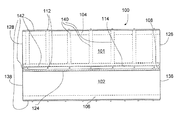
- FIG. 4 shows a side view of a covering layer arrangement 100 for a leaching protector according to one embodiment of the present invention.
- the leaching protector may be constructed in the same way as described in U.S. Pat. No. 5,799,948.
- the leaching protector of the present invention may be constructed in the same way as described in U.S. Pat. No. 5,799,948, except for the above described outlet connector 6 , the plastic resin wall outlet 7 , the anti-slide protector 8 , the discharge pipe 9 , the collection reservoir 10 and the lid 11 , described with reference to FIGS. 1-3 .
- the drain pipe 5 can be sealed with a lid in each end and a drainage outlet connector can be arranged to the drain pipe 5 .
- the outer free end of the drainage outlet connector can also be sealed with a lid.
- the drainage water collected in the drain pipe 5 can be discharged via the drainage outlet connector occasionally by removing the lid from the drainage outlet connector and connecting a discharging conduit to the end of the drainage outlet connector for emptying the water.
- the length of the drainage outlet connector approximately correspond the depth of the projectile-arresting material 3 such that the lid of the drainage outlet connector can be arranged just below the covering layer 1 . Consequently, the upper free end of the drainage outlet connector and the lid can be hidden and the covering layer 1 is only opened occasionally for emptying the drainage water.
- the covering layer arrangement 100 is preferably inclined with approximately 30° with respect to the ground level.
- the covering layer arrangement 100 comprises a security layer 101 covering a security area 110 and a firing layer 102 covering a firing area 120 .
- the probability of projectiles penetrating the security area 110 is low and the probability of projectiles penetrating the firing area 120 is high.
- the firing area 120 may be the area receiving more than 90-95% of all fired projectiles and the security area 110 may be the area which receives the rest of the fired projectiles.
- the security area 110 and the firing area 120 are best seen in FIG. 7 .
- FIG. 7 shows the covering layer arrangement 100 seen obliquely from above.
- the figure is intended to show the principles of how the covering layer arrangement can be constructed.
- the measures and the relative sizes of the different parts of the invention are not to scale. For sake of clarity some details are not illustrated in FIG. 7 .
- the security area 110 is shown with dots and the firing area 120 is shown with stripes.
- the security area 110 and the firing area 120 are overlapping each other in a joint area 114 .
- the security layer 101 is preferably positioned in the upper half of the covering layer arrangement 100 and the firing layer 102 is preferably positioned in the lower half of the covering layer arrangement 100 .
- the security layer 101 can e.g. have a height of 4-6 meters and a width of about 30-80 meters.
- the firing layer 102 can e.g. have a height of 7 meters and a width of about 30-80 meters. Both the security layer 101 and the firing layer 102 are supported by the projectile arresting material positioned under the layers (not illustrated).
- the security layer 101 will not be frequently penetrated and it is optimised to have a high tensile strength and a high durability. It can e.g. be made of reinforced rubber fabric of synthetic rubber or of other elastomers with reinforcing material adapted to resist tensile forces and tearing.
- the material of the security layer 101 can be made thinner than the material of the firing layer 102 since the number of penetrations is negligible in comparison with the firing layer 102 and the penetrations are more spread which minimises the risk of large holes.
- the security layer 101 can be made of several smaller pieces of fabrics which are bonded together to form one large fabric.
- the security layer 101 has an upper edge 122 , a lower edge 124 and two side edges 126 and 128 (see FIG. 5 ).
- the upper edge 122 of the security layer 101 is attached to a first support element 104 which extends along the upper edge of the security layer 101 .
- the security layer 101 can e.g. be attached to the first support element 104 by means of a clamping strip 142 and fastening devices 112 like e.g. screw joints.
- the firing layer 102 will be frequently penetrated and is optimised to exhibit a very small entry hole after penetration.
- the size of a penetration hole after penetration by a projectile may be between 0.0-0.5 mm depending on the size of the projectile. It is undesired to have large penetration holes, since this will permit rain water to enter into the leaching protector.
- the firing layer 102 can be a fabric made of crude rubber or other elastomers like e.g. polyurethane.
- the firing layer 102 can be made of several smaller pieces of fabrics which are bonded together to form one large fabric.
- the firing layer 102 has an upper edge 132 , a lower edge 134 and two side edges 136 and 138 (see FIG. 5 ).
- the lower edge 134 of the firing layer 102 is attached to a second support element 106 which extends along the lower edge 134 of the firing layer 101 .
- the firing layer 102 can e.g. be attached to the second support element 106 by means of a clamping strip 142 and fastening devices 112 like e.g. screw joints.
- the lower edge 124 of the security layer 101 and upper edge 132 of the firing layer 102 are overlapping each other in the joint area 114 and both layers are connected to a third support element 108 which extends along the lower edge of the security layer 101 and the upper edge of the firing layer 102 .
- the third support element can e.g. be a solid high density polyethylene support element. It can also be a tubular support element or a support element made of a penetrable material which does not cause any ricochets.
- the security layer 101 and the firing layer 102 are connected to the third support element 108 by means of clamping strips 142 and fastening devices 112 like e.g. screw joints.
- the side edges 126 and 128 of the security layer and the side edges 136 , 138 of the firing layer can e.g. be attached with clamping devices to the sides of the leaching protector.
- the security layer 101 has a relatively high tensile strength, it must withstand the forces from wind, snow and from the weight of the third support element 108 and the firing layer 102 as well as the tensile forces from the stretching of the layer and from the weight of entering wild animals or humans. Since it is difficult to combine the high tensile strength and elastic properties of the security layer 101 in order to minimise the penetration holes, support straps 140 are provided as illustrated in FIG. 5 .
- the support straps are arranged under the security layer 101 , so that the support straps 140 are covered by the security layer 101 .
- the upper end of the support straps are connected to the first support element 104 by means of fastening devices 112 .
- the lower end of the support straps 140 may be winded round the third support element 108 and are attached to the third support element 108 by means of fastening means 112 .
- the support straps 140 can have a width of e.g. 50 mm and they can be arranged with an interval of e.g. 1 meter. They can e.g. be woven and/or be made of polypropylene. They are preferably arranged to handle penetrations without breaking.
- the support straps 140 are adapted to carry the load of the third support element 108 and of the firing layer 102 alone during the mounting procedure. When the security layer 101 is mounted, the security layer 101 helps carrying the permanent load from e.g. snow and wind and also the stress from the firing layer.
- FIG. 5 shows schematically the covering layer arrangement 100 seen obliquely from above.
- the parts of the covering layer arrangement 100 which are hidden by the security layer 101 or by the firing layer 102 , are shown with dashed lines.
- the figure is intended to show the principles of how the covering layer arrangement can be constructed. The measures and the relative sizes of the different parts of the invention are not to scale.
- FIG. 6 shows the covering layer arrangement 100 , depicted in the same view as in FIG. 5 , but without the hidden parts.
- FIG. 7 shows the covering layer arrangement 100 , depicted in the same view as in FIG. 5 or 6 , but aims at illustrating the support area 110 and the firing area 120 .
Landscapes
- Engineering & Computer Science (AREA)
- General Engineering & Computer Science (AREA)
- Aiming, Guidance, Guns With A Light Source, Armor, Camouflage, And Targets (AREA)
- Emergency Lowering Means (AREA)
- Laminated Bodies (AREA)
Applications Claiming Priority (4)
| Application Number | Priority Date | Filing Date | Title |
|---|---|---|---|
| SE1250579A SE536516C2 (sv) | 2012-06-04 | 2012-06-04 | Urlakningsskydd för skjutbanor utomhus |
| SE1250579 | 2012-06-04 | ||
| SE1250579-8 | 2012-06-04 | ||
| PCT/SE2013/050638 WO2013184062A1 (en) | 2012-06-04 | 2013-05-31 | A leaching protector for outdoor shooting ranges |
Publications (2)
| Publication Number | Publication Date |
|---|---|
| US20150123347A1 US20150123347A1 (en) | 2015-05-07 |
| US10066909B2 true US10066909B2 (en) | 2018-09-04 |
Family
ID=49712338
Family Applications (1)
| Application Number | Title | Priority Date | Filing Date |
|---|---|---|---|
| US14/404,921 Active US10066909B2 (en) | 2012-06-04 | 2013-05-31 | Leaching protector for outdoor shooting ranges |
Country Status (11)
| Country | Link |
|---|---|
| US (1) | US10066909B2 (pl) |
| EP (1) | EP2856071B1 (pl) |
| JP (1) | JP2015522787A (pl) |
| CN (1) | CN104335004B (pl) |
| CA (1) | CA2870135C (pl) |
| DK (1) | DK2856071T3 (pl) |
| ES (1) | ES2680219T3 (pl) |
| PL (1) | PL2856071T3 (pl) |
| SE (1) | SE536516C2 (pl) |
| WO (1) | WO2013184062A1 (pl) |
| ZA (1) | ZA201408134B (pl) |
Families Citing this family (1)
| Publication number | Priority date | Publication date | Assignee | Title |
|---|---|---|---|---|
| SE1950454A1 (en) | 2019-04-11 | 2020-10-12 | Bap Pats S R O | A projectile arresting device and a method for preparing a projectile arresting device |
Citations (28)
| Publication number | Priority date | Publication date | Assignee | Title |
|---|---|---|---|---|
| US579948A (en) | 1897-04-06 | Automatic feeding-machine for sawing materials | ||
| JPS54183903U (pl) | 1978-06-19 | 1979-12-27 | ||
| JPS5845748U (ja) | 1981-09-19 | 1983-03-28 | 大日通商有限会社 | 連結シ−ト |
| JPS60135326U (ja) | 1984-12-24 | 1985-09-09 | 押川 真人 | 河川,貯水池等の法面における防護装置 |
| JPS6229610A (ja) | 1985-07-31 | 1987-02-07 | Ohbayashigumi Ltd | 土壌地盤面の防水工法 |
| JPS6312228A (ja) | 1986-07-02 | 1988-01-19 | 徳増 陽司 | 地表シ−ト張方法 |
| US4728109A (en) | 1984-06-01 | 1988-03-01 | Impresa Costruzioni Soc. FRA. SA. S.r.l. | Ballistic projectile-arrester, having a regeneration and/or recovery system for the impact material |
| US4741132A (en) * | 1981-06-17 | 1988-05-03 | Emblin Robert T | Multiple panel metal roofing system with overlapping panel edges |
| US4773653A (en) * | 1987-01-20 | 1988-09-27 | Linatex Corporation Of America | Cover for ballistic target assembly |
| US4786059A (en) * | 1985-12-20 | 1988-11-22 | A B C Appalti Bonifiche E Costruzioni Di Elio Floria & C.S.A.S. | Equipment with energy knocking-down septum for bullets, to be installed in shooting ranges |
| GB2242730A (en) | 1990-04-07 | 1991-10-09 | John Alan Vertanness | Bullet trap |
| JPH06101219A (ja) | 1992-09-18 | 1994-04-12 | Sansui Sangyo Kk | 遮水シート固定用接手シート |
| DE4317742A1 (de) | 1993-05-27 | 1994-12-01 | Spieth Ernst K Gmbh | Geschoßfang und Geschoßfangkasten für einen solchen Geschoßfang |
| DE4441559A1 (de) | 1994-11-22 | 1996-05-23 | Philipps Claus Hermann Dipl In | Geschoßfangsystem für Raumschießanlagen |
| JPH08136194A (ja) | 1994-11-04 | 1996-05-31 | Babcock Hitachi Kk | 停弾装置 |
| DE29521148U1 (de) * | 1995-03-08 | 1996-09-19 | Ernst K. Spieth Gmbh, 73730 Esslingen | Geschoßfang für Streubeschuß |
| US5799948A (en) | 1995-10-17 | 1998-09-01 | Moberg; Gerth | Leaching protector |
| US5848794A (en) * | 1991-01-18 | 1998-12-15 | Caswell International Corporation | Granulate backstop assembly |
| RU2213320C1 (ru) | 2002-06-24 | 2003-09-27 | Институт прикладной механики УрО РАН | Световая мишень |
| JP2003287399A (ja) | 2002-03-28 | 2003-10-10 | Sumitomo Electric Ind Ltd | 銃弾回収装置及びその方法 |
| US6715761B1 (en) | 2003-03-14 | 2004-04-06 | Gerth Moberg | Apparatus for shooting ranges |
| WO2004068060A1 (en) | 2003-01-31 | 2004-08-12 | Svenska Pistolskytteförbundet | A method of preventing uncontrolled dispersal of degraded metallic products from a bullet back stop at a shooting-range and a bullet back stop for performing the method |
| US20040239037A1 (en) | 2002-12-02 | 2004-12-02 | Tom Joe G. | Modular bullet trap cover |
| DE202005002672U1 (de) | 2005-02-19 | 2005-05-19 | Gerd Bücheler Schießanlagen und Schießstandbau | Abbremsvorrichtung |
| JP2005188894A (ja) | 2003-12-26 | 2005-07-14 | Babcock Hitachi Kk | 停弾装置 |
| US7185892B2 (en) * | 2003-01-20 | 2007-03-06 | Gerth Moberg | Apparatus for shooting ranges |
| US20110233869A1 (en) * | 2010-03-25 | 2011-09-29 | John Ernest M | Ballistic paneling for bullet traps |
| US20110233870A1 (en) | 2008-12-24 | 2011-09-29 | In Gyu Oh | Empty shell recovery device |
-
2012
- 2012-06-04 SE SE1250579A patent/SE536516C2/sv unknown
-
2013
- 2013-05-31 PL PL13800626T patent/PL2856071T3/pl unknown
- 2013-05-31 EP EP13800626.7A patent/EP2856071B1/en active Active
- 2013-05-31 CA CA2870135A patent/CA2870135C/en active Active
- 2013-05-31 DK DK13800626.7T patent/DK2856071T3/en active
- 2013-05-31 US US14/404,921 patent/US10066909B2/en active Active
- 2013-05-31 JP JP2015515982A patent/JP2015522787A/ja active Pending
- 2013-05-31 CN CN201380025148.4A patent/CN104335004B/zh active Active
- 2013-05-31 ES ES13800626.7T patent/ES2680219T3/es active Active
- 2013-05-31 WO PCT/SE2013/050638 patent/WO2013184062A1/en not_active Ceased
-
2014
- 2014-11-06 ZA ZA2014/08134A patent/ZA201408134B/en unknown
Patent Citations (29)
| Publication number | Priority date | Publication date | Assignee | Title |
|---|---|---|---|---|
| US579948A (en) | 1897-04-06 | Automatic feeding-machine for sawing materials | ||
| JPS54183903U (pl) | 1978-06-19 | 1979-12-27 | ||
| US4741132A (en) * | 1981-06-17 | 1988-05-03 | Emblin Robert T | Multiple panel metal roofing system with overlapping panel edges |
| JPS5845748U (ja) | 1981-09-19 | 1983-03-28 | 大日通商有限会社 | 連結シ−ト |
| US4728109A (en) | 1984-06-01 | 1988-03-01 | Impresa Costruzioni Soc. FRA. SA. S.r.l. | Ballistic projectile-arrester, having a regeneration and/or recovery system for the impact material |
| JPS60135326U (ja) | 1984-12-24 | 1985-09-09 | 押川 真人 | 河川,貯水池等の法面における防護装置 |
| JPS6229610A (ja) | 1985-07-31 | 1987-02-07 | Ohbayashigumi Ltd | 土壌地盤面の防水工法 |
| US4786059A (en) * | 1985-12-20 | 1988-11-22 | A B C Appalti Bonifiche E Costruzioni Di Elio Floria & C.S.A.S. | Equipment with energy knocking-down septum for bullets, to be installed in shooting ranges |
| JPS6312228A (ja) | 1986-07-02 | 1988-01-19 | 徳増 陽司 | 地表シ−ト張方法 |
| US4773653A (en) * | 1987-01-20 | 1988-09-27 | Linatex Corporation Of America | Cover for ballistic target assembly |
| GB2242730A (en) | 1990-04-07 | 1991-10-09 | John Alan Vertanness | Bullet trap |
| US5848794A (en) * | 1991-01-18 | 1998-12-15 | Caswell International Corporation | Granulate backstop assembly |
| JPH06101219A (ja) | 1992-09-18 | 1994-04-12 | Sansui Sangyo Kk | 遮水シート固定用接手シート |
| DE4317742A1 (de) | 1993-05-27 | 1994-12-01 | Spieth Ernst K Gmbh | Geschoßfang und Geschoßfangkasten für einen solchen Geschoßfang |
| JPH08136194A (ja) | 1994-11-04 | 1996-05-31 | Babcock Hitachi Kk | 停弾装置 |
| DE4441559A1 (de) | 1994-11-22 | 1996-05-23 | Philipps Claus Hermann Dipl In | Geschoßfangsystem für Raumschießanlagen |
| DE29521148U1 (de) * | 1995-03-08 | 1996-09-19 | Ernst K. Spieth Gmbh, 73730 Esslingen | Geschoßfang für Streubeschuß |
| US5799948A (en) | 1995-10-17 | 1998-09-01 | Moberg; Gerth | Leaching protector |
| JP2003287399A (ja) | 2002-03-28 | 2003-10-10 | Sumitomo Electric Ind Ltd | 銃弾回収装置及びその方法 |
| RU2213320C1 (ru) | 2002-06-24 | 2003-09-27 | Институт прикладной механики УрО РАН | Световая мишень |
| US7134664B2 (en) | 2002-12-02 | 2006-11-14 | The United States Of America As Represented By The Secretary Of The Army | Modular bullet trap cover |
| US20040239037A1 (en) | 2002-12-02 | 2004-12-02 | Tom Joe G. | Modular bullet trap cover |
| US7185892B2 (en) * | 2003-01-20 | 2007-03-06 | Gerth Moberg | Apparatus for shooting ranges |
| WO2004068060A1 (en) | 2003-01-31 | 2004-08-12 | Svenska Pistolskytteförbundet | A method of preventing uncontrolled dispersal of degraded metallic products from a bullet back stop at a shooting-range and a bullet back stop for performing the method |
| US6715761B1 (en) | 2003-03-14 | 2004-04-06 | Gerth Moberg | Apparatus for shooting ranges |
| JP2005188894A (ja) | 2003-12-26 | 2005-07-14 | Babcock Hitachi Kk | 停弾装置 |
| DE202005002672U1 (de) | 2005-02-19 | 2005-05-19 | Gerd Bücheler Schießanlagen und Schießstandbau | Abbremsvorrichtung |
| US20110233870A1 (en) | 2008-12-24 | 2011-09-29 | In Gyu Oh | Empty shell recovery device |
| US20110233869A1 (en) * | 2010-03-25 | 2011-09-29 | John Ernest M | Ballistic paneling for bullet traps |
Non-Patent Citations (8)
| Title |
|---|
| English machine translation of DE 29521148 U1, Sep. 1996, Spieth. * |
| English machine translation of JP 2005188894 A. * |
| Extended European Search Report dated Oct. 15, 2015 in corresponding EP Application No. 13800626.7. |
| James Walker, Elastomer Engineering Guide, p. 8, (c) 2012. * |
| LINATEX Rubber Products, Linard 60, Weir Minerals, http://www.weirminerals.com/products_services/rubber/the_linard_range/linard_60.aspx, captured Jan. 8, 2011. * |
| Office Action dated Jul. 2, 2015 in corresponding CN Application No. 201380025148.4. |
| Office Action dated Mar. 28, 2017 in corresponding RU application No. 2014152021/28(083230). |
| Office Action issued dated Mar. 6, 2017 in corresponding JP Application No. 2015-515982. |
Also Published As
| Publication number | Publication date |
|---|---|
| EP2856071A1 (en) | 2015-04-08 |
| CA2870135C (en) | 2020-12-15 |
| PL2856071T3 (pl) | 2018-10-31 |
| DK2856071T3 (en) | 2018-08-06 |
| SE536516C2 (sv) | 2014-01-21 |
| CN104335004B (zh) | 2016-09-28 |
| US20150123347A1 (en) | 2015-05-07 |
| WO2013184062A1 (en) | 2013-12-12 |
| ZA201408134B (en) | 2015-12-23 |
| CA2870135A1 (en) | 2013-12-12 |
| JP2015522787A (ja) | 2015-08-06 |
| ES2680219T3 (es) | 2018-09-05 |
| EP2856071B1 (en) | 2018-05-23 |
| SE1250579A1 (sv) | 2013-12-05 |
| CN104335004A (zh) | 2015-02-04 |
| EP2856071A4 (en) | 2015-11-18 |
Similar Documents
| Publication | Publication Date | Title |
|---|---|---|
| US10053867B2 (en) | Apparatus for diverting water | |
| RU2525771C2 (ru) | Устройство защиты, по меньшей мере, одного трубопровода, проложенного на дне водного бассейна, и соответствующая система транспортировки текучей среды | |
| US10066909B2 (en) | Leaching protector for outdoor shooting ranges | |
| US5799948A (en) | Leaching protector | |
| US9726464B2 (en) | Projectile arresting module and projectile arresting arrangement | |
| US20140294507A1 (en) | Aggregate replacement | |
| CN104662231A (zh) | 表面排水系统 | |
| EP1588117B1 (en) | Apparatus for shooting ranges | |
| US9733050B2 (en) | Projectile arresting device and projectile arresting arrangement | |
| ES2268249T3 (es) | Disposicion de recogida de perdigones. | |
| US20200326164A1 (en) | Projectile arresting device and a method for preparing a projectile arresting device | |
| JP5271184B2 (ja) | 軒先用雪止め装置 | |
| AU2006225265B2 (en) | Apparatus for use in collecting rainwater | |
| US8256466B2 (en) | Thermal insulted sewer water treatment environment | |
| JP2007010302A (ja) | 射撃場鉛弾環境汚染防止装置 | |
| DE29913841U1 (de) | Schießsportanlage |
Legal Events
| Date | Code | Title | Description |
|---|---|---|---|
| AS | Assignment |
Owner name: STAPP INTERNATIONAL AB, SWEDEN Free format text: ASSIGNMENT OF ASSIGNORS INTEREST;ASSIGNOR:MOBERG, GERTH;REEL/FRAME:046294/0945 Effective date: 20141013 |
|
| STCF | Information on status: patent grant |
Free format text: PATENTED CASE |
|
| MAFP | Maintenance fee payment |
Free format text: PAYMENT OF MAINTENANCE FEE, 4TH YR, SMALL ENTITY (ORIGINAL EVENT CODE: M2551); ENTITY STATUS OF PATENT OWNER: SMALL ENTITY Year of fee payment: 4 |