RU2336373C2 - Device for textile fibers rippling - Google Patents
Device for textile fibers rippling Download PDFInfo
- Publication number
- RU2336373C2 RU2336373C2 RU2006141080/12A RU2006141080A RU2336373C2 RU 2336373 C2 RU2336373 C2 RU 2336373C2 RU 2006141080/12 A RU2006141080/12 A RU 2006141080/12A RU 2006141080 A RU2006141080 A RU 2006141080A RU 2336373 C2 RU2336373 C2 RU 2336373C2
- Authority
- RU
- Russia
- Prior art keywords
- fibers
- ridges
- needles
- hatchels
- movement
- Prior art date
Links
- 239000000835 fiber Substances 0.000 title claims abstract description 47
- 239000004753 textile Substances 0.000 title claims abstract description 6
- 238000006748 scratching Methods 0.000 claims description 6
- 230000002393 scratching effect Effects 0.000 claims description 6
- 238000000034 method Methods 0.000 abstract description 12
- 238000004140 cleaning Methods 0.000 abstract description 4
- 230000000694 effects Effects 0.000 abstract description 2
- 239000000126 substance Substances 0.000 abstract description 2
- 238000009960 carding Methods 0.000 description 14
- 239000002657 fibrous material Substances 0.000 description 6
- 238000009987 spinning Methods 0.000 description 4
- 238000005452 bending Methods 0.000 description 3
- 239000012535 impurity Substances 0.000 description 3
- 241000208202 Linaceae Species 0.000 description 2
- 235000004431 Linum usitatissimum Nutrition 0.000 description 2
- 210000001520 comb Anatomy 0.000 description 2
- 239000000463 material Substances 0.000 description 2
- 230000000737 periodic effect Effects 0.000 description 2
- 229920000742 Cotton Polymers 0.000 description 1
- 241000196324 Embryophyta Species 0.000 description 1
- 244000309464 bull Species 0.000 description 1
- 208000018747 cerebellar ataxia with neuropathy and bilateral vestibular areflexia syndrome Diseases 0.000 description 1
- 238000004519 manufacturing process Methods 0.000 description 1
- 230000035515 penetration Effects 0.000 description 1
- 238000002360 preparation method Methods 0.000 description 1
- 238000005096 rolling process Methods 0.000 description 1
- 210000002268 wool Anatomy 0.000 description 1
Images
Landscapes
- Preliminary Treatment Of Fibers (AREA)
- Treatment Of Fiber Materials (AREA)
Abstract
Description
Изобретение относится к области текстильной промышленности, в частности, для осуществления процесса чесания волокон при их подготовке к прядению.The invention relates to the field of textile industry, in particular, for the implementation of the process of carding fibers in their preparation for spinning.
В настоящее время известны различные устройства для чесания текстильных волокон. Известно, например, устройство для ручного чесания [1, с.18] льняных волокон. Устройство состоит из неподвижно закрепленного гребня, образованного из одного или нескольких рядов параллельных игл, закрепленных перпендикулярно основанию. Горсти волокон вручную насаживаются на гребень сверху и протаскиваются через него в горизонтальном направлении.Currently, various devices for carding textile fibers are known. It is known, for example, a device for manual carding [1, p. 18] of flax fiber. The device consists of a fixed ridge formed from one or more rows of parallel needles fixed perpendicular to the base. Handfuls of fibers are manually mounted on the comb from above and dragged through it in the horizontal direction.
Известно устройство для непрерывного чесания волокон в потоке при помощи кардных поверхностей - кардочесание [2, с.88]. При этом используются валики и другие рабочие органы, оснащенные игольчатой гарнитурой. При этом отдельные волокна и их комплексы подвергаются воздействию игл гарнитуры при непрерывном движении. Игольчатая гарнитура рабочих органов машин, работающих по данному способу чесания, представляет собой планки с закрепленными на них рядами игл, имеющими наклон по ходу или навстречу движения продукта. В отечественной промышленности применяются такие машины типов Ч-600-Л, Ч-460-Л, ЧМД и др.A device for continuous carding of fibers in a stream using carded surfaces - carding [2, p. 88]. In this case, rollers and other working bodies equipped with a needle headset are used. In this case, individual fibers and their complexes are exposed to the needles of the headset with continuous movement. The needle headset of the working bodies of machines working according to this method of carding is a plank with rows of needles fixed to them, tilted along or in the direction of movement of the product. In the domestic industry, such machines of the types Ch-600-L, Ch-460-L, ChMD, etc. are used.
Известно устройство для чесания волокон в потоке, знакомое под названием «гребнечесальная машина». При этом осуществляются периодические действия по чесанию отдельных порций непрерывного продукта (ленты) - осуществляется отдельно прочесывание гребнями передних и задних концов порций волокнистого материала, отделяемых из общего потока волокон, с последующим их сложением друг с другом со сдвигом. В льняной промышленности используются такие машины типов ГД-485-Л, ГК-485-Л, аналогичные по принципу действия машины используются в хлопчатобумажной и шерстяной промышленности. Непосредственно устройство для такого чесания состоит из набора гребней с иглами, расположенными параллельно друг другу и совершающими периодические движения, приводящие к проникновению игл гребней вглубь волокнистого материала и последующему перемещению их относительно волокон. При необходимости иглы могут иметь наклон по ходу или навстречу движения продукта.A device for combing fibers in a stream, known under the name "combing machine." At the same time, periodic actions are taken to scratch individual portions of a continuous product (tape) - combing the combs of the front and rear ends of the portions of fibrous material separately from the total fiber stream, combining them with a shift, is carried out separately. In the linen industry, such machines as GD-485-L, GK-485-L are used, similar machines according to the principle of operation are used in the cotton and wool industries. Directly, the device for such scratching consists of a set of ridges with needles parallel to each other and making periodic movements, leading to the penetration of the ridge needles deep into the fibrous material and their subsequent movement relative to the fibers. If necessary, the needles can be tilted along or towards the movement of the product.
Основным рабочим органом для чесания волокон является гребень. Конструкция гребня (в общем случае) предполагает наличие некоторого основания - «планки» с закрепленными в ней параллельно друг другу иглами. Так согласно [3] (прототип) гребенная планка чесальной машины содержит корпус, в пазу которого закреплены иглы, два кронштейна с выемкой, в которой установлен сухарь. Корпус соединен посредством штифтов с кронштейнами. К крепежным кронштейнам жестко прикреплены концы плоской пружины, изогнутой по дуге в средней части и расположенной в дополнительном пазу корпуса по всей его длине, средняя часть плоской пружины опирается на дно паза. Кронштейны жестко крепятся посредством винтов к гребенным полотнам. Зазор между корпусом и каждым кронштейном загерметизирован муфтой. Расчесываемый волокнистый материал зажат в неподвижной колодке.The main working body for carding fibers is a comb. The crest design (in the general case) presupposes the presence of some base — a “bar” with needles fixed in it parallel to each other. So according to [3] (prototype), the combed strip of the carding machine contains a housing in which grooves are attached needles, two brackets with a recess in which the cracker is installed. The housing is connected via pins to the brackets. The ends of the flat spring curved in an arc in the middle part and located in the additional groove of the body along its entire length are rigidly attached to the mounting brackets, the middle part of the flat spring rests on the bottom of the groove. The brackets are rigidly fixed with screws to the combed web. The gap between the housing and each bracket is sealed with a sleeve. The combed fibrous material is clamped in a fixed block.
В результате работы этого устройства волокна в процессе чесания остаются всегда параллельными друг другу, а иглы гребней их «проглаживают» в продольном направлении. Такой процесс чесания не способствует удалению сорных примесей, особенно присушистой костры в лубяных волокнах. Одновременно с этим следует отметить, что и сам процесс чесания, призванный дробить лубяные волокна в продольном направлении, также не является достаточно напряженным, чтобы считать его удовлетворительным.As a result of the operation of this device, the fibers in the process of carding always remain parallel to each other, and the ridges needles are “ironed” in the longitudinal direction. Such a carding process does not contribute to the removal of weedy impurities, especially from the arid bonfire in bast fibers. At the same time, it should be noted that the scratching process itself, designed to split bast fibers in the longitudinal direction, is also not stressful enough to be considered satisfactory.
Основным недостатком данного устройства для чесания волокон является слабая очищающая способность от сорных примесей и низкая степень дробления лубяных волокон в продольном направлении.The main disadvantage of this device for scratching fibers is the poor cleaning ability of weed impurities and a low degree of crushing of bast fibers in the longitudinal direction.
Техническая задача: интенсификация очистки волокон от сорных примесей и, в частности, от костры; интенсификация процесса дробления комплексов технических лубяных волокон в продольном направлении за счет реализации скользящего изгиба волокон.The technical problem: the intensification of the cleaning of fibers from impurities and, in particular, from the fire; intensification of the process of crushing of complexes of technical bast fibers in the longitudinal direction due to the implementation of the rolling bending of the fibers.
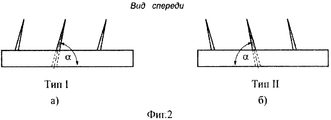
На фиг.1 изображено устройство, состоящее из совокупности движущихся относительно волокон чередующихся друг с другом гребней двух видов (фиг.2).In Fig.1 shows a device consisting of a set of moving relative to the fibers alternating with each other crests of two types (Fig.2).
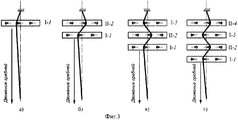
На фиг.3 представлено последовательное воздействие гребней разных типов на одиночное волокно расчесываемого волокнистого материала, приводящее к проявлению скользящего изгиба.Figure 3 presents the sequential effect of ridges of different types on a single fiber combed fibrous material, leading to the manifestation of a sliding bend.
Для обеспечения скользящего изгиба волокон в процессе чесания предлагается устройство, содержащее совокупность гребней с параллельными друг другу иглами, выполненными с возможностью перемещения, при этом гребни имеют два вида, а иглы в соседних гребнях имеют противоположный наклон к основанию менее 90 градусов в направлениях, поперечных направлению движения гребней относительно волокон. Эти гребни можно условно назвать гребнями типов I или II (фиг.2).To ensure a sliding bending of the fibers during the scratching process, a device is proposed comprising a set of ridges with needles parallel to each other, made with the possibility of movement, while the ridges have two types, and the needles in adjacent ridges have an opposite inclination to the base of less than 90 degrees in directions transverse movement of ridges relative to the fibers. These ridges can be arbitrarily called ridges of types I or II (figure 2).
Работа устройства происходит следующим образом: волокна, подвергаемые чесанию в форме горсти, закреплены некоторым сечением на неподвижной опоре.The operation of the device is as follows: fibers subjected to carding in the form of a handful are fixed by some section on a fixed support.
Гребни последовательно друг за другом подводятся к волокнам в зоне, близкой к точке зажима, и вводятся своими иглами внутрь.The ridges are successively connected one after another to the fibers in an area close to the clamping point, and inserted with their needles inward.
При введении наклонных игл гребней в расчесываемый материал волокна, касающиеся игл, скользят по их поверхностям и приобретают зигзагообразную форму (фиг.1). В исходном положении (фиг.1а) волокно a-d находится в некотором натянутом состоянии, а гребни I и II находятся вне волокнистого материала и лишь касаются волокна в точках b и с соответственно. При введении игл гребней внутрь волокнистого материала на некоторую величину δ (фиг.1б) волокно будет скользить по боковым поверхностям игл и за счет их наклона изменит свою конфигурацию. В новом положении точками касаний будут точки b1 и с1 - волокно примет зигзагообразную форму a-b1-c1-d.When introducing the inclined needles of the ridges into the combed material, the fibers touching the needles slide along their surfaces and acquire a zigzag shape (Fig. 1). In the initial position (figa), the fiber a-d is in some tense state, and the ridges I and II are outside the fibrous material and only touch the fiber at points b and c, respectively. With the introduction of the crest needles into the fibrous material by a certain value δ (Fig. 1b), the fiber will slide along the side surfaces of the needles and due to their inclination will change its configuration. In the new position, the touch points will be points b1 and c1 - the fiber will take a zigzag shape a-b1-c1-d.
После ввода игл в горсть гребни движутся относительно волокон в направлении от точки зажима волокон к их концам, т.е. осуществляется собственно процесс чесания.After inserting the needles into the handful, the ridges move relative to the fibers in the direction from the point of clamping of the fibers to their ends, i.e. the actual carding process is carried out.
Для удобства описания работу устройства рассмотрим на примере одиночного волокна. Допустим, на волокно воздействует первый гребень типа I (фиг.3а), например, с "правым" наклоном игл (в обозначении гребней первый символ обозначает тип гребня - I, второй - его порядковый номер - 1, т.е. гребень I-1). При введении игл этого гребня в горсть одиночное волокно отклоняется влево (по чертежу) под действием наклонной иглы, и затем гребень движется в направлении движения гребней. При движении следующего - второго гребня II-2 с "левым" наклоном игл волокно отклоняется вправо (фиг.3б). Затем уже третий гребень I-3 имеет тип I (фиг.3в), отклоняет волокно соответственно влево, гребень II-4 (фиг.3г) - вправо и т.д. Таким образом, происходит поочередное отклонение волокна то влево, то вправо от среднего положения. С учетом того, что гребни непрерывно движутся вдоль волокон, реализуется принцип «скользящего изгиба», что способствует улучшению процесса чесания и лучшей очистке волокон от сорных примесей.For convenience of description, we consider the operation of the device using an example of a single fiber. Suppose that the first ridge of type I acts on the fiber (Fig. 3a), for example, with the “right” tilt of the needles (in the designation of the ridges, the first symbol denotes the type of ridge — I, the second - its serial number is 1, i.e. one). When the needles of this ridge are introduced into a handful, a single fiber is deflected to the left (according to the drawing) under the action of an inclined needle, and then the ridge moves in the direction of movement of the ridges. When moving the next - second ridge II-2 with a "left" tilt of the needles, the fiber deviates to the right (Fig.3b). Then, already the third ridge I-3 has type I (Fig.3c), deflects the fiber, respectively, to the left, ridge II-4 (Fig.3d) - to the right, etc. Thus, there is a sequential deviation of the fiber to the left, then to the right from the middle position. Given that the ridges are continuously moving along the fibers, the principle of “sliding bending” is implemented, which helps to improve the process of scratching and better cleaning of fibers from debris.
В реальных машинах процесс чесания осуществляется бесконечным множеством гребней, следующих друг за другом. На практике этот процесс реализуется в виде движения фиксированного набора гребней, закрепленных на бесконечных ремнях, образующих гребенные полотна, или на валах и двигающихся циклически. Как правило, гребенные полотна располагаются с двух сторон от обрабатываемого материала.In real machines, the carding process is carried out by an infinite number of ridges, following each other. In practice, this process is implemented in the form of movement of a fixed set of ridges, mounted on endless belts forming combed web, or on shafts and moving cyclically. As a rule, combed canvases are located on both sides of the processed material.
Источники информацииInformation sources
1. Прядение лубяных волокон: том 1: Прядение льна: часть 1: Учебник для вузов / П.А.Финягин, Н.И.Щербаков. - М. - Л.: Гизлегпром, 1940. - 360 с.1. Spinning of bast fibers: Volume 1: Flax spinning: Part 1: Textbook for high schools / P.A. Finyagin, N.I. Shcherbakov. - M. - L .: Gizlegprom, 1940 .-- 360 p.
2. Прядение лубяных и химических волокон и производство крученых изделий: Учебник для вузов / В.Г.Комаров, Л.Н.Гинзбург, В.А.Забелин, Н.С.Кульков, Л.Г.Меламед. - М.: Легкая индустрия, 1980. - 494 с., ил.2. Spinning of bast and chemical fibers and the production of twisted products: Textbook for universities / V. G. Komarov, L. N. Ginzburg, V. A. Zabelin, N. S. Kulkov, L. G. Melamed. - M.: Light Industry, 1980. - 494 p., Ill.
3. Пат. SU 1359355 А1: Гребенная планка чесальной машины / В.Д.Карезо, В.К.Герасимов, Н.И.Потапенков; заявл. 24.03.86; опубл. 15.12.87; Бюл. №46 (Прототип).3. Pat. SU 1359355 A1: Combs of the carding machine / V.D. Kareso, V.K. Gerasimov, N.I. Potapenkov; declared 03/24/86; publ. 12/15/87; Bull. No. 46 (Prototype).
Claims (1)
Priority Applications (1)
| Application Number | Priority Date | Filing Date | Title |
|---|---|---|---|
| RU2006141080/12A RU2336373C2 (en) | 2006-11-20 | 2006-11-20 | Device for textile fibers rippling |
Applications Claiming Priority (1)
| Application Number | Priority Date | Filing Date | Title |
|---|---|---|---|
| RU2006141080/12A RU2336373C2 (en) | 2006-11-20 | 2006-11-20 | Device for textile fibers rippling |
Publications (2)
| Publication Number | Publication Date |
|---|---|
| RU2006141080A RU2006141080A (en) | 2008-05-27 |
| RU2336373C2 true RU2336373C2 (en) | 2008-10-20 |
Family
ID=39586253
Family Applications (1)
| Application Number | Title | Priority Date | Filing Date |
|---|---|---|---|
| RU2006141080/12A RU2336373C2 (en) | 2006-11-20 | 2006-11-20 | Device for textile fibers rippling |
Country Status (1)
| Country | Link |
|---|---|
| RU (1) | RU2336373C2 (en) |
Citations (4)
| Publication number | Priority date | Publication date | Assignee | Title |
|---|---|---|---|---|
| GB1425696A (en) * | 1973-08-14 | 1976-02-18 | South African Inventions | Textile fibre combing |
| FR2287535A1 (en) * | 1974-09-25 | 1976-05-07 | Nitto Shoji Kk | TEXTILE COMBING MACHINE |
| SU1449015A3 (en) * | 1985-11-05 | 1988-12-30 | Джеймс Макки Энд Санз Лимитед (Фирма) | Carding arrangement |
| RU2117082C1 (en) * | 1996-09-17 | 1998-08-10 | Акционерное общество открытого типа "Костромское специальное конструкторское бюро текстильных машин" | Method and apparatus for producing elongate bast fiber |
-
2006
- 2006-11-20 RU RU2006141080/12A patent/RU2336373C2/en not_active IP Right Cessation
Patent Citations (4)
| Publication number | Priority date | Publication date | Assignee | Title |
|---|---|---|---|---|
| GB1425696A (en) * | 1973-08-14 | 1976-02-18 | South African Inventions | Textile fibre combing |
| FR2287535A1 (en) * | 1974-09-25 | 1976-05-07 | Nitto Shoji Kk | TEXTILE COMBING MACHINE |
| SU1449015A3 (en) * | 1985-11-05 | 1988-12-30 | Джеймс Макки Энд Санз Лимитед (Фирма) | Carding arrangement |
| RU2117082C1 (en) * | 1996-09-17 | 1998-08-10 | Акционерное общество открытого типа "Костромское специальное конструкторское бюро текстильных машин" | Method and apparatus for producing elongate bast fiber |
Non-Patent Citations (1)
| Title |
|---|
| КОМАРОВ В.Г. СИМОНОВ В.Б. СТАРКОВ И.М. Льночесальные машины. - М.: Легкая индустрия 1980, с.17-25. * |
Also Published As
| Publication number | Publication date |
|---|---|
| RU2006141080A (en) | 2008-05-27 |
Similar Documents
| Publication | Publication Date | Title |
|---|---|---|
| FR2857677B1 (en) | DEVICE FOR NEEDLING A FIBER MATTRESS | |
| CN102733012A (en) | Saw-tooth clothing | |
| CN101012578A (en) | Equipment for cleaning fibrous materials on flat cards, roller cards, etc. | |
| US6185789B1 (en) | Metallic clothing for carding elements | |
| US3470586A (en) | Textile carding | |
| ES458452A1 (en) | Carding engines | |
| US4090276A (en) | Textile carding | |
| CN113046866A (en) | Roller type pure cotton carding machine | |
| US3474502A (en) | Process of and apparatus for drawing batting | |
| TWI806845B (en) | Carding machine with card flat | |
| RU2058446C1 (en) | Carding machine | |
| US922448A (en) | Card-clothing. | |
| US2908046A (en) | Carding engine | |
| CN1100898C (en) | Strip of needles of textile machine | |
| RU2179602C1 (en) | Drawing apparatus | |
| DE50004940D1 (en) | top comb | |
| US1953386A (en) | Combination card clothing and flat wire carding machine | |
| RU2190048C1 (en) | Method for hackling of flax fiber yarn on flax hackling machine and flax hackling machine | |
| US3529326A (en) | Means for stripping textile carding flats | |
| US539691A (en) | Seryais lebe and jonas haley | |
| US3550214A (en) | Method of fiber transfer in carding process | |
| CN220665530U (en) | Comb needle material belt | |
| US1328535A (en) | Machine for dressing silk | |
| CN105051273B (en) | For carding machine or the non-woven guide rail of roller and clearer card | |
| US2325147A (en) | Fiber producing apparatus |
Legal Events
| Date | Code | Title | Description |
|---|---|---|---|
| MM4A | The patent is invalid due to non-payment of fees |
Effective date: 20081121 |